Vol. 71, Issue 10
N o v e mb e r 4 - N o v e mb e r 11 , 2 0 2 5
Est. 1981
THE PAISANO
Independent Student Newspaper for the University of Texas at San Antonio Community
@ThePaisano
@paisanomedia
@paisanosports
@paisanosports
/paisano-online.com
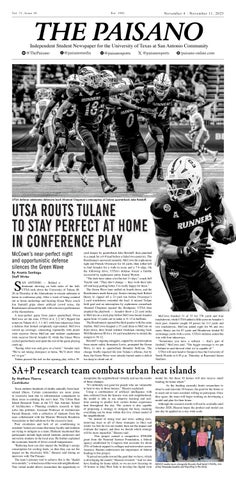
UTSA defense celebrates defensive back Ahamad Chapman’s interception of Tulane quarterback Jake Retzlaff.
UTSA routs Tulane to stay perfect at home in conference play
McCown’s near-perfect night and opportunistic defense silences the Green Wave
By Aramis Santiago Staff Writer
S
AN ANTONIO — Behind a dominant showing on both sides of the ball, UTSA took down the University of Tulane 4826 on Thursday at the Alamodome to remain unbeaten at home in conference play. After a week of being counted out as home underdogs and hearing Green Wave coach Jon Sumrall gripe about artificial crowd noise, the Roadrunners silenced the talk with a decisive performance at the Alamodome. A near-perfect game from junior quarterback Owen McCown set the tone. UTSA (4-4, 2-2 AC) flipped the script on Tulane (6-2, 3-1 AC) with four takeaways from a defense that looked completely rejuvenated. McCown carved up coverage, connecting repeatedly with junior wide receiver Devin McCuin and redshirt sophomore wide receiver David Amador II, while the Green Wave cycled quarterbacks and spent the rest of the game playing catch-up. “Seeing what was said gave us a boost,” Amador said. “We’re not taking disrespect at home. We’ll show what we’ve got.” Tulane pierced the turf on the opening play with a 39-
yard keeper by quarterback Jake Retzlaff, then punched in a sneak for a 6-0 lead before a failed two-point try. The Roadrunners answered instantly. McCown hit sophomore tight end Patrick Overmyer for 44 yards, then rolled left to find Amador for a walk-in score and a 7-6 edge. On the following drive, UTSA’s defense forced a fumble recovered by sophomore safety Jimmy Wyrick. “The kids have taken a lot the last 11 days,” coach Jeff Traylor said. “They don’t change — they work their tails off and keep getting better. I’m really happy for them.” The Green Wave later stalled on fourth down, and the Roadrunners made them pay. Senior running back Robert Henry Jr. ripped off a 23-yard run before Overmyer’s 2-yard touchdown extended the lead. A missed Tulane field goal and an interception by sophomore cornerback Ahamad Chapman opened the floodgates. UTSA then emptied the playbook — Amador threw a 21-yard strike to McCuin on a trick play before McCown found Amador again from 14 yards out to make it 31-12 at halftime. The Roadrunners opened the third quarter with the same rhythm. McCown dropped a 35-yard dime to McCuin on third down, then found redshirt freshman running back Will Henderson III for a 16-yard touchdown to stretch the margin to 38-12. Retzlaff’s ongoing struggles, capped by an interception from senior safety Jermarius Lewis, prompted the Green Wave to turn to quarterback Brendan Sullivan. The change briefly injected life into Tulane’s offense, but by then, the Green Wave were already buried under a deficit too deep to climb out of.
McCown finished 31 of 33 for 370 yards and four touchdowns, while UTSA added a fifth score on Amador’s trick pass. Amador caught 10 passes for 113 yards and two touchdowns, McCuin added eight for 96 and two more, Henry ran for 87 yards and Henderson totaled 82 scrimmage yards with a score. UTSA’s defense sealed the win with four takeaways. “Sometimes you have a setback — that’s part of football,” McCown said. “The bigger message is we put it behind us and showed what we’re capable of.” UTSA will next head to Tampa to face the University of South Florida at 6:30 p.m. Thursday at Raymond James Stadium.
SA+P research team combats urban heat islands
By Matthew Ybarra Contributor
Texas endures hundreds of deaths annually from heatrelated illness. Certain communities are more prone to excessive heat due to infrastructure components in these areas re-emitting the sun’s heat. The Urban Heat Island Research Team at the UT San Antonio School of Architecture + Planning conducts research to help solve this problem. Assistant Professor of Architecture Farzad Hasemi, with a collective of students from the team collaborated with the Historic Westside Residents Association to find solutions for the excessive heat. Poor circulation and lack of air conditioning in residents’ homes are issues that many faculty and students are trying to mitigate as a team. Hashemi mentioned that participants include high school students, professors and university students in the local area. He further explained the economic benefit of lower overall temperatures. “Reducing heat can also impact the building‘s energy consumption for cooling loads, so then they can see the impact on the electricity bills,” Hasemi said during an interview with The Paisano. The team’s primary tool to achieve this is the “digital twin models,” a virtual scan of the west side neighborhood. This virtual model allows researchers the opportunity to
manipulate the neighborhood virtually and see the results of these changes. “It’s definitely not good for people who are vulnerable to heat to stay in those houses,” Hasemi explained. Using a combination of artificial intelligence with data collected from the historic west side neighborhood, the model is able to use adaptive learning and realtime sensing to predict how certain homes experience heat throughout the day. The system is also capable of proposing a strategy to mitigate the heat, meaning everything can be done within this live virtual model of the neighborhood. “So instead of doing trial and error, adding trees, removing trees or all of those strategies in [the] real world, we first do it in our model, then see the impact and evaluate the impact, and then we decide which strategy will be more impactful,” Hasemi said. This project earned a competitive $700,000 grant from the National Science Foundation, a federal agency established by Congress that accounts for about 25% of federal support to colleges and universities across America. Hasemi underscores the importance of federal funding to this project. “It paved our paths toward the goal that we have, which is developing the model,” Hasemi revealed. “And we also have funding for home rehab, so we are now focusing on 10 homes in [the] West Side to develop the digital twin
model for, but these 10 homes will also receive small funding for home rehab.” As the funding currently limits researchers to observe and renovate 10 houses, the goal for the future is to reach out to more residents willing to participate. Once they agree, the team will begin working on developing a model and plan for their home. Although the research results will not be available until October 2026, Hasemi hopes the product and model can one day be applied on a city-wide scale. Courtesy/The Paisano
KENS5 media team alongside Ricardo Rodriguez’s family, one of the Westside families participating in the study.