SGA reports spending $25,784.96 of budget as of March 7
 By Gauri Raje News Editor
As the academic year comes to a close, The Paisano obtained a copy of expenses by the Student Government Association (SGA) for the year.
Out of the $47,173.00 total allocated this year, $25,784.96 has been spent as of March 7, 2023.
Like every year, the university determined the total amount allocated to SGA after the organization’s advisor, Chantea` Swinson-Rhoe, submitted a proposed budget. This is a process that all sponsored student organizations have to go through.
“This proposed budget does
not lock anyone into spending money in any kind of way,” Swinson-Rhoe said. “It is to see what [we’re] spending student fee-related money on and [if] it [is] relating back to students.”
In the case of SGA, funds are derived from the mandatory Student Services fee, which is “$16.18 per semester credit hour, with a maximum of $194.16 per semester.”
Based on information shared with The Paisano, sizable expenses this academic year include $2,235.00 on SGA storefront painting, $1,138.95 on lapel pins as a part of promotional items in Fall 2022 and $4,959.00 on promo items in the Spring 2023 semester.
University prepares for transition to new learning management system
By Jada Thomas Staff Writer
On Jan. 11, 2023, UTSA announced to students and faculty that they would adopt the Canvas Learning Management System (LMS) as the new academic platform beginning in the Fall 2023 semester, consequently replacing Blackboard. This development is not sudden; rather, it is one that has been a long time coming.
According to Melissa Vito, the vice provost for academic innovation, the administration began putting the pieces in place for the switch as early as March of 2020.
“We were ready to go to academic council in March of 2020 and seek feedback and approval to move forward with looking at a new LMS,” Vito said. “If you recall, March of 2020 was right [around the] pandemic. And so we decided that was the one thing we couldn’t add on to everything else that we were working on.”
Given that the university has utilized Blackboard for the past 12 years, a lot of consideration went into the decision to switch
to Canvas, including feedback from students and faculty regarding what they wanted to see in an LMS.
“Some of it was also based on feedback that we were hearing from students about things that were important to them in an LMS,” Vito said. “Being mobile friendly, you know, and other types of features.”


Faculty feedback was also taken into account when making this decision.
“Faculty who use our tools were looking for more features, and we would often find out that Canvas had those features or better integration with those tools that we use,” Jonathan Gutierrez, an associate director for Digital Transformation, said. “And so that also led to considering the realignment to Canvas.”
Amongst the feedback that was received from students, the primary desire in an LMS was its ability to be user-friendly on mobile devices.
However, Swinson-Rhoe pointed out that not all of the expenses listed have been processed at the university level. Some of the billing is pending reconsolidation by the Financial Affairs department, which can take up to 30 days. This includes signing contracts with vendors, among other things.
“It takes a while for those things to process, and that’s just across the entire university,” Swinson-Rhoe said.
The budget shared with The Paisano was a copy of SwinsonRhoe’s spreadsheet that helps keep track of spending, both processed and pending.
All expenses for SGA go through the organization’s fi-
By Gauri Raje News Editor
SGA executive director Zachary Nepote was elected the new student body president this month.
“I’m very, very excited to get started with the fall,” Nepote said. “We’ve begun work already upon my election. We solidified the transition [early]. We are beginning our planning for the fall semester.”
Over the next academic year, Nepote plans to focus on three main goals — the student worker visibility initiative, increasing student organization engagement and expanding open education resources (OERs).
Student worker visibility initiative
Nepote got to represent UTSA at the UT System Student Advisory Council, where there was a system-wide discussion around student workers, including ensuring there is a voice for the latter.
“I would like to create a forum for student workers who are need-based students, typically students who are middle class or lower income, to be able to discuss their working conditions in an anonymous manner,” Nepote said.
Nepote explained that this would be different from go-


nancial affairs committee and its treasurer. Swinson-Rhoe explained that the treasurer could “make the determination” to make purchases for overall organizational needs. For events, senators, chairs and directors have to submit bid proposals that the executive committee assesses when it comes to purchases for events. The budget is also allocated so that each SGA director has a certain amount of money they can spend on programs.
Some of the payment methods used by the organization include Interdepartmental Transfer to other departments on campus, OneCard — a credit card — and a PO or Purchase Order. According to Swinson-Rhoe, a PO is
used when going through a vendor on RowdyMart and is reconciled, as described above.
Faculty and staff are given the aforementioned OneCard credit card to make purchases. Students are not allowed to have the card, nor does Swinson-Rhoe have one. In order to make any purchases, SGA has to coordinate with staff who have a OneCard.
Finally, non-PO vouchers are used to pay stipends for SGA’s executive team members.
Updates to the SGA budget will be presented at SGA’s final general assembly scheduled for 5:30 p.m. on Thursday, April 20.
ing through HR, which can be “daunting” for students who lack access to legal representation or don’t know exactly what is happening.
Increasing student organization engagement
Student organization engagement is something Nepote described as essential for SGA.
“It has to be a consistent goal for the student government,” Nepote said. “We have to constantly [be] out there representing the students.”
Nepote plans on accomplishing this by appointing liaisons from “specific underrepresented populations to university-wide councils and to committees” while also working alongside organizations.
Expanding open education resources
Finally, when it comes to ex panding OERs, Nepote wants to work with the university to ensure high enrollment classes have access to OER resources.
Nepote also wants to ensure there is an increased dialogue between students and profes sors, letting the latter know the “demonstrated need of students for low cost or free textbooks in these high enrollment classes.”
Sustainability initiatives on campus
Nepote was also asked about environmental concerns and implementing green policies on UTSA’s campus. According to Nepote, SGA appoints student representatives to universitywide committees for student input. SGA also engages with the Council of Sustainability. Furthermore, Nepote has also personally worked with the organization’s sustainability director.
See SGA on Page 2

THE PAISANO April 18 - April 25, 2023 Est. 1981 /PaisanoOnline /ThePaisano @ThePaisano @PaisanoMedia Paisano-Online.com Independent Student Newspaper for the University of Texas at San Antonio Community 1 | News 3 | Opinion 5 | Arts & Life 7 | Sports Vol. 65, Issue 12
Out of $47,173.00 allocated from mandatory Students Services fees, $21,388.04 remains Zachary Nepote elected new SGA president
“Some of it was also based on feedback that we were hearing from students about things that were important to them in an LMS.”
See Canvas on Page 2
Photo courtesy of Zachary Nepote
Chloe Williams/The Paisano
UTSA

The UTSA School of Data Science has selected six teams to proceed to the final round of the Draper Data Science Business Plan Competition, where they will compete for up to $75,000 in cash prizes. The six finalists come from UTSA, UT Health San Antonio, Carnegie Mellon University and the University of Rochester. The finals will take place from 9:30 a.m. to 1:30 p.m on Friday, April 21, at San Pedro I, the downtown facility where the UTSA School of Data Science is located.
TEXAS
The Texas Department of Public Safety was notified on Sunday of an anonymous 911 call that claimed there was a pipe bomb at the Texas Capitol. According to KXAN, the capitol was evacuated out of safety, but troopers and explosive K-9s were unable to locate any explosive devices on capitol grounds. The all-clear was given Sunday evening, although the investigation is ongoing.
U.S.
The Missouri Attorney General issued a new state directive last week that would severely restrict gendertransitioning treatment for both adults and minors, according to The New York Times. Citing a consumer protection law intended to prevent fraudulent business practices, the emergency regulation includes “guardrails” such as at least 18 months of required therapy with a psychologist or psychiatrist before receiving gender-transitioning treatments like pubertyblocking drugs or surgeries. The directive, which will be active April 27 through next February, makes Missouri the first state in the U.S. to restrict gender-transitioning care for all ages.
WORLD
Poland and Hungary banned imports of grains and other food products from Ukraine this past weekend in an attempt to support local farmers who have suffered financial losses as they cannot compete with the cost of Ukrainian grain. The ban applies to grains, dairy products, sugar, fruit, vegetables and meats and will be in effect until the end of June. According to CNN, farmers in central and eastern Europe were protesting against the impact of cheap grain imports throughout the week. The European Commission has condemned Poland’s decision, saying it was not for individual members to decide trade policy.
A power struggle between the two main factions of Sudan’s military regime has resulted in at least 56 deaths and hundreds of injuries as the country’s army and the Rapid Support Forces (RSF) battle for control over the presidential palace, state TV and army headquarters. According to BBC News, the clashes began after tensions arose regarding a proposed transition to civilian rule. It is unclear who fired the first shot, although diplomats have urged the two sides to cease fire.
State of the City — Week of April 18
“As we surveyed students regularly during the pandemic to try to understand their experience, one thing we learned is that almost half of our students really use their phones for almost everything that they do,” Vito explained. “And so it really isn’t overestimating how important being mobile friendly was because that was really a barrier for students, not to have that seamless experience.”
Aside from feedback, another factor that went into the decision was the rapid pace at which the university was growing and how students and faculty needed an LMS that could match that pace.
By Gauri Raje News Editor
Weather: Following storms Friday night, mysanantonio.com reports that there is a probability the city will experience rain again on Tuesday, April 18. The “potential” for rain will continue through Fiesta’s kickoff on Thursday, April 20.
On Saturday, April 15, what seemed like orange cloud formations appeared in the sky just as the sun was about to set. On KSAT 12, meteorologist Sarah Spivey explained the clouds were actually distant storms in areas surrounding Bexar County that became visible in San Antonio due to the city’s clear weather. According to Spivey, as a storm goes higher up, it eventually flattens out as it reaches the stratosphere. This top part of the storm was what was visible in the sky Saturday evening.
Government
Governor Greg Abbott visited San Antonio on Thursday, April 13, to continue “his campaign for school choice and educational savings accounts in Texas,” News4SA reports. While the legislation dealing with school choice has passed the Texas Senate, it is facing resistance in the Texas House. Abbott spoke at the St. Mary Magdalen school gym amidst
Continued SGA
“There are mediums and channels to engage with administration with regards to sustainability,” Nepote said. “I also encourage students to talk to the student government association regarding our efforts with sustainability.”
“I myself have always [been] supportive and advocating [for] green issues,” Nepote added. “I would like to work with the Council of Sustainability more to see what options we have as a university but also what they have planned in the future in terms of sustainability and find ways that we can complement each other in our initiatives.”
Voter turnout and engagement
As previously reported, SGA’s student voter turnout decreased from 2.45% last spring to 1.82% this year. Nepote addressed this, adding that the organization changed its approach to the elections this semester, focusing more on outreach like candidate rallies, campaigns and debates.
“With that, I would say it was a learning curve — learning how to truly campaign in comparison to tabling and handing out stuff as a transaction for votes,” Nepote said.
Nepote further discussed the organization’s overall engagement with student organizations.
“There are two clear goals
constituents present to hear his “plea.” As Abbott made his case and urged attendees to call state representatives and express support for the concerned legislation, protesters gathered outside the school to make their opposition known.
City councilman Clayton Perry, who was arrested in November in connection with an alleged hit-and-run case, has been given 12 months of probation, during which he will receive random testing and cannot drink alcohol. Perry must also complete 24 hours of community service and pay a $500 fee and court costs. Furthermore, he was given a vehicle ignition lock. If Perry is able to meet these requirements during his probation period, he can ensure the two misdemeanor offenses related to this case are kept off his criminal record, mySA.com reports.
Misc According to the SA Current, a new study lists San Antonio’s River Walk as the eighth biggest tourist trap in the U.S. The study based its ranking on TripAdvisor reviews, looking at places people described as “tourist traps.” In the case of the River Walk, this was at least 304 people. Despite this, the tourist attraction still remains one of the state’s “most-visited attractions.”
that I am going into my role with,” Nepote said. “First, ensuring that our organization has the leadership and professional development training [so that they know] how to be Senators and represent our constituents [in] the best means. And the second part of that is us getting out there and being involved.”
“This would increase our presence on campus at events throughout colleges, and this would, in turn, increase our awareness as an organization and our participation,” Nepote added.
Nepote also addressed criticism of the organization’s effectiveness in terms of actually getting things done and making sure students are aware of those things.
“I think that as [a] university with approximately 34,000 people, it would be nearly impossible for every single person to know who we are as an organization — which is one of my goals this year is for us to get out there and increase our presence so more students do know what we’re doing,” Nepote said.
According to Nepote, SGA has been working on several tangible projects concerning menstruation, student health and access to resources.
Continue reading at paisano-online.com
“So we’ve [UTSA] been growing with new buildings, more students, awesome football team, new research tier one — all of these great designations and levels that we’re reaching,” Gutierrez said. “But the Blackboard experience had largely gone unchanged since
we first adopted it.”
In areas where Blackboard has lacked as an LMS, Canvas will provide more tools that will give students more agency in their learning and help increase the quality of their academic performance.
“It [Canvas] gives them [students] tools that we have not had in Blackboard, to be able to take ownership of their learning and basically not go into a course and not understand where they are until the end, or until the grade comes out,” Gutierrez said. “I think they’ll be much more up to date with their progress, their grades and what they need to do — what they need to accomplish.”
In terms of any challenges that students and faculty may face, UTSA Academic Innovation has prepared several methods to assist individuals throughout this transition.
Continue reading at paisano-online.com
UTSA welcomesprofessor use of AI
By Haley Aguayo Staff Writer
The newest and most accessible form of Artificial Intelligence (AI) is known as ChatGPT, which is an acronym for chat generative pre-trained transformer. ChatGPT can be used for a number of actions, but it is best known for communicating with its user. One user who has benefited from its use is AI enthusiast Ryan McPherson.
McPherson is a communication professor at UTSA. He teaches online courses and has become the communications department’s designated go-to guy when it comes to the digital world since the COVID-19 pandemic forced all faculty and students to move online.
“AI is good, but I think that because I just love thinking about the future,” McPherson said. Despite his fascination and personal appreciation for AI, McPherson can understand why
people may be apprehensive to use it. For one, some teachers see a source like ChatGPT as a means to cheat, while others like McPherson see it and even recommend it as a personal tutoring tool for students.
“People have always cheated,” McPherson said. “It happens. People make mistakes. Humans make mistakes. Humans are prone to bad decisions. [AI] does not change human nature. Does it make it easier to cheat? Yeah, definitely. Does it make it easier to make bad choices and make those bad choices have a faster impact? Maybe.”
To draw similarities between AI and their existing digital usage, Mcpherson pointed out how social media may impact people in the same way that AI does when it comes to the issue of cheating.
Continue reading at paisano-online.com
Engineering students present research at department showcase
By Gauri Raje News Editor
The Department of Electrical and Computer Engineering (ECE) organized a research showcase for Masters and Ph.D. students to present projects they are working on. The showcase was part of a bigger graduate student appreciation day event, followed by a party to celebrate graduate students.
“Each department was tasked with doing some sort of appreciation for their graduate students, so this is what this showcase is for,” Khanh Nguyen, program coordinator for the ECE department, said. “[The showcase] is an opportunity for students who aren’t quite graduating but they are in the middle of their research, and it’s
a way for them to show off what they’re doing.”
Participating students included electrical engineering Ph.D. students Sergio Montufar, Suraj Bandela, Sthefanie Passo, Qi Xia and Bowen Ou. Parth Patel, an M.S. Computer Engineering major, also participated.
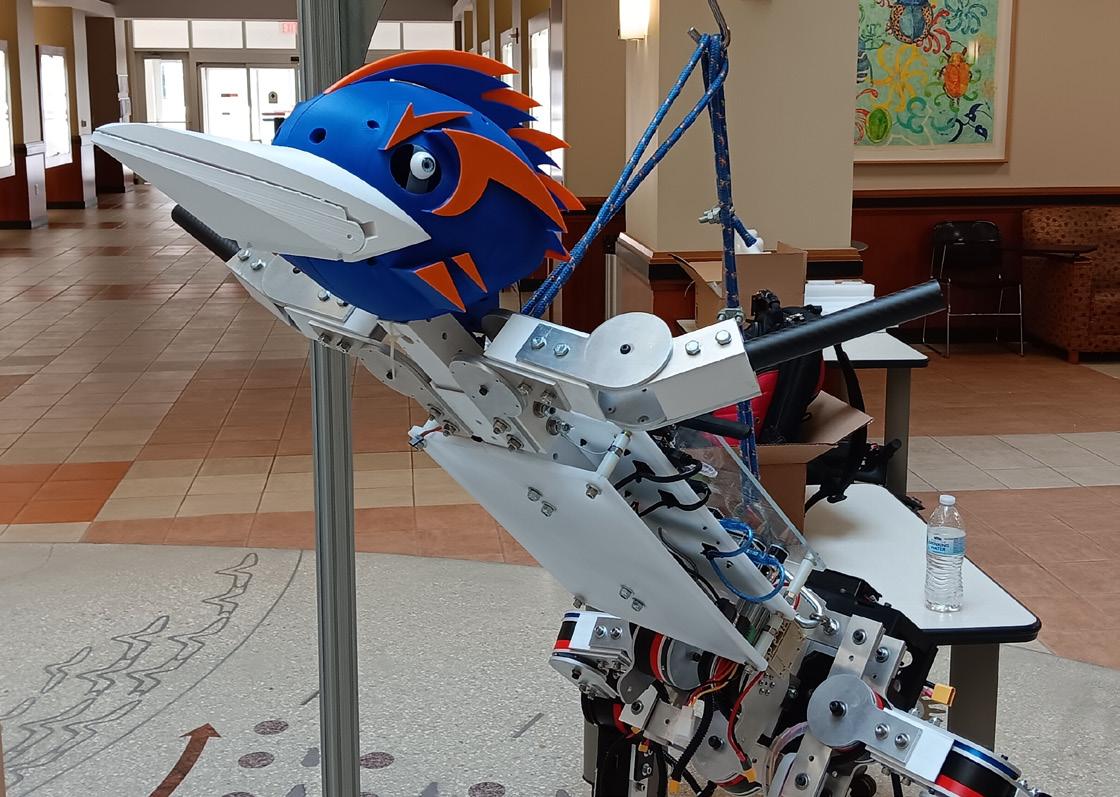
First place was awarded to Montufar’s project, titled “Reinforcement Learning Control of an Autonomous wheellegged biped robot,” while Xia won second place and Passo won third place.
For more information about the Department, visit https:// klesse.utsa.edu/electrical-computer/.
View the full video covering the event on YouTube @ThePaisano.
April 18 - April 25, 2023 2 | news@paisano-online.com
Learning
Montufar’s project, titled “Reinforcement
Control of an Autonomous wheel-legged biped robot,” won first place.
NEWS
Chloe Williams/The Paisano
William Barnes/The Paisano
Continued Canvas
OPINION
Want to know how student government spends YOUR money? Good luck
Astated mission of serving “YOU, the student body,” comes with a hefty price tag. The Student Government Association (SGA) at UTSA has long portrayed itself as a benevolent organization serving the interests of and advocating on behalf of the student body. However, similar to other governments at all levels, the SGA has become increasingly less transparent in their practices and how they spend their budget.
SGA derives its budget from the Student Services Fee, which comes out to $16.18 per semester credit hour, with a maximum of $194.16 per semester per student. Students are not given a choice on whether or not they will contribute financially to the SGA, and the massive budget allocated for the SGA is handed to them on a silver platter year after year, with few questions asked. Students are not given a breakdown of how their money is spent by this organization as the budget on the organization’s website has not been updated since 2019. This action — inadvertent or not — shields the organization’s finances from the public eye.
Additionally, the students that SGA represents cannot see the laws this organization abides by, as the SGA by-laws have also not been updated since 2019

Autism awareness is not enough
Commentary
By Ahavah Kirwan Staff Writer
The month of April is known for spring, flowers and Autism Awareness Month. Teachers, instructors and other individuals will don puzzle piece pins, ribbons, shirts and other paraphernalia. Thousands of landmarks and buildings will be lit up blue for the “Light it up Blue” campaign started by the infamous organization, Autism Speaks. Unfortunately, these performative and insufficient actions done in the name of so-called autism awareness do nothing for those who are autistic; in fact, they do more harm than good.
Many people will see the puzzle piece used to represent autism. The puzzle piece symbol, which originally included an image of a crying child, was chosen to represent “the missing piece” and the “puzzling condition” called autism. These reasons for using the puzzle piece to represent autism and autistic individuals are nothing more than erroneous, as having autism and having deficits or differences in some cognitive areas does not mean there is something “missing” or that someone is less human. Autism should not be treated as some puzzling or paradoxical condition, as these beliefs are what promote a negative image of autism and cause those with the condition to be misunderstood and subject to harm from others who hold those beliefs. In addition, the puzzle piece was selected as a symbol for autism without any input whatsoever from the autistic community. Many individuals with autism will tell you that they prefer the infinity sign to represent their condition since it symbolizes
despite numerous revisions.
Recently, The Paisano received a copy of the SGA’s 2022-2023 budget, accounting for all of the documented expenses the organization has incurred from August 2022 to February 2023. In our review of the document, many wasteful and questionable expenditures have come to light. These include but are not limited to: $1,138.95 for SGA promotional lapel pins, $890.05 for SGA senator notebooks, $958.50 for SGA polos, $4,959.00 for other SGA promotional items in -
the infinite diversity of autism, as no two autistic people are the same.
The color blue being used to represent autism in the “Light it up Blue” campaign has a sexist history. When autism was first being studied, doctors only studied males with the condition, creating systemic discrimination in the medical field that has lasting effects. To this day, autistic people who are assigned female at birth go through extreme difficulties to get diagnosed, as doctors will look for symptoms only present in males. The color blue promotes the idea that more males have autism, as this is a widely accepted stereotype. Blue is also typically a color associated with grief and loss, and the narrative that having autism or having a child or family member who is autistic is something that must be changed, as autism is nothing to mourn. Still, the diversity of the autistic mind is something to embrace. This is why many autistic people will tell you that they prefer the “Red Instead” slogan to the “Light it up Blue,” as red is a color associated with fire and passion.
Some autistic people will even tell you that they like the color gold, as the element gold is represented by “Au” in the Periodic Table, originating from the Latin “aurum.”
Autism Speaks is the most famous charity that people will donate to during Autism Awareness Month in an unsatisfactory effort to “help” those with autism. The truth is that Autism Speaks’ fundraising strategies further promote fear and prejudice against autistic people. An example of this can be seen in the 2009 commercial titled “I am Autism,”
cluding pens, water bottles, snack bags and tote bags, $2,235.00 for SGA storefront painting, $1,027.49 for travel expenses and a total of $4,900 for officer stipends. A majority of these fees would require other organizations to self-fund or fundraise to cover, especially those related to travel reimbursement or promotional merchandise.
While they claim to be serving “YOU, the student body,” it is clear that the SGA is serving no one but themselves and using your money to do it, all while maintaining an abysmally low voter turnout percentage of less than 1.5%. Why should students fund their promotional items, lapel pins, notebooks or stipends when we are given no insight into how our forced contributions are being spent? Why should UTSA students feel that SGA represents the interest of every student, when less than 600 people participate in their elections, with very little sign that the organization is displeased with this trend? The SGA needs to be reformed. They are an organization that wastes university resources and blatantly disregards any form of transparency or accountability. UTSA deserves better. You can find sources to voice your opinion about SGA at https://www.utsa.edu/sga/contact-us.html.
‘Stand your ground’ stands for murder
Commentary
By Nate Henneke Staff Writer
Texas Governor Greg Abbott recently stated his plan to pardon convicted murderer Daniel Perry, an announcement that has sparked controversy statewide. In 2020, Perry was driving in downtown Austin when he encountered protesters that blocked his way forward. This is when Perry drove into the crowd where Garrett Foster was legally carrying an AK-47. Perry claims that this was when Foster raised his rifle, but before Foster could act, Perry unloaded five shots from his handgun, killing Foster.

Now nearly three years later, Governor Abbott is fighting for Perry to be pardoned on the grounds that he was simply defending himself. Under the “Stand Your Ground” law, if Perry acted out of fear for his life, he did not break any laws.
In the initial trial following the murder, the jury concluded that Perry aggravated the protesters prior to killing Foster. Before Abbott can pardon Perry, the Texas State Parole Board needs to approve the appeal, which has led to new evidence being found on Twitter, showing Perry to be a racist anti-protester.
Perry’s defense has held onto the fact that he was acting out
of self-defense, and if the Texas Parole Board agrees with his defense, he would be protected under the strong “stand your ground” law that Texas has. This law has become common, with 28 states adopting some form of it. These types of laws
have led to unjust convictions and, in some cases, people getting away with murder. They encourage the use of violence as a response to being threatened; being able to defend yourself from potential threats should be protected under the law. However, “stand your ground” style of laws should not be the method for providing self-defense guidelines. State lawmakers should implement “duty to retreat” laws as a means to prevent complicated cases such as the current situation surrounding Perry’s pardon. If Texas had “duty to retreat” instead of “stand your ground” laws, there would be no question as to whether Perry committed murder. The protection of the use of deadly force that “stand your ground” laws provide has led to so many innocent and undeserving victims losing their life because someone with a gun felt threatened.
Another attack on abortion
Commentary
By Malaki Lingg Assistant Web Editor
In the past few years, the Republican Party has become increasingly firm on its “pro-life” stance and has heavily restricted abortion access nationwide. With Roe v. Wade being overturned and SB 8 completely banning abortions in Texas, what is next in the push against abortion access?
On April 7, a federal judge in Texas suspended the Food and Drug Administration’s (FDA) approval of the medication mifepristone. The medication was originally approved by the FDA in 2000 as a safe option to end intrauterine pregnancies
up to 10 weeks. Abortions are most commonly done using medication; the most prevalent medication in use is mifepristone in combination with misoprostol. Mifepristone works by blocking progesterone — a vital hormone needed to support pregnancy — while misoprostol causes the uterus to contract and empty. While working in tandem, these medications have a 100% success rate at terminating a pregnancy up to 10 weeks after conception, according to a 2015 Journal of Obstetrics & Gynecology study.
On April 12, the U.S. Court of Appeals for the Fifth Circuit appealed the ban on mife-
pristone but added temporary constraints. When originally appealed, mifepristone was only approved for terminating pregnancies up to seven weeks as well as banning medical professionals from mailing the medication. Following the restrictions, U.S. Supreme Court Justice Samuel Alito blocked the lower court rulings and temporarily restored full mifepristone access on April 14.
The GOP’s blatant attacks on access to safe abortions are disgusting and go directly against the word of medical professionals across the nation.
April 18 - April 25, 2023 opinion@paisano-online.com | 3
Editorial
Kara Lee/The Paisano
“Autism should not be treated as some puzzling or paradoxical condition”
Continue reading at paisano-online.com
Continue reading at paisano-online.com
Wasteful spending and lack of transparency is how the SGA keeps YOU in the dark
Calli Recore/The Paisano
Too Swift to judge women OPINION
Commentary
By Amber Serio Staff Writer
Taylor Swift is one of the most successful musicians of our generation. Throughout her career, she has amassed an immense following of fans and supporters. Her career’s success speaks for itself. She is a Grammywinning artist that has received notable recognition for her ability to write her own songs independently. Having begun her career at 16 as a country artist, she has since adapted into an artist unafraid of change who has explored various genres of music, such as pop and alternative rock. Without a doubt, Swift has proven on multiple occasions that she is a multifaceted powerhouse within the music industry.
Though, with such fame and success comes constant scrutiny, opinions and judgment from the media. Although her talent and hard work are undeniable, Swift constantly faces criticism from tabloids seeking to make her every move in life a spectacle. As a result, her remarkable accomplishments are sometimes overshadowed by the media’s emphasis on exploiting aspects of her personal life, such
Commentary
By Carley Martin Contributor
as who she is currently dating or if her appearance has changed. Since the beginning of her career, Swift has been notorious for writing songs about her past relationships and has expressed her frustration with tabloids on multiple accounts.
Her song “Lavender Haze” exemplifies these frustrations, as it fires back at gossipers for their assumptions. The song includes lines such as “I’ve been under scrutiny” and “They’re bringing up my history.” Taylor explained in October of 2022 that, “This song is sort of about the act of ignoring that stuff to protect the real stuff.”
In her 2020 Netflix documentary, “Miss Americana,” Swift expresses that the media’s invasive assumptions of her personal life result from her gender. She further explains the double standards she has experienced as a woman in the music industry, stating that, “Everyone is a shiny new toy for like two years. The female artists have reinvented themselves 20 times more than the male artists.” Swift feels as though her male counterparts do not have the same pressures and are sometimes praised for things women in the
The Paisano
Editorial Board
Mason Hickok | Editor-in-Chief Editor@paisano-online.com
industry are scrutinized for, such as dating and breaking up with many people. Overall, this double standard costs women in the music industry to not publically celebrate the victories they deserve and have worked hard for.
Laynie Clark | Managing Editor Manager@paisano-online.com
Gauri Raje | News Editor News@paisano-online.com
Jake Mireles | Opinion Editor Opinion@paisano-online.com
Keep Tate in the can
Thirty-six-year-old Andrew Tate is a former professional kickboxer, businessman, social media personality and a self-proclaimed misogynist. While cultivating his following for years, Tate has recently amassed enormous success on TikTok. Controversial videos of Tate calling women property, telling women they should bear responsibility for being raped and saying women cannot drive have gone viral on TikTok in the past year. These videos have caused a massive debate online between Tate’s dedicated followers and those in stark opposition. Videos have also begun to circulate of Tate hitting a woman with a belt and asking another woman to count how many bruises he gave her, although,
Commentary
these women have come out since and said that everything that happened between the two was consensual. While his followers praise this behavior, teachers have spoken out about Tate’s negative influence on young
Grace Robinson/The Paisano
boys. These teachers have reported a massive increase in misogynistic speech among their male students. Tate and his brother, Tristan Tate, were arrested on December 29 in Romania on charges of organized crime, human
By Ahavah Kirwan Staff Writer
In the past week, Russia has been facing new accusations of war crimes committed in the invasion of Ukraine after two videos surfaced online of Russian soldiers beheading Ukrainian prisoners of war. The videos have drawn international condemnation, with the European Union and United Nations denouncing the footage.
The first video emerged and was propagated on Russian Telegram channels. It depicts a Russian soldier wielding a knife and decapitating a man wearing a Ukrainian military uniform while a group of Russian soldiers observe.
The second video, allegedly filmed by Russian mercenaries in the paramili-
tary organization “The Wagner Group,” a group described as the de facto private military of Russian President Vladimir Putin, shows the beheaded bodies of two Ukrainian soldiers next to a destroyed military vehicle. A voice says in Russian, “They killed them. Someone came up to them. They came up to them and cut their heads off.”
Ukrainian President Volodymyr Zelenskyy addressed the public on April 12. He said that the executions seemed to be perpetrated by Russian forces in Russian-occupied areas of Ukraine, such as Bucha, where invading soldiers tortured, raped and murdered hundreds of civilians. Zelenskyy declared in a powerful call to action, “This is not an accident. This is not an episode. This
trafficking and rape. The pair have since been released and put on house arrest until April 29. It is speculated that the prosecution will then ask for a thirty-day extension of the ongoing investigation. Despite the ongoing investigation and house arrest, the brothers have maintained their innocence and Tate has continued to post messages on Twitter.
Tate and his brother should not have been released from custody because there is the possibility that they could flee to another country that lacks extradition. Not only does Tate now have the ability to avoid facing charges for his crimes, but with access to his Twitter account, he will keep spreading his hateful ideology to the masses. Tate must be held accountable and put back in jail for his dangerous criminal behavior.
War crimes lack global scrutiny
was the case earlier. This was the case in Bucha. Thousands of times. Everyone must react. Every leader.”
Ukrainian officials opened a war crime investigation on the same day Zelenskyy’s speech was delivered. Journalists have confirmed neither the origin nor authenticity of the videos. They were shared all over Russian social media sites and then on Twitter and other Ukrainian channels. Ukraine’s Foreign Ministry urged the International Criminal Court to immediately launch an investigation. Dmitri S Peskov, a spokesman for the Kremlin, called the video “terrible” but questioned its authenticity.
Riley Carroll | Arts & Life Editor Arts@paisano-online.com
Luke Lawhorn | Sports Editor Sports@paisano-online.com
Chloe Williams | Web and Social Editor Web@paisano-online.com and Socialmedia@paisano-online.com
Dustin Vickers | Photo Editor Photo@paisano-online.com
Grace Robinson | Graphic Editor Graphic@paisano-online.com
Marcela Montufar Soria | Multimedia Editor Multimedia@paisano-online.com
Jenna Taylor | Magazine Editor Magazine@paisano-online.com
Genevieve Vega | Distribution Manager Distribution@paisano-online.com
Luke DeMario | Buisness Manager Buisness@paisano-online.com
Staff
The most recent aspect of Swift’s life that is being exploited and misconstrued by the media is her rumored breakup from her boyfriend of six years, Joe Alwyn. The rumors struck on April 8 when People magazine unexpectedly released an article stating the pair had gone their separate ways. People magazine also mentioned their information came directly from a source closely affiliated with the pair. These rumors caused Swift’s fans to question the authenticity of People’s source because it was not coming directly from Swift or Alwyn. As a result, millions of fans took to social media to share their thoughts, feelings and theories about the rumored breakup. Swift has previously mentioned her desire to keep her relationship with Alwyn private, which would explain why neither of the celebrities have spoken on the subject. The
Diane Abdo | Advisor
Steven Kellman | Advisor

Jack Himelblau | Advisor
Stefanie Arias | Advisor
Sandy Norman | Advisor Sofia Garcia | Advisor
John Helton | Advisor Corey Franco | Advisor Imelda Robles | Advisor
The Paisano is published by the Paisano Educational Trust, a non-profit, tax exempt, educational organization. The Paisano is operated by members of the Student Newspaper Association, a registered student organization. The Paisano is NOT sponsored, financed or endorsed by UTSA. New issues are published every Tuesday during the fall and spring semesters, excluding holidays and exam periods. The Paisano is distributed on the UTSA Main Campus. Additionally, Paisano publications are distributed at a variety of off-campus locations, including Tri-point and a variety of apartment complexes near the UTSA Main Campus. All revenues are generated through advertising and donations. Advertising inquiries and donations should be directed to:
14526 Roadrunner Way Suite 101 San Antonio, TX 78249
Phone: (210) 690-9301
© 2023 The Paisano
The University of Texas at San Antonio’s Handbook of Operating Procedures states in 5.03 that: The University of Texas at San Antonio (UTSA) will not exercise control over the format or content of Student Publications, but will regulate distribution on campus. Student Publications will be free of censorship and advance approval of copy, and their editors and managers are solely responsible for editorial and content policies and decisions. Editors and managers of Student Publications will not be subject to arbitrary suspension/expulsion or removal from their positions within a Registered or Sponsored Student Organization (Student Organization) by the University because of student, faculty, administrative, or public disapproval of editorial policy or content. Student Organizations that distribute Student Publications are afforded the same rights and privileges as Student Organizations that do not distribute Student Publications.
April 18 - April 25, 2023 4 | opinion@paisano-online.com
Staff Writer Jada
| Staff Writer Cesar
| Staff Writer Luna Infante | Staff Writer Misty Olawunmi | Staff Writer Samantha Ysaguirre | Staff Writer Amber Serio | Staff Writer Naydine De La Fuente | Staff Writer Ahavah Kirwan | Staff Writer Hayley Aguayo | Staff Writer Morgan Francis | Graphic Artist Storm Goodman | Graphic Artist Calli Recore | Graphic Artist Eric Trevino | Photographer Stephen Saenz | Photographer Andrew Christianson | Photographer Kylar Royer | Photographer Jonathan Porter | Photograher Jessica McLaren | Assistant News Editor Lauren Hernandez | Assistant Arts & Life Editor Malaki Lingg | Assistant Web Editor Kara Lee | Assistant Graphic Editor William Barnes | Assistant Multimedia Editor Zach Geocaris | Assistant Buisness Manager Assistant Editors
Nate Henneke |
Thomas
Soto
Editorial
the official opinion of The Paisano editorial
Commentaries
opinion of the individual writer. | Journalism | Writing | Photography | | Audio/Video Production | | Graphic Design | Magazine | Advertising | | Marketing | Podcasting | | Website Management | Social Media |
is
board.
are the
Advisory Board
reading at paisano-online.com
reading at paisano-online.com
Continue
Continue
ARTS & LIFE
Student prepares film for spring screening
Josh Collins submits to local and national film festivals

Jazz is live and alive at UTSA
By Jake Mireles Opinion Editor
Artists of SA
By Mason Hickok Editor-in-Chief
Josh Collins is not letting “analysis paralysis” prevent him from doing what he loves. Collins, a senior communication student at UTSA, learned the term in a conversation with a former agent of the filmmaker Robert Rodriguez; her name was Theresa Vargas. Collins had disclosed that he was interested in writing, and Vargas encouraged him to try and write a screenplay.
“For the longest time growing up, I always loved watching movies,” Col lins said. “I had always been interested in making a movie.”
Collins filmed his first short film, “Master Sommelier,” in San Antonio in January with some of his close friends.
A sommelier is an expert wine spe cialist trained to recommend wine pair ings in restaurants; master sommeliers are the highest level one can reach. To set a film in that world is a niche thought, but the idea came from one of Collins’ collaborators who watched a Vice documentary on the subject.
“What I learned was that not only is there this elite society of people that do this for a living, they make thousands of dollars and their exam to
Paisano Poets
By Samantha Ysaguirre Staff Writer
The special occasion to celebrate poetry is the month of April. It is the most prominent literary celebration in the world. Its creation encourages the reading, teaching, and artistry of poetry. To those outside the culture of poetry, it introduces it to them. One value it brings is the ability to express emotion healthily, especially for individuals who struggle to grasp or put their feelings into words. You can have a safe space through poetry and connect with others who may feel the same way. Through that connection, relationships can build and enrich one’s life.
Three ways to celebrate this National Poetry Month include:
1. Buying a poetry book and setting aside time to read it
2. Attending a poetry reading
3. Joining a club devoted to the topic of poetry
The Student Poetry Society is a student organization accessible to all students dedicated to
become a master is among the most difficult tests in the world,” Collins said.
As the semester nears its end, Collins is submitting to as many local film festivals as possible, with the intent for even higher accolades — submitting to short film contests at the Cannes Film Festival and South by Southwest.
The UTSA Jazz Ensemble held its first concert of the semester on Sunday, March 26, in the UTSA Recital Hall, located in the Arts Building. Performing a set list composed of traditional standards that reached across all eras of the golden age of jazz, the UTSA Jazz Ensemble gave an impressive performance reflecting well on the stellar music department here at UTSA.
The ensemble started their set off
section and excellent volume control from the rhythm section, the ensemble embodied Jones and his orchestra in their concert debut.
Next on the setlist was “Love For Sale” by Buddy Rich. The chart exhibited masterful technique from the rhythm section and interjections from the notorious Buddy Rich-style screamer trumpets.
Then, changing pace for the third chart, the ensemble performed “Darn That Dream” by Dexter Gordon. Heavily featuring trombonist Ethan Gomes, the chart exhibited the ensemble’s ability to play slow and lyrical music with ease.

Finally, the ensemble’s closer, “Take the ‘A’ Train” by Duke Ellington, showed off the ensemble’s exceptional tonal control at lower volumes and featured a stellar bass trombone solo that fully used the instrument’s extended lower range.
concert featured an impressive set of classic jazz standards, helping continue the ensemble’s mission of performing live jazz in the modern era. Director Christopher Villanueva — a San Antonio native — has taught Jazz Studies at UTSA since 2019.
Celebrate National Poetry Month

celebrating poetry. Their weekly meetings are at 4:30 p.m. on Mondays in the McKinney Humanities Building (MH 3.04.12).
Another way of sharing poetry is to submit yours to The Paisano. The Paisano publishes students’ submitted poetry. NPR also accepts submissions of poetry through social media. They read a few submitted poems each year and select a notable poet to celebrate the month with. NPR’s celebration this month is with Poet Franny Choi. She is an award winner of the author of the collection “The World keeps ending, and the World goes on.” Readers can view the full interview online at the NPR website, falling under the “Author Interviews” cat-
egory. Interviewer Scott Detrow discussed with Choi how things changed for her career since her last visit and the process of writing her book.
Furthermore, there is also The
honor of the month. Readers can access a free PDF version of their April issue from 2017. It features a signature mix of established and upcoming poets worldwide, such as Amy Beeder and Alison C. Rollins. In the digital version, you will find a reading list of those who contributed to the edition and a special section from the previous editor Henry Rago.
Shines a Light on Every Other Poem.” The podcast covers this April’s poetry issue and its celebration with the 2022 Ruth Lilly Poetry Prize recipients, which has been awarded to one poet in previous years.
Poetry Foundation, which offers an accessible and exciting array of poetry events and literary program celebrations. One is that the foundation will distribute fifty thousand copies of “Poetry” in April 2023 to reading groups and classrooms worldwide in
As for further access, the Poetic Foundation even has a podcast called “The Poetry Magazine Podcast.” Their latest episode, which can be found on their website poetryfoundation.org, is titled “Arthur Sze and Forrest Gander on Silence, the Importance of Blank Pages, and How Every Poem Written
This year, in honor of the 110th anniversary of the magazine, eleven poets were selected, a gesture to the eleven decades since the magazine’s establishment. This month they cover one of the winners, Arthur Sze, who has written poetry for over fifty years and has published 11 poetry books. His most recent is “The Glass Constellation: New and Collected Poems.” In addition, the podcast invites Pulitzer Prize-winning writer Forrest Gander to speak with Sze.
Nonetheless, there are numerous ways to celebrate the month of poetry. Whether on campus or in your city, there are unique ways to build self-expression and connect with others. So keep an open mind and do not limit yourself to feelings or words because beautiful things can happen with the art of poetry.
Addicted to SAY Sí: A look into their new exhibit
By Lauren Hernandez Assistant Arts & Life Editor
SAY Sí is just what San Antonio needs. This nonprofit organization on the Westside of San Antonio offers after-school art programs for middle and high school students. They prioritize economically disadvantaged youth, providing them with four different studios to learn from: The Visual Arts studio, the Media Arts studio, the HIVE New Media Studio and the ALAS Youth
Theatre Company.
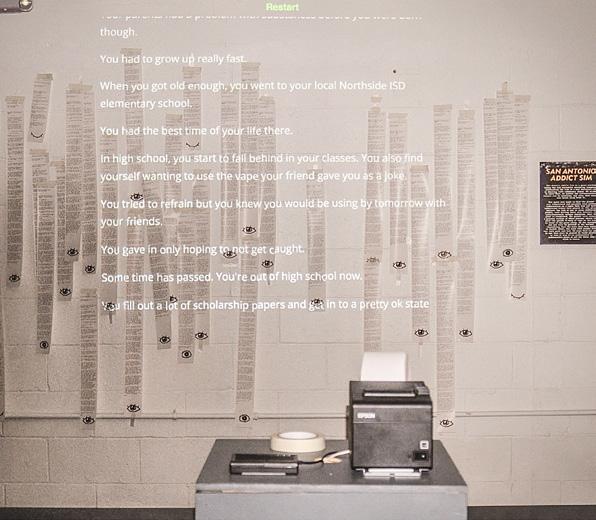
Currently, SAY Sí’s gallery space is hosting artworks from this year’s student-led interdisciplinary art project, “Stories Seldom
Told: User Interface.” This exhibit had students from all four studios create a project focusing on addiction and its effect on youth. The Paisano spoke with students that collaborated on different artworks in this exhibit to learn more about their inspirations, processes and the stories they want to tell.
“Bound”
Tyler Garcia is a high school student from the Visual Arts studio who helped put together “Bound,” a three-dimensional art piece representing the imprint of substance abuse. Garcia explained how he and his group approached two pre-existing walls and promptly kicked them in, creating gashes in the drywall that they haphazardly attempted to fix. Members
of this project contributed a variety of different elements, including stained glass made of glue and paint that filled in concave sections of the wall, distressed childhood objects placed purposefully within the piece and even a faceless puppet that is suspended across the two-walled room by a web of tangled string.

Garcia explained that personally, he had no need to take his anger out on the walls of this piece. Instead, he spent time distressing every object in the artwork with paint and grime. He also painted poems on the walls of the room that were reminiscent of stories he had heard in his childhood.
In the end, Garcia wanted to emphasize that children who live in these situations are often over
looked.
-
April 18 - April 25, 2023 arts@paisano-online.com | 5
Arte de San Antonio
Photo courtesy of Josh Collins
Dustin Vickers/The Paisano
Artists of SA
Continue reading at paisano-online.com Continue reading at paisano-online.com
Lauren Hernandez/The Paisano
Continue reading at paisano-online.com
Lauren Hernandez/The Paisano
Kara Lee/The Paisano

April 18 - April 25, 2023 6| arts@paisano-online.com
SPORTS
things you didn’t know about coach Traylor
By Laynie Clark Managing Editor
UTSA announced the hiring of Jeff Traylor in December 2019, the Roadrunners have had a 30-10 overall record and have won back-to-back Conference USA championships. the on-field success, Traylor has become a well-known face in San Antonio.


Whether it’s on weekly iHeart radio shows every Wednesday at Chicken ‘n’ Pickle, passing out food outside the Sombrilla or riding on the float in the Battle of Flowers Fiesta Parade, Traylor has built the UTSA Football brand up to be one of the most successful programs in the state. entering his fourth season at UTSA, spring practices, recruiting visits, public events and defending conference titles takes a lot of time out from Traylor to show his personal you are a die-hard Roadrunner fan or unfamiliar with Traylor altogether, here are eight things you did not know about the esteemed coach.
Explain what your life looks like off the field.
“I’ve got a wife whose name’s Carrie, we’ve been married 31 years. We have three children. Jordan is our oldest son, he’s 29. I have a middle son named Jake, who is 26. He’s an associate producer for NBC. My daughter JC is 23, and we do have a dog. She weighs about 10 pounds, and her name is Izzy. I didn’t want her, but now I’m in love.”
Favorite sports icon and why? Do they impact your coaching decisions today? “The one I’ve studied the most is John Wooden. I’ve read every book he’s ever written. I like what he stood for, his sideline behavior in basketball, his beliefs. I do believe that the game of football is an analogy of life, and when you use a football correctly, it’s a beautiful thing. Unfortunately, a lot of men miss that.” When you get in the car, do you gravitate toward music, podcasts or silence? “On the way home, it’s music. The kind of music
depends on my day; if it’s been a rough day, I put on my Christian music. If it’s been a good day, I’ll put on some oldies country. On the way to work, it’s always a podcast about the culture pillar of the week. I listen to it to get my mind ready on what I’m going to speak to my kids about during the team meeting.”
Q: What sparked your love for sports? Did it start at an early age or were you a late bloomer?
A: “I always knew my entire life that I wanted to be a coach. My mother wanted me to be a lawyer, but I never wanted to do that. I’ve always wanted to coach, and I was psychotically competitive to a fault. I knew my passion was to coach, but when I realized my purpose could be to influence boys to become men, I lined up my passion of being psychotically competitive and then realized I can get my purpose with that. That was a great peace for me to realize that I could get my purpose and my passion in the same alignment. I’ve always enjoyed coaching and teaching. If there is a ball involved and somebody’s keeping score, then I want to play.”
Q: Do you have a favorite quote?
A: “I have a ton, but my favorite one is ‘Your dreams should always be large, but your prayer life has to match it so that when your dreams come true, no human can take credit for it –– only God gets the credit.’”
Q: What do your pre-game and postgame rituals look like?
A: “We’re usually at a hotel the night before. I go to my room, and I try to watch the last couple of things that I’m still worried about. So it’s just me and my room, just my computer and just finishing up my thoughts. Just nervous energy. After the game, my wife will be waiting on me. We usually go out and eat somewhere because we’ve won so much that it’s okay to go out and eat. If we lost, I’d go get some street tacos by myself and cry.”
Q: Movies or tv shows? List your best recommendations.
A: “I love movies, big movie guy. Life is too short to watch a scary movie or a sad movie. I want the underdog to win every time, and I don’t want to be scared –– I want to laugh. My favorite is when the underdog wins at the last second; that’s why I love the ‘Rocky’ movies.”
Q: When Sundays roll around, what jersey are you rocking?
A: “Well, my son coaches for the Saints. I used to be a Cowboys fan only, but my son has worked for the Saints for five years. But I’ve got so many players in the NFL and I keep up with all of them, so I’m always cheering for those guys as well.”
Players to watch for the 2023 season
By Haley Aguayo Staff Writer
As UTSA’s football team geared up to play its spring Fiesta game at the Alamodome, coach Traylor was geared up to see how new potential starters and backups would perform during their public practice last Friday night.
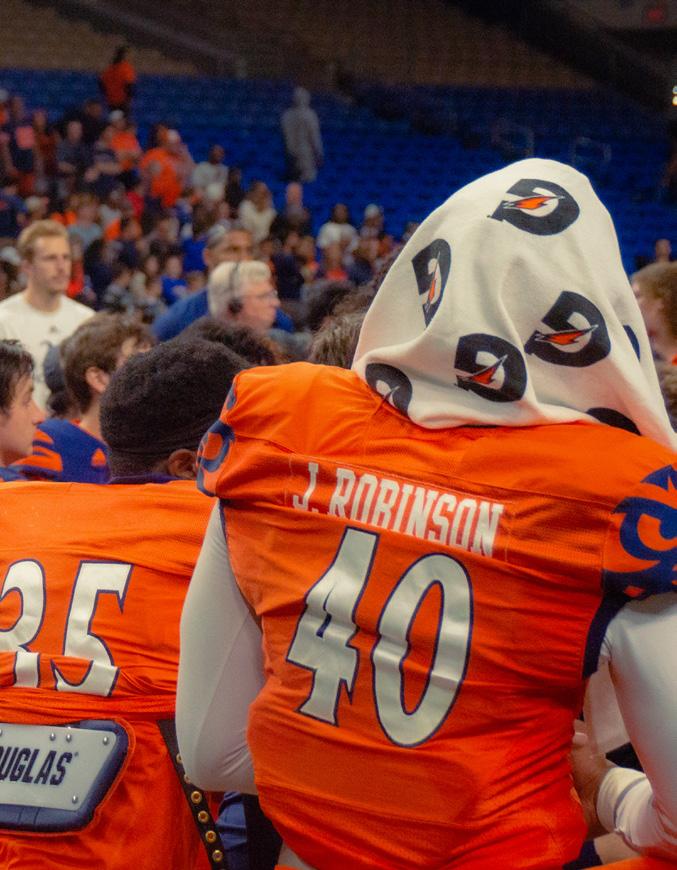
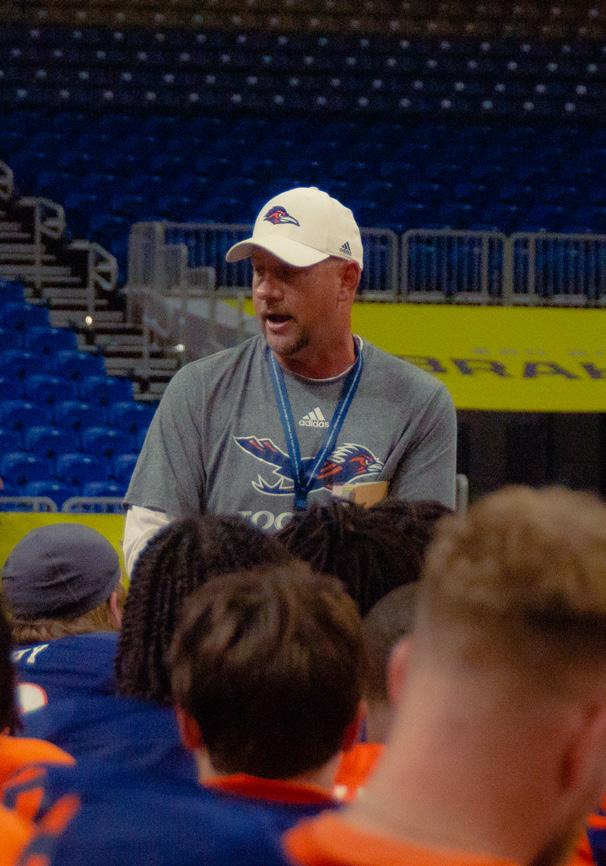
Going into the game, Traylor made it known that this was a practice and not a game. Since UTSA’s defense played against their own offense, there would not be the potential of any surprises that the other team was not already aware of. The only possible revelation the team would have was how well players, especially new additions to the team, could play under a sort of pressure.
The question of who would fill the backup quarterback spot came up during coach Traylor’s radio show. Owen McCown and Eddie Lee Marburger were brought up as potential backups, but Traylor said, “Brandon Tennison has been playing really well.” Both returning sophomore Marburger and freshman player Tennison proved to be quick and reliable during Friday night’s practice game. Both threw touchdown passes as well. McCown dropped the ball on his first play and favored the far left field but was quick on his feet as he found holes to run through against his own defense.
Wide receivers Chris Carpenter and Willie McCoy both made touchdowns during the practice game and were both name-dropped by Traylor in a post-practice interview. “He’s extremely fast,” Traylor said of his newest junior transfer athlete. “He’s got playmaking skills. We can get the ball to him down the field. I really like Willie. He’s a pro. We’ve had no issues with Willie whatsoever as far as getting him acclimated to the culture; really excited for him, and his upside is really high.”
Veterans Frank Harris, De’Corian Clark, Joshua Cephus and Zakhari Franklin were sidelined this spring game to due injury. This gives other players more time to shine.
“We feel really good about our guys returning,” Traylor said. “Chris Carpenter is really good at returning punts. Willie is as well. We’ll see where [Willie] fits as far as returning kicks. You know, we’ve got Carpenter to do that as well, but I think Willie can take a little bit of that off of Chris. We hope, but we’ll see; he was recruited for that intention. But Chris Carpenter has had a fantastic spring. He’s really come on.”
Other wide receivers to look out for come this fall would be Jace Wilson, Chu-Chu Doe, David Amador II, Isaiah Davis and Tykee Ogle-Kellogg, who all made runs that helped drive the ball down the field during the fiesta game.
Possible running backs to look forward to watching during the season would be Justin Rodriguez, who made several runs and a TD during the game. Rocko Griffin, Ezekiel Saldana and Mason Culton all made runs that advanced their team as well. Tight end Camron Cooper seemed to be a favorite runner when McCown was on the field and made quick runs as well.
Even though defensive players were not allowed to tackle, they were able to block. OLBs such as Trey Moore, Nnanna Anyanwu and Jimmori Robinson were all major forces in prohibiting plays by the offensive line. Lastly, safety Kelechi Nwachuku proved to be a double threat as he was able to block players and turn around just as quickly to tag them to end a play.
Any of these players can be driving forces and become familiar faces this fall as football season approaches.
By Logan Martinez Contributor
Often touted as “just a football school,” countless UTSA sports programs have received little to no recognition from outside analysts and reporters.
With football set to defend twostraight conference titles when entering the American Athletic Conference this fall, it’s easy to overlook the success of this spring’s baseball squad. After losing in the Conference USA championship last season and currently cruising to a league-best 28-8 record, many fans proclaim the baseball program as the new darling on campus.
Led by the superb coaching of Pat Hallmark and the bombing bat of Antonio Valdez, the ‘Runners have high hopes as they look to qualify for the NCAA tournament for the first time since 2013.
Sitting atop Conference USA at 12-2, UTSA baseball has officially put its name on the Division I college baseball map.
The team’s 38-20 record in the 2022 breakout season propelled the Roadrunners for their national exposure in 2023. The program received a national ranking at No. 25 for the first time in the program’s history. No longer is the university “just a football school,” as smart hitting and clutch pitching have allowed the program to emerge as
a truly dominant force.
Helping to do so are star players Valdez and Simon Miller. Valdez, batting at a team-high .401 average, also leads the team in both RBIs and hits for the season.
Meanwhile, on the mound, reliever Miller finds himself ranked No. 9 in the nation, leading all relievers with an ERA of 0.55. Surrounded by a plethora of talent, such as infielder Barry Leyton and starter Luke Malone, the future looks bright for the club as they continue on their dominant conference run.
The Roadrunners’ stellar play has not only done wonders for this season but for future baseball seasons as well. With high-level analysts taking note of the club’s success, high-ranking recruits will soon find themselves also taking note. With back-to-back winning seasons in the books, it is highly anticipated that coach Hallmark’s recruiting will improve exponentially in the foreseeable future. If UTSA continues to build on its last two successful seasons, the baseball program could soon be mentioned in highlevel baseball colleges such as Vanderbilt, Texas and Kentucky. Though there is certainly a long way to go, it goes without saying that UTSA baseball is here to stay.
Football holds first spring game inside Alamodome
By Rylan Renteria Contributor
With the 2023 college football season still months away from kicking off, fans were eager to watch as UTSA held its annual spring game. Starters Frank Harris, JT Clark and Zakhari Franklin are just a few of the veterans who were inactive for the spring game.

One of the main storylines fans were watching during this game was who would win the QB2 spot. Eddie Lee Marburger is a well known fan favorite and has familiarity with Jeff Traylor’s offense; however, Owen McCown, son of longtime NFL QB Josh McCown and University of Colorado transfer, is an intriguing prospect and a potential threat to the backup spot.
On the opening drive, Marburger led the UTSA second team offense down the field
with ease and capped off the drive with a touchdown pass to WR Chris Carpenter. Marburger made a number of beautiful deep throws that were dropped by his receivers. One attribute that Marburger showed off was his ability to take off and run; he also showed great pocket movement.
Later on in the game, Marburger would complete a long touchdown off an outstanding catch from JUCO transfer WR Willie Mccoy. When McCown came into the game, he showed flashes; he is a good athlete with a nice arm and was able to make a couple of good throws into tight windows. However, he could not get on the same page with his receivers, and his offense suffered from a lot of miscommunications and drops.
While the spring game was mostly for the backup QBs to show off, you could nott help but notice RB Justin Rodriguez making plays. Rodriguez, a walk-
on from the San Antonio area, scored his first career touchdown against LA Tech this past season. Rodriguez showed off excellent footwork and speed, all while not shying away from contact. Expect an expanded role for Rodriguez this upcoming season.
On the defensive side of the ball, it was hard for players to really stand out since tackling was not allowed, but a few players in the secondary had some nice plays. Safety Je’Vuan Dabon had a spectacular interception that was called back due to an offsides on the defensive line. In addition, Cornerback Alpha Kahn had a few nice pass breakups.
The game concluded with UTSA’s offense coming away with a 7-6 win. UTSA’s coaching staff has a lot to look forward to and a lot to sort out before the program begins its first season as a new member of the American Athletic Conference.
April 18 - April 25, 2023 sports@paisano-online.com | 7
UTSA’s new favorite pastime
Stephen Saenz/The Paisano
Commentary
Dustin Vickers/The Paisano

April 18 - April 25, 2023 8 | sports@paisano-online.com
