OpenSesame_ISSU

Page 1


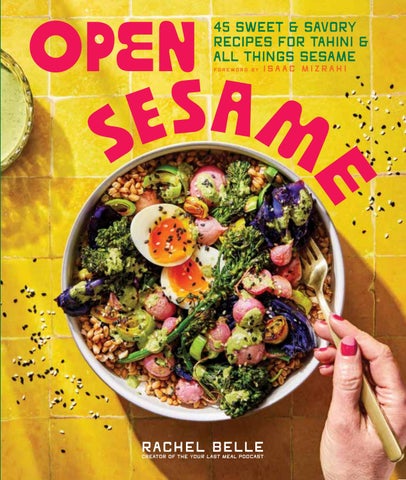
45 sweet & savory recipes for tahini & all things sesame

foreword b y i s aac mizrahi

rachel b elle
creator of the your last meal podcast
Rachel Belle
Photography by Charity Burggraaf

57 Everything Including the Bagel Salad

61 Beet Salad with Garlicky Tahini and Mint Gremolata

65 Roasted Kabocha Squash with Tangy Miso-Tahini Drizzle

67 Crushed Potatoes with Tahini Feta Queso and Olive Tapenade

69 Gingery Sesame Chicken Soup with Rice Noodles

73 Rainbow Farro Bowls with Herby Tahini Sauce

76 Cozy Kitchari with Cilantro-Tahini Sauce

80 Vietnamese Fresh Rolls with Tahini-Hoisin Dipping Sauce

83 Cold Sesame Soba with Summer Veg

85 Beef Arayes with Garlicky Tahini Sauce

89 Challah Chicken Schnitzel “Shabbat Sandwiches”

93 Basil-Lime Pasta with Sesame Chicken Bolognese

97 Steak Tacos with Charred Corn–Sesame Relish 101 Gingery Chicken Meatballs with Sesame Chili Crisp Glaze

103 Weeknight Poke Bowls

106 Crispy Sesame Schnitzel’d Oyster Mushrooms

111 Chocolate Miso Whoopie Pies with Tahini Cream

114 Tahini Frangipane Apricot Galette

117 Tender Tahini Almond Cake with Strawberries and Cream

119 No-Bake Berry Tahini Layer Bars

123 Tahini Banofee Pie

127 Super Sesame Ice Cream Sundaes

130 Goat Cheese, Honey, and Tahini Cheesecake

133 Black Sesame Date Shoothie

134 Crisp Sesame Seed Brittle

139 Acknowledgments

143 Index

For my mom

who did not under any circumstances hint that she might like this book dedicated to her

foreword

I bore easily.

Yes, I repeat meals. Yes, I love comfort food. But in the end what really motivates my appetite is finding new things to eat. Rachel Belle is always full of surprises, always full of ideas, constantly challenging the way I look at food. I met Rachel several years ago when I was a guest on her podcast, Your Last Meal We hit it off immediately, and a handful of months later she flew across the country to cook with me in my Manhattan kitchen.

But when she said she was working on a cookbook, I sighed and hoped for the best. [Author’s note: Guffaw!] As a jaded cookbook collector of forty years I was preparing for the worst, and began assembling praiseful phrases that wouldn’t let on how bored I was at the prospect of another cookbook trying to reinvent pub food or exaggerate the creature comforts of their childhood food memories.

But then, this slightly insane book about sesame and tahini arrived and I was truly surprised: These are ingredients I haven’t cooked with in years, flavors I literally haven’t explored since my childhood . . . This was not boring! That’s a good sign. Then I started skimming the book: She’s

very good with words, our Rachel. She says things like burble and tells you to cook the strawberries until they are slumped. I wouldn’t put it past her to stop a total stranger on the street to correct their pronunciation of the word chhhoumoose. I began obsessing over the recipes, and everything I knew about the subject of sesame seeds was up for reevaluation. Or, rather, evaluation, since I haven’t ever really put a lot of thought into the subject.

Having grown up in a Sephardic Jewish home, I ate so many foods that included sesame and tahini. But I took them for granted, never paid much attention to those flavors. When I left my mother’s house, I left that cuisine in the dust and went on to explore foods of other worlds.

But as I dog-eared recipe after recipe in this book, my mouth officially watering, I began aching for those flavors again. I immediately ordered two kinds of sesame seeds and a bottle of very good tahini, ready to take part in this flavor revolution. Who among us can resist the sound of Hot Pink Hummus? Gingery Sesame Chicken Soup with Rice Noodles? Tahini Frangipane Apricot Galette?

Those foundational flavors of my childhood that I ran so far away from have been reshaped into shiny, new dishes from the other worlds I dreamed of exploring. And they’re anything but boring.

Isaac Mizrahi per f ormer, writer, and designer

introduction

Be honest. Have you ever finished an entire jar of tahini? How many times have you bought tahini for, say, a hummus recipe or a salad dressing, used ¼ cup, and then watched it slowly moonwalk to the back of the refrigerator, unsure of what to do with the rest? *slowly raises hand*

Here at Open Sesame, we believe in No Tahini Left Behind!

Like a little black dress, tahini can seamlessly transition from day to night, from savory to sweet, from the Middle East to the Midwest, with a healthy drizzle baked into your morning granola (page 13), poured over Pita Chip Nachos (page 29) in the form of creamy Tahini Feta Queso (page 33), and whipped into desserts like Chocolate Miso Whoopie Pies with Tahini Cream (page 111).

Tahini: it’s not just for hummus! But I’ll show you how to make a fantastic version of that too.

This book is a celebration of sesame in its many forms: the earthy warmth of sesame oil shimmering on the surface of a noodle soup, the toasty crunch of a sesame seed–crusted schnitzel, and the deep, dark nuttiness of black sesame paste blended with dates, banana, and milk.

But the origin story of this book is rooted in a Tahini Epiphany™.

Growing up in the 1980s with an Israeli-raised dad, my family ate a fair amount of chhhoumoose. That’s how we pronounce hummus—the Hebrew way, with the signature guttural, phlegm-clearing roll in the back of the throat (she’s one page into her cookbook and she’s already said phlegm?).

Chhhhhouuumoooose! This was before “hummus” was a household name in the United States, before you could buy seven varieties (Pumpkin spice hummus!

Chocolate hummus!) at Trader Joe’s. This was before we’d ever heard of Trader Joe’s!

Hummus is simple: a creamy puree of chickpeas, tahini, lemon, garlic, ice water, and salt. But every time I made a batch in my own kitchen, it never tasted quite right. I tried everything: tirelessly peeling the papery skins off every single garbanzo bean, soaking dried beans in baking soda–spiked water. The hummus I ordered in restaurants, or bought from the supermarket, wasn’t any better.

Several years ago after an event I attended at the Stroum Jewish Community Center in Mercer Island, Washington, we were treated to a Middle Eastern nosh. I half-heartedly scooped an obligatory blob of paprika-dusted hummus onto my tiny plate, dragged a wedge of pita through it, took a bite, and, reader, I immediately lost my mind.

“Who made this hummus!?” I squawked, zipping around the room, interrupting groups of kibbitzing strangers with my broken-record question. This was it! The flavor I’d been chasing for over a decade! I was given the phone number of the caterer, an Israeli man my father’s age, and the next weekend I was standing in Eli Lahav’s kitchen watching him make chhhoumoose.

He cranked open a giant can of chickpeas from a restaurant supply store, glugged an ungodly amount of tahini into the food processor, and after a single taste, it became clear: delicious hummus relies completely on delicious tahini! I needed better tahini and lots of it.

Not long after, I interviewed the chef-owner of Seattle’s Aviv Hummus Bar for my podcast, Your Last Meal. Aviv serves life-changing hummus, the best I’ve tasted outside of Israel, and when I asked him what makes his hummus so special, he confirmed: it’s the tahini. He wouldn’t share which brand he uses, but he offered me a clue: he only buys tahini from Israel.

A shipment of Har Bracha Tahini later, I was ready to try again. I blitzed all the usual suspects in my blender, dipped a spoon in for a taste, and stood

Turn static files into dynamic content formats.

Create a flipbook
OpenSesame_ISSU by paigetate - Issuu