Praise for Dear Blind Lady
“Empathetic, razor-sharp, laugh-out-loud funny, and very necessary. Read this now.”
—MARIEKE NIJKAMP, New York Times–bestselling author and editor of Unbroken: 13 Stories Starring Disabled Teens
“Full of personal stories and professional observations about everything from dating to unsolicited prayers, Dear Blind Lady blows up stereotypes and offers solutions for people who are trying to figure out where disabled people belong in the world. The answer, by the way, is that they belong everywhere.”
—ANNALEE NEWITZ, bestselling author of Stories Are Weapons
“It’s vanishingly rare that a book that should be essential reading for everybody is so engaging and funny while being a treasure-trove of exceptional information. Get it and you’ll immediately tell everyone you know that they need it, too— just wait.”
—RABBI DANYA RUTTENBERG, author of On Repentance and Repair: Making Amends in an Unapologetic World
“As a blind person I’ve been asked more than once, ‘What’s wrong with you?’ This excellent book asks, with humor, nuance, and scruples, ‘What’s wrong with everyone else?’”
—STEPHEN KUUSISTO, author of Planet of the Blind
Copyright © 2026 by Elsa Sjunneson
All rights reserved. No portion of this book may be reproduced or utilized in any form, or by any electronic, mechanical, or other means, without the prior written permission of the publisher.
Printed in China
SASQUATCH BOOKS with colophon is a registered trademark of Blue Star Press, LLC.
10 9 8 7 6 5 4 3 2 1
The authorized representative in the EU for product safety and compliance is
Authorised Rep Compliance Ltd., Ground Floor, 71 Lower Baggot Street, Dublin D02 P593, Ireland. www.arccompliance.com
Editor: Jill Saginario
Production editor: Peggy Gannon
Designer: Tony Ong
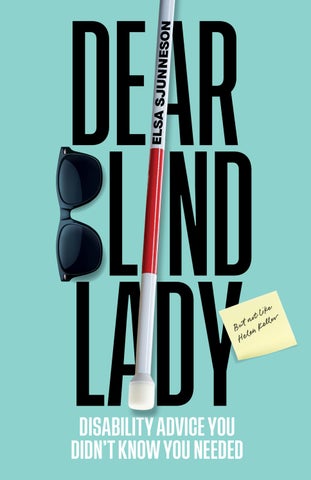
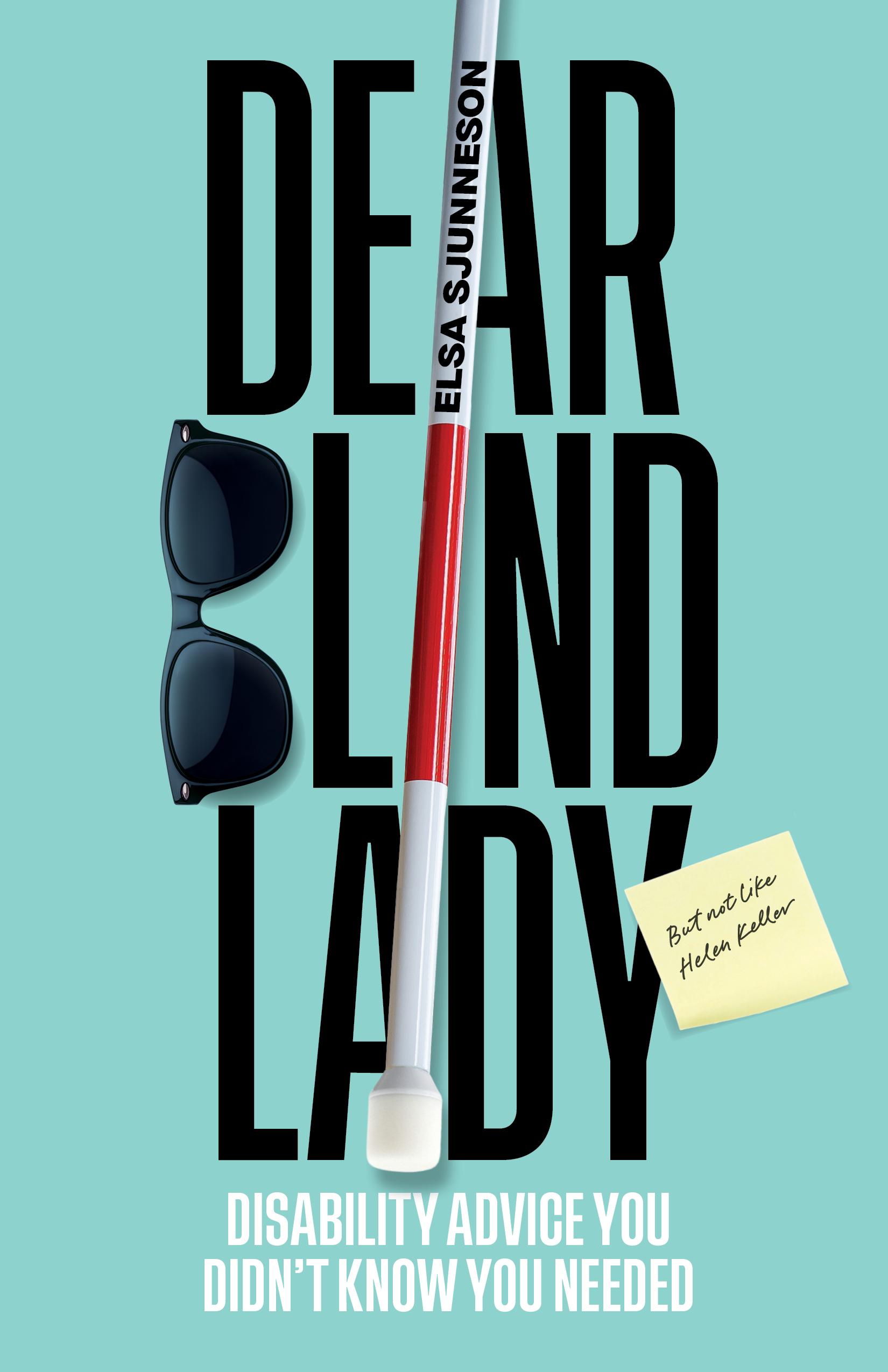
Cover photographs:
Sunglasses: © stock.adobe.com | pixelrobot
Sticky note: © stock.adobe.com | Designpics
Cane: © stock.adobe.com | Михаил
Meme illustration on page 89: © stock.adobe.com | Nuno 88
Library of Congress Cataloging-in-Publication Data is available.
ISBN: 978-1-63217-636-3
Sasquatch Books
1325 Fourth Avenue, Suite 1025 Seattle, WA 98101
SasquatchBooks.com
DEAR BLIND LADY
DISABILITY ADVICE YOU DIDN’T
KNOW YOU NEEDED
Elsa Sjunneson
For DR and everyone else who has acquired a newly broken meat suit. Living at the margins of ability only gets easier from here.
For HKDJ—you were born right alongside this book, so it belongs to you.
And for Alice Wong—friend, conspirator, mentor, and absolute fucking badass. I miss you.
INTRODUCTION
We shouldn’t need this book. I shouldn’t have to write it, and you shouldn’t have to buy it. My career goal is that we don’t need books like this. After all, one in four people in the United States is disabled. Worldwide, there are roughly one billion disabled people, and other countries don’t have it any better than we do. It’s just different. Just saying, we should already be good at this.
But we’re not, as a species, good at being in community with disabled people. In fact, disabled people have been gated out of the community for so long that the idea of knowing how to engage with us is almost terrifying to most nondisabled people.
This isn’t a new problem. But it’s different than it used to be. Better in many ways, worse in others. There are historical reasons for this, ranging from the widespread notion that disability is bad to the rampant insistence that disabled people cannot live independently and are therefore a burden, a belief that came along with industrialization and capitalism.
But the fact is, how poorly we navigate disability permeates every part of both my life and those of disabled people everywhere.
I’ll give you a pretty benign example.
When I was planning my first wedding, I called a lot of venues. My (now) ex and I were getting married in the New York metropolitan area, and there were thousands of spaces to choose from, ranging from obscenely expensive venues to reasonably priced but tiny spaces that could fit a micro wedding at best. Brides and grooms in the New York City area are spoiled for choice in that matter, but what’s best
for you depends heavily on what kind of bride, groom, or otherwise you are.
I’m going to talk a lot more about what marriage means for disabled people in a later chapter, but what follows is evidence of how rarely we’re considered. I was on the phone with a venue when the woman on the other end said something that made me stop:
“And will the bride need a guide dog? Because we don’t allow dogs, so she’ll have to leave her dog at home.”
The number of things that are wrong with that sentence is staggering.
First, she was talking to me. The bride. As though I were the bride’s personal caretaker. Second, I had never mentioned having a guide dog or, for that matter, needing one (and at the time, I didn’t even have a guide dog). Third, she was violating the law by saying my dog—should it exist, which it didn’t—couldn’t come with me, the bride.
People don’t know anything about disability. Either willfully, because they’re afraid of it, or because there just isn’t all that much accurate information about disabled people out there. They rely on information they’ve gleaned from various sources: the media, after-school specials, their uncle twice removed with an eye patch, rumors, and, of course, the dreaded Church that talks about healing blind people . . . etc.
But most people develop bigoted perceptions of the disabled community because they don’t know something or have learned about disability from outsiders. We’ve seen this play out with other minorities, such as Muslims, Jews, people of color, queer people . . . the list goes on and on. If you don’t know about someone else’s experience, you often make really bad judgment calls about what their life is like and what needs they have.
So let’s start with some basics.
My name is Elsa Sjunneson. I’m a writer, wife, mom, activist, corgi owner, cat servant, teacher, dancer, school
volunteer, and pain in the ass—and I’m Deafblind. In 2020, my first nonfiction book came out. It’s called Being Seen, and it’s a memoir about how the media shapes the way people look at disability. You should probably go read it, but it’s not required reading for this book. This is not Being Seen Two: Rechargeable Hearing Aids Edition.1
This is the book people started asking me for after Being Seen.
At every book event, I had two kinds of experiences with people. There were the people who came up to me while clutching my book like it was a beloved teddy bear, asking me to sign it and telling me that it was about them too. People who had been bullied for having glasses. People who had yelled at Sneakers just as much as I did when I saw it for the first time. People who knew the pain of having a stranger ask, “What’s wrong with you?”
(I love y’all, by the way.)
And then there was the other kind: people who would sidle up to me at the signing table, thank me for writing the book, take a deep breath, and then ask, “OK, so I believe you that ableism exists. I hadn’t been aware of it before, but I am now. But . . . what do I do about it? Like . . . how do I change?”
The questions would come tumbling out: questions about their friends, disabled ones, whom they didn’t want to bother by asking them to do the labor of retraining them. Questions about potential dates. Questions about other parents at their kids’ schools. Questions about institutional ableism and how to fix it. . . .
There were a lot of questions. So many that I realized perhaps there was a need for something I hadn’t yet provided: a book of advice.
Emily Post did it first. She told the world what it meant to be polite in an era that was full of people who needed it.
1 I got a pair recently, though, and they fucking rock. I never have to fiddle with tiny batteries again!
Now, I’m not Emily Post. I will not tell you how to fold your napkin, and while I do have opinions on runcible spoons— mostly that they’re cool and that I wish we used them more—I won’t be writing them down here. My thoughts on forms of address boil down to “use people’s fucking pronouns and not the ones you think they should have.”
But I do have opinions about how to treat disabled people. About how to change ableism. About what the right way to help a blind person across the street is and how to not be an asshole to the Deaf mom at the PTA.
But this book is about more than opinions. It’s not just a prescriptive list of polite behaviors. Emily Post’s work is excellent in that regard, but it’s somewhat limited because you can’t read other people’s minds. That’s why I’ve introduced a literary device that I think will help everyone understand each other a little better. See, I wrote this book as an advice column. Kind of.
Every advice letter you’ll read in this book is based on something a disabled person has experienced. I’ve taken those extremely haphazard and mostly ableist social situations, stepped into the ableist person’s shoes, and turned what I think is going on in their heads into questions. Each letter is designed to help us access certain content so that we all have a chance to learn and grow. But they’re snarky—because I’m a lot more like Dan Savage than Emily Post, runcible spoon feelings aside.
So, here’s what you’ll get from this book:
• ANSWERS TO ACTUAL QUESTIONS. Yeah, the ones you never wanted to ask. We’ll go from conversations with fellow disabled people about adaptations and how sometimes they aren’t always copacetic with each other, to how to ask for accommodations for a parent–teacher conference, to how to not be an asshole about disability parking placards. Oh, yeah—and just like in my first
book, there’s a sex chapter. (Sorry, Mom. Even more sorry, in-laws.)
• SCRIPT CHANGES. Sometimes I’ll suggest ways to have a conversation—for example, how to tell someone not to touch your guide dog, wheelchair, or adaptive device. Other times, I’ll show nondisabled people how to fix their scripts because the ones they have for talking to us are pretty broken.
• ABLEISM BINGO. In this book, we’ll use bingo cards as learning tools. I’ve worked with tons of disabled people to identify the most common, most frustrating, and most insulting things they hear on a regular basis. These have been used to create the squares of each individual bingo card. Ready to find out exactly how badly you’ve behaved? In this case, you almost never want to win.
• ACTUAL SCENARIOS. Every single reader letter in this book is based on something I or another disabled person has been asked, though each question has been anonymized and rewritten so that the culprit can’t be identified. And if you recognize yourself, uh . . . sorry, not sorry, I guess? I don’t know what to tell you. You’re the one making the choices here, not me.
• HONEST ANSWERS. I’ll always tell people what I think. I don’t speak for the entire disability community, but I certainly know enough to guide you through the general dos, don’ts, and what-the-ever-loving-fuck-did-you-dos.
Here’s what you won’t get from this book:
• Coddling
• The knowledge that you’ll always get it “right” with disabled people. You won’t. You’ll still fuck up, and you’ll discover why that’s OK if you handle it well.
• A one-size-fits-all approach to disability. The disabled community is not a monolith. Some of us are like me,
some are not—some are like Madison Cawthorn,2 and if you don’t know who that is, you’re lucky!
• A Nice Disabled Lady. I am not nice. I am kind, and I am insistent. Sometimes my kindness will come across as something other than nice, and that’s OK. I’m not obligated to be nice to you because you bought my book, but I am obligated to help you change. Change is hard. This isn’t just about nondisabled readers, by the way— even disabled people can be ableist. That’s why we’re all here. In the disability community, we sometimes have tiers of acceptability.3 So I’m going to push even the disabled readers out of their comfort zones and help them learn because everyone on the planet is growing. Even me.
Let’s put the system to the test with a rapid-fire rundown. Here are the top ten worst questions disabled people get asked. I did a poll! And I’m going to answer them the way I do in real life. We’ll discuss them later.
10 “WHAT’S WRONG WITH YOU?” Absolutely nothing. I’m perfect just the way I am. What’s your damage?
9 “YOU DON’T LOOK DISABLED.” I admit I don’t get this one. But I do get the variant “you’re too young to be disabled,” to which I say: “That’s cute, but I’ve been disabled since birth.”
2 For the morbidly curious: Madison Cawthorn is a wheelchair-using Republican who served as a House representative for North Carolina’s 11th district between 2021 and 2023 and landed himself in the news because he visited Hitler’s bunker. Yes, that Hitler, the one who murdered countless disabled people.
3 I find that physical disabilities are often more accepted than invisible disabilities and that almost everyone has biases against people with intellectual disabilities, nonverbal disabled people, and those with physical differences that seem “ugly.” If you’re pretty and disabled, things tend to be a lot easier.
8 “G- D DOESN’T GIVE US THINGS WE CAN’T HANDLE; YOU MUST BE SPECIAL.” “Special” is a word we don’t use for many reasons, friend. And if there were an interventionist G-d, I doubt you would’ve said that out loud.
7 “BUT YOU SEEM SO NORMAL!” Was . . . that supposed to be a compliment?
6 “WILL YOUR KIDS BE NORMAL?” Will your children be raised to believe in eugenics? Yes. My children will be normal, thanks.
5 “AT LEAST YOU DON’T HAVE TO USE A WHEELCHAIR.” Because comparing disabilities like they’re ranked-choice voting is a good idea?
4 “YOU MUST BE SO GRATEFUL WHEN PEOPLE HELP YOU LIKE THIS!” Ma’am, please stop touching me and back away slowly from the blind woman.
3 “ARE YOU CONTAGIOUS?” No. But if you’re not vaccinated, you sure are.
2 “ARE YOU SURE YOU SHOULD BE LIVING BY YOURSELF?” Actually, I don’t live alone. Bold of you to assume I’m not partnered. But when I did live alone, I was totally fine. I hate having roommates.
1 “IF I WERE LIKE YOU, I WOULDN’T STAY ALIVE. HAVE YOU THOUGHT ABOUT EUTHANASIA?” It’s amazing how nondisabled people assume that all disabled people are suicidal. We live. We thrive. You would too if you were disabled.
Ready to step into my world? Come bearing questions and an open mind.
FORMALITIES:
First Contact with Disability Is Not Like Meeting Aliens
Dear Blind Lady,
My brother (Ted) just married a woman who is in a wheelchair (Robin). Like Ted, Robin is a dancer, and she performs regularly using her chair. In fact, my brother and sister-in-law met at a dance party.
I always thought it was weird that Robin dances in a wheelchair. After all, she can’t walk! But I have mostly kept my opinions to myself.
My family wasn’t invited to the wedding, and we’re all still really upset about it. My brother and Robin live far enough away that we don’t get a lot of time with them, but close enough that, with some planning, we could visit every once in a while.
But after we met Robin for the first time, Ted and Robin didn’t want anything to do with us anymore. My brother said that we were really rude and asked too many invasive questions.
Apparently the breaking point was that we planned our family outing at a place that didn’t have a wheelchair ramp. Ted and Robin didn’t even stay to visit; they just got back into their car and left. My dad even offered to carry Robin’s wheelchair inside while my brother carried Robin, but she just fell silent and asked to leave.
Ted and Robin were in the family chat for a while, but then Robin left after my mom offered to pray that she would be able to walk—rather than roll—down the aisle. Afterward, we were told not to attend the wedding.
I don’t understand why Robin is so angry or why my brother isn’t asking her to be kinder to us. We’re his family, after all.
—MY SISTER-IN-LAW IS ON WHEELS
Dear My Sister-in-Law Is on Wheels, So you’ve all made . . . choices. First of all, it sounds like your brother wasn’t sure whether your family would be welcoming of his girlfriend, so he waited until he and Robin were a package deal before introducing her to the family. If I were him, I would have eloped—but your brother made an attempt to let you stay involved.
I’m also willing to bet that if your family was that thoughtless, there were probably millions of microaggressions toward Robin that you didn’t even notice before you eventually met her.
Let’s work through this together.
The core problem is that no one in your family seems to have had any real experience with disabled people before meeting Robin. And I’m not saying you haven’t volunteered in a hospital. Hell, you might even be medical professionals for all I know. But chances are that you’ve never had a personal relationship with a disabled person.
There are people like you all over the world—people who suddenly come into contact with a disabled person for the
first time. They’ve never noticed the disabled kids in their classes. Or maybe they’ve only ever experienced disability in a medical context or when an aging relative got hearing aids, glasses, or a wheelchair. Your whole life, you’ve looked at disabled people from the outside in, but you now have the opportunity to change the way you look at disability. It’s just new and different, and so you’re making . . . choices.
You have two paths here. You can stay afraid, which means keeping your foot permanently stuck down your throat, or you can join your brother in building a world where disabled people don’t have to worry about being mistreated by their friends, family, or in-laws. You can, in fact, change the narrative.
And you can even change it after having made the mistakes you’ve made.
First, let’s take a look at Meeting a Disabled Person Bingo. How many of these did you do when you first met your sister-in-law? Be honest. Did you get bingo?
You did, didn’t you? I can see why Robin and Ted were mad.
To have positive relationships, not just with disabled people but also with the nondisabled people who they love and support, you have to treat disabled people like people.
MEETING A DISABLED PERSON BINGO
You’re so inspiring! Can she walk at all? We’ll pray for you.
You’re confined to that thing? Let me carry you!
Wheelchairbound Handicapable Special needs Different abilities Differently abled
At least you still have your upper body!
Why do you dance if you can’t walk?
You’re such a hero. FREE SPACE
We didn’t think about accessibility. We can just carry her inside.
You’re such an inspiration to us all. She’s the wheelchair girl. You’re so brave. What happened to you?
She doesn’t seem disabled. He’s such a good man for marrying you. We didn’t mean to offend you.
So how can you do better?
I didn’t even notice the wheelchair! Everything looks accessible to me.
To begin with, it’s important to understand why all of these phrases are on the bingo card in the first place. I asked a bunch of my disabled friends what the most common and most irritating responses to their bodies are when meeting a new nondisabled person for the first time. Let’s walk through some of the choices you made and talk about why they weren’t so great.
1) YOUR MOM INVOKED JESUS. We’ll talk about this more in the chapter on religion—and about how different religious traditions treat disability and how we can all do better—but