




Introduction from the Chief Executive
Welcome to our Quality Account for 2025-26.
This report sets out how we have worked over the last year to improve the safety, quality and experience of care for the people who rely on our services. It reflects a year of determined progress, honest learning and continued focus on what matters most: delivering safe, effective and compassionate care for our patients, supported by an environment in which our people can thrive.

During 2025-26, we made progress in a number of important areas. We continued to improve elective performance, including 18-week referral to treatment times, and made substantial reductions in the number of patients waiting the longest for care. In urgent and emergency care, while we know there is more to do, we have seen a sustained improvement trajectory in 12-hour performance and achieved the significant milestone of closing our Emergency Department corridor as a clinical care area. This represents a major step forward for patient dignity, safety and experience.
Our focus on quality has also been evident across a wide range of clinical priorities. We have embedded Martha’s Rule, strengthening the voice of patients and families when concerns are raised about deterioration. We have continued to improve the way we learn from incidents, reduce avoidable harm and act on themes emerging from complaints, Patient Advice and Liaison (PALS) concerns and patient feedback. We have maintained strong performance in infection prevention and control, with key infection rates below regional averages despite significant winter pressures. We have also continued to strengthen medicines safety, safeguarding, support for vulnerable patients and personalised care for people with dementia, delirium, learning disabilities and autism.
Listening to patients and improving experience has remained central to our work. Our Patient Panel has continued to play an invaluable role, helping us hear directly from our communities and shape improvements in how we communicate, involve and care for people. At the same time, we have seen encouraging progress in areas such as the Friends and Family Test, digital access through MyAlex Health, and the continued development of services and information designed to make care more accessible, compassionate and responsive.
None of this progress would be possible without our people. I want to thank all colleagues across our organisation for their professionalism, compassion and commitment. This year has brought continued operational pressure and organisational change, but our staff have continued to deliver for patients while also embracing improvement, innovation and learning. We know from the NHS Staff Survey and from the Freedom to Speak Up themes that we must continue to build a culture where colleagues feel valued, supported and safe to raise concerns, and this remains a priority for the year ahead.
Our new Rise strategy (2026-2031) sets an ambitious direction for the future of our organisation. We are committed to delivering safer, more reliable care and supporting
our staff to thrive. We are also transforming the way care is designed and delivered with our partners for the communities we serve. This means shifting more care closer to home, making better use of digital technology, focusing earlier on prevention and joining up services so that patients experience more seamless, personalised care. Rise also reflects our wider role as an anchor organisation in Harlow and beyond, helping to tackle inequality, strengthen community wellbeing and create a healthier future for local people.
This ambition is already being reflected in the way we are redesigning services with our partners. We are proud to have officially opened our Community Diagnostic Centre, and blood testing (phlebotomy) services have moved from The Princess Alexandra Hospital to the Harvey Centre, improving access and convenience for local people. Our work with partners on neighbourhood health and care also reflects our wider ambition to improve outcomes and deliver care in ways that are more integrated, accessible and sustainable. Together, these developments show how Rise is beginning to shape practical improvements for our patients, our people and the communities we serve.
This Quality Account recognises both the progress we have made and the challenges we are focused on in the year ahead. We remain committed to sustained improvement, open learning and working with our patients, staff, partners and communities to provide the highest possible standards of care now and in the future.
Best wishes
Thom Lafferty Chief Executive
As part of the drive across the NHS to be open and honest about the quality of services provided to the public, from 2009, all NHS hospitals have to publish an annual Quality Account. Its purpose is to increase transparency, strengthen accountability to the public, and support continuous improvements in the quality of care.
At The Princess Alexandra Hospital NHS Trust (PAHT), we remain committed to safeguarding our patients and our staff. Our priority is to ensure that every patient receives the care and treatment they need in the safest possible way, at the right time and in the right setting.
The Purpose of the Quality Account is to:
• Summarise our performance and improvements against the quality priorities and objectives we set ourselves for 2025-26.
• Complete a look back to review our quality information for the period 2025-26
• Set out our planned key priorities and objectives for 2026-27, these are our commitment to the improvements we plan to make between 1 April 2026 and 31 March 2027
The report includes required statements of assurance from our Board as well as contributions from our commissioners and other partners. A glossary of terms is included for ease of understanding.
Our Quality Account has been produced in line with the Quality Accounts toolkit guidance
This report has been developed through internal and external engagement with our partners. The information was reviewed by the Trust Board in June 2026, with final approval delegated to the Quality and Safety Committee.
The Trust’s directors are required, under the HealthAct 2009, the amendments set out in the Health and Social Care Act 2012, and the Quality Account FAQ (2021/22 Annex 1), to produce a Quality Account for each financial year.
The Department of Health regularly publishes updated guidance on the structure and content of annual Quality Accounts, incorporating all relevant statutory requirements. When preparing the Quality Account, directors must ensure that:
• It provides a fair and balanced reflection of the Trust’s performance during the reporting period
• All performance information included is accurate and reliable.
• Appropriate internal controls are in place for collecting and reporting the performance measures, and that these controls are routinely reviewed to confirm they operate effectively.
• The data underpinning the reported performance measures is robust, reliable, aligned with required data quality standards and definitions, and has been subject to appropriate scrutiny and review.
• The Quality Account has been produced in line with the Department of Health’s guidance.
The directors confirm that, to the best of their knowledge and belief, they have met all of the above requirements in preparing the Quality Account.
The most recent inspections of the Trust were completed by the Care Quality Commission (CQC) through unannounced core services inspections using the new quality statement framework in November 2026, consisting of:
• Medicine
• Surgery
• Urgent and emergency care

The Trust wide well led inspection was completed in January 2026. At the time of publishing this report in June 2026, we have not yet received the final report.
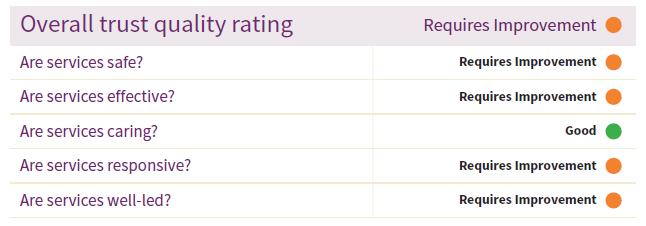
Therefore, the Trust current CQC rating remains ‘requires improvement’ resulting from the 2021 and 2023 published inspections, see figures 1 and 2 for breakdown of results.
The recommendations received from the published 2021 and 2023 CQC inspections were collated into individual projects and were updated by the relevant divisional teams using our quality improvement methodology to enable a consistent and
sustained approach to the achievement of these objectives. Each project had a designated executive; a senior responsible officer (SRO) and we have appointed a quality project management team to provide additional support.
We used our CQC quality improvement plan as a dynamic document; during the year we have added additional improvement topics into it, as we identified further areas that required improvement. The quality improvement plan is monitored monthly through the Clinical Quality Improvement Group that reports into the Trust Compliance Group and onto the Quality and Safety Committee.
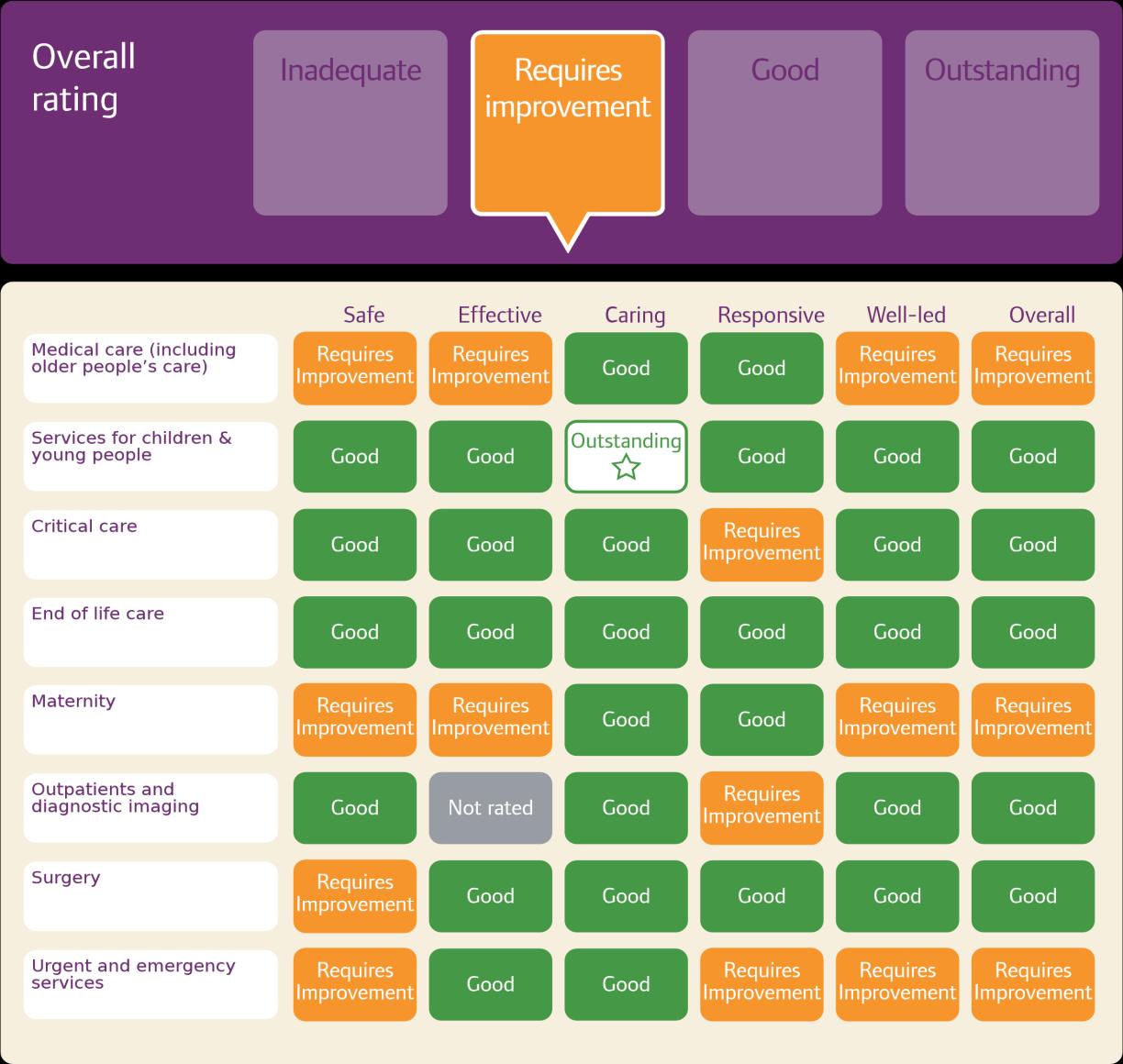
Our people use the CQC inspection outcomes as the foundation upon which to critically examine our services and focus on how we plan and deliver the fundamental aspects of safe care. We have taken decisive action to change everyday activities, which have led to significant improvements.
The Trust is actively working across all our clinical services to measure our current performance position and identify the evidence we have in place to support each quality statement.
March 2027
The Trust has established eight Quality Account priorities for delivery between April 2026 and March 2027. These priorities align with the four quality performance indicators of the Trust’s strategy: our patients, our people, our performance and our places.
They have been developed by focusing on what matters most to our patients: improving safety, reducing harm, shortening waiting times and acting on their feedback. We have also considered how best to support our staff who provide direct patient care. This process has been informed and supported by clinical leadership teams and members of the Trust Board.
Priority 1: (Our Patients and Our Performance)
We will continue to maintain progress towards the Trust Hospital Standardised Mortality Rate (HSMR) within the “as expected” range and we will continue learning from every death. This will improve quality of care for all patients.
Priority 2: (Our Patients and Our Performance)
We will continue to deliver high quality care in the right place and at the right time for our emergency and urgent care patients. Our improvement plans require the continued reduction in numbers of patients within the department who are waiting for longer than 12 hours for treatment, admission or discharge home or to an alternative hospital setting.
Priority 3: (Our Patients and Our Performance)
We will continue to drive the quality improvements on reducing the number of complaints or PALS concerns that detail communication as the main issue We will focus on ensuring that our feedback to patients demonstrates improvements in communication and evidencing that we have listened to all our patients.
Priority 4: (Our Patients and Our Performance)
Following successful launch of Martha’s Rule in 2025-26, we will ensure we embed ‘Call for Concern’ to reduce harm from failure to recognise deterioration and ensure that patients’ families/carers are listened to.
Priority 5: (Our Patients and Our Performance)
We will reduce the numbers of hospital acquired pressure ulcers graded 3 and 4 and continue to learn from each of these incidents. This will improve the quality of care received by our patients at risk of developing pressure ulcers through our fundamentals of care quality improvement programme.
We have set five priorities to support our people, creating a coherent and credible framework for strengthening the quality of care delivered today while enabling the strategic shifts required for sustainable improvement in future service delivery.
• Priority 1 – Improve the care we deliver through staff feeling valued
• Priority 2 – Recognition and reward
• Priority 3 – Reducing the violence and aggression that our staff experience
• Priority 4 – Strengthen staff networks and embed EDIB (Equality, Diversity, Inclusion and Belonging)
• Priority 5 – demonstrate that our people feel their wellbeing has been focused on by the Trust Priority 7: (Our Performance)
For the year ahead (2026/27) we have aligned our quality improvement and transformation activities with strategic and organisational goals.
There will be three PAHT programmes aligned with the three new divisions. The focus will be on:
a) Urgent care and unplanned care
b) Elective pathways (focus on theatres utilisation and elective recovery)
c) Outpatient improvement and redesign
We will be aiming for significant changes in the following measures:
• Theatre utilisation
• Patient experience of waiting lists
• Outpatient Patient Initiated Follow Up (PIFU) rate
• Outpatient Do Not Attend (DNA) rates
• Advice and Refer triage
These quality improvements will in turn contribute to improved performance against:
• Referral to treatment standards
• Cancer 62 days
• Urgent and Emergency Care 4 hour, 12 hour and ambulance handover times
We will continue to develop our Health and Care Partnership model in line with Trust strategy.
Our pounds – No objective
We firmly believe that by delivering the best care for our patients this will assist in reducing our operating costs. We will continue to meet our Patients, Quality and Productivity targets to maintain financial balance and ensure we live within our means and deliver great value for the people of Hertfordshire and West Essex.
Monitoring Progress on our 2026-27 quality improvements
These priorities will be monitored through our established governance structures, including regular oversight by the Quality and Safety Committee.
The Princess Alexandra Hospital NHS Trust is a 414 bedded District General Hospital with a full range of general acute services, including; a 24/7 Emergency Department, an Intensive Care Unit, a Maternity Unit, a Level 2 Neonatal Intensive Care Unit, Operating Theatres and Day Case Surgery services.
The Trust serves a core population of around 350,000 and is the natural hospital of choice for people living in West Essex and East Hertfordshire. In addition to the communities of Harlow and Epping, the Trust serves the populations of Bishop’s Stortford and Saffron Walden in the North, Loughton and WalthamAbbey in the South, Great Dunmow in the East and Hoddesdon and Broxbourne in the West. Its extended catchment incorporates a population of up to 500,000.
The Trust delivers outpatient services at The Princess Alexandra Hospital site and at our satellite sites, including Herts and Essex Hospital in Bishop’s Stortford and St Margaret’s Hospital in Epping.
We operate a variety of services to meet the needs of our patients (the service portfolio is detailed within Table 1)
Table 1: Directory of our Services
Care Group: Musculoskeletal and Ear Nose and Throat (ENT)
Ear Nose and Throat (ENT) and ENT SDEC
Rheumatology
Maxillofacial / Dental Musculoskeletal (MSK) Orthopaedics
Integrated Emergency and Medical Pathways Division
Care Group: Urgent and Emergency Care
Adult Emergency Department
/ Same Day Emergency Care (SDEC)
Acute Medicine Inpatient Wards Medical SDEC
Care Group: Medical Specialties
Cardiology
Care Group: Frailty and General Medicine
General Medicine Inpatient and Outpatient
Orthogeriatrics
Family, Diagnostics and Community Division
Care Group: Women’s Services
Inpatient Maternity
Gynaecology
Care Group: Babies, Children and Young People
Paediatrics
Care Group: Outpatient
Diagnostics and Breast Audiology
and Outpatient
Clinical Admin/Outpatients
Care Group: Community Services
and Breast Screening
Oversight of West Essex Community Services
The review of services and all related data is carried out through the Trust’s governance structures. This includes monthly meetings that examine information on patient experience and engagement, patient safety, learning from deaths, vulnerable patient groups, and infection prevention and control, as well as monthly meetings of the clinical effectiveness and compliance groups.
All of these groups report monthly to the Quality and Safety Committee, a subcommittee of the Trust Board.
Performance for each service within the Trust is monitored by the Performance and Finance Committee, while external oversight is provided by both Essex and Hertfordshire commissioners through the monthly Quality Assurance, Improvement and Performance Oversight Meeting.
Our Achievements Against Priorities Set for Completion during 2025-26
Our Patients and Performance Objectives
1. We will continue to maintain the Trust 12-month rolling Hospital Standardised Mortality Rate+ (HSMR) ‘as within expected’ and we will continue learning from every death. This will improve quality of care for all patients.
Outcome: Achieved
The Princess Alexandra Hospital Trust (PAHT) is currently showing a mortality position of within expected deaths, under the Dr. Foster mortality model. Since June 2025 it was identified that the Trust’s mortality indices had deteriorated. Elevated values were primarily due to data quality issues arising from incomplete coding at Secondary User Service (SUS+) submission.
Hospital Standardised Mortality Ratio (HSMR+) for the period Feb-25 to Jan-26 is 97.67 and “within expected”, based on 20,225 superspells and 781 deaths (crude rate 3.86%), see Figure 3.
Figure 3: HSMR for the period Feb-25 – Jan-26
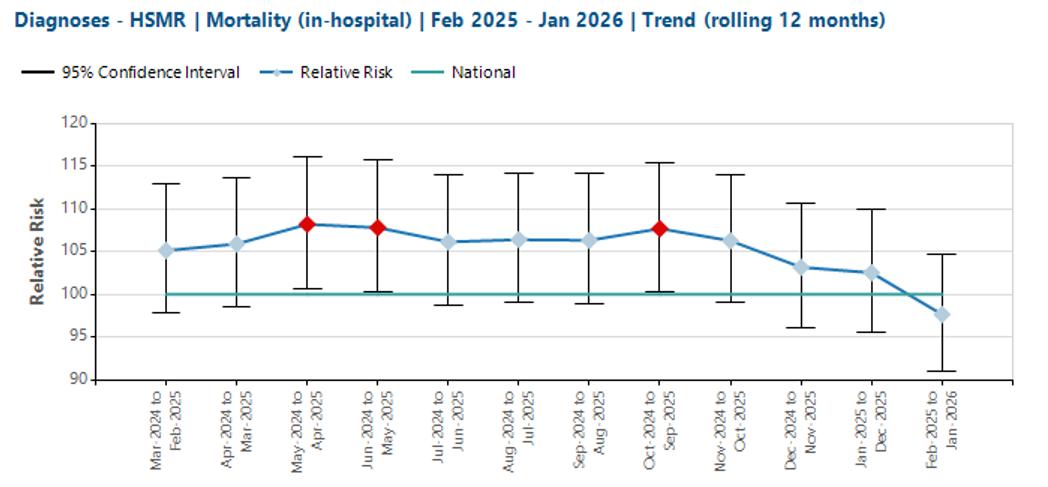
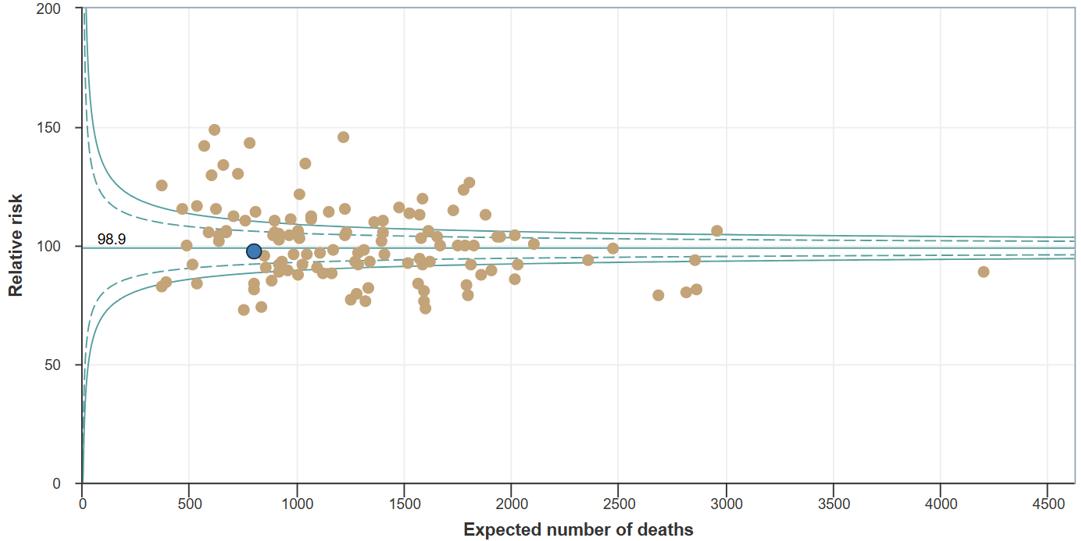
Despite the deterioration in the Trust’s mortality position, under the Dr Foster model, the Trust was not found to have a HSMR+ which was statistically higher than our national peers over the last 12 months, Figure 4.
Figure 4: In Hospital Mortality Feb-25 – Jan-26 Rolling Trend
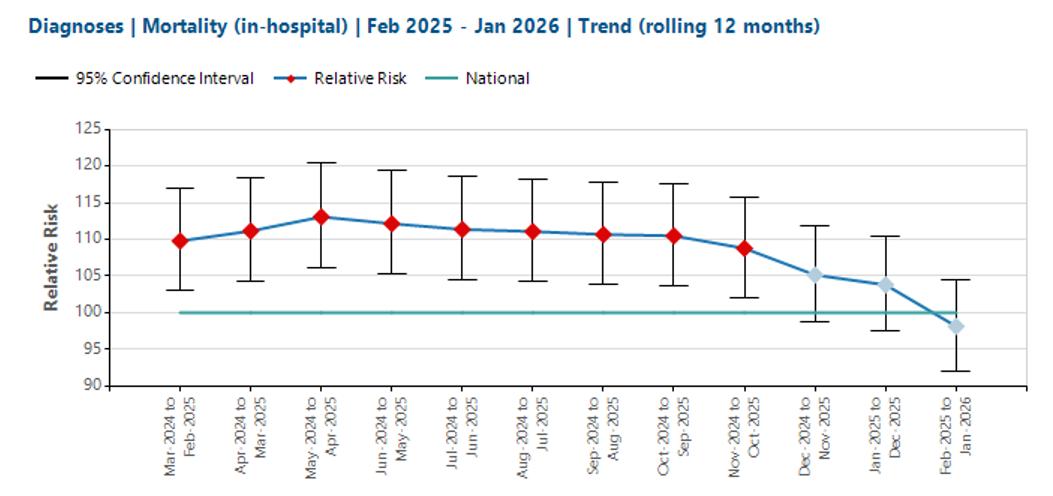
Standardised Mortality Ratio (SMR) for the period Feb-25 – Jan-26 is 98.13 and “within expected”, based on 70,360 superspells and 964 deaths (crude rate 1.37%), Figure 5.
Mortality indicators were elevated from June 2025, with the underlying cause being data quality rather than clinical care.
• Staffing challenges in the coding department has created a backlog in coding clinical activity.
• The implementation of Alex Health (Electronic Patient Record), in October 2024 created additional and unnecessary episodes of care, which has distorted the expected mortality calculations. This was not identified until July 2025.
• Clinical documentation and coding standards have misrepresented patient care and treatment, leading to inaccurate and/or incomplete coded activity, impacting the Trust’s mortality position.
Significant steps were taken to improve the Trust’s mortality position, which include:
• Improved quality and depth of coding by working more closely with clinicians
• Recruitment of coding staff and external sourcing of clinical coders.
• Amending the admission process so that patients are admitted under the correct and single clinician for that admission and speciality.
• Teaching for clinical teams on what language is bound by coding standards, to improve clinical documentation and accurate coding.
Learning from deaths does not rely solely on the mortality indices. The following processes complement the mortality data:
• The Dr Foster data set includes diagnosis-specific mortality outliers. All patient deaths within each outlier group are reviewed by the relevant clinical specialty leads and coding leads to identify care and treatment or coding inaccuracies.
• Every in-hospital, Emergency Department and community death is scrutinised by the Medical Examiner team.
• A minimum of 25% of deaths are further reviewed using the structured judgement review (SJR) approach and learning is shared through regular departmental mortality and morbidity meetings.
• Concerns raised through or external to these processes, are scrutinised by the Incident Management Group by reporting, using the Trust’s Datix system.
5: HSMR+ National Peer Comparison (Last 12 Months)
2. To improve patient outcomes and reduce harm from long waits in the Emergency Department (ED), our improvement plans aim to reduce the numbers of patients waiting longer than 12 hours from the decision to admit to them being admitted, less than 10% of attendances, that then are direct admissions, discharged or transferred to an alternative clinical setting.
Our overall 12-hour length of stay performance has demonstrated a sustained improvement trajectory since January 2026. While there have been identifiable periods of achievement against this standard, this improvement has not yet been consistently maintained and continues to be affected by wider operational pressures across the system.
Variability in demand and capacity has contributed to fluctuations in performance, highlighting the need for continued focus on resilience and flow along with comprehensive improvement plans, Figure 6.
We recognise the additional impact of out-of-hours activity, which disproportionately contributes to periodic dips in 12-hour performance due to delays in downstream processes, and increased volume and complexity of presentations.
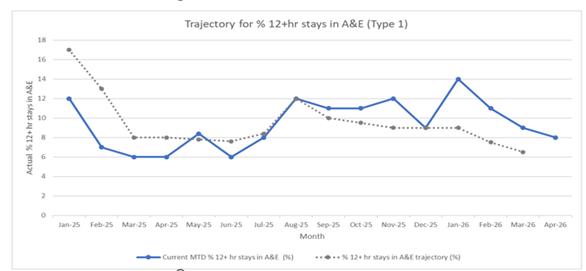
Despite ongoing challenges in achieving the 12-hour standard, the team has continued to implement improvements focused on patient safety, experience, and quality of care. The current harm review process within ED for 12-hour waits, has not identified any increases in patient harm.
Since November 2025, the Trust has achieved and sustained the closure of the Emergency Department (ED) corridor as a clinical care area. Historically, corridor care was used during periods of extreme operational pressure, presenting challenges in maintaining our patient’s privacy, dignity, and optimal standards of care.
The elimination of corridor care represents a significant quality improvement milestone and reflects a whole-system approach to patient flow, capacity management, and clinical prioritisation. This achievement has been driven by strengthened operational grip, including enhanced real-time flow oversight, improved escalation processes, and closer collaboration with system partners to support timely admission, discharge, and transfer of care. As a result, patients attending the ED are now cared for in the appropriate clinical environments that better supports their safety, confidentiality, and experience. Sustaining the closure of the ED corridor remains a priority.
The Trust continues to monitor performance closely, particularly during periods of increased demand, and is committed to ongoing system-wide collaboration to ensure that safe, dignified care environments are maintained for all patients.
This represents a significant quality milestone and reflects strengthened clinical oversight, improved flow, and a sustained commitment to delivering care in appropriate clinical environments.
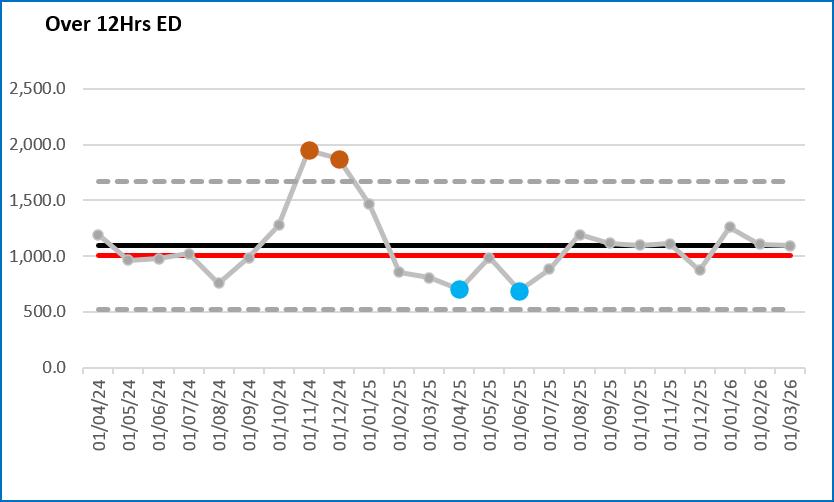
However, our improvement plan to reduce the numbers of patients waiting longer than 12 hours from the decision to admit to them being admitted has not consistently achieved the less than 10% of attendances during the period 2025-26, figure 7 and 8.
Figure 7: Twelve Hour Waits After Decision to Admit
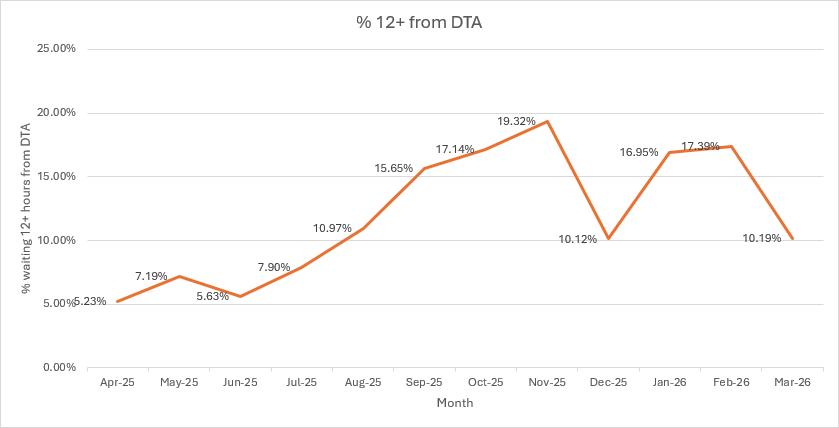
8: Numbers of Patients in ED >12 Hours
As part of the Trust’s wider improvement programme, a set of targeted, time-bound actions is being developed to mitigate these pressures. These include strengthening out-of-hours escalation processes, improving access to senior decision-making, and enhancing coordination with internal and system partners to support more sustained and embedded improvement.
3. We will collaborate with all clinical leaders to reduce communication-related patient complaints by 20% for 31 March 2026, as identified by patient feedback surveys and complaints data, through increased staff training and regular feedback mechanisms. Outcome: Partially Achieved
The number of complaints received increased significantly between the financial years ending March 2025 to March 2026. For the year ending:
• 31 March 2025 we opened 319 complaints.
• 31 March 2026 we opened 651 complaints; this is a 104% increase.
As the performance indicator is a percentage and not an absolute number, this means that although more complaints about communication were made, 8% fewer of these had the primary concern relating to communication. This represents a significant achievement given the overall increase in complaints. This was achieved by working closely with our medical education teams, to increase the numbers of medical staff completing SAGE and THYME, the nationally accredited Foundation Level Skills and communication training, led by the patient experience team, with 87.15% compliance across the eligible staff groups. Additional training for both preceptors and consultants was led by the Head of Patient Experience. A summary of the complaint theme topics is represented in the figure below.
Figure 9: Summary of complaint topics
New information published about how to communicate better with our clinical teams and the involvement of a number of vulnerable patient groups in desensitisation visits to hospital environments have contributed to the improvement.
4. We will have zero patients waiting over 65 weeks for treatment and reduce the number of patients waiting longer than 52 weeks for treatment to no more than 1% by 31st March 2026 (this is in line with national guidance).
pathways, by the reported national submissions of patient waiting times and will improve the experience of patients.
Outcome: Partially Achieved
The Trust remained committed to reducing long waits for elective care and prioritised this objective throughout 2025-26. Performance against the incomplete 18-week Referral to Treatment (RTT) standard improved significantly during the year, with the Trust exceeding its internal target in March 2026 by achieving 64.1%. This improvement was supported by additional capacity, closer working with community and primary care partners, and strengthened waiting list validation to ensure accurate recording and prioritisation of patients.
A key focus during 2025-26 was the treatment of the most clinically urgent patients and those with the longest waits. As a result, the Trust successfully reduced the number of patients waiting longer than 65 weeks, with 65 patients waiting on 31/3/2026, and all will commence treatment before the end of June 2026.
The Trust also targeted a reduction in patients waiting longer than 52 weeks for treatment to no more than 1% by year end. Substantial progress was achieved. The number of patients waiting over 52 weeks reduced from 2,403 in April 2025 to 569 by March 2026, representing 1.4% of the waiting list. This reflects a significant improvement for patients experiencing the longest waits.
Recognising the impact of long waits on children and young people, targeted action was undertaken to reduce extended waits in this group. The number of children waiting longer than 52 weeks reduced from 232 in April 2025 to 88 by March 2026. This improvement represents meaningful progress; there has been a substantial reduction in the overall long-wait group of patients.
Reducing long waits will remain a key priority for 2026-27. The Trust will continue to build on progress made during 2025-26, working towards national guidance requiring a minimum 7% improvement in the incomplete 18-week RTT standard to support delivery of 92% of patients waiting 18 weeks or less by March 2029.
5. Roll out Martha’s Rule (Call for Concern) to reduce harm from failure to recognise deterioration and ensure the patients’ families/carers are listened to.
Outcome: Achieved
Martha’s Rule is a national programme introduced following the death of 13-yearold Martha Mills in 2021 from sepsis where there was a failure to escalate her to intensive care and after her family raised concerns about the deterioration in her condition, that was not responded to promptly.
Extensive campaigning by her parents and the cross-party think tank Demos, saw widespread support for a single system that allows patients or their families to trigger an urgent clinical review from a different team in the hospital, if the patient’s condition is rapidly worsening and they feel they are not getting the care they require
The national programme was to build on NHS England’s Worry and Concern pilots launched at seven NHS Trusts last year, which developed and tested escalation methods to address patients’ and families’ concerns.
There are 3 components to Martha’s Rule:
I. All staff in NHS trusts must have 24 hours a day and 7 days per week (24/7) access to a rapid review from the Critical Care Outreach Team (CCOT) who they can contact should they have concerns about a patient.
II. All patients, their families, carers, and advocates must also have access to the same team 24/7 for a rapid review from a CCOT.
III. The NHS must implement a structured approach to obtain information relating to a patient’s condition directly from patients and their families at least daily. In the first instance, this will cover all inpatients in acute and specialist trusts.
PAHT applied to be one of the early implementers of Martha’s Rule, one of 100 Trusts that during 2025-26 rolled it out in a phased approach comprising of three components
Adult pathway
• Martha’s Rule (Call for Concern) process is now in place and working across all adult inpatient areas, see table 2.
• Patient Wellness Questionnaires (PWQs) were introduced and embedded to support the Trust successfully implement Calls for Concern.
• Ongoing teaching and support from CCOT remains in place.
Children’s and Neonates pathway
• Short term pathway trial is in place with support from North Thames Paediatric Network (NTPN)
• Long term pathway planning is in the discussion phase.
• PWQ will be documented electronically with the rollout of Newborn Early Warning System (NPEWs) and Paediatric Early Warning Score (PEWS)
These areas were not in the original implementation phase for the Call for Concern programme but are being considered for implementation in 2026-27.
6. We will improve the number of our staff who state that they agree / strongly agree that they feel safe to speak up within the organisation to over 60%. This will be measured through the annual staff satisfaction surveys. This will benefit the Trust as it concerns the wellbeing of all our people.
Outcome: Not Met
Current position from the 2025 annual NHS Staff Survey was the Trust scored 54.9 % of staff agreed / strongly agreed that they felt safe to speak up, this is a 1% decrease in the responses from the 2024 survey.
This reflects inconsistent leadership behaviours across teams, insufficient visibility of actions completed following concerns raised, in addition to cultural, psychological safety barriers and change fatigue.
During the period of the Staff Survey the Trust was undergoing a clinical divisional restructure, it is likely that with structural changes and role redesign in an uncertain environment, this impacted staff to answer this question in a negative way.
7. We will improve by at least 10% the numbers of our staff who: • would recommend the Trust as a place to work to 55% • would recommend the Trust as a place to receive care/treatment to 50%
This will be measured through the annual staff satisfaction survey. This will benefit the Trust through improved wellbeing of our people
Outcome: Not Met
Results from 2025 for those that would recommend the Trust as a place to work is 49.27%, which is a reduction of 0.67%. 1,284 people answered this question positively in comparison with 1,005 people in 2024.
The number of staff that would recommend the Trust as a place to receive care/treatment was 42.88% in 2025, which is a reduction of 2.67% compared to 2024
Advocacy scores have fallen nationally as a sub score within the Annual Staff Survey results and reduced to 6.64%. Our Trust score reduced to 5.98% although 25a (care of patients / service users is organisation top priority), it is also included in this score.
From reviewing the reasons for the decline both locally and nationally, this relates to themes around compassionate and visible leadership, improving team culture and peer support, strengthening wellbeing such as breaks and behavioural
standards, which links to themes identified through the Freedom to Speak Up and review of workload and addressing burnout.
We will continue to work in collaboration with our local system and regional partners in the area of health pathways, to improve local health outcomes, improve patient care and experience.
Outcome: Achieved
At the beginning of 2025-26, the New Hospital Programme confirmed that land acquisition and strategic estates development planning could continue despite the Trust being in placement Wave 2 of the national New Hospital Programme. Work continued this year to assess the feasibility of delivering a new hospital on a new site at Junction 7A of the M11, however, we have begun to explore more robustly as to whether a new hospital would fit within the current site and provide further benefits for patients by expediting the delivery of new care facilities for the people of West Essex.
To complement this approach and in line with the NHS 10 Year Health Plan, the Trust recognises that there are a range of services that can be moved off the hospital site and delivered in a community setting and we are prioritising this shift within the Trust. The first example of such a move was achieved earlier this year with practical completion of the phlebotomy (blood test) service move from the main site to the Harvey Centre in the heart of Harlow. This is aligned to the economic redevelopment of the town centre and we continue to explore other opportunities with the Council.
Our staff continue to work in partnership with a wide stakeholder group of experts to deliver a Community Diagnostic Centre (CDC) at St Margaret’s Hospital in Epping. As the lead organisation for our CDC programme, we are delighted to have achieved completion of phase 1 of the innovative and fit for purpose Community Diagnostic Centre, and receiving the first patient in March 2026.
The CDC provides additional scanning and diagnostic testing at the weekend and longer opening hours during the week. This development brings diagnostic tests closer to patients’ homes, increases the number of appointments and extends the days of the week that tests will be available, which will support local people. With additional funding gained, phase 2 of the CDC has commenced, this is to provide two new X-ray rooms, ultrasound and fibroscan and transnasal endoscopy rooms as well as a new consulting room. We are aiming to receive the first patient in early 2027.
Infection Prevention and Control
Infection Prevention and Control (IPC) is a core organisational priority, embedded within the Trust’s risk management framework and supported by strong Board oversight. A culture of patient safety continues to be reinforced through robust governance structures, including the Infection Prevention and Control Committee
(IPCC) and the operational IPC Steering Group (IPCSG), ensuring effective leadership, performance monitoring, and risk escalation.
The Trust maintained strong overall IPC performance, with infection rates for all key healthcare-associated infections (HCAIs) remaining below the East of England (EoE) regional averages, despite exceeding some national thresholds.
• Clostridioides difficile: 58 cases (above threshold), but improved year-onyear and below regional rates. Strong antibiotic stewardship and standard IPC measures remain key mitigations.
• Methicillin-Resistant Staphylococcus Aureus (MRSA) Blood Stream Infections (BSI): 3 cases; performance broadly in line with regional averages
• Methicillin-Sensitive Staphylococcus Aureus (MSSA) BSI: Rates significantly lower than regional average, indicating sustained effective prevention measures.
• Gram-negative BSIs: Remain below regional averages, with ongoing focus on reducing urinary-related infections.
Nationally, health care associated infections (HCAI) pressures have increased, particularly linked to antibiotic use and operational pressures such as high bed occupancy and patient flow.
The winter period presented significant challenges, with increased respiratory infections:
• Notable rise in Influenza A (415 cases), alongside Respiratory Syncytial Virus (RSV) and COVID-19.
• Implementation of a point-of-care testing programme improved rapid diagnosis and patient cohorting.
• Outbreaks were fewer than the previous year and largely contained.
The Trust maintained a comprehensive IPC response including vaccination programmes, enhanced cleaning, Personal Protective Equipment (PPE) use, and targeted seasonal controls, which mitigated wider impact.
A robust assurance framework underpins IPC delivery:
• Audit results demonstrated consistently high compliance, with targeted action for underperforming areas.
• Mandatory training compliance is improving, though some areas remain slightly below target.
Despite increased national and seasonal pressures, the Trust has sustained strong IPC performance, demonstrated by:
• Lower-than-average infection rates across most key organisms
• Effective governance, surveillance, and clinical oversight
• Successful management of winter respiratory pressures
The organisation continues to embed best practice and national guidance, supporting the delivery of safe, high-quality care.
At the Princess Alexandra Hospital NHS Trust (PAHT) we define quality improvement as: ‘Working together in partnership to make the sustainable changes that lead to us being modern, integrated and outstanding for our patients, people, places, performance and pounds.’
The purpose of the quality improvement (QI) and transformation team is to nurture an improvement culture that will enable the delivery of the Trust’s strategies and wider NHS ‘Fit for the Future: 10 Year Health Plan for England’ three shifts:
• Analogue to digital
• Hospital to community
• Sickness to prevention
We achieved this by working alongside our people, patients and wider health and care partners with a focus on two key areas:
a) Building our people’s capability and capacity in delivering quality improvement and transformational change at PAHT for the benefit of our patients, staff and wider community.
b) Centrally coordinate and facilitate the delivery of quality improvement and transformation programmes and projects that address significant risks and / or achieve the realisation of strategic priorities.
During 2025-26 the following improvement programmes were supported by the QI and transformation team:
• PAHT2030 Change Strategy: strengthened Trust’s improvement infrastructure and capability, supporting delivery of strategic priorities through structured improvement approaches, coaching, and programme development
• Alex Health Transformation: three pathways including Virtual Fracture Clinic, End of Life and Frailty were updated and went live. This has improved compliance and data retrieval.
• Outpatients Programme: continued improvements with Patient Initiated Follow Up (PIFU) utilisation and exploration to deliver surveillance pathways for patients with long-term conditions. Advice and Refer implemented for four specialities in preparation for the national launch of Single Point of Access (SPOA) which releases capacity for secondary care to see patients in a timely manner.
Community Diagnostic Centre programme implemented successfully on 16 March 2026.
• Urgent Care Programme: supported urgent and emergency care redesign and integrated discharge leading to reduction in ambulance handover times and improvements with ED access standards.
• Theatres: improved data quality and reporting capability, alignment of theatre templates and consultant job plans, development of theatres dashboard with positive impact on theatre recovery
• Musculoskeletal (MSK): PAHT awarded as lead provider following procurement process for a further five years. Onward referrals to secondary care continue to reduce through a range of initiatives including spinal injections being delivered in the community and clear patient pathways. Complex patients are now discussed
at multi-disciplinary team meetings (MDTs), by secondary care and community clinicians.
• West Essex Healthcare Professionals Transformation: Frailty collaborative implemented key initiatives to facilitate direct transfers from older people’s assessment to care of the elderly wards. New leg ulcer pathway mapped across the system to reduce duplication, unwarranted variation and to improve patient experience.
For the year ahead we have aligned our quality improvement and transformation activities with strategic and organisational goals. There will be three PAHT programmes aligned with the three new divisions. The focus will be on:
1. Urgent care and unplanned care
2. Elective pathways (focus on theatres utilisation and elective recovery)
3. Outpatients’ improvement and redesign
Patient safety and quality will be a golden thread that cuts across this and we will be held to account on delivery by our impact against core planning metrics across the five Ps (Patients, People, Performance, Place and Pounds). Ultimately, we will look to make sustainable improvement that impacts positively across patient experience and outcomes as well as the wider community we serve (population focus and care closer to home).
Linked with this are three system integration priorities of:
1. Children and Young People (Paediatrics)
2. Long-Term Conditions
3. Frailty
There are cross cutting and enabling streams of work:
1. Integrated Workforce Development Programme
2. Neighbourhood Health Development
3. Strategic Estates
4. Digital by Default
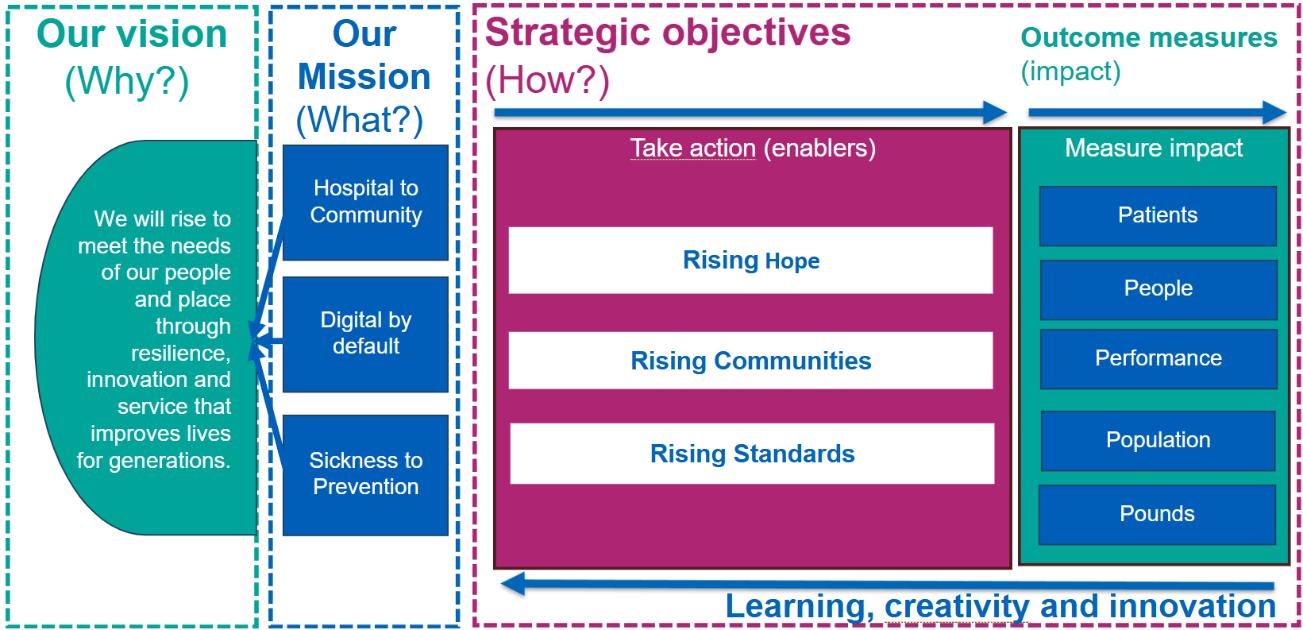
Going forward during 2026-27 the work to support the delivery of the Trust’s Rise strategy will be implemented.
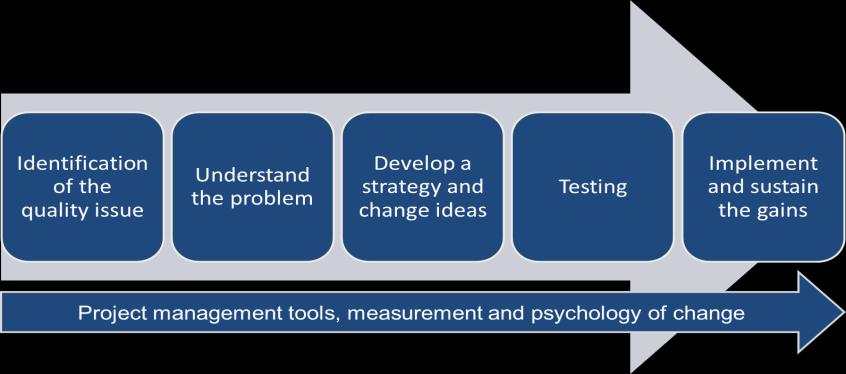
Figure 10: Improvement Roadmap
At PAHT, improvement is guided by our Improvement Roadmap (Figure 11), which provides a structured and consistent approach to delivering sustainable change aligned to our strategic priorities.
The roadmap sets out the key stages of improvement, from identifying and understanding problems, through to testing, implementation and sustaining gains — supported throughout by project management, measurement for improvement and the psychology of change, figure 10 and 11
Within this approach, we use the Model for Improvement as our core method to support teams to define clear aims, establish meaningful measures, and test practical change ideas using Plan–Do–Study–Act (PDSA) cycles. This enables a disciplined and evidence-based approach to developing, testing and implementing change.
Quality improvement at PAHT is embedded within everyday clinical and operational practice and is enabled through a combination of capability building, programme delivery and governance oversight.
Improvement programmes are designed around priority quality and operational challenges, with clear aims, measures and accountable leadership. These are supported through structured governance arrangements, including regular reporting to the Quality and Safety Committee, ensuring transparency, accountability and continuous organisational learning.
Improving patient safety remains central to our improvement approach. Programmes have focused on reducing harm, strengthening reliability in safety-critical pathways, and ensuring that learning from incidents and mortality reviews is translated into measurable and sustained improvements in practice.
Patient experience is improved through targeted programmes that use patient feedback and insight to inform priorities, design changes and evaluate impact, ensuring that improvement is grounded in what matters most to patients and families.
Quality improvement also supports productivity and sustainability, ensuring that services are efficient while maintaining exact standards for safety and experience. Improvement programmes have focused on patient flow, reducing delays and improving the effective use of resources.
All quality improvement activity is supported by clear governance and reporting arrangements. Regular reports to the Quality and Safety Committee provide assurance on delivery, highlight risks, and enable shared learning across the organisation.
Digital transformation is a key enabler of quality improvement at PAHT, supporting safer care, better patient outcomes, and more integrated pathways. During the year, we have progressed targeted digital programmes aligned to our quality priorities, with a particular focus on frailty and infection prevention and control (IPC).
The Improvement Partnership has played a central role in strengthening the Trust’s improvement infrastructure, with a focus on building capability at scale, developing leadership for improvement, and enabling delivery of strategic priorities.
A key achievement has been the continued growth and embedding of Quality Improvement Fundamentals (QIF) as the Trust’s core capability offer. Over the year, nearly 300 staff across clinical and corporate teams have been trained, establishing a consistent approach to improvement and supporting teams to apply methodology to real-world challenges.
Alongside this, the Improvement Leaders Programme (ILP) has been developed and launched as the Trust’s next-level offer, designed to support senior leaders to lead improvement aligned to divisional and organisational priorities. The programme brings together a multi-professional cohort working on live projects, strengthening leadership capability and creating a pipeline of strategically aligned improvement work.
To further strengthen engagement and culture, the Trust delivered its Quality Improvement Celebration Event in February 2026, bringing together over 80 staff and showcasing more than 30 improvement projects. This provided a platform for shared learning, recognition and connection across teams, reinforcing the importance of improvement in delivering the Trust’s ambitions.
Throughout the year, the Partnership has also provided targeted improvement support to priority programmes and teams, including facilitation, coaching, stakeholder engagement and development of measurement systems. There has been an increasing focus on strengthening measurement for improvement, supporting teams to move beyond activity to demonstrating impact and outcomes.
• Established a scalable improvement capability model, with QIF and ILP forming a clear development pathway
• Nearly 300 staff trained in QI methodology, strengthening consistency and confidence across the organisation
• Increased visibility and engagement in improvement through Trust-wide events and shared learning
• Strengthened focus on outcome measurement to support evidence-based decision making
Patient Advice and Liaison Service (PALS)
The Patient Advice and Liaison Service (PALS) is the public’s first point of contact service with the Trust and responded to 5,087 enquiries this year, which is a 7.6% increase on the numbers for 2024-25. PALS received concerns from patients via email, over the telephone, or in person and work closely with services and clinical teams in the resolution of patient concerns. The increase reflects delays due to operational pressures and overall increases in public demand on our services.
Section 18 report
The complaints team deals with formal complaints relating to patient care. Every year, the Trust must make a statement under Section 18 of the NHS Health and Social Care Act 2009, about how many complaints it received, whether or not they were well founded, their subject, the issues they raise, and any actions taken. This section satisfies the requirement.
How many complaints were received?
651 formal complaints were received between April 2025 and March 2026, which is a 104% increase from the previous year (319).
How many were well founded (upheld)?
561 complaints were closed in the period April 2025 to March 2026, (the point at which we determine if a complaint can be upheld) 80 were fully upheld, 271 were partially upheld, and 117 were not upheld. The remainder (93) having been either withdrawn, out of time, or failed to provide valid consent.
By identifying a case as partially upheld, we mean that at least one of the concerns raised meant action was required by the Trust to address the issue.
What were the subjects?
Of the 651 cases received, 1037 categorisations were made (each case can be categorised multiple times). The most frequently occurring themes related to:
a. Medical and nursing care
b. Communication
c. Waiting times
What issues do those cases raise and what actions were taken?
Issues relating to medical and nursing care were addressed by the ward or specialty
involved, with specific measures and actions taken as a result of the learning from each individual case.
Transformation work is underway Trust-wide to address waiting times for our outpatients.
The patient experience strategy focuses upon three core themes of
• improving our communication
• effective use of technology
• kindness and compassion in the services we provide.
Our actions in response to those themes were:
Improving our communication
• Over 2500 nursing, midwifery and allied health professional staff have been trained in Sage and Thyme Foundation Level communication skills, with a trial also undertaken involving doctors.
• Improved communication training developed and delivered for preceptorship nurses, allied health professionals, and operating department practitioners.
• Support was provided to Patient Panel outreach events in Harlow, Epping and Bishop’s Stortford, to reinforce access to the resolution of PALS enquiries and the formal complaint process.
• Work is ongoing with the deaf community to improve cancer information in partnership with Cambridge based Anglia Ruskin University.
The effective use of technology
• My Alex Health is our new web-based patient portal which went live in March 2025. It is a secure digital service where patients can access information relating to their care at PAHT, including appointment letters, test results and scans. To date, over 62,000 patients have registered to use it. 29 specialty services are now live on the portal, with only 5 of our services remaining to be onboarded.
• A new technology driven noise at night project is ongoing with the aim of reducing noise by using sound meters to show the sound level in decibels.
• A project is currently underway to procure new wheelchairs which are digitally trackable to the user, with the aim of ensuring improved wheelchair provision across the Trust.
Enabling kindness and compassion
• Development of projects focusing on enabling personalised care, such as the provision of food and drink to patients waiting for extended periods in the Emergency Department (ED) and the Urgent Treatment Centre (UTC), improved discharge support, and end of life care through the Butterfly Volunteer Hub.
• Bringing greater visibility to the challenges of marginalised groups through Board stories on outreach cases within the community, and reducing health inequalities within our maternity and neonatal services.
• The development and adoption of sensory and therapeutic gardens on the hospital site for the use of patients and staff.
We receive hundreds of compliments for our services each year. These are examples of just a few of those received in 2025-26:
“I would like to praise all the staff that I had contact with from the caring, knowledgeable nurses, the extremely patient anaesthetist, and of course the consultant. I entered the unit completely terrified not of the procedure itself but the thought of having a general anaesthetic. If it had not been for all the staff who were so kind and patient, I was not sure I could have gone ahead.”
“My thanks and gratitude to every single member of staff at PAHT, my daughter attended A&E with suspected appendicitis. The moment we arrived every member of staff was attentive and caring, escalating to surgery. The surgeons, ultrasound department, Children’s A&E, and Dolphin Ward have just been amazing, helped with every query, every inch of support and care, I feel quite overwhelmed.”
“The support, dedication and encouragement continued to be provided by my midwives throughout my pregnancy. They made me feel safe and secure at a time when uncertainties still very much lay ahead. They will be the first to tell you that my biggest challenge was having the ability to trust. I can hand on heart say I trust them implicitly, no matter what, no matter the situation, no matter how scared I felt. That core foundation of trust was built, maintained and will always continue to be valued. With my best interests at heart, they advocated for me time and time again when I struggled to advocate for myself.”
“I would like to express my sincere thanks for the care given to my husband during his recent visit to The Princess Alexandra Hospital. It was an extremely long day, with a wait for his procedure while being nil by mouth, but this was made much easier thanks to the kindness and professionalism of the team who looked after him.”
“I attended the radiology department and can only express my appreciation for the kindness, courtesy and professionalism of everyone I met from the receptionist, the radiographers and discharge nurse. It would be impossible to have been made to feel more comfortable or more reassured. It was a procedure I was not looking forward to but their kindness and efficiency made the whole thing "a piece of cake.”
This has been an exceptionally busy and productive year for the Patient Panel, marked by a wide range of initiatives aimed at strengthening patient engagement and improving the overall healthcare experience.
During the year, the Panel successfully organised three public engagement events in Harlow, Epping and Bishop’s Stortford. Following feedback from the initial afternoon session, subsequent events were scheduled in the early evening to improve accessibility. This resulted in a significant increase in attendance, with nearly 100 members of the public attending the Epping event. Reports from these events are available on the Patient Panel’s webpage.
The Panel has also strengthened its contribution to system-wide working. This includes becoming a partner in the Neighbourhood Scheme and presenting at the NHS Confederation conference on “Closer to Home,” sharing learning on community-based approaches to care and patient involvement.
Partnership working has been further achieved through collaboration with Anglia Ruskin University students on a project to explore the development of a Young People’s Board within the hospital. This supports the Trust’s ambition to ensure that younger people’s voices are represented in service design and delivery. In addition, the Panel has worked with local Patient Participation Groups (PPGs) to establish more effective mechanisms for communication and collaboration across primary and secondary care.
To strengthen patient insight, the Panel undertook a number of surveys during the year. Following an inpatient survey, Panel members conducted structured interviews with patients across all wards to better understand experiences of communication with doctors. Findings were presented to senior management and have informed a range of service improvement actions.
Towards the end of the year, the Panel contributed to the Care Quality Commission (CQC) “Well-Led” inspection process, participating in an assessment interview. While the formal report is awaited, initial feedback provided during the process was positive and recognised the Panel’s contribution to patient engagement and governance.
The Patient Panel continues to be comprised entirely of volunteers, whose contribution is integral to supporting patient experience and quality improvement across the organisation.
The Panel also supported a programme of educational visits for schoolchildren aged 8–10 and young adults with additional needs. These visits, delivered with support from staff across the Trust, provides an introduction to the hospital environment and contributes to improved confidence and understanding of healthcare services within the community.
Ensuring representation of the diverse local population remains a priority. The Panel achieves this through public meetings, engagement in community settings, and participation in local events. This includes involvement in the annual Royal British Legion Poppy Appeal, working in partnership with local schools and community groups to deliver a commemorative display within the hospital.
Individual contributions have also been recognised at a national level. The Panel Chair, Ann Nutt, was awarded the British Empire Medal for services to the NHS. Panel members Jacqueline Jackson and Mark Hamilton have been invited to attend the King’s Garden Party in recognition of their voluntary service. Angela Weeks has also received recognition for her contributions to the Medicine Optimisation Committee, the Readers’ Panel (this group reviews patient information leaflets to ensure they will be understandable to our patients) and the Falls Committee.
Overall, the work of the Patient Panel during the year demonstrates a continued commitment to strengthening the patient voice, supporting quality improvement, and contributing to the Trust’s wider engagement and governance arrangements
PAHT is committed to providing safe, inclusive and high-quality care for children, young people and adults who are vulnerable or at increased risk of harm. The Vulnerable People Team provides leadership and specialist expertise across safeguarding, mental health, learning disability and autism, dementia and delirium, Mental Capacity Act practice and enhanced care, supporting delivery of compassionate, person-centred care and meeting our statutory responsibilities.
During 2025-26, safeguarding and enhanced care services were delivered through an integrated multidisciplinary Vulnerable People Team, providing consistent oversight and strong governance. The Trust received assurance that robust arrangements remained in place, aligned with the Children Act, Care Act, Mental Capacity Act and national NHS safeguarding and enhanced care frameworks.
Regular reporting is through quality, safety and workforce governance supporting early identification and management of risk, learning from incidents and continuous improvement. Enhanced care governance was strengthened, improving oversight of decision-making, workforce deployment and patient outcomes.
The team supports patients with a learning disability, autism, mental health needs and cognitive impairment, ensuring reasonable adjustments and personalised care. Progress continued against national priorities, including delivery of Oliver McGowan Mandatory Training, strengthened Mental Capacity Act practice and improved multidisciplinary and multi-agency working. Audit and review activity informed quality improvement in dementia, delirium and mental health care, supporting safer and more responsive practice.
Enhanced care remains central to supporting patients with high levels of need, distress or risk. During 2025-26, the Trust built on its established enhanced care programme, supported by a dedicated enhanced care team and staff with mental health expertise.
PAHT participation in the NHS England Enhanced Therapeutic Observation and Care (ETOC) collaborative supported comprehensive review of governance, workforce, data and patient experience. A quality improvement project using an exemplar ward approach was delivered, alongside practical and simulation-based training focused on caring for patients with dementia, delirium, learning disability, autism, mental health needs and falls risk.
Governance was strengthened through a multidisciplinary Enhanced Care Assurance Group, improving oversight of activity, incidents, audit, training and patient feedback. Care decision-making processes were improved to support proportionate, least restrictive and dignified use of enhanced care. Investment in workforce capability and improved data collection further strengthened assurance.
The Vulnerable People Team supported safe discharge planning where safeguarding, enhanced care needs or complex social circumstances were present. Learning from case reviews informed improvements to communication, documentation, escalation pathways and partnership working, reducing the risk of harm following discharge.
During 2025-26, the Trust has continued to strengthen our Enhanced Care Programme, supporting patients with complex needs who require additional observation and therapeutic input to maintain safety, dignity, and quality of care.
Enhanced care has been a key component of the Trust’s approach to reducing harm, improving patient experience, and supporting staff to deliver compassionate, personcentred care.
This year marked a period of significant development, including participation in a national NHS England Enhanced Therapeutic Observations and Care (ETOC) collaborative, expansion of the enhanced care workforce, strengthening of governance and reporting arrangements, and improved approaches to training and data collection.
Enhanced care plays a critical role in mitigating risk for patients who are vulnerable due to cognitive impairment, delirium, mental health needs, learning disabilities, or increased risk of falls. In 2025-26, the Trust:
• Maintained a dedicated Enhanced Care Team, supplemented by appropriately skilled NHSP staff with verified mental health experience.
• Strengthened the consistency and safety of enhanced care decision-making through the introduction of a revised Enhanced Care Request Protocol.
• Improved incident monitoring relating to enhanced care provision, including absconding, falls, assaults on staff, and self-harm, with regular review of trends.
• Established a multidisciplinary Enhanced Care Assurance Group, providing formal oversight of incidents, risks, and mitigations.
Participation in the NHS England ETOC programme enabled the Trust to benchmark its enhanced care arrangements against national best practice and identify priority areas for improvement, strengthening assurance around safety and quality.
Throughout 2025-26, the Trust focused on improving the effectiveness, consistency, and sustainability of enhanced care delivery.
Key developments included:
• Implementation of a quality improvement project on an exemplar ward (Lister Ward), combining practical, simulation-based training with specialist clinical input on dementia, delirium, learning disabilities, autism, falls risk, and mental health.
• Recruitment of a substantive Band 4 Enhanced Care Coordinator, improving patient review, data oversight, and operational coordination.
• Appointment of a Falls Clinical Nurse Specialist, strengthening clinical leadership and integration between enhanced care and falls prevention strategies.
• Progression of work to improve data quality and reporting, including submission of enhanced care activity data to NHS England and improved use of safer care systems.
Although data collection processes continue to mature, the Trust has made measurable progress in developing consistent reporting mechanisms, supporting ongoing evaluation of effectiveness and workforce capacity.
Enhanced care is integral to delivering person-centred care for patients with complex needs, ensuring dignity, reassurance, and therapeutic engagement.
During 2025-26:
• Ward-level engagement and enhanced staff training improved confidence in supporting patients requiring enhanced care.
• Feedback from staff involved in the ETOC exemplar ward initiative demonstrated improved understanding of patient needs and enhanced multidisciplinary working.
• Governance arrangements were expanded to include review of patient experience data, complaints, and PALS feedback related to enhanced care.
Planned developments for 2026-27 include the introduction of a formal enhanced care training study day for all clinical staff, further supporting compassionate and consistent care delivery across the Trust.
During 2025-26, PAHT has continued to meet its statutory responsibilities to safeguard children, young people, and adults at risk. Safeguarding remains a core priority and is embedded across clinical services through robust governance structures, workforce development, multi-agency working, and continuous quality improvement.
The Trust provides safeguarding leadership, governance and assurance that safeguarding arrangements are effective, aligned to national legislation and guidance, and subject to regular oversight through internal and external assurance mechanisms.
Workforce, Training and Supervision
Safeguarding Training
Safeguarding training compliance improved over the year, with:
• Level 1 and Level 2 training consistently meeting Trust targets.
• Level 3 training compliance improving across the year, reaching approximately 77% by Quarter 3, following implementation of targeted actions with divisions.
Actions to support improvement have included:
• Increased availability of face-to-face Level 3 training
• Use of e-learning options
• Enhanced divisional oversight using This is Me System (TIMS).
• Improved data access and quality following resolution of system access issues.
Safeguarding training compliance remains on the Trust risk register, with ongoing monitoring and divisional action plans in place.
Safeguarding Supervision
The Trust identified that statutory safeguarding supervision requirements were not consistently met during the year, representing a recognised risk. In response, significant improvement actions were implemented, including:
• Review of safeguarding supervision arrangements across Children’s and Maternity Services.
• Delivery of refresher training for supervisors
• Relaunch of a formal supervision offer supported by Learning and Development.
• Introduction of a rota model and supervision agreements
• Commencement of recording and monitoring supervision through TIMS.
This work provides assurance that the Trust is strengthening reflective practice, practitioner support, and safeguarding decision-making.
Safeguarding Activity and Practice
Safeguarding Children
Throughout 2025-26 the Trust experienced increasing complexity in safeguarding children activity, particularly linked to:
• Adult Emergency Department attendances
• Mental health concerns and substance misuse within families.
• Increased information sharing and consultation with community partners
Key highlights include:
• Timely completion of all Child Protection medicals, with 100% completed within 24 hours and reports returned within 72 hours.
• Sustained compliance with statutory timescales for conference reports and multi-agency meetings.
• Ongoing contribution to Child Safeguarding Practice Reviews, Section 11 audits, and multi-agency audits
The Trust continues to demonstrate strong partnership working with Local Authorities and safeguarding partners.
Safeguarding Adults activity increased over the year, particularly in Quarter 3, with:
• Rising numbers of referrals linked to neglect, self-neglect and domestic abuse.
• Complex discharge and capacity-related issues
• Increased scrutiny of hospital-acquired pressure ulcers and falls.
Key assurance includes:
• Strengthened integration with Falls and Pressure Ulcer oversight meetings.
• Robust safeguarding scrutiny processes for cases raised against the Trust
• Clear escalation and learning processes through partnership Safeguarding Scrutiny panels
The Trust continues to meet its responsibilities under the Domestic Abuse Act 2021, recognising children as victims in their own right.
Key achievements include:
• Active participation in MARAC for high-risk cases.
• Timely responses to information requests for both adults and children
• Strengthened professional curiosity through training and supervision.
• Implementation of a National Alert process on the electronic health record
Capacity Act and Deprivation of Liberty Safeguards (DoLS)
There was a significant increase in Mental Capacity Assessments recorded during the year, reflecting improved informatics reporting rather than increased incidence.
Key assurance points:
• All audited cases demonstrated appropriate completion of MCA and Best Interest decision-making
• Identified improvement needs in the completeness of documentation have informed a Trust-wide improvement plan.
• Implementation of an automatic safeguarding notifications following MCA completion within the electronic patient record.
• DoLS applications increased in line with patient complexity, with clear escalation of delays through Datix and the Trust
Safeguarding quality is supported through a comprehensive audit programme, including:
• Section 11 audits (Trust score maintained at 37/40)
• Safeguarding training audits using a QR-code evaluation system.
• Mental Capacity Act audits
• Multi-agency audits and case reviews.
Audit findings are used to:
• Identify good practice.
• Address gaps
• Inform training development.
• Shape the Trust’s safeguarding quality improvement plan
PAHT continues to make significant progress in delivering high-quality, person-centred care for patients living with dementia and those experiencing delirium. Guided by national policy and our integrated Dementia and Delirium Strategies, we are committed to ensuring that every patient receives outstanding, compassionate, and holistic care.
The Trust dementia and delirium strategy is essential because it ensures our hospital can consistently identify, support, and treat patients with cognitive impairment in a safe, compassionate, and evidence-based way. It also strengthens staff skills, improves environments, and partners with carers so that some of the most vulnerable patients receive care that protects their dignity, wellbeing, and recovery.
Our dementia and delirium work is overseen by the Dementia and Delirium Steering Group, which monitors performance across the following domains:
• Find, Assess and Refer Pathway – ensuring timely identification and assessment of cognitive impairment.
• Person-Centred Care – including consistent use of This is Me documentation.
• Harm-Related Incident Monitoring – development of a dementia-specific harm dashboard.
• Training and Workforce Development – ensuring staff are equipped with the skills and knowledge to deliver excellent care.
Our ambition is to deliver relationship-centred, proactive care that supports independence, reduces the impact of hospital admission, and enables patients to return to their previous level of functioning and residence as quickly as possible. Personalised care planning remains central to ensuring patients can live well and die well in the most appropriate, needs-led environment.
By 2031, PAHT aims to fully embed digital technologies to ensure all patients aged 65+ are screened for cognitive impairment and included directly into the admission pathways, providing automated prompts to staff, and stored within the electronic patient records. Creating a consistent, system-wide process will improve communication between the multidisciplinary teams, patients, carers, and community partners to support seamless integrated care. This has commenced by using specific pathways on Alex Health.
Digital tools will also strengthen communication between patients and carers. We will of course continue to use phone, text messaging and letters to those that do not use digital communication to ensure they are not disadvantaged
We recognise the vital role of carers in supporting patients with dementia and delirium. We are committed to:
• Ensuring carers’ knowledge informs personalised care plans.
• Providing accessible information to help carers support their loved ones.
• Enhancing collaboration between staff and carers across all inpatient settings.
We continue to expand our evidence-based dementia and delirium training offer:
• Tier 1 training is mandatory at induction, with 98.5% compliance.
• Tier 2 training, aligned with national recommendations, is available for staff with regular patient contact.
• High-fidelity simulation training has received excellent feedback and has supported neighbouring trusts.
• The Virtual Dementia Tour remains a valued experiential learning tool.
• Dementia training is embedded in Preceptorship and Health Care Support Worker programmes and is available to volunteers.
We aim to be recognised as a centre of excellence for dementia and delirium education for both staff and carers.
Working alongside our teams in Estates, Facilities, Harlow Dementia Friendly Communities, and patient representatives, we are improving ward environments to better support patients with cognitive impairment. Therapeutic activities are central to this work, ensuring patients receive the right activity at the right time to promote rehabilitation and wellbeing.
PAHT’s Admiral Nurse provides specialist dementia support, receiving 45–52 referrals per month from both internal teams and community sources. The role includes:
• Monthly clinical supervision via Dementia UK.
• Strong community links to address gaps in local dementia support.
• Chairing the Harlow Dementia Friendly Communities group in a voluntary capacity.
This service is a vital resource for families, carers, and staff.
Therapeutic Activities
Following the successful Singing for the Brain pilot in 2019, PAHT now offers regular music therapy sessions delivered by the Admiral Nurse/Dementia CNS and volunteers. Sessions are provided at the bedside or in small groups.
Feedback highlights:
• Increased patient interaction
• Improved appetite
• Reduced delirium-related anxiety
Plans for 2026–27 include expanding the range of therapeutic activities available.
Namaste Care
Namaste Care “to honour the spirit within” has been introduced in partnership with St Clare Hospice. This approach supports patients with advanced dementia through:
• Compassionate nursing
• Sensory-based therapeutic activities
• A Namaste champion within the Dementia CNS team
• Development of Namaste volunteers
• Staff are encouraged to embed Namaste principles into everyday care.
Sensory Garden and Outdoor Spaces
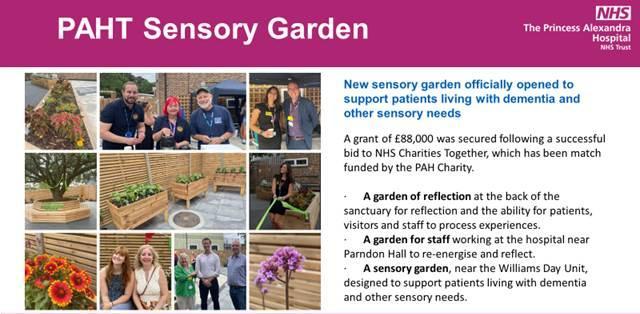
PAHT is developing three therapeutic outdoor spaces:
• Sensory Garden
• Staff Garden
• Garden of Reflection
The project is supported by NHS Charities Together and PAHT’s charity. Due to relocation costs, an additional £32k is being sought. The Sensory Garden was opened on 5 July 2025
The garden will support patients with dementia, delirium, autism, prolonged hospital stays, or sensory overwhelm. Volunteers will help maintain the space, and the Trust has received free trees and hedges through NHS Forests.
Environment Improvements
Recognising that hospital environments can be distressing for patients with cognitive impairment, PAHT is working with:
• The Patient Panel
• Trust Board
• External design partners
Capital funding has been allocated to upgrade ward environments, with further work planned to create consistently dementia-friendly spaces.
PAHT has introduced a Carers’ Passport to recognise and support the essential role of family carers. The passport provides:
• Access to care plan information
• Concessions (e.g., discounted parking and refreshments)
• Flexible visiting (where appropriate)
• Overnight comfort items such as blankets and pillows
This initiative aims to reduce anxiety for carers and strengthen collaborative care.
PAHT has made substantial progress in improving dementia and delirium care, with strong foundations in place across clinical practice, training, environment, and carer engagement. Going forward the Trust’s strategic ambitions for 2026–2030 provide a clear roadmap for continued improvement, ensuring that PAHT remains committed to delivering outstanding, compassionate, and person-centred care for our most vulnerable patients.
Hospital
The team is actively promoting the use of Hospital Passports across the Trust for patients that have a learning disability (LD), encouraging every patient to bring their Hospital Passport or Purple Folder with them when they come into hospital.
If a patient does not already have a Passport, the Learning Disabilities Team will support and encourage completion of one during their admission. Paper copies are kept at the patient’s bedside, and a digital version is uploaded to Alex Health prior to discharge.
We continue to receive a daily list of patients with a recorded diagnosis of learning disability and/or autism being cared for as inpatients, supplemented by referrals via
telephone, e-mail and Alertive (bleep) system. Overall referrals are steadily increasing, reflecting both rising demand and improved awareness among clinical teams. The average number of monthly referrals now stands at 31.
We are also working to ensure that all patients with a relevant diagnosis have a digital flag added on the Alex Health electronic patient record, alongside clearly documented personalised reasonable adjustments. This gap was identified during the Learning Disability Improvement Standards review, which highlighted inconsistent flagging and incomplete reasonable adjustment records as key areas requiring improvement.
The Trust has participated in the Learning Disability Improvement Standards assessment that was developed by people with a learning disability and their families, outlining what they expect from NHS trusts in terms of safety, accessibility, and personalised care. They provide a consistent national framework to help organisations measure the quality of their services and identify areas for improvement.
The assessment process involved completing up to 10 patient reviews, an organisation-led survey, a staff survey, and a patient survey. This provided a comprehensive view of how effectively we are meeting the needs of people with learning disabilities and/or autism across the Trust.
Key learning identified through this process included:
• Clearer documentation of reasonable adjustments, ensuring they are visible, accessible, and consistently applied.
• Improving the quality of LD nursing assessments, with a stronger focus on person-centred information.
• Earlier and more consistent involvement of advocacy services, particularly for patients who may lack capacity or have limited support networks
• Better documentation of reasonable adjustments within Mental Capacity Act assessments, including clear evidence of best-interests discussions
Oliver McGowan training is a standardised training package, developed to ensure that health service staff receive learning disability and autism training appropriate to their roles. Currently, it is the preferred and recommended training for health and social care staff.
The training consists of two different levels:
• Tier 1 – E-learning with handbook, plus online webinar
• Tier 2 – E-learning with handbook, plus one day face-to-face training
Training compliance has steadily increased and we are able to visualise divisional and trust wide compliance against this standard. As demonstrated in Tables 3 and 4 below, a positive steady increase in compliance has been achieved to date in 2026.
Table 3:
4:
During 2025-26 the capacity for Tier 2 face-to-face training has been constrained by persistent room availability challenges and Tier 1 training constrained by issues around accessing laptops and PCs.
As a result of the recent changes across the sector and with NHS England (NHSE) funding for the training programme, we are now actively exploring moving this to a shared-system delivery model which would increase the throughput and completion The aim going forward is to train approximately a third of our workforce annually, which will provide a sustainable trajectory toward full compliance and a significant improvement on our trajectory.
A significant piece of work was completed this year was with the theatre department to establish a robust pathway for identifying patients with a diagnosis of learning disability and/or autism at the earliest opportunity when scheduled for a surgical procedure.
This process is now embedded within pre-assessment for both adult and paediatric patients. The paediatric pathway and patients are now also reviewed by the Trust LD team from March 2026
Early identification of this group of patients enables more proactive planning, timely implementation of reasonable adjustments, and improved communication with families and carers. We have received multiple compliments from theatre teams, patients, and relatives, highlighting the positive impact this work is having on patient experience and staff confidence.
A Standard Operating Procedure (SOP) has been developed and is being consulted upon. In addition, we are exploring the potential for Theatres to pursue Autism Accreditation through the National Autistic Society (NAS), which would further strengthen the department’s commitment to delivering accessible, person-centred care.
Both our extranet (AlexNet – for staff) and external website pages have been updated to include links to easy read information and leaflets, supporting improved communication with patients who have learning disabilities and/or autism.
Alongside this, we continue to promote the use of the Hospital Passport, encouraging all patients with a relevant diagnosis to complete one on admission and ensuring that completed passports are uploaded to Alex Health for visibility across clinical teams.
Funding has been agreed for the re-printing of Hospital Communication Books, which have recently arrived and are being given out across the Trust. These resources will support staff in delivering clearer, more accessible communication and help ensure that patients’ needs, preferences, and reasonable adjustments are understood and acted upon.
A SEND quality visit was carried out by our Integrated Care Board partners in March, and while we are awaiting the formal written report, the verbal feedback received was extremely positive.
Inspectors highlighted the strength of our pathway for individuals with a learning disability and/or autism who require surgery, recognising the improvements made in early identification, planning, and reasonable adjustments. Alongside this, we have begun working closely with the paediatric ward to support staff in caring for children and young people with LD or Autism Spectrum Disorder (ASD). This includes promoting the use of Hospital Passports to ensure staff have access to key person-centred information and can plan care more effectively.
The total number of patient falls for all levels of harm reported in 2025-6 has a marginal reduction (16), in comparison with the total numbers for the previous year, see figures 12-13 and table 5 In 2025-6 the majority of patient falls were graded as no harm (74%)
The Trust has seen an increase in the total number of patient falls when including no harm and all grades of harm (minor, moderate, severe, death) when calculated against 1,000 bed days. Numbers for 2025-26 are 1.14 per 1,000 bed days in comparison with 1.07 per 1,000 bed days in 2024-25, (Figure 14)
Patient Falls with Harm (moderate, severe, death grades)
There has been an increase in the total number of inpatient falls that resulted in moderate, severe or death graded harms to 1.6 per 1,000 bed days in 2025-26 from 0.89 per 1,000 bed days seen the previous year, Figure 14-15
14: All Falls with Harm per 1,000 bed days (Minor, Moderate, Severe, Death graded)
Apr-23May-23Jun-23
15: Falls with Moderate, Severe, Death graded harms (per 1,000 bed days)
The Trust remains committed to maintaining and reducing the numbers of patient falls where patients sustain moderate or a higher graded harm injuries and are working to maintain less than 0.5 per 1,000 occupied bed days, see figure 16. This continued to be achieved in 2025-26 with the overall rate of 0.42 cases per 1,000 bed days. This is slightly increased from the previous year.
During 2025-26 there were 13 reported severe harm falls. All resulted in patients sustaining fractures of the femur (this grading is a national recommendation) This is one less than reported during the previous year. This is the second year when the Trust has seen high numbers of this injury, Table 5.
All falls resulting in moderate or above graded harms are subject to a review by the ward area and then discussion at the monthly Falls Investigation Oversight Group (FIOG). This group considers if further action needs to be taken for each individual case and confirms if appropriate local thematic learning has been identified and implemented. The terms of reference of the FIOG have been reviewed and updated.
Work continued on the reduction of unwitnessed falls and the overall trend remains positive with the numbers decreasing. See Figure 16, table 5
Work Continues to Reduce Patient Falls
Recording of lying and standing blood pressure (LSBP) - Compliance with the completion of lying standing blood pressure remains variable. The National Audit of Inpatient Falls recommends that Trusts should maintain compliance at over 60%. During 2025/2026 work was ongoing using Alex Health (electronic patient record) and corporate information teams to enable accurate and real time data recording for lying and standing blood pressure data. Micro-teaching has been taking place across the organisation.
Training - The Trust maintained mandatory falls awareness training compliance at over 90% each month. Compliance data is shared across the organisation on a monthly basis to ensure leads and managers are aware of their team’s compliance. 0.00 1.00 2.00 3.00
Falls nurse specialist - A new post of Falls Nurse Specialist was introduced and recruited to in year with the post holder leading on all falls related workstreams across the Trust
Post fall care management - The Falls Lead has commenced work with the Alex Health team on the creation of a post fall proforma for all clinical staff to use following a patient fall. This will be similar to the current proforma used by the medical staff for a patient review following a fall.
Collaborative work with Essex Partnership University NHS Foundation Trust (EPUT) - Collaborative work with EPUT has commenced to allow each organisation to have access to the patient records from the other organisation to allow us both to improve patient experience and management of care.
National Audit of Inpatient Falls (NAIF) - The Trust remains compliant with uploading patient incident details into the national audit (certain criteria of falls injuries). New criteria have been introduced to include information relating to reverse board patients
Data for the 12 months up to 31 March 2026 showed:
• 33 reported cases.
• Our Key Performance Indicators (KPIs) data demonstrated the following compliances in comparison with the data for 12 months up to the end of March 2025 (based on 16 reported cases)
NB: Up until January 2025 NAIF only requested data on fractured femurs. From January 2025 data collection was increased to include all fractures and all head injuries/cerebral bleeds. Therefore, the KPIs do not reflect data on all falls, only those that met the criteria for inclusion in the National Audit.
We are committed to improving patient outcomes, and reducing the numbers of hospital-acquired pressure ulcers (HAPUs). Our aim is to reduce reportable pressure ulcers to less than 3 per 1,000 occupied bed days where they can be prevented, and to minimise pressure ulcers graded as moderate and severe harms to below 0.5 per 1,000 bed days. Achieving these targets will enhance the quality and safety of care delivered to patients at risk of pressure damage.
Total number of reportable pressure ulcers (category grading of 2, 3, 4 and mucosal) are demonstrated in figure 17.
Figure 17:
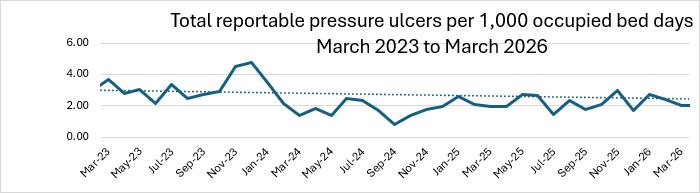
Total reportable pressure ulcers (Categories 2, 3, 4 and mucosal) demonstrate that:
• Category 2 pressure ulcers remain the largest contributor to total reportable cases and continues to drive overall variation.
• While variation persists, it is less pronounced than in 2024-25, indicating greater consistency in care.
• There is a slight downward trend in total reportable pressure ulcers, suggesting early signs of improvement, figures 18-19.
Figure 18 and 19:
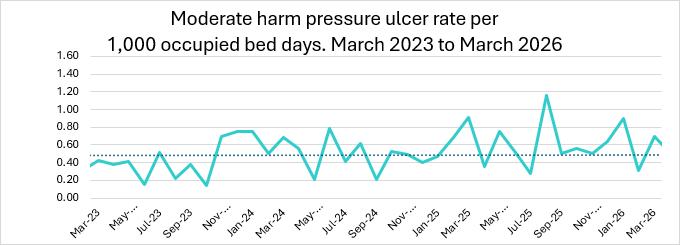
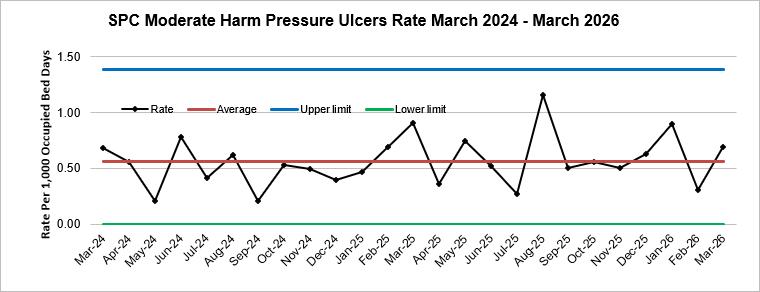
Long-term patterns of pressure ulcer rates indicate stability, with no evidence of an upward or downward shift compared with the previous year
• Monthly rates show the expected level of natural variation, with peaks and troughs, but overall, the pattern remains broadly stable and close to the Trust’s threshold of 0.5 per 1,000 occupied bed days.
• Longer-term analysis does not indicate a consistent upward trend; instead, the data show normal fluctuation with a short-term spike in mid-2025 that subsequently returns to typical levels.
Notable observations include:
• Spikes in August 2025 and January 2026, linked to an increase in Category 3 and 4 HAPUs.
• During December 2025 to January 2026, patient acuity and complexity were particularly high, reflected in the highest utilisation of specialist mattresses since the COVID-19 period.
• There have been no validated severe harm pressure ulcers reported during 2025-26, representing a positive outcome.
Strategic Approach
The Trust delivers an annually reviewed workplan aligned to our comprehensive long-term Pressure Ulcer Prevention Strategy (2023-27), focused on reducing harms where they can be prevented and embedding sustainable improvement. This programme continues to be implemented across all clinical areas.
From our implementation of the Patient Safety Incident Response Framework (PSIRF) for HAPUs in 2024 we have identified the following areas for improvement:
• Current processes can focus disproportionately on data collection, harm validation, and confirming known themes,
• This has reduced the ability to respond proportionately, in real time, and maximise learning opportunities.
Quality Improvement Programme (planned from April 2026)
A revised Quality Improvement (QI) approach will be implemented in phases during April and May 2026, this aligns with PSIRF principles, focusing on timely learning, proportional response, and system-wide improvement.
Key Changes Include:
Governance and Oversight
• Routine data monitoring at the Pressure Ulcer Investigation Oversight Group will cease.
• Divisions will assume responsibility for:
• Monitoring Category 3 and 4 outcomes and harm levels
• Tracking progress of ward-level Quality Improvement Action Plans.
Rapid Learning and Response
• Introduction of SWARM huddles, facilitated by the Tissue Viability Service:
• Category 2 and mucosal ulcers reviewed within 48 hours
• Enables rapid learning, staff support, and immediate corrective action
• Supports deeper analysis of recurring contributory factors.
Early Identification and Prevention
• Enhanced skin checks and monitoring for patients with Category 1 damage and vulnerable skin, ensuring early intervention and prevention of deterioration.
Multidisciplinary Team (MDT) Collaboration
• Tissue viability to escalate the need for ward-led MDT reviews for patients with complex needs and deteriorating Category 3 and 4 ulcers, promoting timely and coordinated care.
Enhanced Surveillance and Support
• Implementing surveillance in clinical areas is aligned with the enhanced monitoring process criterion for wards with higher trends of HAPUs
• Allocation of TVNs across all clinical areas to provide expert advice, coaching, and role modelling.
Workforce Development and Learning
• Introduction of bi-monthly pressure ulcer prevention newsletters, sharing local and Trust-wide learning
• Shadowing opportunities with the Pressure Ulcer Prevention Practitioner to support staff development
• Proposal to introduce mandatory training in the Essentials of Pressure Ulcer Prevention, subject to approval, to ensure all clinical staff have a consistent baseline knowledge and competence in prevention
• Continuation of “Prevention Wednesdays”, delivering targeted, ward-based microteaching aligned to current themes
Documentation Improvement
• Review and optimisation of pressure ulcer care plan documentation within the electronic patient record (EPR) to:
• Improve accuracy and timeliness
• Reduce administrative burden
• Maximise time available for direct patient care
Conclusion
The Trust remains committed to delivering safe, high-quality pressure ulcer prevention and care. Through the implementation of strengthened improvement processes and a focus on early intervention, learning, and multidisciplinary collaboration, we aim to:
• Reduce avoidable pressure ulcer harm
• Improve patient outcomes
• Enhance the overall quality of care for patients at risk of pressure damage
Patient safety is our priority and we continuously work to ensure that incidents are managed effectively, promptly and most importantly, that we learn from them and share the improvements arising with relevant staff members.
Apatient safety incident refers to any unintended or unexpected event that could have, or did, lead to harm for one or more patients receiving NHS funded care. This includes all terms such as adverse incidents, adverse events and near misses, where an incident was recognised and averted.
For the year 1 April 2025 to 31 March 2026, 13,362 incidents were reported on the Trust’s incident management system; this is comparative to the previous year’s reporting. The spread of incidents across our divisions is reflected below in Figure 20.
Figure 20: Incident reporting data for period 1 April 2025 – 31 March 2026 as %
The top categories of incidents reported in 2025-26 are summarised in Table 7, figure 21.
• 61% of all incidents raised within the Trust are for patient safety - and Figure 22, breaks these into themes of care These are reported to the Learning from Patient Safety Events (LFPSE) platform to enable learning and comparison with similar sized organisations across the country to occur.
Table 7: Top Categories For All Incidents Raised During 2025–2026
Table 7 2025/2026
Figure 21: Top 10 Care Themes For Patient Safety Incidents – 2025-26
Number of patient safety incidents reported
The Patient Safety Incident Response Framework (PSIRF) is the national system that supports organisations in identifying incidents that require investigation, focusing on learning to enhance patient safety. Incident investigations commissioned under the PSIRF framework are called Patient Safety Incident Investigations or PSII’s.
The Trust raised 9 PSII incidents during the period 1 April 2025 to 31 March 2026, compared to 13 in the previous year.
Once a PSII investigation is concluded, an action plan is developed to capture the learning and recommendations that need to be undertaken to prevent a reoccurrence. The Trust uses a sharing the learning report to ensure all relevant staff are:
• aware of the key issues that occurred in this incident
• the changes to practice either implemented or being completed.
• what the learning from the incident is to prevent reoccurrence.
This is presented and shared widely within the local teams where the incident occurred and if relevant to other clinical areas with divisions across the Trust. This information is reported in a Trust wide report that is taken to monthly or quarterly quality governance meetings, including the Quality and Safety Committee.
Of the 9 PSII’s in year, two were Never Events One investigation has concluded with a robust action plan developed and in place, the other remains under investigation.
Examples of Change Implemented during 2025/6 Following Learning from Incidents
Hospital Acquired Pressure Ulcers - Reviewed and implemented a refreshed multidisciplinary pressure ulcer prevention pathway to support timely identification and treatment of skin damage to reduce the incidence of higher severity hospital acquired pressure ulcers.
Critical Medication - The pharmacy revised the supply process for critical medications (for example, medicines used to treat Parkinson’s disease) by introducing direct communication with clinical areas when medications are ready for collection and ensuring medicines are redirected appropriately when patients are transferred between departments, supporting the timely administration of essential treatment.
Discharge Summary Process - The Trust has strengthened the discharge summary process to ensure timely information sharing with primary care to support ongoing care and treatment following a patient’s discharge.
Creative Collaboration for Pregnant Patients - Improved collaboration between the Emergency Department and Obstetrics and Gynaecology specialists for pregnant and recently pregnant patients attending the Emergency Department requiring urgent care and treatment.
Neonatal Care Planning - The Trust has strengthened multidisciplinary team communication and processes for notification of babies requiring neonatal care plans.
Customer Service Training - The Trust implemented customer service training within outpatient services to strengthen communication and accessibility for patients with hearing difficulties.
Drug Administration - Standardised competencies were developed to support consistent and safe practice in the management and administration of controlled drugs
Nerve Block Procedures - The Trust strengthened safeguards against wrong-site nerve blocks through standardised site-marking practice and reinforced multidisciplinary training and team-based checks prior to anaesthetic blocks
Medicines safety and reducing avoidable harm from medicines is of worldwide significance, with both the launch of the World Health Organisation’s ‘Medication without Harm’ initiative as well as NHS England’s recently launched Medicines Safety improvement programme.
Regionally, medicines safety is a core priority as services and pathways begin to become more seamless in the newly formed, Essex Integrated Care System (ICS)
Through a combination of staff awareness and training, utilising technology, and ensuring the right expertise is in place, we aim to ensure not only that medicines are safe within PAHT, but also to ensure they are optimised and patients get the best value and outcomes possible. Through feedback from services, reviews of incidents, and incorporation of national alerts and priorities, the focus has been in the following key areas to improve patient experience, outcomes and safety:
• Time critical medicines.
• Improving and updating knowledge
• Sharing the learning on incidents
• Optimise antibiotic use.
• Utilise technology to enhance safety.
Timely administration of a number of medicines, such as those to treat Parkinson’s disease, are critical to prevent avoidable harm and ensure patient safety. Small delays to the administration, even as great as 30 minutes, can lead to severe health consequences, deterioration of their condition, increased length of stay, and morbidity, figure 22 below.
Figure 22: Compliance Against Administration of Time Critical Medication (30 minute standard) for Parkinson's Disease
A number of interventions, including staff training, case-based presentations and poster campaigns have seen compliance to this 30-minute standard improve over the last 12 months, although work is needed to achieve the national target of 90%.
The World Health Organisation has declared antimicrobial resistance (AMR) as one of the top global public health and development threats and it is also listed on the UK government’s National Risk Register. Bacterial infections were the 2nd most common cause of death in the UK in 2019, with antimicrobial resistant strains contributing to over a third of these.
The next 5 years represent a pivotal period in addressing the global threat of AMR. In a world recovering from the profound impact of the COVID-19 pandemic, international collaboration and preparedness for global health challenges have taken on an unprecedented importance. From 2024 to 2029, the UK is committed to playing a central role in the global effort to confront AMR by taking a comprehensive approach that leverages the UK expertise and domestic experience. In order to prevent the global threat from becoming an unavoidable reality, it is vital that the national AMR action plan becomes a key local priority, featuring on short-term and long-term, clinical agendas
Four human health targets have been included with the national action plan, developed by short-term expert working groups with representatives from across
from the UK. All targets are evidence-based, reflecting on previous plans. The four human health targets are:
• Target 1a: by 2029, we aim to prevent any increase in a specified set of drugresistant infections in humans from the 2019 to 2020 financial year (FY) baseline.
• Target 1b: By 2029, we aim to prevent any increase in Gram-negative bloodstream infections in humans from the 2019 to 2020 financial year baseline.
• Target 4a: by 2029, we aim to reduce total antibiotic use in human populations by 5% from the 2019 baseline.
• Target 4b: by 2029, we aim to achieve 70% of total use of antibiotics from the Access category (new UK category) across the human healthcare system
Through the Trust antimicrobial stewardship group and introduction of educational events, e-learning, antimicrobial ward rounds and utilising digital systems to support prescribing choices, PAHT will continue to prioritise safe antimicrobial prescribing.
A number of incidents involving medicines have identified knowledge gaps with staff, particularly controlled drug processes, local policies and procedures, and insulin safety. To help improve this, pharmacy have developed a number of e-learning programmes to update and develop staff knowledge on several key medicines safety topics.
These include:
• Insulin safety (developed by TREND® and available on the TIMs platform)
• Medicines management (developed in house and available on the TIMs platform)
• Controlled drug management (currently in development)
• Antimicrobial safety (developed by e-LFh® and available on the TIMs platform)
Studies have demonstrated that education programmes, included e-learning, simulation and shared learning, can reduce medication errors, increase compliance with guidance and standards, and give staff improved clinical confidence
PharmOutcomes referrals, a process which has allowed the hospital to directly refer patients to community interventions that help reduce readmissions, showed inconsistency following the Alex Health rollout. Some recovery has taken place rising back to pre-Alex Health baseline in December (772 referrals). Further monitoring and investigation are planned to determine whether issues lay with discharge completion or referral processing. See figures below
Electronic Prescribing and Medicines Administration (EPMA) barcode and wristband scanning compliance continued to fluctuate with small improvements reported in February (22.11% wristband; 14.93% medication) but is still far from desired levels, Figure 23-25
Persistent issues included maternity hardware limitations, paediatric dosing constraints, and inconsistent staff engagement. EPMA teams continued adding unregistered barcodes and providing ward level support, resulting in data for wristband bar code compliance being available commencing from August 2025.
Figure 23 and 24: Monthly Referrals and Follow Up Data
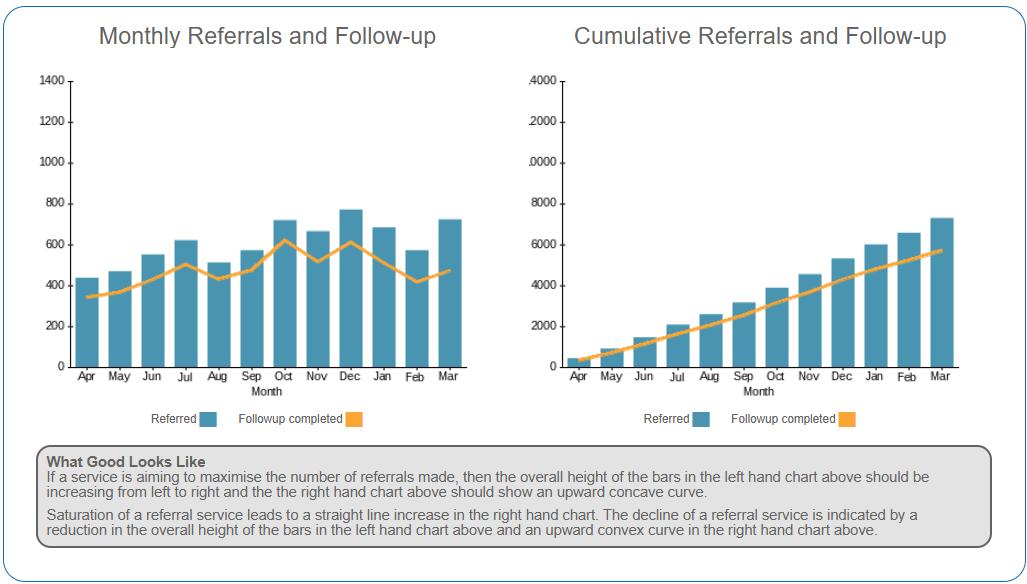
Figure 25:
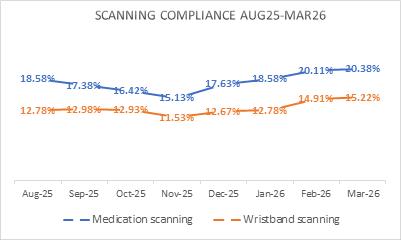
A number of incidents were identified where the wrong medication was administered, or a medicine was administered to the wrong patient, and this has been fed back to all relevant clinical areas. A relaunch has begun in April, with an attempt to increase compliance.
Medication Incidents
There are two metrics that are nationally reported to measure medicines safety and governance, these are:
• Medication Incidents Rate per 1,000 bed days.
• Percentage Medication Incidents Reported as Causing Harm or Death/All Medication Errors.
ATrust that is frequently reporting medication incidents, with a low percentage of these incidents causing harm to patients, is recognised as having a good organisational ethos with regards to patient safety.
These two figures 26-27 are monitored monthly and presented to the Medicines Optimisation Group.
Figure 26:
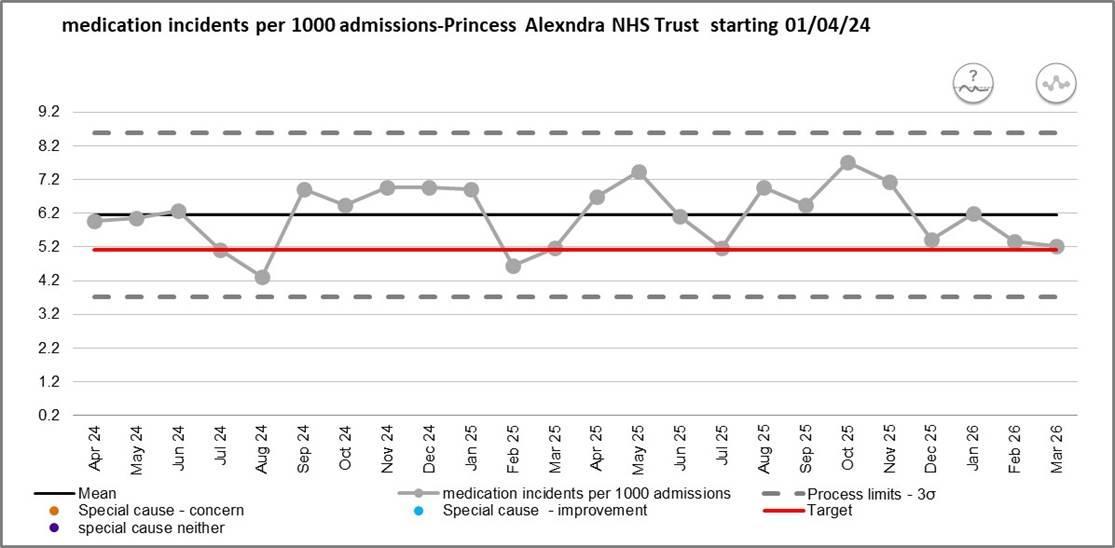
Figure 27:
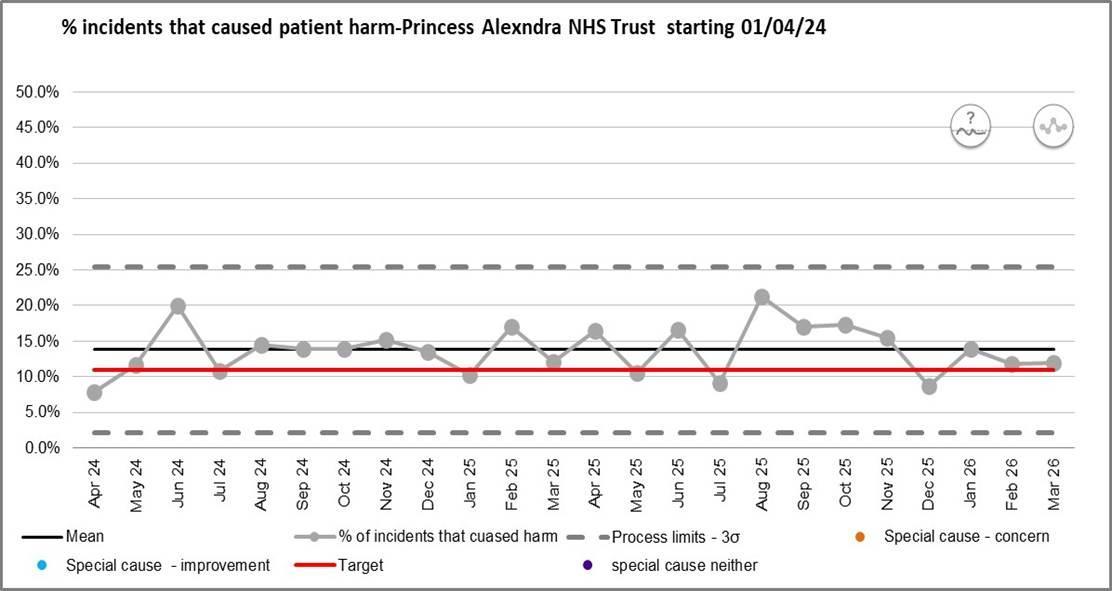
Incidents are shared with doctors, nurses and pharmacists through a number of different avenues including:
• Grand round once a month (known as ‘Pharmacy 15 Minutes’).
• A nursing forum dedicated to incidents on the third Wednesday of each month (prior to Medicines Optimisation Group).
• Weekly pharmacy meetings every Wednesday.
Recurring themes included discharge errors, weight related dosing issues, and delays in time critical medications, all of which have formed key priorities within MOG. Digital solutions have been sought, utilising the capabilities of Alex Health in collaboration with the EPMA team.
In 2025-2026 the achievements in key people indicators are reflected in table 8 below:
Table 8: People KPI Compliance
Drivers for change are:
• People planning
• Equality, Diversity, Inclusion and Belonging
• Staff Wellbeing
• Sustainability
• Digital
Underpinned by:
Our strategy is built around two strategic key pillars:
Attract and Recruit – Positioning PAHT as an employer of choice by strengthening talent pipelines, expanding career opportunities, and ensuring inclusive recruitment. Develop and Retain – Creating a culture of growth, leadership, and progression, where every individual is supported to thrive.
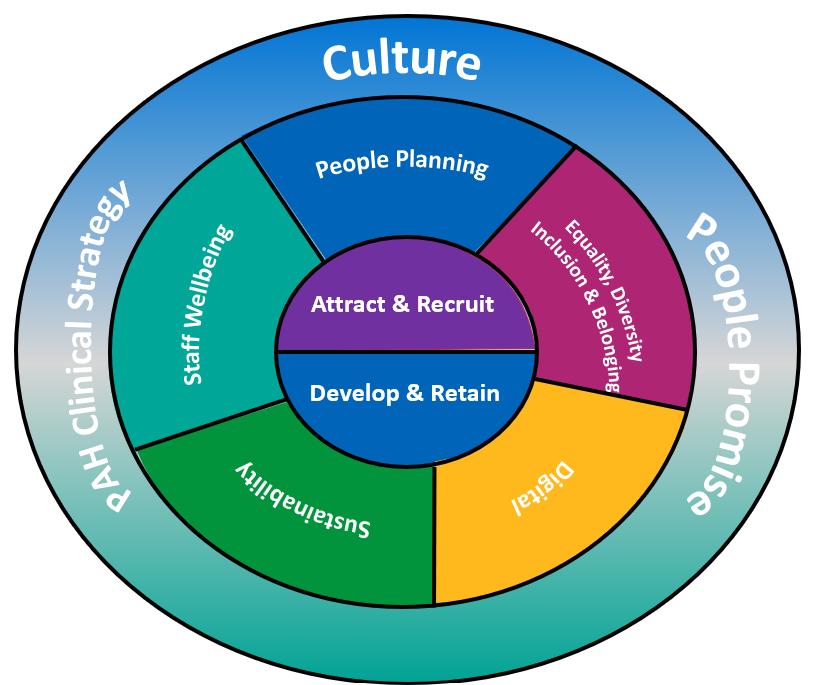
People Planning – career opportunities, work experience, flexible career pathways, values-based recruitment. Also, leadership framework and development, statutory mandatory training, career growth plans, awards
During 2025-26, the Trust delivered a significant change in how recruitment supports workforce planning. We implemented Jobtrain and completed the transition from Trac (our old recruitment electronic system). This included redesigning application forms across all staff groups, removing long supporting statements, and introducing structured, skills-based questions aligned to role requirements.
We introduced a consistent shortlisting approach across the Trust, reducing variation between teams and improving the quality of candidate assessment.
We developed and delivered manager guidance and training to support the new recruitment model. This has strengthened manager ownership and improved consistency in recruitment decisions.
AI-assisted shortlisting was piloted to support initial candidate review. This is being evaluated ahead of wider rollout.
We improved the candidate journey, with clearer application processes and onboarding steps within Jobtrain.
Assessment centres were introduced as a new approach to recruiting into senior operational and clinical leadership roles. These were designed and delivered inhouse and aligned to the NHS Management and Leadership Standards (2025). They
included structured exercises, scenario-based assessments, and interview panels to assess candidates consistently against role requirements.
A key focus was improving fairness and reducing bias. This included:
• use of trained and diverse panels, including external assessors.
• structured scoring and moderation processes
• consistent assessment across all candidates.
A two-stage moderation process was implemented to ensure scoring was reviewed and calibrated before final decisions were made.
This process was used as part of a wider divisional restructure, supporting fair and transparent selection into new roles. This approach has strengthened consistency in senior recruitment and supports a more inclusive and objective selection process.
The resourcing team’s work was recognised nationally, with shortlisting by the Healthcare People Management Association (HPMA)
A total of 3,738 Continuing Professional Development (CPD) places were funded across the Trust. CPD moved from under-utilisation to full exploitation in 2025-26 representing a 151% increase from the previous year. This reflects a significant expansion of access to learning and development, aligned to the NHS People Promise commitment: “We are always learning.”
Appraisals were relaunched on the This is Me (TiMs) system after significant improvement work over the previous year – during which staff completed a Word document. Collaborative work was undertaken to devise a new form for April 2025. Workshops and training were delivered to support both line managers and staff through the processes. A review of the process has been undertaken for 2026 with a streamlined online form and supporting training materials to go live for the next appraisal cycle.
Our aim is to create an environment where an inclusive culture and sense of belonging is experienced by all staff that work at the Trust. We are taking steps to achieve this by monitoring our progress, through the activity in our PAHT EDI Delivery Plan 2025-2026.
We recognise that positive change on inclusion can only come from concerted action, leadership, commitment and accountability. Our aim is to achieve the EDI outcomes of our People Strategy, by recruiting and retaining staff from different backgrounds and walks of life, Tables 9-13.
Our Workforce Gender Profile
When compared to last year the data shows a 1% increase in male staff and comparable 1% decrease in female staff, see table below.
Our Workforce Ethnic Profile
When compared to last year our data shows a 1% reduction in White staff and corresponding 1% increase in BME staff
Our Workforce Disability Profile
Those who have declared their disability status have increased in numbers of staff from 156 to 187, however the overall percentages remain the same.
Our EDI Compliance
Our EDI Delivery Plan 2025 - 2026 sets out the actions we have taken to deliver our EDI Strategy. This includes a governance framework timetable to meet our regulatory reporting responsibilities. We are committed to creating an inclusive environment where all staff feel a sense of belonging.
The EDI Delivery Plan details the actions we are taking to deliver the following reporting requirements:
• EDI Annual Report – NHSE EDI Improvement Plan and East of England Antiracism Strategy
• Workforce Race Equality Standard
• Workforce Disability Equality Standard
• Gender Pay Gap Report
• Ethnicity Pay Gap Report
• Disability Pay Gap Reporting
• Equality Delivery System
All of these reports can be found on our website
The EDI Steering Group (EDISG) is responsible for monitoring the EDI Delivery Plan and Governance Framework. The EDISG consists of a diverse range of representation from teams and departments across the Trust. The EDI Steering Group meets quarterly and the main aim of the group is to help shape the organisation’s strategies and policies to improve the experience of staff and patients, particularly those with protected characteristics. A Forward Plan sits within the EDI DP. The aim is for this meeting to create a collaborative space to share best practice, provide support, discussions, challenge, and to learn and build on our partnership work.
To deliver our EDI obligations we require ongoing effective scrutiny, accountability and commitment. Above reporting, we want our workforce practices and process to improve so that people feel free and safe to speak out. This entails setting up staff forums, focus groups, listening events and staff development and training.
Whilst we are obliged to respond to the reporting systems of the NHS, there is also a requirement to bring active measurable change. We aim to demonstrate this by measuring the impact of the differences we are making. This year’s key areas of focus have been; improving outcomes for staff in particular those with disabilities or long-term health conditions; staff and patient engagement; and challenging discrimination.
During 2025 to 2026 we have:
• Achieved our compliance for delivering EDI Annual Reporting, to satisfy the Care Quality Commission and NHSE Region, through the East of England Integrated Care Board.
• Completed a disability audit to examine and improve policies and practices across the organisation through our membership of the Business Disability Forum An Action Plan is being created for 2026 to 2027.
• Improved accessibility of information, throughout our communication platforms.
• Organised staff engagement sessions in partnership with our Staff Networks, Organisational Development and EDI teams to understand the lived experience, and address concerns raised through the Staff Survey.
• Improved the workforce profiles in ESR across the protected groups.
• Reviewed systems and introduced a working group to tackle bullying, harassment and discrimination experienced by staff.
• Improved patient data to better address access to health services, quality of care and health inequalities.
• Improved disability access and awareness for staff and patients, through training and assessment of the Accessible Information Standard.
• Implemented Jobtrain (new recruitment system) to monitor recruitment and improve inclusive recruitment.
• Reviewed our disciplinary policies and process
• Introduced our culture change programme.
We have reviewed our staff networks in line with the NHS Guidance for Staff Networks 2024. The Trust currently has three staff networks; the Disability and Wellbeing Network (DAWN), the Race Equality and Cultural Heritage (REACH) staff network and the Alex Pride lesbian, gay, bisexual, transgender, and queer/or questioning) (LGBTQ+) staff network.
The Race, Ethnicity and Cultural Heritage (REACH) network has supported the organisation to move forward on race equality with a focus on its three primary objectives:
1. The promotion of Psychological Safety
2. Support for Continuing Professional Development.
3. Achieving our goals through Allyship with other networks.
The Disability and Wellness Network (DAWN) has been operating for just over a year and formed in response to feedback from staff and review of Staff Survey findings. The purpose of the network is to be an independent and effective voice for staff with long-term health conditions and disabilities. We want to ensure that the organisation recognises and responds to the needs of all its staff, thereby increasing staff morale and improving the patient experience.
The LGBTQ+ staff network re-established its name to Alex Pride. The network has invited members of the LGBTQ+ community to meetings to share learning and as an opportunity to inform Trust policies and practices. The network is linked in with the East of England LGBTQ+ network.
In the coming year we aim to increase our staff networks for the following strands:
• Religion and Belief
• Women’s
• Allies
The Trust also actively participates in the East of England Integrated Care Board EDI network. Strong relationships have been developed by working collaboratively through partnership with other Trusts to develop and share best practice and new developments. Through the ongoing changes at the Integrated Care Board, PAHT will continuously work to improve a number of diversity initiatives including recruitment, leadership development, and anti-racism awareness.
Our Aims for the Coming Year:
During 2026 to 2027 we aim to achieve the following:
• Promotion of our Staff Networks to increase staff membership and engagement
• Creating a psychological safe space for staff to ensure all voices are heard.
• Increase EDI competency of senior managers to the Chartered Institute for Professional Development (CIPD) EDI specialist and core skills categories.
• Develop our culture change programmes, embracing EDI to address behaviours, bullying, harassment and discrimination.
• Work with leading Trusts to bring in new initiatives and best practice, this will be beneficial to deliver the key principles of the new 10 Year Plan.
• Improve Equality Impact Assessments, linking them to Quality Impact Assessments
• Develop equality performance indicators and a dashboard through Qlik Sense.
• A strategy and delivery plan on health inequalities to improve health outcomes.
• Review the People Directorate structure to improve the delivery of EDI to benefit both staff and patients.
• The ability to work collaboratively internally and externally to improve staff engagement.
• Implement our Talent Management and Succession Planning Strategy.
• Design and roll out our bystander training – to encourage staff to speak up
• Increase our activities and reporting on health inequalities during 20262027.
Our ultimate aim is to weave Equality, Diversity, Inclusion and Belonging throughout our ‘business as usual’ activity at PAHT. We will aim to ensure that everyone understands their areas of responsibility. It is therefore incumbent on us to ensure we equip managers with the tools to deliver the future needs of our staff and patients. Our challenge will be to create and maintain an inclusive culture in the workforce and improve health inequalities experienced by patients.
Staff Wellbeing (onboarding programme, benefits and incentives, culture of wellbeing, psychological safety, leadership programme)
The staff health and wellbeing team at PAHT provides occupational health and wellbeing services which include:
• Pre-employment health screening
• Immunisation.
• Self-referrals/Management referrals
• Health Surveillance
• Sharps/Body fluid injury management.
• Seasonal vaccination campaigns
• Blood Born Virus management.
The National Staff Survey showed a positive increase in response rate to the question. Overall, for this People Promise, PAHT achieved 5.94%, which is the best score achieved in the Trust since we started reporting in 2021, with PAHT being 0.64% under the benchmarked best result.
Current wellbeing and activity include:
Mental health and psychological support
• Access to independent psychological support services
• Support for staff that who have been impacted by violence and aggression from patients, visitors or staff.
Health promotion and prevention
• Health checks and vaccination programmes.
• Healthy eating and hydration campaigns – fruit and vegetable stall on site two days per week.
• Weekly wellbeing walkarounds promoting services plus delivering healthy food and drink
• Monthly newsletters.
Supporting rest and recovery
• Promotion of rest spaces and breaks.
• Supporting managers with stress risk assessments and referrals
Manager capability and culture
• Emphasis on early intervention and reasonable adjustments
Inclusion and Health Equity
• Ongoing work to ensure wellbeing support is inclusive and accessible for all staff groups.
• Engagement with staff networks to understand specific wellbeing needs
• Monitoring of absence and wellbeing data by protected characteristics where available.
Freedom to Speak Up (FTSU) is seen as a trusted route, with 151 concerns raised during 2025–26. Key themes related to bullying and harassment, staff behaviour, patient safety and workload pressures. Most concerns were resolved promptly through early intervention, and no substantiated cases of detriment were identified.
Our Amazing People Awards and the Patient Panel Champion Award saw 43 employees and teams shortlisted from 254 nominations across these categories:
Kindness Award: Peter Linden
Safety Award: Kirsten Dalby and Alana Whipp
Speaking Up Award: Lauren Chappell
Commitment Award: Claire Eels
Improvement Award: Caroline Hockett
Engagement Award: Shahid Sardar
Inclusion Award: Teresa Dunn

Managing for Excellence Award: Nagalakhsmy Bhagavathiappan
Emerging Leader Award: Katy Kay
Inspiring Leader Award: Dr Jane Snook
Teamwork Award: Lister Ward
Patient Panel Champion Award: Dr Kapila Gunasekera
Patient Panel Team Award: Theatres
The awards – certificate, pin badge and glassware – were presented on Wednesday 19 November 2025.
Every year, we award colleagues for their continuous long service at PAHT (20 and 25 years). And in 2025, we also recognised staff who achieved 30- and 35-year milestones.
• 62 people for 20 years of service.
• 43 people with 25 years of service
• 45 people with 30 years of service
• 20 people with 35 years of service.
• Collectively a total of 4,440 years’ service
An additional initiative launched in July 2025 to recognise a clinical colleague, a nonclinical colleague and a team every month, nominated by staff across the Trust and judged by senior leadership The three winners are presented with a certificate and their photos displayed at PAHT By end of March 2026, we’d received 254 nominations and announced 27 winners.
The annual NHS National Staff Survey is recognised as an important tool for ensuring that the views of people working in the NHS are used to help inform local improvements. The feedback is useful in helping highlight strengths, and improvements that will make PAHT a better place to both work and be treated.
The NHS Annual Staff Survey 2025 results are benchmarked nationally and show our results against the national average. The questions are aligned to the NHS People Promise which are the seven elements that would most improve working life as chosen by NHS employees.

In 2025, 2624 of PAHT employed staff completed the survey which gave a response rate of 64%. This result is 17% above average to the median response rate of the
comparison group (47%) and a 15% increase compared with our response rate of 49% in 2024, see figure 28.
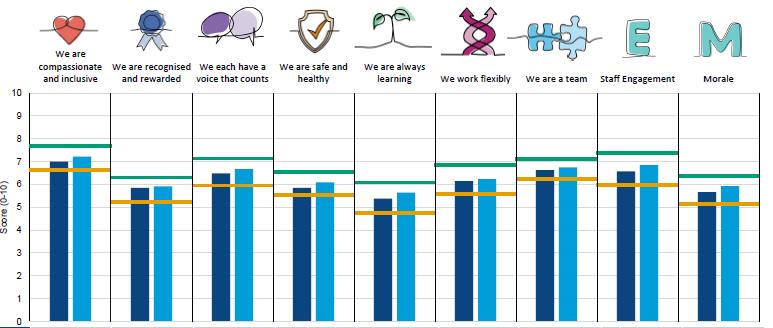
It represents the highest response rate the Trust has achieved in the last 5 years, strengthening confidence that the results reflect staff experience across the Trust
The above picture provides the overview comparison for the Trust during the surveys completed in both 2025 and 2024. It is evident that PAHT has improved in four of the domains, with some further work to improve in the remaining areas.
It is worth noting that PAHT scores are closer to the national average for similar organisations. Therefore, although scores have declined for some of the domains, PAHT is not an outlier. Locally compared to last year, morale scores remain stable, and there are no statistically significant changes across the NHS People Promise compared with 2024.
Free-text comments provide powerful, unfiltered descriptions of the lived experience of PAHT staff. These comments show the emotional toll of systemic pressures and highlight:
• Stress and anxiety caused by staffing shortages and workload.
• Lack of follow-through on concerns and a sense of being ignored.
• Desire for practical recognition, everyday appreciation, and fair treatment.
The Executive Board has identified 5 key priorities for all divisions to concentrate on within their 2026 engagement plans:
• Priority 1 – Improve the care we deliver through staff feeling valued
• Priority 2 – Recognition and Reward at divisional level
• Priority 3 – Violence and Aggression programme.
• Priority 4 – Strengthen staff networks and embed EDIB
• Priority 5 – Wellbeing of our people
From the Staff survey results shown in figures 29-32, we have reviewed different indicators to identify how comfortable staff feel to raise concerns. There has been minimal change over the last year, but with increased responses we stay just below the average.
Figures 29-30:
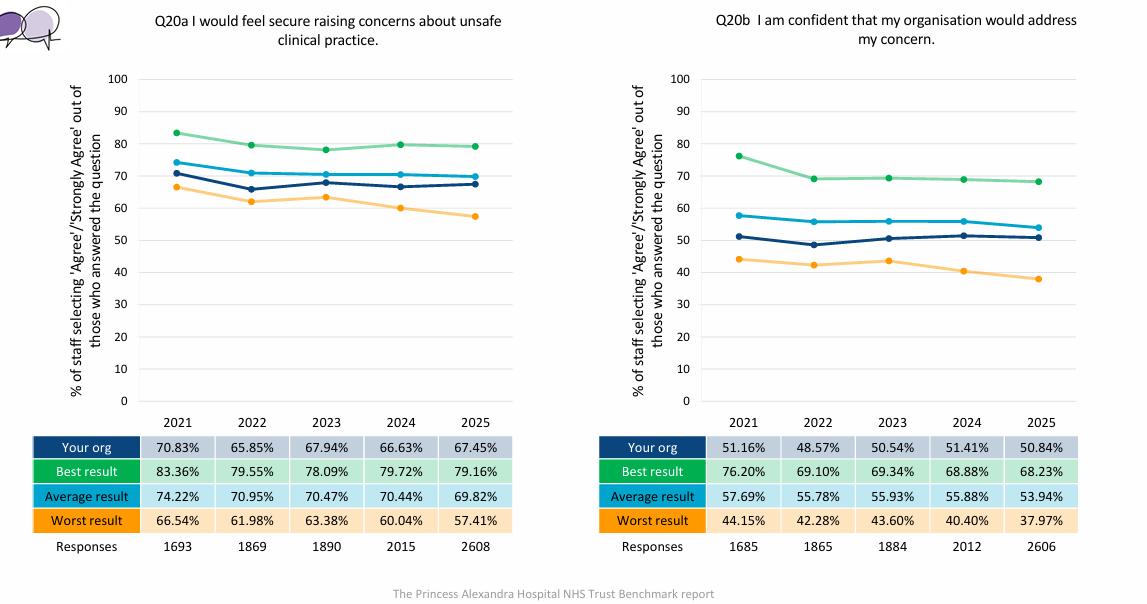
Figures 31-32:
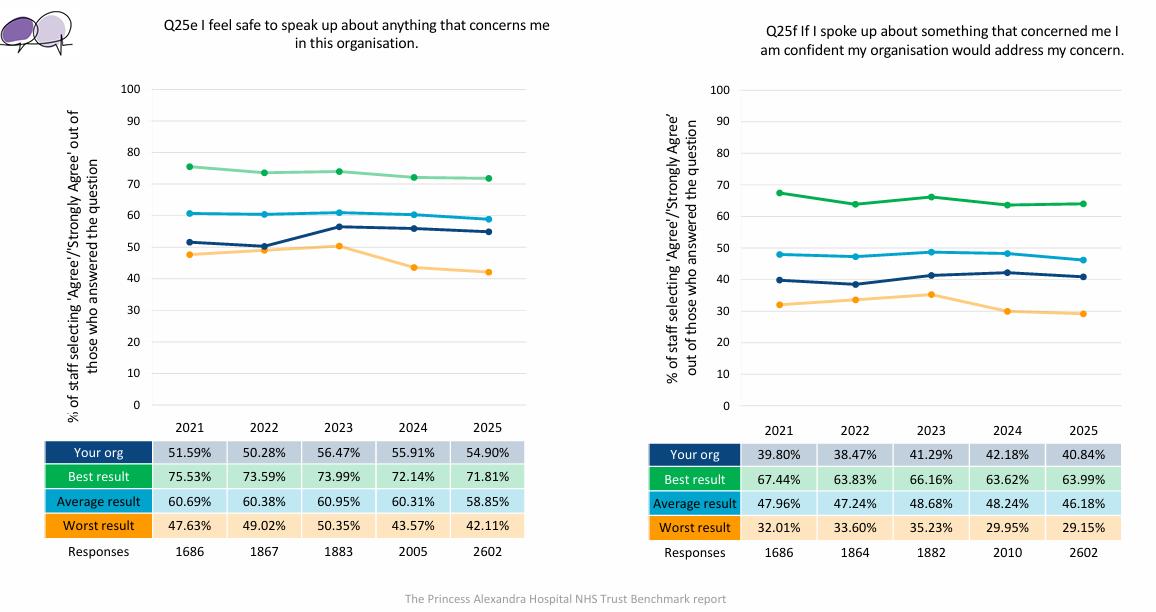
This Is Us Week, our annual event, was People Promise-themed and aimed to deliver fun, food and appreciation for staff across all sites and work with local suppliers to strengthen community ties.
• 5,134 estimated staff touchpoints.
• 720 staff attended face-to-face session activities.
• 78 staff joined online sessions
• 640 cooked breakfasts served to staff at the Learning and Education Centre.
• 1,115 lunches (up from 700 in 2024) delivered across five locations.
• 525 staff interacted with supplier stands
• 1,150 refreshments / cupcakes from the Executive Team hand delivered to staff
• 400 boxes of ‘thank you’ biscuits hand delivered to 135 departments across five sites.
During 2025-26, the Trust strengthened control of temporary staffing and improved oversight of workforce deployment. We moved all temporary staffing booking through the Trust’s rostering system, creating a single route for requesting and approving shifts. This has improved visibility, reduced off-system bookings, and strengthened control.
We implemented an electronic approval process aligned to national requirements, ensuring all requests are reviewed before fulfilment and embedding consistent governance across divisions.
We undertook divisional deep dives into rosters, improving oversight of workforce deployment and identifying opportunities to use substantive and bank staff more effectively.
We reviewed long-term agency and bank usage (“long lines”) and converted appropriate roles to fixed-term contracts. This has reduced reliance on temporary staffing and improved workforce stability.
We expanded direct engagement arrangements for Allied Health Professional and Healthcare Scientist bank workers, reducing reliance on external agency supply and improving cost control. This has supported a continued shift from agency to bank usage.
We expanded widening participation through the West Essex Health and Care Career Pathways programme, supported by Essex County Council, creating clearer routes into employment for local people.
We continued partnership working with Harlow College to support local workforce supply
Digital – Tools and AI, Staff Equipped with Digital Skills, Optimising Virtual Learning
PAHT was selected as one of 40 NHS organisations across England and Wales to participate as Early Adopter for the Future NHS Workforce Solution Transformation Programme.
The Trust will:
• Influence the design and national implementation model
• Access enhanced functionality earlier than the wider NHS.
• Reduce manual processes and improve employee experience.
• Position the Trust as a lighthouse for workforce transformation
The Trust will benefit through early access by:
• Streamlined recruitment, onboarding and talent pathways as this will improve patient care.
• Automated workflows will reduce duplication and administrative burden and time gained can be directed to frontline patient care.
• More accurate workforce and financial data to support workforce planning
• Expanded people, payroll, learning and analytics capabilities
• Improved retention and high employee morale through improved design.
• Shared learning across another NHS organisation
The Trust will enter the implementation phase in June 2026 and go-live of the new solution in June 2027, figure 33
Figure 33: Implementation Timeline
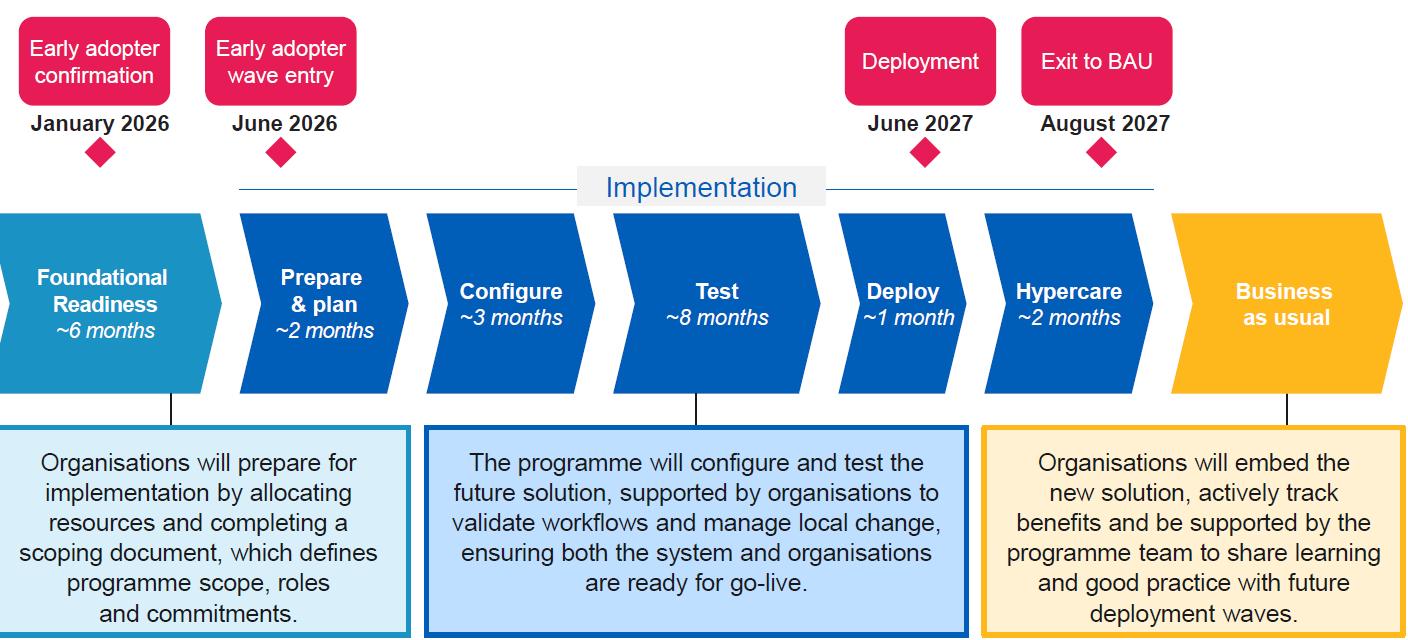
• Led the successful implementation of This is Me System (TiMS) as the Trust’s single, central digital learning and talent management platform, establishing a single source of truth for workforce learning and development.
• Consolidated fragmented learning, training, and performance activity across professional groups into one enterprise system.
• Established TiMS as the sole delivery and tracking mechanism for all mandatory and statutory training, achieving Trust-wide compliance rates exceeding 91%.
• Enabled delivery of learning through multiple formats within TiMS, including:
1. eLearning modules
2. Face-to-face programmes
3. Live virtual sessions
4. Recorded digital learning resources
• Supported blended learning approaches, increasing flexibility, improving accessibility, and reducing unnecessary time away from patient-facing and operational services.
• Ensured consistent access to learning regardless of role, shift pattern, or location.
• Increased accessibility to learning by enabling staff to complete training flexibly around shifts and clinical commitments.
• Reduced dependency on classroom-based delivery and physical training capacity.
• Improved equity of access to learning opportunities across both clinical and non-clinical staff groups.
• Enabled the Trust to deliver learning rapidly and at scale during periods of increased demand and workforce pressure.
To follow on from the Gosport Independent Panel Report, all Trusts providing NHS funded care were required to provide ways in which staff could speak up. Within PAHT there are a number of ways in which our people can speak up and raise concerns within the Trust.
One of these is via the Freedom to Speak up Service (F2SU). This may be to raise concerns about behaviours of colleagues, concerns about patient or staff safety either as an individual or as a witness, if they believe something is not correct or to give suggestions for improvements.
Staff can either speak directly to a guardian, be signposted by an ambassador or complete an anonymous online form. There is a lead guardian who is clinical with a further two clinical guardians and two non-clinical guardians.
We have now trained a total 30 Freedom to Speak Up Ambassadors. Their role is to support staff to speak up, raise the profile of the service and be accessible to a wider range of staff. They come from a wide range of ethnic backgrounds and a variety of roles within the Trust.
We have a Freedom to Speak up vision and strategy and the vision states: “We are striving to ensure that our people feel enabled to speak up in order to support and improve patient safety and quality, the health and wellbeing of our people, and staff experiences”.
The guardians continue to raise awareness through staff induction, local training sessions and walkabouts. The ambassadors are also hugely supportive of raising awareness of the service. The communications team support with regular
updates via Trust-wide mechanisms and the staff extranet (AlexNet) workspace is kept up to date.
Other mechanisms to increase awareness include:
• Junior doctor drop-in sessions.
• FTSU newsletters
• Increasing number of ambassadors.
• Presentations for all new staff
• Sessions on preceptorship
• Video on the staff extranet (AlexNet) with examples of speaking up.
• Attending wards/departments
• Posters with contact details
• Listening events.
• Support at health and wellbeing events.
• Schwartz Rounds
The Lead Guardian submits a quarterly report to the National Guardian’s Office detailing the numbers of referrals and themes. A more detailed report is presented to the People Committee and the Trust Board bi-annually. This shares numbers and themes of concerns raised to them but also the actions taken or required to happen to improve staff and patient experience and safety. The number of referrals continues to increase which is a good indication that more staff are feeling supported and safe to speak up.
Following the self-assessment undertaken in June 2025 an improvement plan was developed to address gaps in full compliance. The following actions have been completed:
• Increased the diversity of guardians.
• Enhanced communications plan
• Enhanced evaluation of the service from user feedback.
• An updated strategy is under development
Staff surveys and regular Pulse surveys are undertaken to monitor impact of any changes made to improve experience and actions are monitored locally and centrally for themes and improvements. The Trust endeavours to triangulate all speaking up avenues and the lead guardian collaborates with a range of key individuals across the Trust to promote this.
Staff can also contact a range of people directly within the organisation who can signpost them for advice and support. These include:
• The people team
• Staff side (Union representatives).
• Equality, Inclusion and Diversity Lead.
• Line manager
• Tutors.
• Organisational development team.
• Staff health and wellbeing team.
• Mental Health First aiders
• Professional Nurse/Midwife Advocates.
• Guardian for Safer Working
• Freedom to Speak Up ambassadors
Anyone who speaks up is always thanked for doing so. They are assured of confidentiality and encouraged to report immediately if they suffer any detriment from speaking up. This is taken very seriously and will be formally investigated. The details of this are now included in the updated Speaking Up Policy. All people who speak up to a guardian are kept informed of progress of any actions taken to improve or resolve issues and asked to feedback on their experience.
When staff wish to raise a concern, they should not need to identify if it is speaking up, whistleblowing or any other form of feedback. The organisation should acknowledge all concerns raised so that they are explored using the correct process. It has been identified that although there are a variety of mechanisms for raising concerns these are not all captured and used to identify wider themes and hotspots.
To try and improve this, key individuals in the Trust have developed a Raising Concerns Group. There is a panel that use an agreed risk assessment to explore complex cases. This process aims to ensure that the correct level of investigation is carried out, by the correct individual/s and is captured on a Trust-wide database.
There has been significant improvement during 2025-26 against the core national performance standards for Diagnostic, Elective, Cancer, and Urgent and Emergency Care
The Trust implemented a new operational divisional structure in February 2026 which was centred around clinical accountability and leadership. A changed approach to performance improvement has contributed to improved performance, and ultimately shorter waiting times for patients requiring care in our emergency, urgent and planned pathways.
Performance against the incomplete 18-week RTTstandard has significantly improved during 2025-26 and the Trust exceeded its target for March 2026, with a performance of 64.1% against the national standard. This was achieved through additional capacity, working closely with community and primary care colleagues and ensuring our waiting lists were accurate from a data perspective, figure 34 below.
Figure 34:
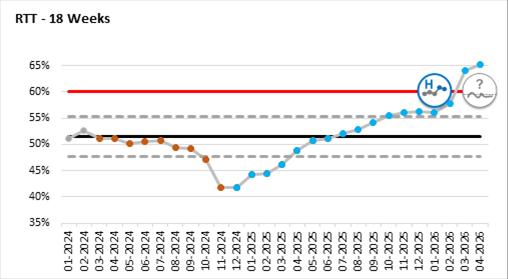
? is marked in the graph where a target is expected to be achieved some of the time, but normal variation would cause the target to be missed too
Referral To Treatment Access Target – Total Waiting List Size (Total Incomplete Pathways)
The waiting list for elective (planned) treatment has substantially reduced in 2025-26, from 51,395 patients in April 25 to 39,763 patients in March 26, see figure below
Figure 35:
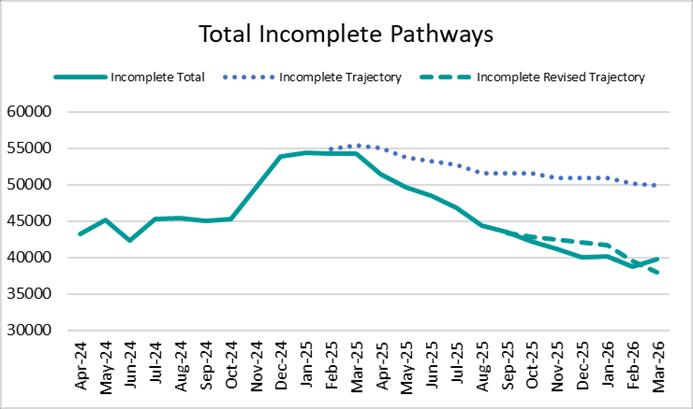
Referral to Treatment Access Target – Patients Waiting Over 52 Weeks
The numbers of patients waiting over 52 weeks for treatment has significantly reduced this year, and at March 2026, the number had reduced to 569 patients from 2,403 patients in April 2025, see figure 36 below.
Figure 36:
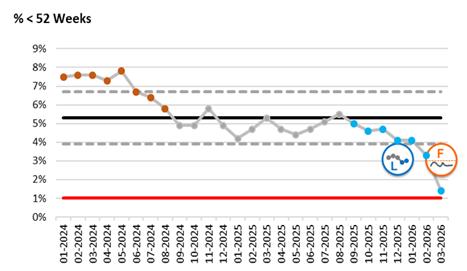
F is marked in a graph where the target is currently unattainable without a change in process being initiated.
Delivery against the national cancer standards has significantly improved. Performance against the 28-day faster diagnosis standard (FDS) and the 31-day decision to treat to treatment (DTT) standard has substantially improved. Performance against the 62-day referral to treatment standard has also improved, but still falls below the national standards. There will be focused improvement work in 2026-27 to bring the performance against the 62-day standard up to national expectations.
Performance against the FDS standard has improved from 70.2% in March 2025 to 80.0% in March 2026. The Trust benefited from Cancer Alliance funding in 2025-26 which enabled investment in early diagnostics / clinical input in Lower Gastrointestinal pathways (LGI), Urology Pathways and Gynaecology, figure 37
Figure 37:
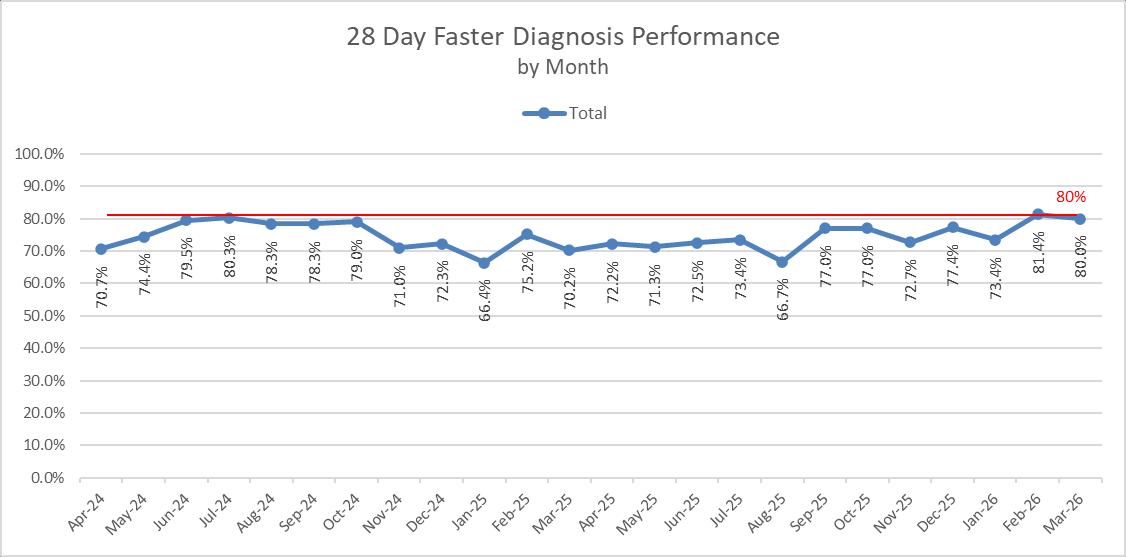
31-day Decision to Treat to Treatment (DTT) Standard
Performance against the 31-day standard has improved from 90.2% in March 25 to 97.7% in March 2026, see figure 38 below.
Figure 38:
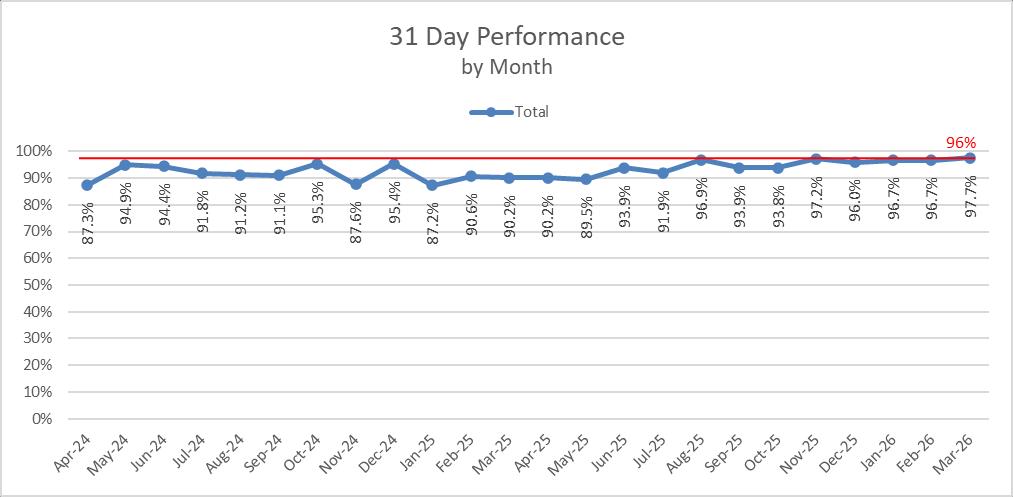
62-day Referral to Treatment Standard
Performance against this standard remains challenged, and below the national threshold for 2025-26 of 75%, figure 39
Focused clinical pathway work into Urology, Head and Neck, Gynaecology and Lower Gastrointestinal services in 2026-27 is planned, looking at the whole pathway from referral to treatment, aiming to improve waiting times in these tumour groups.
Figure 39:
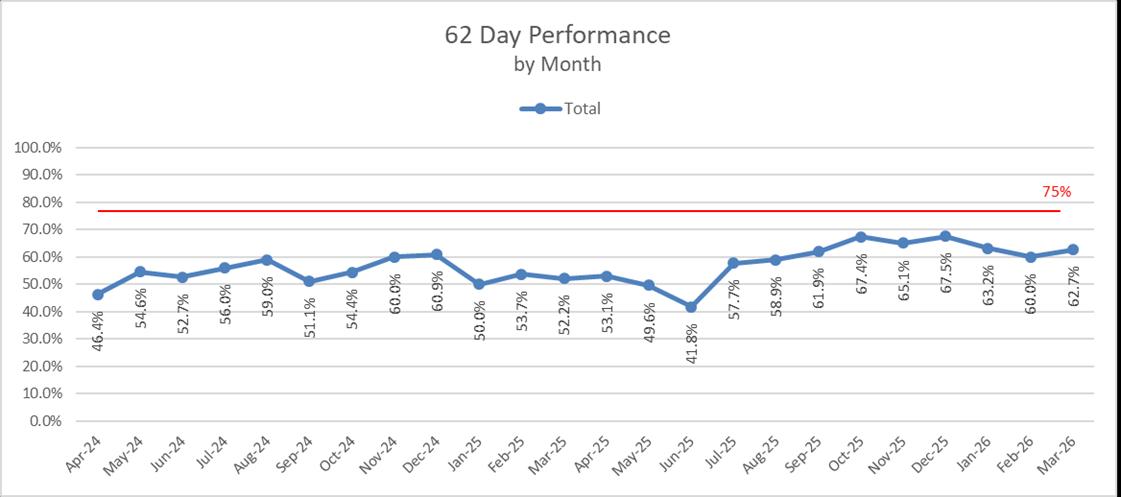
Diagnostic performance - Patients Who Have Diagnostic Tests Within 6-weeks of Time from Request
There has been significant work on diagnostic pathways in 2025-26 both from a capacity and a reporting perspective. The new Community Diagnostic Centre (CDC)
opened in March 2026, and new CT and MRI capacity have been implemented as part of this venture. The Trust has also invested in additional insourcing for Endoscopy, to ensure that waiting lists are reduced as quickly as possible. The new CDC will add real benefit to diagnostic pathways for patients across the specialties, in a location that is close to home and easily accessible. Performance in March 2026 was 71.28%, figure 40
Figure 40:
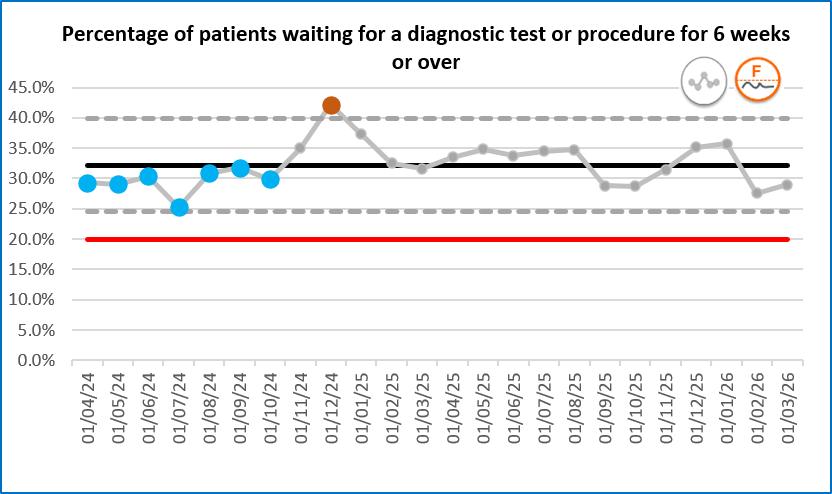
Performance against 4-hour Emergency Department Waiting Time Target Performance against the 4-hour standard has dramatically improved over 2025-26, as shown in Figure 41. The Trust has trialled a combination of different initiatives that has contributed to this high level of performance.
New approaches have included additional resource at the front door over winter to rapidly assess patients, further development of the Older Persons Assessment and Liaison (OPAL) model, development of Emergency Medicine Same Day Emergency Care pathways, and a GP-led two step streaming process at the Emergency Department front door. A trial of prescribing ward-based pharmacists over the winter period which has demonstrated significant impact in ensuring discharge prescriptions are completed earlier in the day, supporting patients to go home earlier.
Figure 41:
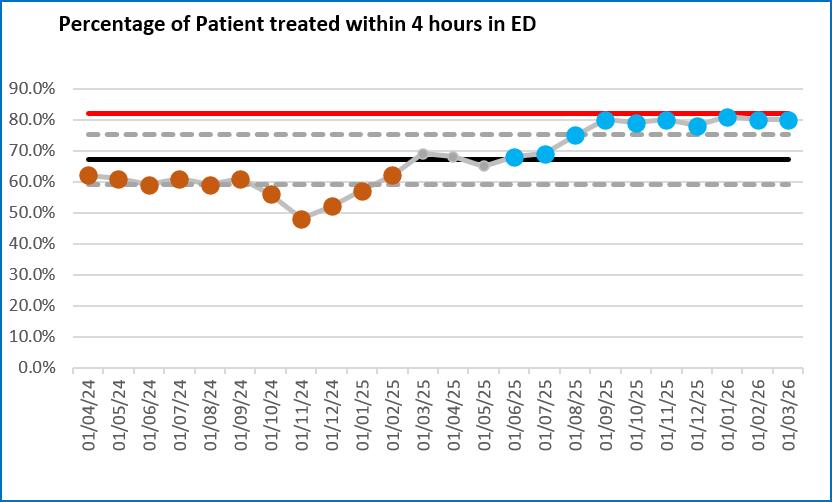
Percentage of Patients within the Emergency Department for 12 hours or more
Performance against the 12-hour standard has been much more consistent over 202526, although it remains a challenge. PAHT implemented a new surge plan which has helped support appropriate and rapid escalation and action during times of compromised flow across the urgent and emergency care pathway. Ensuring that a large proportion of patient discharges happen before midday will be a key focus for improvement for 26/27, see figure 42.
Figure 42:
Delivery of this standard for 2025-26 has been affected by a range of system pressures, most notably a sustained rise in ambulance arrivals, reflecting increased demand and acuity within urgent and emergency care pathways.
Despite these challenges, there has been areas of improvement. Multidisciplinary Assessment and Decision Events (MADE) delivered demonstrable benefits, supporting improved flow and decision-making. This contributed to a period of performance improvement in December 2025, where outcomes were better than the expected trajectory, see figure 43
However, from January 2026 onwards, although there has been a continued reduction in ambulance handover times, indicating progress in our front-door
processes, this has not fully mitigated the ongoing impact of high demand and downstream constraints. The reduction in handover delays suggests that targeted operational interventions are having a positive effect, but system-wide pressures continue to limit sustained improvement against the overall standard.
Figure 43:
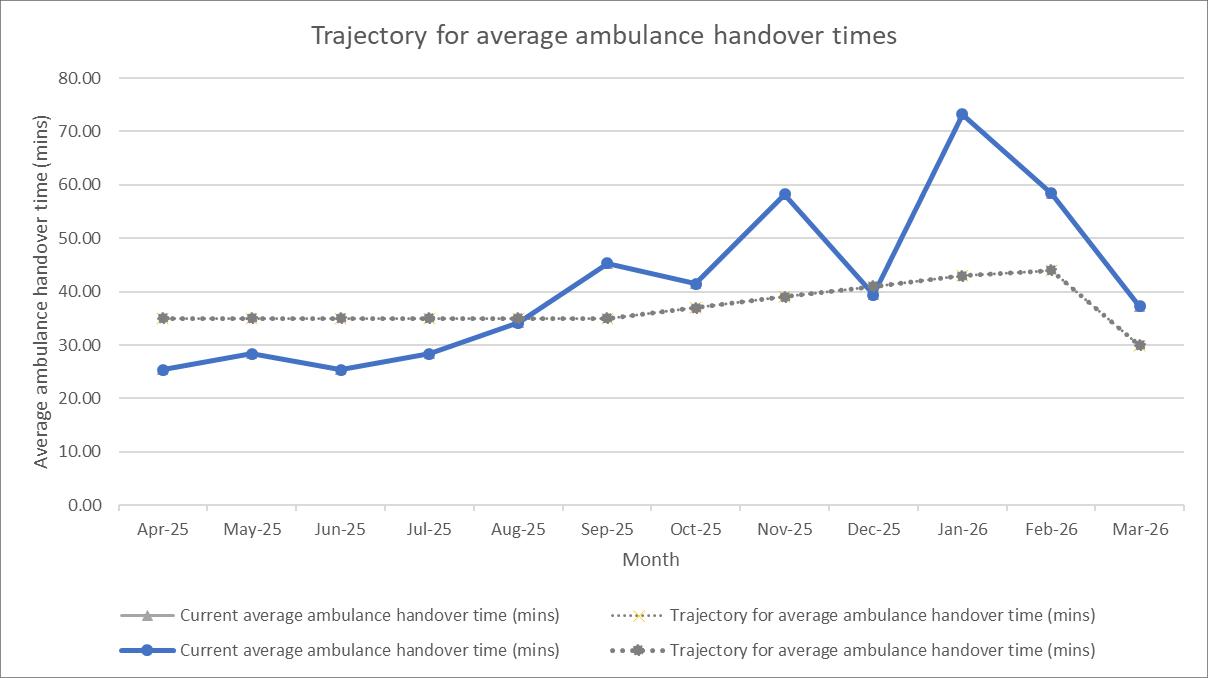
Moving forward, continued focus on demand management, patient flow optimisation, and embedding the benefits of MADE will be critical to stabilising performance and aligning delivery more closely with the 2026-27 trajectory.
As an organisation the Trust scored and retained its status as substantially compliant against the 2025 NHS England Core StandardsAssurance. The core standards report highlighted several areas of improvement with business continuity being the main area of concern, a work plan is now in place to ensure that this is implemented. Overall, 55 out of the 62 areas were fully compliant and 7 partially compliant, giving an overall rating of substantially complainant at 89%, table 14.
The scoring for the core standards is based on the following criteria.
Table 14:
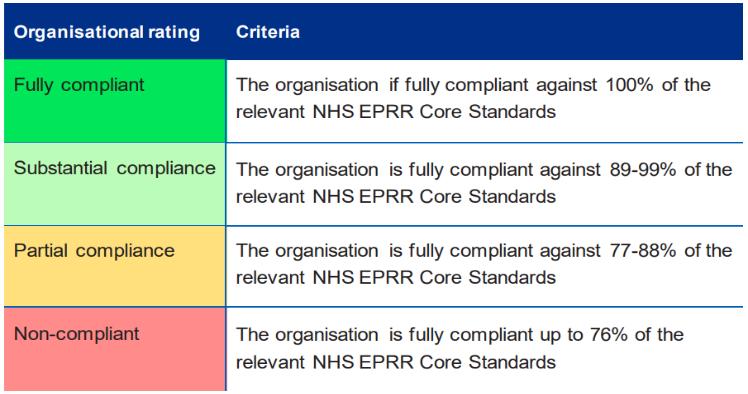
A number of plans and policies relating to PAHT emergency preparedness have been reviewed to ensure that these are still in line with national and local guidelines, this has resulted in the Major and Critical Incident Plan, Adverse Weather Plan and a new CBRN SOP been created / updated.
Business Continuity - Business continuity management processes continue to be developed, this includes the updating of the Trust-wide business continuity policy, as well as a new combined business impact analysis and business continuity plan template, which will enable divisions to write and update plans with prompts and identify risks.
Testing and Exercise - Throughout the year, the Emergency Preparedness, Resilience and Response (EPRR) team has attended a number of external multiagency exercises, including exercise Solaris and Pegasus (pandemic planning) and a cyber exercise held by the Hertfordshire Local Resilience Forum attended by our Head of EPRR and two members of the Trust digital team.
The Trust has participated in relevant national clinical audits in year
Table 15 – Clinical Audit Participation for 2025-6
BAUS Data & Audit Programme
a) British Audit of the Investigation and Referral of Women with Recurrent Urinary Tract Infection Using Recent Guidance (BOOMERANG) The British Association of Urological Surgeons (BAUS) No
b) Evaluating the Management Pathway for Suspected Testicular Cancer Referrals (EMPAST)
Case Mix Programme (CMP)
National Audit & Research Centre (ICNARC)
Child Health Clinical Outcome Review Programme1 (NCEPOD)
Cleft Registry and Audit Network (CRANE) Database Not applicable Emergency Medicine QIPs:
Falls and Fragility Fracture Audit Programme (FFFAP)1:
Fracture Liaison Service Database (FLS-DB)
Project Name / Workstream Name
Mental Health Clinical Outcome Review Programme1
a) National Diabetes Core Audit. Includes: -Care Processes & Treatment Targets -Complications & Mortality -Type 1 Diabetes -Learning Disability and Mental Health -Structured Education -Prisons and Secure Mental Health Settings
National Adult Diabetes Audit (NDA)4:
b) Diabetes Prevention Programme (DPP) Audit
c) National Diabetes Footcare Audit (NDFA)
d) National Diabetes Inpatient Safety Audit (NDISA)
e) National Pregnancy in Diabetes Audit (NPID)
f) Transition (Adolescents & Young Adults) and Young Type 2 Audit
g) Gestational Diabetes Audit
The University of Manchester / National Confidential Inquiry into Suicide & Safety in Mental Health (NCISH) Not applicable
applicable
NHS England (formerly NHS Digital)
National Audit of Cardiac Rehabilitation University of York Not applicable
National Audit of Cardiovascular Disease Prevention in Primary Care (CVDPrevent)1 NHS Benchmarking Network Not applicable
National Audit of Care at the End of Life (NACEL)1
Benchmarking Network
Via NDA and NPDA submissions.
National Audit of Dementia (NAD)1
National Audit of Eating Disorders (NAED)1
National Bariatric Surgery Registry
National Audit of Metastatic Breast Cancer (NAoMe)1
Royal College of Psychiatrists
Data not being collected during 2025-26
Royal College of Psychiatrists Not applicable
British Obesity & Metabolic Surgery Society Not applicable
National Cancer Audit Collaborating Centre (NATCAN):
Royal College of Surgeons of England (RCS)
National Cardiac Audit Programme (NCAP):
a) National Adult Cardiac Surgery Audit (NACSA)
National Institute for Cardiovascular Outcomes Research (NICOR) Not applicable b) National Congenital Heart Disease Audit (NCHDA) Not applicable
(continued)
c) National Heart Failure Audit (NHFA)
d) National Audit of Cardiac Rhythm Management (NACRM)
e) Myocardial Ischaemia
National Audit Project (MINAP)
f) National Audit of Percutaneous Coronary Intervention (NAPCI)
g) UK Transcatheter Aortic Valve Implantation (TAVI)
Registry
h) Left Atrial Appendage Occlusion (LAAO) Registry
i) Patent Foramen Ovale Closure (PFOC) Registry
j) Transcatheter Mitral and Tricuspid Valve (TMTV)
Registry
Not applicable
Data submission period still open
Not applicable
Not applicable
Not applicable
Not applicable
National Clinical Audit of Psychosis (NCAP)1 Royal College of Psychiatrists Not applicable National Comparative
National Early Inflammatory Arthritis Audit (NEIAA)1 British Society for Rheumatology
Ongoing data submission for eligible cases; follow-up data completeness may be impacted where patients are not reviewed within expected timeframes.
Project Name
National Emergency Laparotomy Audit (NELA)1
National Joint Registry
National Major Trauma Registry
College of Anaesthetists
National Maternity and Perinatal Audit (NMPA)1 Royal College of Obstetricians and Gynaecologists
National Neonatal Audit Programme (NNAP)1
National Obesity Audit (NOA)1
National Ophthalmology Database (NOD):
Cataract Audit
England (formerly NHS Digital)
Respiratory
National Vascular Registry (NVR)1 Royal College of Surgeons of England (RCS)
Project Name / Workstream Name
Out-of-Hospital Cardiac Arrest Outcomes (OHCAO)
Paediatric Intensive Care Audit Network (PICANet)1
Perioperative Quality Improvement Programme (PQIP)
a) Improving the quality of valproate prescribing in adult mental health services
Prescribing Observatory for Mental Health (POMH):
University of Warwick Not applicable
University of Leeds / University of Leicester Not applicable
Royal College of Anaesthetists Yes 31 participants
Royal College of Psychiatrists Not applicable
b) Use of clozapine Not applicable
c) Use of medicines with anticholinergic (antimuscarinic) properties in older people’s mental health services Not applicable
Sentinel Stroke National Audit Programme (SSNAP)1
King's College London Not applicable
Serious Hazards of Transfusion (SHOT): UK National Haemovigilance Scheme Serious Hazards of Transfusion (SHOT) Yes
UK Cystic Fibrosis Registry
a) Cystic FibrosisAdults Cystic Fibrosis Trust Not applicable b) Cystic FibrosisChildren Not applicable
UK Interstitial Lung Disease (ILD) Registry British Thoracic Society No
UK Parkinson's Audit Parkinson's UK Yes Data submitted to x2 elements
UK Renal Registry Chronic Kidney Disease Audit UK Kidney Association Not applicable
UK Renal Registry National Acute Kidney Injury Audit UK Kidney Association Yes
There were 10 commercial portfolio studies and 75 non-commercial studies open or in follow-up, throughout 2025/2026, see figure 44-45.
Figure 44:
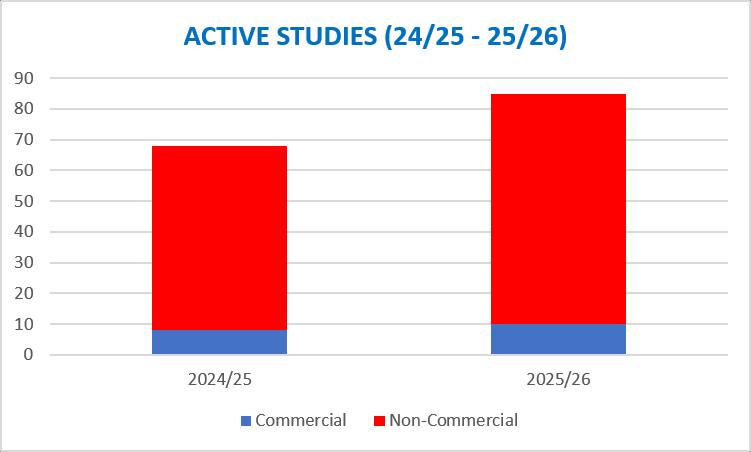
The overall recruitment for 2025-2026 studies was 3,503 made up of 8 recruits to our commercial studies and 3493 to our non-commercial, see table 16.
Figure 45: Recruitment to Clinical Trials in 2025-26
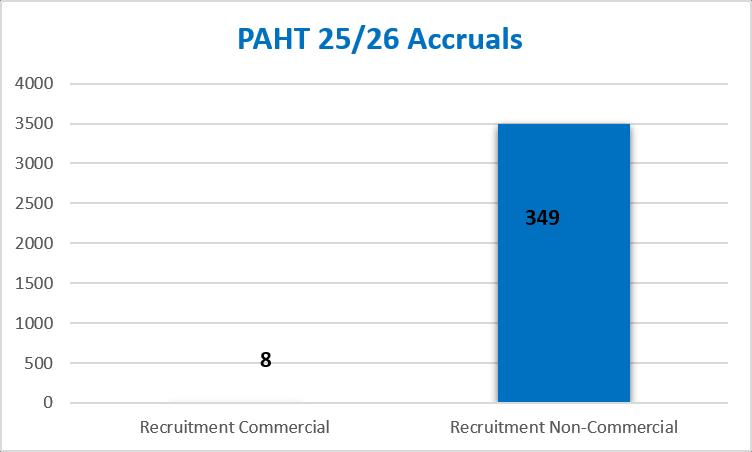
Central to this year’s progress was the optimisation of the Alex Health system (our electronic patient care record which went live in November 2024), a comprehensive programme to support adoption, and the successful rollout of four optimised clinical pathways: frailty, end of life, fracture clinic, and discharge and transfer of care. The report also details the first major upgrade to the system, advances in early warning score identification, improved communications with primary care partners, ongoing enhancement of the patient portal (My Alex Health), the implementation of the Somerset cancer management system, and continued engagement with partners to drive improvements in patient safety, quality of care, and staff experience.
The successful optimisation has been reliant upon a highly functioning multiprofessional team. The team has included advanced technical skills in configuration from the IT team, patient and end user functionality testing and delivery from the Clinical Digital Team, careful clinical safety review from the team of Clinical Safety Officers, successful project management and energetic and coordinated implementation from the transformation team.
Importantly, we are working towards the delivery of the NHS 10 Year Plan, moving from analogue to digital, to secure long-term benefits for patients and staff. A key part of our approach is continued investment in our teams, ensuring that staff have the knowledge and skills required to fully realise the benefits of digital optimisation across the organisation. We are also actively working towards improving our digital maturity, ensuring that the Trust adopts best practices, leverages innovative digital tools, and maintains robust digital capabilities to support future growth and excellence.
In September 2025, PAHT undertook the implementation of its first upgrade to our enterprise-wide electronic health record (EHR) Alex Health. Upgrades are essential for digital systems because they deliver improvements in performance, security, and functionality. As technology evolves, regular upgrades ensure that systems remain resilient against emerging cybersecurity threats and are aligned with latest clinical requirements. Upgrades also introduce new features and workflows and are crucial to maintaining digital systems. In addition, system upgrades enhance user experience, optimise integration with other platforms, and support compliance with regulatory standards. By implementing the upgrade in 2025, the Trust maintained the reliability, efficiency, and innovation of its digital infrastructure, making certain that Alex Health continues to meet the needs of both patients and staff in a rapidly changing healthcare environment. The upgrade also included improvements to
system stability, user interface, and integration with other digital platforms, further strengthening the Trust’s digital infrastructure.
In 2025-26, significant optimisation of the Alex Health system was achieved. The Trust dedicated resources to refining workflows, enhancing usability, and supporting staff adoption through targeted training and ongoing engagement.
Over 621 configuration changes were made to tailor the platform to clinical and operational requirements, ensuring that Alex Health remains responsive to evolving needs and best practice. The adoption support was maintained and included masterclasses, quick reference guides, floorwalking and 1:1 support to embed new ways of working and encourage continuous learning across all departments. Areas of work optimised include (but are not limited to):
• Improvement in efficiencies in EPMA and pharmacy workflows
• Inpatient referrals transferred to Alex Health to improve governance and reduce length of stay.
• Significant reduction in delays in clinical correspondence
• Stabilisation and improvement of HSMR.
• Improved governance in implementation of multiprofessional Go/No Go meetings for implementation of new systems and decommissioning of legacy systems.
• Integrations between Alex Health and other systems to improve efficiency and patient safety
Further, substantial investment in staff development and digital skills has supported our teams to be empowered to lead the Trust’s digital transformation and drive forward system optimisation.
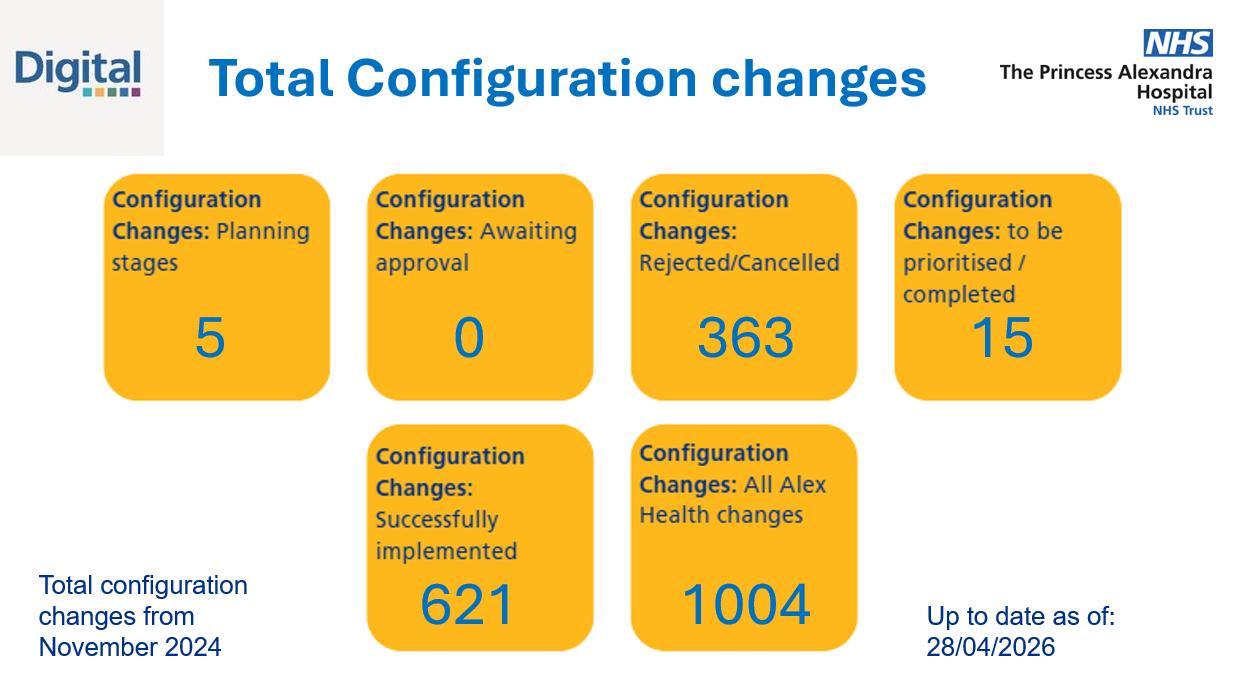
Three clinical pathways were successfully built and rolled out during the year:
• End of life.
• Frailty
• Virtual fracture clinic
• Discharge and transfer of care.
These pathways were led by the clinical and operational teams collaborating with the expert digital team to standardise care processes. The pathway digitisation has improved efficiency, improved the capture and use of data and supported better patient outcomes. Staff received pathway-specific training and guidance, ensuring a smooth transition to the new protocols and a high standard of care delivery.
The introduction of a new workflow to directly acquire patient observations directly into Alex Health improved identification and monitoring of patients’ early warning scores for our adult inpatients. This enhancement enables real-time alerts, supporting clinical staff in the timely recognition and escalation of deteriorating patients.
The Trust prioritised improvements in communication and collaboration with primary care partners throughout 2025-26 to support digital pathways, with a particular focus on improving:
• Outpatient clinical letters
• Inpatient discharge summaries.
• New streamlined processes were implemented to ensure timely information sharing, reduce duplication, and support continuity of care.
• Feedback from GPs and clinical leaders informed ongoing refinements, fostering a culture of openness and shared responsibility for patient outcomes.
Ongoing optimisation of the patient portal (My Alex Health) has remained a key focus. The portal enables patients to securely access information relating to their care, enhancing transparency and patient engagement. Between June 2025 and March 2026 65,412 patients registered on the patient portal. The phased rollout by clinical specialty is supported by a robust communications campaign, outreach through voluntary sector partners, and digital inclusion initiatives to address barriers to access. Patients who prefer not to use digital technology continue to receive communications by post, ensuring equitable access for all.
Phase 1 of the transfer from Infoflex to the Somerset cancer management system was rolled out Trust-wide in March 2026, providing clinicians with an improved platform to manage cancer pathways efficiently. This implementation supports multidisciplinary working, improves data accuracy, and enhances the coordination of care for cancer patients. Training and support were provided to ensure rapid adoption and effective use of the new system.
The Trust continued to strengthen its engagement with system partners, patient groups, voluntary organisations, and the wider community. Collaborative initiatives
focused on improving patient safety, care quality, and staff experience. The partnership with West Essex Community Action Network (WECAN) exemplifies this approach, with the recycling and distribution of electronic devices to address digital exclusion and support vulnerable individuals in the community.
Wayfinding and Digital Check In – Developed In House at St Margaret’s Community Diagnostic Centre (CDC)
The Trust has successfully delivered a purpose-built patient self-check-in and wayfinding solution for the new Community Diagnostic Centre (CDC) at St Margaret’s Hospital, Epping, which welcomed its first patients on 16 March 2026.
Patients can now self-check-in on arrival and receive clear, automated wayfinding instructions, reducing queues, improving patient flow and enhancing the overall experience at the CDC The solution also releases clinical capacity, with staff no longer required to leave consultation rooms to locate patients in waiting areas.
This delivery demonstrates the Trust’s growing capability to design and implement complex digital solutions internally, aligned to clinical workflow and patient experience.
The team later received the internal team of the month award:
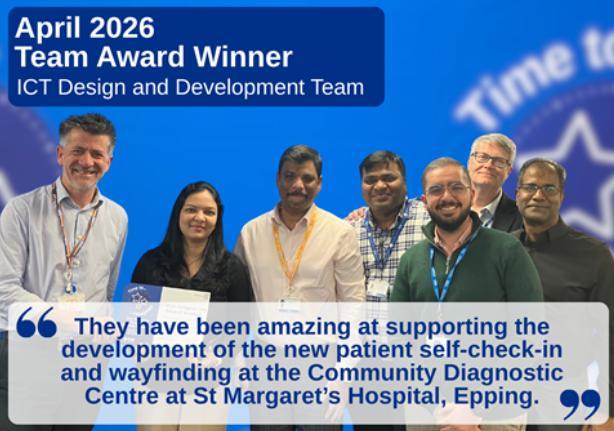
In 2025-26, the Princess Alexandra Hospital NHS Trust has made substantial progress in digital transformation, clinical pathway optimisation and partnership working. Our ongoing efforts to deliver the 10 Year Plan and transition from analogue to digital systems will underpin sustained improvements in patient experience, staff wellbeing, and clinical excellence.
As we continue to improve our digital maturity, we are committed to adopting the latest technologies and practices to ensure our digital infrastructure remains resilient, innovative, and future-ready. The Trust remains dedicated to continuous improvement, innovation, and the delivery of safe, high-quality care for all patients.
Looking ahead, further enhancements to the Alex Health system, innovations and ongoing pathway development with deeper engagement with partners will continue to be prioritised, ensuring sustained excellence in patient and staff experience. The trust is further currently looking to adopt the use of ambient voice technology to
support our clinicians to optimise their time when caring for their patients and focus on the delivery of their care rather than the burden of documentation.
The Trust has made significant progress during 2025-26 in improving estate safety, resilience, and sustainability, while supporting high-quality patient care and preparing for future redevelopment.
A £33m capital investment programme has prioritised critical infrastructure upgrades, including fire safety, electrical and water systems, and backlog maintenance associated with an ageing estate.
Key developments included the completion of Phase 1 of the Community Diagnostic Centre at St Margaret’s Hospital, enhancing diagnostic capacity and patient access The relocation of phlebotomy services to the Harvey Centre in Harlow has improved accessibility for patients and reduced pressure on the acute hospital site, enhancing patient experience and strengthening capacity.
Improvements and major upgrades to the Children’s Emergency Department facilities have improved patient experience and strengthened capacity.
The Trust continues to advance its sustainability agenda in line with NHS Net Zero ambitions, achieving an 11% reduction in carbon emissions and notable reductions in energy use, waste emissions, and water consumption in year.
Improvements have been driven by energy efficiency measures, better waste segregation, and expanded community and digital care models, reducing reliance on inpatient services and associated emissions.
Governance has been strengthened through the establishment of a Sustainability Steering Group and delivery of the Green Plan. However, progress remains constrained by an ageing, energy-intensive estate, and reliance on fossil fuel systems.
Priorities for 2026-27 include improving data quality, optimising energy systems, strengthening climate risk management, and developing further low-carbon initiatives to support long-term environmental performance and sustainable healthcare delivery.

Response to The Princess Alexandra Hospital NHS Trust Quality Account (2025-2026) from Healthwatch Essex
Healthwatch Essex is an independent organisation that works to provide a voice for the people of Essex in helping to shape and improve local health and social care. We believe that health and social care organisations should use people’s lived experience to improve services. Understanding what it is like for the patient, the service user and the carer to access services should be at the heart of transforming the NHS and social care as it meets the challenges ahead of it.
We recognise that Quality Accounts are an important way for local NHS services to report on their performance by measuring patient safety, the effectiveness of treatments that patients receive and patient experience of care. They present a useful opportunity for Healthwatch to provide a critical, but constructive, perspective on the quality of services, and we will comment where we believe we have evidence – grounded in people’s voice and lived experience – that is relevant to the quality of services delivered by The Princess Alexandra Hospital NHS Trust (PAHT). In this case, we have received limited feedback about services provided by the Trust and so offer only the following comments on the PAHT Quality Account.
• It is fantastic to see that the CQC rating for caring is outstanding for children’s services.
• Although it is disappointing to see how many areas are considered to be ‘requiring improvement’ by the CQC, it is reassuring to see the action plans in place to address these including having a dedicated SRO and executive for each area.
• Healthwatch are heartened to see the Trust's quality improvement programmes are designed to use patient feedback and insight to inform priorities, design changes, and evaluate impact.
• The number of complaints received has increased significantly to 651. It would be useful to understand the reasons for this and the learning that has been captured from them.
Listening to the voice and lived experience of patients, service users, carers, and the wider community, is a vital component of providing good quality care and by working hard to evidence that lived experience we hope we can continue to support the encouraging work of PAHT
Samantha Glover Chief Executive Officer, Healthwatch Essex
21/05/2026

Healthwatch Hertfordshire’s response to The Princess Alexandra Hospital NHS Trust Quality Account 2025/2026
Thank you for sharing your Quality Account with us. Healthwatch Hertfordshire values its positive relationship with The Princess Alexandra Hospital NHS Trust and looks forward to continuing to work together to ensure patient voices help shape improvements, including those reflected in the Trust’s quality priorities for the coming year.

Neil Tester, Chair Healthwatch Hertfordshire May 2026

NHS Central East Integrated Care Board feedback on the Quality Account of The Princess Alexandra Hospital NHS Trust (PAHT) for 2025/2026
Thank you for sharing the draft Quality Account for 2025/26 for The Princess Alexandra Hospital NHS Trust (PAHT). The document has been reviewed, and the following feedback has been collated to support preparation of the final version.
Overall, the Quality Account is clearly presented, well structured, and easy to navigate. It provides a balanced and transparent overview of the Trust’s performance, recognising both achievements and areas requiring further development. The report demonstrates a strong commitment to continuous improvement, organisational learning, and patient-centred care.
• The alignment of the quality priorities with the Trust’s “5 Ps” strategy is clear and well articulated throughout the document.
• Compliance with Oliver McGowan mandatory training has improved compared with the previous year, and it is encouraging to see clear actions identified to further increase compliance and achieve the Trust standard.
• Consider including reference to Venous Thromboembolism (VTE) and Sepsis within the falls and pressure ulcer sections, as these are important indicators associated with fundamental aspects of patient care and safety.
• The Quality Account demonstrates a continued focus on patient safety, learning, and quality improvement across the organisation.
• The report provides a comprehensive overview of performance and improvement activity, demonstrating openness in reporting and a commitment to learning from challenges as well as achievements.
• It may be helpful to provide additional narrative where there are significant changes in performance indicators, to support understanding of the underlying causes and improvement actions.
• The document reflects a clear commitment to continuous improvement and embedding learning across services.
• The work described in relation to the Patient Panel is particularly positive and demonstrates meaningful engagement with patients and service users.
• The report reflects a strong commitment to listening to patient feedback and using insight to support service improvement.
• It would be helpful to provide additional context regarding the reported 104% increase in complaints, including the key drivers contributing to this increase

and whether this may reflect improved reporting mechanisms, changes in patient experience, or other underlying factors.
Overall, the Quality Account reflects a continued commitment to improving patient safety, patient experience, and clinical effectiveness across the organisation. NHS Central East Integrated Care Board thanks the Trust for the opportunity to review the draft document and acknowledges the work undertaken across the organisation to support quality improvement and positive outcomes for patients, carers, and staff.

By email
23 June 2026
Subject: NHS Essex Integrated Care Board response to The Princess Alexandra Hospital Quality Account 2025/26
Dear Colleagues
NHS Essex Integrated Care Board (EICB) welcomes the opportunity to comment on The Princess Alexandra Hospital NHS Trust (PAHT) Quality Account for 2025/26.
It should be noted that EICB was not the primary commissioner of services delivered by PAHT last year but welcomes the opportunity to comment on the planned quality priorities for 2026/27.
EICB recognises the significant efforts made by the Trust and its staff to deliver highquality care in the context of sustained system pressures and increasing demand. It notes that the Trust has outlined the following priorities for the coming year:
• Continue to make progress towards the Trust Hospital Standardised Mortality Rate (HSMR) within the ‘as expected range’, learning from every death
• Deliver high quality care in the right place and at the right time for our emergency and urgent care patients (focusing on 12 hour waits for treatment, admission or discharge)
• Reducing the number of complaints or PALS concerns
• Embed the call for concern (‘Martha’s rule’)
• Reduce the number of hospital acquired pressure ulcers (graded 3 & 4)
• Use of quality improvement methodologies to improve planned performance trajectories
• Support their people to deliver against a credible framework to enable changes that allow for sustainable improvement in service delivery
• Continuation of development of the Health and Care Partnership Model
NHS Essex Integrated Care Board
Seax House, Victoria Road South, Chelmsford, CM1 1QH
www.essex.icb.nhs.uk
Chair: Professor Michael Thorne CBE | CEO: Tom Abell
Sincere thanks go to teams at PAHT for their hard work and dedication that has been noted since EICB commenced working with PAHT to deliver healthcare services to the people of West Essex.
In conclusion EICB considers the PAHT priorities to be appropriate and will continue to seek assurance on performance and delivery of care by regular monitoring through agreed processes.
Yours sincerely,

Dr Giles Thorpe RN, DProf, MSc, Bsc (Hons), MIHM
Executive Chief Nurse / Caldicott Guardian
NHS Essex Integrated Care Board
Seax House, Victoria Road South, Chelmsford, CM1 1QH
www.essex.icb.nhs.uk
Chair: Professor Michael Thorne CBE | CEO: Tom Abell
Advice & refer – is the NHS pathway where a GP consults a hospital specialist before deciding to send someone to hospital.
Allied health professionals - Healthcare professionals working in dietetics, occupational therapy, physiotherapy, operating department assistants, radiography and speech and language therapy. This is distinct from nursing, medicine, pharmacy and healthcare scientists.
Ambulatory care - Medical care provided on an outpatient basis, includes diagnosis, observation, consultation, and treatment
Antenatal – This is the care you receive from health professionals during your pregnancy
Antimicrobial resistance - The ability of a bacteria to resist the effects of medication (antibiotics) that once could successfully treat the infection
Anticholinergic /Antimuscarinic drugs – class of medication that block nerve transmitters and are used to treat a variety of medical conditions.
Antimicrobial stewardship - A coordinated intervention designed to improve and measure the appropriate use of antimicrobials by promoting the selection of the optimal antimicrobial drug regimen, dose, duration of therapy, and route of administration.
Atrial Appendage Occlusion – the top chamber of the heart called the atrium is occluded, and a minimally invasive procedure is completed to provide a stroke prevention alternative for those who cannot take blood thinning medication
Audiology - The study of hearing and balance
Bacteraemia – An infection of bacteria in the blood.
Best interest decision – making a decision in someone’s best interest and in respect to hospital care it means that a specific decision will be made by at least two clinical staff about care / treatment for a person deemed to lack the mental capacity to make that decision for themselves.
Cardiac arrest – Sudden loss of blood flow from failure of the heart to pump effectively
Cardiology - The branch of medicine that deals with diseases and abnormalities of the heart
Care Quality Commission (CQC) - CQC is an executive non-departmental public body of the Department of Health United Kingdom. Established in 2009, it is the independent regulator of all health and social care services in England.
Chemical pathology – A branch of pathology dealing with biochemical basis for disease.
Chemotherapy - The treatment of disease by the use of chemical substances, especially the treatment of cancer by cytotoxic and other drugs.
Chronic obstructive pulmonary disease (COPD) - The name for a collection of lung diseases including chronic bronchitis, emphysema and chronic obstructive airways disease
Clinical audits - A process aimed to improve quality of patient care and outcomes through systematic review of care against explicit criteria and the implementation of change
Clinical coding - The process by which patient diagnosis and treatment is translated into standard, recognised codes that reflect the activity that happens to patients
Clostridium difficile (C. difficile) - Clostridium difficile, also known as C. difficile, or C. diff, is a type of bacterial infection that can affect the digestive system
Community-onset healthcare associated infection (COHA) – is when an infection is detected when a patient is a home but they have only arrived home within two days of admission to hospital, and the patient was an inpatient in the Trust in the previous four weeks.
Controlled drugs – are medications regulated by the misuse of Drugs Act because they carry a risk of addiction, misuse or harm.
Colorectal care - Treatments for patients with symptoms of the gastrointestinal tract including colorectal cancer and inflammatory bowel disease.
Colposcopy and hysteroscopy services - A procedure used to examine the cervix and inside of the womb (uterus).
CQUIN - Commissioning for Quality and Innovation is a system introduced in 2009 to make a proportion of healthcare providers’ income conditional on demonstrating improvements in quality and innovation in specified areas of care
Datix - Software used in healthcare to collect patient safety incidents and for reporting adverse events.
Deep tissue injury – is damage to the subcutaneous tissue that results from externally applied load/pressure. This is distinct from a pressure ulcer and is not always associated with broken skin
Delirium - Is a state of mental confusion that can happen if you become unwell. It is also known as an acute confusion
Dementia champions - A group of staff who have had specific training in dementia care. Their aim is to make other colleagues more understanding of why a patient may be more challenging and encourages them to tailor therapies accordingly
Deprivation of liberty (DoLS) – taking away a person’s freedom, specifically their freedom to leave and so placing them under continuous supervision and control. This typically occurs when a person lacks the capacity to make decisions about their own care and treatment and so they will not be free to leave a place where they are being cared for.
Dermatology - The branch of medicine concerned with the diagnosis and treatment of skin disorders.
Diagnostics - Tools used to help identify disease and illness
Dietetics – A branch of healthcare concerned with the diet and its effects on health, especially with the practical application of a scientific understanding of nutrition.
Endocrinology - The branch of physiology and medicine concerned with endocrine glands and hormones.
Endoscopy - A procedure that allows a view the inside of a person's body.
ENT clinics – An area where diagnosis and treatment are provided to conditions of the ear, nose and throat.
Escherichia coli (E. coli) bacteraemia - Type of bacterial infection and a blood stream infection
Frailty service – Reviews frail older people using a holistic assessment of physical, mental and social needs
Friends and Family Test (FFT) - Test aimed at providing a simple headline metric which, when combined with follow-up questions, is a tool to ensure transparency, celebrate success and galvanise improved patient experience. It asks “How likely are you to recommend our services to friends and family if they needed similar care or treatment?” with answers on a scale of extremely likely to extremely unlikely.
Gastroenterology - The branch of medicine which deals with disorders of the stomach and intestines.
Genito-urinary - The branch of medicine relating to the genital and urinary organs
Gestational diabetes – a temporary form of high blood sugar that develops during pregnancy in women who do not already have diabetes.
Governance - Establishment of policies, and continuous monitoring of their proper implementation, by the members of the governing body of an organisation.
Gram negative blood stream infections (GNBSIs) - Type of bacterial infection and a blood stream infection.
Gynaecology - The branch of physiology and medicine that deals with the functions and diseases specific to women and girls, especially those affecting the reproductive system
Haematology - The branch of medicine involving the study and treatment of the blood
Healthcare associated infections (HCAI) - Infections that are acquired as a result of healthcare. The burden of healthcare-associated infections has mainly been in hospitals where more serious infections are seen
Health Overview and Scrutiny Committee – Local authority committees that scrutinise health issues and care in their area
Healthwatch – Obtain the views of people about their health needs and experiences of having care and social services
Hepato-pancreato-biliary (HPB) - involved in the management of gallstone disease along with benign and malignant diseases of the liver, pancreas and gall bladder.
Hospital acquired pressure ulcer (HAPU) – a pressure ulcer that developed during a person’s stay in hospital so is not there on admission.
Hospital onset healthcare associated infection (HOHA) – this is an infection that is detected three or more days after admission to hospital therefore considered to be hospital acquired.
Hospital Standardised Mortality Ratio (HSMR) - Calculation used to monitor death rates in a Trust.
Hospital Standardised Mortality Ratio+ (HSMR+) – Is an updated model of HSMR, and includes more accurate, comprehensive assessment of hospital mortality, building upon the original HSMR model by including new variables to address: socio-economic influences on mortality and co-morbidity to include the Global Frailty Index. These were introduced in November 2024.
Integrated Care Partnership and System (ICP and ICS) – are alliances of NHS providers that work together to deliver care by agreeing to collaborate rather than compete
Inflammatory bowel disease – The name for a group of conditions that cause the digestive system to become inflamed.
Intravenous – Giving fluids or drugs directly into a vein
Laparotomy - A surgical incision into the abdominal cavity, used for diagnosis or in preparation for major surgery.
Macular degeneration – a progressive eye disease that damages the central part of the eye
MARAC – This involves implementation of a safety plan for an adult victim of abuse within the safeguarding remit and requires relevant agencies to be informed
Maternal and Fetal Assessment Unit - Outpatient Antenatal Unit offering planned appointments for assessment of the mother and unborn baby in pregnancy
Maxillofacial department – An area where diagnosis and treatment are provided to conditions of the mouth, face and adjacent structures.
Medical examiner – senior medical doctors who are contracted for a number of sessions a week to undertake medical examiner duties outside of their usual clinical duties. They are trained in the legal and clinical elements of death certification processes.
Medicines optimisation - the process of ensuring patients are on the most effective and fewest medications .
Medicines reconciliation – the process of identifying an accurate list of a patient’s current medicines
Methicillin-Resistant Staphylococcus Aureus (MRSA) / Methicillin-Sensitive Staphylococcus Aureus (MSSA) – A specific bacterial infection
Morbidity and mortality (M&M) - Meetings established to review deaths as part of professional learning
Musculoskeletal (MSK) – Encompassing the muscles, bones, joints and associated tissue.
Myocardial ischaemia - When blood flow to your heart is reduced, preventing the heart muscle from receiving enough oxygen.
National Confidential Enquiries (NCEPOD) - National Confidential Enquiry into Patient Outcome and Death.
Neonatal (NICU) - New-born children and new-born intensive care unit.
Neurology - The branch of medicine or biology that deals with the anatomy, functions, and organic disorders of nerves and the nervous system.
Never event – serious largely preventable patient safety incidents that should not happen if healthcare providers follow established national safeguards
NHS Digital – the national information and technology partners to the health and social care system
NHSE/I - NHS England and Improvement is responsible for overseeing Trusts and NHS services, as well as independent providers that provide NHS-funded care.
NICE - The National Institute for Health and Care Excellence provides guidance, which supports healthcare professionals and others to make sure that the care they provide is of the best possible quality and offers the best value for money
Non-Hodgkin Lymphoma – a cancer that develops in the lymphatic system, affecting white blood cells called lymphocytes.
Obstetrics - The branch of medicine that deals with the care of women during pregnancy, childbirth, and the recuperative period following delivery
Oesophago-gastric care – Treating patients with problems of the gullet (oesophagus) and stomach
Oncology - The study and treatment of cancer and tumours
Ophthalmology - The study of the structure, functions, and diseases of the eye.
Orthopaedic - The branch of medicine that deals with the prevention and correction of injuries or disorders of the skeletal system and associated muscles, joints, and ligaments
Paediatrics - The specialty of medical science concerned with the physical, mental and social health of children from birth to young adulthood.
Palliative care - An approach that improves the quality of life of patients and their families facing the problems associated with life-threatening illness, through the prevention and relief of suffering by means of early identification and impeccable assessment and treatment of pain and other problems, physical, psychosocial and spiritual
Pathology - The scientific study of the nature of disease and its causes, processes, development and consequences
Patient Advice and Liaison Service (PALS) - Offering confidential advice, support and information on health-related matters. Provides a point of contact for patients, their families and their carers.
Patient initiated follow up (PIFU) – instead of attending routine hospital appointments the patient or carer can arrange to see the hospital specialist team only when it is needed e.g. when having a symptom flare up
Patient Panel - A group of volunteers who represent patients, families and carers of The Princess Alexandra Hospital NHS Trust
Percutaneous Coronary Intervention – is a minimally invasive procedure used to open coronary arteries and improve blood flow to the heart. Is also called an angioplasty.
Perioperative medicine - care of patients from the time of contemplation of surgery through the operative period to full recovery.
Personal protective equipment (PPE) - will protect the user against health or safety risks at work, examples are FFP 2/3 face masks medical grade.
Pressure ulcer – injury to the skin and underlying tissue primarily caused by prolonged pressure on the skin.
Pulmonary embolus – is when a blood vessel in the lung is blocked by a blood clot.
Rapid Assessment and Treatment (RAT) - A treatment model used in emergency care to provide an early senior assessment and early treatment.
Radiology - The branch of medicine that deals with the use of radioactive substances used in diagnosis and treatment of disease.
Referral to Treatment (RTT) – A constitutional standard that Trusts are measured against in which a person’s waiting time starts on the day the hospital receives the referral letter from a GP to the time of first appointment or treatment
Respiratory medicine – The branch of medicine that deals with the act of breathing
Respiratory Syncytial Virus (RSV) – Respiratory syncytial virus is a contagious infection causing infection of the respiratory tract
Rheumatology - The study and treatment of arthritis, autoimmune diseases, pain disorders affecting joints, and osteoporosis.
Secondary user service submission – a single comprehensive repository for healthcare data in England that Trusts report into.
Stakeholders - A stakeholder is anyone with an interest in a business. Stakeholders are individuals, groups or organisations that are affected by the activity of the business.
Standard Operating Procedures – A set of step-by-step instructions compiled to help workers carry out complex routine work, aimed to achieve efficiency and uniformity of performance
Standardised Mortality ratio (SMR) and Summary Hospital-level Mortality Indicator (SHMI) - Ratio between the actual number of patients who die following treatment at the Trust and the number that would be expected to die, based on average England figures given the characteristics of the patients treated there.
Structured Judgement Review (SJR) – allows trained reviewers to identify and describe the quality of care received and in so doing can create a score of that quality
Superspells – refers to a continuous period of hospital care per patient, especially if this required multiple hospital stays even if across different hospitals so comprising the whole of the patient’s journey. This gives an accurate representation of the hospital’s overall performance.
SWARM huddle – a rapid “no blame” learning response used in healthcare immediately after a patient safety incident to analyse what happened, why it happened and how to reduce risks
Transcatheter cardiac valve replacement (valves called aortic, mitral, pulmonary and tricuspid) - a minimally invasive procedure used to treat cardiac valve stenosis (when a valve becomes stiffened or narrowed so does not open fully)
Valve implantation - replacing a diseased valve with a biological tissue valve without removing the old valve
UK Health Security Agency (UKHSA) – responsible for protecting every member of every community from the impact of infectious diseases.
Urology - The study of urinary organs in females and the urinary and sex organs in males.
Vascular surgery – Specialists that treat people with diseases of the circulation, which can be conditions affecting arteries, veins and where there are blockages to the flow of blood.
Venous thromboembolism (VTE) - A condition where a blood clot forms in a vein, most commonly in a leg where it is known as deep-vein thrombosis (DVT), a blood clot in the lungs is called a pulmonary embolism (PE)
VTE prophylaxis/ thromboprophylaxis - The giving of a medicine or treatment to prevent a VTE.
No. Prescribed information Form of statement in 2025-2026
1 The number of different types of relevant health services provided or subcontracted by the provider during the reporting period, as determined in accordance with the categorisation of services:
(a) Specified under the contracts, agreements or arrangements under which those services are provided. or
(b) In the case of an NHS body providing services other than under a contract, agreement or arrangements, adopted by the provider.
1.1 The number of relevant health services identified under entry one in relation to which the provider has reviewed all data available to it on the quality of care provided during the reporting period.
1.2 The percentage that the income generated by the relevant health services reviewed by the provider, as identified under entry 1.1 represents of the total income for the provider for the reporting period under all contracts, agreements and arrangements held by the provider for the provision of, or subcontracting of, relevant health services.
During 2025-26 PAHT provided all acute services, emergency department services, diagnostics, screening, pathology, cancer services and end of life care. The Trust has SDEC service alongside our emergency department.
PAHT collaborated with our Integrated Care Board partners on site in the Urgent Treatment Centre (UTC) provided by Stellar Health Care.
We continue to commission mental health services with our Community Provider EPUT.
We have reviewed all the data available on the quality of care provided by the services listed in table 1.
In 2025-26, the Trust received £463.5m, of which patient care activity constituted 89% of the income.
A significant element of income was for non-patient purposes; £13m for education and training and £19m from other public bodies.
No. Prescribed information Form of statement in 2025/2026
2 The number of national clinical audits and national confidential enquiries which Trust collected data during the reporting period and which covered the relevant health services that the provider provides or subcontracts.
2.1 The number, as a percentage, of national clinical audits and national confidential enquiries, identified under entry two, that the provider participated in during the reporting period.
2.2 This was removed in a previous year.
2.3 A list of the national clinical audits and national confidential enquiries, identified under entry 2.1, that the provider participated in.
2.4 A list of each national clinical audit and national confidential enquiry that the provider participated in, and which data collection was completed during the reporting period, alongside the number of cases submitted to each audit, as a percentage of the number required by the terms of the audit or enquiry.
2.5 The number of national clinical audit reports published during the reporting period that were reviewed by the provider during the reporting period.
During 2025-26 there were 58 national clinical studies and 3 national confidential enquiries covering relevant health services that are provided at PAHT that we were eligible to participate in table 15
2.6 A description of the action the provider intends to take to improve the quality of healthcare following the review of reports identified under entry 2.4
During 2025-6 the Trust participated in
• 93% (54) of national audits relevant to our services
• 100% (3) of relevant national confidential enquiries
The national clinical audits and national confidential enquiries that we have participated in during 202526, are listed in Table 15.
The national clinical audits and national confidential enquiries that we have participated in, and for which data collection was completed during 2025-26, are listed in Table 15, detailing:
• the number of cases submitted to each audit or enquiry.
• as a percentage of the number of registered cases or the numbers of cases required by the terms of that audit or enquiry.
The reports of nine national clinical audits were published in year, six of which are applicable to the Trust.
• One was published and reviewed.
• The remaining five reports are with the relevant services for review of the recommendations.
The recommendation had already been acted upon by the Trust.
2.7 The number of local clinical audit reports that were reviewed by the provider during the reporting period.
2.8 A description of the action the provider intends to take to improve the quality of healthcare following the review of reports identified under entry 2.6.
The reports of 28 local clinical audits were reviewed by the Trust in 2025-6
3. The number of patients receiving relevant health services provided or subcontracted by the provider during the reporting period that were recruited during that period to participate in research approved by a research & ethics committee within the National Research Ethics Service.
-Update of rib fracture pathway to include daily pain scores and acute pain service (4362)
-Implement simulation and case-based training to improve ReSPECT discussions and documentation (4386)
-Teaching provided by Palliative Nurses to doctors to support advanced care planning in sever frailty and terminal illness (4403).
-Development of guidance to support meeting EHR documentation standards for ITU admission (4405)
-Training and education to reinforce RCS consent principles (4410)
-Targeted education section to support standardised dosing of Gentamicin in geriatric patients (4420)
-Use of imaging QI to improve use foreign body markers for identification of foreign bodies on x-rays (4464)
-Standardised use of SBAR to support quality of handover in obstetrics and gynaecology (4556)
In 2025-26, the Trust recruited 3,503 participants into research studies (704 in 2024-25).
The increase in participants was largely driven by a maternity-based study conducted during the year, which included all pregnant women attending the Trust.
No. Prescribed information Form of statement in 2025-2026
4. Whether or not a proportion of the provider’s income during the reporting period was conditional on achieving quality improvement and innovation goals under the Commissioning for Quality and Innovation (CQUIN) payment framework agreed between the provider and any person or body they have entered into a contract, agreement or arrangement with for the provision of relevant health services.
4.1 If a proportion of the provider’s income during the reporting period was not conditional on achieving quality improvement and innovation goals through the CQUIN payment framework, the reason for this.
4.2 If a proportion of the provider’s income during the reporting period was conditional on achieving quality improvement and innovation goals through the CQUIN payment framework, where further details of the agreed goals for the reporting period and the following 12month period can be obtained
5. Whether or not the provider is required to register with the CQC under Section 10 of the Health and Social Care Act 2008.
5.1 If the provider is required to register with the CQC: whether at end of the reporting period the provider is:
(i) registered with the CQC, with no conditions attached to registration
In 2025-26, Commissioning for Quality and Innovation (CQUIN) payment was included within the fixed element of the contract as NHSE paused the nationally mandated CQUIN schemes.
The income associated with CQUIN in 2025-26 was not at risk.
As detailed under No.4
Not applicable
PAHT is required to and is registered with the Care Quality Commission.
No. Prescribed information Form of statement in 2025-2026 (continued).
(ii) registered with the CQC with conditions attached to registration If the provider’s registration with the CQC is subject to conditions, what those conditions are, and whether the CQC has taken enforcement action against the provider during the reporting period
(ii) The trust does not have any conditions attached to its registration.
6. Removed from the legislation by amendments made in 2011
7. Whether or not the provider has taken part in any special reviews or investigations by the CQC under Section 48 of the Health and Social Care Act 2008 during the reporting period.
7.1 If the provider has participated in a special review or investigation by CQC:
(a) the subject matter of any review or investigation
(b) the conclusions or requirements reported by the CQC following any review or investigation
(c) the action the provider intends to take to address the conclusions or requirements reported by the CQC and (d) any progress the provider has made in taking the action identified under paragraph prior to the end of the reporting period.
8. Whether or not during the reporting period the provider submitted records to the secondary uses service for inclusion in the hospital episode statistics, which are included in the latest version of those statistics published prior to publication of the
PAHT has not participated in any special reviews or investigations by the CQC during this reporting period
Not applicable
PAHT submitted records during 2025-26 to the secondary user service for inclusion in the hospital episode statistics, which are included in the latest published data.
No. Prescribed information Form of statement in 2025-2026 (continued) relevant document by the provider.
8.1 If the provider submitted records to the secondary uses service for inclusion in the hospital episode statistics which are included in the latest published data: (a) the percentage of records relating to admitted patient care which include the patients:
(i) valid NHS number
(ii) General Medical Practice Code
(b) the percentage of records relating to outpatient care which included the patients:
(i) valid NHS number
(ii) General Medical Practice Code
(c) the percentage of records relating to accident and emergency care which included the patients:
(i) valid NHS number
(ii) General Medical Practice Code
9. The provider’s Information Governance Assessment Report overall score for the reporting period as per the Data Security Protection Toolkit (DSPT) grading criteria.
10. Whether or not the provider was subject to the payment by results clinical coding audit at any time during the reporting period by the audit commission.
The percentage of records in the published data which include valid percentage:
(a) the percentage of records relating to admitted patient care which include the patient’s:
(i) valid NHS number – 99.7%
(ii) General Medical Practice Code – 100%
(b) the percentage of records relating to outpatient care which included the patients:
(i) valid NHS number – 99.9%
(ii) General Medical Practice Code – 100%
(c) the percentage of records relating to emergency care which included the patients:
(i) valid NHS number – 99.2%
(ii) General Medical Practice Code – 100%
PAHT Information Governance: Assessment Report via the Data Security Protection Toolkit has an overall score for 2025-26 as Standard Met.
The Trust received a green low risk with high confidence rating outcome for the associated internal audit with no recommendations to take forward
PAHT was not subject to the payment by results clinical coding audit during 2025-26 by the audit commission.
However, an internal clinical coding information governance audit was undertaken by an NHS Digital qualified clinical coding auditor
No. Prescribed information Form of statement in 2025-2026
10.1 If the provider was subject to the payment by results clinical coding audit by the audit commission at any time during the reporting period, the error rates, as percentages, for clinical diagnosis coding and clinical treatment coding reported by the Audit Commission in any audit published in relation to the provider for the reporting period prior to publication of the relevant document by the provider.
11. The action taken by the provider to improve data quality.
Not applicable for 2025-26.
PAHT has taken the following actions to improve data quality:
a) a full suite of data quality reports is produced daily / weekly and circulated to divisional teams for resolution of issues.
b) data quality issues are monitored and addressed through the data quality group and operational board
c) data quality updates are provided to the Performance & Finance Committee, Information Governance Steering Group, Operational and Executive Board
d) responds in full to externally reported data quality issues from NHS England, Department of Health & Social Care, Integrated Care Boards and Commissioners.
The NHS England Data Quality Maturity Index score is 93.1% for December 2025; the national average is 87.5%.
e) Conducts full user and refresher training to support the capture and recording of good quality data, operational processes are fully reviewed and aligned to system functionality. Furthermore, system user training guides are regularly reviewed and updated.
No. Prescribed information Form of statement in 2025-2026
12. (a) The value and banding of the summary hospital-level mortality indicator (‘SHMI’) for the Trust for the reporting period; and
(b) The percentage of patient deaths with palliative care coded at either diagnosis or specialty level for the Trust for the reporting period.
Applies to Mental health Trusts
Applies to Ambulance Trusts
Applies to Ambulance Trusts Applies to Ambulance Trusts Applies to Mental health Trusts
18 Trust’s patient reported outcome measures (PROMs) scores for:
(i) groin hernia surgery
(ii) varicose vein surgery
(iii) hip replacement surgery
(iv) knee replacement surgery during the reporting period.
(a)SHMI banding published by Telstra in April 2025 covering the period December 2024 – November 2025 was 111.64 “within expected” see figure 46.
Figure 46: SHMI banding April-December 2025
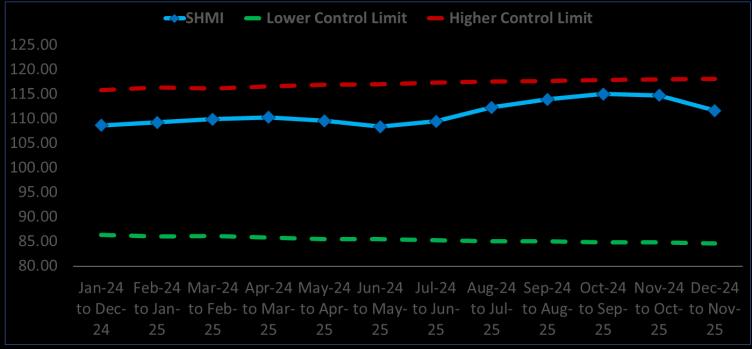
(b)The Trust current report for 2025-26 palliative care coding was 39% at either diagnosis or speciality level.
(i, ii) Monitoring of PROMs for (i)groin hernia and (ii) varicose vein surgery was paused in 2022; therefore, no data is available.
Latest data published was in April 2026 for the period covering 2024-2025.
(iii)
EQ5D Index: Hip replacement: 82.4%
EQ-VAS: Hip replacement: 75%
National
EQ5D Index: Hip replacement: 89.3%
EQ-VAS: Hip replacement: 71.8%
(iv)
EQ5D Index: Knee replacement: 86.2%
EQ-VAS: Knee replacement: 74.1%
National
EQ5D Index: Knee replacement: 81.5%
EQ-VAS: Hip replacement: 72.84%
No. Prescribed information Form of statement in 2025-2026
19. The percentage of patients aged: (i) 0 to 5 years (ii) 16 years and over
That were readmitted to the Trust within 28 days of being discharged from our hospital, that forms part of the same organisation during the reporting period.
20. The Trust’s responsiveness to the personal needs of its patients during the reporting period.
21. The percentage of staff employed by, or under contract to, the Trust during the reporting period who would recommend the Trust as a provider of care to their family or friends.
22. Friends and Family Test –patient. The data made available by the National Health Service Trust or NHS Foundation Trust by NHS Digital for all acute providers of adult NHS funded care, covering services for inpatients and patients discharged from accident and emergency (types 1 and 2)
Please note: there is a not a statutory requirement to include this indicator in the Quality Accounts reporting, but provider organisations should consider doing so.
(i) Percentage of 0 to 15 years readmitted was 10.73%
(ii) 16 years and over readmission rate was 15.71%.
The Patient Advice and Liaison service are our first point of contact resolution service. In year they received and responded to 5140 concerns.
The NHS Staff Survey 2025 results found that 42.88% of staff would be happy with the standard of care provided by the organisation if a friend/relative needed treatment.
Friend and Family Test (FFT) ratings continued to be received by the Trust throughout 20252026.
An increase in satisfaction and in the number of FFT responses received in year:
• 83% of 19,679 patients rated overall services as good or very good (up from 79% of 13,336 patients in 2024-25).
• 81% of 1,937 inpatients rated ward-based care as good or very good (up from 80.6% of 1480 inpatients in 202425).
• 74.5% of 6,870 patients rated the Emergency Department good or very good (up from 72.5% of 6480 in 2024-25).
Our service users receive a link via text within 24 hours of being discharged or attending their hospital appointment.
No. Prescribed information Form of statement in 2025-2026
23. The percentage of patients who were admitted to hospital and who were risk assessed for venous thromboembolism during the reporting period.
24. The rate per 100,000 bed days of cases of C. difficile infection reported within the Trust amongst patients aged 2 or over during the reporting period.
25. The number and, where available, rate of patient safety incidents reported within the Trust during the reporting period, and the number and percentage of such patient safety incidents that resulted in severe harm or death.
26. Statement on seven-day hospital services
Data for the period 2025-26 was 67.92%.
27.1 The number of its patients who have died during the reporting period, including a quarterly breakdown of the annual figure.
31.93 per 1,000 bed days healthcare associated cases of Clostridium Difficile were reported to the national surveillance database for period April 2025 to March 2026
During the period April 2025 to March 2026 there was a total of 8,166 patent safety incidents reported.
22 (0.165%) resulted in severe harm 3 (0.0225%) resulted in death.
Over the Winter 2025 the Trust tested out the impact of a 7-day model with increased consultant cover on wards and in ED. Our diagnostic services running from the newly opened CDC run 7 days per week. We have updated job plans to reflect this.
In 2026/27, the executive and divisional teams will continue to review 7-day services. Key opportunities include theatres and non-elective pathways across all specialties.
From 1 April 2025 to 31 March 2026, 1091 of The Princess Alexandra Hospital NHS Trust patients died.
Quarter 1: 233
Quarter 2: 240
Quarter 3: 348
Quarter 4: 270
No. Prescribed information Form of statement in 2025-2026
27.2 The number of deaths included in item 27.1 which the provider has subjected to a case record review or an investigation to determine what problems (if any) there were in the care provided to the patient, including a quarterly breakdown of the annual figure
In relation to 1091 deaths (item 27.1):
• 160 SJRs requested
• 170 were completed.
• 13 incidents were raised on Datix for patients that died
• 9 are closed of which 3 confirmed as death harm
• 4 remain under review.
Quarter 1:
• 34 case record reviews.
• 4 incidents were raised
• 1 concluded minor harm.
• 1 concluded no harm
• 0 remain under investigation
• 2 concluded death harm.
Quarter 2:
• 42 case record reviews
• 4 incidents were raised
• 2 concluded minor harm.
• 1 concluded death harm
• 1 remains under review.
Quarter 3:
• 57 case record reviews.
• 3 incidents were raised
• 2 concluded no harm
• 1 remain under review.
Quarter 4:
• 37 case record reviews
• 2 incidents raised
• 2 remain under review.
27.3 An estimate of the number of deaths during the reporting period included in item 27.2 for which a case record review or investigation has been carried out which the provider judges as a result of the review or investigation were more likely than not to have been due to problems in the care provided to the patient (including a quarterly
Of the 2025-26 completed case studies and incident investigations into patients who had died, 3 were found to be a result of problems in the care provided to the patient.
Quarter 1: (June 2025 = 2)
No. Prescribed information Form of statement in 2025-2026
27.3 (continued) breakdown), with an explanation of the methods used to assess this
Quarter 2: (1 x July 2025)
Quarter 3: (0)
None
Quarter 4: (0)
None
Cases referred for a structured judgment review (or called case record review) have data captured on an electronic system called SMART.
All of these cases are rated with an avoidability rating of:
Score 1: Definitely avoidable
Score 2: Strong evidence of avoidability.
Score 3: Probably avoidable (more then 50:50)
Score 4: Possibly avoidable, (less than 50:50).
Score 5: Slight evidence of avoidability
Score 6: No evidence of avoidability
All cases with an avoidability score of 1, 2 or 3 are followed up by:
• a review by the Trust’s learning from deaths panel
• are logged on Datix as a clinical incident and investigated through this process
• Reviewed by the Trust’s Incident Management Group – level of investigation decided.
• For discussion and learning at the specialty mortality and morbidity meeting.
27.4 A summary of what the provider has learnt from case record reviews and investigations conducted in relation to the deaths identified in item 27.3.
Learning identified from completed case record reviews:
The most prominent theme was delayed recognition of clinical deterioration and late escalation to senior clinicians. Strengthening early warning systems and senior review processes is a Trust‑wide priority.
Multiple cases demonstrated late identification of dying patients and delayed involvement of the Specialist Palliative Care Team (SPCT). Earlier recognition and timely transition to comfort focused care are essential
27.4 (continued)
Communication with families was inconsistent, and documentation quality varied, with missing times, unclear notes, and absent escalation plans. These issues impact safety, continuity, and family experience.
TEP and DNACPR decisions were often completed late or not at all. Early escalation planning is critical, particularly for frail or multimorbid patients.
Several cases highlighted delayed or missed diagnoses, including imaging interpretation issues and late specialist review. Strengthening diagnostic pathways is required.
Frail patients deteriorated rapidly, and holistic assessments were not always completed. Embedding frailty scoring and proactive planning is essential.
Delays in lab results, pathway inefficiencies, and inconsistent MDT involvement were noted. These require operational and governance oversight.
The Trust demonstrates strong MDT working and compassionate care, but there are clear opportunities to improve early deterioration recognition, EOL care, escalation planning, communication, and diagnostic vigilance. These themes form the basis of the Trust wide QI priorities and governance action plan.
27.5 A description of the actions which the provider has taken in the reporting period, and proposes to take following the reporting period, in consequence of what the provider has learnt during the reporting period (see item 27.4).
The following actions from case reviews that continues to be embedded:
• Distribution of the current VTE guidelines and new quick reference guides at the local COG
• Training provided to all members of the orthopaedic teams to ensure accurate knowledge of how to order a follow up appointment on Alex Health.
• Removal of outdated VTE quick reference guide from staff extranet (AlexNet).
No. Prescribed information Form of statement in 2025-2026
• Education for medical and nursing teams on how to request specialist review
• To review the staff extranet (AlexNet) for all policies and guidelines that are not correctly linked to the current authorised document.
• Internal safety bulletin (ISB) issued which demonstrated the correct way for staff to search for policies and procedural documents.
• Removal of all outdated/expired documents from AlexNet
• To ensure that there is a robust process in place for the uploading of documents to AlexNet workspaces.
• All patients post fall to be reviewed by nurse in charge (NIC), to set frequency of neurological observations and allocate a nurse to complete these 15 mins in a timely manner.
• All patients who have fallen to have an accurate record and documentation of all actions in a timely manner. If this is not possible, to ensure this is updated retrospectively with accurate times of actions, as soon as possible.
• Bed space allocation for each patient should be reviewed by the NIC each shift and document findings/movements on safety brief and attend the falls oversight meeting for learning.
• Post falls flow charts circulated by email to all staff and refresher training updated.
• Sharing of all learning from deaths at departmental meetings and mortality, nursing teams and morbidity meetings
27.6 An assessment of the impact of the actions described in item 27.5, which were taken by the provider during the reporting period
The impact of the actions from review of cases are as follows:
• All patients who undergo orthopaedic surgery must be provided with appropriate
No. Prescribed information Form of statement in 2025-2026 (continued) VTE Prophylaxis according to the Trust VTE Pathway Guidelines
• Increased knowledge for medical and nursing teams on the VTE prophylaxis policy and ensure that patients are discharged with the appropriate regime as part of their TTA.
• Increased knowledge for medical and nursing staff on how to request appointments and to know how to complete this through the Alex Health system
• Internal, informal spot-check audits completed to determine medical teams are following the correct internal referral process. This demonstrated full compliance
• A new process is in place whereby, when an appointment is missed while a patient is admitted, a review by the appropriate team should be requested by the medical and/or nursing teams, so that patients do not get missed.
• Improved use of how to access the policies and procedures section and search within this, either by keyword, first letter or division.
• NIC has a clearer understanding of the challenges of patients at risk of falls and can make assessments and amendments of patients’ bed positions on a shift-by-shift basis to enhance patient safety.
• NIC can highlight potential training for staff by reviewing the patients’ post fall documentation and assessments.
• Enhanced knowledge for all staff on the post fall flow chart.
27.7 The number of case record reviews or investigations finished in this reporting period which related to deaths during the previous reporting period (2024-25), but were not included in item 27.2 as they were for a previous reporting period.
Four investigations were closed relating to deaths
No. Prescribed information Form of statement in 2025-2026
27.8 An estimate of the number of deaths included in item 27.7 which the provider judges as a result of the review or investigation were more likely than not to have been due to problems in the care provided to the patient, with an explanation of the methods used to assess this.
27.9 A revised estimate of the number of deaths during this reporting period stated in item 27.3, and for that previous reporting period, taking account of the deaths referred to in item 27.8.
28 In response to the Gosport Independent Panel Report, provide details of ways in which staff can speak up (including how feedback is given to those who speak up) and how we ensure staff who speak up do not suffer detriment. This disclosure should explain the different ways in which staff can speak up if they have concerns over quality of care, patient safety or bullying and harassment.
Four (item 27.7).
29 Following the terms and conditions of service for NHS Doctors and Dentists in Training (England) 2016 requires a consolidated annual report on rota gaps and the plans to reduce rota gaps.
Of the 2025-26 completed case studies and incident investigations into patients who had died, and taking into account case record reviews or investigations finished in this reporting period which relates to death during the previous reporting period (2024-25), seven were found to be a result of problems in the care provided to the patient.
The Trust has a robust Freedom to Speak Up (F2SU) process in place Staff can either speak directly to a F2SU guardian, be signposted by an ambassador or complete an anonymous online form to raise a concern.
The Trust has a lead guardian who is clinical with a further two clinical guardians and two non-clinical guardians.
We have 30 Freedom to Speak Up Ambassadors. Their role is to support staff to speak up, raise the profile of the service and be accessible to a wider range of staff. They come from a wide range of ethnic backgrounds and a variety of roles within the Trust.
Further information is detailed on page 68.
The Trust did not complete a consolidated annual report on rota gaps for NHS doctors in training during 2025-26.
The Princess Alexandra Hospital NHS Trust
01279 44 44 55
www.pah.nhs.uk