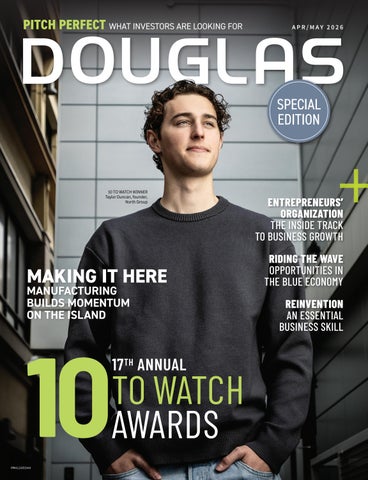
DOUGLAS Magazine April/May 2026

Page 1


ENTREPRENEURS’ ORGANIZATION THE INSIDE TRACK TO BUSINESS GROWTH RIDING THE WAVE OPPORTUNITIES IN THE BLUE ECONOMY REINVENTION AN ESSENTIAL BUSINESS SKILL

for commercial and industrial customers

Upgrading to higher-efficiency equipment may help lower your business’s energy use and help you save on operational costs. Plus, our rebates can help improve your return on investment.

We’ve got rebates for gas heat pumps, heating, ventilation and air conditioning controls, LED lighting, refrigeration, restaurant equipment, optimization measures and more. Improving energy efficiency is one of the ways we’re working towards a lower carbon energy future. Energy for a better B.C. fortisbc.com/businessrebates

FEATURES

18

Forging the Inner Circle

A peer network where Island entrepreneurs can exchange ideas and share experiences.

26 Making It Here

Where – and how – are Island manufacturing companies building world-class products?

60

Great Big Sea

The blue-economy bandwagon rolled into COAST’s inaugural Ocean Tech Live event, where homegrown West Coast companies joined the party.

ANDREW FINDLAY

68

Pitch Perfect

Here’s how to get your company’s story across in a concise, exciting manner to attract investors.

TAMMY SCHUSTER SPECIAL SECTION

32

10 to Watch Award Winners 2026

From technology to education, finance to recreation, hospitality to wellness, our community’s most promising new entrepreneurs have a lot of bases covered.

BY TAMMY SCHUSTER, JULIEN JOHNSTON-BREW AND LIONEL WILD

DEPARTMENTS

8 LETTER FROM THE EDITOR

11 IN THE KNOW

Coastal Offroad’s DIY automotive armour kits for off-road wheeling; UVic’s Gustavson School of Business to present the Distinguished Entrepreneur of the Year; Duncan–based Ergo Eco Solutions has a sticky solution for dusty, unpaved roads; Tailgate Toolkit to strengthen mental-health leadership on construction sites; North Saanich food hub a step forward for local agriculture; a new energy centre for VGH; job cuts in the federal civil service; YYJ’s new airport hotel; introducing our new Corporate Calendar. Plus: Douglas Reads; and Douglas’s 20th anniversary giveaway!

70 INTEL

70 NO JOB TOO SMALL: JAMMING WITH TAYLOR SWIFT

A global icon offers lesson in leadership, with a personal touch. BY PIERS HENWOOD

72 REINVENTION: AN ESSENTIAL BUSINESS SKILL

In the face of a fast-changing world, companies must make changes even when it’s not comfortable. BY INGRID VAUGHAN

74 WHO HOLDS THE LADDER WHILE YOU CLIMB?

Finding the perfect second-in-command is tricky – your values should be a match, but not necessarily your skill sets.

BY DANIELLE SMELTZER

76 LIFE + STYLE

The modern elements, and importance, of a proper business card; “shoes-ing” to put your best foot forward by having a cobbler fix your footwear; picking plants that will thrive in your office.

78 DID YOU KNOW

With the imminent opening of the new Telus Ocean building, we look at the recent fluctuations in the downtown office vacancy rate.

The Season of Possibilities

SPRING HAS A WAY OF STIRRING UP MOMENTUM (not just allergies). It’s a season when ideas that have been hibernating through the winter begin to defrost and take root. It’s a time when people feel ready to try things, go places and imagine possibilities.

In Douglas magazine’s 17th annual 10 to Watch issue, we celebrate the top new businesses that have done just that.

Behind each one of these businesses lies a moment where someone decided to take the leap. Then came the 18-hour days, late-night emails, favours called in, spreadsheets, second guesses, redirections and spikes in blood pressure. Then it’s that powerful and terrifying moment when the realization hits: There’s no turning back now.

Chuck offers a team-based approach for a total wealth strategy that addresses the entirety of your life.

C.P. (Chuck) McNaughton, PFP

Senior Wealth Advisor

250.654.3342

charles.mcnaughton@scotiawealth.com themcnaughtongroup.ca

The McNaughton Group

ScotiaMcLeod®, a division of Scotia Capital Inc.

While all the businesses featured in this issue are diverse, a familiar thread runs through each one, as each person at the helm had the audacity (a nice way to say daring recklessness) to try. They are building companies, services and opportunities for the community and the economy that matter. They’ve built meaningful cultural experiences, given people reasons to get out and participate and created concepts to help businesses operate more efficiently.

Spring feels like the right time to tell these stories. It’s a time of renewal and of risk. Just as growth takes planning, vision and action, the stories in this issue remind us that the future gets better when you’re willing to take the leap.

In the spirit of new beginnings, Douglas magazine is also preparing to launch the Douglas newsletter later this spring as a fresh way to stay connected with the ideas, people and businesses that make our community so vibrant.

The stories featured in this issue show what’s possible when bold ideas meet determination. Now it’s your turn. Join in, support local ventures, take your allergy meds and consider taking a leap of your own.

Our

VOLUME 20 NUMBER 2

PUBLISHERS Lise Gyorkos, Georgina Camilleri

EDITOR IN CHIEF Joanne Sasvari

DOUGLAS EDITOR Tammy Schuster

ASSISTANT EDITOR Lionel Wild

DIRECTOR OF PHOTOGRAPHY Jeffrey Bosdet

LEAD GRAPHIC DESIGNER Kelly Hamilton

ASSOCIATE GRAPHIC DESIGNER Janice Hildybrant

ADVERTISING CONSULTANTS Deana Brown, Jennifer Dean Van Tol, Cynthia Hanischuk, Brenda Knapik

ADVERTISING CO-ORDINATOR Rebecca Juetten

MARKETING & EVENTS

CO-ORDINATOR Lauren Ingle

EDITORIAL ASSISTANT Julien Johnston-Brew

CONTRIBUTING WRITERS Paul Bucci, Andrew Findlay, Piers Henwood, Julien Johnston-Brew, Robyn Quinn, Danielle Smeltzer, Tammy Schuster, Ingrid Vaughan, Lionel Wild

CONTRIBUTING AGENCIES Getty Images p. 63, 69, 76, 77, 78

GENERAL INQUIRIES info@douglasmagazine.com

SEND PRESS RELEASES TO editor@douglasmagazine.com

LETTERS TO THE EDITOR letters@douglasmagazine.com

TO SUBSCRIBE TO DOUGLAS subscriptions@ douglasmagazine.com

ADVERTISING INQUIRIES marketinginfo@douglasmagazine.com

ONLINE douglasmagazine.com

FACEBOOK DouglasMagazineVictoria INSTAGRAM @douglas_magazine

COVER Taylor Duncan, North Group

Photo by Jeffrey Bosdet

Published by PAGE ONE PUBLISHING

580 Ardersier Road, Victoria, B.C. V8Z 1C7 T: 250.595.7243 E: info@pageonepublishing.ca pageonepublishing.ca

Printed in British Columbia by Mitchell Press

Ideas and opinions expressed within this publication do not necessarily reflect the views of Page One Publishing Inc. or its affiliates; no official endorsement should be inferred. The publisher does not assume any responsibility for the contents of any advertisement and any and all representations or warranties made in such advertising are those of the advertiser and not the publisher. No part of this magazine may be reproduced, in all or part, in any form printed or electronic without the express written permission of the publisher. The publisher cannot be held responsible for unsolicited manuscripts and photographs.

Canadian Publications Mail Product Sales Agreement #41295544

Undeliverable mail should be directed to Page One Publishing Inc. 580 Ardersier Road, Victoria, B.C. V8Z 1C7

Douglas magazine is a registered trademark of Page One Publishing Inc.

ADVERTISE IN DOUGLAS!

Douglas is a premium magazine dedicated to innovation, leadership and business lifestyle. Established in 2006, Douglas is the first choice for business leaders and achievers. Align your business with Douglas For more information or to request a media kit, please call us at 250.595.7243 or email us at marketinginfo@douglasmagazine.com.

L to R: Ian Clark, Carmen Atwood, Grant Atwood

OFF-ROAD ARMOUR

What began as a four-wheel-drive enthusiast’s personal project has grown into an international automotive accessory enterprise.

CONTINUED ON P. 12

JEFFREY BOSDET/DOUGLAS MAGAZINE
When then-UVic student Brandon Falszewski couldn’t find the right, affordable armour products to protect his off-road vehicle, he did something about it: creating his own modifications.

While studying mechanical engineering at UVic, avid offroader Brandon Falszewski struggled to source modifications to protect his Toyota 4Runner. “The products available out there were either just not quite suited to the terrain we have here on Vancouver Island or, being a student, just really expensive,” says Falszewski, who went on to create his own modifications. This initial customization evolved into Coastal Offroad, which offers DIY automotive armour kits to withstand the rough-and-tumble conditions of off-road wheeling. “The customer would assemble [the kit] themself, basically making it a more accessible version of what was already out there.”

Coastal Offroad manufactures armour kits that mount to the frames of select, popular off-road vehicles, which amounts to more than 100 vehicle models across 12 brands. One brand exception is Jeep due to the saturation of available mass-produced modifications. “It’s worked really well for us targeting the more niche markets,” says Falszewski, noting that online marketing has been key for Coastal Offroad’s success. “Especially being a hobby industry, that online presence and how things are marketed is pretty important … You can design the coolest product that you think is the best, but if you don’t have good pictures of it and it’s not put out there in the right way, no one will buy it.”

When designing and prototyping a new kit, Coastal Offroad recruits a local volunteer to attend one of their manufacturing shops in Metchosin or Delta for first-hand measurements and fittings. Coastal Offroad also has a subcontractor in New Zealand for customers throughout Australasia. “Offroading is extremely popular there, way more so than here, on a per-capita basis.”

Coastal Offroad recently launched a Find Your Welder service on its website for customers who can’t assemble the armour kits themselves. “They’re shops we’ve worked with,” says Falszewski, “and people we would recommend to other customers.”

B.C. Roots to Global Reach

The Gustavson School of Business honours Telus president and CEO Darren Entwistle as Distinguished Entrepreneur of the Year.

The Distinguished Entrepreneur of the Year Award (DEYA) from the University of Victoria’s Gustavson School of Business has long celebrated leaders who push the boundaries of innovation and entrepreneurship. This year’s recipient, Darren Entwistle, president and CEO of Telus, represents a new dimension of that entrepreneurial spirit as the leader who transformed an established company into a global innovator. Since becoming CEO in 2000, Entwistle has overseen Telus’s expansion from a regional telecom provider into a diversified international technology company. Under his leadership, the organization has invested

billions in network infrastructure while branching into health-care technology and the global food system with Telus Health and Telus Agriculture. Entwistle will retire on June 30.

Since becoming CEO in 2000, Entwistle has overseen Telus’s expansion from a regional telecom provider into a diversified international technology company.

Mia Maki, associate dean, external and outreach associate teaching professor at the Gustavson School of Business, says this year’s award builds on last year’s focus on hyperlocal entrepreneurs — Andrew Wilkinson and Chris Sparling of Tiny — by highlighting a leader whose impact extends far beyond B.C.

“We wanted to go B.C. but global,” Maki says. “Telus itself has become a global company with a footprint all over the world. Darren literally took a

Darren Entwistle, the driving force behind Telus’s expansion into a diversified international technology company, will retire as president and CEO on June 30.

regional company and made it global, and we wanted to tell that story.”

DEYA has historically celebrated founders, but organizers are equally interested in what Maki calls “entrepreneurial leaders,” executives who scale organizations beyond their original vision.

“These are people who take a company and do really innovative things that scale it beyond the original imagination of what it could be,” she says, noting that his focus on building a culture, and specifically a culture of social purpose, reinforced Entwistle as this year’s recipient.

The event itself is designed to be more than an awards ceremony. Each year, DEYA features an on-stage conversation intended to feel like a candid masterclass in leadership.

“In Darren’s case, he’s a very private person,” Maki says. “So this is a real opportunity to hear from him about what Canadian innovation looks like, what innovation looks like within a company, and how we build successful companies here in Canada and extend them beyond our borders.”

Held at the Victoria Conference Centre on Monday, June 15, the evening aims to foster a sense of community and shared inspiration.

“In many ways, the event is kind of like a love letter from the Gustavson School of Business and the University of Victoria to the business community,” Maki says. “Let’s get together, learn something, be inspired and connect because we really appreciate you.”

Guests are invited to attend in “black tie your way” attire, an approach carried over from last year’s event that gives attendees the option to blend traditional formal wear with personal style (and comfort).

ECO INNOVATION HITS THE ROAD

A Duncan startup turns leftovers into a sustainable solution for dusty, unpaved roads.

A Vancouver Island clean-tech startup is turning food waste into a bio-based solution that helps reduce dust on unpaved roads, reducing water use and giving organic waste a second serving.

The innovation targets a problem defining much of B.C.’s infrastructure. According to the provincial government, 92 per cent of the province’s road network is unpaved.

For rural communities, construction sites and resource roads, controlling dust is a constant and costly

challenge. Traditional methods rely heavily on repeated water spraying — an approach that is increasingly unsustainable as drought conditions worsen and water costs rise.

Duncan–based Ergo Eco Solutions believes its alternative offers a more durable and climate-conscious option.

The company’s product is made from recycled organic waste, including used cooking oil collected from local restaurants, and is designed to bind road surfaces and reduce airborne dust longer than

water alone. Pilot projects on Vancouver Island have shown promising results, significantly reducing dust while conserving water.

Because the solution can be applied using standard road-maintenance equipment, it has the potential to scale quickly without requiring new infrastructure or major capital investment.

Beyond roads, Ergo is building a local circular economy by transforming waste into practical, lowcarbon products that solve everyday problems.

JAMES MACDONALD
Duncan–based Ergo Eco Solutions transforms food waste into bio-based solutions.

FOOD FACILITY OF THE FUTURE

Harvest Hub a “meaningful investment” in North Saanich.

A new, community-focused food hub in North Saanich is moving into pre-construction planning and procurement, marking a step forward for local agriculture on the Saanich Peninsula.

The Harvest Hub is a project designed to strengthen regional food production by providing a shared-use facility for local farmers, producers and processors. The hub will offer services such as storage and processing infrastructure, with the potential for future development that will improve access to local markets.

The District of North Saanich council recently approved the Harvest Hub vision as it aligns with the district’s long-standing strategy to support local agriculture and build resilient production systems.

The Harvest Hub is a project designed to strengthen regional food production by providing a shared-use facility for local farmers, producers and processors.

“The Harvest Hub represents a meaningful investment in our agricultural community, helping local producers thrive, innovate and access new opportunities,” says North Saanich Mayor Peter Jones.

“Made possible through the generosity

of [community member] Gregory Warner, this facility will serve as a vital resource that strengthens local food systems while reflecting a deep respect for North Saanich’s agricultural heritage and future. On behalf of council and residents, we are sincerely grateful for his leadership and vision in helping bring the Harvest Hub to life.”

As the project moves through the planning phase, the district held a workshop bringing together 16 local farmers, six members of the agriculture and food security advisory committee, along with staff and members of council, to discuss the facility’s concept, timeline and next steps. The initial planning phase of the project is expected to be completed by late 2026 with further details to be announced.

Who doesn’t love an updated classic? In The Wealthy Barber: The Fully Updated All-Time Canadian Classic (Financial Awareness Corporation), former CBC Dragons’ Den panellist and best-selling author David Chilton returns with an update to his 35-year-old financial handbook The Wealthy Barber. This edition is fully updated and includes information about personal-finance tools available to Canadians like TFSAs, FHSAs, ETFs and more. This entertaining and digestible take on financial education was indispensable in the ’90s and is a must-read today.

Artist’s depiction of the future Harvest Hub, a shared-use facility for farmers, producers and processors.
DESIGN BY AMCA

VGH’S POWER UPGRADE

A new $75.6-million energy centre will strengthen reliability and increase technological capacity at the region’s hospital.

As health-care systems brace for growing demand and climate-driven disruptions, Island Health is investing $75.6 million in a new energy centre at Victoria General Hospital to strengthen infrastructure and build resilience. Jointly funded by the Province of British Columbia and the Capital Regional Hospital District, the facility will modernize electrical systems, increase capacity for advanced medical technologies and ensure operations remain uninterrupted during outages or natural disasters. Construction is scheduled to begin in summer 2026, with completion expected in 2029, positioning one of the region’s most vital medical hubs for sustained growth and health-care expansion.

DOUGLAS CELEBRATES

At Douglas magazine, we’re kicking off our 20th-year festivities with an exciting contest! Enter now for your chance to win round-trip Helijet tickets for two guests between Vancouver Harbour and Victoria Harbour OR Nanaimo Harbour.

To enter, visit douglasmagazine.com or scan the QR code. The prize has an approximate value of $1,998, depending on route, dates, and availability. Contest ends May 10. Good luck!

Disciplined Value Investing that Works.

Good Strategy Drives Impactful Organizations We Can Help.

Wirk Consulting partners with you to map a clear path forward for your organization – designing your future, aligning your team to a shared purpose, committing to key priorities, and implementing with focus

Wirk Consulting partners with you to map a clear path forward for your organization – designing your future, aligning your team to a shared purpose, committing to key priorities, and implementing with focus.

wirkconsulting.ca | 250.588.9051 team@wirkconsulting ca

wirkconsulting.ca | 250.588.9051 team@wirkconsulting ca Good Strategy Drives Impactful Organizations We Can Help.

WORLD CLASS MARKETING, MOVING RESULTS, & PERSONAL ATTENTION

CALL OUR TEAM TODAY

BALANCING THE BOOKS

CALL THE WILDMAN GROUP.

AWARD WINNING REALTORS® FOR MOVING RESULTS,

TheWildmanGroupguidedus throughboththesellingand purchaseofourhomewitha knowledgeable,attentiveandfriendly team.We felt confident we were in theverybestofhandsthroughout theentireprocess.”

– S. Taylor

The federal government trims its workforce.

The 2026 federal budget confirmed plans to reduce the size of federal public services by roughly 40,000 positions by 2029, bringing staffing levels down from their pandemic-era heights of nearly 368,000 jobs. The move is framed as part of a broader effort to rein in spending, reduce the deficit and redirect federal funds toward infrastructure and long-term economic-growth priorities.

The reductions will be phased in over several years and are expected to include a mix of early-retirement incentives and direct layoffs. Agencies such as the Royal Canadian Mounted Police and the Department of National Defence are protected from the planned cuts.

The reductions will be phased in over several years and are expected to include a mix of early-retirement incentives and direct layoffs.

“We need to bring back the civil service to a more sustainable level,” federal Finance Minister François-Philippe Champagne said last fall when the budget was tabled in the House of Commons. The provincial government is similarly restraint minded. In a February address to the Victoria Chamber of Commerce, B.C. Finance Minister Brenda Bailey emphasized the government’s focus on restraint and efficiency.

The plan is expected to return the public service sector closer to its pre-pandemic size, reversing a period of rapid hiring that occurred during COVID-19 as Ottawa expanded programs and benefits to help manage unprecedented demand.

“We’re continuing with our efficiency review. We’re centralizing HR, we’re centralizing IT. We’re not using outside consultants the way we did, and we’ve reduced travel,” she said. “We’re scrutinizing government spending to ensure as many dollars as possible reach the front lines — classrooms and emergency rooms.”

This post-pandemic reset will test whether a leaner public service sector will still be able to deliver for Canadians.

WHERE FEDERAL SERVICE JOBS HAVE BEEN CUT

Most significant layoffs by department

YYJ AIRPORT HOTEL

The Victoria Airport Authority has its newest travel perk, as the TownePlace Suites by Marriott Victoria Airport will be ready to welcome weary travellers as soon as April 8.

The three-storey, 129-room hotel, located at 9785 Stirling Way in Sidney, features studio, one-bedroom and two-

CORPORATE

CALENDAR

APRIL

Sidney’s newest property opens.

bedroom units with fully equipped kitchens. The hotel offers guests a fitness centre, 24-hour business centre, 24-hour front desk, meeting space and parking. The development will also include a full-service, stand-alone restaurant, with the brand and construction plans to be provided soon.

Victoria has plenty of opportunities to connect with broader business communities. Here are a few standout events.

MAY

BUILDING HEALTHIER WORK SITES

VICA launches mental-health training for construction leaders.

Labour shortages, rising stress and the toxic drug crisis are reshaping risk management in the construction industry. The Vancouver Island Construction Association (VICA) is responding with leadership training as part of the solution. Its new program, Tailgate Toolkit: Leadership Fundamentals, is designed to strengthen mental-health leadership on construction sites across British Columbia.

The training emphasizes early intervention, stigma reduction and a clear understanding of legal responsibility.

Young Builders Network Charity Casino

Delta Hotels Victoria Ocean Pointe Resort

The 10th annual fundraiser, proceeds support the Help Fill a Dream Foundation. vicabc.ca

Leadership in Construction Summit

Delta Hotels Victoria Ocean Pointe Resort

The Vancouver Island Construction Association brings together decision-makers shaping the Island’s built environment. vicabc.ca

Association of Vancouver Island and Coastal Communities AGM & Convention

Victoria Conference Centre

The 77th annual gathering of local government representatives. avicc.ca 17

Mari-Tech Conference & Exhibition

Victoria Conference Centre

A showcase of local endeavours to build a resilient, future-ready marine engineering industry. mari-techconference.ca

Tee off for Trades Golf Tournament

Olympic View Golf Club

The second annual fundraiser to support Camosun College’s trades students. camosun.ca

Miracle Gala

Dogwood Auditorium at Hatley Park

A fundraising event supporting the Victoria Hospitals Foundation. victoriahf.ca

DisruptHR

Victoria Conference Centre

A gathering of thought leaders and industry experts committed to reshaping the future of human resources. engagedhr.com

Designed for supervisors, forepersons, project managers and company leaders, the course equips participants with practical strategies to recognize and respond to mentalhealth concerns, substance use and pain-related challenges in the workplace. The training emphasizes early intervention, stigma reduction and a clear understanding of legal responsibility — skills that have become necessary in an industry facing elevated rates of toxic drug poisoning and jobrelated stress.

“Mental health leadership starts at the top,” says Rory Kulmala, chief executive officer of VICA. “Construction leaders play a critical role in shaping workplace culture. This training gives them practical, industry-specific tools to support their crews and create safer, healthier job sites.”

The program combines four hours of self-paced online learning with eight hours of in-person instruction led by industry experts and at no cost. Participants may also qualify for Gold Seal credits. To learn more or register, visit vicabc.ca.

FORGING THE INNER CIRCLE

Inside a peer network where Vancouver Island founders confront risk, leadership and the loneliness of decisionmaking together.

Left to Right: Tom Benson, cofounder and CEO, WildPlay Element Parks
Tessa McLoughlin, founder and CEO, KWENCH
Richard Van Leeuwen, chapter president, EO Vancouver Island
Robin Kelley, managing partner, Camargue Properties
Ray Cao, president, RT Prime Industries Group
Jason Cridge, CEO and founder, Cridge Pharmacies

For Vancouver Island entrepreneur Tom Benson, working on the edge is literally his business. Benson is a cofounder and chief experience officer of WildPlay Element Parks, an outdoor adventure company built around adventure courses and big, scary jumps, all with the goal of helping people to be brave in changing their world.

But even high-flying founders need a lifeline once in a while. That’s where the Vancouver Island chapter of the Entrepreneurs’ Organization comes into play. “I would say it’s the only reason that I’m still in business,” Benson says.

WHERE FOUNDERS FIND THEIR PEOPLE

Founded in 1987, the Entrepreneurs’ Organization (EO) is a peer-led, global nonprofit that supports business owners through confidential forums, leadership development and shared experience.

Today, EO has more than 18,000 members across 220 chapters in more than 75 countries. Membership is generally limited to founders, owners or controlling shareholders of businesses with US$1 million or more in annual gross revenue. For entrepreneurs who aren’t there yet, EO also runs Accelerator, a year-long program that focuses on cash flow, people, strategy and execution.

On Vancouver Island, the organization is quietly collecting superlatives and success stories. Now in its 26th year, Entrepreneurs’ Organization Vancouver Island has grown to 55 members, making it one of the fastest-growing EO chapters in Canada, with an unusually high average business size and a renewal rate near 96 per cent.

What distinguishes EO on Vancouver Island, members say, is not just who belongs, but how the organization is built to support entrepreneurs over the long term.

At the heart of EO is Forum — a small, confidential peer group of six to 10 entrepreneurs that meets monthly and often stays together for years. In a structured, timed process, members share updates and bring forward challenges under a strict set of rules: no solicitation, absolute confidentiality and no “advice.” Instead, participants share lived experience — what they tried, what worked, what failed — allowing others to draw their own conclusions.

That discipline, members say, creates a level of trust that’s hard to replicate elsewhere.

INSIDE THE FORUM

For EO Vancouver Island chapter president Richard Van Leeuwen, Forum is like a war room — a small circle where entrepreneurs talk about the stuff they can’t take anywhere else. For Van Leeuwen, principal at Victoria’s Numberra Chartered Professional Accountants, Forum is where “your brothers and sisters are preparing for war.”

“It’s 100-per-cent confidential — like, no pillow talk with the spouse or partner. If I come and tell you something, it cannot leave that room,” he says.

Van Leeuwen describes the Forum model as a practical answer to a familiar entrepreneurial problem: There are moments when you can’t bring a challenge to your employees, don’t want to carry it home and friends outside business won’t fully understand what’s at stake.

Van Leeuwen recalls a peer conversation that helped him navigate a highstakes challenge involving a previous business, which he calls the “$2-million coffee.” In EO’s culture, that kind of exchange is the point — not a lecture or a framework, but a peer sharing their own experiences in similar situations.

Jason Cridge, CEO and founder of Cridge Pharmacies, came to EO through Accelerator, designed for entrepreneurs

Changing lives, one sold business at a time

Congratulations to this year’s Douglas 10 to Watch award recipients!

Left to right: Mike Lenz, partner & business intermediary of Chinook; Alexa Tremblay, consultant, Wirk Consulting; Keith MacKenzie, founder & president of Chinook; Ashka Wirk, principal of Wirk Consulting; Maggie McKenna, analyst, Wirk Consulting

whose businesses are generating at least US$250,000 in annual gross revenue and are working toward the full EO membership threshold. Cridge opened his first pharmacy shortly after graduating from university — starting the business at just 22 years old — and quickly found himself navigating rapid growth without a strong peer network of other owners.

After completing Accelerator, he transitioned into full EO membership, where he now participates in Forum and mentors newer entrepreneurs.

“As an entrepreneur, no one is telling you which direction to go,” Cridge says. “You’re just out there making decisions — dealing with cash flow, employees, legal issues — things most people never have to navigate.”

That isolation, members say, is one of the defining challenges of entrepreneurship — and one EO is deliberately designed to counter. For Cridge, what surprised him most was watching seasoned entrepreneurs run significantly larger businesses while working fewer hours.

“If they could do it,” he says, “I had to ask myself why I couldn’t.”

He credits that mindset change with helping his business continue to scale while restoring balance.

PEERS OVER ANSWERS

clearer decision-making and healthier boundaries between work and life.

Van Leeuwen notes that this is where EO often surprises outsiders: despite being a business organization, a large share of Forum discussions are personal and family related.

A BUILT-IN INTERNATIONAL COMMUNITY

EO Vancouver Island first caught Tessa McLoughlin’s attention when the chapter held events at her KWENCH facility on Store Street, a Victoria coworking and culture club that pairs work and meeting space with wellness facilities and community.

Two things stood out right away: the calibre of the members and what wasn’t happening. “I don’t like going to things where people are really pitching,” McLoughlin says. Instead, she saw a group that felt unusually welcoming with people she respected as “standup citizens, morally good humans.”

AT THE HEART OF EO IS FORUM — A SMALL, CONFIDENTIAL PEER GROUP OF SIX TO 10 ENTREPRENEURS THAT MEETS MONTHLY AND OFTEN STAYS TOGETHER FOR YEARS.

For Robin Kelley, managing partner at Camargue Properties, a company within the Denux Group of family companies, EO filled a different gap. With residential, office and commercial properties across B.C., Quebec, Alberta and France, Kelley says leading a geographically dispersed business from Vancouver Island can heighten the sense of isolation that accompanies leadership.

“The buck stops with you,” Kelley says. “That’s a different kind of pressure.”

Forum, he says, provides a rare space for candid feedback — including being challenged by peers — without the complications of hierarchy or personal relationships. That, in turn, has led to

McLoughlin was also drawn to EO’s global reach. She says EO offered something she could carry with her: a built-in community and an international network that could support her wherever she was, particularly as she explores expanding KWENCH into Australia. “Someone will jump on a call within a day,” she says of EO’s worldwide network. “It could be someone in Australia, it could be someone in China, it could be someone in Vancouver or in Minneapolis.”

Ray Cao, president of RT Prime Industries Group, came to Victoria as an international student. Like many people in EO Vancouver Island, he was introduced to EO and mentored by Scott Phillips of StarFish Medical.

For Cao, whose company is a manufacturer of engineered custom machine parts and components, one of his first major crises quickly became a turning point. A key customer fell into

AS AN ENTREPRENEUR, NO ONE IS TELLING YOU WHICH DIRECTION TO GO. YOU’RE JUST OUT THERE MAKING DECISIONS — DEALING WITH CASH FLOW, EMPLOYEES, LEGAL ISSUES — THINGS MOST PEOPLE NEVER HAVE TO NAVIGATE.”

Jason Cridge, CEO and founder, Cridge Pharmacies

THE BUCK STOPS WITH YOU. THAT’S A DIFFERENT KIND OF PRESSURE.”
Robin Kelley, managing partner, Camargue Properties Inc.

GOOD FOOD STARTS WITH THE FINEST INGREDIENTS

receivership owing his company a large sum, and Cao says EO peers helped him see a path that hadn’t occurred to him: pursuing an asset acquisition through the trustee process, effectively converting a bad debt into an ownership opportunity. He went on to rebuild and grow that operation over the next decade, scaling it dramatically before eventually exiting.

The lessons weren’t only about crisis management. Cao also credits EO with shaping how he structured his core business: buying his facility and holding it in a separate holding company, then leasing it back to the operating business. The approach, he says, helped build a durable asset base and gave lenders added confidence, even when the operating side moved through leaner cycles.

PROGRAMMING

ALSO INCLUDES EXPERIENTIAL EVENTS, SUCH AS A GUIDED COAST SALISH SWEAT-LODGE CEREMONY FOCUSED ON REFLECTION, RENEWAL AND CONNECTION TO THE LAND.

NORMALIZING UNCERTAINTY

Beyond Forum, EO Vancouver Island runs a regular slate of learning events, expert-led sessions spanning a wide range of topics. These include a briefing by Eamon Murphy, the Woodward & Company Lawyers LLP partner who successfully represented Cowichan Tribes in their landmark Aboriginal title case; a datadriven economic outlook from housing and macroeconomic analyst Ben Rabidoux; and a session with relationship and intimacy expert Jessica O’Reilly. Programming also includes experiential events, such as a guided Coast Salish sweat-lodge ceremony focused on reflection, renewal and connection to the land.

For Benson, EO’s international reach also opened doors to learning experiences he would not have accessed on his own.

Through the organization, he participated in executive education programs, including a Harvard Business School course, as well as invitation-only leadership academies. Benson describes those experiences as “game changers” — not just for how he approached his business, but for how he understood leadership, decision-making and his own limits.

Over time, those experiences changed how he approached those factors, both in his business and in his personal life. More than tactics or strategy, Benson says EO helped normalize uncertainty — not as a personal failing, but as a constant condition of entrepreneurship.

“There’s never really a sense of security,” Benson says. “It just keeps shifting and changing all the time.”

What EO Vancouver Island offers instead, Benson suggests, is grounded commonality: the reminder that even the most accomplished entrepreneurs are navigating the same shifting terrain — opportunity, risk, responsibility, doubt — and that the difference is not whether challenges arrive, but whether you face them alone.

And that is the promise at the centre of EO Vancouver Island’s design. Every entrepreneur eventually meets a moment that tests their appetite for risk — a lawsuit, a cash crunch, a key departure, a personal crisis or something that changes the math overnight. The difference is whether you face it alone, or with a war room behind you.

it Here Making

Challenging the belief that manufacturing products must be outsourced, Vancouver Island companies are quietly building sophisticated, worldclass products right here at home.

Manufacturing suffers from a perception problem: People assume they know exactly what it’s all about, but very few actually do. Manufacturing literally means to make or build a product, yet what most people picture is an automated, impersonal process.

Assembly lines are certainly part of the story, but on Vancouver Island our manufacturing sector looks different. Here, companies assemble end products through a creative and unique lens, solving problems head-on because they are drawn to the challenge.

The results are tangible and diverse, from car-roof mounted parking enforcement computers prowling neighbourhoods to ambulance stabilizers designed to safely transport premature babies. Victoria-based companies like Viala Technologies and Iris Dynamics are leading the way. Quietly and without grand announcements, the local manufacturing sector is defining itself through execution over hype, often in lean environments designed to maximize efficiency.

A healthy, committed manufacturing sector benefits the entire economic ecosystem. When innovative companies know they can build their prototypes and later the products themselves locally — in Canada, B.C. or Victoria — that’s a big deal. And it reflects another common misconception that manufacturing must be outsourced. Given the proven quality

outputs and innovative technical designers based here, the best way to build a local product may be to look in our own backyard.

Overcoming Misconceptions

Many industry people see living on an island as a significant challenge for any “economies of scale” dreams, which can result in outsourcing designs and builds. A bigger obstacle for companies that want to grow is finding and retaining talent. While post-secondary institutions are working to reduce their reliance on international tuition, most have yet to fully embrace the new wave of technology-driven manufacturing programs.

North Island College, with campuses located from Port Hardy to Port Alberni, is helping meet the growing demand for technical skills in the Island’s manufacturing sector. (See Solving the Skills Gap, page 30.)

Another popular misconception is that manufacturing is dirty manual labour, when in reality it is highly technical work where software and programming translate 3D designs into precise machine movements.

Dallas Gislason, deputy director of regional economic development at the South Island Prosperity Partnership, agrees the time is right to grow the sector, identifying a particular challenge — pointed out by others — in the lack of light industrial space in Greater Victoria.

“It’s in all of our best interest to support and nurture local manufacturing employers,” says Gislason. “And that includes protecting the land-use types like industrial, light industrial and marine industrial zoning over the long term.”

Some see the advancement of AI in automation as proof of the tentacles and automated claws of evil machines waiting for their chance to build us out of existence. The reality is simpler: humans design things and then build them, often hoping to achieve the magical and elusive “economies of scale.”

Building things using costeffective processes is at the heart of manufacturing — dreamers daring to create while making some money. So how did we categorize the whole sector as beige?

From Overlooked to Overseas

According to Mike Viala, owner of Viala Technologies in Victoria, the sector needs talented tradespeople who understand their role in building critical components and products for the world. He is ready to jump-start manufacturing skills himself: “I’ve been thinking about teaching in my own space. It’s a way to

bring more local people into the sector.”

At the beginning of his career, Viala also believed manufacturing would be mundane. “I thought this would be boring, repetitive production with no inspiration,” he says. But he changed his mind after joining the team at Phillips Brewery and discovering that managing automation processes and maintaining machines was actually interesting and challenging. He says he loved the handson problem solving demanded in his job, then and now. “I’m not sitting at a computer all day,” he says. “I’m building things.”

“I’ve been thinking about teaching in my own space. It’s a way to bring more local people into the sector.”
Mike Viala, Viala Technologies

Three months ago, Viala moved his team from an original space of 1,500 square feet to their new 4,800-squarefoot manufacturing headquarters, and it looks like they may already need to expand.

By simply focusing its attention on

solving a client problem, the company landed a contract in Australia.

Viala says the company was originally hired to make some small modifications to an Australian company’s existing vehicle-mounted licence-plate-reading systems. But as the project progressed, the team began redesigning and assembling core components. “We eventually redesigned almost everything, then our version was sent back to Australia so they could implement the new design over there.”

Launched officially in 2025, the system, called SenForce, uses six cameras mounted to a bylaw enforcement vehicle employing AI and licence-plate recognition technology to capture potential parking violations.

What began as a modification project turned into a global collaboration. This type of innovative problem solving is showing that Island-based manufacturers can compete beyond their geography.

Assembling the Pieces

Vancouver Island is a surprising hotbed of globally respected manufacturing excellence, and there is a focused effort underway to build on that recognition. Established in April 2025, Vancouver Island Manufacturing Excellence

From left: Mike Viala, owner of Viala Technologies, is delighted to be “building things” instead of being desk-bound at his computer. One of those things – the SenForce system – has cameras mounted to bylaw enforcement vehicles employing AI and licence-plate recognition technology.

SOLVING THE SKILLS GAP

While BCIT has been the go-to educator for manufacturing trade, North Island College (NIC) is now playing a growing role delivering instrumentation and electrical automation programs. Grounded in strong, technical fundamentals, these credentials are designed to support long-term growth across Vancouver Island’s manufacturing sector.

Originally developed to meet the regional demands in millwork and automation operations, NIC’s programs now service a wide range of applications, from manufacturing and food processing to agriculture and health services. As more systems rely on monitoring, measurement and controlled movement, the demand for automation technicians continues to grow.

The advantage for employers is flexibility. Graduates trained in instrumentation and automation (offered at NIC) can easily move across sectors, giving manufacturers access to adaptable, technically skilled staff right here on the Island a definite advantage to grow the sector.

Viala Technologies has worked with a few dozen manufacturers on the Island.

“My impression is that most of the small manufacturers start out primarily reliant on machine operators as employees, but become increasingly dependent on technical staff as the plant grows,” says owner Mike Viala.

As equipment becomes more expensive and more complex, he believes that outsourcing automation work is no longer sustainable. “Not only does it make the plant vulnerable to extended downtime, but there are missed opportunities for efficiencies,” says Viala. “I often see a number of things that could be automated with little effort when I visit factories if only they had the technical people on staff to implement it.”

Alliance (VIMEA) is a collaborative group formed to bring together the very different types of manufacturing models with a clear goal: to support growth.

Proponents of this effort include Ray Brougham of Rainhouse Manufacturing Canada, a local powerhouse, and Anders Nielsen, a professional engineer and consultant who has made it his mission to provide a trusted source of real-world experience and lessons learned.

Nielsen’s focus on manufacturing has landed clients from major companies such as Toyota, Honda, Sanofi Pasteur and Husqvarna. Based in Greater Victoria, he has confidence in the companies currently looking to grow their businesses. So why is this happening now and what do they hope to achieve for this sector?

“Opportunities are being created by the current economic situation,” says Nielsen. “A significant example is the Canadian defence industry, now poised to make Canadian manufacturers a desirable part of the supply chain.” Some might say we are not big enough to take advantage of those contracts, but he sees the partnerships and believes a high tide lifts all boats.

As cofounder of VIMEA, he and other members aim to help smalland medium-sized manufacturers on Vancouver Island create lean businesses.

Brougham, a VIMEA cofounder, echoes the value of bringing together manufacturers — big and small — to identify common goals and secure

tangible support from governments at all levels. Brougham is a strong advocate for the sector in many ways and he engages the post-secondary community with an annual engineering showcase. His plans for VIMEA include more outreach programs. “I’m hoping we can expand education and events to reach more grade-school kids and get them excited about making things,” he says.

“Our engineers essentially built a smart suspension system under the incubator, one that can … keep the baby’s world as steady as possible.”

Manufactured for Meaning

Technology that was first designed to handle delicate industrial tasks is now protecting some of the smallest patients, with examples reinforcing the opportunities in both niche and large-scale manufacturing here on the Island.

Case in point: touring the immaculate, lean station set-ups at Victoria’s Iris Dynamics. Kelly Knights, the firm’s manufacturing manager, talks about how its unique and global market-leading product, the ORCA motor, has helped to address a unique challenge: How do you keep a premature baby’s incubator rocksteady while an ambulance is bouncing through traffic?

Training in instrumentation and automation gives NIC graduates flexibility in the job market.

When moving a three-pound premature baby between facilities, the transport incubator needs to hold a safe temperature and keep sensitive medical equipment and monitors stable; sudden jolts or vibrations can make it difficult for staff to work and can stress a very fragile baby.

Traditional ambulance suspensions and simple shock mounts cannot easily distinguish between a harmless bump in the road and a more serious jolt that needs active correction. Iris Dynamics’ ORCA motor acts as a highly sensitive, computer-controlled shock absorber. The motor “feels” precisely how much force is being transmitted and responds in milliseconds, pushing back or giving way to cancel out a bump, similar to how you might instinctively bend your knees to keep a tray level as you navigate steps or curbs.

“Our engineers essentially built a smart suspension system under the incubator, one that can sense motion and push back in just the right way to keep the baby’s world as steady as possible,” says Kyle Hagen, chief technology officer of Iris Dynamics, who teamed up with the National Research Council, the Children’s Hospital of Eastern Ontario and Ottawa’s Carleton University to design a system that could handle the tough conditions of transporting a premature baby by ambulance.

“ORCA motors work especially well for this kind of job because they can move smoothly in and out and ‘give’

when needed, almost like a very sensitive, computer-controlled shock absorber,” he says. “By carefully tuning how firm or soft the system feels, the team can cancel out many of the bumps and jolts on the road, helping keep the incubator, and the infant inside, as steady as possible during the ride.”

Although still in testing, the final set-up could isolate incubators from much of an ambulance’s vibration and movement, giving medical staff a calmer, more predictable environment

to care for extremely small patients during one of the riskiest trips of their lives.

For companies like Iris Dynamics and Viala Technologies, this is what modern manufacturing looks like. Translating complex problems into solutions that work in the real world, under real pressures with real consequences.

As Viala shares, when a manufacturing team solves challenges and delivers products that work, it’s a great feeling to say: “I made that!”

Quality control on the production floor at Iris Dynamics, makers of the ORCA Series Linear Motors.

THE ISLAND’S TOP NEW BUSINESSES SHAPING OUR COMMUNITY

The Douglas magazine 10 to Watch Awards have long recognized and celebrated the most promising entrepreneurs in Greater Victoria and across Vancouver Island. Now in our 17th year, we are excited to see that the inspiration is not slowing down.

This year, we have witnessed a new level of entrants from a remarkable range of businesses. They celebrate wellness, the outdoors, nourishment and technology that gives people their time back, plus places that invite us to gather, think and belong. We see people doing hard things — reimagining underused spaces, building new experiences and creating opportunities for people to reconnect with one another.

One of the requirements of a Douglas magazine 10 to Watch Award nominee is to have launched their business within the last three years. Getting more eyes on a new business is one of the biggest challenges for many new entrepreneurs and our award is intended to support and promote their success. Winning a 10 to Watch Award brings an increased awareness to each business and acts as a launching pad for future growth, and we are honoured to introduce you to these outstanding entrepreneurs.

Thank you to the Victoria business community for your support and congratulations to the winners of the 2026 Douglas magazine 10 to Watch Awards.

Creating spaces that work for you

FACILITATOR

Cathy McIntyre is the principal of Strategic Initiatives, a strategy consulting firm that works with for-profit and not-for-profit organizations. A chartered director, McIntyre serves on the boards of First West Credit Union, Consumer Protection BC and Peninsula Co-op. She is a former chair of the University of Victoria Board of Governors and the Victoria Hospitals Foundation and has served on other local boards. She earned her MBA in entrepreneurship at UVic and received the Queen’s Diamond Jubilee Medal for her community service.

Mia Maki is a principal at Quimper Consulting and associate dean, external and outreach, at UVic’s Gustavson School of Business. Formerly chief financial officer and chief operating officer for a Victoria-based technology company, Maki has helped raise over $50 million for international initiatives, including acquisitions, strategic partnerships and joint subsidiaries.

JUDGE

Jim Hayhurst is a longtime Victoria tech and community leader who now advises a select group of purpose-driven entrepreneurs, philanthropists and social impact leaders. Hayhurst cofounded the very popular Fuckup Nights Victoria and is a regular columnist for Douglas magazine. In 2016 and 2018, he was honoured with VIATEC Awards for his contributions to the technology sector and is a 2015 Douglas 10 to Watch winner himself.

JUDGE

Deirdre Campbell is president of the Canadianbased tartanbond, a globally integrated communications consultancy. Campbell has been nominated as a businessperson and PR professional of the year, recognized with the YW/YMCA Women of Distinction Award for her work in the community and, in 2019, Destination Greater Victoria presented her with their Miracle Award for her work in tourism.

PANEL OF JUDGES

Meet the independent panel of judges for the 10 to Watch Awards 2026.

Our judging panel comprises six returning members who are all accomplished and respected leaders from our local business community. They generously volunteer their time and thoughtful consideration to review each of the nominees and select our winners. The 10 to Watch Awards are judged independently: Nominees do not pay to enter, nominations remain confidential and the process is free from outside influence.

JUDGE

Heidi Sherwood has been active in the Victoria business community since 2005. She is a naturalhealth practitioner, has a master’s degree in business administration and is a management consultant. She is a leader in the health and wellness sector, working with governing bodies to ensure the highest standards are continually met. She loves investing in small businesses and exudes energy and creativity.

JUDGE

Pedro Márquez, professor, strategic management and international business, at Royal Roads University. He is a former dean of the faculty of management and a former board member at the WestShore Chamber of Commerce, Vancouver Island Economic Alliance and South Island Prosperity Partnership. Márquez is a current board member of the Greater Victoria Chamber of Commerce. He holds a PhD in management and political science from the University of Calgary.

Cathy McIntyre
JUDGE
Mia Maki
Jim Hayhurst
Deirdre Campbell
Heidi Sherwood
Pedro Márquez

Your story is just beginning We’re here to help you write the next chapter

Congratulations to this year’s Douglas 10 to Watch nominees and winners! Your passion and determination shape our vibrant business community.

Behind every great idea is a story of hard work and ambition. Emma and Luke specialize in supporting entrepreneurs like you — offering tailored business solutions designed to help your business grow and succeed. Let’s work together to build the future you envision.

Luke Biles, CPA, CA, Partner, Private Enterprise
Emma Miller, CPA, Partner, Private Enterprise

FIZZ NON-ALC BOTTLE SHOP

From take-home bottles to curated catering, this boutique offers alcohol-free beverages that look, taste and feel good for every occasion.

In the boutique-esque atmosphere of a Johnson Street storefront, bottles with sleek, paper-white labels and bold, colourful fonts against dark glass seem, at a glance, like a wine collection. However, each and every product is a thoughtfully curated non-alcoholic beverage (NA) in Fizz Non-Alc Bottle Shop.

A mutual love for hosting and search for beverages suiting their sober lifestyles brought together Jamie Gerus and fellow cofounder (and brother-in-law) Jeff Wright, whose marketing background is in alcohol-focused businesses such as Vancouver Island Brewing and Cascadia Liquor. When Fizz began, the NA industry was still developing. “I knew that there was a market. I knew that it was small, but it was definitely growing,” says Wright. “All of a sudden, this whole new world opened up to me. … I started learning more about it, and I realized, holy smokes, there is actually a legitimate product here that people can bring into their life.”

Gerus adds: “It’s overwhelming to be like, ‘I don’t know what a wine proxy is versus a wine alternative versus what is a functional spirit,’ so early on we knew that the educational component of it would be a cornerstone of the business.”

In-store consumer discussions evolved into NA menu and pairing consultations with cafés, bars and restaurants, then catering and programming that demonstrate how NA beverages support and enhance special occasions. “It’s not a boring, lesser product and experience,” says Wright. “We can help educate and show that, and then the HR department isn’t dreading the day after the Christmas party.”

Gerus says that they taste everything they bring in, but she notes that taste isn’t the only consideration when selecting products. “It has to satisfy. … When I drink it, do I feel good? When I see it on the shelves, is it beautifully presented? And when I’m having a dinner party, am I proud to have this on my table?”

With annual alcohol sales declining across the country, companies like Fizz are in a position to take advantage of the shifting beverage market. “Now you’re associating these cultural moments with these elevated non-alc products, and it’s creating this cultural association, which is new,” says Gerus. “We’re having a ton of fun in this space of being able to show up in ways that alcohol, historically, has not been able to get in the room.”

Sector:

Food and drink, sales and retail, events and catering.

Principals: Jamie Gerus Jeff Wright

Number of employees: Four

Unique selling proposition: Curated beverage experiences that allow all consumers to engage, whether or not they drink alcohol.

Target audience/ market: Hosts, restaurants and organizations seeking premium non-alcoholic offerings for every occasion.

Website: fizzbottleshop.com

Fizz Non-Alc Bottle Shop principals, from left: Jeff Wright and Jamie Gerus.

ÆRTH SAUNAS

Driven by what was missing, this founder built a wellness experience designed to encourage the art of gathering with one another.

Ærth Saunas does not announce itself with an elaborate or stately front entrance. Instead, it unfolds gently down an unassuming downtown Victoria alleyway — an underutilized passage between the Pendray Tea House and the Huntingdon Hotel transformed into an outdoor sauna village designed for connection.

Founded by Hungarian-born entrepreneur Viktoria Csánicz, Ærth is a response to what modern wellness has quietly lost.

“Every sauna I went to here felt off to me — overventilated, too quiet, too sterile,” she says. “Spas cram you into this non-talking experience, which is beautiful once a month. But I wanted something people could come to three times a week, where you actually see your people.”

Inspired by European sauna traditions and forms found in nature, Ærth replaces corners with curves and polish with flow. The freestanding, open-air architecture encourages people to slow down, linger and reconnect with themselves and each other.

That instinct to notice what isn’t working and imagine something better has shaped Csánicz’s life. Raised by an entrepreneurial father who worked in film production and a mother who was a police officer, she grew up in between chaos and structure. “I’ve always overperformed,” she says. “I don’t really know how to do things halfway.”

After working in corporate finance, Csánicz launched

a kombucha manufacturing company in Hungary at age 25. Confronted by the limitations faced by women entrepreneurs there, she moved to Canada, earning a master’s degree in management innovation and entrepreneurship from Queen’s University in Kingston, Ontario. She then settled in Victoria, where her work in tourism shaped her sense of what she felt the city lacked.

“Everything here is about doing — yoga, hiking, productivity,” she says. “There aren’t many places where you can just sit and exist together. I wanted a place where you don’t have to do anything. You can just be.”

Ærth is about gathering. Communal heat sessions, guided rituals and cultural practices dissolve more than stress. “In the sauna, everyone is equal,” Csánicz says. “CEOs sit next to students. Teenagers come with their parents. Nobody stands out.”

The three-and-a-half year process to opening was marked by resistance and challenge — hesitant architects, shifting permits and a mid-build financial setback that required quick recalibration. Csánicz persisted. “Leadership doesn’t mean having followers,” she says. “It means going first.”

Csánicz created Ærth to provide an inclusive wellness space for everyone, but its origin remains deeply personal.

“I started Ærth because I needed a place like this,” she says. “And I believed that if I built it with integrity, others would need it, too.”

Sector: Personal services.

Principal: Viktoria Alexandra Csánicz

Number of employees: 10

Unique selling proposition:

An outdoor sauna village built around people, designed for connection and belonging over luxury and performance.

Target audience/ market: People of any age or gender who are seeking wellness, ritual and community.

Website: aerthsaunas.com

Ærth Saunas principal: Viktoria Alexandra Csánicz.

FULL ON LIGHTING

Four-person startup designs and manufactures a one-beam, high-tech bicycle light that creates “unmatched vision” for night riders.

Just over a decade ago, Sean Bourquin was sitting in the offices of First Light Technologies, the Victoria company he founded, talking with a colleague about their shared passion for biking.

More specifically, about bike lights for night riding.

“Man, bike lights suck,” Bourquin recalls saying. “We would joke at that time that our mission was unsucking solar lighting because solar lighting sucks, too. So now we were having a similar conversation about these bike lights.”

Bourquin did something about it. The 2012 Douglas 10 to Watch winner (for First Light) left that company a couple of years ago and launched Full On Lighting, a four-person business that has designed, manufactured and sold around 1,000 high-tech bike lights since January 2025.

The MB6 High Performance Light, which retails for $495, is seen as a one-light solution to the twolights policy of other mountain bike lights.

This isn’t the standard high-intensity, singularly directed spotlight strapped to the rider’s helmet paired with a handlebar-affixed light bouncing light out in different directions as the bike moves along a trail. Rather, the MB6 is a singular, lightweight bike light attached to the helmet, where it fills the rider’s entire field of view, using technology that automatically controls brightness

and the shape of the beam cast.

“I thought, ‘Oh, this has got to be on your head.’ Your body’s a great shock absorber. You’re up higher, so it projects better, and it’s where you’re looking,” says Bourquin. “What we create for people is unmatched vision.”

This optical design — the ultra-wide beam — is one of the MB6’s two “pillars.” The second pillar is smart controls, with four settings that range from the low-light “manual hangout” to the highest-intensity “active light control,” a setting that will regulate itself, in effect — “the faster you go, the brighter it is.” It not only makes for a safer experience, but the dimmer output at slower speeds saves on battery power.

Design is done in house, parts sourced both locally and from other parts of Canada and the U.S., and assembled back at Full On Lighting’s Langford offices.

While mountain and trail biking is the MB6’s primary market now, it’s also applicable to other activities, from off-road motorbiking to snowmobiling and backcountry skiing. There’s even commercial-market potential — search and rescue, ski-lift maintenance and mine site security personnel have used it.

The future looks bright for this “unsucked” smart bike light.

Sector: Technology, manufacturing, recreation.

Principals: Sean Bourquin

Scott Macdonald

Iris Gillies

Jason Kereluk

Employees: Four

Unique selling proposition: The best night ride of your life, guaranteed. We allow people to ride faster, safer and have more fun.

Target audience/ market: Outdoor enthusiasts.

Website: fullonlighting.com

Full On Lighting principals, from left: Jason Kereluk, Sean Bourquin, Iris Gillies, Scott Macdonald.

MONKEY C INTERACTIVE’S ARTCADE

In a world of digital view-based media, this collective presents a hands-on sensory playground of sculptural art.

Step inside this unassuming concrete building near the end of Yates Street, continue through the tunnel and you’ll be dazzled by eclectic sculptures, glowing lights and synth-heavy music. David Parfit and Scott Amos, the duo behind Monkey C Interactive, have displayed movement-responsive sculptures throughout B.C. and beyond, and the Artcade began no differently.

“We, for years, had kind of fantasized about having a storefront where we could have some kind of experience,” says Parfit. “It wasn’t until we had the opportunity to have a pop-up for the film festival and Winter Arts [Festival], we had enough funding through the two of them that we were able to have a monthlong pop-up just to test the waters and see how people liked it.”

Following overwhelming positive feedback at the festivals, Amos and Parfit saw potential for a more permanent fixture and enlisted artist and designer Heather Troy to help create a permanent home for the art pieces. Thus, the thoroughly unique, art-museummeets-playground of Artcade was born. “It’s different building an environment than it is building an object that goes places, right?” says Amos. “It’s a different kind of animal in here than it is historically [with] what we’ve made.”

The trio refer to themselves as Artcade’s “threelegged stool”: Amos does most of the building and wiring; Parfit does most of the coding and sound

design; and Troy does the branding and grant-writing, as well as fine-tuning the exhibition experience.

“Nothing in here was made by a single person, really,” says Amos, since multiple artists often contribute to a given piece’s concept, construction and/or corrections. Installations are made from salvaged technologies (old phones, cash registers, radios) that give guests a screen-free art experience beyond standard at-arms-length observation.

“What we’re building here encourages people to interact with each other and be present,” says Amos. “We get enough screens in our lives … It’s very limiting what you can do with the screen. I mean, don’t get me wrong, video games do it well, but we don’t do video games, right?”

Artcade is designed as an all-ages attraction. “It’s beautiful watching people come in with this kind of cautious-but-open attitude about it,” says Troy. “Part of it, right, is creating this sense of playfulness to remind adults to let go … and get immersed in what they’re playing with, which children do naturally. But as adults, we have a really hard time getting back to that space.”

The trio eventually hope to design a travelling version of Artcade. “Ideally we’ll keep building enough stuff that we can start to cycle the stuff out of here,” says Amos, “and then send that on tour and then keep building more stuff.”

Sector: Arts and entertainment, tourism, technology.

Principals: David Parfit

Heather Troy

Scott Amos

Number of employees: Four

Unique selling proposition: A one-of-a-kind audiovisual arts experience that encourages visitor engagement via shared interaction and play.

Target audience/ market: Tourists and locals seeking a unique, interactive arts experience.

Website: artcade.ca

Monkey C Interactive’s Artcade principals, from left: David Parfit, Heather Troy, Scott Amos.

STEP INTO YOUR AMBITION.

Starting a business can be risky. It takes incredible resilience, commitment, innovation, and a whole lot of hard work. It’s your big ideas and passion that make Vancouver Island an exciting place to live and work. At Royal Roads, we share your entrepreneurial spirit. Our programs are designed to help you own your expertise through flexible admissions, stackable courses, and personalized education. You’re ready for more. royalroads.ca

EASY VEGAN

This sustainability-conscious meal kit service develops local, nutritious and delicious recipes without the meat.

As a professional working from home, Jocelyn Light waited years for a substantial plant-based meal kit option. “I would just check every few months because I was busy,” says Light, who struggled to balance meal planning with a fulltime job and day-to-day life. “I don’t want to be doing meal prep on Sunday, I want to be camping on a small island, right? But every time I would look, there really weren’t plant-based options. Or there would be a couple, but then they wouldn’t be consistent.”

When no such offering sprung up, Light (who uses they/them and she/her pronouns) took it upon themself to create the very meal kit they were looking for: Easy Vegan.

Easy Vegan partners with organizations throughout the peninsula to create meal kits with local ingredients, such as ginger soy curls, “lazy” lasagna, savoury quinoa bites and peanut butter power cookies. “Everything is coming from as close to home as possible,” says Light. “And of course, the only way to do that with produce is to be aware of the seasons and what’s growing.” Using seasonal produce furthers Light’s commitment to sustainable practices since locally sourced ingredients require less travel and packaging while maintaining the same freshness as imported ingredients. Light also makes sure to partner with businesses that

share their own values, such as the Zero Waste Emporium. “They’re definitely incredibly aligned in terms of their sustainable practices and their community focus.”

One of Light’s biggest priorities with Easy Vegan recipes is tasty nutrition, which includes nutrition labels for every meal option. Light also points out that those with meatless diets must be more conscientious about protein intake in particular. “That can be even more concerning if you’re used to associating protein with animal products.”

Plus, Easy Vegan recipes consciously avoid replacement-style ingredients such as imitation meat and cheese. “We’re not trying to just replicate. We’re making really good food that happens to use different sources [than animal proteins].”

In addition to the meal kits, Easy Vegan provides cookies for local bakeries, cafés and storefronts. Light is eager to partner with more local food providers interested in diversifying offerings for customers with specialized diets, but asserts that Easy Vegan isn’t only for those with meatless diets. “I have zero judgment for how people eat,” they say. “We’re really just for anybody who wants really easy, but really good food … You really don’t need to be vegan to enjoy a couple of plant-based meals a week.”

Sector:

Food and drink, sales and retail.

Principal: Jocelyn Light

Number of employees: One Unique selling proposition: Exclusively plantbased meal kits that prioritize nutrientrich recipes with locally sourced ingredients.

Target audience/ market: Vegans and home cooks with limited resources looking for nutritious, plantbased meals.

Website: easyvegan.ca

Easy Vegan principal: Jocelyn Light.

THE NATURE EDUCATOR

Passionate about nature and continuous learning, this creator found an opportunity to teach others about the natural world.

The Nature Educator may be a new business, but Rachael Tancock started laying the foundation for it long ago.

“I remember very specifically a long sailing trip from Fiji to Hawaii on a 50-foot Samson steel-hull sailboat with my friend’s family,” Tancock, 33, recalls. “I was snorkelling in Suwarrow, an island in the Cook Islands. There were no other people there.

“I was surrounded by blacktip reef sharks. I had this moment, because I was 18 or 19 and I was just not sure what I wanted to do with my life. I knew I loved nature, but everyone I talked to was like, well, what are you gonna do with a geography degree? And I was like, I don’t know. But I just know I’m passionate and I want to learn more. … I’m going to make this happen.”

That opportunity would come more into focus over a decade later, when one of her early stabs at social media — a 2023 Instagram video on the western trillium plant — bore stunning results.

“It was my first video that went viral — I think I got like 80,000 followers from one video. It was a video about a unique plant, the kind that baffled people’s understanding of plants,” she says. “After that is when I started getting brands reaching out. So I was like, ‘OK, there is a way to monetize what I’m doing.’ ”

Tancock left her job at the registered charity Power To Be (accessing nature for people with disabilities or barriers) to fire up thenatureeducator.com as a full-time business.

Among her roles is host of “Planting Curiosity” on CBC’s Creator Network, for which she won a 2025 Jackson Wild Media Award in the content creator category. (Jackson Wild is considered “the Oscars” of natural history filmmaking.) And now Tancock is really hitting her stride.

The Greater Victoria native has utilized her post-secondary education (geography/ environmental studies plus education degrees) and work experience (developing nature education programs) to produce engaging, short-form video content on our natural world. She has both non-profit and for-profit clients, the latter being subtle product placement with businesses that align with her conservation and biodiversity values.

“What I do is so unique, that for the right person, the right nonprofit, the right business, it’s like exactly what they’re looking for, because I do have that background in understanding science, as all my schooling is in biology and geography,” she says. “I have that base that a lot of content creators don’t have.”

Sector: Education.

Principals: Rachael Tancock

Number of employees: One

Unique selling proposition: Educating people about the natural world with an authenticity that comes from a passion for conservation and sustainability.

Target audience/ market: Anyone interested in learning more about nature, as well as businesses and nonprofits seeking naturefocused content online.

Website: thenatureeducator. com

The Nature Educator principal: Rachael Tancock.

Congratulations to the 2026 10 to Watch Winners!

We work as a team to guide successful entrepreneurs and families through pivotal moments and the often complex and emotional financial decisions that arise over time. We partner with our clients to navigate through the opportunities and challenges that come with wealth. Using our collaborative approach, we identify practical, actionable opportunities and solutions, empowering you to proactively strategize for the future – from a simple bank account, to preparing the next generation to lead the family enterprise.

HIGHSPIRE

Consulting company coaches construction businesses on how to become self-managed firms and build wealth through real-estate development.

Highspire is a coaching company with a twist. It focuses on a particular sector — the construction industry — and helps small- to medium-size firms across North America become profitable, selfmanaged companies that will diversify into real estate.

In select cases, Highspire will add its market expertise and co-invest on those projects.

“We really put a lot of attention on a construction company and make sure it’s good — that’s the coaching part,” says Highspire CEO and cofounder Paul Atherton. “We help them leverage free cash into successful real estate projects that are managed and owned by their company, so they become their own customer. So instead of building for others, they’re building for themselves.”

The two arms of the company — coaching and capital — are at different stages of development, with the coaching arm firmly established and growing with 150 to 200 clients, while the capital arm is in the very early stages. It’s that latter “appendage” that inspired the 44-year-old Atherton, a professional engineer, to take his career beyond the business coaching he had been doing since returning to Victoria in 2013.

“It was a eureka moment, because two of the cofounders that I work with, Dave Stephens and Barrett [Johnston], I’d been their business coach

for five or six years, and I noticed they were seeing accelerated gains much, much more than their counterparts who were not using their construction companies to invest in real estate,” says Atherton.

“Eventually I thought, ‘Look, let’s just start a consulting company that literally focuses on building a self-managed company and building wealth through real-estate development.’ ”

On this basis, plus the idea of co-investing on the best of those projects, Atherton in 2023 found eager partners in Stephens, Johnston and Jordan Milne.

For now, coaching is king. An all-female leadership team — “pretty cool, because this industry is very male dominated,” says Atherton — and coaches work remotely from Victoria, Vancouver and Calgary, but the latter are able to visit clients on site.

As for Atherton, an Islander who grew up in Campbell River, he’s a CEO who keeps his personal hand in coaching.

“What you see is that wealth that you’ve helped [clients] create in their business translates down to their staff, which helps them buy houses and send their kids to school. And then what happens is those companies invest back into their communities,” says Atherton.

“It’s not just the owners that benefit. … If you can coach that at scale, it’s the best feeling in the world.”

Sector: Construction, consulting, real estate.

Principals: Paul Atherton

Dave Stephens

Jordan Milne

Barrett Johnston

Number of employees: 15

Unique selling proposition:

Building wealth for construction companies by helping them create self-managed companies and leveraging retained earnings into their own real estate projects.

Target audience/ market: Construction companies all over North America.

Website: highspire.com

Highspire principals, from left: Paul Atherton, Dave Stephens, Jordan Milne; not pictured: Barrett Johnston.

COLLAGE

In search of less complicated beauty, two entrepreneurs created a clean skin-care line formulated to simplify and support well-being at all stages of life.

In the mainstream beauty industry filled with 12-step skin-care routines and campaigns that play to every insecurity, Collage is making a deliberate return to simplicity and empowerment.

Founded in 2024 by Olga Roberts and Marlene Schluter, Collage was created from a shared belief that skin care should support your life, not complicate it.

Roberts, a former airline professional turned wellness entrepreneur and advocate, and Schluter, a cancer survivor with a heightened awareness of the importance of clean ingredients, met through a previous business venture and realized they were searching for the same thing: clean, functional skin care that adapts to real life.

“Our goal was to create a skin-care line that’s simple to use and effective, without compromising on clean, science-informed ingredients,” says Roberts. “Your life is dynamic, as humans and amazing people — and as a result, our skin is dynamic. We wanted products that move with people, not restrict them.”

Designed to work across genders, generations and all skin types — including sensitive skin —

the Collage line features a trio of products: an emulsion serum, a gel moisturizer and a wax-free balm. The formulations are 97-per-cent botanical based and rely on botanical waters (hydrosols or hydrolats) rather than overhyped ingredients such as retinols and essential oils that can trigger irritation.

Collage layers high-performance natural ingredients such as dual-weight hyaluronic acid, niacinamide and willow bark extracts to support skin barrier health, deliver gentle exfoliation and provide sustained hydration without the heaviness of wax-based products.

Sustainability is equally deliberate. Produced in small batches in B.C., the line is packaged primarily in glass with FSC-certified materials, and designed with future refill options in mind. “Every decision we make — from formulation to packaging — is intentional,” says Roberts. “It’s about what we put into the world.”

More than skin care, Collage is a philosophy based on long-term skin wellness without the stress. “We want people to take agency over their own radiance,” says Roberts. “Skin care should be supporting you, not stressing you out.”

Sector: Sales and retail: beauty, wellness, lifestyle.

Principals: Olga Roberts Marlene Schluter

Number of employees: Two Unique selling proposition: Clean, 97-per-cent botanical skin-care systems that support long-term skin health and changing skincare needs.

Target audience/ market:

Adults of any gender and stage of life seeking clean, uncomplicated skin care that hydrates and nourishes skin.

Website: collagebeauty.com

Collage principals: Olga Roberts; not pictured: Marlene Schluter.

SMØR SCANDINAVIAN BAKERY

Burned out by policy work, a Sidney baker turned her love of Norway into a bakery serving up tradition, connection and the joy of good food.

When Leah Hayward, founder of Smør Scandinavian Bakery in Sidney, left her former career, she was in pursuit of community and joy. Baking, she discovered, offered both.

“I wanted to be in an industry that gave me positive energy,” she says. “Everybody loves a baker. Everybody loves food.”

Trained as a professional baker at Vancouver Island University, Hayward’s path to entrepreneurship was not linear. With a master’s degree in environmental studies and years spent working in sustainability and policies, she found the work to be emotionally draining. “I’m a naturally positive, optimistic person,” she says. “I needed a change.”

That change was shaped both by burnout and by longing. When she and her husband moved to Sidney after spending several years in Norway, Hayward found herself craving the foods she had grown to love. Unable to find Norwegian treats locally, she began baking them herself.

During the COVID-19 pandemic, while she and her husband were raising their newborn, Hayward enrolled in baking school. She began taking her baked goods to local markets where demand was immediate and immense, but it also came with unexpected emotion. “People would show up at

my doorstep and burst into tears,” she says. “I was shocked by how emotional this food is for people. It’s not just about delicious baked goods. It’s about cultural connection, accessing heritage and childhood memories. Eating these foods is an identity thing.”

Smør Scandinavian Bakery was created with the intention of connection. Spacious and bright, it is designed to welcome all generations from babies (and their parents) to senior citizens.

From the beginning, Hayward says quality was non-negotiable. “Very few places are making everything in-house, every step of the way,” she says. “We are.” The result, she believes, goes beyond the taste. “It’s not just nourishing for the body, it’s nourishing for the soul. People feel it.”

Opening a bakery came with a steep learning curve for the optimistic Hayward, who believed she could do a little bit of everything to keep things churning. “I totally underestimated how much work it would be,” she says. “I probably bit off more than I could chew, but then you just keep chewing.”

With the long days and unexpected challenges, Hayward sees the process as part of the reward. “Entrepreneurship is a creative process,” she says. “All of this exists because I made it. That’s pretty cool.”

Sector: Food and drink.

Principal: Leah Hayward

Number of employees: Five

Unique selling proposition: The only Scandinavian bakery on Vancouver Island, connecting people to Nordic heritage through traditional, made-from-scratch baking.

Target audience/ market: Scandinavian expats and descendants in Greater Victoria, and anyone who loves exceptional, quality baked goods.

Website: smor.ca

Smør Scandinavian Bakery principal: Leah Hayward.

... people who see possibility where others see obstacles, who take risks on ideas, and who work tirelessly to turn vision into reality. The individuals recognized here embody that spirit.

At Victoria Digital Marketing, we are fortunate to work with many of the entrepreneurs, creators, and leaders who are moving our community forward. We know how much dedication it takes to grow something meaningful, and we believe those efforts deserve to be recognized.

The winners featured in 10 to Watch are doing more than building businesses or launching initiatives — they are helping define the future of our city. Their work creates opportunity, sparks innovation, and inspires the next generation of leaders.

VDM is proud to support the Douglas magazine 10 to Watch awards and celebrate the people shaping Victoria’s future.

Congratulations to everyone recognized this year. You represent the next chapter of Victoria’s story.

Group principal: Taylor Duncan.

NORTH GROUP

A young entrepreneur helps companies adopt artificial intelligence ethically without replacing the people behind the work.

Artificial intelligence is reshaping business, and Taylor Duncan is working to ensure small companies are not left behind in an AI-driven world. As the founder of North Group, he helps owner-led companies adopt AI to increase productivity without cutting jobs.

Building custom AI systems that connect departments, automate routine work and train staff to use the technology effectively, North Group gives smaller teams the capacity of much larger corporations.

“Right now, most AI tools lack context,” says the 22-year-old Duncan. “What we’re building is the equivalent of bringing every employee to every meeting.” In practice, that could look like a marketing agent knowing what sales have closed, a sales agent understanding what’s been onboarded, proposals drafted automatically based on past work and routed for approval in minutes instead of days. “It’s crossfunctional.” he says. “One brain.”

Raised in a family of entrepreneurs, Duncan recalls building a homemade stop sign at age 10 and halting neighbourhood traffic to sell a biweekly car-wash subscription. “When I got my first sale, I realized I didn’t actually know how to wash a car,” he says. So he hired neighbourhood kids to do the work and made himself the permanent salesperson. “That’s kind of how I’ve always operated.”

Now a business student specializing in entrepreneurship at the University of Victoria’s Peter

B. Gustavson School of Business, Duncan runs his bootstrapped startup while completing his studies. His work has already earned national recognition, placing second at the Entrepreneurs’ Organization’s 2025 Global Student Entrepreneur Awards Canada and being named one of 12 finalists in the Enactus Canada 2026 Student Entrepreneur Competition.

The idea for North Group evolved from one of his earlier ventures, a social media agency, where Duncan’s clients were AI curious, but didn’t know where to start. After seeing the same gap again and again, he built for it.

The company combines hands-on education with a SaaS platform that can provide up to 10 AI agents per employee, all connected through a shared knowledge base. After learning how a business operates, AI is designed and integrated directly into workflows to automate manual tasks. North Group trains staff and provides ongoing support.

For Duncan, his technology isn’t about replacing people, it’s about freeing them. “We don’t want to reduce head count. We want a 50-person organization to have the output of 500 because they’re utilizing the technology.”

Duncan says he is aware of the apprehension surrounding AI, but warns of the risk of not adapting. “If those small businesses don’t adopt AI, the mega corporations that do will wipe them out.”

Sector: Technology, education.

Principal: Taylor Duncan

Employees: One Unique Selling Proposition: Enable businesses to integrate ethical AI for increased efficiency while protecting jobs.

Target audience/ market: Small and mid-sized businesses on Vancouver Island and in Greater Vancouver that want to increase efficiency without cutting staff.

Website: northgroup.ai

North

THANK YOU

Douglas magazine’s 10 to Watch Awards strive to connect and promote our business community by highlighting new local businesses that embody the spirit of innovation, entrepreneurship and community. We could not do that without the support of our sponsors each year.

PRESENTING SPONSOR

SUPPORTING SPONSORS

OCEAN TECH EXPERTS GET THE WORD OUT ABOUT THE POTENTIAL FOR THE BLUE ECONOMY IN VICTORIA.

Outside the big white tent at Ship Point Pier, Nanaimo company Seamor Marine Ltd. conducts a demonstration subsea excursion beneath the dock with one of its remotely operated vehicles. Inside the tent, Brandon Wright, founder and CEO of Victoria’s Barnacle Systems, explains to a packed crowd how the U.S. military is using his company’s proprietary tech to monitor the impact that rapid assault marine vessels may be having on a Navy SEAL’s brain.

Jason Goldsworthy, executive director of COAST (Centre for Ocean Applied Sustainable Technology), looks on with a mix of relief and pride. Relief that after more than a year of scheming and planning, COAST’s inaugural Ocean Tech Live event had finally gone “live.” And pride at seeing homegrown West Coast companies making waves in the ocean-tech sector.

“We’re still trying to get the word out that the blue economy and ocean technology and ocean innovation is happening here, and British Columbia and Greater Victoria is a destination for it,” Goldsworthy told Douglas magazine. “I don’t think the general public have that same understanding. So, a big part of this event is to have it in a very visible location and get some public involvement and interest.”

The Chinook, one of Seamor Marine’s remotely operated vehicles, is an industrial grade inspection ROV that can reach depths up to 300 metres with the standard vehicle or 600 metres with the deep-water version.

The Global Blue Movement

Another goal of the recent Ocean Tech Live event is to foster networking and growth in the ocean tech ecosystem, a sector that is poised to boom. According to the Organization of Economic Co-operation and Development, the global blue economy will be a $3-trillion industry by 2030. Canada, with the longest coastline in the world at more than 200,000 kilometres, is well positioned to capitalize on emerging opportunities.

One example is Canada’s Ocean Supercluster, an industry-boosting organization based in St. John’s, N.L., that released a study touting Canada’s potential to lead in the nascent marine carbon dioxide removal industry. Known as mDCR, it refers to a variety of methods for enhancing the ocean’s natural ability to absorb CO2. According to the study, the sector could generate $16 billion in economic activity and employ 90,000 people in Canada.

B.C. is home to more than 2,200 marinefocused companies. Among them are big global players like Seaspan, which owns Victoria Shipyard, the West Coast’s largest ship repair and conversion facility, and small startups like Ocean AID, a company that is using AI to optimize activities like ocean plastic cleanup, ghost fishing gear

in 2017 after Wright’s sailboat broke moorage at Mill Bay, he searched for a specialized boat security product. he was surprised to find nothing on the market tailored to the needs of private owners wanting to safeguard their expensive investments.

Above: Barnacle Systems’ BRNKL 5G model keeps boat owners connected in real time to their vessels. Opposite page: Brandon Wright, founder and CEO of Victoria’s Barnacle Systems.

removal and fish counting for resource management. The Association of Marine Industries in B.C. says more than half of the province’s small- and medium-sized ocean tech companies are located on Vancouver Island.

From Sailing to Startup

Barnacle Systems was one of more than a dozen mostly B.C.-based companies on hand for the COAST demo event, along with representatives from the Canadian Coast Guard, federal and provincial government agencies.

Wright, the company’s enterprising founder, has experienced the growing ocean tech buzz first-hand. In 2016, the University of Victoria electrical engineering grad was well established overseas working as product manager for a company specializing in remote monitoring technology that served topshelf clients like the Central Intelligence Agency and United States Air Force. With a then two-year-old daughter, entrepreneurship wasn’t even a twinkle in his eye.

That changed in 2017 after Wright’s sailboat broke moorage at Mill Bay. When he searched for a specialized boat security product, he was surprised to find nothing on the market tailored to the needs of private owners wanting to safeguard their expensive investments. “I saw the timing was right and I knew I could put in the hard work and that’s what motivated me to go for it,” Wright says.

He applied to and was accepted into the Victoria Innovation, Advanced Technology and Entrepreneurship Council (VIATEC) accelerator program. Working in the 100-square-foot boot room of his house, Wright prototyped the company’s flagship software, hardware and firmware

Be the first to know...

NEW! The team at Douglas magazine is launching a bi-weekly newsletter featuring local business news, smart insights and the stories everyone will be talking about. Sign up and stay ahead of the conversation.

that allows customers to monitor for intruders, broken moorage and other security issues from anywhere via laptop or mobile app.

Things moved quickly. In 2018, Barnacle Systems was named VIATEC’s startup of the year. The fully bootstrapped operation now employs 15 engineers, technicians, sales and administrative staff in Victoria. Last year Wright sold a stake to American investors, but remains as the majority shareholder and company CEO. Barnacle Systems’ upward trajectory mirrors what Wright has observed in Victoria’s oceanoriented economy.

“I didn’t see much in terms of ocean tech startups in 2017. Now with the support of the Association of B.C. Marine Industries and the formation of COAST a few years ago, it’s been pretty incredible how they’ve been able to help nurture and identify high-potential startups and really give them the pathways to be successful,” he says.

And it’s not just Victoria. Seamor Marine has been a longtime leader in remotely operated vehicle technology. From RCMP recovery operations to hydroelectric dam and ship inspections, the company’s submersibles are widely deployed domestically and abroad.

In 2023, Seamor partnered with Burnabybased Ocean Floor Geophysics, which specializes in high-tech sensing systems, on a pilot project for identifying unexploded ordinances on the ocean floor.

“We saw it as a great opportunity to promote collaboration between

two B.C.-based companies working in complementary areas. It helped demonstrate what’s possible in this area,” says Kayla Mozill, Seamor Marine’s marketing and communications manager. These are the kinds of homegrown collaborations and success stories that COAST’s Goldsworthy hopes will inspire other budding local entrepreneurs in the blue economy.

Mapping the Last Frontier

A few blocks away from the Ship Point demo tent, delegates from around the world packed the Victoria Convention Centre for Ocean Floor Explore. The event, co-hosted by COAST and the Seattle-based non-profit Map The Gaps, was dedicated to stoking excitement about ocean floor mapping.

“If mapping the ocean floor and learning more about the ocean floor is going to be successful, it’s going to need investment, it’s going to need funding, it’s going to need support.”

COAST.

Interested in reaching this audience? Ask us about advertising opportunities. hello@douglasmagazine.com

Victor Vescovo, the first person to reach the bottom of all four of the world’s deepest ocean trenches, was keynote speaker at the recent Ocean Tech Live event. He called deepsea exploration Earth’s last great exploration challenge.

AHEAD OF THE CURVE

“Ocean surveying needs a few things. One obviously is technology, interesting new innovations and really high-end technology,” says Goldsworthy. “But the second thing is that if mapping the ocean floor and learning more about the ocean floor is going to be successful, it’s going to need investment, it’s going to need funding, it’s going to need support.”

Keynote speaker Victor Vescovo, a retired U.S. naval commander, private equity investor and deep-sea exploration enthusiast with a can-do attitude, called it Earth’s last great exploration challenge.

As of the summer of 2025, a whopping 262 million square kilometres, or 73 per cent of the ocean floor, remained unmapped to modern standards. Finding cost-effective ways to get this job done will drive innovation in drones, remotely operated vehicles, sonar and myriad other technologies, as well as creative approaches to funding. Goldsworthy says this blend of tech innovation and financing fits well within COAST’s wheelhouse as an organization aimed at sparking, supporting, mentoring and nurturing startups in Victoria’s ocean tech sector.

Big Blue Ideas

While Vescovo fielded microscopic questions from the audience about driving down the mapping cost per square kilometre of ocean floor, a handful of budding entrepreneurs at the opposite end of the career spectrum shifted nervously

Open Ocean Robotics demonstrates one of its uncrewed solar-powered surface vehicles in the Inner Harbour at last fall’s Ocean Tech Live event.

2,200 marine-focused companies

262M sq km or 73% of the ocean floor is still unmapped as of 2025 the global blue economy will be a $3 trillion

Roland Poulin, a commercial fishing deckhand, took the top prize along with North Island College student Bianca Parcher for their idea to manufacture chemical-free toilet paper from kelp pulp and natural byproducts from other marinebased enterprises. Over the course of a furiously paced day of brainstorming and ideation, the duo also landed on a catchy name: SeaCheeks.

Poulin says he was looking to shift out of commercial fishing and was taking courses through Excel Career, including one called AI in Aquaculture.

Since launching Ocean Startup in 2020 with a regional focus on Atlantic Canada, the project has gone nationwide and has so far invested $4.4 million in ocean sector innovators.

“That course opened up the doors to me for understanding how AI is utilized in different sectors of aquaculture, as well as just kind of got my wheels spinning,” he says. “I went down this really big rabbit hole. What if you could make something out of the shells that all these processing plants have and need to get rid of and make something out of it?”

He learned about the Ocean Startup activator and decided to give it a shot. It wasn’t long before he was sequestered in a breakout room with two other participants spit-balling about the energy intensive and wasteful process of grinding up trees to make single-use paper products.

The proverbial light bulb lit up, Poulin says, and SeaCheeks was born.

These are very early days. Poulin estimates the newly incorporated company will need $2 million to fund research and development. Winning the activator event earned them a token $300 prize. But the team also made valuable ocean industry contacts, earned some recognition and the opportunity to apply for another phase of support: the Ocean Startup Challenge and a chance to win up to $25,000 in funding and executive mentorship.

Poulin sees SeaCheeks as a “disruptor.”

“I definitely want to see where it goes because I think B.C. could definitely lead the charge in terms of shifting from wood to something else,” Poulin says.

Seeding Victoria’s Next Wave

For Barnacle Systems’ Brandon Wright, it was a sailboat adrift in Mill Bay that led to a life-changing business idea. For Poulin, it may be a fortuitous decision to attend the Ocean Startup activator and an entrepreneurial itch to scratch that could change his.

Tiny seeds like this are what’s needed to sow the growing blue economy of the future. Victoria should be front and centre, says COAST’s Goldsworthy. That’s why getting the message out that B.C.’s capital is

much more than a city of civil servants and tourists is a no-brainer.

“Victoria is on an island. It’s part of the ocean, so the ocean should be part of us. We rely on it, and I think what gets me excited is seeing these new innovations and the new ways of working with the ocean in a better way than we did in the past,” Goldsworthy says. “And that’s what sort of drives me in terms of supporting these guys and these companies, because it’s the next step, right? Some people like to go to space, but the ocean is still an untapped frontier.”

Pitch Perfect

In the startup world, few documents carry as much weight, and generate as much anxiety, as the pitch deck. Often described as your company’s story, a pitch deck is meant to accompany a presentation outlining your business. It’s the gateway to attracting investors and, ultimately, securing some funds.

Think of it as the “say less” version of your business plan: concise, focused and designed to make an impression in a few meaningful slides.

What is a Pitch

Deck?

The pitch deck is the business plan’s cooler, edgier cousin. It’s a short presentation that explains what your company does, why it matters and why it’s worth someone’s time or money. While it’s most commonly used to pitch investors, it also shows up in accelerator applications, sales conversations and internal strategy sessions.

A pitch deck answers three questions: What problem is your company solving? Why are you the right team

A Deck that Delivers

According to the 10/20/30 Rule, your pitch deck should be no more than 10 slides, your presentation should be 20 minutes long and you should use a 30-point font.

START WITH THE STORY

Before opening PowerPoint or Google Slides, write your pitch as a short narrative. If you can’t explain your business clearly in a page of text, slides won’t help you.

DESIGN FOR SKIMMING

Each slide should communicate its main idea in a headline and support it visually. Don’t make the

Build a pitch deck that tells a story, earns trust and has investors leaning in.

to solve it? Why now? Investors don’t expect a pitch deck to answer everything. But it should spark interest and demonstrate credibility. If your deck tries to do too much, it’s probably doing the wrong things.

IT BUILDS

A CASE FOR WHY YOUR COMPANY MATTERS

Even though they are related, a pitch deck is not a business plan. It’s not a product manual or a marketing brochure, and it’s definitely not a slide-byslide transcript of what you plan to say during your meeting. Instead, it’s a carefully crafted story that helps guide your audience through key points and builds a case for why your company matters.

mistake of assuming more details equals a better chance. Dense, busy slides can be hard to follow. The deck is meant to help guide a conversation, not replace it altogether.

USE PLAIN LANGUAGE

Clear language signals clear thinking, while buzzwords blur meaning. “AI-powered synergistic solutions” tells investors nothing; “AI that helps teams work faster by reducing manual repetitive work” has less sex appeal, but it’s understandable and approachable. If a non-technical person can’t picture what the

product does after reading the sentence, rewrite it.

KEEP DESIGN SIMPLE

Good design is invisible. Use consistent readable fonts, minimal colours and allow for plenty of white space. Include simple but useful visuals when necessary.

A strong pitch deck doesn’t guarantee funding, but a weak one almost guarantees rejection. Rather than being flashy, the goal is to be understood, remembered and trusted. If investors close your deck thinking, “I get it, and I want to know more,” you’ve done your job.

TITLE SLIDE

INVESTMENT ASK

TEAM BUSINESS MODEL TRACTION THE PROBLEM/ OPPORTUNITY

the essential slides

Every deck is different, but each one follows the same basic formula. A strong pitch deck is about persuasion and clarity. Done well, it can open doors. Done poorly, it can slam them shut. While the typical length can be about 10 to 20 slides, if you can tell your company’s story in 10 without missing any information, even better.

MARKET OPPORTUNITY

TITLE SLIDE

Include your company name, a short tagline and your contact information. If your tagline can’t be understood immediately, it needs work.

THE PROBLEM/OPPORTUNITY

Describe the real-world problem your company is solving. This should feel specific and familiar. If your audience doesn’t immediately recognize the problem, they are not going to care about the solution.

THE SOLUTION

Show how your product or service solves the problem. Focus on what it does and why it helps. “Our app automatically categorizes expenses and generates reports, reducing the time spent on manual bookkeeping.”

THE PRODUCT/SERVICE

Show what you’ve built. Screenshots, diagrams, video or a short demo will help investors visualize the experience.

MARKET OPPORTUNITY

Who is this for, and how big is the opportunity? Be specific. Include market size and scope and any industryspecific data or trends. Show that you understand your customer and the market dynamics.

COMPETITIVE ANALYSIS

Acknowledge your competitors. Show how your company is different, how it’s better and why it matters. This can often include a matrix of features comparing your product with your competitors.

BUSINESS MODEL

How does your business make money? Investors care about pricing, margins and sales strategy. Include revenue models and how you plan to go to market. Provide the metrics that are relevant to your specific industry. For later-stage companies, show your predicted sales growth.

COMPETITIVE ANALYSIS

Common Mistakes to Avoid

When building your deck, keep your information simple, clear and truthful. Avoid these most common mistakes.

• Trying to impress instead of explain: Avoid buzzwords or technical jargon and break down ideas so they are clear and easy to understand.

• Crowding slides with text: The text is meant to be helpful, not trigger a migraine.

TRACTION

Show the evidence that this works. You can brag a bit here. Highlight any achievements, revenue, growth, partnerships, pilots or early engagement. Traction will help build trust in your product or service.

TEAM

Introduce your team and show why they are the right people to build this. Highlight relevant experience (full resumés aren’t necessary) and how your team members have the right knowledge for this field. Also include your board or any advisers involved.

INVESTMENT ASK

Make your ask and outline your terms. Include how you plan to use the funds and a timeline. Show how this is a good opportunity for your potential investor.

• Avoiding weaknesses: Addressing any weaknesses shows that you are aware, honest and prepared.

• Inflating the financials: Be realistic with your financial information and projections, and explain why it makes sense.

• Forgetting the ask: They are expecting it, so make your ask and explain how it will be used.

Piers Henwood is a Grammy and Juno Award-nominated artist manager and musician based in Victoria.

No Job Too Small: Jamming with Taylor Swift

A tiny gesture from a global superstar offers a lesson in business leadership and relationship building.

We tend to think that great leadership reveals itself in big, visible moments wrapped in strategy and spectacle. But sometimes the clearest lessons arrive in the smallest of details. In 2013, while working as the management team for Tegan and Sara, I witnessed a masterclass in leadership backstage of one of the world’s biggest stars.

On March 14, 2013 my inbox lit up with an email I never expected in my wildest dreams: “Robert Allen here. I am writing to extend a personal invitation from Taylor for Tegan and Sara to join her onstage.” I stopped in my tracks and took stock of the moment. This was no ordinary Taylor. This was Taylor Swift.

Providing Opportunity

In 2013, Swift was in her Red Tour era, and her longtime management colleague Robert Allen was helping to organize a unique show concept that she had conceived. Select tour stops would feature a surprise guest with a twist — rather than appearing as a conventional opener, the surprise guest would join Swift on stage during the middle of her set, and together they would sing a song from the guest’s catalogue.

The idea would allow Swift to shine a spotlight on artists and songs she loved, creating mutually reinforcing viral moments. Some shows included a legend like Jennifer Lopez or Carly Simon, other shows featured a rising star. The anticipation became part of the rhythm of the Red Tour, rewarding superfans and transforming a global arena run into a different story each night.

Swift’s band would learn the song, and all Tegan and Sara had to do was be ready to sing it with her in front of 20,000 screaming fans. No pressure.

When we landed in L.A. a few months later in August, I knew we were ready for a big moment in Tegan and Sara’s career. What I didn’t know was that watching Swift work behind the scenes would exemplify a lesson in business leadership that has stuck with me to this day.

Big Venue, Small Touches

Walking through private corridors at the Staples Center upon arrival, we passed the fabled dressing rooms of the NBA’s Lakers and the NHL’s Kings and gazed at championship photographs. As we got situated in our more modest dressing room a few doors down, we glanced at the hospitality rider on a draped table in the corner and noticed something unexpected. Standing beside the standard items — water, wine and snacks — were four Mason jars of strawberry jam and a carefully placed handwritten note from Swift, welcoming Tegan and Sara to the tour.

None of us could believe Swift had taken the time to personally write a welcome note, but when she sauntered into the room a few minutes later to say hi, we were even more dumbfounded.

“Did you see the jam I made for you?” she excitedly asked Tegan and Sara.

We worked quickly to confirm Tegan and Sara as the surprise guest for an upcoming tour stop at The Staples Center in Los Angeles. Plans were put in motion to sing together on “Closer,” the biggest pop single of Tegan and Sara’s career at the time.

Swift was famous for her ability to create personal connection with her fans, but personally making jam for Tegan and Sara? How could someone who juggled constant media obligations, millions of fans and a relentless touring schedule find the time?

Without missing a beat, Swift explained that with L.A. being a four-night stand, she was stationary and wanted to unwind at home by

Taylor Swift, a leader involved in all elements of her business, stops in to congratulate Tegan and Sara on an awesome show.
CATIE LAFFOON

making batches of homemade jam. We were the lucky recipients of her ritual, and it was one of the most memorable welcomes we had ever received. Swift’s famous personal touch in the flesh.

As we stepped into the arena for sound check with her band, my colleague and I stood beside Swift’s father, Scott, watching on. While Swift led the band through “Closer” and consulted with Tegan and Sara on creative decisions, he was equally welcoming and regaled us with facts and figures from the tour. Over 100 on crew, 24 trucks, 15 buses and 86 shows across 12 countries. Every key decision was made by Swift, who was no different than the CEO of a successful multinational business.

The Right Mix of Big and Small Tasks

Later that night, as we watched the three of them on stage successfully surprising and delighting 20,000 delirious fans, I kept recalling a business mantra that I knew all too well as a talent manager: no job too big, no job too small. That day Swift was the perfect embodiment of its folksy wisdom.

The successful leader is someone equipped to make a big strategic impact at one moment and be in the trenches on a customer relationship issue the next. Swift had conceived the surprise guest strategy on a tour that would go on to sell 1.7 million tickets and gross US$150 million. She also found the time to make homemade jam to create a quiet but indelible relationship memory behind the fanfare.

We often ask ourselves how effectively we’re using our time, and good leaders are great at knowing what to do when. If your calendar has a blank space, what’s the right mix of big and small tasks? When you’re always working on esoteric strategy and ignoring small operational glitches, you may have an issue. If you’re always in the weeds and not tackling the future, ditto.

So perhaps we should take a cue from Taylor Swift and start with a very basic premise. Every week do something small but personally meaningful, and every week do something big and challenging. Just like we saw her do that day on the Red Tour. As a metaphor for Swift’s leadership style, the big job of jamming with her band to a packed arena seemed to be no more or less important than the small job of making homemade jam to welcome her tour guests. And that’s a lasting lesson I’ve never been able to shake off.

Journey Through the Heart of the Stans

Oct 9 to 19, 2026

Join your host Cathy Scott in tracing the ancient Silk Road through Kyrgyzstan, Kazakhstan, Tajikistan, and Uzbekistan on this 12-night immersive journey. Share meals with local families, marvel at Kaindy Lake’s sunken forest and Charyn Canyon’s towering cliffs, and explore cities shaped by nomadic, Persian, and Soviet history. Best suited for experienced travellers with moderate fitness.

Vancouver Island’s Culinary Experience, Redefined

We believe the way you gather reflects the professionalism and vision of your company. Exceptional meals spark ideas, inspire confidence, and strengthen trust.

Our team designs each experience with care and creativity, ensuring each occasion feels elevated and intentional.

Inquire today

1889 Oak Bay Avenue, Victoria | 250-480-0008 | nichewomenstours.ca
Learn
Your Host, Cathy Scott Niche Women’s Tours are for women who wish to travel independently but prefer not to travel alone. Relaxed, informal, fun, and safe!

Ingrid Vaughan is the principal of Smart Leadership and founder of the Smart Leadership Academy. She is a Certified Reinvention Practitioner, coaching businesses to thrive in uncertainty.

Reinvention: An Essential Business Skill for a Fast-Changing World

With the current business life cycle shorter than ever, companies must adapt even when things feel comfortable.

The world is moving at a dizzying speed. Disruption, chaos and change characterize almost every day, and business leaders are feeling the stress of keeping up.

Most business education over the last four decades has used the bell curve model, initially made popular in the early 1980s by management expert Ichak Adizes, describing a business framework as organizations moving through stages: birth (startup), growth, maturity and decline. The theory states that at maturity (the top of the bell curve), organizations must change, adapt and shift in order to avoid decline. With a change intervention, the business shifts back to growth and the cycle begins again. With no change, decline is imminent.

The problem is that this is the time when things are comfortable and going well. Throughout history, businesses that were not able to adapt when things were comfortable didn’t survive (Blockbuster, Kodak, Xerox and Blackberry, to name a few).

Here’s what makes this important. One hundred years ago, the business cycle from startup to death was 75 years. This meant that a major shift only needed to occur every 30 to 40 years. Care to guess what that life cycle is today?

According to Reinvention Academy founder Dr. Nadya Zhexembayeva, the current business cycle is five to seven years, and the gap is closing quickly. This means businesses should be looking at what she calls reinvention every three to four years if they want to survive the current speed of change and disruption. After a decade of studying this phenomenon and working as a reinvention consultant with large organizations, she claims that reinvention is becoming one of the most useful business skills of our time.

“Reinvention isn’t optional,” says Zhexembayeva. “It’s survival. Adapt fast or risk falling behind.”

What Reinvention Actually Means

At its core, reinvention is the ability to renew how your business creates value before you’re forced to. Research from organizational psychology, systems thinking and complexity

science all point to the same conclusion: Longlasting organizations aren’t the strongest or the most innovative, they’re the most adaptable. Reinvention brings together three key areas: Paying attention to what’s changing Economist, trend-tracker and futurist Rebecca Ryan calls this “watching for weak signals” that your market, workforce, clients and industry are changing. “A weak signal is any observation that is surprising, amusing, ridiculous, or annoying, because novelty often signals that something new is emerging,” she says. Experimenting with signals allows businesses to get ahead of trends and positions them to be industry leaders with a competitive advantage.

Adjusting operations as those changes take shape For a business, seeing the signs and not responding is like the Titanic hitting the iceberg after ignoring repeated warnings. When businesses don’t respond to warnings, they risk missing the signals that could help them course correct.

Letting go of outdated assumptions

Reinvention starts when people are willing to let go and think new. The speed of change doesn’t allow the luxury of long-term strategies or slow decision cycles. The business advantage lives in cultures where reinvention is everyone’s job and new ideas and changes are welcome.

Why Reinvention Matters Now

The risk isn’t that change is coming. The risk is waiting too long to respond because things still seem “mostly fine.” Reinvention helps business owners move from reacting to problems toward anticipating them. It shifts the focus from “how do we fix this?” to “what’s changing and what does that mean for us?” Adaptability isn’t optional, it’s essential.

Change itself isn’t new. The speed of it is. Traditional planning is breaking down. Long, linear, goal-focused strategic plans are no longer viable. Emergent strategic thinking is required, replacing fixed goals with openness to new and unexpected opportunities, and quickly letting go of things that aren’t working.

Unfortunately, the most common response to chaos and uncertainty is to work harder, tighten control or double down on familiar strategies. Reinvention takes a different approach. Instead of trying to predict the future perfectly, it builds the ability to adjust continuously. That looks like:

• Shorter planning and feedback cycles.

• Regularly questioning long-held assumptions.

• Making room for small experiments instead of big bets.

• Developing leaders who can sit with uncertainty.

What Reinvention Looks Like

Traditionally, competitive advantage came from efficiency, scale or access to resources. Today, it increasingly comes from responsiveness. Organizations that practise reinvention tend to spot shifts earlier, adapt more smoothly and avoid the high cost of last-minute change.

One of the most helpful tools

Reinvention Academy Practitioners use is the Reinvention Map©, which identifies 15 different business areas including branding, products and services, customers, supply chain, revenue streams and market presence. Here’s how it works:

1. Review business activities regularly (at minimum annually).

2. Look at signals that have emerged during that time.

3. Explore which areas may need reinvention based on signals.

4. Identify what reinvention looks like in each area and plan how to address it.

5. Try low-risk experiments, gather data and formalize next steps.

6. Repeat. Often.

Starting Before You Think You Have To

When I was a new entrepreneur, I was outgrowing my business but was afraid I couldn’t afford to expand my team. My business coach told me the biggest mistake businesses make is hiring too late. “By the time you feel ready, it’s probably too late.” he said. I took his advice, hired my first contractor and was able to do more than I ever could on my own.

Reinvention is the same. By the time things stop working, it’s often too late. The speed of change isn’t slowing down and waiting for the right time. That time is now.

Get the whole team there in style.

From executive sedans to luxury buses seating up to 31, L.A. Limousines has been Victoria and Vancouver Island’s trusted ground transportation partner since 1989. Whether it’s a corporate event, team transfer, or client pickup, our diverse fleet ensures your group travels comfortably, professionally, and on time.

Latest addition to the fleet: Maserati Quattroporte.
Photo Credit: Jordyn Giesbrecht

Danielle Smeltzer is the founder of Awarely Embodied Leadership, helping high-performing women reclaim their well-being as they rise. She’s a passionate advocate for trauma-informed leadership, gender equity and progressive workplace wellbeing.

Who holds the ladder while you climb?

Selecting your second-in-command is a balance of finding your total opposite in skill set and your absolute mirror in values.

You used to be an inbox-zero kind of person, but you can’t get it down to under 5,763 emails no matter how many AI productivity apps you use. You wake up every night at 3 a.m., brain racing, a to-do list running like an unstoppable freight train through your head. Your family is getting resentful. Your team keeps dropping not-so-subtle hints that you need help, like, yesterday.

You’re stuck in the weeds when you should be thinking three to five years out. One second you’re talking to an investor, the next you’re unloading the office dishwasher because it grants you a rare moment of peace.

If you nodded along to this, then it’s time to save yourself and consider hiring a second-incommand (a.k.a. a 2IC). But before you post the job ad, let’s look at the fundamental shifts this role requires.

The shift from one to two

For founders moving from solopreneur to fullfledged business owner, the shift from doing the work to leading the work is where many stumble. Your first leadership hire will either free you to grow, or inaction will quietly become the reason you burn out.

In The Hard Thing About Hard Things, Ben Horowitz talks about the distinct difference between “Ones” and “Twos.” The “Ones” are the visionaries who set the course, while the “Twos” excel at execution and managing the complexity of the organization. One likes risk, the other doesn’t. One loves the plans, the other loathes them (you get the picture). Finding this mechanical balance is vital, but the relationship only survives if you embrace the friction that comes with it.

The human paradox: the opposites you need

In her most recent book, Strong Ground, Brené Brown explores how we must hold space for seemingly contradictory truths through the paradox of the human spirit. A successful founder/2IC relationship is a living paradox: You need someone who is your total opposite in skill set, yet your absolute mirror in soul and values.

You don’t need a “yes person” or a “minime.” You need someone who knows what you don’t. When you’re looking for that first general manager, chief of staff or people/ops leader, look for the builders. You need a ditch digger — someone scrappy and not driven by ego who is willing to get their hands dirty alongside you while building the systems that will eventually replace the shovel. And most importantly, they don’t want your job and likely never will. But being opposites only works if you have a shared language for the things that matter most.

Mission critical: the yellow highlighter

You look at a problem and you call it blue, but your 2IC calls it pink. This is what you want. Two lenses are better than one in order to come to a solution. But you need your “yellow highlighter” — the thing you both look at and, without hesitation, you both say is “yup, that’s yellow.”

In her latest book, Brown also discusses the concept of “mission critical” — the nonnegotiables that require total clarity. This is your yellow highlighter. Whether it’s the company values, the strategic plan or the “why” behind your work, you may have vastly different ways of getting to where you want to go, but you must be 1,000 per cent aligned on the mission-critical “yellow” that roots you when chaos knocks (and it inevitably will). Once you have that “yellow” alignment, you can finally face the hardest part of the partnership: the act of handing over the keys.

Letting go of Legos

One of the most shared articles I’ve ever used to help founders and leaders let go is called “Give Away Your Legos” by Molly Graham. As you scale, you have to hand over parts of your job that you used to love or feel protective of. What founders must unlearn is the need to control every block. If you don’t let go of the Legos, you’ll never have the capacity to build anything bigger. Don’t start this journey unless you’re prepared to take this awkward but oh so necessary step.

The growth paradox: the success and the expiry date

Through a 2IC, you will learn things about yourself you didn’t want to learn. There is also a reality we have to face: The relationship with a 2IC is generally timebound. It’s a hard truth to acknowledge because these relationships are often the closest ones in your professional life.

But if they’ve done their job well, the company will eventually outgrow the current version of the partnership. Reaching an “expiry date” is actually a sign of massive growth. The skill set required to build the foundation is rarely the same one needed to scale the skyscraper.

So — fair warning — one of the most dangerous things in a company is “two companies in one” and a divided force at the top if this goes unchecked. Have the hard conversations early, find a mutually agreedupon way to transition and move on.

Reaching the top

Ultimately, bringing on a 2IC to steady the ladder is the bravest thing a founder can do. It requires a level of vulnerability that most business books don’t prepare you for — the willingness to let someone else see the mess behind the curtain so they can help you organize it.

If you find the right person and dare to let go of your Legos, you’ll find that the 3 a.m. freight train in your head finally starts to slow down and you can start to see beyond the clouds.

REAL TALK: WHAT A 2IC IS AND IS NOT

They are there to:

• Multiply your capacity and take the mental load off.

• Free you up so you can focus on high-level strategy.

• Say the hard things and poke holes in everything you thought was true.

They aren’t there to:

• Placate you or be your therapist/ personal assistant.

• Be the “cleaner-upper.”

• Have the hard conversations that you are avoiding.

Built in your community. Here when you need us most.
know your industry.

SMART CARDS

10 PARTS OF A MODERN

CARD

PUT A PLANT ON IT

Low-maintenance and high-survival plants for your office or desk.

If you are the lucky inhabitant of a low-light or windowless office or studio, we have a hack for that: add a plant.

Plants have the ability to change the look and feel of a room. They can break up screenheavy spaces, absorb noise and serve as a property line if you are sharing your space with others. Plants make a room more appealing and polished, and the conditions don’t need to be perfect for plants to thrive in your office.

Do you still ask for a business card?

Do you offer yours to others you meet? Or has the business card been replaced by a LinkedIn lookup, Google search and QR code scan?

With so many digital ways to connect, the case against paper cards is strong. But exchanging business cards isn’t just an exchange of information, it’s a ritual. And it’s one that a screen tap can’t quite replicate. Their relevance has been debated over the past decade — business cards are neither fully in nor fully out, they’ve just evolved. So if you’re going to use one, design matters. Here are a few things to remember when designing your next business card.

Keep it clean

Start with restraint. Include your corporate logo and brand colours, but remember that white space is important. Resist the temptation to list every social media handle, secondary websites or outdated information (like fax numbers). Include only what’s relevant to how you work.

Be

clear

Your name, role and primary contact information should be instantly legible. If someone has to decode your

We’ve rounded up a selection of low-maintenance, hardy plants to breathe some life into your workspace.

Succulents

First of all, they are adorable. Second, succulents are ideal for the office because they require little fuss and take up minimal desk real estate. As one Reddit user said, they “thrive on neglect.”

Arrowhead

Plant (Syngonium Podophyllum)

Aside from the occasional misting and trimming, the arrowhead plant makes a beautiful addition to any office. A light trim now and then encourages dense, bushy growth, and many varieties feature pink or white tones.

typography, your design has failed. Save your experimental fonts and side-quest information for your portfolio. A business card should be easily scannable and memorable for the right reasons.

Invest in stock

Not that kind of stock. The weight, texture and finish are almost as important as your logo. Haven’t you experienced the “ick” after touching a flimsy card? Thick stock, softtouch coatings or subtle embossing elevate a card from disposable to deliberate.

Integrate digital thoughtfully

Connect your print and digital worlds. A well-placed QR code, URL or even NFC chip can instantly link people to your portfolio or booking page. Keep it clean, functional and convenient.

You don’t have to reach Patrick Bateman (of American Psycho) levels of business card obsession, but a slick card printed on a weighty stock with a satisfying font can linger as a reminder of a conversation months later.

ZZ Plant (Zamioculcas Zamiifolia)

Thriving under artificial light and requiring minimal care, ZZ plants are a great choice for offices with limited natural light. Their large, glossy leaves will instantly brighten any dark corners.

Bao Ly of Bao Shoemaker has over 25 years of experience perfecting his trade.

STEP INTO SPRING

Revive your footwear for style, grip and sustainability.

Spring is here, and your shoes deserve a second chance. The pair of shoes that you tossed to the back of the closet at the end of summer or the boots that took a beating over the winter can be revived, and they should be!

Leather dries out, soles wear thin and stains settle in, but you don’t have to say goodbye to your favourite pair. A quick stop at a local cobbler to resole, reheel or recondition can bring your shoes back to life. Cobblers can refresh leather, replace zippers, restitch seams and even update with new soles for a better traction.

Repairing your footwear supports fine local craftsmanship and contributes to sustainability by keeping them out of the landfills. Whether it’s your workday heels or your weekend Blundstones, a little bit of care goes a long way.

Our favourite local cobblers:

BAO SHOEMAKER 2672 Shelbourne Avenue baoshoemaker.com

DAVID, THE OAK BAY COBBLER 2045 Oak Bay Avenue

Plants have the ability to change the look and feel of a room.

Cast Iron Plant (Aspidistra Elatior)

True to its name, the cast iron plant is as tough as … iron. If you’re looking for something that is close to being indestructible, this is your plant.

Snake Plant (Dracaena Trifasciata)

Snake plants can survive almost any environment and require very infrequent watering. They’re also known to naturally regulate indoor humidity. If you often experience headaches, dry skin or congestion at work, low humidity could be the reason.

JEFFREY BOSDET/DOUGLAS MAGAZINE

OUT OF OFFICE

Victoria’s downtown office vacancy rate reaches new heights.

In major cities across Canada, government return-to-office orders have contributed to decreasing office vacancy rates throughout 2025. Nationally, 2025’s fourth-quarter office vacancy rate sits at 13.9 per cent with the downtown office vacancy rate, specifically, at 15.5 per cent.

However, Victoria (alongside Edmonton, Saskatoon and Ottawa) has seen an increase in office vacancy. Federal and provincial commitments to hybrid work formats have contributed to downtown Victoria’s office vacancy rate, which has consistently increased since 2023 with a slight downtick in 2025’s second quarter. As of 2025’s fourth quarter, downtown’s office vacancy rate sits at a historic high of 13.2 per cent (roughly double the rates from 2023).

There are high hopes that the Telus Ocean building will help breathe life back into downtown, especially with about 70 per cent of its non-Telus office spaces already pre-leased. Despite this, surrounding office buildings’ vacancies remain and recent absorption rates indicate diminishing demand.

Turn static files into dynamic content formats.

Create a flipbook