We have every reason to trust in God, and to bring all our worries and anxieties to Jesus Christ, that we may become better acquainted with Him. It should not be a difficult thing to remember that the
Lord Jesus is desirous that we should bring all our troubles and perplexities to Him. “Take it to the Lord in prayer,” and then leave your perplexities and burdens with Him. How much happier we should be, could we do this. You may come to Him as a child comes to his parents, saying, “Here, Lord, I have carried myself as though I could save myself for a long time. My burdens are too heavy for me to carry longer. Thou canst bear them for me.” He says, “I will take them. With everlasting kindness will I have mercy upon thee.”
—Ellen G.
White, Letters and Manuscripts, vol. 11, letter 48, 1896
Recorder
Publisher Ray Tetz
Editor Alberto Valenzuela
Assistant Editor Connie Jeffery
Design/Layout
Stephanie Leal • Alberto Valenzuela
Printing
Pacific Press Publishing Association www.pacificpress.com
Adventist Health 916-742-0429
Kim Strobel strobeka@ah.org
Arizona
480-991-6777
Alexis Camacho ACamacho@azconference.org
Central California 559-347-3031
Justin Kim Communication@cccsda.org
Hawaii 808-595-7591
Miguel Manzo communicationsdept@hawaiisda.com
What’s inside
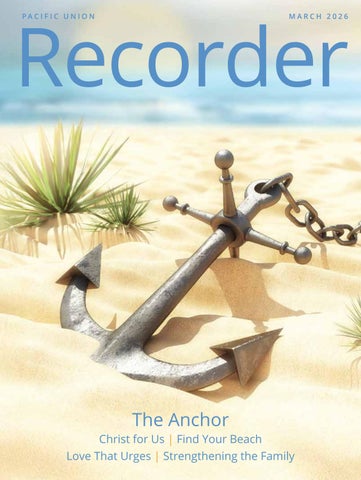
4 The Anchor: Fastened to the Rock
8 Fundamental Belief #24: Christ for Us: Hope, Assurance, and the Heavenly Sanctuary
10 Adventist Pioneers in the West: Holbrook Indian School: From Beginnings to Wholeness
15 Strengthening the Family: Returning to God’s First Gift
18 Love That Urges But Does Not Force: Mary Clough and Ellen White
21 Newsdesk
24 Arizona Conference
26 Central California Conference
30 Hawaii Conference
32 Holbrook Indian School
34 Adventist Health
35 La Sierra University
36 Loma Linda University Health
37 Pacific Union College
38 Nevada-Utah Conference
40 Northern California Conference
44 Southeastern California Conference
48 Southern California Conference
52 Community & Marketplace
56 Sunset Calendar
58 Find Your Beach
Holbrook Indian School 928-524-6845 x143
Kimberly Cruz kcruz@hissda.org
La Sierra University 951-785-2000
Darla Tucker dmartint@lasierra.edu
Loma Linda 909-651-5925
Ansel Oliver anoliver@llu.edu
Nevada-Utah 775-322-6929
Michael Jenkins Jr. mjenkins@nevadautah.org
Northern California 916-886-5600
Laurie Trujillo
Laurie.Trujillo@nccsda.com
Pacific Union College 951-809-6777
Gene Edelbach gedelbach@puc.edu
Southeastern California 951-509-2258
Taji Saleem taji.saleem@seccsda.org
Southern California 818-546-8400
Lauren Lacson Llacson@sccsda.org
Editorial Correspondents
Subscription rate: No charge to Pacific Union Adventist church members; $16 per year in U.S.; $20 foreign (U.S. funds); single copy, $2. POSTMASTER: Send address changes to: Circulation Department, Pacific Union Recorder, Box 5005, Westlake Village, CA 91359. Info@adventistfaith.com.
The Anchor: Fastened
Fastened to the Rock
By Bradford C. Newton
What do you do when you think you’ve had enough? When you’re ready to give up and the impossible challenges look like the end? This must have been what Aron Ralston experienced in 2003. He was solo hiking in Bluejohn Canyon in Canyonlands National Park in southeast Utah. The beauty of the location masked from him the danger that lay just ahead. As he climbed down into an isolated and narrow area, a large boulder fell on him. His right arm was wedged tight, in spite of his struggling with all his might to free himself. Alone. Desperate. Without anyone to help him, he went through the packed water and snacks he had brought with him. After five days, no one had come by to find him. He had also made a critical mistake. He hadn’t told anyone where he was going. His mind raced to the only solution available to him as he realized he would likely never be found. Taking his multi-tool that included a sharp knife, he amputated his arm. Cutting through flesh and bone and enduring unimaginable pain, he freed himself. But then he had to get back to his truck, parked seven miles away. Struggling with superhuman effort, he was found along the trail by a family, who alerted authorities. He had lost 40 pounds and had somehow avoided bleeding to death. His incredible story is told in the film 127 Hours
You may never face a harrowing experience like Aron Ralston did. Yet life can still feel out of control. It is particularly during these seasons that I’m thankful for what the Bible tells
us about Jesus. A favorite promise of mine is Hebrews 6:19-20: “We have this hope as an anchor for the soul, firm and secure. It enters the inner sanctuary behind the curtain, where our forerunner, Jesus, has entered on our behalf.” 1 Like the rest of the book of Hebrews, these verses are packed with key words that speak profound truths for our daily walk with the Lord.
“We have this hope as an anchor for the soul.” Recently, I was standing on the dock next to an immense cruise ship weighing some 120,000 tons. Thick ropes running from inside the hull held it steady in the port. But it was the ship’s anchor that most fascinated me. Weighing in at 20 tons and 20 feet long, the anchor held everything and everyone on board steady and secure.
The anchor in Hebrews 6:19 signifies what hope and faith in Jesus means for us in this troubled world. Unlike physical anchors going down into the dark depths of the ocean, this anchor of hope defies gravity to do the opposite. It travels upwards into the very inner workings of heaven itself. Rather than being an anchor plunged into darkness, the anchor of hope connects each believer into the light of the presence of God. Hebrews is a book of sanctuary imagery, and our faith in Jesus gives us what no earthly priesthood ever could: direct, firm, and secure access to all the resources of heaven.
Some years ago, a group of fellow pastors, along with family guests, from the West Region of the Southern California Conference embarked on a fishing trip. We left from Long Beach and sailed toward Catalina Island. My father-in-law, along with my son, Tyler, were with me. The ocean grew rougher as we made our way out to the open ocean. Arriving at our fishing spot, the crew instructed us to cast in our fishing lines. Unfortunately for us, the little anchor they deployed had no effect on our boat as we rolled back and forth with the waves. Soon, many of us were not doing well as sea sickness gripped us. We made a valiant effort to appear to be fishing, but we mostly fed the fish our lunches rather than catching anything. It was with relief that we arrived at Catalina and had a reprieve before heading back. I have never forgotten this trip.
Thankfully, the anchor of hope operates differently than any earthly one. This is a firm and secure connection operating in the opposite direction of every earthly anchor. Rather than going down, it reaches up and up into the very throne room of heaven and by faith tethers us securely with Jesus. The Bible tells us, “We do have such a high priest, who sat down at the right hand of the throne of the Majesty in heaven” (Hebrews 8:1). And “We have one who has been tempted in every way, just as we are—yet he did not sin. Let
Thankfully, the anchor of hope operates differently than any earthly one. This is a firm and secure connection operating in the opposite direction of every earthly anchor.
us then approach God’s throne of grace with confidence, so that we may receive mercy and find grace to help us in our time of need” (Hebrews 4:15-16).
The audience for Hebrews was Jewish Christians who were growing discouraged. Some were drifting away from the faith they had embraced earlier as the good news. We are in a time that is not unlike what they experienced. Yet there is an anchor of hope for each of us, still active and connected to our hearts. We are in a time when we need to remind each other of the good news of Jesus and His message for our time, salvation secured at the Cross and His promise of the Second Coming, the seventh day Sabbath as God’s special day to restore our relationships with God and others, and so many other precious Bible truths that give meaning, direction, and hope to life.
When troubles and challenges stir up the waters of life, remember that we are not left alone. There is One who holds us securely. The words of the old hymn still ring true—
We have an anchor that keeps the soul
Steadfast and sure while the billows roll; Fastened to the Rock which cannot move, Grounded firm and deep in the Savior’s love.2
Bradford C. Newton is the president of the Pacific Union Conference.
1All
Scripture quotations are from the New International Version.
2Priscilla J. Owens, “Will Your Anchor Hold?” Seventh-day Adventist Hymnal (Hagerstown, MD: Review and Herald Pub. Assn., 1985), # 534.
Fundamental Belief #24 Christ for Us: Hope, Assurance, and the Heavenly Sanctuary
By Alberto Valenzuela
Among the fundamental beliefs of the Seventh-day Adventist Church, Fundamental Belief #24—Christ’s Ministry in the Heavenly Sanctuary—stands as one of the longest and most detailed. That alone tells us something important. Length often signals controversy, misunderstanding, or vulnerability. We have felt the need to explain, defend, and sometimes rescue this belief from distortion. Yet at its heart, this doctrine is not meant to confuse or frighten believers. It is meant to anchor our hope, clarify God’s character, and assure us that salvation is not finished business left unattended—it is a living reality actively carried forward by Christ Himself.
Too often, when Adventists are asked what Jesus is doing now in heaven, the answer comes quickly and reflexively: He is pleading with the Father for us. While Scripture does speak of Christ’s intercessory role, this answer—if left unqualified—can subtly misrepresent God. Jesus Himself cautioned against such a misunderstanding. “I do not say to you that I shall pray the Father for you,” He said, “for the Father Himself loves you” (John 16:2627, NKJV). Salvation does not depend on persuading a reluctant Father. The initiative of redemption flows from the Father just as surely as from the Son.
Ellen White expressed this clearly when she wrote that “the love of the Father, no less than that of the Son, is the fountain of salvation.… God was ‘in Christ, reconciling
the world unto Himself’” (The Great Controversy, p. 416). If the Father had come to earth instead of the Son, she insists, the story would not have been different. In every act of Jesus, we see the heart of the Father revealed. Any explanation of the heavenly sanctuary that portrays Jesus as compassionate but the Father as stern or distant divides the Trinity and undermines the gospel itself. “Had God the Father come to our world and dwelt among us, humbling Himself, veiling His glory, that humanity might look upon Him, the history that we have of the life of Christ would not have been changed.… In every act of Jesus, in every lesson of His instruction, we are to see and hear and recognize God. In sight, in hearing, in effect, it is the voice and movements of the Father” (Ellen G. White, That I May Know Him, p. 338).
So what, then, is Christ doing in the heavenly sanctuary?
Fundamental Belief #24 invites us to shift our focus. Christ’s ministry is not aimed at softening God’s heart toward us; it is aimed at vindicating God’s justice, answering the accusations of Satan, and restoring human beings fully and safely into God’s presence. Scripture names Satan as “the accuser of our brethren” (Revelation 12:10, NKJV). The courtroom imagery of the New Testament does not place the Father in the role of prosecutor; rather, it presents Christ as our Advocate, responding to charges brought against us.
Paul captures this beautifully in Romans: “Who then is the one who condemns? No one. Christ Jesus who died— more than that, who was raised to life—is at the right hand of God and is also interceding for us” (Romans 8:34, NIV). Christ’s intercession assures the universe that those who trust Him are truly healed, forgiven, and restored. The judgment, therefore, is not primarily about God discovering information He lacks; it is about the moral transparency of salvation before an on-looking universe. This leads naturally to the question of the reality of the heavenly sanctuary itself. Is it merely symbolic language, or does Scripture describe an actual heavenly dwelling? The Bible consistently speaks of God’s heavenly temple as real—God’s abode, His throne room, and a place of action (Revelation 11:19; 15:5). John and Daniel both describe movement, worship, and administration within this space. Christ, having taken a glorified human body to heaven, ministers there as our High Priest. This alone implies more than abstraction or metaphor.
At the same time, Scripture cautions us against overly literal imagination. The earthly sanctuary was a copy—a shadow—of heavenly realities. While there is correspondence, it is limited. Still, the biblical witness consistently affirms distinct spaces, echoing the twoapartment structure of the earthly sanctuary. John sees the altar of incense; later he sees the ark of the covenant.
Jesus Himself speaks of His Father’s house as having “many rooms” (John 14:2, NIV). These images resist attempts to spiritualize the sanctuary out of existence while also reminding us of its transcendent nature.
Understanding this framework was critical for the early Adventists, especially in the aftermath of the Great Disappointment of 1844. They had not erred in trusting Scripture but in assuming that the cleansing of the sanctuary described in Daniel 8:14 referred to the earth. Through prayerful study, figures like Hiram Edson, O.R.L. Crosier, and others discovered that the prophecy pointed instead to a new phase of Christ’s heavenly ministry, analogous to the Day of Atonement in the earthly sanctuary.1
This insight reshaped Adventist theology. Hebrews, they discovered, does not teach that Christ entered the Most Holy Place immediately at His ascension. Rather, it speaks of His ministry in the “holy places”—a plural term
that assumes a sanctuary with more than one phase of ministry. Just as the earthly priest served daily in the Holy Place and annually in the Most Holy Place, Christ’s heavenly ministry unfolds in phases, culminating in a final work of cleansing and judgment before His return.
Crucially, this judgment is not bad news. It is gospelshaped judgment. The same Christ who died for us is the One who represents us. The judgment reveals who has accepted God’s healing grace and allows the universe to see that God’s mercy does not compromise justice. In this sense, the investigative judgment is not about fear but about assurance—the assurance that evil will be fully dealt with and that God’s redeemed people are safe to inhabit a restored creation.
Fundamental Belief #24 therefore protects several essential truths at once. It safeguards the unity of the Godhead, affirming that Father, Son, and Spirit are united in love and purpose. It preserves the ongoing significance of Christ’s saving work, reminding us that the cross was not the end of redemption but its decisive foundation. And it gives believers confidence that our salvation is being actively, lovingly, and faithfully carried forward by Christ Himself.
For a world anxious about judgment and suspicious of God, this message matters deeply. We do not proclaim a fearsome God tallying failures, but a faithful High Priest who knows our weaknesses and invites us to draw near with confidence. As Hebrews declares, we now have “a better hope, through which we draw near to God” (Hebrews 7:19, NKJV).
In the end, the doctrine of the heavenly sanctuary is not about charts or timelines. It is about Jesus— alive, engaged, and for us. It calls us to trust Him fully, to represent God accurately, and to live in hopeful expectation. Christ has not abandoned His people. He ministers for them still. And when His work is complete, He will come again—not as a stranger but as the One who has carried our names in His heart all along.
Alberto Valenzuela is the associate director of communication and community engagement for the Pacific Union Conference and editor of the Recorder
1See Bryan Strayer, Hiram Edson: The Man and the Myth (Westlake Village, CA: Oak & Acorn Publishing, 2023).
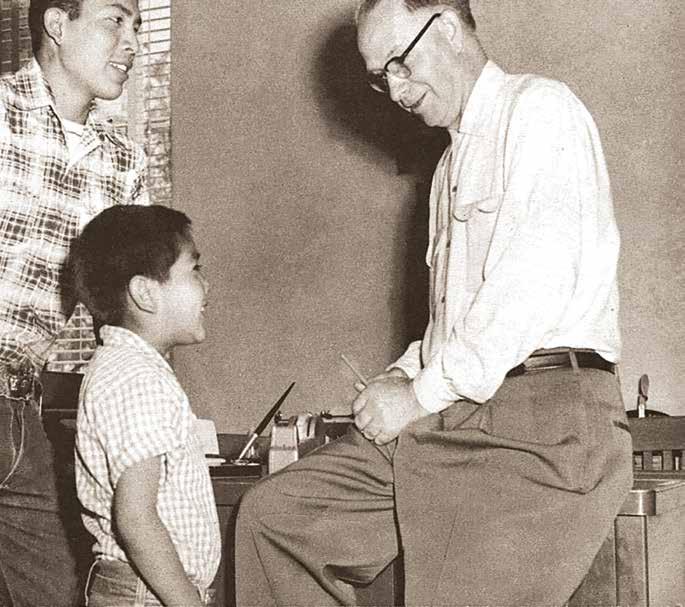
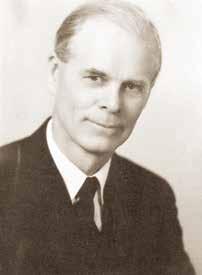
Frank Daugherty, who was principal from 1949-1966, talks with two students in the office at the mission school in Holbrook.
Orno Follett and his wife, Agnes, pioneered Seventh-day Adventist mission among Native Americans in the American Southwest.
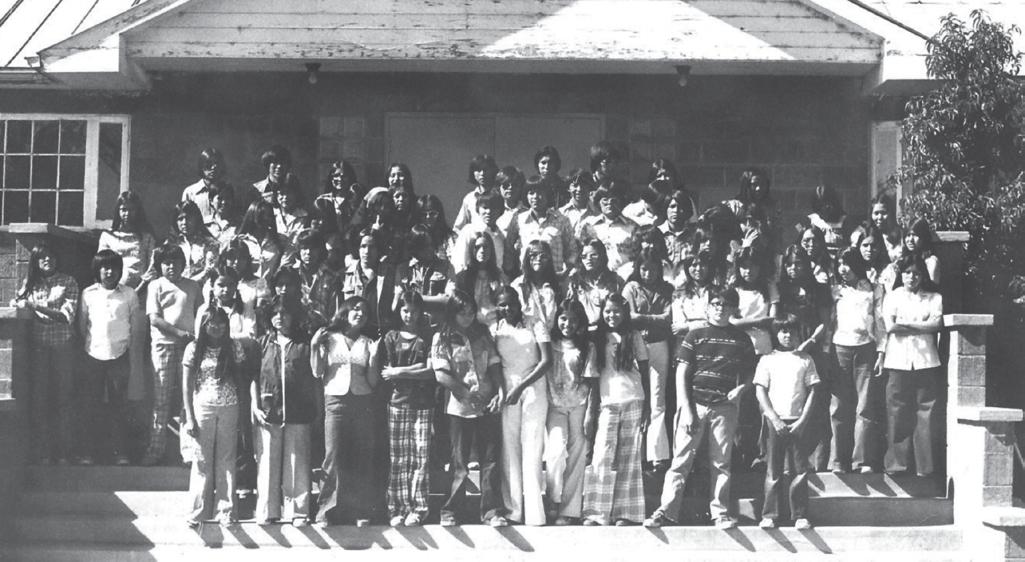
Holbrook Indian School students in the 1970s.
Pioneers in the West
By the Recorder editorial staff
Holbrook Indian School: From Beginnings to Wholeness
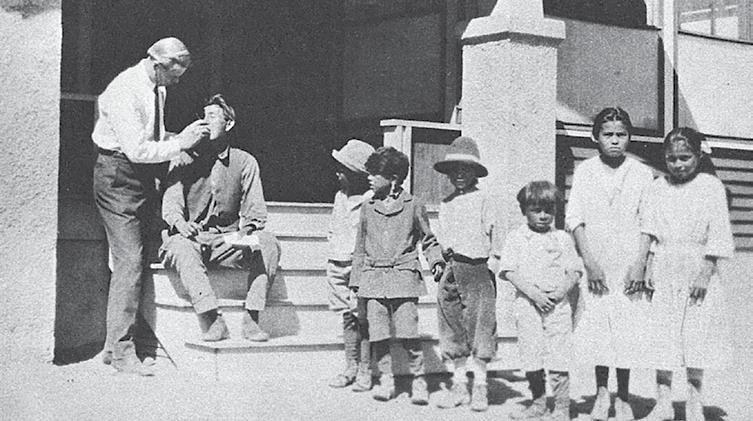
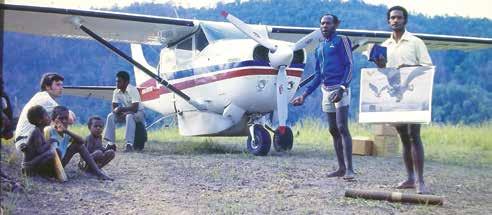
The story of Holbrook Indian School (HIS) begins long before the campus doors opened in 1946. In 1916, Elder Orno Follett and his wife devoted themselves to mission work among the Navajo people. Their efforts led to the building of a small school at Lake Grove Mission in New Mexico in 1918. Yet this first attempt did not last; the Great Depression forced its closure in 1937 when funds dried up.
By the early 1940s, the Seventh-day Adventist Church again turned its attention to the Navajo Nation. The Arizona Conference hired Marvin Walter, a full-time evangelist, whose wife, Gwen, was a nurse. Their dual ministry aimed to meet both the physical and spiritual needs of the people. With land secured in Holbrook, Arizona, a new mission school opened in 1946. The first class numbered just 30 students, taught by one teacher with the help of two deans. Lacking desks, the children recited lessons seated on rugs and sheepskins. Challenges soon arose. When the Walters had to leave due to illness, the school briefly closed in 1948. Yet the vision would not die. The Arizona Conference reopened HIS, bringing in new leaders—Frank Daugherty, Ardell
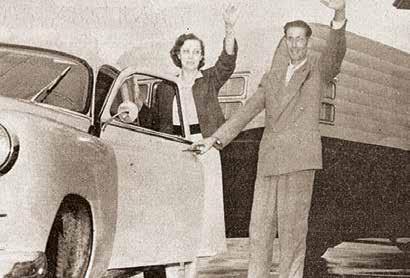
Marvin and Gwen Walter wave goodbye as they leave Glendale, California, for a new mission post among the Navajos.
Altman, and Wilfred Rathburn. Their resilience planted seeds for what would become a longlasting institution.
The rise of HIS must be seen in contrast to the government’s boarding school system, which by the late 19th century was infamous for its destructive policies. These schools operated under the motto of Richard Henry Pratt: “Kill the Indian, save the man.” Native children were taken from their families, stripped of their culture, and punished for speaking their languages. Hair was cut, names changed, and diets forced to conform to Western norms.
The consequences of such assimilationist policies were devastating: generations scarred by trauma, cycles of poverty, addiction, depression, and broken families. Even today, the legacy is felt in statistics: American Indian youth suicide rates are more than double the national average, alcohol-
related deaths are five times higher than the U.S. average, and food and housing insecurity continue to burden many communities.
In this context, HIS represented a different path. Instead of erasing identity, it sought to nurture wholeness—educating young people while honoring their heritage and helping them thrive as Indigenous Christians.
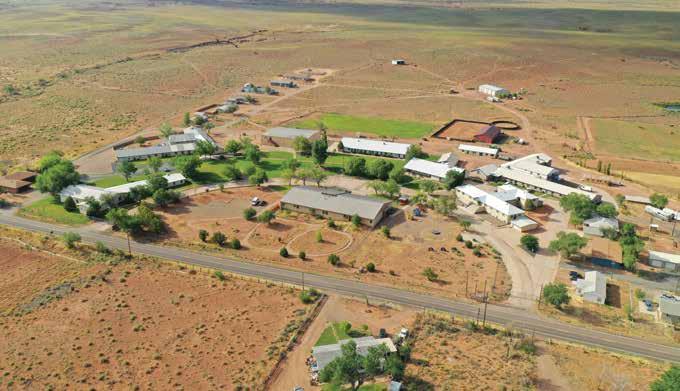
From its modest beginnings, HIS steadily expanded. Today the school boasts modernized classrooms, a high school building, and an administration center that doubles for elementary instruction. The campus, once a dusty desert landscape with a windmill for water, now features attractive landscaping and safe, comfortable facilities.
The curriculum evolved too. Academic subjects remain core, but HIS emphasizes vocational and cultural education as well.
Students learn welding, woodworking, auto mechanics, and agriculture. An Indigenous Arts program offers pottery, beading, weaving, drawing, and graphic design.
The Equine-Assisted Learning program has become a student favorite, blending practical skill with therapy.
One innovation is the MAPS program— addressing Mental, Academic/Artistic, Physical, and Spiritual needs. HIS recognizes that academic achievement is deeply tied to mental health, physical well-being, and spiritual grounding. Licensed counselors, teachers, and mentors work together to craft wholistic wellness plans for students.
While HIS provides a safe learning environment, its deeper mission is restorative. Many students arrive with personal or family trauma, echoes of the systemic injustices faced by Indigenous peoples. HIS staff consciously counteract this by affirming culture, reconnecting students with their language, history, and traditions.
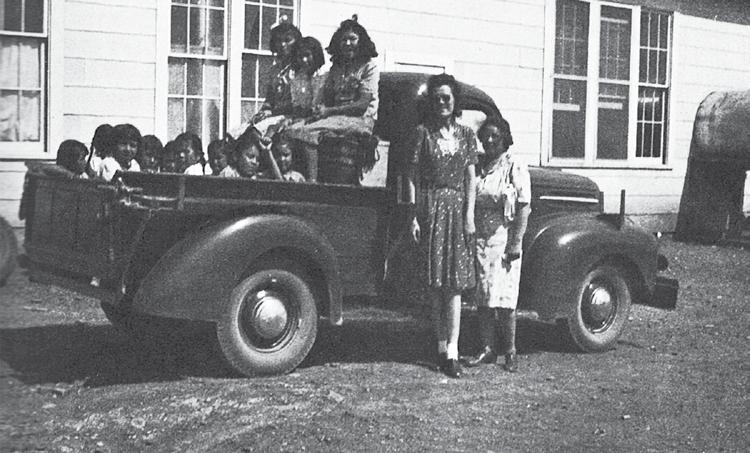
A missionary provides dental services at the Lake Grove Mission.
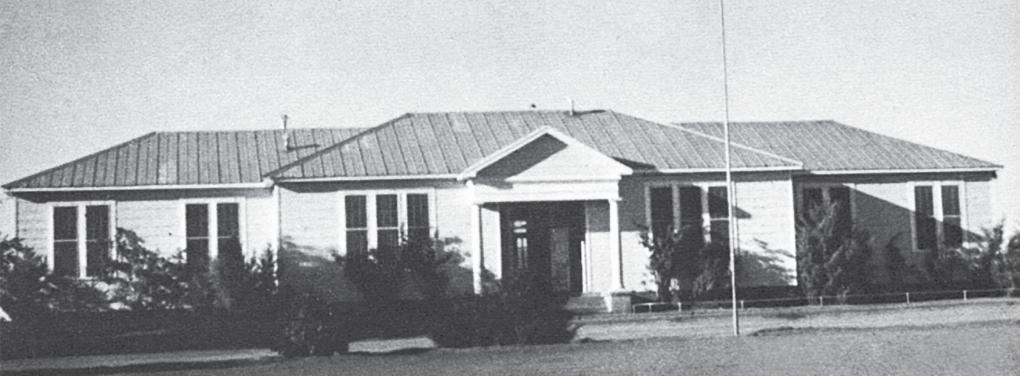
The first school building, no longer on campus today, was built in the late 1940s and had classrooms, offices, dorms, staff apartments, and a cafeteria.
Classes in Navajo government and language are central. Sam Hubbard, a Diné instructor, delights in watching students discover parts of their heritage they might never encounter elsewhere. “We want them to not feel ashamed of their Native heritage,” he explained.
This cultural reclamation is powerful, considering that earlier boarding schools punished children for speaking Navajo. Ironically, the language became a national asset during World Wars I and II, when Navajo Code Talkers used it to transmit unbreakable messages. Many HIS students are descendants of these heroes, and language classes help them reconnect with their grandparents who still speak Diné.
Students also retrace history through experiential learning. In Navajo history classes, they study the Long Walk of the 1860s, when Kit Carson’s scorchedearth campaign forced thousands of Diné on a 400mile march to Bosque Redondo. Hundreds perished along the way. Today’s HIS students walk parts of that trail to understand their ancestors’ suffering and resilience.
Each year, students also travel to Window Rock,
Arizona, to witness the Navajo Nation’s government in action. As the largest tribal government in the U.S., it faces stark realities: widespread poverty, low graduation rates, and scarce opportunities. These field trips empower HIS students to see both the challenges and the possibilities before them.
Agriculture remains central to HIS. For centuries the Navajo sustained themselves through farming and sheep herding. After Bosque Redondo, they had to rebuild from nothing, often relying on government rations. HIS aims to restore traditional farming knowledge by teaching students to grow the “Three Sisters”—corn, beans, and squash— while practicing sustainable gardening.
The school’s farm now supplies organically grown produce for the cafeteria and sells to staff and the local community. Agriculture classes also connect students with themes of health, stewardship, and independence.
Art plays a profound role in healing trauma. HIS’s Indigenous Arts program teaches pottery, weaving, and beadwork, but its benefits extend beyond skill. As Zak Adams, the program’s founder, explained, “They can use it to express themselves when words
Many students arrive with personal or family trauma, echoes of the systemic injustices faced by Indigenous peoples.
can’t. What I have seen of our students is that they are starving for their own culture.”
Creative expression fosters resilience, concentration, and emotional well-being. For youth facing depression, anxiety, or PTSD, art becomes both a therapy and a link to heritage.
Holbrook Indian School continues as a ministry of the Seventh-day Adventist Church, accredited by both denominational and regional agencies. Funding comes from two main sources: about 20 percent from the Pacific Union Conference and 80 percent from individual donors who believe in the mission.
The spiritual foundation remains central. The
school’s mission is to provide “a safe place for students to learn, grow, and thrive in Christ.” Unlike government boarding schools of the past, HIS offers students a Christ-centered education that embraces rather than erases their culture.
From its precarious start with one teacher and no desks, Holbrook Indian School has become a place of resilience and renewal. It was born in response to a need—the need to serve Native youth with dignity and respect. Over the decades, HIS has adapted, expanding programs in agriculture, vocational skills, equine learning, and Indigenous arts.
Most importantly, it has stood as a counterwitness to the destructive legacy of federal boarding schools. HIS does not seek to strip away identity but to nurture it. Here, Navajo youth and other Native students find not only education but healing, cultural pride, and spiritual hope.
The words of a second-grader arriving at the dormitory capture the heart of HIS: “It’s so good to be home!” For many who pass through its doors, Holbrook Indian School is more than a school. It is a place where brokenness meets compassion, where culture is celebrated, and where the future is written anew.
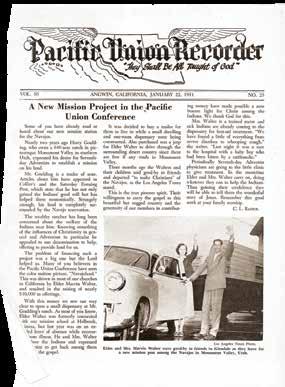
Aerial views of Holbrook Indian School today. BELOW: In 1951, the Pacific Union Recorder first used the term “Holbrook Indian School.”
Strengthening the Family: Returning to God’s First Gift
By Mila León
The first institution God ever established was not a church, a nation, or a school. It was a home. Before there was a congregation to gather, there was a couple to unite; before there was a command to go into all the world, there was an invitation to rest together. Scripture presents this truth not as a footnote but as a foundation. Within the same sacred hours, God formed the first family and sanctified the first Sabbath—one a place of rest, the other a time of rest. Together they reveal something
essential about God’s intention for human life. The Genesis story lingers on a striking detail: Adam’s loneliness. Surrounded by abundance, beauty, and purpose, he still lacked something vital. Every creature had a companion, yet he did not. His emptiness was not a failure of environment but of relationship. God’s response was not instruction or distraction but presence. He created Eve, joined their hands, and pronounced them husband and wife. (See Ellen G. White, Patriarchs and Prophets, p. 46.) The home was born as God’s answer to human
longing—a living expression of divine love.
Home, as God envisioned it, is meant to be a place where we belong. A place where joy and sorrow can be spoken aloud, where imperfection does not cancel love, where memories of grace are strong enough to soften the memory of pain. It is meant to be a sanctuary—a space where hearts can rest. Yet for many, home has become anything but that. Instead of refuge, it is a place of tension; instead of stability, uncertainty; instead of presence, absence. Families today take many forms, and not all stories are whole or reassuring. But Scripture does not invite us to despair over what has been lost; it calls us back to what God intended from the beginning.
God chose the family as one of the primary ways to reveal Himself. The bond between husband and wife was designed to mirror divine love—voluntary, mutual, and life-giving. Love in the home was never meant to be enforced by power or sustained by fear. It was to be a shared submission, each giving themselves for the good of the other, reflecting the self-giving love God extends to humanity.
This vision becomes clearer when we consider the role of the husband and father. Scripture presents Abraham as a compelling example—not because he was flawless but because he led with faith. He commanded his household (Genesis 18:19), yet his authority was not oppressive. His leadership was relational and spiritual. He made his family participants in his faith rather than spectators of his power. When the ultimate test came on Mount Moriah, there was no struggle between father and son. Isaac trusted because Abraham had already taught him who God was (Genesis 22:1-18).
Abraham’s strength lay not in control but in character. He was approachable, generous, and unselfish. When conflict arose with Lot, Abraham chose peace over privilege, surrender over selfassertion. In doing so, he modeled a principle desperately needed in families today: love that prefers others before self. His authority was credible because it was anchored in humility.
That legacy of faith continued through Isaac and Jacob. Jacob’s story is especially instructive because it unfolds amid family brokenness. His household was fractured by jealousy, deception, and fear. Before returning to Bethel, Jacob recognized that spiritual renewal had to begin at home. He gathered his family, called them to put away false gods, and reminded them of God’s faithfulness— not hiding his own failures, but confessing them (Genesis 35:2-3). That moment of honesty became a moment of healing. By acknowledging weakness and praising God’s mercy, Jacob softened hearts and prepared his family for worship. (See Ellen G. White, Patriarchs and Prophets, p. 205.)
This remains one of the most powerful acts a father—or any parent—can perform: admitting imperfection, seeking forgiveness, and giving thanks for God’s grace. Families are not strengthened by pretending to be flawless but by practicing repentance and gratitude together. Spiritual leadership in the home is not about moral superiority; it is about spiritual authenticity.
Scripture is equally clear about the dignity and influence of the wife and mother. Few biblical teachings have been more misunderstood—or misused—than the call for wives to submit to their husbands. Read in isolation, it has been wielded as a weapon. Read in context, it becomes an invitation
Home, as God envisioned it, is meant to be a sanctuary— a space where hearts can rest.
to mutual reverence. The call to submission begins not with wives but with all believers: “Submit yourselves to one another out of reverence for Christ” (Ephesians 5:21, NIV).
Biblical submission is never coerced; it is offered freely in the presence of love. It reflects the relationship between Christ and the church—a relationship marked by sacrifice, service, and compassion. Christ lead not by domination but by washing feet and laying down His life. Where that kind of love exists, submission ceases to be a burden and becomes an act of trust.
Scripture consistently affirms the equality of husband and wife, even as it acknowledges distinct roles. The wife stands beside her husband, not behind him—faithful in her calling, respected in her strength. Ellen White writes, "She [wife and mother] should feel that she is her husband's equal—to stand by his side, she faithful at her post of duty and he at his" ( The Adventist Home, p. 231). The image of Solomon honoring his mother by placing her on a throne beside his own powerfully illustrates this truth (1 Kings 2:19). Wisdom bows before motherhood. Authority recognizes nurture. Love gives honor.
The portrait of the capable wife in Proverbs 31 is not a narrow ideal but a celebration of wisdom, industry, compassion, and faith. She manages, provides, plans, teaches, and fears the Lord. Her influence reaches far beyond her household, yet her greatest legacy is often unseen. Ellen White tells us that many of the redeemed will raise their crowns and thank their faithful mothers for their instruction and prayers ( Messages to Young People , p. 330).
When husband and wife cultivate mutual respect, when love is nurtured and partnership embraced, the home becomes a testimony. In the words of Ellen White, “A husband and wife should cultivate respect and affection for each other. They should guard the spirit, the words, and the actions, [so] that nothing will be said or done to
irritate or annoy. Each is to have a care for the other, doing all in their power to strengthen their mutual affection” (Letters and Manuscripts, vol. 16, letter 168, 1901).
Children learn what love looks like not primarily from instruction but from observation.1 There is no greater gift parents can give their children than a living example of tenderness, forgiveness, and commitment. Such a home offers security in a fragile world—a reminder that worth does not depend on performance but on God’s grace.
That sense of worth is essential. Scripture teaches that our value originates not in comparison but in creation and redemption (Psalm 139:14, Ephesians 2:10). Pride compares and competes; worth rests and serves. When we know we are valued by God, we are freed from defensiveness and selfabsorption. We can listen, understand, and love more fully. This transformation is evident in Peter’s journey—from impulsive insecurity to humble strength—after encountering both his failure and Christ’s forgiveness.
Strengthening the family, then, begins not with techniques but with theology. Family worship, communication skills, traditions, and conflict resolution all matter—but they cannot replace a heart transformed by divine love. Without a genuine desire to love as God loves, our best efforts will fall short.
The prophetic call of Scripture is urgent and hopeful. In a world marked by confusion about God and brokenness in relationships, the message of restoration is clear: hearts must turn—parents to children, children to parents (Malachi 4:5-6). The healing of families is inseparable from spiritual renewal. The time to strengthen the family is not someday. It is now.
Mila León is a freelance writer from Tucson, Arizona.
1Kerry Stutzman, “What Your Kids Learn About Love by Watching You (It Might Surprise You),” June 30, 2024, https://kerrystutzman.com/what-yourkids-learn-about-love-by-watching-you-it-might-surprise-you/.
Love That Urges But Does Not Force: Mary Clough and Ellen White
By Teobaldo Montagut
Ellen G. White’s seven-decade public career was marked by relentless demands on her time and energy. Between constant requests for preaching, writing, and recording her visionary experiences, Ellen White relied on an extensive support network that included household helpers, childcare providers, editors, and publicists. Among her many assistants, none equaled the skill and congeniality of her niece, Mary Clough. From 1875 to 1877, Mary played an instrumental role in one of White’s most productive and influential periods, helping to complete key volumes of The Spirit of Prophecy and orchestrating large, impactful public events. Yet their relationship, professionally fruitful as it was, ultimately foundered on the shoals of spiritual disagreement.
Mary Clough, daughter of Ellen White’s oldest sister, Caroline Harmon Clough, was born in 1845 into a Methodist family and grew up distanced from the fervent Adventism embraced by much of the Harmon clan. When the Whites traveled through Kansas in 1872, they reconnected with Caroline and her family. Ellen’s hopes of converting her Methodist relatives to Adventism glowed bright during that visit. She described Mary as “pure, simple-hearted, yet intellectual,” and she was impressed by the young woman’s attentiveness to spiritual conversations and prayer gatherings.1
Mary Clough
The summer of 1875 marked the beginning of an intense professional collaboration. Mary joined the White household in California to assist with editing tasks and manage publicity for the upcoming camp meeting season. Her talents immediately proved invaluable. She adeptly edited Ellen White’s manuscripts and generated widespread interest in White’s speaking engagements. Thanks to Mary’s promotional prowess, Ellen spoke to some of the largest crowds of her career, including an estimated 20,000 attendees at the Groveland, Massachusetts, camp meeting in 1876.2
Mary’s editorial approach was exactly what Ellen White needed: tactful, intelligent, and deferential to White’s own voice. White would quickly draft material, and Mary would follow behind, polishing grammar and structure without altering the prophetic authenticity that White felt was integral to her writings. This editorial teamwork peaked in 1876 when White, determined to continue her Spirit of Prophecy series, dedicated herself to uninterrupted writing in California while James White attended to denominational matters in Michigan.
In Ellen’s letters from that period, the symbiosis between her and Mary is clear. She gushed about the “precious subjects” opening to her mind and reported being “twenty-four pages ahead of Mary,” who was hard at work copying and editing.3 Mary not only provided professional support but also embodied for Ellen a hope for spiritual transformation. White’s immersion in the life of Christ fueled a desire to see her niece fully embrace Adventist teachings.
However, despite the spiritual intensity of their shared work, Mary Clough never fully accepted Adventist doctrines. Her deep Methodist roots and independent spirit resisted the complete theological alignment Ellen White so desperately desired. As early as 1877, tensions surfaced. Caroline Clough visited California, and Ellen grew suspicious that Caroline might be undermining her daughter’s spiritual journey. Ellen wrote urgent letters to her
son Edson, asking him to monitor Mary’s reactions to spiritual exhortations she sent.4
The break came gradually but inexorably. In the fall of 1877, Mary defied Ellen White’s expectations by engaging in secular activities on the Sabbath and pursuing a courtship that Ellen deemed inappropriate. Ellen, devastated, wrote heartwrenching letters expressing her love and sorrow, pleading with Mary to reconsider her spiritual choices. In one letter, she lamented, “My heart would nearly break should we be separated, and yet I know we must drift apart without a change in you.”5
Despite the rupture, necessity forced a brief professional reconciliation. Financial pressures required White to complete the third volume of The Spirit of Prophecy, and she reluctantly reengaged Mary’s services in 1878. Once the volume was finished, however, their collaboration ended permanently. Mary married John Wanless in 1880, later married George Watson, and drifted into a quieter life, punctuated by sporadic correspondence with her aunt.
Even after their working relationship ceased, Ellen White continued to reflect on Mary’s contributions with a mixture of admiration and regret. No subsequent editor or publicist matched Mary’s natural gifts. White lamented the incompetence of her later assistants and expressed wistful wishes for Mary’s return.6
In 1896, Mary Clough Watson, financially straitened and spiritually chastened by life’s hardships, wrote to Ellen White from Arkansas, expressing deep regret for her earlier spiritual resistance. She acknowledged the “chastising hand of God” upon her life and offered to work for White without pay as a means of repaying a perceived “deep debt.”7 Though touched, Ellen White hesitated. Her life in Australia was vastly different from their earlier years together in California, and she doubted whether Mary, now middle-aged, could adjust to the austere, youthful, and vegetarian environment of her Avondale estate.
Ellen’s cautious letter outlined the challenges Mary would face: financial stringency, hard physical work, and strict religious observance. While she extended a conditional invitation, it was clear that the circumstances were no longer conducive to rekindling their former partnership.8
Mary responded with heartfelt understanding and regret. She acknowledged the “dream was over,” recognizing that her impulsive offer had overlooked the practical and spiritual realities separating them. Yet she affirmed her enduring affection and veneration for her aunt, writing, “I shall always love and venerate you as the most intensely human, yet most sublimely sanctified person I ever knew.”9
Though Mary and Ellen never worked together again, they did maintain occasional contact. Ellen White even visited Mary in California in her final years. Upon Ellen’s death in 1915, Mary penned one of the most moving tributes, emphasizing White’s humanity, sympathy, and divine calling. “She was not only a great and talented and divinely gifted woman, but she was
also wonderfully human, sympathetic and loving. Her exalted mission in life never chilled her tender heart,” she wrote to Ellen White’s son, W.C. White.10
The relationship between Ellen White and Mary Clough highlights critical themes in Ellen White’s ministry: the blending of the spiritual and the practical, the high expectations for close associates, and the heartbreak of spiritual dissonance among family members. Mary was the most gifted editor and promoter Ellen White ever had. Yet for Ellen, professional excellence could not compensate for spiritual nonalignment.
This tragic tension between professional admiration and spiritual disappointment reveals both the depth of Ellen White’s religious commitment and the heavy costs she was willing to bear for theological integrity.
Ultimately, the story of Ellen White and Mary Clough stands as a testament to the complex interplay between family loyalty, professional collaboration, and religious conviction in the shaping of early Adventist history.
Teobaldo Montagut is a freelance writer from Southern California.
1MS 4, 1872. Quoted in Arthur L. White, Ellen White: The Progressive Years, 1862-1876, vol. 2 (Hagerstown, MD: Review and Herald Pub. Assn., 1986), pp. 345-346.
2Ellen White to James White, April 18, 1876, Letter 9, 1876, https:// egwwritings.org/book/b14053.
3Ellen White to James White, April 7, 1876, Letter 4, 1876, https:// egwwritings.org/book/b14053.
4Ellen White to J.E. and Emma White, May 17, 1877, Letter 2, 1877, https:// egwwritings.org/book/b14053.
5Ellen White to Mary Clough, Nov. 3, 1877, Letter 6, 1877, https:// egwwritings.org/book/b14053.
6Ellen White to “Children,” Sept. 16, 1884, Letter 60, 1884, https:// egwwritings.org/book/b14054.
7Mary Clough (Wanless) Watson to Ellen White, Jan. 4, 1896. Quoted in Terry Dopp Aamodt, “Almost Persuaded: The Spiritual and Editorial Relationship of Mary Clough and Ellen White,” in The Philistines Are Upon Us: A Festschrift in Honor of Alden Thompson, ed. Carl P. Cosaert (Thousand Oaks, CA: Oak & Acorn Pub., 2022), p. 21.
8Ellen White to Mary Clough Wanless Watson, July 9, 1896, Letter 128, 1896, https://egwwritings.org/book/b14061.
9Mary C. Watson to Ellen White, Aug. 16, 1896. Quoted in Aamodt, “Almost Persuaded,” p. 27.
10Mary C. Watson to W.C. White, July 19, 1915. Quoted in Aamodt, “Almost Persuaded,” p. 28.
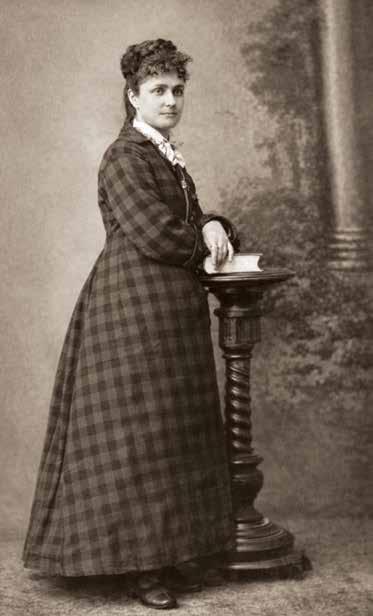
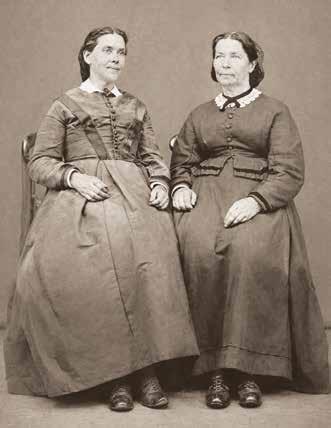
Ellen White and her sister, Caroline True Harmon Clough
Not Just Present: Disabilities Ministries Provides Resources for Accessibility in the Church
Bill Davis was born with Primary Immune Deficiency, a condition that compromised his body’s natural defenses, leaving him prone to frequent infections and hospital stays. “The constant vigilance over my health became a familiar rhythm,” Davis recalled. As a child, he often felt as though he was living in a bubble, fully aware of the unseen battle within, yet yearning for the freedom of unrestricted play like his peers.
As he grew older, Davis said, “another facet of my unique design became apparent,” and he was diagnosed with Attention Deficit Hyperactivity Disorder (ADHD). This diagnosis is often misunderstood, and Davis experienced this firsthand. Later in life, he became an amputee, which was more than just a physical change for him. “It was also an emotional and spiritual reckoning,” he said.
Davis is one of millions of people around the world who live with disabilities—some visible, some not; some suddenly life-changing, some lifelong. The Adventist Church has made it a priority to specifically and directly serve those living with disabilities through Adventist Disabilities Ministries, also known as Possibilities Ministries. Early in 2025, Davis was selected to serve as director of this ministry for the Pacific Union Conference.
Disabilities Ministries is an avenue for churches and church organizations to specifically reach those living with disabilities. Based in the North American Division offices, the ministry advises other ministries and church leadership, serves as liaisons with service organizations such as Christian Record Services, and provides resource materials for local congregations. “Our ministry strives to ensure every person can fully participate in worship, fellowship, and service,” the ministry states on its website.
Some resources available through Disabilities Ministries include, among others, National Camps for Blind Children; evangelism and accessibility tips for churches; and a collection of church materials and resources available in audio format, Braille, and large print.
As director of this ministry in the Pacific Union Conference, Davis listed three goals: Raise awareness, improve physical access, and facilitate integration into church communities for those with disabilities. Not all church buildings are disability-accessible, and not every congregation is sensitive to the needs of those within their ranks who are differently abled, Davis pointed out.
“From ramps and accessible restrooms to sensoryfriendly environments, we must ensure our churches
are truly welcoming spaces where everyone can participate fully in worship, fellowship, and service,” he stated.
Providing space for people living with disabilities in the church service and community goes beyond physical access, however, Davis said. “It’s about fostering a culture of belonging, where individuals with disabilities are not just present but actively engaged, leading, and contributing their unique talents to the body of Christ.”
“It’s about fostering a culture of belonging, where individuals with disabilities are not just present but actively engaged, leading, and contributing their unique talents to the body of Christ.”
Bill Davis
His own life experience feeds Davis’ passion for serving others who live with disabilities. “For me, ADHD translated into a mind that raced with ideas, a spirit brimming with curiosity, and an energy that sometimes felt boundless, even when my body was not,” he explained. Davis learned to think creatively, find innovative solutions, and approach
challenges from multiple angles. “It also taught me patience—both with myself and the world around me—as I learned to channel that energy and focus my thoughts for God’s glory.”
Having himself walked the challenging road of testing, refinement, and strengthening while remaining deeply connected to the church and his Savior, Davis firmly believes it is fully possible for every church and ministry to provide accessible opportunities for all. “Our churches can be shining examples of inclusivity,” he said. “My journey has granted me a deep understanding of the barriers that many individuals with disabilities face—not just physical obstacles but also societal attitudes and, at times, even unintended barriers within our own church communities.”
He concluded: “We need to open our eyes and our hearts to the diverse needs and incredible gifts of every member. Disability is not a separate issue; it is an integral part of the human experience, and those living within it are each a vital part of our church family.”
By Becky St. Clair and Bill Davis
Loma Linda University Health Announces Upcoming Retirement of President Richard Hart
Loma Linda University Health (LLUH) announced the upcoming retirement of its president, Richard Hart, MD, DrPH, following a distinguished tenure of service marked by faithful leadership, vision, and dedication to the organization’s mission.
Hart joined the institution as a student and later served in multiple leadership roles before being appointed president in 2008. Hart played a pivotal role in advancing Loma Linda University Health’s commitment
to whole person care across academics, healthcare, and research. As a strong advocate of Adventist education, he has led in global outreach, strengthening multiple hospitals and educational institutions throughout the world, many staffed with Loma Linda University Health graduates, all committed to service. His legacy is defined by compassion, service, and a steady trust in God’s leading.
Thomas Lemon, chair of the Loma Linda
University Health Board of Trustees, expressed the board’s appreciation on behalf of the entire organization.
“We are profoundly grateful for Dr. Hart’s years of faithful commitment and service,” Lemon said. “Through seasons of growth and challenge, he has led with humility and helped establish Loma Linda University Health as a premier academic health sciences center both nationally and globally. As we give thanks for all that has been accomplished, we do so with confidence that God will continue to guide Loma Linda University Health into its next chapter through the strong leadership team in place.”
The LLUH Board of Trustees will convene
a presidential search committee in the coming months. The committee will conduct a comprehensive search to identify the next leader who will continue to advance the organization’s mission.
“While leadership transitions mark significant moments, our trust remains firmly in God’s ongoing guidance,” Lemon said. “We believe He will continue to lead this organization, just as He always has. Please join us in thanking Dr. Richard Hart for his steadfast commitment to continuing the teaching and healing ministry of Jesus Christ.”
Hart will continue to serve in his role through June, ensuring a smooth and seamless transition.
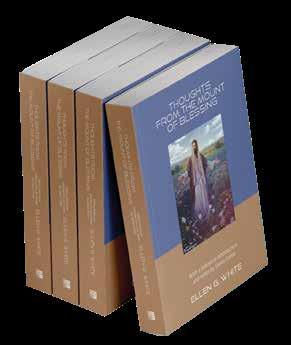
Thoughts From the Mount of Blessing
By Ellen G. White
This edition includes:
• A comprehensive historical introduction to the book’s creation and context.
• Annotations and footnotes explaining key theological and literary insights.
• Reproduced archival photographs and documentation from the Ellen G. White Estate.
• An appendix identifying Ellen White’s original sources and influences.
With historical introduction and notes by
Discover one of the most profound commentaries ever written on Jesus’ Sermon on the Mount—now enriched with fresh insight and historical clarity.
In this beautifully annotated edition, theologian Denis Fortin uncovers the story behind Ellen White’s beloved devotional, tracing how it was written, edited, and inspired. Through detailed notes and historical background, readers will encounter both the words of Christ and the spiritual journey of one of Adventism’s most influential voices in a new light.
“Every sentence is a jewel from the treasure house of truth.”
—Ellen G. White
Ideal for pastors, students, and readers seeking deeper understanding of Christian character, discipleship, and the ethics of the kingdom of God.
Oak & Acorn Publishing is a ministry of the Pacific Union Conference.
NOW AVAILABLE FROM
Denis Fortin
More Than a Meal: How Mobile Ministry Is Impacting Lives in Phoenix
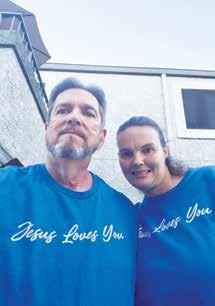
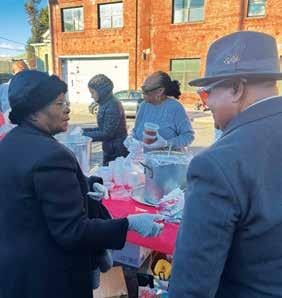
On an ordinary day, Kirk Sorenson and his daughter, Catie, received a call that took them not to their destination but to where they needed to be.
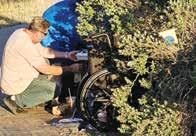
Kirk and Catie were informed through a call that an elderly lady had car problems and needed roadside assistance. Father and daughter met 77-year-old Suki, better known as Mama Kim to her “children,” on the side of the road next to her brokendown car. Apparently, this wasn’t the first time she had experienced car issues, and before this encounter, she had been charged large amounts by different people to “fix” the problem.
After they helped Mama Kim with her car trouble, she gratefully offered Kirk and Catie some of her delicious teriyaki chicken, the same home-cooked meal she feeds her “children,” the homeless. She thought of them not as strangers but as family. “Those are her kids— the homeless,” Kirk recalled. Mama Kim was living on a fixed income, yet she spent what little she had to prepare meals and care for those experiencing homelessness.
This encounter stayed with Kirk and Catie.
This was the moment that “the Lord planted in our hearts right there,” Kirk recalled, for them to start a ministry in the service of others. “We didn’t want to just feed people,” he said. “We wanted to go a little bit further. We wanted to help get them off the streets.”
From that conviction, Mobile Ministry was born—an outreach committed not only to meeting physical needs but to walking alongside people toward restoration.
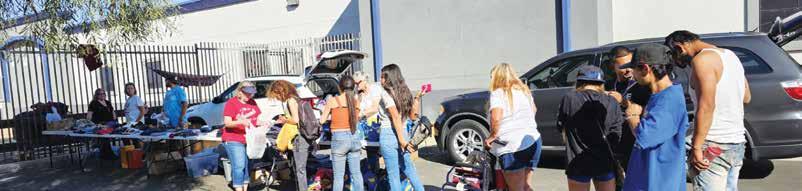
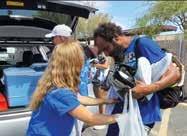
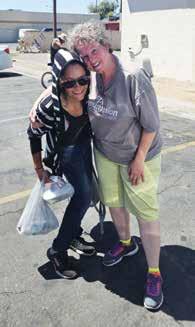
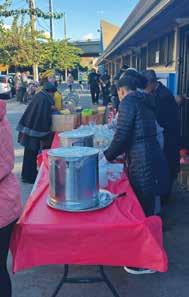
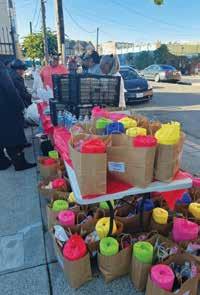
Launched two years ago in January 2024 with the support of a local pastor and Bible study group, Mobile Ministry operates with a broad, selfless approach. Volunteers prepare homemade meals,
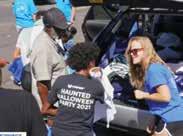
including a Bible verse written directly on the container and bag. Along with food, they distribute hygiene kits, Bibles, clothing, and copies of Steps to Christ. They also help rehab graduates move, among other things. But perhaps what makes the ministry so unique is how they decide where to go.
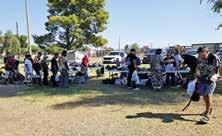
“Every time we pick up meals, we pray and ask the Lord to guide us to the people who need us most,” Kirk shared. “We don’t have set locations—we just follow where He leads.”
That dependence on God has opened doors far beyond what Kirk and Catie initially imagined.
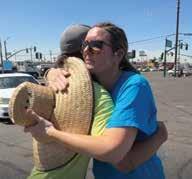
Mobile Ministry is intentional about offering a “hand up, not a handout.” Volunteers do not simply drop off meals and leave. They build relationships, learn names, listen to stories—and when someone is ready, they help connect them to detox programs, residential recovery, job resources, and housing opportunities. The goal is not dependency but integral restoration and social reintegration.
“We built a network with detox facilities and transition facilities. We built a relationship with the city of Phoenix, to the point where they now assist us in helping people get into programs and also enter their own apartments,” explained Kirk.
Mobile Ministry has shared 558 copies of Steps to Christ, 131 Bibles, 9,886 meals, 515 cases of water, 1,124 hygiene kits, 242 blankets, 161 jackets/ sweaters, 720 pairs of shoes, and 9,990 pairs of socks. They have referred 42 people and five families to rehab programs, 94 people to the Phoenix Office of Homeless Solutions, and eight people to assisted housing.
One story stands out.
A woman was met by the team while she was living on the street. She eventually accepted help to enter detox, then moved into a residential program. Over time, with consistent support and encouragement, she secured her own apartment. Even more powerfully, she was reunited with her young son and has regained full custody.
“She went to our church. She's been baptized. And they're together now, living in the apartment. She’s doing well,” Kirk affirmed.
Stories like these remind the team why the long
hours and emotional weight are worth it. Though the ministry is volunteer-driven, its demands are significant. Kirk often invests 35 to 40 hours a week in the ministry. Challenges such as limited storage space, financial needs, and volunteer availability are constant realities. Yet again and again, the ministry has seen God provide at just the right moment.
“It just seems like He’s one step ahead of us every time,” Kirk reflected. Whether it’s furniture arriving just as a family moves into housing or unexpected partnerships forming with churches and local organizations, the team has learned to trust God’s timing.
Through it all, the volunteers themselves have been deeply impacted. “Being on this end of it,” Kirk said, “I think we’re the ones being blessed.”
Kirk hopes this ministry will grow to reach and change even more lives and that others will be inspired to be actively involved in God’s mission. Kirk reminds us that we are “the hands and feet of Jesus,” and thus we should follow His example: meeting people where they're at and meeting their needs first.
In a world overwhelmed by need, Mobile Ministry is a powerful reminder that God is still at work. Although we may only be a conduit of superficial restoration, we should point others to the One who will restore them wholly.
By Alexis Camacho
2026 and Beyond: Rooted in Faith, Focused on Mission
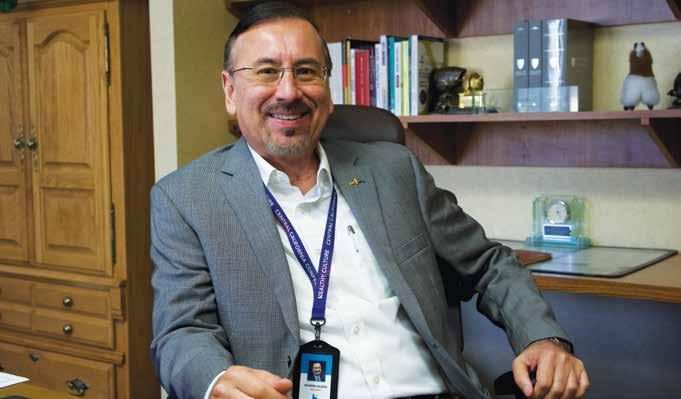
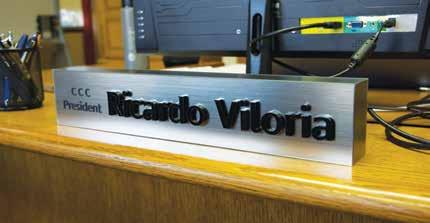
President Ricardo Viloria shared his vision for the year ahead and reflected on lessons learned during his first full year of leadership. In this conversation, he offers encouragement, biblical hope, and specific prayer requests for our conference family.
As you enter the second year of your term, what direction or focus do you sense that God is calling our conference to pursue?
I sense God calling our conference to cultivate a healthy culture where people flourish, the organization thrives, and the mission is fulfilled. The focus is not only on what we do but how we do it—grounded in a deep connection with God as our source of wisdom, strengthened by collaboration, and marked by unity that values both diversity and shared purpose. I believe the Lord is inviting us to slow down enough to listen well, care deeply for people, and move forward together with clarity, faith, and hope.
As you reflect on your first full year serving as president, what has the Lord taught you during this season of leadership?
This first full year has reminded me that leadership is, above all, a spiritual calling. The Lord has taught me the importance of dependence on Him, especially in complex and challenging decisions. I've learned again that I don't have to have all the answers, but I must remain prayerful, teachable, and willing to listen. God has also reinforced my conviction that healthy leadership is rooted in humility, compassion, and trust—and that when we lead with grace and accountability, He faithfully guides the outcome.
Are there any specific prayer requests you would like our conference family to unite around in prayer together?
As our church members and families enter this new year, what message would you like to share with them, and is there a Bible promise that is especially on your heart?
My message to our church members and families is simple: God is with you, and He is faithful. As we step into a new year—carrying hopes, uncertainties, and prayers— we can move forward with confidence, knowing that the same God who has sustained us will continue to lead us.
A promise especially on my heart is Isaiah 41:10: "So do not fear, for I am with you; do not be dismayed, for I am your God. I will strengthen you and help you; I will uphold you with my righteous right hand" (NIV).
May this assurance remind us that we never walk alone.
I invite our conference family to unite in prayer for spiritual renewal, wisdom for our leaders, and healing and encouragement for those who are weary or discouraged. Let us also pray for unity of heart and mind, for our pastors, teachers, staff, and volunteers, and for our families and young people. Above all, let us pray that everything we do reflects the character of Christ and advances God's mission in ways that bring Him glory.
As we continue through this year together, may we move forward with the confidence that comes from knowing God walks with us. Let us commit to prayer, pursue unity, and trust that He who has called us will equip us for every good work He has prepared.
Edited by Justin Kim
Oakdale Church’s Homeless Ministry Bears Lasting Fruit
For decades, compassion has been more than a calling for the members of Oakdale church—it has been a way of life. At the heart of that ministry is Roger Renslow, whose longstanding commitment, alongside a dedicated team of church members, has shaped a homeless outreach that continues to transform lives across the community.
Renslow has been involved in homeless ministry since the mid-1980s. What began with simple acts—feeding individuals along the river from the back of his car—has grown into a consistent, team-driven ministry that meets people where they are, both physically and spiritually.
“God has given me a gift for this work,” Renslow said. “But it’s something we do together.”
Today, Oakdale church serves unhoused individuals locally and in nearby communities such as Sonora. Volunteers regularly distribute food, socks, and other essential supplies to meet immediate needs. Just as important, the ministry creates space for conversation, prayer, and engagement with Scripture—often leading naturally to spiritual decisions. Those who express interest are invited to explore the Bible, ask questions, and respond as they feel led.
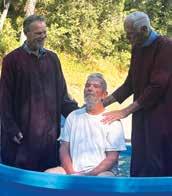
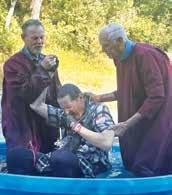
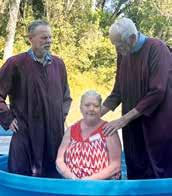
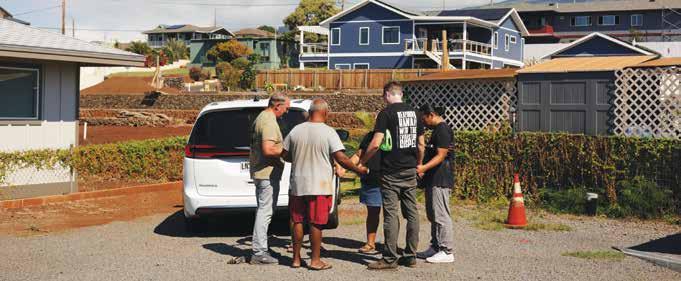
That approach bore remarkable fruit in July 2025, when 29 individuals—many experiencing homelessness— were baptized through the ministry. These baptisms did not follow a single format or take place in one location. Instead, Renslow and his team brought baptism directly to the people.
Baptisms were held outdoors in the very communities where individuals were living, as well as in members’ swimming pools. When someone was ready, the team responded—offering baptism where it was most accessible and meaningful.
Several of those baptisms were deeply personal. One woman, who had been living in her vehicle near Renslow’s home for more than a year, struggled with feelings of isolation and doubt,
questioning whether God truly cared for her. Supported by church members, she continued attending church and Bible studies and eventually chose baptism.
For Renslow, the greatest joy comes not from numbers but from relationships.
“Being out there with them, talking with them, and seeing how they respond—that’s the blessing,” he said.
Even after decades of service, Renslow continues the work alongside his team with humility and consistency. Over the years, many have been baptized through this ministry—each one a reminder that faithful, collaborative service can open hearts to the gospel.
As Oakdale church continues to serve its community, its homeless ministry stands as a living expression of Christ’s compassion—meeting people where they are and walking with them, together, toward hope.
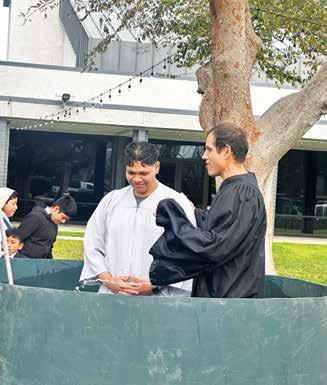
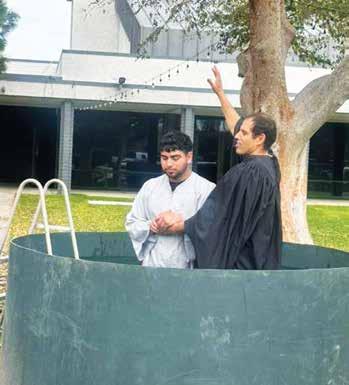
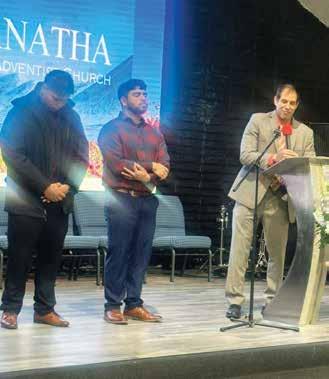
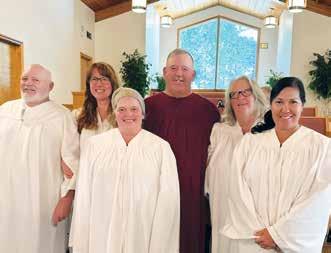
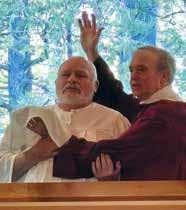
Maranatha Company Celebrates Baptism
The Maranatha company gathered in joyful worship as new believers publicly declared their faith through baptism, led by Pastor Gomez. The service marked a meaningful milestone not only for those entering the waters but for the entire faith community that has walked alongside them in prayer, study, and encouragement.
Family members, friends and church leaders witnessed each baptism as a testimony of God’s transforming grace and a commitment to follow Jesus wholeheartedly. Pastor Gomez emphasized that baptism is not the end of a journey but the beginning of a new life rooted in Christ and lived out in community.
The celebration reflected the Central California Conference’s commitment to nurturing disciples and cultivating a healthy, Christ-centered culture. As the Maranatha company rejoiced together, the moment served as a reminder of God’s ongoing work in the local church and the hope for His soon return.
By Osiris Gomez
Pastor Gomez emphasized that baptism is not the end of a journey but the beginning of a new life rooted in Christ and lived out in community.
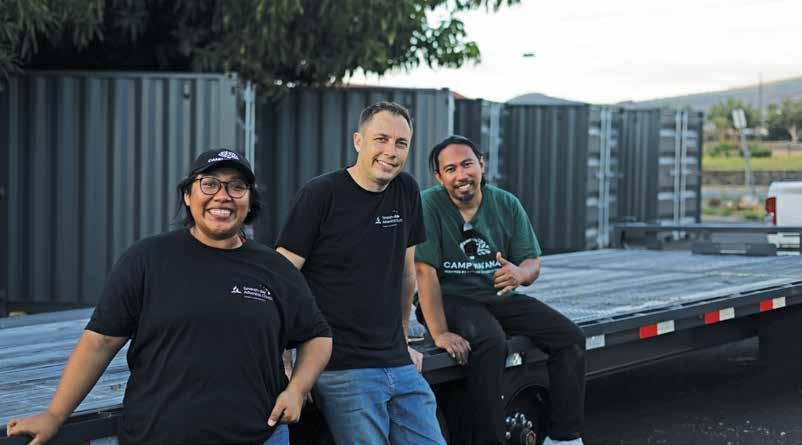
Shipping Containers Bring Stability to Lahaina Families
In the aftermath of the August 2023 wildfires, Lahaina continues to move through a long season of rebuilding and waiting. While news coverage has slowed, daily life for many families remains uncertain. In response to this ongoing need, the Hawaii Conference and the Lahaina church launched a shipping container project to meet a practical and important gap in recovery by providing secure storage.
Through this project, we have provided and delivered approximately 40 shipping containers of various sizes, including 10 by 8, 9 by 8, and 8 by 8 feet, to families who lost property in the fires. This effort is part of a larger plan to deliver a total of 120 containers to the Lahaina community. Deliveries are completed in waves, relying on a dedicated team of pastors and local community members who assist with placement. These containers are placed directly on family-owned land to help secure tools, home goods, and personal belongings during the rebuilding process. For many residents, the containers serve as the first stable structure to return to their property.
Permits to rebuild are only now beginning to be issued, and many families are still waiting. Financial limitations have made it difficult for
most residents to live on their lots at this time. Even so, those lots represent generations of family history and deep cultural roots. Having a secure structure on their land allows families to take meaningful steps forward while protecting what they still have.
One recipient, Uncle Earl, a respected kūpuna (elder) who grew up in Lahaina, shared how significant the container has been for his family. As he begins construction, his only on-site shelter was a small trailer with very limited space. The shipping container now allows him to store materials safely and remain connected to his land as he rebuilds with his family.
Another powerful story came from the DeGama family, who expressed surprise and gratitude that a church they do not belong to would step in to help. Like many in Lahaina, they had been promised resources that never materialized. Receiving a shipping
container gave them the freedom to return to their property, establish a sense of structure, and safely store their belongings. For them, it represented not just storage, but hope.
These stories reflect just a small example of the nearly 40 families served through this project, many of whom are not part of our church community yet are neighbors we are called to love and support. Lahaina’s recovery is far from over, but progress is happening. Each container represents a family taking one more step toward home. Support is still needed through prayer, financial giving, and continued awareness. To learn more, visit the Maui Fire Relief tab on our website, hawaiisda.com. Together, we can continue walking alongside Lahaina and help turn recovery into renewal.
By Melanie Ramirez
Expanding Young Minds
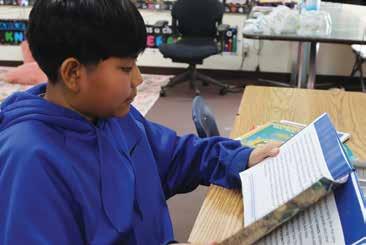
TOP: Annalynn and Quanah partake in the read-a-thon efforts. ABOVE: Eli the Eagle (mascot) gets in on the reading, too.
Most of us correlate Valentine’s Day with the month of February, but did you know that February is also National Library Lover’s Month? It is!
National Library Lover’s Month is celebrated throughout the whole of February. The purpose of this time is to show appreciation for libraries, librarians, reading, the value of books, and the crucial resources for communities that each provides. In addition, libraries provide various educational programs, digital access, spaces for meetings, tutoring, and increased awareness and fostering of literacy.
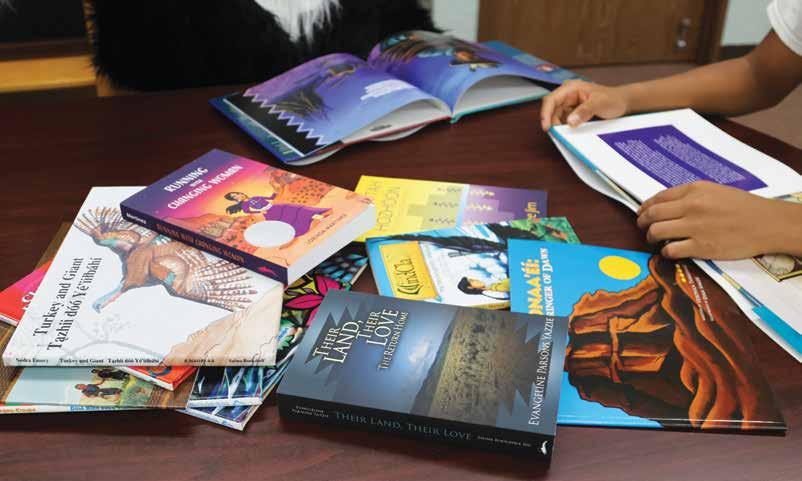
Here at Holbrook Indian School, we are privileged to have a well-stocked library full of books for all grade levels to encourage students to expand their imaginations and excel in reading. The Bible says in Romans 12:2 that to “be transformed” we must renew our minds. Reading is one of the best ways to do that! From biblical principles to economics, philosophy, mental health, science, and more—young minds are expanded on a regular basis at our little school in the desert.
To set the stage for Library Lover’s Month, and to support our literacy initiative, we hosted a read-a-thon last month in which students were encouraged to read as much as they could. Additionally, Kitty Simmons, a special friend of HIS and major supporter of our library and literacy efforts, made a challenge
A Seventh-day Adventist Boarding Academy Serving Native American Youth Since 1946
gift of $3,000 for the read-a-thon. She matched up to $3,000 in sponsorship gifts for students to read books during this event!
Kitty dedicated 43 years of her life to the La Sierra University library as librarian and library director, so she understands how crucial books and reading are to the success of students. We are so thankful for her support and involvement in helping us raise awareness and funds for this important work on our campus. Prior to the read-a-thon kickoff, two of our sixth graders, Ryder and Tyler, were already well on their way to reaching their reading goals, having read over 1 million words each during the first semester alone! It is always a pleasure to watch our students reach for and achieve their goals.
For Tyler, it began last school year when he asked his dad, our farm assistant, Mr. Wagner, if they could go to the library so that he could catch up on his reading. As an HIS staff member and a father, Mr. Wagner cares very much about the success of his children, so he was happy to comply. It has since become a nightly family routine.
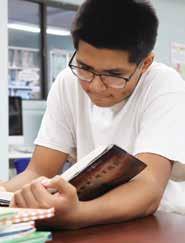
RIGHT: Ryder puts in more time reading. FAR RIGHT: Autry reads about spiders.
Both Ryder and Tyler were asked what motivates them to read and what they like most about reading. Ryder said, “It’s peaceful. It’s easy. There’s nothing to it. I get that it’s too hard for some people, but not for me. I enjoy it, like a hobby or passion.” Tyler said, “I like to read. My favorite author is Adam Makos. He has a lot of war books. My three favorites are Spearhead, A Higher Call, and Devotion.”
We are grateful for the support we receive from generous friends like Kitty that allows us to provide the valuable resources of our library to students like Ryder and Tyler. We are equally grateful that our staff parents, such as Mr. Wagner, are deeply involved in the lives of their children on campus. It is such a blessing to have so many friends and family encouraging our students to continue their passion for reading and learning.
By Kimberly Cruz
A Seventh-day Adventist Boarding Academy Serving Native American Youth Since 1946
Indian School (HIS) is a first- through twelfth-grade boarding academy operated by the Pacific Union Conference of the Seventh-day Adventist Church. HIS also manages a first- through eighth-grade day school on the Navajo reservation in Chinle, Arizona. Eighty-seven percent of funding comes from individuals who have a desire to support Native American ministries and Christian education. Your generosity makes a difference in the lives of our students, their families, and the communities they serve. Thank you for your support.
Holbrook Indian School
WHow to Comfort a Loved One in the Hospital
hen a loved one is in the hospital, you want to encourage them and make their experience more pleasant. But what can you do or say to help?
Adventist Health chaplains are trained to care for the spiritual and emotional needs of patients in a wide variety of situations. Here are a few of their top tips for providing just the right kind of support.
1. Keep a notebook handy. “Sometimes there is a lot of information given to the family and the patient,” said Sara-May Colón, director for Mission and Spiritual Care at Adventist Health Castle. “I love having a notebook by the patient’s bed as a place to write questions and answers from the care team, or even just to journal musings or to note who visited.”
2. Let your honest curiosity lead. “A carefully chosen, genuine, open-ended question will be more effective than a comment such as, ‘You must be feeling really sad right now,’” said J Murdock, senior chaplain for Adventist Health Clear Lake. Instead, try asking questions such as, “How are you feeling right now?” Murdock says this kind of openended question shows you care and leaves space for an honest response, which can help you determine how best to provide care moving forward.
3. When in doubt, say less. “Simply being a quiet and compassionate presence speaks volumes over non-stop conversation and activity,” said Garrett Shon, associate chaplain for Adventist Health Castle. Just sitting with your loved one in silence can be the best approach. Not every thought, feeling, or comment calls for a response.
“Go and just be!” said Wes Welch, staff chaplain for Adventist Health Columbia Gorge. “In the book of Job, his friends started off doing very well. They showed up and were just with him. It was when they started talking and giving all their opinions on the matter that they went terribly astray.”
Murdock added, “You might be just the right person to let your loved one think aloud, judgment-free, and get their feelings out. Despite the pressure you may feel to do otherwise, say less and listen more.”
4. Media can be therapeutic. “When one of my loved ones was dying, she didn’t like the sound of TV and commercials,” said Colón. “So instead, I brought a small Bluetooth speaker and played podcasts, sermons, and music she preferred.”
A customized television channel recently introduced at some Adventist Health hospitals features scenes from nature to nourish patient’s minds and souls. “The channel goes beyond medicine and technology; it’s part of nurturing the whole person,” said Chris Hagen, director for Mission and Spiritual Care at Adventist Health Lodi Memorial.
5. Create a cozy environment. Reduced noise and homey touches can improve a patient’s sense of well-being. Consider small gifts, such as unscented hand cream, lip balm, or photos of pets. “Depending on what your loved one is in the hospital for, it may help them pass the time to give them a fidget toy, stress ball, or coloring book,” said Colón.
Be sure to check with your loved one’s care team before making any big plans, but know your small touches can make a big difference.
By Kim Strobel
Holbrook, Guatemala Missions Move the Needle on Impact
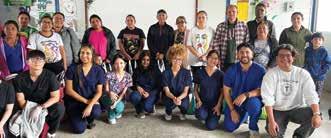
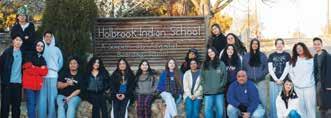
Over Christmas break, 28 La Sierra University students chose to invest their free time in the wellbeing of others in communities thousands of miles apart. The students, through the Office of Spiritual Life and the Pre-Medical Society respectively, traveled to Holbrook Indian School in Arizona and to cities in Guatemala to provide needed assistance in building repair, agricultural activities, social and spiritual support, clean water provision, and medical and dental services.
Ten students and one faculty member under the auspices of the Pre-Medical Society served more than 500 people across multiple communities in Guatemala between Dec. 13-21. Their activities included distributing toys to children; installing clean water filters in six homes; visiting a children’s hospital to pray with families and deliver stuffed toys; providing enriching social activities at an HIV hospice; donating essential supplies to a homeless shelter; and assisting physicians and dentists during a health clinic.
“Each day concluded with team debriefs and devotionals, providing space for reflection, gratitude, and spiritual growth,” Pre-Medical Society President Pablo Jacquez said in an email overview of the trip. “These moments helped center the experience in service, humility, and faith and allowed students to process the responsibility and privilege of caring for others.”
Meanwhile, nearly 3,900 miles away, 18 of their peers were helping Holbrook Indian School with painting of school buildings and with agricultural activities.
Ezekiel Teo, a graduate student with the H.M.S.
Richards Divinity School and a videographer with the university’s marketing department, documented activities with photos and video. He assisted in dismantling a damaged greenhouse, sorting a toolshed, weeding and gardening in the school’s fields, and preparing food for mission participants. It was his first visit to Holbrook Indian School.
“I was interested in accompanying and documenting this trip because I was curious about Holbrook’s mission as an Indigenous boarding school and how it set itself apart from Christianity’s difficult history with such type of schools,” Teo said.
For Teo and others, the work of serving others circled back to impact their own hearts, minds, and faith experience.
“I enjoyed moments where we worshipped and spent time with students, hearing their faith questions,” Teo said. “I’m happy to see how Adventist education positively impacts the world around us beyond [our] faith community.”
Student Loreen Nepomuceno who assisted with the painting the school’s cafeteria noted, “Serving others helped me understand that faith isn’t just something we believe internally, but it can be demonstrated through love and service.”
“My faith was impacted by the smiles and impressions we left upon the students and staff,” said Ministry Director of Missions Dionne Afease, who coordinated the Holbrook outreach. “The staff could not believe the job we completed. They didn't expect us to do work. In the name of Jesus, we served beyond their expectations.”
By Darla Martin Tucker
La Sierra University students and faculty member Arun Muthiah pose with members of a Guatemala community.
La Sierra University students traveled to Holbrook Indian School to help with projects.
Loma Linda University Health Awarded $9 Million From the California Institute for Regenerative Medicine
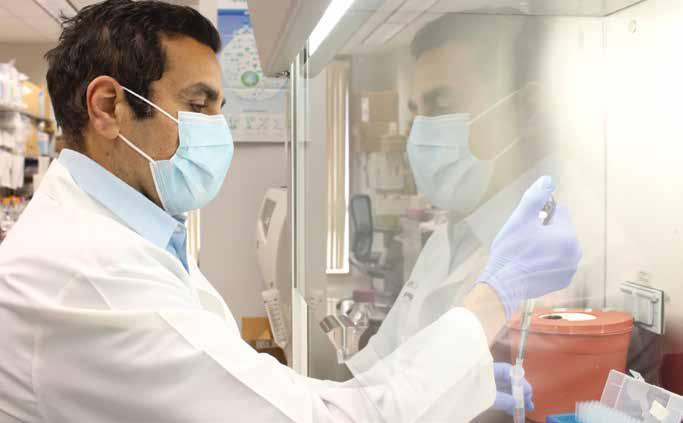
The California Institute for Regenerative Medicine has awarded $9 million to Loma Linda University Health to create a Community Care Center of Excellence (CCCE) in the Inland Empire and desert region. This Center of Excellence is led by Hisham Abdel-Azim, MD, MS, division chief of Transplant and Cell Therapy/ Hematological Malignancies.
The CCCE program is the first of its kind designed to make regenerative medicine clinical trials and treatments accessible for Californians. “This funding ensures underserved populations will have local access to cutting-edge cell, gene, and regenerative medicine therapies, such as CAR T cell therapy,” Abdel-Azim said. Grant funding will also support a state-of-the-art transplant and cell therapy Good Manufacturing Practices lab that not only serves cancer patients but extends to other non-malignant diseases such as neurological and immune disorders. The lab will allow for onsite cell manufacturing capacity and build a robust team to offer cutting-edge treatments and trials for a wide range of conditions, including
cancers, sickle cell disease, and various neurological and immune disorders.
“We now have the ability to join forces with academic and industry experts to bring world-class technologies directly to the underserved Inland Empire and desert region patients,” Abdel-Azim said. “We're changing the way we do medicine in collaboration with our colleagues in neurology and neurosurgery among various other specialties.”
Loma Linda University Transplant and Cellular Therapy is the only program in the region accredited by the Foundation for the Accreditation of Cellular Therapy, making Loma Linda University Health the only center in the vast Inland Empire geographic region offering these advanced, personalized therapies for adults and children.
Loma Linda University Health is the first and only provider in the Inland Empire and desert region offering cell, gene, and regenerative medicine therapy for both children and adults.
By Briana Pastorino
See the latest news and Health & Wellness stories from Loma Linda University Health at news.llu.edu.
Charlie: The Aviation Program’s New Vessel for Service and Mission
Pacific Union College’s aviation program eagerly awaits the arrival of Charlie, the longest-serving aircraft for the Seventh-day Adventist church in the South Pacific and possibly globally.
This Cessna 206 has served in some of the most remote and challenging corners of the world since it was brand new in 1976. Now, PUC anticipates that a fully refurbished aircraft will continue to serve locally and further afield.
The first Adventist plane to serve in Papua New Guinea (PNG) was referred to as P2-SDA, with P2 being the country code for PNG. Because the aviation world uses the ICAO phonetic alphabet, pilots refer to Alpha for A, Bravo for B, and Charlie for C. When it came time for the third airplane in the series, P2SDC, to be registered, it was affectionately nicknamed “Charlie” for short.
Charlie’s story is one that is very special to the people of Papua New Guinea, Australia, and Vanuatu, considering its 50 years of faithful service to the church and community there. Accumulating nearly 4 million kilometers (2.4 million miles) and witnessing
the establishment of over 1,000 churches, Charlie has transported thousands of pastors, missionaries, laymen, and building materials to remote areas to construct churches, schools, and clinics. It also carried hundreds of doctors, nurses, and teachers to serve isolated and underprivileged people, including mothers and children of all ages, in underserved communities.
This aircraft has loyally served in its own ministry through the Adventist church, contributing to the church arguably more than any other aircraft worldwide. It has also trained many young pilots to safely navigate challenging terrain, weather conditions, and airstrips. Pastor Roger Millist, former CEO and chief pilot for Adventist Aviation Services PNG, along with other pilots, has testified that God used, blessed, and guarded this aircraft, especially with the difficult airstrips and challenging weather conditions it encountered. Charlie remained within God’s hedge of protection as it continued to support medical clinics, transport critically sick patients to hospitals, and aid in the establishment of Adventist churches and clinics in rural villages along the way.
Charlie is now ready for a new role. At PUC, Charlie will provide technically advanced training for pilot certification and will open opportunities for service projects and recurrency training for pilots already serving in humanitarian roles. The aviation program has innovative dreams for Charlie and how this special aircraft will inspire youth and veterans alike, cherishing a vision that wholeheartedly dedicates and honors service to Jesus Christ.
By Marina Maher
Salt Lake City Area Youth and Young Adult Candlelight Service
The West Jordan church in Salt Lake City, UT, had the privilege of hosting an Adventist Youth (AY) candlelight service for young adults, bringing together multiple churches from across the area for an evening of worship and community. The space was decorated with candlelight at the front, creating a warm and inviting atmosphere. The evening included beautiful worship led by the West Jordan Worship Collective and a special solo by one of our young adults, Sophia Borba, both of which helped set a meaningful tone for the night.
Pastor Serrano led the service, titled “Why Do I Need Jesus?” Centered on the theme of living for Christ, it encouraged young adults to reflect on how faith shapes everyday life and what that looks like. The program created space for engagement, reflection, and connection, allowing attendees to feel both welcomed
and spiritually encouraged as they began the new year.
After the service, everyone enjoyed fellowship, games, and delicious food that had been generously prepared by friends from the Provo church. This candlelight AY event was a fun and refreshing way to start the year, and it highlighted the power of young adult ministries. Gatherings like these strengthen relationships across churches and positively impact the young adult community in Utah by creating intentional spaces for faith, unity, and genuine connection.
We look forward to hosting more gatherings like this in the coming year as we continue building community, strengthening faith, and creating meaningful spaces for young adults throughout the Salt Lake area.
By Jocelyn Lujan
Growing Faithful Stewards of Jesus
The Nevada-Utah Conference recently hosted the “Growing Faithful Stewards of Jesus” Stewardship Council Leadership Training, bringing together pastors, elders, and stewardship leaders for a focused time of reflection and instruction on biblical stewardship.
Pastor Rudy Salazar, North American Division associate director of Stewardship Ministries, emphasized that stewardship begins with recognizing God as Creator and Owner of all things. From Creation to redemption, God gets real in His relationship with humanity. Citing
Abraham’s tithe in Genesis 14 and Job’s declaration that everything comes from God (Job 1:21), Pastor Salazar reminded leaders that tithe and stewardship acknowledge God’s authority and love. “The whole purpose of stewardship,” he noted, “is so we can preach the gospel.”
Pastor Elias Ivan Marrero, of Abundant Grace ministry, focused on the stewardship of time, drawing from Psalm 90:12 and Psalm 139:16. Time, he explained, is life itself and must be intentionally managed. Because our days can be measured, they can also be improved. Scripture reminds us that we will give an account to God for how we lived while we had opportunity (2 Corinthians 5:10).
The training concluded with a call to intentional growth, wise investment, and faithful living. Stewardship, leaders were reminded, is discipleship in action— managing every gift God has entrusted to us for His glory and the advancement of the gospel.
By Michael Jenkins Jr.
Building Organizational Health to Advance the 2027 Vision
In January, 32 pastors, educators, and administrators gathered at the Northern California Conference (NCC) office in Roseville for a full day of organizational health training. The purpose was to equip trainees as organizational health consultants, prepared to guide leadership teams across the conference toward greater clarity, alignment, and effectiveness. Focus areas included clarifying priorities, building trust, aligning efforts, and establishing consistent meeting rhythms. Trainees were also introduced to concepts from The Working Genius framework, learning how to help leaders contribute to areas that energize them and complement team strengths—enabling teams to operate with greater energy, creativity, and results.
This training directly supports the NCC’s 2027 mission goal of embedding organizational health in at least 51% of churches, schools, and ministries, ensuring
that healthy leadership practices become standard across the conference. Healthy leadership teams strengthen community initiatives, enhance employee and member engagement, and support church and school growth, ensuring ministries operate with clarity and purpose. By developing consultants from within, these practices are embedded into everyday leadership life, creating a shared language and consistent approach across the conference.
For the last five years, the conference has been on an intentional path to clarity in our ministries. Through prayer and disciplined effort, the NCC has laid the groundwork for a future marked by alignment, trust, and shared commitment to mission. This intentional approach is referred to as the NCC Advantage.
By Ken Miller
The 20% Growth Sabbath
In November, the Dobbins church experienced a remarkable 20% growth! Lay Pastor John Fleming baptized six new members. For a small congregation, this increase was especially meaningful— but the truth is, many of these newcomers already felt like part of the Dobbins church family, just as countless non-members who regularly attend do.
That welcoming spirit is what first drew Maggie Jackson to the church one Sabbath in the fall of 2023. Raised in the Seventh Day Church of God, Maggie had drifted away for a time, and years later she was searching for a church home. “From the moment I walked through the doors, I was welcomed with genuine love,” she recalled. Ronda and Jerry Charlton
had a similar experience, sharing. “We are both very blessed to be members of the Dobbins church. My husband and I were both baptized, renewing our relationship with God,”
For some, the journey into the Dobbins family began with Wednesday Bible study rather than Sabbath worship. Fleming leads this weekly study, serving a meal beforehand to nourish both body and spirit. Two of the newest members have been
instrumental in preparing these delicious meals, leading to engaging Bible discussions.
The Dobbins church continues to be a place of welcome for all. Whether you’re traveling through the Yuba County foothills on a Wednesday evening or a Sabbath morning, everybody is invited to join in study, fellowship, and food.
By Susan Fleming
Chili Is Community Relevant
In December, Oakland Market Street church (MSC) stepped beyond its walls to serve the Oakland community through a “Pop-Up Pot of Chili” outreach.
Following the church’s year-end Communion Service, members gathered that afternoon to prepare and distribute 100 bags filled with winter essentials and hygiene items. In addition, volunteers joyfully served more than 100 bowls of hot homemade chili—offering comfort, nourishment, and connection on a cold winter day. Senior Pastor Edwin Brown reflected on the experience, saying, “Though it was a cold day, the gratitude and smiles of those receiving a cup of hot chili filled me with exhilaration and joy. The volunteers were cheerful and seemingly unaware of the cold. Serving the people invigorated them as well. I felt like our church’s
mission theme song— ‘Outside These Walls’—was being fulfilled right before my eyes.”
Stephanie Jolliff, MSC community service director, added, “A bowl of chili may warm the body, but kindness warms the heart. We serve our community to remind every person that they are seen, valued, and loved. The chili was delicious, people were happy, and many wanted to know who we were. That’s mission at its finest hour.”
Through simple acts of service and engaged members, Market Street church continues to demonstrate community relevance—meeting real needs, building trust, and reflecting Christ’s love in tangible ways where it matters most.
By Keith Henry
NCC Opens New Media Resource Center
Recently, NCC Executive Secretary José Marin unveiled the new NCC Media Resource Center with a ribbon-cutting ceremony and walkthrough.
The center was constructed on the lower floor of the Roseville administration building, where the former mail and copy room had been located. Marin explained, “This resource center will be a production tool to serve our churches, schools, and ministries, where the next level of equipment and production is available for use and instruction.” He noted that the facility has already been used, providing a set for the annual Ten Days of Prayer, videos for conference directors and constituency meeting productions, and Culture of Generosity training videos sponsored by The Center for Community Change at Andrews University. All productions are available on the NCC website.
Studio usage is managed by the Communication and Development Department. Laurie Trujillo,
director, shared, “We have established a usage policy, and the studio is fully equipped with three cameras, a teleprompter, adjustable lighting, and an Apple computer with a large cinema display running professional-grade software. We’re very happy to have a space like this available—one that empowers our teams to tell stories with excellence, clarity, and purpose and to share the hope of our mission in ways that are creative, compelling, and impactful.” The space also contains three different backdrops to accommodate a variety of recording needs: a podcast/ interview setting, a more formal look for programstyle productions, and a youthful corner for informal presentations.
Trujillo concluded, “We encourage pastors, teachers, and presenters to utilize this modern and helpful tool for sharing the abundant life found in Jesus Christ and preparing people for His soon return.”
By Ken Miller
Stronger Pastors, Stronger Mission
In January, pastors came together at Gracepoint church for their annual business meeting—a time set aside for learning, alignment, and connection.
The gathering provided policy updates, moments of inspiration, and dedicated Q&A sessions with leaders from various administrative departments. Some of the topics covered were practical and necessary, including employment matters, hiring, administrative processes, and even routine but important details like expense reimbursement. The event also offered pastors a forum to share with administrators the everyday challenges they face, giving leaders better perspective on the realities of leading and pastoring in their communities.
Jim Lorenz, ministerial director, highlighted the value of these gatherings: “One developmental aspect we intentionally address is adding to a pastor’s professional toolbox with new or improved skills. There is also the communicational part, where different initiatives can be discussed and clarity can be gained, and lastly, there is
the camaraderie of colleagues who might not get to see each other very often.”
Interacting in a setting like this strives to build a stronger, more unified team, better equipped to spread the love of Jesus Christ and navigate the challenges and joys of ministry together.
By Ken Miller
All for His Glory: Emerson Bolivar Ordained
Igrew up surrounded by mission mentality,” said Emerson Bolivar, manager of Mission Integration and Spiritual Care at Dignity Health San Bernardino Community Hospital. His family is made up of physicians and ministers, and Bolivar spent many hours helping his parents with health clinics, making food baskets, and ministering through music. “Ministry followed me, but I didn’t realize it was what God wanted me to do until my senior year of high school.”
At that time, Bolivar recalls, he was really struggling to figure out who he was and who he was going to be. God led him to Puerto Rico, where he earned his bachelor’s degree from Antillean University while serving as pastor of the local English church.
A mission trip to Costa Rica left Bolivar wondering if he was meant to go into ministry, so he decided to test God. “I told Him if someone I knew asked me to preach, I’d know the answer was yes,” he explained. “Not too
long after, one of my best friends asked me to preach. I’ve been in ministry since that moment.”
After finishing his studies in 2020, Bolivar served for four years at La Sierra Spanish church. In 2024, he transitioned into chaplaincy at the Community Hospital. In January, Bolivar was one of only a few chaplains to be ordained in the Adventist Church thus far.
“Chaplaincy is a rather new field compared to other professions, and they have traditionally not been ordained,” Bolivar said. “People are really starting to recognize that although we have two different titles, pastors and chaplains are in the same ministry with the same mission, vision, and goal of leading others to Christ and spreading His healing ministry.”
Bolivar says he loves healthcare ministry for the opportunity to meet people from all different walks of life, and he’s drawn to the creative ways one preaches the gospel in a space where sermons aren’t an option. “You preach by showing them love,” he said. “Through the darkest times of their lives, we show people compassion, sincerity, and humility. That’s our ministry.”
In addition to his work at the hospital, Bolivar continues to serve as co-director of the Pathfinder Master Guides at church. One thing that made his ordination so special was the entire Pathfinder club showing up to support him. He was also thrilled to see his entire family in attendance as he stood on the platform with his wife of one year by his side.
“It was such a special occasion,” he said. “It was a confirmation of the call God gave me when I was 17 years old—a call I will continue to follow, whether it’s in church or healthcare, because it’s all for His glory to bring others to Christ.”
By Becky St. Clair
LEFT: Penick leads the prayer of ordination over Bolivar. RIGHT: Angela Li, North American Division associate director for Adventist Chaplaincy Services, presents gifts to the Bolivars.
SECC Ministerial Director Will Penick reads through the ordination charge. “
Reimagining the Hymn: A Night of Gospel Jazz
Hymns & Harmonies, held on Jan. 23 at the Fontana–Juniper church, offered a powerful evening of worship and musical artistry, reimagining timeless gospel hymns through the rich textures and expressive freedom of live jazz. More than a concert, the event created a sacred space for spiritual reflection, creative expression, and heartfelt praise.
Presented by the Lesly Juniper Jazz Ensemble, the night featured a live gospel jazz ensemble, guest vocalists and musicians, and familiar hymns transformed with fresh harmonies and rhythmic depth. Each arrangement honored the original message of the hymn while inviting listeners to experience it in a new and meaningful way. Light refreshments followed the program, allowing guests to linger in fellowship and conversation. Event organizer and bassist Lesly Valbrun shared that Hymns & Harmonies first began in 2011 with a clear vision: “To worship God with our instruments—to reframe and remap the hymns and allow them to speak in a different voice while staying true to the original.”
For Valbrun, worship through music is deeply personal. “Music expresses what I can’t always put into words,” he explained. “When I hit a note, God understands what I’m saying.” He described gospel jazz as both a creative and spiritual art form, one that allows freedom of expression while remaining unified in purpose. “What could sound like chaos individually becomes beautiful harmony when it’s done together for God’s glory,” he said.
Pianist Gershom Byass, who performed on keyboards, described the evening in one word: Praise. One musical moment he was especially excited for audiences to hear was the arrangement of “All Creatures,” noting its compelling melody and thoughtful interpretation. “It was all about giving God the glory,” Byass shared. “Using our talents to honor Him.”
Valbrun hopes guests left with more than an emotional experience. “We want it to be something of substance,” he said, “that people walk away knowing God loves them and that there is a blessed hope.”
Hymns & Harmonies served as a reminder that worship, expressed through music, has the power to uplift hearts and draw people closer to God.
By Jordyn Wright
Band members from left to right: Gershom Byass, Elijah Nunez, Sean Monsalvé, Lesly Valbrun, and Jeffrey Davis.
The band tunes up before the night begins.
Bible Camp 2026: Living Their “True Story”
From Jan. 29-31, junior and senior students from 11 academies gathered at Pine Springs Ranch for another Junior/Senior Bible Camp retreat. This annual event, hosted by the SECC Office of Education, placed “True Story,” as the central theme. The weekend invited students to reflect on God’s presence in their lives while growing spiritually, building meaningful relationships, and stepping into leadership alongside peers from other schools.
Worship played a central role throughout the camp. Robinson Massey, music coordinator for the event, shared that the goal was not simply musical excellence but helping students understand worship as both a relationship and a ministry. “Worship is connection with God—and leading
worship is facilitating that connection for others,” he said. Student musicians spent long hours rehearsing, reflecting on lyrics, and learning how to express faith through their individual roles authentically and vulnerably. The weekend also featured keynote speaker Jonathan Henderson, lead pastor of Vallejo Drive church, who encouraged students to embrace their personal faith journeys and recognize how God is actively working within their stories. La Sierra University church Youth Pastor Ben Amoah, who assisted with family group leader training, noted that one of the most powerful aspects of the weekend was seeing students take ownership of their gifts. “They stepped into leadership—guided deep conversations and supported one another,” he stated. Amoah emphasized that Bible camp is meant to be a starting point that encourages students to carry their faith into everyday life at school and at home.
Students echoed this sense of connection and growth. Grace, a senior and family group leader from Newbury Park Adventist Academy, shared that her favorite part of the weekend was “meeting new people and creating new connections.” Jared, an 11th-grader from San Fernando Valley Academy, reflected on how worship deepened his personal relationship with God. As students returned home, leaders expressed hope that the spiritual momentum of the weekend would continue, empowering students to lead, pray, worship, and live out their “true story” long after camp ended.
By Jordyn Wright
Student worship leaders lead out.
Two of the many members on the 2026 Bible Camp planning team, Massey and Amoah.
Henderson speaks on the meaning of “true story.”
The Experience: A Day of Faith, Connection, and Growth
On Sabbath afternoon, Jan. 24, the Southeastern California Conference (SECC) youth department hosted The Experience, a middle school youth event, at the Loma Linda University church (LLUC). This marked the fifth consecutive year the conference has hosted the event.
The one-day event ran from 3:00 to 9:00 p.m., beginning with registration and followed by icebreakers led by Aren Rennacker, director of Growing Young Leaders. The evening included a series of general sessions, beginning with worship led by Cameron Jordan and his band, with LLUC pastors Luke Steen and Miguel Verazas serving as emcees. The evening featured keynote speaker Pastor Somer Knight. Following the first general session, students participated in breakout sessions. Alexy Mondak, youth department assistant director for summer camp, explained that students did not choose their breakout sessions. Instead, they rotated through all five sessions so each student could participate in every breakout.
After the breakout sessions and dinner, students returned for the final general session. Prior to this session, a special segment called “Parent Connect” was held. This segment included the youth director and other pastors who engaged with parents, distributed informational materials, and discussed what students had learned throughout the day. Parent Connect was designed to equip parents with questions, tools, and conversation starters so they could continue engaging with their children after The Experience concluded.
The theme for the event centered on the idea of “gathering around the table,” emphasizing what it looks like to make room for others, show compassion, and practice inclusion and hospitality. Students were encouraged to learn how to celebrate one another in both large and small ways, navigate big emotions, and interact with peers in an equitable and faith-centered manner.
One of the most interactive elements of the event was a jiu-jitsu class, which helped students learn how to process and manage big emotions healthily. Mondak noted that events like The Experience are especially significant because—while many programs exist for elementary students, high school students, and young adults—seventh- and eighth-grade students often have fewer opportunities specifically designed for their developmental stage. These years are pivotal, and tailored programming helps support students as they grow and mature.
This year, The Experience impacted more than 130 students, equipping them not only to encounter Christ themselves but also to become a catalyst for others to do the same.
By Ezrica Bennett
Students worship together in fellowship.
LEFT: Rennacker leads students in an icebreaker activity. RIGHT: High school student volunteers welcome junior high students.
Introducing SCC Department of Education: A New Team Is Energized for Mission
In July 2025, when James P. Willis II, then SCC vice president for education, and Nancy Garcilazo, then SCC associate superintendent, moved on to new endeavors, it was only a few months into Wayne Dunbar’s tenure as associate superintendent. Dunbar had recently joined the SCC education team from La Sierra University, where he had served as the vice president for strategic engagement, enrollment, and marketing. Dunbar, although new to the department, was soon invited to fill the vice president of education role.
Meanwhile, his and Garcilazo’s transitions had created vacancies in the associate superintendent positions, so as he settled into his new position, his first task was to build
“Just to be a teacher is difficult enough, but to be a teaching principal…there are so many demands. What I’m really enjoying is just to be that support for them and help them excel and do what they do.”
Angel Nair
PHOTO: LAUREN LACSON
The SCC office of education team (left to right): Mary Greene, Wayne Dunbar, Angel Nair, and Nelly Martin.
“As I looked at this position, I thought to myself, ‘If I had someone like this when I was a business manager, my life would have been so much easier.’”
Mary Greene
a team—and the start of the school year was getting closer and closer. He was blessed to welcome Angel Nair and Mary Greene to the team later that summer. Now, Dunbar, Nair, and Greene share oversight of the SCC schools, with each of them assigned to a group of the schools for more hands-on support.
Nair stepped into the associate superintendent role with more than 36 years serving in various roles as teacher, principal, and teaching principal. “Just to be a teacher is difficult enough, but to be a teaching principal—all my schools have teaching principals— there are so many demands,” she said, noting times where it can feel like the principal is wearing all the hats, tending to emergencies at the facility (no matter what time of day or night they happen), visiting family members of students in the hospital, and so much more.
When asked what she most enjoys about her role, she spoke about streamlining the information principals need, making sure they are well equipped to meet important regulations and protocols, and giving guidance and moral support. “What I’m really enjoying is just to be that support for them and help them excel and do what they do,” she said.
Greene brings a finance background to the new associate superintendent for school finance role, and she’s eager to continue enriching her education background. While she previously served in various roles including public accounting and auditing, her experience on the education side comes from five years serving as the business manager at Oakwood Academy.
“As I looked at this position, I thought to myself, ‘If I had someone like this when I was a business manager, my life would have been so much easier,’” Greene shared. “So being on this side of it, being able to pour into the business managers, understanding what they’re going through and the struggles that they’re having, I wanted to be able to be that support for them.”
As Dunbar, Nair, and Greene visit with the principals and business managers and support their work at the local schools, Nelly Martin keeps business running at the office. Martin is the registrar and executive assistant to the vice president of education. Having served in
the department since December 2018, her historical knowledge of SCC schools is invaluable. “She’s the glue that keeps us together,” Dunbar said. “She helps us maintain a bigger picture of the collective.” She supervises important processes on behalf of the schools, like setting up the schools in the system to facilitate their standardized MAP testing and much more.
The core purpose of the department is to support teachers, principals, and school boards. “The people we meet with most often are principals, so any opportunity to help them and facilitate them doing their job better, differently, or having them think about it differently is what we aim to do and certainly from a biblical Adventist Christian perspective,” Dunbar said.
When asked what makes our schools special, Greene said it’s “the love that our teachers have for our students. I can see the sacrifices that our teachers and principals are making. With my kids, when I know that the teacher loves them, then I know that they’re in a safe place, and I know that they’ll get what they need academically.”
“You go to all of our schools and people say it feels like a family,” Nair added. “There’s caring, there’s nurturing, there’s that push to help people to excel. I think they just reflect what’s great about God’s character and presence. You just sense that in our schools, and I think that’s what our schools are about, because if they reflect Christ, they’re going to reflect quality in all areas—physically, emotionally, spiritually, academically, mentally. That’s what I find on our campuses. The research shows our students excel beyond what they’re predicted to do, and that’s the God factor.”
Dunbar sees value in the often-recognized small class sizes, Christian teachers, lifelong friendships, and our denomination-wide Adventist education system that provides structure and support.
“Beyond these features, our schools ultimately exist to introduce students to Jesus,” Dunbar pointed out. “I don’t think anything will grab and hold a kid more than having their own experience with Him.”
By Lauren Lacson
“Our schools ultimately exist to introduce students to Jesus.”
Wayne Dunbar
Glendale City Church Celebrates 120 Years of Faith, Community, and Service
This January marked a significant milestone for the Glendale City church (GCC) as it celebrated 120 years of faith, community, and service. The two-day celebration highlighted its rich history, commitment to Christ, creative ministry, and love for the community.
In January 1906, a group of people met in the parlor of the Glendale Sanitarium (now Adventist Health Glendale) to organize the first Adventist church in Glendale. After meeting for several years, a church building was purchased in 1911 located on the corner of Wilson Ave. and Isabel St. Due to rapid growth, the church moved one block to its present and expanded location on the corner of Isabel St. and California Ave.
In January 1930, a fire destroyed this building, but members worked quickly to have the structure rebuilt for $69,000. Amid the Great Depression, the new building was dedicated two years later in 1932.
Throughout the past 12 decades, the church has become known to the city as a welcoming place for
worship and community care. GCC has advocated for the arts, families, social justice reforms, and more. Through partnerships with organizations in the city and beyond, the church lives out its mission to “reveal the love of Christ in all its tenderness and grandeur to the community in which we live.”
Celebrations began Friday night with a contemporary worship service in the chapel with guest speaker Pastor Andy Palomares. Sabbath morning started with breakfast in the courtyard, followed by a lecture on the history of Glendale City church presented by Michael Scofield, assistant clinical professor, school of nursing at Loma Linda University.
“We are not celebrating this 120th anniversary in a vacuum; we are celebrating this in a very particular time in the history of our city and our country where we find ourselves being pulled in different directions,” said GCC Senior Pastor Uriel Herinirina. In his message, taken from Deuteronomy 30, he encouraged the congregation to “choose life—shaped by divine presence and divine guidance that generates more life for others. We know that it’s the only way that we can continue to be a church that represents what God is doing in this world.” The service reflected its tradition of music performance by featuring the GCC choir and flutist Kathy Marsh, who is a regular performer at the noon concert series the church holds every first and third Wednesday of the month in the sanctuary. The day concluded with an afternoon lunch, an organ concert by Kemp Smeal, the church’s organist for more than 25 years, and a look toward the future.
By Araya Moss
LEFT: Members and friends pose for an annual group photo on the steps outside of the church. RIGHT: The officers of the Southern California Conference (SCC) shared a congratulatory letter and gifted the congregation with $5,000. From left to right: John H. Cress, SCC president; Senior Pastor Uriel Herinirina; Brett Poynter, SCC Los Angeles Metro Region director; Danny Chan, SCC executive secretary; and Kathleen V. Diaz, SCC treasurer/CFO.
PHOTO: DYLAN SNYDER
PHOTO: ARAYA MOSS
Senior Pastor Uriel Herinirina preached from Deuteronomy 30, urging the church to “choose life.”
PHOTO: ARAYA
SCC Hispanic Women’s Ministries: Empowering Women in Mission
The Hispanic Women’s Ministries of the Southern California Conference will commemorate its 36th anniversary, marking more than three decades of dedicated service. Throughout these years, the ministry has consistently advanced its mission to nurture, encourage, support, and equip women as they follow Jesus and share Him with others, through structured training, leadership development, retreats, and conferences.
The theme for this year, “A Woman With Purpose in Her Mission,” emphasizes the exaltation of Jesus Christ by equipping women to identify and exercise
their leadership and ministry roles within the home, the church, and the broader community.
This year, the ministry will prioritize collaboration with local directors and leaders, providing intentional training and guidance to foster active participation in the church’s mission. The focus will be on service characterized by commitment, unity, and a strong missionary spirit. Through these efforts, the ministry seeks to support, encourage, and challenge Adventist women in their spiritual growth as disciples of Jesus Christ and as members of the global church.
The spiritual retreat at Pine Springs Ranch, scheduled for May 29-31, will feature three keynote speakers who will address the mission to which women are called at various stages of life. The registration fee is $210, with a deadline of May 1, or earlier if capacity is reached.
Beyond the retreat, the ministry will continue to provide individualized support and training for local directors during their local meetings, promote Women’s Ministries emphasis days, and coordinate an evangelistic outreach initiative in November. These activities will culminate in the 36th anniversary celebration and the seventh Women’s Ministries Congress, to be held on Dec. 5, 2026.
Women gather at the 2025 congress at Pine Springs Ranch.
Left to right: (back row) Emily Coronel, Letty Milan, Blanca Espinoza, Cristy Rodas, Delia Galindo, Lucy Benitez; (front row) Karla Cota, treasurer; Montse Huerta-Rivera, director; Rocio Santos, associate director; and Marlene Quintanilla, secretary.
Advertising
Advertising is accepted as a service to Seventh-day Adventist church members in the Pacific Union. The Recorder management reserves the right to refuse any advertisement, especially ads not related to the needs and practices of the church membership. Acceptance of any advertising shall be considered a matter of accommodation and not a matter of right, nor shall it be construed to constitute approval of the product or service advertised.
Payment in advance must accompany all classified advertisements or they will not be published. Display ads for known advertisers will be billed.
How to Submit Advertising
Classified ads must be sent with payment to the Recorder office. Display ads should be arranged with the editor (recorder@adventistfaith.com).
Classified Rates
$70 for 50 words; 75 cents each additional word. Display rates (full color only): back cover, $4,200; full page, $3,800; 1/2-pg., $2,200; 1/4-pg., $1,200; 1/8-pg., $700; $160 per column inch.
Information
The Pacific Union Recorder is published 12 times per year with a circulation of approximately 75,000. For more information about advertising, please email to recorder@adventistfaith.com.
Upcoming Deadlines
These are the advertising deadlines for the Recorder Your local conference news deadlines will be earlier. April: March 2 • May: April 2
Contributions
The Recorder pages are assigned to the local conferences, colleges, and healthcare institutions, and all content comes through the communication departments in those organizations. If you have a news story/idea, calendar announcement, etc., please contact your local communication department. See the masthead for contact information. Want tips for writing for us? See www.dailywritingtips.com/the-artof-writing-news.
Recorder Membership
The Pacific Union Recorder is provided as a free service to members of the conferences that are part of the Pacific Union Conference (Arizona, Hawaii, Northern California, Central California, Southern California, Southeastern California, and Nevada-Utah). Each conference maintains the list of members, based on the reports from their churches. If you would like to make a change to your subscription (name, address, cancellation), please contact your local conference. The staff of the Recorder does not have access to the circulation lists, other than the paid subscriptions.
Calendar
La Sierra University
The Prince of Egypt. The Department of Music presents “The Prince of Egypt” in two shows, Sat., March 7 at 7 p.m. and Sun., March 8 at 3 p.m. at Hole Memorial Auditorium. The production showcases student musicians and the La Sierra University Orchestra. Producer, Raejin Lee. Tickets: https:// music-events.lasierra.edu. Information: 951-785-2036, music@lasierra.edu.
Brandstater Gallery: John Divola. Brandstater Gallery presents the work of Riverside, CA, artist John Divola in an exhibit running through March 19. Gallery hours are Mon.-Thurs., noon-5 p.m. Admission is free. For information, contact tmusso@lasierra.edu.
Pacific Union College
Visual Arts Faculty Exhibition Opening. On April 11 from 6-8 p.m., the Visual Arts faculty from PUC will feature their work during this exhibition.
Homecoming, April 17-18. Homecoming is a wonderful opportunity for PUC alumni and friends to reconnect and reminisce about their time at PUC. Visit puc.edu/homecoming for information and registration. We hope to see you on campus.
Air Expo, April 19. PUC will host its Air Expo at the Angwin Airport on Sun., April 19. Admission is free, and attendees can view planes, helicopters, and firetrucks. Food and treats are available for purchase, and plane rides with instructors will be available at a low cost. All are welcome to partake in this fun event.
Connect Ministries is a group of Pacific Union College students passionate about Jesus and sharing through music and worship. The bilingual team leads worship services, retreats, youth events, and any programs where they can inspire other young people to become worship leaders. Any school or church interested in having them visit, please email connectministries@ puc.edu.
Add PUC News in Your Church Bulletin. With many updates to share at Pacific Union College, we designed a printable bulletin insert for churches to use. Just print the PDF double sided and cut in half, then include as a bulletin insert. Download at puc.edu/ bulletin.
Subscribe to the PUC Now Newsletter. Stay up to date with Pacific Union College by subscribing to their monthly newsletter at puc.edu/subscribe. From campus stories and alumni features to student interviews, you’ll be in the now with PUC.
The quadrennial Constituent membership of La Sierra University will convene on the campus of La Sierra University at Hole Memorial Auditorium, 4500 Riverwalk Parkway, Riverside, CA, on Wednesday, May 13, 2026, at 1 p.m.
The purpose of the meeting is to (1) receive reports from the University and its auditor, (2) to amend the Bylaws, (3) to appoint Trustees as specified by the Bylaws, and (4) to transact other business as may be submitted by the Board of Trustees.
Bradford
C. Newton,
Chair Christon Arthur, Secretary
Classified Employment
Camp Cedar Falls is hiring! Live and work in God’s beautiful nature. Positions available include: Camp Ranger/Custodial and Camp Ranger/Maintenance. Opportunities available to singles, couples, and families. To learn more or apply, visit https://scc.adventist. org/departments-ministries/human-resources/jobopenings. For questions, call Camp Cedar Falls at 909805-4104.
Pacific Union College seeks a skilled Certified Electrician with expertise in Medium Voltage Systems to join our team. C10 Contractors License or California Fire Alarm Installation Certification required as well. This role requires a strong understanding of electrical codes, safety protocols, and hands-on experience in industrial or commercial settings. https://www.puc.edu/campusservices/human-resources/careers/electrician. Email hr@puc.edu, 707-965-6231.
Pacific Union College seeks dedicated Executive Director to lead Human Resources operations and strategy and oversee well-being and development of talented team members. Strong leadership, communication, and organizational skills are essential. https://sdawest.pub/job_posting. Email hr@puc.edu, 707-965-6231.
Pacific Union College seeks qualified candidates to fill open positions in fulfilling our mission to Learn with Purpose, Rise in Faith, and Serve in Love. Beautiful mountain campus, minutes to shopping, an hour+ drive of ocean and skiing. Current openings at https:// sdawest.pub/candidates.
Live-in companion in Madera, CA. Seeking an SDA woman to share home with a mostly independent elderly woman. Evenings/overnight preferred; minimal assistance, presence in the home. Must be reliable, kind, and comfortable with one gentle, mostly outdoor cat. Room and board plus stipend provided. Email ayomoon@gmail.com with references and brief bio.
Free rent in Henderson, NV. One bedroom/living room, snack kitchen casita in exchange for helping widow with managing household three hours per day. Owner travels. Need single person who can help with various duties. Live in guard-gated community, fabulous situation in estate home. Call Myrna at 310-613-9549.
Discover Life
Church and Mother Lode Junior Academy are seeking a regular part-time Maintenance Director to provide oversight of grounds and facilities. This role includes supervising volunteers and contractors, performing basic maintenance as needed, and supporting long-term facility care. Experience in maintenance, grounds, or facilities management preferred. For more information or to apply, please contact the church office at 209-532-3337 or office@ discoverlifesonora.org.
Real Estate
PUC commercial space for rent. Pacific Union College has commercial real estate space available for lease. The spaces are in various sizes and functionality and are available for inquiries. For additional information, please email Sam Heier at sheier@puc.edu.
California Adventist Federal Credit Union
YOUR “ONE STOP FINANCE SHOP”
Serving our Adventist Community for over 68 years with financial products and services, along with wealth building education.
Please visit our website for updates on all that CAFCU has to offer. Call our office and speak to our friendly staff or manager for more information.
Cottage for rent. Are you looking for serenity and peace? Then this rental is the perfect place for you. A small and private cottage, complete with picket fences and gardens. 1 bedroom, 1.5 bathrooms, skylights, and unique shower. Located in foothills by Collins Lake, CA. Contact John at Mountains. skyz@gmail.com.
NPAA campus home rentals. Low-cost three-bedroom, two-bath home rentals are available on the Newbury Park Academy campus. Temperate climate, clean air; beaches, hiking, small town exploring within minutes. Conference and union employees are eligible to rent at NPAA. For more information on these or other available units, please contact principal@mynpaa.com or treasurer@mynpaa.com.
Summit Ridge Retirement Villages, an Adventist community in a rural setting, offers affordable homes or apartments and caring neighbors, with fellowship you will enjoy. Onsite church, planned activities, and transportation as needed. Onsite Wolfe Living Center offers independent living and nursing homes. Visit SummitRidgeVillage.org or call Bill Norman, 405-2081289.
Country living with contemporary luxury in this newly remodeled 3-bed 2-bath 2700 sf home with open floor plan bathed in natural light with gourmet kitchen,
SS appliances, granite countertops, LVP flooring. A master suite with a large bathroom and shower with a huge walk-in closet. Also a large game room/office, all on a single level. House on 1.6 acres backed by a pond and stream; more acreage available. Any questions or pictures, contact me at ptnbear@gmail.com.
Country living in Northern California: 3-bedroom, 2-bath, newly renovated home for sale on one acre, quiet street 15 minutes from Redding, mature fruit trees, grapevines, 50x80 fenced garden area with small greenhouse, irrigation system, landscaping, 3-car garage, gym, and large 18x30 shop with RV hookups. Call, text 909-735-2745.
Near Pacific Union College, in Pope Valley, CA. Beautiful 3-story, 4 BDRM, 3 full bath home for sale. Downstairs could be apartment. Peaceful, secluded, sits above creek. Own water access. Dock possible. Kayak, swim, picnic, hike. No neighbors either side, rolling hills across. $525,000. See listing: www.listing4. com/1060deputydrive. Kris Chun, Brokerage License 01870237; phone: 707-853-5747.
Southern Oregon, Days Creek, country living: 10-acre property, 4+bdrm, 3.5-bath, 4,000 sq. ft, well with 3,000-gallon tank, septic system, big garden area, grapes and fruit trees, large workshop, greenhouse, woodshed/carport, lots of storage, Adventist schools and church nearby, ideal place for country living or wellness center. Call 541-825-3823, email janmay92@ aol.com.
Off-grid solar, 4+ sloped acres. Shared well, older mobile, 2 bd/1bath with 3 sheds. Near Mexico and Arizona border. God willing, moving overseas. Church with school nearby. Estimated $130K invested. No conventional financing. Cash offers. Much to include. Materials for strong greenhouse. Text, 520-858-6674 message, or email poolman52@hotmail.com.
45-acre retreat estate in Valley, Washington. This 45-acre estate offers a remarkable opportunity for Christian ministry, retreat, or community living. The main residence spans over 15,000 sq. ft. with 10 bedrooms and 11 bathrooms—ideal for hosting church retreats, leadership gatherings, discipleship training, or extended fellowship stays. Amenities include an indoor pool and spa, elevator, multiple family rooms, and spacious common areas designed for rest and renewal. Beyond the home, the property’s 45 acres feature barns, shops, guest quarters, and horse facilities—perfect for outdoor ministry, youth camps, agricultural projects, or creation care programs. Surrounded by serene mountain views, this estate provides a peaceful environment for prayer, worship, and community connection. Offered at $2,300,000. For more information, please contact: Riley Knutson, knutsonrealtor@gmail.com, 509-279-9797;
Outpatient physical therapy and aquatic therapy in the foothills above Sacramento, CA. Turn-key practice, in business for over 30 years. Great referral base and solid practice. Lots of potential for growth. Great opportunity for someone wanting to establish a medical mission outpost or wellness center as well. 5400-sq-ft facility. $450,000. Flexible options to the right party. Contact levi2000@ sbcglobal.net or leave message at 209-304-7455.
Vacation Opportunities
Travel on a faith-based biblical tour to Israel (March 2026) with Dr. Carl Cosaert, Dean of the School of Theology at Walla Walla University. To learn more, visit www.adventtours.org or email info@adventtours.org.
Travel on a William Tyndale Reformation tour , Aug. 26 to Sept. 11, 2026, celebrating the 500th anniversary of the English New Testament with Dr. Carl Cosaert of Walla Walla University. Explore Tyndale’s England, with an optional Germany and Belgium extension. To learn more, visit www.adventtours.org or email info@ adventtours.org.
and awesome kids programs at LifeTalkKids.net, or listen to talk radio at LifeTalk.net. Download our handy free app from LifeTalk.net.
Angwin home. Five-bedroom, three-bathroom vacation home 2 miles from PUC. Fully furnished, large kitchen, dining room, living room, family room, piano, vineyard views, WiFi, washer and dryer, BBQ, sleeps 10. Call for rates, photos and reservations: 415-539-7980 or email nroger1965@gmail.com
Bulletin Board
LifeTalk Radio. Discover stellar faith-building, Biblebased, and Christ-centered radio programs for all ages. LifeTalk Radio streams all music at LifeTalkMusic.net
Authors, transform your manuscript into a globally distributed book. Get free evaluation from trusted SDA publisher (42 years). If accepted, we edit, design, layout, market and distribute worldwide. Submit today: www. teachservices.com. Look for red “Submit Manuscript” button top of homepage. We buy/sell used SDA books www.LNFbooks.com. 706-504-9192.
AdventistDating.com. Looking for meaningful, faithcentered connections? Join AdventistDating.com, where single Seventh-day Adventists meet for friendship,
companionship, and love grounded in shared beliefs. Safe, sincere, and free to join. Start your journey today at AdventistDating.com—where faith meets love!
Country living for students? Check out Milo Adventist Academy in Southern Oregon: miloadventistacademy. com, admissions@miloacademy.org, 541-825-3200.
Hone your fundraising skills at the 2026 Missional Philanthropy Conference at Southern Adventist University in Collegedale, TN, July 14-16. Learn from nationally recognized experts in education, healthcare, corporate foundations, and nonprofit work about how to effectively generate financial support for projects. Earlybird registration is open through April 1 at southern.edu/ philanthropyconference.
Bucky Stone Adventures give your junior high son or daughter the perfect Sabbath afternoon reading treat! Ten sports-themed stories pop with homers and threepoint buzzer beaters, cheating scandals, and meeting new girlfriends on mission trips. Bucky meets every high school challenge with the knowledge that, yeah, he can “do all things through Christ who strengthens me.” Download for just a buck each! Also in print and audio formats. Amazon links at www.davidbsmithbooks.com.
March 2026 Sunset Calendar
City/Location MAR 6 MAR 13 MAR 20 MAR 27
Alturas (Shasta) 6:05 7:13 7:21 7:28
Angwin 6:08 7:15 7:21 7:28
Bakersfield 5:56 7:02 7:07 7:13
Calexico 5:43 6:48 6:53 6:58
Chico 6:05 7:12 7:19 7:26
Death Valley (Furnace Ck) 5:46 6:53 6:59 7:05
Eureka 6:13 7:21 7:28 7:36
Four Corners [E] 6:15 7:21 7:28 7:34
Fresno 5:58 7:04 7:11 7:17
Grand Canyon (South Rim) 6:28 6:34 6:40 6:46
Half Dome 5:56 7:03 7:10 7:16
Hilo 6:27 6:29 6:31 6:33
Holbrook (Sun City) 6:29 6:35 6:40 6:46
Honolulu 6:37 6:40 6:42 6:44
Joshua Tree 5:45 6:51 6:57 7:02
Lake Tahoe 5:58 7:05 7:12 7:18
Las Vegas 5:40 6:46 6:52 6:58
Lodi-Stockton 6:03 7:10 7:17 7:23
Loma Linda 5:49 6:55 7:00 7:06
Los Angeles 5:53 6:59 7:04 7:10
McDermitt [N] 5:47 6:55 7:03 7:11
Moab 6:16 7:23 7:30 7:36
Monterey Bay 6:06 7:13 7:19 7:25
Mt. Whitney 5:49 6:55 7:00 7:05
Napa 6:07 7:14 7:21 7:27
Nogales (Rio Rico) 6:25 6:30 6:35 6:40
Oakland 6:07 7:14 7:21 7:27
Paradise, CA 6:04 7:11 7:18 7:25
Phoenix 6:29 6:34 6:40 6:45
Pu‘uwaiau, Ni’ihau [W] 6:30 6:32 6:34 6:36
Reno 5:57 7:04 7:11 7:18
Riverside 5:50 6:55 7:01 7:06
Sacramento 6:04 7:11 7:18 7:24
Salt Lake City 6:24 7:32 7:39 7:47
San Diego 5:49 6:55 7:00 7:05
San Francisco 6:08 7:15 7:21 7:28
San Jose 6:06 7:13 7:19 7:25
Santa Rosa 6:09 7:16 7:22 7:29
Sunset Beach 6:06 7:13 7:19 7:25
Thousand Oaks 5:55 7:01 7:07 7:12
Tucson 6:25 6:30 6:35 6:40 [N]=Northernmost [S]=Southernmost [E]=Easternmost [W]=Westernmost point in the Pacific Union
“So there remains a Sabbath rest for the people of God.” Hebrews 4:9
At Rest
Banks, Linda – b. Nov. 2, 1947, Loma Linda, CA; d. Dec. 29, 2025, Loma Linda, CA. Linda leaves no immediate family but is lovingly remembered by many dear friends.
Bennet, Marilyn Elaine MacLafferty – b. Oct. 27, 1941, Portland, OR; d. Nov. 9, 2025, National City, CA. Survivors: husband, Harry Bennett Jr; son, Brad; daughter, Bonnie; five grandchildren. She was active in ministry all her life. She was church organist and taught piano and organ for over 60 years.
Bills, Diana – b. Aug. 29, 1948, Reedly, CA; d. Jan. 11, 2026, Loma Linda, CA. Survivors: husband, Brent; children, Randy Bills, Mindy Rendon, Casen Bills; three grandchildren.
Beach, Marilyn Gibbs – b. Feb. 22, 1929, Portland, OR; d. Jan. 9, 2026, Loma Linda, CA. Survivors: sons, Paul, Preston; daughter, Barbara Jean Currier; 10 grandchildren; six great-grandchildren.
Heisler, William – b. Dec. 10, 1933, Seattle, WA; d. Dec. 19, 2025, Chula Vista, CA. Survivors: wife, Patricia; sons, Scott, Barry, Brad; daughter, Susan Lewis; brothers, Robert, Jack; seven grandchildren; three greatgrandchildren. Dr. Heisler graduated from Loma Linda University School of Dentistry, practiced in Oregon and Northern California, served in the army in Germany, and eventually returned to Loma Linda University, where he was a beloved professor of dentistry for many years. He also served as an elder of the Redlands church and was a member of the Redlands Rotary Club, where he initiated humanitarian dental services to the far east of Russia.
Javor, Shirley – b. March 13, 1941, Snohomish, WA; d. Dec. 18, 2025, Loma Linda, CA. Survivors: husband, George; sons, Ron, Ed; brother, Arvid Silcox; three grandchildren.
Larsen, Eugene E. – b. Sept. 4, 1931; d. Nov. 19, 2025. Survivors: sons, Lawrence, Raymond; grandchildren and great-grandchildren. Gene and his wife, Bertie, were married 75 years and lived in Camino, CA. They were apple and pear farmers. Gene was active in the church and community. Gene and Bertie passed away just days apart.
Larsen, Roberta F. – b. July 24, 1930; d. Nov. 6, 2025. Survivors: sons, Lawrence, Raymond; grandchildren and great-grandchildren. Bertie and her husband, Gene, lived their 75 years together in Camino, CA. They were members of the Camino church, where they were active members in many capacities.
Lessard, George – b. Sept. 27, 1939, San Jose, CA; d. Jan. 5, 2026, Loma Linda, CA. Survivor: wife, Joanne.
Mayo, Joyce – b. April 17, 1930, Cuero, TX; d. Dec. 25, 2025, Clovis, CA. Survivors: 13 grandchildren. A gifted cook and baker, Joyce was renowned for her professional catering and hospitality.
Morrison, Eleanor – b. Nov. 16, 1928, Clinton, MA; d. Dec. 15, 2025, Citrus Heights, CA. Survivors: daughters, Lynn Tank, Susan Mallory, Sharyl Tobin; son, Bruce Morrison; seven grandchildren; seven great-grandchildren. Eleanor worked at the General Conference early in her secretarial career and was active in every church where she lived. A member of the Carmichael church since 1972, she served many years as editor of the Clarion and was a church elder, among other positions.
Nicholas, Henry F. – b. Dec. 23, 1927, Pittsburgh, PA; d. Oct. 21, 2025, Apple Valley, CA. Survivors: wife, Gay Nicholas; daughters, Gay Jacobsen, Jeanne Toomey; eight grandchildren. He served as a church elder of the Apple Valley church for 20 years and the Victorville church for over 30 years. He was a Navy veteran and was married for 75 years.
Perez, Angel Uriel – b. Jan. 9, 1939, Guayama, PR; d. Sept. 24, 2025, Yuma, AZ. Survivors: wife, Carol; children, Linda Perez Smith, Ruth Perez Hodge, Allen Perez; eight granddaughters; three great-grandchildren. His son, Angel Perez Jr., passed away 10 days after his father. Angel was an X-ray technologist and served wherever he went as a chorister and deacon in his church.
Perry, Maureen – b. July 21, 1939, Kingsbury, UK; d. Oct. 23, 2025, Sparks, NV. Survivors: son, Nathan; three grandchildren; one great-grandchild.
Petersen, Kari – b. May 22, 1939, Kristiansand, Norway; d. Jan. 7, 2026, Loma Linda, CA. Survivors: children, Anne Petersen, Rie Askari, Kenneth Petersen, Roy Petersen; two grandchildren; siblings, Birger Nielsen, Niels Nielsen.
Poulos, Sophia – b. Sept. 3, 1925, Salinas, CA; d. Dec. 3, 2025, Whittier, CA. Survivors: children, Elaine Poulos Valles, Nicholas Poulos; eight grandchildren; five great-grandchildren. Sophia and her husband Nick served as missionaries to Greece 1950-1958. During this time, she introduced children's Sabbath School classes to all the SDA churches in Greece, and together they pioneered youth camps and Pathfinder Clubs there. She was an active member of every church in which she was a member, as church organist, directing Community Services, teaching healthy cooking and smoking cessation classes. Sophia and her daughter published three mission story books in Sophia's 90s: The Unorthodox Orthodox; Choices: Where He Leads; RX: Laughter.
Ryckman, Joseph – b. Oct. 17, 1951, Loma Linda, CA;
d. Jan. 8, 2026, Cleveland, OH. Survivors: wife, Kathleen; children, Eva Ryckman Durbin, Alexandria Ryckman Harrett, Tatiana Ryckman, Anastacia Ryckman Millikin; sister, Ruby Ryckman; brother, Albert Ryckman; four grandchildren.
Sequeira, Artemisa – b. Nov. 14, 1949; d. Oct. 16, 2022. Survivors: husband, Mario Sequeira; sons, Jorge Saldia, Ivan Saldia; daughter, Brenda Saldia-Trinidad; five grandchildren.
Sheppari, Kathryn – b. Jan. 25, 1934, OK; d. Oct. 17, 2025, Bakersfield, CA. Survivors: daughter, Becky Cox; two great-great-grandchildren.
Soria, Ricardo – b. April 22, 1934, Oaxaca, Mexico; d. Nov. 17, 2025, Visalia, CA. Survivors: wife, Maria; sons, David, Jose, Abraham; four grandchildren; one greatgrandchild.
Spuehler, Gwen Sofie – b. May 10, 1935, French Camp, CA; d. May 4, 2025. Survivors: niece, Pam, and her husband, Art Gaskell; grandniece, Julie and Julie's husband, Jeff. Gwen attended Lodi Academy and earned a history degree from Pacific Union College. Her career included jobs at the Northern California Conference, San Gabriel Academy, and Pacific Union College. She worked for 52 years for the church, with 48 of them being at the PUC Records Office.
Thunquest, Wilfred – b. Sept. 11, 1934, Queens, NY; d. Dec. 1, 2025, Windsor, CO. Survivors: wife, Marilyn; children, Rosy Pauly, Mike Thunquest, Gary Thunquest; nine grandchildren; nine great-grandchildren.
Walters, Richard – b. Feb. 18, 1935, Hillsboro, OR; d. Feb. 7, 2025, Hanford, CA. Survivors: wife, Carol; son, Steve; daughter, Bev; two grandchildren. Richard was drafted into the army and served as a medic and pharmacy tech at the Korean DMZ, 1958-1960. He was a well-respected dentist and church/community worker who served as a deacon for the Hanford English church for 56 years.
Willhelm, Glenn – b. Sept. 27, 1928, Mena, AK; d. Nov. 26, 2025, San Diego, CA. Survivors: daughters, Carol Willhelm, Lisa Cooney; two grandchildren. A graduate of Pacific Union College and Andrews University, Glenn dedicated his career to Adventist education, serving Rio Lindo Adventist Academy and Columbia Union College as accountant and teacher. In retirement, he devoted his many talents to the Prescott church.
Williams, Thomas – b. May 16, 1930, Milwaukee, WI; d. Dec. 4, 2025, Loma Linda, CA. Survivors: children, Teri Williams Muir, Tom Williams, Tonyce Williams Bates; five grandchildren. He and his beloved wife, Audry, were married for 65 years before her passing in 2021.
Find Your Beach The Last Word
By Ray Tetz
“And God said, ‘Let the water under the sky be gathered to one place, and let dry ground appear.’ And it was so. God called the dry ground ‘land,’ and the gathered waters he called ‘seas.’ And God saw that it was good” (Genesis 1:9-10, NIV).
The Amtrak train that runs from San Luis Obispo, through Los Angeles, and on down to San Diego is called the Pacific Surfliner. It was my chosen means of transport to a meeting I was attending in San Diego, and as we rumbled along from Dana Point to Del Mar, the view from my window was filled with striking views of the ocean and the shoreline. And the beaches.
It made me wish that the Genesis account of creation contained an extra phrase, “And on the third day, God made the beach.” Alas, it is only in the RDT version. But the beach is there, nonetheless. That threshold between the chaotic fluidity of the seas and the stability of the land can be found along virtually every waterway on earth—a riparian ribbon that serves as an ecological gateway. Generally, we just call it the beach.
Whether we live in San Diego or Salt Lake, Tucson or Honolulu, the beach is part of our mental maps. Here in the West, we are ready to give an answer to the question, “How long will it take to get to the beach?” We know our favorite beach and how fast we can get there, as well as the best place to park when we arrive!
For many of us, the ocean or lake or desert shore is no more than a morning’s drive away (under an hour for me). The beach is where we go for birthdays and Sabbath afternoons, campouts and baptisms, graduations and goodbyes. We’ve got the pictures on our phones and framed on the walls of our homes. It’s where we went with our grandparents and where we go with our families now.
Living in the West we remember that for our
pioneer forebears who headed west across the plains or deserts, the beach was the destination. The literal end of the road. They kept going west until they couldn’t go any farther. They found themselves face to face with the Pacific, and they knew they were home.
Our family has a favorite beach in Hawaii that we’ve visited many times on our vacations. When our son was ready to be baptized, imagine my delight at learning that what he wanted was for me to do the honors in the shallow waters of our favorite beach! Yes, I love that beach.
Even though I grew up reading the story in Genesis, I had treated those early verses as just a preamble for the more exciting parts of the Creation story, including the creation of Adam and Eve. Looking out my train window as we came into San Onofre, I began to think about the Creator at that foundational moment: as God set out to create our wonderous world, He began by making the beach.
Throughout Scripture, shorelines are often portrayed as places of significance.
Stepping out of the ark onto dry land, Noah gave thanks for the re-emergence of the land and claimed the promise written in the rainbow above him.
Baby Moses in his tiny ark of bullrushes, set afloat but never abandoned, was fished out of the Nile by a princess and slowly discovered the importance of this shoreline rescue. As an adult, he carefully guided God’s people on a sandy path through the waters of the Red Sea and through the wilderness. It fell to Joshua, years later, to lead Israel across the Jordan on dry land into the long awaited promised land.
Determined to avoid God’s call, Jonah set out on
a journey that became more perilous with every passing hour. Wanting no part of this misguided odyssey, his companions tossed him overboard, and in short order he was swallowed by a great fish. After a long weekend of self-reflection in the most unsatisfactory of places, the fish spit him up—right onto the beach. It was from there that his journey back to life and the understanding of grace began again.
Directed by God, Elijah escaped a lengthy drought by camping out on the banks of the brook Cherith. Ravens brought him bread and meat each day, and his life was sustained.
In a beach story that Jesus Himself retold, Elisha sent Naaman to dip in the waters of the Jordan River to be healed. The thought angered Naaman, and he resisted the prophet’s command, but after his health was restored, he returned to the prophet and asked if he could take some of the earth (the beach!) home with him.
The beach stories in the New Testament are fewer in number but among the scenes we know the best. Jesus sought His first disciples from among the men who made their livelihood in the waters of the Sea of Galilee and called the beach their home. How well we know the names of those who responded to His call to become “fishers of men”!
The beach is the environment for the ministry of Jesus as He journeyed around the Sea of Galilee with His followers, turned a boat anchored in shallow waters into a floating stage to speak to the crowds, stilled a storm that was preventing a safe return to the harbor, and even walked on the water itself—a miracle that defied the essential difference between the water and the shore.
In the wake of the upheaval created by the crucifixion and the resurrection, the disciples sought to make sense of things by going back to the same beach where they began their journey with Jesus. And it was here that they encountered their beloved Lord in a new and transforming way.
The disciples had gone back to fishing. One morning, they saw a lone figure on the beach who
seemed familiar. Excitedly, they returned to the beach—Peter actually jumped into the water and swam ashore. In one of the most memorable and touching scenes in the Gospels, they found that the risen Christ, tending a small fire, had made breakfast for these, His closest colleagues and followers. Breakfast on the beach! I imagine the gray skies clearing as the water lapped against the shoreline, and all those things that needed to be worked through were resolved right there on the beach. Peter rediscovered the calling that he would never again betray, and the church of Christ began to take shape.
Revelation contains two final “beach” stories. John the Revelator was exiled to the island of Patmos and received an epic vision of the future in which God’s people are assembled on the sea of glass before the throne of God. We can only imagine this glorious scene! And then, near the end of his vision, there was a vivid description of the river of life, flowing from the throne of God: “On each side of the river stood the tree of life, bearing twelve crops of fruit, yielding its fruit every month. And the leaves of the tree are for the healing of the nations” (Revelation 22:2, NIV).
Across the grand arc of the stories of Scripture, from the first verses to the last, the beach as a place of God’s activity—as well as God’s care—can be seen over and over. The prophet Jeremiah affirmed God’s purposes: “I made the sand a boundary for the sea, an everlasting barrier it cannot cross. The waves may roll, but they cannot prevail; they may roar, but they cannot cross it” (Jeremiah 5:22, NIV).
So, find your beach. As the weather gets warmer and we seek our favorite shorelines, we can also find those inner places where we process through the transitions, evaluate where we’ve come from, think through where we are headed, and discover anew God’s grace and leading.
Ray Tetz is the director of communication and community engagement of the Pacific Union and the publisher of the Recorder.