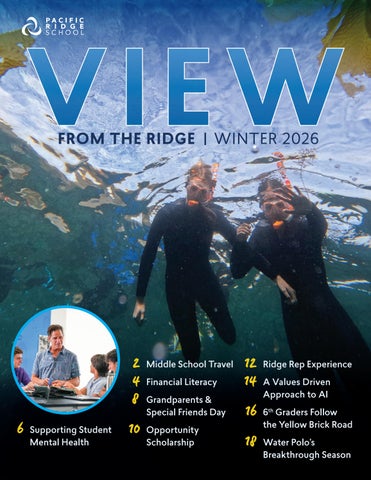
View from the Ridge | Winter 2026

Page 1


2026 marks the year before Pacific Ridge School will celebrate its 20th year. Moments such as a 20-year anniversary naturally lead to celebration and looking backwards – celebrating how far we have come. However, if we let them, significant anniversaries can also lead us to look forward to the future, to the next 20 years. While I could not have predicted all that would unfold at Pacific Ridge School, or in the world, since 2007, our mission and values have continued to guide us through each moment. The exercise of looking ahead five, 10, and 20 years allows us to think about how to position the school for its third decade. So, when we look ahead, what do we see for education in 2037 and beyond?

A lot of unknown.

Between the unpredictable impact of AI on education, the role of a college education in preparation for a purposeful life, the nature of permeable worldwide borders, the questions schools such as Pacific Ridge School must answer about how to pay our faculty and staff what they deserve and keep tuition at a sustainable level, and what it means to prepare young people for a future none of us can quite predict, we know that we cannot foresee exactly what the world will ask of young people in the medium and long-term future. So, what does a school do to prepare for that?

First, we look at the next five years by running the strategic planning process we are deeply engaged in right now. That will give us a roadmap for the next three to five years.

Second, we acknowledge what we know a school and its students will need to be ready for the kinds of unpredictability we can expect. What are those? Here is what I would say… Both young people and schools are going to need to be agile, utilize community-building skills, and maintain a standard of excellence.

Preparing Our Students and School for the Future

I imagine a high degree of future uncertainty makes the need for agility obvious. But why community-building skills? Moves towards AI, further siloed media and society, and continued culture wars make community-building skills even more vital and important. In fact, if we realize that so many people in our community will not have those skills, they become incredibly empowering for those who do. Finally, maintaining excellence will allow young people (and schools) to thrive in whatever environment prevails in the future.

Luckily, Pacific Ridge School’s program has always been focused on developing agility, community, and excellence in our students. Our program has always been designed to expose students to so much, hone community skills at the Harkness table, and push our students to evolve, grow, and thrive in uncertainty. So, as it turns out, we have always focused on these three tenets for our students, and we will continue to do so.

Pacific Ridge School will need to embrace the same qualities - agility, community, and excellence. Again, for the last 19 years, we have focused on those areas. But, as schools age, the institutions become more ossifiedmaking agility (and perhaps community and excellence) harder to achieve.

As we complete our 19 th academic year and begin to consider our 20 th (and beyond), Pacific Ridge School’s program will continue to pursue ways to prepare our students (and school) for their agile, community-minded, excellent future.

I am excited to see what the future holds - for Pacific Ridge and for a world with so much change and possibility in front of us.

MIDDLE SCHOOL TRAVEL

As our introduction to PRS Global Programs, sixth graders traveled to Pathfinder Ranch for a week of outdoor learning and team-building. Students rotated through activities like ecology, orienteering, archery, climbing, canoeing, and horseback riding, while evening programs included a Loraxinspired debate and a catapult challenge to “defeat the Pathfinder Ranch Dragon.” Even thunderstorms couldn’t dampen the fun, with creative indoor games and dancing filling the time. The trip wrapped up with sunny skies, shared meals, and memories to last the year.

Our seventh graders visited Catalina for a week of outdoor education. Students learned about marine ecology and enjoyed snorkeling, kayaking, and hiking, all while connecting with their peers and deepening their connection with one another!

FINANCIAL LITERACY AT PACIFIC RIDGE

As part of Pacific Ridge School’s commitment to preparing students for college and life beyond high school, the Financial Literacy elective offers students a practical, experience-based approach to understanding money, decisionmaking, and long-term planning.

Open to juniors and seniors, Financial Literacy features a project-based curriculum grounded in real-world scenarios, designed to help students navigate the financial realities they are likely to face in early adulthood. “This course builds a basic foundation of financial sensibility, while focusing primarily on the immediate needs of students approaching college and entering the workforce,” says Justin Symington, who has taught Financial Literacy at Pacific Ridge for the past six years. “The idea is to ensure students understand how to avoid common financial pitfalls over the next 10 years and have the foundational tools to apply their knowledge in the future.”

The course emphasizes practical applications over abstract theory. Students explore topics such as opening and managing bank accounts, budgeting on a limited income, understanding credit and debt, and creating professional materials for successful job searches. A section of the curriculum is also devoted to investing and entrepreneurship, with in-depth units on the stock market and real estate investing, followed by a comprehensive examination of the process of starting a business. Throughout the year, simulations and real-world applications enable students to test their ideas, evaluate outcomes, and build confidence.

One of the most impactful aspects of the course is its relevance. “Many students come into the class with limited knowledge or understanding of things like basic household finances,” says Symington. “Even students with some investing savvy are typically unaware of how to manage a budget or what it takes to sustain their home and family.”

This course provides a lot of authentic ‘Aha’ moments, which are always exciting and rewarding to witness as a teacher.

He adds, “You should see the looks of surprise when we calculate how much a home in San Diego ends up costing at the end of a 30-year mortgage.”

Students themselves recognize the value. Junior Arjun Inamdar, who is currently enrolled in the class, shares, “I think it’s a class every high schooler should take to be prepared for life. We’re learning about auto loans, credit cards, and how to apply for jobs, and I know these are things that will benefit me in my future.”

Ultimately, Financial Literacy is designed to help students make thoughtful, values-driven choices. “The idea behind this course is not to push every student to become an investment banker,” says Symington. “This curriculum provides a solid understanding so students can understand financial decisions accurately and make long-term decisions that match their goals and life values.” By grounding learning in realistic, relatable experiences, the course equips students with skills that extend well beyond the classroom.

CULTIVATING COMMUNITY

THE PARENTS ASSOCIATION: CULTIVATING COMMUNITY

The Parents Association builds connections and creates a fun, supportive community for students and their caregivers.

From cherished traditions like Fall Fest and Gingerbread Breakfast to staff appreciation events, the Parents Association brings people together in meaningful ways. Our parent social events and clubs - such as book club, hiking, and pickleball -offer fun opportunities to bond with fellow parents.

Best of all, every parent at Pacific Ridge School is automatically part of the Parents Association - no dues required! Volunteering is a great way to engage in the life of the school, meet other parents, and enrich our community. We’re here to make your experience as enriching and enjoyable as your student’s!

Join us for an engaging morning with graduating seniors as they share valuable insights into their college guidance journey and the college application process. Moderated by Rachel Petrella, Executive Director of College Guidance, this highly anticipated event is a favorite among parents. Don’t miss this opportunity to gain firsthand advice and perspectives!

WELCOME AND BRIEF UPDATES FROM:

•Executive Director of the Parents Association Stephanie Piccirelli

•Head of School Bob Ogle

Coffee and refreshments served.

For up-to-date event information, please visit the Parent Portal calendar. on May 7 for the annual PA Senior Panel!

CONNECT with the Parents Association Facebook group

SUPPORTING STUDENT MENTAL HEALTH

A Talk with Dr. Benjamin Maxwell and Practical Guidance for Parents

Pacific Ridge is committed to understanding and supporting the wellness and mental health of students. Earlier this year, we welcomed Dr. Benjamin Maxwell, Division Chief of Child and Adolescent Psychiatry and the Una Davis Family Chair in Behavioral Health at Rady Children’s Hospital in San Diego, for a candid conversation with parents about youth mental health.

This event offered a data-informed look at the challenges teens face, and provided practical insights on how schools, families, and communities can work together to support teenagers’ mental well-being. During his presentation, Maxwell also reviewed our school’s Mental Health Quotient (MHQ) results, an assessment Pacific Ridge students took in December of 2024.

The Landscape Has Changed

Dr. Maxwell framed the youth mental health crisis, noting a dramatic rise in youth psychiatric cases. At Rady Children’s Hospital, psychiatric emergency visits have risen from 167 in 2010 to more than 4,700 last year — a staggering 2,800% increase.

“When I started in this field,” he shared, “children’s mental health was stable for decades. Now, it’s one of the biggest public health challenges of our time.”

What the Data Tells Us

Pacific Ridge partnered with Sapien Labs to administer the MHQ, a global measure of psychological well-being. Our school’s results were encouraging: an average MHQ

score of 77, about 50 points above the national average, indicating that most PRS students are thriving.

However, like teens all over the country, about 40% of students still fell into the “struggling or distressed” categories.

Dr. Maxwell praised Pacific Ridge’s strong culture of connection and friendship and reminded families that true belonging — the sense of being known, trusted, and supported by adults and peers — is foundational to emotional health.

“Pacific Ridge students are doing remarkably well,” he concluded, “but none of us are immune. The good news is, we know what helps — connection, rest, purpose, and community. Together, we can create conditions where our young people can truly thrive.”

Hidden Drivers of Distress

Among the points Dr. Maxwell shared were the underappreciated factors fueling anxiety and depression among youth:

Sleep deprivation: One of the biggest drivers of poor mental health is lack of sleep and lack of quality sleep.

Diet and ultra-processed foods: Data indicate a clear correlation between the consumption of processed foods and psychological distress.

Digital overload: Social media and screen time, especially passive scrolling on platforms like TikTok and YouTube, are eroding attention spans, selfesteem, and real-world connections.

Hope and Possibility

Dr. Maxwell also shared reasons for optimism. Pilot programs demonstrate that interventions focused on connection, sleep, nutrition, and limited phone use led to dramatic gains in mental well-being within months.

“Change is possible,” he said. “When communities come together around shared values, we see transformation.”

Throughout his presentation, Dr. Maxwell underscored that collaboration is the key to addressing the mental health crisis for youth. Schools, families, healthcare providers, and students themselves each play a role in building environments that nurture psychological resilience.

Drawing on Dr. Maxwell’s insights, our own student data, and current industry recommendations, Director of Student Support Ericka Pike shares some practical tips for families:

Support Sleep Needs

Sleep is one of the most powerful tools parents have to support mental health. Dr. Maxwell identified sleep deprivation as one of the biggest drivers of poor mental health in teens, often fueled by blue light exposure and late-night academic demands. Families can help by prioritizing consistent bedtimes, establishing calming nighttime routines, and keeping devices out of bedrooms at night. Equally important is reinforcing that it is okay for students to advocate for their health, including reaching out to teachers when an assignment deadline interferes with getting enough sleep.

Set Boundaries Around Tech Use

Digital overload is another key contributor to distress. Dr. Maxwell warned that passive scrolling on platforms like TikTok and YouTube can erode attention, self-esteem, and real-world connection. While experts recommend delaying smartphones and social media until at least age 16, many teens already have access. Parents can still make a meaningful impact by establishing phone-free times during studying, family meals, and before bed. Working collaboratively with teens to set reasonable limits, and using parental controls or screen-time apps when helpful, supports healthier tech habits without framing them as punishment.

Cultivate Connection

A strong sense of belonging is foundational to emotional health. Teens thrive when they feel known, trusted, and supported. At home, connection grows when parents listen without immediately fixing, ask open-ended questions, and stay curious about their teen’s interests, friendships, and daily experiences. Supporting teens’ own problem-solving builds confidence and trust while reinforcing that parents are a steady source of support.

Stay Alert and Use Resources

Even in a community where many students are thriving, data shows that a significant number still struggle. Parents are encouraged to watch for changes in sleep patterns, social withdrawal, persistent sadness, or loss of interest in activities once enjoyed. Trusting gut instincts matters. If something feels off, talking with your child and reaching out to a school counselor, advisor, or healthcare provider can be an important first step. Staying connected with Pacific Ridge’s support systems and resources

can help you at home. Encourage your child to use the resources available on campus, communicate with their teachers and advisors, and build connections with adults on campus.

Rethink Food Choices

Nutrition also plays a role in mental well-being. Gradual shifts toward whole foods, involving teens in meal planning, and prioritizing family meals support both physical health and connection.

Model the Behaviors

You Want to See

Perhaps most importantly, teens are watching how adults manage stress, use technology, prioritize sleep, and maintain relationships. Being honest about challenges and modeling helpseeking behaviors reinforces that asking for support is a strength, not a weakness.

To watch a recording of

Right: PRS creates space for focus, reflection and meaningful connection. Here, Upper School students pause to read during Book Break.
Dr. Maxwell’s talk, scan the QR code.

On November 21, Pacific Ridge hosted its annual Grandparents and Special Friends Day, welcoming over 300 guests to campus for a day of celebration and connection.

The program featured lively performances by the school’s competitive dance team and vocalists, along with poetry readings from two ninth grade students who will compete in San Diego’s Poetry Out Loud Regional Championships in February. Following the program, guests enjoyed lunch and toured the campus with Pacific Ridge student ambassadors, Ridge Reps.

Guests were also invited to two engaging sessions led by Upper School administrators, showcasing how Pacific Ridge students are thinking critically, creatively, and compassionately about the world around them: Leveraging AI for Student-Centered Learning and Tools That Empower Human Thinking and Civic Engagement: Students Building a Better Tomorrow, Together.

Jaida McCullough ‘23

Jaida attended Pacific Ridge from eighth through 12 th grade and is currently studying Government with a sequence in leadership at Claremont McKenna College. With a passion for mentorship and justice, she aspires to work at the intersection of human resources, organizational development, and conflict resolution.

The thread that runs through everything I do is altruism through action. I’ve only gotten to where I am because of the mentors and supporters who believed in me, and my purpose is to give back by helping others see their full potential.

The Opportunity Scholarship opened doors I never imagined, including travel to Washington, D.C., Peru, and Ghana and Togo before I graduated high school. That’s not something I thought was possible for me before coming to PRS.

Access to campus resources — especially college guidance — was equally transformative. Working closely with my college counselor strengthened my writing, clarified my goals, and helped me better understand who I was becoming. At the same time, seeing my friends in public schools without those

same resources made me more aware of my privilege and the responsibility that comes with it. That awareness continues to drive my commitment to advocating for educational equity in college – work that I hope to continue after I graduate.

photographer, a businesswoman, or an activist, I should keep taking photos and come back to visit. That really showed me the connection I could have with my teachers at PRS, and it’s something I knew I wanted in my future, too.

My advisor and photography teacher, Ms. Behr helped me shape my goals and figure out who I wanted to be in high school. She was someone I could go to when I was struggling, and photography became a space where I could step away from academics and focus on creativity. Ms. Behr pushed me to move beyond taking simple images and to think deeply about what I wanted to show the world.

For me, that became political commentary. Ms. Behr noticed the photographers I was inspired by, and at the end of the year, she gave me a book of photos by Tyler Mitchell. She wrote to me that whether I became a

I also interned with City Council member Teresa Acosta, who introduced me to local government and the power of advocacy. Speaking before the city council about affordable housing was intimidating at first, but remembering my purpose transformed my fear into fuel. I realized that my voice mattered. As a young Black woman, I saw that my perspective was valuable, and that experience solidified my commitment to advocating for marginalized voices.

Supporting Impactful Opportunity for First-Gen Scholars

When I was choosing a college, I thought a lot about what I loved about PRS and what I found challenging. I valued the close student–teacher relationships, small class sizes, and emphasis on discussion and handson learning. At the same time, being in a small community and being a minority on campus pushed me to think carefully about the kind of environment I wanted next.

I was deciding between UCLA and Claremont McKenna, and I knew I needed the kind of support I had at PRS to succeed academically. Claremont McKenna’s small classes and holistic, experiential approach felt familiar, especially its emphasis on learning beyond the classroom and studying abroad. Nearly threequarters of students study abroad, which helped me believe those opportunities were possible for me as a first-generation student.

What ultimately mattered most was finding a place that truly supports firstgen students. At Claremont McKenna, those resources are prioritized. Through career services funding, I was able to take an unpaid internship in Bali that would have otherwise been out of reach. The program covered the $3,000 program cost and my flight, removing a major financial barrier. That experience affirmed how important it was to choose a school that supports first-generation students the way PRS supported me.

Every year, our school community proudly invests in the academic journeys of first-generation, college-bound students who have demonstrated academic excellence, financial need, and a passion for contributing to campus life. Since its inception in 2011, the Opportunity Scholarship program has evolved from supporting a single scholar to now providing full-tuition scholarships to up to 10 students each year.

With the generous support of the Pacific Ridge community, we have graduated 23 Scholars through the PRS Opportunity Scholarship program.

Your gift to this impactful program is an investment in the future of our school community. For more information about supporting the Opportunity Scholarship program, please contact Allissa Thompson, Associate Director of Annual Giving and Major Gifts at 760-448-9883 or athompson@pacificridge.org.

Scan to Learn More About Opportunity Scholarship

PACIFIC RIDGE OPPORTUNITY SCHOLARS HAVE MATRICULATED TO THE FOLLOWING SCHOOLS:

Northwestern University

Princeton University

University (2) Ursinus College

Whittier College

California Sate University, Long Beach (2)
Claremont McKenna College
Emory University (2)
Harvey Mudd College
Kenyon College (3)
Linfield College
Mira Costa College
University of Redlands (2)
Rice University Santa Clara University Skidmore College Southern Connecticut State

Ridge Rep Perspectives: STUDENT AMBASSADORS

REFLECT

ON THEIR EXPERIENCE

Founded in 2017, Pacific Ridge’s student ambassador program, the Ridge Reps, offers prospective families an authentic, studentcentered view of the school through the voices of those who know it best. Ridge Reps welcome guests, lead campus tours, and help families feel informed and at ease by sharing their own experiences and perspectives, along with a genuine sense of the Pacific Ridge community. Over the past two years, approximately 35 students have taken on this role, serving as ambassadors of both the school and the values it upholds. Two Ridge Reps share more about their experiences in the program and what it means to represent Pacific Ridge.

Ryder ‘27

Could you describe what it means to be a Ridge Rep? What kind of activities do you participate in?

Being a Ridge Rep is Pacific Ridge’s student ambassador program. We represent the school and its core ideals. We help organize and run events for admissions, as well as marketing opportunities, and giving student led tours of the campus.

What inspired you to apply to be a part of the Ridge Rep ambassador program?

I was inspired to join because I love the community and love talking about what makes Pacific Ridge special. I also love marketing and video editing, and was looking forward to opportunities where I could use these skills.

What has been something memorable from your time as a Ridge Rep?

A few memorable moments have been at Open House. I was on the upper school panel and was able to talk all about stories and experiences I have had on campus.

I have had many amazing opportunities, from running a takeover on Instagram to meeting prospective students, and I am very grateful for this program.

Lila ‘27

Could you describe what it means to be a Ridge Rep? What kind of activities do you participate in?

Being a Ridge Rep means representing our school to incoming and prospective students and families. We lead tours around the school, greet families, answer questions, and we also help with major visitor events, such as Grandparents Day.

What inspired you to apply to be a part of the Ridge Rep ambassador program?

I was inspired to be a part of the Ridge Rep program by the tight-knit community that I have found here. In my four years at Pacific Ridge, I have made so many connections, whether they are with friends, teachers, or administrators, and I feel like I have so many people to go to. I wanted to be able to promote this community to other students and maybe help them in deciding to attend Pacific Ridge.

What has been something memorable from your time at Pacific Ridge?

One memorable thing from my time at Pacific Ridge is how invested the teachers are in our success. For example, math used to be one of my least favorite subjects, but after getting help from my teachers the past few years, it is one of my best classes academically, and I enjoy it.

AN UPDATE ON THE 52 WEEKS OF SERVICE INITIATIVE

One of the cornerstones of the Pacific Ridge experience is our commitment to service learning. Through meaningful, hands-on opportunities, students serve their communities while practicing core ethical principles, developing compassion, and discovering their own ability to create lasting change.

At Pacific Ridge, service learning is rooted in student-directed action. Students are encouraged to take the lead—launching new initiatives, sustaining long-term partnerships, and responding to real community needs with purpose and creativity. The result is learning that extends beyond the classroom and into the world our students are preparing to lead.

Service learning is an opportunity for students to step out of the academic checklist and develop who they want to be in their communities,” says Germaine Jackson, Director of Service Learning.“It’s about identifying needs, collaborating with local partners, and discovering that service is as much about what we gain as what we give.

This year, Pacific Ridge launched 52 Weeks of Service, a community initiative inviting families, faculty, staff, and students to form small groups and engage in acts of service together throughout the year. The goal is simple: 52 service projects — one for each week — strengthening community connections while expanding our impact beyond campus. Highlights are shared through school communications and social media, helping San Diego County learn more about the Pacific Ridge Firebirds’ responsibility to act, desire to do good, and belief that we can make a difference.

Service learning is already woven into daily life at Pacific Ridge, with more than 30 Upper School projects and ongoing Middle School initiatives supported during the school day. Many additional opportunities take place after school and on weekends, allowing families to serve together and deepen their connection to both the school and the wider community.

THIS YEAR’S PROJECTS INCLUDE:

• Volunteering with Carrillo Elementary School to support its Harvest Festival

• Students and parents serving at My Girlfriend’s Closet , providing clothing to under-resourced teens

• A Warm Clothing Drive led by Middle School families, donating more than 150 items to local elementary schools in Carlsbad and Oceanside

• Music From the Ridge, where student musicians raised funds to support arts education through NAMM

• Coin Wars, an annual Middle and Upper School fundraiser supporting Feeding San Diego

• A holiday toy drive benefiting Casa de Luz , a local orphanage in Tijuana

• Rock Your Socks, led by The Flock, collecting socks for Los Posadas Shelter and Interfaith Community Services

• Coaches vs. Cancer events hosted by the basketball program, raising more than $3,000 for the American Cancer Society

If you’re planning a service project as part of 52 Weeks of Service, we invite you to share it to communications@pacificridge.org. We’ll continue highlighting stories and opportunities in our weekly eNew.

A VALUES-DRIVEN APPROACH TO ARTIFICIAL INTELLIGENCE AT PACIFIC RIDGE

Pacific Ridge is a place where critical thinking and thoughtful communication are central to learning. Through the Harkness method, students gather around the table to listen closely, challenge ideas respectfully, and articulate their thinking with clarity and purpose. Learning is rooted in human-centered dialogue, and as artificial intelligence (AI) becomes increasingly present in our world, we are called to consider how this evolving technology fits within a community built on inquiry, conversation, and reflection.

Pacific Ridge has taken a proactive and values-driven approach to AI. The school has maintained an AI policy since 2023 that addresses academic integrity while also acknowledging that AI may be used when teachers provide explicit instruction and context for its appropriate use. As our understanding of artificial intelligence continues to evolve, so does our responsibility to ensure it supports, not replaces, deep thinking and authentic learning.

To guide this work thoughtfully, Pacific Ridge has established two faculty and staff-led committees, overseen by Alfie Hobbs, Head of Upper School. The AI Policy and Ethics Committee focuses on developing guiding

principles to ensure decisions around AI align with the school’s mission and core values. In parallel, the AI Collaborative Committee explores specific tools to determine how they might streamline administrative processes and enhance teaching and learning in meaningful ways. There is also a student-led AI Club exploring issues related to ethics. The group recently hosted a thoughtful and engaging forum to share perspectives, ask questions, and explore the ethical implications of artificial intelligence in education and beyond. Together, these efforts reflect a commitment to innovation grounded in purpose and care.

While I believe AI can be a useful tool to help students study, learn, and hone skills in academic topics, our ultimate goal is to transition both students and faculty/staff from being users of AI to informed practitioners and creators.

Above: Mr. Hobbs presented Pacific Ridge School’s approach to AI during Grandparent and Special Friends Day.

“Just as we teach students to evaluate a book or news article as a valid resource, we want to do the same with AI. We want students to be able to determine if the information is factual, if there is bias, and even where the data may have come from.”

Central to this approach is the development of computational thinking, an essential skill set for navigating a rapidly changing world. Through decomposition, abstraction, pattern recognition, and algorithmic thinking, students learn to break down complex problems, identify what matters most, recognize meaningful connections, and design logical solutions. These skills extend across disciplines and strengthen students’ ability to reason, adapt, and innovate. By pairing computational thinking with ethical reflection and critical inquiry, Pacific Ridge prepares students not only to engage thoughtfully with AI, but to thrive in a new world shaped by it.

ALFIE HOBBS

Head of Upper School Alfie Hobbs has been with Pacific Ridge since 2018. For more than 15 years, he worked in the corporate world as a computer programmer, designer, and manager at IBM and BB&T. For three years, he taught computer science, coached basketball and soccer, and was involved in equity work at Ravenscroft, capping his successful time there by receiving the Qubain Award for Teaching Excellence in 2018. He received his B.S. in Computer Science from Hampton University, an M.B.A. from North Carolina Central University, and an Ed.S. in Curriculum and Instruction with an emphasis in Educational Technology from the University of Florida.

Right: Students in the AI Club led a lunchtime forum on AI Ethics.
Above right: Grandparents listen to a presentation about AI

The entire sixth grade brought The Wonderful Wizard of Oz to life in a bold, energetic adaptation of L. Frank Baum’s beloved classic by playwright Rachel Teagle. A key milestone for community-building in the sixth grade, every student played a role in the production — designing sets and costumes, creating props and artwork, performing vocal music, and stepping into character on stage. As four different Dorothys journeyed through the magical land of Oz, students explored themes of courage, compassion, and self-discovery, imagining the heart, brains, and bravery needed to find one’s way home. From the Yellow Brick Road to the Emerald City, the production reminded audiences that sometimes the greatest magic is found in our own backyard. Congratulations to the entire sixth grade on a joyful and imaginative performance!

Photos by Erin Evangeline Photography

The 2025 water polo season at Pacific Ridge School will be remembered as nothing short of epic, a year defined by leadership, resilience, and a historic breakthrough for the program. At the heart of this season was an exceptional class of 10 seniors whose camaraderie and commitment set a new standard for Firebird water polo. They challenged one another daily, held each other accountable, and brought intensity and joy to every practice. Their presence elevated the entire program, giving younger players a powerful model of teamwork, discipline, and pride in the pool.

The Firebirds captured their first-ever League Championship, highlighted by victories over RBV and Ramona (twice). Along the way, the team demonstrated grit and growth, finishing third in CIF and proving they belonged among the region’s best. While the ultimate goal remained just out of reach, the season was defined by progress and a deep sense of accomplishment that will resonate for years to come.

A pivotal part of this success came from the coaching staff, led by alumni brothers Oliver McClymonds ‘17, and Nate McClymonds ‘19. Oliver returned to PRS to guide the program he helped launch as a student. Reflecting on the season, McClymonds pointed to a defining moment early on: “One of the season’s highlights was our weekend tournament at Del Norte High School. We entered the group as underdogs and pulled off a signature upset over Granite Hills, a Division II team.” He also recalled a tense win over Ramona that demanded trust across the roster, noting how players stepped up in critical moments to deliver “a clutch (man-down) stop,” calling it “a snapshot of our team’s resilience and next-player-up mentality.”

For McClymonds, returning to campus alongside his brother, assistant coach Nathan McClymonds ‘19, carried special meaning.

Coming back to PRS to coach alongside my brother Nate has been an honor.

- Oliver McClymonds ‘19

“From day one, we challenged the team to forge its own legacy and to elevate one another in and out of the pool.” That challenge resonated most strongly with the senior class, whose commitment embodied the values of the school and the sport.

McClymonds also drew on lessons from his own playing days. “While coaching the team this season, I returned often to a core principle from my time at PRS: you honor the game, your teammates, your opponents, and yourself by playing the right way,” he shared, praising the seniors for setting the tone with their composure and respect. He emphasized how the program has grown, crediting those who built its foundation: “Thanks to Coach Anderson and Coach Sage, the program is stronger than ever.” He added, “I especially love that we are a coed program, and I hope interest continues to grow to the point where we can eventually field multiple teams!”

Among the senior leaders was team captain Wan ‘26, the recipient of this year’s Firebird Award, which recognizes the student-athlete who makes the greatest contribution to their team’s success. Wan led the team in scoring and was a defensive powerhouse, consistently performing at a high level with a positive attitude, but his impact extended beyond statistics. He approached game strategy with thoughtful insight, was quick to own his mistakes, offer support, and maintain the perspective that the game itself is the ultimate teacher.

When asked about his journey, Wan shared, “I started water polo in eighth grade, and played for all four years of high school. I love the autonomy that the team has. We get to make a lot of decisions as a team, with guidance from the coaches.”

Balancing athletics and academics, he reflected, “Water polo takes up a lot of time, but I also made a lot of friends I would never have made otherwise.”

The best advice I’ve learned is that team chemistry is the most important part of a team.

Wan also highlighted the behind-the-scenes support that made the season possible, saying, “Coach Sage is an amazing coach who goes beyond game-day preparation, taking the time to manage logistics and meet with players— often before school—to review film, drills, and strategy.”

As the season comes to a close, the seniors’ hard work, determination, and leadership have shaped a remarkable year and set a standard for future Firebirds to follow. Their impact reaches beyond banners and records, living on in the culture they built and the inspiration they leave behind.

- David Wan ‘26

6269 El Fuerte Street Carlsbad, CA 92009

MARCH 22 - 27

MARCH 28 Showcase of the Arts

APRIL 4 - 12 Spring Break

APRIL 23 - 25 Upper School

MAY 2

MAY 23 - JUNE 6

JUNE 4

JUNE 10

Turn static files into dynamic content formats.

Create a flipbook