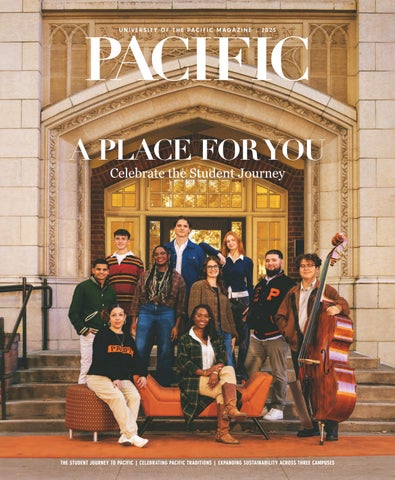
PACIFIC UNIV ERSIT Y OF THE PACIFIC MAGA ZINE | 2025
A PLACE FOR YOU Celebrate the Student Journey
THE STUDENT JOURNEY TO PACIFIC | CELEBRATING PACIFIC TRADITIONS | EXPANDING SUSTAINABILITY ACROSS THREE CAMPUSES
HOLLYWOOD RETURNS TO PACIFIC Pacific’s picturesque Stockton Campus is once again serving as the backdrop of a major Hollywood production. A film crew descended on the Stockton Campus over the summer, bringing A-list actors on-site for a new television series in the works. Students, faculty and staff took a turn in the spotlight, serving as extras. Scenes were largely filmed around Knoles Hall, Anderson Hall and Faye Spanos Concert Hall, with the Janet Leigh Theater transformed into a holding space for actors and props.
PHOTO 2 PACIFIC CREDIT: MAGA KATRINA ZINEMARCINOWSKI | 2025
2025
CONTENTS FROM THE PRESIDENT 04 MESSAGES AND BOARD CHAIR
76 BELOVED PACIFIC TRADITIONS
06 THE REVIEW
82 HERE TO WIN
26 LESSONS FROM A LEADERSHIP LEGEND
92 GIVING BACK
30 JOURNEY TO PACIFIC
100 BE OUR GUEST
42 GROWING GREEN
106 ALUMNI IN THE SPOTLIGHT
52 REAL WORLD IMPACT
112 ALUMNI NEWS
The people, progress and key moments of the year
An interview with Pacific’s 23rd president
Differing paths lead students to Pacific
Adapting for a sustainable future
Shared experiences that make us Tigers
Pacific athletics reaches new heights
Philanthropy that changes lives
Thought leaders and culture makers take the Pacific stage
Pacificans with career-topping achievements
Illuminating research and study
58 OUR SCHOOLS AND COLLEGES
Paying it forward and a look back at last year’s colorful events
Pacific is putting experiential learning first
STAFF
EXECUTIVE EDITOR Sallie Poggi CREATIVE DIRECTOR Nico Barredo SENIOR EDITOR Erica Hechtkopf ’25 PROJECT MANAGER Svend Holst LEAD WRITERS Johanna Bakmas ’09 Mike Klocke Kelsey Lindquist Merritt McLaughlin LEAD COPY EDITOR Monica Klem
CONTRIBUTORS Scott Biedermann ‘05, ‘20 • Molly Byrne • Isabella Edwards ‘26 • Ashley Golledge • Amber Flores • Sheri Grimes • Christina GusmanMeyers ‘08 • Lisa Hill • Dua Her • Alaya Hubbard ‘25 • Robbie Kleinmuntz • Jenny Key • Jennifer Krengel • Mikael Pitanguy • Geneva Polendey • Mariella Reis ‘26 • Dan Soine • Zac Spurlin ‘16 • Janice Wagner
SENIOR DESIGNER Mishi Chua ‘25
DIGITAL DIRECTOR Ryan Walters
LEAD PHOTOGRAPHERS Jason Millner ‘19 Christian Murillo Mikael Pitanguy
WEB DEVELOPER Daniel Ellingson DIGITAL DESIGNER César Larios
PUBLISHED BY: University of the Pacific 3601 Pacific Avenue Stockton, CA 95211
CONTRIBUTING PHOTOGRAPHERS Ashley Golledge Justin Gomes Mark Rodriguez ‘21 Roland Liwag
SPECIAL THANKS 5DTHRIFT Elizabeth Bishop Danny Castillon Karen DeRosa Janel Ludwig Lynne Madewell Leslie Rudbeck
Send address changes to: Pacific Magazine Advancement Services Bannister Hall 3601 Pacific Avenue Stockton, CA 95211
CONTACT: magazine@pacific.edu P: 209.946.2311 Pacific.edu/Magazine
Material in this publication may not be reproduced in any form without permission.
(Left to Right) Top Row: Christoff Coffey ‘27, Lance Gilson ‘29, Maena Strong ‘27 • Second Row: Dev Desai ‘25 , Asteroid Toles ‘25,
cover Kaitlyn Ferreira ‘26, Andres Mayorga ‘28 • Bottom Row: Cherise Munoz ‘26, Kiara Saucer ‘27, ‘28, Kyle Saelee ‘26
UNIVERSIT Y OF THE PACIFIC
3
MESSAGE FROM THE
PRESIDENT On a crisp autumn day in 2021, amidst the grandeur of Knoles Lawn, I made a bold proclamation during my inauguration as the 26th president of University of the Pacific: that our university would become the best student-centric comprehensive university in America within a decade. Today, we are halfway through that remarkable journey. We have made enormous progress. And while there remains much more to accomplish, I am supremely confident we will reach our destination by staying laser-focused on the success of our students through educational environments that blend immersive, personalized and experience-based learning with a deep belief that all qualified students should have the benefit of a transformational Pacific education–no matter their race, religion, ideology or socioeconomic background. Our progress over the past five years has been nothing short of historic. This year we saw our highest national rankings ever–No. 85 among national universities as measured by The Wall Street Journal–and higher education author Jeffrey Selingo named Pacific one of his 75 “Dream Schools.” As many of our peer institutions declined in recent years, we’ve enjoyed our three highest enrollment years ever–approaching 7,000 students in our nine schools and colleges across our three campuses–while adding 24 new academic programs on the undergraduate, master’s and doctoral levels. We’ve enjoyed strong financial health year over year through the 2020s. Meanwhile, annual fundraising has nearly doubled, our endowment has increased by more than 60 percent and government research and service grants tripled. We continue to lead the way in sustainability, this year becoming just one of 16 American universities to power their
4
PACIFIC MAGA ZINE | 2025
campuses with electricity from 100 percent renewable energy sources. And we continue to expand deep experiential learning opportunities for our students while serving thousands across our Northern California communities through free clinics that provide legal support and critical health care such as dental services, vaccinations, diabetes screenings, hearing and speech services and more. Pacific Athletics also is on the rise, with our first year of multiple championships in a dozen years, nationally ranked programs and teams competing in NCAA tournaments. And while other schools are eliminating some Olympic sports, we are growing, adding both men’s cross country and track and field teams this year as well as diving programs to both women’s and men’s swimming squads. We have nearly 400 NCAA Division I studentathletes today–our most ever. The next five years are already off to an amazing start as we unveiled one of the most significant and highprofile partnerships in our 174-year history: Pacific becoming the Official Higher Education Partner of the San Francisco 49ers. These two great Northern California institutions have a shared passion for excellence and a shared belief in the transformational power of education.
The new year of 2026 will usher in more advances with the opening of the Arthur A. Dugoni School of Dentistry’s Ambulatory Surgical Center and Multidisciplinary Advanced Care Clinic on the Sacramento and San Francisco campuses. On the Stockton Campus, we will open the new 391bed Southwest Hall, the StudentAthlete and Sports Medicine Center and the Jie Du Inn, which will provide a home away from home for visiting families, alumni, prospective students and other guests while serving as the learning hub for our new hotel and hospitality management major at the Eberhardt School of Business. You’ll also see our return to the entertainment world as the picturesque Stockton Campus serves as the backdrop for a new comedy series starring Steve Carell. Throughout the new year we will be celebrating our 175th year as California’s first university and host a very special Homecoming and Family Weekend on Oct. 9-11. Thank you for being part of this very special community here at Pacific. And remember, the best is yet to come. Go Tigers! President Christopher Callahan
MESSAGE FROM THE BOARD OF REGENTS CHAIR Since our founding in 1851, University of the Pacific has met change and challenge with a singular, consistent goal: supporting the success of our students. For 174 years we have prepared graduates who make a difference. Their impact spans across boardrooms and classrooms, labs and courtrooms, clinics and hospitals, neighborhoods and nations. Today, Pacific’s mission remains as bold and urgent as ever before. As regents, we are charged with ensuring that our university provides a superior, student-centered learning experience integrating liberal arts and professional education and that we prepare individuals for lasting achievement and responsible leadership in their careers and communities. In this moment, characterized by immediacy and
rapid change, students do best when they have access to an education that prepares them to adapt, to lead and to serve. A longtime friend and former regent once said that we each hold a piece of the culture. That is important. I would add that we also have a great responsibility for stewarding our mission with care. Each of us–regents, faculty, staff, parents, family members, alumni, community partners and friends– contributes to the diverse ecosystem in which our students thrive, and our mission is a great unifier. Our regents volunteer their time and talent to ensure the long-term vitality of Pacific. Our faculty invest in the growth and development of every student. Our staff champion the success of each student who walks through our doors. Our alumni are employers, mentors and ambassadors. Our friends and partners ensure students have the financial resources and opportunities to succeed in college and career. And parents and
families provide critical support and encouragement along the way. The results of our collective efforts are clear. We see graduates who enter the world not only with professional competence but also with a strong sense of purpose. They are leaders who contribute to their communities. They are innovators who advance progress in their fields. They are citizens who act with integrity and purpose. On behalf of the Board of Regents, it is a privilege to serve alongside our distinguished and dedicated community of Pacificans who ensure every student has the opportunity to succeed here at Pacific and beyond. Thank you for advancing our mission and goal of becoming the best, student-centric university in the nation.
Go Tigers! Mary-Elizabeth Eberhardt ’76 Chair, Board of Regents
“For 174 years we have prepared graduates who make a difference. Their impact spans across boardrooms and classrooms, labs and courtrooms, clinics and hospitals, neighborhoods and nations.” MARY-ELIZABETH EBERHARDT Chair, Board of Regents
UNIVERSIT Y OF THE PACIFIC
5
Review The
CAMPUS | SPOTLIGHT | CULTURE | SNAPSHOT | LAURELS | VIEWPOINT
Pacific’s Strongest Years Yet —and the Road Ahead
The numbers tell a remarkable story: Pacific just completed its strongest five-year period in the university's 174-year history. Record enrollment. Unprecedented fundraising. An endowment up 60%. New academic programs launched across all three campuses. National rankings at all-time highs. But the real story lives beyond the statistics. It emerges in students discovering their passions and converting them into careers, in alumni supporting the next generation of Tigers and in faculty and staff who champion student success—even as higher education faces unprecedented headwinds.
6
PACIFIC MAGA ZINE | 2025
Bold Momentum While universities nationwide grapple with enrollment declines, political pressures and eroding public confidence, Pacific forges ahead. The university eliminated chronic budget deficits, climbing from second-worst financially among its peer universities to second-best over five years. Pacific posted its three highest enrollment years ever. Fundraising nearly doubled previous annual averages. The university launched 24 new degree programs and broke ground on major capital projects in Stockton, Sacramento and San Francisco. Recognition has followed performance. The Wall Street Journal recently ranked Pacific No. 85 nationally—the highest placement in the university's 174-year history. The New York Times rated Pacific No. 23 in socioeconomic diversity, while the Wall Street Journal placed the university at No. 36 for social mobility. HIGHEST PLACEMENT
The Wall Street Journal Ranked Pacific
85
No.
Nationally
These rankings matter because they validate what Pacific has always known: The university's student-centered approach works. When you prioritize developing whole people—not just degrees—students thrive academically and launch meaningful careers. The enrollment cliff—long predicted, now arriving—will shrink U.S. college-age populations for the next 15 years. Pacific has spent five years preparing: launching academic
Concerns about federal policy center on declining visa approvals for international students and potential elimination of the Grad PLUS loan program that many professional students depend on. Pacific is developing new international recruitment strategies and working with commercial lenders on alternative financing while actively engaging Congress to preserve educational access. President Callahan and Congressman Josh Harder are introducing a bill to extend Grad PLUS loans, ensuring students pursuing advanced degrees, especially in health care, maintain access to funding. New York Times best-selling author Jeff Selingo just named Pacific among 75 national “Dream Schools,” institutions that balance academic excellence, access, affordability, hands-on learning and graduate outcomes.
programs that meet job sector growth, growing populations like undergraduate transfers and graduate students, expanding beyond traditional geographic markets and developing online executive programs. Creative programs like McGeorge School of Law’s automatic admission for Pacific undergrads forge new pathways where Pacific students excel. Perhaps most concerning is the cultural shift. Americans expressing great confidence in higher education has plummeted from 60% a decade ago, while those with little or no confidence have more than doubled from 10%. Pacific's Strategic Communications and Enrollment Strategy teams are developing new campaigns to articulate the university's value to families in compelling, tangible ways.
Confronting What's Next
Pacific's upward trajectory comes as higher education confronts what President Christopher Callahan calls “the Big Three Threats”: the enrollment cliff for traditional-age undergraduates, policy shifts from Washington and Americans' diminishing confidence in college degrees.
23
No.
PACIFIC RANKING
In Socioeconomic Diversity
The New York Times
What Serves Students Best These challenges also create opportunities. As many institutions retrench, Pacific expands, guided always by what serves students best. New academic programs respond to workforce needs while maintaining liberal arts foundations. Enhanced residential facilities create communities where students develop as leaders. Operational improvements free resources for student success. The next five years will demand creativity, resilience and unwavering focus on student success. But Pacific's recent track record suggests the university thrives in moments like this—not despite the challenges ahead, but because of how the Pacific community responds to them. Next year in 2026, Pacific's 175th anniversary celebration will honor this legacy while looking forward. California's first university has always adapted to serve students—from Methodist pioneers valuing practical and classical education equally, to becoming the first western university offering co-education, to today leading the charge in serving first-generation and Pell Grant eligible students. None of this happens without the people who make Pacific work: Faculty members who redesign courses to meet students where they are. Staff who answer late-night calls from anxious parents and stay after hours to help students navigate financial aid. Coaches who teach resilience. Advisors who see potential that students don't yet see in themselves. They are Pacific's foundation, and they show up for students every single day. As construction cranes dot the campuses and new programs launch, one truth remains constant: Pacific succeeds when students succeed.
UNIVERSIT Y OF THE PACIFIC
7
THE REVIEW
THE REVIEW / FEATURE
A GOLDEN OPPORTUNITY In a groundbreaking partnership that bridges higher education and professional sports, Pacific has been named the Official Higher Education Partner of the San Francisco 49ers. The agreement connects California’s first and oldest university with one of the NFL’s most iconic franchises to expand access to education, create real-world career opportunities for students and strengthen community engagement across Northern California. “This partnership is a statement of belief in our students and in the transformative power of education,” said President Christopher Callahan. “Our two organizations share a common goal—to build champions on the field, in the classroom and throughout our communities—and we’re proud to stand alongside the 49ers as we work together to shape the future of California.” Through the agreement, Pacific students will gain direct access to internships and hands-on learning experiences within the 49ers organization. In turn, 49ers staff will have the opportunity to enroll in Pacific’s nationally ranked programs to further their education. Together, the two organizations will launch new initiatives to support K–12 education across the region, offering learning resources, career and networking programs and access to college-readiness opportunities to students. In the months ahead, Pacific students, alumni and community members can look forward to several special events at the Stockton Campus and at Levi’s Stadium, including viewing parties, educational opportunities and co-branded experiences.
8
PACIFIC MAGA ZINE | 2025
SCAN QR CODE TO KEEP UP WITH THE PARTNERSHIP AT PACIFIC.EDU/49ERS
UNIVERSIT Y OF THE PACIFIC
9
THE REVIEW
Campus UPDATES AND HAPPENINGS
A Home for Those Who Served
Pacific’s historic Manor Hall has found new life, reopening over the summer as dedicated housing for student veterans. The building, which has been vacant since 2014, was thoughtfully renovated with comfort, accessibility and a sense of community paramount to its design. It includes ADA-compliant features such as fully accessible kitchens and supportive furnishings to meet the needs of veterans with physical challenges. Pacific is one of only a few universities nationwide with a dedicated facility designed to provide affordable housing for student veterans. The building is intended to serve as both a living space and a community hub for up to 33 students.
10
PACIFIC MAGA ZINE | 2025
George Retana '25 recites the Pledge of Allegiance at the ribbon cutting for Manor Hall.
(A Home for Those Who Served) At a celebration held in Manor Hall’s courtyard, Pacific President Christopher Callahan described veterans as “unbelievable students.” “They’re mature. They’re focused and disciplined. They add richly to the intellectual diversity and environment of our campuses. They are unbelievable, and they are high achieving,” Callahan said. Lance Gilson ’29 is one of the first veterans to live in Manor Hall. “One thing I loved about the Marine Corps is that it gave me challenges every single day,” Gilson said. “Thatʼs what really shaped me: challenges in leadership, challenges in my job, challenges with problem solving on the spot with immense high pressure. Going through extremely adverse challenges and situations in the Marine Corps— that shaped who I am today and informs how I show up as a student.” Gilson said he appreciates the amenities in his apartment and loves being able to cook when he’s not in class. “Itʼs been amazing. Itʼs a beautiful apartment. Everythingʼs new. Everythingʼs nice. Moving from the Marine Corps to this is such a nice change. Barracks rooms are not the greatest.” Having a space all his own makes a huge difference for Gilson and other student veterans. “Manor Hall was created specifically and intentionally to provide a warm, welcoming, nurturing environment where our student veterans can come feel at home,” Callahan added. “They can build a community here and support each other. We paid special attention to the unique health and wellness needs of some of our veterans with this project,” he said.
Manor Hall is one of the original eight buildings on the university’s Stockton Campus. The renovations bring a modern character to the 101-year-old building while honoring its history; Pacific housed a Red Cross unit in the building during World War II. The $7 million renovation was funded through philanthropy and the support of San Joaquin County,
“
Manor Hall was created specifically and intentionally to provide a warm, welcoming, nurturing environment where our student veterans can come feel at home. President Christopher Callahan
which gave $2 million to the project. Many of the living spaces and 11 residential suites in the new residential space are named in honor of veterans. “Pacific has made great strides in supporting its student veterans, and it bears noting that Manor Hall was funded entirely by philanthropy and public funding. No tuition dollars were used anywhere in the project,” said Scott Biedermann ʼ05, ʼ20, vice president for development and alumni relations. “This generosity underscores how deeply the greater Pacific community—our alumni, friends and community partners—appreciate and respect these studentsʼ sacrifices and want to help them have the best future possible.” Local philanthropists John and June Rogers were the lead donors to Manor Hall. “Itʼs a great project, and it warms my heart to see. Itʼs been a pleasure to support the university, and I am proud to be a veteran,” said John Rogers, a retired Air Force colonel who served 26 years as a pilot. “Iʼm proud to support the veterans. Itʼs easy to support the people that have served our country and continue to serve our country, the people that have gone before. Itʼs just in my heart to say that we are pleased to be here, pleased to have supported such a wonderful organization and such a wonderful building.” Located next to the Military and Veteran Student Center, Manor Hall offers easy access to resources, events and additional support for student veterans. Pacific currently serves nearly 160 student veterans across the university’s Stockton, Sacramento and San Francisco campuses.
UNIVERSIT Y OF THE PACIFIC
11
THE REVIEW
CAMPUS / UPDATES AND HAPPENINGS
Progress on the Ground 12
PACIFIC MAGA ZINE | 2025
Major capital projects to improve teaching, housing and community facilities continue Southwest Hall Construction is underway on Southwest Hall, a new living and learning community for students. The new facility, opening fall 2026, will recreate the original building’s 1924 facade while adding sustainable, modern amenities for nearly 400 students on the Stockton Campus. Jie Du Inn The new boutique lodging,
which has received generous support from Regent Jie Du ’90, ’93, is expected to open on the Stockton Campus in 2026. The lodging will be located in a century-old building adjacent to the President’s Residence. It also will provide hands-on hospitality experience for business students.
Ambulatory Surgical Center and Multidisciplinary Advanced Care Clinic
The Arthur A. Dugoni School of Dentistry will open a $22 million clinic and surgery center on the San Francisco Campus in fall 2026 to expand care for patients of all ages with special needs.
Student-Athlete and Sports Medicine Center
Photo: Construction continued on Southwest Hall during the summer.
A planned $11 million sports medicine and rehabilitation complex is expected to open summer 2026 to support student-athlete wellness and training, enhance academics and provide hands-on clinical experience. In November, Pacific held a groundbreaking for the project, which is funded entirely with donor support.
UNIVERSIT Y OF THE PACIFIC
13
THE REVIEW
Spotlight PROFILES
Raising the Bar High
NEW DEAN
Michael Colatrella
New dean shares priorities for McGeorge School of Law
McGeorge School of Law
Michael T. Colatrella Jr. once dreamed of a life on stage, not in a courtroom. College “wasn’t part of the conversation” for the New Jersey native, whose family owned a small beauty parlor. “I actually wanted to be an actor, so I spent a couple of years doing that,” he said. Friends he met at an acting gig one summer—students at Yale and Stanford—convinced him to give college a chance, where a law and society class soon ignited his interest in a legal career.
Favorit
hings eT Movie: “The Best Years of Our Lives.” It's a 1946 film about three people coming home from World War II and their struggles in trying to readapt to their lives.
Now, Colatrella is helping students navigate law school as the new dean of McGeorge. Colatrella stepped into the role in July after former dean Michael Hunter Schwartz returned to the faculty to teach. As the new dean, Colatrella is focused on three priorities: raising bar exam pass rates, improving job placement and elevating McGeorge’s national profile. “The higher ranked we are, the more students we attract and the higher credential students we attract,” Colatrella said. “That impacts
14
PACIFIC MAGA ZINE | 2025
Colatrella first joined the McGeorge School of Law as an assistant professor in 2009.
our budget, which means we can do more things. We can be more innovative in the programs we offer and consider adding new clinics students and faculty would like to see.” Equally important to him is supporting McGeorge’s large population of first-generation students like himself. “That’s a point of pride for the faculty here because you don't just change their lives—you're changing generations.” But beyond rankings and outcomes, what motivates him most is the classroom—and its impact on all students. “As the semester progresses, you can see their minds opening up,” he said. “As a lawyer, you learn to think differently. You see problems differently. Watching that transformation is so exciting.”
Favorite Food: I’m a meat and potatoes sort of person, so shepherd's pie is one I like to make a lot. Book: “David Copperfield” by Charles Dickens TV Show: “The Mentalist” Hobby or Interest: I paint and sing. I also like hiking because this is a beautiful place to hike.
Q and A
Invested in Pacific With a wealth of financial knowledge and business experience, two Pacific alumni—Meryam Alaoui Crist and Evan Dreyfuss —are helping propel the university forward as the newest members of the Board of Regents.
Meryam Alaoui Crist ’94 was general manager of Elixir Savings from 2009–24 and spent nine years as vice president of American Express. She credits her professors and peers in the Eberhardt School of Business with playing a crucial role in her personal and professional growth. “Everyone was invested in our success,” she said. She now supports students with a passion for entrepreneurship through the Meryam Alaoui Emerging Entrepreneur Endowed Scholarship as well as the Eloise Johnson and Jane Johnson Sonner Endowed Scholarship for Education. Evan Dreyfuss ’86, a portfolio manager for the investment fund Twin Lake Total Return Partners, which he founded in 2002, returned to the board after serving from 2015-24. The Eberhardt alumnus has provided extensive support to Pacific students over the years. In 2022, he and his wife Elizabeth donated $1 million to create the Dreyfuss Family Fixed Income Fund, a student-run investment fund focused on bonds. He also established the Dreyfuss Wall Street Fellows Endowment in 2016 to send business students on an annual week-long trip to New York to meet with financial industry insiders and network with alumni. Both began three-year terms July 1.
Anne Milne Departs After Six Years on Board
with
Meryam Alaoui Crist and Evan Dreyfuss
Q
Meryam, why are you excited to join, and for you Evan, to re-join the Board of Regents?
MERYAM: For more than 10 years, I have enjoyed donating to the university in the form of scholarships and other financial support, but my career left little flexibility for giving time. I recall thinking long ago that when the opportunity arose, hands-on engagement at Pacific would be my priority. Now in semi-retirement, I am truly thrilled to join other regents who share this passion for the school. EVAN: The opportunity to be hands on in helping your alma mater reach new heights is very fulfilling. Also, the ability to be a mentor to students at Eberhardt who are involved in either the Eberhardt Student Investment Fund or the Dreyfuss Fixed Income Fund is very rewarding. I have always wanted to give back to Pacific in any way I can.
Q
What do you hope to bring to your role?
MERYAM: I hope to contribute a different perspective—a viewpoint that comes from the intersection of my health care and financial services leadership experiences. These sectors are changing so rapidly, and technology is playing an outsized role across the continuum of care and the administration of services. The emerging capabilities are fascinating, which is why I have continued to consult. Translating what is going on in these high-growth, in-demand areas into the skills that students need to succeed will be a rewarding challenge. EVAN: Use my investment experience to keep our growing endowment cutting edge! Also, I want to help our board with strategy and vision as higher education is changing at a rapid pace.
Whether she was welcoming students to Wall Street or helping to guide Pacific’s financial decisions, Anne Milne ’78 made her mark on Pacific during her six-year term as a regent, which wrapped up on June 30. As chair of the Finance and Facilities Committees, she oversaw critical financial decisions and major capital projects. “Her leadership created the financial stability we enjoy today,” said Chief Financial Officer James Walsh. “She gave me the latitude to bring new ideas to the committee and was always wonderful in guiding and supporting me as we presented financial changes and capital projects to the board.” Beyond her board service, Milne has been an engaged alumna, hosting the New York City reception for alumni and students on Wall Street, and this year, coordinating and moderating a panel of experts for the program. Her philanthropy continues to open doors. In 2016 she created the Anne Milne Endowed Fund, supporting internships and scholarships for College of the Pacific students. Milne currently serves as managing director at Bank of America, where she leads the Global Emerging Markets credit research teams in New York, London, São Paulo and Buenos Aires. A Pacific alumna, she majored in international studies before earning a master’s degree in international economics from Johns Anne Milne Hopkins University.
UNIVERSIT Y OF THE PACIFIC
15
THE REVIEW SPOTLIGHT / PROFILES
A New Way of Learning Cathy Davidson, a nationally recognized scholar, shared insights from her research into higher education and current work on active learning, collaboration and the responsible use of artificial intelligence as a guest speaker in Pacific’s Presidential Speaker Series. Davidson visited Pacific in September at the invitation of President Christopher Callahan, who had brought the higher education thought leader to Arizona State University when he served
16
PACIFIC MAGA ZINE | 2025
as dean of the Walter Cronkite School of Journalism and Mass Communication. “Cathy's work, starting with her seminal book ‘The New Education,’ published nearly a decade ago now, remains the single biggest influence on my thinking and approach to teaching and learning in colleges and universities in the 21st century,” the president shared with the audience. In an engaging conversation with Provost and Executive Vice President for Academic Affairs Gretchen Edwalds-Gilbert, Davidson urged faculty to view themselves as partners with students, emphasizing that higher education should not just prepare learners for existing jobs, but give them the skills needed to adapt to constant change. “How do you educate students, not just for a changing world, but how to address change? How to be confident enough in their own abilities that when suddenly their job disappears, they now have the confidence to relearn and
continue to learn and be prepared for the next opportunity that comes along? That's a differSCAN TO WATCH CATHY ent concept of educaDAVIDSON AND PAST GUESTS tion than doing well on IN THE PRESIDENTIAL tests,” she said. SPEAKER SERIES Davidson highlighted the importance of collaboration and communication as core outcomes of a college education. She praised Pacific’s culture of care, small class sizes and commitment to student success, noting she was “falling in love with this place,” which was answered by roaring applause from the audience. Faculty also had the opportunity to connect with her directly in hands-on lunch and learn sessions to discuss innovative teaching strategies. Davidson was recently selected to receive the 2025 Harold W. McGraw Prize for Higher Education.
Q&A
Jean Callahan
Pacific's first lady on growth, students and finding joy After five years at University of the Pacific, Jean Callahan has witnessed transformation first-hand. She shares what has changed during that time, what makes Pacific special and where she finds her joy. You've been at Pacific for five years now. What's different? The vibrancy of our campus. As I walk across our beautiful campus, I see students engaging everywhere. There is an energy and a vitality and a pride in Pacific that seems to be growing each year. It is wonderful to see. What's Pacific's secret sauce? The relationships that individuals have with each other and with the institution, and the caliber of people here. They support each other—there's no competition. It's not “I succeed if others don’t.” And our students are the best people. They are values-based and authentic and so appreciative. We have many first-generation students from diverse cultural and religious backgrounds. They appreciate everything done to help them advance. You know that the impact is going to be beyond just the one student to the entire family. What project excites you most? The Miracle Mile and connecting with the business community to transform that corridor— though I always want the initiatives to move faster. And there is the Jie Du Inn. It is an exciting project. We are thinking through how to use it for the campus community in addition to visitors. There are plans
for a full commercial kitchen so we can host faculty happy hours or create local wine tastings with our Conservatory students performing. It's another way of sharing the talents of the campus. The project is very student and family focused. We are trying to think through the whole student experience—down to very small details like how easily the grout lines can be cleaned! Do you have a memory from your college days when someone helped you? For me, the transition from high school to college was getting to the understanding that college professors are there to help you. As my father used to say, ‘professors won't spoon feed you anymore.’ I was struggling with calculus during my freshman year when a friend said, “Jean, you have to spend more time working on it.” I started going to professors for help—working harder and smarter. It worked! What are you reading? “Circe” by Madeline Miller is next for my book club. I love to read, especially mysteries with a surprise ending. Current soundtrack? I love old rock and roll, jazz and blues music. In my car right now, I am playing Creedence Clearwater Revival and Buffalo Springfield. Your happy place? Anywhere with family and friends. Special relationships, spending time with people and helping others be successful and happy. That is my joy. My perfect day would be with my boys, their partners, and our new grandson!
UNIVERSIT Y OF THE PACIFIC
17
THE REVIEW
Culture BUZZ
Camera ready at Cannes Film Festival
For two weeks in May, the Cannes Film Festival in France brought together some of the biggest names in the entertainment industry, and students from Pacific joined them. Through an internship program with American Pavilion—the central hub for American attendees and industry professionals at Cannes—four students from Pacific’s Media Arts and Production program assisted with events, programming, guest services, distribution and talent agencies. The unique opportunity was funded through the Barbara and Benjamin Bejan Experiential Learning Endowment.
18
PACIFIC MAGA ZINE | 2025
Press Play
Isabella Edwards ’26 (left) shares a first-hand account Interning at Cannes On the videography team for the American Pavilion, I worked with IndieWire to film daily panel discussions and interviews with Pavilion staff, students and scholarship recipients. We also filmed events with producers, entertainment lawyers and directors like Richard Linklater and Spike Lee, who were both at Cannes for their film premieres, “Nouvelle Vague” and “Highest 2 Lowest.” This was a chance to bring my love for cameras to a large festival setting while collaborating with students who are equally passionate about other aspects of filmmaking, like producing and marketing. My Experience at the Festival As a videographer, my shifts were dependent on the number of events to cover. In between, our team would grab B-roll of the hustle and bustle of the pavilion against the backdrop of the French Riviera. We were on our feet working hard, but our supervisors were also huge believers in us taking in all there was to experience at Cannes. If any of us got tickets to a screening, they’d make sure we took that opportunity. Cannes Takeaways Attending and interning at the Cannes Film Festival was a once-in-a-lifetime opportunity for me. Though my big dream is to be a cinematographer, I’m considering a career in brand videography or in-house content creation after graduation. Being surrounded by film and marketing professionals who care deeply about their craft was inspiring and contagious. I consider myself lucky to have been a videography intern at Cannes.
In a national segment on Good Morning America, students shared how Pacific is making college accessible for first-generation students and students with disabilities through the university’s long-running TRIO program. From the New York Times to the Washington Post, faculty were also prominently featured over the past year, showcasing their research and offering insights on complex issues. 1
Hit Print 1. “The Norton Critical Edition of Macbeth” Introductory essay by Courtney Lehmann
2
Acclaimed Shakespeare scholar and Professor of English Courtney Lehmann provides an analysis of Shakespeare’s “Macbeth” through the lens of five film adaptions of the play in the “The Norton Critical Edition of Macbeth,” published in March. 2. “Home” Matt de la Pena
3
New York Times best-selling author and College of the Pacific alumnus Matt de la Pena ’96 explores the meaning of home— both places and people— in his latest children’s book.
SCAN TO WATCH THE TRIO PROGRAM'S GOOD MORNING AMERICA SEGMENT
’01 portrays the struggle for survival during the Spanish Civil War in the late 1930s. His debut novel is described as “a dazzling feat of storytelling” by Harvard Review Online. 4. “Prairie Man: My Little House Life & Beyond” Dean Butler In celebration of the 50th anniversary of "Little House on the Prairie," the 1979 College of the Pacific graduate reflects on his starring role as Almanzo Wilder on the hit television show and his diverse career that followed. 4
3. “What We Tried to Bury Grows Here” Julian Zabalbeascoa College of the Pacific alumnus Julian Zabalbeascoa
UNIVERSIT Y OF THE PACIFIC
19
THE REVIEW CULTURE / BUZZ
20
PACIFIC MAGA ZINE | 2025
YOU’LL NEVER WALK ALONE A whirl of student talent brought Rodgers and Hammerstein’s beloved musical “Carousel” to life during a successful two-week run in March. A cast and orchestra of nearly 40 students performed on stage. Behind the scenes, Media Arts and Production students collaborated, filming and editing short videos in Stockton’s iconic Pixie Woods, which were used as set backgrounds.
UNIVERSIT Y OF THE PACIFIC
21
THE COLUMNS
Snapshot FLASH PORTRAITS
August 25, 2025
We found students bright and early on the first day of school and asked for their thoughts on the start of the semester.
Casey Lowenbord Biochem | First Year
Is there a class you're most excited about and why? It would
be bio because bio is kind of my thing. I like learning about genetics. I'm really into cells and how they function and support the body.
Caroline Poso and Kenny Wolaver Music Therapy | Third Years
Is there a class you're nervous about and why?
Phonetics is a really cool class, but it’s a whole other language, so it will be interesting.
Chizimuzo Ajawara
Pre-Pharm | Second Year
22
PACIFIC MAGA ZINE | 2025
Kai Jackson
Speech-Language Pathology | Second Year
What was your morning routine like today? I came to
eat right here in the DUC! I always have a morning affirmation too. Just to remind myself that I’m worthy of everything, everything coming forth is supposed to happen, and I can deal with any adversity.
Sarang Bajwa and Aleena Khan Pre-Dent | Second Years
Terrion Evans
Media Arts and Production | Second Year
Zara Crawford
Biological Sciences | First Year
Do you have any advice on making it through the first week of school? Put
yourself out there as much as you can. Use the resources you learn throughout, like Week of Welcome. Make those connections with departments and that’ll help you succeed later on.
Jamison Penticuff
Exercise Science | Second Year
Charlie Donlin
Communications | Fourth Year
Yohanna Mallari
Accounting | Fourth Year
What do you plan on doing after your last class? Go to the
gym and then probably chill and go eat. My go-to meal here is the bowl or a burrito.
Jayla Doan
Pre-Dent | Fourth Year
Calvin Huot
Pre-Pharm | Second Year
Bella Poncini
English | Second Year
UNIVERSIT Y OF THE PACIFIC
23
THE REVIEW
Laurels ACCOLADES
The award funds a project that merges teaching and research. Gutierrez’s project centers on the Bracero Program, a labor agreement signed in 1942 by the United States and Mexico during World War II. It created short term contracts for Mexican men to work in the U.S. to address the wartime workforce shortage. Stockton was the first city to employ the Mexican laborers. “It’s been incredible to think about how what was originally intended to be an emergency wartime labor program fundamentally reshaped us,” she said. “One of the things I want to do with this project is to get students involved and thinking about how their research and their work connects directly to the community.”
ompton
On the Map
Shaping Future Leaders
en
G
Natalie Compton ’13 has turned her passion for travel writing into a rewarding career, earning one of the top honors in her field in 2024—the Lowell Thomas Journalist of the Year Grand Prize, awarded by the Society of American Travel Writers Foundation. It was the first-ever win in that category for The Washington Post, where Compton writes for the “By the Way” travel section. Judges praised Compton’s work as “a tribute to the power of imagination in finding unique stories around the globe and in our own backyard.” Before reporting around the world, Compton got her start at Pacific as a communication major and writer for the student newspaper The Pacifican. She was honored with the Outstanding Young Alumni Award in 2024. “I am still feeling really excited to get to do what I love, and I am grateful I started at Pacific and ended up where I am today. It feels totally surreal,” she said.
tierrez
eP
earson
Two years after retiring from his 51-year tenure as a professor of geology, Gene Pearson continues to be the bedrock of new generations of students. Mortar Board, a national academic honor society, honored Pearson with its
Excellence in Advising Award in 2024. He was one of six people around the country to receive the award, which emphasizes scholarship, leadership, service and the exchange of ideas with junior- and senior-level students. Pearson has been the Mortar Board faculty advisor for Pacific’s chapter for 34 years. “Dr. Pearson has been a steady, guiding presence, which has helped the organization thrive and achieve its goals,” said former chapter president Megan Carmichael ’25, who nominated Pearson.
In the Spotlight James Haffner’s masterful work behind the scenes of Pacific’s award-winning opera theater productions tied him for
Jam
es
H
24
PACIFIC MAGA ZINE | 2025
aff
ner
second in the theater/musical theater division of The American Prize in Directing—The Charles Nelson Reilly Prize for Pacific’s production of “Into the Woods.” The beloved musical also won second place in its division of the National Opera Association’s production competition. “This award is very special to me because it recognizes the incredible team we have in place; truly, I could not have realized this vision of ‘Into the Woods’ without our production and design teams,” Haffner said. “Furthermore, the work of our students both as individual actors and as an ensemble perfectly showcases our program of which I could not be prouder.” His former students have gone on to perform at some of the most prestigious venues and opera houses in the world, including the San Francisco Opera House and Metropolitan Opera in New York. nn or Co O'
Transforming Campus Life
h
Gu
Professor of History Laura Gutierrez is exploring Stockton’s history as a recipient of the prestigious Arnold L. and Lois S. Graves Award in the Humanities, presented by Pomona College and the American Council of Learned Societies.
Jos
Na
a
ur
C lie ta
Digging Into History
La
Whether it’s sharing untold stories, solving problems or bringing big ideas to life, these Pacificans are at the top of their game—and people are taking notice.
From bringing TEDx talks to campus, to launching the common read program, to helping with the design of the new Southwest Hall, Assistant Vice President for Student Life Josh O’Connor is reshaping the student experience. His work was recognized with the Robin Orr Outstanding Practitioner Award, presented annually by the Association of Leadership Educators for excellence in student life work. “Josh’s diligent work and student-centric efforts make such a positive impact at Pacific,”
(Josh O'Connor) said Maria Blandizzi, vice president for student life. “We have put important programs and initiatives in his hands and he delivers positive outcomes every time.”
Vıewpoint OPINION PIECE
Left to right: Venkata Ranga Ramanuja K. Chaitanya Kamduri, Samuel Wan, Sarah Akhtar and Nathan Ho
Cracking the Code Pacific computer science students hit the mark with their Target-inspired app at Cal Hacks, earning first place in the Best Web App category. Run by students at University of California, Berkeley, Cal Hacks bills itself as the world’s largest collegiate hackathon. Teams are challenged to create a product in just 36 hours. Pacific’s team, comprised of Samuel Wan ’25, Sarah Akhtar ’26, Nathan Ho ’24 and graduate student Venkata Ranga Ramanuja K. Chaitanya Kamduri ’25 built an app called Tool Assisted Shopping. The app lets users input a shopping list and a specific Target location, then maps out the most efficient route through the store. “We are incredibly proud to represent University of the Pacific and to be the first team from our institution to win at Cal Hacks,” Akhtar said. “This achievement is a testament to Pacific’s commitment to fostering technological innovation, cultivating creative minds and supporting student excellence.”
Written By
Jaden Deng
ASUOP Vice President | Second Year
I threw the last box from the car into my dorm room and stepped outside to meet my mother, listening to the bustle of other students moving into John Ballantyne. My mother, who is a Pacific alumna, wanted to see how the campus had changed after all these years and get a walk in before her long drive home. As we wandered around, she seemed almost in awe—or maybe wrapped in reawakened memories. She pointed out the main dining hall that used to be in Raymond Hall, how the DeRosa University Center was once just a lawn and where she had lived in the McCaffrey Apartments.
At the time, I didn’t realize how much her reminiscing would stick with me. But a week later, after orientation ended and campus life began to settle, I understood. The memories she was reliving would soon become my own as I embarked on my own journey. The next year would be both arduous and rewarding. I began work as an assistant at the Center for Identity and Inclusion and started serving as vice president of ASUOP— both paid positions. Balancing school and work was no easy task, especially while trying to maintain a 4.0 GPA. But it became clear that I needed more support to pay for tuition. I didn’t want to place more strain on my independent mother, who was already helping support both my sister and me in our college pursuits, especially as she approaches retirement. I seriously considered transferring out to ease my family's financial burden. A friend had told me about Tiger Scholarships, an online portal connecting Pacific students to scholarships funded by generous alumni and friends. I’d known about university aid, but I hadn’t realized how deeply alumni support students like me. I applied to several and was fortunate to receive two: the Max E. & Jane K. Childress Memorial Endowed Scholarship for Math and the G. Warren White, Ruby Zahn White and Patricia White Sprague Endowed Scholarship for Math. Combined, the scholarships significantly reduced my tuition. Because of the generosity of Pacific alumni and other donors, I was able to stay at the school where I had already made lasting friendships, and where I’ve begun to uncover the same sense of joy my mother once felt here. I am able to continue growing—both as a student and a leader. My experiences have become the foundation of the career I hope to build using the incredible mathematical skillsets and economic framework I have developed at Pacific. The generosity of Pacific alumni isn’t just an investment in my education—it’s an investment in the continuation of the Pacific legacy, one that I hope to honor by giving back to future students just as others have done for me. Now when I walk past Raymond Hall and the DeRosa University Center, I understand what my mother was feeling that first day. I'm not just making my own memories at Pacific—I'm continuing hers. And because of those alumni, I'll be able to ensure the next generation has that same opportunity to create their own.
UNIVERSIT Y OF THE PACIFIC
25
Q
&
A
LESSONS from a
LEAD E RS H I P LEGEN D
An interview with Pacific’s 23rd president
Donald DeRosa
26
PACIFIC MAGA ZINE | 2025
A
hen Donald DeRosa reflects on his 14 years as Pacific’s president, he doesnʼt lead with statistics or rankings. He talks about developing students as whole people—not just academically, but as leaders, thinkers and engaged citizens. That philosophy defined DeRosa’s tenure from 1995 to 2009, years when economic pressures mounted and higher education grew increasingly complex. His student-centered approach helped Pacific break into the top 100 universities and attract the transformational Powell gift—but more importantly, it reinforced a core value that continues to define Pacific today. DeRosa reflects on leadership, the pressures of the presidency and the lessons that matter most.
UNIVERSIT Y OF THE PACIFIC
27
LESSONS FROM A LEGEND
Don, your leadership philosophy centered on emotional intelligence before it became standard corporate language. What does it mean to you and why is it so important? Daniel Goleman defines emotional intelligence as the ability to recognize, understand and manage oneʼs own emotions, as well as recognize, understand and influence the emotions of others. I learned early on that my statements or language caused people to resonate to a position or reject it, and I was able to adjust my own behavior to their emotional reaction. In simple terms, learning how to read people. A successful leader must be as good a listener as a communicator, and listening includes not only hearing but sensing what a person is expressing. Highly intelligent people can effectively turn off a person they are seeking to persuade or lead in some fashion by not understanding how their behavior affects others. What do you think is one of the defining aspects of Pacific’s values and culture that make it so special? You need to understand and know our history as California’s first university founded by Methodist churchmen who valued practical education as well as classical learning, and valued women as much as men. Pacific was the first university in California to offer co-educational
28
PACIFIC MAGA ZINE | 2025
coursework. We were also the first medical school. We offered courses in engineering early in our history as well as the first Conservatory of Music. What you find is a blend of classical education and the humanities combined with professional schools at a level that would only be found in universities twice our size or larger.
A successful leader must be as good a listener as a communicator, and listening includes not only hearing but sensing what a person is expressing.
Looking back, what aspects of your leadership had the most lasting impact on Pacific? Pacific has always served students from modest economic backgrounds. We lead Californiaʼs independent universities in Pell Grant eligible students and remain especially welcoming to first-generation students. Both Karen and I are first-generation college students. We personally experienced the importance of mentors—people who cared about our wellbeing and educational progress. In my case, it was Richard Sprinthall, a young psychology professor who took a personal interest in my development. A comment he made on an examination paper led me to an academic career. When I arrived at Pacific, Karen suggested a metaphor: There were so many shining lights of excellence, unfortunately pointing in different directions. The need was to bring those lights together to illuminate the distinctiveness that already existed. My talent was establishing a strong mission statement and institutional priorities that people resonated with and that inspired the university. That was a top priority on day one, aided by a strong board and an exceptional board chair, Robert T. Monagan ʼ42. But equally important was rediscovering our commitment to whole-student learning. When I met Karen at Bowling Green, where she worked in Student Affairs, she showed me the importance of development outside the classroom. Students who join clubs, organizations and teams learn critical leadership skills. Every external activity is an opportunity for learning. Karen was responsible for my early exposure to that work. What do people misunderstand about being a university president? A university president has a broad constituency—students, faculty, staff, alumni, community, board, politicians, often pushing and pulling in opposite directions. A president must understand that you cannot please everyone. My overriding priority had to always be what was best for the university. The most important decisions are often personnel. I tended to hire those with
skills and competencies I did not possess. That, I believe, is an important element of emotional intelligence—knowing your strengths and weaknesses, having the confidence to surround yourself with strong, talented individuals and allowing them to do their job. I learned so much from the people who reported to me. The challenges facing higher education leaders today seem unprecedented. What lessons do leaders need to remember? I think the challenges faced by presidents and leaders of colleges and universities today are the greatest in our history. I never could have imagined that we would find ourselves penalized for our values of diversity, equity and inclusion. Pacific has a great history of inclusion and for being there for every person. I was fortunate to lead Pacific when our demographics and goals aligned. Our enrollment and selectivity increased, and we broke into the Top 100 schools in U.S. News. It was then that Bob and Jeannette Powell stepped forward with a $125 million gift—which at the time was the largest single gift in all higher education—that funds the nationally recognized Powell Scholars program. This, notably, from two individuals without college degrees. The faculty and administration must be joined at the hip in fighting and communicating to the public why there is a need for independent thinking, which has made our universities and their graduates the best in the world. This will require presidents of all universities and their boards to be engaged and effective communicators with the public about the value of independence and the faculty in matters of the curriculum, teaching and research. Pacific is in wonderful hands with President Christopher Callahan being such a strong and effective communicator. I think he has laid out an aggressive agenda—to be ranked the best student-centric comprehensive university—that I hope the Board of Regents and faculty endorses, as it will take effort and resources to accomplish. I believe it is achievable if programs of excellence become better known throughout the nation.
I could not have accomplished all that I have in my life without my most trusted friend and partner, Karen, and the strong team we built at Pacific. Nothing can really compare to having the love and support of my family: five children, nine grandchildren and one great grandson. As you reflect on your time at Pacific, what brings you the most satisfaction? I could not have accomplished all that I have in my life without my most trusted friend and partner, Karen, and the strong team we built at Pacific. Nothing can really compare to having the love and support of my family: five children, nine grandchildren and one great grandson. They have provided so much to me personally during these final years as I’ve been able to watch them grow. Also, the friendships made along the way that endured and grew with age and were my chosen family who provided love, laughter and support over time and distance. I have been fortunate to have had great mentors, people who recognized and helped me realize my own potential. Three university leaders—Richard Atkinson, Bill Moran and Mick Ferrari—were important mentors who also became lifelong friends. At Pacific, many people were vital in the success we experienced: my executive
assistants, John Stein and Jean Purnell ’02; Pat Cavanaugh, who gave the university financial strength; exceptional student life leaders Judy Chambers ’58, ’60, Julie Sina and Elizabeth Griego; Athletic Director Lynn King who brought our teams into national prominence; and my exceptional provost, Phil Gilbertson, whose partnership I appreciated for my entire tenure. Lastly, my appreciation of significant board chairs, Robert Monagan ’42, Dianne Philibosian ’67 and Tom Zuckerman ’64, all of whom worked tirelessly to serve the university and secure its role in California private higher education. Their support and leadership were important aspects of my own success. Surrounding myself with strong leaders has been an important part of my life story. My successes have been greatly enhanced by choosing the right people to work with, live with and love. It has been a privilege to be a part of Pacific’s storied history.
UNIVERSIT Y OF THE PACIFIC
29
JOURNEY TO PACIFIC
JOURNEY TO PACIFIC At Pacific, many embark on a journey that feels like destiny. Some follow a trail of history and legacy, while others forge entirely new paths as first-generation students. Whether it be a non-traditional student balancing school with family life, a graduate student squeezing in study time while working, an online student still looking for community or alumni reminiscing on their days on campus as they make their next big career moves, no Pacifican walks alone. Pacific is a place where paths converge, not despite differences but often because of them. Melding generations, walks of life, areas of interest and even countries, Pacific offers experiential education that translates to experiencing life. The voices of Journey to Pacific each represent a unique story.
SCAN TO INTERACT WITH THIS STORY PACIFIC.EDU/JOURNEY
30
PACIFIC MAGA ZINE | 2025
NONTRADITIONAL
JEFFERY BENSON Connection in Adversity / Growing up in Topeka, Kansas, in the 1960s, Jeffery Benson ’26 was surrounded by love. “I grew up in a very tight knit Black family that was filled with a lot of love and a lot of pride and a lot of purpose,” he recalls. He remembers his grandmother cooking meals from scratch, the smell of spices wafting through the house as she crafted his favorite dishes. He remembers sitting around the table as a family, rooted in connection and community. Sometimes, his grandmother would allow a special treat on Sundays. The kids in the family could go down to the local diner to pick up a simple all-American classic dish: warm apple pie with ice cream. “They did the best—besides my grandmother—apple pie in town,” Benson emphasizes, “and they also served it with what was called satin freeze ice cream. I still remember the taste of it today.” When Benson would return to the diner to trade in the pie tin he had freshly washed for a nickel, he remembers being told to use the back door because he wasn’t allowed in the front. “Moments like that were really quieting and very dehumanizing and reminders of the inequality that existed around me. That planted in me this burning desire to challenge unjust systems. That desire became the foundation of my decision to pursue my legal education.” Letter of the Law / Benson’s journey to McGeorge School of Law began when he took a job as a courier. Every day he would come through campus to deliver mail and packages. His own acceptance letter to the school would come nearly 30 years later. “I remember dropping off packages to McGeorge, but I never really considered walking through the front doors of the law library one day, some 30 years later.” In 2022, he stumbled upon an advertisement for a New Student Mixer event. Something pulled at him to check it out the following week, and the resulting decision to enroll in law school at age 59 changed his path forever. “My first impression with McGeorge and the University of Pacific was overwhelming. I knew it was an elite school in the area. I knew of its heritage and the history. I stepped onto the campus with a bunch of hope and humility in my pocket. Almost immediately, I was riddled with imposter syndrome and as a non-traditional student, I wasn’t sure how I’d be received. But the professor’s encouragement on that day really echoed one message to me, and that was ‘Jeff, you do belong.’”
A History of Activism / In addition to making an incredible apple pie, Benson’s grandmother was a fierce proponent of civil rights. She petitioned to desegregate schools. Benson’s mother, father and aunt went to a segregated school called Monroe, which was at the center of the legendary Brown v. Board of Education lawsuit. “My grandmother took up the fight and took up petitioning in Topeka. Fast forward, that landmark decision altered the face of the future of education as we know it today, right? It had a global effect, but it really shaped the core of who I am.” Benson plans to carry on his family’s legacy by becoming a civil rights attorney. “I want to finish my Master of Science in Law program, then get my JD to become a civil rights attorney. I want to tie back the work from a civil rights perspective that my family started in the 50s and 60s, all the
“I REMEMBER DROPPING OFF PACKAGES TO MCGEORGE, BUT I NEVER REALLY CONSIDERED WALKING THROUGH THE FRONT DOORS OF THE LAW LIBRARY ONE DAY, SOME 30 YEARS LATER.” way up to the Supreme Court to work with the Department of Education as a civil rights attorney and become a policy advocate at the Department of Justice,” he says.
UNIVERSIT Y OF THE PACIFIC
31
JOURNEY TO PACIFIC TRANSFER
ASTEROID TOLES A New Generation of Activism / When Asteroid Toles ’25 walked into the vice principal’s office of their allgirls Catholic high school in Ohio, they didn’t expect to make history. They just wanted to start a Pride club. “At first, they told me no,” Toles remembers. “But I sat down with my vice principal—she was a lovely, reasonable woman—and I said, ‘I need you to think about this with me. Why can’t I start a Pride club? What are you saying about the community? About the young women you’re trying to empower?’” The conversation worked. That day, the school’s first Pride club was born. PRISM: Pride, Raising Awareness, Involvement and Student Mentoring. Years later, that same spark followed Toles to Pacific, where they’re majoring in Music Industry Studies and still building spaces for inclusion and connection.
32
PACIFIC MAGA ZINE | 2025
“I started a Pride club at my high school. I started one at my last college. I couldn’t leave Pacific without starting a Pride club,” they say. Toles started PRISM at Pacific, a vibrant student organization dedicated to community visibility and resource sharing. “It just felt like we needed something to be together on,” Toles says. “When I saw people gathered in a room, talking and caring, it was awesome.” Building Bridges, One Resource at a Time / Toles aims to create practical change. During Pacific’s Week of Welcome, PRISM helped host a preferred name-change clinic, bridging the gap between university systems and students whose identities weren’t accurately reflected on their IDs. “I’ve been Asteroid since high school,” they explain. “But some people just recently changed their name, and their ID still said something else. They’d tell me, ‘I’m used to it.’ And I’d say, ‘You shouldn’t have to be used to that.’ There are ways to make changes, you just might not know where to start. That’s where PRISM steps in.” Finding Home at Pacific / Coming from a university in Ohio where they began as a business major, Toles describes their move to Pacific as a transformative leap. “I found a lot of different communities on campus that filled out my life with really cool people,” they say. In a recent class on music royalties, they built a mock business plan for their dream: an inclusive live music venue functioning as a space that doubles as an LGBTQ+ bar and performance hub.
“I STARTED A PRIDE CLUB AT MY HIGH SCHOOL. I STARTED ONE AT MY LAST COLLEGE. I COULDN’T LEAVE PACIFIC WITHOUT STARTING A PRIDE CLUB.” “I’ve been working live shows this summer and I’m realizing I want to build something like that one day,” they say. “A place where everyone belongs, where music and queer community meet.” Pride, Progress and Pacific / At Pacific, Toles says the university has given them the tools and the encouragement to keep building. “Every school has work to do,” they say. “But Pacific gives us the structure to build the communities we want. When I started PRISM, Student Life was so supportive. Dominic Jimenez from the Student Leadership and Involvement Center sent me the packet, met with me and walked me through the process. People like Yvette Quintana and Missy Rae Magdalera said, ‘I’ll help you in any way you need.’” Toles continues to expand their impact beyond campus through their work with the San Joaquin Pride Center, working on mental health campaigns and workshops tailored to the queer community. When they were invited to speak at the 2025 Lavender Graduation, they admit, they had a moment of imposter syndrome. “But then I realized what I wanted to say. If there’s one thing people remember about me, I want it to be about community building—just being in relation with each other. We’re all better off when we’re connected.” That belief is what drives Toles. Whether in a classroom, a concert hall or a Pride meeting, they’re shaping a culture of belonging.
“Ever since that first summer institute program, it really evoked an interest in chemistry, where I then took a chemistry high school course, and that sort of grew like dominoes falling on top of each other.”
SUMMER HIGH SCHOOL INSTITUTE
ZEESHAN ANWAR The Summer I Turned Pacifican / Zeeshan Anwar ’27 and Pacific started as high school sweethearts and have been flourishing ever since. In fact, the chemistry he has with Pacific and connections he’s created are what really sealed the deal. “I was able to build a community here because for every summer since I started high school, I’ve been doing something in the chemistry department. I was able to connect with multiple professors, and my older brother also goes here. I feel like connections really make a place.” Anwar’s first introduction to Pacific was through the Summer High School Institute where he worked with the Pantouris Lab doing research toward finding a cure for cancer. He worked in the biochemistry lab as well as the cancer cell culture room. The following summer, he did a program through the American Chemical Society called Project Seed, where he focused on nucleic acids and their potential effects in cancer research. Most recently, he worked with the Franz Lab over the summer to analyze the materials used in wig production using a newly acquired mass spectrometer.
Success in Scholarship / His determination carried over to one of the most competitive scholarships in the nation: the Gates Scholarship, awarded to just 750 students each year. “I didn’t think I’d make it past the first round,” Anwar says. “But Gates looks for potential, for people who can grow.” Through essays and interviews, he impressed the selection committee with his insight, empathy and leadership. At Pacific, Anwar channels those same qualities into research and community involvement. A former Model United Nations founder at his high school and volunteer at the California Islamic Center in Lodi, he sees leadership as service. “Helping others reminds me why I’m here,” he says. The Gates program, he adds, has not only lifted financial stress but transformed how he connects with others. “They pushed me out of my comfort zone,” he says. “I came in introverted, but now I can walk into any room and start a conversation.” For Anwar, Pacific isn’t just a campus. It’s a place for discovery, purpose and belonging.
time: I moved from Mexico, going to college, being in classes that are fully in English. I didn’t know if I was going to understand, but at the end, I passed them.” Pressure of Being First-Gen / Villa Velazquez’s journey is inspiring, but it doesn’t come without pressure. “I have an older sister and a little brother, but my parents didn’t go to college. My older sister was trying to, but she didn’t finish. I’m the first in my family to be on my way to finishing a college degree.” Villa Velazquez hopes to leverage his sociology and human resources and management programs into a future career managing an organization and making a difference. “My family is excited. They keep mentioning that once I have my degree, I can get a better job. As immigrants, we always want to help the family. I do feel a little pressure. They’re relying on me. But I’m excited and happy to get my degree and get a better job and have a future.” He is an immigrant, he is first-gen and he is working hard to finish his degree at the end of this year to help his family. But he’s also just a young man experiencing college. He loves hanging with his friends, eating at the DUC and going to concerts. “I don’t know if I want to be an example for anybody. I just want to live like everybody else.”
FIRST- GEN
JAVI VILLA VELAZQUEZ Perseverance to Pacific / “My friends have been telling me that they’re proud of me and that I inspire them, because for my group of friends, my immigrant group of friends in high school, I’m the only one who graduated. I don’t know anybody who had the same journey that I did,” explains Javi Villa Velazquez ’26. Villa Velazquez felt disconnected when he was in high school. But he worked hard to learn English, and everything changed when he took a sociology class at Delta College. He enjoyed learning about people and cultures and found community through the course material. When he transferred to Pacific, he found that same connection in the sociology department. “Sometimes I feel like I cannot do things, but at the end, I do it, even if I’m scared. I think that’s what I’ve been doing this whole
UNIVERSIT Y OF THE PACIFIC
33
JOURNEY TO PACIFIC ONLINE / DOUBLE TIGER
ERIKA RAMIREZ A Good Neighbor / For Erika Ramirez ’25, ’26 moving back to Stockton from Salinas for a family matter was the catalyst to her journey to Pacific. She was outside raking leaves when her neighbor walked by. Casually mentioning a couple of exciting programs at Pacific in conversation, he unknowingly sparked inspiration in Ramirez that resulted in a two-degree endeavor. Her neighbor happened to be Lou Matz, who was the chair of philosophy at Pacific at the time. “We just went from there, and then the following semester I was here at Pacific,” she says. She remembers attending junior college and going to a speaker series covering forensic psychology. She was immediately hooked by a look into the innerworkings of the human brain. “I wanted more,” she says, “So, I decided to pursue it at Pacific.” Ramirez graduated with her bachelor’s in psychology in 2025, and now she is an online student pursuing a master’s degree in emergency services management, all moving toward her ultimate goal. “I’m planning go to medical school. Hopefully I can apply within the next two years. Having a master’s, especially from a school like Pacific, that’s really credible, first of all. The masters in science is impressive, but especially when it’s in emergency management,” Ramirez says. The program offers transferable skills that Ramirez says will benefit her as she embarks on her journey. “I think it’s good to have even if you’re not going to work directly in emergency services specifically, because you learn so much. I want to be a doctor, so I need to learn how to do things like work under stress and pressure and make decisions while having my composure. I feel like this program will help a lot.” Connection to Pacific / Ramirez initially chose Pacific because of proximity. But when proximity didn’t matter, she still chose to come back to Pacific. “I had great professors. I feel like the whole culture of the school is just really welcoming. I wanted to keep it that way and stay here for my online degree.” Ramirez stays connected to the Pacific community through attending on-campus events and texting members of her cohort for support and connection. The online programming allows her to balance life with school and earn her degree on her terms. “I like that the program is asynchronous. People have busy lives, kids, other things. The schedule is a bit more flexible, and you know what’s expected before the deadline. I like that. I can work in my pajamas. It’s different, but the expectations are the same.”
34
PACIFIC MAGA ZINE | 2025
S T U D E N T - AT H L E T E
ALEXA LEWIS Playing Pacific / Alexa Lewis ’28 still remembers the first time she stepped onto a softball field nearly 12 years ago. For Lewis, softball has always been a source of camaraderie and connection. “I knew that I wanted to play collegiate softball since I was eight years old. My mother played collegiate softball, and we share the love of the sport,” she says. “I had support from both sides of my family, from my grandpa, who was my hitting coach, or my other grandpa who taught me how to pitch, and it’s something I find so much connection and joy in.” That support paved the way for her journey to Pacific, where she now competes as a pitcher while pursuing an exploratory business major. After being recruited to Pacific by former head softball coach Brian Kolze and falling in love with the Stockton Campus, Lewis approached her first season humbly with focus and determination. “Coming in as a freshman, I was not expecting playing time at all. I just focused on putting in the extra work. I know that my drive to show up every day and stay consistent is going to help me in the future, whether it’s in softball or the business world.” Give me Your Best Pitch / Pitching, she says, is where she found her true love for the game. “It’s a whole other experience on the field. You control the pace of the game, and you go head-to-head with every batter,” Lewis says. “I bring a lot of heart to it when I play.” Lewis hopes to one day run her own business, though she’s still exploring what field she may enter. What she knows for sure is that softball has shaped the leader she is becoming. “Working with 24 teammates and a coaching staff prepares you to communicate, collaborate and show up
“IT’S A COOL EXPERIENCE TO PUT ON A UNIFORM WITH THE COLLEGE THAT YOU GO TO, KNOWING THAT YOU WORKED SO HARD TO GET THERE.” for others. I think the lessons I’ve learned in softball will make me successful in any career path.” Tiger Tenacity / That passion extends to the Pacific athletics community, where she has found a strong support system. “Pacific culture, especially in athletics, is super supportive. I’ve enjoyed all the support from other athletes. We’re all there to support each other, no matter who you are or what sport you’re on.” The community she’s found at Pacific makes Lewis proud to represent as a Tiger. “It’s truly an experience to put on our uniform,” she explains. “I don’t know exactly how to explain it, but it’s almost like you put on another layer of skin, it’s
like armor, and you know everybody in the uniform is on your side. It’s a cool experience to put on a uniform with the college that you go to, knowing that you worked so hard to get there.” Grand Slam Graduation / With two seasons left, Lewis is focused on finishing strong as an athlete and in the classroom. She hopes to hit 70 mph by her senior year, a milestone for college pitchers. “There’s only a limited amount of time left, so every minute matters,” she says. “After softball, I’ll go into the workforce and eventually start my own business. But right now, I’m giving everything I have.” After graduation, Lewis may not always be a softball player, but she will always be a Tiger.
UNIVERSIT Y OF THE PACIFIC
35
JOURNEY TO PACIFIC
I N T E R N AT I O N A L
KRISHNA PRIYA UPADRASTA Defining Home / India is home for Krishna Priya Upadrasta ’26. It’s the place where she was born and where she developed a deep sense of community, family and belonging. Now a dental student at the Arthur A. Dugoni School of Dentistry, she is building a new home in the United States, a home that blends the traditions of both cultures for her young daughter. “There is this unspoken support system that surrounds you, and it makes you feel like you are never alone,” Upadrasta says. “You are always welcome, whether it is for a meal, a conversation or just to sit and be together. And then there are the festivals—so many of them! Those moments bring everyone together in the most joyful and colorful ways.” Those values of care and connection are what drew her to dentistry and, eventually, to Pacific. Choosing a Path to Pacific / Upadrasta’s path to dentistry began in Hyderabad, where her father encouraged her to explore the field after seeing the balance it could provide between professional fulfillment and family life. “He had friends who were dentists, and listening to their conversations about patient care really sparked something in me,” she remembers. After earning one of just 40 highly competitive spots at Government Dental College in Hyderabad, Upadrasta immersed herself in hands-on learning, working with patients from underserved communities. “Hearing their stories shaped how I think about care and compassion in dentistry,” she says. She briefly practiced after graduation before moving to the United States, where she deepened her interest in the intersection of technology and oral health—a focus that would later align perfectly with Pacific’s innovative approach. “I was drawn to Dugoni because of how student-focused it is,” she says. “The faculty truly support and empower us, not just academically but personally. It’s a place where you’re encouraged to follow your passions.” The Dugoni Difference / Upadrasta first heard about Dugoni through alumna Priyanka Unnam ’24, whose positive experience inspired her to apply. Once on campus, she immediately noticed how different the learning environment was from what she had experienced in India. “Both schools have amazing faculty, but Dugoni’s curriculum is so thoughtfully structured,” she says. “Nothing
36
PACIFIC MAGA ZINE | 2025
can compare to the Dugoni School. The lab facilities here are state of the art. It truly feels like the gold standard.” She was especially impressed by the use of electronic health records, a major shift from the paper-based systems used at many dental schools in India. “It’s a huge step up in efficiency and patient care,” she says. Beyond academics, Upadrasta cherishes opportunities to give back, such as volunteering at the Give Kids A Smile event. “Seeing how much those kids needed care made it so meaningful,” she says. “Dugoni doesn’t just train us to be dentists—it shapes us into well-rounded professionals.” Rooted in Support / Her cohort at the Dugoni school offers a diverse perspective and blends culture and life experience.
“The small group sizes give us opportunities to connect with and learn from each other,” she says. “We all come from such varied backgrounds. Some of us have medical, public health or dental experience from other countries, so everyone brings something unique to the table.” Though adjusting to life in America came with challenges, Upadrasta found support through her family, husband, friends and classmates. At home, she keeps Indian traditions alive while embracing new ones so her daughter grows up connected to both cultures. As she looks ahead, Upadrasta hopes to build her career in San Diego and stay involved with the Dugoni School and the California Dental Association. “Dugoni has such a strong reputation,” she says. “I feel proud to be part of that legacy.”
VETERAN
LANCE GILSON A New Path / When Lance Gilson ’29 left the U.S. Marine Corps in February, he wasn’t sure what came next. After six and a half years of service as a combat engineer working with explosives and leading under pressure, he suddenly found himself with a new title: student. “I was in a lull period when I got out,” he says. “Then I went to a veteran’s entrepreneurship seminar and met a Vietnam veteran who changed everything. He’s one of Pacific’s donors and told me I should look into this school. He connected me with the Veteran Center, and that really sealed the deal.” The support he found through Pacific’s Veteran Center, especially from staff members including Stan Rapada ’21, helped him transition from military life to academia. “They really cared,” Gilson says. “The mentorship and guidance they gave me made all the difference.” Military Mindset / Now a history major on the Stockton Campus, Gilson is rediscovering what it means to be a student after years away from school. “Time management has been the hardest part,” he says. “But I’m getting back into the rhythm: relearning study habits, adjusting to classes and meeting new people. The faculty here really take care of us. They make sure we get everything we need.” Although his degree will be in history, Gilson’s long-term goal is to earn a master’s in business and eventually work in venture capital. “My dream job is to go somewhere I’m excited to work every day,” he says. “History is something I love, but business is where I see my future.” His years in the Marine Corps taught him discipline, leadership and resilience, skills that continue to shape his approach to learning. “In the Marines, you had to pay attention or people could get hurt,” he says. “That mindset doesn’t go away. I still bring that focus and discipline into everything I do.”
At 24, Gilson admits that starting college among younger classmates took some adjustment. “My peers are mostly 18, so there’s a bit of a disconnect,” he said. “The way I talk, my humor, it’s different. But everyone here has been welcoming and accepting. That’s one thing I’ve learned about Pacific: everyone’s happy to meet you.” A New Home / Living in Manor Hall has made campus life even more enjoyable. “It’s a beautiful apartment. Everything’s new and nice,” he said. “Having my own kitchen is a big plus too because I love to cook.” Cooking has become one of Gilson’s favorite ways to unwind. “I learned how to cook by failing a lot,” he jokes. “Now I can make a great penne alla vodka or a ribeye with creamy garlic mashed potatoes and broccolini sautéed with lemon and olive oil. It’s a good break from studying.” For other veterans considering college, Gilson’s advice is simple: Keep an open mind. “Don’t isolate yourself,” he says. “Go out and make friends. You never know who you’ll meet or where those friendships will take you.” Reflecting on his journey, Gilson says being both a veteran and a student fills him with pride. “We’re only one percent of the nation,” he says. “Knowing that my service overseas contributes to something meaningful here at Pacific, that means a lot. The veteran community here is amazing, and I feel truly welcomed. That’s something I didn’t expect, but I’m really grateful for.”
UNIVERSIT Y OF THE PACIFIC
37
JOURNEY TO PACIFIC O U T O F S TAT E
KATIE CARLOS Musical Chairs / Katie Carlos ’27 played music all her life. She took piano lessons as a kid but never thought it was something she’d pursue in college. She transferred to Pacific as a business major, but during Week of Welcome she had a change of heart. “Just in those couple of days that I was here, I was convinced. The Conservatory seemed awesome, the faculty were really nice. The students were enthusiastic, and it was something I knew I had to look further into,” she remembers. Her mom had always encouraged her to do music at the higher education level, so when she learned more about the Conservatory, it felt like it was meant to be. Carlos had a short checklist of items she wanted in a new university: a nice campus, a solid support network and a close flight to
home. The connection she found with the Conservatory turned out to be an unexpected bonus. “I thought I wanted a big school. But during my freshman year at a large university in Idaho, I visited my friends at some smaller campuses and I just loved it. I thought it was so nice, walking through campus and running into people you knew. I remember looking at the Pacific campus online. I thought, ‘Oh my goodness, that campus is gorgeous.’ Pacific checked all the boxes for me. It looked like where I was meant to be.” “Growing up in Hawaii, I grew up around a lot of diversity, and so I knew I wanted that at college, too.” Carlos remembers calling the phone number for the Conservatory and having somebody immediately answer—no hold music, no automation, just a person ready to help. She learned about the Music Management program and decided to plan a visit to campus.
Finding a Place at Pacific / Carlos auditioned for her program and was quickly accepted. She was able to make her schedule that same week. “Music management as a major for me was perfect. I get to learn about theory and performance, but also get an insight into the music industry, which is so broad. One of my professors calls it a tasting menu of all the different professions in the music industry.” Growth Through Discomfort / For Carlos, the performing part of music wasn’t always second nature; it was something to conquer. “I used to hate performing,” she admits. “I’d get so in my head about it.” But through persistence and perspective, she’s learned to see the stage as exhilarating rather than intimidating. Her turning point came when she realized performances weren’t about her. “One of my teachers said, if you go into a performance thinking it’s for you, that’s the most selfish thing you can do,” she recalls. “You’re there to do the music justice, for the composer, for your bandmates, for the audience.” Now, she finds joy in performing, despite her occasional nerves. The Conservatory, she says, has shaped her not only as a musician but as a person, helping her become more open-minded, empathetic and confident. Moving away from home taught her independence. “Everything I have here, I’ve built myself,” she says. “I auditioned, I pushed past fear, I met incredible people. It’s all made me realize how special this place is and how much I’ve grown.” Standing Ovation / “Bet on yourself.” That’s the thought that carried Carlos through one of the biggest adventures of her life: transferring schools to find the right fit. She remembers the moment clearly, asking her mom, “Should I really do this?” It wasn’t that she disliked her old program. In fact, she was thriving there. But something deeper pushed her toward change. “I thought, if I can do well in a place that doesn’t suit me, imagine what I could do somewhere that truly supports me,” she says. That leap of faith took courage. “The only thing that’s going to make this work is me,” she tells herself. “You’ve done hard things before; you can do it again.”
38
PACIFIC MAGA ZINE | 2025
NONTR ADITIONAL / LEGACY
SHAWN QUILLIN Rooted in Family / For as long as he can remember, Pacific has been a part of Shawn Quillin’s ’26 story. “When I was a kid, I’d drive past campus and just stare,” he remembers. “It always amazed me. I wanted to go here, but I never thought I could afford it.” That dream, once distant, has now become his reality and a family legacy fulfilled. His grandfather once attended Pacific but passed away before he could graduate. For Quillin, earning his degree carries forward that unfinished chapter. “That’s another little push for me to succeed,” he says. A Lifelong Learner / Quillin’s love for learning started early. “I was always a good student,” he recalls. But after high school, life took a turn. His parents divorced, and he felt compelled to help his mother. “I saw her struggling, and I thought, ‘I need to help her,’” he says. “So, I decided to work instead of going to college.” He took swing-shift jobs and put education on hold. Then a car accident changed everything. “I realized I couldn’t do the physical jobs I used to do,” he says. “I had to use my brain. That’s when I started thinking seriously about education.” When his wife became pregnant with their daughter, that motivation deepened. “I just wanted to be there for them,” he says. “Then COVID hit, and we were homeschooling. And I thought, ‘How can I educate my daughter if I’m not educating myself?’ That’s when I decided it was time to go back to school.” Choosing Pacific / When it came time to return to school, Quillin had options, including a full-ride scholarship to another local school. But he chose Pacific for one simple reason: connection. “I didn’t want to do online classes,” he says. “I wanted to be in a place where I could talk with professors, ask questions, really engage.” Pacific’s small class sizes and close-knit academic environment sealed the deal. “At Pacific, they actually want you
to learn and teach,” he says. “That’s what makes this place special.” Like Father Like Daughter / Everything Quillin does now revolves around his family, especially his 9-year-old daughter. “My family is amazing,” he says with a smile. “They deserve so much more than I can give them. That’s why I went back to school. Because I have the best family in the world.” His daughter, he says, is a daily reminder of why perseverance matters. “She looks up to me. She sees everything I do. Sometimes I get asked to do things at school, and I know I can bring her, and she’ll see it,” he says. “It makes a difference in her life.” At Pacific, his daughter is almost as well-known as he is. “At first, I didn’t know if I was supposed to bring her,” he says, laughing. “But if I didn’t, everyone
would ask, ‘Where’s your daughter?’ So now I bring her whenever I can.” She’s even sat in on classes and made her mark…literally. “One professor still has a picture she drew hanging on her office wall,” he says proudly. The Heart of Pacific / For Quillin, Pacific has become part of his family. “‘Pacific is the jewel of Stockton,” he says. “I don’t want to go anywhere else. Pacific has the secret recipe: the student-to-professor ratio, the community, the support. It all just works.” As he nears graduation, Quillin is already thinking about what’s next. “I want to keep going,” he says. “If I can do this, I can do anything.” His goal is to earn his master’s degree from Pacific, continuing the legacy he’s built for his family and honoring the one that began with his grandfather decades ago.
UNIVERSIT Y OF THE PACIFIC
39
JOURNEY TO PACIFIC
“REMEMBER YOUR WHY. BUILD RELATIONSHIPS, NOT JUST RESUMES. GIVE YOURSELF GRACE. AND KNOW THAT YOU BELONG HERE.” with underrepresented groups, focusing on systemic change and helping students who might not have had access to succeed,” he recalls.
G R A D U AT E S T U D E N T / S TA F F
TRAVEON JEFFERSON Building Belonging / When Traveon Jefferson ’25 talks about his path to earning a doctorate from Pacific, his story is as much about community as it is about education. A Texas native and first-generation college graduate, Jefferson says his education is about more than earning degrees. It is about opening doors for others. “I wanted to be that person who provides an opportunity for someone
40
PACIFIC MAGA ZINE | 2025
else who might fit my same profile,” he says. In 2021, Jefferson set his sights on the West Coast, seeking what he calls “a fresh start.” After conversations with his mentors, he explored doctoral programs across California. Pacific’s Doctor of Education program in Transformative Action stood out immediately. “The program aligned with everything I wanted: working
Clocked In / Jefferson enrolled that fall in Benerd College’s Doctor of Education program and soon began juggling multiple full-time roles as a student and researcher, and later as a program specialist for Black Student Services within Pacific’s Center for Identity and Inclusion. “It was extremely difficult trying to balance two conflicting priorities,” he admits. “But I learned how to manage my time, protect my energy and practice self-care. That’s what made it sustainable.” His dissertation, “Aspiration to Achievement: A Mixed-Methods Study for Postsecondary Access Programs for First-Generation College Students,” examined the systems that shape opportunity. “I wanted to look at how we can better support students from first-generation backgrounds, not just to get into college, but to thrive there,” Jefferson explains. At Pacific, his proximity to both students and faculty gave him a unique perspective. Living in graduate housing just steps from campus, he built connections that helped his position. “It allowed me to relate to other students and help foster trust and belonging,” he says. In his role with Black Student Services, Jefferson helps create programming focused on community building, decolonization of systems and cultural celebration. From dayto-day student mentorship to major campus events such as Black History Month and Latinx Heritage Month collaborations, his work centers on inclusion, visibility and connection. “We’re building spaces where students feel at home, where they can see themselves reflected and valued,” he says. A New Journey / Now, after defending his dissertation in spring 2025, Jefferson continues to shape Pacific’s learning community, this time from the front of the classroom. He’s teaching a four-unit course through the College of the Pacific while pursuing new research projects that extend his doctoral work. His advice for future graduate students: “Remember your why. Build relationships, not just resumes. Give yourself grace. And know that you belong here.”
something peaceful about the campus,” she recalls. “Whenever I needed to focus, I’d go there. It grounded me.” For Buitrago, school was never just about earning degrees, although hanging them on her office walls is a bonus. School was truly about modeling lifelong learning for her children. “I wanted them to see what it means to grow, to stay curious, to keep learning,” she says. “That’s always been a priority for me.”
WORKING STUDENT
VANESSA BUITRAGO From Pacific to the Superintendency / When Vanessa Buitrago ’14 enrolled in Pacific’s Benerd College in 2012, she was already balancing more roles than most people could imagine: a full-time special education supervisor, a wife, a mother of two and a graduate student earning her second master’s degree. “I don’t think I was the typical student,” she says with a laugh. “I was working constantly, my husband was in school full time with two jobs, and we were raising our kids. We were just constantly juggling life.” Her days began before sunrise and stretched long past midnight. Even with the chaos, Pacific became her sanctuary for learning. “There’s
At Pacific, that philosophy deepened. Through Benerd’s Master’s in Curriculum and Instruction program, she discovered a new passion: adult learning. “That was the first time I really started thinking about what it means to teach adults and build the capacity of educators,” she says. “If I could empower more adults, I could impact even more students.” Today, that belief drives her work as the newest superintendent of Modesto City Schools, one of California’s largest districts. After years serving as a teacher, principal, assistant superintendent and deputy superintendent, Buitrago steps into this role with a blend of humility and purpose. “I still have moments where I think, ‘Is this really happening?’” she admits. “Because, honestly, it shouldn’t have, not with who I am and where I come from.” Being a woman of color in educational leadership hasn’t been easy for Buitrago. “It took me countless interviews to get jobs my peers seemed to walk into,” she says. “For high school principal roles, it was almost always men, and usually white men, being chosen. I knew I was capable, but I had to keep proving it.” That persistence, she says, comes from her belief that representation matters. “Our students deserve to see themselves reflected in the people leading them,” she says. “We need to ask why our staff doesn’t reflect our students and then we need to do something about it.” Now leading a district that serves tens of thousands of students, Buitrago is focused on equity, staff development and community connection. She’s passionate about creating welcoming environments in schools, investing in professional growth for teachers and ensuring fiscal and operational strength across the district. “Education isn’t just about academics,” she says. “It’s about bringing a community together to thrive.” For Buitrago, her ascent to superintendent isn’t just a professional milestone. It’s also a deeply personal one. A recent encounter with her former high school drama teacher, who showed up at her new office unexpectedly, reminded her of how far she’s come. “It was such a full-circle moment,” she says. “He believed in me when I was just a kid, and now I’m here serving the same community that shaped me.” Balancing ambition, family and identity hasn’t been simple, but for Buitrago, it’s been worth it. “Every challenge taught me something,” she says. “And now, I get to create the kind of spaces where others, especially young women of color, can do the same.”
UNIVERSIT Y OF THE PACIFIC
41
GROWING GREEN
Green Pacific Adapts to a Sustainable Future
U
niversities are, by their nature, engines of innovation and progress, particularly in advancing environmental stewardship. As early as the 1970s, around the time the term “sustainability” entered the international lexicon, many universities were already incorporating sustainability principles into research, teaching and campus operations. Today, the call for sustainability in higher education has never been louder. A 2021 survey from The Princeton Review found that 75% of college applicants said a school’s environmental commitment would influence their decision to apply. The verdict is clear. Sustainability is no longer a peripheral virtue; it has become a defining
42
PACIFIC MAGA ZINE | 2025
measure of a university’s values and relevance. Pacific meets this challenge head-on with intention and urgency. Under President Christopher Callahan’s leadership, Pacific made sustainability a core institutional priority, aiming for a gold rating from the Sustainability Tracking, Assessment & Rating System, known as STARS, by 2026. The goal signals a broader commitment to social responsibility and preparing students to lead in a rapidly changing world. In the last five years, Pacific has made significant progress toward that goal. As of October, 100% of the electricity used on all three campuses comes from renewable sources such as wind and solar, purchased from clean
energy providers. In addition, the Stockton Campus generates nearly one-third of its own electricity through 12,000 solar panels on site. “This milestone builds on years of progress and reinforces our dedication to creating a more resilient and responsible future for our students and communities. It also makes prudent financial sense, saving money that can be used to invest more in our students, faculty and learning environments,” the president said. Beyond utilities, Pacific’s commitments include the launch of an e-bike program, the installation of electric vehicle charging stations on all three campuses and the use of 100% non-potable water for irrigation.
But Pacific’s efforts extend far beyond infrastructure. Each year, Pacific students donate nearly 300,000 hours of community service, contributing to the social health and welfare of surrounding communities and supporting initiatives that promote public health, education and environmental justice. And just this fall, Pacific launched a new undergraduate major in sustainability to cultivate student leaders who will tackle the urgent and complex challenges that will shape our future. From bold infrastructure upgrades to a growing community of sustainability-minded students, faculty and alumni, Pacific is striving to become one of the best in the world at being the best for the world.
UNIVERSIT Y OF THE PACIFIC
43
GROWING GREEN
Gretchen Edwalds-Gilbert Provost and Vice President for Academic Affairs
Seeds of Change
Pacific’s New Sustainability Major
O
n a warm June morning, nearly 20 professors from across disciplines and campuses gathered at the Alex and Jeri Vereschagin Alumni House to present posters of new curricula ideas. Their mission: reimagine how sustainability could be integrated into the classroom. The gathering marked the conclusion of a two-and-a-half-day retreat, part of the university’s new Sustainability Faculty Fellows program, a cross-disciplinary think tank focused on reimagining the curriculum through the lens of sustainability. The retreat also laid the academic groundwork for Pacific’s new Bachelor of Science in Sustainability degree, which officially launched this fall. The degree reflects a growing demand for professionals who can address complex environmental challenges from multiple angles. Designed as a major that bridges engineering, business, environmental science, public health, the liberal arts and more, it will equip students with the creative agility and skills needed to develop and implement sustainable solutions to the planet’s most pressing problems. “Faculty proposed this new degree program after brainstorming together at Faculty Innovation Day in January 2024,” explained Provost and Vice President for Academic Affairs Gretchen Edwald-Gilbert. “The new major aligns with Pacific’s mission and its sustainability goals. Importantly, the major will approach environmental changes as social and economic issues, not just scientific and technological ones.” During the retreat, faculty explored concrete ways to incorporate sustainability into their teaching, whether as a central course theme or through a specific assignment, module or case study. They mapped opportunities for place-based
44
PACIFIC MAGA ZINE | 2025
learning, allowing students to engage in local, real-world projects tied to campus or community initiatives, such as Pacific’s Ted and Chris Robb Garden, campus solar panels or partnering with local nonprofits across the region. “The Central Valley grapples with issues related to sustainability including access to water, impact of logistics and data centers on air quality, transportation and many others,” said Edwalds-Gilbert. “These complex problems require interdisciplinary solutions, and the new major includes experiential learning where students address these issues from a variety of perspectives.” Recent data underscores the pressing need for sustainability-focused education. According to a 2024 report by LinkedIn’s Economic Graph Research Institute, demand for sustainability-related skills rose by more than 11% over the past year. Yet the number of qualified candidates continues to lag, especially in fields like health care, business and engineering. That gap is where Pacific sees real opportunity to not only prepare students for meaningful careers, but also to give them a deeper understanding of how sustainability fits into the work they choose to do. Assistant Professor of Health and Exercise Science Tianou Zhang plans to incorporate sustainability into his nutrition class by having students explore the environmental impacts of their dietary choices, including supplements. “For example, fish oil is very popular for the prevention of cardiovascular disease. However, its production can lead
Demand for sustainability-related skills rose by more than
over the past year 2024 report by LinkedIn’s Economic Graph Research Institute
to overfishing,” Zhang said. “I want students to think about what could be another pathway. Are there any alternative plant-based products that contain Omega-3? Those are the types of projects I will have students think about.” At its core, the new major challenges students to examine the connections between people, the planet and the economy, and how those relationships shape the world they will inherit. Grounded in collaboration, applied learning and interdisciplinary thinking, the program will prepare students to lead in a world that demands resilience, adaptability and bold ideas.
Taking Root
Growth Across All Three Campuses
A
cross its three campuses, Pacific is forging a strong and unified commitment to sustainability, with each location playing a distinct role in reducing environmental impact and shaping a greener future. From innovative student-led projects to community gardens and renewable energy initiatives, Pacific is building a culture of leadership and elevating efforts to build a more sustainable world. Powered by Perseverance and the Sun
Pacific’s student-run Solar Car Club earned national recognition this summer at the 2025 Electrek Formula Sun Grand Prix, receiving the Perseverance Award, a special recognition given to a team that demonstrates exceptional resilience. Colleges from around the country compete in the annual racing event. This year’s car, named Yakatiac, the Mayan word for “he who goes ahead,” is more than just a sleek machine—it’s a testament to the team’s creativity and grit. Working with limited resources, the students rely heavily on repurposed materials: pedals from another car, an old seat, leftover tubing, scraps from other projects and materials donated by local businesses. “We’ll take used items and repurpose them to become new again,” said Ariana Desai ’25, who helped cofound the club in 2022. “It teaches our engineers to be resourceful. And I think the more resourceful you are, the more sustainable you’re able to make things.” The team designs and builds the race car from the ground up, giving students hands-on experience in
Above: Ashton Beattie ‘26 works on the Solar Car Club project.
mechanics, aerodynamics, electrical systems and controls, while also developing skills in project management, fundraising and leadership. “It’s pretty crazy what people are able to do with solar,” said Pranow Jayakumar ’26, the club’s systems and controls lead. “This effort is a testament that it’s not some far-fetched impossibility—you can actually build a viable car that runs on solar energy.” The club is open to all students and has nearly 40 members from majors including engineering, mathematics, pre-pharmacy, pre-dentistry, music
and more. Last year, students from Delta College and local high schools also joined the effort. “Having this type of competition really tests the limits of the technology because you get to see how far you can push solar panels, how far you can push the batteries of these cars. You’re working with stuff that’s experimental,” said Aleksei Macatuno ’26, president and cofounder of the club. “It’s preparing the next generation of engineers for those challenges that maybe you would never see out in the field, but you did see when you were racing your solar car.”
UNIVERSIT Y OF THE PACIFIC
45
GROWING GREEN ‘All Good Things’ Grow
Andrew McGowan ’25 recalls trailing his mother through garden centers in Highland, Utah, as a child, selecting flowers and vegetables to plant in their summer garden. Growing up in a household of eight children, sustainable practices like gardening and composting weren’t just hobbies—they were a way of life. When McGowan and his family relocated to a small townhouse in Sacramento so he could attend the McGeorge School of Law, the plan was to put gardening on pause. “Part of the rationale was that I was going to need to be focusing on law school, so it was probably best that I didn’t have a garden to putter around in.” But when he discovered the Sacramento Campus Garden, everything changed. “This is my moment,” he joked. “I saw the garden and I saw a really good resource. I wanted to bring energy to it.” So he dug in—literally. McGowan began volunteering in the garden, and it wasn’t long before his enthusiasm drew attention. He was tapped to lead the Student Bar Association’s Sustainability
Committee, and what started as a personal outlet bloomed into a campus-wide movement. McGowan expanded the committee from three members to 12, rallied volunteers and secured new funding. The group launched bike repair clinics, group bike rides and a wildly popular series of plant yard sales, raising thousands of dollars for student organizations on campus. Using compost from the garden, they propagated and sold succulents, calendula, salvia, herbs and Goji plants. This spring, that energy culminated with a mural project in the campus garden—a collaborative effort that brought together students and staff from both the law school and the School of Health Sciences. Over the course of four days, volunteers gathered to paint using supplies generously donated by student organizations. The design came from a particularly meaningful source: McGowan’s wife, Shallen, who is a gifted artist. “It was like a crescendo for me,” McGowan said, “because it was kind of a testament to what I wanted from the very outset—a space that was inviting, energetic, where people came together.”
Andrew McGowan
46
PACIFIC MAGA ZINE | 2025
Now heading into a career in construction and real estate litigation, McGowan still plans to stay involved with the garden. “Modern life is overly cerebral. The garden and sustainability in general are great ways to connect with the real world. I just formed these connections and friendships that I otherwise would not have done,” he said. “And at the end of the day, you get vegetables and plants and flowers. All good things.”
Leading the Charge in Renewable Electricity
The San Francisco Campus has long been at the forefront of Pacific’s sustainability efforts, setting a high standard for environmental innovation. When the 225,000-square-foot facility opened in 2014, it was built to LEED Gold standards to optimize energy and water efficiency while supporting overall environmental health. It was also the first Pacific campus to offer charging stations for both electric vehicles and electric scooters. In January, the campus took a significant and bold step forward by transitioning to 100% renewable electricity. The shift was made possible through a partnership with CleanPowerSF, a nonprofit program of the San Francisco Public Utilities Commission that supplies clean energy to the city’s homes and businesses. A majority of the electricity will come from hydroelectric and solar power, followed by wind and geothermal. “Renewable electricity contributes to a healthier environment and therefore healthier people. It contributes to Pacific’s sustainability goals, and it makes us a leader in showing that we’re modeling using electricity from renewable sources,” said Sustainability Director Jessica Bilecki. “By sourcing electricity from renewables, we’re reducing our greenhouse gas emissions and increasing our future resilience for when fossil fuels aren’t as readily available.” Following in the footsteps of the San Francisco Campus, the Sacramento Campus transitioned to 100% renewable electricity in March through a similar partnership with the Sacramento Municipal Utility District. This fall, the Stockton Campus followed suit, completing the university’s move to renewable electricity across all three campuses.
Fruits of Labor Alumni Leading Environmental Change
A
s the university continues to cultivate a culture of environmental responsibility, Pacific graduates are carrying those values into the world, transforming industries and communities through their work and contributing to a greener future. Meet the alumni who are advancing sustainable practices, tackling climate change and serving as catalysts for environmental change in extraordinary and unexpected ways.
Grant Kirkpatrick | Oluchi Njoku | Vanessa Munoz Tucked in a quiet corridor of Stockton’s City Hall, a small yet determined team of Pacific alumni are leading the charge on climate resilience: Grant Kirkpatrick ’19, Oluchi Njoku ’21, ’25 and Vanessa Munoz ’20. Along with two other colleagues, they form the city’s first environmental team and are the driving force behind Stockton Rising, a coalition of community-based organizations working to advance environmental justice. The initiative is funded by the state’s Transformative Climate Communities Program, which supports community-led infrastructure projects that deliver environmental, health and economic benefits. Since 2020, Stockton has secured $35 million through two grants, supporting a 5.1-square-mile area of South Stockton, one of the city’s most historically underserved neighborhoods. The program distributes water and energy saving devices, air purifiers, rooftop solar systems and weekly deliveries of organic produce boxes. It also plants trees to help eligible residents–all at no cost. As the city’s Environmental and Sustainability Officer, Kirkpatrick helped secure the first grant. “When I learned Stockton had some of the worst air quality in the state and heard stories of people with asthma and
(Left to right) Oluchi Njoku, Grant Kirkpatrick and Vanessa Munoz
serious health issues, I thought, ‘What can we do to solve this?’” he shared. “That made me passionate.” So, he got to work. Recognizing the scope of the effort ahead, he turned to Lead for America, a national service organization, to hire support. Enter fellow Pacific graduates Njoku and Munoz who were hired on as fellows and then as permanent city employees. For Munoz, who grew up in South Stockton and participated in Pacific’s Community Involvement Program, the work is personal. “My favorite part of my job is that I still get to be in my community,” she said. “I was in the Community Involvement Program and one of its core values was to be community focused, so I’m carrying that into my work. I think it’s something special.”
Njoku, who earned her Master of Public Administration from McGeorge School of Law last spring, believes some of the most effective sustainability solutions begin close to home. “Some of the best quality work can be done at the local level,” she said. “People can get caught up in national and global issues, but there’s so much you can do in your own backyard. I want residents to feel like their voice matters and that they can come talk to us.” Kirkpatrick credits his time at Pacific for shaping his approach to public service. “Working in government, in nonprofits, in companies—you need to know how to think, how to move people,” he explained. “Pacific offers that holistic education that prepares you to take on any mission.”
UNIVERSIT Y OF THE PACIFIC
47
GROWING GREEN
Kendra Bruno
What do dairy farms and sustainability have in common? As it turns out, quite a bit. For 30 years, Straus Family Creamery has been synonymous with premium, high-quality dairy. And thanks to a recent TikTok revolution known as #MilkTok, their cream-topped milk in glass bottles has captured America’s heart. Beyond its viral fame, Straus holds another distinction: It was the first organic creamery in the United States and in 2019 became the first in the world to achieve TRUE Zero Waste Certification. Farming, when done responsibly, can have a regenerative impact on the environment, according to Kendra Bruno ’09, who is the sustainability specialist for the creamery. “What we’ve found with carbon farm planning and livestock is the natural grazing of cows and doing it in a very intentional pattern, through compost and their methane–through poop production, really–will actually create a higher level of CO2 capture as well as water retention.” Every aspect of the creamery’s operation contributes to this regenerative cycle. Compost is applied to grazing pastures which helps capture CO2, retain water, improve soil health and, in turn, creates better nutrition for the cows. As cows graze and naturally fertilize the land, their manure is collected and processed through composting machines that separate it into biosolids and liquid. Biosolids become nutrient-rich compost that doubles as cow bedding, while liquid waste is stored in a lagoon where captured methane is converted into natural fertilizer.
Photo: Kendra Bruno visits one of the Straus Family Creamery dairies.
48
PACIFIC MAGA ZINE | 2025
UNIVERSIT Y OF THE PACIFIC
49
GROWING GREEN (Kendra Bruno) Packaging is also part of the equation. Those iconic glass bottles aren’t just visually appealing—they’re a pillar of the company’s zero-waste philosophy. “We have about a 70% return rate, and we’re constantly working to get it higher,” Bruno said. That return rate makes Straus one of the leading glass bottle reuse programs in the world. Customers receive a $3 deposit refund when the bottle is returned to the store. From there, bottles are sent back to the creamery where they are washed, sanitized and reused. Bottles need to be reused 2-3 times to hit the equilibrium of the life cycle of the glass.
Bruno, who majored in international studies and Spanish at Pacific, later earned a master’s degree from Costa Rica’s University for Peace where she studied natural resources and peace as a Rotary Scholar. Upon returning to California, she rejoined Pacific as its Sustainability Coordinator. It’s at Pacific that she fell in love with waste management, she said. “Sustainability at Pacific was very overarching. We had energy, waste mitigation, water—we had all of it. I still love that job.” That passion now drives the work she does at Straus. “You have communities who are supported by agriculture, but you also have agriculture supported by communities, and to be able to create resiliency within that is just a huge deal to me. If you can do it in the most sustainable manner, I think that is the biggest win.”
50
PACIFIC MAGA ZINE | 2025
Dr. Praj Kamat and Dr. Ruhi Sangha
At the forefront of the eco-dentistry movement, Dr. Praj Kamat ’12 and Dr. Ruhi Sangha ’12 are redefining what it means to take care of patients and the planet. Imagine stepping into a dental office where the sharp scent of disinfectants is replaced by the calming fragrance of essential oils. The waiting room, furnished with cozy reclaimed furniture and a bamboo floor, invites you to unwind with a warm mug of tea. Every detail, from the tools to the products, has been thoughtfully chosen with sustainability in mind. This is the reality at Transcendentist, an eco-conscious dental practice in Berkeley, California. Kamat and Sangha, who met at the Dugoni School of Dentistry, took over the practice in 2017 from eco-dentistry pioneer Dr. Fred Pockrass. When he opened Transcendentist in 2003, it was the first green dental practice in the country. Since then, the pair has expanded that vision, blending cutting-edge sustainability with exceptional patient care. (Left to right) Dr. Ruhi Sangha and Dr. Praj Kamat
DR. RUHI SANGHA Think digital charts instead of paper. Ceramic mugs and glass cups instead of paper or plastic. Toothbrushes made from recycled yogurt cups and floss made from coconut fibers. Even the dreaded dental drill has gone green, replaced by a laser that eliminates the use for needles and anesthetic cartridges that would otherwise end up in the trash. “We don’t have any disposables in the office,” Kamat said. Instead, they use cloth bibs, headrest covers and gowns, even cloth-based sterilization pouches that can be reused up to 100 times. Needless to say, there is a washer and dryer onsite. “The laundry never ends, at home or in the office,” joked Sangha. While their friendship was forged through the rigors of dental school, it was their journey through motherhood that led them to eco-dentistry. “I would say when we had our first kids, we were new moms and looking for the most sustainable, least toxic products,” Sangha said. “And then we realized we should bring it into the dental practice as well, because at the
end of the day, you see the trash cans at the back of the office and they are full. And we didn’t like that,” Kamat said. While sourcing eco-friendly dental products has its challenges, the long-term savings in waste reduction and energy efficiency have made their sustainable choices not only beneficial for the planet but also for their practice. And patients love it too. “When patients walk in, they’re like, ‘Oh, this is like our home lobby. You can just sit here. There’s a sofa!’ It’s a very homey vibe in the office,” Sangha said. The pair takes great pride in showing that sustainability in dentistry and health care is not just a dream—it’s a possibility. Kamat encourages others to take the leap and embrace a more eco-conscious approach in their own practices. “It is doable…It’s not about dentistry; it’s about how dentistry can impact the environment. So if we can get our team on board with what we are trying to do and what our vision is, it is achievable.”
UNIVERSIT Y OF THE PACIFIC
51
REAL WORLD IMPACT
R E A L W O R L D I M PA C T Pacific’s professors and students aren’t just studying in classrooms—they’re shaping the world far beyond campus. From prehistoric fossils to modern medicine, their work is changing the way people live and think.
52
PACIFIC MAGA ZINE | 2025
T HE E A R LY B I R D Seeing the land around Vega Island in Antarctica for the first time, with its patchy snow and desolate, rocky terrain, was like arriving at an alien planet, Chris Torres recalls. “The actual sensory experience was unlike anything I’ve ever felt,” he said. “But beyond that, there’s the meaning. We are uncovering a world that doesn’t exist anymore.” Torres, a biologist in the College of the Pacific, traveled to the remote site on a 2016 expedition with the Antarctic Peninsula Paleontology Project in search of fossilized remains. Despite its barren appearance, the mostly lifeless landscape—home to fewer than two dozen organisms—turns out to be an ideal location for studying how life has evolved. “It captures a lot of interesting slices in Earth history that are really important moments, and one of those moments is what we call the end Cretaceous mass extinction event that played out around 66 million years ago. An asteroid the size of Mount Everest collided with the Earth just off the coast of Mexico, triggering a mass extinction that no dinosaurs, except living birds, survived,” Torres said. THE SEARCH FOR THE GOLDEN GOOSE Torres’ journey to Vega Island was a follow up to a trip made in 2011 by colleagues in the Project. While searching through the frozen dirt, a geologist had unearthed a football-shaped rock. He believed they had struck gold, but the rest of the team was skeptical. “We all know that finding a bird skull in this spot would be the Holy Grail. Up until this expedition, we had every part of the skeleton except the skull, which was critical to us understanding what kind of bird Vegavis was. Everyone wanted to believe him, but no one dared.” Still, they packed it up and brought it back to the United States. Scientists spent years meticulously removing dirt and debris.
Once the fossil became too fragile to go further, they turned to digital imaging. That’s when Torres, who was working as a postdoctoral fellow at Ohio University at the time, became involved, analyzing the fossil and digital reconstruction. It took months of analysis—a series of small “aha moments” mixed with a lot of skepticism—but eventually Torres confirmed their findings to be the oldest known modern bird fossil. Named Vegavis iaai, the skull belongs to a waterfowl that lived alongside dinosaurs during the Cretaceous period. The discovery made headlines across The New York Times, CNN and other major outlets earlier this year after being published in the journal Nature. The fossil helps fill a major gap in the evolutionary history of birds and raises new questions about why some species survived the mass extinction while others vanished. “Put T. rex and a duck in a fight and T. rex wins. But when an asteroid hits the planet, suddenly T. rex doesn’t win anymore. Why is that? Why are ducks so hardcore they can take an asteroid to the face, but T. rex can’t?” The research could help uncover answers to questions with global implications, including the unfolding biodiversity crisis and the possibility of a sixth mass extinction.
“As a species, if we’re not going to take steps to stop this happening, at the very least we should understand what might happen as this plays out. To answer questions like that, we look to the past and try to understand how it happened before.” THE POWER OF CURIOSITY Torres has always had a yearning to better understand the world around him, but he used to brush it off as “silly curiosity.” He initially envisioned a career digging through legal documents rather than field sites. But three years into his pre-law studies, he had an epiphany in a science class he had been putting off. “By the end of the first week, it occurred to me that the professor was paid to think about dinosaurs all day, and I thought, ‘That’s me. I’m going to do that.’ I realized that the ‘silly curiosity’ I had as a kid wasn’t silly. It was just curiosity. And it is the lifeblood of what we do as scientists.” He began offering a similar class to students at Pacific this fall called “Life through time!” “My goal is to provide my students with the same experience. The same opportunity to explore, to engage with their curiosity about, ‘Why is the world the way that it is? Why is the sky blue? Why is the air we breathe the air we breathe?’”
Above: The 69-million-year-old skull of Vegavis iaai was discovered during a 2011 Antarctic expedition. The fossil is now housed at the American Museum of Natural History in New York.
UNIVERSIT Y OF THE PACIFIC
53
REAL WORLD IMPACT
CO MMU NI T Y T R E AT ME N T
Above: Chris Torres takes an antarctic selfie during his expedition in 2016.
(The Early Bird) Undergraduate and graduate students also have the opportunity to learn alongside him, sifting through his data as research assistants. That assistance is partly what drew Torres to Pacific in 2024. “The idea of doing meaningful research and having students be a key component is exactly what I want to do, and this department especially is where that is done. It’s the perfect environment to continue that research tradition,” Torres said. THE ONGOING SEARCH Torres is now finalizing research on some of the fossilized remains discovered during his 2016 expedition to Antarctica. He spent 30 days living at the site with 11 other scientists. It was like working in a refrigerator, he said, though the frigid conditions paled in comparison to the wind. “The wind is constant because there’s nothing to stop it,” he said. “The very few breaks we would have from the wind, we would celebrate.” Every minute of daylight, the team spent searching the frozen ground, finding fossils of all different types. “We found birds. We found other dinosaurs. We found marine reptiles like plesiosaurs—think Loch Ness Monster. We found bits of crocodile. We found bits of mammals. We found plants, so all of this incredibly broad diversity of organisms.” Now, nearly a decade later, the team is preparing to publish their latest round of findings, adding new pieces to the evolutionary puzzle. Torres’ work is a striking reminder that the past holds more than ancient bones—it may also hold the blueprint for the future.
54
PACIFIC MAGA ZINE | 2025
For thousands of patients with a life-threatening type of heart disease called transthyretin amyloid cardiomyopathy, a diagnosis used to be debilitating. The disease makes it hard for the heart to pump blood and there were few options for treatment. A discovery made in one of Pacific’s labs has changed that. In late 2024, the U.S. Food and Drug Administration approved a breakthrough treatment discovered by Thomas J. Long School of Pharmacy Professor Mamoun M. Alhamadsheh—the first Pacific professor to oversee a drug from design to market. The drug is now publicly available under the brand name Attruby (Acoramidis). Alhamadsheh began working on Acoramidis at Stanford University before joining Pacific, where he continued his research. His work was in collaboration with physician-scientist Isabella A. Graef, who is CEO of Shenandoah Therapeutics
and a former Stanford University faculty member. “This achievement is the result of years of dedication, collaboration and a shared commitment to alleviating human suffering,” Alhamadsheh said. “Acoramidis represents a beacon of hope for patients. I am honored that Dr. Graef and I have contributed to a solution that can truly make a difference in patients’ lives. I hope this success also serves as an inspiration to the scientific community, symbolizing what is possible through collaboration and perseverance.” Graef and Alhamadsheh co-founded Eidos Therapeutics in 2013 to support the drug’s clinical development. The corporation was acquired by BridegBio Pharma and went public in 2018, accelerating Acoramidis’s path to the market. BridgeBio Pharma sheperded the drug through the FDA approval process of Acoramidis. “It not only reflects Pacific’s commitment to advancing
Below: The FDA approved Attruby (Acoramidis) in November 2024 to treat patients with a heart disease called transthyretin amyloid cardiomyopathy. (Photo: BridgeBio/ attruby.com)
“THIS ACHIEVEMENT IS THE RESULT OF YEARS OF DEDICATION, COLLABORATION AND A SHARED COMMITMENT TO ALLEVIATING HUMAN SUFFERING” Mamoun M. Alhamadsheh knowledge but also demonstrates the critical role that academic institutions play in solving real-world problems,” said Provost and Executive Vice President for Academic Affairs Gretchen Edwalds-Gilbert. “The approval of this life-saving treatment underscores the importance of fostering a collaborative research environment that has the potential to transform lives.” The discovery is also being utilized in ongoing research. Alhamadsheh and his team of graduate students published research in 2024 showing the potential to treat opioid overdoses using a derivative of Acoramidis. Developed through cutting-edge research at Pacific, the revolutionary drug delivery system provides extended protection against fentanyl and other opioids by steadily releasing naloxone for up to one week, minimizing overdose and withdrawal symptoms as well as other side effects. This innovative technology holds significant promise in curbing opioid abuse and stands as a hopeful breakthrough in addressing one of America’s most urgent public health crises.
UNIVERSIT Y OF THE PACIFIC
55
REAL WORLD IMPACT
C LO S I N G T H E LO O P For years, there was a major gap in California’s data privacy law. If a company was sold or merged, customers’ privacy settings went out the window. While working in an externship during her second year at McGeorge School of Law, Sarah Bridges ’25 realized she had the power to close the gap. Bridges was working in Assemblymember Avelino Valencia’s office at the time. “It was through an introduction from Adjunct Professor, Jessica Gosney ’17, that I met Erinn Ryberg ’13, who is the former chair of the Capital Center Alumni Board and current chief of staff for Assemblymember Avelino Valencia, that I began working for Valencia’s office.” Valencia was crafting a bill that would provide stronger protections for consumers in the increasingly crowded and complicated world of artificial intelligence and data privacy. While the AI space was one of her initial focuses, Bridges quickly realized that a related issue in consumer privacy presented an even more pressing concern. “I suggested that we could have a bigger impact on consumers by addressing a gap in the California Consumer Privacy Act,” Bridges said. “What I found was a loophole that allowed companies to bypass privacy preferences when they acquired another company’s data.” Bridges proposed a solution: a bill that would require companies to respect users’ privacy preferences if acquired from another company and provide an option for users to opt out of marketing or data sales—a step toward empowering consumers to retain control over their personal information. As Bridges took ownership of the project, she dove into the research and drafted a factsheet, prepared background materials
Left: Sarah Bridges walks through the grounds outside of the California State Capitol.
56
PACIFIC MAGA ZINE | 2025
for legislative committees and gathered support from stakeholders. She also organized witnesses to testify in favor of the bill. Her dedication paid off when SB 1824 passed through the legislature with overwhelming support—receiving zero “no” votes along the way. “It was an incredible feeling of accomplishment, especially as a law student,” Bridges said. “I’m so grateful to Assemblymember Valencia and his team for giving me the opportunity to contribute in such a meaningful way, and to my mentors Erinn Ryberg and Legislative Director Nathaly Teran.” The amended bill was signed into law in September 2024 and went into effect in January.
“WHAT I FOUND WAS A LOOPHOLE THAT ALLOWED COMPANIES TO BYPASS PRIVACY PREFERENCES WHEN THEY ACQUIRED ANOTHER COMPANY’S DATA.” Sarah Bridges
A CLE AN BILL For some rural parts of California, sanitation conditions reached a crisis level a few years ago. Aging sewage systems were causing sewage to back up in people’s homes. Those hit hardest by the failing infrastructure were in underserved communities. That was a powerful motivator for Erika Cabrera ’23 when she was a student at McGeorge School of Law. “When I heard about East Orosi and their struggles, I knew I wanted to help,” Cabrera said. “As someone who comes from a disadvantaged community, this issue hit home for me.” Alongside then-students Jaime Bowker ’23 and Emma Syftestad ’23, the trio drafted legislation to combat the problem through McGeorge’s Legislative and Public Policy Clinic under the supervision of Directors Aaron Brieno ’14 and Cathy Christian. The students also played a critical role in securing the bill’s sponsorship by the Community Water Center and its authorship by Assemblymember Joaquin Arambula.
Their work paid off in September 2024 when it was signed into law by the governor. Under the law, AB 805, the State Water Resources Control Board now has the authority to identify failing sewer systems, appoint qualified administrators, provide technical and financial support and coordinate with drinking water administrators to improve service and efficiency. “I am grateful to have worked on legislation during law school aimed at providing solutions to California’s aging water infrastructure and ensuring disadvantaged communities have access to safe, affordable drinking water,” Bowker said. “I learned how statewide legislation can have a positive impact on a local government and provide local governments with the much-needed support to resolve water access issues in California.” Since the clinic began in 2013, students have worked on 15 bills that later became law.
Tulare County East Orosi, CA
UNIVERSIT Y OF THE PACIFIC
57
OUR SCHOOLS
58
PACIFIC MAGA ZINE | 2025
arthur a. dugoni school of dentistry
DIGNITY IN DENTAL CARE Dugoni Tackles Special Care Gap
F
or many families in Northern California, finding dental care that supports those with intellectual and developmental disabilities often means navigating a maze of limited options and long wait lists. While demand has soared, specialized providers remain scarce— leaving patients with few options that often escalate into painful emergencies. The Arthur A. Dugoni School of Dentistry has been working to fill this critical need through its Special Care Clinic, but even at one of the region’s top providers, the need has outpaced capacity. Patients often wait up to six months for an initial consultation. That reality is about to change. An innovative new facility opening next year on the San Francisco Campus will significantly expand access to specialized dental and integrated medical care for patients who need it most. Where Design Meets Compassion The Board of Regents approved an investment of $22 million into the new Ambulatory Surgical Center and Multidisciplinary Advanced Care Clinic, bolstered by a university fundraising campaign. The project also received a $5 million Specialty Dental Clinic Grant from the California Health Facilities Financing Authority, focused on increasing access to care for people with special health care needs. The center is expected to open fall 2026 and triple patient visits to 8,000 per year. It will include four operating rooms, eight operatories, five mixed medical/dental treatment rooms, seven recovery rooms and a sensory waiting room designed specifically
for patients with sensory processing disorders and other conditions. Alumnus and retired dentist Al Warkentine ’65, specifically remembers the challenges for many patients with disabilities. “We were prepared to handle almost anything, but the most difficult cases often weren’t treated back then,” he recalled. “That’s where I see Pacific’s clinic being of special value.” He and his wife Dotty Warkentine contributed a $1 million lead gift to the center. “This new facility will greatly improve how quickly we can care for patients with more complex medical, developmental or behavioral needs—many of whom can’t be treated in a typical dental office,” explained Paul Subar, professor and chair of Diagnostic Sciences and director of the Special Care Clinic and Hospital Dentistry program. The design puts patients first in ways both subtle and profound. Operatories accomodate wheelchairs and assistive devices, and other special features such as a separate waiting room will improve care for patients with sensory sensitivities. Patients who cannot transfer from their wheelchairs can connect their chair directly to a mechanical base that tilts back, eliminating the stress of moving to a traditional dental chair. With dual-use treatment rooms, patients will be able to see both dental providers and medical specialists, such as Stanford Health’s otolaryngology team, during the same visit. Training Empathetic Providers For patients with special needs, special equipment is only half of the equation—it’s also about
practitioners who know how to connect and care for their patients. It’s a skill that Subar and his team prioritize when teaching students. “A lot of providers who have not worked with this population will talk to the caregiver,” Subar said. “I always talk to the patient, even if the patient has a developmental condition like autism or cerebral palsy or an intellectual disability. Patients with sensory deficits or intellectual disabilities pick up on certain cues that some of us don’t: the tone of our voice, how close we are to them.” That philosophy of direct patient engagement is being woven through the educational mission of the new facility. The center will support internships in the Oral and Maxillofacial Surgery and Hospital Dentistry programs. “This new clinic will elevate both patient care and dental education,” said Interim Dean Elisa Chávez, professor in the Department of Diagnostic Sciences. “Our students and residents will get critical hands-on experience caring for a population that desperately needs more qualified providers.” For families who have spent years navigating a system that wasn’t built for their needs, the new center represents something more than just convenience—it represents dignity, access and the promise that specialized care doesn’t have to be compromised care.
To learn more about supporting the Dugoni School of Dentistry, contact Eric Dumbleton, associate dean for development, at 415.929.6422 or edumbleton@ pacific.edu.
UNIVERSIT Y OF THE PACIFIC
59
OUR SCHOOLS
60
PACIFIC MAGA ZINE | 2025
benerd college
KNOCKING DOWN BARRIERS
When Life Gets in the Way of Learning
A
fter graduating with her associate’s degree from Delta College in 2021, Martha Robles Mosqueda ’26 originally planned to attend a four-year school. But as a mom juggling work and three children—including a toddler at the time—the cost and time commitment felt overwhelming. As her kids have gotten older, she finds even less free time. After work it’s off to the soccer field so her two youngest can practice while her husband coaches. “We are busy after work,” she said with a laugh. “We practice Mondays, and games are Wednesday, Thursday and Saturday.” But her educational journey didn’t end with that associate’s degree. Thanks to an innovative degree completion program at Benerd College, she’s now on track to earn both her bachelor’s degree and a master’s in education with special education credentials by fall 2026—all while keeping her day job and never missing a game. Changing the Game Degree completion has been a part of Pacific’s history since the 1970s, when the university recognized a marked increase in nontraditional learners and designed the University College program to meet their unique needs. The first class of 17 students began in fall 1985 and carried over to Benerd College when the University College merged with the School of Education in 2019. All programs are hybrid with limited on-campus requirements to remove barriers preventing adult learners from completing their degree. The latest addition to the degree completion catalog is entirely online with no on-campus requirements. It enables students to achieve a bachelor’s degree in general studies and then seamlessly transition into a master’s degree in
education with a teaching credential—all in as little as two and a half years. Mosqueda joined the first cohort in fall 2024, driven by both the accelerated timeline and her passion for making an impact in the lives of others. “That’s my goal, special education. I like making a difference,” she explained. She hopes to teach in elementary schools where she can work with students at the beginning of their educational journey. And it’s much needed. California faces a critical shortage of special education teachers, while the number of students receiving special education services continues to grow. Making It All Work The secret to Mosqueda’s success in this program isn’t superhuman time management skills. It’s a program designed around real life. Benerd’s fully online format means Mosqueda and her cohort of classmates can tackle coursework around their own work and life schedules. “Just the fact that the classes are online and I don’t have to go somewhere,” makes the course load manageable, she noted. “I can manage it all around my schedule.” When she needs extra help with the kids, her parents or partner will step in, creating a support network that makes it possible. The cohort model adds another crucial element: community. Students progress through the program together, building relationships with classmates and professors despite never sharing a physical classroom. It’s the best of both worlds—flexibility with connection. Empowering students to thrive was a driving force in developing the General Studies program for Brittany Auernig-Roan, assistant dean and assistant professor of practice
at Benerd. “This program is innovative not just in its design, but in its purpose: to make college accessible, relevant and responsive to the diverse needs of today’s students. At its core, it’s about creating phenomenal teachers for California. Educators who are prepared, passionate and equipped to serve every learner in every classroom.” The Bigger Picture Benerd has been pioneering accessible education since 2019, even before the COVID-19 pandemic made virtual learning mainstream. They recognized that adult learners need more than just classes—they need guidance and support. Enter the HIVE, the college’s “one-stop shop” designed to help students navigate the complexities of their programs and ensure they graduate on time. During one of her visits to the HIVE, staff realized a course Mosqueda had taken at a different school counted towards her requirements, saving her both time and tuition money. “They were so helpful. They even send students information on scholarships and make sure you have your class schedule,” she said, noting that the HIVE is one of the most helpful assets for Benerd students. Bright Futures For Mosqueda, the pressures of juggling work, kids’ activities and study sessions make the days long but worth it. The promise of working with students with special needs in her own classroom isn’t far off and motivates her to keep going. It’s proof that when barriers are removed and support is provided, working parents can pursue dreams they thought were out of reach. Mosqueda is looking forward to completing her program and fulfilling promises she made to not just her loved ones, but also herself. “I went back to school for my children, my husband and my parents, but most importantly, for that little girl who once believed that education wasn’t possible for her. This journey is a testament to her dreams, proving that with determination and courage, anything is achievable.” To learn more about supporting Benerd College, contact Christina Gusman-Meyers ’08, director of annual giving, at 209.932.3176 or cgusmanmeyers@pacific.edu.
UNIVERSIT Y OF THE PACIFIC
61
OUR SCHOOLS
62
PACIFIC MAGA ZINE | 2025
college of the pacific
BEYOND BORDERS
Pacific Students Practice Global Citizenship
W
hat does it take to defend a nation’s foreign policy when you fundamentally disagree with it? How do you negotiate climate agreements on behalf of a country with an environmental stance contradicting your own? For students on the College of the Pacific Model United Nations team, these are not just hypothetical questions. These are the challenges they face as they prepare to compete on a global stage. Students in majors ranging from pre-dental to international relations practice diplomacy, negotiation and public speaking in a setting where debates are intense, the stakes are high and learning goes beyond the classroom. The Art of Learning New Perspectives Students put themselves in the shoes of diplomats—extensively researching their assigned country’s history, foreign policy, domestic politics, economy and cultural views to prepare for debates and draft mock legislation on issues like climate change, international security and human rights violations. Along the way, students strengthen their understanding of international law and public speaking skills and learn to collaborate with people who hold different worldviews. “Model United Nations has opened my eyes to the complexity of international affairs far beyond what I was taught in school,” said Co-Head Delegate Murad Shah ’26, a computer science major. “Model United Nations has taught me that international politics is not only about power and policy, it is also about representation and the ongoing struggle for justice and human dignity.” Preparation paid off for Co-Head Delegate Emma Tisdell ’26, a history major, at
the 2024 Northwest Model United Nations Conference in Seattle. Tisdell’s convincing representation of the Russian Federation in the Reformed Security Council earned her a Distinguished Delegate Award. “Being such an influential nation in the most advanced committee at the conference was challenging,” she said. “After months of research and discussion with my classmates, it was extremely rewarding to be recognized for my representation of a government so vastly different than ones I am familiar with. It’s an experience I will never forget.” Beyond the Classroom and Onto the Global Stage In spring 2025, the team traveled to Manila, Philippines, for the Harvard World Model United Nations Conference. Commonly referred to as the “Olympics of Model United Nations,” more than 2,000 students from 110 countries converge for a week of policy debates and cultural immersion. Between tackling global issues ranging from cybersecurity to International Monetary Fund reform, Pacific delegates explored everything Manila has to offer. They wandered through historic sites including Intramuros’ Spanish colonial walls; visited Binondo, the world’s oldest Chinatown; and marveled at the largest mall in Asia. “Attending the conference in Manila gave me the chance to engage with students from around the world while also experiencing a new city full of culture and energy,” said Jocelyn Avila ’28, a political science and business major. “Those experiences made the academic side of the trip even more meaningful and reminded me how valuable it is that Pacific
creates opportunities for us to connect with the world beyond our campus.” For Tisdell, it also has helped her make friends near and far. “Model UN introduced me to some of my closest friends on campus” she said. “Beyond Pacific, it has taught me how important cross-cultural connections are. When I returned home from the Harvard conference, I was proud to tell my family that I now had a friend on almost every continent.” From Classroom to Career “Practically speaking, students improve their public speaking skills, learn to collaborate as a team and gain valuable leadership experience,” said Howard Moseley ’89, ’96, faculty instructor for Pacific’s team. The evidence speaks for itself. Pacific’s Model UN alumni populate law firms, government agencies, nonprofits and corporate boardrooms. Many alumni credit the experience with developing their confidence, analytical thinking and cultural competency, and creating a professional network that serves them long after graduation. “In Model United Nations, we also strive to learn what motivates international actors so that we might play a role in shaping our future toward one of peace and prosperity,” Moseley said. “We might try to achieve that goal through our choice in careers or simply by thinking globally and acting locally. Either way, we are committed to making a difference in the world, because if we don’t, who will?” This November, the Pacific team returned to Seattle to compete at the Northwest Model United Nations Conference and will again travel in spring 2026 to the Harvard World Model United Nations Conference, this time in Lima, Peru. For Pacific students, these experiences are intensive training grounds for leadership in an increasingly complex world. In such a world, the ability to understand multiple cultures and perspectives isn’t just valuable—it’s essential. To learn more about supporting College of the Pacific, contact Robin Moler, senior assistant dean for development, at 209.932.3129 or rmoler@pacific.edu.
UNIVERSIT Y OF THE PACIFIC
63
OUR SCHOOLS
64
PACIFIC MAGA ZINE | 2025
conservatory of music
BACK IN THE GAME Pacific’s Pep Band Strikes the Right Note
F
or decades, Pacific’s Pep Band has rallied school spirit at campus events. But after COVID-19, participation dropped to about a dozen members— dampening sound, game atmosphere and band morale. The Sound of Revival “The moment the team and mascot come storming out of the tunnel and the Pep Band explodes with the Pacific fight song followed by ‘Eye of the Tiger,’ I can feel those moments very physically. The music has a powerful impact on everyone in the stands—students, fans and attendees of all ages,” said Associate Professor of Practice Jonathan Latta ’00, who became director of the band in summer 2024. Latta should know. As a former Pacific Pep Band member himself and a veteran of over 300 performances with the United States Air Force Band of the Golden West, he understood exactly what Pacific had lost—and what it would take to get it back. The transformation has been nothing short of remarkable. This past school year, Latta, championed by President Christopher Callahan, bolstered Pacific’s Pep Band roster, surging to 42 members and representing every school on the Stockton Campus. Now, 25–30 talented
musicians, decked out in new uniforms and playing a larger repertoire, are at each game. “Having a bigger band is more exciting for us. We enjoy playing more; it sounds fuller. For the audience too, they really notice it,” said Kaitlyn Ferreira ’26. The difference is impossible to ignore.
commitments. Perhaps more importantly, the band moved locations from the stands to the floor near the Pacific Cheer and Dance team, placing them right at the heart of the action. “The energy around you forces you to be more open. It helped me to loosen up and match the energy of the people around me,” Galvin said.
More Than Music The revivial wasn’t just about recruiting students to play. Latta reimagined what it means to be in the Pacific Pep Band. Students now receive course credit and are paid for performances. “It definitely is a draw factor,” said freshman music education major Tommy Galvin ’28. “[Pep Band] was my primary job for the semester. It bought groceries every week.” Latta’s vision extends beyond financial incentives. “We’re turning these student musicians into professionals,” he explained. “So being on time in the right uniform and having the music ready is part of the educational experience.” He even appoints two student leaders each semester as conductors and assistants, giving students real-time leadership experience. The addition of a substitute list ensures full sound at every game, keeping more students involved while allowing flexibility to balance academic and other
It honestly doesn’t matter how tired I go into the games; I find a lot of energy from the fans.
Hitting the High Notes Civil engineering major Morgan Bates ’26 captured the impact on the community: “When that one person walks up to us after the game to say, ‘Hey I really love the band playing,’ it makes me feel that what I’m doing is really making a difference.”
Morgan Bates The band now performs at all men’s and women’s basketball and women’s volleyball games, adding men’s water polo this year and major admission events like orientation and Week of Welcome. Beyond the games, Pep Band has formed a supportive community. Ferreira met three of her roommates through the band. Galvin, who describes himself as reserved, said, “Within the band it’s a supportive atmosphere, which helped me build connections and make friends.” “It honestly doesn’t matter how tired I go into the games; I find a lot of energy from the fans,” added Bates. “It’s fun and gratifying to be a part of it.” From weekly games to the culminating trip to the WCC basketball championships in Las Vegas, Pacific Pep Band has reclaimed its role in producing the soundtrack of school spirit. In an era where community feels both important and rare, Pacific’s Pep Band is creating bonds through music. Looking ahead to her final year, Bates put it simply: “That’s been the biggest thing with Pep Band. It’s the memories.”
To learn more about supporting the Conservatory of Music, contact Yvette Khan, assistant dean for development, at 209.946.2417 or ykhan@pacific.edu.
UNIVERSIT Y OF THE PACIFIC
65
OUR SCHOOLS
66
PACIFIC MAGA ZINE | 2025
eberhardt school of business
THE COMPETITIVE ADVANTAGE
Eberhardt Goes All In on Real Work Experience
A
t most business schools, you learn about investment portfolios from books, case studies and lectures. At Pacific’s Eberhardt School of Business, you manage a $5 million one. This hands-on learning approach isn’t new at Eberhardt. The school has long emphasized real-world learning through class projects, internships and study abroad. With a few exceptions, these opportunities were largely optional. But recently, faculty made it official: Every student must complete an experiential learning opportunity as part of their degree. “Each student now will have a minimum of three units of qualified, meaningful handson learning as part of their degree program,” said Dean Lewis R. Gale. “Our goal is for graduates to have their own portfolio to showcase what they’ve done—not just what they have studied.” Recognizing that not every student can take a traditional internship, the school is helping faculty design accessible opportunities within their existing curriculum. “We recognize an external internship might not work for every student’s circumstance,” Gale said, noting many students have full time jobs and family obligations. Learning by Doing In the business analytics capstone, students work with outside clients to find solutions to existing problems. Marketing majors consult on research projects with outside clients like Visit Stockton. Management and human resources students coach and mentor peers. Budding entrepreneurs develop and pitch concepts at the
Shark Tank–style annual Pacific Innovation and Entrepreneurship Summit. In one of the school’s signature programs, the Eberhardt Student Investment Fund gives students control over a nearly $5 million investment portfolio. They research, make investment decisions and present performance reports to an advisory board. The Dreyfuss Family Fixed Income Fund class offers similar opportunities focused on bonds. “The Eberhardt Student Investment Fund class set the foundation to understand the investment world,” said Efrain Jimenez ’25, a double major in finance and business analytics. His experience led directly to an internship with Stifel, a global wealth management firm, and ultimately to his current role at Oak Valley Bank as a commercial real estate investment portfolio specialist. “They [Stifel] specifically wanted people from the investment fund,” Jimenez said. Internships That Launch Careers Internships remain central to career preparation—building confidence, refining career goals and creating professional networks. Carlos Nunez ’23, an analytics and sport management major, found his calling while interning with Pacific Ticket Operations where he oversaw operations during the men’s basketball season and supervised student staff. “It was my first experience in the field I’ve now gone into. I found I enjoyed it and was good at it,” he said. The internship led to his current position as associate director of ticket operations at UC Berkeley. This summer, he was instrumental in hiring a 2025 Pacific alumnus who completed the same internship.
For sport management major Klara Kosan ’24, a marketing internship with the Sacramento Republic FC proved transformative. “I hadn’t considered that direction before, but I found it super interesting and really enjoyed it,” she said. The experience inspired her to add marketing as a second major. Expanding Opportunities A new hotel and hospitality management concentration launched this fall, with internships being developed with hotels and wineries. Students will also help operate the Jie Du Inn, a boutique hotel opening on Pacific’s Stockton Campus in 2026. With support from San Joaquin County, Pacific is also launching a small business center. “It’s a tremendous opportunity for our students and area businesses,” Gale said. “Small businesses will receive free consulting services and advice in marketing, finance and HR while students gain real-world experience working with clients. “We must be at the forefront of the educational frontier,” he emphasizes. “We want our graduates prepared to address problems that have yet to be considered, able to envision and adapt to what comes next, and to be positive contributors in their communities, their businesses and society at large.” The Payoff The focus on practical application reflects Gale’s goal of providing an education that anticipates rather than responds to change as the school continues to innovate and deliver concrete results that center on student success. For students like Kiera Pollard ’20, who chose the school’s accelerated degree program to earn both a bachelor’s and a master’s of accounting degree in less than five years, Eberhardt’s approach created immediate returns. Her internships with KPMG led to a permanent position as an audit associate. “As a first-generation college student, beginning my career as soon as possible was so important to me,” Pollard said. “Pacific led me to the perfect start of my career.” To learn more about supporting the Eberhardt School of Business, contact Rob Wagner, senior assistant dean for development, at 209.932.4443 or rwagner@pacific.edu.
UNIVERSIT Y OF THE PACIFIC
67
OUR SCHOOLS
68
PACIFIC MAGA ZINE | 2025
mcgeorge school of law
THE CAPITAL CONNECTION
McGeorge Shapes Future Leaders for Public Service
C
ourtney Yamagiwa ’26 can point to the moment she knew she wanted to shape policy from the inside. As an undergraduate advocating for better school conditions in her rural Modoc County hometown, she saw firsthand how crumbling infrastructure can dampen student success. “If you’re in school and you’re in a room where the ceiling’s falling down, you’re probably not going to want to go to college if that’s been your experience the whole time,” she explained. Nevertheless, that experience set her pursuits in motion. Now a student at McGeorge School of Law and president of the Student Bar Association, Yamagiwa is writing policy, connecting with lawmakers and gaining experience to turn her passion into real impact. Her journey illustrates why McGeorge earned the No. 1 national ranking for government law—tied with New York Law School and the University of Pennsylvania—in preLaw Magazine. The ranking underscores how McGeorge’s Sacramento location puts students at the heart of California government, offering natural opportunities and alumni networks for those drawn to public service. The Sacramento Advantage “I remember being shocked by how many McGeorge people are in and around the Capitol,” Yamagiwa recalled. “It was enlightening to get those different perspectives and talk to different people.” At her first Capitol event, Professor Erin O’Neal, director of McGeorge’s Capital Center for Law & Policy, offered Yamagiwa a global perspective that reframed how she thought about California’s influence. While many assume Washington, DC, is the heart of policymaking, O’Neal explained
that California often leads on the international stage. Yamagiwa witnessed it firsthand during a 2019 internship with the German federal parliament. “Policymakers in the German Parliament would say, ‘Oh, you’re from California?’ and then go on about what policymakers did in California and what California is doing,” she said. “They wouldn’t always talk about the U.S. They’d talk specifically about California.” Professors like O’Neal are teaching global and local perspectives, shaping how McGeorge students study the law—and eventually learn to create it. “McGeorge is the Capital’s law school. We have an unmatched alumni network working in and around the Capitol,” O’Neal said. “Students in McGeorge’s Capital Lawyering Concentration study with professors who have extensive experience in government law and policy, and our Legislative & Public Policy Clinic provides our students with the opportunity to not just learn the law, but help to shape it, while in law school.” Empowered to lead Yamagiwa is pursuing the Capital Lawyering Concentration, a 14-unit program focused on practical skills for careers in public service. The program goes beyond theory to hands-on policy writing experience. Through McGeorge’s California Initiative Review, she co-authored an analysis of Proposition 2, the $10 billion K–12 and community college facility upgrades bond that voters approved in 2024. That was a full-circle moment for Yamagiwa, whose motivation for policy work had been to advocate for improved student learning environments. “I want to be that person who can go and write that bill, or the person who’s there
making the decision on whether that bill has passed or not, not just the person on the outside,” she said. Ready to Serve The school’s emphasis on public service and mentorship creates opportunities for students that extend far beyond the classroom. Yamagiwa’s externship with Judge Carla Baldwin ’03 in the District of Nevada, a McGeorge alumna also from a small town, created a personal connection that will last through their careers. “I’m seeing perspectives I wouldn’t normally get of what judges think and what happens behind the scenes,” Yamagiwa reflected. “I feel like I’m a better person for having had that exposure.” With graduation approaching, Yamagiwa knows where she is headed. “I want to run for public office,” she declared. “I want to be the person making the votes and speaking directly to senators, legislators and governors, not just as an outsider or lobbyist, but as one of their peers and colleagues.” Her journey from small-town advocate to future policymaker illustrates McGeorge’s distinctive approach to building leaders who don’t just practice law but who are actively helping to create it. In a state that influences policy worldwide, that distinction matters. And for students like Yamagiwa, it’s the difference between watching change happen and making it happen themselves.
To learn more about how to support the McGeorge School of Law, contact Casandra Fernandez, assistant dean for advancement and development, at 916.739.7214 or cfernandez@pacific.edu.
UNIVERSIT Y OF THE PACIFIC
69
OUR SCHOOLS
70
PACIFIC MAGA ZINE | 2025
school of engineering and computer science
ENGINEERING A NEW MINDSET Curriculum Redesign to Emphasize Empathy Alongside Expertise
W
hen Bryan Estrada ’28 first met with a client for a class project, he immediately understood her frustration. The 20-year-old woman was nonverbal and relied on basic hand gestures to communicate. It was a daily struggle that left her unable to express even simple needs. “She can’t clearly articulate what she wants, and people don’t understand her,” said Estrada, a civil engineering major. His team’s task—find a way to improve her daily life. Their solution was elegantly simple: an image-based communications app where touching an image would speak the corresponding word aloud. “For example, if she needed to go to the bathroom, it would have a picture of the bathroom, and then it would say the word,” Estrada explained. Estrada’s project illuminates very real ways engineering can change someone’s life. This is exactly what Pacific’s School of Engineering and Computer Science wants every student to experience. Engineering with Empathy The communication app project was part of IDEA 20, one of two new classes for first-year engineering students. Designed to go beyond technical skills, the courses are part of a broader curriculum redesign aimed at cultivating an entrepreneurial mindset—one in which students think creatively, learn how to be strong decision-makers and center solutions more on the people they impact. “The idea is to help students develop a mindset that will make them better engineers
and computer scientists,” said Dean Elizabeth Orwin. “That means developing their curiosity, the ability to make connections and the ability to create value with their solutions.” Starting in 2021, an interdisciplinary group of faculty led by David Mueller and Shelly Gulati have been working to integrate these concepts into the classroom. The initiative gained momentum in 2024 when the school joined the Kern Entrepreneurial Engineering Network (KEEN), a network of more than 60 colleges and universities around the country created to develop a problem-solving mindset in engineering students. Since joining, about 35 faculty members from Pacific have attended KEEN conferences and workshops, bringing back ideas and approaches that emphasize hands-on, experience-based learning. Learning by Making The new approach comes alive in the Fletcher Jones Foundation Makerspace, which opened in 2024. It provides students with the tools and space they need to bring their ideas to life. Computer science major Aly Cox ’27 used the makerspace’s 3D printer and sewing machine to create a fidget board for a 7-year-old boy she worked with in her IDEA 20 class. “He is a super lively elementary school kid,” Cox recalled. “We wanted to figure out something to make his life brighter.” The result was a tactile, interactive toy that his mother reported he played with for hours–a small victory but a powerful example of the meaningful difference engineering can have. Changing Perspectives The impact of these real-world problems and projects goes far beyond the classroom. “This has changed
The idea is to help students develop a mindset that will make them better engineers and computer scientists Dean Elizabeth Orwin
students’ perception of engineering,” said Sebastian Dziallas, assistant professor of computer science. “This project gave me a lot of reassurance that this is the path I want to pursue. It opened my eyes to the difference you can make,” said Cox while reflecting on her experience. Estrada’s mindset has also shifted. “Before I came to Pacific, I thought I’d just work a typical nine-to-five job,” he said. “Now, I see myself doing meaningful work that could truly help people.” That’s exactly the kind of transformation the school hopes to see. “The kinds of problems our students are going to be trying to solve when they leave our program are complicated,” said Dean Elizabeth Orwin. “They’re going to need more than their engineering and computer science skills to solve them. They’re going to need bigger picture thinking. This is helping to better prepare our students to make a difference in the world.” To learn how to support the School of Engineering and Computer Science, contact Amber Flores, assistant vice president for development, at 209.946.7345 or aflores6@pacific.edu.
UNIVERSIT Y OF THE PACIFIC
71
OUR SCHOOLS
72
PACIFIC MAGA ZINE | 2025
school of health sciences
GRANTing OPPORTUNITIES
Future Health Leaders Help Fill Gaps in Community Care
S
ince its founding five years ago, the School of Health Sciences has secured $18 million in state and federal grants—a remarkable achievement that’s doing double duty: expanding access to education for students who need it most while building a pipeline of health care workers for underserved communities in California. Making Programs Accessible When a loved one was seriously injured in a car crash, Andrea Jimenez ’26 watched her slowly rebuild her life with the help of an occupational therapist—relearning how to walk, communicate and care for herself. “I got to see firsthand how occupational therapy brought not only that skill and the care, but also brought joy, dignity and hope in her recovery process,” said Jimenez, now a doctoral student in Pacific’s occupational therapy program. “Watching someone I love fight so hard to regain her independence sparked that passion to want to help others.” The cost of pursuing an advanced degree initially weighed on her, though. As a first-generation student, she juggled two to three jobs as an undergraduate to save money. That burden has eased significantly thanks to a grant-funded scholarship that covers half her tuition. “This has given me the opportunity to fully devote myself to my education in order to become the provider I wish to be, and I am very grateful for that,” she said. Nearly half of the $18 million the school has secured in grant funding goes directly to students through scholarships and living stipends, creating opportunities for many who wouldn’t be able to pursue their degrees otherwise. The grants target high-need fields, such as social work, nursing and occupational ther-
apy, and prioritize students who have overcome barriers and are committed to returning to their local communities after graduation. “Without the scholarships to prompt them in this direction, I don’t know that a lot of them would do it,” said Amanda West, program director and chair of the Department of Social Work. “It’s one of the things that is an impetus for them to start thinking differently about themselves and where they want to be in their communities.” Students like Annais Holdredge ’27 exemplify this transformation. After experiencing housing instability as a child, she hopes to help others overcome similar barriers. “Having this scholarship really inspired me because I realized there are people who have been in my situation. I want to give back to children and people who are experiencing that, especially through occupational therapy,” she said. Transforming Community Health Local communities are also reaping the benefits. By supporting students with roots in the Central Valley, the school is building a workforce pipeline of providers who understand the communities they’ll serve—and who are likely to stay. California needs more than 500,000 new health care professionals to meet demand by 2030, according to the California Hospital Association. The need is especially high in the Central Valley. The social work program has grown significantly since receiving a $6 million state grant in 2023 and is on track to enroll nearly 150 students by the end of the year. It has become one of the fastest growing programs at Pacific for new students. The grant provided funding for new faculty, helped launch an online option and allowed
for the development of specialty tracks in behavioral health and diabetes management to meet the needs of local communities. “It changed our program,” West said. Nursing received a $4 million grant in 2024 to expand the nursing workforce. The grant provides stipends to students who participate in clinical rotations with an emphasis on geriatric care. Immediate Impact Students are helping to fill shortages even before graduating as they work with area hospitals and community partners as part of their required field work. At the Sacramento County Public Defender’s Office, social work student interns work alongside attorneys. They provide screenings and conduct assessments of youth who have been arrested, and proactively connect them with services and treatment providers, which otherwise could be delayed for months while their cases moves through the system. Holdredge is spending the semester in an adult day center with people who have dementia and Alzheimer’s disease. “Being able to work with older populations and see them light up when we arrive and we’re interacting and playing games has definitely been inspiring,” she said, adding that wherever she ends up after graduating, “I’m really hopeful that I can make an impact.” The impact on both students and the community is a testament that the School of Health Sciences is living up to its purpose: to advance the lifelong health and wellness of diverse communities. To learn more about supporting the School of Health Sciences, contact Lana Watts, senior assistant dean for advancement, at 916.325.4656 or lwatts@pacific.edu.
UNIVERSIT Y OF THE PACIFIC
73
OUR SCHOOLS
74
PACIFIC MAGA ZINE | 2025
thomas j. long school of pharmacy
A DOSE OF INNOVATION
Pharmathon Builds Future Leaders Through High-stakes Problem Solving
W
hen Harman Thind ’26 signed up for Pharmathon, a 48-hour innovation challenge, he pictured himself contributing quietly from the sidelines. But as his team tackled a real-world pharmaceutical case, his ideas took shape, and his confidence grew. What began as a weekend event became a formative experience that reframed how he saw himself—not just as a student, but as a future pharmaceutical industry leader. Thind and his team of doctor of pharmacy and computer science students developed the winning idea: Medichlorian Metrics, a fully operational website where users access evidence-based supplement recommendations through real-time demonstrations. “We saw people relying on flashy labels instead of real data,” explained Thind. “Rather than getting stuck in endless planning, our team focused on execution. We built a tool that empowers users with evidence-based insights.” This is exactly what Pharmathon is designed to create—confident professionals who, under pressure, can turn complex problems into working solutions that improve lives. Essential Skills for a High-intensity Field Hosted by Pacific’s student chapter of the Industry Pharmacists Organization, Pharmathon is a signature annual event inspired by Silicon Valley hackathons and the highstakes energy of Shark Tank. Students work in teams, develop innovative solutions and pitch their ideas to a panel of judges made up of faculty, alumni and industry professionals. For many students, Pharmathon serves as their first real introduction to the pharmaceuti-
cal industry. It is also where they build communication, teamwork and critical thinking skills essential to navigate a high-intensity field. “Pharmathon mirrors real-world health care innovation by simulating the fast-paced, interdisciplinary problem-solving environment that defines the industry,” said Professor Sachin A. Shah, faculty advisor for the event. “Students must collaborate across domains, manage limited resources and present their ideas to expert judges just like they would with stakeholders or regulators. It’s an intense, hands-on experience that prepares students for the real challenges of bringing health care innovation to life.” From Competition to Career Aydin Shek ’27, is a Pharmathon veteran, having participated for two years—once as an undergraduate pre-pharmacy student and now as a first-year PharmD student. His team earned second place for its idea, Dietary Usage Monitor, an AI-powered mobile app that combats obesity by tracking chews per bite as a marker for calorie intake. “Participating in Pharmathon helped cement my decision to pursue a fellowship after graduation,” Shek reflected. “Seeing all the innovative ideas created in just 48 hours made me excited about the possibility of making a large-scale impact.” The competition’s effect extends well beyond graduation. Sheel Patel ’16 participated in a student-led trial on a hangover recovery product that resulted in a marketed product and yielded a competitive fellowship at University of North Carolina at Chapel Hill. Now, Patel is the director of clinical science at Be-
One Medicines, a company specializing in cancer treatments. In 2023, he helped create the company’s first fellowship program for doctors training in blood cancer treatment. “When I was a student, I never imagined I’d be leading clinical trials, but strong mentorship and hands-on experience changed that,” Patel said. “This fellowship is designed to do the same for students—to help them discover what’s possible, grow into a leader and make a real impact in pharmacy and drug development.” Evolving with the Industry Programs like Pharmathon respond to current industry needs and reflect Pacific’s commitment to preparing students for a rapidly-evolving field. As new specialties emerge in the pharmaceutical industry, Pacific faculty thoughtfully adapt and expand programs to deliver tailored, intentional experiences that help students find their purpose and walk into their careers with confidence. “Pharmathon is a fun and unique event,” Shek noted. “Whether you’re pursuing residency, industry or another path in pharmacy, I highly recommend it. You’ll grow as an individual and as a future pharmacist.” In the pharmaceutical industry, innovation drives patient outcomes. Pacific’s approach ensures students don’t just learn about pharmaceutical science—they learn to lead it. To learn how to support the Thomas J. Long School of Pharmacy, contact Susan Webster, senior assistant dean for development, at 209.946.3116 or swebster@pacific.edu.
UNIVERSIT Y OF THE PACIFIC
75
beloved
dance
go tiger pledge Pacific Traditions
roar
76
PACIFIC MAGA ZINE | 2025
rsgame
Est.1851
spirit
party
home
Campus traditions are a rite of passage that shape the college experience. From fight songs and festivals to the downright quirky rituals that define campus life, these shared experiences create a sense of belonging that anchors generations of students across majors and across time.
pepTRIPS band
As California’s first and oldest university, Pacific’s history is steeped in tradition. Now, a new initiative is making it easier for students to discover and engage with that legacy. Last year, the university launched the Pacific Tradition Keeper program, which invites students to immerse themselves in the full spectrum of Pacific traditions and campus life while gamifying the experience. Through the Pacific Traditions app, students can explore and complete over 120 university traditions, earning points for activities that include taking a selfie in front of Burns Tower, volunteering, joining a club, eating at Tigers Yogurt and many more. Students who accumulate 126 points across 13 categories earn the title of Tradition Keeper and receive a special medallion to wear at commencement. “There are a lot of fun traditions at Pacific,” says Josh O’Connor, assistant vice president for student life. “We wanted to bring them all into one place, to make sure first-year students know about them and
can engage with them from the start. It’s about encouraging students to go to athletic games, visit the Career Center, meet people and really get involved.” The program is open to all graduate and undergraduate students from Pacific’s three campuses. “It’s for everybody,” O’Connor emphasizes. Last year, 20 students completed the challenge and received medallions at graduation. Among them was Andrew Erck ’25, a civil engineering major and transfer student, who was the first to finish. “It helps you get out of your comfort zone,” Erck said. “You go to things and connect with people who you wouldn’t have met otherwise.” From enduring traditions passed down through generations to new rituals emerging each year, the Pacific Tradition Keeper program serves as a reminder that college is not solely about academics. It’s about building community and connection.
power cat
asuop
SCAN TO INTERACT WITH THIS STORY
PACIFIC.EDU/TRADITIONS
Explore 51 traditions past and present that have united students on all three of Pacific’s campuses.
UNIVERSIT Y OF THE PACIFIC
77
TIGER TRADITIONS
07
SORORITY DAD’S WEEKEND Fathers of
01
TIGER FIGHT SONG (Current Tradition) Win or lose, at the end of every home game, the Pacific Pep Band unites the team, fans, alumni and students in school spirit with the Tiger Fight Song.
02
VOTING FOR STUDENT GOVERNMENT
(Current Tradition) Every academic year, students vote for members of the governing student body. Formerly the Pacific Student Association, the student government is now known as ASUOP.
03
GREEN FASHION SHOW (Current Tradition) Student organizations and members of the Stockton community compete on the runway, featuring upcycled, thrifted and other environment-friendly fashion designs.
04 GREEK WEEK
(Current Tradition) A vibrant week packed with friendly competition, games and events for Fraternity and Sorority Life and the wider student community.
05
BRIDGE BUILDERS (Current Tradition) Students and faculty at Dugoni celebrate the dental school’s cultural diversity with traditional food, drinks, attire and entertainment.
06
HOMECOMING BBQ (Current Tradition) Faculty, alumni and students gather to enjoy a delicious meal–tailgate style–during the Homecoming weekend.
78
PACIFIC MAGA ZINE | 2025
sorority girls came up for a weekend of recreational sports, dinners and a football game. For each year they attended, dads received an additional white stripe for their Pacific sweatshirt.
08
THANKS A BUNCH BRUNCH (Current Tradition) At brunch during commencement weekend, Dugoni’s grads thank their loved ones for “getting them through” school with the dental school’s “Ph.T” (Putting Her/Him Through) certificate.
11
ASUOP A&E TIGERLANDS (Current Tradition) Spring’s biggest event featuring concerts with local and major artists, a pop-up flea market, food vendors and exciting outdoor activities.
09
TUNING IN TO PACIFIC RADIO Now known as Pacific Tiger Broadcasting, Pacific’s radio provided music and entertainment for students. In 1964, the station moved to Burns Tower, before ownership went to CSU Sacramento in 2007.
10
12
THANKSGIVING AT PACIFIC (Current Tradition) Students unable to go home for the break are invited to enjoy a special Thanksgiving meal with their Pacific friends and family.
Saying hello to a campus cat is a must, even if you are in a rush.
Bonus points if you can name them all!
POOL IN THE LAIR (Current Tradition) Since the completion of the DeRosa University Center in 2007, students have enjoyed playing pool in the Lair, Pacific’s late-night hangout spot.
14
No better way to start your day than grabbing an iconic breakfast burrito.
Pro Tip: Always add tater tots
15
STRAWBERRY BREAKFASTS Hosted by the Center for Community Involvement, students shared breakfast and strawberries with their guests on the campus lawn.
18
ORDERING A SICK TRAY FROM DINING SERVICES Sick day? You could ask your roommate, RA or friend to bring a lunch tray from the dining hall to your room.
16 READING
(Current Tradition) Student-run since 1908, the newspaper includes articles covering campus news, opinions and athletics.
17 Spirit Rocks For decades, students on the Stockton Campus have upheld the unique tradition of painting two boulders near the School of Engineering and Computer Science. Known collectively as “Spirit Rocks,” the boulders have become symbols of student expression, often graffitied overnight to promote campus organizations, holidays and social justice issues.
What do karaoke and free swag have in common? Why, Pacific Friday on the DUC lawn of course.
BARRISTER’S BALL (Current Tradition) A “law school prom”style evening event for students at McGeorge, hosted annually by the Student Bar Association.
20 SENIOR GIFTS
Led by the Senior Class Committee, seniors raised money for a parting gift to Pacific. Class of ’89 gifted a bench for the McCaffrey Center and ’06 left Pacific with two gold and bronze tigers.
21
SCHOOL NIGHTS AT MEN’S BASKETBALL
THE PACIFICAN
24
19
The dean, faculty, staff and students of each school were invited to sit together. During halftime, the dean received a game ball signed by the team as the videoboard showcased the school’s achievements.
22 ARCHANIA SWEETHEARTS
Fraternities picked a “Belle of Archania” to join their brotherhood for the year. This is still a common practice on campus even though it is not associated with the Archania fraternity anymore.
23
ORDER OF THE COIF LUNCHEON (Current Tradition) McGeorge established the 59th chapter of the national Order of the Coif in 1982. The annual luncheon honors its members, graduates in the top 10%.
25
SPAGHETTI FEEDS A popular fundraising event hosted by Greek organizations or the Newman Club to raise money for their philanthropies.
Despite their shared nickname, the Spirit Rocks are actually two distinct landmarks, each with their own story. Senior Rock, located on the walkway across from Anderson Hall, was originally from Napa College, which merged with Pacific in 1896. It was moved to Stockton in 1951 and has since accumulated nearly two inches of paint. Engineering Rock, positioned outside Khoury Hall, was transported to campus from California’s Mother Lode region in 1961. Once used as a type of Blarney Stone in an initiation ritual for the Engineering Club, it has also become a canvas for student creativity. Students are allowed to paint the rocks at any time, continuing a tradition that reflects the ever-changing spirit and voice of Pacific’s student body.
UNIVERSIT Y OF THE PACIFIC
79
TIGER TRADITIONS
30
33
(Current Tradition) These fun-filled weekend adventures take students throughout California at a student-friendly price.
During rush week, sorority and fraternity pledges teamed up to perform choreographed dance routines.
31
34
This campus event shared Japanese culture with Pacific students and the broader Stockton community.
Students could request freshly made meals from dining services for picnics on Pacific’s scenic campus.
TIGER ESCAPES
JAPANESE FESTIVAL
27
MARDI GRAS Hosted by the Black Student Union, this festive event celebrated Louisiana culture with meals, music and community spirit.
28
CHRISTMAS TEA An annual tea party that was held each December for students, hosted by the residence halls and College of the Pacific.
80
29
OVER THE HUMP (Current Tradition) Dugoni students celebrate the halfway point of their DDS program with a lavish dinner, dancing, video presentations and special awards.
32 PILIPINO
CULTURAL NIGHT (Current Tradition) Student cultural club Kulusan Pilipino hosts an annual campus celebration of Filipino culture.
What’s more quintessentially Pacific than walking across Knoles Lawn when the leaves turn color in the fall?
PACIFIC MAGA ZINE | 2025
CAMPUS PICNICS
35
26 Band Frolic In 1929 the Conservatory of Music started Band Frolic, a musical and variety show that remained one of the most celebrated annual events on campus well into the 1990s. The event featured skits and musical performances by fraternities, sororities and student organizations. Trophies were awarded and proceeds from ticket sales supported the Conservatory’s travel fund and instrument repairs. By the late 1990s the event had evolved into Lip Sync, a contest of singing and dance performances held during Pacific’s Fall Festival. Today the tradition continues as Tigers Got Talent, a high-energy showcase that brings the campus community together.
PLEDGE DANCES
Oh and let’s not forget the leaf blowers.
36
PACIFIC FORMAL This tux-and-gown evening at the Hilton Stockton included a three-course meal, a live DJ and dancing.
37
38 DAY OF SERVICE
(Current Tradition) For one day during Week of Welcome, students, staff and faculty members volunteer together with select community partners across Stockton.
39
PACIFIC FARMERS MARKET (Current Tradition) What began as local farmers selling on Pacific’s campus has grown into the Pacific Farmers Market, with food produced at the Robb Garden and distributed by the Sustainability Office.
CARDBOARD BOAT REGATTA (Current Tradition) Freshmen in the School of Engineering and Computer Science would set sail down the Chris Kjeldsen Pool, racing in boats made only of cardboard and duct tape. It is now hosted by Theta Tau fraternity as a philanthropic event.
43
50
Tigers, on what weekend can you wear orange and black everyday and reunite with friends? The answer: Homecoming.
PACIFIC TRICK OR TREAT (Current Tradition) The Pacific community welcomes all little ghouls and goblins (and their families) to a delightfully spooky campus-wide trick-ortreat with games and Halloween cheer.
Save the Date: Homecoming and Family Weekend, October 9–11, 2026
44 40 Dugoni Music Video
MIDNIGHT MANIA/ MADNESS Pacific
Students at the Arthur A. Dugoni School of Dentistry prove they can clean teeth and drop beats, too. Each year, second-year students produce a parody music video to celebrate reaching the halfway point of the DDS program. The videos premiere at the annual “Over the Hump” party in January and have become a long-standing tradition dating back to the mid-2000s. Many videos feature choreographed scenes filmed throughout the school and across San Francisco.
Athletics hosted a mid-October midnight event with slam dunk competitions, 3-point shoot-outs and team scrimmages.
45
LATE NIGHT BREAKFAST (Current Tradition) Students can enjoy a free late-night breakfast at the DeRosa University Center to fuel up before finals week.
48
ASUOP A&E BLOCK PARTY (Current Tradition) The kickoff concert of each academic year, ASUOP’s Block Party is a night full of music, food, giveaways and the chance to make new friends.
49
PACIFIC BOARDWALK Students lived the beach boardwalk experience with classic carnival games, food and prizes –plus a dunk tank.
51 Tiger Roar
A longtime tradition that marks the start of the incoming cohort’s Pacific journey and kicks off the Week of Welcome festivities: Each year as the new students exit their Convocation ceremony, a crowd of current students and staff line the walkway to shower the new class with confetti and cheers.
46
PRIDE ALLIANCE DRAG SHOW (Current
41 MCGEORGE’S DECEMBER
Scan to watch “Humble” a 2019 Dugoni School of Dentistry parody.
SPIRIT WEEK (Current Tradition) A theme is given for each day of the week before the holidays, including Pajama Day, Gingerbread Day, Holiday Sweaters, Secret Santa and other festive favorites.
42 ORANGE ARMY (Current Tradition) To combat Fresno State’s Red Wave, football coach Bob Cope brought in a home crowd of thousands of fans in the 1980s. It later became a student club and was relaunched on campus this year to boost Tiger spirit at games.
Tradition) While originally a PRIDE Alliance event for Pride Week, Pacific’s Drag Show is now a campus-wide celebration in April during Pacific’s Pride Month.
47
CIOPPINO WELCOME DINNER (Current Tradition) To give new dental students a warm welcome to the Pacific family, alumni cook and serve them a hearty cioppino meal.
UNIVERSIT Y OF THE PACIFIC
81
ATHLETICS
82
PACIFIC MAGA ZINE | 2025
developing a championship mindset When Director of Athletics Adam Tschuor arrived at Pacific in 2023, the athletics programs he inherited were a mixed bag. Some were strong competitors vying for titles. For others, big wins had been elusive. Two years later, the momentum is undeniable. Pacific is coming off one of its most successful seasons since rejoining the West Coast Conference more than 10 years ago. That shift comes from a new mindset: A “winning spirit” isn’t enough. Tschuor wants Pacific to win. The quest to create and implement a championship culture has become a clarion call, with leadership from President Christopher Callahan, guidance from Tschuor and buy-in throughout the Pacific community. From a razor-sharp focus on academics to an intense drive in athletic competition, Tschuor reveals how he’s taking Pacific Athletics to new heights.
UNIVERSIT Y OF THE PACIFIC
83
01. ATHLETICS
putting TROPHIES in cases When Tschuor first arrived in Stockton, he took one look at the department’s crest with its four guiding pillars and made a change. “I understood the concepts of three of the pillars—family, balance and innovation. I didn’t want to tear down years of tradition,” he said. “But the other pillar was winning spirit. It was like ‘if we don’t win, we’re okay with that because we have spirit.’ The shoe may fit, but I didn’t like the shoe.” Tschuor had the word “spirit” covered. Now, it just reads “winning.” He wants to see teams putting “actual trophies in trophy cases” and urges his program leaders to show persistence and patience. It’s paying off. In the 2024-25 academic year, Pacific won conference titles in men’s water polo and men’s swimming and reached the NCAA Tournament in men’s golf. It’s the first time since 2017-18 the department has won two championships in the same year. “Winning the conference championship was an unforgettable moment,” said men’s swim student-athlete Nate Rasmussen ’28, a sports management
84
PACIFIC MAGA ZINE | 2025
Pacific All-American Students
In 2024-25, seven Pacific student-athletes were named All-Americans, the most since 2017-18. All-Americans are voted as the best players in the nation in their respective sports after seasons of exceptional performances. They are selected by committees of coaches, sportswriters and media panels across the country.
ALEXA EDWARDS
DORA ALAKSZA
JEREMIE COTE
BA in Political Science, MS in Law
Psychology Major
BS in Business Administration, Finance
Women’s Volleyball
One of the most decorated student-athletes in the program’s history, Alexa Edwards ‘24, ‘25 was named 2024 West Coast Conference Player of the Year and broke both school and conference records for career kills. She led the conference in kills per set (4.35), and her 563 single-season kills ranked top-five in the nation. Alexa was a two-time WCC Player of the Week winner and earned a spot on the WCC All-Academic Team for her classroom achievements.
major. “It was proof that the early mornings, tough sets and relentless commitment were all worth it.” Men’s water polo had an unblemished 6-0 conference record. The fifth-ranked Tigers were honored with five All-Americans, the West Coast Conference Player of the Year Mihailo Vukazic ’25, Newcomer of the Year Oliver Fodor ’25 and Coach of the Year James Graham. The second conference championship came in February when the men’s swim team won the Mountain Pacific Sports Federation crown. It was the program’s fourth conference title and its first since 2004-05. The
Women’s Water Polo Dora Alaksza ‘27 tallied a team-leading 95 goals in the season, which were the second-most in the program’s single-season history. She was named to both the All-Conference First Team and the Golden Coast Conference All-Tournament Team. Dora broke the school record for goals in a game with 11 in a win against Concordia on 13 shots. She netted 11 goals in three games at the conference tournament.
Men’s Water Polo Jeremie Cote ‘24 became a threetime All-Conference selection and was also recognized for achievements in the classroom, joining the WCC All-Academic Team. He tallied 36 goals during the season with four hat tricks and was a West Coast Conference Player of the Week honoree. He was part of the team’s WCC regular season championship squad and helped the team post an 18-2 record, including 6-0 in conference play.
team earned numerous accolades including Player of the Year Mitchell Hopper ’25, Freshman of the Year Javier Lopez Guillen ’28 and Coach of the Year Katelyne Herrington. Pacific’s success continued into the 2025 spring season when the men’s golf program capped a huge season with an NCAA Tournament appearance under WCC Coach of the Year John Cook. It came after the Tigers won two tournaments, which hadn’t happened in more than 10 years. On the track, the Tigers broke five school records. Sophia Livingston ’26, a psychology major, cracked the 800-meter record multiple times, ending with a 2:17.55 in the season
REUEL D’SOUZA
BAE FOUNTAIN
MATTHEW HOSMER
MIHAILO VUKAZIC
BS in Health and Exercise Science
MA in Communication
BS in Business Administration, Sport Management
BFA in Graphic Design
Men’s Water Polo
Reuel D’Souza ‘24 became a threetime All-Conference selection and was also recognized in the classroom, being selected for on the WCC All-Academic Team. He registered 31 goals in the year with five hat tricks and led the team with 45 assists. He was part of the team’s WCC regular season championship squad and helped the team post an 18-2 record, including 6-0 in conference play.
Men’s Water Polo Bae Fountain recorded 177 saves in 20 games and held 11 teams to under 10 goals. He was also recognized for classroom achievements by being placed on the WCC All-Academic Team. Bae held five of six West Coast Conference opponents to eight goals or less. He was part of the team’s WCC regular season championship squad and helped the team post an 18-2 record, including 6-0 in conference play.
finale at Occidental College. Serena Yee ’26, a health and exercise science major, became a duo school record holder with a 1.50m in the high jump and a 10.51m in the triple jump. Emily Wernli ’26, a dental hygiene major, ran the fastest 1500-meter time in school history with a 4:44.18, while Talia Johnson ’25, who is studying toward a doctorate in physical therapy, sprinted for a record-best 8.24 in the 60-meter. “We are starting to see the fruits of our labor,” Tschuor said. “I am enjoying talking to companies about purchasing championship rings.”
Men’s Water Polo
Matthew Hosmer ‘24 was second on the team in scoring with 40 goals on the season, which included nine hat tricks. He scored at least one goal in 17 different games including at least two goals in 13 matches. He was part of the team’s WCC regular season championship squad and helped the team post an 18-2 record, including 6-0 in conference play.
ELIAS RALPH
Men’s Water Polo
Mihailo Vukazic ‘25 was named the 2024 West Coast Conference Player of the Year and was one of three finalists for the Cutino Award, which goes to the best player in the country. He became just the second student-athlete from Pacific to win Player of the Year and the first since 2019. Mihailo was a three-time WCC Player of the Week, was part of the team’s WCC regular season championship squad and helped the team post an 18-2 record, including 6-0 in conference play.
02.
HOOPS stir the drink Men’s basketball is “the straw that stirs the drink,” Tschuor said. “Basketball success can lead to so much in terms of campus and community. Just ask Gonzaga and the city of Spokane.” It’s why Tschuor has focused on building a strong foundation for the team since day one. In the spring of 2024, he brought in Head Coach Dave Smart, widely regarded as the most successful Canadian college basketball coach of all time. Now in his second year, Smart is working to build a team committed to a Pacific turnaround. “The level of care and love for the game of basketball that this team has is an enormous first step toward building a championship culture,” said Elias Ralph ‘25, a health and exercise science major. “The coaching staff has emphasized that everything is within our control—how good we want to be, how badly we want it, how much time, work and effort we want to put into it.”
UNIVERSIT Y OF THE PACIFIC
85
03. ATHLETICS
OUTPACING the field
While schools across the country eliminated programs to deal with funding issues, Tschuor responded with a gutsy and innovative approach: immediate and aggressive growth. This year, Pacific added men’s cross country and track and field, revived men’s and women’s diving and expanded women’s track and field, increasing the Tigers’ program to 19 sports and with spots for an additional 82 students. Rocky Harris, executive vice president and chief of sport and athlete services at the U.S. Olympic and Paralympic Committee, praised Pacific’s innovative response to the fast-changing landscape of intercollegiate athletics. “The impacts of collegiate sport are far greater than performance, and Pacific recognized that offering broadbased education and sport opportunities makes their student and university community stronger,” Harris said. “It’s no secret that we believe in the power of sport and work hard to support its growth. At the same time, we understand the challenges of effectively allocating resources. Pacific has shown that these concepts can work successfully together, and I am thrilled for the current and future student athletes who call Pacific home.” Men’s cross country and diving kicked off their seasons in the fall. Track and field will begin in the spring.
Left: Lexxi Chavez performs a forward oneand-one-half somersault pike dive.
86
PACIFIC MAGA ZINE | 2025
DIVING INTO NEW OPPORTUNITIES
Lexxi Chavez ‘26 a biochemistry major, was crestfallen when the university she was attending dropped its diving program, threatening to end her career. The move followed a nationwide trend of shuttered collegiate sports programs. But then the Texas native heard about Pacific resurrecting its diving program. She was invited to campus and became Pacific’s first diving recruit. “I was thrilled when I learned about a school that was actually reviving its program,” said Chavez, a transfer from California State University, Bakersfield. “The chance to join a program that is
starting anew was very appealing. It is exciting to help with the foundation of a program.” The diving programs will join the men’s and women’s swimming programs under Head Coach Katelyne Herrington, who led the men’s swim team to the Mountain Pacific Sports Federation Championship this year. Herrington is a native of Stockton who virtually grew up at Chris Kjeldsen Pool, now named Douglass M. Eberhardt Aquatics Center, competing in meets and teaching swimming lessons through the Tiger Aquatics program. She graduated from University of Nevada, Las Vegas, and swam at the 2012 Olympic Trials. “We are thrilled to add diving programs at Pacific,” Herrington said. “There are so many schools shutting down programs, and it is great to see the commitment to growth at Pacific.”
Leading the dive team under Herrington is a new addition to Pacific— diving coach Javier Salcedo. Salcedo has competed and coached in mostly high school diving programs for the past 15 years. “I like the idea of embracing life’s opportunities,” the Sacramento native said. “I have been in the sport for a fairly long time, and I can help these student athletes compete and grow.” Herrington expects more meet victories with the addition of diving. There are 16 overall events in meets—14 swimming and two diving (1- and 3-meter springboard), which all contribute to the teams’ overall points. “We are not scoring points at any of our meets from diving, and because of that, we lose close meets,” she said. “We are looking to change that with the addition of diving points.”
UNIVERSIT Y OF THE PACIFIC
87
ATHLETICS
HITTING THE GROUND RUNNING Kohl Sanders ’28 (pictured right), a health and exercise sciences major, wasted no time in the first-ever men’s cross country season. Sanders, from Utah, took first place at the Big Wave Invitational in Hawaii and the Tigers took places one through nine to win the men’s meet. Sophomore Angelina Lione ’28 finished second in the women’s race. With a win out of the gate, Sanders immediately looked ahead to foster a sense of unity for the team. “I believe in running in pairs. That can lead to a sense of togetherness,” he said. “When you’re out there running for others and not for yourself, that’s when the magic can happen.” Sanders said he enjoys the opportunity to help build a program from the ground up. “We started to develop cohesiveness right from the start,” he shared. “And we compete while having a lot of fun. We are looking to build something strong here.” Men’s cross country and men’s track and field operate alongside existing women’s programs currently under Head Coach Josh Jones. He has led women’s cross country and track and field since 2009. Jones was an All-American decathlete in track and field at Liberty University. “My experience as an athlete has helped me as a coach. I could not be more pleased with this opportunity for growth that’s in front of us,” he said. “We will be recruiting diligently.” Isaac Wood was recently hired as head coach for cross country and assistant coach for track and field and brings considerable knowledge to Pacific. He coached Salt Lake Community College to a combined five junior college national team titles and directed nine individual national champions.
Wood speaks English, Cambodian, Hmong, Lao, Thai and Spanish. He held key roles in the track and field programs at national champion BYU and Weber State. In addition, he spent 15 months of his mission in Stockton for The Church of Jesus Christ of Latter-day Saints “I learned so much as a 21-year-old serving in Stockton, and I have a passion for the city,” Wood said. “The chance to come back to help start a program was a huge appeal in taking this amazing opportunity.” Jones has set lofty goals and believes they can be reached. “I want us to be the best teams in the West Coast Conference for all of our disciplines,” he said. “A lot of it will come down to recruiting, and we are working hard in that area.” “We have built a quality staff and are looking for student-athletes who can excel on the field and in the classroom,” Jones said.
“when you’re out there running for others and not for yourself, that’s when the magic can happen.“ KOHL SANDERS Men’s Cross Country | Health and Exercise Sciences
88
PACIFIC MAGA ZINE | 2025
UNIVERSIT Y OF THE PACIFIC
89
ATHLETICS
04.
ACADEMICS take priority–ALWAYS
Even while balancing early morning practice schedules, weekend games and travel, student-athletes at Pacific know—academics always come first. With an overall 3.35 GPA last year, Pacific Athletics’ cumulative gradepoint average is higher than the overall student body’s in recent years. “Academic success is vital in overall campus life and certainly in sports. It’s easy to rob Peter to pay
Paul and let your academic standards fall, and some schools do that,” Tschuor says. “But that is not going to happen at Pacific. Our academics are crucial and our students and faculty are excellent.” The rigors of athletic training are actually what help students excel in the classroom, says Balint Sztaray, a chemistry professor and the university’s faculty athletics representative.
05.
ROARING for our athletes is key The roar of the crowd isn’t just background noise for players. It can fuel them on the field, giving them that extra push to pull ahead. A new position added this year is helping to amp up the support. Andrea Sanchez-Johnson is the new director of spirit and community engagement, which is intended to bridge student life and athletics. Her first move—bringing back cheerleaders to join the dance team in one program called Tiger Spirit. The squad has already doubled
90
PACIFIC MAGA ZINE | 2025
“Our students’ athletic training teaches them exceptional discipline, time-management skills and perseverance, which they bring into the classroom,” Sztaray says. “That commitment to balancing rigorous practice and competition schedules while pursuing their degrees makes them excellent students who enrich our campus community.”
from 12 people in 2024-25 to 30 this year. The Orange Army, the official name of the basketball student section, returns to Pacific to boost campus pride and school spirit. “Expanding the Spirit Program brings more energy, greater visibility and new opportunities to connect with our campus community,” Sanchez-Johnson says. “By adding a cheerleading program to the already established Tiger Dance Team, we can elevate the game-day atmosphere and create unforgettable experiences for our fans and student-athletes alike.” “Our Spirit Program will be more than just cheers and chants— it’s about building new traditions while honoring the ones that came before us. When that energy comes together, every student feels a deeper sense of connection and pride.” The new cheer squad and dancers have help cheering on the teams from longtime fans. For decades, dedicated Tigers fans have shown up in a big way.
THE ESSENCE OF TIGER LOYALTY
Over the past few years, only two things have kept John Gilstrap ’79 from attending men’s soccer games—surgery and his daughter’s wedding. He routinely makes the 340-mile Visalia-Stockton round trip for games and attends all matches— home and away. He’s traveled as far as Maryland for a match. “I’ll support the program in any way I can, because we know what it’s like to have a void,” Gilstrap says. “Soccer was moved to a club sport status at Pacific in 1985 and it wasn’t until 2014 when we joined the West Coast Conference that it became a Division I sport again.”
Mike Haley ’85 makes a boast with Tiger pride: “We have the best water polo tailgate parties in the country.” That’s because the former four-year water polo player at Pacific has helped turn games into events by building a strong support and fan group. Hours before a match, the grills are fired up and player parents, alumni, students and supporters are feasting while getting primed to cheer on their team. “The atmosphere makes a difference,” says James Graham, men’s and women’s head coach. “It has helped us win games.” Haley said he “lives water polo.” He plays for the Olympic Club adult team in San Francisco. “I’ll always be there for Pacific,” he says. “I want to be there when we win that first national title.” Diane Batres didn’t attend Pacific but she has cheered on basketball, volleyball and other sports since 1981 when the Alex G. Spanos Center opened. “My (late) husband had season tickets and I started going with him,” said Batres, who is retired from the San Joaquin County District Attorney’s Office. “We both had stressful jobs and found Pacific sports to be an ideal release.” Batres’ attachment to the programs has grown through the years. She has accompanied Tiger teams on trips to Europe, including a journey to Spain. She also has regularly attended the West Coast Conference and Big West Conference basketball tournaments. Batres has organized a group of women who regularly attend games together. “I am trying to get people to share the message that there is great Division I athletics here in Stockton,” Batres says. “It really can be special, and you can’t meet young people nicer than Pacific student-athletes.” Jason Carnes ’14 and Shannon Carnes ’15 both were swimmers for Pacific and have remained close to the university, so the news of Pacific expanding its dive program was met with enthusiasm. “We do have rich history in swimming at Pacific and we are pleased with the plans for the future,” Jason Carnes says. “This is so positive for our student-athletes.”
altora smith’s passion for Pacific Athletics
extends the longest. Smith started rooting for the Tigers in the mid-1950s and continued attending games for seven decades through 2010s. Shannon Carnes worked for the Pacific Alumni Relations Department for several years and Jason Carnes is now vice president of the Pacific Athletic Foundation board. “There are quite a few recent graduates who are reaching out and trying to make a positive impact,” Jason Carnes says. “We want to keep the momentum going.” Altora Smith’s passion for Pacific Athletics extends the longest. Smith started rooting for the Tigers in the mid-1950s and continued attending games for seven decades through 2010s. She says quite simply, “I loved going to the games. I looked forward to them.” Now at the age of 105, her support would quite possibly still be going strong if not for vision issues and the COVID-19 pandemic that shut down games for one season. It all started in 1956 when Smith began cheering on the Tigers at football games,
which she attended with family members. Smith saw NFL all-pro running back Dick Bass ‘60 in action for Pacific. In the 1970s, she started attending basketball games with her daughter Sue Stuart, a retired kindergarten teacher in the Lincoln Unified School District. Smith and her daughter attended hundreds of men’s basketball games at Stockton Memorial Civic Auditorium and, starting in 1981, at the Alex G. Spanos Center. “Mom called the Civic ‘the old gym,’’’ Stuart said. “We had seats in the first row of the balcony.” Smith’s affinity for front-row seats continued. For decades after games moved to the Spanos Center, Smith and Stuart sat in Section 3, Row J, Seats 7 and 8 in the front row of the upper section. Even as her vision declined, Smith brought binoculars to the games so she could “see the game and follow the score,” Stuart says.
UNIVERSIT Y OF THE PACIFIC
91
GIVING BACK
LEARNING BY DOING Philanthropy brings a Pacific education to life outside the classroom
92
PACIFIC MAGA ZINE | 2025
At Pacific, learning doesn’t stop when class is dismissed. In laboratories, courtrooms and boardrooms, students apply classroom knowledge to real challenges. Donor support makes these opportunities possible by enabling research, internships, travel, community outreach and more. Six Tigers share how donor support shaped their Pacific experience.
Meghna Kini
Eglet Advocacy Center Fund Diana P. Scott Moot Court Endowment At McGeorge School of Law, an award-winning moot court program tests students’ written and oral advocacy skills in competitions arguing fictional cases. Pacific Regent Robert Eglet ’88, his wife Tracy Eglet and fellow McGeorge alumna Sandra Otellini ’77 have created multiple endowments supporting the moot court team. They benefit students like Meghna Kini ’26, who credits moot court with helping her successfully navigate a judicial externship last fall. “I watched the judge question opposing counsel the same way we would in moot court,” she said. “In hearings, you really need to know your cases well because the judge will question you—it’s great to practice that in competition.” Kini serves as co-team lead for McGeorge’s Bankruptcy Clinic, where she represents local debtors. She is also the managing editor of the Pacific Law Review. “It means the world to me that alumni and friends love McGeorge enough to give back, that they value legal education enough to invest in future lawyers like me,” she said. “McGeorge has impacted their lives so much that now, they’re impacting mine, and I get to explore everything I want to do because of it. That’s something I’m eternally thankful for.”
UNIVERSIT Y OF THE PACIFIC
93
GIVING BACK Murad Shah
Dreyfuss Family Fixed Income Fund Murad Shah ’26 embraces dual passions for finance and computer science. He’ll graduate next year with bachelor’s degrees in both. A highlight of his studies is his role in the Dreyfuss Family Fixed Income Fund, which lets business students manage a real bond portfolio. The fund is a gift from Pacific Regent Evan Dreyfuss ’86 and his wife Elizabeth. “It’s what motivated me to attend Pacific,” Shah said. “This isn’t just a class; it’s an experience. I’m mimicking a real job, and the things we do—the pressure, the need for work-life balance—ensure that we’ll retain this knowledge within and beyond the class.” As portfolio manager, Shah analyzed fund trends and presented his insights to the class.
He also earned Bloomberg certification, becoming proficient in a key platform used by financial professionals to access real-time market data, and visited several New York firms during the university’s “Week on Wall Street.” The experiences helped him secure a coveted summer internship with Ernst & Young, a global professional services firm. One of four siblings to attend Pacific, Shah is a Community Involvement Program Scholar and is active in Model UN and Delta Sigma Pi, a professional business fraternity. “It’s inspiring to know that people want to invest back into the university,” he reflected. “At first, I didn’t understand why, but after taking the fixed income class, I get it. It makes me want to one day do the same.”
“Many teams go to tournaments and pay for everything out of pocket, but I couldn’t have done that. My food and lodging when we travel is covered by gifts.” -Carson Paul
Paul Winters Forensics Tournament Endowment Last year during Pacific Gives, the university’s annual day of giving, more than 350 alumni and friends supported speech and debate competitors like Carson Paul ’28. Named for a legendary Pacific Forensics coach, the Winters Endowment covers students’ costs to compete in regional and national competitions. “Debate has such educational value, and everyone should have the financial ability to participate,” Paul said. “Many teams go to tournaments and pay for everything out of pocket, but I couldn’t have done that. My food and lodging when we travel is covered by gifts.”
94
PACIFIC MAGA ZINE | 2025
A debater since middle school, Paul was thrilled to attend his first national tournament last year. “Debate requires a lot of spontaneous thinking, and the ability to critically analyze arguments and prepare multiple responses quickly,” he said. “I’ve always enjoyed it—with every round I learn new curriculum, making me knowledgeable about policy, international relations, geopolitics, you name it.” Paul is treasurer of Pi Kappa Alpha fraternity and plays intramural pickleball but devotes most of his non-class time to debate. During Pacific Gives, he enjoyed helping the team solicit donations from their vast alumni network. “At every tournament we think of the alumni, and how much they’ve given us. That impact is so influential on our program,” he said.
Ernesto Peña
Kong Family Endowment for Music Therapy For Ernesto Peña ’28, studying music therapy blends his love for music with his interest in psychology and human behavior. “The study of the mind is interesting—looking at individuals’ social habits, analyzing behavior and studying myself as well,” he said. Peña discovered Pacific’s music therapy program through personal research. In his first year, he appreciated bonding with his cohort, learning the guitar and performing with the Wind Band, Pep Band and Pacific Opera Theatre.
“It showed me there are many opportunities to find support. You just have to look for them.” -Valeria Rosseau Nunez
Fletcher Jones Foundation Undergraduate Research Endowment Since 2008, more than 80 students have participated in Pacific’s Summer Undergraduate Research Program, completing eight-week, faculty-mentored studies. A new gift from the Fletcher Jones Foundation will support this research in perpetuity for students like Valeria Rosseau Nunez ’26. Rosseau Nunez developed an early interest in engineering and now aspires to develop medical devices. This summer she studied the effects of various pharmaceuticals to help identify safe treatments for hypertension and other cardiovascular diseases. Her graduate mentor’s guidance was invaluable. “He trained me, and after a few weeks he let me try things on my own,” she said. “That hands-on support really helped my learning. For example, one process had about 50 steps, and he helped me memorize all of them.”
(Ernesto Peña) With support from an endowment funded by Pacific parents Clement and Melinda Kong, he also leveraged a student membership in the American Music Therapy Association, gaining access to textbook discounts, internship listings and connections to working music therapists. “It’s great to have that base of people who’ve been through the same things, who I can talk to about their experiences,” he said. This fall Peña is completing a practicum to gain experience serving clients with disabilities. As a first-generation student, college was initially a culture shock, but he is eager to explore and is thankful to receive so much support. “I’m here to learn, I’m always learning, and all the opportunities make it very easy to learn. And I’m grateful that so many people are willing to help,” he said.
Though initially intimidated in the lab, her accomplishments gave her confidence. “Before starting my research, I would just observe. I thought, ‘I’ll never be able to do this.’ But once I completed the experiments, I realized I can do it—I can adapt to different environments and learn. This experience was wonderful, and I’m grateful for it.” Rosseau Nunez works locally while going to school, and as a music minor, plays the oboe in Pacific’s chamber groups. She appreciated the ability to do research full time despite her demanding schedule. “It showed me there are many opportunities to find support. You just have to look for them,” she said.
(Kelly Zhou) In pharmacy school, Zhou has actively sought opportunities to challenge herself. Over the past two years she has participated in more than 20 health fairs— including Medicare Part D Outreach Clinics serving thousands of community members— alongside fellow students, faculty and alumni of the Thomas J. Long School of Pharmacy. Since 2007 the clinics have saved nearly 13,000 Medicare beneficiaries an estimated $13.92 million; they are now supported in perpetuity by an endowment funded with gifts from more than 200 Pacific alumni and friends. At the clinics Zhou helped patients enroll in Medicare plans, reviewed their medications, administered vaccines and led a team screening for cardiovascular diseases. She calls her participation “one of the best decisions I ever made.” In the process, she discovered her passion for patient connection. “I learned that many older patients just want a friend to talk to,” she said. “I developed patience and an appreciation for the elderly. The patients were always so grateful to us, and it warmed my heart to know I made an impact for them.” Zhou is now completing her internship at CVS, with her Medicare experience fueling her confidence. “That opportunity really helped me, because now I feel like I’m capable of more than I think,” she said.
Kelly Zhou
Medicare Part D Program Endowment Watching her beloved grandmother battle Alzheimer’s disease, Kelly Zhou ’22, ’26 became fascinated by the effects of medications on the body. She now aspires to help other seniors along their medical journeys.
To support experiential learning opportunities for Pacific students, contact: Scott Biedermann ’05, ’20, vice president for development and alumni relations, at 209.946.2166 or sbiedermann@pacific.edu.
UNIVERSIT Y OF THE PACIFIC
95
GIVING BACK
Pacific gives What happens when we all give together
For 24 hours in April, Pacific Gives— the university’s annual day of giving— united Tigers worldwide to impact students through philanthropy. Gifts of all sizes supported academic programs, athletic teams, student life initiatives and more than 70 scholarships, including the one Mark Castaneda ’25 received. “I started my higher education journey in poverty. Scholarships have been a lifeline, and I wouldn’t be where I am today without them,” said Castaneda, who will graduate in December with a job at NASA. “To the donors, thank you for believing in my potential and for showing your belief through a generous scholarship. I am perpetually grateful to you for making my dreams not just a possibility, but a reality.” Seven years ago, Pacific Gives began as a modest grassroots effort; it has since ballooned into the university's largest and broadest annual fundraiser. This year a record 433 ambassadors helped raise $2.67 million from nearly 4,600 donors—the most successful Pacific Gives campaign yet. “To all who gave during Pacific Gives this year—thank you,” said Scott Biedermann ’05, ’20, vice president for development and alumni relations. “Your support touched every aspect of the Pacific experience and continues to change students’ lives every day. Their success is possible because of you.”
Pacific Gives Returns April 21-22, 2026
96
PACIFIC MAGA ZINE | 2025
TOTAL DOLLARS RAISED
TOTAL DONORS
All 50 states and 31 countries represented experiential learning and student life funds
TOTAL AMBASSADORS
TOTAL NUMBER OF GIFTS
GIFTS SUPPORTED more than 200 areas across all three campuses, including: • 71 scholarship funds • 57 academic programs • All 17 athletic teams
An Instrumental gift
Conservatory of Music alumna Patricia Glunt broke barriers—now she’s opening doors for other students
For decades, Patricia Glunt ’77 chased her dream of conducting an orchestra. She enjoyed an illustrious career as a music educator and professional violinist, including notable collaborations with the New York Pops, American Ballet Theater and Metropolitan Opera. She served as a teaching artist at the New York Philharmonic and produced concerts for children at Carnegie Hall. And still—the dream eluded her. No ensemble would hire a woman conductor. So, in 2012, Glunt founded her own. She directed the Jackson Heights Orchestra for 11 years. “If a door opens, take advantage of the opportunity,” she insisted, reflecting on her experience. “And if the door doesn’t open, make your own opportunities.” Her determination traces back to her days as a student at Pacific’s Conservatory of Music, where professors George Buckbee and Warren Van Bronkhorst showed her what mentorship could accomplish and helped open pathways to the profession. Now, with her wife Ellen Kantro, Glunt is ensuring future students will have the same support. The couple established the Glunt & Kantro Endowment in Memory of George Buckbee and Warren Van Bronkhorst, named for two of Glunt’s mentors, to support professional development for Conservatory of Music students. “It felt important to celebrate these professors who were instrumental in the success of my career,” she said. Glunt structured her gift to help students immediately and for the long term, pairing a bequest from a charitable remainder trust with a cash gift to Pacific. The endowment supports guest artists, and encourages mentorship connections, and can be used to send students to music conferences or pay for instrument repairs.
“Pat and Ellen’s commitment will provide flexible support for music students as the profession evolves. We appreciate their tremendous practicality and thoughtfulness,” said Pacific President Christopher Callahan. Glunt’s gift ensures that when today’s students encounter closed doors, they’ll have resources and support to build their own opportunities, just as she was empowered to pursue her conducting dreams. “I’m fortunate for the many who have helped me along the way,” she replied. “I haven’t always been in a position to reciprocate, but I’m giving back now because I know it all adds up.”
Make a Lasting Impact Patricia Glunt’s gift creates a lasting impact for Pacific students pursuing careers in music. Explore Pacific’s deferred giving opportunities and find a charitable plan that benefits both your family and future Tigers. a Gifts During Your Lifetime: Real estate, qualified charitable distributions from an IRA, donor-advised funds, charitable gift annuities and charitable remainder trusts. a Gifts Through Your Estate: Designate Pacific in a will or trust, or add Pacific as a beneficiary on an account or life insurance policy.
To learn more contact: John Koch, executive director of estate and planned giving, at 209.294.0495 or jkoch@pacific.edu.
UNIVERSIT Y OF THE PACIFIC
97
GIVING BACK
PROFESSORS WHO GIVE Pacific faculty are abundantly generous with their time, expertise and encouragement. Many also support Pacific as donors. Here, two professors share the “why” behind their giving—the legacies honored, lessons learned and hopes for future students.
98
PACIFIC MAGA ZINE | 2025
Charles Matuszak doesn’t like talking about his gifts to Pacific. Significant though they are—including four endowed scholarships—he prefers to stay out of the spotlight. The professor emeritus does, however, point proudly to one of his recent contributions: a pair of shadowboxes filled with 50 years of pharmaceutical memorabilia that now adorn a conference room in the Thomas J. Long School of Pharmacy. His late wife Alice Jean Boyer Matuszak created the boxes. The couple taught at Pacific together for 37 years, he in the department of chemistry and she in the pharmacy school, where the wooden boxes—containing vintage pill bottles, antique drugs and more—once adorned her office wall. “She’d have been happiest being a pharmacist back in the 1890s, where not only did you do compounding, but you were getting crude drugs and extracting them in the back of the store, making up your own elixirs, pills, capsules and so forth,” Matuszak said, recalling Alice Jean’s curious nature and pioneering spirit. Alice Jean Matuszak taught pharmaceutics and medicinal chemistry at Pacific and was a national advocate for women in pharmacy. She held leadership roles in several pharmaceutical organizations and was recognized for documenting the history of the Thomas J. Long School of Pharmacy and the California Pharmacists Association. She passed away in 2021. Her husband is one of numerous current and emeriti faculty members who support Pacific philanthropically. Most of his gifts celebrate faculty legacies: Alice Jean’s, his own and other pharmacy and chemistry colleagues whose friendships they cherished. After she died, Matuszak endowed a scholarship for pharmacy students in her honor. Three other scholarships—named for Matuszak himself and for Professors Emeriti Francis Sharp, Donald Wedegaertner and their wives—support chemistry, music and humanities students. “Our students have significant tuition to be concerned about,” Matuszak said. “My goal is to help them feel supported, fulfill their dreams and contribute positively to society.” Matuszak created three additional endowments to meet the operational needs of the chemistry department.
“I knew they really needed support for certain things, and I’m happy to be in a position to supply some of it,” he said. “I started these endowments at Pacific to help the school that we spent all those years at,” he continued. “I enjoy seeing the university succeed and helping the students through. Helping them seems like a natural thing to do.” Just as Charles and Alice Jean Matuszak were retiring, another young pharmacist was getting his start. Rajul A. Patel ’01, ’06 came to Pacific as a doctoral student and subsequently discovered a love of teaching. He joined the faculty in 2005. Patel began his graduate studies after a personal tragedy: his mother passed away shortly before his program began, and his father had died when he was younger. Ten years later, Patel was ready to honor his parents’ legacies in a significant way. He established the Arvind and Kumud Patel Endowed Pharmacy Scholarship to support students who persevere through difficult circumstances and continue serving their communities—just as he did. “When you face adversity, it’s easy to be bogged down by it and feel defeated,” Patel said. “For students who are able to overcome that and give back in a meaningful way, I want them to understand that they are seen and appreciated.”
Above:. Patel looks through archives found at Thomas J. Long School of Pharmacy.
“When you face adversity, it’s easy to be bogged down by it and feel defeated. For students who are able to overcome that and give back in a meaningful way, I want them to understand that they are seen and appreciated.” -Rajul A. Patel Left: Alice Jean Matuszak poses next to her vintage pharmaceutical collection for the Pacific Review, 1986.
Patel believes that when faculty give, they inspire students in ways they might not realize. “We get to work directly with students every day, but to be so invested that we want to support them financially, in even a small capacity, shows a different level of commitment and engagement. When students see that, it might inspire them to one day give back when they’re in a position to do so.”
Join Pacific’s faculty with a gift supporting students, contact Scott Biedermann ‘05, ‘20, vice president for development and alumni relations, at 209.946.2166 or sbiedermann@pacific.edu.
UNIVERSIT Y OF THE PACIFIC
99
BE OUR GUEST PACIFIC’S LEGENDARY SPEAKERS and ICONIC PERFORMERS
100 PACIFIC MAGA ZINE | 2025
hen Judy Woodruff stepped onto Pacific’s stage this spring, she became part of a decades-long tradition at Pacific of bringing influential voices to share their perspectives with students, faculty, staff and the broader community. From performers and authors to artists and political leaders, these speakers each have brought a unique story to share. The top-tier speakers Pacific has attracted reflect both its academic reputation and its commitment to opening conversations to those beyond its campus walls. These events are invitations to the entire community to connect with leaders who are shaping ideas, culture and conversations. The result: standing ovations, tough questions, quiet moments of reflection and conversations that leave lasting marks long after the applause fades.
UNIVERSIT Y OF THE PACIFIC 101
BE OUR GUEST
I meet many aspiring young journalists who give me hope for the future. Judy Woodruff
102 PACIFIC MAGA ZINE | 2025
BRIDGING THE DIVIDE “I’ve never seen Americans as split as we are today,” Judy Woodruff told a crowd gathered at Pacific’s historic Faye Spanos Concert Hall. “And I thought, I want to understand why that is.” That theme shaped much of Woodruff’s visit to the university, where the PBS News journalist joined President Christopher Callahan for a conversation on politics, journalism and key issues shaping the country today. Part of Pacific’s new Presidential Speaker Series, the event brought together students, faculty, staff and community members for an intimate and insightful dialogue with one of the most respected voices in American journalism. With a career spanning five decades and coverage of 12 presidential elections, Woodruff offered an honest yet hopeful perspective on the widening divisions across economic, racial, geographic and generational lines. She also shared insights from her latest PBS project, “America at a Crossroads,” which explores the country’s divisions through on-the-ground reporting across 27 states. Audience members had the opportunity to ask questions about the challenges facing journalism and politics and what she hopes to see in the next generation. “I meet many aspiring young journalists who give me hope for the future,” said Woodruff as the lights rose and the hall filled with lively discussion. “So, don’t be deterred by this negativity that’s around you. Look for positive, look for the silver lining. It is there.”
2008 Chuck D
Cornel West
2003 Spike Lee
2008 Bill Clinton
In the late 1990s, Cornel West participated in President Clinton’s “National Conversation on Race,” a series of town hall meetings and dialogues.
Speaks at A.G. Spanos
While at CNN, Judy Woodruff covered the Clinton administration, including a 1995 interview she conducted with the president.
2015 Justice Sonia Sotomayor
2025 Giancarlo Esposito
2019 Awkwafina
Attribution: © Glenn Francis PacificProDigital.com
In July 2009, Woodruff anchored special coverage for PBS of Sotomayor’s Senate Judiciary Committee confirmation hearings.
Spike Lee has cast Giancarlo Esposito in key roles in several of his films, “School Daze” and “Do the Right Thing” are among a few.
2005
Kareem Adbul-Jabbar produced and co-wrote the documentary, “On the Shoulders of Giants,” which featured Chuck D, Cornel West and Spike Lee.
2025 Judy Woodruff
Photo by Jonn Leffmann, CC BY 3.0 commons.wikimedia.org/w/index. php?curid=36882437
2013 Kareem Adbul-Jabbar
1987 Cyndi Lauper
Lauper and Kenny Loggins performed together as part of the 1985 USA for Africa supergroup that recorded the song “We Are the World.”
Esposito and Awkwafina were guests stars in season two of the Peacock series “Poker Face.”
Cyndi Lauper and Awkwafina were both involved in the 2020 film “The SpongeBob Movie: Sponge on the Run.”
CROSSING PATHS
1985 Kenny Loggins
These powerful speakers and iconic performers are not just connected by being guests at Pacific. They are also tied together through varying degrees of collaboration and moments in history.
UNIVERSIT Y OF THE PACIFIC 103
BE OUR GUEST
STARS TAKE THE STAGE For one night every April, the DeRosa University Center lawn transforms from a rolling campus green to a thrilling concert venue. Tigerlands, an annual music festival hosted by ASUOP, consistently brings in rising stars and fan-favorite artists from across the music industry. Less than a year after performing for students at the 2024 Tigerlands with hits like “Yucky Blucky Fruitcake” and “What It Is (Block Boy),” rap artist Doechii (pictured left) stepped onto the Grammy stage, earning Best Rap album of the year. This year, R&B singer and songwriter Tinashe (pictured above) commanded the crowd as the event headliner. Behind the scenes, students run the show. “Pacific gave me the confidence and motivation to think outside the box and make hard decisions,” said Alysha Haight ’25, one of the organizers. “To create an event like this, you need more than just time and hands to put on the event, but passion for music and the student experience. “Seeing our student body come together so strongly during one of the most stressful times of the school year made all of the stress and anxieties worth it.” For many attendees, Tigerlands isn’t just a concert. It becomes an unforgettable memory of their time as students at Pacific.
104 PACIFIC MAGA ZINE | 2025
A REVEALING ROLE Known for his commanding performances in “Breaking Bad,” “The Mandalorian” and “Do the Right Thing,” Giancarlo Esposito is often cast as the villain. But in front of a packed house at the Alex G. Spanos Center, Esposito revealed an intimate glimpse into his life beyond the screen—one shaped by struggle, creativity and resilience. In a candid conversation with Donte Miller, Pacific’s executive director of student success and retention, Esposito spoke openly about his personal journey navigating the entertainment industry. The event was part of the university’s Black History Month programming.
What you do today determines your tomorrow. Sacrifice, dedication. These are the things that move you forward. Giancarlo Esposito
“I wasn’t always the person that I am today,” he told the audience. “I was a struggling actor who had to survive. And that survival allowed me to move through doors.” Esposito spoke about the importance of embracing individuality, chasing one’s dreams and other powerful themes. “I beg to tell you that you are not who you think you are,” he said. “You are more than that.” Esposito chal-
lenged attendees to question the limits they place on themselves and to envision something greater. “What you do today determines your tomorrow. Sacrifice, dedication. These are the things that move you forward.” He ended the evening with a powerful call to action: “Empower each other. The university is here to empower you to find out where you want to go and how you want to go.”
UNIVERSIT Y OF THE PACIFIC 105
Alumni
Spotlight in the
As students at Pacific, they honed their crafts— perfecting musical performances, mastering the art of creative writing and developing formidable skills on the field. Today, these alumni command the national spotlight, sharing their talents with people around the world.
106 PACIFIC MAGA ZINE | 2025
ON THE IDOL STAGE
Below: Filo Ebid performs “And I Am Telling You I’m Not Going” in his final performance on “American Idol.” (Photo courtesy: Disney/Eric McCandless)
Before finishing the final note in his powerful rendition of “Try a Little Tenderness” by Otis Redding, music superstars and American Idol judges Lionel Richie, Carrie Underwood and Luke Bryan jumped to their feet to applaud Conservatory of Music alumnus Filo Ebid ’23. “We’ve been waiting for you … That was amazing,” Richie declared. The soul-stirring American Idol audition that aired this spring quickly catapulted Ebid onto the national stage. His performance earned one of three coveted Platinum Tickets, allowing him to skip the first round of Hollywood Week on the show. Ebid went on to wow judges week after week as the Pacific community cheered him on from watch parties on the Stockton Campus. He closed out his impressive run in the Top 12. “As a musician, you pray to get that chance to share your hard work, your gift, with as many people as you can, so getting that opportunity is very validating and life changing,” he shared. Despite the enormous audience—nearly six million viewers watched the season premiere—it was learning how to balance audience expectations that he found most challenging. The performances? While he
admits they could be intimidating, it’s also where he thrives. “When you hear him in his element, especially live, he has a certain energy,” said his former professor Daniel Ebbers, who helped him prepare for the show. “When you hear him, you feel he loves the music, and it’s so enjoyable to watch a performer like that.” Music has always been a common thread of comfort and support in uncertain times for the first-generation Tiger, who is from Egypt. “I didn’t know if I’d ever fit in,” he said. “Then, I walked past a flyer for auditions for the school musical. I didn’t even know what a musical was at the time, but I happened to be a huge fan of Shrek, which was the show that they were putting on,” he recalled. Ebid landed the title role. “It was the first time I felt like I was accepted into this new American society. From that moment, I knew that being on stage was my calling.” The pivotal moment was the starting point of more title roles to come. While studying voice with Ebbers and acting with Professor of Opera James Haffner, he played leads in award-winning Pacific Opera Theatre performances of “The Threepenny Opera” in 2022 and “Into the Woods” in 2023.
UNIVERSIT Y OF THE PACIFIC 107
ALUMNI IN THE SPOTLIGHT
(Filo Ebid) “Pacific prepared me to take on any challenge that I faced head-on as I built my career in the music industry. Not only did I grow as a musician, but it helped me develop my networking skills and how to navigate this huge industry,” he said. After graduating from Pacific, Ebid completed a master’s program in contemporary performance at the prestigious Berklee College of Music, spending a year at its Valencia campus in Spain before returning to California. It was Jim Brickman, a guest artist he met in Valenica, who thought Ebid would be a good fit for Idol and sent his video to a senior casting director he knew. The show days on Idol were long and intense, typically starting at 5:30 a.m. and ending around 9 p.m. “Exhausting,” but worth it, Ebid said. “At the end, we get to make music.” Ebid’s fellow Conservatory alumnus Brylan Finley ’23 (the two performed together as the Baker and the Baker’s wife in “Into the Woods”) was able to join him for his audition and one of the live shows. “My whole Pacific community was very supportive throughout, which was awesome,” he said. Ebid is now working on music—his first original song dropped in October—and performing across the country, from Los Angeles to Nashville to New York. He also made a stop at Pacific to perform at Homecoming. Next year, he’s dreaming even bigger, with plans for more performances and possibly an album. “Thank God for everything. He’s opened all the doors for me…. (American Idol) led to so much joy and just this huge leap forward into the industry,” he said.
Hannah Ludwig, second from left, as one of the Servants in Strauss’s “Die Frau ohne Schatten.” (Photo courtesy: Evan Zimmerman/Met Opera)
MAKING MUSIC AT THE MET Standing backstage at the Metropolitan Opera, Hannah Ludwig ’14 found herself struck by how surreal the moment was, as she stood next to fellow Conservatory of Music alumna Yelena Dyachek ’13. “We both started crying, and she said, ‘can you believe we came all the way from Stockton to here?’” Ludwig recalled. “It was so special.” The Met is one of the world’s preeminent opera companies. It’s a stage Ludwig had dreamed of performing on since she was a student at Pacific. In December 2024, she made her Met debut in Strauss’s “Die Frau ohne Schatten,” playing the role of one of the servants in six shows over a three-week period. “For a lot of people in America, that’s the ultimate goal, to eventually perform there,” Ludwig said. “I had kind of thought it wouldn’t happen. I do some operatic work, but most of my work is symphony. It was kind of shocking,” she said, of getting the casting news. Dyachek had the role of the Guardian in the cover cast, serving as an understudy. She was able to take on her character’s role during one of the final dress rehearsals. Before sharing one of the world’s most illustrious stages, the duo last
performed together at Faye Spanos Concert Hall a little over a decade ago, sharing scenes in Otto Nicolai’s “The Merry Wives of Windsor.” The show earned first place for their division at the National Opera Association’s annual production competition. “Out of all of the training programs that I’ve been through, Jim (Haffner’s) Opera Theater Workshop classes were the most fundamental training I’ve received,” Ludwig said. “It helped me be comfortable on stage, and it helped me with characterization. It helped me with character sketches,” she said. “I still pull from it going into my professional work … I’m going to be grateful to Jim forever for his training, as well as my time with Burr Phillips, who I’m still very close to. He was my voice teacher in undergrad, and he also really set me up for success.” And the success continues. Ludwig debuted with the Monteverdi Choir & Orchestras in London this fall while Dyachek is back at the Met, covering Donna Elvira in its production of Don Giovanni. “Getting to rehearse and be around world class singers is surreal,” Dyachek said. “Seeing the work ethic, the talent, and getting to experience the musical input from the staff here is invaluable.”
Left: Ebid delivers an emotional rendition of Simon and Garfunkel’s “Bridge Over Troubled Water” during American Idol. (Photo courtesy: Disney/Eric McCandless)
TAKING HOME AN EMMY Halima Lucas ’13 sat in the audience at Television City in Los Angeles in March, listening closely to hear if the show, “Moon Girl and Devil Dinosaur” had won the Emmy for Outstanding Writing for a Children’s or Young Teen Animated Series. In fact, she was listening so intently she missed the announcement when the host read the name of the episode rather than the show’s full title. Despite the shock of realizing her first Emmy win, Lucas maintained composure as she collected the award. “I kept it really together compared to how I was feeling inside, which was like, oh my God, oh my God, oh my God, oh my God,” she said. “It was very magical, very powerful and an unforgettable night.” Lucas, a recent Distinguished Young Alumni Award winner, is an associate story editor for the show, which is produced by Disney Television Animation and Marvel Animation. A Stockton native, Lucas said she was drawn to filmmaking after realizing that she could cultivate conversations and connections in communities in an accessible way through media. “Being from Stockton and being raised in Stockton really informed the kinds of stories that I wanted to tell, and I don’t take accomplishing this or being where I’m from lightly at all, because I know what it’s like for things to feel so far and out of reach. “I know what it’s like to watch a ton of movies, and everything is set in Los Angeles or is set in San Francisco, or it’s set everywhere but where you’re from. When you don’t see it reflected on screen, it makes you think it’s not important, because stories, what we put on TV, what we make movies about, what we put in books, they highlight to us who and what is important. When you’re not in that, the default is you think you’re not important, or you didn’t play an important role.” Lucas said she takes any opportunity to highlight her hometown and elevate the Stockton community. This kind of representation and experience is a theme she said is central to the show. “That is what ‘Moon Girl’ is all about, truly. This show is about someone who is just this little girl who cares about her community so much she becomes a superhero. I’d call it a biopic if it wasn’t so fantastical.” Reflecting on her time at Pacific, Lucas said she was empowered to nurture her curiosity and explore how she
Halima Lucas (left) accepts an Emmy for her work as a writer on the show “Moon Girl and Devil Dinosaur” March 15, 2025. (Photo by Amy Sussman/Getty Images)
wanted to make a difference in the world through her storytelling. “My time at Pacific, in all the programs and courses that I took, consistently asked the question, ‘What is your why? Why do you want to do what you’re doing? How do you want to impact the world? How do you want to leave it better, and how can you do that while you’re pursuing what you want to do?’ That gave me such crystal-clear clarity that it didn’t matter if I was filming with my siblings in my house with the camcorder or shooting a film that would then get licensed on HBO. It still had the
same through line, because I was very clear about my purpose coming out of Pacific,” Lucas said. Her advice for other Tigers looking to follow in her footsteps: Have the audacity. “Be bold. Do the thing that you know seems crazy. Be relentless in your audacity to make the world a better place in the way you envision it. Have the audacity to do the thing that you know is sewn inside of you and be open to how it manifests, because it may be in a way that you don’t expect it.”
UNIVERSIT Y OF THE PACIFIC 109
ALUMNI IN THE SPOTLIGHT (Photo courtesy: AELTC/Simon Bruty)
Sem Verbeek and Katerina Siniakova celebrate after winning the mixed doubles championship.
WIMBLEDON CHAMPION Alumnus Sem Verbeek ‘16 fired off a powerful serve. His partner Katerina Siniakova attacked the return. The ball soared past their opponents’ outstretched racquet. Game. Set. Match. Wimbledon champions. Verbeek collapsed to the ground after the final point of the mixed doubles championship before jumping up to hug his partner. “He smiled throughout—and he’s certainly smiling now,” an announcer said, as the pair celebrated. Verbeek, from the Netherlands, and Siniakova, from the Czech Republic, won in straight sets, 7-6 (3), 7-6 (3) over Joe Salisbury from England and Luisa Stefani from Brazil. Verbeek and Siniakova dropped just one set during the tournament. They won the quarterfinals, semifinals and finals in straight sets. The July win on Centre Court was the first major championship victory for Verbeek, who graduated from Pacific in 2016 with a degree in pre-med.
110 PACIFIC MAGA ZINE | 2025
“Winning Wimbledon is arguably the biggest thing in tennis, so it was the wildest dream come true for me,” Verbeek recalled. “The most special was being able to share it with (former Pacific coach) Ryan Redondo, who traveled to London to be with me during the Champions’ Dinner. The trophy is a testament to all the work with everyone I care about and, hopefully, it can serve as a source of inspiration for current and future Tigers.” Verbeek arrived at Pacific as a walk-on and quickly proved his talents on the court, winning 2013 Big West Freshman of the Year and All-Conference honors in singles and doubles. He was put on scholarship as a sophomore and went on to win 2016 West Coast Conference Player of the Year as a senior. He won 125 matches at Pacific, the second most in program history.
Verbeek has played in six consecutive grand slams. He debuted at the 2024 French Open in men’s doubles with Reese Stalder, recorded his first grand slam win at the 2024 Wimbledon in men’s doubles with Romain Arneodo and also won men’s doubles matches at the 2024 U.S. Open and the 2025 French Open with Andre Goransson. Looking back, he credits Pacific with serving up the foundation for his ongoing success. “My time at Pacific was instrumental in preparing me for professional tennis,” Verbeek said. “The system of discipline and opportunities for learning that Ryan Redondo and Pacific gave me made me believe that professional tennis was in the cards. Without them both, I would not be in the position I am now. Having been a Tiger was the best thing that could have happened to me. I’ll forever be grateful for my time in the 209.”
ALL-STAR ON THE FIELD Among the hundreds of players in Major League Soccer, alumnus Tristan Blackmon has emerged as one of the best. The 2017 alumnus was named an MLS All-Star this year, joining the select group of pro players in July for an exhibition game against Liga MX, Mexico’s professional league. Not long after, Blackmon made headlines again when he got his first call up to the U.S. national team. He played in exhibition games for USA against South Korea and Japan in September. “I feel really honored to represent the U.S. and to share the field with such great players,” he said. “I definitely felt the emotions when the anthem was playing, and I saw my family in the stands singing the anthem as well. I feel super blessed to be in this position and have that opportunity.” He also was named the 2025 MLS Defender of the Year.
Blackmon, who plays for the Vancouver Whitecaps in Canada, has advanced rapidly in professional soccer since graduating from Pacific, now competing against players and teams he idolized as a child, including international icon Lionel Messi and Inter Miami CF. “Messi is one of the greatest to have ever played,” Blackmon said. “Leading up to the game, I was talking to my parents and friends from Pacific and said to them that I never thought we would be on the same field together. It was an amazing experience and even better that we beat him. It’s right up there with one of the most important games I’ve been a part of.” Before becoming a pro, the Las Vegas native appeared in 70 matches for the Tigers, tallying 16 goals and nine assists in over 5,700 minutes on the pitch during his collegiate career. Blackmon was awarded the West Coast Conference
Defender of the Year honor and was selected to the AllWest Coast Conference First Team in 2017. He was also named to the conference All-Freshman team in 2014. “I grew up a lot as a person and as a player at Pacific,” Blackmon said. “I had a good year during my freshman year. I had a great junior and senior year. I learned a lot about myself with the help of my coaches and teammates who I’m still in contact with today. They are lifelong friends of mine. I walked into school as a teenager and left as a man.” Blackmon said he appreciates former Pacific Head Coach Ryan Jorden for believing in his potential after observing Blackmon at a regional camp in Nevada the summer after high school. “He kept his eyes on me,” Blackmon said. “After building a good relationship with Ryan, I went to a college ID camp at Pacific. I had a conversation with him and with my parents. He had a lot of confidence with me in giving me the time to play Division I soccer. I’d say my relationship with Ryan ultimately sold me on going to Pacific.” When looking back at his time with the Tigers, Blackmon acknowledges the hard work and sacrifices he made to get to where he is today. He passed along this advice to present and future Pacific soccer players: “You have to work hard and ask yourself, ‘How bad do you want it?’ You have to be willing to sacrifice things that other people are not willing to. If you do that and dedicate yourself to your craft in getting better on the field, you can make that jump to being a professional soccer player. The biggest thing is keeping your head down and mastering your skills to get to the next level.” Below: Tristan Blackmon celebrates with Vancouver Whitecaps teammates.
(Photo courtesy: : Bob Frid/Vancouver Whitecaps FC.) UNIVERSIT Y OF THE PACIFIC 111
ALUMNI
Paying it Forward Pacific Alumni Association
President Pamela Gibbs
112 PACIFIC MAGA ZINE | 2025
S
he started as a “campus kid,” running and playing with her siblings as her mother studied nearby. To a carefree child, Pacific was the ideal playground. Years later, her mom’s example inspired Pamela Gibbs ’92 to forge her own path at Pacific, where she earned a communication degree while raising her own young daughter. She also worked multiple jobs—bookkeeping, selling cosmetics, deejaying for two radio stations—and competed with Pacific Forensics, the university’s speech and debate team. Today, as president of the Pacific Alumni Association, known as PAA, Gibbs frequents the Stockton Campus for entirely different reasons. “Students need to see successful people who have made it through college, to remind them that everybody has a hard time, but that it’s possible, and they can do it,” she says. “I’m here to mentor students and provide advice—that’s my way of giving back.” Gibbs gives back to Pacific in many ways, most visibly through her PAA presidency. Besides serving on the PAA Board of Directors, she sits on the steering committees of the Black Alumni Club and the Pacific Forensics Alumni Club, attends numerous events and regularly donates to the university. A lobbyist by day, she also mentors students and recent graduates, and provides valuable insight into state government work. “Just opening somebody’s eyes to the possibilities—sharing how to get into this kind of work and connecting them with my phenomenal colleagues—is wonderful,” she says. “Some students have told me later how I impacted them, and I never even knew.” Gibbs advocates policies and programs supporting Los Angeles K-12 students in more than 80 school districts. She was recently honored by the California Association of African American Superintendents and Administrators and the Association of California School Administrators for her decades of leadership and service.
Pam Gibbs and daughter Brandi at her graduation from Pacific in 1992.
Earlier in her career, she held roles in the California State Assembly, the State Senate and the office of former governor Gray Davis. However, her professional success story truly starts with her mother. After watching Lillie Gibbs ’74 graduate from Benerd College and become a teacher, Gibbs always imagined pursuing a Pacific degree herself. Life circumstances delayed her entry to college, but after her daughter Brandi was born, she felt compelled to be a good provider and a good example. Even when the unthinkable happened—Brandi’s father passed away—Gibbs didn’t quit. “When you have a child looking up at you, you don’t want her to think that you quit anything, right? So I didn’t stop,” she recalls. “My mom inspired me by going to college and doing a phenomenal job and finding her passion, and I wanted to do the same. I wanted to be an inspiration to my daughter.” A decorated high school debater, Gibbs found mentorship and belonging in Pacific’s forensics program. She hosted her own program on KUOP, the university’s radio station. After graduation, she continued to spend time on campus and eventually caught the attention of alumni volunteers who encouraged her into service. From then on, she never looked back. Now, Gibbs is leading efforts to drive alumni engagement through activities like
the Distinguished Alumni Awards (January), Homecoming and Family Weekend (October), reunions, campus events and regional and affinity gatherings throughout the year. She looks forward to involving alumni in celebrations of Pacific’s 175th anniversary in 2026. “We’re excited to continue Pacific’s growth and build on our successes, and alumni are instrumental in that work,” she explains. “We’re ambassadors, visibly supporting the university and helping to move it forward, but just as importantly, we are serving the greater community of Pacific alumni.” Gibbs is a champion for activities that connect current Pacific students with alumni, and she invites them to participate in whatever way feels right to them. “If you have time to interact and engage, do it!” she says. “There are many ways to get involved: Serve on the alumni board, volunteer with alumni chapters, mentor students, donate to your favorite program, or attend events on one of our three campuses. Be an inspiration to our students, and show them that they can make it through, too.”
UNIVERSIT Y OF THE PACIFIC 113
ALUMNI
2026 DISTINGUISHED ALUMNI AWARDS
2027 Distinguished Alumni Awards Nominations Now Open
To submit a nomination, scan the QR code or visit Pacific.edu/Alumni/Awards.
114 PACIFIC MAGA ZINE | 2025
The Distinguished Alumni Awards recognize outstanding leaders, changemakers and trailblazers whose journey started at Pacific. Five new recipients will be honored in 2026. “These individuals represent the very best of Pacific,” said Vice President for Development and Alumni Relations Scott Biedermann ’05, ’20. “Each honoree models leadership, service and strength of character. Together, they demonstrate the powerful ripple effect of a Pacific education across disciplines and across generations.” The Pacific Alumni Association will host the 66th Distinguished Alumni Awards ceremony Saturday, Jan. 31 on the Stockton Campus.
1. Mary-Elizabeth Eberhardt
Medallion of Excellence | Honors alumni who are faculty, staff or regents and have exhibited exceptional service to the university, their profession and the community Mary-Elizabeth Eberhardt ’76 holds many roles in the Stockton community but is proudest of those in service to Pacific. A College of the Pacific graduate with a credential from Benerd College, she began giving back as a student, teaching physical education classes for the Health and Exercise Science department. Pacific later hired her as the first marketing and fundraising coordinator for women’s intercollegiate athletics. There, she pioneered initiatives to garner awareness and financial support for the program while challenging long-held biases against women in sports. Today, Eberhardt proudly chairs the university’s Board of Regents. She joined the board in 2017 and subsequently participated in a presidential search, guided the university through the COVID-19 pandemic and steered a $300 million comprehensive campaign. She is the fifth in her family to serve on the board and only the third woman in Pacific’s 174-year history to chair it. Her example inspires other female leaders to follow suit. “Mary-Elizabeth’s mentorship has profoundly shaped my own leadership journey,” said Board Vice Chair Leticia Robles ’89. “She gave me the courage to be bold and showed me how to do it with grace, modeling a leadership style that is both visionary and deeply compassionate. Her ability to empower others, especially women, to lead with confidence and purpose continues to inspire my work at Pacific and beyond.” Eberhardt previously participated on advisory boards for the Division of Student Life, Pacific Athletics and the Eberhardt School of Business, named
for her family in 1995. The Eberhardts received the Alumni Association’s Outstanding Family Award in 2016. She has made significant philanthropic contributions to Pacific, including three endowed scholarships, two endowed chairs and the Dean’s Innovation Fund, which fuels program growth and faculty development in the business school. She also gives to the Community Involvement Program and Pacific Athletics, where she has driven support for the Douglass M. Eberhardt Aquatics Center, the Pacific Football Legacy Project and the planned student-athlete and sports medicine center. Her impact beyond Pacific’s gates is equally powerful. As vice president and director of community banking for Bank of Stockton, she takes bold action to make banking accessible to low-income and underrepresented communities, to help small businesses thrive and to equip other bankers for impactful careers. “Mary-Elizabeth forges the way not only for herself, but for others. She is true to her beliefs, can be bull-headed in pursuit of them and few have been successful in telling her no,” said Angela Brusa ’84, the bank’s vice president and director of marketing. “She has the heart of a tiger and the roar of one too, if you stand in the way of what she believes in.” Eberhardt also is vice chair of the San Joaquin Partnership, a founding board member of the Children’s Museum of Stockton and a trustee of the San Joaquin Historical Society. Her many contributions were recently recognized with a key to the city of Stockton.
“Her ability to empower others, especially women, to lead with confidence and purpose continues to inspire my work at Pacific and beyond.” Leticia Robles Board Vice Chair
1
UNIVERSIT Y OF THE PACIFIC 115
ALUMNI
2
4
5
3
2. Robert Eglet
Distinguished Professional Service Award | Honors alumni who have achieved notable success in their professional field His journey began nearly 40 years ago at the McGeorge School of Law. Today, Robert Eglet ’88 is one of the most respected and sought-after trial lawyers in the country. Eglet boasts an astonishing 98% success record over hundreds of civil jury trials. He has secured more than $7 billion in ver-
116 PACIFIC MAGA ZINE | 2025
dicts and settlements, including the largest product liability verdict in Nevada history. His legal victories also include more than $1.6 billion in opioid-related settlements on behalf of the state of Nevada, $1.2 billion in verdicts for the largest medically caused Hepatitis C outbreak in U.S. history and an $800 million settlement for victims of the October 2017 Las Vegas mass shooting. His work has prompted sweeping security and health care reforms to ensure higher standards of practice and has earned him
numerous awards and accolades, including National Lawyer of the Year honors from Lawyers USA. He is the only person to ever be named the Nevada Justice Association’s Trial Lawyer of the Year twice. “Mr. Eglet’s victories on behalf of victims of corporate greed have built his reputation as a fantastic trial attorney,” said Gerry Latasa ’10, ’13, immediate past president of the McGeorge Alumni Association. “He also gives back greatly to his alma mater, increasing McGeorge’s ability to support
its nationally ranked mock trial, moot court and alternative dispute resolution programs, increasing national recognition of the school in these areas and helping recruit outstanding students.” Eglet joined Pacific’s Board of Regents in 2024. His historic gifts to McGeorge, totaling more than $30 million, support scholarships, faculty positions and the law school’s advocacy center, renamed the Eglet Center for Advocacy and Dispute Resolution in his honor.
Miller will retire in 2026 as deputy chief of staff for manpower, personnel and services at the Pentagon, in which role she is responsible for human resources for the entire Air Force.
Chase and his wife Kelli enjoy visiting the Stockton Campus each semester to meet and personally encourage their scholarship recipients.
4. John Chase
Outstanding Family Award | Honors a family with multiple Pacific alumni whose contributions to the university are worthy of special recognition
3. Caroline Miller
John Chase has made it his mission to help Stockton students dream of brighter futures. For more than 55 years, Pacific’s Community Involvement Program has helped low-income, first-generation students attain college degrees. Chase has provided scholarships and leadership opportunities for hundreds of them. The lifelong Stocktonian and third-generation owner of Chase Chevrolet draws inspiration from his father, the late William K. Chase ’48, who modeled philanthropic generosity and community engagement. When the elder Chase died, his son established the William K. Chase Memorial Endowed Scholarship at Pacific to assist CIP Scholars who prioritize community service. Chase also funds the Chase Your Dreams Mentor Program, through which CIP Scholars mentor local middle, high school and junior college students who are also first-generation collegegoers. Last year, 30 CIP mentors served more than 180 Stockton students. “The Chase program shaped not only my college years but also who I am as a professional today,” said Randi Holguin ’21. “Being a Chase mentor allowed me to grow alongside the students I supported and instilled in me a lifelong commitment to education and equity for underserved youth—values that Mr. Chase himself embodies. I am deeply grateful for his contributions, his vision and the doors he opened, both for mentors like me and for the students we served.” In 2019, Chase made a transformative gift to CIP—including an additional endowed scholarship and a full-time staff position supporting the mentorship program—to enhance and sustain outreach, financial aid and mentoring opportunities. A third CIP scholarship followed in 2024.
Distinguished Public Service Award Honors alumni who have made exceptional professional contributions to society through civic or other public service Caroline Miller ’90 credits Pacific for teaching her the importance of relationships, providing a crucial foundation for her 30-year career in the United States Air Force. Miller is only the third active-duty woman in the Air Force to achieve the rank of lieutenant general—the latest in her long list of accomplishments. After earning a psychology degree from Pacific and the first of four master’s degrees, she began her military career as a human resources officer and has steadily advanced through the ranks. Wide-ranging assignments have taken her from Alaska to Qatar and everywhere in between. She has held numerous command and staff positions across various levels, including base, major command, Air Staff and joint levels. For two years Miller commanded the 502nd Air Base Wing at Joint Base San Antonio, Texas, overseeing critical operations and personnel management. She also has completed several assignments at the Pentagon, the first involving staff accountability during the 9/11 terror attacks. Throughout her distinguished career, she has received numerous awards and decorations honoring her leadership and commitment to excellence. “I’ve always admired Caroline’s caring and gracious spirit, which she demonstrates daily towards her family and friends, our country, and her local community,” said her friend Guy Williams ’90. “We shared so many great memories at Pacific, and I’m grateful that we’ve remained friends ever since. I’m so proud of her.”
Honorary Alumni Award | Recognizes non-alumni who through their leadership, engagement and support have contributed significantly to the advancement of Pacific
5. The Berbano Family
Marrino Berbano ’57 is one of sixteen Pacific alumni in his family, including four siblings, two children and a grandson, to name a few. Berbano immigrated to the United States from the Philippines in 1953. He was hosted by a family with strong Pacific ties, who made Stockton a home and gave him a sense of belonging. After graduating from the Eberhardt School of Business, Berbano worked at Pacific for more than 40 years, retiring as director of purchasing. He and his wife Mary are longtime generous supporters of Pacific Athletics; For years they were known for driving the famous ‘tiger car,’ an orange Cadillac convertible. “Rino is the epitome of a true Pacific Tiger—he bleeds orange and black,” said Berbano’s former colleague Larry Brehm ’65. “As an employee he would do anything he possibly could for anyone connected to Pacific. If you needed something, he’d find a way to make it happen. He and Mary both are very thoughtful and very caring, and he really loves Pacific.” To honor Rino’s host family, the couple recently established the Berbano Family Endowed Scholarship in the business school. He hopes it will support foster youth, first-generation college students or entrepreneurs who have started their own businesses. The Berbano family includes numerous donors, athletics season ticketholders and alumni volunteers. These include Rino and Mary’s daughter Marilyn (Berbano) Nilsen ’85 and son-in-law Mark Nilsen ’84, who recently endowed the Nilsen Family Endowed Scholarship that supports pharmacy and engineering students.
UNIVERSIT Y OF THE PACIFIC 117
ALUMNI
1
2
3
4
MENTORS Mentors Who Made the Difference
From research conferences to Shakespeare festivals, the opera stage or an African safari, the 2025 Faculty Mentor Award recipients prove that good mentors empower students in any setting. Bestowed annually by the Pacific Alumni Association, the Faculty Mentor Awards recognize professors whose outstanding
118 PACIFIC MAGA ZINE | 2025
mentorship, dynamic teaching and individualized support have catalyzed students’ academic and career success. The awards have honored more than 60 current and retired faculty members since 2008. “Each of us likely can identify someone whose belief in our abilities and personal investment in us has profoundly impacted our lives,” said Gretchen Edwalds-Gilbert, provost and executive vice president for academic affairs. “The Faculty Mentor Awards allow Pacific alumni to celebrate
and thank professors for their immeasurable impacts, whether they connected someone to a job opportunity, made challenging material engaging or offered a safe space for difficult conversations. These are the gifts that stay with students for the rest of their lives.” This year’s honorees were recognized in October during Homecoming and Family Weekend. Nominations for the 2026 Faculty Mentor Awards will be accepted through March 15.
“Each of us likely can identify someone whose belief in our abilities and personal investment in us has profoundly impacted our lives” Gretchen Edwalds-Gilbert
Provost and Executive Vice President for Academic Affairs
1. Courtney Lehmann
Tully Knoles Endowed Professor of the Humanities, College of the Pacific Even her most Shakespeare-phobic students describe Courtney Lehmann as funny, passionate, charismatic and highly effective at bringing the Bard to life. A world-renowned Shakespeare scholar, Lehmann teaches Shakespeare along with other British literature courses and is the author of numerous books and essays on his works and their film adaptations. She has led numerous visits to the Ashland Shakespeare Festival in Oregon, where students and alumni alike have benefited from her expertise. Lehmann also founded and directed the Pacific Humanities Scholars and directed the Powell Scholars Program, which supports high-achieving students with leadership potential. “Dr. Lehmann stands out as an amazing teacher, mentor and scholar,” said Powell Scholar Lorenzo Spaccarelli ’24. “I enjoyed her brilliant Shakespeare class and discussing the finer merits of the Elizabethan era. She also was a supportive mentor as I strived to meet various challenges outside the classroom. She was the first professor I met when I visited Pacific, and without her impact, I probably wouldn’t have gone here. I am very privileged to have been her student.” Lehmann has received numerous awards and accolades, including the university’s Distinguished Faculty Award (2016) and the Phi Beta Kappa Teaching Excellence Award (2021).
2. Lynelle F. Wiens
Professor Emerita of Voice, Conservatory of Music Lynelle Wiens’ students have gone on to perform on the world’s most respected opera stages. A specialist in vocal science and medicine, Wiens taught studio voice, vocal pedagogy and
Italian, French and German diction classes. She was program director of Pacific’s voice department and an academic advisor for more than 24 years. “I vividly remember Dr. Wiens greeting me with such warmth and kindness when I auditioned for the conservatory,” said Irene Roberts ’06. “She had to start from scratch, as I had virtually no formal voice training before attending Pacific. She prioritized the development of my own natural sound, never pushing me to sound like anyone else, and this has been one of the main factors in my success. Without her instilling this principle, I wouldn’t be where I am today—singing on some of the world’s greatest stages!” Other students of Wiens’ have pursued careers as music educators, music therapists and voice faculty members at major universities. Upon her retirement in 2020, she received the Order of Pacific, one of the university’s highest honors.
3. Rachelle Kisst Hackett
J. William Harris Professor of Educational Research, Benerd College “Dr. Hackett’s encouragement played a huge part in my decision to pursue my EdD,” said Jasmine Patel ’22. “Though the idea of conducting research has always been frightening for me, she helped me see and believe that I am capable of it.” For decades, Rachelle Kisst Hackett has instilled in her students and colleagues a deeper appreciation for research. She specializes in research design, applied statistics and program evaluation, training students to design studies and critically analyze their own and others’ data. She has served on dozens of dissertation committees and leads numerous projects in collaboration with faculty and doctoral students, which have led to many presentations at prestigious conferences. Her students praise her intentionality, thoughtful feedback and ability to make even
the most daunting course material feel accessible and useful. “I am a much better consumer of research literature because of Dr. Hackett and her courses,” Patel said. “This is a valuable gift that will serve me for the rest of my life.”
4. Richard Tenaza
Professor Emeritus of Biological Sciences, College of the Pacific For 20 of his 39 years at Pacific, Richard Tenaza took students on the trip of a lifetime: exploring wildlife in east Africa for a month. His lifelong passion for wildlife research has taken him from jungles to frozen outposts across five continents, including Antarctica, where Tenaza Peak is named in his honor. He holds a PhD in zoology and has conducted extensive studies on birds, primates, mammals and marine life. At Pacific, he guided students in wildlife research and experiential learning, leading safaris and supporting field studies in Africa and Indonesia. “Dr. Tenaza was pivotal in my life,” said Paula Kornell ’81. “He taught us independence and to be inquisitive. My trip to Kenya with him led me to eventually climb Mt. Kilimanjaro and to trek quite a few mountains around the world.” Tenaza also has a fascination with Filipino American history and is a champion of Filipino cultural preservation. He was the inaugural advisor of Kilusan Pilipino, the university’s Filipino student organization.
Nominations for the 2026 Faculty Mentor Awards are now being accepted. To submit a nomination, scan the QR code or visit Pacific.edu/FacultyMentorAwards.
UNIVERSIT Y OF THE PACIFIC 119
ALUMNI
A Life
of Firsts Judge Callahan returns to Pacific to accept honorary degree
120 PACIFIC MAGA ZINE | 2025
Fifty years after crossing the stage during the McGeorge School of Law commencement, the Honorable Consuelo María Callahan ’75 proudly walked across it again— this time to receive one of Pacific’s highest honors.
P
acific awarded Callahan, a judge for more than 20 years on the nation’s second-highest court, an honorary doctoral degree in recognition of half a century of distinguished public service and mentorship. One of the university’s highest honors, the degree celebrates her history of breaking barriers as a Hispanic woman in the courtroom. The degree was bestowed during the the Class of 2025 commencement ceremonies. “It was a great privilege to receive the honorary degree alongside this year’s graduates,” Callahan said. “I hope I encouraged them that, with a Pacific education, they too can defy expectations and create positive change.” President George W. Bush nominated Callahan to serve on the U.S. Circuit Court of Appeals for the 9th District, and she was unanimously confirmed by the Senate in 2003.
A graduate of Stanford, she earned her Juris Doctor degree at McGeorge in 1975, in a class of more than 250 with fewer than 10 women. She later completed a Master of Laws degree at the University of Virginia School of Law. After graduating from Pacific, Callahan was hired as a deputy city attorney in Stockton and later joined the district attorney’s office, where she tried cases with overwhelming success and created the office’s first child abuse and sexual assault unit. “Pacific and McGeorge equipped me to pursue a career marked by taking risks, asking critical questions and challenging norms,” Callahan said. “That kind of education doesn’t just benefit me—it helps other lawyers and judges who come after me and indeed, makes the entire legal system better for those it serves.” Her subsequent journey to the judge’s bench spanned many firsts. She was the first female court commissioner in San Joaquin County, the first woman and first Latina on the San Joaquin County Superior Court, and, when appointed to the Third District California Court of Appeals in 1996, was the first person to ascend from the San Joaquin County Superior Court to the appeals court in more than 70 years. Callahan is president of the American Inns of Court, a nationwide association of lawyers, judges and other legal professionals dedicated to professional excellence and mentoring. She has traveled abroad to share her expertise with lawyers and judges in India and Albania. At home, she is passionate about mentoring students and young professionals, particularly young women, within and beyond the legal field. Pacific President Christopher Callahan praised her tenacity and servant leadership that have benefited many in the Pacific community. “Judge Callahan serves with distinction and empowers others to do the same,” the president said. “She is a life-changing mentor to
so many, including countless Pacific students and alumni. She is an inspirational role model, and as I can personally attest, she is a valued and trusted advisor, colleague and friend. She has strengthened our university in countless ways, and we are profoundly grateful.” Callahan has served as a guest lecturer in McGeorge’s Salzburg Graduate Study Abroad Program, which allows students to pursue international legal studies and work in firms abroad. She has held multiple executive positions on the McGeorge Alumni Board, was a member of the Dean’s Cabinet and has administered the Oath of Professionalism to incoming law students. She served on Pacific’s Board of Regents from 2005-14 and rejoined the board in 2022. She also was a founding member of the Advancing Women’s Leadership Committee, which brings nationally recognized women speakers to campus and provides scholarships for female students. “Connie is phenomenal—brilliant, thoughtful and fearless,” said Board of Regents Chair Mary-Elizabeth Eberhardt ’76. “For 50 years she has embraced every available opportunity to uplift others, and her mentees have gained the confidence to push boundaries in their own careers because people like Connie paved the way. She sets a wonderful example for all of us, and I have the utmost respect and admiration for her.” The honorary degree is the latest of many Pacific accolades Callahan has received. She was the McGeorge Alumna of the Year in 2005, received the Pacific Alumni Association’s Distinguished Public Service Award in 2017 and was a member of McGeorge’s Alumni of Distinction cohort during its centennial celebrations in 2024. “I have loved my legal career, and I am grateful to Pacific and McGeorge for preparing me so well, constantly supporting me, and then selecting me for such a great honor,” she said. “I am deeply appreciative and will do my level best to always prove worthy.”
“Pacific and McGeorge equipped me to pursue a career marked by taking risks, asking critical questions and challenging norms.” Consuelo María Callahan UNIVERSIT Y OF THE PACIFIC 121
ALUMNI
Tiger Dance Team brings the spirit at the Craft Beer Tasting.
SAVE THE DATE: OCT. 9–11, 2026 122 PACIFIC MAGA ZINE | 2025
1. Bob Gross ’66, ’82 leads the alumni band at Taste of Pacific. 2. Cindy (Bava) Spiro ’76, ’84 and Steve Spiro ’74 make a grand entrance at the Orange & Black Ball. | 3. Shannon Carnes ’15 and Jason Carnes ’14 renew their vows in Morris Chapel. | 4. Pamela Gibbs ’92 raises her paddle to support student-athletes at the Orange & Black Ball. | 5. Joshua Harzman ’18 and Kelly Lootz ’21 savor a Taste of Pacific. | 6. Regents Cindy Foster and Eve Zimmerman ’84 prep for a win on the pickleball court. 7. Steven Goulart ’80, Ted Leland ’70, ’74, the Hon. Morrison England Jr. ’77, ’83 and Dick McClure ’78 proudly sport their Distinguished Alumni Award medallions while celebrating with President Callahan at the Tiger Football reunion.
1
3
2
4
5
6
7
UNIVERSIT Y OF THE PACIFIC 123
ALUMNI
1
2
Seen at the
Scene
1. Anthony Morreale ’83, the 2025 Pacific Pharmacy Alumni Association Alumnus of the Year. | 2. 2025 Distinguished Alumni Award Recipients, L-R: Calvester Stanley ’79, Professor Emeritus Robert Hanyak ’79, Regent Jie Du ’90, ’93, Halima Lucas ’13 and Ron Berberian ’65, alongside President Christopher Callahan. | 3. Regent Evan Dreyfuss ’86, Former Regent Anne Milne ’78 and Elizabeth Dreyfuss at a Pacific alumni mixer in NYC.
124 PACIFIC MAGA ZINE | 2025
3
4 4. Catherine Mariano ’11 and Anthony McClaren ’03 share a laugh at McGeorge’s Los Angeles alumni mixer. | 5. Golden Tiger alumnae celebrate their 50th reunion. L-R: Elaine DixonUgarkovich ’75, Debra Cauble ’75, Melinda Elliott ’75, MaryAnn (Manzone) Solorzano ’75, Kristin (Hoffmire) Ocon ’75, Ginnon Cunningham ’75. | 6. Hunter Hayes ’21, Uri Peña ’21, Tyler Warren ’23 and Bryanna Betgeorge at McGeorge’s annual Sacramento
alumni mixer. | 7. Professor Emerita Simalee Smith-Stubblefield ’83 and Carol Hirota ’77, ’79 stroll down the Miracle Mile during Pacific’s Week of Welcome. | 8. Ann Marie Silvestri, recipient of the 2025 Dugoni Medallion of Excellence, with her husband Tom Ellerhorst ‘77. | 9. Pharmacy alumni reunite at a San Diego conference. L-R: Jolena Tsai ’15, Edlen Wong ’07, Veronica (Tovar) Bandy ’00, ’08, Lance Jue ’03, Samantha Teshima ’22.
5
6
7
8
9
UNIVERSIT Y OF THE PACIFIC 125
IN MEMORIAM
IN MEMORIAM
AN ENDURING LEGACY
Professor Emeritus Larry Meredith When students took one of Larry Meredith’s classes, they were never quite sure what to expect—but they knew they didn’t want to miss it. Known for his captivating lectures, signature humor and unwavering mentorship, the professor emeritus was one of the university’s most beloved professors. He died May 29, 2025, at age 96. “Professor Meredith is one of the most important and influential figures in the 174year history of our great university,” said President Christopher Callahan. “There is no faculty member who reached more students, inspired more students and changed the trajectory of more students’ lives than Professor Meredith.” Meredith spent more than three decades at Pacific before retiring in 1999. He began his career at the university in 1966 to help establish Callison College, the former cluster college focused on global awareness, and to serve as dean of the chapel, a role in which he reenvisioned how a college chapel could serve its students. To help students navigate the political tumult of the 1960s, Meredith exposed them to wide-ranging viewpoints, sometimes courting controversy by bringing counterculture speakers to Morris Chapel.
126 PACIFIC MAGA ZINE | 2025
He also brought in luminaries such as famed author and poet Maya Angelou. Meredith strongly believed teaching should not be isolated to one place. He traveled with students to India, served as a professor in residence in Japan and earned Fulbright teaching fellowships in Austria and Indonesia. In 2020, more than 50 of his former students created The Lawrence Meredith Endowed Professorship in the Humanities in his honor. “Larry’s wisdom shaped us at an important, formative time in our lives and has stayed with us ever since,” wrote Pete Carroll ’73, ’78, head coach of the Las Vegas Raiders, and his wife, Glena ’77. Carroll developed a lifelong friendship with Meredith after taking one of his classes. “He had a truly special energy, and it meant so much that we got to sustain a connection with him for over 50 years.” His long list of honors includes the Distinguished Teacher Award from the National Association of Schools and Colleges of the United Methodist Church, national finalist for the E. Harris Award for Distinguished Teaching, the Pacific Alumni Association Faculty Mentor Award and Teacher of the Universe by Semester at Sea.
AN ADVOCATE FOR EDUCATION Regent Dianne Philibosian
Dianne Philibosian’s ’67 life was marked by a strong commitment to education, public service and a deep dedication to expanding opportunity. The trailblazing educator, former chair of the Board of Regents and lifelong advocate for children and community well-being died Oct. 13, 2025, at age 79. A proud alumna of Pacific, she earned her bachelor’s degree in drama and French in 1967 and later earned a master’s and PhD in early childhood development and curriculum and instruction from Southern Illinois University. Her legacy spans generations of students. She served for more than four decades at California State University, Northridge.
At Pacific, Philibosian’s impact was profound, serving as a member of the Board of Regents for nearly 20 years. She was the first female chair of the board. Her tenure was marked by visionary leadership, a collaborative mindset and her tireless support of students, faculty and alumni. “She led with vision, integrity and an unwavering commitment of serving students, strengthening our university and opening doors for all who follow in her footsteps,” said Board Chair Mary-Elizabeth Eberhardt ’76. Philibosian also served as vice president of the Pacific Alumni Association Board of Directors as well as on numerous other university committees. She was honored with the Medallion of Excellence in 2008 in recognition of her decades of exceptional service to the university and received the university’s highest honor, the Order of Pacific, in 2018. Her leadership elevated Pacific’s stature and fostered a culture of volunteerism and philanthropy. “Dianne’s contributions to Pacific continued long after her Board of Regents duties,” said President Callahan. “Dianne was one of the very first people I met at Pacific, and ever since she has been a trusted mentor, advisor, confidant and friend. Jean and I join the Pacific community in mourning her passing, but her light will continue to shine at her university through her fellow Pacificans.”
A LEGAL TITAN
Alumnus Theodore B. Olson As U.S. solicitor general, Ted Olson ’62 argued landmark Supreme Court cases that defined presidential power, advanced civil liberties and transformed electoral law. His extraordinary legal career—launched with skills he honed as a student on Pacific’s nationally renowned speech and debate team—spanned seven decades. Olson died Nov. 13, 2024, at age 84. “Pacific fostered an environment that placed an emphasis on individual liberties and opportunities,” Olson said in a 2020 interview with President Callahan as part of the Pacific Alumni Association’s Leading Voices speaker series. “The nature of having a small campus provided me with the freedom to get involved and create those close relationships with faculty that pushed me to do more.” Olson received Pacific’s Distinguished Alumni Award in 1999 in recognition of his exceptional contributions to public service. He served as solicitor general under President George W. Bush from 2001 to 2004. “Ted Olson was one of the most influential attorneys of our time, and one of our greatest Pacificans,” Callahan said. “He always talked with great affection about his Pacific years and how the debate team gave him the confidence to pursue his legal career.” Perhaps Olson’s most prominent moments came in the aftermath of the 2000 presidential election. Bush and Al Gore were locked in a race where seemingly every Florida vote mattered as the case went before the U.S. Supreme Court, with Bush ultimately winning. Despite his staunch conservative leanings, Olson took on cases with liberal un-
derpinnings. He surprised many by arguing on behalf of same-sex marriage in California and against the Trump Administration’s rescission of the Deferred Action for Childhood Arrivals. In the 2013 same-sex marriage case, a federal judge ruled the state’s ban violated the U.S. Constitution, and the U.S. Supreme Court let that decision stand. “This is the most important thing I’ve ever done, as an attorney or a person,” Olson later said in a documentary. While at Pacific, Olson served as editor of the student newspaper, The Pacifican; performed in theater; hosted a radio show; and participated in student government and Greek life. He said his debate experience was formative for him, crediting former Pacific Professor Paul Winters, who directed the team.
A TIGER FOR ALL TIME Regent Don Smith
Known for his steadfast integrity and vision for the university, Don Smith ’52 helped guide Pacific through pivotal decisions as a regent, serving on the board from 1984 to 2006. He died July 3, 2025, at age 95. “Don Smith has had a lasting and important impact on our great university,” President Callahan said. “His dedication shows through the hard decisions he had to make, the opportunities he forged for our students and his unwavering embodiment of Pacific values. He is truly a Tiger for all time.” While at Pacific, he met and married his lifelong partner, Wendy Hammond ’52. The couple were together for 68 years until her passing in 2019. Smith remained deeply involved with the university throughout his life. He established two endowed scholarships and funded various programs, including the Stauffer Undergraduate Summer Research program. A passionate supporter of Pacific Athletics, he helped create “the Casaba Club,” which supports the men’s basketball team and provided generous gifts for the JanssenLagorio Gymnasium and the forthcoming student-athlete and sports medicine center. Smith was a member of the 1851 Society, which acknowledges the university’s highestlevel donors.
A legendary figure in the Central Valley farming community, Smith wasn’t afraid to get his hands dirty—literally and figuratively. Former Pacific President Don DeRosa recalled Smith coming to the Stockton Campus dressed in boots and coveralls, having come straight from his farm to consult on university matters. He was a guiding voice in the creation of the Don and Karen DeRosa University Center, refusing to accept a design that didn’t reflect the university’s character. He told the architect: “What you’re producing is a cross between an airport terminal building and a John Deere tractor agency—and I don’t think either one belongs on the Pacific campus.” Smith also faced difficult decisions as a regent, including the fate of Pacific’s football program. A longtime supporter of Tiger football, Smith ultimately recommended the program’s discontinuation when it became financially unsustainable. He was awarded the Pacific Alumni Association Medallion of Excellence in 2022 in recognition of a lifetime of service and dedication. Outside of Pacific, Smith was a leader in the agricultural community. The Turlock, California, native was the second-generation co-owner of Turlock Fruit Company, which his father started in 1918. The company is one of California’s oldest commercial producers of cantaloupe and honeydew.
To make a memorial gift, please contact Vice President for Development and Alumni Relations Scott Biedermann ’05, ’20 at 209.946.2166 or sbiedermann@pacific.edu.
UNIVERSIT Y OF THE PACIFIC 127
IN MEMORIAM ELMER CLAWSON
IN MEMORIAM
Professor Emeritus
Professor Emeritus Elmer Clawson, a beloved mentor and national leader in economics education, died April 27, 2025, at age 90. Known as “Moke” to friends and colleagues, Clawson taught in the School of Education, now known as Benerd College, from 1974 to 1996. He held many leadership roles, including department chair and acting dean and was celebrated for mentoring young educators. Clawson received Pacific’s Distinguished Faculty Award and its highest honor, the Order of Pacific. “He selflessly provided so much advice on teacher education,” said Professor Emerita Marilyn Draheim. “He was always highly positive, open to helping me and all others.” Clawson was instrumental in establishing the Center for the Development of Economics Education, which brought national recognition to Pacific for its work with K-12 economics curricula. He received the Award for Excellence in Private Enterprise Education from the Freedom Foundation at Valley Forge and an honorary lifetime membership from the California Congress of Parents and Teachers.
CEDRIC DEMPSEY Athletics Director
Cedric Dempsey, who served as director of athletics at Pacific from 1967-79 and went on to become president of the National Collegiate Athletic Association from 1994-03, died April 29, 2025, at age 92. While at Pacific, Dempsey transitioned the department from its small college designation to Division I-A classification. He was inducted into the Pacific Athletics Hall of Fame in 1992. “Pacific has always celebrated its mentors—Cedric was mine. Com-
128 PACIFIC MAGA ZINE | 2025
munity. Empathy. Balance. Diligence. Great teachers inspire. They don’t fill a bucket; They light a fire,” said former director of athletics Ted Leland ’70. Dempsey initiated Pacific’s intercollegiate athletic program for women in 1970 and was the guiding force behind the creation of the Northern California Athletic Conference for women, serving as its first president in 1977. He helped create the Pacific Athletic Foundation in 1972. Among the athletic facilities introduced to campus under Dempsey’s watch where the Chris Kjeldsen Pool at the Douglass M. Eberhardt Aquatics Center, the Pacific Stadium Club and the Alex G. Spanos Center. Dempsey was recognized with a Lifetime Achievement Award at the 2025 Men’s Basketball Final Four in San Antonio, Texas.
BOB GOLDEN Professor
Robert Golden, a Pacific alumnus who taught at his alma mater for three decades, died August 4, 2025, at his Alameda, California, home. He was 75. After earning his degree from the Arthur A. Dugoni School of Dentistry in 1979, he immediately joined the school’s Department of Operative Dentistry as a preclinical instructor. He was well known in the dental school for the attention and care he provided to students and patients. “Dr. Bob Golden was my beloved instructor who taught me not only the foundations of operative dentistry, but also how to embrace and care for patients,” said Debra Woo ’86, assistant professor at the Dugoni School. “Bob’s humbleness and selfless dedication made him a true model of humanistic excellence.” Golden went on to become an early group practice leader and eventually a master clinician. His colleagues describe him as “prodigiously talented and hard-working.”
Outside of Pacific, Golden had an active dental practice in downtown Oakland, where he provided oral health care to the community for 40 years until retiring in 2020.
GERALD “JERRY” HEWITT Professor
A longtime professor and chair of the political science department, Jerry Hewitt died August 21, 2025, at age 84. During his 35 years at Pacific, Hewitt was the “heart and soul” behind building several programs on campus and was a mentor to students and faculty alike. Hewitt joined Pacific in 1969 to teach in Callison College, one of Pacific’s original cluster colleges. When Callison closed, Hewitt moved into the College of the Pacific to teach philosophy and political science. A few years later, he helped found the School of International Studies. Hewitt also served as chair of the political science department and was widely praised for his teaching, earning the Eberhardt Teacher-Scholar Award in 1994, among others. “He had this remarkable commitment to working with students and to trying to get students to achieve their best results as learners,” said Professor Emeritus Brian Klunk. Hewitt was equally connected to faculty. “He was always helpful in providing advice when needed, listened and helped me navigate problems that naturally occur for all new faculty,” said Professor of Political Science Cynthia Ostberg. “He was an intellectual force at the university.”
NEIL LARK Professor
Neil Lark, a physics professor who taught at Pacific for more than three decades and helped establish Ray-
mond College, died Nov. 9, 2024, in Stockton at age 90. Lark began his career at Pacific in 1962 as an assistant professor of natural sciences. He was brought on to help develop the science curriculum for Raymond College, one of Pacific’s three cluster colleges that operated from 1962-86. Lark transferred to College of the Pacific in 1975 where he taught physics, eventually becoming chair of the department. “Neil was a tremendous colleague, mentor, friend and one of the most thoughtful people I’ve met,” said Professor of Physics James Hetrick. In addition to teaching, Lark was a dedicated researcher in the fields of nuclear physics and astronomy. His research took him around the world, including the Niels Bohr Institute in Copenhagen, the Brookhaven National Lab in New York and the Australian National University in Canberra, among others. After retiring, he spent many years volunteering as a science mentor with children in area schools.
FRED MUSKAL Professor Emeritus
Professor Emeritus Fred Muskal, who shaped the lives of countless students at Pacific and was a passionate advocate for others, died May 23, 2025, at age 85. Muskal, a professor of education administration, joined the School of Education in 1970, now known as Benerd College, and taught at the university for 39 years. Muskal’s expertise was in historical, philosophical and sociological foundations for education and learning. Former colleagues say Muskal strongly believed in helping others and pushed students and colleagues alike to broaden their minds. Lynn Beck Brallier, former dean of Benerd College, described him as “infinitely curious.” “He loved far-reaching discussions, challenging questions and surprising, novel ideas. He was not simply an ‘idea’ person, though,” Brallier said. “Fred’s priority was always people. He was crazy about his wife Ann, his children and grandchildren. Fred
cared deeply about his students and both pushed and supported them in the pursuit of excellence.” After retiring in 2009, he volunteered in the community by teaching literacy to people who are unhoused.
LARRY SPREER Professor Emeritus
Professor Emeritus Larry Spreer, known for his passion for students and mentorship, died March 21, 2025, in Stockton at age 81. Spreer taught in the chemistry department for 41 years, beginning as an assistant professor in 1970 and working his way up to department chair. His teaching earned numerous accolades over the years, including Pacific’s highest honor—the Order of Pacific. “Larry was a passionate professor who cared deeply about students’ success,” said Jianhua Ren, professor and co-chair of the chemistry department. “He motivated the students in the classrooms and in the labs. As the department chair, Larry cared about the well-being of the department, the faculty and the staff.” Spreer successfully brought in large research grants, providing vital support to the chemistry department’s PhD program and served as a visiting professor and scientist at prestigious institutions around the world, including University of Zurich, Stanford University, Brookhaven National Laboratory, Naval Weapons Center and Lawrence Berkeley Laboratory.
TANYA STORCH Professor Emerita
Professor Emerita Tanya Storch, known for her inspired teaching style and insightful research into Asian religions, died March 7, 2025, in New Mexico at age 68. Storch taught at Pacific for 23 years, starting in 2000 in what was then the Department of Religious Studies. Her academic specialty was Chinese Buddhism, but she also taught and was well-versed in many of the world’s religious traditions. “Tanya was a highly respected scholar of great intelligence and keen insight,” said
Professor of History Alan Lenzi. “What stands out most to me is that Tanya was a unique, generous, lovely human being who greeted everyone with an open mind, a kind heart, and, often, with hands folded in front of her slightly bowing head. There was no one like Tanya,” Lenzi said. An accomplished linguist and polyglot, Storch could speak more than eight languages and was able to read and translate others. Storch viewed her efforts to connect Pacific with local houses of worship as her most important service. She began her study of Asian religions in St. Petersburg where she was born and raised. She was among the last refugees from the Soviet Union shortly before its collapse.
TOM STUBBS
Pacific’s Athletic Hall of Fame Inductee Tom Stubbs, who coached baseball at Pacific for nearly two decades and helped shape the school’s sport sciences program, died March 4, 2025, at age 90. Stubbs joined Pacific in 1963 and remained at the university for 36 years before retiring in 1999. He held various roles, including head baseball coach, assistant football coach, assistant athletic director, associate athletic director and professor. He also served as interim athletic director. During his nearly two decades at the helm of the baseball program, 18 of his players went on to play professionally. He was inducted into Pacific’s Athletic Hall of Fame in 1997. In the classroom, Stubbs started off as an assistant professor of physical education and later helped develop a sport management program within the Department of Physical Education and Recreation. He served as department chair from 1988 to 1999 and helped transform it into the Department of Sport Sciences, now known as Health, Exercise and Sports Sciences, which was the largest enrolled department in the university for several years. “Tom was tireless in his dedication to and efforts on behalf of Pacific,” said Professor Emerita Peg Ciccolella. “He was truly a servant leader who was committed to helping faculty and students alike.”
UNIVERSIT Y OF THE PACIFIC 129
YOU GIVE, THEY SOAR Pacific students rise higher when you stand behind them. Make an immediate impact by giving to the school, team or program that means the most to you. Your support delivers life-changing opportunities for students to experience all the promise and possibility of a Pacific education.
To make your gift today, visit: Pacific.edu/GiveNow To learn more about giving, call 209.946.2500 or email pacificfund@pacific.edu. 130 PACIFIC MAGA ZINE | 2022
UNIVERSIT Y OF THE PACIFIC 131
3601 Pacific Avenue Stockton, California 95211
SAVE THE DATE
Special 175th Celebration
HOMECOMING AND FAMILY WEEKEND October 9-11, 2026
SAVE THE DATE
PACIFIC GIVES
April 21-22, 2026
PRINTED BY COMMERCE PRINTING SERVICES. CERTIFIED UNDER THE FSC’S CHAIN OF CUSTODY STANDARD. University of the Pacific is dedicated to responsible stewardship of the environment. In doing so we have chosen to use paper that is Forest Stewardship Council certified (FSC). Made from a renewable resource, vegetable-based printing inks are produced with vegetable oil, such as soybean or corn oil, as a substitute for petroleum.