PSYC HO LO GI STS’ ASS OCIATION OF A L BERTA
VOL.37 NO.1 • SUMMER 2026
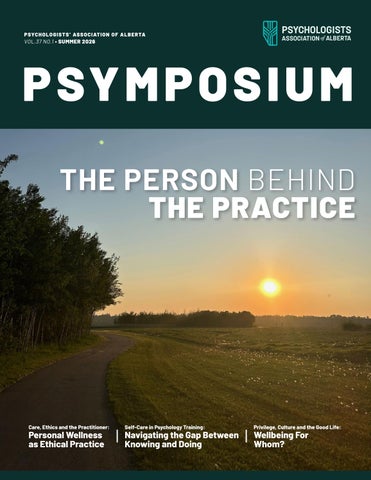
THE PERSON BEHIND THE PRACTICE
Care, Ethics and the Practitioner:
Personal Wellness as Ethical Practice
Self-Care in Psychology Training:
Navigating the Gap Between Knowing and Doing
Privilege, Culture and the Good Life:
Wellbeing For Whom?
BOARD OF DIRECTORS President: Stacey Steele, R.Psych President-Elect: Carmen Bellows, R.Psych Past President: Dr. Quintina Bearchief-Adolpho, R.Psych Audit Committee Chair: Chris Pawluk, R. Psych Board Custodian: Rashmani Chakrabarty, R.Psych Members at Large: Dr. Allison McNeil, R.Psych Lisa Kaldenbach, R.Psych Dr. Ruby Sharma, R. Psych Dr. Denise Mannell, R. Psych Dr. Julie Curley, R. Psych
PAA’s Mission To connect and empower psychologists in Alberta. PAA’s Vision One PAA. The trusted home and leading voice of psychologists in Alberta. It is where psychologists belong, network, and shape the future of mental health care. About Psymposium Looking to advertise with us? Visit our website: paa-ab.ca.
PSYMPOSIUM Editorial Editors: Dr. Alana Ireland, R. Psych & Dr. Lily Le, R. Psych
PAA STAFF
Summer Contributing Writers: Dr. E. Aiofe Freeman-Cruz, R. Psych Dr. Harpreet Gill, R. Psych Leigh-Anne Sheldon, R. Psych Dr. Devyn Rorem Colquhoun, R.Psych Nicole Perry, R.Psych
Chief Executive Officer Dr. Bill Hanson, R. Psych
Design and production: Ken Schwanke & Abby Oloriz
Chief Operating Officer Joanna Leung
PAA Psymposium [ISSN 1193-2627] is the official newsletter of the Psychologists’ Association of Alberta. Canadian Publication Mail Product Sales Agreement #40020241. PAA Psymposium is published four times a year (March, June, September and December) for the purpose of fostering communication amongst psychologists and supporting the goals of the Association and the profession of psychology. The newsletter is available to all members of the PAA on our website or by subscription, as well as to public subscribers and selected individuals and organizations with interests in the practice of psychology. Except where otherwise indicated, copyright 1998 by the Psychologists’ Association of Alberta are in effect. Permission is granted to reproduce up to 10 copies of any article as it appears in PAA Psymposium, if such reproductions are distributed without profit for educational or research purposes only and properly cite Psymposium and denote PAA copyright. Permission for additional reproductions or reproduction for commercial purposes must be obtained in writing from the Editors. PAA generally welcomes requests to reprint from other professional newsletters. Psymposium is submitted to PsycEXTRA, a database set up by the American Psychological Association, which contains newsletters, policy papers, white papers, fact sheets, reports, magazines. PsycEXTRA is a companion to the American Psychological Association’s scholarly database PsycINFO.
Director of Professional Affairs Dr. Harpreet Gill, R. Psych Director of Career Affairs Matthew Cairns, R. Psych
Director of Communications & Strategic Engagement Ken Schwanke
Executive Assistant Jiya Juneja
Governance Officer Angela Sargent
Canada Jobs Trainee & Outreach Assistant Aseel Hag Hussein
Professional Guidance Officer Annika Rorem Member Services Officer Emma McGrath
Paid Advertisement
Payments collected. Reports done. Day wrapped. Book a demo at jane.app/demo
COVER Photo: Taken by Abby Oloriz | West River’s Edge, Fort Saskatchewan AB
2 • PSYMPOSIUM SUMMER 2026
Use code PAA1MO for a 1-month grace period on your new account
Resource Specialist Abby Oloriz
Features
Summer 2026 08
Except where specifically indicated, the opinions expressed in Psymposium are strictly those of the authors and do not necessarily reflect the opinions of the Psychologists’ Association of Alberta, its officers, directors, or employees. The Psychologists’ Association of Alberta reserves the right to edit all articles and submissions before publication and to decide on the suitability for publication.
Personal Wellness as Ethical Practice: Competence, Self-Awareness, and the Psychologist’s Duty of Care
10 Wellbeing for Whom?
14
Self-Care in Psychology Training: Navigating the Gap Between Knowing and Doing
16
Self-Care Through an Indigenous Lens: Two-Eyed Seeing and Holistic Wellness
18
Sustaining Aliveness in Therapeutic Practice
For PAA Members from the Editors: 04 Letter Sustaining the Healer: The
Learn. Engage. 05 Connect. Explore the PAA Annual
06
Notes from the CEO’s desk: Building a Healthy, Ethical, and Effective Psychology Workforce.
07
11
13
Membership That Pays Off Compare the benefits, costs and savings of each PAA membership tier.
Evolving Practice of Well-being.
Introducing Our Board Meet the 2026-2027 Board of Directors
Conference and Register Today!
Celebrating Excellence Meet the 2026 PAA Award Recipients!
PAA-AB.CA • 3
LETTER FROM THE EDITORS
Sustaining the Healer: The Evolving Practice of Well-being Dr. Alana Ireland, R. Psych & Dr. Lily Le, R. Psych Happy summer, PAA readers! For this issue, we turned to a topic suggested by many of our readers: psychologist wellbeing. As we began working with contributors, we quickly realized that psychologist wellbeing is both deeply important and surprisingly difficult to define. It is intertwined with concepts such as burnout, self-care, wellness, resilience, and professional longevity. These ideas overlap, but they are not interchangeable, and together they illustrate that well-being is far more nuanced than any single definition can capture. Rather than trying to define well-being for you, this issue invites reflection. Our conversations with contributors reinforced that well-being is an evolving practice shaped by our personal experiences, professional responsibilities, identities, and cultures. We hope these articles encourage you to approach the topic with curiosity, openness, and perhaps a renewed perspective on what well-being means in your own professional life.
Well-being is far more nuanced than any single definition can capture. In a profession dedicated to supporting the mental health of others, it is easy to assume that caring for our own well-being is selfevidently important. Yet in practice, it often receives less attention than it deserves. Like many psychologists, we remember being reminded during graduate training that self-care mattered, but often as a brief aside rather than an integral part of being a psychologist. Even today, many of us dutifully
Dr. Lily Le (she/her) is a Registered Psychologist based in Edmonton, AB. She earned her PhD from the University of Alberta and is CoEditor of Psymposium. She works as a Credentials Specialist with the College of Alberta Psychologists.
Dr. Alana Ireland (she/her) is a Registered Psychologist based in Calgary, AB. She earned her PhD from the University of Calgary and is Co-Editor of Psymposium. She works as an Associate Professor with Athabasca University and in Private Practice at Valeo Well-Being.
record our wellness activities as part of our annual professional development requirements without pausing to consider why that reflection is built into our profession in the first place. And because so many of us were drawn to psychology by a desire to help, it can become second nature to prioritize the well-being of others while neglecting our own.
privilege matter when discussing concepts like well-being. Finally, Nicole Perry encourages us to cultivate aliveness and vitality, qualities that help sustain us over the course of a long career.
With this issue, we wanted to move beyond familiar reminders about “putting on your own oxygen mask first.” Instead, we sought perspectives that challenge, broaden, and deepen our understanding of what it means to sustain ourselves in this work. Dr. Devyn Rorem shares her experiences as a trainee and reflects on struggles that many psychologists may recognize from the beginning of their careers. Dr. Harpreet Gill reminds us that psychologist well-being is not a luxury, but a professional necessity. Through an Indigenous worldview, Leigh Sheldon invites us to consider self-care through a holistic, Two-Eyed Seeing approach. Dr. Aiofe Freeman-Cruz thoughtfully explores how understandings of well-being differ across cultures and why power and
Collectively, these authors remind us that well-being is not a destination or a checklist. It is an ongoing practice that looks different across career stages, identities, and life circumstances. As psychologists, we are often described as one of our most important therapeutic tools, if not, the tool itself. Caring for ourselves, therefore, is not separate from our professional lives: it is part of how we practice them. Wishing you all a wonderful summer. We hope you find opportunities to rest, reconnect, and care for yourselves, in whatever way well-being looks for you. With gratitude, Alana & Lily
Collectively, these authors remind us that well-being is not a destination or a checklist. It is an ongoing practice that looks different across career stages, identities, and life circumstances.
4 • PSYMPOSIUM SUMMER 2026
PAA-AB.CA • 5
NOTES FROM THE CEO’S DESK
Building a Healthy, Ethical, and Effective Psychology Workforce By Dr. Bill Hanson, R. Psych, PAA CEO The health and well-being of Alberta’s psychologists is one of my highest priorities. In the past year, PAA has developed dedicated funds to help psychologists in need, workshops and upcoming conference presentations related to mental health, and explored extended health benefits for members that includes thousands of dollars of mental health coverage. Every day, psychologists help others navigate trauma, loss, anxiety, relationship challenges, and life’s uncertainties. Yet our ability to help others depends, in no small part, on how we help ourselves. Many psychologists are naturally drawn to careers that align with Dr. John Holland’s Investigative, Social, and Artistic (ISA) personality profile. They are intellectually curious, enjoy solving complex problems, value meaningful relationships, and appreciate the creativity involved in understanding the human experience. Research and clinical experience consistently point to a constellation of personal characteristics that distinguish highly effective practitioners from average clinicians, including self-awareness, trustworthiness, warmth, reflection, cultural responsiveness, and, of course, one’s own mental health. Having participated in therapy before isn’t predictive of effectiveness, but having good mental health is (Jennings & Skovholt, 1999; Skovholt & Jennings, 1992). Additionally, highly effective psychologists are open-minded, not judgmental; recognize limits of their knowledge; and continually strive to improve. Perhaps most
Dr. William E. Hanson (he/him) is a Registered Psychologist based in Edmonton, AB. He earned his PhD from Arizona State University and is the CEO of the Psychologists’ Association of Alberta (PAA). He is the Chair of the Council of Professional Associations of Psychology, and a retired professor of psychology.
6 • PSYMPOSIUM SUMMER 2026
“The therapist’s own person is the principal instrument of psychotherapy.” — Irvin D. Yalom, The Gift of Therapy importantly, they understand that they are an important part of the therapeutic process. Every psychologist brings personal experiences, assumptions, and biases into clinical work. All of us have “growth edges.” Ethical practice therefore requires ongoing self-monitoring, openness to feedback, and a willingness to revise our thinking when new evidence emerges. Remaining skeptical without becoming cynical protects both our clients and us from questionable practices and confirmation bias. Additionally, research also reminds us that effective treatment involves much more than selecting the “right” technique. The contextual model emphasizes that clients often seek care because they are demoralized and hopeless. Healing occurs through collaborative, culturally salient, “real relationships” characterized by empathy, trust, shared goals, and positive expectations for change (Wampold & Imel, 2015). Techniques matter, but not as much as the therapeutic alliance, the credibility of the therapist, and the environment in which care is delivered. Perhaps one of the most compelling findings from psychotherapy research is that therapists differ meaningfully in their effectiveness, even when they possess similar qualifications, training, or years of experience. Improvement therefore depends less on accumulating experience and more on engaging in deliberate practice, reflecting on feedback, identifying strengths and growth areas, seeking expert consultation, and pursuing purposeful, goaldirected development throughout one’s career. It also depends on having cultural humility. Cultural humility deserves extra attention here. Developing a strong sense of one’s own “cultural self” and the ways our nationalities, ethnicities, generations, socioeconomic backgrounds, religions, genders, and life experiences shape our worldview, is foundational to understanding others. Cultural humility begins with knowing ourselves. Genuine curiosity about clients’ backgrounds, communities, support systems,
and expectations strengthens therapeutic relationships and improves engagement across diverse populations. MEASURING WHAT MATTERS, INCLUDING PSYCHOLOGISTS’ OWN MENTAL HEALTH Another top priority for me at PAA is Measurement-Based Care (MBC). And as psychologists, we should measure what matters (Hanson & Truscott, 2025). Just as we monitor client progress, we should routinely monitor our own mental health. Traditional clinical dashboards track attendance, client outcomes, therapeutic alliance, client satisfaction, and culturally responsive practice, which provide valuable feedback for reflection, supervision, and continuous quality-of-care improvement. But for a minute, imagine this: imagine expanding these dashboards beyond client processes and outcomes to include psychologists’ own health and well-being, for example, mood and emotional exhaustion, compassion fatigue, general hopefulness/ optimism, sleep quality, perceived stress, readily available collegial support, and overall psychological health. These factors are, to be sure, indicators of professional readiness and quality of care (Miller, Hubble, Chow, & Seidel, 2013). By combining ethical reflection, cultural humility, intentional self-care, and ongoing measurement of our own effectiveness and mental health, we strengthen not only ourselves, but the future of psychology in Alberta.
The Psychologists’ Association of Alberta (PAA) is pleased to welcome the 2026–2027 Board of Directors. Representing communities across the province and a broad range of professional experiences, our Board provides the leadership and strategic direction that supports PAA’s mission to connect and empower psychologists in Alberta. We are grateful to each Board member for their commitment to volunteering their time, expertise, and leadership. As the trusted home and leading voice of psychologists in Alberta, PAA relies on the guidance and dedication of its Board to help strengthen the profession, cultivate meaningful connection, and shape the future of mental health care. We look forward to working together over the coming year to support our members and continue building a strong, connected community where psychologists belong.
PAA-AB.CA • 7
ETHICS CORNER
Personal Wellness as Ethical Practice: Competence, SelfAwareness, and the Psychologist’s Duty of Care By Dr. Harpreet Gill, R. Psych In psychology, competence is often discussed in terms of education, supervised training, continuing professional development, ethical decision-making, and evidence-informed practice. These are essential. Yet there is another dimension of competence that is sometimes treated as secondary, private, or “nice to have” i.e. the psychologist’s own well-being. The capacity to be present, thoughtful, emotionally regulated, and clinically responsive is not separate from ethical practice. It is part of ethical practice. Psychologists work in spaces of vulnerability. Clients bring grief, trauma, uncertainty, conflict, fear, and pain into the room. Our task is not merely to know what intervention to use, but to listen closely, notice nuance, regulate our own reactions, think clearly, and respond in a way that protects the client’s welfare. When a psychologist is exhausted, acutely grieving, sleep deprived, overwhelmed, or otherwise compromised, these capacities may be affected. The ethical question then becomes direct: am I able to provide competent care today? As per the CPA’s, Canadian Code of Ethics, selfcare is explicitly part of the psychologist’s duty of Responsible Caring, which requires psychologists to maintain competence, minimize harm, and recognize when their own functioning may affect the quality of care they provide (Canadian Psychological Association, 2017). This framing moves self-care away from being viewed as
Dr. Harpreet Gill (she/her) is a Registered Psychologist based in Edmonton, Alberta. She earned her PhD from Punjabi University and currently serves as PAA’s Director of Professional Affairs. In her clinical practice, she brings her commitment to professional standards and patient care through her work specializing in addictions and couples counselling.
8 • PSYMPOSIUM SUMMER 2026
The ethical issue is not whether we suffer; it is how honestly and responsibly we respond when suffering begins to affect our clinical presence or professional judgment. optional or indulgent. Instead, it becomes part of the psychologist’s ethical responsibility to clients, colleagues, the profession, and the public. The Canadian Code of Ethics for Psychologists is organized around four core principles: Respect for the Dignity of Persons and Peoples, Responsible Caring, Integrity in Relationships, and Responsibility to Society. While all four principles may relate to wellness and professional functioning, Responsible Caring is especially relevant. It asks psychologists to maximize benefit, minimize harm, and maintain the competence necessary to provide effective services. This duty of care requires more than good intentions. It requires ongoing self-monitoring and a willingness to act when personal functioning begins to affect professional judgment or clinical presence. Rodolfa and colleagues’ (2005) cube model of competence is useful here because it frames competence as multidimensional. Competence involves foundational competencies, functional competencies, and development across the professional lifespan (Rodolfa et al., 2005). Ethics is not a single checkbox within this model; it is woven through how psychologists relate, assess, intervene, consult, supervise, and continue to grow. Personal well-being intersects with each of these dimensions. Sleep deprivation can impair attention and memory. Grief can reduce emotional capacity. Burnout can reduce empathy, flexibility, and patience. Chronic stress can affect decision-making and increase the likelihood of rigid, reactive, or avoidant responses. This does not mean psychologists must be free from pain or stressors in order to practise. Psychologists are human beings. We experience illness, loss, parenting stress, caregiving responsibilities, financial worries, relationship strain, and the ordinary pressures of life. The ethical issue is not whether we suffer; it is how honestly and responsibly we respond when
suffering begins to affect our clinical presence or professional judgment. A useful starting point is self-awareness. Before asking, “Should I be practising?” psychologists can ask more specific questions: » » » » » » »
Am I able to listen with full attention? Am I unusually irritable, distracted, numb, or emotionally flooded? Am I missing important details? Am I dreading certain clients in a way that may affect my care? Am I relying on autopilot? Am I more likely to over-identify, withdraw, or become impatient? Have I received feedback from clients, colleagues, supervisees, or loved ones that suggests I am not myself?
The challenge is that self-assessment has limits. Barnett and Homany (2022), drawing on Wise and Reuman (2019), emphasize that self-care is more than a list of activities, and they argue that psychologists may not always accurately recognize when their competence is at risk or when support from others is needed. They recommend a more communitarian approach, one in which colleagues, supervisors, consultation groups, and professional communities help normalize care, accountability, and support (Barnett & Homany, 2022). This is an important corrective approach. Ethical selfcare is not simply a bubble bath, a day off, or a wellness checklist. It is a professional culture in which psychologists can say, “I am struggling,” and receive support before impairment harms clients. In practical terms, psychologists need plans for different levels of concern. Mild depletion may require immediate restoration: eating, hydration, a walk, a short pause between sessions, a consultation call, or rescheduling non-urgent administrative work. Moderate impairment may require reducing caseload, increasing supervision
or consultation, taking leave, adjusting the type of work being done, or seeking therapy or medical support. More serious impairment may require temporarily stopping clinical work, arranging coverage, consulting with regulatory or professional guidance, and ensuring continuity of care for clients. One of the most powerful forms of ethical practice is prevention. Many psychologists wait until they are depleted before making changes. However, the profession increasingly recognizes that self-care is not a luxury. The APA Monitor has described self-care for mental health professionals as an ethical imperative, particularly because psychologists are often holding clients’ pain while also navigating their own stressors (Abramson, 2021). Preventive self-care protects both the psychologist and the people they serve. Prevention does not always require large blocks of time. In my own experience, when my children were younger, I would come home from work before they returned from school. I made sure I had 15 minutes to myself before they came in. That small pocket of time mattered. On days when I did not get those 15 minutes, I noticed I felt more overwhelmed and irritable. The lesson was simple but significant: small pauses can create enough space to reset. They allow the nervous system
to settle, the mind to shift roles, and the body to communicate what it needs. For many psychologists, this may be a more realistic entry point than idealized versions of self-care. Fifteen minutes between sessions. Ten minutes outside before returning home. A quiet cup of tea before documentation. A walk around the block after a difficult assessment. A moment to breathe before opening the next file. These practices are not indulgent; they are micro-acts of competence maintenance. Listening to the body is also essential. Fatigue, headaches, muscle tension, shallow breathing, irritability, tearfulness, forgetfulness, and emotional numbness are important signals. They are not inconveniences to override indefinitely. Psychologists are trained to help clients notice patterns, triggers, and signals. We must be willing to apply the same curiosity to ourselves. Several takeaways follow. First, build selfmonitoring into routine practice rather than waiting for a crisis. Second, identify trusted colleagues for consultation before we need them. Third, create a personal impairment plan: what signs will tell us that our competence may be affected, whom will we contact, and what steps will we take? Fourth, normalize conversations about wellness in supervision, peer consultation,
and professional communities. Fifth, treat rest and recovery as part of professional preparation, not as a reward after all work is complete. Competent care depends on the psychologist’s whole capacity: our knowledge, ethics, skills, judgment, emotional availability, and humanity. Personal wellness is therefore not separate from quality practice; it is one of the conditions that makes quality practice possible. When psychologists care for themselves with honesty, humility, and accountability, they are also caring for their clients.
Have an ethical dilemma?
Our Professional Guidance Program can help. » GUIDANCE CONSULTATIONS » ETHICS WORKSHOPS
» WEBINARS & LUNCH N LEARNS » PODCASTS & RESOURCES
BOOK A CONSULT OR LEARN MORE
PAA-AB.CA • 9
Wellbeing for Whom? By Dr. E. Aiofe Freeman-Cruz, R. Psych The word “wellbeing” is often used yet rarely clearly defined across multiple disciplines (Jarden & Roache, 2023). It is a term that may be thought of as universal, yet it can have varying interpretations and meanings. The World Health Organization (WHO, 2021) defines wellbeing as a positive state that is considered necessary for one’s quality of life. Furthermore, WHO (2021) states that wellbeing encompasses “the ability of people and societies to contribute to the world with a sense of meaning and purpose” (p.10). Meanwhile, the American Psychological Association (APA, 2018) defines wellbeing as “a state of happiness and contentment, with low levels of distress, overall good physical and mental health and outlook, or good quality of life.” As Jarden and Roache (2023) highlight, different cultural worldviews understand
Different cultural worldviews understand wellbeing differently as well as the tasks involved in pursuing wellbeing.
wellbeing differently as well as the tasks involved in pursuing wellbeing. Both definitions have words that are loaded with meaning that can vary from person to person and group to group. What does it mean to “contribute to the world with a sense of meaning and purpose”? What does it mean to have good physical and mental health? What does it mean to have a good quality of life? Who decides how one measures up to these concepts? Several scholars have made strong attempts to operationalize the concept, yet it is unclear how applicable these operationalizations are to diverse cultures and social locations (Seligman, 2011; Zhang et al., 2024). As we continue to
decolonize psychology practice, we need to consider the role of privilege in the pursuit of wellbeing as well as how we are outlining wellbeing. At this time, there is limited research that reflects non-Westernized views of wellbeing as the standard (Zhang et al., 2024). Most psychology and mental health professionals have recognized systemic barriers and oppressions that impact BIPOC and marginalized groups. The intention of a wellbeing conceptualization for marginalized groups is to support a “good quality of life,” with “good physical and mental health” (APA, 2018; Zhang et al., 2024). However, one’s context of life and cultural experience may not be well suited to this conceptualization of wellbeing. For example, a Black solo parent with limited resources may be struggling to achieve good physical and mental health when their meaning is derived from ensuring their children are raised in better conditions than they were. With this example, this parent may be working to break intergenerational trauma patterns but may not be able to prioritize this work due to limited resources (e.g., time, energy, money, etc.). That would require a variety of resources to engage in the proposed tasks of wellbeing which may be simply out of reach. The recommendations for wellbeing often lead the individual to fit within a westernized idea of meaning, purpose, and physical/mental health. The subtle suggestion is that if one were to do enough, they could achieve wellbeing as defined by those with privilege and power (often connected to whiteness). The multi-million dollar wellness industry markets to audiences in a particular way to support this societal narrative (Stea, 2025). Such discourse does not acknowledge the limitations of an inequitable system, not to mention diversity in the meaning of wellbeing. As such, some racialized and marginalized communities frequently receive the same feedback – you are not doing enough to promote wellbeing. In reality, it may be more likely due to the systemic barriers, the ill-fitting definition of wellbeing for some, and the expectations inherent that everyone can achieve this privileged ideal of wellbeing.
Dr. E. Aiofe Freeman-Cruz (she/her) is a Registered Psychologist in Calgary, Alberta. She earned her PhD from the University of Calgary and works in private practice at Divertue Psychology & Wellness. She specializes in intersectionality and identity construction.
For the aforementioned Black parent, they may also be working against continued microaggressions inherent in the expectations of wellbeing that are framed within whiteness, particularly from practitioners who may be imposing a westernized conceptualization of wellbeing, rather than a decolonized one. Furthermore, individuals with diverse abilities may be seeking a “good enough” life as they are also living in a world that was not designed for them. The operationalization of wellbeing needs to be considered in the context of individual circumstances. As such, it is the psychologist’s responsibility to actively decolonize their lens and work towards anti-oppressive practices, especially within their application of certain concepts that were developed from a Western perspective. This is not an easy process nor is it ever a complete one as much of the practice of psychology is based on Westernized concepts. This is not to say that Western concepts are bad or in some way unhelpful. Instead, it is an acknowledgement that one size does not fit all, and psychologists are responsible for reasonably adjusting to be accessible to diverse clients. On the microsystem level, psychologists first need to recognize their own privilege and power in a therapeutic dynamic with BIPOC and marginalized clients. Some recommendations, supports, and therapeutic directions may not be in alignment with diverse clients’ perspectives of wellbeing and meaning. Continued on pg. 12 >>>
One size does not fit all, and psychologists are responsible for reasonably adjusting to be accessible to diverse clients. 10 • PSYMPOSIUM SUMMER 2026
CONGRATULATIONS TO OUR 2026 PAA AWARD RECIPIENTS
Each year, our association honours and celebrates our professional community. Here are the 2026 Award Winners.
Pettifor Lifetime Achievement Award
Excellence in Community Service
Dr. John Amundson
Debbie Jabbour
John G. Paterson Media Award
Masters’ Thesis Research Award
Dr. Sandra Dixon
Henna Hans
Doctoral Dissertation Award
Excellence in Clinical Supervision Award
Jessica Cooke
Dr. Wendy Hawkins
Excellence in Teaching Psychology
Undergraduate Thesis Research Award
Michael Huston
Abby Oloriz
PAA-AB.CA • 11
This is essential to becoming a culturallyresponsive psychologist, recognizing that a position of humility and not knowing may be a more helpful approach to wellbeing. For example, some clients may have a strong cultural value of prioritizing family connection and support, so being told to “cut off” a family member because of their family member’s “bad behaviour” could be counter to their cultural beliefs and values. For some, maintaining contact with many emotional boundaries in place is more helpful to ensure they remain connected with that family member. While for others, it is more meaningful for their personal wellbeing to eliminate contact with that family member. The psychologist’s privilege and worldview can
inform recommendations in this situation. By maintaining awareness of and continuously monitoring one’s worldview, a psychologist can better respond to concepts like wellbeing from within the cultural context and worldview of the client.
and revisited with a culturally-responsive and socially just lens. Decolonizing practice is not easy, and yet to prevent psychology practice from perpetuating oppression, it is necessary to promote true wellbeing.
As psychologists, we can consider evidencebased approaches to fostering wellbeing, while also acknowledging that the research literature is limited and not always representative (Jarden & Roache, 2023; Zhang et al., 2024). In practice, it seems defining wellbeing needs to be a collaborative process: we need to acknowledge our own positions and privileges while recognizing that the standard for wellbeing is yet another concept that needs to be decolonized
Paid Advertisement
EMDR Basic Training 2026 TRAININGS EDMONTON • Spring - June • Fall - Begins September
45 Hours Continuing Competence Activities
Trainer Dr Judy Moench with expert Facilitators LEARN MORE
EMDRIA Approved training, developed locally, taught by a teacher in a positive learning environment
prepped4learning.com
12 • PSYMPOSIUM SUMMER 2026
PAA-AB.CA • 13
Self-Care in Psychology Training: Navigating the Gap Between Knowing and Doing By Dr. Devyn Rorem Colquhoun, R.Psych Training to become a psychologist has been one of the most meaningful and rewarding experiences of my life, and undoubtedly one of the most challenging. Trainees are told by wellmeaning instructors and supervisors that selfcare and well-being are essential to ethical and effective practice (CPA, 2017), yet there is a gap between valuing these principles and actually putting them into practice (Fonte et al., 2025). Although I certainly do not pretend to have the answer to this complex issue (wouldn’t that be great), I do have a lot of very recent experience navigating this topic. I hope to explore some of the barriers that make this balance so difficult, share some of my own experiences trying to navigate this gap, and reflect on what I want to carry forward as I move out of the trainee phase. I was fortunate to have a wonderful graduate school experience and felt well supported by incredible supervisors, faculty, and peers and there were still moments where prioritizing my own wellbeing was hard. I choose to share some of my own experiences because I believe it is critical to normalize the reality that many trainees struggle with and to open conversations about how they can access meaningful support. As a scientist-practitioner, I find that a helpful first step in unpacking why engaging in selfcare is challenging for many graduate students is to examine the literature on the demands of graduate studies in psychology. Maranzan et al. (2018) highlight the paradoxical nature of training, in which students are expected to demonstrate competence across a variety of research, clinical, and professional roles as they learn many of these skills. Students are encouraged to adopt a growth mindset and learn through feedback and mistakes while being continuously evaluated within supervisory relationships with significant power differentials (Miller et al., 2023) and in the context of real clients. At the same time, trainees are often balancing
personal and familial responsibilities alongside financial and time constraints, which can make it more difficult to engage in self-care or to seek support (Brown et al., 2022; ElGhoroury et al., 2012). These challenges may be particularly pronounced for trainees who are parents, many of whom report inadequate support in navigating both caregiving and professional demands within programs that continue to operate around non-parent norms (Pereira et al., 2023). For many psychology trainees, there is a difficult irony in struggling to access or afford adequate mental health support for themselves while simultaneously providing mental health services to others at no cost. These demands place trainees at increased risk for struggling with their own mental health. Psychology trainees report elevated rates of burnout (Park et al., 2021), depression (Hobaica et al., 2021; Schneider et al., 2021; Victor et al., 2022), anxiety (Hobaica et al., 2021; Schneider et al., 2021; Victor et al., 2022), stress (Schneider et al., 2021; Victor et al., 2022), and suicidal ideation (Hobaica et al., 2021; Victor et al., 2022). Furthermore, trainees from structurally marginalized communities often face additional and compounding stressors that can further affect their mental health and ability to engage in self-care, including discrimination, microaggressions, financial pressures, and feelings of isolation within academic and clinical environments (Brown et al., 2022; Hobaica et al., 2021). These experiences occur within broader colonial and WEIRD (Henrich et al., 2010) institutional contexts that normalize individualistic and Eurocentric assumptions about professionalism, competence, wellness, and care (Johnson et al., 2012). At the same time, trainees are learning to manage the emotional toll that psychological work can have on their wellbeing (Miller et al., 2023). Disclosing personal struggles in this context can feel especially challenging. I have had conversations with fellow highly skilled
trainees who expressed feeling embarrassed and afraid that it was unprofessional if they felt emotionally impacted by a disclosure from a client. Given the highly competitive nature of graduate admissions and the sense of privilege often associated with pursuing this career path, trainees may worry that acknowledging difficulties will be perceived as complaining, ingratitude, or that they “don’t have what it takes.” Overextension is often rewarded, and many trainees fear that disclosing their own mental health challenges could lead to stigma or their competence being questioned (Bailey et al., 2024). I remember once calling a mental health helpline while struggling and, after being asked what I did for work, being told, “Why don’t you just do what you would tell a client?” There can also be mixed messaging around wellness and productivity. In one of my placements, we were told we should not be bringing work home and to prioritize self-care, only to later be questioned about why certain tasks were not already completed and reminded that we could use banked overtime for time off at Christmas. Given these factors, self-care can start to feel like just another task added to an already overwhelming list. The metaphor that most often came to mind for me as a trainee was standing in a room full of spinning plates. Just as a few plates finally seemed to stabilize, others would begin wobbling or falling. When I felt ahead in coursework or practicum, or had spent time preparing for a conference presentation, I would suddenly feel behind on my thesis, research, or another commitment. In trying to manage all of this, my self-care was often the first thing sidelined. I remember learning how to pre-schedule emails so it would be less obvious that I had been up all night working. Eventually, I had convinced myself that evening and weekend practicum hours were actually good because they “forced” me to stay productive outside of regular work hours. Looking back, I was burning myself out without
There is a difficult irony in struggling to access or afford adequate mental health support for ourselves while simultaneously providing mental health services to others at no cost. 14 • PSYMPOSIUM SUMMER 2026
Rather than viewing balance as something to perfect, I see it as an ongoing practice and commitment to myself. fully recognizing it because I had convinced myself I was nowhere near productive enough to deserve to feel burned out.
In doing so, I became more realistic and intentional in how I planned my time and stopped working late into the night.
For me, the turning point came when I started opening up to others when I was struggling. In one especially memorable conversation, I shared my “spinning plates” metaphor with my supervisor and explained how much I was struggling to keep everything balanced. As we mapped out my responsibilities together, she emphasized that taking care of myself needed to be the highest priority. At the time, that felt almost counterintuitive. I was so focused on keeping up with responsibilities and being productive that self-care felt like time taken away from getting things done. Gradually, though, I began to live out what I already knew from the literature: trainees who engage in self-care practices report lower perceived stress, greater well-being, and improved perceptions of their clinical and academic performance (Maranzan et al., 2018).
I also found ways to make large or anxietyprovoking tasks feel more manageable by pairing them with things I enjoyed - working alongside a friend, finding cozy cafes to work in, or listening to EPPP study podcasts while walking my dog. Over time, I have worked on comparing myself less to others and have become more comfortable saying no, or at least “not right now,” to commitments that do not feel sustainable.
There is also a dialectic that trainees face: although there are significant systemic barriers to self-care, trainees also carry some responsibility to engage in it. For me, this has been less about achieving a perfect balance and more about intentionally building small practices, boundaries, and sources of support into my life. One of the biggest shifts was learning to ask for support sooner rather than waiting until I was already overwhelmed.
UPCOMING TRAINING
After a year of completing my pre-doctoral internship during the week while writing my dissertation on weekends, I chose to work clinically 4 days a week so I could dedicate time during the work week to preparing for my doctoral defence and studying for the EPPP. I have also become more open with colleagues about the emotional impact of clinical work, while trying to embody the idea of maintaining both a soft heart and a strong back when working with children, youth, and families. Have I completely figured out this balance? Not quite - I am currently writing this on a Sunday evening after attending a training workshop on Saturday. But rather than viewing balance as something to perfect, I see it as an ongoing practice and commitment to myself.
even though we have all been children, we cannot fully know what it is like to be a child because we now understand the experience of being a child through adult minds. I think the same can be said for trainees. We have all been there, but we look back on those experiences knowing how the story unfolded and that, ultimately, things worked out. Trainees are still in the middle of it. As I move forward in this field, I hope to keep that in mind when supporting trainees: remembering what it felt like to be in that vulnerable space and collaborating with them to find ways to prioritize their well-being throughout the process.
Dr. Devyn Rorem Colquhoun (she/ her) is a Registered Psychologist. She completed her PhD at the University of Alberta, and is currently working at the Glenrose Rehabilitation Hospital in Edmonton. She specializes in School and Clinical Child Psychology.
A mentor once told me that, as child clinicians,
Pre-Conference Workshops October 1, 2026
Other upcoming workshops?
Dr. Mike Sornberger, R.Psych
Dr. Stephen Carter, R.Psych
Dr. Michael Ungar
Dr. Harpreet Gill, R.Psych & Dr. Shahin, R.Psych
LEARN MORE
LEARN MORE
LEARN MORE
LEARN MORE PAA-AB.CA • 15
INDIGENIZING PSYCHOLOGY
Self-Care Through an Indigenous Lens: Two-Eyed Seeing and Holistic Wellness By Leigh Sheldon, R. Psych SEEING WELLNESS THROUGH TWO EYES Two-Eyed Seeing offers an understanding of self-care and capacity-building through a holistic lens. It can also be understood as a decolonizing approach to self-care, one that invites us to remember who we are, where we belong, and how we are connected to ourselves, others, and the world around us. To appreciate what self-care might look like through an Indigenous lens, we need to consider how wellness, more broadly, is understood. Wellness can be conceptualized through Two-Eyed Seeing. This approach invites us to look both inward and outward; one eye in and one eye out. One perspective encourages awareness of thought, knowledge, analysis, and problem-solving, while the other emphasizes feeling, being, embodiment, relationality, and connection. Rather than positioning these perspectives in opposition, Two-Eyed Seeing teaches us to value the strengths of both and to use them together in support of wellness. Looking inward invites reflection and selfawareness. We may ask ourselves: What am I noticing? What sensations are present in my body? Where is my energy today? What is my nervous system communicating? Looking outward invites awareness of our relationships, environment, community, and broader context. Together, inward and outward awareness strengthen our capacity to care for ourselves and others in balanced, sustainable, and meaningful ways. Through many Indigenous worldviews, wellness is understood as a dynamic process of maintaining harmony across all aspects of life. Health extends beyond the absence of illness and reflects the quality of our relationships, with ourselves, our families, our communities, the land, and spirit. It is not about identifying something wrong with ourselves that needs to be fixed, but recognizing that we need balance and connection. As such, self-care is not simply about managing stress or preventing burnout, it is about engaging in activities or practices that invite harmony and holistic wellness. WELLNESS IS RELATIONAL Holistic approaches to wellness recognize the interconnectedness of the physical, mental, emotional, spiritual, and relational dimensions of life. When one area is affected, the others are influenced as well. Emotional distress may manifest physically. Chronic stress can shape
16 • PSYMPOSIUM SUMMER 2026
our thoughts, relationships, and sense of wellbeing. Conversely, growth and healing in one domain can positively influence the others.For example, spiritual practices such as prayer, ceremony, connection with land, or relationship with ancestors may foster emotional grounding and a greater sense of purpose. Improved emotional regulation may support physical health and clearer thinking, while caring for the body through rest, movement, nutrition, and breath can contribute to emotional resilience and mental clarity. Each dimension influences the others, and each can become a pathway toward healing and restoration. At its core, this understanding of wellness is relational. Rather than asking only what is wrong, it invites us to ask: What relationship requires my attention? What part of myself needs care? What is my relationship with my stress? What is asking to be restored, strengthened, or supported? Through this lens, self-care becomes less about fixing ourselves and more about nurturing relationships that sustain balance, connection, and well-being. THE BODY: A RELATIONSHIP WITH PHYSICAL WELLNESS Many Elders encourage us to begin with a simple but profound question: What is your relationship with your body or physical self? The body sustains us every day, yet it is often the aspect of ourselves we neglect most. Physical self-care includes foundational practices such as sleep, nutrition, hydration, rest, movement, and breath. These are not luxuries; they are essential conditions that support our overall capacity to live, work, relate, and heal. When these needs go unmet, strain is often experienced across multiple dimensions of wellness. Many Indigenous teachings recognize that the body carries lived experience. It holds memories of adversity, resilience, connection, and healing. While trauma can be experienced through the body, so too can restoration. The body is not simply a vessel that carries suffering; it is also a source of wisdom, strength, and renewal. Movement, whether through walking, dancing, exercise, or traditional cultural practices, supports both physical and emotional wellbeing. Research suggests that physical activity contributes to nervous system regulation, cognitive functioning, and overall health. Breathwork and restorative practices can
Leigh-Anne Sheldon (she/her) is a Registered Psychologist in St. Albert, Alberta. She earned her Master’s from City University of Seattle and is the Founder and CEO of Indigenous Psychological Services. She frequently facilitates training workshops, and specializes in complex trauma and Indigenous counselling. further support the body’s capacity to recover from stress and maintain balance. Within many Indigenous traditions, healing practices such as ceremony, drumming, dancing, singing, and land-based activities engage the body as an important pathway for connection and healing. These practices often emphasize experience, participation, community, and relationship rather than solely cognitive understanding. They invite individuals to reconnect with themselves, others, culture, and spirit through embodied ways of knowing. From this perspective, healing is not only something we think about. It is also something we experience, feel, practice, and live. The body becomes an important teacher, offering insight into what needs attention, support, and care. Similarly, an Indigenous lens would consider self-care a practice that we engage in when we recognize that our body holds wellness and the medicines we need for healing. THE MIND: CULTIVATING AWARENESS AND UNDERSTANDING Our thoughts shape how we understand ourselves, others, and the experiences we encounter throughout life. At the same time, the mind does not function in isolation. Thoughts, emotions, bodily sensations, relationships, and life experiences continuously influence one another. For example, chronic stress, including complex and intergenerational trauma, can affect how we perceive and respond to the world around us. When the nervous system remains in a prolonged state of activation, it can become difficult to feel present, connected, and at ease. Individuals may experience rumination, heightened vigilance, catastrophic thinking, or difficulty accessing the clarity and perspective needed for decision-making.
Indigenous teachings often recognize the importance of the stories we carry about ourselves and the world. A teaching commonly shared across many communities speaks of two wolves within us. One wolf represents fear, anger, resentment, and disconnection. The other represents love, compassion, kindness, and connection. The teaching reminds us that the wolf we feed grows stronger. While difficult thoughts and emotions are part of being human, we have a relationship with our thoughts and can choose which patterns we nurture through our attention and actions. Supporting mental wellness involves learning to work with our thoughts rather than against them. Practices such as mindfulness, reflection, meditation, journaling, storytelling, and positive self-talk can strengthen awareness and cognitive flexibility. Equally important is the opportunity to speak our experiences aloud. For many Indigenous individuals and communities impacted by residential schools, cultural suppression, and intergenerational trauma, sharing stories can be a powerful act of healing. Being heard, seen, and witnessed may help restore dignity, connection, and voice. Within many Indigenous teachings, language itself carries meaning, spirit, and relationship. Through story, conversation, and collective witnessing, individuals and communities can create space for understanding, healing, and renewal. Ultimately, the goal is not to control every thought that arises. Rather, it is to develop a healthier relationship with the mind, one grounded in awareness, compassion, and discernment. EMOTIONAL PRACTICE: LISTENING TO WHAT EMOTIONS TEACH US Within many Indigenous worldviews, emotional distress may be understood as a sign that balance has been disrupted in one or more areas of life. Emotions can serve as messengers, drawing attention to relationships, experiences, or aspects of ourselves that may require care and attention. Rather than asking how to make an emotion disappear, the question often becomes: What is this feeling trying to teach me, tell me and the medicine it may bring? Some Cree teachings speak of difficult experiences and emotional struggles as opportunities for learning, growth, and transformation. Challenges are not necessarily viewed as signs of weakness or failure, but as part of the human journey. Community, family, Elders, and cultural teachings often play an important role in helping individuals navigate times of adversity and reconnect with their strengths.
Many Indigenous and somatic approaches to healing recognize the relationship between emotions and the body. Emotions are often experienced as sensations, energy, and felt experiences. Fear may be felt as tension, grief as heaviness, or joy as warmth and openness. By developing awareness of these bodily experiences, individuals may become better able to understand and process emotional experiences. Similarly, from a Western traumainformed perspective, emotions are sometimes described as “energy in motion.” When emotions are ignored, suppressed, or avoided, they may continue to manifest psychologically, physically, or relationally. Creating opportunities to acknowledge and process emotions can support healing and resilience. Emotional wellness is also deeply relational. Healing rarely occurs in isolation. Co-regulation, supportive relationships, cultural connection, ceremony, and community all contribute to emotional well-being. While personal reflection is important, many Indigenous teachings emphasize that healing is strengthened through relationships with others. Healing is more powerful collectively instead of individually. Self-care then might invite us to engage with those we care about to benefit from the healing and enhanced wellness that relationship brings. THE SPIRIT: CONNECTION, MEANING, AND BELONGING The spiritual dimension of wellness is central within many Indigenous understandings of health and healing. While Western health models often focus on mental, psychological, and behavioral factors, Indigenous perspectives frequently recognize spirit and physical health as an essential aspect of human well-being. Spiritual wellness is not limited to religious practice. It encompasses meaning, identity, belonging, purpose, connection, and relationship. It may be nurtured through ceremony, prayer, language, community, land-based practices, cultural teachings, or relationships with family and ancestors. For many Indigenous people, spirituality is woven into everyday life rather than existing as a separate aspect of it. It is a lifeway, being and embodying. Historical experiences of colonization, cultural suppression, residential schools, and forced displacement disrupted many of these relationships. Cultural erasure, attempts at cultural silencing and cultural amnesia affected not only communities and families but also individuals’ connections to identity and spirit. As a result, healing often involves more than addressing symptoms; it may require restoring relationships that were interrupted or harmed across generations. It also requires cultural continuity.
Many Indigenous communities speak of cultural continuity as an important protective factor that supports health and wellness. Reconnecting with cultural teachings, language, Elders, traditional practices, and community can strengthen a sense of belonging and identity. These connections often provide meaning, guidance, and support throughout the healing journey. Spiritual healing is deeply personal and may look different for every individual. For one person, it may involve attending ceremonies or participating in cultural practices. For another, it may involve spending time on the land, learning their language, speaking with Elders, connecting with family, or finding comfort in prayer. Some individuals experience spiritual connection through music, dancing, storytelling, or service to others. Through the lens of Two-Eyed Seeing, spiritual wellness invites us to cultivate awareness not only of what exists around us but also of what exists within us. It encourages us to listen carefully to that inner knowing and to honour the relationships that help guide our path. Similarly, self-care might involve connecting deeply and intentionally to the inner wisdom that guides our health CONCLUSION: SELF-CARE AS RELATIONSHIP Through many Indigenous perspectives, wellness is not understood as the absence of illness or the achievement of perfection. Rather, it is viewed as a dynamic process of maintaining balance, nurturing relationships, and living in a good way with ourselves, others, community, land, and spirit.Two-Eyed Seeing offers a valuable framework for understanding wellness through both Indigenous and Western perspectives. It invites us to appreciate the strengths of cognitive understanding alongside embodiment, relationality, and connection. In doing so, it reminds us that wellness is not found solely through thinking, nor solely through feeling, but through honouring the relationship between the two. The stronger our relationship with ourselves, the greater our capacity to be in relationship with others, our communities, the land, and spirit. When we learn to listen to ourselves with curiosity, compassion, and respect, we strengthen our ability to respond to what is needed within and around us. With one eye turned inward and one eye turned outward, Two-Eyed Seeing reminds us that wellness is not something we achieve alone. It is something we cultivate through relationship, balance, and connection throughout our lives. Self-care then is about how we care for ourselves as we care for others.
PAA-AB.CA • 17
Sustaining Aliveness in Therapeutic Practice By Nicole Perry, R. Psych After more than fifteen years in the profession, I have become increasingly interested in this question: what helps therapists sustain themselves in their work? What allows us to remain curious, hopeful, engaged, and energized after years of sitting with grief, trauma, conflict, uncertainty, and pain? To me, the answer begins with aliveness. Aliveness is a subjective experience or sense of vitality, pleasure, and engagement that is associated with being awake to our lives and to the world (National Institute for the Clinical Application of Behavioral Medicine [NICABM], n.d., and Levine, 1997). To sustainably practice over a period of decades, we need experiences that generate energy rather than merely conserve it. According to Diana Fosha (2019), energy, vitality, openness, and aliveness are positive affective experiences associated with transformational growth and neuroplasticity. They signal engagement, integration, and movement toward flourishing. In the therapy room, our own aliveness helps us remain present, curious, flexible, and relationally available. Being relationally available matters clinically on more than one level. Consider that traumatic experiences, particularly relational ones, can be thought of as experiences where humanity, connection, and attunement were absent. Survivors have often experienced neglect, dehumanization, violence, betrayal, or environments where their emotional reality was unseen. As Somatic Experiencing trainers have noted, one antidote to trauma is the experience of genuine humanity experienced in relationship with others (Stelte & Galloway, 2016). Likewise, Deb Dana notes that when a client has experienced trauma, especially
Nicole Perry (she/her) is a Registered Psychologist. She completed her MA at Yorkville University in 2009, and is currently the owner of Embodied Psychology Inc. in Edmonton. She specializes in shame resilience, healing trauma, and setting boundaries.
18 • PSYMPOSIUM SUMMER 2026
interpersonal trauma, the social engagement system responds to protect itself: “If it’s not met in the world with another social engagement system that’s alive and welcoming, the social engagement system begins to take a step back to shut down.” (Dana & Buczynski, 2020, p.3). In other words, healing asks us to bring our humanity into the room. That, in turn, asks us to protect the parts of ourselves that remain open, engaged, and alive. Burnout has a way of stealing that aliveness. As described by Maslach and Gomes (2006), burnout is characterized by emotional exhaustion, cynicism, and a sense of inefficacy. It’s more than just exhaustion at the end of the week. It erodes our imagination and relational vitality. Vicarious trauma (VT), likewise, can rob us of our belief in human goodness. Françoise Mathieu describes a profound shift in worldview as a core component of VT. When it takes hold, people can start to wonder, “Are people even good? Is there any reason for hope?” These are not small challenges and can have a profound impact upon our sense of aliveness. Burnout and VT are occupational realities for psychologists; we are at risk due to the nature of our work and regular exposure to traumatic material. And even beyond that, we live in a broader capitalist and ableist culture that tends to value hard work, suffering, and grit. When productivity and “selflessness” are celebrated, we are primed to struggle with setting sustainable boundaries. So perhaps a central question for sustainable practice is not only “How do I prevent burnout?” but also “How do I remain alive?” Boundaries are one possibility. Here, I’m referring to the practices we put in place to protect our time, energy, and capacity. They are unique to each person, so there’s no right or wrong - just what works for each person in the here and now. Our boundaries are culturally rooted, informed by our experiences and goals, and can change over time. Setting boundaries involves defining what we need, want, and value, and doing what we can to align ourselves with that. Of course, we won’t do that perfectly - it’s a consistent recalibration. So it can involve saying no to work that is out of alignment, but also saying yes to what is in alignment. To bring our own aliveness and vitality into the therapy room we need to also be connected to it outside the therapy room. Among the many ways back toward aliveness, I keep returning to two that are often overlooked in professional
We’re invited to reconnect with our own aliveness -- to be playful, present in the here and now, and embodied in the world. conversations: joy and hope. I appreciate the grounded way Dr. MaryCatherine McDonald talks about both concepts in The Joy Reset: Six Ways Trauma Steals Happiness and How to Win it Back. She acknowledges that joy and hope can feel impossible to reach when we’re drowning in darkness. She outright criticizes toxic positivity, or any other worldview that would ask us to ignore suffering, avoid our real emotions, and focus only on the positive. Instead, she offers up a vision of joy where it does not have to be equal in size to pain to count, and it does not have to solve the pain – it can just sit beside it. She defines joy not as the opposite of darkness, but “a kind of relentless, steely thing you find within” (p. 94). And she describes hope as “to transcend one’s circumstances - to know that the circumstances are dire and choose to dream anyway” (p. 99). From this perspective, joy and hope become even more audacious (and more necessary) precisely when there is little reason to feel them. One of my small daily joys outside of work is engaging in stories in all forms - including books, movies, tv shows, and music. A good story has the power to make us feel deeply, heal us in ways we didn’t know we needed to be healed, and change us for the better. At their best, stories can offer us hope about humanity. They remind us that human beings are capable of love, repair, and goodness. For therapists who spend their days holding the weight of trauma and pain, including the horror of world events, that reminder is medicine. Stories can also offer us hope about our collective future. For example, Solarpunk is a genre that imagines sustainable, community-oriented futures where technology exists in relationship with nature rather than in opposition to it. Unlike dystopian stories that assume collapse, scarcity, and violence are inevitable, solarpunk asks us to imagine futures built around cooperation, ecological balance, accessibility, and care.
It’s a genre I’ve found particularly important, because if burnout and vicarious trauma narrow the future, stories have a way of reopening it. Imagination becomes an antidote to despair. Of course, stories are just one way back toward hope, joy, and our own aliveness. Self-care such as movement, connection, creativity, time in nature, and rest are others. The research reminds us there’s no hierarchy here. One 2016 meta-analysis showed that when it comes to self-care for therapists and therapists in training, there’s no meaningful difference between different types of self-care activities in terms of their positive impact on selfcompassion and life satisfaction (Colman et al., 2016). So whether you rock climb, paddleboard, ski, sing karaoke, read, meditate, sit with friends, or anything else, I encourage you to engage in self-care that helps you feel more joyous, hopeful, and alive. If our goal is sustainable practice, then we require a shift in focus. We need to figure out how we can show up as more present both in our sessions and outside of them in our own lives. Ideally, what we decide to do is connected to our values and centers our needs as a
human being to ensure this is both meaningful and sustainable. So for both ourselves and our clients, we are called to pause regularly, turn inside, and notice the parts of ourselves we have ignored for the sake of productivity. We’re invited to reconnect with our own aliveness - to be playful, present in the here and now, and embodied in the world. Personally, I keep coming back to joy, and to the people I share it with. When psychologists get together, the pull is often to talk about work. And there’s real value in that. In the literature on VT prevention in therapists, the importance of peer consult groups and workplace support is highlighted (Melaki & Stavrou, 2023). But what actually sustains me most these days are the group chats with my psychologist friends where we’re talking about the latest little joys (like watching Heated Rivalry, listening to Noah Kahan, and sharing our latest favorite books). Joy and relationship can be sustaining across contexts. I had the same experience doing activist work—what kept us going for so long is that we prioritized joy and our relationships with each other. This can also be done in group supervision. At a recent
supervision session I facilitated, we consciously took the time to reflect on experiences of joy, and what was so powerful was that you could actually see the joy spreading as people talked about touching grass, planting gardens, and hanging out with their pets. Over the long term, I think we should ask ourselves not “Can I technically do this today?” but “How does this connect me to myself and my aliveness over time?” There will always be more we could do, and more our clients seem to need. But it’s worth asking: who do I want to be in twenty years? It may be better service to both parties for clients to connect with someone who engages in life and joy with the same courage and presence we’re asking of them.
Welcoming PAA’s New Staff Ken Schwanke, M.Div Director of Communications & Strategic Engagement
Abby Oloriz, BSc Resource Specialist
Aseel Hag Hussein, BSc Canada Jobs Trainee & Outreach Assistant
Ken Schwanke, M.Div, joined PAA in July and comes with a 20-year track record of communications and marketing expertise, strategic planning, brand development, and reputation management. With extensive experience across the post-secondary, municipal government, and financial services sectors, he has led complex projects involving research, team leadership, and cross-functional collaboration. Ken enjoys working in teams, buildings systems, and when he’s not at work, spending time with his wife, going out for dinner, traveling, bike riding, learning, going to movies, and spending time with family and friends.
Abby Oloriz, BSc, recently graduated from MacEwan University. Her honours thesis used electroencephalography (EEG) to explore how task engagement and learnability influence neural reward processing. Her work was recognized with the Psychologists’ Association of Alberta Undergraduate Thesis Award (2026), the Canadian Psychological Association Certificate of Academic Excellence (2026) and an Honourable Mention for Oral Presentation (2026). Following a practicum with PAA, Abby was recently welcomed to the organization as our new Resources Specialist.
Aseel Hag Hussein, BSc, recently graduated from the University of Alberta with a Bachelor of Science in psychology and now serves as the student program coordinator at PAA. In this role, she leads community outreach and non-member engagement and curates evidence-informed resources that support the public’s understanding of mental health. Outside the office, Aseel enjoys exploring coffee shops and attending Edmonton’s summer festivals. She hopes to pursue a master’s degree in clinical psychology, with interests in youth mental health, knowledge translation and science communication.
PAA-AB.CA • 19
Connect. Learn. Engage. Psychology Conference
Edmonton October 1–3, 2026
Register Today. Learn more: paa-ab.ca.