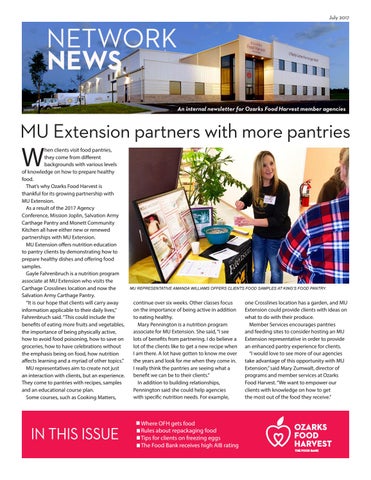
July 2017
MU Extension partners with more pantries
W
hen clients visit food pantries, they come from different backgrounds with various levels of knowledge on how to prepare healthy food. That’s why Ozarks Food Harvest is thankful for its growing partnership with MU Extension. As a result of the 2017 Agency Conference, Mission Joplin, Salvation Army Carthage Pantry and Monett Community Kitchen all have either new or renewed partnerships with MU Extension. MU Extension offers nutrition education to pantry clients by demonstrating how to prepare healthy dishes and offering food samples. Gayle Fahrenbruch is a nutrition program associate at MU Extension who visits the Carthage Crosslines location and now the Salvation Army Carthage Pantry. “It is our hope that clients will carry away information applicable to their daily lives,” Fahrenbruch said. “This could include the benefits of eating more fruits and vegetables, the importance of being physically active, how to avoid food poisoning, how to save on groceries, how to have celebrations without the emphasis being on food, how nutrition affects learning and a myriad of other topics.” MU representatives aim to create not just an interaction with clients, but an experience. They come to pantries with recipes, samples and an educational course plan. Some courses, such as Cooking Matters,
IN THIS ISSUE
MU REPRESENTATIVE AMANDA WILLIAMS OFFERS CLIENTS FOOD SAMPLES AT KING’S FOOD PANTRY.
continue over six weeks. Other classes focus on the importance of being active in addition to eating healthy. Mary Pennington is a nutrition program associate for MU Extension. She said, “I see lots of benefits from partnering. I do believe a lot of the clients like to get a new recipe when I am there. A lot have gotten to know me over the years and look for me when they come in. I really think the pantries are seeing what a benefit we can be to their clients.” In addition to building relationships, Pennington said she could help agencies with specific nutrition needs. For example,
Where OFH gets food Rules about repackaging food Tips for clients on freezing eggs The Food Bank receives high AIB rating
one Crosslines location has a garden, and MU Extension could provide clients with ideas on what to do with their produce. Member Services encourages pantries and feeding sites to consider hosting an MU Extension representative in order to provide an enhanced pantry experience for clients. “I would love to see more of our agencies take advantage of this opportunity with MU Extension,” said Mary Zumwalt, director of programs and member services at Ozarks Food Harvest. “We want to empower our clients with knowledge on how to get the most out of the food they receive.”
THE SHELVES OF THE OFH WAREHOUSE ARE STOCKED WITH BOTH PURCHASED AND DONATED FOOD.
Where OFH gets its food
W
here does all the food come from? This is a question that pantry volunteers and employees might not be familiar with. Each day, food leaves the Ozarks Food Harvest distribution center to stock the shelves of the pantries in our 28-county service area. At the same time, empty trucks
roll out to pick up food from wholesale donors, manufacturing facilities, food drive locations and retail stores. Meanwhile, loads of purchased food, USDA Food and donated food show up to restock the warehouse to meet the ever-increasing requests for food to help pantry clients. The answer to the question of where we
get our food is just about everywhere. This answer is contrary to the old belief that food from food banks is usually all rescued food or stuff that no one will purchase. In the not too distant past, that may have been true, but the picture at Ozarks Food Harvest has changed much over the last couple of years. However, donated food that does not pass the test of being sellable is still an important part of our feeding programs. Whether or not a pantry has a direct Retail Pick-Up partner, all pantries still benefit from free product that comes through the Ozarks Food Harvest distribution center. The Food Bank picks up from grocery stores in the major Springfield metro area. This food is sorted and offered to all members as it is available. Recently, the pounds of food donated through retail, manufacturers and wholesale companies has noticeably declined. The retail grocery business is very competitive, and compared to non-perishable products, it is a very low-profit enterprise. Because of this low profit, stores seek to control expenses as much as possible. The most obvious factor they can control is inventory. This simply means they purchase the amount of product they are most likely to sell. The reduced amount of donations is simply the result of store efforts to be more efficient and profitable. So as donations ebb and flow, remember donations are gifts, not guarantees.
Clearing up confusion about repackaging The topic of when it’s acceptable to repackage bulk food items or items damaged in the handling process often brings up confusion. Simply put, no facility should repackage food, unless it’s an approved facility. Repackaging food requires strict food safety regulations, to which OFH is not even equipped for. Food Bank member agencies should follow
the same food safety guidelines that Ozarks Food Harvest uses during its sorting process. Meat donations can only be accepted from USDA processing facilities in their original packaging, which means no home processing or repackaging. If a meat donation comes in and the packaging is too large to distribute to even a large family, contact The Food Bank. Canned and packaged food must remain in
original packaging with original ingredient label fully intact, so repackaging is also prohibited. Homemade meals and food cannot be accepted. When it comes to prepared meal sites, bread may be opened to accompany homebound meals. This is not considered repackaging as these sites already prepare meals.
DID YOU KNOW? After-School Food programs that participate in the Child and Adult Care Food Program (CACFP) will have meal pattern changes effective October 2017. In fiscal year 2017, The Food Bank distributed over 3.1 million pounds of USDA food. Honey is the only food substance that doesn’t spoil.
TEFAP corner
TEFAP food survey
Huge thanks to everyone that responded to the recent TEFAP product survey. We are excited and thankful that everyone had the opportunity to vote for their top three most desirable choices in seven categories: protein, juice, soup, vegetables, fruit, cereal and miscellaneous. For the protein results, beef was the number one desired choice, followed by whole-bagged chicken and then peanut butter. For juice, apple was the most requested followed by orange and grape. In the miscellaneous category, pasta ranked number one, macaroni and cheese was number two, and dehydrated potatoes was number three. As you know, Ozarks Food Harvest is one of six food banks in Missouri, so the survey went out to all pantries and feeding sites affiliated with Missouri food banks. We look forward to seeing what the collective responses are and what future TEFAP products will be made available to the families and individuals we serve.
CONTACT US Ozarks Food Harvest Member Services 2810 N. Cedarbrook Ave. Springfield, Mo., 65803 memberservices@ ozarksfoodharvest.org (417) 380-5007 ozarksfoodharvest.org
Director Q & A
Jonathan Roberts
J
onathan Roberts realized he had a passion for the YMCA when he began volunteering 15 years ago. Now, he has been employed with the organization for 13 years and is CEO/executive director of the Fair Acres Family YMCA in Carthage. Read the interview below to learn more about Roberts’ passion for his job. Q: Were you in another position prior to becoming director? A: I started my employment with the YMCA as a summer residential camp counselor while in college at Camp Wakonda in Halltown, Missouri in 2003. Later I moved to Nevada, Missouri as a program director before moving to Carthage YMCA in 2008 as a program director. In 2013 I was promoted to CEO/ executive director. Q: What sparked your interest in working at the YMCA? A: As a student athlete attending Ball State University, we had a guest speaker from the local YMCA speak to our class and ask for volunteer basketball coaches. I decided to give it a try and have never looked back. The mission of the YMCA and its power to make communities better, families healthier and the development of youth has become my passion. Q: What is your biggest achievement? A: There have been many successes in my career with the YMCA, all made possible with help from other people. Everyday I see the positive effects our organization has on families and individuals. Recently, we started the Learn to Swim program during the 20162017 school year. Through a partnership
JONATHAN ROBERTS AND HIS SON RIDE IN A GOLF CART.
with the Carthage R-9 school district and the Carthage Community Foundation of the Ozarks, over 650 second grade students were bused to the YMCA from five schools to take part in the program over a six month period. Due to the success of the program, this program will be adopted for future years. Drowning is the second leading death in our youth, and it is an important life skill that all people need to have. The most astonishing result was the 36 percent passing margin, showing the need in our community of this program. Q: What is the best part of your job? A: Coming to work to do something I love is by far the best part of my job. Seeing the positive impact on our employees, volunteers, and members everyday is all the motivation I need! Q: What is your most memorable moment working at the YMCA? A: There are moments everyday that give me butterflies, like stories of overcoming health issues through attending fitness programs, families gathering after a disastrous event and watching children laugh and develop through youth sports.
Tips for freezing extra eggs With the sizable egg donations from Vital Farms, Member Services has received numerous questions about whether or not eggs can be frozen. Member Services did some research and wanted to share the best practices for freezing extra eggs to pass along to clients. According to the American Egg Board, eggs can be frozen in a home freezer for up to one year. Clients can crack open the eggs, beat them together, pour them in a freezer
container and freeze. To use the frozen eggs, clients can thaw them overnight in the refrigerator or under running cold water. This link gives great tips for you to pass on to your clients during distribution, but are not meant to be put into practice in your facility as this would be considered repackaging: incredibleegg.org/eggcyclopedia/f/freezingeggs/. Visit our resource center for handouts about freezing eggs to give to clients.
“We are excited about this new partnership because milk is one of the most requested and nutritious items on our menu,” said Mary Zumwalt, director of programs and member services at Ozarks Food Harvest. “It is our hope that this pilot program continues to grow, because we know that is a wonderful opportunity for our agencies and the clients that they serve.” Although this program is in the early stages of development, it is well on its way to providing a constant supply of milk products to pantries and meal sites. Like all pilot programs, some restrictions do apply. For example, an agency must agree to a minimum $150 product purchase per delivery and adhere to the supplier’s delivery schedule and time. If you would like more information or to be considered for this program, please contact Member Services at 417-380-5007.
MILK TO MY PLATE IS A PILOT PROGRAM THAT WILL HELP PROVIDE A STEADY SOURCE OF MILK FOR CLIENTS.
Pilot milk program begins soon
T
hanks to all who responded to the recent milk survey from Member Services. The team at Ozarks Food Harvest is hard at work looking over the results. This survey was the first step in assessing the needs of our agencies and determining which agencies would be a likely candidate for a pilot program now being offered at The
Food Bank called Milk to My Plate. Milk to My Plate is an initiative presented on behalf of the National Dairy Council, Feeding America, MilkPEP and the food banks. The program aims to provide a steady supply of fresh milk to food banks and their agency partners at an affordable and consistent price. Participating milk suppliers will deliver milk to qualifying agencies.
Good news at The Food Bank Ozarks Food Harvest earns superior food safety certification from AIB The Food Bank is proud to announce that it received high-marks on its food safety inspection from AIB International in May. For six years, The Food Bank has held this superior food safety certification. The award recognizes Ozarks Food Harvest’s commitment to food safety, sanitary working conditions and proper food handling training for employees and volunteers. In the last 12 months, Ozarks Food Harvest received, processed and distributed more than 18.8 million pounds of food. “Food Bank staff and volunteers work diligently to keep our distribution center
clean and safe. This recognition is a testament to their hard work year-round,” said Bart Brown, president/CEO of Ozarks Food Harvest. When Ozarks Food Harvest first received this certification in 2012, it was only the sixth Feeding America food bank of 200 in the country to do so. AIB International was founded in 1919 as a technology and information transfer center for bakers and food processors. Its mission is to empower the global food industry to elevate their food safety. Thanks to Ozarks Food Harvest’s Operations staff and volunteers for their hard work!
LOOKING AHEAD... The Food Bank will be closed Monday, Sept. 3 for Labor Day. Food Safety classes are on July 26 and Aug. 23. September is Hunger Action Month.