
INTRODUCTION
From the President
This may be a divine appointment.
Perhaps you’re a prospective student. Maybe you’re a parent, church leader, or guidance counselor who will advise prospective students. Whatever your circumstance, your choice to open this catalog may be providential. It may be the start of a whole new life.
As a graduate of both the college and the seminary, I can give personal testimony. While I enjoyed my studies at the state university I first attended, my education at Ozark (and later at Lincoln Seminary) was truly life changing. The classes I took, the relationships I built, the professors who mentored me—the Lord used each of these to shape me in significant ways. The knowledge, commitments, and skills I gained here equipped me for a fruitful life and ministry.

Only you can discern if the Lord is leading you here, so I invite you to give us a careful, prayerful look. Whether you’re preparing for full-time Christian service or simply looking for a stronger biblical foundation for your faith, your experience at Ozark will be marked by:
• Excellent Bible teaching. We really believe that “all Scripture is God-breathed and useful for teaching . . . so that the servant of God may be thoroughly equipped for every good work” (2 Tim 3:16-17). Our curriculum backs our commitment—every graduate takes a strong core of top-notch Bible classes.
• Practical ministry training. Here at Ozark, you can take classes on how to preach, teach, counsel, grow a youth ministry, lead worship, organize a team of volunteers, lead someone to Christ, or enter a new culture as a missionary. You’ll learn the skills necessary for ministry in the twenty-first century.
• Caring community. Our students consistently mention the encouraging Ozark community as one of our greatest strengths. Professors know your name. Fellow students care. For on-campus students, residence hall directors become like a second mom and dad. For online students, long-distance friendships start to feel like next-door neighbors, and for seminary students, your classmates might end up as some of your most trusted confidants. You’ll form relationships that you’ll carry with you for life.
• Sense of mission. A theme verse for our college is Mark 10:45—“not to be served, but to serve.” At OCC, you’ll catch a greater vision for reaching out to others with the love and truth of Christ, and you’ll leave with a clearer sense of life purpose.
Choosing a college is one of the biggest decisions anyone can make, so read closely, check out our website, and feel free to contact us with any questions. Let me especially encourage you to come to campus soon for a visit. Sit in on a class, attend one of our inspiring chapel services, meet a few professors, and talk with some of the students who come from over 38 states and 8 foreign countries.
I look forward to a more personal meeting in the days ahead. Let us know how we can help! Who knows what God has in mind? This catalog could be the start of a whole new life.

In Christ, Matt Proctor President
General Information
History
The heritage of Ozark Christian College is rooted in the Restoration Movement. Ozark Christian College is supported by independent Christian Churches and Churches of Christ, a non-denominational fellowship of more than 3 million members and nearly 6,000 congregations in the United States, plus many more worldwide.
Ozark Bible College was established in Bentonville, Arkansas, on June 12, 1942, committed to training men and women for Christian service by teaching the Word of Christ in the Spirit of Christ. An earlier Ozark Christian College had been established in St. Joe, Arkansas, in 1938. It moved to Harrison, Arkansas, in 1939, and then to Bentonville in 1940. This school was to provide both occupational training and Bible teaching.
Ozark Bible College was founded to be a Bible college training full-time and part-time Christian workers.
Workers were prepared to be ministers, missionaries, Christian musicians, educational directors, and assistant ministers, as well as elders, deacons, and volunteer workers in the local church. The trustees elected F.W. Strong as president and Seth Wilson as dean, positions they held in the former college.
At the time, many churches in the Four State Area of Missouri, Kansas, Arkansas, and Oklahoma were closed, and hundreds were without preachers. Ozark Bible College desired to provide ministers whose biblical preaching would revive the churches.
In October 1944, Ozark Bible College moved to a large house located at 516 North Wall Street in Joplin, Missouri. Joplin was chosen as the new home for the college because it was easily reached by car, bus, train, or plane. Many churches were in the area, providing opportunities for student ministries, and Joplin also had more job opportunities for students.
In 1946, Edwin B. Strong succeeded his father as president of Ozark Bible College. The college grew from 16 students in 1942 to 123 students in the fall of 1949. An addition to the building in 1948 provided a dining room, a small chapel, and two classrooms. At this time, most of the full-time faculty preached every weekend. Area ministers assisted as part-time instructors. Students were involved in service in the churches on weekends.
In 1952, Don Earl Boatman became the third president of Ozark Bible College, a post he held for 27 years. The college had a vision and desire to grow. A 1953 addition
to the college building provided a large chapel, a library, and additional classrooms. These additions let the college accommodate the 176 students who enrolled in the fall of 1954. In 1955, Ozark faculty, staff, and students served 75 churches. Soon the college reached the maximum capacity in the 516 North Wall building.
In 1959, 40 acres were purchased on North Main Street, a mile north of downtown Joplin and less than a mile from the Wall Street location. The Missions Building and Alumni Hall were completed in 1963, providing classrooms and a dormitory for women. This enabled the college to move to the new campus to welcome 309 students in the fall of 1963. The Administration Building was completed a few weeks after the fall semester started. Under the direction of Walter Goodman, 13 buildings were constructed on the new campus during its first two decades.
Every year during the 1960s, enrollment increased, reaching its peak of 803 in the fall of 1974. New faculty and programs expanded the outreach of the college. The college was known for its emphasis on evangelism and missions.
In 1979, new leaders assumed responsibilities at Ozark Bible College. Ken Idleman became president, and Wallace Wartick was named academic dean. Dr. Lynn Gardner became academic dean in 1981.
On July 1, 1985, Midwest Christian College of Oklahoma City, Oklahoma, consolidated with Ozark Bible College on the Joplin campus under the name of Ozark Christian College. The college grew numerically from the mid-1980s until the present. Dr. Mark Scott became academic dean in 1998.
A new record enrollment of 839 was set in the fall of 2005. In 2005, Matt Proctor was announced as the fifth president of OCC. He served for one year as the president-elect. On July 1, 2006, Matt Proctor officially became president of OCC, with Ken Idleman serving as chancellor until 2007. After serving as interim academic dean in 2011, Doug Aldridge became the academic dean in 2012. In the fall of 2015, Ozark Christian College was approved to offer an online degree, expanding the opportunities for student enrollment.
Dr. Chad Ragsdale became the college’s sixth academic dean in 2021. In the fall of 2022, the college launched the Graduate Studies Department with the offering of a Master of Arts in Christian Ministry.
On June 1, 2024, Lincoln Christian Seminary, the embedded seminary of Lincoln Christian University, became Lincoln Seminary at Ozark Christian College. Lincoln Christian University was founded in 1944 in Lincoln, Illinois. Lincoln Christian Seminary was founded in 1952. After 80 years of training leaders in the church, LCU
announced the cessation of all academic operations on May 31, 2024, and the gifting of the seminary to OCC.
OCC is now led by four senior administrators: Matt Proctor, President; Chad Ragsdale, Chief Academic Officer; Damien Spikereit, Chief Financial and Operational Officer; and Jim Dalrymple, Chief Advancement Officer. This executive leadership team works with the vice presidents, deans, and select directors to form the Administrative Council.
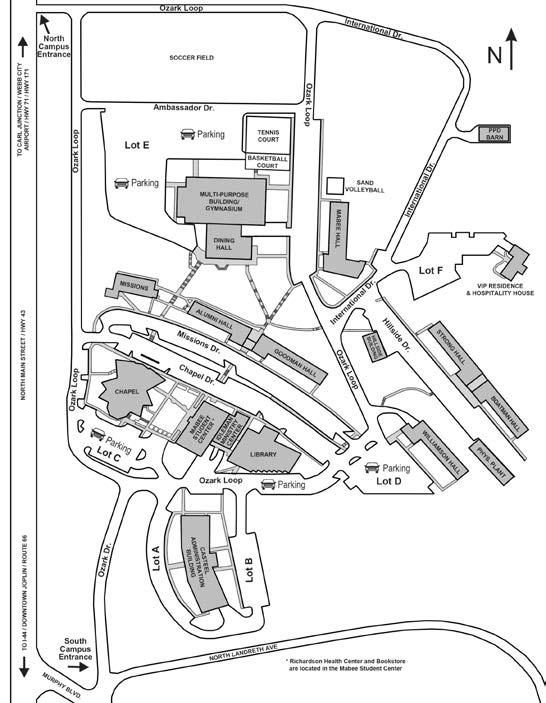
Today, OCC’s attractive campus includes the Chapel, Missions Building, Seth Wilson Library, Idleman Ministry Center, Casteel Administration Building, Hillside Building, Dining Hall, Multi-Purpose Building, Mabee Student Center, Missions House, Physical Plant Building, and six residence halls.
A strong faculty consists of over 35 full-time professors and over 35 adjunct professors. The 40-year average of undergraduate student enrollment is 650 students. During its first two years, the graduate studies program of OCC welcomed over 100 students. The college continues to prepare men and women for vocational and volunteer Christian service, reaffirming its historic purpose by teaching the Word of God to men and women who will be equipped to teach others (2 Tim 2:2).
Mission
The mission of Ozark Christian College is to train men and women for Christian service as a degree-granting institution of biblical higher education.
The vision of Ozark Christian College is to glorify God by evangelizing the lost and edifying Christians worldwide. Emphasis is given to vocational preparation for Christian ministry in a variety of specific fields. Biblical and practical instruction are also provided for those who will serve in bi-vocational or volunteer ministries.
Ozark Christian College seeks to glorify God by doing his will. This entails entrusting God’s truth “to faithful men and women, who will be able to teach others also” (2 Tim 2:2), declaring the wisdom of God (Eph 3:7-12), equipping “the saints for the work of service, to the building up of the body of Christ; until we all attain to the unity of the faith, and of the knowledge of the Son of God, to maturity, to the measure of the stature which belongs to the fullness of Christ . . . and speaking the truth in love, we are to grow up in all aspects into him, who is the head, even Christ” (Eph 4:12-15).
The Apostle Paul stated how this purpose of God is accomplished. “God willed to make known what are the riches of the glory of this mystery among the Gentiles, which is Christ in you, the hope of glory. And we proclaim him,
admonishing everyone and teaching everyone with all wisdom, that we may present everyone complete in Christ. And for this purpose also I labor, striving according to his power, which mightily works within me” (Col 1:27-29).
“The goal of our instruction is love from a pure heart and a good conscience and a sincere faith” (1 Tim 1:5).
Institutional Goals
Ozark Christian College is committed to:
Exceptional Academics. OCC provides qualified, innovative, and biblically faithful instruction to prepare our students to serve Christ and his church.
Engaging Experience. OCC offers quality co-curricular and extracurricular programs to grow students in Christian maturity and equip students for Christian ministry.
Transforming Community. OCC cultivates a life-changing community marked by personal holiness, joyful diversity, gracious honesty, and loving service.
Distinctive Resources. OCC offers Christ-centered events, materials, and personnel to encourage and equip our constituents.
Strategic Stewardship. OCC manages physical, financial, and human resources to honor Christ and advance the mission of the college.
Doctrinal Statement
Ozark Christian College has its roots in the Stone-Campbell heritage (Independent Christian Churches and Churches of Christ) that began in the United States in the early 19th century. This heritage seeks the unity of all Christians based on the authority of the Bible for the evangelization of the world. OCC recognizes that creeds and confessions of faith have at times been more divisive than unifying. Still, in light of its commitment to Scripture, OCC believes that agreement on certain matters of the faith is essential to carry out its mission. Therefore, to avoid any misunderstanding or misinterpretation, the following statements are given, and all trustees, administrators, and faculty affirm their unqualified acceptance of the following:
God. There is one holy God who eternally exists in three persons—Father, Son, and Holy Spirit. God created all things visible and invisible. God is perfect in wisdom, power, and love, knowing all things past, present, and future, and his sovereign plan of redemption was set in place before the foundation of the world. (Gen 1:1-2; Dt 6:4; Heb 11:3; Eph 1:9-10; Rev 13:8)
Jesus. Jesus Christ is God’s only begotten Son, born of a virgin, fully divine and fully human, and our Savior and Lord. Jesus, who was without sin, died in our place as a
substitutionary sacrifice for our sins, bearing divine wrath, and reconciling to God all who trust in him. Jesus was bodily resurrected in victory over sin and death. He ascended to the right hand of the Father where he presently reigns as our king, high priest, and advocate until his glorious return. (Jn 3:16; Col 1:15, 2:9-15; 1 Cor 15:3-8, 20-28; 2 Cor 5:18-21; Heb 4:14-15)
Holy Spirit. The Holy Spirit is fully divine and active in the church and the world. The Holy Spirit draws all people to Christ by illuminating the gospel and convicting of sin. The Holy Spirit dwells in the life of a believer to transform, guide, assure, and empower living a fruitful Christian life. (Jn 16:8-11; Acts 2:38; 2 Cor 3:17-18; Gal 3:2)
Bible. God is revealed in the Bible, the uniquely inspired written Word of God and infallible in all that it affirms. The Bible is the final authority in all matters of faith and practice. (2 Tim 3:16; 2 Pet 1:20-21)
Humanity. God creates all humans, male and female, in his image, and therefore all people have intrinsic value and purpose. By the sin of the first man and woman (Adam and Eve), death entered the world. All have sinned and fall short of the glory of God, alienated from God and without hope apart from the blood of Jesus Christ. (Gen 1:26-27; Gen 3; Rom 3:23; Eph 2:1-3)
Salvation. Salvation can be found in Christ alone and is offered to all by grace through faith. A living faith is demonstrated through repentance, confession, baptism by immersion, and a life of obedience. (Rom 3:23, 5:12; Acts 2:38; Gal 3:26-29; Eph 2:4-10)
Church. The church is the body of Christ on earth, with Christ as the head. God’s church is comprised of a priesthood of all believers, serving as ministers of the gospel according to the gifts which God has given them. Together the church is called to make disciples of all nations until Christ returns. (Matt 28:18-20; Eph 3:10, 4:11-13; Col 1:18; 1 Pet 2:9-10)
Return of Christ. Christ will visibly return to restore creation and judge the world. There will be a bodily resurrection for the believers to eternal life with God in heaven and for the unbelievers to eternal judgment in hell. In heaven, sin will be no more and those in Christ will live in fellowship with God forever. (Acts 1:11; 2 Thess 1:5-12; 1 Thess 4:13-18; Rev 20:11-15)
Core Values
Ozark Christian College is not merely an institution of higher education. It is a spiritual family of brothers and sisters in Christ. The college seeks to follow the best educational methods, but the highest priority is to honor the lordship of Christ. The college intends to influence the
spirit of the student as well as inform their minds and develop their skills. The college is guided by the following core values:
The Word of Christ Taught in the Spirit of Christ (Col 1:28). We are a biblical community, grounding our curriculum and life in God’s Word.
Not to Be Served, but to Serve (Mark 10:45). We are a serving community, looking to others’ interests, not our own.
Speaking the Truth in Love (Eph 4:15). We are an honest community, practicing maturity through careful truth-telling.
Trusting in the Power of God (1 Cor 4:20). We are a dependent community, leaning not on our own strength, but on God’s.
An Atmosphere of Grace, Trust, and Freedom (Rom 15:7; 1 Pet 4:10). We are a gracious community, maintaining unity in mutual acceptance and trust.
Making Christ Known through the Church (Matt 28:19-20; Eph 3:10). We are a witnessing community, partnering with the Church in the Great Commission.
Worshiping in Spirit and Truth (Jn 4:23-24). We are a worshiping community, pursuing God and the praise of his glory.
Academic Mission
The academic mission of Ozark Christian College is to educate and equip students to become like Christ and serve Christ in leadership ministry.
Learning Goal
Graduates will be grounded in Scripture, growing in Christlikeness, practicing cultural discernment, and vocationally prepared for Christian service.
Assessment of Student Learning
Ozark Christian College strives for the highest standards of excellence and quality in education. Excellence requires the ongoing assessment of student learning which leads to improvement. Assessment is driven by our mission and is focused on our learning outcomes. Ozark regularly assesses student learning on multiple levels (including course-level assessment and regular programmatic review), using multiple approaches (qualitative, quantitative, direct, and indirect), and accounting for multiple dimensions of student learning (not just intellectual, but also spiritual and affective).
Accreditation
Higher Learning Commission
Ozark Christian College is accredited by the Higher Learning Commission, an institutional accreditor recognized by the U.S. Department of Education.
Association for Biblical Higher Education
Ozark Christian College is accredited by the Association for Biblical Higher Education Commission on Accreditation (5850 T. G. Lee Blvd., Ste. 130, Orlando, FL 32822, 407.207.0808) to grant certificates and degrees at the Associate, Baccalaureate, and Master levels.
Association for Theological Schools
Lincoln Seminary at Ozark Christian College is accredited by the Commission on Accrediting of The Association of Theological Schools (ats.edu) and is approved to offer the following degrees: Master of Divinity, Master of Arts in Bible and Theology, Master of Arts in Christian Ministry, and Master of Arts in Biblical Studies. Comprehensive distance education approval is also held by the seminary enabling it to offer half or more of any approved degree program online.
Certification
Ozark Christian College is recognized and listed in the Council for Higher Education Directory (online); in the Transfer Credit Practices of AACRAO (online); and in the Member Guide, American Association of Collegiate Registrars and Admission Officers (online).
Ozark Christian College is approved for Federal Students Financial Aid under the Higher Education Act of 1965 (as amended) and 20 U.S.C. 1085, 1141.
Ozark Christian College is approved for:
• Training of veterans under section 3675, Title 38, U.S. Code and Title 5, Code of State Regulations 20-500.370.
• Training of non-immigrant foreign students under Section 101(a) (15), (F) (i), of the Immigration and Nationality Act (see page 14 for admission requirements for foreign students).
Ozark Christian College has been a member of the Evangelical Council on Financial Accountability since December 1988.
Ozark Christian College participates in the State Authorization Reciprocity Agreements. Through this agreement or by state exemption status, OCC is authorized to offer distance education in all 50 states.
UNDERGRADUATE STUDIES
2026-2027 Academic Calendar
FALL 2026
Aug. 1 Payment plan signed or full fall payment made
Aug. 14 Residence halls open for new students; Module 1 payment due (Module 1 online)
Aug. 15 Residence halls open for returning students, 11:00 a.m.
Aug. 16 Last day to add/drop on the portal; Convocation Banquet and Service, 6:00 p.m.
Aug. 17 Semester begins; residential classes begin; online Fall Module 1 classes begin; charge for Add/Drops begins
Aug. 18 Community Ministry Expo, 4:00-6:00 p.m.
Aug. 22 blOCC Party, 5:00 p.m.
Aug. 23 Last day for 100% refund of fees (Module 1 Online)
Aug. 24 Last day to register or add a course; last day for dropping without showing on transcript; last day to change to audit status; last day for 100% refund of fees (residential)
Aug. 30 Last day for 75% refund of fees (Module 1 online)
Aug. 31 Payment #1 due (residential)
Sept. 1 Last day for 90% refund of fees (residential)
Sept. 3-5 Pursue (grade 12 and GAP year students)
Sept. 6 Last day for 50% refund of fees (Module 1 online)
Sept. 7 Labor Day—no residential classes—offices closed
Sept. 8 Last day for 75% refund of fees (residential)
Sept. 17 Serve Our City Day
Sept. 20 Last day to drop a course (no refund; Module 1 online)
Sept. 25-26 Getaway (grades 6-8)
Sept. 28 Last day for 60% refund of fees (residential)
Oct. 1 Payment #2 due (residential)
Oct. 5 Last day for 25% refund of fees (residential)
Oct. 9 Module 2 payment due (Module 2 online)
Oct. 12 Online Fall Module 2 classes begin
Oct. 12-13 Fall Break—no residential classes—offices closed
Oct. 18 Last day for 100% refund of fees (Module 2 online)
Oct. 19-21 Global Awareness Week
Oct. 19 Online Module 1 grades due
Oct. 25 Last day for 75% refund of fees (Module 2 Online)
Oct. 26 Last day for dropping a course (residential); last day for withdrawing from school (residential)
Oct. 26, 2026-Jan. 10, 2027 Registration open for spring and summer semester
Nov. 1 Payment #3 due (residential); Institutional and Memorial Grant Application deadline for spring (must also have FAFSA in to be considered for I&M Grant)
Nov. 1 Last day for 50% refund of fees (Module 2 Online)
Nov. 6-7 The Event (grades 9-12)
Nov. 12-14 International Conference on Missions (ICOM), St. Louis, MO
Nov. 15 Last day to drop (no refund; Module 2 Online)
Nov. 23-27 Thanksgiving Break (Residence halls close Sat., Nov. 21, 10:00 a.m.; reopen Sat., Nov. 28, 2:00 p.m.)
Dec. 1 Payment #4 due (residential)
Dec. 3-6 Christmas Musical
Dec. 4 Last class day
Dec. 7-10 Final exams
Dec. 10 Fall semester closes (Residence halls close Fri., Dec. 11, 10:00 a.m.)
Dec. 11, 2026-Jan. 10, 2027 Christmas Break
Dec. 15 Residential and Online Fall Module 2 grades due, 9:00 a.m.
SPRING 2027
Jan. 2 Payment plan signed or full spring payment made
Jan. 9 Residence halls open for Winter Session students, 2:00 p.m.
Jan. 11 Semester begins
Jan. 11-15 Winter Session
Jan. 15 Module 1 payment due (Module 1 Online); residence halls open for new students
Jan. 16 Residence halls open for returning students, 2:00 p.m.
Jan. 18 Last day to add/drop on the portal for spring; MLK Jr. Day—no residential classes—offices closed; online Spring Module 1 classes begin
Jan. 19 Residential classes begins; charge for add/drops begins
Jan. 24 Last day of 100% refund of fees (Module 1 Online)
Jan. 25 Last day to register or to add a course (residential); last day for dropping without showing on transcript; last day to change to audit status (residential); last day for 100% refund of fees (residential)
Jan. 31 Last day for 75% refund of fees (Module 1 Online)
Feb 1 Last day for 90% refund of fees (residential)
Feb 1 Payment #1 due; Last day for 50% refund (Module 1 Online)
Feb. 8 Last day for 75% refund of fees (residential)
Feb. 15-17 Preaching-Teaching Convention
Feb. 21 Last day to drop—no refund (Module 1 Online)
Mar. 1 Payment #2 due (residential); Last day for 60% refund of fees (residential)
Mar. 8 Last day for 25% refund of fees (residential)
Mar. 12 Module 2 payment due (Module 2 Online)
Mar. 15 Online Spring Module 2 classes begin
Mar. 21 Last day for 100% refund (Module 2 Online)
Mar. 22-26 Spring Break—no classes (residence halls close Sat., Mar. 20, 10:00 a.m.; reopen Sat., Mar. 27, 2:00 p.m.)
Mar. 22 Online Spring Module 1 grades due
Mar. 26 Good Friday—no residential classes—offices closed
Mar. 28 Last day for 75% refund (Module 2 Online)
Apr. 1 Payment #3 due (residential); Institutional and Memorial Grant Application deadline for spring (must also have FAFSA in to be considered for I&M Grant)
Apr. 4 Last day for 50% refund (Module 2 Online)
Apr. 5 Last day for dropping a course (residential); last day for withdrawing from school (residential)
Apr. 5-Aug. 15 Registration open for fall semester
Apr. 16-17 Women’s Event
Apr. 18 Last day to drop (no refund, Module 2 Online)
Apr. 22-24 Pursue (grades 11-12 and GAP year students)
May 1 Payment #4 due (residential)
May 6 Baccalaureate Service, 9:30 a.m.
May 7 Last class day (residential)
May 10-13 Final exams (residential)
May 13 Spring semester closes
May 15 Commencement, 10:00 a.m.; residence halls close, 4:00 p.m.
May 18 Residential and Online Spring Module 2 grades due, 9:00 a.m.
May 28 Summer payment due
May 30 Last day to add/drop on the portal for summer
SUMMER 2027
June 7-August 1 Online Summer School
June 14 Last day for 100% refund of fees (Online Summer)
June 21 Last day for 75% refund of fees (Online Summer)
June 28 Last day for 50% refund of fees (Online Summer)
July 12 Last day to drop (no refund, Online Summer)
Aug. 10 Online Summer School grades due, 9:00 a.m.
COMING IN 2027-2028
A look ahead at the beginning, ending, and vacation dates for the 2027-2028 year:
FALL 2027
Aug. 16 First day of class (residential and online)
Sept. 6 Labor Day
Oct. 11-12 Fall Break
Nov. 22-26 Thanksgiving Break
Dec. 9 Last day of final exams
SPRING 2028
Jan. 17 First day of class (online); MLK Jr. Day
Jan. 18 First day of class (residential)
Mar. 20-24 Spring Break
May 11 Last day of final exams
May 13 Commencement
For dates specific to Online Program Academic Calendar, visit occ.edu/onlinecalendar
All dates subject to change. For the most current dates, visit occ.edu/calendar.
Admissions Information
Ozark Christian College is dedicated to training men and women for Christian service. The mission of the Admissions Department at Ozark Christian College is to actively recruit a national and diverse group of prospective students through accurate and effective communication to enroll students who are ready to train for Christian service. The Admissions Department at OCC works to provide prospective students with information and counsel on how OCC can prepare them for lifelong Christian service. To do this effectively, the following information will serve as a guide for admissions policies, procedures, and recruitment programs. Ozark Christian College reserves the right to change admissions policies as needed. The Admissions Department may require certain students to submit supplemental material to make an informed decision about admission. This information will be communicated to the student by admissions staff members.
Enrollment Planning
When you decide to join the OCC family, you may have questions regarding admission qualifications, procedures, requirements, and financial considerations. We hope the material in the following pages will help answer your questions. All admissions policies and forms are also available at occ.edu/admissions. If you need more information or if you have questions, contact the Admissions Department at 417.680.5678 or admissions@occ.edu
Campus Visit
Many prospective students have found it helpful to visit campus (preferably on a class day) before making their decision to attend OCC. Please let the Admissions Department know when you would like to visit, and our campus visit team will do their best to design your visit with your interests in mind. Register for an individual tour at occ.edu/ individualtour or contact the Admissions Department at 417.680.5678 or admissions@occ.edu
We also offer Tuesday Tour visit days on select class days each semester. If you come on a Tuesday Tour, you’ll attend class, attend chapel, go on a campus tour, eat lunch with our president, and receive a scholarship* to OCC when you apply. Find available Tuesday Tour dates and registration information at occ.edu/tuesdaytour. (*Only students (juniors, seniors, or transfers) pursuing the residential programs are eligible for the Tour Scholarship.)
Requirements to Be Fully Accepted for Enrollment
Students who wish to enroll at OCC must complete all admission requirements based on their particular entry
status to be considered for acceptance. Please see the corresponding section below to see the requirements for each of the following entry status types:
• First-time (freshman) students: students who are entering college for the first time following the completion of high school
• Transfer students: students who have attended a college or university following the completion of high school
• International students: students who are not U.S. citizens or permanent residents
• Undergraduate dual enrollment students: students currently enrolled in high school seeking college credit
• Online students (first-time* or transfer): students who want to earn an undergraduate degree fully online
• Non-degree seeking students: students who desire to take courses for audit or credit (less than 6 hours), but do not plan to enroll in a degree program
*First-time online students will be subject to an interview.
Additional admissions information is provided for students who were homeschooled, have disabilities, or have criminal charges/a prison record. Admissions staff will communicate any additional information needed to the student.
OCC admissions personnel do everything possible to assist prospective students in completing their files and moving them to full acceptance status. When all necessary application materials have been received and approved by the Admissions Department, students will be notified of their acceptance by mail, by email, and by an OCC admissions employee. A student is not accepted to Ozark until they receive such notification directly from the Admissions Department.
Ozark Christian College admits students (who meet admission requirements) of any race, color, national, and ethnic origin to all the rights, privileges, programs, and activities generally accorded or made available to students at the college. Ozark Christian College does not discriminate on the basis of race, color, disability, or national and ethnic origin in administration of our educational policies, admissions policies, scholarship and loan programs, and athletics or other school-administered programs.
Only students who have been fully accepted, paid the enrollment deposit (non-refundable), and made an initial payment can attend classes and/or live in the residence halls.
Both residential and online students must adhere to the deadlines established by the Admissions Department for each academic year. The Admissions Department reserves the right to make exceptions to the deadlines listed below.
The deadlines for the 2026-2027 school year are as follows:
Residential Students:
Fall 2026
Jul. 31 Acceptance deadline (all materials turned in)
Aug. 5 Deposit deadline
Aug. 7 Registration deadline
Spring 2026
Dec. 18 Acceptance deadline (all materials turned in)
Jan. 1 Deposit deadline
Jan. 8 Registration deadline
Online Students:
Fall 2026 Module 1
Jul. 24 Application deadline
Jul. 31 Acceptance deadline (all materials turned in)
Aug. 5 Deposit deadline
Aug. 7 Registration deadline
Fall 2026 Module 2
Sept. 18 Application deadline
Sept. 25 Acceptance deadline (all materials turned in)
Sep. 30 Deposit deadline
Oct. 2 Registration deadline
Spring 2027 Module 1
Dec. 11 Application deadline
Dec. 18 Acceptance deadline (all materials turned in)
Jan. 1 Deposit deadline
Jan. 8 Registration deadline
Spring 2027 Module 2
Feb. 5 Application deadline
Feb. 12 Acceptance deadline (all materials turned in)
Feb. 19 Deposit deadline
Feb. 26 Registration deadline
Summer 2027 Module
Apr 30 Application deadline
May 7 Acceptance deadline (all materials turned in)
May 14 Deposit deadline
May 21 Registration deadline
Non-Degree Seeking Students
Fall 2026
Jul. 31 Acceptance deadline (residential and online)
Aug. 8 Registration deadline (residential and online)
Sep. 25 Acceptance deadline (online Fall Module 2 only)
Oct. 2 Registration deadline (online Fall Module 2 only)
Spring 2027
Jan. 1 Acceptance deadline (residential and online)
Jan. 8 Registration deadline (residential and online)
Feb. 19 Acceptance deadline
Feb. 26 Registration deadline (online Spring Module 2 only)
Admission of First-Time Students
First-time (freshmen) students are defined as students who are enrolling in college for the first time following graduation from high school. (These students may transfer in college credit or AP/CLEP credits earned while in high school. Please see Transfer of Credit Policy in Academic Policies on page 37 and at occ.edu/ecc.)
Admissions requirements are subject to change without notice. The application procedure is outlined as follows:
1. Complete the “undergraduate” application at occ.edu/apply.
• Applicants must submit contact information for both an academic and a spiritual reference. The references cannot be related to the applicant.
• Applicants must also submit a brief ministry purpose statement, and they must sign the OCC Student Covenant.
2. Submit a high school transcript (public, private, or homeschool).
• Students should meet their respective state’s high school graduation requirements. For example, Missouri high school students are typically required to complete 24 total units to graduate: 4 units of English, 3 units each in Math, Science, and Social Studies, 1 unit each in Fine Arts, Practical Arts, and Physical Education, a half-unit course in Personal Finance, a half-unit course in Health Education, and 7 units of electives.
• Students can request a transcript through their high school officials and can be sent to OCC (electronically or by mail).
• A high school student may be accepted for admission with a transcript of grades through the entirety of their junior year of high school. The Admissions Office will begin accepting students at the beginning of their senior year of high school.
• An official final high school transcript with the date of graduation must be submitted before students can attend class. We recommend students have their final official high school transcript sent to OCC immediately after graduation from high school. The transcript must be mailed or sent electronically directly from the high school to be considered official. (An official GED certificate may be accepted in lieu of an official final high school transcript.)
3. Return the completed, notarized Verification of Identity Form with a copy of valid photo ID (for candidates of the online program only— occ.edu/vsiform)
4. Participate in an interview led by the Admissions Department (for freshman candidates of the online program, and any candidates that do not meet OCC’s minimum GPA requirements).
Upon acceptance, first-time students will be expected to pay a $100, non-refundable deposit in order to be eligible to enroll in classes.
NOTE: Students must be at least 17 years old to enroll as firsttime degree-seeking students at OCC. Please see the Residence Life Policy on page 29 regarding the residence hall requirements for first-time students.
Admission of Homeschool Students
Homeschool students must meet the same requirements for admission for first-time students. Documentation of credits taken and grades received through high school must be provided. This can come from their State Department of Education or homeschool organization showing satisfactory completion. It can also be an original of the student’s transcript of grades signed by the parent(s) of that student, or a GED certificate. In addition, the homeschooled student is required to complete a “homeschool self-certification form” before they can be reviewed for acceptance. This can be found at occ.edu/homeschoolcertification, or by contacting the Admissions Department at admissions@occ.edu
Academic Tutoring for First-Time Students
Student files will be evaluated for admission on an individual basis. Some students may be accepted for admission but with limitations to help them adapt to college academics. A first-time freshman student with an unweighted high school grade point average (GPA) below 2.5 will be interviewed by admissions staff and may be admitted on Academic Tutoring. The Admissions Department reserves the right to put a student on academic tutoring even if they do meet the minimum GPA requirement.
A residential student on Academic Tutoring will be limited to a maximum of 13 credit hours during their first semester enrolled at Ozark and required to attend tutoring sessions and a series of academic skills workshops with the Academic Resource Commons (ARC). Additionally, students accepted on Academic Tutoring will be expected to meet with the Student Success Coordinator.
Online students on Academic Tutoring will be limited to one class per module during their first semester and will have the option to schedule tutoring sessions with the ARC.
Admission of Transfer Students
Students who have completed academic credits at another college or university after graduating from high school will be required to complete the following for admission:
1. Complete the “undergraduate” application at occ.edu/apply.
• Applicants must submit contact information for both an academic and a spiritual reference. The references cannot be related to the applicant.
• Applicants must also submit a brief ministry purpose statement.
• Applicants must sign the OCC Student Covenant.
2. Submit academic transcripts from all previously attended colleges/universities.
• Students who have earned 12+ college hours at another college or university after graduation from high school will be exempt from submitting an official high school transcript. Prospective transfer students must request that official transcripts from all previously attended institutions be sent directly to Ozark Christian College. Acknowledging attendance at each institution is mandatory, regardless of the student’s wishes to transfer credit. Failure to disclose attendance at an institution on the application may disqualify a student’s admissions application, and the Admissions Department reserves the right to deny admission to a prospective student if they do not disclose all previously attended institutions. In the case of closed schools and difficulty in obtaining transcripts, the Director of Admissions and Vice President of Enrollment Management will evaluate these situations on a case-by-case basis.
• The Registrar’s Office will evaluate transcripts for transfer of academic credit. Students may also petition for additional courses to be accepted following the college Transfer of Credit policy (see page 37 in Academics Section). Courses must have a grade of at least 2.00 to be accepted for transfer credit.
• Transcripts must be mailed directly to OCC or sent electronically by the college(s) and/or university(ies) previously attended (including any dual credit courses), and they must be official, authentic, signed, and affixed with the school seal.
• Students whose transcripts have not been received as requested will not be accepted for enrollment.
3. Return the completed, notarized Verification of Identity Form with a copy of valid photo ID (for candidates of the online program only— occ.edu/vsiform).
4. Participate in an interview led by the Admissions Department (for any candidates that do not meet OCC’s minimum GPA requirements only).
Upon acceptance, transfer students will be expected to pay a $100, non-refundable deposit in order to be eligible to enroll in classes.
NOTE: Students must be at least 17 years old to enroll as degree-seeking, transfer students at OCC. Please see the Residence Life Policy (page 29) regarding residence hall requirements for transfer students.
Academic Tutoring for Transfer Students
Student files will be evaluated for admission on an individual basis. Some transfer students may be accepted for admission, but with limitations to help them adapt to Ozark’s academic curriculum. A transfer student with a cumulative college grade point average of 2.00 or below will be interviewed by admissions staff and may be admitted on Academic Tutoring.
Residential students will be limited to a maximum of 13 credit hours during their first semester at Ozark and required to attend tutoring sessions and a series of academic skills workshops with the Academic Resource Commons. Additionally, students accepted on Academic Tutoring will be expected to meet with the Student Success Coordinator. The Admissions Department reserves the right to put a student on academic tutoring even if they do meet the minimum GPA.
Online students on Academic Tutoring will be limited to one class per module during their first semester and will have the option to schedule tutoring sessions with the ARC.
Admission of International Students
Ozark Christian College is authorized under federal law to enroll non-immigrant students. The U.S. Immigration and Customs Enforcement (USICE) demands the following rigid requirements for acceptance and enrollment of foreign (non-immigrant) students in F-1 status:
1. Complete the application at occ.edu/apply.
2. If English is not the student’s first language (even if English is the official language of their country of residence and/or citizenship), the student must take and pass a certified English proficiency test. Ozark Christian College will accept the following tests:
• Duolingo English Test: Minimum acceptable score is 110. This test can be taken online, on-demand in under an hour for $49. Have certified results sent to Ozark Christian College.
• Test of English as a Foreign Language (TOEFL): Testing and prices vary per country. Please have results sent to Ozark Christian College. Our registration number is 6542.
• TOEFL exams taken before Jan 21, 2026: Minimum acceptable score is 79 on the internet-based test.
• TOEFL exams taken on or after Jan 21, 2026: Minimum acceptable score is 4 total.
3. Foreign transcripts will need to be submitted to a Credential Evaluation Company. We require your transcripts to be evaluated by a credential agency so they can be converted to the U.S. grading system, specifically into a GPA (Grade Point Average) format. Since many countries use different grading scales, this step is necessary for us to accurately assess your academic records.
• Residential Students Planning to Play Sports: You will need to complete your evaluation through InCred. This is the required service for students seeking athletic eligibility. Cost ranges between ($95-$190, plus fees, if applicable).
• Residential Students NOT Planning to Play Sports and Online Students: You may use The Evaluation Company. Cost ranges between $150–$180, plus fees, if applicable).
Links are found on occ.edu/international. Residential students may find this information under International Residential Undergraduate Admissions. Online Students may find it under International Online Undergraduate Admissions.
4. Return the completed, notarized Verification of Identity Form with a copy of valid photo ID (for candidates of the online program only— occ.edu/ vsiform). Admissions of International Students into the online degree will be evaluated on a case-by-case basis based on country of origin due to federal regulations.
NOTE: International students must be at least 17 years old to be admitted as degree-seeking students at OCC. Please see the Residence Life Policy (page 29) regarding residence hall requirements for international students.
Next Steps Upon Acceptance
These steps need to be completed in order to be eligible for an I-20 from OCC (residential candidates only):
1. Complete the Declaration and Certification of Finances form.* Before doing so, familiarize yourself with the cost of attendance and the financial sponsorship requirements.
2. Complete and sign the OCC Application for Form I-20.*
3. Submit a deposit of $1,500 (U.S.) to OCC. This will be applied to the educational expenses of your first semester. If your plans on attending OCC change or you cannot
obtain a visa, Ozark will refund the deposit (minus any refund/wire transfer fees) upon written request.
4. Read information on the Student and Exchange Visitor Information System (SEVIS)* and Obtaining a Student Visa.
5. Complete the Housing (if living on campus), and Medical and Immunization Forms.*
6. Review What to Bring to Campus and the International Student Checklist.
*All links and forms are found on occ.edu/admissions-and-aid/ international-admissions/international-admissions
Ozark Christian College offers several scholarships to international students. For more information, please refer to the Financial Information section (page 18).
NOTE: Applicants must understand that they are not permitted to obtain off-campus employment in the U.S. The college may not endorse attempts by applicants to do so except in extreme cases of unforeseen circumstances arising subsequent to entry. But, the USICE does permit them to be employed in available jobs on the college campus upon enrollment as fulltime students. However, the college does not guarantee that jobs will be available.
Admission of High School Students Seeking Undergraduate Dual Enrollment
Current high school juniors and seniors may apply for a limited amount of college-level courses provided by OCC and simultaneously earn high school (dual) credit. To enroll as a dual enrollment student, a student must meet the following admissions requirements:
1. Complete the “undergraduate non-degree seeking” application. This application is available online at occ. edu/apply. Applicants must sign the Student Covenant and Financial Agreement and parents of applicants must sign the Parent Consent section.
2. Submit the prospective student’s most recent high school transcript indicating a grade point average of at least 2.5 on a 4.0 scale. The following Ozark classes are eligible for dual enrollment status:
• Introduction to Biblical Studies (3)
• English Comp 1 (3)
• English Comp 2 (3)
• Essentials of Spiritual Formation (2)
• Psychology (3)
• Any 1000-level class approved by the Academics Office
Dual-enrollment students are limited to 6 credit hours per semester.
Due to government requirements, dual enrollment students are not eligible for federal financial aid, nor will they be considered for institutional scholarships.
NOTE: Dual enrollment students must be at least 17 years old to enroll in classes at Ozark Christian College.* Dual enrollment students are not eligible to live on campus.
*A junior in high school who is 16 years old and is seeking dual enrollment may request an exception with the Admissions Office.
Admission of Non-Degree Seeking Students
A student who is taking classes for personal improvement, getting a degree from another institution, or taking a course for audit is considered “non-degree seeking.”
Non-degree seeking students will be accepted when the following requirements are met:
1. Complete the “undergraduate non-degree seeking” application. This application is available online at occ.edu/apply
2. Sign the Financial Agreement and Student Covenant.
3. Submit official documentation verifying completion of secondary education.
4. Submit Verification of Identity Form (for online students taking classes for credit only— occ.edu/vsiform).
Non-degree seeking students are limited to 6 credit hours or less a semester (if they are taking classes for credit), up to a total of 30 credit hours. Once a student reaches 30 hours, they will need to have met the full acceptance requirement for admission to continue taking classes for credit. Students are allowed to audit as many credit hours as they would like if they are accepted as a non-degree seeking student. Due to government requirements, “non-degree seeking students” are not eligible for federal financial aid assistance, nor will they be considered for institutional scholarships until all admissions requirements have been met.
NOTE: Non-degree seeking students must be at least 17 years old to enroll in classes at Ozark Christian College. Non-degree seeking students are not eligible to live on campus. Non-degree seeking students are not permitted to enroll in private music lessons.
Readmission of Returning Students
Degree-seeking students who previously attended OCC but have not been enrolled at OCC for more than one semester are eligible to apply to return. If there are no holds on the student’s financial account that need to be resolved or issues with other departments on campus (Student Affairs,
Academics, etc.), the student will be eligible to register for classes once registration opens. If there are issues that need to be resolved, the Admissions Department will make arrangements to help the student get them resolved. Returning students will be readmitted once they are cleared by all departments and the following requirements are met:
1. Complete the “readmittance application.” This application is available online at occ.edu/apply. Provide written evidence that demonstrates the ability to achieve academic success upon returning to OCC.
2. Submit transcript(s) from any institution(s) attended during the student’s absence from OCC — even if the student does not anticipate any transfer of credits. Official transcripts must be mailed or sent electronically directly to OCC by the records office of the issuing institution(s).
3. Return the completed, notarized Verification of Identity Form with a copy of valid photo ID (for candidates of the online program only— occ.edu/vsiform).
Any residential students who are approved for re-admittance on Academic Warning will be limited to taking a maximum class load of 13 credit hours and will be required to attend tutoring sessions and a series of academic skills workshops. Additionally, students accepted on Academic Warning will be expected to meet with the Student Success Coordinator.
Returning online students accepted on Academic Warning will be limited to one class per module during their first semester, and will have the option to schedule tutoring sessions with the ARC.
Upon acceptance, returning online students will be expected to pay a $100, non-refundable deposit in order to be eligible to enroll in classes.
Admission of Students with Disabilities
Our Commitment
Ozark Christian College is committed to full compliance with all laws regarding equal opportunity for students with disabilities. Students, the faculty, and the Academics Office all play a role in ensuring that reasonable and appropriate accommodations are provided in a timely and effective manner. The following is an outline of the process followed at OCC when a student requests services or accommodations in accordance with the Americans with Disabilities Act (ADA) and Section 504 of the Rehabilitation Act of 1973.
Requesting Accommodation
It is only through a student’s voluntary disclosure of disability and request for accommodation that OCC can support disability needs. Students with disabilities who wish to receive accommodations or services must disclose the disability and make a personal request to the OCC Academics Office. The student meets with a representative from the Academics Office, submits required disability documentation, and formally requests services, including accommodations, a minimum of eight (8) weeks before the start of a semester. Depending on the nature of the disability, more time may be necessary to satisfy the reasonable accommodation.
A disclosure of disability or request for an accommodation made to a faculty or staff member other than the Academics Office will not be treated as a request for an accommodation.
Any requests for changes regarding services or accommodation should be made prior to the start of a semester to allow time to review requests and documentation and make proper arrangements.
Accommodation arrangements may be compromised if a request is not made in a timely manner.
For the complete Students with Disabilities policy, see occ.edu/disabilityservices.
Admission of Those Having Criminal Charges Against Them or Having a Prison Record
All previous application requirements apply. In addition, those with pending criminal charges cannot be admitted until those charges are fully cleared. Those who have a criminal record must have been cleared (not out on bail, probation, or parole) for at least one year to demonstrate recovery, during which time they must have been actively involved in their church directly under the oversight of the elders and the minister(s) of that church.
The Admissions Office reserves the right to request additional information and references, run a background check, conduct interviews, etc.
Academic Honesty in Admission
Statement of Policy. Academic dishonesty includes but is not limited to altering or misusing documents; impersonating, misrepresenting, or knowingly providing false information as to one’s identity; or providing false information regarding professional history or accomplishments.
Procedure. Staff, faculty, or students who believe that a student has not adhered to the Academic Honesty Policy will bring the matter to the attention of the Academics Office. In cases where the authenticity of documents
sub- mitted by a student is in question, an investigation will be conducted by the Dean of Undergraduate Studies, the Registrar’s Office, and/or the Admissions Office. Should the documents submitted by a student be determined to be fraudulent (such as identification documents, a transcript, diploma, certification, references, etc.), the student will be notified via their official school email and written notice to the student’s last known address by the office that conducted the investigation of the violation and the proposed disciplinary action. If the student acknowledges responsibility, they will enter into an agreement regarding an appropriate sanction.
In response to violations of the Academic Honesty Policy, Ozark Christian College reserves the right to take any or all of the following actions as appropriate to the violation:
• Bar the student from enrolling in the college or registering for courses.
• Suspend or dismiss the student. If the student is dismissed, the college reserves the right to revoke all credits. If the student has withdrawn or graduated, any credits and/or degrees and certificates/ diplomas previously awarded may be revoked and the student will be asked to return the certificate or diploma.
• Suspend or terminate all college services previously available to the student.
• Retain all tuition and fees paid by the student.
• Withhold course grade(s) and/or examination score(s) and official Ozark Christian College transcripts.
• Permanently annotate a student’s record to reflect action(s) taken by the college in response to the student’s violation of the Academic Honesty Policy.
• Notify educational institutions, licensing or certification boards, employers, or others who have previously received a transcript or similar certification of any action taken by the college.
• Prohibit re-enrollment in Ozark Christian College except by appeal.
• Take other action as appropriate.
If a student does not acknowledge responsibility or disputes the accusation of academic dishonesty, the student and appropriate administrator will enter into the formal process described in the Student Conduct Process which may include a hearing before the Conduct Committee. Upon completion of the informal or formal process, students have the right to appeal the decision through the OCC Grievance Policy. The Academics Office and Registrar’s Office maintain records of all student violations of the Academic Honesty Policy.
Petition for Reinstatement. A student who has been denied services or has been dismissed because of a violation of the Academic Honesty Policy may petition for reinstatement no sooner than two years from the date of the final
decision. The petition must be in writing, must present a rationale for reinstatement, and should be addressed to the Chief Academic Officer, Ozark Christian College, 1111 North Main Street, Joplin, MO 64801.
Financial Information
Payment Policy
Registering for and attending college creates a financial obligation, and that obligation necessitates a plan for fulfilling payment. Upon a student’s registration and the completion of their financial aid file, preliminary charges and preliminary aid can be accessed on the my.occ.edu student portal.
OCC students have two payment options:
1. Pay in full: Complete payment of residential tuition, fees, room, and meal charges (less anticipated aid) by August 1, 2026, for the fall semester and January 2, 2027, for the spring semester. Payments of tuition and fees for students enrolled in online classes only are due in full the Friday prior to the start of each 8-week module. Module payment dates can be found at occ.edu/onlinecalendar.
2. Enroll in the Payment Plan: OCC offers the opportunity to spread your bill over several interest-free monthly payments. The only cost for this service is an administrative fee of $50 to be assessed each semester this payment option is used. The enrollment form is available on the my.occ.edu student portal.
Payment Deadlines
Fall 2026
Spring 2027
Payment 1: Sept. 1, 2026 Payment 1: Feb. 1, 2027
Payment 2: Oct. 1, 2026 Payment 2: Mar 1, 2027
Payment 3: Nov. 1, 2026
Payment 3: Apr. 1, 2027
Payment 4: Dec. 1, 2026 Payment 4: May 1, 2027
Failure to Meet Payment Deadlines
Failure to fulfill the payment agreement will result in the following:
• A late payment fee of $35 will be assessed each month that payment is more than 7 days past due.
• Administrative withdrawal from class and residence hall.
• Students are not allowed to attend future semesters until their student account and bookstore balances are paid in full.
Note: Students receiving Chapter 31 or 33 VA Benefits will not be charged late fees, denied access to classes, libraries, or other institutional facilities, or be required to borrow additional funds to cover financial obligations due to the delayed disbursement of payment by the U.S. Department of Veterans Affairs.
For assistance, contact OCC Student Financial Services at 417.626.1216 or finaid@occ.edu.
Counting the Cost at OCC
Ozark Christian College wants every prospective student to have the opportunity to receive a Bible college education. To that end, OCC works with the student in financial planning and will assist in securing financial aid. Ozark seeks to maintain a high quality of education at the lowest possible cost, and, thanks to many donors who generously support OCC, the student pays only a part of the total cost of their education. The charges listed on the following pages are in effect for the 2026-2027 year.
It is critical that the college teaches students wise principles for personal money management. OCC encourages students to keep their lives as free as possible from the burden of debt (Rom 13:8; 2 Thess 3:7-15). It’s also important and right that the college does not waste its resources, sacrificially provided by God’s people, by carelessness in collecting the tuition and fee assessments. Therefore, tuition, fees, room, and meal charges are due and payable according to the payment policy. Financial arrangements are businesslike, and the college insists that students keep all accounts paid up-to-date.
College Costs
The following list itemizes the fee schedule for students in residential programs, which is in effect for the 20262027 school year. Tuition and fees for students in online programs are listed after the fee schedule for residential programs. Tuition and other fees are subject to change without notice
NOTE: Some other courses have substantial fees attached to them. They are not listed here, as they are dependent on changing circumstances, guest speakers, special materials, field trips, etc.
Basic Fees Per Semester: Residential Programs
Housing + Plans
Each plan includes a double-occupancy room* and a designated number of meals.
Housing + 110 Meal Plan
Housing + 140 Meal Plan
Housing + 175 Meal Plan
Housing + 240 Meal Plan
*Single-occupancy room is an additional $565.
Commuter Flex Meal Plan
Commuter 40 Meal Plan
Commuter 80 Meal Plan
This option is available for commuter students only.
Enrollment/Student Services Fee*
Over 8 credit hours
5-8 credit hours (or students with 4 credit hours or less and living in the dorm)
4 credit hours or less
$3,595.00
$3,740.00
$3,821.00
$4,048.00
International Students Living on Campus Per Academic Year
Tuition,
$412.00
$762.00
$545.00
$400.00
$140.00
*Enrollment/Student Services fee includes Health Center services, athletic facilities and events, intramural sports, OCC-sponsored events and conventions, library, ARC, and student ID card. Audit-only and Dual Enrollment students are exempt from student services fees.
Estimated Costs for Residential Program Students
Below is an estimate of the costs for a student at OCC, based on the assumption that the student will take 15 semester hours of classroom study.
On-Campus/Residential Student Per Semester: Residential Programs
Tuition at $529 per semester hour (15 credit hours)
Housing + 175 Meal Plan
$7,935.00
$3,821.00
Enrollment/Student Services fee $545.00
Room Maintenance deposit (refundable upon move out of dorm if room is in good condition)
$75.00
Subtotal $12,376.00
Books and supplies (estimated)
$400.00
Estimated total $12,776.00
Off-Campus/Commuter Student Per Semester: Residential Programs
Tuition at $529 per semester hour
$7,935.00 (15 credit hours)
Enrollment/Student Services fee $545.00
Subtotal $8,480.00
Books and supplies (estimated) $400.00
Estimated total $8,880.00
Tuition, fees, room, and meal charges are due and payable according to the payment policy.
NOTE: All students must live on campus unless they are:
• Married and living together
• Living locally with a (non-student) relative
• 23 years of age or older
• Have completed 90 credit hours
International Students Living off Campus, No Dependents Per Academic Year
Tuition, fees, books, and supplies
International Students Living off Campus, With Dependents Per Academic Year
NOTE: OCC provides neither on- or off-campus housing for married students, nor off-campus housing for unmarried students. On-campus housing for unmarried students is in double occupancy rooms in residence halls. Single occupancy rooms may be available for an additional cost.
All costs are subject to change without notice. Costs may rise 3-5% annually.
Tuition/Fee Schedule for Online Students: Online Program
One-time fees
Graduation fee (regardless of ceremony participation)
Late application fee for graduation
Subsequent late application fee for May graduation
Tuition and Registration fees per Module:
Tuition (per credit hour)
Books (estimate per module)
Change of Course fee (to switch courses within first four days of class)
Special Course fees:*
*Most courses do not have additional fees.
$75.00
$50.00
$50.00
$480.00
$150.00
$10.00
Tuition and other fees are subject to change without notice.
At this time, online degree-seeking students are eligible for the Online Merit scholarships and Federal Student Aid programs, including Pell Grants, student loans, Veterans Education Benefits, and Vocational Rehabilitation Benefits.
Tuition Refund Adjustment
OCC Refund Policy
Refunds of tuition and certain fees may be made upon official withdrawal of any student according to the schedule below. The date of withdrawal will be determined by the date the official drop slip was completed in the Registrar’s Office. For Withdrawal from Course Policy, see page 35.
Regular Classes
• First week of class - 100% refund
• Second week of class - 90% refund
• Third week of class - 75% refund
• Fourth through sixth week of class - 60% refund
• Seventh week of class - 25% refund
• After seventh week of class - 0% refund
One-Weekend Seminars:
• Before first day of seminar - 100% refund
• First day of seminar - 50% refund
• After last day of seminar - 0% refund
Two-Weekend Seminars:
• Before first day of seminar - 100% refund
• First day of seminar - 50% refund
• Between first and last day of seminar - 25% refund
• After last day of seminar - 0% refund
Winter Session Classes: Refund adjustments are given on a case-by-case basis.
Online Classes
• Week 1 of Online Module: Monday-Sunday100% refund
• Week 2 of Online Module: Monday-Sunday75% refund
• Week 3 of Online Module: Monday-Sunday50% refund
• After third week of Online Module - 0% refund
Add/drop and late fees will not be refunded. Student activity fees are refunded per the above schedule as determined by the withdrawal date. Room and meals will be refunded on a prorated basis as determined by the date of vacating the residence hall.
Refunds will be credited to the student’s account. A disbursement will be made to the student when the account has a credit balance.
For students receiving federal student aid (FSA) who withdraw before completing the enrollment period for which they were charged, federal regulations require that a school calculate a Return of Title IV Funds, using the formula set by the Department of Education.
Return of Title IV Funds
The law specifies how your school must determine the amount of FSA program assistance you earn if you withdraw before completing at least 60% of the semester. The amount of assistance you have earned is determined on a prorated basis.
For example, a student who withdraws at the end of the fourth week of a semester will have “earned” approximately 25% of their aid (completed four weeks of a 16-week semester). The remaining 75% must be repaid. If you received (or your school received on your behalf) less assistance than the amount that you earned, you will be eligible to receive those additional funds.
If more aid has been paid than was earned, the funds not earned must be returned. OCC will be required to return a portion of the excess that is equal to the lesser of the amount of Title IV funds that the student does not earn or your institutional charges multiplied by the unearned percentage of your funds.
If there are FSA funds to be returned by the school, they must be returned in the following order until the return amount is exhausted.
1. Unsubsidized Direct Stafford Loans
2. Subsidized Direct Stafford Loans
3. Direct PLUS Loans
4. Federal Pell Grants
5. Federal Supplemental Educational Opportunity Grant (FSEOG)
All Title IV funds that are determined to be the school’s responsibility will be returned as soon as possible
but no later than 45 days after determining that you have withdrawn.
If OCC is not required to return all of the excess funds, you must return the remaining amount. Any loan funds that you must return, you (or your parent for a PLUS loan) repay in accordance with the terms of the promissory note. That is, you make scheduled payments to the holder of the loan over a period of time.
If you are responsible for returning grant funds, you do not have to return the full amount. Regulations limit the amount a student must repay to the amount by which the overpayment amount exceeds 50% of the total grant funds disbursed or could have been disbursed.
Any amount that you do have to return is a grant overpayment, and you must make arrangements with the Department of Education to return the funds. Eligibility for additional aid is dependent upon the student repaying the grant(s) in full or abiding by a repayment plan.
Disbursing Credit Balances
If a credit balance exists on your student account after any tuition adjustment and the Return to Title IV (R2T4) aid is applied, the credit balance will be refunded to you as soon as possible but no later than 14 days after the R2T4 calculation is completed. Credit balances will be disbursed by paper check mailed to your current address or via direct deposit, if your bank account information is complete on the my.occ.edu student portal.
Post-Withdrawal Disbursements
Post-withdrawal disbursements occur when the amount of Title IV funds earned is more than the amount that was disbursed to your student account. Post-withdrawal disbursements will be credited to your student account to satisfy any current institutional charges. Excess funds will be refunded to you either by paper check mailed to your current address or via direct deposit, if your bank account information is complete on the my.occ.edu student portal.
Post-withdrawal disbursements of grant funds will be made within 45 days of the date of withdrawal.
Post-withdrawal disbursements of federal loan funds require that OCC obtain permission before disbursement is made. You (or your parent in the case of a PLUS Loan) will be notified that loan funds are available within 30 days of the date of withdrawal. The borrower will have 14 days to respond. If no response is received, the loan funds will be canceled.
Module Courses
Module courses are courses that do not span the entire length of a semester. You will be considered withdrawn if
you do not complete all days in the payment period that you are scheduled to complete. If you withdraw from a modular course but are enrolled in another modular course that begins later in the same semester, written authorization. of your intent is required for the Return of Title IV funds calculation to be avoided.
OCC has two R2T4 Freeze Dates in each fall and spring semester and one for Summer. Whether a module is included in the Return of Title IV funds calculation will be determined by the applicable freeze date. Only one Freeze Date will apply within a semester. OCC will use the last RFD in the period that applies. An RFD applicable to a particular module is activated only if you actually begin attending that module.
Unofficial Withdrawal
If a student does not officially withdraw and fails to earn a passing grade in at least one enrolled course during the semester, the Student Financial Services Office will verify if the failing grades were earned or were the result of non-attendance. If non-attendance is determined, the “unearned” calculation will be applied based on the last date of a documented academically related activity or the midpoint of the semester.
OCC is not required to take attendance by an outside entity. However, to maintain the integrity of the programs offered, attendance is taken in every class. Therefore, the withdrawal date for students will be the last date of academically related activity. “Last date of academically related activity” includes but is not limited to:
• Physically attending a class where there is an opportunity for direct interaction between the instructor and students
• Submitting an academic assignment
• Taking an exam
• Initiating contact with the professor to ask a question about the academic subject studied in the course
For more information on withdrawal procedures, see Withdrawal from College on page 35
Financial Aid Philosophy
The fundamental purpose of the financial aid program at Ozark Christian College is to make it possible for students who would normally be deprived because of inadequate funds to attend OCC. Based on the belief that higher education should not be a privilege reserved only for those who can afford to purchase it and that educational opportunities should not be limited by the financial resources of the student and his/her family, the OCC Student Financial Services Office will seek out funds and make them available to prospective and current students so as to meet their
demonstrated financial need, without regard to race, creed, national origin, sex, color, handicap, or age.
The Student Financial Services Office will make every effort to meet the demonstrated needs of all students in an ethical manner, to the extent funding will permit. We recognize that the primary responsibility for financing post-secondary education rests with the student and their family. Financial assistance from OCC and other sources is intended only as supplementary to the family contribution.
The confidentiality of student records will be respected. Information will be released only with the written consent of the student and/or his/her family, and all policies and procedures will protect the student’s right to privacy.
All students should complete the Free Application for Federal Student Aid (FAFSA). The FAFSA is the beginning step in generating any financial aid at OCC.
Federal Student Financial Aid
OCC receives no federal monies given directly to the college for use in general funds. However, students at Ozark are eligible to apply for federal financial assistance. Students who are in default on a federal student loan or have a grant repayment outstanding will not be eligible for federal financial aid. Federal aid will not be applied to a student’s account until enrollment eligibility and satisfactory academic progress (explained later in this section) have been verified.
Federal Pell Grants
Federal Pell Grant is an aid program designed to provide financial assistance to those undergraduates who have a demonstrated financial need (as determined from the FAFSA). These grants are intended to be the “floor plan” of financial assistance and may be combined with other aid programs to meet the full cost of education. Each student must fill out the FAFSA to determine eligibility for federal and institutional grants, loans, or Federal Work Study programs. The FAFSA may be completed online at studentaid.gov.
After processing the FAFSA, the FAFSA Processing System will email the student the FAFSA Submission Summary and send an Institutional Student Information Record (ISIR) electronically to all colleges the student has selected on the FAFSA. The college will be able to determine the amount of Pell for which the student is eligible and will notify the student of the amount.
Students eligible for Pell will receive part of their eligible amount each semester based on their enrollment status. If students attend only one semester, they will receive only that semester’s portion of the Pell award.
Federal Supplemental Educational Opportunity Grant
The Federal SEOG is an award to help students with extreme financial need pay for their college education.
SEOG is a campus-based award, meaning each school receives an allocation of money and determines its own policy for awarding it within the confines of federal regulations. The FAFSA is the form that needs to be completed for SEOG.
Student Loan Programs
Loans are to help students meet their financial need to obtain a college education after exploring all scholarships, grants, church assistance, and job possibilities. Borrowing is much easier than repayment, so borrow wisely.
Dependent students are eligible for the subsidized and/ or unsubsidized Stafford Loans and PLUS (Parents’ Loan for Undergraduate Students) Loans. Independent students are eligible for the subsidized and/or unsubsidized Stafford Loans and an unsubsidized Independent Loan. On subsidized loans, the interest is paid by the government while the student is in school.
On unsubsidized loans, the student is responsible for the interest and can choose to pay it immediately or defer the interest payments. Whether the loan is subsidized or unsubsidized depends on the financial need of the student combined with other scholarships or grants received and the college cost of attendance. Individuals who have loans in default are not eligible for federal jobs or programs, may have tax refunds withheld to pay for loan payments, may damage their credit ratings, may have wages garnished, etc.
Federal Work Study
This program provides students an opportunity to earn money to help pay educational expenses. The FWS award depends on the need of the student, the amount of money in the program, the amount of aid received by the students from other programs, and the number of hours the student is able to work.
Because OCC receives very limited FWS funds, there are many students employed on campus who do not have an FWS Award. To utilize this award, students are responsible for obtaining a job on campus. See On-Campus Employment (page 28) for information on how to apply.
Disbursement of Financial Aid
All federal funds are sent to the school electronically. Funds are received and applied to the student accounts weekly, beginning the third week of classes each semester. Award amounts will be disbursed based on the number of enrolled credits at the end of the add period (approximately one week of class) each semester. Award amounts may change if a student does not begin attendance in all courses enrolled.
No funds will be disbursed until all requested student documents are on file in the Student Financial Services Office and Admissions Office.
NOTE: The awarding of all financial aid is contingent upon the college’s receipt of funds from its various sources. To receive these funds, a student must maintain satisfactory academic progress as defined. All financial aid programs are subject to review each year by the college and the federal government.
Veterans’ Education Benefits
For those veterans who are eligible for VA Education Benefits, for proper application procedures contact the VA Certifying Official at branstine.lacey@occ.edu.
Vocational Rehabilitation Benefits
Students who have a physical disability may qualify for vocational rehabilitation benefits. Questions concerning eligibility should be directed to the Office of Vocational Rehabilitation in the student’s home state.
Scholarships & Grants
The following scholarship and grant information applies only to students in residential programs. Information for online-only students is listed immediately following the residential information.
Residential First-Time Freshmen
Scholarships are awarded to first-time, degree-seeking freshmen and must be used for the academic year they are awarded unless otherwise noted.
Merit Scholarships
Ozark offers several Merit Scholarships to domestic students. Upon acceptance to Ozark, Merit Scholarships are awarded based on the student’s cumulative GPA. The Admissions Office will automatically award these scholarships to all students who meet the GPA threshold. A student can receive only one Merit Scholarship The full value of the scholarship will be split equally between the fall and the spring semesters. The values of the automatic scholarship categories are:
Presidential $8,000 per year
Richardson Dean’s $6,000 per year
Alumni $4,500 per year
Trustee’s $2,500 per year
Founder’s $2,000 per year
Admissions Scholarships
The Ozark Scholarship is awarded to those students who attend a Tuesday Tour and complete an application for admission to the college. It is valued at $1,400 and will be paid $350 each year for four years.
In addition, a limited number of Ambassador Scholarships are awarded each year at camps, conferences, and events by authorized OCC personnel. The Ambassador Scholarship is valued at $4,000 and will be paid $1,000 each year for four years. Students must begin attendance within two academic years of award date.
Awards are limited to one Ozark and one Ambassador Scholarship and can be stacked with the Merit Scholarships.
Need-Based Aid
The OCC Grant Fund is provided to incoming students based on the results of the FAFSA and high school GPA. Students must complete the FAFSA to be eligible.
For additional information regarding scholarships and grants, including enrollment standards and renewal guidelines, contact Student Financial Services at 417.626.1206 or finaid@occ.edu
Residential Transfer Students
Scholarships are awarded to full-time, degree-seeking students transferring from another college/university to Ozark Christian College.
Merit Scholarships
Ozark offers several Merit Scholarships to domestic transfer students. Upon acceptance to Ozark, Merit Scholarships are awarded based on the student’s cumulative college GPA. The Admissions Office will automatically award these scholarships to all students who meet the GPA threshold. A student can receive only one Merit Scholarship. The full value of the scholarship will be split equally between the fall and the spring semesters. The values of the automatic scholarship categories are:
Platinum $3,500 per year
Gold $2,500 per year
Silver $1,500 per year
Bronze $1,000 per year
Admissions Scholarships
The Ozark Scholarship is awarded to those students who attend a Tuesday Tour and complete an application for admission to the college. It is valued at $1,400 and will be paid $350 each year for four years.
In addition, a limited number of Ambassador Scholarships are awarded each year at various camps, conferences, and events by authorized OCC personnel. The Ambassador Scholarship is valued at $4,000 and will be paid $1,000 each year for four years. It must be used within two academic years of award date.
Awards are limited to one Ozark and one Ambassador Scholarship and can be stacked with Merit Scholarships.
Residential International Students
Scholarships are available per academic year for qualified, new, full-time, degree-seeking international students entering the United States on an F-1 student visa seeking to prepare for involvement in Christian ministry.
Merit Scholarships
Ozark offers several Merit Scholarships to international students. Upon acceptance to Ozark, Merit Scholarships are awarded based on the student’s cumulative GPA. The Admissions Office will automatically award these scholarships to all students who meet the GPA threshold. A student can receive only one Merit Scholarship. The full value of the scholarship will be split equally between the fall and the spring semesters. The values of the automatic scholarship categories are:
Platinum International
Gold International
$8,000 per year
$6,000 per year
Silver International $4,000 per year
DeWelt International Scholarship (Competitive)
The DeWelt International Scholarship is awarded to four students each academic year who desire to train for ministry and return to their home country to bring the Gospel there. A student’s GPA will also be taken into consideration. This scholarship is not stackable— recipients will receive either the merit-based or the DeWelt scholarship—$10,000 per year, resulting in $40,000 over the course of four years. To apply:
1. Submit the application at admissions.occ.edu/register/chrisdeweltscholarship.
2. Record a two- to three-minute video describing why diversity matters in the kingdom of God and how you will share the Gospel of Jesus Christ upon returning to your home country. The DeWelt International Scholarship deadline is April 1 for the fall semester.
NOTE: Financial aid received in excess of tuition and fees is subject to 14% federal tax withholding and applicable state tax. Any tax amount due on financial aid is calculated and added to your student account before refund checks are released in the fall and spring semesters.
Renewal Requirements: Residential Programs
OCC scholarships are renewed based on the following:
• A student maintains a full-time enrolled status (12 credit hours or more). Those in the Bachelor of Arts in Bible and Interdisciplinary Studies degree (dual degree program) are included if they are following the dual degree guidelines as shown in the current OCC catalog. (Need-Based Grant requires full-time enrollment at OCC.)
• A cumulative Ozark GPA of 2.0 is met each academic year.
• Scholarships are renewed by academic year. If a student loses the scholarship at the end of an academic year, it can be renewed following the completion of the next academic year by reaching a 2.0 cumulative GPA.
• Students enrolled for less than 12 credit hours in either of their final two semesters toward the completion of their degree may apply for an enrollment exemption for one semester. If approved, a student will continue to receive OCC scholarships for the approved semester. (Need-Based Grant is not eligible for enrollment exemption.) The Scholarship Exemption Form is available in the Student Financial Services Office.
• Due to extended internships or other special circumstances, students may enroll for less than fulltime status (12 credit hours or more). Scholarships will
not apply for this semester but will be reinstated if the student returns to full-time in the following semester.
• Students who have not been enrolled at OCC for three or more consecutive semesters will not retain institutional scholarships.
For additional information regarding scholarships, including enrollment standards and renewal guidelines, contact Student Financial Services at 417.626.1206 or finaid@occ.edu.
Online Program
Merit Scholarships
Ozark offers several Merit Scholarships to Online students. Upon acceptance to the Online program at Ozark, new online students will be automatically awarded merit scholarships based on their cumulative college GPA (transfers) or final unweighted high school GPA (first-time freshmen).
Platinum
Gold
$2,000/year $400/module enrolled
$1,500/year $300/module enrolled
Silver $1,000/year $200/module enrolled
Bronze $500/year $100/module enrolled
A student can receive only one Merit Scholarship. The full value of the scholarship will be split equally between all five modules each year. The scholarship will be applied during the modules enrolled, regardless of the number of hours, for up to four years.
Renewal Requirements: Online Program
OCC scholarships are renewed based on the following:
• The student maintains a cumulative Ozark GPA of 2.0 to renew their priority or merit scholarship each academic year.
• Scholarships are renewed by academic year. If a student loses the scholarship at the end of an academic year, it can be renewed following the completion of the next academic year by reaching a 2.0 cumulative GPA.
• Students who do not enroll in any coursework during a full academic year will not be eligible for scholarship renewal for any future years.
For additional information regarding scholarships, including enrollment standards and renewal guidelines, contact Student Financial Services at 417.626.1206 or finaid@occ.edu
Other OCC Financial Aid
OCC Institutional & Memorial Grants
These grants are funded by individuals and churches. An application form that explains the special requirements and disbursement eligibility for each grant is available online. The financial aid grant committee evaluates the applications and awards the grants according to the required guidelines established by each benefactor.
Aid to Missionary Interns
Students who are regularly enrolled in OCC during the semester preceding their summer missionary internship service, meet internship requirements, and have been approved by the selection committee will qualify for limited funds through the special missions fund. For more information, contact the Intercultural Studies Office.
Outside Scholarships
There are various outside scholarships available to OCC students. We suggest students check any clubs and civic organizations they might be associated with, employers, school organizations, etc., to investigate possible scholarships for which they could apply. The Student Financial Services Office also maintains a list of known outside scholarships at occ.edu/outsidescholarships
Church Assistance
Many OCC students receive assistance from their churches for attending a Bible college. We recommend that you check with your church to find out if they offer church assistance.
Satisfactory Academic Progress
Federal regulations require that financial aid recipients make satisfactory academic progress to remain eligible for federal and some institutional assistance.
Satisfactory Academic Progress (SAP) standards, therefore, apply to students receiving financial assistance from such programs as Federal Pell Grant, Federal Supplemental Educational Opportunity Grant (FSEOG), Federal Work Study (FWS), Federal Stafford Loans, and Institutional and Memorial (I&M) Grants.
The SAP Policy has two components: qualitative and quantitative. Satisfactory Academic Progress means meeting the requirements for both components as outlined below and being enrolled in an eligible program.
Qualitative Requirements: Grade Point Average
Associate’s Degree Programs
• A student with less than 33 credit hours must have an • institutional cumulative grade point average (GPA) of at least 1.670.
• A student with 33 or more credit hours must maintain an institutional cumulative grade point average of at least 2.000.
Bachelor’s Degree Programs
• A student with less than 60 credit hours must have an institutional cumulative grade point average (GPA) of at least 1.670.
• A student with 60 or more credit hours must maintain an institutional cumulative grade point average of at least 2.000.
Quantitative Requirements: Pace of Completion of All Degree Programs
• A student must have completed 67% of the credit hours attempted. For example, if after the third semester the student has attempted 46 credit hours and has completed only 30 credit hours, the quantitative pace of completion rate is 65%, and the student would be placed on financial aid warning even though the student may have had a cumulative GPA of 2.320.
• A student must complete a program within an established time frame. Financial aid will be awarded according to the number of the program’s credit hours multiplied by 150%. If the student changes degrees, only the hours that apply to that degree will be included in the calculation for this portion of SAP. For example, the Bachelor of Arts in Biblical Studies degree requires 128 credit hours. Therefore, the student could receive federal aid for up to 192 credit hours. An Associate of Arts in Biblical Studies degree requires 61 credit hours. Therefore, the student could receive federal aid for up to 91 credit hours.
• A student will lose eligibility for financial aid for all future semesters after the semester in which the maximum hours allowed are exceeded.
Students’ academic progress (both qualitative and quantitative) will be checked at the end of each semester. If a student does not maintain the above standards, the following will apply:
• The student will be placed on FINANCIAL AID WARNING. Warning means the student will be eligible to receive financial aid, but it also means the student must complete the required percentage of hours with the required GPA by the end of the semester on warning. If not, the student will be
placed on FINANCIAL AID SUSPENSION the following semester.
• FINANCIAL AID SUSPENSION means that the student will not be able to receive any financial aid until the student again meets the required completion rate and GPA standards as outlined above.
Reinstatement of Financial Aid Eligibility
Periods of non-enrollment or paying for school out of pocket does not qualify a student for reinstatement of financial aid eligibility. Eligibility will be reinstated by achieving both the qualitative and quantitative standards of this policy or by appealing his/her satisfactory academic progress status and the appeal is approved.
Appeal Procedure
At the time a student is placed on financial aid suspension, the student may appeal the condition in writing to the Director of Student Financial Services. Appeals must be based on unusual circumstances such as long-term illness, death or illness of a family member, etc. The Financial Aid Appeal Committee will review the student’s file, and the student will be notified of the decision.
Letters of appeal must be submitted to the Student Financial Services Office by the date printed on the Suspension Notification Letter, along with any and all appropriate documentation.
If granted, the student will be placed on Financial Aid Probation during which the student may continue to receive Federal Student Aid funds.
If it is determined, based on the appeal, that the student should be able to meet the progress standards by the end of the subsequent semester, one semester of probation will be granted. If it is determined, based on the appeal, that the student will require more than one payment period to meet progress standards, an academic plan will be developed. The plan will list the length of time and conditions that must be met each semester for the student to remain on probation.
Progress will be reviewed at the end of each semester. Aid eligibility will be lost if the student is not meeting either the standard academic progress or the requirements of the academic plan that was made.
Repeated Courses
When a course is repeated, only the highest grade will be included in the GPA calculation. However, repeated hours are counted as attempted hours each time you take the course.
Federal regulation allows for the following in determining enrollment status for students who are retaking coursework:
• If a student retakes a previously failed course, the repeated course will be included in the student’s Title IV enrollment status, and Title IV funds will be available to pay for the repeated course.
• If a student retakes a previously passed course, one repetition of the repeated course will be included in the student’s Title IV enrollment status, and Title IV funds will be available to pay for the repeated course.
Withdrawal from Course
Students who have attended, but withdraw from a residential course in weeks 2-10, a seminar course after the first day, or an online course in weeks 2-5 will be given a “W” (withdrawal), the class will count only as hours attempted. No residential courses can be dropped after ten weeks or online courses after five weeks of class.
Incomplete Grades
Grades of “I” (Incomplete) will count only as hours attempted. Once an incomplete grade is finalized, the final grade will be factored into the student’s GPA and hours earned (if passing) during the next evaluation.
Transfer Students
Academic transcripts from all other colleges attended will be included when evaluating satisfactory academic progress. Transfer credits accepted by OCC will be included when calculating quantitative requirements but not in GPA calculation. The student will be placed on financial aid satisfactory progress or warning based upon the review. If a student’s progress is not satisfactory, the student will be notified.
A copy of the SAP policy will be sent to each student’s OCC mailbox once each semester. The policy is also included in the Financial Services sections of the website.
Employment Opportunities
On-Campus Employment
Current OCC students may fill out an application for on-campus employment. A variety of positions are available throughout campus to engage a variety of skill sets. To apply for employment for an on-campus job, access the application on the Student Employment section of the my.occ.edu student portal. Submit the application to the Human Resources Office. Positions will be filled quickly at the beginning of each semester, with the majority of openings in the fall semester.
Off-Campus Employment
While we assist our students in any way we can, we do not offer a job placement service. Off-campus jobs are posted in the Mabee Student Center.
Ministry Opportunities
Many students have ministries in local churches or other ministry organizations, giving them an opportunity to serve in local churches and providing them with an income that enables them to meet their financial needs. The Ministry Center maintains a list of local ministries at occ.edu/ministryopenings
Student and Academic Services
Residence Life
OCC has three women’s and three men’s residence halls that provide our residential program students with a Christian community during their time as a student.
Unmarried students who are enrolled in 8 or more credit hours and at least 17 years of age at the time of high school graduation are required to live in a residence hall. Exceptions to this policy may be granted by Student Affairs when a student:
• Will be living with his or her immediate family or guardian
• Has completed at least 90 credit hours (excluding dual credit hours)
• Will be at least 23 years of age in the upcoming semester
• Already has lived in a residence hall six semesters
• Who does not meet the minimum age requirement makes a written request.
Students who are non-degree seeking or who have already earned a bachelor’s degree are not allowed to live in residence halls.
More details about living facilities and guidelines are included in the Residence Hall Guidelines at occ.edu/residencehallguidelines
Dining Services
The OCC Dining Hall provides a comfortable environment for students to enjoy meals. The college offers four Housing+ Meal Plan options for students living on campus, each providing room and board and a different number of meals to be used throughout the semester. Unused meals are not refunded, nor do they roll over to the next semester. Off-campus students may purchase a commuter meal plan if desired. Dining Hall hours and menus are published on the my.occ.edu student portal. Pre-packed “sack lunches” are available with advance notice to the Dining Hall and can be picked up anytime throughout the day. The Dining Hall staff works hard to accommodate a variety of dietary needs. A doctor’s note describing the specific dietary needs, as well as a brief conversation with the Dining Services Director, is required in order to accommodate each student’s situation.
Intercollegiate Athletics
Ozark Christian College competes in the National Christian College Athletic Association (NCCAA) Division II with teams in women’s volleyball, men’s soccer, men’s and
women’s basketball, and men’s and women’s cross country. Athletics present the opportunity for Christian witness for the Ambassadors. Historically, OCC has competed at the highest regional and national levels.
Intramural Athletics
Intramural sports include basketball, volleyball, soccer, and Ultimate Frisbee. The Athletics Department announces sign-up requirements for participation in these programs each semester.
Health Services
Ozark’s Health Services Coordinator (campus nurse) works to promote and encourage optimal physical health and well-being among Ozark Christian College students. Located in the lower level of the Mabee Student Center, the nurse provides first aid, basic medical care, and relevant healthcare advice. Students who need further treatment are referred to a local hospital, urgent care, or primary care provider.
Security Department
OCC’s Security Department provides a safe and secure environment for students, personnel, and visitors while also safeguarding campus property and facilities from damage or loss. As required by federal guidelines, Ozark Christian College makes available an annual security report that includes statistics for the previous three years concerning any reported crimes. Those guidelines require the report to include any crimes that occurred on campus, in certain off-campus buildings or property controlled or owned by the college, and on public property within or immediately adjacent to and accessible from campus. This report also includes institutional policies concerning alcohol and drug use, crime prevention, the reporting of crimes, sexual assault, and other related matters. This report may be accessed at occ.edu/security or by contacting the Student Affairs Office.
Student Handbook
Ozark Christian College students will find information related to campus and conduct policies, emergency guidelines, and legal requirements in the Student Handbook. Students will be required to review the handbook and sign the Student Covenant prior to enrollment. The Residential Student Handbook can be found at occ.edu/handbook and on the my.occ.edu student portal. The Online Student Handbook can be found at occ.edu/olresources and in the Intro to Ozark Online orientation course in Canvas.
Student Affairs Office
The Student Affairs Office serves all students, both undergraduate and seminary, helping students thrive and reach their full potential by working to identify personal,
environmental, and/or institutional factors that could hinder students from continuing to complete their academic goals. Personnel in this office help to connect students with the various services the institution provides. The Student Affairs Office is located in the Idleman Ministry Center.
Campus Minister
The mission of the Campus Minister Office is to disciple wholeness into the personal, relational, and ministry lives of students by providing pastoral counseling and intergenerational relational mentoring to model a shepherding approach to ministry to be replicated in the future ministries of the students. The office of the Campus Minister is located in the Idleman Ministry Center and appointments with the Campus Minister are available to all current OCC students.
Counseling Services
OCC makes available confidential pastoral counseling services to all current OCC students. If student counseling needs go beyond the scope of pastoral counseling, Ozark has contracted with area professional counselors to provide clinical counseling at a reduced rate, with financial assistance from the college.
Student Activities & Mabee Student Center
The mission of Student Activities is to strengthen community life and connection within the residential program student body by providing a variety of engaging events at strategic times throughout each semester to include and involve a maximum number of students in the community. Concerts, conferences, and clubs are other activities in which students participate.
The Mabee Student Center, with its games, foosball, ping pong, pool table, TVs, coffee, Mail Center, and campus bookstore, is a favorite meeting place for students and a great environment to strengthen community.
Online Student Life
Upon acceptance into the online program, new students receive an OCC email address, access to a student portal (for online billing, financial aid, and informational purposes), access to the Canvas learning management system, and a brief orientation to online studies.
Throughout each semester, a student newsletter for those in the online program is published to communicate important dates, program changes, significant events, and resources. While it takes a campus to meet all the educational and personal needs of online students, the Digital Learning Office (onlinelearning@occ.edu) is available to assist students with their concerns. Students are encouraged to ask questions early and often.
In the event a student is unable to resolve a concern with the student, faculty member, or staff member, they may follow the formal complaint/grievance process at occ.edu/grievancepolicy
Department of Education:
Department of Higher Education and Workforce Development
301 W. High Street, Suite 840, PO Box 1469 Jefferson City, MO 65102
Residential campus students
Distance learning students in Missouri
Distance learning students outside of Missouri:
National Council for State Authorization Reciprocity Agreements
3005 Center Green Dr. Suite 130 Boulder, Colorado 80301
Academic Support Services and Co-Curricular Learning
Chapel And Life Groups
The spiritual growth of OCC students is of utmost concern to our administrators, faculty, and constituents. Weekly chapel services provide an opportunity for the Bible college community to worship Christ together. All students enrolled in eight or more hours of a residential program OR living on campus are required to attend every scheduled chapel service. Students will receive a pass/fail grade based on attendance (more than four absences in a semester results in a “fail”). Chapel meets every Tuesday at 9:30 a.m. Students must scan their ID cards outside of the chapel doors immediately after being dismissed from chapel. If a student is absent, they will receive an email from the Chapel Office letting them know of their absence. No exceptions will be made for lost or broken cards, forgetting to scan, or any non-school sanctioned absences. Excused absences and chapel exemption requests will be determined by the Academics and Chapel Offices. Links to live and pre-recorded chapel services are available and communicated on a weekly basis to non-residential students, should they choose to participate.
On Thursday mornings at 9:30 a.m., all residential program students participate in small group meetings (life and mentor groups) for community, mentoring, and prayer.
Ministry Center and Christian Service
The Ministry Center staff provides assistance to OCC students in the areas of internships and vocational placement as they prepare for a life of ministry. The Ministry Center maintains a list of available ministry positions for students who desire part-time ministry positions in the area and full-time ministry positions upon graduation. Resume writing assistance is also provided. They connect ministry
students to internship opportunities to prepare them for future full-time ministry. Coordination of ministry expos and campus guests help students to find opportunities for ministry in areas of church, parachurch, missions, camps, residencies, and internships. For assistance, contact ministry.center@occ.edu.
Christian service is an integral part of a student’s preparation for ministry, which is why every graduating student must demonstrate that Christian service has been a priority in his/her degree program. Students in the residential program enrolled in eight or more credit hours in a semester are to complete and report 15 hours of Christian service each semester enrolled. These hours are to be reported as a Canvas assignment at the close of each semester.
Degree-seeking students in an online program enrolled for credit in each 8-week module will be enrolled in CS 1700 Christian Formation and Service and are expected to complete and report eight hours of Christian service and eight hours of Christian formation. These hours are to be reported as a Canvas assignment at the close of each semester.
Library
The Seth Wilson Library provides quality resources and services to facilitate lifelong learning and research for students, faculty, staff, alumni, and the wider community. Named after OCC’s founding academic dean, the Seth Wilson Library provides access to quality resources for the entire OCC community. Through consortial relationships with nearly 400 other academic and public libraries in the MOBIUS consortium and the Christian Library Consortium, Seth Wilson Library patrons have access to millions of materials locally, as well as throughout the region and nation.
The library catalog and academic databases are accessible online, and all resources have been curated for best use by residential and distance learning students, faculty, and community patrons. Hospitality is central to the services of the Seth Wilson Library, including free coffee, comfortable reading areas and various study spaces with carrels, tables, lounge desks, and reservable study rooms for both groups and individuals.
Academic Resource Commons
The mission of the Academic Resource Commons (ARC) is to help students succeed academically by providing resources, instruction, and peer-tutoring on academic skills, writing, and research; facilitating learning accommodations; and offering test proctoring services for OCC students. On-campus and online students can make appointments to work with tutors in an in-person or online session, and all tutoring is free. Visit occ.edu/thearc to schedule an in-person or online tutoring session. The ARC is located inside the Seth Wilson Library.
Music/Drama Opportunities
Students with talent in music and drama find many enjoyable ways to use their abilities at Ozark. The college has many on-campus performance opportunities in the areas of instrumental and vocal music as well as drama. Students will find many opportunities to express their talents through fine arts. Contact the Worship and Creative Arts Office for more information.
Special Activities
Several special on-campus events enhance the student’s educational experience:
• Welcome Week in August begins the fall semester. It includes the Convocation Banquet, blOCC Party, the Community Ministry Expo, and more.
• Getaway in September invites students (grades 6-8) to campus for meaningful worship, engaging speakers, workshops, games, and fun. This two-day event gives middle schoolers a chance to experience OCC.
• Pursue is a weekend event exclusively for juniors and seniors in high school. It is designed to encourage and equip students in their pursuit of the pathway to ministry as a career. Students will be immersed in the campus of Ozark Christian College and the reality of training for ministry.
• Global Awareness Week in the fall emphasizes the need for evangelizing the world. During this event, students are challenged to serve the Lord on the mission field.
• The Event in November welcomes hundreds of high school students (grades 9-12) to campus for worship, speakers, and more. This two-day event gives high schoolers a chance to experience OCC.
• The Christmas musical in December welcomes thousands of people to the campus to enjoy the timeless message of Jesus Christ through music and drama.
• Preaching-Teaching Convention in February features strong Bible preaching, excellent workshops, inspiring music, alumni celebrations, and Christian fellowship.
• Forum on Cultural Engagement in the spring features an expert on a topic pertaining to culture for the sake of increasing students’ ability to be biblically grounded and culturally agile.
• Women’s Event in April exists to encourage, empower, and equip women everywhere. This two-day event engages guests with Bible teaching, meaningful worship, workshops, fun activities, and more.
Academic Policies
General Undergraduate Academic Policies
Credit (Semester) Hour Definition
A credit hour is defined as the following in keeping with the Carnegie Unit: “One hour of classroom or direct faculty instruction and a minimum of two hours of out-of-class student work each week for approximately 15 weeks for one semester or trimester hour of credit . . . or the equivalent amount of work over a different amount of time.”
Note: Hour is determined as a 50- or 60-minute class, lecture, or recitation in a 60-minute period. (Title 34, Part 600, Section 2 of the Electronic Code of Federal Regulations)
Course Workload Calculator
Ozark Christian College utilizes a course workload calculator built on the Carnegie Unit of calculating credit hours. Workload calculation appears in all syllabi and assists faculty members in appropriately assigning reading, assignments, and other learning experiences that are appropriate to the credit hour and course level designation.
Learning Modalities
Traditional Classroom Instruction:
Semester of instruction includes the following per each 1 credit hour of class:
• 15 weeks of one session per week of 50-minute course sessions in a 60-minute period
• 1-hour final class session for final exam or other final class session
• Minimum of two hours of out-of-class student work each week
Seminar or Intensive Courses:
A course that does not meet weekly, but rather over one or more days, has the following expectations:
• 12-15 hours of face-to-face instruction per credit hour
• Out-of-class student work that is approximately 30 hours per credit hour
Courses with a Laboratory Hour (3 credit hour courses that meet for extended times):
A course that requires student practice and in-class student presentations scheduled for four hours per week for a 3-credit-hour course. Semester of instruction includes the following:
• 15 weeks of three sessions per week of 65-minute course sessions
• 3-hour final class session for final exam or other final class session
Distance Learning Courses:
A course in which one or more technologies are used to exclusively deliver instruction to students who are separated from the instructor and to support regular and substantive interaction between the students and the instructor.
• 8-week format with an equivalent total workload of 38-45 hours/credit hour.
Internship and Field Experience Program (2 credit hours):
Non-traditional courses are expected to meet the minimum requirement of time equivalent to the amount of time spent in a traditional classroom. There is an understanding that experiential learning may require more clock hours to reach the same level of learning.
• Summer Session Internships
40 hours/week for eight weeks which includes ministry experiences, meeting with a supervisor, and completion of course work.
• Semester Internship or Field Experience
20 hours/week for 15 weeks which includes ministry experiences, meeting with a supervisor, and completion of course work.
Guided Readings or Independent Study Courses:
A course in which student learning takes place independently under the direction of an instructor while not being part of an organized class. Coursework may consist of readings, projects, or field work. Courses are designed to require roughly the same amount of work and rigor as traditional classroom instruction.
Classification
Full-time students are those who are enrolled for at least twelve credit hours. Part-time students are those enrolled in less than twelve credit hours. Freshmen are those who have earned less than 30 credit hours. Sophomores are those who have earned 30-59 hours. Juniors are those who have earned 60-89 hours. Seniors are those who have earned at least 90 hours.
Academic Freedom
Ozark Christian College recognizes the freedom of expression and pursuit of truth as essential to the goals of collegiate education. All faculty and students are free to research and explore ideas appropriate to various disciplines and to express ideas and views without fear of reprisal. Within the boundaries of their commitment to the doctrinal statement, mission, and outcomes of Ozark Christian College, faculty members are given the right and responsibilities of academic freedom. Faculty and students have freedom of expression in the classroom but should avoid the
classroom as a forum for personal agendas not relevant to the discipline or to the outcomes of the course.
Academic Integrity Policy
Due to the commitment of training men and women for Christian service and of educational excellence, academic integrity is our natural expectation. Violations of academic integrity and their definitions are as follows:
• Plagiarism. Submitting as part or all of one’s own work material that is copied or paraphrased from another source, including online sources, without the proper acknowledgment of the source. Examples include failing to cite a reference, failing to use quotation marks where appropriate, misrepresenting another’s work as your work, or using text written by a generation system as one’s own (i.e., entering a prompt into an artificial intelligence tool and using the output in a paper).
• Use of AI Software. Artificial Intelligence (AI) software, including natural language processing applications or generative writing assistance applications can be useful tools in educational settings. They can also be misused in a variety of ways. Appropriate use of these kinds of AI for assignments would include assistance with pre-writing activities (including tasks such as brainstorming topics or creating search terms for research) and proofreading activities (including tasks such as checking spelling, grammar, punctuation). Inappropriate use of AI would include assistance with generating or substantially revising content, including sentences, paragraphs, and entire assignments.
• Cheating. Using unauthorized material or study aids for assistance on examinations or other academic work. Examples include looking at a peer’s exam, altering a graded exam, or using notes without permission.
• Fabrication. Submitting altered or contrived information in any academic assignment. Examples include falsifying data, text material, or sources.
• Facilitating academic dishonesty. Helping another student violate this policy. Examples include allowing one’s work to be copied, working together on an assignment where collaboration is not allowed, or doing work for another student.
Procedure
If an instructor suspects that a violation of Academic Integrity has occurred, the instructor may discuss the circumstances with the student in person or via email using school email addresses. If a student suspects another student has committed a violation of Academic Integrity, they may notify the appropriate instructor or the Academics Office.
If the instructor concludes there is a violation, the instructor will notify the Academics Office. The instructor and student, in consultation with the Academics Office, may agree to handle the issue through an informal process. If the student acknowledges responsibility, they will enter into an agreement with the Dean of Undergraduate Studies and instructor regarding an appropriate sanction. Descriptions of potential sanctions are provided below.
First Offense: In the first case of dishonesty, the instructor will normally give the student a zero for the assignment or test on which the student has been dishonest. Instructors are free to impose more severe penalties if such penalties are announced in the course syllabus.
Second Offense: A second violation of the integrity policy in the same course or in any other course will result in an F in the course and the student will be placed on disciplinary contract.
Third Offense: Any further violations of the integrity policy may result in suspension or dismissal from school. If the student does not acknowledge responsibility or disputes the accusation of the violation of academic integrity, the student and faculty member will enter into the formal process described in the Student Conduct Process which may include a hearing before the Conduct Committee. Upon completion of the informal or formal process, students have the right to appeal the decision through the grievance policy outlined in the OCC Grievance Policy. The Academics Office maintains records of all student violations of Academic Integrity.
Petition for Reinstatement
A student who has been denied services or has been dismissed because of a violation of the Academic Integrity Policy may petition for reinstatement no sooner than two years from the date of the final decision. The petition must be in writing, must present a rationale for reinstatement and shall be addressed to the Dean of Undergraduate Studies, Ozark Christian College, 1111 North Main Street, Joplin, MO 64801. Students who are subsequently reinstated will be governed by the academic policies in effect at the time of reinstatement.
Grading Policies
Marking System of Grades
The following symbols, together with plus (+) or minus (-) variations, indicate a student’s proficiency on final grades.
P=Passing
X=Exempt
W=Withdrawn (not computed in GPA)
I=Incomplete
Repeating Courses
Students may retake courses for which they would like to earn a higher grade than previously earned. For the grade to be replaced and improve the student’s cumulative institutional GPA, the student must retake the exact same course and receive a higher grade. Some financial aid limitations may apply.
Academic Appeals
Students who wish to appeal an academic decision must submit a written appeal to the Dean of Undergraduate Studies describing the decision and basis for the appeal. The Dean of Undergraduate Studies will decide the appeal promptly after processing all relevant information. Appeals must be made within 14 days of the official issuance of grades and academic standing by the Registrar’s Office. The Academics Office will maintain a file of all formal student academic appeals submitted.
Family Education Rights and Privacy Act
The Family Education Rights and Privacy Act (FERPA) gives students the following rights with respect to their educational records. These rights include the right to inspect their own educational records, the right to request amendment of records they believe to be inaccurate or misleading, the right to give consent to the disclosure of their records (with specific exceptions allowed by law, including publishing directory information), and the right to file a complaint with the U.S. Department of Education concerning any alleged failures of the college to comply with FERPA requirements. A detailed explanation of these rights is provided on the Consumer Information page of the college website at occ.edu/consumerinfo
Release of Information
Records are maintained in the following offices: Academic-Registrar; Academic Integrity-Academics; Admissions-Enrollment Management; Housing and
Student Discipline-Student Affairs; Financial-Student Financial Services.
Academic Advising
A student will be assigned an Academic Advisor upon enrollment. A majority of students will be assigned to the program coordinator for their chosen major or a faculty member assigned to assist in that program. Students will meet with their academic advisors before enrollment each semester. Students may also request additional appointments as needed.
Students have access through the my.occ.edu portal to view their ongoing progress toward the completion of their degree program. Students can view and print an unofficial degree audit and unofficial transcript from the portal.
Changes of Degrees, Majors, or Minors
Students changing from one degree or major to another or adding or eliminating a minor should complete a Change of Degree form in the Registrar’s Office. Students making such a change will be responsible for meeting the degree and other program requirements shown in the catalog at the time of their initial enrollment (within the time limit— see page 36 ) or the catalog in effect at the time of change.
Schedule
Changes: Add, Drop, Withdraw Courses
A student may add or drop a course anytime the Add/ Drop period is open on the my.occ.edu portal. In addition, students receiving financial aid must also talk with the Student Financial Services Office to determine whether adding or dropping creates a change in financial aid status.
A student may add a residential course during the first week of the semester and an online course up to Wednesday of Week 1 per online module by contacting the Registrar’s Office. A student may not add a course to his/ her schedule after the start of the second week of school. Sometimes exceptions are made in the case of weekend seminars, but those must be approved by the Dean of Undergraduate Studies.
Any student who wishes to drop a class outside of the open Add/Drop period must notify the Registrar’s Office and formally request to be dropped from the class. Until this is done, the student is officially enrolled in the class whether he/she attends. The student is responsible for appropriate charges and coursework until he/she has officially dropped a course through the Registrar’s Office.
Any residential courses dropped during the first week of the semester or online courses dropped during the first week of the module will not be recorded on the student’s transcript.
Residential courses dropped after the first week but before the eleventh week of the semester will be recorded as a “W” on transcripts. Online courses dropped after the first week but before the sixth week of the course will be recorded as a “W” on transcripts. A grade of “W” will not be calculated into the GPA but will impact financial aid Satisfactory Academic Progress. Residential courses cannot be dropped after ten weeks of class. Online courses cannot be dropped after the fifth week of class. The only exception is for reasons approved by the Academics Office and Vice President of Student Affairs. Courses that have not met at the time of the drop date will not be listed on the transcript.
Withdrawal from College
To officially withdraw from the college, within the first ten weeks of the semester or within the first five weeks of an online module, a student must drop his or her classes through the Registrar’s Office.
The student is expected to meet all obligations involving instructors, fellow students, deans, residence hall directors, Student Financial Services director, and librarian. Students who leave college without officially withdrawing through the Registrar’s Office will receive a failing grade in each course.
Administrative Withdrawal
In a limited number of circumstances, a student may be automatically withdrawn from courses. OCC will not execute an administrative withdrawal until attempting to communicate with the student via phone and/or OCC student email account and allowing the student 48 hours to respond. Students will be dropped from their course(s) if they do not respond accordingly. If this occurs within the first ten weeks of the semester for residential courses or within the first five weeks of a module for online courses, a grade of “W” will be given for each course as well as the corresponding tuition refund according to the refund schedule.
If after the first ten weeks for residential courses or after the first five weeks in an online module, the student will receive a failing grade and no refund will be distributed. Students will not be administratively withdrawn from online courses after the sixth week.
Administrative withdrawals will be used in the following scenarios:
• Students in online courses who do not participate in their course(s) within the first week of the course (see Online Attendance requirements).
• A student who has been absent for 14 consecutive calendar days (residential course) or two absences (online courses) and has not communicated his/her
intentions to continue in the course to the instructor and/or a school official.
• A student who is experiencing an extraordinary circumstance that the college deems it appropriate to grant a withdrawal after the tenth week of the semester for residential courses or after the fifth week for online courses.
• Failure to meet payment deadlines (see financial information section for more details).
Incomplete Grades
An incomplete grade (I) is a temporary, non-punitive grade given at the conclusion of a semester/module only if a student is (1) able to pass the course with extended time; (2) has a justifiable and documented reason, beyond the control of the student (such as serious illness or emergency), for not completing the work on schedule; and (3) a request for the incomplete is submitted after the 10th week of the semester/5th week of a module and before the final day of the semester/module.
The student must arrange with the professor to finish the course requirements within six weeks (for a residential class) or three weeks (for an online class) of the day of the final class session. These requirements must be listed on a Request for Grade of Incomplete Form signed by the professor, student, and the Director of Academic Operations. The Registrar’s Office will issue the Incomplete grade at the conclusion of the semester/ module. The instructor will be responsible to submit a Grade Change Form to the Registrar’s Office upon receipt of the completed work. A student who does not complete the course requirements within the six-week (residential course) or three-week (online course) extension will be awarded a grade as determined by the coursework completed.
An Incomplete grade may not be considered passing for purposes of determining academic standing, federal financial aid eligibility, athletic eligibility, or other purposes. Both credit and grade points for that course are suspended until the incomplete is converted to either a passing grade or an “F.” Students who have applied to graduate may request an Incomplete and still participate in commencement. Their diploma will be held until the course requirements have been met.
Leave of Absence
Ozark Christian College understands that there are times when extenuating circumstances arise and a student may need to take a temporary leave of absence from their studies at the conclusion of a term for the following reasons: family circumstances, financial issues, documented medical issues, or extended internship. A leave of absence for a semester is granted to a student who anticipates returning to Ozark to complete their studies.
Students who need to cancel registration for an upcoming term for which they have already registered or take a planned leave of absence should consult with their academic advisor and notify the Registrar’s Office at least one week prior to the start of the semester.
During a leave of absence students are not permitted to live in school housing, attend classes, or maintain student employment. (Students enrolled in the dual degree program may receive permission to live in student housing if they are enrolled at their other institution during the semester.)
At the conclusion of their leave of absence, students can register through their academic advisor for the upcoming semester using the standard process. Students will be required to meet all financial arrangements with the institution prior to registration. Students will retain their institutional scholarships if they return to the college within one year of their leave of absence.
Students who have been suspended for academic or other reasons will not be eligible for leave of absence and must instead apply for readmittance.
Graduation Requirements
Students are approved for graduation by the registrar upon the recommendation of the administration and faculty under the authority of the board of trustees. To be approved for graduation, students must meet the following requirements:
1. Completion of all academic requirements of the chosen degree as listed in the Ozark Christian College academic catalog. At least 25% of the degree’s required credit hours must be taken from Ozark Christian College for both bachelor’s and associate’s degree graduates. All bachelor’s degrees require at least 39 hours of upper division (3000 level or above) credit. The student pursuing a Bachelor of Arts may minor in a ministry field by taking 18 additional hours. Twelve of those must be unique to the minor and include the core ministry courses for that particular field. The student’s academic advisor and the Dean of Undergraduate Studies must approve any substitution or waiver of requirements. If the student is completing a second bachelor’s degree, the student must complete a minimum of 150 credit hours and the requirements for both degrees.
2. Receive a passing grade in all required courses and acceptable electives. A cumulative institutional grade point average of at least 2.0 must be maintained after 60 cumulative hours.
3. Complete all requirements listed in the catalog at the time of initial enrollment. Students may choose to complete requirements listed in catalogs subsequent, but not before their initial enrollment. Students who fail to complete the catalog requirements within 150%
of the designated degree years (Associate of Arts, three years; Bachelor of Arts, six years) from initial enrollment will be required to meet the requirements of a more recent catalog.
4. Candidates for graduation will have been involved in documented Christian service and chapel attendance (for online program, Christian Formation and Service). Christian service and chapel attendance (for online program, Christian Formation and Service) is recorded as a pass/fail grade on the college transcript.
5. Maintain a high level of biblical, moral, and spiritual integrity. Faculty review the list of graduation candidates. If serious character deficiencies are discovered, counseling may be advised and/ or students may be prohibited from participation in Commencement.
6. Apply for graduation through the Registrar’s Office. All students must apply for graduation using the application on the registrar’s tab of the OCC portal (my.occ.edu). The following are the deadlines and fees to apply for graduation. Students may not apply for graduation after the deadline of July 1, November 15, or April 15 for each respective term.
August Graduation
Applications received by June 1: $75
Applications received from June 2-July 1: $75 + $50
December Graduation
Applications received by Sept. 15: $75
Applications received from Sept. 16-Oct. 15: $75 + $50
Applications received from Oct. 16-Nov. 15: $75 + $100
May Graduation
Applications received by Nov. 15: $75
Applications received from Nov. 16-Feb. 15: $75 + $50
Applications received from Feb. 16-Apr. 15: $75 + $100
Students who have not met all these requirements will not be approved for graduation, nor will they be allowed to participate in Commencement exercises. Those unable to attend the Commencement services because of distance or other circumstances may notify the Academics Office that they plan to graduate in absentia. The college holds Commencement services in May, though it grants degrees in August, December, and May.
Application for Early Participation in Commencement Due to Commencement exercises being held annually in May, a student may apply to participate in advance of the completion of the degree under the following circumstances:
1. Have met all degree requirements and are in good academic standing (Minimum Institutional Cumulative GPA of 2.0)
2. Have six hours or less to complete in their bachelor’s degree requirements or three hours or less to complete in their associate’s degree requirements
3. Can complete the remaining requirements in either the summer or fall term of the current calendar year
4. Are registered for the remaining requirements. Students will only be able to participate in Commencement once for the same degree. Students may apply to walk early at commencement through the Registrar’s Office. The deadlines and fees are as follows:
Nov. 16-Feb. 15: $50 Feb. 16-Apr. 15: $100
Applications received after April 15 will not be accepted and the student may walk at commencement the following year.
Release and Mailing of Academic Transcripts
Official transcripts from Ozark Christian College, Ozark Bible College, Lincoln Christian University and Midwest Christian College may be requested in person or online at occ.edu/transcript. Ozark Christian College has contracted with Parchment to process online transcript requests for a nominal fee. The Family Educational Rights and Privacy Act (FERPA) prohibits the release of student academic transcripts and certain other educational information without the student’s written consent. Because the student’s written authorization is required, requests made by telephone or by email cannot be honored.
Ozark Christian College policy is to not copy transcripts and other personal data from high schools and other colleges for anyone.
Transfer of Credit Policies
According to the established practice in higher education, receipt of credit from other institutions is neither automatic nor obligatory. The receiving institution has the exclusive right to accept or reject credits earned at other institutions.
1. Ozark Christian College will accept credit for equivalent courses for degrees offered at Ozark from other institutions accredited by accrediting organizations recognized by CHEA (Council for Higher Education Administration).
2. Academic transcripts from previous colleges must be submitted to the Registrar’s Office for evaluation.
3. Transcripts must be sent to the Ozark Christian College Registrar’s Office directly from the college(s) and/ or university(ies) previously attended. The transcripts must be official, authentic, signed, and affixed with the
school seal. Transcripts may be faxed to the college; however, they will be considered unofficial documents only, pending the official, authenticated, signed, and sealed documents received in the mail or via electronic transcript services used by the other institution.
4. Determination of equivalency will be made by the Registrar’s Office in conjunction with the Dean of Undergraduate Studies. Students may be asked to submit either a course description or course syllabus to evaluate equivalency of course work.
5. Students must have earned a grade of at least 2.000 on a 4.000-point scale in the course to be considered for transfer.
6. Ozark Christian College measures all courses in semester credits. Transferred courses that were transcripted using a quarter system will be converted to semester credits.
7. Transfer credits: For students enrolling in bachelor’s degree programs: A maximum of 75% of transfer credits will be accepted toward a bachelor’s degree. For students enrolling in associate’s degree programs: A maximum of 75% of transfer credits will be accepted toward an associate’s degree.
Transfer Courses that Meet General Education Requirements
Missouri Southern State University Course Number
ANTH 101 General Anthropology 3 General Education Elective
ART 110 Art Appreciation 3 General Education Elective
BIO 101 General Biology/Lab 4 Math/Science Elective
BIO 110 Principles of Biology I/Lab 4 Math/Science Elective
BIO 121 Human Anatomy & Physiology I/Lab 4 Math/Science Elective
CHEM 120 Chem. For Allied Health Sciences 5 Math/Science Elective
CHEM 151 General Chemistry I/ Lab 5 Math/Science Elective
ECON 101 Economics of Social Issues 3 General Education Elective
ECON 201 Principles of Economics (Macro) 3 General Education Elective
ECON 202 Principles of Economics (Micro) 3 General Education Elective
EH 101 General Biology/Lab 4 Math/Science Elective
ENG 281, 282 American Literature 3 General Education Elective
ENG 305 Short Story 3 General Education Elective
GEOG 101 Introduction to Geography 3 General Education Elective
GEOG 201 Physical Geography 4 Math/Science Elective
GEOL 120 Introduction to Geology/Lab 4 Math/Science Elective
GEOL 185 Introduction to Meteorology/Lab 4 Math/Science Elective
GEOL
HIST
HIST
HIST
HIST
MATH
MATH
MATH
MATH
MATH
PHYS
PHYS
PHYS
PHYS
PSC
Elective
BIOL 110 General Zoology 5 Math/Science Elective
BIOL 120 General Botany 5 Math/Science Elective
BIOL 152 Human Anatomy & Physiology I/Lab 5 Math/Science Elective
CHEM 101 Chem. For Health Sciences 5 Math/Science Elective
CHEM
ECON
ENGL
GEOL 115 Introduction to Geology/Lab
HIST 101 Western Civilization I
HIST 102 Western Civilization II 3
HIST 106 U.S. History I 3 General Education Elective
HIST 107 U.S. History II 3 General Education Elective
MATH 107 Introduction to Mathematics 3 Math/Science Elective
MATH 125 Quantitative Reasoning 3 Math/Science Elective
MATH 135 Algebra for Calculus 3 Math/Science Elective
PHYS 101 Survey of Physical Science 5 Math/Science Elective
PHYS 190 General Physics I 5 Math/Science Elective
PHYS 210 General Physics II 5 Math/Science Elective
PLSC 103 National, State, Local Government 3 General Education Elective
SOC 101 General Sociology 3 General Education Elective
TA 205 Introduction to Theatre 3 General Education Elective Modern (Foreign) Language 3 General Education Elective
Advanced Placement Credits
Ozark Christian College accepts some credits earned through the College Board Advanced Placement (AP) program. Credits will be granted for courses in which a student has completed AP examinations with a score of 3 or above. If a student wishes to receive AP credit, they must request their scores be sent from the College Board to the OCC Registrar’s Office.
Advanced Placement Course Required Score Credit Hours Granted OCC Course Number OCC Course Title
Calculus AB 3, 4, 5 3 XXX Math/Science Elective
Calculus BC 3, 4, 5 3 XXX Math/Science Elective
Statistics 3, 4, 5 3 XXX Math/Science Elective
English Language & Composition 3, 4, 5 3 EL 1210 English Composition 1
English Literature & Composition 3, 4, 5 6 EL 1210 & Elective English Composition 1 & General Education Elective
Human Geography 3, 4, 5 3 XXX General Education Elective
Music Theory 3, 4, 5 3 MU 1111 Fundamentals of Music 1
Psychology 3, 4, 5 3 PC 2210 Psychology
United States History 3, 4, 5 3 HI 2211 General Education Elective
World History: Modern 3, 4, 5 3 XXX General Education Elective
European History 3, 4, 5 3 XXX General Education Elective
Elective
Chinese Language & Culture 3, 4, 5 5 XXX General Education Elective
French Language & Culture 3, 4, 5 3 XXX General Education Elective
German Language & Culture 3, 4, 5 3 XXX General Education Elective
Italian Language & Culture*** 3, 4, 5 3
Japanese Language & Culture 3, 4, 5 3
Spanish Language & Culture 3, 4, 5 3
Spanish Literature & Culture 3, 4, 5 3
Art History 3, 4, 5 3
2D Art & Design 3, 4, 5 3
3D Art & Design 3, 4, 5 3
Drawing 3, 4, 5 3
Biology 3, 4, 5 3
Chemistry 3, 4, 5 3
Computer Science A 3, 4, 5 3
Environmental Science*** 3, 4, 5 3
Government & Politics: Comparative 3, 4, 5 3
Government & Politics: United States 3, 4, 5 3
Latin: Vergil 3, 4, 5 3
Macroeconomics 3, 4, 5 3
Microeconomics 3, 4, 5 3
Physics 1 3, 4, 5 3
Physics 2 3, 4, 5 3
Physics B 3, 4, 5 3
Physics C: Electricity & Magnetism 3, 4, 5 3
Physics C: Mechanics 3, 4, 5 3
General Education Elective
General Education Elective
General Education Elective
General Education Elective
General Education Elective
General Education Elective
General Education Elective
General Education Elective
Math/Science Elective
Elective
Math/Science Elective
Math/Science Elective
General Education Elective
General Education Elective
General Education Elective
General Education Elective
General Education Elective
Math/Science Elective
Math/Science Elective
Math/Science Elective
Math/Science Elective
Math/Science Elective
To order AP scores, visit the College Board Reporting services page apscore.collegeboard.org/scores. The College Board code for OCC is 6542. Students who are pursuing a dual degree with Missouri Southern State University may have additional AP credits that can apply toward their degree requirements. For a listing of the AP credits accepted by MSSU, see mssu.edu/student-affairs/registrar/ap.php.
***MSSU does not accept these AP credits.
AP credit is issued as “credit” (a grade is not assigned to the credit). AP credit is not calculated in the Grade Point Average.
CLEP
OCC accepts some credits earned through the College Board’s College Level Examination Program (CLEP). Credits will be granted for courses in which a student has completed a CLEP test with a score of 50 or above. If a student wishes to receive CLEP Credit, they must request their scores be sent from the College Board to the OCC Registrar’s Office. To receive CLEP Credit, students should complete all CLEP examinations prior to reaching senior-level status (90 credit hours). If a student fails a course and then passes a CLEP equivalent, the course grade remains on the transcript, but the course requirement is fulfilled. The only way to remove the course grade is to retake the same course.
CLEP Subject (will not accept College Composition
History of the United States I: Early Colonization to 1877 50 3
History of the United States II: 1865 to the Present
Western Civilization I: Ancient Near East to 1648
Western Civilization II: 1648 to the Present
1210 (NOT
Elective
Elective
Elective
Elective
Elective
Elective
Elective
Education Elective
Education Elective
Elective
3 General Education Elective American Literature
Elective English Literature
2312 French Language
Elective German Language
Education Elective
Elective Spanish Language
*The number of CLEP scores allowed are not to exceed an equivalent of 12 credit hours.
**Other subjects may be accepted for the general education credit if approved by the Dean of Undergraduate Studies.
***Will not accept College Composition Modular
Nationally Evaluated Courses
OCC will accept up to six general education elective credit hours for alternative learning courses recommended for college credit by national credit recommendation services, such as the American Council on Education (ACE) and the National College Credit Recommendation Service (NCCRS). Students should contact the OCC Registrar’s
Office for information on acceptable courses. Courses taken in the student’s final semester must be completed two weeks before the semester ends.
If a student fails a course and then passes a nationally evaluated equivalent course, the course grade remains on the transcript, but the course requirement is fulfilled. The only way to remove the course grade is to retake the same course.
Credit For Prior Learning
Students with significant previous ministry experience or other training may be able to receive credit toward degree requirements through Credit for Prior Learning (CPL). Credit for Prior Learning may be earned by demonstrating that college-level learning has occurred in a variety of settings, such as workshops, seminars, non-credit classes, training programs, and field experience. The number of hours awarded for CPL will not exceed 50% of the total hours of any academic program.
Students must apply for CPL in the Registrar’s Office followed by an interview with the Dean of Undergraduate Studies. Decisions regarding the awarding of credit for prior learning are made by the Dean of Undergraduate Studies in consultation with relevant members of the faculty.
Graduate Dual Enrollment
Certain seminary courses may be taken by undergraduate students to fulfill bachelor’s degree requirements. The completed credit hours may also be counted towards a master’s degree should a student enroll in Lincoln Seminary (or another graduate program). Undergraduate students must have at least a 3.00 GPA at the time of registration in order to enroll in a dual enrollment course. Students also must have completed at least 75 undergraduate hours before enrolling (unless otherwise noted). Undergraduate students will typically be limited to one seminary course per term.
Accelerated Pathways
The Accelerated Pathways initiative is designed for students interested in attending Lincoln Seminary at Ozark Christian College (OCC) after completing their undergraduate studies. Through the various Pathways offered, capable and motivated students can eliminate up to a full year of classes and tuition by taking graduate courses that simultaneously fulfill both their undergraduate and seminary requirements. Students can earn a B.A. degree and an M.A. degree in five years, or a B.A. and the Master of Divinity (MDiv) degree in six years. This accelerated program applies to numerous bachelor’s and master’s degrees, allowing students to tailor their academic journey to best prepare for a lifetime of service to Christ and the church. More information can be found at occ.edu/acceleratedpathways
International Baccalaureate
OCC will grant up to 30 semester hours or the equivalent of one full year of study to those who have completed study in the International Baccalaureate curriculum in high school. OCC will grant college credit for courses completed with a score of five (5) or greater. Students with such backgrounds should contact the Registrar’s Office for a detailed analysis of credits and standing.
Limitations Of Credit (Applied Toward a Degree):
Vocal or instrumental music (private lessons): 12 hours (Worship and Creative Arts majors exempt)
Physical education courses: 6 hours
Field Experience Courses: 2 hours
Ozark Christian College reserves the right to change or cease offering any curricular program at any time. The school will make a reasonable effort to help students thus affected to complete their education in a comparable program, if at all possible.
Articulation Agreement
Ozark Christian College has an articulation agreement with Missouri Southern State University in Joplin, Missouri.
Academic Standing Dean’s List
Excellence in academic achievement is recognized by the Dean’s List. To qualify for the Dean’s List in a given semester, a student must complete at least 12 hours and have a minimum 3.670 grade point average for that semester.
Academic Honors
The following honors are given to students graduating with a bachelor’s degree and earning the required cumulative institutional GPA listed below:
Summa Cum Laude 3.90-4.00
Magna Cum Laude 3.80-3.89 Cum Laude 3.67-3.79
Graduation honor cords and designations printed on programs are determined by the student’s cumulative institutional GPA after the fall term before commencement.
When all degree requirements are fulfilled, final honors designations will be recorded on the diploma and transcript.
Academic Concern
Students who have earned at least 60 credit hours towards a Bachelor of Arts or at least 33 credit hours towards an Associate of Arts will be placed on Academic Concern if their previous semester GPA falls below 2.0, even if their
cumulative institutional GPA is above 2.0. Students who have earned less than the above referenced credit hours in their degree program will be placed on Academic Concern if their previous semester GPA falls below 2.0 or if their cumulative institutional GPA is between 1.67 and 2.0.
Academic Warning
Students will be placed on Academic Warning if their cumulative institutional GPA falls below the following criteria and will be notified in writing by the Registrar’s Office.
Associate’s Degree Programs
• A student with less than 33 credit hours must have a cumulative institutional grade point average (GPA) of at least 1.670.
• A student with 33 or more credit hours must maintain a cumulative institutional GPA of at least 2.000.
Bachelor’s Degree Programs
• A student with less than 60 credit hours must have a cumulative institutional grade point average (GPA) of at least 1.670.
• A student with 60 or more credit hours must maintain a cumulative institutional GPA of at least 2.000.
During the semester on Academic Warning, students will be limited to a maximum class load of 13 credit hours, and they will also be required to attend tutoring sessions and a series of academic skills workshops. It is recommended that the student not engage in more than 24 hours of employment per week.
Students taking four credit hours or less and are non-degree seeking will not be put on Academic Warning or Suspension.
Academic Suspension
At the end of a semester on Academic Warning, students not meeting the cumulative institutional GPA requirements stated above will be moved to Academic Suspension and will not be allowed to enroll at OCC for one semester. Students will be notified in writing from the Registrar’s Office.
Students may appeal their suspension within 14 days after being notified, in writing, to the Academics Office.
Appeals will be considered by a probationary committee and must include the following written requirements:
• A description of why the student failed to make satisfactory academic progress.
• A statement of what has changed in the student’s situation that will allow him/her to make satisfactory academic progress by the next evaluation.
Academic Probation
Academic Probation will be granted after a successful Academic Suspension appeal and may include a revised academic plan. During the semester on Academic Probation, students will be limited to a maximum class load of 13 credit hours, and they will also be required to attend tutoring sessions and a series of academic skills workshops through the Academic Resource Commons.
Academic Readmittance
Students returning to OCC after an Academic Suspension must provide written evidence that demonstrates they will achieve academic success. This written evidence must be presented to the Admissions Director. Upon approval for re-admittance on Academic Warning, the student will be permitted to take a maximum class load of 13 credit hours and will be required to attend tutoring sessions and a series of academic skills workshops through the Academic Resource Commons.
Disciplinary Suspension
If a student is suspended for disciplinary reasons within the first ten weeks of the semester for residential courses or the fifth week of a course for online courses, the student will be withdrawn from school. After the tenth week of all residential courses or the fifth week of the online course module, all grades will be “F.”
Attendance and Assignment Policies
Attendance: Residential Courses
Attendance at OCC is taken seriously because Christian leaders must be self-disciplined. The student receives a benefit from the discussion, interaction, and emphasis of a class session, which can be appreciated in no other way, even by additional make-up work. When the student is absent from class, a loss is experienced which may not show up on examinations but is nonetheless real.
The student is expected to attend each meeting of the class in which he/she is enrolled. The equivalent of two weeks of absences plus one additional absence in a class will result in the student receiving an “F” for the course. Any absences for school-sponsored activities (such as varsity sports, courses that require travel, or employment responsibilities at the college) are not counted toward this number of absences.
Tardy students will be counted absent for the period unless they inform the professor of their presence at the conclusion of the class period. Four tardies constitute an absence. Any tardiness or other absence from class for over 15 minutes constitutes an absence.
Faculty members may make some specific requirements regarding attendance stated in their course syllabi that
students will need to meet, but general attendance regulations apply to all classes.
In cases of extenuating circumstances (such as an extended illness) beyond the student’s control, appeal for credit may be made to a faculty-led committee. Email notification will be made to those students who are over-absent and are eligible to appeal. This appeal must be in writing, stating reasons for the absences, and must be presented to the Academics Office before final exams begin for the semester in question.
Attendance: Guided Readings, Independent Study, Internship
Students enrolled in a guided readings course, independent study, or internship will be expected to actively participate according to the individual course syllabus. Participation may include, but not be limited to submitting written assignments, posting in graded forum discussions, completing exams, and written communication with the instructor directly related to the course. Students who do not participate in the above ways for seven consecutive days will be considered absent.
Attendance: Online Courses
Online courses often demand greater discipline and careful attention to details within a compressed period of time compared to on-campus courses. Students are strongly advised to remain in close contact with their online instructor in the event that they must be absent for a brief period of time. Attendance in online courses will be taken on a weekly basis. Students will be expected to actively participate according to the individual course syllabus.
Participation may include but not be limited to the following activities: submitting written assignments, posting in graded forum discussions and completing exams. Students in online courses who do not participate in the above ways during a given week (Monday through Sunday) will be considered absent for that week. Students are permitted a maximum of one absence but are responsible to complete all coursework.
The following scenarios may negatively impact a student’s academic record and current and future financial aid opportunities. Grade and refund schedules will apply (see Schedule Changes, page 34).
1. Being administratively dropped due to lack of participation within the first week of an online course. Digital Learning Department personnel will contact students via their OCC student email account and/ or current phone number to assist them before this deadline.
2. Missing 12 consecutive days (beginning Monday). The student will be contacted by the instructor via
the student’s OCC email account. Instructors will promptly convey this information to the Director of Digital Learning. The student will be given 48 hours to communicate his/her intentions. Those who do not respond, communicate their intent to drop the course, or accrue a second absence will be administratively withdrawn.
3. Acquiring a second absence after the fifth week. Students who exceed the absence limit (one) after week 5 will fail the course. If the absence limit is exceeded within the first six weeks, he/she will be removed from the course. The student may appeal for credit by submitting a written letter describing the reasons for the absences which must be submitted to the Academics Office within 3 days of the last day of the module.
Examinations (Residential Program)
The Academic Resource Commons facilitates make-up tests, memory work, and quizzes for students who meet the following criteria: approved ADA accommodations, traveling with the school (sports, seminars, etc.), and legitimate illness or emergency communicated to the professor in advance (car accidents, family deaths, etc.). It is at the instructor’s discretion to identify a legitimate excuse. If students wish to make up a test or quiz for reasons other than those listed above, it will be their responsibility to arrange a makeup time with the professor. This policy applies to both late and early tests, quizzes, and final exams.
Incomplete Work
Incomplete assignments or make-up work must be turned in during the semester, according to each individual instructor’s stated requirements. However, no make-up work can be accepted for any semester/module after the last class day of that semester/module.
A student may officially request an incomplete grade for the semester/module if there is a justifiable and documented reason, beyond the control of the student, for not completing the work on schedule. Please refer to page 35 for the Incomplete Grade Policy.
Student Notifications
All Ozark Christian College students must use the official email address provided by the college (lastname.firstname@ my.occ.edu) to receive communication from the faculty and staff. The OCC student email address may be forwarded to another email service (e.g., yahoo.com or hotmail.com). Some notifications to students are delivered to their student mailbox or mailed to their home address.
Degree Programs
Undergraduate Learning Goal
Graduates will be grounded in Scripture, growing in Christlikeness, practicing cultural discernment, and vocationally prepared for Christian service.
• Students grounded in Scripture will know and value the content of the Bible as well as the principles of its study and application. Students will integrate this instruction to form the foundation of a comprehensive and cohesive worldview informing all aspects of life.
• Students growing in Christlikeness will develop their personal faith and devotion. They will grow in their knowledge and appreciation of God and will see their lives in relation to his purposes. Furthermore, they will learn principles and strategies that will allow them to continue to grow throughout their lives.
• Students practicing cultural discernment will appreciate, interact with, and analyze culture in its various manifestations. Students will be committed to and will love people within their context, regardless of their particular cultural setting.
• Students vocationally prepared for Christian service will be prepared to enter the workplace. To this end, they will be trained in the foundational principles, the current issues, the effective strategies, and the skills for success in their calling/ ministries or professions.
Undergraduate Learning Philosophies and Outcomes
The curriculum of Ozark Christian College includes courses in three areas: General Education, Biblical Education, and Professional Education.
The GENERAL EDUCATION curriculum contributes to the learning goal by equipping students with the foundational skills, knowledge, and disposition necessary to be productive, well-informed, and ethical members of society. More specifically, our general education curriculum both (a) prepares students for the more specialized learning of our biblical and professional curriculum, and (b) provides the skills necessary to apply this learning to the settings and problems they will engage in the world we are sending them out to serve.
The BIBLICAL EDUCATION curriculum contributes to the learning goal by equipping students to know and affirm the content of the Bible and interpret it to discern the author’s intended meaning. It will also contribute to the spiritual formation of students so that they can effectively serve in the church and the world. This biblical foundation will guide students in forming a Christian worldview and philosophy of ministry to be developed in the general and professional curricula.
The PROFESSIONAL EDUCATION curriculum contributes to the learning goal by preparing students with practical instruction for effective ministry inside the church vocationally or in the larger marketplace. Through classroom instruction and field experience, as well as an emphasis on Christian service, students will be equipped with a framework that is designed to shape their motives, strategies, applications, and practices of various ministry skills.
The courses within the three areas of the curriculum work together so that upon completion of the course of study at Ozark Christian College, students will be able to:
1. Communicate Effectively
a. Written and Oral Communication:
i. Communicate ideas effectively with clarity, focus, and appropriate style.
ii. Present material that is well organized and accurate.
b. Audience and Cultural Awareness:
i. Craft communication for diverse contexts and audiences.
ii. Demonstrate skills necessary to engage the culture in which Christian service takes place.
c. Interpersonal Communication:
i. Contribute constructively with others to accomplish shared objectives.
ii. Exhibit empathy, active listening, and compassionate care.
2. Think Critically
a. Worldview Analysis:
i. Articulate a Christian worldview.
ii. Analyze different worldviews in light of the Christian worldview.
b. Biblical Interpretation and Theological Synthesis:
i. Employ principles for biblical interpretation.
ii. Synthesize biblical content into a theological framework.
c. Logical Problem Solving:
i. Access and evaluate relevant (quantitative or qualitative) data.
ii. Develop logical and effective conclusions based on evaluation.
3. Integrate Knowledge
a. Lifelong Learning
i. Integrate information from various disciplines into Christian service contexts.
ii. Create a lifelong learning strategy that fosters continuous growth.
b. Spiritual Growth:
i. Articulate a Christian identity in light of the work and life of Jesus Christ.
ii. Engage in spiritual practices.
c. Vocational Competence: i. Major Program Outcomes
Undergraduate Degrees Offered
Ozark Christian College offers the following undergraduate degrees:
• Bachelor of Arts (BA) degree (120-128 hrs) can be completed in 4 years with the exception of the BA in Bible and Interdisciplinary Studies, which can be completed in 5 years
• Bachelor of Arts (BA) degree for students who have previously completed an approved bachelor’s or associate’s degree (63-72 hrs) can be completed in 2 years
• Associate of Arts (AA) degree (61 hrs) can be completed in 2 years
Academic Programs
Bachelor of Arts (BA)
• Biblical Studies (128 hours)
• Music and Worship (128 hours)
• The following majors have a common core (124 hours)
Biblical Communication
Biblical Justice
Children’s Ministry
Christian Ministry
Counseling and Pastoral Care
Creative Arts Ministry
Intercultural Studies
Organizational Leadership
Student Ministry
• Bible and Interdisciplinary Studies (124 hours); Dual Degree with Partnering Institution
• Bible and Ministry (120 hours); Online Program
• Minors (18 additional hours; 12 unique hours)
Biblical Languages
Biblical Communication
Biblical Justice
Children’s Ministry
Counseling and Pastoral Care
Creative Arts Ministry
Intercultural Studies
Organizational Leadership
Student Ministry
Worship Ministry
Associate of Arts (AA)
• Biblical Studies (61 hours); can be completed as a Residential or Online Program
The college reserves the right to change degree requirements in subsequent catalogs. Students may elect to change to a more recent catalog but will be required to meet all requirements in
effect. In the event the college eliminates a degree program or major, students will receive notification to be able to participate in a teach-out process over a limited timeframe.
Bachelor Degrees
Bachelor of Arts in Biblical Studies
The Bachelor of Arts in Biblical Studies equips students to serve in areas of preaching, teaching, and Bible translation. This includes courses in Greek and Hebrew, elective space for biblical exegesis courses, and several ministry courses. The degree prepares students to utilize the original languages of Scripture in service to the church. Students completing the Bachelor of Arts in Biblical Studies will be able to:
1. Interpret biblical texts from their original languages of Hebrew and Greek.
2. Integrate historical, literary, and theological insights for biblical interpretation.
3. Summarize basic Christian doctrines and their rootedness in biblical texts.
4. Effectively communicate the meaning of Scripture in contemporary contexts.
Basic Requirements for Bachelor of Arts in Biblical Studies
OT 4314
OT 4701 Old Testament Prophetic Literature
NT
Refer to the Transfer Guide for additional course offerings at local colleges that are acceptable for General
Bachelor of Arts in Music and Worship
The Bachelor of Arts in Music and Worship degree equips students to serve as worship arts pastors in churches and parachurch ministries. The degree focuses on preparing students to lead with musical excellence, theological depth, and effective interpersonal pastoral skills. With a solid foundation in music theory, students develop vocal, guitar, and piano skills. The program emphasizes the planning and leading biblically rich and culturally sensitive worship services. Students are expected to put what they are learning into practice by participating in ministry opportunities both on and off campus. Students completing the Bachelor of Arts in Music and Worship (BAMW) will be able to:
1. Articulate a philosophy of worship ministry that aligns with biblical principles and incorporates an understanding of modern worship practices.
2. Plan, prepare and lead intentional worship services for various contexts.
3. Disciple and lead a creative arts team while serving alongside other ministry staff members.
4. Demonstrate a working knowledge of the production equipment needed for modern worship.
5. Demonstrate vocal and instrumental proficiency for leading worship.
General Requirements
• Music Theory Placement Test. This test is required of all prospective music and worship majors to determine correct placement in Music Theory courses.
• Large Ensemble Participation. All BAMW students are required to participate in at least two semesters of Worship Choir.
• Juries. All BAMW students enrolled in applied lessons are required to perform before the worship arts faculty at the end of each semester. Repertoire will be chosen from the student’s applied lessons.
• Recitals. All BAMW students enrolled in applied lessons are required to perform before their peers in a recital at the end of each semester. Repertoire will be chosen from the student’s applied lessons. Students enrolled in applied lessons are required to attend all on-campus recitals.
Requirements for Bachelor of Arts in Music and Worship
General Education Electives* (12)
*Private lessons/choir/varsity sport courses are repeatable up to 3 times.
AN 2510 World Religions (3 hrs)
AN 3210 Cultural Anthropology (3 hrs)
MU 1114 Worship Choir (1 hr)
MU 1210 Beginning Piano Class (1 hr)
MU 1216 Modern Keyboard (1 hr)
MU 1218-1220 Private Piano 1-3 (1 hr)
MU 1316-1318 Private Voice 1-3 (1 hr)
MU 1416-1418 Private Guitar1-3 (1 hr)
MU 1602-1604 Private Drums 1-3 (1 hr)
MU 2115 Frontline Worship Team (1 hr)
MU 3117 Graphic Design (2 hrs)
MU 3122 Photography (1 hr)
PC 1110 Healthy Relationships (1 hr)
PC 3117 Authentic Human Sexuality (3 hr)
PE 1111 Varsity Soccer - Men (1 hr)
PE 1112-1113 Varsity Basketball (1 hr)
PE 1114 Varsity Volleyball - Women (1 hr)
PE 1116 Varsity Cross-Country (1 hr)
PH 2310 Philosophy (3 hrs)
PH 2311 Ethics (3 hrs)
Any EL, HI, LA, MA, SI course not already required in the degree
MN 3141 Podcasting (1 hr)
MN 3314 Worship with Children (1 hr)
MU 1218-1220 Private Piano 2-4 (1 hr)
MU 1318-1319 Private Voice 3-4 (1 hr)
MU 1417-1419 Private Guitar 3-4 (1 hr)
MU 1602-1605 Private Drums 1-4 (1 hr)
MU 2114 Creative Arts Conference (1 hr)
MU 2115 Frontline Worship Team* (1 hr)
MU 3117 Graphic Design (2 hrs)
MU 3118 Music and Audio Production (2 hrs)
MU 3121 Videography (2 hrs)
MU 3122
(1 hr) MU 3124
(1 hr)
MU 4116 Topics in Worship and Creative Arts Ministry (1 hr)
TH 3113 Theology, Technology & Digital Culture (1 hr)
Additional Worship Choir
Additional Frontline Worship Team MU 4993 Worship Internship** OR MU 4991 Worship Field Experience 2 *MU 2115 Frontline Worship Team can fulfill up to 2 hours as a General Education Elective and an additional 2 hours as a Music Elective.
**Internship is limited to 4 hours. Additional internship hours come from Music Electives.
Basic Requirements for Bachelor of Arts in Music & Worship
Two-Year Option (72 Hours)*
*Students who transfer in an earned associate’s or bachelor’s degree that meets all course prerequisites are eligible for the two-year option.
*Speech is a prerequisite for classes in this degree program and must be met.
1210 Beginning Piano Class (1 hr)
1216 Modern Keyboard (1
MU 1218 Private Piano 1 (1 hr)
MN 3140 Church Communications (1 hr)
MN 3141 Podcasting (1 hr)
MN 3314 Worship with Children (1 hr)
MU 1219-1221 Private Piano 2-4 (1 hr)
MU 1318-1319 Private Voice 3-4 (1 hr)
MU 1418-1419
Guitar 3-4 (1 hr)
MU 1602-1604 Private Drums 1-3 (1 hr)
MU 2114 Creative Arts Conference (1 hr)
MU 2115 Frontline Worship Team* (1 hr)
MU 3117
MU 3118
MU 3121
MU 3122
(2 hrs)
MU 3124 Songwriting (1 hr)
MU 4116 Topics in Worship and Creative Arts Ministry (1 hr)
TH 3113 Theology, Technology and Digital Culture (1 hr)
Additional Worship Choir Additional Frontline Worship Team
MU 4993 Worship Internship**
OR MU 4991 Worship Field Experience 2
*MU 2115 Frontline Worship Team can fulfill up to 2 hours as a Music Elective.
**Internship is limited to 4 hours. Additional internship hours come from Music Electives.
(2 hrs)
BA in Music & Worship Academic Plan 2-Year Option (72 Hours)*
*Students who transfer in an earned associate’s or bachelor’s degree that meets all course prerequisites are eligible for the two-year option.
Bachelor of Arts (9 Majors)
There are nine majors that share a common core of Biblical, General, and Professional Education requirements and 19 hours of study specific to the declared major.
Basic Requirements for Bachelor of Arts (124 Hours) Biblical Education—56 hours
(12)
3210
OT 3211 Wisdom Literature
OT 3702 Old Testament Poetry & Wisdom Literature
Testament Prophets Elective (choose one)
OT 4311 Isaiah
OT 4313 Daniel and Ezekiel
OT 4314 Minor Prophets
OT 4701 Old Testament Prophetic Literature
Testament (18)
2212
NT 3213
HI 3100 Study Tour (3 hours)
Most courses identified with a NT, OT, or TH not already required in the degree
General Education Electives* (12) *Private lessons/choir/varsity sport courses are repeatable up to 3 times.
AN 3210 Cultural Anthropology (3 hrs)
AN 2510 World Religions (3 hrs)
MU 1114 Worship Choir (1 hr)
MU 1210 Beginning Piano Class (1 hr)
MU 1216 Modern Keyboard (1 hr)
MU 1218-1220 Private Piano 1-3 (1 hr)
MU 1316-1318 Private Voice 1-3 (1 hr)
MU 1416-1418 Private Guitar1-3 (1 hr)
MU 1602-1604 Private Drums 1-3 (1 hr)
MU 2115 Frontline Worship Team (1 hr)
MU 3117 Graphic Design (2 hrs)
MU 3122 Photography (1 hr)
PC 1110 Healthy Relationships (1 hr)
PC 3117 Authentic Human Sexuality (3 hr)
PE 1111 Varsity Soccer - Men (1 hr)
PE 1112-1113 Varsity Basketball (1 hr)
PE 1114 Varsity Volleyball - Women (1 hr)
PE 1116 Varsity Cross-Country (1 hr)
PH 2310 Philosophy (3 hrs)
PH 2311 Ethics (3 hrs)
General Education—37 hours
Refer to the Transfer Guide for additional course offerings at local colleges that would be acceptable for General Education requirements.
Any EL, HI, LA, MA, SI course not already required in the degree
Basic Requirements for Bachelor of Arts Two-Year Option (69 Hours)*
*Students who transfer in an earned associate’s or bachelor’s degree that meets all course prerequisites are eligible for the two-year option.
1110
1111
SI 2111
SI 2112
Biblical Communication Major—31 hours
This program is designed to prepare students to communicate biblical truth accurately and persuasively to a variety of audiences. Students enrolled in this major take all core biblical communication classes, appropriate ministry electives, preaching seminars, and an internship or field experience in the biblical communication area. Students experience the opportunity to preach in class several times as well as in a variety of ministry contexts.
Students completing the Bachelor of Arts in Biblical Communication will be able to:
1. Define preaching in its theological, ecclesiastical, and cultural contexts.
2. Produce written sermons that demonstrate the student’s ability to preach from, through, and like the Bible.
3. Preach from, through, and like the Bible in class and ministry contexts.
4. Articulate a philosophy of preaching that is informed by Scripture and sensitive to various ministry contexts.
5. Demonstrate competency in ministry leadership skills beyond the preaching task.
BA in Biblical Communication Academic Plan (2-Year Option)
BA in Biblical Communication Academic Plan (4-Year Option)
Major Course Requirements
MN 2612 Foundations for Biblical Communication (3)
MN 3121 Strategies for Biblical Communication (3)
MN 3142 Strategies for Teaching (3)
MN 4113 Advanced Biblical Communication (3)
MN 4115 Practical Issues in Leadership Ministry (3)
PC 3314 Pastoral Counseling (2)
Ministry Electives (4)
TH 3113 Theology, Technology and Digital Culture (1 hr)
Any IS, LE, MN, MU, or PC course not already required in the degree or limited to Counseling/ Pastoral Care majors
The following are recommended:
IS 2310 Foundations for Biblical Justice (3 hrs)
MN 2310 Foundations for Children’s Discipleship (3 hrs)
MN 2410 Foundations for Student Ministry (3 hrs)
Preaching Seminar Electives (2)
MN 3611 Preaching and Self-Disclosure (1 hr)
MN 3612 Practical Issues in Preaching (1 hr)
MN 3614 Preaching and Storytelling (1 hr)
MN 3616 Preaching and Leadership (1 hr)
MN 3618 Preaching and Humor (1 hr)
MN 3622 Preaching to Youth (1 hr)
MN 4993 Ministry Internship*
OR MN 4991 Field Experience (2)
Professional Education (taken in the core) (6)
*Internship is limited to six hours. Additional internship hours come from the Preaching Seminars and Ministry Electives.
Biblical Justice Major—31 hours
This program is designed to prepare students to engage in ministries involved in the fight against social injustices. Students in this program will receive a strong theological foundation that communicates the heart of God to redeem both the physical and spiritual lives of broken humanity. In addition, the program integrates a strong practical approach through direct interaction with local churches, parachurch organizations, and cross-cultural contexts that implement justice ministries of a wide variety.
Students completing the Bachelor of Arts in Biblical Justice will be able to:
1. Articulate both a theological foundation for biblical justice and a philosophy of ministry for engaging in justice issues.
2. Explain a clear and specific understanding of the dual nature of evangelism and meeting social needs in biblical justice work.
3. Describe the major issues that confront those engaged in justice work and have developed a personal response to those issues.
4. Apply practical approaches to justice work from a fieldbased understanding of biblical justice work.
5. Employ a plan for engaging in justice work from a biblical perspective by graduation.
BA in Biblical Justice Academic Plan (2-Year Option)
BA in Biblical Justice Academic Plan (4-Year Option)
Major Course Requirements
IS 2310 Foundations for Biblical Justice (3)
IS 2311 Orientation to Biblical Justice (1)
IS 3310 Strategies for Biblical Justice (3)
IS 4310 Practical Issues in Biblical Justice (2)
MN 2612 Foundations for Biblical Communication
OR MN 3142 Strategies for Teaching (3)
MN 3137 Spiritual Conflict (1)
PC 4312 Crisis Counseling (2)
Major Electives (8)
IS 2215 Culture Codes and Behaviors (1 hr)
IS 3112 Engaging Disability in Culture and Missions (1 hr)
IS 3223 Approaches to Engaging those in Poverty (1 hr)
LE 2117 Building Teams, Leading Groups (1 hr)
LE 3114 Dynamics of Change & Organizational Conflict (2 hrs)
LE 3115 Strategic Planning (1 hr)
MN 2114 Cross-Cultural Trip Experience (1 hr)
MN 2214 Modern Day Slavery and Human Trafficking (1 hr)
MN 2612 Foundations for Biblical Communication (3 hrs)
MN 3120 Interpreting Culture (2 hrs)
MN 3136 The Pursuit of Racial Reconciliation in the Church (1 hr)
MN 3142 Strategies for Teaching (3 hrs)
MN 3312 Ministering to Children and Students with Special Needs (2 hrs)
OT 4314 Minor Prophets (3 hrs)
PC 3114 Principles of Family Living (2 hrs)
PC 3115 The Trauma Informed Church (1 hr)
PC 3315 Suicide Intervention (1 hr)
IS 4990 Biblical Justice Internship 1* (2)
Professional Education (taken in the core) (6)
*Internship is limited to six hours. Additional internship hours come from the Preaching Seminars and Ministry Electives.
NOTE: PH 2311 Ethics is the designated Humanities/Fine Arts Elective in the 4-year degree option and a designated Major elective in the 2-year degree option.
Children’s Ministry Major—31 hours
This program equips students to design and lead educational programs for children (birth-age 13) and their families in church and parachurch ministries. Students will be trained in issues of faith development in children, creating age-appropriate lesson materials and equipping volunteers for service. Upon completion, students will possess the skills to develop and administer a children’s ministry program and serve as a children’s minister, children’s director, or in other ministry roles.
Students completing the Bachelor of Arts in Children’s Ministry will be able to:
1. Articulate a biblically grounded philosophy of children’s discipleship that integrates principles of child development and reflects an understanding of how children grow spiritually.
2. Administrate a contextualized children’s ministry that aligns with a church’s mission, demonstrates cultural sensitivity, and adheres to best practices in safety, child protection, and resource stewardship.
3. Disciple children through communicating Scripture and core biblical truths in creative, effective, and developmentally appropriate ways.
4. Train volunteers to serve effectively in children’s ministry, cultivating a culture of teamwork, safety, and spiritual growth.
5. Equip parents to disciple their children through teaching scripture, modeling spiritual practices, and assessing children’s spiritual formation.
6. Serve as a healthy and self-aware ministry team member, demonstrating emotional intelligence, collaborative skills, and a commitment to ongoing personal and spiritual growth.
BA in Children’s Ministry Academic Plan (2-Year Option)
BA in Children’s Ministry Academic Plan (4-Year Option)
Major Course Requirements
MN 2310 Foundations for Children’s Discipleship (3)
MN 2612 Foundations for Biblical Communication (3)
MN 3142 Strategies for Teaching (3)
MN 3310 Strategies for Children’s Ministry (3)
MN 3312 Ministry to Children & Students with Special Needs (2)
MN 4310 Practical Issues in Children’s Ministry (3)
PC 3314 Pastoral Counseling (2)
Major Electives (5)
LE 2116 Project Management (1 hr)
LE 2117 Building Teams, Leading Groups (1 hr)
LE 3114 Dynamics of Change and Organizational Conflict (2 hrs)
MN 2311 Children’s Ministry Conference (1 hr)
MN 3211 Ministry to the Family (1 hr)
MN 3311 Ministry to Children in Multi-Ethnic Settings (1 hr)
MN 3313 Ministry to Children in Trauma (1 hr)
MN 3314 Worship with Children (1 hr)
MN 3315 Children’s Discipleship in Intercultural Settings (1 hr)
MN 3614 Preaching and Storytelling (1 hr)
MN 4993 Ministry Internship* OR MN 4991 Field Experience (2)
Professional Education (taken in the core) (6)
*Internship is limited to 4 hours. Additional internship hours come from Major Electives.
Christian Ministry Major—31 hours
Rather than offering field specific preparation, this program takes a broader approach to ministry preparation. Vocationally, a graduate in this program may serve in various ministries within a church or parachurch organization. Christian Ministry is an attractive option to a student who desires the flexibility of getting some training in multiple fields of ministry. A larger number of ministry elective hours are offered in this program for students to pursue different areas of interest.
Students completing the Bachelor of Arts in Christian Ministry will be able to:
1. Articulate a philosophy of Christian service consistent with biblical theology.
2. Demonstrate the skills necessary for biblical discipleship within their ministry context.
3. Interpret and appropriately apply biblical texts to various ministry settings.
BA in Christian Ministry Academic Plan (2-Year Option)
BA in Christian Ministry Academic Plan (4-Year Option)
Major Course Requirements
MN 2612 Foundations for Biblical Communication (3)
MN 3142 Strategies for Teaching (3)
Foundations in Ministry Elective (choose one) (3)
IS 2310 Foundations for Biblical Justice (3 hrs)
LE 2115 Foundations for Organizational Leadership (3 hrs)
MN 2310 Foundations for Children’s Discipleship (3 hrs)
MN 2410 Foundations for Student Ministry (3 hrs)
MN 3121 Strategies for Biblical Communication (3 hrs)
MN 4115 Practical Issues in Leadership Ministry (3)
Counseling Elective (2)
Any PC course 3000 level or above and not limited to Counseling/Pastoral Care majors
Ministry Electives (6)
TH 3113 Theology, Technology, and Digital Culture (1 hr)
Any IS, LE, MN, MU, or PC course not already required in the degree or limited to Counseling/ Pastoral Care majors
General Elective (3)
Any course not already required in the degree or limited to Counseling/Pastoral Care majors
MN 4993 Ministry Internship* OR MN 4991 Field
Experience (2)
Professional Education (taken in the core) (6)
*Internship is limited to 8 hours. Additional internship hours come from General Elective and Ministry electives.
Counseling And Pastoral Care Major—31 hours
This program is designed to give students a solid biblical base and the tools to do critical thinking in the area of counseling and pastoral care so that they can provide pastoral counseling in the church or pursue graduate work that will allow them to be a licensed professional in the various counseling fields. Students will receive training in crisis counseling, pastoral counseling, developmental psychology, abnormal psychology, family relationships, and the opportunity to choose elective classes in their particular area of interest.
Students completing the Bachelor of Arts in Counseling and Pastoral Care will be able to:
1. Articulate a philosophy of counseling practice that is grounded in biblical truths that inform care, healing, and service in professional and ministry contexts.
2. Apply foundational theories, techniques, and interventions through biblical integration and contextualization across diverse counseling and ministry settings to provide effective, Christ-centered care.
3. Demonstrate essential vocabulary and knowledge of human development and psychology with an integrative of psychological service and a Christian worldview.
4. Practice counseling as “ambassadors of reconciliation” (2 Cor 5:11-21), integrating faith and professional competencies to promote healing, restoration and redemptive relationships with God, self, and others.
BA in Counseling and Pastoral Care Academic Plan 2-Year Plan
BA in Counseling and Pastoral Care Academic Plan 4-Year Plan
Major Course Requirements
MN 2612 Foundations for Biblical Communication
OR MN 3142 Strategies for Teaching (3)
PC 2211 Developmental Psychology (3)
PC 2312 Interviewing and Counseling Skills (3)
PC 3201 Theories of Counseling and Psychotherapy (3)
PC 4210 Abnormal Psychology (3)
PC 4313 Research Methods & Statistics in Counseling (3)
Major Electives (7)
MN 2612 Foundations for Biblical Communication (3 hrs)
MN 3142 Strategies for Teaching (3 hrs)
Any PC course not already required in the degree
Professional Education (taken in the core) (6)
NOTE: No internship is required, but a student may enroll in PC 4992 Practicum in Counseling and Pastoral Care as a major elective.
Creative Arts Ministry Major—32 hours
This program is designed to prepare students in a variety of skills and principles related to creative arts ministry. In addition to developing a theology of technology and pastoral leadership skills, students will gain hands-on experience with audio, video, and lighting equipment.
Project-based courses allow students to develop a portfolio of their work in audio-video recording, stage set design, and graphic arts. Graduates from this program will serve the church and parachurch organizations in the areas of worship production and creative arts.
Students completing the Bachelor of Arts in Creative Arts Ministry will be able to:
1. Articulate a philosophy of creative arts ministry that aligns with biblical principles and incorporates an understanding of modern worship practices.
2. Plan, prepare and lead the production of intentional worship services for various contexts.
3. Disciple and lead a creative arts team while serving alongside other ministry staff members.
4. Demonstrate a working knowledge of the production equipment needed for modern worship.
5. Demonstrate a working knowledge of the principles and tools for creating content for print, website, audio, and visual media.
BA in Creative Arts Ministry Academic Plan 2-Year Option
BA in Creative Arts Ministry Academic Plan 4-Year Option
Major Course Requirements
MN 2612 Foundations for Biblical Communication
OR MN 3142 Strategies for Teaching (3)
MU 1115 Foundations for Creative Arts Ministry (3)
MU 2118 Strategies for Creative Arts Ministry (3)
MU 4115 Practical Issues in Worship & Creative Arts
Ministry (3)
Major Electives (9)
MN 3140 Church Communications (1 hr)
MN 3141 Podcasting (1 hr)
MU 2114 Creative Arts Conference (1 hr)
MU 2115 Frontline Worship Team (1 hr) (limit: 1 hr)
MU 3117 Graphic Design (2 hrs)
MU 3118 Music and Audio Production (2 hrs)
MU 3121 Videography (2 hrs)
MU 3122 Photography (1 hr)
MU 3124 Songwriting (1 hr)
TH 3113 Theology, Technology and Digital Culture (1 hr)
Ministry Electives (3)
TH 3113 Theology, Technology and Digital Culture (1 hr)
Any IS, LE, MN, MU, or PC course not already required in the degree or limited to Counseling/ Pastoral Care majors
MU 4997 Creative Arts Ministry Internship (2)
Professional Education (taken in the core) (6)
*Internship is limited to 4 hours. Additional internship hours come from Major Electives.
NOTE: TH 3114 Theology of Worship is designated as the Bible Exegesis Electives in the core.
Intercultural Studies Major—31 hours
This program is designed for students who wish to develop their skills and deepen their passion for ministry that crosses cultural barriers. This preparation is accomplished with three avenues in mind: 1) resident service in a cultural setting other than the student’s home culture (traditional missions); 2) stateside service in the homebase of a mission organization; or 3) ministry that involves mobilizing both workers and senders in the local church. As a part of their program, students carry out a field internship in a cross-cultural setting under the supervision of an experienced cross-cultural worker.
Students completing the Bachelor of Arts in Intercultural Studies will be able to:
1. Articulate a theology of biblical mission as based on both the Old and New Testaments.
2. Prepare a sound missions program for the local church context.
3. Create a clear appeal for both financial and spiritual support of entry level missions work.
4. Explain an understanding of the role and place of Western missionaries in the contemporary global Christian community.
5. Demonstrate cross-cultural competency and discipleship methods for mission life and work.
BA in Intercultural Studies Academic Plan 2-Year Option
BA in Intercultural Studies Academic Plan 4-Year Option
Major Course Requirements
IS 2213 Intercultural Internship Preparation (1)
IS 3211 History of the World Christian Movement (2)
IS 3212 Strategies for Intercultural Ministry (3)
IS 3216 Global Outreach & the Church (1)
IS 3226 Intercultural Debriefing Retreat (1)
IS 4210 Practical Issues in Intercultural Life (2)
MN 2612 Foundations for Biblical Communication
OR MN 3142 Strategies for Teaching (3)
MN 3137 Spiritual Conflict (1)
PC 3314 Pastoral Counseling (2)
Major Electives (4)
LE 2117 Building Teams, Leading Groups (1 hr)
LE 3114 Dynamics of Change and Organizational Conflict (2 hrs)
LE 3115 Strategic Planning (1 hr)
LE 4112 Global Leadership Styles (1 hr)
MN 2114 Cross-Cultural Trip Experience (1 hr)
MN 3120 Interpreting Culture (2 hrs)
MN 3510 Orientation to Church Planting (2 hr)
Any IS, or LA course not already required in the degree
Ministry Electives (3)
TH 3113 Theology, Technology and Digital Culture (1 hr)
Any IS, LE, MN, MU, or PC course not already required in the degree or limited to Counseling/ Pastoral Care majors
IS 4993 Intercultural Studies Internship* (2)
Professional Education (taken in the core) (6)
*Internship is limited to 4 hours. Additional internship hours come from Major Electives. Internship must include cross-cultural experience.
NOTE: AN 2510 World Religions and AN 3210 Cultural Anthropology are designated General Education electives in the 4-year degree option and the designated Ministry Elective in the 2-year degree option.
Organizational Leadership Major—31 hours
This program equips students to engage in any level of leadership within an organization through an understanding of leadership principles and practices combined with practical experiences and learning opportunities. The program is integrated with churches and local businesses, and with leaders from various organizations engaging the students on a regular basis. This degree uniquely positions a student to engage in different levels of leadership, in the ministry context and in the business setting, from a servant-based, Christocentric approach to leading.
Students completing the Bachelor of Arts in Organizational Leadership will be able to:
1. Develop a personal philosophy of leadership that integrates Christian theology with leadership theory.
2. Develop a concrete leadership plan that translates a personal philosophy of leadership into specific practices in an organizational context.
3. Teach others how Christian theology and leadership theory shape the practice of leadership.
4. Employ self-leadership practices that foster ongoing personal growth and constructive engagement in an organizational leadership role.
BA in Organizational Leadership Academic Plan 2-Year Option
BA in Organizational Leadership Academic Plan 4-Year Option
Major Course Requirements
LE 2115 Foundations for Organizational Leadership (3)
LE 3113 Strategies for Organizational Leadership (3)
LE 3114 Dynamics of Change & Organizational Conflict (2)
LE 4111 Practical Issues in Organizational Leadership (3)
MN 2612 Foundations for Biblical Communication
OR MN 3142 Strategies for Teaching (3)
PC 3314 Pastoral Counseling (2)
Major Electives (7)
MN 2612 Foundations for Biblical Communication (3 hrs)
MN 3139 Critical Analysis and Exploration of the Enneagram (1 hr)
MN 3142 Strategies for Teaching (3 hrs)
LE 1101 Orientation to Organizational Leadership (1 hr)
LE 2116 Project Management (1 hr)
LE 2117 Building Teams, Leading Groups (1 hr)
LE 2118 Entrepreneurship and Vocation (1 hr)
LE 2119 Ethical & Legal Issues for Ministries (1 hr)
LE 3115 Strategic Planning (1 hr)
LE 4112 Global Leadership Styles (1 hr)
LE 4113 Coaching/Mentoring in Organizational Leadership (1 hr)
LE 4997 Organizational Leadership Internship 1* (2)
Professional Education (taken in the core) (6)
*Internship is limited to 4 hours. Additional internship hours come from Major Electives.
Student Ministry Major—31 hours
This program is aimed at training and inspiring the next wave of student ministers to lead Christ-centered student ministries, guiding teenagers to become lifelong disciples of Jesus. Courses in this program are very practical in nature using lectures, projects, guest teachers, current studies of youth culture, and interviews with student workers on the field, hands-on experience, internships under veteran student ministry mentors, and one-on-one evaluation meetings each semester with the Student Ministry Program Coordinator.
Students completing the BA in Student Ministry will be able to:
1. Demonstrate skills necessary to implement a student ministry program in a local church.
2. Create a student ministry philosophy encompassing a clear purpose, goals, core values, and theology statements.
3. Explain the disciple-making process within a student ministry context.
BA in Student Ministry Academic Plan 2-Year Option
BA in Student Ministry Academic Plan 4-Year Option
Major Course Requirements
MN 1410 Orientation to Student Ministry (1)
MN 2410 Foundations for Student Ministry (3)
MN 2612 Foundations for Biblical Communication (3)
MN 3121 Strategies for Biblical Communication (3)
MN 3142 Strategies for Teaching (3)
MN 3410 Practical Issues in Student Ministry (2)
MN 4410 Integration to Student Ministry (2)
PC 3314 Pastoral Counseling
OR PC 4312 Crisis Counseling (2)
Major Electives (4)
TH 3113 Theology, Technology and Digital Culture (1 hr)
Any MN or PC course not already required in the degree or limited to Counseling/Pastoral Care majors
MN 4993 Ministry Internship*
OR MN 4991 Field Experience (2)
Professional Education (taken in the core) (6)
*Internship is limited to 6 hours. Additional internship hours come from Ministry Electives.
Bible and Interdisciplinary Studies
The Bachelor of Arts in Bible and Interdisciplinary Studies degree combines an emphasis in biblical training at Ozark Christian College with professional courses in a specific discipline from an OCC approved partnering institution. The combination of these emphases results in an earned bachelor’s degree at each institution. Many of the General Education courses are shared between these two degrees, allowing the student to complete both degrees in five years. These degrees prepare students to minister and serve as Christian leaders within the context of their chosen profession.
Students completing the Bachelor of Arts in Bible and Interdisciplinary Studies will be able to:
1. Interpret Scripture using sound biblical principles and articulate a coherent Christian worldview.
2. Communicate clearly and accurately for diverse audiences and contexts, demonstrating collaborative skills, cultural awareness, and compassionate Christian engagement.
3. Integrate insights from multiple disciplines, evaluate information critically, and pursue spiritual practices and lifelong learning for continued growth.
General Requirements for the Bible and Interdisciplinary Studies Degree
1. Students will complete a bachelor’s degree at another institution with 40 hours transferring to OCC to complete the BIDS. At least 19 of the hours transferred must be upper division courses (3000-4000 level).
2. Both bachelor’s degrees must conclude in the same semester in order for a student to remain eligible for federal financial aid.
3. There may be additional departmental requirements for the bachelor’s degree at the approved partnering institution dependent upon the respective discipline and degree chosen.
4. The suggested course sequence reflects a typical number of hours per semester a student may choose to be enrolled at a partnering institution to work toward their respective bachelor’s degree. The exact number of hours required per semester may vary depending upon the number of hours required for the degree.
Refer to the Transfer Guide for additional course offerings at local colleges that would be acceptable for General Education requirements. Students should check with their academic advisor for courses that transfer to meet degree requirements at both OCC and the partnering institution.
Literature
2311 American Literature EL 2314 World Literature
2310 Philosophy
Language Course
Language Course
Language Course
1111 Contemporary Mathematics
SI 1100 Essentials of Human Biology
SI 2111 Introduction to Life Science
SI 2112 Introduction to Physical Science
course
General Education Electives (15)
AN 2510 World Religions (3 hrs)
PH 2310 Philosophy (3 hrs)
Any AN, EL, HI, LA, MA, SI course not already required in the degree Professional Education—55 hours MN
Ministry Concentration
MN 1112 Principles of Discipleship and Evangelism
Foundations in Ministry Elective (choose one)
IS 2310 Foundations for Biblical Justice (3 hrs)
LE 2115 Foundations for Organizational Leadership (3 hrs)
MN 2310 Foundations for Children’s Ministry (3 hrs)
MN 2410 Foundations for Student Ministry (3 hrs)
MN 2612 Foundations for Biblical Communication (3 hrs)
MN 3142 Strategies for Teaching (3 hrs)
Any IS, LE, MN, MU, NT, OT, PC, or TH course 3000 level or above course not already required in the degree or limited to Counseling/Pastoral Care majors
Partnering Institution Courses (40)
At least 19 hours of the transfer courses must be upper division courses (3000-4000 level). An OCC course may be counted toward the 40-hour requirement on the condition that it transfers to the partnering institution and other OCC core requirements have been met. *Ozark’s partnering institution, Missouri Southern State University will accept additional OCC courses as electives dependent on the academic program.
Bachelor of Arts in Bible and Ministry (Online Program)
The Bachelor of Arts in Bible and Ministry degree is designed for the working adult student for whom moving to campus is not feasible. The curriculum has been selected to continue in the longstanding OCC tradition of teaching the Bible and ministry courses through an exegetical theological perspective. The degree is designed to accept the greatest amount of transfer work possible in order to make finishing an undergraduate degree an attainable goal—all while maintaining accreditation standards for general and biblical education.
Students graduating with the Bachelor of Arts in Bible and Ministry will be prepared for careers in vocational church work and Christian nonprofit organizations. The degree empowers students with substantial scriptural knowledge, opportunities for spiritual maturation, cultural evaluation skills, and the opportunity to develop communication and leadership skills.
Students who are able to transfer in 60 credit hours of coursework or an earned associate’s or bachelor’s degree may qualify to complete a two-year version of the degree program. At this time, because of the limited scope of online course offerings, students in this degree program are unable to add a minor.
Students completing the Bachelor of Arts in Bible and Ministry will be able to:
1. Articulate a philosophy of Christian service consistent with a biblical theology.
2. Demonstrate the skills necessary for biblical discipleship within their ministry context.
3. Interpret and appropriately apply biblical texts to various ministry settings.
2211
HI 2212 History of the Roman Empire
HI 2213 Ancient Near Eastern History HI 2310
(3)
Electives (choose one)
MA 1110 Math for Life
MA 1111 Contemporary Mathematics
SI 2111 Introduction to Life Science
SI 2112 Introduction to Physical Science General Education Electives (choose four) (12)
AN 2510 World Religions
AN 3210 Cultural Anthropology
EL 1212 Intro to Literature
EL 2314 World Literature
HI 2211 US History
HI 2212 History of the Roman Empire
HI 2213 Ancient Near Eastern History
HI 2310 World Geography
HI 3210 Church History 1
MA 1110 Math for Life
MA 1111 Contemporary Mathematics
SI 2111 Introduction to Life Science
SI 2112 Introduction to Physical Science
PH 2310 Philosophy
PH 2311 Ethics
AN 2510 World Religions
MN 3121 Strategies for Biblical Communication
MN 3142 Strategies for Teaching
MN 3704 Practical Ministry
MN 3705 Strategies for Christian Discipleship
MN 3706 Purposeful Youth Ministry
MN 4791 Ministry Field Experience 1
MN 4792 Ministry Field Experience 2
General Electives—24 hours
Any course not already required in the degree. Transfer credits must be Academic Courses; any instructional level.
Additional OCC classes may be an option. NOTE: At least 39 hours of upper division credits are required for this degree. (3000 level or above)
Basic Requirements for Minors
A student may minor in a ministry field in the BA degree (residential*), by taking 18 additional hours. At least 12 of those hours must be unique to the minor and include the core ministry courses for that particular field.
*At this time, because of the limited scope of online course offerings, students in the online program are unable to add a minor.
Biblical Communication
MN 3121
MN 3611 Preaching and Self-Disclosure (1 hr)
MN 3612 Practical Issues in Preaching (1 hr)
MN 3614 Preaching and Storytelling (1 hr)
MN 3616 Preaching and Leadership (1 hr)
MN 3618 Preaching and Humor (1 hr)
MN 3622 Preaching to Youth (1 hr)
Electives
MN 3120 Interpreting Culture (2 hrs)
MN 3211 Ministry to the Family (1 hr)
MN 3510 Orientation to Church Planting (1 hr)
MN 3622 Preaching to Youth (1 hr)
PC 3314 Pastoral Counseling (2 hrs)
PC 4312 Crisis Counseling (2 hrs)
TH 3113 Theology, Technology and Digital Culture (1 hr)
Biblical Languages
(not used in Major)
LA 2411 Greek 1A (3 hrs)
LA 2412 Greek 1B (3 hrs)
LA 2415 Beginning Hebrew (3 hrs)
LA 3411 Greek 2A (3 hrs)
LA 3412 Greek 2B (3 hrs)
LA 3415 Intermediate Hebrew (3 hrs)
LA 4420 Hebrew Exegesis (3 hrs)
IS 2215 Culture Codes and Behaviors (1 hr)
IS 2311 Orientation to Biblical Justice (1 hr)
IS 3112 Engaging Disabilities in Culture and Missions (1 hr)
IS 3223 Approaches to Engaging Those in Poverty (1 hr)
LE 2117 Building Teams, Leading Groups (1 hr)
LE 3114 Dynamics of Change and Organizational Conflict (2 hrs)
LE 3115 Strategic Planning (1 hr)
LE 4112 Global Leadership Styles (1 hr)
MN 2114 Cross-Cultural Trip Experience (1 hr)
MN 2214 Modern Day Slavery and Human Trafficking (1 hr)
MN 3120 Interpreting Culture (2 hrs)
MN 3136 The Pursuit of Racial Reconciliation in the Church (1 hr)
MN 3312 Ministering to Children & Students with Special Needs (2 hrs)
PC 3114 Principles of Family Living (2 hrs)
PC 3115 The Trauma Informed Church (1 hr)
PC 3315 Suicide Intervention (1 hr)
MN 2311 Children’s Ministry Conference (1 hr)
MN 3211 Ministry to the Family (1 hr)
MN 3311 Ministering to Children in Multi-ethnic Setting (1 hr)
MN 3313 Ministry to Children in Trauma (1 hr)
MN 3314 Worship with Children (1 hr)
PC 1110 Healthy Relationships (1 hr)
PC 3117 Authentic Human Sexuality (3 hr)
PC 3113 Christian Counseling (AACC Convention) (1 hr)
PC 3114 Principles of Family Living (2 hrs)
PC 3115 The Trauma Informed Church (1 hr)
PC 3116 Ministering to the Sexually Marginalized (2 hrs)
PC 3314 Pastoral Counseling (2 hrs)
PC 3315 Suicide Intervention (1 hr)
PC 4312 Crisis Counseling (2 hrs)
MN 3141 Podcasting (1 hr)
MU 2114 Creative Arts Conference (1 hr)
MU 2115 Frontline Worship Team (1 hr)
MU 3117 Graphic Design (2 hrs)
MU 3118 Music and Audio Production (2 hrs)
MU 3121 Videography (2 hrs)
MU 3122 Photography (1 hr)
MU 3124 Songwriting (1 hr)
Intercultural
MN 3312 Ministry to Children and Students with Special Needs (2 hrs)
MN 3313 Ministry to Children in Trauma (1 hr)
MN 3614 Preaching and Storytelling (1 hr)
MN 3622 Preaching to Youth (1 hr)
PC 3114 Principles of Family Living (2 hrs)
PC 3315 Suicide Intervention (1 hr)
TH 3113 Theology, Technology and Digital Culture (1 hr)
Worship Ministry
MN 3120 Interpreting Culture (2 hrs)
MN 3510 Orientation to Church Planting (1 hr)
Any IS course not already required in the degree NOTE: This minor requires AN 3210 Cultural Anthropology as one of the courses that may be counted twice (in the major and minor).
Organizational Leadership
LE 2115
LE 3113
LE 3114
LE 1101 Orientation to Organizational Leadership (1 hr)
LE 2116 Project Management (1 hr)
LE 2117 Building Teams, Leading Groups (1 hr)
LE 2118 Entrepreneurship and Vocation (1 hr)
LE 2119 Ethical and Legal Issues for Ministries (1 hr)
LE 3115 Strategic Planning (1 hr)
LE 4112 Global Leadership Styles (1 hr)
LE 4113 Coaching/Mentoring in Organizational Leadership (1 hr)
MN 3139 Critical Analysis and Exploration of the Enneagram (1 hr)
MU 1210 Beginning Piano Class (1 hr)
MU 1216 Modern Keyboard (1 hr)
MU 1218 Private Piano 1 (1 hr)
MU 1316 Private Voice 1 (1 hr)
MU 1416 Private Guitar 1 (1 hr)
Associate Degree
Biblical Studies (Residential and Online Program)
*Some elective offerings may not be available as an online course.
The Associate of Arts in Biblical Studies degree is designed to prepare students to complete their education at another institution. In addition to completing a number of hours in General Education, students are trained in a biblical worldview and are given some foundational principles for Christian ministry. Graduates from this program will typically serve the church in a volunteer capacity.
Students completing the Associate of Arts in Biblical Studies will be able to:
1. Demonstrate an understanding of discipleship, evangelism, and mission.
2. Apply basic interpretation principles to biblical texts.
3. Serve in a variety of ministry contexts.
2210 Gospel of Matthew NT 2211 Gospel of Mark NT 2212 Gospel of Luke
NT 2213 Gospel of John
Education—25 hours
Refer to the Transfer Guide for additional course offerings at local colleges that would be acceptable for General Education requirements.
students can meet this requirement with an additional
EL 1212 Introduction to Literature (3 hrs)
EL 2311 American Literature (3 hrs)
EL 2314 World Literature (3 hrs)
AN 2510 World Religions (3 hrs)
MU 1114 Worship Choir (1 hr)
MU 1210 Beginning Piano Class (1 hr)
MU 1216 Modern Keyboard (1 hr)
MU 1218-1220 Private Piano 1-3 (1 hr)
MU 1316-1318 Private Voice 1-3 (1 hr)
MU 1416-1418 Private Guitar1-3 (1 hr)
MU 1602-1604 Private Drums 1-3 (1 hr)
MU 2115 Frontline Worship Team (1 hr)
MU 3117 Graphic Design (2 hr)
MU 3122 Photography (1 hr)
PH 2310 Philosophy (3 hrs)
PH 2311 Ethics (3 hrs)
Any 1000 or 2000 level Language courses
Natural Sciences/Mathematics (3) Mathematics/Science Elective (choose one) 3
MA 1110 Math for Life
MA 1111 Contemporary Mathematics
SI 1100 Essentials of Human Biology
SI 2111 Introduction to Life Science SI 2112 Introduction to Physical Science Social/Behavioral Sciences (3)
2210 Psychology 3
General Education Electives (6)
*Private lessons/choir/varsity sport courses are repeatable up to 3 times.
AN 3210 Cultural Anthropology (3 hrs)
HI 3100 Study Tour (3 hrs)
AN 2510 World Religions (3 hrs)
MU 1114 Worship Choir (1 hr)
MU 1210 Beginning Piano Class (1 hr)
MU 1216 Modern Keyboard (1 hr)
MU 1218-1220 Private Piano 1-3 (1 hr)
MU 1316-1318 Private Voice 1-3 (1 hr)
MU 1416-1418 Private Guitar1-3 (1 hr)
MU 1602-1604 Private Drums 1-3 (1 hr)
MU 2115 Frontline Worship Team (1 hr)
MU 3117 Graphic Design (2 hrs)
MU 3122 Photography (1 hr)
PC 1110 Healthy Relationships (1 hr)
PC 3117 Authentic Human Sexuality (3 hr)
PE 1111 Varsity Soccer - Men (1 hr)
PE 1112-1113 Varsity Basketball (1 hr)
PE 1114 Varsity Volleyball - Women (1 hr)
PE 1116 Varsity Cross Country (1 hr)
PH 2310 Philosophy (3 hrs)
PH 2311 Ethics (3 hrs)
Any 1000 or 2000 level EL, HI, LA, MA, SI course not already required in the degree Professional Education—9
(choose one)
LE 2115 Foundations for Organizational Leadership (3 hrs)
IS 2310 Foundations for Biblical Justice (3 hrs)
MN 2310 Foundations for Children’s Ministry (3 hrs)
MN 2410 Foundations for Student Ministry (3 hrs)
MN 2612 Foundations for Biblical Communication (3 hrs)
MN 3142 Strategies for Teaching (3 hrs)
General Elective—3 hours
Any course not already required in the degree or limited to Counseling/Pastoral Care majors.
Courses of Instruction
General Course Information
Each course number represents a semester course. Credit hours are expressed in terms of semester hours. The following two-letter prefixes used in the course number indicate the area or department of study.
AN Anthropology
BH Biblical Hermeneutics
CM Communication Methods
EL English Language
HI History
IS Intercultural Studies
LA Language
LE Leadership
MA Mathematics
MN Ministry
MU Music
NT New Testament
OT Old Testament
PC Psychology & Counseling
PE Physical Education
PH Philosophy
SD Student Development
SF Spiritual Formation
SI Science
TH Theology Internships/Field Experience
The first digit of the four numbers in a course number indicates the year in one’s college career in which it is normally recommended that the particular course be taken. Courses unrelated to any particular year in the curriculum are numbered along with freshman courses with “1” as the first digit.
When applicable, prerequisites are listed with course descriptions.
R = Course offered to students in the Residential Programs
O = Course offered to students in the Online Programs
The college reserves the right to cancel any course for which there is insufficient registration. Schedules of classes for the next semester are published prior to registration.
ANTHROPOLOGY
AN 2510 World Religions—(3 hours) RO
Surveys the world’s most influential religions through a Christian perspective. Students learn the history and teachings of these religions, how these religions impact
contemporary cultures, and how these religions intersect with Christianity.
AN 3210 Cultural Anthropology—(3 hours) RO
Students are introduced to the field of cultural anthropology through a careful examination of the five main value paradigms that drive the behaviors of human culture.
Emphasis will be placed on how students can practice cultural discernment by recognizing the value systems and engaging with the behavioral choices that are experienced in the local church, cross-cultural environments, and systems throughout human history.
BIBLICAL HERMENEUTICS
BH 1410 Introduction to Biblical Studies—(3 hours) RO
This course is an introductory study on the nature of the Bible and the primary claims of Jesus Christ. Students learn about the formation of the Bible as canon, the inspiration and authority of the Bible, and the nature of Jesus Christ.
BH 2410 Principles of Interpretation—(3 hours) RO
A study of the universal principles of interpretation as applied to interpreting language. Students will learn how to accurately interpret and apply the Bible.
BH 3410 Issues in Interpretation—(3 hours) RO
A study of the various approaches of biblical interpretation. Students will learn the history of biblical interpretation as well as recognizing and critiquing an array of contemporary approaches and current issues in biblical studies. Prerequisite: BH 2410 Principles of Interpretation.
BH 4410 Critical Perspectives on Scripture—(3 hours) RO
This course focuses on the interpretation of Scripture in light of various higher critical issues. Students will examine topics such as historical background, extra-biblical ancient texts, and bridging the Old and New Testaments to affirm the reliability and divine origin of the Scriptures. Prerequisite: BH 3410 Issues of Interpretation.
COMMUNICATION METHODS
CM 1110 Speech—(3 hours) RO
An introduction to the task of public speaking through the formation of thought, organization of material, and oral presentation of a speech. The student will develop important skills in research, writing, and evaluation through the use of lecture, critical thinking, peer discussion, and observation of quality communication. Through delivering presentations with various purposes in
extemporaneous, manuscript, and impromptu styles, the student will experience increased confidence in delivering a public presentation
ENGLISH LANGUAGE
Refer to the Transfer Guide for additional course offerings at local colleges that would be acceptable for General Education requirements.
EL 1210 English Composition 1—(3 hours) RO
A course designed around the skills necessary for college-level writing and critical reading. Students will read, discuss, and respond to texts and will become familiar with the various stages of the writing process, including revision and editing. Students will write several essays for a variety of contexts.
EL 1211 English Composition 2—(3 hours) RO
A course based on research-writing and critical thinking skills. Students will analyze texts, conduct research, and synthesize outside sources in their own writing. A major research project forms part of the course requirements.
EL 1212 Introduction to Literature—(3 hours) RO
A survey course designed to acquaint students with Western literature, past and present, focusing primarily on but not limited to poetry. Students will read a variety of poems and a few brief fiction pieces.
EL 2311 American Literature—(3 hours) R
A survey course designed to acquaint students with American authors, literary periods, genres, and movements from the Civil War to the present. Students will read a variety of texts, including fiction, non-fiction, drama, and poetry.
EL 2314 World Literature—(3 hours) RO
A survey course designed to acquaint students with major authors and works from the Renaissance to the present, excluding British and American literature. Students will read a variety of texts, including fiction, drama, and poetry.
HISTORY
Refer to the Transfer Guide for additional course offerings at local colleges that would be acceptable for General Education requirements.
HI 2211 U.S. History 1492 to 1877—(3 hours) RO
This course is a survey of United States history from the colonial period to 1877. Special attention will be given to the social, political, and religious aspects of American life during this period.
HI 2212 History of the Roman Empire—(3 hours) RO
Examination of the development and progress of Roman civilization from its origin to the principate, with special emphasis on the influence and impact in modern Western civilization. This class highlights the role and function of imperial myths, political organization, socio-cultural trends, the role of religion, imperial propaganda (e.g., architecture, coins, parades, etc.), and daily life for those in the empire (both citizen and subject).
HI 2213 Ancient Near Eastern History—(3 hours) RO
This course focuses on the various civilizations of the Ancient Near East, including Egyptian, Mesopotamian, and Syro-Palestinian peoples. Attention will be given to the socio-cultural, political, and religious backgrounds of these various nations and their interconnections with ancient Israel, as well as archaeological data and how it illuminates the historical veracity of sacred texts.
HI 2221 U.S. History 1877 to Present—(3 hours) R
This course is a survey of United States economic, social, political, and diplomatic history from Reconstruction to the early twenty-first century.
HI 2310 World Geography—(3 hours) RO
Survey of the earth’s regions and how the activities of peoples are influenced by climate, topography, natural resources, and culture, as well as impact for global mission. Special attention is given to Syro-Palestine, providing students with an acquaintance with ancient biblical geography and culture.
HI 3100 Study Tour—(3 hours) R
This course will offer students an immersive, study-abroad experience in an international location. The sites visited on this pilgrimage will be considered from biblical, geological, archeological, and historical perspectives, enabling participants to have a unique intellectual and spiritual experience. As a study-abroad experience, this course requires that participants be capable of enduring long-distance travel and extensive amounts of walking. Course fee.
HI 3210 Church History 1: Pentecost to PreReformation—(3 hours) RO
An examination of the history of the church from the first century to the dawn of the Reformation (1500). Attention will be given to the major events, people, and issues that have shaped church history within this time period and how these things integrate with biblical norms.
HI 3211 Church History 2: Reformation to the Restoration Movement—(3 hours) RO
An examination of the history of the church from the Protestant Reformation into the modern era, including a particular focus on the emergence and history of the
Restoration Movement (also called the Stone-Campbell Movement). Attention will be given to the major events, people, and issues that have shaped church history within this time period and how these things integrate with biblical norms.
HI 3212 History of American Civil Religion—(3 hours) R
This course is a study of the major issues in American religious history. These include the foundational mythologies of America’s “civic faith,” the dominant Christologies throughout American history, and the influence of minority religious traditions in American life. The course will consist primarily of lectures enhanced by handouts and electronic presentations.
INTERCULTURAL STUDIES
IS 2210 Essentials of Christian Mission and Culture— (3 hours) RO
Studies fundamental areas of missions. Surveying world needs, tracing missions throughout Scripture, and studying the overview of the many roles of mission work around the world. Students develop both a broad and biblical perspective on missions. Lecture, media, reading, and discussion.
IS 2211 Orientation to Intercultural Studies—(1 hour; repeatable) R
Participates in a missions-focused conference and exposes students to a wide range of programs, activities, and information concerning present-day cross-cultural and Biblical justice ministries. Field trip, guest lectures, reading, and discussion. Course fee.
IS 2213 Intercultural Internship Preparation—(1 hour) R
Offers specific orientation for the missionary candidate as he/she readies for service. Practical in nature, their studies range from raising support to visa and passport acquisition everything needed to get to the field. Lecture, reading, presentations, and discussion. Prerequisite: IS 2210 Essentials of Christian Mission and Culture.
IS 2215 Culture Codes and Behaviors—(1 hour) R
Addresses unwritten codes and behaviors of shame/honor, guilt/innocence, and fear/power cultures that impact evangelism, church planting, and cultural engagement for Christians intending to minister to the whole of a person. Lecture, reading, and discussion. Prerequisite: IS 2210 Essentials of Christian Mission and Culture. Seminar format.
IS 2310 Foundations for Biblical Justice—(3 hours) R
Explores the theological foundation for biblical justice. Themes include justice, suffering, government, poverty, and
the church’s response to God’s call for “the least of these.” Lecture, discussion, reading, and practical learning experiences. Prerequisite: IS 2210 Essentials of Christian Mission and Culture.
IS 2311 Orientation to Biblical Justice—(1 hour; repeatable) R
Introduces students to biblical justice administered through the local church. The class provides exposure to a variety of social ministries as well as interaction with church leaders carrying out biblical justice both locally and globally. Field trips, guest lectures, reading, and discussion. Seminar format. Course fee.
IS 3211 History of the World Christian Movement—(2 hours) R
Studies the lives and ministries of men and women who have led missions over the history of the church. Students understand the people, issues, and dynamics of the missions movement from the end of the New Testament through modern times. Lecture, media, reading, discussion. Prerequisite: IS 2210 Essentials of Christian Mission and Culture.
IS 3212 Strategies for Intercultural Ministry—(3 hours) R
Broad overview of brands and methodologies for reaching various contexts. Discussion of various approaches and kinds of ministry along with field-specific preparation. Lecture, media, reading, discussion. Prerequisite: IS 2210 Essentials of Christian Mission and Culture.
IS 3213 Women in Intercultural Life—(2 hours) R
Surveys the interface between missions and women’s ministry. Students will see various models of the ways women get involved in the missions of the church. They will be exposed to obstacles and opportunities of married and single women on the field. Lecture, media, reading, and discussion. Prerequisite: IS 2210 Essentials of Christian Mission and Culture.
IS 3216 Global Outreach and the Church—(1 hour) R
Designed to equip leaders in local churches to set up an effective missionary program. Students learn the principles of the important church/missionary partnership and how the “sending” process needs to function. Models of successful programs are examined. Lecture, media, reading, and discussion. Prerequisite: IS 2210 Essentials of Christian Mission and Culture.
IS 3219 Intercultural Studies Guided Readings—(1 hour) R
Independent study in a specific area of missions. The student works together with the professor to construct guided readings, preparing the student for serving overseas in a specified field. Readings, critiques, and analysis of material
covered. Prerequisite: IS 2210 Essentials of Christian Mission and Culture.
IS 3220 Intercultural Studies Guided Readings—(2 hours) R
Independent study in a specific area of missions. The student works together with the professor to construct guided readings, preparing the student for serving overseas in a specified field. Readings, critiques, and analysis of material covered. Prerequisite: IS 2210 Essentials of Christian Mission and Culture.
IS 3223 Approaches to Engaging Those in Poverty—(1 hour) R
This class explores the use of community asset approaches, microfinance programs, holistic care strategies, and other tools to alleviate poverty in the world. Concepts that will be explored include a scriptural basis for engaging the poor, an assessment of various forms of poverty alleviation strategies, and criticisms of efforts that devalue the poor. This will be developed through lecture, discussion, guided reading, guest lecturers, and practical “hands-on” learning experiences. Prerequisite: IS 2210 Essentials of Christian Mission and Culture. Seminar format.
IS 3225 Intercultural Regional Study—(1 or 2 hours; repeatable) R
Designed to provide a historical overview of the growth and development of missions outreach in a specific geographic or culturally identifiable part of the world. Methodologies and individual leadership will be addressed as well as the cultural dimension of the area of study. Lecture, media, guest lecture, reading, and discussion. Prerequisite: IS 2210 Essentials of Christian Mission and Culture.
IS 3226 Intercultural Debriefing Retreat—(1 hour) R
This seminar is required for all students who have completed IS 4993 Intercultural Studies Internship 1. Students will participate in debriefing activities designed to help them mentally process and emotionally reflect upon their intercultural internship experiences. Students will be exposed to various debriefing aids and techniques, with the goal of improving the re-entry process back into college life. This will be accomplished utilizing formal group discussion, reflection on reading material, and written assignments. Seminar format. Course fee.
IS 3112 Engaging Disability in Culture and Missions— (1 hour) R
This course explores how individuals with disabilities have intrinsic value and can participate in the mission of God. Students will explore disability and weakness from a biblical perspective, understanding cultural perceptions of individuals with disabilities, and then learn practical principles to serve and engage those with disabilities
to participate in the Great Commission. Prerequisite: IS 2210 Essentials of Christian Mission and Culture. Seminar Format.
IS 3310 Strategies for Biblical Justice—(3 hours) R
Explores various strategies to address issues of injustice. This course engages practical ways the global church addresses issues of justice. Interaction with local and global leaders, lecture, sensory, and tactile-experiential learning. Prerequisite: IS 2310 Foundations for Biblical Justice.
IS 4210 Practical Issues in Intercultural Life—(2 hours) R
Developing a philosophy of missions, this course looks at the fundamentals of mission work. Students study and consider the critical issues at work in cross-cultural ministry. Lecture, media, reading, and discussion. Prerequisite: IS 2210 Essentials of Christian Mission and Culture.
IS 4214 Current Topics in Intercultural Studies—(1 or 2 hours; repeatable) R
This class provides practical insights for engaging in global and cross-cultural issues. Students will learn from current practitioners through lecture, small group interaction, round-table discussion, media, and guest lecturers. Prerequisite: IS 2210 Essentials of Christian Mission and Culture.
IS 4310 Practical Issues in Biblical Justice—(2 hours) R
Explores major issues for workers in justice ministries. Ethical dilemmas, global crises, and spiritual warfare will drive the curriculum. Lecture, media, discussion, and additional lab hours. Prerequisite: IS 2310 Foundations for Biblical Justice.
IS 4990-4992 Biblical Justice Internship—(2 hours) R
See Residential Program Internship/Field Experience section for detailed description.
IS 4993-4994 Intercultural Studies Internship—(2 hours) R
See Residential Program Internship/Field Experience section for detailed description.
LANGUAGE
LA 1210 Spanish 1—(3 hours) R
This course is an introduction to the vocabulary and syntax of the Spanish language.
LA 2411 Greek 1A—(3 hours) R
New Testament Greek for beginners, with emphasis on noun declensions and indicative verbs. Basic translation principles are introduced through exposure to the Greek New Testament and textbook exercises.
LA 2412 Greek 1B—(3 hours) R
This course completes the coverage of the basic grammar and vocabulary of the New Testament. Special attention is given to the complete verb system of New Testament Greek. Prerequisite: LA 2411 Greek 1A.
LA 2415 Beginning Hebrew—(3 hours) R
This course provides an introduction to the basics of Biblical Hebrew, with a focus on internalizing the structures of the language. Students will learn to recognize basic stories and texts in Biblical Hebrew.
LA 3411 Greek 2A—(3 hours) R
This semester of intermediate New Testament Greek consists of continuing emphasis on syntax and vocabulary. A special area of concentration is the research and writing of Greek word studies. Prerequisite: LA 2412 Greek 1B
LA 3412 Greek 2B—(3 hours) R
This semester of intermediate Greek completes the instruction of special features of grammar in the Greek New Testament. Principles of exegesis are thoroughly discussed and applied. A working knowledge of the vocabulary of the Greek New Testament is finalized. Prerequisite: LA 3411 Greek 2A.
LA 3415 Intermediate Hebrew—(3 hours) R
This course provides increased exposure to Biblical Hebrew, with a focus on developing fluency with the Hebrew Old Testament. Students will broaden and deepen their understanding of the grammatical structure and syntax of Biblical Hebrew. Prerequisite: LA 2415 Beginning Hebrew.
LA 4420 Hebrew Exegesis—(3 hours) R
This course provides increased exposure to various Biblical Hebrew texts, with a focus on noticing the author’s choices within the Hebrew Old Testament. Students will increase their awareness of the complexities of Biblical Hebrew, utilize textual criticism to analyze texts, and produce word studies in Biblical Hebrew. Attention will be given to how to use the Old Testament in preaching and teaching. Prerequisite: LA 3415 Intermediate Hebrew
LEADERSHIP
LE 1101 Orientation to Organizational Leadership—(1 hour) R
Introduces students to Christian leadership in various organizations. The class provides exposure to a variety of organizations as well as interaction with leaders of various organizations. Field trips, guest lectures, reading, and discussion. Seminar format. Course fee.
LE 2115 Foundations for Organizational Leadership— (3 hours) R
This course provides the fundamental components for a basic understanding of organizational leadership. Consideration will be given to the theological, philosophical, and practical considerations of leadership in a wide array of organizational structures (church, parachurch, nonprofit, and businesses). Classes will involve lectures, small group interactions with case studies, and focused projects.
LE 2116 Project Management—(1 hour) R
This course serves as an introduction to project management. It will introduce and explain the five project processes (initiating, planning, executing, monitoring and controlling, and closing). This course will be tailored for church-based and nonprofit organizations. This seminar will include lecture, readings, group discussions, and an assigned project for the student(s) to manage. Seminar format.
LE 2117 Building Teams, Leading Groups—(1 hour) R
This course uses an experiential approach to learning the skills and attitudes necessary for building and leading effective teams, distinguishing teams, groups, and individuals. The seminar will include lecture, group projects, case studies, and situation-specific guests. Seminar format.
LE 2118 Entrepreneurship and Vocation—(1 hour) R
This course explores how one combines their entrepreneurial spirit with a vocation. An emphasis will be placed on leveraging a vocation for the advancement of the kingdom and the greater good of mankind. The seminar will include lecture, guest leaders, media, and case studies. Seminar format.
LE 2119 Ethical and Legal Issues for Ministries—(1 hour) R
This seminar explores ethical and legal issues facing churches/ministries from a current cultural context (governmental, legal, financial, and moral). An emphasis will be placed on practical ways to prepare for and handle issues. An awareness of the resources available to navigate these issues will be developed. The class will consist of lecture, case studies, readings, and media. Seminar format.
LE 3113 Strategies for Organizational Leadership—(3 hours) R
This course is designed to explore the strategies of effective organizational leadership. Various leadership strategies (including servant leadership), data-driven decision analysis, strategic planning, effective team building and collaboration, interpersonal communication, and other topics will be addressed. Classes will involve lecture, case studies, group discussions, focused projects, profiles, and expert
guest lecturers. Prerequisite: LE 2115 Foundations for Organizational Leadership.
LE 3114 Dynamics of Change and Organizational Conflict—(2 hours) R
This course deals with the dual impact of the dynamics of change in organizations/social systems and the inevitable conflict that arises in any setting. A focus on practical, biblical approaches to navigating and communicating through both change and conflict will be employed. The class will consist of lecture, case studies, readings, and media. Prerequisite: LE 2115 Foundations for Organizational Leadership.
LE 3115 Strategic Planning—(1 hour) R
This course defines the strategic planning process. The student will learn the steps to developing a strategic plan, including creating organizational statements, employing analytical assessment, identifying stakeholders, developing/ implementing the organizational plan, and follow-up assessment. Seminar includes lectures, group projects, case studies, and readings. Seminar format.
LE 4111 Practical Issues in Organizational Leadership—(3 hours) R
This course will introduce various organizational issues encountered in ministry and non-ministry settings. Topics will include Human Resources, conflict management, change dynamics, dysfunctional teams, ongoing organizational development, creative thinking, and the learning leader. Classes will involve lecture, case studies, group discussion, situation-specific guests, and focused projects. Prerequisite: LE 3113 Strategies for Organizational Leadership.
LE 4112 Global Leadership Styles—(1 hour) R
This course is a survey of leadership approaches from different cultures around the world. Students will explore the impact of worldview and cultural norms on leadership styles. The class will consist of guest lecturers, class lectures, discussion, small groups, and case studies. Seminar format.
LE 4113 Coaching/Mentoring in Organizational Leadership—(1 hour) R
This course will foster the creation of a coaching/ mentoring relationship and introduce the value of being a lifelong learner, receiving feedback, and being self-aware. Using local leaders, coaching relationships will be established with the oversight of the college. The seminar will include selected readings, reflective writings, local coaches, and a one-year membership to the area Chamber or Rotary. Prerequisite: LE 3113 Strategies for Organizational Leadership. Seminar format. Course fee.
LE 4997-4998 Organizational Leadership Internship— (2 hours) R
See Residential Program Internship/Field Experience section for detailed description.
MATHEMATICS
Refer to the Transfer Guide for additional course offerings at local colleges that would be acceptable for General Education requirements.
MA 1110 Math for Life—(3 hours) R
A course designed to introduce students to methods that will assist them in managing money. Students learn to budget income and expenses, evaluate insurance needs, assess investments, and use credit wisely. Students are also introduced to income tax regulations and forms, with emphasis given to special circumstances applicable to ministers.
MA 1111 Contemporary Mathematics—(3 hours) RO
This course is an introduction to various areas of mathematics, such as set theory, logic, geometry, probability, and statistics. It is contemporary in the sense that the topics studied will enrich students’ lives and be useful today.
MINISTRY
MN 1000 Christian Service—(0 hours; repeatable) R
This non-credit course will serve as Christian service accountability for students during their college career. Students will complete a Christian Service Accountability Report to record their Christian service experiences and reflect on their practice of Christian service for the semester. Students are expected to serve approximately 15 hours each semester.
MN 1112 Principles of Discipleship and Evangelism— (3 hours) RO
This course is a critical examination of evangelism and discipleship as one continuous development of the spiritual life. Students will be given models, strategies, and biblical examples that both individuals and churches can use to help people grow to become fully devoted followers of Jesus. The class will include lecture, discussion, case studies, and course assignments.
MN 1410 Orientation to Student Ministry—(1 hour) R
Students will examine the current American youth culture and identify the need for taking the gospel into this culture. Students will be exposed to ways the church has attempted to meet this need in the past and explore how they can meet that need today. This will take place through lecture, guest speakers, video, and group interaction. Seminar format.
MN 1700 Christian Formation and Service—(0 hours; repeatable) O
A pass/fail, non-credit course intended to facilitate the spiritual and ministry formation of online students outside of the classroom. Students are expected to participate in a total of sixteen (16) hours per module. These hours will be divided between participation in spiritual growth experiences and Christian service opportunities. Students will submit an accountability and reflection report of these experiences in each module.
MN 2114 Cross-Cultural Trip Experience—(1 hour) R
This one-hour seminar is a guided trip to a cross-cultural destination. Topics covered will include culture shock, team dynamics in a cross-cultural setting, spiritual conflict, prayer, and other related themes. Costs of the trip are included in the course fee. Course fee.
MN 2120 Wilderness Challenge—(1 hour) R
Students will be challenged to grow spiritually, mentally, and physically in the areas of self-awareness, confidence, leadership, and team unity through the rigors of a 9-day wilderness experience. Moderate physical ability required. Seminar format. Course fee.
MN 2214 Modern-Day Slavery and Human Trafficking—(1 hour) R
A study of the issues surrounding modern-day slavery and human trafficking in a global context. This class will explore a historical and present-day understanding of the topic, as well as foundational approaches for practical ways to engage today. Students will explore specific methodologies from current practitioners in the field. Prerequisites: Completion of 30 credit hours.
MN 2310 Foundations for Children’s Discipleship—(3 hours) R
This foundational course explores a biblical and theological understanding of childhood, emphasizing the roles of parents, families, communities, and the church in discipling children from birth to age 13. Students will examine key aspects of childhood development—cognitive, emotional, social, biological, and moral—to understand how children grow in faith throughout their early years. By the end of the course, students will be equipped to articulate a foundational philosophy of discipleship for children and effectively guide them toward a lifelong faith in Christ.
MN 2311 Children’s Ministry Conference—(1 hour) R
This course involves a field trip to hear from some of the most effective children’s ministers today. Students will observe firsthand principles and methods behind children’s ministry. Directed readings and a significant project will help the student receive the most from the seminar. Prerequisite: MN 2310 Foundations for Children’s Discipleship or
MN 2410 Foundations for Student Ministry and completion of 30 hours. Seminar format. Course fee.
MN 2410 Foundations for Student Ministry—(3 hours) R
The course covers the development of a personal philosophy of youth ministry, the personal life of the youth minister, intergenerational student ministry, evangelism, and discipleship of students, camps, retreats, missions, events, building a volunteer team, staff relationships, and other duties required in a balanced student ministry. Prerequisite: 14 earned hours.
MN 2612 Foundations for Biblical Communication—(3 hours) RO
An introductory study of the preaching task. Students learn the theology and history of preaching as well as skills needed for sermon study, construction, delivery, and evaluation. Prerequisite: CM 1110 Speech.
MN 3120 Interpreting Culture—(2 hours) R
This course trains students to understand key elements of culture, using New York City as a laboratory. Students will learn to identify cultural artifacts and differentiate between cultural constructs and Christian virtue, with a view toward adaptability in ministry. Prerequisite: 60 earned hours. Course fee.
MN 3121 Strategies for Biblical Communication—(3 hours) RO
This gender-inclusive course is designed to aid in the construction and delivery of expository and theological-thematic sermons. Students learn how to craft two sermon series (expository and topical). Prerequisites: MN 2612 Foundations for Biblical Communication and BH 2410 Principles of Interpretation.
MN 3136 The Pursuit of Racial Reconciliation in the Church—(1 hour) R
This seminar explores the theological foundation for ethnic reconciliation within the body of Christ. Students will examine how the gospel of Jesus Christ naturally disrupts racial barriers and calls Jesus followers to create ethnically diverse communities marked by biblical justice, Christ-like love, and the embrace of the “other.” Through historical analysis, theological reflection, and practical ministry application, students will investigate the roots of systemic racism and its ongoing impact on both American society and the church. The course equips future ministry leaders to foster communities of hospitality, truth-telling, repentance, justice, and reconciliation that embody the kingdom vision of God’s diverse family. Seminar format.
MN 3137 Spiritual Conflict—(1 hour) R
A study of the issues surrounding spiritual conflict in the world from a biblical perspective. Careful examination
of Scripture will help the student develop a healthy Christ-centered understanding of the spiritual forces at work, especially in cross-cultural environments. Format includes lecture, media, and discussion. Students will be involved in specific methodologies for practically engaging the subject. Prerequisites: IS 2210 Essentials of Christian Mission and Culture and 60 earned hours. Seminar format.
MN 3139 Critical Analysis and Exploration of the Enneagram—(1 hour) R
An introductory exploration into the history, biblical foundation, and ministry implementation of the enneagram-centrally focused on using the tool for personal growth (in conjunction with various spiritual disciplines explored in SF 1110 Essentials of Spiritual Formation) and, by extension, discipleship of others. Students will learn the theological foundation for transformation as explored in the enneagram, also to identify their number type in the enneagram and various paths for Christlike transformation in the enneagram (when coupled with classical spiritual disciplines). This class includes lecture (primarily at the seminar itself), discussion, individual projects, and group projects. Prerequisite: SF 1110 Essentials of Spiritual Formation. Seminar format.
MN 3140 Church Communications—(1 hour) R
This course introduces students to the best practices in church communications, both internal and external. Students will evaluate and create plans for church communications and marketing strategies including social media, graphic design, digital media creation, and website management. Learning will be both classroom and project-based. Seminar format.
MN 3141 Podcasting—(1 hour) R
This course is designed to train students in the art of storytelling for the audio medium. Topics include audio recording and editing, sound design, interview preparation and implementation, marketing, and distribution. This course will offer students the practical, theoretical, and ethical framework to produce professional quality audio and gain enough skills for entry-level work in the growing field of podcasting. Students will learn by working together to complete a podcast project. Course fee. Seminar format.
MN 3142 Strategies for Teaching—(3 hours) RO
This course is designed to explore the strategies governing the teaching/learning process and the methods used to convey biblical truth in the lesson plan, the classroom setting, and the teacher/student relationship. Prerequisite: BH 2410 Principles of Interpretation.
MN 3211 Ministry to the Family—(1 hour) R
This course studies the principles and methods for creating a family ministry which draws connections between children’s ministry and student ministry while implementing strategies to equip parents. Students will develop a family ministry philosophy which will include reviewing the stages of discipleship and rites of passage for children and teenagers. Prerequisite: MN 2310 Foundations for Children’s Discipleship, or MN 2410 Foundations for Student Ministry. Seminar format.
MN 3213 Strategies for Adult Discipleship—(3 hours) R
This course will prepare students to develop discipleship programs and lead spiritual formation practices within local congregations. Students will learn to shape church programming and specific practices to people in various stages of faith development, promote a discipleship culture through building and sustaining a small group program, and lead groups of various sizes through formative exercises. Prerequisites: 60 earned hours, MN 1112 Principles of Discipleship and Evangelism, and IS 2310 Foundations for Biblical Justice, MN 2310 Foundations of Children’s Discipleship, or MN 2410 Foundations of Student Ministry
MN 3310 Strategies for Children’s Ministry—(3 hours) R
The second course in a three-course sequence focused on ministry to children (birth–13) and their families. This course examines strategies for developing impactful ministry programs, including worship, special events, intergenerational ministry, and other contemporary approaches for diverse ministry contexts. Emphasis is placed on teaching the Bible to children in ways that consider age, learning styles, and contextual factors. Students will evaluate various children’s ministry methods, create curriculum for specific contexts, and explore current trends in the field. The course also emphasizes skill development in storytelling and active learning techniques for effective discipleship. Prerequisite: MN 2310 Foundations for Children’s Discipleship.
MN 3311 Ministry to Children in Multi-ethnic Settings—(1 hour) R
A course to discuss the complexities of ministry to children in multi-ethnic contexts and/or settings reaching a variety of ethnic groups. This course will investigate the diversity of family systems and religious perspectives that will impact ministry to children. Seminar format.
MN 3312 Ministry to Children and Students with Special Needs—(2 hours) R
This course focuses on families with special needs children who are atypical in learning, sensory, social and physical development with the goal of understanding and learning appropriate teaching and accommodating skills for the benefit of these children and their families. With a strong
theological and biblical approach so as to create an effective ministry mindset, a variety of topics as Autism, ADHD, genetic disorders, sensory processing, behavioral and physical disabilities as well as identifying unique family needs will be considered. Prerequisite: 60 earned hours and IS 2310 Foundations for Biblical Justice, MN 2310 Foundations of Children’s Discipleship, or MN 2410 Foundations of Student Ministry. Seminar format.
MN 3313 Ministry to Children in Trauma—(1 hour) R
This course will prepare students to create a trauma-informed ministry by identifying the effects of trauma in the life of a child. Students will learn how to create individual education plans and train volunteers to respond appropriately to children in crisis. Prerequisite: 60 earned hours, PC 2210 Psychology, and MN 2310 Foundations of Children’s Discipleship, or MN 2410 Foundations of Student Ministry. Seminar format.
MN 3314 Worship with Children—(1 hour) R
This course will help students to identify the unique opportunities and challenges in leading children in worship. Students will learn how to create age-appropriate worship environments and activities to be used in various ministry settings. Seminar format.
MN 3315 Children’s Discipleship in Intercultural Settings—(1 hour) R
This course studies the principle for creating a children’s discipleship programs in intercultural settings. Students will learn the principles of exegeting an intercultural environment and creating methods for teaching and programming specific to that setting. Prerequisites: IS 2210 Essentials of Christian Mission and Culture and MN 2310 Foundations of Children’s Discipleship.
MN 3410 Practical Issues in Student Ministry—(2 hours) R
Instruction in the organization and administration of an effective youth ministry. Topics of study will include administration, organization, budgeting, strategic planning, leadership, conflict management, discipline issues, risk prevention, and liability. General ministry issues such as weddings, funerals, hospital visits, baptisms, etc., will also be addressed. Students will learn through a combination of lecture, discussion, and hands-on programming. Prerequisite: MN 2410 Foundations for Student Ministry. Course fee.
MN 3510 Orientation to Church Planting—(2 hours) R
This course introduces students to some of the key concepts and methods of establishing new congregations. Students will grow in awareness of the distinct ministry challenges and opportunities involved with church planting. The
format of the course will include a trip to a church planting conference or site. Course fee.
MN 3611 Preaching and Self-Disclosure—(1 hour) R
This course is a study of the vulnerability of the preacher’s first-person stories in the sermon. Students will learn how to disclose with discretion. The seminar will feature lectures and numerous examples of self-disclosure. Prerequisite: MN 2612 Foundations for Biblical Communications. Seminar format.
MN 3612 Practical Issues in Preaching—(1 hour; repeatable) R
This course is a field trip to a convention or conference, which addresses the subject of preaching today. Students will be exposed to some of the most effective communicators in the church today. Directed readings and a significant project will help students receive the most from this seminar. Prerequisite: MN 2612 Foundations for Biblical Communications. Course fee.
MN 3614 Preaching and Storytelling—(1 hour) R
This course is a study of the dynamics of storytelling as they relate to preaching. Students will be exposed to several models of storytelling and be challenged to find their own voice in that regard. Pre-seminar directed readings and a post-seminar assignment will focus on the content of the seminar. Prerequisite: MN 2612 Foundations for Biblical Communications. Seminar format.
MN 3616 Preaching and Leadership—(1 hour) R
Students will explore what it means to lead from the “pulpit” and away from the “pulpit.” Through reading, lecture, dialogue, and ministry case studies students will discuss how to advance the vision of the church through the preaching of the word and lead in other ministry settings. Course sessions will be led by a ministry practitioner. Prerequisite: MN 2612 Foundations for Biblical Communication. Seminar format. Course fee may be applicable.
MN 3618 Preaching and Humor—(1 hour) R
This course examines the biblical roots and principles of humor as they relate to pulpit work. Students will learn through lecture, class examples, and church experiences how to use humor effectively in preaching. Prerequisite: MN 2612 Foundations for Biblical Communications. Seminar format.
MN 3622 Preaching to Youth—(1 hour) R
This course examines the factors related to preaching to today’s middle school and high school students. Participants learn how to package Scripture in culturally relevant ways to impact today’s youth. The seminar will follow a lecture and model format. Seminar format.
MN 3701 Christian Mission and Evangelism—(3 hours) O
A course designed to study fundamental areas of missions and evangelism. Beginning with a core understanding of God’s heart for all of humanity, the significance of following Jesus is examined in light of today’s world, including the challenges of cross-cultural communication and what it means to make disciples both locally and globally. Attention is given to the biblical message and methods of the evangelist.
MN 3702 Church Leadership—(3 hours) O
This course is a study of the dynamics of leadership as they apply in a local church setting. Classes will involve readings, online discussions, problem-solving, and scenario assignments. During the course, each student will be led to discover his/ her leadership style while gaining new skills and insights into church leadership.
MN 3704 Practical Ministry—(3 hours) O
This course is a general study of the practical issues that are common in ministry. Topics range from the personal life to the professional skills needed for ministry. This course includes content from a variety of experienced presenters. Students will interact with the content through case studies, discussions, projects, and reading.
MN 3705 Strategies for Christian Discipleship—(3 hours) O
This course will investigate the scriptural basis for how evangelism and discipleship are connected in fulfilling the Great Commission task. Students will be given models for effectively bringing people to faith and developing them into fully devoted followers of Christ.
MN 3706 Purposeful Youth Ministry—(3 hours) O
Students will consider characteristics of today’s youth culture and how to meet the needs of students with the gospel of Jesus Christ. Students in this course will develop both foundational knowledge and skills, including creating a purposeful philosophy, setting goals and values, establishing an intergenerational student ministry, building a volunteer team, fostering the personal life of the youth worker, and understanding methodology for reaching, discipling, and mentoring teens.
MN 4112 Spiritual Direction Skills for Ministry—(2 hours) R
This course is an introduction to the principles of spiritual direction: the historic discipline of intentionally guiding people in their spiritual growth. Students will explore the dynamics of the spiritual life along with the biblical and psychological premises of spiritual direction as a ministry of the local church. Students will practice core
competencies for spiritual direction that have application in any discipleship setting.
MN 4113 Advanced Biblical Communication—(3 hours) R
An advanced preaching course that gives guidance and experience in preaching from the varied genre of the Old and New Testaments. In addition to crafting sermons from various biblical genres, students learn how current thought impacts homiletic patterns. The class follows a lecture and student-preaching format. Prerequisite: MN 3121 Strategies for Biblical Communication.
MN 4115 Practical Issues in Leadership Ministry—(3 hours) R
This course studies the theoretical and practical dynamics relating to the development of functional maturity and pastoral/administrative behaviors in the leader (personal) and the organization (corporate). Through lectures, classroom discussion/activities, observations, and projects, the student will gain an understanding of the roles and behaviors of leaders and an assessment of their own leadership. Prerequisite: 75 earned hours.
MN 4310 Practical Issues in Children’s Ministry—(3 hours) R
The final course in a three-course sequence focused on ministry to children (birth–13) and their families. This course equips students to lead and manage a children’s ministry program in a church or parachurch setting. Through classroom activities and assignments, students will develop skills in organizing, administering, and leading ministry initiatives. Key topics include team leadership, volunteer management, and collaborating effectively within a ministry team. The course also addresses the professional and personal aspects of serving as a children’s minister. Prerequisites: MN 3310 Strategies for Children’s Ministry, and 75 earned hours.
MN 4410 Integration to Student Ministry—(2 hours) R
This course is designed to expose students to a wide variety of effective student ministries and to aid students in their pursuit of their first full-time student ministry post-college. They will hear from current student pastors serving in the large and small churches, satellite churches, inner city, east and west coast student ministries, and more. The class will also include an emphasis on finding a ministry, writing resumes, and job interviews. Students will learn from a combination of in-class lecture, FaceTime interviews, guest lecturers, and practical projects. Prerequisites: MN 3410 Practical Issues in Student Ministry and 75 earned hours.
MN 4791 Ministry Field Experience 1 (Online Program Only)—(3 hours) O
Ministry Field Experience 1 is designed for those serving weekly with a church or parachurch ministry. Particular emphasis is given to ministry problems, spiritual formation, and leadership qualities. The instructor functions as a minister, counselor, and mentor to the student. Prerequisites: 60 earned hours.
MN 4792 Ministry Field Experience 2 (Online Program Only)—(3 hours) O
Ministry Field Experience 2 is designed for those serving weekly with a church or parachurch ministry. Particular emphasis is given to ministry leadership, vision, mission, core values, and community. The instructor functions as a minister, counselor, and mentor to the student. Prerequisites: MN 4791 Ministry Field Experience 1.
MN 4991 Ministry Field Experience—(2 hours) R
See Residential Program Internship/Field Experience section for detailed description.
MN 4993-4996 Ministry Internship—(2 hours) R
See Residential Program Internship/Field Experience section for detailed description.
MUSIC
MU 1111 Fundamentals of Music 1—(2 hours) R
This course is specifically designed to help students with little or no previous musical training acquire the basic skills and concepts of musicianship. Students will learn to read, write, and aurally apprehend musical structures that relate to time and sound. The course follows a lecture, discussion, and student participation format.
MU 1114 Worship Choir—(0 or 1 hour; repeatable) R
A mixed choir open to all students, faculty, and staff, providing a simulated church choir experience for participants. Vocal skills will be enhanced through instruction, demonstration, and proper rehearsal techniques. Performances include chapel services and some on-campus events.
MU 1115 Foundations for Creative Arts Ministry—(3 hours) R
This course introduces students to the tools of live production and visual presentation. Students will gain foundational skills in audio production and visual design and apply these skills to church ministries. The course will be divided into topical segments with classroom, laboratory, and project-based learning experiences. Course fee.
MU 1210 Beginning Piano—(1 hour) R
A course for students with little or no previous keyboard experience, students learn staff names, note reading, simple rhythms, basic music theory, and simple playing in each hand. Students are taught in a classroom lab setting using required textbooks for reference and assignments. Course fee.
MU 1216 Modern Keyboard—(1 hour) R
This course prepares students to participate in a modern worship band setting, including how to read and play basic chord charts, use a click track, and incorporate electronic sounds. Students will learn foundational skills such as major scales and inversions, the music theory behind building chords, and various techniques for musical contours in a worship service. The class includes lecture, discussion, and lab implementation on keyboards. Course fee.
MU 1218 Private Piano 1—(1 hour) R
This course instructs students in advanced improvisation, transposition, and the reading of music (as determined for each individual). Students will engage musical scales, memorize a written piece, transform a hymn into a chord chart, and learn to lead worship from the keyboard. This class is taught through one-on-one instruction at the piano with piano literature determined on an individual basis. Instructor approval needed. Course fee.
MU 1219 Private Piano 2—(1 hour) R
Building on skills learned in Private Piano 1, this course instructs students in advanced improvisation, transposition, and the reading of music (as determined for each individual). Students will engage musical scales, memorize a written piece, transform a hymn into a chord chart, and learn to lead worship from the keyboard. This class is taught through one-on-one instruction at the piano with piano literature determined on an individual basis. Instructor approval needed. Course fee. Prerequisite: MU 1218 Private Piano 1.
MU 1220 Private Piano 3—(1 hour) R
Building on skills learned in Private Piano 2, this course instructs students in advanced improvisation, transposition, and the reading of music (as determined for each individual). Students will engage musical scales, memorize a written piece, transform a hymn into a chord chart, and learn to lead worship from the keyboard. This class is taught through one-on-one instruction at the piano with piano literature determined on an individual basis. Instructor approval needed. Course fee. Prerequisite: MU 1219 Private Piano 2.
MU 1221 Private Piano 4—(1 hour; repeatable) R
Building on skills learned in Private Piano 3, this course instructs students in advanced improvisation, transposition,
and the reading of music (as determined for each individual). Students will engage musical scales, memorize a written piece, transform a hymn into a chord chart, and learn to lead worship from the keyboard. This class is taught through one-on-one instruction at the piano with piano literature determined on an individual basis. Instructor approval needed. Course fee. Prerequisite: MU 1220 Private Piano 3.
MU 1316 Private Voice 1—(1 hour) R
This course will prepare students to lead worship through singing. Based on the individual’s abilities and experience level, the instructor will develop a private instructional course. The individualized plan will further the student’s vocal proficiency through instruction, demonstration, and appropriate practice and performance opportunities. Course fee. Accompanist fee.
MU 1317 Private Voice 2—(1 hour) R
Building on skills learned in Private Voice 1, this course prepares students to lead worship through singing. Based on the individual’s abilities and experience level, the instructor will develop a private instructional course. The individualized plan will further the student’s vocal proficiency through instruction, demonstration, and appropriate practice and performance opportunities. Course fee.
Accompanist fee. Prerequisite: MU 1316 Private Voice 1.
MU 1318 Private Voice 3—(1 hour) R
Building on skills learned in Private Voice 2, this course prepares students to lead worship through singing. Based on the individual’s abilities and experience level, the instructor will develop a private instructional course. The individualized plan will further the student’s vocal proficiency through instruction, demonstration, and appropriate practice and performance opportunities. Course fee. Accompanist fee. Prerequisite: MU 1317 Private Voice 2.
MU 1319 Private Voice 4—(1 hour; repeatable) R
Building on skills learned in Private Voice 3, this course prepares students to lead worship through singing. Based on the individual’s abilities and experience level, the instructor will develop a private instructional course. The individualized plan will further the student’s vocal proficiency through instruction, demonstration, and appropriate practice and performance opportunities. Course fee.
Accompanist fee. Prerequisite: MU 1318 Private Voice 3.
MU 1416 Private Guitar 1—(1 hour) R
This course is designed for students with previous guitar playing experience. Based on the individual’s abilities and experience level, the instructor will develop a private instructional course. The individualized plan will further the student’s guitar proficiency through instruction,
demonstration, and appropriate practice assignments. Course fee.
MU 1417 Private Guitar 2—(1 hour) R
Building on skills learned in Private Guitar 1, this course is designed for students of all levels of experience playing guitar. Based upon the individual’s abilities and experience level, the instructor will develop a private instructional course. The individualized plan will further the student’s guitar proficiency through instruction, demonstration, and appropriate practice assignments. Course fee. Prerequisite: MU 1416 Private Guitar 1.
MU 1418 Private Guitar 3—(1 hour) R
Building on skills learned in Private Guitar 2, this course is designed for students of all levels of experience playing guitar. Based upon the individual’s abilities and experience level, the instructor will develop a private instructional course. The individualized plan will further the student’s guitar proficiency through instruction, demonstration, and appropriate practice assignments. Course fee. Prerequisite: MU 1417 Private Guitar 2.
MU 1419 Private Guitar 4—(1 hour; repeatable) R
Building on skills learned in Private Guitar 3, this course is designed for students of all levels of experience playing guitar. Based upon the individual’s abilities and experience level, the instructor will develop a private instructional course. The individualized plan will further the student’s guitar proficiency through instruction, demonstration, and appropriate practice assignments. Course fee. Prerequisite: MU 1418 Private Guitar 3.
MU 1514 Fundamentals of Music 2—(3 hours) R
Designed to foster broad-based musicianship, this course includes the study of chords, melody writing, and analysis, with an introduction to part-writing skills and basic harmonic functions. Students will develop skills in sight-singing, ear training, and dictation through the use of computer and classroom exercises. Prerequisite: MU 1111 Fundamentals of Music 1 or pass Music Theory Placement Test. Lab hour.
MU 1602 Private Drums 1—(1 hour) R
This course is designed for both beginning and advanced drummers. Based on the individual’s abilities and experience level, the instructor will develop a private instructional course. The individualized plan will further the student’s musical proficiency through instruction, demonstration, and appropriate practice and performance opportunities. Course fee.
MU 1603 Private Drums 2—(1 hour) R
Building on skills learned in Private Drums 1, this course is designed for students of all levels of experience playing
drum kit or percussion. Based upon the individual’s abilities and experience level, the instructor will develop a private instructional course. The individualized plan will further the student’s percussion proficiency through instruction, demonstration, and appropriate practice assignments. Course fee. Prerequisite: MU 1602 Private Drums 1.
MU 1604 Private Drums 3—(1 hour) R
Building on skills learned in Private Drums 2, this course is designed for students of all levels of experience playing drum kit or percussion. Based upon the individual’s abilities and experience level, the instructor will develop a private instructional course. The individualized plan will further the student’s percussion proficiency through instruction, demonstration, and appropriate practice assignments. Course fee. Prerequisite: MU 1603 Private Drums 2.
MU 1605 Private Drums 4—(1 hour; repeatable) R
Building on skills learned in Private Drums 3, this course is designed for students of all levels of experience playing drum kit or percussion. Based upon the individual’s abilities and experience level, the instructor will develop a private instructional course. The individualized plan will further the student’s percussion proficiency through instruction, demonstration, and appropriate practice assignments. Course fee. Prerequisite: MU 1604 Private Drums 3.
MU 2114 Creative Arts Conference—(1 hour; repeatable) R
Students will participate in a Creative Arts Conference. They will attend the main sessions and breakout sessions, report on those sessions, and participate in discussions related to the creative arts in worship. Course fee.
MU 2115 Frontline Worship Team/Frontline Worship Team Participation—(0 or 1 hour; repeatable) R
Students will meet with their Frontline team one day a week for two hours for rehearsal, as well as one songwriting hour each week. Students will lead worship in chapel typically four times each semester. Frontline teams may additionally lead worship for other events throughout the school year. This course is open to students on an auditioned basis. Applications and auditions will be submitted digitally the previous spring, and a further audition meeting may be scheduled.
MU 2117 Worship Band Skills—(2 hours) R
This course explores the role of the various instruments and tools used in modern worship bands, including keyboard, acoustic guitar, electric guitar, bass guitar, and percussion instruments. The course will focus on the application of music theory to the creation of chord charts, and training students how to prepare for and execute effective and
efficient rehearsals. Students will learn through classroom, laboratory, and project-based learning experiences.
MU 2118 Strategies for Creative Arts Ministry—(3 hours) R
This course further develops skills in audio recording, lighting and stage design, video production, and communication strategies, preparing students to serve in all aspects of creative arts ministry in a church or parachurch organization. The course is divided into topical segments with classroom, lab, and project-based learning experiences. Prerequisite: MU 1115 Foundations for Creative Arts Ministry or instructor permission.
MU 3117 Graphic Design—(2 hours) R
This course introduces students to the principles, tools, and techniques of graphic design for their application in creative arts ministry in the church and parachurch organizations. Students will explore the creative process, learn principles of visual design, and create graphic communication tools using form, text, and image through project-based learning experiences. Course fee.
MU 3118 Music and Audio Production—(2 hours) R
This course introduces students to principles, tools, and techniques of music and audio production. Students will record and mix multi-track audio for distribution and develop their skills in live audio production. Learning will be classroom- and project-based. Course fee.
MU 3121 Videography—(2 hours) R
This course will introduce students to the field of videography. Students will be introduced to the tools of video production while gaining skills in visual storytelling, editing, and pre- and post-production techniques for application in church and parachurch ministry. The course will include classroom- and project-based learning experiences.
MU 3122 Photography—(1 hour) R
This course introduces students to the aesthetic principles and techniques of digital photography. Topics include camera and lens operation, composition, lighting, creativity, and image editing software. Students will learn through project-based learning experiences. Course requires a digital camera.
MU 3124 Songwriting—(1 hour) R
This course introduces students to the principles, tools, and techniques of songwriting. Students will write music and lyrics in a variety of styles individually and collaboratively. Learning will be both classroom and project-based.
MU 4115 Practical Issues in Worship and Creative Arts Ministry—(3 hours) R
A study of qualifications, responsibilities, and opportunities of a vocational worship/creative arts minister. Students will gain knowledge of the role of music, production, technical elements, pastoral endeavors, and other worship and creative arts in various church contexts. This course follows a lecture and discussion format.
MU 4116 Topics in Worship and Creative Arts Ministry—(1 hour; repeatable) R
This course offers advanced instruction in specific topics of relevance in worship and creative arts ministry. Topics will vary by seminar but may include music direction, digital audio workstations and tracks, synthesizer music, music composition and arranging, animation, live-streaming, and live video production and directing. Students will learn from current practitioners through lecture, discussion, hands-on experience with equipment, and project-based learning.
MU 4991 Worship Ministry Field Experience—(2 hours) R
See Residential Program Internship/Field Experience section for detailed description.
MU 4993-4994 Worship Ministry Internship— (2 hours) R
See Residential Program Internship/Field Experience section for detailed description.
MU 4997-4998 Creative Arts Internship—(2 hours) R
See Residential Program Internship/Field Experience section for detailed description.
NEW TESTAMENT
NT 1110 Book of Acts—(3 hours) RO
An exegetical study of Acts that considers the expansion of Christianity from AD 30-60. Students will learn how the church understood its mission in Jewish and Greco-Roman settings, the doctrines related to Christian conversion, the Holy Spirit, church polity, and how the epistles fit into the framework of the missionary journeys.
NT 2210 Gospel of Matthew—(3 hours) R
An exegetical study of the Gospel of Matthew. Students will learn Matthew’s unique presentation of Jesus as the royal Messiah through the various narratives and the five major discourses. The text is exegeted verse by verse and is developed primarily through lecture, discussion, and commentary research.
NT 2211 Gospel of Mark—(3 hours) R
An exegetical study of the Gospel of Mark. Students will learn of Mark’s unique presentation of Jesus as the powerful servant of God. The text is exegeted verse by verse and is developed through lecture, discussion, and commentary research.
NT 2212 Gospel of Luke—(3 hours) RO
An exegetical study of the Gospel of Luke focusing on Luke’s unique presentation of Jesus as the Son of Man, Savior, and Lord. Students will learn Jesus’ care for the marginalized and his willingness to cross barriers.
NT 2213 Gospel of John—(3 hours) RO
An exegetical study of the Gospel of John focusing on John’s unique presentation of Jesus as the Son of God who was sent from heaven. Students will learn of the credentials and power of Jesus as God in flesh.
NT 2310 Hebrews—(3 hours) RO
An exegetical study of the letter to the Hebrews focusing on the superiority of Jesus and his covenant to all other religious persons and systems. Students will learn the contents of Hebrews, practice solid doctrinal thinking about its teachings, and experience the freeing impact of Jesus’ “once-for-all” atonement.
NT 3101 Hospitality in the New Testament World—(1 hour) R
A socio-cultural exploration of the biblical theme of hospitality and its significance within the New Testament and its world. Students will learn about the concept of hospitality by engaging ancient Jewish and Greco-Roman sources related to gift exchange, fictive kinship, and table fellowship for the purpose of interpreting the New Testament through a 1st century imagination. Particular emphasis will be given to Jesus and his early followers’ approaches to hospitality, and how the contemporary church can recapture biblical hospitality for forming churches of belonging.
NT 3211-3214 Life of Christ
An exegetical study of the gospel accounts harmonized in chronological order covering four semesters. This study involves a serious attempt to understand Jesus—his person, his work, and his teachings. Students will be equipped through interactive lectures, written assignments, memory work, and tests to follow Jesus’ teachings, apply his principles of ministry, and raise up disciples who will further expand his kingdom. Prerequisite: BH 2410 Principles of Interpretation.
NT 3211 Life of Christ 1—(3 hours) R
Semester one covers the beginnings of the gospel up through the first year of ministry. It concentrates on the
birth narratives, early Judean ministry, and early Galilean ministry. Major sermons: Jesus’ deity and credentials (John 5) and the Sermon on the Mount (Matthew 5-7). Students will concentrate on learning Jesus’ primary identity and proclamation of the kingdom. Prerequisite: BH 2410 Principles of Interpretation.
NT 3212 Life of Christ 2—(3 hours) R
Semester two covers the Later Galilean ministry, including the feeding of the 5,000, Peter’s great confession, and the transfiguration. This is classic Jesus, including many major miracles. Major sermons: kingdom parables (Matthew 13), Bread of Life (John 6), and the sending of the apostles (Matthew 10). Students will focus on learning Jesus’ miracles, parables, and claims to deity. Prerequisite: BH 2410 Principles of Interpretation.
NT 3213 Life of Christ 3—(3 hours) R
Semester three covers the later Judean and Perean ministry up through Tuesday of the last week. It includes a travel narrative (Luke 9-19) and major confrontations with Jewish leaders, culminating in the triumphal entry and the cleansing of the temple. Major sermons: sermon on light and the Good Shepherd (John 7, 10) and the debate in the Temple (Matthew 21-23). Students will concentrate on learning the ethics of Jesus. Prerequisite: BH 2410 Principles of Interpretation.
NT 3214 Life of Christ 4—(3 hours) R
Semester four covers the passion through the ascension. It includes the last supper, arrest, crucifixion, and resurrection. Major sermons: prediction of Jerusalem’s destruction (Matthew 24) and the farewell discourse (John 13-17). Students will concentrate on understanding the meaning of Jesus’ death, resurrection, and return. Prerequisite: BH 2410 Principles of Interpretation.
NT 3315 Paul’s Letters to Corinth—(3 hours) R
An exegetical study of 1 and 2 Corinthians. Students will learn the nature of the apostolic Gospel and its impact in shaping a Christian community to be unified, holy, generous, and hopeful in the face of hardship. Prerequisites: Prerequisite: BH 2410 Principles of Interpretation.
NT 3316 Paul’s Early Letters—(3 hours) R
An exegetical study of Galatians and 1 and 2 Thessalonians. Students will learn the nature and importance of the doctrine of justification, the work of the Holy Spirit, and the shape and significance of Christian eschatology for life between Christ’s resurrection and return. Prerequisite: BH 2410 Principles of Interpretation.
NT 3317 Paul’s Prison Letters—(3 hours) R
An exegetical study of Ephesians, Philippians, Colossians, and Philemon. Students will learn the identity of Christ,
the nature and sufficiency of his saving work, what it means to walk faithfully in him, and how the gospel addresses social issues such as imprisonment and slavery. Prerequisite: BH 2410 Principles of Interpretation.
NT 3318 General Epistles—(3 hours) R
An exegetical study of James, 1 and 2 Peter, 1-3 John, and Jude. Students will learn the nature of Christian wisdom and significance of community life in the face of persecution from outside the church and threats of false teaching from within the church. Prerequisite: BH 2410 Principles of Interpretation.
NT 3701 Survey of the Life of Jesus—(3 hours) RO
This course provides an overview of Jesus of Nazareth by focusing on four key aspects of his life: his person (self-perception and relationships), his power over nature and disease, the content and character of his preaching, and the purpose of his passion and resurrection. Prerequisite: BH 2410 Principles of Interpretation.
NT 4113 New Testament Guided Readings—(1 hour) RO
An elective, independent study on selected topics/texts/ issues of the New Testament. The student will be assisted in this selection by the professor. Students will learn the message of the text through readings and written analysis.
NT 4114 New Testament Guided Readings—(2 hours) RO
An elective and independent study course on selected top- ics/texts/issues of the New Testament. The student will be assisted in this selection by the professor. Students will learn the message of the text through readings and written analysis.
NT 4314 Romans—(3 hours) RO
An exegetical study of the epistle to the Romans focusing on the power of gospel to transform Jew and Gentile. Students will learn of humankind’s alienation from God through sin, salvation in Christ by faith, and transformed living by the power of the Holy Spirit. Prerequisites: Prerequisites: BH 2410 Principles of Interpretation and 60 earned hours.
NT 4315 Revelation—(3 hours) R
An exegetical study of the book of Revelation, focusing on how John’s vision reveals the sovereignty of God over all human history: past, present, and future. Students will learn and utilize the special principles for interpreting apocalyptic literature that will enable them to understand the book’s meaning for the first-century church and apply that meaning for the church today. The class will follow a lecture, discussion, and research format. Prerequisite: BH 2410 Principles of Interpretation.
NT 4316 Timothy and Titus—(3 hours) RO
An exegetical study of 1 and 2 Timothy and Titus. Students learn the letters’ themes, including the importance of godly conduct and the qualifications and duties of church leaders, for personal application and preaching/teaching purposes. Study of the Scripture is developed verse by verse through lecture, discussion, and commentary research. Prerequisite: BH 2410 Principles of Interpretation.
OLD TESTAMENT
OT 1110 History of Ancient Israel 1—(3 hours) RO
A study of the Old Testament historical books Gene-sis through Joshua focusing on chronological history. The course includes summaries and introductions to the various books, questions over the text, and information about the redemptive plan of God to save the world. Students will learn the facts of the text through lecture, discussions, assigned reading, and projects.
OT 1111 History of Ancient Israel 2—(3 hours) RO
A study of the Old Testament historical books of Judges through Esther. The course includes summaries and introductions to the various books, questions over the text, and information about the redemptive plan of God to save the world. Students will learn the facts of the text through lecture, discussions, assigned reading, and projects.
OT 3210 Psalms—(3 hours) RO
A study of the characteristics of Hebrew poetry evident in the Book of Psalms. Students will learn the general background, major themes, literary forms, theological themes, and Israelite practices of worship in Psalms. Prerequisite: BH 2410 Principles of Interpretation.
OT 3211 Wisdom Literature—(3 hours) R
A study of the characteristics of Hebrew poetry will be followed by an examination of the books of Job, Proverbs, Ecclesiastes, and Song of Songs. A topical study will cover the major theses in the books. In Job, special attention will be given to the nature of God and the problem of evil. Students will learn the thesis of the text through lecture, discussions, reading, and projects. Prerequisite: BH 2410 Principles of Interpretation.
OT 3701 History and Literature of Ancient Israel—(3 hours) O
This course is an overview survey of the historical sections of the Old Testament, focusing on the books of Genesis through Esther with related readings from other Old Testament texts. The course content includes summaries and introductions to the various books, principles for Old Testament exegesis, and a broad overview of God’s
plan to save the world. Prerequisite: BH 2410 Principles of Interpretation.
OT 3702 Old Testament Poetry and Wisdom Literature—(3 hours) RO
This course is an overview survey of the wisdom books of the Old Testament, focusing primarily on the poetry of Job, Psalms, Proverbs, Ecclesiastes, and Song of Songs. The course content includes introductions to the various books, characteristics of Hebrew poetry, exegesis of selected passages and a broad overview of major theological themes in Old Testament wisdom literature. Prerequisite: BH 2410 Principles of Interpretation.
OT 4115 Old Testament Guided Readings—(1 hour) RO
An elective and independent study course on selected topics/texts/issues of the Old Testament. The professor will assist the student in this selection. Students learn the message of the text through readings and written analysis.
OT 4116 Old Testament Guided Readings—(2 hours) RO
An elective and independent study course on selected topics/texts/issues of the Old Testament. The student will be assisted in this selection by the professor. Students will learn the message of the text through readings and written analysis.
OT 4311 Isaiah—(3 hours) R
An exegetical study of the eighth-century prophetic book of Isaiah. Special emphasis will be placed on the Messianic texts, devotional material, and preaching values. Critical issues such as date and authorship will be analyzed. Students will learn the message of the text through lecture, discussion, reading, and projects. Prerequisite: BH 2410 Principles of Interpretation.
OT 4313 Daniel and Ezekiel—(3 hours) R
An exegetical study of the books of Daniel and Ezekiel, with a thorough analysis of the background, message, and prophetic significance of the books. Emphasis will be given to prophecies of the Messiah and his kingdom. Controversies regarding higher critical views as well as different millennial positions will be addressed. Students will learn the message of the text through lecture, discussions, assigned reading, and projects. Prerequisite: BH 2410 Principles of Interpretation.
OT 4314 Minor Prophets—(3 hours) R
A survey study of the twelve minor prophets. The backgrounds, messages, and prophets themselves will be considered. Messianic content will be emphasized. Students will learn the message of the text through lecture, discussions, assigned reading, and projects. Prerequisite: BH 2410 Principles of Interpretation.
OT 4701 Old Testament Prophetic Literature—(3 hours) RO
This course is an exegetical survey of the Old Testament writing prophets, including the major prophets, minor prophets, and the book of Lamentations. The reading of each Bible book will be accompanied by the reading of survey works on introductory and interpretative issues. Special attention will be given to the New Testament’s use of the Old Testament, the Messianic kingdom, and other major prophetic issues. Prerequisites: BH 2410 Principles of Interpretation and OT 1110 History of Ancient Israel 1 or OT 3701 History and Literature of Ancient Israel.
PSYCHOLOGY AND COUNSELING
PC 1110 Healthy Relationships—(1 hour) R
This course will cover the often-overlooked fundamental, Biblical principles of healthy relationships including such dynamics as family of origin, friendships, dating, and working relationships. Students will learn how to follow the lead of Christ as they relate to others with confidence and gentleness, assertiveness and sacrifice, persuasiveness and humility. Pedagogical techniques will include lecture, in-class demonstrations, hands-on exercises, and personal spiritual reflection. Seminar Format.
PC 2210 Psychology—(3 hours) RO
This course is a general survey of the interests and fields of psychology such as human development, perception, learning, personality and psychological disorders, and treatment theory. Current popular conceptions about the nature of man, health and healing are analyzed in light of psychological theory and discovery. Special emphasis is given to integrating modern psychology and theory in the light of scriptural principles, and the use of such insight in the work of the Christian minister.
PC 2211 Developmental Psychology—(3 hours) R
This course consists of the tracing of the developing human psyche in the course of the normal life cycle. Students will learn the moral, emotional, physiological, and psychological development of the human psyche in chronological format. The class will be conducted through lecture, case studies, group discussions, and videos. This course is restricted to students who have declared a major or minor in Counseling and Pastoral Care. Prerequisite: PC 2210 Psychology.
PC 2311 Strategic Lay Counseling—(1 hour) R
This course provides the student with a philosophy of lay counseling, an understanding of the legal issues pertaining to lay counseling, and a specific plan on how to train lay leaders with the basic skills needed to provide spiritual counseling in the church. Students will learn how to train lay counselors to do intakes, evaluations, counseling, and
follow-up. The course will be taught through lecture, PowerPoint, case studies, reading assignments, video, and role play. Prerequisite: PC 2210 Psychology. Seminar format.
PC 2312 Interviewing and Counseling Skills—(3 hours) R
This course is an overview of foundational counseling skills including empathy, listening, feedback, goal setting and basic interviewing. Further areas of focus include development of the person and practice of the counselor: attributes, the therapeutic relationship, spiritual attunement and the appropriate use of spiritual themes and practices in Christian counseling settings. This course is highly experiential and intended to help students develop a foundation to become strong, effective counselors and helpers. Learning modalities include discussion, lecture, role play and video critique. This course is restricted to students who have declared a major or minor in Counseling and Pastoral Care. Prerequisite: PC 2210 Psychology
PC 3117 Authentic Human Sexuality—(3 hours) R
This course provides a comprehensive exploration of the physiological, psychological, sociological, and theological dimensions of human sexuality. Students will study human anatomy, sexual development, sexual health and variation, attraction, dating, and the expression of sexuality within the context of love and intimacy. The course also addresses challenging issues such as homosexuality, sexual harassment, pornography, and sexual violence. Emphasis is placed on biblical foundations, current medical and psychological research, and the integration of Christian faith with a holistic understanding of human sexuality. Prerequisite: PC 2210 Psychology.
PC 3113 Christian Counseling (AACC Convention)—(1 hour; repeatable) R
This course involves participation in the annual American Association of Christian Counselors Convention. Major Christian counselors, counseling organizations, publishing houses, and graduate training institutions are regular participants in the AACC Convention. Main sessions and workshops afford a unique opportunity for students to learn from the most qualified Christian counselors and teachers on a wide variety of counseling issues. Prerequisite: PC 2210 Psychology. Course fee.
PC 3114 Principles of Family Living—(2 hours) R
This course teaches God’s order for the family as seen in the Bible, as a benefit to each family member and as an essential basis for the strength of the church.
PC 3115 The Trauma Informed Church—(1 hour) R
This course provides effective insights and practical tools to aid counselors, pastors and church leaders in applying trauma-informed practices within the church setting
and to offer hope and healing to individuals and communities affected by trauma. Students will identify the complex effects of ACES (adverse childhood experiences) and develop a basic knowledge of trauma and its effects. Guidelines for trauma informed practices and policies within the church will be presented. Students will be further challenged to look at trauma through a theological lens and develop a basic theory for helping the church body approach the worship service and the church community as tools for healthy coping and healing. Prerequisite: PC 2210 Psychology. Seminar format.
PC 3116 Ministering to the Sexually Marginalized—(2 hours) R
Biblically led and supported by research from sociology, psychology, and theology, this course discusses populations that are often treated as insignificant or peripheral (by society or even Christians) for their sexual experiences, preferences, or beliefs. From a Christian perspective, students will come to understand and implement best practices of grace (Luke 5:31) and truth (God’s plan for sexuality within the context of marriage between one man and one woman) when ministering to groups and individuals impacted by homosexuality, sexual transitioning, bisexuality, trafficking, sexual abuse, crisis pregnancies, abortion, pornography, and the sex-industry. The learning environment will include field trips, lectures, books, articles, and guest speakers. Prerequisites: PC 2210 Psychology
PC 3201 Theories of Counseling and Psychotherapy—(3 hours) R
This course is an introductory study of counseling theory and associated techniques, ethical practice, multicultural considerations and integration of Christian theology and worldview. Individual, marriage and family and group approaches will be addressed. Students will have the opportunity to apply theoretical approaches in role play and peer counseling and to integrate approaches into a personal counseling style. This course is restricted to students who have declared a major or minor in Counseling and Pastoral Care. Prerequisite: PC 2211 Developmental Psychology.
PC 3314 Pastoral Counseling—(2 hours) R
This is a basic counseling course for students training for vocational ministry. Students will learn how to do some appropriate levels of counseling as part of their ministry in the church and how and when to refer clients to professionals. Class will consist of lecture, group discussions, problem-solving, and role play. Prerequisite: PC 2210 Psychology.
PC 3315 Suicide Intervention—(1 hour) R
This course consists of training in the QPR method of suicide intervention by a certified and licensed instructor and reading in the area of suicide prevention, intervention, and
pastoral care of survivors. Students will learn and be able to implement the three main steps of suicide intervention according to the QPR method of training. They will also be able to identify the specific behaviors that identify a person who is at risk as a possible suicide. Prerequisite: PC 2210 Psychology. Seminar format.
PC 3701 Strategies for Pastoral Counseling—(3 hours) O
Strategies for Pastoral Counseling is a basic course in counseling for students who are training for vocational ministry. Students will learn how to conduct basic pastoral counseling sessions that include marital and recovery issues, that will also integrate the use of the Bible and brief solution-focused counseling techniques into practical skills. Prerequisite: PC 2210 Psychology.
PC 4210 Abnormal Psychology—(3 hours) R
This course will explore the major approaches to understanding what constitutes “abnormal behavior,” including the physiological, behavioral, psychoanalytical, humanistic, cognitive, and family system approaches. The students will learn how to evaluate abnormal behavior from childhood through adulthood as well as be familiar with the most common treatment methods and the associated legal and ethical issues that accompany the treatment of mentally ill patients from a Christian worldview. The course will be taught through lecture, PowerPoint, videos, case studies, research projects, and presentations where student groups will be assigned opposing sides concerning some controversial aspect or treatment of mental illness. This course is restricted to students who have declared a major or minor in Counseling and Pastoral Care. Prerequisite: PC 2211 Developmental Psychology.
PC 4312 Crisis Counseling—(2 hours) R
This course is a study of the nature, common causes, and skills used to respond to personal crises in the local church or counseling ministry. The student will learn a biblical framework for understanding and responding to crises, as well as mastering fundamental counseling skills used in responding to these. The course will utilize readings, lecture, guided experiences, and skill-centered projects. Prerequisite: PC 2210 Psychology.
PC 4313 Research Methods and Statistics in Counseling—(3 hours) R
An overview of major research designs and an introduction to basic statistical techniques using MS Excel and APA style for documentation. The focus will be on research methodologies, conceptualization, hypotheses, measurement of sampling techniques, synthesis of data using statistical measurements, and tools usable within the mental health counseling context. This course is restricted to students who have declared a major or minor in Counseling and
Pastoral Care. Prerequisite: Completion of 60 earned hours, PC 2210 Psychology.
PC 4992 Practicum in Counseling and Pastoral Care— (2 hours) R
The Practicum in Counseling and Pastoral Care is an elective opportunity that allows students to earn course credit while participating in hands-on skill development and training. Students will choose a community or churchbased organization that provides clinical, counseling or other treatment services for a population related to his/her own area of interest. While it is not realistic for undergraduate students to provide individual counseling or therapy, students will work under the supervision of agency staff members in teaching skills, leading group activities, observing and interacting with clients as well as administering spiritual and pastoral care as appropriate. The Counseling and Pastoral Care faculty will assist in the integration of academic learning by requiring additional related readings and opportunities for reflection and mentoring. This course is restricted to students who have declared a major or minor in Counseling and Pastoral Care. Prerequisite: Permission by the Counseling and Pastoral Care Program Coordinator, PC 2210 Psychology and 60 earned hours.
PHYSICAL EDUCATION
PE 1111 Varsity Soccer - Men—(1 hour) R
Involves intercollegiate participation in soccer. Class meets 4-5 times a week during soccer season.
PE 1112 Varsity Basketball - Men—(1 hour) R Involves intercollegiate participation in basketball. Class meets 4-5 times a week during the basketball season.
PE 1113 Varsity Basketball - Women—(1 hour) R Involves intercollegiate participation in basketball. Class meets 4-5 times a week during the basketball season.
PE 1114 Varsity Volleyball - Women—(1 hour) R Involves intercollegiate participation in volleyball. Class meets 4-5 times a week during the volleyball season.
PE 1115 Varsity Sports Activity Fee—(0 hours; repeatable) R
Any student participating in varsity sports who is not taking it for credit will be enrolled in Varsity Sports Activity Fee. Course fee.
PE 1116 Varsity Cross Country—(1 hour) R
Involves intercollegiate participation in cross country track. Class meets 4-5 times a week during cross country season.
PHILOSOPHY
PH 2310 Philosophy—(3 hours) RO
This course is an introduction to the history and the major problems of philosophy, showing their relationship to the divine truth revealed in the Scriptures and their effect upon the thinking and attitudes of the people.
PH 2311 Ethics—(3 hours) RO
Exploration of the problems of value and person-al moral standards, comparative survey of major ethical systems, and evaluation of the chief ethical struggles in contemporary society.
PH 3212 Christian Apologetics and Worldview—(3 hours) RO
A study of the commendation and defense of historical and supernatural Christianity. Students will learn how to analyze and respond to questions posed from other worldviews expressed from philosophy, science, religion, and culture. Prerequisite: BH 1410 Introduction to Biblical Studies or BH 2701 Intro to the Bible and Theology.
STUDENT DEVELOPMENT
SD 1112 First Year Student Success—(1 hour) R
This course is designed to introduce freshmen to the general scope and distinctive emphases of an Ozark Christian College education. This class looks at three critical dimensions of human life: intellectual, emotional, and social. This class will help the student see how these dimensions are tightly interwoven and interdependent for a life of wholeness and flourishing. This class will be conducted through lectures, readings, and group discussions.
SD 1701 Introduction to Ozark Online—(0 hours) O
This zero-credit course is designed to be taken by students enrolled in fully online programs, to be completed before the start of their first module. It provides basic skills in the use and navigation of the Learning Management System, evaluates and builds basic writing and research skills, and provides insight into the values and culture of Ozark Christian College.
SPIRITUAL FORMATION
SF 1100 Chapel—(0 hours; repeatable) R
All students enrolled in 8 or more hours of a residential program OR living on campus are required to attend every scheduled chapel service, with four absences allowed per semester. Students will receive a pass/fail grade based on attendance. Chapel meets every Tuesday at 9:30 a.m.
SF 1110 Essentials of Spiritual Formation—(2 hours) RO
Essentials of Spiritual Formation is a course designed to help students grow in Christlikeness. Students will gain a biblical view of their identity in light of God’s identity and examine what it means to accept the lordship of Christ in their lives. Students will be challenged to grow in their intimacy with God through spiritual disciplines such as prayer, silence and solitude, fasting, slowing and sabbath, Bible study and meditation, and service.
SF 2113 Formation in Scripture Retreat—(1 hour) R
A retreat-based course where students will be led through a study of a New Testament epistle for discerning spiritual identity in light of Christ, areas for growth toward a holy character, and divine vocation. Students will integrate their study of Scripture with spiritual assessments in order to hear God’s voice in a personally formative way. Prerequisite:
SF 1110 Essentials of Spiritual Formation. Seminar format. Course fee.
SF 3110 Spiritual Formation Retreat—(2 hours) R
An advanced Spiritual Formation course where students evaluate their spiritual health while being exposed to and participating in the fundamental forms of prayer, meditation, contemplation, and other spiritual disciplines rooted in the Christian tradition. The course will have biblical, historical, theological, and pastoral components and exercises. Prerequisite: 75 earned hours. Course fee.
SF 3701 Practices in Spiritual Formation—(3 hours) O
Practices in Spiritual Formation is a course designed to help students grow in Christlikeness and evaluate their spiritual health. Students will be led to develop intimacy with God through spiritual practices including: scripture study and meditation, prayer, silence and solitude, Sabbath, and service. This course will have biblical, historical, theological, and pastoral components and exercises. (3 hours)
SCIENCE
Refer to the Transfer Guide for additional course offerings at local colleges that would be acceptable for General Education requirements.
SI 1100 Essentials of Human Biology—(3 hours) R
A lecture course designed to help students understand the biological basis of human life by introducing the major concepts and principles of human biology. Topics include the chemical basis of life, cell biology, histology, anatomy, physiology and genetics. Current bioethical issues are also explored through reading and discussion.
SI 2111 Introduction to Life Science—(3 hours) RO
This course serves as an introduction to the study of biology. Topics include cell structure and function, photosynthesis, cellular respiration, scientific classification, characteristics of the five kingdoms, and how living organisms interact with and depend on one another. Additional areas of emphasis include scientific writing, presentation, and application of the scientific method.
SI 2112 Introduction to Physical Science—(3 hours) RO
Basic concepts in the fields of physics, chemistry, geology, and astronomy will be presented as time permits. Central to the course will be a working ability in applying some of the basic laws of nature to specific problem
THEOLOGY
TH 3113 Theology, Technology, and Digital Culture— (1 hour) R
This course explores a theological understanding of digital technologies, especially social technologies like social media and smartphones. Focused attention is paid to the various effects of digital technologies on human flourishing, personal discipleship, and the global mission of the church. This course is taught in a weekend seminar modality. Seminar format.
TH 3114 Theology of Worship—(2 hours) R
A study of the Bible’s teaching concerning worship, historical worship practices of the church, and application of that teaching to both public and private expressions of worship. Attention is given to evaluation of current practices in the light of those biblical and historical practices. The course will be taught through interactive lecture, written projects, group projects, scripture memorization, and tests.
TH 3115 Christian Theology—(3 hours) R
An examination of core Christian doctrines that summarize the teaching of Scripture. This course will explore issues in theological method and survey the major categories of the historic Christian faith: Theology Proper, Theological Anthropology, Christology, Pneumatology, Soteriology, Ecclesiology, and Eschatology.
TH 4111 Theological Integration for Ministry—(2 hours) O
A capstone course to integrate a student’s study and development from a biblical or ministry perspective. Students will integrate their major through an integration paper or e-portfolio project. Prerequisites: BH 2410 Principles of Interpretation and 60 earned hours.
TH 4701 Christian Doctrine—(3 hours) O
A capstone course designed to define the major doctrines of the Christian faith. Students learn the signposts of Christianity with a focus toward the New Testament. The class will include lecture videos, readings, posted discussions, book reports, papers, and tests. Prerequisite: BH 2701 Introduction to the Bible and Theology.
RESIDENTIAL PROGRAM INTERNSHIPS/ FIELD EXPERIENCE
Internships
True preparation for ministry cannot solely take place inside the classroom. With this in mind, bachelor’s degrees require two hours of internship or field experience credit (BA in Counseling and Pastoral Care, BA in Bible and Interdisciplinary Studies, and the BA in Bible and Ministry are the only exceptions).
To be eligible for an internship, a student must have 60 earned hours of college credit (30 hours must have been taken at OCC), and the specified foundations course in that field (see below). The student must receive approval from the host church, course teacher, and Ministry Center director before he/she can take an internship for credit.
Up to 8 hours of credit may be earned in an internship setting. One course (2 credit hours) covers a full-time summer internship (approximately 40 hours/8 weeks) or a part-time semester internship (approximately 20 hours/15 weeks).
Those in full-time semester internships can take two courses concurrently for 4 credit hours.
INTERNSHIP COURSE NUMBERS AND PREREQUISITES
IS 4990 Biblical Justice Internship 1—(2 hours) R
An opportunity for students to apply knowledge gained in previous coursework through an approved and guided internship experience in organizations/churches in the area of biblical justice. Students will acquire practical experience in their chosen field under the guidance of a mentor. The internship is supplemented with readings and regular debriefings. Prerequisites: IS 3310 Strategies for Biblical Justice and 60 earned hours (30 from OCC). Permission from the Biblical Justice Program Coordinator is required.
IS 4991 Biblical Justice Internship 2—(2 hours) R
This next level of internship expands on the opportunity for students to apply knowledge gained in previous coursework through an approved and guided internship experience in organizations/churches in the area of biblical justice. Building on the first internship experience, the student will
explore deeper issues of justice work and spiritual formation. Students will gain further practical experience in their chosen field under the guidance of a mentor. The internship is supplemented with readings and debriefing exercises. Prerequisite: IS 4990 Biblical Justice Internship 1. Permission from the Biblical Justice Program Coordinator is required.
IS 4992 Biblical Justice Internship 3—(2 hours) R
At this level, the student will use their internship to gain further practical experience in their chosen area of interest under the guidance of a mentor. Building on the first two internships, the student will engage in assignments that focus on synthesizing what they have learned in their total internship experiences. An extensive reading assignment will supplement the internship, as well as a capstone project. Prerequisite: IS 4991 Biblical Justice Internship 2. Permission from the Biblical Justice Program Coordinator is required.
IS 4993 Intercultural Studies Internship 1—(2 hours) R
Prerequisite: IS 3224 Practical Ministry in Intercultural Service and 60 earned hours (30 from OCC). Permission from the Intercultural Studies Program Coordinator is required.
IS 4994 Intercultural Studies Internship 2—(2 hours) R
Prerequisite: IS 4993 Intercultural Studies Internship 1. Permission from the Intercultural Studies Program Coordinator is required.
LE 4997 Organizational Leadership Internship 1—(2 hours) R
Students will apply knowledge gained in previous coursework through an approved and guided internship experience in organizations and churches in the area of organizational leadership. Students will acquire practical experience in their chosen field under the guidance of a mentor. The internship is supplemented with readings and regular debriefings. Prerequisites: LE 3113 Strategies for Organizational Leadership and 60 earned hours (30 from OCC). Permission from the Organizational Leadership Program Coordinator is required.
LE 4998 Organizational Leadership Internship 2—(2 hours) R
This next level of internship expands on the opportunity for students to apply knowledge gained in previous coursework through an approved and guided internship experience in organizations and churches in the area of organizational leadership. Building on the first internship experience, the student will explore deeper issues of servant leadership and spiritual formation. Students will gain further practical experience in their chosen field under the guidance of a mentor. The internship is supplemented with readings,
regular debriefings, and a capstone project. Prerequisite: LE 4997 Organizational Leadership Internship 1. Permission from the Organizational Leadership Program Coordinator is required.
MINISTRY INTERNSHIPS
MN 4993 Ministry Internship 1—(2 hours) R Internship 1 Focus: Degree Major
• Biblical Communication or Christian Ministry –Prerequisite: MN 2612 Foundations for Biblical Communication and 60 earned hours (30 from OCC).
• Student Ministry – Prerequisite: MN 2410 Foundations for Student Ministry and 60 earned hours (30 from OCC).
• Children’s Ministry – Prerequisite: MN 2310 Foundations for Children’s Discipleship and 60 earned hours (30 from OCC).
MN 4994 Ministry Internship 2—(2 hours) R Internship 2 Focus: The Spiritual Formation of a Leader. Prerequisite: MN 4993 Ministry Internship 1.
MN 4995 Ministry Internship 3—(2 hours) R Internship 3 Focus: Leadership in Evangelism and Disciple Making. Prerequisite: MN 4994 Ministry Internship 2.
MN 4996 Ministry Internship 4—(2 hours) R Internship 4 Focus: Leadership in Vision Casting, Ministry Mission/Purpose, Ministry Core Values, Ministry Polity. Prerequisite: MN 4995 Ministry Internship 3.
WORSHIP AND CREATIVE ARTS MINISTRY INTERNSHIPS
MU 4993 Worship Ministry Internship 1—(2 hours) R
Prerequisite: TH 3114 Theology of Worship and 60 earned hours (30 from OCC). Permission from the Worship Ministry Program Coordinator is required.
MU 4994 Worship Ministry Internship 2—(2 hours) R
Prerequisite: MU 4993 Worship Ministry Internship 1. Permission from the Worship Ministry Program Coordinator is required.
MU 4997 Creative Arts Internship 1—(2 hours) R
Students will participate in an internship program in the area of creative arts. Students will work and learn under the guidance of experienced field mentors. Students will be expected to demonstrate competency in various areas appropriate for the field, such as (but not limited to) sound, lighting, set design and construction, and video. Prerequisites: TH 3114 Theology of Worship, MU 2118 Strategies for Creative Arts Ministry, 60 earned hours (30 from OCC). Permission from the Creative Arts Program Coordinator is required.
MU 4998 Creative Arts Internship 2—(2 hours) R
A continuation of MU 4997 Creative Arts Internship 1, student learning will be directed toward developing proficiencies in areas of the creative arts that were not emphasized in the first internship. Prerequisite: MU 4997 Creative Arts Internship 1. Permission from the Creative Arts Program Coordinator is required.
FIELD EXPERIENCE COURSE NUMBERS & PREREQUISITES: MINISTRY FIELD EXPERIENCES
Field Experience
An alternative to the internship is directed field experience. This applies to the student who has a weekly ministry. This course requires one-on-one meetings with the course teacher and/or class discussion with those in a similar area of ministry. Additional projects may be assigned. This course lets students share successes and frustrations of ministry experiences and receive mentoring. Weekly meetings consist of discussion, projects, and reading related to the student’s ministry. Prerequisites: specified foundations course in that field, 60 earned hours (30 from OCC), and a part-time ministry. Permission from the Ministry Center Director required.
MN 4991 Ministry Field Experience—(2 hours) R
• Biblical Communication or Christian Ministry –Prerequisite: MN 2612 Foundations for Biblical Communication and 60 earned hours (30 from OCC) and have a part-time ministry.
• Student Ministry – Prerequisite: MN 2410 Foundations for Student Ministry and 60 earned hours (30 from OCC) and have a part-time ministry.
• Children’s Ministry – Prerequisite: MN 2310 Foundations for Children’s Discipleship and 60 earned hours (30 from OCC) and have a part-time ministry.
MU 4991 Worship Ministry Field Experience—(2 hours) R
Prerequisite: TH 3114 Theology of Worship and 60 earned hours (30 from OCC) and have part-time ministry. Permission from the Worship Ministry Program Coordinator is required.
LINCOLN SEMINARY
2026-2027 Academic Calendar
FALL 2026
June 29 Registration opens for fall term
Aug. 6-7 New student orientation
Aug. 15 Payment plan signed or full fall payment made
Aug. 21 Last day to register for fall term
Aug. 24 Fall term classes begin
Aug. 30 Last day for 100% refund
Sept. 6 Last day for 75% refund
Sept. 13 Last day for 50% refund
Sept. 14-18 Intensive Week
Sept. 15 Payment #1 due
Oct. 4 Last day to drop with a W—no refund
Oct. 12 Registration opens for spring term
Oct. 15 Payment #2 due
Nov. 15 Payment #3 due
Dec. 4 Last day of fall term
Dec. 15 Grades due
SPRING 2027
Oct. 12 Registration opens for spring term
Jan. 1 Payment plan signed or full spring payment made
Jan. 8 Last day to register for spring term
Jan. 11 Spring term classes begin
Jan. 17 Last day for 100% refund
Jan. 24 Last day for 75% refund
Jan. 31 Last day for 50% refund
Feb. 1 Payment #1 due
Feb. 1-5 Intensive Week
Feb. 21 Last day to drop with a W—no refund
Mar. 1 Payment #2 due
Mar. 22 Registration opens for summer term
April 1 Payment #3 due
April 23 Last day of spring term
May 4 Grades due
May 15 Commencement (for Summer 2026, Fall 2026, and Spring 2027 seminary graduates)
SUMMER 2027
Mar. 22 Registration opens for summer term
May 1 Payment plan signed or full summer payment made
May 14 Last day to register for summer term
May 17 Summer term classes begin
May 23 Last day for 100% refund
May 30 Last day for 75% refund
June 1 Payment #1 due
June 6 Last day for 50% refund
June 27 Last day to drop with a W, no refund
July 1 Payment #2 due
July 5 Registration opens for fall term
Aug. 1 Payment #3 due
Aug. 6 Last day of summer term
Aug. 17 Grades due
All dates subject to change. For the most current dates, visit occ.edu/calendar
Lincoln Seminary at Ozark Christian College
Lincoln Seminary contributes to the mission of Ozark Christian College by providing highest-quality graduate education to equip servant leaders for lifelong ministry in the church and other ministry settings.
We envision churches fully-equipped with leaders who know God and serve joyfully and faithfully in the Spirit of Jesus. To this end, we seek to be a seminary marked by a shared pursuit of God’s presence and a posture of faithful service to today’s church—a transformational education community centered on the living Word of God, where intellectual rigor and integrative learning serve the deeper work of spiritual and vocational formation.
Lincoln Seminary offers a range of graduate degrees designed to serve students in different callings and stages of ministry, including programs focused on spiritual formation, strategic leadership, biblical studies, and theological wisdom. Together these programs are intended to cultivate leaders who are rooted in Scripture, attentive to the needs of the church, and capable of thoughtful engagement with the complexities of ministry in contemporary contexts.
We pursue this formation through an educational model that brings together technological accessibility and embodied community. Our students remain meaningfully embedded in their ministry contexts while also participating in a shared learning community shaped by real-time interaction with faculty and peers. Students may choose each term between fully online or hybrid courses, both of which include synchronous learning opportunities with the professor and other students.
The pages that follow describe the specific degree programs, learning modalities, and academic expectations through which this vision is achieved.
Admissions Information
Enrollment Planning
You may have questions regarding admission requirements and procedures for Lincoln Seminary, as well as financial considerations including tuition, fees, and financial aid. We hope the material in the following pages will help answer your questions.
Admission Requirements
Admission to Lincoln Seminary at Ozark Christian College is granted based on the following criteria:
1. An earned baccalaureate degree from an institution of higher learning accredited by a US agency recognized by the Council of Higher Education Accreditation (CHEA) or the demonstrated educational equivalent of a North American baccalaureate degree with a cumulative GPA of at least 2.5 (on a 4.0 scale). For all non-US/all foreign transcripts, Ozark Christian College partners with a Credential Evaluation Agency, currently The Evaluation Company, accredited by NACES (National Association of Credential Evaluation Services) to evaluate standard equivalencies.
2. Evidence of academic, personal, and spiritual preparation that demonstrates potential for making a contribution to church and society.
3. Evidence of intellectual capacity for graduate-level studies, having developed to a satisfactory degree the ability to think independently, communicate effectively, and research adequately.
Provisional Status
The Admissions Committee will identify deficiencies and specify how they are to be addressed. Students may be provisionally admitted but restricted as to the number of courses they may take until the requirements are met. No student can apply for graduation while on provisional admittance status. Students must satisfy all conditions of their provisional acceptance by the end of their second term.
Students without an earned baccalaureate degree may be admitted to Lincoln Seminary on a probationary basis. Applicants who demonstrate significant ministry experience and a record of ministerial excellence may be considered for admission on an individual basis. The Dean of Lincoln Seminary, with the assistance of the Admissions Committee, will review these exceptions. History of excellence in ministry is assessed on the basis of a letter of recommendation from an official representative of the applicant’s
church, references from two additional persons acquainted with the applicant’s ministry, and an essay on the applicant’s goals for graduate studies written by the applicant and demonstrating a sound rationale for the exception. These materials must be submitted to the Lincoln Seminary Office along with the application to the program. Students must successfully complete 6 hours of the chosen degree (including concentration) with a 3.0 or better for the probationary status to be removed.
Application for Admission
1. Submit the Lincoln Seminary online application at occ.edu/apply
2. Write a brief essay, as described in the application material.
3. Request official transcripts from the undergraduate institution where a bachelor’s degree was granted and all graduate institutions attended.
4. Provide two different individuals for references as described in the application.
Only students who have been fully accepted and have completed a Verification of Student Identity (see section below) may enroll in classes.
When all necessary application materials have been received and approved by the Lincoln Seminary Admissions Committee, the student will be notified by phone and/or email. The student should not consider himself/herself accepted and admitted until receiving official notification from Lincoln Seminary.
Lincoln Seminary admits students who meet the admission requirements regardless of race, color, age, or national and ethnic origin to all the rights, privileges, programs, and activities generally accorded or made available to students at the college. It does not discriminate on the basis of race, color, age, disability, national and ethnic origin in administration of its educational policies, admissions policies, scholarships and loan programs, or other school-administered programs.
Application deadlines for the 2026-27 school year are as follows:
Fall 2026
Jul. 17 Application deadline
Jul. 24 Acceptance deadline (all materials turned in)*
Jul. 31 Deposit deadline
Aug. 21 Registration deadline
Spring 2027
Dec. 11 Application deadline
Dec. 18 Acceptance deadline (all materials turned in)*
Jan. 1 Deposit deadline
Jan. 8 Registration deadline
Summer 2027
Apr. 16 Application deadline
Apr. 23 Acceptance deadline (all materials turned in)*
Apr. 30 Deposit deadline
May 14 Registration deadline
*Materials: application, transcripts, application essay
Verification of Student Identity
Federal regulations [34 CFR 602.17(g)] require institutions that offer distance education to “have processes in place through which the institution establishes that the student who registers in a distance education or correspondence education course or program is the same student who participates in and completes the course or program and receives the academic credit.”
Before a student may enroll in graduate courses at Lincoln Seminary at Ozark Christian College, the student must satisfy federal regulations for verification of student identity. OCC has instituted the following policies:
• For all courses, students must access and submit all coursework through the campus learning management system (LMS) Canvas or the OCC email system through a secure login provided by the college’s technology team, and
• Complete at least one of the following authentication measures in coordination with the Lincoln Seminary Department:
› One in-person interaction with Lincoln Seminary personnel with a government-issued photo ID verification (e.g., orientation, meeting by appointment, etc.), or
› One real-time interaction online through videoconferencing technology with Lincoln Seminary personnel with a government-issued photo ID verification, or
› One notarized Verification of Student Identity Form (found at occ.edu/vsiform) along with a copy of a valid government-issued photo ID.
International Students
Lincoln Seminary at Ozark Christian College is authorized under federal law to enroll non-immigrant students. Since Lincoln Seminary courses can be completed entirely online without a student’s physical attendance, international seminary students are not eligible for an F-1 student visa. In
addition to the admissions requirements listed above, international students will need:
1. English Proficiency Test. If English is not the first language of the applicant (even if English is the official language of their country of residence and/or citizenship), he/she must present evidence that he/she has sufficient knowledge of the English language to pursue a full course of studies at Lincoln Seminary at Ozark Christian College by taking an English proficiency test. We accept the following English proficiency tests:
• Duolingo English Test —minimum acceptable score is 125. This test can be taken online, on-demand in under an hour for $49. Have your certified results sent to: Lincoln Seminary at Ozark Christian College.
• Test of English as a Foreign Language (TOEFL) Testing and prices vary per country. Please have results sent to Ozark Christian College. Our registration number is 6542.
› TOEFL exams taken before Jan 21, 2026: Minimum acceptable score is 95 on the internet-based test.
› TOEFL exams taken on or after Jan 21, 2026: Minimum acceptable score is 5 total.
2. Transcript Evaluation. The prospective student will need to submit their official transcripts/diplomas to a credential evaluation agency. Ozark Christian College partners with The Evaluation Company to guarantee that the application will receive a discount, and the college receives the evaluation we require.
3. Internet Access and Security. International students must have secure, adequate, and consistent internet access for the duration of their enrollment in the Graduate Studies courses.
Non-Degree Seeking Students
Students with a baccalaureate degree not planning to pursue a master’s degree or a certificate program, or OCC students seeking to pursue an Accelerated Pathway program may enroll in courses (to audit or for credit) as a non-degree seeking student by following an abbreviated process:
1. Submit the Graduate Non-Degree Seeking application at occ.edu/apply
2. Request official transcripts from the undergraduate institution where a bachelor’s degree was granted.
3. Approval for the desired course by the Lincoln Seminary Office is required.
4. Complete Verification of Student Identity requirements as outlined in the above section.
If a student later decides to enroll as a certificate or degree-seeking student the admissions process must be
completed in order to be accepted to a Lincoln Seminary degree program.
Admission of Returning Students
Students not continuously enrolled at Lincoln Seminary (i.e., not enrolled for at least one course during the previous 12 months) will need to complete the Application for Readmission before being permitted to register for courses.
Please note: Students who have been suspended must reapply for admission, even if they were enrolled in the last 12 months. Reinstatement is not automatic and requires a new application.
1. Submit the Readmittance application at occ.edu/apply.
2. Request official transcripts from any institutions attended since leaving Lincoln Seminary.
Transfer of Credits, Advanced Standing, and Shared Credit
Transfer of Credits
Current students and applicants who have completed courses at other accredited graduate institutions may receive transfer credit for comparable course offerings in Lincoln Seminary curriculum. After having completed their application and having received a letter of acceptance, incoming students may request a transcript evaluation by contacting the Director of Seminary Operations and Community Formation. According to the established practice in higher education, receipt of credit from other institutions is neither automatic nor obligatory. The receiving institution has the exclusive right to accept or reject credits earned at other institutions. Transfer of credits is conditional upon approval by the Lincoln Seminary Office in consultation with the faculty as described below.
1. Lincoln Seminary will accept credit for equivalent courses for degrees offered at Lincoln from other institutions accredited by accrediting organizations recognized by CHEA (Council for Higher Education Administration).
2. Academic transcripts from previous colleges will be evaluated by the Lincoln Seminary Office. Official transcripts must be sent to the Ozark Christian College Registrar’s Office directly from the college(s) and/or university(ies) previously attended. The transcripts must be official, authentic, signed, and affixed with the school seal. Transcripts may be faxed to the college; however, they will be considered unofficial documents only, pending the official, authenticated, signed, and sealed documents received in the mail or via an electronic transcript service used by the other institution.
3. Determination of equivalency will be made by the Lincoln Seminary Office in conjunction with the faculty. Students may be asked to submit a course description,
course syllabus, and completed assignments to evaluate equivalency of course work.
4. Students must have earned a grade of at least 2.0 on a 4-point scale.
5. Lincoln Seminary measures all courses in semester/ term credits. Transferred courses that were transcripted using a quarter system will be converted to semester/term credits.
6. Courses completed more than ten years previous may not be accepted unless continued academic capacity can be demonstrated. For students enrolling in master’s degree programs, a maximum of 50% of transfer credits can be accepted toward a master’s degree unless credits are coming from an institution with which Lincoln Seminary has a signed articulation agreement.
7. Transfer credit will not be accepted for the certificate programs.
Upon completion of the evaluation of a student’s previous coursework, a copy of the Transfer of Credit Form indicating awarded courses will be sent to the student by email.
Advanced Standing
The Association of Theological Schools allows students to apply for advanced standing of up to one-third of the total credits required for a graduate degree program. Advanced Standing is conditional upon approval by the Lincoln Seminary Office in consultation with the faculty as described below. Advanced Standing is available to students whose undergraduate cumulative GPA is 3.0 or higher (on a 4.0 scale), and the courses being considered received a grade of B or higher. Typically, Advanced Standing is granted where the bachelor’s degree is from an accredited institution with a major or minor in Bible, theology, religion, or a ministry-related field of study.
Upon approval from Lincoln Seminary Office, such standing may be assigned:
• Without credit. Waives students from some course requirements without reducing the total number of academic hours required for the degree. (Students will replace the required course with another approved course offered by Lincoln Seminary.)
• With credit. Reduces the number of hours required for the degree. Advanced Standing “with credit” is limited to nine (9) hours in 36-hour master’s degrees and fifteen (15) hours in the 72-hour Master of Divinity. (Exceptions may be made for students in the Accelerated Pathways program; see page 40.)
Biblical Languages
Advanced Standing for Biblical Languages (with or without credit) will be considered if the requesting student’s undergraduate transcripts demonstrate at least two semesters/
terms in the specified language. In addition to the application for Advanced Standing listed below, the student may be required to demonstrate proficiency through an oral or written exam from the professor of the chosen biblical language course. The professor’s recommendation will then be reviewed by the Lincoln Seminary Office for final approval or denial.
Application for Advanced Standing
Students must request an Advanced Standing evaluation before the end of their first academic year. Incoming students must have a completed application on file and have received a letter of acceptance before Advanced Standing will be granted. It is the student’s responsibility to request an Advanced Standing evaluation from the Seminary Office. Students may be required to provide syllabi for previous coursework and/or copies of completed assignments.
Upon the completion of the evaluation of a student’s previous coursework, the student will receive notification via email from the Registrar Office and Seminary Office.
Shared Credit
The Association of Theological Schools defines shared credit as the counting of credits from one master’s degree toward those required for a second master’s degree. This would most naturally apply to Lincoln Seminary if a student completed any of our 36-hour master’s degrees and then decided to pursue our 72-hour Master of Divinity or another 36-hour master’s degree. Shared Credit between degrees may not exceed two-thirds of the degree receiving those credits. Students pursuing graduate certificates may apply their completed coursework to any of our accredited master’s degrees upon enrollment in those degree programs.
Any combination of these reduced-credit options (advanced standing, shared credits, or combined undergraduate/graduate degrees) requires that at least one-third of any degree granted must be from credits earned at Lincoln Seminary.
Admission of Students with Disabilities
Our Commitment
Lincoln Seminary at Ozark Christian College is committed to full compliance with all laws regarding equal opportunity for students with disabilities. Students, the faculty, and the Academics Office all play a role in ensuring that reasonable and appropriate accommodations are provided in a timely and effective manner. The following is an outline of the process followed at LS/OCC when a student requests services or accommodations in accordance with the Americans with Disabilities Act (ADA) and Section 504 of the Rehabilitation Act of 1973.
Requesting Accommodation
• It is only through a student’s voluntary disclosure of disability and request for accommodation that LS/ OCC can support disability needs.
• Students with disabilities who wish to receive accommodations or services must disclose the disability and make a personal request to the Director of Academic Operations. The student meets with the Director of Academic Operations, submits required disability documentation, and formally requests services, including accommodations, a minimum of two weeks before the start of a term. Depending on the nature of the disability more time may be necessary to satisfy the reasonable accommodation.
• A disclosure of disability or request for an accommodation made to a faculty or staff member other than the Director of Academic Operations will not be treated as a request for an accommodation.
• Requests for services or accommodation should be made prior to the start of each term to allow time to review requests and documentation and make proper arrangements. Accommodation arrangements may be compromised or denied if a request is not made in a timely manner. Requests must be renewed each term.
For the complete Students with Disabilities policy, see occ.edu/disabilityservices.
Admission of Those Having Criminal Charges Against Them or Having a Prison Record
All previous application requirements apply. In addition, those with pending criminal charges cannot be admitted until those charges are fully cleared. Those who have a criminal record must have been cleared (not out on bail, probation or parole) for at least one year to demonstrate recovery, during which time they must have been actively involved in their church directly under the oversight of the elders and the minister(s) of that church.
The Admissions Office reserves the right to request additional information, references, run a background check, conduct interviews, etc.
Academic Honesty in Admissions
Statement of Policy. Academic dishonesty includes but is not limited to: altering or misusing documents; impersonating, misrepresentation or knowingly providing false information as to one’s identity; or providing false information regarding professional history or accomplishments.
Procedure. Staff, faculty, or students who believe that a student has not adhered to the Academic Honesty Policy will bring the matter to the attention of the Academics Office. In cases where the authenticity of documents
submitted by a student is in question, an investigation will be conducted by the Chief Academic Officer, Dean of Lincoln Seminary, Registrar’s Office, and/or Admissions Office. Should the documents submitted by a student be determined to be fraudulent (such as identification documents, a transcript, diploma, certification, references, etc.), the student will be notified via their official school email and written notice to the student’s last known address by the office that conducted the investigation of the violation and the proposed disciplinary action. If the student acknowledges responsibility, they will enter into an agreement regarding an appropriate sanction.
In response to violations of the Academic Honesty Policy, Lincoln Seminary at Ozark Christian College reserves the right to take any or all of the following actions as appropriate to the violation:
• Bar the student from enrolling in the college or registering for courses.
• Suspend or dismiss the student. If the student is dismissed, the college reserves the right to revoke all credits. If the student has withdrawn or graduated, any credits and/or degrees and certificates/diplomas previously awarded may be revoked and the student will be asked to return the certificate or diploma.
• Suspend or terminate all college services previously available to the student.
• Retain all tuition and fees paid by the student.
• Withhold course grade(s) and/or examination score(s) and official Lincoln Seminary at Ozark Christian College transcripts.
• Permanently annotate a student’s record to reflect action(s) taken by the college in response to the student’s violation of the Academic Honesty Policy.
• Notify educational institutions, licensing or certification boards, employers, or others who have previously received a transcript or similar certification of any action taken by the college.
• Prohibit re-enrollment in Lincoln Seminary at Ozark Christian College except by appeal.
• Take other action as appropriate.
If a student does not acknowledge responsibility or disputes the accusation of the violation of academic dishonesty, the student and appropriate administrator will enter into the following formal process:
• Student issues formal appeal: Student expresses in writing (a) the situation at hand, (b) the student’s appeal, (c) any evidence to support their position, and (d) sign the document. The student is to submit the appeal to the Chief Academic Officer and the Dean of Lincoln Seminary through the school’s email system.
• A hearing before the Lincoln Seminary Council may be conducted.
• The response from the Chief Academic Officer, the Dean of Lincoln Seminary, and the Lincoln Seminary Council (if necessary) will be emailed through the school’s email system as well as physically mailed to the student’s physical address on file.
Upon completion of the informal or formal process, students have the right to appeal the decision through the OCC Grievance Policy. The Academics Office and Registrar’s Office maintain records of all student violations of the Academic Honesty Policy.
Petition for Reinstatement. A student who has been denied services or has been dismissed because of a violation of the Academic Honesty Policy may petition for reinstatement no sooner than two years from the date of the final decision. The petition must be in writing, must present a rationale for reinstatement and should be addressed to the Chief Academic Officer, Ozark Christian College, 1111 North Main Street, Joplin, MO 64801. Students who are subsequently reinstated will be governed by the academic policies in effect at the time of reinstatement. Certificates or degrees previously revoked will not necessarily be reinstated.
Financial Information
Payment Policy
Registering for and attending college creates a financial obligation, and that obligation necessitates a plan for fulfilling payment. Upon a student’s registration and the completion of their financial aid file, preliminary charges and preliminary aid can be accessed on the my.occ.edu student portal.
Lincoln Seminary students have two payment options:
1. Pay in full: complete payment of residential tuition and fees (less anticipated aid) by August 15, 2026, for the fall term, January 1, 2027, for the spring term and May 1, 2027, for the summer term.
2. Enroll in the Payment Plan: Lincoln Seminary at Ozark Christian College offers the opportunity to spread your bill over several interest-free monthly payments. The only cost for this service is an administrative fee of $50 to be assessed each term this payment option is used. The enrollment form is available on the my.occ.edu portal.
Payment Deadlines
FALL 2026
Payment 1: Sept. 15, 2026
Payment 2: Oct. 15, 2026
Payment 3: Nov. 15, 2026
SPRING 2027
Payment 1: Feb. 1, 2027
Payment 2: Mar. 1, 2027
Payment 3: Apr. 1, 2027
SUMMER 2027
Payment 1: June 1,2027
Payment 2: July 1, 2027
Payment 3: Aug. 1, 2027
Failure to Meet Payment Deadlines
Failure to fulfill the payment agreement will result in the following:
• A late payment fee of $35 will be assessed each month that payment is more than 7 days past due.
• Administrative withdrawal from class.
• Students are not allowed to attend future terms until student account and bookstore balances are paid in full.
For assistance, contact LS/OCC Student Financial Services at 417.626.1216 or finaid@occ.edu.
Counting the Cost at Lincoln Seminary
Lincoln Seminary wants every prospective student to be given the opportunity to receive a seminary education. To that end, LS/OCC works with the student in financial planning and will assist in securing financial aid. Lincoln Seminary seeks to maintain a high quality of education at the lowest possible cost, and, thanks to many donors who generously support Lincoln Seminary, the student pays only a part of the total cost of education. The charges listed on the following pages are in effect for the 2026-2027 school year.
It is critical that the college teaches students wise principles for personal money management. LS/OCC encourages students to keep their lives as free as possible from the burden of debt (Rom 13:8; 2 Thess 3:7-15). It’s also important and right that the college does not waste its resources, sacrificially provided by God’s people, by carelessness in collecting the tuition and fee assessments. Therefore, tuition, fees, room, and meal charges are due and payable according to the payment policy. Financial arrangements are businesslike, and the college insists that students keep all accounts paid up-to-date.
College Costs
The following list itemizes the fee schedule for students in a graduate program, which is in effect for the 2026-2027 school year. Tuition and other fees are subject to change without notice.
Mentored Ministry Experience Course Fee per credit approved $50.00 Off-OCC Campus Intensives/Retreats TBD*
*NOTE: Some intensive courses have substantial fees attached to them. They are not listed here, as they are dependent on changing circumstances, location, rental fees, etc.
Estimated Costs
Below is an estimate of the costs for a Seminary student, based on the assumption that the student will be taking six credit hours of study in a term.
Lincoln Seminary Student Per Term:
Tuition at $505 per credit hour
Enrollment/Student Services fee
$3,030.00
$390.00
Books $600.00
Subtotal
$4,020.00
Tuition and fees are due and payable according to the payment policy.
Tuition Refund Adjustment
Lincoln Seminary Refund Policy
Refunds of tuition and certain fees may be made upon official withdrawal of any student according to the table below. Date of withdrawal will be determined by the date the official drop slip was completed in the Registrar’s Office. For Withdrawal from Course Policy, see page 102 .
• Week 1 of class: Monday-Sunday—100% refund
• Week 2 of class: Monday-Sunday—75% refund
• Week 3 of class: Monday-Sunday—50% refund
• After third week of class—0% refund
Refunds will be credited to the student’s account. A disbursement will be made to the student when the account has a credit balance.
For students receiving federal student aid (FSA) who withdraw before completing the enrollment period for which they were charged, federal regulations require that a school calculate a Return of Title IV Funds, using the formula set by the Department of Education.
Return of Title IV Funds
The law specifies how your school must determine the amount of FSA program assistance you earn if you withdraw before completing at least 60% of the term. The amount of assistance you have earned is determined on a prorated basis.
For example, a student who withdraws at the end of the fourth week of a term will have “earned” approximately 30% of their aid (completed four weeks of a 15-week term). The remaining 70% must be repaid. If you received (or your school received on your behalf) less assistance than the amount that you earned, you will be eligible to receive those additional funds.
If more aid has been paid then was earned, the funds not earned must be returned. Lincoln Seminary will be required to return a portion of the excess equal to the lesser of the amount of Title IV funds that the student does not earn or your institutional charges multiplied by the unearned percentage of your funds.
All Title IV funds that are determined to be the school’s responsibility will be returned as soon as possible
but no later than 45 days after determining that you have withdrawn.
If LS/OCC is not required to return all of the excess funds, you must return the remaining amount. Any loan funds that you must return, you repay in accordance with the terms of the promissory note. That is, you make scheduled payments to the holder of the loan over a period of time.
Disbursing Credit Balance
If a credit balance exists on your student account after any tuition adjustment and the Return to Title IV (R2T4) aid is applied, the credit balance will be refunded to you as soon as possible but no later than 14 days after the R2T4 calculation is completed. Credit balances will be disbursed by paper check mailed to your current address or via direct deposit, if your bank account information is complete on your my.occ.edu portal.
Post-Withdrawal Disbursements
Post-withdrawal disbursements occur when the amount of Title IV funds earned is more than the amount that was disbursed to your student account. Post-withdrawal disbursements will be credited to your student account to satisfy any current institutional charges. Excess funds will be refunded to you either by paper check mailed to your current address or via direct deposit, if your bank account information is complete on your my.occ.edu portal.
Post-withdrawal disbursements of federal loan funds require that LS/OCC obtain permission before disbursement is made. You will be notified that loan funds are available within 30 days of the date of withdrawal. The borrower will have 14 days to respond. If no response is received, the loan funds will be canceled.
Unofficial Withdrawal
If a student does not officially withdraw and fails to earn a passing grade in at least one enrolled course during the term, the Student Financial Services Office will verify if the failing grades were earned or were the result of non-attendance. If non-attendance is determined, the “unearned” calculation will be applied based on the last date of a documented academically related activity or the midpoint of the term. For more information on withdrawal procedures, see Withdrawal from Seminary on page 108
Financial Aid Philosophy
The fundamental purpose of the financial aid program at Lincoln Seminary is to make it possible for students to attend LS/OCC. Based on the belief that higher education should not be a privilege reserved only for those who can afford to purchase it, and that educational opportunities should not be limited by the financial resources of the student and his/her family, the LS/OCC Student Financial Services Office will seek out funds and make them available
to prospective and current students so as to meet their demonstrated financial need, without regard to race, creed, national origin, sex, color, handicap, or age.
The Student Financial Services Office will make every effort to meet the demonstrated needs of all students in an ethical manner, to the extent funding will permit. We recognize that the primary responsibility for financing post-secondary education rests with the student. Financial assistance from LS/OCC and other sources is intended only as supplementary to the student contribution.
The confidentiality of student records will be respected. Information will be released only with the written consent of the student and/or his/her family, and all policies and procedures will protect the student’s right to privacy.
All students should complete the Free Application for Federal Student Aid (FAFSA). The FAFSA is the beginning step in generating any financial aid at LS/OCC.
Federal Student Financial Aid
Lincoln Seminary receives no federal monies given directly to the college for use in general funds. However, students at LS/OCC are eligible to apply for federal financial assistance. Students who are in default on a federal student loan or have a grant repayment outstanding will not be eligible for federal financial aid. Federal aid will not be applied to a student’s account until enrollment eligibility and satisfactory academic progress (explained later in this section) have been verified.
Student Loan Programs
Loans help students meet their financial need to obtain a college education after exploring all scholarships, grants, church assistance, and job possibilities. Borrowing is much easier than repayment, so borrow wisely!
Graduate students may be eligible to receive aid from the William D. Ford Federal Direct Loan Program.
• Direct Unsubsidized Loans – Eligible students may borrow up to $20,500 per school year.
• Maximum amount per academic year is the cost of attendance minus any other financial aid received. The aggregate (lifetime) amount allowed $100,000 (includes undergraduate loan amounts borrowed)
Disbursement of Financial Aid
All federal funds are sent to the school electronically. Funds are received and applied to the student accounts weekly, beginning the third week of classes each term. Award amounts will be disbursed based on the number of enrolled credits at the end of the add period (approximately one week of class) each term. Award amounts may change if a student does not begin attendance in all courses enrolled.
No funds will be disbursed until all requested student documents are on file in the Student Financial Services Office and Admissions Office.
NOTE: The awarding of all financial aid is contingent upon the college’s receipt of funds from its various sources. To receive these funds, a student must maintain satisfactory academic progress as defined. All financial aid programs are subject to review each year by the college and the federal government.
Veterans’ Education Benefits
For those veterans who are eligible for VA Education Benefits, for proper application procedures contact the VA Certifying Official at branstine.lacey@occ.edu.
Vocational Rehabilitation Benefits
Students who have a physical disability may qualify for vocational rehabilitation benefits. Questions concerning eligibility should be directed to the Office of Vocational Rehabilitation in the student’s home state.
Lincoln Seminary Scholarships
The following scholarships have limited availability. See occ.edu/lincoln for upcoming scholarship deadlines and application details.
Students must be accepted by Lincoln Seminary in order to apply for scholarships. Criteria for all scholarships include the following considerations: scholarship application, essay, and video; ministry and life experience; cumulative GPA; financial need.
Matthew 9:38 Scholarship
The Matthew 9:38 Scholarship is designed to recruit students who desire to be trained for Christian leadership at Lincoln Seminary.
Value: 40% of tuition for up to five years
Revelation 7:9 Scholarship
The Revelation 7:9 Scholarship is awarded to students who desire to be servant leaders in multiethnic, multicultural ministries and churches. Students of any ethnic or racial background are welcome to apply.
Value: 40% of tuition for up to five years.
2 Timothy 2:2 Scholarship
The 2 Timothy 2:2 Scholarship is designed to recruit students who desire to be trained for Christian leadership at Lincoln Seminary.
Value: 25% of tuition for up to five years.
Austin Scholarship
The Austin Scholarship is named in honor of Lloyd and Joyce Austin and is designed to recruit students who desire to be trained for Christian leadership at Lincoln Seminary.
Value: 10% of tuition for up to five years.
Mieir OCC Graduates Scholarship (Automatic and Unlimited)
The Mieir Scholarship is named in honor of William (“Bill”) and Dorothy Mieir and is designed to recruit OCC undergraduate alumni who desire to be trained for Christian leadership at Lincoln Seminary.
• Value: 10% of tuition for up to four years. Students may also apply for other scholarships. The highest valued scholarship will be awarded.
• Selection Criteria: Guaranteed to OCC graduates upon acceptance.
Additional Award Information:
• All candidates must complete the Free Application for Federal Student Aid (FAFSA) to be eligible for any scholarship awards. The FAFSA is available after October 1 at fafsa.gov
• All candidates must complete the Lincoln Seminary Application by the stated deadline for consideration of any scholarship awards.
• All scholarships will be awarded based on available institutional aid unless otherwise stated and before the start of applicable terms (i.e., no midterm awards).
Renewal Requirements
All Lincoln Seminary scholarships will be renewed based on the following:
• Student must maintain a 3.0 cumulative GPA each year.
• Scholarships are renewed by academic year. If a student loses a scholarship at the end of an academic year, it can be renewed following the completion of the next academic year by reaching a 3.0 cumulative GPA.
Satisfactory Academic Progress for Financial Aid Recipients
NOTE: Academic Warning, Probation, and Suspension are different. Please see the Registrar’s Office for information about Academic Policies.
Federal regulations require that financial aid recipients make satisfactory academic progress in order to remain eligible for federal and some institutional assistance. Satisfactory Academic Progress (SAP) standards, therefore, apply to students receiving financial assistance from such programs as Federal Stafford Loans and LS/OCC Scholarships.
The SAP Policy has two components: qualitative and quantitative. Satisfactory Academic Progress means meeting the requirements for both components as outlined below and being enrolled in an eligible program.
Qualitative requirements: (Grade Point Average—GPA)
• Graduate students must maintain a GPA of 2.5 (on a 4.0 scale).
Quantitative requirements: (Pace of Completion)
• A student must have earned 67% of the total hours attempted to be considered eligible for financial aid. For example, if after the fourth term the student has attempted 20 credit hours and has completed only 12 credit hours, the quantitative pace of completion rate is 60%, and the student would be placed on warning even though the student may have had a cumulative GPA of 2.65.
• A student must complete a program within an established time frame. Financial aid will be awarded according to the number of the program’s credit hours multiplied by 150%. If the student changes degrees, only the hours that apply to that degree will be included in the calculation for this portion of SAP. For example, the Master of Arts in Christian Ministry degree with a Concentration in Spiritual Formation requires 36 credit hours; therefore, the student could receive federal aid for us to 54 credit hours.
• A student will lose eligibility for financial aid for all future terms after the term in which the maximum hours allowed are exceeded.
Students’ academic progress (both qualitative and quantitative) will be checked at the end of each term. If a student does not maintain the above standards, the following will apply:
1. The student will be placed on FINANCIAL AID WARNING. Warning means the student will be eligible to receive financial aid, but it also means the student must complete the required percentage of hours with the required GPA by the end of the term on warning. If not, the student will be placed on FINANCIAL AID SUSPENSION the following term.
2. FINANCIAL AID SUSPENSION means that the student will not be able to receive any financial aid until the student again meets the required completion rate and GPA standards as outlined above.
Reinstatement of Financial Aid Eligibility
Periods of non-enrollment or paying for school out of pocket does not qualify a student for reinstatement of financial aid eligibility. Eligibility will be reinstated by achieving both the qualitative and quantitative standards of this
policy or by appealing his/her satisfactory academic progress status and the appeal is approved.
Appeal Procedure
At the time a student is placed on financial aid suspension, the student may appeal the condition in writing to the Director of Student Financial Services. Appeals must be based on unusual circumstances such as long-term illness, death or illness of a family member, etc. The Financial Aid Appeal Committee will review the student’s file, and the student will be notified of the decision.
Letters of appeal must be submitted to the Student Financial Services Office by the date printed on the Suspension Notification Letter, along with any and all appropriate documentation.
If granted, the student will be placed on financial aid Probation during which the student may continue to receive federal student aid funds.
If it is determined, based on the appeal, that the student should be able to meet the progress standards by the end of the subsequent semester, one semester of probation will be granted. If it is determined, based on the appeal, that the student will require more than one payment period to meet progress standards, an academic plan will be developed. The plan will list the length of time and conditions that must be met each semester for the student to remain on probation.
Progress will be reviewed at the end of each semester. Aid eligibility will be lost if the student is not meeting either the standard academic progress or the requirements of the academic plan that was made.
Repeated Courses
When a course is repeated, only the highest grade will be included in the GPA calculation. However, repeated hours are counted as attempted hours each time you take the course.
Federal regulation allows for the following in determining enrollment status for students that are retaking coursework:
• If a student retakes a previously failed course, the repeated course will be included in the student’s Title IV enrollment status and Title IV funds will be available to pay for the repeated course.
• If a student retakes a previously passed course, one repetition of the repeated course will be included in the student’s Title IV enrollment status and Title IV funds will be available to pay for the repeated course.
• Repeats of a dissertation writing course are not counted as a repeated course and are not subject to repeat restrictions.
Withdrawal from Course
Students withdrawing from classes before Monday of the second week of the term will not have the class recorded on their transcript.
Courses dropped beginning Monday of the second week but before Monday of the seventh week of the term will be given a “W” (withdrawal), the class will count only as hours attempted.
Courses dropped beginning the Monday of the seventh week of the term will be given an “F” and will count in GPA and hours attempted.
Incomplete Grades
Grades of “I” (Incomplete) will count only as hours attempted. Once an incomplete grade is finalized, the final grade will be factored into the student’s GPA and hours earned (if passing) during the next evaluation.
Transfer Students
Academic transcripts from all other colleges attended will be included when evaluating satisfactory academic progress. Transfer credits accepted by Lincoln Seminary will be included when calculating hours attempted and hours earned but not in GPA calculation. The student will be placed on financial aid satisfactory progress or warning based upon the review. If a student’s progress is not satisfactory, the student will be notified.
The policy is printed in the Financial Aid sections of the LS/OCC catalog and website.
Student and Academic Services
Attending a graduate program that incorporates online interactions with in-person intensives is a unique and enriching experience for students of diverse ages, locations, and life circumstances. While this flexible format offers many benefits, it also presents distinct challenges. Students must exercise intentional self-regulation and establish healthy boundaries as they balance academic work with family, employment, and ministry responsibilities. Thoughtful and strategic time management is essential for navigating both synchronous components (such as videoconferencing, virtual classes, and on-campus attendance) and asynchronous components (such as assignments, discussion posts, and pre-recorded lectures). Lincoln Seminary is committed to supporting students through a variety of resources designed to help them meet these challenges and successfully complete their seminary education.
Upon acceptance into a Lincoln Seminary program, students receive an Ozark Christian College (OCC) email address, access to the student portal for billing, financial aid, and institutional information, and access to—along with training on—the Learning Management System (Canvas). These tools are essential for participation in all courses and delivery formats across Lincoln Seminary’s master’s and certificate programs.
While our seminary students mostly study from a distance, they are an integral part of our community. Seminary students have access to weekly chapel services (livestream) during the fall and spring terms through the Ozark Christian College website at occ.edu/chapellive. In addition, OCC’s Ministry Center staff can provide assistance to Lincoln Seminary students in the area of vocational placement as they prepare for a life of ministry. The Ministry Center maintains a list of available ministry posts for students who desire part-time and full-time ministry positions. For assistance contact ministry.center@occ.edu
For those able to attend in person, several on-campus events held throughout the year—such as the Preaching-Teaching Convention and the Women’s Event—offer additional opportunities for training and enrichment for students and their church communities. Details about these events are available on the college website and are communicated regularly throughout the year.
In addition, during their first year of studies, students are required to meet (in-person or virtually) with a mentor, life coach, or spiritual director three (3) times per fall and spring term. The Seminary Office provides a list of names from each category with whom the student may choose to
meet without any additional cost. (If the student chooses to meet with someone outside of the provided list of names, all cost is assumed by the student.) A student can continue these meetings after the first year, but it is no longer required.
Throughout each term, the Seminary Office communicates important dates, upcoming events, available resources, program updates, and other information essential to the seminary community. While graduate education is supported by the broader campus, the Director of Seminary Operations and Community Formation (lincolnseminary@occ.edu) is available to assist students directly and to connect them with additional service providers at Ozark Christian College.
Student Handbook
Information related to student life, student services, online learning tools, grievance procedures, and student concern forms is available in the Lincoln Seminary Student Handbook. The handbook is accessible at all times at occ.edu/seminaryhandbook
Academic Support Services Library
The Seth Wilson Library provides quality resources and services to facilitate lifelong learning and research for stu- dents, faculty, staff, alumni, and the wider community. Named after OCC’s founding academic dean, the Seth Wilson Library provides access to quality resources for the entire OCC community. Through consortial relationships with nearly 400 other academic and public libraries in the MOBIUS consortium and the Christian Library Consortium, Seth Wilson Library patrons have access to millions of materials locally, as well as throughout the region and nation. The library also provides seminary stu- dents with a subscription to Perlego, an online digital library with access to over a million academic, professional, and non-fiction ebooks.
The library catalog and academic databases are accessible online, and all resources have been curated for best use by residential and distance learning students, faculty, and community patrons.
Academic Resource Commons (ARC)
The mission of the Academic Resource Commons (ARC) is to help students succeed academically by providing resources, instruction, and tutoring on academic skills, writing, and research, and facilitating learning accommodations. Lincoln Seminary students can make virtual appointments (occ.edu/thearc) with qualified tutors to assist with writing and research questions.
Seminary Academic Assistance
Lincoln Seminary has dedicated ARC Seminary tutors available to support students through both individual and group sessions. Tutors can assist with coursework, research resources, and other course-related needs. Students may schedule an appointment through WC Online or contact the ARC Director at coen.katie@occ.edu for more information.
Academic Policies
Academic Terms (Semester) and Credit Hours
Lincoln Seminary’s academic calendar is built around three trimesters: Fall and Spring terms are 15 weeks. Summer term is 12 weeks.
In keeping with the industry standard Carnegie Unit, a credit hour is defined by the US Department of Education as: “One hour of classroom or direct faculty instruction and a minimum of two hours of out-of-class student work each week for approximately 15 weeks for one semester or trimester hour of credit . . . or the equivalent amount of work over a different amount of time.” Each 3-hour course is designed for course work to be completed within approximately 135-150 hours across the term.
Learning Modalities
Lincoln Seminary courses will use one of the following learning modalities:
• Online courses. These courses are entirely online and do not require travel. They include scheduled weekly videoconference meetings as well as various asynchronous learning elements.
• Hybrid (Intensive) courses. These courses include both online and in-person elements and so require travel. Students will meet in-person with professor and classmates in a single 2.5 to 5 day intensive, supplemented by semi-weekly videoconferencing and various other learning elements.
• Mentored Ministry Experience courses. These courses allow students to achieve program outcomes through substantive ministry engagement under guidance from a mentor, personal reflection, and synchronous peer interaction.
• Guided Study courses. These courses include readings-based courses and focused studies on special issues, as well as thesis and capstone projects. Students complete this work under guidance from a Lincoln Seminary professor. Assignments and meeting rhythms vary depending on subject and instructor.
• Seminar courses. These courses are similar to our online modality, but typically involve fewer and longer videoconferencing sessions during which professors and students evaluate previously completed student work.
Classification
Full-time students are those who are enrolled for at least six credit hours in a fall, spring, or summer term.
Part-time students are those enrolled in less than six credit hours in a term.
Course Participation
Seminary intensive and online courses often demand great discipline. Each professor will explain their attendance expectations in the course syllabus. Students will be expected to actively participate according to the course syllabus throughout the week. Participation typically includes turning in assignments, commenting in class forums, attending Zoom sessions, communicating with the instructor, and other specified points of contact as outlined in the course syllabus. As a general rule, students must remain in contact with their professors regarding any situation that could affect their course participation and attendance.
Academic Freedom
Lincoln Seminary recognizes the freedom of expression and pursuit of truth as essential to the goals of graduate education. All faculty and students are free to research and explore ideas appropriate to various disciplines and to express ideas and views without fear of reprisal. Within the boundaries of their commitment to the doctrinal statement, mission, and objectives of Ozark Christian College, faculty members are given the right and responsibilities of academic freedom. Faculty and students have freedom of expression in the classroom but should avoid the classroom as a forum for personal agendas not relevant to the discipline or to the outcomes of the course.
Academic Integrity Policy
Due to the commitment of training men and women for Christian service and of educational excellence, academic integrity is our natural expectation. Each professor will clarify specific expectations in the course syllabus. Violations of academic integrity and their definitions are as follows:
• Plagiarism. Submitting as part or all of one’s own work material that is copied or paraphrased from another source, including online sources, without the proper acknowledgment of the source. Examples include failing to cite a reference, failing to use quotation marks where appropriate, misrepresenting another’s work as your work, or using text written by a generation system as one’s own (i.e., entering a prompt into an artificial intelligence tool and using the output in a paper).
• Cheating. Using unauthorized material or study aids for assistance on examinations or other academic work. Examples include looking at a peer’s exam, altering a graded exam, or using notes without permission.
• Fabrication. Submitting altered or contrived information in any academic assignment. Examples include falsifying data, text material, or sources.
• Facilitating academic dishonesty. Helping another student violate this policy. Examples include allowing
one’s work to be copied, working together on an assignment where collaboration is not allowed, or doing work for another student.
Procedure
If a faculty member suspects that a violation of Academic Integrity has occurred, the faculty member may discuss the circumstances with the student face-to-face (in-person or via technology) or via email using school email addresses. If a student suspects another student has committed a violation of Academic Integrity, they may notify the appropriate faculty member or the Dean of Lincoln Seminary.
If the faculty member concludes there is a violation, the faculty member will notify the Dean of Lincoln Seminary. The faculty member and student in consultation with the Seminary Office may agree to handle the issue through an informal process. If the student acknowledges responsibility, they will enter into an agreement with the Seminary Office and faculty member regarding an appropriate sanction. Descriptions of potential sanctions are provided below.
First Offense. In the first case of dishonesty, the instructor will normally give the student a zero for the assignment on which the student has been dishonest. Instructors are free to impose more severe penalties if such penalties are announced in the course syllabus.
Second Offense. A second violation of the integrity policy in the same course or in any other course will result in an F in the course and the student will be placed on disciplinary contract.
Third Offense. Any further violations of the integrity policy may result in suspension or dismissal from school.
If the student does not acknowledge responsibility or disputes the accusation of the violation of academic integrity, the student and faculty member will enter into the following formal process:
1. Student issues formal appeal: Student expresses in writing (a) the course and professor, (b) the description of the assignment from the syllabus, (c) the situation at hand, (d) the student’s appeal, (e) any evidence to support their position, and (f) sign the document. The student is to submit the appeal to the Chief Academic Officer and the Dean of Lincoln Seminary through the school’s email system.
2. A hearing before the Seminary Council may be conducted.
3. The response from the Chief Academic Officer, the Dean of Lincoln Seminary, and the Seminary Council (if necessary) will be emailed through the school’s email
system as well as physically mailed to the student’s physical address on file.
Upon completion of the informal or formal process, students have the right to appeal the decision through the grievance policy outlined in the OCC Grievance Policy. The Academics Office maintains records of all student violations of Academic Integrity.
Petition for Reinstatement
A student who has been denied services or has been dismissed because of a violation of the Academic Integrity Policy may petition for reinstatement no sooner than one year from the date of the final decision. The petition must be in writing, must present a rationale for reinstatement, and shall be addressed to the Chief Academic Officer, Ozark Christian College, 1111 North Main Street, Joplin, MO 64801. Students who are subsequently reinstated will be governed by the academic policies in effect at the time of reinstatement.
Grading Policies
Marking System of Grades
The following symbols, together with plus (+) or minus (-) variations, indicate the student’s proficiency on final grades.
P = Passing
W = Withdrawn (not computed in GPA)
CR = Credit
AU = Audit (not computed in GPA)
Repeating Courses
Students may retake courses for which they would like to earn a higher grade than previously earned. In order for the grade to be replaced and improve the student’s cumulative institutional GPA, the student must retake the exact same course and receive a higher grade. Some financial aid limitations may apply.
Academic Appeals
Students may appeal an academic decision. Such appeals may include disputes over assigned grades, other individual faculty decisions and requirements, or academic institutional requirements and decisions. When the matter involves the decision of a faculty member, the student is encouraged to discuss the matter first with that faculty member, whenever possible, before making any appeal. If a discussion with that faculty member is not possible or proves unsatisfactory, the student should contact the Dean of Lincoln Seminary by submitting a written appeal to him or her that describes the decision or policy in question and the basis for the student’s appeal. In consultation with the Chief Academic Officer, the Dean of Lincoln Seminary will decide the appeal, in as timely a manner as possible, after processing all relevant information. (If the faculty member in question is the Dean of Lincoln Seminary, the student should contact the Chief Academic Officer in the same manner as described above. If the faculty member in question is the Chief Academic Officer the appeal will be considered in consultation with the President.) Appeals to change a course grade must be made within 14 days of the official issuance of that grade by the Registrar’s Office. The Chief Academic Officer will maintain a file of all formal student appeals.
Family Education Rights and Privacy Act
The Family Education Rights and Privacy Act (FERPA) gives students the following rights with respect to their educational records. These rights include the right to inspect their own educational records, the right to request amendment of records they believe to be inaccurate or misleading, the right to give consent to the disclosure of their records (with specific exceptions allowed by law, including publishing directory information), and the right to file a complaint with the U.S. Department of Education concerning any alleged failures of the college to comply with FERPA requirements. A detailed explanation of these rights is provided on the Consumer Information page of the college website: occ.edu/about/disclosures
Release of Information
Records are maintained in the following offices: Academics—Registrar; Academic Integrity—Chief Academic Officer; Admissions—Vice President of Enrollment Management; Student Discipline—Dean of Lincoln Seminary; Financial—Director of Student Financial Services.
Academic Advising
Academic advising is overseen by the Director of Seminary Operations and Community Formation with assistance from Lincoln Seminary degree program coordinators. Students will be contacted by their academic advisors prior to
enrollment for each term. Students may also request additional appointments as needed.
Students have access through the my.occ.edu portal to view their progress toward the completion of their degree program. Students can view and print an unofficial degree audit and unofficial transcript from the portal.
Changes of Degree
Students changing from one degree to another, changing concentrations within a degree, or adding an additional degree should request an official change of degree from the Director of Seminary Operations, who will coordinate with the Registrar’s Office to make the necessary changes. Students making such a change will be responsible for meeting the degree and other program requirements shown in the catalog at the time of their initial enrollment or the catalog in effect at the time of the change.
Schedule Changes: Add, Drop, Withdraw Courses
A student may add or drop a course anytime the Add/Drop period is open on the my.occ.edu student portal. In addition, students receiving financial aid must also talk with the Student Financial Services Office to determine whether adding or dropping creates a change in financial aid status.
A student may add a course during the first week of the term by contacting the Registrar’s Office. A student may not add a course to his/her schedule after the start of the second week of school. Any exceptions must be approved by the Seminary Office.
Any courses dropped during the first week of the term will not be recorded on the student’s transcript.
Any student who wishes to drop a class outside of the open Add/Drop period must notify the Registrar’s Office and formally request to be dropped from the class. Until this is done, the student is officially enrolled in the class whether he/she attends. Likewise, the student is responsible for appropriate charges and course work until he/she has officially dropped a course through the Registrar’s Office.
Courses dropped after the first week but before the seventh week of the term will be recorded as a “W” on transcripts. A grade of “W” will not be calculated into the GPA but will impact financial aid Satisfactory Academic Progress. Courses cannot be dropped after six weeks of class. The only exception is for reasons approved by the Chief Academic Officer and Dean of Lincoln Seminary.
• “W” = Drop before Monday of the second week with 100% refund of course and course removed from transcript.
• “W” = Drop before Monday of the third week with 75% refund and a “W” on transcript
• “W” = Drop before Monday of the fourth week with 50% refund of course and a “W” on transcript.
• “W” = Drop on or after Monday of fourth week but before Monday of the seventh week with no refund and a “W” on transcript.
• No Drop with “W” = Beginning the Monday of the seventh week any courses dropped will result in an “F” in the course and 0% refund.
Withdrawal from Seminary
To officially withdraw from Lincoln Seminary, a student must drop his or her classes through the Registrar’s Office. The student is expected to meet all obligations involving his/her instructors, fellow students, deans, Student Financial Services director, and librarian. Students who leave college without officially withdrawing through the Registrar’s Office will receive a failing grade in each course.
In a limited number of circumstances (i.e., a student does not participate in the course during the first weeks, failure to meet payment deadlines), a student may be automatically withdrawn from courses. Lincoln Seminary at OCC will not execute an administrative withdrawal until attempting to communicate with the student via phone and/or OCC student email account and allowing the student 48 hours to respond. Students will be dropped from their course(s) if they do not respond accordingly. If this occurs within the first six weeks of the term, a grade of “W” will be given for each course. If after the first six weeks, the student will receive a failing grade. No refunds will be given for administrative withdrawals.
In addition, a grade of “W” will be used if a student is experiencing an extraordinary circumstance that the college deems it appropriate to grant a withdrawal after the sixth week of the term.
Incomplete Grade Policy
An Incomplete grade (I) is a temporary, non-punitive grade assigned at the conclusion of a term and may be granted only when all of the following conditions are met:
1. The student is able to pass the course with additional time.
2. The student has a justifiable and documented reason beyond the student’s control (such as serious illness or emergency) for not completing course requirements by the end of the term.
3. A request for an incomplete grade is submitted after the eighth week of the term and before the final day of the term.
The student must make arrangements with the professor to complete all remaining course requirements within five weeks from the last day of the term. These requirements
will be documented on a Request for Grade of Incomplete form, which must be signed by the student, the professor, and the Director of Seminary Operations. The Registrar’s Office will issue the incomplete grade at the conclusion of the term. Upon receipt of the completed work, the professor is responsible for submitting a Grade Change Form to the Registrar’s Office. If the student does not complete the required coursework within the five-week extension, a final grade will be assigned based on the coursework completed.
An incomplete grade is not considered a passing grade for purposes of determining academic standing, federal financial aid eligibility, or other institutional requirements. Credit and grade points for the course are suspended until the incomplete is resolved and converted to either a passing grade or an “F.” Students who have applied to graduate may request an incomplete and may participate in commencement; however, the diploma will be withheld until all course requirements have been completed.
Thesis or Capstone Extension Incomplete Policy
An incomplete (I) grade will be issued for any thesis or capstone project not completed by the end of the term in which the student is enrolled. A student may enroll in the appropriate Thesis Extension or Capstone Extension course up to two times to complete the project. All work on the thesis or capstone—including any extension enrollments— must be completed within one calendar year from the start date of the original thesis or capstone course. Extensions do not reset or extend the one-year completion deadline. If the project is not completed within this one-year period, the original incomplete grade will convert to an “F,” and the student must re-enroll in and complete the original course.
Leave of Absence Policy
We recognize that seminary students may experience extenuating circumstances that require a temporary interruption in their studies. A Leave of Absence (LOA) allows a student to step away from coursework with the intention of returning to the program.
To be eligible for a Leave of Absence, a student must be in good academic standing and not on academic suspension at the time of the request.
A Leave of Absence may be granted for up to two consecutive academic terms. Students who do not enroll after the completion of two consecutive LOA terms must apply for readmission before registering for additional coursework.
Students requesting a Leave of Absence should contact the Director of Seminary Operations via email to initiate the request.
Graduation Requirements
Students are approved for graduation by the registrar upon the recommendation of the administration and faculty under the authority of the board of trustees. In order to be approved for graduation, students must meet the following requirements.
1. Completion of all academic requirements of the chosen degree as listed in the Lincoln Seminary academic catalog.
a. At least 50% of the degree’s required credit hours must be taken from Lincoln Seminary at Ozark Christian College.
b. The Seminary Office must approve any substitution or waiver of requirements.
2. Receive a passing grade in all required courses and acceptable electives. A cumulative grade point average of at least 2.5 for all coursework applied toward their current Lincoln Seminary degree program must be maintained.
3. Complete all requirements listed in the catalog at the time of initial enrollment. Students may choose to complete requirements listed in catalogs subsequent, but not prior to their initial enrollment. Students who fail to complete the catalog requirements within ten years of initial enrollment will be required to meet the requirements of a more recent catalog.
4. Apply for graduation through the Registrar’s Office. All seminary students must apply for graduation using the application on the registrar’s tab of the OCC portal (my.occ.edu). The following are the deadlines and fees to apply for graduation. Students may not apply for graduation after the deadline of July 1, November 15, or April 15 for each respective term.
August Graduation
Applications received by June 1: $100
Applications received from June 2-July 1: $100 + $50
December Graduation
Applications received by Sept. 15: $100
Applications received from Sept. 16-Oct. 15: $100 + $50
Applications received from Oct. 16-Nov. 15: $100 + $100
May Graduation
Applications received by Nov. 15 $100
Applications received from Nov. 16-Feb. 15: $100 + $50
Applications received from Feb. 16-Apr. 15: $100 + $100
Students who have not met all these requirements will not be approved for graduation, nor will they be allowed to participate in Commencement exercises.
Candidates for graduation are expected to maintain biblical, moral, and spiritual integrity consistent with the
mission of Lincoln Seminary. The Seminary reserves the right to delay or deny participation in Commencement when serious concerns arise regarding a student’s readiness for public recognition of ministry preparation. Further information regarding conduct expectations and review processes is outlined in the Lincoln Seminary Student Handbook.
Those unable to attend the Commencement services because of distance or other circumstances may notify the Academics Office that they plan to graduate in absentia. The college holds Commencement services in May, though it grants degrees in May, August, and December.
Release and Mailing of Academic Transcripts
Official transcripts from Lincoln Seminary at Ozark Christian College may be requested in person or online at occ. edu/transcript. Ozark Christian College has contracted with Parchment to process online transcript requests for a nominal fee. The Family Educational Rights and Privacy Act (FERPA) prohibits release of student academic transcripts and certain other educational information without the student’s written consent. Because the student’s written authorization is required, requests made by telephone or by email cannot be honored.
Ozark Christian College policy is to not copy transcripts and other personal data from high schools and other colleges for anyone.
Academic Standing
Students who are struggling academically should pursue available assistance before falling too far behind. Students whose grades fall below a certain threshold will enter the process described below.
• Academic Warning. Students will be placed on Academic Warning if their cumulative GPA for all coursework applied toward their current Lincoln Seminary degree program falls below the 2.5 GPA criteria for graduation (see above) and will be notified in writing by the Registrar’s Office.
• Academic Suspension. At the end of a term on Academic Warning, students not meeting the cumulative GPA requirements for all coursework applied toward their current Lincoln Seminary degree program stated above will be moved to Academic Suspension and will not be allowed to enroll at Lincoln Seminary for one term. Students will be notified in writing from the Registrar’s Office.
Return Following Academic Suspension
Students seeking to return to Lincoln Seminary after an academic suspension must reapply for admission.
Readmission is not automatic and is required even if the student was enrolled within the past twelve months.
As part of the readmission process, students must
1. Complete the Readmission Application at occ.edu/apply
2. Provide written documentation demonstrating readiness and a plan for academic success. This documentation should address the factors that led to the suspension and outline the steps the student has taken to ensure improved academic performance.
3. Students must also request official transcripts from any institutions attended since leaving Lincoln Seminary at Ozark Christian College.
All application materials must be submitted to the Director of Admissions for review. If a student is approved for readmission, they will be reinstated on Academic Warning status and limited to a maximum course load of three (3) credit hours during the initial term of re-enrollment.
Students who experience a significant life circumstance during the term on Academic Warning (personal injury, illness, the death of a relative, or other special circumstances) may appeal, in writing, to the Seminary Office. Appeals will be considered by a probationary committee and must include the following written requirements:
• A description of why the student failed to make satisfactory academic achievement.
• A statement of what has changed in the student’s situation that will allow him/her to make satisfactory academic achievement by the next evaluation. Academic Probation will be granted after a successful appeal and may include a revised academic plan.
Disciplinary Suspension
If a student is suspended for disciplinary reasons within the first two weeks of the term, the student will be withdrawn from school. After the second week, all grades will be “F.”
Student Notifications
All students of Lincoln Seminary must use the official email address provided by the school (lastname.firstname@ my.occ.edu) to receive communication from the faculty and staff. The OCC student email address may be forwarded to another email service (e.g., yahoo.com or gmail.com).
Degree Programs
Master of Divinity (MDiv)
Lincoln Seminary’s Master of Divinity is a 72-hour professional degree for leaders serving or preparing to serve in a church or other ministry setting. This program develops servant leaders who are equipped to follow God’s call and lead others with the necessary humility, knowledge, wisdom, and skills to build up the body of Christ. Students will enjoy the broad range of courses as well as the number of electives empowering them to tailor their educational experience.
Program Learning Outcomes
Our Master of Divinity degree will develop graduates who are able to:
1. Interpret a biblical text from its original language (Greek or Hebrew*) for use in preaching, teaching, and personal study.
2. Integrate historic, literary, canonical, and theological insights in biblical interpretation for contemporary application.
3. Critically engage Christian theological traditions to address challenges in ministry.
4. Articulate and defend foundational doctrines as revealed in Scripture and affirmed by the Christian tradition.
5. Foster spiritual maturity personally and within a community of faith.
6. Demonstrate a wide range of skills for servant leadership in various cultural contexts.
*Which language a student translates will depend on their language coursework.
MDiv Course Requirements*
Biblical Studies (24)
BH 5101 Biblical Hermeneutics
NT 5501 Beginning Greek or OT 5501 Beginning Hebrew
NT 6502 Intermediate Greek or OT 6502 Intermediate Hebrew
NT 6503 Greek Exegesis or OT 6503 Hebrew Exegesis
NT/OT Exegesis Elective
NT/OT Elective
Choose Two Biblical Studies Electives:
- NT 6630 Discourses in the Gospels & Acts
- NT 6631 Pauline Letters and Theology
- OT 6640 Introduction to Pentateuch
- NT/OT Exegesis Elective
Theology and Culture (18)
HI 5201 History of Christianity 1
HI 5202 History of Christianity 2
PH 5201 Worldview and Cultural Discernment
TH 5301 Biblical Theology of Mission
TH 6201 Christian Doctrine and Theology
TH Elective
Ministry (18)
MN 5901 Mentored Ministry Experience 1‡
MN 6601 Introduction to Preaching OR MN 6804 Introduction to Teaching the Bible
MN 6802 Pastoral Counseling
SF 5101 Spiritual Formation and Discipleship
Choose Two:
- LE 5201 Self-Awareness and the Christian Leader
- LE 6202 Dynamics of Change and Conflict
- LE 6203 Multicultural Dynamics in Leadership Settings
- LE 6209 Leadership Structure and Team-Building
Free Electives (12)
Free Electives (12)†‡
*All MDiv students will also take RW 5101 Orientation to Lincoln Seminary (0 hrs) at the onset of their studies.
†Students may apply to complete a Capstone Project (3 hrs) for one Free Elective, or a Thesis (6 hrs) for two Free Electives. Contact the Seminary Office for details
‡Students pursuing a chaplaincy track will take a field specific practicum in place of MN 5901 and will use their free electives in courses related to chaplaincy preparation.
Master of Arts in Christian Ministry (MACM)
Lincoln Seminary’s Master of Arts in Christian Ministry is a 36-hour degree oriented toward preparation for leadership in a church or other ministry setting. Students in this program will pursue one of three concentrations to receive specialized training for specific kinds of servant leadership: General Ministry (non-concentration), Spiritual Formation Concentration, or Strategic Leadership Concentration. In all its forms, the MACM provides meaningful opportunities for growth in knowledge of God, character, wisdom, and ministry skills.
Program Learning Outcomes (General)
All concentrations of our Master of Arts in Christian Ministry degree will develop graduates who are able to:
1. Interpret a biblical text using historical, literary, canonical, and theological contexts for personal and ministry application.
2. Articulate and defend foundational doctrines as revealed in Scripture and affirmed by the Christian tradition.
3. Demonstrate skills for servant leadership in various cultural contexts.
Program Learning Outcomes (Concentrations)
In addition to the general MACM outcomes identified above, our MACM with a concentration in Spiritual Formation will develop graduates who are able to:
1. Develop strategies to disciple believers through identifying the sanctifying work of the Holy Spirit in their lives.
2. Integrate spiritual traditions and practices to strengthen local Christian communities.
In addition to the general MACM outcomes identified above, our MACM with a concentration in Strategic Leadership will develop graduates who are able to:
1. Implement Christian principles to lead an organization through internal and external change dynamics.
2. Identify the value and challenges of multicultural settings from a leadership perspective.
MACM Course Requirements* MACM
BH
General Ministry (Non-Concentration)
LE 5201 Self-Awareness and the Christian Leader
MN 6802 Pastoral Counseling
MN/SF/LE Elective
Free Elective
Free Elective
MN 5901 Mentored Ministry Experience 1†
Students may choose one of the following concentrations (or they may choose the general ministry / non-concentration option).
Spiritual Formation Concentration
SF 6101 Biblical Patterns of Spiritual Development
SF 6102 Historical Streams of Christian Spirituality
SF 6103 Spiritual Formation for Christian Community
SF 6104 Awareness and Identity
SF Elective
MN 5901 Mentored Ministry Experience 1†
Strategic Leadership Concentration
LE 5201 Self-Awareness and the Christian Leader
LE 6201 Ethics in Leadership
LE 6202 Dynamics of Change and Conflict
LE 6203 Multicultural Dynamics in Leadership Settings
LE Elective
MN 5901 Mentored Ministry Experience 1†
*All MACM students will also take RW 5101 Orientation to Lincoln Seminary (0 hrs) at the onset of their studies. Additionally, all MACM students must complete MACM Summative Essay(s) in their final term (0 hrs). (Alternatively, students may apply to complete a Capstone Project to replace MN 5901 Mentored Ministry Experience and Summative Essays. Contact the Seminary Office for details.)
† Those with sufficient ministry experience may replace Mentored Ministry Experience with a Free Elective. Contact the MACM Program Coordinator for details.
SF 5101 Spiritual Formation and Discipleship
TH 6201 Christian Doctrine and Theology
NT/OT Exegesis Elective
Master of Arts in Biblical Studies (MABS)
Lincoln Seminary’s Master of Arts in Biblical Studies is a 36-hour degree that prepares servant leaders for a lifetime of ministry by training them in rigorous study of Scripture in its original languages. Students may apply to complete a master’s thesis for this degree. This program serves as a foundation for teaching the Bible in the church and other ministry settings, and it prepares students for postgraduate work in biblical studies and theology.
Program Learning Outcomes
Our Master of Arts in Biblical Studies degree will develop graduates who are able to:
1. Interpret a biblical text from its original language (Greek or Hebrew*).
2. Integrate historical, literary, canonical, and theological insights in biblical interpretation.
3. Employ appropriate research methodologies in biblical scholarship.
*Which language a student translates will depend on their language coursework.
MABS Course Requirements*
BH 5101 Biblical Hermeneutics
NT 5501 Beginning Greek Basics or OT 5501 Beginning Hebrew
NT 6502 Intermediate Greek or OT 6502 Intermediate Hebrew
NT 6503 Greek Exegesis or OT 6503 Hebrew Exegesis
NT Exegesis Elective
OT Exegesis Elective
TH 6201 Christian Doctrine and Theology
NT/OT Elective
NT/OT Elective
NT/OT Elective†
NT/OT/BH/HI/TH Elective
Free Elective†
*All MABS students will also take RW 5101 Orientation to Lincoln Seminary (0 hrs) at the onset of their studies. Additionally, all MABS students must complete MABS Summative Essay(s) in their final term (0 hrs).
†Alternatively, students may apply to complete a Thesis (6 hrs) to replace six elective hours (NT/OT and Free) and Summative Essays. Contact the Seminary Office for details.
Master of Arts in Bible and Theology (MABT)
Lincoln Seminary’s Master of Arts in Bible and Theology is a 36-hour degree designed for Christians who desire to serve Christ by pursuing a deeper understanding of Scripture and theological wisdom. This program is less focused on professional ministry training, does not require Hebrew or Greek, and offers a substantial number of elective hours so that students may pursue their individual interests within the framework of biblical studies and theology.
Program Learning Outcomes
Our Master of Arts in Bible and Theology will develop graduates who are able to:
1. Interpret a biblical text using historical, literary, canonical, and theological insights.
2. Engage Christian theological traditions to address challenges in ministry.
3. Articulate foundational doctrines as revealed in Scripture and affirmed by the Christian tradition.
MABT Course Requirements*
BH 5101 Biblical Hermeneutics
PH 5201 Worldview and Cultural Discernment (or HI 5201 or 5202)
SF 5101 Spiritual Formation & Discipleship
TH 5301 Biblical Theology of Mission
TH 6201 Christian Doctrine and Theology
TH Elective (or HI 5201 or 5202)
NT/OT Exegesis Elective
NT/OT Elective
BH/NT/OT/TH Elective
MN Elective
Free Elective†
Free Elective†
*All MABT students will also take RW 5101 Orientation to Lincoln Seminary (0 hrs) at the onset of their studies. Additionally, all MABT students must complete one or more MABT Summative Essay(s) in their final term (0 hrs).
†Alternatively, students may apply to complete a Thesis (6 hrs) to replace two Free Electives and Summative Essays. Contact the Seminary Office for details.
Lincoln Seminary Certificates
The Certificate Program is designed to equip leaders with focused graduate-level study in one of the following five areas: Christian Ministry, Biblical Studies, Strategic Leadership, Spiritual Formation, or Theology. This non-degree program consists of 9 total hours (three 3-hour courses) and can be completed in one year. The courses taken in the certificate program can later be applied toward a Lincoln Seminary master’s degree. A student who completes an MA in one concentration can also add a certificate in another area by taking an additional nine unique hours of study in the certification area. The certificate program is ideal for church leaders or lay leaders seeking continuing education opportunities and biblical training. The admission and application process for the certificate program is the same as other graduate programs and can be found on page 93 of this catalog.
Students completing a graduate certificate must apply for graduation on the registrar’s tab of the student portal in order for the certificate to be officially awarded. While certificate students do not participate in Commencement exercises, the Seminary celebrates the completion of their academic work and will issue and mail the certificate upon successful completion of all requirements.
Christian Ministry Certificate (9 hours)
Required Courses—Choose three of the following six courses:
• BH 5101 Biblical Hermeneutics
• LE 5201 Self-Awareness & the Christian Leader
• MN 5901 Mentored Ministry Experience 1
• PH 5201 Worldview and Cultural Discernment
• SF 5101 Spiritual Formation and Discipleship
• TH 5301 Biblical Theology of Mission
• TH 6201 Christian Doctrine and Theology
Biblical Studies Certificate (9 hours)
Required Courses
• BH 5101 Biblical Hermeneutics
• Choose any NT or OT course
• Choose any TH (Theology) Course
Strategic Leadership Certificate (9 hours)
Required Courses
• LE 5201 Self-Awareness & the Christian Leader
• Choose two 6000-level LE courses
Spiritual Formation Certificate (9 hours)
Required Courses
• SF 5101 Spiritual Formation and Discipleship
• Choose two 6000-level SF courses
Christian Theology Certificate (9 hours)
Required Courses
• TH 6201 Christian Doctrine and Theology
• Choose any two TH (Theology) courses
Courses of Instruction
The following two-letter prefixes used in the course number indicate the area or department of study.
BH Biblical Hermeneutics
HI History
LE Leadership
MN Ministry
NT New Testament
OT Old Testament
PH Philosophy
RW Research & Writing
SF Spiritual Formation
TH Theology
BIBLICAL HERMENEUTICS COURSES
BH 5101 Biblical Hermeneutics (3 hours)
An introduction to basic principles of interpreting the Bible. Attention will be given to historical and literary features of biblical texts, the theological nature of Scripture as divine revelation, and the history of Christian interpretation of the Old and New Testaments.
BH 5102 Contextualized Hermeneutics (3 hours)
An examination of various principles of interpretation through the book of Acts intentionally engaging in missiological, pastoral, and historical-grammatical contextual analysis. Students will learn both general and specific hermeneutical principles necessary to acquire and apply scriptural insights to various contexts. Prerequisite: BH 5101 Biblical Hermeneutics.
BH 6102 Imperial-Critical Readings of the Biblical Text (3 hours)
A critical examination of the biblical text from an imperial-critical approach that explores the relationships and interactions between an empire and its subjects utilizing archeology, anthropology, sociology, and the historicalgrammatical method. Students will learn to appreciate the socio-political dynamics in the biblical text and how the insights from this approach apply to the church today. Prerequisite: BH 5101 Biblical Hermeneutics.
BH 6104 Readings in the History of Interpretation (3 hours)
Cross-listed as HI 6204
A guided study of the ways Christians have interpreted Scripture throughout history. Attention will be given both to primary and secondary hermeneutical sources from different historical periods and schools of thought. Prerequisite: BH 5101 Biblical Hermeneutics.
BH 6105 The New Testament in Its World (3 hours)
Cross-listed as NT 6801
A guided study exploring the historical, literary, and cultural contexts that shaped the world of the New Testament. Students engage Jewish and Greco-Roman texts alongside Scripture to better understand the setting in which Jesus and the early church lived. Reading the New Testament in light of its world, students develop greater skill in interpreting and communicating the distinctive message of the gospel with clarity and nuance. Prerequisite: BH 5101 Biblical Hermeneutics (or hermeneutical proficiency).
BH 6110 Preaching and Teaching from the Old Testament (3 hours)
Cross listed as MN 6610 and OT 6810
This course equips students to prepare effective sermons or lessons from the primary genre categories of the OT. Students will employ genre-sensitive strategies to communicate the content and accomplish the intent of selected texts, with special attention to how the shape of biblical texts influences the way sermons attempt to persuade listeners. Prerequisite: MN 6601 Introduction to Preaching or MN 6804 Introduction to Teaching the Bible, or sufficient preaching/teaching experience.
BH 6111 Preaching and Teaching from the New Testament (3 hours)
Cross listed as MN 6611 and NT 6811
This course equips students to prepare effective sermons or lessons from the primary genre categories of the NT. Students will employ genre-sensitive strategies to communicate the content and accomplish the intent of selected texts, with special attention to how the shape of biblical texts influences the way sermons attempt to persuade listeners. Prerequisite: MN 6601 Introduction to Preaching or MN 6804 Introduction to Teaching the Bible, or sufficient preaching/teaching experience.
HISTORY COURSES
HI 5100 Study Tour (3 hours)
An immersive, study-abroad experience in an international location. The sites visited on this pilgrimage will be considered from biblical, geological, archeological, and historical perspectives, enabling participants to have a unique intellectual and spiritual experience. As a study-abroad experience, this course requires that participants be capable of enduring long-distance travel and extensive amounts of walking.
HI 5201 History of Christianity 1 (3 hours)
A study of the church from its beginning until the Protestant Reformation. Attention will be given to the development of doctrinal orthodoxy, central figures in the expansion of the church, major movements that arose during this period, and sociopolitical influences on the church’s growth and organization.
HI 5202 History of Christianity 2 (3 hours)
A study of the church from the Protestant Reformation to today. Attention will be given to major reformers and the social, cultural, theological, and political forces that gave rise and direction to the Reformation. Special attention will also be given to the history of the Stone-Campbell Restoration Movement from its beginnings to the present, e.g., the early leaders, guiding principles, growth, division, and modern state of the movement.
HI 6201 History of the Restoration Movement (3 hours)
A close examination of the Stone-Campbell Restoration Movement that familiarizes students with the historic affiliation of Ozark Christian College, equips students with a coherent overview of the growth and development of an indigenous religious movement within America, and enables students to identify the cultural influences that America has had on Christian thought.
HI 6204 Readings in the History of Interpretation (3 hours)
Cross-listed as BH 6104
A guided study of the ways Christians have interpreted Scripture throughout history. Attention will be given both to primary and secondary hermeneutical sources from different historical periods and schools of thought. Prerequisite: BH 5101 Biblical Hermeneutics.
LEADERSHIP COURSES
LE 5201 Self-Awareness and the Christian Leader (3 hours)
An exploration of the nature of Christian leadership development, which highlights an integration of spiritual leadership, inner life formation, and identity, as found in Scripture. The student will learn how God shapes a leader over a lifetime for His unique purposes and how to partner with this process through various aspects of self-awareness.
LE 6201 Ethics in Leadership (3 hours)
A critical analysis of the foundation, purpose, and methodology of various ethical systems, approaches to ethical decision-making, and applications to leadership contexts. Students consider leadership from the perspective of the personal character of leaders—their ability to make decisions and take actions considered good and right.
LE 6202 Dynamics of Change and Conflict (3 hours)
An examination of the dual impact of the dynamics of change in organizations/social systems and the inevitable conflict that arises in any setting. Students will learn practical, biblical approaches to navigating and communicating through both change and conflict, both on an interpersonal and organizational level.
LE 6203 Multicultural Dynamics in Leadership Settings (3 hours)
An examination of the dynamics in multicultural and multiethnic teams seeking to execute strategies in a diverse setting. Students will be able to identify the strengths and opportunities that diversity brings to organizations and teams while developing strategies for problem solving and communication.
LE 6204 Organizational Communication Dynamics (3 hours)
An analysis of the foundational concepts of communication with an emphasis on how social psychology, cultural anthropology, and communication theory informs one’s ability to send and receive messages in diverse environments. Students will examine the major value systems that inform communicative behavior to gain understanding of how perception, expression, and non-verbal communication relates to comprehension.
LE 6205 Strategic Planning and Project Management (3 hours)
An exploration of the strategic planning process with an emphasis on project management. The student will learn the steps to develop strategic plans, engage in analytical assessment, and employ project management principles.
LE 6207 Cultural Intelligence and Agility (3 hours)
An introduction to various multicultural frameworks, with special attention given to a variety of different cultural codes, values, worldviews, and the journey through the different stages of cultural intelligence. Students will learn to engage, discern, and do ministry in a variety of cultural contexts by utilizing various tools to identify cultural agility in themselves and others.
LE 6208 The Church in the Public Sphere (3 hours)
A critical engagement with a variety of contemporary social issues from a Christian perspective, including (but not limited to) race, class, gender, sexuality, and marriage. Special attention will be given to practical integration of biblical teaching and historical perspective in contemporary ministry contexts.
LE 6209 Leadership Structure and Team-Building (3 hours)
An exploration of principles and practices for developing leadership structures and building teams that work efficiently together to achieve productive aims. Students will examine the dynamics of leadership in both simple and complex organizations and methods for understanding and shaping intentional and effective teams.
MINISTRY COURSES
MN 5901 Mentored Ministry Experience 1 (3 hours)
An experience-based course that allows students to apply the objectives of the program through engagement in practical and substantive ministry experience. Students will develop assignments that demonstrate on-the-field training and experience centered on developing leadership skills, self-awareness, and pastoral awareness.
MN 6901 Mentored Ministry Experience 2 (3 hours)
An intermediate experience-based course that allows students to apply the objectives of the program through engagement in practical and substantive ministry experience. Students will utilize leadership skills, self-awareness, and pastoral awareness in a ministry context. Prerequisite: MN 5901 Mentored Ministry Experience 1.
MN 7901 Mentored Ministry Experience 3 (3 hours)
An advanced experience-based course that allows students to apply the objectives of the program through engagement in practical and substantive ministry experience. Students will utilize leadership skills, self-awareness, and pastoral awareness in a ministry context. Prerequisites: MN 5901 Mentored Ministry Experience 1 and MN 6901 Mentored Ministry Experience 2.
MN 6601 Introduction to Preaching (3 hours)
An introduction to the principles and practices of Christian preaching. Attention will be given to the process of sermonic development from the study to the stage, resulting in preaching that is biblically faithful, clearly communicated, relevant to contemporary audiences, and engaging to the listeners. Prerequisite: BH 5101 Biblical Hermeneutics.
MN 6610 Preaching and Teaching from the Old Testament (3 hours)
Cross-listed as BH 6110 and OT 6810
This course equips students to prepare effective sermons or lessons from the primary genre categories of the OT. Students will employ genre-sensitive strategies to communicate the content and accomplish the intent of selected texts, with special attention to how the shape of biblical texts influences the way sermons attempt to persuade listeners.
Prerequisite: MN 6601 Introduction to Preaching or MN 6804 Introduction to Teaching the Bible, or sufficient preaching/teaching experience.
MN 6611 Preaching and Teaching from the New Testament (3 hours)
Cross-listed as BH 6111 and NT 6811
This course equips students to prepare effective sermons or lessons from the primary genre categories of the NT. Students will employ genre-sensitive strategies to communicate the content and accomplish the intent of selected texts, with special attention to how the shape of biblical texts influences the way sermons attempt to persuade listeners. Prerequisite: MN 6601 Introduction to Preaching or MN 6804 Introduction to Teaching the Bible, or sufficient preaching/teaching experience.
MN 6802 Pastoral Counseling (3 hours)
An introduction to pastoral counseling as a practice of ministry and a theological bridge that connects sound theology with the best practices of psychology and counseling. Students will learn specific interventions for the common issues pastors face, e.g., addictions, marital problems, divorce, sexuality issues, trauma and death. Students will learn the solution-focused counseling model with an emphasis on ethical practice, confidentiality, and the skill of referral, with special attention given to the pastor’s own need for self-care in pastoral ministry.
MN 6803 Theory and Practice in Evangelism (3 hours)
A critical examination of the practices and approach to strategic evangelism in modern times. Students will learn both general and specific principles of how people come to a place of intentional faith in Jesus, seeking to utilize methods that build toward a lifelong journey of union with Christ. Emphasis will be placed on both theoretical knowledge and practical skill, utilizing the learning methods of lecture, case study, social science theory, biblical analysis, and research methods.
MN 6804 Introduction to Teaching the Bible (3 hours)
An introduction to fundamental principles and practices of effective Bible teaching. Students will integrate course insights by preparing lessons that are accurate, clear, relevant, and persuasive. Attention will be given to important contextual factors that impact lesson design. Prerequisite: BH 5101 Biblical Hermeneutics.
MN 6805 Curricular Design and Development (3 hours)
A guided study examining educational theory and pedagogy as they relate to curriculum design in Christian contexts. Students will design and develop curricular materials, learning to align educational goals with effective learning
outcomes. The course equips students for teaching and leadership in ministry settings and in higher education. Prerequisite: BH 5101 Biblical Hermeneutics
MN 6806 Theology and Practice of Worship (3 hours)
An integrated study of the biblical, theological, and pastoral dimensions of Christian worship. Emphasizing the narrative unity of Scripture and the historic practices of the church, the course explores worship as a holistic and formative practice which retells and reenacts the gospel in prayer, Word, baptism, Supper, song, and embodied ritual. Students will connect theological reflection with pastoral leadership and gain tools for leading Christ-centered, historically rooted, and contextually sensitive worship in local church settings.
MN 6850 Introduction to Chaplaincy (3 hours)
An introduction to the theology, vocation, and practice of chaplaincy across diverse institutional settings. Students examine the chaplain’s role as a ministry of presence, spiritual care, and ethical leadership among people of varied beliefs and backgrounds. Attention is given to professional standards and the pastoral skills needed for service in healthcare, military, educational, civic, and workplace contexts.
MN 6851 World Religions (3 hours)
A survey of the beliefs and practices of the world’s major religious traditions, anchored in a Christian theological perspective and oriented toward pastoral engagement in religiously diverse settings. Students explore the histories, texts, and worldviews of traditions such as Judaism, Islam, Hinduism, and Buddhism while developing the discernment, humility, and clarity needed to serve faithfully as Christian ministers among people of other faiths.
MN 6852 Chaplaincy Field-Specific Practicum (3 hours)
A contextual practicum that prepares students for Christian ministry within a chosen chaplaincy setting such as healthcare, military, hospice, education, public safety, sports, or workplace environments. Under qualified supervision, students apply theological training and pastoral skills within real institutional contexts while engaging structured reflection on vocation, witness, and professional responsibility.
MN 6853 Clinical Pastoral Education (CPE) Credit (3 hours)
Students receive seminary credit upon successful completion of an approved unit of Clinical Pastoral Education through an accredited CPE center, supplemented by additional reflection integrating clinical care with Christian theology, pastoral identity, and vocational discernment appropriate to the student’s professional context.
NEW TESTAMENT COURSES
NT 5501 Beginning Greek (3 hours)
An introduction to the basics of the Greek language, with focus on using the language in a ministry setting. In using examples from the Greek New Testament, the course is designed to prepare students to use the basics of the language in interpreting Scripture (e.g., grammar, syntax, the meaning of words, etc.).
NT 6502 Intermediate Greek (3 hours)
By building on NT 5501 and a basic knowledge of Greek grammar and vocabulary, this course teaches how to translate directly from the Greek New Testament. In addition to translation, students will be introduced to lexical analysis of Greek words and textual criticism. Prerequisite NT 5501 Beginning Greek.
NT 6503 Greek Exegesis (3 hours)
By building on NT 5501 and NT 6502, this course will emphasize using the Greek New Testament in the exegetical process. Students will develop a method for using the Greek text, English translations, and other appropriate tools to understand the context, grammar, syntax, word meanings, theology, and contemporary meaning of New Testament texts. Attention will be given to how to use the New Testament in preaching and teaching. Prerequisite: NT 5501 Beginning Greek and NT 6502 Intermediate Greek (or Greek proficiency).
NT 6601 Exegesis of Matthew (3 hours)
An exegetical study of the Gospel of Matthew based on grammatical, socio-cultural, literary, and theological insights from both the Greek and English texts with special emphasis on regal themes in the narrative. Students will learn to engage the socio-political contours of Matthew from a first-century perspective with special attention given to Jewish intersections in the text. Prerequisite: BH 5101 Biblical Hermeneutics (or hermeneutical proficiency).
NT 6603 Exegesis of Luke (3 hours)
An exegetical study of the Gospel of Luke based on grammatical, socio-cultural, literary, and theological insights from both the Greek and English texts with special emphasis on Jesus as the culmination of history and friend of the marginalized. Students will study Luke’s unique literary features, historical perspective, and theological emphases. Prerequisite: BH 5101 Biblical Hermeneutics (or hermeneutical proficiency).
NT 6610 Exegesis of Ephesians (3 hours)
An exegetical study of Paul’s letter to the Ephesians based on grammatical, socio-cultural, literary, theological, and pastoral insights from both the Greek and English texts with special emphasis on the letter’s integration of
Christology, soteriology, ecclesiology, and spiritual formation. Students will learn the purposes and argument of Ephesians as well as the details of key texts and their theological and pastoral implications. Prerequisite: BH 5101 Biblical Hermeneutics (or hermeneutical proficiency).
NT 6613 Exegesis of 1-2 Thessalonians (3 hours)
An exegetical study of Paul’s letters to the Thessalonians based on grammatical, socio-cultural, literary, theological, and pastoral insights. Students will learn the purposes and argument of both Thessalonian epistles with special emphasis on eschatological implications for Christian communities. BH 5101 Biblical Hermeneutics (or hermeneutical proficiency).
NT 6621 Exegesis of the Letters of Peter and John (3 hours)
An exegetical examination of 1-2 Peter and 1-3 John based on grammatical, socio-cultural, literary, theological and pastoral insights from both the Greek and English texts. Students will learn the purposes and argument of these letters as well as the details of key texts and their theological and pastoral implications. Prerequisite: BH 5101 Biblical Hermeneutics (or hermeneutical proficiency).
NT 6627 Exegesis of Revelation (3 hours)
An exegetical examination of the Apocalypse of John based on grammatical, socio-cultural, imperial-critical, and theological insights from both the Greek and English texts.
Students will learn to navigate apocalyptic literature from a first-century perspective with special attention given to appropriate modern-day application. Prerequisite: BH 5101 Biblical Hermeneutics (or hermeneutical proficiency).
NT 6630 Discourses in the Gospels and Acts (3 hours)
An exegetical examination of the discourses of the Gospels and Acts based on genre analysis, orality considerations, socio-historical context, and other hermeneutical approaches. Students will learn to identify and engage discourses in the biblical text, emphasizing cultural differences and similarities in communication methodologies. Prerequisite: BH 5101 Biblical Hermeneutics.
NT 6631 Pauline Letters and Theology (3 hours)
Cross-listed as TH 6231
An introduction to the life and thought of the Apostle Paul in conversation with ancient contexts, the history of interpretation, and contemporary scholarship. Attention will be given to the arguments of individual letters, themes and tensions in Pauline theology, and Paul’s own pastoral and formational aims. Prerequisite: BH 5101 Biblical Hermeneutics.
NT 6632 Theology in the Gospel of John (3 hours)
Cross-listed as TH 6232
An exploration of the distinctive theological vision of the Gospel of John within the narrative of Scripture and the life of the church. Students examine major themes in John, such as incarnation, belief, life, glory, new birth, and the Spirit, as well as the Gospel’s shaping of Christian faith and discipleship. Special attention is given to the historical reception and contemporary theological reflection for teaching and ministry. Prerequisite: BH 5101 Biblical Hermeneutics.
NT 6801 The New Testament in Its World (3 hours)
Cross-listed as BH 6105
A guided study exploring the historical, literary, and cultural contexts that shaped the world of the New Testament. Students engage Jewish and Greco-Roman texts alongside Scripture to better understand the setting in which Jesus and the early church lived. Reading the New Testament in light of its world, students develop greater skill in interpreting and communicating the distinctive message of the gospel with clarity and nuance. Prerequisite: BH 5101 Biblical Hermeneutics (or hermeneutical proficiency)
NT 6802 Hospitality in the New Testament and Its Cultural Environment (3 hours)
A socio-cultural exploration of hospitality and its significance within the New Testament and its world. Students will learn about the concept of hospitality by engaging ancient Jewish and Greco-Roman sources related to gift exchange, fictive kinship, and table fellowship for the purpose of interpreting the New Testament. Special attention will be given to Jesus and his early followers’ approaches to hospitality, and how the contemporary church can recapture biblical hospitality for forming churches of belonging. Prerequisite: BH 5101 Biblical Hermeneutics.
NT 6811 Preaching and Teaching from the New Testament (3 hours)
Cross-listed as BH 6111 and MN6611
This course equips students to prepare effective sermons or lessons from the primary genre categories of the NT. Students will employ genre-sensitive strategies to communicate the content and accomplish the intent of selected texts, with special attention to how the shape of biblical texts influences the way sermons attempt to persuade listeners. Prerequisite: MN 6601 Introduction to Preaching or MN 6804 Introduction to Teaching the Bible, or sufficient preaching/teaching experience.
NT 7612 Greek Exegesis of Colossians (3 hours)
An exegetical study of the Greek text of Paul’s letter to the Colossians based on grammatical, socio-cultural, literary, theological, and pastoral insights, with special emphasis on the letter’s Christology and how it impacts the first-century church and the church today. Students will solidify their capacity for original language exegesis of the Greek New Testament. Prerequisite: BH 5101 Biblical Hermeneutics (or hermeneutical proficiency); NT 5501 Beginning Greek; NT 6502 Intermediate Greek; NT 6503 Greek Exegesis.
OLD TESTAMENT COURSES
OT 5501 Beginning Hebrew (3 hours)
This course provides an introduction to the basics of Biblical Hebrew, with a focus on internalizing the structures of the language. Students will learn to recognize basic stories and texts in Biblical Hebrew. (Note: OT 5501 is taught immersively in a hybrid modality that includes a 5-day intensive early in the Spring semester.)
OT 6502 Intermediate Hebrew (3 hours)
This course provides increased exposure to Biblical Hebrew, with a focus on developing fluency with the Hebrew Old Testament. Students will broaden and deepen their understanding of the grammatical structure and syntax of Biblical Hebrew. Prerequisite: OT 5501 Beginning Hebrew.
OT 6503 Hebrew Exegesis (3 hours)
This course provides increased exposure to various Biblical Hebrew texts, with a focus on noticing the author’s choices within the Hebrew Old Testament. Students will increase their awareness of the complexities of Biblical Hebrew, utilize textual criticism to analyze texts, and produce word studies in Biblical Hebrew. Prerequisite: OT 5501 and 6501 or Hebrew proficiency. Attention will be given to how to use the Old Testament in preaching and teaching. Prerequisite: OT 5501 Beginning Hebrew and OT 6502 Intermediate Hebrew (or Hebrew proficiency).
OT 6601 Exegesis of Genesis (3 hours)
An exegetical examination of the book of Genesis based on grammatical, socio-cultural, literary, pastoral, and theological insights from the Hebrew, Greek (LXX), and English texts. Participants will explore various elements of the book, such as its genre, structure, themes, and theology, as well as its place in the life and worship of ancient Israel, use in the New Testament, and continued value for the church. Prerequisite: BH 5101 Biblical Hermeneutics (or hermeneutical proficiency).
OT 6605 Exegesis of Deuteronomy (3 hours)
An exegetical examination of the book of Deuteronomy based on grammatical, socio-cultural, literary,
pastoral, and theological insights from the Hebrew, Greek (LXX), and English texts. Participants will explore various elements of the book, such as its structure, genres, themes, and theology, as well as its relationship to the rest of the Old Testament and its use in the New Testament. Prerequisite: BH 5101 Biblical Hermeneutics (or hermeneutical proficiency).
OT 6607 Exegesis of Judges (3 hours)
An exegetical examination of the book of Judges based on grammatical, socio-cultural, literary, pastoral, and theological insights from the Hebrew, Greek (LXX), and English texts. Students will explore the historical context of the early Hebrew presence in the Levant, literary characteristics of the book, and theological themes that ultimately reveal the character of God and anticipate Christ. Prerequisite: BH 5101 Biblical Hermeneutics (or hermeneutical proficiency)
OT 6619 Exegesis of Psalms (3 hours)
An exegetical examination of the book of Psalms based on grammatical, socio-cultural, literary, pastoral, and theological insights from the Hebrew, Greek (LXX), and English texts. Participants will explore various elements of the book, such as its poetic features, structure, themes, and theology, as well as its place in the life and worship of ancient Israel, use in the New Testament, and continued value for the church. Prerequisite: BH 5101 Biblical Hermeneutics (or hermeneutical proficiency).
OT 6620 Exegesis of Proverbs and Ecclesiastes (3 hours)
An exegetical examination of the books of Proverbs and Ecclesiastes based on grammatical, socio-cultural, literary, pastoral, and theological insights from the Hebrew, Greek (LXX), and English texts. Students will explore various elements of both books, such as poetic features, structure, themes, and theology, as well as their place in the life and worship of ancient Israel, use in the New Testament, and continued value for the church. Prerequisite: BH 5101 Biblical Hermeneutics (or hermeneutical proficiency)
OT 6624 Exegesis of Jeremiah (3 hours)
An exegetical examination of the book of Jeremiah based on grammatical, socio-cultural, literary, pastoral, and theological insights from both the Hebrew, Greek (LXX), and English texts. Students will learn to navigate this tragic period of Hebrew history with special emphasis on Messianic texts and God’s call to repentance amidst suffering. Prerequisite: BH 5101 Biblical Hermeneutics (or hermeneutical proficiency).
OT 6640 Introduction to Pentateuch (3 hours)
An introduction to the first five books of the Bible (Genesis, Exodus, Leviticus, Numbers, and Deuteronomy) in conversation with ancient contexts, the history of interpretation,
and contemporary scholarship. Attention will be given to the exposition of select texts, the arguments of individual books, themes across the Pentateuch, and the place of the Torah within the Christian canon. Prerequisite: BH 5101 Biblical Hermeneutics.
OT 6810 Preaching and Teaching from the Old Testament (3 hours)
Cross-listed as BH 6110 and MN 6610
This course equips students to prepare effective sermons or lessons from the primary genre categories of the OT. Students will employ genre-sensitive strategies to communicate the content and accomplish the intent of selected texts, with special attention to how the shape of biblical texts influences the way sermons attempt to persuade listeners. Prerequisite: MN 6601 Introduction to Preaching or MN 6804 Introduction to Teaching the Bible, or sufficient preaching/teaching experience.
OT 7602 Hebrew Exegesis of Exodus (3 hours)
An exegetical study of the Hebrew text of Exodus based on grammatical, socio-cultural, literary, theological, and pastoral insights. Students will solidify their capacity for original language exegesis of the Hebrew Old Testament. BH 5101 Biblical Hermeneutics (or hermeneutical proficiency); OT 5501 Beginning Hebrew; OT 6502 Intermediate Hebrew; OT 6503 Hebrew Exegesis.
PHILOSOPHY COURSES
PH 5201 Worldview and Cultural Discernment (3 hours)
This course outlines and analyzes the content of the many worldview systems operative in our world today from a Christian worldview rooted in Scripture. Attention is paid to the development of these worldviews over time as well as their many present applications. Students will learn how to understand and appreciate these worldviews, and how to evaluate and respond from a Christian worldview perspective.
PH 6102 Readings in Christian Apologetics (3 hours)
A guided study of Christian apologetics. Attention will be paid to historical and contemporary approaches through both primary and secondary sources.
PH 6103 Readings in the Philosophy of Technology (3 hours)
A guided study on the philosophy of technology. Attention will be paid to historical ways of understanding technology with a special emphasis on post-World War II philosophy. Students will reflect on the applications of this philosophy to contemporary digital culture.
RESEARCH AND WRITING COURSES
RW 5101 Orientation to Lincoln Seminary (0 hours)
An introduction to graduate study at Lincoln Seminary that prepares students for effective participation in the seminary community. Students develop familiarity with the learning management system, library research tools, and essential academic resources while engaging the history, mission, and ethos that shape life and learning at Lincoln. The course provides practical guidance and clear pathways for student success.
RW 5201 Introduction to Graduate Research and Writing (3 hours)
A guided study that strengthens the research, reading, and writing skills required for graduate theological study. Students learn strategies for academic inquiry, critical engagement with sources, and clear scholarly argumentation, with guided practice in drafting and revising graduate-level work and proper citation methods.
RW 6101 Guided Research and Writing (1-3 hours)
A guided elective research and writing course on a selected topic/text/issue. The student will complete readings, research, and written assignments as required by the professor to show critical understanding of the chosen topic. This course is offered by permission/arrangement only.
RW 7101 MACM Summative Essays (0 hours)
These essays will manifest the student’s integration of course content across their degree. Students will demonstrate theological understanding as well as their capacity for addressing questions related to the practice of ministry. Essays will be submitted in the student’s final term. Course fee.
RW 7102 MABT Summative Essays (0 hours)
These essays will manifest the student’s integration of course content across their degree. Students will demonstrate theological understanding as well as their capacity for addressing questions related to the practice of ministry. Essays will be submitted in the student’s final term. Course fee.
RW 7103 MABS Summative Essays (0 hours)
These essays will manifest the student’s integration of course content across their degree. Students will demonstrate theological understanding as well as their capacity for addressing questions related to the practice of ministry. Essays will be submitted in the student’s final term. Course fee.
RW 7203 Thesis 1 (3 hours)
A guided study where students research for and begin to write a thesis in the area of Biblical Studies or Theology.
Students will utilize learned skills in research and writing to interact with scholarly conversations through summarization, critique, and contribution. (Students must apply and be approved to write a thesis; approved students will begin their thesis in the last year of their program.)
RW 7204 Thesis 2 (3 hours)
A guided study where students complete and defend a thesis in the area of Biblical Studies or Theology. Prerequisite: RW 7203 Thesis 1.
RW 7205 Thesis Extension (0 hours)
A guided study where students complete and defend a thesis in the area of Biblical Studies. Prerequisite: RW 7203 Thesis 1 and RW 7204 Thesis 2. Course Fee.
RW 7301 Capstone Project (3 hours)
A guided study where students propose, develop, and write an integrative project on a specified area of practical ministry. Students will integrate theology and ministry while interacting with a variety of research modalities. (Students must apply and be approved for the Capstone Project; approved students will begin their Capstone in the last year of their program.)
RW 7302 Capstone Project Extension (0 hours)
A guided study where students complete an integrative project on a specified area of practical ministry. Students will utilize learned skills that integrate theology and ministry to complete their capstone project. Prerequisite: RW 7301 Capstone Project. Course fee.
SPIRITUAL FORMATION COURSES
SF 5101 Spiritual Formation and Discipleship (3 hours)
An examination of the biblical truths that guide how spiritual practices become helpful to the spiritual journey of the individual and groups. Students will learn why spiritual practices are important, how they can be approached healthily and unhealthily, and how to apply certain spiritual practices for specific seasons of the spiritual journey.
SF 6101 Biblical Patterns of Spiritual Development (3 hours)
A critical approach to the nature and development of the spiritual journey, with special attention to helpful and unhelpful responses to God’s work in the life of the Christian. Students will learn how to articulate, tend to, and build a framework for the work of the Spirit in their own lives and in the lives of those they companion.
SF 6102 Historical Streams of Christian Spirituality (3 hours)
A study of the major spiritual traditions in Christian history with special attention on integrating their concerns, foundations, and methods for contemporary disciple-making. Students will be introduced to major figures in the history of Christian spirituality and will apply their concepts to issues in spiritual formation today.
SF 6103 Spiritual Formation for Christian Community (3 hours)
A synthesis of various issues and traditions of Christian spiritual formation into the liturgical practices of a local community. Students will utilize biblical foundations, historical practices, and insights in group dynamics to imagine a fellowship that leads to personal spiritual maturity.
SF 6104 Awareness and Identity (3 hours)
A critical examination of self-awareness and its relation to identity using Scripture, ancient and modern texts, assessment tools, and personality profiles. Students will learn spiritual practices that focus on deepening self-awareness, unearthing their identity in Christ, and how this impacts Christian community. (This course is typically offered in a retreat format.)
SF 6105 The Power of Scripture in Spiritual Formation (3 hours)
A study of how the content and various genres of Scripture define and shape models for spiritual formation. Students will craft a bibliological foundation for discipleship, as they integrate the message and form of Scripture with historical and contemporary concerns in Christian spirituality.
SF 6107 Soul Care and Discipleship (3 hours)
This course will explore soul care practices and habits, as well as gain understanding of a Rule of Life. Students will experiment with different spiritual practices and habits throughout the term and create a working Rule of Life.
SF 6109 Dynamics of Spiritual Direction for Ministry (3 hours)
This course explores the historic Christian practice of spiritual direction biblically, theologically, and practically. Locating spiritual direction within the pastoral task, this class will introduce the postures, skills, and accountability structures necessary for those in ministry to practice spiritual direction-informed soul care within their contexts.
THEOLOGY COURSES
TH 5301 Biblical Theology of Mission (3 hours)
A critical examination of the principles of missiology as seen in Scripture specifically engaging the major historical
and theological perspectives on mission. Students will learn to distinguish missiological approaches with a particular emphasis given to the significance of Abrahamic covenant in Missio Dei theology.
TH 6201 Christian Doctrine and Theology (3 hours)
A survey of Christian Doctrine and Theology based on historical, theological, and philosophical inquiry with special emphasis on the first six centuries of the church. Students will learn to navigate theological categories and controversies with special emphasis on the articulation of core Christian doctrine and scriptural contexts.
TH 6202 Christology (3 hours)
A study of the doctrine of Christ as revealed in Scripture. Attention will be given to the biblical, historical, philosophical, and cultural issues that have contributed to the Church’s past and present understandings of the person and work of Jesus Christ. Prerequisite: TH 6201 Christian Doctrine and Theology.
TH 6203 Ecclesiology (3 hours)
A study of the doctrine of the church as revealed in Scripture. Attention will be given to the biblical, historical, philosophical, and cultural issues that have contributed to past and present understandings of the nature and purposes of the church. Special attention will be given to unique emphases of the Stone-Campbell Restoration Movement. Prerequisite: TH 6201 Christian Doctrine and Theology.
TH 6204 Theological Anthropology (3 hours)
A study of the doctrine of humanity as revealed in Scripture. Attention will be given to the biblical, historical, philosophical, and cultural issues that have contributed to the Church’s past and present understandings of what it means to be human. Special emphasis will be placed on understanding humanity as created in God’s image, corrupted by sin, and redeemed in Christ. Prerequisite: TH 6201 Christian Doctrine and Theology.
TH 6231 Pauline Letters and Theology (3 hours)
Cross-listed as NT 6631
An introduction to the life and thought of the Apostle Paul in conversation with ancient contexts, the history of interpretation, and contemporary scholarship. Attention will be given to the arguments of individual letters, themes and tensions in Pauline theology, and Paul’s own pastoral and formational aims. Prerequisite: BH 5101 Biblical Hermeneutics.
TH 6232 Theology in the Gospel of John (3 hours)
Cross-listed as NT 6632
An exploration of the distinctive theological vision of the Gospel of John within the narrative of Scripture and the life of the church. Students examine major themes in John, such as incarnation, belief, life, glory, new birth, and the Spirit, as well as the Gospel’s shaping of Christian faith and discipleship. Special attention is given to the historical reception and contemporary theological reflection for teaching and ministry. Prerequisite: BH 5101 Biblical Hermeneutics.
Administration & Faculty
Trustees
The college’s faithfulness to its mission is assured by these leaders, who, in prayer and deep concern, conduct their meetings with the will of the Lord foremost in their minds. They serve at their own expense in travel and meet three times each year to give direction to the college.
Dr. Robert Arnce, M.D. Physician, Joplin, MO
Rob Brust Minister, Bentonville, AR
Mark Christian Minister, Oronogo, MO
Brian Jennings Minister, Tulsa, OK
Jim Johnson Minister, Stillwater, OK
Dr. Tamsen Murray Professor, Oklahoma City, OK
Dr. Leanna Rierson Professor, Dallas, TX
Karolyn Schrage Business Leader, Joplin, MO
Lito Solorio Minister, Wichita, KS
Don Steen Business Leader, Eldon, MO
Roger Storms Minister, Chandler, AZ
Jim Vasey Business Leader, Wichita, KS
Timothy Whelan, J.D. Business Leader, Joplin, MO
Administration
Matt Proctor President
Dr. Chad Ragsdale Chief Academic Officer, Dean of Undergraduate Studies
Damien Spikereit Chief Financial and Operating Officer
Jim Dalrymple Chief Advancement Officer
Dr. Michael DeFazio Dean of Lincoln Seminary
Doug Miller, J.D. General Counsel
Jessica Scheuermann Associate Dean of Undergraduate Students
Dr. Jeff Snell Associate Dean of Lincoln Seminary
Amy Storms Vice President of Marketing and Communications
Andy Storms Vice President of Student Affairs/Dean of Students
Dr. Robert Witte Vice President of Enrollment Management
Full-Time Administrators & Faculty
The year following each name indicates when their service with the OCC faculty began.
Mike Ackerman, 2012. New Testament; Undergraduate Studies
MA (Theology), Midwestern Baptist Theological Seminary, 2013; BTh and BBL, Ozark Christian College, 2004.
Doug Aldridge, 2003. New Testament; Undergraduate Studies
MS, Pepperdine University, 2000; BTh and BBL, Ozark Christian College, 1997; Crafton Hills College Paramedic Program, 1988; California State University at Chico, 1984-1985.
Jim Dalrymple, 2013. Chief Advancement Officer; New Testament; Undergraduate Studies
MDiv, Lincoln Christian Seminary, 2009; BTh, Ozark Christian College, 2003.
Beth DeFazio, 2016. Communication; Undergraduate Studies
MA, Liberty University, 2017; BBL, Ozark Christian College, 2003.
Michael DeFazio, Ph.D., 2013. Dean of Lincoln Seminary; Theology and New Testament; Seminary and Undergraduate Studies
PhD, University of Aberdeen, 2023; MA (Theology), Fuller Theological Seminary, 2007; BTh (New Testament), Ozark Christian College, 2005.
Jason Donato, 2017. Director of Digital Learning. MA (Philosophy), Lincoln Christian Seminary, 2013; BCM, Ozark Christian College, 2010.
Justin Gill, 2022. Director of Library Services.
MLS, University of Southern Mississippi; MA (New Testament), Northern Baptist Theological Seminary, 2020; BTh (New Testament), BACM, Ozark Christian College, 2014.
Kevin Greer, 2007. Student Ministry; Undergraduate Studies
MA, Hope International University, 2018; BSL, Ozark Bible College, 1979.
Fred Hansen, Ph.D., 2023. Biblical Languages and Biblical Studies; Seminary and Undergraduate Studies
PhD (Religious/Biblical Studies), Radboud University, 2019; MDiv (New Testament), Lincoln Christian Seminary, 2009; MA (Old Testament), Lincoln Christian Seminary, 2002; BA (World Missions), Lincoln Christian College, 1997.
Drew Henderson, 2026. Ministry Center Director; Undergraduate Studies
MA, Liberty University, 2016; BBL, Ozark Christian College, 1997.
Michael Hinnen, 2024. Old Testament; Undergraduate Studies
MDiv (Old Testament), Lincoln Christian Seminary, 2022; BTh (Theology), Ozark Christian College, 2018.
Mackenzie Johnson, 2026. Biblical Studies and Theology; Seminary and Undergraduate Studies
PhD in progress, Union School of Theology; MTh (Scripture and Theology), Union School of Theology, 2024; MDiv (Biblical Languages), Midwestern Baptist Theological Seminary, 2021; BTh, Ozark Christian College, 2018.
Jon Kehrer, Ph.D., 2015. Biblical Languages and Old Testament; Seminary and Undergraduate Studies
PhD, University of the Free State in South Africa, 2026; MA, Wheaton College, 2009; BTh and BBL, Ozark Christian College, 2006.
Darrin King, 2012. Intercultural Studies; Undergraduate Studies
DMin (Missions), in progress, Midwestern Baptist Theological Seminary; MA (Intercultural Studies), Lincoln Christian University, 2011; BBL, Ozark Christian College, 1993; Pittsburg State University.
Chris Lahm, 1999-2001, 2005. Athletics Director, Men’s Head Basketball Coach; Undergraduate Studies
MS, Kearney State College, 1982; BA, Nebraska Christian College, 1981; Nebraska Wesleyan University.
Wade Landers, Ph.D., 2004. Biblical Justice, Intercultural Studies, and Strategic Leadership; Seminary and Undergraduate Studies
PhD (Intercultural Studies), Biola University, 2023; MA, Biola University, 2015; BBL, Ozark Christian College, 1995; Arkansas Tech University; University of Arkansas-Fort Smith.
Matthew McBirth, D.Min., 2019. Biblical Studies; Seminary and Undergraduate Studies
DMin, Northern Seminary, 2025; MA (Christian Practice), Duke University, 2019; BA (Christian Ministry), Ozark Christian College, 2016.
Doug Miller, J.D., 2002. General Counsel JD, University of Missouri-Columbia, 1989; BA, University of Missouri-Columbia, 1986.
Andrew Nichols, 2023. Church History; Seminary and Undergraduate Studies
PhD (in progress), University of Aberdeen, 2026; MA (Church History), Lincoln Christian University, 2020; BTh, Ozark Christian College, 2017.
Laura Porter, LCPC, 2022. Counseling and Pastoral Care; Undergraduate Studies
PhD (in progress), Columbia International University; MS (Counseling), Pittsburg State University, 1998; BBL, Ozark Christian College, 1994.
Jason Poznich, D.Min., 2020. Biblical Communication; Seminary and Undergraduate Studies
DMin, Biola University, 2020; MBA, Pittsburg State University, 2004; MDiv, Lincoln Christian University, 2014; BBM, Ozark Christian College, 2008; BBA, Pittsburg State University, 2004.
Mark Proctor, 2019. Creative Arts and Music; Undergraduate Studies
BBL, Ozark Christian College, 1996.
Matt Proctor, 1996. President; Biblical Communication; Seminary and Undergraduate Studies
MA, Lincoln Christian Seminary, 1997; BTh, Ozark Christian College, 1993; Southern Baptist Theological Seminary; University of Iowa.
Chad Ragsdale, D.Min., 2005. Chief Academic Officer, Dean of Undergraduate Studies; Apologetics and Philosophy; Seminary and Undergraduate Studies
DMin, Biola University, 2020; MDiv, Lincoln Christian Seminary, 2004; BA, Lincoln Christian College, 2000.
Teresa Roberts, D.Min., 2014. Children’s Ministry and Spiritual Formation, Seminary and Undergraduate Studies
DMin, Emmanuel School of Religion, 2007; MDiv, Lincoln Christian Seminary, 2002; MA (Family and Youth Ministries), Malone College, 1997; BCE, Ozark Christian College, 1994.
Jessica Scheuermann, 2012. Associate Dean of Undergraduate Studies; English; Undergraduate Studies
DMin in progress, Western Theological Seminary; MA, Pittsburg State University, 2012; BCE, Ozark Christian College, 2000; Missouri Southern State University.
Jeff Snell, D.Min., 1997-2005, 2011-2014, 2025.
Associate Dean of Lincoln Seminary; Biblical Communication; Seminary
DMin (Expository Preaching), Southern Baptist Theological Seminary, 2002; MDiv, Lincoln Christian Seminary, 1997; MA (New Testament), Lincoln Christian Seminary, 1996; BTh and BBL, Ozark Christian College, 1989.
Damien Spikereit, 2005. Chief Financial and Operating Officer; Biblical Communication; Undergraduate Studies
MBA, Pittsburg State University, 2021; MA, Lincoln Christian Seminary, 2003; BBL, Ozark Christian College, 1997.
Matt Stafford, 2004. Worship Arts Director; Creative Arts and Worship; Undergraduate Studies
MA, Ball State University, 1997; BTh, Ozark Christian College, 1988.
Amy Storms, 2021. Vice President of Marketing and Communications; English; Undergraduate Studies
MA (Professional Writing), Liberty University, 2021; BBL, Ozark Christian College, 1998.
Andy Storms, 2020. Vice President of Student Affairs; Student Success; Undergraduate Studies
MS (Higher Education Administration), Bay Path University, 2021; BBL, Ozark Christian College, 1997.
Doug Welch, D.Min., 2004. New Testament and Spiritual Formation; Seminary and Undergraduate Studies
DMin (Transformative Discipleship), Northern Seminary, 2024; MDiv, Lincoln Christian Seminary, 2003; MA, Gor- don-Conwell Theological Seminary, 2000; BTh, Ozark Christian College, 1997.
Aaron Wheeler, Ph.D., 2016. Ministry and Anthropology; Seminary and Undergraduate Studies
PhD (Intercultural Studies), Biola University, 2018; MA (Intercultural Studies), Wheaton College, 2009; TEFL Certification, Wheaton College, 2006; BA (Bible & Psychology), Ozark Christian College, 2004.
Robert Witte, D.Min., 2012. Vice President of Enrollment Management; Old Testament and Ministry; Seminary and Undergraduate Studies
DMin (Leadership) and ThM, Midwestern Baptist Theological Seminary, 2026; MA (New Testament), Kentucky Christian University, 2012; MA (Pastoral Leadership), Cincinnati Christian University, 2009; BTh, Ozark Christian College, 2013; BBL, Ozark Christian College, 1999.
Shane J. Wood, Ph.D., 2009. New Testament; Seminary and Undergraduate Studies
PhD, University of Edinburgh-Scotland, 2013; MDiv and MA, Lincoln Christian Seminary, 2008; BTh and BBL, Ozark Christian College, 2004.
Brice Wurdeman, 2021. Director of Intercultural Studies; Intercultural Studies; Undergraduate Studies
MA (Global Studies), Liberty University Seminary, 2024; MA (Christian Ministry), Liberty University Seminary, 2014; BBL, Ozark Christian College, 2004.
Faculty Emeritus
Chris DeWelt, D.Miss., Anthropology and Missiology; Seminary and Undergraduate Studies
DMiss, Biola University, 2012; MA (Church History), Cincinnati Bible Seminary, 1995; BTh (Communications), Ozark Bible College, 1976; Spanish Language Institute; Missouri Southern State College; Harding Graduate School of Religion.
J.K. Jones, D.Min., Spiritual Formation; Seminary DMin (Spiritual Formation), Dallas Theological Seminary, 2001; MDiv, Lincoln Christian Seminary, 2001; MA, Friends University, 1992; MA, Lincoln Christian Seminary, 1982; BA, Lincoln Christian College, 1980.
Mark Scott, D.Min., Biblical Studies; Seminary and Undergraduate Studies
DMin, Denver Seminary, 2006; MDiv, Lincoln Christian Seminary, 1983; BTh, Ozark Bible College, 1976; Trinity Evangelical Divinity School.
Affiliate Faculty
Daniel McCoy, Ph.D., Apologetics and Philosophy; Seminary and Undergraduate Studies
PhD (Missiology), NorthWest University, 2015; MA (Christian Apologetics), Veritas Evangelical Seminary, 2012; (Lincoln Christian University); BTh (New Testament), Ozark Christian College 2007.
Jaron Scott, Organizational Leadership; Undergraduate Studies
DMin (in progress), Denver Seminary; MA (Organizational Leadership), Abilene Christian University, 2022. BACM (Preaching), Ozark Christian College, 2017.
Adjunct Faculty
Christopher Breuer, Biblical Studies; Undergraduate Studies
MA (New Testament), Denver Seminary, 2025; BA, Ozark Christian College, 2021.
James Bond, Discipleship, Undergraduate Studies.
MA, Lincoln Christian Seminary, 2023; BA, Ozark Christian College, 2019.
Brian Brubaker, D.Min., Ministry; Undergraduate Studies
DMin, Trinity Evangelical Divinity School, 1994; MDiv, Cincinnati Bible Seminary, 1985; BSL and BTh, Ozark Bible College, 1981; Missouri Southern State College; Taylor University.
Peter Buckland, Family Ministry; Undergraduate Studies
MA (Human Services and Counseling), Liberty University, 2015; AB and BTh, Manhattan Christian College, 1988; Kansas State University.
John “Shan” Caldwell, Ph.D., Strategic Leadership; Seminary
PhD (Conflict Management), Trinity Seminary, 2013; MMin, Cincinnati Bible Seminary, 2000; MA (Pastoral Counseling), Cincinnati Bible Seminary, 1996; BS, Cincinnati Bible Seminary, 1992; AA, Cincinnati Bible Seminary, 1989.
Richard Cherok, Ph.D., History; Seminary and Undergraduate Studies
PhD (History), Kent State University, 2002; MA (Ed.), The University of Akron, 1989; MA (History), The University of
Akron, 1987; BTh, Kentucky Christian University, 1986; BA, Kentucky Christian University, 1985.
Mark Christian, Ministry; Undergraduate Studies
MA, Central Michigan University, 1991; BRE, Great Lakes Bible College, 1987.
Ryan Claborn, Business; Undergraduate Studies
MBA, Oklahoma State University, 2002; BS, Oklahoma State University, 2000.
Michael Crider, Psychology; Undergraduate Studies
MA (School Counseling), Lindenwood University, 2020; BBL and BACM (Family Ministry), Ozark Christian College, 2007.
Cindy Dagnan, U.S. History; Undergraduate Studies
MA (American History, minor in European Studies), Missouri State University, 1995; BS (Secondary Education, Social Sciences), Missouri Southern State University, 1988; Certificate of Biblical Literature, Ozark Christian College, 1987.
Elijah Dally, D.Min., Biblical Studies; Undergraduate Studies
DMin, Midwestern Baptist Theological Seminary, 2025; MA, Asbury Theological Seminary, 2019; BA, Ozark Christian College, 2014.
Greg Delort, Ph.D., Counseling and Pastoral Care; Seminary
PhD (Family Studies), Kansas State University, 2006; MS (Family Studies), Kansas State University, 2002; MA (Counseling), Lincoln Christian University, 1997; BA (Christian Education), Lincoln Christian University, 1994.
Justin Dewell, Biblical Studies; Undergraduate Studies
MA (Biblical Studies), Asbury Theological Seminary, 2018; BTh (New Testament) and BACM (Church Planting), Ozark Christian College, 2016.
Torrie Epperson, Science; Undergraduate Studies
MS (Biology), Pittsburg State University, 2014; BS in Science Education (Biology and Education), Northeastern State University, 2002.
Claudia Errington, Literature; Undergraduate Studies MA (Education) and MA (Creative Writing), Goddard College, 2014; BA, UC Davis, 1986.
Rob Fleenor, Ph.D., Old Testament; Seminary PhD (Biblical Studies), Asbury Theological Seminary, 2019. MA, Cincinnati Bible Seminary, 2007. BTh, Ozark Christian College, 1997. BBL, Ozark Christian College, 1997.
Ed Green, DMin, Spiritual Formation; Seminary DMin (Spiritual Formation), Lincoln Christian Seminary, 2018. MA (New Testament), Lincoln Christian Seminary, 1998. BTh (New Testament), Ozark Christian College, 1989.
Lauren Green, Counseling; Undergraduate Studies. MA (Clinical Mental Health Counseling), Denver Seminary, 2015; BACM, Ozark Christian College, 2011.
Gerald Griffin, New Testament; Undergraduate Studies MA, Cincinnati Bible Seminary, 2003; BTh, Ozark Bible College, 1980.
Les Hardin, D.Min., Spiritual Formation; Seminary DMin (Spiritual Formation), Ashland Theological Seminary, 2003; MDiv (New Testament), Cincinnati Bible Seminary, 2000; MA (New Testament), Cincinnati Bible Seminary, 1995; BA (Biblical Studies), Cincinnati Christian University, 1993.
David Heffren, Biblical Studies; Undergraduate Studies MDiv (Biblical Studies), Cincinnati Christian University, 2014; BTh (New Testament) and BACM (Student Ministry), Ozark Christian College, 2011.
Jan Johnson, D.Min., Spiritual Formation; Seminary DMin (Ignatian Spirituality & Spiritual Direction), Graduate Theological Foundation, 2006. BA (Christian Education), Ozark Bible College, 1974.
Jeremiah Jones, Assistant Director of Digital Learning; Guitar; Undergraduate Studies
MA (Ministry Entrepreneurship and Innovation), Tabor College, 2019; BA (Music and Worship), Ozark Christian College, 2017.
Landon Justice, Biblical Studies; Undergraduate Studies MA, Wheaton College Graduate School, 2018; BTh, Ozark Christian College, 2015.
Chrissy King, Intercultural Studies; Undergraduate Studies
DMin (Spiritual Formation in Ministry Leaders), in progress, Wheaton College; MA (Intercultural Studies), Oklahoma Baptist University, 2021; BA (English), Missouri Southern State University, 1993; AA (Bible and Secondary Education), Ozark Christian College, 1992.
Jean Lozano-Pittsley, English; Undergraduate Studies
Ed.S.(Education), Walden University, 2019; MA (English), Pittsburg State University, 2015; BS (Secondary Education), Missouri Southern State University, 2005; BA (English), Missouri Southern State College, 1995; AA, San Joaquin Delta College, 1991.
Doug Lucas, Ph.D., Strategic Leadership; Seminary PhD (Business Administration), California Coast University, 2017; MA (Missions), Cincinnati Christian Seminary, 1984; BA (Bible), Kentucky Christian College, 1979.
Genilyn McCaffrey, DWS, Worship; Seminary DWS, Robert E. Webber Institute for Worship Studies, 2012; MDiv, Lincoln Christian Seminary, 2006; BBL, Ozark Christian College, 1997.
Abhineeta Matney, Ph.D., Strategic Leadership; Seminary PhD (Global Leadership Studies), Johnson University, 2021; MA (Intercultural Studies), Biola University, 2017; BA, Taylor University, 2004.
Brian Neugebauer, Ed.D., Math; Undergraduate Studies
Ed.D. (Educational Leadership), Southwest Baptist University, 2023; MS (Education and Administration), William Woods University, 2011; BS in Education (Middle School Math and Social Studies), 2007, BBL, Ozark Christian College, 2005.
Jody Owens, DMin, Spiritual Formation; Seminary DMin (Old Testament), Emmanuel Christian Seminary, 2003; MDiv (Church History), Emmanuel Christian Seminary, 1997; MA (New Testament and Preaching), Johnson University, 1994; BA (History), Armstrong State University, 1987.
Ty Paige, Philosophy and Apologetics, Undergraduate Studies
MA, Talbot School of Theology, 2026; BTh and BA, Ozark Christian College, 2023.
Rob Petersen, Church History; Undergraduate Studies
MDiv (Historical Theology), Lincoln Christian University, 2011; BTh (New Testament), Ozark Christian College, 2003.
David Porter, Campus Minister; Spiritual Formation; Undergraduate Studies
MA (Spiritual Formation), Lincoln Christian University, 2022; BA (Music Ministry), Ozark Christian College, 1992.
Leanna Rierson, Ph.D., Strategic Leadership and Biblical Studies; Undergraduate Studies and Seminary PhD (Biblical Studies/New Testament), University of Exeter, 2021; MA (Biblical Studies/New Testament), Cincinnati Bible Seminary, 2015; MA (New Testament Teaching and Preaching), Johnson Bible College, 2008; MS (Software Engineering), Rochester Institute of Technology, 2000; BS (Electrical Engineering), Wichita State University, 1991.
Rachael Sachs, Math; Undergraduate Studies
MS (Mathematics), Pittsburg State University, 2016; BS (Education), Pittsburg State University, 2014.
Judy Sansom, English; Undergraduate Studies
MA (English), Fort Hays State University, 2019; BA (English), Fort Hays State University, 2017.
Caroline Smiley, Ph.D., Biblical Studies; Seminary PhD, Aberdeen University, 2026. ThM, Southern Baptist Theological Seminary, 2019. MAR (Biblical Studies), Redeemer Theological Seminary, 2013. BA, Wake Forest University, 2008.
J.K. Stevens, Ph.D., Research; Seminary
PhD (Organizational Leadership), Columbia International University, 2021. MRE, Lincoln Christian University, 1996. MA, Lincoln Christian University, 1974. BA, Lincoln Christian University, 1971.
Tyler Stewart, Ph.D., Biblical Languages and New Testament; Seminary
PhD (Religious Studies), Marquette University, 2019; MDiv, Lincoln Christian University, 2012; BTH, Ozark Christian College, 2008
Greg Stratton, Ph.D., Counseling and Pastoral Care; Undergraduate Studies
PhD (Psychology), Grand Canyon University, 2019; MDiv, Liberty University, 2014; BBL, Ozark Christian College, 1991.
Creighton Tamerius, 2026. Chapel Minister, Director of Frontline; Worship; Undergraduate Studies
MA, Lincoln Seminary, 2024; BA, Ozark Christian College, 2016.
Karl Wendt, Ph.D., Counseling and Pastoral Care; Undergraduate Studies
PhD, Saint Louis University, 1996; MEd, N.E. Louisiana University, 1982; BA, Harding University, 1980.
Shannon Wendt, Communication, Counseling and Pastoral Care; Undergraduate Studies
MA, Northeast Louisiana University, 1983; BA (Speech English Education), Harding University, 1980.
Tim Whelan, J.D., Strategic Leadership; Seminary
JD, University of Kansas School of Law, 1980; BA (Economics), Fort Hays State University, 1977.