
2603_Hearth_Oriel Zinaburg

Page 1


H E A R T H O R I E L Z I N A B U R G by

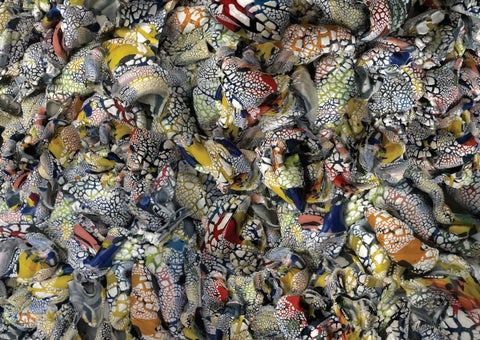
Hearth is a site‐specific ceramic installation embedded within the existing fireplace of the Grade I listed building at Somerset House. The work engages the hearth as both architectural element and cultural archetype: historically the symbolic and spatial nucleus of domestic life, a site around which identity, narrative, and social cohesion are constructed. By reconfiguring this fireplace as a ceramic intervention, the installation interrogates how “home” is materially produced, spatially experienced, and psychologically internalised.

Working as an Israeli ceramicist living in the United Kingdom, my practice unfolds within a diasporic condition. I understand diaspora not only as displacement but as an ongoing negotiation of belonging a continual process of inhabiting more than one geography at once. Hearth materialises this negotiation. Rather than replacing the existing structure, I inhabit and reconstruct it, overlaying a personal geology onto a protected heritage interior associated with British continuity and preservation. The intervention proposes home not as origin or stability, but as a layered and contingent construct.

The formal and material language of the work derives from the geology of the Negev Desert in Israel — a landscape shaped by tectonic folding, sedimentary exposure, and vast erosion craters (makhteshim). In such terrain, time is visible; pressure and fracture are recorded in strata. These geological processes become both metaphor and method. Clay itself is sedimented earth compressed matter carrying memory. In working with it, I am not simply shaping form but engaging with material that embodies duration, displacement, and transformation.

I am drawn to ceramics because of a particular sensitivity to matter in its solid physical actuality to weight, density, fracture, and heat. Clay is not a neutral vehicle for representation; it is earth in a responsive state. It registers touch, records pressure, and is irrevocably altered by fire. Through its manipulation cutting, layering, building, eroding I attempt to give spatial form to internal negotiations of identity. The problems that occupy me are those of mass and volume in relation to architecture; of surface in relation to light; of containment in relation to rupture. These are not merely formal concerns but existential ones: how a body occupies space, how it withdraws or asserts itself, how it holds together under heat.

Central to Hearth is the deliberate use of crawling glazes. Historically categorised as technical failure within ceramic orthodoxy, crawling occurs when glazes rich in raw minerals contract during drying and firing, causing the molten surface to withdraw and expose the clay body beneath. I employ this phenomenon intentionally, aligning the work with material practices that embrace contingency and the agency of matter. The glaze resists complete control; it fissures, beads, and retreats. Its surface recalls cracked desert earth or cooled lava geological formations shaped by stress and release.

The kiln, like the hearth, becomes a chamber of transformation. Fire acts as mediator both destructive and generative collapsing distinctions between domestic interior and geological process. Within the kiln, intention meets unpredictability. The final surface records a negotiation between gravity, mineral composition, and temperature. In this sense, the work is phenomenological: it is not simply an object to be viewed, but a material event that bears the trace of its own becoming.

Installed within a Grade I listed interior, Hearth stages a dialogue between permanence and instability. The architecture asserts fixity, preservation, and national memory; the ceramic intervention introduces fracture, movement, and exposure. This tension foregrounds a central question: how can fluid, migratory identity be inscribed within structures designed to stabilise history? The work does not resolve this contradiction but renders it materially visible.

Ultimately, Hearth reframes the hearth itself — not as a static emblem of domestic security, but as a site of continual formation. Home is proposed here as process rather than place: something constructed through acts of making, unmaking, and remaking. Through clay — displaced earth subjected to fire — I construct a temporary dwelling within a historic institution. Belonging, like glaze in the kiln, emerges through compression, fracture, and heat.

WORK IN PROGRESS

ARCHITECTURAL PLAN & ELEVATIONS (NTS)

SOMERSET HOUSE - ROOM E7 - INSTALLATION VIEW

SELECTED WORKS

LOT # 212 - (2022) Stoneware, glaze, oxides, 57(H) x 36(W) x 36(D)cm
LOT # 219 (2022) Stoneware, glaze, oxides, 59(H) x 46(W) x 44(D)cm
LOT # 225 - (2022) Stoneware, glaze, oxides, 34(H) x 32(W) x 32(D)cm
COR # 901 (2023) Stoneware, glaze, oxides, 60(H) x 53(W) x 50(D)cm
STV # 716 (2022) Stoneware, glaze, oxides, 47(H) x 28(W) x 28(D)cm
LOT # 222 (2022) Stoneware, glaze, oxide, H 38 x W 37 x D30 cm
COR # 905 (2023) Stoneware, glaze, oxide, 60(H) x 32(W) x 32(D)cm
LOT # 278 (2023) Stoneware, glaze, oxide, H 60 x W 50 x D45 cm
A L I # 3 6 6, 2022, Stoneware, Glaze, Oxide, 58(H) x 40(W) x 38(D)cm
BLUE # 2601 (2026), Porcelain, slip, cobalt oxide, glaze, 35(w) x 35(d) x 48h)cm
ALI # 2605 (2025), Porcelain, slip, cobalt oxide, glaze, 23(w) x 23(d) x 28(h)cm
ALI # 2601 (2023), Porcelain, glaze, oxide, stain, underglaze, 38(w) x 38(d) x 58(h)

CREATIVE PROCESS

Turn static files into dynamic content formats.
Create a flipbook
2603_Hearth_Oriel Zinaburg by oz_ceramic - Issuu