Women’s Voice and Leadership
Final Evaluation
Key Findings Report

Women’s Voice and Leadership - Guatemala — Final Evaluation Key Findings Report
Data collection and complete final evaluation Report by Sonia Elizabeth Moreno de León, Rosa Macz and Carlos Anckermann. This is a summarized version of that complete report done by Oxfam Canada.
May 2024
For more information, questions, and concerns about this study please contact: Tz’ ununija’
Eva Cristina Tecún León
General Coordinator
evatecunltzununija@gmail.com
Disclaimer
Oxfam in Guatemala
Eva Mejía Program Officer
Eva.mejia@oxfam.org
Oxfam Canada
Carla Caxaj
Monitoring, Evaluation and Learning Program Officer carla.caxaj@oxfam.org
This report was commissioned by Oxfam for the project, “Women’s Voice and Leadership Guatemala,” with financial support from Global Affairs Canada. The findings, interpretations, and conclusions expressed in this work do not necessarily reflect the opinions held by Oxfam or Global Affairs Canada. It should also be noted that the statistics in this report are not comparable to national-level statistics. The study was conducted with sample groups from specific project areas; thus, the statistics are not coherent with national standardized data. While every attempt has been made to ensure data quality, we recognize that there may be certain limitations in this sense. Neither Oxfam nor Global Affairs Canada can guarantee the precision of the data included in this report. Additionally, the borders, colours, denominations, or other information shown on any map in this report do not reflect any judgement by Oxfam or Global Affairs Canada with regard to the legal status of any territory or the endorsement or acceptance of any such boundaries.
This report is for the internal use only of Tz’ununija’ Indigenous Women’s Movement, the IWROs linked to Tz’ ununija’, Global Affairs Canada, and Oxfam.
Oxfam Canada
39 McArthur Avenue, Ottawa, ON K1L 8L7
1-800-466-9326
www.oxfam.ca


oxfamcanada
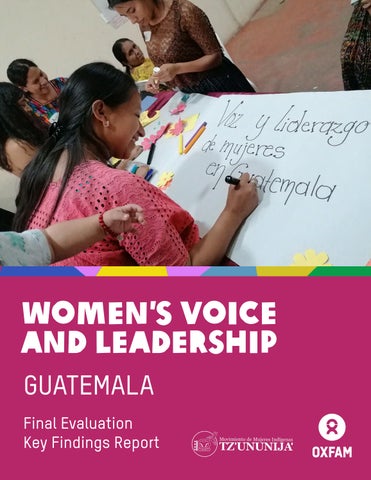
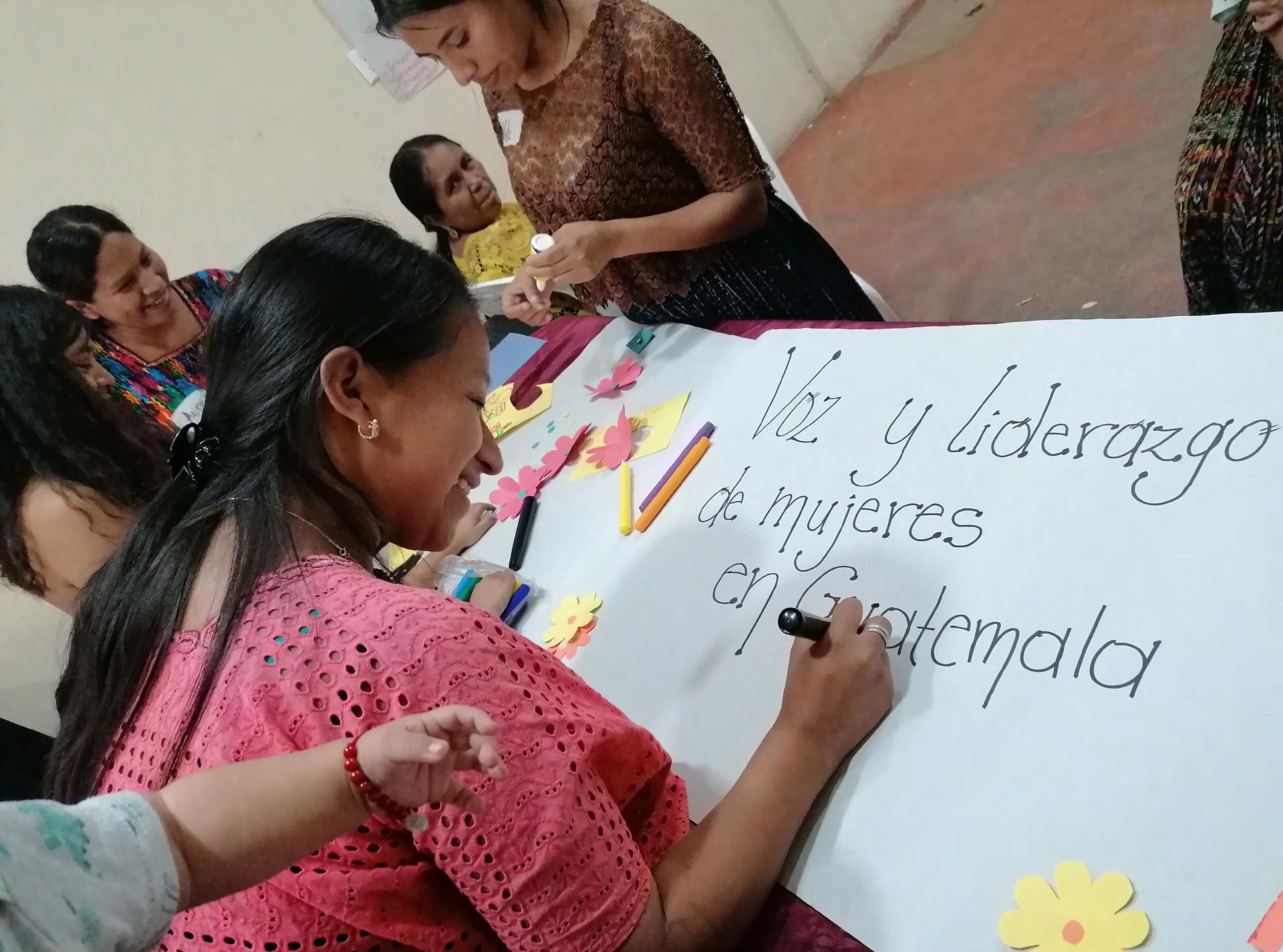
Cover page: Young leader from the San Luis Women’s Committee. San Luis, Alta Verapaz, October 2023.
Credit: Carlos Ankerman/ Tz’ununija’/ Oxfam
Acknowledgements
Oxfam wishes to acknowledge the Tz’ununija’ Indigenous Women’s Movement (Tz’ununija’) and the Indigenous women’s rights organizations, project partners in Guatemala for sharing all their ideas, insight, perceptions, and knowledge.
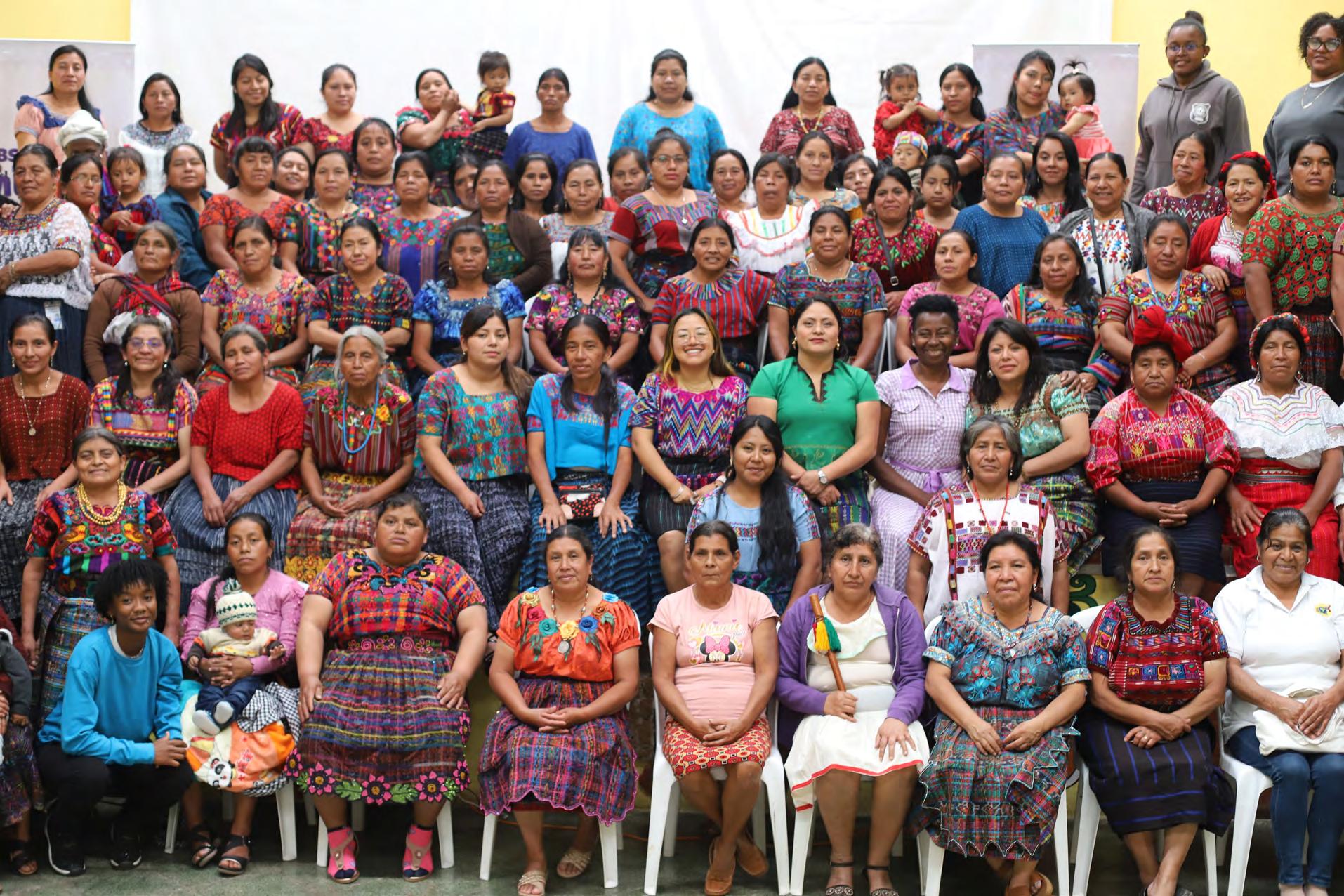
Tz’ununija’ Indigenous Women’s Movement National Assembly, July 2023. Credit: Eva Mejia
Findings by Pillars
Recommendations Tz’ununija’s vision of WVL G
EXECUTIVE SUMMARY
This is the Key Findings Report of the final evaluation of the Women’s Voice and Leadership Guatemala (WVL-G) project. It gathers the visions, voices and experiences of the Tz’ununija’ Indigenous Women’s Movement and 28 local Indigenous Women’s Rights Organizations (IWROs) linked to Tz’ununija’ at the end of the project. The report narrates the journey towards organizational capacity strengthening of Tz’ununija’ and the local IWROs linked to Tz’ununija’ (six of which were prioritised, along with Tz’ununija’ to undergo a self-assessment and implement a capacity strengthening plan). This report is a summarized compilation of the key findings and recommendations from the full final evaluation report completed in March 2024.
WVL-G was implemented from 16 September, 2019 to 15 March, 2024 by Tz’ununija’ in coordination with Oxfam in Guatemala (OiG) and Oxfam Canada (OCA), with financial support from the Government of Canada through Global Affairs Canada (GAC). The project is part of GAC’s Women’s Voice and Leadership (WVL) Program, which aims to directly strengthen the capacities and actions of Women’s Rights Organizations (WROs) in 28 countries.
WVL-G set as its Final Outcome “greater enjoyment of women and girls’ human rights and the advancement of gender equality in Guatemala”. Since its formulation it has been a process of co-design, co-creation and coimplementation, respecting and learning to respect the voice and leadership, the direction of Tz’ununija’ as an Indigenous women’s movement in Guatemala 1
The data presented in the final evaluation shows how the strategies and actions of the WVL-G project have changed and strengthened the IWROs and changed the lives of the women who are part of them in various ways. The baseline painted a picture of how women saw themselves, and their organizations in 2020. This was the beginning of a four-and-a-half-year process in which Tz’ununija’, together with the territorial and national liaisons (project coordinators), the Minor Council, the Political Council and, above all, the IWROs
1 Interview with Oxfam Canada
and their members “tilled the land and tended the crops … to be able to blossom”.2
THE FINAL EVALUATION METHODOLOGY AND PROCESS was defined as an exercise of reflection, analysis and collective learning, aimed at assessing the changes generated and the progress towards the outcomes and the indicators defined in the project. Oxfam Canada’s Feminist Monitoring, Evaluation, Accountability and Learning (FMEAL) framework, the principles of the Tz’ununija’ Indigenous Women’s Movement and community-based feminist approaches from popular education were used in the methodology defined for the final evaluation.
One of the main tools used was the Capacity Assessment Tool for Gender-Just Organizational Strengthening (CAT4GJO). This is a participatory capacity self-assessment tool for organizations. It is divided into six Capacity Domains and 22 Capacity Areas. The CAT4GJO methodology is designed to generate dialogue and collective critical reflection on the strengths, weaknesses and limitations of organizations in promoting Gender-justice; it encourages analysis, planning and a strategic view of the organization, leading to individualized Capacity Strengthening Plans (CSP). During the baseline, this tool underwent a significant contextualization process tailored specifically by and for Tz’ununija’ and the local IWROs that make up the movement.
THE KEY FINDINGS OF THE CAT4GJO show the situation four years after the beginning of the project and narrates how the six local IWROs and Tz’ununija’ perceive their organizational capacity strengthening journeys after having implemented their CSP. To assess the results, the scoring scale defined by Tz’ununija’ for the baseline was used, where the highest score of 4 (100%) is dark green, and the lowest score of 0 (0%) is red. Overall there were shifts across all but one domain.
2 Quotation summarising what a WRO member participating in the final evaluation said.
Credit: Carlos Ankerman/ Tz’ununija’/ Oxfam
The domain that showed the most significant change, with a 32% increase in perceived capacity, was Domain 2 ‘Gender-just Structures and Processes’, which increased from a score of 2.2 in the baseline to a score of 2.9 in the final evaluation. This is also the domain with the highest overall score in the end line. The increase is based on the IWRO’s perception that Tz’ununija’ and the linked local IWROs continued to focus during the project, on equity and justice in power relations, on the transformation of these relations between women and men, between mestizos/ladinos and Indigenous peoples, and on understanding that racism is the historical basis for the domination, exclusion and
dispossession of Indigenous peoples. The WVL-G project itself had a strong focus on understanding the historical basis of racism as a form of violence against Indigenous women (VAIW). Through trainings on VAIW and strengthening the capacities of IWROs to replicate those trainings, a greater number of IWROs -and Indigenous women- were reached than the six IWROs implementing CSP.
The domain with the second most significant change was Domain 3 ‘Organizational Resilience and Sustainability’ with a 19% decrease, which dropped from a score of 2.1 in the baseline to a 1.7 in the final
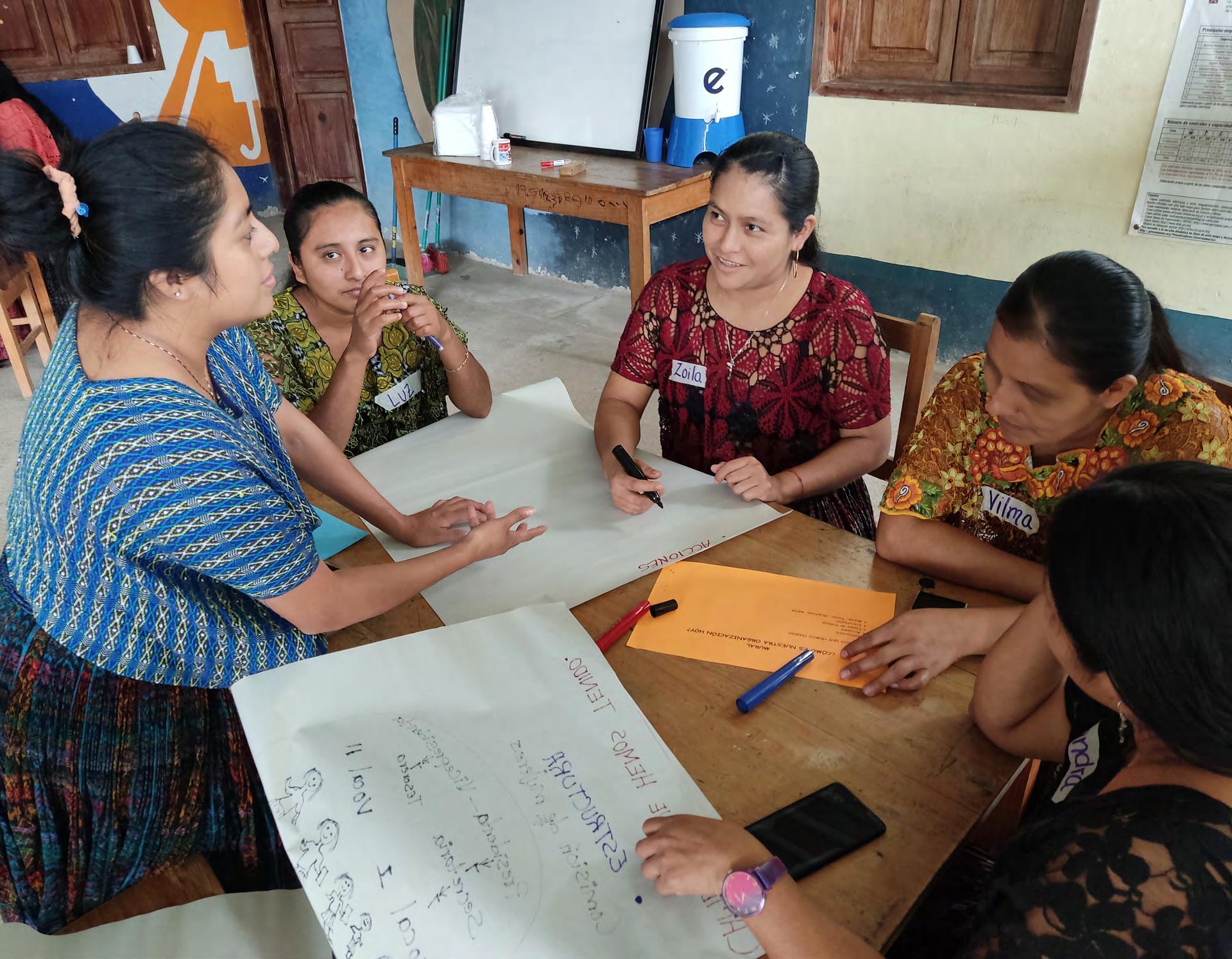
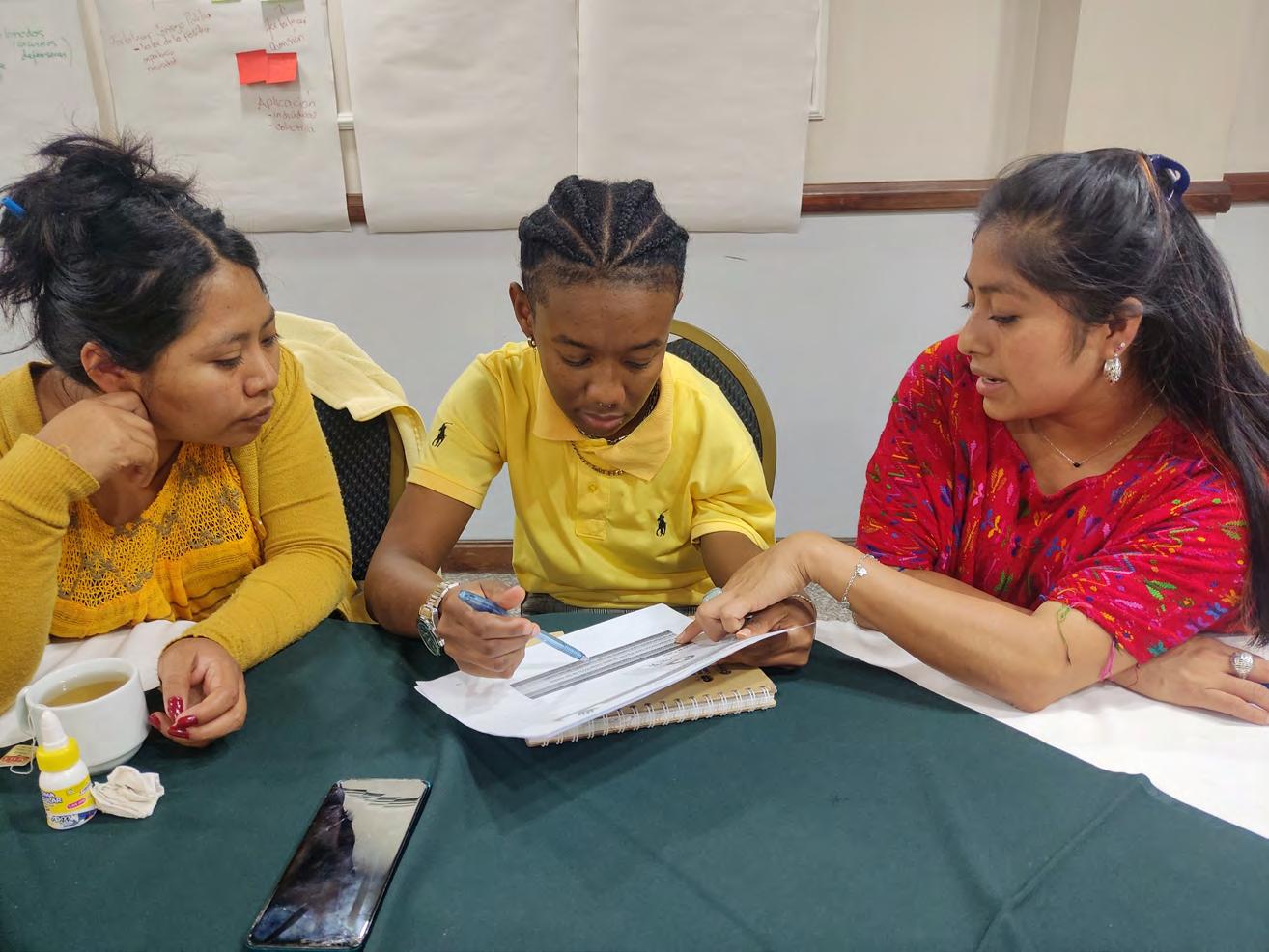
Young Nimlajacoc Region leaders discussing organizational capacities. Nimlajacoc, Alta Verapaz, October 2023.
evaluation. The low scores are primarily based on the IWROs lack of funds to implement projects and activities. The IWROs understanding of resilience and sustainability goes beyond financial sustainability; however, the lack of financial resources, was the driving force in the decision to decrease scores. This domain showed the greatest changes within capacity areas (CA), having the capacity area that most decreased and the one that most increased overall.
The specific capacity area that most decreased was CA 9 ‘Gender-responsive Financial Management’ going from 1.7 in the baseline to 0.4 points in the final evaluation, resulting in the lowest scored capacity area overall. The six IWROs identified the need to acquire skills in project design, management and financial management to enable them to carry out activities in their community with other women, youth and the local population, which would in turn empower them and give them organizational recognition in the community and economic sustainability. When defining capacity areas in this domain, it is important to bear in mind that although it includes the concept of resilience, the capacity areas focus on planning, management and resource management, but do not include capacity areas to understand a broader concept of resilience. This was a gap identified by the all IWROs.
The specific capacity that most increased was CA 7 ‘Strategic Planning’ with an increase of 1.2 points, resulting also in the highest average score for a capacity area overall, landing at 2.9 points at the end line. This is directly due to two IWROs having prioritized this for their capacity strengthening plans, five of the six local IWROs now doing annual or semi-annual workplans, and all local IWROs (even beyond the six prioritized) increasing their practice to do workplans (including oral or written planning), a significant change from the start of the project. The Patzún Women’s Network developed their first ever strategic plan. Tz’ununija’ elaborated their Global Plan 2024-2032 collectively with local IWROs based on findings from the evaluation of the previous Global Plan 2015-2023 (as part of the CSP), which included lessons learned and needs identified, and from the strategic analysis (internal midterm review) of the project.
KEY FINDINGS IN ACHIEVEMENT OF OUTCOMES point to an overall increased organizational capacity to deliver effective programming protecting and promoting human rights of Indigenous women. At the end of the WVL-G project, the Tz’ununija’ Indigenous Women’s Movement, as a network of 85 Indigenous women’s rights organizations (IWROS) has increased its overall capacity to deliver effective programming protecting and promoting human rights of Indigenous women, including young indigenous women, and to advance gender equality. All seven IWROs that were selected to develop Capacity Strengthening Plans to increase their capacity to deliver effective programing protecting and promoting of Indigenous women’s rights, completed their implementation (Indicator 1000.a.). The seven IWROs selected to implement the CAT4GJO, perceive they have on average 53.8% overall capacity (2.15/4), an increase from the 50.5% (2.02/4) at the onset of the project (Indicator 1000.b.)
Tz’ununija’, considers that the project strengthened its structure as a movement through the Regional Assemblies, the training processes for linked local IWROS and for women human rights defenders, their ability to provide guidance and support to women defenders who have been criminalised or prosecuted, and also strengthened its capacity to position racism as a form of violence against Indigenous women. The members of the six IWROs see themselves as subjects of rights and leaders, and indicate that the knowledge acquired in the training process has allowed them to strengthen their ability to promote, defend and demand their human rights as Indigenous women. The women participate in their community assemblies, in decision making spaces in their communities, municipalities and departments, where they make proposals and speak out about Indigenous women’s rights and the enforceability of those rights.
THE PROCESSES AND ACTIONS IMPLEMENTED IN WVL-G HAD SIGNIFICANT IMPACTS ACROSS ALL LEVELS: individual, collective and organizational levels. On a personal level, IWRO members spoke of overcoming fear, increased selfesteem and active participation within their organization and community, greater knowledge of their rights and of the issue of violence against Indigenous women. The members also value and believe that the process of psychosocial counselling and healing was fundamental in breaking the confinement, fear and pain experienced
in their minds, hearts and bodies as a result of the violence to which they were subjected. Overcoming these wounds has led them towards active participation in their organization. The training processes on dealing with violence and on national and international legislation have led them to see themselves as subjects of rights, as leaders and to participate in decisionmaking in their communities, in municipalities and even in their departments. This change at a personal level has led to a collective change: it has created greater dialogue and trust among the members of the IWROs, a sense of collective responsibility for strengthening the organization, and a commitment to work for Indigenous women’s rights. The women feel that their organizations are stronger because they have been able to socialize information and replicate knowledge, resulting in more women joining their organizations. This facilitated
greater outreach, strengthening the capacities and leadership of more women (115% growth in membership) and more IWROs (28) than those originally targeted (20).
WVL-G was characterised by co-creation processes between Tz’ununija, OiG and OCA; as well as within Tz’ununija’ between the Minor Council, the Political Council, the Technical Team and the Territorial Liaisons with the participating WROs. Considering the characteristics of the women and the IWROs, the project has overall achieved the expected results. The RECOMMENDATIONS point to continuation of the processes generated to strengthen the changes achieved in the IWROs and the women who make up the IWROs that are part of the Tz’ununija’ Indigenous Women’s Movement.
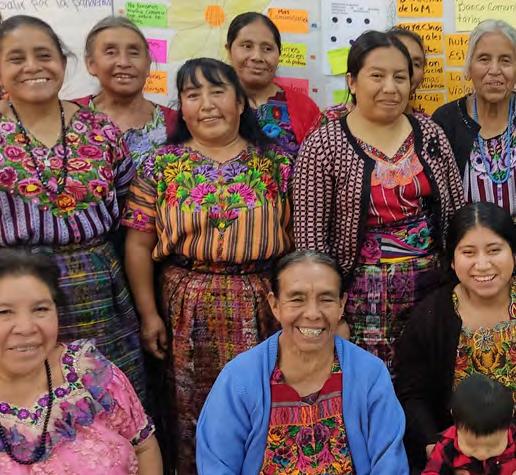
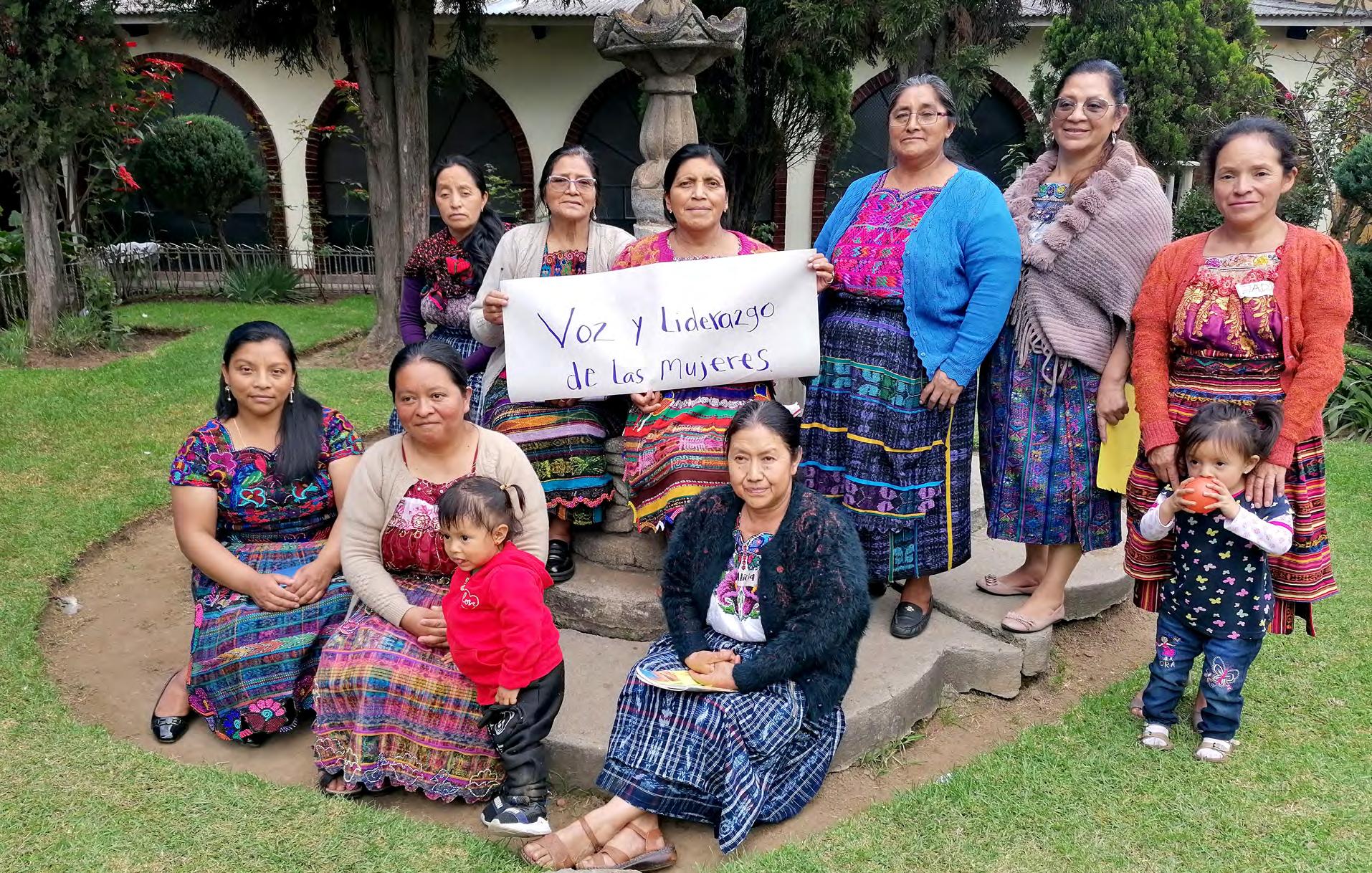
Zone 2 Women’s Group, Totonicapán, October 2023. Credit: Carlos Ankerman/ Tz’ununija’/ Oxfam
INTRODUCTION 2
This Key Findings Report for the final evaluation for the Women’s Voice and Leadership Guatemala (WVL-G) project aims to paint a picture of how the women who constitute the Tz’ununija’ Indigenous Women’s Movement (Tz’ununija’) and the Indigenous women who make up 28 of the 85 local Indigenous Women’s Rights Organizations (IWROs) linked to Tz’ununija’, see themselves at the end of the project.
WVL-G was implemented from September 2019 to March 2024 by Tz’ununija’ in coordination with Oxfam in Guatemala (OiG) and Oxfam Canada (OCA) and with the financial support of the Government of Canada through Global Affairs Canada (GAC). The project is part of GAC’s Women’s Voice and Leadership program, an innovative global initiative that directly strengthens the capacities and activities of local and regional women’s rights organizations and movements in 28 countries.
The project’s Ultimate Outcome was to contribute to increased enjoyment of human rights by Indigenous women, including young Indigenous women, and the advancement of gender equality in Guatemala. Tz’ ununija aimed to implement the project with 20 of
the IWROs that are part of the Tz’ununija’ Indigenous Women’s Movement in four departments: Totonicapán, Chimaltenango, Baja Verapaz and Alta Verapaz. Through the lifespan of the project, this target was surpassed reaching 28 IWROs in seven departments. Six of these IWROs, along with Tz’ununija’ underwent a capacity strengthening process using the Capacity Assessment Tool for Gender-Just Organizational Strengthening (CAT4GJO), contextualized and adapted specifically by and for Tz’ununija at the onset of the project.
With the intention of shifting power to Tz’ununija’ and following the spirit of co-creation that has marked this project, a team of consultants was selected by Tz’ununija’ to facilitate qualitative and quantitative data gathering and analysis. This report is a summarized compilation of the key findings and recommendations from the complete final evaluation report.
The findings show how the picture has changed, four years after the beginning of the project and narrates how Tz’ununija’ and the IWROs that make up the movement perceive their organizational capacity strengthening journeys and their ability to act in the face of violence against Indigenous women.
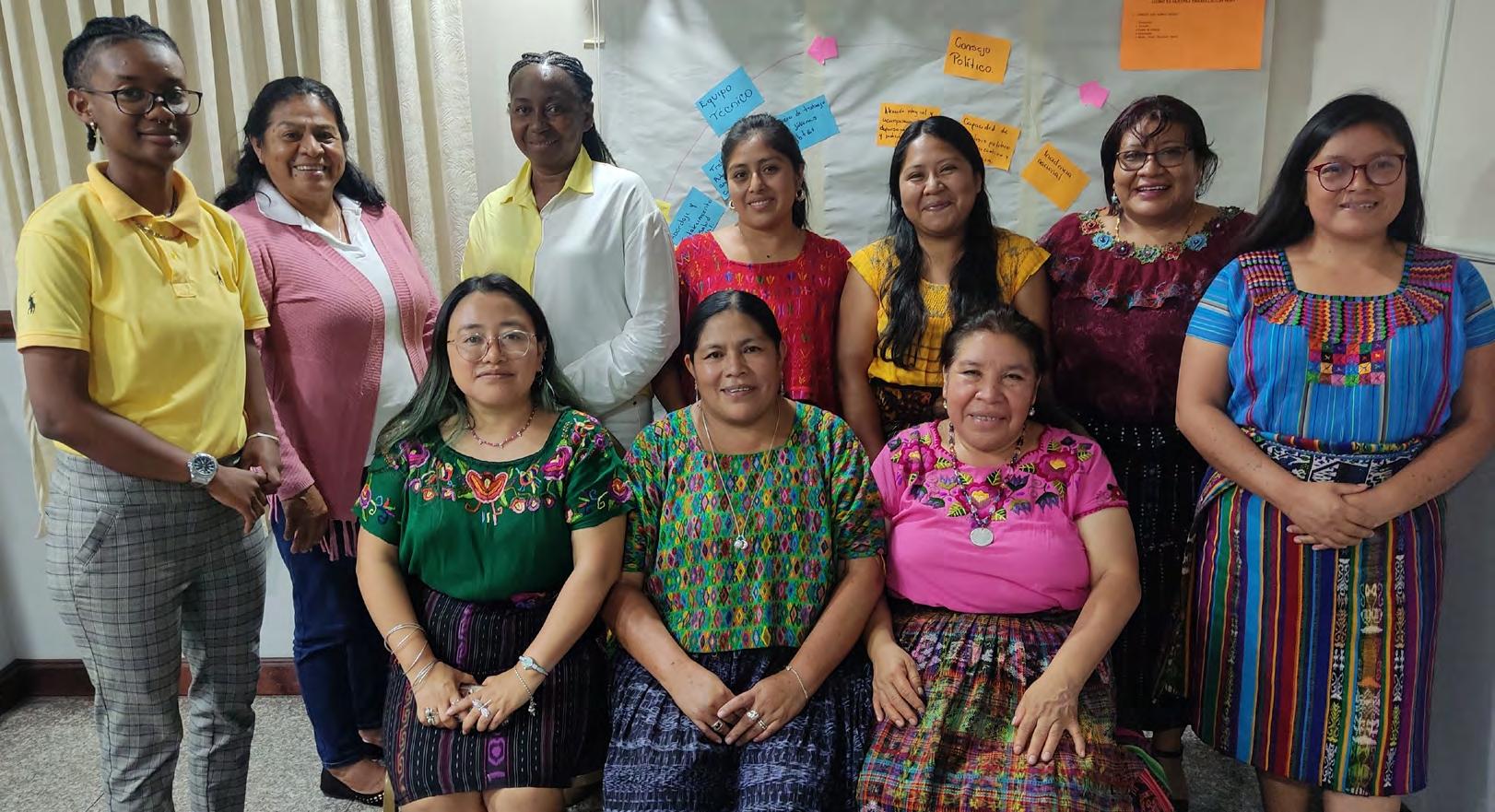
Tz’ununija’ leaders. Guatemala, October 2023.
Credit: Carlos Ankerman/ Tz’ununija’/ Oxfam
20 28 115% 17
LOCAL IWROS MAKE UP TZ’UNUNIJA’
LOCAL IWROS TARGETED IN WVL-G
LOCAL IWROS REACHED IN WVL-G
GROWTH IN MEMBERSHIP TO 28 LOCAL IWROS DURING WVL-G
IWROS IN DECISION MAKING SPACES IN THEIR COMMUNITIES, MUNICIPALITIES OR DEPARTMENTS
Indigenous women are organized, articulated, strengthened and happy, positioned and making decisions in different spaces and at different levels (community, municipal, departmental, national, international); they participate in the formulation of proposals to influence plans, programs and public policies for the assertion, exercise and enjoyment of their individual and collective rights.
Tz’ununija’ Indigenous Women Movement Global Plan 2024-2032
guatemala
Comité de Mujeres San Luis
Asociación de Mujeres Triunfadoras
Mujeres Construyendo un Futuro Región Nimlajacoc
ALTA VERAPAZ
Comité de Mujeres de la zona 2 Red comunitaria de Mujeres Maya K’iche’ Grupo de Mujeres Emprendedoras
Red de Mujeres de Patzún Grupo de Mujeres Medicina Natural Kakom Katit
Grupo de Mujeres Molaj Exoquib
CHIMALTENANGO
Comité de Mujeres Finca Ronda Sachut
Comité de Mujeres Finca Patal
Comité de Mujeres Finca Comunal
Flor de Primavera Comité de Mujeres
Comité de Mujeres Maya Poqomchi’
Comité de Mujeres Finca Pampaj
Comité de Mujeres Las Orquídeas
Comité de Mujeres Finca Portezuelo
Grupo de Mujeres Sembradoras de Girasoles Grupo de Mujeres para el Desarrollo Patzicia (AMAP)
TOTONICAPÁN BAJA VERAPAZ
KEY FINDINGS 3
Capacity Assessment Tool for Gender-Just Organizational Strengthening (CAT4GJO)
Safeguarding
CA20: Ensuring Safe and Ethical Programming
CA21: Child Protection
CA22: Safeguarding, Protection from Sexual Exploitation and Abuse, and Ensuring Safety
Transformative Gender Justice Programming and Advocacy
CA15: Design and Implementation of Gender-Transformative Programs, Including Standalone, WomenSpecific Programs or Projects
STRONG, EFFECTIVE, GENDER-JUST ORGANIZATIONS
Women’s Transformative Leadership
CA1: Reflective Leadership on Gender and Diversity
CA2: Cultivating Women’s Confidence and Leadership Capacity
CA16: Engaging Men and Boys as Allies and Beneficiaries of GenderJust Communities
CA17: Routine Involvement of People we Work With in Program Development and Implementation
CA18: Feminist Monitoring, Evaluation, Accountability, and Learning
CA19: Women’s Rights and Gender Justice Focused Advocacy and Campaigning
Strategic Gender Justice Relationships and Linkages
CA12: Working in Network/ Coalitions
CA13: Communicating and Sharing Knowledge
CA14: Fostering, Strengthening, and Sustaining Movements
Gender-Just Structures and Processes
CA3: Living our Values’ - Gender-Just HR Policies and Practices
CA4: Collaborative Management and Decision Making
CA5: Self-Care, Collective-Care, and Organizational Culture
CA6: Promoting Environmentalism and Ensuring Environmental Best Practices
organizational Resilience and Sustainability
CA7: Strategic Planning
CA8: Mobilizing Resources
CA9:Gender-Responsive Financial Management
CA10:Undertaking an Intersectional Approach to Operations and Programs
CA11: Fostering Intergenerational Learning and Exchange
3.1 CAT4GJO Findings
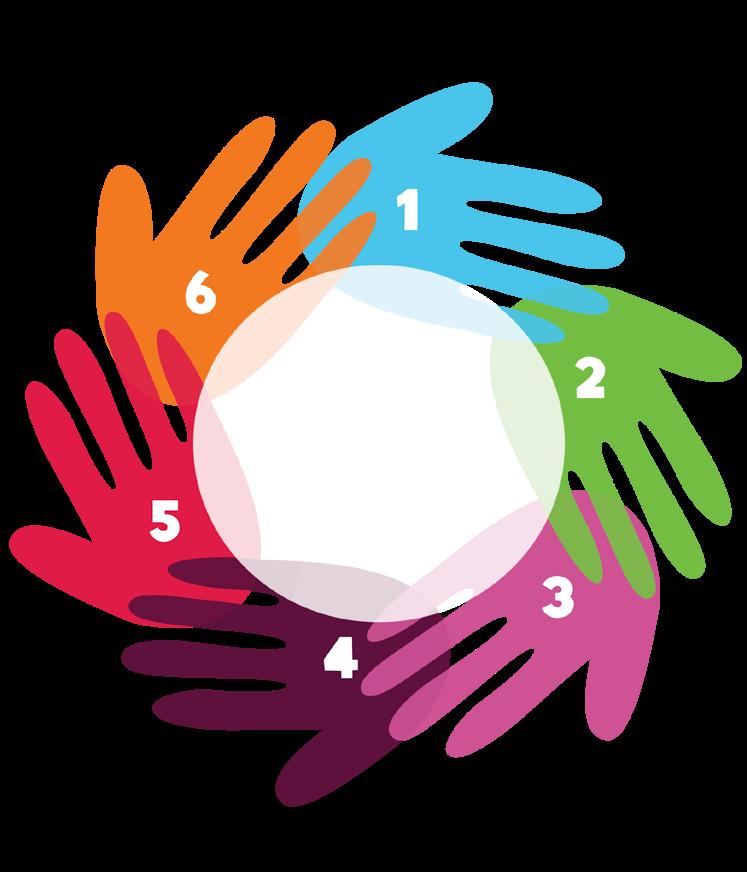
The findings show the situation four years after the beginning of the project and narrate how six local IWROs and Tz’ununija’ perceive their organizational capacity strengthening journeys and their ability to act in the face of violence against Indigenous women. Qualitative and quantitative data was gathered using the Capacity Assessment Tool for Gender-Just Organizational Strengthening (CAT4GJO). This is a participatory capacity self-assessment tool for organizations. It is divided into six Capacity Domains and 22 Capacity Areas (see Figure 1). The CAT4GJO methodology is designed to generate dialogue and collective critical reflection on the
strengths, weaknesses and limitations of organizations in promoting Gender-justice; it encourages analysis, planning and a strategic view of the organization, leading to individualized Capacity Strengthening Plans. The CAT4GJO methodology was applied with the adaptations and contextualization carried out during the baseline of the project. Tz’ununija’ and the six prioritized local IWROs combined a stoplight scale and an estimated percentage of compliance with the guiding questions to interpret the point scores. In this scale the highest score of 4 (100%) is dark green, and the lowest score of 0 (0%) is red (See Figure 1). The average scores given by the six IWROs and Tz’ununija’ to the Capacity Domains show their perspective on how their organizations and the Movement were strengthened.
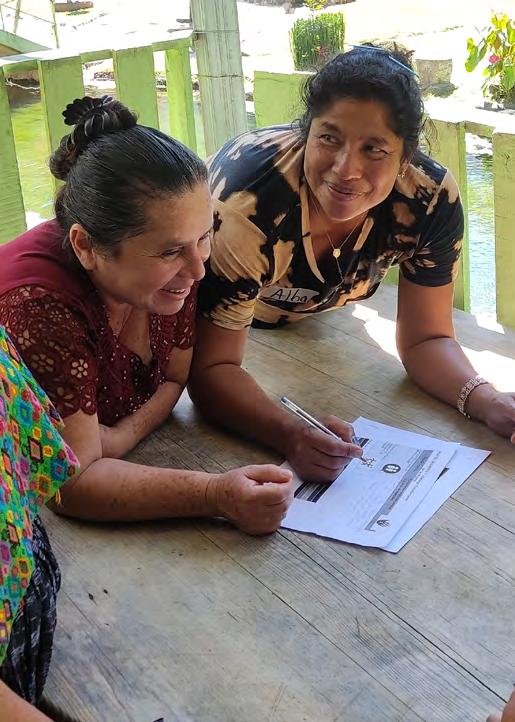
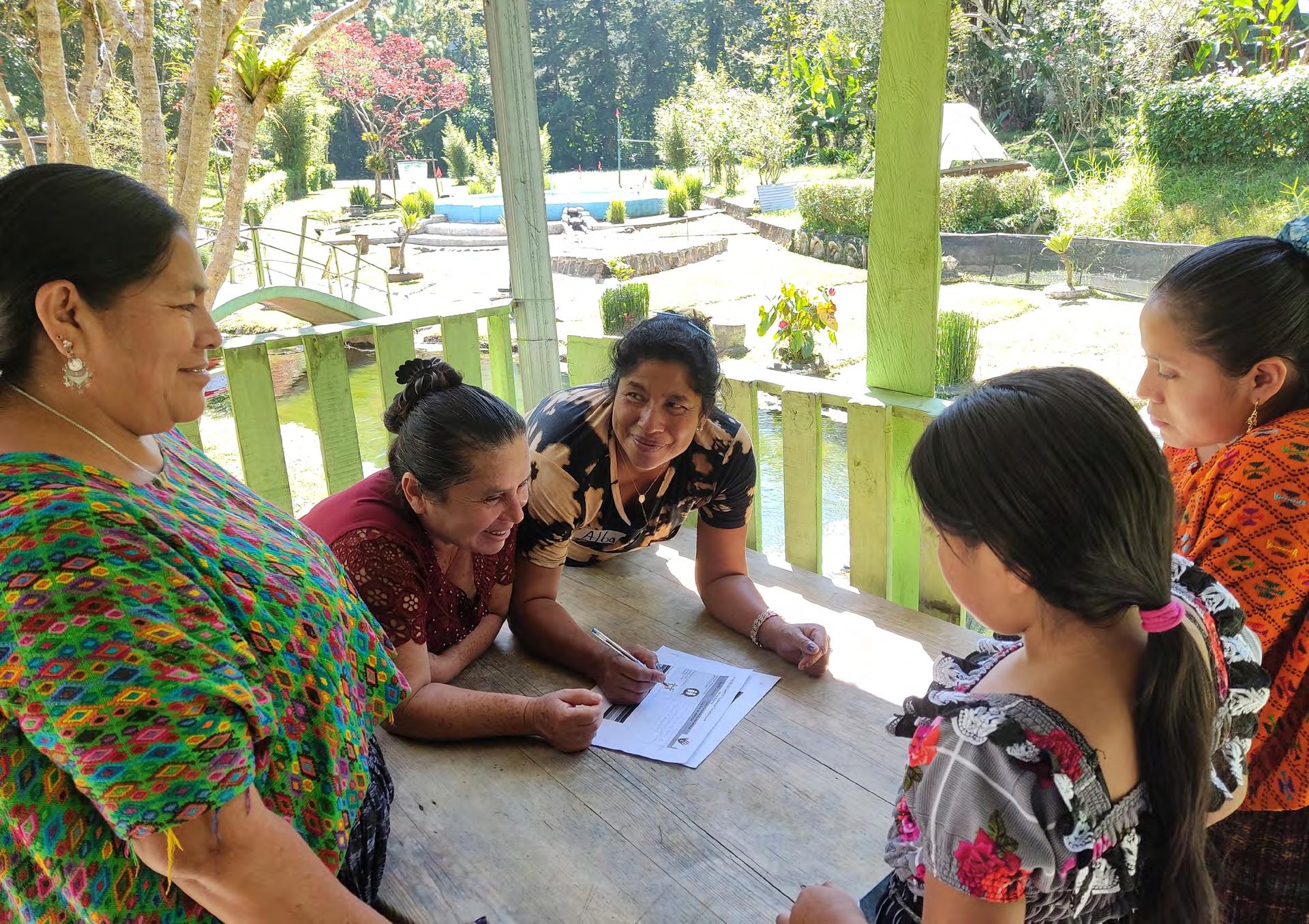
Pocomchi’ Women’s Committee members discussing organizational capacities. Arroyo Verde, Baja Verapaz, October 2023. Credit: Carlos Ankerman/ Tz’ununija’/ Oxfam
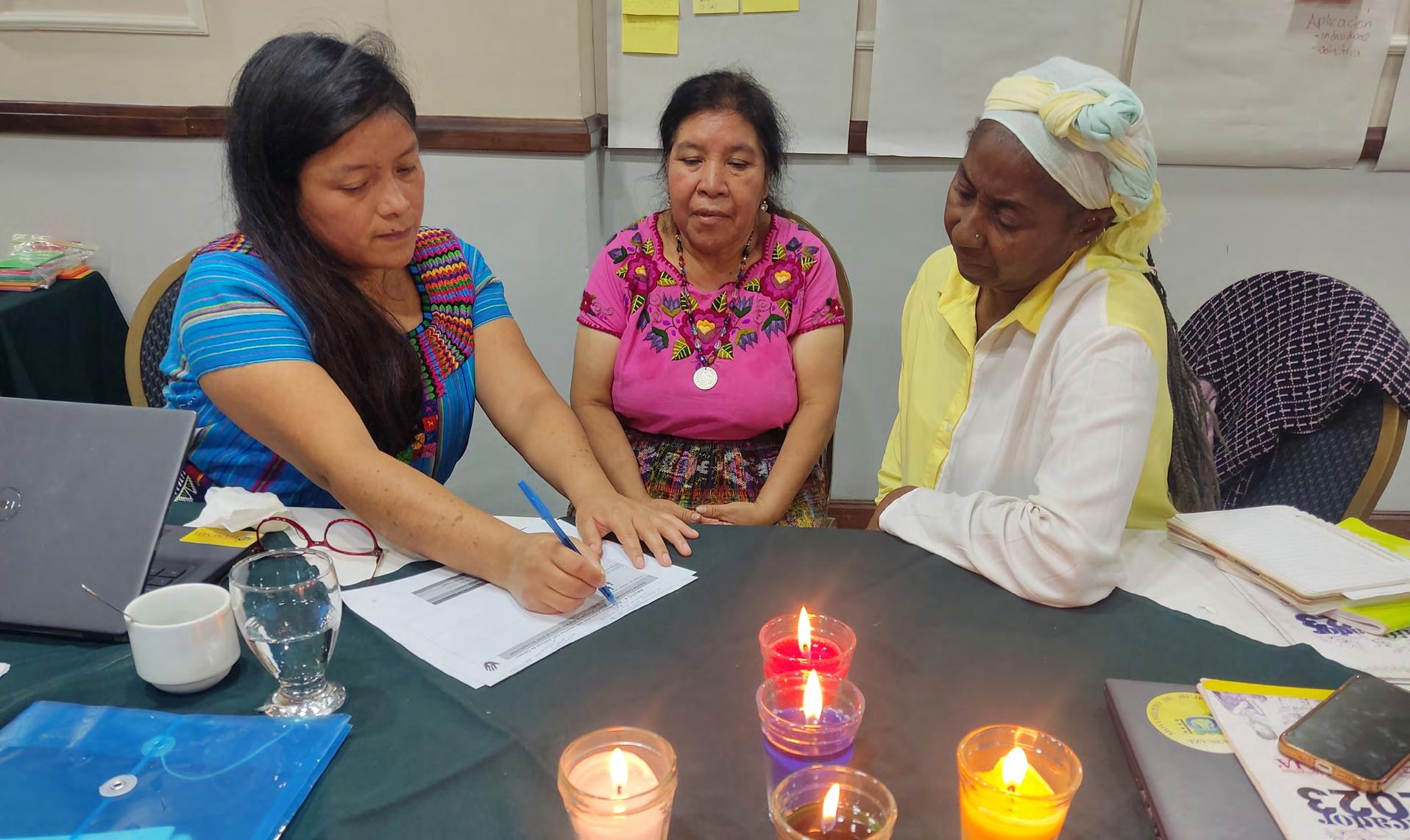
Tz’ununija’ leaders discussing organizational capacities. Guatemala, October 2023.
Credit: Carlos Ankerman/ Tz’ununija’/ Oxfam
0 = Our organization does none of these things(0%)
1 = The organization does few of these things (25%)
2 = The organization does some of these things (50%)
3 = The organization does several of these things (75%)
4 = The organization does all of these things (100%)
Figure 1: CAT4GJO scoring scale adapted by Tz’ununija’ and local IWROs
Figure 2: Average Scores Per Capacity Domain for The Six Prioritized IWROs and Tz’ununija’
Table 1: Points and percentage of increase and decrease per Capacity Domain
D3: Organizational Resilience and Sustainability
D4: Gender-just Relations and Strategic Linkages
D5:
Overall the domain that showed the most significant change with a 32% increase was Domain 2 ‘Gender-just Structures and Processes’, which increased from a score of 2.2 in the baseline to a score of 2.9 in the end line (see Table 1). This is also the domain with the highest overall score in the end line. The increase is based on the IWRO’s perception that Tz’ununija’ and the linked local IWROs focus on equity and justice in power relations, on the transformation of these relations between women and men, between mestizos/ladinos and the Indigenous population, and on understanding that racism is the historical basis for the domination, exclusion and dispossession of Indigenous peoples. The WVL-G project itself had strong focus on understanding the historical basis of racism as a form of violence against Indigenous women, through trainings and strengthening the capacities of IWROs to replicate those trainings with other IWROs, reaching a greater number of IWROs and Indigenous women than the six IWROs implementing capacity strengthening plans.
The domain with the second most significant change was Domain 3 ‘Organizational Resilience and Sustainability’ with a 19% decrease, which dropped from a score of 2.1 in the baseline to a 1.7 in the end line (see Table 1). The low scores are primarily based on the IWROs lack of funds to implement projects and activities. The IWROs understanding of resilience and sustainability goes beyond financial sustainability; however, the lack financial resources, was the driving force in the decision to decrease scores.
The domain with the lowest overall scores is Domain 6 ‘Safeguarding’ for both the baseline and end line. The score decreased by 0.1 point going from a score of 1.6 at the start to 1.5 at the end of the project. The low scores are due to the lack a formal security plan for all but two IWROs, and the fact that despite Tz’ununija’ having developed a Safeguarding Guide as part of their capacity strengthening plan, this has not yet been shared with the IWROs.
Domain 1- Women’s Transformative Leadership
3: Domain 1- Women’s Transformative
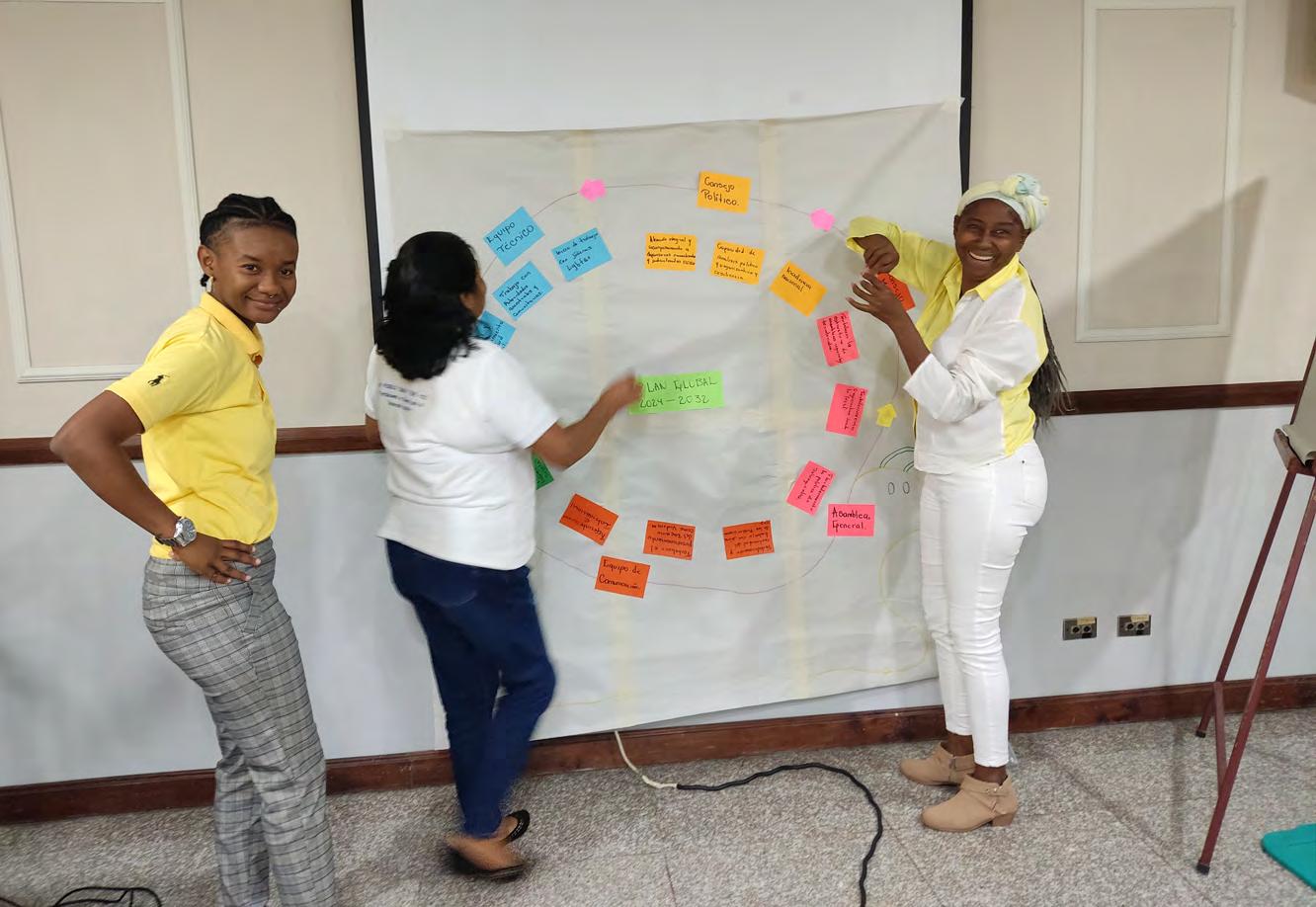
Table 2: Points and percentage of increase and decrease in Domain 1 - Women’s Transformative Leadership
CAPACITY AREA
CA1: Reflective Leadership on Gender and Diversity
CA2: Cultivating Women’s Confidence and Leadership Capacity
or decrease
Tz’ununija’ national liaisons and communications officer presenting diagram of Tz’ununija’s Global Plan 20242032. Guatemala, October 2023. Credit: Carlos Ankerman/ Tz’ununija’/ Oxfam
Domain 1 ‘Women’s Transformative Leadership’ remains the second highest scoring domain, with an average end line score of 2.7, an increase of capacity of 0.4 higher than the baseline. In both CA 1 ‘Reflective Leadership on Gender and Diversity’ and CA 2 ‘Cultivating Women’s Confidence and Leadership Capacity’, the scores are similar between the six local IWROs and Tz’ununija’, each with an average increase of 0.4 points for the first capacity area and 0.5 for the second. Both moved from yellow to green on the stoplight scale. The increase in scores according to the IWROs responds to several activities within their capacity strengthening plans as well as other within the project, undertaken to strengthen their leadership within their
organizations. For the members of the six IWROs, there can be no women’s leadership unless there is change in themselves, in their minds, in their hearts, in their bodies, in their senses, in their knowledge, in their lives. Participating in the training process, knowing and feeling that they have rights, that they are subjects of rights, knowing the types of violence and identifying the ones they have experienced, and above all, beginning to heal the pain, the sadness, the damage they have experienced as a result of violence, has made them strong leaders. Individual and collective empowerment as women strengthens their organizations and increases their participation within their organizations and in their communities. Participants in the final evaluation mentioned that they see themselves as subjects of rights, as leaders, that they have strengthened their knowledge about violence and ways to denounce it, and how to replicate this knowledge with other women in their communities and participate in different forms of organization.
This domain is of particular significance because Tz’ununija’, as an Indigenous Women’s Movement, defines its Strategic Areas and Lines of Work as focusing on training and strengthening the leadership of Indigenous women leaders (Maya, Xinca and Garifuna) who defend human rights.
Domain 2- Gender-just Structures and Processes
Figure 4: Domain 2- Gender-just Structures and Processes
Ensuring
CA4: Collaborative Management and Decision Making
Self-Care, Collective-Care, Organizational Culture
Table 3: Points and percentage of increase and decrease in Domain 2 - Gender-just Structures and Processes
increased their scores across all capacity areas. Overall, this domain moved from yellow to green on the stoplight scale.
Domain 2 ‘Gender-just Structures and Processes’ shows a change in the score, increasing from 2.1 in the baseline to 2.9 in the end line. This is the domain with greatest change with an overall 32% increase. Scores for all capacity areas under this domain increased from the start to the end of the project and all IWROs
The two capacity areas that most increased in scores were CA 5 ‘Self-Care, Collective-Care, Organizational Culture’ by 1 point and CA 4 ‘Collaborative Management and Decision-Making’ by 1.1 point, the latter also being the capacity area with the highest points under this domain. The six local IWROs indicate that the reason for this is the ongoing practice of decisions being made collectively, through dialogue and reflection in order to reach consensus. The Zone 2 Women’s Group of Totonicapán is the IWRO that needs the most strengthening in this aspect. The increase in scores for CA 5 ‘Self-Care, Collective Care and Organizational Culture’, is due to the healing processes carried out as part of project activities in which the women have healed the pain and wounds caused by the violence they have experienced by learning healing exercises and techniques which they have then used in their families. They emphasise the importance of caring for each other.
Both CA 6 ‘Ensuring Environmental Best Practices’ and CA 3 ‘Gender-just HR policies in Practice” each have increased by 0.6 points each. This slight increase for
the first has to do with increase in activities such as the Zone 2 Women’s Group and the Poqomchi’ Women’s Committee participating in their municipality’s or community’s forest management organization or the active involvement in actions to defend their lands and territories where extractive industries have increased in Alta and Baja Verapaz.
Domain 3- Organizational Resilience
The six IWROs are not legally registered and do not have written policies, regulations, or other documents required for legal status. Although at the baseline they indicated that they were weak in these aspects, in the final evaluation they mention that although this is a limitation for the management of funds, it does not make them weak as an organization when it comes to organizing and training women.
and Sustainability
Figure 5: Domain 3- Organizational Resilience and Sustainability
Table 4: Points and percentage of increase and decrease in Domain 3Organizational Resilience and Sustainability
CA8: Mobilizing Resources
CA9: Gender-responsive Financial Management CA10: Intersectional Approach for Operations and Programs
Domain 3 ‘Organizational Resilience and Sustainability’ was the domain with second most overall significant change with a 19% decrease, dropping from a score of 2.1 in the baseline to a 1.7 in the end line. Three capacity areas showed significant decreases in scores while two showed increase. This domain showed the greatest change in individual capacity areas, having the capacity area that most decreased and the one that most increased overall.
The capacity area that most increased was CA 7 ‘Strategic Planning’ with an increase of 1.2 points, resulting also in the highest scored capacity area overall, landing at 2.9 points at the end line. This is directly due to two IWROs having prioritized this for their capacity strengthening plans, five of the six local IWROs now doing annual or semi-annual workplans, and all local IWROs (even beyond the 6 prioritized) increasing their practice to do workplans (including oral or written planning), a significant change from that start of the project. The Patzún Women’s Network developed their first ever strategic plan while Tz’ununija’ elaborated the Global Plan 2024-20323 collectively with local IWROs based on an evaluation of the previous Global Plan 20152023 (as part of the capacity strengthening plan) and needs identified and lessons learned in the strategic analysis of the project. Tz’ununija’ recognises the strength of having a set of seven policies that guide its working practices, as well as transparent and efficient administrative and financial functioning. All six local IWROs indicate that they need to learn more about what strategic planning is and how it is done, which was a need identified during the baseline, but not prioritized as part of their plans given other identified needs.
In second place, CA 11 ‘Fostering Intergenerational Learning and Exchange’ shows an average score of 2.6. The local IWROs indicate that women of different ages are integrated in their organizations, and that the older women share learning and experience with the younger women, they also say that the knowledge acquired is socialised considering the opinions of the younger women.
The capacity area that decreased the most in scores was CA 9 ‘Gender-responsive Financial Management’ going from 1.7 in the baseline to 0.4 points in the end line. This capacity area was given overall lowest scores of all domains in the end line (0.4) because many of the local IWROs consider they do not engage in financial management, and for those that do, they feel it is insufficient. Two of the IWROs indicate that they do manage funds, either because they raise funds among themselves or with COCODE, or because certain authorities allocate resources to carry out specific activities in the community. The six local IWROs identified the need to acquire skills in project design, management and financial management to enable them to carry out activities in their community with other women, youth and the local population, which would in turn empower them and give them organizational recognition in the community and economic sustainability. When defining capacity areas in this domain, it is important to bear in mind that although it includes the concept of resilience, capacity areas focus on planning, management and resource management, but do not include capacity areas related to organizational capacity, women’s leadership and Tz’ununija’ in a broader concept of resilience. This is a gap identified by the all IWROs.
3 A seven-year strategic plan along with a funding strategy for the plan
Domain 4- Gender-just Relations and Strategic Linkages
Table 5: Points and percentage of increase and decrease in Domain 4 - Gender-just Relations and Strategic Linkages CAPACITY AREA
CA12: Working in Networks/Coalitions
CA13: Communicating and Sharing Knowledge
CA14: Fostering, Strengthening and Sustaining Movements
Domain 4 ‘Gender-just Relations and Strategic Linkages’ decreased score by 0.1 points, having had the highest score in the baseline of 2.7 ranking third in the end line with an average of 2.6 points, moving from green to yellow on the stoplight scale. Of the three capacity areas in this domain, two decreased in score and one increased.
The capacity area that most increased in scores was CA 14 ‘Fostering, Strengthening and Sustaining Movements’, by 0.5 points. This increase is due to the fact that Tz’ununija’ and all local IWROs linked to Tz’ununija’ see themselves as an Indigenous women’s movement that link local community IWROs and there has been an increase in numbers from 80 to 85 IWROs ratifying their linkage to Tz’ununija’ by the end of the project. Of those, the 28 reached through the project have increased their membership from (639 to 1,375).
The capacity area that most decreased in average points was CA 12 ‘Working in Networks/ Coalitions’ dropping 0.6 points from the baseline to the end of the project. The drop in scores for the local IWROs is mainly due to the lack of sufficient resources to participate in networks. The lack of financial resources continues to be identified as a weakness in enabling more women to participate or coordinate activities with other organizations. All six IWROs stress the importance of getting to know other women’s organizations and women’s social movements at the municipal, departmental and national level.
Tz’ununija’ s reflections based on its experiences participating in coordination spaces/ alliances/ movements help to understand the decrease in points. Tz’ununija’s leadership notes that many of these spaces
Figure 6: Domain 4- Gender-just Relations and Strategic Linkages
are created at specific moments and disappear once the action or objective for which they were created has been achieved; others tend to be motivated by international cooperation funds based on the objectives of the donor. It considers it necessary to define its participation on the basis of its political vision, strategies and actions
defined in the Global Plan 2024-2032. In this Plan, Strategic Area 4 ‘National and International Participation and Advocacy’ defines actions for relations, coordination and alliances with entities and institutions, cooperation agencies, movements and civil society organizations.
Domain 5- Transformative Gender-justice Programming and Advocacy
Table 6: Points and percentage of
Figure 7: Domain 5- Transformative Gender-justice Programming and Advocacy
CA16: Engaging Men and Boys as Allies
CA17: Involvement of People we Work With in Program Development and Implementation CA18: Feminist MEAL
Domain 5 ‘Transformative Gender-justice Programming and Advocacy’, maintains the second lowest score, with an average score of 1.9 points, in both the baseline and the end line; the only domain without any change in overall score. Overall this domain remains at yellow on the stoplight scale.
CA 19 ‘Women’s Rights and Gender-justice Focused Advocacy and Campaigning’ was the area that most increased – and also received the highest score in both the baseline (2.5) and end line (2.9), moving from yellow to green on the stoplight scale. This increase is the result of several factors. The first is that three of the IWROs and Tz’ununija’ prioritised this domain in their Strengthening Plan; San Luis Women’s Group, Maya Poqomchi’ Women’s Committee and the Zone 2 Women’s Group prioritized advocacy training; the first two implemented an advocacy process at the local level, and Tz’ununija’ did so at both the national and international levels. The six local IWROs highlighted the importance of including advocacy and social auditing aspects in their training processes in order to strengthen their actions as organizations and as leaders in their communities and municipalities. Tz’ununija’ conducted annual information and awareness-raising campaigns during the implementation of the project; all six local IWROs indicated their active participation in these campaigns, as well as in the activities and forums and meetings held during the lifespan of project. The six local IWROs showed interest in acquiring knowledge on how to conduct campaigns, considering the conditions of their organization and communities.
The capacity area that decreased the most was CA 16, ‘Engaging Men and Boys as Allies’ by 0.3 points. Only two IWROs included it in their strengthening plans (and not prioritized by any IWRO to be implemented through project funds). The reason for the decrease is primarily due to those IWROs not implementing the activities as planned in their strengthening plans due to lack of resources for materials. However, the women indicate that they are socialising knowledge about rights with their daughters and sons, defining patterns of behaviour that are gradually changing or transforming the roles assigned to women and men; they also indicate that they find it more difficult to discuss the issue with the adult men in their families. The work successfully carried out by other IWROs, primarily Tz’ununija’, Nimlajacoc,
and Women Building a Future, with Ancestral and Community Authorities and Indigenous youth, including young men showcased the importance of working with allies to influence change. Tz’ununija’ highlighted that the work initiated with the Ancestral and Community Authorities in Alta and Baja Verapaz has been of the utmost strategic importance, because of the role they play in the communities, and considers it necessary to extend this work to other departments in future work. The work with Indigenous youth (women and men) in the Course on History and Racism and in artistic activities, including the youth festivals has been important for Tz’ununija’ and for the participants, who say that their participation in their organisations and communities has been strengthened by their involvement in Tz’ununija’s activities.
Despite the decrease in scores the work done in this capacity area has brought about important unexpected outcomes: as a direct result in work with youth was the incorporation of an LGBTQI+ Indigenous youth organization - ABA WABU- which has encouraged Tz’ununija’ to broaden its approach to diversity and to the specific needs of LGBTQI+ Indigenous youth organizations. Another important result is that Tz’ununija’ has included in its Global Plan 2024-2032 Indigenous youth, the elaboration of a curriculum and the development of methodologies and strategies to initiate work with children, along with the continued work with Ancestral and Community Authorities as key influencers to shift social imaginaries in violence against Indigenous women in their communities. Another important unexpected outcome is the creation of the Women’s Committee in the Nimlajacoc Region, both in the Regional Assembly and in the majority of the communities that make up the region. It is an organisational form that did not exist before the implementation of WVL-G and is a direct result of the discussions on organizational capacity strengthening using the CAT4GJO.
In relation to Capacity Area 18, ‘Monitoring, Evaluation, Accountability and Learning’, Tz’ununija’ considers it necessary to build a comprehensive monitoring, evaluation and learning system for Tz’ununija’ that would allow it to have global data on its work to assess the progress and implementation of the Global Plan 2024-2032.
Domain 6 - Safeguarding
Figure 8: Domain 6 - Safeguarding BASELINE ENDLINE
Table 7: Points and percentage of increase and decrease in Domain 6 - Safeguarding
CA20: Ensuring Safe and Ethical Programming
CA21: Child Protection
CA22: Safeguarding, Protection from Sexual Exploitation and Abuse, and Ensuring Safety
Domain 6 ‘Safeguarding’ remains the lowest in both the baseline at 1.6 points and the end line at 1.5 points. Of the three capacity areas under this domain, two decreased and one increased. Overall this domain remains at an orange on the stoplight scale.
Two capacity areas, CA 21 ‘Child Protection’ and CA 22 ‘Safeguarding, Protection from Sexual Exploitation and Abuse, and Ensuring Safety”, both decreased by 0.6 points each. The IWROs have reduced this score because they say they do not have a written security
plan, and in the case of Tz’ununija’ they mention that the Safeguarding Guide has not yet been socialised with the linked IWROs. Tz’ununija’ prioritised in its strengthening plan, developing a Safeguarding Guide, which was created, revised and updated with its own resources and those of Oxfam. This guide was called “Weaving our Security and Protection”. Tz’ununija’ will socialize the guide in order to ensure that linked IWROs have a good understanding of the concepts and their implementation.
The one capacity area that increased was CA 20 ‘Ensuring Safe and Ethical Programming’, by 0.7 points. The IWROs also indicate that the reason for the increase is, in part, because they discuss security measures in their organization according to their context, particularly in Alta and Baja Verapaz, where they face conflicts related to extractive industries. They indicate that security measures emerge from discussions in the Community Assembly and in their organizations, but that they have decided not to write them down; they consider it important to know the protection procedures because of the increase in criminalisation and persecution of Indigenous women human rights defenders. They know that Tz’ununija’ has a Safeguarding Guide and that it is working to obtain resources to share it with the organizations involved.
CA21: Child Protection
CA22: Safeguarding, Protection from Sexual Exploitation and Abuse, and Ensuring Safety
CA20: Ensuring Safe and Ethical Programming
Overall Capacity Strengthening Scores Tz’ununija’ and six local IWROs linked to Tz’ununija’
Table 8: Average Scores of selected local IWROs and Tz’ununija’ per Capacity Domain
The two that had the highest increases were Tz’ununija’ with an increase of 0.9 points and the Nimlajacoc Region with an increase of 0.6 points. Both of these were among the IWROs with the most fulsome capacity strengthening plans and also among the last to complete them. Tz’ununija’ prioritized a lengthy strategic planning process that included evaluating the previous strategic plan, and developing a funding strategy to accompany the strategic plan. They were also able to cover other action items with funds outside of the WVL-G capacity strengthening plans budget, such as safeguarding, campaigns and advocacy. Nimlajacoc underwent a tailored community-based training and healing process to reach a wider membership in strengthening their programmatic capacities to address violence against Indigenous women. The Poqomchi’ Women’s Committee and Women Building a Future also increased their scores by 0.1 points each.
Poqomchi’
Of the seven IWROs that underwent the Capacity Strengthening Tool for Gender-just Organizational Strengthening (CAT4GJO), four (three local IWROs and Tz’ununija’) increased their overall organizational capacity to deliver effective programming protecting and promoting human rights of Indigenous women, and three local IWROs decreased their score at the end line in relation to the baseline (Indicator 1000a). For the overall assessment of the scope and capacity areas of the CAT4GJO, there was an increased level of appropriation and understanding of the concepts and capacity areas and perception of importance of these areas to strengthen their organization, which resulted in some cases in more severity and rigour in scoring during the final evaluation.
The IWROs with the greatest decrease in overall points was the Zone 2 Women’s Group with a decrease in 0.4 points. The Patzún Women’s Network and the San Luis Women’s Committee also lowered the scores, the first by 0.3 and latter by 0.1 points. The Patzún Women’s Network also prioritized strategic planning, developing their first ever organizational strategic plan. However, because this only corresponds to one specific capacity area, the lack of growth in other areas resulted in a decrease of overall scores. The San Luis Women’s Committee also lowered their overall score by 0.1 points. The main reason was that they were unable to fully implemented their plans (beyond what was funded by the project) due to lack of financial resources to carry out all the planned activities.
Some of the rationale given from IWRO members, was that they now have increased knowledge and better understanding of the concepts used in the CAT4GJO and better analytical capacity to evaluate their work and this in turn can increase the perception of greater organizational gaps that can be further strengthened, resulting in lower scores. The Zone 2 Women’s Group explained their decrease in scores:
“We may have graded ourselves too harshly, we may have given ourselves lower scores than at the beginning. It is not that we are less strong, we are stronger because now we understand better what a strong Indigenous
women’s organization fighting for their rights is, we know that we are capable, that we have the strength to improve our organization”
— Leader from Zone 2 Women’s Group, Totonicapán
3.2 Findings by Pillars
ULTIMATE OUTCOME 1000 Increased enjoyment of human rights by indigenous women, including young indigenous women, in the advancement of gender equality in Guatemala
At the end of the WVL Guatemala project, the Tz’ununija’ Indigenous Women’s Movement, as a network of 85 Indigenous women’s rights organizations (IWROS) has increased its overall capacity to deliver effective programming protecting and promoting human rights of Indigenous women, including young indigenous women, and to advance gender equality. All seven IWROs that were selected to develop Capacity Strengthening Plans to increase their capacity to deliver effective programing protecting and promoting human rights of Indigenous women completed their implementation. (Indicator 1000.a.).
The seven IWROs who carried out the CAT4GJO process perceive they have on average 53.8% overall capacity (2.15/4), an increase from the 50.5% (2.02/4) at the onset of the project (Indicator 1000.b.).
The target for the first indicator was fully reached. For the second indicator, the ambitious target of 69% overall capacity (2.76/4) was not reached due to overestimating much perception and capacity strength can shift in a short period, although there was an increase in overall perceived organization capacity strengthening.
The members of the six IWROs see themselves as subjects of rights and leaders, and indicate that the knowledge acquired in the training process has allowed them to strengthen themselves to promote, defend and demand their human rights as Indigenous women. The women participate in their community assemblies, in COCODE, in committees, groups and commissions in their communities, where they make proposals and speak out about Indigenous women’s rights and the enforceability of those rights. Overall, all IWROs considered that the
Capacity Strengthening Plan was a tool that allowed them to organize themselves better. Tz’ununija’ considers that the project strengthened its structure as a movement through the Regional Assemblies, the training processes for linked local IWROS and for women human rights defenders, the guidance and support to women defenders who have been criminalised or prosecuted, and also strengthened its position on racism as violence.
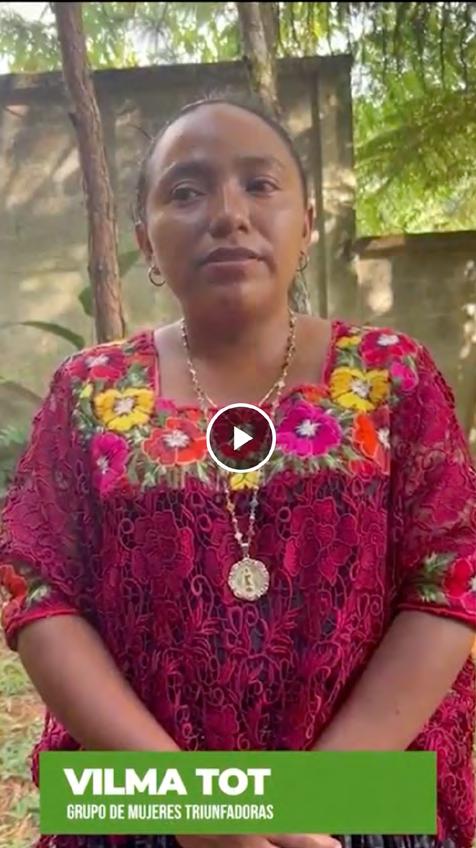
Now I am human rights defender. I know how to defend myself, I know my rights... I know that I have a voice and vote… I support and accompany other women.
— VILMA TOT Triumphant Women’s Group, Alta Verapaz
PILLAR 1
INTERMEDIATE OUTCOME 1100
Improved management and sustainability of local Indigenous women’s rights organizations (WROs) in Guatemala, particularly those representing vulnerable and marginalized Indigenous women, including young Indigenous women.
The seven IWROs that implemented the Capacity Strengthening Tool for Gender-just Organizational Strengthening (CAT4GJO), show an overall decrease in points on their sustainability capacity, decreasing in 0.3 points starting at an average 2 points at the baseline to 1.7 at the end line (Indicator 1100a). The decrease in scores is primarily due to a decrease specifically in mobilising resource and financial management, two key capacity areas analysed as part of sustainability4 Despite the decrease in overall scores, there were
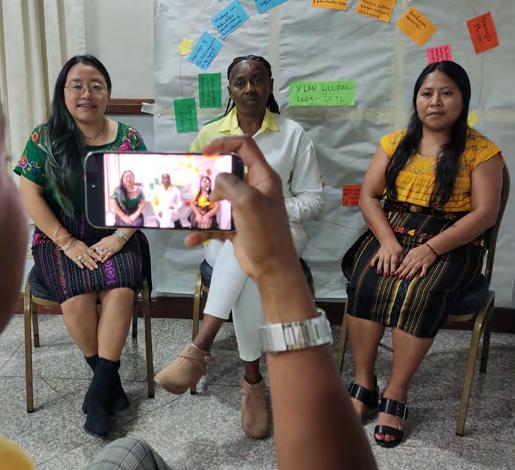
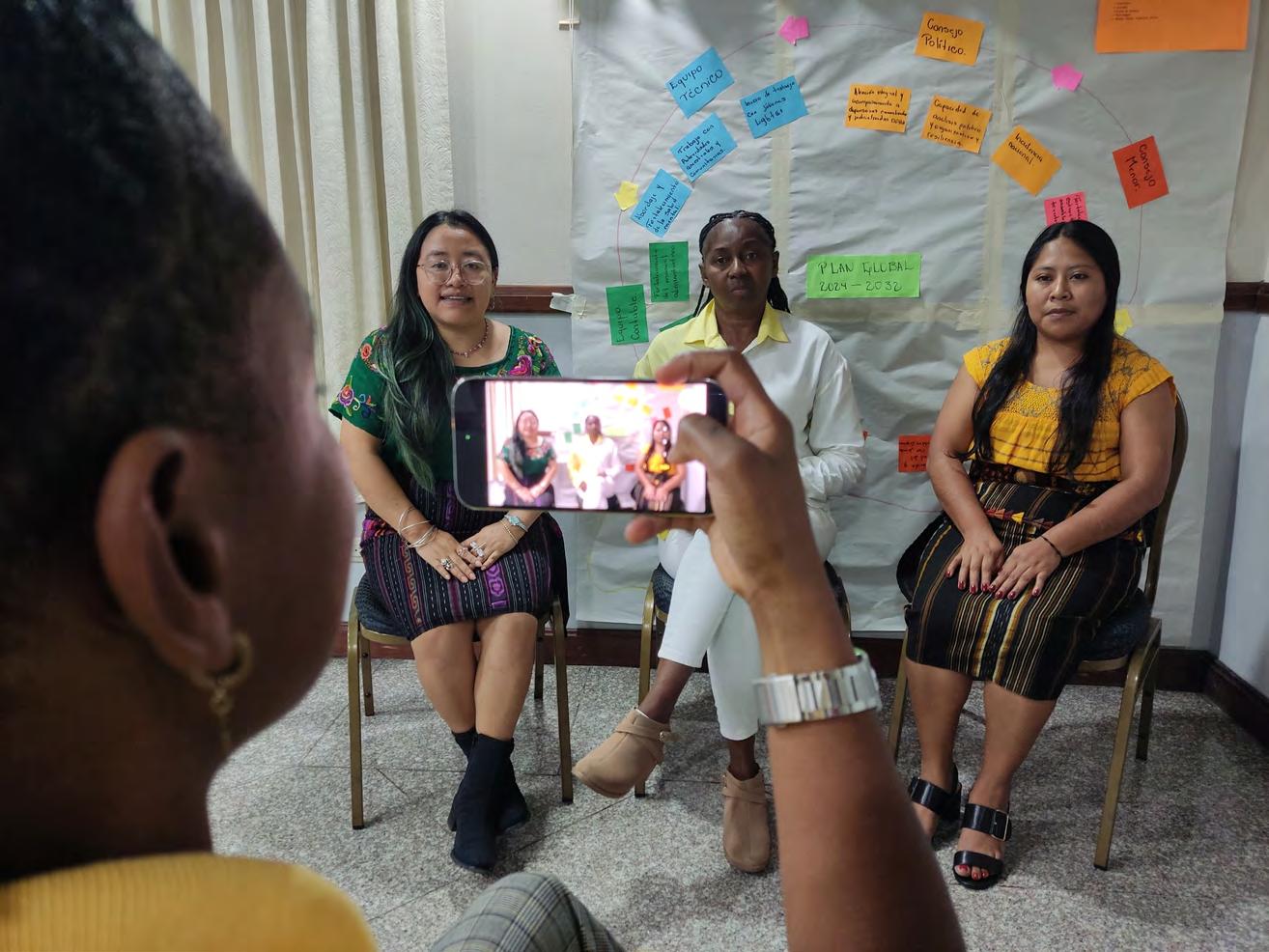
Tz’ununija’ communications officer recording Tz’ununija’ leaders on what changes they see in Tz’ununija’ organizational capacities. Guatemala, 2023. Credit: Carlos Ankerman/ Tz’ununija’/ Oxfam
significant gains in other areas discussed as part of strengthening sustainability capacities. Tz’ununija’ and the Patzún Women’s Committee prepared Strategic Plans (another key capacity area analysed under sustainability5). For the Patzún Women’s Network it was the first time ever developing a Strategic Plan, while for Tz’ununija’ the process included evaluating the previous plan, applying findings to collectively developing a seven-year strategic plan and developing a fundraising strategy to accompany the plan.
For all IWROs reached through WVL-G6, there have been improvements in using best-practice governance and managements. There has been an increase from eight IWROs, including Tz’ununija’, that had at least one to four best practices in governance and management during the baseline to now 21, including Tz’ununija’, at the end line (Indicator 1100b). All 21 have some type of plan, at least eight have produced reports and/or signed and approved minutes, at least six do semi-annual or annual plans, and 2 have other best practices including
4 Resource mobilisation and financial management is understood by WROs as seeking and managing funding agencies for the implementation of projects. In applying the CAT4GJO and in defining the concepts, it is important to consider the different ways in which the WROs manage resources in their communities for the implementation of specific activities
5 For more findings on sustainability see section 3.1 Key CAT4GJO Findings, Domain 4 ‘Sustainability and Resilience’
6 20 local IWROs + Tz’ununija’ were targeted, 28 local IWROs + Tz’ununija’ were reached
funding plans or strategies, emergency or security plans and/ or communications plans. However, there were significant areas for improvement identified, not only in number of bestpractices but the quality of those. Many IWROs plan their work orally or write the plans and ideas in notebooks. The majority do not have a system to monitor and report on the outcomes of their actions or plans, contingency plans, strategy or funding diversification plans. However, they did express understanding better how to carry out evaluations and self assessments. It is important to consider the inclusion of training on technical and conceptual aspects of the strategic plan, the annual work plan and monitoring, learning and accountability.
IMMEDIATE OUTCOME 1110
Strengthened organizational capacity of local Indigenous women’s organizations to manage their organizations, improve program implementation, and mobilize resources effectively, based on the Tz’ununija’ Indigenous Women’s Movement (Tz’ununija’) and its articulated organizations’ selfselected needs who are now using bestpractice governance and managements
The strategic vision of Tz’ununija’, the strategic lines of WVL-G and the actions defined focused on strengthening the WROs and the leadership of Indigenous women. The six local IWROs point out that the spaces for dialogue and reflection, knowledge sharing, and participation in training processes have strengthened their organizations. In these spaces they analyse the dynamics of their work, the problems and challenges they face as an organization, as leaders and
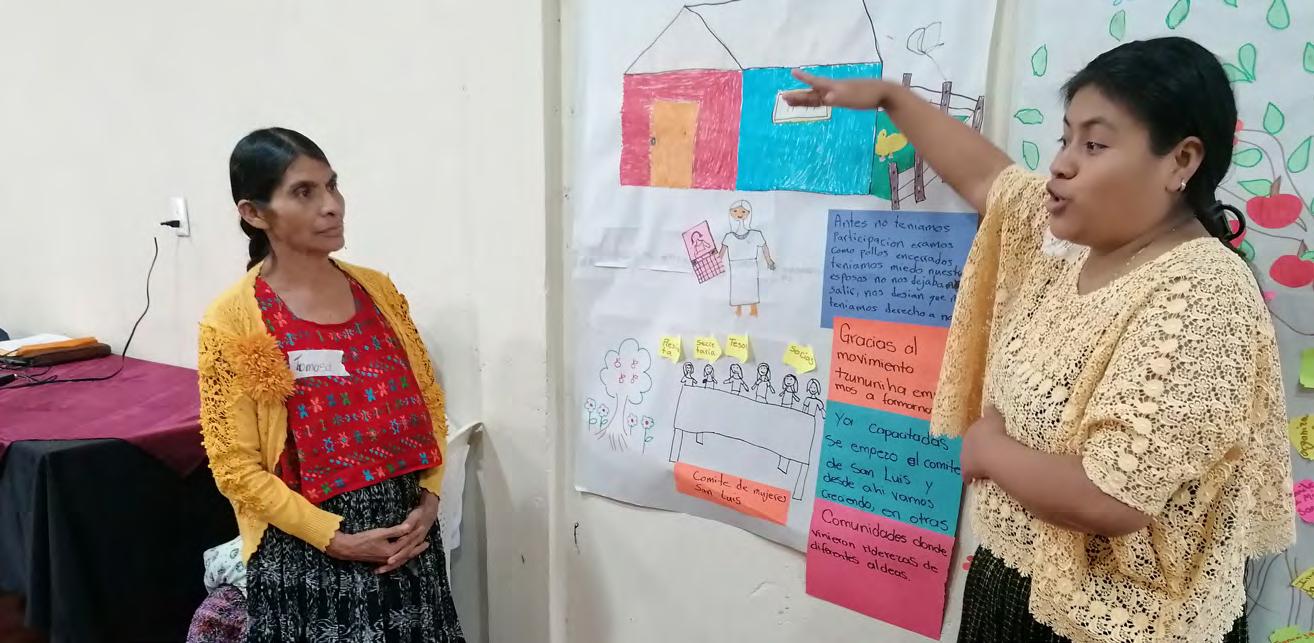
San Luis Women’s Committee members presenting during a final evaluation workshop. San Luis, Alta Verapaz, October 2023. Credit: Carlos Ankerman/ Tz’ununija’/ Oxfam
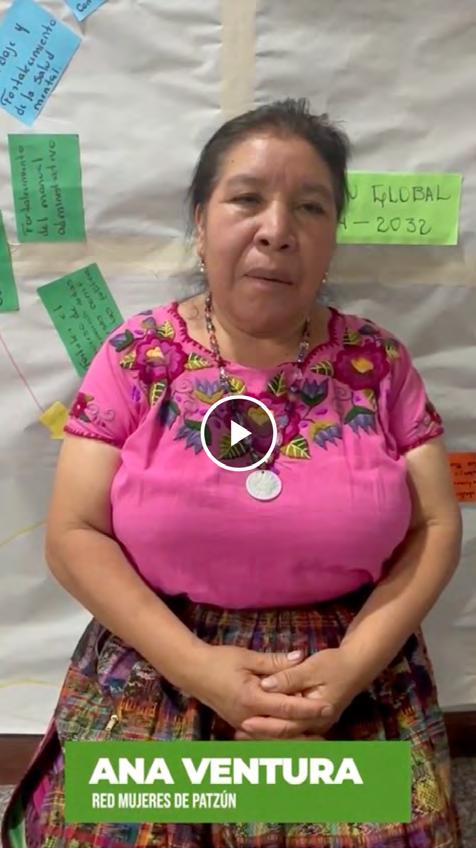
I’d been in other spaces before but not doing expense reports… For me it was like getting a degree because it is like studying administration. At first it was hard, but I learned.
— ANA VENTURA Territorial Liaison in Chimaltenango, Leader of Patzún Women’s Network
as women, and make decisions collectively. They feel that the role and responsibility of their organization’s Board has been strengthened, that they are better organized, and that they are more engaged and active in their community and their organization. Five of seven IWROs reported increased scores in their perceived ability to manage and/or govern their organizations (Indicator 1110.a)7. The five IWROs that reported increased scores in their ability to manage were (in order of greatest increase to least): Women Building a Future, San Luis Women’s Committee, Maya Poqomchi’ Women’s Committee, the Nimlajacoc Region and the Zone 2 Women’s Group. The remaining two - Tz’ununija’ and the Patzún Women’s Network - were the two IWROs that already had the highest scores at the onset of the project and they maintained those scores.
IMMEDIATE OUTCOME 1120
Enhanced capacity and leadership of the Tz’ununija’ Indigenous Women’s Movement (Tz’ununija’) to exercise and enjoy Indigenous women’s individual and collective rights
The number of Tz´ununija´ member IWROs with representatives that participate in decision-making spaces at the community, municipal, departmental or national level has increased from 14 at the start of the project to at least 178 at the end. At least 15 local IWROs have representatives holding decision-making positions within their community development councils (COCODE), three within their municipal development councils (COMUDE) and five within their departmental development councils (CODEDE). The members of the local IWROs also participate in their communities in committees and commissions for water, environment, health and education. In Alta and Baja Verapaz, some of the women leaders are part of the structure of Ancestral and Community Authorities. Tz’ununija’ and the 28 IWROs reached through the lifespan of the project see a change in participation (individually and as an organization). The women see themselves as leaders and they understand the role that they have as organizations for the defence of the individual and collective rights of the Indigenous women.
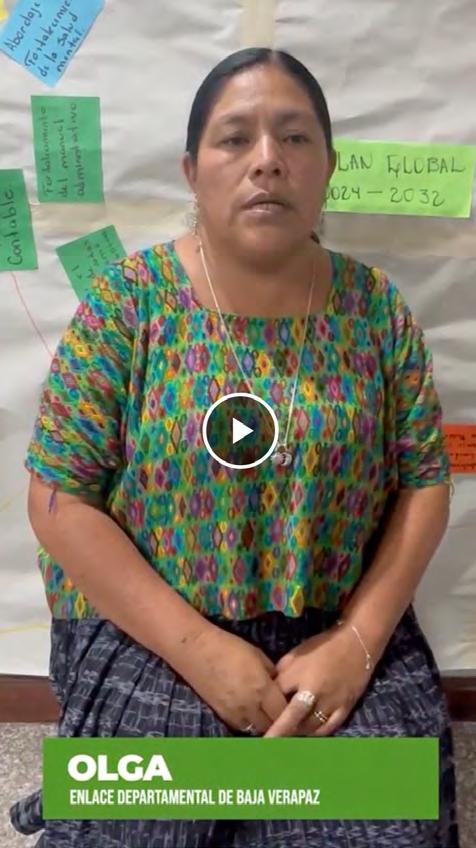
The Voice and Leadership project has made a personal transformation for me. It has strengthened my knowledge. It has made me feel confident in what I do, in the technical part I have learned to manage supporting documents to make the execution of project funds transparent. IWROs have also been strengthened …and their participation in decisionmaking spaces.
— OLGA
Territorial Liaison in Baja Verapaz, Leader of the Poqomchi’ Women’s Committee
7 Scores from CAT4GJO Capacity Area 1, “Reflective Leadership on Gender and Diversity,” and Capacity Area 4, “Collaborative Management and Collaborative Decision Making,” provide information on IWROs’ perceptions of their ability to manage and govern their organizations
8 The final evaluation report has 21 IWORs with participation in different spaces, however also includes family committees and school parental committees which are not included in the indicator definition.
PILLAR 2
INTERMEDIATE OUTCOME 1200 Enhanced performance of programming and advocacy by Indigenous women’s rights organizations (WROs) to advance gender equality in Guatemala
WVL-G has one grantee: the Tz’ununija’ Indigenous Women’s Movement. Tz’ununija’ reported greater reach by the end of the project (Indicator 1200.a). Greater reach can be exemplified by the number of local IWROs linked to Tz’ununija’ reached during the lifespan of the project: 28 local IWROs, 8 over the target of 20. Of these, 21 plus Tz’ununija’, for a total of 22 IWROs, have met objectives as defined in their work plans (Indicator 1200.b), surpassing the end-of-project target of 11 IWROs. The CAT4GJO scores are also clear evidence of this increase. The capacity that most increased was CA 7 ‘Strategic Planning’ with an increase of 1.2 points, resulting also in the highest average score for a capacity area overall, landing at 2.9 points at the end line. This is directly due to two IWROs having prioritized this for their CSP, five of the six local IWROs now doing annual or semi-annual workplans, and all local IWROs
Tz’ununija’ young leaders discussing organizational capacities. Guatemala, October 2023. Credit: Carlos Ankerman/ Tz’ununija’/ Oxfam
(even beyond the 6 prioritized) increasing their practice to do workplans (including oral or written planning), a significant change from the start of the project. The Patzún Women’s Network developed their first ever strategic plan. Tz’ununija’ elaborated their Global Plan 2024-2032 collectively with local IWROs based on findings from the evaluation of the previous Global Plan 2015-2023 (as part of the CSP), which included lessons learned and needs identified, and from the strategic analysis (internal midterm review) of the project.
Tz’ununija’ carried out various actions with several member IWROs to strengthen their capacities, to develop and implement annual work plans to carry out activities at the local level, such as activities to commemorate emblematic dates, trainings, and replications. For each activity, specific plans include developing agendas, tailoring the training materials, budgeting, paying and reporting on participants’ transportation and meals, and systematizing the process. Tz’ununija’ territorial liaisons provided this key guidance to progressively transition the leading responsibilities to the WROs themselves.
The project is relevant and related to the vision, political position and strategies of Tz’ununija’; the actions defined respond to the vision, political position, strategies and overall work of the Movement. The
project has strengthened the training processes as well as the counselling of human rights defenders who help with cases, the counselling of women survivors of violence, and has also strengthened Tz’ununija’’s national and local advocacy actions. The Tz’ununija’ Indigenous Women’s Movement has strengthened its organizational structure by holding Territorial Assemblies to socialise the movement’s strategy, the actions promoted by the movement to position racism as violence and the defence of Indigenous women’s rights (individual and collective). As an unexpected outcome, Tz’ununija’ identifies the approach to aspects related to sexual identities and the LGBTIQ+ population, as a result of the work with young people, which had never been addressed before in the Movement. The Tz’ununija’ strategy related to Ancestral and Community Authorities has also been strengthened, based on their importance and role in the communities for the attention and guidance in cases of violence against Indigenous women and girls. The IWROs in Alta and Baja Verapaz are confronted with the impact of the presence of extractive industries and projects and the divisions created in communities by political parties during election campaigns, as well as the increased criminalisation or persecution of women human rights defenders. These issues have been identified by Tz’ununija’ and will be considered in the monitoring of the project and in the management of other projects (see recommendations).
INTERMEDIATE OUTCOME 1210 Improved capacity of Indigenous WROs to promote and advocate for
women’s
rights and gender transformation
Tz’ununija’ draws up an annual communication plan, which includes the campaigns to be carried out and the maintenance of the website, social networks and radio programs. The campaigns focus on commemorating the dates, positioning racism as a form of violence against Indigenous women, and providing information on the situation of Indigenous women’s rights and the gaps in enforcement. During the project implementation, Tz’ununija’ has carried out 15 campaigns9 by different means (1210.a): in person in the departmental capitals; virtually with information and promotion campaigns through social networks or through direct transmissions, either through networks or radio; information material, T-shirts and bags have also been produced and distributed. For Tz’ununija’, it is of strategic importance to strengthen the Communication Team; a permanent
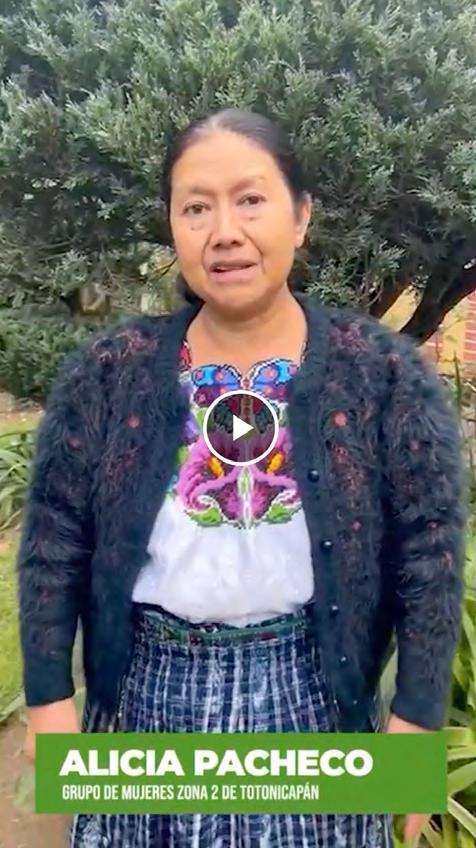
I was afraid, I couldn’t express myself, I couldn’t speak (...) In the training and healing workshops I learned that we have laws that defend us, indigenous women. I got other women involved (…) they were afraid, they had a taboo about the types of violence they are suffering, and thanks to these workshops I lost my fear and I now I can help other women in the processes so that they can get out of the fear and out of violence.
— ALICIA PACHECO Zone 2 Women’s
Group, Totonicapán
9 After data collection for the evaluation, Tz’ununija’ implemented and concluded 2 more campaigns, resulting in 17 total for the project.
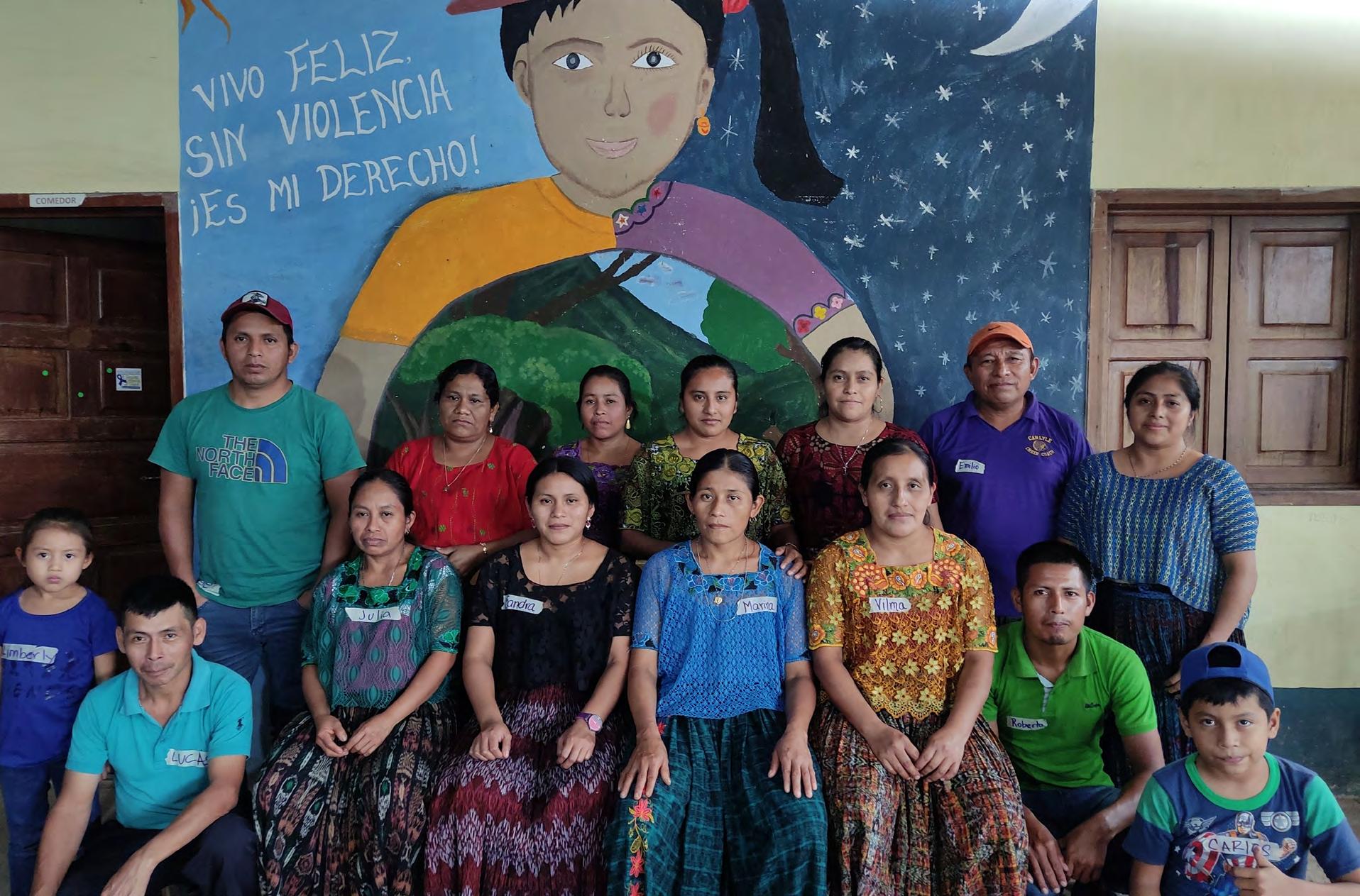
Nimlajacoc Region leaders, Alta Verapaz, October 2023. Credit: Carlos Ankerman/ Tz’ununija’/ Oxfam
team would make it possible to update information on platforms and networks for the prevention of violence against Indigenous women, to continue to position racism as a form of violence and to disseminate the results of the research it carries out. In the words of a member of Tz’ununija’ “…the campaigns, the awarenessraising and communication actions we carry out have left a significant mark in the fight for the elimination of racism and (in) the recognition of the rights of indigenous women”.
INTERMEDIATE OUTCOME 1220 Improved
programmatic capacity of Indigenous WROs to respond to key women’s rights issues
Women in the communities have shown great interest in learning about human rights, their rights as Indigenous women and information on violence against them, and
this is reflected in the increase in the number of WRO members. The knowledge acquired and socialised with new members shows the capacity of the WROs and their members to promote women’s rights to participation and information in their communities. In the various forms of community-based organization in which they are involved, WROs promote women’s participation, gender equality, the right to a life free from violence and the transformation of power relations between men and women. The creation of the Women’s Committee in the Nimlajacoc Region is of the utmost importance, both in the Regional Assembly and in most of the communities, as it is an organizational form that did not exist before the implementation of the WVL-G project. The WROs and Tz’ununija’ feel that it is important to work with both men and women. They point out that in order to work on issues related to violence, power relations and the individual and collective rights of men and children, it is necessary to know the methods, to be trained and to have the funds to initiate processes of change.
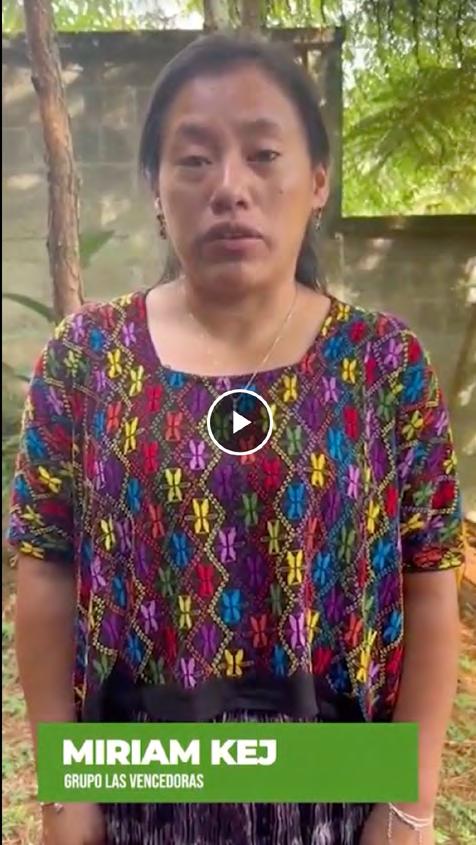
With the Voice and Leadership project, I acquired new knowledge: my rights as a woman, how to make women’s groups aware of the types of violence, how and where to go to defend ourselves... (we have) new opportunities in our lives.
— MIRIAM KEJ
Triumphant Women’s Group, Alta Verapaz
PILLAR 3
1300 Increased effectiveness of local, national, and international women’s rights platforms, networks, and alliances to effect gender-transformative policy change and policy implementation in Guatemala
The participation of the 28 IWROs in platforms, networks and alliances in their departments and at the national level is low. 13 IWROs reported increased ability to engage in alliances, surpassing the end-of-project target of 10 IWROs. Of these, six underwent the CAT4GJO identifying an increase from the scores in the baseline and the other seven report an increase based on their now engaging in other alliances, networks or movements. Through different processes carried out in WVL-Guatemala, the capacities of the WROs have been strengthened, which has allowed them to participate in coordination spaces at the local and municipal levels. These coordination spaces have facilitated advocacy actions for the exercise of Indigenous women’s rights. Some are participating in alliances with other WROs at a community, departmental and/ or national level. The Poqomchi’ Women’s Committee is part of the Movimiento Indígena Campesino (a movement concerned with the defence of their land and territories and the collective rights of Indigenous People); the other five work on actions within their community or municipality. In Totonicapán the organisations participate in the Women’s Network of Momostenango. IWROs consider it important to get to know other organisational experiences that allow them to learn about their organisation, forms of struggle, ideas and ways of working. Another clear example is Tz’ununija’s engagement within the alliance of Indigenous WROs formed for the Summit for Indigenous Women of Abya Yala and the leadership role they assumed for both the third summit and now in preparation for the fourth as part of the International committee for the IV Summit. Other examples include the alliances for commemorative dates like 25th of November, or the human rights verification mission to condemn and put an end to the use States of Siege to violently evict Indigenous communities from their lands. The decision to participate is taken collectively (Minor Council, Political Council and Technical Team), assessing the objective of the space, the actions to be carried out and their relationship with the Strategic Axes and their lines
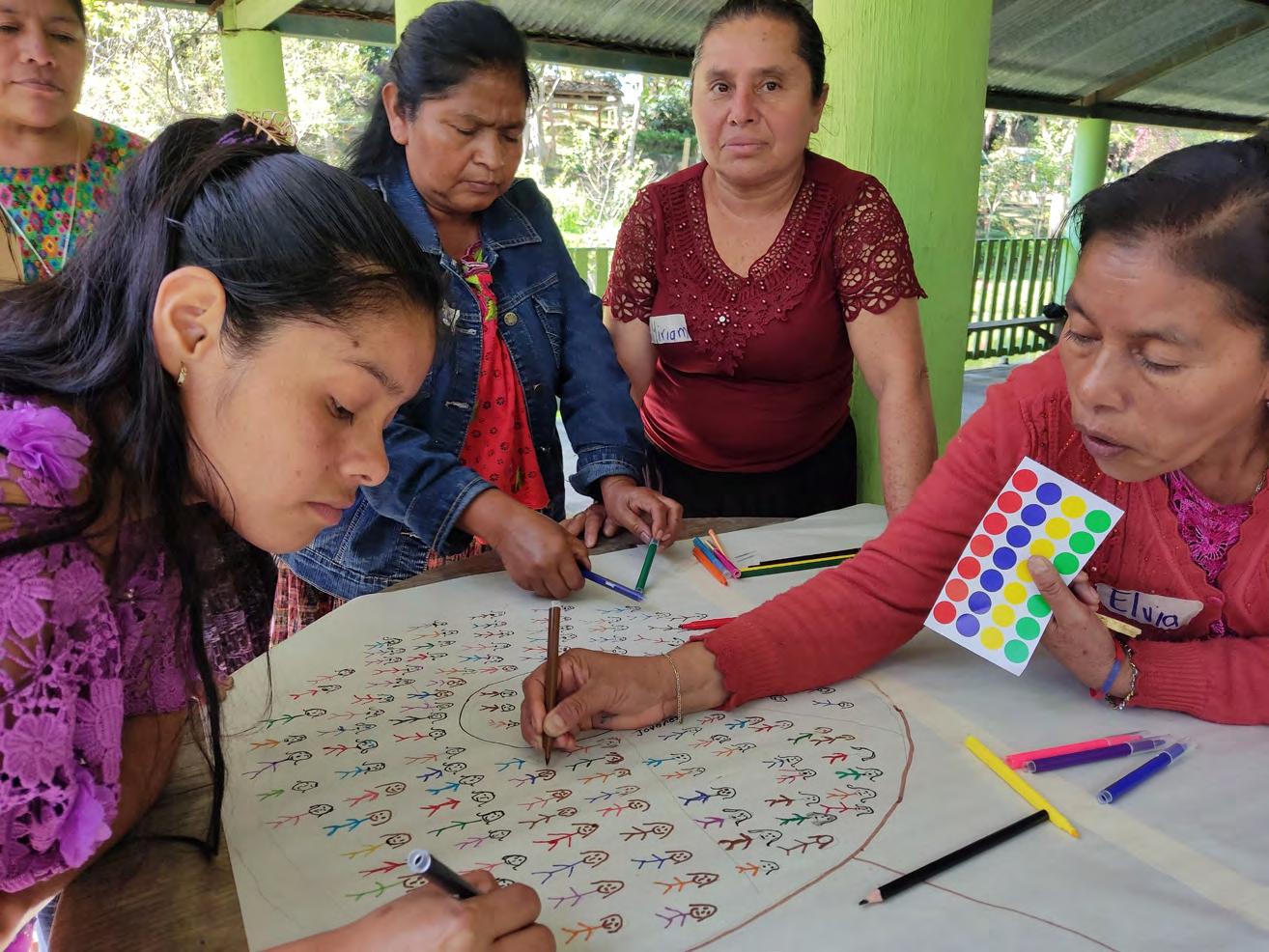
of work. Tz’ununija’ leaders position the Movement’s political and conceptual vision in the different national and international spaces where they participate or are invited (Indicator 1310a).
3.3 Findings by Criteria
a. Relevance
Co-creation and co-designing Project Strategies and Actions based on the Needs of Indigenous Women
The design and implementation of the project as an exercise of co-creation, learning and exchange of visions and conceptual and political perspectives between Tz’ununija’, OiG and OCA ensured that WVL-G responded to the condition and situation of Indigenous women. The outcome, strategies and actions were based on Tz’ununija’s vision, political positioning and ways of working as outlined in its Global Plan 2015-2023 (the plan being implemented at the time the project was being designed). For Tz’ununija’, both the movement and the local IWROs linked to Tz’ununija’ were strengthened because WVL-G was designed and responds to the vision, ways of working, Strategic Areas and Lines of Work defined by Tz’ununija’.
Pocomchi’ Women’s Committee members drawing how they see their organization has changed. Arroyo Verde, Baja Verapaz, October 2023. Credit: Carlos Ankerman/ Tz’ununija’/ Oxfam
Mutual Learning, Knowledge Co-creation
Mutual learning and the co-creation of knowledge, from the design of the project and during its implementation, allowed the processes to be carried out with relevance, adapted to the conditions and needs of Indigenous women and their contexts.
Knowledge generated by Tz’ununija’ in the implementation of the project has been socialised, valued within the structure of the Movement and has been included in the Global Plan 2024-2032 and in its Capacity Strengthening Plan, for example: application of the CAT4GJO tool; importance of working with men and children; inclusion in training modules of aspects related to strategic planning, annual work plans; reflection on the importance and decision to participate in platforms, alliances and/or confluences.
For OCA, learning more about Tz’ununija’ and its work contributes to the understanding of what transformative leadership actually means in practice and how it is applied, and also contributes to the discussion on how to strengthen movements (Interview with OCA).
A relevant aspect for Oxfam, understood as learning, is that “it has shown us how an actor like Tz’ununija’ can make critical contributions, such as positioning
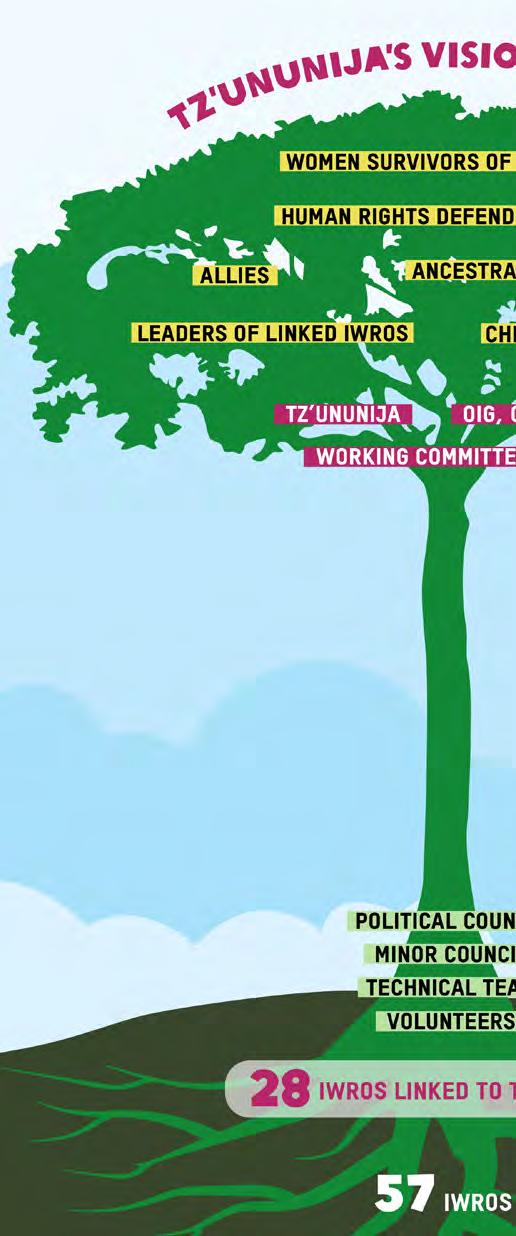
WOMEN SURVIVORS OF VIOLENCE
HUMAN RIGHTS DEFENDERS
LEADERS OF LINKED IWROS ALLIES CHILDREN AND YOUTH
ANCESTRAL AND COMMUNITY AUTHORITIES
TZ’UNUNIJA’ OIG, OCA, GAC
WORKING COMMITTEES
POLITICAL COUNCIL
MINOR COUNCIL
TECHNICAL TEAM
VOLUNTEERS
WVL G is like a tree that has been cared for, that needs to be pruned and new care to continue growing.”

28 IWROS LINKED TO TZ’UNUNIJA’
57 IWROS
TOTAL 85 IWROS
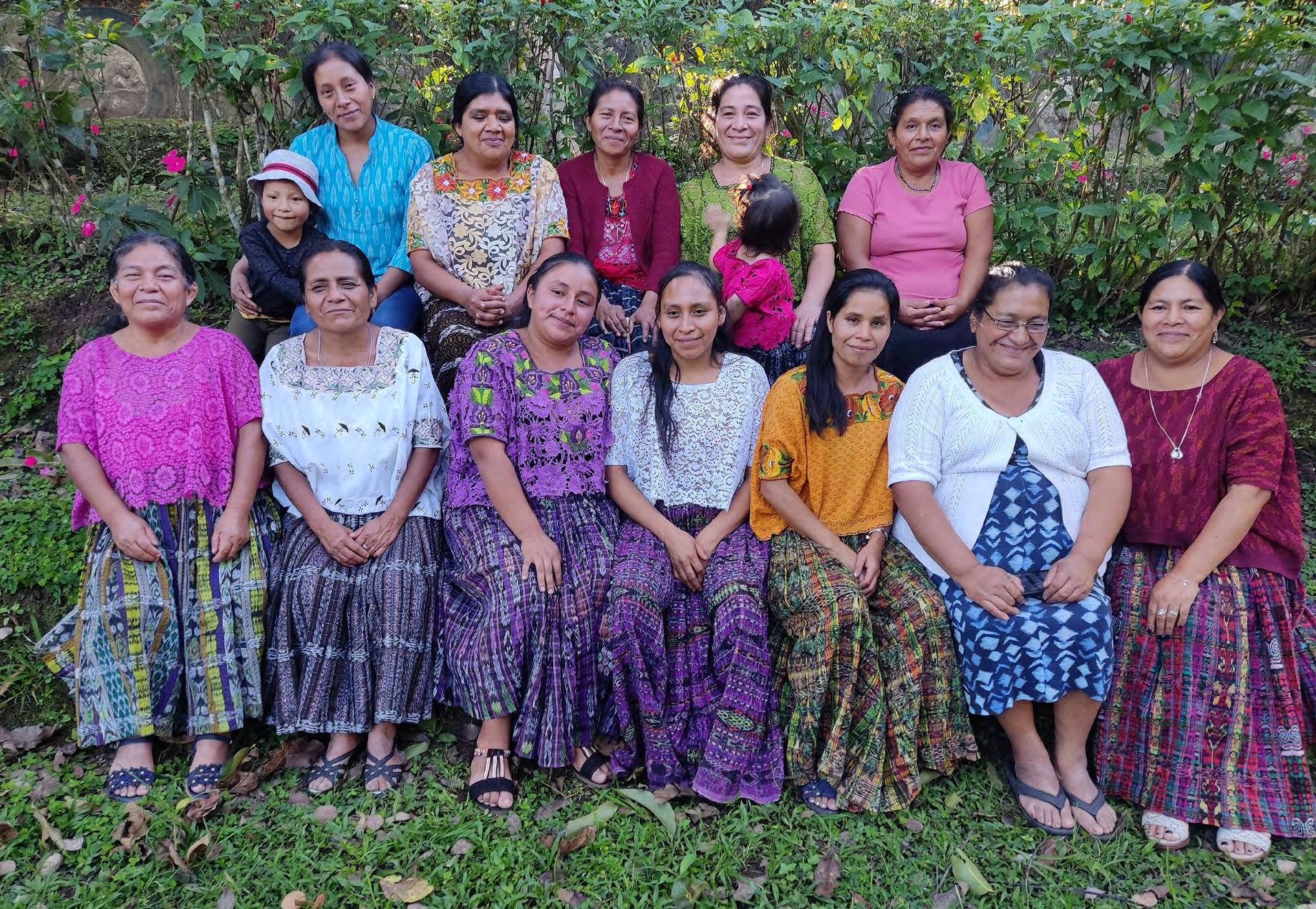
racism as a specific form of violence against Indigenous women, contributing to the Gender-justice axis” (Interview with OiG).
B. Effectiveness
Project Strategies
The interrelation of the project strategies and the actions defined have been effective in achieving outcomes and generating changes in the WROs and their members. The Tz’ununija’ strategy, which combines and implements training processes with psychosocial counselling and healing, is relevant and effective in bringing about change in women.
Participants in the final evaluation say that they have gone from being confined in mind, body, heart and senses, to healing their wounds from the violence they have experienced, to knowing their rights, to seeing themselves as subjects of rights, to overcoming the fear of participating and acting in defence of their individual and collective rights. They speak of a personal transformation that has led them to active participation in their organization and community, thus strengthening their organization. Without personal change it is not possible to strengthen their organization.
Monitoring, Evaluation and Learning
A Monitoring, Evaluation and Learning Cycle was carried out throughout the implementation of the project. As
Pocomchi’ Women’s Committee. Arroyo Verde, Baja Verapaz, October 2023. Credit: Carlos Ankerman/ Tz’ununija’/ Oxfam
part of the cycle, a Monitoring Matrix10 was co-created that provided a means of tracking and recording information on an ongoing basis. This allowed for tracking progress in the implementation of activities, number of Indigenous women and number of IWROs reached, as well as progress towards output indicators. Weaknesses could be identified in the monitoring tools to adequately record qualitative data on challenges faced, learning, and change generated in IWROs and women leaders, ancestral and community authorities, youth and in other stakeholders. The same weaknesses were identified in tools to monitor the capacity strengthening plans.
CAT4GJO
The outcome of the application of the CAT4GJO as evidenced in the progress made by the organizations, shows its effectiveness in conducting a participatory self-assessment of IWROs, leading to improvements in capacities. An unexpected outcome, is the adaptation made by Tz’ununija’ in the elaboration of a Facilitator’s Guide and the Participants’ Notebook. As they were rolled out, both Tzúnunija’ and the Territorial Liaisons found them to be effective. Tz’ununija’ appreciates the importance and effectiveness of the CAT4GJO. During the final evaluation focus group, adjustments were made to the concepts stated in the areas and capacity areas based on internal reflection11. Another unexpected outcome is the appropriation of the CAT4GJO, now included in the Global Plan 2024-2032, as well as its revision and a new adaptation for its application with other linked IWORs.
C. Sustainability
The political and organizational sustainability of the implemented processes is based on the consideration that:
• Tz’ununija’ is an Indigenous women’s movement thatis not project dependent .
• Its organizational structure is strengthened and growing (number of linked organizations). At the 2023 General Assembly, the linkage of more than 85 local organizations was ratified, which confirms the permanence and strengthening of the Movement.
• The project strategies and the actions defined respond to the Strategic Lines and their lines of work defined in the Global Plan 2024-2032.
• Tz’ununija’ has incorporated the learnings and the CAT4GJO into its Global Plan 2024-2032.
The growth of the Tz’ununija’ Movement is reflected in the dynamics generated by the IWROs, in the formation of diverse groups, in the socialisation or replication of knowledge, and also in the fact that these groups identify with Tz’ununija’, which shows the commitment, the change achieved and the organizational strengthening of the IWROs. Exceeding the target of 20 to reach 28 local IWROs, as well as the increase in the number of members within these 28, from 639 to 1,375, shows not only the relevance of the processes promoted within WVL-G, but also the effectiveness of the organizational strategy promoted by Tz’ununija’; this strategy guarantees the sustainability of the processes of the changes generated in the women of the local IWROs linked to Tz’ununija’ and their leaders, as well as in the IWROs themselves. The effectiveness of Tz’ununija’ strategies defined in WVL-G and the implementation of the actions defined can be seen in the vision that the 28 IWROs have for strengthening their capacities as an organization, in their assumption of leadership, in the importance they attach to the recognition of their organization in the community, and in their commitment to continue strengthening and acting in defence of Indigenous women’s rights. This commitment demonstrates the sustainability of the leadership of the IWROs and their members; it is an achievement and a result of the processes facilitated by Tz’ununija’ and WVL-G.
10 A simplified version of the performance measurement framework with emphasis on reach disaggregated by Indigenous Peoples, categorized by linguistic communities.
11 The same discussion exercise to have a common understanding of key concepts was carried out during the baseline process.
D. Impact
The greatest impact of the processes and actions implemented in WVL-G is seen in the changes generated at the individual, collective and organizational levels.
Organizational Change
Individual Change
Collective Change
Individual Change
The women first and foremost identify a personal transformation. They say that they have gone from living in sadness, confinement and pain due to the violence they have experienced and its naturalisation, to healing the wounds of violence, to seeing themselves as subjects of rights, as leaders who can organize and act in defence and for the enforcement of their rights and for a life free of violence. This personal transformation is generated by the women’s participation in the training processes (rights, women’s rights, violence) and in the healing processes, which generate a change that leads them collectively to the strengthening of their organization. Organizational strengthening cannot take place without personal change and healing.
Collective Change
The individual changes in the women (seeing themselves as subjects of rights and leaders, healing the wounds of violence) allow them to value and recognise other women who have experienced similar situations, other leaders with whom they can work to strengthen and guide themselves as women, creating a sense of group. The collective healing activities and training processes have created a different kind of relationship (solidarity, understanding, support) among the members of the WROs, a different view of being women, of being part of a group, of being an organization. Dialogue, collective reflection, mutual support and shared responsibility are encouraged.
Organizational Change
Individual and collective responsibility is reflected in the way work is done, in participation in commissions to carry out actions, in the responsibility to replicate achievements and to socialise knowledge. Collective decision-making is strengthened through reflection, analysis and consensus. The women indicate that they are happy to take on collective work in order to carry out the actions they have planned. There is a collective understanding of the importance of individual action to defend Indigenous women’s rights in the community, in the municipality and in the spaces where women participate. This individual action is taken in the name of their organization, and as a result the recognition of their organization’s work has increased.
The technical knowledge acquired through the organizations’ participation in WVL-G, the application of the CAT4GJO and the Capacity Strengthening Plan (the six prioritised WROs) has led them to have a clearer and more demanding view of what they want from their organization. They know that the limitations they face, such as low level of education, lack of technical knowledge, lack of funds, office space or a computer, may be limiting but do not limit their actions; they want to learn about project management and financial resource management in order to strengthen their organizational work.
Girasoles Women’s Group, members of the Patzún Women’s Network, Patzún, Chimaltenango, October 2023.
Credit: Carlos Ankerman/ Tz’ununija’/ Oxfam
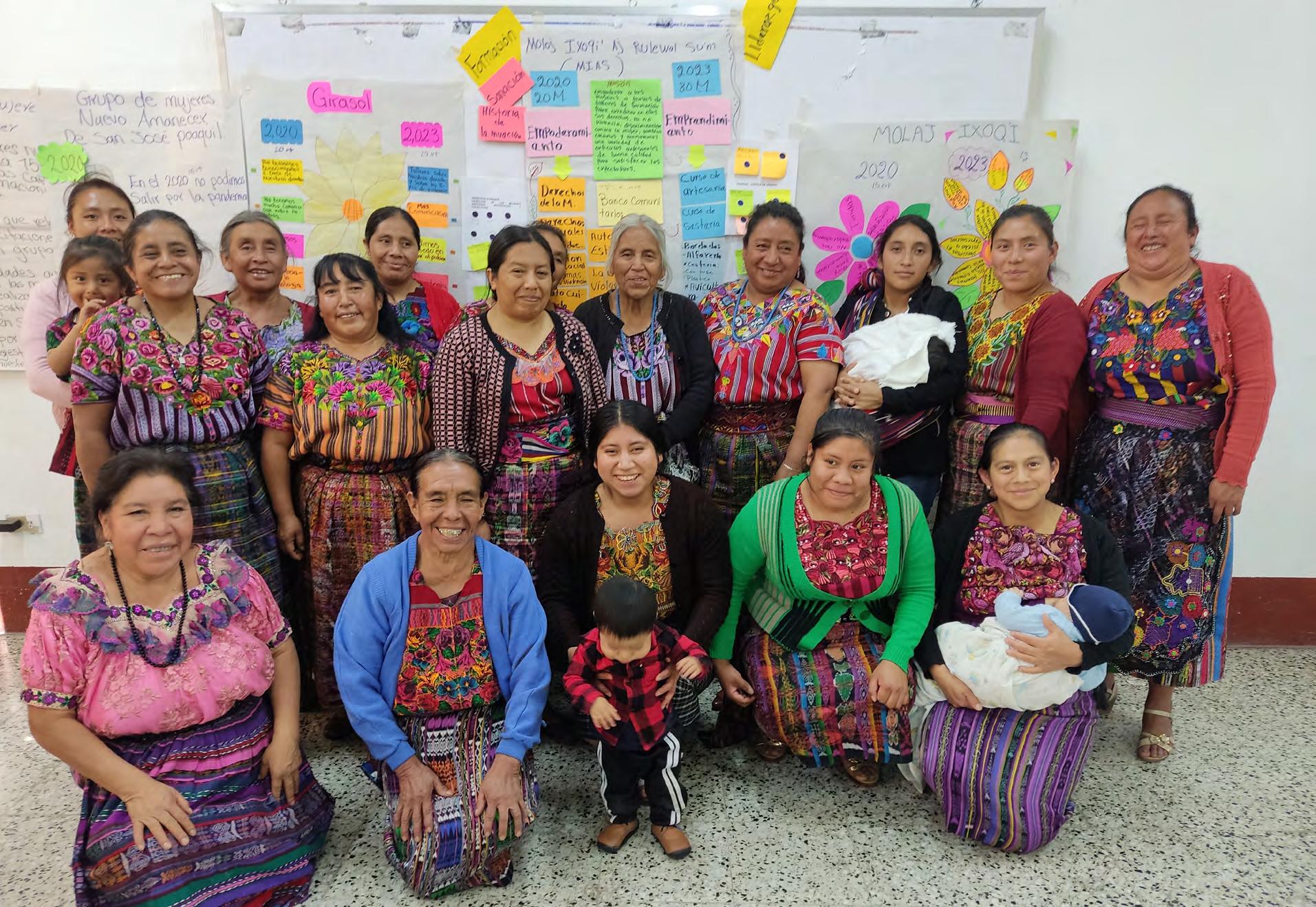
RECOMMENDATIONS 4
A. Relevance
The IWROs request that the needs they have expressed be considered and that future training processes include topics related to:
• Theoretical, technical aspects for the preparation of the AWP and the Strategic Plan
• Advocacy and Social Audit
• Project development and management, project financial management
• Methodologies and techniques to facilitate groups, assemblies, commissions, committees, meetings with greater presence of men and authorities (ancestral/community and State institutions).
In order to strengthen training processes at the community level, resources and activities that provide methodological support for the training process for women leaders as Community Facilitators should be included in a follow-up project.
Include, as defined in the CAT4GJO, methodologies to address violence and rights (individual and collective) with men, groups of women and men, with children, mothers and fathers, as these are of interest to the WROs and to promote work with men and children.
In order to empower IWROs, women leaders and human rights defenders, the modules on violence should include aspects related to how to address the issue with partners, family, children, as well as ways to confront new violence generated by the exercise of the right to participation and leadership (in the community, municipality, state institutions and other spaces).
The following aspects identified by Tz’ununija’ should be considered for inclusion in the strategies and processes of other projects:
• Legal, psychosocial and healing counselling processes.
• Implementation of the Response Fund for the defence and protection of Indigenous women defenders/leaders and Indigenous ancestral and community authorities due to the increase in their criminalisation and persecution.
• Include in the curriculum training processes on the history and characterisation of the political party system, critical analysis of participation in political parties, and national and international environmental regulations.
• Consider the interest of the IWROs and their members in learning about platforms, networks and alliances in their municipality, department and at the national level.
b. Effectiveness
Project Management Structure
It is important to continue with a co-creation approach between Tz’ununija’ and Oxfam in all dimensions of project implementation, strengthening the progress made by Tz’ununija’ as a partner of Oxfam and GAC. Systematising the experience of this project is essential for the learning process.
Definition of Indicators
When defining indicators for the project, it is important to consider the characteristics and conditions of WROs in order to better assess their best practices in governance and management.
Monitoring, Evaluation and Learning
In order to strengthen monitoring, evaluation and learning, it is proposed to include in the Monitoring Matrix (or another system) the development of tools that allow for data collection and registration of qualitative information, including: challenges faced, learning, changes generated in IWROs and leaders, ancestral/ community authorities, youth or other actors involved,
all in relation to the outcomes and their indicators. It is important to develop simple tools that allow IWROs to monitor their strengthening, always considering their specific characteristics, conditions and needs. In the case of the prioritised WROs, focus on monitoring the implementation of the Strengthening Plans (challenges, difficulties and how to overcome them).
CAT4GJO
When defining what capacity areas will be monitored as part of GAC’s WVL Program, it is important to allow for flexibility to adapt the conceptual orientation, of the capacity areas, to respond to the characteristics, condition and situation of women’s organizations, local Indigenous and community women, urban or rural. This adaptation will allow the countries implementing the WVL to analyse more objectively the state of the initial and ongoing capacity of WROs, and to document the ways in which WROs manage to become stronger despite having no legal status, no financial management, etc.
In view of Tz’ununija’s adoption of the CAT4GJO and its inclusion in the Global Plan 2024-2032 for its application with local IWROs linked to Tz’ununija’, consideration should be given to including financial support and technical and methodological guidance from OiG and OCA. In terms of technical support, it is important to train Tz’ununija’ in the use of a counting matrix, the generation of data and graphs and their analysis, and to develop a user’s guide.
Evaluate the possibility of separating the aspects covered in Capacity Domain 3 ‘Resilience and Sustainability’ by creating two domains. In the Sustainability Domain, assess how the concepts in the capacity areas of ‘Mobilising Resources’ and ‘Genderresponsive Financial Management’ can be presented in the context of WROs. In the new Resilience Domain, the definition should consider the different ways in which WROs and their members face contextual conditions (economic, social, political, climatic).
When applying the CAT4GJO both in the baseline and in the final evaluation, it is important to consider the languages for translation and/or delivery at the time of application, as well as to assess the possibility of translating the tools (Facilitator’s Guide and Participants’ Notebook). Allocate more time and (financial) resources in order to provide more detailed information.
Capacity Strengthening Plans
It is important to identify a person within the project implementation team who will be responsible for monitoring the implementation of the project, under the guidance of the Territorial Liaisons. The WROs have repeatedly stated that they do not have the resources to carry out the planned activities; therefore, consideration should be given to the inclusion in the project of more financial resources for the implementation of the strengthening plans, with the allocation of these funds being handed over to Tz’ununija’ so that they can transfer them to the IWROs and then monitor them. This would be an exercise that would allow the IWROs to manage funds for activities and they would be required to have a reporting mechanism to facilitate monitoring.
Sustainability
The forms of organization created by the IWROs make it necessary to carry out an organizational mapping that will allow the territorial and organizational characteristics of the Movement to be better understood, further strengthening the structure of the Regional and Territorial Assemblies; at the same time, it would allow the scope of the project’s actions to be defined more precisely.