
Her Future, Her Choice: Strengthening Sexual and Reproductive Health and Rights
Health Facility Audit Midline report
Project Number: P005242
Purchase Order: 7403155
Name of Implementer: Oxfam Canada
Country/Region: Canada, Ethiopia, Mozambique, Malawi, and Zambia
Date of Report: 31/05/2022
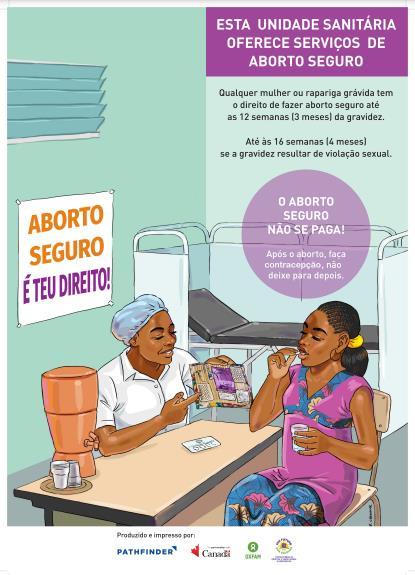
Previous Page Image: Poster produced by Pathfinder Mozambique and DKT in Portuguese on the availability of abortion in Health Facilities. The poster portrays a smiling nurse explaining abortion and contraception using a poster to a young woman who is taking an abortion pill in a Health Facility. The poster explains that safe abortion is a right and that it is available in the Health Facility. It is also stated that abortion can be performed in all situations up to 3 months of pregnancy, and that it can be performed up to 4 months in the case of rape. The poster also informs that abortion is free in the Health Facility and that contraception should be used afterwards
For more information and questions about this study, please contact:
Oxfam Canada
Youssra Bakhir, Program Officer, Monitoring Evaluation and Learning (SRHR) youssra.bakhir@oxfam.org
Oxfam, Country Office Malawi
Chikondi Mendulo, Monitoring, Evaluation, Accountability and Learning (MEAL) Officer cmendulo@oxfam.org.uk
Oxfam, Country Office Mozambique
Israel Muba, Program Officer, Monitoring Evaluation and Learning israel.muba@oxfam.org
Oxfam, Country Office Zambia
Jimmy Siachobe, Monitoring, Evaluation, Accountability and Learning (MEAL) Coordinator JSiachobe@oxfam.org.uk
Disclaimer
This study’s data collection in Malawi, Mozambique and Zambia was commissioned to external consultants by Oxfam teams and Pathfinder International in their respective country together with Oxfam Canada, Pathfinder International in Mozambique, Planned Parenthood Association of Zambia and Family Planning Association of Malawi for the Her Future Her Choice (HFHC) project, funded by Global Affairs Canada. The findings, interpretations, and conclusions expressed in this work do not reflect those of Oxfam, Pathfinder International, Family Planning Association of Malawi, Planned Parenthood Association of Zambia and Global Affairs Canada. Please note that the findings of this report cannot be generalized at national level for Malawi, Mozambique and Zambia; the study was carried out for health facilities that are engaged within the HFHC project, which is a sub-sample of the health facilities in target project districts. Oxfam, Pathfinder International, Family Planning Association of Malawi, Planned Parenthood Association of Zambia and Global Affairs Canada do not guarantee the accuracy of the data included in this work.
Oxfam Canada
39 McArthur Avenue
Ottawa, ON K1L 8L7, Canada 1-800-466-9326 www.oxfam.ca Twitter.com/oxfamcanada Facebook.com/oxfamcanada
Oxfam, Country Office Malawi
Green Heritage House (Area 13 Market)
P/Bag B331
Lilongwe 3, Malawi
Telephone: +265-0-770-489, ext. 525 www.oxfam.org/malawi
Oxfam, Country Office Mozambique
Rua Osvaldo Tanzama No 169 B, 2oe 3o Andar, Bairro Sommerschield 2, Maputo, Mozambique
Telephone: +258-21-08-3652 www.oxfam.org/mozambique
Oxfam, Country Office Zambia
250 Zambezi Road, Roma Township Lusaka, Zambia
Tel: +260-211-291016
www.oxfam.org/zambia
Acknowledgement
Our salute to the frontlines in the 69 health facilities of this study for their sacrifice and dedication to serve clients during the COVID-19 pandemic in disadvantaged regions in the Malawi, Mozambique and Zambia. We are grateful for their time and effort to meet us in-person to complete this study.
Findings from the rapid assessment conducted by Pathfinder in Ethiopia following the conflict
1. Executive Summary
The Global Affairs Canada and Oxfam funded Her Future Her Choice (HFHC) project seeks to empower Adolescent Girls and Young Women (AGYW) to secure their Sexual and Reproductive Health and Rights (SRHR) in target regions of Ethiopia, Malawi, Mozambique, Zambia and Canada. The HFHC project consists of three strategic Pillars of work: 1) community engagement and training to increase knowledge on sexual and reproductive health and rights (SRHR) and strengthen agency of women and girls in exercising their SRHR, 2) strengthen the capacity of health system and health facilities to provide comprehensive sexual and reproductive health (SRH) information and services, and 3) strengthen capacity of women’s rights organizations to advocate for SRHR. This Health Facility Audit (HFA) aims to gather data to inform pillar 2 outcome level indicators as well as gauge the effectiveness of project implementation and inform program strategy under this pillar.
To assess the present status of the health facilities of the HFHC project on gender responsiveness of SRHR delivery, Baseline and Midline data was collected for HFA in Malawi, Mozambique and Zambia. Baseline data was collected between December 2020 and June 2021. Midline data was collected between January 2022 and March 2022 for the HFA. While Baseline data was collected in Ethiopia, Midline data collection was not possible due to internal conflict in the country. However, Pathfinder Ethiopia conducted a rapid assessment with the seven health facilities participating in the HFHC project as soon as the armed conflict stopped, to assess the level of damage in these facilities, and inform a rehabilitation and refurbishment plan for these facilities. Findings from this assessment can be found in Annex 2.
Based on the Midline HFA study findings, the following conclusions are drawn for health facilities in Malawi, Mozambique and Zambia:
On health facility readiness and capacity:
• All the health facilities surveyed at minimum offer STI counselling, diagnosis, and treatment. All health facilities but one offer family planning information and counseling and gender-based violence counseling and care.
• Out of 69 health facilities sampled, 49 facilities (71%) have an YFS space that provides SRH services to adolescents and young people of ages 10 – 24 years. This is an increase from 41 out of 77 health facilities (53%) at Baseline. Another 13 facilities (19%) have an assigned health service provider who provides SRH services specifically for adolescents and young people of ages 10 – 24 years.
• In Malawi and Mozambique, SRH services are offered during the majority of the days per week (5 or 6 days per week) In Zambia, SRH services are offered 4 days per week. There was an increase in the number of days per week that SRH services are offered in all three countries.
• Health facility conditions that ensure clients’ privacy and confidentiality were lacking in some areas, though there were improvements from Baseline.
• In terms of availability at health facilities, male condoms, injectable and oral contraceptive pills –all short-acting contraceptives – are the most widely available at the health facilities sampled. There were increases in contraceptive availability across health facilities in all three countries.
• Injectable and implant contraceptives are the most likely to have a stock out across the facilities sampled. There were increases in contraceptive stock outs in all health facilities. This may be related to global supply chain issues during the survey period.
• Emergency oral contraceptives and IUDs saw larger increases in availability from Baseline to Midline than other contraceptive methods. At Baseline, 51% of health facilities ever provided emergency oral contraception, compared to 81% at Midline. Forty-nine percent of health facilities ever provided IUDs at Baseline, compared to 67% at Midline.
• There was strong improvement between rounds of data collection in health facilities with a GBV focal point person, from 60% of health facilities at Baseline to 90% at Midline.
• Abortion service provision increased from Baseline (49% of surveyed health facilities offering any abortion service) to Midline (81% of health facilities).
• Health facilities, especially in Malawi and Mozambique, were less likely to have paper copies of guidelines and protocols at Midline than at Baseline, though this may be due to changes in enumerator instructions.
• Availability of proper bins and training of staff on the different types of waste and by-products produced in health facilities is a gap to be addressed.
• Record keeping with data separated by SRH service type increased between rounds of data collection in Mozambique and Zambia and remained at 100% for both rounds in Malawi. There is still room for improvement, especially in Mozambique and Zambia.
Table 1: Summary of Indicators Values at the end of Year 3, Midline Results for Health Facilities. Outcome
1210 Increased knowledge of how to provide genderresponsive, youth-friendly, environmentally sensitive comprehensive SRH services among health service providers
1220 Increased ability of health systems and institutions to provide gender-responsive, youthfriendly comprehensive SRH information and services
1210.b: Number of health facilities with trained SRH providers
1220.a: Number of health facilities providing gender responsive SRHR information and services
1220.b: Number of health facilities that have at least 3 modern contraceptives available on day of assessment
1220.c: Number of health facilities with information management system that incorporates SRH data