Resisting
the RulE of the Rich
Protecting freedom from billionaire power executive summary
© Oxfam International January 2026
Lead authors: Alex Maitland, Anjela Taneja, Anthony Kamande, Carlos Brown Solá, Harry Bignell, Max Lawson and Rune Møller Stahl.
Commissioning and publication manager: Harry Bignell
Oxfam acknowledges the assistance of Alex Bush, Alison Court, Anouk Franck, Amina Hersi, Ashish Damle, Bart Monnens, Beverly Musili, Brenda Mofya, Ceren Topgul, Chiara Putaturo, Cristina Fernandez-Duran, Deepak Xavier, Didier Jacobs, Efren Perez, Emilio del Rio Castro, Emma Seery (external consultant), Eva Smetts, Fati Nzi-Hassane, Gloria Isabel Garcia Parra, Grazielle Custódio, Hana Ivanhoe, Hanna Nelson, Hernan Saenz, Inigo Macias Aymar, Irit Tamir, Isobel Frye, Jane Garton (external consultant), Jackson Gandour, Jenny Patricia Gallego Munoz, John Makina, Jon Robin Bustamante, Joss Saunders, Kate Donald, Kira Boe, Linda Odour-Noah, Lucy Cowie (external consultant), MacPherson Mdalla, Mads Busck, Mai Lagman, Mahmuda Sultana, Maria Eugenia Luarca, Miguel De La Vega, Mirjam van Dorssen, Mustafa Talpur, Nabil Abdo, Nabil Ahmed, Nafkote Dabi, Neal McCarthy, Nicholas Vercken, Nina Crawley, Nizar Aouad, Nout van der Vaart, Paola Castellani, Rebecca Riddell, Rod Goodbun, Sally Abi Khalil, Seán McTernan, Stanislas Hannoun, Steve Price-Thomas, Susana Ruiz, Tobias Hauschild, Veronica Paz Arauco, Victoria Harnett and Viviana Santiago.
This publication is copyright, but the text may be used free of charge for the purposes of advocacy, campaigning, education, and research, provided that the source is acknowledged in full. The copyright holder requests that all such use be registered with them for impact assessment purposes.
For copying in any other circumstances, or for re-use in other publications, or for translation or adaptation, permission must be secured and a fee may be charged.
The information in this publication is correct at the time of going to press. Published by Oxfam International under DOI: 10.21201/2025.000113
Oxfam is grateful to the authors of the background papers it commissioned on the same themes: Anjela Taneja, Grazielle Custódio, Hana Ivanhoe, Jennifer Erazo, Maria Eugenia Luarca, Michael Borum, Miguel De La Vega, Nizar Aouad, Nour Shawaf, Paola Castellani, Roslyn Boatman and Veronica Paz Arauco.
Designed by Nigel Willmott with data visualisation support from Julie Brunet.
Several experts and organisations generously gave their assistance during the development of this report. Thank you to Alice Krozer (El Colegio de México), Benedicte Bull (University of Oslo), Christoph Lakner (World Bank), Danny Dorling (University of Oxford), Steve Cockburn (Amnesty International), Tess Wolfenden (Debt Justice), Todd Brogan (International Trade Union Confederation) and Wiz Bains (Debt Justice).
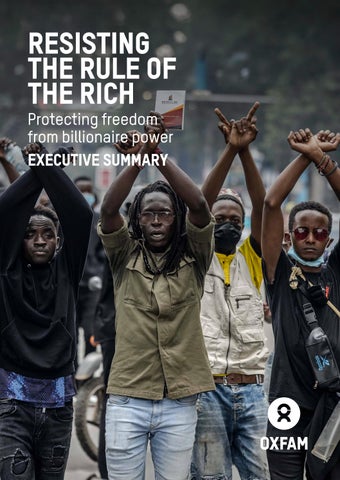
Front cover: Kenya, 2024. Demonstrators make signs with their arms in front of Kenyan police officers during a demonstration against tax hikes as Members of the Parliament debate the Finance Bill 2024 in downtown Nairobi, on June 18, 2024. The police fired tear gas and arrested dozens of demonstrators.Photo: Luis Tato/AFP via Getty Images.
THE CHOICE: OLIGARCHY OR DEMOCRACY?
Billionaire fortunes have grown at a rate three times faster than the average annual rate in the previous five years since the election of Donald Trump in November 2024.1 Whilst US billionaires have seen the sharpest growth in their fortunes, billionaires in the rest of the world have also seen double digit increases. Actions of the of the Trump presidency, including the championing of deregulation and undermining agreements to increase corporate taxation, have benefited the richest around the world.2
The number of billionaires has surpassed 3,000 for the first time, and the level of billionaire wealth is now higher than at any time in history. In October 2025, the world’s richest man, Elon Musk, became the first person to have wealth over half a trillion dollars.3 Meanwhile, one in four people globally face hunger.
It is one thing for a billionaire to buy an enormous yacht or many luxury homes around the world. This excessive consumption can rightly be criticized in a deeply unequal world where the majority have very little. A world that can also not afford the carbon that comes with this excessive consumption. But many others would reject this criticism, describing it as the politics of envy. Yet far fewer people would disagree that when a billionaire uses their wealth to buy a politician, to influence a government, to own a newspaper or a social media platform, or to out-lawyer any opposition to ensure them impunity from justice, that these actions are inimical to progress and fairness. Such power gives billionaires a grasp over all our futures, undermining political freedom and eroding the rights of the many.
Box ES1: A Good Decade For Billionaires: The Facts
• In 2025, billionaire wealth increased three times faster than the average annual rate over the previous five years.4
• One study found that more unequal countries are up to seven times more likely to experience democratic erosion than more equal countries.5
• Billionaires are over 4,000 times more likely to hold political office than ordinary people. 6
• The amount of wealth gained by the world’s billionaires over the last year is enough to give every person in the world US$250 and leave the billionaires more than US$500bn richer.7
• The world’s 12 richest billionaires have more wealth than the poorest half of humanity, or more than four billion people.8
This phenomenon of the richest influencing and controlling politics is not new; it is familiar in countries in every part of the world. But events in the US in 2025 perhaps made this viscerally clear: in country after country, the super-rich have not only accumulated more wealth than could ever be spent, but have also used this wealth to secure the political power to shape the rules that define our economies and govern nations. At the same time, all over the world we are seeing an erosion and rolling back of the civil and political rights of the many; the suppression of protests; and the silencing of dissent. A century ago, the US Supreme Court Justice Louis Brandeis said, ‘We must make our choice. Either we can have extreme wealth in the hands of the few, or we can have democracy. We cannot have both.’
This report is about that choice. How governments worldwide are making the wrong choice; choosing to defend wealth not freedom. Choosing the rule of the rich. Choosing to repress their people’s anger at how life is becoming unaffordable and unbearable, rather than redistributing wealth from the richest to the rest. It shows how the economically rich are becoming politically rich the world over, able to shape and influence politics, societies and economies. In sharp contrast, those economically with the least wealth are becoming politically poor, their voices silenced in the face of growing authoritarianism and the suppression of hard-won rights and freedoms.
FIGURE 1: EVOLUTION OF BILLONAIRES’ WEALTH 1987-NOV 2025, US$ BILLIONS IN REAL TERMS
Source: Forbes Annual and Real-Time Billionaires Lists

Box ES2: Digital space – the new battleground In 2022, Elon Musk purchased Twitter – later rebranded X – for US$44bn9 and promised, under the guise of ‘free speech’, to scale back its guardrails monitoring and censuring hate speech.10 Immediate spikes in hate speech followed his takeover, including a 500% increase in the use of a racial slur and an uptick in misogynistic, transphobic and other hateful terms.11 The value of the platform has risen sharply following the 2025 inauguration of Donald Trump and the alliance at that time between the pair.12
Meanwhile, Kenyan law enforcement has used X and other digital providers to track and abduct protestors and critics of the government.13 In December 2024, protestors were abducted from the streets of Kenya and tortured for posting anti-government images on X.14 In June 2025, protests hit the streets of Kenya again over the death of Albert Omondi Ojwang in police custody after he posted a criticism of the Deputy Inspector General of Police on X.15
The conclusion of this report shows that this is not inevitable. Governments can choose to defend ordinary people rather than oligarchs. People themselves, when organized, can present a powerful counterweight to extreme wealth. Together we can demand a fairer, more equal world.
Extreme wealth accumulation accelerates
How much is too much? The case for an extreme wealth line
Philosopher Ingrid Robeyns has set out the philosophical case for a legal limit on private wealth. Her proposal, known as ‘limitarianism’, argues that beyond a certain point, private wealth becomes morally unjustifiable and politically dangerous.16 Just as societies define a poverty line to identify when someone has too little, we should also define a threshold for when someone has too much – an ‘Extreme Wealth Line17 – she proposes an upper limit of US$10m in wealth. The organization Patriotic Millionaires found that one-third of the millionaires who they surveyed supported a US$10m extreme wealth line.18
Source: FAOSTAT, Forbes Annual and Real-Time Billionaires Lists
Life is becoming unaffordable for everyday people everywhere
In previous decades, defenders of the global economy could evidence the very real progress in reducing poverty, pointing out that this was what mattered, not the wealth of a few at the top.
Yet, in the decade since 2020, this is no longer the case. The reduction in poverty has largely ground to a halt, with poverty rising again in Africa. In 2022, nearly half of the world population (48%), or 3.83 billion people, lived in poverty.19
Looking beyond income to other aspects of poverty, one in four people worldwide face moderate or severe food insecurity.20 This number increased by 42.6% between 2015 and 2024.21 Ordinary people worldwide are seeing the cost of food rise relentlessly. This includes 92 million food insecure people in Europe and North America, some of the richest regions in the world.22
Women and girls living in poverty, racialized communities, disabled people, and LGBTQI+ communities experience
even more severe impacts, as well as exclusion, marginalization and shrinking freedoms to protests against their economic hardships.23 Women and racialized people predominate in the lowest-paid and most poorly protected jobs, and they are less likely to have land rights. Women contribute an estimated 12.5 billion hours of unpaid care work every day, adding at least US$10.8 trillion in value to the global economy.24
In the US alone, more than one in five LGBTQI+ adults (22%) are living in poverty, compared to an estimated 16% of heterosexual and cisgender people.25
Economic inequality becomes political inequality
Economic inequality plays a major role in the erosion of rights and political freedoms, and creates fertile ground for increased authoritarianism. Research finds that rising inequality is one of the strongest predictors of democracies beginning to fall apart.26
One comprehensive study analysed 23 episodes of ‘democratic erosion’ in 22 countries.27 This democratic
FIGURE 2. TRENDS IN BILLIONAIRE WEALTH VS NUMBER OF FOOD INSECURE PEOPLE
Executive summary THE CHOICE: OLIGARCHY OR DEMOCRACY?

erosion included the undermining of checks and balances such as the judiciary or legislature; the restriction of civil liberties; the manipulation of elections; and the normalization of authoritarian practices such as concentrating power in the hands of a political leader. The study found that the most unequal countries are as much as seven times more likely to see this democratic erosion happen than more equal countries.
Political inequality at the top: the oligarchy that controls our world today
In 2025, we saw the inauguration of a billionaire president with a cabinet that includes multiple billionaires,28 backed and bankrolled by the world’s richest man, Elon Musk,29 who became US President Donald Trump’s right-hand man before his spectacular fall from grace.30
Data from 136 countries confirms that as economic resources become more unequally distributed, so too does political power. This leads to policy outcomes that reflect the preferences of upper-income groups more than those of lower-income groups.31
The super-rich have built their political power in three main ways: by buying politics, investing in legitimizing elite power, and directly accessing institutions.32 Billionaires and the super-rich have long used their vast wealth to buy politicians and political parties, subverting the power of the majority in favour of an unjust system of ‘one dollar, one vote’.33 The World Values Survey found that almost half of all people surveyed perceived that the rich often buy elections in their country.34 In 2024, one in every six dollars spent by all US candidates, parties and committees came from donations from just 100 billionaire families.35
Billionaires and the super-rich increasingly dominate media and AI. Over half of the world’s largest media companies have billionaire owners,36 and 9 of the top 10 social media companies in the world are run by just six billionaires.37 8 of the top 10 AI companies – which overlap with media companies – are billionaire-run, with just three commanding nearly 90% of the generative AI chatbot market.38 In France, CNews was bought and rebranded as the French equivalent of Fox News by far-right fossil-fuel billionaire Vincent Bolloré, a man who has brought lawsuits against journalists who have criticised him.39

Billionaire-owned media systematically neglect the interests of people living in poverty, women and racialized groups.40 In Latin America, for example, only 3% of the people in news media coverage are from Indigenous groups, and of these, only one in five is a woman.41
A 2023 article found that over 11% of the world’s billionaires had held or sought political office.42 Oxfam estimates that billionaires are at least 4,000 times more likely to hold political offices than ordinary people.43 Najib Mikati, Lebanon’s ex-prime minister and reputedly its richest man,44 is a clear example of how great wealth contributes to gaining political office. He has been appointed as a ‘consensus’ prime minister three times despite having little popular or grassroots party support.45
Political inequality at the bottom: governments choose repression over redistribution
The economic poverty of the majority tends to translate into political poverty; they face higher barriers to participation in politics, decision-making and public life. This limits people’s abilities to influence policies,
access their rights, and shape their future. Women, particularly racialized women and those living in poverty, also disproportionately experience acute time poverty because of the care responsibilities they face.46
In 2024, freedom of expression was curtailed in a quarter of the world’s countries.47 According to Freedom House, 2024 was the nineteenth successive year of global decline, with over 60 countries experiencing a decline in political rights and civil liberties.48
Extraordinary levels of economic hardship for the many are being compounded by austerity, which governments, especially in lower-income countries, feel forced to implement in the face of overwhelming debt. Protests against inequality and hardship have subsequently erupted across the world.
Faced with widespread public anger49 over issues that impact their populations’ everyday lives, governments worldwide have doubled down and chosen repression rather than redistribution. Protests against austerity and the cost of living have led to harsh government crackdowns.
Box ES3: The brutal backlash against Kenya’s finance bill protests
In July 2024, Tom50 joined thousands of protesters in Nairobi’s city centre to campaign against tax hikes, price rises, inequality embedded by debt,51 and the government. They were attacked by a group of plain-clothed police officers with guns. Tom was shot three times with rubber bullets that lodged in his chest.
In many ways Tom was lucky. The Kenya National Commission on Human Rights recorded that 39 people were killed at the protests52 and the Kenyan state has been accused of systematically killing or kidnapping those who were involved. 60 cases of extrajudicial killings are being investigated, along with 71 cases of abductions and forced disappearances.53 Human Rights Watch has also reported victims having been found tortured and mutilated.54
The protests Tom joined, while not achieving all their aims, succeeded in forcing the president to dissolve the cabinet and withdraw the bill that would have driven up taxes.55 They showed the power of people to force change. Despite his injuries, Tom said, ‘If the protest were tomorrow, I would go again. We are fighting for our lives. We are fighting for a better Kenya. If we don’t do it now, who else will?’ Trade Unionists are often at the forefront of protests and are among the first to be targeted in government crackdowns.56
In Argentina, President Javier Milei, backed by the Argentine billionaire Eduardo Eurnekian, has sought to amend 366 laws to deregulate working conditions and wages, dismantle union protections and privatize public companies.57
Protesters face an increasingly hostile context as Milei’s government has also issued a decree restricting freedom and the right to protest;58 union protests were met with widespread police brutality and mass arrests during public demonstrations in 2024. At least 1,155 protesters were injured with at least 33 suffering rubber bullet wounds to the head and face.59
Blaming migrants not millionaires
Supported by far-right parties and media platforms, many of which are owned by the super-rich, governments systematically stigmatize and scapegoat minorities. In country after country, migrants are used as scapegoats for a host of social ills including crime, shrinking welfare provisions and the rising cost of living.60 A 2024 poll in Canada found that 35% of Canadians surveyed believe immigration increases crime levels, driven in part by misleading news reports, social media and right-wing politicians.61 In the UK, a powerful minority with disproportionate influence have contributed to the public conversation being focused on small migrant boats crossing the English Channel, rather than the super yachts of the ultra-wealthy.62 Some people are convinced by this scapegoating and the worst results can be seen in increased racist violence enacted by an emboldened few.63 While the majority see through the lies and many fight back, the sad truth is that these dirty tactics serve as a distraction from the real cause of hardship for the many - extreme levels of inequality.
Building a more equal future
This report evidences how extreme inequality, billionaires and their government enablers are thwarting political freedom and human rights for the majority. This vicious cycle is widely recognized – even from within the ranks of the super-rich. In 2024, a survey of over 2,300 millionaire respondents from G20 countries found that over half think that extreme wealth is a ‘threat to democracy’.64 Polling across 36 countries found that people reported the top cause of economic inequality as ‘rich people have too much political influence’; 86% of respondents either agreed or strongly agreed with this statement.65
The good news is that none of this is inevitable, and change is possible. To create a fairer future for everyone, this report recommends:
1. Countries must radically reduce economic inequality
High economic inequality, alongside huge concentrations of extreme wealth and persistent poverty, is the engine that is eroding the rights and freedoms of the many. Governments need to make a radical reduction of economic inequality their top priority. All countries should put in place realistic and time-bound National Inequality Reduction Plans (NIRPs) to reduce inequality, with regular monitoring of progress. Every country should work towards an income Gini coefficient of less than 0.3 and/or a Palma ratio of no more than 1.66
All countries should also support the recommendations of the Extraordinary Committee report67 to the South African G20 led by Professor Joseph Stiglitz. The Committee called for the formation of an ‘International Panel on Inequality’, an institution to provide timely, accurate information on the scale, causes, impacts and solutions
to runaway inequality. Just as the Climate Emergency required the formation of the IPCC, the inequality emergency requires the urgent formation of the IPI.
2. Curb the political power of the super-rich
The translation of economic wealth into political power is not automatic, there is strong variation between countries, which reflects the regulatory environment. As well as reducing the existence of extreme wealth, governments can take concrete steps to build a strong firewall between wealth and politics. They should:
• effectively tax the super-rich to reduce their economic power, and through this their political power;
• regulate lobbying and revolving doors;
• ban campaign financing by the rich;
• legislate to ensure media independence;
• regulate media companies to increase algorithmic transparency;
• protect freedom of speech while preventing harmful content, especially hate speech targeting immigrants and women as well as gender-diverse, racial, ethnic and religious minorities.

3. Build the political power of the many
Ordinary people become powerful in a political system where they are incentivized and motivated to influence decision-making despite structural inequality. To build the political power of the many, governments must guarantee an enabling environment with laws, institutions and public policies whereby citizens can freely organize, speak out and act collectively to make demands of power-holders accountable for the fulfilment of these rights. Promoting and protecting civic space is an effective counterweight to authoritarianism, oligarchy and structural inequality.
Civil society organizations (CSOs), trade unions, other marginalised, organised groups, and networks, are critical to the fight against inequality. They are convenors of ordinary people, collaborators with grassroots and Indigenous movements, mechanisms for social cohesion, watchdogs for transparency and accountability, and advocates for progressive policies and governance that serve the interests of the many.
Building a worldwide movement and daring to demand change together
In too many contexts, daring to dissent means risking arrest, intimidation and even your life.
That is why we must stand together and enact measures to build and protect the voice, choice and power of the many fighting for a more equal future.
Working in solidarity and collaboration across our movements and organizations is vital. We must work collaboratively to build a worldwide people’s movement to defend our rights, fight for a more equal world, and demand an end to inequality and oligarchy.
Box ES4: Beating political poverty – the power of unity
Research from Latin America shows that key institutes of democracy, including civil society organizations, and the targeting of mobilization efforts and voluntary organization in lower income communities can give ordinary people a powerful political voice.68 Mass participation in elections ensures victory to candidates or parties that address the grievances of the many and curb the power of the few. José Mujica (the president of Uruguay from 2010 to 2015) rose from humble origins and a period of imprisonment under a military dictatorship, garnering massive support among Uruguay’s working class and rural communities living in poverty.69
Trade unions play a critical role in driving collective action and influencing the policy process, as well as directly reducing economic inequality by raising wages for those on low and middle incomes relative to the highest earners.70 Unions have been especially effective in narrowing gender and racial wage gaps. Black and Hispanic workers, as well as women, receive a larger wage boost from unionization than white male workers, helping to close long-standing pay gaps.71
resisting the rule of the rich REFERENCES
1 Methodology note, stat 1
2 Oxfam America. (2025). UNEQUAL: The rise of a new American oligarchy and the agenda we need. Accessed 6 November 2025. https://www.oxfamamerica.org/explore/research-publications/unequal-the-rise-of-a-new-american-oligarchy-andthe-agenda-we-need/
3 P. Hoskins. (2 October 2025). Musk becomes world’s first half-trillionaire. BBC. Accessed 6 October 2025. https://www.bbc. co.uk/news/articles/c89d3547npjo
4 Methodology note, stat 1
5 E.G. Rau and S. Stokes. (2025). ‘Income inequality and the erosion of democracy in the twenty-first century’. Proceedings of the National Academy of Sciences, 122(1). Accessed 18 September 2025. https://pubmed.ncbi.nlm.nih.gov/39793070
6 Methodology note, stat 16
7 Methodology note, stat 3
8 Methodology note, 4
9 M. Sweney. (19 March 2025). Value of Elon Musk’s X ‘rebounds to $44bn purchase price’. The Guardian. Accessed 19 September 2025. https://www.theguardian.com/technology/2025/mar/19/value-elon-musk-x-rebounds-purchase-price
10 L. Jamali. (18 June 2025). Musk’s X sues New York state over social media hate speech law. BBC. Accessed 16 October 2025. https://www.bbc.co.uk/news/articles/c4g8vy2n3dko
11 R. Ray and J. Anyanwu. (23 November 2022). Why is Elon Musk’s Twitter takeover increasing hate speech? Brookings. Accessed 19 September 2025. https://www.brookings.edu/articles/why-is-elon-musks-twitter-takeover-increasing-hatespeech
12 M. Sweney. (19 March 2025). Value of Elon Musk’s X ‘rebounds to $44bn purchase price’, op. cit
13 Dr J. Mwangi. (20 August 2024). Security dynamics in the digital era: A case of Kenya. Mashariki Research and Policy Centre. Accessed 17 October 2025. https://masharikirpc.org/security-dynamics-in-the-digital-era-a-case-of-kenya/; and M. Koskei. (7 January 2025). Abducted Cartoonist ‘Kibet Bull’ freed. Daily Nation. Accessed 19 September 2025. https://nation. africa/kenya/counties/nakuru/abducted-cartoonist-kibet-bull-freed-4880658
14 O. Madung. (1 May 2025). Tortured over a tweet: how the war between Kenya’s Gen Z and their president has moved online. The Guardian. Accessed 19 September 2025 https://www.theguardian.com/global-development/2025/may/01/kenyanstortured-for-a-tweet-president-ruto-satire-x-youth-gen-z; and NTV Kenya. (2025). University student Davis Mokaya denies posting image of President Ruto’s coffin on social media [video content]. Accessed 19 September 2025. https://www. youtube.com/watch?v=s7R0IF3bmns
15 A. Wandera and B. Rukanga. (9 June 2025). Protest hits Kenya after shock death of man held by police. BBC. Accessed 19 September 2025. https://www.bbc.com/news/articles/cwy3eqpqqnzo
16 I. Robeyns. (2024). Limitarianism: The Case Against Extreme Wealth. London: Penguin.
17 F. Belata and H. Wright. (2025). Exploring An Extreme Wealth Line. New Economics Foundation, in partnership with Patriotic Millionaires International. Accessed 18 September 2025. https://neweconomics.org/2025/01/exploring-an-extremewealth-line
18 Ibid.
19 World Bank Group. (3 June 2025). June 2025 Update to the Poverty and Inequality Platform (PIP). Accessed 18 September 2025. https://documents.worldbank.org/en/publication/documents-reports/documentdetail/099510306052516849; and J. Hasell. Et al. (11 August 2025) $3 a day: A new poverty line has shifted the World Bank’s data on extreme poverty. What changed, and why? Accessed 28 October 2025 https://ourworldindata.org/new-international-poverty-line-3-dollars-per-day
20 The number of people facing severe or moderate food insecurity increased by 42.6%, or 682.6 million, between 2015 and 2024. See: methodology note, stat 9; and FAO, IFAD, UNICEF, WFP and WHO. (2025). The State of Food Security and Nutrition in the World 2025: Addressing high food price inflation for food security and nutrition. Accessed 18 September 2025. https:// doi.org/10.4060/cd6008en
21 Methodology note, stat 9.
22 FAO, IFAD, UNICEF, WFP and WHO. (2025). The State of Food Security and Nutrition in the World 2025: Addressing high food price inflation for food security and nutrition. Accessed 18 September 2025. https://doi.org/10.4060/cd6008en
23 Oxfam. (2018). Reward Work not Wealth. Accessed 18 September 2025. https://www.oxfam.org/en/research/reward-worknot-wealth
24 Oxfam. (2020). Time to Care. Accessed 16 September 2025. https://policy-practice.oxfam.org/resources/time-to-care-unpaid-and-underpaid-care-work-and-the-global-inequality-crisis-620928
resisting the rule of the rich REFERENCES
25 UCLA School of Law Williams Institute (2023) LGBT Poverty in the United States. Accessed 24 October 2025. https://williamsinstitute.law.ucla.edu/publications/lgbt-poverty-us/; and Human Rights Campaign. (n.d.). Understanding Poverty in the LGBTQ+ Community. Accessed 20 October 2025 https://www.hrc.org/resources/understanding-poverty-in-the-lgbtq-community
26 E.G. Rau and S. Stokes. (2025). ‘Income inequality and the erosion of democracy in the twenty-first century’. Proceedings of the National Academy of Sciences, 122(1). Accessed 18 September 2025. https://pubmed.ncbi.nlm.nih.gov/39793070
27 Ibid.
28 Forbes. (3 April 2025). These Are the 10 Richest People in Donald Trump’s Administration Accessed 13 August 2025. https:// www.forbes.com/sites/danalexander/2025/04/03/these-are-the-10-richest-people-in-donald-trumps-administration
29 The Financial Times. (2024) Elon Musk donated more than $250mn to Donald Trump’s campaign, electoral filings show. Accessed 24 October 2024. https://www.ft.com/content/5f962d83-01d8-4a2d-9d36-a1bfed400c00; and F. Schouten et al. (6 December 2024). Musk spent more than a quarter-billion dollars to elect Trump, including funding a mysterious super PAC, new filings show. CNN. Accessed 4 September 2025. https://www.cnn.com/2024/12/05/politics/elon-musk-trumpcampaign-finance-filings
30 Al Jazeera. (6 July 2025). Elon Musk launches the America Party as feud with Trump escalates. Accessed 18 September 2025. https://www.aljazeera.com/news/2025/7/6/elon-musk-launches-the-america-party-as-feud-with-trump-escalates
31 W. M. Cole. (2018). ‘Poor and powerless: Economic and political inequality in cross-national perspective, 1981–2011’ International Sociology, 33(3), 357–385. Accessed 18 September 2025. https://economicsociology.org/wp-content/uploads/2018/04/poor-and-powerless-economic-and-political-inequality-in-cross-national-perspective.pdf
32 P. Hägel. (2021). Billionaires in World Politics. Oxford: Oxford University Press. 117 – 145.
33 The Economist. (22 May 2014). One dollar, one vote. Accessed 27 October 2025.
34 C. Haerpfer et al. (eds.). (2022). World Values Survey: Round Seven – Country-Pooled Datafile Version 6.0. Madrid, Spain and Vienna, Austria. JD Systems Institute and WVSA Secretariat. Accessed 23 October 2025. https://www.worldvaluessurvey. org/WVSDocumentationWV7.jsp
35 Americans for Tax Fairness. (2 April 2025). Billionaires Buying Elections: They’ve Come to Collect. Accessed 18 September 2025. https://americansfortaxfairness.org/billionaires-buying-elections-theyve-come-to-collect
36 Methodology note, stat 17; and R. Neate. (3 May 2025). ‘Extra level of power’: billionaires who have bought up the media. The Guardian Accessed 16 October 2025. https://www.theguardian.com/news/2022/may/03/billionaires-extra-power-media-ownership-elon-musk
37 Statista. (February 2025). Most popular social networks worldwide as of February 2025, by number of monthly active users. Accessed 20 October 2025. https://www.statista.com/statistics/272014/global-social-networks-ranked-by-number-ofusers/
38 Companies Market Cap. (n.d.). Largest AI companies by market capitalization. Accessed 20 October 2025. https://companiesmarketcap.com/artificial-intelligence/largest-ai-companies-by-marketcap/
39 R. Dupré and J. Lefilliâtre. (19 March 2025). NGOs file suit accusing billionaire Vincent Bolloré of being at heart of African ‘system of corruption’. Le Monde. Accessed 4 September 2025. https://www.lemonde.fr/en/france/article/2025/03/19/ ngos-file-suit-accusing-billionaire-vincent-bollore-of-being-at-heart-of-african-system-of-corruption_6739309_7. html
40 F. Kurtulmus and J. Kandiyali. (2023) ‘Class and Inequality: Why the Media Fails the Poor and Why This Matters’. In Carl Fox and Joe Saunders (eds.), The Routledge Handbook of Philosophy and Media Ethics. Routledge, 276–87.
41 GMMP. (2021). Global Media Monitoring Project 2020 Report: Who Makes the News? Accessed 18 September 2025. https:// whomakesthenews.org/wp-content/uploads/2024/06/GMMP2020_ENG-FINAL.pdf
42 D. Krcmaric et al. (2024). ‘Billionaire Politicians: A Global Perspective’ Perspectives on Politics, 22(2), 357–371. Accessed 18 September 2025. https://www.cambridge.org/core/journals/perspectives-on-politics/article/abs/billionaire-politicians-a-global-perspective/1AD0E0C33FE43165B14DD981533E00DD
43 Methodology note, stat 16.
44 Forbes. (n.d.). Najib Mikati. Accessed 26 September 2025. https://www.forbes.com/profile/najib-mikati
45 M. Chulov. (26 July 2025). Billionaire tycoon named as Lebanese PM as economic crisis bites. The Guardian. Accessed 6 October 2025. https://www.theguardian.com/world/2021/jul/26/billionaire-tycoon-lebanese-pm-najib-miqati
46 Y. Rodgers. (2023). ‘Time Poverty: Conceptualisation, gender differences, and policy solutions’. Social Philosophy and Policy, 40(1), 79–102. Accessed 5 September 2025. https://www.cambridge.org/core/journals/social-philosophy-and-policy/article/time-poverty-conceptualization-gender-differences-and-policy-solutions/06A5EFDF49F494FB69B1D4830F1CAB19
resisting the rule of the rich REFERENCES
47 Freedom House. (2025). Freedom in the World 2025: The Uphill Battle to Safeguard Rights. Accessed 18 September 2025. https://freedomhouse.org/sites/default/files/2025-02/FITW_World_2025_Feb.2025.pdf
48 Ibid.
49 Debt Justice and Institute of Political Economy. (2025). How the global debt system is undermining democracy and fuelling authoritarianism across Global South countries. Accessed 18 September 2025. https://debtjustice.org.uk/wp-content/ uploads/2025/06/Debt-Democracy-and-Austerity_Jun-25.pdf
50 An Oxfam case study, first published in: M. Lawson. (16 November 2024). The High Price of Fighting for Freedom. EQUALS blog. Accessed 16 October 2025. https://www.equals.ink/p/the-high-price-of-fighting-for-freedom?utm_source=publication-search
51 C. Liverseed. (29 April 2025) Kenya Finance Bill Protests. Accessed 24 October 2025 https://thenonviolenceproject.wisc. edu/2025/04/29/kenya-finance-bill-protests/; Business Daily. (23 July 2025). World Bank freezes Sh97bn to Kenya on reform delays. Accessed 18 September 2025. https://www.businessdailyafrica.com/bd/economy/world-bank-freezessh97bn-to-kenya-on-reforms-fallout-5129344
52 Kenya National Commission on Human Rights. (1 July 2024). Update on the Status of Human Rights in Kenya during the Anti-Finance Bill Protests, Monday 1st July, 2024. Accessed 27 October 2025. https://www.knchr.org/Articles/ArtMID/2432/ ArticleID/1200/Update-on-the-Status-of-Human-Rights-in-Kenya-during-the-Anti-Finance-Bill-Protests-Monday-1stJuly-2024
53 DW News. (2024). Kenya police accused of killing or abducting dozens of ‘Gen-Z’ protesters. [video content]. Accessed 18 September 2025. https://www.youtube.com/watch?v=q4FWNpzvQ0M
54 Human Rights Watch. (5 November 2024). Kenya: Security Forces Abducted, Killed Protesters Accessed 18 September 2025. https://www.hrw.org/news/2024/11/06/kenya-security-forces-abducted-killed-protesters
55 Al Jazeera. (11 July 2024). Kenya’s Ruto dismisses almost entire cabinet after nationwide protests. Accessed 17 October 2024. https://www.aljazeera.com/news/2024/7/11/kenyas-ruto-dismisses-almost-entire-cabinet-after-nationwide-protests
56 ITUC. (2025). Global Rights Index 2025. Accessed 18 September 2025. https://www.ituc-csi.org/global-rights-index
57 Ibid.
58 PEN International. (1 July 2025) Argentina: Serious deterioration of freedom of expression under Javier Milei’s government. Accessed 30 December 2025. https://www.pen-international.org/news/argentina-serious-deterioration-of-freedom-of-expression-under-javier-mileis-government
59 ITUC. (2025). Global Rights Index 2025 Accessed 18 September 2025. https://www.ituc-csi.org/global-rights-index
60 Transforming Society. (19 May 2023). It’s called scapegoating and it’s as old as divide and rule. Accessed 18 September 2025. https://www.transformingsociety.co.uk/2023/05/19/its-called-scapegoating-and-its-as-old-as-divide-and-rule
61 J. P. Walsh et al. (2022). Social media, migration and the platformization of moral panic: Evidence from Canada. Accessed 29 October 2025. https://journals.sagepub.com/doi/full/10.1177/13548565221137002; S. Esmail. (2025). No Longer the Exception: An exploration of factors affecting decreasing positive attitudes towards immigration in Canada post-COVID-19. University of Alberta. Political Science Undergraduate Review. DOI: https://doi.org/10.29173/psur420; L. Schemitsch (6 December 2024). The risks of immigration misinformation to Canada’s int’l students. Accessed 27 October 2025. https://thepienews.com/the-risks-of-immigration-misinformation-to-canadas-intl-students/; and M. Bernier. (1 November 2024). A tidal wave of immigration is swamping my country. It may not survive Accessed 28 October 2025. https://www.telegraph.co.uk/news/2024/11/01/canada-peoples-party-immigration-is-the-issue/
62 Runnymede. (2025). A hostile environment: language, race, politics and the media. Accessed 7 October 2025. https://www. runnymedetrust.org/publications/a-hostile-environment-language-race-politics-and-the-media
63 S.A. Olofinbiyi. (2022). ‘Anti-immigrant Violence and Xenophobia in South Africa: Untreated Malady and Potential Snag for National Development’. Insight on Africa, 14(2), 193–211. Accessed 29 September 2025. https://journals.sagepub. com/doi/10.1177/09750878221079803; J. Drury. (2024). The August 2024 riots: Empowerment of the xenophobes. Accessed 23 October 2025. https://blogs.sussex.ac.uk/crowdsidentities/2024/08/04/the-august-2024-riots-empowerment-of-the-xenophobes/; H. Al-Othman. (1 June 2025). Riots after Southport attack more similar to those in 1958 than in 2011, study finds. The Guardian. Accessed 29 September 2025. https://www.theguardian.com/uk-news/2025/ jun/01/southport-attack-unrest-1958-race-riots-2011-disorder-far-right-protests; N. Popli. (16 May 2022). How the ‘Great Replacement Theory’ Has Fueled Racist Violence. Time. Accessed 29 September 2025. https://time.com/6177282/ great-replacement-theory-buffalo-racist-attacks; and P. Hille. (2023). Far-right terror attack in Solingen: 30 years later. DW. Accessed 29 September 2025. https://www.dw.com/en/far-right-terror-arson-attack-in-solingen-30-years-later/a-65757610
resisting the rule of the rich REFERENCES
64 Patriotic Millionaires. (16 January 2024). Nearly three quarters of millionaires polled in G20 countries support higher taxes on wealth, over half think extreme wealth is a “threat to democracy”. Accessed 16 September 2025. https://patrioticmillionaires.uk/latest-news/pmuk-davos-2024-release
65 R. Wike et al. (9 January 2025). Economic Inequality Seen as Major Challenge Around The World Pew Research Center. Accessed 18 September 2025. https://www.pewresearch.org/global/2025/01/09/economic-inequality-seen-as-major-challenge-around-the-world
66 J. Stiglitz et al. (2025). G20 Extraordinary Committee of Independent Experts on Global Inequality. Accessed 6 November 2025. https://ipdcolumbia.org/wp-content/uploads/2025/11/2-G20-Global-Inequality-Report-Full-and-Summary.pdf
67 Ibid.
68 C. Boulding. (2021). Voice and Inequality. University of Colorado Boulder. Accessed 18 September 2025. https://www.colorado.edu/polisci/2021/05/27/voice-and-inequality
69 V. Hernandez. (15 November 2012). Jose Mujica: The world’s ‘poorest’ president. BBC. Accessed 18 September 2025. https:// www.bbc.com/news/magazine-20243493
70 F. Jaumotte and C.O. Buitron. (2015). Power from the People. Accessed 18 September 2025. https://www.imf.org/external/ pubs/ft/fandd/2015/03/pdf/jaumotte.pdf
71 A. Banerjee et al. (2021). Unions are not only good for workers, they’re good for communities and for democracy. Economic Policy Institute. Accessed 18 September 2025. https://www.epi.org/publication/unions-and-well-being; and J.T. Addison. (2020). The consequences of trade union power erosion. IZA World of Labor. Accessed 18 September 2025. https://wol.iza. org/uploads/articles/525/pdfs/consequences-of-trade-union-power-erosion.pdf
© Oxfam International January 2026
For information on the issues raised in this report please email mailto: advocacy@oxfaminternational.org
This publication is copyright but the text may be used free of charge for the purposes of advocacy, campaigning, education, and research, provided that the source is acknowledged in full.
The copyright holder requests that all such use be registered with them for impact assessment purposes. For copying in any other circumstances, or for re-use in other publications, or for translation or adaptation, permission must be secured and a fee may be charged: https://policy-practice.oxfam.org/copyrightpermissions
Oxfam GB, Oxfam House, John Smith Drive, Cowley, Oxford, OX4 2JY, UK.
About Oxfam
Oxfam is a global movement of people who are fighting inequality to end poverty and injustice. We are working across regions in more than 70 countries, with thousands of partners, and allies, supporting communities to build better lives for themselves, grow resilience and protect lives and livelihoods also in times of crisis. Together, we tackle inequalities to end poverty and injustice, now and in the long term – for an equal future.
Please write to any of the agencies for further information or visit http://www.oxfam.org
Oxfam South Africa (www.oxfam.org.za)
Oxfam America (www.oxfamamerica.org)
Oxfam Aotearoa (www.oxfam.org.nz)
Oxfam Australia (www.oxfam.org.au)
Oxfam-in-Belgium (www.oxfamsol.be)
Oxfam Brasil (www.oxfam.org.br)
Oxfam Canada (www.oxfam.ca)
Oxfam Colombia (www.oxfamcolombia.org)
Oxfam Denmark (www.oxfam.dk)
Oxfam France (www.oxfamfrance.org)
Oxfam GB (www.oxfam.org.uk)
Oxfam Germany (www.oxfam.de)
Oxfam Hong Kong (www.oxfam.org.hk)
Oxfam India (www.oxfamindia.org)
Oxfam Intermón (Spain) (www.oxfamintermon.org)
Oxfam Ireland (www.oxfamireland.org)
Oxfam Italy (www.oxfamitalia.org)
KEDV (www.kedv.org.tr)
Oxfam Mexico (www.oxfammexico.org)
Oxfam Novib (Netherlands) (www.oxfamnovib.nl)
Oxfam Pilipinas (www.oxfam.org.ph)
Oxfam Québec (www.oxfam.qc.ca)