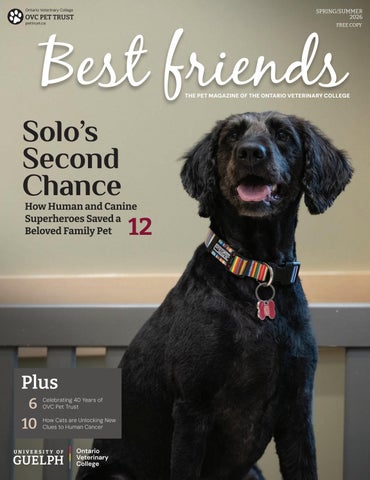

Solo’s Second Chance


FROM THE DEAN
ABOUT OVC PET TRUST
Dr. Jeff Wichtel and OVC staff pet Coops.
For those of us who have chosen a life in veterinary medicine, animals sit at the very heart of what we do. They are family members, confidants and sources of connection and companionship—and caring for them has never carried greater meaning or greater complexity.
The final issue of Best Friends published during my tenure as dean comes at a moment of profound change for our profession. Rising demand for care, affordability challenges, workforce pressures and evolving client expectations are testing long-standing models of practice. At the same time, they are pushing us toward something essential: a renewed focus on relationships. The future of veterinary medicine will be shaped not only by clinical excellence but by how well we support the people who deliver care and the bonds they build with clients and patients.
Our profession—and our college—has increasingly viewed its obligations to society through a social accountability lens.
At the Ontario Veterinary College, we are reshaping education, research and service with this reality in mind—embracing relationship-centred care, improving access to services, empowering high-functioning, purpose-driven veterinary teams, and thoughtfully integrating digital tools and artificial intelligence to strengthen, not replace, human connection.
As I reflect on my time as dean, I remain deeply optimistic. We continue to attract exceptional students, graduate compassionate and capable professionals, and collaborate with partners who share a commitment to service and social accountability. Change can be unsettling, but it also creates opportunity. I am confident this momentum will continue under the leadership of our new dean, Dr. Julia Montgomery, whose vision will help guide OVC into its next chapter.
I am grateful for the privilege of having served this remarkable community. Much of what we have achieved over the past decade would not have been possible without the support of OVC Pet Trust and its generous donors. The future of companion animal care—and of our profession—is in very good hands.
Dr. Jeff Wichtel,
Dean, Ontario Veterinary College
As part of the Ontario Veterinary College (OVC) at the University of Guelph, OVC Pet Trust is Canada’s first charitable fund dedicated to advancing pet health and well-being. We do this by raising funds to support innovative discoveries, health care and education that improves the prevention, diagnosis and treatment of diseases of companion animals. Since 1986, more than $100 million has been raised to improve life for pets and the people who love them. As of 2026, OVC is ranked first in Canada and fourth worldwide for veterinary science by the QS World University Rankings.
Kristyn Anthony
Martyn
Alison McLaren
Becky Rothwell
Sandra Valeriote
Andrew Vowles
GRAPHIC DESIGNER
Allison Graef
VETERINARY REVIEWERS
Dr. Doreen Houston (OVC ‘80)
Dr. Karyn Jones (OVC ‘01)
OVC PET TRUST BOARD
Mary Beaton
Dr. Nicole Iarusci
Dr. Karyn Jones
Kim Lang
Dr. Jennifer Ogeer (Chair)
William Pringle
Jane Riddell
Dr. Rebecca Sterns
Roland Browning Watt
Dr. Jeff Wichtel Honorary: Roger Warren
Ex-officio:
Dr. Alice Defarges
Dr. Luis Gaitero
Alison McLaren
Deanna Tigani
CONTACT
OVC PET TRUST Ontario Veterinary College
University of Guelph 50 Stone Rd. E. Guelph ON N1G 2W1
519-824-4120, Ext. 54695
ovcpet@uoguelph.ca
GIVE TO
HOW ONE LITTLE DOG IS HELPING ADVANCE EPILEPSY RESEARCH


A DAY IN THE LIFE OF AN EMERGENCY AND CRITICAL CARE RESIDENT

ALWAYS NEAR ME: OVC PET TRUST LAUNCHES NEW PET LOSS SUPPORT RESOURCE CENTRE
2
FROM THE D EAN OF THE ONTARIO VETERINARY COLLEGE
4 FROM THE DESK OF OUR MANAGER
4 OVC MEWS: NEWS AND UPDATES FROM THE ONTARIO VETERINARY COLLEGE
6 CELEBRATING 40 YEARS OF OVC PET TRUST
8 10
HOW ONE LITTLE DOG IS HELPING ADVANCE EPILEPSY RESEARCH: PATIENT-DRIVEN RESEARCH AT OVC IS HELPING VETERINARIANS BETTER DIAGNOSE AND TREAT ONE OF THE MOST COMMON NEUROLOGICAL DISEASES IN DOGS
HOW CATS ARE UNLOCKING NEW CLUES TO HUMAN CANCER: NEW LANDMARK INTERNATIONAL STUDY IS THE LARGEST GENETIC ANALYSIS OF FELINE CANCERS TO DATE
12 SOLO’S SECOND CHANCE
14 A DAY IN THE LIFE OF AN EMERGENCY AND CRITICAL CARE RESIDENT
17
ALWAYS NEAR ME: OVC PET TRUST LAUNCHES NEW PET LOSS SUPPORT RESOURCE CENTRE
20 YOUR GIFTS AT WORK
22
RELATIONSHIP-CENTRED VETERINARY MEDICINE: HOW BETTER CONVERSATIONS ARE HELPING MORE PETS GET THE CARE THEY NEED
23 PETS IN MEMORY: BARNEY Back cover PET TRUST PALS
Northern Ontario faces a long-standing and worsening shortage of veterinary care, leaving many rural, remote and Indigenous communities with limited access to routine and emergency services. This gap affects animal welfare, community wellbeing and the veterinarians who must cover vast regions with little support. The Collaborative Doctor of Veterinary Medicine Program (CDVMP) — a partnership between the University of Guelph and Lakehead University in Thunder Bay — combines the Ontario Veterinary College’s internationally recognized veterinary education with Lakehead University’s 60-year commitment to northern, rural, remote and Indigenous communities. Together, these institutions are expanding access to education and building a skilled workforce ready to serve the North.
In March 2026, Kim and Stu Lang made a $10-million grant to OVC Pet Trust to support construction of a planned Medical and Surgical Learning Centre (MSLC) at the Ontario Veterinary College. The facility will enhance hands-on training in surgery, medicine, dentistry and clinical skills, ensuring that students graduate with the confidence and competence needed across diverse practice settings. This grant brings OVC to 75 per cent of its fundraising goal, enabling OVC to move forward with its construction plans. The new building is expected to be completed and open by fall 2028.

SMILING BLUE SKIES CANCER FUND MARKS 25TH ANNIVERSARY
When Suzi Beber’s Golden Retriever named Blues died of lymphoma on March 27, 2001, Suzi contacted the Ontario Veterinary College at the University of Guelph to determine how she might raise money for others facing a similar heartbreaking diagnosis. What began as one person’s tribute has grown into a movement and an enduring force for change that continues to touch countless lives.
The Smiling Blue Skies Cancer Fund, an OVC Pet Trust fund dedicated to improving cancer care for pets, celebrates its 25th anniversary in 2026. This community-driven effort has raised more than $3.6 million for groundbreaking oncology research, innovative treatments and brighter futures for families navigating cancer.
Thank you, Suzi, and the entire Smiling Blue Skies community. Your passion, dedication and love have created a legacy that will continue to inspire future generations.

Are you interested in doubling your impact?
For a limited time, OVC Pet Trust donors Llewellyn and Susan Smith are matching all gifts to OVC’s Medical and Surgical Learning Centre up to a total of $750,000. Donate today at uoguel.ph/bf0626 or scan the QR code.


The University of Guelph is pleased to announce the appointment of Dr. Julia Montgomery, dean of the Ontario Veterinary College.
An academic leader, researcher and veterinarian with more than two decades of extensive experience, Montgomery will begin a five-year term June 15, 2026.
Montgomery most recently served as professor and department head of veterinary clinical sciences at Oklahoma State University. Prior to that, she spent more than a decade on faculty at the Western College of Veterinary Medicine at the University of Saskatchewan following her postdoctoral fellowship in pulmonary pathobiology. Montgomery received her Doctor of Veterinary Medicine from the University of Veterinary Medicine in Hannover, Germany and a PhD from the University of Prince Edward Island. She completed a Large Animal Internal Medicine (LAIM) residency and is a diplomate of the American College of Veterinary Internal Medicine, specialty of LAIM.
“I am deeply humbled and genuinely excited to be joining the Ontario Veterinary College as its next dean,” Montgomery said. “Being entrusted with the leadership of Canada’s premier veterinary institution by the OVC community and the University of Guelph is a great honour.”
UNIVERSITY OF GUELPH APPOINTS DR. JULIA MONTGOMERY DEAN OF ONTARIO VETERINARY COLLEGE

class facilities, ensuring pets have access to advanced diagnostics, complex surgical procedures, leadingedge cancer therapies, critical care and groundbreaking clinical trials.
From the introduction of radiation therapy in the 1980s to the installation of MRI technology in the 1990s to the opening of Canada’s first comprehensive animal cancer centre in 2012, donor support has helped OVC Pet Trust consistently elevate the standard of care.
By investing, and continuing to invest, in new surgery and anesthesia facilities, critical care and specialty services spaces over the past decade, OVC Pet Trust has helped to ensure that the sickest patients have access to the most advanced, compassionate treatment available.
EDUCATION:
Training Tomorrow’s Leaders
OVC Pet Trust invests in people — the next generation of veterinary professionals and specialists who will shape the future of animal health.
Funding supports advanced specialty training for licensed veterinarians pursuing board certification, hands-on learning opportunities for student veterinarians and state-of-the-art teaching environments that reflect the realities of modern veterinary medicine.
Each year, OVC graduates enter communities across Ontario and around the globe with knowledge shaped by cutting-edge research and hands-on clinical experience.


The ripple effect is extraordinary, with one institution effectively launching thousands of careers and helping millions of animals.
Did you know?
With support from donors, the college is now developing a $44.5-million Medical and Surgical Learning Centre. The new facility will bring together elements of clinical education under one roof and allow the college to expand class sizes for the first time in more than 30 years — helping to address Ontario’s veterinary shortage and improving access to care, including for pets in underserved Northern communities.
RESEARCH:
Discovering Better Outcomes
Scientific breakthroughs begin with curiosity — and the courage to pursue better answers.
Since its earliest days, OVC Pet Trust has funded innovative research to improve the prevention, diagnosis and treatment of disease in companion animals. From cancer and cardiology to neurology, infectious disease and the human-animal bond, OVC researchers are advancing discoveries that improve quality of life for pets. Many discoveries extend beyond veterinary medicine, contributing to broader scientific understanding and sometimes human health as well.
What started in 1986 with $33,200 in donations allocated to supporting 14 research projects has grown into an investment of millions of dollars across hundreds of projects —
accelerating discovery and changing lives for the better.
Every breakthrough begins with belief — and a community that chooses to invest in possibility.
A Community Built on Love
OVC Pet Trust was built by visionary leaders and compassionate donors who believed that pets deserved the very best care. Founding champions — including dedicated board members, deans and clinical leaders — laid the groundwork for what has become a national model for companion animal philanthropy.
Forty years later, that spirit endures.
This 40th anniversary is not just a milestone. It is a testament to a community of visionary founders, dedicated clinicians and researchers, students eager to learn and thousands of donors who have memorialized cherished companions by helping others to receive a second chance.
For 40 years, OVC Pet Trust has stood at the intersection of love and science. And as veterinary medicine evolves, our commitment remains firms to advance care, expand knowledge and improve life for the animals who share our homes and our hearts.
OVC Pet Trust is powered by one simple belief: every pet deserves a longer, healthier life with the people who love them.
Learn more about the work of OVC Pet Trust and donate on our website at pettrust.ca . Photography courtesy of OVC Milestones.

James’s work has already led to major discoveries. In 2017, she was part of an international team that identified a genetic mutation linked to epilepsy in Rhodesian ridgeback dogs—an important finding that may also help researchers better understand epilepsy in humans.
“Understanding where seizures start and how they behave in the brain opens the door to more targeted treatments,” James explains.
New treatment possibilities
Beyond improving diagnosis, James is exploring new therapies for dogs with epilepsy.
One study is investigating vagus nerve stimulation, a treatment already approved for people with epilepsy. The non-invasive therapy uses gentle electrical signals applied to the neck to influence brain activity. Early studies at OVC show the technique is safe for dogs, potentially offering another option for pets whose seizures are difficult to control.
A new OVC Pet Trust-funded study launched in spring 2026 and led by
“Understanding where seizures start and how they behave in the brain opens the door to more targeted treatments”
James is examining a specific type of epilepsy discovered by her team at OVC in the Cavalier King Charles spaniel dog breed. Now under way, this is the first double-blinded clinical trial in veterinary medicine that compares the efficacy of different anti-seizure medications for a specific epilepsy syndrome called absence seizures. A double-blinded study—when neither the participants nor the researchers know which patient receives which treatment—ensures results are scientifically strong and unbiased.
For Rikley, being part of research has made a challenging diagnosis easier to face.
“Clinical trials combine leading-edge science with incredible compassion,” she says.
Despite her diagnosis, Faith remains a lively and sociable little dog who loves greeting people during volunteer visits with Rikley at a local hospice.
“We’ll always trust the expertise at OVC,” Rikley says. “But they’ve made us feel like we’re part of the journey, too.”
Discover more about Dr. Fiona James’s research and explore active neurology clinical trials at OVC at epilepsy.uoguelph.ca

Faith and OVC Biomedical Sciences PhD candidate Grace Kadler sit together in an exam room as Faith undergoes an EEG, a diagnostic test that records brain activity using small sensors placed on the head.

How Cats Are Unlocking New Clues to Human Cancer
A new landmark international study—the largest genetic analysis of feline cancers to date—is uncovering surprising similarities to human disease, pointing to new insights for prevention and treatments that could help both cats and people

Cancer is one of the leading causes of illness and death in domestic cats. Yet for many years, scientists have known relatively little about the genetics behind feline tumours.


A new international study published in the journal Science has mapped the genetic changes driving cancer in domestic cats at an unprecedented scale. The findings reveal striking similarities between cancers in cats, dogs and humans—insights that could eventually help improve treatments across species.


“It’s long been something of a black box,” says Dr. Geoffrey Wood, a professor of pathobiology at the University of Guelph’s Ontario Veterinary College (OVC) and co-senior author of the study. “Despite domestic cats being common pets, there was very little known about the genetics of cancer in these animals—until now.”


Dr. Wood’s cat, Smokey.
Dr. Geoff Wood and Dr. Arlene Khachadoorian, Anatomic Pathology DVSc student.
Solo’s Second Chance How Human and Canine Superheroes Saved a Beloved Family Pet

On a snowy day in February 2025, a seemingly minor stomach upset quickly became a fight for survival for Solo, a four-year-old Labradoodle who had always been the picture of health.
When Solo became lethargic and her family noticed blood in her urine, they rushed her to their local veterinarian. Hours later, they received a devastating call: “Solo is dying.” She was in critical condition with suspected pancreatitis and concern that her organs were at risk of failure.
Solo’s veterinarian made an emergency referral to the Ontario Veterinary College (OVC). Despite an intense snowstorm, Solo’s guardian, Marc, was soon en route with his beloved companion to the University of Guelph.
At OVC’s Health Sciences Centre, Solo was admitted through the Emergency and Critical Care Service and quickly assessed by specialists in the Small Animal Internal Medicine Service. Within hours, the pieces of a complex medical puzzle began to come together.
“Solo was diagnosed with immunemediated hemolytic anemia (IMHA), a life-threatening condition in which
the body destroys its own red blood cells,” says Dr. Alex Walker, small animal internal medicine resident at OVC. “She was also battling serious infections, including a resistant urinary tract infection, compounding the urgent medical situation.”
The internal medicine team moved quickly, initiating immunosuppressive therapy and intensive supportive care. But Solo’s condition was precarious. As her red blood cell count dropped, her body struggled to deliver oxygen where it was needed most.
At that critical point, life-saving help came not only from medical experts but

also from two unlikely heroes—Reign and Java, both donor member dogs in OVC’s Blood Donor Program.
A LIFE-SAVING PROGRAM
The OVC Blood Donor Program ensures that a safe, high-quality supply of blood is available year-round for critically ill patients. More than 70 volunteer donor dogs like Reign and Java are carefully screened for health and compatibility and give blood regularly, enabling more than 400 life-saving transfusions each year in the intensive care unit.
Last year, Solo was one of many patients who survived thanks to the program. The internal medicine team administered four blood transfusions, each one buying Solo time and helping to stabilize her fragile system. Five days into hospitalization, she started to respond to her treatments. Her packed cell volume—a key measure of red blood cells—began to rise.
By the time she was discharged, the volume had climbed to 28 per cent. Two weeks later, it reached 40 per cent, with no signs of active red blood cell destruction. For the first time, hope felt real.
OVC Blood Donor Program heroes Reign (top left) and Java (top right) meet Solo.
Solo visits the OVC Internal Medicine team: RVT Karen Avent, Dr. Ashley Spencer and Dr. Alex Walker.
“We didn’t even know animal blood donation existed before meeting with the internal medicine team at OVC,” says Marc. “But the transfusions allowed her body extra time to respond to treatment and gave us reason to believe that everything would work out.”
Solo was discharged after seven days in OVC’s intensive care unit.

The following months involved careful monitoring, frequent re-checks and a complex regimen of medications to keep her immune system from turning against her once more. Her treatment included such drugs as prednisone and cyclosporine, which were tapered over time as her condition improved.
There were other challenges along the way.

“The medications made Solo constantly hungry and unlike her usual self,” says Marc. “Her energy was low, and we had to take precautions to protect her suppressed immune system.” That meant That means no social outings


to places like the dog park and the groomer, and fewer trips to their favourite vacation spot in Georgian Bay.
Slowly and steadily, Solo got stronger.
“We were very happy to see Solo’s red blood cell levels return to normal,” says Walker. “By the fall, her blood work was stable, and her medications were reduced to minimal levels.”
Monthly reassessments have shown continued improvement, and earlier this year, Marc received welcome news: it was time to discontinue Solo’s medications. Today, Solo is thriving: chasing toys, enjoying evening walks and cuddling with the people she loves.
“You wouldn’t know she’s been through any of this,” Marc says, adding that he and his family are grateful for the seamless, compassionate care Solo received.
“Every doctor knew her story. From the emergency team to the internal medicine specialists and everyone we have seen during follow-up appointments, we’ve always felt she was in the best hands.”
MEETING SOLO’S CANINE SUPERHEROES
The urgency of Solo’s blood transfusions last year left little time for Marc to think about where the donations came from. But behind each unit of blood was another family—and their dog—who had quietly made a choice to help. Earlier this year, Marc and his family had the chance to meet them.
On a rainy day in March, Marc and his children arrived at OVC with Solo for a meet-and-greet with Reign, a
Cane Corso, and Java, a Flat-Coated Retriever—both six years old and seasoned contributors to OVC’s Blood Donor Program. While all three dogs got acquainted with sniffs and barks, Marc spoke with Reign’s guardian, Rachel, and Java’s guardians, Mary and David, about why they enrolled their dogs in the program and the difference they’ve made for Marc and his family.
“I just wanted them to know what an extraordinary impact they’ve made,” says Marc. “The blood transfusions Solo received were like a life raft. They allowed her body to keep fighting long enough for the treatments to work, and that’s why she is here today. Their kindness means everything to our family.”

DID YOU KNOW?
Dogs, like people, have different blood types, and a mismatch can trigger a dangerous or fatal reaction. Veterinarians use in-clinic tests to detect blood type markers when assessing compatibility for blood transfusions, but current testing methods aren’t perfect.
A new OVC Pet Trust-funded study led by OVC internist Dr. Shauna Blois, professor in the Department of Clinical Studies, aims to improve blood typing safety by studying blood types at the genetic level. By comparing the DNA of dogs with different blood types, the team hopes to pave the way for a more accurate, reliable genetic test.
This work could do more than make transfusions safer. The same blood cell markers that determine blood type may also influence a dog’s risk for certain diseases, meaning this research could help advance not only emergency care but overall canine health.
Reign with her caregiver, Rachel.
Java with her caregivers, Mary and David.
Marc, his children, Evangeline and Félix, and Solo visit OVC for a recheck appointment in March 2026.
Solo in the OVC ICU in 2025.
a day in the life of an Emergency and Critical Care Resident
Inside OVC’s Intensive Care Unit
At 7:15 a.m. in the Intensive Care Unit (ICU) within the OVC Companion Animal Hospital, the day is already in motion. Monitors flicker and machines hum. The hospital is already awake. For most of Guelph, the day is just beginning—but here, it never really ended.
Dr. Matt Kornya steps into the unit in navy blue scrubs and a grey fleece sweater, reviewing overnight patient updates and setting the course for the hours ahead. Charts are scanned, priorities set. Every decision begins with the same focus: what each patient needs next. Weeks away from completing his emergency and critical care residency, Kornya is already a board-certified internist—soon to hold dual specialization in two of veterinary medicine’s most demanding disciplines.
Inside the ICU, monitors beep in competing rhythms, IV pumps click steadily and a team of overnight staff exchanges updates. Four registered veterinary technicians (RVTs) deliver patient care, their 12-hour day shifts already well underway.
Today will be a long one for Kornya. It will involve split-second decisions and careful calculations, moments of hope threaded with difficult conversations. It will demand technical precision, emotional resilience and an ability to pivot at a moment’s notice.
Patient Care Close Up
Every detail matters: fluid rates adjusted, vitals tracked and every slight change noted—precision shapes the course of a patient’s recovery.
Two cat patients named Phoebe and Tiddlywinks remain under continuous observation. Phoebe was admitted to the ICU three days ago in critical condition with life-threatening anemia and hemorrhagic shock, requiring

intensive stabilization and investigation into a gastrointestinal mass and internal bleeding. TiddlyWinks, also known as Tiddles, was admitted to the ICU six days ago in critical condition with shock and suspected sepsis following traumatic injuries when she returned home after going missing for five days. Her care has required aggressive stabilization efforts, infection management and surgical intervention. Fortunately, both cats are starting to show signs of improvement today.
Kornya moves from bed to bed, performing physical exams—each one a checkpoint in a constantly evolving clinical picture. Point-of-care ultrasound follows, offering immediate insight beneath the surface: fluid status, organ changes and emerging concerns.
Phone calls begin. For each patient, Kornya walks caregivers at home through the facts: what is stable, what is improving, what remains uncertain. Hydration. Blood pressure. Oxygenation. Diagnostic plans. Time frames that are, at best, estimates. And sometimes, the conversation shifts.

Phoebe

Tiddlywinks
Medicine in Motion
The ICU doesn’t pause.
A triage RVT calls for Kornya’s input on a complex case. Throughout the day, Kornya will advise multiple referring veterinarians beyond OVC, offering guidance on cases that may never arrive but still demand critical decision-making. Rounds with faculty would follow— another layer of scrutiny, collaboration and refinement. Plans evolve and treatments shift.
Koda, a six-year-old Labrador retriever and Siberian husky mixed-breed dog, arrives in the OVC emergency room in respiratory distress and is rushed into the triage unit on a stretcher. Intensive care begins immediately: oxygen support, medications, intubation and mechanical ventilation are initiated as the team works rapidly to try to stabilize him.
Despite every effort by Kornya and the team, Koda’s condition does not improve. After difficult conversations, his family chooses humane euthanasia. Koda’s case reflects the reality of emergency and critical care—where advanced medicine meets its limits, and not every outcome is the one hoped for. These moments carry the quiet but immense weight of the work. There is no pause long enough to process it fully as the day drives on.
Elsewhere in the unit, patients shift locations as their needs change. A dog stabilizes enough to return home with palliative support. Paperwork accumulates, treatment plans are revisited and an outpatient re-check appointment arrives.
The pace never settles—it simply recalibrates.
Two dog patients, Pepper and Marshmellow, are examined by members of the care team as part of continued monitoring and targeted intervention.
Hope in Real Time
Kona, a five-year-old English springer spaniel, is admitted in diabetic ketoacidosis (DKA)—a life-threatening complication of diabetes where the body cannot use glucose for energy and instead breaks down fat, leading to dangerous acid buildup in the blood.


Koda
Pepper
Marshmellow
Treatment begins immediately: IV fluids to restore circulation, a continuous insulin infusion to correct metabolic imbalance and careful electrolyte management to stabilize shifting chemistry. A PICC line is placed: a long, flexible IV catheter that’s inserted into a vein in the leg and threaded farther up inside the body. Unlike a regular IV, it stays in place longer and allows for continuous delivery of fluids, medications and nutrition safely and consistently over time. Supportive care—including potassium supplementation, gastrointestinal protection, antibiotics and pain medication—rounds out a protocol that requires constant reassessment as Kona’s condition evolves minute by minute and hour by hour.
A five-year-old cat named Dora is admitted to ICU with a foreign body suspected in the pylorus, the valve-like opening at the bottom of the stomach where it connects to the small intestine. As Kornya is an internist, he performs Dora’s endoscopy procedure afterhours to retrieve the foreign body, which turns out to be a cat toy.


Sixteen hours, countless decisions and one constant: care that does not waver. At 11:00 p.m., as Kornya’s shift ends, the ICU—and the team of veterinary professionals that works within it— carries on.
Connect with OVC Pet Trust on Instagram for more behind-thescenes storytelling @OVCPetTrust

Kona
Dora
Always Near Me Navigating Pet Loss

With new pet loss resources, OVC Pet Trust is creating space for caregivers to feel seen, supported and connected through their grief
Continued on page 18
OVC Pet Trust launches a new Pet Loss Support Resource Centre, among the first of its kind in North America
There’s a moment, often small and quiet, when the absence becomes real. It might be the stillness of a food bowl that no longer needs filling. The silence where paws once tapped across the floor. The instinct to reach down—only to remember there’s no warm head waiting beneath your hand.
For those who have loved and lost a pet, grief doesn’t usually arrive neatly. It can linger and consume routines, spaces and the ordinary moments that once felt so full. And yet for something so profound, it’s a kind of grief people often feel they have to carry alone.
“Losing a pet is never ‘just losing a pet’ — it’s saying goodbye to a family member, a source of unconditional love and a companion integrated into

Banjo Fund was established in memory of a beloved Basset Hound named Banjo (pictured). The fund supports OVC Pet Trust’s mission to provide meaningful resources for families experiencing pet loss and for the veterinary professionals who support them.

everyday life,” says OVC’s veterinary social worker, Sarah Bernardi. “Deeply grieving the loss of a pet is a natural human experience, yet it’s often a form of disenfranchised grief — a grief that isn’t always commonly recognized or understood. Through these resources, we hope to validate that experience, offer gentle guidance and remind people that they are not alone.”
In November 2025, OVC Pet Trust launched one of North America’s first comprehensive Pet Loss Support Resource Centres. This online hub offers free, evidence-informed tools, blending storytelling with expert insights to help people navigate the difficult experience of losing a beloved companion animal.

Stories that heal, shared by real people
At the heart of the platform is a sixpart documentary series, Always Near Me: Navigating Pet Loss. Created with award-winning Canadian filmmakers and supported by The Banjo Fund — established in memory of a beloved Basset Hound — the series leans into what Bernardi calls “the healing power of shared experience.”
One of its stories follows Sydney and her dog, Bella. After Bella’s cancer diagnosis, Sydney found herself struggling not only with anticipatory grief but also with how to express her feelings to those around her. In the years since Bella’s passing, that grief has transformed into ritual. Each year,

The
Sydney with her late dog, Bella.

Sydney and her family return to Bella’s favourite conservation area, sprinkling white rose petals along her favourite paths. It’s a simple act. But acts like these, as Bernardi often tells clients, are powerful.
“Grief isn’t about ‘moving on.’ Rather, it is something we learn to move with,” Bernardi says. “Grief is a process that allows us to continue honouring the bond we have shared with our pets. Through this process, we identify ways to stay connected to them, finding healing and meaning.”
Grief without a roadmap
If there’s one thing Bernardi emphasizes, it’s this: there is no one way to grieve.
“Grief is rarely a linear process,” she says. “It can come in waves, and it can resurface at unexpected times.” The Pet Loss Support Resource Centre reflects this reality. Rather than offer a single path, the centre provides a range of supports designed to meet people wherever they are in their journey, including:
• A video library of interviews with veterinary and mental health experts
• Four downloadable guidebooks with compassionate insights and practical tools to help navigate grief and healing before and after loss
• A six-part documentary series entitled Always Near Me: Navigating Pet Loss, featuring real stories of love, loss and remembrance
• Links to additional resources including support groups, mental health providers and educational materials
“These resources don’t replace human connection or professional mental health support,” Bernardi notes. “But they give people language and
validation for what they’re feeling and comfort for a grief that’s so often misunderstood. And sometimes that’s the first step toward healing.”
Caring for the whole person
For Dr. Jeff Wichtel, dean of the Ontario Veterinary College, this initiative reflects a broader shift in how veterinary care is understood.
“At the Ontario Veterinary College, we understand that pets are family,” says Wichtel. “These new resources reflect OVC’s leadership in compassionate, people-centred veterinary medicine — addressing the emotional and relational dimensions of care that are so often overlooked — and OVC Pet Trust’s

dedication to advancing the humananimal bond.”
Pets are family — and supporting the people who love them means recognizing the emotional impact of loss, not just the physical aspects of care.
That philosophy is one Bernardi sees reflected in her work every day.
“Veterinary teams are often present during some of the most difficult moments in a person’s journey with their companion animal. They walk alongside pet caregivers and bear witness to the emotional significance of the human–animal bond. To acknowledge this bond is to affirm that the love people feel, and the grief that follows, is real, valid and worthy of care,” Bernardi says.
The power of the bond
Grief, at its core, reflects love. And while loss may change that bond, it doesn’t erase it.
The bond lives on in stories told, in rituals kept, in the quiet ways people continue to honour the animals who shaped their lives.
Or, as Bernardi puts it: “The relationship doesn’t end. It just changes form.”
For anyone currently grieving the loss of a pet, says Bernardi, the message behind these new resources is simple but necessary:
“You are not alone. Your grief reflects something beautiful: the love you shared.”
To explore OVC Pet Trust’s Pet Loss Support Resource Centre and the full collection of materials and resources, visit pettrust.ca/PetLossResources

Behind the scenes filming Sydney’s Best Friend, part of the six-part OVC Pet Trust Always Near Me: Navigating Pet Loss documentary series.
YOUR GIFTS AT WORK
Each year, OVC Pet Trust invests more than $600,000 in new projects and equipment to advance pets’ health and well-being

DOG HEALTH
Better diagnostic testing for serious fungal infections in dogs
Dr. Alex Moskaluk
This study will help determine the accuracy of a commonly used diagnostic test for Aspergillus fungal infections in dogs and will determine whether this test can be used to rapidly identify fungi that are resistant to treatment. The results will help veterinarians diagnose this infection faster and more accurately, which means dogs can get the right treatment sooner and have better chances of recovery.
Light-activated therapy for bone cancer
Dr. Alicia Viloria-Petit
Osteosarcoma is common in dogs, and few dogs survive the disease past one year, even after surgery

and chemotherapy. This research is evaluating a new treatment for bone cancer in dogs using a drug that is activated by red light. The treatment aims to kill cancer cells more effectively and possibly help the immune system fight the disease. The goal is to slow or prevent cancer from spreading to the lungs and improve both survival and quality of life.
Are tick-borne infections being missed in sick dogs?
Drs. Ashley Spencer & Katie Clow
Climate change and increased travel have made diseases carried by ticks more common in Ontario. This study will evaluate dogs in Ontario showing signs of anemia, fever, joint pain or kidney problems to see how many carry infections transmitted by ticks. Because these infections can mimic immune diseases, they are sometimes misdiagnosed. The results will help
veterinarians better recognize and treat tick-borne diseases in dogs.
Using blood markers to measure epilepsy treatment success without drug intervention
Dr. Fiona James
This study looks at whether inflammation changes in the blood can help predict how well nerve stimulation therapy works in dogs with epilepsy. The goal is to find more objective ways to predict and track treatment success beyond just counting seizures. These markers could help guide future clinical trials and improve seizure treatments.
OVC radiologist Dr. Ryan Appleby. Photo by Kenneth Chou.

Can certain immune cells kill bone cancer?
Dr. Khalil Karimi
Unde rstanding the interactions between immune cells and cancer cells is essential for developing effective therapies. This research studies a special type of immune cell (ILC2) to see whether it can attack and kill bone cancer cells in dogs. The findings could help develop new immunotherapies that harness a dog’s own immune system to fight cancer.
Genetic testing for blood type in dogs
Drs. Shauna Blois & Ian Tobias
This study will investigate the genes that determine a dog’s blood type. By comparing the genomes of dogs with different blood types, researchers hope to identify the pertinent genetic markers. This could lead to more accurate blood typing and safer blood transfusions for dogs.
A new immune-based cancer treatment
Drs. Samuel Workenhe & Michelle Oblak
This project will study a new way to trigger cancer cell death that activates the immune system to attack tumours. Researchers will investigate how this process works in canine cancer cells so it can be developed into an immunotherapy treatment. The goal is to create safer, more effective cancer therapies for dogs.
Engineering a dog’s own immune cells to fight and destroy cancer cells
Dr. Anthony Mutsaers
This research aims to bring a revolutionary human cancer treatment into veterinary oncology by exploring a new way to treat cancer in dogs. The research involves genetically modifying T cells — a type of white blood cell that helps the body find and destroy infected or abnormal cells — so they can better recognize cancer. This approach, called CAR-T cell therapy, adds a receptor to the T cells that helps them more easily identify and attack cancer cells.
COMPANION ANIMAL HEALTH
An AI tool to help write veterinary radiology reports
Dr. Ryan Appleby
This project will create an artificial intelligence (AI) system designed to support veterinary radiologists in writing diagnostic imaging reports. By improving reporting efficiency and comparing its performance to commercial AI systems like ChatGPT, this tool may make specialist care faster, more accessible and more consistent for animals and the veterinarians who care for them.
EQUIPMENT
Purchase of equipment to keep cells and tissues sterile in support of OVC Pet Trust-funded collaborative research and training programs
Drs. Khalil Karimi & Byram Bridle
Under this project, researchers will purchase a biological safety cabinet — specialized and essential laboratory equipment that keeps cells and tissues sterile during experiments. This ensures important cancer and immunology research can be done safely and without contamination.

Grace Kadler, PhD candidate in Biomedical Sciences at OVC with Fiona James’s Comparative Epilepsy Lab. Photo by Ashleigh Martyn.
Relationship-Centred Veterinary Medicine
How Better Conversations Are Helping More Pets Get the Care They Need

For many years, veterinary medicine focused on what was often called the “gold standard” of care—the most advanced diagnostic tests or treatments available. While these options can be life-saving, they don’t always fit every pet owner’s situation.
Today, many veterinarians are embracing a more flexible approach called Spectrum of Care. The basis of the approach is that good veterinary medicine should combine the best medical knowledge with the real-life circumstances of each pet and their family. Cost, lifestyle, values and access to resources can all shape what the best plan looks like for each pet.
This shift aims to make veterinary care more accessible and realistic while focusing on pets’ health and well-being.
A Different Kind of Conversation
At the heart of Spectrum of Care is something surprisingly simple: better communication between veterinarians and pet caregivers.
Dr. Jason Coe, a professor at the Ontario Veterinary College (OVC) and the Mars Veterinary Health Chair in Relationship-Centred Veterinary Medicine, says the way these conversations happen can make a big difference in the care pets receive.
“One of the most important aspects of Spectrum of Care is how veterinarians and clients talk to each other,” he explains. “Our research focuses on helping those conversations support the pet, the family and the veterinary team.”
Research shows that most pet owners want to understand all the care options available for their animals, including the benefits, possible drawbacks and costs. Just as important, they want to be part of deciding what happens next.
This process is called shared decisionmaking, and it’s becoming more common in veterinary medicine: veterinarians and pet owners work together to choose the option that best fits the pet’s needs and the family’s circumstances.
Tools That Make Tough Decisions Easier
To help veterinary teams navigate these conversations, Coe and his colleagues have developed a communication toolbox designed specifically for veterinary clinics. Coe and former OVC post-doctoral fellow Dr. Natasha Janke, along with their U.K.-based collaborators, developed a Communications-Skills Toolbox for Contextualizing Spectrum of Care.
The tools focus on simple skills that help veterinarians better understand both the pet and the owner. These include:
• Open-ended questions, like “Tell me what you’ve noticed at home”
• Active listening, allowing caregivers time to explain concerns
• Empathy, acknowledging how stressful medical decisions can be
• Partnership language, such as “Let’s figure this out together”
• Breaking information into smaller pieces and checking that everything is clear before proceeding
These techniques may sound small, but they can make a big difference. When pet owners feel heard and involved, they’re often more confident in the decisions they make for their animals.
Seeing the Options Clearly
Through the clinical-communication curriculum at OVC, Coe has also created a visual tool called the Value Matrix to help simplify complex choices.
Think of it as a chart that lays out different diagnostic or treatment options side by side. Each option includes information about benefits, limitations and potential costs. By reviewing the tool together, veterinarians and pet owners can more easily compare options and decide what works best for the pet.
The goal isn’t to push one “right” answer but to help families choose the path that feels both medically sound and personally realistic.
A More Collaborative Future for Pet Care
At its core, the Spectrum of Care approach recognizes that every pet and every family is unique. What works for one situation may not work for another.
“By combining medical expertise with open, respectful conversations, veterinarians and pet caregivers can build care plans together—ones that support the health of the animal while respecting the realities of the family caring for them,” Coe says.
And ultimately, that collaboration can lead to something every pet lover wants: more pets getting the care they need.
Learn more about the work of Dr. Jason Coe and RelationshipCentred Veterinary Medicine at OVC at rcvm.uoguelph.ca
Dr. Jason Coe with his dog, Harley.
Honour a Best Friend and Give Back to Pet Health
Did you know that you can support OVC Pet Trust through our Pet Memorial Program?
Each year, we send more than 45,000 memorial letters and ecards to pet caregivers who have lost a pet. Gifts made in honour or in memory of a beloved pet support advancements in companion animal health at the Ontario Veterinary College.
Thank you to everyone who chooses to give back to improving and advancing companion animal health and wellbeing in this meaningful way.
Visit our website to learn how to make a gift at pettrust.ca/donate
Share Your In Memory Story
Pets leave paw prints on our hearts.
Have you recently lost a beloved companion whose memory has been honoured with a gift to OVC Pet Trust?
Connect with us on social media or contact us via email to share your story.
Email: ovcpet@uoguelph.ca facebook.com/ovcpet X.com/ovcpettrust
Instagram: @ovcpettrust
PETS IN MEMORY
In Memory of Barney
Barney arrived when we needed him most—a tiny puppy with a quiet strength. I was recovering from radiation, a time when even standing felt impossible, yet from the beginning, he chose me. He stayed through every fragile moment, protecting me with unwavering loyalty as I slowly learned to walk again. In the stillness of those months, we made a silent promise: he was helping me find my life, and I would spend the rest of mine protecting his.
What we didn’t know then was just how much of a fighter he would become.
For sixteen years and five months, he met every challenge with a courage that never wavered and a grit that humbled us. Even when faced with a rare and relentless cancer, he remained our warrior—a small body carrying a lion’s heart. Barney proved every single day that the smallest heart can be the mightiest.
To others, he was Barnacle, Barnes or simply B. But to us, he was our son — our BeBe — and Charlie’s big brother.
Baffling experts, this rare Sertoli cell cancer left us without a medical roadmap. Though the first surgery brought hope, the disease returned again and again, each time more determined.
We pursued every possibility and every expert, refusing to yield. We fought for Barney with a devotion that mirrored his own strength; he had carried me, and now it was our turn to carry him.
When the road ahead seemed to disappear, the Ontario Veterinary College took a chance on Barney. It wasn’t a cure, but a miracle in its own way—granting us more sunsets, more kisses, and a little more time.
Time to celebrate his 16th birthday.
Time for one more Mother’s Day and Father’s Day together. Time to be a family.
“What we have once enjoyed, we can never lose. All that we love deeply becomes a part of us.” – Helen Keller

A village of dedicated hearts held Barney. He was truly extraordinary, bettering everyone he met with a love that was as deep as it was effortless.
As his strength faded, our final promise became our mission: that he would never know a moment of suffering, and that we would be the last thing he felt, walking beside him until he was ready to let go.
Barney drifted off peacefully, held in the warmth of our arms, his final breath cocooned in the love he had known his whole life. He crossed over exactly as he was meant to: cherished, protected, and - always with us.
We miss him in the quiet, sacred places. He moves through me constantly, stitched into every thought, every pause, every breath I sometimes forget to take. Even now, the smallest things undo me, and suddenly I’m standing still, full of him. Tears come like memory unannounced and true.
A piece of me left with him, for there was so much of me in him. I see now that he didn’t just carry my heart—he was my heart.
We are forever indebted to the remarkable team that stood in the trenches with us. To Drs. Brendon Ringwood, Mark Dilworth, Ian Buffett, Arata Matsuyama, Kim Williams, and Tracy McKenzie—
as well as the many others whose names we hold dear and whose care we will never forget- thank you for standing for Barney. You gave him every chance, every ounce of your expertise, and the very best of yourselves.
Barney’s courage inspired not only us, but everyone who cared for him, and we are committed to honouring his legacy beyond his years. He was our soul—a vibrant light that no illness could ever dim. We will remember him for his bravery, his spunk, and the unforgettable force of his personality; a spirit far greater than the cancer he carried.
Honouring Barney and the team that stood by him, we vow to support Dr. Matsuyama’s research at OVC Pet Trust, carrying Barney’s light forward and devoting our lives to cancer research.
Barney has passed a torch, turning his journey into a bridge toward a cure. He is, as he always was, the very centre of our story.
We loved you your whole life, An d we will miss you for the rest of ours.
His family, now and for all time, Amy, Allen And his brother, Charlie Toronto, ON
PET TRUST PALS


1. OVC Pet Trust marked 40 years of helping the pets we love to live longer, healthier lives at the OVMA Conference and Trade Show in January 2026 in Toronto. Thanks to all of our veterinary friends who attended our alumni reception and visited our booth in the exhibit hall to learn more about how we are working to advance companion animal health and well-being.
2. In November 2025, the OVC Pet Trust team hosted a special screening event for Always Near Me: Navigating Pet Loss, a six-part documentary and part of OVC’s new Pet Loss Support Resource Centre. Learn more at pettrust.ca/PetLossResources. In picture: a group of veterinary and mental health professionals.
3. In March 2026, more than 450 children and their families participated in OVC’s Teddy Bear Surgery at the College Royal Open House Weekend at the University of Guelph, now in its 102nd year. Thank you to the OVC Class of 2027—the Emerald Elk—for organizing such a fantastic, interactive event for the community.
4. This spring, the 16th Annual OTS Dog Jog in support of OVC Pet Trust raised more than $18,000! Many thanks to all who attended, donated and sponsored, and to OVC student veterinarians who planned and executed an amazing day.
OVC PET TRUST
OVC Pet Trust is part of the University of Guelph, a registered charity. You can visit our website to support companion animal health at www.pettrust.ca .
The University of Guelph charitable registration number: 10816 1829 RR 0001

