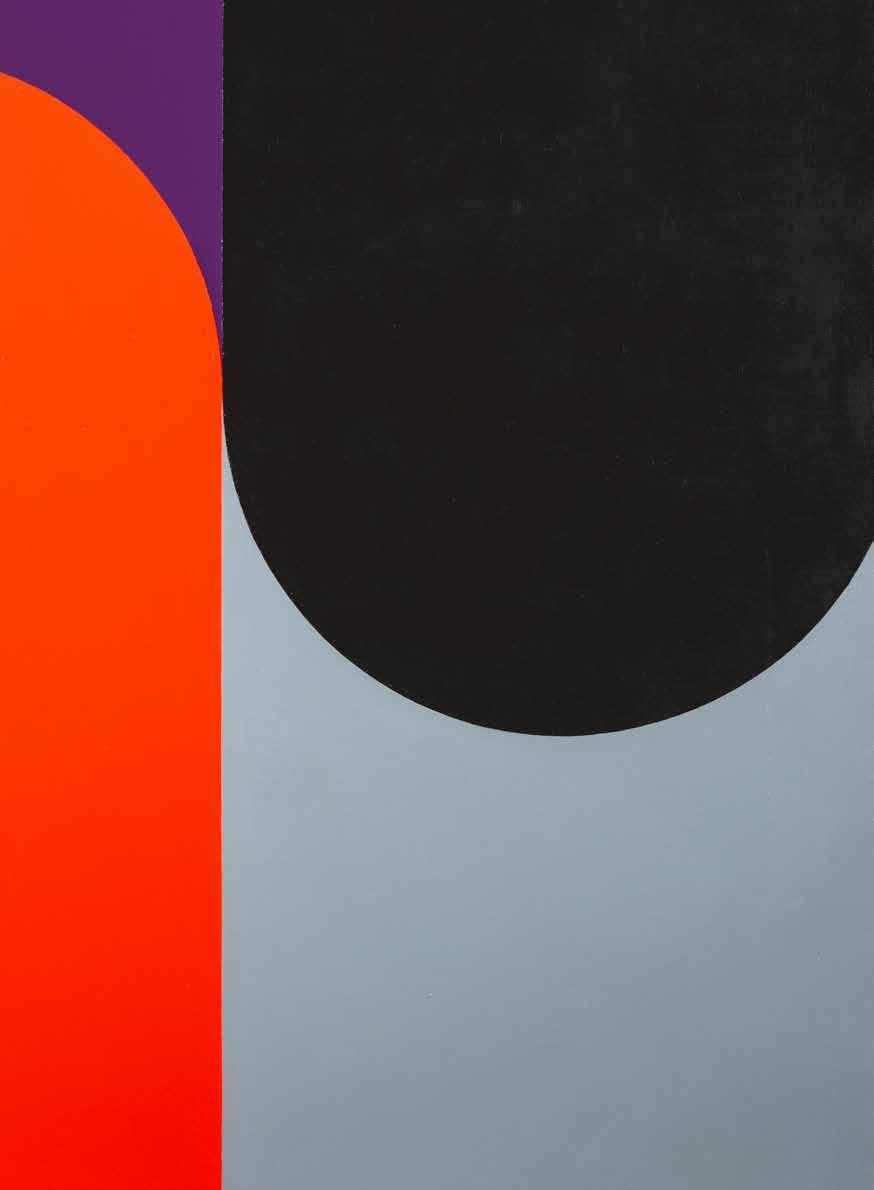
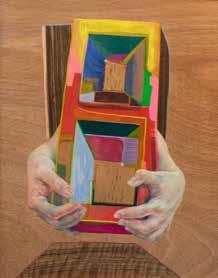
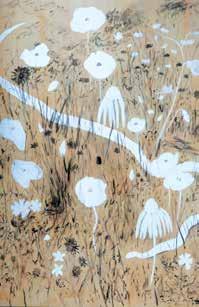
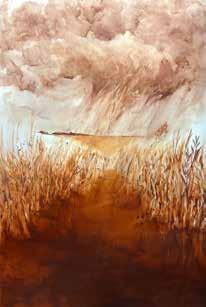
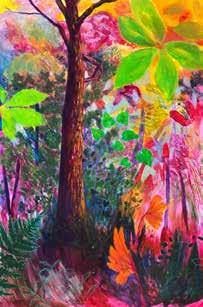
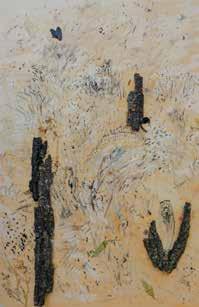
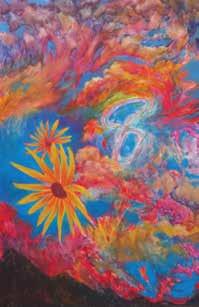
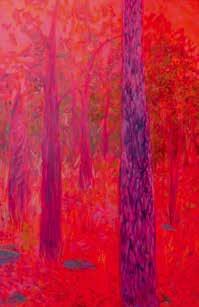
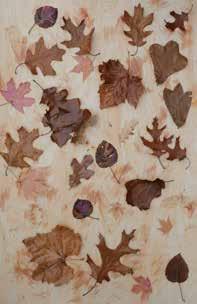
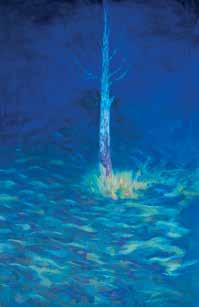
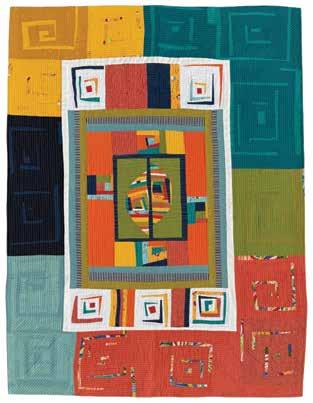
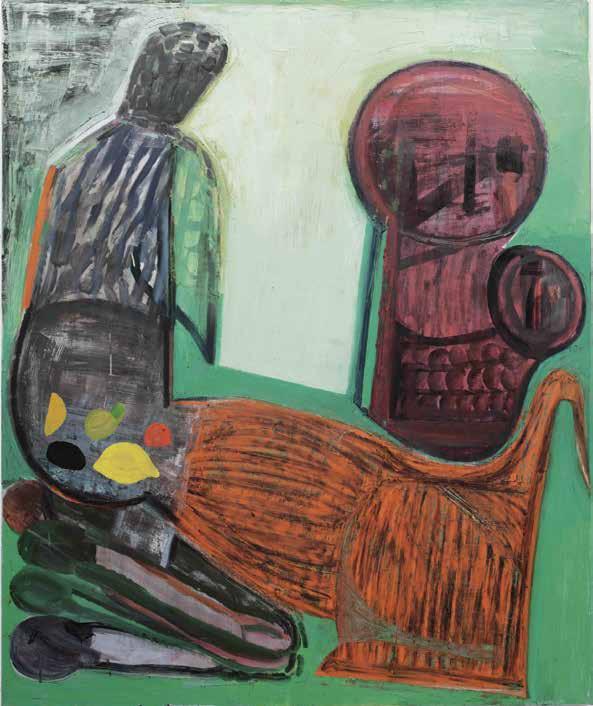
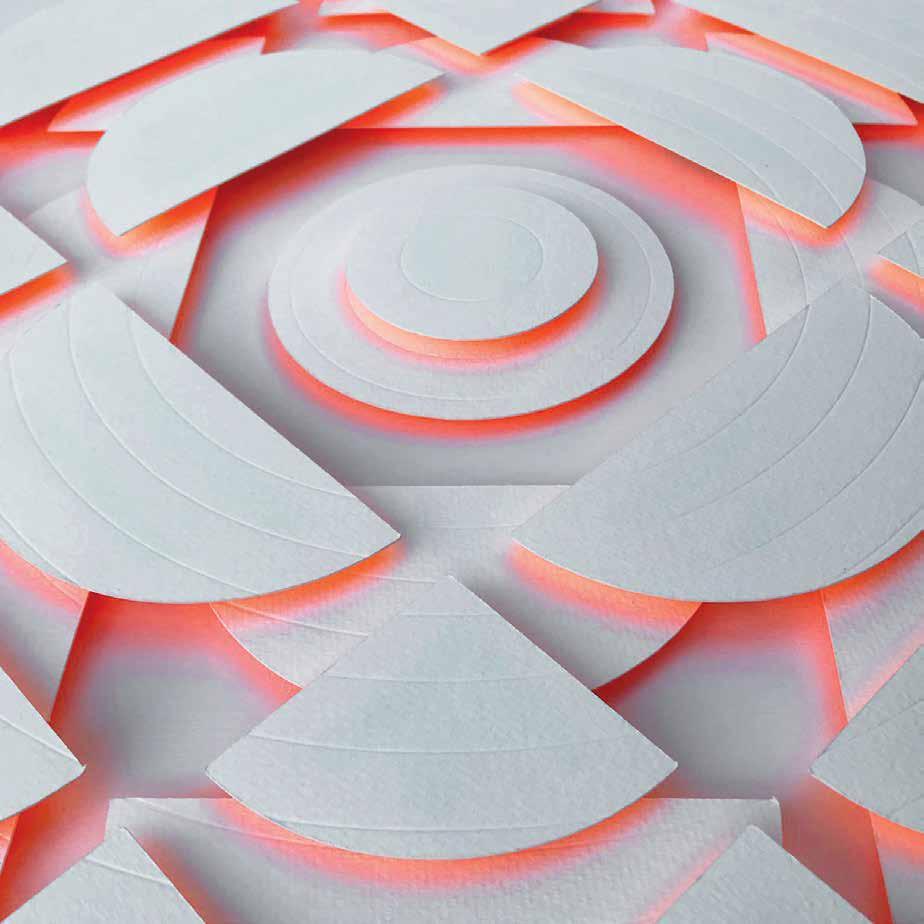
Hammersley, Change Over (#38) (Detail), 1964, oil on cotton, 51 × 40 inches, The Hugon Collection.
ANNUAL SUPPORT FROM:
CONTENTS // Volume 41 No. 3 // SUMMER 2026
ISSN: 3069-244X
LETTER FROM THE EDITOR // ZOE ELROD
IN THE STUDIO EMBODYING ART WITH LIZ DUECK // A Q&A with artist Liz Dueck, who spent a year in touch with nature and with herself to create her project, A Year of Embodied Art .
OLIVIA DAILEY
FEATURE EXPLORING ROUTE 66’S PUBLIC ART TRAIL // Everything you need to know about three recently unveiled works, all celebrating the centennial of Route 66 and developed through the Oklahoma Arts Council’s Art in Public Places program.
ERIN SCHALK
FEATURE GOLDEN GLUE: HOW OKLAHOMA ARTS CENTERS BUILD COMMUNITY // Examining how local spaces like the Norman Firehouse Art Center and Radiant Healing Arts Centers are building community through their exhibitions and programming.
LAUREN SCHLEPP
FEATURE WOMEN’S WORK, WOMEN’S VOICES // A look into the upcoming exhibition, Women’s Work, at Positive Space Gallery, exploring the pieces that reflect what it’s like to be a woman in the arts.
KATE BATTERSHELL
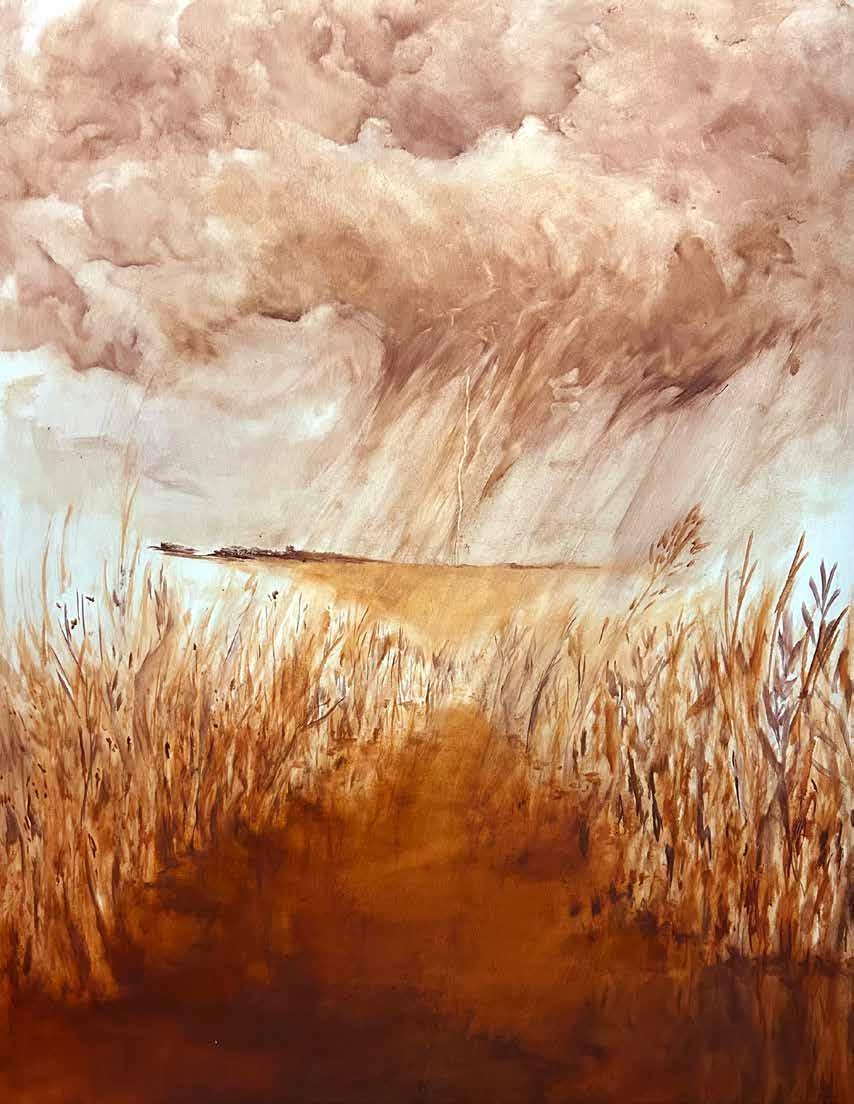
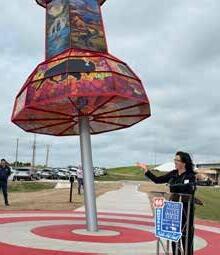
ON THE COVER // Liz Dueck, A Year of Embodied Art – June 2025, page 6. MIDDLE // Oklahoma Arts Council Executive Director Amber Sharples speaking at the ribbon cutting and dedication of You Are Here, created by Joseph O’Connell’s Creative Machines | photo provided by Oklahoma Arts Council, courtesy of the Oklahoma Turnpike Authority, page 12. BOTTOM // JP Morrison, Pretty Brick, 2023, encaustic, color pencil, gouache, wood veneer on panel | photo courtesy the artist, page 22.
OKLAHOMA VISUAL ARTS COALITION // PHONE: 405.879.2400
609 W. Sheridan Ave., Oklahoma City, OK 73102
Web // ovac-ok.org
Executive Director // Rebecca Kinslow, rebecca@ovac-ok.org
Editor // Zoe Elrod, zoeetravers@gmail.com
Art Director // Anne Richardson, speccreative@gmail.com
Art Focus is a quarterly publication of the Oklahoma Visual Arts Coalition dedicated to stimulating insight into and providing current information about the visual arts in Oklahoma. Mission: Growing and developing Oklahoma’s visual arts through education, promotion, connection, and funding. OVAC welcomes article submissions related to artists and art in Oklahoma. Call or email the editor for guidelines. OVAC welcomes comments. Letters addressed to Art Focus are considered for publication unless otherwise specified. Mail or email comments to the editor at the address above. Letters may be edited for clarity or space reasons. Anonymous letters won’t be published. Please include a phone number.
2024-2025 BOARD OF DIRECTORS // Douglas Sorocco, President, OKC; Jon Fisher, Vice President OKC; Matthew Anderson, Secretary, Tahlequah; Jacquelyn Knapp, Parliamentarian, Chickasha; Marjorie Atwood, Tulsa; Barbara Gabel, OKC; Farooq Karim, OKC; Kathryn Kenney, Tulsa; John Marshall, OKC; Chris Winland, OKC
On one hand, time moves so slowly, like we’re all trapped in amber, unaffected by the ever-changing world around us and carrying on in the way artists always have and perhaps always will. And yet it also moves remarkably fast, with years of work from artists perceived by its audience in a single moment.
Art, whether it is written, sculpted, painted, or played on an instrument, has a unique ability to be both lightning in a bottle and completely and totally timeless. As time passes, art becomes a record of changing conversations around gender, politics, nature, and identity, and while so much of the world shifts around us, art remains a constant way for humans to process and make sense of those changes.
Perhaps no one speaks to the passage of time through art better than artist Liz Dueck, who spent an entire year on a creative experiment, painting on a new wood panel each month. The result was her exhibition, A Year of Embodied Art, which writer Olivia Dailey explores in this issue. Stepping into the intimate inner workings of Dueck’s practice, we learn everything from her inspiration in the natural world
to her mindful approach to painting. What emerged was an honest portrait of a year in an artist’s life, with its griefs and celebrations fully on display. As we enter these warm summer months, Dueck’s story serves as a timely reminder that everything has its season.
This season also invites historical reflection. It’s impossible to ignore one of this year’s most significant milestones: the centennial of Route 66. With festivals, exhibitions, and celebrations taking place throughout the year, the anniversary offers a unique opportunity for visual artists, particularly through the Route 66 Public Art Trail, developed through the Oklahoma Arts Council’s statewide Art in Public Places program. Spanning Oklahoma’s 400 miles of the Mother Road, the trail features a series of large-scale public artworks. Writer Erin Schalk explores three of those works (You Are Here, Harvest and Highway, and Relics and Reed) and everything you need to know before setting out to experience them.
While we celebrate history through art, other artists in our community are using their work to illuminate the work still left to be done, particularly in how women are treated in the arts. For the upcoming exhibition Women’s Work at Tulsa’s Positive Space Gallery, Claudette Torneden has curated an intentional exploration of how women artists have been overlooked, dismissed, and marginalized throughout history and into the present day. In these works, time seems to stand still. Through different mediums—from bloodied
photographic imagery to oil paintings of the female form—the exhibition asks viewers to consider what opportunities, conversations, and changes we want to see within our arts community. Writer Kate Battershell examines this exhibition and the questions it raises in this issue of Art Focus.
Finally, writer Lauren Schlepp explores one of art’s greatest powers: its ability to bring people together. Whether art seeks change, as in Torneden’s work, emotional connection, as in Dueck’s, or historical reflection, as in the Route 66 Public Art Trail, it must first accomplish something essential...it must connect us. In an audience of one or one thousand, art is a universal connector. Schlepp examines how local arts centers foster those connections through community-centered exhibitions and programming, framing her article through the Japanese art of kintsugi, the practice of repairing broken pottery with gold lacquer to create something even more beautiful than before.
It’s also something I’ve been thinking about as I reach my first year with Art Focus: how rare and remarkable our arts community is. Take this summer for example, with families exploring the new Formless Matter and its Devastating Gestures work in Campbell Art Park, or this fall when art enjoyers have the opportunity to attend OVAC’s 12x12 Art Fundraiser. I consider myself incredibly fortunate to work alongside writers and artists who tell essential stories and continue the invaluable work of connection, a rare and, above all, timeless art.
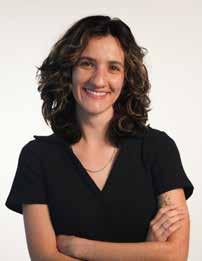
ZOE ELROD is an Oklahoma City-based writer and multimedia storyteller with bylines in KOSU, Make Oklahoma Weirder, Oklahoma Today, Oklahoma City Free Press, etc. Outside of work, she enjoys live music, arts festivals, trips to the movie theater, spending time with her wife and their two dogs, and exploring and uncovering Oklahoma’s iconic and unexpected sides.
Photo by Colby Ballard
A Year of Embodied Art,
by Liz Dueck
IN THE STUDIO: EMBODYING ART WITH LIZ DUECK //
by Olivia Dailey
In March 2025, Sand Springs-based artist Liz Dueck started a year-long creative experiment. Each month, Dueck would intuitively paint on a new wood canvas panel. The resulting collection of work, A Year of Embodied Art ( AYOEA ) showed at Positive Space Gallery in Tulsa from March 7-28. I met with Liz over a video call, the sounds of birds singing in the background, to talk about her artistic process and how it has evolved over the past year.
I love the setting, to start with. Thank you. Yeah, I have this really cool little tree house in my backyard and sometimes I just sit out here and hang out. It is absolutely my dream to have my art studio in a tree house one day. I have to have time for nature and my art.
What made you want to do this project?
Going to school at OSU, getting my BFA, I was trained in this very traditional way. Once I graduated, I wanted to find my own style. I was used to getting a formal reference photo and having a plan. My art practice started evolving into this idea of exploration and connection between art, nature, myself. I started to think about this idea of nature expressionism. Could I paint something off purely a memory or something I felt and experienced?
In art school, I would have an extra piece of oil paper or canvas. I called them venting pieces, where I would just either clean my brush off, or if I was too stuck on a piece, I would just turn and mess around with this other extra canvas. I got into doing that more intentionally, and I’ve even taught mindful painting workshops. I’m helping people connect with art in a more heartfelt space and a more somatic way. What do our bodies feel like when we do this? Or how does the material feel? It’s this totally different way of creating.
You’re capturing a very ephemeral thing, one month of a year.
I had to be done at the end of each month. I would get a
little insecure and think ‘this doesn’t look done.’ But once I looked back through all of them, it shocked me how beautiful they felt to me, raw and real.
There were a number of really intense challenges that I had to go through this year: grief, loss, a lot of change and transitions and love and beautiful things and heartbreak. I’m just so grateful that I had this project to anchor into and to work through some of the hardest things I’ve ever experienced. There are certain months that I have trouble even looking at now because they feel so intense still. I’ve always believed that art holds energy, whether that’s the energy of the artist or that shared energy of people viewing art.
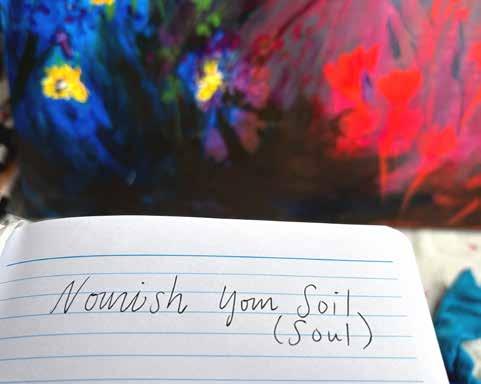
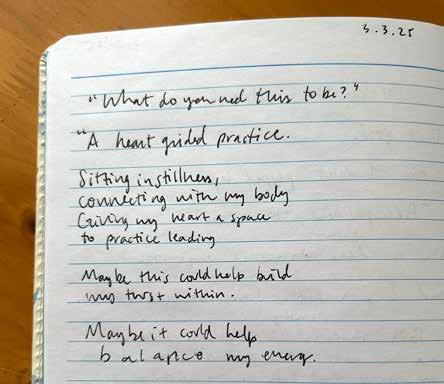
Seeing these pieces at the end of the 12 months, they each felt different and unique and exactly like how I felt in those months. I journaled along with it as well. In the gallery, I had the last page of my journal framed and hung up. It was the page I wrote the last day of the experiment, which was the last day of February of 2026.
CONTINUED
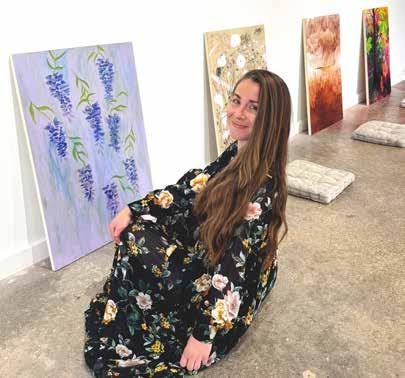
Liz Dueck at her show, A Year of Embodied Art, at Positive Space Gallery, 2026 | photo by Eric Hunker
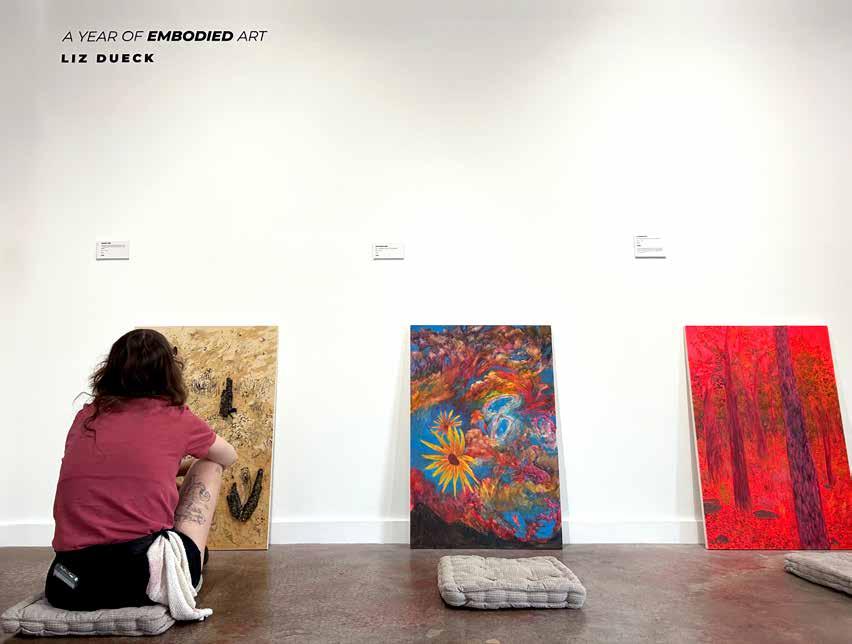
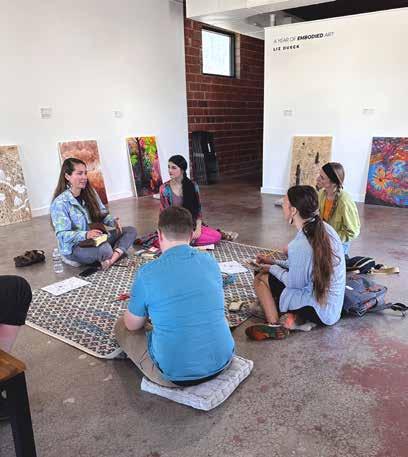
I placed the paintings in order and directly on the ground. Then I had a cushion with each one. I wanted people to be able to sit with the pieces and stay for longer. The longer you sit with art, the more you can feel.
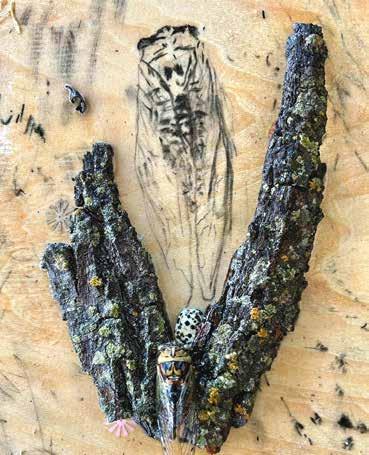
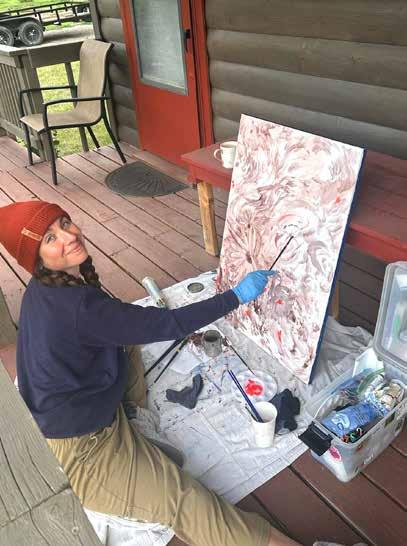
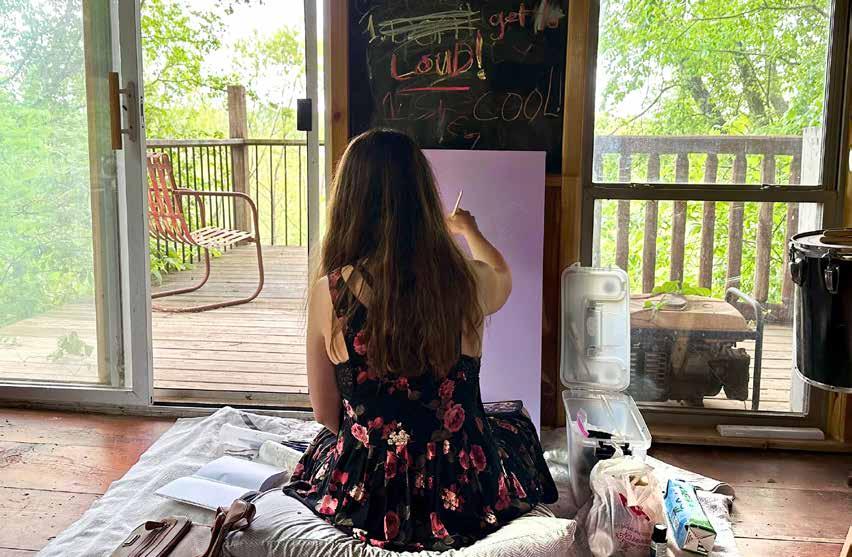
ABOVE // A Year of Embodied Art at Positive Space Gallery, 2026, art by Liz Dueck. RIGHT and BELOW // The process of A Year of Embodied Art by Liz Dueck
It’s a visual reminder that things ebb and flow, like in nature. Nothing blooms all year.
The start of spring absolutely feels like that newness, sowing the seeds, getting the soil ready. In my personal life, March was this catalyst month. The first painting, MARCH 2025 , it’s bright, intense neon storm clouds.
It was fun to see what elements naturally came out. There were a lot of storm clouds and rain and water, but then a ton of plants and trees in different phases. There are so many lessons I’ve learned and understood through nature: the comfort of changes and life cycles, of how energy is never lost, like in a forest, it just changes form.
Let’s talk about the actual show.
I placed the paintings in order and directly on the ground. Then I had a cushion with each one. I wanted people to be able to sit with the pieces and stay for longer. The longer you sit with art, the more you can feel.
Most of the pieces were created on my studio floor or outside in nature on the ground. I was sitting during the process, which feels more grounding and calming, so being seated felt really in alignment with this project.
You also lead art hikes.
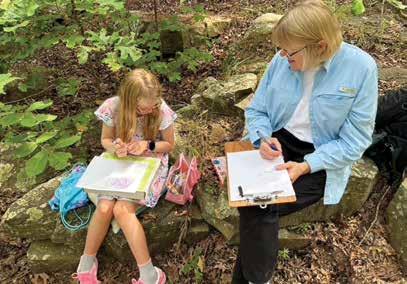
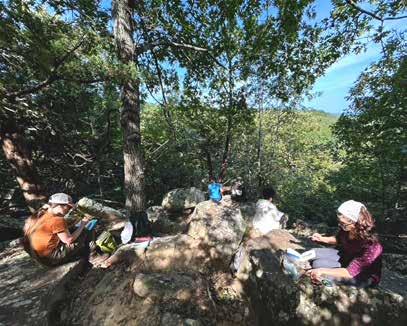
I started volunteering as a trail guide at the Keystone Ancient Forest during the pandemic. Then I started leading free, monthly art hikes there in 2021.
CONTINUED
ABOVE // An Art Hike, an extension of Dueck’s artistic process. BELOW // EmbodiedArt - ArtTherapyTalk at Positive Space Gallery | photo by Nicole Finley
Let’s appreciate what’s around us. I’ve been able to work with some environmental groups in Oklahoma and in some camps that do conservation work. I feel like it’s hard to be a nature artist and not be concerned about nature, right?
Thank you for sharing all of this. Thanks for listening. I could talk about nature and art and feelings forever.
Two of Dueck’s forest-inspired original pieces from A Year of Embodied Art are hanging up at the Keystone Ancient Forest; a selection of prints are also available to purchase there. All prints from AYOEA are available to purchase via the artist’s website at lizdueck.com.
OLIVIA DAILEY earned a B.A. in Journalism from the University of Oklahoma. She works as a program manager for a transportation research center in Norman and is a frequent Art Focus contributor.
The process of A Year of Embodied Art, by Liz Dueck | Photo at the Colorado Cabin by Paitton Kendrick Callery
The process of A Year of Embodied Art, by Liz Dueck
OKLAHOMA, CURATED.
Oklahoma Today is the o cial magazine of our state—where stories are told with soul, artistry, and a deep sense of place. Each issue is a tribute to the bold creators, quiet wonders, and hidden corners that make Oklahoma unforgettable.
Sign up for our free newsletter and let handpicked events, secret spots, and behind-the-scenes stories nd their way to your inbox. Experience a curated journey through the heart of Oklahoma. Subscribe. Collect. Discover. Newsletter.OklahomaToday.com.
With 2026 being the centennial of Route 66, we recognized an opportunity to leverage public art to build upon the highway’s legacy and lure, which brings tens of thousands of travelers to our state, and is a vital means of support for the small towns along its path.
We know public art could uniquely define Route 66’s next 100 years in Oklahoma, creating an experience for travelers that would be exclusive to our state.
— Jarica Walsh
EXPLORING OKLAHOMA’S ROUTE 66 PUBLIC ART TRAIL //
by ERIN SCHALK
As Route 66 marks its centennial this year, Oklahoma is seizing the moment with a public art project as iconic as the highway itself. The Route 66 Public Art Trail, developed through the Oklahoma Arts Council’s statewide Art in Public Places program, features a series of large-scale artworks in communities along the state’s approximately 400 miles of the Mother Road.
Art Focus interviewed Jarica Walsh, Director of Visual and Public Art for the Oklahoma Arts Council, to learn more.
“With 2026 being the centennial of Route 66, we recognized an opportunity to leverage public art to build upon the highway’s legacy and lure, which brings tens of thousands of travelers to our state and is a vital means of support for the small towns along its path,” Walsh said. “We knew public art could uniquely define Route 66’s next 100 years in Oklahoma, creating an experience for travelers that would be exclusive to our state.”
Founded in 1965, the Oklahoma Arts Council is the official state agency and leader for the arts in Oklahoma. Recently, the Oklahoma Arts Council, Oklahoma Department of Transportation, and Oklahoma Turnpike Authority celebrated three new Route 66 Public Art Trail works dedicated in the town of Wellston on April 23, 2026: You Are Here by Joseph O’Connell’s Creative Machines, Harvest and Highway by Cliff Garten Studio, and Relics and Reed by Helen Atkins and Will Geusz.
Walsh offered insights into each work’s visual character, as well as their connections to Route 66 and the state.
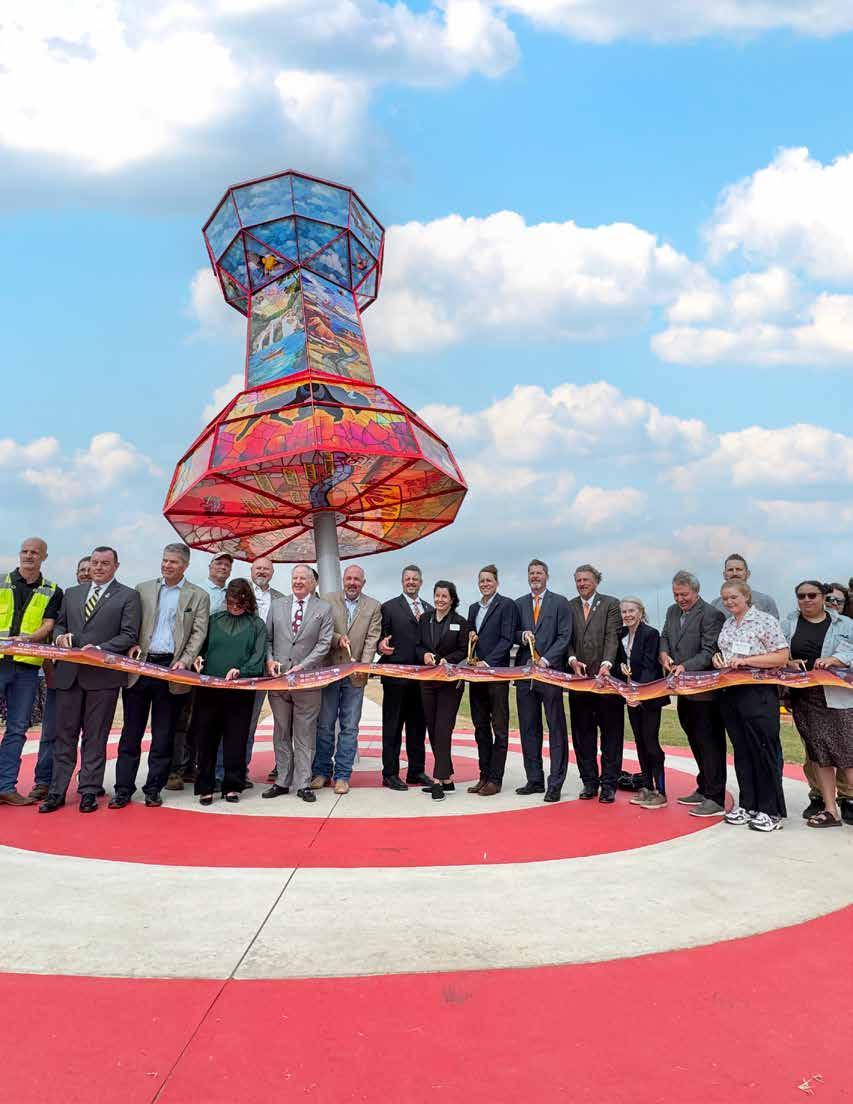
O’Connell’s You Are Here is a striking 23-foot sculptural map pin set at a slight angle in the center of a bull’s eye. Because the pin sits high above eye level, viewers are prompted to
OPPOSITE // Federal and state leaders and community stakeholders with Oklahoma Arts Council Executive Director Amber Sharples (center) during the ribbon cutting and dedication of You Are Here, created by Joseph O’Connell’s Creative Machines | photo provided by the Oklahoma Arts Council
circle it, taking in the sculpture from multiple angles. When viewed from below, the piece reveals the words ‘Here we are on…Route 66 Wellston,’ along with a miniature map of key sites along Oklahoma’s stretch of the highway and beyond.
Walsh provided further background on the piece:
“Wellston stakeholders were eager to highlight the importance of the midpoint of Oklahoma’s miles of Route 66. In conversations about how to best accomplish this priority, we found consensus around the idea of a map pin to mark the spot…When the committee members first saw the proposal for You Are Here, they knew instantly it would be a hit, and it has indeed lived up to this.”
Visually, You Are Here features a prismatic array of polycarbonate panels, with dominant cerulean, green, and magenta hues.
“The stained-glass-like appearance of the panels is enhanced by the internal illumination once the sun sets,” Walsh explained.
You Are Here features symbolic imagery including a Route 66 shield, multiple landscapes unique to Oklahoma, buffalo and horse silhouettes, an oil derrick, and more.
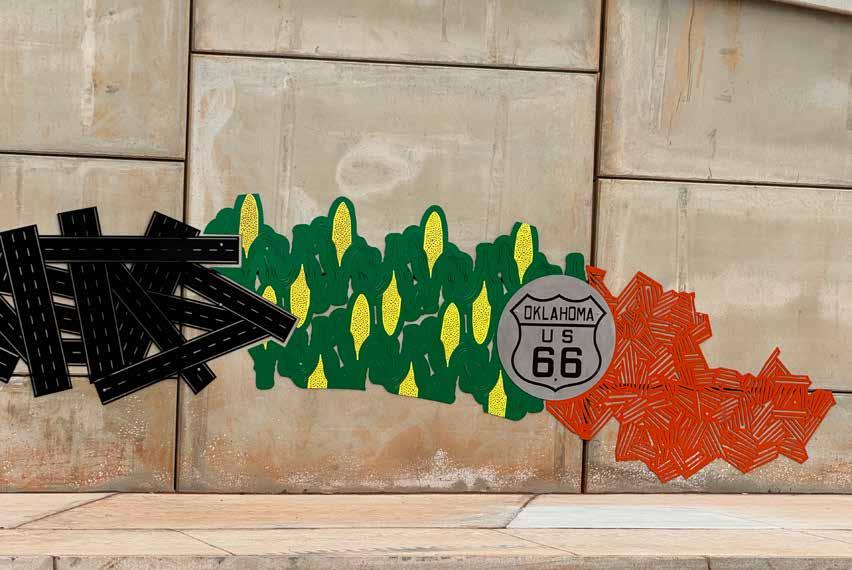
In contrast to the freestanding You Are Here, Cliff Garten Studio’s Harvest and Highway is composed of vivid, powdercoated metal panels mounted along portions of the newly rebuilt Turner Turnpike bridge wall. As a whole, the piece ripples across the bridge’s concrete like a multicolored ribbon, creating a fluid line that plays against the bridge’s rectangular geometry.
Harvest and Highway reimagines imagery inspired by Wellston’s official seal, and it also honors the town’s natural environment and agricultural heritage. The shaped panels depict five elemental themes: corn, wheat, roads, water, and earth. In addition, historical photographic imagery from the town is integrated into the overall composition.
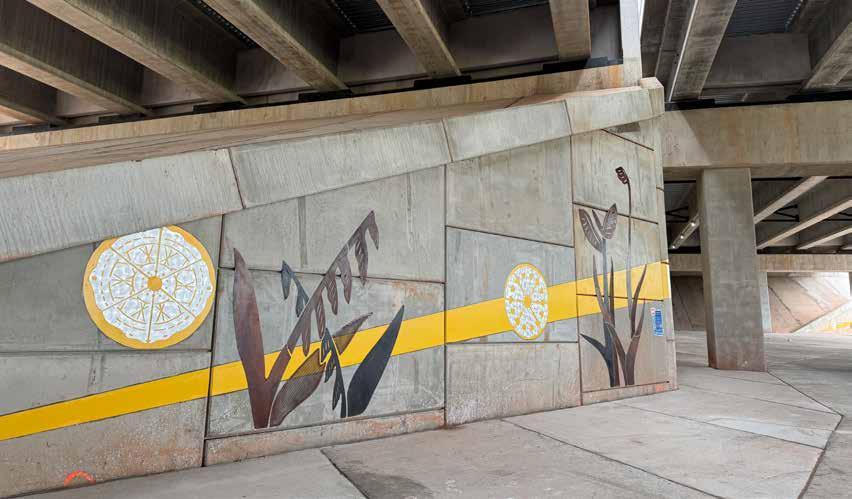
Like Harvest and Highway, Atkins and Geusz’s Relics and Reed also stretches across areas of the Turner Turnpike. A band of bright yellow extends horizontally behind medallion shapes and diverse plants that seem to stretch up from the ground, as if growing in a field. This interplay of strong horizontal and vertical elements creates a dynamic sense of upward and downward motion.
“[Relics and Reed] consists of 17 vignettes, created from steel in three different tonal finishes,” Walsh said. “The piece combines imagery of wheat, native plants, and automobile iconography to celebrate Wellston and the legacy of Route 66. The round, mandala-like shapes are abstracted forms of wheel rims, with one connected to each decade of Route 66’s history.”
These three artworks are among a growing collection along the Route 66 Public Art Trail. The Oklahoma Arts Council’s commitment to the project extends well beyond 2026, and more artwork proposals will be selected in the coming years.
“[Art Focus] readers can look forward to truly unique works
that we hope will delight and captivate people’s imaginations,” Walsh said. “After visitors finish driving Oklahoma’s portion of Route 66, we want them to feel inspired about who we are as a state. We want their trip to create a lasting impression that they talk about with others.”
For more information about the Oklahoma Arts Council and Oklahoma’s Route 66 Public Art Trail, visit arts.ok.gov.
ERIN SCHALK serves as a writer, visual artist, voice narrator, and accessibility-centered educator. She is the recent recipient of multiple Writer’s Digest awards and the Armed Services Arts Partnership’s National Scholarship. She has also received a Best of the Net nomination. Schalk’s work has appeared in Instructure, Wordgathering, Stirring Lit, Parentheses International Literary Journal, The Petigru Review, and numerous other publications. She also holds an MFA from the School of the Art Institute of Chicago.
Cliff Garten Studio, Harvest and Highway | photo provided by Oklahoma Arts Council
Helen Atkins and Will Geusz, Relics and Reed | photo provided by Oklahoma Arts Council
ABOVE // Firehouse Art Center | photo by Casey Gilman
BELOW // Sohail & Co., Firehouse Art Center
GOLDEN GLUE: HOW OKLAHOMA ARTS CENTERS BUILD COMMUNITY //
by LAUREN SCHLEPP
The Oklahoma arts community is an ever-expanding and evolving microcosm, and local arts organizations are at the center of that expansion.
Balancing art, education, community well-being, and creativity takes a jack-of-all-trades skill set that these types of organizations have down to an art (pun intended).
The function of arts centers reminds me of the Japanese art form of Kintsugi: repairing broken ceramics or pottery with a gold lacquer to make something newer, stronger, and more unique, all while acknowledging that the individual parts aren’t broken or incomplete but can serve another purpose.
Creating an art exhibit is not dissimilar to crafting a Kintsugi vessel.
The curator/program coordinator and supporting staff take the separate pieces of community, exhibit preparation, art installation, and programming and glue them together into a thriving community art center that is greater than the sum of its original parts.
Among these local arts organizations are the Prairie Arts Center in Stillwater, the West OK Co-Op, the Spider Gallery, the Cherokee Arts Center in Tahlequah, and the two centers featured here: Norman Firehouse Art Center and Radiant Healing Arts Center. I spoke with staff from these two arts centers about the unique niches they fill in their communities and how that shapes the exhibitions and programming they provide.
Piece One: Community
The Norman Firehouse Art Center was founded in 1970 as a community art center by Carolyn Folkins, Carol Whitney, and Audrey Irwin, three friends and artists. They transformed a decommissioned firehouse into a space for artists to practice their craft and teach others. This space, which is now the longest-running visual arts center in the Norman community, has transformed over the decades with the goal of enriching the community by offering creative visual arts opportunities,
collaborations within exhibitions, and educational outreach programs.
Radiant Healing Arts Center was founded as a nonprofit holistic health center where health professionals and spiritual practitioners could rent office space and be around likeminded individuals. Community is at the center of everything they do, and their newly created art program aims to be a place where local artists and community members can have a casual and approachable way to display their artwork and grow in their creative practice.
Piece Two: Planning & Preparation
Four full-time staff members and five part-time staff members from a variety of backgrounds collaborate to plan the Firehouse Art Center’s exhibitions. Exhibits follow a two-year plan and, when selecting artists, they search for artists who are relevant in the Norman community. Two weeks between each exhibition is dedicated to prep work, when the center turns into a flurry of painting walls, curating artwork, designing the exhibit layout, and developing remaining educational content related to that exhibit.
The entirely volunteer-run Radiant Healing Arts Center utilizes their four board members and about ten volunteers to help plan and run events, manage social media, maintain the building, and wear about a dozen other hats that keep the center functioning. I know a lot about this process firsthand because I serve as the art program coordinator and handle a good portion of the exhibition planning and installation of artwork myself. Artists apply via an open call and the final selection is made by the board director and art program coordinator. Artwork is chosen based on what bodies of artwork will look good together and if they fit the mission and vibe of the building.
Piece Three: Installation
The exhibition space at Firehouse Art Center has a small footprint and is centrally located within the building. It’s
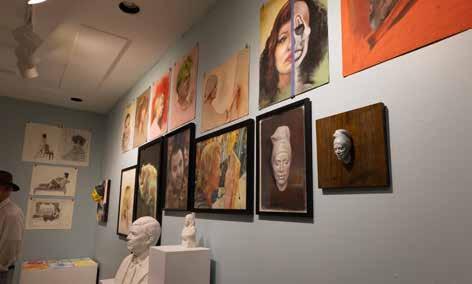
On display now at the Radiant Healing Arts Center: Summer 2026 exhibition featuring Lauren Schlepp, Shoena Harris and Britny Cordera, on display until September 12, 2026.
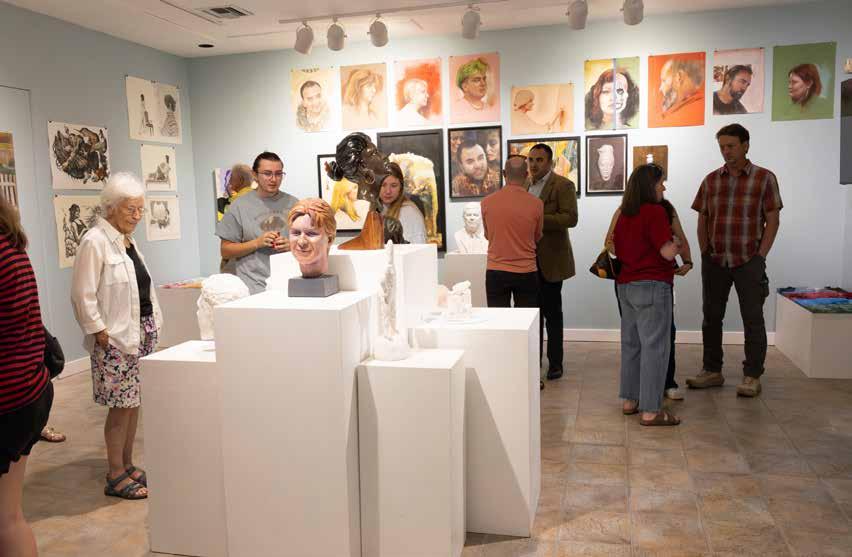
On display now at the Norman Firehouse Art Center: Sohail and Co., exploring the relationship between figure drawing and sculpture, on display until August 7, 2026.
Photo by Arrow Marketing
Selection of Work, Sohail and Co. at Norman Firehouse Art Center
TOP LEFT // Work by Shoena Harris, featured in the Summer 2026 exhibition at Radiant Healing Arts Center; TOP RIGHT // Work by Britny Cordera, featured in the Summer 2026 exhibition at Radiant Healing Arts Center; BOTTOM LEFT // Work by Lauren Schlepp, featured in the Summer 2026 exhibition at Radiant Healing Arts Center
not near a loading dock and lacks a dedicated prep space, so it serves many functions at times, which is a familiar theme for anyone working in galleries. These spaces serve many purposes and need to be able to complete a metamorphosis at a moment’s notice.
Works cannot exceed 90” in any direction for installation, and, during the school year, the space serves over 1,000 elementary students each semester, so extra awareness is given to the space’s layout and fragility of artwork.
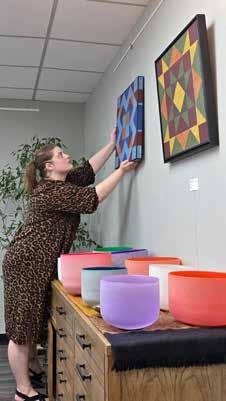
The main spaces where Radiant Healing Arts Center displays artwork are in their lobby and a small multipurpose events room that’s about 750 square feet and has plenty of blank wall space. Exhibitions last for four months and the preparation starts about two months before the exhibit opening date with artwork installation the week before. The designated storage area for artwork is a small set of shelves. Storing large pieces is tricky, so that heavily affects what size of artwork is accepted and the timeline for installation. Artwork is limited to what can be hung on the walls because sculptures or 3D work that requires pedestals would take up too much floor space.
Piece Four: Programming
Norman Firehouse Art Center officials said they emphasize partnerships and collaborations within their exhibitions to invite a larger audience into the arts and to make art as accessible as possible. The exhibitions even form the basis of their “Art Sparks!” community outreach program.
Meanwhile, one of Radiant Healing Arts’ past featured artists began hosting a regular class in the multi-purpose room and has become more plugged in to the partnership program. Artists are able to host workshops and classes at a discounted rate at Radiant Healing Arts Center, and they hope to have more involvement in that area.
Final Kintsugi:
Supporting local art organizations is a positive feedback loop. These centers exist to provide a creative haven for curious people, and when you visit them or take a class at their studio you become part of the golden glue that helps to hold together all the pieces of the Kintsugi vessel that everyone in the community gets to benefit from even if they don’t directly participate in the art themselves.
“We all come from different professional backgrounds and have day jobs outside the center, but we share a desire to nurture body and soul through building community.”
— Radiant Healing Arts Center officials
“Through exhibitions, we invite new audiences into the arts and create new connections within our community.”
—
Norman Firehouse Art Center officials
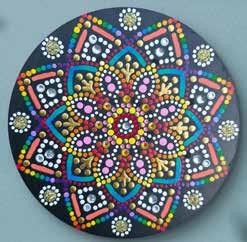
LAUREN SCHLEPP is a multimedia artist and curator based in Oklahoma City, whose artistic style manifests itself as bold geometric paintings that play with patterns, scale, and color theory, as well as detailed collages and “gem paintings.” She graduated with a Bachelor of Arts in Museum Studies in 2016 and has been working in the museum/nonprofit sector ever
since. She loves keeping up with the ever-changing pulse of the arts community and volunteers for many arts organizations and events. Her artwork can be seen in The Paseo Arts and Creativity Center, Allied Arts ARTINI, Edmond Arts 5”x5”, and OVAC’s MOMENTUM and 12x12 shows.
Disclosure: Schlepp serves as art program coordinator for Radiant Healing Arts Center.
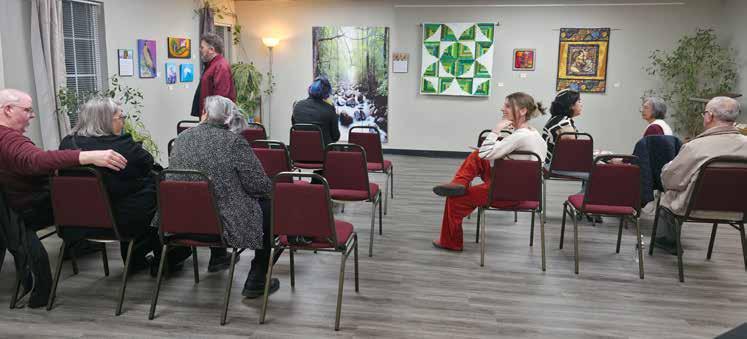
Winter Art Show at Radiant Healing Arts Center
Join us for a community quilt craft activity, exclusive workshops, and live artist demonstrations. Find more details on our website.
Exhibition Opening: Friday, June 5, 2026 from 6:00 - 9:00 pm
Exhibition Opening: Friday, August 7, 2026 from 6:00 - 9:00 pm
Artist Talk: Saturday, August 8, 2026 at 1:00 pm
*ASL interpretation provided*
WOMEN’S WORK, WOMEN’S VOICES //
by Kate Battershell
“What has being a woman in the art world been like for you?”
This was the question Claudette Torneden approached her fellow artists with. The “woman issue” has been a persistent nuisance to Torneden for the whole of her art career, and she’s not alone. When posed with an invitation to exhibit on the very issue, many were eager to partake in and create new pieces just for the show. Others hesitantly refused, citing a fear of blowback to their careers. For such an exhibition, Positive Space Gallery in Tulsa was the immediate choice to host. Nicole Finley founded Positive Space as a women-led gallery to be just the kind of place for these grievances to be aired.
Torneden titled the exhibition Women’s Work as a playful dig on the forced limitations of women’s socially acceptable spheres. Torneden reflected on the impact of having to shrink herself and her art in order to be granted access to exist and exhibit in the traditional photography world.
“Going by VC Torneden was only a way to hide that I was female from galleries when I was young,” she said. “I think after [Women’s Work], I’m going to drop using that and use Claudette–it is my name.”
Torneden acknowledged that the upper echelons of the arts are often a boys’ club, citing both long-standing statistics surrounding the lack of female representation in the auction circuits and anecdotes from female artists of questions around their dedication to their art in lieu of their families.
The participating artists were given free rein to interpret the theme however they saw fit and through whatever medium they preferred. Women’s Work highlights artists from Oklahoma and Texas whose ages range from 21 to 82 and whose backgrounds are equally diverse, including immigrant, Indigenous, and African American women. Together, they exhibit works informed by their lived experiences.
“It wasn’t an intentional push to be as diverse as we could–it fell into place by itself,” Torneden said. “I wanted these people because of the work they produce, and this is why [the exhibition] covers so many bases.”
Sculptor and Oklahoma arts professor Jordan Vinyard’s work sits in the intersection of tech machinery and the corporeal body, which she uses to dehumanize and rehumanize the performance of being a female artist. In her recent kinetic sculpture, small, automated brushes furtively sweep pigment dust up to a sieve, which rains it back down to be swept up again in Sisyphean toil.
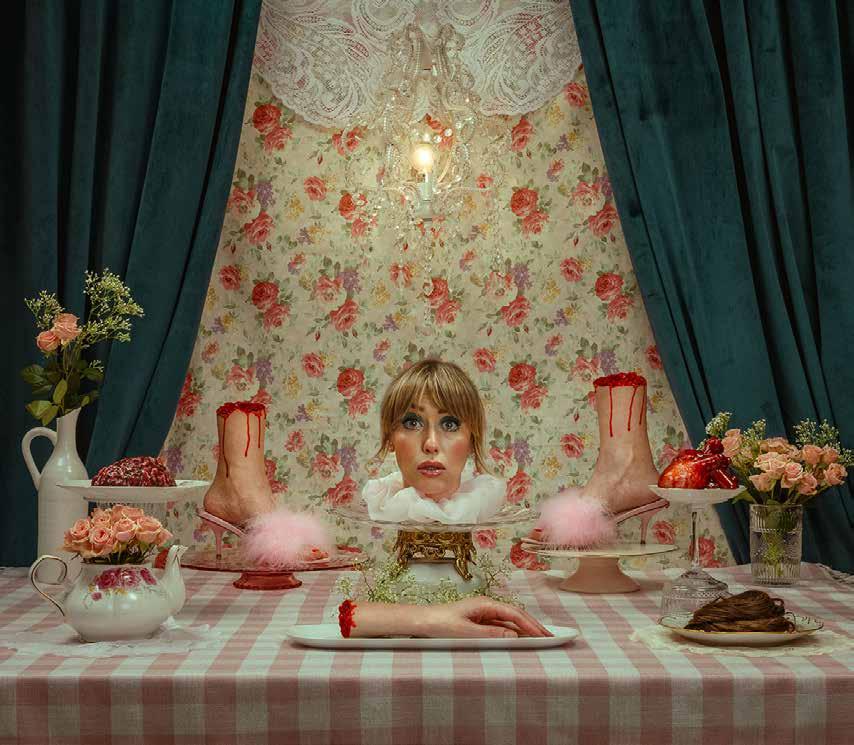
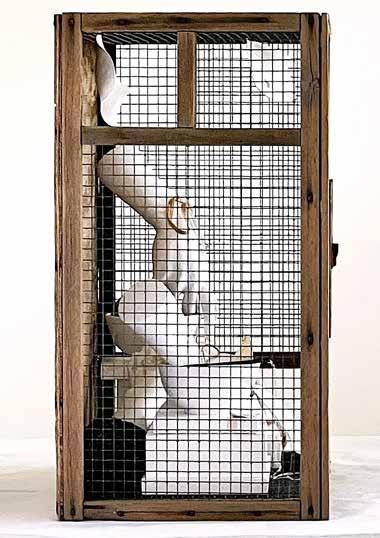
Vinyard separates herself as machine metaphorically, while photographer Alex Eischeid does so more literally. In her hyper-surrealist self-portrait, Here For Your Consumption, Eischeid is dismembered and served up to her audience. The centerpiece, her shocked head, is adorned by two pink, slippered feet and displayed in manageable, marketable chunks. In the foreground sits Eischeid’s hand–cut at the forearm–mirroring the mixed-media assemblage, Severed by L. Katherine Roberts. A severed hand is confined in a live trap–unable to escape–but surrounded by sacred vessels, needles, wasp nests, and sheep locks–all symbols of healing. Hands are what make us human–they give us our ability to create, to care for ourselves and others, to fight against systems of oppression.
Rochelle Lee Hardman and Ashley Forrest share a medium and reverence for art’s history. They both draw from past art movements and place their own perspectives at the center. Hardman paints in a surreal, Impressionistic style rife with visual metaphors, and Forrest’s distinctly Cubist painting style both buck the traditionally masculine history of the movements and flip them on their heads to place women’s perspectives–not just their bodies–as the subjects.
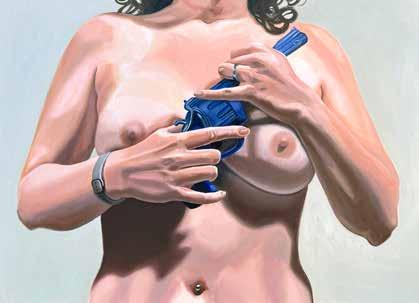
In the same way, Shannon Cannings’ oil painting Pry depicts that same common art subject: a naked female torso, though
Here For Your Consumption, Alex Eischeid, 2026, digital photography | photo courtesy the artist
Cannings’ subject is gripping a pistol. Cannings describes this piece as “stealing the words of old white guys” when addressing their guns and weaponizing those words back to them on the continually fraught state of women’s bodies.
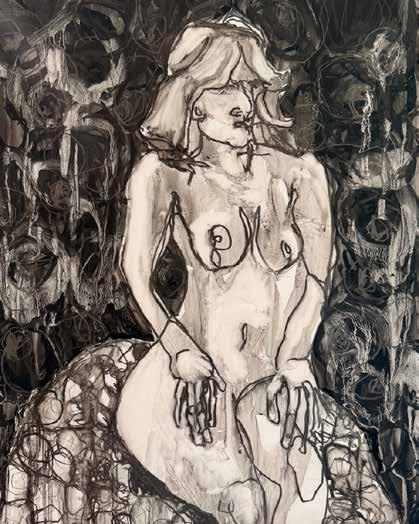
Leslie Hamrick, a Tulsan mixed-media artist, presents a charcoal life drawing, Not Safe From The Algorithm, in which she distorts her female figure in a way similar to antisurveillance makeup techniques as she “refus[es] to alter [her] vision to appease automated censorship”.
JP Morrison’s mixed-media work, Pretty Brick, (see art on page 3) is a refusal as well. Morrison crafts her anger as a wooden brick, done up in color, in the midst of being hauled away–either to be thrown or laid as a foundation.
The arts are built on community, and much of that depends on the rooms you are in, but when the doors are shut to you, that community and those opportunities are inaccessible.
In Torneden’s eyes, the Oklahoma art space is unique in that “so much of this is built off the backs of the artists rather than the system money.” Without strong arts funding, the Oklahoma arts community has shaped and held itself up through the communion and collaboration of the female artists who have come to define it.
Women’s Work will run from July 3 to July 25 at Positive Space Gallery in Tulsa, with an opening reception on July 3 from 6-9 p.m. and a closing reception along with artist talks on July 25 from 6-9 p.m.
KATE BATTERSHELL is an arts graduate from Oklahoma State University, which houses one of her fiber arts tapestries in its permanent art collection. She currently works in philanthropic giving. In her spare time, she freelances in art collection management for artists and collectors in Oklahoma and is a frequent Art Focus contributor.
ABOVE // Pry, Shannon Cannings, 2024, oil on panel | photo courtesy the artist; RIGHT // Not Safe From the Algorithm, Leslie Hamrick, 2026, charcoal and graphite on yupo paper | photo courtesy the artist
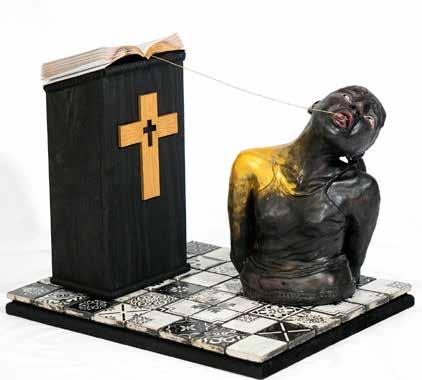
RIGHT // Tongue Tied, Colleen Stiles, 2025-2026, mixed media | photo courtesy the artist
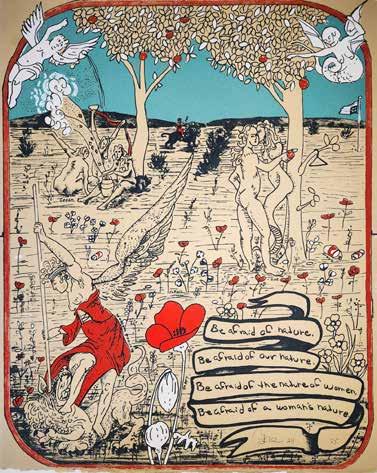
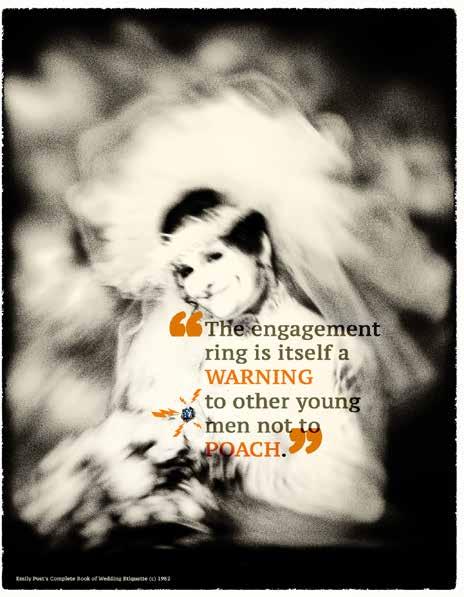
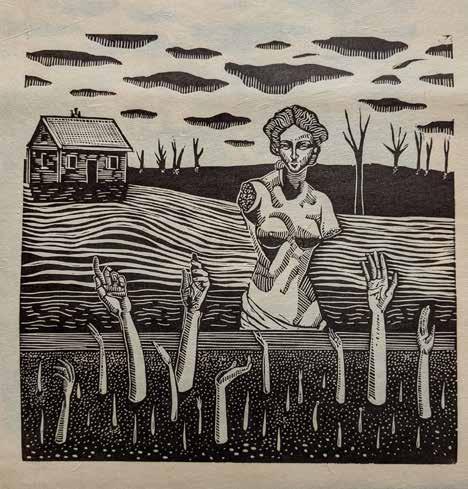
CLOCKWISE FROM ABOVE // Scorned Women on a Bed of Poppy Flowers, Catherine Prose, 2024, screen-monotypes, edition screenprint | photo courtesy the artist; No Poaching - Transferable Property series, Melinda Green Harvey, 2026; I’ll Just Grow My Own , Candacee White, 2026, linocut on Hanji paper | photo courtesy the artist; Severed , L. Katherine Roberts, 2026, mixed media assemblage | photo courtesy the artist