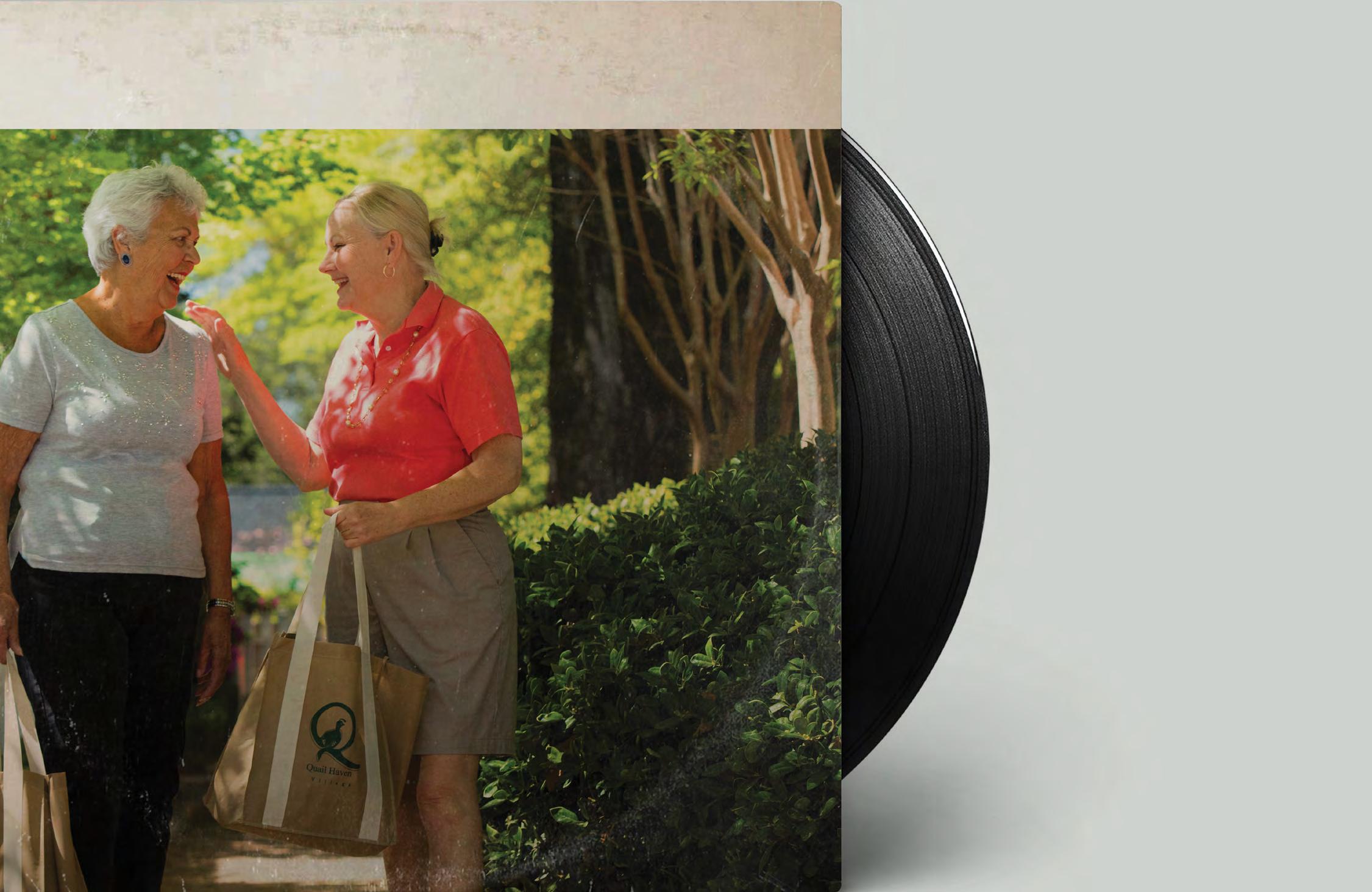
In the summer between middle school and high school, I spent a few weeks in upstate New York with my grandfather and his sister, my great Aunt Marie. I’d just met Aunt Marie because she was an East Coast resident, and my side of the family was squarely West Coast. But that summer, when she met me at the Syracuse airport and offered a card game to pass the time (Authors), I fell in love with a woman who would become not just an aunt but a mentor and a comrade, the person who was always on my side, who funded my education, inspired my writing and sent me endless letters of encouragement during my Peace Corps service in China.
As I sit at my trusty laptop, I just finished an email in which I wrote: I long for the first crisp day of fall. We are in the dog days of summer, and it’s only July. By the time this issue hits the stands, it will be August. I’d love to say we only have a few more weeks of the sort of heat that drains our energy and makes a nap seem like the only option for the afternoon. Alas, we have more than a few weeks, but we will carry on.
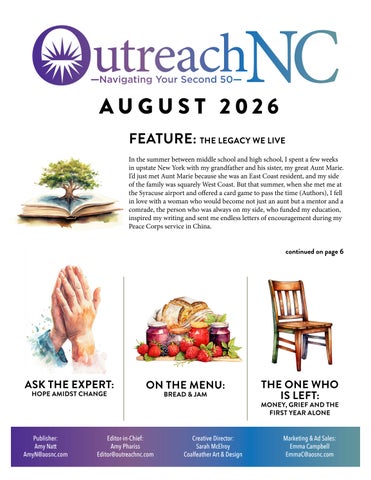
For August, in our feature “The Legacy We Live,” we explore the legacy of how we live and what that means for the people we love. Legacy isn’t always a thing we leave behind, something that becomes part of our past. Legacy is also how we live today, a verb as much as a noun.
In this month’s Ask the Expert, Jennifer Tyner explores Parkinson’s disease including how a diagnosis affects more than physical health but also mental health, emotional wellbeing, relationships and, above all, hope. Tyner explores the nuances of this diagnosis and life with an illness that touches every area of life.
In our financial column (we’re blessed that Doug Lynam has signed on for monthly writing!), Lynam writes about the first year after the loss of a spouse and
Well, it’s official: fall is here. I had my first pumpkin-spiced latte just ture dipped low enough to merit a fleece.
Don’t worry. It was decaf.
the financial consequences we’re often unaware of. In “The One Who is Left: Money, Grief and the First Year Alone,” Lynam explores the bigger themes of grief, transition, overwhelm and confusion as well as the finer details of tax implications and Social Security forms.
October is a gentle month. There are constant reminders of change. we are lucky, toward each other. We have lingering conversations over the flames flicker. Smoke dances around us in a circle. We zip our jackets
In this month’s feature, we’re starting an important conversation: care community for ourselves or a loved one? Fox Hollow Senior Robin Hutchings offers inside perspective for making this decision.
In On the Menu, we’ve got recipes with heritage, legacy and flair. We’ve also added a Poetry Corner, after several of you wrote in and commented on how much you’ve enjoyed the poems we print. This month, we’re including poetry to remind us how our lives matter and how they’ll be remembered.
In Ask the Expert, Amy Natt answers a reader’s question regarding what away without any estate planning. Without a will or access to important
Physical therapist Dr. Sara Morrison of Total Body Therapy and Wellness potential diagnostic tools used in physical therapy to help diagnose and these tools differ from what other doctor’s offices may offer.
Finally, for our Mental Health Matters column, we’re doing a National Wellness Month wordsearch. August is National Wellness Month, so what could be better than quiet time, a cognitive challenge and possibly some social betting on who’ll finish first?
I’m going to agree with Nathaniel Hawthorne this month, who wrote: I cannot endure to waste anything so precious as autumnal sunshine spent almost all the daylight hours in the open air.
August 21st is National Senior Citizens Day, and the words of Frank Lloyd Write (who designed Fallingwater at the age of 67 and began work on the Guggenheim Museum at the age of 76) are particularly fitting:
Here’s to enjoying the October sunshine, falling leaves and daylight
“The longer I live, the more beautiful life becomes.” Indeed,
Keep up with all things ONC by following us on social media.
Home is Where the Hea
and with the right care, it’s where you comfortably, safely, and independe
Let us refer private-duty caregivers who wi according to your needs and schedule
Whether you need a few hours of daily perso the extra security of 24-hour care, our larg pre-screened caregivers can accommodate y S
| info@AOSNC.co
ASK THE EXPERT: HOPE AMIDST CHANGE
Jennifer Tyner, AOS Care Management, Lead Care Manager | jennifert@aoscaremanagement.com
Q: My husband was recently diagnosed with Parkinson’s disease. Since then, it feels like everything has become about doctor’s appointments, medications, and what he can no longer do. How can I help him stay hopeful—and how do I stay hopeful myself?
A: I am so glad you reached out because this question and your experience are shared by so many people with a loved one diagnosed with Parkinson’s. One thing I like to tell clients is: A Parkinson’s diagnosis changes our life, but it doesn’t define it.
When we first hear the word Parkinson’s, our minds often go straight to the physical symptoms: tremors, stiffness, changes in movement, and the progressive nature of the disease. These challenges are very real, but focusing only on the medical side of Parkinson’s can mean we can overlook the person who is living with it.
I recently attended the 42nd Annual Aging Life Care Association Conference and listened to the presentation by Dr. Allan Cole: “Resilience, Hope, and Parkinson’s.” One of the most meaningful ideas shared by Dr. Cole, who lives with Parkinson’s himself, is the distinction between disease and illness. Disease is what physicians diagnose and treat. Illness is the personal experience of living with that disease. It includes the emotional, social, and spiritual questions that naturally arise: Who am I now? What does this mean for my future? How do I continue living a meaningful life?
Supporting someone with Parkinson’s means caring for both.
Parkinson’s is often described as a “loss-based” condition because people experience many changes over time. There may be losses in mobility, independence, work, routines, or even confidence. Those losses deserve to be acknowledged rather than minimized. At the same time, it is equally important to recognize what has not been lost.
A diagnosis does not erase a person’s identity. They are still a spouse, parent, grandparent, friend, volunteer, artist, gardener, musician, or neighbor. Those roles continue to matter.
Dr. Cole encourages people to focus on what they can still control. While no one can choose a diagnosis, we can often choose how we respond to it.
WE CAN DECIDE HOW WE SPEND OUR TIME, WHO WE CONNECT WITH, WHAT BRINGS US PURPOSE, AND HOW WE CARE FOR OURSELVES.
These choices restore a sense of agency when so much else feels uncertain.
Community also plays a tremendous role in resilience. Parkinson’s can be an isolating disease, particularly if people begin withdrawing from activities they once enjoyed. Staying connected with family, friends, exercise groups, support groups, or faith communities reminds people that they are not facing this journey alone.
RESEARCH CONSISTENTLY SHOWS THAT STRONG SOCIAL CONNECTIONS CONTRIBUTE TO BETTER EMOTIONAL WELL-BEING AND QUALITY OF LIFE FOR PEOPLE LIVING WITH CHRONIC ILLNESS.
As caregivers, we sometimes feel pressure to fix everything. The truth is, some things cannot be fixed—but they can be faced together. Sometimes the greatest gift we offer is our presence. Listening without immediately trying to solve a problem, encouraging independence when possible, celebrating small victories, and making room for laughter all help preserve dignity and hope.
Hope itself is often misunderstood. It’s not pretending everything is fine or denying that life has changed. HOPE IS CHOOSING TO BELIEVE THAT LIFE CAN STILL CONTAIN JOY, PURPOSE, AND MEANINGFUL MOMENTS DESPITE THOSE CHANGES.
Dr. Cole begins each day with a few simple reminders: to be grateful for another day, to do his best with the day he has been given, to focus on both his strengths and his needs, and to intentionally choose hope. Gratitude and hope, he suggests, grow together.
If you love someone with Parkinson’s, remember this: your role is not simply to help manage a disease. It is to continue seeing—and helping them see—the whole person behind the diagnosis.
Parkinson’s changes life, but it doesn’t erase the possibility of connection, purpose, growth, or joy. With compassionate care, meaningful relationships, and a willingness to adapt, individuals and families can continue building rich, fulfilling, and deeply meaningful lives.
The Legacy We Live
by Amy Phariss
continued from page 1
Over the decades, I watched her way of life and absorbed much of it, the quiet afternoons spent napping and reading, the belief that we dress for dinner, the appreciation for grammar and a love for Danish midcentury furniture. Aunt Marie had a style, a message she sent with her manners, her grammar, her politics, her education and, most of all, her unwavering belief that human beings can survive hardship and continue to thrive.
What comes to mind when you hear the word legacy?
Most of us think first of the tangible things we leave behind. Family photographs. Handwritten recipes tucked inside a favorite cookbook. A wedding ring passed from one generation to the next. A quilt stitched by hand, or perhaps a collection of stories that only grows richer with retelling.
Aunt Marie certainly left me many tangible items: a pair of ginger jars she purchased in China, a mid-century coffee table I use today, a book of Robert Frost poems signed by Frost himself.
These are the things we preserve because they remind us where we came from and who came before us.
Lately, though, I’ve found myself wondering if our
greatest legacy has less to do with the things we leave after we’re gone and more to do with the way we choose to live while we’re here.
As I’ve gotten older, I’ve developed a much deeper appreciation for time. It’s not just for how I spend my own time but for the time spent in the world around me. I think about the hours baked inside a loaf of fresh bread, the seasons required to cultivate a thriving garden, the countless stitches in a hand-knit sweater, or the careful repair of a torn shirt that might otherwise have been discarded. Even a handwritten letter feels different to me now. It carries with it something a text message never can: evidence that another person believed this conversation was worthy of both their time, attention, a piece of paper, a walk to the mailbox and a stamp, a real, hold-it-in-your-hand stamp. What draws me to these things is not nostalgia or a desire to reject modern life. Instead, I find myself increasingly aware of the skill required to live a life of depth, meaning and quality, the opposite of fast fashion, fast food and a piece of furniture that falls apart if I move it too quickly.
True craftsmanship asks something our culture rarely celebrates anymore. It asks us to practice patiently,
to fail repeatedly, to begin again, and to devote ourselves to learning something well simply because it is worth knowing. The beauty of the finished object is inseparable from the years of quiet practice that produced it.
The more I think about it, the more I realize that much of this knowledge is quietly disappearing. When I imagine the people who could teach me these skills, I don’t picture experts on YouTube or influencers on social media. Instead, I think of the generations before us. The women who mended clothes because replacing them wasn’t an option. The men who repaired tools instead of buying new ones. Families who baked bread because that was how bread arrived on the table, and who planted gardens because that was where much of dinner came from. They were not preserving quaint traditions or cultivating an aesthetic. They were simply living the lives necessity required of them. Along the way, they became masters of skills that many of us now long to recover.
There are folk schools popping up in communities because people have a deep hunger for quality, craftsmanship, creativity and connection.
Perhaps that is what I find myself searching for – not just the skills themselves but the worldview they represent. Living well means learning well. Competence is cultivated slowly, often over decades, and is valued not because it can be monetized or displayed, but because it makes everyday life richer, more capable, and more resilient. These skills become a quiet inheritance, passed from one set of hands to the next, carrying with them lessons about patience, stewardship, humility, and care.
Of course, there comes a season when life changes. We may no longer have a large garden to tend or the strength to split wood. Arthritis might make knitting more difficult. We may move from the family home into a smaller apartment or trade a bustling kitchen for a dining room where someone else prepares our meals. There’s a temptation to believe that because we can no longer do what we once did, our opportunity to leave a legacy has somehow diminished.
I don’t believe that’s true. In fact, it was when Aunt Marie moved to a senior living community that we spent the most time together. I would go for visits, staying in a lovely guest room just down the hall. We met daily for long walks, had Chinese food in town, ran errands and picked up prescriptions. We talked about art, the world, her travels and my own plans for life. She
listened, offered insight, made quips and then told me to go take a nap before dinner, which I did. We started dinner festivities at 4:45 p.m., in Nina’s apartment, for what they called “4:45s.” Sherry and mixed nuts, wheeled into the living room on a cocktail cart, with a side of civilized conversation that brushed upon politics but never stayed too long. Aunt Marie believed politics were too personal for public conversation. To this day, I tend to agree. And as I type this, I plan to purchase a bottle of sherry and transition my days at 4:45, if at all possible, with bowl of mixed nuts.
If legacy is only about what we produce, then it has an expiration date. But if legacy is about how we live, it continues as long as we do and as long as anyone else can remember – which, if you’ve ever made a mistake, you know is a very long time.
We can continue to cultivate curiosity by learning a new craft, studying a language, joining a book club, or asking someone to teach us a skill we’ve always admired. We can continue to cultivate beauty by arranging flowers from the grocery store, setting the table with care even if we’re dining alone, or choosing clothes that reflect the dignity with which we wish to meet the day.
We can cultivate generosity by writing letters, sharing family recipes, mentoring a young parent, or simply becoming the neighbor who remembers birthdays and welcomes newcomers.
ONE OF THE GREATEST GIFTS OF AGING IS THAT IT FREES US FROM THE PRESSURE TO IMPRESS ANYONE.
We’re not building careers, proving ourselves, or chasing the next achievement. We’re able instead to become students again—to learn for the joy of learning, to create for the satisfaction of creating, and to savor the ordinary moments that once hurried past unnoticed.
When I think about the people who have shaped my own life, I realize I remember very little about their accomplishments. I remember how they welcomed people into their homes. I remember the meals they cooked, the books they recommended, the hymns they sang, the gardens they tended, and the quiet confidence with which they moved through the world. What they left me wasn’t simply a collection of memories. They left me an example of how to live.
Maybe that’s the truest definition of legacy. It’s not the scrapbook on the shelf or the set of fine china, though those items have their place.
Legacy is also the patient wisdom we pass from one generation to another. Aunt Marie used to say, “Way will open.” I think of that nearly every day. And it’s true. Way will open. I watched it open for her through her decades of teaching, traveling and quiet reflection as a Quaker. She lived simply and humbly, and when I think of her, she’s in an L.L. Bean sweater, a book in one hand, a Pepperidge Farm cookie in another.
Legacy is the values our grandchildren absorb without our ever speaking them aloud. It is the beauty we choose to create, the skills we continue to learn, the curiosity we refuse to lose, and the kindness we practice until it becomes part of who we are. Sometimes it’s our saltiness, our refusal to join the “modern world” or the stories we tell that are bawdy or inappropriate. Often, those are the best stories of all.
Legacy is the handmade wooden box our grandfather made our grandmother for her jewelry, not the box itself but the hours of care taken to craft it by hand. Legacy is his skill, his attention, his love.
In the end, the question isn’t only, “What will I leave behind?” It’s also, “What way of living am I leaving behind?”
Because long after people have forgotten our résumés, our titles, and many of the stories we told, they will remember the life we quietly led, one day at a time.
I cannot think of a better poem to convey how a man lived than Henry Wadsworth Longfellow’s The Village Blacksmith. It makes one consider how we each might be described in such detail by those who loved us, worked alongside us and knew us in one of our roles…or another.
The Village Blacksmith Henry Wadsworth Longfellow
Under a spreading chestnut-tree
The village smithy stands; The smith, a mighty man is he,
With large and sinewy hands; And the muscles of his brawny arms
Are strong as iron bands.
His hair is crisp, and black, and long;
His face is like the tan; His brow is wet with honest sweat,
He earns whate’er he can, And looks the whole world in the face,
For he owes not any man.
Week in, week out, from morn till night,
You can hear his bellows blow; You can hear him swing his heavy sledge,
With measured beat and slow, Like a sexton ringing the village bell,
When the evening sun is low.
And children coming home from school
Look in at the open door; They love to see the flaming forge,
And hear the bellows roar, And catch the burning sparks that fly
Like chaff from a threshing floor.
He goes on Sunday to the church,
And sits among his boys; He hears the parson pray and preach,
He hears his daughter’s voice, Singing in the village choir,
And it makes his heart rejoice.
It sounds to him like her mother’s voice,
Singing in Paradise!
He needs must think of her once more,
How in the grave she lies; And with his hard, rough hand he wipes
A tear out of his eyes.
Toiling,—rejoicing,—sorrowing,
Onward through life he goes; Each morning sees some task begin,
Each evening sees it close; Something attempted, something done,
Has earned a night’s repose.
Thanks, thanks to thee, my worthy friend,
For the lesson thou hast taught! Thus at the flaming forge of life
Our fortunes must be wrought; Thus on its sounding anvil shaped
Each burning deed and thought!
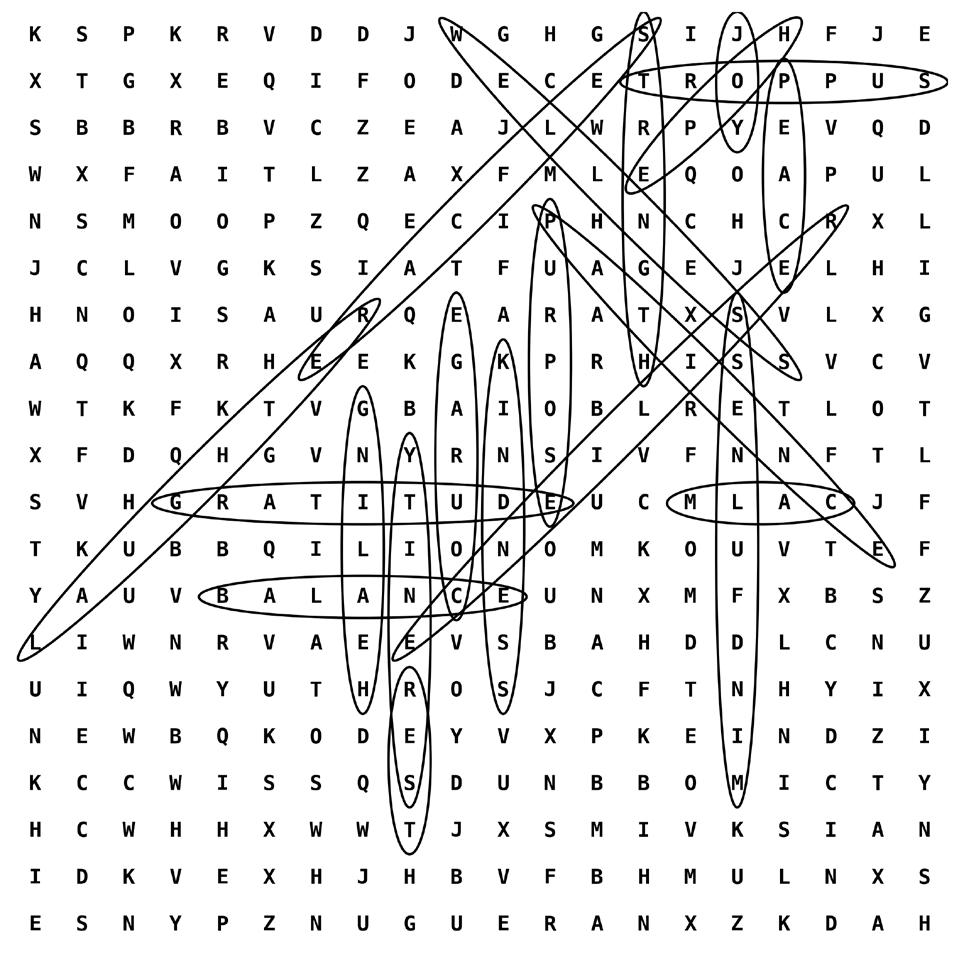
NATIONAL WELLNESS MONTH WORD SEARCH
Find all 20 words hidden forward, backward, vertically, horizontally, and diagonally.
COURAGE GRATITUDE
HEALING HOPE JOY KINDNESS
LAUGHTER
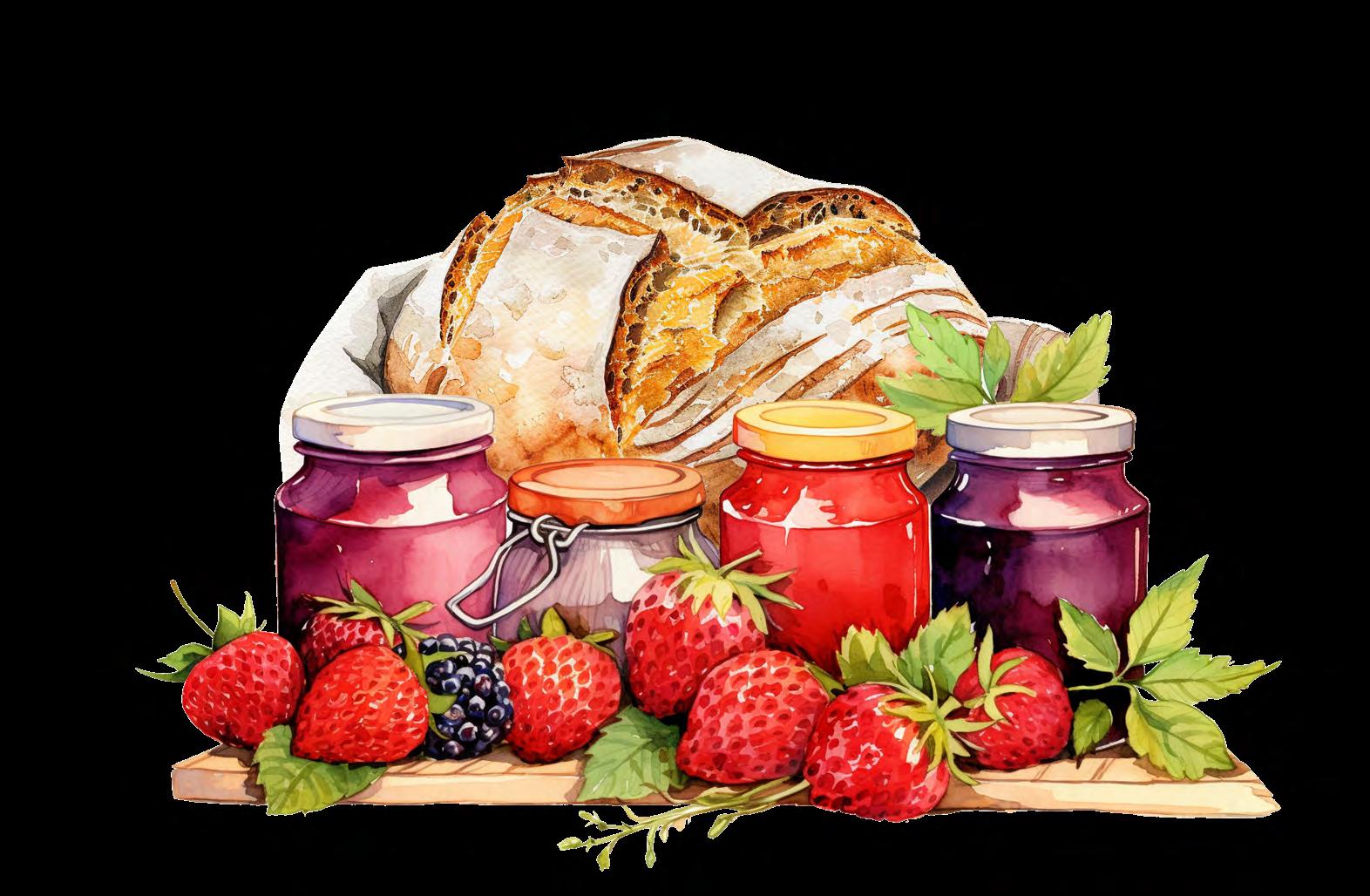
ON THE MENU: Bread & Jam
One of the themes of this month’s issue is legacy—not only what we leave behind but also the ways we choose to live each day.
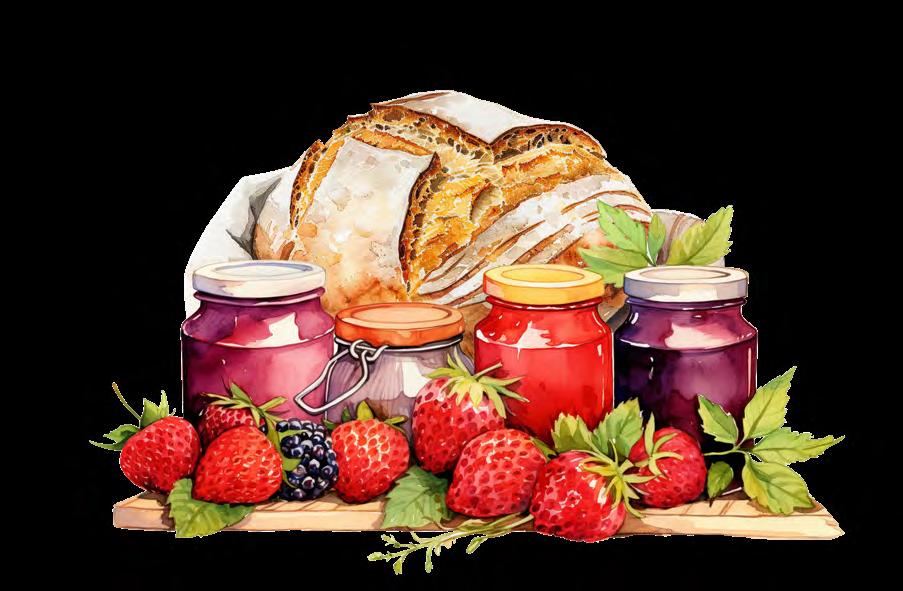
The recipes below are inspired by skills once common in everyday life. Most of us no longer need to bake our own bread, make jam, or preserve herbs, but there’s something deeply satisfying about learning or re-using the practices that sustained generations before us. These simplified versions make it easy to experience those traditions, one recipe at a time.
FIVE-MINUTE ARTISAN BREAD
There’s something almost magical about homemade bread. The smell alone transforms a house into a home. I used to make this bread almost nightly when my kids were little. It’s perfect because you can make as little (or as much) as you’d like, and the rest of the dough hangs out in the fridge.
This “five-minute” bread doesn’t actually bake in five minutes—but the dough comes together in about that long. The secret is making a large batch of no-knead dough that lives in your refrigerator for up to two weeks. Whenever you want fresh bread, simply tear off a piece, shape it, let it rest while the oven heats, and bake.
Ingredients
3 cups lukewarm water
1½ tablespoons yeast
1½ tablespoons kosher salt
6½ cups all-purpose flour
Directions
1. Stir together the water, yeast, and salt.
2. Add flour until a shaggy dough forms.
3. Cover loosely and let rise for two hours.
4. Refrigerate.
When ready to bake:
1. Pull off about a one-pound piece of dough.
2. Shape gently into a round loaf.
3. Let rest 30–40 minutes.
4. Bake at 450°F for about 30–35 minutes, preferably in a Dutch oven or on a preheated baking stone.
You’ll have fresh bakery-style bread all week with almost no effort. You can make sandwiches, French toast, regular toast, even pizza dough.
FIVE-MINUTE STRAWBERRY FREEZER JAM
Nothing tastes more like August than fresh berries or peaches.
Traditional canning can be an overwhelming (and hot) endeavor, but freezer jam doesn’t require special equipment or long hours over a stove. It keeps the bright flavor of fresh fruit and makes wonderful gifts.
Ingredients
2 cups crushed strawberries
4 cups sugar
1 package powdered fruit pectin
¾ cup water
Directions
1. Follow the pectin package directions, stir together, pour into freezer-safe jars, and freeze.
The same method works beautifully with:
• Blackberries
• Blueberries
• Peaches
• Mixed berries
Keep one jar in the refrigerator and the rest in the freezer
Of all the legacies we leave, perhaps the best is how we interacted with each other, with our families, friends and all our fellow men.
The House by The Side of The Road
Sam Walter Foss
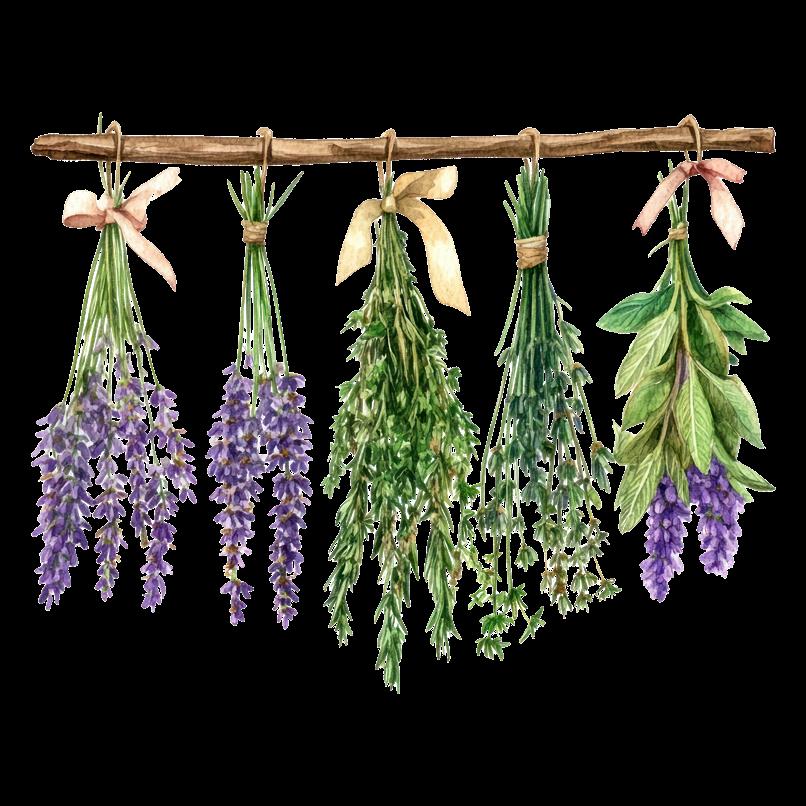
PRESERVING HERBS FOR WINTER
This is a “recipe” many of us haven’t used before but can easily get on board with, ensuring fresh herb flavor yearround. One herb plant often produces far more than we can use in a season. Instead of letting it bolt or fade away, preserve it now.
Air Drying
Gather small bundles of:
• Rosemary
• Thyme
Directions
• Oregano
• Sage
1. Tie with twine and hang upside down in a cool, dry room for one to two weeks.
2. Store in glass jars.
Freeze in Olive Oil
Perfect for:
• Basil
• Parsley
Directions
• Chives
• Cilantro
1. Chop herbs and pack into ice cube trays.
2. Cover with olive oil and freeze.
3. Each cube becomes the perfect start for soups, sauces, or roasted vegetables all winter long.
Herb butter
• ½ cup softened butter
• 2–3 tablespoons chopped herbs
• pinch of sea salt
• optional garlic or lemon zest
Directions
1. Mix ingredients together
2. Roll into a log using parchment paper and freeze.
3. Slice off rounds whenever you need to finish vegetables, grilled meat, bread, or pasta.
There are hermit souls that live withdrawn
In the place of their self-content;
There are souls like stars, that dwell apart,
In a fellowless firmament;
There are pioneer souls that blaze the paths
Where highways never ran-
But let me live by the side of the road
And be a friend to man.
Let me live in a house by the side of the road
Where the race of men go by-
The men who are good and the men who are bad,
As good and as bad as I.
I would not sit in the scorner’s seat
Nor hurl the cynic’s ban-
Let me live in a house by the side of the road
And be a friend to man.
I see from my house by the side of the road
By the side of the highway of life,
The men who press with the ardor of hope,
The men who are faint with the strife,
But I turn not away from their smiles and tears,
Both parts of an infinite plan-
Let me live in a house by the side of the road
And be a friend to man.
I know there are brook-gladdened meadows ahead,
And mountains of wearisome height;
That the road passes on through the long afternoon
And stretches away to the night.
And still I rejoice when the travelers rejoice
And weep with the strangers that moan,
Nor live in my house by the side of the road
Like a man who dwells alone.
Let me live in my house by the side of the road,
Where the race of men go by-
They are good, they are bad, they are weak, they are strong,
Wise, foolish - so am I.
Then why should I sit in the scorner’s seat,
Or hurl the cynic’s ban?
Let me live in my house by the side of the road
And be a friend to man.
THE ONE WHO IS LEFT: MONEY, GRIEF, AND THE FIRST YEAR ALONE
A man I will call Frank came to see me three months after his wife died. She had handled the money for fortyone years. Not because he could not, but because she was better at it, and it was one less thing for him to carry. He knew they were comfortable. He did not know the password to the brokerage account, the name of their accountant, or whether the life insurance had paid out. He brought me a shoebox. Inside were statements he had been afraid to open, two unopened envelopes from Social Security, and a note in his wife’s handwriting that read, “Call the advisor.” He did not know which one. Frank is not unusual. In most marriages, one person runs the money and the other trusts them to handle it. It’s an efficient arrangement, right up until the morning it’s not.
WHEN A SPOUSE DIES, THE SURVIVOR INHERITS TWO THINGS AT ONCE: A GRIEF THAT SWALLOWS THE DAYS, AND A FINANCIAL LIFE THEY HAVE NEVER OPERATED, ARRIVING IN ENVELOPES THEY ARE AFRAID TO OPEN.
The cruelty is not the paperwork; it’s the timing. The decisions come fastest in the exact season you are least equipped to make them well. And there is a hard truth underneath all of it, one I have watched play out too many times to soften: grief is a poor financial advisor.
The Empty Chair at the Money Table
The widows I sit with tell me the hardest part is rarely the math. It’s opening an envelope addressed to two people when only one is left to read it.
In almost every couple I have worked with, the finances had a primary author. One spouse knew the passwords, opened the statements, met with the advisor, and filed the taxes. The other signed where they were told and trusted that it was handled. Often it was handled, beautifully. The problem is that competence does not transfer. It dies with the person who held it.
The surviving spouse is then asked to run a system they have never seen the inside of, in a language they were never taught, on the worst days of their life. This is not about intelligence. I have watched retired surgeons and career executives sit across from me, fluent in their own fields, and go pale at a brokerage statement. The knowledge was simply never theirs. It lived in someone else, and that someone is gone.
THIS IS WHY THE MOST LOVING FINANCIAL ACT IN ANY MARRIAGE HAPPENS LONG BEFORE THE FUNERAL. IT IS THE ORDINARY AFTERNOON WHEN THE SPOUSE WHO RUNS THE MONEY TEACHES THE OTHER ONE HOW.
Where the accounts are. Who to call. How the income arrives each month. Not a binder handed over in a crisis, but a habit built over years. The couples who do this do not spare themselves grief. They spare themselves the second catastrophe that grief invites.
The Income Shock Nobody Warns You About
Here is the part that surprises people most. When one spouse dies, household income usually falls, but taxes often don’t fall with it. In fact, sometimes taxes rise.
The clearest blow is Social Security. A married couple receives two checks. When one spouse dies, the survivor keeps the larger of the two and loses the smaller one entirely. For many retirees, that is a meaningful cut in reliable monthly income, arriving at the same moment the bills stay exactly where they were.
Then there is the tax code. In the year a spouse dies, the survivor can usually still file a joint return. After that, most file as single. The single brackets are narrower and the standard deduction is close to half. So, the survivor can end up paying tax at a higher rate on less income than the couple had before. Advisors call this the widow’s penalty, and it is real.
It is also, I want to be honest, oversold. Some firms wave it around to frighten people into their offices. The tax hit is real, but usually smaller than the marketing suggests, and the lost Social Security check is the larger wound. The point is not to be scared. It is that your income and your taxes both change the moment you are widowed, and nobody sends a letter explaining it. A little planning, ideally before that day but often still useful after, can soften the landing.
The Year of Doing Nothing You Cannot Undo
IF I COULD GIVE A NEWLY WIDOWED PERSON A SINGLE RULE, IT WOULD BE THIS: IN THE FIRST YEAR, MAKE NO MAJOR FINANCIAL DECISION YOU CANNOT REVERSE.
Sell nothing you would grieve twice. Move nowhere you cannot move back from. Invest no lump sum in a hurry. Give away no money you might need, however much
you love the person asking. Grief creates a powerful urge to do something, anything, to feel less helpless. That urge is human, and it is expensive.
Two forces press in during this year, and both wear friendly faces. The first is the professional predator. Newly widowed people, often women, are targeted by salespeople who read the obituaries and arrive with annuities and “safe” products dressed up as comfort. The second is harder, because it comes from love. Adult children, in-laws, and old friends all have opinions about the house, the money, and what Mom or Dad should do now. Some of that counsel is wise. Some of it serves the giver more than the receiver. In the fog of the first year, it is nearly impossible to tell them apart.
So, you buy time. The life insurance can sit in a simple, interest-bearing savings account for a year while you think. The house can wait. The portfolio, if it was reasonable a month ago, is still reasonable today. Almost nothing that matters has to be decided this week.
A Few Things Worth Knowing
Some doors, on the other hand, do have hinges, and it helps to know where they are.
Order ten certified copies of the death certificate at the start. Every institution wants an original, and running back for more is a small misery you can skip.
Make sure Social Security has been notified, since the survivor benefit does not adjust itself.
If Medicare premiums spike because they are calculated on the couple’s old joint income, a single form, the SSA44, lets you ask for a recalculation based on your reduced circumstances. Many widows overpay for years simply because no one told them that form exists.
There are quieter gifts in the tax code too. Assets held in a taxable account generally receive a “step up” in cost basis at death, which can erase a great deal of capital gains tax if you sell later. And a surviving spouse can usually still claim the full home-sale exclusion for a couple of years, which matters enormously if the house is eventually sold. You do not need to master any of this. You only need to know it is there, so you can ask before you act.
The Conversation That Prevents Most of This
My own mother was widowed after caring for my stepfather through dementia. She believed, as most people do, that their affairs were in order. A few of them were not, and she learned about them the hard way. I do not tell that story to sell anything. I tell it because I have stood on both sides of this now, as the advisor and as the son, and I have never once seen the silence pay off.
IF YOU ARE THE SPOUSE WHO HANDLES THE MONEY, THE KINDEST THING YOU WILL EVER DO IS MAKE YOURSELF REPLACEABLE.
Show your husband the accounts. Walk your wife through the income. Introduce them to the people who will answer the phone when you cannot. And if you are the one who never handled it, you are allowed to learn now. I have watched people in their seventies read their first balance sheet and discover they were more capable than a lifetime of deferring had let them believe.
The first year alone is not about optimizing anything. It is about surviving it, and not letting a season of sorrow make the decisions that a clearer year would refuse. Be safe before you try to be smart. Buy yourself time. And when you are ready, sit down with someone whose only job is to look after you, and let them help you carry what you were never meant to carry alone.
Grief is a poor financial advisor. Find someone whose judgment is steady until yours has had time to heal. And do not do this alone.
Doug Lynam is an Investment Adviser Representative. Advisory services are offered through Course Management Investment Advisors, an SEC-registered investment adviser. This article is educational only and is not investment, tax, or legal advice. Consult qualified professionals before acting.
IF YOU ARE NEWLY ALONE
The first year, in the order that actually matters.
Do first
• Order ten certified copies of the death certificate.
• Make sure Social Security has been notified. The survivor benefit will not adjust on its own.
• Find the income. Know exactly what arrives each month, and from where.
• Park the life insurance in a simple, interest-bearing savings account and leave it there for now.
Do not do yet
• Do not sell the house.
• Do not relocate.
• Do not invest a lump sum in a hurry.
• Do not give money away, however much you are asked. Ask a professional about
• The SSA-44 form, if Medicare premiums jump.
• The step-up in cost basis, before selling any investments.
• The home-sale exclusion, before selling the house.
• Whether this is a rare low-tax year worth using on purpose.
THE RULE: IN THE FIRST YEAR, MAKE NO DECISION YOU CANNOT UNDO.