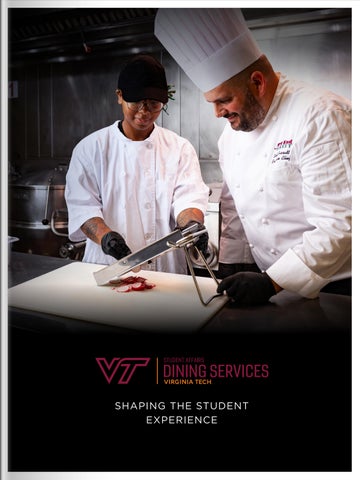
SHAPING THE STUDENT EXPERIENCE
VIRGINIA TECH DINING SERVICES FOOD & BEVERAGE
SHAPING THE
STUDENT EXPERIENCE The ultimate goal of Virginia Tech Dining Services is to create an environment where students not only eat, but also grow, connect, and thrive as members of the Hokie community. After nearly 40 years at the department, Brian Grove, Director, discusses his legacy Writer: Jack Salter | Project Manager: Harry Thurlow
V
irginia Tech is the commonwealth’s most comprehensive university and leading research institution, with around 38,000 students and 280 undergraduate and graduate degree programs. As a core part of daily life at the university, Virginia Tech Dining Services (Dining Services) makes a meaningful impact on the student experience. 2 | North America Outlook Issue 37
“Every innovation, enhancement, and interaction contributes to creating memorable dining experiences for our students,” introduces Brian Grove, Director. “Being part of an organization that helps shape campus life through food, hospitality, and community engagement is what makes this work so rewarding.” Dining Services is an award-winning dining program spanning nine distinct
buildings that offers an unparalleled variety of culinary experiences through 36 unique retail dining concepts, ranging from national brands to chef-driven. Complementing its retail portfolio are two all-you-care-to-eat dining centers featuring 19 diverse dining concepts, delivering an exceptional array of cuisines, flavors, and experiences. “Together, these venues create a
ALL PHOTOGRAPHY BY DARREN VAN DYKE, VISUAL PRODUCTION MANAGER
dynamic foodservice program widely recognized for its quality, variety, innovation, and commitment to meeting the evolving needs of our campus community,” Grove outlines.
TRUSTED TO LEAD Grove himself started out as a student employee at Dining Services in January 1988, working his way up to Associate Director by April 2007. Then, when the COVID-19 pandemic
hit, the department’s operations pivoted and Grove was made Senior Associate Director by Ted Faulkner, who was Director of Dining Services at the time. “I was trusted to lead the department out of the final stages of the pandemic and completely humbled and honored that Ted and others had full faith in me,” recalls Grove. “He became my greatest mentor
prior to and during this period of my career. When I moved into my new office, there was a handwritten note – “Wishing you great success in your new role!... The keys to the finest automobile are yours.” – I share this because it’s really where I thought about what my legacy would be for Dining Services and Virginia Tech.” Grove became Director of Dining Services in January 2024 and now oversees and heads the department. North America Outlook Issue 37 | 3
VIRGINIA TECH DINING SERVICES FOOD & BEVERAGE
“ B E I N G P A R T O F A N O R G A N I Z AT I O N T H AT H E L P S S H A P E C A M P U S L I F E T H R O U G H F O O D , H O S P I TA L I T Y, A N D C O M M U N I T Y E N G A G E M E N T I S W H AT M A K E S T H I S W O R K S O R E WA R D I N G ” – B R I A N G R OV E , D I R E C TO R , V I R G I N I A T E C H D I N I N G S E RV I C E S
His vision is for Dining Services to be the leader in collegiate dining by delivering exceptional food, innovative facilities, meaningful programs, and outstanding service that enriches the student experience. “I firmly believe we can achieve this by continuously adapting to student needs, creating welcoming spaces that foster connection and belonging, investing in student and employee development, and embracing innovation that enhances convenience, sustainability, and operational excellence,” Grove sets out. After more than 35 years with Dining Services, Grove recognizes his role today is as much about preparing for the future as it is about leading the present. “I want to leave the organization stronger than I found it by developing future leaders, modernizing our facilities and programs, and creating a culture that embraces innovation while staying true to our commitment to students,” he affirms. “My goal is to ensure that 10 years from now, Dining Services is still recognized as a national leader – not because of any one person, but because we have built an organization that continuously develops its people, adapts to changing student needs, and creates exceptional dining 4 | North America Outlook Issue 37
experiences that strengthen the Hokie community.”
LEAVING A LEGACY People are the first of three focus areas for Dining Services, creating opportunities for professional growth, leadership development, and succession planning so the next generation of leaders is prepared to continue advancing its mission. The department’s success has always been driven by its talented and dedicated employees, of which there are 2,200, so ensuring it cultivates future leaders is essential. “My goal is to foster a culture of
leadership development, continuous improvement, and empowerment that prepares the next generation of Dining Services leaders for success,” Grove emphasizes. “If our team is stronger, more capable, and better-positioned to thrive because of the investments we make today, then we will have built a solid foundation for the future. “Our operation serves as a livinglearning environment where students gain leadership, customer service, teamwork, and professional skills through employment opportunities. We should continue investing in training, mentorship, and leadership
development programs that prepare students for success beyond Virginia Tech,” he tells us. As well as student staff, Dining Services offers the same type of training and professional development for its full and part-time staff, preparing them to take the next step in the organization as supervisors and management. Second is the continued evolution of the department’s facilities and dining environment. Today’s students have different expectations than they did even a few years ago, and those will continue to change. By strategically planning renovations, new concepts, and flexible dining spaces, its facilities will remain relevant, welcoming, and supportive of student engagement. The third and final focus area is Dining Services’ commitment to fostering a culture of innovation and continuous improvement. “I want us to remain proactive rather than reactive – embracing change, testing new ideas, and consistently seeking ways to enhance the student experience,” urges Grove. “I hope to leave Dining Services with a strong foundation that balances tradition with innovation. While we should continue to evolve and adapt to changing student needs, we must also preserve the
SOUTHGATE FOOD CENTER The Southgate Food Center (Southgate) has served as the centralized warehouse, bakery, and food production facility for Dining Services, providing critical support to dining operations across campus. The warehouse receives, stores, and distributes food and beverages and supplies campus dining locations, while the on-site bakery produces a wide variety of fresh-baked items including cakes, cookies, brownies, donuts, and other specialty desserts. Now, Southgate is to be replaced by a single-story, high-bay facility on university-owned property on Research Center Drive, near Virginia Tech Montgomery Executive Airport (BCB). The project scope envisions shifting all food production and preparation to a modern, fully equipped, commercial food preparation facility with both cold and dry storage capacity.
North America Outlook Issue 37 | 5
VIRGINIA TECH DINING SERVICES FOOD & BEVERAGE
WHAT IS PERRY PLACE AND HOW DOES IT FUNCTION AS A PHYSICAL AND CULTURAL BRIDGE BETWEEN LEARNING AND LIVING ON CAMPUS? BRIAN GROVE, DIRECTOR OF DINING SERVICES: “Perry Place is located in the heart of the newly completed Hitt Hall, a 100,000-square-foot multipurpose facility that pairs cutting-edge construction labs with destination dining. “It was developed as a next-generation dining destination to support Virginia Tech’s planned enrollment growth, expand dining access for offcampus and upper-division students, and enhance the overall student experience. “As the university prepared to add approximately 5,000 students over five years, existing dining facilities – particularly in the North Academic District – faced increasing capacity pressures. Rather than expanding traditional dining halls, Virginia Tech invested in a flexible, retail-focused food hall model that can adapt to demand, offer extended service hours, and meet the diverse preferences of today’s students. “The primary goals of the project included expanding seating capacity and access, increasing culinary variety and choice, improving the speed of service and peak period throughput, and creating a branded destination dining experience. “The final project addressed these goals by delivering a two-level food hall with 629 seats, nine distinct dining concepts, and a centralized production kitchen. Perry Place supports approximately 36,400 daily transactions and generates more than $10.5 million in annual sales. Eight of the nine concepts were developed internally by Virginia Tech, reinforcing institutional brand ownership while offering broad culinary appeal. “Concept development was informed by direct student input and national best practice research, while operational decisions were grounded in throughput, labor efficiency, and scalability. This combination of vision and execution ensured Perry Place delivered immediate impact upon opening while remaining flexible enough to evolve with future enrollment growth, menu innovation, and changing student expectations. “Sustainability was incorporated from design through to daily operation. Perry Place uses energy-efficient kitchen systems, demand-controlled ventilation, and data-driven production practices to reduce food waste. AMP Coffee Bar emphasizes responsibly sourced ingredients, reinforcing environmental and social responsibility within everyday student choices. The dining center also uses all compostable to-go containers.”
6 | North America Outlook Issue 37
VIRGINIA TECH DINING SERVICES FOOD & BEVERAGE
DISPOSABLES WORTHY OF VIRGINIA TECH Since 2023, Terravive has proudly supported Virginia Tech with BPI Certified compostable foodservice products guided by a simple belief: what touches your food matters. Made in the USA from plants, Terravive’s products are free from Forever Chemicals and are designed to compost without generating microplastics, delivering the performance campus dining expects while reflecting the same care and quality as the meals they serve. Their products are designed to be worthy of every meal, every student, faculty member, and guest they reach.
www.terravive.com
“ I WA N T T O L E AV E T H E O R G A N I Z AT I O N STRONGER THAN I FOUND IT BY DEVELOPING FUTURE LEADERS, M O D E R N I Z I N G O U R FA C I L I T I E S A N D P R O G R A M S , A N D C R E AT I N G A C U LT U R E T H AT E M B R A C E S I N N O VAT I O N W H I L E S TAY I N G T R U E T O O U R C O M M I T M E N T T O STUDENTS” – B R I A N G R OV E , D I R E C TO R , V I R G I N I A T E C H D I N I N G S E RV I C E S
values that have made us successful – our commitment to excellence, hospitality, teamwork, and the student experience. “If my legacy is that I helped to develop future leaders, strengthen our culture, and position our staff and organization for continued success, then I would consider that my greatest accomplishment,” he prides.
PRIORITIES FOR FUTURE SUCCESS While Dining Services has built a strong foundation, several opportunities and challenges will shape its future. Workforce development remains a top priority; recruiting, developing, and retaining talented and dependable employees is essential to
the department’s long-term success. “We will continue investing in leadership development, employee engagement, and succession planning to ensure we have a strong team prepared to meet future needs,” Grove confirms. At the same time, there are ongoing financial pressures facing the industry to navigate, including rising costs for food, labor, utilities, and supplies. Maintaining operational efficiency and sound financial stewardship will be critical as Dining Services delivers the high-quality dining experiences its students and guests expect. “Today’s customers expect exceptional food quality, convenience, technology-driven solutions, and strong value. We will continue enhancing the dining experience through customer-focused service, expanded technology offerings, and flexible dining options that meet the changing needs of our campus North America Outlook Issue 37 | 7
VIRGINIA TECH DINING SERVICES FOOD & BEVERAGE
WHAT MAKES THE DINING PROGRAM SPECIAL? SUSTAINABILITY INITIATIVES • Homefield Farm – The farm is the only certified organic operation owned by a university in Virginia. A partnership between Dining Services, the College of Agriculture and Life Sciences, and the School of Plant and Environmental Sciences, it is also a site for outreach and experiential learning, with various classes and departments utilizing the farm for educational experiences. • Waste minimization – Composting, food diversion, recycling, and polystyrene-free dining. • Local and sustainable sourcing – Dining Services strives to support local agriculture and source campus-raised ingredients produced by the College of Agriculture and Life Sciences. • Reusable To-Go – An innovative program that makes Virginia Tech a more sustainable place to live and work.
SPECIAL EVENTS More than 100 take place per year, including culinary demos, cultural events, study monotony breaks, holiday events, and customer appreciation events. • International Café – Highlight countries around the world through food, drink, and education of cultural customs and traditions. • Chili Challenge – A tradition in which students eat a bowl of chili that becomes progressively hotter over five days. • Oyster Day – Showcasing the diversity of Virginia’s oyster industry, it has become one of Dining Services’ most anticipated and popular annual events. • Diwali – Educates students about Indian cuisine, cultural traditions, and customs through interactive dining experiences.
PROFESSIONAL DEVELOPMENT OPPORTUNITIES FOR STAFF Dining Services is a living-learning environment where staff and student staff gain leadership, customer service, teamwork, and professional skills through employment opportunities. The department invests in training, mentorship, and leadership development programs that prepare students for success beyond Virginia Tech.
8 | North America Outlook Issue 37
VIRGINIA TECH DINING SERVICES FOOD & BEVERAGE
community,” assures Grove. Health, wellness, and sustainability will also remain important areas of focus, with students increasingly seeking fresh ingredients, allergenfriendly options, locally sourced products, and environmentally responsible practices. This is exemplified by the introduction of a certified top nine allergen-free dining concept in D2 at Dietrick Hall, opening in fall 2026. A new menu, alongside existing favorites, will be served by committed and trained staff, with all recipes tested and reviewed by students. “The concept reinforces our commitment to students selfidentifying with food allergies and promotes success, well-being, and a sense of belonging on the Virginia Tech campus,” Grove highlights. Innovation and continuous improvement, meanwhile, will be central to the department’s future success. “Whether through consumer waste technology, robotics, datadriven decision-making, new dining concepts, facility enhancements, or operational efficiencies, we will continue looking for ways to evolve and improve,” he states. As one of the largest auxiliary enterprises on campus, Dining Services also plays an important role in student satisfaction, community engagement, and the overall Virginia Tech experience. “We will continue to strengthen that impact by providing welcoming spaces and meaningful connections for students and the broader campus community,” closes Grove.
Tel: 540-231-3933 dining@vt.edu
www.dining.vt.edu North America Outlook Issue 37 | 9
Tel: 540-231-3933 Tel: xxxxxx dining@vt.edu email
www.dining.vt.edu www
PRODUCED BY NORTH AMERICA OUTLOOK MAGAZINE PRODUCED BY NORTH AMERICA OUTLOOK MAGAZINE