TH E Q U E STION
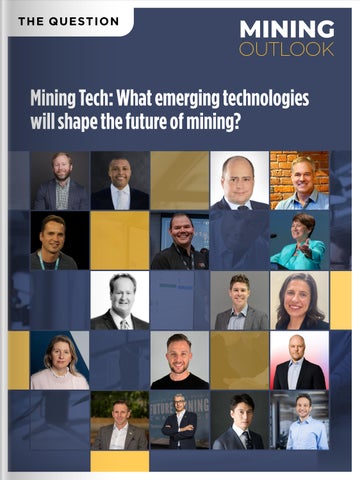
Mining Tech: What emerging technologies will shape the future of mining?
TH E Q U E STION
Mining Tech: What emerging technologies will shape the future of mining? In each edition, we invite business leaders from across the mining sector to give their views on the same question
2 | Mining Outlook Issue 16
THE QUESTION MINING TECH
BENJAMIN PORTER Business Development Manager, Bureau Veritas Artificial intelligence (AI) is rapidly changing how we analyse materials and the speed at which we can deliver findings. For spectral analysis, Bureau Veritas utilises AI to generate correlations between a wide range of analytical results and spectral measurements. Spectral measurements consist of over 8,000 unique readings that correlate to the minerology and chemical composition of a material. This measurement is nondestructive and can be completed on a small amount of sample in seconds. This large dataset allows the team to build predictive models using as few as 300 samples. Correlations have been built on minerology, chemistry, geometallurgical properties, and environmental properties. These properties are traditionally measured using expensive and destructive techniques that can take weeks to months to complete. This usage has been shared with Bureau Veritas’ clients, and the response has been very enthusiastic. Spectral analysis is notoriously subjective and contains very specific terminology that clients often do not have the time or bandwidth to fully understand. Having an output that they are familiar working with has been of great interest to our clients. This also allows them to greatly upscale their datasets, which helps with increasing their model resolution. www.bvna.com
COREY DIAS CEO, co-Founder, and Director, Anfield Energy The future of mining isn’t about chasing radical disruption just for the sake of it. In a landscape of constant change, true leadership is actually about balance. It’s about adopting smart, modern tools without abandoning the stable, proven methods that we know work. Advancements like autonomous fleets and automated safety systems are great for efficiency, but the core of mining remains a very familiar process. Sticking with reliable, standard practices is how one keeps operations predictable and safe. Embracing technology should never mean taking unnecessary risks. This evolution is especially important as we look at global energy needs. Nuclear power is becoming a cornerstone of the clean energy transition because it provides the steady, reliable baseload power that heavy industry and modern grids require. For the mining sector, this creates a dual responsibility: we must supply the critical materials fuelling this nuclear resurgence whilst ensuring our own extraction methods remain efficient. At Anfield Energy, this is exactly how we look at the future. By pairing time-tested mining methods with proven automated tech, we can scale up our operations safely. We are focused on a practical path ahead that is both forward-thinking and operationally secure. anfieldenergy.com
Mining Outlook Issue 16 | 3
THE QUESTION MINING TECH
BO MØLLER STENSGAARD President, Greenland Mines The future of mining will be defined by smarter extraction. As the global transition demands an unprecedented volume of critical minerals, the most impactful emerging technologies will be those centered on enhanced mineral processing, advanced mineralogy, and localised low-carbon supply chains. Historically, mining focused on single, high-grade target commodities. Today, next-generation metallurgical engineering and highly evolved flowsheet simulation, pioneered alongside specialised research pilots like GTK Mintec, allow us to unlock complex, polymetallic systems.
We can now efficiently isolate and recover a spectrum of co-product and by-product critical metals, such as palladium, platinum, vanadium, and gallium, from a single ore body. This maximises value recovery whilst strictly adhering to the philosophy of ‘mined once, utilised in full’. Furthermore, downstream optimisation technologies, such as pairing regional resource extraction with adjacent hubs powered entirely by renewable energy, are reshaping supply logistics. By leveraging proximity to green infrastructure, modern mining can establish resilient, transparent, and low-carbon critical mineral corridors directly connecting remote assets with Western industrial ecosystems. Technology is fundamentally shifting our role from raw material excavators to highly efficient, responsible supply chain architects. greenlandmines.com
DARREN BAHREY Founder, President, and CEO, StrategX Elements Corp I envision employing more technologies during the exploration phase to aid in the hunt for discoveries, especially in the critical minerals sector. These technologies should only enhance or complement traditional prospecting and geological fieldwork when developing targets to discover new economic ore deposits. Integrate AI-driven mineral systems modelling and targeting with geochemical, geophysical, and remote sensing technologies to further refine and define targets for drill testing. Furthermore, more advanced technologies will develop to compress the timeline from the first drill discovery to a defined resource and then into production. In mining, crushing rock is the most energy-intensive part of the industry. Therefore, technologies like bulk ore sorting – using sensors to reject waste before it even hits the mill – are game-changers. It reduces working capital costs whilst lowering the carbon and water footprints, which is essential for responsible and sustainable mining practices. Finally, in-situ recovery technologies can extract minerals via a closed-loop chemical process which will minimise environmental impact. For a critical minerals company, these technologies can turn deposits into bankable assets whilst shortening the timeline from the first drill hole to the first ore shipment.
www.strategxcorp.com
4 | Mining Outlook Issue 16
THE QUESTION MINING TECH
NATHAN McKENZIE CEO, Speedshield Technologies Ask anyone in the mining industry about the future and you’ll hear about autonomous vehicles or fully automated sites. Those innovations will come, but the real story right now is awareness. Mining is becoming increasingly connected, with equipment, infrastructure, and workers generating constant streams of data. The opportunity is to “mine” that information and turn it into clear, actionable insight that teams can use in the field. AI will play a major role, especially at the edge where systems can process information instantly without relying
on distant networks. We’re already seeing progress in machine vision, predictive maintenance, and environmental monitoring – tools that help operators identify issues earlier and respond with greater confidence. As these technologies mature, they’ll offer a far more complete picture of site conditions, improving planning, reducing disruption, and preventing incidents. Mining has always relied on skilled workers making fast, high‑stakes decisions in unpredictable environments. The next wave of technology will support them, not replace them. New safety‑focused systems will act more like copilots than enforcers, fitting naturally into daily workflows so operators can stay focused on the task at hand without unnecessary distraction or interruption.
www.speedshield.com
WALDO BOSHOFF CTO, Optix One of the most significant shifts shaping the future of mining safety is the move from detecting fatigue to predicting it. Mining presents a perfect storm for fatigue: long shifts, remote sites, and repetitive haulage routes. Optix’s annual State of the Data report showed a 41 percent increase in collisions and a 24 percent increase in near collisions in the sector. Industry estimates place the annual cost of unplanned mining downtime globally at a staggering USD$15 billion. The financial and human case for earlier intervention is clear. The industry is reaching an inflection point. The next generation of fatigue technology doesn’t simply react when a driver’s eyes close – it builds a predictive picture of risk over time. By analysing patterns across shift duration, time of day, individual baselines, and behavioural signals like excessive blinking, yawning, and head movement, AI-enabled systems can identify who is likely to fatigue, on which routes, and at what point in a shift. Early intervention can then involve an in-cab alert, dispatcher notification, schedule adjustment, or rest break. Organisations that embrace predictive fatigue management won’t just protect their people – they’ll protect operational continuity, compliance standing, and their social licence to operate.
optix.co
Mining Outlook Issue 16 | 5
THE QUESTION MINING TECH
PAT RYAN, P. ENG. Chairman and CEO, Ucore Rare Metals Inc.
KARI YUERS President and CEO, Kryton International From advanced ore crushing machinery to unprecedentedly heavy, autonomous earth-moving equipment and round-the-clock logistics, modern mining has evolved whilst its traditional infrastructure struggles to keep pace with massive loads and continuous hauling cycles. By applying Kryton International’s (Kryton) established admixture technology to this new frontier, mining engineers are discovering a critical tool for building high-durability haul roadways, crusher pads and approaches, tipper loading docks, and supporting infrastructure – that can double the service-life and reduce maintenance costs. Hard-Cem is poised for a significant role in the mining industry, which requires resurfacing every three to five years and has one of the costliest downtimes: around USD$400,000 an hour, according to Mining Ops Studies, Heavy Industry Benchmarks. Exact return on investment (ROI) projections for mining operations can be tabulated with Kryton’s new ROI Calculator, which assesses value based on project types, location, and size. Hard-Cem transforms the concrete matrix itself, drastically increasing wear resistance without requiring frequent, disruptive surface maintenance. It also reduces the dust created by abrasion to these surfaces. In a landscape where downtime is the ultimate cost, the novel application of this rugged technology ensures mining lifelines can withstand the brutal abrasion of tomorrow’s heavy-haul operations.
www.kryton.com
6 | Mining Outlook Issue 16
The future of mining isn’t just about what comes out of the ground – it’s about what happens next. Extraction without processing sovereignty is half a supply chain, and North America has learnt that lesson the hard way. We’re currently operating at a 40-year disadvantage in critical mineral processing, and that gap doesn’t close with good intentions – it closes with better technology. That’s where I see the most transformative shift happening: in separation and purification. Solvent extraction has been the only commercial pathway to refine rare earth elements, but it’s been a Chinese-optimised process for decades. At Ucore Rare Metals Inc., we’ve Westernised that technology through RapidSX – increasing throughput efficiency in ways that make domestic processing economically viable for the first time. Combined with advances in AI-driven process optimisation, modular plant design, and tighter integration between mine operators and downstream manufacturers, we’re approaching an inflection point. The mining industry is no longer just a raw materials business – it’s becoming a critical technology sector. For anyone who’s spent 35 years building specialised supply chains for global original equipment manufacturers (OEMs), the parallel is clear: the winners will be those who control the full value chain, not just the ore body. ucore.com
THE QUESTION MINING TECH
ALEX FRANKLIN Managing Director, First Principles Consulting With many predicting the next commodity super-cycle has only just started, the next generation of mining technology is already emerging, attracting interest, talent, and funding. However, the technology that will truly shape our industry’s future isn’t the most advanced tool on the market – it’s the one that actually gets adopted on the front line. This is because mining has a notoriously poor track record with innovation. Ernst & Young found that 74 percent of mining executives view integrating new technology as a key challenge, compared to just 37 percent across all other sectors. Too often, technology is simply bolted onto a broken process and expected to fix it. But technology is a force multiplier; when you add complexity to a fractured system, you scale the chaos rather than the solution. The ultimate competitive advantage won’t be a specific technology, but how well sites can adopt it (their adaptive capacity). The future belongs to the tech companies that understand this, working with clients to architect the ecosystem required to pull technology into daily habits, recognising that any tool is only as powerful as the culture utilising it. www.firstprinciplesconsulting.com
LESLIE MILLER Principal Client Solutions Architect, OLI Systems The mining industry is finally closing its digital gap, and one technology is enabling this transformation. Mechanistic models (thermodynamic models) allow engineers to predict how complex chemistry behaves in leach liquors, brines, and high-ionic strength systems before infrastructure is built. These models are critical to the advancement of rare earth element and battery mineral processing and production. The US Department of Energy recognised this directly, funding thermodynamic modelling tools through its Critical Materials Innovation Hub to accelerate domestic production.
Oil and gas has relied on these same tools for decades; mining is now following that path. That foundation is what makes the next step possible. As predictive chemistry becomes standard practice in feasibility and design, mining will be positioned to ride the broader industrial digitalisation wave. Hybrid models that combine a mechanistic thermodynamic layer with machine learning (ML) can move operations beyond costly reactive control, without waiting years to accumulate training data. The thermodynamic model provides the scientific baseline required. Strong proofs of concept already exist and, with geopolitical capital now behind critical minerals and AI, expect rapid advancement.
olisystems.com
Mining Outlook Issue 16 | 7
THE QUESTION MINING TECH
SHELLEY COPSEY CEO and co-Founder, FYLD Mining’s future will be shaped less by automation tools and more by technologies that create real-time operational intelligence. At FYLD, we’re already seeing this play out in mining environments. We’re thinking too small if we’re thinking about technology as “automating workflows”; instead, technology should create a digital understanding of work itself. This means connecting what is planned, observed, and actually happening in the field. Once that’s established, technology must be able to predict risk in all forms – not just safety incidents, but delays, rework, downtime, compliance failures, and productivity gaps. The opportunity lies in identifying the conditions that lead to failure before they escalate. In pit mine deployments, predictive AI has already helped reduce serious worksite incidents and injuries by up to 48 percent. Next, mining organisations need systems that can adapt in the moment. Conditions on sites change constantly, yet many technologies still follow an old software-as-a-service (SaaS) model: collect data, analyse it later, then decide what to do. Platforms that help shape decisions live on-site, particularly in high-risk environments, will prevail. Finally, the most valuable technologies expand beyond siloed internal systems and learn from cross-industry data. Transformation comes from technologies trained on millions of field interactions across industries. fyld.ai
MICHAEL MCGOUGH Account Director, Totalmobile Mining has never been a static industry; it has always adapted to new ground conditions, regulatory pressures, and shifting economic demands. What’s different now is the pace of change and the technologies driving it. Across the sector, AI, predictive analytics, and automation are shifting operations from reactive to proactive. Equipment failures can be anticipated before they occur, schedules optimised in real time, and downtime that once seemed inevitable is becoming preventable.
8 | Mining Outlook Issue 16
The impact is already visible in both productivity and safety outcomes. With remote, asset-heavy, and logistically complex operations, the pressure to adopt technology effectively is high. Mobile workforce technology is now central to that evolution, connecting people, systems, and field data in real time, regardless of location. At Totalmobile, we are seeing inspections, compliance reporting, and maintenance workflows move from clipboards and spreadsheets to connected platforms that deliver operational intelligence instantly. The organisations investing in connected, data-driven operations today will define what the next generation of mining looks like.
www.totalmobile.com
THE QUESTION MINING TECH
PEKKA UUSITALO Global Business Line Manager for IEC Low Voltage Motors, ABB Across a single mine, hundreds of certified hazardous area motors run continuously – powering pumps, fans, and ventilation systems through some of the harshest conditions in any industry. The energy demand is enormous, and the pressure to cut both costs and emissions is only growing. Yet, for Zone 1 and Zone 2 applications, achieving the highest efficiency levels available within certified hazardous area motors has remained out of reach – until now. ABB is the world’s first manufacturer to offer an IE6 Hyper-Efficiency motor certified to ATEX and IECEx requirements. Built on magnet-free synchronous reluctance motor (SynRM) technology, the IE6 SynRM Increased Safety motor delivers up to 60 percent lower energy losses than the IE3 induction motors that remain the default across most hazardous area installations. Replacing a single 110-kilowatt (kW) IE3 unit generates over €87,000 in energy savings across a 20-year service life, with a payback period of just eight months. That same rotor design means the motor runs up to 30 degrees Celsius (°C) cooler, directly reducing the bearing failures which account for around 70 percent of unplanned outages. This is hazardous area motor technology designed to ‘Engineered to Outrun’ the limitations mining operators have faced for too long. www.abb.com/global/en
LUKE SMITH Programme Director – Mobile Equipment, MMD Group As electrification and autonomy mature, the mining industry will begin to fundamentally rethink how material is moved. For over 100 years, haulage has largely relied on the same principle: large trucks operating in fixed cycles between loading and tipping points. Whilst trucks themselves have evolved, the underlying system architecture has remained largely unchanged. The challenge is that conventional haulage introduces significant inefficiencies through idle time, queueing, payload variability, and stop-start operation, all of which become increasingly important as mines push to reduce cost, energy consumption, and emissions. The next generation of mining systems will focus less on maximising the performance of an individual truck and more on optimising the entire material movement process. Electrification, autonomy, and real-time system orchestration will enable smaller, coordinated autonomous fleets operating as part of an integrated material handling system rather than isolated machines. The result is the potential for significantly lower energy consumption, improved productivity, reduced operating cost, and safer, more consistent operations across the mine. www.mmdsizers.com
Mining Outlook Issue 16 | 9
THE QUESTION MINING TECH
MOHAMMAD DOOSTMOHAMMADI CEO and Founder, pH7 Technologies The emerging technology that will shape the future of mining is the electrification of mineral processing and hydrometallurgical flowsheets. The industry is moving towards replacing traditional consumables such as water, heat, fossil fuels, and large volumes of chemical reagents with electricity-driven extraction and processing technologies powered by renewable energy. Electrified processing creates a major shift in how metals are produced. Instead of relying on complex chemical-intensive systems, future operations will increasingly use electrochemical and electrically driven separation technologies that can operate with lower reagent consumption, reduced water usage, and higher process efficiency. When integrated with on-site renewable power generation, mines can become more selfsufficient, reducing exposure to energy price volatility, logistics challenges, and geopolitical supply chain risks. This transition also enables a new level of automation and digitalisation. Electrified flowsheets are inherently more controllable and data-driven, creating ideal conditions for AI, advanced process control, and autonomous optimisation systems that improve recoveries and lower operating costs. Most importantly, electrification allows the mining industry to unlock greater value from low-grade ores, tailings, and waste materials whilst significantly reducing environmental impact. This will redefine mineral processing and position electrified hydrometallurgy as one of the most important mining technologies of the future. ph7technologies.com
10 | Mining Outlook Issue 16
THE QUESTION MINING TECH
RYOJI MORII Founder and Representative Director, Insynergy Inc. The future of mining will be shaped not only by automation itself, but how organisations govern autonomous operational decisions. Technologies such as AI-assisted predictive maintenance, industrial digital twins, autonomous haulage systems, and remote operations are already transforming mining environments. What is emerging now is a shift from “machines supporting workers” to “systems making operational recommendations and acting semi-autonomously”. The challenge is no longer purely technical – it is organisational. As industrial AI becomes embedded into operational workflows, mining companies will need clearer structures defining where autonomous systems are allowed to act, where escalation is required, and who ultimately carries accountability for operational decisions. In many industries, the failure point is not model accuracy alone, but the absence of designed judgment boundaries between AI systems and human operators. I believe the mining sector will increasingly adopt what I call “Decision Design” – the deliberate design of operational judgment, escalation authority, and accountability structures around AI-enabled systems. The companies that succeed will not simply automate operations faster. They will design clearer responsibility structures for autonomous industrial environments. insynergy.io
ALEX DUKHOVNY Executive Vice President, IntraTEM It’s a technology that isn’t quite new, but a big trend we are seeing in the mining industry, amongst others, is the shift to private 5G networks. They are seemingly becoming somewhat of a necessity. Private 5G is functioning as the connective mesh for fully integrated intelligent operations. This includes autonomous haulage vehicles, remote-controlled drill rigs, and more. An Ericsson report I got ahold of perfectly quantified the impact – “Whilst many private cellular networks are 4G LTE with 5G-ready capabilities, private 5G-ready cellular networks will play a critical role in enabling smart mining by introducing high-speed connectivity, low latency, and strong performance in high-devicedensity environments. They will reduce round-trip latency by 95 percent, providing the high uplink speed required for smart mine use cases.” - Ericsson, December 2020 study. From a technology expense standpoint, our enterprise clients in oil and gas are already managing increasingly complex network infrastructures. Mining is heading in the same direction, and fast. The companies that get their connectivity foundation right now will have a real operational and financial advantage. IntraTEM.com
Mining Outlook Issue 16 | 11
THE QU E STI O N
PRODUCED BY MINING OUTLOOK MAGAZINE