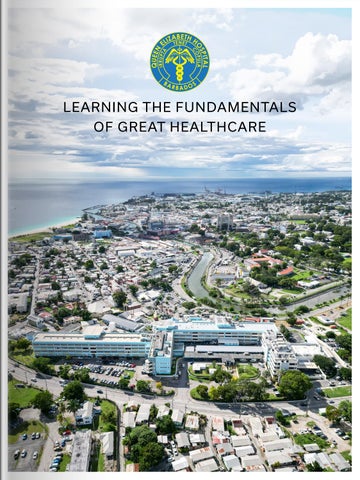
LEARNING THE FUNDAMENTALS OF GREAT HEALTHCARE
QUEEN ELIZABETH HOSPITAL HEALTHCARE
Every Patient Matters, Every Staff Member Counts Having worked in three different healthcare systems across the globe, Neil Clark, CEO of Queen Elizabeth Hospital, believes the fundamentals of great healthcare are universal. We learn more about his experience and how it is changing hospital operations in a modern setting Writer: Lauren Kania | Project Manager: Ben Weaver
I left school at 16 and joined the Royal Air Force (RAF), with no career plan beyond wanting to make something of myself. The 12 years that followed taught me the fundamentals I have relied on ever since: discipline, planning, and leadership.” This passionate start to a career is what led Neil Clark, CEO of Queen Elizabeth Hospital (QEH), to work within the healthcare industry – a sector that is not only in a state of constant development and innovation, but also directly impacts the lives of everyday individuals across the world. After leaving the military and joining the UK’s National Health Service (NHS), Clark assumed the skills he had 2 | North America Outlook Issue 37
previously learned would transfer easily; however, he quickly discovered that this new industry would ask more of him. “Hospitals are among the most complex organizations in society – running 24 hours a day, seven days a week, with thousands of professionals making hundreds of decisions every hour, often under immense pressure. The challenge for leaders is not simply managing that complexity; it is creating systems that allow talented people to deliver consistently excellent care,” he details. Much of Clark’s early leadership career in the NHS was spent progressing through operational leadership roles at
Breast cancer surgery led by Dr. Dale Springer
QUEEN ELIZABETH HOSPITAL HEALTHCARE
challenging healthcare facilities. It was through this work that he learned the most important lesson of his career so far – a plan, however well designed, is worthless without the people to deliver it. This was where he developed crucial skills, such as the ability to listen properly, build trust, and translate a technical plan into something frontline staff could believe in and own. “It was also where I first noticed something that has shaped the rest of my career: the teams that improved fastest were almost always the ones with the best information about their own performance. You cannot fix what you cannot see – and you cannot expect people to change something they cannot measure,” he reveals.
departments; they experience one healthcare journey. If organizations fail to work together, patients experience delays and duplication rather than seamless care. This is the exact perspective he brought to Barbados when he became CEO of QEH in April 2024. “QEH is far more than a hospital – it is one of Barbados’ most important public institutions, and thousands of people pass through its doors every day at some of the most vulnerable moments of their lives,” he explains.
LEARNING LEADERSHIP By the time Clark left the NHS, his team had delivered measurable improvements in performance, finance, and culture at every hospital he had led – proof that the model of leadership he had developed since his days in the RAF was working; combining people skills with a growing belief in the value of good information. “If the NHS taught me how to lead hospitals, my work in Abu Dhabi taught me how to lead healthcare systems. I was subsequently recruited to the Abu Dhabi Department of Health where I was no longer working for a single provider, but helping develop an entire health system,” Clark describes. “For the first time in my career, I was looking at healthcare as an interconnected system rather than a single organization, and, to this day, it has fundamentally changed the way I think.” Abu Dhabi’s combination of information and technology as core infrastructure and access to the people skills to attract providers taught Clark that healthcare should never be managed in isolation. The interdependencies of departments and the economics of preventative medicine highlighted that the chosen model of care shapes the performance of the whole system far more than the volume of any single service. One of the greatest lessons Clark learned, however, was that patients do not experience separate hospitals, clinics, and government 4 | North America Outlook Issue 37
CAN YOU TELL US MORE ABOUT YOUR LEADERSHIP PRINCIPLES AND HOW THEY HAVE MANIFESTED IN A HEALTHCARE ENVIRONMENT? Neil Clark, CEO: “After more than 40 years in leadership, my vision of what makes an effective leader has become simpler than it once was. It’s not about hierarchy or issuing instructions from the top but creating an environment where people can do their very best work, and giving them the tools and information to do so. “Three principles have stayed constant across every organization I have led, at every scale. The first is purpose: people want to know that what they do matters, and in healthcare, that is never in doubt, from the cleaner maintaining infection control to the porter transporting a patient safely, the pharmacist checking medications, and the consultant making complex clinical decisions. “The second is trust, which cannot be demanded, only earned through honesty, consistency, and genuine listening; the best ideas rarely come from the executive office; they come from the people delivering care every day. The third is continuous improvement – no organization is ever finished, and every member of staff should feel empowered to ask, ‘Can we do this better?’, and have the data to answer the question honestly.”
Aerial picture of QEH in 2022
“QEH is far more than a hospital – it is one of Barbados’ most important public institutions, and thousands of people pass through its doors every day at some of the most vulnerable moments of their lives” – N E I L C L A R K , C E O , Q U E E N E L I Z A B E T H H O S P I TA L
“I found an organization with highly committed and talented staff, proud of the care they provided despite real operational challenges, such as rising demand, workforce shortages, aging infrastructure, financial pressure, and a lack of coordinated information across paper records, spreadsheets, and systems. None of that was unique to Barbados. What was unique was the opportunity.”
BUILDING SYSTEMS With all the challenges modern healthcare is currently facing, Clark decided that rather than treating those hurdles separately, QEH would look at the organization as a whole and build a strategic framework around modernizing infrastructure, financial sustainability, and digital transformation.
The centerpiece of this transformation is the roll-out of a new health information system within the hospital – to give every clinician a single, accurate, real-time view of a patient’s history, and provide QEH’s leadership with reliable data on what is happening across the organization. “ A hospital does not sit in isolation, and one of the questions we are having to answer now is how that data needs to interoperate with the rest of Barbados’ healthcare providers,” expands Clark. “We are extending that same discipline well beyond clinical care, digitizing our human resources (HR), finance, and procurement records by moving that information off paper and into systems that let us plan properly.” Ultimately, none of these developments would be possible without the belief that Clark first learned in the NHS: buildings and systems do not care for patients; people do. His philosophy – every patient matters; every staff member counts – is what connects the two. It is why the hospital is expanding recruitment and training, investing in technology, and why Clark always reminds colleagues that equipment and information systems alone do not transform healthcare; transformation happens when investment in data is matched by investment in people, leadership, and culture. Small island nations often possess advantages that larger healthcare systems struggle to replicate. North America Outlook Issue 37 | 5
QUEEN ELIZABETH HOSPITAL HEALTHCARE
UNOPS and QEH
“I believe QEH has the potential not only to remain Barbados’ national referral hospital, but also become one of the Caribbean’s leading centers of excellence – a hospital where good data and leadership reinforce one another” – N E I L C L A R K , C E O , Q U E E N E L I Z A B E T H H O S P I TA L
Decision-making can be faster, partnerships closer, and innovation implemented more rapidly because people know one another and share a common commitment to their communities. “I believe QEH has the potential to not only remain Barbados’ national referral hospital, but also become one of the Caribbean’s leading centers of excellence – a hospital where good data and leadership reinforce one another,” impassions Clark. “That will not happen overnight, but every day I see colleagues, better informed and genuinely empowered, moving us another step closer.” 6 | North America Outlook Issue 37
THE FUTURE, LEADERSHIP, AND LEGACY Having worked across myriad healthcare systems, Clark has seen how rapidly healthcare continues to evolve, from paper records to integrated systems, and now to artificial intelligence (AI), predictive analytics, and genomics. “I believe the future will be shaped just as much by leadership and culture as technology, because data on its own changes nothing. It is only useful once it changes a decision, and healthcare remains, above all else, a human profession,” he asserts. The role of technology is to enable healthcare professionals to deliver better care, not to replace them – a philosophy that underpins everything being built at QEH. The future lies in organizing healthcare around the patient rather than around departments and professional boundaries, with information following the patient across hospitals, primary care, and community services, and in organizing leadership around empowered people rather than command-and-control. In looking towards the future of the industry, Clark views his role, and leadership in general, as a temporary custodian for an organization. “Rather than asking what I can achieve during my tenure, I try to ask what I will leave behind. Some of what we are building at QEH will be visible while some will be less so – but it will matter just as much, because they will be shaping
QUEEN ELIZABETH HOSPITAL HEALTHCARE
Bryden Stokes Ltd (BSL) proudly congratulates the Queen Elizabeth Hospital (QEH) on its remarkable legacy of excellence in healthcare and its unwavering commitment to serving the people of Barbados. Over the years, BSL has had the privilege to partner with QEH in supporting patient care through continued medical advancements and the reliable supply of quality pharmaceuticals, medical devices and diagnostics. Together, we have worked toward a common goal, improving health outcomes and enhancing the lives of our community. We extend our sincere appreciation to the Hospital’s dedicated team of healthcare professionals.
1 (246) 467-2200 www.brydenstokes.com bslhealthandwellness
how the hospital cares for patients and empowers staff, long after I have moved on,” Clark notes. PMHEALTH-AD-Outlook-QEH.indd 1 7/31/26 3:12 PM As he reflects on his own journey, Clark recognizes how fortunate he has been to work alongside extraordinary people, and how much the tools available to healthcare leaders have changed along the way. No meaningful achievement in healthcare is ever the work of one individual, but the result of teams united by a common purpose and the shared information that lets them act together. “Technology may transform how we deliver care, and data may transform how we plan it, but compassion, Left to right: Paul Inniss, Depty Chairman; Paul Ashby, Chairman; Lisa Cummins, professionalism, teamwork, and trust will always define Minister of Health and Wellness; Neil Clark, CEO whether we succeed. That is why every decision at QEH is guided by one simple belief: every patient matters. Every staff member counts,” Clark proudly concludes. “Those six words have become more than a motto; they have become my philosophy of leadership. If the systems, information, and empowered people we are building today continue to guide this hospital long after my time here has ended, I will consider that my greatest achievement.”
Tel: 246-536-4800 helpdesk@qeh.gov.bb Transplant team conducting kidney transplant led by Dr. Margaret O’Shea
www.qehconnect.com North America Outlook Issue 37 | 7
Tel: 246-536-4800 helpdesk@qeh.gov.bb www.qehconnect.com
PRODUCED BY NORTH AMERICA OUTLOOK MAGAZINE