
TGW Logistics

Page 1


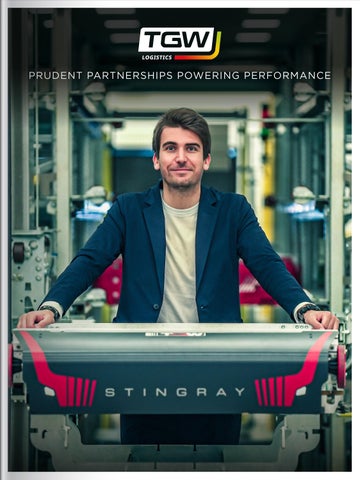
PRUDENT PARTNERSHIPS POWERING PERFORMANCE

The Future of Innovation in AUTOMATION

We revisit TGW Logistics’ journey with Stipe Galic, Vice President of Business Development, who discusses how a transformative market approach strategy positions companies to elevate performance in an ever-evolving industry landscape

Poppi Burke

Since TGW Logistics’ (TGW) last conversation with us, it has introduced a new executive team comprising five leaders with over 70 years of combined experience, including individuals from global roles and those with deep roots in the North American market.

Their diverse backgrounds create a strong blend of perspectives and local understanding, helping align TGW’s identity and values with the region’s specific needs.

“We have been focusing on increasing our team’s expertise, streamlining the way we work,

understanding industry trends, and consulting our customers on their actual needs,” opens Stipe Galic, Vice President of Business Development.

“At the same time, strengthening relationships with existing customers is essential to our success, ensuring they feel like true partners and receive

what they deserve.”

By emphasizing seamless implementation and service, TGW has made significant progress through cultural change and organizational adjustments, resulting in a fivefold increase in pipeline and substantial growth in order intake.

The company’s primary strategy was to accelerate its North American business, resulting in order intake nearly 10 times higher than it was two and a half years ago.

“The automation market in North America was already established, and we positioned ourselves to leverage

that opportunity fully.”

To build a robust market presence, TGW is integrating marketing, business development, and solution consulting while engaging target accounts to help potential customers recognize collaboration opportunities.

“Business development is about

expertise and being present in the right places. We live by two principles: ‘without know-how, you are nobody’, and ‘time is the most precious resource – therefore every touch point with TGW should be valuable for customers’,” insights Galic.

SEAMLESS INTEGRATION

The concept of TGW as a boutique automation integrator reflects the

company’s identity and its approach to the market.

Operating as a foundation-owned company, it reinvests profits and allocates a third to its non-profit organization to fund social projects for young people.

Furthermore, its structure emphasizes long-term growth over short-term financial results, enabling strategic planning across mid- and

long-term horizons.

“We aim to co-create the future of supply chains; therefore, the term boutique fits us well, as we carefully choose our focus areas, portfolio elements, and partnerships,” states Galic.

Focusing on select industry segments, TGW aims to excel in integration rather than spread itself too thin.

CAN YOU PROVIDE SOME DETAILS ABOUT TGW’S CAMPFIRE TALK EVENTS AND HOW THEY CONTRIBUTE TO CUSTOMER RELATIONSHIPS?

Stipe Galic, Vice President of Business Development:

“These events are one of our most important formats for building genuine customer relationships.

“They originated from a spontaneous conversation with our customer, URBN, at a bar after a supply chain event.

“Most industry events, while valuable, follow a very commercial formula. We wanted to create a more human and transformative experience; therefore, we imagined a movement – that’s how Campfire Talk was born.

“It’s a space for real conversations among supply chain leaders, partners, and industry peers to learn from one another, exchange ideas, and discuss challenges and opportunities.

“Everyone is on their own journey, and Campfire Talk is about helping each other take the next step. We focus on meaningful discussions, like you would around a campfire, rather than promoting TGW technology.

“Our vision is to build an ecosystem of technology partners, supply chain leaders, and curious minds who believe in collaboration and in moving the industry forward.

“So far, we’ve hosted five events with more than 150 participants from around 80 customers and over 10 partners and consultants.

“Many relationships and projects have emerged from honest talks at these events, showing that transformation doesn’t start with a proposal or a presentation; it often begins with a conversation.”

100+ years of combined staff experience

1,000,000+

Sprinkler heads installed

The company enhances fulfillment by evolving its technology portfolio, offering solutions from entry-level to high-performance systems in the goods-to-person segment.

Additionally, TGW covers solutions in the area of goods-to-person, automated case handling, mixedcase palletizing, mobile robotics, and robotic picking, with a strong emphasis on software integration for a cohesive, future-ready system.

“The key shift in automation is prioritizing a holistic view and seamless integration over cuttingedge technologies. This minimizes the risk of isolated automation systems failing in operations.

“Ultimately, being a boutique automation integrator means choosing your fields of expertise and a defined way how you deal with your ecosystem partners and customers,” Galic expresses.

For TGW, the long-term strategy

AST Fire Protection Company specializes in the design and installation of fire protection systems for complex material handling and high-density racking environments. Since 1997, storage sprinkler systems have been a core strength of oursbacked by the installation of over 1 million sprinkler heads in storage and automated facilities nationwide.

We have extensive experience with TGW shuttle systems and advanced storage layouts, understanding that product placement and optimization are vital. Our designs accommodate tight clearances, high-density storage, and intricate material handling operations while prioritizing product and life safety.

Our team navigates evolving warehouse configurations with precision. We design to meet NFPA standards, local code requirements, and FM guidelines, bringing proven familiarity. We collaborate closely with system integrators, general contractors, and facility operators to deliver seamless solutions from design through installation.

revolves around enhancing consumer experiences through building solutions that improve the overall process and not just selling technology.

One of the benefits of automation is to address labor scarcity and spatial limitations. However, the bigger impact is on overall company performance, as it enables higher efficiency, consistent service levels, and greater customer satisfaction and loyalty.

“Automation provides the operational backbone to meet rising expectations for speed, accuracy, and flexibility, enabling companies to serve end consumers better and strengthen their brands.

“By optimizing facilities and downstream processes – such as delivery routes and store replenishment – it boosts supply chain performance.

“Without it, companies risk losing

market share and customer loyalty, thereby limiting their ability to meet market expectations. As such, strategic planning and some bold decision in terms of automation is crucial to prepare for future challenges and opportunities,” Galic outlines.

THE TRANSFORMATIVE POWER OF AUTOMATION

Galic acknowledges that automation involves both efficiency and people, with the latter often proving more challenging.

“Skepticism is almost guaranteed with automation – questions, fear, and resistance often arise. This reaction makes sense because it directly impacts real people and routines,” he points out.

“However, when implemented correctly, automation can enhance working conditions while maintaining business efficiency.”

TGW’S EXEMPLARY PROJECTS

Two notable examples of TGW’s projects come from very different industries – fashion and grocery foodservice.

Today, many companies operate legacy distribution networks throughout the US and are now re-evaluating their long-term supply chain network strategy.

“One fashion customer transitioned to a true omnichannel model after separate management of distribution channels led to inefficiencies, duplicated inventory, and limited capacity to balance peak demand across the network.”

“So, TGW implemented a goods-to-person solution called FlashPick®, which streamlined operations by sharing inventory across various channels,” Galic prides.

This game-changing solution reduced costs, consolidated two facilities into one, and improved service to stores, creating a significant financial advantage on the customer’s profit and loss (P&L) statement.

“By implementing the right solution for this environment, the financial case became extremely compelling.”

In the grocery foodservice sector, meanwhile, the focus is on enhancing order fulfilment efficiency, especially since the highest costs arise from delivering products to customers.

“Optimizing truck routes for order preparation enables more stops per delivery, resulting in substantial savings. While automation improved warehouse operations, the biggest gains we saw were in transportation.

“The key takeaway is the importance of a holistic approach and industryspecific expertise,” Galic implores.

He shares a positive example from one of TGW’s customers, where an employee felt they could work several more years due to a new goods-toperson system that alleviated physical strain.

Moreover, Galic, whose mother worked in warehouses and faced similar exhaustion, emphasizes that automation can free workers from repetitive tasks, allowing them to focus on valuable contributions that enhance the customer experience and strengthen the brand.

“If automation enables people to leave their shift less exhausted and more focused on delivering customer value, it is not just an efficiency initiative - it can also be a humancentric one.”

Combining the two worlds unites innovation and people, highlighting the importance of ‘and’ over ‘either/ or’.

Although the level of automation remains industry-dependent, it is expected to significantly impact facility operations in the future.

“In some sectors, fully automated ‘dark’ warehouses will emerge, but most will remain a mix of people, machines, and intelligent software.”

Galic envisions future distribution centers as great working environments, with strong collaboration between humans and robots, focused on value-added services and customization.

He believes these centers will evolve from cost centers to strategic assets, where technology, data, and

“WE ARE ON A GREAT PATH WITH EXISTING AND NEW CUSTOMERS, MANY OF WHOM ARE NOW AN INTEGRAL PART OF THE TGW FAMILY”
– STIPE GALIC, VICE PRESIDENT OF BUSINESS DEVELOPMENT, TGW LOGISTICS

human creativity drive service and differentiation.

“In the future, distribution centers will be smarter, more flexible, and far more connected to customers than ever before,” he predicts.

REVOLUTIONIZING MARKETING

TGW is advancing several marketing initiatives centered around three primary pillars: advertising, customer events and experiences, and consulting on automation journeys.

“The goal is to connect to

customers via any channel they want to engage while also telling our story very clearly. For years, we were seen as the industry’s best-kept secret.

“To achieve ambitious growth targets – especially when the goal is to outperform the market by up to two times – we need to be more proactive and strategic about our presence,” urges Galic.

By investing in dynamic advertising avenues, from digital marketing to podcasts, TGW has created a ‘pinball content ecosystem’ that

ensures customers engage with the company in different ways across various channels and from a variety of perspectives.

This multidimensional approach reflects the diverse needs and preferences of its audience, connecting with a wider range of consumers and resonating with their interests.

While traditionally attending large automation trade shows, TGW has consciously opted out of certain events to prioritize value.

As such, the company now hosts experience events, creating platforms for genuine business exchange and networking to better connect with customers through meaningful conversations.

“When making decisions on projects worth millions, trust in your collaborators is essential. Traditional trade shows can fall short of fostering deep, long-term relationships, even though they are useful for new technology launches.

“This is why TGW established Campfire Talk as the centerpiece of its event strategy.

“IN THE FUTURE, DISTRIBUTION CENTERS WILL BE SMARTER, MORE FLEXIBLE, AND FAR MORE CONNECTED TO CUSTOMERS THAN EVER BEFORE”
– STIPE GALIC, VICE PRESIDENT OF BUSINESS DEVELOPMENT, TGW LOGISTICS

“We are a people-oriented business, and customers now view our choices as bold and smart, eagerly asking when the next one will be,” notes Galic.

When consulting on automation journeys, TGW emphasizes understanding its clients’ specific needs and situations without pushing for sales.

“The aim is to share expertise and guide clients, highlighting our role as an automation integrator and recognizing their unique paths toward transformation, adapting our approach accordingly.

“We want to be seen as true experts who prioritize the customers’ best interests, not just short-term gains,” claims Galic.

SUSTAINABLE GROWTH STRATEGIES

TGW focuses its efforts on key industries, entering new sectors only when it has the potential to become a leading player.

“Our front-end teams are organized by industry to achieve the necessary level of expertise. Equally, we foster a culture of cross-industry knowledge exchange,” Galic highlights.

This approach has been vital to TGW’s success and will remain central to its strategy. Furthermore, North America is experiencing faster growth than Europe, presenting strong potential.

“We are on a great path with existing and new customers, many of

whom are now an integral part of the TGW family.

“Delivering projects on time and within budget is our top priority and essential for our goal of becoming the leading project delivery company,” he expands.

Another key focus is TGW’s service organization, which supports customers across North America.

“We unlock long-term value for our customers and ensure they get the most out of their automation systems by utilizing data and our expert maintenance teams. To achieve this, we work closely with our customers to put together the best maintenance package for their needs,” Galic specifies.

“Typically, that’s a mix of on-site maintenance, remote services, spare parts support, and regular consulting based on data and performance

insights. These Lifetime Services team members are integrated into the customer’s teams to create transparency and deliver daily, longterm success.”

This approach fosters on-site stability and reduces cost and maintenance risk for customers, enabling a relationship built on trust.

“We emphasize focus, expertise, purposeful consulting, creativity, honoring commitments, and highlevel execution. Adapting our structure while maintaining customer relationships is essential.”

Galic’s earnest advice is to select automation partners with genuine commitment, stability, strong ownership, and long-term service and support.

“Consider company structure, sales potential, and profit distribution, not just leadership and project teams.

Our future will be more volatile and unpredictable, and technology will evolve rapidly – the key is having a reliable partner who won’t suddenly change direction.

“Customers should seek a company with strong ownership that is committed to serving its customers and people and ready to support them through every step of their journey,” he concludes emphatically.

Tel: 616-888-2595

us.info@tgw-group.com

tgw-group.com

Turn static files into dynamic content formats.
Create a flipbook