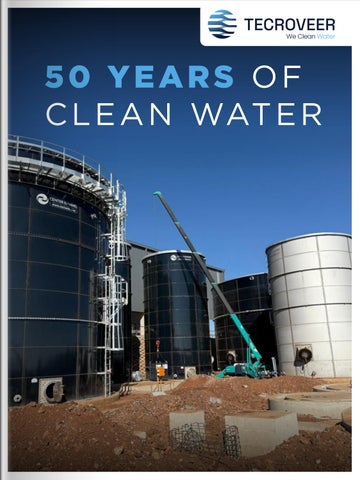
50 YEARS OF C L E A N WAT E R
50 YEARS OF C L E A N WAT E R Operating across Southern Africa and beyond for half a century, Tecroveer upholds a shared commitment to restoring confidence in clean water. Group CEO, Izak Cronje, talks us through the company’s unwavering environmental purpose and flagship Hammanskraal water treatment plant Writer: Lucy Pilgrim | Project Manager: Robert Payne Izak Cronje, Group CEO
D
espite experiencing a significant upward trajectory at the time, the South African mining industry in the 1970s was running into serious sewage capacity constraints. The existing infrastructure left challenges unresolved, leading the Council for Scientific and Industrial Research (CSIR) and other consulting engineers to create a solution for such conditions. It is within this context that Tecroveer was founded; on 1st March 1976, the company was born from a real problem rather than a business idea. Indeed, the Tecroveer name itself is a portmanteau of technology, rotor, and Pasveer – after a Pasveer oxidation ditch. “Engineering is literally in the name, and that has never stopped being 2 | Sustainability Outlook Issue 3
true of how we operate,” begins Izak Cronje, Group CEO. “We have been anchored in Glenharvie, Gauteng since the late 1980s, which means five decades of serving the same community. That matters more than it sounds; you cannot walk away from work you have to drive past,” he emphasises. Celebrating its 50th anniversary this year, Tecroveer views this milestone as a marker not of longevity, but of maintaining a clear purpose whilst everything else has changed – the technology, regulations, clients, and South Africa (SA) itself. “Our purpose is ‘We Clean Water’. The picture behind that is simple and has not moved: our children playing in pristine rivers and oceans and drinking safe water straight from the tap,” shares Cronje.
Half a century after Tecroveer was founded to revolutionise water and wastewater treatment solutions, the company has opened its Hammanskraal water treatment plant – built to answer another emergency. “50 years on, we’re doing the same thing – showing up when water fails and fixing it. That is what the milestone means to us. “Looking forward, our goal for 2035 is to be a globally recognised, purpose-driven water technology company. 50 years is the platform, not the achievement,” Cronje sets out.
SOLUTION-DRIVEN GROWTH Since its inception, Tecroveer has expanded significantly not from strategised planning, but from creating tailored solutions for clients who had no off-the-shelf answer.
TECROVEER AFRICA
TECROVEER AFRICA
This unique growth began in 1976 when the province’s mines required greater sewage capacity, for which the company built a wastewater foundation. Moreover, local municipalities with failing works needed a business that would not just design a fix but stand behind it, resulting in a turnkey service delivery system and, later, resuscitation as an operational discipline. From here, industry demands for better wastewater treatment facilities paved the way for Tecroveer’s industrial treatment capability, with its plant gaining a solid reputation for long-term dependability after several years – attracting clients and resulting in the creation of the company’s Operation and Maintenance (O&M) division. Elsewhere, clients that needed compliance but had no capital budget sparked the launch of Tecroveer’s
Financed Solutions model, whilst the Hammanskraal emergency demanded drinking water in months rather than years, forcing the company to productise five decades of learning to create a plant quickly and efficiently. “The pattern is as such: listen to the client’s actual constraint, engineer for it and, when the same problem walks in the door three times, turn the answer into a product. That is how a wastewater specialist became a fullspectrum provider,” explains Cronje.
A PROJECT OF NATIONAL SIGNIFICANCE In 2023, Hammanskraal, a town north of Pretoria, experienced a significant cholera outbreak that transformed the area’s long-standing water quality problem into a national emergency overnight. “The facility’s requirement changed shape completely; the country
needed safe drinking water at Hammanskraal in months, not years,” Cronje tells us. Under Pro-Plan Consulting Engineers (Pro-Plan) and Magalies Water, Tecroveer was contracted as the full turnkey partner – including design, supply, installation, and commissioning works – for a new modular drinking water plant. The answer was the Calabash modular water treatment system installed at Hammanskraal, comprising four modular units delivering up to 50 megalitres (ML) per day of safe drinking water. On the conviction that the company would rise to the challenge, Tecroveer tendered the project without an offthe-shelf solution. “Pro-Plan and Magalies Water had seen our track record – the acid mine drainage work and the industrial plants – and there was enough trust there to appoint us on that basis.
What we delivered was not a package plant at all; it was a modular water treatment plant that had never existed before and developed in record time inside the project,” he outlines. At this scale and efficiency, Hammanskraal’s modular concept was a world first and is one of the largest modular water treatment facilities of its kind in Africa. On 18th July this year, SA President, Cyril Ramaphosa, officially opened the facility and chose it as the platform to launch the government’s National Water Access Acceleration Programme. “The President could have spent Mandela Day anywhere in the country doing anything, but he opened the plant because of what it represents: an emergency answered with working infrastructure,” Cronje gleams. The four Calabash modules now feed 50 ML of treated water
“ O U R P U R P O S E I S ‘ W E C L E A N WAT E R ’ . T H E P I C T U R E B E H I N D T H AT I S S I M P L E A N D H A S N O T M O V E D : O U R C H I L D R E N P L AY I N G IN PRISTINE RIVERS AND OCEANS AND D R I N K I N G S A F E WAT E R S T R A I G H T F R O M T H E TA P ” – I Z A K C R O N J E , G R O U P C E O, T E C R OV E E R
per day into the City of Tshwane’s network, serving an estimated 47,550 households and around 180,000 people in Hammanskraal and the surrounding communities. The project’s significance has also been recognised internationally. At this year’s International Federation of Municipal Engineering (IFME) World Congress in Helsinki, Finland, Tecroveer’s Calabash solution at Hammanskraal won the IFME Construction Project Gold Award.
“That is a South African emergency response judged against the best municipal engineering in the world and taking gold. It reflects the teamwork between Pro-Plan, Magalies Water, and Tecroveer as much as any single company,” he prides.
FULL TURNKEY CONTRACTOR The secret behind Hammanskraal’s success was its modularity, enabling the company to beat the clock. Sustainability Outlook Issue 3 | 5
OUTPERFORMING THE INDUSTRY NORM Across its 50-year history, Tecroveer has overcome many barriers in conventional water treatment, including high-strength industrial effluent, ageing infrastructure, and systems under real operational pressure. High-strength industrial effluent is waste that conventional municipal works were never designed to receive, particularly across the South African food and beverage sector. “In each case, the load is far outside what the standard works can absorb. Tecroveer’s answer to this is process design built for that specific stream rather than a general-purpose plant that is expected to cope with the highstrength effluent,” Cronje details. Tecroveer was also the mechanical and electrical implementer of the Eastern Basin Acid Mine Drainage plant – at 108 ML per day, it is one of the largest facilities of its kind in the world. Ageing infrastructure is another Tecroveer speciality. It has refurbished hundreds of wastewater treatment works, including the Matwabeng facility in Senekal and Rooiwal facility in Gauteng. “These works were brought back into service through smart redesign and automation rather than demolition and rebuild. Extending the life of an asset is almost always the better engineering and economic answer,” he explains. Tecroveer is further differentiated by its ability tackle systems under real operational pressure. Its O&M contracts keep plants compliant day to day, whilst the company’s financed solutions let municipalities reach compliance without waiting for a capital cycle that may never arrive. “The common thread across all three is accountability that does not hand over at commissioning. Design, build, operate – one partner, one line of responsibility,” Cronje states.
6 | Sustainability Outlook Issue 3
“On a conventional build, you construct a bespoke plant on-site, stage by stage, and the programme is the sum of those stages. Here, the integrated treatment modules were manufactured whilst civil works proceeded in parallel, which compresses a schedule in a way sequential construction simply cannot match,” illustrates Cronje. Just six months after the emergency work began – with staff working round the clock – the first 12.5-ML module delivered clean water into the reservoir whilst the civil works for the remaining modules were still being built around it. The plant was subsequently improved during delivery rather than after a defect period thanks to a standardised design across all four units and the company’s total ownership of the project, from ideation to commissioning. Through that optimisation, each module now delivers 16.5 ML per day against the 12.5 ML per day contracted, totalling 66 ML per day operational across the plant, against the 50 ML per day contracted. As the designer, fabricator, installer, and commissioning team were all from one company, there was a single line of accountability, turning an emergency timeline into working infrastructure. “When something needed to change, the decision took days, not months,” he recalls. Hammanskraal also created a documented, repeatable model for any municipality or utility facing a similar constraint. “The standardised, optimised unit design means the next municipality does not start from a blank sheet. The model is on the shelf, documented, and with known performance – and now with a presidential opening and an international gold award behind it, no one has to take our word for what it can do,” Cronje affirms.
TECROVEER AFRICA
Proudly part of
The Steel Service Solution Centre
LOOKING FOR A STEEL SERVICE PARTNER THAT DELIVERS PRECISION, SPEED, AND RELIABILITY?
Our Services Hi Definition Plasma Cutting Laser Cutting Bending Rolling Guillotining Chamfering Brushing Machining Flange Manufacturing Material Cutting to size (sheets & plates)
331 Dame Street, Extension 3 Wadeville, Germiston Gauteng, South Africa, 1422 � +27 11 902 5550 +27 82 490 0406 � sales@plasmacut.co.za
www.plasmacut.co.za DRIVING THE CIRCULAR ECONOMY The Hammanskraal facility also demonstrates Tecroveer’s ability to turn waste streams into vital resources, primarily because the plant treats its own residuals. Indeed, an on-site dewatering plant – added as a separate phase of the contract – significantly reduces the sludge volume, and the dewatered sludge goes to a composting contractor rather than to landfill. “There is also deliberately no composting on site, as the Hammanskraal community lives on one side of the works and a wildlife estate sits across the river, so the material leaves the site only to become compost,” notes Cronje. Broaden this ethos to the wider organisation, and sludge management and resource recovery is a core service line for Tecroveer – recovering water, nutrients, and Sustainability Outlook Issue 3 | 7
“WE DESIGN IN AFRICA, FOR AFRICA – FO R A N I N D E F I N I T E D E S I G N L I F E , N OT A F I N I T E O N E . W E O P E R AT E P L A N T S S T I L L P R O D U C I N G C L E A N LY A F T E R 2 0 Y E A R S WITHOUT MAJOR REFURBISHMENT” – I Z A K C R O N J E , G R O U P C E O, T E C R OV E E R
energy from streams that would otherwise be a disposal cost. The company’s Cape Town Biogas facility is a clear example of this, where the city’s organic waste is turned into renewable energy, simultaneously reducing emissions 8 | Sustainability Outlook Issue 3
and operating costs. Similarly, PepsiCo’s Simba plant in Isando is designed to process around 50 tonnes of organic solid waste a day into biogas and electricity in support of a zero-organic-waste-to-landfill strategy. The Hammanskraal plant itself is low energy by design as its Calabash systems are engineered to reduce energy use and total lifecycle cost. “Measured against the existing conventional works treating the same raw water on the same site, the Calabash system uses roughly a
third of the energy per ML,” Cronje expands. It is equally durable by design. Being built using standardised units with interchangeable parts means the plant stays maintainable for decades, whilst Tecroveer remains available to operate and support it – a distinguishing factor that decides whether the infrastructure survives. “We design in Africa, for Africa – for an indefinite design life, not a finite one. We operate plants still producing cleanly after 20 years without major refurbishment,” he points out.
TECROVEER AFRICA
STEWARDSHIP AS A PURPOSE
SA President, Cyril Ramaphosa, and Minister of Water and Sanitation, Pemmy Majodina, at the Magalies Water Klipdrift Modular Package Plant, Calabash
Tecroveer team with Minister Majodina
Tecroveer has a clear commitment to the UN’s Sustainable Development Goals (SDGs), adhering to SDG 6 – clean water and sanitation, SDG 7 through its waste-to-energy services, SDG 9 through resilient infrastructure, and SDG 12 via responsible production. “Stewardship is the purpose, not a policy document,” declares Cronje. “We hold ourselves to whether a project leaves a river cleaner, an ecosystem healthier, and a community better served – if it does not, we have not done the job, regardless of what the contract says.” Indeed, the local community are not just an audience to this model but a key part of it, as each Tecroveer project creates economic participation and builds local service delivery capacity, creating a measurable social impact that sits alongside the environmental result. “There is a human side that engineers tend to leave out. We do not just build plants; we rebuild confidence in clean water. Restoring dignity, health, and trust in the tap is the real output at somewhere like Hammanskraal,” he closes.
Tecroveer and Pro-Plan Consulting Engineers with Ofentse Nthutang, CEO of Magalies Water, and Stanley Ngobeni, Board Member and Chair of the Audit and Risk Committee
Tel: +27 11 752 1191 info@tecroveer.co.za Tecroveer, Nthutang, and Deputy Minister of Water and Sanitation, David Mahlobo
www.tecroveer.co.za Sustainability Outlook Issue 3 | 9
Tel: +27 11 752 1191 info@tecroveer.co.za
www.tecroveer.co.za