N O F A R
E N E R G Y
R O M A N I A
K I N G S PA N
N O R D I C S
GREEN BUILDING COUNCIL OF AUSTRALIA
Contributing to the nation’s net zero goals
CBRE www.sustainabilityoutlookmag.com
Issue 2
Real estate solutions of the future
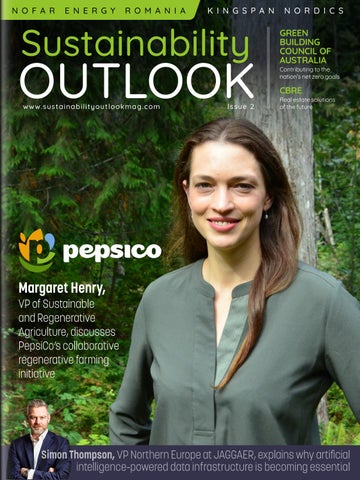
Margaret Henry,
VP of Sustainable and Regenerative Agriculture, discusses PepsiCo’s collaborative regenerative farming initiative
Simon Thompson, VP Northern Europe at JAGGAER, explains why artificial intelligence-powered data infrastructure is becoming essential
COUGAR GROUP
COMPAGNIE DES BAUXITES DE GUINÉE
DERICHEBOURG | RHEINMETALL UK
DIGICEL HAITI
CBRE TURBOCAM
COOPER FLUID SYSTEMS
K N E U M AY E R C I V I L C O N T R A C T O R S
LONDON FIRE BRIGADE
JOHN A. MORAN EYE CENTER Issue 14
ROBINSON MINE
Unearthing new standards of copper extraction
w w w. a f r i c a o u t l o o k m a g . c o m
Issue 120
w w w. a p a c o u t l o o k m a g . c o m
www. northame ricaoutlookmag.com
Issue 80
AGILE MINING SERVICES
w w w. e m e o u t l o o k m a g . c o m
The pioneering endeavour delivering a new benchmark for golf equipment
Where technology meets tenacity
Transforming waste into valuable resources
BANNERMAN MINING RESOURCES NAMIBIA
Harnessing the nation’s rich resources
DANONE ROMANIA
MONTEGO PET NUTRITION
HUNTER VALLEY OPERATIONS
VULCAN MOZAMBIQUE
BUILT FOR THE
GRYDALE
Operator safety through world-class dust management solutions
JOURNEY AHEAD
Amongst the world’s premier coal miners, contributing significantly to energy security and economic stability in the Hunter Valley
On a mission to be the world’s leading integrated green coal mining operation, Vulcan Mozambique continues to drive the country’s mining space
Pad-Up Creations is determined to provide hygiene products with safety, comfort, and sustainability. Olivia Onyemaobi, Founder and CEO, tells us more
Whether on the road or on the water, Lippert enhances all outdoor recreation adventures
Panasonic Connect Europe is a vital bridge between the digital and physical worlds. Peer Schumacher, Head of Electronics Manufacturing Solutions, gives his insight
Dr Omera Khan, Chief of Staff, Strategy and ESG Lead at DHL Supply Chain Asia Pacific, provides insight into the next era of supply chain excellence
THE 1-2-1 • THE QUESTION • TURBOCAM
Margaret Melanson
President and CEO, shares the organization’s innovative approaches and dedication to quality across its wide network of hospitals and community-based facilities in New Brunswick, Canada
Mopani Copper Mines is a proudly Zambian mining company engaged in the full spectrum of copper production, from ore extraction to the beneficiation of finished copper cathodes ready for export across the globe
Contributing to a healthier world
A well-loved and innovative pet care brand
THE THOUGHT LEADER
• THE 1-2-1 • THE QUESTION
Phil McKee, Chairman and Founder of Appliance Innovation, explores the company’s approach to automation, driven by a commitment to solving operational challenges in the foodservice sector
T O N G A AT H U L E T T Z I M B A B W E • K U K U F O O D S
WBHO CONSTRUCTION
Paula Burke, Director, HealthTech and Medical Devices, discusses HSBC Innovation Banking Life Sciences’ UK & Europe: Life Sciences & Healthcare Venture Financing Report
Dr Max Werner, CEO and Founder, details Hades Mining’s proprietary drilling technology, which is set to fundamentally change drilling economics
GREEN BUILDING COUNCIL OF AUSTRALIA
N O F A R
E N E R G Y
R O M A N I A
K I N G S PA N
BOKOMO NAMIBIA
w w w. s u p p ly c h a i n - o u t l o o k . c o m
Issue 12
W W W .CONST RUCT ION-OUT L OOK.COM • ISSUE 3
www.foodbevera ge-outl ook.com
Contributing to the nation’s net zero goals
OUTLOOK
CBRE www.sustainabilityoutlookmag.com
Enhancing food security and supporting local economies
Real Estate Solutions of the Future
N O R D I C S
GREEN BUILDING COUNCIL OF AUSTRALIA
AUNT MILLIE’S Healthy, high-quality baked goods
ISSUE 10
www.mfg-outlook.com
Issue 2
Real estate solutions of the future
Iss ue 8
CBRE’s multidimensional perspective helps businesses find greater success with real estate facilities. John Kirkman, Senior Managing Director and Supply Chain Leader, gives us the full story
LOCKHEED MARTIN LIPPERT
Enhancing all outdoor recreation adventures
Zambia’s largest fast-moving consumer goods manufacturer, Trade Kings Group, has an expanding ecosystem of brands that remain both relevant and scalable
As a subsidiary of Dassault Systèmes, DELMIA is on track to shape the manufacturing industry of the future. We speak to Guillaume Vendroux, CEO Jan Diekmann, Head of Business Development and Manufacturing at Ericsson Enterprise Wireless Solutions, explores how private 5G is transforming the factory floor
Enterprise Wireless Solutions, explores how private 5G is transforming the factory floor Jan Diekmann, Head of Business Development and Manufacturing at Ericsson
Packsize is the global leader in packaging automation. We unbox the company’s right-sized approach with Brian Reinhart, Chief Revenue Officer company’s right-sized approach with Brian Reinhart, Chief Revenue Officer Packsize is the global leader in packaging automation. We unbox the
Wouter van der Kolk, co-Founder and CEO, shares how Youvit is scaling a category-defining lifestyle supplement brand across Southeast Asia a category-defining lifestyle supplement brand across Southeast Asia Wouter van der Kolk, co-Founder and CEO, shares how Youvit is scaling
We speak to Guillaume Vendroux, CEO track to shape the manufacturing industry of the future. As a subsidiary of Dassault Systèmes, DELMIA is on
and Virtual Worlds Bridging the Real
INTEGRAL TO THE INDUSTRIAL LANDSCAPE
TRADE KINGS GROUP
Locked and loaded
Bridging the Real and Virtual Worlds
VP of Sustainable and Regenerative Agriculture, discusses PepsiCo’s collaborative regenerative farming initiative
K Neumayer Civil Contractors upholds a deep responsibility to develop Namibia’s industrial landscape
Simon Thompson, VP Northern Europe at JAGGAER, explains why artificial intelligence-powered data infrastructure is becoming essential
The Founder and CEO of GRU Space reveals his plans for the first lunar hotel Skyler Chan, has ambitious designs on Earth’s celestial companion.
intelligence-powered data infrastructure is becoming essential Simon Thompson, VP Northern Europe at JAGGAER, explains why artificial
develop Namibia’s industrial landscape upholds a deep responsibility to K Neumayer Civil Contractors
LANDSCAPE INDUSTRIAL TO THE INTEGRAL
GROUP TRADE KINGS
adventures outdoor recreation Enhancing all
Margaret Henry,
Skyler Chan, has ambitious designs on Earth’s celestial companion. The Founder and CEO of GRU Space reveals his plans for the first lunar hotel
remain both relevant and scalable expanding ecosystem of brands that Trade Kings Group, has an consumer goods manufacturer, Zambia’s largest fast-moving
LIPPERT
Locked and loaded
MARTIN LOCKHEED
initiative regenerative farming PepsiCo’s collaborative Agriculture, discusses and Regenerative VP of Sustainable
Margaret Henry, gives us the full story Director and Supply Chain Leader, John Kirkman, Senior Managing success with real estate facilities. helps businesses find greater CBRE’s multidimensional perspective
TELL US YOUR STORY, AND WE’LL TELL THE WORLD the Future Solutions of Real Estate
www.mfg-outlook.com
www.foodbevera ge-outl ook.com
Issue 12
Iss ue 8
economies and supporting local Enhancing food security
w w w. s u p p ly c h a i n - o u t l o o k . c o m
NAMIBIA BOKOMO
ISSUE 10
W W W .CONST RUCT ION-OUT L OOK.COM • ISSUE 3
OUTLOOK
www.sustainabilityoutlookmag.com
Issue 2
CBRE
AUSTRALIA COUNCIL OF BUILDING GREEN
AUNT MILLIE’S
THE THOUGHT LEADER
• THE 1-2-1 • THE QUESTION
T O N G A AT H U L E T T Z I M B A B W E • K U K U F O O D S
of the future Real estate solutions nation’s net zero goals Contributing to the
baked goods Healthy, high-quality
THE 1-2-1 • THE QUESTION • TURBOCAM
Integrated digital health information
Horizon Health Network
MOPANI COPPER MINES
FORTERRA
REMONDIS BELGIEN
www.healthcare-outlook.com
www.mining-outlook.com • Issue 15
Every product deserves a box that fits perfectly
End-to-end solutions from exploration to extraction
Helping junior miners unlock value
JOSEPH BRANT HOSPITAL
PACKSIZE
WEIR
HARDY DIAGNOSTICS
Building a healthier world
Issue 35
Issue 72
WBHO CONSTRUCTION
GREEN BUILDING COUNCIL OF AUSTRALIA
N O F A R
E N E R G Y
R O M A N I A
K I N G S PA N
N O R D I C S
Africa Outlook, APAC Outlook, EME Outlook, North America Outlook, Mining Outlook, Healthcare Outlook, Manufacturing Outlook, Supply Chain Outlook, Food & Beverage Outlook, Construction Outlook, and Sustainability Outlook are digital publications aimed at boardroom and hands-on decision-makers, reaching an audience of more than 800,000 people around the world. With original and exclusive content compiled by our experienced editorial team, we look to promote the latest in engaging news, industry trends, and success stories from across the globe. Your company can join the leading industry heavyweights enjoying the free exposure we provide across our platforms with a free marketing brochure, extensive social media saturation, enhanced B2B networking opportunities, and a readymade forum to attract new investment and help you grow your business. Visit www.outpb.com/work-with-us for details on how your company can feature for free in one of our upcoming editions.
www.outpb.com/work-with-us
WELCOME FROM THE EDITOR
EDITORIAL Head of Editorial: Jack Salter jack.salter@outpb.com Deputy Head of Editorial: Lucy Pilgrim lucy.pilgrim@outpb.com Senior Editor: Lily Sawyer lily.sawyer@outpb.com Editor: Ed Budds ed.budds@outpb.com Editor: Rachel Carr rachel.carr@outpb.com Copy Editor: Lauren Kania lauren.kania@outpb.com PRODUCTION Art Director: Stephen Giles steve.giles@outpb.com Senior Designer: Devon Collins devon.collins@outpb.com Designer: Louisa Martin louisa.martin@outpb.com Production Manager: Alex James alex.james@outpb.com Digital Marketing Director: Fox Tucker fox.tucker@outpb.com Senior Web Content Manager: Oliver Shrouder oliver.shrouder@outpb.com Social Media Executive: Jake Crickmore jake.crickmore@outpb.com BUSINESS CEO: Ben Weaver ben.weaver@outpb.com Managing Director: James Mitchell james.mitchell@outpb.com Chief Technology Officer: Nick Norris nick.norris@outpb.com Content Director: Neil Perry neil.perry@outpb.com Global Head of Media: Lewis Hammond lewis.hammond@outpb.com Global Media Executive: Kai Boyle-Vennard kai@outpb.com ADMINISTRATION Finance Director: Suzanne Welsh suzanne.welsh@outpb.com Finance Manager: Victoria McAllister victoria.mcallister@outpb.com CONTACT Sustainability Outlook Norvic House, 29-33 Chapelfield Road Norwich, NR2 1RP, United Kingdom Sales: +44 (0) 1603 804 445 Editorial: +44 (0) 1603 804 431 SUBSCRIPTIONS Tel: +44 (0) 1603 804 431 jack.salter@outpb.com www.sustainabilityoutlookmag.com Follow us on Linkedin: @sustainabilityoutlook Follow us on X: @outlookpublish
STEPPING UP TO THE PLATE Welcome to our second edition of Sustainability Outlook magazine. The 1-2-1 with Margaret Henry, VP of Sustainable and Regenerative Agriculture at PepsiCo, heads up our latest issue. Henry shares how STEP Up for Agriculture – PepsiCo’s collaborative regenerative farming initiative – is helping create resilient support networks for farmers worldwide. The momentum behind the transition to regenerative agriculture is accelerating, but the systems and structures needed to support farmers have not kept pace. Many farmer support organisations, which are the primary advisers farmers trust, lack knowledge of regenerative practices or the ability to scale their impact. STEP Up for Agriculture responds directly to this gap. “By strengthening these organisations now, the programme can help enable faster, more local and effective adoption of regenerative practices on the ground, at a time when climate, soil health, and supply chain pressures are intensifying globally,” Henry tells us. Another company stepping up is Shorr Packaging (Shorr), where sustainability is prioritised as an essential pillar of its day-to-day operation. The company continues to receive prestigious accolades for its sustainable mindset, including its recent EcoVadis Silver Badge, which is a true reflection of Shorr’s genuine commitment to sustainability. “For us, the biggest lesson wasn’t about achieving a particular rating or badge, it was learning how to think differently about our business and translate those lessons into value for customers,” affirms Sustainability Manager, Meredith Moore. Sustainability is likewise a focus for CBRE, the world’s largest commercial real estate services and investment firm and a premier provider of critical infrastructure services. The company has made a public commitment to achieve net zero emissions by 2040 – a target supported by tangible programmes across its global portfolio and value chain. “For our clients, sustainability has increasingly become a value creation lens rather than simply a compliance requirement,” outlines John Kirkman, Senior Managing Director and Supply Chain Leader. We also find out how the likes of Kingspan Nordics, Nofar Energy Romania, and the Green Building Council of Australia are stepping up their sustainability commitments. We hope that you enjoy your read. Jack Salter Head of Editorial, Outlook Publishing Sustainability Outlook Issue 2 | 3
11 THE THOUGHT
2
CONTENTS REGULARS
LEADER
21 THE 1-2-1
Simon Thompson
Margaret Henry
VP Northern Europe, JAGGAER
The Hard Cost of Carbon Why supply chain emissions data is now a finance function
SUSTAINABILITY INSI G HTS
VP of Sustainable and Regenerative Agriculture, PepsiCo
Supporting the Sustainability Transition Resilient support networks for farmers
26 THE QUESTION Measuring Impact: How can companies measure environmental impact across complex global value chains?
6 Blue Yonder Steering Strategic Resilience Building resilient and sustainable supply chains
I N DU STRY S P OTL I G H T
36 Green Building Council of Australia 15
15 THE DISRUPTOR PATH Water
6
4 | Sustainability Outlook Issue 2
Inspiring a Customer Behaviour Revolution Bold thinking disrupts the beverage industry
Contributing to the nation’s net zero goals
SUSTAINABILITY OUTLOOK CONTENTS
AFRICA
FEATURES
134 Bannerman Mining Resources Namibia
NO RT H AMERICA
Unlocking a Uranium Upgrade
48 Shorr Packaging A Shorr Thing More efficient, optimised packaging solutions
80
Harnessing Namibia’s rich resources
EU R OP E & M I D D L E E AST
80 Kingspan Nordics Better Buildings for a Better World Meeting today’s regulations and tomorrow’s sustainability goals
90 Nofar Energy Romania Romania’s Renewable Revolution An essential player in the energy transition and an emerging platform for investor capital
48
134
146 Heath Goldfields LTD The Importance of Indigenous Mining Committed to the revival of the 100-yearold Bogoso-Prestea Mine
56 CBRE Real Estate Solutions of the Future A new multidimensional perspective
90
98 Derichebourg Enabling Europe’s Circular Economy
146
At the forefront of metal recycling
108 REMONDIS Belgien 56
Waste into Worth Transforming waste into valuable resources
158 Marcopolo S.A. A Sustainable Protagonist in Mobility Solutions Bringing together human values, passion, and product excellence
66 Packsize Smart Packaging for a Healthy Planet Every product deserves a box that fits perfectly
108
114 Investwood
66
74 Corix
158
Rooted in Innovation
166 KRT Group
Reshaping modern construction
Farming Forward – A Vision for Sustainable Agriculture
120 Danone Romania
Sustainable practices and growth in Zambia
Nurturing Nutrition
AS I A PAC I F I C
Contributing to a healthier world
Cultivating Tomorrow’s Low-Carbon Energy Infrastructure
126 DN AGRAR
Bringing low-carbon energy systems to life across Canada and the US
Revolutionising the milk industry
From Farm to Future Dairy Dominance
174 Kajima Overseas Asia Pte Ltd Rooted in Japan, Built Across Asia Coordinating Kajima Corporation’s construction activities
Sustainability Outlook Issue 2 | 5
STEERING STRATEGIC RESILIENCE Building resilient and sustainable supply chains is at the top of the agenda for many businesses today. We sit down with Saskia van Gendt, Chief Sustainability Officer at Blue Yonder, to discuss the resilience and artificial intelligence-driven innovation required to succeed – even as climate change and geopolitical uncertainty persist Writer: Lily Sawyer
W
ith the recent pistachio shortage highlighting the growing impact both climate change and geopolitical tensions can have on global supply chains, businesses across the world are learning an important lesson. “The recent pistachio shortage shows how quickly modern supply chains can destabilise when demand velocity outpaces agricultural and production cycles,” opens Saskia van Gendt, Chief Sustainability Officer at Blue Yonder. Indeed, volatility is no longer an exception – it is structural, and businesses today must move away from static forecasting to dynamic demand sensing that incorporates non-traditional signals such as social media trends, weather anomalies, and 6 | Sustainability Outlook Issue 2
geopolitical risk indicators. It also reinforces the need for diversifying sourcing regions, scenario planning for climate and conflict risks, and tighter integration between demand planning and procurement so organisations can respond before bottlenecks materialise. “Recent events in the Strait of Hormuz reinforce this point. Even when supply routes reopen, recovery remains gradual as congestion, insurance delays, and operational caution continue to affect the movement of critical inputs such as fertilisers,” outlines van Gendt.
SUSTAINABILITY INSIGHTS BLUE YONDER
As such, building resilience is about anticipating disruption earlier and understanding how interconnected risks can cascade across global supply chains.
RESILIENT AND SUSTAINABLE As extreme weather disrupts the supply of key commodities such as cocoa, wheat, rice, and corn, organisations are building more resilient and sustainable supply chains. “Resilience depends on designing supply chains that can absorb shocks rather than simply react to them. That means shifting from single-source or regionally concentrated sourcing to multiregional, flexible supplier networks,” van Gendt explains. It also requires investing in climateresilient agricultural practices,
including regenerative approaches that improve soil health and water retention, making yields more stable under stress. On top of inventory, organisations need a strategic buffer capacity comprised of flexible logistics, diversified transport routes, and stronger end-to-end visibility so disruptions in one corridor do not cascade globally. Scenario planning and artificial intelligence (AI)-driven forecasting can also help model the impact of extreme weather, enabling them to shift demand and geopolitical events before they become operational challenges. “With resilience and sustainability increasingly converging, reducing emissions, waste, and resource intensity not only supports environmental
goals but also improves long-term supply stability and helps organisations adapt more effectively to future disruption,” van Gendt emphasises.
SHAPING SUPPLY CHAIN STRATEGY As sustainability increasingly shapes supply chain strategy, leading organisations are beginning to embed sustainability into their sourcing and procurement decisions rather than treating it as a separate environmental, social, and governance (ESG) initiative. “Rather than treating sustainability as a parallel ESG workstream, they are embedding it directly into procurement decision-making,” states van Gendt. Examples include integrating carbon metrics into supplier Sustainability Outlook Issue 2 | 7
SUSTAINABILITY INSIGHTS BLUE YONDER
scorecards, making Scope 3 emissions a core sourcing constraint alongside cost and quality, and embedding sustainability key performance indicators (KPIs) into contracts and supplier performance management. In addition, as supplier decisions become increasingly informed by scenario planning that considers both climate and geopolitical risk, procurement teams are actively incentivising regenerative and deforestation-free sourcing, ensuring organisations build resilience as well as sustainability into their sourcing strategies. “In practice, sustainability becomes a ‘licence to operate’ within supplier selection rather than an after-the-fact reporting exercise,” she details. For Blue Yonder, this is reflected in how sustainability is being embedded directly into planning systems and decision workflows. “In doing so, we enable organisations to balance environmental objectives with cost, service, and resilience, rather than treating sustainability as a separate reporting layer,” van Gendt tells us.
VISIBILITY IS KEY With businesses looking to anticipate climate-related risks before they become operational or financial challenges, end-to-end supply chain visibility is allowing them to move from reactive firefighting to forwardlooking risk management. “When planning, sourcing, and execution data are unified, businesses can connect early signals – such as drought forecasts, El Niño patterns, shipping disruptions, or geopolitical instability – to downstream operational impact,” van Gendt elaborates. This enables scenario modelling before disruption hits – being able to anticipate how a cocoa yield shock in West Africa or fertiliser disruption in the Gulf region, for example, could affect production schedule, pricing, 8 | Sustainability Outlook Issue 2
“The recent pistachio shortage shows how quickly modern supply chains can destabilise when demand velocity outpaces agricultural and production cycles” – S A S K I A VA N G E N D T, C H I E F S U S TA I N A B I L I T Y O F F I C E R , B L U E Y O N D E R
and inventory months in advance. “Crucially, visibility also reduces decision latency. When leaders can see constraints in real time across tiers of suppliers, they can reroute, re-source, or rebalance demand before risks escalate into financial loss,” she highlights.
As climate and geopolitical risks become increasingly interconnected, organisations with real-time visibility and AI-enabled decision support will be significantly better positioned to adapt than those relying on historical planning models.
SUSTAINABILITY INSIGHTS BLUE YONDER
SUSTAINABLE ABUNDANCE Operating at the intersection of technology and sustainability, Blue Yonder is on a mission to enable global supply chains to deliver what the world needs whilst minimising environmental impact. In this way, the company is seeking to deliver ‘sustainable abundance’, which comprises a future where fresh food, essential medicines, and economic opportunity are delivered at scale – efficiently, responsibly, and resiliently. Blue Yonder believes sustainability is no longer a nice-to-have – businesses are increasingly investing in sustainability to drive business growth, with: • 77 PERCENT of consumers willing to pay more for sustainable products. • 49 PERCENT of supply chain leaders prioritising sustainability alongside resilience and profitability. • 40 PERCENT of global carbon emissions addressable using readily available and cost-effective strategies. Striving to make its vision of sustainable abundance a reality, Blue Yonder’s AI-powered, end-to-end visibility platform can help businesses optimise their supply chains, increasing efficiency and reducing carbon emissions for a more sustainable world.
TRANSFORMATIONAL TECHNOLOGY Supply chain transparency is high on the agenda for many businesses today, and technology is on hand to help bridge the gap. “Today, the biggest barrier to transparency is fragmentation, with data often managed across disconnected systems and multiple tiers of suppliers, resulting in inconsistent or inaccurate visibility,” van Gendt notes. She also points out a prevalent trust gap amongst suppliers who may lack the incentives or capability to share granular environmental and operational data – particularly beyond Tier 1 – making it difficult to build a complete picture of supply chain risk. “Technology is increasingly bridging this gap: AI-driven platforms, digital twins, Internet of Things (IoT)enabled tracking, and traceability systems are helping to build more continuous, auditable supply chain visibility.” Sustainability Outlook Issue 2 | 9
SUSTAINABILITY INSIGHTS BLUE YONDER
These tools transform fragmented data into actionable intelligence, enabling faster and more informed decisions. Technology alone is not enough, however, as standardised data definitions, stronger supply collaboration, and shared accountability frameworks are equally important to make transparency operational rather than aspirational.
FINDING A BALANCE As climate change undeniably reshapes global supply chains, businesses must successfully balance sustainability, resilience, and commercial performance. “Climate change is fundamentally increasing the frequency, correlation, and severity of supply chain shocks, and we are already seeing overlapping risks reinforcing each other rather than occurring in isolation,” van Gendt reflects. As extreme weather, geopolitical tension, resource scarcity, and input shortages persist, Blue Yonder anticipates that supply chains will become gradually more digitally orchestrated and adaptive. “Agricultural systems will also continue shifting towards regenerative models that improve resilience by restoring soil health, water cycles, and biodiversity, whilst
10 | Sustainability Outlook Issue 2
“With resilience and sustainability increasingly converging, reducing emissions, waste, and resource intensity not only supports environmental goals but also improves longterm supply stability and helps organisations adapt more effectively to future disruption” – S A S K I A VA N G E N D T, C H I E F S U S TA I N A B I L I T Y O F F I C E R , B L U E Y O N D E R
businesses increasingly diversify sourcing to reduce dependence on any single region or supplier,” she adds. Indeed, those willing to invest in connected data ecosystems, AI-driven decision intelligence, scenario planning, and supply networks designed for flexibility rather than efficiency alone will succeed.
“In short, the winners will not be those who avoid disruption, but those who are structurally designed to anticipate, absorb, and adapt to disruption faster than others,” van Gendt boldly concludes.
blueyonder.com
THE
THOUGHT LEADER The Hard Cost of Carbon Simon Thompson, VP Northern Europe at JAGGAER, explains why artificial intelligence-powered data infrastructure is becoming essential for compliance, risk management, and long-term business resilience
Why supply chain emissions data is now a finance function
The Hard Cost of Carbon As carbon reporting regulations tighten and Scope 3 emissions become a financial reporting requirement, businesses must rethink how they collect, verify, and manage supply chain emissions data. Simon Thompson, VP Northern Europe at JAGGAER, explains why artificial intelligence-powered data infrastructure is becoming essential for compliance, risk management, and long-term business resilience
W
hen the European Union’s (EU) Carbon Border Adjustment Mechanism (CBAM) concluded its transitional phase in 2024, it transformed supply chain emissions from an environmental metric into a direct line item on the balance sheet. UK companies importing iron, steel, aluminium, cement, fertilisers, electricity, or hydrogen into the EU now face carbon pricing based on the embedded emissions in their production processes. Scope 3 emissions reporting is rapidly moving from the realm of voluntary corporate responsibility into mandated financial disclosure subject to independent assurance. The timeline for this transition is compressed, and the gap
12 | Sustainability Outlook Issue 2
between current data practices and what will soon be legally required presents a material risk for organisations unprepared for the change.
A RAPID REGULATORY LANDSCAPE The UK’s approach to corporate carbon disclosure has historically leaned towards encouragement rather than compulsion. The Streamlined Energy and Carbon Reporting (SECR) framework mandates disclosure of Scope 1 and Scope 2 emissions, whilst Scope 3 emissions remain optional, though the guidance strongly recommends disclosure for companies in sectors where indirect emissions dominate the overall carbon footprint.
THE THOUGHT LEADER SIMON THOMPSON
In early 2026, the Department for Business and Trade published the finalised UK Sustainability Reporting Standards The space between regulatory (UK SRS) S1 and S2, which are currently for requirements and manual operational voluntary adoption. However, the Financial capacity creates an obvious role for Conduct Authority’s (FCA) Consultation Paper CP26/5, published on 30th January technology-enabled solutions” 2026, proposes requiring listed companies to report under UK SRS for accounting periods starting on 1st January 2027. For audit committees and finance teams, this However, 62 percent of these companies identify internal represents a planning horizon measured in months, data quality as a major obstacle, and 79 percent cite not years. Organisations that lack the data governance, obtaining supplier data as a primary challenge. internal controls, and audit trails necessary for Under UK SRS S2, material Scope 3 categories assured Scope 3 disclosure will face both regulatory must be disclosed alongside direct emissions and be consequences and reputational damage from explicitly linked to financial performance and climate appearing operationally unprepared. risk assessments. Estimated figures based on industry UK businesses with European trading relationships averages or partial supplier engagement will not face an additional layer of complexity. The EU withstand the scrutiny of independent assurance. For Corporate Sustainability Reporting Directive (CSRD) companies preparing for 2027 compliance, and for requires large companies, including non-EU entities their supply chain partners who will receive cascading with substantial EU revenues, to disclose detailed data requests, the window to establish reliable, environmental, social and governance (ESG) traceable, and assurance-ready emissions data is performance data and conduct comprehensive due already narrow. diligence across their value chains. The EU Corporate The pressure to synchronise ESG reporting, Sustainability Due Diligence Directive (CSDDD) supplier engagement, and emissions accounting reinforces this by mandating supply chain due diligence has intensified significantly, but sustainability teams on human rights and environmental impacts. have not expanded to match these demands. In most The CBAM adds complexity to these reporting organisations, a handful of employees manage multiple obligations. For any company moving CBAM-covered responsibilities. As reporting obligations multiply and materials across the EU border, the emissions intensity assurance standards tighten, expecting these teams of the supply chain is embedded in the cost structure. to manually collect, validate, and disclose Scope 3 Inaccurate emissions data creates not only compliance data across multi-tier supply chains is operationally risk but also miscalculated carbon costs. unsustainable.
THE INFRASTRUCTURE DEFICIT
TECHNOLOGY AS INFRASTRUCTURE
Evidence from recent industry analysis reveals a significant gap between reporting ambitions and data quality. Sphera’s 2025 Scope 3 Report indicates that 79 percent of companies already reporting greenhouse gas (GHG) emissions now disclose across all three scopes, a substantial increase from 52 percent in 2024.
The space between regulatory requirements and manual operational capacity creates an obvious role for technology-enabled solutions. Artificial intelligence (AI)powered platforms can deliver supply chain visibility that manual processes fundamentally cannot achieve at scale: continuous data flows from suppliers, automated validation protocols, real-time identification of emissions hotspots, and audit-ready records maintained continuously. Evidence from recent industry analysis Automated supplier onboarding systems and customisable scorecards reveals a significant gap between enable procurement teams to embed reporting ambitions and data quality” Scope 3 data collection into standard sourcing decisions, transforming data requests into ongoing engagement
Sustainability Outlook Issue 2 | 13
ABOUT JAGGAER JAGGAER is a provider of procurement and supplier collaboration software that helps organisations manage and automate source-to-pay processes. Its AI-powered platform supports direct and indirect procurement, supplier management, and supply chain collaboration across a range of industries. Founded more than 30 years ago, the company employs around 1,200 people worldwide and works with organisations to improve procurement efficiency, supplier visibility, and operational resilience.
that improves data quality through consistency. Integration with existing enterprise resource planning (ERP) systems ensure emissions data flows continuously rather than being gathered in periodic reporting cycles. Automated monitoring can flag an expiring supplier certification or an emerging data gap the moment it occurs, triggering corrective action before it becomes
AUTHOR BIO With over 20 years of experience in the provision of technology solutions for commercial, notfor-profit, and public sector organisations, Simon Thompson leads JAGGAER’s UK, Nordic, and Benelux commercial teams. He strives to drive change through the delivery of value that has a meaningful impact on cost optimisation, supply chain resilience, and risk mitigation.
14 | Sustainability Outlook Issue 2
a compliance breach or an audit finding. Internal audits that previously required weeks of manual data archaeology become a matter of accessing continuously maintained, assured records. As the Financial Reporting Council’s (FRC) assurance regime takes shape and investor scrutiny of Scope 3 disclosures intensifies, this capability is becoming an operational necessity.
THE STRATEGIC WINDOW Listed companies face mandatory UK SRS reporting from January 2027, CBAM obligations are already operational for relevant importers, CSRD requirements are applying to UK companies with significant EU revenues on a phased basis, and the assurance regime will be operational by late 2026. The emergence of mandatory Scope 3 assurance, the financial materiality lens of UK SRS, and the direct cost consequences of CBAM have elevated it to a finance function priority with balance sheet implications. Organisations that establish supply chain visibility and AI-powered Scope 3 data infrastructure now will build a foundation that satisfies multiple overlapping regulatory requirements, whilst waiting until mandatory requirements arrive means building this infrastructure under deadline pressure and simultaneously producing the first round of assured disclosures.
N EW PERS PECT I V ES O N T H E FUT UR E O F B U SI NESS
FACT FILE BUSINESS NAME: PATH WATER YEAR FOUNDED:
2015
LOCATION:
San Francisco, California, US
KEY PRODUCTS:
Reusable water bottles
INSPIRING A CUSTOMER BEHAVIOUR REVOLUTION Shadi Bakour, Founder and CEO of PATH Water, explains how reusable aluminium bottles and bold thinking are helping disrupt the beverage industry and reduce single-use plastic waste
S
hadi Bakour is the Founder and CEO of PATH Water, the fastest-growing reusable bottled water brand and the leading company advancing the shift away from single-use plastic in consumer packaged goods. Under his leadership, PATH Water has rapidly expanded into major national retailers, airports, stadiums, hospitality groups, and fitness chains. The company has also earned recognition at Fast Company’s World Changing Ideas Awards, been selected as part of the prestigious Inc. 5000 list, listed amongst the Real Leaders Top Impact Companies, chosen as a regional finalist for EY Entrepreneur Of The Year (Bay Area), and achieved a Sustainability, Environmental Achievement, and Leadership (SEAL) Award for its innovation and environmental impact. Bakour is also a Forbes 30 Under 30 honouree in Social Entrepreneurship and a frequent speaker on sustainability, entrepreneurship, and consumer innovation, with features in leading business and impactfocused media outlets. Sustainability Outlook (SO): What industry assumption was PATH Water created to challenge?
16 | Sustainability Outlook Issue 2
Shadi Bakour, Founder and CEO (SB): The whole beverage industry runs on the assumption that you sell people more water, wrap it in plastic, and make it disposable. That’s just how it’s always been done. We wanted to flip that narrative entirely. PATH Water isn’t here to sell you more water; we’re here to prove convenience doesn’t have to cost the planet and you can actually build a real business around getting people to use less, not more. That’s the whole game for us. SO: How difficult is it to be a disruptor in the highly competitive beverage sector? SB: Honestly, it’s brutal. We’re not just fighting against other bottles on the shelf; we’re going up against an entire industry that’s been built around single-use plastic for decades, plus the giants with the marketing budgets to match. Biggest of all, we’re fighting a supply chain and consumer habits built around single-use plastic. We bootstrapped, worked around the clock, and spent years going store to store before we got any real traction. There’s no shortcut. If you’re doing it right, it should feel like a grind. That’s usually a sign you’re actually changing something that needed to change.
THE DISTRUTOR PATH WATER
Sustainability Outlook Issue 2 | 17
SO: What have been the biggest successes for the brand? SB: Becoming the exclusive water brand at San Francisco Airport (SFO) was the moment that changed everything for us. From there, we scaled to 75,000+ retail locations and 100+ airports globally, built 1,200+ co-brand partnerships, raised more than USD$100 million, and are now the leading aluminium-bottled water brand, with a majority market share of the market. But the number I care about most is the more than 750 million single-use plastic bottles we’ve kept out of landfills and oceans – and we’re not stopping anytime soon.
SO: What has been your biggest lesson in changing customer behaviour? SB: People aren’t going to change because they’re being lectured about helping the planet. They change when the better option is just as easy as, or easier than, what they were already doing. Nobody wakes up wanting to save the world with their water bottle. Make it about the experience first, and the behaviour change happens naturally. SO: What has been the most significant challenge in scaling reusable packaging? SB: Infrastructure and habit, in that order. Reusable packaging asks more of the whole system. Retailers, distributors, and consumers all have to adjust, whereas single-use packaging has been built for maximum convenience at every step for decades.
18 | Sustainability Outlook Issue 2
“PATH WATER ISN’T HERE TO SELL YOU MORE WATER; WE’RE HERE TO PROVE CONVENIENCE DOESN’T HAVE TO COST THE PLANET AND YOU CAN ACTUALLY BUILD A REAL BUSINESS AROUND GETTING PEOPLE TO USE LESS, NOT MORE”
THE DISTRUTOR PATH WATER
Scaling something that goes against that grain means rebuilding trust and behaviour at every link in the chain, not just designing a better bottle. The biggest challenge is overcoming a system that was never designed for reuse. SO: Why is it vital to slow down plastic production by offering alternatives? SB: Everyone wants to talk about cleaning up the ocean, but nobody wants to talk about turning off the faucet. That’s the disconnect. You can fund every beach clean-up on the planet, but if the tap is still running at full blast, producing hundreds
of billions of new plastic bottles every single year, you’re mopping the floor while the tap is still running. Recycling was supposed to be the fix, and it’s not. Only a fraction of plastic ever actually gets recycled, so most of it just moves from the shop shelf to a landfill or the ocean anyway. Real progress isn’t clean-up; it’s prevention. Giving people a genuine alternative is the only way to actually turn off the faucet. SO: How important are partnerships in driving packaging innovation? SB: Everything.
Sustainability Outlook Issue 2 | 19
Our co-branding programme with names like Transformers, Hello Kitty, Jurassic World, SpongeBob, and regional sports partnerships with National Basketball Association (NBA) teams like the Denver Nuggets and National Hockey League (NHL) teams like Colorado Avalanche is a huge part of our growth engine. It’s a key part of how we built the ‘x-factor flywheel’ in this business. And it’s not just cultural partnerships. We also have celebrity investors like Michael Jordan, Kevin Hart, Shakira, and Guy Fieri who believe in what we’re building. None of that scale happens if you try to do it alone. (SO): How has the product developed since launch? (SB): We’ve gone from a scrappy bottle sold door-todoor out of a beat-up car to a full ecosystem: core still, alkaline, sparkling, and flavoured sparkling lines, plus rotating campaigns like Made in USA, sports hydration, state bottles, and team bottles. The bottle itself hasn’t compromised on our founding principle of developing 100 percent refillable, infinitely recyclable aluminium. Everything around it has scaled to match a brand that’s now distributed across 16 countries. SO: What does the future hold for PATH Water? SB: 10 billion single-use plastic bottles eliminated by 2030. That’s the number we’re building towards every single day.
ABOUT PATH WATER PATH Water is a reusable bottled water brand focused on reducing reliance on single-use plastic. Packaged in refillable, infinitely recyclable aluminium bottles, PATH Water aims to provide a more sustainable alternative to conventional bottled water. Through innovation, strategic partnerships, and consumer engagement, PATH Water is working to support a more circular approach to beverage packaging.
20 | Sustainability Outlook Issue 2
“DON’T SELL JUST THE MISSION; SELL A PRODUCT PEOPLE ACTUALLY WANT AND LET THE IMPACT RIDE ALONG WITH IT. AUTHENTICITY IS ALWAYS UNDEFEATED” Beyond that, it’s about proving sustainability can scale profitably rather than be treated as a sacrifice. Growing three times faster than our category isn’t an accident; it’s the model. We want PATH Water to be the proof point that the next great beverage brand doesn’t have to look anything like the last one. SO: What advice would you give to other sustainability disruptors? SB: Be a contrarian thinker and challenge the conventional narrative, but back it up with real hustle. Nobody’s coming to save your idea for you. I went from having minus USD$400 in the bank to building the world’s leading sustainable beverage brand by refusing to accept ‘no’ as an answer and grinding through every single door, every single account. Don’t sell just the mission; sell a product people actually want and let the impact ride along with it. Authenticity is always undefeated.
drinkpathwater.com
THE
1-2-1 AN IN-DEPTH INTERVIEW WITH MARGARET HENRY, VP OF SUSTAINABLE AND REGENERATIVE AGRICULTURE AT PEPSICO
At the core of STEP Up for Agriculture is the recognition that regenerative progress must be practical, scalable, and selfsustaining – not simply aspirational”
Supporting the Sustainability Transition Creating resilient support networks for farmers
Supporting the Sustainability Transition Margaret Henry, VP of Sustainable and Regenerative Agriculture at PepsiCo, shares how STEP Up for Agriculture – the company’s collaborative regenerative farming initiative – is helping create resilient support networks for farmers worldwide
Sustainability Outlook (SO): Firstly, why is now the right time to launch a programme like STEP Up for Agriculture? Margaret Henry, VP of Sustainable and Regenerative Agriculture (MH): The momentum behind the transition to regenerative agriculture is accelerating, but the systems and structures needed to support farmers have not kept pace. Many farmer support organisations, which are the primary advisers’ farmers trust, lack knowledge of regenerative practices or the ability to scale their impact.
22 | Sustainability Outlook Issue 2
STEP Up for Agriculture responds directly to this gap. By strengthening these organisations now, the programme can help enable faster, more local and effective adoption of regenerative practices on the ground, at a time when climate, soil health, and supply chain pressures are intensifying globally. For example, organisations like FarmAdvisor in the US have used STEP Up for Agriculture’s support to hire additional staff and secure funding partnerships, unlocking their ability to reach more farmers and expand their programmes. It is about unlocking scale where it matters most – at
THE 1-2-1 MARGARET HENRY
the intersection of farmer trust, technical support, and real-world implementation. It is about providing targeted support to the unsung hero enablers of this regenerative transition – those who act as the connective tissue between corporate ambitions and on-the-ground impact. SO: What was the key motivator for PepsiCo to get involved? How does it complement your existing sustainability programmes? MH: PepsiCo’s sustainability ambitions depend on daily practice at farm level. We have rapidly expanded our work and now support tens of thousands of farmers implementing regenerative practices. Through this experience, we have learned that lasting change requires strong local partners who keep the realities of their communities at the forefront. STEP Up for Agriculture complements our existing efforts by focusing on how delivery happens. It builds the capacity of trusted advisers who already work with farmers, strengthens systems such as measurement, reporting, and verification (MRV), training and implementation, creates a more reliable pathway from corporate goals to on-the-ground outcomes, and formalises mentorship networks between local farmer advisory organisations. In practice, this means investing in organisations like the Ontario Soil Network, where STEP Up for Agriculture funding is helping strengthen human resources and financial systems – foundational capabilities that enable longterm organisational growth and stronger farmer support. Rather than launching standalone projects and pilots, this approach strengthens the ecosystem that underpins regenerative agriculture programmes, making landscape impact more scalable, credible, and durable. SO: Why has strengthening farmer-facing organisations become the critical lever for accelerating regenerative agriculture? MH: Farmer-facing organisations are the bridge between ambition and action. Farmers rely on these trusted advisers for guidance on practices, risk, and investment decisions. When those organisations lack regenerative capability or capacity, whether in staffing, systems, or funding, programmes struggle to scale. STEP Up focuses on strengthening this backbone because one organisation can influence hundreds, or even thousands, of farmers. It also enables the consistent delivery of training, data collection, and support, whilst
Farmer-facing organisations are the bridge between ambition and action” creating long-term local capability that persists beyond any single project. In short, scaling regenerative agriculture is not just about farmers; it is about scaling the systems that support them. SO: How do you balance corporate sustainability targets with the realities and risks faced by farmers on the ground? MH: At the core of STEP Up for Agriculture is the recognition that regenerative progress must be practical, scalable, and self-sustaining – not simply aspirational. The programme bridges this gap by investing in advisory organisations that understand local realities and can tailor support to farmers’ needs. This includes delivering practical, field-level guidance, helping farmers navigate risks and trade-offs, and strengthening incentive models and engagement strategies. For example, in Australia, STEP Up for Agriculture is supporting the Cool Soil Initiative to refine its farmer incentive programmes and improve data systems, helping make participation more accessible and valuable to farmers whilst also improving emissions tracking. SO: What does success look like for STEP Up for Agriculture? MH: Success is measured through both organisational strength and on-the-ground outcomes.
Sustainability Outlook Issue 2 | 23
For farmer support organisations, success means stronger business and strategic plans, expanded teams, improved training capacity, robust MRV systems to track sustainability outcomes, and a greater ability to scale and reach more farmers with the latest information and innovation. Across the broader system, it means increased adoption of regenerative practices by farmers, more resilient local agricultural economies, faster and more
reliable delivery against sustainability goals, and self-sufficient agronomic advisory infrastructure and ecosystems. Ultimately, success is achieved when organisations supporting farmers become self-sustaining engines of change. SO: Why is collaboration so important to sustainability progress? MH: Scaling regenerative agriculture requires collaboration across a wide range of stakeholders. STEP Up for Agriculture demonstrates the value of collaboration by pooling resources to strengthen shared local partners, reducing duplication of effort across the same landscapes, and creating space for shared learning and innovation. This model enables companies to deliver greater impact whilst reducing costs and improving efficiency.
SUPPORTING FARMER LIVELIHOODS Since 2021, PepsiCo has supported approximately 224,000 people across its agricultural supply chains and communities through programmes designed to improve economic prosperity and strengthen farmer and farm worker security, moving closer to its goal of positively impacting more than 250,000 livelihoods by 2030. Key initiatives include She Feeds the World, a food security programme delivered in partnership with CARE; the Collaborative Farming Program in India; Agrovita in Mexico, delivered alongside Proforest; and Türkiye’s 1,000 Farmers Endless Prosperity programme. Together, these initiatives provide agronomic advice, improve market access, promote sustainable farming practices and are guided by PepsiCo’s Livelihoods Implementation Framework for Engagement (LIFE).
24 | Sustainability Outlook Issue 2
Through this experience, we have learned that lasting change requires strong local partners who keep the realities of their communities at the forefront”
SO: How will MRV systems evolve to support credibility and scalability across such a diverse global supply base? MH: MRV systems are evolving from fragmented, project-level approaches to more standardised and scalable systems. STEP Up for Agriculture supports this by building MRV capability directly within farmer support organisations, ensuring internal systems and processes align with evolving industry standards, developing tools that improve data quality, consistency, and efficiency, and enabling organisations to meet increasing reporting requirements whilst reducing administrative burden. For example, support from STEP Up for Agriculture has enabled organisations to hire staff dedicated specifically to MRV and reporting, helping them meet increasing requirements whilst improving efficiency.
THE 1-2-1 MARGARET HENRY
WHAT IS STEP UP FOR AGRICULTURE? STEP Up for Agriculture – in which ‘STEP’ stands for supporting trusted engagement and partnership – is a collaborative initiative led by PepsiCo, Unilever, and other major food, beverage, and retail companies to strengthen the farmer-facing organisations that help drive regenerative agriculture. By providing funding, training, tools, and MRV capabilities, the programme aims to build stronger local support networks, accelerate the adoption of regenerative farming practices, and create more resilient, sustainable agricultural supply chains.
Foundation and non-profit organisations also recognise the value of this systemic approach. Partners such as the PepsiCo Foundation and The Platform for Agriculture and Climate Transformation (PACT) are supporting STEP Up for Agriculture to empower local organisations and communities. SO: What challenges arise when trying to align multiple stakeholders – corporates, non-governmental organisations, and farmer-led organisations – under one operating model? MH: Bringing together corporates, non-governmental organisations (NGOs), and farmer-led organisations inevitably introduces complexity. The main challenges include balancing different priorities and timelines, accommodating varying levels of organisational maturity and capability, and aligning data standards, funding models, and programme design. STEP Up for Agriculture addresses these challenges through neutral conveners, including Sustainable Food Lab and Earthworm Foundation, which facilitate alignment, foster honest dialogue, and help co-create solutions across partners. SO: Finally, looking ahead, how could STEP Up for Agriculture reshape how global food and beverage companies think about supply chain responsibility?
SO: What feedback have you received from your partners and suppliers about the programme? MH: Early feedback highlights STEP Up for Agriculture as both a capacity-building engine and a shared-value platform. Whilst it has delivered value for member organisations, it has also benefited wider system actors and collaborators, including governments, academia, civil society, and agricultural retailers. Farmer support organisations are using the programme to expand teams, strengthen systems such as MRV, and reach more farmers, directly increasing their ability to deliver on-the-ground impact. For member organisations, this translates into faster progress towards sustainability goals through stronger advisory networks, greater confidence in delivery through more reliable partners and clearer data, and lower costs with less duplication through shared investment in the same organisations. In practice, companies are not simply funding projects; they are strengthening the systems that make them successful.
MH: STEP Up for Agriculture represents a shift from individual company programmes to shared system investment. Looking ahead, it could redefine supply chain responsibility by encouraging investment in the systems that enable farmers, not just the farmers themselves. It could also encourage a shift from isolated sustainability projects to collaborative, landscape-level change, create a replicable model for collaborative action across global supply chains, and improve the stickiness of the regenerative transition by building landscapes with self-sustaining advisory infrastructure. By strengthening the organisations that underpin agricultural systems, STEP Up helps the industry transition from short-term initiatives to long-term, scalable impact.
pepsico.com
Sustainability Outlook Issue 2 | 25
TH E Q U E STION
Measuring Impact: How can companies measure environmental impact across complex global value chains? In each edition, we invite business leaders from across the sustainability sector to give their views on the same question
26 | Sustainability Outlook Issue 2
THE QUESTION MEASURING IMPACT
NEIL CAWSE CEO and Founder, Geotab Fuel volatility is a reminder that sustainability is a business strategy. When integrated with a pragmatic focus on short-term value, sustainability measures can drive both efficiency and profitability. Every operational improvement is an immediate, measurable step towards resilience and growth. Geotab’s greatest contribution to sustainability is helping the transportation industry optimise operations. Everyday, we see businesses reduce fuel use, cut emissions, and make more strategic choices around electrification using data and artificial intelligence (AI) insights. www.geotab.com
SIMON RICHARDS Sustainability Director, Sir Robert McAlpine The honest answer is that most environmental measurement is performative, not transformational. Vast effort goes into producing data that influences almost no design or commercial decision. The numbers land in the sustainability report; the design is already frozen; the material is already specified or procured and the project carries on, with opportunities missed. Where measurement has changed decisions, it’s because the data arrived in the right place at the right time. Environmental Product Declarations (EPDs) are a good example. They’ve made embodied carbon a live conversation in design and procurement, not a retrospective one. But coverage is patchy, methodologies vary, and vast parts of the global supply chain still have no EPD at all. So, until we have genuine standardisation across global value chains, decisiongrade data will remain the exception, not the norm. Companies should invest time in identifying where their environmental impact lies, in their products and services, and collaborate with peers to develop consistent measurement that’s valuable at the point of use. A measurement system that doesn’t help change a design choice, procurement decision, or supplier relationship isn’t measuring impact – it’s reporting, and reporting isn’t the job. www.srm.com
Sustainability Outlook Issue 2 | 27
THE QUESTION MEASURING IMPACT
JAMES KNOX Head of ESG, Ricoh Sustainability only matters when it creates change people can genuinely see and feel. At Ricoh, responsibility goes beyond our own operations. It means looking at the full journey of our products, from raw materials sourcing, manufacturing, and transport through to reuse and recycling. Every stage has an impact, and every stage is an opportunity to do better. One thing I’ve learnt is that no organisation can solve environmental challenges alone. Real progress happens when businesses, suppliers, and partners work together with openness, transparency, and shared accountability. That is why capturing and reducing carbon emissions across our value chain remain amongst our biggest priorities and commitments to mitigate year on year. Our partners play a vital role in that progress. Ricoh’s recognition as a CDP 2025 Supplier Engagement Leader for the sixth consecutive year reflects a long-term commitment. www.ricoh.co.uk
BIN LU EVP of Power Products, Schneider Electric Businesses must evolve along with the global transformation that’s unfolding. A ‘glocal’ strategy meets it head-on by leaning into regional strengths and building more resilient, agile supply chains. Rather than running everything from a central headquarters, operations can be distributed across regional hubs, where local leaders and their teams call the shots. They understand cultural nuances, customer behaviours, regulatory shifts, and ground-level risks. Regional initiatives can be supported by a global architecture that provides end-to-end visibility into energy use, emissions, and supply chain performance. These platforms ensure that whilst execution is tailored to local environments, reporting and insights are standardised, scalable, and transparent across geographies. When disruptions occur, these tools help businesses pivot more quickly and mitigate losses. But perhaps more importantly, they open the door to new opportunities for sustainable growth. Local teams can monitor energy use and emissions, share insights with stakeholders, and improve transparency throughout the value chain. Highly digitalised supply chains are twice as transparent and 30 percent more likely to stay on schedule, making them more resilient and giving businesses a competitive edge. www.se.com/ww/en
28 | Sustainability Outlook Issue 2
THE QUESTION MEASURING IMPACT
BOB VAN DEN OORD Chief Executive Officer, Langham Hospitality Group One of the biggest misconceptions about measuring environmental impact is that the challenge is collecting data. In reality, the harder task is ensuring data means the same thing everywhere. Hotels operate in vastly different environments, with different energy grids, water constraints, waste infrastructure, and supply chains. The challenge is not simply what to measure, but how to measure it consistently enough that performance can be compared across a global portfolio. At Langham Hospitality Group, we address this by combining internationally recognised methodologies with a common reporting framework that applies across all our hotels. This is supported by centralised data management systems, property-level sustainability champions, and third-party certification programmes that help ensure reporting is accurate, credible, and actionable. We also recognise that a significant share of environmental impact sits beyond our hotel walls. The products we source, the food we serve, and the materials we use every day all form part of the equation. Evaluating impact therefore requires close collaboration with suppliers and sourcing partners to strengthen transparency across the value chain. Ultimately, good measurement is not about producing more data – it is about creating a reliable basis for better decisions and meaningful progress. www.langhamhospitalitygroup.com/en
Sustainability Outlook Issue 2 | 29
THE QUESTION MEASURING IMPACT
JAMES PENNINGTON Director – Global Sustainability Solutions Strategy, Lenovo Companies can measure environmental impact across complex global value chains by moving beyond spendbased methodologies and using more product-based measurement approaches. Spend-based models estimate emissions according to financial spend but are often inaccurate and can penalise companies investing in more durable or longer-lasting products or components, even when lifetime emissions are lower. Instead, organisations should use real product and manufacturing data wherever possible. Lifecycle assessments (LCAs) can improve accuracy by measuring environmental impact across the full product lifecycle. Companies can identify emissions hotspots, compare materials and processes more effectively, and avoid misleading conclusions based solely on financial spend. To build a reliable baseline, companies should first focus on areas within their direct control before expanding measurement across the wider supply chain. However, complexity increases further upstream, particularly in industries such as IT with thousands of suppliers. Because reliable supplier data is often difficult to obtain, businesses should take a risk-based approach. This includes identifying high-impact materials and critical minerals, conducting targeted assessments in priority areas, and improving traceability where it matters most. Looking ahead, digital product passports could improve transparency by providing more consistent product and supply chain data, helping companies make more informed sustainable purchasing decisions. www.lenovo.com
MATTIE YETA Chief Sustainability Officer, CGI UK Environmental impact spans the full life cycle of a product or service, from suppliers, assets, travel, raw material extraction, and production, through to consumer usage, disposal, and recycling. Measuring that impact across complex global value chains starts with visibility of what ‘environmental’ actually covers and where those impacts sit along the chain. To do this, organisations must bring together qualitative and quantitative data from the various categories, including primary data from supplier tiers, using
30 | Sustainability Outlook Issue 2
traceability standards and lifecycle analysis approaches. By standardising this information into consistent frameworks and technology-enabled solutions, companies can establish a baseline, identify the areas driving the greatest impact and track progress over time. Supplier and stakeholder engagement is also essential, as much of a business’ environmental impact sits outside its direct control. By working with suppliers, third-party verifiers, and others across the value chain to improve data quality and assess factors such as carbon intensity, resource consumption, and software efficiency, organisations can build a clearer picture of their overall footprint. It’s important to remember that the data may not be perfect from day one. However, organisations that commit to using and improving it will be better positioned to reduce environmental impact across the value chain. www.cgi.com/uk/en-gb
THE QUESTION MEASURING IMPACT
ELEANOR PENNEY Emissions and Decarbonisation Specialist, Zevero Measuring environmental impact across global value chains is one of the defining challenges of corporate sustainability today. For most businesses, Scope 3 emissions (indirect emissions spanning suppliers, logistics, and end-of-life) account for 70 to 90 percent of their total carbon footprint. The challenge here lies in the complexity of modern supply chains. Data must be gathered across multiple tiers of suppliers, geographies, and industries, often with inconsistent methodologies, varying levels of maturity, and limited transparency. As a result, many organisations still rely on spend-based estimates or sector averages, which can provide a useful baseline, but are rarely accurate enough to support credible target-setting or decarbonisation strategies. Improving measurement requires better data, supplier engagement, and smarter technology. Companies should segment suppliers by carbon materiality, simplifying data requests, and invest in supplier capability-building. Integrating sustainability data collection into existing finance, procurement, and logistics systems can significantly reduce reporting burdens and improve consistency, whilst automation can help businesses move from annual reporting exercises to more continuous monitoring. Measuring value chain impact will never be a onetime exercise. Companies that treat it as an ongoing operational capability and collaborative process rather than a compliance task will be far better placed to reduce emissions that matter. www.zevero.earth
GERBEN HIEMINGA Energy Transition and Cleantech Economist, ING Bank Leaders increase impact by shifting focus to system-wide transformation. Measuring environmental impact across value chains is less about tracking emissions but understanding where intervention will make the biggest difference. But measurement alone is not enough; companies also need to understand the underlying economics. Low carbon alternatives – green steel, sustainable plastics, and low-carbon cement – remain significantly more expensive, hampering margins and stalling investment. The key question is where these costs sit in the value chain. In many cases, passing them through would only marginally affect end prices. Yet, such transmission often fails. This makes prioritisation critical: emissions should be reduced where it’s most cost-effective, including upstream and downstream, beyond direct organisational control. Increasingly, companies are adopting a supply chain perspective to enhance their competitiveness. ING’s survey on decision-makers in Dutch firms reveals a marked shift in attitudes – 25 percent of leaders now view sustainability as both a strategic tool and a prerequisite for strengthening their supply chain position, compared to just 15 percent two years ago. Leading companies increasingly recognise they cannot decarbonise value chains alone. Progress depends on collaboration and shaping the wider system through partnerships and policy engagement to enable more sustainable outcomes at scale. think.ing.com
Sustainability Outlook Issue 2 | 31
THE QUESTION MEASURING IMPACT
GEMMA LYNCH Chief Customer Officer, Oritain To accurately measure environmental impact across complex supply chains, organisations must start with a fundamental truth: impact is inherently linked to origin. Factors like carbon emissions, deforestation exposure, and water usage are location-specific, and cannot be reliably determined through supplier declarations or documentation alone. Where the origin of a product is incorrectly understood, any subsequent assessment of environmental impact is built on uncertain foundations. This is reflected in the data. Despite significant investment in traceability systems, many brands continue to face exposure to highrisk or prohibited materials. This highlights the limitations of relying solely on documentation, certifications, or digital tracking tools, which often act as proxies for what should have happened, rather than verifying what actually did. To measure impact with confidence, businesses need to move beyond declared data to verified data. Oritain’s forensic origin verification analyses the natural chemical properties within a product. Grounded in scientific evidence, this provides an objective source of truth that cuts through supply chain complexity. By verifying origin directly from the product itself, organisations can anchor their environmental assessments in reality, enabling more accurate environmental, social, and governance (ESG) reporting, stronger risk management, and greater confidence in the claims they make to regulators, customers, and stakeholders. oritain.com
32 | Sustainability Outlook Issue 2
THE QUESTION MEASURING IMPACT
ARBEN MALIQI Director of ESG, a&o Hostels
ASSHETON STEWART CARTER Executive Chair and Founder, TDi Sustainability Measuring environmental impact across complex global value chains starts with recognising that no company operates in isolation. Every product and service depends on a network of suppliers, producers, customers, and ecosystems, so meaningful measurement must extend well beyond organisational boundaries. The first step is to establish a robust baseline using credible, science-based methodologies and highquality data. But measurement alone is not enough. Companies need to understand where their greatest impacts and dependencies lie, identify the most material opportunities for improvement, and work collaboratively with suppliers and partners to drive change. Technology has an important role to play, but so do governance, transparency, and trust. Better data enables better decisions, yet businesses must avoid waiting for perfect information before taking action. Progress comes from continually improving data quality whilst implementing practical interventions that reduce emissions, protect nature, and strengthen resilience. Ultimately, measuring impact is not about producing ever more detailed reports. It is about creating the insight needed to transform value chains so they are more regenerative, resource-efficient, and resilient. The organisations that succeed will be those that see measurement not as a compliance exercise, but as a strategic tool for driving long-term value for business, society, and the environment.
Companies measure environmental impact across complex global value chains by treating measurement as a management system, not an annual calculation. The first step is a consistent boundary, a recognised methodology, and one source of truth for operational, procurement, and supplier data. At a&o Hostels, we calculate Scope 1, Scope 2, and relevant Scope 3 emissions under the GHG Protocol, using Code Gaia, an ESG data platform, to collect, analyse, and verify data across our portfolio and value chain. The real discipline is moving from estimates to evidence. Spend data helps identify hotspots, but it must be replaced progressively with activity data, product-level supplier footprints, and site-level performance indicators. For a&o Hostels, this means tracking carbon per guest overnight, improving site performance, and working with suppliers across the value chain to improve data quality and identify reduction opportunities. Governance turns data into reductions. ESG performance must be reviewed by leadership, embedded into procurement, and translated into property-level action. When measurement identifies a high-impact lever, teams need authority to act, whether through green electricity, heat efficiency, adaptive reuse, waste tracking, or responsible sourcing. Impact is credible only when data quality, accountability, execution, and decisions improve together across sites globally and consistently. www.aohostels.com
www.tdi-sustainability.com
Sustainability Outlook Issue 2 | 33
THE QUESTION MEASURING IMPACT
SARIA TABISH Assistant Manager, Minus 2 Degrees Measuring environmental impact across global value chains begins with visibility, yet many companies still face fragmented data, inconsistent supplier reporting, and limited traceability beyond Tier 1 suppliers. In distributed manufacturing networks, businesses must move beyond periodic reporting and adopt continuous, data-driven monitoring embedded directly into supply chain operations. Effective approaches combine digitalisation with standardised sustainability frameworks such as the GHG Protocol to improve Scope 3 emissions visibility. Many organisations still spend most of the year collecting and reporting environmental data instead of acting on it. AIenabled monitoring, automated supplier data collection, and real-time verification tools now allow companies to shift
from retrospective reporting towards faster operational decision-making. Improving visibility beyond Tier 1 suppliers also requires stronger collaboration across supply chains. Companies need systems that encourage suppliers to share consistent data, align on measurement methodologies, and build transparency over time rather than relying solely on annual compliance requests. Measurement alone is not enough. Businesses must turn data into actionable insights that drive accountability and collaboration across the value chain, embedding environmental intelligence into sourcing, procurement, and operational decision-making. This shift will help organisations reduce reporting burdens, strengthen supplier engagement, and respond more effectively to evolving sustainability expectations and regulations worldwide today. www.m2d.com
DREW COLLIER President and CEO, LGM Financial Services When companies talk about environmental impact, the focus often falls upstream: on manufacturing, supply chains, and reporting frameworks. Those areas are important, but they are only part of the picture. Impact is also shaped downstream in the everyday decisions businesses make across their operations. As a business-to-business (B2B) company, LGM Financial Services operates in the middle of that value chain. We are not a manufacturer, but we do see ourselves as stewards of the brands we support. That means our choices matter, whether we are managing our own carbon footprint, selecting suppliers, deciding where to invest, or shaping the people practices that define our employer brand and the experience we create for partners. In complex value chains, the challenge is not just measurement; it is alignment. Data on its own does not drive progress if decisions across the ecosystem are disconnected. Frameworks such as those from the UN Global Compact (UNGC) Network Canada can help identify opportunities and support continuous improvement, but real progress comes from translating broad ambitions into practical action. That is the role we see for ourselves: connecting the dots and turning influence into meaningful impact, always keeping in mind that our actions or inaction affect our customers’ brands.
www.lgm.ca
34 | Sustainability Outlook Issue 2
THE QUESTION MEASURING IMPACT
INGRID WEIJER CSRD Reporting Manager, Stahl
RACHAEL CROZIER Director of Risk and Compliance, Thermatic As organisations progress towards net zero targets, measuring impact across global value chains will increasingly depend on transparency and credible reporting from suppliers and partners. No company operates in isolation, and the accuracy of Scope 3 reporting is only as strong as the quality of the data shared across the supply chain. This is likely to drive greater scrutiny of supplier performance, more robust ESG due diligence, and stronger expectations around carbon disclosure. Over time, businesses that cannot demonstrate measurable reductions or provide reliable emissions data may face increased pressure within procurement and contract renewal processes. In this environment, honest reporting and collaborative engagement across the supply chain become essential not only for compliance, but also long-term commercial resilience and credible progress towards net zero. External specialists can play a critical role. They help structure and standardise fragmented data, engage suppliers directly to obtain emissions information, and test results for gaps or anomalies. Remember, you can’t improve what you do not accurately measure, and this is where experts can be extremely valuable.
1. Globally recognised standards and target setting: the Greenhouse Gas Protocol and Science Based Targets Initiative (SBTi) to calculate Scope 1, 2 and 3 emissions correctly, consistently, and accurately. 2. Supplier data and traceability to understand upstream impacts, using tools like supplier assessments, sustainability ratings, and raw material transparency. 3. Product-level impact tools such as LCAs and product carbon footprints (PCFs) to quantify the footprint of individual products across their full lifecycle. 4. Governance and materiality so that environmental measurement is embedded in strategy and focuses on the most relevant impacts. 5. Action plans: the goal of measuring and reporting greenhouse gas (GHG) emissions is of course to reduce emissions of your own operations or in the value chain. The Corporate Sustainability Reporting Directive (CSRD) gives good insight in what companies should focus on. According to Stahl’s ESG Reports 2023-25, the company applies these principles through SBTivalidated targets, supplier sustainability ratings, expanding LCA/PCF coverage, alignment with European Sustainability Reporting Standards (ESRS) and the UNGC, and a double materiality-based ESG Roadmap to 2030. In essence, measuring environmental impact across global value chains requires science-based methods, high-quality supplier data, product-level footprinting, international standards, and strong governance. Stahl’s publicly reported approach illustrates how these principles work in practice. www.stahl.com
thermatictechnical.co.uk
Sustainability Outlook Issue 2 | 35
AU S T R A L I A N G R E E N B U I LT E N V I R O N M E N T S P OT L I G H T As it seeks to implement sustainability more widely, Australia’s construction sector is leveraging influential green policies and new technologies to reframe how the industry can contribute to achieving the nation’s net zero goals Writer: Lily Sawyer | Project Manager: Deane Anderton
T
oday’s Australian construction landscape is undergoing a notable shift, with sustainability, regulation, and technological innovation reshaping construction processes. Historically characterised by traditional, carbonintensive methods, the sector is increasingly embracing greener practices and data-driven approaches in response to evolving environmental expectations. A key catalyst for recent industry change was the introduction of the National Construction Code (NCC)
36 | Sustainability Outlook Issue 2
2022, which raised the minimum energy efficiency standard for new homes to a seven-star rating in line with the Trajectory for Low Energy Buildings – a government plan to achieve lower carbon structures. The move has encouraged developers and designers to re-think building performance – from improved insulation to more efficient material choices. At the same time, the industry is turning its attention to reducing embodied carbon – the emissions associated with the production and construction of building resources.
GREEN BUILDING COUNCIL OF AUSTRALIA INDUSTRY SPOTLIGHT
This growing focus is driving interest in construction materials such as sustainable timber, recycled alternatives, and low-carbon steel, whilst new policies are beginning to require large infrastructure projects to actively manage their upfront carbon. Technological innovation is also playing a transformative role, with digital tools such as building information modelling (BIM) and artificial intelligence (AI) enabling companies to improve planning accuracy, optimise material use, and reduce waste. Modern methods of construction, meanwhile, are helping to streamline delivery and enhance quality control, such as volumetric modular construction and precast
concrete elements. Despite these advances, the sector continues to navigate a challenging operating environment. Rising material costs and inflationary pressures are placing strain on residential developments, whilst a persistent shortage of skilled labour remains a continued obstacle to growth within the industry. Nevertheless, with sustainability now firmly embedded in the nation’s long-term agenda, Australia’s construction sector is steadily laying the foundations for a more efficient, resilient, and environmentally conscious future, particularly as it seeks to achieve net zero greenhouse gas (GHG) emissions by 2050. Sustainability Outlook Issue 2 | 37
INTERVIEW:
GREEN BUILDING COUNCIL OF AU S T R A L I A We sit down with Taryn Cornell, Senior Manager – Strategy and Development for the Green Building Council of Australia, who discusses for the organisation’s role in advocating on behalf of its members and supporting a sustainable future for the nation’s construction sector Sustainability Outlook (SO): Firstly, could you talk us through the origins and primary goals of the Green Building Council of Australia? Taryn Cornell, Senior Manager – Strategy and Development (TC): The Green Building Council of Australia (GBCA) was founded in 2002 by industry leaders who recognised the need for a unified, consensus-driven, and sciencebased approach to transforming Australia’s built environment and shifting towards sustainability. Our primary goal is to deliver better buildings and places to live, work, and play – by ‘better’ we mean lower-carbon, healthier, and more climate-resilient environments. These are things we’re driven to improve not just at scale, but also on a granular level. We do that by working across a lot of different building types, from workplaces and sports facilities to schools, universities, railway stations, and retail spaces. Our purpose is to drive ambition whilst building capability across the construction industry. 38 | Sustainability Outlook Issue 2
GREEN BUILDING COUNCIL OF AUSTRALIA INDUSTRY SPOTLIGHT
Sustainability Outlook Issue 2 | 39
GREEN BUILDING COUNCIL OF AUSTRALIA INDUSTRY SPOTLIGHT
Australia leads the world in rooftop solar adoption
SO: What is your take on today’s Australian construction landscape, and how have you seen it evolve over the course of your career? TC: I would say it’s both exciting and challenging. Australia has a strong track record when it comes to sustainability in the built environment. One of the biggest shifts has been the rise of upfront carbon as a mainstream conversation. Five years ago, very few people understood it; today, governments are backing the concept and discussing its inclusion in the NCC. That represents a rapid and significant change. We’re also seeing growing momentum around designing and building for circularity. This involves treating buildings as a ‘kit of parts’ and finding ways to extend the life of materials within our built environment, which requires a shift away from traditional construction approaches towards more modular and durable design. Another important change is leadership across the construction supply and value chain. Where sustainability was once seen as an optional extra, today construction companies and contractors are increasingly using it as a point of difference, and proposing ways to reduce upfront carbon, electrify buildings, connect projects with better suppliers, and rethink material choices to improve construction outcomes. 40 | Sustainability Outlook Issue 2
“ U LT I M AT E LY, O U R G O A L I S T O DRIVE MEANINGFUL CHANGE WHILST SUPPORTING THE INDUSTRY IN DELIVERING A B E T T E R , M O R E S U S TA I N A B L E B U I LT E N V I R O N M E N T ” – TA R Y N C O R N E L L , S E N I O R M A N A G E R – S T R AT E G Y A N D D E V E L O P M E N T, G R E E N B U I L D I N G C O U N C I L O F AUSTRALIA
This kind of leadership evolution is particularly exciting because the construction sector has not always been seen as a driver of change. In fact, I began my career as an interior designer, where the goal was enriching people’s lives through design. But, at the time, sustainability rarely entered the conversation – unless there was extra budget, which seldom happened. So, seeing these sustainability concepts scale across the industry is what drew me to GBCA – real change requires an entire industry supported by clear targets and pathways to achieve them.
Sentinel Australia at the forefront of Build to Rent Sentinel Fund Manager Australia is helping shape the future of rental living in Australia – defined by quality, sustainability, long-term thinking and a better experience for residents and investors. Established in 2010, Sentinel Australia is the local arm of Sentinel Real Estate, an independently owned US-based real estate investment manager with A$14.4 billion in institutional-quality assets under management globally. Drawing on decades of international experience, the firm has taken a long-term view of the Australian housing market, investing early in the potential of Build to Rent and supporting the emergence of a more professionally managed rental sector. Sentinel Australia develops, owns and operates highquality Build to Rent communities designed to meet the needs of modern renters while delivering stable, longterm returns for investors. The platform is vertically integrated, allowing oversight from development through to ongoing operations and ensuring consistency, accountability and enduring value across the portfolio. Central to Sentinel’s Build to Rent strategy is Kinleaf, the company’s dedicated Australian Build to Rent brand and
resident platform. Kinleaf communities are purpose-built for renters, with a focus on thoughtful design, sustainability and ease of living. Each community is professionally managed by on-site teams and supported by a transparent leasing process, flexible tenancy options and carefully considered amenities that encourage connection and long-term residency. Sustainability underpins the Kinleaf platform. Developments target strong environmental benchmarks, including carbon-neutral outcomes, high Green Star ratings and energy-efficient apartment design – reflecting Sentinel’s commitment to responsible, future-focused development. Headquartered in Melbourne, with additional offices in Perth and Adelaide, Sentinel Australia continues to expand its national Build to Rent footprint. Through Kinleaf, the platform brings together professional management, sustainable design and a resident-first philosophy – setting a new benchmark for rental communities across Australia.
Renting. Refined.
www.sentinel-australia.com.au
GREEN BUILDING COUNCIL OF AUSTRALIA INDUSTRY SPOTLIGHT
SO: How important is your Green Star rating system in helping Australia to deliver sustainable, resilient, and healthy built environments? TC: Green Star is built by industry, for industry. We undertake extensive consultation and consensus-building to identify what leadership looks like in this regard, whilst ensuring we don’t move so far ahead that people are left behind. The aim is not only to set leadership benchmarks but also to help raise minimum standards across the industry, as we believe sustainability shouldn’t be limited to highend developments. Green Star provides a clear set of targets and requirements for the industry, establishing best-practice benchmarks for areas such as energy efficiency, carbon reduction, and climate resilience. It’s a holistic rating tool that considers the broader sustainability picture rather than focusing on a single issue. Projects inevitably need to balance competing priorities, so Green Star provides a framework and shared definition of what strong sustainability outcomes look like. Because it is a certification scheme, it also verifies claims, and any sustainability outcomes put forwards by a project must be independently audited before certification is awarded. We now have more than 7,500 Green Star-certified projects across Australia, representing billions of square metres of space. That scale demonstrates both industry leadership and the growing commitment to improving the built environment for all.
The Green Star Interiors-certified Country Road store in Ballarat
SO: As an association that serves as a key advocate for the construction industry, how extensively is GBCA involved in contributing to policy and regulatory frameworks which may affect Australia’s construction landscape? TC: We play a very active role in advocacy across all levels of government. At the local level, we work with councils on planning provisions and the ways they can influence sustainable development outcomes. We also engage closely with state and federal governments to ensure policy frameworks support sustainable, resilient, and healthy buildings. Our advocacy is guided by five key priorities: 1. Climate action – Ensuring buildings meet net zero targets and are resilient to future climate conditions. 2. Adaptability – Helping communities to withstand climate events and recover quickly. 3. Affordability, health, and low-carbon housing – This has become particularly prevalent as housing remains a critical national issue. However, if homes are being delivered quickly, they must also be delivered well. 4. Circular economy and resource efficiency – Key priorities in ensuring responsible material sourcing and use across the construction process.
The Green Star Performance-certified Sydney Opera House
42 | Sustainability Outlook Issue 2
5. The broader urban system – Not just buildings themselves but the infrastructure and connections that make cities function effectively.
GREEN BUILDING COUNCIL OF AUSTRALIA INDUSTRY SPOTLIGHT
Innovating today for the built environment we want tomorrow. CSR is proud to focus on developing sustainable manufacturing processes and products that produce minimal environmental impact. As part of this commitment to sustainable building practices, we offer Environmental Product Declarations (EPDs) and other environmental certifications across a broad range of products.
Scan to view our EPDs
GBCA office
Sustainability Outlook Issue 2 | 43
TRANSFORM
SO: Your 2025 federal election policy priorities saw you working with elected representatives and parties that place a strong emphasis on lowering the cost of living, enhancing efficiency, and unlocking economic opportunities. What progress have you made towards these so far? TC: Our advocacy is anchored by a policy framework called Every Building Counts, which has been guiding our work since 2019. We collaborate closely with organisations such as Property Council of Australia and other industry partners
GBCA OBJECTIVES • Rate – Rating the sustainability of buildings, fitouts, and communities through Australia’s largest national, voluntary, holistic rating system – Green Star. • Educate – Educating industry, government practitioners, and decision-makers to promote green building programmes, technologies, design practices, and operations. • Advocate – Promoting policies and programmes that support GBCA’s vision and purpose. • Collaborate – 650+ GBCA members are key enablers in supporting strategic objectives.
44 | Sustainability Outlook Issue 2
to deliver it, because progress requires collective effort. Through the framework, we work with the Australian government on initiatives such as doubling the country’s circularity rate by 2035 and establishing a wider national circular economy. Recent developments include a built environment sector plan, which provides funding and support for programmes such as the Nationwide House Energy Rating Scheme (NatHERS) for residential energy efficiency, and updates to the Greenhouse and Energy Minimum Standards Act 2012 – initiatives which form the foundation of our broader sustainability progress. We also work closely with the Australian Building Codes Board (ABCB), which develops the NCC. Green Star provides a recognised pathway for projects to demonstrate leadership in these instances, whilst also helping build an evidence base for stronger minimum standards. Another key development is progress around embodied carbon. Five years ago, the concept felt too complex for many stakeholders. Through industry collaboration and funding initiatives, a National Australian Built Environment Rating System (NABERS) tool was launched in late 2024 to measure embodied carbon and provide a consistent, nationally recognised approach to reducing upfront carbon. We are also involved in the Australian Sustainable Finance Taxonomy (ASFI), where Green Star can help link project finance with verified sustainability outcomes – the type of independent verification that is critical for ensuring credibility and transparency.
GREEN BUILDING COUNCIL OF AUSTRALIA INDUSTRY SPOTLIGHT
“BUILDINGS DON’T EXIST IN I S O L AT I O N ; T H E Y A R E P A R T O F A B R OA D E R E COSYST E M , A N D N AT U R E P R O V I D E S A N I M P O R TA N T C O N N E C T I O N P O I N T ” – TA R Y N C O R N E L L , S E N I O R M A N A G E R – S T R AT E G Y A N D D E V E L O P M E N T, G R E E N B U I L D I N G C O U N C I L O F AUSTRALIA
Fitouts operate differently from base buildings, and they offer unique sustainability opportunities – particularly around material selection and circularity. Whilst individual fitouts may be smaller in scale, their collective impact across the built environment is significant, and launching this tool will help building owners and contractors achieve better sustainability outcomes across those projects. SO: Finally, what are GBCA’s key priorities for the future, and how do you see Australia’s energy landscape evolving in coming years?
SO: You recently participated at TRANSFORM in Sydney – the premier event for sustainability leaders and practitioners working across the built environment. What key topics were on the agenda? TC: TRANSFORM is a fantastic conference because it brings together a wide range of people involved in the built environment. It’s a space where big ideas are discussed, but also where practical implementation is explored. An area I was particularly excited about this year is our work on nature, biodiversity, and regenerative design. Buildings don’t exist in isolation; they are part of a broader ecosystem, and nature provides an important connection point. We launched a roadmap for nature-positive buildings, which will help guide the integration of biodiversity outcomes into the built environment. This work also intersects with our Design for Country principles, which recognise the value of Indigenous knowledge systems that have supported communities for tens of thousands of years. Another key milestone at the conference was the launch of the Green Star Fitouts rating tool – something I’ve personally been keen to see for several years.
TC: Resilience will remain a central priority. It’s a broad concept, but the challenge lies in defining what resilience means at project level and developing consistent ways to measure and demonstrate it. Nature and biodiversity will also continue to grow in importance, alongside circularity. These three areas – resilience, nature, and circularity – together form a powerful framework for transforming the built environment. Carbon will remain a core focus, but we are also seeing new discussion points emerge such as data centres. In our annual membership survey of more than 600 organisations, data centres were identified as the main topic members wanted to better understand – despite barely appearing in the survey the year prior. Data centres’ rapid growth raises important questions about energy use, sustainability, and infrastructure. In response, we have already hosted training courses and launched pilot programmes to explore how the sector can achieve stronger sustainability outcomes. At the same time, we must continue advancing existing priorities such as energy efficiency and electrification, addressing how buildings interact with the grid. These transitions can be disruptive, so collaboration between government and industry will be essential to ensuring they are implemented effectively. Ultimately, our goal is to drive meaningful change whilst supporting the industry in delivering a better, more sustainable built environment.
Tel: 02 8239 6200 info@gbca.org.au www.gbca.au
Sustainability Outlook Issue 2 | 45
Exclusive, earth-friendly content, straight to your inbox Adding to the success of its regional titles; Africa Outlook, EME Outlook, APAC Outlook, and North America Outlook, Outlook Publishing is proud to introduce a new platform dedicated to the sustainability sector. A multi-channel brand, Sustainability Outlook brings you the positive developments driven by organisations across the global sustainability industry through its various platforms. Discover exclusive content distributed through the brand’s website, online magazine, social media campaigns, and digital dispatches, delivered straight to your inbox with a bi-weekly newsletter. Through these compelling media channels, Sustainability Outlook will continue to foreground the movers and shakers of the industry. To participate as a featured company and join us in this exciting endeavour, contact one of our Project Managers today.
SUBSCRIBE NOW TO OUR DIGITAL MAGAZINE
www.sustainabilityoutlookmag.com
SHORR PACKAGING NORTH AMERICA
A Shorr
Thing
Through sustainability, innovation, and an employee-owned culture, Shorr Packaging continues to outpace market growth. We sit down with CEO, Rob Onorato, and Sustainability Manager, Meredith Moore, who explain how the company is positioning itself as a trusted partner for customers seeking more efficient, optimized packaging solutions Writer: Lily Sawyer | Project Manager: Poppi Burke
O
ver the course of the last five years, the US packaging industry has continued to grow slowly yet steadily by around four percent year-over-year. Shorr Packaging (Shorr), however, has taken a much more progressive approach, having grown from a $500 million company in 2020 to a $1 billion company today. “We’ve been growing at a 20+ percent compound annual growth rate (CAGR), and we fully expect that to continue,” introduces Rob Onorato, CEO. Onorato cites two major factors behind Shorr’s recent growth 48 | Sustainability Outlook Issue 2
– sustainability and freight efficiency. Four or five years ago, if sustainable products cost more, most customers weren’t willing to absorb a significant premium, but this has changed considerably. Recognizing that sustainability was evolving quickly, and many distributors weren’t taking a strategic approach, Shorr hired Meredith Moore, Sustainability Manager, in February 2023. “Today, whenever we’re discussing new product introductions with manufacturers, we’re also discussing sustainability,” Moore observes. “Meredith has fundamentally
changed how Shorr is viewed from a sustainability standpoint,” Onorato continues. When it comes to package design and freight efficiency, Shorr has made significant improvements in this area too. Historically, products were shipped in corrugated boxes with protective packaging, tape, and void fill, meaning freight costs were heavily influenced by the dimensions of the package. “Customers began realizing that for smaller items, they could replace traditional boxes with mailers. Whether padded or unpadded, mailers are smaller, lighter, and more
cost-effective,” Onorato outlines. As such, Shorr has worked with key suppliers to promote a sustainable, efficient shift away from traditional packaging as a result.
SUSTAINABLE MINDSET As a company that has prioritized sustainability as an essential pillar of its day-to-day operation, Shorr continues to receive prestigious accolades. It views sustainability as essential for both the environment and helping customers meet their own corporate objectives. Its recent EcoVadis Silver Badge is a true reflection of Shorr’s genuine
commitment to sustainability. The EcoVadis Silver Badge assessment evaluates organizational sustainability performance across more than 175,000 companies worldwide through 21 sustainability criteria spanning four key areas: environment, labor and human rights, ethics, and sustainable procurement. “That first year took months. It was an extremely comprehensive assessment, and it required a lot of preparation,” reflects Moore. Under the 2025 EcoVadis standards, the Silver Badge distinguishes companies ranking among the top 15 percent of all
evaluated organizations, recognizing Shorr’s ongoing commitment to responsible and ethical operations and strategy. “For us, the biggest lesson wasn’t about achieving a particular rating or badge, it was learning how to think differently about our business and translate those lessons into value for customers,” she adds. Another example of Shorr’s sustainable mindset is being the recipient of the 2023 John Deere Sustainability Award, presented to suppliers demonstrating strong performance in sustainable processes, products, and operations. Sustainability Outlook Issue 2 | 49
SHORR PACKAGING NORTH AMERICA
“ T H AT ’ S W H Y W E C O M E T O W O R K E V E R Y D AY – W E WA N T TO B E T H E LO G I C A L C H O I C E W H E N E V E R A C U STO M E R H AS A PAC K AG I N G C H A L L E N G E O R OPPORTUNITY” – R O B O N O R AT O , C E O , S H O R R P A C K A G I N G
“ H AV I N G W O R K E D I N O T H E R O R G A N I Z AT I O N S , I C A N H O N E S T LY S AY T H E E S O P M O D E L C R E AT E S A V E R Y D I F F E R E N T E N V I R O N M E N T. P E O P L E F E E L GENUINE OWNERSHIP AND RESPONSIBILITY A N D C A R E A B O U T I M P R O V I N G N O T O N LY T H E I R O W N P E R F O R M A N C E , B U T A L S O T H E L O N G -T E R M S U C C E S S O F T H E C O M PA N Y ” –
M E R E D I T H M O O R E , S U S TA I N A B I L I T Y M A N A G E R , S H O R R P A C K A G I N G
“John Deere is a long-standing, traditional manufacturing company, and what ultimately differentiated us wasn’t just product selection – it was our ability to incorporate sustainability into their packaging strategy,” Onorato emphasizes. “Meredith and the team demonstrated a range of sustainable packaging options tied to a broader sustainability roadmap.” This approach helped Shorr win their business and subsequently earn John Deere’s Sustainability Award, with emphasis on emissions reduction, product circularity, and social improvement. “The awards are appreciated, but they’re really a by-product of our commitment to innovation and customer value,” he points out. 50 | Sustainability Outlook Issue 2
SOLUTIONS-DRIVEN Shorr listens to its customers before designing customized solutions using products and services from its network of more than 700 suppliers. “85 percent of the inventory is already allocated to specific customer needs – for example, the inventory we stock in Chicago looks
very different from what we stock in Atlanta or Los Angeles because it’s tailored to local requirements,” Onorato explains. The company’s private label, ShorrExpress®, and its intellistock℠ inventory solution have helped simplify the purchasing process and streamline customers’ business needs.
Where automation meets the human T O U C H. As automation is being layered into the way we work – that’s where Dehnco fits in. Our workstations are designed to create an ergonomic, adaptable surface where people and technology can work together seamlessly. We’re built to adjust, integrate and evolve – and keep up with the pace of your industry. See what’s possible at dehnco.com
SHORR PACKAGING NORTH AMERICA
Sustainable to the core From sustainability awards to its proud participation in both national and international sustainability frameworks, Shorr has proven that sustainability is truly part of its DNA. Recent accolades include: • PREGIS PURPOSE AWARDS – Having achieved all three awards (Renew, Preserve, Inspyre) for the third consecutive year, Shorr’s tangible commitment to sustainability includes cutting hundreds of tons (t) of carbon emissions and saving hundreds of thousands of trees annually. • ECOVADIS SILVER BADGE – This award places Shorr within the top 15 percent of all evaluated organizations in terms of sustainability • PRATT ENVIRONMENTAL AWARD – Shorr earned this award for its 2024 initiatives, acknowledging the significant impact of its sustainability partnership. The company’s use of packaging made from Pratt Industries’ (Pratt) 100 percent recycled content paper resulted in more than 370,000
Through ShorrExpress, products are strategically stocked across the company’s distribution centers, meaning if a customer needs stretch film, tape, mailers, or similar, the products are available and ready to ship from Shorr’s nearest warehouse. On the other hand, intellistock has been one of the biggest technological developments in the company’s recent history. This inventory management platform is offered to Shorr customers and gives them complete visibility into everything they purchase. “Depending on the customer’s needs, our representatives can visit facilities, monitor inventory levels, and replenish stock according to agreed minimum and maximum levels,” Onorato tells us. Today, Shorr manages over 40 percent of its revenue annually through intellistock, which benefits customers because they don’t need as much warehouse space, devote fewer resources to inventory management, and have less supplier relationships to oversee. “Finance teams appreciate the simplification, and customers gain access to detailed purchasing data, inventory visibility, and demand forecasting tools. It’s become a very powerful platform,” he shares. 52 | Sustainability Outlook Issue 2
trees, 152 million gallons of water, and 87 million kilowatt hours of power saved, 21,809 t of carbon dioxide (CO2) eliminated, and 71,970 cubic yards diverted from landfill. • 2023 JOHN DEERE SUPPLIER SUSTAINABILITY AWARD – Presented to suppliers demonstrating strong performance in sustainable processes, products, and operations. • SUSTAINABLE FORESTRY INITIATIVE (SFI) CHAIN OF CUSTODY – Achieved through third-party audits and verification, this certification allows Shorr to track forest fiber content from production to the end product. Continuously striving to serve as a resource for our customers and lead by example, Shorr is also a proud member of the: • Sustainable Packaging Coalition • Flexible Film Recycling Alliance • Association for Packaging and Processing Technologies As a member of the UN Global Compact, Shorr also aligns itself with universally accepted principles in the areas of human rights, labor, environment, and anticorruption. Shorr is also a proud UN Climate Pledge signatory, reinforcing its commitment to sustainability.
SECURING SMARTER, MORE EFFICIENT PACKAGING SOLUTIONS For more than 30 years, Shorr Packaging and PAC Strapping have partnered to deliver secure, efficient, and cost‑effective packaging solutions for demanding operations
STRAPBLASTER® TECHNOLOGY
For over three decades, PAC Strapping has been a trusted strapping partner to Shorr Packaging, helping their team deliver secure, efficient, and cost‑effective packaging solutions to customers across North America. What began as a product relationship has evolved into a true extension of Shorr’s capabilities, with PAC’s product expertise and quality solutions supporting Shorr’s sales team in solving complex packaging challenges every day.
At the heart of this long‑standing partnership is a shared commitment to providing customers with the most efficient, effective, and innovative packaging solutions. Shorr’s sales team brings deep, consultative relationships with their customers, while PAC Strapping contributes technical know‑how and a comprehensive portfolio of strapping materials, tools, machines, and automation options. Together, they ensure that every solution is tailored to the application, the operation, and the customer’s performance and cost goals. From bundling and carton closure to reinforcement and vertical load retention for palletizing, PAC’s products are one of many tools in Shorr’s packaging toolbox. Shorr customers rely heavily on PAC’s polyester and polypropylene strapping, along with the compatible tools, machines, and automated systems that apply these materials to secure loads and protect products in transit. This combination of consumables and equipment allows Shorr to present complete, integrated strapping solutions rather than one‑off products.
“It has been an honor to support the Shorr sales team for over 30 years, helping deliver the best packaging solutions with cost‑effective, quality strapping products.” Jeff Lowmiller, Territory Manager at PAC Strapping Products, Inc
Collaboration is central to how the two teams work. PAC supports Shorr through ongoing product training, open communication, and hands‑on problem solving—whether reviewing applications remotely or visiting customer sites to assess challenges firsthand and recommend the best path forward. Shorr’s customers, in turn, benefit from PAC’s product and application expertise, as well as competitively priced, high‑quality strapping solutions that help improve safety, efficiency, and total cost of ownership. Above all, the relationship between PAC Strapping and Shorr Packaging is grounded in shared values: an emphasis on strong relationships, a deep understanding of customer needs, and a focus on delivering the most effective, efficient, and innovative packaging solutions. It has been an honor for PAC to assist the Shorr sales team for the past 30 years, helping them supply their customers with the best packaging solutions backed by product expertise and cost‑effective, quality products.
Contact
Contact
info@strapsolutions.com
https://www.shorr.com/contact-us/
1-800-523-7752
888‑885‑0055
https://strapsolutions.com/
https://www.shorr.com/
SHORR PACKAGING NORTH AMERICA
EMPLOYEE-OWNED Shorr is a 100 percent employeeowned company that takes great pride in its culture, operating through an employee stock ownership plan (ESOP). “Every employee, from executives to warehouse associates, has
54 | Sustainability Outlook Issue 2
ownership in the company,” Onorato prides. As such, Shorr was recently named the 2026 ESOP Company of the Year by the Illinois Chapter of the ESOP Association. This sense of ownership mindset creates accountability, engagement,
and a strong customer-first culture within the company. “As we grow and become more profitable, employees directly benefit from that success. It’s one of the biggest drivers of our culture,” he acknowledges. “Having worked in other organizations, I can honestly say the ESOP model creates a very different environment. People feel genuine ownership and responsibility and care about improving not only their own performance, but also the long-term success of the company,” Moore insights. This mindset is visible every day across the company and its activities, where a positive culture is tangible and people feel encouraged to think about what’s best for the customer and the business in the long term. “We’re a $1 billion company with no debt, focused on investing where it
SHORR PACKAGING NORTH AMERICA
PACKAGING
THAT SHOWS UP. PEOPLE WHO FOLLOW THROUGH. Deadlines don’t move. Production lines don’t wait. At Kruger, reliability goes beyond the box. It’s built into how we operate, from proactive communication to consistent quality and on-time delivery. We deliver clarity, accountability, and follow-through so you can focus on running your business, not chasing your box supplier.
See How Easy Packaging Can Be. KRUGERPACKAGING.COM
creates value,” Onorato sets out. Unlike some of its competitors, Shorr is proud to have grown organically rather than through acquisitions. “If we want to enter a new market, we’ll build a facility, hire and train people, and grow the business ourselves - that’s a major competitive advantage for us,” he adds.
SCALING FOR THE FUTURE As it looks to the future, Shorr
will continue investing heavily in sustainability, cold-chain packaging, and contract packaging services. “Our real estate strategy is simple - we follow the customer,” Onorato states. Operating across multiple distribution centers today and supported by a broad network of third-party logistics providers (3PLs), Shorr is confident in its ability to quickly establish operations in new locations. More broadly, the company’s strategy remains centered around customer success. “Recently, we won a major customer after their CEO personally asked me how we would support their business,” Onorato exemplifies. Before launching the proposed new program, Shorr assembled a 35-person project team to map every milestone and risk. As a result, the implementation and execution were exceptional, and the
customer was thrilled with the results. “That’s why we come to work every day - we want to be the logical choice whenever a customer has a packaging challenge or opportunity,” Onorato asserts. “We’ve doubled the value of the business in five years, and I don’t see that momentum slowing.” Ultimately, this is because Shorr genuinely cares about its customers. The company has 5,000 active accounts, and every day it works to earn their trust. “In short, that’s what drives our growth,” he confidently concludes.
Tel: 888-885-0055
www.shorr.com Sustainability Outlook Issue 2 | 55
Real Estate Solutions of the Future With deep market knowledge, the largest dataset in the industry, and proprietary technologies at its fingertips, CBRE’s multidimensional perspective helps businesses find greater success with real estate facilities. John Kirkman, Senior Managing Director and Supply Chain Leader, gives us the full story Writer: Ed Budds | Project Manager: Ben Weaver
T
he global supply chain is one of the most dynamic and consequential fields in today’s economy. Historically – particularly in the US – supply chain infrastructure was built around reliability and predictability. However, the sector is currently enduring a period of significant change marked by frequent disruptions and growing uncertainty. Typically, distribution networks have been designed around the demographic center of the country, with the assumption that goods could reach virtually anywhere within five to seven business days. This model contained a degree of built-in slack, but consumer behavior has since shifted dramatically. Today, delivery expectations are closer to two to three days, and if consumers do not receive products quickly enough, they are increasingly
56 | Sustainability Outlook Issue 2
willing to choose alternatives or even lower-quality products. This shift has forced organizations to deploy inventory more widely and position themselves closer to end consumers, which, in turn, exposes them to greater levels of disruption and complexity. Within this vast and complex field, CBRE provides a platform and the resources for businesses to tackle these challenges in ways that genuinely matter. “Our company builds real estate solutions of the future to help clients, professionals, and business partners realize their potential,” introduces John Kirkman, Senior Managing Director and Supply Chain Leader at CBRE. “From instilling confidence in today’s decisions to reimagining tomorrow’s spaces, we thrive in complex and ever-changing environments,” he establishes.
CBRE NORTH AMERICA
Sustainability Outlook Issue 2 | 57
CBRE NORTH AMERICA
UNMATCHED CAPABILITIES CBRE is the world’s largest commercial real estate services and investment firm and a premier provider of critical infrastructure services, operating in more than 100 countries with approximately 155,000 employees globally. The business provides a comprehensive range of services across multiple disciplines including advisory and transactions, property management, valuation, and capital markets. A key differentiator for CBRE is its ability to deliver end-to-end solutions
58 | Sustainability Outlook Issue 2
through fully integrated, in-house capabilities, meaning it can support clients across the entire real estate lifecycle. “My current role sits within the company’s supply chain advisory practice, a capability within our industrial and logistics platform. We operate at the strategic level, helping businesses design distribution networks, select optimal sites, and assess automation investments,” Kirkman explains. “At its core, our work focuses on aligning real estate decisions with
operational requirements and the customer experience our clients aim to deliver,” he adds. From an investor and developer perspective, CBRE also advises on how assets should be designed and positioned to meet market demand and attract the right tenants over the long term. “Having insight across both occupier and investor needs enables us to bring a more holistic view of the market.” In what is an extremely competitive sector, another of the company’s key differentiators is the depth
CBRE NORTH AMERICA
of its technologies and analytical capabilities combined with the breadth of its market perspective, built over many years in the industry. Unlike some competitors who rely on outsourcing or external specialists for network study services, CBRE hosts these capabilities in-house, enabling seamless collaboration across the platform and ensuring clients receive consistent, high-quality advice.
SHAPING OUTCOMES Kirkman believes there is an incredible amount happening in the global
“At its core, our work focuses on aligning real estate decisions with operational requirements and the customer experience our clients aim to deliver” – JOHN KIRKMAN, SENIOR MANAGING DIRECTOR AND SUPPLY CHAIN LEADER, CBRE
supply chain right now, and a growing recognition of just how critical the industry is to business’ success is emerging. “What makes this moment particularly exciting is the convergence of
traditional real estate leadership and supply chain leadership. Those conversations are happening in a much more integrated way than before, creating a real alignment between strategy and execution,” he sets out.
CAN YOU TELL US ABOUT YOUR WORK IN THE FIELD OF AUTOMATION AND THE GROWING IMPORTANCE THIS TECHNOLOGY HOLDS? John Kirkman, Senior Managing Director and Supply Chain Leader: “Automation ready site selection has become a critical focus – it has become essential to creating density, improving throughput, and moving products faster – but it brings additional requirements that must be understood upfront. “One of the most significant constraints is power. The US is widely underinvested in energy infrastructure, and power availability is becoming a gating factor when it comes to site selection. “Companies now need to evaluate not only labour and location, but whether sufficient power exists to support both current operations and future automation. It’s why CBRE has an in-house Energy team with experts skilled at helping to navigate power procurement for large energy requirements. “Automation itself is no longer a question of if, but when. The real challenge is ensuring that companies select buildings, locations, and assets that are durable enough to support automation over time. “This consideration is equally important on the investor side of the market. Many are shifting away from speculative development and toward build to suit strategies, and there is a growing need to ensure assets remain relevant through multiple leasing cycles. “Moreover, investors who continue to build to older standards risk rendering their assets obsolete. “We are approaching a period where inventory obsolescence will become a real issue across the US market. Designing assets for next-generation occupier requirements – not just today’s standards – is critical to preserving long-term value.”
Sustainability Outlook Issue 2 | 59
Navigating the Pain of Ever-Changing Tariff Rates? IMS Worldwide Inc. provides solutions to help companies impacted by the current administration’s “tariff pain”. These tariffs must be paid, but IMSW can assist in providing tariff relief using the FTZ process. Tariffs can be partially mitigated in an FTZ through: • Duty deferral until goods enter US commerce (HUGE benefit now) • Duty elimination on all goods scrapped or re-exported • Use of weekly entry process • Enhanced import velocity
going to stay high. Such measures will impact almost all US businesses, leading to increased costs for manufacturers and consumers. Importers will face higher costs of goods sold, affecting their profitability. IMSW offers 45+ years of expertise in establishing and operating foreign-trade zones (FTZs), which can provide significant benefits to importers. By utilizing FTZs, companies can defer, reduce, or even eliminate customs duties on imported goods. This can result in improved cash flow, lower overall tariff pain, and reduced overall costs.
(APRIL 7, 2026) HOUSTON, TX:
The current administration’s implementation of a variety of significant additional tariffs on imports from all US’s trading partners is causing serious tariff pain for US companies. The pre-2025 average tariff into the country was 2.5%. The average today is over 25% all in, and that can pose too much to handle. Chinese goods currently have a 55% +/- (stacked) tariff rate. Steel, aluminum, and many other products are higher and can be projected to last well into the next 3+ years.
With our extensive experience in the FTZ industry, IMSW has assisted clients with FTZ applications, activations, and operator training, zone operating services, and ensured compliance with regulations to help optimize the advantages of FTZs. The IMSW team has completed over 535 FTZ projects to date and assisted clients in navigating the complex trade environments and mitigating the impact of tariffs and other trade barriers.
Negotiations with numerous countries are underway, and even with the elimination of the IEEPA tariffs, these rates are
In 2002, IMSW teamed up with CBRE to introduce FTZ services to CBRE clients on a discounted basis. This professional resource partnership has been excellent for CBRE Brokers, their tenants, and developers who rely on CBRE to bring FTZ expertise to the table. Today, IMSW and CBRE celebrate 24 years of working together to assist customers, tenants, and occupiers lower their overall costs of doing business.
Contact us today for a FREE cost-benefit analysis and introductory call: IMS Worldwide, Inc.
(281) 554-9099 www.imsw.com
Please visit www.imsw.com to complete a FREE cost-benefit analysis and introductory call to determine if the benefits of an FTZ outweigh the costs of operating within an FTZ environment.
CBRE NORTH AMERICA
“From instilling confidence in today’s decisions to reimagining tomorrow’s spaces, we thrive in complex and ever-changing environments” – JOHN KIRKMAN, SENIOR MANAGING DIRECTOR AND SUPPLY CHAIN LEADER, CBRE
PHOTOGRAPHY BY TIFFANY HOFELDT
“We are seeing a confluence of decisions coming together at once, which is creating a unique opportunity to help shape outcomes in a meaningful way.” Therefore, CBRE’s role is increasingly about translating a business’ strategy into a physical footprint. A company’s infrastructure – its assets on the ground and supply chain network – is ultimately a tangible representation of its customer promise. 62 | Sustainability Outlook Issue 2
“How you design and operate that footprint directly determines how you meet customer expectations,” Kirkman muses. “Being able to help clients make that leap from strategy to execution is incredibly rewarding. It’s challenging, impactful, and very real, which is what makes working in this space so energizing,” he excites.
SUSTAINABILITY AT THE CORE Sustainability is a focus for CBRE, both internally as a business and in the
way it advises its clients. As such, the company has made a public commitment to achieve net zero emissions by 2040 – a target supported by tangible programs across its global portfolio and value chain. These include renewable energy initiatives, sustainable procurement practices, and ongoing improvements in resource and operational efficiency. “For our clients, sustainability has increasingly become a value creation lens rather than simply a compliance requirement,” Kirkman tells us.
MOVE MORE FOR LESS AT MACC This is the home of nextgeneration air logistics. Faster, cheaper, and featuring hyper-efficient facilities from industry disruptors, MKE Air Cargo Center at Milwaukee Mitchell International Airport (MKE) is opening a new era in air logistics. Visit mkeaircargo.com to learn more.
Rising Now. Delivering Fall 2026. Located in the U.S. Midwest, Milwaukee is just 70 miles from Chicago O’Hare International Airport (ORD) 5 ADG Group V plane parking positions with Group VI functionality Access to the same consumer base and cargo logistics partners as ORD 55% available runway capacity with 5-minute average taxi times at MKE
CONSTRUCTION PROGRESS
CBRE NORTH AMERICA
“Through our energy and sustainability services, we help organizations reduce costs, mitigate risk, and create value through practical decarbonization strategies, resource optimization, and energy management and procurement, including renewables,” he expands. Moreover, this work is becoming especially relevant as power availability emerges as a major constraint when it comes to site selection and operational planning. CBRE’s in-house Energy team helps clients navigate power procurement and energy market volatility.
PHOTOGRAPHY BY TIFFANY HOFELDT
64 | Sustainability Outlook Issue 2
From a supply chain perspective, sustainability also needs to be considered holistically, and as transportation represents the largest component of total cost of ownership for most facilities, reducing miles traveled can have a direct and measurable impact on carbon emissions. “By helping clients rethink network design and inventory placement, we can reduce emissions while simultaneously improving service levels and operational resilience.” Similarly, automation readiness and sustainability are also highly complementary goals – automated
facilities tend to be more energy efficient, with more precise resource usage and fewer variables in day to day operations. “This makes it easier to monitor performance in real-time and to track, manage, and reduce operational carbon emissions. Together, these factors allow clients to build supply chains that are more efficient, resilient, and sustainable over the long-term,” Kirkman asserts.
FUTURE SOLUTIONS Ultimately, the legacy that Kirkman hopes to cement for CBRE is that it
CBRE NORTH AMERICA
PHOTOGRAPHY BY TIFFANY HOFELDT
PHOTOGRAPHY BY TIFFANY HOFELDT
PHOTOGRAPHY BY TIFFANY HOFELDT
PHOTOGRAPHY BY TIFFANY HOFELDT
becomes synonymous with helping companies build supply chains that are truly durable. “We’re not just building systems that are optimized for a single point in time, but networks that are resilient, automation ready, and designed around where commerce is heading – not just where it is today,” he clarifies. “As delivery expectations continue to compress and businesses move away from five to seven day fulfilment models and toward greater immediacy, it becomes essential to anticipate future needs rather than react to current pressures.” Recent global disruptions have exposed how brittle much of the existing supply chain infrastructure really is. That has reinforced the need to think beyond short term fixes and focus instead on long-term
performance – how assets function over time, adapt to change, and continue to serve occupiers and capital partners through multiple cycles. “The legacy I would like us to leave is one of helping companies and investors build something better – supply chains and assets that are resilient, future proofed, and thoughtfully designed for what comes next, rather than solutions that simply address today’s challenges,” Kirkman concludes optimistically.
www.cbre.com Sustainability Outlook Issue 2 | 65
SMART PACKAGING FOR A HEALTHY PLANET As the global leader in packaging automation, Packsize empowers businesses to transform their packaging processes while driving operational efficiency and reducing their environmental impact. We unbox the company’s right-sized approach with Brian Reinhart, Chief Revenue Officer Writer: Jack Salter | Project Manager: Ben Weaver
T
he cardboard box has become one of the most visible symbols of global commerce. Every day, millions of packages arrive on doorsteps across the US, each one representing a complex supply chain journey that begins in a warehouse somewhere in the world. Yet, for decades, one critical step in that journey remained surprisingly inefficient – the box itself. 66 | Sustainability Outlook Issue 2
That inefficiency is exactly what Brian Reinhart, Chief Revenue Officer, and the Packsize team are working to change. Reinhart is helping to lead a shift in how businesses think about packaging, moving away from standardized boxes and excess filler materials toward intelligent, automated systems that create the right sized box for every shipment.
In an era defined by e-commerce growth, rising transportation costs, labor shortages, and increasing sustainability expectations, Reinhart believes packaging can no longer be treated as an afterthought in the fulfillment process. “For a long time, packaging in distribution centers was treated as a commodity step at the very end of the fulfillment process. Companies
PACKSIZE NORTH AMERICA
invested heavily in optimizing picking, robotics, and shipping networks, but the box itself was often an afterthought. Yet, packaging sits right at the intersection of cost, sustainability, labor, and the customer experience,” Reinhart opens. “That realization is what drew me into the space. When you start looking closely at packaging operations, you see enormous inefficiencies: oversized
boxes, wasted corrugate, excess filler material, higher shipping costs, underutilization of labor, and unnecessary transportation emissions.” Now, packaging is becoming a strategic lever for improving efficiency across the entire supply chain. “At Packsize, that’s exactly the challenge we focus on. Our goal is to transform packaging from a static
commodity into a dynamic, intelligent system that adapts to every order,” explains Reinhart. “Being at the forefront of an industry transformation like that is incredibly exciting.”
THE PERFECT FIT
Packaging has a surprisingly large impact on the overall efficiency of the supply chain. Sustainability Outlook Issue 2 | 67
PACKSIZE NORTH AMERICA
Small improvements at the packaging stage can ripple through the entire logistics network – from warehouse productivity to transportation efficiency to the customer’s unboxing experience. As companies continue to modernize their operations, packaging will increasingly be recognized as an area where technology and innovation can deliver meaningful improvements. “The box may be the last thing a company touches before shipping a product, but it is the first thing a customer touches when receiving a product, and it has the power to
influence everything that happens before and after,” explains Reinhart. Packsize was founded on a simple but powerful idea – every product deserves a box that fits perfectly. “Instead of stocking dozens of premade box sizes, our systems create the exact box needed for each order in real time,” he informs. The company provides a broad range of automated packaging solutions for some of the world’s largest retailers, manufacturers, and third-party logistics providers. Its technology integrates directly into fulfillment operations and can scale from smaller pack stations to highly automated packaging lines capable of handling high-volume e-commerce environments. Operating globally with a presence across North America and Europe, Packsize serves over 3,000 customer facilities. The team includes engineers, supply chain specialists, software developers, and operations experts who work together to help customers rethink packaging as part of a broader operational strategy.
HOW PROUD ARE YOU OF PACKSIZE’S SUSTAINABILITY VALUE CREATION? Brian Reinhart, Chief Revenue Officer: “We’re extremely proud of our sustainability value creation. If you go to our website, you’ll see a ticker across the top of the screen showing the number of boxes being created (somewhere around two billion) and the associated amount of carbon dioxide (CO2) saved, just over 1.2 billion pounds. “What’s amazing about sustainability as it pertains to packaging, though, is that it makes sense. Too often, sustainable initiatives are business-prohibitive and require subsidies or profit erosion to do the right thing. “This is one of the cases where doing the right thing increases profits and improves the bottom line. I had a customer say, “We’re doing well by doing good”, and I couldn’t have said it better myself.”
68 | Sustainability Outlook Issue 2
“What makes Packsize unique is that we’re not just delivering machines – we provide an integrated solution that combines automation, software, packaging design, and corrugate supply to optimize how packaging functions within the fulfillment process,” Reinhart highlights.
PACKAGING AS A SYSTEM
Whereas traditional packaging solutions often only focus on one element of the process, Packsize looks at the entire workflow, from the moment an order is picked to the moment it leaves the facility. “We approach packaging as a system, not just a piece of equipment,” affirms Reinhart. “Our systems dynamically determine the optimal box size, create it on demand, and integrate directly
PACKSIZE NORTH AMERICA
into the picking or packing process.” This approach delivers benefits across several dimensions, such as reducing material usage, lowering shipping costs, improving labor efficiency, increasing throughput, and enhancing the customer experience. Another differentiator is the depth of Packsize’s technology platform, as the company combines advanced machinery, intelligent software, and a global corrugate supply network to create solutions that are both scalable and highly adaptable. “We provide technology to support oversized items, operations electing to pick directly into the box with automated lidding and closing systems, or operations that would prefer to package last, and we’re the only packaging provider in the world that can say that,” Reinhart acclaims.
“RIGHT-SIZING ISN’T JUST ABOUT REDUCING WASTE – IT’S ABOUT BUILDING SMARTER SUPPLY CHAINS” – BRIA N RE IN H A RT , CHIEF R EVENUE OFFICER , P ACKSIZE
Most importantly, Packsize has developed deep expertise after years working with large operations to understand the realities of modern logistics. That experience allows it to design packaging systems that solve real operational challenges rather than theoretical ones. “Packaging isn’t just a box anymore – it’s becoming a datadriven system inside the fulfillment operation. Packsize not only understands that, but also knows
how to maximize its value,” outlines Reinhart.
RIGHT-SIZED APPROACH
Sustainability has always been a central part of Packsize’s mission and, interestingly, often goes hand in hand with operational efficiency. “When you reduce excess packaging, you’re not just helping the environment – you’re also reducing material costs, shipping expenses, and transportation emissions,” Reinhart sets out. Sustainability Outlook Issue 2 | 69
PACKSIZE NORTH AMERICA
“In other words, doing the right thing environmentally often turns out to be the right thing economically as well.” One of the most visible examples of this is the reduction of void fill and unnecessary packaging material. When a company ships a product
in a box that is much larger than it needs to be, that extra space often requires plastic fillers or additional packing materials. Right-sizing – creating packaging that fits the product as closely as possible – eliminates much of that waste.
WHAT MAJOR FORCES ARE SIMULTANEOUSLY RESHAPING THE US PACKAGING INDUSTRY? Brian Reinhart, Chief Revenue Officer: “First, e-commerce continues to fundamentally change fulfillment operations. Distribution centers are shipping more SKUs, more frequently, and with higher expectations around speed and cost. That puts strain on every step in the fulfillment process, including packaging. “Second, companies are under increasing pressure to reduce waste and improve sustainability. Consumers are more aware of packaging than ever before; nobody enjoys opening a small product inside a large box filled with unnecessary filler. “Companies that over-box are becoming a punchline between friends and families. Businesses are recognizing that packaging decisions directly impact their brand equity and environmental footprint. “In addition, with states implementing legislation around extended producer responsibility (EPR), the responsibility for managing the environmental impact of a product is shifting to the companies that produce and sell the products and packaging. Therefore, utilizing packaging that promotes recycling and sustainability is more valuable than ever before. “Third, there is a significant labor challenge across logistics and manufacturing. Automation is no longer just about efficiency – it’s becoming essential for maintaining consistent operations. “Warehousing automation is almost always focused on product movement or picking as that is historically where you could see the most labor savings. Today, however, Packsize can do over 1,000 automated packages per hour with two operators – that’s a 10:1 operator efficiency gain, substantially more than most picking technologies provide. “All of these pressures converge in packaging. As a result, we’re seeing a shift from traditional packaging methods toward automated, data-driven packaging systems that optimize each shipment in real time. “For those of us in the industry, it’s a fascinating moment. Packaging is moving from being a back-of-house function to becoming a strategic lever in supply chain performance. For years, companies optimized every part of the warehouse except the box – that’s starting to change.”
70 | Sustainability Outlook Issue 2
“Packaging has historically relied on a limited number of standard box sizes, which meant products were often shipped in boxes that were significantly larger than necessary,” Reinhart tells us. “Right-sizing changes that approach. Our systems analyze the dimensions of each product and each order to produce a custom box in real time.” Packsize can do this in several different ways; if the operation has stock-keeping unit (SKU) data available, it can pre-size the box based on that data. If, however, the data is unavailable, the system can perform a 3D scan of the products or order on the fly and build the box in real time. This ability to remove data hygiene as a barrier to entry for right-sizing has been key to adoption across the marketplace.
“THE BROADER VISION IS SIMPLE: A FUTURE WHERE PACKAGING IS NO LONGER WASTEFUL, INEFFICIENT, OR STATIC, BUT INSTEAD DYNAMIC, AUTOMATED, AND OPTIMIZED FOR EVERY SHIPMENT” – BRIA N RE IN H A RT , CHIEF R EVENUE OFFICER , P ACKSIZE
“The key for us is making the process simple. Businesses are more likely to adopt a technology that minimizes disruption and provides its value without headaches,” emphasizes Reinhart. “Ease of installation, system performance, uptime, and throughput are all metrics we commit to as part of our partnerships. We understand that packaging is critical to an operation, and our commitment is a baseline requirement for any level of embrace. “Right-sizing isn’t just about
reducing waste – it’s about building smarter supply chains,” he states.
SPARCK ACQUISITION
Packsize now has the full suite of high-volume, right-sized-on-demand packaging technology having acquired Sparck Technologies (Sparck) last year. Sparck has built an exceptional reputation in the industry for highly automated packaging systems designed for high-volume fulfillment environments. Sustainability Outlook Issue 2 | 71
PACKSIZE NORTH AMERICA
“PACKAGING IS MOVING FROM BEING A BACK-OF-HOUSE FUNCTION TO BECOMING A STRATEGIC LEVER IN SUPPLY CHAIN PERFORMANCE. FOR YEARS, COMPANIES OPTIMIZED EVERY PART OF THE WAREHOUSE EXCEPT THE BOX – THAT’S STARTING TO CHANGE” – BRIA N RE IN H A RT , CHIEF R EVENUE OFFICER , P ACKSIZE
“Their continuously variable packaging (CVP) technology complemented our existing solutions extremely well,” Reinhart notes. “We evaluated numerous technologies and companies for potential acquisition and, after exploring Sparck’s CVP Impack and CVP Everest technologies, it became apparent they were best-in-class.” The acquisition represents an important step in Packsize’s 72 | Sustainability Outlook Issue 2
long-term growth strategy, strengthens its global footprint, and accelerates its ability to innovate across the automated packaging space. “Sparck has a lot of exciting R&D initiatives and new products in the pipeline that we’ve continued to develop and are excited to bring to market in the coming months and years,” shares Reinhart. With a combined offering of both
box-first and box-last solutions, and low and high-automation technology, the combination of Packsize and Sparck creates the most comprehensive portfolio of automated packaging technologies. Customers today have very different operational needs depending on their order profiles, fulfillment volumes, and facility designs. By bringing these capabilities
together, Packsize is able to support a much broader range of packaging scenarios. “It also allows us to continue investing in innovation. Automation is evolving rapidly, and the integration of packaging technology with warehouse software, robotics, and data analytics will play an increasingly important role in the future of fulfillment,” Reinhart insights. “Together, our organizations are well-positioned to lead that next phase of development.” For Packsize’s customers and partners, it shows the company’s commitment to their long-term success and growth. “Our goal is to be their one-stop shop for automated packaging, but we understand that to become that level of partner, we must continue to build our portfolio of technologies and internal expertise and maintain and expand our position as the industry leader,” he acknowledges.
THREE FOCUS AREAS
The first of Packsize’s three focus areas moving forward is to continue helping customers rethink packaging as a strategic part of their supply chain operations, rather than a final step in the fulfillment process. “I still believe we as an industry have a lot of work to do here. Every time I get an overpacked box at my front door, I consider it a failure on my part. We won’t rest until every organization sees right-sizing as a baseline for packaging,” Reinhart asserts. Second, Packsize is continuing to invest in automation and intelligent packaging solutions that integrate more deeply with warehouse technologies and order management systems. “Ease of integration and ease of use are critical. Once the market is aware of the technology and the benefits, we must ensure the barrier to entry is as low as possible,” he elaborates.
Lastly, the company is focused on executing successfully upon the adoption of right-sized packaging as companies pursue both operational efficiency and sustainability goals. “We continue to see adoption rise and substantial year-on-year growth, but that will only continue if we have success in the field. “The broader vision is simple: a future where packaging is no longer wasteful, inefficient, or static, but instead dynamic, automated, and optimized for every shipment,” concludes Reinhart passionately.
Tel: 1-888-231-6770 marketing@packsize.com
www.packsize.com Sustainability Outlook Issue 2 | 73
Cultivating Tomorrow’s Carbon Energy Infrastr
Diego Mandelbaum, CDO
Bringing low-carbon energy systems to life across North America, Diego Mandelbaum, CDO of Corix, discusses the company’s worldclass district energy infrastructure and how this transforms communities across Canada and the US Writer: Lucy Pilgrim Project Manager: Molly Foss
74 | Sustainability Outlook Issue 2
s Lowructure
CORIX NORTH AMERICA
T
he electric and utilities sector in North America is experiencing an unprecedented convergence of forces, including electrification, decarbonization, and digitization, which coincide with a renewed focus on affordability. Despite creating new avenues of opportunity, this environment has also placed considerable pressure on existing infrastructure. Increasingly recognized as the
missing bridge between all these elements together, district energy systems connect heat and power markets with buildings, data centers, and other large energy-intensive categories – providing a viable solution. “The district energy sector is really community-scale, demandside management (DSM) for entire districts,” opens Diego Mandelbaum, CDO of Corix – a leader in low-carbon energy infrastructure.
Bellingham project
Sustainability Outlook Issue 2 | 75
CORIX NORTH AMERICA
“More and more, we’re seeing electric utilities view district energy not only as a pathway to meet their own DSM requirements, but in many cases, the only true scalable way to manage upcoming energy demands.” Corix develops, finances, owns, and operates district energy systems to provide heating and cooling to neighbourhoods, campuses, and large mixed-use developments.
TECHNOLOGY-AGNOSTIC APPROACH
Corix’s presence currently spans two Canadian provinces and four US states, driven by a workforce of over 100 people across engineering, finance, operations, development, and other professions. The company’s client base ranges from municipalities and universities to large real estate developers and
institutional partners. “What ties them all together is the need for reliable, long-term energy infrastructure that supports sustainability and affordable development,” Mandelbaum informs. Corix utilizes a range of technologies including heat recovery, geothermal exchange, heat pumps, biomass processing, and more. “We’re a technology agnostic type of business – we put together the platform and deliver the infrastructure,” he surmizes. The company consistently uses the right mix of tools and infrastructure to meet its clients’ economic and environmental objectives. With this in mind, Corix is committed to cultivating enduring energy systems for communities to thrive – a mission that is built on two fundamental principles.
“The first is that energy infrastructure should be built to serve communities for generations and district energy systems are long-lived assets that often operate for 100 years or more, so we approach everything with a long-term perspective,” Mandelbaum outlines. The company’s second principle is continually striving to facilitate energy better for its communities, customers, and the environment, which drives its mission of developing resilient, worldclass district energy systems. “District energy is often viewed as the invisible infrastructure – people tend to see buildings, roads, and power lines, but you don’t see the piping networks underground that make these communities function. “Our work is all about building the backbone of infrastructure and systems that quietly operate in the background but play a critical role in enabling sustainable communities,” he surmizes.
SUSTAINABLE, CUSTOMIZED TECHNOLOGY AT SCALE
Bellingham project
76 | Sustainability Outlook Issue 2
Heating and cooling systems represent a major proportion of urban energy use and greenhouse gas (GHG) emissions, often times equating to more than 50 percent. The needs of these systems have historically been met through individual boilers, chillers, and heat pumps with large electricity and natural gas connections fitted in clients’ buildings. The district energy sector takes a slightly different approach – rather than installing individual equipment for thermal energy needs, energy is produced centrally and then distributed through a shared network of underground pipes. “This allows Corix to integrate sustainable technologies at scale in a far more efficient manner by allocating scarce resources, ensuring the efficient use of capital, electricity, physical space, and energy commodities,” Mandelbaum sets out.
Cleveland thermal project
BMDEU project
As such, the company can ‘plugand-play’ the right technology for the job, whether it be a geoproject, biomass, heat recovery, heat pump, or electric boilers, therefore creating specialist platforms depending on what’s required. “What I think distinguishes Corix’s approach to the market is not only our ability to develop these platforms from concept all the way through to long-term operations, but also how seamlessly we integrate the engineering, finance, construction, regulatory expertise, and operations together from inception. “This is all executed with an unwavering focus on creating value for our communities, customers, and partners,” he prides.
POWERING UTAH CITY
Positioned as one of the fastestgrowing states in the US, Utah has an increasing need for new
UBC project
Oakridge Energy project
“Utah City is a really great example of how thoughtful urban planning infrastructure and environmental stewardship can work together to create something that’s truly transformative” – DIEGO MANDELBAUM, CDO, CORIX
infrastructure, particularly in the energy industry. With this in mind, Corix is developing a district energy system for Utah City in Vineyard, Utah, comprising a 350-acre mixed-use community with a shared network of heating and cooling. This follows a recently received positive precedent regulatory decision from the Utah Public Service Commission, making it the first modern, regulated district energy system in the state to provide both heating and cooling.
This decision sets a brand-new regulatory framework for how energy infrastructure will be developed across Utah, with surrounding states looking to replicate it. “Our collaboration with the project partners is one of the things that makes this such a unique and special project,” Mandelbaum expands. “It is a giant masterplan development on the eastern shore of Utah Lake, which will be a vibrant, walkable urban center that integrates residential, retail, commercial, and medical research space. Sustainability Outlook Issue 2 | 77
CORIX NORTH AMERICA
Utah City
“Our work is all about building the backbone of infrastructure and systems that quietly operate in the background but play a critical role in enabling sustainable communities” – DIEGO MANDELBAUM, CDO, CORIX
“Utah City is an entirely new city that’s getting built out, and it’s one of a kind in North America,” he adds. Once the district energy system is complete, it will serve nearly 20 million square feet (sqft) of residential, commercial, and institutional space with an interconnected piping network and central energy plants that combine to create a reliable heating and cooling system. The project being built from the ground up also provides a unique opportunity to integrate district energy infrastructure from the very beginning. Corix’s real estate partners can save hundreds of millions of dollars across the project lifecycle as a result, with the project saving over 70 megawatts of electric capacity from 78 | Sustainability Outlook Issue 2
an already-constrained power grid. “The system will integrate a huge amount of heat recovery that will be both incredibly efficient and help reduce emissions. “For us, this development is not just an asset milestone in our growth – at its core, we believe it will set a precedent for the way infrastructure continues to develop across the entire state,” Mandelbaum shares. “Utah City is a really great example of how thoughtful urban planning infrastructure and environmental stewardship can work together to create something that’s truly transformative.”
TRANSFORMING WASTE HEAT Elsewhere, Corix is also proud to play a key role in the Port of Bellingham’s
Waterfront District Redevelopment in Whatcom County, Washington, US. The port is developing approximately two million sqft of mixed-use real estate and identified an opportunity for a district energy network to support the build-out from both an economic and environmental perspective. The project is co-located with an existing power plant that provides energy to the grid; however, the facility generates a tremendous amount of waste heat that is dispelled into the surrounding environment. Corix has worked with Puget Sound Energy, the local electric utility, to put the by-product to good use. “Through the project, we run a pipe to the power plant, tap into their cooling tower, and take all the waste heat that would have otherwise just gone into the atmosphere. “We run that energy through a heat pump, which is then used to heat the entire build-out of the project,” Mandelbaum explains. This process provides clean, sustainable, and efficient heating and cooling for Corix’s customers – improving efficiency in some cases by 800 percent – it also makes the adjacent power plant more effective as it helps cool down the waste heat generated. “It’s a real win-win scenario for the developer, customers, and the power plant that we’re actually taking waste heat from.”
DEVELOPING DISTRICT ENERGY
Corix has a vast operational presence, emphasized by its wealth of projects across North America. For instance, it is working on the Burnaby Mountain District Energy Utility (BMDEU) project, which serves Simon Fraser University’s (SFU) Burnaby campus. The company’s role in the development involves taking wood waste and converting it into thermal energy at a biomass plant located on campus.
CORIX NORTH AMERICA
Services and Capabilities:
For all your Masonry Restoration needs Concrete Restoration • Concrete Restoration • Caulking and Sealants • Chemical Grouts • Epoxy Injection • Parking DeckRestoration • Vehicular Coating Systems • Plaza Deck Restoration • Wall and Deck Waterproofing
Specialty Services • Specialty Services • Carbon Fiber • Specialty Flooring • Stadium Restoration
Repair Capabilities • Fiber Reinforced Polymer • Precast Repair • Stone Strengthening • Granite and Marble Repair • Wet Glazing
West elevation during restoration
Masonry Restoration • Building Cleaning/ Sealer • Epoxy Injection • Exterior Wall Coating • Historic Restoration • Tuck Pointing • Caulking and Sealants
New Masonry • Brick Veneer • Concrete and Decorative Block • Precast and Cast Stone • Natural Stone • Glass Block
Phone: 440-564-7362 www.rrcle.com E-mail: marty@rrcle.com
Completed West elevation Renaissance Restoration Ltd. 11084 Bell Road Newbury, Ohio 44065 Oakridge Energy project
This is subsequently used to heat the majority of the campus, helping SFU reduce its GHG emissions by around 90 percent. The thermal energy is also used to heat a nearby residential community. Meanwhile, through its Oakridge Energy project, Corix is co-developing a low-carbon district energy system that will be one of the largest geoprojects in North America. It will serve 14 residential towers, a one-million-sqft mall, and a nearly five-million-sqft mixed-use real estate complex. The company’s recent projects additionally include the development of a district energy system beside the University of British Columbia (UBC), which serves a residential district currently being built out into a big master plan community. “The system happens to be beside a very large particle accelerator, and there are future plans in place to tap into that accelerator and utilize
it to both decarbonize the district energy system and provide immense efficiencies to benefit our customers,” Mandelbaum expands. Finally, the company has accelerated system modernization and transformed the existing coal-fired district energy utility in downtown Cleveland into a highefficiency gas plant, cutting air emissions by 84 percent. “We plan to use a lot of the footprint we have in Cleveland to springboard into surrounding states, as well as looking at eastern Canada as well,” he sets out.
and affordable energy to all the communities it serves. Corix’s second priority is execution discipline, such as ensuring it completes projects that are already in flight in a way that’s timely, on budget, and meets the specified objectives. “Our third priority is looking at how we replicate the success we’ve already had across North America to both scale the company and bring the benefits of district energy to communities across Canada and the US,” Mandelbaum concludes.
LOOKING FORWARD
In order to continue its trajectory of success, Corix has a simple list of priorities that put both existing and future customers at the center. First, this means is developing its existing portfolio of district utilities to ensure the company continues to deliver safe, clean, reliable,
Tel: 1.888.390.5027 info@corix.com
www.corix.com Sustainability Outlook Issue 2 | 79
Better Buildings for a Better World
Creating building envelopes that redefine energy efficiency, safety, and design, Kingspan is proud to be shaping a safer, better, and more sustainable industry. We speak to the company’s team to glean more about its recent successes and future plans Writer: Lauren Kania | Project Manager: Ben Weaver
Ahlsell Logistics Centre
80 | Sustainability Outlook Issue 2
KINGSPAN NORDICS EUROPE & MIDDLE EAST
This is a very exciting time to be in our industry. Construction is changing fast, and manufacturers have a real responsibility to support that change. “It’s no longer only about supplying a product at the right price. Customers need solutions that deal with fire safety, energy performance, sustainability, regulations, speed of build, and long-term reliability. The role of a company like ours is becoming more about partnership, technical confidence, and reducing risk for the customer.”
This insight from Jan Ryšavý, Managing Director BU Nordics and BU RoW at Kingspan Insulated Panels (KIP), directly addresses the crucial role that those in the manufacturing industry are playing in the global economy. Ryšavý’s experience in the sector places him at the forefront of this transformation. With a career that has logically and fluently developed across international business, finance-led commercial management, construction products, and manufacturing, he has observed
how, although individual sectors have changed, the common hurdles remain the same. Working with products where quality, technical performance, customer trust, and long-term value are essential. “I was attracted to manufacturing because it brings together strategy and reality. You can develop a commercial plan, invest in capacity, improve processes, innovate products – and then see the outcome physically installed in buildings. The direct link between business decisions and realworld impact is motivating,” he insights.
Sustainability Outlook Issue 2 | 81
The SNØ project showcases innovative, energy-efficient design inspired by resilience, performance, and environmental responsibility
“It’s no longer only about supplying a product at the right price. Customers need solutions that deal with fire safety, energy performance, sustainability, regulations, speed of build, and long-term reliability. The role of a company like ours is becoming more about partnership, technical confidence, and reducing risk for the customer” – JAN RYŠAVÝ, MANAGING DIRECTOR BU NORDICS AND BU ROW, KINGSPAN INSULATED PANELS
Working in insulated panels and building envelope solutions, Ryšavý views the modern industry as one of the key drivers of change in construction. With the sector needing solutions that support energy efficiency, safety, speed, architectural quality, and sustainability, manufacturing is where many of those ambitions become practical and scalable. “That’s why I find the sector so exciting; it allows us to combine commercial leadership, technical innovation, and a meaningful contribution to the future of the built 82 | Sustainability Outlook Issue 2
environment,” Ryšavý enthuses. Leading the industry in this evolution is Kingspan – a global provider of energy-efficient insulation and building envelope solutions. Developing highperformance systems for projects around the world, the company serves industrial and commercial applications as well as residential, office, and administrative buildings. Its core portfolio includes insulated roof and wall systems, architectural façade solutions, daylighting systems, and a wide range of system accessories.
KINGSPAN NORDICS EUROPE & MIDDLE EAST
HOW DOES KINGSPAN NORDICS COMBINE ADVANCED TECHNOLOGY WITH A DEEP UNDERSTANDING OF NORDIC CLIMATE CHALLENGES AND DESIGN STANDARDS? Eric Henningsson, Technical Manager: “We are involved in European Norm (EN) standardisation committees and working groups to be a part of the development of our business. Our involvement gives us an understanding of product development and the latest dimensioning standards. Our insulated panels are designed according to the latest standards to meet the highest climate requirements of wind and snow loads. “To make sure our customers’ building projects are correctly designed, we have project engineers who design and dimension projects to withstand long-term climate challenges. “When it comes to insulation, we supply insulated panels with high-performing QuadCore insulation with a Lambda value up to 0.019 watts per meter-Kelvin (W/ mK) and sufficient air tightness, ensuring the buildings are energy efficient to keep warm during their lifetime.”
“Kingspan is internationally recognised for its advanced insulation technologies and complete system solutions designed to enable lower-carbon, highefficiency buildings,” explains Katja Gessner, Marketing Manager. “In Kingspan Nordics, we carry two brands of sandwich panels. Together with the Kingspan brand, we produce and distribute Paroc Panel System – one of the leading manufacturers of high-quality insulated panel systems with a stone wool core. In 2026, the brand marked 40 years of innovation built around the core values of protection, durability, strength, and sustainability.”
BALANCING SUSTAINABILITY AND INNOVATION Kingspan Nordics – a growing subsidiary of Kingspan – is on a mission to create sustainable building envelopes that redefine energy efficiency, safety, and design. With a physical presence in Finland, Sweden, Norway, and Denmark, Kingspan Nordics’ focus is on being a system provider, supporting investors, architects, building designers, fire consultants, authorities, main and subcontractors, and installers, rather than material suppliers. “Having aesthetically appealing, optimised products in the right place, at the right time, is our main agenda,” highlights Martin Holmberg, Commercial Sales Lead.
“We have a broad portfolio of insulated panels with QuadCore, Interpenetrating Polymer Network (IPN), or mineral wool (MIWO) cores, combined with all necessary accessories to create façades where only imagination sets the limit. Through technical expertise, verified performance, and responsible manufacturing, we help our customers meet today’s regulations and tomorrow’s sustainability goals.” Specifically, within the company’s KIP CEME division, two of its strategic business units (BUs) – BU Nordics and BU Rest of the World (RoW) – are structured to address the organisation’s geographic diversity whilst maintaining strategic alignment. BU Nordics is primarily focused on managing and expanding operations within the region across commercial, industrial, data centre, sport, leisure, and infrastructure sectors. Its role involves deepening market penetration, maintaining strong relationships with key stakeholders, and ensuring products and services are tailored to local regulatory requirements and customer preferences. “Given the maturity and strategic importance of these markets, the unit often emphasises operational excellence, brand positioning, and sustainable growth,” details Mariah Naeem, Business Development and Specification Manager. Meanwhile, BU RoW succeeds by driving expansion and capturing growth opportunities across a diverse set of international markets. This unit requires greater flexibility and a more dynamic approach, balancing market entry strategies with the scaling of existing operations. Sustainability Outlook Issue 2 | 83
As a pioneer in the industry of protection film solutions, Pelloplast manufactures surface protection films that protect the sandwich panels from scratches and dirt during panel manufacturing process, storage, transportation and installation. The protection films are easy to remove after installation leaving the painted surface clean and undamaged. Pelloplast products are well known for their high quality and reliability in both arctic winter conditions and high uv resistance. Operating in the heart of the stunning Finnish Lapland, Pelloplast is a family-owned manufacturer of selfadhesive films trusted to deliver only the highest-quality and most durable products since 1971.
With 55 years of time-tested expertise, the company has grown to be strong – just like the natural environment and the people in the North. Specialising in the manufacture, lamination, and cutting of selfadhesive films, Pelloplast’s main products include a range of surface protection films, book covering films, and other self-adhesive films. Most crucially, however, the company’s
products are made to ensure the harsh Arctic weather conditions.
the longevity and life cycle of other materials.
Additionally, the company’s products are always manufactured directly in Pello, Finland – the world’s northernmost label factory for selfadhesive films – with its raw materials coming from the EU. Only water-based acrylics are used – not solvents – and every product is made to increase
Taking pride in over five decades of experience, the company continuously develops, maintains, and updates its skills and production technologies. It values its long, positive relationships with customers, suppliers, and partners, and ensures confidence that every delivery will be on time and of the highest quality.
Experiencing everything from endless snowfall and temperatures that dip below -20 °C to high UV radiation from the summertime sun shining day and night, Pelloplast’s vast range is specially developed to work in even the most challenging of climate conditions.
“We manufacture products, that can stand the arctic weather. Our products are made to be strong, just like the nature and people in Lapland.” - Erika Barsk, Sales Director
Pelloplast pioneers in developing environmentally friendlier products. All Pelloplast surface protection films can be recycled and the company manufactures also biobased surface protection films.
Additionally, the company ensures its raw materials are sourced from responsible suppliers who uphold the same environmental standards. Therefore all raw materials are sourced within European Union countries.
The company was the first to not only introduce a water-based protection film adhesive in surface protection films but also utilise phthalate-free PVC films for book coverings, furthering its dedication to eco-friendly innovations. Equally, throughout its process of manufacturing adhesive films, the only emission is water vapour.
EXPERTLY PROTECTING YOUR PRODUCTS
Pelloplast’s continued success is largely due to its product development, high-quality offerings, and proven reliability. Approximately 70 percent of the company’s production is exported to 20 countries around the globe, with its rate for on-time deliveries proudly sitting at over 99 percent.
The company’s partners range from microenterprises to global organisations, and it provides every customer with a personalised service to ensure the best protection solution – regardless of challenges. Pelloplast is passionate about keeping customers’ surfaces in their intended condition, making surface protection easy through the provision of customerspecific production development. The quality of the company’s worldclass products is guaranteed through its modern machinery and skilled, highly-trained team members. This allows Pelloplast to address specific customer needs through the vast expertise it has gained throughout the course of business, alongside the constant development of its own machinery.
Equally, Pelloplast has cooperated with the Kingspan factory in Finland for over 20 years, and today, it works with Kingspan factories across Europe. With Kingspan having created a name for itself as the global leader in highperformance insulations and building envelope solutions, the partnership between the two companies is one of pride and dedication to manufacturing only the very best.
Whether you are looking to protect steel, wood, books, glass, mirrors, or even maps, Pelloplast’s range of protective solutions offers an option for every need.
ALWAYS THE BEST SOLUTIONS
As a company located in the ecologically treasured Lapland, Pelloplast places the utmost value on its shared environment.
Ultimately, Pelloplast boasts not only 55 years of service, but a continued commitment to making adhesive products with an international reputation for high quality. Like its products, the company can handle anything from the summer midnight sun to the Arctic winter with speed, finesse, and unparalleled customer satisfaction.
The development of greener products and methods never stops Your Surface, Our Solution at the company. It uses water-based adhesives and is actively developing its +358 20 743 4390 production process to increase energy efficiency and minimise non-recyclable info@pelloplast.com waste, in addition to implementing protective solutions that have less www.pelloplast.com impact on the environment. Pelloplast is a proud pioneer in the field of bio-protective films made from plant-based origins, alongside developing a production line with a carbon-neutral manufacturing process.
Kokkola Sports Park
Investing in R&D, forming partnerships, and adapting to market trends have been the focal points for the company’s long-term success. “Together, these units create a balance between stability and innovation. One consolidates and strengthens the organisation’s position in its core markets, whilst the other broadens its global footprint and drives growth across new and developing markets. Success is demonstrated not only in their individual performance but also in how the teams complement each other,” Naeem explains.
DELIVERING EXCELLENCE IN COMPLEX ENVIRONMENTS Pivotal to Kingspan Nordics’ success is upper management’s work to nurture sharp, high-performing teams whilst driving excellence in complex and premium project environments. “These teams are built through clarity, trust, and shared purpose. In complex and premium project environments, success does not come from one individual function working well in isolation. It comes from commercial, technical, customer service, project engineering, manufacturing, and supply chain teams working together with a common understanding of the customer need and project outcome,” expands Ryšavý. With customers expecting certainty around fire resilience, thermal performance, sustainability, lead times, and reliability, Ryšavý and his team focus on being not only commercially strong but also technically confident. The company also ensures delivery excellence through structured reporting, clear priorities, and regular followups, enabling teams to react quickly, communicate simply, 86 | Sustainability Outlook Issue 2
“For a long time, manufacturing was seen as a traditional, operationally focused sector, but today it’s being reshaped by technology, sustainability goals, supply chain pressures, and changing customer expectations. These factors steer Kingspan to drive innovation and encourage us to adapt our approaches to be more towards agile and forward-thinking” – MARIAH NAEEM, BUSINESS DEVELOPMENT AND SPECIFICATION MANAGER, KINGSPAN
and solve problems as knowledge leaders, not just product suppliers. “My role as a leader is to set direction, create accountability, empower key people, and remove obstacles. Premium projects require resilience and a solution-oriented mindset. When a team has technical knowledge, ownership, and disciplined execution, it can deliver real value for customers,” Ryšavý asserts.
KINGSPAN NORDICS EUROPE & MIDDLE EAST
WHAT IS YOUR TAKE ON THE MANUFACTURING INDUSTRY AT THE MOMENT? Mariah Naeem, Business Development and Specification Manager: Manufacturing is in an interesting transition phase right now, which makes it a particularly compelling industry to work in. “For a long time, manufacturing was seen as a traditional, operationally focused sector, but today it’s being reshaped by technology, sustainability goals, supply chain pressures, and changing customer expectations. These factors steer Kingspan to drive innovation and encourage us to adapt our approaches to be more agile and forward-thinking. “What I find especially exciting is manufacturing has a direct, tangible impact. You can see the results of innovation in actual products, processes, and customer outcomes. It’s an industry where continuous improvement matters, and where small operational changes can create significant business value. “There’s also a growing recognition that modern manufacturing isn’t just about production; it’s about digital transformation, agility, and long-term strategic thinking. That creates a lot of opportunities for people who enjoy problem-solving, collaboration, and driving change. What makes the sector especially interesting is the combination of strategic and practical impact.”
www.solupak.fi The continuous success of Kingspan Nordics’ teams can be directly observed through the company’s recent projects. These include the Ahlsell Logistics Centre, Hallsberg, SNØ, Norway, Kokkola Sports Park, MUNCH Museum, Fujirebio Diagnostics’ GoCo Health Innovation City, Lumijälki 2, and S-Market Suutarila. Specifically, the Ahlsell Logistics Centre, Hallsberg is a formidable project as Norway’s largest distribution centre. Located in the city of Eidsvoll and completed in 2025, the facility features an extensive solar cell system on the roof that produces more electricity than the building consumes in a year, leading to its ‘Very Good’ certification from the Building Research Establishment Environmental Assessment Methodology – Norway (BREEAM-NOR). Additionally, the iconic MUNCH Museum, one of Norway’s most recognisable contemporary cultural buildings, was designed as a landmark waterfront project. It required façade and wall solutions combining architectural freedom, durability, and high-performance building standards. Paroc Panel System supplied approximately 8,000 square metres (sqm) of insulated wall panels for the project, supporting the realisation of the museum’s distinctive modern appearance whilst meeting strict Sustainability Outlook Issue 2 | 87
KINGSPAN NORDICS EUROPE & MIDDLE EAST
technical, fire resilience, and sustainability requirements. A key aspect of the project was the ability to merge architectural design freedom with long-term façade durability in a demanding marine environment. Equally, Paroc Panel System supplied both external and internal insulated panels for several hyperscale data centre developments, primarily in the Helsinki metropolitan area, with total deliveries exceeding 150,000 sqm of panels. The projects form part of the ongoing expansion of digital infrastructure and cloud capacity across the Nordic region. The projects include large-scale multi-building campus environments, some of which are currently under construction and planned for further expansion in the coming years. These developments highlight Paroc Panel System’s strong position in delivering high-performance building envelope solutions for critical infrastructure and technically demanding data centre facilities, where energy efficiency, durability, fire resilience, and fast installation are essential. Finally, Fujirebio Diagnostics’ GoCo Health Innovation City project represents a unique combination of Scandinavian and Japanese architectural influences within a modern life science and laboratory environment.
Ahlsell Logistics Centre
The project features approximately 2,500 sqm of façade surface utilising Dri-Design aluminium cassettes integrated with Paroc Panel System insulated panels. The façade concept enabled both aesthetic flexibility and efficient installation whilst meeting the technical standards required for laboratory facilities.
Paroc Panel System supplied approximately 8,000 sqm of insulated wall panels for the MUNCH Museum Katja Gessner, Marketing Manager
88 | Sustainability Outlook Issue 2
Diana Patroiu, Divisional Procurement Director – KIP CEME
Paroc Panel System supplied both external and internal insulated panels for several hyperscale data centre developments
GROWING IN THE RIGHT WAY Crucial to Kingspan Nordics’ continued success are its partner and supplier relationships. “Supply chain operations in our business are complex and tightly interlinked, requiring precise coordination across sourcing, manufacturing, logistics, and customer delivery,” insights Diana Patroiu, Divisional Procurement Director – KIP CEME. At its core sits the procurement of critical materials, of which ensuring a stable supply, consistent quality, and price visibility is essential. On the operations side, production planning must be closely synchronised with incoming materials flows to avoid potential disruptions in raw materials, which can impact output efficiency and delivery commitment. “Together with our suppliers, we are operating as partners rather than transactional counterparts, creating a more resilient value chain, reducing risk, and supporting competitiveness for all stakeholders involved,” states Patroiu. As Kingspan Nordics looks ahead, the company’s main priority is to keep improving delivery for customers, especially in the more demanding and premium parts of the market. The company has strong opportunities on the horizon, but the key to managing them properly is through the right capacity, service level, and technical support.
Specifically, capacity optimisation is crucial for the company. It’s not only about producing more; it’s about using resources smarter, improving planning, simplifying processes where possible, and making customers feel confident in its services. “The goal for the coming year is to grow in the right way: focus on the right sectors, improve service, support customers earlier, and make sure our teams have the tools and knowledge to deliver premium solutions with confidence,” concludes Ryšavý. “Ultimately, we are proud to be part of an industry that is helping shape safer, better, and more sustainable buildings for the future.”
Tel: +358 (0) 9 878 6080 info@kingspan.fi
www.kingspan.fi Sustainability Outlook Issue 2 | 89
R O M A N I A’ S R E N E WA B L E REVOLUTION Romania’s energy transition rarely gets the international recognition it deserves. Backed by a publicly listed parent group, a growing book of European Bank for Reconstruction and Development-financed assets, and a 870-megawatt solar photovoltaic/1.9-gigawatt-hour battery energy storage system pipeline, Nofar Energy Romania is positioning the country, and itself, as one of the most investable renewable energy stories in Central and Eastern Europe. Favi Stelian, Managing Director and CEO of Nofar Energy Romania and COO of Nofar Energy Europe, explains why Writer: Jack Salter | Project Manager: Robert Payne
Iepurești and Ghimpaţi represent a defining milestone – not only for Nofar Energy Romania, but for the broader Romanian renewable energy sector.” Two large-scale, ground-mounted solar photovoltaic (PV) parks, Iepurești and Ghimpaţi have now both been successfully energised, ranking amongst the most significant renewable energy developments in Romania, with a combined installed capacity of 315 megawatts (MW) – 169 MW and 146 MW, respectively. 90 | Sustainability Outlook Issue 2
This landmark development has been delivered with meticulous attention to detail – grid connection, environmental impact, land use, and community engagement. “The scale of what we are delivering here is significant, both in terms of installed megawatt (MW) capacity and the clean energy it will inject into the national grid annually,” acclaims Favi Stelian, Managing Director and CEO of Nofar Energy Romania and COO of Nofar Energy Europe. What makes Iepurești particularly significant is that it demonstrates the
scalability of solar development in the country. “It’s one thing to build a 20 or 30 MW project – it’s quite another to successfully navigate all the complexities of a development of this magnitude: the grid studies, the financing structure, the engineering, procurement, and construction (EPC) contracting, the permitting. “Getting all of that right is an enormous team achievement and partnership, and it sends a powerful signal to international investors that Romania is open for business at scale,” Stelian sets out.
NOFAR ENERGY ROMANIA EUROPE & MIDDLE EAST
“With Ghimpați now energised alongside Iepurești, we’ve brought almost 400 MW of clean energy capacity to the cusp of the Romanian grid - a landmark moment for our team” – FAV I S T E L I A N , M A N A G I N G D I R E C T O R A N D C E O , N O FA R E N E R G Y R O M A N I A A N D C O O , N O FA R E N E R G Y EUROPE
NOFAR ENERGY ROMANIA EUROPE & MIDDLE EAST
ROMANIAN PIPELINE Nofar Energy Romania is the Romanian subsidiary of Nofar Energy, one of Israel’s leading renewable energy groups and a publicly traded independent power producer with a growing presence throughout Europe. It operates across the full spectrum of the renewable energy value chain, from project origination and land securing all the way through to permitting, development, construction management, financing, and long-term asset management. The subsidiary’s client base ranges from institutional investors and lenders who co-invest in or finance its projects to offtakers – utilities, energy retailers, and large industrial corporates. “Our core focus is utility-scale solar PV and, increasingly, hybrid solarplus-storage projects that address the intermittency challenge head-on,” outlines Stelian. “We are active across multiple counties in Romania, with our project portfolio spanning the south and
southwest of the country where the solar resource is strongest, but also developments in other regions as we diversify our pipeline.” Nofar Energy Romania’s pipeline is substantial and reflects the subsidiary’s ambition to become one of the leading renewable energy platforms in the country, with a portfolio of 870 MW of PV and 1.9 GWh of BESS. The coming months will be particularly exciting, as Nofar Energy Romania brings almost 400 MW online across three major projects – Iepurești and Ghimpaţi, both of which have now been successfully energised, with Slobozia following close behind. “That is a significant moment for any developer and, for us, it represents the culmination of years of hard work in development, permitting, and construction,” Stelian prides. “To be advancing 870 MW of solar PV capacity and 1.9 GWh of BESS across our Romanian portfolio is
something the whole team should be enormously proud of – it is a concrete demonstration of our execution capability at scale.” That execution capability is underwritten, in no small part, by a deepening relationship with the EBRD. The bank has now backed Nofar Energy Romania’s build-out through two separate financing packages: an earlier facility supporting the Iepurești and Ghimpaţi plants, followed by a fresh €192 million package – €64 million from
INVESTOR SNAPSHOT – NOFAR ENERGY ROMANIA Parent group: O.Y. Nofar Energy Ltd, listed on the Tel Aviv Stock Exchange (TASE: NOFR), with a market capitalisation in the region of USD$3.5-4 billion. Footprint: Active across eight countries – Israel, the US, Romania, Poland, Spain, Italy, the UK, and Serbia. Romanian pipeline: 870 MW of solar PV and 1.9 gigawatt hours (GWh) of battery energy storage (BESS) in development. Near-term connections: Almost 400 MW being connected to the grid across three flagship projects – Iepurești (169 MW) and Ghimpați (146 MW), now successfully energised, plus Slobozia (74 MW), in progress. Lender base: Financing partners include the European Bank for Reconstruction and Development (EBRD), which has backed Nofar Energy Romania’s projects through two financing packages and holds a direct equity stake in the parent group. De-risking milestone: Financial close has already been reached across the near-term portfolio.
92 | Sustainability Outlook Issue 2
NOFAR ENERGY ROMANIA EUROPE & MIDDLE EAST
“Iepurești and Ghimpati represent a defining milestone – not only for Nofar Energy Romania, but for the broader Romanian renewable energy sector” – FAV I S T E L I A N , M A N A G I N G D I R E C T O R A N D C E O , N O FA R E N E R G Y R O M A N I A A N D C O O , N O FA R E N E R G Y E U R O P E
the EBRD’s own account and a further €128 million mobilised from commercial lenders - for the Slobozia plant and the wider Corbii Mari and Iepurești II projects. Part of that newer package, the Slobozia plant has secured a 15-year contract for difference (CfD) under Romania’s inaugural CfD auction, whilst output from the other projects is sold on the country’s competitive day-ahead market – evidence, as the EBRD itself has noted, of the growing commercial viability of unsubsidised renewable energy in Romania. What is particularly exciting beyond these near-term connections is Nofar Energy Romania’s move into hybrid configurations – combining solar generation with BESS. “These hybrid projects are the future of renewables in Romania because they allow us to generate clean energy and dispatch it intelligently, capturing peak pricing moments and providing grid stability services,” insights Stelian.
“This is where I see enormous value creation potential, both for us as a developer and the Romanian energy system.”
DECARBONISATION PUSH Each project in Nofar Energy Romania’s pipeline is developed according to rigorous standards and, together, they represent a meaningful contribution to the country’s renewable energy targets. There is a political and regulatory push towards decarbonisation in Romania, which has some of the best solar irradiation in Central and Eastern Europe, excellent wind corridors, and a grid that is actively being developed. “What makes it truly special right now is the speed of change; when I started in this market, utility-scale solar was still considered ambitious,” Stelian reflects. “Today, we are talking about gigawatt-scale pipelines, hybrid projects combining solar with storage, and corporate power
purchase agreements (PPAs) becoming mainstream. The market is maturing rapidly; being part of that transformation and helping to shape it is genuinely thrilling.” Romania also has a unique energy position in Europe as one of the few EU member states with a diversified generation mix that includes hydro, nuclear, gas, and now rapidly growing renewables. With the planned expansion of the Cernavodă Nuclear Power Plant – which produces around 20 percent of the country’s electricity – and the accelerating pace of renewable development, Romania has the potential to be a genuine clean energy exporter within the European grid and a pillar of energy security for the region. “That strategic dimension underpins everything we do. Our portfolio of solar and battery storage projects across Romania is not just a collection of energy assets – it is a contribution to Romania’s energy sovereignty and the European clean energy transition. Sustainability Outlook Issue 2 | 93
NOFAR ENERGY ROMANIA EUROPE & MIDDLE EAST
“Understanding that connection between individual projects and larger policy objectives is what drives our commitment to excellence across every stage of development,” Stelian states.
ESSENTIAL CONTRIBUTOR There are also challenges, of course, such as grid connection queues, permitting timelines, and regulatory uncertainty. However, these are precisely what create space for experienced, wellcapitalised developers like Nofar Energy Romania to add real value. “We’re lean but highly experienced – we deliberately keep our core team focused and expert-driven, complemented by a strong network of local and international partners,” notes Stelian. “What I’m proud of is the quality of people we have: professionals who understand both the technical and commercial complexity of this business.” There are a few things that make Nofar Energy Romania’s contribution to transforming Romanian energy essential rather than just relevant. First, the subsidiary brings international expertise and capital to a market that needs both.
94 | Sustainability Outlook Issue 2
“To be advancing 870 MW of solar PV capacity and 1.9 GWh of BESS across our Romanian portfolio is something the whole team should be enormously proud of – it is a concrete demonstration of our execution capability at scale” – FAV I S T E L I A N , M A N A G I N G D I R E C T O R A N D C E O , N O FA R E N E R G Y R O M A N I A A N D C O O , N O FA R E N E R G Y E U R O P E
“Nofar Energy’s global footprint – across Israel, Spain, Poland, Germany, Italy, the UK, and now Romania – means we bring best practices, lessons learnt from mature markets, and the financial backing to execute at scale,” Stelian explains. “We are not operating as a singleproject developer; we are part of a global, publicly listed group with a proven track record of delivering renewable energy capacity at scale across Israel, the US, and Europe.” Another is its commitment to quality and longevity, with a long-term ownership mindset that changes how every decision is approached. “You care about the technical quality of the assets, community relationships, and environmental impact because you are going to live with those decisions for 25 years,” he enlightens. Perhaps most importantly, Nofar
Energy Romania is helping to prove that large-scale renewable development in the country is bankable, investable, and replicable. “Every project we successfully finance and construct raises the bar and builds confidence for the entire market – that demonstration effect matters enormously.”
AMBITIOUS PRIORITIES Stelian’s priorities are clear and ambitious; with Iepurești and Ghimpaţi now successfully energised, his immediate focus is on bringing Slobozia online and taking all three Nofar Energy Romania projects to full commercial operation. Financial close has already been reached for the entire portfolio, which is a major de-risking milestone and strong signal of confidence from financing partners.
+40 21 371 56 90 hello@hyperfy.tech www. hyperfy.tech
Security4Energy: The Renewable Energy Division of Hyperfy
As renewable energy infrastructure continues to expand across Europe, the industry faces an increasing need for operational resilience, security and longterm reliability. Modern energy projects require far more than physical protection - they require integrated operational models capable of supporting complex infrastructure throughout every stage of its lifecycle. As part of Hyperfy, Security4Energy was created to address this evolving market reality. Security4Energy represents Hyperfy’s specialised division dedicated to operational security and infrastructure support for the renewable energy sector, delivering integrated solutions that support clients from early-stage development and construction to operational scaling and long-term asset management. By combining operational expertise, technology integration, centralised monitoring and field execution capabilities, Security4Energy delivers a unified operational framework specifically designed for renewable energy environments. The objective is clear: enabling clients to operate more securely, efficiently and predictably within increasingly complex infrastructure ecosystems. One of the projects that best reflects this operational philosophy is the Iepuresti project — a landmark renewable energy development and a reference project for the Romanian market. Security4Energy is proud to serve as the exclusive security contractor for the Iepurești project, working alongside the EPC contractor and Nofar Energy Romania (Nofar) in delivering a high-quality, large-scale renewable energy infrastructure project.
The trust placed in our teams by both the EPC partner and Nofar represents an important validation of our operational standards, execution capabilities and long-term commitment. We are honoured to contribute to a project defined by high-quality standards, operational complexity and strategic relevance for the future of renewable energy infrastructure in the region. Through Hyperfy’s broader operational capabilities and strategic ecosystem, Security4Energy benefits from an integrated structure capable of supporting large-scale infrastructure projects across multiple operational layers. This positioning allows the division to deliver both agility in execution and long-term operational continuity for renewable energy operators. Unlike traditional service providers, Security4Energy operates as a longterm operational partner rather than a transactional contractor. The renewable energy sector requires continuity, adaptability and operational alignment throughout multiple stages of infrastructure growth — from development and implementation to optimisation and expansion.
“One of the biggest challenges in renewable energy is ensuring operational continuity at scale. Our objective is not only to secure infrastructure, but to remain alongside our clients as a longterm operational partner throughout every stage of development and expansion.” — Lucian Mataoanu This philosophy defines the way Security4Energy structures every partnership and operational engagement.
“One of the biggest challenges in renewable energy is ensuring operational continuity at scale. Our objective is not only to secure infrastructure, but to remain alongside our clients as a long-term operational partner throughout every stage of development and expansion.” — Lucian Mataoanu
From infrastructure planning and implementation to centralised monitoring, operational optimisation and rapid intervention capabilities, the teams remain fully integrated into the operational realities of each client environment. As the renewable energy market matures, operators are increasingly focused on scalability, compliance, centralised visibility and operational efficiency. Infrastructure is becoming larger, more distributed and more exposed to operational risks that require realtime coordination and intelligent response models. Security4Energy addresses these challenges through integrated operational solutions designed to provide centralised control, real-time monitoring and scalable security capabilities across distributed infrastructures. Supported by Hyperfy’s long-term strategic vision and operational ecosystem, Security4Energy is positioned to help renewable energy operators build resilient infrastructures capable of sustaining longterm growth and adapting to future market demands. At its core, Security4Energy remains built around one principle: long-term partnership. As the energy transition accelerates, we believe the future of renewable infrastructure will depend not only on production capacity, but on the ability to operate securely, intelligently and sustainably at scale.
NOFAR ENERGY ROMANIA EUROPE & MIDDLE EAST
“Now it’s about execution – getting these nearly 400 MWs generating clean energy into the Romanian grid as smoothly and efficiently as possible,” affirms Stelian. Beyond that, the next big frontier for Nofar Energy Romania is BESS, where it is currently directing significant development energy, and reaching financial close on its storage projects is a key priority for the coming period. “It’s a more complex financing proposition than pure solar – the revenue stack, contract structures, and technology risk assessment – but we are well advanced and I’m confident we will get there,” he states optimistically. “When we do, it will open up a genuinely new chapter for Nofar Energy Romania, moving us from pure generation into intelligent, dispatchable clean energy.” Looking at the broader horizon, Stelian’s target is for Nofar Energy Romania to be operating a truly significant portfolio of clean energy capacity within the next three to four years, with hybrid solar-plus-storage projects becoming an increasing proportion of that mix. “At the European level – and this is something I’m particularly energised by in my new COO role at Nofar Energy Europe – I want to ensure Romania serves as a model for how we develop and operate across Central and Eastern Europe. “The playbook we have built here, relationships, financing track record, and operational expertise – all of that has real transferability to other markets, which excites me enormously,” he enthuses. Stelian also wants to deepen Nofar Energy Romania’s PPA market presence in Romania; corporate PPAs are still relatively nascent in the country compared to Western Europe, but demand is growing. Large industrial and commercial offtakers increasingly want to decarbonise their energy 96 | Sustainability Outlook Issue 2
NOFAR ENERGY ROMANIA’S ESG COMMITMENT Environmental, social, and governance (ESG) practices are not just a checkbox for Nofar Energy Romania – they’re embedded into how the subsidiary thinks and operates. Environmental – The very nature of what Nofar Energy Romania does – replacing fossil fuel generation with clean solar energy – is its primary contribution. The subsidiary goes even further by conducting honest and thorough environmental impact assessments, working with ecologists, adapting project designs to protect biodiversity, and thinking carefully about land use and water management on its sites. Social – Nofar Energy Romania is deeply committed to the communities where it develops. This means genuine consultation, transparent communication, and creating local employment and collaborative opportunities where possible. A project the local community understands and supports is a better project. Governance – As part of Nofar Energy, the subsidiary operates to high standards of transparency, reporting, and ethical conduct. Its financing structures involve international lenders, such as the EBRD, and institutional investors who conduct rigorous ESG due diligence. This scrutiny is welcomed because it ensures accountability. “I genuinely believe that in the renewable energy business, good ESG and commercial practices are not in tension – they reinforce each other,” Stelian tells us.
procurement and need long-term, reliable partners to do that with – Nofar Energy Romania seeks to be their partner of choice. “Finally, I want to continue building and investing in our team here in Romania. The energy transition will only succeed if we have the right people driving it, and I am committed to making this a place where the best energy professionals want to build their careers,” Stelian concludes.
Tel: 0751 112 425/0734292822 office@nofar-energy.ro
www.nofar-energy.ro
DERICHEBOURG EUROPE & MIDDLE EAST
At the forefront of the European metal recycling sector, Derichebourg offers a comprehensive range of integrated waste management and recovery solutions. Abderaman El Aoufir, CEO, highlights how the company maximises material recovery, reduces dependence on virgin raw materials, and boosts the continent’s circular economy Writer: Lucy Pilgrim | Project Manager: Robert Payne 98 | Sustainability Outlook Issue 2
T
he environmental services industry in Europe has undergone a profound transformation over the last four decades, something Abderaman El Aoufir, CEO of Derichebourg – a leader in the metal recycling sector – has a deep understanding of. “When I began my career, recycling and waste management activities were still viewed largely as local industrial services focused mainly on collection and disposal. Today,
ENABLING EUROPE’S CIRCULAR ECONOMY
our industry has become a strategic pillar of the European industrial and environmental agenda,” he opens. Indeed, over the span of El Aoufir’s 40+ year career, there has been a growing recognition that waste is not something to eliminate but a valuable source of secondary raw materials – a shift in mindset that has significantly altered the sector. Recycled metals, plastics, paper, electronic waste, and batteries are now considered critical resources
that contribute directly to reducing dependence on virgin raw materials and lowering industrial carbon emissions. European regulation has simultaneously evolved considerably with the creation of one of the most advanced environmental regulatory frameworks in the world. This has driven higher standards in recycling, traceability, depollution, emissions control, and resource recovery, ultimately accelerating innovation and
professionalisation across the sector. “Technological progress has also been remarkable; modern recycling facilities today bear little resemblance to those of 40 years ago. “Automation, optical sorting, artificial intelligence (AI), advanced shredding technologies, battery treatment processes, and sophisticated material recovery systems have dramatically improved both efficiency and material quality,” he excites. Sustainability Outlook Issue 2 | 99
DERICHEBOURG EUROPE & MIDDLE EAST
DERICHEBOURG RECENTLY PARTNERED WITH LG ENERGY SOLUTION TO RECYCLE ELECTRIC VEHICLE (EV) BATTERIES IN FRANCE. WHY DOES THIS COLLABORATION REPRESENT AN IMPORTANT STEP IN WASTE MANAGEMENT SERVICES? Abderaman El Aoufir, CEO: “We believe this represents a very important milestone, both for our group and the broader evolution of the recycling industry. “The rapid growth of electric mobility is creating an entirely new industrial ecosystem around batteries and critical raw materials such as lithium, nickel, cobalt, copper, and graphite. “This partnership combines LG Energy Solution’s expertise as one of the world’s leading battery manufacturers with Derichebourg’s dense network and long-standing industrial know-how in collection, logistics, dismantling, recycling, and material recovery. “The objective is to develop efficient and secure recycling solutions capable of recovering valuable materials and reintegrating them into the battery manufacturing supply chain. “Battery recycling is significantly more complex than traditional metal recycling because it involves advanced technologies, strict safety requirements, and increasingly demanding environmental standards. It therefore represents the next generation of recycling activities, requiring high levels of industrial expertise and innovation.”
100 | Sustainability Outlook Issue 2
The industry has witnessed numerous other notable evolutions, such as the increasing strategic importance of recycling for heavy industry and manufacturing, the landscape’s transition from a fragmented and largely local industry to more international and consolidated supply chains, and a growing awareness of sustainable performance and adherence to environmental, social, and governance (ESG) criteria. “Overall, I would say the industry has evolved from a relatively traditional waste management business into a highly strategic industrial ecosystem that sits at the intersection of environmental protection, industrial competitiveness, and the energy transition. “It is a transformation that has been both challenging and extremely rewarding to witness throughout my career,” El Aoufir reflects.
CIRCULAR ECONOMY PIONEER Derichebourg has grown over the last seven decades to be a major player in environmental services and circular economy solutions, with a strong presence across Europe and North America. The company is organised around two main divisions: Environmental Services and Public Sector Services. The former focuses primarily on collecting, recycling, recovering, and trading ferrous and non-ferrous metals, as well as end-of-life products comprising vehicles, waste electrical and electronic equipment (WEEE), and industrial waste streams. Meanwhile, the Public Sector Services division provides local government services such as household waste collection and urban cleaning. Collectively, Derichebourg serves a broad and diversified base, including steelmakers, foundries, manufacturers, and local authorities. Indeed, the company’s roots
DERICHEBOURG EUROPE & MIDDLE EAST
“From the very beginning, the company understood the value of recovering industrial materials and reintegrating them into the production cycle, long before the circular economy and decarbonisation became widely recognised” – A B D E R A M A N E L AO U F I R , C E O, D E R I C H E B O U R G
date back to 1956 when it began developing activities linked to metal recovery and recycling in France. “From the very beginning, the company understood the value of recovering industrial materials and reintegrating them into the production cycle, long before the circular economy and decarbonisation became widely recognised,” El Aoufir elaborates. Over the decades, Derichebourg progressively expanded both geographically and operationally, investing heavily in industrial
infrastructure, shredding capacity, logistics, and advanced recycling technologies. The company soon became one of the leading recycling operators in Europe and amongst the early pioneers in recognising that raw materials would play a critical role in the future of manufacturing and steel production. “Our mission is to transform waste into resources and support a more circular industrial model where materials remain in the economy for as long as possible.
“We believe this is essential not only for increasing Europe’s recycling performance, but also reducing dependence on virgin raw materials and supporting long-term industrial decarbonisation,” he surmises.
MEETING EUROPE’S RECYCLING NEEDS Derichebourg is deeply committed to its role of recovering valuable raw materials from industrial, commercial, and end-of-life products and reintroducing them into the manufacturing cycle under the highest quality conditions. In the current context of the energy transition and geopolitical uncertainty, the company plays an active role in supporting the continent’s transition towards a more circular and resource-efficient economy. Sustainability Outlook Issue 2 | 101
ITALIAN TECHNOLOGY FOR GLOBAL RECYCLING FOR REC presents its story through tailor-made plants, international growth and the development of efficient and reliable solutions capable of ensuring high-quality output fractions. In the recycling technology sector—where operational efficiency, output quality and process sustainability are increasingly critical—plant manufacturers are required to evolve their role. FOR REC designs, engineers, manufactures and installs machines and complete plants for the treatment of a wide range of waste streams, including WEEE, metals, municipal and industrial solid waste, cables and electric motors, photovoltaic panels, refrigerators, tires and aluminum, as well as many other types of materials. In an exclusive interview, Marco Zoccarato, CEO of FOR REC, describes the company’s positioning in a rapidly evolving market and explains the engineering-driven approach behind the development of tailor-made machines and plants designed for increasingly complex materials and applications. “Our role is not to sell machines; it is to design the most efficient solution for each material flow, every operational context, and every recovery goal.” — Marco Zoccarato, CEO of FOR REC.
CEO’S PERSPECTIVE: INNOVATION, MARKET AND INTERNATIONAL GROWTH FOR REC has been operating in the recycling technology sector for many years. What is your current market positioning and which customer needs do you feel you are most effective at addressing? FOR REC is a highly specialized partner in the design and manufacturing of machinery and complete waste treatment plants, with a strong engineering approach that combines
performance, reliability, and efficiency. Today, the market demands robust, versatile systems capable of continuous operation, controlled costs and high-quality output fractions, with increasing focus on customized turnkey solutions and the valorization of secondary raw materials. FOR REC meets these needs by delivering tailor-made plants designed for high capacity, operational continuity, and reduced environmental impact, through optimized energy consumption, efficient process flows, and advanced control systems. More than a manufacturer, FOR REC acts as
an engineering partner, supporting clients with technical consultancy, rapid analysis and a structured after-sales service. This integrated approach ensures reliable, high-performance solutions aligned with the evolving demands of the circular economy. Your product range covers a wide variety of materials and sectors. What are the design principles that unite your solutions and what differentiates you from other manufacturers in terms of technical approach? All FOR REC solutions are built on consistent design principles that define the company’s technological identity. The core element is customization: each plant is tailor-made according to the material and the client’s objectives, ensuring effective solutions even for complex waste streams. From a technical perspective, FOR REC systems combine robust construction, energy and production efficiency, simplified maintenance, modular flexibility and advanced separation technologies that guarantee high-quality output fractions. What sets FOR REC apart is its engineeringdriven approach, based on material analysis, testing and close collaboration with customers. This allows the company to deliver reliable, high-performance solutions designed for continuous operation, high production capacity and optimized environmental impact. In recent years, efficiency—energy, operational, and maintenance—has become a central theme in treatment plants. How do your machines respond to this evolving demand? In recent years, efficiency has become a key factor in plant selection, with a focus on reduced consumption, operational continuity, ease of management and high-quality output fractions. FOR REC addresses these needs by developing technologies designed for continuous operation, optimized energy use and stable performance, even with complex materials. Systems are engineered to minimize wear, simplify maintenance and reduce downtime through accessible components and modular configurations. This approach is supported by a structured service organization, including scheduled maintenance, rapid interventions, remote assistance and fast spare parts availability worldwide.
For FOR REC, efficiency means reliable performance, controlled costs and sustainable processes capable of delivering long-term value. One of the most interesting aspects of your journey is your strong growth in international markets. Which geographical areas are responding best to your solutions, and what factors have driven this expansion? In recent years, FOR REC has achieved strong international growth, with exports now accounting for 80% of turnover, driven by a flexible engineering approach and highly adaptable technologies. The company has built a global commercial and project network, with installations across Europe, the Middle East, Asia, North and South America, successfully adapting to diverse markets and operational contexts. This expansion is not based on standardization, but on customization and direct customer relationships, supported by continuous investment in R&D and a high level of customer loyalty. Key drivers include tailor-made design, highefficiency and low-impact technologies, system
“We are not just a manufacturer: we are a partner that stays close to the customer, providing high-level technical consultancy and a structured after-sales service.”
“In a rapidly changing market, customers are looking for partners able not only to supply machines but to build complete, high-performance solutions oriented towards ecological transition.” — Marco Zoccarato, CEO of FOR REC. versatility across multiple waste streams, and a strong service and spare parts network. This combination enables FOR REC to deliver reliable solutions and continuously strengthen its presence in international markets. Looking ahead to the coming years, what are the key development directions FOR REC is investing in: new markets, new applications, or technological evolution? Looking ahead, FOR REC is investing in three key strategic directions to drive future growth. The first is international expansion, with a focus on strengthening our presence in high-demand regions such as Northern Europe, the Middle East, Asia, and the Americas. The second is the development of new applications, particularly for emerging waste streams such as photovoltaic panels, complex industrial waste and next-generation WEEE, ensuring high-quality output fractions and economically sustainable recovery. The third is continuous technological evolution, with ongoing investment in R&D to improve efficiency, reduce energy consumption and wear, increase production capacity and achieve zero environmental impact.
— Marco Zoccarato, CEO of FOR REC.
+39 049 0990015 info@forrec.it www.forrec.eu
“Recycling and environmental services are activities that operate at the heart of local economies, creating industrial employment, supporting circular economy initiatives, and contributing directly to environmental protection and resource preservation” – A B D E R A M A N E L AO U F I R , C E O, D E R I C H E B O U R G
emissions compared to primary extraction and refining. “By supplying high-quality recycled metals to industrial customers, we directly contribute to the decarbonisation of sectors such as steel, aluminium, automotive, and manufacturing,” he highlights.
LOCAL ANCHORING, INTERNATIONAL REACH Indeed, Derichebourg contributes to the resilience and sovereignty of European industry by helping secure local sources of secondary raw materials and providing integrated waste management and recycling solutions designed to maximise material recovery and reduce dependence on virgin raw materials. One of the company’s key strengths in this regard is its ability to manage the entire value chain, from collection and sorting to processing, recovering, and reintegrating recycled materials into industrial production cycles. 104 | Sustainability Outlook Issue 2
“This integrated approach allows us to improve traceability, optimise recovery rates, and deliver highquality secondary raw materials that can be reused by steelmakers, foundries, refiners, and manufacturing industries across Europe,” details El Aoufir. Metal recycling in particular has become strategically important for the continent’s industrial and environmental ambitions. Recycling ferrous and non-ferrous metals significantly reduces energy consumption and carbon dioxide
Both local and international suppliers play a critical role in the success of Derichebourg. At a local level, the company’s operations rely heavily on strong relationships with regional suppliers, industrial partners, transport companies, maintenance providers, and equipment specialists. “Recycling is fundamentally a proximity business: the ability to collect, process, and valorise materials efficiently depends on a dense local ecosystem and trusted long-term partnerships.
DERICHEBOURG EUROPE & MIDDLE EAST
“Local suppliers also help us remain agile, responsive to customer needs, and compliant with national environmental and regulatory requirements,” El Aoufir notes. At the same time, international suppliers are increasingly important as the recycling industry becomes more globalised and technologically advanced. “Scrap flows, refined recycled materials, and end customers often operate across borders. Having a strong international supply chain enables us to secure outlets for recycled materials, diversify sourcing opportunities, and better support major industrial customers – particularly steelmakers and metallurgical groups transitioning towards more sustainable production models such as electric arc furnace (EAF) steelmaking,” illustrates El Aoufir. Ultimately, Derichebourg’s balance between strong local anchoring and international reach is one of the key strengths of its business model, allowing the company to combine operational proximity with industrial scale and global market access.
PAN-EUROPEAN NETWORK With a broad European footprint, Derichebourg strongly believes that an efficient supply chain cannot be managed exclusively from a central office. “The strength of our organisation comes from combining a common industrial strategy with strong regional leadership teams that understand their local markets in depth,” El Aoufir tells us. Indeed, the company’s regional supply chain heads play a key role in ensuring operational efficiency whilst adapting to the specific realities of each country and region. This includes understanding local business practices, regulatory environments, transport infrastructures, customer expectations, and language and cultural nuances.
REINFORCING A LEADING POSITION Derichebourg recently reached a major milestone in the acquisition agreement relating to Scholz Recycling – one of the leading metal recycling companies in Europe. This project is strategically important to Derichebourg as it significantly strengthens the company’s industrial footprint in Germany, Austria, the Czech Republic, Slovenia, Poland, and Romania. “Beyond this geographical expansion, the transaction will reinforce our position as a major supplier of high-quality recycled raw materials to the European steel industry, particularly as steelmakers accelerate their transition towards lower-carbon production models and EAF technologies,” El Aoufir points out.
Sustainability Outlook Issue 2 | 105
DERICHEBOURG EUROPE & MIDDLE EAST
the scale, expertise, and international reach of a major European recycling and environmental services organisation.
THE HEART OF THE LOCAL ECONOMY
“In industries such as recycling and environmental services, relationships and trust remain extremely important, and having local teams who speak the language and understand the culture creates a significant operational advantage,” he affirms. “These regional teams also allow us to react more quickly to market fluctuations, logistical disruptions, or changes in material flows.” At the same time, Derichebourg’s pan-European structure allows it to coordinate strategically across borders. Indeed, best practices, market intelligence, industrial standards, and operational expertise are shared throughout the group, whilst procurement and logistics synergies are leveraged whenever relevant. “This balance between local autonomy and European coordination helps us build a resilient, agile, and highly responsive supply chain,” adds El Aoufir. In practical terms, this means Derichebourg can remain locally embedded whilst benefitting from 106 | Sustainability Outlook Issue 2
Derichebourg upholds a deep commitment to local communities across its operations. “Recycling and environmental services are activities that operate at the heart of local economies, creating industrial employment, supporting circular economy initiatives, and contributing directly to environmental protection and resource preservation,” El Aoufir insights. With this in mind, the company’s sites are long-standing industrial actors within their respective regions, demonstrated through strong and constructive relationships with stakeholders, including municipalities, residents, schools, associations, industrial partners, and public authorities. Internally, social responsibility is also embedded in Derichebourg’s operational culture. “Our industry remains highly people-oriented, and the expertise of our employees is one of the key drivers of our success. We therefore place significant emphasis on health and safety, professional development, internal promotion, and workforce stability,” he reveals. Case in point, many of the company’s employees build longterm careers in the business, reflecting the importance it places on loyalty, knowledge sharing, and social cohesion. Derichebourg’s staff base is also built on a social model centred around diversity and inclusion. “The recycling industry brings together a wide variety of professions, skills, and backgrounds, and we see this diversity as a strength. We actively support vocational integration and seek to provide opportunities across different levels
DERICHEBOURG EUROPE & MIDDLE EAST
of qualification and experience,” El Aoufir informs us. In parallel, the company’s environmental mission naturally creates a positive social impact. “By recovering and transforming waste into secondary raw materials, we help reduce the consumption of virgin natural resources, lower industrial carbon emissions, and support the transition towards a more circular and sustainable economy,” he prides.
DISCIPLINED GROWTH With continued investment in industrial performance and operational excellence as one of its main priorities, Derichebourg intends to strengthen its position as a leading player in the circular economy. The company plans to modernise its equipment, improve recovery rates, increase automation where relevant, and further enhance safety and environmental standards across its facilities. Supporting the decarbonisation of the industry also remains a steadfast focus.
“Steelmakers and manufacturers across Europe are accelerating their transition towards lower-carbon production models, particularly through EAF technologies, which require high-quality recycled raw materials. “We see this transition as a major long-term opportunity for our sector, and we intend to further strengthen our ability to supply reliable, high-quality ferrous and nonferrous recycled materials to these industries,” El Aoufir sets out. Geographical expansion and selective external growth also remain part of Derichebourg’s strategic vision, as it continues to evaluate opportunities that strengthen its industrial footprint, improve access to strategic markets, and complement existing expertise in recycling and environmental services. “Our objective is not diversification for its own sake, but rather disciplined growth aligned with our core competencies and long-term industrial strategy.” In parallel, the company is
continuing to accelerate its ESG and sustainability roadmap. This includes reducing the environmental footprint of its operations, improving energy efficiency, advancing decarbonisation initiatives, and strengthening transparency and governance practices in line with evolving European regulatory expectations. “Ultimately, our ambition for the coming years is to combine sustainable growth, industrial leadership, and environmental responsibility, whilst continuing to reinforce our role as a key contributor to Europe’s circular economy and resource independence,” closes El Aoufir.
Tel: 33.1.44.75.40.40 www.derichebourg.com Sustainability Outlook Issue 2 | 107
Waste into Worth
As Belgium’s circular economy accelerates, REMONDIS Belgien is combining innovation, digitalisation, and sustainability to transform waste into valuable resources and drive long-term environmental impact. We sit down with Managing Director, Stefaan Pillen, to learn more Writer: Lily Sawyer | Project Manager: Robert Payne
Stefaan Pillen, Managing Director
Over the course of my career, I have witnessed a clear transition from a largely linear waste model to a truly circular economy.” The opening words of Stefaan Pillen, Managing Director of 108 | Sustainability Outlook Issue 2
REMONDIS Belgien – the Belgian subsidiary of REMONDIS, one of the world’s largest privately held recycling, water management, and environmental service companies – reflect a fundamental shift in global production and consumption.
Moving away from a traditional, wasteful model towards a restorative and regenerative economic system, this transformation has been felt across the globe. With Belgium having positioned
REMONDIS BELGIEN EUROPE & MIDDLE EAST
itself as one of the frontrunners of the industry in Europe, its strong regulatory frameworks, high recycling rates, and increasing environmental awareness amongst both businesses and citizens set it apart. Today, the sector is evolving faster than ever, defined by the increasing complexity of its waste streams, such as composite materials, electronic waste, and chemical residues, which require advanced treatment. Regulations, meanwhile, are being made stricter around emissions, recycling targets, and transparency, whilst digitalisation and traceability have seen continued emphasis thanks to legislation and customers
stewardship, and advance environmental, social, and governance (ESG) initiatives – which is particularly the case for REMONDIS Belgien. “Companies that invest in circular solutions and innovative technologies will lead the market,” he asserts.
demanding full visibility – from waste generation to final processing. “Now, the main challenge lies in balancing economic viability with sustainability ambitions,” Pillen reflects. At the same time, this landscape is creating a major opportunity for those looking to drive sustainable innovation, champion environmental Sustainability Outlook Issue 2 | 109
REMONDIS BELGIEN EUROPE & MIDDLE EAST
“We seek to preserve natural resources by transforming waste into valuable raw materials. We do not see waste as an endpoint, but as the beginning of a new lifecycle” – S T E FA A N P I L L E N , M A N A G I N G D I R E C TO R , R E M O N D I S B E LG I E N
UPGRADING RECYCLING TECHNOLOGY With the best available technologies on the market today, REMONDIS Belgien is convinced that it can significantly improve the recycling rate of construction and demolition (C&D) waste beyond current performance levels. It is therefore exploring the complete renewal of one of its processing lines, with the aim of increasing both efficiency and output quality. “By investing in more advanced sorting technologies, we can achieve a finer separation of materials such as concrete, wood, metals, and plastics,” Pillen observes. This has a dual benefit, for both the planet and economy. Indeed, REMONDIS Belgien’s solution enables higher material recovery rates, reduces the need for virgin raw materials, and lowers carbon dioxide (CO₂) emissions whilst increasing the value of recovered materials and creating more cost-efficient solutions for its customers. “In other words, better sorting of C&D waste is not only a crucial step towards a circular economy, but also a clear win from a business perspective as it provides both sustainability and profitability,” he confirms.
110 | Sustainability Outlook Issue 2
LONG-LASTING END-TO-END SOLUTIONS
In Belgium, REMONDIS’s focus is on activities such as household waste collection, waste sorting, and waste service. The sectors it serves through REMONDIS Belgien include construction and hospitality, along with public authorities. “Our core services include collecting and processing commercial and industrial waste and recycling construction and demolition waste,” Pillen outlines. The company’s footprint spans multiple operational sites across Belgium, with a workforce including several hundred specialist employees. Ranging from large industrial groups to small to medium-sized enterprises (SMEs), private persons,
and public institutions, REMONDIS Belgien’s client base is also broad. “Our strength lies in delivering integrated, end-to-end solutions tailored to our customers’ needs with a high focus on service,” he tells us. Personally responsible for the activities of REMONDIS in Belgium, Pillen explains how the company’s mission is clear. “We seek to preserve natural resources by transforming waste into valuable raw materials. We do not see waste as an endpoint, but as the beginning of a new lifecycle.” With a vision to actively contribute to a fully functioning circular economy where materials remain in use for as long as possible, REMONDIS’s 800 locations across multiple continents have enabled it to build the infrastructure needed to achieve this goal.
ZERO EMISSION. TRUSTED PERFORMANCE. eMPOWERING YOU. ALL THE WAY.
Driving into the future is simple with MAN eTrucks. With the addition of the new MAN eTGM, MAN now offers a complete electric truck range that covers all major applications. Backed by over a century of engineering expertise, MAN eTrucks match the versatility and performance of our diesel range, powered by commercial vehicle-specific batteries made in Germany. And with our 360° eMobility consulting and MAN DigitalServices, your transition to electric transport becomes smooth, confident and uncomplicated. Learn more: www.truck.man
REMONDIS BELGIEN EUROPE & MIDDLE EAST
“Today, we have a continued focus on resource recovery, sustainable water management, and protecting natural ecosystems,” Pillen confirms.
INTEGRATED SERVICE OFFERING
Aside from being one of the world’s largest recycling, service, and water companies, REMONDIS Belgien stands out for many reasons. “Beyond our size and global presence, several factors set us apart,” Pillen insights. The company’s integrated service offering – combining waste management, recycling, and water treatment – represents its strong technological expertise, backed by international know-how. Local market understanding, meanwhile, is supplemented by REMONDIS Belgien’s deep knowledge of Belgian regulations and customer needs. “We see ourselves not just as a service provider, but as a long-term partner to our clients. Flexibility and customisation enable us to provide tailored solutions,” he adds. Elsewhere, the company’s deep commitment to sustainability goes beyond compliance to actively drive circularity and CO2 reduction programmes across the organisation. 112 | Sustainability Outlook Issue 2
REMONDIS GROUP – A TIMELINE As a family-owned company steeped in tradition, REMONDIS has evolved over decades into a globally operating service group, with a history that outlines its successful trajectory: • 1934 – The family business was founded by Josef Rethmann in Lünen, Germany, under the name Rethmann Entsorgung (Rethmann). • 1977 – The range of services grows to include plastics recycling and water management with the construction of the first industrial water treatment plant in 1977. • 1982 – First overseas branch opens in Australia, whilst the utilisation of biomass, processing of building materials, and disposal of mercury and waste electrical and electronic equipment occur later in the decade. • 1993 – Rethmann acquires the Lippewerk plant in Germany, which is subsequently converted into a centre for industrial recycling. • 1998 – Start of the largest nationwide public-private partnership (PPP) in Frankfurt. • 2005 – Acquisition of RWE Umwelt AG and renaming of the group to REMONDIS. Continued expansion includes the acquisition of market-leading companies in the areas of metal recycling and industrial services – TSR Group in 2006 and XERVON in 2011 – and expansion of international activities in Australia and Poland. • 2012 – Acquisition of EURAWASSER GmbH & Co. KG, one of the leading water management companies in Germany. • 2018-2023 – Several groundbreaking innovations are launched, including a secure container system for lithium-ion battery disposal, the first large-scale TetraPhos® plant for phosphorus recycling, and a processing plant for household and commercial waste. Today, REMONDIS remains one of the world’s leading service providers in recycling, services, and water.
REMONDIS BELGIEN EUROPE & MIDDLE EAST
For instance, REMONDIS Belgien is working to maximise its recycling and material recovery by investing in energy-efficient technologies. “In this way, we can reduce CO2 emissions across our logistics and operations whilst developing a circular business model,” Pillen details. Indeed, as a company dedicated to thinking globally and acting locally, with a great deal of team spirit, REMONDIS Belgien is managed in a very decentralised manner, allowing it to maintain direct contact with its clients. “Combined with international expertise, this helps us bring our ‘think global, act local’ philosophy into practice,” he prides.
SUSTAINING THE FUTURE
Several projects clearly illustrate REMONDIS Belgien’s innovationdriven approach and commitment to sustainability. For example, the company is currently developing an advanced artificial intelligence (AI)-powered system to analyse incoming waste streams directly from its collection vehicles. “Because compaction trucks typically unload directly at processing facilities, it is traditionally difficult to assess the quality of the waste at the source,” Pillen explains.
“We see ourselves not just as a service provider, but as a long-term partner to our clients. Flexibility and customisation enable us to provide tailored solutions” – S T E FA A N P I L L E N , M A N A G I N G D I R E C T O R , R E M O N D I S B E L G I E N
To address this, REMONDIS Belgien is implementing a solution where multiple images are captured during each collection of a specific customer container. These images are then analysed using AI to identify material composition and sorting quality. “This initiative serves multiple purposes, such as supporting our customers by providing them with detailed feedback on their waste streams and identifying opportunities for improved sorting,” he tells us. It also ensures compliance by meeting increasingly strict regulatory requirements and enhances internal processes by linking analysis results to individual customers and feeding insights back into commercial teams. “We have already achieved significant progress in that the material recognition and customerlinking capabilities are operational,” Pillen reflects. Going forwards, REMONDIS Belgien’s focus for this project is on
fully automating the reporting and communication of information to customers, authorities, and internal stakeholders. Indeed, the company’s overall priorities for the future include further expanding its recycling capabilities whilst advancing sustainability performance. REMONDIS Belgien also hopes to advance its future market position and accelerate digital transformation across the business. “We aim for growth, but always with a strong focus on quality and long-term impact,” he confidently concludes.
Tel: +32 3 844 99 09 info@remondisdevocht.be
www.remondisdevocht.be Sustainability Outlook Issue 2 | 113
ROOTED IN INNOVATION Through innovative wood-based panel solutions, Investwood is helping to reshape modern construction with enhanced sustainability, energy efficiency, and performance across increasingly demanding global markets. Carlos Cruz, CEO, tells us more Writer: Lily Sawyer Project Manager: James Melton
F
ollowing a decade of significant change, Portugal’s construction sector today – like many others across Europe – is facing countless challenges. These include labour shortages, lengthy licensing processes, and difficulties in transitioning from traditional construction methods towards more efficient, industrialised solutions with improved energy performance and lower carbon impact. “Currently, the sector is more 114 | Sustainability Outlook Issue 2
Villa Epicurea, Serra d’Arrábida, Portugal
demanding – we are dealing with important challenges that affect the industry’s dynamics, particularly when it comes to quality, energy efficiency, material innovation, and sustainability,” introduces Carlos Cruz, CEO of Investood – a Portuguese company managing the production and sales of wood fibre boards and cement-wood boards. At the same time, constraints coexist with a strong, growing demand driven by the tourism sector and high-end residential developments.
This has created a new and complex dynamic in the Portuguese construction market, which will represent a significant challenge in the coming years. “On the other hand, we see unique opportunities in the application of our materials and products within industrialised construction solutions, enabling improved energy and structural efficiency and helping to align with current market requirements,” Cruz insights.
INVESTWOOD EUROPE & MIDDLE EAST
BENCHMARK FOR SUCCESS Investwood operates as the commercial brand through which Valbopan and Viroc’s two woodbased panel product lines – coloured medium-density fibreboard (MDF) panels and cement-bonded particle boards (CBPB) – are marketed. “Investwood is the platform that allows us to position our full portfolio of decorative and structural solutions,” Cruz explains. Viroc’s CBPB panels are produced at Investwood’s Indústria de Madeira
e Cimento SA facility in Setúbal, whilst Valchromat – Valbopan’s coloured MDF panels – are manufactured at Investwood’s Indústria de Fibras de Madeira SA plant in Nazaré. “Both brands offer decorative solutions for the construction, furniture, and interior design sectors,” he details. Beyond their complementarity in end-use applications, both Viroc and Valbopan’s products maintain important synergies at
the distribution level, which have enabled Investwood to maximise its presence in distributor networks. In this context, Viroc has a stronger positioning within the construction sector, offering solutions for ventilated façades, structural wall systems, sub-floor applications, and a wide range of interior cladding solutions. On a mission to be recognised as the benchmark for the wood-based panels sector, Investwood’s strategy focuses on performance. Sustainability Outlook Issue 2 | 115
INVESTWOOD EUROPE & MIDDLE EAST
“Beyond our strong focus on the customer, we aim for our products to make a clear difference in their final applications, offering distinctive performance when compared to alternative solutions. In terms of service, Investwood is also looking to challenge traditional models as it prepares to offer more flexible distribution formats. These include unit-based supply, as opposed to the predominantly pallet-based approach currently in use. “For Valchromat, the development of new colours and finishes will play a key role in the future, alongside solutions with enhanced fire resistance and the use of mineralsbased resins,” Cruz tells us. When it comes to Viroc, Investwood is developing a solution focused on reducing cement content through the incorporation of recycled by-products – optimising the product’s carbon footprint and contributing to a more circular economy. In this context, Investwood will continue to strengthen its partnerships with leading architects, aligning its R&D processes with the decision-making processes of specifiers.
STRATEGIC DIFFERENTIATOR Positioning itself within a niche market segment, Investwood’s products, by nature, serve highly demanding requirements. “We clearly differentiate ourselves from commodity products through our products’ distinctive performance in specific applications,” Cruz explains. Looking ahead, the company’s goal is to ensure its products’ characteristics are perceived by customers as differentiating factors. “One of the pathways we intend to follow in this context is strengthening our partnerships with companies that can incorporate additional features and functionalities at the surface level, further enhancing our products’ differentiation,” he elaborates. Valchromat will also continue to 116 | Sustainability Outlook Issue 2
focus on expanding and reinforcing its colour palette, setting it apart from competitors even further. Elsewhere, Viroc will evolve towards enhanced performance in industrialised modular construction systems.
As it works to remain relevant, Investwood understands that maintaining – and where possible, improving – its competitiveness in the market is essential, particularly in relation to alternative products.
AS A COMPANY THAT PROUDLY USES WOOD FROM SUSTAINABLY MANAGED FORESTS, COULD YOU OUTLINE YOUR PERSPECTIVE ON SUSTAINABILITY? Carlos Cruz, CEO: “For many years, the company has exclusively used wood sourced from sustainably managed forests, certified under the most recognised chain-of-custody standards, namely the Programme for the Endorsement of Forest Certification (PEFC) and the Forest Stewardship Council (FSC). “Our approach to sustainability is closely linked to how we manage and understand forestry itself. One of our industrial units, Valbopan, is directly involved in managing approximately 800 hectares of pine forest, allowing us to apply and test best practices in sustainable forest management at an industrial scale. “That said, this is an area of growing concern, particularly in terms of how forest sustainability is being addressed at a European level. We believe that forests are not always being managed or valued with the long-term perspective required to ensure the future of the sector. “In our view, the use of wood as a primary source for thermal energy generation is not the most efficient way to utilise a limited and valuable natural resource, especially when it can play a more impactful role in long-life construction applications.”
“WE OFFER CLOSE INTERACTION WITH DECISION-MAKING CENTRES, HIGH LEVELS OF RESPONSIBILITY – EVEN IN JUNIOR R O L E S – A N D A H E A LT H Y , S U P P O R T I V E W O R K P L A C E C U LT U R E ” – CARLOS CRUZ, CEO, INVESTWOOD
“To achieve this, we are focused on two key dimensions – enhancing our current portfolio and expanding it in order to enter application segments where we are not yet present,” Cruz outlines. Across both areas, the company has planned the introduction of a new colour range with a more contemporary coloured MDF panel, which is better aligned with the current trends in the interior furniture industry. “Within the same product family, we are preparing to introduce a Valchromat solution with enhanced abrasion resistance and high moisture resistance, enabling us to offer solutions for applications in humid environments,” he reveals. At the same time, it aims to further improve abrasion resistance for applications such as kitchen worktops and office desks. For example, Viroc’s sought-after A2 firerated range is to be extended across the full colour spectrum by the end of the year.
INTERNATIONAL VISIBILITY With projects coming from all over the world, Investwood’s versatility
and the relevance of its materials are clearly reflected across a wide range of contexts. This is precisely what the business aims for – to see its materials applied in diverse projects, fully demonstrating their vast potential. A recent example is the Casita Obscura project in Tucson, Arizona, which gained international visibility after being selected for the America By Design™ TV programme, broadcast in the US by CBS in partnership with the American Institute of Architects. “At the same time, we are seeing more experimental explorations, such as the SPECIMEN collaborative research project in London, which uses Valchromat at the intersection of furniture design and textile thinking,” Cruz explains. On the other hand, Investwood’s projects in Crozon, Brittany – known in France as ‘le bout du monde’ or the end of the world due to its Atlanticfacing position – have been developed by renowned architect Philippe Gravier and demonstrate Viroc’s ability to perform in demanding environments with high exposure to extreme natural conditions.
ION Hotel, Iceland
“Together, these examples illustrate the diversity of application and how our materials are used across different geographies and architectural approaches,” Cruz prides.
PARTNERSHIPS AND PEOPLE As networking events are important to Investwood, Cruz reflects on how it is essential for the company to stay close to architects, designers, and industry partners – particularly across its key markets. “Through trade fairs, events, and direct market engagement, we are able to follow trends, share knowledge, and identify new opportunities,” he says. Sustainability Outlook Issue 2 | 117
INVESTWOOD EUROPE & MIDDLE EAST
This proximity is also fundamental in strengthening the company’s relationships with partners, who play a crucial role in supporting Investwood’s international development.
CASITA OBSCURA Selected to appear in the America By Design™ TV programme, Casita Obscura is a valuable project for Investwood, demonstrating its materials offer not only technical performance but architectural value. In partnership with the American Institute of Architects, the project has strong international visibility, reinforcing the credibility of the distinction. The project stands out for its integration within the surrounding landscape, with Viroc contributing to a natural, durable expression aligned with the architectural approach. This type of international exposure strengthens Investwood’s position within the industry and validates the work it has been developing. A short teaser of the project is available online, offering a glimpse into its concept and execution.
“The examples I mentioned earlier are a clear reflection of how we build and nurture relationships with our stakeholders and specifiers in practice,” Cruz insights. Indeed, Investwood also understands how its staff is crucial to maintaining a strong market presence. “Our industry faces the challenge of being less attractive to talent compared to others – particularly when competing with sectors such as technology,” he reflects. In response, the company’s approach to its staff is built around creating a working environment that values proximity, autonomy, and engagement. “We offer close interaction with decision-making centres, high levels of responsibility – even in junior roles – and a healthy, supportive workplace culture,” Cruz reveals. Additionally, there is a strong sense of belonging within the organisation. In the case of Valbopan, this is rooted in a long-standing industrial heritage with a resilient history and a culture that has maintained close relationships between management, technical teams, and operational staff. “At the same time, we believe that autonomy and agile decision-making processes are key factors in attracting talent,” he adds. Ultimately, Investwood understands that younger generations are increasingly drawn to organisations where they can have a real impact and feel truly part of the business, rather than large multinational corporations where roles can become diluted within complex structures and layers of control.
INNOVATION AND CONTINUOUS IMPROVEMENT Looking to the future, Investwood’s priority at this stage in the company’s development is to sustain and consolidate future growth whilst preserving the strong identity that has brought it to where it is today. 118 | Sustainability Outlook Issue 2
Valbopan factory
INVESTWOOD EUROPE & MIDDLE EAST
967554391 / 966245230 jumanutrec@gmail.com
Jumanutrec is a company operating in the fields of Machining of parts, Mechanical metal work, and industrial maintenance. Our mission is to carry out excellent work in close collaboration with you, our client, guaranteeing full satisfaction of your needs and expectations. Services at customer facilities:
Services in our workshop:
•
Maintenance
•
•
Mechanical and electrical repairs
•
6 lathe machines
•
Assembly of equipment and production lines in the industrial area
•
Welding and fillings/repairs
•
Slotter machine
•
Two milling machines
•
Metal guillotine
CNC Bending Machines
“WE MUST LEVERAGE OUR FUTURE BY VA L U I N G T H E H E R I TA G E T H AT H A S B E E N P A S S E D D O W N T O U S . O N LY B Y U N D E R S TA N D I N G W H E R E W E C O M E F R O M A N D W H AT W E D O B E S T C A N W E P R O J E C T A FUTURE FULL OF CHALLENGES AND OPPORTUNITIES” – CARLOS CRUZ, CEO, INVESTWOOD
“Our historical identity and the significant social impact we have within the surrounding communities are essential elements that must be maintained,” Cruz details. At the same time, the company understands it must continue to project for the future through economic growth, ongoing technological investment, and motivated, stable teams. “Our priorities include continuing
to expand internationally and strengthening our product brands, such as Viroc and Valchromat,” he says. In parallel, the company remains committed to innovation and the continuous improvement of its products. “We believe that rediscovering and valuing our legacy and identity is fundamental, as it provides the foundation for building the future in a
consistent and sustainable way,” Cruz posits. Indeed, Cruz reflects on how Investwood’s leaders today have a responsibility to preserve and strengthen the company’s legacy built over generations. “We must leverage our future by valuing the heritage that has been passed down to us. Only by understanding where we come from and what we do best can we project a future full of challenges and opportunities,” he passionately concludes.
Tel: +351 934 200 109 marketing@investwood.pt
www.investwood.pt Sustainability Outlook Issue 2 | 119
Nurturing Nutrition With the ambition of continued growth alongside stronger brand equity, innovation, and competitiveness, Danone Romania is making its mark on the dairy, plantbased, baby, and medical nutrition industry. We explore further with Delia Corniciuc, Marketing and Growth Acceleration Director for Central and Eastern Europe Writer: Ed Budds | Project Manager: Presley Smith
T
he food industry is going through one of its most transformative periods in decades. Consumers are increasingly informed, health-conscious, and demanding greater transparency from brands. At the same time, however, businesses must navigate economic pressures, sustainability challenges, and rapidly evolving consumer expectations. “Romania is a particularly dynamic market. We are seeing a clear shift towards products supporting digestive health, protein intake, and functional benefits,” introduces Delia Corniciuc, Marketing and Growth Acceleration Director for Central and Eastern Europe at Danone Romania (Danone). 120 | Sustainability Outlook Issue 2
Categories like kefir or high-protein yogurt, which until recently were more niche, are now becoming everyday choices for many consumers. “Meanwhile, across Europe, we see similar patterns, alongside a growing interest in plant-based alternatives and products that combine health with taste and convenience,” she insights. However, for Danone, one of the most important shifts is the move from reactive healthcare to proactive well-being. Now, more people are not waiting to fix issues – they are actively shaping their habits through everyday choices. “I find this shift particularly powerful because it places food at the centre of long-term lifestyle decisions,” Corniciuc sets out.
DANONE ROMANIA EUROPE & MIDDLE EAST
DANONE ROMANIA EUROPE & MIDDLE EAST
LEADING THE WAY
THE PERFECT FORMULA
Today, Danone is one of the leading players in the dairy, plant-based, and baby food categories, with a strong mission to bring health through food to as many people as possible. At its inception, the company acquired the Miorița dairy factory in Bucharest in 1996 and produced its first yoghurt in 1999, after three years of investments in modernisation and technological upgrades. Today, 1.5 million yoghurts are distributed to Romanian consumers, as well as 18 other European markets. Danone processes over 65,000 tonnes of 100 percent locally sourced milk each year, collected from 22 large farms and more than 100 small household producers. “Danone is present on the Romanian market with a portfolio covering a wide range of everyday products that are deeply embedded in consumer routines – ranging from fresh dairy such as yoghurts and desserts to functional products that support immunity and digestive health, as well as a growing plantbased offering,” acclaims Corniciuc. Some of company’s well-known brands include Activia, Actimel, Danette, YoPro, and Alpro, each addressing different consumer needs and consumption moments – from health and nutrition to indulgence and on-the-go convenience. On top of this, Danone provides baby food and specialised nutrition brands such as Aptamil, Milupa, and Forticare. “In Romania, we operate as part of Danone’s Central and Eastern Europe cluster, with our main office in Bucharest and a nationwide commercial footprint, serving millions of consumers through modern retail, traditional trade, and e-commerce channels,” she adds. The company’s extensive client base spans key international retailers as well as strong local partners, ensuring broad accessibility across the country.
Ultimately, Danone is defined by its combination of strong local roots, global expertise, and commitment to quality, nutritional expertise, and sustainability. “We aim to offer simple, nutritious, and accessible food choices for the whole family, whilst continuously improving our impact on health and
122 | Sustainability Outlook Issue 2
the environment,” Corniciuc affirms. Furthermore, what truly differentiates Danone is its tried and tested combination of nutritional expertise, purpose, and ability to translate both into products that are relevant in everyday life. As one of its many unique qualities, the company is deeply rooted in science and nutrition.
CAN YOU TELL US MORE ABOUT THE COMPANY’S ‘CHANCE FOR ALL’ PROGRAMME? Delia Corniciuc, Marketing and Growth Acceleration Director for Central and Eastern Europe: “The ‘Chance for All’ programme is a unique project that has been developed in Romania since 2012, dedicated to supporting small household producers by integrating them into a sustainable, long-term value chain. “The initiative focuses on working directly with local rural households, offering them fair access to the market, stable partnerships, and technical support to improve the quality and efficiency of their production. “Through training sessions, financial guidance, and constant collaboration, the programme helps small producers meet modern industry standards whilst preserving local agriculture. “At the same time, ‘Chance for All’ contributes to strengthening rural communities by creating economic stability and encouraging responsible farming practices. By sourcing EU quality milk from household producers and investing in their development, Danone not only ensures high-quality raw materials, but also builds a more inclusive and resilient ecosystem where small-scale farmers have real opportunities to grow their business, secure their income, and pass on their activity to future generations. “These householders gain not just access to the market but access to opportunity – from a fair and stable income to knowledge, training, and trust. “We have seen families transform uncertainty into stability and small farms grow with confidence, knowing their effort matters. Younger generations can now choose to stay and believe in their future at home because they have real prospects and a partner who stands by them. “This is what ‘Chance for All’ stands for – not just sourcing locally but building futures; not just supporting agriculture but empowering people – because when you invest in individuals, you strengthen communities, and when communities thrive, everyone moves forward together.”
DANONE ROMANIA EUROPE & MIDDLE EAST
“We aim to offer simple, nutritious, and accessible food choices for the whole family, whilst continuously improving our impact on health and the environment” – D E L I A C O R N I C I U C , M A R K E T I N G A N D G R O W T H A C C E L E R AT I O N D I R E C T O R FOR CENTRAL AND EASTERN EUROPE, DANONE ROMANIA
“Our products are not just about taste; they are designed to support specific needs – digestive health, immunity, or protein intake – which makes them increasingly relevant as consumers look for food that contributes to their well-being,” she continues. Danone also has an extremely versatile dairy and plant-based portfolio across multiple occasions, from breakfast and snacking to indulgent treats, which allows it to stay connected to consumers throughout the day. This positions the company as a ’repertoire brand’ that people return to across different needs. “In addition, purpose and
sustainability are deeply embedded in how we operate. For us, sustainability is not an add-on – it is integrated into our business model, from how we source ingredients to how we design our products and packaging. “This builds trust with consumers, who today expect transparency and responsibility from the brands they choose,” Corniciuc acknowledges. What also enables Danone to remain an established and strong player is its ability to continuously evolve through innovation, strong brand building, and close connection to consumers. “We combine global expertise with local relevance, which allows us to stay competitive, even in very dynamic and price-driven markets
like Romania. Overall, I believe our strength comes from consistently delivering on a very simple but powerful promise – making it easy for people to eat well every day,” she excites.
DELICIOUS INNOVATION A key priority for Danone at present is developing innovation that responds to real consumer shifts whilst creating value for the category. One example is the launch of Activia Kefir, which has allowed the company to expand into the growing fermented space whilst simultaneously building on its strong credentials in digestive health. Sustainability Outlook Issue 2 | 123
DANONE ROMANIA EUROPE & MIDDLE EAST
More consumers are rediscovering kefir and incorporating it into their daily routines, making it more accessible in a convenient format. Danone is also accelerating its plant-based agenda with innovations such as Alpro Matcha, responding to a growing demand for natural, functional, and trendy plant-based options. “By combining the benefits of plant-based nutrition with ingredients like matcha, we are bringing something new and differentiated to the category, targeting consumers who are looking for both health and experience,” states Corniciuc. Parallel to this is heavy investment in Danone Greek, one of the most dynamic segments in the market. Here, the brand’s focus is on expanding the range and building stronger consumer relevance in a category where shoppers are increasingly trading up for taste, thicker textures, higher protein 124 | Sustainability Outlook Issue 2
“At Danone, we believe the future belongs to brands that can successfully combine scientific credibility with genuine human connection” – D E L I A C O R N I C I U C , M A R K E T I N G A N D G R O W T H A C C E L E R AT I O N D I R E C T O R F O R CENTRAL AND EASTERN EUROPE, DANONE ROMANIA
content, and a more satisfying experience, particularly for breakfast or snacking. “Across all these initiatives, there is a common thread – we are leveraging our nutritional expertise and strong brands to innovate in areas where we see long-term growth potential, whether it’s functional health, plant-based, or benefit-led dairy,” she explains. At the same time, Danone ensures these innovations remain accessible and relevant for
everyday consumption, which is key in a market like Romania.
PROUD HERITAGE Danone has created a strong and meaningful heritage in the food industry, built on a simple but powerful belief – that nutrition can play a fundamental role in improving people’s health. Since its inception, the company has been deeply rooted in science and understanding the link between food and well-being. This long-standing commitment
DANONE ROMANIA EUROPE & MIDDLE EAST
is reflected in its continuous focus on improving nutritional quality and developing products with proven health benefits, supported by research and innovation. At the same time, Danone has always been a mission-led company. “The idea of bringing health through food to as many people as possible has guided our decisions for decades – not only in terms of what we produce but also how we operate and the impact we want to have on society,” Corniciuc elaborates. In Romania, this heritage translates into a strong connection with consumers through trusted brands that have been part of everyday life for generations, whilst continuously evolving to meet new expectations around health, taste, and convenience. Looking ahead, the legacy Danone wants to build is about remaining
relevant and responsible in a rapidly changing world. This means continuing to lead in areas like gut health, functional nutrition, and plant-based products, whilst also making sure healthier choices are accessible to as many people as possible. “It also means going further in sustainability and ensuring the way we produce food has a positive impact on both people and the planet,” she clarifies.
ONE PLANET, ONE HEALTH The company believes its role goes beyond products – it aims to help people build healthier habits in a way that feels simple and accessible. “This is embedded in our vision of ‘One Planet, One Health’, which reflects the connection between personal wellbeing and the broader environment we live in,” Corniciuc prides.
“What really matters to us is making this philosophy tangible in people’s daily lives through what we offer, how we communicate, and how we engage with communities.” When Danone succeeds in this regard, the company not only grows its business but also contributes in a meaningful way to society. “At Danone, we believe the future belongs to brands that can successfully combine scientific credibility with genuine human connection,” she concludes optimistically.
Tel: 004 0212046204 reception.office@danone.com
danone.ro Sustainability Outlook Issue 2 | 125
From Farm to Future Dairy Dominance On a mission to revolutionise the milk industry, leading dairy producer DN AGRAR is setting ambitious goals for sustainable growth and expanding its market reach across Europe. CEO, Peter de Boer, discusses the company’s advanced approach to agriculture and the environment Writer: Rachel Carr | Project Manager: Presley Smith
F
Peter de Boer, CEO
126 | Sustainability Outlook Issue 2
rom the Neolithic era to modern times, farming has been the foundation of societies. As agricultural practices evolved, the dairy sector in particular has seen significant strides in efficiency and productivity through automation. Today, there is a strong focus on organic and sustainable methods that aim to reduce carbon footprints, enhance animal welfare, and improve resource use. Additionally, technological innovations such as precision agriculture are now being implemented to boost productivity and sustainability further. DN AGRAR exemplifies this evolution by combining modern techniques with a commitment to sustainability. In 2008, current CEO Peter de
Boer’s father founded the company with the aspiration to become the largest milk producer in the EU, including the UK. Remarkably, this goal was achieved five years ago. “Initially, the company was established with the support of Dutch investors, starting with just a few hectares (ha) and the creation of the APOLD Farm. Over time, additional farms were added with different investors and facilities,” opens de Boer. “Moreover, in 2022, the business went public on the AeRO market of the Bucharest Stock Exchange (BVB), achieving a valuation of over €18 million. Since then, the share price has grown approximately 400 percent, resulting in a current market capitalisation of around €115 million,” he adds.
DN AGRAR EUROPE & MIDDLE EAST
Since DN AGRAR’s listing, it has achieved fivefold growth in earnings before interest, taxes, depreciation, and amortisation (EBITDA), and it aims to double this by 2030 compared to 2025. As one of Romania’s fastest-growing companies, DN AGRAR has one of the largest shareholder bases in the market, both individual and institutional. Next year, it plans to upgrade to the BVB’s main market to attract larger institutional investors and further support the development plans of the company using capital market instruments. “At present, we are trading at a price-to-earnings ratio of seven, indicating that our company is
undervalued relative to the market average of 15. This situation presents a strong opportunity for new investors,” de Boer outlines. Notably, the family maintains majority ownership, holding 66 percent of the shares, whilst the remaining 34 percent is distributed amongst approximately 5,500 investors, including large asset managers and other institutional
investors across all of Europe. Recently, the company was shortlisted for the Investor Relations (IR) Impact Awards in London and was ranked number one in Europe in the small cap category for its annual report for 2025, becoming the first Eastern European emerging-market company to achieve this distinction amongst global competitors such as Unilever and Heineken. Building on this recognition, DN AGRAR was also shortlisted for Best Investor Day at the same gala, further highlighting the company’s commitment to exceptional communication and strong engagement with its investor community. Sustainability Outlook Issue 2 | 127
DN AGRAR EUROPE & MIDDLE EAST
UNIFIED AND FUTURE-PROOFED Currently, DN AGRAR operates over 10,000 ha and has nearly 20,000 animals. “A key strength of our business model is full integration, combining milk production, crop cultivation, composting, renewable energy and, increasingly, food processing. Furthermore, our farms are strategically located within an hour of each other, which enhances our logistics efficiency in transporting our own milk,” clarifies de Boer. “Last year, we produced 70 million litres (L) of milk. Following my transition to CEO, we have set ambitious goals. Importantly, our 2025-2030 strategy targets net zero milk production, with significant investments aimed at making us one of Europe’s most sustainable food producers.”
KEY FOCUS AREAS OF DN AGRAR There are three primary pillars the company are addressing: welfare, sustainable food production, and innovative agricultural technology. “We are particularly excited about wheatgrass, as well as no-till technology. The wheatgrass grown in vertical farms is non-existent in Europe for large-scale farming, so its introduction could significantly transform the future of agriculture both in the EU and globally. “However, hydroponically grown wheatgrass offers a promising technology for countries in the Middle East and the global south that can experience an unfavourable climate to grow conventional crop.” Even in Western Europe, land scarcity limits agricultural uses due to the need for industry, forests, and residential areas. This highlights the importance of designing agricultural land for multiple purposes.
128 | Sustainability Outlook Issue 2
“Romania has all the ingredients to become one of Europe’s leading agri-food producers. DN AGRAR’s development proves that” – P E T E R D E B O E R , C E O, D N AG R A R
DN AGRAR EUROPE & MIDDLE EAST
The group consists of 10 companies, including five farms and two compost production facilities, with plans to expand its composting capacity to five facilities by 2030. Animals are raised on-site rather than purchased from the market to ensure quality control. In addition, the company uses sexed semen to focus on breeding female cows. “Our operations heavily rely on technology; for instance, all cows are fitted with chips that use artificial intelligence (AI) to predict illnesses with five days’ notice and have 80 percent accuracy, allowing for timely pre-treatment. “This technology gathers data on each cow’s behaviour, such as walking, eating, and sleeping patterns. We also have farm hospitals staffed 24/7 with veterinary personnel to monitor animal welfare closely,” de Boer insights.
REVOLUTIONISING DAIRY To secure feedstock for its dairy operations, especially amidst climate change and market fluctuations, DN AGRAR has partnered with Logiqs, a company that develops greenhouse systems globally, to create Europe’s first large-scale wheatgrass production facility at its CUT Farm, which currently houses 2,200 dairy cows. This €3 million facility aims to produce 40 tonnes (t) of wheatgrass per day, with constant protein and sugar levels, thereby providing 30 percent of the farm’s feedstock, subsequently increasing secure food supply. “As wheatgrass requires 90 percent less water and does not need herbicides or pesticides, this nutritious fresh feed has the potential to replace around 500 ha of conventional crops and the import of rapeseed, and increase milk supply whilst consuming less food,” de Boer explains.
“There have been success stories and challenges with this technology, especially in the US and China; that’s why we built a test facility in the Netherlands. Through trial and error, we have reduced capital expenditure (CAPEX) significantly, from nearly €19 million to approximately €3 million.” Impressively, wheatgrass can thrive for the first four days without light or fertiliser, maximising food quality. There is also no need for machinery or manual labour; it’s fully automated from seeding to harvesting. DN AGRAR plans to test the facility
at 40 t for one year before scaling up to 200 t, with an additional €20 million investment by 2030. “We also aim to sell this technology not only to the dairy sector but to the poultry and pork industries all over the world. We expect to produce the first feedstock by early Q4 2026,” he mentions. “In a nutshell, we are building a fully integrated circular agriculture business by generating value from every stage of the production chain, from raw milk to processed dairy products, organic fertiliser, and Sustainability Outlook Issue 2 | 129
DN AGRAR EUROPE & MIDDLE EAST
“A key strength of our business model is full integration, combining milk production, crop cultivation, composting, renewable energy and, increasingly, food processing” – P E T E R D E B O E R , C E O, D N AG R A R
involvement in producing biomethane, whilst targeting approximately 15 to 20 percent of Romania’s raw cow milk production by 2030.”
INNOVATING SUSTAINABLY All DN AGRAR’s farms are committed to sustainability, using solar panels to meet 50 percent of their energy needs, amongst other initiatives. “Currently, we produce 14,000 t of organic fertiliser annually; however, we have plans to expand this to 28,000 t with two additional units starting from next year,” de Boer reveals. Moreover, the company’s operations employ no-till technology, meaning no ploughing of the land across all its ha, reducing land disturbance and yielding nearly €1 million in crop production savings last year. This sustainable method integrates preparation, seeding, and fertilisation, cutting fuel costs and enhancing soil water conservation, both of which are crucial in the face of climate change. “We primarily use our own fertilisers to reduce chemical usage. Currently, we’re focused on two main business lines. In the dairy sector, we’ve increased our production to 80 million L this year through organic growth. “With new financing from ING, we aim to reach 150 to 200 million L by 2030, addressing Romania’s milk and dairy deficit and relying less on imports,” emphasises de Boer. 130 | Sustainability Outlook Issue 2
The company is also developing a food cluster to boost local production of fruits and vegetables, as the nation currently imports 80 to 90 percent of these products. A market study is underway to identify the best vegetable mix for Bucharest’s metropolitan area, which has nearly seven million residents. DN AGRAR aims to supply 40 to 50 percent of the most-consumed vegetables year-round. This initiative will provide shared services such as packaging, storage, and marketing, similar to those in its dairy operations. “Besides land acquisition, we’ll explore energy sources like geothermal, solar, and biomethane, boosting greenhouse growth with carbon dioxide (CO2) from our biomethane plant.” DN AGRAR is advancing its strategic growth with plans to finalise its first merger and acquisition (M&A) transaction this summer: the acquisition of a 1 ha hydroponic lettuce greenhouse facility, which has an estimated annual yield of 1.7 to 2 million crops and offers the potential to double capacity within one year.
DN AGRAR EUROPE & MIDDLE EAST
KNOWLEDGE, EXPERTISE, EXCELLENCE. Global Industrial Consult (GIC) is a Bucharestand Brussels-based advisory firm built on knowledge, expertise and excellence. Our team, which includes Victor Grigorescu, former Romanian Minister of Energy, advises companies and investors operating in energy, international trade and foreign direct investment, with deep expertise in M&A, market entry and public-private partnerships. We pair insight into the regional energy sector and EU affairs with innovative, pragmatic solutions that help businesses navigate complex environments and grow. We are proud to support Peter de Boer and DN AGRAR as a trusted partner.
MERGING WELFARE AND ECONOMICS Sustainability and animal welfare are top priorities for DN AGRAR, with strict camera monitoring to ensure efficiency at the farms. “A team of over 300 employees focuses on operations, supported by 32 staff in finance and data analysis. We invest in data solutions for our livestock and land, utilising integrated systems such as AgroVIR for field operations and UNIFORM-Agri for the farm within our enterprise resource planning (ERP) framework to enhance efficiency,” de Boer details. The farm’s efficiency is also exemplified by a system that monitors how quickly and accurately the tractors drive. Furthermore, by 2030, the company aims to produce between 150 to 200 million L of raw milk whilst minimising waste by precisely managing fat percentages.
info@globalindustrialconsult.ro globalindustrialconsult.ro
The company currently holds established contracts with the country’s largest retailers, presenting strong export potential into Hungary, Serbia, and Bulgaria, alongside the Romanian market. Looking ahead, construction for the additional crop facilities – focused on a product mix of four to six core varieties including tomatoes, cucumbers, peppers, and paprika – will commence in 2027, with production slated for 2028. Furthermore, DN AGRAR aims to build 10 ha of modern greenhouses annually in strategic partnerships with leading European growers. “They are currently imported; therefore, we want to focus on quality. Greenhouse construction starts next year, and this requires an estimated investment between €2 to €3.5 million per ha, depending on the type of crop,” de Boer sets out. DN AGRAR has invested over €150 million in Romania and plans to double that figure by 2030. “In European dairy farming, larger farms are the future due to their focus on sustainability and animal welfare as demand for cheese and high-protein foods rises. Producers are challenged to adapt to climate change whilst managing resources effectively, highlighting the importance of shared services and sustainable practices,” de Boer observes.
“More broadly, sustainability is embedded throughout our production model. We operate a circular agriculture system in which crops grown on our own land are used as animal feed, whilst manure is transformed into high-quality organic compost through our composting facilities.” Driven by the operation of two full-scale composting facilities, DN AGRAR is increasing its organic compost production to 28,000 t annually. “Additionally, we expect to earn 100,000 voluntary carbon certificates annually, potentially generating €2 to €3 million in sales. Our sustainability approach not only reduces emissions but also enhances our financial performance,” he affirms. “Also, we partnered with Black Sea Oil & Gas (BSOG) to develop a biomethane plant, projected to reduce emissions by 90 percent and generate €3.5 to €5 million annually for the company from processed manure, contributing to the goal of achieving a net zero footprint for milk production.” This is a game-changer for DN AGRAR, with estimated production to start in the beginning of 2028. “The resulting digestate will be used in our two compost factories to create organic fertilisers for various markets, yielding profit margins over 80 percent,” notes de Boer.
DN AGRAR EUROPE & MIDDLE EAST
ENVIRONMENTAL CONSIDERATIONS By introducing innovative production facilities, such as those utilising wheatgrass, DN AGRAR contributes to enhanced food quality whilst also reducing water extraction from the environment. Research indicates that this approach could reduce cows’ CO2 emissions, further underscoring the environmental benefits of these methods. Moreover, animal welfare is prioritised by ensuring calves receive ample veterinary attention and are allowed to spend their early years in natural settings to promote their health. “Efforts are made to keep the cows’ diets stable and predictable by providing a year-round mix of fresh feed, which is fundamental to their well-being and milk production,” de Boer informs. From an environmental, social, and governance (ESG) perspective, the company emphasises sustainability not only in environmental terms
but also in its impact on local communities. As the largest producer and a major employer in the region, DN AGRAR provides stable job opportunities, significantly improving the livelihoods of many villagers. Its commitment to sustainability and social responsibility illustrates a comprehensive approach that balances economic growth with community welfare. “We have made significant contributions to the Maria Beatrice Hospital, the only facility in the region serving children and infants with disabilities, totalling nearly €1.5 million. This commitment positions us as the hospital’s second-largest contributor after Mercedes-Benz, helping ensure that disabled children receive a strong start in life despite their challenges. “Additionally, we support local communities by sponsoring playgrounds and similar initiatives, reinforcing our commitment to social welfare,” he prides.
CAPITAL MARKET RECOGNITION FROM ZIARUL FINANCIAR ANALYSIS • According to a recent analysis published by Ziarul Financiar on companies listed on the BVB since 2020, DN AGRAR stands out at the forefront of the capital market rankings. • Out of 47 new issuers listed since 2020, DN AGRAR recorded the top performance – nearly fivefolding its market value since its debut. • DN AGRAR’s market capitalisation surged from €23 million at the company’s February 2022 AeRO listing to €115 million today, a 397+ percent increase driven by the company’s strong financial performance, active market dialogue, and transparent reporting standards.
“Efforts are made to keep the cows’ diets stable and predictable by providing a year-round mix of fresh feed, which is fundamental to their well-being and milk production” – P E T E R D E B O E R , C E O, D N AG R A R
DN AGRAR EUROPE & MIDDLE EAST
CULTIVATING GROWTH DN AGRAR is currently implementing a five-year strategic plan, which includes key milestones for 2026 and 2027, with the expectation of significant financial growth beginning in 2028.
CORE PILLARS AND HIGHLIGHTS – KEY TAKEAWAYS ESG at the core and path to net zero dairy production – A compounding growth story built on scale, sustainability, and vertical integration. Proven financials • €42 million turnover – threefold growth since 2022 listing. • €20 million EBITDA in 2025 – 30 percent year-on-year (YoY) growth, 45 percent margin, fivefold growth in four years. • €13 million net profit in 2025 – up 64 percent YoY. • 24 percent return on equity (ROE) in 2025. Clear growth path – targeting 2030 • Double EBITDA and reach close to 30,000 animals by 2030. • Target 150 – 200 million L of milk produced annually. Six core revenue streams by 2030 – Milk production, milk processing, compost, biogas, vertical farming/ greenhouses, and carbon credits.
Last year, the company reported a profit of €13 million, turnover of nearly €43 million, and EBITDA of €21 million under International Financial Reporting Standards (IFRS). “We secured around €20 million in financing for various projects, including a €10 million dairy farm – CUT 2 – supported by ING. Additionally, our wheatgrass facility and milk processing plant are set to become operational this year,” de Boer reports. “By the end of 2027, we aim to implement about 80 percent of our 2025 - 2030 Strategy, focusing on developing our food cluster and transitioning into a sustainable industrial enterprise. To support this, changes to our hiring strategy will focus on data and optimisation roles, enabling us to innovate and double our milk output in the coming years.” Looking further ahead, by 2030, DN AGRAR expects 35 percent of its EBITDA to come from manure treatment. This value creation will be driven by a fully integrated circular model: utilising manure to produce biomethane, processing the resulting digestate into high-value organic compost at its own facilities for markets like wineries, and using manure to fertilise the 10,000 ha of land and monetising these sustainable practices through voluntary carbon credits. The company is also planning to expand into fruit and vegetable production, strengthen its position in the EU, and increase the number of animals by close to 30,000. Romania has all the ingredients to become one of Europe’s leading agrifood producers, and DN AGRAR’s development proves that. With long-term investment, modern technology, and a strong focus on operational excellence, Romania can build internationally competitive agribusinesses whilst making an increasingly important contribution to
Europe’s food security. “Construction of our sixth farm, which will house 5,000 dairy cows, is set to begin in September, and will be operational by 2028 and produce 150,000 L of milk, adding 55 million L annually in addition to the other farms. By 2030, we aspire to produce 80 to 90 million L for local sale, and the same amount out for exports mainly to Greece and Northern Italy. “At the Straja Farm, we developed a processing plant producing skimmed milk and cream to diversify DN AGRAR’s client base, selling to ice cream factories, bakeries, and food processors such as Nestlé. Furthermore, being able to extract water from milk will reduce transportation costs,” de Boer tells us. Starting from 2030, to optimise distribution, DN AGRAR will implement a dual strategy: in-house processing 90 million L into skimmed milk and cream, for export to European markets like Italy and Greece, whilst directing the remaining 90 million L of raw milk to local processing partners. “Finally, last year, we achieved a profit margin of 29 percent and an EBITDA margin of 49 percent under IFRS. We are actively transforming, not only from being a food producer but also entering into solar energy and biomethane production to enhance our business model diversification further,” de Boer emphatically concludes.
Tel: 0040 258818 115 office@dn-agrar.eu
dn-agrar.eu Sustainability Outlook Issue 2 | 133
UNLOCKING A URANIUM UPGRADE Bannerman Mining Resources Namibia is at the forefront of leveraging the nation’s rich resources to foster sustainable industrial growth and enhance energy security, positioning Namibia as a leader in the global nuclear fuel market. Interim CEO, Danie van Aswegen, tells us more Writer: Rachel Carr | Project Manager: Josh Whiteside
A
s a country that boasts abundant natural resources, Namibia is pivotal to the global mining industry, which is a cornerstone of its economy. Amongst its significant contributions, the nation stands as the world’s third-largest uranium producer, harnessing the valuable radioactive metal to drive industrial growth and bolster energy security. Key players in these sectors are Bannerman Mining Resources Namibia (BMRN) and Australian-listed Bannerman Energy. BMRN is a 95 percent-owned subsidiary of Bannerman Energy, with the remaining five percent owned by the One Economy Foundation (OEF) of Namibia. Notably, its world-class flagship asset is the advanced Etango Uranium Project (Etango), located in Namibia’s Erongo region, known for its rich mineral resources. The project possesses a globally significant uranium mineral resource endowment of 207 million pounds (lbs) of contained yellowcake (U3O8) – a powdered form of uranium concentrate obtained from leach solutions – at a cut-off of 100 parts per million (ppm) U3O8. 134 | Sustainability Outlook Issue 2
Bannerman recently hosted JV Partner CNNC on site at Etango
BANNERMAN MINING RESOURCES NAMIBIA AFRICA
BANNERMAN MINING RESOURCES NAMIBIA AFRICA
“BMRN received the exploration licenses for Etango in 2005 – one of the world’s largest undeveloped uranium projects, underpinned by more than 15 years of exploration and feasibility work,” introduces Danie van Aswegen, Interim CEO, who has over 25 years of mining industry experience. Indeed, the project’s definitive feasibility study (DFS), completed in 2022, confirmed the strong technical and economic viability of conventional open-pit mining and heap-leach processing at an eight million tonne (MT) per annum rate, producing 3.5 million lbs of U3O8 annually. In 2024, a scoping study further outlined potential expansion to 6.7 million lbs of U3O8 per year. Importantly, Etango is fully permitted with all the necessary environmental approvals and a mining licence in place. BMRN is now advancing key workstreams towards a final investment decision (FID).
PIONEERING FUTURE PRODUCTION Namibia is a prominent uranium jurisdiction with a 50-year history of production and export, supported by strong government and community backing, ensuring a favourable environment for development, characterised by political stability, security, and a strict rule of law. Crucial uranium mines include Rössing, owned by China National Nuclear Corporation (CNNC); Langer Heinrich, owned by Paladin Energy; and Husab, owned by China General Nuclear Power Group (CGN).
136 | Sustainability Outlook Issue 2
CNNC is a major nuclear utility and uranium consumer, classified as Tier 1 due to its scale and credibility. The company is expanding, with 18 nuclear reactors under construction or approved, and has successfully operated the Rössing mine in Namibia since 2019. By developing Etango, BMRN is placing itself amongst the major players in the country’s uranium resources. “We chose to develop Etango because it combines globally significant scale, strong project
economics, and a streamlined pathway to development in one of the world’s premier uranium jurisdictions,” Van Aswegen explains. “There is clear scalability for future expansion as market conditions strengthen. The project benefits from demonstrated processing performance through the Etango Heap Leach Demonstration Plant, which validated metallurgical performance, processing assumptions, and low technical risk supported by a simple, proven flowsheet.”
WHAT SAFETY PROTOCOLS AND MEASURES HAVE CONTRIBUTED TO BMRN’S 17 YEARS WITHOUT A RECORDED INJURY? Danie van Aswegen, Interim CEO: “Our 17-year record of zero lost time injuries (LTI) is the result of a strong safety culture. We make safety personal, simplify systems, show we care, and lead by example. Our culture is based on continuous vigilance, proactive hazard identification, and strict adherence to procedures and risk mitigating controls. “Safety is a shared responsibility amongst every employee and contractor. Therefore, regular safety briefings and awareness drives, thorough risk assessments, and effective mitigating controls are essential for maintaining a safe workplace. “This achievement reflects our commitment to the company’s zero-harm philosophy and operational discipline, ensuring that everyone goes home safely whilst promoting continuous improvement in safety practices. “The BMRN team and Bannerman Energy executives engage in Visible Felt Leadership (VFL) to enhance leadership presence in the field and encourage open conversations about safety. This process emphasises care, leading by example, and empowering all workers to address unsafe conditions. “These discussions foster trust, reinforce personal ownership of safety, and uphold our ‘safety first, every day’ philosophy across the project.”
The Primary crusher building at Etango
The fine ore silo at Etango continues to take shape with concrete works progressing
Blasting and crushing of the heap leach drainage material is underway at Etango
Layout of the dry crushing circuit at Etango Uranium Project
BANNERMAN MINING RESOURCES NAMIBIA AFRICA
With the stockpile tunnel foundation completed, focus now shifts to the tunnel and wing walls
BMRN’S ETANGO MILESTONES • STRONG SOCIAL LICENCE TO OPERATE IN NAMIBIA – Since 2008, BMRN has conducted environmental baseline monitoring and developed International Finance Corporation (IFC)-compliant ESIA and management plans. Additionally, its partnership with the Namibian non-profit OEF aims to create economic opportunities. In 2017, BMRN granted OEF a five percent loan-carried shareholding in Etango. BMRN also supports education, conservation, and tourism initiatives in Namibia. Notably, in 2019, former Managing Director Werner Ewald was named tourism personality of the year for his work with local tour operators and promoting synergies between mining and tourism. • FULLY PERMITTED – BMRN can build, operate, and expand the Etango deposit as the project has demonstrated strong technical and commercial viability through extensive feasibility and operational testing. • PROVEN TEAM – The company knows how to build an incredibly strong team with deep uranium and Namibian experience. • FINANCING SOLUTION – Etango now has a world-class strategic partner and a clear, construction-funded pathway to bring it into production – a landmark partnership for the project and a major step forwards for Namibia. • SUCCESSFUL EARLY WORKS CONSTRUCTION PROGRAMME – After receiving its mining licence in December 2023, BMRN began early construction at Etango, which has continued for 2.5 years exclusively with Namibian contractors. The work has stayed within budget and schedule and has been completed safely. The project achieved one million man-hours LTI-free in April this year.
138 | Sustainability Outlook Issue 2
Furthermore, with long-term global uranium supply deficits forecasted, Etango is well-positioned as an advanced, development-ready project capable of supplying reliable uranium to the growing nuclear energy sector. “The global nuclear fuel market is becoming increasingly focused on the widening imbalance between reactor requirements and projected primary uranium availability,” he observes. “Nuclear generating capacity continues to expand through new builds, reactor life extensions, uprates, newcomer countries, and emerging technologies.” Together, these developments are driving sustained growth in uranium consumption and placing mounting pressure on future supply. “The central challenge for the uranium mining sector is whether sufficient new production capacity can be brought online within the required timeframe,” Van Aswegen explores. “Even with existing producers increasing output, the market is still likely to face a meaningful deficit, underlining the importance of advancing new uranium assets towards commercial operation over the next several years.” As such, Etango is poised to deliver additional uranium volumes as industry conditions tighten by the end of the decade. With advanced technology and reduced risks, it’s moving towards fullscale construction, aiming for first production in 2028. At full capacity, it could meet the annual uranium needs of seven to eight large nuclear reactors, boosting global fuel supply during a critical time.
ETANGO’S ENVIRONMENTAL EMPOWERMENT BMRN exercises best-practice environmental, social, and governance (ESG) leadership in all aspects of its business, most notably in its
MORRIS MATERIAL HANDLING SA (PTY) LTD Morris Material Handling SA (Pty) Ltd, Southern Africa’s largest crane company, manufactures and supplies electric overhead travelling (EOT) cranes, hoists, and accessories. The South African operation was established in 1952, and expanded to the present 11,000 m² factory in Apex, Benoni, Johannesburg. The product range at Morris is predominantly based around the ABUS range of lifting equipment, a range supplied from ABUS Kransysteme GmbH in Germany. These units are manufactured to the highest of European Standards and Morris have had the sole Sub-Saharan agency for this product range for over a decade. Morris has additionally joined forces with ETS Engineering S.p.A., for the distribution of explosion-proof solutions certified to EU standards. With expert service and decades of experience, Morris delivers safe, reliable lifting solutions across standard and hazardous environments. Crane Aid is Morris Material Handling’s nationwide network, consisting of eight branches for the provision of longterm maintenance, servicing, modernisation, load testing, refurbishment and the supply of spare parts. Crane Aid services and repairs all makes of lifting equipment.
MORRIS IS PROUD TO PARTNER WITH BANNERMAN RESOURCES ON THE ETANGO PROJECT IN NAMBIA. This reflects Morris’s ongoing commitment to delivering robust, precision engineered crane solutions for Africa’s most demanding industries. Production is set to commence shortly on the 80-tonne double girder semi-portal crane, which will support the maintenance of secondary and tertiary crushers at Etango. This will be followed by the manufacturing of two overhead cranes, along with a range of chain hoists, chain blocks, and wire rope hoists. These lifting solutions will be deployed across key areas of the project, including the fine ore silo belt, conveyor systems, and reclaim tunnel, amongst others. This project reinforces Morris’s role in supporting critical mining infrastructure across the continent.
TEL: +27 11 748 1000| www.morris.co.za EMAIL: sales@morris.co.za
A semi-portal crane project similar to the crane that will be manufactured for Etango.
BANNERMAN MINING RESOURCES NAMIBIA AFRICA
Construction power facilities have been completed and the 33-kilovolt reticulation has been commissioned
ENHANCING EDUCATION In 2023, BMRN won the African Mining Indaba ESG Award for Community Engagement in recognition of its Early Learner Assistance (ELA) programme. Since its launch in 2011, the ELA programme has supported and
“ W E A R E P R O U D O F O U R E N V I R O N M E N TA L AC H I E V E M E N TS , I N C LU D I N G O U R B AS E L I N E D ATA S I N C E 2 0 0 8 , I N N O VAT I O N S I N D R I L L P A D R E H A B I L I TAT I O N I N T H E N A M I B D E S E R T A D O P T E D BY OT H E R U R A N I U M M I N E R S , AND OUR PEER-REVIEWED ESIA FOR E TA N G O , W H I C H S E C U R E D E N V I R O N M E N TA L CLEARANCE” – D A N I E VA N A S W E G E N , I N T E R I M C E O , B A N N E R M A N M I N I N G R E S O U R C E S NAMIBIA
inspired young learners from underserved communities across Namibia to stay in school by providing uniforms and essential materials. “Initially, what began as school fee support in our local region of Erongo has evolved into a nationwide initiative. Moreover, since the Namibian government abolished school fees, the ELA programme shifted its focus to school uniforms – now supporting more than 4,600 learners,” Van Aswegen impassions. Whilst fees are no longer a barrier, a lack of uniforms can still impact confidence and inclusion, and ELA helps close the gap.
140 | Sustainability Outlook Issue 2
commitment to nuclear energy, where the company is highly respected by stakeholders in Namibia and beyond. “Nuclear energy is vital for the global shift to a low-emissions future, supplying about 10 percent of the world’s electricity as the second largest low-carbon power source after hydropower. In this regard, it is reliable, scalable, and cost-effective, enhancing energy security and grid stability whilst supporting intermittent renewables like wind and solar. “Moreover, beyond electricity generation, nuclear energy is expected to contribute to the decarbonisation of key industries, including heating, desalination, and hydrogen production. Additionally,
the resource can also create longterm, high-skilled employment opportunities and support regional economies,” posits Van Aswegen. As global decarbonisation accelerates, the demand for uranium is expected to rise significantly. The International Energy Agency (IEA) projects that nuclear capacity will need to nearly double by 2050 to achieve net zero goals. BMRN’s Etango project will enhance global uranium supply, aiding the transition to a lower-carbon world. It will create 300 direct jobs and up to 5,000 indirect jobs, avoid 64 MT of carbon emissions by replacing coalfired power, and displace 25 MT of coal equivalent.
CONSTRUCTION EXCELLENCE: DELIVERING SUSTAINABLE INFRASTRUCTURE
Namibbeton is a 100 percent Namibian-owned civil engineering contracting company with a proven track record and advanced expertise in construction operations. We specialise in civil and municipal infrastructure services, road construction, maintenance and rehabilitation, mining, bulk earthworks, pipelines and selected building and concrete works.
formidable force in delivering quality projects in Namibia’s highly competitive construction sector.
From a small private company established in 1981, we have held our own through more than 40 years of continuous construction experience to become a reliable, trusted and
Namibbeton has demonstrated construction excellence through the successful completion of various projects throughout Namibia.
We pride ourselves on adaptability and flexibility, solving complex technical challenges with cost-effective, innovative techniques whilst upholding highest standards of quality, health, safety and environmental care.
ETANGO URANIUM MINE: BULK EARTHWORKS PROJECT Namibbeton is currently finalising the Bulk Earthworks project for the Etango Uranium Mine in Namibia. The project entails moving of roughly 2,000,000 m³ of gravel. Part of the works was the precision drill and blast of the primary crusher pit as well as the coarse ore stockpile tunnel. The scope also includes the 360,000 m² of heap leach pads and ponds, internal roads as well as various earthwork terraces.
OTHER NOTABLE INFRASTRUCTURE PROJECTS
• • • • • • • •
Auasblick Extension 1, Windhoek, Namibia Finkenstein Estate, Windhoek, Namibia Academia Extension 1, Windhoek, Namibia Otjomuise Lifestyle Estate, Windhoek, Namibia Khomasdal Extension 16, Windhoek, Namibia Otjiwarongo Extension 12, Otjiwarongo, Namibia Dunes Estate Development, Walvis Bay, Namibia Osona Village Lifestyle Estate, Okahandja, Namibia
BUILDING NAMIBIA’S FOUNDATIONS FOR THE FUTURE Contact us today: Nico Badenhorst | nico@namibbeton.com +264811491002 | +264 61 262 971
BANNERMAN MINING RESOURCES NAMIBIA AFRICA
BMRN celebrated on-site with all contractors at Etango the achievement of 16 years LTI-free
“Since commencing operations in Namibia in 2006, we have demonstrated exemplary environmental standards,” he prides. “We are proud of our environmental achievements, including our baseline data since 2008, innovations in drill pad rehabilitation in the Namib Desert adopted by other uranium miners, and our peer-reviewed environmental and social impact assessment (ESIA) for Etango, which secured environmental clearance.” Furthermore, as part of the project’s development, BMRN has carefully considered environmental impacts in its design trade-offs and when selecting the process plant, with a strong focus on reducing Etango’s overall footprint whilst maintaining technical and commercial robustness.
INNOVATIVE SUSTAINABLE DEVELOPMENT Despite the Etango deposit’s leading global status, it is considered low grade by global hard-rock uranium standards, with an endowment of approximately 240 ppm of uranium. “A conventional uranium processing route would typically require energy-intensive crushing and grinding, agitated-tank leaching, solvent extraction, and wet tailings 142 | Sustainability Outlook Issue 2
“ E TA N G O W I L L S I G N I F I C A N T LY B O O S T N A M I B I A’ S U R A N I U M M I N I N G I N D U S T R Y A S A KEY ECONOMIC DRIVER IN THE ERONGO REGION. THE PROJECT’S CONSTRUCTION A N D O P E R AT I O N S W I L L C R E AT E NUMEROUS JOB OPPORTUNITIES FOR I TS S U B CO N T R AC TO R S , S U P P L I E R S , A N D S E RV I C E P R OV I D E R S ” – D A N I E VA N A S W E G E N , I N T E R I M C E O , B A N N E R M A N M I N I N G R E S O U R C E S NAMIBIA
disposal — all of which would present significant challenges in Namibia given the country’s water scarcity, energy constraints, logistical complexity, and reliance on imported reagents. “In response, the Etango process flowsheet reimagines traditional hardrock uranium processing to fit the project and local conditions. It uses heap leaching on fine crushed ore instead of milling and tank leaching, eliminates the solvent extraction stage through ion exchange and direct uranium precipitation, and employs dry-stacked leached tailings (ripios) instead of wet disposal,” Van Aswegen details. Together, these innovations significantly reduce water and energy
requirements, lower operating complexity, and minimise the project’s environmental footprint, whilst also improving capital efficiency and supporting a more streamlined, lowerrisk development pathway. “Etango will significantly boost Namibia’s uranium mining industry as a key economic driver in the Erongo region. The project’s construction and operations will create numerous job opportunities for its subcontractors, suppliers, and service providers,” he affirms. The contractor workforce on site includes over 560 people from four local Namibian firms: Namibbeton, K Neumayer Civil Contractors, Tulela Mining & Construction, and AN Construction.
Bannerman, Wood, and Köppern project teams before delivery
Köppern HPGR to boost production of Bannerman
A
s a Christmas present in December 2023, Bannerman chose Köppern as their supplier for one major beneficiation item in their uranium ore processing. Placed in the tertiary stage, the HIGH PRESSURE GRINDING ROLL (HPGR) acts as a highly efficient transfer unit of upstream crushing and downstream agglomeration. HPGRs have emerged as a preferred alternative to traditional grinding apparatuses since the 1980s by offering several advantages, including improved energy efficiency, reduced water consumption, and enhanced product quality. Higher throughput rates, finer product options and low wear also make them an attractive option for modern processing facilities.
Explaining of surface details at full assembled FAT test
The technology of roller presses has been established in mineral and metal industries with more than 1,000 successful working machines supplied by Köppern, a family-run company based in Germany.
MDs Chamberlain and Schäfer at old roller press
The key process advantage is the high level of forces available in the machine that lead to micro fracturing grains of the base uranium ore. This boosts accessibility of leaching agents on the pounds. Dr. Felix Heinicke, Senior Process Manager of Köppern, reports: “The machine is equipped with 13.000 kN which are applied to a grinding zone of 0.2m² in between the rollers only. Material passes this zone in about 10ms which leads to a super high peak impact which grinds the particles but also destabilises the grain in between primary compounds.”
The company has stood for technological innovation and the highest manufacturing quality since 1898. “One key success is the early exchange of all needs around the project. Köppern served with highly specialised experts who supported Bannermann and the main engineer Wood throughput the project,” says Marcel Spritulle, Senior Project Manager of Köppern. To boost final production and ensure the highest availability and performance, Bannerman and Köppern are currently finalising long-term service agreements which includes individual adaptation to the on-ground needs of Namibia.
www.koeppern-international.com
BANNERMAN MINING RESOURCES NAMIBIA AFRICA
BMRN’s project team, with over 70 years of collective experience in Africa, focuses on empowering Namibian small to medium-sized enterprises (SMEs).
STRATEGICALLY LEAPING TO A BRIGHTER FUTURE The current and primary focus for BMRN’s team is Etango – transitioning from early works into full construction of the mine later this year and finalising the project as a joint venture (JV). “In February 2026, we announced the strategic partnership with CNNC. Through CNNC Overseas Limited (CNOL), CNOL will invest up to USD$321.5 million for a 45 percent stake in the JV company that owns 95 percent of Etango. “Bannerman Energy will retain a 55 percent stake in the JV, which translates to a 52.25 percent effective economic interest in the project. The OEF will continue to hold its five percent loan-carried shareholding,” reveals Van Aswegen. Most importantly, Etango can now be constructed debt-free. “Building without project debt reduces financial risk, gives us more flexibility, and strengthens our ability to manage construction and ramp-up with confidence, positioning BMRN to remain meaningfully exposed to upside future uranium prices.” Under the agreement, CNOL will purchase 60 percent of Etango’s production, whilst Bannerman Energy will market the remaining 40 percent, thereby offering revenue certainty and strategic flexibility and supporting stability and growth. Furthermore, strengthening Namibia’s position as a leading
uranium producer, CNOL’s investment in Etango reflects confidence in the country’s regulatory environment. Once operational, the project will boost job creation, skills development, export revenues, and overall economic growth. “At a time when the world is accelerating nuclear energy development to support energy security and lower-carbon power generation, Namibia is poised to play a critical role in the global nuclear fuel chain. “For employees, this is a defining milestone. After nearly two decades of technical studies, optimisation, and de-risking work, we have secured the final key piece required to move towards development,” he exclaims. The company now has construction funding in place, a Tier 1 off-take partner, a globally respected technical collaborator, and a clear pathway to an FID upon completion of the transaction, estimated to be around mid-2026.
“This partnership validates our project strength. With support from Namibian leaders and stakeholders, we are positioning Etango as a key global greenfield uranium project. Our goal is to complete the JV transaction, execute an FID, and commence fullscale construction shortly thereafter. “We look forward to a successful partnership with CNOL and will continue to build the Bannerman brand and culture as our team grows,” Van Aswegen enthusiastically concludes.
Tel: +264 64 416200 info@bmnenergy.com
bannermanenergy.com
BANNERMAN MINING RESOURCES NAMIBIA AFRICA
Engineering the Future of Namibia AN Construction CC is a proudly Namibian civil engineering contractor with over 50 years of experience delivering high-quality infrastructure projects across the country.
We specialise in pipeline construction, water and wastewater infrastructure, and reinforced concrete works for public and private clients. With a strong focus on quality, safety, and reliable delivery, we provide durable, efficient solutions for demanding environments, including mining and resource developments. Our current projects include the Etango Water Scheme permanent pipeline, showcasing our commitment to engineered excellence and long-lasting results.
Delivering quality infrastructure solutions across Namibia. Get in touch with us today! Cell: +264 81 308 4347 Tel: +264 61 228 271 Email: armand@anconstruction.com.na
The Bannerman Early Learner Assistance program has reached 4600 learners across Namibia
Sustainability Outlook Issue 2 | 145
Proudly Ghanaian-owned, Heath Goldfields LTD’s rev Mine is integral to national development. Managing D through the company’s commitment to
146 | Sustainability Outlook Issue 2
HEATH GOLDFIELDS LTD AFRICA
THE IMPORTANCE OF
INDIGENOUS MINING
vival of the 100-year-old Bogoso-Prestea Director, Patrick Appiah Mensah, talks us o building an indigenous mining platform Writer: Lucy Pilgrim | Project Manager: Josh Whiteside
Sustainability Outlook Issue 2 | 147
HEATH GOLDFIELDS LTD AFRICA
T
he gold mining industry in West Africa remains one of the most dynamic and strategically important mining regions globally. It continues to benefit from a combination of highly prospective geology, long history of gold production, and increasing global demand for the resource as a safe-haven asset. Countries like Ghana, in particular, have demonstrated regulatory maturity and a strong commitment to maintaining a stable and competitive mining environment – components critical for long-term investment. Especially encouraging is the shift towards more responsible and sustainable mining practices demonstrated by a growing emphasis
148 | Sustainability Outlook Issue 2
on environmental stewardship, community engagement, and transparency. This is reshaping how mining companies operate and are perceived, which is a positive development for both investors and host communities. The industry is simultaneously becoming more sophisticated, with business leaders leveraging modern technology, improving operational efficiencies, and placing greater focus on value optimisation rather than just volume production, helping to unlock previously challenged assets and extend the life of mature mines. “Importantly, we are also witnessing the rise of capable indigenous mining companies that are playing a more
prominent role in the sector. “This is a significant milestone for the region, as it ensures that greater value is retained locally, builds technical capacity, and fosters longterm economic resilience,” opens Patrick Appiah Mensah, Managing Director of Heath Goldfields LTD (Heath Goldfields). The burgeoning Ghanaian-owned gold mining company is focused on the revitalisation and development of the Bogoso-Prestea Mine (BogosoPrestea) – one of the country’s oldest and most strategically located gold assets located in the Western Region of the country. “Overall, I would describe West Africa as a region of strong
HEATH GOLDFIELDS LTD AFRICA
“ O U R O B J E C T I V E I S N O T J U S T T O O P E R AT E A M I N E , B U T T O B U I L D A S U S TA I N A B L E , L O C A L LY A N C H O R E D M I N I N G B U S I N E S S T H AT D E L I V E R S L O N G -T E R M VA L U E F O R G H A N A WHILST SETTING A STRONG EXAMPLE F O R I N D I G E N O U S P A R T I C I P AT I O N I N T H E S E C TO R ” – PAT R I C K A P P I A H M E N S A H , M A N A G I N G D I R E C T O R , H E AT H G O L D F I E L D S LT D
fundamentals, evolving standards, and growing local participation. For those who are disciplined, responsible, and committed to longterm value creation, it remains one of the most compelling gold mining frontiers in the world,” he adds.
STEWARDS OF A NATIONAL ASSET Located in the Western Region of Ghana, Bogoso-Prestea is one of the most established gold mining belts in the region, with over a century of production history and a substantial, compliant resource base. Central to the mine’s redevelopment, Heath Goldfields’ core business revolves around responsible gold production, supported by both openpit and underground mining operations, as well as established processing infrastructure. Beyond production, the company’s work extends to mine rehabilitation, asset turnaround, and sustainable mine development – key to its operating philosophy. With a nationwide presence, Heath Goldfields’ head office is situated in Accra, supported by an operational base at Bogoso-Prestea. “Whilst we are currently a singleasset operator, our strategy is to build a scalable, indigenous mining platform capable of delivering longterm value across the region,” Patrick shares. From a workforce perspective, the company has already created over 1,400 direct and indirect jobs following the restart of BogosoPrestea’s operations, with a strong emphasis on local employment and skills development. This reflects Heath Goldfields’ belief that sustainable mining must be anchored in community participation and local capacity-building. Sustainability Outlook Issue 2 | 149
About us Alfield Engineering Limited is a registered Ghanaian engineering contracting company established in 2013 under the Companies Act (Act 179).
Our operations are built on a foundation of technical expertise, local experience, and uncompromising commitment to safety and quality.
Headquartered in Tarkwa, Alfield delivers end-to-end technical services in Electrical & Instrumentation (E&I), Structural–Mechanical– Piping–Platework (SMPP), Fire & Safety Systems, and Maintenance Support for the mining and industrial sectors.
With a highly trained team of engineers, supervisors, and technicians, Alfield provides practical, efficient, and sustainable engineering solutions that drive productivity and value for clients across Ghana and West Africa.
To be Africa’s most trusted indigenous engineering partner in delivering reliable and world-class solutions. To deliver safe, innovative, and efficient engineering services that create value for clients and communities.
Our Values
Integrity We deliver on our promises with honesty and accountability.
Safety No job is successful unless it is done safely.
Excellence Quality workmanship and technical precision are our standard.
Teamwork Collaboration drives our success.
Innovation We embrace modern technologies to deliver smarter solutions.
Our Services At the core of our operations is a commitment to delivering reliable, efficient, and end-to-end industrial solutions. Our range of services is designed to support clients across multiple sectors with the expertise, technology, and operational excellence needed to keep projects running safely and smoothly.
Electrical & Instrumentation (E&I)
IT & Telecom Infrastructure
Operation & Maintenance (O&M)
Fire & Safety Systems
Our CEO
CEO’s Message
SMPP Works
Labour & Equipment Hire
Reliable Execution. Proven Quality. Local Expertise. At Alfield Engineering Limited, our journey since 2013 has been defined by one guiding principle — reliability through excellence. From humble beginnings in Tarkwa, we have built a reputation as one of Ghana’s most trusted indigenous engineering contractors, supporting critical mining and industrial projects across the country. Our commitment is simple: deliver value, uphold safety, and exceed expectations on every project, no matter the scale or complexity. As we continue to grow, we remain driven by innovation, continuous improvement, and a passion for developing local talent that meets global engineering standards. Through partnerships with leading project management and engineering firms, we have proven our ability to execute with precision and integrity. The success of our recent works — including the full Electrical and Instrumentation (E&I) supply, fabrication, and installation for the Asante Gold Bibiani Sulphide Concentrate Recovery Project — reflects our capacity to deliver results that matter. At Alfield, we believe that progress is built — not by chance, but by design, teamwork, and a relentless pursuit of quality. We look forward to building the next phase of Africa’s industrial and mining future together. – Ebenezer Eshun - CEO, Alfield Engineering Limited
T +233 24 681 7020 / +233 537940778 | E info@alfieldeng.com | enquiry@alfieldeng.com | W www.alfieldeng.com
HEATH GOLDFIELDS LTD AFRICA
HEATH GOLDFIELDS’ CURRENT PROJECTS Also noteworthy is the company’s broad stakeholder base, comprising government, regulators, local communities, contractors, and international partners, all tied together by a collaborative approach. This ensures its operations are aligned with regulatory requirements whilst also delivering tangible socioeconomic benefits. “At its core, Heath Goldfields is built on a simple but important principle: to develop a modern, responsible, and community-aligned gold mining business that meets international standards whilst remaining proudly Ghanaian. “We see ourselves not just as operators of a mine, but as stewards of a national asset, committed to restoring Bogoso-Prestea into a sustainable and competitive operation for the long term,” Patrick prides.
Alongside the re-opening of Bogoso-Prestea, the company has a number of other key initiatives it is proud of. Firstly, mobilising a modern mining fleet and strategic partnerships with Ghanaian contractors is particularly important – not only from an operational standpoint, but also as a demonstration of Heath Goldfields’ commitment to local content and indigenous participation in large-scale mining. Secondly, the company has prioritised the stabilisation and safeguarding of critical mine infrastructure, particularly for underground workings. This is essential to ensuring safety, protecting the viability of the asset, and preventing further deterioration of a historically significant mine. Thirdly, Heath Goldfields has initiated structured community engagement and support programmes aimed at rebuilding trust and ensuring alignment with its host communities as it restarts operations. Fourthly, the Daakye Oil Palm Plantation is a flagship community development initiative designed to create sustainable livelihoods for host communities. The project drives local employment, supports smallholder participation, promotes inclusive economic growth, and empowers women and youth with skills and long-term income opportunities. As a key pillar of Heath Goldfields’ community strategy, the initiative strengthens the company’s social licence to operate and reflects its commitment to responsible mining and shared value creation. This is especially important given the history of the mine and the expectations
BOGOSO-PRESTEA
of local stakeholders.
As one of Ghana’s most historic gold-producing assets, BogosoPrestea plays an important role in reinforcing the country’s reputation as a responsible and credible mining jurisdiction.
“Whilst these may be considered foundational projects, they reflect our
152 | Sustainability Outlook Issue 2
disciplined approach, ensuring we get the fundamentals right from the outset so the mine can be rebuilt into a safe, efficient, and sustainable operation,” Patrick adds.
HEATH GOLDFIELDS LTD AFRICA
First gold pour at the goldroom
The mine is also a demonstration of Heath Goldfields’ commitment to stewardship. “We are not approaching BogosoPrestea as a short-term opportunity, but as a strategic national asset that must be responsibly rebuilt, managed, and sustained for future generations,” Patrick states. With this in mind, the company’s approach is anchored in strict regulatory compliance, international best practices, and a strong commitment to its environmental, social, and governance (ESG) framework. Heath Goldfields is also investing in modern mining equipment, strengthening safety systems, and implementing structured mine planning to ensure efficient and responsible operations. Bogoso-Prestea’s revival represents both a technical and social transformation, signified by the company’s focus on community engagement and local
Executives of Heath Goldfields interacting with the Chief Mining Inspector and other officials
participation as a fundamental pillar to sustainable mining. “By prioritising transparency, stakeholder collaboration, and long-term value creation, we are not only revitalising a historic asset but also demonstrating that indigenous operators can meet and exceed global
industry standards,” he notes. Beyond this, the company’s structured community engagements and agreements – such as employment frameworks and stakeholder consultations – mean its operations contribute meaningfully to local socioeconomic development. Sustainability Outlook Issue 2 | 153
UNLOCKING LOCK-TERM VALUE As a wholly Ghanaian-owned company, Heath Goldfields is fundamentally aligned with the interests of the country and its people. The company unlocks value on multiple levels; for instance, through responsible and sustained gold production, it contributes directly to national revenue, foreign exchange earnings, and economic stability. Additionally, Heath Goldfields prioritises local employment, creating jobs, building technical capacity, and supporting the growth of Ghanaian contractors and suppliers. “Importantly, as an indigenous operator, a greater share of the value generated is retained within the country, helping to strengthen local enterprise and reinvest in national development. “Our objective is not just to operate a mine, but to build a sustainable, locally anchored mining business that delivers long-term value for Ghana whilst setting a strong example for indigenous participation in the sector,” Patrick states. Contributing to this central mission is the company’s marriage of modern mining standards and deep local roots. 154 | Sustainability Outlook Issue 2
“ H E AT H G O L D F I E L D S R E P R E S E N T S A S H I F T T O WA R D S L O C A L LY R O O T E D , P R O F E S S I O N A L LY M A N A G E D M I N I N G C O M P A N I E S T H AT C O M B I N E I N T E R N AT I O N A L S TA N D A R D S W I T H A D E E P U N D E R S TA N D I N G O F T H E L O C A L O P E R AT I N G E N V I R O N M E N T ” – PAT R I C K A P P I A H M E N S A H , M A N A G I N G D I R E C T O R , H E AT H G O L D F I E L D S LT D
“Heath Goldfields represents a shift towards locally rooted, professionally managed mining companies that combine international standards with a deep understanding of the local operating environment. “We believe this model is critical not only for improving operational outcomes, but also for ensuring a greater share of value is retained within the country,” he urges. On one hand, the company operates in line with international best practices, from safety systems and environmental management to disciplined mine planning and governance. On the other, Heath Goldfields holds a deep understanding of the social, cultural, and economic context
in which it operates. The amalgamation of these two forces allows the business to engage more meaningfully with its host communities, respond effectively to local challenges, and build trust that is often difficult to achieve through purely external operators. It also enables the company to prioritise local content, employment, and partnerships, ensuring that a greater share of value is retained within the country. “What differentiates us is the ability to deliver globally aligned, technically sound operations whilst remaining locally grounded, responsive, and accountable. In our view, that is what sustainable mining in Africa should look like going forwards,” he reflects.
HEATH GOLDFIELDS LTD AFRICA
Sustainability Outlook Issue 2 | 155
HEATH GOLDFIELDS LTD AFRICA
Patrick and other Heath Goldfields executives with the Paramount Chief of the Wassa Amenfi Traditional Area, Tetrete Okuamoah Sekyim II
COMMITTED TO SUSTAINABLE DEVELOPMENT ESG is not just a standalone function for Heath Goldfields, but a deeply embedded framework that drives how the business designs, operates, and grows. From an environmental perspective, the company’s focus is on responsible resource management, rehabilitation, and strict adherence to regulatory standards. “As we restart operations, we are implementing modern systems to manage water, tailings, and land use in a way that minimises our impact and protects the surrounding ecosystem,” Patrick expands. On the social front, Heath Goldfields places strong emphasis on structured community engagement, transparency, and 156 | Sustainability Outlook Issue 2
MEANINGFUL MULTI-MILLION-DOLLAR INVESTMENTS Heath Goldfields’ investment strategy is designed to deliver both operational excellence and national value. The company has a planned capital injection of approximately USD$500 million over the next five years, aimed at fully revitalising Bogoso-Prestea. The fund will support mine redevelopment, the modernisation of equipment and processing infrastructure, and the establishment of safe, efficient, and sustainable operations over the coming years. Beyond this, Heath Goldfields also recognises that sustainable mining must translate into meaningful impacts for its host communities. As such, it has developed a five-year community development plan that will invest around USD$20 million directly into its catchment communities. “Taken together, this approach reflects our commitment to building not just a successful mining operation, but a responsible, inclusive, and nationally impactful business that contributes to Ghana’s long-term development,” Patrick emphasises.
Heath Goldfields executives at the Prospectors and Developers Association of Canada
shared value creation. This includes conducting ongoing dialogue with traditional authorities, targeted investments through its community development programmes, and a clear commitment to local employment and enterprise growth. Governance is equally critical to the company, as it operates with clear accountability, compliance, and disciplined oversight, ensuring that its activities meet both national regulations and international best practices. “By integrating these principles into our day-to-day operations, we are able to build trust with our stakeholders, support responsible growth, and position Heath Goldfields as a credible, longterm operator that is committed not just to production, but also to
Heath Goldfields invests in employee education
sustainable development,” Patrick details.
A STRONG INDIGENOUS MINING PLATFORM In the coming year, Heath Goldfields’ primary focus is on stabilising and ramping up operations at Bogoso-Prestea in a disciplined and sustainable manner. As such, the company is concentrating its efforts on protecting and securing critical mine assets whilst advancing structured planning to unlock both near-term production and long-term value from the resource base. An equally important priority is the implementation of Heath Goldfields’ community development and local content programmes, which ensure the benefits of the
mine are felt meaningfully across host communities from the outset. “We will continue to build a strong indigenous mining platform, positioning Heath Goldfields for future growth opportunities within Ghana and, over time, the broader West African region. “Overall, our approach is deliberate: to establish a solid, credible operating base in the near term, whilst laying the groundwork for sustainable growth and long-term value creation,” Patrick concludes.
Tel: +233 256119400 info@heathgoldfields.com
heathgoldfields.com Sustainability Outlook Issue 2 | 157
A SU STAINAB L E P ROTAGO NIST IN
MOBILITY SOLUTIONS
As a global leader in bus body manufacturing, Marcopolo S.A. offers more than two decades of industry excellence and innovation in South Africa. Renan Pesente, General Manager, takes the wheel and steers us through the company’s achievements and future plans Writer: Lauren Kania | Project Manager: Andrew Marjoram
P
roudly celebrating 25 years in the country, Marcopolo S.A. is a bus body manufacturer serving both the South African market and the broader sub-Saharan Africa region. Offering a diverse portfolio designed to meet varying transportation needs, the company combines human values, passion, and product excellence to truly set it apart from the rest. Marcopolo – the wider, international organisation – boasts 76 years of
158 | Sustainability Outlook Issue 2
experience and is a world reference in manufacturing bus bodies and developing electromobility solutions in line with the most modern concepts of sustainability. “What sets us apart is, above all, our people. Our founder used to say, “The most important thing is people”, and that remains part of our culture today,” introduces Renan Pesente, General Manager. “We’re passionate about what we do, embrace challenges, and always willing to go the extra mile.
MARCOPOLO S.A. AFRICA
On top of that, Marcopolo brings together over seven decades of tradition, globally recognised design, and strong engineering capability.” In South Africa (SA), the company employs approximately 300 people – the majority of whom are from the surrounding communities. Marcopolo S.A.’s urban mobility range includes the Torino, Torino Low Entry, and Gran Viale models. For semi-luxury long-distance travel, it offers the Andare
FL and Audace 1050, whilst in the luxury long-distance segment, the company’s portfolio includes the Paradiso G8 1350 and DD 1800. In addition to its vehicle offering, the company has a strong after-sales support network, with depots in Johannesburg, Cape Town, and Durban. These facilities support warranty work and refurbishment projects, ranging from minor repairs to full restorations. Sustainability Outlook Issue 2 | 159
MARCOPOLO S.A. AFRICA
With Marcopolo S.A.’s recent achievement of 25 years in the country, its capabilities and continued growth are more evident than ever. “Our 25th anniversary in SA is a very important milestone and a strong reflection of Marcopolo’s long-term commitment to the region. It shows our ability to build a sustainable business, stay close to customers, and grow together with the market,”
CAN YOU TELL US ABOUT THE MARCOPOLO FOUNDATION AND ITS GOALS? Renan Pesente, General Manager: “Corporate social responsibility (CSR) is an important part of our values. One of the main examples of this commitment is the Marcopolo Foundation, a non-profit organisation focused on promoting sport, culture, and education in Caxias do Sul, Brazil. “The foundation is funded by Marcopolo S.A., supported by its employees, and has positively impacted thousands of children over the years through its various programmes. In addition to its social initiatives, the foundation provides a space where employees and their families can enjoy leisure and community facilities, including a gymnasium, playgrounds, football fields, and social areas for family gatherings. “The Marcopolo Foundation reflects our broader belief that companies should contribute not only to economic development, but also the well-being of the communities connected to them.”
160 | Sustainability Outlook Issue 2
Pesente prides. “SA is a strategic base for us. By operating locally, we are better positioned to understand customer needs, respond to market challenges, and support partners across the region. At the same time, our Germiston factory contributes to local job creation and supplier development.” This achievement represents
not only the company’s history in the country but also its capability, resilience, and confidence in future growth.
LONG-TERM COMMITMENT A stalwart of the manufacturing industry, Pesente built his career with a strong focus on executive leadership, supported by a technical and business foundation.
“I graduated in mechanical engineering, which gave me the technical knowledge and analytical mindset to understand complex industrial environments. Later, I completed an MBA as well as an executive and international management course abroad, helping me broaden my strategic and global business perspective,” he insights. Having begun his career in multinational companies, initially specialising in lean manufacturing, Pesente developed deep expertise in operational efficiency, continuous improvement, and performance management. Over time, his responsibilities expanded from technical and operational roles into broader leadership positions, where he transitioned into executive management and quickly found himself leading entire business operations. “What attracted me to manufacturing was the combination of technical complexity, operational discipline, and business impact. It’s an industry where strategy and execution must work together
“ W E ’ R E P A S S I O N AT E A B O U T W H AT W E D O , E M B R A C E C H A L L E N G E S , A N D A LWAY S W I L L I N G TO G O T H E E X T R A M I L E . O N TO P O F T H AT, M A R C O P O L O B R I N G S T O G E T H E R O V E R S E V E N D E C A D E S O F T R A D I T I O N , G L O B A L LY RECOGNISED DESIGN, AND STRONG E N G I N E E R I N G C A PA B I L I T Y ” – R E N A N P E S E N T E , G E N E R A L M A N AG E R , M A R CO P O LO S . A .
every day, and I find that extremely motivating,” Pesente expands. The manufacturing industry is one of the most dynamic and challenging sectors to work in. It is influenced by a wide range of factors, from local economic conditions and political developments to global supply chain distributions, raw material costs, exchange rate fluctuations, and changing customer demand. What makes it especially exciting is that the environment is constantly evolving. “You are always learning and adapting, whether that means responding to shifts in the market,
managing operational risks, improving productivity, or identifying new growth opportunities. In manufacturing, no two days are the same,” he notes.
LEADING ROLE IN MOBILITY SOLUTIONS Marcopolo S.A. has experienced exponential growth over the course of the past three years, alongside cementing its status as a leader within the sector. To achieve these monumental accomplishments on a daily basis, the company ensures its success is built on three primary pillars. Sustainability Outlook Issue 2 | 161
MARCOPOLO S.A. AFRICA
Paradiso G8 1350
MARCOPOLO S.A.’S PRINCIPLES • RESPECT AND APPRECIATION OF PEOPLE – The company believe the most important thing is people who are committed and engaged. • MAKING IT HAPPEN WITH EXCELLENCE – Providing consistent, excellent service is what sets Marcopolo S.A. apart. • CLIENT SATISFACTION – Satisfied customers are the company’s primary motivation. • ETHICS AND INTEGRITY – Marcopolo S.A.’s actions are a reflection of its words. • SUSTAINABILITY – The company constantly keeps the integrity of the future at the forefront.
162 | Sustainability Outlook Issue 2
The first is its people, as the company places great importance on transparency, teamwork, and shared responsibility. It fosters a culture where everyone understands that one person’s challenge is a challenge for the whole team. “We also believe strongly in empowering people, giving them responsibility, and creating opportunities for growth within the company,” details Pesente. Marcopolo S.A.’s second pillar is its products; it works to understand customers’ needs, identify necessary improvements, and develop new
solutions that add operational value. Staying close to the market and listening to clients is essential to maintaining its leadership position. The company’s final pillar comprises its processes, as it constantly looks for better, more efficient ways of doing things. Continuous improvement is part of the company’s daily mindset, helping it strengthen quality, productivity, and competitiveness. “I believe the combination of these three elements has enabled us to grow strongly in recent years and consolidate our position as a sector leader,” Pesente asserts.
SCANIA Buses and coaches
FOR EVERY MILE AND EACH JOURNEY
Scania K450 Euro 5 Bus Chassis Introducing the Scania K450 Euro 5 chassis - designed for performance, safety, and efficiency. Power and Performance
Efficiency and Reliability
Engine: 450 hp, 12.7-liter inline 6-cylinder diesel
Emission Standard: Euro 5 with advanced SCR technology
Torque 2350 Nm for exceptional power Gearbox: 12-speed with Scania Opticruise and retarder for smooth driving
Fuel: Diesel with a maximum sulphur content of 50 ppm
Comfort and Control
Convenience Features
Suspension: Full air suspension with electronic height adjustment for a smooth ride
Tyres: Durable 18-ply tubeless tyres on aluminium rims
Axles: 3-axle configuration offering a high load capacity, with a total GVM of up to 25 tonnes
Safety and Support Brakes: Disc brakes with advanced safety features like ABS, traction control, and a Scania Retarder Driver Assistance: Lane departure warning, adaptive cruise control, and emergency braking
www.scania.com/za
Electrical System: Dual 12V batteries and high-capacity alternators for reliable power
Experience the superior comfort and performance of the Scania K450 Euro 5 where innovation meets excellence.
MARCOPOLO S.A. AFRICA
Marcopolo S.A.’s success can be directly seen in its recent endeavours. Specifically, over the past few years, the company has made significant investments in its product portfolio, facilities, and manufacturing capabilities, reinforcing its leadership position. In 2024, it officially launched the right-hand drive (RHD) version of the Paradiso G8 1350, alongside the facelifted Gran Viale. The following year, the company introduced the new Torino Low Entry, began production of the Torino on an Isuzu chassis – marking its first bus body built on an Isuzu platform – and launched the Audace 1050, supported by a national roadshow to present this new semi-luxury long-distance solution to the market. “This year, we just released the new four-axle Paradiso G8 1800 DD – the first double-decker, four-axle, Euro 6, RHD coach of its kind in SA,” Pesente reveals. 164 | Sustainability Outlook Issue 2
“OUR 25TH ANNIVERSARY IN SA IS A V E R Y I M P O R TA N T M I L E S T O N E A N D A STRONG REFLECTION OF MARCOPOLO’S L O N G -T E R M C O M M I T M E N T T O T H E R E G I O N . I T S H OWS O U R A B I L I T Y TO B U I L D A S U S TA I N A B L E B U S I N E S S , S TAY C L O S E TO C U STO M E R S , A N D G R OW TO G E T H E R WITH THE MARKET” – R E N A N P E S E N T E , G E N E R A L M A N AG E R , M A R CO P O LO S . A .
MARCOPOLO S.A. AFRICA
Engineered Wiring Harness and Auto Electrical Solutions Harntech is all about Wiring harnesses and advanced auto electrical solu ons. With more than 20 years' experience mee ng the demands of customers and manufacturers, HARNTECH designs and manufactures high-quality wiring harnesses and engineered systems for diverse industries. Founded on a vision of superior quality, fast turnaround mes and excep onal service, we build strong client rela onships and con nuously improve our processes to deliver on me, every me. Proudly IATF 16949, ISO 9001, ISO 14001 and ISO 45001 cer fied for global automo ve markets worldwide.
T +27 11 894 3339 | C +27 79 921 0771 | E contact@harntech.co.za | W harntech.co.za Unit E Ashworth Logis cs Park | 18 Laneshaw Street | Longlake | Johannesburg |1609 | South Africa
Paradiso G8 1350
“Additionally, we continue investing in our current facilities and new machinery to strengthen production efficiency, quality, and our ability to support future growth.”
At the same time, the company understands that different markets require different solutions, hence its investment in alternative technologies beyond electrification. For example, Marcopolo S.A. DRIVING TOWARDS THE recently released the first hybrid FUTURE minibus powered by ethanol. It is also Marcopolo S.A. has worked diligently working in partnership with original to play a leading role in sustainable equipment manufacturers (OEMs) mobility solutions. For the company, and affiliates that are developing sustainability is not limited to a single sustainable alternatives, as well as technology or approach; rather, there the company’s natural gas articulated are multiple paths towards more vehicle. sustainable transport, with its strategy “When we speak about being a reflecting that broader vision. sustainable protagonist in mobility, “We developed our fully electric we mean leading the transition mobility solution several years ago through innovation, strategic and recently launched a 28-metre partnerships, and a portfolio of All our cables are built to the that can respond to the bi-articulated electric bus – one of/ testedsolutions the largest vehicles of its kind – in realities IPC / WHMA-A-620 Standardof different markets whilst partnership with Volvo. This is a contributing to a lower-carbon clear example of our commitment future,” explains Pesente. to innovating and reducing As Marcopolo S.A. continues to look environmental impact in public ahead to its future in SA, the compatransport,” acclaims Pesente. ny’s main priority is to keep offering
customers the best products and services. As a market leader, it is always working on new projects and solutions to meet changing customer needs. “Already, we have launched the new Paradiso G8 1800 DD RHD coach, which is an important milestone. At the same time, our engineering team is developing new projects, and business expansion remains a part of our strategic discussions with the board. Whilst some of these initiatives are still confidential, we are actively planning important steps for the future,” Pesente concludes.
Tel: 011 418 0800
marcopolo.co.za Sustainability Outlook Issue 2 | 165
FARMING FORWARD –
A VISION FOR SUSTAINABLE AGRICULTURE KRT Group is at the forefront of Zambia’s food production revolution, integrating sustainable practices and innovative strategies to enhance operations whilst ensuring long-term resource efficiency. Brendon Cantlay, Executive Chairman, tells us more Writer: Rachel Carr | Project Manager: Harry Thurlow
166 | Sustainability Outlook Issue 2
KRT GROUP AFRICA
A
s a landlocked country with abundant natural resources, Zambia’s agricultural industry plays a pivotal role in its economic landscape. A major player in this thriving sector is KRT Group (KRT), a dynamic company that has significantly evolved since its inception. Established in 1979, KRT has grown from a small 140-hectare (ha) dry-land farm to owning and operating multiple businesses throughout the value chain. Currently, the company manages over 5,000 ha of mostly irrigated primary agriculture, along with associated services, processing, and retail operations. These activities generate over USD$40 million in annual revenue and employ 1,500 people.
In its early years, KRT faced a challenging economic environment characterised by strict foreign exchange controls, bank interest rates exceeding 150 percent, and heavy local currency devaluation, which made sourcing products, equipment, and spares difficult. However, the situation helped build a resilient and adaptable company. “An exacting situation compelled my father, Douglas Hampton Cantlay, who founded the business, to diversify, as he rarely passed up an opportunity and took risks that paid off. He launched an international transport service that eventually specialised in sugarcane load and haulage within the local sector. “We also branched out into
various other ventures – such as establishing a maize milling unit for food production in the community and developing a residential real estate division,” introduces Brendon Cantlay, Executive Chairman. It was at this crucial juncture that B. Cantlay joined the company fulltime, having also contributed during his educational years.
AN INSIGHT INTO OPERATIONS KRT’s current business units include Kapinga Enterprises Ltd., which focuses on primary agriculture, including sugar cane, wheat, soybeans, avocados, and cattle, as well as real estate, both commercial and residential.
Sustainability Outlook Issue 2 | 167
KRT GROUP AFRICA
Rolling Thunder International Ltd., meanwhile, provides agricultural services, including farmland preparation and sugar cane harvesting and transportation, whilst Southern Agribusiness Supplies and Services Ltd. offers agricultural retail options, supplying farmers with the necessary inputs and equipment. Elsewhere, the Eco Beef Ltd. and Bonaventure Premium Meats Ltd. business units specialise in meat processing and packing through abattoirs and butcheries, backed by a highly cohesive shareholder base of leading genetics and breeding cattle farmers. “Some of the ventures nearly led us to bankruptcy, but I stepped in to stabilise the situation. I later became Executive Chairman, balancing my father’s bold entrepreneurial spirit with a more cautious, corporate approach,” B. Cantlay candidly reveals.
“ W E A R E C O N S TA N T LY A C T I V E I N T H E M A R K E T, D R I V I N G E F F I C I E N C Y I M P R OV E M E N TS T H R O U G H O U R CONTINUED INVESTMENTS IN T E C H N O L O G Y A N D S U S TA I N A B L E FA R M I N G P R A C T I C E S T O I M P R O V E Y I E L D S , Q U A L I T Y, AND REDUCE COSTS” – B R E N D O N C A N T L AY, E X E C U T I V E C H A I R M A N , K R T G R O U P
“This mix of our differing styles has strengthened the business, allowing me to emphasise the importance of returns on investment and risk management.” B. Cantlay streamlined KRT’s businesses by closing underperforming units and focusing on the core farming business and expanding the meat processing and packing unit, presenting further opportunities.
“We also launched an agricultural retail division for Zambian farmers and grew our agricultural operations through new farm acquisitions. This has all been overseen by a strong executive team known for its integrity, ensuring smooth operations. “Zambia is a beautiful country with peaceful and welcoming people and culture, and the business and I, as the largest shareholder, are proud Zambians,” he beams.
KRT GROUP AFRICA
COULD YOU PROVIDE DETAILS ON THE PROCESS OF EXPANDING YOUR DAM FOR IRRIGATION? WHAT CHALLENGES DID THE COMPANY FACE DURING THIS PROJECT? Brendon Cantlay, Executive Chairman: “A comprehensive study of the dam site and its catchment area was conducted to determine the appropriate capacity for this location and the sustainable yield. This was carried out by both South African consulting engineers and Zambian engineers on the ground. “Based on the feasibility of the impoundment and its sustainable yield, the information was translated into potential cropping capacity and irrigation designs for the Riverdale Farm. We aim to increase the dam capacity from the current 1.3 billion Litres of water to 5.2 billion Litres. This expansion will allow us to double, possibly even triple, the amount of land that can be irrigated. “There have been various interactions with the regulatory authorities and the community that will be affected by the dam, all of which have been positive due to the significant economic benefit and job creation in the local area. “Overall, the dam and subsequent expansion of agricultural activities associated with the project have been overwhelmingly positive, as this project will create significant jobs, investment in the local area, and sustainable growth. “The dam will provide a reliable and secure source of water, maximising benefits for all stakeholders.”
TRANSFORMING THE INDUSTRY In recent years, the potential to develop the cattle farming business in Zambia has garnered attention, and as the agricultural industry continues to evolve, it’s clear that implementing targeted strategies could maximise its potential. One pivotal factor is establishing an export market for Zambian
beef. By doing so, farmers would see an increase in the value of their livestock and, therefore, be more likely to invest in their herds, enhancing productivity and profitability. “The biggest challenge affecting herds has been poor disease control; however, the President of Zambia, Hakainde Hichilema – a successful businessman and one
of the nation’s top cattle farmers - is pro-business and supports the agricultural sector,” B. Cantlay enlightens. “Things are starting to change; regional exports have begun, and if we manage to penetrate overseas markets, the value of Zambian beef will increase significantly. As a result, farmers will invest more in genetics, pastures, feeding techniques, and disease control, thereby elevating the entire industry.” In line with these developments, KRT ensures sustainability in its farming practices through a long-term vision of having as little environmental impact as practically possible whilst achieving its economic objectives. “We maintain a short rotation in our commercial cropping programmes, which is interspersed with growing bio-diverse cover crops which function as green manure and organic mulch for the next crop cycle. “This is done to reduce monocropping, breaking pest and disease cycles, introducing organic matter, fixing nutrients in the soil for the next crop, and significantly improving soil health,” explains B. Cantlay. Various practices are also used to minimise the use of inorganic inputs. KRT has a significant supply of organic manure from its cattle feedlotting activities, which is formulated at an aerobic composting facility and used to produce a highquality, nutrient- and organic matterrich compost, applied in conjunction with inorganic fertilisers to meet crops’ micro and macronutrient requirements.
EXPLORING NEW HORIZONS Regarding future investments, KRT has numerous options within its existing businesses – agriculturally, this could include acquiring additional cropping or ranching farms. Sustainability Outlook Issue 2 | 169
KRT GROUP AFRICA
“We are constantly active in the market, driving efficiency improvements through our continued investments in technology and sustainable farming practices to improve yields, quality, and reduce costs,” B. Cantlay enthuses. “In terms of beef, there is potential for acquisitions of competitors’ businesses or backward integration. Given our strong focus on beef and significant use of pork, chicken, and fish in our butcheries, we may explore opportunities in other sectors outside of beef in the future.” KRT is leveraging recent technological advancements, revolutionising its approach to crop management and pest control. This method allows chemicals to target specific areas, reducing waste and environmental impact. 170 | Sustainability Outlook Issue 2
KRT GROUP AFRICA
Hollard Insurance Zambia
Protecting Progress, Ensuring Better Futures
Phone numbers: +260 211 255 680, +260 973 043 313, +260 760 634 430 Email addresses: direct@hollardzam.com nkabaso@hollardzam.com Website: www.hollard.co.zm
At Hollard Insurance Zambia, we believe a better tomorrow is built on the confidence of being protected today. For over 15 years, we have partnered with individuals and businesses across Zambia, delivering smart, flexible insurance solutions that protect what matters most — from vehicle fleets and commercial assets to homes and personal wellbeing. Our partnership with KRT Group reflects a shared commitment to resilience, sustainable growth, and meaningful community impact. Together, we support key sectors that fuel Zambia’s economic advancement, including logistics and agribusiness, by providing risk solutions that enable businesses to thrive. Driven by innovation, guided by integrity, and grounded in trusted service, Hollard Insurance Zambia is committed to safeguarding your ambitions and supporting your journey toward lasting success.
“THE BIGGEST CHALLENGE AFFECTING HERDS HAS BEEN POOR DISEASE CONTROL; HOWEVER, THE PRESIDENT OF ZAMBIA, HAKAINDE HICHILEMA – A SUCCESSFUL B U S I N E S S M A N A N D O N E O F Z A M B I A’ S T O P C AT T L E FA R M E R S - I S P R O - B U S I N E S S A N D S U P P O R T S T H E A G R I C U LT U R A L S E C T O R ” – B R E N D O N C A N T L AY, E X E C U T I V E C H A I R M A N , K R T G R O U P
“Spray applications are performed using advanced drone technology supplied by Sativa Precision Agriculture – incorporating a 100-litre (L) spraying capacity that remains limited to a small number of countries globally.” In addition to KRT’s current operations, the company consistently seeks new opportunities. In the agricultural sector, it is particularly focused on value-added processing businesses, aiming to advance beyond primary agriculture.
“We see significant potential in interesting and niche opportunities in this area, similar to what we have already achieved with beef,” he states resolutely. “Apart from agriculture, I also see the appeal of the insurance industry. This is not a direct area of expertise for us, so we would likely not build it from scratch but acquire a smaller company that brings the necessary expertise, providing access to the insurance float for investment purposes.”
Other possibilities for the company include fund management, such as establishing a debt fund focused on lending to farmers, particularly in Zambia. “Current financing terms, particularly tenures, for farmers are very demanding – typically five years, seven at best – which is unusually short compared to other jurisdictions worldwide. A fund could raise capital and lend it on more realistic tenures, such as 15 to 20 years. “Along similar lines, I currently run my own private fund outside Zambia, and there may be potential to expand further into investing in public markets, possibly listing our company on the public markets one day,” B. Cantlay outlines.
CULTIVATING SUCCESS KRT has outlined several key plans and priorities that will guide its strategic initiatives over the next one Sustainability Outlook Issue 2 | 171
KRT GROUP AFRICA
to three years, focusing on enhancing operational efficiency, fostering innovation, and ensuring sustainable growth, whilst also addressing the evolving needs of stakeholders and the market. Indeed, the company aims to implement specific projects and strategies that will not only strengthen its core competencies but also position it for future challenges and opportunities in the industry. “Over the short- to medium-term, a solid milestone will include hitting USD$50 million in revenue across our businesses. We’ll push for further diversification, too, since we’re so agriculture-heavy, with cattle and 172 | Sustainability Outlook Issue 2
KRT GROUP AFRICA
AN INNOVATIVE METHOD FOR OPTIMUM SOIL COMPOSITION The Johnson-Su composting technique produces a highly beneficial, fungal-dominant compost that inoculates the soil with beneficial microbes, significantly improving soil health, carbon sequestration, and water retention. Effective Micro-organisms, a blend of naturally occurring microbes, are utilised to improve soil, boost plant health, enhance water quality, and support waste decomposition. This creates a symbiotic environment, brewed on-site by KRT and inoculated as a further means of improving plant and soil health through a soft,
sugar making up large portions. “Additionally, we will explore longer-duration debt from development finance institutions or other funds at rates cheaper than those from commercial banks to be utilised for future growth,” declares B. Cantlay. Finally, KRT’s plans include buying out non-core shareholders that no longer have a vested interest in the long-term development of the business, therefore leaving the company with a core, strategically aligned shareholder base. “I believe Zambia holds tremendous potential; it’s a peaceful, stable democracy – not just in Africa, but
organic process, reducing the need for hard chemical interventions and fertilisers. KRT’s fertilisation recommendations are formulated through regular soil sampling, with inputs determined by assessing latent nutrients, influenced by organic composts and cover crops, as well as inorganic inputs. The company has invested in water probes across all its major fields. This ensures that the water applied is used efficiently for the crop, reducing both water stress and waterlogging, and potentially decreasing nutrient leaching. This assists KRT in creating the best possible environment for crop production and in maintaining an aerobic soil environment, which boosts soil health and microbial activity.
globally – which is a huge advantage. “The biggest change I’d propose is to simplify doing business and cut excessive red tape and regulation, as we should not be trying to mirror Western countries’ regulation, as economically and structurally we’re not at that level yet. With our infrastructure, employment rate, and GDP per capita, it’s currently too burdensome. “Addressing these limitations, however, would have a significant impact on socioeconomic growth, which is why it remains a top priority. Our team – from junior employees to executive leadership – delivers incredible on-the-ground
value through the hard work that makes our businesses succeed and thrive,” finishes B. Cantlay earnestly. KRT continues to ensure sustainability in its farming practices through a long-term vision, which ultimately aims to elevate both the agricultural industry and the livelihoods of Zambian farmers, paving the way for a prosperous future.
enquiries@krtzambia.com
www.krt-group.com Sustainability Outlook Issue 2 | 173
R O OT E D I N JA PA N , B U I LT AC R O S S A S I A Kajima Overseas Asia Pte Ltd coordinates the regional building construction activities of one of Japan’s oldest and most respected construction and engineering firms. Sawa Hiroaki, Managing Director, discusses this central strategic role Writer: Jack Salter | Project Manager: Andrew Marjoram
K
ajima Corporation (Kajima), the global headquarters of Kajima Overseas Asia Pte Ltd (KOA), has a rich history stretching back to 1840. Kajima has a deep heritage as one of Japan’s leading construction, engineering, and real estate groups, with a long-standing commitment to research and technology development. It originally started as a carpentry business in Edo, which is modern-day Tokyo, and was formally incorporated in 1930. Over the decades, Kajima has delivered landmark projects in Japan and around the world, ranging from one of the earliest ‘Western-style’ buildings in Yokohama to major infrastructure works such as dams, railways, airports, and high-rise developments. In terms of business, the group operates across several interconnected areas: construction and civil engineering – including commercial, industrial, and residential buildings – as well as transport infrastructure and environmental works. Architectural design and planning are also provided, offering integrated 174 | Sustainability Outlook Issue 2
services from concept through to execution. On top of that, Kajima is involved in real estate development, such as urban regeneration and mixed-use projects, and specialty engineering and consulting, which includes project management, research, and environmental solutions. Thus, Kajima essentially combines design, engineering, and construction into comprehensive design-build solutions, allowing it to manage projects end-to-end.
Headquartered in Tokyo, the group has a strong international presence with subsidiaries and offices in a further 20+ countries across Asia, Europe, North America, and Oceania, allowing it to deliver projects locally whilst leveraging global expertise in engineering, sustainability, and project management. Consistently recognised as a top global contractor, Kajima is known for technical innovation, detailed engineering, and large-scale project execution, with a rich history, broad footprint, and reputation for excellence in the built environment.
CENTRAL TO CONSTRUCTION
Sawa Hiroaki, Managing Director
KOA plays a central strategic role as the regional headquarters for Kajima’s building construction business across South and Southeast Asia (SEA), leveraging the strong design capabilities of Kajima Design Asia (KDA) and the experience and expertise of Kajima Japan. “What sets KOA apart in this region is that we leverage Kajima’s deep global experience, backed by more than 185 years of success in Japan combined with local market knowledge across multiple countries in SEA,” acclaims Sawa Hiroaki, Managing Director.
KAJIMA OVERSEAS ASIA PTE LTD ASIA PACIFIC
KAJIMA OVERSEAS ASIA PTE LTD ASIA PACIFIC
KOA’s history is rooted in its parent company’s long-standing presence and expansion in SEA, particularly Singapore. Kajima’s overseas business expanded significantly from the 1950s onwards, with construction operations in Asia starting as early as the 1960s, including shipyard and industrial projects in Singapore. To strengthen its regional presence, KOA was formally established in 1988 and is headquartered on the island, serving as the central organisation coordinating Kajima’s construction activities in SEA. “As the SEA regional headquarters, we offer integrated engineering, design, and construction services, acting as a total solution provider across a wide range of sectors, from commercial and industrial buildings to residential and mission‑critical facilities such as data centres,” outlines Hiroaki. “This means we support projects from early feasibility and design all the way through construction and post‑completion.” Singapore isn’t just the base of KOA’s operations – it’s also where the functions of Kajima’s broader Asia Pacific headquarters are consolidated, alongside other group companies, helping to align strategy, innovation, and delivery across the region. With an established presence in SEA and a diverse portfolio backed by Kajima’s long global track record, KOA leverages both local experience and international expertise to deliver high‑quality, safe, and sustainable built environments for clients and communities. Indeed, it has completed a wide range of projects in Singapore and the broader region. “These include complex commercial, institutional, residential, and mixed-use developments, spanning from the late 1950s projects executed before KOA’s formal establishment to the iconic 176 | Sustainability Outlook Issue 2
developments of recent decades,” highlights Hiroaki. “Lately, we have continued to evolve by incorporating digitalisation and advanced construction technologies into our operations in the 2020s, reflecting KOA’s ongoing adaptation to industry trends whilst maintaining high standards of execution in the region.”
OPEN INNOVATION PLATFORM With a long-standing commitment to research and technology development, innovation is embedded in Kajima. Notably, the Kajima Technical Research Institute, established in 1949, continues to shape how the group approaches technology not as an abstract exercise, but as something that must perform in real-world conditions. In Singapore, The GEAR by Kajima (The GEAR) represents the evolution of that mindset. Established in 2023 as Kajima’s technology services business and open innovation platform, The GEAR is designed to bridge in-house research, external collaboration, and commercial deployment. KOA leverages The GEAR, which provides a living lab environment where new technologies can be tested, validated, and deployed in real operating conditions. Its role is twofold – commercialise Kajima’s proprietary technologies and serve as an open platform where start-ups, industry partners, research institutions, and public agencies can co-create and validate new solutions. “A defining feature of The GEAR is its physical presence. The building functions as a living lab where technologies are deployed, tested, and refined in an operational environment,” Hiroaki showcases. “This allows us to gather real performance data across areas such as smart building systems, sustainability solutions, digital construction technologies, robotics, and productivity tools.
For both Kajima and our partners, this shortens the path from concept to realworld application.” Open innovation is central to how Kajima operates. Through initiatives such as The GEAR Startup CoLab Programme, the group actively engages start-ups from around the world, providing them with access to testbeds, technical expertise, and industry networks. Rather than limiting innovation to internal development, Kajima deliberately opens its platform to external ideas that can address complex challenges in construction, real estate, and urban development. “Whilst The GEAR is headquartered in Singapore, its outlook is global. The platform leverages Kajima’s international footprint to help scale proven technologies beyond a single market. This global connectivity is critical because the challenges we are tackling – sustainability, productivity, resilience, and wellness in the built environment – are not confined to one geography,” acknowledges Hiroaki. “Ultimately, I see Kajima’s technology services business and The GEAR as a convergence of legacy and forward thinking. It reflects how a long-established engineering company can remain relevant by embracing collaboration, experimentation, and real-world validation, all with the goal of shaping a more sustainable and intelligent built environment.”
CONSTRUCTION OPERATIONS As Managing Director of KOA, Hiroaki views Kajima’s presence in Asia as the result of long-term commitment, local partnerships, and the steady development of capabilities that respond to the region’s evolving needs. “Our business here has grown over decades, shaped by the diversity of Asian markets and the importance of earning trust through consistent delivery,” he notes.
Little Tokyo, Los Angeles
The Kasumigaseki Building, Japan’s first modern office skyscraper
The GEAR
The group’s operations on the continent are coordinated through Kajima Asia Pacific Holdings Pte Ltd (KAP), the regional holding company for Kajima’s operations in Asia Pacific. Kajima has established a strong presence in SEA through a clear regional structure. KAP sits at the top, with KOA and Kajima Development Pte Ltd (KD) operating as its subsidiaries; together, they form a complementary, end-to-end model. Headquartered in Singapore, KAP integrates key business functions: construction (KOA), design (KDA), development (KD), and innovation platforms such as The GEAR, ensuring alignment and growth across markets. Under KAP, KOA is the group’s construction arm and regional headquarters for building construction, whose subsidiaries across SEA are responsible for delivering complex building projects
“ W H AT S E T S K O A A P A R T I N T H I S R E G I O N I S T H AT W E L E V E R A G E K A J I M A’ S D E E P G L O B A L E X P E R I E N C E , B AC K E D BY M O R E T H A N 1 8 5 Y E A R S O F S U C C E S S I N J A PA N C O M B I N E D W I T H LO C A L M A R K E T K N OW L E D G E AC R OSS M U LT I P L E C O U N T R I E S I N S E A” – S AWA H I R O A K I , M A N A G I N G D I R E C T O R , K A J I M A O V E R S E A S A S I A P T E LT D
across the commercial, industrial, institutional, and residential sectors. “Their strength lies in combining Kajima’s global construction standards with deep understanding of local regulations, supply chains, and workforce conditions,” Hiroaki insights. KOA’s design capability is provided through KDA, which provides architectural and engineering services across the region. “By integrating design expertise early in the project lifecycle, we
improve constructability, manage risk more effectively, and enhance the long-term performance of the assets we build,” Hiroaki prides.
IN-HOUSE DESIGN CAPABILITY KDA plays a critical role in how KOA delivers projects across SEA and is a cornerstone of Kajima’s integrated approach in Asia. Established in 1992, KDA has evolved alongside Kajima’s longstanding presence and expansion across the region. Sustainability Outlook Issue 2 | 177
Kajima Technical Research Institute
Victoria Place, courtesy of Ward Village
KOA’S MULTI-LAYERED POSITIONING IN SEA REGIONAL COORDINATION AND LEADERSHIP – KOA drives Kajima’s construction strategy and execution in SEA, acting as the go-to hub for crossborder coordination, project delivery standards, and quality assurance. TOTAL SOLUTION PROVIDER – KOA is not just a contractor – it delivers endto-end value from early planning through to design, construction, and beyond, drawing on advanced technology, sustainability practices, and innovative construction methods. INNOVATION AND FUTURE READINESS – KOA is also part of broader regional efforts such as The GEAR, Kajima’s R&D and innovation facility that focuses on digitalisation, automation, smart building technology, and sustainable practices, reflecting its commitment to future-orientated built environments across Asia. “This positioning allows KOA to bridge Kajima’s global strengths with regional opportunities, ensuring we deliver high-quality, safe, and sustainable projects that meet the diverse needs of clients and communities throughout SEA,” Hiroaki sets out.
178 | Sustainability Outlook Issue 2
Tokyo International Airport access railway shield tunnel
“As our construction and development activities grew throughout Asia, it became clear that strong, in-house design capability was essential not only to support project delivery, but also to ensure consistency in quality, engineering rigor, and long-term performance,” insights Hiroaki. Based in Singapore, KDA operates as Kajima’s regional design hub, with approximately 140 architects and engineers working across five countries to support projects throughout SEA, South Asia, and beyond. From a services perspective, KDA provides comprehensive architectural and engineering design capabilities, including architectural planning, structural engineering, and mechanical, electrical, and plumbing
KAJIMA OVERSEAS ASIA PTE LTD ASIA PACIFIC
(MEP) design, as well as coordination across specialist disciplines. “The team works across a broad range of asset types, including commercial offices, retail developments, industrial and manufacturing facilities, logistics and data centres, residential properties, institutional buildings, R&D facilities, and complex mixed-use projects,” Hiroaki informs. “What differentiates KDA, in my view, is its close integration with both our construction and development teams. Design is not treated as a standalone function; instead, the team collaborates from the earliest stages of a project to ensure concepts are buildable, efficient, and aligned with lifecycle performance objectives.” This early integration helps to manage risk, control costs, and improve construction productivity whilst maintaining high design and engineering standards.
SUSTAINABLE SOLUTIONS KDA brings strong technical depth in areas of growing importance across Asia, particularly sustainability, energy efficiency, and resilient building design. Guided by its latest vision – ‘Sustainability for the Planet and Wellness for Humans’ – KDA has delivered a wide range of sustainable solutions, including notable work in industrial developments and wellnessfocused projects. A recent example of this approach is the office development, which demonstrates the team’s ability to integrate wellness principles into large-scale projects. KDA also supports projects pursuing green building certifications and applies performance-based design to respond to climate conditions, operational efficiency, and occupant well-being, drawing on close collaboration with Kajima’s global technical and research resources in Japan.
“A S O U R C O N S T R U C T I O N A N D D E V E L O P M E N T AC T I V I T I E S G R E W T H R O U G H O U T AS I A , I T B E C A M E C L E A R T H AT S T R O N G , I N - H O U S E D E S I G N C A PA B I L I T Y WA S E S S E N T I A L N O T O N LY T O S U P P O R T P R O J E C T D E L I V E R Y, B U T A L S O T O E N S U R E C O N S I S T E N C Y I N Q U A L I T Y, E N G I N E E R I N G R I G O R , A N D L O N G -T E R M PERFORMANCE” – S AWA H I R O A K I , M A N A G I N G D I R E C T O R , K A J I M A O V E R S E A S A S I A P T E LT D
In addition, KDA plays an important regional coordination role. The team supports local subsidiaries through technical guidance, design oversight, and knowledge transfer, whilst maintaining the flexibility required to respond to local codes, regulations, and cultural contexts. “This balance between regional consistency and local adaptation is essential in a diverse market like Asia,” affirms Hiroaki. “From a regional leadership perspective, I see KDA as more than a design office. It’s a strategic enabler that allows us to deliver fully integrated solutions – connecting design, construction, development and, increasingly, technology – in a way that creates long-term value for our clients and partners across the region.”
REAL ESTATE DEVELOPMENT Kajima’s real estate development capability in Asia, meanwhile, is led by KD, which focuses on creating long-term value rather than one-off projects. This team oversees planning, development, and asset management for offices, commercial buildings, and mixed-use developments, particularly in key urban markets where quality and sustainability are increasingly important. KOA works closely with KD on development projects and with the Kajima Technical Research Institute Singapore (KaTRIS), the group’s
regional R&D hub. KaTRIS develops and localises advanced construction technologies, including robotics, digital engineering, advanced materials, and sustainability solutions, embedding innovation into project delivery. KOA’s uniqueness comes from collaborations with other Kajima business wings in Asia such as KD, KaTRIS, and The GEAR. Like KOA, KD also operates strong local subsidiaries in markets such as Thailand, Indonesia, and Vietnam. These subsidiaries bring local insight, relationships, and talent, whilst being fully connected to Kajima’s regional and global technical resources. “From a regional perspective, this integrated structure is a key strength. Asia is diverse, fast-moving, and increasingly complex. “Our ability to combine local execution with regional coordination and global expertise allows us to support clients across the full lifecycle of their assets and grow sustainably alongside the communities we serve,” Hiroaki closes.
Tel: +65 63398890 koa.marketing.enquiries@kajima.com.sg
www.kajima-overseas-asia.com
Sustainability Outlook Issue 2 | 179
SOUTHEAST ASIA P R E S E N C E O F KOA G R O U P KAJIMA OVERSEAS ASIA (SINGAPORE) Kajima Overseas Asia (Singapore) (KOAS) has strong Asian roots and has been developing Singapore for more than 65 years. With more than 168 projects successfully completed, KOAS has a strong vision to continue being a responsible, reliable, and committed construction partner in Singapore, building sustainable, high-quality projects with an unwavering commitment to safety, environmental responsibility, and on-time delivery. KOAS is capable and competent in projects of any nature in Singapore, including commercial, industrial, institutional, hospitality, and medical. It is committed to providing valuable solutions in terms of quality, cost, safety, and delivery through digitalisation, automation, and innovative value engineering. The subsidiary pursues creative progress and development founded on both rational and scientific principles, as well as a humanitarian outlook, through which KOAS strives to continually advance its business operations and contribute to society. Tel: +65 6344 0066 koa.geninfo@kajima.com.sg koas.com.sg LinkedIn
180 | Sustainability Outlook Issue 2
KAJIMA OVERSEAS ASIA PTE LTD ASIA PACIFIC
THAI KAJIMA Thai Kajima was established in 1985, specialising in all kinds of services for construction projects in Thailand. The subsidiary provides professional construction and project management services to both private and public sector clients in the country. For Thai Kajima, project success come from teamwork, with all work completed on time, within budget, and to the highest quality. Tel: +66 2632 9300 marketing@kajima.co.th kajima.co.th LinkedIn
Sustainability Outlook Issue 2 | 181
KAJIMA OVERSEAS ASIA PTE LTD ASIA PACIFIC
KAJIMA MALAYSIA Kajima Malaysia is a leading construction and engineering company that offers innovative solutions for projects of all sizes. With a strong commitment to quality, Kajima Malaysia works closely with clients to deliver exceptional results that meet their unique needs. Its expertise spans across a range of sectors, including warehouses, factories, data centres, industrial, and more. Kajima Malaysia is dedicated to building a sustainable future by using cuttingedge technology, prioritising safety and environmentally friendly practices. Tel: +603 2272 2525 enquiry@kajima.com.my kajima.com.my LinkedIn
182 | Sustainability Outlook Issue 2
KAJIMA OVERSEAS ASIA PTE LTD ASIA PACIFIC
KAJIMA VIETNAM Kajima Vietnam’s business activities include building and interior design, general construction, and engineering and project management. Established in 1994, Kajima Vietnam leverages decades of engineering experience, advanced construction technologies, and integrated design capabilities to bring complex projects to life. The subsidiary is committed to quality management, environmental responsibility, and workplace safety, ensuring consistent excellence across every project phase, from planning and design through to construction and operation. By using cutting-edge technologies and maintaining close collaboration with Kajima’s headquarters in Japan, Kajima Vietnam integrates proven global solutions into the local Vietnamese context, enhancing efficiency, precision, and sustainability. Tel: 84-28-3521-0720 marketing@kajima.com.vn kajima.com.vn LinkedIn
Sustainability Outlook Issue 2 | 183
KAJIMA OVERSEAS ASIA PTE LTD ASIA PACIFIC
KAJIMA INDONESIA Kajima Indonesia has been delivering excellence in construction and property development since 1998. Based in Jakarta, the subsidiary provides comprehensive design and construction services, backed by advanced technical expertise and a commitment to quality, safety, and innovation. Its portfolio features landmark projects such as the Plaza Senayan complex, industrial facilities for major multinational companies, and cutting-edge data centres. Kajima Indonesia leverages international experience to meet the country’s evolving infrastructure needs. Driven by precision and sustainability, it aims to shape Indonesia’s future through world-class developments and trusted partnerships. Tel: +62 21 572 4477 marketing@kajima.co.id kajima.co.id LinkedIn
184 | Sustainability Outlook Issue 2
KAJIMA OVERSEAS ASIA PTE LTD ASIA PACIFIC
KAJIMA PHILIPPINES Kajima Philippines has developed local design and build services skills, as well as expertise in all types of building Asia Pacific. It takes pride in approaching every project with a commitment to prioritising clients’ requests, aiming to deliver the best possible solutions to achieve their goals. In doing so, Kajima Philippines ensures their specific requirements are met whilst leveraging the full extent of its technological expertise and experience. Tel: +632-8886-6818 kajima.com.ph LinkedIn
KAJIMA INDIA Kajima India was established in 2011 and has been involved in numerous projects throughout the country. Its first contract was an automobile plant project in Sanand, Gujarat. Going forward, Kajima India used this project as a springboard for developing business and pursuing mandates for design and Asia Pacific management, as well as Asia Pacific work in projects that showcase Kajima’s technology and expertise. Tel: +91 124 491 1450 info@kajima-india.com kajimaindia.com LinkedIn
Sustainability Outlook Issue 2 | 185