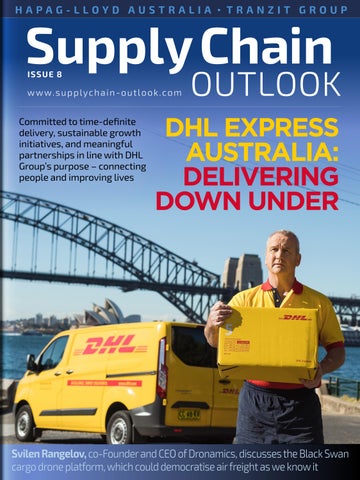
Supply Chain Outlook - Issue 8

Page 1


Africa Outlook, APAC Outlook, EME Outlook, North America Outlook, Mining Outlook, Healthcare Outlook, Manufacturing Outlook, Supply Chain Outlook, Food & Beverage Outlook, and Construction Outlook are digital publications aimed at boardroom and hands-on decision-makers, reaching an audience of more than 800,000 people around the world.

With original and exclusive content compiled by our experienced editorial team, we look to promote the latest in engaging news, industry trends, and success stories from across the globe.

Your company can join the leading industry heavyweights enjoying the free exposure we provide across our platforms with a free marketing brochure, extensive social media saturation, enhanced B2B networking opportunities, and a readymade forum to attract new investment and help you grow your business.

Visit www.outpb.com/work-with-us for details on how your company can feature for free in one of our upcoming editions.

EDITORIAL

Head of Editorial: Jack Salter jack.salter@outpb.com

Deputy Head of Editorial: Lucy Pilgrim lucy.pilgrim@outpb.com

Senior Editor: Lily Sawyer lily.sawyer@outpb.com

Editor: Ed Budds ed.budds@outpb.com

Editor: Rachel Carr rachel.carr@outpb.com

Copy Editor: Lauren Kania lauren.kania@outpb.com

PRODUCTION

Art Director: Stephen Giles steve.giles@outpb.com

Senior Designer: Devon Collins devon.collins@outpb.com

Designer: Louisa Martin louisa.martin@outpb.com

Production Manager: Alex James alex.james@outpb.com

Digital Marketing Director: Fox Tucker fox.tucker@outpb.com

Website Content Manager: Oliver Shrouder oliver.shrouder@outpb.com

Social Media Executive: Jake Crickmore jake.crickmore@outpb.com

BUSINESS

CEO: Ben Weaver ben.weaver@outpb.com

Managing Director: James Mitchell james.mitchell@outpb.com

Chief Technology Officer: Nick Norris nick.norris@outpb.com

ADMINISTRATION

Finance Director: Suzanne Welsh suzanne.welsh@outpb.com

Finance Assistant: Victoria McAllister victoria.mcallister@outpb.com

CONTACT

Supply Chain Outlook

Norvic House, 29-33 Chapelfield Road

Norwich, NR2 1RP, United Kingdom

Sales: +44 (0) 1603 804 445

Editorial: +44 (0) 1603 804 431

SUBSCRIPTIONS

Tel: +44 (0) 1603 804 431 jack.salter@outpb.com

www.supplychain-outlook.com

Follow us on Linkedin: @supplychainoutlook

DELIVER THE GOODS

Welcome to our eighth edition of Supply Chain Outlook magazine.

At its core, time-definite delivery means that urgent international shipments reach their destination within a specified time frame.

This is what our cover star, DHL Express Australia, offers through the secure door-to-door delivery of goods with full track-and-trace visibility.

“Customers are paying for the speed, reliability, and security of our network and visibility of when their shipment is going to be delivered,” notes Phil Corcoran, Managing Director of DHL Express Australia and Papua New Guinea.

Corcoran also shares insights on the company’s commitment to sustainable growth initiatives and meaningful partnerships in line with DHL Group’s purpose – connecting people and improving lives.

Patriot Rail, a leading operator of short-line and regional freight railroads and rail service companies throughout the US, has likewise partnered with the new Rocky Mountain Rail Park to advance growth in the rail freight sector through industrial development.

The company is additionally establishing a new industrial park in Denton, Texas, in partnership with Canadian Pacific Kansas City on its main network.

“This multi-commodity transload facility will provide reliable, competitive transload services and logistics solutions to customers in the Dallas-Fort Worth metropolitan area – one of North America’s fastest-growing regions,” outlines Tom Tisa, CCO.

We also reflect on the rich 100-year history of Tranzit Group (Tranzit), a proud milestone for the largest family-owned transport and tourism company in New Zealand (NZ).

With a commitment to sustainable transport solutions and community engagement, the senior leadership team highlights a journey of growth.

“We can attribute our growth to diversified contracts, which span tourism, and school and public transportation services, including transitioning to electric buses to help NZ reduce emissions,” highlights Jenna Snelgrove, General Manager – Tranzit Coachlines, InterCity, and Tourism Division.

This edition also delivers the goods with corporate stories from Hapag-Lloyd Australia and RCS Logistics.

We hope that you enjoy your read.

UPS TO ‘TRIM’ OPERATIONS DURING RECONFIGURATION

AMIDST UPS’S ONGOING ‘network reconfiguration’ consolidation initiative, the multinational company has announced its intention to close or reduce operations at four separate facilities over the next two months. Approximately 195 employees across North Carolina, Michigan, and Alabama will be impacted as the company continues its overhaul.

The first nine months of 2025 saw UPS reduce its workforce by 34,000 and close 93 buildings across the US. These drastic steps saved the company around USD$2.2 billion as of September 2025. Whilst this may possibly be the largest network reconfiguration in the company’s history, UPS is confident that the end result will be worth the wait.

QATAR AND THE UAE JOIN PAX SILICA

SET TO JOIN the US-led initiative to secure artificial intelligence (AI) and semiconductor supply chains, Qatar and the United Arab Emirates (UAE) are embracing a technologyfocused economic framework.

The programme, Pax Silica, aims to safeguard the full technological supply chain, such as critical minerals, advanced manufacturing, computing, and data infrastructure. Qatar and six other nations signed the declaration on 12th January, with the UAE following suit on 15th January.

Pax Silica’s goals for the new year include expanding membership, building strategic projects to secure supply chains, and coordinating policies to protect critical infrastructure and technology. EUROPE

CONTESTED DEAL PASSES BETWEEN THE EU AND SOUTH AMERICA

SET TO BE SIGNED IN Paraguay in early 2026 after being backed by the European Union (EU), the EU-Mercosur free trade agreement aims to gradually reduce import duties on 91 to 92 percent of exports over a 15-year period, whilst increasing import quotas for various products.

Approximately 20 years in the making, this trade pact has faced scrutiny from farming nations, including France and Italy, which have questioned its environmental protections and agrifood standards. It is anticipated that the deal will boost the Mercosur bloc economy by 0.7 percent and Europe’s economy by 0.1 percent, alongside strengthening the EU’s footprint in a region where China has remained a prominent industrial supplier and commodities purchaser.

CHINA COMPLETES MAIDEN FLIGHT OF NEW AIRCRAFT

DEBUTING ITS NEWEST midaltitude, low-cost cargo transport platform – the Tianma-1000 – China has made waves with the unmanned cargo aircraft’s ability to navigate complex highland terrains, execute ultra-short take-offs and landings, and switch between cargo and air-drop missions.

Developed by China North Industries Group, the first-of-its-kind aircraft has been designed for

AMERICA

WALMART’S DRONE DELIVERY SERVICE TAKES FLIGHT

WITH APPROXIMATELY 4,600 store locations across the US, Walmart is a retail titan known for offering nearly every product a consumer could dream of.

multi-functional roles, such as cargo transport, emergency rescue, and air-drop operations. It can reach a maximum altitude of 8,000 metres, has a flight range of 1,800 kilometres, and can carry a payload of one tonne, allowing it to deliver substantial supplies in just a single flight.

subsidiary of Google’s parent company Alphabet – to 150 of its US storefronts over the course of 2026, potentially reaching over 40 million customers within proximity to these locations.

BRAZIL REPORTS RECORD 2025 EXPORTS

NORTH AMERICA WITH TOTAL EXPORTS reaching approximately USD$348.7 billion for 2025 – a 3.5 percent increase from the year prior – Brazil’s exports surged to record levels unseen since 1997.

Despite harsh tariffs from the US, including 50 percent tariffs on key goods such as beef and coffee, the country was able to expand shipments to China and other major trading partners.

According to Brazil’s Ministry of Development, Industry, and Foreign Trade, exports for 2026 are expected to earn between USD$340 billion and USD$380 billion, with China remaining the country’s largest purchaser.

EUROPE & MIDDLE EAST

POLISH TRAIN MANUFACTURER TO ENTER GERMANY NORTH

Recently, the company announced its decision to expand its drone delivery coverage with Wing – a

This partnership will expand even further, with the aim for the drone delivery service to cover 270 Walmart stores by the end of 2027, including locations in Los Angeles, St Louis, Cincinnati, Miami, and more.

PESA BYDGOSZCZ SA (PFR S.A.)

– a train manufacturer from Poland –has agreed to purchase the entirety of a German competitor, HeiterBlick GmbH, for an undisclosed sum to strengthen its standing in western Europe.

This adds to a list of takeovers from Polish companies seeking to expand and support Polish firms. Germany is becoming an increasingly popular country for foreign acquisitions due to the country’s succession issues and declining economy.

PFR S.A. anticipates two more German mergers and acquisitions transactions in the next six months, showcasing its dedication to expanding its footprint across the continent.

THE CROSS-BORDER BALANCING ACT

Milton Magos, Vice President – Mexico at TRAFFIX

– a North American logistics company specializing in cross-border supply chain solutions for the US, Canada, and Mexico – discusses strategies to assist importers and exporters in moving freight from the US to Mexico in today’s challenging logistics landscape

Writer: Milton Magos, Vice President – Mexico, TRAFFIX

For importers and exporters between the US and Mexico, the border is both a gateway and a gatekeeper.

Freight keeps moving only when three fundamentals stay aligned –accurate documentation, prepared people, and capacity matched to time. When one slips, every schedule and promise downstream pays the price.

True reliability is built on coordination. It happens when teams, paperwork, and timing work in unison instead of in reaction.

Cross-border freight now accounts for more than 70 percent of North American trade by volume.

Every minute lost is multiplied across networks, delaying production lines and customer promises alike.

As nearshoring accelerates, the ability to cross consistently is no longer just an operational strength – it is a strategic advantage.

The companies that master consistency will set the pace for the region’s next decade of growth.

ESTABLISH A STEADY FLOW

Reliable crossings depend on pace, not improvisation. Think of the border as a production line that runs on steady inputs and predictable handoffs.

When trucks arrive in bursts, congestion takes control. When movement stays steady, efficiency returns.

The most reliable operators treat their appointment calendars as living systems. They review them weekly with carriers and facility managers, adjusting flow before problems surface.

When this consistency becomes visible to everyone involved – shipper,

carrier, and consignee – waiting time fades and control returns.

This flow can be sustained by creating one source of truth. In other words, bringing together all item data, origins, routes, license plates, drivers, and consignee details in a single shared view – fragmented information is what destroys coordination.

In addition, matching appointments to your facility’s actual throughput, not a theoretical maximum, helps to schedule to real capacity. Each slot is a resource that must be protected.

Using a short pre-clear checklist to confirm that documents, license plates, and drivers are validated before departure can also help. A few minutes of prevention can save hours of delay.

Targets: Aim for appointment adherence above 95 percent, checklist completion at 100 percent, and weekly exception reviews with a documented root cause.

Avoid: Try to avoid booking extra appointments ‘just in case’. Once appointment capital is wasted, it cannot be recovered.

PREPARE THE PEOPLE

No system holds its rhythm without people who understand it; the dock, yard, and border hand-off depend on teams that know exactly what they own.

Therefore, defined roles and escalation paths should be demarcated so that everyone knows who makes each decision and when.

In addition, procedures should be kept bilingual and visible, and every shift should begin with a short border briefing that reviews appointments, exceptions, and customs updates.

People keep operations steady when they have information.

When a dock coordinator updates plate numbers in real time or a dispatcher flags a customs delay before it snowballs, that awareness synchronizes the entire operation.

Good training builds reflexes – not just compliance – and turns data into action.

Targets: Work to complete training and procedure acknowledgment for all staff, and respond to escalations within 15 minutes.

Avoid: Don’t assume experience equals alignment. Even seasoned teams need clear directions to act quickly.

MATCH CAPACITY TO THE CLOCK

The border moves in cycles. Volumes rise and fall by hour, day, and direction, and the best operators anticipate the rhythm and shape capacity around it.

They build flexibility into their networks, adding short-term capacity buffers when seasonal peaks approach, scaling down efficiently once they pass – they plan accordingly rather than react quickly.

Planning time blocks for peaks and keeping enough drop-andhook trailers to absorb variability is important, as is aligning service agreements with what operations can truly deliver as opposed to what forecasts hope for.

Targets: Keep door utilization between 80 and 90 percent, yard dwell under 24 hours, and on-time arrival above 95 percent.

Avoid: Don’t chase peaks without buffers. When dwell time expands, recovery becomes costly.

MEASURE THE PATH, NOT JUST THE FINISH

A successful border crossing is more than a final timestamp, so tracking every stage before, during, and after the gate is crucial. Each phase reveals where control strengthens or weakens.

Grouping exceptions by type –whether this be documentation, assets, capacity, or customs –combined with regular weekly reviews can help to address root causes each month.

The strongest shippers turn these reviews into collaboration sessions with their carriers and brokers.

Transparency replaces firefighting, and when everyone sees the same metrics, accountability turns from pressure into performance.

Targets: Work to keep exceptions per 100 loads decreasing month after month, and zero repeat issues on the same lane.

Avoid: Stop focusing only on outcomes – what is not measured cannot be improved.

STRATEGIES YOU CAN ACTIVATE TODAY

Reliability can be written into agreements, so beginning with the following elements is a great starting point:

• Clearing service terms for appointment adherence and exception resolution.

• Establishing minimum standards for data sharing, including license plates, drivers, estimated times of arrival (ETAs), and document status.

• Devising incentives that reward rhythm and discourage disruption. The goal is to turn reliability into a shared currency. When partners agree on what success looks like and commit to measuring it, coordination becomes enforceable rather than aspirational.

QUICK WINS TO START NOW

• Create a shared source-of-truth dashboard within two days.

• Publish the pre-clear checklist to all partners.

• Confirm the next two weeks of appointments based on real capacity.

In the end, the border is not a barrier but a mirror. It reflects the discipline, alignment, and foresight of the supply chains that approach it.

The companies that operate with balance and control will define the next decade of North American trade.

When documentation, people, capacity, and visibility move as one, the crossing transforms from a daily struggle into a competitive advantage.

Predictability is not perfection – it is performance, and what keeps freight moving in both directions.

At TRAFFIX, we help importers and exporters move freight with the consistency the border demands.

Our cross-border teams in the US, Mexico, and Canada work as one to keep shipments predictable, visible, and on time.

ABOUT THE EXPERT

Milton Magos is Vice President – Mexico at TRAFFIX, leading operations in the country with a focus on cross-border logistics and market growth.

With decades of experience in US-Mexico trade – including leadership roles at UPS – Magosis a visionary strategist dedicated to building empowered teams and advancing nearshoring logistics solutions.

The global resource for supply chain professionals and organisations

As supply chain organisations worldwide confront unprecedented change, embracing technological innovations and incorporating critical environmental sustainability agendas, now more than ever is the time to showcase the strides being taken in this dynamic sector.

A multi-channel brand, Supply Chain Outlook brings you the positive developments driven by organisations across the global supply chain industry through its various platforms. Discover exclusive content distributed through its website, online magazine, social media channels, and dispatches delivered straight to your inbox with a bi-weekly newsletter.

Through these compelling media channels, Supply Chain Outlook will continue to foreground the movers and shakers of the industry.

To participate as a featured company and join us in this exciting endeavour, contact one of our Project Managers today.

Black Swan

The Future of Air Freight

When the Rangelov brothers founded Dronamics in 2014, they began their mission to transform the face of Europe’s logistics industry. Over a decade later, Svilen Rangelov, co-Founder and CEO, joins us to discuss the Black Swan cargo drone platform – soon to be commercially operational – which will democratise air freight by making it more efficient, affordable, and accessible

Arguably the backbone of the global economy, rapid and reliable logistics have been key in keeping markets moving and economies thriving throughout history.

Indeed, in a European context, the free movement of goods remains one of the EU single market’s fundamental liberties.

“Logistics today is about more than just efficiency; it’s about sovereignty and resilience, and is the foundation upon which our economy thrives,” introduces Svilen Rangelov, co-Founder and CEO of Dronamics –a company which is aiming to make a significant impact on Europe’s logistics industry as the creator of the world’s first cargo drone airline.

Dronamics’ Black Swan cargo drone

platform facilitates point-topoint cargo transportation that unlocks bottlenecks and enables same-day delivery of goods across the continent.

With over 4,000 airports and airfields – many of which are currently underutilised or inactive – Europe boasts a vast, untapped network that could be repurposed for crucial logistics operations.

Dronamics’ cargo drone platform is designed to be deployed at smaller airports and airfields with minimal infrastructure, effectively reviving these sites.

Svilen Rangelov, co-Founder and CEO

This is intended to bring logistics closer to the origin of goods, simplify supply chains, and create new efficiencies in terms of time, cost, and emissions.

Beyond powering e-commerce, spare parts, and fresh produce delivery, the company’s cargo drone platform can also serve more critical civil needs, from distributing medical supplies and humanitarian aid to disaster relief and emergency response.

“The same technology that drives commercial growth can also strengthen Europe’s ability to respond quickly and effectively when it matters most,” Rangelov emphasises.

PERFORMANCE, EFFICIENCY, AND SUSTAINABILITY

Having transformed the face of Europe’s logistics industry in just over a decade, Dronamics has been on an impressive, impactful journey to revolutionise air cargo.

“OUR VISION IS A WORLD WHERE CARGO MOVES AS EFFICIENTLY AND AFFORDABLY AS INFORMATION, WITH THE BLACK SWAN PLATFORM AT THE CENTRE OF A NEW OPTIMISED LOGISTICS ECOSYSTEM”

SVILEN RANGELOV, CO-FOUNDER AND CEO, DRONAMICS
Dronamics and the Strategic Development Fund sign joint venture

Upon inception, the company’s founders were making a deliberate choice to solve the middle-mile logistics challenge.

“The middle-mile is where we see the most delays and bottlenecks and is the ripest for technological transformation – especially when it comes to underserved and remote areas,” Rangelov points out.

As such, Dronamics tasked itself with designing a technology that can carry a meaningful payload and travel an equally meaningful distance.

This translated into design decisions that informed its cargo drone platform, the Black Swan.

“We developed a clean sheet aerospace programme from scratch, built and successfully flew the Black Swan prototype, and became Europe’s first licensed cargo drone airline,” he summarises.

The company is also the first cargo drone airline in the world to be issued both an International Air Transport

Dronamics and Aramex

Association (IATA) and International Civil Aviation Organisation (ICAO) designator code – the same credentials that traditional airlines use to operate globally.

Most recently, Dronamics announced a strategic partnership with Japanese mobility manufacturer Kawasaki Motors to integrate advanced aero piston engines into the Black Swan.

This collaboration enhances performance, efficiency, and sustainability, and opens the door to a Japanese-built version of the drone for both civilian cargo and critical civil protection missions.

“It’s a strong validation of the technology leadership we’ve built and a clear signal of our growing global impact,” Rangelov prides.

UNLOCKING ACCESS TO AIR FREIGHT

Interestingly, the Black Swan was not adapted from passenger aircraft –which is where most cargo aircraft originate from.

“Built specifically for cargo, the Black Swan is a lightweight carbonfibre structure with optimised

aerodynamics and efficient propulsion which allow it to carry 350 kilogrammes over 2,500 kilometres at a speed faster than road transportation and cheaper than air,” Rangelov explains.

Indeed, Dronamics reports the Black Swan to achieve up to 80 percent faster delivery times whilst being 50 percent cheaper.

Choosing to operate from smaller airfields as opposed to major hubs –which can lead to an over-stretched budget – has enabled the company to

further cut costs.

Indeed, the aircraft’s simple design and fuel-efficient engine lowers operating costs, whilst its emissions are reduced by up to 60 percent compared to alternative modes of transport, including air freight.

Currently, only one percent of worldwide goods are transported by air due to the expenses associated.

A cargo drone solution such as Dronamics’ could help unlock the other 99 percent – particularly for communities and businesses that

Black Swan exhibition model at the Dubai Airshow 2023 EU Future Mobility Taskforce

currently don’t have access to air freight due to a lack of infrastructure or associated costs.

“Air freight has traditionally been expensive and therefore reserved for high-value goods, leaving many businesses and regions underserved. We founded Dronamics to change that,” he outlines.

As such, the Black Swan platform makes cargo transport faster, cheaper, and more reliable, unlocking access to thousands of smaller regional airports that conventional aircraft cannot serve due to a lack of necessary infrastructure.

This means small to mediumsized enterprises (SMEs), remote communities, and critical services can all begin to benefit from same-day deliveries – whether for spare parts, fresh produce, or medical supplies.

“By lowering barriers to entry, reducing costs, and improving speed, we’re making air freight truly accessible and scalable,” Rangelov asserts.

TECHNOLOGICAL SOVEREIGNTY

As the only European company to build, test, and fly locally manufactured large cargo drones, Dronamics is reducing strategic dependencies and strengthening the EU’s technological sovereignty.

By designing, building, and operating the Black Swan in Europe, the company has afforded the continent with access to homegrown, advanced drone capabilities.

In turn, this has decreased reliance on external suppliers for critical logistics and aerospace technologies, bolstering Europe’s strategic autonomy.

“We’ve created a homegrown solution for both commercial and civil protection applications – from same-day deliveries to civil protection missions such as disaster relief, medical supply distribution, and emergency response,” Rangelov reflects.

REVOLUTIONISING EUROPEAN LOGISTICS

Thanks to its status as a pioneering European company with the potential to revolutionise logistics and bolster the EU’s strategic autonomy, Dronamics has achieved countless awards, grants, and recognitions over the years, including:

AWARDS AND CERTIFICATIONS

• Light unmanned aircraft system (UAS) Operator Certificate (LUC) –Dronamics was the first cargo drone company to receive an LUC from the EU in 2022 – a high-level certification that allows the company to self-authorise its drone operations across EU member states.

• Middle East and Africa (MEA) Business Aviation Achievement Awards 2023

– The company won the Best Air Cargo Service Provider (non-Commercial Airline) at the event held in Dubai.

• NEC Innovation Challenge Awards – Dronamics was a winner at the NEC Innovation Challenge Awards in 2024 for its innovative logistics services using unmanned aerial vehicles.

GRANTS

• EIC Accelerator grant – This €2.5 million grant from the European Commission in 2022 supported the development of Dronamics’ cargo drone fleet, droneport network, and operational expansion.

• Malta Enterprise grant – Awarded in 2023, this grant is supporting the establishment of Dronamics’ Global Network Operations Centre (GNOC), a facility intended to centralise the management and control of its drone fleet and droneport network.

INDUSTRY RECOGNITION

• IATA and ICAO designator codes – In 2023, Dronamics became the first cargo drone airline to be assigned these codes, which are essential for official recognition and operational integration within the global aviation community.

On a mission to democratise air freight through sustainable, EU-developed drone technology, Dronamics is proud of the progress it has made within Europe.

At Dronamics’ R&D centre in Sofia, Bulgaria, for example, it is actively building large cargo drones that are 50 to 90 percent more affordable to produce and run than the alternatives.

“We are designing, building, and optimising the aircraft based on tests under a single roof. This ensures tight integration, efficiency, and quality control,” he tells us.

For the few parts sourced externally, the company works with certified suppliers.

“This vertically integrated model enables us to significantly reduce operating costs compared to conventional aircraft,” Rangelov adds.

LOOKING AHEAD

In June last year, Dronamics was put forward for an equity investment of up to €30 million under the European Innovation Council’s (EIC) Strategic Technologies for Europe Platform (STEP) Scale Up scheme.

The funding supports breakthrough companies by investing between €10 and €30 million and attracting additional private investment.

Being put forward for this programme means that the European

Commission recognises Dronamics as a significant and strategic technology provider.

The end goal is to enable financing rounds of between €50 and €150 million or more, helping scale innovations that are critical to Europe’s competitiveness.

“For Dronamics, being nominated is both a recognition of our impact and a major opportunity to secure growth capital at a European level,” Rangelov reflects.

The funding will enable the company to finalise its Black Swan flight testing programme, expand manufacturing capabilities, and launch its first commercial flights.

“BY LOWERING BARRIERS TO ENTRY, REDUCING COSTS, AND IMPROVING SPEED, WE’RE MAKING AIR FREIGHT TRULY ACCESSIBLE AND SCALABLE”
– SVILEN RANGELOV, CO-FOUNDER AND CEO, DRONAMICS

“This investment strengthens Europe’s technological sovereignty, accelerates greener, faster logistics, and creates high-tech jobs, supporting both commercial and critical civil protection operations,” he confirms.

Looking to the future, Dronamics will continue to focus on maintaining its first-mover position in advanced air logistics.

The company’s number one goal is to achieve a successful commercial launch and expand its reach across key markets.

By leveraging partnerships with leaders like Kawasaki Motors, it continues to enhance technology, performance, and sustainability.

“Our vision is a world where cargo moves as efficiently and affordably as information, with the Black Swan platform at the centre of a new optimised logistics ecosystem,” Rangelov passionately concludes.

EIC 2024 in Brussels
Dronamics and strategic partner Kawasaki Motors

SMARTER PROCUREMENT, STRONGER GROWTH

Amy Worth, Director of Amazon Business UK and Public Sector Customers EU, outlines how small to medium-sized enterprises can make cost savings in order to support their growth and make the most out of their procurement spend

WRITER: JACK SALTER

Supply Chain Outlook (SC): Firstly, please introduce us to Amazon Business and how the company is changing the world of procurement?

Amy Worth, Director (AW): Amazon Business combines Amazon’s vast product selection and trusted user experience with artificial intelligence (AI)-powered intelligence and business-focused tools to help organisations of all sizes streamline purchasing, ensure compliance, and make smarter spend decisions.

Moving beyond manual, fragmented processes, Amazon Business delivers a transparent, data-driven procurement platform that enables smarter spend decisions, efficient processes, and supports strategic goals such as prioritising

local, small suppliers and sustainable purchasing.

Amazon Business empowers organisations to shift from tactical

purchasing to strategic procurement, providing efficient purchasing frameworks for public sector and private buyers alike.

SC: Can you tell us how Amazon Business helps small to mediumsized enterprises (SMEs) make cost savings in order to support their growth and make the most out of their procurement spend?

AW: Procurement teams know that cost savings are paramount to business growth.

Amazon Business enables SMEs to maximise their procurement spend through multiple value drivers – business-only pricing, quantity discounts, and competitive deals across millions of products.

Amy Worth, Director, Amazon Business UK and Public Sector Customers EU

With Amazon Business Prime, SMEs can access member-only offers and exclusive business deals alongside fast and free delivery, levelling the playing field with larger competitors.

In 2024, Business Prime members saved over USD$750 million globally. By consolidating purchasing, invoicing, and approvals in one store, time-consuming manual processes can be cut down, allowing small teams to operate more efficiently.

Built-in analytics and Spend Visibility dashboards help UK SMEs to monitor and control business spending, identify costsaving opportunities, and reduce unnecessary tail spend, supporting a healthier cash flow.

Additional Business Prime benefits, such as guided buying tools, extend support beyond procurement to enable SMEs to work more efficiently, reduce operational costs, and reinvest savings back into growth.

SC: What are the most important Amazon Business features and innovations would you highlight?

AW: Amazon Business offers a comprehensive suite of AI-powered tools that transform procurement from a manual, reactive function into an intelligence-led operation.

At the forefront is Business Analytics, which uses dashboards powered by AWS QuickSight, to automatically generate detailed reports, enabling businesses to analyse spending patterns across multiple attributes at an itemised level.

New innovations announced at Reshape 2025 include Amazon Business Assistant, which uses conversational AI to provide contextual procurement recommendations; Savings Insights, which leverages generative AI to reveal historical spending trends and identify cost-saving opportunities like quantity discounts; and Spend

Anomaly Monitoring, which automates spend monitoring by detecting unusual purchasing behaviour with proactive AI-powered alerts.

These tools help businesses streamline supplier management, strengthen rationale behind internal purchasing policies, and ensure buying decisions align with broader priorities such as sustainability, compliance, and supplier diversity.

With advanced features like IT Services for device lifecycle management and an AWS-integrated manufacturing solution that predicts supply chain challenges before they impact production, Amazon Business has evolved into a leader for enterprise purchasing, serving more than 62 of the FTSE 100 companies within the UK.

SC: How can digital procurement reduce processing costs, save valuable admin time, improve order accuracy, and handle peak service demands without disruption?

AW: By consolidating purchasing, invoicing, and approvals in one digital platform with built-in analytics, organisations can improve order accuracy through standardised processes and real-time validation to leverage Amazon Business’ extensive catalogue and robust supply base.

The platform’s scalable infrastructure handles peak service demands without disruption, supporting continuous, policycompliant procurement that adapts to volume fluctuations whilst maintaining accuracy and control.

Digital procurement provides businesses with real-time insights and automated processes powered by AI to eliminate time-consuming manual tasks, allowing procurement teams to focus on strategic value rather than repetitive administrative work.

System for Cross-domain Identity Management

Amazon Business’ new AI-powered tools, such as Amazon Business Assistant, transform procurement from reactive purchasing to proactive, intelligence-led operations.

SC: When businesses gain access to clear spending data, what insights do they unlock that can support budget planning?

AW: Every procurement professional knows how intensive budget planning can be and how many insights they’ll need to leverage for forecasting.

Clear spending data provides a comprehensive picture of needs versus wants and problem areas that need to be addressed.

Once new budgets are finalised, digital procurement tools like Budget Management allow administrators to allocate funds and manage multiple budgets at once with real-time tracking.

These real-time insights provide teams with current spend data to effectively manage budgets and goals to support predictive procurement that better anticipates future demand and pricing in an uncertain economic environment.

“Digital procurement provides businesses with real-time insights and automated processes powered by AI to eliminate time-consuming manual tasks, allowing procurement teams to focus on strategic value rather than repetitive administrative work”
– AMY WORTH, DIRECTOR,

SC: How do detailed insights allow teams to forecast more accurately and make adjustments based on customer trends?

AW: With access to detailed insights, teams can forecast demand more accurately, identify opportunities to consolidate purchases, and adjust inventory levels based on footfall trends.

The granular visibility across departments, cost centres, and product categories helps procurement teams make data-driven decisions and create accurate forecasts for the year ahead.

A data-driven approach means that procurement teams can move from reactive support to proactive planning, ensuring resources are allocated with both resilience and growth in mind.

AMAZON BUSINESS UK AND PUBLIC SECTOR CUSTOMERS EU
Amy Worth, Director, Amazon Business UK and Public Sector Customers EU

SC: Spend visibility also enables purchasing teams to move from reactive to proactive and allocate their resources with resilience and growth in mind. Can you expand?

AW: Spend visibility gives purchasing teams a clear, real-time view of where money is being spent across the organisation. With greater insight into spending patterns, supplier dependencies, and emerging trends, teams can anticipate risks, plan more effectively, and make data-driven decisions that support continuity and growth.

Predictive procurement tools utilise historical and real-time data to identify risks, anticipate demand, and allocate resources effectively, empowering organisations to forecast challenges, respond proactively, and strengthen resilience against disruption.

SC: What about strengthening ties with local suppliers? How does this benefit the regional economy and attract consumers that prioritise brands committed to supporting small businesses?

AW: Strengthening ties with local suppliers supports the regional economy by keeping spending and jobs within the community, encouraging reinvestment and economic growth.

With Amazon Business, organisations can leverage the Buy Local programme to create guidelines that prefer sellers in their local communities.

Many organisations have environmental, social, and governance (ESG) commitments that mean they prioritise brands that support small businesses.

Through Amazon Business’ Seller Certification programme, it’s easy to

“With greater insight into spending patterns, supplier dependencies, and emerging trends, teams can anticipate risks, plan more effectively and make data-driven decisions that support continuity and growth”
– AMY WORTH, DIRECTOR, AMAZON BUSINESS UK AND PUBLIC SECTOR CUSTOMERS EU

identify and prefer certified small, diverse, and local suppliers.

In buying local, organisations can improve supply chain responsiveness and transparency and reinforce their reputation for supporting sustainable, community-focused practices.

SC: Finally, as business budgets are tightened ahead of what will likely be a slow January, why can strong supplier relationships lead to cost savings?

AW: Strong supplier relationships can lead to cost savings, especially when budgets are tight, by fostering collaboration and trust.

Suppliers are more likely to offer favourable pricing or value-added services to partners they have longterm, reliable relationships with.

Additionally, where strong relationships are in place with

suppliers, account holders can receive price breaks on multi-unit purchases and request quantity discounts.

Amazon Business also enables organisations to maintain relationships by inviting negotiated vendors to onboard to the platform, where they can continue to honour customer-specific negotiated pricing.

Greater supplier relationships empower procurement professionals to be more predictive and proactive with planning and day-to-day operations.

FROM SCRIPT TO SCREEN

We dive beneath the surface of Hollywood movie production and dissect the stages of the supply chain required to transport film concepts from script to screen
WRITER:

Every industry depends on an efficient and well-oiled supply chain, and the world of filmmaking is no different.

Behind the scenes of our favourite cinematic stories and epic on-screen adventures, a whole hidden world of supply chain processes must be meticulously managed.

This complex and vast supply chain encompasses a plethora of varying stages such as financing, development, production, marketing, and distribution, all of which play critical roles along the gradual journey to the silver screen.

A vast network of equipment, services, and talent is crucial for bringing a movie from script to screen, with modern challenges focusing on digital solutions and localised networks.

Nowadays, filmmakers must also deal with the harsh realities of supply chain issues; one isolated event can

trigger worldwide shortages and rising prices, impacting production directly.

SECURING FINANCES AND EQUIPMENT

Without a bulletproof financial plan and sufficient funding, film projects can be doomed before the cameras even start rolling.

A comprehensive budget also allows producers to distribute funds effectively across departments, ensuring the necessary areas have adequate resources.

Another critical element of the supply chain is the process of sourcing and securing equipment.

Filmmakers require countless essentials, ranging from a variety of different cameras, lighting, and sound gear to props, costumes, and other materials to ensure production runs smoothly and the technical side is well-managed.

However, supply chain disruptions can cause limited availability of

technological devices, often leading to rising costs and budget alterations.

One such example of the volatility of supply chains is that cameras require microchips, as integrated circuits are crucial for controlling power consumption, storing media, and connecting to Wi-Fi.

Unfortunately, microchips have been in severely limited global supply since the COVID-19 pandemic.

Additionally, once film equipment is secured, it must then be transported to the crew at filming locations safely and on time.

HIRING SKILLED WORKERS

It takes an eclectic and vast group of people in a variety of roles to produce a movie, so finding skilled workers is a significant part of filmmaking.

Labour drives every supply chain, and a lack of suitable workers increases costs and causes logistical issues.

Some films may require specialised professionals whose jobs are in high demand, such as stunt or pyrotechnics experts, who must have the correct licences depending on the filming location and local legislation.

Filming in New York, for example, requires a certified pyrotechnician on set at all times.

Moreover, keeping a film crew energised and well fed is essential, so filmmakers usually offer free food on set, a further cost and supply factor to consider.

LOCATION AND SAFETY

Throughout history, movies have been shot in some of the most remote locations on Earth, which complicates the issues of transport and supplies.

For example, Cast Away, the Tom Hanks survival movie classic, was filmed on the uninhabited island of

Remote areas can also be a liability when you factor in the risk of harsh weather conditions. Torrential rain, perilous snowstorms, or even natural disasters such as earthquakes or floods can delay production, jeopardise transportation, or damage equipment.

Filmmakers must also account for a location’s political stability as well as its geographical complications.

Finally, movie creators should advocate for the highest standards of safety throughout the entire production process by enforcing guidelines and ensuring equipment and all other elements meet the correct standards.

To prevent accidents on set, reputable suppliers must be selected and comprehensive risk assessments carried out to ensure the safety of actors and crew.

KEY STAGES OF THE FILM SUPPLY CHAIN

DEVELOPMENT – Generating ideas, acquiring rights, scriptwriting, budgeting, and hiring key talent.

FINANCING – Securing funding through studios, investors, or presales of rights.

PRE-PRODUCTION – Planning, casting, location scouting, set design, and scheduling.

PRINCIPAL PHOTOGRAPHY –Filming the movie.

POST-PRODUCTION – Editing, visual effects, sound design, music scoring, and colour grading.

MARKETING AND DISTRIBUTION – Creating trailers, advertising, and securing distribution deals for theatrical, streaming, and physical release.

EXHIBITION – Releasing the film to audiences via cinemas, video on demand, streaming platforms, and physical media.

The global resource for supply chain professionals and organisations

As supply chain organisations worldwide confront unprecedented change, embracing technological innovations and incorporating critical environmental sustainability agendas, now more than ever is the time to showcase the strides being taken in this dynamic sector.

A multi-channel brand, Supply Chain Outlook brings you the positive developments driven by organisations across the global supply chain industry through its various platforms. Discover exclusive content distributed through its website, online magazine, social media channels, and dispatches delivered straight to your inbox with a bi-weekly newsletter.

Through these compelling media channels, Supply Chain Outlook will continue to foreground the movers and shakers of the industry.

To participate as a featured company and join us in this exciting endeavour, contact one of our Project Managers today.

DHL EXPRESS DELIVERING DOWN UNDER

In the context of Australia’s unique geographical challenges and opportunities, we speak with Phil Corcoran, Managing Director of DHL Express Australia and Papua New Guinea. He shares insights on the company’s commitment to time-definite delivery, sustainable growth initiatives, and meaningful partnerships in line with DHL Group’s purpose –connecting people and improving lives

In the ever-evolving world of logistics, Phil Corcoran stands out as the Managing Director of DHL Express Australia and Papua New Guinea, bringing nearly three decades of experience to the role.

Corcoran’s journey began in the late 80s working for a large Australian manufacturing company, where he first encountered the complexities of international trade, customs clearance, and shipping logistics. His passion for the industry was ignited, but a yearning for adventure

led him to embark on a year-long journey across Africa.

During this time, he was captivated by the global presence of DHL Group (DHL), the world’s leading logistics provider, which inspired him to join the company upon his return to Australia.

Now, with a wealth of knowledge and a commitment to sustainable growth, Corcoran is at the forefront of DHL Express Australia’s initiatives, focusing on environmental responsibility, enhancing service

quality, and fostering meaningful partnerships, all whilst navigating the unique opportunities of the logistics landscape in Australia.

TIME-DEFINITE DELIVERY

At its core, time-definite delivery means that urgent international shipments reach their destination within a specified time frame.

This is what DHL Express Australia, part of DHL Group, offers through the secure door-to-door delivery of goods with full track-and-trace visibility.

“Customers are paying for the speed, reliability, and security of our network and visibility of when their shipment is going to be delivered,” outlines Corcoran.

“Their demand for accurate

“CUSTOMERS ARE PAYING FOR THE SPEED, RELIABILITY, AND SECURITY OF OUR NETWORK AND VISIBILITY OF WHEN THEIR SHIPMENT IS GOING TO BE DELIVERED”
– PHIL CORCORAN, MANAGING DIRECTOR, DHL EXPRESS

shipment information is only increasing, so relying on digital systems and up-to-date information available online and integrated with customers is really important – far more so now than it ever used to be.”

Consistently delivering on time, and with visibility, remains quite a challenge for logistics companies in Australia due to its vast geography.

“We have a physical presence in the major population centres, but there are vast areas where we rely on third-party agents to deliver or pick up shipments for us. We’re aiming to expand our physical presence; when we do that, we improve the service quality for our customers.”

Australia is not shielded from current and increasing geopolitical challenges, including the new raft of US tariffs, which have had a big impact on exporters.

For many years, DHL has surveyed the export confidence of its customers and what they see as emerging trends, opportunities, and threats.

The latest DHL Export Barometer 2025 reveals how, despite the

DHL EXPORT BAROMETER 2025 HIGHLIGHTS

• 60 percent of Australian exporters are confident in the year ahead and expect revenues to increase, tracking close to the long-term average of 63 percent.

• Half of Australian businesses saw orders increase in the past 12 months, whilst only 14 percent reported a decrease, one of the lowest figures in a decade.

• The importance of free trade agreements has risen sharply, with 84 percent of traders now viewing them as crucial to their decision-making, up from 79 percent two years ago.

• New Zealand remains the top trading partner for Australian exporters. The average number of export markets per trader has grown from 3.8 in 2021 to 5.2.

• Whilst only 19 percent of exporters currently use artificial intelligence (AI), a significant 36 percent plan to implement it in the near future for tasks like marketing and demand.

• 82 percent of businesses continue to generate orders through online channels.

uncertainty created by the US tariffs, hope remains buoyant for Australian exporters, who are navigating a shifting global landscape with confidence, diversification, and new technology.

“Because we’re predominantly a business-to-business company, we see trends develop in trade based on geopolitical decisions, tariff introductions, and any conflicts in the world,” he explains.

“We also see an immediate impact on trade flows and volumes around the world in and out of Australia and internationally, so we view ourselves as a barometer for how trade is going.”

GREEN LOGISTICS OF CHOICE

When DHL launched its Strategy 2030: Accelerate Sustainable Growth,

the group took the bold step of introducing a new bottom line for its business to be the green logistics provider of choice.

This enables DHL customers to remove carbon from their supply chain which would otherwise be incurred by shipping packages.

The vast majority of DHL’s carbon emissions comes from its 300-strong aircraft fleet, which is a huge challenge without a viable alternative to traditional jet fuel.

However, fleet modernisation and sustainable aviation fuel (SAF) are both major focuses to reduce carbon emissions.

“Every time we replace an old aircraft, we make a dramatic saving in fuel consumption and carbon emissions,” Corcoran emphasises.

“Many of our customers are keen

for us to help them inset carbon emissions, rather than offset them, by reducing the amount they generate through the shipments they send with us.

“By utilising SAF, we’re having a really positive impact as we press towards our global target of net zero by 2050,” he affirms.

DHL is also working internationally on the electrification of its massive ground fleet, reducing the reliance on fossil fuels to power its vehicles.

Electrification is one of the biggest levers in achieving net zero and involves replacing internal combustion vehicles with electric alternatives.

This is an important focus area for logistics as road freight is responsible for around 70 percent of emissions generated during overland transportation.

“WE WILL HAVE GLOBALLY ELECTRIFIED 60 PERCENT OF OUR GROUND FLEET WITHIN THE NEXT COUPLE OF YEARS – OUR GOAL WAS TO DO THAT BY 2030”

The facility is also equipped with 199 solar panels, boasts an energyefficient design, and incorporates a rainwater harvesting system.

“We will have globally electrified 60 percent of our ground fleet within the next couple of years – our goal was to do that by 2030,” Corcoran acclaims.

“It’s been a bit more challenging in Australia because as a country we haven’t invested fast enough for our fleets, not just at DHL but across the whole industry, to be able to accelerate as rapidly as other parts of the world towards electrified fleets, but we are making progress.”

SUSTAINABLE, AUTOMATED FACILTIES

New facilities are also being developed with sustainability in mind, exemplified by DHL Express Australia’s new carbon-neutral sorting facility in Adelaide, which was launched in 2024 and marked a significant step towards sustainable logistics.

The Adelaide Gateway is a stateof-the-art logistics hub that not only accelerates international shipping times for South Australian customers but also showcases the company’s commitment to environmental responsibility.

“We’ve invested in fully automated sorting equipment, carbon-neutral buildings, solar generation, and rainwater reuse to better utilise electricity and dramatically reduce our footprint – it’s all happening as we develop our new facilities,” details Corcoran.

Automation is likewise implemented into sophisticated software to improve the accuracy of the customs clearance process that DHL performs on behalf of customers.

“It’s a lot of investment to make sure we’re doing that in a seamless and automated fashion because it’s a very complex process, but also a highly repeatable one as a lot of our customers send the same things to the same places every day,” he insights.

Engineering Powering DHL’s Automation Ambitions

AGITO is a global engineering, manufacturing and integration partner specialising in intralogistics and supply chain automation across. We design, build and support high-performance systems that move products faster, safer, and with total visibility - from receipt to dispatch.

Our track record with DHL spanning a decade speaks for itself. Across DHL’s Express, Supply Chain, and eCommerce divisions, AGITO has partnered to deliver mission-critical automation that keeps pace with rapid e-commerce growth and rising service expectations. Today, we are delivering multiple active cross-belt sortation projects with DHL, reinforcing our capability to execute high-speed, high-availability systems at scale while integrating our in-house Warehouse Control System seamlessly with upstream and downstream operations.

What sets AGITO apart is our end-to-end, in-house capability. We combine local mechanical and electrical engineering, global manufacturing, turnkey site integration, and a dedicated software team under one roof. Our software platform provides real-time visibility, smart routing, and performance analytics-closing the loop between operational targets and onfloor performance. This integrated model reduces risk, accelerates deployment and simplifies long-term support.

To solve the most demanding throughput and footprint challenges, AGITO brings technology partnerships spanning:

• High-speed sortation (including crossbelt and complementary sortation technologies),

• Automated Storage & Retrieval Systems (AS/RS) for dense, scalable storage and order consolidation, and

• AGV/AMR technologies for flexible, safe, and resilient material flow.

Together, these capabilities enable holistic intralogistics solutions – from express hub and gateway operations across the region, to multi-client distribution centres for Supply Chain, to scalable eCommerce fulfilment with rapid SLAs and peak resilience. We engineer for uptime, operator safety, and lifecycle value, backed by responsive regional service and spares.

Aligned with DHL’s continued investment in infrastructure and its sustainability goals (including the shift to an electric fleet), AGITO’s solutions are designed to minimise energy use, optimise footprint and extend asset life - delivering measurable performance with a lower environmental impact.

For organisations seeking a proven automation partner, AGITO offers the credibility of delivered systems for global leaders, the agility of a regionally embedded engineering and manufacturing bases, with the confidence of a single accountable integrator from design to operations.

Let’s move your operation further, faster.

www.agitoglobal.com

GOTRADE

Global trade is a powerful driver of inclusive economic development and global connectivity.

Small to medium-sized enterprises (SMEs) form the backbone of local economies and innovation ecosystems, yet many face systemic barriers when trying to expand internationally – especially in developing countries.

GoTrade, a strategic DHL initiative, aims to address these challenges by equipping SMEs with the tools, knowledge, and infrastructure they need to participate in global trade, building capacity in areas such as cross-border e-commerce, supply chain management, and digital trade readiness.

One SME close to Corcoran’s heart is Banz Kofi, a coffee business located in the highlands of PNG that DHL has supported through GoTrade.

“Through our mentorship and connections, Banz Kofi now exports their coffee around the world. They’re a great little company with an amazing product operating in a really challenging environment,” he shares.

“We deliver Banz Kofi to their customers in countries as far afield as Estonia and other parts of our network within a few days; they’re developing a big global fan base. When they’re able to get their product directly into the hands of consumers, they make a lot more money than if they were just selling it to in-country coffee buyers, who pay the bare minimum. It puts the profits where they really need to go, rather than at the retail end of the chain.”

“If you can capture accurate data and use it effectively, you remove a lot of pain from what is traditionally quite a manual process.

“We still have multiple digitalisation opportunities that will make life easier for our customers and staff, so that will remain a focus for us as we continue to invest,” Corcoran confirms.

GROWTH INDUSTRY VERTICALS

DHL is investing in its capability to capitalise on the anticipated growth in those industries over the coming years.

“In these verticals, the customer feedback is they want more choice in terms of logistics. DHL is investing to meet growing demand,” notes Corcoran.

DHL will accelerate collaboration with sister business units, not just the Express division.

“In Australia, DHL Supply

Chain, who specialise in product warehousing, picking and packing, and distributing for customers, are heavily integrated into most of the major health companies that operate in the country,” he tells us.

“If we can collaborate more effectively with our sister business units, like DHL Supply Chain, we will accelerate our ability to offer integrated services across the group to our shared customers.”

CONNECTING PEOPLE AND IMPROVING LIVES

Over many years, DHL Express Australia has developed purposeful partnerships that align with DHL’s purpose.

Since 2003, it has partnered with Surf Life Saving Australia (SLSA), the country’s peak coastal water safety, drowning prevention, and rescue authority, contributing to its vision of zero preventable deaths in Australian waters.

A smarter way to lower your fleet emissions

Practical guidance. Achievable steps. Real results.

Every fleet’s journey is different, and FleetPartners helps you take the right steps with a clear, practical plan to reduce emissions without disrupting your operations.

We analyse your current fleet, highlight opportunities, and map out a simple five-step transition pathway tailored to your business.

Working alongside the CEFC we apply a 0.5% interest rate discount* to the monthly operating lease rental for electric vehicles.

From planning to implementation, we make your transition manageable, cost-effective and aligned to your operational needs.

Ready to take the first step? Book a call with a FleetPartners sustainability specialist.

CONTACT A SPECIALIST

“SLSA volunteers keep beaches safe, prevent drownings, and minimise injuries around the country, particularly at this time of the year as it gets warmer and everyone heads to the beach,” Corcoran highlights.

“They’re a huge part of the Aussie culture and an iconic movement. They also share the red and yellow colours of DHL and our values in terms of wanting to help communities.

“The partnership has only survived for as long as it has because we’ve got great people on both sides who bring it to life,” he acknowledges.

Another organisation DHL Express Australia has partnered with is Stepping Stone House, a Sydney-based charity that provides accommodation, life skills, and employment development support

for homeless and at-risk youth.

“Their goal is to end youth homelessness entirely, and they’ve been extremely successful in lobbying government to support vulnerable kids. I’ve personally got deeply involved in Stepping Stone House and they do amazing work,” reflects Corcoran.

Amongst many others, DHL Express Australia also works with the DV Collective, who provide urgent assistance, essential resources, and long-term solutions for women and children escaping domestic violence, as well as children’s cancer charity, Camp Quality.

Then there’s global DHL partner, ChildFund Pass It Back, an innovative sport for development programme that delivers an integrated life skills and rugby curriculum for children

and young people in disadvantaged communities across Asia.

“Historically, DHL and rugby have very close ties. We do a lot of work to support the programme in developing countries and less fortunate parts of developed countries, including Australia,” informs Corcoran.

PRIORITIES TO DELIVER

DHL Express Australia’s meaningful partnerships will continue into the future, along with several other important priorities.

“It’s about being a great place to work, the best possible logistics provider for our customers, and a sustainable organisation for future generations, whilst making sure we remain compliant in all areas of governance,” Corcoran summarises.

“There are huge risks around cybersecurity and work health and safety that we need to remain vigilant about. We also need to do things efficiently, keep an eye on costs, and invest wisely, leveraging the opportunities in new energies, life sciences, and healthcare.

“All of this – under our Strategy 2030 to accelerate sustainable growth – is what we need to focus on over the coming year,” he concludes.

Tel: 13 14 06

marcomms.au@dhl.com www.dhl.com/discover/en-au

THE ROAD TO A CENTURY OF SUCCESS

As Tranzit Group celebrates its 100-year anniversary, the company reflects on its rich history whilst embracing an innovative future. With a commitment to sustainable transport solutions and community engagement, the senior leadership team highlights a journey of growth

Commemorating a centennial is a remarkable achievement, and for Tranzit Group (Tranzit), the largest family-owned transport and tourism company in New Zealand (NZ), it embodies the company’s phrase ‘the journey keeps getting better’.

“The 100-year celebration is a proud milestone for our family. It provides an opportunity to reflect on the company’s history and to acknowledge everyone who has contributed to Tranzit’s success and future direction,” introduces Jenna Snelgrove, General Manager – Tranzit Coachlines, InterCity, and Tourism Division.

“As part of the activities, we will celebrate our people and the communities we live and work in, recognise our stakeholders, partners, and customers, and how we have helped our key clients achieve their business objectives,” she continues.

A special exhibition has been shown

at the Aratoi Wairarapa Museum of Art and History in Masterton over the last two months and showcases Tranzit’s history through memorabilia, photos, and storytelling.

It has been popular with visitors with many enjoying seeing original oil paintings by Wally Trickett, a former Tranzit mechanic and bus driver, who has painted 100 works of art in tribute to the company that show how it is interwoven into the communities in which it serves throughout NZ.

There was also a celebration day for team members, as well as a dinner for long-term stakeholders, suppliers, and customers held in November.

Additionally, in 2026, the Snelgrove family and Tranzit’s senior leadership team will embark on a roadshow to connect with their teams at their various depots across NZ, sharing stories and discussing the company’s future.

Jenna Snelgrove, General Manager –Tranzit Coachlines, InterCity, and Tourism Division

Currently, the fourth generation of the Snelgrove family is guiding the company forwards, and after significant growth in the last decade, success clearly runs in their genes.

“We can attribute our growth to diversified contracts, which span tourism, and school and public transportation services, including transitioning to electric buses to help NZ reduce emissions,” Jenna exclaims.

Another boost to the business in recent years has been the expansion of the Cross Country Rentals (CCR) division run by James Snelgrove.

Today, it operates four brands: CCR, Maugers Rentals, Rite Price Rentals, and Luxury Airport Shuttles and offers rental cars at or near airports in Christchurch, Wellington, Palmerston North, Napier, Tauranga, Auckland, and soon to be Queenstown.

In addition, CCR holds Ministry of Education Special Education School Transport Assistance (SESTA) contracts throughout NZ. Tranzit also demonstrated innovative responses to adversity, particularly during the COVID-19 pandemic.

It secured the transport contract to transfer passengers on the first

Wuhan evacuation flights arriving at Auckland Airport and significant contracts with district health boards to transport patients to and from hospitals or into isolation.

Moreover, many of Tranzit’s urban drivers delivered essential public transport services during the NZ lockdowns.

INNOVATING FOR A SUSTAINABLE FUTURE

Tranzit is known for its innovative approach. The company launched NZ’s first electric bus in 2018 and now plans to expand its services whilst transitioning to a fully electric fleet in the coming years.

“In 2017, we were awarded significant public transport contracts in Wellington and Auckland, allowing

them to promote alternatives to diesel buses. Electric buses were a new concept in NZ and worldwide,” states Keven Snelgrove, Tranzit’s Director of Transport and Operations.

“Everyone was requesting electric or low-emission vehicles, and Wellington wanted double-decker buses. However, no one in the world was producing electric double-decker (EVDD) buses,” adds Keven.

Together with Managing Director, Paul Snelgrove, Keven explored global options, visiting China and Europe, before ultimately deciding to introduce electric buses in NZ based on their research into the best innovations.

Tranzit soon developed its first electric bus, EV1, in collaboration with the Auckland University of Technology and with funding from the Energy Efficiency and Conservation Authority (EECA).

In 2018, it launched EV1, closely followed by NZ’s first fleet of 10 EVDD buses into Wellington in partnership with Greater Wellington Regional Council. These were built at Kiwi Bus Builders with the chassis and battery imported from China.

“We introduced a fleet of Euro 6 diesel buses as well as 10 EVDD buses into Wellington. We then expanded this fleet by introducing a further 31 EVDD buses, and installed two super-fast chargers, allowing for quick 12-minute charging,” discusses Keven.

Since then, Tranzit has introduced electric buses into regional NZ. The first was a single deck electric bus into Palmerston North in 2021 in partnership with Horizons Regional Council.

Indeed, the partnership with Horizons Regional Council continued when Tranzit launched Australasia’s first 100 percent fully electric bus fleet in Palmerston North and Ashhurst in the North Island in March 2024. It has also expanded its electric bus operations into Taranaki, Taupo, and Waikato.

Earlier in 2025, the company also expanded its urban operations in Auckland, introducing a fleet

“PUBLIC TRANSPORT IS AN INCREDIBLY IMPORTANT PART OF OUR ENVIRONMENT AND IS PART OF THE FUTURE, WHICH IS WHY WE HAVE INVESTED SO MUCH IN IT”
– PAUL SNELGROVE, MANAGING DIRECTOR, TRANZIT GROUP

of brand-new single deck and EVDD buses, operating under the Tranzurban Auckland brand.

These services on the key WX1, 11T/11W, and 120 bus routes were in addition to the NX2 service it has operated since 2018.

As part of this expansion, Tranzit has invested in building a new depot that will accommodate 110 vehicles and feature three megawatt (MW) of charging capability, meaning Tranzit will own one of NZ’s largest private charging infrastructure networks.

It will also feature a modern depot for drivers and operations teams, a workshop, and parking, ensuring a safe and sustainable workplace.

“Public transport is an incredibly important part of our environment and is part of the future, which is why we have invested so much in it,” prides Paul.

By prioritising upskilling, Tranzit’s internal workshop and project

teams are focused on continuous improvement to work on the growing fleet of electric buses as well as charger installation and maintenance.

“By having both teams work closely, we enhance design effectiveness. Our trained in-house maintenance team safely manages electric chargers, whilst our suppliers perform annual checks.

“We develop our charging infrastructure internally and collaborate with select installers for effective implementation,” details James Howard, Senior Projects Manager, who has been a key driver in the company’s electric bus journey.

CHARGING IN FLEET FIRST

The electric bus fleet project with Horizons Regional Council involved hiring 50 additional drivers and tripling the network size with the addition of 42 electric buses imported from China.

PHOTOGRAPHY BY CHARLOTTE CURD
PHOTOGRAPHY BY BRENDON O’HAGEN

It also required charging infrastructure to be upgraded to 1 MW and updating the Palmerston North depot. Collectively, the partnership will help Horizons Regional Council reduce land transport emissions by 30 percent by 2030.

The installation included 10

THE EVOLUTION OF TRANZIT

Tranzit’s long and proud history dates back to 1925, when Albert Snelgrove established the Grey Bus Service in Wairarapa with one vehicle.

After changing its name to the Royal Blue Bus Service five years later and then to the Blue Bus Service in 1947, it was in the early 1980s that third-generation brothers Paul and Keven Snelgrove acquired the company, steering it in new directions.

By 1984, and with a fleet of 32 vehicles, it rebranded as Tranzit to reflect an expansion into freight and tourism.

chargers with capacities ranging from 80 kilowatt hours (kWh) to 160 kWh and upgrading a transformer to support the fleet whilst maintaining operations.

“The set-up allows for overnight charging of 43 electric buses, including the original vehicle

introduced in 2021, as well as 42 new ones, using dual charger technology, enabling charging of two buses or fast charging for one.

“Monitoring via EVisi systems ensures smart charging and cost management, contributing to a zeroemission fleet,” Howard enlightens.

The Palmerston North depot was also upgraded with the addition of an extra workshop space, ensuring a safe and sustainable workplace.

Meanwhile, Tranzit’s new depot build in West Auckland includes a 3 MW transformer with a single switchboard. To address space challenges for charging, especially for its high-kilometre (km) West Auckland services, a ‘fuel station’style set-up was designed with eight chargers, each with a 240 kWh capacity, enabling each bus to charge in under two hours and minimising downtime.

Since introducing electric buses into NZ, Tranzit has continued to lead the way and has been happy to share its learnings with industry.

“In 2018, we introduced EVDD buses – the first in NZ – with small battery packs into Wellington as part of our urban contract with the Greater Wellington Regional Council.

PHOTOGRAPHY BY CHARLOTTE CURD
PHOTOGRAPHY BY

Electric Autobus for the next 100 years

Made for Australasia – proven EV tech in quality buses priced to power the future

We celebrate Tranzit’s 100-year centenary and its visionary programme of fleet electrification. We’re proud to be Tranzit’s trusted partner on this pathfinding journey since 2017.

Electric Autobus delivers high-performance electric buses optimised for local roads, regulations, and communities. No need to settle for overweight vehicles or seek exemptions.

Our buses are proven at scale in New Zealand - on the road in cities and towns from Auckland to Timaru.

With eight years’ experience supporting electric bus fleets in New Zealand, we engage closely with our customers, councils, and regulators to help them understand and manage the opportunities and risks of electrification.

Our mission: to deliver reliable, clean public transport that makes economic sense and is a pleasure to ride (who doesn’t want in-seat USB charging and a quiet, climate-friendly ride?)

Electric Autobus for:

• Local Expertise, Global Strength

In-house engineering expertise here in Australasia for faster co-design, advanced servicing and full-life cycle support.

Our fleet

• 6m Very Small Bus passenger capacity 13/13

• 7.2m Coach passenger capacity 22/22

• 8.5m Small Bus passenger capacity 43/23+20

• 10.7m Medium Bus passenger capacity 54/25+29

• 11.3m Medium Bus passenger capacity 54/32+22

• 12.7m Large Bus passenger capacity 75/40+35

• 12m DD passenger capacity 101/82+19

• 12m Coach passenger capacity 50/50

• 18m Articulated Bus passenger capacity 128/46

As an official agent for CRRC, we’re backed by the global Fortune 500 manufacturer of high-speed trains and electric vehicles with hundreds of thousands of vehicles and electric powertrains operating around the globe.

• Less Expensive than Diesel?

Proven cost cases make electrification financially advantageous for operators, councils - and even non-subsidised services. Drive all day on a single charge and worry less about diesel price shocks.

• Safe, Reliable and Resilient

Made for local roading conditions, regulations and unique geographies. Using ultra safe battery systems, proven EV technologies and traditional vehicle architectures for reliability and ease of transition for your staff.

• Proven at Scale in New Zealand

By the end of 2026, 500 of our electric buses will be running the New Zealand roads delivering clean, comfortable rides. We have extensive spare parts holdings at our logistics and service base located at Auckland Airport.

Partner with Us

Partner with Electric Autobus for electric transport that’s built to last, built to scale, and built for Australasia.

T +64 21 2216524

info@electric-autobus.com

www.electric-autobus.com

These packs allowed for a range of 120 km on a full charge. To extend this, we installed two pantograph chargers at key locations, enabling a full charge in 12 minutes whilst in transit.

“The charging system, delivered through an on-bus ‘riser,’ was redesigned to be mounted on the rear of the vehicle due to height constraints. This successful set-up has been vital to our electric bus operations,” explains Howard.

A COMMITMENT TO DRIVERS AND SUPPLIERS

For Tranzit, the safety and professionalism of its drivers are paramount. As such, each driver must complete a comprehensive induction programme that includes both classroom and practical training, closely supervised to ensure an understanding of responsibilities and safe practices.

“No one can operate company vehicles until all training is completed and documented. Our accredited instructors facilitate ongoing driver training as part of our internal system, ensuring drivers are only assigned to vehicles they are qualified to operate,” Jenna assures.

“Furthermore, our training covers essential topics such as health and safety protocols, company procedures, the use of personal protective equipment (PPE), emergency evacuation, situational awareness, passenger safety, hazard identification, and customer service techniques.”

Depending on driving responsibilities and experience, initial training lasts three to 20 days, with ongoing refresher courses throughout the year.

“We continuously update our training to reflect industry best practices, reinforcing our commitment to safety, efficiency, and service excellence,” she confirms.

A source of pride, Tranzit Coachlines – a subsidiary of the wider

“WE CONTINUOUSLY UPDATE OUR TRAINING TO REFLECT INDUSTRY BEST PRACTICES, REINFORCING OUR COMMITMENT TO SAFETY, EFFICIENCY, AND SERVICE EXCELLENCE”

– JENNA SNELGROVE, GENERAL MANAGER – TRANZIT COACHLINES, INTERCITY, AND TOURISM DIVISION, TRANZIT GROUP

group with a focus on providing group transport in multiple sectors – is a leader in school bus safety, with over 20 years of targeted campaigns that promote positive behaviours amongst students and ensure community safety.

Recently, the company was recognised for its overall safety efforts, being shortlisted for the 2025 Australasian Fleet Champions Awards in the Road Safety in the Community category. Additionally, Tranzit Coachlines was listed as a finalist for the NZ Workplace Health and Safety

Award in Leadership.

Each regional manager is also allocated a sponsorship budget to support education, sports, and community connections.

As a fourth-generation family business, Tranzit also nurtures its supply chain relationships from a long-term perspective.

“Some of our suppliers have been with us for over 80 years – one for 100 years – and are essential to our operations, providing everything from diesel for our fleet to tyres and windscreens. Given our 24/7

nationwide service, it’s crucial that we can quickly address issues, such as a puncture on Christmas Day. We prioritise reliable suppliers over low prices,” Howard acknowledges.

Tranzit balances nationwide diesel and spare parts suppliers with local cleaning equipment providers.

“With more suppliers from China, we’ve adapted our approach, recognising NZ’s relative isolation; we need to ensure they’re committed to us, even during times of low volume.

“We’re invested in long-term partnerships and have spent time visiting and vetting suppliers to cultivate relationships,” he highlights.

DRIVING TOWARDS A SHARED VISION

The opening of Tranzit’s new depot in Auckland, which will accommodate its growing driver team and new electric bus fleet, is a key priority for the company, enabling it to continue

TRANZIT FACTS AND FIGURES

• Major clients – Ministry of Education, Greater Wellington Regional Council, Horizons Regional Council, Taranaki Regional Council, Waikato Regional Council, Auckland Transport, NZ Defence Force, NZ Rugby Football Union, Trinity Schools.

• Fleet and facilities – Over 3,000 vehicles, 15 workshops, 35 depots, in addition to significant charging infrastructure to support Tranzit’s growing electric bus fleet. Its headquarters are in Masterton, where it thrives – growing existing team members and attracting new talent to the region.

• Sectors – Tourism, public transport, school buses, event charters, car rentals and lease vehicles, and electric buses. Tranzit is behind some of NZ’s most renowned brands, such as Tranzit Coachlines, Tranzit InterCity, Tranzit Tours, Pacific Tourways (Auckland) Ltd, Royale Coachlines, Tranzurban, CCR, Maugers Rentals, Luxury Airport Shuttles, Rite Price Rentals, and Bus Travel NZ Ltd. Additionally, Tranzit is a 50 percent shareholder of Entrada Travel Group, which owns and operates InterCity in NZ and Greyhound in Australia, as well as various marine-based tourism brands in Australia.

• Employees – Over 2,000 working throughout NZ, connecting the communities they live and work in. Many employees are long-serving, with one driver having been with the company for over 50 years.

delivering services for Auckland Transport.

This is in addition to a new contract in regional NZ – it was recently announced that Tranzit was awarded a tender to introduce electric buses to Feilding in the North Island.

“Being awarded a tender will ensure our partnership with Horizons Regional Council will continue, alongside our transition to electric buses outside the main centres,” Jenna notes emphatically.

Indeed, Tranzit’s roadmap for the future is anchored in six foundational pillars: operational excellence, innovation, people, sustainability, stakeholders, partnerships, and growth.

“Our mission is partnering with our people and communities as the leading and trusted provider of quality, safe, innovative, and sustainable transport solutions. Our vision is ‘your journey; our team’,

all of whom will play a key role in keeping this strategy alive as we move forwards and ensure the company’s family values are kept alive,” she concludes passionately.

0800 TRANZIT (872 6946)

www.tranzit.co.nz

AUSTRALIA’S TO GLOBAL

Clinton Evans, Managing Director – Oceania at Hapag-Lloyd activities in the region, with particular emphasis Gemini Cooperation, which heralds a new era of

Writer: Lily Sawyer | Project

GATEWAY

SHIPPING

Hapag-Lloyd Australia, discusses the company’s recent on its strategic partnership with Maersk to form of productivity for the global supply chain sector

Project Manager: Saxon Figg

Having grown up in Richards Bay, South Africa – where the majority of local businesses relied on its renowned port – Clinton Evans, Managing Director – Oceania at Hapag-Lloyd Australia, was exposed to the supply chain industry from a very young age.

“My first actual shipping experience was at the age of 16, when I worked over the school holidays to fit container lugs on a multi-purpose vessel.

“I vividly recall standing on top of the stack at the end of my overnight shift as the sun rose over the harbour, thinking to myself how excited I was and how interesting I found shipping and logistics, and that I wanted a career in this field,” he opens.

Evans subsequently continued to work in port environments, increasing his exposure, which eventually led to him working in various supply chain roles across Africa, the Middle East, and eventually the Asia Pacific

IN AN AGE OF INCREASED AUTOMATION AND TECHNOLOGICAL ADVANCEMENT, HOW DO YOU TREAD THE FINE LINE BETWEEN MAINTAINING A HUMAN TOUCH AND INTEGRATING ADVANCED TECHNOLOGIES?

Clinton Evans, Managing Director – Oceania: “We see technology and the human factor as complementary – not competing.

“Automation, digitalisation, and artificial intelligence (AI) greatly enhance our ability to work efficiently, process information, and deliver higher-quality outcomes for our customers.

“But transformation does not happen through technology alone. It is our people who ask the right questions, provide direction, make decisions, and ultimately bring technology to life.”

(APAC) region as his career unfolded.

Today, in his position as Managing Director, Evans has seen APAC’s supply chain sector undergo major shifts.

The COVID-19 pandemic, for example, triggered a rethinking of inventory strategies, with many companies moving away from strict just-in-time models and towards higher destination stock levels to buffer against disruption.

Geopolitical tensions across the Middle East and Ukraine, meanwhile, in addition to recent US tariff developments, have further challenged global routing and transit schedules.

“At the same time, the industry has become more agile and resilient as a result,” Evans optimistically notes.

With its parent company overseeing a fleet of 313 modern container ships and boasting a total transport capacity of 2.5 million twenty-foot equivalent units (TEUs), Hapag-Lloyd Australia is ideally equipped to lead APAC’s supply chain sector towards a new era of success, defined by resilience, agility, and sustainability.

GOOD THINGS COME IN TWOS

Having strategically aligned itself with Maersk, the world’s largest container shipping company, HapagLloyd officially launched Gemini Cooperation (Gemini) in February 2025 – a long-term operational partnership to create a joint ocean network, primarily focusing on EastWest trade routes.

Through the cooperation, HapagLloyd is aiming to achieve over 90 percent schedule reliability, enhance flexibility, and promote sustainability across the global container shipping landscape.

“The launch of Gemini has been a key enabler for us in achieving schedule reliability, restoring confidence in our supply chains, and supporting a more predictable flow of goods,” Evans insights.

The service deploys fuel-efficient vessels and enables smoother network execution, reducing the need for fuel-intensive speed-ups and supporting sustainable, dependable operations for customers.

Elsewhere, Strategy 2030 is Hapag-Lloyd’s comprehensive roadmap to retaining its status a leading global container line, guided by five key pillars, which is emerging as a key focus for the company both internationally and in Australia.

“Strategy 2030 reflects our clear ambition to be our customers’ undisputed number one for quality whilst driving sustainable, profitable growth,” he tells us.

Building on the foundations of Strategy 2023, Hapag-Lloyd has refined its strategic pillars, which now focus on strengthening its core business, market position, service quality, environmental responsibility, and operational efficiency.

“Implementation happens through

“THE LAUNCH OF GEMINI HAS BEEN A KEY ENABLER FOR US IN ACHIEVING SCHEDULE RELIABILITY, RESTORING CONFIDENCE IN OUR SUPPLY CHAINS, AND SUPPORTING A MORE PREDICTABLE FLOW OF GOODS”
– CLINTON EVANS, MANAGING DIRECTOR – OCEANIA, HAPAG-LLOYD AUSTRALIA

a strengthened set of Quality Promises, which translate our strategy into measurable customer outcomes,” Evans assures.

Earlier this month, the company introduced its newest global promise – Equipment Availability – ensuring its customers receive the equipment stated in their booking confirmation by leveraging Hapag-Lloyd’s global depot network.

With these pillars in place, the company now offers 10 global Quality Promises, including Loaded as Booked, Schedule Reliability,

Accurate Arrival Notification, Fast Booking Response, Accurate Invoicing, Effective Case Resolution, Ease of Doing Business, Always Accessible, and Swift Bill of Lading (B/L) Delivery.

“These promises are embedded in our global operations, supported by clear key performance indicators (KPIs), dashboards, and regular customer surveys.

“Together, they guide how we design our network, deploy our fleet, invest in technology, and engage with our customers – all with the goal of

delivering higher reliability, greater transparency, and the best service in the industry,” he prides.

DECARBONISING THE FUTURE

Despite geopolitical and regulatory uncertainties, Hapag-Lloyd is moving forwards with determination in terms of its decarbonisation efforts.

This is due to the company’s belief that the actions it takes today define its ability to operate sustainably and competitively in the decades ahead.

“At Hapag-Lloyd, we consider decarbonisation to be a shared responsibility, meaning we prioritise vendors and partners who share our sustainability ambitions and can support transparent, measurable emissions reductions across the entire supply chain,” Evans reflects.

Doubling down on the company’s unwavering dedication to quality, sustainability, and customer satisfaction, Strategy 2030 places decarbonisation high on HapagLloyd’s agenda.

“We have set ambitious

“WE HAVE SET AMBITIOUS DECARBONISATION TARGETS WITHIN THE STRATEGY – BY 2030, WE AIM TO REDUCE OUR ABSOLUTE FLEET EMISSIONS BY AROUND ONE THIRD COMPARED WITH 2022 AND IMPROVE OUR CARBON INTENSITY BY MORE THAN 50 PERCENT”

decarbonisation targets within the strategy – by 2030, we aim to reduce our absolute fleet emissions by around one third compared with 2022 and improve our carbon intensity by more than 50 percent,” he explains.

Looking ahead, the company is committed to becoming fully net zero by 2045 – five years ahead of the International Maritime Organisation’s 2050 goal and fully aligned with the 1.5 degrees Celsius (°C) pathway of the Paris Agreement.

“To achieve this, we are focusing on fleet efficiency, network optimisation,

and the introduction of alternative fuels” Evans details.

As such, Hapag-Lloyd’s newbuilds are already 30 to 40 percent more fuel-efficient and it is preparing for the broader use of low-carbon fuels such as liquefied natural gas (LNG) and methanol, with further potential pathways including ammonia.

Australia plays an important role in this transition, as Hapag-Lloyd Australia continues to work closely with customers and partners across the region to drive down emissions in supply chains and expand availability

Phone: +613 9315 5000

Website: www.viccm.com.au

IG: @victorian_container_Management Mon - Fri: 5am-5pm | Sat: 6am - 12pm Sun: Closed

Across the South Pacific, JPC delivers fast, expert care for every reefer brand.

As a private, independently 100% Australian-owned specialist, we offer unbiased diagnostics, warranty repairs, smarter genuine parts sourcing, and quick turnarounds that keep your cargo cold and your schedules tight.

From every port, our technicians bring deep expertise, 24/7 responsiveness, and rigorous quality to keep your cold chain moving with speed, precision, and competitive pricing. You get greater service at a cool price, backed by reliability, flexibility, and results. Choose JPC Reefer - A Better Cooler Service.

sales@jpcreefers.com | www.jpcreefers.com

Victorian Container Management P/L (VCM) has been in operation since 2001, but has over 40 years experience.

We offer storage, handling, repairs, sales and modification services to all shipping lines and leasing companies, with a fast turnaround and quality service.

BRIDGING YOUR BUSINESS NEEDS TO THE SOUTH PACIFIC

Since 2011, Hapag-Lloyd has maintained a slot partnership with Carpenters Shipping Limited, offering a weekly service connecting the Western Hemisphere with the Asia-Pacific region via Singapore. This collobaration leverages the combined operational expertise of both carriers ensuring reliability and efficiency.

The service ensures seamless westbound and eastbound cargo movement, particularly to and from Papua New Guinea. By combining the operational strengths of both carriers, the partnership delivers a reliable and efficient shipping solution.

Singapore’s role as the primary transshipment hub offers customers access to a wide range of vessel options within Hapag-Lloyd’s global fleet, seamlessly linking with Carpenters Shipping’s scheduled service to Papua New Guinea. customer.service@carpentersshipping.com | www.carpentersshipping.com

and uptake when it comes to greener fuel options.

ELIMINATING INDUSTRY PAIN POINTS

Offering integrated brown marmorated stink bug (BMSB) fumigation and inland delivery services, Hapag-Lloyd Australia is able to facilitate efficient, compliant, and high-quality containers in the region.

“Our integrated BMSB fumigation and inland delivery offering was introduced in response to two clear needs – growing customer demand for true door-to-door capabilities and the recurring challenges shippers face during Australia’s strict BMSB season,” Evans shares.

By expanding beyond port-to-port and strengthening its inland product, the company has developed a solution that provides customers with a seamless, compliant, and reliable end-to-end process.

Together with certified fumigation partners at all major ports across the country, Hapag-Lloyd Australia offers tailored fumigation and last-mile delivery for shipments that require treatment upon arrival.

“This is especially critical when fumigation cannot be performed at origin – for example, due to weather restrictions or when certificates expire in transit,” he tells us.

“Without our integrated solution, customers would often need to divert or even re-export containers for treatment, adding significant costs, delays, and operational complexities – our product eliminates these pain points,” he delights.

Containers move directly from vessel discharge into compliant fumigation, followed by on-carriage transportation to their final destination, all managed through a single point of contact.

“With fast turnaround, on-port facilities, customs coordination, and reliable inland haulage, we help

maintain supply chain continuity during the high-risk BMSB season,” Evans adds.

This is Hapag-Lloyd Australia’s first year offering the service, and customer uptake has been strong.

As such, the company will continue refining the product to add further value and make the process even easier for customers in the coming BMSB season.

WELL-BEING AT THE CENTRE

With the well-being of its teams – both off and onshore – closely aligned to Hapag-Lloyd’s enduring values and organisational culture, the company is determined to provide a positive working environment for its employees.

As such, it has implemented a global hybrid working strategy, which includes three days at the office and two days working from home, aimed at supporting staff in achieving a healthy work-life balance.

“We are also continually reviewing processes and practices as well as

incorporating technology and best practices to reduce or eliminate cumbersome and repetitive tasks to manage workload and enable our teams to focus more on interesting, value-creating tasks,” Evans reveals.

STRATEGY 2030 – FIVE CORE PILLARS

PURE PLAY PLUS – Continued investment in the company’s fleet and service network to further strengthen its core liner business, whilst expanding its terminal portfolio backed by a new Terminal and Infrastructure division.

TOP-FIVE GLOBAL CONTAINER LINE – With a focus on strategic growth initiatives, Hapag-Lloyd aims to cement its position amongst the top five global container lines and reinforce its presence in key markets, including Africa, India, Southeast Asia, and the Pacific.

UNDISPUTED NUMBER ONE FOR QUALITY – Emphasising its commitment to quality, the company is aiming for an on-time delivery rate of more than 80 percent. Hapag-Lloyd also aims to enhance the customer experience and its operational excellence, supported by Gemini.

SUSTAINABILITY DRIVER – The goal is to reduce greenhouse gas (GHG) emissions by one-third by 2030, in line with the 1.5°C target of the Paris Agreement, whilst striving for net zero fleet operations by 2045 through modernisation and alternative fuels.

TOP PERFORMING CARRIER – To achieve this pillar, Hapag-Lloyd is leveraging cutting-edge IT solutions, increasing productivity, optimising costs, developing the workforce, and attracting talent.

A clear focus on outcomes and results, which are clearly communicated, agreed, and regularly reviewed, enables the team to manage their workload and focus their time and attention on defined objectives.

In addition, the Hapag-Lloyd Australia head office has recently been relocated from Pyrmont to Sydney’s central business district (CBD), which has led to many staff seeing a major reduction in their commute time.

“Our prior location in Pyrmont added, on average, 25 minutes each way to our office employees’ already long commutes, whereas today they’re within a two-minute walk from the city’s Central Station,” he emphasises.

This not only resulted in significantly reduced commute times but also the added benefit of staff being able to do their grocery shopping before, during, or after work on days they are in the office.

“We have also introduced a fulltime work-from-home policy for our commercial and sales staff based in Brisbane and Adelaide.”

The company’s annual employee engagement surveys act as a gauge

for its overall performance in terms of organisation, location, office, team, and departmental feedback, which can be reflected on in relation to work-life balance.

“This also enables us to obtain valuable input from the team in terms of what can be done to achieve a healthy balance,” Evans adds.

FUTURE FOCUS

Looking ahead, Hapag-Lloyd Australia’s priorities will continue to be closely aligned with Strategy 2030.

“These strategic enablers will serve as a guiding light in terms of how we will successfully navigate what looks to be a challenging year ahead,” Evans reflects.

From an Oceania perspective, the priorities for 2026 will be to leverage Gemini’s service schedule reliability to further strengthen the company’s Asia-Europe presence and market share.

With a global network of 26 mainline services and 32 dedicated shuttle services, covering key trade routes across Asia, Europe, the Transatlantic, and the Middle East, Gemini’s network will be optimised in

the next 12 months.

The service also plans to deliver a schedule reliability of above 90 percent – significantly higher than the industry average – which is expected to be fully realised and maintained throughout 2026.

Elsewhere, the company will continue to focus on quality and consistent achievement of its Quality Promise targets and, as part of this, look to further improve upon the October 2025 Customer Experience Survey, with a net promoter score of more than 59.

Additionally, in the wake of steadily increasing operational costs in recent years, cost management and unit cost reduction remain top priorities.

“We will also continue to grow our inland and carrier haulage offering, including fumigation and last-mile delivery, in line with growing demand and organisational aspiration targets,” Evans concludes.

www.hapag-lloyd.com

FULL STEAM

Patriot Rail is redefining rail freight solutions that connect communities and industries, delivering locally and reaching nationally. We sit down with Tom Tisa, CCO, who outlines the company’s latest initiatives and projects

STEAM AHEAD

Over the last few decades, North America’s rail freight industry has evolved, witnessing consolidation, efficiency-focused strategies, and technological advancements.

Today, it remains a crucial link in the supply chain, connecting businesses and markets across the continent and overseas.

“During the course of my 30+ years in the rail industry, I’ve seen a lot of change – particularly in how railroads operate and how much more efficient they’ve become,”

introduces Tom Tisa, CCO of Patriot Rail (Patriot), whose portfolio of short-line and regional freight railroads continues to grow.

With 32 short-line railroads across 23 states covering over 1,200 miles of track, the company has a national network in the US.

Its principal operations center around rail freight transportation and ancillary rail services, including 11 transloading locations and industrial development and railcar storage.

“We even have four excursion lines!” Tisa adds.

However, while rail remains a vital part of the freight network, competition from the trucking industry continues to increase.

“The challenge is that we haven’t

seen the growth in volume compared to other modes of transportation, especially given the improved productivity in rail freight operations,” he observes.

While Tisa believes that the industry’s current focus on

RAILPROS PARTNERSHIP

HOW HAS WORKING WITH RAILPROS ENABLED YOUR COMMUNICATION TEAM TO ACHIEVE STRONGER RESULTS?

Tom Tisa, CCO (TT): “Patriot has maintained a productive and ongoing collaboration with RailPros over the past year, focused on producing corporate, employee, and safety training videos.

“RailPros consistently delivers high-quality media featuring engaging visuals, crisp sound, and flawless editing - supported by smooth, professional project management. Their team stands out for its attention to detail and dedication to helping clients tell their stories effectively, making them highly recommended for top-tier media production and technical expertise.

“Since partnering with the RailPros team, we’ve been able to connect more deeply with our employees and communicate in new, engaging ways - using videography in job briefings, on our employee portal, in quarterly corporate videos, and through new safety training modules.

“We are currently testing the use of virtual reality in our training videos, allowing employees to conduct training directly on their mobile devices and tablets prior to job briefings and team discussions.

“This past August, the RailPros media production team filmed and produced our rebrand town hall, including event setup and management. Whether in studio or before a live audience, RailPros delivers a top-tier product.

“Our engineering and transportation departments have also utilized RailPros’ engineering and field services.”

HOW CAN VENDORS LIKE RAILPROS BE A STRONGER PARTNER TO THE PROCUREMENT TEAM?

TT: “We continue to see added value in working with a vendor like RailPros. Their expertise is a great complement to smaller operations such as short line railroads, where a slight extension of internal talent is often needed on a project basis.”

industrial development and short line engagement will lead to growth opportunities, he notes how freight rail also needs to see continual improvements in overall pricing to compete with the trucking sector.

“Competitive rates, combined with the outstanding first mile and final mile service that short lines provide, can together lead to increased market demand,” he posits.

ADVANCING INDUSTRY GROWTH

One way that Patriot is advancing growth in the rail freight sector is through industrial development.

As such, just outside Denver, Colorado, on the Union Pacific (UP) Railroad, it has partnered with the new Rocky Mountain Rail Park

(RMRP) to serve the Mountain states freight market beyond Colorado, including Idaho, Montana, Nevada, Utah, and Wyoming.

The company recently announced the arrival of its second locomotive at the rail park, further developing its operations on the Front Range (FR) Railroad.

“We are excited about our recent expansion in Colorado, and to start serving the customers in this new rail park which will be operational by the end of the year,” says Tisa.

RMRP’s strategic location offers room to grow. Patriot’s transloading company HYDRA will use one of the sites at the rail park to set up an operation that offers truck-to-rail and rail-to-truck services for various commodities.

“The team is ready to assist and

“WE STAY FOCUSED ON UNDERSTANDING LOCAL AND REGIONAL DYNAMICS WHILE UNDERSTANDING THE GLOBAL MARKET AND TRAFFIC FLOWS”

guide customers with rail services solutions tailored to meet both their current needs and long-term goals, and we have the ability to invest where we see an attractive rate of return,” he details.

Elsewhere, the company is establishing a new industrial park in Denton, Texas, in partnership with Canadian Pacific Kansas City (CPKC) on its main network.

“This multi-commodity transload facility will provide reliable,

competitive transload services and logistics solutions to customers in the Dallas-Fort Worth metropolitan area – one of North America’s fastestgrowing regions,” Tisa outlines.

Patriot looks forward to growing with CPKC as it continues to serve the cement, aggregate, and lumber markets, and creating a more sustainable supply chain for the region to meet its future needs.

“We expect this site to be operational by the end of 2026,” notes Tisa.

KEEPING TRANSPORTATION ON TRACK

True to its name, RailPros offers time-tested railroad expertise to support the transportation industry.

With over 25 years of experience, RailPros is moving full steam ahead as the premier engineering, diversified safety services, and technical and safety training company serving North America’s freight, transit, and industrial railroads and rail adjacent industries. With office locations spanning the US, Mexico, and Canada, RailPros helps its clients complete work safely, efficiently, and with minimal disruption to existing rail service.

Established in 2000 by two veteran rail professionals, the company has experienced steady, sustained growth from inception to date, turning 25 in 2025. Over the years, it has continuously introduced new services to its customer base, furthering its position as a trusted industry partner. RailPros serves customers that include Patriot Rail, all six Class 1 railroads, and several others in the freight, transit, passenger, utility, and adjacent communities. Through these partnerships, the company plays a crucial role in facilitating the safe and efficient movement of freight and provides services to the passenger rail and transit industry, which moves millions of people daily.

The company attributes much of its success to its dedication to providing excellent customer service. Deeply rooted in serving its clients, RailPros has earned its partners’ trust by consistently delivering services that meet or exceed expectations. Providing outstanding service remains a core pillar of the company’s operations, and it continues to offer the same attention to detail, principal-level involvement, and thoughtful consideration of customers’ needs that gave RailPros its start.

“Working with partners like Patriot Rail enable us to combine our skill sets with theirs, resulting in collaborations on projects that are defining the future of rail in North America.”

Another key factor that sets RailPros apart is its railspecific expertise and focus. The firm’s primary service sector is rail. The organization’s seasoned staff know the critical aspects of a successful rail operation, from their engineers to flaggers (Roadway-Workers-in-Charge), project managers to trainers, and safety leaders to strategic advisors. Where other firms may struggle, the RailPros team is experienced in overcoming common challenges and interacting with railroads and other railrelated entities. The company’s personnel include former railroad employees with deep roots in the rail industry who have guided thousands of projects and have the experience, training, and certifications necessary to keep projects running safely and efficiently. Because rail expertise has always been at the heart of the business,

over time the company’s list of offerings has naturally expanded into a full suite of services that allows it to use its rail-specific knowledge to address the needs of rail and rail adjacent customers.

ENGINEERING

RailPros’ engineering division provides licensed professional engineers with in-depth engineering design, planning, and services for rail and transit. With project experience throughout North America, the team’s railroad-focused expertise and industry knowledge allow it to provide clients with exceptional support. Some critical areas of any successful rail project include track engineering, structural engineering, and civil engineering, all of which RailPros can provide, along with qualified supporting teams dedicated to rail signal, communications, and system control needs.

The engineering division functions as more than just a service provider; it’s a partner that can handle every aspect of a project. With construction management, program and project management, and project controls capabilities, RailPros can guide customers from the initial planning stages through completion. The organization’s project and program management team has a history of extensive and diverse work and can assist with managing and delivering everything from a single project to an entire program of projects. Its construction management services, led by proactive staff who deeply understand rail construction, work hand in hand with project management to deliver a successful project. RailPros also offers project controls, providing clients with data analyses and realtime metrics about project status, risks, and quality.

FLAGGING/RWIC SERVICES

When a project requires work to be performed on or around live railroad tracks, safety is the top priority. RailPros provides safety services in the form of RoadwayWorkers-in-Charge (RWICs), commonly called flaggers — highly skilled individuals with in-depth rail knowledge and safety training. Flaggers are responsible for the safety of people and equipment working on and around live railroad tracks and for the safe passage of trains through the work zone. Qualified in various forms of railroad communication, RailPros flaggers ensure workers (and any

Our field services:

• Track Inspection

• Construction Observation

• Real Estate and Development

• RWIC / Railroad Flagging

• Railroad Coordination

• Construction Management

equipment they are utilizing) are not struck by trains or other on-track machinery.

RailPros is the largest provider of flagging services in North America. Every day, the company effectively dispatches rail professionals to job sites as flaggers. They work on projects of all sizes and durations and have provided flagging services for numerous capital and maintenance-of-way projects, including double track and siding, track rehabilitation, yard reconstruction, quiet zone construction, utility installations, and surveys. The company’s commitment to providing safe, high-quality service has landed it key clients over the years and secured its spot as the leader in the flagging space.

It is the only flagging/RWIC provider in the US serving all six Class 1 railroads, and it is the exclusive provider of flagging/RWIC services on numerous short-line and regional rail carriers.

CONSTRUCTION OBSERVATION, REAL ESTATE, AND RIGHT OF WAY MANAGEMENT

RailPros’ construction observation group manages utility and construction projects from agreement execution through construction completion, working to reduce risk and variability to railroad operations and infrastructure from third-party, no-benefit projects. Before construction begins, RailPros’ licensed engineers identify noncompliance issues.

Then, once a project has completed the pre-construction requirements, experienced railroad professionals observe the third-party installation and escalate any items that do not meet the approved work plan for immediate resolution. By providing these layers of expert oversight, RailPros helps clients reduce risks, comply with engineering standards, and ultimately safeguard their operations and infrastructure.

The company also provides expertise in managing rail right-of-way and surplus, offering a full suite of services to

safeguard clients’ railroad property and ensure they are compensated accurately for third parties’ use and access. Offerings include third-party/utility management services, rental portfolio management services, and identification and rectification of encroachments. RailPros uses an approach called “Total Right of Way Management,” where it manages a request from its initial application through the completion of construction in the field, often involving permitting, observation, and flagging services.

STRATEGIC OPERATIONAL CONSULTING

RailPros’ strategic consulting team assists customers by providing the insight and framework needed to improve rail infrastructure, optimize capital investments, and support long-term growth. For example, the team offers industrial rail design services to industries such as food and beverage, aggregates, lumber, steel, grain, and chemicals, as well as deep-water ports and river ports. RailPros understands that rail is a critical component on any industrial site, adding land value, offering an alternative transportation option, and enabling the receipt of various commodities in bulk.

With its rail-specific expertise, the firm is an important partner for essential site development projects, specializing in tailored rail-design options that maximize a site’s potential while minimizing the overall rail footprint. Complementing these efforts, RailPros also offers track inspections. The company provides inspectors who are trained and qualified to identify non-compliance with federal standards and provide detailed instructions for initiating remedial actions and repairs, if needed. When a project is being planned or constructed on or near a railroad, the strategic consulting team can provide railroad coordinators who understand the challenges presented by each railroad’s specific requirements and can guide agencies and contractors from project planning through construction.

In addition, RailPros offers operations and maintenance support services, such as assisting clients with developing technical specifications for contracted railroad operations and maintenance services.

TRAINING AND MEDIA SERVICES

RailPros’ training division delivers specialized, high-impact training and support services specifically designed for the railroad and rail-adjacent industries. With a curriculum crafted by seasoned railroad professionals, RailPros’ programs cater to all six Class 1 railroads, short lines, commuter agencies, contractors, consultants, industrial rail facilities, and government entities, including the Department of Defense.

Their services encompass railroad engineering, transportation, mechanical rules, regulations, and procedures, as well as an Industrial Railroad Safety Training Program that helps organizations such as agricultural, chemical, or mining operations learn industry best practices for working safely around rail. This department also offers a HazMat for Shippers course that equips individuals with the knowledge and skills needed to safely receive and ship hazardous materials by rail.

The company’s training team has a unique understanding of Federal Railroad Administration (FRA), federal, state, and local regulations, having built relationships with key contacts at these agencies over the years. They use what they call a “learner-obsessed” approach, building training experiences that are designed to empower learners and enhance comprehension and retention.

For projects that intersect with rail, RailPros stands out as a best-in-class choice to address the transportation industry’s needs. Grounded in safety, quality, and railspecific expertise, the company has demonstrated its effectiveness through its strong track record with clients and exceptional growth. As it rounds out 25+ years of providing outstanding service, RailPros is well-positioned to continue delivering for its customers, strengthening trust, and keeping the transportation industry on track.

OTHER GROWTH INITIATIVES

In partnership with Burlington Northern Santa Fe (BNSF) Railway and the Utah Inland Port Authority (UIPA), Patriot has opened a new intermodal terminal in Salt Lake City.

“This project came to life because BNSF Railway’s Ocean Carrier customers wanted a competitive rail option in Salt Lake City,” Tisa tells us.

The company worked closely with UIPA and BNSF Railway to develop a plan and construct the terminal, which subsequently became operational in less than 100 days.

“This initiative is a great example of how we create opportunities through a shared collaborative approach,” he adds.

Indeed, through the project, Patriot is actively engaging at the local level and remains committed to being a productive partner with Class I railroads and shippers.

GETTYSBURG EXCURSION RAILWAY

In September, Patriot launched the Gettysburg Excursion Railway, a revitalized heritage rail experience along a 25-mile route starting in Gettysburg, Pennsylvania.

The fourth addition to the company’s growing Excursion Division – which also includes the Blue Ridge Scenic Railway in Georgia and two New Hampshirebased operations in Lincoln and Meredith – the Gettysburg line is an important contribution to Patriot’s growing portfolio.

Featuring fully restored 1950’s era passenger coaches, immersive historical narration, and scenic views of Adams County, the Gettysburg line is a true delight.

Departing from the historic 1884 Gettysburg Depot, the attraction offers themed rides, special events, and a Café Car with local catering, enhancing tourism and community engagement across one of the US’ most iconic landscapes.

“We stay focused on understanding local and regional dynamics while understanding the global market and traffic flows,” Tisa explains.

As a project where all stakeholders share the same vision for a more connected, sustainable, cost-efficient,

and resilient future for the nation’s supply chain, the intermodal terminal is a good example of a win-win partnership to enhance freight rail opportunities for shippers.

Elsewhere, as the company continues to work closely with its

“THIS REBRAND MARKS A MILESTONE IN OUR GROWTH STRATEGY AND REFLECTS OUR VISION TO REDEFINE RAIL FREIGHT – CONNECTING COMMUNITIES, DELIVERING LOCALLY, AND REACHING NATIONALLY”
– TOM TISA, CCO, PATRIOT RAIL

customers and local partners, Patriot’s rail network will benefit from public as well as private investments. Over the past several years, Patriot and its local partners have secured almost $200 million in federal and state grants.

“This funding will enable us to augment our safety practices, improve service reliability and efficiency, deliver cleaner air, and place less strain on our roads,” he outlines.

A PROGRESSIVE SAFETY CULTURE

At Patriot, safety comes above all

else. This past year, the company’s President and COO, Jerry Hall, and Vice President of Safety, Harrison Roughton, implemented five safety tenets across its network.

Since then, every Patriot employee has pledged to follow the guidelines, which include advice on preventable injuries and how to prioritize safety, making it everyone’s responsibility and a condition of employment.

In 2024, over 95 percent of the company’s network operated for 365 days without a reportable derailment, injury, or first-aid event.

“This is a milestone reflected in the 20+ Patriot railroads honored by the American Short Line and Regional Railroad Association’s (ASLRRA) Jake Award with Distinction,” Tisa comments.

The company has continued this momentum into 2025, with Hall’s operations and safety team having visited each of Patriot’s 30+ railroads over the course of the year.

“We have reached over 430 days without a Federal Railroad Administration (FRA)-reportable derailment,” Tisa notes.

Mission Statement: “When

This underscores Patriot’s commitment to ‘vision zero’, which works to promote a company-wide safety culture and safe operations by engaging employees and encouraging individuals to take accountability for maintaining a secure environment.

In addition, Patriot supports Operation Lifesaver – a non-profit organization that promotes rail safety through education, reducing deaths and injuries at highway rail crossings.

Patriot also participates in educational programs such as media campaigns, community events, and specialist training classes to promote safe behaviors on and around railroads.

A NEW IDENTITY

Spurred by its growth over the past three years – which has seen it double in size – Patriot unveiled a brand-new identity this August.

More than just a new look, the

rebrand represents a pivotal moment in the company’s growth strategy.

“We’ve welcomed new team members, acquired additional properties, and expanded our services,” Tisa confirms.

With this level of transformation, he notes how transparent communication is essential for the company’s partners to fully understand its evolution.

“It’s a new day at Patriot – we want our current and future partners to know who we are now,” he emphasizes.

As such, the rebrand seeks to share the company’s evolving story, presenting itself as a modern, forward-thinking rail and transportation leader.

“We want to demonstrate how we’re ready for the future, driven by an entrepreneurial mindset, and committed to continued growth,” Tisa declares.

Indeed, the company’s new logo, which depicts a curved ‘p’ with steps

resembling railroad ties, symbolizes steppingstones to the future and reflects the pivotal first mile and final mile services that Patriot’s short lines provide.

The company is also introducing a refreshed tagline – ‘Your Freight, Our Focus’ – a simple phrase intended to succinctly communicate what Patriot does and why it matters.

“This rebrand marks a milestone in our growth strategy and reflects our vision to redefine rail freight – connecting communities, delivering locally, and reaching nationally,” he adds.

ON TRACK FOR THE FUTURE

Looking to the future, Patriot will continue to focus on safety and growth.

CEO Brandy Christian, who joined the company in 2024, brought her vision to create long-term value for customers, employees, and owners.

Railroads don’t need buzzwords. They need results. RailConnect™

RailConnect’s time-tested technology delivers proven reliability, analytics, and intuitive web-based tools by automating car movements and switching operations, giving you real-time visibility into rail assets. Empower smarter decisions and drive operational efficiency by turning data into actionable insights that streamline asset, revenue, and car-hire management to save time, cut complexity, and boost profitability.

WabtecCorp.com

“DURING THE COURSE OF MY 30+ YEARS IN THE RAIL INDUSTRY, I’VE SEEN A LOT OF CHANGE – PARTICULARLY IN HOW RAILROADS OPERATE AND HOW MUCH MORE EFFICIENT THEY’VE BECOME”

– TOM TISA, CCO, PATRIOT RAIL

“In line with Christian’s vision, we set out on a course to find creative solutions for customers and Class 1 partners to identify sustainable, profitable growth opportunities, including new industrial parks and inland ports,” Tisa observes.

Christian’s experience in global logistics has enabled Patriot to forge new strategic paths with long-term benefits – such as its expansion into intermodal transport with the BNSF Railway terminal.

“We prioritize our workforce and listen to their concerns and ideas,” Tisa adds.

Earlier this year, for example, Patriot received the 2025 USA TODAY Top Workplaces Award, which honors organizations with 150 or more employees and that have created people-first cultures.

Out of the 42,000+ businesses invited to participate this year, the company stood out for fostering a workplace where teamwork thrives and employees feel valued.

“The winners are recognized for their commitment to fostering a workplace environment that values employee listening and engagement,” Tisa informs.

“Our CEO summed up Patriot’s view on this influential award perfectly when she noted how our teamwork culture is more than just a corporate value – it’s the driving force behind our achievements and the foundation of our future growth,” he concludes.

Tel: 904-423-2540 www.patriotrail.com

LOGISTICS FOR A GLOBAL ECONOMY

Specializing in the delivery of streamlined solutions, RCS Logistics continues to level up its spectrum of capabilities. We speak with co-Owner and CCO, Brian Aldridge, and co-Owner and COO, Jeff Evanoff, to find out more

In recent years, the state of play within the vast global logistics industry can be boiled down to two words – constant disruption.

This sector-wide turbulence was exacerbated by the COVID-19 pandemic, and has since been forced to contend with tariffs, port strikes, Red Sea disruptions, and the rise of e-commerce.

“Lately, our industry hasn’t had a moment of peace. However, At RCS Logistics (RCS), we thrive during disruption – that’s when our true value shines,” introduces the company’s co-Owner and CCO, Brian Aldridge.

“Anyone can move freight when the market is soft, but real warriors show up when no one else can,” he boldly lays out.

Today, RCS is a global logistics leader focused on delivering seamless and innovative supply chain solutions.

Backed by decades of meticulously crafted experience and a resolute commitment to excellence, the company acts as a business extension, ensuring products arrive on time, safely, and efficiently.

“There will always be a need to optimize the movement and storage of products both globally and locally.

“While the industry isn’t immune to recessions or financial swings, there’s always going to be a need for our services,” adds Jeff Evanoff, co-Owner and COO.

To this end, RCS now boasts offices around the world and can service virtually any freight, no matter where it’s produced or consumed.

Aldridge’s role within the company began by leading the Southeast region for RCS before being promoted to oversee all global commercial activities.

In June 2025, he partnered with Evanoff to acquire the organization, seduced by the possibility of going truly global and being unrestricted by region, grasping the chance to build something truly special.

“We feel honored and blessed to sustain the brand for the next generation,” he prides.

UNRIVALLED SERVICE

The expert team at RCS is dedicated to providing personalized service, driving continuous improvement, and harnessing advanced technology to meet the evolving needs of its clients.

By leveraging an extensive network which spans Asia, Europe, Latin America, and the US, the company provides customized solutions with speed to market – whenever and wherever.

“We specialize in international air and ocean freight forwarding, supply chain management, domestic transportation/drayage, customs brokerage, and a wide array of other third-party logistics (3PL) solutions,” Aldridge explains.

“To say that this industry is exciting would be an understatement. Every day brings a new challenge for us to solve, either for our clients or internally,” he continues.

The company’s list of clients includes some of the biggest names in the business, and RCS is regularly featured among the top 100 US importers and exporters.

RCS’ LIST OF SERVICES

• AIR FREIGHT – RCS provides innovative and integrated transportation services to meet a variety of air freight needs.

• OCEAN SHIPPING – The company offers a broad range of global ocean freight and transportation services as well as providing door-to-door services for any size shipment.

• TRUCKING – Now featuring a dedicated fleet of bonded trucks equipped with GPS, RCS has reduced the transit time from pick-up to warehouse to two hours or less.

• CONTAINER FREIGHT STATION – RCS provides bonded facilities located close to airports and charter services. Additionally, its warehouses feature full container transloading services.

• GLOBAL FREIGHT AND SUPPLY CHAIN MANAGEMENT – The company specializes in global freight management and supply chain services for a wide variety of cargo, working with its clients to develop a logistics solution to meets every need.

• CONSOLIDATION SERVICES – RCS is committed to helping its customers minimize the cost of doing business by consolidating vendor shipments.

“ONE OF MY EARLY MENTORS ALWAYS SAID, “JUST CARE MORE”. THAT STUCK WITH ME, AND IT’S NOW EMBEDDED IN THE DNA OF EVERYONE AT RCS”
– BRIAN

ALDRIDGE, CO-OWNER AND CCO, RCS LOGISTICS

“We have established ourselves as a global logistics provider offering a full range of services with a boutique feel that’s much needed in our industry. We compete with the giants – and we win.”

As such, RCS is not afraid to pave the way, with its biggest differentiator being unmatched speed and agility, as well as an ability to respond quickly to customer and market needs.

“One of my early mentors always said, “just care more”. That stuck with me, and it’s now embedded in the DNA of everyone at RCS,” Aldridge recalls fondly.

ADAPT OR DIE

To date, RCS’ largest project has been the complete operational transformation of its air freight program.

“This is something Brian and I have realized was an absolute necessity for our long-term vision, but in the past year, we’ve accumulated the talent, leadership, and resources needed to execute the high standard we expect,” Evanoff asserts.

“While our people and culture are what differentiates us from our competition, it’s critical that we continue striving for operational excellence, efficiency, and low-cost –which are paramount to a successful logistics organization and the primary goals of our air freight transformation program,” he expands.

HOW WERE YOU FIRST INTRODUCED TO THE LOGISTICS INDUSTRY?

BRIAN ALDRIDGE, CO-OWNER AND CCO: “I’m a third-generation Aldridge in the logistics business. My grandfather, Don Aldridge, started in the industry before containers were even invented.

“Being immersed in the business from a young age and living overseas in places like Puerto Rico – and attending high school in Hong Kong – sparked my passion for the complexity, cultural depth, and impact of the supply chain. We truly are the backbone of the global economy.”

JEFF EVANOFF, CO-OWNER AND COO: “After leaving college, I focused on getting a job that could provide me with the best blend of leadership experience and compensation. As I became more immersed in new opportunities, my passion for the logistics industry outweighed my desire to go law school – and the rest is history!”

Elsewhere, like everyone, RCS is embracing artificial intelligence (AI) and automation.

“One key initiative is optimizing overseas operations so that while our US teams sleep, the international team keeps things moving. That way, our American staff can focus on what matters most – the customer experience,” Aldridge illuminates.

“I don’t want to be too ‘movie quote’ here, but when it comes to keeping pace with the latest innovations and trends, it’s the Moneyball mantra –adapt or die,” he quantifies.

UNVEILING AN EXCITING FUTURE

Heading into 2026, RCS’ top priorities encompass staying true to what its clients need, alongside identifying

+1 973-361-3900

quotes@thorxpress.com www.thorxpress.com

THOR XPRESS TRANSPORT –POWERING YOUR SUPPLY CHAIN

From air freight to ocean containers, warehousing to trucking, Thor Xpress delivers logistics solutions with speed, precision, and care. As an EWR CFS (Container Freight Station) and CCSF (Certified Cargo Screening Facility), we guarantee secure and compliant handling for every import and export shipment.

Our expert team specializes in airport transfers, drayage, cross-docking, and time-critical deliveries - ensuring your cargo moves seamlessly from origin to destination. In addition, we

provide pick-up and delivery, as well as comprehensive trucking services into and out of JFK, EWR, and PHL, giving your supply chain the reach and flexibility it needs.

With unmatched reliability and a customer-first approach, Thor Xpress keeps your business moving- on time, every time.

“WE’VE HAD A TERRIFIC YEAR IN 2025 WHICH, COUPLED WITH OUR OWNERSHIP CHANGE, HAS PROVIDED US WITH A TREMENDOUS AMOUNT OF MOMENTUM GOING INTO 2026”
– JEFF EVANOFF, CO-OWNER AND COO, RCS LOGISTICS

new industry gaps and bringing meaningful solutions to market.

“We’ve had a terrific year in 2025 which, coupled with our ownership change, has provided us with a tremendous amount of momentum going into 2026. We have some very large new customers set to come on board this year, which will be a huge boost to our growth goals,” Evanoff excites.

Elsewhere, the company will continue expanding its already vast service offerings with additions such as a newly launched domestic air product.

“Set to be unveiled in 2026, we’ve recently partnered with one of the largest global order management providers to expand our current network, giving us a massive amount of new origin offices worldwide,” Aldridge reveals.

“This unique approach lets RCS operate as if we had brick-and-mortar offices in every key market – without actually having to build them,” he adds.

Additionally, this strategy allows vendors to seamlessly interact with the company using its origin control tower, supported by electronic data interchange (EDI) and booking tools.

“This groundbreaking model lets us match up with the best partners in every market – whether it’s our own office or a top-tier strategic partner – while maintaining complete control and visibility for our clients.”

Furthermore, in terms of RCS’ corporate vision, 2026 will be focused on continuing to strengthen the foundation and fundamentals of the organization, as the company positions itself for significant growth in the coming years.

“Continuous improvement is a huge part of our DNA, so we’re always evaluating ourselves and exploring ways to raise the bar,” Evanoff concludes optimistically.

info@rcslogistics.com www.rcslogistics.com

TRUCK COUNTRY IS PROUD TO SUPPORT OUR DEDICATED BUSINESS PARTNER, RUAN TRANSPORTATION. RUAN IS A DYNAMIC CUSTOMER THAT IS DEVOTED TO BEING THE BEST IN THE TRANSPORTATION INDUSTRY.

Our partnership with Truck Country began in 2015 with the acquisition of Freightliner trucks. Since then, they have been a strategic partner, providing exceptional vehicles and support. Their involvement includes driver and technician training and keeping our team proficient and up-to-date, which has been vital to our operational efficiency and overall growth.

— Brad Gehring, Ruan Transportation Vice President, Procurement & Asset Management

At Truck Country, we take a different approach to marketing trucks through our Corporate Fleet Sales program. We are not here to simply sell you trucks. We are here to build long, sustaining business partnerships. We deliver:

• Expert account management

• Dedicated uptime support

• Quality delivery process

Scan to learn more about Truck Country’s Corporate Fleet Team and what we can do for your fleet.

Turn static files into dynamic content formats.

Create a flipbook
Issuu converts static files into: digital portfolios, online yearbooks, online catalogs, digital photo albums and more. Sign up and create your flipbook.
Supply Chain Outlook - Issue 8 by Outlook Publishing - Issuu