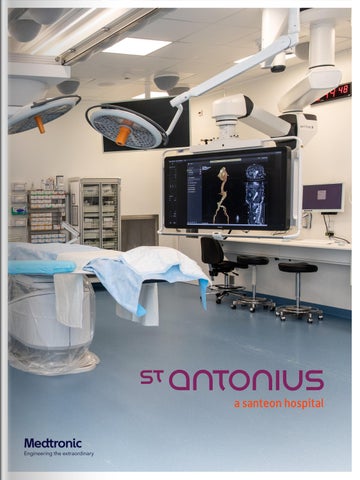
S E T T I N G S TA N DA R D MEDICAL SPECIALIT Person-centred care, education, innovation, and research are top priorities for St. Antonius Hospital in the Netherlands to achieve quality of care. We speak to CEO, Luc Demoulin, about constantly innovating to meet the demands of the healthcare industry Writer: Rachel Carr | Project Manager: Cameron Lawrence
2 | Healthcare Outlook Issue 4
DS IN TIES
ST. ANTONIUS HOSPITAL EUROPE & MIDDLE EAST
L
ocated in the middle of the Netherlands, St. Antonius Hospital (St. Antonius) strives daily to offer patients the best care, often in challenging circumstances. “The Dutch population is both growing and greying at the same time. These two developments culminate in a steadily increasing demand for care,” introduces Luc Demoulin, CEO of St. Antonius. Together with the rising costs of sophisticated new diagnostic procedures and treatments, energy, and personnel, St. Antonius faces the challenge of providing a high level of care without breaking the budget. Beyond St. Antonius, all hospitals in the Netherlands face a shortage of healthcare professionals.
“Our hospital is no exception to the shortage, but our doctors and nurses persistently find new ways to see more patients with the same number of caretakers. We have different ongoing experiments to find out what works, and if it works, we share the results with our partners,” divulges Demoulin. As a leading teaching hospital and part of Santeon, a partnership of seven teaching hospitals across the Netherlands, of which St. Antonius is one of the founding fathers, education and research are naturally a part of its DNA.
Healthcare Outlook Issue 4 | 3
ST. ANTONIUS HOSPITAL EUROPE & MIDDLE EAST
“Both are essential to constantly improve our care, according to the latest medical and scientific standards. “Furthermore, without structural external funding, we run many scientific and applied research projects via large-scale subsidies and the St. Antonius Research Fund, mainly powered by patients who make donations out of gratitude,” Demoulin explains. With locations in Utrecht, Nieuwegein, and Woerden, hospital services include all medical specialities, focusing on heart, vascular, lung, and cancer treatments. St. Antonius has become a healthcare leader known for combining innovation, drive, and person-centred care. “At the same time, we believe that cooperation is key to achieving the best medical care for people. Therefore, we work closely with other hospitals and care partners in the region,” adds Demoulin.
QUALITY OF LIFE St. Antonius’ mission is “ensuring quality of life together”, which it is able to achieve by investing in education, research, and the development of its employees, therefore contributing to excellent healthcare practices.
“ VA L U E - B A S E D H E A LT H C A R E I S O U R G U I D I N G P R I N C I P L E . P AT I E N T P A R T I C I P AT I O N A N D S H A R E D D E C I S I O N M A K I N G R U N S T H R O U G H O U T O U R H O S P I TA L TO AC H I E V E T H E B E ST Q UA L I T Y O F L I F E ” – L U C D E M O U L I N , C E O , S T. A N T O N I U S H O S P I TA L
“We make quality of care measurable and offer patients insight into the outcomes that matter to them. We use these results to continuously improve our care. Value-based healthcare (VBHC) is our guiding principle. With patient participation and shared decisionmaking runs throughout our hospital to achieve the best quality of life,” states Demoulin. Working as a team based on the personal needs of the patient is essential for the staff at St. Antonius. “We consider it our mission to act based on recent and innovative findings. We add to this by conducting our own research.”
‘MISSION IMPOSSIBLE’ A test to organise care so that nurses can help twice as many patients while improving job satisfaction and quality of care is currently running at St. Antonius, to determine whether the impossible can become a reality. Dubbed ‘Mission Impossible’, the test must contribute to keeping healthcare accessible and affordable. Hopefully, it will enable patients to have more control over their treatment. The project team of nurses was challenged to think outside the box, resulting in a colourful range of suggestions to meet the ambitious objective. Ultimately, it led to adjustment proposals in three areas: more involvement in family care, a smarter division of work, and using an app or digital platform. The plan will be actioned with the following steps: – A new division in all healthcare departments contributes to greater patient comfort and efficiency for nurses and other healthcare providers. This will limit absenteeism due to illness and make it possible to continue working in all phases of life. – Involving patients’ families and loved ones in nursing, which could lead to an earlier discharge from the hospital and abolishing fixed visiting times. – Working with an admission plan, where the hospital describes what the patients and loved ones can do themselves, means less home care is needed. – Experimenting with parts of the project in the oncology and urology departments.
The team at St. Antonius wants patients and their loved ones to feel heard and helped when visiting the hospital, where passionate professionals provide care with attention, love, and respect. Person-centred care means organising all aspects, from intake, several kinds of examination, and treatment, through to aftercare, all in close cooperation with the different medical specialists involved. The holistic approach of VBHC helps improve healthcare services, the patient experience, and overall well-being. “The patient’s personal situation, needs, health goals, and shared decision-making is crucial. We provide them and their families with all the relevant information at the right time and stimulate our medical specialists to speak with them about the best choice. “We believe our specialists know best about treatments, but our patients are the experts about what fits them personally,” Demoulin points out.
DIGITAL DILIGENCE Looking toward the future, St. Antonius believes that digital development is essential, not only in administration, where it tries to minimise paperwork, but also in care and treatment. Demographic and financial pressure drive innovation at unprecedented speed, and Demoulin finds the ongoing transformation in healthcare fascinating. “It is a unique era with great challenges and many new opportunities. The demand for care is increasing, but the supply more or less remains the same,” he adds. With a shortage of funds and employees in the healthcare industry, adaptations must be made to keep treatments accessible, affordable, and of good quality. Options to achieve this include labour-saving technologies, such as digitisation and home monitoring. “During the COVID-19 pandemic, we began to monitor patients who were stable enough at home. They had an app to measure their data, and if their health worsened, signals Healthcare Outlook Issue 4 | 5
Cardiology
Cancer centre
would go off, and there would be contact between an e-nurse and the patient to find the right approach to proceed,” Demoulin informs us. Currently, the home monitoring principle has expanded in Santeon, where St. Antonius cooperates with six other top clinical hospitals in the Netherlands. The aim is to achieve a nationwide network, making it accessible to all patients and caregivers. Digitising care and treatment has multi-faceted benefits, as the patients feel more comfortable being in their own homes whilst a high level of vigilance is maintained, and it creates room in the hospital for patients with more severe complaints. “This experience has encouraged us to continue this principle in our regular care and treatments. Most 6 | Healthcare Outlook Issue 4
Evolvement of pacemakers
Heart centre
“ O U R H O S P I TA L I S N O E X C E P T I O N T O T H E S H O R TA G E I N H E A LT H C A R E P R O F E S S I O N A L S , B U T O U R D O C TO R S A N D N U R S E S P E R S I S T E N T LY F I N D N E W WAY S T O S E E M O R E P AT I E N T S W I T H T H E S A M E N U M B E R O F C A R E TA K E R S . W E H AV E D I F F E R E N T O N G O I N G E X P E R I M E N T S T O F I N D O U T W H AT WORKS, AND IF IT WORKS, WE SHARE THE R E S U LT S W I T H O U R P A R T N E R S ” – L U C D E M O U L I N , C E O , S T. A N T O N I U S H O S P I TA L
patients are appreciative as it saves them time and money from hospital visits. Our specialists can monitor them on a more frequent basis; this makes more adequate interventions possible,” Demoulin notes. Another example of an innovative way to reduce workload while
increasing the quality of healthcare is the deployment of automated blooddrawing devices. The first devices of supplier Vitestro, which should be operational in 2025, will relieve the workload of the phlebotomists and deliver samples with significantly more consistency.
ST. ANTONIUS HOSPITAL EUROPE & MIDDLE EAST
CENTRED ON INNOVATION In 1938, the first lung surgery occurred at St. Antonius; fast forward to 1990, and the first double lung transplant in the Netherlands was performed there. Today, the St. Antonius Lung Centre is one of the most crucial of its kind in the world. The hospital invests heavily in research and constantly seeks new treatment methods and technologies. Indeed, lung disease is the focal point of the hospital. “This is often the last resort for patients suffering from interstitial lung diseases (ILDs) such as pulmonary fibrosis, sarcoidosis, hypersensitivity pneumonitis, and other rare and ultrarare ILDs.” St. Antonius hosts a worldrenowned Centre of Excellence for ILDs, including a biobank containing over 10,000 deep-frozen samples of patient material. It is the most extensive collection on the planet,
ST. ANTONIUS IN NUMBERS 29 medical specialties 500 beds 430,000 outpatient visits 220,000 digital consultations 40,000 hospitalisations 52,000 day admissions 3,300 births 8.4/10 patient satisfaction rating 7,000 total staff 2,000 nurses 420 doctors 320 doctors in training 445 medical trainees 500 volunteers 600 publications €800 MILLION turnover
Biobank
including a wealth of data explored by over 200 collaborations across the globe. As well as the lung centre, St. Antonius has one of the most innovative heart centres in the Netherlands, which will treat almost any type of cardiopathy heart disease. The first closed-heart surgery took place there in 1948, with the first open-heart surgery following in 1959. “In 2014, we placed the first wireless pacemaker,” Demoulin adds. “We have a long-lasting partnership with Medtronic, a supplier of electronic medical devices. Last year, Medtronic partnered with St. Antonius and our cardiologist Lucas Boersma for the global launch of its Aurora extravascular implantable cardioverter defibrillator (ICD).” This latest generation of ICDs needs no transvenous electrodes to provide therapy, which minimises the risk of common complications of ICDs. It combines this safety with the ability to terminate ventricular arrhythmias by anti-tachycardia pacing (ATP) or a shock if needed.
Equally important is the St. Antonius Cancer Centre, one of the largest in the Netherlands. “Each year, we investigate, treat, and operate on more than 3,000 new cancer patients. Therefore, we have accumulated a lot of knowledge about all aspects of cancer. “As an example where innovation and sustainability go hand in hand, we no longer use radioactive contrast agents to find the sentinel nodes in breast cancer patients – the first hospital in the Netherlands to do so. We now use a green, fluorescent liquid, which a study in our hospital has made clear is effective and reliable without the negative consequences for the patient and environment,” Demoulin concludes proudly.
ST. ANTONIUS HOSPITAL www.antoniusziekenhuis.nl Healthcare Outlook Issue 4 | 7
Transforming cardiac care for patients with St. Antonius Hospital As the patient population grows and ages, healthcare systems face capacity pressures and staffing challenges. At the same time, they must maintain a high quality of patient care while striving to keep it affordable. To address increasing pressures and ensure patients were receiving the best treatment, St. Antonius Hospital has partnered with Medtronic Integrated Health Solutions (IHS) in 2014. The partnership has been successful in helping the Heart Center at St. Antonius transform its cardiac care. More than 40 joint projects have been completed during our ten-year collaboration, yielding impressive results. Working closely with St. Antonius Hospital, these projects included among others: • Care pathway development • Implementing Same Day Discharge as a default • Optimising referrals and enabling growth • Planning and Scheduling of key capacities
Optimising pathways, implementing Same Day Discharge (SDD) and improved planning and scheduling means more patients are receiving the high-quality care of the St. Antonius Hospital. Below are some examples, but there are many more. • TAVI procedures increased by 60 percent within three years • Cardiac ablations increased by 80 percent • Length of Stay (LoS) was reduced by 27 percent • 8-10 clinical ward beds were freed up due to SDD Across these and numerous other projects, Medtronic IHS adopts a long-term approach and ensures the Heart Center can continually draw on Medtronic’s international best practices. This way the partnership supported the St. Antonius in achieving its annual growth target in high-complex intervention care and maintaining
Introducing the Aurora EV-ICD™ system The Aurora EV-ICD system is the only extravascular ICD to offer1: •
Antitachycardia pacing (ATP)
•
Small size (33 cm3) and PhysioCurve™ design
• 11.7 years projected longevity
The extravascular system with transvenous ICD features2
92.6%
patients free from major system or procedurerelated complications3*
Establishing the rhythm. Pioneering what’s possible. Learn more at 0123 ©2023 Medtronic. Medtronic, Medtronic logo, and Engineering the extraordinary are trademarks of Medtronic. All other brands are trademarks of a Medtronic company. UC202401841-aurora-ev-icd-print-ad-en-emea-10653628 09/2023
medtronic.eu
their top three position among cardiac intervention centers in the Netherlands. The collaboration has not only improved care for patients, but also for the planet. A sustainability scan conducted by the IHS team identified a potential 8.5 percent CO2 reduction. After three months, the hospital implemented changes that reduced its CO2 by 5.8 tonnes.
About Medtronic IHS We partner with hospital management and medical leaders to transform care pathways and clinical operations with a shared goal of improving efficiency and outcomes, increasing patient and staff satisfaction, and optimising costs. We use our extensive cross-regional experience to provide proven and highly effective solutions that can be quickly tailored to specific care provider needs and generate value, now and for the future.
Over the last ten years, we have partnered with more than 250 healthcare centres in 27 countries and completed more than 300 transformation projects annually. Over one million patients are impacted by our solutions every year, from reducing cancellations by an average of 60 percent to decreasing referral time by an average of 56 percent. Would you like to know more about what IHS can do for your hospital? Learn more by visiting our website, reaching out to your Medtronic contact, or emailing us at: integratedhealthsolutions@medtronic.com
ST. ANTONIUS HOSPITAL Soestwetering 1, 3543 AZ Utrecht, Netherlands Tel: +31 88 320 3000 www.antoniusziekenhuis.nl PRODUCED BY HEALTHCARE OUTLOOK MAGAZINE