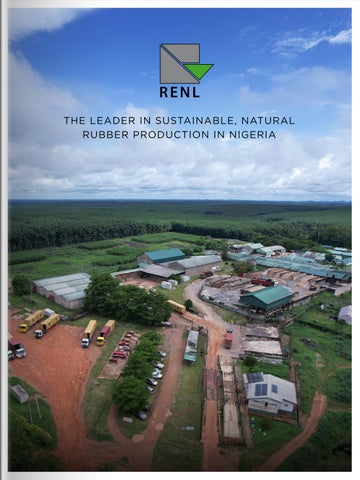
THE LEADER IN SUSTAINABLE, NATURAL RUBBER PRODUCTION IN NIGERIA
D R I V I N G A F R I C A’ S INDUSTRIAL AND COMMERCIAL D E V E LO P M E N T Specialising in the production and processing of natural rubber, Rubber Estates Nigeria Limited is on a mission to consolidate its position as the sustainable leader of choice in Nigeria for this ever-crucial industry. Olivier Odoukou, Managing Director, tell us more about the company and its plans for a successful, Africa-focused future Writer: Lauren Kania | Project Manager: Josh Whiteside
D
emonstrating characteristics that give it a competitive advantage over synthetic rubber, such as a lower heat generation and better ability to regain its original shape, natural rubber is an increasingly crucial material in countless industries across the globe. Rubber Estates Nigeria Limited (RENL) is an expert in all things natural rubber, proudly residing as the leading producer and exporter of the material in Nigeria. Managing more than 15,000 2 | Manufacturing Outlook Issue 10
hectares (ha) of plantation in seven main locations across four states in Nigeria – Edo, Delta, Ogun, and Ondo – the company engages in the normal farming system, which includes land preparation for planting, maintaining, harvesting, processing, and exporting of natural rubber. “We purchase raw materials from local farmers to complement our field production and boost factory production and sales. We also have a six tonne (t) per hour factory based in Araromi-Obu, which is three hours
from the Lagos Port Complex,” introduces Olivier Odoukou, Managing Director. RENL’s customers primarily comprise tyre manufacturers and dealers from the global markets, and it is a subsidiary of the Société Indochinoise de Plantations d’Hévéas (SIPH) – the holding consolidating the rubber activities of Société Immobilière et Financière de la Côte Africaine (SIFCA). SIPH is the leader of sustainable rubber in Africa, and the ambition of RENL is to make
RUBBER ESTATES NIGERIA LIMITED AFRICA
Nigeria a major place of growth for the group in the future. “At RENL, our vision is to become the leader of sustainable rubber in Africa. This requires embedding best practices in our processes, especially the sustainability requirements of our customers, and the key needs and expectations of our internal and external parties,” details Odoukou. Equally, it means the company’s strategy goes beyond economic performance and places high importance on customer satisfaction
as well as environmental, social, quality, and compliance requirements. To put stock in these goals, RENL is ISO 9001-2015, 140012015, and 45001-2018-certified, EU Deforestation-free Products Regulation (EUDR)-compliant, and Top Employer-certified.
AN AUTHENTIC AFRICAN IDENTITY After graduating from business school, Odoukou began his career in an international audit firm before
transitioning to the Group Internal Audit Department of SIFCA. “For me, working for SIFCA was an opportunity to contribute to the development of sustainable agriculture and industry for a company with an authentic African identity,” he explains. Regular interactions with business processes, top management, and the board of directors improved Odoukou’s understanding of the group’s corporate strategy and operations, triggering his ambition Manufacturing Outlook Issue 10 | 3
RUBBER ESTATES NIGERIA LIMITED AFRICA
to impact the business beyond internal audits. “The opportunity to become Managing Director came at the right time, when I was eager to move from a support role to operations leadership. RENL’s location in Nigeria was an additional motivation to move out of my francophone comfort zone,” he prides. Having now resided at the helm for nearly five years, Odoukou is pushing RENL to meet its goal of a production value of 30,000 t by the end of 2025. Previously, the company had been
exploiting, processing, and selling rubber from its own plantations. Although this enabled the company to maintain control over the quality of its production, it was limited in terms of growth, with a maximum of 25,000 t annually. This slow growth was a consequence of the limited availability of raw materials to be purchased from local farmers in the country, as rubber farming in Nigeria has greatly declined. To address this, RENL developed a handful of local initiatives to
encourage the planting of rubber by local farmers. Gradually, more plantations came into production, allowing RENL to purchase rubber to complement production from its own plantations. “This positive trend, coupled with a competitive sourcing strategy, has enabled us to increase our volume of rubber purchased from 1,000 t in 2021 to a forecast of almost 10,000 t in 2025. We are confident we will hit 30,000 t by the end of the year,” details Odoukou. Meanwhile, the company has
RUBBER ESTATES NIGERIA LIMITED AFRICA
upgraded its factory capacity and is planning additional investments to ensure it has the processing capacity to absorb the increasing raw materials. Ultimately, for RENL, the target of 30,000 t is just a milestone towards a larger ambition of contributing to the development and growth of the industry. “We believe the future is bright for the sustainable rubber business in Nigeria, and RENL wishes to continue to play a leadership role in this development,” prides Odoukou.
CONTINUAL GROWTH AND SUCCESS Currently, Odoukou finds the rubber manufacturing industry an exciting place to be, with a plethora of internal and external challenges to overcome. “It consists of evolving customer needs that require continual improvement of all our processes. Good people management is key to optimising our internal operational capacity, meeting our operational and sustainability objectives, and improving our resilience to an unstable external context,” he informs. For RENL, its business comes with the responsibility of supporting the development of local suppliers. This same responsibility extends to the rural communities surrounding the company’s locations regarding infrastructure development, employment, and education. “Contributing to the future agriculture of Africa is an additional motivation for working in the rubber manufacturing industry,” states Odoukou. To advance this critical sector, RENL is undertaking ongoing projects and initiatives, one of which includes the acquisition of additional lands for plantation expansion. As Nigeria has a good availability of areas suitable for rubber farming, the company is selecting opportunities that meet its operational,
CAN YOU TELL US ABOUT RENL’S SUPPLY CHAIN OPERATIONS AND HOW SUCH RELATIONSHIPS CONTRIBUTE TO YOUR OVERALL SUCCESS? Olivier Odoukou, Managing Director: “Our supply chain can be described using the following words – partnership, capacity building, traceability, and sustainability. “Partnership because our objective is not just to source raw materials and other items for our business, but also to build a partnership with reliable suppliers. “Capacity building is where we work with local contractors and vendors from the surrounding communities. We operate in rural areas, and this collaboration with local partners is important and part of our CSR. We support these vendors in capacity building, not only to meet our standards but also to create the appropriate conditions for their business to be a viable source of livelihood. “Traceability and sustainability refer to the business imperatives of our value chain. We implemented the necessary measures to trace, assess, and validate the origin of our raw materials, other items, and services in our value chain. We also ensure that our suppliers understand our policies, as well as the legal and regulatory requirements associated with the business.”
environmental, and compliance objectives – with more than 20 areas already being studied. Additionally, the company is working to provide programmes to empower local women and youth. “Nigeria is the most populous country in Africa, and the need to support women and children is extremely important. We are implementing various initiatives to improve female representation within the workforce and employing young people from the surrounding communities at our sites,” details Odoukou. Equally, RENL is embracing digital transformation initiatives which have the potential to greatly
develop African agriculture and industry. The company has set up a digital transformation unit to explore and implement opportunities for optimisation of its processes and operations.
CONTRIBUTING TO THE FUTURE OF AFRICA As RENL operates within rural communities, many of which are underdeveloped with pressing needs, the company has a strong corporate social responsibility (CSR) policy, with key components comprising active listening and dialogue, educational support, employment, community projects, and partnerships with community vendors and contractors. Manufacturing Outlook Issue 10 | 5
View of plantation and factory
Distribution of school bags in company schools
Scholarship award
Top Employers Certification celebration in London
Visit to rural community leader
Visit to rural community leader
Women’s Day celebration Education Legacy Award
For active listening and dialogue, the company has a department dedicated to liaising with local communities. It also holds quarterly meetings with the communities alongside scheduled visits from top management twice a year. “To support education, we provide scholarships to students and renovate local schools. Equally, for employment, we place a high importance on hiring from the 6 | Manufacturing Outlook Issue 10
surrounding neighbourhoods and have a diversity, equity, and inclusion strategy that focuses on fairness and equality,” expands Odoukou. RENL annually invests in community projects, such as access to water, health centres, schools, and others, alongside collaborating with vendors and contractors in its value chain. The company’s relationship with local farmers is part of this strategy, and the sustainable
farming initiatives it has with them include supplying planting materials, sensitisation against deforestation and child labour, education around geolocation and traceability of plantations, and technical assistance. As RENL looks ahead at the rubber industry in Africa, it is working towards Nigeria’s future as an agricultural giant. “Nigeria’s population currently stands at more than 200 million and
RUBBER ESTATES NIGERIA LIMITED AFRICA
RENL’S WELL-BEING PRACTICES Since RENL operates in rural areas remote from the main cities of Nigeria, it sees the accommodation of employees and their families as an opportunity to positively impact all aspects of their well-being – mental, physical, financial, spiritual, environmental, vocation, and so on. Embedding well-being in work is seen by the company as a strategic priority, with the needs and expectations of employees as the main driver of the actions implemented. RENL’s business is driven by its people, and it believes that productivity and effectiveness can only be achieved if their well-being is protected. Therefore, the company embeds well-being into its work because it knows success is sustained through physical and psychological health. The company is engaging in various initiatives and programmes to reach these goals, alongside regularly reviewing and improving strategies based on employee feedback and active listening.
“AT R E N L , O U R V I S I O N I S T O B E C O M E T H E L E A D E R O F S U S TA I N A B L E R U B B E R I N AFRICA. THIS REQUIRES EMBEDDING BEST P R A C T I C E S I N O U R P R O C E S S E S , E S P E C I A L LY T H E S U S TA I N A B I L I T Y R E Q U I R E M E N T S O F O U R C U STO M E R S , A N D T H E K E Y N E E DS A N D E X P E C TAT I O N S O F O U R I N T E R N A L A N D E X T E R N A L PA R T I E S ” – O L I V I E R O D O U KO U, M A N AG I N G D I R E C TO R , R E N L
is projected to surpass 400 million by 2050. Agriculture will continue to play a vital role in ensuring the needs of this population are satisfied,” insights Odoukou. “Fortunately, Nigeria still has available land, and the country has established the development of agriculture as a strategic priority. We would like to take advantage of the excellent relationship we have built over time with our surrounding
neighbourhoods to develop an ecosystem of local farmers that will boost agricultural and social development in all our areas of operation. This is in line with the vision of SIPH to prioritise local partnerships in agricultural development, and RENL’s ambition is to play a leadership role in achieving it.” Although RENL’s core business is rubber, it is also considering other crops. One of the company’s
initiatives is to support the development of food crops in rural communities and to find intercropping solutions for rubber. These initiatives aim to contribute to the country’s agricultural development. “We believe that, as the most populous country in Africa, Nigeria will drive the industrial and commercial development of the continent in the future. We are working towards aligning our business plan with these projections,” confidently concludes Odoukou.
Tel: +234 806 337 67 18 info@renl-siph.com
renl.ng
Manufacturing Outlook Issue 10 | 7
Tel: +234 806 337 67 18 info@renl-siph.com
renl.ng
PRODUCED BY MANUFACTURING OUTLOOK MAGAZINE