![]()


Brendon Pambid, one of two Managing Directors at Queensland Magnesia alongside Dr Christoph Beyer, offers insight into the products, processes, and most importantly, people that have led to 35 years of success
Writer: Lily Sawyer
Project Manager: Thomas Arnold


Australia’s ever-evolving mining industry continues to be both exciting and challenging.
Shifting global markets, increasing demand for critical minerals, and the ongoing need to balance operational performance with environmental expectations are transforming the nation into a strategic and sustainable supplier of critical minerals.
At the same time, cost pressures around gas and energy pricing remain significant and require agile management and long-term planning.
“For companies like Queensland Magnesia (QMAG), innovation and adaptability are essential as we navigate these dynamics,” introduces Brendon Pambid, Managing Director of the leading Australian producer of high-grade magnesia products.
Indeed, the business is positioning itself to support global supply chains whilst contributing to a growing critical minerals landscape in Queensland (QLD).
Producing a full suite of premium magnesia products derived from one of the largest deposits of cryptocrystalline magnesite in central QLD, QMAG boasts a comprehensive product portfolio used across a range of industries.
Its customer base spans the refractory, chemical, agricultural, hydrometallurgical, environmental,
steel, cement, and industrial processing sectors across global and domestic markets.
This year, QMAG is proud to have secured funding under QLD’s Collaborative Development Programme (CDP) to advance a groundbreaking initiative: the extraction of high-purity magnesium chloride from magnesite tailings.
The project focuses on reprocessing mine waste to produce magnesium metal, turning tailings – which traditionally hold limited residual value –into critical mineral feedstock.
In undertaking such a venture, QMAG is driving circular economy outcomes and enabling downstream magnesium metal production capability within QLD.
It is also supporting the state’s critical minerals strategy and stimulating regional industry participation and supply chain uplift.
“This is an important step towards positioning central QLD as a leading hub for critical mineral innovation,” Pambid emphasises.
As part of the Refratechnik Group (Refratechnik), QMAG enacts a unified corporate leadership culture around the group’s motto, ‘expect the best’.
“Refratechnik’s global culture emphasises performance excellence, integrity, and people-first leadership,” he adds.
At QMAG, this is brought to life by the company fostering an inclusive work environment, prioritising safety and well-being and empowering its teams to take ownership of innovation and continuous improvement.
HOW IMPORTANT IS COLLABORATION WITH BOTH GOVERNMENT AND INDUSTRY FOR YOU WHEN IT COMES TO EXPORTING YOUR PRODUCTS?
Brendon Pambid, Managing Director: “For us, extensive collaboration and realistic understanding across policymakers and regulators is mandatory.
“As we are dealing at an international level, our success is heavily influenced by that space.
“Pit-to-port alignment is critical to remain competitive. Australian and QLD businesses do face headwinds that some of our global competitors do not.”


“Refratechnik’s motto resonates strongly with our approach to product quality, operational discipline, and building meaningful relationships with employees, partners, and customers,” Pambid tells us.
It also ensures that every decision made aligns with long-term sustainability and global best practice.
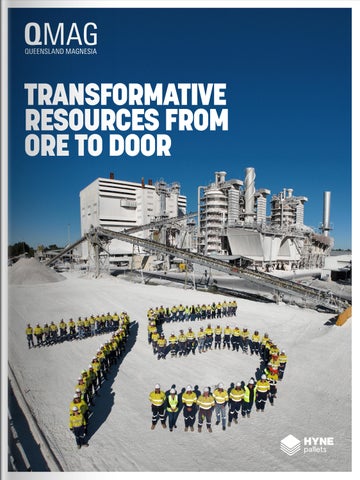
Having celebrated Refratechnik’s 75th anniversary last year, QMAG is proud to be part of the world’s largest family-owned refractory.
“It grants us a sense of stability,


“FOR US, SUSTAINABILITY MEANS OPERATING RESPONSIBLY ACROSS EVERY DIMENSION”
– BRENDON PAMBID, MANAGING DIRECTOR, QUEENSLAND MAGNESIA
heritage, and shared purpose,” Pambid smiles.
Refratechnik’s anniversary was a moment of pride for the entire workforce, especially as QMAG is celebrating its own 35th anniversary in 2026.
To mark the event, QMAG was visited by Maleachi Bühringer and
Michael Frei, Managing Directors of Refratechnik.
It also brought its workforce and their families together for a special family fun day at the Parkhurst site, where everyone could connect with QMAG’s operations and recognise the people who drive the company’s success.
224
Years of combined operation
6 Production sites
1,200
Pallets per hour capacity 100% National coverage

Australia’s supply of pallets faces a unique set of challenges, largely driven by fluctuations in raw material availability.
The humble pallet is often overlooked, but when pallets aren’t available where and when they’re needed, operations slow, costs rise, and customer service can suffer.
THE STATUS QUO
Australian pallet manufacturing plays a vital – yet often overlooked – role in the nation’s logistics, supply chain, resources, and manufacturing ecosystem. Pallets are the quiet enablers of commerce. These simple platforms support goods through storage, handling, and transport, underpinning efficient freight movement both domestically and internationally.
Unlike many other global markets, Australia’s pallet sector is highly fragmented, dominated by smaller processors with a regional focus. Despite its essential role, the Australian pallet manufacturing industry is not without challenges.
Wooden pallets remain the predominant format in Australia, prized for their cost efficiency, sustainability, and adaptability. Raw material availability and cost volatility – particularly across timber and plastics –continue to squeeze margins and test the ability of some manufacturers to meet demand consistently.
In a country as vast and decentralised as Australia, the consistent supply of pallets across states and territories is fundamental. Australia’s freight task is inherently interstate and often international. Supply chains span thousands of kilometres, making pallet availability in the right location at the right time critical.
Any imbalance – whether due to seasonal demand spikes,
So how do you create certainty in an uncertain market?
We take a closer look at how the Hyne Group is reshaping the pallet sector through something few can match: direct access to large-scale timber production.
natural disasters, or shifts in consumer purchasing patterns – can quickly disrupt distribution networks. In this environment, scale, coordination, and material certainty are becoming increasingly important.
A CHALLENGER EMERGES
In contrast to the fragmented sector, Hyne Pallets has emerged as a single pallet producer with a geographically diverse manufacturing footprint.
With six sites dotted across Australia – spanning the east coast and extending as far west as Perth – the business operates as an integrated manufacturing network capable of servicing customers where and when supply is needed.
Hyne Pallets is a part of the Hyne Group, a vertically integrated wood processing conglomerate operating two of the nation’s most advanced, high-capacity softwood sawmills. Hyne Group processes over 1.1 million cubic metres of plantation pine annually, providing the pallet division with direct access to raw materials and shielding it from the supply and price volatility often experienced by manufacturers reliant on third-party suppliers.
Material stability is further bolstered by a further three site-dedicated sawmills supplying fibre to the Hyne Pallets network, enabling rapid and efficient production scaling.

The business can produce an impressive 1,200 pallets per hour – a significant advantage for organisations prioritising supply security.
The Hyne Group is majority owned by James Jones & Sons, one of the UK’s largest sawmilling, timber processing, and pallet manufacturing companies, producing more than 3.5 million pallets per annum. This global connection brings decades of operational insights, industry expertise, and manufacturing innovation to the Australian market. Technological and operational innovation is also transforming the pallet sector. Advanced automation across cutting, nailing, and assembly processes is improving productivity, product consistency, and production scalability – allowing factories to increase output without proportionally increasing labour requirements.
As a vertically integrated wood processing company, Hyne Group has found broad uses for the logs that it processes. It’s a part of a ‘Whole-of-Log’ strategy that ensures zero waste. Logs are processed into structural timber framing, engineered timber for use in construction, landscaping, and garden care products, and pallets and packaging. Even the sawdust is collected and used as biofuels to run the sawmills.
It’s a corporate philosophy that also delivers good environmental benefits.
The mills that feed Hyne Pallets are fed by responsibly managed Australian pine plantations. These plantations are replanted after harvest and supported by a full chain of custody certification. Australia has approximately 8.9 million hectares of plantation forest, and more than 70 million seedlings are planted annually – providing longterm resource security for a growing pallet market.
Not surprisingly, trees are great for the air we breathe. As they grow, they pull carbon from the atmosphere and lock it up in their fibres.
Research shows that a single 1200x800 millimetre timber pallet can store approximately five kilogrammes (kg) of carbon, even after accounting for the emissions created during manufacture and transport. In contrast, the production of an equivalent plastic pallet will release 34kg of greenhouse gases into the atmosphere.
(Ivan Deviatkin1, Mika Horttanainen, 2019, ‘Carbon footprint of an EUR-sized wooden and a plastic pallet’, Department of Sustainability Science, School of Energy Systems.)
STRATEGIC IMPORTANCE IN
As supply chains across Asia Pacific become more interconnected and time-sensitive, efficient pallet solutions are increasingly critical to logistics performance. The right pallet partner is more than a supplier – it is a critical risk management decision and growth partner. For partners such as QMAG, who rely on pallets as a global supplier of magnesia, Hyne Pallets plays an important strategic role. QMAG originally sourced pallets from Seapal Pallets & Crates starting in 2017, before Seapal was acquired by Hyne Pallets. Now a Hyne Pallets’ production site, QMAG benefits from the stable backing of a large-scale business geared to support its future growth. The QMAG-Hyne partnership ensures timely pallet supply to reduce handling times and streamline transitions between road, rail, and sea freight.
Hyne Pallets’ national production model, combined with direct access to scalable timber resources, positions the business as a stabilising force in a sector historically shaped by fragmentation and supply uncertainty. As supply chain demands continue to evolve, this approach could redefine expectations around reliability, scale, and sustainability in pallet manufacturing.


“AS WE LOOK AHEAD, WE REMAIN FOCUSED ON BEING AN EMPLOYER OF CHOICE AND PARTNER OF INTEGRITY FOR INDUSTRY, COMMUNITY, AND GOVERNMENT”
– BRENDON PAMBID, MANAGING DIRECTOR, QUEENSLAND MAGNESIA
Guided tours of both the Parkhurst processing plant and the Kunwarara mine enabled employees to proudly show their loved ones the work they do.
“The day also featured a variety of family activities such as children’s rides and games, food trucks, a mini mine site for kids to explore, a petting zoo, and, of course, cake!”
More widely, QMAG is deeply connected to central QLD and committed to giving back, demonstrated by its corporate social responsibility (CSR) approach.
“We support local education and career pathways, including hosting students and partnering with industry groups to promote STEM and trade opportunities, such as during the Awesome Women in Construction (AWIC) Roadshow,” Pambid explains.
The company is also dedicated to creating inclusive and welcoming workplaces through programmes driven by its Culture Committee.
In addition, QMAG engages transparently with industry partners, government, and community stakeholders as it progresses new projects – particularly the CDP initiative.
“We believe strong communities create strong industries,” he states.
As it continues to strengthen its operational capability and futureproof the business, QMAG is progressing a number of important projects that highlight its commitment to growth, innovation, and community.
Some of its key initiatives include the CDP-funded magnesium chloride extraction project, which has taken a transformative step towards turning waste into value and advancing QLD’s critical minerals capability.
The company is also upgrading its Kunwarara and Pankhurst mine sites.
“This includes improvements in
site infrastructure, beneficiation efficiency, and sustainability practices to support long-term resource optimisation,” Pambid outlines.
It is also working on its people and community initiatives, where the Culture Committee plays a central role in shaping many of QMAG’s peoplefocused and community-driven programmes.
“Their work spans a wide range of initiatives, from site improvement projects and school placement opportunities to community engagement activities such as sponsorships and volunteering,” he details.
As such, QMAG’s Culture Committee is strengthening local ties, enhancing workplace pride, and fostering a positive, inclusive environment.
“Each of these projects reflects our commitment to innovation, people, community, and sustainable growth,” Pambid points out.
A green focus, meanwhile, is also deeply important to QMAG as it seeks to protect the environment, land, and culture.
“For us, sustainability means operating responsibly across every dimension,” he reflects.
This includes environmental stewardship through efficient resource use, reduced waste, and projects that enable circular outcomes, like the repurposing of tailings into mineral feedstock.
It also means respecting the land that surrounds the company’s sites, ensuring its operations coexist sensitively with local ecosystems and community expectations.
“We also seek to protect people and cultures, which is reflected in our safe workplaces, inclusive initiatives, and programmes that promote diversity, well-being, and employee engagement.”
“Sustainability is embedded in our strategy, not an afterthought,” Pambid asserts.

Your trusted partner in Engineering, Fabrication, and Machining since 1955.
Ashton Engineering is a family-owned Australian business with over 70 years of experience in General Engineering, Fabrication, and Machining, located in Rockhampton, Queensland. The company specialises in custom-built equipment for the Mining and Agricultural sectors, leveraging its proximity to key industrial areas. With a diverse range of equipment, Ashton Engineering performs extensive repairs and fabrications, having supplied numerous companies, including QMAG.

We utilise various specialised materials and possess CAD technology for manufacturing drawings. We prioritise local industry engagement and are committed to delivering the best service for our clients.
Ashton Engineering is one of CQ’s most comprehensive engineering workshops.
Ph: 07 4936 1145 igloo@ashtonengineering.com.au www.ashtonengineering.com.au


Maximise productivity with our pneumatic conveying and bagging solutions for fine, abrasive powders. Engineered to withstand demanding industrial and mining conditions, our solutions are built for longevity, reliability, and efficient performance. The convenience of a pipeline provides easy conveyor integration within existing plant infrastructure, simplifying upgrades and future expansions. Our heavy-duty, operator-friendly Bulk Bag Fillers provide accurate, high-speed filling whilst maintaining safe, dust-controlled operation. Tailored to suit each application, these end-to-end solutions streamline material handling and bulk packaging from intake to dispatch. Request your custom solution today!

Optimise your operations with world-class packaging systems T:


HIGH-GRADE CAUSTIC CALCINED MAGNESIA (HGCCM) –Used in hydrometallurgical and chemical processes, including precipitating rare earths, nickel, and cobalt essential for EV battery supply chains.
CAUSTIC CALCINED MAGNESIA (CCM) – Used in agriculture, animal feed, fertilisers, iron and steel applications, pulp and paper, and water treatment.
ELECTROFUSED MAGNESIA (EFM) – Used in high-temperature industrial applications and speciality refractory bricks.
DEAD BURNED MAGNESIA (DBM) – A key refractory material used in steel and cement furnaces.
Looking ahead, QMAG is focused on strengthening its existing capability, supporting growth in critical minerals, and investing in the people and systems that will drive its long-term success.
“We are also sharpening our focus on cost-saving initiatives and working closely with our stakeholders to ensure the organisation remains resilient and sustainable well into the future,” Pambid insights.
As such, the company’s key priorities include advancing its critical minerals processing capabilities, specifically seen in the progression of its magnesium chloride extraction project.
QMAG will additionally seek to strengthen its sustainability

Pambid reflects how QMAG’s strength lies in its people – from the mine to the production floor to its corporate office.
framework, particularly for energy efficiency, resource optimisation, and site rehabilitation.
“We will also expand our highgrade magnesia portfolio to meet global demand in refractory, electric vehicle (EV) battery, and industrial sectors,” he reveals.
With investment in its people remaining a key priority, QMAG’s training programmes and diversity initiatives will continue to nurture a pipeline of talent that is deeply
aligned with Refratechnik’s values.
“Moreover, we are enhancing operational resilience, especially around energy, logistics, and supply chain optimisation, alongside driving cost savings and efficiency initiatives across our operations to support long-term competitiveness,” Pambid outlines.
It is also collaborating with customers, suppliers, government, and community stakeholders to reinforce sustainable growth and shared value.
“As we look ahead, we remain focused on being an employer of choice and partner of integrity for industry, community, and government,” he confidently concludes.

Tel: +61 7 4920 0200
info@qmag.com.au
www.qmag.com.au