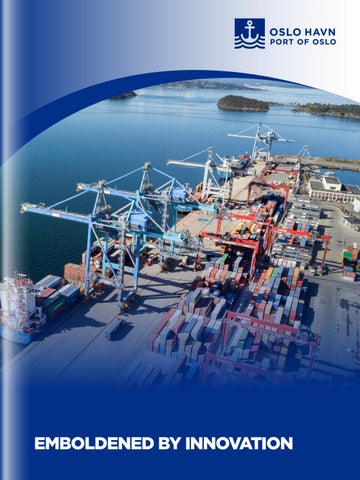
EMBOLDENED BY INNOVATION
PORT OF OSLO
CHARTING A NEW COURSE In a pursuit of environmental excellence, optimised operational efficiency and growth, Port of Oslo is epitomising the new role of ports via a flurry of innovative initiatives Writer: Jonathan Dyble | Project Manager: Alistair Bailey
2 | EME Outlook issue 33
SUPPLY CHAIN
EME Outlook issue 33 | 3
PORT OF OSLO
G
lobal trade is on the up. According to data from the World Bank, the value of exported goods as a share of global GDP rose from 19.3 percent in 1990 to 29.3 percent in 2017. In tandem with this rise, the role of ports has changed dramatically in recent decades. Cities that serve as major oceanic transit hubs have come to experience faster growth than their inland counterparts, owed to a rising economic dependence on sea trade that has seen ports become transformed into spatial clusters of innovation, research and development as they strive to meet a new calling. Indeed, Ingvar Mathisen, CEO and Port Director of Port of Oslo, is one individual well aware of this transition. “Ports and shipping is an exciting space to be involved in right now,” he states. “Whether its technological advancements, environment pressures, global political developments or the continued emphasis on improving efficiency and cost, a lot of change is happening.” For Mathisen, today’s seascape is in many ways entirely different to one that he found upon entering the industry almost a quarter of a century ago. Opting to fine tune his business acumen when undertaking higher education studies at Pacific Lutheran University in Tacoma in State of Washington in the USA and Nord University in Bodø, Norway, a career in the maritime industry was always his end goal. “The sector is almost in my genes, so to speak,” he reveals. “On my father’s side, all the men have become seafarers going way back. My father himself ended up working as the CEO of a shipping company, and I was able to hone my hereditary passion through a number of summer jobs at the business.” Picking up his first full time job back in 1994, working in a marketing capacity for international shipping entity Leif 4 | EME Outlook issue 33
Höegh & Co., the past three decades led Mathisen to numerous jobs and advisory roles across the globe, today heading up one of the world’s most innovative ports.
EMBRACING THE CHALLENGE In typically progressive Nordic fashion, Oslo is not only embracing but equally spearheading the vast swathes of changes sweeping across the maritime industry. Climate control plans targeting an 85 percent reduction in greenhouse gas emission by 2030 have been adopted by the City Council, Executive Board of the City of Oslo and Port of Oslo itself, owed to the country’s and indeed region’s growing focus on addressing climate issues. Coupling this, however, are logistical challenges facing the port – challenges stemming from the strides being made by both Oslo and the industry alike – that are forcing it to take a proactive stance on all fronts. “Our location is one of our biggest assets,” Mathisen reveals. “Oslo is one of the Europe’s fastest growing metropolitan areas, and it’s just a six-kilometre round trip between the city centre and the port, meaning we can supply building materials, fuels and other key commodities with ease and with a low carbon footprint. “On the other hand, as the city grows, the area we’re able to work with shrinks. We’re expecting our 5,700-acre site to roughly half in the coming years, yet at the same time we’re looking to grow our overall cargo business by 50 percent and passenger throughput by 40 percent come 2034.” Simultaneously shrinking in size, expanding in capacity and becoming more environmentally friendly, it’s a critical time for the Port of Oslo, the organisation reacting accordingly via a distinct emphasis on innovation. It’s carbon capture agreement with Fortum Oslo Varme stands as a prime such example. A collaboration set to be initiated
Color Line Color Line is Norway’s largest and one of Europe’s leading companies in the field of short sea shipping. With regular and daily sailings between ports in Norway, Germany, Denmark and Sweden, Color Line is a key player in the development of a modern, environmentally friendly, and forward-looking seaborne transportation industry. The commitment of the authorities and the international community to bring down climate gas emissions lies at the heart of the business of the company. As part of the company’s sharpened focus on environmentally-friendly solutions, 2019 has been an extraordinary year for Color Line. In January, a newly acquired ro-ro vessel was put into service between Kiel and Oslo, moving cargo from road to sea and rail. In cooperation with Kombivekehr in Germany, transport owners can utilise intermodal solutions from Norway to cities in Europe and vice versa. In April, Color Line opened a shorebased power supply system in Kiel, making this first installation abroad. Color Line was the first company to introduce high-voltage shore-power supplies for its ships in Norway and has been a pioneer in establishing these facilities and uses shore-based power supplies in all the Norwegian ports at which the company’s ships call. In August, Color Line launched the world’s largest plug-in hybrid ship, M/S Color Hybrid. With a battery capacity of approximately 5MWh, the passenger and transport vessel can run on electricity for up to one hour at speeds of up to 12 kn.
www.colorline.com
COLOR LINE NORWAY–GERMANY Cargo and Intermodal Solutions
Color Line is Norway’s largest and one of Europe’s leading companies in the field of European short-sea shipping. The company operates four international services between seven ports in Norway, Sweden, Denmark and Germany.
NORWAY–GERMANY Cruise and Transport
NORWAY–DENMARK Transport and Shopping
NORWAY–SWEDEN Transport and Shopping
Color Line aim to be at the forefront of the green transition. Color Line has invested in shore-based power supply systems in all the Norwegian port’s which the company’s ships call. In 2019, the company installed a similar system in Kiel, launched the world’s largest plug-in hybrid ship, and opened up a new cargo route which connect Norway to European cities by train and transport at sea.
colorline.com
PORT OF OSLO at the Klemetsrud waste-to-energy plant, the goal is to create a chain that will see CO2 captured from industrial processes converted into a liquid form, transported by ship to the west coast of Norway and then transported offshore by pipeline and stored within the seabed in empty oil wells. “Should all go well, the city can expect to deposit around 400,000 tonnes of liquid carbon in empty oil wells in the North Sea every year beginning 2025,” Mathisen states. “In doing so, we’ll be able to cut the city’s overall emissions by roughly 15 percent. “What’s great about this project is that nobody’s really done it on a global scale. Should it prove to be a success in Oslo, then it has the potential to have
6 | EME Outlook issue 33
massive implications on the reduction of CO2 emissions worldwide.”
ABUNDANT INVESTMENT Indeed, it is anticipated that the carbon capture project will also facilitate the growth of a regional waste-to-energy circular economy, the ashes from the burners becoming a key material in development of roads in countries such as Denmark. “These ashes are becoming something of a commodity, providing the Port of Oslo with the opportunity to expand its export business where traditionally we’ve largely been an imports port,” Mathisen explains. The carbon capture storage project is just one of numerous examples of
innovation in practice at the transport hub, however. Equally, the port is in the final stages of developing an enhanced replacement for its Pelikan work boat, designed specifically to collect waste on the water’s surface both in and around the port. “The new version will be fully electric and harness sophisticated mapping technologies, improving efficiency and reducing environmental impact of cleanup operations,” the CEO adds. Owed to these ambitious efforts, it may come as no surprise that Port of Oslo is on track to become one of the world’s first zero-emission ports. Yet its strategic plan extends far beyond this, the firm also pursuing more traditional investments including the
SUPPLY CHAIN maintenance and rehabilitation of its facilities in order to prepare for surges in demand. Currently the port is in the process of expanding both its passenger and container terminals – necessary improvements considering it has developed capacity for six new container lines and grown roughly 14 percent each year for the past two years. “We’re also installing a new ship to shore gantry crane and other critical equipment to ensure that we can handle future growth,” Mathisen adds. “By accepting a wider range of cargo, we’re able to move it away from the roads while reducing emissions and congestion, resulting in a win-win situation for all stakeholders.”
CHAMPIONING CHANGE Investments are not only the way in which Port of Oslo has established an esteemed reputation, however, the Port Director also pointing to his workforce as key champions of its progressive approach. Having altered the direction of the company along with the direction put forth by the Port’s Board of Directors, Mathisen remains proud of the Port of Oslo team, eluding to their willingness to embrace the challenges that have been accompanied by its broad transition. “Of course, without dedicated and eager staff, we would be no closer to achieving our goals,” he affirms. “Port operations and development
are ultimately always the core business of the Port of Oslo. Without that, and those who empower it, any of our wider goals would just be like wishes. Our new vision is really something to strive towards: “Port of Oslo – the world’s most efficient and environmentally friendly city near port”. And the staff shall have a clear view of where we are going and are welcoming the changes.” Supporting its staff is understandably viewed as being of paramount importance to the organisation as a result. And by empowering its HR department internally and working with the City of Oslo externally, it has been able to do so with extensive training programmes and courses. Higher education is encouraged and
EME Outlook issue 33 | 7
PORT OF OSLO in many cases funded by the port itself, providing the platform for individuals to grasp innovations and opportunities arising across the industry. “We’ve seen many new skills and professions come to the fore of our operations in recent times,” Mathisen continues. “Drone technologies have been implemented of late, for example, used in everything from maintenance assistance and 3D modelling to the identification of potential hazards such as debris and oil spills.”
“SHIPPING HAS BECOME MORE COMPETITIVE AND, IN MANY WAYS, IT IS THE FUTURE – BECAUSE THE SEAWAY IS THE ENVIRONMENTALLY FRIENDLY WAY” – INGVAR MATHISEN
AN OPTIMISTIC OUTLOOK Indeed, this recognition of the necessity of proactivity forms the basis of
EMPHASISING EMPOWERMENT Owed to an enviable culture, Port of Oslo has become a responsible organisation by its very nature. Here, Mathisen outlines some of its wider corporate social investment initiatives: “We have a fund provided by the Board of the Port of Oslo equating to NOK 3 million ($330,000) per year,” he states. “This is often used to support our customers in becoming more environmentally friendly, replacing diesel forklift trucks with electric alternatives, for example. “We also support various maritime orientated initiatives, providing activities for young people and allowing them to become acquainted with the industry and kickstart their career, particularly if they have been through times of hardship. “We recognise our responsibility and we take it very seriously.”
8 | EME Outlook issue 33
many of Port of Oslo’s goals for the coming years. While environmental improvements and capacity expansions form a substantial part of the organisation’s long-term targets, the CEO acknowledges that there is a long a road ahead to reaching these objectives and a number of alternate near-term goals will take similar precedence. “Within our overall strategic plan, we have four strategic objectives,” he affirms. “Number one is to facilitate and empower a greater level of sea transportation, through enhancing the political policies with regards to sea transport, and reducing the environmental and congestion pressures that come from land-based freight. Number two is to
SUPPLY CHAIN
continue to have an effective and wellrun port. Number three is to ensure we promote our environmental agenda within sea transport more broadly. And number four is to continue to contribute to Oslo as an attractive city.” In accordance with these four objectives, the port has equally developed a number of key priorities in an attempt to meet its ambitions, the first of these being a three-pronged approach to the greater appreciation of market, business and customer orientation. “Improving our work processes and cultivating our business culture comes under this remit,” Mathisen continues. “We hope to continue to empower our people with technologies and give them more responsibility to take ownership of these new directions.”
This, combined with improved competencies, accelerated development and bolstered local and international stature, will dictate busy times ahead for Port of Oslo. Yet the sheer number initiatives underway speaks volumes of the organisation’s optimism – optimism cited by Mathisen in his concluding statements. He affirms: “In previous years, there have been times when we haven’t expanded, and in some cases contracted. But right now, we’re growing tremendously. “In 2017 we catered for roughly 207,000 twenty-foot equivalents (TEUs). Last year we had 238,000. And this year we’re on track to hit somewhere around the 270,000 mark. “Yet at the same time, this is not
a temporary surge. Rather, it stems from a structural change. Continental Europe is lacking tens of thousands of truck drivers, making land transport scarcer and more expensive and subsequently paving the way for the shipping industry to begin to come to the fore. “Shipping has become more competitive and, in many ways, it is the future – because the seaway is the environmentally friendly way.”
PORT OF OSLO Tel: +47 21 80 21 80 postmottak@hav.oslo.kommune.no www.oslohavn.no
EME Outlook issue 33 | 9
PORT OF OSLO PB 230 Sentrum N-0103 Oslo Tel: +47 21 80 21 80 postmottak@hav.oslo.kommune.no www.oslohavn.no
PRODUCED BY EME OUTLOOK MAGAZINE