Nigerian Gas Association

Page 1


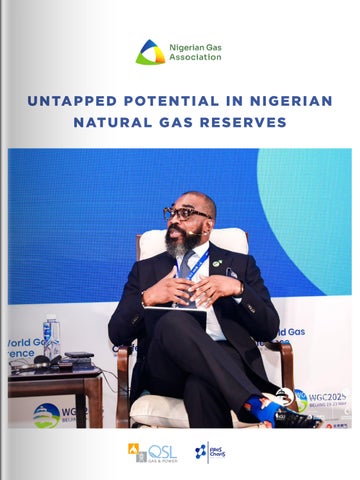
UNTAPPED POTENTIAL IN NIGERIAN NATURAL GAS RESERVES

NIGERIAN GAS SPOTLIGHT

There is hugely untapped potential in Nigerian natural gas reserves.

Focused on transforming into a gaspowered economy by 2030, Nigeria’s path to energy security and economic development hinges on leveraging these abundant resources

Nigeria’s gas industry is at a pivotal moment. With over 200 trillion cubic feet of proven reserves, the opportunity is significant – spanning domestic power generation, industrialisation, and export markets. The key constraint is no longer resource availability, but execution. Infrastructure gaps – particularly in pipelines, processing, and distribution – continue to limit supply

and market access. In addition, pricing misalignments and limited access to long-term financing have slowed investment.

Encouragingly, progress is being made; policy focus has strengthened and investment momentum is improving.

However, closing the gap between potential and

actual utilisation will require sustained execution, stronger commercial frameworks, and a more consistent investment-friendly environment.

Over the next decade, gas will play a central role in Africa’s energy mix – as a transition fuel, industrial feedstock, and driver of economic resilience.

Across the continent, new supply hubs will emerge,

particularly in East and Southern Africa, supported by growing regional integration.

In Nigeria, there is expected to be increased domestic utilisation underpinned by the power sector, expansion of liquefied natural gas (LNG) capacity, and stronger participation of Indigenous companies across the value chain.

Nigerian Gas Association INTERVIEW

Akachukwu Nwokedi, President of the Nigerian Gas Association, outlines how gas has been successfully repositioned at the centre of Nigeria’s energy and economic agenda. As General Counsel and Secretary of Nigeria LNG and Regional Coordinator for Africa at the International Gas Union, Nwokedi also discusses advancing collaboration across the continent

Africa Outlook (AO): Firstly, can you introduce us to the Nigerian Gas Association with an overview of your mission, vision, and members?

Akachukwu Nwokedi, President (AN): The Nigerian Gas Association (NGA) is the apex, non-partisan umbrella body representing stakeholders across Nigeria’s entire gas value chain.

Established in 1999, the association serves as the collective voice of the industry, bringing together international and Indigenous operators, regulators, investors, service providers, and major gas users across

power, industrial, and commercial sectors.

Our mission is to promote the sustainable development and optimal utilisation of Nigeria’s gas resources through policy advocacy, investment facilitation, capacity building, and the promotion of global best practices.

Our vision, simply put, is to position gas as the backbone of Nigeria’s economic transformation and a key enabler of Africa’s energy future.

What distinguishes the NGA is the breadth and diversity of its membership, which enables us to provide a unifying platform for collaboration, innovation, and industry-wide alignment.

AO: Nigeria has declared a ‘Decade of Gas’ – how is this translating into real opportunities?

AN: The ‘Decade of Gas’ has successfully repositioned gas at the centre of Nigeria’s energy and economic agenda.

We are now seeing tangible progress, including expansion of pipeline infrastructure, increased domestic utilisation, and stronger alignment across policy institutions.

There is also growing momentum in gas-to-power, gas-based industries, and autogas development, which is creating new opportunities across transportation, manufacturing, and small-scale enterprises.

However, the real test lies in translating policy into bankable projects. This requires clarity on pricing, credible risk allocation frameworks, and regulatory consistency that supports long-term investment decisions.

AO: How does the NGA promote and protect the interests of the Nigerian gas industry?

AN: The NGA serves as a bridge between government, industry, and investors. We actively engage in policy advocacy to ensure regulatory frameworks are transparent, stable, and investment-friendly.

We also provide a neutral platform for stakeholder engagement, helping to address industry challenges such as pricing, infrastructure constraints, and regulatory alignment.

In addition, we drive capacity development, knowledge sharing, and the adoption of global best practices.

Ultimately, our role is to create an enabling environment where the gas industry can thrive – delivering value to investors whilst supporting national development and energy security.

AO: As Regional Coordinator for Africa at the International Gas Union, how can African countries collaborate more effectively on gas infrastructure and policy?

AN: Advancing collaboration across the continent hinges on three priorities: alignment, integration, and shared execution.

First, African countries must strengthen policy and regulatory alignment. Harmonising frameworks –particularly around tariffs, fiscal terms, and gas utilisation – will reduce uncertainty and support cross-border investment.

Second, regional infrastructure integration is essential. Given the uneven distribution of gas resources, collaboration on cross-border pipelines, LNG hubs, and shared processing facilities will unlock economies of scale and improve energy access.

Third, collaboration must be institutionalised through structured partnerships involving governments, multilateral, international, and regional bodies, and the private sector. This includes joint project development, coordinated financing, and risk-sharing mechanisms. Knowledge sharing and capacity building are equally important, with more mature markets supporting emerging ones.

“ULTIMATELY, A COORDINATED REGIONAL APPROACH WILL DE-RISK PROJECTS, ATTRACT INVESTMENT, AND UNLOCK AFRICA’S FULL GAS POTENTIAL”
– AKACHUKWU NWOKEDI, PRESIDENT, NIGERIAN GAS ASSOCIATION

Ultimately, a coordinated regional approach will de-risk projects, attract investment, and unlock Africa’s full gas potential.

AO: What risks does Africa face if it fails to coordinate its energy strategy?

AN: Failure to coordinate energy strategies presents significant risks. For example, there is the risk of fragmented and inefficient investments. Without alignment, countries may duplicate infrastructure or pursue isolated projects that are not commercially viable, leading to stranded assets and wasted capital.

Powering Industries. Fueling Growth. Driving the Future.

In today’s fast-evolving economy, access to reliable and efficient energy is not just an advantage but a necessity. At QSL Gas and Power, we are committed to delivering sustainable, affordable, and reliable gas and power solutions that empower industries, communities and power-generating businesses to thrive.

We are an indigenous Gas and Power company with a fresh and innovative approach to providing gas and power solutions. We specialise in the development, distribution, and optimisation of natural gas infrastructure, and our goal is to bridge the energy gap and unlock productivity for our clients through innovative and dependable solutions.

Why QSL Gas and Power?

We combine technical expertise, industry experience, and strategic partnerships to deliver value-driven solutions. Our projects are executed with a strong emphasis on safety, quality, and sustainability, ensuring long-term benefits for our clients and the environment.

With a growing footprint across key regions in Nigeria, QSL Gas and Power continues to support industrial clusters, manufacturing hubs, and commercial enterprises with energy solutions that are both scalable and future-ready.

Our Commitment

We are driven by a vision to become the foremost Gas marketing, distribution and Power company in Nigeria and Africa at large, providing gas and power solutions through exceptional service delivery to its customers.

Our Core Services

• Natural Gas Distribution: Reliable supply of gas via pipeline networks tailored to industrial and commercial needs at competitive prices

• Compressed Natural Gas (CNG) Solutions: Flexible and mobile gas solutions for areas with limited pipeline access, and Natural gas for Vehicles.

• Gas Infrastructure Development: End-to-end design, construction, and operation of gas systems, including PRMS and distribution networks.

• Embedded Power Solutions: Reliable on-site power generation systems that ensure uninterrupted operations.

• Gas Equipment procurement: We collaborate with our partners to help companies secure gas-fired boilers, heaters, etc. for business operations.

Our Mission

To establish a world-class gas marketing, distribution and power company that consistently renders exemplary services to its customers, through our commitment to quality, best practices and the highest standards.

Our team of professionals works closely with clients to understand their unique needs and deliver solutions that align with their goals.

Let’s Power Your Vision

Whether you are developing a manufacturing facility, a power-generating plant, an industrial park, or seeking a more efficient energy source, QSL Gas and Power is your trusted partner.

In addition, limited access to finance becomes a major challenge. Investors are far more attracted to large, integrated markets with clear and consistent policies. A lack of coordination increases perceived risk, raises the cost of capital, and slows down project development.

Furthermore, Africa could face persistent energy poverty. Disconnected national strategies make it harder to optimise resource distribution, meaning gas-rich assets remain underutilised whilst energy-deficient regions continue to struggle with access.

Finally, Africa could miss a critical window to monetise its gas resources within the global energy transition.

In summary, fragmented markets deter investment, increase project costs, and limit economies of scale.

More importantly, they risk prolonging energy poverty and slowing industrialisation across the continent. A coordinated approach, by contrast, enables scale, efficiency, and shared prosperity.

AO: What needs to change to attract more global investment into Africa’s gas sector?

AN: Investors are fundamentally seeking clarity, consistency, and commercial viability. Attracting global investment into Africa’s gas sector requires a strong

“THE ‘DECADE OF GAS’ HAS SUCCESSFULLY REPOSITIONED GAS AT THE CENTRE OF NIGERIA’S ENERGY AND ECONOMIC AGENDA”
– AKACHUKWU NWOKEDI, PRESIDENT, NIGERIAN GAS ASSOCIATION

foundation built on confidence, competitiveness, and clarity.

Central to this is policy stability and regulatory consistency. Investors need predictable fiscal regimes, transparent licensing processes, and assurance that contracts will be honoured over time. Uncertainty in these areas increases risk and discourages long-term capital.

Equally important is ensuring the commercial viability of projects. This involves adopting market-reflective pricing, especially as markets mature, strengthening payment security mechanisms, and establishing credible offtake arrangements, particularly in domestic gas-to-power markets where payment risks have historically been a concern.

Alles Charis Gas Limited: Building Nigeria’s Energy Future. 30,000+ MT of Proof.

Alles Charis Gas Limited opened its first seven retail stations in 2022, with a quiet but deliberate declaration: that downstream LPG in Nigeria could be done with discipline, scale, and a long view. Four years later, the numbers tell the story.

• 2022: Launched with 7 retail stations, delivering 606 MT in our first year of operations

• 2023: Expanded to 10 stations, growing volume to 2,701 MT

• 2024: Scaled to 11 stations, delivering 10,000 MT, a fivefold increase in a single year

• 2025: Commissioned our 500MT inland storage depot, delivering 14,000 MT

• Q1 2026: Already at 7,000 MT, on track for our strongest year yet

Across our growing network of retail gas stations, bridger and bobtail logistics fleet, 500MT inland depot, and bulk supply operations, we have constructed an integrated downstream infrastructure designed for the demands of a growing nation.

Behind every kilogram delivered is a home with clean cooking fuel, a business keeping its lights on, a community touched by our CSR programmes.

Nigeria is a gas nation and ACGL is building the infrastructure to prove it.

Accelerating infrastructure development is also critical as many gas resources remain stranded due to inadequate pipelines, processing facilities, and distribution networks. Bankable, integrated infrastructure projects – often delivered through public-private partnerships – can unlock supply and demand at scale.

Regional market integration further enhances investment appeal by creating larger, interconnected markets with improved economies of scale. In addition, access to financing and effective risk mitigation tools, supported by development finance institutions, will help mobilise private capital.

Finally, strong governance, transparency, and a clear energy transition narrative – positioning gas as a practical transition fuel – are essential to building investor confidence and aligning with global sustainability expectations.

Africa must provide stable and transparent regulatory regimes, bankable fiscal terms, and credible project pipelines. Addressing above-ground risks – such as security, contract sanctity, and ease of doing business – is equally critical.

In addition, partnerships with development finance institutions can play a catalytic role in mobilising private capital through risk mitigation and blended financing structures.

AO: How can regulatory frameworks across African countries be improved or harmonised?

AN: Regulatory harmonisation across Africa should centre on aligning core principles – streamlining licensing processes, fiscal regimes, environmental standards, and cross-border gas trade protocols –to create a more predictable and investor-friendly operating environment.

Achieving this requires deliberate coordination, stronger institutions, and a shared vision for market integration. Greater alignment of policies and legal frameworks – particularly around transparent licensing, standardised fiscal terms, and clear third-party access rules – will reduce uncertainty and support cross-border project development.

Regional bodies such as the Economic Community of West African States (ECOWAS) and the African Union have a critical role in advancing this agenda through model regulations, common codes, and dispute resolution mechanisms that countries can adopt flexibly. Equally important is the harmonisation of technical, safety, and environmental standards to streamline operations across jurisdictions, alongside strengthening regulatory institutions through capacity building, digitalisation, and knowledge sharing.

Having the right partner means you can plan, invest, and grow with confidence. Shell Nigeria Gas delivers reliable natural gas solutions that help manufacturers reduce fuel costs and operate with confidence every day. By replacing diesel with pipeline natural gas and integrated gas to power solutions, we provide predictable pricing, stable supply, and uninterrupted operations. Backed by decades of Shell expertise and a growing gas network across Nigeria, we are your energy partners, helping you deliver the best products to your customers.

Shell Nigeria Gas Limited, 21, Lugard Avenue, Ikoyi Lagos. T: +234 (0) 8070325986 | SNG-Request@shell.com | www.shellnigeria.com

Improved transparency, standardised cross-border agreements, and sustained stakeholder engagement will further enhance investor confidence.

Ultimately, harmonisation is about coherence – not necessarily uniformity – creating a stable and efficient framework that supports large-scale gas development and investment across the continent.

AO: What are the NGA’s key priorities to continue promoting and protecting the interests of the gas industry in Nigeria?

AN: Our priorities remain clear:

• Deepening policy advocacy to ensure full and effective implementation of the png Industry Act.

• Promoting investments across the gas value chain, particularly in midstream infrastructure.

• Strengthening industry standards and operational excellence.

• Supporting capacity development and local content growth.

• Enhancing regional collaboration to position Africa competitively in global gas markets.

AO: Finally, what message would you give to investors, policymakers, and young professionals?

AN: To investors: Africa’s gas story is compelling, and the fundamentals are strong. The opportunity is significant for those willing to take a long-term view.

To policymakers: consistency and execution will determine success. The policies are largely in place – what is needed now is disciplined implementation.

To young professionals: the gas sector offers immense opportunities to shape the future of energy in Africa. This is a defining moment, and your skills, innovation, and leadership will be critical.

Tel: +234 8023398312 imfo@nigeriangasassociation.org.ng nigeriangasassociation.org.ng

Shell Nigeria Gas Limited
Shell Nigeria Gas Limited - YOUR EVERYDAY ENERGY PARTNER

Tel: +234 8023398312

imfo@nigeriangasassociation.org.ng nigeriangasassociation.org.ng

Turn static files into dynamic content formats.

Create a flipbook