POWER TO T H E PU B L I C
POWER TO T H E PU B L I C
With electricity being the lifeblood of modern society, Nebraska Public Power District plays a critical role in ensuring it’s available at the flip of a switch for Nebraskans. Tom Kent, CEO, tells us more about the company’s proud history of public power Writer: Ed Budds | Project Manager: Molly Foss 2 | Sustainability Outlook Issue 3
NEBRASKA PUBLIC POWER DISTRICT NORTH AMERICA
I
t is a time of monumental change in the utilities industry. Distributors must embrace innovation and move swiftly to find new and improved ways to deliver affordable, reliable, sustainable, and resilient electricity to customers, as well as products and services to help improve their quality of life. As such, demand for energy is currently at its highest in the US since World War II. As new requirements emerge in areas such as value-added agriculture, sustainable aviation fuel, biofuels, clean fuels, and data centers – as well
as countless others – energy remains a key part of economic growth, with electricity the primary resource feeding that growth across the nation. The same is true in Nebraska, a state heavily reliant on agriculture, which has witnessed growth in areas such as biofuels and value-added agriculture, while data centers are also becoming a major part of its story. For Nebraska Public Power District (NPPD), this current era represents the state’s highest demand for power since the 1970s. “We represent the foundation
of economic growth in Nebraska and have an important role to play, ensuring we provide affordable, reliable electricity that can continue to spur economic growth and bring good jobs in for our state,” introduces Tom Kent, CEO. “Whether the opportunity involves data centers or other businesses, the goal is to attract the right companies; those that grow the local economy, expand the tax base, and create jobs – increasingly, electricity sits at the center of that opportunity,” he explains. Sustainability Outlook Issue 3 | 3
NEBRASKA PUBLIC POWER DISTRICT NORTH AMERICA
ORIGINS OF PUBLIC POWER The concept of public power and why and how it was created date back to the 1920s and 1930s. At the time, electricity was being recognised as a major force for growth – it could improve business efficiency, support the transmission of energy, modernize homes, make daily tasks easier, and improve people’s quality of life. In the 1930s, that transformation was taking place largely in urbanised parts of the country, and investorowned utilities were leading the charge. “If you look at the nation as a whole today, investor-owned utilities still serve the largest share of the population. However, the largest land area of the country is served by public power, whether through public power districts, municipalities, or cooperatives,” Kent pinpoints. What was not happening in the 1930s was the electrification of rural areas. Those utilities were not especially interested in serving communities in the countryside, so there was a grassroots effort, alongside leadership from key figures in government, to put the right structures in place for rural electrification. That was the birth of public power. “Public power was founded on a few central questions – how do we serve the community, provide affordable and reliable electricity, and help improve the quality of life for the people we serve in rural areas.” Some of the key leaders in that effort were Nebraskans. Senator George Norris, who served in Congress and the Senate for many years, played an important role at the national level. “That proud history – of being founded to be owned by the customers to provide service and improve quality of life – remains the same foundation we stand on today. 4 | Sustainability Outlook Issue 3
“We keep our focus on how we best serve the people who own us, while ensuring affordability and reliability every day – that remains our key underlying drive,” Kent prides. Indeed, utilities in Nebraska continue to deliver some of the highest reliability in the nation and some of the lowest electricity costs – a quality Kent believes is rooted in
HOW IMPORTANT IS IT TO REMAIN AGILE WHEN RESPONDING TO NEW TRENDS AND EMBRACING THE ONGOING INDUSTRY TRANSFORMATION? Tom Kent, CEO: “I would say it is absolutely essential. That has probably been one of the biggest areas of focus for us as an entity and business.
the core purpose of public power dating back to the founders of NPPD a century ago.
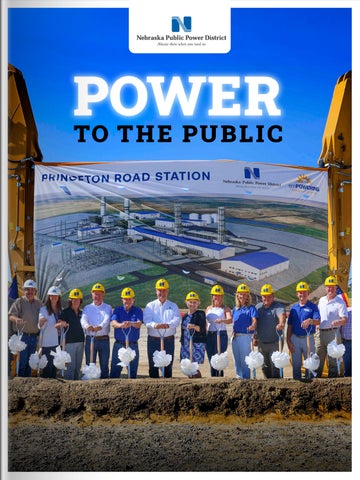
BOOSTING CAPACITY NPPD is currently embarking on a major new project – Princeton Road Station (PRS), a large generating facility in Southeast Nebraska with a 700-megawatt (MW) capacity.
“The idea of ‘speed to power’ has become a key mantra, not just for us, but for the utilities industry as a whole. It is about helping these projects move forward and supporting economic growth. The question is, how do we get that done faster? “We have become much more innovative in the way we work with potential large customers, including the implementation of a new load process that helps both us and our wholesale customers understand what businesses are committed to coming to Nebraska, as well as developing a large load rate that aims to mitigate against the potential for cost shifts to existing customers and stranded assets should a large load leave. “We’re always trying to ‘solve the puzzle’, as I like to say, of how to provide the new generation, transmission, infrastructure, and interconnection infrastructure needed to serve new and expanding businesses at a pace that also meets their goals. “Over the past three years, to the credit of the team at NPPD and the wider industry, we have really stepped up. We have looked outward, benchmarked against others, and worked to understand how we can be more agile and flexible. “The goal is to address these issues in a way that creates wins for our current and future customers, while also growing NPPD as a business.”
Sheldon
North Platte hydrostation
The first phase of construction at PRS includes installing two internal combustion turbines (CTs) with a capacity of 478 MW and 12 reciprocating internal combustion engines with a capacity of 216 MW, which are scheduled to come online in 2029. In addition, NPPD will also install three more CTs at this site that will provide an additional 717 MW and are scheduled to be online in 2032. Once completed, PRS will generate over 1,400 MW, along with an expansion of the output of the Cooper Nuclear Station (CNS), which will increase the company’s generating capacity by about 50 percent over the
PRS groundbreaking
next six years. NPPD is pursuing a 20-year license extension for CNS and conducting a study for an extended power uprate, which would ultimately provide an additional 100 MW. “We are undertaking a capital expansion plan of a scope and scale that we have not pursued as an organization since the 1970s, which represents a very significant undertaking,” highlights Kent. This project will place NPPD in a strong position to serve the growing load of its existing customers while also supporting new businesses coming into the state and providing substantial value to Nebraska in terms
of jobs and economic expansion. “At the same time, we are making sure that we never lose sight of the most important metrics for our customers – the reliability and affordability of the electricity we provide.” Alongside these generation projects, the company is expanding its transmission system. Already by far the largest transmission owner and operator in Nebraska, together these new initiatives form a capital plan of more than $5 billion over the next six years. In addition, over the past two years, NPPD has put new wholesale power contracts in place with its customers. Sustainability Outlook Issue 3 | 5
A Q&A with Forbes Bros. Building Utility Infrastructure Across North America
TRANSMISSION
DISTRIBUTION
Briefly introduce me to Forbes Bros. Group of Companies, e.g., a brief overview of your main products and services, family origins, locations, client base, number of employees, etc. Forbes Bros. Group of Companies (Forbes Bros.) is a family-owned utility construction contractor established in 1977 by brothers Mark, Earl, and Rob Forbes. Since then, the company has grown into a major North American contractor with approximately 1,200 employees and operations throughout the US. This growth has been supported by strategic acquisitions, including FB Timberline in South Dakota and FB Titan in Wyoming, which strengthened the company’s regional expertise, workforce, and operational capabilities. Forbes Bros. provides transmission, distribution, substation, underground, and telecommunications services. We support utilities and other public- and privatesector clients with projects ranging from ongoing maintenance and emergency response to large, complex infrastructure programs. What, for you, differentiates Forbes Bros. from the competition? What distinguishes Forbes Bros. is our
SUBSTATION
combination of nearly 50 years of utility construction experience, family ownership, and a service offering dedicated exclusively to the utility industry. Our broad range of capabilities enables us to support clients across multiple disciplines while providing a consistent approach to safety, quality, and project execution. With operations across Canada and the US, we have the geographic reach to deliver projects throughout North America while maintaining the flexibility to meet regional and client-specific requirements. Our long-standing relationships with utility owners are built on reliability, collaboration, and a commitment to delivering projects safely and efficiently. How does the company achieve its purpose of working together to build things that matter?
EV INFRASTRUCTURE
relationships based on trust, reliability, and shared success. This approach has helped establish Forbes Bros. as a contractor of choice for many of our longterm utility clients. Could you elaborate on your partnership with Nebraska Public Power District? How do the two organizations mutually benefit each other, and what complementary strengths do you bring? Forbes Bros. has partnered with Nebraska Public Power District (NPPD) on the R-Project for approximately eight years. Throughout the project, both organizations have remained committed to working collaboratively to address challenges and deliver successful outcomes.
Strong executive alignment and open communication have enabled us to Forbes Bros. achieves its purpose by navigate project approvals and develop focusing on collaboration, long-term a commercial model that supports the relationships, and community investment. objectives of both organizations. NPPD We take a community-first approach to our brings in-depth knowledge of its system work, recognizing that the infrastructure and stakeholders, while Forbes Bros. we build has a lasting impact on the contributes specialized transmission people and regions we serve. construction expertise and proven project execution capabilities. We prioritize strong partnerships with our clients, employees, subcontractors, and suppliers, working to build lasting
Are there any recent projects or investments you would like to highlight? One of the most significant investments Forbes Bros. has made was our strategic entry into the U.S. utility construction market through the acquisitions of FB Titan and FB Timberline. Rather than building a US presence from the ground up, these acquisitions provided an established platform with experienced leadership, skilled employees, customer relationships, and a strong operational footprint. They enabled Forbes Bros. to accelerate our expansion into the US and demonstrate a long-term commitment to serving utility customers across the country. Since then, we’ve successfully integrated and grown those businesses, establishing permanent operating locations throughout the US and creating a dedicated headquarters to support our expanding operations. Today, our US business represents approximately 50 percent of Forbes Bros.’ overall revenue and employee headcount, highlighting the significance of that initial investment and the growth it has enabled.
Construction of 121 miles of 230 kV transmission line in Wyoming
Over this period, we’ve successfully delivered several major transmission line projects that have strengthened our reputation as a trusted contractor in the US market. We’re particularly excited to have been selected by NPPD to deliver the R-Project, a critical transmission infrastructure initiative that will help improve reliability and support future energy demand. The success of this investment has positioned Forbes Bros. as a leading North American utility infrastructure contractor and allows us to continue playing an important role in delivering the energy infrastructure that powers communities and economies across the US. Looking ahead, what are Forbes Bros.’ key priorities? Looking ahead, Forbes Bros. is focused on strengthening the people, systems and operational capabilities that support consistent project execution and delivery across our business. We are continuing to invest in the development and training of our people, strengthening our approach to safety and operational excellence, and creating opportunities for the next generation of leaders within our organization. Ultimately, our goal is to build on the success we’ve achieved by continuing to improve how we execute, building trust and long-term relationships with our clients, and creating a strong, sustainable organization for the future.
forbesbrosgroup.com
NEBRASKA PUBLIC POWER DISTRICT NORTH AMERICA
CNS
“We recently completed a strong, principle-based negotiation process to extend and improve those contracts, which are our primary source of revenue for funding this expansion. “Ultimately, that revenue is tied to the customers who use the electricity we generate. It was a very positive process, with strong receptivity, and the vast majority of our customers signed on which really sets the stage for us to do the things we need to do to serve their growing load,” details Kent.
EXPLORING NUCLEAR SOLUTIONS There are currently 21 nuclear operating utilities in the US that are licensed by the US 8 | Sustainability Outlook Issue 3
“ W E R E P R E S E N T T H E F O U N D AT I O N O F ECONOMIC GROWTH IN NEBRASKA AND H AV E A N I M P O R TA N T R O L E T O P L AY, E N S U R I N G W E P R OV I D E A F FO R DA B L E , R E L I A B L E E L E C T R I C I T Y T H AT C A N C O N T I N U E TO S P U R E CO N O M I C G R OW T H A N D B R I N G G O O D J O B S I N F O R O U R S TAT E ” – T O M K E N T, C E O , N E B R A S K A P U B L I C P O W E R D I S T R I C T
government’s Nuclear Regulatory Commission to operate nuclear power plants. NPPD is one of those utilities and has been in the nuclear operating business for more than 50 years. “As we look to the future and think about how we can continue to reduce our carbon footprint while ensuring affordable and reliable electricity,
nuclear needs to be part of the answer,” Kent reasons. NPPD has recently helped form a consortium of large public power utilities to investigate and develop new nuclear systems and improve affordability and reliability while managing collective carbon footprint.
WATTS ELECTRIC IS
Building for
the Future
From the ground to the grid, Watts Electric delivers. For more than 45 years, Watts Electric has specialized in the full spectrum of power delivery for clients throughout the Midwest. From municipalities to large power providers, we work with owners of all types and sizes, bringing the same commitment and focus to every project.
Facing complex challenges head-on has shaped who we are today—a diverse team of power professionals bringing broad, crossdisciplinary expertise to every project.
With every specialty under one roof, our customers get a single, accountable partner— not a patchwork of subcontractors. That means consistent safety standards, quality installation, tighter schedules and a team that understands how every piece of the system connects.
Toni Watts-McDonald – Owner
SERVICES 🟥🟥
🟥🟥 🟥🟥
Transmission and Distribution Construction Duct Bank Construction Transmission & Distribution Maintenance, Upgrades & Reconductoring
WE ARE PERFORMANCE DRIVEN
🟥🟥
🟥🟥 🟥🟥
🟥🟥
Emergency Storm Restoration Substation Construction Renewable Energy Construction
🟥🟥 🟥🟥
🟥🟥
Trenchless Construction Battery Storage Construction Utility Construction & Fiber Optics
Drilled Pier Foundations
13351 Dovers Street, Waverly, NE, 68462, U.S.
(402) 786-2270 www.gowatts.com
“ T H AT P R O U D H I S T O R Y – O F B E I N G F O U N D E D TO B E OW N E D BY T H E C U STO M E R S TO P R OV I D E S E RV I C E A N D I M P R OV E Q UA L I T Y O F L I F E – R E M A I N S T H E S A M E F O U N D AT I O N W E S TA N D O N T O D AY ” – T O M K E N T, C E O , N E B R A S K A P U B L I C P O W E R D I S T R I C T
These organisations are similar in size and structure, although they are not all based in Nebraska. Grand River Dam Authority and Lincoln Electric System are both involved, along with Omaha Public Power District. The consortium is focused 10 | Sustainability Outlook Issue 3
on working together to create the right partnerships, de-risk nuclear development, and position members effectively. “We want to be part of the next wave of nuclear development, so that when pilot plants are successful, and when we better understand the risks
NEBRASKA PUBLIC POWER DISTRICT NORTH AMERICA
and what construction looks like, we can move quickly,” Kent tells us.
GROWTH FOR ALL As the company moves through the next 18 months, opportunities abound for continued growth. Many different organisations are interested in entering Nebraska, and energy, electricity, and power supply are a big part of those discussions. NPPD possesses a very active economic development team, and endeavors to continue moving forward and landing new projects. As more of those projects come in, they will drive decisions around further expansion.
Meanwhile, another key focus is on delivering the commitments made for the new generating facilities and transmission lines that NPPD is building, while continuing to support local communities and helping to grow the state’s economy. Undoubtedly, a personal connection to Nebraska having spent so much of his career working in the state has helped Kent sustain an undeniable enthusiasm and drive for his work at NPPD. “I grew up in a small town where my parents owned a small business, so I understand the importance of the agricultural economy and the
relationship with public power,” he passions. “Nebraska is a 100 percent public power state, where all electricity is provided to customers by a publiclyowned entity such as a public power district like NPPD, a municipality, or a cooperative. That foundation of being guided by a publicly elected board, and making sure essential critical infrastructure is delivered in a reliable and affordable way, is what connects us to the customers we serve. “To me, that is the special ingredient that makes this business model work so well,” Kent concludes with a smile.
Tel: 1-877-ASK-NPPD customerservice@nppd.com
www.nppd.com Sustainability Outlook Issue 3 | 11
Tel: 1-877-ASK-NPPD customerservice@nppd.com www.nppd.com