
MOTRACO

Page 1


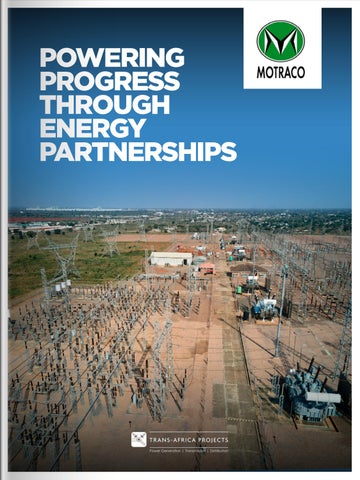
POWERING PROGRESS THROUGH ENERGY PARTNERSHIPS

As a pioneering force in Mozambique’s energy landscape, MOTRACO exemplifies how to harness the nation’s substantial power generation capabilities, positioning it as a leader in electricity transmission and promoting regional integration. General Manager, Adérito Sousa, highlights the organisation’s journey and collaborative efforts

Writer: Rachel Carr | Project Manager: Joshua Mann

POWERING PROGRESS ENERGY PARTNERSHIPS

PROGRESS THROUGH PARTNERSHIPS

Mozambique has significant power generation potential with a diverse range of sources at its disposal, including hydroelectricity, natural gas, solar, and wind.

This repertoire elevates the country to a significant and influential role in Southern Africa’s energy sector, highlighting its strategic importance and capacity to shape the region’s energy supply.

Mozambique ranks first in the Southern African Power Pool (SAPP), boasting an estimated capacity of approximately 20,000 megawatts. The government, meanwhile, has a plan to achieve universal electrification by 2030.

Notably, MOTRACO stands out in this sector. Established in 1998, the organisation operates as a joint venture (JV), equally owned by Electricidade de Moçambique (EDM), Eskom Holdings SOC Ltd (Eskom) from South Africa, and Eswatini Electricity Company (EEC).

The JV was motivated by the need to improve the region’s electricity transmission infrastructure and strengthen energy integration amongst the countries involved.

Remarkably, the first of its kind in Southern Africa, MOTRACO is also a public-private partnership (PPP) that brings together government and private-sector resources to drive regional development.

“Over the past 25 years, we have been recognised as a success story in the energy sector,” proudly introduces Adérito Sousa, General Manager.

MOTRACO has managed to supply large quantities of electricity from Eskom to the Mozal aluminium smelter in Maputo continuously for 25 years, whilst also transporting it to EDM and EEC.

Furthermore, the organisation is tasked with managing and ensuring the ongoing operation of high-speed digital telecommunications (telecoms) infrastructure across borders.

WHAT SPECIFIC MEASURES ARE BEING TAKEN TO ADDRESS THE VULNERABILITIES IN MOTRACO’S CONTROL SYSTEMS AND INFRASTRUCTURE AND ENSURE THEIR RELIABILITY?

Adérito Sousa, Managing Director: “We have been addressing various issues with our equipment. For example, some high-voltage towers in the vicinity are vulnerable to erosion and other stresses due to nearby development and natural causes.

“This has raised safety concerns regarding our equipment. As such, we are currently engaged in major projects to replace certain technical components.

“Additionally, whilst some of our transformers aren’t necessarily old, they require repairs and improvements. Our ongoing projects focus on ensuring our infrastructure remains operational for many years to come whilst maintaining high-quality standards.”

“Since operations began, we have achieved our objectives – providing high-quality power and playing a strategic role in the region’s electricity transmission,” he continues.

EMPOWERING CONNECTIONS

Beyond its primary role of transporting and supplying electricity, MOTRACO has installed fibre-optic substation infrastructure alongside its power lines to bolster its activity.

The two strategically located substations, each operating at 400 kilovolts (kV), are connected by a network of 132 kV and 400 kV transmission lines, ensuring efficient energy transfer across the region.

The operation and maintenance of this network is overseen by MOTRACO, therefore guaranteeing dependable performance.

“With reliability at the forefront,

our role is essentially to ensuring our three customers receive the highest quality service from us and our lines are always available, well-maintained, and fully functional.

“This integration allows us to serve some telecoms customers, thus extending our business scope beyond electricity supply,” Sousa emphasises.

Moreover, MOTRACO recently reached a significant milestone last year – its 25th anniversary.

“Continuous operation and success over the years stand as testament to the vision that originally brought the organisation to life, involving collaboration between countries, governments, and national utilities,” he prides.

Despite doubts about their capability to collaborate, each party ultimately succeeded in achieving their goals.

“CONTINUOUS OPERATION AND SUCCESS OVER THE YEARS STAND AS TESTAMENT TO THE VISION THAT ORIGINALLY BROUGHT THE ORGANISATION TO LIFE, INVOLVING COLLABORATION BETWEEN COUNTRIES, GOVERNMENTS, AND NATIONAL UTILITIES”
– ADÉRITO SOUSA, GENERAL MANAGER,

MOTRACO

“The support from international banks and financiers has been instrumental, as evidenced by the reliability of key clients like Mozal, EDM, and EEC, who have honoured their commitments to us.”

This mutual trust has allowed MOTRACO to fulfil its obligations to its own financiers and investors, demonstrating that the initial vision and objectives have been successfully met.

“Each of our three partners holds an equal share, which ensures a good balance of power and consensus,” Sousa explains.

“Despite being neighbours from different countries, facing different challenges with varying levels of development – like South Africa’s Eskom and the smaller utilities of EDM and EEC – the companies manage to collaborate effectively.”

Driving Industrial Growth in Southern Africa

Large-scale energy infrastructure is a critical driver of economic growth, industrial development, and regional integration across Southern Africa. One of the most notable examples of such infrastructure collaboration is the partnership between Trans-Africa Projects (TAP) and Mozambique Transmission Company (Motraco). This relationship emerged during the implementation of a major high-voltage transmission project designed to deliver reliable electricity to the Mozal aluminium smelter Project in Mozambique whilst strengthening the regional power network connecting South Africa, Mozambique, and Eswatini.

Strategic partnership

The strategic collaboration began when MOTRACO required a capable engineering partner to design and implement a high-voltage transmission network supplying electricity to the Mozal aluminium smelter near Maputo. At the time of its development, the Mozal aluminium smelter represented one of the largest industrial investments in Mozambique.

The success of the smelter project was therefore of national economic importance and attracted significant international attention. Importantly, the commissioning of the smelter depended entirely

on the availability of reliable electricity supply through the transmission infrastructure being constructed under the MOTRACO project.

Overall, the partnership completed major transmission line sections with a total length of approximately 600 kilometres. These included the 400kV transmission line from Arnot to Maputo, the 400kV line from Camden to Edwaleni, the 275kV line from Maputo to Infuleni, and three 132kV lines connecting Maputo to the smelter. Together, these lines formed a critical electricity corridor linking power generation facilities in South Africa with industrial demand centres in Mozambique while simultaneously reinforcing regional grid stability.

In addition to the transmission lines, substations were constructed or expanded as part of the project. These included the Arnot 400kV extension to Maputo, the Camden 400kV extension to Edwaleni II, the Maputo 400/275/132kV substation, the Infuleni 275kV extension to Maputo, and the Edwaleni II substation. These installations ensured the safe transmission, voltage transformation, and distribution of electricity across the interconnected regional network.

Environmental Sensitivities in Complex Terrain

The successful execution of this project required sophisticated project management and coordination. TAP managed transmission line construction contractors and transmission substation contractors operating across multiple countries.

This coordination ensured that the project progressed efficiently while maintaining strict compliance with technical specifications, safety standards, and construction schedules. During construction, the project faced substantial environmental and logistical challenges. Tropical cyclones and severe flooding affected large portions of the transmission corridor, significantly complicating transportation, site access, and construction activities. In response, TAP implemented innovative engineering solutions to maintain progress despite these conditions.

Construction contractors experienced in helicopter-assisted tower erection were brought in to support the installation of transmission structures in complex terrain.

The future and beyond

Trans-Africa Projects (TAP), established 30 years ago through a partnership between Fluor Corporation and Eskom, has developed into a reputable engineering consultancy specialising in transmission line and substation infrastructure. Over the course of its engineering journey, TAP has cultivated critical competencies in client engagement, engineering design, and project execution. These capabilities, combined with an unwavering commitment to achieving client objectives, represent the defining characteristics of leading engineering consultancies.

TAP’s reputation remains a foundational pillar, built upon consistently demonstrated capability, reliability, dependability, and trustworthiness, supported by a solutionsorientated approach that maintains the end client and project objectives at its core.

TAP proudly celebrates MOTRACO’s Silver Jubilee. The successes achieved by TAP over the years have enabled mutually beneficial project collaborations between the two organisations. Throughout these engagements, MOTRACO has continually challenged and strengthened TAP, whether through rigorous design review or a focus on constructability, thereby enhancing TAP’s ability to deliver on end-client expectations.

an and joint venture company

MOTRACO’s leadership within the energy sector remains exemplary as TAP looks forward to continuing this partnership. Both organisations work collaboratively to unlock further potential and realise shared opportunities in the evolving energy landscape. info@taprojects.co.za

NAVIGATING COMPLEXITIES

Currently, MOTRACO faces various operational challenges in the Southern African energy and utility sector, both specific to its regional scope and more general.

The organisation operates in three countries, requiring it to navigate three distinct legal systems and jurisdictions, which adds complexity to the technical management and maintenance of its infrastructure.

“Although there are some similarities between the nations, the regional nature of the company means that any technical issues need a coordinated approach. This ensures that the entire system functions smoothly as a single entity, rather than operating on a country-by-country basis,” Sousa details.

A BRIGHTER OUTLOOK FOR COMMUNITIES

Over the years, MOTRACO’s infrastructure in Mozambique and Eswatini has significantly improved the quality and reliability of electricity supply, thereby increasing access for both local and urban areas.

“25 years ago, the quality of power supply in Mozambique was notoriously poor, characterised by frequent outages. However, through MOTRACO’s efforts at the transmission level, it has largely eliminated these issues, resulting in a reliable and efficient power supply in the southern part of the country,” Sousa reports.

Whilst localised distribution problems still occur, they are managed by national utilities.

MOTRACO attributes this success to strict adherence to maintenance standards, careful selection of credible contractors with strong expertise, and the diligent implementation of industry protocols.

As a result, the infrastructure is well-maintained, and the service’s reliability is exceptionally high, therefore positively impacting communities.

“The infrastructure we have relied on for the past 20 to 25 years is showing signs of ageing, even though it has been well-maintained. As a result, we are currently repairing, rehabilitating, and upgrading our equipment to ensure it remains operational,” he stresses.

“Our goal is to extend the lifespan of these assets for another two decades, thereby maximising the value of our initial investments and continuing to provide essential services.”

Furthermore, MOTRACO faces added operational challenges due to varying levels of technical capability across the network, which can hinder its ability to respond effectively to major issues.

“We must create tailored systems and strategies to address resource disparities,” he urges.

In addition to these specific operational hurdles, MOTRACO faces broader challenges common across Southern Africa, most notably, vandalism.

“Situations arise where infrastructure, such as tower structures, is vandalised or stolen, compromising system performance. To combat this, we collaborate with local authorities and engage communities living near its infrastructure,” Sousa tells us.

“By establishing corporate social responsibility (CSR) programmes to uplift local economic conditions, we seek to foster better relationships and mitigate perceptions of threat.”

This approach underscores the importance of community involvement in protecting infrastructure.

ACCESS FOR ALL

There is significant room for improvement in Southern Africa’s access to electricity, particularly in Mozambique.

Currently, approximately 65 percent of the population has access to electricity, which is primarily concentrated to urban areas, whilst power supply

“SINCE OPERATIONS BEGAN, WE HAVE ACHIEVED OUR OBJECTIVES – PROVIDING HIGH-QUALITY POWER AND PLAYING A STRATEGIC ROLE IN THE REGION’S ELECTRICITY TRANSMISSION”
– ADÉRITO SOUSA, GENERAL MANAGER, MOTRACO

in the country’s rural communities remains disproportionately low.

“The Government of Mozambique has prioritised electrification as a key objective, aiming to enhance access for its citizens. To achieve this, it has been actively encouraging both public and private investors to undertake projects within the electricity sector. A variety of incentives are in place to attract such investments.

“As part of this ecosystem, there is great potential for further opportunities and the need for companies to adapt their operations and strategies to align with market demands and circumstances. Our focus remains on identifying and capitalising on these opportunities for growth and development in the energy sector,” Sousa concludes optimistically.

In the context of a rapidly evolving energy landscape, characterised by fluctuations in demand, regulatory changes, and the need for sustainable

practices, Sousa acknowledges that whilst challenges persist, MOTRACO remains committed to innovation and adaptability.

Through strategic initiatives and collaboration, the organisation aims to not only assist the national utilities of Mozambique and Eswatini to meet their growing electrification needs but also lead the way towards a more integrated energy future in the region.

With a strong foundation built over 25 years, MOTRACO will continue to serve its clients with the same high-quality that has defined the organisation since its inception, powering progress and fostering development for decades to come.

Tel: +258 21 313 427 info@motraco.co.mz www.motraco.co.mz

Turn static files into dynamic content formats.
Create a flipbook
MOTRACO by Outlook Publishing - Issuu