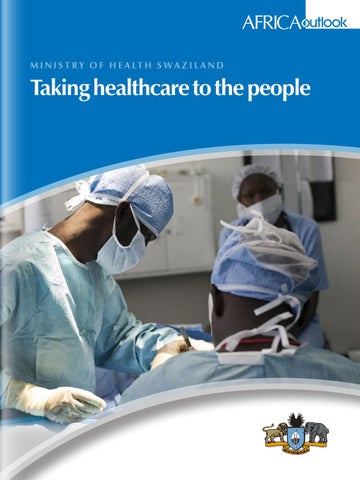
M I N I S T R Y O F H E A LT H S W A Z I L A N D
Taking healthcare to the people
ame M I N I S T R Y
2
O F
WWW.AFRICAOUTLOOKMAG.COM
H E A L T H
S W A Z I L A N D
H
E
A
L
T
H
C
A
R
E
Striving for
Universal Health Coverage
Ministry of Health Swaziland strives towards its ultimate aim via a series of investments, training and technological enhancements akin to the best in first-world healthcare provision Writer: Matthew Staff | Project Manager: Eddie Clinton or nearly 50 years, the Ministry of Health (MOH) Swaziland has been striving to improve the health status of the country’s population by providing preventative, promotive, curative, palliative and rehabilitative services for the betterment of a nation very much in societal transition. Not only introducing such services, but doing so to the highest quality, with honed relevance and as accessibly and affordably as possible has been a challenge for the Ministry, but one that has been met over the decades, and the organisation remains as committed as ever today to keep moving with the times and improving the country’s healthcare provision even further. “The aim is to provide equitable and socially acceptable health services to the highest possible standards comparable to the first world, and to have every citizen being able to access quality healthcare regardless of where one is in the country,” said Vusi Magagula, Director of Health Services back in 2016. “The core functions of the Ministry of
Working hard to meet MDGs
Health include health promotive and preventative services; curative and clinical healthcare services; medical, nursing and allied health regulation; and medical referral services.” An additional host of clinical support services are also incorporated within the areas of focus across Swaziland and comprise pharmaceutical services, medical imaging services, medical
laboratory services, rehabilitation, palliative services and nutritional services; all compounded by an ongoing dedication to investing in the very latest methodologies and technologies in order to best implement such treatment types. Advanced hospital equipment including a modernisation and expansion of its renal services, as well as the opening of a new chemotherapy unit have gone hand-in-hand with the recent renovation of the main referral hospital in the capital, Mbabane. The expansion of a new maternal wing at the latter facility is also in place as well as a rebuilding of a new outpatient department. Magagula added: “The use of evidence-based medicine to inform decision-making is being emphasised now. “We have also envisaged a PPP construction of a new referral hospital as well as completion of the Lubombo Regional referral hospital and an expansion of health centres to broaden activities provided by the facilities in the regions.”
WWW.AFRICAOUTLOOKMAG.COM
3
M I N I S T R Y
O F
H E A L T H
S W A Z I L A N D
MYLAN
M
ylan is one of the world’s leading global pharmaceutical companies. Our medicines include generic and brand name products in a variety of dosage forms, such as difficult-to-manufacture injectables, transdermal patches and HIV/AIDS antiretroviral (ARV) therapies. The Mylan has innovative research and development capabilities and is one of the world’s largest active pharmaceutical ingredient (API) manufacturers. Every one of our medications meets our one global quality standard regardless of where it is produced. At Mylan, we are committed to setting new standards in healthcare. Working together around the world to provide seven billion people access to high quality medicine, we: • Innovate to satisfy unmet needs
A host of clinical support services have been incorporated across Swaziland
4
WWW.AFRICAOUTLOOKMAG.COM
• Do what’s right, not what’s easy • Impact the future through passionate global leadership
Healthcare to the population
These most contemporary and forward-thinking of innovations in Swaziland represent a vast revolution from the state of healthcare in place prior to the Ministry’s formulation. In place since colonial times, and subsequently run at the time by colonial masters, the independence gained in 1968 - headed by a Minister and initially shared with the Portfolio of Education - laid the foundations for an official Government-run institution to flourish in the decades to follow. “Ever since, the Ministry has dealt with all issues concerned with the delivery of healthcare to the population,” Magagula explained. “The services are such that there is the public subsector, which deals largely with Government-owned and run facilities as well as sub-vented organisations. “There is also the private subsector, which is privately owned and run with
• Make reliability and service excellence a habit
The MOH aim is ultimately the attainment of universal health coverage, but our midterm goals include increasing the number of health and related services
Creating better health for a better world. That’s what inspires Mylan in our mission to provide quality healthcare, one person at a time. Our Key Access Initiatives: • Increase generic utilization • Establish an effective generic biologics pathway • Advance one global quality standard • Enhance anaphylaxis awareness and expand access to epinephrine autoinjectors • Stem the tide of HIV/AIDS
T +91 40 3086 6206 E arvind.kanda@mylan.in
www.mylan.com
M I N I S T R Y
O F
H E A L T H
S W A Z I L A N D
little Government financial assistance. The traditional sector or healers have their own organisation and their services are run and regulated separately from the modernwesternised healthcare, which is coordinated through the MOH.� Overcoming numerous initial challenges to kick-start the Ministry, there have inevitably been varying difficulties along the way and remain today, as the parallel aspirations and goals have also escalated dramatically over that period. The biggest challenge now regards the sourcing of resources to effectively carry out its ambitious mandate especially the amount of doctors, nurses and other professionals on hand - but this is being overcome through extensive local training initiatives and heightened social security measures to address any shortfalls caused by inadequate finances. The combating and alleviation of such pressures will then ultimately go a long way in achieving its shorter-term goals and its overriding long-term aim. “The MOH aim is ultimately the attainment of universal health coverage, but our mid-term goals include increasing the number of health and related services and interventions provided across the country; increasing the coverage of the population through the different health and related services and interventions; and reducing the household financial burden incurred at the point of access and utilisation of health and related services and interventions,� Magagula listed.
Consistent strategy
Addressing personnel shortfalls has encouraged more professionals to receive the best training
6
WWW.AFRICAOUTLOOKMAG.COM
In addressing personnel shortfalls in particular, the MOH has, over the years, encouraged more and more professionals to receive the best training possible - even if it means conducting their studies abroad before returning to Swaziland - as well driving the idea of medical specialisation.
H
E
A
L
T
“Though the country, like many sub-Saharan countries, continues to face healthcare delivery problems, progress is being made towards improved health for the people,” Magagula enthused about the results of the Ministry’s efforts. “There have been noticeable achievements in the delivery of healthcare and some of these have been recognised even outside our borders. “These include great improvements in the fight against communicable diseases. The country is at a level of eliminating malaria infection and has been achieved through consistent strategy implementation with the help of cooperating partners and the Government’s own efforts.” The fight against HIV and AIDS has similarly been at the forefront and, in line with international trends, there has been a marked reduction in the occurrences of HIV, a sizable portion of people living with HIV being put on ART which is procured through
H
C
A
R
E
The use of information technologies and electronic medical records will also increase coverage of healthcare, particularly to the underserved
Government funding. There has also been a dramatic improvement in the fight against Tuberculosis in recent years. Magagula continued: “More investments have been made in our health systems, aimed at ensuring attainment of universal healthcare. “Infrastructure developments continue to be made, immunisation coverage has improved, and an emergency preparedness system was been put in place, increasing the reach to those who most need such services. “The use of information technologies and electronic medical records will also increase coverage of healthcare, particularly to the underserved. “Infrastructure developments are at an advanced state, the main referral hospital is being rehabilitated to international standards, and several clinics are being constructed as we ensure the nation can take healthcare to the people.”
WWW.AFRICAOUTLOOKMAG.COM
7
MINISTRY OF HEALTH SWAZILAND 2nd Floor Ministry of Justice & Constitutional Affairs Building Mhlambanyatsi Road Mbabane, Swaziland T: +268 2404 5514 | 2404 2431 F: +268 2404 7420 E: mohswaziland@yahoo.com
www.gov.sz
www.outlookpublishing.com