INDUSTRY SPOTLIGHT
SPOTLIGHT ON INDUSTRY IN LESOTHO Katse Dam, Lesotho
In line with its socio-economic development, Lesotho is catalysing a conducive business environment. We discover more about industry in the country Writer: Jack Salter | Project Manager: Krisha Canlas
T
he business community in Lesotho, and around the world, has been affected by socioeconomic and political issues in recent times, not least due to the COVID-19 pandemic. Business leaders, who understandably remain busy with the day-to-day running of their respective organisations, tend to find it difficult to constantly
2 | Africa Outlook issue 95
engage in public policy and advocate for legislation that contributes to growth and prosperity in their country. Working in a conducive business environment is one of the prerequisites and key drivers of economic growth, and the small, mountainous and landlocked nation of Lesotho is no exception.
LESOTHO CHAMBER OF COMMERCE AND INDUSTRY (LCCI)
Economic development With a population of just over two million and nominal gross domestic product (GDP) per capita, The World Bank classifies Lesotho today as a lowermiddle-income country. As Lesotho continues to progress from a predominantly subsistence-oriented economy to one that exports manufactured goods and natural resources such as water, a significant portion of the population now benefits from a higher, more secure level of income.
The economy of Lesotho has historically been based primarily on subsistence agriculture, especially livestock. According to the World Food Programme, the food assistance branch of the United Nations, more than 70 percent of the population in rural Lesotho remains engaged in subsistence farming. Agricultural productivity has been on the decline in Lesotho since the 1990s, however, with unpredictable weather conditions and persistent, recurring droughts necessitating the transition of the country’s industrial landscape. With droughts affecting harvest yields and causing significant loss of livestock, it is clear that Lesotho is highly vulnerable to the impacts of climate change. Complementing Lesotho’s subsistence economy is a well-developed downstream oil sector and
SACU – AT A GLANCE Vision – An economic community with equitable and sustainable development, dedicated to the welfare of its people for a common future. Mission • To serve as an engine for regional integration and development, industrial and economic diversification, the expansion of intra-regional trade and investment, and global competitiveness. • To build economic policy coherence, harmonisation, and convergence to meet the development needs of the region. • To promote sustainable economic growth and development to create employment and reduce poverty. • To serve as a building block of an evercloser community among the people of Southern Africa. • To develop common policies and strategies for areas such as trade facilitation, effective customs control, and competition. • To develop effective, transparent and democratic institutions and processes.
INTRODUCTION
Thankfully, as a member of the Southern African Customs Union (SACU), Lesotho benefits from the conducive nature of the world’s oldest customs union. SACU eliminates tariffs on the trade of goods between Lesotho and the four other member countries, namely Botswana, Namibia, South Africa, and Eswatini. For just over a century, SACU has played an important role in promoting regional integration and the economic performance of all member states. Members such as Lesotho are mindful of the different levels of economic development of each state, and the need for their integration into the regional and global economy. Recognising the challenges presented by regional and global developments, SACU can be a vehicle for deeper integration both within the union itself and the wider region of Southern Africa. Moreover, the African Continental Free Trade Area (AfCFTA) recently commenced trade as of January 2021. This free trade area is the largest in the world in terms of the number of participating countries, comprising all but one of the 55 African Union nations, including Lesotho. As a member of AfCFTA, Lesotho is helping to accelerate intra-African trade and boost Africa’s trading position in the global market, by strengthening the continent’s common voice and policy space in global trade negotiations. AfCFTA aims to boost trade by providing a comprehensive and mutually beneficial trade agreement among member states, covering trade in goods, services, investment, intellectual property rights, and competition policy. Lesotho is also tied into the Common Monetary Area (CMA) of Southern Africa, a longstanding and successful monetary union allied to SACU in which member currencies are valued and exchanged on par with the South African Rand.
Africa Outlook issue 95 | 3
PETROLEUM FUND’S FUTURE PRAGMATIC APPROACH TO THE SUPPLY OF PETROLEUM PRODUCTS IN LESOTHO
T
he Lesotho Energy Policy, read together with the Petroleum Fund’s Strategic Plan, both provide a strategic direction that the country should follow in the petroleum sector, noting the pivotal role that petroleum products play in driving socio-economic development. They provide mandate to address issues around their importation, storage, distribution, investment and consumption. Accordingly, the Petroleum Fund undertook a country-wide needs assessment exercise, to determine supply and other gaps, relating to petroleum products, with a view to developing necessary interventions to fill them. The exercise entailed identifying gaps within the petroleum sector value chain; assessment of the structural policy and legislative framework, and any other factors that could be impeding on the supply of products in Lesotho. Following these assessments, recommendations on corrective measures that could be undertaken, and in particular, on capital projects that could be developed, to mitigate supply challenges, were made.
Gap Analysis A sample survey was undertaken in all districts of the country. It covered the whole petroleum sector value chain, within both the supply and demand sides. On the supply side, questionnaires were sent to suppliers of products, while on the demand side, a sample of households, across the country were interviewed. The results show that for the rural households, 95% use paraffin and candles as their main source of energy, 37% have access to electricity and that 66% of the energy consumed is still from biomass. It revealed that for cooking, wood is dominant at 65%, LPGas at
14% and illuminating paraffin (IP) at 5%. For lighting, 62% use IP, 19% candles and 14% use grid electricity, and for heating, 39% use illuminating paraffin (IP), 37% wood and 2% LPGas. The survey further assessed the country-wide demand for petroleum products in the country and an indication is that IP remains the key petroleum product for rural communities and it is utilised by a vast majority of households in Lesotho. Furthermore, the analysis revealed that there was lack of storage infrastructure and limited local participation in distribution networks; the restriction around regulating limited products at different levels; supply of petroleum products remained a challenge, in relation to paraffin and petrol, in the rural areas; and poor Health and Safety Standards in the sale and distribution of products.
Structural Policy and Regulatory Framework This part of the assignment examined the existing laws, institutions, and policies within the Lesotho petroleum sector, in relation to how they singularly, and collectively, make for an enabling environment. The results reveal the necessity to undertake a comprehensive policy and legislative framework review as the current one is deemed as antiquated, and out of touch with global industry standards, market trends, and generally throttling to investment. Among the key legislations that are recommended for immediate review, are the following: • The Fuel and Services Control Act 23 of 1983, and all its ancillary regulations. • Safety guidelines and necessary facilities for filling/ service stations
Projects The following projects are recommended based on the Gap Analysis and on satisfaction that they would meet the Project Evaluation Framework:
will allow the Fund to leverage existing infrastructure, reduce the potential costs of establishing the infrastructure, and other operational costs.
Centralised Information and Procurement System (“CIPS”)
Projects Transaction Structures
The purpose of this system will be to improve reporting, information collection and data analysis for the Fund, by creating a centralised information platform through which all stakeholders will be required to report information to the Fund. It will be rolled out to all stakeholders, across the petroleum value chain.
Internal Distribution Network The Fund will select and appoint 3 key distributors to deliver petroleum products to all registered retail outlets on the Centralised Information and Procurement System (“CIPS”). Each of these distributors will be granted a concession in terms of a region where these distributors will have the exclusive right to deliver to registered outlets in the region, in return for delivering to all of these outlets at an agreed price, including existing filling stations.
Mobile Filling Station Network Development of a network of mobile filling stations in key locations to improve access and distribution of petroleum products in many areas. The purpose of these mobile filling stations is to improve access to petroleum products in under-serviced areas, specifically the highlands and rural parts of the country.
There are various models that have been recommended for financing of these projects, which include the following: • • • • •
Build Own Operate Transfer (BOOT) Build Operate Transfer (BOT) Build Transfer (BT) Build Own Operate (BOO) Rehabilitate Own Operate Transfer (ROOT)
Projects Financial Feasibility For each project, the following key elements will need to be determined: a) Capital requirements b) Estimate funding needs c) Alternatives
Conclusion The Fund will be holding a series of consultative meetings with relevant stakeholders, such as business, financial institutions, and many other institutional players, who will be critical in the successful roll out of the identified projects, and endeavours to ensure that Basotho become direct beneficiaries of this initiative, in regard to job creation and stimulating the economy.
Paraffin Automatic Dispensing Machine (“ADM”) Network Establishing a network of Paraffin ADMs across the country, through which paraffin can be bought directly, with the use of a prepaid card or code, similar to acquiring airtime. The Fund will create a concession for the roll out, support and maintenance of the paraffin ADMs nationally, with a locally-owned company.
Mohasoa is the Chief Executive Officer of the Petroleum Fund.
Self-Contained LP Gas Cylinder Filling Stations
Petroleum Fund
There shall be established the LP gas cylinder filling stations to existing infrastructure such as traditional filling stations, as well as mobile filling stations. This
(+266) 22312137 administrator@petroleum.org.ls www.petroleum.org.ls
Africa Outlook issue 95 | 5
INDUSTRY SPOTLIGHT
other small-scale industries such as clothing, footwear, textiles and food processing, whilst the likes of manufacturing and mining are now also on the ascendancy in Lesotho. Economic and industrial growth in the country is expected to be boosted further in the medium-term by a number of construction-related projects, including the Lesotho Highlands Water Project (LHWP), whilst it is anticipated that Lesotho’s water and electricity subsectors will be enhanced by green energy endeavours. LHWP is a multi-phased transnational project that first commenced in the 1990s, consisting of a system of dams and tunnels to store and transfer water from the catchment of the Orange River in the highlands of Lesotho to the industrial heartland of South Africa, as well as a hydropower plant at Muela. Water is the only major natural resource in Lesotho, yet domestically the country consumes less than six percent of its supply. It therefore made sense for Lesotho to commercialise the excess water it was not consuming, and South Africa represented the ideal customer. Similar to Lesotho, South Africa is an arid country troubled by periodic droughts, unevenly distributed rainfall and unequal water availability, with a considerable portion of the population still without access to clean, safe water and adequate sanitation. LHWP generated growth in the Lesotho economy from the very outset. The country registered an impressive economic performance at the time as a result of the initial construction works associated with LHWP, with a real GDP growth rate that ranked Lesotho amongst the top 10 performers in Africa. Phase two of LHWP is currently underway, implementing a water delivery system to augment the delivery of water to South Africa and a 6 | Africa Outlook issue 95
hydropower generation system, which will increase the current electricity generation capacity in Lesotho.
Private sector development The recovery of the tertiary sector in Lesotho from COVID-19, meanwhile, is set to be accelerated by lessened restrictions and increased travel, as the world learns to live with the disease and gets back to normal. However, COVID-19 has exacerbated Lesotho’s otherwise weak macroeconomic performance and subsequently limited its fiscal capacity to respond to such shocks. For example, more than 60 percent of households in the country rely on remittances received from South Africa every month, but these have dropped significantly as a result of the pandemic. In order to attain its macroeconomic objectives, the Lesotho government strategically places a high priority on parastatal privatisation and private sector development as a primary source of growth and employment creation. Through its National Strategic Development Plan (NSDP), the government of Lesotho recognises the vital role of domestic and foreign investment, and the development of the private sector to drive shared economic growth. Foreign direct investment is actively encouraged in all areas of Lesotho’s economy, with the agriculture, manufacturing, technology/ innovation, and tourism/creative industries in particular earmarked for their potential to promote growth through the private sector. Lesotho has a free-market economy with a relatively open business climate and capital markets, and as a member of both SACU and the Southern African Development Community (SADC), foreign businesses are able to use Lesotho as a gateway to larger regional markets.
Alliance Insurance OUR STORY Formerly known as Alliance Insurance Company, Alliance was founded in 1993 with the vision of creating a unique insurance financial solutions entity. The company, now called Alliance Group Investment Holding Company Limited has expanded its business since then to offer different solutions which are tailor-made specifically for Basotho and their way of life. Alliance majority shareholding is Basotho with over 80%, while the remaining 20% is owned by Alliance Employees Share Trust and non-residents. It employs over 300 Basotho and has over 13 branches. We are proud to be recognized over the years as a leading pioneer of innovation and service excellence in the insurance industry in Lesotho. In 2021, Alliance won 4 awards in the Africa Top 100 Most Admired Brands, becoming the only local brand in the top 10. SOLUTIONS We offer innovative risk and wealth creation financial solutions to all businesses, individuals, retirement funds, corporates, stokvel schemes and public sectors in Lesotho. Short Term Insurance Protect your valuable assets with competitively priced insurance for buildings, plant and machinery, contents, motor vehicles, construction work and livestock. Life and legal Insurance Market leading life insurance and savings products for individuals, families, and societies to cover funeral expenses with cash benefits of up to M164 000. You also have a partner to stand by you throughout your legal problems at an affordable cost. Employee Benefits To maintain a decent quality of life after working years, we introduce the First licensed Umbrella Fund in Lesotho. The fund can be joined by multiple and unrelated employers for their most important assets-employees. The fund not only offers retirement savings benefits, but also risk benefits such as life cover, disability cover, income protection, critical illness, and funeral cover. CORPORATE SOCIAL INVESTMENT – ploughing back to our communities We are proud of our noteworthy achievements in contributing to meaningful and sustainable courses under the CSI umbrella, the latest being a Covid-19 relief fund to more than 2000 street vendors and all registered orphanage homes in Lesotho with M2 million in 2021.
www.alliance.co.ls
INDUSTRY SPOTLIGHT
Interview: Lesotho Chamber of Commerce and Industry (LCCI) Playing a critical role in the development and implementation of policies that affect the business community, the Lesotho Chamber of Commerce and Industry is the country’s ‘Voice of Business’. Executive Secretary and CEO, Fako Hakane, tells us more
INTERVIEW
Fako Hakane Executive Secretary and CEO, LCCI
Africa Outlook (AO): Can you talk me through the origins of LCCI, how it came about, and its initial vision? Fako Hakane, Executive Secretary and CEO (FH): The Lesotho Chamber of Commerce and Industry (LCCI) is a business membership organisation that was established in 1976 under the Societal Act of 1966. As LCCI first came about to address the need for organised business in Lesotho, it is a non-partisan business association that supports, protects and advocates the interests of its members operating legal business in Lesotho and beyond. LCCI has three tiers of membership (Associate, Affiliate, and Ordinary) that pay annual subscriptions. AO: Since inception, how has LCCI developed and progressed in terms of its key objectives and the messages it tries to get across?
8 | Africa Outlook issue 95
FH: Since inception, we have managed to develop business activities when it comes to trade, goods and services, promote internal and external investment, as well as mobilise resources to promote and support export oriented industrial development. LCCI trains, develops and promotes businesses using local facilities, and instils high standards of customer service amongst the chamber’s membership. We also undertake an educational role to promote the strive for excellence in all commercial undertakings to LCCI members, customers and communities. Finally, LCCI keeps members informed with opportunities, matters affecting trade, commerce, industry, retail, tourism, and so on. AO: What do you find most exciting about working in Lesotho’s industrial sector, and equally, what are its biggest challenges? FH: Working in Lesotho’s industrial sector can be frustrating; however, it poses a challenge that needs serious attention. Much more groundwork has to be put into making the industrial sector tick. LCCI’s biggest challenge is our inadequate resources, as our revenue streams stem from annual subscriptions. AO: How has LCCI navigated the COVID-19 pandemic? FH: The COVID-19 pandemic has affected all spheres of our lives. We could not hold or host
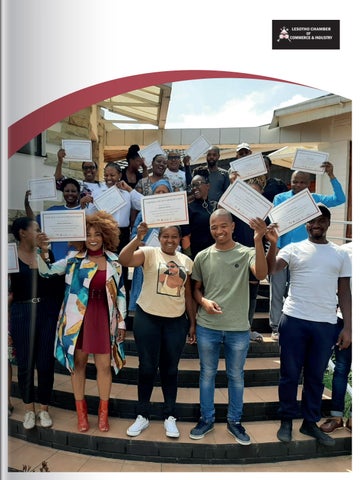
LCCI Members are awarded their Certificates of Participation
INTRODUCTION
LESOTHO CHAMBER OF COMMERCE AND INDUSTRY (LCCI)
Africa Outlook issue 95 | 9
INDUSTRY SPOTLIGHT
LCCI head office
INTERVIEW
LCCI board members meeting
revenue generating activities such as gala dinners or fun walks to name but a few. In the midst of the pandemic, we established a solidarity fund that members have contributed to, and we were able to assist with providing PPE to vulnerable communities. Businesses that were seriously affected by the shutdown were also assisted through LCCI, the government’s COVID-19 relief fund, as well as other organisations. AO: What trends are currently transforming the sector and how are you responding to them? FH: Lesotho is one of the countries that has ratified the African Continental Free Trade Agreement to create the African Continental Free Trade Area (AfCFTA), which reduces tariffs among member countries. LCCI will also help to address barriers that delay the flow of goods and services, and this will in turn encourage investment.
just come to an end. The objective of FAPA was the capacitation of business associations, which was well-executed, and we have some tangible proof of the success of the project. AO: How do you see the chamber developing over the next five years? FH: LCCI in five years will be a force to reckon with because we are finally being recognised by the public sector, which involves us in some policy making decisions. The International Chamber of Commerce also affords us the recognition we desire and assists in training programmes and all of its other activities.
AO: Has LCCI got any projects in the pipeline that you wish to highlight? FH: We were running the AfDB Fund for African Private Sector Assistance project (FAPA), which has 10 | Africa Outlook issue 95
Tel: +266 22321066 lcci@leo.co.ls info@lcci.org.ls www.lcci.org.ls
www.tharolloconsultancy.com Maletsunyane Office Park, Opposite Mpilo Estates, New Parliament Road, Qoatsaneng, PO. Box 2317, Maseru 102, Lesotho +266 525 12345 /+266 22326092 lnfo@tharollo.org.ls
LABOUR LAW AND INDUSTRIAL RELATIONS BUSINESS DEVELOPMENT • Company registration including traders licenses and tax clearance applications corporate governance • Operations management • Human capital management and development • Risk management • Project management • Quality management and compliance
• Development of workplace policies, procedures and systems • Training on various areas of the labour law and labour relations • Mediation & arbitration • Chairing of disciplinary hearings including appeals • Assistance with public and private labour dispute resolution processes • Work permit applications • Occupational safety and health • Assist with workplace compensation and workplace claims
LESOTHO CHAMBER OF COMMERCE AND INDUSTRY (LCCI) LCCI Complex Corner Orpen & Princess Market Roads Po Box 79 Maseru Lesotho Tel: +266 22321066 lcci@leo.co.ls / info@lcci.org.ls www.lcci.org.ls
PRODUCED BY AFRICA OUTLOOK MAGAZINE