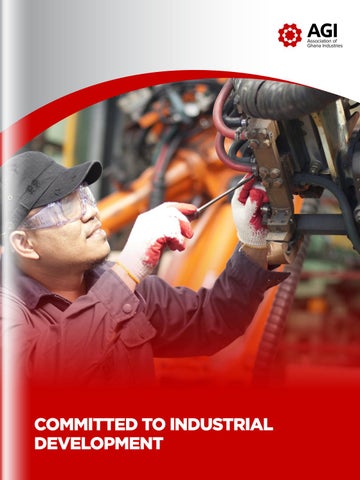
COMMITTED TO INDUSTRIAL DEVELOPMENT
INDUSTRY SPOTLIGHT
INDUSTRY
IN GHANA Ghana’s government is committed to industrialisation and endeavour to provide a fertile business environment for local and international companies Writer: Dani Redd | Project Manager: Joe Palliser
G
hana’s industrial sector has recently emerged as a significant driver for economic growth in the country. When President Nana Akufo-Addo was sworn into office in 2017, he made industrialisation a major priority, reflected in such programmes as the Ghana Beyond Aid. It aims to improve the competitiveness of trade and investment internationally, while mobilising local resources via industrialisation and value adding. The Ghanaian economy is poised to grow
2 | Africa Outlook issue 86
significantly over the next few years (COVID-19 notwithstanding), thanks to governmental policies that help enable manufacturing and exports. As a result, Ghana has a large and very active consumer and industrial products and services sector, which is dominated by subsidiaries of international companies such as Unilever and Toyota. However, Ghana also has a thriving SME culture – 90 percent of registered businesses in Ghana are SMEs, and they account for around 85 percent of employment in Ghana’s manufacturing sector.
ASSOCIATION OF GHANA INDUSTRIES
However, SMEs in Ghana do face some challenges. Many of them struggle with accessing credit or capital, with financial institutions declining loan requests due to SME’s positioning. Other SMEs struggle with finding a platform to sell their services – leveraging ecommerce is vital for them, especially in the wake of COVID-19. Businesses both small and large also find that a significant impediment to business is the high cost and unreliability of electricity in Ghana; frequent outages lead to a loss of productivity and increase cost of maintaining machinery. Some businesses can mitigate this through setting up their own microgrids (often using PV systems).
FACTS & FIGURES Major industries: Mining, light manufacturing, cement, food processing Top exports: Crude petroleum, gold, cocoa beans, cocoa butter Percentage of GDP: 24 GDP per capita: $2,202.116 (2019)
Why do business in Ghana? Overall, however, Ghana is considered an attractive place to do business. In 2019, the World Bank ranked it at the 114th best for ease of doing business, making it the highest-ranking West African nation on the list. One reason for this is that the multi-party government is stable and committed to improving business confidence by helping provide a sound macroeconomic climate and streamlining regulations. FDI is being encouraged through 100 percent foreign ownership being permitted. The country also offers export-free zones, a rapidly expanding stock market and increasing infrastructure development.
I NITNRTORDOUDCUTCITOIN ON
Sector challenges
Africa Outlook issue 86 | 3
amartex Timber and Plywood Co. Ltd is a wood processing company established in 1995 and located in Samreboi, Ghana’s Western Region. The company has over 2,000 direct employees and about 500 contract personnel (for outsourced services). Some of our products include: sliced veneer, plywood, rotary veneer, lumber, mouldings, carvings, honey and thaumatin. Aside fulfilling requirements of the Social Responsibility Agreement, as stipulated in the law(Act 547) to fringe communities, Samartex undertakes Corporate Social Responsibility initiatives and projects such as: Healthcare: Samartex hospital’s medical care to surrounding communities; an average 3,500 private patients monthly, and free medical care for about 1,000 employees and their dependants monthly Education and Training: 1. Fee-free tuition at Samartex School Complex 2. Free Apprenticeship Vocational Training Programme for graduates of Junior and Senior High School 3. Management Trainee Programme for fresh graduates from tertiary institutions, all as part of building the human resource capacity in the country. Roads Construction and Maintenance: 500-kilometre-plus stretch of community and public roads maintained annually, across forest fringe communities. Provision of Potable Drinking Water: Free potable water supply through our water treatment filtration plants, also boreholes have been installed in communities which are not within close proximity to our filtration plants. Agro- forestry and Alternative Livelihood Schemes: Community sensitisation and education on sustainable agricultural practices and alternative livelihood schemes such as snail rearing, beekeeping and honey harvesting, as well as free seedlings distribution to farmers. Africa Outlook spoke to Richard Duah Nsenkyire, the Managing Director of Samartex, to find out more about this fascinating organisation and the forestry industry in Ghana. Africa Outlook (AfO): Give us a brief insight into the Ghanaian forestry and wood processing industry. Why is it an exciting space to be working in?
Caring for Ghana’s Forests Richard Nsenkyire (RN): The forestry and wood processing industry is regulated by the Ghana Forestry Commission, under the Ministry of Lands and Natural Resources. The wood processing industry is driven by the private sector, which is categorized under: 1. Loggers 2. Secondary and Tertiary Processing Firms. Presently, most of the companies have either completely closed down or partially operating. These challenges could be attributed to high utility bills, government policies and over regulation, lack of suitable raw material, bureaucracies etc. However, the industry is very exciting and promising due to species and product diversity. Currently, there is more conscious effort (Private Public Partnership) geared towards plantations establishment and development, which was not the case in the past. Ghana’s climate and soil have an enormous potential which favour tree growing and natural regeneration.
AfO: How will such work support the national wood processing industry?
RN: Undoubtedly the forest as a renewable natural resource and its products have multiple benefits and provide direct employment for over 200,000 people in Ghana, not forgetting the environmental benefits like protection of water bodies, wildlife, non-timber forest products, shelter etc.
RN: Our plantation initiatives are in line with the general concept of “sustainability” and advocate for the need to increase resource base, since government policies, over the years, have laid more emphasis on regulation, rather than building a forest industry. Our initiative on off-reserve forest lands, is to promote sustainable agriculture, increase soil fertility and tree cover, as well as curbing shifting cultivation.
AfO: What work is Samaratex doing to build plantations and forests in the country?
AfO: Are you optimistic about the future of the industry and what lies ahead?
AfO: How important is it to manage forests sustainably in Ghana?
RN: Samartex is into private plantation of exotic and indigenous species of timber through the following: Dikoto Community Agroforestry Project (DICAP): 120 hectares of exotic and indigenous species have been established with the community. Tano Nimre Forest Reserve Plantation: Reforestation project of 1,152 hectares of degraded compartments allocated to Samartex by the Forestry Commission under Public Private Partnership (PPP). Tain II Forest Reserve Plantation: Reforestation of degraded forest reserve, totaling 2,048 hectares. Another PPP project with the Ghana Forestry Commission. Adeiso Plantation: private plantation located in the Eastern Region of Ghana, 165 hectares of teak plantation. Introduction of trees in various cocoa farms with over 500 farmers in our catchment area, as a tool in managing off-reserve forest lands.
RN: The industry will have a brighter future if government policies are directed towards increasing resource base on-reserve and off-reserve. There would also be the need for government to intensify the partnership with the private sector, with a conscious effort to establish large scale plantation and implement the tree tenureship policy for individual farmers to own trees that are cared for through natural regeneration, especially on farm and outside forest reserves.
Mr. Richard Duah Nsenkyire (Managing Director) Email: richard.nsenkyire@samartex.com Email: richard.nsenkyire@samartex.net Phone No: +233 277100144 www.samartex.com Africa Outlook issue 86 | 5
INDUSTRY SPOTLIGHT
Interview: Association of Ghana Industries (AGI) Associations play a vital role in representing the interests of their members at an industry and national level. Africa Outlook spoke to Seth Twum-Akwaboah, CEO of AGI, to find out more about this vital organisation. Writer: Dani Redd | Project Manager: Joe Palliser
A S S O C I AT I O N
O
n Saturday June 28, 1958, a historic meeting of representatives and indigenous owners of small industries in Ghana convened to discuss the difficulties that confronted SMEs in the country. This meeting led to the inception of the Ghana Manufacturers Association. In 1984 it was decided to expand the Association’s remit to meet the needs of both the manufacturing sector and other sectors, including finance and hospitality. The association became known as Association of Ghana Industries (AGI). In its current incarnation it consists of around 2,000 members made up of SMEs and large-scale industries in fields ranging from construction to IT, advertising to construction. We spoke to Seth Twum-Akwaboah, CEO of AGI, for his take on the association and Ghana’s industry as a whole.
6 | Africa Outlook issue 86
The AGI represents around 2,000 members made up of SMEs and large-scale industries
Africa Outlook (AfO): Since inception, how has the AGI developed and progressed in terms of its key objectives and the messages it tries to get across? Seth Twum-Akwaboah (ST-A): As the leading voice of manufacturing industries in the country, AGI has committed its effort to: advocating policies that advance the growth and development of industries; facilitating international trade through exhibitions of member products in countries across the subregion; strengthening institutional collaboration through the sharing of knowledge, experience, and critical information and creating the platform for networking of contacts, both locally and internationally.
ASSOCIATION OF GHANA INDUSTRIES
ICASOR International Centre for Advocacy and Social Research
AIDEC GROUP OF COMPANIES:
Africa Integrated Development and Communications Consultancies (AIDEC) Group are made up of; AIDEC Holdings Ltd, AIDEC Supplies Ltd and AIDEC Consultancies International Ltd. Year of incorporation; 2004 in Ghana. A premier network group of companies. Provides General Management Consulting including leadership, skills, competency and entrepreneurship development. We also undertake simultaneous translation and interpretation for international conferences. We are also into Petroleum downstream retail, Haulage and transportation, Supermarket operations and importation and distribution of wine from South Africa. A 100% owned private limited liability with shares. We provide a one-stop shop for services. Open to foreign shareholders participation. Our vision; network and promote businesses across Africa through integrated processes and the effective use of ICT. A member of the Association of Ghana Industries (AGI) and the Ghana National Chamber of Commerce & Industry (GNCCI). We are very customer focused and we ensure a good return and maximize shareholders value.
We work with our Partners with a high sense of honesty and integrity. We are committed to exceeding shareholders expectation. We have a passion for excellence. We are highly ethical and a socially responsible corporate citizen. Our corporate social responsibility is undertaken by our NGO, International Centre for advocacy & Social Research (ICASOR). AIDEC Holdings Ltd is a two time winner of the prestigious Invest In Africa (IIA) Star for Excellence and Business Transformation awards in 2019 and 2020. Our slogan is; “Excellence; get it right the first time and always”. The AIDEC Group has as its vision to be one of the largest mobilizer of private investment capital in Ghana by 2025 and look forward to interested investors to partner. Our current Partners; Total Petroleum and La Ric Mal of South Africa. Our clients range from National to Multinational institutions, Government, NGO’s, Individuals and family owned businesses.
T: +233 540115656 /+233 0540116527 | E: info@aidecholdings.com | www.aidecholdings.com Mailing Box: P.O.Box CT583, Cantonments, Accra | Address: AIDEC Plaza, East Legon, Ogbojo, Accra Ghana
DRIVE UP TO EXPECTATION Our range offers best in class Elegance, Safety, Comfort and Performance
5008
GLE Coupé
Peugeot 5008 SUV | Citroën C5 Aircross | Mercedes-Benz GLE Coupé E XC LU S I V E D I S T R I B U TO R
SILVER STAR AUTO
Hotline:
0244 335 558
Africa Outlook issue 86 | 7
INDUSTRY SPOTLIGHT
Over time, AGI has succeeded in influencing government policies and regulations. These include: the reduction in corporate tax from 32.5 percent to 25 percent; the reduction of utility tariffs from 150 percent to 89 percent; and The Public Procurement Act 2003 (Act 663) to assist the local business community to supply to the public sector.
A S S O C I AT I O N
AfO: What do you find most exciting about conducting private business in Ghana? ST-A: The private sector is the fulcrum upon which all economic activities revolve. It provides innovation and employment, it contributes significantly to the tax basket and revenue generation, and it reduces poverty. Ghana has become an important destination for foreign direct investment within the West Africa subregion and Africa as a whole, in view of its conducive environment for businesses. There are various incentives such as free zone operations – which provide tax holidays for several years – a generally well educated labour force, good access to the entire West African market, growing demand due to an expanding middle class resulting from consistent GDP growth, and a stable political environment which guarantees private sector investment. As a private sector organisation, we constantly advocate for policy makers to provide a conducive environment for industries to thrive in, and we have largely succeeded in this as AGI is highly recognised by successive governments. This partnership with government enables us to push our advocacy agenda to support private sector businesses.
8 | Africa Outlook issue 86
AfO: On the flip side, what are its biggest challenges? ST-A: The key challenges faced by businesses in Ghana as revealed by our AGI Business Barometer survey include poor access to medium to long term funding, high cost of capital, high cost of electricity for industrial operators and stiff competition from imported products. The recent banking reforms embarked upon by the central bank are, however, yielding good results as bank lending rates have been on a gradual decline. AfO: How has COVID-19 affected Ghana’s industries, and how are is AGI helping? ST-A: The COVID-19 impact cut across all sectors of the industry in Ghana, but the sectors most affected are hospitality and tourism, educational institutions, food and beverage industry, clothing and garments, building and construction, airlines and services. AGI has constantly engaged the government since the onset of COVID-19 and advocated for support for businesses. The government has subsequently listened to the industry’s concerns and has recently set up the COVID 19 Alleviation Programme (CAP) for SMEs, a two-billioncedi (or $340 million) guarantee scheme for industries including manufacturing, agriculture and construction, alongside the Mastercard COVID-Relief Fund to support industries. AGI is collaborating with relevant government entities
ASSOCIATION OF GHANA INDUSTRIES
to implement these programmes and support businesses in Ghana. In addition, AGI is collaborating with other development partners to provide training, mentorship and project support to our SME members throughout the country. AfO: Have you got any projects or partnerships in the pipeline you wish to highlight? ST-A: We have several important projects in the pipeline, including the Ghana Industrial Summit and Exhibition 2021 (GISE). It is the biggest industrial gathering in Ghana and will provide a platform for serious business linkages, international networking, exposure and knowledge transfer in addition to creating awareness of products and concepts. The event will bring together key sectors such as oil and gas, manufacturing, construction, energy and power and other supporting sectors including finance together on one big platform. It will help to set the agenda for value-added industrialisation and the advancement of local content development to support the process. Next year we will also produce the AGI Ghana Industry Handbook 2021, a one-stop industry informational resource and guide for policy makers,
A S S O C I AT I O N
The Independence Square of Accra, Ghana, inscribed with the words “Freedom and Justice, AD 1957�, commemorates the independence of Ghana, a first for Sub-Saharan Africa
Africa Outlook issue 86 | 9
INDUSTRY SPOTLIGHT
A S S O C I AT I O N
Ghana is assembling vehicles and introducing several sophisticated industrial operations
industry players, researchers, entrepreneurs, and manufacturers. We are also forming several interesting partnerships. For example, we are partnering with GIZ to implement an energy service centre promoting renewable energy usage among the large industrial companies. A second partnership – with GIZ, Sight and Light, and the Bill and Melinda Gates Foundation – will lead to the implementation of a food fortification programme for the food and beverage and sector of Ghana. AfO: How do you see Ghana’s industry developing over the next five years? ST-A: With the advent of robust industrial policies – such as One District One Factory, Strategic Anchor Industrial Initiatives, Development of Industrial Parks – introduced by the government, we foresee a revolutionary upsurge of the private sector and industry driving growth. Today, Ghana is assembling vehicles and introducing several sophisticated industrial operations; it will undoubtedly move industrial development to higher levels over the next five years.
10 | Africa Outlook issue 86
AfO: Are you optimistic about the future of industry in Ghana? ST-A: We believe the private sector is the engine of growth, and that every economy derives its source of strength from industry. With our continuous advocacy and positive policies in place, we are very optimistic about the future of industry in Ghana, despite the challenges it faces. More so with the coming into being of the African Continental Free Trade Agreement Area (AfCFTA); big market opportunities will be created within the African market which will in turn attract large industries to Ghana to target the African market.
42 Dr. Isert Street, North Ridge, Accra, Ghana Tel: +233 (0)302 779023 agi@agighana.org www.agighana.org
ASSOCIATION OF GHANA INDUSTRIES
Key Players Key Players
The companies shaping and disrupting the manufacturing industry in Kenya AIDEC HOLDINGS LTD Africa Integrated Development and Communications Consultancies – AIDEC – provides consulting in advocacy, business and management training. It functions as a onestop shop, providing innovative, quality and efficient services for its customers including, consulting, retail, haulage and distribution. AIDEC Holdings Ltd. is the parent company of AIDEC Consultancies International Ltd and AIDEC Supplies Ltd as 100 percent owned subsidiaries.
SAMARTEX Samartex Timber and Plywood Co. Ltd. is Ghana’s leading sustainable and socially responsible timber company in Ghana. All its products are sourced from sustainably managed natural products, as it has put in place a system of community education leading to advanced forest management. As well as advocating for sustainable forestry management, Samartex is also proud of its corporate social responsibility initiatives, which improve the livelihoods and wellbeing of staff and local communities. For example, it has built a hospital which provides medical care to employers, their dependents and local community members.
K E Y P L AY E R S
The companies shaping and disrupting the industrial sector in Ghana
SILVER STAR AUTO Ghana’s leading automobile firm, Silver Star Auto, is synonymous with luxury. It is the authorised distributor of Mercedes Benz, Citroën and Peugot. It also deals in spare parts and after-service sales support, including repairs.
Cocoa Processing Company Skyland Aluminium Works
Africa Outlook issue 86 | 11
ASSOCIATION OF GHANA INDUSTRIES 42 Dr. Isert Street, North Ridge, Accra P.O. Box AN-8624, Accra North Digital Address: GA-014-5066 T: +233 (0)302 779023 T: +233 (0)302 251266 T: +233 (0)302 779023 / 4 E: agi@agighana.org www. agighana.org PRODUCED BY AFRICA OUTLOOK MAGAZINE