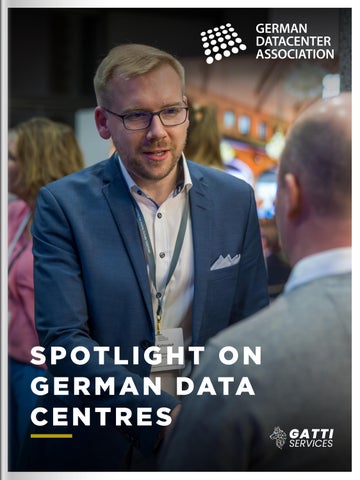
S P OT L I G H T O N G E R M A N DATA CENTRES
S P OT L I G H T O N G E R M A N DATA CENTRES Germany is positioned at the helm of Europe’s data centre future, balancing artificial intelligence-driven growth and market leadership with the growing importance of decarbonising operations Writer: Lucy Pilgrim | Project Manager: Joseph Perfitt
2 | EME Outlook Issue 73
GERMAN DATACENTER ASSOCIATION INDUSTRY SPOTLIGHT
H
istorically, Germany has maintained a strong reputation for manufacturing excellence and precision engineering expertise. It is therefore no wonder the country is home to Europe’s top infrastructure markets and a thriving data centre industry, supported by its central location in the continent, strong economy, and political stability. This leading position is further driven by multi-billion-euro investments from both the private and public sectors, whilst the rise of cloud computing and hyperscale facilities across the country further aid industry growth. Geographically, Frankfurt has emerged as a central hub for data centre development thanks to its financial importance and presence of vital international interconnection services, underpinning the region’s central role in Europe’s data centre market. Germany is no stranger to the accelerating emergence of artificial intelligence (AI) and its importance as a significant growth engine. Indeed, the country is central to unlocking the power of generative AI, cloud services, and high-performance computing. However, each of these elements require extensive processing capacity and large specialised facilities – attributes Germany is well positioned to cater for. The growth of AI is simultaneously taking place alongside the industrywide shift towards decarbonisation and greener digital infrastructure. This is primarily demonstrated by recently introduced regulatory measures such as the Energy Efficiency Act (EnEfG) and the government’s Data Centre Strategy, which prioritise waste heat recovery and aim to make Germany one of the leading global hubs for sustainable data centres. Looking ahead, the nation’s data centre industry must navigate the delicate balance between rising digital demand and lower environmental impact. As AI continues to shape the landscape, Germany aims to further expand its capacity to meet the needs of Europe’s evolving digital economy whilst facilitating a highly sustainable sector. EME Outlook Issue 73 | 3
INTERVIEW: G E R M A N DATAC E N T E R A S S O C I AT I O N Since its founding in Frankfurt in 2018, the German Datacenter Association (GDA) has worked to provide the country’s data centre industry with a strong, coordinated voice. Martin Kohoutek, Director General, talks us through the intricacies of the industry and how the association forges a path for its progressive growth EME Outlook (EO): Firstly, could you introduce us to the German Datacenter Association (GDA) and outline its founding principles? Martin Kohoutek, Director General (MK): For me, the strength of GDA lies in the diversity of the organisations it 4 | EME Outlook Issue 73
brings together – right now more than 320. Our members include operators, investors, technology providers, engineering firms, law firms, energy companies, research institutions, and municipalities. Each of them contributes a different perspective, but they are united by the understanding that data centres have become essential infrastructure for the economy, public services, and society as a whole. From the outset, our objective has been to improve the framework conditions for digital infrastructure, represent the sector in political and regulatory discussions, and bring together the organisations that collectively enable digital infrastructure. I see our role as translating the operational experience of our members into practical policy recommendations and helping to create conditions for secure, sustainable, and predictable infrastructure development.
GERMAN DATACENTER ASSOCIATION INDUSTRY SPOTLIGHT
EO: What is your take on the German digital infrastructure sector at the moment, particularly as energy access demand increases with the growing prominence of AI? MK: Few sectors are currently evolving as rapidly as digital infrastructure and in my view, Germany does not have a demand problem; it has a delivery challenge. Demand for cloud services, AI, and data-driven applications continues to grow rapidly. However, demand alone does not create digital infrastructure. The decisive question is whether new capacity can be delivered within a predictable timeframe. For me, one of the most important measures of a digital infrastructure location is its ‘time to capacity’: how quickly demand can be translated into capacity that is permitted, powered, connected, and ready for operation – which goes far beyond the construction period of an individual facility. It includes access to land and power, grid connection procedures, planning and permitting, connectivity, regulatory certainty, and the coordination of all relevant
public and private stakeholders. A market may have strong demand and significant energy potential, but investors ultimately need deliverable capacity within a credible timeframe. Power potential attracts interest whilst deliverable capacity attracts investment. AI reinforces this development. During the cloud era, connectivity was often the primary location factor. In the AI era, power availability has become equally important, which fundamentally changes how digital infrastructure is planned and where future investment will flow. Germany benefits from strong industrial demand, excellent connectivity, engineering expertise, and political stability. I believe we have everything it takes to remain one of Europe’s leading digital infrastructure markets. The key challenge is whether we can align energy planning, grid expansion, permitting, and regulation quickly enough to keep pace with demand. Demand tells us where the market wants to grow. Time to capacity determines whether that growth can actually be realised.
EME Outlook Issue 73 | 5
Building the Infrastructure Behind Tomorrow's Digital Economy Artificial intelligence is fundamentally changing how digital infrastructure is designed, deployed, and operated. Higher rack densities accelerated deployment schedules, liquid cooling, and increasingly complex GPU clusters require a different level of engineering expertise than traditional enterprise infrastructure. Founded in Germany, Gatti Services was established to help organisations meet this new reality. As an engineering services company specialising in the design, deployment, commissioning, and long-term operation of AI and mission-critical digital infrastructure, Gatti Services brings together specialist engineering disciplines that are too often delivered by multiple independent providers. Today, Gatti Services supports hyperscalers, enterprises, OEMs, and colocation providers across Europe, helping customers deploy resilient, scalable AI infrastructure while reducing complexity, improving operational reliability, and accelerating time to production.
As a Prime Partner of the German Data Center Association (GDA), Gatti Services is proud to contribute to Germany's growing leadership in digital infrastructure. The partnership reflects a shared commitment to advancing innovation, promoting engineering excellence, and supporting the continued growth of the data centre industry in Germany and internationally. While projects now span multiple continents, the company's engineering philosophy remains firmly rooted in the principles that have defined German engineering for generations: precision, accountability, quality, and long-term thinking. Every engagement is built on technical excellence, close collaboration, and a commitment to delivering infrastructure that performs not only on day one, but throughout its operational lifecycle.
From initial planning through Day 2 operations, Gatti Services provides customers with one engineering partner across the entire infrastructure lifecycle. Reference architecture validation, mechanical engineering, rack integration, deployment, commissioning, and operational support are delivered as connected disciplines rather than isolated workstreams, creating greater consistency from design through production.
Engineers at Gatti Services validate reference architectures, review bills of materials, optimise rack layouts, and design structured cabling with power, cooling, maintainability, and scalability in mind. Deployment extends through rack integration, InfiniBand and Ethernet fabric implementation, direct liquid cooling (DLC) commissioning, firmware configuration, logical cluster bring-up, acceptance testing, and multi-day burn-in, ensuring every environment is fully production-ready before handover.
e
100,000+ GPUs Deployed Delivering high-performance GPU infrastructure across hyperscale and enterprise environments worldwide. 14 Production GPU Clusters Delivered Supporting complex deployments with proven experience delivering large-scale AI infrastructure. 40,000+ GPUs Under Active Day 2 Support Providing continuous operational expertise through GPU-specialised onsite engineers and a dedicated global support organisation. ISO 9001 & ISO 27001 Certified Delivering secure, compliant, vendor-agnostic engineering services backed by internationally recognised quality and information security standards.
Behind Gatti Services is Founder and CEO Christof Stührmann, whose career has been built around infrastructure, cloud environments, and complex deployment operations. Through years of supporting large-scale infrastructure programmes, Christof recognised that many organisations struggled not because of technology, but because engineering responsibility was fragmented across multiple vendors. The result was unnecessary complexity, slower deployments, inconsistent delivery, and increased operational risk. Driven by the belief that infrastructure projects require greater accountability and a more integrated approach, he founded Gatti Services to bridge the gap between engineering, deployment, and longterm operations.
Gatti Services believe organisations need more than technology providers. They need engineering y partners capable of delivering certainty from design through deployment and into long-term operations.
By combining engineering expertise with specialist teams, Gatti Services helps customers build resilient, high-performance AI infrastructure that is ready for today's workloads and prepared for tomorrow's innovations.
"The future of AI infrastructure will not be defined solely by the technology organisations deploy, but by how effectively they execute. Success comes from combining engineering expertise, operational excellence, and accountability across the entire infrastructure lifecycle." Christof Stührmann Founder & CEO, Gatti Services Gatti Servicesʼ approach remains rooted in Germany's tradition of precision engineering, and long-term partnership, bringing those values to every project, every customer, and every deployment.
EO: With some highly notable and globally leading names in its member base, how does GDA help its members evolve and progress in the German data centre market? MK: Today, delivering digital infrastructure has become a collaborative effort as no single company, regardless of its size, can solve the industry’s biggest challenges alone. A data centre operator can optimise the design and efficiency of a facility, but cannot independently accelerate grid expansion, simplify permitting procedures, or establish regional heat infrastructure. These challenges require alignment between industry, policymakers, utilities, municipalities, and regulators. This is where I believe GDA creates real value for its members: we bring together all relevant stakeholders, identify where projects lose time, and help improve the framework conditions that determine whether investment can actually be realised. We also provide guidance through Germany’s federal structures, regulatory framework, and regional stakeholder landscape as, often, understanding who is responsible for what is often just as important as understanding the regulation itself. Our objective is never to advocate for individual projects or companies. Our objective is to improve the environment 8 | EME Outlook Issue 73
“ U LT I M AT E LY, O U R R O L E I S T O ENSURE POLITICAL DECISIONS A R E I N F O R M E D B Y O P E R AT I O N A L REALITY AND THE EXPERTISE OF OUR MEMBERS CONTRIBUTES C O N S T R U C T I V E LY T O S H A P I N G G E R M A N Y ’ S D I G I TA L F U T U R E ” – M A R T I N KO H O U T E K , D I R E C TO R G E N E R A L , G E R M A N D ATA C E N T E R A S S O C I AT I O N
in which every member operates. If we can shorten permitting timelines, improve planning certainty, or create better regulatory conditions, the entire ecosystem benefits. EO: How do GDA’s working groups encourage members to participate in the sustainable growth of the industry? MK: One of GDA’s greatest strengths is the expertise of its members. Our working groups provide the structure through which this expertise is brought together and translated into concrete outcomes.
GERMAN DATACENTER ASSOCIATION INDUSTRY SPOTLIGHT
They are not discussion forums; they are where the association develops its positions, consultation responses, and industry initiatives. Experts from across the data centre value chain contribute their operational experience, challenge each other’s perspectives, and work towards common recommendations. A good example is our politics working group, which coordinates GDA’s political and regulatory work by developing common positions on issues at municipal, state, federal, and European level. Topics range from grid connections, energy efficiency, and heat reuse to permitting, electricity costs, and data centre strategies. Recent examples include GDA position papers on the EnEfG, grid connection reform, Frankfurt’s municipal heat planning, and Hesse’s regional data centre strategy. Another example is the annual Open Data Centre Day which has been developed together with our members, it has become an important initiative to improve public understanding of digital infrastructure by opening data centres to citizens, students, and local communities. For me, these working groups demonstrate what an industry association should do: transform the practical expertise of its members into solutions that benefit the entire ecosystem. EO: Can you tell us more about the German Datacentre Conference (GDACon) 2026 and how it created a forum to discuss the key issues facing the industry right now?
10 | EME Outlook Issue 73
MK: This year marks the fifth anniversary of GDACon, reflecting how the conference has evolved alongside Germany’s rapidly changing digital infrastructure sector. When GDACon started, discussions focused primarily on technology and market growth. Today, the agenda is much broader. Over the past five years, the industry has changed significantly. AI, energy availability, digital sovereignty, and resilience have moved to the centre of strategic discussions, making it increasingly clear that technology, energy, and regulation can no longer be considered separately. GDACon therefore brings together stakeholders who do not always engage in the same discussions, including operators, technology providers, energy companies, investors, policymakers, municipalities, and researchers. Alongside keynote sessions, workshops and interactive
GERMAN DATACENTER ASSOCIATION INDUSTRY SPOTLIGHT
formats focus on practical implementation, examining how improvements could be made across coordination energy systems, permitting, financing, and infrastructure planning. Many of the industry’s current challenges are not primarily technical. They arise where different planning and decision-making processes fail to progress in a coordinated manner. For me, GDACon has become much more than an industry conference: it is a platform where different parts of the digital infrastructure ecosystem can develop a shared understanding of the challenges ahead and, hopefully, common solutions. EO: As one of the industry’s biggest hurdles currently, GDACon 2026 also addressed questions surrounding efficient energy supply and reuse. How do you believe this can be resolved and in what ways is GDA supporting its members working towards this? MK: In my view, energy has become the defining strategic issue for the future of digital infrastructure. It is no longer simply an operational consideration – it has become one of the key determinants of investment. Energy access is also one of the main factors influencing time to capacity. A site may be technically suitable and commercially attractive, but without a reliable grid
connection and a credible delivery timeline, it cannot become operational capacity. Addressing this challenge requires much closer coordination between developers, grid operators, energy suppliers, and public authorities. More transparent grid connection procedures, continued investment in electricity networks and generation capacity, competitive energy conditions, and earlier planning are all part of the solution. Heat reuse is a good example of why this coordinated approach matters. A data centre can provide a reliable source of residual heat, but successful implementation also depends on suitable heat networks, local demand, financing models, and long-term contractual certainty. None of these elements can be developed in isolation. This illustrates a broader lesson as the future competitiveness of digital infrastructure will depend less on optimising individual assets and more on connecting different infrastructure systems effectively. The real challenge is not whether Germany has electricity, but whether electricity, permitting, and infrastructure planning evolve at the same pace. At GDA, we support this process by bringing operational experience into legislative discussions, facilitating dialogue between industry, energy stakeholders, and municipalities, therefore advocating for practical framework conditions that improve both sustainability and investment certainty. EME Outlook Issue 73 | 11
“GERMANY BENEFITS FROM STRONG INDUSTRIAL DEMAND, E X C E L L E N T C O N N E C T I V I T Y, ENGINEERING EXPERTISE, A N D P O L I T I C A L S TA B I L I T Y. I B E L I E V E W E H AV E E V E R Y T H I N G I T TA K E S T O R E M A I N O N E O F E U R O P E ’ S L E A D I N G D I G I TA L INFRASTRUCTURE MARKETS” – M A R T I N KO H O U T E K , D I R E C TO R G E N E R A L , G E R M A N D ATA C E N T E R A S S O C I AT I O N
This is why I do not see sustainability and implementation speed as competing objectives. Better coordination strengthens both. In fact, many future efficiency gains will not come from the data centre itself, but from the interfaces between energy, digital infrastructure, and urban development. Ultimately, decarbonisation is not just about building better facilities but better systems. EO: As data centres transition from commercial entities to critical national infrastructure, how important is it that efficient regulatory frameworks and strategies are put in place?
EO: Can you provide more detail on why you believe efficient and interconnected infrastructure is so crucial to the evolution of the data centre landscape, particularly as the industry strives to decarbonise and improve its environmental footprint? MK: Efficient and interconnected infrastructure is essential both for decarbonisation and improving time to capacity. No data centre develops in isolation – every project depends on a broader infrastructure ecosystem that extends well beyond the facility itself. Successful development depends on electricity networks, generation capacity, fibre connectivity, planning authorities, construction supply chains, and, where appropriate, district heating infrastructure. If these systems evolve independently, projects become slower, more expensive, and less sustainable. If they are planned together from the outset, we can accelerate delivery whilst improving energy efficiency, heat reuse, and the integration of digital infrastructure into regional energy systems. 12 | EME Outlook Issue 73
MK: With data centres increasingly becoming recognised as critical national infrastructure, the expectations placed on regulation inevitably change. Regulators must protect security, resilience, and sustainability whilst also enabling the timely deployment of the digital infrastructure on which modern economies increasingly depend. In my view, this is not about choosing between growth and regulation but creating regulation that enables responsible growth. That requires rules that are clear, proportionate, technologically informed, and, above all, predictable. Planning certainty is the prerequisite; time to capacity is the result. Investors can adapt to ambitious requirements when they are transparent and consistently applied. What creates uncertainty is overlapping responsibilities, fragmented decision-making, and approval processes without reliable timelines. Every unnecessary delay ultimately extends the time it takes to bring new digital infrastructure online. This is why regulation has become a competitive factor. Countries that provide planning certainty will be better positioned to attract investment because they can deliver
GERMAN DATACENTER ASSOCIATION INDUSTRY SPOTLIGHT
capacity more predictably and more quickly. Ultimately, effective regulation is not measured by how many rules it creates, but by whether it delivers secure, sustainable, and predictable outcomes. EO: Following on from this, how does the GDA act as voice for its membership in front of governing bodies? MK: Effective policymaking starts with understanding how digital infrastructure is actually planned, financed, and delivered. Providing that practical perspective is one of GDA’s most important responsibilities. In my experience, policymakers and industry often pursue the same objectives: secure, sustainable, and resilient digital infrastructure. The challenge is translating those shared objectives into regulation that also works in practice. This is where GDA acts as a bridge. Through our working groups and continuous dialogue with members, we identify where projects encounter delays, uncertainty, or conflicting regulatory requirements, translating this operational experience into evidence-based positions, consultation responses, and recommendations for ministries, parliaments, regulators, municipalities, and network operators.
Our objective is not simply to argue for faster procedures or fewer rules but to help create better regulation through better dialogue. Ultimately, our role is to ensure that political decisions are informed by operational reality and that the expertise of our members contributes constructively to shaping Germany’s digital future. EO: Finally, how would you define the outlook for the German data centre community in 2026 and beyond? MK: I am optimistic about the future of Germany’s data centre industry because the long-term demand for digital infrastructure is beyond question. Cloud computing, AI, and the digital transformation of industry and public services will continue to drive investment for many years to come. The defining question for the coming decade is therefore no longer whether additional digital infrastructure is needed, but whether we can deliver new capacity with sufficient speed, reliability, and planning certainty. Germany starts from a position of strength. We have many of the fundamentals required for continued growth: a strong industrial base, excellent connectivity, engineering expertise, and a highly innovative digital infrastructure ecosystem. Our challenge is to bring these strengths together more effectively. The most competitive locations will not necessarily be those with the greatest energy resources or the largest number of announced projects. They will be those that align energy, connectivity, permitting, regulation, and execution into one coordinated delivery model. If Germany succeeds in creating a more predictable and coordinated environment for infrastructure development, we will not only attract more investment – we will also strengthen industrial competitiveness, digital sovereignty, and sustainable economic growth. I am convinced the country has everything it takes to remain one of Europe’s leading digital infrastructure markets and lead its next phase of growth. Whether we succeed will depend less on ambition than on execution.
Tel: +49 69 130 134 70 info@germandatacenters.com https://www.germandatacenters.com/
EME Outlook Issue 73 | 13
Tel: +49 69 130 134 70 info@germandatacenters.com https://www.germandatacenters.com/
PRODUCED BY EME OUTLOOK MAGAZINE