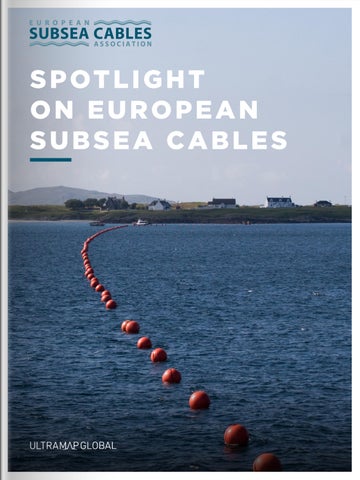
S P OT L I G H T ON EUROPEAN SUBSEA CABLES
S P OT L I G H T ON EUROPEAN SUBSEA CABLES Increasingly integral to people’s daily lives, subsea cables play a vital role in advancing Europe’s energy and digital sectors, highlighting their importance in connecting nations and driving innovation Writer: Rachel Carr | Project Manager: Ben Weaver
2 | EME Outlook Issue 73
EUROPEAN SUBSEA CABLES ASSOCIATION INDUSTRY SPOTLIGHT
T
he European subsea cable industry is rapidly evolving, driven by the increasing demand for high-speed data transmission, cloud computing, hyperscale data centres, and international internet connectivity. Subsea cables serve as essential connectors and enablers in our daily lives, forming the backbone of the dynamic energy and digital sectors. These complex networks, often extending deep beneath the ocean’s surface, transmit electricity and data across vast distances. In particular, the European subsea cable industry plays a crucial role in this infrastructure, connecting countries and facilitating advancements in technology and renewable energy initiatives. Through these underwater connections, resources can be harnessed and information shared more efficiently than ever, fostering innovation and connectivity in our interwoven world. Indeed, the subsea cable market is projected to reach USD$13.30 billion by 2033, growing at a compound annual growth rate (CAGR) of 7.39 percent from 2026 to 2033. Key drivers include the rapid expansion of offshore wind energy projects, deployment of submarine communication cable systems, and rising investments in cross-border electricity interconnectors. Additionally, technological advancements in highvoltage cable systems, high-voltage direct current transmission, and durable cable insulation materials are enhancing project efficiency and reliability. To safeguard these vital connections, the EU is actively investing in legal, technological, and military measures. However, achieving resilience requires coordinated action across member states, private operators, and international partners to protect connectivity, economic stability, and security. European subsea cables face several risks and threats of damage, including abrasion, ocean currents, and seismic activity. Accidental damage also often results from fishing equipment or ship anchors, whilst the risk of intentional threats and cybersecurity have increased attention of governments in recent years. These cables carry trillions of dollars in daily financial transactions, support military communications, and enable cross-border energy flows, making them critical infrastructure. Therefore, the resilience and advancement of the European subsea cable industry is vital not only for technological progress and renewable energy integration, but also maintaining global connectivity and security in an increasingly interdependent world. EME Outlook Issue 73 | 3
INTERVIEW: EUROPEAN SUBSEA C A B L E S A S S O C I AT I O N We sit down with the European Subsea Cables Association to explore the integral role of the subsea cable industry in meeting Europe’s evolving energy needs and dynamic digital demands. Featuring insights from Executive Director, John Wrottesley, and Chair, Steve Holden, we uncover the strategies driving the future of subsea infrastructure 4 | EME Outlook Issue 73
T
he European Subsea Cables Association (ESCA) is a forum for companies involved in the ownership, operation, installation, maintenance, and supply of submarine cables in European and nearby waters, focusing on telecommunications (telecoms), power, and offshore renewables. As a non-commercial, member-led association, ESCA promotes marine safety and protects submarine cables from hazards. Its members have interests across the Baltic Sea, North Sea, Irish Sea, Atlantic approaches, and Mediterranean.
EUROPEAN SUBSEA CABLES ASSOCIATION INDUSTRY SPOTLIGHT
ESCA holds Observer Status with the OSPAR Commission and is a member of the Seabed User & Developer Group (SUDG), which promotes cross-sector cooperation for sustainable development in increasingly busy marine spaces, advocating for early communication between marine industries and good practices to minimise conflicts. The association provides technical evidence to the European Commission and national regulators and manages the Kingfisher Information Service – Offshore Renewable & Cable Awareness (KIS-ORCA), a free cable awareness resource for fishermen and mariners in Northwest Europe. ESCA is run by a small, experienced Secretariat, whose lean structure draws on its members’ expertise, under an elected Executive Committee. It collaborates with governments, regulators, and policymakers to share technical expertise and ensure decision-makers have accurate information. When taking a public stance, the association invites others to collaborate. Addressing the complexities of subsea cables that cross national boundaries, ESCA engages with the European Commission and national government departments, maintains its OSPAR Observer Status, and supports the Valentia Island Symposium on Subsea Cable Security and Resilience. In addition, ESCA works closely with other subsea cable associations such as the International Cable Protection Committee (ICPC), Danish Cable Protection Committee (DKCPC), and wider stakeholder groups for other marine industry groups across Europe to support collaboration. Moreover, the association partners with academic and scientific organisations to ensure access to quality, neutral data concerning subsea cables in the marine environment, focusing on evidence rather than specific conclusions. EME Outlook (EO): Firstly, could you talk us through the origins of ESCA, its inception, and initial mission and vision? ESCA: It is worth starting a little earlier than ESCA itself, because the industry we represent began in European waters. The first successful permanent transatlantic telegraph cable ran from Valentia Island in County Kerry, Ireland to Heart’s Content in Newfoundland, Canada at the western end, completed in 1866 after the celebrated failure of 1858. The questions operators of that cable faced about protection, repair, and coexistence with other sea users are recognisably the issues the industry still works on today. ESCA’s roots run back much further than its name. The first international body dedicated to protecting undersea cables, the Cable Damage Committee, formed in 1958,
HELEN McENTEE TD, IRISH MINISTER FOR FOREIGN AFFAIRS AND TRADE AND MINISTER FOR DEFENCE, AT THE VALENTIA ISLAND SYMPOSIUM ON SUBSEA CABLE SECURITY AND RESILIENCE
became the ICPC in 1967. Four decades later, it became clear that European waters, amongst the busiest and most contested stretches of seabed anywhere in the world, needed a regional forum of their own. The UK Cable Protection Committee was established in 1999 by companies that own and operate cables in UK waters. It became Subsea Cables UK in 2011 and, in 2016, adopted its present name to reflect a membership and workload that had long since stopped at the UK’s territorial limit. The founding mission has barely changed – promoting marine safety and safeguarding submarine cables from man-made and natural hazards. Those two aims sit together deliberately. When fishing gear snags a cable, the result is not only a service outage; it’s a serious risk to the life of the crew aboard that vessel, and commercial fishing remains one of the most dangerous occupations in Europe. Preventing cable faults and keeping people safe at sea are, in practice, the same piece of work. EME Outlook Issue 73 | 5
EUROPEAN SUBSEA CABLE SPOTLIGHT · INTERVIEW
ULTRAMAPGLOBAL
In conversation with Martin Connelly
Co-Founder & Commercial Director, UltramapGlobal Europe's repair fleet is stretched, the seabed is getting busier and the 1885 Act is finally being replaced. Martin Connelly on what a cable owner can control, and what to ask before appointing a monitoring provider. ESCA and IMCA have both warned about Europe's repair capacity. What does that mean for the owner of a cable? We sit at the prevention end of it. ESCA and IMCA have been warning about the state of the repair fleet since August last year, and no owner can do much about how many vessels Europe has. What we can change is how often you need to send for one. How does an alert about a high-risk vessel turn a cable into one that does not get hit? The vessel alert comes off a behavioural assessment. An analyst looks at what the vessel is doing and how vessels usually behave on that route, then contacts the vessel or its operator. Speed matters, but so does avoiding crying wolf. An operator who's been woken for nothing three times stops answering. What should an owner ask a monitoring provider before appointing one? Ask who responds to alerts for their cable, by name, and what happens at three in the morning on a Sunday. Ask how far back the behavioural data goes. Anyone can show you a map with vessels on it. What you're buying is the judgement applied to it.
Martin Connelly, Co-Founder & Commercial Director, UltramapGlobal
“UltramapGlobal focuses on reducing subsea cable strikes – to zero. It’s a goal I’m comfortable setting.”
The ICPC puts 70 to 80 per cent of telecommunications cable faults down to accidental human activity. Does that match what you see? It does. Most of what we see is a crew who had unintentionally got too close to the cable that was under them, doing the same job they did last week and the week before. Nobody set out to cause damage. An accident is preventable in a way a deliberate act is not. The government said in May it will replace the Submarine Telegraph Act 1885, with duties on operators modelled on the Telecommunications (Security) Act 2021. What should owners take from that? The Act dates from 1885 and it shows. Its replacement will criminalise reckless damage as well as intentional, and place security duties on operators. For an owner the question is evidential. If you must show that you prevent, detect and respond, you need a record of having done so. That's where we come in.
ESCA describes a seabed that is getting busier, with cables, offshore wind, fishing and shipping in the same space. What does that change operationally? More assets in an area means more vessels working near them, and nearly all of that traffic is doing an honest job. What we are judging is which one is not behaving like the rest, and that comes from knowing what normal looks like on that route.
Better Informed, Means Better Protected. UltramapGlobal monitors subsea assets in every ocean.
ultramapglobal.com
SUBSEA CABLE AND PIPELINE MONITORING SINCE 2009
Reducing subsea cable strikes. To zero.
100%
of customers see fewer cable strikes
60%+
have zero cable strikes since appointing us
Protection can cost 1/1000th of 1% of the cost of one single strike — and a cable gives no warning it has been hit. FIVE MODULAR CORE SERVICES · TOGETHER OR SEPARATELY
AssetMonitor® Software
Global Monitoring Teams
Intelligent rules honed over 15 years detect threatening vessel behaviour
Our own highly trained teams respond to every alarm, around the clock
Global Data
Marine Liaison
DAS
Nobody has gathered more data, for longer, than us
Cable awareness delivered at targeted locations, in person and in real time
Real-time seabed detection, hardware independent
Tell us which assets you need watched. We will talk you through how the watch would run on your routes. info@ultramapglobal.com · +44 (0)191 233 6351 · ultramapglobal.com
REQUEST A DEMO TODAY
For telecoms, offshore wind, oil and gas, power interconnectors and defence. UltramapGlobal, Newcastle upon Tyne, United Kingdom. Members of ESCA. ICPC member since 2010.
What has changed is the breadth of the membership. ESCA began as a telecoms body and today brings together telecoms and data cables, power interconnectors, offshore transmission owners (OFTOs), island and festoon systems, offshore renewables export and inter-array cables, and the supply chain that installs, maintains, and repairs all of them, alongside government and regulator participants from a number of European countries. ESCA is a non-commercial forum focused on sharing technical information and best practices, not a marketplace or lobby group. It provides decision-makers with the technical input necessary for informed decisions without campaigning for commercial outcomes. Steve Holden, Chair (SH): We were founded on an idea that hasn’t dated, which is that protection of subsea cables and protection of lives at sea and maritime safety go hand in hand. Protect the cable and, through active liaison, safeguard the crew of all inshore and offshore maritime users, and everything downstream of that cable benefits. Everything else we do flows from these basic principles. EO: How is the subsea cable industry addressing the growing demand for digital connectivity and energy security? ESCA: Two demand curves are rising at once, and they are sharing the same seabed. On the digital side, subsea cables carry over 99 percent of intercontinental data traffic, and the current wave of investment in artificial intelligence (AI) and cloud infrastructure is driving both new cable systems and far higher capacity on existing routes, with hyperscalers now investing directly alongside carriers. On the energy side, Europe has around 39 gigawatts (GW) of offshore wind capacity installed, and WindEurope expects roughly a further 34 GW of offshore build from 2026 to 2030, alongside a steady increase in interconnectors. None of that reaches shore without subsea cables.
8 | EME Outlook Issue 73
Geography shapes where the pressure falls. Ireland sits at the western edge of Europe, and its exclusive economic zone, seven times the size of its land area, carries most transatlantic data traffic to the continent. The Baltic and North Seas combine dense shipping, extensive fishing activity, and Europe’s fastest offshore wind buildout. The Mediterranean carries the routes linking Europe to Africa, the Middle East, and Asia. Each of these has a different mix of users, regulators, and risks, which is one reason a European forum is more useful than a purely national one. The industry’s response has three strands. The first is promoting diversity by design – more routes, landing points, and system-level redundancy, so cable faults do not disrupt the end user. The second is investment in capacity, meaning manufacturing, installation vessels, and long-term maintenance agreements. The third, and the one ESCA is directly concerned with, is coordination. Policy has moved quickly to keep pace. The EU Action Plan on Cable Security, adopted in February 2025, has since produced the Cable Security Toolbox, a list of 13 Cable Projects of European Interest (CPEI) to guide investment over the next 15 years. ESCA contributes technical input to that work and consultations run by European bodies, and its consistent message is that measures need to be designed alongside the operators who will have to deliver them. This is where ESCA stands out. It is one of the very few places where telecoms, power, and offshore renewables collaborate, and where these sectors engage with governments to exchange technical advice and information. Historically, they have used the same seabed with different regulators, standards, and vocabularies. When a wind farm export cable and transatlantic cable system want to deploy in the same area or close to each other, or
EUROPEAN SUBSEA CABLES ASSOCIATION INDUSTRY SPOTLIGHT
when an offshore wind farm export cable has to cross an in-service interconnector, these types of situations need to be resolved technically and early. ESCA’s Guidelines do exactly that, covering the proximity of offshore renewable energy installations to cable infrastructure, rock placement, power cable installation and repair, crossing arrangements, and much more. Energy and digital security have become the same conversation in government. It helps that, within ESCA, they have already been the same conversation in industry for a decade. John Wrottesley, Executive Director (JW): Connectivity and energy security now depend on the same seabed and a limited supply of vessels and people. It is vital to consider the differences, but treating them as entirely separate policy areas can create bottlenecks in both. EO: What specific challenges does the industry face in enhancing this critical infrastructure? ESCA: There are several, but three come up consistently. First, repair and maintenance capacity: in 2025, ESCA and the International Marine Contractors Association (IMCA) issued a joint statement warning of emerging gaps in Europe’s ability to repair its own undersea infrastructure. The repair vessel fleet is ageing, strategic spares and equipment reserves need investment, and the sector faces a generational transition in a specialised offshore workforce. Power cable repairs are particularly complex, and inconsistent processes between neighbouring states can hold up cross-border repairs. Building new cable is only half of the resilience picture; the other half is repairing it quickly. Secondly, regulatory fragmentation and permitting. Rules made for other purposes, whether environmental permitting, maritime spatial planning, or maritime transport, routinely produce unintended consequences for cables. Complex authorisation procedures can delay new systems and, more seriously, slow emergency repairs where no expedited route exists. A cable that crosses four exclusive economic zones can encounter four different consenting regimes, four sets of environmental conditions, and four different definitions of what counts as an emergency. ESCA has consistently asked for two practical things: designated single points of contact for subsea cable policy
at member state level, and consultation with operators whilst rules are being drafted rather than after they are made. That is how you arrive at resilience measures that are technically feasible and proportionate. Government departments from a number of countries are members of ESCA, and those countries have seen good outcomes from being part of the discussions that take place within industry and becoming aware of challenges naturally, rather than being informed only once a serious problem has arisen. Lastly, seabed congestion – marine protected areas, offshore wind, aggregates extraction, fishing, aquaculture, defence activity, and carbon storage are all competing for space. Marine spatial planning needs to account for a characteristic unique to cables: they are linear rather than confined to a single footprint. The best spatial plans incorporate the needs of future cable installation and repair from the outset. Framing is also an important consideration; since the incidents in the Baltic Sea, undersea cables have become a prominent security issue in the headlines. Whilst the increased attention on this sector is welcome and long overdue, the daily risk profile for the things which commonly damage cables has not changed. Policies based on sensational headlines rather than data often overlook the measures that could prevent most faults. However, the heightened focus has led to greater collaboration between industry and governments, which benefits everyone involved.
EO: What are some of the potential risks or threats to subsea cables, and how does ESCA monitor and protect them? ESCA: The hazard list is long, and most of it is either accidental or natural in origin: commercial fishing gear, ship anchors, other human activities on the seabed, earthquakes and turbidity currents, underwater landslides, seabed mobility and abrasion, weather and climate effects, and collateral damage from marine incidents. ICPC records about 150 to 200 submarine telecoms cable faults globally each year, of which 70 to 80 percent are caused by accidental human activity, mainly fishing and anchors. The UK government says 97 percent of faults affecting UK cables result from fishing or anchor dragging. In practical terms, a subsea cable is damaged somewhere in the world roughly every three days. That frequency does
not indicate a crisis; it reflects a well-understood operating condition the industry is built to absorb. It is worth separating three kinds of risk, because each calls for a different response – direct damage to the cable; impeded access to the water column and seabed, which delays repair; and clustering of systems, or limited access for future routing, which magnifies the consequences of both. ESCA should clarify its role here: it does not operate cables or monitor them in real time. Members do that, and national authorities lead on maritime security. ESCA brings a collective voice for the industry, improves the quality of information available to everyone with operational responsibility, shares experience between members, engages with all stakeholders, and helps improve safety, coordination, and cable awareness. In practice, that means promoting the charting and dissemination of route information through the hydrographic offices and KIS-ORCA, sustained awareness and education work with fishermen, mariners, offshore operators, and divers, a library of technical guidelines developed by member experts, structured liaison, and the provision of accurate technical evidence to governments, regulators, and European institutions. EO: What measures ensure the integrity and resilience of subsea cables, and how do you respond to detected issues to minimise disruption? ESCA: Protection begins long before installation. A desk study and detailed route survey identify hazards and other users of the area. Burial is the single most effective protection measure, and how deep to bury is an engineering judgement that balances cable protection, cost, and the route’s risk profile. After installation, the toolkit largely focuses on separation and information: separation distances from other activities, crossing agreements with other asset owners, cable protection zones, corridors where national frameworks provide for them, proper representation in marine spatial planning, and accurate charting through the hydrographic offices and KIS-ORCA. Behind all of that sits a legal framework of civil and criminal liability, supported by maritime guidance such as Marine Guidance Note (MGN) 661 and ESCA’s own guidance. When a fault occurs, the network itself is the first line of defence. Resilience and diversity of design, i.e. multiple systems, routes, and landings, mean most single faults never reach the end user. Repair vessels are then mobilised, usually under a standing maintenance agreement, and the cable is recovered, jointed, tested, and reburied.
10 | EME Outlook Issue 73
EUROPEAN SUBSEA CABLES ASSOCIATION INDUSTRY SPOTLIGHT
“A C A B L E I S S T I L L R E P A I R E D AT S E A , B Y A C R E W, B R I N G I N G C H A L L E N G E S O F W E AT H E R , MARITIME TRAFFIC, AND ALL OF THE COMPLEXITIES OF WORKING IN THE OCEANS” – J O H N W R O T T E S L E Y, E X E C U T I V E D I R E C T O R , E U R O P E A N S U B S E A C A B L E S A S S O C I AT I O N
This is normally an emergency response because you can’t plan for the unexpected incidents that typically damage cables, so readiness is key. New technology is changing detection, not repair. Vessel behaviour analytics built on automatic identification system data can flag loitering or anchor dragging near a route in near real time. Distributed acoustic sensing and state-of-polarisation monitoring can support understanding of activities around the cable, and power cables increasingly carry distributed temperature sensing for condition monitoring. Improved seabed mobility modelling is making burial decisions smarter. The EU has recognised the need for further funding to support the subsea cable ecosystem, with close to €350 million committed in February 2026. Of that, €60 million is earmarked for cable repair equipment, €20 million for monitoring tools that can detect damage, and a further €20 million for faster repairs, with the Baltic Sea as the pilot region for rapid repair capability. JW: There is a lot of interest in what technology can do for cable protection, and rightly so. What we would add is that a cable is still repaired at sea, by a crew, bringing
challenges of weather, maritime traffic, and all of the complexities of working in the oceans. Investment in monitoring is one thing, but it is vital to invest in people, skills, and typical cable protection techniques in policy and practice. EO: What notable projects, events, or key initiatives is ESCA currently involved in? ESCA: KIS-ORCA – Managed by ESCA with Seafish’s Kingfisher department, KIS-ORCA provides free, accurate, and regularly updated information on subsea cables and offshore renewable infrastructure to mariners and fishermen. It covers the North Sea, English Channel, Bristol Channel, Irish Sea, west of Scotland, and more widely across Europe and down to the Mediterranean, and is distributed as charts, plotter-compatible files, an interactive website, and the Kingfisher Bulletin app. Full members include their operational cable data in the system, with annual data calls managed through ESCA and Seafish. It is one of the clearest examples of the industry collectively funding the prevention of incidents that would otherwise fall to individual operators. EME Outlook Issue 73 | 11
BARONESS LIZ LLOYD, UK MINISTER FOR DIGITAL ECONOMY WITH ESCA NEXTGEN AT THE BT TOWER 2026
Valentia Island Symposium on Subsea Cable Security and Resilience – ESCA has supported the symposium since its inception and remains one of its strongest supporters. Hosted by the Valentia Transatlantic Cable Foundation at the historic Valentia Transatlantic Cable Station, it brings government, industry, and academia together over several days and has become one of Europe’s most productive dialogues for working through the harder questions of cable security and resilience. Then-Tánaiste, Micheál Martin, addressed the inaugural symposium in October 2024, and the resulting report was launched on European Maritime Day in Cork, Ireland in May 2025. The second symposium, held in April 2026 on the theme of restoration and repair, was addressed by the Minister for Defence and Minister for Foreign Affairs and Trade, Helen McEntee, who set out Ireland’s National Maritime Security Strategy and intention to put maritime security and subsea infrastructure on the European agenda during its Presidency of the Council of the EU. The location is not incidental; Valentia Island has historical significance as the site of the first permanent transatlantic telegraph cable. The station buildings remain in remarkable condition, and the two sites together are the subject of a transnational UNESCO World Heritage bid, the Transatlantic Cable Ensemble, which sits on Ireland’s tentative list and is working towards formal nomination. For a largely invisible industry, having a physical place where its origins can be seen and visited matters more than 12 | EME Outlook Issue 73
it might sound and gives discussions about the network’s future an unusually long perspective. JW: Valentia Island is a remarkable place, and it works because industry, academia, and government are together across multiple days in a unique and historic location. The focus is on practical, shared dialogue, not just talking sessions. ESCA has supported it from the outset for exactly that reason. ESCA: Fishing Liaison Best Practice Guidelines – Launched in June 2026 and formally endorsed by the Minister for Digital Economy, Baroness Liz Lloyd, at a Royal United Services Institute (RUSI) Whitehall Briefing on Subsea Cable Resilience. The guidelines were developed with fishing organisations and government departments through joint workshops in York and Cardiff and set out how early dialogue and open information sharing should work across the whole lifecycle of a cable project. Two plenary meetings each year – These are members’ meetings rather than commercial conferences. They bring together cable owners, operators, and the supply chain from across the industry, with governments, regulators, and policymakers attending as participants rather than an audience. Subsea Cable Awareness Workshop – ESCA’s dedicated forum for sharing information freely on how cables are installed and repaired and scientific evidence is a great place to start if you want to learn about subsea cables.
EUROPEAN SUBSEA CABLES ASSOCIATION INDUSTRY SPOTLIGHT
Engagement with European institutions – The association responds to European consultations, contributes technical evidence to the European Commission’s work on cable security, and maintains working relationships with national departments and regulators across Europe. Several government departments are ESCA members in their own right, which means the technical conversation happens continuously rather than only when something goes wrong. Observer Status with the OSPAR Commission – Allows ESCA to contribute technical expertise and evidence to discussions on marine environmental protection and keep members informed of emerging policy. SUDG membership – Much of the cross-sector work with other marine industries happens here with a key focus on sustainable development. Sub-Groups and Working Groups – Six standing groups do the substantive work: the Maritime Sub-Group, Technical and Regulatory Sub-Group, Renewables and Power Cables Sub-Group, Next Generation Sub-Group, the Subsea Cable Decommissioning Working Group, and Southern Europe Sub-Group. NextGen – ESCA’s NextGen programme supports early-career professionals through training, outreach, and mentorship. In July 2026, ESCA’s Subsea Cables Summer Reception at BT Tower in London brought around 120 students and early-career professionals together with Baroness Lloyd, The Crown Estate, and industry leaders to talk about routes into the sector, including graduate schemes, apprenticeships, and vocational and technical training. There is no single way in, and the sector needs all of them.
ESCA FACTS AND FIGURES • Over 99 percent of intercontinental data traffic travels on subsea cables. • Approximately 150 to 200 submarine telecoms cable faults occur per year globally, of which 70 to 80 percent are caused by accidental human activity. • A subsea cable is damaged somewhere in the world roughly every three days. • 97 percent of faults affecting UK cables result from fishing or anchor dragging. 64 cables serve the UK, £1.4 trillion of daily UK transactions depend on the sector, and the average repair response time is eight days. • The UK plans to replace 140-year-old legislation with a modern criminal and security framework, with a white paper expected in 2026. • Ireland holds the Presidency of the Council of the EU from July 2026 and has named subsea cable resilience amongst its digital priorities. • Ireland’s exclusive economic zone is seven times the size of its land area and carries the majority of transatlantic data communications. • Ireland’s National Maritime Security Strategy was set out at the 2026 Valentia Island Symposium on Subsea Cable Security and Resilience, alongside €1.7 billion of capital defence investment over five years. • The recovery impacts of cable decommissioning are typically localised, short-lived, and smaller than installation impacts, and materials are over 95 percent
EO: How does ESCA support its members in adopting sustainable practices and minimising their ecological footprint? ESCA: The physical footprint of a subsea cable is small. A telecoms cable is roughly the diameter of a garden hose and buried wherever the seabed allows, but small is not the same as evidenced, and ESCA’s position is that decisions about the marine environment should rest on neutral, independent data rather than assumptions in either direction. Where evidence has been thin, precaution has often filled the gap. That is understandable, but it is not a substitute for data. ESCA’s Observer Status with the OSPAR Commission allows the association to contribute technical expertise directly to discussions on marine environmental protection and help ensure guidance reflects how cables are actually designed, installed, and maintained.
recyclable. • A 35-year synthesis of 67 peer-reviewed studies from 1990 to 2024 found measurable biological responses to EMFs alongside significant gaps in chronic and population-level effects. • A published library of 21 ESCA Guidelines covers fishing liaison, UK Home Office liaison, navigational aids, offshore liaison, proximity to offshore renewables, rock placement, decommissioning, cable fouling incidents, research vessel safe working distances, anchor fault reporting, fishing compensation, power cable installation, power and renewable cable repair, cable testing, marine aggregate extraction proximity, vessel notifications, and power cable mechanical handling, together with a statement on EMFs and subsea cables.
EME Outlook Issue 73 | 13
Where ESCA believes existing guidance has not kept pace with modern practice, it has consistently offered to help bring it up to date. The more important work sits upstream of any guideline – improving the evidence itself. ESCA works with academic and scientific organisations across Europe to support better availability of independent data on subsea cables in the marine environment. Two recent examples show why this matters. A global assessment of the environmental considerations of subsea cable decommissioning, led by the National Oceanography Centre and published in late 2025, found the impacts of cable recovery are typically localised, short-lived, and substantially smaller than those of installation; modern cables remain structurally sound after decades on the seabed, and their materials are over 95 percent recyclable. Separately, a 2026 synthesis of existing research into EMF, to provide a technical summary of the topics, and support the knowledge base as well as where there may be uncertainty. ESCA maintains its own statement on EMFs and subsea cables and wants to close those gaps, whichever way the findings fall. In practical terms, members are supported through ESCA Guidelines on rock placement and decommissioning, through the Subsea Cable Decommissioning Working Group’s work on end-of-life regulatory, environmental, and practical questions and shared best practices on route planning that avoids sensitive habitats and minimises seabed intervention. JW: We are not asking regulators to take our word for anything. We are asking for the science to be done properly and independently, and we will help whoever does it. Filling an evidence gap with assumptions harms the marine environment and infrastructure. EO: What are the most significant benefits members receive, and how are these tailored to different types of organisations? ESCA: ESCA offers two categories: full membership is open to submarine cable owners and operators and includes voting rights, full participation in governance, eligibility to stand for the Executive Committee, Chair, or Vice Chair, and inclusion of operational cables and offshore renewable infrastructure within KIS-ORCA. The other category is associate membership, open to government departments, suppliers, consultants, and wider industry stakeholders, with full participation in SubGroups, Working Groups, and meetings. The common benefits are straightforward: access to 14 | EME Outlook Issue 73
peers across telecoms, power, and renewables; shared technical, environmental, legal, and regulatory expertise; collective engagement with governments, regulators, and European institutions; reduced operational risk through initiatives such as KIS-ORCA; and a public demonstration of commitment to safety and responsible operation. Tailoring happens through the Sub-Groups, which is where most of the work is done. An offshore wind developer or OFTO will gravitate towards the Renewables and Power Cables Sub-Group; a telecoms operator tends to find most value in the Technical and Regulatory SubGroup and Maritime Sub-Group. A vessel operator or supplier gains direct access to the technical debate that shapes the standards they will be asked to work to and the people specifying that work. A government department or regulator gets something hard to obtain elsewhere: a neutral, non-commercial technical channel into the industry it regulates and a view of what is happening in neighbouring member states. Members in Southern Europe and the Mediterranean have the Southern Europe Sub-Group, early-career staff have NextGen, and organisations facing end-of-life decisions have the Decommissioning Working Group. Membership is deliberately accessible. Associate membership is currently £1,500 a year with a £500 oneoff joining fee, and full membership is currently £3,500 a year with a £1,000 joining fee, pro-rated for those joining mid-year. SH: The value members talk about most is the relationships. Working alongside people across the sector over several years builds trust, and that allows issues to be resolved quickly and sensibly when they do arise. EO: Finally, what is the anticipated outlook for ESCA and the broader industry over the next five years? ESCA: Five things look reasonably certain. Volume – Demand from AI and cloud infrastructure on the digital side, and from European electrification and offshore wind on the energy side, means the demand for subsea cables continues to increase. Regulation catching up – The EU Action Plan on Cable Security has moved from communication to delivery, and Ireland has named subsea cable resilience amongst the digital priorities of its Presidency of the Council of the EU, which runs from July 2026. In the UK, the government has announced plans to replace legislation dating back over 140 years with a modern criminal and security framework, with a white paper expected in 2026. The direction of travel is right, and the detail will determine whether it helps or hinders, which is precisely where ESCA’s technical input matters.
EUROPEAN SUBSEA CABLES ASSOCIATION INDUSTRY SPOTLIGHT
“ W E W E R E F O U N D E D O N A N I D E A T H AT H A S N ’ T D AT E D , W H I C H I S T H AT O F S U B S E A C A B L E S A N D P R OT E C T I O N O F L I V E S AT S E A A N D M A R I T I M E S A F E T Y G O HAND IN HAND” – S T E V E H O L D E N , C H A I R , E U R O P E A N S U B S E A C A B L E S A S S O C I AT I O N
Repair capacity as the binding constraint – If one issue defines the next five years, it will be whether Europe invests in the vessels, equipment reserves, and workforce needed to fix what it is so enthusiastically building. People – The generational transition in the offshore workforce is real. NextGen exists because a sector that cannot recruit cannot be resilient, no matter how much cable it lays. A maturing evidence base – Independent science on decommissioning, EMFs, seabed mobility, and coexistence is improving quickly. Better evidence should mean more proportionate regulation and better environmental outcomes. For ESCA specifically, expect a broader geographic footprint through the Southern Europe Sub-Group, deeper government participation, and more cross-sector work through SUDG and with the fishing industry. The association has grown from a UK cable protection
committee into a European forum spanning three industries, and that trajectory continues. SH: Five years from now, there will be more subsea cables on the European seabed, more sectors sharing that space, and more political attention on all of it. Our job is to make sure the decisions taken in that environment are informed by the people who actually install, operate, and repair this infrastructure.
secretary@escaeu.org https://www.escaeu.org/
EME Outlook Issue 73 | 15
secretary@escaeu.org https://www.escaeu.org/
PRODUCED BY EME OUTLOOK MAGAZINE