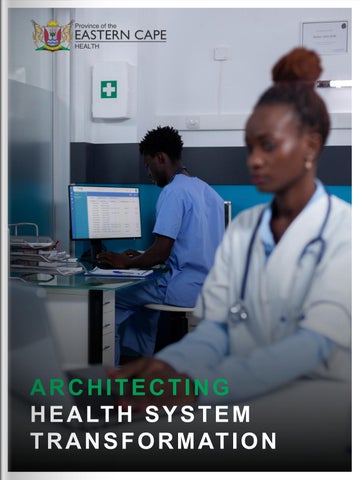
ARCHITECTING H E A LT H S Y S T E M T R A N S F O R M AT I O N
ARCHITECTING H E A LT H S Y S T E M T R A N S F O R M AT I O N How do you transform one of South Africa’s most complex provincial health systems under severe fiscal and operational constraints? Dr Rolene Wagner, Head of Department, reflects on five years of institutional reform inside the Eastern Cape Department of Health – and the thousands of public servants who built it Writer: Dr Rolene Wagner, Head of Department, Eastern Cape Department of Health Project Manager: Ben Weaver
W
hen I accepted the responsibility of leading the Eastern Cape Department of Health (ECDH) in 2021, my ambition extended beyond improving annual performance indicators. Lasting public value comes not from isolated projects, but from institutions that grow stronger and more resilient regardless of who occupies leadership positions. The transformation agenda we built was therefore deliberately systemic: governance reform, financial sustainability, infrastructure renewal, workforce stabilisation, and digital innovation, integrated into one programme rather than pursued as disconnected initiatives. Better governance would improve financial discipline; improved finances would fund people and infrastructure; modern infrastructure would support better clinical outcomes – each reinforcing the next. That conviction was tested directly. 2 | Africa Outlook Issue 122
Between October 2023 and August 2024, I was moved out of the Department for close to a year, seconded to a provincial support unit in the Office of the Premier, where I worked on cross-government interventions including the education turnaround and scholar transport reform. Away from ECDH, the continuity we had spent two years building faltered, and accruals and payables grew significantly by an additional ZAR1.5 billion, putting pressure on the provision of basic supplies like surgical consumables and medicines. Additionally, from leaving in a position where we were able to employ staff, there was now a deficit of ZAR900 million to pay staff salaries and benefits. I returned in August 2024 after the National Treasury, National Department of Health (NDH), and Office of the Premier convened to address the deterioration directly.
I raise this not to relitigate a difficult year, but because it makes the point of this article better than I can. It was never about any one person occupying this office; it was about whether the institutions we were building could hold without them. For 10 months, that question had a real, measurable answer. What follows is not a catalogue of achievements, but a reflection on institutional transformation in one of South Africa’s largest, most fiscally constrained health systems.
EASTERN CAPE DEPARTMENT OF HEALTH HEALTHCARE
But, before turning to what was built, it is worth pausing on who built it. Institutions that Outlast Individuals Every figure in this article – every rand recovered, every audit finding cleared, every appointment made – is a proxy for something else: thousands
of people choosing, every day, to show up. ECDH spans 777 clinics, more than 90 hospitals, 85 emergency medical services (EMS) bases, and nine districts across some of the most demanding terrain in the country. No single leader runs a system that size. It is run by doctors and nurses treating patients through unreliable water and power; by pharmacists, therapists, community health workers, and emergency personnel reaching patients other systems cannot; by administrators, finance, and supply chain officials keeping a multibillion-rand department moving; and by cleaners, security officers, and maintenance teams whose work
never appears in an annual report but without which no hospital functions at all. The results that follow are not a personal scorecard; they are what became possible when thousands of public servants, many working in extraordinarily difficult circumstances, stayed committed to a shared purpose for five straight years. My role has been to build the governance and financial conditions in which that commitment could translate into outcomes. The credit for the outcomes belongs to the people who deliver the care. Africa Outlook Issue 122 | 3
EASTERN CAPE DEPARTMENT OF HEALTH HEALTHCARE
BUILDING THE FOUNDATIONS OF A MODERN PUBLIC HEALTH SYSTEM When I assumed office as Accounting Officer in 2021/22, the Department faced a defining moment. The COVID-19 pandemic had redirected infrastructure programmes towards emergency response, backlogs had accumulated, and fiscal pressure had intensified – just as demand for modern, equitable healthcare facilities had never been greater. We repositioned infrastructure as a long-term investment rather than a collection of construction projects. Expenditure rose to approximately ZAR1.09 billion in 2021/22 alone, resuming hospital revitalisation, critical maintenance, equipment replacement, and stalled COVID-19 capital projects. By 2022/23, ECDH had completed every statutory infrastructure planning instrument and prepared 111 Project Initiation Reports – well beyond target – building one of the most comprehensive infrastructure pipelines in ECDH’s history. That planning translated into delivery. Six major hospital developments advanced, including Greenville and St Elizabeth, alongside new and replacement primary healthcare facilities across several districts. Khutsong and Siphethu Hospitals achieved targeted upgrades; five further hospitals were refurbished, with parallel investment in water, sanitation, power, lifts, and mortuaries addressing years of deferred maintenance. By 2023/24, 10 major projects were under construction and eight had been completed, spanning seven districts at once. Facilities matter beyond clinical function, too: a ZAR33 million clean-up programme reached 80 facilities, and a ZAR82.9 million security upgrade – fencing, guardhouses, lighting – reached 29 more. 4 | Africa Outlook Issue 122
The International Labour Organisation’s preliminary assessment has already found measurable improvements in workplace safety at participating sites. Specialised care has grown alongside general infrastructure. A linear accelerator and dedicated radiotherapy bunker at Nelson Mandela Academic Hospital, one of the Department’s most significant single investments in this period, will open in October 2026. As climate variability and ageing municipal systems raise the stakes, the infrastructure programme now builds in water security, energy resilience, and lifecycle asset planning as standard, not exception. The most enduring achievement, though, isn’t any single building – it’s
the transformation of infrastructure governance itself: stronger planning systems, deeper technical capability, and a genuine pipeline of future investment. The Health Facility Revitalisation Grant achieved 99.9 percent expenditure in 2022/23 and has sustained that discipline through to 2025/26. None of this was about building more for its own sake; it was about a health system that’s more accessible and better able to meet the needs of the Eastern Cape. Infrastructure isn’t the goal here – it’s the foundation everything else depends on. The Terrain ECDH Builds In Four realities shape every infrastructure decision in the province: • Extreme terrain and roads – In
THE LAST FIVE YEARS AT ECDH – IN NUMBERS • ZAR2+ billion saved in medico-legal settlements over four years, with annual payouts down 60 percent from over ZAR900 million to ZAR340-400 million. • Contingent medico-legal liabilities almost halved from ZAR38 billion to below ZAR20 billion since 2020/21. • An unqualified audit opinion in 2024/25, ending six straight years without one. • Recent confirmation of an unqualified audit opinion for 2025/26, with zero issues of non-compliance. This is ECDH’s sixth unqualified audit opinion confirming credible annual financial statements. • In-year irregular expenditure reduced by 97 percent from ZAR197 million a year to below ZAR6 million. • Around ZAR699 million saved on goods and services over the past two financial years. • 1,700+ posts being filled through a new ZAR415 million recruitment drive, with over 220 doctors and 248 EMS staff already appointed in 2025/26. • 43 facilities live on HMS2, ECDH’s own digital health platform, built in-house with zero licence fees. • 60 percent fewer claims against ECDH since litigation peaked in 2018.
“Every figure in this article – every rand recovered, every audit finding cleared, every appointment made – is a proxy for something else: thousands of people choosing, every day, to show up” – D R R O L E N E WA G N E R , H E A D O F D E P A R T M E N T, E A S T E R N C A P E D E P A R T M E N T O F H E A LT H
deep-rural municipalities like Mbhashe, Alfred Nzo, Joe Gqabi, and O.R. Tambo, unpaved roads become unmotorable in heavy rain, cutting off villages and construction vehicles alike. • Utility backlogs – Rural facilities often need their own boreholes and septic systems simply to secure water, whilst cellular backlogs hamper the digital systems described later in this article. • Century-old buildings – Many rural health outposts still operate from missionary-era structures, forcing expensive rehabilitation of foundations that predate modern healthcare standards. • Staffing resistance – Even a fully
built facility can sit chronically understaffed: clinical staff resist deep-rural postings without safe accommodation, security and schooling for their children. Building Around the Constraints, Not Against Them Rather than wait for roads or municipal grids to catch up, the Department began deploying selfcontained health hubs. The ZAR64million Cebe Clinic in Centane runs on off-grid solar, its own borehole, and septic systems – keeping vaccine cold chains uninterrupted, independent of municipal reliability. The same logic applies to people. Modern project blueprints now
standardise premium, secure on-site accommodation for nurses and doctors alongside the clinical facilities themselves, turning remote postings from a hardship into a viable career step. Centralised electronic medical records, alongside our own HMS2 platform, are closing the information gap that isolation used to guarantee. The lesson for leaders anywhere: resource constraints should never dictate the boundaries of innovation.
RESTORING GOVERNANCE AND PUBLIC CONFIDENCE Institutional transformation begins with governance. Public confidence is earned when organisations Africa Outlook Issue 122 | 5
EASTERN CAPE DEPARTMENT OF HEALTH HEALTHCARE
demonstrate integrity and accountability consistently, not occasionally. Strengthening governance, decision-making, and accountability was one of our earliest priorities. Internal controls were strengthened, governance structures reviewed, and executive oversight extended to strategic programmes, with particular attention to audit readiness, procurement, infrastructure, and contract management. Governance failures, after all, tend to show up eventually as poorer services for patients. The results: an unqualified audit opinion in 2024/25, only ECDH’s fifth since 2000 – following 2002/03, 2015/16, 2016/17 and 2017/18 – and the end of six consecutive years without one. This one landed in the middle of the most fiscally constrained period in the Department’s recent history. ECDH also recently received confirmation that it has obtained an unqualified audit opinion for 2025/26, with zero issues of non-compliance. This is the Department’s sixth unqualified audit opinion confirming credible annual financial statements. Irregular expenditure tells a similar story from a different angle. The historic balance is down more than 95 percent – from ZAR279 million in 2021/22 to below ZAR13 million by 2024/25. In-year irregular expenditure – new instances identified within the reporting year itself – is down 97 percent, from ZAR197 million in 2020/21 to below ZAR6 million a year for the past three years; of every ZAR100 once lost this way, ZAR97 no longer is. Fruitless and wasteful expenditure dropped 81 percent in a single year from ZAR78.7 million to ZAR15.2 million; departmental debt growth slowed accordingly. Accountability, in other words, has become an organisational value, not a box to tick. 6 | Africa Outlook Issue 122
“Buildings, systems, and strategies do not deliver healthcare – people do” – D R R O L E N E WA G N E R , H E A D O F D E P A R T M E N T, E A S T E R N C A P E D E P A R T M E N T O F H E A LT H
Remaining Challenges and the Period Ahead The focus now is supply chain management reform – procurement tracking, e-quotations, and e-tendering – and rebuilding HR capacity through training. A clean audit within five years will require further digital investment; ECDH is working with the National Treasury, Provincial Treasury, and NDH on a reform and investment plan intended to position the Eastern Cape as a model of multi-level collaboration for national health sector reform. Two developments show the work becoming institutional rather than project-based. The Provincial Occupational Health and Safety
Forum was reactivated on 16th July 2026, with a multilateral structure for organised labour launching 28th July – a formal channel to resolve concerns and improve working conditions before they become industrial action. From 8th-10th July, a joint workshop with both treasuries, the NDH, and the Department of Justice and Constitutional Development (DJCD) worked through ECDH’s two highest-priority reforms: debt restructuring and continued medicolegal reform.
STRENGTHENING FINANCIAL STEWARDSHIP Leading a public health system under sustained fiscal constraint demands
EASTERN CAPE DEPARTMENT OF HEALTH HEALTHCARE
Quality Healthcare Supplies You Can Trust
Medical Supplies Jasuki Enterprise is a supplier of hospital linen, blankets, patient, nurses and doctors clothing, and medical and surgical consumables to government and privately owned entities. Jasuki is currently contracted to supply the Eastern Cape Department of Health.
Ph: 082 851 6248 E: chico@jasuki.co.za W: www.jasuki.co.za
PLUMBING, CONSTRUCTION, AND MAINTENANCE Bowitorque (Pty) Ltd is a proudly family-owned South African company providing trusted construction, maintenance, and infrastructure solutions. We specialise in plumbing, electrical services, roofing, carpentry, waterproofing, renovations, and general facility maintenance, with extensive experience in the healthcare sector. For more than a decade, we have supported the Eastern Cape Department of Health, helping keep healthcare facilities safe, functional, and operational. Guided by trust, integrity, and quality workmanship, we build resilient facilities and lasting client partnerships. Call: 041 371 1104 ( Office ) Cell: 071 889 8500 ( Nigel Marsh ) 071 889 8501 ( Surekha Marsh ) Email: surekha@bowitorque.co.za Website: www.bowitorqueservices.co.za Facebook: Bowitorque Services
Africa Outlook Issue 122 | 7
disciplined management has protected infrastructure spending and investment through some of ECDH’s most constrained years.
INVESTING IN THE PEOPLE WHO DELIVER CARE Resolving it, alongside medico-legal reform, is one of two priorities identified as central to long-term sustainability.
difficult choices. Sustainability isn’t just about spending less; it’s about protecting frontline services whilst making every rand go further. Financial Discipline in Practice The results are concrete: ZAR849 million saved on goods and services over two years, debt growth roughly halved from 31 percent to 16 percent, and a further ZAR200 million recovered from accruals and payables, redirected to frontline care rather than lost to inefficiency. None of this was free. Strict controls on employee compensation kept that budget line on target, but at the cost of a net staff reduction in 2024/25 and 2025/26, the trade-off the recruitment drive later in this article exists to reverse. Accruals and payables remain a structural risk, not an administrative footnote: unpaid bills in one year mean less for medicines, maintenance, and equipment the next, and can push the Department towards paying suppliers late. 8 | Africa Outlook Issue 122
Medico-Legal Reform: Stopping the Financial Bleeding Few reforms link governance, finance, and patient care as clearly. ECDH now spends roughly 40 cents for every rand it once spent settling medicolegal claims – annual payouts are down from more than ZAR900 million in 2020/21 to ZAR340–400 million a year, cumulatively saving more than ZAR2 billion. Contingent liabilities have nearly halved from ZAR38 billion to below R20 billion since 2020/21. New claims are down 60 percent since their 2018 peak, supported by parallel investment in safer pregnancy and childbirth care and declining maternal mortality. This is not only a financial reform. In March 2026, ECDH appealed to the Constitutional Court of South Africa to uphold the Griffiths judgment, which allows the public system to provide future medical care to successful claimants directly rather than through lump-sum settlements, protecting the services on which 6.5 million Eastern Cape residents depend whilst still honouring what claimants are owed. The Department’s own e-liability system, built into HMS2, now makes that case management auditable rather than paper-based. Financial sustainability remains a journey, not a destination, but
Health systems are ultimately built by people. Buildings, technology, and equipment create opportunity; healthcare professionals turn that opportunity into outcomes. Workforce stability came under real pressure over the past two years: fiscal consolidation and reduced donor funding drove a net staff reduction in 2024/25 and 2025/26, the direct cost of the compensation controls described above. Ministerial intervention followed, refocused on strengthening primary healthcare: eliminating clinics staffed by a single professional nurse and capacitating mobile outreach, community health centres, and hub hospitals. With finances more stable, ZAR415 million has been allocated to appoint more than 1,700 employees, alongside replacing critical staff lost since February. Block advertisements ran in June and again on 17th July 2026 prioritised one-nurse clinics, mobile outreach, and hub hospitals. 220+ doctors and 248 EMS practitioners were appointed in 2025/26 alone – enough to activate 31 additional EMS vehicles – before counting nurses and support staff still being appointed against the wider target. Filling vacancies was never the real goal. The goal is an environment where dedicated public servants are equipped and supported to do the work only people can do.
DIGITAL TRANSFORMATION AS A CATALYST FOR BETTER HEALTHCARE Digital transformation is one of the defining features of a modern health system – and, like infrastructure and
EASTERN CAPE DEPARTMENT OF HEALTH HEALTHCARE
Complex public challenges require leadership that crosses organisational boundaries whilst holding firmly to accountability for results.
LEADERSHIP AS STEWARDSHIP
people, far easier to buy than to build well. The Department chose to build. HMS2, its electronic medical record and hospital management platform, was originally developed at Frere Hospital in 2013 and rolled out provincially within one month of my taking office in August 2021. Five years on, HMS2 runs in 43 facilities, with 20 more in a second phase already under way. Because ECDH owns it outright, there are no third-party licence fees, no recurring costs scaling with every new site, and no vendor dictating the roadmap. Its modules now cover medico-legal case management through e-liability, revenue collection, emergency services, adverse-event reporting, and theatre performance. The platform’s relevance now extends past the province: the Free State has adopted it and, following a Council for Scientific and Industrial Research (CSIR) assessment, at least three more provinces are considering the same. A system built to solve one province’s problem is becoming a candidate for solving the country’s. Electronic procurement is being extended across districts in parallel to strengthen transparency.
DELIVERING BETTER CARE THROUGH SYSTEM INTEGRATION The purpose of every governance reform, infrastructure investment,
and financial decision in this article is the same: a better experience for patients and communities. Primary healthcare, oncology capacity, emergency care, and clinical technology have all advanced together over the past five years – supported by infrastructure, stronger district systems, and closer integration between planning and clinical governance. Transformation in healthcare rarely comes from one intervention; it shows up in a patient triaged faster and treated closer to home by a system whose parts finally talk to one another.
PARTNERSHIPS AS MULTIPLIERS OF PUBLIC VALUE No public institution succeeds in isolation. Partnerships with national government, the Provincial Treasury, implementing agents, academic and research institutions, the private sector, and development partners have extended capability, mobilised expertise, and accelerated delivery across every area of this transformation – infrastructure, digital innovation, workforce, and specialised care. The July 2026 joint reform workshop with both treasuries, the NDH, and DJCD is a recent example: collaborative in design but ultimately answerable to one department for the outcomes it delivers.
Leadership in the public sector is an act of stewardship measured not by the number of projects initiated, but by the strength of the institutions left behind. I do not regard infrastructure, governance, financial management, digital innovation, and workforce reform as separate achievements. Together, they are the architecture of a stronger institution – one better equipped to serve the Eastern Cape despite unprecedented fiscal pressure and persistent structural challenge. The most enduring legacy of any public leader is never a single building, programme, or policy; it is an institution more resilient, accountable, and capable than the one that leader inherited. That has been the purpose of this journey. I did not set out to manage a department; I set out to help build one capable of delivering quality healthcare for generations to come. None of it was mine to build alone, and none of the credit is mine to keep alone. It was carried by the thousands of people this article opened with – the doctors, nurses, pharmacists, community health workers, finance officials, cleaners, and security officers – who chose, every day for five years, to show up. Buildings, systems, and strategies do not deliver healthcare – people do. That has not changed and is the clearest measure of what the Department’s future still depends on.
www.echealth.gov.za
Africa Outlook Issue 122 | 9
www.echealth.gov.za
PRODUCED BY AFRICA OUTLOOK MAGAZINE