INDUSTRY SPOTLIGHT
BUSINESS IN EAST AFRICA
East Africa’s industrial landscape is at the centre of ongoing reforms designed to expedite intra-African trade and unify a stable, competitive and prosperous haven for trade and investment Writer: Phoebe Harper | Project Manager: Matthew Cole-Wilkin
A
s the location of one of the fastest growing economic blocs in the world, East Africa is in a state of flux. Founded in 1967 and headquartered in Arusha, Tanzania, the East African Community (EAC) is the intergovernmental organisation championing the
2 | Africa Outlook issue 90
goal of a prosperous, competitive, secure and politically united East Africa. Of the nine African nations geographically located within the region, six are registered as partner states within the EAC, namely Burundi, Kenya, Rwanda, South Sudan, Tanzania and Uganda.
EAST AFRICAN BUSINESS COUNCIL (EABC)
The above countries are instrumental in implementing the EAC’s vision of a common market and monetary union that will ultimately streamline the movement of goods, labour and services and further strengthen the region as an attractive hub for foreign investment. Home to approximately 177 million citizens primarily centred in urban locations, and with a combined Gross Domestic Product of $193 billion (EAC Statistics 2019), East Africa’s potential as a centre of trade is enormous.
EAST AFRICAN COMMUNITY (EAC) PRIORITIES 2021 • Consolidation of the Single Customs Territory (SCT) • Infrastructure Development • Enhancing free movement of production across Partner States • Enhancement of regional industrial development • Improvement of agricultural productivity and value addition • Promotion of regional peace
As the area undergoes region-wide integration to expedite intra-African trade and facilitate greater market access, East Africa’s infrastructure of transport is a key pillar of reform to achieve this goal, as evidenced by the ongoing construction of the Tanzania Standard Gauge Railway as part of the East African Railway Master Plan. Today, East Africa falls within the African Continental Free Trade Area (AfCFTA), the revolutionary initiative that is reshaping the continent. The largest free trade area in the world, this pact will connect 1.3 billion people across 55 countries with a combined GDP value of $3.4 trillion. By reducing tariffs and technical barriers to trade while implementing stringent regulatory measures, the AfCFTA will revolutionise African markets and economies, strengthening Africa’s position on the global landscape of trade and investment.
IN I NTTRROODDUUCCTTI O I ONN
• Institutional transformation at regional and Partner State levels
Africa Outlook issue 90 | 3
Starting a business can be
In financial year 2019/20, despite the impacts of Covid-19, the OSC
intimidating, from developing
hit 82,000 unique transactions, nearly tripling the target of 30,000
a business plan to formalizing
transactions. We believe that that speaks to the investment climate
the company to marketing the
in the country and the willingness of investors to achieve their
product or service. With so much to
investment objectives.
consider, the Ugandan government has made the process of registering, establishing, and operating a company
Access government Incentives Investors should take advantage of the many incentives available
easier by getting these services closer
in Uganda in order to promote their companies. These incentives
to the people through agencies such as
include, for example, duty-free imports of any factory, machinery,
the Uganda Investment Authority (UIA). UIA promotes
equipment, vehicles, or building materials for an investment project
and facilitates investment in Uganda and works with both domestic
and exemptions on businesses engaged in agro-processing. The
and foreign investors to achieve their investment objectives.
incentives vary depending on the type of investment and the amount invested.
Don’t know where to start? To be formally recognized as a business in Uganda, you need to meet
Access land for investment
a number of government requirements and acquire a government
UIA plans to build 27 serviced industrial and business parks across
license(s). The number of licenses will largely depend on the sector(s)
the country, eight of which are already open, to make it easier for
you wish to invest in.
investors to access land in strategically located adjacent areas. In
If you’re not sure where to begin, visit UIA’s One Stop Business Centre
addition, each park has designated zones for SMEs as a means
for Investors, which was created to make it simple for local and
of assisting investors who fall into this category. Domestic and
foreign investors and entrepreneurs to register, launch, and operate a
international investors who meet a number of criteria may access
business in Uganda.
this land.
The OSC currently hosts 16 government and private sector players in its physical space that provide services which include Investment
Access SME support services
Advisory Services, Company Registration and Intellectual Property
SMEs account for roughly 90% of Uganda’s business population, so
Advisory Services, Citizenship and Immigration Control Services,
it is critical that the environment in which they operate is conducive
Tax Registration and Compliance Advisory Services, Environmental
to their development. UIA assists MSMEs with entrepreneurship
Impact Assessment Certificates, Application and Issuance of
training, hands-on professional skill training for value addition, cluster
Trading License and Application for Building Permits, Banking
growth and business linkages, youth and women apprenticeship
Services and Online Payments, Distinctive Mark Application and
programs, and SME profiling and database development, and
Purchase of Standards, Free Zone Advisory Services, Services of
creation of District Investment Committees (DICs).
Utility Companies, Land Title Verification Services, Tourism and
UIA remains committed to promoting Uganda as the preferred
services to promote employer-employee relations.
investment destination in Africa.
Access the OSC online
Author information
If you can’t make it to the OSC in person, UIA has teamed up with
Lawrence Byensi
NITA-U to provide online access through www.ebiz.go.ug. The
Ag. Director General
award-winning eBiz network has a multilingual call centre on 24/7
Uganda Investment Authority
standby that provides the business community user-friendly and
byensi@ugandainvest.go.ug
EN FOR BUSINESS
T TODAY
faster services.
UIA OFFERS A SEAMLESS JOURNEY FOR INVESTORS
WED Plaza, Plot 22B Lumumba Avenue, Kampala.
anda 336
byensi@ugandaninvest.go.ug info@ugandainvest.go.ug
www.ugandainvest.go.ug | www.ebiz.go.ug
UGANDA UGANDA IS IS OPEN OPEN FOR FOR BUSINESS BUSINESS INVEST INVESTTODAY TODAY
The TheInvestment InvestmentCenter, Center,TWED TWEDPlaza, Plaza,Plot Plot22B 22BLumumba LumumbaAvenue, Avenue,Kampala. Kampala. Uganda UgandaInvestment InvestmentAuthority Authority
Your YourInvestment InvestmentIs IsOurOurBusiness Business
P.O.Box P.O.Box7418, 7418,Kampala, Kampala,Uganda Uganda
info@ugandainvest.go.ug info@ugandainvest.go.ug
+256 +256313 313301 301000 000| |800 800300 300336 336
www.ugandainvest.go.ug www.ugandainvest.go.ug| |www.ebiz.go.ug www.ebiz.go.ug
Africa Outlook issue 90 | 5
INDUSTRY SPOTLIGHT
INTERVIEW: East African Business Council (EABC) As the unified voice safeguarding the interests of the East African Business Community, the former CEO of the East African Business Council, Dr. Peter Mathuki, discusses the challenges and developments of streamlining intra-regional trade
Dr. Peter Mathuki Former CEO of East African Business Council
T
he East African Business Council (EABC) is the apex body of private sector associations and corporates in the East African Community (EAC) region. The Council was formed in 1997 to advocate for a conducive business environment for trade and investment in the (EAC), by tracking progress on agreed commitments within the EAC integration process and providing a public-private dialogue platform at the EAC regional level. The EABC vision is a borderless East Africa for business and investment. EABC organises several high-level public-private dialogues such as the EAC Secretary General Forum with CEOs, East African Business Leaders’ Summit with the EAC Council of Ministers, Regional Dialogue with Trade Facilitation Agencies, Transport & Logistics, Customs & Tax, among others. EABC also undertakes research for evidence-based policy advocacy, provides
6 | Africa Outlook issue 90
advisory services, analysis and market intelligence on regulatory developments in the EAC in a bid to reduce the costs of doing business in the region. In the last three years, under the tenure of Dr. Peter Mathuki, the institution has strengthened its advocacy role, increasing its membership and firming up its role as the voice of the private sector. Dr. Mathuki has since transitioned and is currently the Secretary General of the EAC. Africa Outlook (AO): Can you talk us through the origins of the EABC; how it came about, and its initial vision? Dr. Peter Mathuki (PM): The inception of the East African Business Council in 1997, arose from the need for the EAC governments to consult with the private sector in their quest for a new EAC. It was important for the private sector to have a common voice in the region that would revive optimism and fast track the market Dr.iven benefits of the East Africa Community Integration process. The aforementioned is evidenced from the fact that the EABC, on behalf of the private sector, was actively involved in the development of the treaty for the establishment of the EAC. Dr. Manu Chandaria, Hon. Amb. Juma Mwapachu and the late Prof. James Mulwana founded the East African Business Council and played a key role in the formulation and signing of the treaty establishing the EAC. The EABC is recognised as the champion of private sector interests in the region as clearly shown in the structure of the EAC Consultative Dialogue Framework (CDF) approved by EAC Council of Ministers in 2012. The EABC is a true partner of the EAC regional integration agenda – the engine for social-economic growth in the region.
INTERVIEW
EAST AFRICAN BUSINESS COUNCIL (EABC)
Africa Outlook issue 90 | 7
Africa Outlook issue 90 | 9
INTERVIEW
INDUSTRY SPOTLIGHT
AO: Since inception, how has the East African Business Council developed and progressed in terms of its key objectives and the messages it tries to get across? PM: The observer status, granted at the inception of EABC, made it possible for the organisation to participate in the activities and input into the negotiation process of the treaty, the protocols and other relevant instruments of the EAC. The approval of the EAC Consultative Dialogue Framework by the EAC Council of Ministers in 2012 further provided an opportunity for EABC and other non-state actors to consult the EAC leadership and other stakeholders and to participate in all relevant activities and deliberations at the EAC level. It is with no doubt that a lot has been achieved from influencing and advocating for formulation, implementation or review of various policies at regional level in a bid to improve the business environment and make it conducive for trade and investment in the region. Businesses can now feel the tangible benefits of the EAC integration process arising from the custom union, common market protocols as well as infrastructural developments such as the ‘One Stop Border Posts’ and Standard Gauge Railway. Looking back in 2004, the total intra EAC trade was $1.342 billion while the total EAC exports to the world was $4.182 billion. It is commendable to see that total
10 | Africa Outlook issue 90
“The EABC organised high-level courtesy visits to the EAC Heads of State and urged for intergovernmental trade dispute mechanism, elimination of persistent Non-Tariff Barriers and institutionalising a dialogue mechanism between the EAC Council of Ministers and private sector to inform the Summit of EAC Heads of State”
EAC intra-trade has increased to $5.1 billion in 2015 and total EAC exports to the world to $15.8 billion in 2019 (EAC Trade and Investment Reports). The EABC also identified the 20 most traded goods in the EAC upon which the EABC is based on, to advocate for standards harmonisation. So far over 200 standards have been harmonised. The EABC also advocated for the review of the EAC SQMT Act paving the way for the standardisation,
EAST AFRICAN BUSINESS COUNCIL (EABC)
ETABCO PANAFRICA; based in Kampala Uganda is specialized in Construction Services, where we can join our clients from the design stage till key of the building using most quality building materials and high advanced construction systems to produce a building which can serve for long with minimum cost of maintenance. ETABCO serves your building through a big professional engineering teams and trained skilled labors ETABCO trustable services, building
www.etabcopanafrica.com
Africa Outlook issue 90 | 11
INDUSTRY SPOTLIGHT
INTERVIEW
Accreditation Conformity Assessment (SACA) Bill and further advocated for the enactment of EAC Axle load Act. In Trade in Services Liberalisation: The EABC advocated for delinking the movement of service suppliers (Mode Four from the schedule of Movement of Workers). Partner states have also formulated Regulations for Movement of Services and Service Suppliers. The EABC organised high-level courtesy visits to the EAC Heads of State and urged for intergovernmental trade dispute mechanism, elimination of persistent Non-Tariff Barriers and institutionalising a dialogue mechanism between the EAC Council of Ministers and private sector to inform the Summit of EAC Heads of State. These high-level dialogue mechanisms have enabled EABC to put forward cross-border trade and investment bottlenecks affecting the East African business to the EAC Council of Ministers and Heads of State for quick resolution. The EABC Secretariat, has successfully set up sector-specific desks with experts to respond to the needs of businesses in the region, these include: Trade in Services, Manufacturing, Agriculture, Energy, Infrastructure and SMEs, and also Women in Business.
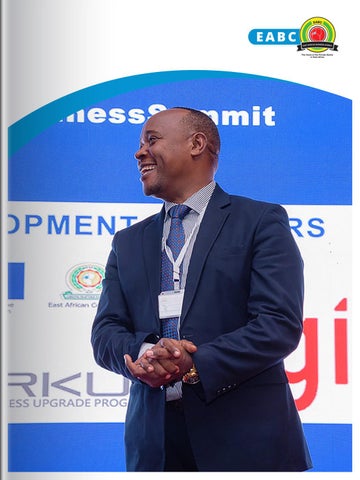
Peter Mathuki accepts the EABC Award 2021
12 | Africa Outlook issue 90
EABC Management team
AO: What did you find most exciting about working in trade and investment within the East African private sector? PM: Delivering tangible benefits to businesses and creating jobs, following our advocacy initiatives was exciting and fulfilling. EABC has actively advocated for issues which have eased trade in the region. For instance, the EABC relentlessly advocated for the harmonisation of a work permit regime in EAC- so far Kenya, Uganda and Rwanda have removed work permit fees for East African nationals and Tanzania has reduced work permit fees for East Africans.
EAST AFRICAN BUSINESS COUNCIL (EABC)
EABC is currently still pushing for abolition of work and residency permit fees for East African nationals. EABC has contributed significantly to the elimination of Non-Tariff Barriers (NTBs) through: • Advocacy - particularly of the establishment of the mechanism for elimination of NTBs in EAC. • Through studies and surveys- EABC has developed several position papers that have influenced policy formulation at EAC level. The EABC developed the Annual EABC Policy Advocacy Agenda highlighting key challenges faced by the private sector and recommendations to boost economic resilience amid the pandemic. The EABC has been pushing for the finalisation of the comprehensive review of the EAC Common External Tariff with the view of building consensus amongst the private sector on the appropriate tariff structure.
Responsible forest management can play a vital role in securing our future by lifting millions out of poverty, creating jobs and building resilient economies and societies that can withstand Climate Change, pandemics like COVID-19, and other global challenges. Buy East Africa, Build East Africa (BEA BEA) by promoting procurement and consumption of Forest Stewardship Council™ (FSCTM) (FSC™ C131488, FSC™ C124444, FSC™ C001823, FSC™ C162788) certified quality (treated, kiln dried) timber and biomass. We also produce quality treated utility wooden poles and charcoal. The New Forests Company (NFC) supports economic empowerment and the building of agency of local Communities through the NFC’s Forests for Prosperity Approach.
E: roland.nkwitsana@newforests.net T: +256 414 581 249
AO: How has COVID-19 affected the EAC? PM: Supply and demand shocks have impacted trade in goods and services in the EAC. In addition, disruption of the global supply chain has negatively impacted the demand of EAC exports. The supply shocks have resulted in shortages of raw materials, capital goods, intermediate goods, and final products which are critical for domestic production. Also, various restrictions instituted by the EAC partner states have negatively impacted the free flow of goods across countries hence a decline in intra-EAC trade. The tourism and hospitality sectors are some of the most adversely affected areas in the region. In the year 2020, EAC Partner States lost approximately $5.4 billion of tourist local spending. The aviation and transport and logistics sectors are also other areas adversely affected. The EABC has been vital in pushing for business and economic resilience of the EAC bloc amid the pandemic by urging for adoption and implementation EAC coordinated approach on COVID-19, called for fiscal incentives to cushion East African businesses, resumption of air transport services and resolved COVID-19 related NTBs at border points. AO: What trends are currently transforming East Africa and how are you responding to them?
By buying FSC™-certified products you help take care of the world’s forests (www.fsc.org). Look for our FSC-certified products. FSC™ C131488, FSC™ C124444, FSC™ C001823, FSC™ C162788
instance, in transport hailing applications such as Uber and online shopping applications. In terms of cross border movement of goods, the region has embraced the Regional Electronic Cargo and Dr.iver Tracking System (RECDTS). RECDTS is designed as a mobile phone application that enables the issuance of the EAC COVID-19 digital certificates that are mutually recognised by partner states, thus eliminating the need for multiple testing as well as contributing to alleviating ongoing congestion at East Africa border crossing points. The African Continental Free Trade Area (AfCFTA) offers a new market of 1.2 billion people. as the fastest growing economic bloc in Africa, the EAC should be at the centre of this transformative agreement.
Tel: +255 27 252 0162 admin@eabc-online.com www.eabc-online.com
PM: East African countries are embracing digitisation in the movement of persons and goods. For Africa Outlook issue 90 | 13
EAST AFRICAN BUSINESS COUNCIL (EABC) 9th Floor, Mafao House, Old Moshi Road, PO BOX 2617 Arusha, Tanzania Tel: +255 27 252 0162 admin@eabc-online.com www.eabc-online.com
PRODUCED BY AFRICA OUTLOOK MAGAZINE