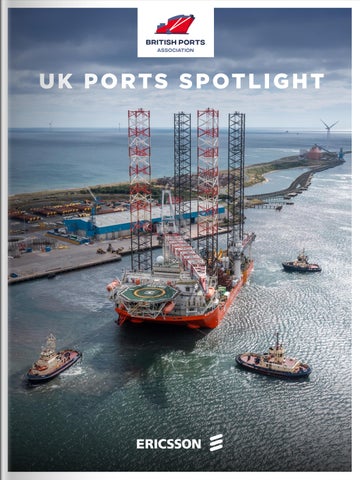
U K P O R T S S P OT L I G H T
UK PORTS S P OT L I G H T UK ports are constantly evolving to meet changing demand, underlining the sector’s resilience and continuing role at the heart of the nation’s trade and supply chains Writer: Jack Salter | Project Manager: Deane Anderton
2 | EME Outlook Issue 73
BRITISH PORTS ASSOCIATION INDUSTRY SPOTLIGHT
T
he UK ports industry has demonstrated remarkable resilience over recent years. Since the COVID-19 pandemic, the sector has continued to adapt to changing global trading patterns, geopolitical uncertainty, inflationary pressures, supply chain disruption, and evolving regulatory requirements. At the same time, ports have become increasingly central to delivering national priorities. Indeed, they are playing an essential role in supporting offshore wind, handling new energy products, facilitating the transition to net zero, and strengthening supply chain resilience. Further, as the UK government looks at national resilience, ports are increasingly seen as vital hubs that can also support military defence and mobilisation. The industry additionally continues to invest at significant levels; since the pandemic, UK port investments have exceeded £1 billion a year on average. Unlike many countries, most UK ports operate commercially without routine government subsidies, reinvesting profits into infrastructure and services. That commercial model has enabled billions of pounds of private investment across the sector, although planning, consenting, grid connections, and wider infrastructure remain challenges that need continued attention. The importance of ongoing investment in port infrastructure is demonstrated by the growth in container traffic at UK ports in 2025, which increased by 10 percent to 66.9 million tonnes (t). This was driven by strong import demand and additional capacity at DP World London Gateway, the UK’s most advanced integrated logistics hub. Overall, UK ports handled 428.3 million t of freight last year – a slight decrease of less than one percent compared to 2024. Despite overall freight volumes remaining broadly stable, significant changes in the types of cargo moving through UK ports reflect wider shifts in trade, energy, and the economy. Whilst consumer traffic increased, liquid bulk traffic fell by two percent due to continued declines in crude oil movements linked to changing North Sea production and refinery activity. Roll-on/roll-off (Ro-Ro) traffic likewise decreased by two percent last year, although it remained the secondlargest cargo category handled by UK ports. Dry bulk traffic also shrank by three percent, continuing longer-term reductions in traditional bulk commodities such as coal and ores. However, the decline in these traditional bulk cargoes reflects structural changes in the wider economy, rather than the performance of the ports themselves. EME Outlook Issue 73 | 3
INTERVIEW:
BRITISH PORTS A S S O C I AT I O N Our latest catch-up with the British Ports Association and CEO, Richard Ballantyne OBE, outlines the strong investment in decarbonisation and infrastructure across UK ports in recent years
4 | EME Outlook Issue 73
BRITISH PORTS ASSOCIATION INDUSTRY SPOTLIGHT
Our aim is to ensure public policy recognises the strategic importance of ports whilst allowing the sector to continue investing and operating on a commercial basis. Unlike other trade organisations, we are open to all and have an inclusive membership approach, accessible outlook, and strong rules on governance and accountability. EO: How does BPA represent the interests of British ports to the UK and international governments? RB: We engage with ministers, parliamentarians, civil servants, and regulators across a wide range of government agencies and departments on behalf of our members, both in Westminster and the devolved assemblies. That includes following transport, trade, energy, planning, environment, border policy, security, marine and fisheries, tourism, and employment issues, reflecting the breadth of activities that ports support. BPA also works closely with the UK government, the devolved administrations in Northern Ireland, Scotland, and Wales and, where appropriate, international organisations and governments on issues affecting maritime trade. We respond to consultations, provide technical expertise, organise industry working groups, and facilitate dialogue between policymakers and the sector.
EME Outlook (EO): We previously featured the British Ports Association in July 2022. Could you reintroduce us to the association and your aims? Richard Ballantyne OBE, CEO (RB): The British Ports Association (BPA) is the national trade association for ports and harbours across the UK and the voice of the ports industry. Our members range from the country’s largest commercial ports handling global trade through to smaller regional ports, passenger gateways, fishing and community harbours, and specialised terminals. Collectively, they are responsible for 88 percent of the UK’s seaborne trade. BPA’s role is to represent the interests of the sector to governments and regulators, provide a forum for collaboration across the industry, and promote the importance of ports to the wider economy. Ports are critical national infrastructure, supporting around 95 percent of the UK’s international trade by volume, facilitating energy security, offshore renewables, manufacturing, fishing, tourism, and regional economic growth.
BPA’S GOALS • Be the voice of the UK’s ports sector to policymakers and beyond. • Dedicate resources to representing a wide variety of UK port interests to government in the UK and internationally. • Provide a resource for its members on legislative and policy issues, as well as a forum for the exchange of knowledge and development of best practices. • Work towards achieving an equitable and transparent ports industry and a level playing field throughout Europe. • Promote the use of ports and shipping as an environmentally sustainable mode of transport.
EME Outlook Issue 73 | 5
Q&A
with Mike Barlow, Regional Sales Director
network will provide flexible and reliable connectivity for the growing network of autonomous transport, video and sensor-driven processes. It will also enable Hamburg Port to test and deploy future digital innovations across the port, creating a scalable blueprint for the next generation of smart port operations. What is the next wave of mobile, and how will it transform ports and drive innovation? A misconception of mobile innovation is that it is defined simply by delivering faster speeds. But connectivity has become the critical platform that automation, AI and operational intelligence is built upon. We increasingly observe this at Ericsson, where the biggest value for our customers often comes from the unplanned use cases that emerge postdeployment.
Firstly, could you please introduce Ericsson, its services and products, mission and vision, and a brief history of the company? Ericsson is the global leader in mobile connectivity, combining creativity, expertise and technology to keep operations moving across people, devices and locations, and supports in resolving some of the most pressing business challenges. This year, Ericsson celebrates 150 years of innovation in communications technology, and there’s plenty of successes to reflect on. The business was founded in 1876 in Sweden, originally supplying telephone equipment to telecommunications companies. After decades of innovating across infrastructure, software and services and increasingly working with enterprises to deploy private cellular connectivity, Ericsson now generates approximately $23 billion in annual revenues. In the UK Ericsson provides network infrastructure for every mobile network – so if you’ve used your mobile today – you have used Ericsson. Our evolving focus on 5G leadership and digital transformation for industries worldwide uniquely positions us to support the next generation of connected industries, including ports.
How is Ericsson advancing its technologies building the digital foundation for modern ports? Ports are constantly under pressure to adapt and accommodate new and growing industries and evolving export and import requirements. For example, the port of Lowestoft is being developed to support the Sizewell C nuclear power station, and in the North East, ports are adapting their infrastructure to handle ultra-heavy offshore wind components. Ensuring connectivity in these situations is difficult. Public mobile networks don’t provide adequate coverage to support scaling operations, and while fibre can work in specific areas, the vast civil engineering works required every time a site changes makes cabling slow, expensive and inflexible. Private 5G changes this dynamic. Instead of waiting months to install new fibre infrastructure, port organisations can quickly and easily provision new SIMs, allowing connectivity to move with operational requirements. For instance, Hamburger Hafen und Logistik AG (HHLA) has chosen Ericsson to provide a private 5G network for one of Europe’s most advanced automated container terminals. The high-performance
Our original project with Port of Tyne provided cellular connectivity for AI-enabled CCTV to monitor PPE compliance on site. This capability then unlocked road surface inspection via vehicle cameras and drone asset inspection in hazardous environments to help keep workers safe. Organisations can also unlock unexpected benefits for customers and the workers themselves in the process of a project – and that’s the mark of real mobile innovation. Our work with Rotterdam Port is a great example of this. By connecting remote-controlled cranes, Rotterdam could remove the physical constraints associated with traditional crane operation, helping to broaden their recruitment base; attract younger workers, women and people who may previously have been excluded because of physical requirements. What would you say sets Ericsson apart from the competition? Ericsson is wholly focused on mobile networking and enabling communications in industrial environments. That said, our differentiation isn’t simply about network performance. Many organisations start by looking through a technology lens, meanwhile Ericsson starts by understanding business’ different operational priorities and outcomes. This means solutions are built which actually benefit enterprise operations and solve real pain points.
Our work with Belfast Harbour demonstrates there’s no “one-size-fitsall” approach to digital transformation. Ericsson originally identified 51 potential private 5G use cases, which were then prioritised into the five most valuable opportunities to build a practical business case. However, even ports owned by the same operator often arrive at completely different priority use cases that unleash the greatest value for each entity. The objective isn’t simply to deploy a network but to create a platform that can continue evolving as new operational requirements emerge. Finally, what is the future of communication and connectivity, and how will it enhance people’s lives? The future is about creating resilient digital platforms that transform how industries operate and how people work and live. Realising that vision starts with dispelling common misconceptions
about Private 5G. The first is that it is simply an extension of public 5G. In reality, organisations operate their own network, and control the spectrum, radios and SIMs to deliver the security, resilience and performance their operations demand. Effectively they become their own localised Mobile Network Operator. The second misconception is that Wi-Fi can deliver the same operational outcomes. While Wi-Fi suits many office environments, operational environments like ports require predictable performance at scale which Wi-Fi simply can’t efficiently achieve. Private 5G enables reliable connectivity across vast industrial environments without the complexity and disruption of deploying hundreds of access points. By providing the digital foundation for automation, AI and real-time decisionmaking, private 5G will help create safer workplaces, more resilient supply chains and smarter, more sustainable industries.
Mobile: +44 7794 920228 Email: mike.barlow@ericsson.com www.ericsson.com
BRITISH PORTS ASSOCIATION INDUSTRY SPOTLIGHT
“ D E C A R B O N I S AT I O N I S O N E O F T H E D E F I N I N G C H A L L E N G E S A N D O P P O R T U N I T I E S FA C I N G T H E P O R T S S E C T O R ” – R I C H A R D B A L L A N T Y N E O B E , C E O , B R I T I S H P O R T S A S S O C I AT I O N
In terms of our wider reach, we have indirect representation at EU and UN/International Maritime Organisation (IMO) level. Also within our network are a number of ports located in the Crown Dependencies and a host of specialist industry advisers, suppliers, and consultancies, adding to the strength of knowledge we provide across our sector. One of our strengths is that we represent ports of every type of ownership model and size. This allows us to present a balanced industry perspective whilst ensuring the needs of different types of ports are understood. We do this for all UK ports, even the handful that are outside BPA. 8 | EME Outlook Issue 73
EO: Can you tell us more about the decarbonisation of British ports and what role BPA plays in this? RB: Decarbonisation is one of the defining challenges and opportunities facing the ports sector. Every port is different, with varying cargoes, business models, and operational requirements, so there is no single pathway to net zero. Many ports are investing in equipment electrification, renewable energy generation, alternative fuels, shore power, and more efficient buildings and vehicles, whilst also enabling the wider energy transition by supporting offshore wind, carbon capture, hydrogen, and other emerging industries.
BRITISH PORTS ASSOCIATION INDUSTRY SPOTLIGHT
From offshore wind and decommissioning to oil and gas and general cargo, Montrose Port is a trusted, strategic hub for the UK’s energy supply chain. As the world’s largest chain and anchor port, we’re helping customers move projects forward efficiently and sustainably. +44 (0)1674 672302 info@montroseport.co.uk www.montroseport.co.uk
Kilkeel Three automated cradles
Complete Vessel Repair and Refit Services Northern Ireland Fishery Harbour Authority is Northern Ireland’s premier vessel repair facility on the east coast, catering for fishing vessels and all classes of work boats – wood, steel and composite hulls, multi hulls and flat bottoms.
Up to 9m beam, 25m OAL and 350T displacement Flat-bottom vessels up to 40m OAL may be accommodated on request. Kilkeel: Tel: 028 4176 2287 Mobile: 075 9278 6138 Email: norman.bridges@nifha.co.uk
We offer a full range of experienced skilled engineering support services available on site and locally.
Portavogie
These include diesel fitting, steel fabrication, shipwrights, hydraulics, electrics/electronics, refrigeration and painting services.
Up to 9m beam, 30m OAL and 570T displacement
We support all types of vessel visits, from cleaning, painting and surveying through to full vessel refits. Licensed vessel dismantling and disposal services are also available by special agreement.
One automated cradle
Portavogie: Tel: 028 4277 1470 Mobile: 077 1207 4609 Email: neil.warnock@nifha.co.uk
EME Outlook Issue 73 | 9
BRITISH PORTS ASSOCIATION INDUSTRY SPOTLIGHT
“ O V E R R E C E N T Y E A R S , W E H AV E S E E N S I G N I F I C A N T S P E N D I N G O N Q U AY I N F R A S T R U C T U R E , D E E P - WAT E R B E R T H S , L O G I S T I C S P A R K S , D I G I TA L T E C H N O L O G I E S , P A S S E N G E R A N D C A R G O H A N D L I N G E Q U I P M E N T, F U E L A N D M A R I T I M E S E R V I C E S , A N D FA C I L I T I E S S U P P O R T I N G O F F S H O R E W I N D A N D OT H E R C L E A N E N E R GY INDUSTRIES” – R I C H A R D B A L L A N T Y N E O B E , C E O , B R I T I S H P O R T S A S S O C I AT I O N
Encouraging our varied types of customers to match the pace has been a challenge and the high electricity prices in the UK puts the ports sector at a competitive disadvantage. BPA works closely with government and industry with the aim of ensuring public policy supports these investments. We facilitate knowledge sharing between ports, engage on funding and regulation, contribute to the development of national decarbonisation strategies, and advocate for practical approaches that recognise commercial realities. We also work to ensure policy reflects the diversity of UK ports, rather than adopting a one-size-fits-all approach.
BPA’S MEMBERS BPA’s members represent a very broad crosssection of the UK port industry, ranging from large cargo handling ports and terminal operators to small leisure ports. Full membership is available to all port authorities and groups, whilst associate membership is available to terminal operators and industry-related organisations. Ports typically fall into one of three types of ownership – privatised, local authority, or trust. All three models are equally open to market forces and run independently as stand-alone, self-financing commercial enterprises, free from systematic government support or subsidies. BPA is an inclusive ports trade association representing its members’ interests, irrespective of ownership, activity, or size.
10 | EME Outlook Issue 73
EO: What developments and investments have there been in ports and logistics infrastructure? RB: Investment across UK ports remains strong. Over recent years, we have seen significant spending on quay infrastructure, deep-water berths, logistics parks, digital technologies, passenger and cargo handling equipment, fuel and maritime services, and facilities supporting offshore wind and other clean energy industries. Many ports are also expanding warehousing and distribution facilities to improve supply chain efficiency and support manufacturing and exports. Investment in automation, digitalisation, and security is helping ports improve productivity whilst maintaining resilience. However, investment decisions increasingly depend on efficient planning processes, timely regulatory decisions, and supporting infrastructure such as road, rail, and electricity networks. Ensuring these wider systems keep pace with private investment is becoming ever more important.
BRITISH PORTS ASSOCIATION INDUSTRY SPOTLIGHT
Telephone: +44 (0)191 262 9614 | Email: headoffice@shepherdoffshore.com www.shepherdoffshore.com
ENERGISING INDUSTRY TO SUPPORT LOCAL, REGIONAL AND GLOBAL BUSINESSES
Neptune Energy Park
Swans Energy Park
The global resource for supply chain professionals and organisations
Offshore Technology Park
Offshore Technology Park Shepherd Offshore is one of the North East’s leading service providers, developers and enablers, operating across more than 200 acres of strategically valuable deepwater and high-value facilities. We enable the co-location, establishment and growth of a thriving, worldclass advanced manufacturing and educational cluster, along with its supply chains, on the banks of the River Tyne. Shepherd Offshore has more than 60 acres of development-ready land available for inward investment and expansion opportunities on
the banks of the River Tyne. With direct access to deep-water quaysides and extensive port infrastructure, we can facilitate co-location opportunities and support the delivery of stateof-the-art facilities tailored to the needs of advanced manufacturing, offshore energy and maritime businesses.
Address: Offshore Technology Park, 1 Rendle Road, Walker, Newcastle upon Tyne, NE6 3NH, United Kingdom
www.supplychain-outlook.com/work-with-us
SUBSCRIBE NOW TO THE DIGITAL MAGAZINE
EO: How do you see the British ports industry developing by the end of the decade?
EO: Lastly, what are BPA’s key priorities in order to continue representing the interests of British ports?
RB: I expect UK ports to become increasingly diversified. Traditional cargo handling will remain fundamental, with a greater focus on unitised activities, but ports will also become major hubs for renewable energy, advanced manufacturing, logistics, offshore maintenance, and lowcarbon fuels. Digital technologies and greater automation will continue to improve efficiency, whilst resilience and security will remain high priorities given the increasingly uncertain global trading environment. The industry will continue investing, but maintaining competitiveness will require proportionate regulation, efficient planning systems, and policies that encourage private investment. If these conditions are in place, UK ports will continue to play a vital role in supporting economic growth and achieving the UK’s wider industrial and environmental ambitions.
RB: Our priorities remain focused on ensuring that ports can continue to invest, compete, and support economic growth. That means working with governments on planning reform, infrastructure investment, border policy, decarbonisation, energy, skills, security, and regulation. We also want to ensure policymakers fully recognise the commercial nature of the UK ports sector and the significant private investment that underpins it. At the same time, we will continue supporting our members through events, training, technical working groups, and opportunities to share best practices. As the industry continues to evolve, BPA’s role in bringing ports together and providing a strong, unified voice will become even more important. Tel: +44(0)20 7260 1780 info@britishports.org.uk news@britishports.org.uk www.britishports.org.uk
EME Outlook Issue 73 | 11
Tel: +44(0)20 7260 1780 info@britishports.org.uk news@britishports.org.uk www.britishports.org.uk
PRODUCED BY EME OUTLOOK MAGAZINE