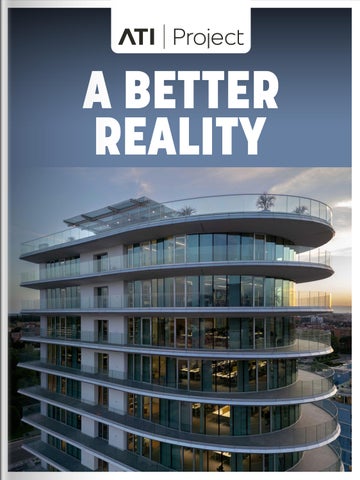
A BETTER REALITY
A BETTER REALITY Putting people and the environment at the centre of architecture and design, ATI Project represents the industry’s fast-moving future. We revisit the company with Branko Zrnic, President, and Giulia Carravieri, Head of International Business Development Writer: Lauren Kania Project Manager: James Melton
We make people and the environment central by embedding sustainability and human needs into the DNA of every project.” This core philosophy underscores the fundamental shift the architecture and construction industry is currently undergoing, driven by rapid technological advances and the growing need to balance innovation with sustainable initiatives. ATI Project not only embodies this transformation but is leading the way in human-focused construction, as highlighted by Giulia Carravieri, Head of International Business Development. 2 | EME Outlook Issue 73
ATI PROJECT CONSTRUCTION
New Turin North Hospital
Since we last featured ATI Project in 2022, the company has undergone a period of intense growth and consolidation. It has established specialised units focused on medical planning, sustainability, comfort, and façade design to strengthen its architecture and engineering backbone, whilst also expanding its footprint in the private sector to complement its public work alongside officially opening a new headquarters inside Pisa’s North Tower in May 2026. With the sector being more dynamic than ever, the firm has observed the entire supply chain shifting towards a more collaborative, integrated model fuelled by rapid 4 | EME Outlook Issue 73
technological advances, which it continuously researches and folds into its design process. “What truly drives us is understanding architecture’s real social impact on people’s lives. Our core challenge today – and our main source of inspiration – is creating spaces that actively promote well-being and inclusion,” states Carravieri. “Tackling modern crises and climate change through sustainable, resilient design gives real purpose to our work as we shape the future of the built environment.” To accomplish these goals, ATI Project’s Sustainability & Comfort team joins at the earliest concept stage, using bioclimatic analysis and whole-lifecycle environmental testing to shape the architecture. At the same time, the company puts people first through datadriven and participatory design. It also goes beyond basic comfort to create spaces that actively support
physical and mental well-being, naturally boosting focus, creativity, and performance.
CUTTING-EDGE INNOVATION Founded in 2011, ATI Project began as a research-driven venture into bioclimatic architecture and renewable energy, developing into an international firm with over 350 team members across eight offices. The company’s headquarters in Pisa and its Milan office cover full-service offerings, whilst collaborating seamlessly with its Belgrade hub, which concentrates on integrated design. “Our work revolves around two core pillars: integrated design – which unites architecture, structural engineering, and mechanical, electrical, and plumbing (MEP) systems – and tender and construction management, covering everything from bid support and value engineering to site supervision,” states Branko Zrnic, President.
ATI PROJECT CONSTRUCTION
CAN YOU TELL US ABOUT YOUR COMMITMENT TO BEING A SPOKESPERSON FOR POSITIVE TRANSFORMATION BY ACTIVATING SHARED GOOD PRACTICES? Giulia Carravieri, Head of International Business Development: “For us, being a spokesperson for positive transformation means turning our experience into something that can be shared, replicated, and continuously improved. We believe that meaningful change happens when knowledge moves beyond individual projects and becomes part of a wider culture of collaboration.
“What truly drives us is understanding architecture’s real social impact on people’s lives. Our core challenge today – and our main source of inspiration – is creating spaces that actively promote well-being and inclusion” – G I U L I A C A R R AV I E R I , H E A D O F I N T E R N AT I O N A L B U S I N E S S D E V E L O P M E N T, AT I P R O J E C T
“We operate natively in building information modelling (BIM), effortlessly aligning specialised disciplines. Supporting this entire ecosystem is our internal Research & Development (R&D) department, which builds proprietary tech tools to continuously refine quality and speed up delivery timelines.” This setup provides the studio with the credibility to work across both the public and private sectors. Beyond its core strengths in healthcare, education, residential projects, and heritage restoration, the practice is actively expanding into high-growth sectors such as hospitality, infrastructure, sports
venues, data centres, logistics, and industrial facilities. “What really sets ATI Project apart is how we balance cutting-edge scientific innovation with a deeply human-centred culture,” Zrnic enthuses. On the one side, the company’s heavy, ongoing investment in R&D turns its research team into a strategic engine, keeping it ahead of industry shifts and driving project development. On the other, ATI Project firmly believes excellence starts with people; it nurtures its team through internal career pathways, fostering a work culture where everyone can thrive.
“As an international practice, we have the opportunity - and the responsibility – to connect different perspectives, expertise, and ways of working across countries and disciplines. Through dedicated training, workshops, and our R&D activities, we actively share knowledge across our teams, transforming lessons learnt and innovative approaches into common practices that can benefit every project. “But this commitment also extends beyond our own organisation. Through collaboration with clients, partners, and the wider industry, we aim to contribute to a more responsible and forwardlooking built environment, where innovation and sustainability are not isolated ambitions, but shared practices capable of generating lasting positive impact.”
ATI PROJECT CONSTRUCTION
North Tower
6 | EME Outlook Issue 73
EME Outlook Issue 73 | 7
ATI PROJECT CONSTRUCTION
CAN YOU EXPAND UPON THE SUSTAINABLE INITIATIVES ATI PROJECT ENGAGES IN AND THEIR IMPACT? Branko Zrnic, President: “For us, social responsibility is a natural extension of our core values into the community. We turn this mindset into real action by partnering with organisations like ‘i Bambini delle Fate’ to support social inclusion initiatives for persons with disabilities. “Alongside this, our ‘Support a Child’ initiative with ActionAid sustains children in underserved regions in the name of each ATI Fellows member, which counts more than 80 persons – providing access to education, healthcare, and nutrition. “Beyond these social initiatives, we have also successfully completed an independent assessment of our environmental, social, and governance (ESG) practices. This external validation recognises our commitment to environmental stewardship, social responsibility, and transparent governance, providing tangible and verifiable evidence of our responsible business practices.”
“That balance of advanced methodology and genuine investment in people defines who we are,” continues Zrnic.
EMBEDDING HUMANITY INTO EVERY PROJECT For ATI Project, utilising a BIM environment allows the company to integrate processes and ensure control of all design phases. “BIM isn’t just modelling software – it’s the foundation where every project takes shape. We’ve broken down traditional silos to connect architects, engineers, and specialists in real time through a single ‘digital brain’. Design becomes a fluid, predictive conversation: clashes are spotted and resolved before construction ever starts, whilst costs and environmental metrics update dynamically as the design evolves,” Zrnic insights. Using a common data environment (CDE), every decision stays transparent, building a digital history that manages the facility long after construction ends. The impact of this approach is observable through ATI Project’s most recent developments, illustrating where the company’s design methodology is heading. Firstly, there is the firm’s North Tower in Pisa, which exists as the city’s first true corporate tower, with the company’s headquarters occupying the top seven floors. “It’s an ambitious urban renewal project that turned an abandoned
“What really sets ATI Project apart is how we balance cutting-edge scientific innovation with a deeply human-centred culture” – B R A N K O Z R N I C , P R E S I D E N T, AT I P R O J E C T
structural skeleton into a vibrant, multidisciplinary hub open to the city. Targeting LEED certification and designed around workplace wellness principles, the building stands as a physical expression of our commitment to sustainability, transparency, and efficiency,” Zrnic details. There’s also the Pisa Training Centre, a major sports infrastructure project that will become the new beating heart of Pisa Sporting Club’s football and administrative activities. Spanning more than 120,000 square metres (sqm), it blends highperformance, eco-friendly design into the local landscape. More than just a state-of-the-art technical facility, it was designed as a community hub where sports, culture, and daily life converge. “Finally, the New Turin North Hospital – a 60,000 sqm cuttingedge medical complex that marks a major milestone for our firm. Building on our international experience with the New Odense University Hospital in Denmark, the New Turin North Hospital is one of our first major projects in Italy to fully reflect our vision for modern healthcare design,” continues Zrnic. Highly sustainable and innovative, this project reconnects the urban and natural surroundings, keeping patient and staff well-being at the heart of every space.
DATA AT THE FOREFRONT As is the case with many industries in the midst of transformation, the architecture and construction sector is being heavily shaped by the emergence of new technology and data. “The conversation in our industry tends to focus on artificial intelligence (AI) as a set of tools. We think the real shift is quieter and deeper: it will be about who owns their data, structures it, and knows how to use it,” Zrnic states. “Everything we design eventually becomes tangible – a hospital, a
ATI PROJECT CONSTRUCTION
Building exclusive content, straight to your inbox.
www.construction-outlook.com/work-with-us
SUBSCRIBE NOW TO THE DIGITAL MAGAZINE
stadium, a tower – but the most valuable asset we generate along the way is intangible: thousands of coordinated models, performance simulations, cost and carbon datasets, and the accumulated experience of hundreds of delivered projects. The practices that treat that as an asset rather than a by-product will set the pace for the next decade; the others will end up renting intelligence from someone else’s platform.” ATI Project recognises that a building today produces information across its entire life, from the first bioclimatic analysis to decades of operational performance, and the party that controls that information controls a large part of the value. Specifically, in Europe, with the EU AI Act now in force, traceable and auditable data governance is shifting from a virtue to a requirement. For clients in healthcare, public
infrastructure, and institutional work, being able to demonstrate where knowledge comes from, how it is handled, and who controls it will become part of the professional offer itself, not a compliance formality. “This is also where we see the clearest distinction of ATI Project in the design sector. We are young enough as a practice to understand what this new element really means, and large enough to meet it with a level of investment, mindset, and scope that smaller studios cannot realistically sustain,” Carravieri details. Since the company has operated natively in BIM from the very beginning, and already has a rich experience in integrating AI into its design processes, it is not starting from scratch but rather building on a proprietary body of structured knowledge that is its own. It’s the same capability that
many international brands are now approaching the studio for because of its ability to bring routine technology adoption and internal data management into sectors that have never had it. “The impact of technology on our sector may prove so disruptive that, in a few years, we will look back at what we said in the summer of 2026 and be struck by everything we did not see coming. That is not an argument for waiting; it is precisely why we keep investing in research,” concludes Zrnic.
Tel: +39 050578460 press@atiproject.it
atiproject.com EME Outlook Issue 73 | 9
Tel: +39 050578460 press@atiproject.it atiproject.com
PRODUCED BY EME OUTLOOK MAGAZINE