D E S I M O N E CÔT E D ’ I VO I R E
w w w. a f r i c a o u t l o o k m a g . c o m
Issue 121
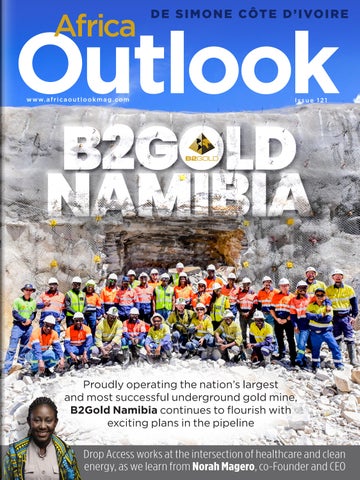
B2GOLD NAMIBIA Proudly operating the nation’s largest and most successful underground gold mine, B2Gold Namibia continues to flourish with exciting plans in the pipeline
Drop Access works at the intersection of healthcare and clean energy, as we learn from Norah Magero, co-Founder and CEO
GLADSTONE AREA WATER BOARD
D E S I M O N E CÔT E D ’ I VO I R E
DERICHEBOURG | RHEINMETALL UK
DIGICEL HAITI
CBRE TURBOCAM
TURNER MINING GROUP
HUNTER VALLEY OPERATIONS
L O S
A N G E L E S
G E N E R A L
End-to-end solutions from exploration to extraction
w w w. a f r i c a o u t l o o k m a g . c o m
Issue 121
B2GOLD NAMIBIA
w w w. a p a c o u t l o o k m a g . c o m
www. northame ricaoutlookmag.com
Issue 81
ALTRAD
w w w. e m e o u t l o o k m a g . c o m
DIGITAL HEALTH ASSOCIATION
Issue 35
PACKSIZE
The pioneering endeavour delivering a new benchmark for golf equipment
On a coal mining mission to champion sustainable practices
Where technology meets tenacity
Transforming waste into valuable resources
VULCAN MOZAMBIQUE
ARGO NATURAL RESOURCES
BUILT FOR THE
GRYDALE
Operator safety through world-class dust management solutions
JOURNEY AHEAD Whether on the road or on the water, Lippert enhances all outdoor recreation adventures
Unearthing coal potential in Australia, Argo Natural Resources champions sustainable mining practices
Panasonic Connect Europe is a vital bridge between the digital and physical worlds. Peer Schumacher, Head of Electronics Manufacturing Solutions, gives his insight
Brendan Tritton, Managing Director and CEO of Valiant Gold, a Western Australian gold company, discusses advancing the restart of two historic mining centres in the Murchison Goldfields
THE 1-2-1 • THE QUESTION • TURBOCAM
THE THOUGHT LEADER
• THE 1-2-1 • THE QUESTION
Phil McKee, Chairman and Founder of Appliance Innovation, explores the company’s approach to automation, driven by a commitment to solving operational challenges in the foodservice sector
CO O P L A N DS B A K E RY • D N AG RA R • B RA K E B U S H
KOLEKTOR CONSTRUCTION
On a mission to be a leading integrated green coal mining operation
M Resources delivers a suite of essential steelmaking raw materials, infrastructure, and mining and logistics services to steelmakers across the globe. Matt Latimore, Founder and President, details the company’s futurefacing approach to investment and market growth
Contributing to a healthier world
Drop Access works at the intersection of healthcare and clean energy, as we learn from Norah Magero, co-Founder and CEO
Thermo Fisher Scientific has reinforced its position as a trusted biologics manufacturing partner
Garry Edwards, VP EMEA at Wolters Kluwer, emphasises the need for formalised, organisation-wide frameworks to ensure responsible use of artificial intelligence
Jason Bontempo, CEO of Gladiator Metals, discusses the resurgence of the Whitehorse Copper Belt in Canada’s historic Yukon mining district
VECA ELECTRIC & TECHNOLOGIES
N O F A R
E N E R G Y
R O M A N I A
K I N G S PA N
Family-run, proudly Canadian
DANONE ROMANIA
w w w. s u p p ly c h a i n - o u t l o o k . c o m
W W W .CONST RUCT ION-OUT L OOK.COM • ISSUE 4
Issue 12
Real Estate Solutions of the Future
www.foodbeverage-outl ook.com
Locked and loaded
Bridging the Real and Virtual Worlds
Enhancing all outdoor recreation adventures
Issue 2
Real estate solutions of the future
Margaret Henry,
VP of Sustainable and Regenerative Agriculture, discusses PepsiCo’s collaborative regenerative farming initiative
From humble potatoes to gourmet crisps, SAVOURSMITHS is transforming snacking with bold flavours and a rich family heritage
LIPPERT
CBRE www.sustainabilityoutlookmag.com
Iss ue 9
SAVOURING THE FLAVOUR OF THE CRISP PARADIGM SHIFT
CBRE’s multidimensional perspective helps businesses find greater success with real estate facilities. John Kirkman, Senior Managing Director and Supply Chain Leader, gives us the full story
LOCKHEED MARTIN
Contributing to the nation’s net zero goals
OUTLOOK
Contributing to a healthier world www.mfg-outlook.com
N O R D I C S
GREEN BUILDING COUNCIL OF AUSTRALIA
OSMOW’S SHAWARMA ISSUE 10
Over the last year, Saulsbury has expanded its position as one of North America’s leading engineering, procurement, and construction contractors
As a subsidiary of Dassault Systèmes, DELMIA is on track to shape the manufacturing industry of the future. We speak to Guillaume Vendroux, CEO Jan Diekmann, Head of Business Development and Manufacturing at Ericsson Enterprise Wireless Solutions, explores how private 5G is transforming the factory floor
Enterprise Wireless Solutions, explores how private 5G is transforming the factory floor Jan Diekmann, Head of Business Development and Manufacturing at Ericsson
Packsize is the global leader in packaging automation. We unbox the company’s right-sized approach with Brian Reinhart, Chief Revenue Officer company’s right-sized approach with Brian Reinhart, Chief Revenue Officer Packsize is the global leader in packaging automation. We unbox the
Johan van Jaarsveld, Managing Director of Montego Pet Nutrition, tells us about the pet care brand’s promise of ‘Better Every Day’ tells us about the pet care brand’s promise of ‘Better Every Day’ Johan van Jaarsveld, Managing Director of Montego Pet Nutrition,
YY Group Holding operates an artificial intelligence-native workforce solutions and integrated facility management platform. CEO, Mike Fu, discusses the company’s established capabilities
Simon Thompson, VP Northern Europe at JAGGAER, explains why artificial intelligence-powered data infrastructure is becoming essential
facility management platform. CEO, Mike Fu, discusses the company’s established capabilities YY Group Holding operates an artificial intelligence-native workforce solutions and integrated
intelligence-powered data infrastructure is becoming essential Simon Thompson, VP Northern Europe at JAGGAER, explains why artificial
procurement, and construction contractors as one of North America’s leading engineering, Over the last year, Saulsbury has expanded its position
We speak to Guillaume Vendroux, CEO track to shape the manufacturing industry of the future. As a subsidiary of Dassault Systèmes, DELMIA is on
and Virtual Worlds Bridging the Real
initiative regenerative farming PepsiCo’s collaborative Agriculture, discusses and Regenerative VP of Sustainable
a rich family heritage with bold flavours and transforming snacking SAVOURSMITHS is to gourmet crisps, From humble potatoes
adventures outdoor recreation Enhancing all
LIPPERT
SHIFT PARADIGM OF THE CRISP THE FLAVOUR SAVOURING
Locked and loaded
MARTIN LOCKHEED
gives us the full story Director and Supply Chain Leader, John Kirkman, Senior Managing success with real estate facilities. helps businesses find greater CBRE’s multidimensional perspective
Margaret Henry,
TELL US YOUR STORY, AND WE’LL TELL THE WORLD the Future Solutions of Real Estate
www.mfg-outlook.com
Modernising and transforming health systems
ARGO NATURAL RESOURCES
FORTERRA
REMONDIS BELGIEN
DANONE ROMANIA
Proudly operating the nation’s largest and most successful underground gold mine, B2Gold Namibia continues to flourish with exciting plans in the pipeline
www.healthcare-outlook.com
www.mining-outlook.com • Issue 16
Every product deserves a box that fits perfectly
Keeping airlines flying to connect the world
C E N T E R
ST. JOSEPH’S HEALTH SYSTEM
Elevating the patient experience
Issue 72
SAESL
One of Australia’s most recognised industrial service providers
M E D I C A L Issue 15
WEIR
www.foodbeverage-outl ook.com
Iss ue 9
Issue 12
healthier world Contributing to a
w w w. s u p p ly c h a i n - o u t l o o k . c o m ISSUE 10
ROMANIA DANONE
Canadian Family-run, proudly
W W W .CONST RUCT ION-OUT L OOK.COM • ISSUE 4
OUTLOOK
www.sustainabilityoutlookmag.com
Issue 2
THE 1-2-1 • THE QUESTION • TURBOCAM
THE THOUGHT LEADER
• THE 1-2-1 • THE QUESTION
CO O P L A N DS B A K E RY • D N AG RA R • B RA K E B U S H
of the future Real estate solutions
CBRE
nation’s net zero goals Contributing to the
AUSTRALIA COUNCIL OF BUILDING GREEN
SHAWARMA OSMOW’S
KOLEKTOR CONSTRUCTION
VECA ELECTRIC & TECHNOLOGIES
N O F A R
E N E R G Y
R O M A N I A
K I N G S PA N
N O R D I C S
Africa Outlook, APAC Outlook, EME Outlook, North America Outlook, Mining Outlook, Healthcare Outlook, Manufacturing Outlook, Supply Chain Outlook, Food & Beverage Outlook, Construction Outlook, and Sustainability Outlook are digital publications aimed at boardroom and hands-on decision-makers, reaching an audience of more than 800,000 people around the world. With original and exclusive content compiled by our experienced editorial team, we look to promote the latest in engaging news, industry trends, and success stories from across the globe. Your company can join the leading industry heavyweights enjoying the free exposure we provide across our platforms with a free marketing brochure, extensive social media saturation, enhanced B2B networking opportunities, and a readymade forum to attract new investment and help you grow your business. Visit www.outpb.com/work-with-us for details on how your company can feature for free in one of our upcoming editions.
www.outpb.com/work-with-us
WELCOME FROM THE EDITOR
EDITORIAL Head of Editorial: Jack Salter jack.salter@outpb.com Deputy Head of Editorial: Lucy Pilgrim lucy.pilgrim@outpb.com
GOLD’S BOLD NEW CHAPTER
Senior Editor: Lily Sawyer lily.sawyer@outpb.com
Welcome to our 121st edition of Africa Outlook magazine.
Editor: Ed Budds ed.budds@outpb.com
The Otjikoto Mine is currently the largest underground gold mining operation in Namibia, located approximately 300 kilometres north of the capital, Windhoek.
Editor: Rachel Carr rachel.carr@outpb.com Copy Editor: Lauren Kania lauren.kania@outpb.com PRODUCTION Art Director: Stephen Giles steve.giles@outpb.com Senior Designer: Devon Collins devon.collins@outpb.com Designer: Louisa Martin louisa.martin@outpb.com Production Manager: Alex James alex.james@outpb.com Digital Marketing Director: Fox Tucker fox.tucker@outpb.com Senior Website Content Manager: Oliver Shrouder oliver.shrouder@outpb.com Social Media Executive: Jake Crickmore jake.crickmore@outpb.com Trainee Digital Content Executive: Tara Steele tara.steele@outpb.com BUSINESS CEO: Ben Weaver ben.weaver@outpb.com Managing Director: James Mitchell james.mitchell@outpb.com Chief Technology Officer: Nick Norris nick.norris@outpb.com Content Director: Neil Perry neil.perry@outpb.com Global Head of Media: Lewis Hammond lewis.hammond@outpb.com Global Media Executive: Kai Boyle-Vennard kai@outpb.com ADMINISTRATION Finance Director: Suzanne Welsh suzanne.welsh@outpb.com Finance Manager: Victoria McAllister victoria.mcallister@outpb.com CONTACT Africa Outlook Norvic House, 29-33 Chapelfield Road Norwich, NR2 1RP, United Kingdom Sales: +44 (0) 1603 804 445 Editorial: +44 (0) 1603 804 431 SUBSCRIPTIONS Tel: +44 (0) 1603 804 431 jack.salter@outpb.com www.africaoutlookmag.com Follow us on Linkedin: @africa-outlook-magazine Follow us on X: @outlookpublish
It is operated by this issue’s cover star, B2Gold Namibia, whose main focus for the next 18 months is the progression of the Antelope Project, a new underground mine currently under development that represents a bold new chapter for the Otjikoto Mine. Indeed, B2Gold Namibia believes the deposit has the seismic potential to change the future of the Otjikoto Mine, representing the next major development of the site. “We look forward to bringing this exciting project online at the end of 2028, when we expect first ore production to begin,” sets out Managing Director, John Roos. From Namibia, our attention turns to the mining landscape in Central and West Africa and the instrumental role Capital Limited (Capital) plays within it. In conversation with Nina Chihambakwe-McKenzie, General Manager, Central and West Africa, we reflect on how the mining industry is evolving across the two regions, why local content is becoming increasingly strategic, and what she believes responsible partnerships between government and industry should look like. “Yes, geology, equipment, and production matter, but what I’ve come to enjoy most are the conversations that happen around a project: about how a mine can create opportunities for local businesses, develop local skills, attract investment, and leave something behind long after the drilling has finished or the mine has reached end of life,” Nina tells us. Staying in West Africa, De Simone Côte d’Ivoire is one of the region’s leading mining construction companies, with nearly three decades of infrastructure solutions expertise. “We leverage our extensive experience in the region and focus on maintaining strong relationships with our clients through transparency and reliable service delivery,” prides Alberto Comazzi, General Manager of Operations. Meanwhile, we strike gold in the African construction, oil and gas, and healthcare sectors with Cementis Group, Altrad Services Africa, and Tygerberg Hospital, respectively – as well as the manufacturing and energy and utilities industries. We hope that you enjoy your read. Jack Salter Head of Editorial, Outlook Publishing Africa Outlook Issue 121 | 3
AFRICA OUTLOOK CONTENTS
I N D U STRY S P OTL I G H T
22 Liquefied Petroleum Gas Association of South Africa
121 | CONTENTS
Encouraging positive energy diversification
REGULARS
6 EXPERT EYE Water resilience for socioeconomic growth
BUS INE SS I N S IG H TS
14
8 Healthcare
14 Construction Whale Tail Wonder
Access for All At the intersection of healthcare and clean energy
Africa’s largest 3D-printed structure
TOP I C A L F O C U S
18 Mining
8
Steel Veins Through the Sahara
156 THE FINAL WORD
A three-kilometre desert marvel
How do you stay ahead of major industry trends?
AFRICA OUTLOOK CONTENTS
F E AT U R E S MINING
38 B2Gold Namibia As Good as Gold Encouraging signs for Namibian mining
66 De Simone Côte d’Ivoire Turning Innovative Solutions into Reality Landmark projects changing the skyline
76 Mining Contracting and Infrastructure Harnessing the Power to Transform Building West Africa’s sustainable future
84 TAU Mining An Open-Cast Colossus Turnkey, industry-driving solutions across the whole spectrum of open-cast mining
CON ST R U C T I ON
92 Cementis Group Cementing a Sustainable Future
H E A LTH C A R E
114 Tygerberg Hospital A Legacy of Care Strengthening South Africa’s healthcare ecosystem
MA N U FAC TU R I N G
124 HESTO Harnesses Driving Innovation for Automotive Excellence Local leadership combined with global expertise
132 Osho Chemical Industries Ltd. Pan-African Dream New markets, new products, same ambition
Building the infrastructure of tomorrow
E N E R GY & U TI L I TI E S
OI L & G AS
50 Years of Clean Water
140 Tecroveer
52 Capital Limited
102 Altrad Services Africa
Restoring confidence in clean water
A Different Perspective on African Mining
Committed to Sustaining Oil and Gas Assets in Africa
148 uMngeni-uThukela Water
Central and West Africa’s evolving mining industry
Ensuring longevity in asset integrity and energy investment
Water security in KwaZulu-Natal
52
76
Leading the Flow
114
92
124
Africa Outlook Issue 121 | 5
Water Resilience Will Shape Africa’s Next Decade of Growth Water is emerging as one of the biggest constraints on Africa’s economic growth. Nirvishee Juggath, Director, Water Management at WSP Africa, explores why the next decade will be defined by water resilience and how governments and businesses are responding through reuse, desalination, integrated infrastructure, and climate adaptation Writer: Nirvishee Juggath, Director, Water Management, WSP Africa
W
ater resilience is becoming fundamental to Africa’s socioeconomic development. It is the ability of communities, businesses, utilities, and governments to anticipate waterrelated pressures, withstand disruption, and adapt to changing conditions whilst maintaining reliable access to water of an appropriate quality. Across the continent, water is increasingly being recognised not only as a public service, but as a strategic asset underpinning industrialisation, health, food security, job creation, climate resilience, and regional stability. 6 | Africa Outlook Issue 121
The central issue is not only scarcity, but how water is planned, managed, treated, distributed, reused, and protected.
THE PRESSURE ON EXISTING SYSTEMS South Africa (SA) illustrates the pressure clearly. It receives less than half the global average annual rainfall and, according to the Department of Water and Sanitation, 98 percent of the country’s available water resources are already allocated. When there is limited spare capacity in the system, resilience depends as much on using
existing water better as it does on developing new sources. Across the continent, longer dry periods are placing pressure on supply, whilst intense rainfall is overwhelming drainage systems, destabilising soils, and damaging infrastructure. Urban growth, industrial demand, and climate uncertainty are increasing the need for systems that can withstand both scarcity and sudden excess. The challenge can be understood through three connected dimensions: availability, quality, and infrastructure performance. Availability is shaped by rainfall variability, drought, competing demand, and the ability to store or access water when it is needed. Quality determines whether available water can be used safely for communities, ecosystems, agriculture, industry, or mining. Infrastructure performance determines whether water can be treated, moved, reused, and managed reliably. Any resilience strategy that treats these issues separately risks solving
EXPERT EYE ENERGY & UTILITIES
one problem while leaving another unresolved.
WHY RESILIENCE NEEDS AN INTEGRATED APPROACH This is why water resilience needs to be approached as a practical systems challenge. The starting point is better information, including robust water balances, water accounting, demand forecasts, asset performance data, and climate-risk insight. These help organisations understand where water is used, lost, or under pressure, and where future risks are most likely to arise. That evidence can support a balanced programme of interventions, including reducing losses, improving network performance, rehabilitating existing assets, strengthening wastewater treatment, enabling reuse where viable, protecting catchments, assessing groundwater resources, and building the operational capacity to manage both drought and flood risk over time. This integrated view is particularly important for sectors central to Africa’s growth and employment. In mining, water risk is connected to licensing, dewatering, groundwater movement, contamination management, closure planning, rehabilitation, and community relationships. In manufacturing, energy, and urban development, it affects reliability, cost, discharge obligations, business continuity, and the long-term viability of new growth. Similar lessons can be drawn from WSP Africa’s work on integrated mine water planning and water conservation programmes in SA and across the continent, where a robust evidence base helps determine whether conservation, reuse, operational improvements, or new supply will deliver the greatest benefit.
There is no single technical solution. Water reuse, desalination, digital monitoring, demand management, groundwater assessment, catchment restoration, and network rehabilitation all have a role to play, but their value depends on local context. Cape Town’s V&A desalination plant, developed during the city’s severe water crisis, shows how alternative supply can supplement stressed systems when planned alongside demand management, network performance, and longterm operational capacity. In Kananga in the Democratic Republic of the Congo, severe erosion caused by heavy rainfall on unstable soils threatened infrastructure and nearby communities, showing how resilience can depend on understanding drainage, land stability, local materials, constructability, and long-term monitoring together. The strongest responses bring disciplines together early, so water decisions are shaped by infrastructure performance, environmental risk, affordability, and long-term resilience at the same time.
THE ECONOMIC CASE FOR ACTION For decision-makers, the economic case is clear. Reducing non-revenue water can improve utility revenues, increase system efficiency, and free up capacity within existing networks. Better wastewater treatment and reuse can support industrial development whilst reducing pressure on freshwater resources. Stronger asset management can extend infrastructure life, whilst better climate and environmental planning can reduce long-term risk and improve investor confidence. The next decade of growth in
Africa will be shaped not only by the infrastructure that is built, but by how resilient that infrastructure is to water risk. Historic assumptions about rainfall, supply, demand, and system performance are no longer enough. Governments and businesses need adaptive approaches that recognise uncertainty and plan for it. Africa’s water challenges will not be resolved through a single technology, asset, or infrastructure programme. Resilience requires integrated planning that understands current and future demand, protects water quality, improves existing systems, diversifies supply where appropriate, and builds the capacity to sustain improvements. Water could become a defining constraint on Africa’s next decade of growth. With better evidence, coordinated planning, and timely investment, it can instead become an enabler of stronger communities, more competitive industries, and more resilient economies.
ABOUT THE EXPERT Nirvishee Juggath is Director, Water Management at WSP Africa, where she leads multidisciplinary water management projects across the mining, industrial, and infrastructure sectors. With more than 24 years of experience, Juggath specialises in water resilience, water security, mine water management, water balances, water conservation and demand management, and integrated water resource planning.
Africa Outlook Issue 121 | 7
Access for All A Kenyan social enterprise, Drop Access develops practical technologies that help underserved and off-grid communities access essential services, from medical refrigeration and vaccine cold chains to food preservation and temperaturecontrolled logistics. We learn about its work at the intersection of healthcare and clean energy with Norah Magero, co-Founder and CEO Writer: Jack Salter
DROP ACCESS HEALTHCARE
Africa Outlook (AO): Firstly, could you outline the mission, vision, and core values of Drop Access? Norah Magero, co-Founder and CEO (NM): We develop practical technologies that help underserved and off-grid communities access essential services, from medical refrigeration and vaccine cold chains to food preservation and temperature-controlled logistics. At Drop Access, our mission is to manufacture and distribute clean energy solutions using flexible payment models, whilst our vision is to provide sustainable clean energy to all underserved communities in Africa. These goals are guided by our core values of innovation, excellence, ecofriendliness, honesty and fairness, and customer centricity. What drives us is a simple belief: where a person lives should not determine whether they can access life-saving healthcare or climate-smart technologies.
We are committed to designing solutions that are reliable, affordable, environmentally responsible, and tailored to the realities of the communities we serve. AO: Drop Access was born out of a deep understanding of the barriers rural populations face, particularly in accessing life-saving vaccines and medicines. Can you explain? NM: The challenge is not only about whether vaccines and medicines are available; it is also about whether they can be stored safely and delivered to the people who need them. In many rural and off-grid communities, health facilities struggle with unreliable electricity, weak cold chain infrastructure, long distances, and difficult transport conditions. As a result, vaccines, insulin, blood products, antibiotics, and other temperature-sensitive medicines often face significant risks before reaching patients. For me personally, this challenge became very real whilst I was living in a rural town and trying to access the right vaccines for my young daughter. Later, during the COVID19 pandemic, the importance of resilient cold chain systems became even more apparent. Before developing our solutions, we spent time listening to nurses, healthcare workers, mothers, health facility
managers, and communities. We wanted to understand the daily realities they faced and design solutions around those realities. That process helped shape Drop Access and our commitment to strengthening last-mile healthcare delivery in underserved areas. AO: The Drop Access journey began with your portable solar-powered refrigerator, Vaccibox. What makes it ideal for vaccine storage and cold chain logistics? NM: Vaccibox was specifically designed to address the challenges of medical cold chain management in remote and resource-constrained environments. It is a portable solar-powered medical refrigerator equipped with integrated lithium batteries and designed to maintain temperatures between two degrees Celsius (°C) and 8°C, which is the recommended storage range for many vaccines. It can be used both for the storage and transportation of vaccines, blood products, insulin, oxytocin, laboratory samples, and other temperature-sensitive medical products. One of the features I am particularly proud of is the integration of real-time monitoring technology. Vaccibox provides data on temperature, battery status, charge levels, location, and inventory, helping healthcare providers maintain visibility and accountability throughout the cold chain.
“What drives us is a simple belief: where a person lives should not determine whether they can access life-saving healthcare or climatesmart technologies” – N O R A H M A G E R O, C O - F O U N D E R A N D C E O, D R O P A C C E S S
Africa Outlook Issue 121 | 9
“Vaccibox was specifically designed to address the challenges of medical cold chain management in remote and resourceconstrained environments” – N O R A H M A G E R O, C O - F O U N D E R A N D C E O, D R O P A C C E S S
Mobility was also central to the design. In many remote communities, bicycles, motorcycles, and boats are often the most practical means of transportation; Vaccibox can be transported using these modes, helping healthcare workers reach 10 | Africa Outlook Issue 121
populations that are otherwise difficult to serve. Ultimately, it was created to make safe and reliable vaccine delivery possible wherever people live, regardless of infrastructure constraints.
AO: What about Koyo, your other solar-powered refrigeration solution for farmers, small to medium-sized enterprises, and households? NM: Koyo extends Drop Access’ clean cooling work beyond healthcare into food security, household resilience, and productive use of energy. Whilst Vaccibox focuses on medical cold chain applications, Koyo is designed to provide reliable solarpowered refrigeration for farmers, small to medium-sized enterprises, and households that may not have access to dependable electricity.
DROP ACCESS HEALTHCARE
Post-harvest losses remain a major challenge across many African communities. Farmers often lose valuable produce because they lack access to cold storage, whilst households and small businesses face similar difficulties preserving food safely. Koyo helps address those challenges by providing clean, reliable
cooling powered by solar energy. We offer Koyo in several different sizes to meet the needs of a wide range of users, from individual households to commercial operators. The broader goal is the same as with all our solutions: improving resilience and creating access to essential services through sustainable technology.
AO: Coolride is Drop Access’ professional cold chain logistics service. How does it ensure safe and reliable transport of temperaturesensitive goods across various industries? NM: Coolride was developed to address a critical gap that extends beyond refrigeration itself: transportation. Even when products are stored correctly, they can still be compromised if they are not transported under controlled conditions. Coolride provides temperaturecontrolled logistics services for vaccines, medicines, laboratory samples, perishable foods, and agricultural products. Africa Outlook Issue 121 | 11
The service combines temperaturecontrolled vehicles, real-time GPS and temperature monitoring, trained personnel, and standardised operating procedures to maintain product integrity throughout the journey. Depending on the use case, we offer transportation solutions that operate at 2°C to 8°C, at -20°C, or under ambient conditions. Our fleet includes cold-box motorcycles for last-mile delivery, and vans fitted with refrigerators. By combining technology, operational discipline, and visibility throughout the supply chain, Coolride helps ensure that temperaturesensitive products arrive safely and reliably at their destination. AO: How does your commitment to local innovation, manufacturing, and community-driven impact set Drop Access apart? NM: One of the things that differentiates Drop Access is that we do not 12 | Africa Outlook Issue 121
start with technology, but with people and the challenges they face. Every solution we develop is informed by conversations with the communities that will ultimately use it. We spent time speaking with healthcare workers, mothers, health facility managers, and community
members to understand their realities before designing Vaccibox and our other products. Local manufacturing is equally important to us. We believe that building solutions locally helps strengthen technical capacity, create jobs, improve after-sales support,
DROP ACCESS HEALTHCARE
and ensure products are adapted to local conditions. It also helps reduce dependence on imported solutions that may not fully address the realities of African communities. At our core, we are committed to local innovation, local manufacturing, and community-driven impact. We want African challenges to be solved by African innovators working alongside the communities they serve.
network of sustainability leaders and organisations committed to solving pressing social and environmental challenges. Another significant development was the enhanced support provided to finalists. The Prize introduced a funding model through which organisational finalists receive USD$100,000 to help advance their work.
AO: How did becoming a finalist for the Health category of the 2026 edition of the Zayed Sustainability Prize help Drop Access grow its projects, credibility and network?
For a growing company like ours, that support can help accelerate deployment, strengthen manufacturing capacity, and expand our reach into underserved communities. Most importantly, the recognition reinforced that locally developed African innovations can play a meaningful role in addressing global healthcare and sustainability challenges.
NM: Being selected as a finalist in the Health category of the 2026 Zayed Sustainability Prize was an important milestone for us. The Prize is one of the world’s leading sustainability awards, attracting thousands of submissions from around the globe. Being recognised amongst the finalists provided strong validation of both our technology and our mission. It increased our visibility among partners, investors, policymakers, healthcare stakeholders, and innovation ecosystems. It also gave us access to a valuable global
AO: Finally, what are your key priorities in order to make essential healthcare and climate-smart innovations accessible to the most underserved communities? NM: Our priority is to continue scaling solutions that make healthcare and climate-smart technologies more accessible,
affordable, and reliable for underserved communities. One important focus area is expanding access to Vaccibox through flexible financing approaches such as lease-to-own and cooling-as-a-service models. We know that affordability remains a barrier for many facilities, and we want to ensure cost does not prevent access to critical cold chain infrastructure. Another key priority is continuing to strengthen quality, compliance, and certification processes as we scale. Achieving international standards is essential for ensuring our solutions can serve more healthcare systems and reach more communities. We are also committed to expanding local manufacturing capacity. My long-term vision is to see advanced HealthTech and CleanTech products fully manufactured within Africa, creating jobs, building expertise, and strengthening local value chains. Finally, we want to continue broadening our impact beyond healthcare alone. Through Vaccibox, Koyo, Coolride, and future innovations, our goal is to build resilient systems that improve healthcare access, strengthen food security, support livelihoods, and help communities adapt to a changing climate. At the end of the day, our mission remains the same: ensuring people in underserved communities have access to the technologies they need to live healthier, safer, and more resilient lives.
dropaccess.org Africa Outlook Issue 121 | 13
THE BEEKMAN GROUP CONSTRUCTION
14 | Africa Outlook Issue 121
WHALE TAIL R E D N
WO
The Beekman Group has introduced Africa’s largest 3D-printed structure at Formosa Bay Resort, a bold new landmark that encourages visitors to stop along the Garden Route Writer: Jack Salter
PHOTOGRAPHY BY THE BEEKMAN GROUP
Africa Outlook Issue 121 | 15
THE BEEKMAN GROUP CONSTRUCTION
T
he 300-kilometre Garden Route along the coast of South Africa (SA) is an iconic tourism corridor and one of the world’s most beautiful stretches of coastline. Now, there’s a new reason for travellers to stop along the route. Towering about the entrance to Formosa Bay Resort in Plettenberg Bay, SA is Africa’s largest 3D-printed structure. The striking Waffling Whale Tail, next to the resort’s iconic Waffling Whale Café, stands approximately five metres high with a unique texture that mimics that of the café’s famous waffles, making this a must-stop landmark for the coastal town. Intended to become a notable landmark on one of SA’s busiest tourism routes, the idea is to attract travellers for a unique selfie opportunity at this fresh roadside attraction that blends hospitality, public art, and local storytelling.
marine life and ocean conservation. The town is also internationally recognised for its Blue Flag beaches, indigenous forests, lagoons, wine farms, restaurants, and adventure experiences. Capturing the spirit of Plattenberg Bay, the Waffling Whale Tail reflects its coastal energy, celebrates its iconic marine life, and complements its tourism offering, whilst giving visitors a reason to stop by. Travellers are increasingly seeking destinations that offer more than just accommodation. Indeed, tourism today is driven by experiences; people want destinations that feel memorable and worth sharing. Attractions such as the Waffling Whale Tail create a stronger connection to a destination and encourage travellers to stop longer and explore more.
THE SPIRIT OF PLETTENBERG BAY
The Waffling Whale Tail design draws directly from one of the region’s most recognisable experiences: the fleeting sight of a whale diving beneath the ocean’s surface during whale season. Its textured finish is inspired by the patterned surface of a Belgian waffle. This ties the structure directly into the adjoining Waffling Whale Café, an award-winning café recognised by Restaurant Guru, where guests can enjoy sweet and savoury whale-shaped waffles, breakfasts, desserts, and signature freak shakes. The base of the installation has also been designed to resemble flowing syrup, creating a playful visual identity that has already proven popular with passing motorists, families, and social media content creators. Beyond the visual impact, the installation strengthens Formosa Bay Resort’s positioning as an experiencedriven Garden Route destination.
Plettenberg Bay is regarded as one of SA’s premier coastal destinations and best-known whale watching spots, with a long-standing connection to
PHOTOGRAPHY BY THE BEEKMAN GROUP
16 | Africa Outlook Issue 121
PLAYFUL VISUAL IDENTITY
Located in the heart of Plettenberg Bay, the resort offers quality coastal accommodation with convenient access to beaches, whale watching, hiking trails, marine safaris, boutique shopping, wine farms, and outdoor activities throughout the region.
RESORT DEVELOPMENT AND MANAGEMENT The structure was developed by Big Ideas 3D Printing for The Beekman Group (Beekman) – one of SA’s leading tourism, hospitality, and leisure property companies, with 55 years of experience developing, operating, and growing hospitality and property assets. A multi-award-winning organisation, the group has received consistent recognition from platforms including the World Travel Awards and KZN Top Business Awards for excellence in tourism, resort operations, sustainability, and employee well-being. Beekman specialises in resort management, vacation ownership, leisure travel services, and residential and commercial property development, creating integrated
THE BEEKMAN GROUP CONSTRUCTION
tourism, business travel, and leisure property offerings across Southern Africa and beyond. At the core of the business is resort development and management; Beekman has built a diverse portfolio of resorts across beach, mountain, and bush destinations, providing flexible holiday options for travellers. Today, it manages more than 30 resorts across five countries, serving over 80,000 members and guests. The group provides comprehensive operational oversight across its portfolio, including guest services, rental programmes, owner and
PHOTOGRAPHY BY THE BEEKMAN GROUP
PHOTOGRAPHY BY THE BEEKMAN GROUP
PHOTOGRAPHY BY THE BEEKMAN GROUP
member relations, and centralised administrative systems that ensure consistent standards and efficient operations. This offering is supported by modern digital platforms and diversified leisure services, including daily rentals, vacation ownership exchanges, and luxury spa experiences. Through its expanding urban hospitality portfolio, Beekman also supports corporate travel, conferencing, and ‘bleisure’ demand, catering to modern businesses, remote professionals, and hybrid workforces. The group
PHOTOGRAPHY BY THE BEEKMAN GROUP
delivers consistent, high-quality accommodation, meetings and events infrastructure, and professional guest services. Beyond hospitality, Beekman develops residential and commercial property assets in key tourism regions, leveraging decades of development expertise to create leisure property investments and destination-driven developments that generate long-term value. The group continues to expand its portfolio to offer more locations, greater flexibility, and new ways for travellers and investors to experience Beekman. Africa Outlook Issue 121 | 17
Steel Vein
S
panning the vast expanse of the Sahara Desert, the Mauritania Iron Ore Train is undoubtedly one of the world’s most extraordinary freight operations, carrying vast quantities of mineral wealth from the country’s remote northern interior towards the Atlantic coast. The railway itself spans more than 700 kilometres (km), connecting the Zouérat region with the port city of Nouadhibou, where iron ore is prepared for export to international markets. The immense freight train extends up to 3 km in length and comprises more than 200 wagons, each laden with up to 84 tonnes (t) of iron ore. Its journey begins in the mineral-rich Tiris Zemmour region of Northern Mauritania, where iron ore is extracted 18 | Africa Outlook Issue 121
from a series of mining sites operated by the Société Nationale Industrielle et Minière (SNIM) – the country’s national mining company. SNIM operates across the iron ore value chain, producing more than 14 million t of iron ore annually – making the railway an essential component of an industrial network that stretches from the mines of Northern Mauritania to the global markets beyond Nouadhibou. Yet, whilst the scale of the train is impressive, its true significance lies in the challenge of operating such an immense freight system across one of the world’s most unforgiving environments – a feat of engineering that has connected Mauritania’s mineral resources with the world for more than six decades.
TOPICAL FOCUS MINING
ns Through the Sahara The Mauritania Iron Ore Train is a three-kilometre desert marvel and the world’s longest freight train. We explore the country’s extraordinary desert railway and examine how this engineering feat and tourist spectacle is a core component of Mauritania’s economy Writer: Lily Sawyer
BUILT FOR THE SAHARA
Construction of the single-track railway began in 1963 prior to Mauritania gaining independence, spearheaded by the Société Anonyme des Mines de Fer de Mauritanie (MIFERMA), a European-backed iron ore mining consortium set up to extract rich iron deposits in Northern Mauritania. The state then nationalised mining and rail infrastructure in 1974, placing operations under SNIM. Originally, the track passed through territory in the Western Sahara, then controlled by Spain. However, following regional conflicts in the late 1970s, the 5-km Choum Tunnel was carved through a solid granite ridge to keep the entire line within Mauritanian borders.
TOPICAL FOCUS MINING
ABOUT THE MAURITANIA IRON ORE TRAIN • At 3 km in length, it is the world’s longest freight train. • SNIM attaches a single passenger car to the end of the train, yet thousands choose to ride atop the iron ore wagons as a mode of free transportation. • To pull the heaviest parts of the train, SNIM deploys specialised diesel-electric locomotives manufactured by Electro-Motive Diesel (EMD), featuring advanced desert filtration systems, pulse-jet air filters, and a redesigned underframe to protect the engine components from iron ore dust and sand.
20 | Africa Outlook Issue 121
Built as a single track across shifting sands, maintaining alignment requires precise weight distribution across the steel wagons to prevent derailment – which would prove extremely dangerous due to the isolated geography of much of the route. In addition, hyper-arid desert conditions – which routinely exceed 48 degrees Celsius (°C) and drop below freezing at night – paired with constant sandstorms mean active sand mitigation, track clearance, and structural track engineering methods must always be ongoing to keep the line moving. Ultimately, conquering these relentless environmental and geographical obstacles elevates the railway from a mere industrial corridor to a triumph of desert engineering.
ENGINE OF AN ECONOMY
Beyond the railway’s engineering prowess, it is socioeconomically significant as it directly links Mauritania’s mineral wealth to the global economy. The line operates as the country’s primary
TOPICAL FOCUS MINING
socioeconomic lifeline, transforming the isolated Sahara Desert into an interconnected industrial corridor. Indeed, the 704-km, single-track railway does far more than simply haul raw minerals; it serves as a critical engine for regional development, job creation, and communal survival. For remote desert communities, the train is a vital humanitarian link which local traders, families, and merchants rely upon to transport essential food, water, building materials, and livestock across otherwise impossible landscapes. In addition, an affordable passenger car at the rear, along with improvised transit options atop the ore wagons, offers a way out of complete geographical isolation for local people, bridging the gap between remote mining towns and coastal markets. SNIM, by way of the iron ore train, is responsible for nine percent of national GDP, 14 percent of state budget revenue, and 37 percent of total exports according to the state-owned entity’s latest official data, reflecting its role as Mauritania’s economic backbone.
DESERT SPECTACLE
The railway’s sheer scale has transformed it into a global spectacle in recent years, capturing the imagination of international travellers, photographers, and filmmakers alike. Drawn by the immense spectacle of the 3-km train cutting through endless desert dunes, adventure tourists are now flocking to the Sahara to witness this industrial marvel. For visitors, riding atop the open ore wagons is a thrilling, bucket-list-worthy challenge – an unforgettable encounter with the raw elements of the desert. However, whilst travellers seek the adrenaline rush of an extraordinary journey, for local communities, the train is an instrument of survival rather than an attraction. Indeed, this piece of critical infrastructure connects families, supplies local markets, and sustains Mauritania’s financial independence. Ultimately, this juxtaposition defines the railway – for visitors, it represents an extraordinary journey into the unknown; for Mauritanians, it is an economic lifeline.
Africa Outlook Issue 121 | 21
SOUTH AFRICAN LIQUEFIED PETROLEUM GAS S P OT L I G H T 22 | Africa Outlook Issue 121
LIQUEFIED PETROLEUM GAS ASSOCIATION OF SOUTH AFRICA INDUSTRY SPOTLIGHT
South Africa’s liquefied petroleum gas industry is enacting positive change across the country, paving the way for equitable access to affordable energy, meaningfully contributing to green energy solutions, and encouraging energy diversification – bringing significant growth to the landscape Writer: Lucy Pilgrim | Project Manager: Henry Butler
T
he liquefied petroleum gas (LPG) industry in South Africa (SA) is at a pivotal stage as the country seeks to improve energy security, expand energy access, and support lower-carbon energy solutions. LPG is increasingly recognised as a practical energy source that complements electricity whilst contributing to economic growth and environmental objectives. Significant opportunities include growing demand driven by electricity supply challenges, which encourage households and businesses to diversify their energy sources. Government and private-sector efforts to reduce carbon emissions and support a just energy transition also favour greater LPG adoption. In addition, continued investment in import and storage infrastructure is strengthening the security of supply, whilst the sector also presents substantial opportunities for skills development, entrepreneurship, local economic growth, and small to medium-sized enterprises (SMEs). Despite this positive outlook, several challenges continue to limit growth. The ongoing illegal market, which includes non-compliant installations and unsafe practices, undermines consumer confidence and creates unfair competition. As such, there is a growing need for regulatory processes to keep pace with industry developments whilst maintaining high safety standards. Affordability, accessibility, and usage patterns also remain major obstacles, with the upfront cost of appliances and cylinders constraining wider adoption. Elsewhere, the expansion of localised last-mile distribution infrastructure is essential to improve access, particularly in rural and peri-urban communities. Overall, the future of the LPG industry in SA remains highly positive. The opportunities presented by energy diversification, clean cooking, lower-carbon energy solutions, infrastructure expansion, autogas development, and local economic growth are substantial. With continued investment, stronger collaboration, and targeted support, LPG can play a transformative role in SA’s energy future by advancing clean cooking, improving energy resilience, and supporting sustainable economic development. Africa Outlook Issue 121 | 23
INTERVIEW: LIQUEFIED PETROLEUM G A S A S S O C I AT I O N O F SOUTH AFRICA The Liquefied Petroleum Gas Association of South Africa (LPGSA) has played a vital role in the development and advancement of the LPG industry for nearly four decades. Gadibolae Dihlabi, Managing Director, delves deeper into how the association promotes responsible use of LPG, drives compliance with critical public safety legislation, and acts as the unified voice of the sector 24 | Africa Outlook Issue 121
Africa Outlook (AO): Firstly, could you introduce us to the Liquified Petroleum Gas Association of South Africa and outline its founding vision? Gadibolae Dihlabi, Managing Director (GD): Established in 1987 as the Liquefied Petroleum Gas Safety Association of Southern Africa (LPGSASA), the Liquefied Petroleum Gas Association of South Africa (LPGSA) was founded with a clear mandate: to promote the sustainable growth of the LPG industry through adherence to the highest standards of safety, compliance, and ethical business practices. At a time when the LPG sector was still developing, LPGSA served as the industry’s leading custodian of safety and technical excellence. The association worked closely with industry stakeholders, regulators, and practitioners to
LIQUEFIED PETROLEUM GAS ASSOCIATION OF SOUTH AFRICA INDUSTRY SPOTLIGHT
establish and maintain best-practice standards, ensuring LPG could be adopted as a safe, reliable, and efficient energy source across Southern Africa. Through its unwavering focus on safety, education, compliance, and technical guidance, the organisation helped build confidence in LPG as an energy solution for households, businesses, and industrial users. These foundational principles remain central to the organisation’s mission today. However, as SA’s energy landscape evolved and the role of LPG expanded, the association recognised the need to broaden its focus and respond to emerging industry opportunities and challenges. In 2020, it underwent a strategic rebranding, becoming LPGSA. This reflected not only a name change but also a significant evolution in the association’s mandate and vision. Whilst safety and compliance continue to form the cornerstone of its activities, LPGSA expanded its role to address a wider range of industry priorities, positioning itself as the unified voice of the LPG sector in SA. Today, LPGSA’s mandate extends beyond technical standards and regulatory compliance. The association actively engages in industry advocacy, representing the interests of its members and promoting policies that support the growth and sustainability of the LPG sector. Through constructive engagement with government, regulators, policymakers, and industry partners, LPGSA works to create an enabling environment that encourages investment, innovation, and expanded access to cleaner energy solutions. Stakeholder engagement has become another critical component of the association’s work. LPGSA collaborates with government departments, energy institutions, training bodies, consumer groups, and international organisations to advance the role of LPG in SA’s energy mix. These partnerships are essential in supporting the country’s energy security objectives, reducing reliance on traditional fuels, and promoting cleaner, more efficient cooking and heating solutions. Recognising the significant potential of LPG as a transition fuel, LPGSA has also intensified its efforts to stimulate market growth and consumer adoption. The association actively promotes LPG as an affordable, accessible, and cleaner household energy source, particularly for communities seeking alternatives to biomass, coal, and increasingly constrained electricity supplies. Through targeted awareness campaigns, public education initiatives, and demonstration projects, LPGSA continues to showcase the economic, environmental, and health benefits of LPG. Central to this mission is the association’s commitment to safety awareness, education, and skills development.
“ B Y B A L A N C I N G S A F E T Y, A D V O C A C Y, M A R K E T D E V E L O P M E N T, S TA K E H O L D E R E N G A G E M E N T, A N D E D U C AT I O N , T H E A S S O C I AT I O N C O N T I N U E S TO CHAMPION LPG AS A CRITICAL CONTRIBUTOR TO THE COUNTRY’S CLEAN ENERGY TRANSITION, ECONOMIC D E V E L O P M E N T, A N D E N E R G Y SECURITY OBJECTIVES” – GADIBOLAE DIHLABI, MANAGING DIRECTOR, L I Q U E F I E D P E T R O L E U M G A S A S S O C I AT I O N O F S O U T H AFRICA
LPGSA develops and delivers leading training programmes for installers, practitioners, and industry professionals whilst also educating consumers on the safe handling and use of LPG. By fostering a culture of safety and accountability, the association ensures industry growth is underpinned by competence, compliance, and public confidence. As SA pursues a more diverse and resilient energy future, LPGSA remains committed to its founding vision of promoting the responsible growth of the LPG industry. By balancing safety, advocacy, market development, stakeholder engagement, and education, the association continues to champion LPG as a critical contributor to the country’s clean energy transition, economic development, and energy security objectives. AO: In your opinion, how has the association remained a cornerstone of the industry’s development as it has evolved over the last 40 years? GD: Over the past four decades, SA’s LPG industry has undergone a remarkable transformation. What was once a relatively niche energy source, primarily serving limited domestic and industrial applications, has evolved into a strategically important sector that contributes to energy security, economic development, and the country’s transition towards cleaner energy solutions. Throughout this evolution, LPGSA has remained at the forefront of industry development, adapting its role to meet changing market needs whilst maintaining an unwavering commitment to safety, compliance, and industry excellence. Africa Outlook Issue 121 | 25
Life Made ‘Easi’ – 40 years of safe and reliable LPGas solutions Easigas is a leading supplier of liquefied petroleum gas (LPGas) in Southern Africa, with over 40 years of experience in the industry. The company makes life and doing business easi by offering a dependable and secure energy source through its extensive LPGas supply network, boosting industry efficiency LEADING THE WAY In 2016, a merger between the company and Reatile Gaz successfully positioned Easigas as the leading LPGas business in Southern Africa. Its operation delivers LPGas solutions that are transforming the energy sector and empowering Africa’s industries. Today, Easigas stands as a level 1 BBBEE company that’s 55 percent owned by Rubis Group, a Frenchlisted company that specialises in storage terminals and petroleum distribution; and 45 percent owned by Reatile Gaz, controlled and managed by Reatile Group. The Reatile Group is a Black-owned and managed company with diverse interests in the Southern African energy sector.
Easigas keeps businesses operating at optimal levels by providing a steady flow of energy at a great price and has meticulously created a rock-solid reputation over the years.
WHY LPG AND WHY EASIGAS? Easigas helps businesses in Southern Africa stay ahead in a constantly changing energy landscape. No matter the industry, the company provides a steady source of energy that fuels growth. LPGas boosts efficiency by keeping businesses up and running, safe, and producing at maximum capacity. It remains a fantastic energy choice because it’s versatile, has lower emissions, and offers numerous benefits.
As a cost-effective solution, LPGas has found a home in many households, industrial facilities, and mining operations because of its efficiency as an energy source. LPGas is also one of the most effective ways to reduce dependency on electricity.
RELIABLE SOLUTION Easigas is a reliable solution for domestic, commercial, and industrial energy needs. From households to big industries, count on the company’s LPGas for a range of indoor and outdoor applications that make life easier. The answer to safe, efficient, and cost-effective energy is here. Available in a variety of sizes, Easigas’ LPGas cylinders are distributed through its widespread network of resellers in every province of South Africa, as well as in Botswana, Lesotho, and Eswatini. An approved LPGas installer must carry out the installation and maintenance of LPGas appliances. LPGas in the home is used primarily for cooking, water heating, and space heating, and its portable nature makes it possible to use it in any location. Over time, LPGas appliances have grown in popularity, coupled with an understanding that it is a cost-effective, energy-efficient, and environmentally friendly way to provide the home with reliable energy, not only during power outages but in everyday applications. From cooking with gas on the stove to a braai stand, geyser, or heater, LPGas has a place in every room in the home, bringing the efficiency of this exceptional energy to you and your loved ones.
PRIORITISING SAFETY Safety for its customers is the top priority at Easigas. The company takes the management of health and safety extremely seriously, with an overarching goal to cause no harm to people or the environment. As such, Easigas remains committed to promoting the best practices in the industry and maintains a management system that follows the international standard of ISO 9001:2015. Dedicated to going above and beyond to follow the highest safety standards, even exceeding local regulations by implementing extra stringent measures, raising awareness, and providing additional training for staff, Easigas seeks to enhance the work environment and reduce occupational risks, ensuring it meets all legal and regulatory requirements. Every installation is completed according to the highest possible standards. These protocols are carried out under the close guidance of trained safety personnel, and in accordance with its customers’ specific industrial requirements.
VISION To drive Southern Africa’s shift to safer, cleaner, reliable, and more sustainable energy by working alongside trusted partners to power businesses, uplift communities, and drive longterm growth whilst limiting impact on the environment for future generations.
VALUES At Easigas, the company takes ownership of its actions, leads with integrity, and treats every person with respect. It embraces bold ideas and creativity, pursues excellence in everything it does, and is uncompromising about safety to protect its people, customers, and communities.
MISSION STATEMENT Easigas delivers safer, cleaner, reliable, and more affordable energy solutions across Southern Africa, empowering households, businesses, and industries while driving economic growth, supporting livelihoods, and improving everyday life.
For more information visit www.easigas.com or Contact 0800 001 504
LIQUEFIED PETROLEUM GAS ASSOCIATION OF SOUTH AFRICA INDUSTRY SPOTLIGHT
In its early years, the association operated largely as a technical and operational safety-focused organisation, undertaking responsibilities that included governmentmandated verification and permitting of LPG equipment, appliances, and cylinders. LPGSA played a critical role in establishing safety systems and compliance frameworks that enabled the industry to develop responsibly and gain public confidence. During this period, the association became the custodian of industry best practices, ensuring that LPG installations, cylinders, and equipment met the rigorous standards required to protect consumers and businesses alike. As the industry expanded, so too did LPGSA’s role. Recognising the growing need for skilled professionals, the association invested significantly in training and skills development. It developed comprehensive training programmes that support the certification and competency of LPG practitioners across residential, commercial, industrial, and autogas applications. Today, these programmes continue to contribute to a highly skilled workforce underpinning the safe and sustainable growth of the sector. LPGSA has also become an influential voice in shaping the regulatory and standards landscape of the industry. The association actively participates in the development and review of national standards, regulations, and
28 | Africa Outlook Issue 121
technical specifications, working closely with government departments, regulatory authorities, and standards-setting bodies. This collaboration ensures SA’s LPG regulatory framework remains aligned with international best practices whilst addressing local market conditions and safety requirements. Beyond safety and compliance, LPGSA has increasingly focused on driving industry growth and supporting national development priorities. The association plays a key role in supporting government initiatives aimed at expanding the use of LPG, including the implementation of strategic programmes such as the Liquefied Petroleum Gas Rollout Strategy and SA’s Closing the Clean Cooking Gap roadmap. These initiatives seek to improve access to cleaner, more reliable energy, particularly for households and communities that continue to rely on traditional fuels such as wood, coal, and paraffin. The association’s contribution extends to broader environmental and social objectives. By promoting LPG as a cleaner-burning fuel, LPGSA supports efforts to improve air quality, reduce harmful emissions, and address pollution-related health concerns. The organisation actively advocates for LPG’s role as a practical and immediately deployable solution in SA’s energy transition, offering significant benefits for both urban and rural communities.
Importantly, LPGSA recognises that industry growth must deliver tangible socioeconomic benefits. The association is actively involved in initiatives that support small business development, entrepreneurship, and job creation across the LPG value chain. Through training, mentorship, enterprise development programmes, and stakeholder partnerships, LPGSA contributes to building a more inclusive industry that creates opportunities for emerging businesses and skilled professionals. As SA continues to navigate complex energy challenges, LPGSA remains a trusted industry leader and strategic partner in the country’s development journey. From its origins as a safety-focused technical body to its current role as a multifaceted industry association, LPGSA has consistently evolved alongside the sector it serves. Its continued leadership in safety, skills development, advocacy, standards development, environmental stewardship, and socioeconomic transformation ensures that it remains a cornerstone of the LPG industry’s growth and success, both now and into the future.
AO: Can you outline how the association promotes the safe, sustainable, and responsible use of LPG across the South African industry landscape? GD: Promoting the safe, sustainable, and responsible use of LPG is at the core of LPGSA’s mandate. As the representative body of SA’s LPG industry, the association employs a multifaceted approach that combines consumer education, industry training, stakeholder engagement, and regulatory support to strengthen safety and compliance across the entire LPG value chain. One of LPGSA’s key initiatives is its consumerfocused awareness programmes, such as the “LPG is Safe” campaign. Through public education, community outreach, digital platforms, and safety awareness, the campaign equips consumers with the knowledge required to use LPG safely in their homes and businesses. These initiatives help build public confidence in LPG whilst promoting the correct handling, storage, and use of LPG cylinders and appliances. Africa Outlook Issue 121 | 29
Recognising the important role entrepreneurs, retailers, and operators play in the industry value chain, LPGSA also delivers targeted programmes such as the “Make LPG Safe for Your Community” workshops. These engagements provide practical guidance on safety, compliance, business operations, and community awareness, helping operators and small businesses become advocates for safe LPG practices within their local communities. LPGSA further supports the broader regulatory environment by providing capacity-building programmes for regulators, inspectors, and law-enforcement agencies. Through technical training, industry guidance, and collaboration with government stakeholders, the association assists authorities in understanding LPG regulations, identifying non-compliant activities, and strengthening enforcement efforts that protect consumers and promote fair industry practices. A critical pillar of LPGSA’s work is industry training and skills development. The association supports the development of competent LPG practitioners through training programmes covering areas such as LPG safety and handling, residential, commercial, and industrial installations, autogas conversions, cylinder refilling operations, tanker maintenance practices, and regulatory compliance. These programmes help ensure that industry personnel possess the knowledge and skills required to operate safely and professionally. Ultimately, LPGSA believes that sustainable industry growth can only be achieved through a strong culture of safety, compliance, and competency. By educating consumers, empowering entrepreneurs, supporting regulators, and developing industry skills, the association continues to advance the responsible use of LPG whilst contributing to SA’s energy security, economic development, and clean energy transition objectives. 30 | Africa Outlook Issue 121
AO: Can you talk us through your member base and how you promote their group interests to both government and industry stakeholders? GD: LPGSA’s membership represents the full LPG value chain, encompassing importers, wholesalers, distributors, cylinder and equipment suppliers, installers, retailers, and technical service providers. Whilst members operate across different segments of the industry, they share a common objective: growing the safe, sustainable, and compliant use of LPG in SA. This alignment enables LPGSA to effectively represent the collective interests of its members on matters such as regulatory developments, national standards, industry transformation, market growth, and safety compliance. As the recognised representative body for the LPG industry, LPGSA works closely with government departments, regulators, standards authorities, and industry stakeholders to ensure that the sector’s views and priorities are appropriately considered in policy and regulatory discussions. The authority facilitates industry forums and committees established under mandates delegated by the Department of Employment and Labour. These platforms bring together industry stakeholders to discuss key issues affecting the sector, including safety, compliance, technical standards, and regulatory implementation. Through these engagements, the industry develops coordinated positions and recommendations that support both regulatory objectives and industry growth. In addition, LPGSA maintains several member-focused committees that address matters relevant to specific segments of the LPG value chain. Where targeted advocacy or representation is required, these committees formulate collective positions that inform the authority’s
LIQUEFIED PETROLEUM GAS ASSOCIATION OF SOUTH AFRICA INDUSTRY SPOTLIGHT
engagement with government, regulatory bodies, and other stakeholders. This structured approach ensures member concerns are accurately represented whilst advancing the broader interests of a safe, compliant, and growing LPG industry. AO: Can you tell us more about the Occupational Health and Safety Act and the importance of this legislation in the LPG industry? GD: The Occupational Health and Safety (OHS) Act is the cornerstone of workplace and public safety legislation in SA. It provides the legal framework for the safe handling, storage, transportation, installation, and use of LPG. The industry is regulated under the OHS Act through the Pressure Equipment Regulations (PER), which establish the requirements for compliance, competency, and safety throughout the LPG value chain. Under these regulations, LPGSA has been mandated by the Department of Employment and Labour to administer several critical industry safety programmes, including: • LPG Cylinder Verification Scheme • Safe Appliance Verification Scheme • The registration, training, and skills development of LPG installers through the South African Qualification and Certification Committee (SAQCC) Gas.
These programmes play a vital role in ensuring that LPG equipment, installations, and practitioners meet the required safety standards and regulatory requirements. Beyond the regulations themselves, the LPG industry is governed by a comprehensive set of national standards, including the South African National Standards (SANS) that prescribes safe practices for LPG storage, distribution, installations, appliances, and cylinder management. Together, the OHS Act, PER, and the applicable SANS standards form the foundation upon which the LPG industry in SA operates. The importance of this legislative framework cannot be overstated. It protects consumers, workers, and communities by ensuring that LPG is handled safely and responsibly. Compliance with these requirements helps prevent accidents, injuries, property damage, and fatalities whilst also promoting professionalism and accountability across the industry. Ultimately, safety is not merely a regulatory obligation – it is fundamental to the sustainability and growth of the LPG sector. A strong compliance culture protects lives, builds public confidence in LPG as a clean energy source, and supports the industry’s long-term development. Conversely, ignorance of or failure to comply with the act and its regulations can have serious consequences, including safety incidents, legal penalties, and loss of life
LIQUEFIED PETROLEUM GAS ASSOCIATION OF SOUTH AFRICA INDUSTRY SPOTLIGHT
AO: How do you ensure your members operate in an industry that is capable of meeting the requirements of the OHS Act? GD: Compliance with the OHS Act and associated regulations is a fundamental requirement for membership of LPGSA. All members are expected to comply with applicable legislation, regulations, and industry standards governing the LPG sector. In addition, members are bound by the LPGSA Code of Conduct, which requires them to uphold the highest standards of safety, professionalism, ethical conduct, and regulatory compliance. Whilst LPGSA is not a regulatory enforcement authority and is therefore limited in its ability to police members directly, the organisation plays a critical role in promoting a culture of compliance and continuous improvement throughout the industry. Membership carries an expectation that companies will act responsibly and consistently with the values and objectives of the association, which are centred on safety, compliance, and public protection. LPGSA further supports industry compliance through its administration and oversight of key industry mandates, including the Safe Appliance Verification Scheme, LPG Cylinder Verification Scheme, and authorised installers training. These initiatives help ensure that LPG appliances and cylinders supplied to the market in SA meet the required safety, quality, and compliance standards. Through these programmes, LPGSA works to minimise 32 | Africa Outlook Issue 121
the circulation of unsafe or non-compliant products and to protect consumers and industry stakeholders alike. Where instances of misconduct, non-compliance, or behaviour that undermines industry safety are identified, LPGSA takes such matters seriously. Membership does not provide immunity from accountability, and the association reserves the right to take appropriate action in accordance with its governance processes and membership requirements. This approach is essential to maintaining the integrity, credibility, and reputation of both the association and the broader LPG industry.
“WITH CONTINUED C O L L A B O R AT I O N B E T W E E N I N D U S T R Y, G O V E R N M E N T , A N D O T H E R S TA K E H O L D E R S , L P G HAS THE POTENTIAL TO BECOME A MAINSTREAM ENERGY SOLUTION FOR MILLIONS OF SOUTH AFRICANS” – GADIBOLAE DIHLABI, MANAGING DIRECTOR, L I Q U E F I E D P E T R O L E U M G A S A S S O C I AT I O N O F S O U T H AFRICA
LIQUEFIED PETROLEUM GAS ASSOCIATION OF SOUTH AFRICA INDUSTRY SPOTLIGHT
C - 57 M-3 Y - 100 K-0
PIONEERING THE LPG INDUSTRY IN SOUTHERN AFRICA
AML Innovations started in 2015. This marked the dawn of an exciting era in the LPG industry in South Africa. The company was founded by an entrepreneurial woman of colour who recognised the potential for growth and excellence in the clean energy sector. AML Innovations is a leading supplier of LPG within the SADC region who safely and efficiently delivers a tailored energy solution for all customers.
AMLINNOVATIONS.CO.ZA
Office: 011 593 3228 | Cell: 073 424 5109 / 063 171 8788 Email: manogaran@amlinnovations.co.za | sales@amlinnovations.co.za
In addition, LPGSA invests significantly in industry education and capacity building. The association offers a range of safety, technical, and compliance training programmes that are accessible to all industry participants. These programmes are designed to strengthen understanding of legislative requirements, applicable standards, and best practices across the LPG value chain. To encourage greater participation and support ongoing professional development, LPGSA members benefit from preferential rates on training and related compliance initiatives. Through these measures, LPGSA actively promotes a safe, compliant, and professional LPG industry capable of meeting the requirements of the OHS Act and contributing to the protection of workers, consumers, and the public. AO: How do you envisage the LPG industry in SA developing by the end of the decade? GD: The LPG industry in SA is poised for significant growth by 2030, driven by increasing demand, the need for a diversified energy mix, and growing recognition of LPG as a clean, reliable, and affordable energy solution. As the country continues to address energy security challenges and pursue a just energy transition, LPG is well-positioned
to play a larger role in residential, commercial, industrial, and transport energy applications. We expect to see increased adoption of LPG in household cooking and heating, particularly in communities where access to reliable electricity remains a challenge. At the same time, commercial and industrial users are likely to expand their use of LPG as an efficient alternative energy source that supports productivity whilst reducing emissions compared to more carbon-intensive fuels. Government initiatives aimed at promoting cleaner energy solutions and reducing reliance on traditional solid fuels could further accelerate LPG uptake, especially in underserved and rural communities. Programmes focused on clean cooking and energy access have already demonstrated the positive social, environmental, and health benefits that LPG can deliver. A key growth opportunity lies in the development of the autogas market. Internationally, LPG is widely used as a vehicle fuel, offering lower emissions, reduced fuel costs, and improved air quality compared to conventional petrol and diesel. SA has the potential to develop a vibrant autogas sector, particularly within commercial fleets, public transport, logistics operations, and high-mileage vehicles. Africa Outlook Issue 121 | 33
LIQUEFIED PETROLEUM GAS ASSOCIATION OF SOUTH AFRICA INDUSTRY SPOTLIGHT
As fuel costs continue to place pressure on businesses and consumers, autogas presents a practical and costeffective alternative that can contribute to both economic and environmental objectives. The expansion of autogas infrastructure and vehicle conversion programmes could become an important driver of LPG demand over the coming years. To support this growth, continued investment in LPG infrastructure will be essential. This includes import and storage facilities, cylinder distribution networks, bulk installations, autogas refuelling infrastructure, and skills development across the value chain. Expanding infrastructure will improve security of supply, enhance market accessibility, and enable wider adoption of LPG throughout the country. However, sustainable growth will depend on maintaining the highest standards of safety and compliance. As the market expands, the industry must continue to prioritise consumer education, installer competency, enforcement of regulations, and adherence to national standards to ensure that growth is achieved responsibly. By 2030, we envisage a larger, more mature LPG industry that makes a meaningful contribution to SA’s energy landscape. Through expanding clean cooking initiatives, supporting industrial growth, improving energy access, and advancing the development of autogas, LPG can play a significant role in the country’s energy transition whilst delivering economic, environmental, and social benefits. With continued collaboration between industry, government, and other stakeholders, LPG has the potential to become a mainstream energy solution for millions of South Africans. AO: Lastly, what are LPGSA’s key priorities in order to ensure the sustainable growth of the industry through safety compliance and business practices? GD: LPGSA’s priorities are centred on creating an industry that is safe, compliant, inclusive, and capable of supporting SA’s long-term energy and economic development goals. The association believes sustainable industry growth can only be achieved through a combination of strong safety standards, regulatory compliance, consumer education, infrastructure investment, and skills development. A key priority is the expansion of clean cooking programmes that improve access to safe and cleaner energy solutions for households and schools. Through the Healthy Flames Healthy Minds programme, LPGSA is working with schools, government, and industry partners to promote the adoption of LPG for school nutrition programmes and household cooking applications. These programmes not only improve health and environmental 34 | Africa Outlook Issue 121
outcomes but also demonstrate the practical benefits of LPG in improving quality of life and energy access. Another strategic focus is supporting the growth of lastmile LPG distribution networks. LPGSA is committed to facilitating skills development and enterprise support for local distributors and small businesses that play a critical role in delivering LPG to communities. By strengthening compliant local distribution networks, the industry can expand access to clean cooking whilst creating employment opportunities and supporting the growth of SMEs. Safety compliance also remains a cornerstone of LPGSA’s mandate. The association continues to work closely with regulators, fire departments, municipalities, and law-enforcement agencies to identify and address illegal and non-compliant activities within the market. Tackling unsafe installations, non-compliant appliances, unauthorised cylinder filling, and other illegal practices is
LIQUEFIED PETROLEUM GAS ASSOCIATION OF SOUTH AFRICA INDUSTRY SPOTLIGHT
essential to protecting consumers, maintaining industry credibility, and ensuring a level playing field for compliant operators. LPGSA is also prioritising stronger collaboration with regulators, customs authorities, and enforcement agencies to prevent the importation and sale of non-compliant LPG equipment and appliances. Ensuring that cylinders, appliances, and related equipment meet SA’s regulatory and safety requirements is critical to reducing risk and maintaining public confidence in LPG as a safe energy source. Looking ahead, LPGSA sees significant potential in the development of autogas as part of SA’s future energy and mobility landscape. The association is actively advocating for the adoption of LPG as a cleaner alternative transport fuel, particularly for commercial fleets, public transport, and high-mileage vehicles. Autogas offers the potential to reduce vehicle emissions, improve urban air quality, lower
operating costs, and support SA’s broader environmental objectives. Ultimately, LPGSA’s vision is to build a thriving LPG industry that contributes meaningfully to energy security, clean cooking, economic development, and environmental sustainability. By advancing safety compliance, supporting industry transformation, expanding market access, and promoting innovative applications such as autogas, the association is committed to ensuring the sector’s sustainable growth for years to come.
Tel: +27 11 886-9702 Info@lpgas.co.za www.lpgas.co.za Africa Outlook Issue 121 | 35
Discover our exclusive content, delivered straight to your inbox As mining organisations worldwide confront unprecedented change, embracing technological innovations and incorporating critical environmental sustainability agendas, now more than ever is the time to showcase the strides being taken in this dynamic sector. A multi-channel brand, Mining Outlook brings you the positive developments driven by organisations across the global mining industry through its various platforms. Discover exclusive content distributed through its website, online magazine, social media campaigns and digital dispatches, delivered straight to your inbox with a bi-weekly newsletter. Through these compelling media channels, Mining Outlook continues to foreground the movers and shakers of the industry. To participate as a featured company and join us in this exciting endeavour, contact one of our Project Managers today.
SUBSCRIBE NOW TO THE DIGITAL MAGAZINE
www.mining-outlook.com
AS GOOD AS GOLD Proudly operating the nation’s largest and most successful underground gold mine, B2Gold Namibia continues to flourish with exciting plans in the pipeline. We dig deeper into the company’s story with Managing Director, John Roos Writer: Ed Budds | Project Manager: Josh Whiteside
38 | Africa Outlook Issue 121
B2GOLD NAMIBIA MINING
Africa Outlook Issue 121 | 39
B2GOLD NAMIBIA MINING
A
cross Namibia, one of the most sparsely populated countries in the world, the vitality of the nation’s mining industry continues to boom as the sector experiences a historic wave of exploration and project development, evidenced by the fact that a record NAD$1.5 billion of exploration capital was spent in 2025 by members of the Chamber of Mines of Namibia. B2Gold has meticulously established itself as a greatly respected global gold producer, headquartered in Vancouver, Canada. Founded in 2007, today the company’s portfolio includes four major active gold mines – the Goose Mine in Northern Canada, the Fekola Mine in Mali, the Masbate Gold Project in the Philippines, and the Otjikoto Mine in Namibia – as well as numerous international development and exploration projects. Employing a substantial workforce of approximately 6,300 employees
worldwide, B2Gold produces around one million ounces (oz) of gold on a consolidated basis each year. The business acquired its first African gold development project, the Otjikoto Gold Project (Otjikoto), through a merger with Auryx Gold Corp. in December 2011. After it received the required mining licence in December 2012, construction of the Otjikoto Mine commenced in April 2013. Within approximately 19 months, the first gold pour occurred in December 2014, ahead of schedule. In Namibia, Otjikoto is currently the largest underground gold mining operation, following the cessation of open pit mining operations in the beginning of October 2025. Up to the end of last year, this mine was the largest gold producer in the country since declaring commercial production in 2015. The mine is located in the north-central part of the nation, approximately 300 kilometres (km)
HOW DO YOU REFLECT ON THE LAST FEW YEARS – BOTH FOR THE COMPANY AND FROM A PERSONAL PERSPECTIVE? John Roos, Managing Director: “We have been through an incredible journey as a company, particularly through the transition phase that began in 2023, when we had to gradually scale down our workforce. “Our open-pit operations ceased at the beginning of October 2025, after which we transitioned to underground mining and stockpile processing. “It was a challenging but valuable journey, particularly in terms of managing the downscaling process, engaging with stakeholders, communicating with government and our people, and putting processes in place to ensure that the transition was handled fairly for everyone involved. “I remain very excited about the Namibian mining sector, particularly gold. Gold is currently at record highs, although I do not know whether it will stay there; unfortunately, I do not have a crystal ball. But I suppose one needs to make hay whilst the sun shines and harvest cashflows for future investment – or, in the case of B2Gold’s agriculture project, grow maize whilst the sun shines.”
40 | Africa Outlook Issue 121
north of the capital, Windhoek. Processed ore is sourced from the Wolfshag underground mine, supplemented by existing ore stockpiles.
ENGROSSED IN THE INDUSTRY John Roos is Managing Director of B2Gold Namibia and has been with the company for 12 years – prior to that, he worked for KPMG as a chartered accountant based in Johannesburg, working in the energy and natural resources division with a focus on the mining sector. “Working at KPMG on major mining clients really sparked my interest in mining. Then, in August 2014, I received a call from B2Gold, a mining company with operations in Namibia that was in the advanced stages of development, three months out from first gold pour. They asked me to join the Namibian business as a member of the finance team – I joined a month later, and the rest is history,” he recalls fondly.
Africa Outlook Issue 121 | 41
COMBINING STRATEGIC INSIGHT, CREATIVE THINKING, AND OPERATIONAL PRECISION WITH DEEP LOCAL EXPERTISE, SPICE BRAND SOLUTIONS DELIVERS BRANDING SOLUTIONS THAT HELP NAMIBIA’S LEADING ORGANISATIONS STAND OUT, STAY VISIBLE, AND PERFORM IN DEMANDING ENVIRONMENTS.
Where Visibility Builds Credibility For more than 15 years, Spice Brand Solutions has helped Namibian businesses strengthen their brands through corporate gifts, branded apparel, and promotional merchandise. Established in 2008, the company has grown into a team of dedicated Namibian professionals serving clients across the mining, energy, corporate, and retail sectors.
This approach is particularly valuable in the mining sector, where logistics, compliance, and strict timelines demand careful planning and flawless execution. Spice’s long-standing partnership with B2Gold Namibia reflects its ability to continuously deliver consisten quality within complex operational environments whilst meeting the highest brand standards.
Spice offers a complete end-to-end service, managing everything from sourcing and concept development to branding, production, quality control, and delivery. Whether it’s executive gifting, staff outfitting, or large-scale promotional campaigns, every project is approached with precision, professionalism, and a commitment to delivering results.
The company has continued to strengthen its capabilities through investments in systems, supplier networks, quality control, and people. As a 100% Namibian-owned business employing Namibian talent, Spice Brand Solutions remains committed to supporting local economic growth whilst delivering world-class branding standards to our local businesses.
What sets Spice apart is its ability to combine strategic thinking, creative solutions, and operational expertise. By first understanding the objective behind each project, whether employee engagement, corporate visibility, client retention, or event activation, the team develops branding solutions that are both practical and impactful.
Looking ahead, Spice Brand Solutions is focused on deepening relationships within Namibia’s corporate and mining sectors, expanding better sustainable product offerings, and helping clients build stronger, more visible brands. Talk to us at marketing@spice.com.na
AT SPICE, BRANDING IS ABOUT MORE THAN PLACING A LOGO ON A PRODUCT. IT’S ABOUT CREATING MEANINGFUL BRAND VISIBILITY AND ENSURING EVERY INTERACTION LEAVES A LASTING IMPRESSION. Spice Corporate Gifts
spicecorporategifts_nam
www.spice.com.na
B2GOLD NAMIBIA MINING
“ B 2 G O L D ’ S E T H O S I S T O L E AV E A C O U N T R Y O R A R E A I N W H I C H I T O P E R AT E D I N A B E T T E R S TAT E T H A N W H AT I T F O U N D I T I N – B O T H E N V I R O N M E N TA L LY A N D S O C I O E C O N O M I C A L LY ” – J O H N R O O S , M A N AG I N G D I R E C TO R , B 2 G O L D N A M I B I A
“If you work at a mining company, you are exposed to many different areas of business – you work with the supply chain, banking, insurance, finance, large construction projects, and a range of other functions. “By contrast, in other sectors, one tends to be focused on one or two disciplines – which is why I chose a career in the mining sector – being able to kick the tyres, crunch the numbers, and make a positive difference to people’s lives is exciting for me. “B2Gold is an incredible 44 | Africa Outlook Issue 121
organisation to be part of – both at the corporate office in Vancouver, Canada and in Namibia. This is a very people-focused company, truly living the values of fairness, respect, transparency, and accountability, understanding that without its people there will be no gold produced,” Roos tells us. He also had the opportunity to work closely with and learn from Bill Lytle and Mark Dawe, the previous Managing Directors of the Namibian business who Roos took
over from in 2022. “With a culture focused on employee development, I was involved in a number of special projects outside finance from early in my career at B2Gold.” Those projects included largescale renewable energy initiatives, managing the company’s NamPower grid connection and a number of other exciting social upliftment initiatives, including the Namibian Rhino Gold Bar Conservation Initiative, to mention but a few.
MOVING THE
EARTH FOR YOU
At GIC, we’ll stop at nothing to get the job done on specification, on schedule and on budget. A 100 percent Namibian owned and managed civil and bulk earthworks contractor, you can trust GIC to deliver, whatever it takes. info@giconstruction.net | Tel: +264 61 23 0443 www.giconstruction.net
B2GOLD NAMIBIA MINING
B2GOLD ESG PRIORITIES, VALUES, AND VISION B2Gold integrates environmental, social, and governance (ESG) factors into each area of its business and day-to-day decision-making. It recognises the importance of having an integrated approach to managing operations, risks, and stakeholder relationships. VISION B2Gold’s vision is to be a responsible mining company, demonstrating leadership by going beyond industry standards and continuing to raise the bar on its own performance. One of the key reasons for its success is delivering on promises of fairness, respect, transparency, and accountability. These principles are part of the B2Gold corporate culture and are applied globally across all corporate social responsibility projects. VALUES • Fairness • Respect • Transparency • Accountability
46 | Africa Outlook Issue 121
ANTELOPE DEPOSIT For the next 18 months, B2Gold Namibia’s main focus is the progression of the Antelope Project, a new underground mine that is currently under development. The development of this underground mine represents a bold new chapter for the Otjikoto Mine, following the closure of open-pit operations in Q4 2025 and transition to becoming an underground mining company. “Our focus is to stay on track with the development of Antelope, further build out the resource for our existing Wolfshag underground mine, and explore additional opportunities that the current gold environment and record-high prices may create,” Roos sets out. The Antelope resource was discovered in 2022, and B2Gold Namibia, through the support of its majority shareholder, B2Gold Corp.,
fast-tracked the project through to a preliminary economic assessment, which was released last year. The company believes the deposit has the seismic potential to change the future of the Otjikoto Mine, representing the next major development of the site. “We look forward to bringing this exciting project online at the end of 2028, when we expect first ore production to begin. From 2028 through to 2033, Antelope is expected to have a significant impact on our gold production profile, with annual production exceeding 100,000 oz at a low all-in sustaining cost,” he excites. The Antelope Project’s initial predicted life of mine spanned five years, yielding gold production of approximately 327,000 oz in total, with an average gold recovery of 95 percent.
B2GOLD NAMIBIA MINING
WELWITSCHIA
Namibia’s Most Experienced Integrated Facilities Management Service Provider Catering, Cleaning, Hygiene & Remote Camp Management Services Allowing you to focus on your core business by creating a home away from home for your employees and contractors. CONTACT US www.welwitschia-services.com 2nd Floor Mandume Park Building Cnr. Dr W Kultz & Teinert Street, Windhoek, Namibia
YOUR ALL-IN-ONE SUPPORT PARTNER Westair Group offers fully integrated mining support services, including personnel transport to remote mining sites, air cargo and freight logistics, helicopter operations and aerial surveys, MEDEVAC and emergency response services, telemedicine support, on-site medical teams and occupational health solutions, VIP and crew transfers, remote camp logistics, as well as pipeline, powerline, and land survey solutions. +264 83 937 8247 | reception@westair.com.na www.westair.com.na
Safari
Africa Outlook Issue 121 | 47
B2GOLD NAMIBIA MINING
“However, through additional exploration work, we’ve increased the resource by 67 percent to approximately 650,000 oz, so it’s very exciting for us for the future.”
RESPONSIBILITY IN THE DNA A resolute dedication to corporate social responsibility (CSR) is deeply ingrained in the DNA of B2Gold Namibia, and the company is proud of its world-class array of initiatives in its CSR portfolio. Since B2Gold began developing the Otjikoto Mine in 2013, the company has invested consistently in the communities around its operations. “Investments into our host communities totalled USD$1 million before a single ounce of gold was produced during development of the project,” Roos adds. At present, cumulative CSR expenditure over the previous 12 48 | Africa Outlook Issue 121
years up to the end of 2025 has reached approximately USD$20 million, with investments focused on education, arts and culture, health, the environment, and livelihoods. Amongst the many impactful projects supported by the company in Namibia, B2Gold has invested in healthcare and water infrastructure, best encapsulated by the clinic built in Otjiwarongo, which was handed over to the Ministry of Health and has supported bulk water infrastructure in the town of Otavi. “These water projects are transferred to the town council and help communities access clean drinking water at a reduced cost,” Roos explains. Another important initiative is the company’s agriculture project – B2Gold owns a land package of approximately 18,000 hectares and has developed part of this land into an intensive agriculture hub.
B2GOLD NAMIBIA MINING
AT RAND REFINERY, OUR LEGACY HOLDS US ACCOUNTABLE TO OUR FUTURE. DELIVERING RELIABLE AUTOMATION SOLUTIONS FOR THE MINING INDUSTRY
YOUR EXPERT PARTNER IN ALL AUTOMATION ASPECTS www.iae-nam.com
|
info@iae-nam.com
|
Our responsibility is not just to our business, products and customers, but to our society and our world. We responsibly and effectively recover gold and silver from various grades of doré and concentrates as well as low grade mine by-products, contaminated carbons, refinery sweeps and other waste material.
+264 83 721 2200
www.randrefinery.com
MI
BIA
.
With over 25 years of continuous product improvement and development, the Styrotex and SiPanel range of products have offered valuable solutions for the everchanging market opportunities across Southern Africa; in particular for the insulation, cold-chain and prefabricated building sectors.
O,
NA
Industry-leading risk insurance solutions for the mining industry.
N
G
M
an
ufa
ctur
ed locally in
Low thermal conductivity Lightweight Strong Versatile Cost-effective
+264 (0)83 721 7400
A IW O TJ
RO
Main Applications: • Mining and Exploration Camps • Modular Pre-Fab Office, Accommodation and Ablution Structures. • Insulated Warehouse Cladding • Insulated Roofing Systems • Insulated Control/Solar Rooms • Cold Rooms, Freezer Rooms and Cold Storage Facilities • Wall, Roof and Floor Insulation • Lightweight Void Filling
info@styrotex.com.na
www.styrotex.com.na
Our deep-rooted industry expertise coupled with unmatched levels of technical knowledge enables us to offer tailor-made risk insurance solutions for the mining sector. This enables you to continue your operations with the confidence and trust that we have you covered with insurance solutions designed to address the specific needs of your business. To find out more visit santam.na or call your broker.
Africa Outlook Issue 121 | 49 ADV 23558 Namibia Mining Advert.indd 1
2026/05/27 13:54
B2GOLD NAMIBIA MINING
“The project began in 2019 as a pilot and proof of concept, and it has since grown into one of Namibia’s largest white maize production operations. The maize is produced on a commercial basis and sold to local 50 | Africa Outlook Issue 121
milling companies,” he adds. Intended to support B2Gold’s longterm post-closure strategy, this agriculture project is expected to become a revenue generator for the company’s foundation, helping to sustain CSR
activities after mine closure. In this way, the project represents sustainability in action and demonstrates exceptional leadership in creating post-mining opportunities.
B2GOLD NAMIBIA MINING
Sunshine Tours
Portion 6 of Bellerode 67nKappsfarm Windhoekz Phone: 061239856 Email: info@sunshinenam.com
DIVERSE PROJECT PORTFOLIO At the same time, cost management remains a key priority. “We need to make sure that we remain cost-competitive and do not allow our costs to become inflated simply because we are operating in a high gold price environment. Gold prices can very easily return to previous levels, so maintaining cost discipline and thereby futureproofing the operation from a cost perspective is essential.” Elsewhere, on the social side, B2Gold Namibia is also excited about a number of upcoming projects such as finishing the Ombili Primary School this year. Once construction is finalised on the school’s sports facilities, it will hand over the entire project to the Ministry of Education towards the end of 2026. The Ombili Primary School, which supports around 1,300 learners currently, is nestled in the heart of the Ombili Informal Settlement on the
outskirts Otjiwarongo near B2Gold’s Otjikoto Mine and has become a beacon of hope and progress since its establishment in 2019. B2Gold identified a need in the informal settlement of Ombili, where children were being taught in tents under difficult conditions. “Serving a diverse learner population with the dedication of its incredible teaching staff, the school has made remarkable strides in both infrastructure and academic achievements.” The school has become a source of pride for the company, with its learners achieving top positions in regional science fairs and mathematics Olympiads, while the school itself ranks strongly within the region. In Otavi, the company is looking at several initiatives, including investment in an open-air business park and continued investment in water facilities. “In the 13 years that B2Gold has
been operating in Namibia, we have built an exceptionally strong brand, despite the fact we had to deal with a period of transition where our workforce was downscaled due to the ending of open-pit mining operations. “We take the lead in investing in communities through our CSR projects, and we invest in initiatives that many mining companies would not dream of taking on,” Roos affirms. “B2Gold is an amazing, forwardlooking organisation to be part of and to work for - that is why we receive recognition for the work we do,” he concludes.
Tel: 00264 61 295 8700 namibia.pr@b2gold.com
www.b2gold.com Africa Outlook Issue 121 | 51
A DIFFERENT PERSPECTIVE ON AFRICAN MINING In conversation with Nina Chihambakwe-McKenzie, General Manager, Central and West Africa at Capital Limited, we reflect on how the mining industry is evolving across Central and West Africa, why local content is becoming increasingly strategic, and what she believes responsible partnerships between government and industry should look like Writer: Lily Sawyer Project Manager: Josh Whiteside
52 | Africa Outlook Issue 121
CAPITAL LIMITED MINING
Africa Outlook Issue 121 | 53
CAPITAL LIMITED MINING
M
ining may begin with geology, but for Nina ChihambakweMcKenzie, its real value lies in what it can leave behind. As General Manager, Central and West Africa at Capital Limited (Capital), Nina works across some of Africa’s most dynamic and fastevolving mining jurisdictions. Based in Libreville, the capital of Gabon, her role spans government engagement, strategic partnerships, and business development, alongside supporting drilling operations across the region. Raised between Zimbabwean and Dutch cultures, Nina studied Economics at the University of Chicago before beginning her career in international finance. Drawn by the opportunity to combine commercial strategy with tangible economic impact, she made the move into mining – an industry where business, government, and community development intersect every day. Today, Nina’s work regularly takes her from remote exploration camps to ministerial offices, meeting with governments, investors, mining companies, universities, and local businesses. This breadth of experience has shaped her belief that mining’s greatest opportunity lies not only in developing world-class projects, but in helping build stronger local businesses, skills, and institutions that continue creating value long after a mine has closed.
We sit down with Nina to dig deeper into Central and West Africa’s evolving mining landscape and the instrumental role Capital plays within it. Africa Outlook (AO): Over the course of your career, how would you say Africa’s drilling and mining landscape has evolved, particularly in Gabon and West Africa? Nina Chihambakwe-McKenzie, General Manager, Central and West Africa (NCM): People often assume mining is about rocks. The longer I’ve worked in the industry, the more I’ve realised it’s really about people. Yes, geology, equipment, and production matter, but what I’ve come to enjoy most are the conversations that happen around a project: about how a mine can create opportunities for local businesses, develop local skills, attract investment, and leave something behind long after the drilling has finished or the mine has reached end of life. That’s become a much bigger part of my job over the last few years.
“What I’ve come to enjoy most are the conversations that happen around a project: about how a mine can create opportunities for local businesses, develop local skills, attract investment, and leave something behind long after the drilling has finished or the mine has reached end of life” – NINA CHIHAMBAKWE-MCKENZIE, GENERAL MANAGER, C E N T R A L A N D W E ST A F R I C A , C A P I TA L L I M I T E D
54 | Africa Outlook Issue 121
One of the things I enjoy most about my role is that no two weeks look the same. A few days ago, I was standing beside one of our drill rigs at a remote site. Not long before that I was in Moanda, Gabon, at a workshop on local content with government, mining companies, banks, universities, and small to medium-sized enterprises (SMEs). Next week, I’ll probably be somewhere else entirely – a sense of variety gives you a really interesting perspective on how the industry is changing. When I first became involved in mining, most conversations centred on the project itself – the resource, drilling programme, or timeline.
ADVANCED FIRE SUPPRESSION SYSTEMS FOR HEAVY MINING EQUIPMENT In the mining industry, protecting worker safety, equipment, and productivity is paramount to keeping operations safe and efficient. Fires can strike without warning due to fuel leaks, hydraulic system failures, electrical faults, or overheated components. Therefore, a reliable fire detection and suppression system is a critical component in protecting any heavy machinery fleet. Even a single fire incident can cause significant equipment damage, costly downtime, production delays, and endanger personnel safety.
IFES – Protecting Your Equipment. Protecting Your People. Securing Your Productivity. FOR HEAVY MINING EQUIPMENT Mining operations demand reliable fire protection to safeguard people, valuable equipment, and business continuity. IFES designs and manufactures advanced fire detection and suppression systems engineered specifically for heavy mobile equipment operating in the world’s toughest mining environments. Designed in accordance with AS 5062:2022 and certified by TÜV Rheinland, IFES systems deliver rapid fire detection, dependable suppression performance, and long-term reliability for mining and industrial applications.
www.fire-equipmentsystems.com
Why Choose IFES? · Designed in accordance with AS 5062:2022 · TÜV Rheinland-Certified
· Engineered for Heavy Equipment · Reliable, High-Quality Components
· Foam and Dry Chemical Powder (DCP) Systems
TRUSTED EXPERIENCE
· Rapid Fire Detection and Suppression
For more than 10 years, IFES has proudly supported the fire suppression requirements of Capital Drilling and Capital Mining Services across mining operations in multiple countries.
· Engineering and Technical Support
· Easy Installation and Maintenance
This long-standing partnership reflects our commitment to delivering reliable fire protection solutions and responsive technical support to the global mining industry.
APPLICATIONS
• Dozers
• Mining Trucks
• Drill Rigs
• Excavators
• Underground Mining Equipment
• Wheel Loaders
• Any Turbocharged Mobile Equipment Branch Office
Head Office
JL. Soekarno Hatta, Ruko Grand Viko, No. 9 Magelang, Jawa Tengah, Indonesia
JL. Marsma R. Iswahyudi No. 299 RT. 5 Kec. Balikpapan Selatan 76115 Kalimantan Timur, Indonesia
Phone: +62 293 321 8666 Website: www.fire-equipmentsystems.com
Phone: +62 542 546 6025
Email: info@fire-equipmentsystems.com
CAPITAL LIMITED MINING
asking how mining can help build a stronger economy and support local communities more broadly. I think that’s a healthy evolution and, for companies involved in the mining sector, expands their role. AO: Can you outline the role Capital plays in Central and West Africa’s mining and mining services landscape? What is the company’s perspective on building meaningful local content?
Whilst those things are still important, increasingly, I’m finding that the conversations are more about everything that sits around the mine: how do local businesses participate? How do you build technical skills required for mining in the local workforce? How do you create opportunities that last beyond the life of the project? How do governments capture more value from their mineral resources? To me, that’s a really positive shift. The workshop in Moanda was a good example, as I expected most of the discussion to focus 56 | Africa Outlook Issue 121
on procurement targets or local spending requirements. Instead, what struck me was how practical the conversations were. People were talking about access to finance for SMEs, supplier development, vocational training, better collaboration between industry and government, and creating an environment where local businesses can actually compete successfully. I’ve had very similar discussions elsewhere in the region, whether in Gabon, Guinea, or Côte d’Ivoire. Countries still want investment – that hasn’t changed – but they’re also
NCM: Capital is obviously there to deliver safe, high-quality drilling or mining services, which is our core business and always will be. Increasingly, mining and mining services companies are expected to contribute beyond their core operations. This may include developing local suppliers, investing in training, or sharing technical expertise – ultimately, it’s a matter of taking the time to understand what governments are trying to achieve and working out how we can best support those objectives. For Capital, this approach is really business 101. In some countries, however, there is an increasingly aggressive push to define local content primarily through mandatory equity ownership or by reserving work exclusively for 100 percent indigenous companies. Whilst ownership has a role to play, this approach can concentrate the benefits amongst a relatively small number of shareholders without necessarily building the broader capabilities needed to support a sustainable mining industry. Local content should be measured by the lasting economic capacity it creates, with a focus on developing competitive local suppliers, expanding in-country manufacturing and maintenance capabilities, transferring technical knowledge, and providing practical training that enables people of all ages to establish and grow their own businesses.
These businesses can then support mining companies and mining service providers, create employment, and generate a broader and more sustainable tax base for the host country. Foreign investment by multinational mining and mining services companies should therefore be viewed as an important part of this development. These companies bring capital, specialist skills, and international experience alongside access to global expertise, technology, and equipment development. They also create opportunities for local employees and businesses to gain experience across different operations and, in Capital’s case, different countries – broadening their skills, experience, and future opportunities. Whilst this type of contribution is increasingly being mandated through legislation, it has been part 58 | Africa Outlook Issue 121
of Capital’s operating philosophy from the beginning. We have consistently invested in training, knowledge transfer, and the longterm career development of our people. At many of our established operations, including Egypt, people who began their careers with Capital in junior roles have progressed into senior operational and management positions. This is meaningful local content – building skills, careers, businesses, and leadership capability that remain in the country and support the continued growth and development of the mining sector. One thing I’ve learnt is that governments and mining companies often want the same outcome: projects that are successful, stable, and investable. Sometimes they just approach those objectives from different starting points. Once you
understand that, the conversations become much more constructive. Indeed, Gabon is a good example of this. It’s already well known for manganese, but there’s growing interest in iron ore, gold, and other critical minerals. At the same time, I’m seeing a real willingness from government to think about mining in a broader context – not just as a source of revenue, but as a way of developing skills, supporting entrepreneurs, and strengthening local industry. I find that genuinely encouraging. Africa has never lacked mineral potential, but what we’re starting to see now is much more discussion about how countries can capture more of the value that comes with it. To me, that’s where some of the biggest opportunities lie over the next decade – not just developing more mines but building stronger businesses and local economies alongside them.
CAPITAL LIMITED MINING
PEGAMI – Your Partner in Energy, Mining & Marine Operations PEGAMI is an international indigenous company specialized in the oil, gas, and mining sectors, offering comprehensive expertise in inspection and maintenance (Diving, ROV, IRM, UWI, anti-corrosion treatment, NDT, UT, PT). It also provides marine assistance with AHTS, PSV, barges, crew boats, and tugboats. Leveraging its know-how in integrated logistics, PEGAMI coordinates transport, handling, and storage for major companies. Its recent successful operations with CAPITAL MINING and ENIVA PETROLEUM highlight its reliability and recognized expertise in managing complex projects, while meeting deadlines and complying with HSE standards. Office Line:+241 011 72 88 57 Whatsapp:+241 (0) 60 35 36 58 Email: p.mouguengui@pegami-international.com Email: info@pegami-international.com www.pegami-international.com
AO: Could you give us a brief overview of Capital’s existing projects and operations, client base, number of employees, and primary locations? NCM: Capital started as a drilling company, and that is still very much part of what we do, but one of the reasons I joined the business is that it has evolved well beyond that. Today, we support companies across the mining value chain, from exploration drilling through to production drilling and mining services. Through our laboratory business, MSALABS – an innovative assay services organisation – we provide assay laboratory services, whilst collaboration with other businesses and strategic investments have brought new and emerging technologies to our clients, enabling us to
support them from the early stages of a project right through to production. The company’s operations are global and, in total, we have a presence in more than 20 countries with established sites across Africa, the Middle East and North Africa (MENA) region, and Pakistan, with additional MSALABS locations in Canada, the US, Europe, and Latin America, and corporate offices in Mauritius, the UK, United Arab Emirates (UAE), and Australia. Our clients range from junior exploration companies through to some of the world’s largest mining groups. In Egypt, we’ve been operating for more than
two decades at the Sukari Gold Mine, now operated by AngloGold Ashanti, where we have provided everything from exploration drilling and drill and blast, through to waste mining load and haul services. Through MSALABS, we also established the country’s first commercial laboratory offering fire assay and other analysis services in Marsa Alam.
“Capital’s legacy is measured by the relationships we’ve built, opportunities we’ve helped create, and people we’ve supported that continue to make a difference in the years ahead” – NINA CHIHAMBAKWE-MCKENZIE, GENERAL MANAGER, C E N T R A L A N D W E ST A F R I C A , C A P I TA L L I M I T E D
Africa Outlook Issue 121 | 59
CAPITAL LIMITED MINING
In Tanzania, we also have a 20-year operating history and long-term relationships with Barrick at North Mara and Bulyanhulu Gold Mines and AngloGold Ashanti at the Geita Gold Mine. My role covers Central and West Africa, so I spend a lot of time moving between countries and projects. One thing I have found is that no two markets are quite the same, which keeps the role interesting. In our part of Africa, we are predominantly focused on gold and iron ore and support projects across both commodities in Gabon, whilst our global portfolio also includes large copper projects. Côte d’Ivoire is also a particularly exciting market for us as we continue to build a strong drilling footprint there. We’ve previously provided mining services in the country as well and, with MSALABS already operating a laboratory in Yamoussoukro and two further labs under construction, we are developing a much broader platform to support mining companies across the country and wider region.
Our business portfolio also includes a strategic partnership with training organisation International Apprenticeship and Competency Academy (IACA). Across our global operations, we employ approximately 3,800 people – the vast majority of whom are nationals. In 2025, 94.3 percent of our employees were from our operational host countries – a number that is even higher in reality due to the number of Africans now working as expats across our sites, sharing their skills and knowledge. Developing local capability is a big part of how we operate. Whether through training, creating opportunities for local suppliers, or supporting local communities, I think these investments make the business stronger over the long term. AO: Can you provide any further details around the training you provide and recent investments or collaborations? NCM: IACA is the first training facility providing internationally accredited
technical and trades training in Tanzania – not just for Capital employees, or even just for the mining sector, but also for other industries including oil and gas and agriculture, too. Through IACA training, more than 2,000 Tanzanians and Ugandans now hold recognised qualifications, and we’re looking to roll out these facilities in other African countries as well. Another part of our business looks at new technologies, and, in 2024, we invested in a company called Eco Detection, who’s unique technology provides real-time water quality monitoring and intelligence which has enormous potential to help both mining operators and governments alike ensure water quality for local communities. Our most recent addition is an investment into Portable PPB, a relatively new technology that significantly accelerates exploration activity by giving same-day gold results with lower detection limits than PhotonAssay, facilitating significantly faster and more agile exploration programmes. Portable PPB’s results are also now approved for Australian Securities Exchange (ASX) and Toronto Stock Exchange (TSX) reporting, where many African mining companies are listed. AO: You are actively looking to grow the drilling industry in Gabon. Can you tell us more about Capital’s projected growth in this area and how you intend to achieve this? NCM: I think the opportunities in Gabon are very exciting – the country has excellent geology, political stability, and, perhaps most importantly, a government that is genuinely committed to developing the mining sector. Those are strong foundations, and the next step is creating an environment where investment can move more quickly and companies
60 | Africa Outlook Issue 121
have the confidence to commit for the long term. Of course, we’d like Capital to grow alongside that and have already worked on a number of projects in Gabon. These include the Belinga Iron Ore project which is delivering drilling and load and haul services, the Gabon and Oxygenation of Earth – Drilling Early Earth Project’s (GOE-DEEP) scientific drilling programme, and a number of exploration drilling projects, so we already have a good understanding of what it takes to operate successfully here. As more exploration projects move into development and production, there will naturally be greater demand for drilling, mining services, and laboratory support – opportunities we are well positioned to take on. We prioritise delivering a consistent, high-quality, and safe service which, when combined with the breadth of our capabilities, means we have a lot to offer exploration and mining companies in Gabon. We add value to projects, use modern rigs and equipment, have teams that are well-trained and good at what they do, are reliable, and make sure project timelines don’t slip – this is what will help us win new work and we have a long history of delivering for clients. What we’ve found on many occasions is that we’ll commence a contract with a client and, as they experience working with us and the quality of our service, they’ll either extend to using more of the services we provide or ask us to deliver the same type of service across their different sites. Our approach to supporting local communities also helps – for Capital, that means continuing to invest in local people through employment, building long-term careers, and maintaining a genuine presence in the community.
AO: How is Capital making a genuine and lasting difference in the areas in which it operates? NCM: We don’t see ourselves as simply delivering a drilling programme and moving on; we want to be part of building a stronger mining sector and making a positive impact on the local economy. This is what meaningful local content is about – transferring knowledge, developing skills, and creating opportunities so that, one day, local people may even own and operate their own drilling rigs. The story of Rig 85 in Gabon
demonstrates what this can achieve. Kennedy and Ndong joined us with no previous mining experience – Kennedy was a qualified mathematics teacher who found himself out of work due to ongoing strikes. With the support of our project manager, they learned the fundamentals of drilling through practical, hands-on experience. We also provided formal training, and both are now working towards an internationally recognised Certificate III in Drilling Operations (RII31820) through an Australian training provider. Africa Outlook Issue 121 | 61
CAPITAL’S VISION, PURPOSE, AND VALUES VISION – To be recognised as the mining industry’s premier service provider of exploration and mining services, setting the standard with comprehensive solutions that prioritise safety, compliance, and sustainability. PURPOSE – To help its customers achieve their business objectives through the application of the company’s knowledge, experience, and end-to-end service proposition. VALUES • Safety – Seeks to uphold its exceptional health and safety standards with a focus on well-being. • Respect – Respects colleagues, clients, the environment, cultures, and communities in which it operates. • Unity – Operates as a fully inclusive global team. • Integrity – Prioritises being frank, honest, and open, and seeing projects through to completion. • Sustainability – Seeks to identify, develop, and implement initiatives to lessen its environmental impact. • Excellence – Takes ownership of being responsive, innovative, and entrepreneurial.
62 | Africa Outlook Issue 121
Since joining us, Kennedy and Ndong have worked across several projects and clients, including at the Belinga Iron Ore project, GOE-DEEP, and, most recently, an exploration programme. They have progressed from offsiders to drillers and are now taking responsibility for operating Rig 85 and delivering drilling programmes. It is an incredible transition. In just a few years, they have built meaningful, long-term careers that were previously not on their radar. Soon, they will hold internationally recognised qualifications, opening the door to even greater opportunities and the potential to become future leaders of Gabon’s mining industry. This is how we make a genuine and lasting difference – by investing in Gabonese people, transferring knowledge, and building local capability that benefits individuals, communities, and the country’s mining sector as a whole. AO: As a prominent advocate for the Women in Mining movement, how do you think we can shift away from the narrative of meeting diversity quotas to embedding women into high-impact roles across the sector? NCM: I’ve never really wanted to be seen as “the female mining executive.” I’d much rather be seen as someone who’s good at what she does. Of course, representation matters. When young women can see people who look like them working in operational and leadership roles, it helps them believe those careers are possible – but I don’t think that’s enough on its own. What matters is making sure women have access to the same opportunities, challenging assignments, and visibility as everyone else – that’s how careers are built. Mining career opportunities today go far beyond traditional operational roles. Whether it’s engineering,
CAPITAL LIMITED MINING
finance, environmental, social, and governance (ESG), geology, technology, or government relations, there are so many different ways to build a meaningful career in this industry. I’ve also found that some of the most valuable support I’ve received has come from people who simply backed me because they believed I could do the job. They weren’t trying to tick a box; they were investing in potential – I think that’s the mindset we need more of. Ultimately, I’d like us to reach a point where we’re talking less about whether someone is a woman in mining and more about the contribution they’re making. When people are recognised because of the value they bring, rather than their gender, that’s probably when we’ll know we’ve made real progress At Capital, we are increasingly seeing women taking roles that have traditionally been male dominated – operating the drill rigs and becoming mechanics, for example – as well as having an increased presence in the broader support functions like human resources (HR), finance, and safety. In Tanzania, we have some allfemale drill crews who perform very well, and we have supported two of our female drillers to attain Certificate III in Drilling Operations (RII31820) from an Australian recognised training institution, representing not only the first women to attain this formal qualification for Capital in Tanzania, but the first in the country – something I’m really proud to see. Here in Gabon, we are also seeing increasing female participation in what would not traditionally be considered women’s roles, with two ladies working as offsiders, another as an electromechanic, and one as a health, safety, and environment (HSE) site officer on site. And the trend is only increasing; in 2025, we saw a 52 percent rise in the number of women working for
Capital, representing 11 percent of our workforce, which is good progress. And it’s not just at the operational level – 29 percent of our board are also female. We do acknowledge that there is still a way to go, and we’ll keep working on growing our female workforce participation, however these numbers represent positive momentum towards more women having long-term career opportunities in our industry, increasing their visibility in a broad range of roles – not just ticking boxes or meeting quotas. AO: What does corporate social responsibility (CSR) mean to Capital, and what steps have you taken towards leaving a legacy that is transformative for local communities? NCM: I think the biggest contribution companies in our sector can make is to leave something behind that lasts long after the project itself. Of course, community initiatives have an important role to play but, for me, real impact comes from building local capability: employing and training local people, helping local businesses grow, and creating
opportunities for suppliers to become part of the mining value chain. Governments increasingly want to see mining act as a catalyst for broader economic development; it’s no longer just about extracting resources but asking how the industry can help strengthen local economies. That’s one of the reasons I’ve become so interested in local content. When it’s done well, it’s not simply about meeting targets but creating businesses, developing skills, and giving people opportunities that continue long after a mine has closed. At Capital, CSR is embedded in our approach to our work – it always has been – and is reflected in the way we invest in local teams and work with our clients and partners. We know that successful mining projects depend on strong relationships with the communities where we operate, and local employment drives socioeconomic growth in our host countries and is the main way we can leave a long-term legacy. As such, we prioritise hiring from the local areas where we work and invest in training and development to build local capability and skills transfer. Africa Outlook Issue 121 | 63
CAPITAL LIMITED MINING
Currently, we employ more than 320 Gabonese, Guineans, and Ivorians – not only is that 320 individuals supported to develop their careers, but 320 families supported with reliable incomes and spending into their local communities. This is where the impact is multiplied. Significantly, dozens of our locally recruited employees are now working as expats for the company in other countries. Indeed, we have around 50 Tanzanians, as well as Mauritanians, Ivorians, Egyptians, and Guineans, not only working for our operations
CAPITAL – AT A GLANCE 20+ Years of experience
135+ Drill fleet
55+ Mining fleet
20+ Operational countries
3,200+ employees
30+ Laboratories
64 | Africa Outlook Issue 121
globally in places like Pakistan, Saudi Arabia, the US, and other African countries, but also becoming soughtafter professionals, recruited by other companies around the world who recognise their competency and skill, which is a direct reflection of our investment in their training and development. These opportunities are what create that long-term legacy and genuinely transform the lives of local people. We also collaborate with our clients to support their community development projects and, where appropriate, initiate our own CSR activities to support local community needs. For example, we provide educational scholarships for school students in multiple countries including Egypt and Zambia, we’ve built a maternity ward at the Kamanga Health Centre in rural Tanzania, and we support numerous local sporting clubs across our African operations. In Gabon, we’ve partnered with Ivindo Iron and local education authorities to provide supplies
to the M’Vhadi School and Mayibouth 1 & 2 Schools close to our drilling operations in Ivindo. In Côte d’Ivoire, we sponsor a Taekwondo athlete, Nabintou Koné, through the Lvolution Academy in Abidjan. Our sponsorship provides opportunities for her to compete nationally and internationally at the highest levels, and it also supports her ongoing studies. This ensures she can not only concentrate on becoming a successful athlete but can achieve university qualifications whilst competing. These are the types of grassroots initiatives we do to make an ongoing difference to the people in our local communities. Supporting local businesses is another way for us to contribute meaningfully to local communities. In Côte d’Ivoire for example, 47 percent of purchases for our drilling operations come from local businesses, and we will continue to foster partnerships with suppliers from the region wherever we can. Personally, I’d like to think Capital’s legacy is measured by the relationships we’ve built,
opportunities we’ve helped create, and people we’ve supported that continue to make a difference in the years ahead. AO: Looking to the future, what key priorities, targets, and goals do you have in place? Do you have plans to expand or diversify at all? NCM: One of my biggest priorities is continuing to build a stronger regional presence across Central and West Africa. We’re already active across multiple countries and business lines, and I see significant potential to leverage our integrated service capability and expertise to add further value for clients across the region. Clients are increasingly looking for partners who understand the broader mining value chain rather than providing just one service in isolation – an exciting direction for Capital because it allows us to bring together the strengths of our different businesses. I’d also like to see us continue investing in countries where we already have a presence. There’s enormous potential across the region, and I think being committed to a market over the long term is just as important as entering new ones. One thing I have noticed since joining Capital is that we do not approach projects with a shortterm mindset, but we invest time in understanding the countries where we work, building local teams and developing relationships with governments, suppliers, and communities. In my experience, those relationships matter just as much as the technical work because successful mining projects do not happen in isolation. We’ve done this very successfully in places like Egypt and Tanzania, where Capital has had a presence for more than 20 years.
We’ve built world-class infrastructure and developed the workforce to the point many of our team who joined years ago are now leaders in our business, operating in expat roles across Africa or globally, or being recruited by others who recognise their level of capability. That’s the impact I’d like to see us continue to make in this region, alongside expanding operationally. Personally, I’d also like to continue strengthening the relationships we’ve built with governments, industry, and local businesses. These kinds of partnerships create opportunities that simply don’t come from responding to tenders alone and help us understand where the industry is heading and how we can contribute to its growth. Ultimately, success for me isn’t just about expanding into more countries – it’s about building a business that’s trusted, develops local capability, and people want to work with because of the quality of delivery and the relationships we’ve built. If we achieve that, I think growth will follow naturally.
partnerships that are based on trust rather than shortterm objectives. For me, that’s what good mining looks like and, working at Capital, that aligns very well with how our business operates. Strong technical delivery will always be important, but the projects that have the greatest impact are the ones that leave behind stronger local businesses, more skilled people, and lasting relationships. I’m excited to be part of that journey with Capital, and I think the opportunities for both the company and the region are only just beginning.
AO: Finally, are you optimistic about the future of the mining in Africa? NCM: I’m genuinely optimistic about where African mining is heading. Across the region, I’m seeing governments, investors, and mining companies having much more constructive conversations about how to create long-term value. Of course, there are still challenges, but there’s also a growing recognition that mining can be a catalyst for broader economic development if done well. Working across Central and West Africa has reminded me that every country is different, there isn’t a blueprint that works everywhere and that’s part of what makes the job so interesting. The key is listening, understanding local priorities, and building
Tel: +241 066 11 30 52 nina.mckenzie@capdrill.com
www.capdrill.com Africa Outlook Issue 121 | 65
TURNING INNOVATIVE SOLUTIONS INTO REALITY Changing the skyline with landmark projects, De Simone Côte d’Ivoire offers nearly three decades of infrastructure solutions expertise. We speak to Alberto Comazzi, General Manager of Operations, to learn more Writer: Lauren Kania | Project Manager: Josh Whiteside
66 | Africa Outlook Issue 121
DE SIMONE CÔTE D’IVOIRE MINING
Africa Outlook Issue 121 | 67
DE SIMONE CÔTE D’IVOIRE MINING
of companies actively ready to face these changes with reliability, confidence, and a passion for innovation. One such company leading the charge in this new way forward is De Simone CI. As a contract mining solutions provider, including load and haul, drill and blast, crushing and screening, and equipment rental, the company is a stalwart in mining throughout West Africa. With the ability to offer any client the full project lifecycle for multidisciplinary projects, De Simone CI turns innovative solutions into reality. “Our main services include earthworks, haulage, and various contract mining services covering drilling, loading, and hauling, in
addition to concrete and structural, mechanical, platework, and piping (SMPP) activities. As a growing organisation, we employ a dedicated team of skilled professionals committed to delivering exceptional service,” Comazzi details.
LEADERS IN WEST AFRICA Comazzi began his career at age 23, supervising construction sites, before quickly being assigned the first mining site construction in Ghana. “Today, a couple of decades later, I still have the same enthusiastic approach to the mining industry. Fast-moving, high expectations and difficult locations are all challenges that allow us to prove who we are,” he expands.
PHOTOGRAPHY @ DESIMONELTD.COM
The mining industry is currently undergoing a significant transformation driven by technological advancements, sustainability demands, and evolving market dynamics, with increased investment in higher efficiency and modernisation of equipment and services. The contractors that proactively adapt to these changes and prioritise innovation are well-positioned for growth.” This insight, provided by Albert Comazzi, General Manager of Operations at De Simone Côte d’Ivoire (De Simone CI), highlights the unparalleled shift this crucial sector is currently facing – and, more importantly, the necessity
68 | Africa Outlook Issue 121
PHOTOGRAPHY @ DESIMONELTD.COM
DE SIMONE GROUP – AT A GLANCE
“WE STRIVE TO MEET OUR CLIENTS’ NEEDS BY EMPHASISING OUTSTANDING SERVICE AND EXCELLENT WORKMANSHIP”
The group has expanded its
– A L B E R T O C O M A Z Z I , G E N E R A L M A N A G E R O F O P E R AT I O N S , DE SIMONE CÔTE D’IVOIRE
operations in several West African countries, with entities established in Côte d’Ivoire, Burkina Faso, Liberia, Nigeria, and more: • De Simone CI • De Simone Limited • Monterosa Construction Limited • De Simone Burkina Faso S.A. • De Simone Liberia • Eastern Quarries Limited • Monolo Plant Limited • De Simone Mining Services
Bringing his ample expertise and passion to De Simone CI every day, Comazzi has helped transform the company into a future-ready, innovation-centred expert in all things mining. Specifically, De Simone CI is a part of the larger De Simone Group, which boasts over 60 years of experience in civil, mining, residential, and commercial construction throughout West Africa. What started as a small Ghanaian construction company established by Giovanni De Simone in 1964 has strategically expanded its presence
throughout the continent, with operations currently in Côte d’Ivoire, Burkina Faso, Liberia, Nigeria, and more. Additional operations include registered entities in Zambia and Mauritius, alongside Togo and Guinea, which are currently in progress. The group has built a reputation for delivering high-end construction products for the full construction project lifecycle. It maintains the highest standards of management and workmanship, ensuring projects are staffed with highly experienced and qualified construction professionals. Africa Outlook Issue 121 | 69
SUPPLER OF QUALITY PRODUCTS FOR WORKER PROTECTION
Can you introduce EPCI? Founded in 2014, EPCI is an Ivorian company specialising in Health, Safety, and Environmental (HSE) solutions for the mining, industrial, oil and gas, energy, construction, as well as public and private sectors. Our portfolio includes Personal Protective Equipment (PPE), workwear, respiratory protection equipment, portable and fixed gas detection systems, fire safety equipment, fire extinguishers, first-aid equipment, Automated External Defibrillators (AEDs), safety signage, and a wide range of industrial safety solutions. To provide our customers with the best solutions available, we work in partnership with internationally recognised manufacturers such as Dräger, MSA Safety, Honeywell, Portwest, Safety Jogger, Coverguard, UVEX, Dunlop, ANAF, Gloria, and ZOLL. Beyond supplying equipment, EPCI offers a comprehensive range of services, including technical consulting, installation, commissioning, inspection, preventive and corrective maintenance, testing, calibration, training, and aftersales support. We are an authorised distributor and service provider for fire extinguishers, as well as an authorised service centre for Dräger, MSA Safety, and Honeywell, providing maintenance, inspection, and calibration services for both portable and fixed gas detection systems.
For more than 10 years, we have been supporting our customers with solutions that comply with international standards, combining technical expertise with a strong commitment to protecting people, assets, and facilities.
What differentiates EPCI from its competitors? Our competitive advantage lies in the combination of our technical expertise, strong partnerships with leading international manufacturers, and ability to provide complete safety solutions. Beyond equipment distribution, we support our customers throughout the entire lifecycle of their safety systems by offering installation, maintenance, inspection, calibration, and after-sales services. Our manufacturer authorisations, expertise in advanced safety technologies, and close customer relationships have established EPCI as a trusted partner for companies operating in demanding environments, particularly in the mining, industrial, and energy sectors.
Can you tell us about your partnership with De Simone CI? Our partnership with De Simone CI reflects a shared commitment to promoting the highest standards of health and safety within the mining industry. EPCI supports De Simone CI by supplying Personal Protective Equipment (PPE), respiratory protection solutions, portable and fixed gas detection systems, fire safety equipment, and technical support provided by our experienced teams. By combining De Simone CI’s operational expertise with EPCI’s technical knowhow in safety solutions, we help enhance workforce protection, prevent operational risks, and meet the highest safety requirements of the mining sector.
These investments enable us to provide our customers with increasingly efficient services that fully comply with international standards.
What are EPCI’s key priorities for the coming years? Our ambition is to strengthen EPCI’s position as one of West Africa’s leading providers of health and safety solutions. We will continue to invest in innovation, technical expertise, strategic partnerships with world-leading brands, and the continuous improvement of our services. Our priority remains to support our customers with reliable, innovative, and internationally compliant solutions that contribute to protecting people, assets, and operations in the most demanding working environments.
Are there any recent projects or investments you would like to highlight? EPCI continues to expand its business by strengthening partnerships with leading international manufacturers and investing in the continuous development of its technical capabilities. We are also enhancing our authorised maintenance, calibration, and after-sales services while expanding our portfolio of solutions in fire safety, gas detection, personal protective equipment, and emergency response.
07 77 77 26 77 | epci@epci-ci.com | www.epci-ci.com
DE SIMONE CÔTE D’IVOIRE MINING
Equally, it contracts with only prequalified and reliable subcontractors that have previous track records in the industry. Such market knowledge means the group’s clients all receive efficient performance, exceeding expectations with every project delivered. “What sets us apart from the competition is our commitment to safety, quality, and client satisfaction. We leverage our extensive experience in the region and focus on maintaining strong relationships with our clients through transparency and reliable service delivery,” Comazzi prides.
INVESTING IN NEW TECHNOLOGY
DE SIMONE GROUP’S NINE DEPARTMENTS • PROJECTS • FINANCE • HAULAGE AND MINE SERVICES • PROCUREMENT AND STORES • MECHANICAL WORKSHOP • CARPENTRY WORKSHOP • EASTERN QUARRIES LIMITED • MONOLO PLANT LIMITED • DE SIMONE BURKINA FASO S.A.
PHOTOGRAPHY @ DESIMONELTD.COM
As one of West Africa’s leading mining construction companies, De Simone CI strives to maintain and improve its performance by demonstrating
outstanding service to its diverse clientele, which includes corporate entities, governments, and private citizens. “We strive to meet our clients’ needs by emphasising outstanding service and excellent workmanship,” explains Comazzi. “Our project management teams ensure every project adheres to the highest standards, and we continually seek feedback to refine our processes and services.” The company provides client infrastructure solutions in the mining, earthworks, and transport industries with paid solutions from an in-country fleet comprising mobile cranes ranging from 75 tonnes (t) to 450 t, and a further diverse range of earthmoving plant equipment, complete with operators and maintenance support.
72 | Africa Outlook Issue 121
COMMITTED TO THE FUTURE Of crucial significance to De Simone CI are the health and safety measures it takes to ensure a safe working environment for all. The company values the lives of all employees and visitors on site and works closely with clients, consultants, and subcontractors to guarantee everyone returns home safely each workday. Additionally, De Simone CI readily acknowledges the significance of its workers to its continued success. “We recognise that our employees are our greatest asset. We focus on empowering them through training and development programmes, fostering a culture of recognition where contributions are celebrated. Engaged and motivated staff are
PHOTOGRAPHY @ DESIMONELTD.COM
In recent years, De Simone CI has completed over 10 tailings storage facility (TSF) construction projects across six different clients in Côte d’Ivoire. Its new investments are directed towards building up capacity to undertake contract mining activities alongside construction activities. “In addition, we have invested in new machinery to enhance our operational efficiencies and expand our capabilities. This investment not only improves productivity but also reinforces our commitment to employing advanced technologies in our operations,” insights Comazzi. Alongside these projects, of equal importance to the company are its supply chain operations and the relationships it maintains with its partners. “Our supply chain operations are crucial to our success; we prioritise building strong relationships with partners and suppliers to ensure reliability and quality in our service delivery. This collaborative approach allows us to navigate challenges effectively and maintain operational continuity,” Comazzi affirms.
“WE BELIEVE IN RESPONSIBLE MINING PRACTICES THAT BENEFIT BOTH OUR CLIENTS AND THE COMMUNITIES IN WHICH WE OPERATE” – A L B E R T O C O M A Z Z I , G E N E R A L M A N A G E R O F O P E R AT I O N S , DE SIMONE CÔTE D’IVOIRE
essential for achieving our business objectives,” details Comazzi. In parallel, De Simone CI emphasises its commitment to its neighbouring communities and environments. “We believe in responsible mining practices that benefit both our clients and the communities in which we operate,” Comazzi highlights. It is through these commitments and passion for creating a safe, collaborative environment that De Simone CI is able to assert itself as an unparalleled leader within the industry and maintain its reputation for excellent workmanship and on-time delivery dates – elements which are too often overlooked in today’s mining and construction businesses. As the company continues to look towards the future of the
rapidly changing mining industry, it is prioritising the stabilisation of its core mission objectives whilst highlighting the need for innovation and technological progress. “Looking ahead, our key priorities include expanding our operations and pursuing diversification opportunities within the mining sector. We have specific targets aimed at enhancing our market position and increasing our capacity to take on larger projects,” confidently concludes Comazzi.
Tel: +22 527 2135 9973 info@desimoneltd.com
www.desimoneltd.com Africa Outlook Issue 121 | 73
Importer / Distributor Tyres & Accessories Car Batteries - Motor Oils 1. COMPANY COMPANYHISTORY HISTORY The company KABALANE & CIE was founded in 1968 by Mr. Joseph Kabalane, initially focusing solely on the distribution of spare parts. While it started with a total headcount of eight (8) employees during its early years, its payroll now stands at ninety-seven (97) operators. Unlike other private enterprises, it secured the majority of its contracts with the State. This strategic partnership with the public sector catalyzed rapid corporate growth. However, given the State’s highly diversified requirements—ranging from facilities management to the maintenance of administrative fleets—the company’s automotive workshop was established in the 1980s to address this specific demand. This robust performance prompted executive management to approve a capital increase in 1983. The equity capital expanded by forty million CFA francs, representing an approximate sixty percent increase of the initial share capital. The capital underwent a second restructuring in 1993, rising to one hundred and fifty million CFA francs. 2. CORE BUSINESS ACTIVITIES The corporate strategy of KABALANE & CIE centers on diversifying its business scope to capture maximum market share. Consequently, the company plays a pivotal role in the supply chain and remains continuously aligned with customer specifications. In pursuit of this growth roadmap, the company secured an official dealership agreement in 1993 with a global leader in tyre manufacturing: the premium American brand Goodyear. Over the subsequent decades, it demonstrated its scaling capabilities by importing a comprehensive portfolio of tyres. Furthermore, this sustained operational growth generated new partnerships through the import rights of additional tyre brands such as Alliance, Galaxy, Primex, alongside Doublestar, Aeolus and Petlas. Today, the company’s portfolio also includes battery wholesale, importing the Dongah brand, and lubricants through the import of the Gemaoil brand. The company also operates a specialized tyre service center dedicated to tyre condition assessments, pressure checks, mounting, demounting, wheel alignment, balancing, headlight calibration, and rim refurbishing. The mechanical workshop delivers high performance driven by decades of field experience, state-of-the-art tooling, and cutting-edge infrastructure. Service capabilities encompass
general mechanics, automotive electronics, electrical diagnostics, bodywork, painting, upholstery, HVAC servicing, and oil changes. It also manages vehicle pre-inspection and handling for mandatory roadworthiness tests 3. THE TYRE SECTOR Tyre distribution covers all application segments:
�� KABALANE & CIE : Performance Partner for
Mining Operations In the mining industry, every minute of asset downtime triggers massive operational losses. Confronted with highly abrasive underfoot conditions and extreme payloads, KABALANE & CIE safeguards your site productivity. We distribute a rigorous selection of world-renowned OTR (Off-The-Road) brands for rigid haul trucks, wheel loaders, and excavators, featuring advanced, high-performance tread designs. Our commitment to dynamic fleet management (inflation pressure monitoring, TKPH/TKH calculations, tyre rotation optimization) aims to transform site constraints into a sustainable competitive advantage across all operations we support.
�� Our Brand Portfolio & Specialized Tread Profiles in Stock
1 GOODYEAR: The Global Premium Tyre Reference • Segment: High-performance premium OTR. Flagship Tread Designs: E4 (e.g., RL-4H/GP-4D): Ultra-deep tread pattern for rigid dump trucks. Engineered to maximize tyre life on abrasive haul roads. L5 (e.g., RT-5D): Ultra-deep rock profile for heavy wheel loaders operating at the pit face. • Key Available Dimensions: 29.00R25, 27.00R49, 35/65R33… • Customer Value Proposition: Maximum hourly service life and the lowest cost-per-hour (CPH) on the market over the asset lifecycle.
Boulevard Félix Houphouët Boigny (ancien VGE) Treichville zo Tél.: (+225) 27 21 75 93 50 - Cél: (+225)
2. AEOLUS: Robustness & Optimized Total Cost of Ownership (TCO) • Segment: Tier-2 / Superior quality. • Flagship Tread Designs: E4/L4 (e.g., AE47): Dual-purpose OTR profiles with high load capacity, ideal for articulated dump trucks (ADTs) and loaders. Superior thermal dissipation. • Key Available Dimensions: 23.5R25, 26.5R25, 29.5R25… • Customer Value Proposition: Heavy-duty endurance paired with an optimized initial capital expenditure (CapEx). 3. ALLIANCE & GALAXY : Off-Road Application Specialists • Segment: Specialized OTR (Off-The-Road) Severe duty. • Flagship Tread Designs: E4/L4: Massive block configurations designed for ancillary equipment and earthmoving excavators. • Key Available Dimensions: 17.5R25, 20.5R25, 23.5R25, 29.5R25… • Customer Value Proposition: Optimum tractive grip and high lateral stability in soft underfoot or severe rock conditions
value from your tyre assets, KABALANE & CIE deploys field engineers directly to your mining concessions: Inflation Pressure Optimization: Eliminates thermal build-up (the primary driver of ply and belt separation) to preserve casing integrity for retreading... Performance Metrics & TKPH Tracking: Granular analysis of cost-per-kilometer and cost-per-hour to optimize your global TCO. Tyre Rotation Programs: Planned asset rotations (e.g., front-to-rear axle matching) to ensure uniform tread wear across the fleet.
�� Other Product Lines
SOME ACTIVITIES
tyre installation
In addition to specialized mining and earthmover tyres, KABALANE & CIE supplies tyre fitments across all commercial segments: passenger cars (PCR), 4x4/SUVs, light commercial vehicles (LCV), heavy commercial trucks (TBR), material handling, agricultural, and forestry equipment...
tyre pressure
�� Beyond the Product: Dynamic Tyre
Fleet Management Supplying the correct tread compound and profile is only the first step. To extract maximum diagnostic car scan mechanic
car bodywork and painting
one 1 - 05 BPM 1248 Abidjan 05 - Email: info@kabalane.com 07 07 09 57 56 - (+225) 07 07 07 83 61
H a r n e ss i n g t h e P owe r t o Tra n sfo r m Mining Contracting and Infrastructure combines innovation, performance, and sustainability to transform mining, industrial, and infrastructure projects into success. Ghassen Knani, CEO, tells us how the company is striving for enhanced global standards, local execution, and long-term partnerships Writer: Ed Budds | Project Manager: Josh Whiteside
MINING CONTRACTING AND INFRASTRUCTURE MINING
W
hen managed responsibly, mining has the power to advance economies, develop infrastructure, create skilled employment, and generate opportunities that extend far beyond the life of a mine. Within this context, Africa has reached a turning point. The continent is no longer simply a destination for mining investment; it is becoming a source of expertise, innovation, and industrial capability.
African companies are increasingly demonstrating that they can deliver projects to the highest international standards whilst creating lasting value for their countries. As such, a combination of exceptional mineral resources, rising investment, and a growing commitment from governments to develop local industries is creating tremendous opportunities for companies that are prepared to invest in the region.
As one of the most dynamic and promising mining geographies in the world today, beyond its unique geology, what makes West Africa exciting is its ongoing transformation. Mining companies are no longer only looking for contractors capable of moving material – they are looking for long-term partners who can improve productivity, manage risk, develop local capabilities, and contribute to sustainable development.
Africa Outlook Issue 121 | 77
MINING CONTRACTING AND INFRASTRUCTURE MINING
“One of the strongest trends we are seeing is the increasing focus on local content. Governments and mining companies expect contractors to create lasting value through local employment, skills development, and stronger local supply chains,” opens Ghassen Knani, CEO of Mining Contracting and Infrastructure (MCI). “We fully support this evolution because it aligns with our own vision of building sustainable businesses within the countries where we operate,” he introduces. Elsewhere, another important trend sweeping the industry is digital transformation. Artificial intelligence (AI), data analytics, predictive maintenance, and fleet management technologies are changing the way mines operate and how contractors deliver value. Companies that embrace innovation whilst maintaining operational discipline will have a clear competitive advantage. “I believe West Africa will continue to attract major mining investment for many years to come. “Success, however, will increasingly depend on companies that combine
78 | Africa Outlook Issue 121
international standards with genuine local commitment and the ability to build trusted long-term partnerships,” Knani lays out.
MORE THAN A CONTRACTOR MCI is more than a mining contractor – it is an integrated mining and infrastructure partner dedicated to delivering safe, efficient, and sustainable solutions across Africa. Since its establishment, the company has been driven by a clear ambition – to combine international standards with the agility, responsiveness, and entrepreneurial mindset required to operate successfully in some of Africa’s most demanding mining environments. Today, MCI has established operations and local entities across several West African countries. Building on this strong regional presence, the company is pursuing its ambition to become the trusted mining services partner of choice across Africa, supporting its international clients and partners as they expand their operations throughout the continent. “Our capabilities span the entire
mining project lifecycle, including contract mining, mine development, overburden removal, ore mining, haulage, civil works, tailings storage facility construction, mining infrastructure, and project support services,” Knani enthuses. “At present, our clients include international mining companies, project developers, and engineering, procurement, and construction management (EPCM) contractors involved in some of the region’s most significant mining projects. “We have earned their trust by consistently delivering safe, reliable, and cost-effective solutions tailored to the specific challenges of each operation,” he tells us.
NAVIGATING THE INDUSTRY Mining is a demanding industry where there is very little room for error. In such an environment, clients are not simply looking for contractors – they are looking for trusted partners who can help them to deliver safer, more efficient, and more profitable operations. That is the philosophy on which MCI has been built.
MINING CONTRACTING AND INFRASTRUCTURE MINING
WHAT IS THE LEGACY YOU ARE STRIVING FOR? Ghassen Knani, CEO: “When I think about legacy, I don’t immediately think about projects, contracts, or the number of countries where MCI operates. Those are important milestones, but they are not what will define us in the long term. “What I hope to leave behind is an organisation that has helped raise the standard of mining services in the continent and demonstrated that an African company can compete with the best in the world whilst remaining deeply committed to local development. “I would like MCI to be recognised not only for the projects we have delivered, but also for the people we have developed. If, in 10 or 20 years, today’s young engineers, supervisors, operators, and managers become the next generation of leaders across Africa’s mining industry, I will consider that one of our greatest achievements. “I also hope we leave behind stronger local businesses, more skilled workforces, and long-term partnerships built on trust and mutual respect. Mining projects eventually come to an end, but the knowledge, capabilities, and opportunities created for local communities should remain. “Ultimately, my ambition is to build a company that will continue creating value long after its founders are gone.”
“We do not measure our success by the number of tonnes moved or the size of our fleet; we measure it by the value we create for our clients. “That means challenging assumptions when necessary, proposing alternative solutions, optimising mine plans, improving productivity, and helping our clients reduce both operational risks and overall project costs,” Knani explains. The company’s multidisciplinary background is another key differentiator, with its experience extending beyond mining into engineering, infrastructure, project development, and business strategy, approaching every project with a broader perspective. “We do not look at mining in isolation – we consider the entire value chain and how every decision impacts safety, productivity, cost efficiency, and long-term sustainability.”
“THE FUTURE OF MINING IN AFRICA WILL NOT O N LY B E M E A S U R E D BY T H E R E S O U R C E S W E E X T R A C T, B U T BY T H E VA L U E W E L E AV E B E H I N D ” – G H AS S E N K N A N I , C E O, M I N I N G C O N T RAC T I N G A N D I N F RAS T R U C T U R E
MCI establishes long-term local operations, recruits local talent, and develops local supply chains. This enables the company to respond faster, optimise mobilisation, strengthen national content, and build stronger relationships with clients, communities, and stakeholders. “In addition, we have deliberately maintained an entrepreneurial culture. Our organisation remains agile, decisions are made quickly, and our teams are empowered to solve problems directly in the field – in our industry, responsiveness is often as valuable as technical capability,” he expands.
DIVERSE SOLUTIONS What best represents MCI is the diversity of operations it supports across West Africa. Each project has its own technical challenges, operating environment, and objectives, but they all reflect the same commitment to safety, operational excellence, and long-term partnership. “One of our flagship operations is the Boto Gold Project in Senegal, which combines mining operations with large-scale earthworks and the construction of critical mining infrastructure, including the tailings storage facility,” Knani prides. Africa Outlook Issue 121 | 79
MINING CONTRACTING AND INFRASTRUCTURE MINING
“It further demonstrates our ability to deliver integrated solutions whilst managing complex interfaces between mining activities, civil engineering, and infrastructure development.” Another important milestone for MCI has been its long-term involvement at the Tri-K Gold Mine in Guinea. Over the years, the company has supported the project through different phases of its development, continuously adapting operations
to meet evolving production requirements. “We are also proud to support operations at the Mako Gold Mine in Senegal. Although different in scope, this project demonstrates our capability to provide specialised mining services with the same commitment to reliability, responsiveness, and operational excellence that defines every MCI project,” he excites. Ultimately, each project is unique,
“ W E B E L I E V E S U S TA I N A B L E G R O W T H COMES FROM DELIVERING CONSISTENT PERFORMANCE AND EARNING OUR C L I E N T S ’ T R U S T, P R O J E C T A F T E R P R O J E C T ” – G H AS S E N K N A N I , C E O, M I N I N G C O N T RAC T I N G A N D I N F RAS T R U C T U R E
but they all share one common foundation: trust. The company sees every contract not as an end in itself, but as the beginning of a long-term partnership built on performance, transparency, and shared success.
DEDICATION TO THE MISSION Undoubtedly, one of MCI’s greatest strengths is its regional presence. “We are not an international contractor which enters a country only after securing a contract. “Instead, we develop long-term local operations in every nation where we work, which enables us to combine deep local knowledge with international standards whilst optimising mobilisation, procurement, recruitment, and project execution,” Knani divulges. This also allows the company to support its clients in achieving their national content objectives in a practical and sustainable way. “People are at the heart of our business – in every country where we operate, MCI mobilises hundreds of employees and works alongside an extensive ecosystem of local suppliers, subcontractors, and business partners.” MCI firmly believes developing local talent and strengthening local businesses are essential to building a sustainable mining industry across Africa. Despite outstanding growth, the mission remains unchanged – to create lasting value for clients by improving operational performance whilst contributing to the socioeconomic development of the countries where MCI operates. “Global standards, local execution, and long-term partnerships are what we are ultimately striving for,” he passions.
STRATEGY FOR GROWTH The mining industry is evolving rapidly, and MCI’s priorities must evolve with it. 80 | Africa Outlook Issue 121
Recruitment
• Temporary Staffing
•
Training
•
Healthcare Solutions
C2K STAFFING SARL SENEGAL’S LEADING RECRUITMENT AND WORKFORCE SOLUTIONS PARTNER C2K STAFFING SARL is one of Senegal’s leading human resources companies, specialising in recruitment, workforce outsourcing, temporary staffing, training, and employee healthcare solutions.
For many years, we have successfully supported national and international organisations operating across mining, oil and gas, energy, infrastructure, construction, logistics, manufacturing, and corporate services sectors. Our mission is to provide clients with the right talent, at the right time, whilst ensuring full compliance with local labour regulations and the highest standards of workforce management. Thanks to our extensive talent network, strong field presence, and deep understanding of the Senegalese labour market, we rapidly mobilise qualified professionals ranging from skilled technicians and operational personnel to engineers, supervisors, managers, and executive leaders. Today, C2K STAFFING is proud to support all five major gold mining operations in Senegal, including: • Endeavour Mining – Sabodala Gold Operations (SGO) • Petowal Mining Company (PMC) • BOTO SA • BOYA SA • Makabingui Gold Operation Our mining expertise is further demonstrated through our successful partnership with Mining Contracting and Infrastructure (MCI), one of our most valued and long-standing clients. Over the years, C2K STAFFING has mobilised and managed more than 700
employees to support MCI’s operations and major construction activities on the BOTO Gold Project, contributing to the successful execution of one of Senegal’s most strategic mining developments. Through these partnerships, we contribute to some of the country’s most significant mining projects by providing recruitment expertise, workforce management solutions, and highly qualified personnel capable of operating in demanding industrial environments.
Our core services include: • Recruitment of technical, operational, and corporate professionals • Temporary staffing and workforce outsourcing • Payroll and HR administration • Professional training and capacity building • Employee healthcare coverage through our dedicated Health Insurance Institution (IPM)
What sets C2K STAFFING apart is our commitment to quality, responsiveness, compliance, and long-term partnerships. We understand that every project presents unique workforce challenges and operational requirements. Our experienced team works closely with clients to design customised HR solutions that improve productivity while minimising administrative and legal risks.
This has positioned C2K STAFFING as a trusted partner for some of the most demanding projects and organisations operating in Senegal.
Our recruitment capabilities cover all levels of seniority, from junior and mid-level professionals to senior management and executive leadership positions. Whether supporting large-scale mining projects, energy developments, industrial operations, or corporate organisations, we consistently deliver qualified talent and reliable workforce solutions that enable our clients to focus on their core business objectives.
At C2K STAFFING, we do not simply recruit peoplewe build the workforce that drives performance, growth, and sustainable success.
Over the years, our reputation has been built on professionalism, operational excellence, and a proven ability to respond quickly to the evolving needs of our clients.
C2K STAFFING SARL Website: www.c2kstaffing.com Email: contact@c2kstaffing.com Phone: +221 77 845 42 42 Location: Thiès., Senegal Serigne SOUVARE, General Manager – C2K STAFFING
MINING CONTRACTING AND INFRASTRUCTURE MINING
Furthermore, the company’s objective for the coming years is not simply to grow, but to build a stronger, more resilient, and more capable business. “Our first priority is to continue strengthening our position across West Africa whilst supporting the expansion of our existing clients and building new long-term partnerships,” Knani reveals. “We believe sustainable growth comes from delivering consistent performance and earning our clients’ trust, project after project.” Another priority is to further strengthen its financial foundations. Mining projects require significant investment capacity, strong financial discipline, and trusted banking and financial partners. MCI will continue reinforcing its financial structure whilst expanding relationships with financial institutions, equipment manufacturers, leasing partners, and strategic investors to support larger and increasingly complex mining projects. 82 | Africa Outlook Issue 121
“At the same time, we are investing in strengthening our procurement capabilities, purchasing power, and supply chain performance. “Our ability to secure strategic equipment, optimise procurement, and mobilise resources quickly has become a key competitive advantage for both MCI and our clients,” he adds.
PREPARED FOR THE FUTURE Digital transformation will also play an increasingly important role in MCI’s future strategy, encompassing significant opportunities to leverage data analytics, AI, fleet management systems, predictive maintenance, and digital reporting tools to improve operational performance, optimise decision-making, and create additional value for clients. By progressively expanding its expertise into underground mining, as many African mining operations evolve from open-pit to underground extraction, MCI wants to develop the technical capabilities, specialised teams, and strategic partnerships required to support clients throughout
the entire lifecycle of their assets. In conclusion, Knani sees mining as much more than an industry focused on extracting resources. “Above all, I would like companies to remember that our industry is ultimately about people. “Mines may eventually close and equipment will eventually be replaced, but the knowledge we transfer, leaders we develop, and partnerships we build can continue creating value for generations,” he muses. “The future of mining in Africa will not only be measured by the resources we extract, but by the value we leave behind,” he concludes with optimism.
Tel: +971 52 982 4720 contact@mci-int.com
www.mci-int.com
MINING CONTRACTING AND INFRASTRUCTURE MINING
Rocade Hann Bel Air BP 2631 DAKAR T (221) 33 849 77 77 E cfaoequipmentsn@cfao.com www.cfaogroup.com
Empowering your ambitions through performance As a leading player in equipment solutions across Africa, CFAO Equipment supports businesses and institutions in the successful delivery of their industrial and operational projects. Solutions tailored to key sectors Construction, mining, industry, logistics, and transport: CFAO Equipment provides reliable, highperformance equipment from leading global brands, tailored to real operational conditions. Comprehensive, hands-on support Beyond equipment supply, CFAO Equipment delivers a full range of services including advisory, maintenance, and responsive after-sales support to ensure operational continuity and performance. A trusted partner for sustainable performance With strong local expertise and field presence, CFAO Equipment supports its clients in optimizing investments and ensuring long-term operational sustainability. CFAO Equipment, your trusted partner to move forward with confidence.
AN OPEN-CAST COLOSSUS Providing turnkey, industrydriving solutions across the whole spectrum of opencast mining, TAU Mining has grown into a diversified group. Mikhail Makhnach, CEO, reveals how the company has become one of the largest mining contractors in Africa and its plans for the future Writer: Lucy Pilgrim Project Manager: Josh Whiteside
T
he vast open-cast mining landscape in Africa has witnessed myriad changes over the past three decades, transitioning from manual, labour-intensive, and shallow excavation to large-scale automated operations, driving many industry players to rapidly evolve or fall short of innovation. Spearheading forward-looking technological change across the sector is TAU Mining – a leading African mining contractor and service provider delivering end-to-end mining 84 | Africa Outlook Issue 121
solutions across the continent. The business combines contract mining, mining engineering, equipment rental, mine planning, project development, and operational management under one integrated platform. With more than three decades of industry experience, TAU Mining supports clients across a diverse range of commodities, including coal, chrome, manganese, iron ore, platinum group metals (PGMs), and critical minerals.
Furthermore, its team operates across multiple African jurisdictions, providing scalable solutions throughout the mine lifecycle – from feasibility and development through to production and rehabilitation. “What distinguishes TAU Mining is our ability to combine technical expertise, operational execution, and entrepreneurial agility,” opens Mikhail Makhnach, CEO. “We are not simply contractors; we are long-term mining partners focused on creating sustainable value for our
TAU MINING MINING
clients, employees, shareholders, and host communities.” The company’s journey over the last 30 years reflects the evolution of the broader African mining industry, having grown from a focused mining services business into a diversified mining group capable of delivering large-scale projects and specialised solutions across multiple commodities and jurisdictions. “Our success has never been driven by pursuing growth at any cost. Instead, it has been built on a simple
principle: consistently delivering on our commitments. In mining, trust is earned through performance, and reputations are built over decades, not months,” he insights. The foundations of TAU Mining’s success are built on its dedication to safety, technical excellence, reliability, and strong client relationships, whilst its reputation is upheld by continuously investing in its people, equipment, and systems, as well as adapting to changing market dynamics, commodity cycles, and technological innovation.
“This ability to evolve without compromising our core values has allowed us to remain competitive and continue expanding our footprint across Africa,” adds Makhnach.
A MINING MODEL FOR TOMORROW In such a dynamic and evolving sector, TAU Mining’s solutions not only distinguish the company but also help its clients overcome long-standing industry obstacles with integrated solutions rather than isolated services. Africa Outlook Issue 121 | 85
TAU MINING MINING
“The open-cast mining sector is becoming increasingly complex, with clients demanding greater efficiency, accountability, and cost certainty. Our turnkey model addresses these challenges by providing a single point of responsibility from project conception through to mining execution,” attests Makhnach. Rather than managing multiple contracts, interfaces, and risk points, TAU Mining’s clients benefit from a fully integrated solution encompassing planning, engineering, mining operations, equipment management, environmental compliance, and project delivery. This integrated approach improves productivity, accelerates decisionmaking, reduces project risk, and aligns all stakeholders around a common objective: maximum value creation. “In an industry where margins and timelines are under constant pressure, that level of integration provides a significant competitive advantage,” Makhnach imparts. By managing planning, engineering, mining operations, equipment management, environmental compliance, and project execution within one organisation, TAU Mining reduces interface risks, improves efficiency, and delivers greater cost certainty. “Our clients benefit from a single accountable partner focused on productivity, safety, and operational performance throughout the life of the project,” he surmises. Building on this deep-rooted business approach, TAU Mining is transitioning into owner mining, which is proving to be one of the most strategic developments in the company’s history. Whilst contract mining remains a core part of the business, owner mining enables it to participate directly in the long-term value generated by mining assets. This creates opportunities for stronger 86 | Africa Outlook Issue 121
TAU MINING MINING
returns, deeper operational involvement, and enhanced strategic influence over project outcomes. “Importantly, owner mining allows us to leverage the experience we have accumulated over decades as contractors. We understand what drives productivity, cost control, asset utilisation, and operational efficiency because we have delivered these outcomes for clients throughout Africa,” explains Makhnach. By aligning its deep industry knowledge and operational expertise with ownership interests, TAU Mining is building a business model that supports sustainable growth, increased resilience, and long-term value creation.
FORGING THE MINING FUTURE Makhnach strongly believes that South Africa (SA) remains one of the most compelling mining destinations in the world. Despite challenges such as energy supply constraints, logistics bottlenecks, and regulatory complexity, the country possesses exceptional mineral wealth, worldclass technical talent, and a highly developed mining ecosystem. The result is an exciting operational environment characterised by industry transformation,
“ T H E O P E N - C AST M I N I N G S E C TO R I S B E C O M I N G I N C R E A S I N G LY C O M P L E X , W I T H C L I E N T S D E M A N D I N G G R E AT E R E F F I C I E N C Y, A C C O U N TA B I L I T Y, A N D C O S T C E R TA I N T Y. OUR TURNKEY MODEL ADDRESSES THESE C H A L L E N G E S BY P R OV I D I N G A S I N G L E POINT OF RESPONSIBILITY FROM PROJECT CO N C E P T I O N T H R O U G H TO M I N I N G EXECUTION” – M I K H A I L M A K H N A C H , C E O , TA U M I N I N G
technological innovation, and a forward-looking focus. This is evidenced by the increasing number of mining companies that are embracing automation, artificial intelligence (AI), real-time data analytics, and sustainable operating models. At the same time, global demand for the critical minerals required for electrification and the energy transition continues to attract investment into Africa and drive the landscape forward. “For businesses that can innovate, maintain operational discipline, and partner effectively with stakeholders, the opportunities are significant. “The future belongs to mining companies that can combine productivity, sustainability, and
technological advancement, and we see ourselves playing an active role in that future,” Makhnach notes. Being successful in the industry therefore calls for resilience, innovation, and proactive foresight. “Staying ahead in mining requires more than following trends – it requires anticipating them,” he adds. Thus, TAU Mining continuously monitors technological developments, engages with industry leaders, collaborates with clients, and invests in the capabilities of its people. Whether it’s automation, digital mining platforms, sustainability initiatives, AI, or new extraction techniques, the company actively evaluates how emerging innovations can improve the way it operates.
TAU MINING MINING
“The mining industry is entering a period of profound transformation. Companies that embrace innovation whilst maintaining operational discipline will define the future of the sector. “At TAU Mining, our goal is to remain at the forefront of that transformation and help shape the future of mining in Africa,” Makhnach sets out.
OVERCOMING COMPLEX ENVIRONMENTS Since its inception over 30 years ago, TAU Mining has delivered a wealth of different projects.
TAU MINING’S PURPOSE AND VALUES • ACTIVITY – Advancing mining to drive long-term growth and opportunity for all stakeholders, including clients,
a respected corporate citizen
“ W E A R E N O T S I M P LY C O N T R A C T O R S ; W E A R E L O N G -T E R M M I N I N G P A R T N E R S F O C U S E D O N C R E AT I N G S U S TA I N A B L E VA L U E F O R O U R C L I E N T S , E M P L O Y E E S , SHAREHOLDERS, AND HOST COMMUNITIES”
by contributing positively
– M I K H A I L M A K H N A C H , C E O , TA U M I N I N G
shareholders, employees, communities, and the countries where TAU Mining operates. • PLACE OF OPERATION – Being
to the development of the environment of the countries it operates in. • PEOPLE – Realising the full potential of its employees and providing opportunities for training, development, and personal growth.
88 | Africa Outlook Issue 121
However, its varied portfolio is not defined by any single operation, but rather the company’s ability to consistently execute difficult assignments safely, efficiently, and responsibly. TAU Mining takes pride in projects where its technical expertise has directly improved production performance, reduced operational costs, and enhanced environmental outcomes. This is particularly the case in challenging and complex environments where the expertise of its equipment, strategy, and staff is put to the test.
One of the company’s most noteworthy projects was with Anglo American, partnering with its Kumba Iron Ore subsidiary to load and haul iron ore at the Sishen mine in the Northern Cape province – one of the largest open-pit mines in the world and a key pillar of global iron ore production. The company was responsible for crucial loading and hauling services, contributing to the successful operation of the Sishen mine for more than a decade. TAU Mining has also successfully executed a greenfield project for South32, where it has become a key
TAU MINING MINING
Verasize specialises in earthmoving machine repairs and rebuilds all over South Africa. The company was established in 2018 to serve the mining sectors in South Africa. Our vision is to revolutionise the mining equipment repair industry by setting new standards for excellence, innovation, and customer service. We envision a future where miners and mining companies can rely on our expertise to swiftly and effectively repair their equipment, ensuring uninterrupted operations and enhanced profitability. By leveraging advanced technologies, data-driven insights, and a team of highly skilled professionals, we strive to be at the forefront of technological advancements in the mining equipment repair industry.
SERVICES • Repair of machinery • Services and maintenance • Build of machinery • Rebuild of machinery • Rebuild of undercarriages • Field services on mining machines • Call-out on breakdowns on mining machines
LEVEL 4 Contributor to B-BBEE
player in the day-to-day running of the open-cast pit. It has developed the mine from a greenfield to a steadystate project, delivering more than 1.5 million bank cubic metres on a monthly basis.
businesses from the earliest stages of project development. Our objective is to ensure transparent communication, responsible land use, and meaningful socioeconomic benefits,” outlines Makhnach. On top of this, environmental stewardship is deeply embedded throughout TAU Mining’s planning and operations through rehabilitation programmes, biodiversity protection, water management, and ongoing environmental monitoring. “We believe responsible mining is not only the right thing to do, but also essential for securing the longterm sustainability of our industry and maintaining our social licence to operate,” he voices.
COMMUNITY AND ENVIRONMENTAL RESPONSIBILITY The company’s varied project portfolio also highlights its commitment to the local community, as it focuses on sourcing employees from the local area and upskilling members of the community through company-led initiatives. “Mining can only be successful when it creates value for all stakeholders. Community engagement and environmental responsibility are therefore fundamental to how we operate. “We work proactively with host communities, traditional authorities, landowners, regulators, and local
DIRECTOR Gerrie Steenberg 082 929 5524
A PEOPLE BUSINESS The growth of the African mining industry is built on the strength and tenacity of its stakeholders, whether it’s employees, customers, or suppliers.
EMAIL gerrie.verasize@gmail.com annelize.verasize@gmail.com
WORKSHOP 3 4855 INDUSTRIAL CRESCENT KLIPFONTEIN, EMALAHLENI MPUMALANGA, 1035
Makhnach is particularly passionate about the growth and development of the company’s staff, who are at the heart of its success. “Mining is ultimately a people business. Equipment, technology, and systems are important, but it is our people who create value and drive performance,” he acknowledges. With such a deep-rooted ethos, TAU Mining invests heavily in training, leadership development, mentorship, and technical skills enhancement, recognising the company’s future is determined by the quality of its workforce. “Creating opportunities for growth is beneficial for employees, and strengthens the entire business,” Makhnach emphasises. With a strong track record of longevity in tenure of service, TAU Mining invests in myriad training initiatives to bolster the development of its employees. Africa Outlook Issue 121 | 89
TAU MINING’S SERVICES – AT A GLANCE • SURVEYING – Involves the accurate measurement and recording of mine workings, which are critical to the design, planning, and safety of mines. • PLANNING AND SCHEDULING – An interactive process that includes design, scheduling, and evaluation processes to ensure success. • EQUIPMENT RENTAL AND ANALYSIS – Guarantees quality equipment that has been properly maintained and
Once detonated, these explosives cause the rock to fracture and crumble. • LOAD AND HAULING – The blasted material is then moved, which involves loading the material from the bench or working face of the mine into trucks. The material is then transported to its destination – such as a stockpile, waste dump, or processing plant – via a haul road that it is purpose-built to accommodate large haulage trucks.
kept in excellent condition. Going beyond world-class
• PHOTOVOLTAIC PLANTS – As part of its commitment
rental, customers can also expect a highly customised
to the expansion of renewable energies and position as
solution, exceptional service, and seamless technical
an integrated photovoltaic (PV) specialist, the company
setup that is tailored to each client’s needs.
manages assets and ensures each project is implemented
• DRILLING AND BLASTING – TAU Mining drills holes into rocks that are then carefully loaded with explosives.
efficiently and effectively to optimise the plant’s operations and maximise yield.
TAU MINING MINING
These include HR development programmes, such as study finance assistance, leadership, and management development initiatives, as well as technical and core production skills training and development, ensuring employees are equipped with the necessary skills to grow and succeed in their careers. Equally important to the company is fostering a culture of accountability, innovation, inclusion, and continuous improvement. TAU Mining believes its staff should take ownership, challenge conventional thinking, and contribute to shaping the future of the organisation. In parallel, the strength of its operations depends on a complex and highly coordinated network of supply chain partners, making dependable relationships essential for long-term success. The company works closely with original equipment manufacturers (OEMs), logistics providers, contractors, and equipment suppliers to ensure continuity of supply and operational reliability. “We view suppliers not as vendors but as strategic partners who contribute directly to project performance,” reflects Makhnach. “Long-term relationships create mutual trust, improve planning capability, reduce operational risk, and enable faster responses to changing project requirements.”
TRIFECTA FOR SUCCESS As it continues on an upward trajectory, TAU Mining is entering an exciting phase of growth centred around three strategic priorities: expanding its contracting business and mining portfolio, strengthening its presence across Africa, and accelerating the adoption of modern mining technologies. This trifecta opens the door to significant opportunities that continue to emerge from the global demand for critical minerals,
infrastructure growth, and efficient mining solutions across the continent. Alongside its continued growth as a mining contractor, the company is focused on sustainable and disciplined expansion, evolving into a diversified mining group with increasing participation in owner mining opportunities across Africa. TAU Mining will additionally continue investing in safety, people, technology, and operational excellence whilst ensuring responsible mining remains at the centre of every decision it makes. “Our vision is to build a company that combines operational excellence,
responsible resource development, and long-term value creation, whilst contributing meaningfully to Africa’s economic growth and mining future,” Makhnach concludes.
Tel: +27 10 753 2018 mail@taumining.co.za
taumining.co.za
Africa Outlook Issue 121 | 91
CEMENTING A S U S TA I N A B L E FUTURE On a mission to help build a more prosperous, resilient, and sustainable Indian Ocean for future generations, Cementis Group is the leading regional producer and supplier of cement and construction solutions. We discover more with Urs Straub, Group CEO Writer: Lauren Kania | Project Manager: James Melton
Across the Indian Ocean region, population growth, urbanisation, tourism development, and major public infrastructure programmes continue to generate strong demand for construction. Governments are investing in roads, desalination plants, renewable energy infrastructure, and affordable housing, whilst private 92 | Africa Outlook Issue 121
developers increasingly seek higherquality, longer-lasting, and more sustainable building solutions.” This insight into the transformative era that the construction industry is currently experiencing, provided by Urs Straub, Group CEO of Cementis Group (Cementis), highlights the necessity for companies ready to pave the way for this innovation-driven future.
One such business that has already proved itself a stalwart within the industry is Cementis – a leading regional producer and supplier of cement and construction solutions across the Indian Ocean islands, with operations in Mauritius, Réunion, Mayotte, Comoros, and Seychelles. “This October marks our fifth anniversary. Although the group itself
CEMENTIS GROUP CONSTRUCTION
is relatively young, the businesses that form Cementis have been supporting construction and infrastructure development in their respective markets for decades. During the past five years, we have successfully integrated these operations under a single regional vision whilst preserving the strength, heritage, and identity of each local business,” states Straub.
Today, Cementis operates through a portfolio of well-established local brands that have become benchmarks in their particular fields. This collective of specialist knowledge is advantageous as the construction industry fundamentally redefines itself, with environmental performance, digitalisation, circular economy
principles, and customer-centric innovation becoming the new drivers of competitiveness. This evolution is especially meaningful in island territories where Cementis primarily operates. “Across the regions we work in, environmental challenges are not abstract concepts debated in boardrooms; they are lived realities. Africa Outlook Issue 121 | 93
CEMENTIS GROUP CONSTRUCTION
HOW IS CEMENTIS CREATING SYNERGY BETWEEN MAURITIUS, MAYOTTE, RÉUNION, SEYCHELLES, AND COMOROS WHILST CEMENTING A SUSTAINABLE FUTURE? Urs Straub, Group CEO: “One of the greatest advantages of being a regional company is our ability to connect our islands rather than operate them independently. Each territory has its own market dynamics, regulatory environment, and customer needs. However, many of the challenges we face, such as logistics, sustainability, supply chain resilience, and skills development, are shared across the region. “Our strategy is therefore based on intelligent collaboration. Technical knowledge developed in Mauritius benefits Seychelles. Operational improvements introduced in Réunion can be transferred to Mayotte. Engineering expertise from one island supports projects in another. We increasingly share people, industrial capabilities, commercial best practices, and innovation across the group. “These synergies also support sustainability. By developing local blending capabilities, increasing the use of supplementary cementitious materials, and producing more products closer to customers, we reduce transportation requirements, lower carbon emissions, and improve resilience across the supply chain. “In many ways, Cementis acts as a bridge between our islands, strengthening regional cooperation whilst respecting each market’s unique identity.”
As an industrial group, we therefore have a responsibility that extends beyond supplying construction materials. We believe our role is to help shape a construction industry capable of supporting economic development whilst preserving the exceptional natural environment that defines our islands,” he expands. This philosophy sits at the heart of the company’s strategic roadmap as it works to transform Cementis from a traditional cement supplier into a 94 | Africa Outlook Issue 121
provider of sustainable construction solutions that combine technical excellence with environmental responsibility.
PASSION WITH PERFORMANCE Having begun his career at General Motors, where he got his first exposure to how large and complex international organisations operate across multiple markets, Straub quickly found himself across the globe working for notable companies, such
as Cemento Polpaico, Holcim, Aljabor Cement, and LafargeHolcim’s Indian Ocean cluster, alongside founding Factum Intelligence. In 2025, he was appointed CEO of Cementis, overseeing operations across numerous islands. “Today, our ambition is to become the leading provider of sustainable, performance-driven construction solutions across the Indian Ocean. This transformation is about strengthening our industrial capabilities, accelerating
CEMENTIS GROUP CONSTRUCTION
“OUR VISION IS S I M P L E : TO H E L P BUILD A MORE PROSPEROUS, R E S I L I E N T, A N D S U S TA I N A B L E I N D I A N OCEAN FOR FUTURE G E N E R AT I O N S ” – URS STRAUB, GROUP CEO, CEMENTIS GROUP
innovation, developing lower-carbon products, empowering our people, and placing customers at the centre of everything we do,” Straub highlights. Alongside Cementis’ strong brand portfolio, its activities extend beyond cement distribution. It operates cement terminals, blending facilities, bagging plants, three ready-mix concrete operations, one precast manufacturing facility, and advanced R&D laboratories. Every day, the company serves major infrastructure developers, multinational contractors, local construction companies, distributors, and individual builders across the region. However, what truly defines Cementis is not only what it produces, but its partners and where it is going. “Our vision is simple: to help build a more prosperous, resilient, and sustainable Indian Ocean for future generations,” asserts Straub. Several factors distinguish and assist the company in achieving its vision, but its greatest strengths are its multicultural teams and combination of regional integration, local expertise, and long-term vision. Unlike other competitors operating within a single market, Cementis has built a truly regional platform spanning five island economies, enabling the company to optimise logistics, transfer expertise, accelerate innovation, and create synergies that improve operational efficiency and customer service. Africa Outlook Issue 121 | 95
YOUR RELIABLE PARTNER FRENCH BASED TRADING COMPANY SPECIALIZING IN THE CEMENT RELATED PRODUCTS Global Transit Trading, a successful French based trading company. Operation Started in Marseille, France in 2001. Global Transit have grown to become the market leader for Cementitious trading, have invested in cement manufacturing plant in Vietnam, running a successful bag’s cement distribution network in Asia, Africa and Indian Ocean.
FORWARD THINKING We are driven by ambition and a focus on future opportunities, constantly seeking to grow, to learn, and pioneer markets solutions that are best-in-class in cost, quality and logistics. RELIABLE We are accountable for our decisions and actions, executing with precision and taking pride in our work to deliver on our promises to all stakeholders. CUSTOMER FOCUS We build our success on a deep understanding of our customers’ unique needs, ensuring we deliver tailored solutions that meet their specific challenges.
ABOUT US
18+
Million tons of goods transported per annum
25+
Years of experience
8
Trading offices in Marseille, Singapore, Dubai, Istanbul, Miami, Madrid, Hanoi, Bangladesh
200
More than 200 ships chartered per year
$1+ billion
FLEXIBLE We apply common sense and a meritocratic approach to navigate market complexities, leveraging our extensive global network and experience to adapt our strategies and execution, ensuring we can seize opportunities and meet our clients’ evolving needs.
Total turnover
MARSEILLE - FRANCE Les Docks, 10 Place de La Joliette, Atrium 10.6, 13002 Marseille +33 (0) 4 95 04 52 98 contact@globaltransit.fr www.global-transit.fr
CEMENTIS GROUP CONSTRUCTION
CEMENTIS’ PARTNERSHIP WITH PENETRON A key milestone in Cementis’ transformation has been its strategic partnership with Penetron in 2025, a global leader in crystalline waterproofing technology and advanced concrete durability solutions. Through its regional partner, Penetron (Mauritius) Ltd., Cementis has gained access to world-class waterproofing expertise, enabling the group to expand its portfolio beyond traditional cement products and deliver greater value to customers across the Indian Ocean. The flagship achievement of this collaboration is the development and launch of BAOBAB PROTECH+, the region’s first cement with PENETRON ADMIX technology already incorporated into the product. This innovative solution simplifies construction by providing integral waterproofing directly within the cement, improving durability, extending the lifespan of structures, and reducing maintenance requirements. By combining Cementis’ regional
A prime differentiator for the business lies in its strategic transformation. “Historically, the cement industry has competed largely on production capacity and price. Our roadmap deliberately moves beyond this model. We are shifting from products to integrated construction solutions, from volume to value, from commodity markets to technical specifications, and from reacting to market demand to actively shaping it,” he explains. 98 | Africa Outlook Issue 121
“Ultimately, we do not simply want to be recognised as the largest cement supplier. We want to become the preferred technical partner for everyone involved in designing and building the infrastructure of tomorrow.”
INNOVATION AT THE CORE Responsibility is deeply embedded in Cementis because the infrastructure the company helps to build will serve communities for generations. “Every day, our products contribute
manufacturing expertise with Penetron’s internationally recognised technology, the partnership represents a significant step forward in delivering high-performance, sustainable construction solutions tailored to the unique challenges of island environments faced by small and medium-sized contractors.
taking place across the business. “One of the most strategic initiatives is the development of new grinding and blending facilities in Mayotte. These projects will enable us to manufacture multiple cement grades locally whilst significantly reducing clinker consumption through the incorporation of locally available mineral components. This will represent both an environmental and economic opportunity,” expands Straub. In Mauritius, Cementis continues to invest in upgraded and highly efficient bagging facilities, digital commerce, artificial intelligence (AI), and valueadded construction products that extend its offering beyond traditional cement. Meanwhile, in Réunion, the company is focusing on developing specialised mortars and supporting major infrastructure projects through innovative, low-carbon solutions. Finally, in Seychelles, it is strengthening logistics infrastructure, modernising industrial facilities, and expanding the distribution network to improve customer service. “Collectively, these investments are aligned with one strategic objective – transforming Cementis from a cement supplier into a regional construction solutions company,” he notes.
SHAPING THE FUTURE to the construction of schools, hospitals, roads, bridges, and homes throughout the Indian Ocean. That gives us a responsibility that extends well beyond manufacturing cement. Our vision is based on a simple conviction: long-term economic performance and environmental responsibility must progress together,” Straub details. Across its operations, Cementis has already made important decisions that reflect this philosophy, with a prime example being its transition from polypropylene bags to kraft
paper bags across Mauritius, Réunion, and Mayotte. In parallel, the company is investing heavily in lower-carbon cements, industrial efficiency, responsible sourcing, and innovation. Beyond environmental initiatives, Cementis is prioritising employee development, governance, safety, and technical expertise because sustainable companies are built on strong people as much as strong industrial assets. Additionally, the company is embarking upon a variety of initiatives which illustrate the transformation
As Cementis continues to look towards the future, the company recognises that sustainability is no longer a separate corporate social responsibility (CSR) initiative; it has become one of the fundamental drivers of its business strategy. In 2024, Cementis became one of the first building materials companies in the Indian Ocean to complete a comprehensive carbon assessment covering all of its operations. “This gave us a detailed understanding of our direct and indirect emissions, energy consumption, and logistics footprint,
CEMENTIS GROUP CONSTRUCTION
CEMENTIS’ PARTNERSHIP WITH HOLCIM SPAIN Another key step in Cementis’ strategy to expand its value-added solutions has been its partnership with Holcim Spain, a recognised expert in the development of high-performance mortars and construction systems. Backed by decades of international experience and a strong culture of innovation, Holcim Spain has developed one of the industry’s most comprehensive mortar portfolios, combining technical expertise with solutions tailored to every stage of the construction process.
“ U LT I M AT E LY, W E D O N O T S I M P LY WA N T TO B E R E CO G N I S E D AS T H E L A R G E ST C E M E N T S U P P L I E R . W E WA N T T O B E C O M E T H E P R E F E R R E D T E C H N I C A L PA R T N E R F O R E V E R Y O N E I N V O LV E D I N D E S I G N I N G AND BUILDING THE INFRASTRUCTURE OF TO M O R R OW ” – URS STRAUB, GROUP CEO, CEMENTIS GROUP
enabling us to identify where we can achieve the greatest reductions,” Straub recalls. In Réunion, Cementis is currently the only cement manufacturer offering a locally produced CEM-V cement incorporating slag and pozzolanic materials. The blended cement technology has been successfully used throughout Europe for many years and combines excellent mechanical performance with approximately 30 percent lower carbon emissions compared with 100 | Africa Outlook Issue 121
traditional cement production. This is not an experimental product; it is fully CE and Norme Française (NF) certified, carries the PM-ES designation for marine and sulphate-resistant environments, and has already been selected for major construction projects including residential developments for Icade and the future Lycée des Métiers de la Mer in Réunion. “This demonstrates that environmental performance and technical excellence are not
Through this collaboration, Cementis has developed the C’MIXÉ range, now available across its five island markets. The portfolio includes tile adhesives, levelling, and finishing products, as well as a selection of technical mortars designed for applications such as structural repair, grouting, and waterproofing, enabling customers to address both everyday construction needs and more demanding technical projects. By combining Cementis’ regional manufacturing and distribution capabilities with Holcim Spain’s internationally recognised know-how in mortar technology, this partnership strengthens Cementis’ ability to deliver reliable, high-quality solutions adapted to the specific requirements of construction across the Indian Ocean. It reflects Cementis’ commitment to making worldclass expertise accessible to builders and contractors throughout the region.
CEMENTIS GROUP CONSTRUCTION
increasing the use of regional mineral resources, strengthening its research laboratories, and accelerating the development of innovative products and services. “Ultimately, our objective is not simply to reduce carbon emissions. It is to demonstrate that sustainable construction can simultaneously deliver greater technical performance, longer infrastructure life, and stronger economic value for our customers and communities,” proudly concludes Straub.
mutually exclusive. On the contrary, they reinforce one another,” he emphasises. Equally, Cementis’ strategic roadmap is centred around one clear ambition – transforming the company into the leading provider of sustainable construction solutions across the Indian Ocean. Over the coming years, it will invest in market
intelligence, commercial excellence, customer experience, and innovation whilst expanding its portfolio of lower-carbon products. An important milestone will be the deployment of additional blended cement technologies across the company’s territories. At the same time, it will expand local blending capabilities in Mayotte and Comoros,
Tel: 230 465 2210 contact@cementis.io
www.cementis.io
Africa Outlook Issue 121 | 101
Committed to Sustaining Oil and Gas Assets in Africa Altrad Services Africa has been a leader in the oil and gas industry for nearly 40 years, focusing on asset integrity and innovative maintenance solutions to ensure the longevity of energy investments in a rapidly evolving market. Nigeria and Angola subsidiary Managing Directors, Maya Omar and Gerald Green, discuss initiatives for their respective companies Writer: Rachel Carr | Project Manager: Josh Whiteside
O
perational since the 1980s, Altrad Services Africa, part of the Altrad Group, has developed a long-lasting relationship with the oil and gas industry. Indeed, two of the group’s subsidiaries in West Africa, Prezicon Limited – a joint venture (JV) in Nigeria between the Altrad Group and Desicon Limited – and Altrad Prezioso Angola, have built a reputation and trust for providing safe, efficient, and cost-effective maintenance solutions. “We focus primarily on asset integrity in the oil and gas sector, helping local oil companies (LOCs) and international oil companies 102 | Africa Outlook Issue 121
(IOCs) maintain and extend the lifespan of their investments. Our services include industrial surface preparation, painting, access solutions, and non-destructive testing (NDT),” opens Maya Omar, Managing Director of Prezicon Limited. “We tailor our services to meet client needs, conducting surveys to recommend maintenance programmes, especially for corrosion and insulation protection. Furthermore, our comprehensive offerings include scaffolding, rope access, and lighter platforms like V-Deck™ – a modular suspended platform.”
Altrad Prezioso Angola, meanwhile, has operated in the country for more than 35 years and is now the group’s largest industrial-services business in Africa, employing nearly 2,000 people and working from key sites in Luanda, Cabinda, Lobito, and Soyo, supporting both offshore and onshore energy assets. “Two recently inaugurated operational bases in Luanda bring together our principal teams, equipment storage, workshops, and training facilities, giving us a stronger platform from which to serve clients and develop local capability,” adds Gerald Green, Managing Director of
ALTRAD SERVICES AFRICA OIL & GAS
the Angolan subsidiary. “Our core activity is integrated fabric maintenance and assetintegrity support. We combine access solutions – principally scaffolding and rope access – with surface preparation, protective coatings, thermal insulation, passive fire protection, NDT, inspection, mechanical services, industrial cleaning, and repair solutions.” This integrated model means a client can address several maintenance needs through one coordinated delivery team, reducing interfaces and improving planning, safety, and execution.
“Our client base includes major international operators, Angolan energy companies and engineering, procurement, and construction (EPC) contractors. We have longstanding relationships across Angola’s principal offshore assets, including longterm work with TotalEnergies and Chevron, and we are expanding our contribution to onshore, gas, and refining activities,” Green continues. Indeed, the business combines a deeply established Angolan workforce with the technical reach of the wider Altrad Group, allowing proven international methods and technologies to be deployed locally.
FOSTERING TRUST Collaborating with both IOCs and LOCs, such as TotalEnergies, ExxonMobil, and Shell Nigeria Exploration and Production Company (SNEPCo), Prezicon Limited’s other key clients include Nigeria Liquefied Natural Gas (NLNG) and Seplat Energy (Seplat). “We’ve noticed a growing presence of local investors in the past few years. We’ve built a strong relationship with NLNG over more than 15 years, and they trust us to deliver. However, I always remind my team and clients not to take this trust for granted,” Omar gently outlines. Africa Outlook Issue 121 | 103
are in the second year of a five-year contract, collaborating with the local shareholder Desicon Engineering (Desicon). Seplat is now actively involved in major tank projects, including scaffolding, blasting, and painting on a live plant, demonstrating our capability to perform extensive online work as well. “Seplat is set to initiate rope access works, a potentially risky endeavour. However, client trust in our certifications and expertise is key. Building strong relationships through timely delivery, safety, and quality is essential, as clients value results over personal interactions,” discusses Omar.
NAVIGATING CHALLENGES
“Fostering a culture of belonging here enhances our pride, helping us deliver projects on time whilst maintaining safety and quality standards” – M AYA O M A R , M A N A G I N G D I R E C TO R , P R E Z I CO N L I M I T E D
“Building trust is essential, which is why we continue to provide support and meet with them regularly. Our visibility as leaders – whether myself or the business unit top managers – has made interactions much easier, allowing us to share our thoughts on how things should be done, and they are more likely to trust our judgment.” Maintaining a trusted relationship 104 | Africa Outlook Issue 121
with NLNG, Prezicon Limited emphasises routine inspections and regular yearly shutdowns, such as the significant one planned for September. During this time, the company will introduce thermal spray aluminium technology, importing equipment and experts to ensure successful operations. “In our partnership with Seplat, we
In Angola, Green recognises the need to help clients extend the life of mature offshore assets whilst controlling costs and maintaining production in a challenging marine environment. However, the sector expects stronger local content, shorter delivery times, and access to new technology. “Logistics and the availability of specialist materials can be challenging, particularly when equipment has historically been imported for individual projects. “Our response is to integrate trades more effectively, use inspection data to focus work on the highestvalue interventions, and deploy technologies that reduce exposure hours and offshore duration,” he explains. Altrad Prezioso Angola is strengthening local procurement and supplier relationships, investing in training and nationalisation, and bringing international specialists into the country to transfer capability rather than create permanent dependence. “Above all, we cannot allow commercial or scheduling pressure to weaken safety: a good safety record
ALTRAD SERVICES AFRICA OIL & GAS
is only valid up to yesterday, so it must be earned again every day through visible leadership, planning, and disciplined execution,” asserts Green. Meanwhile, particularly in Nigeria, Omar has faced excessive bureaucracy and delays in project discussions and decision-making processes. “I have found it can take years for projects to materialise due to the complexities involved in navigating systems and client organisations. Dealing with various offices and decision-makers adds to the frustration. “Moreover, to diversify our services, we’ll continue to integrate technology
to meet client needs, enhance online offerings like inspections and robotics, and focus on asset integrity solutions,” Omar informs.
HARNESSING INNOVATION Prezicon Limited’s services enhance asset integrity and combat corrosion with advanced technologies, transitioning from outdated blasting methods to innovative solutions like robotic ultra-high-pressure (UHP) water systems. Using robotics in maintenance decreases the risk to humans in hazardous environments and improves safety, particularly for tasks such as blasting and painting.
PREZICON LIMITED’S PROJECTS A recent example of local projects is the rehabilitation of Port Harcourt Refinery, which was managed by Maire Tecnimont, an Italian EPC. Prezicon Limited extended the project from one year to nearly three years, tripling initial turnover by blasting and painting 13 tanks and introducing a robot to reduce costs and abrasive materials. “Despite initial challenges with the new technology, we completed the project on time, which led to additional piping work due to our strong adherence to HSE quality standards. Recently, we refurbished two vital water ballast tanks for the floating storage and offloading (FSO) Unity vessel for TotalEnergies, facing significant challenges with limited personnel and logistics,” Omar acknowledges. “We employed an innovative recovery blasting machine, the first of its kind offshore in Africa, which reduced abrasive waste and efficiently reached depths of 20 metres. Thorough risk assessments were conducted to ensure safety and environmental compliance. Instead of traditional scaffolding, we used a lightweight hanging scaffold system called V-Deck™, significantly reducing transportation logistics and reflecting our commitment to modernising project execution.” The project included mobilisation, toolbox talks, scaffolding, and V-Deck™ erection for safe access, followed by surface preparation with abrasive and UHP blasting, inspection, and painting as per approved specifications. The introduction of lightweight V-Deck™ technology on the FSO Unity 2P tank reduced material weight by 70 percent compared to scaffolding. Prezicon Limited utilised eco-friendly MC Globe grit recycling technology, recycling steel grits up to 50 times to minimise environmental impact. Going a step further, using UHP water blasting instead of conventional blasting mitigated the effects of waste grits on the environment.
In a recent project with SNEPCo, robotics were deployed, whilst a separate initiative on water ballast tanks for TotalEnergies significantly reduced abrasive logistics from 400500 tonnes to just 50 tonnes, thereby minimising carbon emissions. “Clients prioritise efficient asset maintenance, emphasising the need for innovative technology. Collaboration with sister companies, such as Altrad UK’s online de-sanding technology, provides a competitive advantage,” states Omar. “We also partner with Remotion for robotic solutions and Beerenberg, now proudly part of the Altrad Group, for insulation whilst focusing on internal networking for expertise sharing. For specific technologies, we connect with colleagues in other locations, like Altrad Singapore and Altrad Prezioso France, to support operational capabilities.” Recent discussions highlighted thermal insulation as a branding opportunity, particularly regarding corrosion under insulation (CUI) and energy efficiency. “Collaborating with a sister company in the Benelux Union, we’re about to deploy thermal cameras to assess assets and improve energy efficiency, with plans to expand this initiative into Nigeria and Africa,” Omar shares. For Altrad Prezioso Angola, technology is valuable as it makes work safer, faster, and more predictable. The company is also introducing Remotion’s remotely operated robots for offshore blasting and painting, reducing the time personnel spend in hazardous or difficult-to-access areas. “We are deploying Abyss Solutions’ three-dimensional asset mapping, which creates a navigable digital representation of two Chevron offshore assets. Teams in Luanda, Cabinda, or overseas can review an area remotely, locate equipment, and plan a work scope before travelling offshore,” Green enlightens. Africa Outlook Issue 121 | 105
RI-TECHNIQUE INTERGRATED LIMITED is a Unique Engineering Company establishment with the concept of bringing Hi-Tech Services into the Engineering construction world. This believes sprang up when it was observed that the changing world today does not allow vacuum in its innovative engineering concept.
RI-TECHNIQUE INTERGRATED LIMITED is an indigenous Oil and Allied Services Company whose scope of engineering operation covers corrosion control services, civil construction and maintenance, mechanical and electrical works and services, fabrication and erection works, scaffolding, labour supply and management, and offshore and onshore purchasing and supply. The company was established in 2005 under the Companies and Allied Matters Decree of 1990 with an operational office at Kilometer 2, DSC Expressway, Otokutu Warri-Delta state, Nigeria.
MISSION STATEMENT:
RI-TECHNIQUE INTERGRATED LIMITED will endeavour to provide innovative corrosion control solutions, technologies, and resources to meet the needs of each client and to be the preeminent provider of superior engineering procurement and construction services by consistently improving the quality of our products; to add value for clients through innovation, foresight, integrity, and aggressive performance; and to serve with character and purpose in Nigeria.
VISION STATEMENT:
Our vision at RI-TECHNIQUE INTERGRATED LIMITED is to have a unique magic touch in our quest to bring into focus some modern techniques which will reduce man-hours lost, increase productivity, lower material waste to it barest minimum and increase profit base. We can achieve this by introducing a new management concept.
CORE SERVICE AREAS
1. Engineering Services •
Corrosion Control Services
•
Blasting and Painting Services
•
Fabrication and Installation Services
•
Civil Construction
2. Procurement Services •
Supply of GMA Garnet Abrasive (Nigeria Sole Representative)
•
Supply of Grit Abrasive (Rugos 2000 Aluminum Silicate) (Nigeria Sole Representative)
•
Supply of all types of steel grits. Angular, round, and shot.
…rust solution
Corrosion is one of the biggest threats to industrial assets — but the right surface preparation makes all the difference.
All our products meet international standards and will give value for your money. At RI-TECHNIQUE INTERGRATED LIMITED, we specialise in the importation and supply of premium abrasive blasting materials trusted for corrosion control and surface preparation across the oil and gas industry.
Our products range include: •
GMA Garnet Abrasive (Nigeria Sole Representative)
•
RUGOS 2000 Aluminum Silicate Grit (Nigeria Sole Representative)
•
Round Steel Grit
•
Angular Steel Grit
Engineered for superior cleaning performance, our abrasives help remove rust, scale, old coatings, and contaminants, ensuring optimal surface preparation before protective coatings are applied. Strong surfaces begin with the right abrasives. RI-TECHNIQUE INTERGRATED LIMITED — Delivering quality abrasive solutions for lasting corrosion protection. Providing excellent and timely service delivery with reliable supply solutions. Stay connected.
PHONE +2348039378524 | +2348057747955 EMAIL info@ritechnique.com | ritechnique@gmail.com
www.ritechnique.com |
Other examples of innovation for Altrad Prezioso Angola include Technowrap™ composite-repair systems, Quickflange™ technology weldless flange installation, V-Deck™ modular access solutions, pressurised habitats, and advanced inspection tools that enable controlled work in sensitive operating areas. “We have also invested in bringing new solutions into Angola through our technology programme and live demonstrations at our Luanda base. The objective is not simply to import equipment, but to prove the technology with clients, train local personnel, and build an enduring Angolan service capability around it,” highlights Green. These solutions can reduce scaffolding quantities, offshore personnel exposure, travel, shutdown duration, and total execution hours. The Altrad Group gives its subsidiaries access to technologies already proven in other markets; the role of the companies is to demonstrate them locally thus validating the application with the client.
Maya Omar, Managing Director
COMMITTED TO FEMALE LEADERSHIP
focus on women’s empowerment in Africa as part of our
The emphasis on diversity within Prezicon Limited’s team
Lagos supporting women facing mental health challenges,
is rooted in the belief that it benefits the company as a
providing safe spaces, and employment support through a
whole, fostering an inclusive environment that welcomes
partnership with a charity,” Omar sets out.
everyone.
CSR efforts. Initiatives include a rehabilitation centre in
Community initiatives include skill development projects
This commitment is backed by data from a recent national
such as tailoring, gardening, and catering, where
seminar, showing how women have progressed in their
participants receive training and resources. At the end of
careers from different trades to skilled roles and team
each programme year, the top performers are equipped
leaders.
with tools to start their own businesses.
The company promotes female leadership across various
Additionally, the company supports local education by
levels, with a focus on training female QC, HSE, permit
funding two teachers for 20 to 30 children and contributes
holders, team lead, etc. Women primarily occupy finance
to an orphanage.
and management positions in the support functions. In onshore projects like Bonny Island’s NLNG project, more than 20 percent of the workforce is female.
“Our approach aims for sustainable development through empowerment, with community engagement initiatives like supporting local basketball events to strengthen
“We embrace a comprehensive diversity strategy,
ties and foster collaboration whilst blending business
including gender, ethnicity, and disability, with a strong
objectives with social responsibility,” smiles Omar.
108 | Africa Outlook Issue 121
ALTRAD SERVICES AFRICA OIL & GAS
SURFACE PREPARATION DELIVERED. Established in 1995, ECCO Finishing are specialists in the manufacture and supply of surface preparation and coating equipment. We also provide dust and fume extraction as well as abrasive recovery systems for demanding industrial environments.
We deliver cost-effective, reliable solutions into the Oil & Gas, Renewables, Shipbuilding, Ship Repair and general industrial sectors - supported by a large nationwide hire fleet ready when you need it.
www.eccofinishingsupplies.com info@eccofinishingsupplies.com +44 (0) 1642 219760
INTEGRATED SOLUTIONS
“Success will be measured by the capability we leave in the country, the value we create for clients, and the consistency with which every job is delivered safely and to specification” – G E R A L D G R E E N , M A N AG I N G D I R E C T O R , A LT R A D P R E Z I O S O ANGOLA
Altrad Prezioso Angola implements best practices for fire protection systems and corrosion management in offshore environments. Corrosion control starts with assessing factors like salt, humidity, and UV radiation. “We perform condition surveys to select the right preparation and coating methods, such as abrasive blasting and UHP water jetting, whilst adhering to environmental controls,” Green emphasises. Quality control (QC) is upheld through surface condition verification, coating traceability, and thickness checks. For passive fire protection, the company ensures proper substrate preparation and uses approved materials that meet client specifications. “We view access, inspection, corrosion protection, insulation, and fire protection as an integrated system, utilising digital asset mapping and advanced techniques to enhance
efficiency. Regular inspections and prompt repairs of small defects help prevent water ingress and costly structural issues,” Green points out. In addition, NDT services offered by Altrad Prezioso Angola help maintain the integrity of energy assets. “Our Angola inspection teams provide conventional NDT services such as visual inspection, ultrasonic thickness measurement, as well as weld inspection, magnetic-particle inspection, and dye-penetrant testing,” specifies Green. “Depending on the asset and inspection objective, we can also mobilise advanced capabilities through the Altrad network, including phased-array and longrange ultrasonic testing, eddycurrent and alternating current field measurement (ACFM) inspection, thermography, positive material identification, remote scanning, and drone-assisted surveys.” Africa Outlook Issue 121 | 109
IN WHAT WAYS DOES ALTRAD PREZIOSO ANGOLA’S EXPERTISE IN THERMAL INSULATION CONTRIBUTE TO ENERGY EFFICIENCY AND COST SAVINGS FOR ITS CLIENTS IN THE OIL AND GAS INDUSTRY? Gerald Green, Managing Director: “Effective insulation is both an integrity measure and an energy-efficiency measure. “Correctly designed and maintained hot, cold, and specialist insulation reduces heat loss or unwanted heat gain, keeps processes within their required temperature range, and lowers the energy needed to maintain operating conditions. It also protects personnel, controls condensation and noise, and improves the reliability of equipment and piping. “We assess existing systems using visual surveys, thermography and targeted inspection, then prioritise damaged or underperforming areas. This allows clients to invest where the energy and integrity return is greatest instead of replacing insulation indiscriminately. “Particular attention is given to water ingress and corrosion under insulation: suitable materials, weatherproof cladding, correctly detailed joints and penetrations, and disciplined inspection and reinstatement to prevent moisture from becoming a hidden corrosion mechanism. “The result is reduced energy consumption and emissions, fewer unplanned repairs, and a lower whole-life cost for the asset.”
110 | Africa Outlook Issue 121
The key advantage is that inspection is integrated with access and repair. Rope-access technicians can reach difficult areas with less scaffolding and disruption, whilst the inspection results are used to identify deterioration, trend wall loss, prioritise repairs, and support decisions on remaining asset life. “Where a defect is found, we can move from inspection to surface treatment, composite repair, mechanical intervention, or insulation replacement through one coordinated plan. This helps clients minimise downtime, direct maintenance expenditure to the highest-risk areas, and preserve the safe operating envelope of ageing assets,” Green notes.
EMPOWERING COMMUNITIES Prezicon Limited’s corporate social responsibility (CSR) initiatives now encompass diverse backgrounds, originally centred on women and promoting inclusivity; the company also emphasises digitalisation
ALTRAD SERVICES AFRICA OIL & GAS
for project management and has launched a well-being programme featuring team-building and cultural representation activities. “Fostering a culture of belonging here enhances our pride, helping us deliver projects on time whilst maintaining safety and quality standards,” Omar expresses. “We emphasise targeted CSR rooted in personal connections and cultural values, prioritising transparency and genuine community impact over mere donations, adhering to ethical guidelines for fund allocation.” A basketball CSR program launched two years ago has significantly engaged communities in Rivers State, particularly in capital city Port Harcourt. Updates on these initiatives are shared via social media, highlighting the team’s grassroots efforts. In Port Harcourt, Prezicon Limited trains underprivileged children with athletic potential, conducting sessions three times a week and managing all logistics, with some athletes even poised to represent the country in competitions. Additionally, the company is developing an Industrial Rope Access Trade Association (IRATA) Training Centre for oil and gas certification,
though delays have occurred due to travel restrictions for UK citizens. It is also set to launch a graduate empowerment programme on Bonny Island, which will provide mentoring and training for recent graduates interested in engineering careers. Prezicon Limited has received an ISO 37001 certification for anticorruption and ethics, reinforcing its commitment to ethical practices. Furthermore, to enhance safety reporting, the company has created a digital app for health, safety, and Africa Outlook Issue 121 | 111
environment (HSE) concerns. Finally, it has initiated a quarterly newsletter to keep stakeholders informed of progress and challenges. There is a unified goal across both nations to foster a strong sense of community and pride. Altrad Prezioso Angola’s success is largely attributed to its team, which consists predominantly of Angolan professionals. “Our responsibility extends beyond merely providing jobs; we aim to cultivate credible technical and leadership careers through training, certification, career progression opportunities, and exposure to the broader Altrad network. My longterm goal is to have the business fully led and operated by Angolan professionals,” Green impassions. Additionally, the company wants its contributions to extend beyond project work. Therefore, it supports Angolan students studying in France, maintains an active relationship with a local orphanage, and organises environmental initiatives involving employees. For instance, during Altrad Prezioso Angola’s recent World Environment Day beach clean-up in Luanda, volunteers removed over 10 tonnes of waste. 112 | Africa Outlook Issue 121
ALTRAD SERVICES AFRICA OIL & GAS
These efforts align with the company’s core principle that longterm success must balance economic contributions, people development, safety, and environmental responsibility.
STRATEGIC GROWTH Several developments illustrate Altrad Prezioso Angola’s trajectory, including recently securing a five-year renewal supporting Chevron’s operations in Cabinda whilst continuing integrated maintenance services across major offshore assets for clients including TotalEnergies. The company is also expanding its onshore and downstream contribution, including insulation work supporting the Luanda Refinery. “Our projects reinforce our position as a long-term partner capable of delivering access, coatings, insulation, inspection, and associated maintenance under one management system,” Green details. Digitalisation is also an area for Altrad Prezioso Angola with its threedimensional asset mapping. The platform allows users to navigate the facility remotely, identify locations by equipment or line reference, and prepare work packs with much better visibility. It reduces repeated survey travel, shortens planning cycles, and brings offshore assets closer to engineering and operational teams wherever they are based. The company’s two principal priorities for the coming year are diversification through technology and integrated solutions. “We want to be the partner that clients approach with an integrity or maintenance challenge, knowing that we can draw on the wider Altrad Group and selected technology partners to propose, demonstrate, and deliver the most suitable solution locally. “Growth should come not only from doing more of the same work, but from adding higher-value
inspection, digital, repair, mechanical, and efficiency capabilities,” Green elaborates. The second priority is nationalisation. Altrad Prezioso Angola’s ambition is for the main supervisory, technical, onshore, and offshore positions to be occupied by Angolan professionals, supported by clear succession plans, training, and international exposure. Alongside this, it will continue to strengthen safety performance, local procurement, operational efficiency, and the ability to support emerging offshore, gas, and refinery developments.
“Success will be measured by the capability we leave in the country, the value we create for clients, and the consistency with which every job is delivered safely and to specification,” Green resolutely concludes.
Tel: +234 (0) 811 3936 001 admin.prezicon@altrad.com
www.prezicon.com Africa Outlook Issue 121 | 113
A Legacy of Care Celebrating its 50th anniversary, Tygerberg Hospital continues to strengthen South Africa’s healthcare ecosystem through innovation, education, and a steadfast commitment to improving patient outcomes. We sit down with the hospital’s executive team to discuss the clinical excellence and compassionate care that permeates the hospital walls Writer: Lily Sawyer | Project Manager: Amelia Jennings
114 | Africa Outlook Issue 121
TYGERBERG HOSPITAL HEALTHCARE
advancements, workforce pressures, financial constraints, and growing public expectations,” introduces Dr Matodzi Mukosi, CEO of Tygerberg Hospital, the largest hospital in the Western Cape. Yet, despite these realities, SA’s healthcare sector remains a rewarding professional environment due to the impact it has. “Everything we do is both tangible and profoundly human – every decision, interaction, and innovation has the potential to change the course of someone’s life,” he smiles. Reflecting on the legacy and true value of Tygerberg Hospital in this challenging landscape, Dr Mukosi emphasises how the hospital is ultimately built on the selfless contributions of its staff and the countless moments where science, humanity, and transformation come together. “The real value of our institution lives in the nurse who comforts an anxious family, porter who reassures a frightened patient, doctor who stays a little longer after their shift to monitor a critical patient, maintenance technician who restores essential services overnight, student who is learning the true meaning of compassionate care, or specialist sharing decades of knowledge with the next generation.” Indeed, the true legacy of the hospital relates to the extraordinary achievements made possible by ordinary people choosing to serve something bigger than themselves.
W
ith the global healthcare sector always having existed at the intersection of immense challenge and extraordinary possibility, demand continues to outpace available resources – and South Africa (SA) is no exception. “Every day we are confronted by increasingly complex disease burdens, rapid technological
EVOLVING HEALTHCARE ECOSYSTEM Over the years, SA’s healthcare system has been significantly transformed, with the first democratic South African government initially inheriting a structurally fragmented, inequitable, and primarily hospitalcentric system in 1994. “This system was shaped by the apartheid regime where access to
care, funding, and infrastructure were ultimately distributed along racial lines,” outlines Dr Melvin Moodley, COO. Since then, healthcare reform has focused on integrating previously fragmented services, improving equity, and expanding access to quality healthcare for all – a transformation driven by successive policies and reforms aimed at strengthening governance. “Whilst we celebrate these successes, we continue to face significant challenges in healthcare. SA continues to operate a dual healthcare system in which public and private healthcare coexist,” states Dr Mukosi. Private healthcare remains accessible only to those who can afford it, creating a fundamental inequality in access to health services that is driven by financial resources. Although both sectors draw on similar resources, the private sector serves only a small proportion of the population, whereas the public sector caters for approximately 85 percent, many of whom rely exclusively on state-funded healthcare. “This inequality runs counter to the principles of fairness and equity, which is why we strongly support the implementation of universal health coverage (UHC), aimed at ensuring equitable access to healthcare irrespective of one’s ability to pay,” laments Dr Mukosi. The implementation of UHC will require a concerted effort to strengthen the healthcare system across the country. This has led to growing recognition that strong governance and leadership are fundamental drivers of health system performance. Leaders must excel in strategic planning, financial stewardship, quality improvement, workforce management and development, and the cultivation of partnerships across the continuum of care. Africa Outlook Issue 121 | 115
“Everything we do is both tangible and profoundly human – every decision, interaction, and innovation has the potential to change the course of someone’s life” – D R M AT O D Z I M U K O S I , C E O , T Y G E R B E R G H O S P I TA L
“We need leaders who are not only technically competent, but also demonstrate high levels of emotional intelligence so we can develop sustainable health systems that deliver better outcomes for the people we serve,” Dr Moodley adds.
SERVING COMMUNITIES As one of SA’s largest academic hospitals, Tygerberg Hospital is one of only two central major healthcare sites in the Western Cape. “We provide highly specialised tertiary and quaternary services across every major clinical discipline, with more than 65,000 patients admitted annually and more than 116 | Africa Outlook Issue 121
400,000 outpatient visits each year,” explains Mr Dirk Heyns, Head of Corporate Services. Spanning the full life course, from foetal medicine and neonatal intensive care to geriatric care, the hospital offers a comprehensive package of tertiary services. These include advanced trauma care, complex surgery, critical care, infectious disease management, and highly specialised allied health services, including its flagship Cochlear Implant Unit. As the Western Cape’s population has grown significantly over the past two decades, demand for these highly specialised services has increased accordingly. “As the only referral centre for many of our patients, Tygerberg Hospital must continue to keep pace with growing demand,” notes Dr Mehreen Hunter, Chief Strategy Officer. “This requires us to continually
review our core service mandate, models of care across the health ecosystem, patient referral networks, technological advancement, workforce management, and collaboration with internal and external partners so we can maximise the impact of the resources available to us,” she explains.
POWERFUL PARTNERSHIPS As an academic institution, Tygerberg Hospital is closely linked with multiple universities, including Stellenbosch University, the University of the Western Cape, and the Cape Peninsula University of Technology. Through these academic partnerships, it can deliver world-class teaching, training, and research. Indeed, Tygerberg Hospital has a reputation for exceptional clinical training and is a sought-after destination for local and international undergraduate and postgraduate students.
TYGERBERG HOSPITAL HEALTHCARE
“Our relationships with universities have evolved into true partnerships, enabling us to collaborate in fulfilling our mandate of service delivery, teaching, training, and research,” comments Mr Heyns. Tygerberg Hospital has come to understand that meaningful transformation cannot be achieved in isolation; rather, it is strengthened through enduring partnerships with academic institutions, clinical teams, organised labour, patients, communities, and stakeholders who share responsibility for building a stronger and more responsive health system. “One of our most critical partnerships is with our Hospital Board, which provides an important link between Tygerberg Hospital and the communities it serves. “Through its oversight, advocacy, and engagement, the board ensures the perspectives and needs of patients and communities inform decision-making and service improvement initiatives,” notes Mrs Vuyokazi Dubase, Acting Head of Nursing Services.
PART OF A HEALTH ECOSYSTEM The Western Cape Department of Health and Wellness has distinguished itself over several decades through sustained investment in strengthening health systems. “One of the most significant shifts I have witnessed over the course of my career has been the move away from hospitals functioning as isolated institutions towards a far more integrated ecosystem approach to
HOW DO YOU EMPOWER YOUR STAFF, SUPPORT PROFESSIONAL DEVELOPMENT, AND CREATE A POSITIVE WORKPLACE CULTURE? Dr Matodzi Mukosi, CEO: “The key part of ensuring we can deliver on our mandate is our people. Every day, thousands of healthcare professionals, support staff, administrators, engineers, porters, cleaners, and students contribute to delivering care under significant pressure. “Our staff have managed to turn the extraordinary into routine. Complex surgeries, life-saving interventions, and moments of compassion happen alongside countless unseen acts that keep a hospital of this scale functioning. “Over the last five years, we have placed renewed and intentional emphasis on organisational culture and leadership development. The hospital has invested in creating environments where people feel heard, supported, and connected. We have focused on the creation of psychologically safe spaces and the importance of consistent and effective communication. “Professional development extends beyond formal education. We believe leadership is developed through mentorship, workplace experience, multidisciplinary collaboration, and creating opportunities for people to grow. Therefore, this is something we are actively strengthening across departments and with our partners as well. “Our vision is to build an institution where kindness and accountability coexist, where excellence is expected but compassion is valued, and where every staff member understands the vital contribution they make to the patient experience.”
healthcare,” says Dr Mukosi. “Our responsibility for patient care is not limited to what happens within our facility alone. We are health stewards, working to improve healthcare at every stage of the patient journey.” This approach has been deliberately fostered by the Western Cape
“One of our most critical partnerships is with our Hospital Board, which provides an i m p o r t a n t l i n k b e t w e e n Ty g e r b e r g H o s p i t a l and the communities it serves” – MRS VUYOKAZI DUBASE, ACTING HEAD OF NURSING SERVICES, T Y G E R B E R G H O S P I TA L
Department of Health and Wellness under the leadership of Dr Keith Cloete, Head of Department. “We are all stewards of healthcare along the care continuum, with a shared responsibility to ensure all people in the province have access to quality healthcare,” explains Dr Hunter.
TYGERBERG HOSPITAL HEALTHCARE
“Success is therefore no longer measured simply by what happens within our own walls, but by how effectively we strengthen the broader health system and improve the patient journey across multiple levels of care,” she adds.
PEOPLE FIRST “Although our institution has been responsible for numerous pioneering advances, including several national and international firsts, their true value lies in how we use them to improve access, redesign systems around patient needs, strengthen partnerships, and deliver highquality care more effectively within resource-constrained environments,” Dr Mukosi reflects. Over the years, this has reinforced one of the most important lessons in healthcare: that exceptional care is fundamentally about people - not only the patients, but also those who deliver care every day. “Technical excellence will always remain essential, but patients remember how they were treated just as much as the treatment they received,” Dr Hunter points out. For this reason, sustainable healthcare depends on creating environments in which staff feel valued, supported, and empowered to deliver their best every day. “When we invest in our people, we strengthen our ability to care for others; that, ultimately, is the foundation on which resilient and compassionate health systems are built,” Dr Mukosi states.
50 YEARS OF TRANSFORMATION Having been established in 1976, this year marks the hospital’s 50th anniversary and, like the country itself, the institution has undergone significant transformation over the decades, moving from a hospital shaped by division towards one increasingly defined by inclusion, 118 | Africa Outlook Issue 121
collaboration, and a shared purpose. “That journey has not always been straightforward, but it has been essential, and at the heart of this legacy are the countless people who have worked tirelessly and selflessly at this institution for years,” Dr Mukosi acknowledges. “50 years represents far more than an anniversary. It provides an opportunity to reflect on the millions of lives that have intersected with this institution and the direction we wish to take this hospital going forwards,” he adds. “Most people remember Tygerberg Hospital as the place where a life was saved, where they held their newborn child for the first time, or where hope was restored during moments of profound uncertainty.” “We are immensely proud of our clinical and internationally renowned academic achievements, but what makes me most proud is the culture we are building, legacy we are shaping, and incredible people who show up every day with extraordinary
commitment,” notes Mrs Dubase. “Indeed, Tygerberg Hospital’s greatest strength has never been its size, capacity, or media presence, but the people who make the facility a home and a place of hope.”
MAKING THE IMPOSSIBLE POSSIBLE As an academic hospital, Tygerberg Hospital’s clinicians, researchers, and educators continually challenge existing practices to provide premium services to all patients. Impactful research is key to this mission, generating evidence that guides clinical decision-making, drives innovation, and facilitates improvements in the way healthcare is delivered. “Whether through pioneering clinical procedures, advances in medical technology, or new care models, innovation is only valuable if it ultimately improves patient outcomes, increases access to care, and strengthens the health system,” Dr Hunter informs.
“We need leaders who are not only technically competent, but also demonstrate high levels of emotional intelligence so we can develop sustainable health systems that deliver better outcomes for the people we serve” – D R M E L V I N M O O D L E Y, C O O , T Y G E R B E R G H O S P I T A L
UNDERSTANDING ELECTROCONVULSIVE THERAPY (ECT) A Safe, Effective Treatment That Can Save Lives Electroconvulsive Therapy (ECT) is one of the most effective treatments for certain severe mental illnesses. Modern ECT is a safe, carefully controlled medical procedure performed under general anaesthesia. Recognised worldwide as an evidence-based treatment, ECT has transformed, and often saved, the lives of thousands of patients. Modern ECT is delivered using advanced systems such as the Thymatron®, one of the world’s leading ECT devices.
WHO CAN BENEFIT FROM ECT?
THE THYMATRON® ECT SYSTEM
• Treatment resistant depression
The Thymatron® is an advanced Electroconvulsive Therapy system used by psychiatrists and hospitals around the world.
• Depression with suicidal thoughts or behaviour • Severe bipolar disorder • Catatonia, psychosis • Certain forms of schizophrenia • Severe psychiatric illness requiring a rapid response Many patients find ECT, alongside other treatments, provides significant improvement and hope when medication and psychotherapy have not been effective.
BENEFITS OF ECT RAPID IMPROVEMENT
IS MODERN ECT SAFE?
Unlike antidepressants, which may take weeks to work, ECT often produces improvement within days or after only a few treatment sessions.
HIGHLY EFFECTIVE
Research consistently shows that ECT is the most effective treatment for severe depression, with remission rates significantly higher than those achieved with medication alone.
LIFE-SAVING TREATMENT
For patients with severe depression and suicidal thoughts, refusal to eat or drink, or extreme psychiatric illness, ECT can rapidly stabilise symptoms and prevent potentially life-threatening outcomes.
A TREATMENT THAT RESTORES HOPE
Individuals living with severe mental illness can often experience a renewed sense of well-being, regain their independence, rebuild relationships, and return to fulfilling lives.
CHERRYMED ENTERPRISES (PTY) LTD Sole Southern African Distributor of Somatics Medical Technologies
It incorporates sophisticated technology that allows clinicians to deliver carefully controlled treatments tailored to each patient’s needs.
www.cherrymed.co.za
Yes. Modern ECT is very different from the treatment portrayed decades ago. • Performed under general anaesthesia • Includes muscle relaxants to minimise physical movement • Uses precisely controlled electrical stimulation delivered by the Thymatron® system • Closely monitored by psychiatrists, anaesthetists, and trained nursing staff • Follows internationally accepted clinical guidelines and safety protocols
REDUCING THE STIGMA Many misconceptions about ECT continue to exist because of inaccurate media portrayals and outdated practices. Modern ECT, delivered using advanced equipment such as the Thymatron®, bears little resemblance to these depictions and has evolved into one of psychiatry’s safest and most carefully regulated procedures. Mental health professionals around the world continue to recommend ECT because of its proven ability to relieve severe symptoms and save lives.
admin@cherrymed.co.za
+27 82 800 9717
TYGERBERG HOSPITAL HEALTHCARE
SELECTING STRATEGIC PARTNERS “Understandably, healthcare organisations are highly selective when it comes to choosing strategic partners and suppliers as they
understand how significant these relationships can be. Indeed, Tygerberg Hospital believes
healthcare is a collaborative domain, and that no hospital can succeed in isolation.
“It is for this reason the institution looks for partners who
understand they are contributing to healthcare outcomes rather than statistics,
products, or services, and that reliability, integrity, and responsiveness are key. “As a government entity, Tygerberg Hospital is bound by the statutory requirements and legislation surrounding procurement. Nevertheless, it understands the most successful partnerships are built on shared purpose.” - Mr Dirk Heyns, Head of Corporate Services
Some of Tygerberg Hospital’s most significant innovations have changed the lives of families across SA, making the impossible seem possible. In 1984, for example, the hospital’s Reproductive Biology Unit was responsible for the breakthrough that led to the birth of the country’s first baby conceived through invitro fertilisation (IVF), opening new possibilities for many couples experiencing infertility. This was followed by numerous advances in reproductive medicine that helped establish Tygerberg Hospital as a leader in the field. Then, in 1986, the hospital performed SA’s first multi-channel cochlear implant, establishing a programme that transformed the lives of children and adults living with profound hearing loss. Tygerberg Hospital’s commitment to innovation continued through the decades, with interventions including the world’s first successful penile transplant in 2014; becoming the first South African government-run hospital to perform robotic surgery using the Da Vinci Surgical System 120 | Africa Outlook Issue 121
in 2022; successfully performing the country’s first living donor kidney removal using robotic surgery in 2025; and making history by performing SA’s first fully internal limb reconstruction and bone transport procedure in 2025. “Yet, whilst these milestones are remarkable, they are not how we define success,” Dr Mukosi points out. “The true measure of innovation is not defined by whether we are the first but by the impact these interventions have on the people we serve – whether patients live longer, recover faster, regain functionality, become parents after years of uncertainty, or return to their families with renewed hope.” This is the enduring philosophy that continues to shape everything Tygerberg Hospital does.
STRENGTHENED BY HUMILITY Constructed 50 years ago in what was a very different landscape, it is no surprise Tygerberg Hospital’s existing infrastructure has reached the end of its serviceable lifespan. Therefore, plans to reimagine
the hospital have been developed through the replacement of the current facility with two new hospitals: Tygerberg Central Hospital and Metro-East Regional Hospital. “This project is about far more than replacing ageing buildings. It is an opportunity to reconsider healthcare delivery and redesign it around modern patient expectations, technological advancement, multidisciplinary collaboration, and future healthcare needs whilst preserving the values that have come to define us over the course of our 50-year journey,” Dr Hunter highlights. Looking ahead, the hospital’s key priorities for this year are centred around three interconnected areas; people, clients, and the health system. With regard to its people, the institution intends to continue fostering psychologically safe spaces in which staff feel valued and respected, whilst continuing to invest in leadership, staff well-being, and organisational culture. Tygerberg Hospital also seeks to improve the patient experience by focusing on the needs of its
TYGERBERG HOSPITAL HEALTHCARE
Boston Scientific South Africa, 8 Anslow Crescent, Anslow Office Park, Bryanston, 2021 | Johannesburg
“As the only referral centre for many of our p a t i e n t s , Ty g e r b e r g H o s p i t a l m u s t c o n t i n u e t o keep pace with growing demand” – D R M E H R E E N H U N T E R , C H I E F S T R AT E G Y O F F I C E R , T Y G E R B E R G H O S P I TA L
clients – from entering the facility to receiving excellent care and a safe discharge, it wishes to enhance all aspects of the patient experience. “We will focus on strengthening the health system, clarifying and bolstering our service platform through closer collaboration across the provincial health ecosystem to ensure patients receive optimal care in the most appropriate setting,” Dr Moodley explains. An important part of this work is expanding strategic partnerships and twinning initiatives – where institutions or health systems commit
to learning from each other over time to strengthen services, leadership, and performance. Based on Tygerberg Hospital’s belief that no single institution, country, or context has all the answers, it is currently part of multiple twinning programmes at both national and international level. “Healthcare is strengthened through humility when organisations learn from one another and grow together,” Dr Mukosi reflects. “All these priorities converge into a single mandate: to use 50 years of learning to create not only a stronger
institution but also a sustainably stronger ecosystem for our patients today and for future generations,” he passionately concludes.
Tel: 021 938 4911 TBH.Generalenquiries@westerncape.gov.za https://www.westerncape.gov.za/ health-wellness
Africa Outlook Issue 121 | 121
A production-line of exclusive content, delivered straight to your inbox As manufacturing organisations worldwide confront unprecedented change, embracing technological innovations and incorporating critical environmental sustainability agendas, now more than ever is the time to showcase the strides being taken in this dynamic sector. A multi-channel brand, Manufacturing Outlook brings you the positive developments driven by organisations across the global manufacturing industry through its various platforms. Discover exclusive content distributed through its website, online magazine, social media campaigns and digital dispatches, delivered straight to your inbox with a bi-weekly newsletter. Through these compelling media channels, Manufacturing Outlook will continue to foreground the movers and shakers of the industry. To participate as a featured company and join us in this exciting endeavour, contact one of our Project Managers today.
SUBSCRIBE NOW TO THE DIGITAL MAGAZINE
Manufacturing
OUTLOOK
www.mfg-outlook.com/work-with-us
DRIVING I N N O VAT I O N FOR AUTOMOTIVE EXCELLENCE Blending local talent with cutting-edge technology, HESTO Harnesses is revolutionising South Africa’s automotive component manufacturing landscape and championing ingenuity and sustainability. Managing Director, Alex Holmes, tells us about the company’s commitment to quality and employee empowerment Writer: Rachel Carr | Project Manager: Tyler Sheppard
H
ESTO Harnesses (HESTO) is one of the Southern Hemisphere’s leading manufacturers of automotive electrical distribution systems, supplying Toyota, Ford, and Isuzu whilst employing over 7,000 people in KwaZulu-Natal, South Africa (SA). Supplying world-class wiring harnesses and combination meters to some of the most respected automotive brands, the company’s operations make it one of the largest employers in the region, utilising advanced production technologies and skilled teams to produce complex 124 | Africa Outlook Issue 121
systems that meet global automotive quality standards. Established more than 35 years ago, HESTO was incepted as a strategic collaboration between three prominent manufacturing companies – Hella, Smiths, and Toyota – to bolster the burgeoning automotive industry in SA. Approximately 20 years ago, it entered into a technical licensing agreement and a joint venture with Yazaki Corporation (Yazaki) – the world’s largest electrical distribution systems manufacturer. As a result, the company is 74.9 percent owned by Metair and
25.1 percent by Yazaki, effectively combining global expertise, engineering capability, and industryleading innovation, thereby enabling the implementation of international best practices whilst delivering solutions tailored to the South African market. “That evolution from a regional supplier into a major manufacturing partner is the thread running through HESTO’s story: a company rooted in KwaZulu-Natal, strengthened by global collaboration, and now preparing for a more complex, electrified, and sustainability-driven
HESTO HARNESSES MANUFACTURING
automotive future. One thing has remained constant: our commitment to quality, innovation, and people,” introduces Alex Holmes, Managing Director. “These three pillars continue to shape how we grow and position HESTO for the future. Being based in KwaDukuza has significantly influenced our business. Whilst operating in a semi-rural environment presents challenges, it has also become one of our greatest strengths,” he adds. This unique blend of local engagement and global collaboration
positions the company to overcome challenges and prosper in a competitive landscape. “What truly sets HESTO apart is our people. As wiring harness manufacturing is people-intensive, our workforce is at the heart of our business; over the years, we’ve built a reputation for developing local talent, creating meaningful employment opportunities, and equipping our people with the skills they need to succeed. The commitment, adaptability, and resilience of our employees are what enable us to consistently deliver the quality our
customers expect,” continues Holmes. “Of course, operating outside a major metropolitan area also requires us to think differently. We invest significantly in skills development, employee well-being, and the infrastructure that supports our workforce because we recognise that building a sustainable business goes hand in hand with building a strong community. Ultimately, our location isn’t something we’ve had to overcome; it’s become one of the reasons we’ve been able to build such a resilient and people-focused organisation.” Africa Outlook Issue 121 | 125
HESTO HARNESSES MANUFACTURING
PAVING THE WAY FOR FUTURE SUCCESS In recent years, HESTO has experienced significant growth, expanding its customer base to include the Ford Ranger programme alongside its long-standing partnership with Toyota. This expansion led to the establishment of a new 30,000-square-metre (sqm) manufacturing facility and the creation of around 5,000 jobs in a relatively short period, enhancing the company’s capabilities and broadening its experience, positioning it as a trusted partner to global automotive manufacturers. “We are now focused on solidifying the foundations we’ve created, and we want to maintain the quality and reliability our customers have come to expect,” Holmes determines. “We are also planning an exciting and significant investment in our solar energy project, utilising approximately 60,000 sqm of roof
space across our facilities to harness renewable energy to support our operations.” Beyond reducing HESTO’s environmental footprint, the solar project is an investment in longterm business resilience, helping the company manage future energy demands whilst advancing its broader environmental, social, and governance commitments (ESG). “We continue to invest in the systems, infrastructure, and capabilities that will support our future growth. Whether it’s developing our people, strengthening our manufacturing operations, or improving sustainability, every investment we make is guided by one simple principle: creating a business that is stronger tomorrow than it is today.” For HESTO, sustained growth involves more than just expanding production; it means developing an organisation that supports long-term success. As the company evolves, it
is investing in systems and processes to remain agile, resilient, and future-ready. Following the successful expansion of HESTO’s Ford programme, one of the company’s key priorities is securing future business by continually demonstrating its engineering capability, manufacturing excellence, and ability to meet the increasingly complex requirements of global automotive customers. “Vehicle programmes are evolving at a rapid pace, with hundreds of engineering changes introduced throughout a product’s lifecycle, and our ability to respond quickly and accurately is critical to maintaining our competitiveness,” he points out. To support this, HESTO is investing in areas such as product lifecycle management, engineering systems, and enterprise resource planning (ERP), enabling greater visibility, consistency, and collaboration across the business.
HESTO HARNESSES MANUFACTURING
AS THE LARGEST EMPLOYER IN THE REGION, WHAT IMPACT DOES HESTO HAVE ON THE COMMUNITY, AND HOW DOES THE COMPANY MAINTAIN EMPLOYEE SATISFACTION AND RETENTION? Alex Holmes, Managing Director: “HESTO’s impact extends far beyond the walls of our manufacturing facilities. We recognise that our success is closely linked to the well-being of the communities in which we operate, and with that comes a responsibility to create opportunities, support development, and make a meaningful difference in people’s lives. “That responsibility begins with our own employees. We believe when people feel valued, supported, and equipped to succeed, they do their best work. That’s why employee well-being is one of HESTO’s core values and a principle that guides many of our decisions. “From creating a safe working environment and investing in learning and development to providing quality facilities and initiatives that support employee well-being, we’re committed to creating a workplace where people can build long-term careers.
“ W H A T T R U LY S E T S H E S T O A PA RT I S O U R PE O PL E . AS WIRING HARNESS MANUFACTURING IS PEOPLE-INTENSIVE, OUR WORKFORCE IS AT THE HEART OF OUR BUSINESS; OVER THE YEARS, WE’ VE B U I LT A R E P U TAT I O N FOR DEVELOPING LOCAL TALENT, CREATING MEANINGFUL EMPLOYMENT OPPORTUNITIES, AND EQUIPPING OUR PEOPLE WITH THE SKILLS THEY NEED TO SUCCEED” – ALEX HOLMES, MANAGING DIRECTOR, HESTO HARNESSES
“More broadly, we’re equally committed to investing in the communities that support us. Through our corporate social investment initiatives and Broad-based Black Economic Empowerment (B-BBEE) programmes, we’ve contributed to projects such as school libraries and educational development, helping to create opportunities that extend beyond our business. “We also recently invested in new employee canteen facilities to provide healthier, high-quality meals because we recognise that something as fundamental as good nutrition contributes directly to well-being, productivity, and dignity in the workplace. “Retention is not something we achieve through a single initiative; it’s the result of building an organisation where people feel respected, trusted, and part of something bigger than themselves. If we continue to create opportunities for our people to grow, whilst making a positive contribution to our community, then we believe we’re creating a business that people are proud to be part of.”
Africa Outlook Issue 121 | 127
HESTO HARNESSES MANUFACTURING
“Whilst some investments may not always be visible to our customers, they strengthen the foundations of our organisation and allow us to deliver with greater precision, reliability, and efficiency. “Our goal is not simply to grow; it’s to build a business that can sustain that growth for decades to come. By strengthening our internal capabilities today, we’re ensuring HESTO remains a trusted partner to our customers and a resilient business for our shareholders, employees, and the communities we serve,” Holmes ardently expresses.
BUILDING A RESILIENT SUPPLY CHAIN HESTO’s supply chain is vital to its success, accounting for around 50 percent of sales costs. As such, a strong supplier network enables the company to consistently deliver quality and reliability to its customers. Utilising three main sourcing channels, the first of which is through Yazaki’s Global Purchasing Organisation in Singapore, allows HESTO to leverage established supplier relationships and the purchasing power of a leading automotive component manufacturer. The second supports the company’s Ford programmes, which involve close collaboration with suppliers in North and Central America and other global markets to meet Ford’s engineering, quality
standards, and performance requirements. The third focuses on local procurement by partnering with South African suppliers such as Unitrade and HellermannTyton. This collaboration not only meets local content requirements but also strengthens the country’s automotive manufacturing value chain and improves supply chain responsiveness. “Across all three sourcing channels, quality is a non-negotiable expectation - it’s the foundation of every supplier relationship we establish. From there, our focus shifts to continuous improvement. “We work collaboratively with
suppliers to identify opportunities for product enhancements, innovation, and improved manufacturing performance, ensuring we continue to meet the evolving expectations of our customers and the global automotive industry,” asserts Holmes. Certain criteria affect the decisions made regarding the sourcing of raw materials and components. “In the automotive industry, sourcing decisions have typically centred on three key criteria: quality, cost, and delivery (QCD). Those principles remain the foundation of every sourcing decision we make. However, today’s environment requires us to look beyond traditional measures,” he outlines.
Increasingly, resilience has become a critical factor in supplier selection. The disruption experienced across global supply chains over recent years has demonstrated that quality products delivered at the right price are only valuable if suppliers have the resilience to continue operating in an increasingly unpredictable world. “When we assess potential suppliers, we look not only at their quality performance and competitiveness, but also the longterm sustainability of their business. Financial stability is an important consideration, as we’ve seen the impact supplier failures can have on the continuity of supply across the automotive industry,” warns Holmes. “Therefore, we prefer suppliers with flexible manufacturing footprints across multiple locations, which enables us to adapt to geopolitical events or logistics challenges as they arise, ensuring greater continuity for our customers.” Thus, whilst QCD remains an essential expectation, resilience has become a key differentiator. Additionally, HESTO encourages its supply partners to innovate and continuously improve, fostering supplier relationships that evolve
“DESPITE OUR ACHIEVEMENTS, WE CANNOT AFFORD TO STAND STILL – THAT IS NOT AN OPTION. THE AUTOMOTIVE INDUSTRY IS UNDERGOING ONE OF THE MOST SIGNIFICANT TRANSFORMATIONS IN ITS HISTORY, AND OUR ABILITY TO REMAIN COMPETITIVE WILL DEPEND ON H O W E F F E C T I V E LY W E C O N T I N U E T O EVO LVE ” – ALEX HOLMES, MANAGING DIRECTOR, HESTO HARNESSES
together in response to changing market conditions. “The strongest supplier relationships are those that continually evolve together,” Holmes says.
EMPOWERING EXCELLENCE WITH INTEGRATED INNOVATION ERP software has significantly improved efficiency in HESTO’s supply chain management. Once fully implemented, the system will enhance planning, inventory management, traceability, and supply chain visibility, leading to better decision-making and operational efficiency. Indeed, access to accurate, realtime information will also strengthen
collaboration between functions, improve responsiveness, and support more effective planning in manufacturing and supply chain operations. “Our ERP transformation remains one of HESTO’s key strategic initiatives. Whilst the programme is still being implemented, it represents far more than a software upgrade; it’s an investment in building a more integrated, agile, and data-driven organisation that is better equipped to support our future growth,” assures Holmes. Ultimately, the ERP transformation is about creating a stronger operational foundation. By improving the way information flows across the Africa Outlook Issue 121 | 129
HESTO HARNESSES MANUFACTURING
organisation, HESTO is positioning itself to make faster, better-informed decisions whilst continuing to deliver the levels of quality, reliability, and service its customers expect. “Whilst innovation is essential for our long-term growth, it does not mean replacing people with machines. Manufacturing wiring harnesses is a skilled, labour-intensive process that values precision and craftsmanship. For us, innovation involves supporting the workforce, refining processes, and preparing for the future,” Holmes resolutely proclaims. Although HESTO continues to invest in specialised manufacturing technologies across its production facilities, one of the company’s greatest areas of focus is developing the skills of its workforce. “The faster we can equip employees with the knowledge and confidence to perform at the
highest standard, the faster we can respond to our customers’ needs without compromising quality. That’s why we’ve invested significantly in training, capability development, and the systems that support continuous learning.” Innovation also means anticipating where the automotive industry is heading. As vehicle technologies evolve, so too must the products HESTO manufactures. “We’re closely monitoring the industry’s transition from traditional copper wiring to aluminium conductors, as well as the growing demand for high-voltage electrical distribution systems required for hybrid and electric vehicles (EVs). These developments present exciting opportunities, and we’re ensuring our technologies, manufacturing capabilities, and people are ready to support the next generation of mobility.
“Ultimately, innovation isn’t a destination; it’s a mindset. It’s about continuously challenging ourselves to improve, adapt, and evolve so we remain a trusted partner to our customers today and well into the future,” states Holmes.
TRANSFORMING HESTO’S HERITAGE INTO A LEGACY Operational excellence and sustainable growth are key priorities for HESTO, but the company’s main focus for the coming year is on its people and the culture shaping its future. “Launched in 2026, OUR HESTO is our cultural transformation initiative that builds on our heritage whilst preparing for our next stage of growth,” impassions Holmes. “We describe our journey as evolving from old HESTO to new HESTO and, ultimately, ‘OUR HESTO’ – building on our strengths whilst
HESTO HARNESSES MANUFACTURING
LEADERSHIP DEVELOPMENT IS NEVER ACCIDENTAL. IT’S ALWAYS INTENTIONAL.
YEARS OF IMPACT
Organisations across South Africa have trusted DYNA to build practical leadership capability where it matters most: on the ground, within teams and across the business. We turn good people into great leaders 021 447 6547 / 0860 820 820 info@dyna-training.co.za www.dyna-training.co.za
fostering a culture that positions us as a people-first, values-led organisation that is investing in its future.” To support this vision, HESTO is rolling out seven core values, including trustworthiness, commitment, teamwork, and staff well-being, which the company wants reflected in how it leads and serves customers. “Our culture is our long-term competitive advantage. Whilst technologies and markets change, an organisation united by shared values and purpose will flourish. If we can unlock the minds and hearts of our employees by year-end, we will have built a strong foundation for our future success. “Despite our achievements, we cannot afford to stand still – that is not an option. The automotive industry is undergoing one of the most significant transformations in its history, and our ability to remain competitive will depend on how
effectively we continue to evolve,” Holmes highlights. HESTO has seen a global shift toward hybrid and EVs and, in SA, the market is becoming increasingly competitive with the growth of vehicle imports from countries like China and India, which creates both challenges and opportunities. As such, this reinforces the need for HESTO to stay agile, innovative, and focused on continuous improvement. “Professionalising our organisation remains an important priority. As we grow, we must continue strengthening our systems, developing our people, and improving the way we operate, whilst never losing sight of the experience, commitment, and ingenuity that have been the foundation of HESTO’s success for many years.
“Remaining competitive means continually improving our quality, efficiency, and cost competitiveness so we continue to deliver value to customers such as Toyota, Ford, and Isuzu. Ultimately, our goal is not simply to respond to change, but to anticipate it and position HESTO to thrive in an increasingly dynamic global automotive industry. “The future will belong to organisations that can combine world-class systems with the passion, dedication, and ingenuity of their people, and that’s exactly the organisation we’re building,” Holmes concludes emphatically.
Tel: 032 347 6700 info@hesto.co.za
www.hesto.com Africa Outlook Issue 121 | 131
The industry has matured considerably over the past three years. When we last spoke, the conversation was largely about access and availability – getting quality inputs into farmers’ hands. Today, the conversation has shifted towards sustainability, regulation, and data.” Since our previous interview in August 2023 with Rushabh Shah, Chief Business Officer at Osho Chemical Industries Ltd. (Osho Chemicals), there has been a clear move towards biological and 132 | Africa Outlook Issue 121
integrated solutions as farmers, regulators, and consumers all become more conscious of residues and resistance management. The regulatory environment has tightened too, both at the Kenyan level through the Pest Control Products Board (PCPB) and across the wider East African Community (EAC) and Common Market for Eastern and Southern Africa (COMESA) markets, which is a positive development – it raises the bar on quality and pushes out counterfeit and substandard
products, which has long been a challenge for the sector. At the same time, the macro environment has been demanding; currency volatility, the cost of imported raw materials, climate variability, and shifting tax policy have all tested resilience. “What we’ve learned is that the companies that invest in local manufacturing, genuine farmer relationships, and their own people are the ones that come through these cycles the strongest. That has very much shaped how we’ve run Osho
OSHO CHEMICAL INDUSTRIES LTD. MANUFACTURING
Pan-African Dream From expanding into new markets to launching new products, developing a sales automation platform, and achieving numerous awards, it’s been a busy three years for Osho Chemical Industries Ltd. We catch up once more with Rushabh Shah, Chief Business Officer, who updates us on recent developments as it seeks to become a pan-African business – reaching farmers across the continent Writer: Jack Salter | Project Manager: Andrew Marjoram
Chemicals over the last three years,” Shah reflects.
MARKET EXPANSION Osho Chemicals began as an industrial chemicals trading business in Kenya before identifying the opportunity to transform the agricultural input landscape across East and Southern Africa. Today, it is the leading manufacturer, marketer, and distributor of crop protection, animal health, public health, and industrial chemical products, as well as farm
equipment and allied products and services. Headquartered in the Kenyan capital, Nairobi, where it operates the largest agrochemical manufacturing facility in East and Central Africa, the company now has a direct presence across a further five markets – Uganda, Tanzania, Rwanda, Zambia, and Malawi – with Ethiopia now coming onstream. “Expansion into new markets is a core part of our growth strategy, and Ethiopia is where our focus and energy are right now,” outlines Shah.
Ethiopia is a large market with enormous agricultural potential and a farming population that stands to benefit significantly from access to quality crop protection, animal health, and public health solutions. “We already have feet on the ground in Ethiopia – our team is established and in place – and we are working through the final registration formalities before we can trade at full scale. It’s an exciting position to be in because the hard groundwork of building a local presence and capability is already done,” he tells us. Africa Outlook Issue 121 | 133
OSHO CHEMICAL INDUSTRIES LTD. MANUFACTURING
What role do family business values play at Osho Chemicals? Rushabh Shah, Chief Business Officer: “Osho Chemicals was founded as a family business in 1993, and the way we run the company still reflects that origin – a long-term view rather than a quarter-by-quarter one, decisions taken with our name attached to them, and a genuine sense of responsibility towards the people who work here and the farmers who trust us.
“That reflects how we approach new markets generally. Rather than simply exporting product, we build a genuine local presence – establishing distribution, putting technical and agronomic support on the ground, and navigating each country’s registration and regulatory requirements properly. That groundwork takes time, but it allows us to serve farmers sustainably and responsibly over the long term.” The Democratic Republic of the Congo (DRC), meanwhile, remains firmly on Osho Chemicals’ radar as a market of real long-term potential. It continues to evaluate the DRC, however entering a market well matters far more to the company than entering quickly. “Our immediate priority is doing right by Ethiopia whilst deepening our leadership across our existing footprint – particularly in animal health and public health, where we intend to be the number one brand of choice for our customers,” Shah affirms.
POINTS OF PRIDE Alongside expansion into new 134 | Africa Outlook Issue 121
markets, there is much for the company to be proud of since we last spoke three years ago. For example, Osho Chemicals has brought 28 new products to market – that pace of innovation is only possible because of its investment in R&D and local manufacturing. “It reflects a deliberate strategy of staying ahead of farmers’ evolving needs, whether that’s resistance management, the shift towards biologicals and more sustainable solutions, or filling gaps in our animal health and public health portfolios,” states Shah. Then there’s Osho Chemicals’ independent validation by Ipsos as Kenya’s number one farmer brand, a result that means a great deal as it came from farmers themselves through an independent, credible research process. The company’s own proprietary sales automation software, Osho Force, has also been developed and rolled out, giving a genuinely deep insight into how its teams are engaging with farmers on the ground – who they’re reaching, how often, and to what effect.
“That is what allowed us, for instance, to absorb cost pressures rather than pass them straight on to farmers during difficult years. It’s why a company of 565 still feels like a family and why our people call themselves ‘Osholites’ – through them, our products touch the lives of an estimated 10 million farmers across the region. “I think it’s the quiet reason behind a lot of the recognition we have received – the workplace awards and the trust farmers place in the brand. Values are easy to put on a wall; living them over three decades is what actually builds a business.”
OSHO CHEMICAL INDUSTRIES LTD. MANUFACTURING
Osho Force has transformed how the company manages and coaches its commercial teams and means decisions are now driven by real data on farmer engagement rather than instinct. “For a business whose model is built on going to the shamba, being able to measure and improve engagement at scale is a significant step forward,” Shah emphasises.
Osho Chemicals has also stepped up its investment in biological products and integrated solutions in recent years. This is where the market is heading – driven by resistance management, residue requirements in export crops, and rising consumer and regulatory expectations – and the company intends to lead rather than follow. “Building this capability locally,
“Expansion into new markets is a core part of our growth strategy, and Ethiopia is where our focus and energy are right now” – RUSHABH SHAH, CHIEF BUSINESS OFFICER, OSHO CHEMICAL INDUSTRIES LTD.
and pairing it with the agronomic support farmers need to use these products effectively, is central to how we see the next decade of African agriculture,” he sets out.
SUPPORTING WOMEN Another recent proud achievement for Osho Chemicals is being recognised as the Best Workplace for Women in Kenya by Great Place to Work Kenya. This demonstrates the company’s commitment to building an inclusive, supportive, and empowering environment where women can thrive, excel, and lead with confidence. “We’re genuinely proud of this recognition because it reflects everyday practice rather than any one-off initiative,” highlights Shah.
Africa Outlook Issue 121 | 135
OSHO CHEMICAL INDUSTRIES LTD. MANUFACTURING
“Supporting women is part of our culture, and the award is an independent affirmation of years of intentional effort.” In practical terms, Osho Chemicals upholds fair and transparent recruitment, promotion, and pay practices to ensure equal opportunities for growth and leadership. Moreover, the company provides flexible working arrangements where possible to support worklife balance, alongside structured career development and continuous learning. “We’ve also put concrete measures in place, including a dedicated mothers’ room that gives nursing mothers a supportive and dignified environment,” Shah adds. “For us, inclusion is both a cultural priority and a business imperative; inclusion and equal opportunities build trust, drive innovation, and sustain long-term performance. When women across every department can thrive, excel, and lead with confidence, the whole organisation is stronger for it.” 136 | Africa Outlook Issue 121
WORKPLACE VALIDATION Likewise, being named Africa’s Top Manufacturer by CIO Africa is an achievement Osho Chemicals holds in very high regard. It’s the result of decades of consistent effort – a validation of the company’s dedication to quality manufacturing, customer trust, and continuous improvement. “In an increasingly competitive and globalised manufacturing landscape, it positions Osho Chemicals as
Osho Chemicals’ crop protection range • Insecticides • Fungicides • Herbicides • Foliar fertilisers • Biological products • Growth media • Spraying equipment
a benchmark for what African manufacturing can achieve at worldclass standards,” acclaims Shah. Being ranked the No. 2 Best Workplace in Kenya by Great Place to Work is equally meaningful because it comes directly from the voices of Osho Chemicals’ own people through a confidential, data-driven survey. These awards matter commercially as well as culturally as they give credible, independent validation of the workplace, which reinforces pride and loyalty amongst existing colleagues and helps Osho Chemicals attract skilled professionals who value purpose, growth, and fairness. “Motivated, satisfied employees are more focused, accountable, and quality-conscious. In a manufacturing environment, that translates directly into improved safety, higher productivity, better quality output, and reduced inefficiency,” Shah insights. Last year, Osho Chemicals also made its debut at the CIO100 Awards and walked away as the winner of the PlusOne Awards Manufacturing Sector 2025.
The Africa MICE Hub is building the intelligence, connections and platforms that enable Africa to complete for and maximize the economic value of business events.
20+ COME TO THE AFRICA MICE SUMMIT TO:
Africa MICE Summit is a strategic convergence of government, destinations, investors, corporate and association buyers, event professionals, hospitality, venues, technology, tourism and many other key stakeholders shaping the future of Africa’s business events economy.
An Initiative of the Africa MICE Hub Ecosystem www.africamicehub.com
+254 705 761 111
info@africamicehub.com
OSHO CHEMICAL INDUSTRIES LTD. MANUFACTURING
Where the company has genuinely pulled ahead is making that closeness
The CIO100 is a pan-African platform that recognises digital leadership across banking, telecommunications, healthcare, energy, and every other sector – the titans of African industry. “What makes this award particularly meaningful is who we were up against. For an agrochemical manufacturer to stand on that stage in its first year and win says something important – that technology leadership in Africa is not the preserve of the sectors people expect it from. It’s validation of the digital transformation work we have been quietly doing for years and the team behind it,” prides Shah.
engaging with farmers on the ground.
CLEAR SENSE OF DIRECTION
What makes Osho Chemicals one of the leading agrochemical suppliers in Kenya? Local manufacturing – The company has always believed in producing locally rather than simply importing and repackaging, and that conviction has given it the largest manufacturing facility in East and Central Africa. It means better
quality control, shorter lead times, products formulated for local conditions, and resilience when global supply chains are disrupted.
Measurable closeness to the farmer – Osho Chemicals’ model is built on going to the shamba – meeting growers in their fields, running farmer outreach and
training programmes, and designing solutions around real agronomic problems rather than selling off a shelf. That depth of relationship, supported by its distributor and stockist network, is very hard to replicate.
measurable, with Osho Force providing deep insight into how its teams are People and integrity – People are central to who Osho Chemicals is. The
company invests heavily in technical capability and a strong, values-driven culture, as well as taking a firm stance against counterfeit and substandard
products. For farmers and distributors, the Osho Chemicals name has come to mean quality they can trust – and in this industry, trust is everything.
138 | Africa Outlook Issue 121
Vision 2028 gives Osho Chemicals a clear sense of direction, and at the heart of it is an ambition to become a pan-African business – reaching farmers in every corner of the continent, not just the markets served today.
“For a business whose model is built on going to the shamba, being able to measure and improve engagement at scale is a significant step forward” – RUSHABH SHAH, CHIEF BUSINESS OFFICER, OSHO CHEMICAL INDUSTRIES LTD.
“That is the dream, and everything we are building is pointed towards it,” Shah enthuses. Technology is central to that vision, with the company placing significant emphasis on artificial intelligence (AI) and precision agriculture, which it believes will define the next era of African farming. Precision agriculture allows farmers to apply the right input, in the right place, at the right time – improving yields whilst reducing waste, cost, and environmental impact. Combined with AI, it gives Osho Chemicals the ability to turn data
into genuinely actionable agronomic advice at scale. “Osho Force has already shown us what’s possible when you bring real data to farmer engagement, and that is only the beginning,” notes Shah. Alongside, the company’s other priorities are portfolio leadership – particularly in animal health, public health, and biologicals, where it intends to be the number one brand of choice – and continued investment in manufacturing capacity and capability to keep raising the standard for what local African manufacturing can deliver.
Underpinning everything is Osho Chemicals’ commitment to its people and the farmers it serves. “Scale means nothing if we lose the closeness to the farmer that got us here. Vision 2028 is ambitious, but it’s built on the same foundations that have carried us for over three decades: quality, trust, and going to the shamba,” closes Shah.
Toll free: (+254) 800 724 211 customercare@oshochem.com
www.oshochem.com
Africa Outlook Issue 121 | 139
50 YEARS OF C L E A N WAT E R Operating across Southern Africa and beyond for half a century, Tecroveer upholds a shared commitment to restoring confidence in clean water. Group CEO, Izak Cronje, talks us through the company’s unwavering environmental purpose and flagship Hammanskraal water treatment plant Writer: Lucy Pilgrim | Project Manager: Robert Payne Izak Cronje, Group CEO
D
espite experiencing a significant upward trajectory at the time, the South African mining industry in the 1970s was running into serious sewage capacity constraints. The existing infrastructure left challenges unresolved, leading the Council for Scientific and Industrial Research (CSIR) and other consulting engineers to create a solution for such conditions. It is within this context that Tecroveer was founded; on 1st March 1976, the company was born from a real problem rather than a business idea. Indeed, the Tecroveer name itself is a portmanteau of technology, rotor, and Pasveer – after a Pasveer oxidation ditch. “Engineering is literally in the name, and that has never stopped being 140 | Africa Outlook Issue 121
true of how we operate,” begins Izak Cronje, Group CEO. “We have been anchored in Glenharvie, Gauteng since the late 1980s, which means five decades of serving the same community. That matters more than it sounds; you cannot walk away from work you have to drive past,” he emphasises. Celebrating its 50th anniversary this year, Tecroveer views this milestone as a marker not of longevity, but of maintaining a clear purpose whilst everything else has changed – the technology, regulations, clients, and South Africa (SA) itself. “Our purpose is ‘We Clean Water’. The picture behind that is simple and has not moved: our children playing in pristine rivers and oceans and drinking safe water straight from the tap,” shares Cronje.
Half a century after Tecroveer was founded to revolutionise water and wastewater treatment solutions, the company has opened its Hammanskraal water treatment plant – built to answer another emergency. “50 years on, we’re doing the same thing – showing up when water fails and fixing it. That is what the milestone means to us. “Looking forward, our goal for 2035 is to be a globally recognised, purpose-driven water technology company. 50 years is the platform, not the achievement,” Cronje sets out.
SOLUTION-DRIVEN GROWTH Since its inception, Tecroveer has expanded significantly not from strategised planning, but from creating tailored solutions for clients who had no off-the-shelf answer.
TECROVEER ENERGY & UTILITIES
TECROVEER ENERGY & UTILITIES
This unique growth began in 1976 when the province’s mines required greater sewage capacity, for which the company built a wastewater foundation. Moreover, local municipalities with failing works needed a business that would not just design a fix but stand behind it, resulting in a turnkey service delivery system and, later, resuscitation as an operational discipline. From here, industry demands for better wastewater treatment facilities paved the way for Tecroveer’s industrial treatment capability, with its plant gaining a solid reputation for long-term dependability after several years – attracting clients and resulting in the creation of the company’s Operation and Maintenance (O&M) division. Elsewhere, clients that needed compliance but had no capital budget sparked the launch of Tecroveer’s
Financed Solutions model, whilst the Hammanskraal emergency demanded drinking water in months rather than years, forcing the company to productise five decades of learning to create a plant quickly and efficiently. “The pattern is as such: listen to the client’s actual constraint, engineer for it and, when the same problem walks in the door three times, turn the answer into a product. That is how a wastewater specialist became a fullspectrum provider,” explains Cronje.
A PROJECT OF NATIONAL SIGNIFICANCE In 2023, Hammanskraal, a town north of Pretoria, experienced a significant cholera outbreak that transformed the area’s long-standing water quality problem into a national emergency overnight. “The facility’s requirement changed shape completely; the country
needed safe drinking water at Hammanskraal in months, not years,” Cronje tells us. Under Pro-Plan Consulting Engineers (Pro-Plan) and Magalies Water, Tecroveer was contracted as the full turnkey partner – including design, supply, installation, and commissioning works – for a new modular drinking water plant. The answer was the Calabash modular water treatment system installed at Hammanskraal, comprising four modular units delivering up to 50 megalitres (ML) per day of safe drinking water. On the conviction that the company would rise to the challenge, Tecroveer tendered the project without an offthe-shelf solution. “Pro-Plan and Magalies Water had seen our track record – the acid mine drainage work and the industrial plants – and there was enough trust there to appoint us on that basis.
What we delivered was not a package plant at all; it was a modular water treatment plant that had never existed before and developed in record time inside the project,” he outlines. At this scale and efficiency, Hammanskraal’s modular concept was a world first and is one of the largest modular water treatment facilities of its kind in Africa. On 18th July this year, SA President, Cyril Ramaphosa, officially opened the facility and chose it as the platform to launch the government’s National Water Access Acceleration Programme. “The President could have spent Mandela Day anywhere in the country doing anything, but he opened the plant because of what it represents: an emergency answered with working infrastructure,” Cronje gleams. The four Calabash modules now feed 50 ML of treated water
“ O U R P U R P O S E I S ‘ W E C L E A N WAT E R ’ . T H E P I C T U R E B E H I N D T H AT I S S I M P L E A N D H A S N O T M O V E D : O U R C H I L D R E N P L AY I N G IN PRISTINE RIVERS AND OCEANS AND D R I N K I N G S A F E WAT E R S T R A I G H T F R O M T H E TA P ” – I Z A K C R O N J E , G R O U P C E O, T E C R OV E E R
per day into the City of Tshwane’s network, serving an estimated 47,550 households and around 180,000 people in Hammanskraal and the surrounding communities. The project’s significance has also been recognised internationally. At this year’s International Federation of Municipal Engineering (IFME) World Congress in Helsinki, Finland, Tecroveer’s Calabash solution at Hammanskraal won the IFME Construction Project Gold Award.
“That is a South African emergency response judged against the best municipal engineering in the world and taking gold. It reflects the teamwork between Pro-Plan, Magalies Water, and Tecroveer as much as any single company,” he prides.
FULL TURNKEY CONTRACTOR The secret behind Hammanskraal’s success was its modularity, enabling the company to beat the clock. Africa Outlook Issue 121 | 143
OUTPERFORMING THE INDUSTRY NORM Across its 50-year history, Tecroveer has overcome many barriers in conventional water treatment, including high-strength industrial effluent, ageing infrastructure, and systems under real operational pressure. High-strength industrial effluent is waste that conventional municipal works were never designed to receive, particularly across the South African food and beverage sector. “In each case, the load is far outside what the standard works can absorb. Tecroveer’s answer to this is process design built for that specific stream rather than a general-purpose plant that is expected to cope with the highstrength effluent,” Cronje details. Tecroveer was also the mechanical and electrical implementer of the Eastern Basin Acid Mine Drainage plant – at 108 ML per day, it is one of the largest facilities of its kind in the world. Ageing infrastructure is another Tecroveer speciality. It has refurbished hundreds of wastewater treatment works, including the Matwabeng facility in Senekal and Rooiwal facility in Gauteng. “These works were brought back into service through smart redesign and automation rather than demolition and rebuild. Extending the life of an asset is almost always the better engineering and economic answer,” he explains. Tecroveer is further differentiated by its ability tackle systems under real operational pressure. Its O&M contracts keep plants compliant day to day, whilst the company’s financed solutions let municipalities reach compliance without waiting for a capital cycle that may never arrive. “The common thread across all three is accountability that does not hand over at commissioning. Design, build, operate – one partner, one line of responsibility,” Cronje states.
144 | Africa Outlook Issue 121
“On a conventional build, you construct a bespoke plant on-site, stage by stage, and the programme is the sum of those stages. Here, the integrated treatment modules were manufactured whilst civil works proceeded in parallel, which compresses a schedule in a way sequential construction simply cannot match,” illustrates Cronje. Just six months after the emergency work began – with staff working round the clock – the first 12.5-ML module delivered clean water into the reservoir whilst the civil works for the remaining modules were still being built around it. The plant was subsequently improved during delivery rather than after a defect period thanks to a standardised design across all four units and the company’s total ownership of the project, from ideation to commissioning. Through that optimisation, each module now delivers 16.5 ML per day against the 12.5 ML per day contracted, totalling 66 ML per day operational across the plant, against the 50 ML per day contracted. As the designer, fabricator, installer, and commissioning team were all from one company, there was a single line of accountability, turning an emergency timeline into working infrastructure. “When something needed to change, the decision took days, not months,” he recalls. Hammanskraal also created a documented, repeatable model for any municipality or utility facing a similar constraint. “The standardised, optimised unit design means the next municipality does not start from a blank sheet. The model is on the shelf, documented, and with known performance – and now with a presidential opening and an international gold award behind it, no one has to take our word for what it can do,” Cronje affirms.
TECROVEER ENERGY & UTILITIES
Proudly part of
The Steel Service Solution Centre
LOOKING FOR A STEEL SERVICE PARTNER THAT DELIVERS PRECISION, SPEED, AND RELIABILITY?
Our Services Hi Definition Plasma Cutting Laser Cutting Bending Rolling Guillotining Chamfering Brushing Machining Flange Manufacturing Material Cutting to size (sheets & plates)
331 Dame Street, Extension 3 Wadeville, Germiston Gauteng, South Africa, 1422 � +27 11 902 5550 +27 82 490 0406 � sales@plasmacut.co.za
www.plasmacut.co.za DRIVING THE CIRCULAR ECONOMY The Hammanskraal facility also demonstrates Tecroveer’s ability to turn waste streams into vital resources, primarily because the plant treats its own residuals. Indeed, an on-site dewatering plant – added as a separate phase of the contract – significantly reduces the sludge volume, and the dewatered sludge goes to a composting contractor rather than to landfill. “There is also deliberately no composting on site, as the Hammanskraal community lives on one side of the works and a wildlife estate sits across the river, so the material leaves the site only to become compost,” notes Cronje. Broaden this ethos to the wider organisation, and sludge management and resource recovery is a core service line for Tecroveer – recovering water, nutrients, and Africa Outlook Issue 121 | 145
“WE DESIGN IN AFRICA, FOR AFRICA – FO R A N I N D E F I N I T E D E S I G N L I F E , N OT A F I N I T E O N E . W E O P E R AT E P L A N T S S T I L L P R O D U C I N G C L E A N LY A F T E R 2 0 Y E A R S WITHOUT MAJOR REFURBISHMENT” – I Z A K C R O N J E , G R O U P C E O, T E C R OV E E R
energy from streams that would otherwise be a disposal cost. The company’s Cape Town Biogas facility is a clear example of this, where the city’s organic waste is turned into renewable energy, simultaneously reducing emissions 146 | Africa Outlook Issue 121
and operating costs. Similarly, PepsiCo’s Simba plant in Isando is designed to process around 50 tonnes of organic solid waste a day into biogas and electricity in support of a zero-organic-waste-to-landfill strategy. The Hammanskraal plant itself is low energy by design as its Calabash systems are engineered to reduce energy use and total lifecycle cost. “Measured against the existing conventional works treating the same raw water on the same site, the Calabash system uses roughly a
third of the energy per ML,” Cronje expands. It is equally durable by design. Being built using standardised units with interchangeable parts means the plant stays maintainable for decades, whilst Tecroveer remains available to operate and support it – a distinguishing factor that decides whether the infrastructure survives. “We design in Africa, for Africa – for an indefinite design life, not a finite one. We operate plants still producing cleanly after 20 years without major refurbishment,” he points out.
TECROVEER ENERGY & UTILITIES
STEWARDSHIP AS A PURPOSE
SA President, Cyril Ramaphosa, and Minister of Water and Sanitation, Pemmy Majodina, at the Magalies Water Klipdrift Modular Package Plant, Calabash
Tecroveer team with Minister Majodina
Tecroveer has a clear commitment to the UN’s Sustainable Development Goals (SDGs), adhering to SDG 6 – clean water and sanitation, SDG 7 through its waste-to-energy services, SDG 9 through resilient infrastructure, and SDG 12 via responsible production. “Stewardship is the purpose, not a policy document,” declares Cronje. “We hold ourselves to whether a project leaves a river cleaner, an ecosystem healthier, and a community better served – if it does not, we have not done the job, regardless of what the contract says.” Indeed, the local community are not just an audience to this model but a key part of it, as each Tecroveer project creates economic participation and builds local service delivery capacity, creating a measurable social impact that sits alongside the environmental result. “There is a human side that engineers tend to leave out. We do not just build plants; we rebuild confidence in clean water. Restoring dignity, health, and trust in the tap is the real output at somewhere like Hammanskraal,” he closes.
Tecroveer and Pro-Plan Consulting Engineers with Ofentse Nthutang, CEO of Magalies Water, and Stanley Ngobeni, Board Member and Chair of the Audit and Risk Committee
Tel: +27 11 752 1191 info@tecroveer.co.za Tecroveer, Nthutang, and Deputy Minister of Water and Sanitation, David Mahlobo
www.tecroveer.co.za Africa Outlook Issue 121 | 147
UMNGENI-UTHUKELA
WATER . AMANZI
Above left: Sandile Mkhize, CEO
148 | Africa Outlook Issue 121
UMNGENI-UTHUKELA WATER ENERGY & UTILITIES
LEADING THE
F LOW On a mission to enhance sustainable development and provide water security in KwaZulu-Natal, uMngeni-uThukela Water goes above and beyond in its role as a bulk water service provider for the province. Sandile Mkhize, CEO, outlines how the company’s recent activities align with both provincial and national development goals to improve quality of life for all Writer: Lily Sawyer | Project Manager: Robert Payne
L
ike many parts of South Africa (SA), KwaZulu-Natal province faces pressing water security challenges, ranging from climate change and recurring drought cycles to urbanisation and ageing infrastructure –variables that have converged to place immense pressure on water systems. As an entity that provides bulk water to municipalities, industries, and communities across the region, uMngeni-uThukula Water is no stranger to such difficulties. With challenges further compounded by a lack of technical skills at municipal levels to both operate and maintain water infrastructure, alongside KwaZuluNatal’s rapidly growing population, the province is uniquely positioned
to demonstrate how integrated planning, sustainable investment, and strong partnerships can ensure a water-secure future. “The mammoth task of delivering water to all our stakeholders, whether in urban or rural areas, has served as a call to action,” opens Sandile Mkhize, CEO. Indeed, all spheres of government must work towards the common vision of achieving the UN’s Sustainable Development Goal (SDG) 6 – to ensure availability and sustainable management of water and sanitation for all. In her recent address at the 2026 Water Institute of Southern Africa (WISA) conference, SA’s Minister of Water and Sanitation, the Honourable Pemmy Majodina, exhorted all water Africa Outlook Issue 121 | 149
UMNGENI-UTHUKELA WATER ENERGY & UTILITIES
sector players to intensify their efforts and tackle water backlogs with a simple yet powerful reminder. She outlined how securing the nation’s water future will require more than additional infrastructure, but new governance models, financing mechanisms, technologies, and a renewed commitment to collective action. Majodina added how water is a catalyst for socioeconomic development and must be prioritised, emphasising that infrastructure on its own cannot guarantee water security. “This statement resonates strongly with our mission at uMngeni-uThukela Water. Every drop we treat and deliver to our customers is part of a broader social contract to advance equity, dignity, and development in line with the vision of universal access,” he impassions.
PROGRESS IN THE FACE OF ADVERSITY For KwaZulu-Natal, the past year has demonstrated that whilst the road is challenging, progress is possible. Although communities continue to face intermittent supply constraints, with some municipalities struggling to cope with maintenance backlogs, through coordinated action, partnerships, and investment in infrastructure, the situation is improving. Strategic augmentation projects, upgrades to treatment works, and the extension of key pipelines have collectively enabled tens of thousands of households to enjoy improved and more reliable water compared to previous years. “Our efforts are underpinned by a philosophy of sustainability. Water infrastructure is capital-intensive, but also foundational to economic growth, food security, and public health,” Mkhize confirms. To finance and implement the scale of projects required, partnerships remain essential for uMngeni-uThukela Water, including collaborations with contracted water services authorities, engagements with industrial clients who depend on reliable supply, and ongoing alignment with the Department of Water and Sanitation as one of its shareholders. “Moreover, partnerships are also forged with a view to extend into new and previously underserved areas,” he insights.
The company’s efforts have culminated in the signing of a partnership deal with the uThukela District Municipality to resuscitate water infrastructure in that area. “Again, these initiatives of going above and beyond in our role as a bulk water service provider resonate with the call made by Minister Majodina in her maiden budget speech where she called upon all water sector actors to address water scarcity with urgency and innovation. “This is an injunction that continues to guide our approach to water stewardship. Our goal is to be efficient in our operations, transparent in our governance, and bold in our vision,” Mkhize reflects.
MAKING MEANINGFUL STRIDES uMngeni-uThukela Water is acutely aware that its responsibility extends beyond pipes and reservoirs and encompasses building a culture of water conservation, promoting community awareness, and preparing for the impacts of climate change. Recent flooding in KwaZulu-Natal province serves as a stark reminder that resilience must be built into every aspect of water planning. “Accordingly, our strategic initiatives now prioritise not only the expansion of access but also the protection of ecosystems, diversification of water sources, and strengthening of disaster preparedness,” Mkhize tells us.
“Our efforts are underpinned by a philosophy of sustainability. Water infrastructure is capital-intensive, but also foundational to economic growth, food security, and public health” – S A N D I L E M K H I Z E , C E O , U M N G E N I - U T H U K E L A WAT E R
150 | Africa Outlook Issue 121
THE TRUE COST OF DOWNTIME: WHY FLUID DYNAMICS DEMANDS ENGINEERING EXPERTISE, NOT JUST EQUIPMENT? In the engineering sector, procurement is often treated as a transactional matter of matching part numbers on a datasheet. However, when a municipal pump station fails or a chemical dosing system loses calibration, the fallout is measured in lost revenue, stalled delivery, and compromised communities. In fluid dynamics, the hardware installed is only as good as the engineering intellect behind it. This reality defines the operational philosophy of Ecochem Pumps. Rather than acting as a passive supplier, the company has spent over 30 years positioning itself as a high-tier fluid handling solutions partner in South Africa. Drawing upon a combined wealth of industry expertise spanning more than half a century, our team handles the complex mechanics that keep heavy industry and public utilities moving. A standout example of Ecochem Pumps’ approach to infrastructure modernisation is the recent upgrade of the Ntuzuma Reservoir 2 Water Pump Station for the eThekwini Municipality. Designed to strengthen water security for Ntuzuma, Inanda, KwaMashu, and surrounding communities, the project involved a complete mechanical, electrical, and control systems overhaul. Our team established fifteen high-performance pumps, installed a modern and more reliable electrical distribution system, and implemented advanced control automation that reduces reliance on manual operation while enabling seamless communication with other reservoirs across the municipal water network. To further enhance resilience against power interruptions, a 1,650 kVA standby generator was installed, ensuring uninterrupted operation during outages. The result is a smarter, more reliable, and future-ready pumping station that improves the resilience and efficiency of the region’s water infrastructure.
Executing public infrastructure projects of this scale requires strict regulatory trust. We back our operational capacity with elite industry credentials, holding both 8ME and 6EP CIDB ratings, legally qualifying them to pilot major mechanical and electrical contracts. However, specialised engineering requires access to world-class machinery. Ecochem Pumps anchors its technical capability through seven exclusive global brand partnerships. The company is an authorised sales partner for KSB and stands as the sole distributor of Milton Roy pumps in South Africa. This Tier 1 portfolio is further strengthened by direct access to specialised international manufacturers, including Someflu Prochem Services, Des-Case, Hidracar S.A. Controlmatik ABW, Haskel BuTech, and Albin Pump. The lesson from the Ntuzuma Reservoir 2 project is clear: successful infrastructure requires a marriage of elite international hardware and sharp local engineering insight.
Lead the Industry with Ecochem Pumps This project underscores a critical truth facing the modern industrial sector, relying on off-the-shelf equipment without understanding systemic fluid dynamics invites premature wear, energy waste, and catastrophic downtime. Operational endurance demands a holistic approach where hydraulic design, robust controls, and backup power work in harmony. By prioritising engineering depth over sales volume, Ecochem Pumps custom-tailors installations to withstand harsh realities. In an era of escalating infrastructure demands, don’t leave your fluid handling to chance. As your definitive partner, we diagnose system vulnerabilities before they manifest as failures. Our value lies not just in the components we deliver, but in the long-term reliability we secure.
Contact our engineering team today to future-proof your next project. JHB (Head Office)
KZN (Durban Office)
Contact details:
011 455 5710
031 101 3045
ecoinfo@ecochempumps.co.za
4 Sunrock Close, Sunnyrock, Germiston
Unit 16, Thynk Industrial Park, Brickworks Way, Briardene, Durban
www.ecochempumps.co.za
UMNGENI-UTHUKELA WATER ENERGY & UTILITIES
These activities demonstrate how, with the support of its Board of Directors, executives, and dedicated staff, uMngeni-uThukela Water continues to make meaningful strides. From large-scale capital projects to operational efficiencies and skills development, the company has worked tirelessly to fulfil its mandate. “Importantly, this work is not confined to engineering and technical solutions. It also embraces governance, stakeholder engagement, and social responsibility,” he highlights.
KEY PROJECTS – PROGRESS UPDATE Key schemes that uMngeni-uThukela Water is currently delivering include the: • UMKHOMAZI WATER PROJECT – Serving six water service authorities, Phase 1 includes a dam, raw water tunnel, pipelines, treatment works, and reservoirs. Major milestones have been achieved, including the signing of water use and off-take agreements in April 2024. The treasury also approved a cost-sharing model by which the state funds 50 percent and users contribute via a unit charge. Site access has now been secured, procurement packages approved, and stakeholder engagements are ongoing. • LOWER UMKHOMAZI BULK WATER SUPPLY SCHEME – Serving eThekwini and Ugu, the construction of Phase 1 is progressing, with Ngwadini Dam having progressed by 13 percent, targeted for completion in July 2027. Goodenough Abstraction Works is 80 percent complete, and additional pipeline and reservoir contracts are in tender or early works stages. Phase 2, which includes a water treatment works and bulk pipeline, is scheduled for completion in 2029. • GREATER MPOFANA BULK WATER SUPPLY SCHEME – Phase 1 was completed three years ago, providing treatment works, reservoirs, and pipelines to Nottingham Road and Bruntville. Phase 2 – a 25-kilometre steel pipeline to Lions River – is at design stage. • IMPENDLE BULK WATER SUPPLY SCHEME – The Stepmore and Nzinga schemes are in preparation, with Stepmore scheduled to begin in 2026. Nzinga is in the detailed design stage, planned to commence a year later. • UMSHWATHI BULK WATER SUPPLY SCHEME AND SOUTHERN NDWEDWE PROJECT – Phase 4 of the Southern Ndwedwe scheme is 75 percent complete with multiple work packages underway, whilst Phase 6 of the regional project remains in detailed design. • OTHER MAJOR SCHEMES – Progress has been achieved on the Lower Thukela Phase 2 upgrade, Maphumulo Phase 3, Mhlabatshane Phase 2, Vulindlela upgrade, Mpophomeni Wastewater Treatment Works, and South Coast Pipeline Phases 2B and 3.
152 | Africa Outlook Issue 121
According to statistics from SA’s 2025 General Household Survey (GHS), some ground has been covered in terms of pushing back the water deficit in KwaZulu-Natal. For example, access to water in KwaZulu-Natal has reportedly increased to 81.2 percent over the past two decades. Similarly, when it came to sanitation provision, GHS noted that
the proportion of households with improved sanitation had increased by 30.6 percentage in KwaZulu-Natal over the same period.
LONG-TERM VIEW In order for the province to make good on its SDG goals, municipalities in KwaZulu-Natal require an estimated ZAR3.98 billion to alleviate the
backlog in infrastructure investment. “Combined with high non-revenue water losses – averaging 52.6 percent in some instances – these factors build a case for urgent interventions to tackle the infrastructure challenge,” Mkhize reveals. uMngeni-uThukela Water’s infrastructure strategy directly targets these deficits by prioritising backlog
reduction, loss mitigation, and the rehabilitation of ageing systems to safeguard sustainable water provision for the province. “Our goal is to extend the benefits of reliable water provision beyond our current bulk water infrastructure footprint – including those municipalities that currently do not fall within our areas of supply. Africa Outlook Issue 121 | 153
UMNGENI-UTHUKELA WATER ENERGY & UTILITIES
“We will continue to work collaboratively with municipalities to ensure we augment their water service delivery efforts for the benefit of all the people of KwaZulu-Natal” – S A N D I L E M K H I Z E , C E O , U M N G E N I - U T H U K E L A WAT E R
“We do this in the knowledge that many communities in KwaZulu-Natal still remain outside the reach of uMngeni-uThukela Water’s supply system and are not yet served by alternative water schemes,” he outlines. These areas often face severe service backlogs and limited access to safe and sustainable water sources. To address this, the company’s long-term infrastructure development plans specifically prioritise underserved communities and ensure current and future projects remain inclusive, equitable, and aligned with provincial and national development goals to improve quality of life for all. 154 | Africa Outlook Issue 121
THE ROAD AHEAD Guided by its mission statement to improve quality of life and enhance sustainable development in KwaZuluNatal, uMngeni-uThukela Water made significant progress in capital infrastructure implementation during the 2024/25 financial year. Spend performance for the year exceeded ZAR3 billion – of which approximately ZAR3 million was spent on infrastructure work and ZAR1 million on rural development. “Notably, more than 85 percent of planned milestone targets were met,” Mkhize asserts. Indeed, targeted and progressdriven key bulk infrastructure
development continues to drive uMngeni-uThukela Water’s implementation of large-scale bulk water infrastructure projects across KwaZulu-Natal. These projects are aimed at expanding access, reducing backlogs, and improving system reliability for municipalities, industries, and communities. Looking ahead, the company is
confident it will deliver its mandate of bulk water and wastewater management services with diligence, integrity, and ethical responsibility. “We will continue to work collaboratively with municipalities to ensure we augment their water service delivery efforts for the benefit of all the people of KwaZulu-Natal,” Mkhize passionately concludes.
UMNGENI-UTHUKELA
WATER . AMANZI Tel: 033 341 1111 info@uuw.co.za
www.umngeni-uthukela.co.za
Africa Outlook Issue 121 | 155
THE FINAL WORD To round off each issue, we ask our contributing business leaders for their views on the same question
How do you stay ahead of major industry trends? Rushabh Shah Chief Business Officer, Osho Chemical Industries Ltd. "I stay close to three sources: farmers, science, and people. Spending time in the field with farmers tells me where the real problems and opportunities are long before they show up in a report. "Staying engaged with R&D, regulators, and global product developments keeps us ahead on the science - particularly the shift towards biologicals and sustainable solutions. Listening to our own teams, who are closest to customers every day, surfaces signals early. "Beyond that, I read widely, stay active in industry bodies, and try to keep a learning mindset - in this sector, the moment you think you've arrived is the moment you start falling behind."
Ghassen Knani CEO, Mining Contracting and Infrastructure “In our industry, standing still is not an option. Mining is evolving faster than ever, driven by technology, sustainability, changing regulations, and increasing expectations from clients and investors. Staying ahead requires continuous learning and, above all, listening. “I spend a significant amount of time visiting mine sites and speaking with clients, operational teams, equipment manufacturers, and financial partners. The best ideas often 156 | Africa Outlook Issue 121
come from the field, where people deal with real operational challenges every day. “I also closely follow industry developments through international conferences, technical publications, and discussions with our partners across the mining value chain. These exchanges help us anticipate changes rather than simply react to them.”
Urs Straub Group CEO, Cementis Group “Staying ahead begins with curiosity and a willingness to challenge conventional thinking. I firmly believe if you only react to market trends, you are already one step behind. Our ambition at Cementis Group is not simply to follow the evolution of the construction industry, but to help shape it. “That starts with listening. We maintain close relationships with our customers, contractors, architects, engineers, developers, and public authorities because they are often the first to identify emerging needs. Through structured market intelligence, customer feedback, and regular engagement with industry stakeholders, we continuously analyse how construction practices, regulations, and customer expectations are evolving across the Indian Ocean. “At the same time, we look well beyond our own region. We closely monitor global developments in
sustainable construction, new cement technologies, digitalisation, circular economy practices, and changing environmental regulations. “Innovation is another essential pillar. We firmly believe sustainability and performance must go hand in hand, and every innovation we develop is designed to reduce environmental impact without compromising technical excellence. “Ultimately, staying ahead is not about predicting the future perfectly; it is about building an organisation that is agile enough to adapt, bold enough to innovate, and disciplined enough to execute. That mindset is embedded in our roadmap and reflects our ambition.”
Dr Matodzi Mukosi CEO, Tygerberg Hospital “As an academic hospital, we occupy a unique position where clinical practice, research, education, and innovation interconnect. We learn continuously from our patients, staff, and partners – both local and international – and our colleagues across the health platform. The best way to stay ahead is to remain curious. “However, it is equally important to remember that the most valuable innovations are those that improve people’s lives in a meaningful and sustainable way. So, whilst the future of healthcare will always involve something new or exciting, our purpose remains unchanged: caring for people with dignity, compassion, and excellence. “As long as we remain anchored in that purpose, we will continue evolving whilst never losing sight of what matters most.” Are you a CEO/Director with a company story to tell? Contact Africa Outlook now!
Encouraging signs for Namibian mining...
B2GOLD NAMIBIA MINING
See Seepage page
AS GOOD AS GOLD
AS GOOD AS GOLD Proudly operating the nation’s largest and most successful underground gold mine, B2Gold Namibia continues to flourish with exciting plans in the pipeline. We dig deeper into the company’s story with Managing Director, John Roos Writer: Ed Budds | Project Manager: Josh Whiteside
68 38 B2GOLD NAMIBIA MINING
A
cross Namibia, one of the most sparsely populated countries in the world, the vitality of the nation’s mining industry continues to boom as the sector experiences a historic wave of exploration and project development, evidenced by the fact that a record NAD$1.5 billion of exploration capital was spent in 2025 by members of the Chamber of Mines of Namibia. B2Gold has meticulously established itself as a greatly respected global gold producer, headquartered in Vancouver, Canada. Founded in 2007, today the company’s portfolio includes four major active gold mines – the Goose Mine in Northern Canada, the Fekola Mine in Mali, the Masbate Gold Project in the Philippines, and the Otjikoto Mine in Namibia – as well as numerous international development and exploration projects. Employing a substantial workforce of approximately 6,300 employees
worldwide, B2Gold produces around one million ounces (oz) of gold on a consolidated basis each year. The business acquired its first African gold development project, the Otjikoto Gold Project (Otjikoto), through a merger with Auryx Gold Corp. in December 2011. After it received the required mining licence in December 2012, construction of the Otjikoto Mine commenced in April 2013. Within approximately 19 months, the first gold pour occurred in December 2014, ahead of schedule. In Namibia, Otjikoto is currently the largest underground gold mining operation, following the cessation of open pit mining operations in the beginning of October 2025. Up to the end of last year, this mine was the largest gold producer in the country since declaring commercial production in 2015. The mine is located in the north-central part of the nation, approximately 300 kilometres (km)
north of the capital, Windhoek. Processed ore is sourced from the Wolfshag underground mine, supplemented by existing ore stockpiles.
ENGROSSED IN THE INDUSTRY John Roos is Managing Director of B2Gold Namibia and has been with the company for 12 years – prior to that, he worked for KPMG as a chartered accountant based in Johannesburg, working in the energy and natural resources division with a focus on the mining sector. “Working at KPMG on major mining clients really sparked my interest in mining. Then, in August 2014, I received a call from B2Gold, a mining company with operations in Namibia that was in the advanced stages of development, three months out from first gold pour. They asked me to join the Namibian business as a member of the finance team – I joined a month later, and the rest is history,” he recalls fondly.
HOW DO YOU REFLECT ON THE LAST FEW YEARS – BOTH FOR THE COMPANY AND FROM A PERSONAL PERSPECTIVE? John Roos, Managing Director: “We have been through an incredible journey as a company, particularly through the transition phase that began in 2023, when we had to gradually scale down our workforce. “Our open-pit operations ceased at the beginning of October 2025, after which we transitioned to underground mining and stockpile processing. “It was a challenging but valuable journey, particularly in terms of managing the downscaling process, engaging with stakeholders, communicating with government and our people, and putting processes in place to ensure that the transition was handled fairly for everyone involved. “I remain very excited about the Namibian mining sector, particularly gold. Gold is currently at record highs, although I do not know whether it will stay there; unfortunately, I do not have a crystal ball. But I suppose one needs to make hay whilst the sun shines and harvest cashflows for future investment – or, in the case of B2Gold’s agriculture project, grow maize whilst the sun shines.”
186 | Africa Outlook Issue 121
Africa Outlook Issue 121 | 187 188 | Africa Outlook Issue 121
Africa Outlook Issue 121 | 189
B2Gold Namibia has told its story. Now, why not tell yours? Our bi-monthly magazine Africa Outlook is essential reading for business executives wanting to keep up with the latest in global news and trends affecting African businesses across all industries. Reaching an audience of over 185,000 readers, your company can take advantage of exposure in Africa Outlook with a FREE article and FREE digital brochure, as well as access to further digital and print-based marketing tools that could transform your business. To share in this unrivalled opportunity, contact one of our project managers today!
www.africaoutlookmag.com/work-with-us
D E S I M O N E C ÔT E D ’ I VO I R E
w w w. a f r i c a o u t l o o k m a g . c o m
Issue 121
B2GOLD NAMIBIA Proudly operating the nation’s largest and most successful underground gold mine, B2Gold Namibia continues to flourish with exciting plans in the pipeline
Drop Access works at the intersection of healthcare and clean energy, as we learn from Norah Magero, co-Founder and CEO