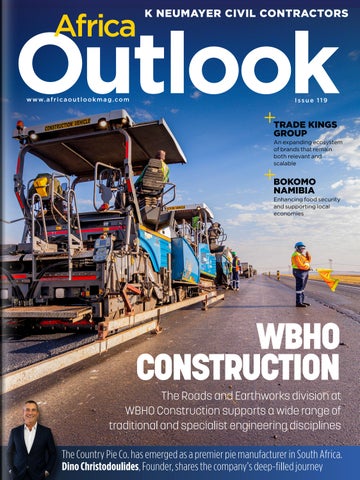
Africa Outlook, APAC Outlook, EME Outlook, North America Outlook, Mining Outlook, Healthcare Outlook, Manufacturing Outlook, Supply Chain Outlook, Food & Beverage Outlook, Construction Outlook, and Sustainability Outlook are digital publications aimed at boardroom and hands-on decision-makers, reaching an audience of more than 800,000 people around the world.
With original and exclusive content compiled by our experienced editorial team, we look to promote the latest in engaging news, industry trends, and success stories from across the globe.
Your company can join the leading industry heavyweights enjoying the free exposure we provide across our platforms with a free marketing brochure, extensive social media saturation, enhanced B2B networking opportunities, and a readymade forum to attract new investment and help you grow your business.
Visit www.outpb.com/work-with-us for details on how your company can feature for free in one of our upcoming editions.
EDITORIAL
Head of Editorial: Jack Salter jack.salter@outpb.com
Deputy Head of Editorial: Lucy Pilgrim lucy.pilgrim@outpb.com
Welcome to our 119th edition of Africa Outlook magazine.
National Route 3 (N3) is one of the busiest highways in South Africa, connecting the financial hub of Johannesburg and the bustling port city of Durban.
The Roads and Earthworks (R&E) division of WBHO Construction (WBHO) rehabilitates N3 on this issue’s front cover.
A flagship project for WBHO’s R&E division is the N3 upgrade between Key Ridge and Hammarsdale, which is improving road safety, traffic flow, and capacity by expanding the route to five lanes.
“The roadway will ultimately be upgraded to a transformative five-lane divided dual carriageway,” informs Riaan de Necker, Group Managing Director of the R&E division.
Changing lanes to Trade Kings Group (Trade Kings), the largest fast-moving consumer goods (FMCG) manufacturer in Zambia, where the FMCG market is amongst the most exciting in Africa.
Trade Kings has grown from humble beginnings in 1995 into one of the largest diversified groups in sub-Saharan Africa, boasting over 100 brands delivered across 10 countries.
“We started small, built patiently, and kept reinvesting – today, we are part of a much bigger conversation about what African industrial capability can look like when it is backed by conviction,” divulges Mohsin Patel, Director.
Like Trade Kings, K Neumayer Civil Contractors (K Neumayer) has grown in the last 30 years, becoming Namibia’s leading multidisciplinary contractor with a proven track record in brownfield and greenfield projects.
The company’s growth is testament to its capabilities and commitment to excellence, with a burgeoning influence that spans the country and beyond.
K Neumayer delivers a vast range of earthworks, civil construction, and full structural, mechanical, piping, and platework (SMPP) services for mining and industrial clients.
“One of our differentiators is our ability to self-perform across civil, SMPP, surveying, and related services. This reduces fragmented contractor interfaces and places accountability within a single, controlled delivery structure,” attests Managing Director, John Mitchell.
We also merge lanes with driving forces such as Thor Explorations, Bokomo Namibia, and the Nigerian Gas Association.
We hope that you enjoy your read.
Jack Salter
Head of Editorial, Outlook Publishing
CONSTRUCTION
36 WBHO Construction
86 Promasidor Angola
Powder to the People
Bridging the Construction Divide
The blueprint for prosperity FEATURES
FOOD & BEVERAGE
54 Trade Kings Group
A Story of African Manufacturing
An expanding ecosystem of brands that remain both relevant and scalable
74 Bokomo Namibia
Nourishing a Nation
Enhancing food security and supporting local economies
Local production, innovation, and community engagement
92 Cervejas de Moçambique
Natural, Local, and Inclusive
Bottling the essence of Mozambique
MINING
100 K Neumayer Civil Contractors
Integral to the Industrial Landscape
A proudly Namibian multidisciplinary contractor
116 Thor Explorations
Golden Progress
Gold production and exploration across West Africa
126 Heath Goldfields LTD
The Importance of Indigenous Mining
Committed to the revival of the 100-yearold Bogoso-Prestea Mine
138
138 JCI Mining
At the Coal Face of Change
Creating efficiency and long-term value
146 GoldPlat
Unbuckling the West African Gold Belt
From by-product to bounty
TECHNOLOGY
152 Botswana
Telecommunications Corporation
Driving Botswana’s Digital Economy
Superior digital solutions
MANUFACTURING
160 Marcopolo S.A.
A Sustainable Protagonist in Mobility Solutions
Bringing together human values, passion, and product excellence
ENERGY & UTILITIES
168 MOTRACO
Powering Progress Through Energy Partnerships
A pioneering force in Mozambique’s electricity transmission
SUPPLY CHAIN
178 Nucleus Mining Logistics
Cargo at the Core
On a mission to transform African mine supply chains
Tailings 2025 – Lessons Learnt and the Road to Safer Systems
Alastair Bovim, CEO and co-Founder of South Africa-based environmental intelligence company, Insight Terra, reflects on how Africa has a critical opportunity to lead responsible extraction as demand for critical minerals accelerates
Writer: Alastair Bovim, CEO and co-Founder, Insight Terra
With 2025 exposing the fragility of tailings governance and water management across the African continent, 2026 must turn lessons into action.
2025 saw multiple tailings dam failures, including a significant incident in Zambia in February. Meanwhile, the global clean energy transition is accelerating, and with it, the demand for critical minerals.
Global forums like G20, COP30, and Mining2030 have made substantial public declarations of intent, and yet, as 2025 has shown, there are several opportunities to improve the systems responsible for managing the transition and to affect change across the entire value chain.
Companies that purchase, trade, and are involved in sourcing metals and minerals should demand transparency and visibility on how
mining and tailings management are done sustainability.
Net zero is a pipe dream if we cannot and do not get the basics of proactively managing water on our mines. We cannot safely grow global mineral supply on a foundation of fragile tailings systems.
Every rechargeable battery, electric vehicle (EV), and wind turbine begins in a mine, and the safety of those mine communities and the surrounding environments must matter as much as the minerals we extract.
Africa, which is home to some of the world’s most important supplies of copper, cobalt, manganese and PGMs, sits at the centre of this minerals surge.
But 2025 highlighted a troubling truth – as governance frameworks like the Global Industry Standard on Tailings Management (GISTM) are maturing, the frequency and
severity of tailings failures show that implementation is not keeping pace with the risks.
2025 – A YEAR OF PROGRESS AND PAINFUL REMINDERS
The International Council on Mining and Metals’ (ICMM) 2025 Tailings Progress Report reflected significant progress in governance:
• 67 percent of member facilities have now achieved full compliance with GISTM.
• More than 80 percent of ‘extreme’ and ‘very high’ consequence facilities are compliant, showing that accountability is steadily moving to board level.
But the flip side is a stark one; one-third of facilities remain only partially compliant – a signal of how much work remains before tailings governance becomes truly universal. 67 percent of member facilities that have achieved self-assessed compliance still require an independent audit from the newly established Global Tailings Management Institute (GTMI).
Whilst there is public discourse, this is mostly at a very basic level and lacks true transparency on the operations.
GISTM calls for an integrated knowledge base, performance monitoring, accountabilities, and responsibilities to make the work visible and transparent.
At the same time, 2025 brought multiple failures that underscored the consequences of delayed action in tailings storage facility (TSF) management.
Early last year in Zambia, a breach released acidic, sulphuricacid-bearing effluent into the Mwambashi and Kafue river systems, with cascading cell failures and overtopping dynamics recorded. Independent analyses confirmed significant water quality impact and long-term heavy metal risks.
In Indonesia’s Morowali Industrial Park, meanwhile, two nickel tailings failures in March 2025 and a fatal landslide later the same month raised questions around site design, rapid industrial expansion, and climate-driven rainfall stressors.
Closer to home in South Africa (SA), a long-awaited investigation into the 2022 Jagersfontein tailings collapse confirmed extensive flooding, pollution, and infrastructure damage.
The report raised concerns about the dam’s design, foundation
stability, and oversight, noting that signs of instability may have been present before the breach.
2025 showed us, once again, that tailings failures are not engineering problems alone – they are governance, climate adaptation, and community-protection failures that are largely preventable.
A GOVERNANCE SHIFTVOLUNTARY STANDARDS TO INDEPENDENT ASSURANCE
One of the most significant structural developments in 2025 was the formal launch of the GTMI which is headquartered in SA and co-Founded by the ICMM, United Nations Environment Programme (UNEP), and Principles for Responsible Investment (PRI).
The GTMI will oversee an independent auditing and certification programme for GISTM – a pivotal step towards transparent, credible assurance for operators, regulators, investors, and, most importantly, mine-affected communities.
Although most major operators are advancing towards compliance, smaller and mid-tier facilities –including many in Africa – remain
outside formal global frameworks, which is where the risk lies.
Standards matter, but standards alone don’t change behaviour. Independent assurance, continuous monitoring, and transparent public reporting are what close the governance gap.
Insight Terra contributed to GTMI’s formative work through its involvement with the Minerals Council South Africa, supporting efforts to strengthen tailings governance across the continent.
TECHNOLOGY MOVES CENTRE STAGE –MONITORING MUST BECOME CONTINUOUS
2025 also marked a step-change in the adoption of environmental intelligence tools across the tailings lifecycle.
Insight Terra successfully received funding from major climate technology investors and has expanded deployments across Africa and South America.
It has also deepened its partnerships with engineers of record, instrumentation vendors, and systems integrators, and achieved Amazon Web Services (AWS) energy sector differentiated partner status.
Platforms that fuse internet of things (IoT) sensors, ground-based instruments, satellite observations, interferometric synthetic aperture radar (InSAR) analytics, and machine learning (ML)-based triggers are increasingly essential for real-time visibility.
Synspective’s expanding StriX synthetic aperture radar (SAR) constellation – now supporting Global South demonstration projects alongside Insight Terra and industrial automation and control systems provider, Yokogawa – is enabling millimetre-level displacement tracking for large areas around TSFs and pit walls.
Tailings facilities are dynamic, living systems, so monitoring cannot be static.
Integrated sensing and real-time analytics give operators the ability to detect anomalies early and intervene before small deviations become structural failures.
Insight Terra’s platform continues to emphasise GISTM Principle 7 – the requirement for disciplined, auditable data governance and clear accountability workflows.
2026 – FROM REACTION TO PREDICT-AND-PREVENT
In the coming year, it’s imperative that we convert 2025’s lessons into meaningful system and behavioural change. Two major forums will set the agenda early:
• Mining Indaba 2026, which will be hosted in Cape Town, SA, between the 9th and 12th February, is placing partnerships, technology, and cross-value-chain collaboration at the centre of its programme.
• Southern African Institute of Mining and Metallurgy (SAIMM) Tailings 2026, which will be hosted in Johannesburg, SA, between the
3rd and 4th March, will advance discussions on South African National Standards (SANS) 10286 updates, artificial intelligence (AI)-enabled monitoring, GTMI implementation, and detailed failure learnings.
The goals for 2026 are clear:
• Close the partial-conformance and self-assessment gap across the industry.
• Scale integrated SAR and IoT monitoring stacks.
• Treat water as a strategic resource requiring continuous surveillance.
• Publish transparent, communityfacing dashboards, and emergency protocols.
• Embed independent assurance into routine practice.
Most importantly, we need to continue to foster collaboration and teamwork with the accountable executive who reports to the board, the responsible tailings facility engineer that works at site level, and the engineer of record that looks to monitor performance against the design.
The Insight Terra platform allows
these critical stakeholders to gather around the data and continually improve the safety and transparency of operations.
If mineral demand is rising exponentially, our safety and transparency standards must rise to match it – anything less leaves communities and the transition exposed.
A MOMENT FOR AFRICAN LEADERSHIP
With Africa at the heart of global critical mineral supply chain, the continent must be part of the conversation on responsible extraction.
African nations can lead by showing that environmental intelligence, transparent governance, and community protection are not burdens – they are strategic advantages.
As such, zero harm must be the expectation, not the aspiration.
ABOUT THE EXPERT
As CEO and co-Founder of Insight Terra, Alastair Bovim is accountable for the business performance, operations, and strategy of the company.
Bovim has a proven executive track record with more than 25 years of experience managing diverse teams in the technology industry.
Discover our exclusive content, delivered straight to your inbox
As mining organisations worldwide confront unprecedented change, embracing technological innovations and incorporating critical environmental sustainability agendas, now more than ever is the time to showcase the strides being taken in this dynamic sector.
A multi-channel brand, Mining Outlook brings you the positive developments driven by organisations across the global mining industry through its various platforms.
Discover exclusive content distributed through its website, online magazine, social media campaigns and digital dispatches, delivered straight to your inbox with a bi-weekly newsletter.
Through these compelling media channels, Mining Outlook continues to foreground the movers and shakers of the industry.
To participate as a featured company and join us in this exciting endeavour, contact one of our Project Managers today.
Autonomous Delivery Across Rwanda
Adecade ago, Rwanda became the first country in the world to launch Zipline’s national autonomous medical delivery service.
Zipline, an artificial intelligence (AI) and robotics company, designs and operates autonomous logistics systems that enable on-demand delivery of blood, vaccines, and essential medicines, fully integrated into national health systems.
In Rwanda, the network supports nationwide coverage and has contributed to improvements in access to healthcare, including a reported 51 percent reduction in maternal deaths.
Now, under a historic expansion agreement between the government and Zipline, Rwanda will also become the first country with full nationwide autonomous logistics coverage.
It will deploy Zipline’s urban delivery system, known as Platform 2 (P2), starting in the capital, Kigali, where a large share of the country’s healthcare demand is concentrated.
“In addition, Rwanda will host Africa’s first AI and robotics testing and research centre, strengthening its position as a leader in advanced technology and innovation on the continent,” acclaims Pierre Kayitana, Country Director of Zipline Rwanda.
“The expansion also includes the construction of a third longrange distribution hub in Karongi, complementing existing hubs in Muhanga and Kayonza.”
The network will support
Rwanda is to become the first country in the world with nationwide autonomous delivery, including Africa’s first urban drone delivery network. We learn about this historic expansion agreement with Pierre Kayitana, Country Director of Zipline Rwanda
Writer: Jack Salter
approximately 350 local jobs and further integrate delivery data into Rwanda’s national health information and emergency response systems.
Importantly, the model reflects a strong government-led approach. The US government is providing upfront infrastructure funding, whilst the Rwanda government is committed to financing ongoing operations.
“This ensures the system is financially sustainable, nationally operated, and embedded within Rwanda’s broader strategy for resilient, technology-driven healthcare,” Kayitana affirms.
ADVANCED LOGISTICS LEADER
By scaling what began as an innovative pilot into permanent
Pierre Kayitana, Country Director
national infrastructure, Rwanda has cemented its position as a global leader in advanced logistics.
What started as a targeted effort to improve access to blood in a handful of hospitals has evolved into a nationwide autonomous delivery network embedded in the public health system.
“Today, Zipline is responsible for delivering approximately 75 percent of Rwanda’s national blood supply outside of Kigali,” highlights Kayitana.
This next phase goes further; by hosting Zipline’s first overseas R&D hub, Rwanda is positioning itself not only as a user of frontier technology, but as a place where the next generation of AI, robotics, and autonomous logistics systems will be developed. In doing so, the country is helping shape the future of global supply chains.
A decade of operational data shows the tangible impact of this
“Introducing P2 in Rwanda means the country will be the first in Africa to deploy this type of urban autonomous logistics system”
– PIERRE KAYITANA, COUNTRY DIRECTOR, ZIPLINE RWANDA
approach, as Zipline’s system has reduced medical waste by enabling centralised inventory and on-demand delivery.
It has also dramatically improved emergency response times for timecritical treatments such as blood for maternal haemorrhages.
This demonstrates that high-tech logistics can be both effective and economically efficient when deployed at national scale.
“Independent studies consistently find that Zipline’s network ranks amongst the highest-impact and most cost-effective health system
interventions studied in recent years – improving outcomes across immunisation, maternal health, nutrition programmes, and emergency care whilst strengthening the reliability of national supply chains,” Kayitana highlights.
AUTONOMOUS DELIVERY SYSTEM
Zipline’s next-generation autonomous delivery system, P2, is designed for fast, quiet, and highly precise deliveries in dense urban environments.
THE WORLD’S LARGEST AND MOST EXPERIENCED AUTONOMOUS DELIVERY SERVICE
Zipline completes a delivery somewhere in the world every 30 seconds.
The company has flown over 120 million autonomous miles and served more than 5,000 hospitals and health facilities globally.
Whilst the drones get all the glory, the real innovation is the holistic system: centralised cold chain storage, digital track and trace, and on-demand delivery.
Together, these enable a shift from a push-based system, which depends on imperfect forecasts, to a pull-based system where healthcare workers can get what they need, exactly when they need it.
Zipline partners with governments to build reliable logistics infrastructure that is embedded into their healthcare systems, supporting them to transform health outcomes and grow economies.
Unlike earlier systems built primarily for long-range medical deliveries, P2 is designed to operate within cities, enabling items to be delivered directly to homes, hospitals, offices, and public spaces with very high accuracy.
“The system uses a new aircraft design with a smaller delivery droid that lowers packages gently to the ground, allowing for maximum accuracy, which makes it well-suited for urban settings like Kigali,” explains Kayitana.
This progress has been championed by Rwandan authorities, notably the Minister of Health, Dr Sabin Nsanzimana, who was recently named to the TIME100 Next list for his work in strengthening Rwanda’s health system through data-driven decisionmaking and innovation.
Under his leadership, Rwanda has benefitted from the impact of the integration of technology into healthcare delivery, allowing for improved and more reliable access to essential services.
The introduction of the urban delivery system in Kigali will address the high concentration of healthcare demand in the capital, enabling fast and precise deliveries within dense city environments.
“Introducing P2 in Rwanda means the country will be the first in Africa to deploy this type of urban autonomous logistics system,” Kayitana tells us.
“It will expand the range of deliveries that can be supported, improve response times in cities, and further integrate autonomous delivery into everyday healthcare and commercial logistics.”
LONG-RANGE COVERAGE
The new long-range distribution centre in Karongi is built on the border between Rwanda and the Democratic Republic of the Congo (DRC), intended as a symbol of peace between the two countries.
Its overall goal is to expand delivery capacity, expected to serve
approximately 200 health posts and 60 major health facilities, reaching more than 2.9 million people.
“Together with the other hubs, it will help deliver full nationwide coverage, allowing Zipline’s network to support more than 11 million people across Rwanda,” informs Kayitana.
The addition of a third hub guarantees the provision of longrange coverage across the country, ensuring even remote and hard-toreach communities can receive critical medical supplies quickly.
By integrating this connected network into national health systems, Rwanda is building a logistics infrastructure that ensures essential medicines and supplies can reach communities quickly and reliably, regardless of location.
The new AI and robotics testing facility, meanwhile, will serve as Zipline’s first R&D hub outside the US.
“This facility will allow us to test our technology in a range of realworld conditions, including different climates and terrain, helping improve the reliability and performance of aircrafts and systems globally,” Kayitana insights.
“Independent studies consistently find that Zipline’s network ranks amongst the highest-impact and most cost-effective health system interventions studied in recent years – improving outcomes across immunisation, maternal health, nutrition programmes, and emergency care whilst strengthening the reliability of national supply chains”
– PIERRE KAYITANA, COUNTRY DIRECTOR, ZIPLINE RWANDA
“It will also support the development of local talent by creating opportunities to work directly on advanced robotics and AI systems.”
INFLUENCE BEYOND LOGISTICS
Rwanda is demonstrating that autonomous delivery works at national scale, and in real-world conditions, as part of a governmentled system.
“Independent research has increasingly validated the transformative power of this system, demonstrating that its influence extends far beyond mere logistics,” notes Kayitana.
“By optimising the delivery of
critical goods, it has fundamentally reshaped supply chain efficiency –drastically reducing waste and theft whilst virtually eliminating the risk of stockouts.”
The impact on public health is even more profound, representing some of the most significant outcomes ever documented through a supply chain intervention.
Data confirms a staggering 56 percent reduction in maternal mortality and a 42 percent decrease in zero-dose prevalence.
Zipline is the most cost-effective immunisation intervention and one of the most cost-effective maternal health interventions on record.
Beyond these clinical milestones,
the system serves as a powerful engine for economic stability.
“By creating hundreds of local jobs and safeguarding the health of the workforce, it generates tens of millions in annual economic growth, proving that a resilient supply chain is the essential foundation for a thriving society,” Kayitana closes. www.zipline.com
L-R: Caitlin Burton, CEO, Zipline Africa; Dr Yvan Butera, Minister of State, Ministry of Health; Pierre Kayitana, Country Director, Zipline Rwanda; and Jeanne Umuhire, Deputy Director, Rwanda Biomedical Centre
The Rise of a Pastry POWERHOUSE
With profound pride in its South African heritage, The Country Pie Co.’s (Country Pie) origins began in the delectable world of baked goods.
What started as a small family bakery became one of the country’s leading pie manufacturers, renowned for its handcrafted pastries created with premium ingredients.
Originally focused on breads and confectionery, the company successfully transitioned into retail, marking a significant milestone in its journey.
“We opened a SPAR supermarket, where we gained valuable and realworld insight into consumer buying behaviour and product performance,” introduces Dino Christodoulides, Founder.
“One key observation stood out –the constant wear on the floor leading to the pie warmer,” he adds with a smile.
This wasn’t just foot traffic – it was
The Country Pie Co. has emerged as a premier pie manufacturer in South Africa, a testament to its unwavering dedication to quality, flavour, and honest ingredients. With a deep-filled understanding of consumer preferences, Founder Dino Christodoulides shares the company’s journey
Writer: Rachel Carr
a clear indicator of demand for the tempting pastries, their tantalising aroma and flavour an irresistible lure for customers.
“When we analysed the top 300 known value items (KVIs), pies consistently ranked within the top 10, which confirmed what we already suspected: they weren’t only popular – they were essential. That insight sparked the vision to build our own manufacturing business.”
Operating from a modest site in Homestead, Johannesburg, where Country Pie still runs a direct-topublic pie shop, the company expanded into a 200-square-metre (sqm) production facility, gradually growing into the adjacent space, eventually scaling up to 1,000 sqm.
“As opportunities arose, we converted our original mini-unit into another factory shop, strengthening our direct retail presence,” informs Christodoulides.
Country Pie’s main manufacturing
facility is now based in Modderfontein, Gauteng, spanning over 2,000 sqm and built step-by-step, entirely through reinvestment in the business. Every phase of growth has been intentional – designed to optimise production flow, efficiency, and scalability.
As the company’s infrastructure expanded, so too did its product offerings. Today, Country Pie operates 11 factory shops, delivering its products directly to customers.
EVOLUTION OF AN INNOVATIVE INDULGENCE
Country Pie’s product journey began with cocktail sausage rolls, which were personally delivered door-todoor using a small red Volkswagen Citi Golf.
From those humble beginnings, the company expanded into pies, developing innovative products such as the jumbo pie in collaboration with grocery chain Pick n Pay.
“AS WE CONTINUE TO EXPLORE NEW IDEAS, WE’VE LEARNED THAT CLASSIC FLAVOURS REMAIN THE BACKBONE OF THE CATEGORY. OUR FOCUS IS ON PERFECTING THESE CORE PRODUCTS WHILST REMAINING OPEN TO INNOVATION THROUGH CUSTOMER AND RETAILER INSIGHTS”
– DINO CHRISTODOULIDES, FOUNDER, THE COUNTRY PIE CO.
“Our range has since grown to include premium pies, which are in foil packaging, as well as a budgetfriendly snack range aimed at everyday affordability, particularly for school-going consumers. Moreover, we introduced our well-known Moja Pie and expanded into convenient, ready-to-go packaged pies to cater to fast-paced, on-the-go lifestyles.
“At our core, Country Pie is built on hands-on experience, market insight, and a commitment to reinvesting in quality and growth. From a small bakery operation to a fully scaled manufacturing business, our journey has always been driven by understanding our customers and delivering the food they love,” Christodoulides emphasises.
Utilising local suppliers has been a crucial part of the company’s success, providing advantages such as reliable availability and supply, costeffectiveness, the ability to foster strong, long-term relationships, and mutual support that strengthens both the business and its suppliers.
“We are proud to support local suppliers and believe it plays a vital role in our sustainability efforts,” he prides.
Country Pie’s commitment also extends to innovation, driven by market demand and customer feedback.
“One of our key developments was the jumbo pie in partnership with Pick n Pay, which helped expand our reach. We later introduced the Moja Pie, identifying a gap for an affordable, convenient, graband-go product aimed at everyday consumers,” Christodoulides highlights.
“As we continue to explore new ideas, we’ve learned that classic flavours remain the backbone of the category. Our focus is on perfecting these core products whilst remaining open to innovation through customer and retailer insights.”
TRANSFORMATIVE OPPORTUNITIES
Over the past 20 years, in addition to Country Pie’s successes, it has faced several significant challenges that have shaped the business into what it is today.
In the early years, the biggest obstacle was financial pressure.
“We didn’t have the capital or clear roadmap for growth, so we had to trade our way forward, often with our backs against the wall – it was slow, disciplined, and driven by necessity,” Christodoulides reflects.
“Another major challenge was product development, particularly perfecting our pastry. Whilst our fresh product tasted great, freezing introduced issues, including cracked pastry and dry fillings; it took years of trial and error and learning to refine pies that consistently met market expectations.”
Navigating external pressures, including load shedding, severely impacted Country Pie’s production.
Other factors included the global impact of the COVID-19 pandemic, a devastating fire that destroyed the
company’s substation, forcing it to run on generators for nearly six months, theft and internal setbacks, including trusted employees stealing staff and starting their own pie factories, and large corporations that unexpectedly shifted suppliers.
Despite all this, Country Pie remained resilient – continuously building, improving, and pushing forward.
“Equally, our journey has been marked by key milestones we’re incredibly proud of, such as building a strong, loyal team that shares our
vision, investing in reliable logistics, including refrigerated delivery vehicles, and expanding into a larger manufacturing facility built through reinvestment.
“Alongside introducing polyurethane flooring, we have solved long-standing operational challenges and developed our factory shop model. This has allowed us to connect directly with customers and strengthen our brand presence, therefore establishing ourselves as a recognised and competitive player in the market,” he states determinately.
Notably, the food and beverage industry in South Africa has undergone significant changes over the years.
In the early days, food safety standards were less stringent, whereas today there is a much stronger focus on compliance and regulation, traceability, monitoring, and quality control.
“The industry has become much more professional and structured, and consumer behaviour has also
changed. There is now a strong demand for affordable food options, convenience, and on-the-go products; this shift has directly contributed to our growth as a convenience-focused brand,” analyses Christodoulides.
RELEVANCE IN A COMPETITIVE MARKET
Being recognised as a strong competitor in the pie market is something Country Pie takes pride in but has always remained humble and grounded about.
“What distinguishes us is our strong foundation in our identity as a family business, characterised by hands-on involvement and a commitment to quality and consistency in every product,” he enthuses.
“We focus on slow, sustainable growth and building strong relationships with customers and suppliers. We’ve invested in our own butchery to control meat quality and are still considered to have a ‘homemade-style’ pie, using minimal preservatives and focusing on real
ingredients and whole spices.”
These qualities are at the core of Country Pie’s business as Christodoulides outlines in a refreshingly straightforward approach.
“Our philosophy has always been simple: stay true to our values, focus on quality, and grow with purpose.”
Furthermore, the company’s strength lies in the mixed-generational team, where each member brings unique experience from diverse industries and backgrounds.
In a team of three, everyone has their own clearly defined role: food quality, operations, and innovation.
“Our structure allows us to focus on our individual strengths whilst working towards a shared goal.
Collaboration is key – we listen to each other’s ideas, challenge one another when needed, and continuously push to improve.
“Whilst we don’t always agree, a diverse way of thinking is what drives progress. By combining our perspectives, we’re able to innovate,
WHAT MARKETING STRATEGIES HAS COUNTRY PIE EMPLOYED TO ATTRACT CUSTOMERS?
DINO CHRISTODOULIDES, FOUNDER:
“Our success has largely been built on trust, consistency, and relationships.
“Over the years, we’ve developed strong connections with our customers, which has led to powerful word-of-mouth marketing – one of our most valuable assets.
“A key part of our strategy has been our factory shop model, which allows us to sell both to wholesalers and directly to the public. These stores don’t just generate revenue – they act as constant brand exposure, helping us stay visible and accessible in the market.
“We’ve positioned ourselves as a loyal, honest, and valuedriven brand, always striving to keep pricing as competitive as possible, passing savings on to our customers.
“Whilst we do make use of social media platforms like Facebook, along with promotions and competitions, our brand has ultimately been built organically over time through consistency and customer satisfaction.”
adapt, and grow stronger as a unit – together, we’ve built a wellbalanced and formidable team,” Christodoulides impassions.
The future of Country Pie is focused on continuous improvement, innovation, and expansion.
“We are constantly identifying gaps in the market, studying consumer trends, improving manufacturing efficiency to control costs, and developing new flavours and product ideas.
“A strategic move has been acquiring our own butchery, allowing us to maintain strict quality control, better manage meat pricing, and expand our product offering,” he notes.
In terms of growth, the company plans to expand its retail footprint by adding new delivery routes, increasing its presence in the sector, and opening more factory outlet stores, making its products more accessible to customers.
“Our goal is simple – stay relevant by evolving with the market whilst staying true to our core values of quality, affordability, and consistency,” Christodoulides emphatically concludes.
CTony’s Chocoloney seeks to end structural poverty and establish more equitable relationships with cocoa cooperatives in Ghana and Côte d’Ivoire
Writer: Jack Salter
ôte d’Ivoire is the world’s largest cocoa producer, supplying over 40 percent of the world’s cocoa.
Neighbouring Ghana is also a leading cocoa production force in its own right, accounting for around 20 percent of global cocoa production. However, climate shocks and crop diseases have caused yields to decline in the two West African countries, whilst there has also been a systematic lack of investment in cocoa farmers and their farms because of
poverty, resulting in child labour and deforestation.
Tony’s Chocolonely (Tony’s), whose vision is to end exploitation in the cocoa industry, addresses these issues.
The impact company was founded in 2005 by three journalists from the Dutch TV show, ‘Keuringsdienst van Waarde’, after they discovered the world’s largest chocolate manufacturers were buying cocoa from plantations that used child labour and modern slavery.
Since then, Tony’s has dedicated
its efforts to raising awareness of and eliminating inequality in the chocolate industry.
Responsibly sourcing cocoa isn’t just the right thing to do for Tony’s –it’s the smartest way to protect the future of chocolate.
Improved farming practices mean better cocoa beans and tastier chocolate, proving ethics and indulgence can go hand-in-hand.
TONY’S OPEN CHAIN
Tony’s leads by example, building
direct, long-term relationships with cocoa farmers in Côte d’Ivoire and Ghana, paying them a higher price, and working together to solve the underlying causes of cocoa’s three biggest issues – forced labour, child labour, and deforestation.
All cocoa beans used by the company are sourced through Tony’s Open Chain, ensuring resilience for farmers and premium-quality beans.
partnerships, and enhanced quality and productivity – enable farmers to earn a living income and build longterm partnerships.
This farmer-first approach in cocoa prioritises human rights and environmental protection, aiming to reverse institutionalised inequality.
By combining its ‘5 Sourcing Principles’, Tony’s Open Chain seeks to end structural poverty and establish more equitable relationships with cocoa cooperatives in Ghana and Côte d’Ivoire.
Traceable sourcing is responsible sourcing, and the model offers this across three levels – operational, environmental, and social.
These are essential to Tony’s Open Chain’s commitment to transparency and accountability throughout the cocoa supply chain.
Tony’s uses its proprietary bean tracking software, BeanTracker, to know exactly where, when, how, and by whom beans were harvested and how they travel through the value chain.
TONY’S OPEN CHAIN ‘5 SOURCING PRINCIPLES’
• TRACEABILITY – Knowing who the cocoa farmers are and engaging in direct relationships with partner cooperatives means understanding bean origins, producers, and related social and environmental factors, which are all vital to taking responsibility and driving meaningful change.
• HIGHER PRICES – Supporting cocoa farmers in achieving a living income and sustainable farms requires paying higher cocoa prices, which are set according to Fairtrade’s LIRP for cocoa.
• LONG-TERM COMMITMENTS – Establishing long-term commitments to work together with cocoa farmers and partner cooperatives to address challenges and plan for the future.
• STRONG FARMER PARTNERSHIPS – Collaborating with partner cooperatives to improve professionalised farming practices and implement strong farming businesses. Collective action amongst cocoa farmers helps address and transform inequalities in the cocoa sector.
• ENHANCED QUALITY AND PRODUCTIVITY – Investing in agricultural knowledge and skills, as well as organising labour brigades via partner cooperatives, enhances cocoa quality and yields, boosting farmer income and preventing deforestation.
Thus, the company ensures 100 percent traceability of Tony’s Open Chain-sourced cocoa, compared to lows of 40 percent for other industry players.
INCREASING INCOME
Inequality has historically defined the cocoa industry, with the majority of cocoa farmers in Côte d’Ivoire and Ghana living in poverty as a result of being underpaid for their produce.
Cocoa farmers often struggle to earn enough to cover their basic living costs, including necessities such as food, decent housing, education, and healthcare.
Despite their hard work and, in many cases, multiple income sources – from farming as well as non-farming activities – many cocoa farmers still fall short of what is needed to achieve a dignified standard of living.
In Côte d’Ivoire and Ghana, Tony’s pays the Living Income Reference Price (LIRP) for all cocoa beans sourced via the model, as set by Fairtrade.
Efforts to support and enable cocoa farmers to lift themselves out of poverty often emphasise increasing their responsibilities, such as improving cocoa quality, adopting better agricultural practices, boosting productivity, or diversifying their income sources – however, this focus absolves companies of their responsibilities.
A more effective strategy involves recognising a wide diversity of local contexts, household types, and different abilities and ambitions, as well as a balanced combination of interventions, which includes guaranteeing higher cocoa prices over multiple seasons.
Tony’s Open Chain ensures a higher price is paid for cocoa, a responsible purchasing practice that helps increase incomes for smallholder cocoa farmers.
The long-term commitment to
higher cocoa prices translates into economic stability, better financial planning, and the ability to invest in farm improvements, such as planting new trees.
COOPERATIVE-CENTRIC
Professional farming cooperatives and farms are promoted by Tony’s Open Chain, giving farmers and their self-organised groups the power to structurally change inequality.
The model is anchored in a cooperative-centric approach; partner cooperatives are key to ensuring safe, sustainable cocoa farming, serve as a direct link between cocoa farmers and Tony’s Open Chain,
and play a critical role in supporting farmer members on their behalf.
Tony’s is proud to support the strength-building of its partner cooperatives as they own the implementation of the model’s ‘5 Sourcing Principles’, which are ingrained in their business practices.
As partner cooperatives mature and professionalise, they provide valuable insights on the application of these principles.
Tony’s Open Chain helps farmers to professionalise by investing in agricultural knowledge and skills, as well as organising labour brigades.
Collectively, the model’s ‘5 Sourcing Principles’ prioritise human
rights and environmental protection in cocoa sourcing and purchasing, which is essential to addressing and reversing decades of institutionalised inequalities within the sector.
These principles need to be combined to offer a concrete solution to end structural poverty at the beginning of the supply chain, by fostering long-term change and establishing more equal business
NIGERIAN GAS SPOTLIGHT
There is hugely untapped potential in Nigerian natural gas reserves.
Focused on transforming into a gaspowered economy by 2030, Nigeria’s path to energy security and economic development hinges on leveraging these abundant resources
Writer: Jack Salter | Project Manager: Mante Kalinauskaite
Nigeria’s gas industry is at a pivotal moment. With over 200 trillion cubic feet of proven reserves, the opportunity is significant – spanning domestic power generation, industrialisation, and export markets. The key constraint is no longer resource availability, but execution. Infrastructure gaps – particularly in pipelines, processing, and distribution – continue to limit supply
and market access. In addition, pricing misalignments and limited access to long-term financing have slowed investment.
Encouragingly, progress is being made; policy focus has strengthened and investment momentum is improving.
However, closing the gap between potential and
actual utilisation will require sustained execution, stronger commercial frameworks, and a more consistent investment-friendly environment.
Over the next decade, gas will play a central role in Africa’s energy mix – as a transition fuel, industrial feedstock, and driver of economic resilience.
Across the continent, new supply hubs will emerge,
particularly in East and Southern Africa, supported by growing regional integration.
In Nigeria, there is expected to be increased domestic utilisation underpinned by the power sector, expansion of liquefied natural gas (LNG) capacity, and stronger participation of Indigenous companies across the value chain.
Nigerian Gas Association INTERVIEW
Akachukwu Nwokedi, President of the Nigerian Gas Association, outlines how gas has been successfully repositioned at the centre of Nigeria’s energy and economic agenda. As General Counsel and Secretary of Nigeria LNG and Regional Coordinator for Africa at the International Gas Union, Nwokedi also discusses advancing collaboration across the continent
Africa Outlook (AO): Firstly, can you introduce us to the Nigerian Gas Association with an overview of your mission, vision, and members?
Akachukwu Nwokedi, President (AN): The Nigerian Gas Association (NGA) is the apex, non-partisan umbrella body representing stakeholders across Nigeria’s entire gas value chain.
Established in 1999, the association serves as the collective voice of the industry, bringing together international and Indigenous operators, regulators, investors, service providers, and major gas users across
power, industrial, and commercial sectors.
Our mission is to promote the sustainable development and optimal utilisation of Nigeria’s gas resources through policy advocacy, investment facilitation, capacity building, and the promotion of global best practices.
Our vision, simply put, is to position gas as the backbone of Nigeria’s economic transformation and a key enabler of Africa’s energy future.
What distinguishes the NGA is the breadth and diversity of its membership, which enables us to provide a unifying platform for collaboration, innovation, and industry-wide alignment.
AO: Nigeria has declared a ‘Decade of Gas’ – how is this translating into real opportunities?
AN: The ‘Decade of Gas’ has successfully repositioned gas at the centre of Nigeria’s energy and economic agenda.
We are now seeing tangible progress, including expansion of pipeline infrastructure, increased domestic utilisation, and stronger alignment across policy institutions.
There is also growing momentum in gas-to-power, gas-based industries, and autogas development, which is creating new opportunities across transportation, manufacturing, and small-scale enterprises.
However, the real test lies in translating policy into bankable projects. This requires clarity on pricing, credible risk allocation frameworks, and regulatory consistency that supports long-term investment decisions.
AO: How does the NGA promote and protect the interests of the Nigerian gas industry?
AN: The NGA serves as a bridge between government, industry, and investors. We actively engage in policy advocacy to ensure regulatory frameworks are transparent, stable, and investment-friendly.
We also provide a neutral platform for stakeholder engagement, helping to address industry challenges such as pricing, infrastructure constraints, and regulatory alignment.
In addition, we drive capacity development, knowledge sharing, and the adoption of global best practices.
Ultimately, our role is to create an enabling environment where the gas industry can thrive – delivering value to investors whilst supporting national development and energy security.
AO: As Regional Coordinator for Africa at the International Gas Union, how can African countries collaborate more effectively on gas infrastructure and policy?
AN: Advancing collaboration across the continent hinges on three priorities: alignment, integration, and shared execution.
First, African countries must strengthen policy and regulatory alignment. Harmonising frameworks –particularly around tariffs, fiscal terms, and gas utilisation – will reduce uncertainty and support cross-border investment.
Second, regional infrastructure integration is essential. Given the uneven distribution of gas resources, collaboration on cross-border pipelines, LNG hubs, and shared processing facilities will unlock economies of scale and improve energy access.
Third, collaboration must be institutionalised through structured partnerships involving governments, multilateral, international, and regional bodies, and the private sector. This includes joint project development, coordinated financing, and risk-sharing mechanisms. Knowledge sharing and capacity building are equally important, with more mature markets supporting emerging ones.
“ULTIMATELY, A COORDINATED REGIONAL APPROACH WILL DE-RISK PROJECTS, ATTRACT INVESTMENT, AND UNLOCK AFRICA’S FULL GAS POTENTIAL”
– AKACHUKWU NWOKEDI, PRESIDENT, NIGERIAN GAS ASSOCIATION
Ultimately, a coordinated regional approach will de-risk projects, attract investment, and unlock Africa’s full gas potential.
AO: What risks does Africa face if it fails to coordinate its energy strategy?
AN: Failure to coordinate energy strategies presents significant risks. For example, there is the risk of fragmented and inefficient investments. Without alignment, countries may duplicate infrastructure or pursue isolated projects that are not commercially viable, leading to stranded assets and wasted capital.
Powering Industries. Fueling Growth. Driving the Future.
In today’s fast-evolving economy, access to reliable and efficient energy is not just an advantage but a necessity. At QSL Gas and Power, we are committed to delivering sustainable, affordable, and reliable gas and power solutions that empower industries, communities and power-generating businesses to thrive.
We are an indigenous Gas and Power company with a fresh and innovative approach to providing gas and power solutions. We specialise in the development, distribution, and optimisation of natural gas infrastructure, and our goal is to bridge the energy gap and unlock productivity for our clients through innovative and dependable solutions.
Why QSL Gas and Power?
We combine technical expertise, industry experience, and strategic partnerships to deliver value-driven solutions. Our projects are executed with a strong emphasis on safety, quality, and sustainability, ensuring long-term benefits for our clients and the environment.
With a growing footprint across key regions in Nigeria, QSL Gas and Power continues to support industrial clusters, manufacturing hubs, and commercial enterprises with energy solutions that are both scalable and future-ready.
Our Commitment
We are driven by a vision to become the foremost Gas marketing, distribution and Power company in Nigeria and Africa at large, providing gas and power solutions through exceptional service delivery to its customers.
Our Core Services
• Natural Gas Distribution: Reliable supply of gas via pipeline networks tailored to industrial and commercial needs at competitive prices
• Compressed Natural Gas (CNG) Solutions: Flexible and mobile gas solutions for areas with limited pipeline access, and Natural gas for Vehicles.
• Gas Infrastructure Development: End-to-end design, construction, and operation of gas systems, including PRMS and distribution networks.
• Embedded Power Solutions: Reliable on-site power generation systems that ensure uninterrupted operations.
• Gas Equipment procurement: We collaborate with our partners to help companies secure gas-fired boilers, heaters, etc. for business operations.
Our Mission
To establish a world-class gas marketing, distribution and power company that consistently renders exemplary services to its customers, through our commitment to quality, best practices and the highest standards.
Our team of professionals works closely with clients to understand their unique needs and deliver solutions that align with their goals.
Let’s Power Your Vision
Whether you are developing a manufacturing facility, a power-generating plant, an industrial park, or seeking a more efficient energy source, QSL Gas and Power is your trusted partner.
In addition, limited access to finance becomes a major challenge. Investors are far more attracted to large, integrated markets with clear and consistent policies. A lack of coordination increases perceived risk, raises the cost of capital, and slows down project development.
Furthermore, Africa could face persistent energy poverty. Disconnected national strategies make it harder to optimise resource distribution, meaning gas-rich assets remain underutilised whilst energy-deficient regions continue to struggle with access.
Finally, Africa could miss a critical window to monetise its gas resources within the global energy transition.
In summary, fragmented markets deter investment, increase project costs, and limit economies of scale.
More importantly, they risk prolonging energy poverty and slowing industrialisation across the continent. A coordinated approach, by contrast, enables scale, efficiency, and shared prosperity.
AO: What needs to change to attract more global investment into Africa’s gas sector?
AN: Investors are fundamentally seeking clarity, consistency, and commercial viability. Attracting global investment into Africa’s gas sector requires a strong
“THE ‘DECADE OF GAS’ HAS SUCCESSFULLY REPOSITIONED GAS AT THE CENTRE OF NIGERIA’S ENERGY AND ECONOMIC AGENDA”
– AKACHUKWU NWOKEDI, PRESIDENT, NIGERIAN GAS ASSOCIATION
foundation built on confidence, competitiveness, and clarity.
Central to this is policy stability and regulatory consistency. Investors need predictable fiscal regimes, transparent licensing processes, and assurance that contracts will be honoured over time. Uncertainty in these areas increases risk and discourages long-term capital.
Equally important is ensuring the commercial viability of projects. This involves adopting market-reflective pricing, especially as markets mature, strengthening payment security mechanisms, and establishing credible offtake arrangements, particularly in domestic gas-to-power markets where payment risks have historically been a concern.
Alles Charis Gas Limited: Building Nigeria’s Energy Future. 30,000+ MT of Proof.
Alles Charis Gas Limited opened its first seven retail stations in 2022, with a quiet but deliberate declaration: that downstream LPG in Nigeria could be done with discipline, scale, and a long view. Four years later, the numbers tell the story.
•2022: Launched with 7 retail stations, delivering 606 MT in our first year of operations
•2023: Expanded to 10 stations, growing volume to 2,701 MT
•2024: Scaled to 11 stations, delivering 10,000 MT, a fivefold increase in a single year
•Q1 2026: Already at 7,000 MT, on track for our strongest year yet
CUMULATIVE TOTAL 30M+ kg
16x
Across our growing network of retail gas stations, bridger and bobtail logistics fleet, 500MT inland depot, and bulk supply operations, we have constructed an integrated downstream infrastructure designed for the demands of a growing nation.
Behind every kilogram delivered is a home with clean cooking fuel, a business keeping its lights on, a community touched by our CSR programmes.
Nigeria is a gas nation and ACGL is building the infrastructure to prove it.
This is not incremental growth. This is a company building at scale. Phone: +2349160757838 | Email: info@allescharis.ng Website: www.allescharis.ng LinkedIn: Alles Charis | Instagram: @allescharis_
Accelerating infrastructure development is also critical as many gas resources remain stranded due to inadequate pipelines, processing facilities, and distribution networks. Bankable, integrated infrastructure projects – often delivered through public-private partnerships – can unlock supply and demand at scale.
Regional market integration further enhances investment appeal by creating larger, interconnected markets with improved economies of scale. In addition, access to financing and effective risk mitigation tools, supported by development finance institutions, will help mobilise private capital.
Finally, strong governance, transparency, and a clear energy transition narrative – positioning gas as a practical transition fuel – are essential to building investor confidence and aligning with global sustainability expectations.
Africa must provide stable and transparent regulatory regimes, bankable fiscal terms, and credible project pipelines. Addressing above-ground risks – such as security, contract sanctity, and ease of doing business – is equally critical.
In addition, partnerships with development finance institutions can play a catalytic role in mobilising private capital through risk mitigation and blended financing structures.
AO: How can regulatory frameworks across African countries be improved or harmonised?
AN: Regulatory harmonisation across Africa should centre on aligning core principles – streamlining licensing processes, fiscal regimes, environmental standards, and cross-border gas trade protocols –to create a more predictable and investor-friendly operating environment.
Achieving this requires deliberate coordination, stronger institutions, and a shared vision for market integration. Greater alignment of policies and legal frameworks – particularly around transparent licensing, standardised fiscal terms, and clear third-party access rules – will reduce uncertainty and support cross-border project development.
Regional bodies such as the Economic Community of West African States (ECOWAS) and the African Union have a critical role in advancing this agenda through model regulations, common codes, and dispute resolution mechanisms that countries can adopt flexibly. Equally important is the harmonisation of technical, safety, and environmental standards to streamline operations across jurisdictions, alongside strengthening regulatory institutions through capacity building, digitalisation, and knowledge sharing.
Having the right partner means you can plan, invest, and grow with confidence. Shell Nigeria Gas delivers reliable natural gas solutions that help manufacturers reduce fuel costs and operate with confidence every day. By replacing diesel with pipeline natural gas and integrated gas to power solutions, we provide predictable pricing, stable supply, and uninterrupted operations. Backed by decades of Shell expertise and a growing gas network across Nigeria, we are your energy partners, helping you deliver the best products to your customers.
Improved transparency, standardised cross-border agreements, and sustained stakeholder engagement will further enhance investor confidence.
Ultimately, harmonisation is about coherence – not necessarily uniformity – creating a stable and efficient framework that supports large-scale gas development and investment across the continent.
AO: What are the NGA’s key priorities to continue promoting and protecting the interests of the gas industry in Nigeria?
AN: Our priorities remain clear:
• Deepening policy advocacy to ensure full and effective implementation of the png Industry Act.
• Promoting investments across the gas value chain, particularly in midstream infrastructure.
• Strengthening industry standards and operational excellence.
• Supporting capacity development and local content growth.
• Enhancing regional collaboration to position Africa competitively in global gas markets.
AO: Finally, what message would you give to investors, policymakers, and young professionals?
AN: To investors: Africa’s gas story is compelling, and the fundamentals are strong. The opportunity is significant for those willing to take a long-term view.
To policymakers: consistency and execution will determine success. The policies are largely in place – what is needed now is disciplined implementation.
To young professionals: the gas sector offers immense opportunities to shape the future of energy in Africa. This is a defining moment, and your skills, innovation, and leadership will be critical.
Shell Nigeria Gas Limited - YOUR EVERYDAY ENERGY PARTNER
Adding to the success of its regional titles; Africa Outlook, EME Outlook, APAC Outlook, and North America Outlook, Outlook Publishing is proud to introduce a new platform dedicated to the construction sector.
A multi-channel brand, Construction Outlook brings you the positive developments driven by organisations across the global construction industry through its various platforms.
Discover exclusive content distributed through its website, online magazine, social media campaigns and digital dispatches, delivered straight to your inbox with a bi-weekly newsletter.
Through these compelling media channels, Construction Outlook will continue to foreground the movers and shakers of the industry.
To participate as a featured company and join us in this exciting endeavour, contact one of our Project Managers today.
www.construction-outlook.com/work-with-us
BRIDGING THE CONSTRUCTION DIVIDE
WBHO Construction has meticulously established a reputation for quality, reliability, safety, and exceeding clients’ expectations. We hear more about its blueprint for prosperity with Riaan de Necker, Group Managing
Director
of the Roads and Earthworks division
Writer: Ed Budds | Project Manager: Andrew Marjoram
Construction remains a cornerstone of global economic growth, supporting infrastructure and urban development.
Increasingly, the sector is evolving through sustainability and technological innovation.
Across Africa, the construction industry continues to grow, driven by rapid urbanisation, population expansion, and demand for new infrastructure.
“In South Africa (SA), we have seen significant road and water infrastructure projects enter the market between 2023 and mid-2025, which are now being constructed,” notes Riaan de Necker, Group Managing Director of the Roads and Earthworks (R&E) division at WBHO Construction (WBHO).
“We have successfully secured a substantial share of these contracts, even though tender activity has
slowed across the continent since mid-2025.
“As such, we continue to service our traditional mining clients across Africa, delivering world-class infrastructure and tailings storage facilities,” he outlines.
WBHO’s footprint spans across Africa, with permanent offices in all major South African metros and extending to Botswana, Ghana, and Mozambique.
The R&E division supports a wide range of traditional and specialist engineering disciplines.
“Our agile teams understand the complexities of working across Africa and are supported by a modern plant fleet and experienced logistics teams, allowing us to deliver consistently high-quality service,” says de Necker.
Founded in 1970, WBHO has become one of the continent’s leading construction companies, recognised for its scale, expertise, and
long-standing industry reputation.
BUILDING THE PORTFOLIO
Since we last spoke to the company in 2024, WBHO’s R&E division has secured numerous large-scale and technically demanding projects.
“These projects have strengthened our order book and created valuable opportunities for our engineers and teams to engage with modern construction techniques and world-class equipment,” de Necker explains.
“Several previously reported projects have now been successfully completed, such as the automated coal handling and loading infrastructure at the Kusile Power Station.”
Recent contract completions also include windfarm construction in the Eastern Cape and the Beposo Tailings Storage Facility at AngloGold Ashanti’s Iduapriem Mine in Ghana.
Beposo phase
Projects such as the N2 Wild Coast Highway (Section 20 between the Msikaba and Mtentu Bridges) are progressing well and further expand the company’s growing portfolio.
The shift from mining infrastructure to road and bridge works was a natural transition rather than a planned strategic pivot.
“As a client-focused construction company, our agility enables us to adapt to changing market conditions and deliver work to our clients’ needs.
“Whilst activity in mining infrastructure declined, we were fortunate to secure significant road and bridge works, allowing us to shift our focus to new opportunities.
Mining infrastructure investment and development are cyclical, and we are confident once this market turns it will again be a significant contributor to our order book,” de Necker sets out.
ROAD REHABILITATION
A flagship project for WBHO R&E is the National Route 3 (N3) road upgrade project between Key Ridge and Hammarsdale, a critical economic corridor connecting Durban to Gauteng.
This project is one of 18 of the country’s Strategic Integrated Projects (SIPs) – a coordinated national infrastructure programme aimed at boosting economic growth
and improving public services.
The upgrade introduces four new major bridges to accommodate a five-lane divided dual carriageway, designed to improve mobility whilst preserving the surrounding environment.
This groundbreaking project features two incrementally launched method (ILM) bridges, each with a deck width of 23 metres (m) and length of 365 m, to accommodate five traffic lanes in both directions.
The project also features two spinebeam bridges, which use a central, robust longitudinal beam to support the decks, with cantilevered side wings to extend the width.
Key Ridge
Unearthing Natural Potential
Where others see obstacles, we see solutions. As an industry stalwart in the provision of quality drilling, blasting, crushing and screening services, we at Danoher are proud to be a leading specialist in the field with technical knowledge accumulated for over five decades.
Firstly, can you provide an overview of Danoher and your operations throughout Southern Africa?
We operate mainly in South Africa and Botswana, with a project in Eswatini set to begin soon. Our footprint includes 3 of our own commercial quarry operations, as well as 10 to 12 project sites at any given time.
What drilling, blasting, crushing and screening services does Danoher provide to the construction and mining industries in Africa?
Danoher serves a diverse customer base across the construction, mining and steelmaking sectors.
Our contract operations typically provide an end-to-end solution, starting with opencast mining to extract various minerals, followed by load and haul and then processing the material to meet customer requirements. The minerals we process include various hard rock types, silica, iron ore and lithium.
With technical knowledge accumulated over five decades, why is Danoher regarded as a leading specialist in its field?
It is not only the technical knowledge we have built up over five decades, but the practical, hands-on way we apply that knowledge and deploy our equipment and resources. We focus strongly on customer-driven solutions and that approach is what sets us apart.
What about Danoher’s focus on customer satisfaction through the reliable supply of quality products?
Our name and the strength of our brand are central to our value proposition. We believe in reflecting that through the way we work every day, delivering what customers expect from a trusted service provider. For us, it goes beyond satisfaction to building confidence through consistency, reliability and quality.
How is this achieved by having an end-toend process, from the first hole being drilled to the stockpiling of the finished product?
We believe in managing the controllables as well as we can. Factors outside your control affect everyone, so focusing too much on them becomes a distraction.
By managing the process end-to-end, from the first hole drilled through to the final stockpile, we are able to control more of the value chain. That gives our skilled team the best opportunity to consistently deliver a quality product and service.
What advanced equipment technology does Danoher utilise to produce construction and mining aggregates that meet clients’ specifications and needs?
We invest heavily in new and advanced equipment, supported by an extensive preventative maintenance programme.
We have largely standardised our fleet and work with trusted brands such as Metso for crushing, Volvo for earthmoving equipment and Atlas Copco for drilling. Our recently completed engineering facility has further strengthened our capability to rebuild equipment in-house and manufacture selected crushing components.
We are also investing in renewable energy, from smaller site-based solar installations to a larger solar plant that supports one of our commercial operations. A further large-scale project is currently in the planning phase.
Danoher has 600+ highly skilled and experienced staff members. How important are they to your success?
Our people are central to our success. Whilst we have centralised support and management functions, our operations are geographically
spread, which makes it essential to have a strong team in the field.
These are the people making key decisions and executing on the ground every day, ensuring that we deliver for our customers.
You can have the best equipment and opportunities, but without the right people to apply them effectively, execution will fall short.
We are fortunate to have built a team that does more than work for Danoher - they take ownership of what they do.
Finally, can you tell us more about your relationship with WBHO Construction?
Our relationship with WBHO Construction is built on trust, consistent delivery and a strong understanding of operational requirements. As with any relationship, success comes down to reliability, clear communication, and the ability to deliver safely and efficiently under demanding conditions.
We value the relationship and the opportunity to continue supporting their projects.
WHY PARTNER WITH WBHO?
As the first-choice African construction partner, WBHO offers:
• A strong culture of professionalism and respect.
• Responsive senior managers who leverage extensive industry experience.
• A conservative approach to risk-taking outside of established construction standards.
• The capability to pursue opportunities across numerous geographical areas.
• Broad technical and sector expertise.
• Proven ability to deliver both small and large-scale projects efficiently.
This impressive design facilitates rapid construction and uninterrupted traffic flow during construction.
Other works include pre-cast traffic barrier installations, gabion protection, and high-quality street lighting.
“The roadway will ultimately be upgraded to a transformative fivelane divided dual carriageway,” de Necker informs.
Historically, this stretch of road has been prone to major accidents, and the upgrade aims to significantly improve safety issues.
“Another one of our projects on the same stretch of highway involves the rehabilitation of the N3 highway
Key Ridge
Electrical Engineering Reliability for the Water Industry Since 1982
EDSE Projects (Pty) Ltd has completed multiple projects over the past 40 years with reliable expertise.
In the dynamic and essential world of water infrastructure, EDSE Projects (PTY) LTD has earned its place as a trusted turnkey engineering partner across Southern Africa. Since its establishment in 1982, EDSE has consistently delivered high-performance electrical, control, and instrumentation solutions tailored to the demanding needs of the water sector.
With a comprehensive, end-to-end service offering, EDSE manages every phase of a project-from concept and design through to manufacturing, installation, and final commissioning. This integrated approach ensures efficiency, accountability, and exceptional quality across all project stages.
As a proud Original Equipment Manufacturer (OEM) of Motor Control Centres (MCCs), EDSE combines engineering expertise with advanced manufacturing technologies. The company utilizes cutting-edge tools such as CAD design, 3D modelling, and precision laser cutting to produce MCCs that are robust, reliable, and built to exact specifications. These capabilities enable EDSE to deliver optimized, futureready solutions that meet the highest industry standards.
EDSE’s technical scope includes:
• Low and medium voltage installations
• Cable installation and management
• Small power distribution
• Telemetry and advanced instrumentation
• PLC and SCADA system integration
• Full installation and commissioning services Quality and compliance are central to EDSE’s operations. The company adheres to IEC and SANS 61439 standards, with MCCs and busbar systems fully type-tested up to a 70kA fault level-demonstrating a strong commitment to safety, durability, and performance under the most demanding conditions.
Operating throughout Southern Africa, EDSE Projects continues to support critical water infrastructure with dependable, innovative engineering solutions. Backed by decades of experience and a forward-thinking approach, EDSE remains dedicated to powering the systems that sustain communities and industries alike.
EDSE PROJECTS (PTY) LTD
TEL:(012) 665
1213/4/5/6/7
10 Einstein Avenue, Highveld Techno Park, CENTURION, 0169
between the Vaaldraai Interchange and Malanskraal, one of the busiest roads in SA,” he explains.
Elsewhere, WBHO is also involved in the significant upgrade of National Route 2 (N2) on three road contracts, between Ermelo and eMkhondo, totalling nearly 100 kilometres (km) of highway.
This section forms part of the main route between Richards Bay harbour and Mpumalanga. The current single carriageway is being upgraded to a dual carriageway with two lanes in each direction and is receiving a Continuously Reinforced Concrete Pavement (CRCP) to accommodate the high volume of heavy-axle loads encountered.
Notably, it will be the first significant stretch of CRCP to be constructed in SA since the turn of the century.
WBHO has therefore acquired two complete Wirtgen concrete paving trains, comprising the WPS 62i concrete placer, a SP 94i concrete paver, and the TCM 180i texture and curing machine.
“Our teams are excited to be involved with this technology delivering world-class infrastructure,” de Necker enthuses.
THE WAY OF WATER
In 2024, WBHO was successful in its bid submission for the design and construction of a 100 km water pipeline with associated pump stations and water storage facilities –the Lebalelo Regional Water Project in Limpopo.
“Since being named as the preferred bidder, we have worked closely with the project sponsor and implementor to get the contract to financial close,” de Necker recalls.
In December last year, the sponsor and implementor – together with the institutional and commercial sector financing partners – signed a pledge to commemorate commercial close for Stage 1 of the Olifants Management Model Programme,
“AS A CLIENT - FOCUSED CONSTRUCTION COMPANY, OUR AGILITY ENABLES US TO ADAPT TO CHANGING MARKET CONDITIONS AND DELIVER WORK TO OUR CLIENTS’ NEEDS”
– RIAAN DE NECKER, GROUP MANAGING DIRECTOR, ROADS AND EARTHWORKS, WBHO CONSTRUCTION
A Century of Steel
Established in 1924 on the West Rand but now headquartered in Wadeville, Germiston, Hall Longmore has spent a century building an unmatched legacy in large-diameter welded steel pipe manufacturing.
The company started life as an independent manufacturer supplying pipes to the booming mining industry during the first half of the 20th century. From the 1970s on, the value of the business was recognized at a more corporate level, having been a member of various groups including Barlows, Malbak, and Murray & Roberts. Since 2013, Hall Longmore has been a proud member of the Barnes Group of Companies, an entity with a specific focus on steel and steel-related products.
Today, the company proudly holds its position as the largest operation of its kind in Africa south of the Sahara, a distinction earned not through longevity alone, but also through an unwavering commitment to quality, innovation, and service excellence.
With a portfolio spanning water conveyance, gas transmission, petrochemical pipelines, mining infrastructure, and structural applications, steel pipes manufactured and supplied by Hall Longmore traverse thousands of kilometres of Southern Africa. From Cape Town, South Africa to Obajana, Nigeria, and from Mozambique’s Indian Ocean coastline to Namibia, the company’s products have become synonymous with quality infrastructure.
Built on Strong Partnerships: Working with WBHO Roads & Earthworks
World-class pipe is only as good as the hands that install it. That is why Hall Longmore’s relationships with South Africa’s leading civil contractors are central to the success of every project. Amongst these valued partnerships is the company’s ongoing collaboration with WBHO, one of South Africa’s most respected civil construction multi-disciplinaries, operating across South Africa, Botswana, and the broader continent.
Hall Longmore already had a long-established working relationship with Insitu Pipelines, a specialist pipe installation and rehabilitation business, when WBHO Roads & Earthworks – the group’s bulk earthworks, infrastructure, and roadworks division – saw obvious synergies and acquired them in 2007. Their teams operate in some of the most demanding conditions in the region, precisely the environments for which Hall Longmore’s steel pipes and protective systems are designed. The alignment of both companies’ commitment to quality, safety, and programme delivery makes for a supply chain partnership built on mutual trust and consistent results. For contractors like WBHO, having a manufacturer of Hall Longmore’s calibre as a supply partner translates directly into on-site confidence, predictable delivery schedules, guaranteed product compliance, and technical support that ensures installation proceeds without delays. It is the kind of partnership that transforms ambitious infrastructure programmes into lasting national assets.
Since Insitu’s acquisition, we have collaborated on project supplies totalling nearly ZAR200 million for end users as wide and varied as Richards Bay Minerals, Mhlatuze Water (now Umngeni Uthukela Water), City of Cape Town, and Two Rivers Platinum (a JV between ARM and Impala Platinum).
Investing in South Africa’s Infrastructure Future
Hall Longmore’s ongoing investment in research and development including the local development, of a Fusion Bonded Medium Density Polyethylene (FBMDPE) coating system “Xtalene” and the constant upgrading of plant, equipment, and materials testing technologies, underscores a philosophy that looks beyond the next contract to the longterm health of South African manufacturing and skills development. Steel pipe, when properly manufactured and protected, delivers infrastructure with a service life of 100 years or more. It is a legacy worth building.
which aims to cost-effectively deliver raw and potable water to various communities and mining houses in the delivery area.
This triggered the commencement of the first phase of the project last month, with the balance of the work likely to commence in April 2026.
“As such, in order to achieve the tight programme requirements for such a large diameter pipe project, we procured a Tesmec 1875XL EVO – the largest and most powerful chainsaw
trencher produced by Tesmec, which has been specifically engineered for large-diameter pipeline projects in the most demanding conditions,” explains de Necker.
This impressive machine is primarily used for excavating hard and abrasive rock where traditional methods often fail.
At present, there are only two other machines of this size and capability in the world, both of which are operating in Saudi Arabia.
WBHO COMPANY VALUES
TEAMWORK
• As one big team, everyone at WBHO succeeds together and looks out for their colleagues. Every team member is encouraged to participate in activities and projects that promote WBHO as a collective entity.
QUALITY
• Quality is of utmost importance to WBHO for both management and employees – it is expected at all times. Duties should be performed at the required level of skill, knowledge, experience, and judgement.
REPUTATION
• The company’s reputation is one of its greatest assets –WBHO actively works to build a reputation of reliability through excellence in its people, systems, and products.
CULTURE
• WBHO promotes a positive ‘can-do’ attitude and always tries to go the extra mile for its clients by fostering flexibility, dependability, and professionalism.
• These shared values have guided and shaped the company, and everything WBHO has achieved is a direct result of the many small acts of consideration, respect, and kindness that are shown daily. Every WBHO employee is an important part of its collective success.
Specialist Water Engineering Contractors in the field of Pumping Systems and Potable Water Treatment.
COMPANY HISTORY
Metsi Projects (Pty) Ltd evolved from Turbo Projects, a company originally specialising in the supply and installation of large pumping plant and other rotating
OUR CLIENTS
machinery, established in 1980. Metsi Projects is a well-respected mechanical engineering and contracting company which has completed numerous pumping and water purification plants over the
Our clients include public bodies such as major government water authorities, water boards, municipalities, Eskom, mining houses, and private companies. Projects have been completed throughout Southern Africa.
ENGINEERING SERVICES
Our field of expertise covers the following disciplines:
• Mechanical and electrical plants for turnkey pumping systems.
• Water purification systems for domestic water. This includes the design, manufacture and installation of filter floor systems, including false floor slabs and pipe lateral systems.
• Chemical dosing systems for chemical processes associated with potable water purification plants.
• Sourcing and supply of products and commodities related to the above disciplines.
• Refurbishments and retro-fitting of filter floors and other associated equipment.
SIGNIFICANT CURRENT PROJECTS
• Metsi Projects is currently in the process of completing a large project for Lepelle Northern Water in the Limpopo Province. The project includes the supply, installation and commissioning of a mechanical plant to replace 15 high-lift pump sets in four pump stations, including piping, valves, cranes and an ancillary plant. The variable speed pump sets deliver up to 0.347m3/s at total heads of up to 330m, with a total installed motor power of 23.1MW. The contract also includes the complete refurbishment of 10 rapid gravity sand filters, valves, actuators and chemical dosing equipment for the 60Ml/day Ebenezer water treatment plant.
• Metsi Projects is delighted to be associated with WBHO Construction as the major mechanical subcontractor for the recently awarded Olifants Management Model BWUA, EPC
past 45 years, as well as maintaining and refurbishing plants in the water treatment industry. Metsi Projects is a Level Three B-BBEE Contributor and holds a CIDB 8ME Grading.
Contract Phase 2B & 2B+, Flag Boshielo Dam to Pruissen Reservoir, bulk water transfer scheme. The mechanical works will comprise three pump stations, each housing three variable speed pump sets of 3.5MW. Each pump station will transfer water at a flow rate of 2.1m3/sec at maximum duty and at a total head of about 250m, with a total installed motor power of 31.5MW.
M E M B E R S H I P S
Metsi Projects is proudly affiliated with the following professional organisations:
• The Water Institute of Southern Africa
• The Engineering Council of South Africa
• The South African Institution of Mechanical Engineering
• The Construction Industry Development Board
LED BY PASSION
Following three consecutive years of growth, de Necker credits WBHO’s ongoing success to its dedicated team of people, who operate in various geographical areas wherever construction opportunities present themselves.
“We operate across multiple disciplines, with each of our divisions being led by management staff that possess detailed market knowledge of the region they are responsible for,” he remarks.
“It’s the quality of our people and the passion they have for what they do that has truly inspired our success to date.”
He emphasises WBHO’s commitment to ongoing training and staff development, allowing WBHO to securely and sustainably deliver the standards of quality, safety, and reliability that its name is now synonymous with.
“We operate a modern fleet of plant and equipment, which further supports our operational excellence,” de Necker states.
WBHO’s leadership in the sector is rooted in the diversity of services offered, quality, sustainability, and strong partnerships. An experienced and loyal management team sets the company apart from its competitors.
SAFETY AS A PRIORITY
As a contractor with an everexpanding international footprint operating across Africa, WBHO must maintain the very highest health and safety standards.
Safeguarding of its employees and subcontractors is essential for high morale and productivity.
Additionally, a proven safety record is imperative for securing contracts in key markets, particularly in mining and public sector projects.
The company endeavours to maintain its sound reputation for delivering high-quality projects with superior levels of safety management.
Poor safety records can negatively affect reputation, client relationships, and most importantly, the well-being of its employees.
“Safety is always our priority – we strive to ensure all our employees return home safely to their families after each workday and are obligated to meet specific safety targets every year,” says de Necker.
“Across every facet of our business, safety is a daily conversation. It is intertwined into every element of the ‘WBHO Way’ and a safe site is a productive site, with safety forming an integral part of our method of doing business.”
THE NEXT CHAPTER
WBHO remains focused on delivering its current project portfolio whilst staying aligned with its mission to provide clients with long-lasting, high-quality projects.
“We do not chase revenue growth – we choose to focus on ensuring we achieve the profitability targets we set ourselves,” says de Necker.
Furthermore, WBHO’s long-term vision is to leave a lasting legacy through the infrastructure it delivers.
“We aim to establish ourselves as the leading construction company wherever we operate, always striving to be a pleasure to do business with, delivering quality solutions in a professional and collaborative manner,” he adds.
Adaptability, strong client relationships, and operational excellence will continue to guide WBHO’s future.
“We stand firmly behind our motto of ‘rely on our ability’, and we trust that mantra to drive us forwards,” de Necker finishes with pride.
Tel: +27 11 321 7200 wbhoho@wbho.co.za wbho.co.za
Exclusive, appetising content, delivered straight to your inbox
As organisations worldwide confront unprecedented change, embracing technological innovations and incorporating critical environmental sustainability agendas, now more than ever is the time to showcase the strides being taken in the food and beverage sector.
A multi-channel brand, Food & Beverage Outlook serves up all the positive global developments driven by companies across the food and beverage industry. Discover exclusive content presented through its website, social media channels and dispatches, delivered straight to your inbox with a bi-weekly newsletter.
Through this compelling venture, Food & Beverage Outlook foregrounds the movers and shakers of the industry by confronting unprecedented change, showcasing technological innovations and incorporating critical environmental sustainability agendas. To participate as a featured company and join us in this exciting endeavour, contact one of our Project Managers today.
MANUFACTURING A STORY OFAfrican
Zambia’s largest fast-moving consumer goods manufacturer, Trade Kings Group, has an expanding ecosystem of brands that remain both relevant and scalable. Mohsin Patel, Director, tells the story of the locally grown business that is unafraid to keep building
Writer: Lucy Pilgrim | Project Manager: Harry Thurlow
Zambia is one of the most exciting fast-moving consumer goods (FMCG) markets in Africa, precisely because it is not an easy one – the sector rewards businesses that can manufacture efficiently, price intelligently, and keep products consistently available.
As it evolves, the nation’s FMCG space is experiencing strong demand,
granting burgeoning local brands room to gain ground.
“However, it is also a market that quickly exposes weak operating models. If manufacturing is inconsistent, route to market is weak, or there is heavy reliance on imports, Zambia will test you very quickly,” opens Mohsin Patel, Director of Trade Kings Group (Trade Kings) – the
largest FMCG manufacturer in the country.
It’s these sorts of challenges that make the sector so compelling, as it is no longer enough to have a good product – industry operators require the quality systems, packaging strength, distribution reach, and confidence to keep investing when conditions get tough.
“For us, Zambia is not just a consumption market; it is a production market. The companies that understand this can build brands with real durability, scale, and regional relevance,” he adds.
A ZAMBIAN SUCCESS STORY
Built from the ground up, Trade Kings began in 1995 from very humble beginnings.
The company did not start as a ready-made industrial giant, but in its founder’s garage in Lusaka, with one product and a belief that local consumers deserved quality, local goods – which subsequently formed Trade Kings’ overarching vision. In the last three decades, the
company has grown into one of the largest diversified manufacturing groups in sub-Saharan Africa, boasting over 100 brands delivered across 10 countries.
“For too long, Africa has been treated mainly as a destination for finished goods. I believe the bigger opportunity is to build serious manufacturing businesses on the continent – ones that produce, process, innovate, distribute, and export with confidence.
“That is what Trade Kings has been working to do for 30 years.
“We started small, built patiently, and kept reinvesting – today, we are part of a much bigger conversation about what African industrial
capability can look like when it is backed by conviction,” Patel divulges.
A majority of the company’s manufacturing footprint is concentrated within the Lusaka South Multi-Facility Economic Zone, where several of Trade Kings’ large-scale production facilities operate.
This operational concentration reflects its long-term approach to industrial capacity, infrastructure, and execution.
Moreover, the company is distinguished by its broad scope of successful brands across the confectionery, food and beverage, dairy, home care, hygiene, agro-industrial, steel, and mining portfolio, positioning Trade Kings as a titan in the FMCG space.
A UNITING, CENTRAL STRENGTH
Trade Kings’ position as an industry leader doesn’t rest on a single brand or category but derives from an ecosystem it has built around manufacturing, supply chains, innovation, and market execution – all driven by a central strength or focus.
“Our story does not revolve around one brand or division; it is the story of a Zambian business that has kept on building,” Patel states.
Indeed, the company’s success stems from far more than branding, as it possesses cutting-edge factories, state-of-the-art systems, procurement strength, packaging capability, route-to-market discipline,
“SUPPLY CHAINS ARE BUILT ON TRUST LONG BEFORE THEY ARE TESTED BY DISRUPTION. FOR A BUSINESS OF OUR SCALE, SUPPLIER AND PARTNER RELATIONSHIPS ARE NOT PERIPHERAL; THEY ARE PART OF THE OPERATING MODEL”
– MOHSIN PATEL,
DIRECTOR,
TRADE KINGS GROUP
and the confidence to keep reinvesting – creating a business that is built for durability, scale, and relevance.
Yet, Trade Kings remains streamlined by ensuring each brand remains within its individual market.
For instance, BigTree Beverages
has a deep understanding of flavour, packaging, channel dynamics, and beverage consumption. BigTree Brands, meanwhile, which operates under the same corporate structure, holds a wealth of knowledge in household food needs, party supplies, and practical, everyday affordability.
Kingsworth Group Limited factory
30+ Years of Experience Installed Projects 100+
1,000+ Produced Vessels
2 B-BBEE Level
Metal Tank
Industries (Pty) Ltd has more than 30 years of experience in the supply of Turnkey Process Solutions and Specialised Stainless Steel Vessels.
Briefly introduce Metal Tank Industries.
Metal Tank Industries is a specialist engineering and fabrication company focused on the design, manufacture, and installation of stainless steel vessels and process equipment. Over the last 30 years, we have developed a strong reputation for delivering high-quality process turnkey solutions to a wide variety of industries, including food and beverage, brewing, chemical processing, detergent, pharmaceutical, mining, and agricultural processing.
Whilst specialised tank fabrication remains at the core of what we do, our offering extends well beyond that. We provide complete turnkey process solutions that include pipework, valves, pumps, instrumentation, cooling systems, heating systems, straining systems, walkways, electrical controls, and an inline illing system. Additionally, we offer a full logistics service throughout sub-Saharan Africa as well as on-site installation and commissioning. We are conveniently located in Gauteng, South Africa, only 20 minutes east of OR Tambo International Airport in Johannesburg. We are wellequipped to load and deliver to all countries in subSaharan Africa.
We have an extensive fabrication facility equipped with the latest vertical tank building technology and automated welding processes. Our fabrication plant is completely unique and differentiates us from other tank manufacturers on the continent. We can build very large vessels and plants with multiple vessels in a short time, to the highest quality, thanks to our automated welding capabilities.
We work with a diverse client base ranging from growing regional manufacturers to well-established multinational companies, with projects extending across the African continent.
Our core focus is to form long-lasting partnerships with our clients and support them on their journeys of growth.
What differentiates Metal Tank Industries from the competition?
What truly differentiates Metal Tank Industries is our ability to deliver complete, customised turnkey process solutions and/or large vessels or plants with multiple vessels within a very short turnaround time. We also provide a total end-to-end solution for process plants that require stainless steel tanks as their core component. Every project is approached with a strong focus on understanding the client’s process and budget requirements as well as their operational goals.
Our fabrication facility is both unique and bespoke and produces tanks using highly efficient automated vertical tank building technology as well as automated welding technology in a manufacturing system unlike any other in Africa.
From design, fabrication, and manufacturing to installation and commissioning, we remain closely involved with our clients’ needs throughout the entire project. This hands-on approach, combined with our focus on quality workmanship and practical engineering and fit-or-purpose build expertise, allows us to deliver solutions that are reliable, efficient, and cost-eective whilst remaining completely tailored to each client’s specific needs.
Can you expand on your experience in providing turnkey solutions?
Providing turnkey solutions has become a key part of our offering. Over the last 30 years, we have built extensive experience in delivering fully integrated turnkey process systems for various industrial sectors.
Our scope typically includes engineering design, fabrication of stainless steel process vessels and tanks, piping reticulation systems, and full on-site installation and commissioning. By managing the project as a complete package, we ensure better integration between components, improved efficiency, and smoother project execution.
Much of our work has been within the food and beverage sector, where strict hygiene standards and precision engineering are essential. Through our experience, we have developed the expertise required to meet these demands whilst helping clients optimise their production processes.
Specifically, our entire team rom design through fabrication to installation and commissioning has developed strong expertise and experience with African Opaque Beverages, which includes popular products such as maize-based drinks, maheu, sorghum-based drinks, and sorghum beer, both carbonated and traditional.
We have a highly qualified and experienced opaque beverages team that delivers total turnkey project solutions relating to Maheu and Sorghum Brewing Plants.
Our current projects extend throughout Southern Africa and give us a strong pedigree to increase our offering into other regions of the African continent.
Could you elaborate on your partnership with Trade Kings Group?
Our partnership with Trade Kings Group goes back almost 20 years.
Our relationship has developed through many successful projects over the years. Trade Kings is one of the leading fast-moving consumer goods (FMCG) manufacturers in the region, and working together has created a strong collaborative relationship. We have been entrusted to supply many tanks, components, and solutions for the group, ranging in size and capacity, over the last two decades. We have worked closely with Trade Kings’ incredible team to understand the requirements and execute accordingly, both on time and on budget.
Through our collaboration, Metal Tank Industries has contributed specialised engineering, fabrication, and equipment solutions, whilst Trade Kings has brought extensive process experience and operational insight. The partnership allows both companies to combine their strengths to develop efficient manufacturing and processing systems that support large-scale production, continued innovation and successful rollout.
Are there any recent or upcoming projects you would like to highlight?
Yes, Metal Tank Industries worked closely with Trade Kings / Dairy Gold Team to design, install, and commission the new Maheu Plant at the MFEZ site. This was an exciting collaboration between the two teams to create a new world-class plant for a product that both teams have been working on together for nearly two decades.
We continue to be involved in several exciting projects within the food and beverage and processing sectors, as well as the chemical and industrial sectors. Our strong presence and reputation in the sub-continent allow us to be a supplier of choice for new investments and upgrades in these manufacturing sectors.
We are also currently involved in numerous projects involving large-capacity stainless steel vessels, as well as ongoing plant expansion work for clients looking to increase their production capabilities. These projects highlight the growing demand for efficient, highquality processing solutions across the region.
Looking
ahead, what are Metal Tank Industries’ key priorities?
Looking ahead, our focus is on continuing to strengthen our engineering and fabrication capabilities through extensive investment in world-class automation technology, whilst expanding our footprint and product offering across Africa. As more industries invest in local manufacturing and processing capacity, there is an increasing demand for reliable engineering partners who can deliver complete turnkey solutions. We aim to continue building strong relationships with our clients to support the long-term growth of the industries we serve.
We believe that Africa is full of potential and needs to support and be supported by local companies, such as Metal Tank Industries, to produce world-class facilities that are built fit for purpose.
How significant a role do partnerships play in Metal Tank Industries’ success?
At Metal Tank Industries, we believe that strong partnerships are key to successful projects. Our goal is not only to manufacture equipment but to work closely with our clients to understand their processes and help them achieve efficient, reliable production systems.
By combining our engineering expertise, quality fabrication, quality installation, and practical industry knowledge, we are proud to contribute to the continued development of manufacturing and processing industries throughout Southern Africa and the wider African continent.
“WE BELIEVE AFRICA CANNOT CONTINUE TO ONLY BE ONLY A CONSUMPTION MARKET – IT MUST INCREASINGLY PRODUCE, BRAND, AND DISTRIBUTE FOR ITSELF. WE WANT TRADE KINGS TO BE PART OF THAT NEXT CHAPTER”
– MOHSIN PATEL, DIRECTOR, TRADE KINGS GROUP
Elsewhere, Dairy Gold keeps track of dairy processing, grain beverages, milk collection, and nutrition.
“This balance is what allows us to stay streamlined whilst still being responsive. The system is shared, but the commercial intelligence stays where it belongs – close to the consumer,” Patel insights.
Trade Kings is further distinguished by its regional footprint, as the company strives to not be a local copy of a foreign FMCG model.
“We are building an African manufacturing model designed around
African consumers, trade routes, and operational realities. That is why manufacturing capability, upstream control, and regional expansion remain at the centre of how we think.”
BIGTREE BEVERAGES
BigTree Beverages was built to create a modern African drinks business that can compete not only on price, but on innovation, taste, packaging, and product execution.
“What makes BigTree Beverages exciting is that it combines technical capability with real market intuition.
TRADE KINGS IN NUMBERS
100+ BRANDS
4,500 STOCK-KEEPING UNITS
17,500+ EMPLOYEES
USD$1 billion IN ANNUAL GROUP REVENUE
USD$1 billion INVESTED IN ZAMBIA
EXPORTS TO 10 NATIONS
THREE
PERCENT CONTRIBUTION TO ZAMBIA’S GDP
Dairy Gold milk processing
Improving Lives, Together
There are companies that manufacture products — and then there are companies that build nations. Trade Kings Group stands firmly in the latter category.
From its early beginnings to its position today as one of Sub-Saharan Africa’s leading FMCG manufacturers, Trade Kings has grown with purpose. Its success has never been measured only in output, but in impact — in the livelihoods created, the communities strengthened, and the dignity preserved through meaningful employment and responsible leadership.
Through investment in large-scale facilities, continued expansion, and sustained job creation, Trade Kings has become an anchor within the regions it serves. Beyond its industrial footprint, its response during times of need — including its support to communities throughout the COVID-19 pandemic — revealed the heart behind the enterprise. Whether through healthcare support, essential goods, or community upliftment initiatives, Trade Kings has consistently demonstrated that true leadership extends beyond the factory gates.
For I Am Chemicals, this spirit of responsibility and integrity is not observed from a distance — it is experienced within the relationship.
I Am Chemicals was established by Dean Booyse in 2019, built upon more than four decades of industry experience and long-standing international relationships. At its core is a disciplined and distinctive business model rooted in trust — trust between manufacturers, logistics partners, compliance authorities, service providers, and the many individuals who make business success and community impact possible. Every person in that chain matters and is honoured.
I Am Chemicals operates with quiet strength and intentional focus, supporting its partners in ways that extend far beyond procurement. Time is dedicated to market research, regulatory alignment, sourcing strategy, expansion planning and ensuring continuity of supply. Relationships are not treated as transactions, but as long-term commitments — built carefully, protected diligently, and strengthened through shared growth.
Dean’s association with Trade Kings for over two decades, and the Group’s continued expansion, have been central to I Am Chemicals’ own journey. As Trade Kings has grown, so too has the extended network that supports it — from international suppliers to the warehouse teams who carefully prepare loads after hours, ensuring quality control without fail. The success of one strengthens many.
There is deep respect for the people behind the process — the teams who pack, load, check and deliver; the partners who respond when required; and the professionals who ensure compliance and continuity. Small gestures of appreciation reflect a larger belief: business is built on people, and relationships are honoured.
Trade Kings’ example — of integrity, resilience and generosity — inspires the standards by which I Am Chemicals operates. It is a reminder that industry, when led with purpose, becomes a force for stability, dignity and opportunity.
As Trade Kings continues to invest in growth and community, those privileged to support its journey remain committed to doing so with loyalty, care and disciplined execution. When leadership improves lives, partnership becomes something far greater than supply.
Dean Booyse, Founder and Director of I Am Chemicals
Trade Kings detergent plant at sunset.
Dean with some of the team who support packing and loading from the KZN site.
“It’s not enough to formulate a beverage in a lab; you must understand what consumers will choose, how it should taste, which packaging format and price point works, and how quickly you can scale a winning idea,” Patel outlines.
“This is where BigTree Beverages has become strong.”
The brand’s portfolio includes Vatra, Fruiticana, Mojo Energy Drink, KungFu Energy, Brothers Premium – mocktails and mixers – Appy, and FruiTop.
To meet increasing product demand, BigTree Beverages has invested in hot-fill capability, in-house polyethylene terephthalate (PET) pre-formulated bottle and cap production, packaging development, and a route-to-market model that spans depots, distributors, modern and general trade, hotel, restaurant, and catering (HoReCa), and last-mile channels.
The brand has also built a flavour pipeline designed around African taste preferences and real-use case studies.
This combination of quality, speed, deep flavour understanding, technical capability, and route-to-market strength has driven industry-wide recognition.
For example, BigTree Beverages was named the South African Development Community’s (SADC) 2024-25 Exporter of the Year in the Large Enterprise category – a
TRADE KINGS’ BRAND PORTFOLIO
• Trade Kings Limited
• Trade Kings Home Care
• BigTree Beverages
• BigTree Brands
• Dairy Gold
• Swiss Bake
• Yoyo Foods
• Kingsworth
LOCALLY DRIVEN INDUSTRIALISATION
Trade Kings’ latest business unit, Kingsworth Group Limited (Kingsworth), is strategically important to the company, enabling it to scale its manufacturing capability efficiently.
“It represents deeper industrialisation, not just expansion. It moves Zambia from importing key industrial inputs to producing them locally, which strengthens both Trade Kings and the wider manufacturing sector,” Patel highlights.
Indeed, Kingsworth is the country’s first integrated starch and glucose facility and a USD$110 million investment developed over two phases.
The plant will process locally grown maize into native and modified starch, liquid glucose, maltodextrin, corn germ, gluten meal and feed, dextrose, and related derivatives. These ingredients are used in confectionery,
TRADE KINGS FOUNDATION – IMPROVING LIVES
The company takes its corporate social responsibility (CSR) seriously, evidenced not only through its factories and revenues but in healthier local communities, better opportunities, and stronger regional resilience.
A great deal of that work is carried out through the Trade Kings Foundation, which focuses on health, education, farmer support, poverty alleviation, disaster response, and community development.
The foundation’s work includes:
• 350 scholarships for Zambian university students.
• Support for 500 farmers since 2023.
• Helping 1,300 flood-affected households through partnership with the country’s Disaster Management and Mitigation Unit (DMMU).
• Support for 10 open-heart surgeries for children through a specialist hospital partnership.
“These are practical interventions, not symbolic ones. They reflect the same principle that drives the business itself – improving lives through action,” Patel urges.
Takasago International Corporation: Asian Heritage, Deep Knowledge of Africa, and Technology that Inspires Innovation for the Future
For more than a century, Takasago International Corporation has been shaping taste experiences that enrich everyday life. Established in Japan in 1920, the company has built a global reputation based on its enduring philosophy: “Contributing to Society through Technology.” From beverages and foods to fine fragrances, home, and personal care products, Takasago partners with leading manufacturers worldwide to create distinctive flavors and fragrances that delight consumers. Today, the Takasago Group operates in 28 countries and regions, with a strong network of production sites, creative centers, and research and development hubs. This global presence enables the company to combine advanced technology with deep local understanding, delivering solutions tailored to the tastes, trends, and
Proud Asian Heritage, Deep Understanding of Africa
Rooted in Asia and inspired by the dynamic innovation culture of Japan, Takasago brings the strengths of a proud Asian company: rigorous quality standards, advanced technology, and a commitment to offering high-value solutions at fair prices.
At the same time, Takasago has invested many years studying African markets and consumer preferences. Through continuous research and collaboration with local partners, the company has developed a deep understanding of regional taste profiles, consumption habits, and emerging trends across the continent.
high-quality, innovative solutions that contribute to cultural and social progress.
From the fast-growing energy drinks segment to carbonates, milk-based products, bakery products, biscuits and cookies, and confectionery, not forgetting the important segment of bouillon, Takasago’s teams translate global expertise into locally relevant concepts. This dual perspective - Asian innovation combined with African market insight— allows the company to support manufacturers in developing the next generation of winning products.
Technologies Designed to Elevate Products
Innovation is at the heart of Takasago’s offering. The company provides advanced flavors and technologies designed to improve taste, mouthfeel, and overall consumer experience.
Amongst these technologies: Granutak – a unique encapsulation technology that brings excitement, beautiful visual effects, innovative texture, and possibly functionality to confectionery applications.
INTENSATES – a powerful technology platform designed for taste modulation, including masking offnotes, improving mouthfeel, adding exciting and unexpected sensations, and optimizing overall sensory balance in complex formulations.
Partnering with Africa’s Food and Beverage Innovators
As African markets continue to grow and diversify, Takasago is committed to working closely with regional manufacturers to develop products that resonate with local consumers. By combining its proud Asian heritage, advanced technology platforms, and deep understanding of African trends, Takasago supports partners in creating outstanding taste experiences for their consumers.
As such, the brand reduces reliance on imported intermediates, helps stabilise costs and margins, strengthens value chain reliability, and makes future downstream expansion more viable as more of the input chain is under local control.
At full capacity, Kingsworth is designed to produce up to 140,000 tonnes of products annually,
substitute around USD$30 million in imports each year, and unlock approximately USD$150 million in export potential through African Continental Free Trade Area (AfCFTA)-linked trade.
“Kingsworth is not just another business unit; it is a capability platform that makes the wider group stronger.”
BUILT ON TRUST
A robust and purpose-built supply chain is fundamental to the success of
Trade Kings.
“Supply chains are built on trust long before they are tested by disruption. For a business of our scale, supplier and partner relationships are not peripheral; they are part of the operating model,” Patel shares.
The company works closely with local and regional suppliers to ensure strong manufacturing capabilities, which depend on reliable input workflows, practical coordination, and shared growth.
Trade Kings is dedicated to improving lives through education, health, and infrastructure, whilst developing value-addition programmes to employ and empower women and youth.
The company wants customers to be as proud to use its products as Trade Kings is to make them.
Since our founding in 1999, Ladismith Cheese has grown into a globally respected brand, and proud South African producer of world-class cheese, butter, and dairy powders, manufacturing 24,000 tonnes of product annually.
These products are sold throughout the food services, retail, wholesale and food production industries in South Africa and the world.
Ladismith also leads in the production of high-quality dairy powders and is a proud supplier of
many of these to the Trade Kings group — whey, coffee creamer, skimmed milk, full cream, and buttermilk. These are used in everything from baking to beverages and confectionary.
We use advanced drying technology to retain flavour and nutrition, ensuring a long shelf life and versatile applications.
Our range of cheeses - from full-fat gouda and cheddar to mozzarella and specialty variantsare crafted using traditional recipes and aged naturally, giving them time to develop their full, rich flavour.
For instance, given Trade Kings is one of the largest industrial users of sugar in Zambia and a major buyer of milk from local dairy farmers, the company works closely with producers of maize, wheat, and potatoes that feed directly into its food processing businesses.
“Local sourcing matters because it shortens the supply chain, builds capability in-country, and strengthens the wider industrial base. Regional partnerships matter because scale
increasingly depends on trade, not isolation,” he informs.
This is also where backward integration becomes important. Case in point, Kingsworth improves the stability of the value chain behind its finished products, whilst Dairy Gold’s milk collection model matters for the same reason.
“The more coordinated and dependable your upstream system is, the more competitive your downstream brands become,” Patel explains.
Equally integral to the company’s DNA is its 17,500+ employees, whose care, deep understanding, and swift problem-solving make the business what it is today.
“One of the things I value most about Trade Kings is that so much of the company’s strength sits in its people – on the plant floor, in engineering, quality, logistics, distribution, and the commercial teams that keep the business close to market.”
Digital, rational, profitable. What else?
Vision system included.
DIGITAL
Digital process control reaches previously unthinkable levels, opening up the industry to IoT scenarios.
RATIONAL
SACMI Preform Vision System included, for advanced, comprehensive process control.
PROFITABLE
After-cooler with COOL+ (inside cooling system): shortens cycle times and leads to more profitable production.
Driving growth with deep expertise in the Consumer Sector
We understand your business landscape, and with our well-established presence across Africa as well as holistic and innovative FMCG sector knowledge, we can help you to drive your growth.
STRENGTHENED BRANDS
Trade Kings is continuing 2026 with a clear set of priorities – to deepen production capability, strengthen upstream control, expand intelligently across the region, and keep building brands that can travel the distance.
This means continuing to strengthen the company’s food and beverage platform through BigTree Beverages, BigTree Brands, and Dairy Gold.
It also means ensuring Kingsworth delivers for the group, namely stronger
input security, more competitive downstream manufacturing, and a more stable industrial base.
Trade Kings also wants to continue investing in key categories such as confectionery, home care, and other core businesses that still have room to grow regionally, facilitated by moving ahead with its wider production expansion agenda that is already part of the company’s growth plan.
“We believe Africa cannot continue to only be a consumption market – it
must increasingly produce, brand, and distribute for itself. We want Trade Kings to be part of that next chapter,” Patel closes.
Flavour Sensations is a bespoke flavour and fragrance house that produces both standard and speciality flavourings. We are a designer, manufacturer, and global supplier of flavours, emulsions and fragrance ingredients to established companies in the food, pharmaceutical, and cosmetic industries.
Over the years, Flavour Sensations has evolved into an innovative and trusted manufacturer and global supplier. With a dynamic and experienced workforce, advanced technology, and turnkey solutions, we offer unique, high-quality flavours and fragrances for local and global tastes.
Our application laboratories are equipped to present products that have been researched, developed, and ready to be marketed.
A NATION Nourishing
Bokomo Namibia has established itself as a significant contributor to the country’s food and beverage market by manufacturing and distributing essential goods and bolstering local economies. CEO, Hubertus Hamm, discusses meeting consumer needs whilst supporting local agriculture and communities
Writer: Rachel Carr | Project Manager: Harry Thurlow
Bokomo Namibia (Bokomo) is a prominent food and beverage manufacturing and distribution company based in Windhoek, Namibia’s bustling capital.
Established in 1998, Bokomo is now an equal joint venture (JV) between Frans Indongo Group and PepsiCo. With a workforce of 624 employees,
it is pivotal in supplying staple foods and fast-moving consumer goods (FMCG) to the Namibian market. Operating primarily from its Brakwater and Walvis Bay industrial sites, Bokomo’s main facilities include grain storage, wheat and maize mills, sugar and rice packing plants, and warehousing and distribution
infrastructure.
“Our Walvis Bay site offers additional storage and logistics capabilities, enabling more efficient import and distribution of both raw materials and finished goods. We also have a diverse portfolio of staple foods, essential items, beverages, and groceries,” introduces Hubertus Hamm, CEO.
HOW HAS YOUR ACQUISITION OF TONGAAT HULETT SIGNIFICANTLY BENEFITTED BOKOMO’S OPERATIONS?
Hubertus Hamm, CEO: “With a high customer overlap of approximately 97 percent, the two companies were able to integrate smoothly and create immediate opportunities for cross-selling.
“There have been notable cost savings from the complementary nature of Tongaat Hulett’s businesses, which have improved efficiency in distribution and logistics.
“This enhanced model works well, as sugar – a high-volume staple –pairs effectively with both heavy essentials and lighter, high-value snack and cereal products.
“Furthermore, the integration of sugar has strengthened Bokomo’s product portfolio, reinforcing our position as a comprehensive essential food and FMCG supplier. The addition of Marathon Sugar, a trusted heritage brand, has also contributed to this enhancement.”
Popular flour and cereal products under the Bokomo brand include Champion maize meal, Bokomo wheat flour, Weet-Bix, and Corn Flakes, alongside Marathon Sugar, Spekko Rice, Nice Rice, Pasta Grande, and White Star instant maize porridge.
In addition, Bokomo provides fruit juices under the Fruitree and LiquiFruit brands, Lipton Ice Tea, Moirs baking products, Safari dried fruit and nuts, as well as snacks such as Simba, Lay’s, Doritos, NikNaks, Cheetos, and Fritos, serving a wide range of customers, including the retail sector
– supermarkets, wholesalers, informal traders, industrial clients, bakeries, and food producers, and everyday consumers across Namibia.
Playing a vital role in Namibia’s food manufacturing sector, Bokomo distributes products nationwide, contributing to food security, creating numerous jobs, and supporting local supply chains – blending local ownership with global expertise.
EVOLVING INTO A PRODUCTION POWERHOUSE
From its humble beginnings as an egg farm, Bokomo has since grown into a major national food supplier.
Initially focusing on egg production, the company transitioned to grain milling – specifically wheat and maize –in the early 2000s and began distributing products through Pioneer Foods.
In 2007, local ownership was strengthened when Frans Indongo Group acquired a 50 percent stake. By 2008, the company expanded into
broader FMCG distribution, investing in new milling plants and warehousing and distribution capacity throughout the 2010s.
Bokomo acquired Marathon Sugar’s sugar packing and distribution business in 2020, solidifying its position as a leading national food manufacturer and distributor.
The JV allows Bokomo to benefit from global expertise and best practices whilst still preserving its strong local heritage.
“Through PepsiCo, the company gains access to advanced technology, international standards, and largescale operational knowledge,” Hamm highlights.
“At the same time, Frans Indongo Group ensures we remain aligned with local market conditions, culture, and consumer needs. Consequently, the JV’s structure is particularly effective because it provides flexibility.”
Moreover, Bokomo can draw on its shareholders’ expertise, skills, and economies of scale when it is advantageous to do so. However, it also retains the independence to make local decisions when more beneficial or cost-effective.
As a result, the company is more agile and responsive to market changes compared to fully centralised multinational operations. It can avoid unnecessary bureaucracy and compliance burdens when they do not add value, whilst still maintaining high standards where required.
This balance enables Bokomo to operate efficiently, competitively, and sustainably in the Namibian market.
“WE FOLLOW A CLEAR PHILOSOPHY: ‘WHAT WE DO WELL, WE DO OURSELVES; WHAT OUR PARTNERS CAN DO BETTER, WE DO WITH THEM’. THIS APPROACH FOSTERS GROWTH AND COLLABORATION WITH SMALL AND LOCAL ENTERPRISES”
–
HUBERTUS HAMM, CEO, BOKOMO NAMIBIA
Built on Integrity, Powered by Passion
As Namibia’s trusted transportation and logistics provider, VZ Trucking brings nearly two decades of industry expertise and has established a reputation for reliability, innovation, and customer satisfaction
Founded in 2009, VZ Trucking soon created a name for itself as Namibia’s go-to transport and distribution solutions partner. Having built a reputation for dedication and a passion for service excellence, the company began offering long-haul operations in 2011, which cemented it as a stalwart within the ever-moving industry.
In the 15 years since, VZ Trucking has expanded its fleet significantly, adopted advanced trucking and monitoring technology, established a fully equipped in-house workshop, strengthened its regional transport footprint, and much more.
This strong foundation enables the company to provide reliable, scalable transport solutions for customers across Southern Africa.
Since VZ Trucking’s origin nearly two decades ago, the company has been regarded as a trusted transport and logistics business specialising in both local and cross-border transportation. Its success is built on reliability, integrity, and a hands-on approach to service delivery.
To ensure every client receives a professional and dependable logistics solution, VZ Trucking continually invests in advanced fleet technology, infrastructure, and skilled personnel.
DEPENDABLE LOGISTICS SOLUTIONS
VZ Trucking offers professional transport and distribution solutions designed to support a wide range of industries and cargo types. The company’s core services include local and cross-border freight transport, long-haul distribution, consumer goods transportation, specialised bulk transport, Hazchem-compliant transport services, and secure cargo handling and monitored deliveries.
Additionally, VZ Trucking’s diverse, modern fleet is equipped and configured to handle a broad range of cargo requirements. This is alongside the company’s operational support, which comprises
real-time fleet tracking, live onboard camera monitoring, experienced loading supervisors and trained drivers, and efficient route planning and dispatch coordination.
To ensure safety, transparency, and efficiency, the fleet is equipped with satellite tracking and real-time positioning, full telematics monitoring, four-camera live video systems in every unit, and driver behaviour and route monitoring features.
Such innovations allow for accurate trip management, reduced risk, and improved service precision, truly setting VZ Trucking’s services apart from the rest.
COMMITMENT TO SUCCESS
With a vision of delivering personal, honest, and reliable transport solutions that consistently meet the highest standards of safety, efficiency, and customer satisfaction, VZ Trucking strives to ensure that every consignment is delivered on time, correctly handled, and received in the same condition in which it was loaded.
The company’s values include integrity, safety, reliability, innovation, and customer commitment. Specifically, it operates with honesty and accountability, prioritises responsible operations and cargo protection, ensures on-time performance and consistent service, embraces technology and continuous improvement, and guarantees that every client is treated as a long-term partner.
Through the company’s footprint across Namibia and Southern Africa, including depots in six locations, it is able to service all areas of the region. Specifically, VZ Trucking’s depots are fully equipped with forklifts for the smooth offloading of palletised goods, alongside delivery vehicles ranging from eight to 12 tonnes for smoother and more efficient delivery at all retail outlets.
Customers choose VZ Trucking as a reliable long-term logistics partner due to the company’s status as an experienced cross-border transport specialist that provides a modern, secure, and wellmaintained fleet. Its reputation is further strengthened by having a highly trained team of drivers and operational staff, real-time shipment visibility, and a steadfast commitment to safety, quality, and customer satisfaction.
Contact VZ Trucking today for an unparalleled service that allows you to focus on what matters most – your business.
VZ Trucking’s footprint covers the whole of Namibia, with depots in six locations to make sure that all areas of the country is serviced. These depots are fully equipped with forklifts for smooth offloading of palletised goods as well as delivery vehicles ranging from eight to 12 tonnes for smoother and more efficient delivery at all retail outlets.
Our cross-border fleet operates to and from various locations in our neighbouring countries Botswana and South Africa.
info@vztrucking.com
STRATEGISING THE SNACK SECTOR
Bokomo maintains approximately 70 percent market share in Namibia’s snack food market, employing various strategies to sustain its competitive edge.
“There are several factors behind our dominance in the industry, including a strong position in the snack market largely driven by our association with powerful, globally recognised brands,” Hamm points out.
The company’s strong portfolio has high consumer recognition and trust, benefitting from global marketing and brand equity through PepsiCo.
“Consumers associate us with product consistency, superior quality, our use of international production standards and quality control systems, consistent taste, packaging, and product reliability,” he informs.
“Brand loyalty and repeat purchases are built through continuous innovation and the regular introduction
of new flavours and limited editions, which keep products exciting and relevant, maintain consumer interest, and prevent market stagnation – particularly amongst younger consumers.”
With a strong distribution network across Namibia, Bokomo can ensure its products are widely available in supermarkets, wholesalers, and informal retail outlets, with high stock availability ensuring customers can always find the product, reinforcing its market share.
“Our strategies to maintain a competitive edge include leveraging global and local strengths whilst providing access to PepsiCo’s innovation pipeline, supply chain expertise, and marketing capabilities, combined with local market knowledge for better execution,” emphasises Hamm.
Having portfolio synergy and distribution efficiency is a key internal advantage that enhances Bokomo’s ability to offer a diverse product range.
BOKOMO’S SUSTAINABILITY INITIATIVES
PACKAGING – The company is exploring paper packaging options – although plastic is often still preferred by consumers because it reduces spoilage, maintains product quality, and is practical for everyday use.
ENERGY EFFICIENCY – First company in Namibia to convert its entire warehouse forklift fleet to electric, reducing emissions and energy use.
WATER MANAGEMENT – On-site desalination plant treats water during droughts, ensuring selfsufficiency and efficient resource use.
Leaders in the Professional Engineering Industry
LMV Consulting Engineers was founded in 1967 has since then offered a wide range of services in the civil and building industry throughout South Africa. Today a full spectrum of specialized professions, such as civil and structural engineering, project management, geotechnical investigations etc, are offered by the Company to national corporate companies and individuals.
Services:
Civil | Structural Engineering
• Geo-technical Investigations
• Foundation Design
• Concrete and Steel Structures
• Water Purification and Distribution
• Sewage Treatment and Networks
• Street and Storm Water
• Structural Compliance Certificates
Project | Contract Management
• Time Management
• Schedule Management
• Risks and Mitigation Actions
• Disaster Recovery Procedure Plan
• Communication and Reporting
Cost | Quantity Estimates
• Contract Documentation
• Bill of Quantities
• Feasibility Studies
• Budget Management
Snacks and cereals are part of Bokomo’s broader product mix as they are lightweight, high-value staple foods. This is in contrast to flour, maize meal, and sugar, which are heavy and have a lower unit value.
These factors create an optimal distribution mix – trucks can carry both bulk staples and high-margin snacks and cereals, improving cost efficiency per delivery and maximising the profitability of the logistics network.
“Economies of scale result from large volumes, enabling lower production and procurement costs, as well as competitive pricing without sacrificing margins.”
Market responsiveness and agility mean Bokomo can quickly introduce new products, adapt to consumer trends, and be less rigid than fully centralised multinationals.
Moreover, strong retail relationships, reliable service, and consistent supply build trust with retailers and preferred shelf space and visibility.
“We uphold high product quality through continuous innovation, excellent distribution, and a strategic product mix, enhancing logistics efficiency.
“Our competitive edge lies in integrating global brand strength with local operational efficiency, especially through smart distribution and portfolio management,” states Hamm.
ADAPTING TO CHANGING DYNAMICS
Bokomo has closely monitored recent trends in the Namibian food and beverage industry and is actively adapting to these changes.
The growth of value and privatelabel store brands, for example, has become noticeable as consumers become more price-sensitive.
Despite this, strong brand loyalty persists amongst Namibian consumers who remain highly loyal to established brands.
“Switching to new brands takes time and trust. Market share shifts occur gradually over the years rather than rapidly,” cautions Hamm.
Furthermore, retailers wield significant power over shelf space, promoting house brands, and shaping purchasing decisions.
“We are adapting in this context by leveraging strong brands and continuing to invest in well-known own brands and ones supported by PepsiCo, as well as focusing on quality, consistency, and brand trust to retain loyal consumers.
“A long-term market approach that recognises success in Namibia requires patience and sustained investment, building brands over the long-term rather than chasing shortterm gains,” he strategises.
Strengthening trade relationships involves working closely with retailers to secure shelf space, run promotions and in-store activations, and ensure strong product visibility. Essentially,
these partnerships are crucial given retailers’ market power.
“We adapt to price sensitivity by offering competitive rates across key products, ensuring value without compromising quality, maintaining high service levels, focusing on consistent availability and distribution excellence, and ensuring products are always in stock, reinforcing both brand loyalty and retailer trust,” Hamm assures.
Namibia’s food industry is seeing a shift towards value and retailer influence, but brand loyalty remains strong.
As such, Bokomo responds by investing in trusted brands, taking a long-term market view, building strong relationships with retailers, and maintaining availability, value, and service levels.
Ultimately, this approach helps the company stay competitive in a market where trust and consistency matter more than short-term trends.
CUSTOMER-CENTRIC INNOVATION AND INVESTMENTS
Bokomo continues to make strategic investments to expand capacity, improve efficiency, and strengthen its brands, including a 2025 wheat mill upgrade and modernised equipment to enhance production quality.
In 2024, meanwhile, a local rice packaging plant was set up in just over 100 days to boost local production and reduce reliance on imports.
Continuous automation and capacity investments include ongoing improvements to production processes to increase output and operational performance. Additionally, a new warehouse investment will commence in May 2026, expanding storage capacity by 20 percent and supporting growing product volumes and distribution capabilities.
“Brand and on-shelf investments mean continuous upgrades to packaging and in-store execution to maintain consumer appeal and visibility,” Hamm explains.
Bokomo takes a customer-centric approach to product innovation by actively integrating consumer feedback into development, ensuring every change or new offering creates real value.
The products are constantly re-engineered and improved to enhance quality, taste, and affordability. Cost efficiency plays a crucial role in innovation, ensuring products remain accessible whilst still providing value.
“In a market without formal consumer research platforms or comprehensive market-share data, we have developed our own models, which track price sensitivity and elasticity, shopper behaviour, channel performance across different retail environments, and extensive research.
“Both qualitative and quantitative research are used to guide decisions on product improvements, development, and innovation initiatives. Research ensures these changes are aligned with real consumer needs and preferences, reducing the risk of failed launches,” clarifies Hamm.
A strategic approach to innovation is never conducted in isolation; it is evidence-based and informed by consumer insights, with a focus on balancing consumer value, operational feasibility, and cost-effectiveness.
“We approach product innovation through a combination of consumercentric design, rigorous research, and cost-conscious engineering,” asserts Hamm.
By building its own market intelligence systems, the company ensures every new product or improvement is grounded in real market dynamics.
“WE APPROACH PRODUCT INNOVATION THROUGH A COMBINATION OF CONSUMERCENTRIC DESIGN, RIGOROUS RESEARCH, AND COST-CONSCIOUS ENGINEERING”
– HUBERTUS HAMM, CEO, BOKOMO NAMIBIA
This also involves promoting sustainability without compromising on quality or affordability, combining consumer-driven packaging choices with innovative energy and water solutions.
CHAMPIONING LOCAL DEVELOPMENT
Bokomo contributes to the local economy, and it supports the broader Namibian economy in several ways beyond revenue generation.
As a major wheat and maize miller, the company sources significant portions of its product from local harvests, directly supporting farmers and the agricultural sector.
“Company leadership actively participates in relevant industry forums, helping shape policies and promote sector growth,” determines Hamm.
“We follow a clear philosophy: ‘what we do well, we do ourselves; what our partners can do better, we do with them’. This approach fosters growth and collaboration with small and local enterprises.”
Through initiatives under its Champion maize meal brand, Bokomo invests in soccer academies and leagues, providing both funding and economic activity whilst supporting youth development and community engagement.
“By supporting local agriculture, fostering partnerships, participating in industry development, and investing in community programmes, we play a broader role in Namibia’s economic and social development beyond its core business operations,” concludes Hamm optimistically.
Whilst Bokomo is committed to social responsibility, it is also keenly
aware of the need to adapt and grow in today’s evolving market, which equally reflects its dedication to Namibian communities.
In the coming year, Bokomo is concentrating on strategic growth, efficiency, and thoughtful innovation. The company plans to expand its capacity by investing in production and warehouse capabilities to meet increasing demand.
To reduce costs and enhance productivity, the company will utilise technology to streamline its operations.
Additionally, it is exploring new product categories that complement its existing portfolio, avoiding unnecessary complexity whilst maintaining a focus on core strengths.
This approach reinforces Bokomo’s competitive edge and ensures that the needs of Namibian consumers are effectively met.
Tel: +264 83 331 5030
reception@bokomonamibia.com.na
www.bokomonamibia.com.na
TO THE PEOPLE Powder
Promasidor Angola is driving the transformation of the nation’s food and beverage sector through local production, product innovation, and community engagement. CEO, Vitor Santos, shares how the company is strengthening domestic capabilities whilst delivering value to consumers across the country
Writer: Lily Sawyer | Project Manager: Harry Thurlow
Having undergone rapid evolution in recent years, Angola’s food and beverage industry is shifting towards domestic production and modernisation.
Though still somewhat dependent on imports – especially when it comes to raw materials – the industry has been transformed in many ways, with more players now choosing to produce locally.
There has also been a marked increase in agricultural production, with various new projects and developments underway across the nation.
“The future looks bright for Angola,” opens Vitor Santos, CEO of Promasidor Angola, part of the Promasidor Group.
Operating in more than 40 countries in Africa, the Promasidor Group’s products are consumed daily by millions of families.
Angola is proudly amongst the top five geographies the group operates in, one where continued investment into new machinery, products, and processes has become crucial to its development.
Currently, Angola is also the only
geography that speaks Portuguese, which differentiates it from other French and English-speaking countries.
GROWING PRODUCT PORTFOLIO
Promasidor Angola’s biggest business is powdered milk, where it has three brands – Loya, Cowbell, and Mixwell.
The company’s goal is to diversify its portfolio and, for several years, new categories have been launched not only in Angola, but across the group.
This includes brands such as Proma Café (instant coffee), Top Tea (tea), Yumvita (cereal), Twisco (powdered chocolate drink), and Amila (powdered juice).
“We’re also present in the home seasoning segment, with our Onga brand offering five flavours of seasoning in powder and solid form,” Santos informs.
Finally, as an alternative to regular milk, the company has now introduced Cowbell Choco (chocolate-flavoured milk) and Loya Café (coffee-flavoured milk).
“Our products can be purchased in all provinces of Angola, which is made possible due to our route-tomarket systems, which include several distributors, or direct sales to modern trade stores,” he adds.
In terms of recent developments, Promasidor Angola launched its new dairy creamer brand, Kremela, at the end of January.
“Kremela has been specifically
“AS A COMPANY, WE BELIEVE WE SHOULD HAVE A DIRECT ROLE IN THE WAY WE INTERACT WITH AND EMBRACE SOCIETY”
– VITOR SANTOS, CEO, PROMASIDOR ANGOLA
developed to be put in coffee or tea, but can also be used on its own,” Santos insights.
In response to market research prior to the product’s launch, the company came to understand that its clients desired something more than just a creamer.
As such, this new formulation also includes milk and sugar, which has been received positively across the market.
Deeply committed to developing high-quality products, Promasidor Angola’s mission and vision is to manufacture, market, and sell food and beverage products that offer nutrition, convenience, and value to
its customers.
“We are very aware that consumer perception and experience are crucial to product development,” Santos adds.
As such, prior to each new product launch, the company conducts extensive market research.
“From experience, something that works well in one country may not work the same way in another,” he points out.
In this way, across the Promasidor Group, market research in each region is responsible for launching products or adopting formulations from other countries to best suit consumer preferences.
Celebrating 30 Years of Promasidor: A Proud Partnership with SLN
SLN Group (SLN) is a distinguished coffee conglomerate, beginning its journey in 1956. Over the last six decades, the group has evolved from a traditional coffee trading and exporting firm into a modern, integrated powerhouse. Today, SLN operates an end-to-end value chain - producing over 10,000 MT of roasted, ground, and instant coffee that meets the highest international quality standards.
Promasidor and SLN share a long-standing and valued partnership built on trust, quality, and shared ambition.
One of the most significant milestones in this relationship was the packing of Proma Café in 2009, the first brand to be packed in cans at the SLN packing facility. This marked not just the beginning of a successful product journey, but also the foundation of a strong collaboration that has stood the test of time.
As Promasidor celebrates 30 years of success in Africa, headquartered in Angola, we take immense pride in being part of this journey.
We extend our warmest congratulations to the entire Promasidor team on this remarkable milestone and are delighted to participate in this celebration.
We wish you continued success in the years ahead and look forward to strengthening our partnership even further.
For SLN, this partnership was especially meaningful. Working with Promasidor opened important doors in Africa, enabling us to establish credibility, build deeper market understanding, and expand our presence across the region.
Even after a product is launched, the company continues its market research to receive constructive feedback from customers.
SUPPORTING COMMUNITIES, BUILDING FUTURES
Committed to exploring meaningful ways to contribute and collaborate with communities, Promasidor
Angola’s primary objective is to foster sustainable development by aligning its corporate social responsibility (CSR) initiatives with the real needs of the local population.
“As a company, we believe we should have a direct role in the way we interact with and embrace society,” Santos reflects.
COULD YOU PROVIDE US WITH SOME INSIGHT INTO YOUR CAREER TO DATE AND OUTLINE YOUR PATH TO LEADERSHIP?
Vitor Santos, CEO: “Originally from Portugal, I have now worked in Angola for almost 20 years.
“When I was 19, I began my career in the Portuguese Air Force (FAP), where I took a course in supply chain and warehouse management.
“I remained in the FAP for just over nine years and, during this time, also undertook a licence degree in accounting at the Lisbon Accounting and Business School (ISCAL). After finishing my degree, I started working in finance – first in Portugal, then in Angola.
“In 2012, I became Finance Director at Grupo Refriango, which specialises in the production and distribution of beverages.
“Then, in 2018, I joined Contidis – the holding company for hypermarket chain Candando – also as Finance Director.
“In 2022, I was hired by Promasidor Angola to manage their finance department, which I was doing up until last year when I was appointed as CEO.”
Based in a province close to the capital, Luanda, Promasidor Angola’s local neighbourhood is made up of honest and hardworking people – many of whom struggle to find employment that can comfortably sustain them.
“We are deeply aware of the socioeconomic climate of our local community, and this is why we interact with local authorities to establish meaningful ways in which we can help,” he assures.
As a result, the company has been able to recruit many of its staff locally, which has both fostered community goodwill and ensured valuable local knowledge.
“Our Twisco brand, for example, is often called upon to sponsor local youth activities. As always, we try to find the best ways of contributing beyond our products,” Santos tells us.
In this way, Promasidor Angola has dedicated teams that visit its stores to make them more appealing.
“OUR GOALS ARE SET, AND I’M SURE WE’LL ACHIEVE THEM IN PARTNERSHIP WITH OUR TEAM AND WITH THE EFFORTS OF EVERYONE INVOLVED”
–
VITOR SANTOS, CEO, PROMASIDOR ANGOLA
“These are just some instances which demonstrate how we’ve been contributing to a better society and happier communities,” he adds.
As it anticipates expanding its involvement in the local community, Promasidor Angola continues to collaborate with local authorities to understand how it can provide even more support.
SUPPLY CHAIN LOCALISATION
With 100 percent of its boxes, cartons, and outer packaging now produced locally, Promasidor Angola has been able to reduce its overall reliance on imports by prioritising local procurement.
“Currently, all our laminates, boxes, plastics, metallised or paper packaging, and materials are acquired locally,” Santos confirms.
This has been an area of great focus for the company, which has involved collaboration with several key players.
So far, this has afforded countless benefits, such as lowering storage costs and streamlining stock management.
It has also decreased the company’s overall dependence on imports, which has proven particularly beneficial when it comes to navigating foreign exchange limitations.
The move has also decreased Promasidor Angola’s need for additional personnel in the imports department.
“Local procurement has also benefitted the country massively as it has led to increased job opportunities and GDP,” he insights.
It has also contributed to the establishment of a circular economy by encouraging companies to begin recycling and reducing waste.
VISION FOR SUSTAINABLE GROWTH
As it anticipates the future, Promasidor Angola is aiming to increase its activity in the country, solidifying Angola’s status as a key geography for the group.
To achieve this, the company will continue to diversify its portfolio through ongoing projects that allow it to grow and deliver increasingly highquality products.
“Our goals are set, and I’m sure we’ll achieve them in partnership with our team and with the efforts of everyone involved,” Santos smiles.
Going forward, Santos is equally keen to emphasise the importance of the people who make Promasidor Angola tick.
“Everything we’ve achieved has been the result of teamwork, and we’ve been betting on our people for a while.
“Our goal is to ascertain the best staff in the market and make them excellent workers – focused, committed, and proud to work for this company,” he passionately concludes.
Cervejas de Moçambique believes that beer exists as much more than a product – it is an ecosystem that creates jobs, builds local supply chains, and connects people. We hear why beer is one of Africa’s most powerful economic engines whilst protecting communities from harmful alcohol with CEO, Galo Rivera
Writer: Ed Budds
Project Manager: Harry Thurlow
Right now, Africa’s beer industry is dynamic and exhilarating thanks to a youthful population, skyrocketing urbanisation, and the expansion of formal retail and hospitality channels – even in the face of macroeconomic and inflationary pressures.
In Mozambique specifically, the beer landscape still has significant headroom for growth, both in terms of per-capita consumption and in the formalisation of the category itself.
Cervejas de Moçambique (CDM), who we last spoke to in February 2023, has been the leading brewer in the country for decades and is part of the AB InBev family, which gives the brand both a strong local heritage and access to global capabilities.
“We operate multiple breweries across Mozambique, including our large, modern site in Marracuene near Maputo, as well as facilities in other key provinces to ensure we are close to consumers and retailers nationwide,” introduces CEO, Galo Rivera.
“Our portfolio spans iconic Mozambican brands such as 2M, Laurentina, Manica, and the cassava-based Impala, alongside international brands including Castle Lite, Corona, Budweiser, Stella Artois, and others, allowing us to serve different consumer tastes and occasions,” he sets out.
CDM employs a substantial workforce directly and supports thousands more jobs indirectly
through its network of farmers, suppliers, distributors, and retailers.
In essence, the company has become a truly national business – ingrained in the fabric of Mozambique’s economy and communities and focused on delivering high-quality, affordable, and responsible beer to customers every day.
SHIFTING LANDSCAPE
Rivera has identified three distinct and important trends that are currently evolving across the African beverage sector.
Firstly, he points to a steady shift from informal, often unsafe illicit alcohol to formal, regulated beer, which brings better health outcomes and more predictable tax revenues.
“There is also a growing preference for brands that feel local and authentic, like our core Mozambican portfolio, combined with interest in premium experiences as incomes rise.
“Finally, brewers are increasingly expected to contribute to environmental, social, and governance (ESG) priorities – from
smart drinking and road safety to water, agriculture, and packaging sustainability,” Rivera observes.
In light of these shifts, CDM’s strategy is to be at the forefront of these trends, partnering with the government and communities to ensure growth in beer translates into inclusive, long-term value for Mozambique.
WHAT IS CDM’S STANCE ON USING GLASS AND THE IMPACT PRODUCTION HAS ON FARMERS?
Galo Rivera, CEO: “Returnable glass bottles are a critical part of our strategy in Mozambique because they are both affordable for consumers and more sustainable over their lifecycle.
“By extending the life of each bottle through multiple reuse cycles, we reduce waste, lower the carbon footprint per hectolitre, and help keep beer accessible in a context where purchasing power is under pressure.
“Our broader packaging and sourcing strategy is closely linked to local agriculture, particularly through brands like Impala, the world’s first industrially produced cassava-based beer.
“By sourcing cassava from thousands of smallholder farmers, especially around Nampula, we provide a stable market for crops that previously often went unsold, improving incomes and encouraging more modern, productive farming practices.
“In this way, every bottle of beer we sell is connected back to the land, and we are committed to deepening those linkages as we grow.”
At present, the company sees its primary competition not as other formal brewers, but as illicit and informally produced alcohol that does not meet safety standards or contribute to taxes and often harms communities.
“What defines CDM is our combination of deep local roots and world-class brewing standards. 2M, for example, is more than a beer – it is a symbol of national pride, a brand that Mozambicans identify with at home and abroad,” highlights Rivera.
This summer, the company is also proud to showcase 2M as one of the sponsors of the FIFA World Cup, a valuable global platform which will help to elevate brand awareness across the globe.
MORE THAN A PRODUCT
Over the past 16 years, Rivera’s career has been dedicated to the beer industry and, in that time, he has come to see beer as much more than a product.
CM&A is a law firm with eighteen years of experience in the Mozambican market, offering integrated and specialized legal solutions that meet international compliance standards, with a particular focus on the following areas:
Commercial/Corporate; Foreign investment and exchange controls;
• Administrative Law (administrative concessions, mineral resources, gas, oil and energy);
• Banking, Insurance and Reinsurance;
• Employment Law, Migration and Social Security;
• Intellectual Property;
• Tourism, Land and Environment;
• Tax and Customs;
• Law & Technology, data protection, cloud computing;
Rather, he views it as an ecosystem that creates jobs, builds local supply chains, and connects people.
“I was drawn to this industry because it is natural, local, and inclusive, bringing together agriculture, manufacturing, logistics, hospitality, and consumers in a very tangible way,” he tells us.
“As I grew in leadership roles, I saw how a well-run beer business
can support government revenues through formal taxation, help shift consumption away from high-risk, informally produced alcohol, and promote moderation and responsible enjoyment.”
This combination of economic impact, social responsibility, and the opportunity to build something enduring for Mozambique is what keeps Rivera deeply engaged in the beverage
“WHAT EXCITES ME ABOUT BEER IS THAT IT SITS AT THE INTERSECTION OF SOCIAL LIFE, ECONOMIC DEVELOPMENT, AND PUBLIC HEALTH”
– GALO RIVERA, CEO, CERVEJAS DE MOÇAMBIQUE
and brewing industries today.
“What excites me about beer is that it sits at the intersection of social life, economic development, and public health,” he adds.
Beer is, by design, a drink of moderation and, when consumed responsibly, can be a powerful tool to shift people away from high-alcohol, informally produced beverages that pose real risks to communities.
INVESTING IN THE FUTURE
CDM’s most visible recent investment has been the approximately USD$180 million committed to its state-of-the-art brewery in Marracuene, which is now a key engine of the company’s growth.
This impressive facility incorporates modern brewing, packaging, and energy-efficient technologies, enabling CDM to brew more consistently, reduce losses, optimise water and energy use, and support a reliable cold chain across Mozambique.
Elsewhere, CDM is also investing in digital tools – from advanced planning and logistics systems to data-driven sales execution – to improve service levels for customers, reduce out-of-stocks, and drive productivity in operations. These investments are not one-off; they are part of a continuous improvement journey where the company benchmarks itself against AB InBev’s best breweries globally and adapts those standards to the Mozambican reality. The result is a more efficient CDM that can reinvest savings back into innovation, people, and communities.
STRENGTH AND RESILIENCE
Since we last caught up with CDM, its focus has been on disciplined growth, operational excellence, and deeper local integration.
In 2024, the company’s profits almost tripled year-on-year, reflecting both strong top-line momentum and improved efficiency, and this trajectory continued in 2025 despite a challenging macroeconomic environment.
“The ramp-up of our Marracuene brewery has been a cornerstone of our recent success, enabling us to increase capacity, improve quality, and support the reliable supply of cold beer across the country,” Rivera details.
“At the same time, we have expanded our work with local suppliers and farmers, particularly around cassava for Impala, helping to create more stable demand and income in rural areas.”
Meanwhile, CDM has stepped up its investments in responsible drinking and community initiatives, including clean water access near its breweries and campaigns against underage and harmful drinking.
“Overall, the last three years have been about building a stronger, more resilient CDM that can support Mozambique’s development over the long-term,” he prides.
THE NEXT STEPS TO SUCCESS
Looking ahead, CDM’s priority is to remain at the heart of Mozambique’s growth story.
That means three things – first, continuing to drive sustainable,
profitable growth in beer by expanding its reach, strengthening core brands like 2M and Laurentina, and offering more choice across price points and occasions, including moderation-focused innovations.
“We are also looking to accelerate the formalisation of the alcohol market by making legal, quality beer more accessible and by working with authorities to combat illicit and unsafe products,” Rivera discloses.
“Thirdly, regarding deepening our local impact, we are prioritising more local sourcing, industrialisation around packaging, as well as new partnerships on water, agriculture, and smart drinking.”
Rivera passionately believes beer is exciting because it is deeply local – brewed with local ingredients, reflecting local tastes, and present at key moments of celebration.
“I WAS DRAWN TO THIS INDUSTRY BECAUSE IT IS NATURAL, LOCAL, AND INCLUSIVE, BRINGING TOGETHER AGRICULTURE, MANUFACTURING, LOGISTICS, HOSPITALITY, AND CONSUMERS IN A VERY TANGIBLE WAY”
– GALO RIVERA, CEO, CERVEJAS DE MOÇAMBIQUE
“Being able to shape that ecosystem in a way that promotes moderation, safety, and shared prosperity is what makes this industry uniquely motivating for me.
“Our ambition is clear – we want CDM to be recognised not only as the leading brewer, but as a long-term partner in Mozambique’s socioeconomic development, creating value for consumers, customers, employees, farmers, and the country as a whole,” he finishes with pride.
Discover our exclusive content, delivered straight to your inbox
As mining organisations worldwide confront unprecedented change, embracing technological innovations and incorporating critical environmental sustainability agendas, now more than ever is the time to showcase the strides being taken in this dynamic sector.
A multi-channel brand, Mining Outlook brings you the positive developments driven by organisations across the global mining industry through its various platforms.
Discover exclusive content distributed through its website, online magazine, social media campaigns and digital dispatches, delivered straight to your inbox with a bi-weekly newsletter.
Through these compelling media channels, Mining Outlook continues to foreground the movers and shakers of the industry.
To participate as a featured company and join us in this exciting endeavour, contact one of our Project Managers today.
INTEGRAL TO THE INDUSTRIAL LANDSCAPE
Having grown in the last 30 years to become Namibia’s leading multidisciplinary contractor, K Neumayer Civil Contractors upholds a deep responsibility to develop the nation’s industrial landscape. John Mitchell, Managing Director, tells us how
The Namibian mining market is rumbling with excitement as it sits at the intersection of established production – populated by uranium, base metals, diamonds, and gold – and new growth driven by the demands of the energy transition and renewed exploration.
Uranium production in particular remains strong going into 2026 as it lifts activity across the supply chain, especially in areas such as construction, maintenance, logistics, and specialist services.
For industry players such as K Neumayer Civil Contractors (K Neumayer) – a proudly Namibian multidisciplinary contractor – the landscape is particularly fruitful due to the sheer variety on offer, including greenfield builds, brownfield upgrades, expansions, shutdowns, and infrastructure that must be delivered safely and reliably in very demanding operating environments.
“In my view, Namibia remains one of the best places in Southern Africa to be right now. It is stable, investor-friendly, and has excellent infrastructure; as a country, we have the skills to build demanding projects,” begins John Mitchell, Managing Director.
Operating across Namibia, K Neumayer delivers a vast range of earthworks, civil construction, and full structural, mechanical, piping, and platework (SMPP) services for mining and industrial clients.
It additionally offers land surveying, custom fabrication, and plant maintenance, allowing customers to reduce interfaces and simplify project execution.
Furthermore, the company’s presence spans its offices in Rosh Pinah, Swakopmund, and Karibib – all purposefully located in proximity to mining clients.
“We have a fully self-sustaining fabrication and service facility in Rosh Pinah and have just finished a new fabrication facility in Swakopmund.
This will enable us to better manage plant fabrication in-house and strengthen our control of the supply chain for mining projects,” Mitchell outlines.
DEEPENING END-TO-END VALUE
With almost three decades of experience, K Neumayer has grown into one of Namibia’s most trusted multidisciplinary contractors, with a proven track record in brownfield and greenfield projects.
The company’s growth is testament to its capabilities and commitment to excellence, with a burgeoning influence that spans the country and beyond.
Indeed, the business has cemented itself as an expert in mine infrastructure, civil and structural steelwork, custom fabrication, land surveying, and plant maintenance.
“One of our differentiators is our ability to self-perform across civil, SMPP, surveying, and related services.
DDP AGENCIES
DDP Agencies (DDP) plays an important role in supporting K Neumayer’s operational readiness through the reliable supply of personal protective equipment (PPE) and critical site consumables.
“In mining and heavy industrial environments, safety is non-negotiable, and consistent access to compliant, quality-certified PPE is essential,” Mitchell asserts.
DDP’s responsiveness and ability to maintain stock availability directly supports K Neumayer’s productivity and health, safety, and environment (HSE) performance across multiple project sites.
“PPE is not simply a procurement item for us – it’s a frontline control measure. Having a dependable supplier ensures our teams remain properly equipped, compliant, and protected at all times.”
As such, the relationship between the two businesses works because it is built on reliability, clear communication, and shared standards.
“We provide predictable demand planning and structured ordering processes, whilst DDP ensures continuity of supply and product quality. That mutual discipline contributes directly to safe, uninterrupted project execution,” he adds.
This reduces fragmented contractor interfaces and places accountability within a single, controlled delivery structure,” Mitchell attests.
As a result, K Neumayer is afforded greater programme control, reduced coordination risk, improved quality continuity, and clear responsibility from start to completion.
The company is also deeply committed to safety, precision, production, and quality, as it doesn’t just complete projects – it builds enduring partnerships and creates lasting impact.
This is emphasised by the fact most of K Neumayer’s projects are with repeat clients and engineering, procurement, and construction management (EPCM) businesses.
“OUR GOAL IS TO NOT ONLY DELIVER PROJECTS TODAY, BUT ALSO CONTRIBUTE TO BUILDING THE NEXT GENERATION OF NAMIBIAN CONSTRUCTION AND MINING PROFESSIONALS”
– JOHN MITCHELL, MANAGING DIRECTOR, K NEUMAYER CIVIL CONTRACTORS
Equally, the company prioritises end-to-end delivery facilitated by its Namibian-based teams, which are equipped with local knowledge of operating conditions, and cuttingedge infrastructure and equipment that complies with regional rules and regulations.
PROUDLY NAMIBIAN
K Neumayer has been delivering excellence in the construction and mining industries since 1998 and is proudly Namibian in terms of ownership, leadership, and workforce composition.
“Our roots are not external or temporary – they are embedded in the towns and regions where we operate. That local grounding gives us an operational advantage that cannot be replicated by short-term or externally driven contractors,” Mitchell prides. However, for K Neumayer, being local does not mean thinking small, but rather nurturing a deep understanding of the surrounding environment.
Indeed, operating successfully across Namibia requires knowledge of regional logistics and supply chain realities, such as navigating local regulatory and compliance frameworks, managing projects in remote environments with limited redundancy, and
building long-term relationships with communities and stakeholders.
“Because we are established in regions across Namibia, we operate with contextual awareness – not assumptions. This reduces risk, improves response times, and strengthens execution certainty,” he insights.
Whilst the company possesses a national footprint, its performance standards are benchmarked against leading international mining and industrial practices.
These include structured project controls and reporting systems, strong commercial governance and cost discipline, safety systems aligned with mining best practices,
CONDRA CRANES
As a reliable crane and lifting partner, Condra Cranes directly contributes to the safe execution, schedule adherence, and reliable assembly and installation sequencing of K Neumayer’s operations.
“We value suppliers who treat lift planning, certification, and HSE compliance as nonnegotiable, because that aligns with how we run projects,” Mitchell elaborates.
Cranes & Hoists
11 Indianapolis Boulevard, Raceway Industrial Park, Gosforth Park Ext 4, Germiston, Gauteng. P O Box 752639, Gardenview, 2047, South Africa
Condra cranes and hoists are without equal in their quality, performance, reliability and overall lifetime cost. The endurance of all Condra products has been proven around the globe in highly corrosive and abrasive environments, and under wide extremes of temperature, humidity and altitude. Technical support and service are guaranteed worldwide.
quality assurance and documentation standards suitable for major project environments, and skilled supervision and technical oversight.
“We deliberately measure ourselves against what the industry requires at a global level – not merely what is typically local,” Mitchell states.
Within this context, a long-term commitment to Namibia is central to K Neumayer’s mission.
Anything but transient, the company also places deep investment into skills development and artisan growth, witnessed in its local supplier networks, nationwide equipment and infrastructure, and local community upliftment initiatives.
“Our strategy is not to extract shortterm value from projects – it’s to build sustained capability within Namibia’s construction and mining sectors.
“We combine local depth, regional
experience, and disciplined execution systems to deliver projects at the standard expected of leading international contractors, whilst remaining deeply rooted in Namibia,” he smiles.
INTEGRATED DELIVERY AT SCALE
Underpinning the company’s enviable capabilities, the Rosh Pinah Paste Plant is a key example of integrated delivery at scale.
Executed in partnership with Viva Engineering, the facility is a major turnkey solution in SMPP scope, achieving a total output of 2,000 tonnes (t) of steelwork and platework, 1,200 t in mechanicals, and 16 kilometres (km) of piping.
As such, the plant expands K Neumayer’s proficiency in detailing, fabrication, corrosion protection, logistics, and site installation.
WEST COAST ALUMINIUM AND GLASS
West Coast Aluminium and Glass supports K Neumayer’s building operations by enabling consistent delivery of specialist building components and fit-forpurpose finishes – particularly where industrial projects need durability, safety compliance, and quick turnaround.
Strong coordination between the two site teams and specialist suppliers reduces rework and prevents installation bottlenecks.
Proudly celebrating 25 years of industry leadership and success, West Coast Aluminium and Glass is the leading glass and aluminium specialist across Namibia and Southern Africa
What began in 2001 as a small family business in the coastal heart of Swakopmund, Namibia, West Coast Aluminium and Glass has since grown into an expert in all things aluminium and glass.
West Coast Aluminium and Glass not only installs, but is a supplier and manufacturer of the following products:
• Aluminium windows and doors (customised or standard)
• Safety gates
• Sliding doors
• Garage doors
• Skylights
• Double glazing glass installation
• Flush glazing installation
• Shower frames
• Balustrades (indoor and outdoor)
• Handrails
“OUR ROOTS ARE NOT EXTERNAL OR TEMPORARY –THEY ARE EMBEDDED IN THE TOWNS AND REGIONS WHERE WE OPERATE. THAT LOCAL GROUNDING GIVES US AN OPERATIONAL ADVANTAGE THAT CANNOT BE REPLICATED BY SHORT-TERM OR EXTERNALLY DRIVEN CONTRACTORS”
– JOHN MITCHELL, MANAGING DIRECTOR, K NEUMAYER CIVIL CONTRACTORS
Elsewhere, the AFS plant in partnership with NAMDEB offers a truly one-stop solution for clients.
The facility’s SMPP scope includes items like bins, chutes, conveyers, and transfer buildings, with K Neumayer covering site installation and commissioning as well as bulk earthworks and civil operations.
“This is a good example of multidisciplinary execution under
one contractor structure,” Mitchell acclaims.
Meanwhile, the Twin Hills Gold Project (Twin Hills) – led by Osino Resources – is significant for Namibian contractors because it represents a major development in investor interest.
From K Neumayer’s perspective, Twin Hills expands its capabilities in three ways.
Firstly, the execution of this large-scale project pushes programme discipline, construction methodology, and coordination across multiple adjacent workforces.
Projects such as Twin Hills also call for higher project-control maturity, encouraging stronger reporting cadence, commercial discipline, and integrated planning.
AFRISALES INVESTMENTS GROUP
Afrisales Investments Group is a trusted equipment hire partner to K Neumayer, providing reliable access platforms and telehandler’s that support demanding mining and industrial operations across Namibia. Our relationship is built on consistency, safety, and performance - ensuring K Neumayer has the right equipment available when and where it is needed.
Beyond equipment supply, Afrisales Investments Group delivers continuous technical support, preventative maintenance, and rapid response service to minimise downtime and keep operations running efficiently. Our experienced technical team works closely with K Neumayer to ensure optimal machine performance under challenging site conditions, aligning with strict operational and safety standards.
Through dependable service delivery, modern equipment solutions, and hands-on support, Afrisales Investments Group plays a key role in enhancing productivity and operational continuity for K Neumayer’s mining and construction projects.
“OUR GOAL IS TO NOT ONLY DELIVER PROJECTS TODAY, BUT ALSO CONTRIBUTE TO BUILDING THE NEXT GENERATION OF NAMIBIAN CONSTRUCTION AND MINING PROFESSIONALS”
– JOHN MITCHELL, MANAGING DIRECTOR, K NEUMAYER CIVIL CONTRACTORS
Thirdly, it encourages transferable systems, whereby the learnings developed during the construction phase translate directly into other projects and the broader industrial network.
The key to success in all these projects lies in a strong supplier network – something K Neumayer deeply values.
“The supply chain is not a
back-office function in our world – it’s a primary driver of project certainty,” Mitchell affirms.
Indeed, in the mining and industrial space, project programmes often live or die on lead times, availability of spares and consumables, fabrication throughput, transport and delivery, and capability and safety compliance – components that are dependent on
strong supplier partnerships.
“That’s why we treat key suppliers and partners as an extension of our delivery capability – aligned on safety, quality, and response time,” he tells us.
LONG-TERM INDUSTRY STRENGTH
Alongside a robust supplier network, K Neumayer firmly believes sustainable growth is built on the strength, capability, and character of its employees.
“Equipment and systems are important, but it’s ultimately our teams on the ground that deliver quality, safety, and performance. For this reason, people development is not incidental to our strategy – it’s central to it,” Mitchell reflects.
RAYLEC
RAYLEC
ELECTRICAL CC
OUR VISION
WE SEEK TO BECOME NAMIBIA’S LEADING ELECTRICAL CONTROL AND INSTRUMENTATION COMPANY, SETTING THE NATIONAL STANDARD FOR EXCELLENCE, SAFETY, AND INTEGRITY, WHILST CREATING SUSTAINABLE OPPORTUNITIES THAT UPLIFT THOUSANDS OF FAMILIES ACROSS THE NATION.
OUR VISION TO BECOME NAMIBIA’S LEADING ELECTRICAL, CONTROL & INSTRUMENTATION COMPANY, SETTING THE NATIONAL STANDARD FOR EXCELLENCE, SAFETY, AND INTEGRITY WHILE CREATING SUSTAINABLE OPPORTUNITIES THAT UPLIFT THOUSANDS OF FAMILIES.
OUR MISSION
OUR MISSION
WE DELIVER HIGH-QUALITY, RELIABLE ELECTRICAL, CONTROL, AND INSTRUMENTATION (EC&I) SOLUTIONS TO THE MINING, INDUSTRIAL, RENEWABLE, AND COMMERCIAL SECTORS.
OUR VISION TO BECOME NAMIBIA’S LEADING ELECTRICAL, CONTROL & INSTRUMENTATION COMPANY, SETTING THE NA EXCELLENCE, SA HILE CREATING SUST HAT UPLIFT THOUSA
WE DO
OUR MISSION
WE DELIVER HIGH-QUALITY, RELIABLE EC&I SOLUTIONS TO THE MINING, INDUSTRIAL, RENEWABLE, AND COMMERCIAL SECTORS.
WE TAKE PRIDE IN OUR WORKMANSHIP, HONOUR OUR COMMITMENTS, BUILD LONG-TERM PARTNERSHIPS, AND WORK HARD TO DEVELOP OUR PEOPLE.
WE TAKE PRIDE IN OUR WORKMANSHIP. WE HONOR OUR COMMITMENTS. WE BUILD LONG-TERM PARTNERSHIPS. WE DEVELOP OUR PEOPLE
OUR CORE VALUES EXCELLENCE
WE DELIVER HIGH-QUALITY, RELIABLE EC&I SOLUTIONS TO THE MINING, INDUSTRIAL, RENEWABLE, AND COMMERCIAL SECTORS WE TAKE PRIDE IN OUR WORKMANSHIP. WE HONOR OUR COMMITMENTS. WE BUILD LONG-TERM PARTNERSHIPS WE
WE DO THE JOB RIGHT THE FIRST TIME. INTEGRITY NO SHORTCUTS NO CORRUPTION NO EXCUSES SAFETY
EVERYONE
ACCOUNTABILITY
OUR CORE VALUES EXCELL WE DO ME INTEGR NO SHO NO EXCUSES SAFETY EVERYONE GOES HOME SAFE. EVERY DAY. ACCOUNTABILITY WE OWN OUR RESULTS
WE ARE BUILDING THE FUTURE OF NAMIBIA Tel: +
Comprising just over 1,000 team members, K Neumayer’s workforce spans artisans, engineers, project and construction managers, quantity surveyors, and associated support staff.
The company prioritises practical and site-based learning, which is integral given mining and civil environments are technically demanding.
Therefore, extensive competence is developed from exposure to these real-world conditions, with K Neumayer’s approach encouraging progressive responsibility and crossfunctional exposure to civil, SMPP, surveying, and plant operations.
The company also offers direct mentorship from experienced supervisors and project leaders, who set clear performance benchmarks linked to project outcomes.
“This ensures learning is measurable and aligned with operational excellence,” Mitchell tells us.
ATEMI CONSTRUCTION
Atemi Construction is a valued partner supporting K Neumayer’s Rosh Pinah operations through the reliable supply of oils and lubricants for its plant and equipment fleet.
“In heavy civil and mining environments, equipment uptime is directly linked to disciplined maintenance and the consistent availability of quality consumables,” Mitchell informs.
Therefore, Atemi Construction’s ability to provide dependable supply and maintain product availability ensures K Neumayer’s machinery operates efficiently and reduces the risk of unplanned downtime.
“Supplier continuity is critical in remote operating environments such as Rosh Pinah, and strong supplier relationships make a measurable difference to performance and productivity.”
K Neumayer also strives to develop technical and leadership capabilities across its staff base, prioritising supervisory and frontline leadership growth, accountability in programme and cost management, and exposure to planning, reporting, and commercial disciplines.
“We aim to create technically strong professionals who understand both execution and responsibility,” he sets out.
Atmei Construction provides turnkey fuel and lubricant infrastructure solutions for mining, industrial, aviation, and commercial sectors. Services include the design, fabrication, installation, and commissioning of aboveground and underground tanks, bulk storage, delivery points, container lube stations, diesel bowsers, lube service units, aviation refuelling systems, and batching systems for underground mines. Expertise extends to electrical reticulation, electronic fuel management systems, fire suppression, waste oil recovery, and environmental compliance. End-to-end capabilities also cover service station and truck stop design, civil works, safety systems, and ongoing maintenance.
Sandworx specialises in high-performance plant hire and bulk crushing and screening, delivering production-focused solutions to mining, infrastructure, and major construction projects.
Our comprehensive fleet includes dozers, graders, vibrating drum rollers, articulated dump trucks, water bowsers, mobile jaw and cone crushers with screens, track excavators with hydraulic hammers, frontend loaders, TLBs, tipper trucks, low-bed transport services, and crane trucks.
With modern equipment, skilled operators, and a strong focus on uptime and efficiency, Sandworx provides dependable, scalable solutions that keep projects moving and productivity at its peak.
Suremix Readymix Concrete delivers strength you can trust.
Based in Namibia, we serve residential, industrial, commercial, and infrastructure developments with high-quality ready-mix concrete in a wide range of strengths, including specialised mixes tailored to client requirements.
Our services also include the manufacture and delivery of construction aggregates, bulk earthworks, precast concrete products and the production and delivery of pavers and bricks. With modern plants, a dependable fleet, and strict quality control, Suremix partners with clients to deliver durable, efficient, and cost-effective construction solutions.
All these employee training elements tie into the company’s overarching goal of long-term capability building in Namibia, as it actively supports practical training pathways and collaborates with institutions such as the Namibia Institute of Mining and Technology (NIMT) to strengthen technical skills within the industry.
LEAVING A POSITIVE FOOTPRINT
Corporate social responsibility (CSR) equally stands as a cornerstone of K Neumayer’s success, as it isn’t treated
as a marketing exercise but a practical commitment to improving the communities in which it operates.
“As a Namibian company with deep roots in towns such as Rosh Pinah, Swakopmund, and the surrounding regions, we recognise our long-term success is directly linked to the wellbeing and development of these communities,” Mitchell acknowledges.
As such, K Neumayer has a steadfast approach to CSR, with the strong belief that education is the foundation of sustainable development.
The company actively supports schools in operational areas, provides
infrastructure improvements and maintenance support, donates essential materials and equipment, participates in school development initiatives, and encourages learners to pursue technical and vocational careers.
“By contributing to a better learning environment, we aim to create opportunity and aspiration for the next generation,” he emphasises.
K Neumayer equally stands by the fact that healthy communities are productive communities and therefore supports various healthfocused initiatives in the region.
This includes assisting local health campaigns and awareness programmes, making contributions to community health-related initiatives where needed, and promoting safety, wellness, and preventative awareness amongst its workforce.
“For us, CSR is about responsible participation in the communities that host our projects. We operate with the understanding that our presence must leave a positive footprint – through education support, skills development, and improved community well-being.
“This is part of our identity as
a proudly Namibian company committed to building not only infrastructure, but also stronger communities,” Mitchell highlights.
As K Neumayer continues its work into 2026, the company maintains a strong focus on the future.
Indeed, it is prioritising securing and executing strategically aligned, profitable projects, as well as strengthening project controls and delivery governance to improve upon its ISO 9000 and 45000 standards.
Elsewhere, K Neumayer aims to build upon its in-house training applications that will enable semi-skilled
workers to reach the next level of understanding and qualify as artisans.
“Our goal is to not only deliver projects today, but also contribute to building the next generation of Namibian construction and mining professionals,” Mitchell optimistically concludes.
Tel: +264 63 274 076
info@kneumayer.com kneumayer.com
GOLDEN PROGRESS
Segun Lawson, CEO, updates us on the progress of Thor Explorations’ gold projects and corporate social responsibility activities across West Africa over the past year
Writer:
Jack Salter | Project Manager: Thomas Arnold
Segun Lawson, CEO
We continue to invest heavily in exploration and are positioning ourselves to build our second mine.”
Segun Lawson, CEO of Thor Explorations (Thor) – whom we previously interviewed in April 2025 – is bullish about the West African mining industry.
Indeed, there continues to be strong global demand for critical metals, whilst high gold prices will
ensure there is continued interest and investment in the sector, ultimately leading to more exploration.
“We are seeing new large-scale projects being approved and financed, despite geopolitical uncertainty in some of the Sahel and West African countries, where we have witnessed regulatory uncertainty,” Lawson insights.
“Overall, I believe West Africa –which is still relatively underexplored
– remains one of the most attractive frontier mining regions globally.”
A West Africa-focused gold producer and exploration company, Thor’s current principal asset is the Segilola Gold Project (Segilola) in Nigeria – the country’s first large-scale gold mine – which is now in its sixth calendar year of production.
Having produced 92,000 ounces (oz) of gold in 2025, the company expects Segilola to produce between
75,000 and 85,000 oz this year and is carrying out exploration programmes to extend the mine life.
Given Thor’s capital expenditure (CapEx) at Segilola has already been completely repaid, any further oz discovery or mine life extension would be extremely value-accretive for the company.
“We’re aiming to delineate sufficient resources to transition
to an underground mine. We’ve had some success in drilling mineralisation underneath the pit and are now aiming to drill sufficient tonnage to justify an underground mine investment decision – we hope to achieve this by the end of the year,” Lawson sets out.
“Additionally, we’re exploring regionally within a 50-kilometre radius for potential satellite deposits that can be trucked to the Segilola processing plant.”
At the moment, Thor’s priority is the utilisation of its Segilola cash flow to fund exploration activities across the company’s entire portfolio.
MULTI-ASSET PRODUCER
Always open to exploring new opportunities, provided they fall within its desired remit, Thor’s projects are diversified by jurisdiction and development stage.
DOUTA PFS HIGHLIGHTS
• Pre-tax project net present value at a five percent discount rate (NPV5%) of USD$908 million and internal rate of return (IRR) of 73 percent (100 percent equity basis) at a long-term gold price assumption of USD$3,500/oz.
• Post-tax project NPV5% of USD$633 million and IRR of 61 percent (100 percent equity basis) at a long-term gold price assumption of USD$3,500/oz, calculated using statutory Senegalese tax rates and excluding any fiscal incentives expected to be granted under the Mining Convention.
• Strong early cashflow, with gold production of 411,000 oz in the first four years of oxide and transitional ore feed at an all-in sustaining cost (AISC) of USD$1,493/oz, generating a pre-tax cashflow of USD$814 million –resulting in USD$561 million of net cashflow post repayment of project capital with an anticipated payback period of 11 months following the start of processing.
• Significant leverage to higher gold prices – at recent spot gold prices of circa USD$4,250/oz, the pre-tax NPV5% increases to USD$1.43 billion (100 percent equity basis) with an IRR of 102 percent and an anticipated payback of nine months from the start of processing.
• Long-life production profile delivering one million ounces (Moz) of gold from 37 million tonnes (t) of mill feed, grading an average of 1.03 grams per t of gold (containing 1.2 Moz) over 12.6 years of operations.
• Two-phase production profile comprised of the Oxide Ore Phase and the Primary Ore Phase.
• Low initial project capital of USD$254 million and life of mine (LOM) AISC of around USD$1,890/oz, supporting strong margins throughout the LOM.
• Project is to be entirely funded from the company’s cash reserves and project financing.
• The Ministry of Environment approved the ESIA in January 2026.
In addition to Segilola, the second mine Lawson refers to in his opening statement is the advanced-stage Douta Gold Project (Douta) in Senegal.
The company recently completed the Douta preliminary feasibility study (PFS) in January 2026, which has shown robust project economics, include a 12.6-year mine life with significant potential to grow.
“Since we last spoke, we announced the results of the Douta PFS, as well as an updated mineral resource estimate and a maiden mineral reserve. We also increased our economic interest in the Douta licences from 70 percent to 100 percent,” shares Lawson.
“The PFS confirms a robust, long-life gold project with strong economics, a substantial mineral reserve base, and a clear, accelerated
“SINCE WE LAST SPOKE, WE ANNOUNCED THE RESULTS OF THE DOUTA PFS, AS WELL AS AN UPDATED MINERAL RESOURCE ESTIMATE AND A MAIDEN MINERAL RESERVE. WE ALSO INCREASED
OUR ECONOMIC INTEREST IN THE DOUTA LICENCES FROM 70 PERCENT TO 100 PERCENT”
– SEGUN LAWSON, CEO, THOR EXPLORATIONS
pathway to development –underpinned by significant potential for further resource expansion.”
This positions Thor to advance its next development project, paving the way to become a multi-asset producer operating across two countries, with first production from Douta targeted for early 2028.
Elsewhere, the company is carrying out significant exploration activities in
Côte d’Ivoire, where it has assembled a portfolio of early-stage gold exploration licences.
In late 2025, Thor added another prospective early-stage exploration licence, taking its portfolio in the country to four.
Exploration work has continued on the Guitry Gold Project, where the company completed a comprehensive drilling programme.
Fembol Group x Thor Explorations Segilola: Delivering Reliable Logistics Solutions for Africa’s Mining and Industrial Sectors
Fembol Group is a trusted logistics leader delivering innovative and reliable supply chain solutions to businesses operating across Africa and beyond. With over 20 years of industry experience, the company has built a strong reputation for excellence, reliability, and deep stakeholder networks within complex and regulated environments.
A key example of Fembol’s impact is its role in supporting Thor Explorations’ Segilola Gold Mining Project, Nigeria’s largest gold mining operation. Segilola has established itself as a benchmark for excellence in gold mining through innovation, compliance, and strategic
Beyond mining, Fembol supports clients across a wide range of industries, including FMCG, oil and gas, manufacturing, healthcare, infrastructure, energy, and artificial intelligence (AI). The company delivers tailored, innovative, and AI technology-driven logistics solutions designed to meet each sector’s unique operational and regulatory requirements.
investment. Fembol Group contributed to this success by ensuring the timely and fully compliant delivery of critical materials, equipment, and project cargo essential to mining operations.
Supporting the Segilola Gold Project required specialised expertise and careful planning. Mining logistics involves the movement of sensitive and highly regulated shipments, including explosives used for blasting, mining-grade chemicals, and heavyduty equipment critical to extraction and processing activities. Through strict adherence to safety standards, accurate documentation, and close coordination with regulatory authorities and on-site teams, Fembol ensured that every delivery was executed safely, securely, and in line with operational timelines.
The company’s service offerings include:
• International Procurement
• Freight Financing
• Air Freight
• Sea Freight
• Import and Export Logistics
Fembol Group’s ability to manage such complex logistics requirements reflects its position as one of Africa’s fastest-growing supply chain and logistics companies. Its integrated approach enables clients to streamline operations, reduce risk, and maintain continuity in compliance-driven and high-stakes environments.
Looking ahead to the year 2026, Fembol Group continues to strengthen its footprint across West Africa, while maintaining operations and partnerships that extend beyond the continent. As Africa’s mining and industrial sectors continue to attract global investment, Fembol Group remains focused on delivering reliable, scalable, and compliant logistics solutions that power sustainable growth across regions.
• Customs Brokerage
• Inland Haulage
• Project Shipments
• Bonded Terminal Services
• Warehousing
All delivered through a single, integrated supply chain framework.
At the Marahui Gold Project, meanwhile, further geological mapping and geochemical sampling generated a number of prospective drill targets, which commenced late in the year.
“We are now looking to achieve maiden resource levels at both of these properties by the end of FY26,” Lawson confirms.
Whilst gold remains Thor’s priority, the company still believes its lithium portfolio is prospective and can deliver significant value, particularly given the recent lithium price recovery.
“We’re continuing lithium exploration and looking to advance drilling programmes across our 600 square kilometres of prospective
tenures in Nigeria this year,” Lawson informs.
COMMUNITY ENGAGEMENT
Thor’s strategy is to operate, develop, and explore mineral properties in accordance with international best practices, with a strong emphasis on health and safety, environmental stewardship, regulatory compliance, and responsible community engagement.
Over the last 12 months, Thor’s community engagement and social investment have remained focused on delivering commitments under community development agreements (CDAs), alongside broader corporate social responsibility (CSR) and livelihood restoration programmes.
In total, 30 community projects and programmes were delivered or initiated during 2025. Key initiatives completed during Q4 included:
• Distribution of food palliatives (oil and rice) to elderly residents in the three host communities near Segilola.
• The sixth Segilola Gold Project Scholarship (SGPS) programme, supporting children from vulnerable households to remain in school.
• The fifth Segilola Women’s Initiative Programme (SWIP).
• Provision of minibuses to a host community as part of the Youth Empowerment Programme.
JUGGERNAUT INDUSTRIES LTD YOUR WORLD CLASS DRILLING PARTNER
DRILLING CAPABILITIES
Whether you are a junior explorer defining your first resource or a mining company in active production, we have the rigs, the people and the experience to deliver.
• Reverse Circulation (RC) Drilling
• Diamond Drilling (DD) — Core Recovery
• Blast Hole & Grade Control Drilling
• Greenfield & Brownfield Exploration
• Water Well & Geotechnical Drilling
PROJECT HIGHLIGHTS
SEGILOLA GOLD MINE — A Landmark Achievement in Nigerian Mining. Juggernaut is proud to contribute to one of the most defining milestones in Nigeria’s mining sector: the development of Thor Explorations’ Segilola Gold Mine, the nation’s first commercial scale gold operation.
We provide a full suite of drilling services at Segilola, including Reverse Circulation (RC), Diamond Drilling (DD), and Grade
HEALTH, SAFETY & ENVIRONMENT
WHO WE ARE
Juggernaut Industries Ltd is Nigeria’s foremost indigenous mining exploration and drilling company built on over a decade of delivering results in some of the continent’s most challenging environments.
Founded in Abuja in 2006, we combine experienced field teams with modern RC and Diamond Drilling rigs to deliver consistent, high-quality results across a wide range of geological environments.
Proudly Nigerian, our capabilities extend beyond borders — we are equipped and ready to mobilise anywhere in the world. When you work with us, you gain a partner invested in your success from first hole to final result.
Safety is not a policy at Juggernaut it is a culture. Our HSE management system is built on global best practices, continuous staff training, and strict regulatory compliance. Across thousands of operational hours and multiple active sites, we have maintained a record free of major incidents — and that is a standard we protect on every project we take on. Our people go home safe. So do yours.
Control(GC) drilling. These services are essential to resource definition, mine planning, orebody modelling, and day to day production management. Through consistent technical precision, reliable performance, and a commitment to operational excellence, we help ensure that Segilola maintains world class standards in both exploration and production. Our ongoing involvement in this historic project reflects the strength of our capabilities and our dedication to advancing Nigeria’s mining industry.
SUPPORTING NIGERIA’S MINERAL FUTURE
From the Federal Government’s NIMEP (National Integrated Mineral Exploration Project) exploration initiative targeting gold, base metals, and rare earths, to extensive RC programs unlocking Nigeria’s emerging lithium belt we have been at the forefront of the country’s most significant mineral discoveries.
A decade of experience drilling across projects ranging from large-scale resource definition programs to smaller targeted campaigns across Nigeria. We have drilled for gold in Niger State and the FCT, leadzinc across the Benue Trough, and lithium in Oyo State. Every project, big or small, gets the same commitment.
“Additional initiatives included a medical outreach programme for residents of the three host communities and the introduction of ‘Seguncare’, which provides medication support for residents with long-term health conditions,” highlights Lawson.
In December, Segilola Resources Operating Limited (SROL), together with SINIC – a key contract partner at Segilola – also hosted a Christmas event for children from the three host communities.
Local employment and procurement also remained a key component of the company’s contribution to economic development in 2025.
Total employment associated with Segilola reached 2,026 personnel in 2025, of which 99 percent are Nigerian nationals.
Moreover, 86 percent of the total procurement budget for Segilola was spent within Nigeria during 2025, supporting local businesses and supply chains.
ESIA APPROVAL
In Senegal, environmental, biodiversity and social baseline studies were undertaken last year to support the Douta PFS.
An Environmental and Social
“WE CONTINUE TO INVEST HEAVILY IN EXPLORATION AND ARE POSITIONING OURSELVES TO BUILD OUR SECOND MINE”
– SEGUN LAWSON, CEO, THOR EXPLORATIONS
Impact Assessment (ESIA) was submitted to Senegalese government authorities in March and subsequently updated in August following comments from the Inter-Ministerial Review Committee.
Additional community consultations undertaken in September and October were incorporated into the final ESIA submission in November.
The ESIA received approval in January 2026, covering Phase 1 (Oxide Ore Phase) oxide ore processing and associated infrastructure.
Phase 2 (Primary Ore Phase) development, which includes refractory ore processing and modifications to the water storage dam and tailings management facility, will be addressed through a future amendment to the EIA.
“Baseline studies indicate generally favourable environmental conditions and manageable biodiversity sensitivities, with mitigation measures
incorporated into project design,” Lawson closes.
“No physical resettlement is anticipated; however, potential economic impacts will be managed through a Resettlement Action Plan and ongoing community engagement programmes.”
Reaching a final investment decision and commencing construction of Douta is one of three priorities for Thor in 2026.
The company is also focused on extending the mine life and achieving an underground mine investment decision at Segilola, as well as advancing its exploration portfolio in Côte d’Ivoire with its extensive drilling campaigns.
info@thorexpl.com www.thorexpl.com
MOVING NIGERIA FORWARD, ONE MOLECULE AT A TIME
Before compressed natural gas (CNG) became a buzzword, Powergas was already on that road. For over a decade, we have been at the forefront of Nigeria’s CNG journey, thus pioneering virtual pipeline solutions that take gas from where it is produced to where it is truly needed i.e., companies like Thor Explorations, manufacturers, and energy users who demand reliability, efficiency, and scale.
At Powergas, we don’t wait for pipelines to arrive. We build solutions that move energy today. Through an extensive network of CNG mother stations, a robust fleet of high-capacity skids, and disciplined operations, we deliver compressed natural gas safely and efficiently to customers across Nigeria, thereby bridging infrastructure gaps and unlocking access to cleaner, more affordable energy. Our focus has always been clear: industrial reliability, operational excellence, and real impact.
With over 600 million standard cubic metres of gas delivered to the Nigerian market today, we have helped industries reduce costs, lower emissions, and operate with greater certainty, even in challenging environments.
We are trusted because we understand one simple truth: “energy is only valuable when it gets to the point of use.”
That is why our virtual pipeline model is engineered for uptime, safety, and scalability. From gas reception to compression, transportation, and delivery, every step is executed with precision, accountability, and deep technical expertise. We remain committed to supporting Nigeria’s gasled energy transition not with promises, but with performance; not with theory, but with proven delivery.
Powergas - taking gas from where it is to where Nigeria needs it most.
Proudly Ghanaian-owned, Heath Goldfields LTD’s revival Mine is integral to national development. Managing Director, through the company’s commitment to
revival of the 100-year-old Bogoso-Prestea Director, Patrick Appiah Mensah, talks us to building an indigenous mining platform
The gold mining industry in West Africa remains one of the most dynamic and strategically important mining regions globally. It continues to benefit from a combination of highly prospective geology, long history of gold production, and increasing global demand for the resource as a safe-haven asset.
Countries like Ghana, in particular, have demonstrated regulatory maturity and a strong commitment to maintaining a stable and competitive mining environment – components critical for long-term investment.
Especially encouraging is the shift towards more responsible and sustainable mining practices demonstrated by a growing emphasis
on environmental stewardship, community engagement, and transparency.
This is reshaping how mining companies operate and are perceived, which is a positive development for both investors and host communities.
The industry is simultaneously becoming more sophisticated, with business leaders leveraging modern technology, improving operational efficiencies, and placing greater focus on value optimisation rather than just volume production, helping to unlock previously challenged assets and extend the life of mature mines.
“Importantly, we are also witnessing the rise of capable indigenous mining companies that are playing a more
prominent role in the sector.
“This is a significant milestone for the region, as it ensures that greater value is retained locally, builds technical capacity, and fosters longterm economic resilience,” opens Patrick Appiah Mensah, Managing Director of Heath Goldfields LTD (Heath Goldfields).
The burgeoning Ghanaian-owned gold mining company is focused on the revitalisation and development of the Bogoso-Prestea Mine (BogosoPrestea) – one of the country’s oldest and most strategically located gold assets located in the Western Region of the country.
“Overall, I would describe West Africa as a region of strong
“OUR OBJECTIVE IS NOT JUST TO OPERATE A MINE, BUT TO BUILD A SUSTAINABLE, LOCALLY ANCHORED MINING BUSINESS THAT DELIVERS LONG-TERM VALUE FOR GHANA WHILST SETTING A STRONG EXAMPLE FOR INDIGENOUS PARTICIPATION IN THE SECTOR”
–
PATRICK APPIAH MENSAH, MANAGING DIRECTOR, HEATH GOLDFIELDS LTD
fundamentals, evolving standards, and growing local participation.
For those who are disciplined, responsible, and committed to longterm value creation, it remains one of the most compelling gold mining frontiers in the world,” he adds.
STEWARDS OF A NATIONAL ASSET
Located in the Western Region of Ghana, Bogoso-Prestea is one of the most established gold mining belts in the region, with over a century of production history and a substantial, compliant resource base.
Central to the mine’s redevelopment, Heath Goldfields’ core business revolves around responsible gold production, supported by both openpit and underground mining operations, as well as established processing infrastructure.
Beyond production, the company’s work extends to mine rehabilitation, asset turnaround, and sustainable mine development – key to its operating philosophy.
With a nationwide presence, Heath Goldfields’ head office is situated in Accra, supported by an operational base at Bogoso-Prestea.
“Whilst we are currently a singleasset operator, our strategy is to build a scalable, indigenous mining platform capable of delivering longterm value across the region,” Patrick shares.
From a workforce perspective, the company has already created over 1,400 direct and indirect jobs following the restart of BogosoPrestea’s operations, with a strong emphasis on local employment and skills development.
This reflects Heath Goldfields’ belief that sustainable mining must be anchored in community participation and local capacity-building.
About us
Alfield Engineering Limited is a registered Ghanaian engineering contracting company established in 2013 under the Companies Act (Act 179).
Headquartered in Tarkwa, Alfield delivers
Our operations are built on a foundation of technical expertise, local experience, and uncompromising commitment to safety and quality.
With a highly trained team of engineers,
Our Services
At the core of our operations is a commitment to delivering reliable, efficient, and end-to-end industrial solutions. Our range of services is designed to support clients across multiple sectors with the expertise, technology, and operational excellence needed to keep projects running safely and smoothly.
Our CEO CEO’s Message
Reliable Execution. Proven Quality. Local Expertise.
At Alfield Engineering Limited, our journey since 2013 has been defined by one guiding principle — reliability through excellence.
From humble beginnings in Tarkwa, we have built a reputation as one of Ghana’s most trusted indigenous engineering contractors, supporting critical mining and industrial projects across the country.
Our commitment is simple: deliver value, uphold safety, and exceed expectations on every project, no matter the scale or complexity. As we continue to grow, we remain driven by innovation, continuous improvement, and a passion for developing local talent that meets global engineering standards.
Through partnerships with leading project management and engineering firms, we have proven our ability to execute with precision and integrity. The success of our recent works — including the full Electrical and Instrumentation (E&I) supply, fabrication, and installation for the Asante Gold Bibiani Sulphide Concentrate Recovery Project — reflects our capacity to deliver results that matter.
At Alfield, we believe that progress is built — not by chance, but by design, teamwork, and a relentless pursuit of quality.
We look forward to building the next phase of Africa’s industrial and mining future together.
Also noteworthy is the company’s broad stakeholder base, comprising government, regulators, local communities, contractors, and international partners, all tied together by a collaborative approach. This ensures its operations are aligned with regulatory requirements whilst also delivering tangible socioeconomic benefits.
“At its core, Heath Goldfields is built on a simple but important principle: to develop a modern, responsible, and community-aligned gold mining business that meets international standards whilst remaining proudly Ghanaian.
“We see ourselves not just as operators of a mine, but as stewards of a national asset, committed to restoring Bogoso-Prestea into a sustainable and competitive operation for the long term,” Patrick prides.
BOGOSO-PRESTEA
As one of Ghana’s most historic gold-producing assets, BogosoPrestea plays an important role in reinforcing the country’s reputation as a responsible and credible mining jurisdiction.
HEATH GOLDFIELDS’ CURRENT PROJECTS
Alongside the re-opening of Bogoso-Prestea, the company has a number of other key initiatives it is proud of.
Firstly, mobilising a modern mining fleet and strategic partnerships with Ghanaian contractors is particularly important – not only from an operational standpoint, but also as a demonstration of Heath Goldfields’ commitment to local content and indigenous participation in large-scale mining.
Secondly, the company has prioritised the stabilisation and safeguarding of critical mine infrastructure, particularly for underground workings. This is essential to ensuring safety, protecting the viability of the asset, and preventing further deterioration of a historically significant mine.
Thirdly, Heath Goldfields has initiated structured community engagement and support programmes aimed at rebuilding trust and ensuring alignment with its host communities as it restarts operations.
Fourthly, the Daakye Oil Palm Plantation is a flagship community development initiative designed to create sustainable livelihoods for host communities. The project drives local employment, supports smallholder participation, promotes inclusive economic growth, and empowers women and youth with skills and long-term income opportunities.
As a key pillar of Heath Goldfields’ community strategy, the initiative strengthens the company’s social licence to operate and reflects its commitment to responsible mining and shared value creation.
This is especially important given the history of the mine and the expectations of local stakeholders.
“Whilst these may be considered foundational projects, they reflect our disciplined approach, ensuring we get the fundamentals right from the outset so the mine can be rebuilt into a safe, efficient, and sustainable operation,” Patrick adds.
The mine is also a demonstration of Heath Goldfields’ commitment to stewardship.
“We are not approaching BogosoPrestea as a short-term opportunity, but as a strategic national asset that must be responsibly rebuilt, managed, and sustained for future generations,” Patrick states.
With this in mind, the company’s approach is anchored in strict regulatory compliance, international best practices, and a strong commitment to its environmental, social, and governance (ESG) framework.
Heath Goldfields is also investing in modern mining equipment, strengthening safety systems, and implementing structured mine planning to ensure efficient and responsible operations.
Bogoso-Prestea’s revival represents both a technical and social transformation, signified by the company’s focus on community engagement and local
participation as a fundamental pillar to sustainable mining.
“By prioritising transparency, stakeholder collaboration, and long-term value creation, we are not only revitalising a historic asset but also demonstrating that indigenous operators can meet and exceed global
industry standards,” he notes.
Beyond this, the company’s structured community engagements and agreements – such as employment frameworks and stakeholder consultations – mean its operations contribute meaningfully to local socioeconomic development.
Executives of Heath Goldfields interacting with the Chief Mining Inspector and other officials
First gold pour at the goldroom
UNLOCKING LOCK-TERM VALUE
As a wholly Ghanaian-owned company, Heath Goldfields is fundamentally aligned with the interests of the country and its people.
The company unlocks value on multiple levels; for instance, through responsible and sustained gold production, it contributes directly to national revenue, foreign exchange earnings, and economic stability.
Additionally, Heath Goldfields prioritises local employment, creating jobs, building technical capacity, and supporting the growth of Ghanaian contractors and suppliers.
“Importantly, as an indigenous operator, a greater share of the value generated is retained within the country, helping to strengthen local enterprise and reinvest in national development.
“Our objective is not just to operate a mine, but to build a sustainable, locally anchored mining business that delivers long-term value for Ghana whilst setting a strong example for indigenous participation in the sector,” Patrick states.
Contributing to this central mission is the company’s marriage of modern mining standards and deep local roots.
“HEATH GOLDFIELDS REPRESENTS A SHIFT TOWARDS LOCALLY ROOTED, PROFESSIONALLY MANAGED MINING COMPANIES THAT COMBINE INTERNATIONAL STANDARDS WITH A DEEP UNDERSTANDING OF THE LOCAL OPERATING ENVIRONMENT”
– PATRICK APPIAH MENSAH, MANAGING DIRECTOR, HEATH GOLDFIELDS LTD
“Heath Goldfields represents a shift towards locally rooted, professionally managed mining companies that combine international standards with a deep understanding of the local operating environment.
“We believe this model is critical not only for improving operational outcomes, but also for ensuring a greater share of value is retained within the country,” he urges.
On one hand, the company operates in line with international best practices, from safety systems and environmental management to disciplined mine planning and governance.
On the other, Heath Goldfields holds a deep understanding of the social, cultural, and economic context
in which it operates.
The amalgamation of these two forces allows the business to engage more meaningfully with its host communities, respond effectively to local challenges, and build trust that is often difficult to achieve through purely external operators.
It also enables the company to prioritise local content, employment, and partnerships, ensuring that a greater share of value is retained within the country.
“What differentiates us is the ability to deliver globally aligned, technically sound operations whilst remaining locally grounded, responsive, and accountable. In our view, that is what sustainable mining in Africa should look like going forwards,” he reflects.
COMMITTED TO SUSTAINABLE DEVELOPMENT
ESG is not just a standalone function for Heath Goldfields, but a deeply embedded framework that drives how the business designs, operates, and grows.
From an environmental perspective, the company’s focus is on responsible resource management, rehabilitation, and strict adherence to regulatory standards.
“As we restart operations, we are implementing modern systems to manage water, tailings, and land use in a way that minimises our impact and protects the surrounding ecosystem,” Patrick expands.
On the social front, Heath Goldfields places strong emphasis on structured community engagement, transparency, and
MEANINGFUL MULTI-MILLION-DOLLAR INVESTMENTS
Heath Goldfields’ investment strategy is designed to deliver both operational excellence and national value.
The company has a planned capital injection of approximately USD$500 million over the next five years, aimed at fully revitalising Bogoso-Prestea.
The fund will support mine redevelopment, the modernisation of equipment and processing infrastructure, and the establishment of safe, efficient, and sustainable operations over the coming years.
Beyond this, Heath Goldfields also recognises that sustainable mining must translate into meaningful impacts for its host communities.
As such, it has developed a five-year community development plan that will invest around USD$20 million directly into its catchment communities.
“Taken together, this approach reflects our commitment to building not just a successful mining operation, but a responsible, inclusive, and nationally impactful business that contributes to Ghana’s long-term development,” Patrick emphasises.
Patrick and other Heath Goldfields executives with the Paramount Chief of the Wassa Amenfi Traditional Area, Tetrete Okuamoah Sekyim II
shared value creation. This includes conducting ongoing dialogue with traditional authorities, targeted investments through its community development programmes, and a clear commitment to local employment and enterprise growth.
Governance is equally critical to the company, as it operates with clear accountability, compliance, and disciplined oversight, ensuring that its activities meet both national regulations and international best practices.
“By integrating these principles into our day-to-day operations, we are able to build trust with our stakeholders, support responsible growth, and position Heath Goldfields as a credible, longterm operator that is committed not just to production, but also to
sustainable development,” Patrick details.
A STRONG INDIGENOUS MINING PLATFORM
In the coming year, Heath Goldfields’ primary focus is on stabilising and ramping up operations at Bogoso-Prestea in a disciplined and sustainable manner.
As such, the company is concentrating its efforts on protecting and securing critical mine assets whilst advancing structured planning to unlock both near-term production and long-term value from the resource base.
An equally important priority is the implementation of Heath Goldfields’ community development and local content programmes, which ensure the benefits of the
mine are felt meaningfully across host communities from the outset.
“We will continue to build a strong indigenous mining platform, positioning Heath Goldfields for future growth opportunities within Ghana and, over time, the broader West African region.
“Overall, our approach is deliberate: to establish a solid, credible operating base in the near term, whilst laying the groundwork for sustainable growth and long-term value creation,” Patrick concludes.
Tel: +233 256119400
info@heathgoldfields.com heathgoldfields.com
Heath Goldfields executives at the Prospectors and Developers Association of Canada
Heath Goldfields invests in employee education
COAL FACE AT THE OF CHANGE
As it navigates an increasingly complex mining landscape, JCI Mining’s recent digital transformation and long-standing people-focused culture have enabled it to stand out as a mining company with a difference. Matthew Abraham, Managing Director, outlines the company’s drive to create both efficiency and long-term value
Richly endowed with a plethora of precious mineral commodities, the mining industry in South Africa (SA) continues to positively influence the national economy.
This is particularly true when it comes to creating employment and supporting regional development.
However, with recent commodity volatility, the sector is not without its challenges.
“Speaking from a contract mining
perspective, the sector has become a lot more complex to navigate of late,” adds Matthew Abraham, Managing Director of JCI Mining (JCI).
At the same time, cost pressures persist, whilst expectations around sustainability and responsible mining have increased significantly.
“This has become a very real part of our industry, particularly over the last 10 to 20 years,” he outlines.
As such, due to the sustained pressures and costs that come with making
such a transition, success in today’s mining landscape comes down to efficiency, adaptability, and discipline.
Indeed, companies that can adapt quickly, manage costs, and maintain strong safety standards will be those that succeed going forwards.
JCI has therefore built a resilient business that can perform consistently in changing conditions.
“It’s a very fluid industry, and our focus on creating long-term value has set us apart – not just for our
clients and employees, but also the communities we operate in,” Abraham points out.
TWO DECADES OF SUCCESS
Established in 2007, JCI is approaching 20 years in the industry. With a wide client base – from junior mining houses to larger corporations – the company’s focus is on thermal coal and hard coking coal.
“Our main footprint is predominantly in Mpumalanga, as well
as operations in Limpopo, supported by just under 1,500 staff including subcontractors,” Abraham insights.
One of JCI’s biggest operations is currently a hard coking coal project in Limpopo, which commenced in June 2025.
Strategically, the company is also looking to diversify into other areas, drawing on its leadership team’s experience across multiple commodities.
“So far, we’ve mainly expanded within coal, but as SA is blessed
with rich resources – from gold to platinum, manganese, and iron ore –diversification is a key objective for us going forwards,” he reveals.
Although its current focus is on building its capabilities beyond coal within SA, JCI is also keen to consider cross-border opportunities in the long term.
Driven by a combination of strong company culture, experienced teams, and disciplined execution, JCI stands out.
“JCI is implementing Tectra Telematics to improve visibility across load and haul operations. The system provides real-time data on cycle times, equipment use, and production, helping teams make faster decisions, reduce idle time, and improve fleet performance”
–
MATTHEW ABRAHAM, MANAGING DIRECTOR, JCI MINING
The company also places great emphasis on accountability and collaboration with both its internal and external stakeholders, placing safety at the centre as a nonnegotiable foundation.
“We do the basics consistently well – planning, communication, maintenance, and operational control. When those elements are aligned, the results follow,” Abraham affirms.
Having also recently developed fit-for-purpose operating models for various clients, JCI is recognised for its understanding of unique project complexities.
“Not every project requires the same set-up. The flexibility awarded by our fit-for-purpose
operating models allows us to remain agile whilst maintaining strong governance,” he tells us.
Ultimately, people are JCI’s greatest assets, with various training and development programmes in place.
“We’ve focused heavily on developing from within and creating clear pathways for growth, which has helped us build a strong team and retain talent.”
CROSS-COMPANY CONNECTIVITY
Committed to remaining ahead of the curve when it comes to new and emerging technologies, JCI recently made the decision to implement Sage X3, a comprehensive enterprise
resource planning (ERP) software solution.
“Our older systems were functional, but we weren’t keeping up with the times,” Abraham admits.
Implementing the Sage X3 ERP system has been a transformational step for JCI, fundamentally changing how the company manages operations, data, and decision-making.
Previously, a lot of its processes – procurement, financial tracking, and inventory – were Microsoft Excel-driven and therefore quite fragmented, which meant limited visibility and more reactive decision-making.
With Sage X3 in place, the company now operates on a single source of
truth, with data that is more accurate and accessible across the business.
“Operationally, we’ve gained much better control over stock and costtracking, which allows us to respond faster and make more informed decisions in real-time,” he shares.
Elsewhere, JCI has implemented Pragma’s On Key enterprise asset management (EAM) system, which aligns maintenance planning with financial and supply chain data, enabling a more seamless flow of information and supporting predictive maintenance.
“The transition had its challenges, but we’re now really seeing the benefits. It’s also positioned us well for future growth – it’s scalable,
“So far, we’ve mainly expanded within coal, but as SA is blessed with rich resources – from gold to platinum, manganese, and iron ore – diversification is a key objective for us going forwards”
– MATTHEW ABRAHAM, MANAGING DIRECTOR, JCI MINING
supports analytics, and enables artificial intelligence (AI) integration,” Abraham reflects.
In terms of the company’s broader digital transformation, it has also rolled out Microsoft 365 Copilot, enabling staff to automate and streamline processes and interact with data generated from Sage X3 more effectively.
One of the biggest benefits
afforded has been how JCI now captures, processes, and uses information, reducing the need for manual intervention and making data more accessible and actionable.
“Our operations run 24/7, so having real-time insight is critical. Previously, we might only see reports the next day – now, we can act immediately,” he adds.
Microsoft 365 Copilot also automates routine tasks like reporting and document generations, freeing up JCI’s teams to focus on analysis and decision-making.
Abraham is keen to point out, however, that the use of Microsoft 365 Copilot is not just about automation, but cross-company connectivity.
“It’s building a connected, datadriven organisation that supports
efficiency and cost control,” he emphasises.
TALENT FROM WITHIN
Set apart by its people-focused culture, JCI is proud of its ability to combine agility with discipline.
“As a privately owned company, we have a relatively lean structure which allows us to respond quickly to clients’ needs and changing market
conditions,” Abraham sets out.
At the same time, it maintains strong governance and operational controls, with a consistent focus on safety.
“There’s a strong reputational element in this industry, and the culture we’ve built here at JCI has enabled us to form long-term partnerships based on trust and reliability,” he smiles.
ProbeIMT is a trusted provider of integrated productivity, safety and digital solutions for the mining industry across Southern Africa. By partnering with global technology leaders and aligning innovations to site specific realities, Probe IMT enables mining operations to improve safety outcomes, reduce downtime and unlock measurable productivity gains.
Probe IMT’s technical solutions span real time monitoring and collision avoidance systems, fleet and asset management technologies, industrial batteries and auto electrical solutions, as well as HVAC, cabin filtration and operator safety systems. Delivered as integrated solutions rather than standalone products, these technologies address critical safety, operational and compliance challenges faced by modern mining operations.
The partnership between Probe IMT and JCI Mining was initiated in 2021 with the supply of premium industrial batteries. Since then, the relationship has matured into a formalised, group wide engagement. Today, Probe IMT supports JCI Mining through a group supply agreement covering a broad range of critical industrial batteries and auto electrical components across multiple operations. “This progression reflects the tangible value delivered through targeted, operationally focused support,” says Gert Roselt, CEO of Probe IMT.
Minimising downtime through quality and proactive support
In mining, every minute of unplanned downtime has a direct impact on production and cost efficiency. Probe IMT supports business critical continuity at JCI Mining by supplying top tier Tudor industrial batteries and OEM approved automotive and auto electrical components engineered for harsh mining environments.
Beyond supply, Probe IMT offers proactive field services and on site support. Through the use of digital diagnostic tools and predictive maintenance platforms, potential failures can be identified early, ensuring optimal battery performance and extended asset life while maximising equipment availability. “Our focus is not only on component quality, but on ensuring uptime and long term asset value,” Roselt explains.
Enabling digital mines through resilient connectivity
Real time data and robust communications are fundamental to modern mining safety and productivity. At JCI Mining’s MC Mining operation in Limpopo, Probe IMT is collaborating with Red Line Infrastructure to implement resilient Rajant Kinetic Mesh private 5G networks.
This advanced connectivity framework establishes a reliable communications grid across operational areas, enabling seamless data flow and eliminating operational blind spots. The network forms the foundation for advanced digital solutions, including M3SH Technology real time sensors that support data driven decision making, enhanced situational awareness and improved safety outcomes.
The solutions deployed at JCI Mining represent only a portion of Probe IMT’s wider capabilities. What differentiates Probe IMT is its ability to integrate multiple technologies into cohesive, intelligent mining systems — from technical design and professional installation to ongoing site support, predictive maintenance and skills transfer.
“Leading mining organisations recognise that sustainable gains require more than incremental improvement,” says Roselt. “At Probe IMT, we partner with clients to fundamentally transform how operations are conducted, delivering safer, more productive and future ready mines. We are proud to partner with JCI Mining and look forward to continued shared success.”
For more information, visit www.probeimt.co.za or contact the Probe IMT team at: +27 (0)10 634 5605 | +27 (0)86 045 3789
Probe IMT operates branches across Sub-Saharan Africa with value added partners across the continent.
Gert Roselt, CEO of Probe IMT
JCI’S SERVICES – AT A GLANCE
JCI offers a comprehensive, end-to-end suite of mining services tailored to sitespecific requirements, including:
• LOAD AND HAUL – Flexible fleet supporting a range of materials and largescale production volumes.
• MATERIALS HANDLING – Tailored solutions using loaders, articulated dump trucks, tippers, or road haulers.
• DEWATERING – Comprehensive systems for varied site conditions.
• DRILLING AND BLASTING – Full-service offering, including planning, design, execution, and monitoring.
• PLANT HIRE – Extensive equipment fleet available with strong mechanical support.
• MINE PLANNING – Value-added services covering planning and scheduling.
• SLURRY POND CLEANING – Pumping or load and haul methods depending on site conditions.
• REHABILITATION – Proven experience in delivering rehabilitation projects.
• CRUSHING AND SCREENING – Mobile solutions customised to client requirements.
In this way, the company’s relationships with both local suppliers and surrounding communities are deeply important.
“Local suppliers support both our operations and regional economic growth,” Abraham highlights.
JCI prioritises working with local businesses where possible and also maintains a focus on job creation and skills development.
In many cases, the company has trained staff from the local area who have had no prior mining experience.
“It’s all about contributing to sustainable economic activity beyond the mine itself,” he adds.
Indeed, investing in its workforce is a central focus for JCI, with structured training, mentorship, and development programmes in place where employees can progress if they meet certain milestones.
“Building talent from within has been very successful for us – we’ve
OFF HI-WAY TELEMATICS
“Operationally, we’ve gained much better control over stock and cost-tracking, which allows us to respond faster and make more informed decisions in real-time”
– MATTHEW ABRAHAM, MANAGING DIRECTOR, JCI MINING
seen people grow from equipment operators to management roles,” Abraham fondly remembers.
MORE THAN A TICK BOX
As it anticipates the future, JCI’s milestone hard coking coal project in Limpopo remains a key focus.
“It could become one of the largest projects of its kind in SA, with both local and export potential,” Abraham remarks.
This project not only demonstrates JCI’s ability to mobilise efficiently and meet key targets with the first coal
produced on time, but it’s also scalable and has strong growth potential, which makes it particularly exciting.
Elsewhere, the company is continuing to explore opportunities in other commodities whilst maintaining existing operations.
Projects aside, what really matters to JCI going forwards is investing in the communities around it – something Abraham feels very strongly about.
“We make a deliberate effort to contribute to these communities. Beyond just the economic side, we
focus on youth development – from education to bursaries and supporting at-risk children,” he prides.
JCI is also heavily involved in supporting youth sports, which it sees as a strong unifying force amongst communities.
“In short, our approach to community is practical. We want to make a real, tangible difference –not just tick a box,” Abraham boldly concludes.
UNBUCKLING THE WEST AFRICAN GOLD BELT
GoldPlat has positioned itself as a leading gold recovery services company with two world-class operations in South Africa and Ghana. We take a look at how the company is engaged in the production of gold and other precious metals by processing byproducts of the mining industry
Writer: Ed Budds | Project Manager: Josh Whiteside
An industry leader in African gold recovery, GoldPlat’s tried and tested strategy is focused on utilising its robust cash flow – generated from flagship gold recovery operations in South Africa (SA) and Ghana – to self-fund the sustainable growth and expansion of its niche gold recovery business model.
The company leverages an experienced board of directors and management team with a proven
track record of creating shareholder value through the development of African resource assets into production.
The flagship item in its portfolio is a leading, profitable, and mature gold recovery business based in SA, with a burgeoning and strong blue-chip client base.
This segment of GoldPlat processes by-products of the mining cycle including mill liners and wood chips to produce bullion.
GHANAIAN OPERATIONS
Elsewhere, GoldPlat’s junior gold recovery operation in Ghana benefits from its prime location in the West African gold belt.
BEHIND THE SCENES OF A RECOVERY PLANT
GoldPlat’s recovery plant is designed to process a variety of material, such as:
WOODCHIPS – Generated from underground mine supports which become caught up in the ore during processing. They are screened off after the milling stage of the processing plant.
VLEI MATERIAL – Mined in the vicinity of the mine operator’s processing plant and tends to accumulate in settlement dams or vleis.
FINE CARBON – Created when a modern processing plant rreprocesses activated carbon for reuse. The abraded carbon grains are collected by screens or filters in the plant.
WASTE GREASE – When replaced, is reprocessed by GoldPlat to recover spillages of ore which has stuck to the grease.
LINERS – Used to protect the mill shell used in the processing plant. Made of rubber or steel alloys, they collect small amounts of gold or precious metals which can be liberated through GoldPlat’s recovery process.
Any product which contains precious metals is of interest to GoldPlat’s research team who will investigate methods to extract metal from unprocessed materials.
As a result, the plant provides access to raw materials from mines in Mali, Guinea, Burkina Faso, Côte d’Ivoire, Senegal, the Democratic Republic of the Congo (DRC), and Mauritania, as well as across Ghana itself.
Like GoldPlat’s South African gold recovery arm, its Ghanaian operation has attained contracts with some of West Africa’s major mine operators including AngloGold Ashanti, Golden Stars Mining Company, Newmont, Perseus Mining, and Gold Fields.
Working with such world-class names in the industry represents a major achievement for GoldPlat and remains a great source of pride for the company.
In Ghana, GoldPlat’s strategy is to increase by-product contracts through other major mining companies in the West African region, whilst also continuing to invest in its operations to simultaneously increase processing capability.
WORKFORCE AND COMMUNITY
Maintaining good health, safety, social, and environmental standards is very important to GoldPlat, and to this end, it is committed to assisting its workforce and the local community in numerous ways.
The company is currently focused on establishing environmentally conscious mining cultures within each country of operation.
Elsewhere, GoldPlat continues to improve the skills of its workforce. In this regard, all employees can voluntarily join an Adult Basic Educational Training programme which is outsourced to an educational facility and is funded by the company itself.
In selected cases, it also assists in the tertiary education of employee’s children whereby the full financial burden of schooling is removed from the parent.
Additionally, GoldPlat maintains a comprehensive array of donations to various causes that it believes in and continues to fund a number of local individuals and organisations in need.
METHOD IN THE MINING
Having built its enviable reputation over a 30-year period, GoldPlat’s recovery technology provides an effective economic method for mines to dispose of waste materials whilst at the same time adhering to a mine’s environmental obligations.
The company operates from a 22-hectare freehold site based in Benoni in Gauteng, near the centre of the East Rand Goldfield.
Africa.Minerals@sgs.com www.sgs.com/mining
Trusted. Independent. Commited.
How we help clients across the mining lifecycle
Our experts solve your most unique challenges across the mining lifecycle
Mining operations are complex, making it important to have accurate, reliable data and insight
Mining operators face increasingly complex business environments, with high stakeholder expectations, including a focus on automation and sustainability.
To meet these challenges, our extensive services help to minimise risk, improving decision making and stakeholder engagement throughout the entire mining value chain.
Our technical expertise in geochemistry, metallurgy, process development and consulting, commodities trade, and sustainability services is unmatched around the world.
We have a global network of highly skilled experts to give you the insights needed to make timely business decisions and create efficient mine operations. We help organisations meet environmental, social, and governance (ESG) and sustainability expectations, and engage in the circular economy.
Remove the guesswork from your mining operations and partner with the industry’s leading experts to shore up your operations, increase efficiency, maximise return on investment, and demonstrate your sustainability credentials.
Our team of experts work to optimise solutions from the earliest stages of exploration through to closure.
Operate
in the know and gain a competitive advantage.
Geochemistry
With decades of experience working in commercial, on-site laboratories and in the field, we understand the need for strong and robust analytical solutions.
The analytical insight can unlock greater efficiency, drive innovation, and increase profitability, especially when making use of our value-added data.
We tailor services to our clients’ needs or can support their own laboratory, including laboratory design and setup.
Metallurgy and Consulting
We are your trusted partner delivering innovative solutions across the mining life cycle. From core logging, exploration advice, and resource estimation through to metallurgical and pilot plant testing, feasibility studies, engineering, construction, and commissioning, our high-level solutions enable you to realise the full potential for your mineral deposit and metallurgical processes.
Globally recognised as the benchmark for quality and integrity, our multidisciplinary teams include geologists, mineralogists, mining engineers, metallurgists, and process engineers. Our network of state-of-the-art metallurgical facilities and globally recognised consultants are ready to address the challenges of your mineral extraction project or operation.
We are committed to our clients’ sustainability journey with a balanced, and responsible approach
Sustainability
ESG
Our sustainability experts advise mining clients on world-class best practices and ESG frameworks.
We create robust ESG plans considering all business critical measurements across your mine operation, from procurement to operations, marketing, and stakeholder relations.
Creating a sustainable future
In collaboration with our clients, we can adapt business operations to be more sustainable. This includes the creation of a circular economy, community engagement, and biodiversity protection, limiting carbon and other greenhouse gas emissions.
We support our clients with data acquisition and validation of ESG metrics and assist with communicating to your stakeholders.
THE WEST AFRICAN GOLD BELT
This geological marvel represents a major, high-potential region situated within the Birimian Greenstone Belt of the West African Craton.
Stretching across Ghana, Mali, Côte d’Ivoire, Burkina Faso, Guinea, and Senegal, it hosts numerous large-scale gold deposits formed around 2.2 billion years ago, with key areas including the Ashanti belt in Ghana and the Houndé and Boromo belts.
In a geological context, the region is characterised by Birimian Paleoproterozoic rocks, consisting of greenstone belts (volcanic and sedimentary rocks) and granitic basins that experience intense shearing, often yielding high-grade, structurally controlled orogenic gold deposits.
Home to a number of key mining regions, Ghana is often considered the centrepiece of the belt, with the country leading African production.
After conducting testing and an assay to establish moisture content, recoverability, and size, GoldPlat purchases the materials from the mine operator when they become available, which helps the company’s management schedule production in an efficient manner and makes it more difficult for potential competitors to enter the market.
GoldPlat’s extraction operations and multiple process lines enable it to keep materials separate, which provides a high degree of flexibility when proposing a solution for a particular type of material. The processes which are employed include roasting in a rotary kiln, crushing, milling, thickening, flotation,
gravity concentrators, leaching, elution, and smelting of bullion.
Production is scheduled to make the most efficient use of the materials, taking into account the ore grade and anticipated recovery factors, before they are blended and transported to GoldPlat’s various plants, ensuring production levels are reasonably consistent from month to month.
In some cases, similar material can be treated in separate plants, but the wide variety of materials stockpiled means that GoldPlat can benefit from blending different materials for more effective processing.
Precious metals are usually recovered from materials within a single process. In some cases, there
may be a second process which takes place many months afterwards, for instance, where the residue from processing very high-grade material is left to oxidise in a stock dam in order to enhance the overall recovery rate.
STRATEGY FOR SUCCESS
GoldPlat’s primary strategy is to build upon the successes of the profitable gold recovery operations in SA and Ghana – where the company sees the strongest potential for continued revenue growth and stable margins.
As such, GoldPlat will continue to optimise its South African gold recovery and build its Ghanaian site to replicate the successful and more mature operation in the former.
Moving forward, the company will also continue to direct its focus on crystallising value from its current gold mining and entire exploration portfolio.
Finally, as a result of higher gold prices, increased volumes, and operational agility and improvements, the GoldPlat board expects the group’s results for the financial year to materially exceed prevailing market expectations.
Providing superior digital solutions that enable people to live connected, Botswana Telecommunications Corporation prides itself on building digitally enabled communities. Refilwe Malope, Head of Enterprise Products, tells us more
Writer: Lauren Kania | Project Manager: Ben Weaver
Telecommunications (telecoms) is not just about connectivity; it is about enabling businesses to grow, governments to deliver services efficiently, and communities to participate in the digital economy.”
As stated by Refilwe Malope, Head of Enterprise Products at Botswana Telecommunications Corporation (BTC), the telecoms industry plays a crucial role in every sector of the global economy, and its significance is not to be understated.
Paving the way in this far-reaching industry is BTC – a converged telecoms operator listed on the Botswana Stock Exchange (BSE). The organisation provides nationwide connectivity infrastructure, fibre networks, mobile broadband, cloud and enterprise ICT services, and digital platforms, serving a wide range of customers, including residential users, small and medium-sized enterprises (SMEs), large enterprises,
government institutions, and other licensed operators.
“Our purpose is to deliver superior customer experiences and drive Botswana’s digital economy, and our vision is to be a leader in digital and communication services,” details Malope.
“We are focused on delivering customer-centric digital solutions whilst driving national digital transformation and economic growth.”
As a well-established professional within this sector, Malope’s career has been largely shaped by a passion for digital transformation, strategy, and building solutions that create real economic impact. He has worked across banking, logistics, and telecoms, with a strong focus on strategy, product development, and innovation.
Malope quickly realised that his interests lie in telecoms, as it sits at the intersection of digital transformation and economic development.
COULD YOU TELL US ABOUT BTC’S SUPPLY CHAIN AND THE IMPORTANT ROLE THESE RELATIONSHIPS PLAY IN THE COMPANY’S SUCCESS?
Refilwe Malope, Head of Enterprise Products: “Partnerships and supplier relationships are critical to BTC’s success, particularly in infrastructure deployment, digital services, and innovation. The company works closely with technology partners, infrastructure providers, and digital solution partners to ensure reliable service delivery and cost efficiency.
“Strategic partnerships enable BTC to introduce new solutions such as cloud services, cybersecurity platforms, and satellite connectivity whilst strengthening our digital ecosystem. In a global environment where supply chain disruptions can affect telecoms operations, strong partnerships ensure resilience, faster deployment, and continuous innovation.”
“My current role allows me to combine strategic leadership, product innovation, and market development to create solutions that empower businesses and public institutions across Botswana. What excites me most about the industry is its ability to transform lives with technology, whether through connectivity, cloud solutions, enterprise platforms, or digital financial services,” he insights.
PASSION FOR DIGITAL TRANSFORMATION
The telecoms industry is currently going through one of the most significant transformations in its
“OUR PURPOSE IS TO DELIVER SUPERIOR CUSTOMER EXPERIENCES AND DRIVE BOTSWANA’S DIGITAL ECONOMY, AND OUR VISION IS TO BE A LEADER IN DIGITAL AND COMMUNICATION SERVICES”
– REFILWE MALOPE, HEAD OF ENTERPRISE PRODUCTS, BOTSWANA TELECOMMUNICATIONS CORPORATION
history. Traditional voice and data services are no longer the primary drivers of growth. The sector is now evolving into a digital ecosystem that includes cloud services, financial technology (FinTech), cybersecurity,
Internet of Things (IoT), and enterprise digital solutions.
“This makes it an incredibly exciting space to be in,” enthuses Malope.
“We are seeing increasing demand for high-speed connectivity, digital
Mitel & BTC — Driving Next-Generation Communication in Botswana
A
Strong Partnership
Mitel and BTC’s longstanding relationship and collaborative approach have been delivering end-to-end unified communication solutions to the Botswana market. Together, we empower businesses to communicate and collaborate securely across devices and locations – every day.
These modernised, highly scalable, and resilient unified communications and collaboration (UCC) solutions provide clients with hybrid working options and AI-assisted customer experience solutions, enabling them to provide personalised experiences across every customer interaction for superior results that set our clients apart from their competitors.
Communication WITHOUT Compromise
Mitel’s world-class communications, collaboration, and contact centre solutions provide organisations the flexibility and choice they need to thrive today and in the future.
Unlock the Power of Communications
Supercharge your organisation with Mitel’s unified communications, collaboration, and customer experience technologies. Our award-winning solutions and services keep teams and customers connected with seamless, secure call, chat, and video, whether on-the-go, in the office, or anywhere else work gets done.
Proven Experience
Mitel has been an industry pioneer and leader for more than 50 years, delivering mission-critical communications to many of the world’s largest businesses, governments, and educational institutions. We bring time-tested communications expertise, a deep understanding of customer needs, and an ecosystem of technology and channel partners to deliver the perfect solution. Learn more about how our services portfolio can help you maximise your communications experience.
Hybrid, Integrated, Multimodal
When it comes to communications, one size simply doesn’t fit all. Mitel solutions allow your organisation to get the right fit for how you work and the outcomes you want to achieve. Adaptive in every way, our flexible hybrid solutions are built on Mitel’s Common Communications Framework to ensure a consistent experience regardless of deployment, such as Zoom, vertical or purpose-built integrations to optimise processes, and multimodal connectivity to support a diverse workforce of frontline employees and back office teams from anywhere.
A Global leader in Business Communications
• In more than 10 major markets
• #1 UCC provider worldwide
• 5,000+ employees worldwide
• #1 in digital enhanced cordless telecommunications (DECT) worldwide
• Over 80 million global users in more than 100 countries
Source: Synergy Research Q2/2024 Analysis
Organisations need the RIGHT SOLUTION for their needs!
• Processes
• Data protection policies
• Regulatory requirements
• Customer experience
• Cooperation between the teams
• Employee mobility
Our Portfolio Communication
• Small to medium-sized business (SMB) call platforms and enterprise call platforms
• Endpoints and devices
Collaboration
• Conferencing
• Team messaging
• Chat
• Video
• Mobility and teleworking Contact Centre
• Contact centre software for all deployments and company sizes
Mission Critical
• Critical event management
• Virtual care collaboration service
• Alarm response
• Remote expert service
• Industry integrations
HOW MITEL MAKES IT HAPPEN
Customer Benefits Experience
Mitel has been a pioneer and market leader for more than 50 years, delivering mission-critical communication to many of the world’s largest enterprises, governments, and educational institutions.
Practical innovation
We focus on innovation that delivers real, everyday value for organisations. By embedding communications and AI into the fabric of your operations, we simplify workflows, so your teams can focus on connections and outcomes.
Global Partner Network
We proudly offer expertise, local support, and versatile integrations. Thanks to our extensive product and services portfolio and broad ecosystem with deep integrations, we bring our customers the right choice for their needs.
Verticals
That is why Mitel provides flexible, innovative solutions for various industries, as well as deep integrations with our ecosystem partners. These specialised solutions meet the needs of any organisation today while maximising its potential for tomorrow.
Services
When it comes to communications, one size simply doesn’t fit all. Mitel solutions allow your organisation to get the right fit for your back-office teams from anywhere.
Flexibility and Choice
For years, flexibility has been a differentiator for Mitel: choice of deployment model, a mix and match of a full range of devices, flexible licensing models, and the ability to tap into our broad services capabilities as needed – we have you covered.
Mitel’s Seven Dimensions of Communication Flexibility and Control: Our hybrid approach means your communication solutions fit your organisation today, whilst supporting your goals for tomorrow. Let’s Thrive Together
Phone:
+27 11 275 2880
Email: Info.sa@mitel.com
Website: www.mitel.com
“THE COMPANY IS NOT JUST A TELECOMS PROVIDER; IT IS A STRATEGIC PARTNER IN GOVERNMENT DIGITALISATION, ENTERPRISE GROWTH, AND COMMUNITY EMPOWERMENT”
– REFILWE MALOPE, HEAD OF ENTERPRISE PRODUCTS, BOTSWANA TELECOMMUNICATIONS CORPORATION
platforms, and integrated solutions that enable businesses to operate more efficiently and compete globally. At the same time, the rise of over-thetop (OTT) players, satellite providers, and digital challengers is forcing telecoms operators to innovate faster and rethink business models.”
BTC views this transformation as a key opportunity, as its focus now is on developing digital ecosystems, improving customer experience, and generating new revenue streams through innovation and partnerships – making the industry highly dynamic and forward-looking.
The company is differentiating itself through its strong infrastructure foundation, customer-centric strategy, and commitment to building a digital ecosystem that goes beyond traditional telecoms.
“BTC is not just a connectivity provider; it is a digital enabler,” Malope states.
Having invested heavily in fibre, long-term evolution (LTE), cloud infrastructure, cybersecurity, and digital financial services to ensure customers receive reliable,
high-quality, and future-ready solutions, the company is continuing to evolve in pace with the industry.
The focus on customer experience, innovation, and strategic partnerships also allows BTC to remain competitive in a market that OTT players and new digital entrants increasingly shape.
Additionally, the company’s national footprint, strong stakeholder relationships, and dedication to digital inclusion position it as a trusted partner in Botswana’s digital transformation journey.
FOUR STRATEGIC PILLARS OF CONNECTION
BTC prides itself on its purpose of building digitally connected communities and driving value creation by empowering customers, transforming operations, and strengthening market leadership – all of which lie at the heart of the company’s strategy and daily operations.
Its four strategic pillars – ICT leadership, digital transformation, new growth areas, and a customer-driven culture – guide how value is created for customers and stakeholders.
ICT leadership focuses on strengthening infrastructure and connectivity, digital transformation ensures efficient and customercentric operations, new growth areas drive innovation and diversification, and a customer-driven culture guarantees that every solution is designed with the end user in mind.
“This approach allows us to empower businesses, support government digitalisation, and ensure that communities across Botswana have access to reliable connectivity and digital services, ultimately contributing to economic growth and social development,” expands Malope.
Of equal importance to BTC are the corporate social responsibility (CSR) initiatives it participates in throughout the surrounding communities.
The BTC Corporate Social Investment portfolio plays a key role in supporting community development and social impact activities across Botswana. It focuses on education, youth development, digital inclusion, and community upliftment. Initiatives such as the BTC Francistown Marathon, Girls in ICT programmes, and local education projects demonstrate the company’s commitment to empowering communities and supporting national development.
BTC’S VALUES
Innovation – Transforming ideas into valuable and groundbreaking solutions.
Impact – Evaluating the profound effects of its actions.
Collaboration – Teamwork, agility, synergy, and unity driving shared success.
Inclusion – Diverse perspectives, equitable opportunities, fostering belonging together.
We leadothers follow
For the service/repair of all electronic equipment
Services:
We offer professional expertise in the supply, installation, repair, and servicing of all types of:
• Telecommunications and broadcasting equipment
• Various types and sizes of power supply units
•
•
(267) 3900461 or (267) 71514444 (24 Hrs) admin@arelectronics.co.bw www.arelectronics.co.bw
“Through these programmes, we align our corporate social investment efforts with sustainability goals, ensuring that the company’s growth contributes positively to society,” Malope prides.
ENABLING A DIGITAL FUTURE
BTC recognises that the most valuable asset it possesses is its dedicated and talented employees.
“We understand that our people are at the centre of the business’s success; therefore, BTC focuses on building a future-fit workforce through skills development, leadership training, and a strong performance culture,” details Malope.
Employee engagement, continuous learning platforms, and a supportive work environment empower staff to innovate and contribute to the company’s transformation journey. The focus on customer-centricity, collaboration, and accountability helps employees align with BTC’s
strategic objectives and deliver value to customers.
“This approach creates a motivated and high-performing workforce that drives innovation and operational excellence,” Malope explains.
Ultimately, BTC plays an unparalleled role in enabling Botswana’s digital economy and supporting national development. As it looks ahead towards a betterconnected future, the company’s key priorities include strengthening network infrastructure, expanding fibre and mobile broadband coverage, growing enterprise and digital services, and unlocking new growth areas such as cloud, FinTech, and cybersecurity.
The company will continue focusing on customer experience, technological advancements, and partnerships to drive sustainable growth and enhance shareholder value. There is also a strong emphasis on digital inclusion, ensuring that
communities across Botswana benefit from connectivity and cutting-edge solutions.
BTC is well-positioned to lead the country’s digital transformation and capture new opportunities in the evolving telecoms landscape.
“The company is not just a telecoms provider; it is a strategic partner in government digitalisation, enterprise growth, and community empowerment.
“Through investments in infrastructure, digital platforms, and innovation, we have positioned ourselves as a key driver of economic growth and digital transformation in Botswana,” concludes Malope.
Tel: (+267) 395 8000 btc.bw
A production-line of exclusive content, delivered straight to your inbox
As manufacturing organisations worldwide confront unprecedented change, embracing technological innovations and incorporating critical environmental sustainability agendas, now more than ever is the time to showcase the strides being taken in this dynamic sector.
A multi-channel brand, Manufacturing Outlook brings you the positive developments driven by organisations across the global manufacturing industry through its various platforms.
Discover exclusive content distributed through its website, online magazine, social media campaigns and digital dispatches, delivered straight to your inbox with a bi-weekly newsletter.
Through these compelling media channels, Manufacturing Outlook will continue to foreground the movers and shakers of the industry.
To participate as a featured company and join us in this exciting endeavour, contact one of our Project Managers today.
A SUSTAINABLE PROTAGONIST IN
MOBILITY SOLUTIONS
As a global leader in bus body manufacturing, Marcopolo S.A. offers more than two decades of industry excellence and innovation in South Africa. Renan Pesente, General Manager, takes the wheel and steers us through the company’s achievements and future plans
Writer: Lauren Kania | Project Manager: Andrew Marjoram
Proudly celebrating 25 years in the country, Marcopolo S.A. is a bus body manufacturer serving both the South African market and the broader sub-Saharan Africa region.
Offering a diverse portfolio designed to meet varying transportation needs, the company combines human values, passion, and product excellence to truly set it apart from the rest. Marcopolo – the wider, international organisation – boasts 76 years of
experience and is a world reference in manufacturing bus bodies and developing electromobility solutions in line with the most modern concepts of sustainability.
“What sets us apart is, above all, our people. Our founder used to say, “The most important thing is people”, and that remains part of our culture today,” introduces Renan Pesente, General Manager.
“We’re passionate about what we do, embrace challenges, and always willing to go the extra mile.
On top of that, Marcopolo brings together over seven decades of tradition, globally recognised design, and strong engineering capability.”
In South Africa (SA), the company employs approximately 300 people – the majority of whom are from the surrounding communities.
Marcopolo S.A.’s urban mobility range includes the Torino, Torino Low Entry, and Gran Viale models. For semi-luxury long-distance travel, it offers the Andare
FL and Audace 1050, whilst in the luxury long-distance segment, the company’s portfolio includes the Paradiso G8 1350 and DD 1800.
In addition to its vehicle offering, the company has a strong after-sales support network, with depots in Johannesburg, Cape Town, and Durban. These facilities support warranty work and refurbishment projects, ranging from minor repairs to full restorations.
With Marcopolo S.A.’s recent achievement of 25 years in the country, its capabilities and continued growth are more evident than ever.
“Our 25th anniversary in SA is a very important milestone and a strong reflection of Marcopolo’s long-term commitment to the region. It shows our ability to build a sustainable business, stay close to customers, and grow together with the market,”
CAN YOU TELL US ABOUT THE MARCOPOLO FOUNDATION AND ITS GOALS?
Renan Pesente, General Manager: “Corporate social responsibility (CSR) is an important part of our values. One of the main examples of this commitment is the Marcopolo Foundation, a non-profit organisation focused on promoting sport, culture, and education in Caxias do Sul, Brazil.
“The foundation is funded by Marcopolo S.A., supported by its employees, and has positively impacted thousands of children over the years through its various programmes. In addition to its social initiatives, the foundation provides a space where employees and their families can enjoy leisure and community facilities, including a gymnasium, playgrounds, football fields, and social areas for family gatherings.
“The Marcopolo Foundation reflects our broader belief that companies should contribute not only to economic development, but also the well-being of the communities connected to them.”
Pesente prides.
“SA is a strategic base for us. By operating locally, we are better positioned to understand customer needs, respond to market challenges, and support partners across the region. At the same time, our Germiston factory contributes to local job creation and supplier development.”
This achievement represents
not only the company’s history in the country but also its capability, resilience, and confidence in future growth.
LONG-TERM COMMITMENT
A stalwart of the manufacturing industry, Pesente built his career with a strong focus on executive leadership, supported by a technical and business foundation.
“I graduated in mechanical engineering, which gave me the technical knowledge and analytical mindset to understand complex industrial environments. Later, I completed an MBA as well as an executive and international management course abroad, helping me broaden my strategic and global business perspective,” he insights.
Having begun his career in multinational companies, initially specialising in lean manufacturing, Pesente developed deep expertise in operational efficiency, continuous improvement, and performance management. Over time, his responsibilities expanded from technical and operational roles into broader leadership positions, where he transitioned into executive management and quickly found himself leading entire business operations.
“What attracted me to manufacturing was the combination of technical complexity, operational discipline, and business impact. It’s an industry where strategy and execution must work together
“WE’RE PASSIONATE ABOUT WHAT WE DO, EMBRACE CHALLENGES, AND ALWAYS WILLING TO GO THE EXTRA MILE. ON TOP OF THAT, MARCOPOLO BRINGS TOGETHER OVER SEVEN DECADES OF TRADITION, GLOBALLY RECOGNISED DESIGN, AND STRONG ENGINEERING CAPABILITY”
– RENAN PESENTE, GENERAL MANAGER, MARCOPOLO S.A.
every day, and I find that extremely motivating,” Pesente expands.
The manufacturing industry is one of the most dynamic and challenging sectors to work in. It is influenced by a wide range of factors, from local economic conditions and political developments to global supply chain distributions, raw material costs, exchange rate fluctuations, and changing customer demand.
What makes it especially exciting is that the environment is constantly evolving.
“You are always learning and adapting, whether that means responding to shifts in the market,
managing operational risks, improving productivity, or identifying new growth opportunities. In manufacturing, no two days are the same,” he notes.
LEADING ROLE IN MOBILITY SOLUTIONS
Marcopolo S.A. has experienced exponential growth over the course of the past three years, alongside cementing its status as a leader within the sector. To achieve these monumental accomplishments on a daily basis, the company ensures its success is built on three primary pillars.
MARCOPOLO S.A.’S PRINCIPLES
• RESPECT AND APPRECIATION OF PEOPLE – The company believe the most important thing is people who are committed and engaged.
• MAKING IT HAPPEN WITH EXCELLENCE – Providing consistent, excellent service is what sets Marcopolo S.A. apart.
• CLIENT SATISFACTION –Satisfied customers are the company’s primary motivation.
• ETHICS AND INTEGRITY –Marcopolo S.A.’s actions are a reflection of its words.
• SUSTAINABILITY – The company constantly keeps the integrity of the future at the forefront.
The first is its people, as the company places great importance on transparency, teamwork, and shared responsibility. It fosters a culture where everyone understands that one person’s challenge is a challenge for the whole team.
“We also believe strongly in empowering people, giving them responsibility, and creating opportunities for growth within the company,” details Pesente.
Marcopolo S.A.’s second pillar is its products; it works to understand customers’ needs, identify necessary improvements, and develop new
solutions that add operational value. Staying close to the market and listening to clients is essential to maintaining its leadership position.
The company’s final pillar comprises its processes, as it constantly looks for better, more efficient ways of doing things. Continuous improvement is part of the company’s daily mindset, helping it strengthen quality, productivity, and competitiveness.
“I believe the combination of these three elements has enabled us to grow strongly in recent years and consolidate our position as a sector leader,” Pesente asserts.
Paradiso G8 1350
SCANIA Buses and coaches
FOR EVERY MILE AND EACH JOURNEY
Scania K450 Euro 5 Bus Chassis
Introducing the Scania K450 Euro 5 chassis - designed for performance, safety, and efficiency.
Gearbox: 12-speed with Scania Opticruise and retarder for smooth driving
Comfort and Control
Suspension: Full air suspension with electronic height adjustment for a smooth ride
Axles: 3-axle configuration offering a high load capacity, with a total GVM of up to 25 tonnes
Safety and Support
Brakes: Disc brakes with advanced safety features like ABS, traction control, and a Scania Retarder
Driver Assistance: Lane departure warning, adaptive cruise control, and emergency braking
Emission Standard: Euro 5 with advanced SCR technology
Fuel: Diesel with a maximum sulphur content of 50 ppm
Convenience Features
Tyres: Durable 18-ply tubeless tyres on aluminium rims
Electrical System: Dual 12V batteries and high-capacity alternators for reliable power
Experience the superior comfort and performance of the Scania K450 Euro 5where innovation meets excellence.
Marcopolo S.A.’s success can be directly seen in its recent endeavours. Specifically, over the past few years, the company has made significant investments in its product portfolio, facilities, and manufacturing capabilities, reinforcing its leadership position.
In 2024, it officially launched the right-hand drive (RHD) version of the Paradiso G8 1350, alongside the facelifted Gran Viale. The following year, the company introduced the new Torino Low Entry, began production of the Torino on an Isuzu chassis – marking its first bus body built on an Isuzu platform – and launched the Audace 1050, supported by a national roadshow to present this new semi-luxury long-distance solution to the market.
“This year, we just released the new four-axle Paradiso G8 1800 DD – the first double-decker, four-axle, Euro 6, RHD coach of its kind in SA,” Pesente reveals.
“OUR 25TH ANNIVERSARY IN SA IS A VERY IMPORTANT MILESTONE AND A STRONG REFLECTION OF MARCOPOLO’S LONG-TERM COMMITMENT TO THE REGION. IT SHOWS OUR ABILITY TO BUILD A SUSTAINABLE BUSINESS, STAY CLOSE TO CUSTOMERS, AND GROW TOGETHER WITH THE MARKET”
– RENAN PESENTE, GENERAL MANAGER, MARCOPOLO S.A.
Engineered Wiring Harness and Auto Electrical Solutions
Harntech is all about Wiring harnesses and advanced auto electrical sol ons. With more than 20 years' e perience mee ng the demands of c stomers and man facturers, HARNTECH designs and man factures high-quality wiring harnesses and engineered systems for diverse industries. Fo nded on a ision of s perior q alit , fast turnaro nd mes and excep onal service, we build strong client rela onships and con n o sl improve our processes to deliver on me, e er me. Proudly IATF 16949,
and
“Additionally, we continue investing in our current facilities and new machinery to strengthen production efficiency, quality, and our ability to support future growth.”
DRIVING TOWARDS THE FUTURE
Marcopolo S.A. has worked diligently to play a leading role in sustainable mobility solutions. For the company, sustainability is not limited to a single technology or approach; rather, there are multiple paths towards more sustainable transport, with its strategy reflecting that broader vision.
“We developed our fully electric mobility solution several years ago and recently launched a 28-metre bi-articulated electric bus – one of the largest vehicles of its kind – in partnership with Volvo. This is a clear example of our commitment to innovating and reducing environmental impact in public transport,” acclaims Pesente.
At the same time, the company understands that different markets require different solutions, hence its investment in alternative technologies beyond electrification.
For example, Marcopolo S.A. recently released the first hybrid minibus powered by ethanol. It is also working in partnership with original equipment manufacturers (OEMs) and affiliates that are developing sustainable alternatives, as well as the company’s natural gas articulated vehicle.
All our cables are built / tested to the IPC / WHMA-A-620 Standard
“When we speak about being a sustainable protagonist in mobility, we mean leading the transition through innovation, strategic partnerships, and a portfolio of solutions that can respond to the realities of different markets whilst contributing to a lower-carbon future,” explains Pesente.
As Marcopolo S.A. continues to look ahead to its future in SA, the company’s main priority is to keep offering
customers the best products and services. As a market leader, it is always working on new projects and solutions to meet changing customer needs.
“Already, we have launched the new Paradiso G8 1800 DD RHD coach, which is an important milestone. At the same time, our engineering team is developing new projects, and business expansion remains a part of our strategic discussions with the board. Whilst some of these initiatives are still confidential, we are actively planning important steps for the future,” Pesente concludes.
Tel: 011 418 0800 marcopolo.co.za
Paradiso G8 1350
As a pioneering force in Mozambique’s energy landscape, MOTRACO exemplifies how to harness the nation’s substantial power generation capabilities, positioning it as a leader in electricity transmission and promoting regional integration. General Manager, Adérito Sousa, highlights the organisation’s journey and collaborative efforts
Writer: Rachel Carr | Project Manager: Joshua Mann
POWERING PROGRESS ENERGY PARTNERSHIPS
PROGRESS THROUGH PARTNERSHIPS
Mozambique has significant power generation potential with a diverse range of sources at its disposal, including hydroelectricity, natural gas, solar, and wind.
This repertoire elevates the country to a significant and influential role in Southern Africa’s energy sector, highlighting its strategic importance and capacity to shape the region’s energy supply.
Mozambique ranks first in the Southern African Power Pool (SAPP), boasting an estimated capacity of approximately 20,000 megawatts. The government, meanwhile, has a plan to achieve universal electrification by 2030.
Notably, MOTRACO stands out in this sector. Established in 1998, the organisation operates as a joint venture (JV), equally owned by Electricidade de Moçambique (EDM), Eskom Holdings SOC Ltd (Eskom) from South Africa, and Eswatini Electricity Company (EEC).
The JV was motivated by the need to improve the region’s electricity transmission infrastructure and strengthen energy integration amongst the countries involved.
Remarkably, the first of its kind in Southern Africa, MOTRACO is also a public-private partnership (PPP) that brings together government and private-sector resources to drive regional development.
“Over the past 25 years, we have been recognised as a success story in the energy sector,” proudly introduces Adérito Sousa, General Manager.
MOTRACO has managed to supply large quantities of electricity from Eskom to the Mozal aluminium smelter in Maputo continuously for 25 years, whilst also transporting it to EDM and EEC.
Furthermore, the organisation is tasked with managing and ensuring the ongoing operation of high-speed digital telecommunications (telecoms) infrastructure across borders.
WHAT SPECIFIC MEASURES ARE BEING TAKEN TO ADDRESS THE VULNERABILITIES IN MOTRACO’S CONTROL SYSTEMS AND INFRASTRUCTURE AND ENSURE THEIR RELIABILITY?
Adérito Sousa, Managing Director: “We have been addressing various issues with our equipment. For example, some high-voltage towers in the vicinity are vulnerable to erosion and other stresses due to nearby development and natural causes.
“This has raised safety concerns regarding our equipment. As such, we are currently engaged in major projects to replace certain technical components.
“Additionally, whilst some of our transformers aren’t necessarily old, they require repairs and improvements. Our ongoing projects focus on ensuring our infrastructure remains operational for many years to come whilst maintaining high-quality standards.”
“Since operations began, we have achieved our objectives – providing high-quality power and playing a strategic role in the region’s electricity transmission,” he continues.
EMPOWERING CONNECTIONS
Beyond its primary role of transporting and supplying electricity, MOTRACO has installed fibre-optic substation infrastructure alongside its power lines to bolster its activity.
The two strategically located substations, each operating at 400 kilovolts (kV), are connected by a network of 132 kV and 400 kV transmission lines, ensuring efficient energy transfer across the region.
The operation and maintenance of this network is overseen by MOTRACO, therefore guaranteeing dependable performance.
“With reliability at the forefront,
our role is essentially to ensuring our three customers receive the highest quality service from us and our lines are always available, well-maintained, and fully functional.
“This integration allows us to serve some telecoms customers, thus extending our business scope beyond electricity supply,” Sousa emphasises.
Moreover, MOTRACO recently reached a significant milestone last year – its 25th anniversary.
“Continuous operation and success over the years stand as testament to the vision that originally brought the organisation to life, involving collaboration between countries, governments, and national utilities,” he prides.
Despite doubts about their capability to collaborate, each party ultimately succeeded in achieving their goals.
“CONTINUOUS OPERATION AND SUCCESS OVER THE YEARS STAND AS TESTAMENT TO THE VISION THAT ORIGINALLY BROUGHT THE ORGANISATION TO LIFE, INVOLVING COLLABORATION BETWEEN COUNTRIES, GOVERNMENTS, AND NATIONAL UTILITIES”
– ADÉRITO SOUSA, GENERAL MANAGER,
MOTRACO
“The support from international banks and financiers has been instrumental, as evidenced by the reliability of key clients like Mozal, EDM, and EEC, who have honoured their commitments to us.”
This mutual trust has allowed MOTRACO to fulfil its obligations to its own financiers and investors, demonstrating that the initial vision and objectives have been successfully met.
“Each of our three partners holds an equal share, which ensures a good balance of power and consensus,” Sousa explains.
“Despite being neighbours from different countries, facing different challenges with varying levels of development – like South Africa’s Eskom and the smaller utilities of EDM and EEC – the companies manage to collaborate effectively.”
Driving Industrial Growth in Southern Africa
Large-scale energy infrastructure is a critical driver of economic growth, industrial development, and regional integration across Southern Africa. One of the most notable examples of such infrastructure collaboration is the partnership between Trans-Africa Projects (TAP) and Mozambique Transmission Company (Motraco). This relationship emerged during the implementation of a major high-voltage transmission project designed to deliver reliable electricity to the Mozal aluminium smelter Project in Mozambique whilst strengthening the regional power network connecting South Africa, Mozambique, and Eswatini.
Strategic partnership
The strategic collaboration began when MOTRACO required a capable engineering partner to design and implement a high-voltage transmission network supplying electricity to the Mozal aluminium smelter near Maputo. At the time of its development, the Mozal aluminium smelter represented one of the largest industrial investments in Mozambique. The success of the smelter project was therefore of national economic importance and attracted significant international attention. Importantly, the commissioning of the smelter depended entirely
on the availability of reliable electricity supply through the transmission infrastructure being constructed under the MOTRACO project.
Overall, the partnership completed major transmission line sections with a total length of approximately 600 kilometres. These included the 400kV transmission line from Arnot to Maputo, the 400kV line from Camden to Edwaleni, the 275kV line from Maputo to Infuleni, and three 132kV lines connecting Maputo to the smelter. Together, these lines formed a critical electricity corridor linking power generation facilities in South Africa with industrial demand centres in Mozambique while simultaneously reinforcing regional grid stability.
In addition to the transmission lines, substations were constructed or expanded as part of the project. These included the Arnot 400kV extension to Maputo, the Camden 400kV extension to Edwaleni II, the Maputo 400/275/132kV substation, the Infuleni 275kV extension to Maputo, and the Edwaleni II substation. These installations ensured the safe transmission, voltage transformation, and distribution of electricity across the interconnected regional network.
Environmental Sensitivities in Complex Terrain
The successful execution of this project required sophisticated project management and coordination. TAP managed transmission line construction contractors and transmission substation contractors operating across multiple countries.
This coordination ensured that the project progressed efficiently while maintaining strict compliance with technical specifications, safety standards, and construction schedules. During construction, the project faced substantial environmental and logistical challenges. Tropical cyclones and severe flooding affected large portions of the transmission corridor, significantly complicating transportation, site access, and construction activities. In response, TAP implemented innovative engineering solutions to maintain progress despite these conditions.
Construction contractors experienced in helicopter-assisted tower erection were brought in to support the installation of transmission structures in complex terrain.
The future and beyond
Trans-Africa Projects (TAP), established 30 years ago through a partnership between Fluor Corporation and Eskom, has developed into a reputable engineering consultancy specialising in transmission line and substation infrastructure. Over the course of its engineering journey, TAP has cultivated critical competencies in client engagement, engineering design, and project execution. These capabilities, combined with an unwavering commitment to achieving client objectives, represent the defining characteristics of leading engineering consultancies.
TAP’s reputation remains a foundational pillar, built upon consistently demonstrated capability, reliability, dependability, and trustworthiness, supported by a solutionsorientated approach that maintains the end client and project objectives at its core.
TAP proudly celebrates MOTRACO’s Silver Jubilee. The successes achieved by TAP over the years have enabled mutually beneficial project collaborations between the two organisations. Throughout these engagements, MOTRACO has continually challenged and strengthened TAP, whether through rigorous design review or a focus on constructability, thereby enhancing TAP’s ability to deliver on end-client expectations.
MOTRACO’s leadership within the energy sector remains exemplary as TAP looks forward to continuing this partnership. Both organisations work collaboratively to unlock further potential and realise shared opportunities in the evolving energy landscape.
an and joint venture company
NAVIGATING COMPLEXITIES
Currently, MOTRACO faces various operational challenges in the Southern African energy and utility sector, both specific to its regional scope and more general.
The organisation operates in three countries, requiring it to navigate three distinct legal systems and jurisdictions, which adds complexity to the technical management and maintenance of its infrastructure.
“Although there are some similarities between the nations, the regional nature of the company means that any technical issues need a coordinated approach. This ensures that the entire system functions smoothly as a single entity, rather than operating on a country-by-country basis,” Sousa details.
A BRIGHTER OUTLOOK FOR COMMUNITIES
Over the years, MOTRACO’s infrastructure in Mozambique and Eswatini has significantly improved the quality and reliability of electricity supply, thereby increasing access for both local and urban areas.
“25 years ago, the quality of power supply in Mozambique was notoriously poor, characterised by frequent outages. However, through MOTRACO’s efforts at the transmission level, it has largely eliminated these issues, resulting in a reliable and efficient power supply in the southern part of the country,” Sousa reports.
Whilst localised distribution problems still occur, they are managed by national utilities.
MOTRACO attributes this success to strict adherence to maintenance standards, careful selection of credible contractors with strong expertise, and the diligent implementation of industry protocols.
As a result, the infrastructure is well-maintained, and the service’s reliability is exceptionally high, therefore positively impacting communities.
“The infrastructure we have relied on for the past 20 to 25 years is showing signs of ageing, even though it has been well-maintained. As a result, we are currently repairing, rehabilitating, and upgrading our equipment to ensure it remains operational,” he stresses.
“Our goal is to extend the lifespan of these assets for another two decades, thereby maximising the value of our initial investments and continuing to provide essential services.”
Furthermore, MOTRACO faces added operational challenges due to varying levels of technical capability across the network, which can hinder its ability to respond effectively to major issues.
“We must create tailored systems and strategies to address resource disparities,” he urges.
In addition to these specific operational hurdles, MOTRACO faces broader challenges common across Southern Africa, most notably, vandalism.
“Situations arise where infrastructure, such as tower structures, is vandalised or stolen, compromising system performance. To combat this, we collaborate with local authorities and engage communities living near its infrastructure,” Sousa tells us.
“By establishing corporate social responsibility (CSR) programmes to uplift local economic conditions, we seek to foster better relationships and mitigate perceptions of threat.”
This approach underscores the importance of community involvement in protecting infrastructure.
ACCESS FOR ALL
There is significant room for improvement in Southern Africa’s access to electricity, particularly in Mozambique.
Currently, approximately 65 percent of the population has access to electricity, which is primarily concentrated to urban areas, whilst power supply
“SINCE OPERATIONS BEGAN, WE HAVE ACHIEVED OUR OBJECTIVES – PROVIDING HIGH-QUALITY POWER AND PLAYING A STRATEGIC ROLE IN THE REGION’S ELECTRICITY TRANSMISSION”
– ADÉRITO SOUSA, GENERAL MANAGER, MOTRACO
in the country’s rural communities remains disproportionately low.
“The Government of Mozambique has prioritised electrification as a key objective, aiming to enhance access for its citizens. To achieve this, it has been actively encouraging both public and private investors to undertake projects within the electricity sector. A variety of incentives are in place to attract such investments.
“As part of this ecosystem, there is great potential for further opportunities and the need for companies to adapt their operations and strategies to align with market demands and circumstances. Our focus remains on identifying and capitalising on these opportunities for growth and development in the energy sector,” Sousa concludes optimistically.
In the context of a rapidly evolving energy landscape, characterised by fluctuations in demand, regulatory changes, and the need for sustainable
practices, Sousa acknowledges that whilst challenges persist, MOTRACO remains committed to innovation and adaptability.
Through strategic initiatives and collaboration, the organisation aims to not only assist the national utilities of Mozambique and Eswatini to meet their growing electrification needs but also lead the way towards a more integrated energy future in the region.
With a strong foundation built over 25 years, MOTRACO will continue to serve its clients with the same high-quality that has defined the organisation since its inception, powering progress and fostering development for decades to come.
The global resource for supply chain professionals and organisations
As supply chain organisations worldwide confront unprecedented change, embracing technological innovations and incorporating critical environmental sustainability agendas, now more than ever is the time to showcase the strides being taken in this dynamic sector.
A multi-channel brand, Supply Chain Outlook brings you the positive developments driven by organisations across the global supply chain industry through its various platforms. Discover exclusive content distributed through its website, online magazine, social media channels, and dispatches delivered straight to your inbox with a bi-weekly newsletter.
Through these compelling media channels, Supply Chain Outlook will continue to foreground the movers and shakers of the industry.
To participate as a featured company and join us in this exciting endeavour, contact one of our Project Managers today.
CARGO AT THE CORE
From point of origin to consumption, Nucleus Mining Logistics is on a mission to transform African mine supply chains by providing precise, end-to-end cargo solutions. Claire Clark, CCO, reflects on the group’s ability to provide stability and its continued focus on controlled growth
Writer: Lily Sawyer | Project Manager: Ryan Gray
Having transformed dramatically in recent years, Southern Africa’s logistics environment has shifted from a state of critical, fragmented infrastructure towards a more integrated, digitalised ecosystem designed to boost regional trade.
“When I first entered the industry,
logistics was largely transactional –moving cargo from A to B – whereas today it is strategic and integrated,” introduces Claire Clark, CCO of Nucleus Mining Logistics (NML).
A mine is often seen as a single operation, but in reality, it functions like a complex machine made up of many interconnected parts.
“If one component stops, everything stops – and the supply chain is one of the most critical components,” Clark adds. Today, mining companies require partners who understand regulatory frameworks, border dynamics, infrastructure constraints, and risk management across multiple countries.
“The supply chain has become just as critical as the mine itself; if you cannot move equipment, reagents, or products reliably, production stops,” she outlines.
The industry has also seen a shift from siloed service providers to fullsolution logistics partners, with clients placing greater emphasis on visibility,
accountability, and predictably.
As such, logistics is no longer just support function – it’s a production enabler.
LOGISTICS LIFECYCLE
As a specialised mining supply chain group, NML supports complex African trade corridors, linking international
suppliers to inland mining operations and onward to global markets.
NML’s involvement in the supply chain begins at the order placement stage, assisting with supplier expedition, consolidation, and coordination of project cargo and mining reagents across sea, road, air, and multimodal transport.
Cargo moves through NML’s regional network into the mine’s central warehouse for distribution across site operations, and the cycle continues outbound, turning trucks around with exportable metals such as copper, zinc, cobalt, and tin, to name just a few.
The group also manages escorts where required, coordinating port offloading and distributing products internationally.
“In simple terms, we support the entire logistics lifecycle from supplier to mine to the world,” Clark surmises.
NML employs over 100 people, with teams positioned strategically along the corridors it serves.
“Our client base includes mining houses, construction and engineering contractors, engineering, procurement, and construction management (EPCM) firms, equipment manufacturers, project developers, industrial suppliers, and international trading companies operating within the resources sector,” she outlines.
To achieve this, the group operates through a structured regional network comprising several resources which, together, create an integrated corridor solution.
“We’re not simply moving cargo across borders – we’re building stable supply chains across the region,” Clark prides.
In addition, NML is a member of the CrossTrades Network, enabling global access to trusted logistics partners in key origin countries and seamless coordination of international supplier movements into African corridors.
“Our business supports both long-term operational mine supply chains and large-scale project cargo movements, with structured teams across commercial, operational, compliance, and border management functions,” she details.
TRUSTED ECOSYSTEMS
With a strong customer-focused model, collaborative and strategic partnerships enable NML to solve the challenges facing today’s supply chain.
NML PARTICIPATED IN AFRICAN MINING INDABA IN FEBRUARY. HOW DID THE GROUP RESONATE WITH THIS YEAR’S THEME, ‘STRONGER TOGETHER: PROGRESS THROUGH PARTNERSHIP’?
Claire Clark, CCO: “This theme reflects exactly how mining supply chains operate in Africa. No project succeeds in isolation.
“Mines, logistics providers, governments, communities, and suppliers all depend on one another. At NML, partnership is not marketing language – it is our operating model.
“African Mining Indaba provides a rare opportunity for the entire industry to meet in one place. It allows us to engage directly with clients, service providers, and new market participants, strengthen existing relationships, and develop new ones through meaningful discussions rather than formal presentations.
“For our business, it is one of the most valuable platforms for visibility and collaboration because decisions in mining are built on trust, and trust is built through engagement.”
“Africa cannot be serviced through a single company alone – success here is built on trusted ecosystems,” Clark emphasises.
As such, the group partners with transporters, clearing agents, regulators, local operators, and clients themselves.
“By integrating these relationships rather than competing against them, we remove friction points in the supply chain,” she insights.
According to Clark, mining operations are like large machines –highly sophisticated, but dependent on many smaller moving parts working together.
“Logistics is one of those essential cogs. When it functions correctly, production flows; when it doesn’t, the entire operation feels it. Our role is to ensure this critical hub keeps on turning.
“Our philosophy is simple: we don’t just manage cargo – we manage it responsibly,” Clark asserts.
As such, partnerships allow NML to proactively solve problems such as border congestion, permit delays, and infrastructure constraints before they become operational disruptions.
With a proven track record, quality resources, strategic planning abilities,
“OUR ROLE IS TO MAKE THESE OPERATIONS PREDICTABLE IN ENVIRONMENTS THAT ARE INHERENTLY UNPREDICTABLE”
– CLAIRE CLARK, CCO, NUCLEUS MINING LOGISTICS
and 25+ years of experience, the group is able to deliver best-in-class logistics solutions.
“Our experience allows us to anticipate problems rather than react to them,” Clark says.
NML builds supply chain strategies around border realities, regulatory compliance, infrastructure limitations, risk exposure, and contingency planning.
“Instead of promising speed, we promise reliability – which ultimately delivers speed,” she adds.
In this way, the group has supported large mine construction projects as well as long-term operational supply chains.
This combination grants NML the ability to design logistics that work both during ramp-up and steadystate production.
OWNERSHIP MENTALITY
Standing out from the competition, NML operates with an ownership mentality.
“Whereas many logistics companies simply execute instructions, we challenge them if they introduce risk,” Clark points out.
The group also maintains an operational presence in the regions it services, with Africa unable to be manged entirely remotely.
Thus, its teams are strategically
positioned along trade corridors, enabling real-time intervention where required.
“Clients trust us because we communicate honestly – even when the answer is not convenient,” she reveals.
As it continues to support supply chains into the Central African Copperbelt – one of the world’s most important critical mineral regions –NML is keen to showcase its work in the area.
These projects are significant because they directly contribute to the global energy transition; copper and cobalt supply chains must be suitable for electrification and renewable energy development worldwide.
“Our role is to make these operations predictable in environments that are inherently unpredictable,” Clark outlines.
NML’S STRUCTURED REGIONAL NETWORK
NUCLEUS MINING LOGISTICS (PTY) LTD – SOUTH AFRICA – South African operations form the backbone of the group. From NML’s Johannesburg cross-docking hub and Durban bonded warehouse, it manages consolidation, compliance, documentation control, and cargo coordination before freight enters inland corridors. Full loads and abnormal cargo are loaded directly from suppliers or the port to minimise on handling.
NML ZAMBIA LTD – NML’s Zambia entity mirrors the group’s South African structure and provides bonded storage and in-country coordination within the Copperbelt, stabilising deliveries closer to mine sites and reducing crossborder pressure.
NUCLEUS LOGISTICS NAMIBIA (PTY) LTD – The Walvis Bay operation provides a bonded transit facility through Namibia, supporting both inbound mining equipment and outbound mineral exports and enabling efficient movement in and out of the region.
CONGO PROJECT LOGISTICS SARL – NML’s in-country execution arm in the Democratic Republic of the Congo (DRC) provides local operational capability and direct support to mine sites through receiving, staging, and distribution activities.
CONGO SUPPLY CHAIN DNM SARL – Manages compliant in-country procurement and Regulatory Authority for Subcontracting in the Private Sector (ARSP)-aligned supply within the DRC, allowing mining companies to meet local content requirements whilst maintaining international standards of quality and traceability.
PEOPLE BUSINESS
As it seeks to empower staff and recognise their important contributions, NML understands that logistics is a ‘people business’.
“We invest strongly in training and upskilling because our industry evolves constantly,” Clark informs.
As such, NML’s team is encouraged to understand the full supply chain – not just their individual role – when it comes to growing within the business.
Indeed, many staff have been with the group since its earliest days and grown alongside it.
A focus on teamwork and a positive working environment means individuals feel trusted to take ownership and make important decisions.
“At NML, recognition is not only formal; it comes through responsibility, inclusion, and knowing your contribution keeps a mine running,
“If our people grow, our group grows – simple as that,” Clark asserts.
Elsewhere, NML participates in corporate social responsibility (CSR) practices, particularly around education, as it recognises longterm economic participation is fundamentally linked to access by quality learning.
For this reason, its corporate social investment (CSI) initiatives are coordinated at group level, which has seen NML partner with Masibambane College and Community Centre in Johannesburg and Education Africa – an organisation specialising in early childhood development and marimba music programmes.
“Research consistently demonstrates that early cognitive stimulation is one of the most effective interventions for improving lifelong learning ability, curiosity, and ultimately employability and entrepreneurship,” she observes.
“Our approach is therefore not charity-driven, but capability-driven.”
Supply Sphere Solutions (SSS): Your Strategic Partner in Procurement and Logistics Across Africa
Based in South Africa, Supply Sphere Solutions (SSS) provides comprehensive procurement and logistics services tailored for clients across the African continent. Our expertise lies in sourcing high-quality materials and finishes, while expertly managing supply chains with transparency, consistency, and precision.
Leveraging an extensive network of trusted suppliers and strategic purchasing strategies, we coordinate every aspect of procurement, warehousing, and distribution to ensure seamless movement of products from source to site. Our robust cross-border logistics capabilities enable clients to access competitive offerings while maintaining reliable timelines and cost certainty.
By handling the complexities behind the scenes, Supply Sphere Solutions empowers our clients to concentrate on design, project delivery, and execution, confident that their sourcing and logistics needs are managed with care, accuracy, and long-term reliability.
You envision it. We source it. We deliver it.
“WE’RE NOT SIMPLY MOVING CARGO ACROSS BORDERS – WE’RE BUILDING STABLE SUPPLY CHAINS ACROSS THE REGION”
– CLAIRE CLARK, CCO, NUCLEUS MINING LOGISTICS
FUTURE FOCUS
As it looks to the future, NML’s focus is on controlled growth.
Over the past three years, the group has experienced significant expansion across its corridors and service offerings, and its objective now is to continue this trajectory in a structured and sustainable way.
“We aim to strengthen our African corridor presence, expand our infrastructure support capabilities, deepen strategic partnerships with mines and original equipment manufacturers (OEMs), and continue building predictable supply chains in complex jurisdictions,” Clark details. The group has also recently
undergone a rebranding process, which reflects the maturity of the business and the integrated structure it has built.
“Our rebrand is not simply visual – it represents clarity of identity, alignment across our regional entities, and our commitment to operating as a unified supply chain partner across Africa,” she excites.
“Growth for us is measured in reliability, not just volume.”
One of the most humbling parts of NML’s journey so far is that its growth has been driven by people.
“Our clients have trusted us, our service providers have supported us, our employees have carried the
business forwards, and the countries we operate in have welcomed us. Relationships, partnerships, and service have been fundamental to our success,” Clark acknowledges.
With Africa increasingly at the centre of global supply chains, particularly with a growing international focus on critical minerals from both Eastern and Western markets, its mining sector is booming.
“Regardless of where investment originates, these mines need stable supply chains – and that is where experienced regional partners are essential.
“We don’t believe we operate in Africa – we operate Africa,” Clark confidently concludes.
To round off each issue, we ask our contributing business leaders for their views on the same question
What are the most exciting aspects of your job?
Mohsin Patel Director, Trade Kings Group
“What excites me most is building –building brands, building factories, building teams, building systems, and proving that large-scale manufacturing can be done from Zambia with real ambition.
“There is something deeply satisfying about seeing an idea become a line, a line become a product, and a product become part of everyday life in people’s homes. That, for me, is the most rewarding part. It’s not just scale – it’s building something that lasts.”
John Mitchell
Managing Director, K Neumayer Civil Contractors
“What excites me most about my role is the responsibility of bringing structure to complexity.
“Mining and infrastructure projects are inherently demanding – technically, commercially, and logistically. The challenge lies in aligning diverse teams, partners, and client expectations into a single, disciplined execution plan, then
delivering it safely and predictably under real-world pressure.
“I find real fulfilment in building capability within the business. Watching young professionals develop into confident supervisors and leaders, seeing artisans refine their craft, and strengthening management depth across the company is deeply rewarding.”
Patrick Appiah Mensah
Managing Director, Heath Goldfields LTD
“What I find most exciting is the opportunity to build something meaningful and enduring.
“Revitalising a historic asset like the Bogoso-Prestea Mine is not just about mining gold – it’s about restoring confidence, creating opportunities, and delivering real impact for communities and the country. Being at the centre of that transformation is both a privilege and a responsibility.
“I’m particularly energised by the challenge of combining technical excellence with local insight, proving that a Ghanaian-owned company can operate at the highest standards whilst remaining deeply connected to its people and environment.
“Ultimately, it’s the ability to create
long-term value economically, socially, and nationally that makes this role truly fulfilling.”
Hubertus Hamm
CEO,
Bokomo Namibia
“I consider myself lucky to have my dream job at Bokomo Namibia, a business that truly lives its vision of ‘creating more smiles with every sip and every bite’.
“The food industry is incredibly exciting because it touches people’s lives every day. I get to collaborate with a wide range of stakeholders –from local farmers and small business partners to global suppliers and retailers – whilst serving consumers across Namibia.
“Being part of a company that makes a tangible difference in people’s daily lives, whilst working with such a diverse team, is what makes this role so rewarding and inspiring.”
Refilwe Malope Head of Enterprise Products, Botswana Telecommunications Corporation
“What excites me most about my role is the opportunity to build solutions that have a real impact on businesses, communities, and the country.
“Telecommunications and digital services are at the heart of economic transformation, and being part of that journey is both challenging and rewarding.
“Every day presents an opportunity to innovate, solve problems, and create value for customers. Whether it’s launching new enterprise solutions, improving connectivity, or enabling digital transformation, the impact is tangible and meaningful – that is what makes this role truly exciting.”
Are you a CEO/Director with a company story to tell? Contact Africa Outlook now!
Reaching
To share in this unrivalled opportunity, contact one of our project managers today!
www.africaoutlookmag.com/work-with-us
Consulting firm in business law tax and customs
JCW is a legal and tax consultancy firm.
JCW has been assisting several mining companies in the exploration and exploitation phases for several years.
In addition to mining companies, JCW also assists mining subcontracting companies.
We are based in Côte d’Ivoire. However, we also operate in Burkina Faso, Mali, Guinea Conakry, Niger, and the Democratic Republic of Congo through our local partners.
For the past 10 years, JCW has been an active member of the Groupement Professionnel des Miniers de Côte d’Ivoire (GPMCI).
We provide advice and support in the areas of business law, taxation and customs.
Our firm stands out for:
• The diverse experience of our managers.
• The youth and dynamism of our team.
• Expertise in the variety and complexity of the work we do.