BOZEMAN DISCUSSES POSSIBILITY OF NEW COMMUNITY CENTER
BIG SKY PBR WINS 'EVENT OF THE YEAR' FOR 12TH TIME OF THE
May 28 - June 10, 2026
Volume 17 // Issue 12
Owned and published in Big Sky, Montana
PUBLISHER
Eric Ladd | eric@theoutlawpartners.com
EDITORIAL
VP MEDIA
Mira Brody | mira@theoutlawpartners.com
SENIOR EDITOR
Jack Reaney | jack@theoutlawpartners.com
STAFF WRITER
Jen Clancey | jen@theoutlawpartners.com
LOCAL JOURNALIST
Leslie Kilgore | leslie@theoutlawpartners.com
DIGITAL MEDIA LEAD
Fischer Genau | fischer@theoutlawpartners.com
STAFF WRITER
Carli Johnson | carli@theoutlawpartners.com
CREATIVE
GRAPHIC DESIGNER
Luke Breum | luke@theoutlawpartners.com
SALES AND OPERATIONS
CHIEF OPERATING OFFICER
Josh Timon | josh@theoutlawpartners.com
CHIEF MARKETING OFFICER
Megan Paulson | megan@theoutlawpartners.com
VP DESIGN & PRODUCTION
Hiller Higman | hiller@theoutlawpartners.com
DIRECTOR OF RELATIONSHIPS
Ersin Ozer | ersin@theoutlawpartners.com
MARKETING MANAGER
Tucker Harris | tucker@theoutlawpartners.com
CONTENT MARKETING LEAD
Taylor Owens | taylor.owens@theoutlawpartners.com
SENIOR ACCOUNTANT
Sara Sipe | sara@theoutlawpartners.com
BUSINESS DEVELOPMENT LEAD
Patrick Mahoney | patrick@theoutlawpartners.com
ACCOUNT COORDINATOR
Ellie Boeschenstein | ellie@theoutlawpartners.com
Maci Berry, Joy Brooke, Kaley Burns, Ali Chipouras, Rachel Hergett, Brendan Moynahan, Benjamin Alva Polley, Victoria Smith, Jon Trapp
TABLE OF CONTENTS
CLASS OF 2026
On Sunday, May 24, Lone Peak High School celebrated the Class of 2026 with a ceremony full of reflective, encouraging and humorous speeches. Valedictorian Elise Daugherty spoke on the challenges ahead, class president Harper Morris reflected on 13 memorable years, and keynote speaker Jennifer Jane gave advice on adult life.
BIG SKY RESIDENT SUFFERS MOTORCYCLE ACCIDENT
Big Sky resident Jordan Dommer faces a long road to recovery after a motorcycle accident in the Gallatin Canyon on Sunday, May 10. First responders transported him immediately via helicopter to Billings Clinic Hospital, and Dommer was later flown to University of Utah Hospital based on the severity of his injuries.
BIG SKY PBR WINS ‘EVENT OF THE YEAR’ FOR 12TH TIME
On May 13 in Dallas, Texas, at the PBR World Finals, Big Sky PBR was once again granted the "Event of the Year" award for the 12th consecutive time. For longtime Big Sky residents and supporters of the event, the annual rodeo is about far more than championship bull riding, but about bringing the community together, a theme producers Outlaw Partners and Freestone Productions credits to the winning streak.
LPHS GOLF: STATE CHAMPIONS AGAIN
On May 20, the Lone Peak High School girls golf team won their second state title in three years, including a first-place individual finish by senior Cate Leydig and runner-up finish by classmate Olivia Kamieniarz.
SCAN FOR
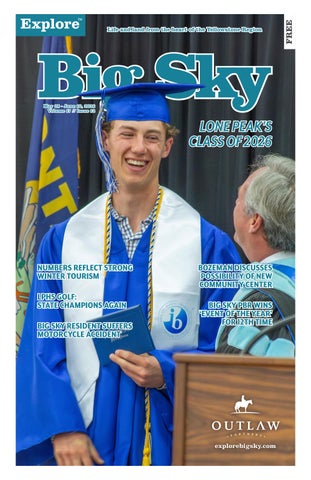
ON THE COVER:
Graduating senior Oliver McGuire smiles beside Big Sky School District Superintendent Dr. Dustin Shipman as he accepts his diploma and shifts his focus to Dartmouth College. PHOTO BY JACK REANEY
EDITORIAL POLICIES
EDITORIAL POLICY
Outlaw Partners, LLC is the sole owner of Explore Big Sky. EBS reserves the right to edit all submitted material. Printed material reflects the opinion of the author and is not necessarily the opinion of Outlaw Partners or its editors. EBS will not publish anything discriminatory or in bad taste.
EBS welcomes obituaries written by family members or from funeral homes. To place an obituary, please submit 500 words or less to media@theoutlawpartners.com.
BOZEMAN DISCUSSES POSSIBILITY OF NEW COMMUNITY CENTER
As Bozeman grows, so does the demand for family-friendly recreational facilities, as proven by the hundreds-long waitlist for swim lessons. EBS spoke with the city about what it would take to create a future ballot item for a new center.
NUMBERS REFLECT STRONG WINTER TOURISM
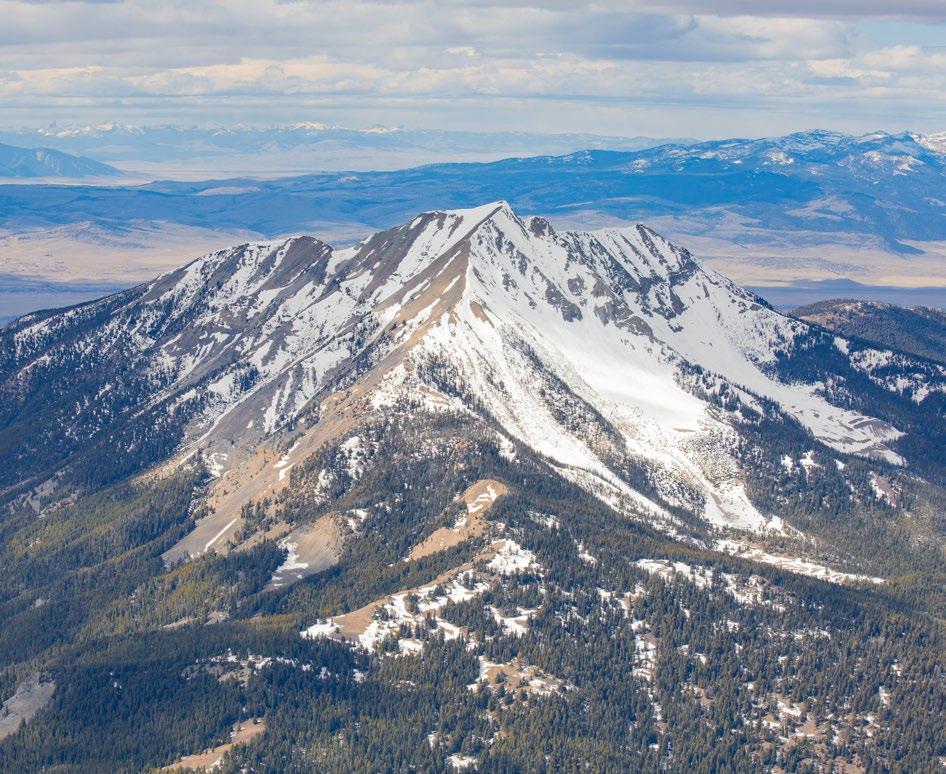
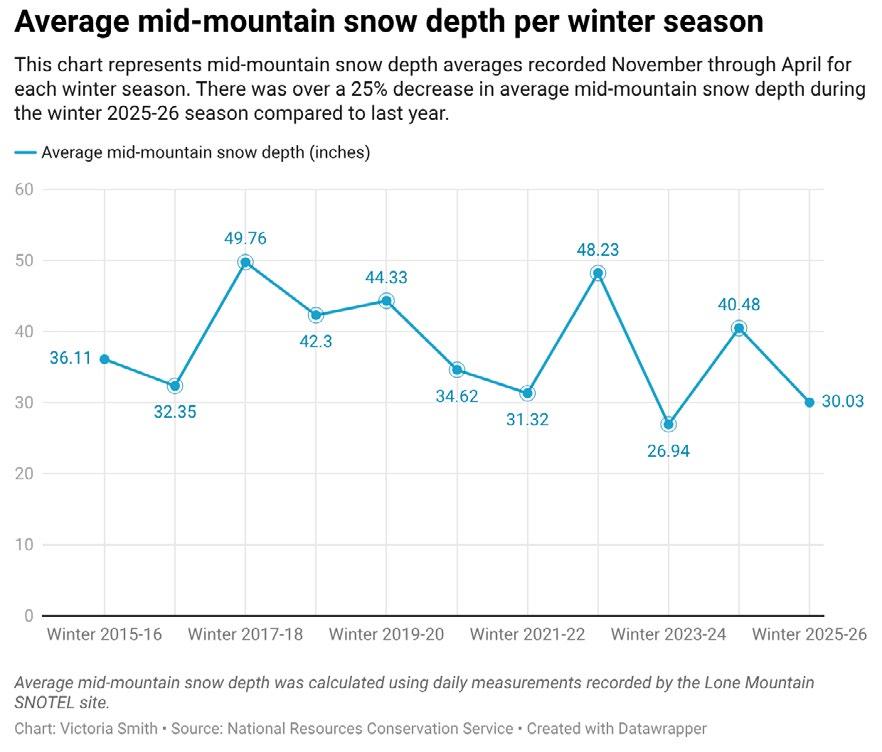
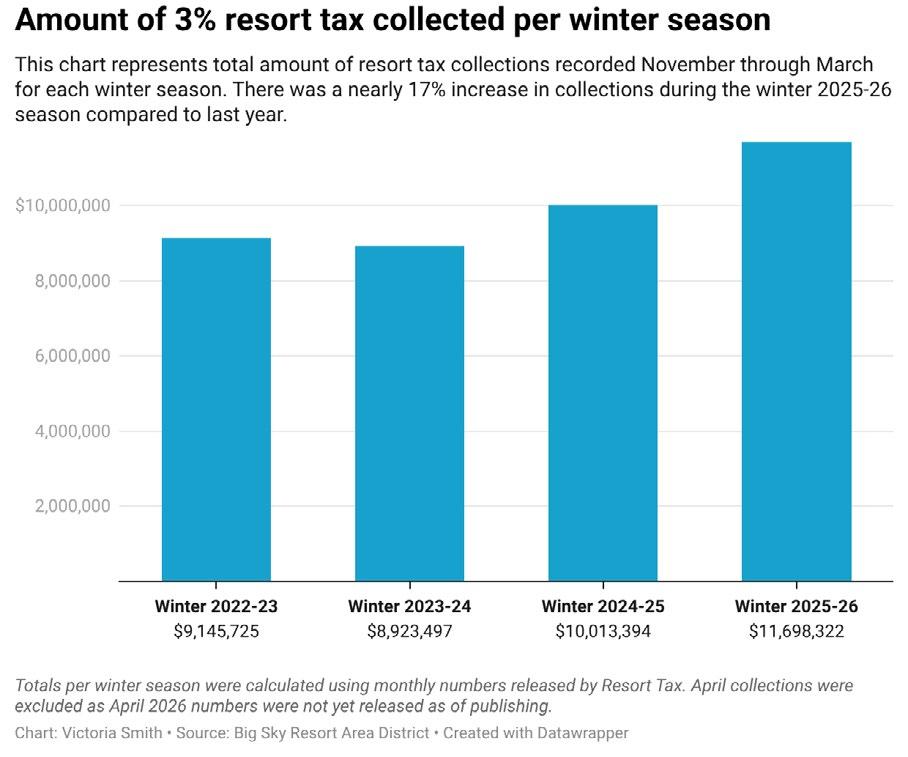
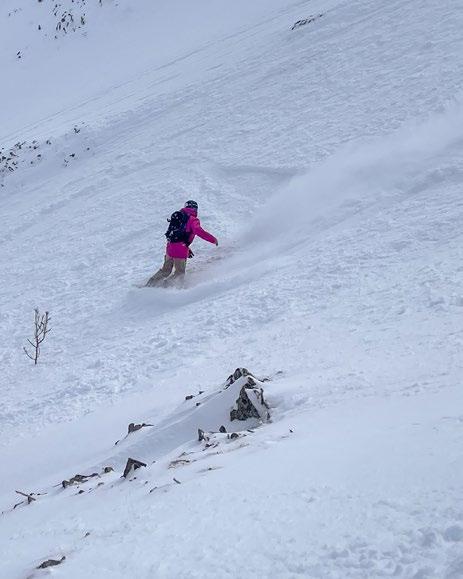
Despite the subpar snow conditions this winter, statistics indicate that Big Sky businesses had a successful season. Visit Big Sky statistics, resort tax collection data and observations from local business owners all agree that Big Sky fared well this winter.
LETTERS TO THE EDITOR
Letters to the editor allow EBS readers to express views and share how they would like to effect change. These are not Thank You notes. Letters should be 250 words or less, respectful, ethical, accurate, and proofread for grammar and content. We reserve the right to edit letters and will not publish individual grievances about specific businesses or letters that are abusive, malicious or potentially libelous. Include: full name, address, phone number and title. Submit to media@outlaw.partners.
ADVERTISING DEADLINE
For the June 11th issue: June 3rd, 2026
CORRECTIONS
Please report errors to media@outlaw.partners.
OUTLAW PARTNERS & EXPLORE BIG SKY P.O. Box 160250, Big Sky, MT 59716 (406) 995-2055 • media@theoutlawpartners.com
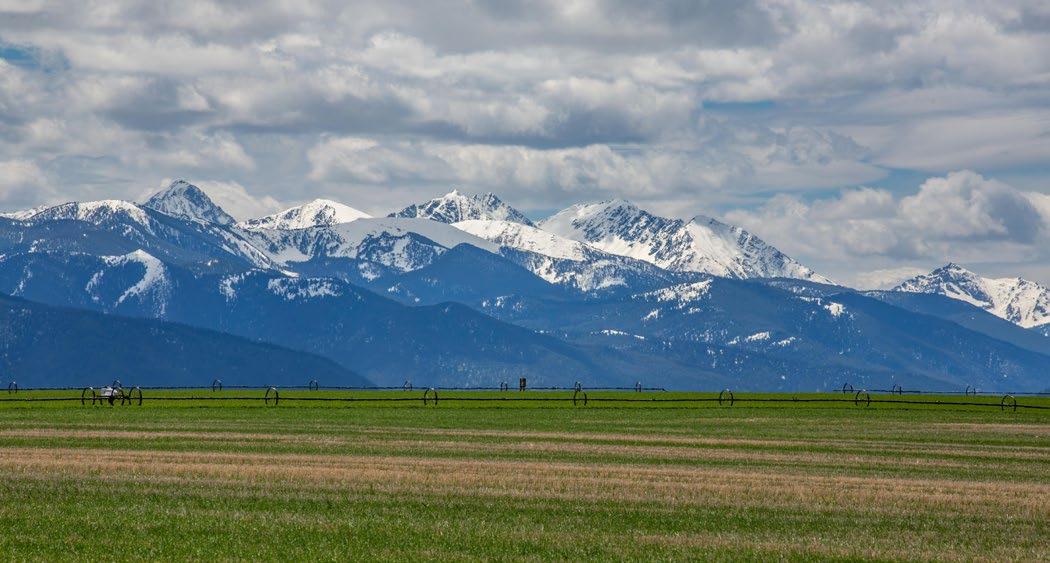
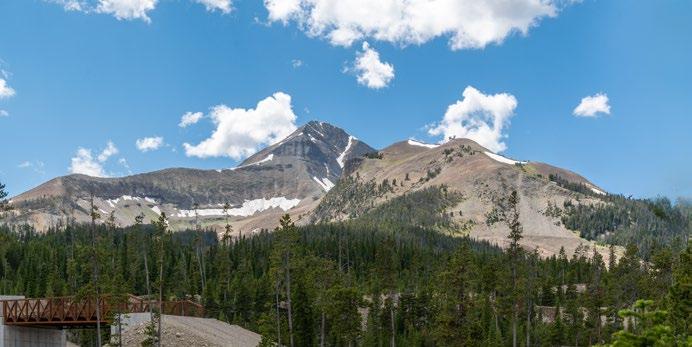
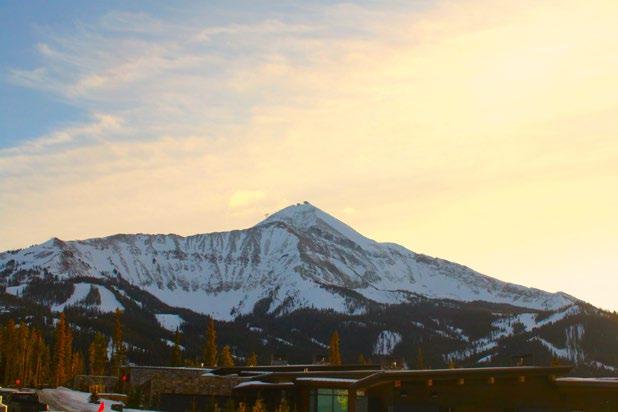
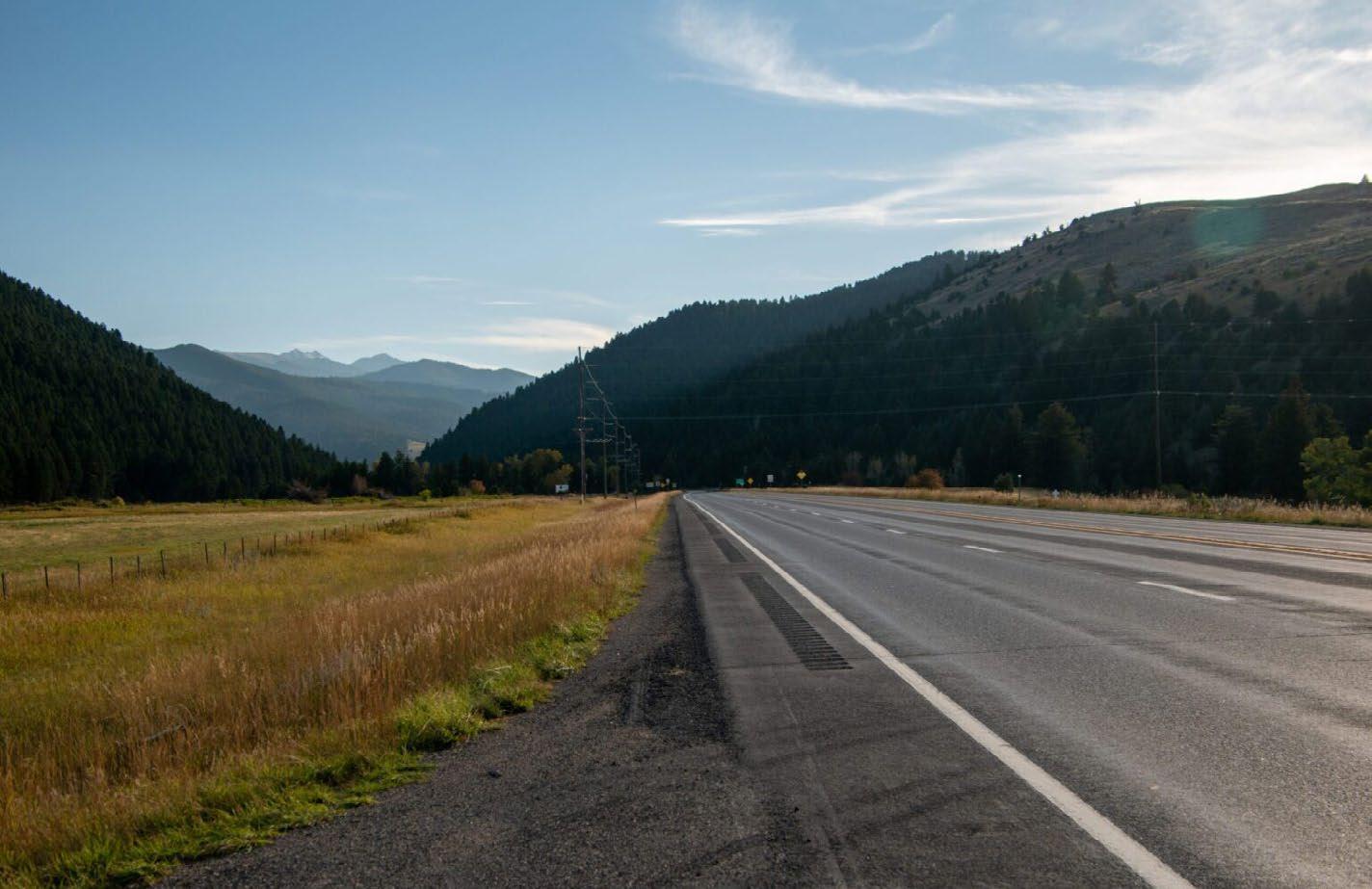
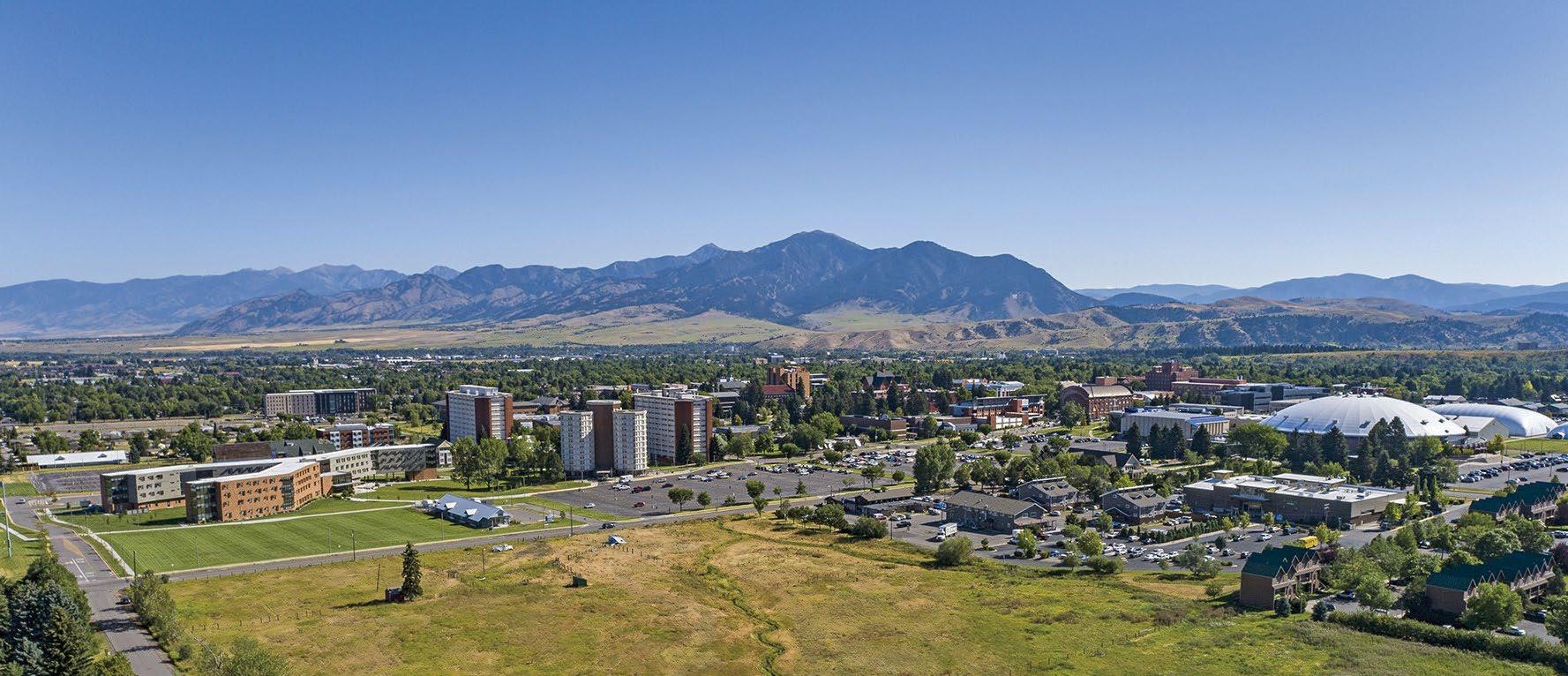
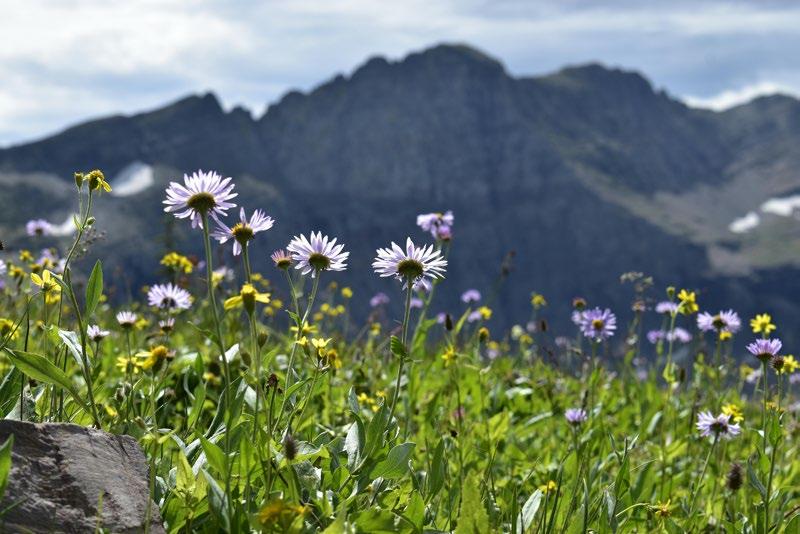
Peaks and valleys tend to disagree this time of year. Photographed on May 22, the Gallatin Valley is in full spring bloom while the Spanish Peaks hold the latest spring snowstorm. PHOTO BY JACK REANEY
LONE PEAK’S
BRIEFS NEWS IN BRIEF
SUMMER SKI AREA BEARTOOTH BASIN OPENS FOR THE SEASON
EBS STAFF
Beartooth Basin, the only summer-only ski area in North America, which sits on Beartooth Highway, is open for the season, the ski area announced on social media.
“You don’t end up at Beartooth Basin by mistake, you chase it,” wrote Ski magazine to honor the event. “There’s no lodge, no cell service, and no RFID gates. Just skiing, and a whole lot of possibility.”
The ski area has a lift staff and professional ski patrol, according to the website, and is open daily from 9 a.m. to 3 p.m. with plans to be open through June 10, conditions allowing. Lift tickets for one day are $50 and can be purchased online but visitors are encouraged to check operations updates and road conditions as U.S. Highway 212 can close intermittently due to weather.
BOZEMAN TO HOST PRIDE IN THE PARK JUNE 6
EBS STAFF
Bozeman Pride 2026’s main daytime event, Pride in the Park, will take place Saturday, June 6 at Lindley Park from 10 a.m. to 4 p.m., featuring a full day of community programming, entertainment and educational events.
The celebration includes an educational speaker series beginning at 10:30 a.m., a Drag Story Hour at 11 a.m., Pride speeches at noon and an all-ages drag show at 1 p.m. Event producer, the Downtown Bozeman Association, said local organizations and businesses will host interactive booths offering resources and support for 2SLGBTQIA+ residents in Bozeman.
“This community-strengthening day of programs welcomes all and celebrates the passion, diversity, history, culture, joy and resilience of Two-Spirit, Lesbian, Gay, Bisexual, Transgender, Queer, Intersex, Asexual, and other identities under the glorious rainbow,” stated a news release from DBA.
The event is open to the public and aims to celebrate diversity, inclusion and community connection through a variety of family-friendly activities and performances.
PUBLIC NOTICE
AVAILABILITY OF ANNUAL DRINKING WATER QUALITY REPORT (CCR)
Big Sky County Water & Sewer District 363 (PWS ID: MT0002385) has completed its 2025 Consumer Confidence Report (CCR), also known as the Annual Drinking Water Quality Report. This report contains important information about your drinking water, including water quality data, potential contaminants, and the steps taken to ensure safe and reliable drinking water for our community.
The CCR is available to the public online at: bigskywatersewer.com. For additional information regarding this report, please contact: office@wsd363.com. The public is also welcome to attend our monthly board meetings, held on the third Tuesday of each month. District 363 is committed to providing safe, high-quality drinking water to all customers.
ONE DEAD IN
BOZEMAN
SHOOTING
EBS STAFF
A 28-year-old man was killed early the morning of Monday, May 25 in a shooting in downtown Bozeman resulting from an altercation that began inside the Rocking R Bar on Main Street.
Officers responded around 12:44 a.m. to the 200 block of East Main Street after reports of a shooting outside of Rocking R Bar, according to a press release from the Bozeman Police Department. Officers began life-saving efforts at the scene before the victim was transported to Bozeman Health Deaconess Hospital, where he was later pronounced dead.
The suspect fled in a vehicle but was quickly located and taken into custody. Twenty-two-year-old Jakob Steven Lundberg was arrested and charged with deliberate homicide, according to reporting by the Bozeman Daily Chronicle. Police said there is no ongoing threat to the public.
According to an official affidavit documenting the incident, Lundberg and the victim, 28-year-old Sidney Callaghan, became engaged in a fight inside the bar and were escorted outside by bar staff. The fighting continued until the suspect—detectives were highly confident the shooter was Lundberg, based on video surveillance and other evidence—went back to his vehicle and returned with a firearm, which he discharged multiple times, killing Callaghan before fleeing the scene.
“Violence of this magnitude in the heart of our community is devastating,” Gallatin County Attorney Audrey Cromwell stated in a press release from the county attorney’s office. “Our office will continue working closely with law enforcement to ensure a thorough review of the evidence and to seek justice for Sidney.”
Lundberg appeared before Gallatin County Justice Rick West on May 26, and is being held on $1.5 million bond, high-level supervision and conditions preventing access to firearms, drugs or alcohol. Charges will be filed in Gallatin County District Court in the coming weeks.
“With the assistance of neighboring agencies, we were able to quickly identify, locate and detain the individual responsible for this act,” the BPD release stated. “We ask any member of the public who may have witnessed this incident or have additional information to report it to the Bozeman Police Department.”
GVLT TO HOST NATIONAL TRAILS DAY EVENT, SUMMER TRAILS CHALLENGE KICKOFF
EBS STAFF
Gallatin Valley Land Trust will host its annual National Trails Day volunteer event on Saturday, May 30, at Gallatin County Regional Park, followed by a free community barbecue to launch the organization’s 11th annual Summer Trails Challenge.
The family-friendly volunteer event runs from 9 a.m. to noon and will include trail and park maintenance projects for all ages and abilities. Checkin begins at 8:30 a.m. with coffee and snacks and a free BBQ to follow. Participants are encouraged to walk, bike or carpool due to limited parking.
“Every year we look forward to spending time with fellow outdoor enthusiasts preparing our local trails for a great season ahead,” says GVLT Trails Director Matt Parsons. “This year, we’re excited to focus our efforts on Bozeman’s west side at the community’s beloved Gallatin County Regional Park.”
The Summer Trails Challenge runs June 1-30 and aims to reach a community goal of 100,000 trail miles logged through hiking, biking, walking, running or rolling on area trails. According to GVLT, every mile logged unlocks $1 for trails and open space through a $100,000 sponsor match pool backed by local businesses including Bozeman Health, EVERGOODS, Oboz Footwear and Toyota of Bozeman.
GRADUATION
LONE PEAK GRADUATES 27 SENIORS FROM CLASS OF 2026
‘WE ARE ABOUT TO HEAD OUTSIDE OF OUR LITTLE BUBBLE, INTO A GREAT EXPANSE’
BY JACK REANEY
BIG SKY—On Sunday, May 24, Lone Peak High School celebrated the Class of 2026 with a ceremony full of reflective, encouraging and humorous speeches.
Big Sky School District Superintendent Dr. Dustin Shipman began thanking families, friends, teachers and the Big Sky community for fostering student success. He encouraged students seated in Lone Peak’s gymnasium to seek challenges and live beyond their comfort zones.
“It is with the foundations you cultivated here, that you will expand further into successful futures,” Shipman said in his address. “I congratulate each one of you for your accomplishments here at LPHS, but I also challenge each graduate to not rest on the past, but to use it as a springboard to the world of opportunities that lie before you.”
Harper Morris, student council president bound for Division III soccer at Middlebury College, entertained the hundreds on hand with the first student speech. Morris thanked staff and faculty members by name, from bus drivers and lunch ladies to custodians and coaches. She made light of awkward and formative moments by herself and her classmates, recalling specific memories dating all the way back to elementary school.
“Together, we have spent 2,236 days... [13 years of] essays, math tests and relationship struggles, side by side, but we’ve also become each other’s ride-ordies. And for that, and so much more, I am forever grateful to have endured this adventure we call childhood growing up alongside all of you.”
Tony Coppola, high school history teacher and boys soccer coach, took a similar approach in his speech, having been chosen by graduates to give the faculty address. He ran through many of the academic and extracurricular accomplishments, growth areas, mistakes and core memories that define the Class of 2026.
“History can be biased, it can be misleading, but it’s also full of lessons and morals that future generations can grow and foster from... You need to examine the past and present to help guide your future,” Coppola said.
He said that while graduation can feel like a transitional moment, it is not the act of graduating that validates Lone Peak’s seniors as worthy adults.
“You don’t need an award or a medal just to prove that you have something special within you,” Coppola said. “All of you are blessed with the talents that are worth congratulating, and this is what this day is all about.”
Valedictorian Elise Daugherty spoke about feelings of pride, relief, anticipation and uncertainty surrounding graduation, as some Big Horns
PHOTO BY JACK REANEY
Harper Morris made classmates and families laugh, sharing inside jokes and memories from the Big Sky School District.
PHOTO BY JACK REANEY
GRADUATION
prepare to leave the only place they’ve ever called home. Daugherty is headed to the U.S. Air Force Academy, becoming the first LPHS female to attend a military academy.
She noted that the Class of 2026 has been privileged to grow up in the “niche society” of Big Sky where everyone wants to see them succeed, demonstrating the importance of a truly supportive community.
She believes adult life won’t be easy. “The current state of the world is tumultuous, and it can be forgotten by some that we are charged with taking care of the world for the future and young generations, not just ourselves and the present,” Daugherty said. Growing up and learning in Big Sky provides an important foundation for meeting those challenges, Daugherty noted.
“The uniqueness of Big Sky is that it has taught us to care for everything we have, and create a balanced relationship with the world around us... We are about to head outside of our little bubble, into a great expanse. To a place where there will be fights for what is right. The world we are living in today is intimidating, but it is our job to keep it protected,” Daugherty said.
as a documentary filmmaker and comedian.
Jane emphasized that while many young adults are encouraged to not be fearful of failure, mentors often give this advice without sharing any examples of their own mistakes. She listed a few personal failures, from a flawed mac and cheese startup to a television script that fell apart when its main character could not be replaced.
When roadblocks emerge, Jane encouraged students to try everything they can to address the problems before giving up. But sometimes, failure is absolute.
“If it’s truly not fixable, just laugh. Just laugh about it. Learn from it and move on,” Jane said. “Dwelling on failure is probably the singular most useless thing you can do in life, as it prevents you from creating the next win.”
Jane discussed the importance of designing one’s own life with intention, and building “a life you are excited to get out of bed for.”
She also noted that one of her own greatest life lessons has been finding motivation for the monotonous responsibilities of adult life and one’s career.
“Learn to get excited about the necessary, boring stuff, as it’s truly a crucial part of life. Make it weird,
make it silly, whatever you have to do to get your mind in the right place. As oddly, the boring stuff always is the framework for all the fun stuff,” Jane advised.
Finally, she cautioned against viewing school-aged years as the best days of one’s life—she pointed out those who reflect on schooling days as the best days of their life are often the most miserable adults.
“The reason a lot of people think that their school days are their best days is because it was a time in their lives when they were socially active, physically active, learning, working towards goals and trying new things all the time,” Jane said. “The way to keep enjoying life is to simply keep doing and prioritizing these things.”
After tossing their caps, the seniors walked out to raucous applause while their chosen walk-out song, “Ocean Man” by Ween, encouraged all 27 alumni to lead the wider world to the land that they understand.
“Seniors, look around,” said LPHS Principal Dr. Marlo Mitchem. “You’re surrounded by a community that believes in you, and takes immense pride in everything you’ve done, and everything you will do. Graduation is a finish line, and it’s also a launching pad... We’re so excited to watch your journeys unfold.”
The keynote commencement speaker was Jennifer Jane, founder of Proper Good Easy Meals, as well
Superintendent Dr. Dustin Shipman reminds students to make every day their best day. PHOTO BY JACK REANEY
Valedictorian Elise Daugherty. PHOTO BY JACK REANEY
PHOTO BY JACK REANEY
PHOTO BY JACK REANEY
Piper Carrico College of Charleston
Aeneas Espinosa Fire Academy
Ebe Grabow Montana State University
Olivia Kamieniarz Lewis and Clark College
Harper Morris Middlebury College
Liliana Turner Montana State University
Jed Clack Montana State University Northern
Morgan Fesller University of Colorado (Boulder)
Shea Grupe Montana State University
Cate Leydig Hamilton College
Anshu Ramesh Brigham Young University (Idaho)
Maddie Wilcynski Lewis University
Elise Daugherty U.S. Air Force Academy
Kaylee Fletcher Gap year—Film school, undecided
Will Helms Elon University
Dylan Manka Cabrillo College
Walker Stewart University of Colorado (Boulder)
Geno DiTullio Post-graduate year (competitive alpine ski)
Eli Gale Gap year—considering military
Lauren Jackson Montana Technological University
Oliver McGuire Dartmouth College
Matthew Tompkins Montana State University
Dylan Efferson Gap year—Montana State University
Taran Gilbert Colorado College
Brady Johnson Bucknell University
Hana Mittelstaedt Bowdoin College
Poppy Towle Oregon State University
SUNDAY, JUNE
WELCOME COCKTAIL HOUR
G-MAN
KIERNAN VOLDEN NAMED EXECUTIVE DIRECTOR OF WIA
BY JACK REANEY
BIG SKY—On May 11, Big Sky nonprofit Wellness In Action announced a change in leadership, promoting director of programs Kiernan Volden to the executive director role.
Volden joined WIA in 2022 and has been “integral” to the nonprofit’s mission as a mental and behavioral health resource provider, working to reduce barriers to care. She offers a “hands-on” leadership style and has led WIA’s expansion of programs like the affordable counseling program, community health worker services, groups and trainings, and youth scholarship initiatives, according to a press release. Volden moved to Big Sky in 2021, and holds a bachelor’s degree in
WIA board chair Dana Wikan said the leadership change allows the organization to carry on the momentum created by former executive director Allison Bradac, who was “pivotal” in strengthening WIA and expanding its impact.
“Under her leadership, WIA deepened its mental health programming, built strong partnerships with local organizations, and established a more sustainable foundation for the future. Her steady guidance helped position WIA as a trusted, community-centered nonprofit prepared for its next phase of growth,” Wikan stated in an email to EBS.
Bradac’s tenure ended in December. Wikan said that the 21-year-old organization is excited to have Volden at the helm for its next chapter.
SARAH BLECHTA EARNS WARM FAREWELL
RAISED IN BIG SKY, BLECHTA SERVED ON THE RESORT TAX BOARD FOR EIGHT PIVOTAL YEARS
BY JACK REANEY
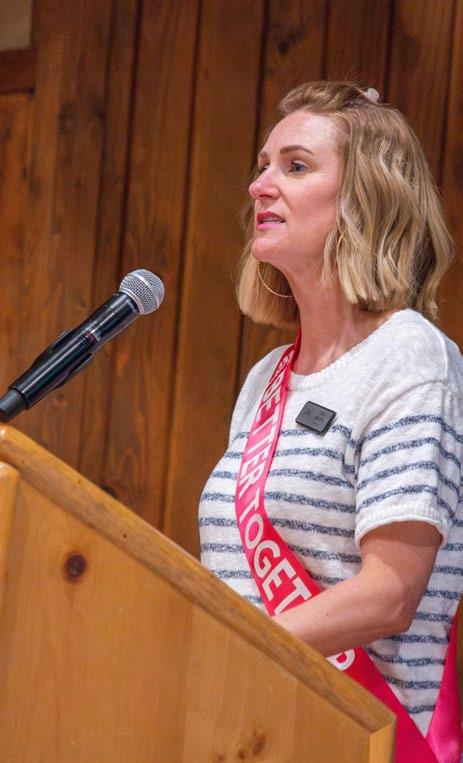
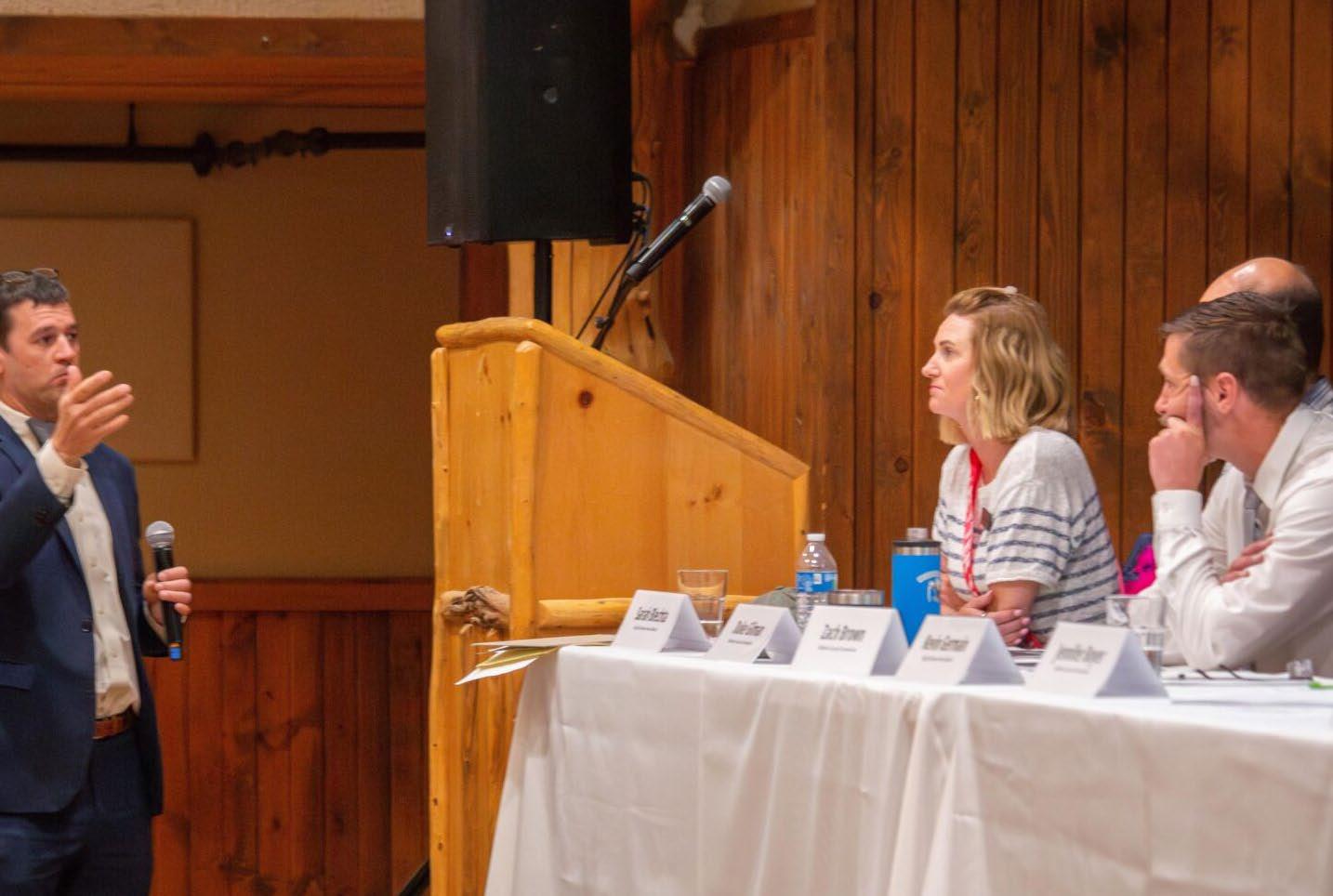
BIG SKY—To celebrate her final day of service to the Big Sky Resort Area District, Sarah Blechta was given a pink sash with the mantra that guided her eight years of leadership: “Better Together.”
During the Madison-Gallatin Joint County Commission meeting on May 13 in Big Sky, fellow Resort Tax board members wore pink in her honor. Blechta was thanked by leaders from local nonprofits like the Big Sky Community Organization and Wellness In Action. “Thank you for all that you have done for our community. Your honesty, your insight, your sass… Thank you for asking the tough questions,” said Madeleine Feher, CEO of BSCO.
Resort Tax board member Kevin Germain said the community truly is better together, and the Resort Tax board will continue to use that phrase for many years to come.
“Sarah, thank you… You’re going to be missed on this board, but your legacy is going to live on for a long time,” Germain said.
Daniel Bierschwale, BSRAD executive director, presented a plaque that will hang in the Resort Tax office.
“It’s been a wild ride. Eight years. And we’re so thankful for everything you’ve done. You have left a lasting impact on our community, and as Kevin said, while Big Sky is certainly better together, Big Sky is better because of you, Sarah,” Bierschwale said.
Blechta gave parting words at the end of Wednesday’s meeting, noting that she’s been proud not only to serve the community where she grew up, but to grow alongside it during those years of hard work in the public eye. She said she’s most proud of the way the Big Sky community collaborated and challenged each other to achieve many goals.
“There’s relief, there’s sadness, a whole lot of pride,” Blechta said. “… Serving in local government— community politics—isn’t always easy… what has always made it worth it is this community, and everyone who keeps showing up, believing in this community and believing that we’re better together.”
Following the May election, Blechta’s seat will be replaced by a new trustee in Taylor Kissell; incumbent Michelle Kendziorski retained her board set during the election.
Sarah Blechta gives a farewell speech in her final meeting as a Resort Tax board member. PHOTO BY JACK REANEY
U.S. 191 IS NO. 2 PRIORITY IN MONTANA TRANSPORTATION NEEDS, NEW STUDY FINDS
BY JEN CLANCEY
GALLATIN GATEWAY—The heavily-used corridor of U.S. Highway 191 between Four Corners and Montana Highway 64 (Lone Mountain Trail) is No. 2 for top transportation challenges in the state, according to a new report that placed Montana’s aging bridges at the top of the list.
The National Transportation Research Group, or “TRIP,” reported in a study that the 35mile section of U.S. 191 needs $350 million in improvements, but options are limited by the Gallatin Canyon’s narrow and steep landscape. The group used data from the Montana Department of Transportation, Federal Highway Administration and U.S. Department of Transportation National Highway Traffic Safety Administration to provide an overview of Montana’s traffic increase and the safety, maintenance and efficiency of roadways.
In the past year, MDT officials acknowledged a state of “disrepair” on U.S. 191 and the urgent need for improvements, while community leaders continue to express concerns about the road’s danger and grassroots efforts focus on reducing speed limits along the primary route between Big Sky and Bozeman.
In a May 19 press conference, Rocky Moretti, director of policy and research at TRIP, noted that vehicle travel between 2000 to 2024 increased by 40% in Montana, but 31% of Montana’s roads are in poor or mediocre condition. Projects that would align road conditions with growth are getting more expensive, he said.
“But the Montana Department of Transportation, like most states, are being constrained partly because of inadequate resources, but also the significant rate of inflation has really impeded their ability to move forward with these projects,” Moretti said.
Brandon Jones, district project development engineer at MDT overseeing the region including the Gallatin Canyon, agreed that inflation creates challenges, as does a long line of projects that have already been granted federal funding. Along U.S. 191, an optimization plan outlines improvements to highway features including the 191/ 64 intersection, Lava Lake structures, improved turnouts, passing lanes and replacement of the Spanish Creek bridge.
A multi-lane roundabout at the 191/64 intersection is still in the preliminary engineering stage, and MDT is waiting to hear if the project is awarded a BUILD grant in July of this year.
The most expensive project on the optimization list is slated for 2030. MDT will replace the Lava Lake bridge and update access points to the Lava Lake trailhead in a project that will likely cost upwards of $70 million, according to Jones. Between now and the bridge replacement, MDT will continually monitor the structure’s condition.
The TRIP report highlighted old bridges, especially timber bridges, as the top challenge the state needs to invest in moving forward. The Lava Lake bridge was originally built in 1950 and is in “fair” condition according to the National Bridge Inventory. The bridge is just one of the 39% of Montana bridges built in 1969 or earlier. Allison Corbyn, operations director with the Montana Infrastructure Coalition, emphasized these issues in the meeting.
“We’ve got a lot of miles of roads. We’ve got a lot of bridges,” Corbyn said. “And that aging infrastructure really comes to light in this report when we’re looking at nearly 40% of our bridges being built in 1969 or earlier. So we’ve really got some aging infrastructure.”
There are 212 bridges in Gallatin County—157 of those bridges are in “fair” condition and 12 are in “poor” condition, including one by Lower Wapiti Trailhead and the popular Axtell Bridge in Gallatin Gateway.
The report also highlighted road safety. With an average of 210 people killed on Montana roads every year between 2019 to 2024, Moretti explained that a combination of driver behavior and road updates can improve safety, especially along rural non-interstate roads where fatality rates are more than double other Montana roads.
“So clearly, Montana needs to make significant improvements in roadway safety,” Moretti said. He described the U.S. Department of Transportation’s Safe Systems Approach, which aims to holistically address safety on roads.
“It includes, certainly, starting with the motorist driving at safe speeds, not being impaired, but it’s also absolutely vital that our infrastructure system be as safe as possible,” Moretti said.
While not the primary cause of fatalities, the report estimated that roadway features—such as number of lanes, lane widths, markings, guardrails and intersection design—were “likely a contributing factor in approximately one-third of all fatal traffic crashes, resulting in $500 million in economic costs in Montana in 2024.” Safety improvements like rumble strips, paved shoulders and clear lane markings can improve traffic safety.
Following bridges and the Gallatin Canyon, TRIP highlighted other transportation issues in the top 10. The age and poor condition of Montana’s culverts is third; Interstate 90 in the Billings area is fourth; and U.S. 212, which includes Beartooth Highway, is fifth. I-90 between Idaho and St. Regis is sixth, followed by I-90 between Hardin and Wyoming, I-15 between Great Falls and Sweetgrass and I-94 between Forsyth and North Dakota. Finally, I-90 in the Bozeman area between Three Forks and Rocky Canyon is at tenth for its capacity and performance issues. Work along that corridor is ongoing with 2026 funds allowing resurfacing and bridge maintenance.
Aptly nicknamed “Keeping Montana Moving Forward,” the research stated that all will benefit from needs being met on the state’s roads.
“A safe and reliable transportation system that is maintained in good condition and offers improved mobility and accessibility to meet the needs of Montana residents, businesses, and tourists alike, is critical to moving Montana forward,” the report concluded.
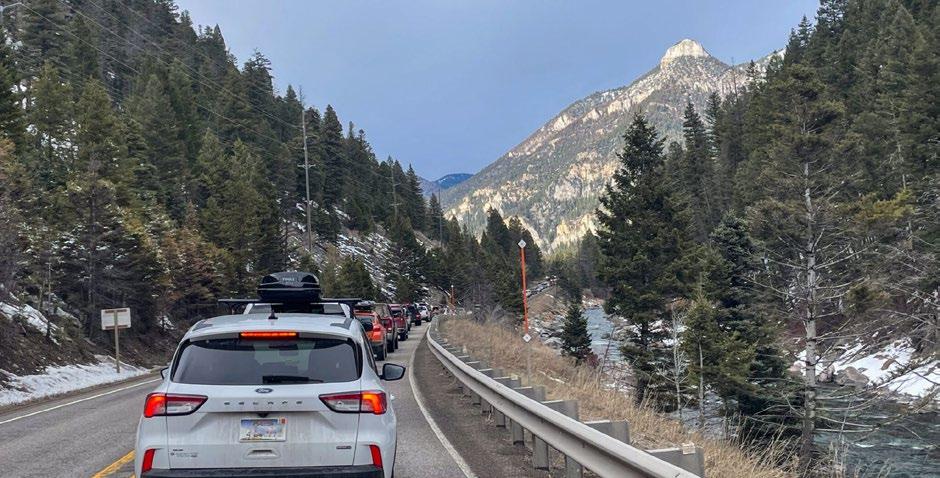
Traffic waited for two hours after pickup trucks collided near Storm Castle Peak on March 15, 2025. Luckily, the accident resulted only in minor injuries. PHOTO BY JACK REANEY
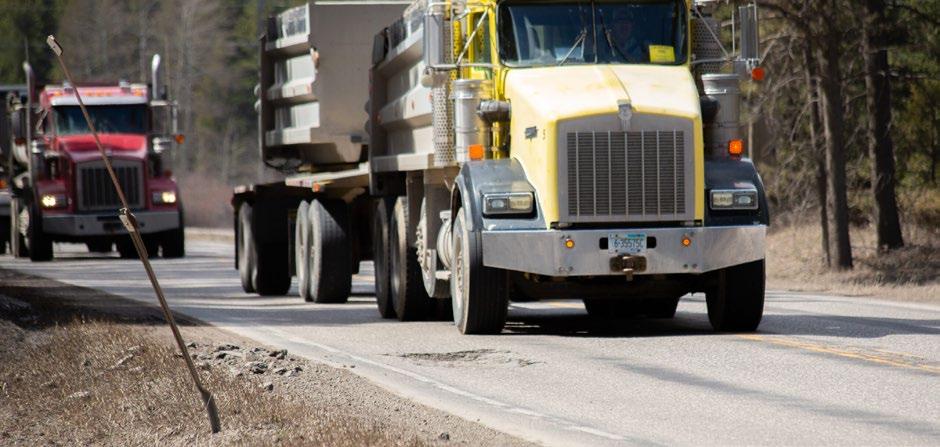
A truck with a trailer avoids a pothole along U.S. 191. PHOTO BY JACK REANEY
BIG SKY FIRE DISTRICT ASKS GALLATIN COUNTY FOR $225K
‘IT’S JUST WORDS’: TRUSTEE MAKES PLEA FOR FUNDING AFTER TAX ERROR LEFT BSFD WITH BUDGET SHORTFALL
BY JEN CLANCEY
BIG SKY—After nine months of handling budget problems due to a Gallatin County tax error, the Big Sky Fire District formally asked the county government for help.
Matt Dodd, Big Sky Fire District trustee, presented a request for $225,000 of Gallatin County dollars at the Madison-Gallatin Joint County Commission, starting with the history of the tax error discovered in September 2025.
A county spreadsheet error led to an $8.3 million over-collection of fire district taxes spanning four years. It also left the Big Sky Fire Department with a $2.3 million gap in its annual budget after the tax error was corrected. Since then, the department has cut projects and administrator salaries to make up for lost revenue, while declaring it would maintain the same service standards.
Dodd thanked County Commissioner Zach Brown for taking responsibility on behalf of Gallatin County at a February public forum about the cause and effects of the tax error.
“Zach, you came out to talk to the folks, and we appreciate that. We appreciate you showing up, taking accountability and saying, ‘this is what went wrong,’” Dodd said.
Still, the budget issue remained, he noted.
“We’ve cut everything we can cut, things we weren’t anticipating cutting. Things like personal protective equipment for our firefighters. Things like training for our firefighters who protect us every day,” Dodd said.
He continued, saying that despite Brown’s February apology, the fire district and the community are still handling the budget shortfall alone—and recently, with the help of Big Sky Resort Area District funding.
In April, BSFD met with BSRAD to discuss the need for further funding within the final year of BSRAD’s three-year, $3.55 million interlocal agreement to fund BSFD services. The fire district’s original ask was for $900,000 in additional funds, but BSRAD agreed to provide BSFD with half of the request and an additional contingency for a match.
If Gallatin County—or any other entity— contributes $225,000 to the fire district, BSRAD will match that amount, leading to an eventual fulfillment of the fire district’s ask of $900,000. The funds would be used for operating expenses, Dodd explained, like fuel for fire trucks and firefighting technology services.
Dodd noted that he appreciated the commission for its acknowledgement of the county’s mistake, but that there are more steps to make the situation better.
“Accountability takes two parts,” Dodd said. “It takes, one, apology, an acknowledgement … But the second part of that is taking action … It’s doing the thing you said you were gonna do.”
Gallatin County never promised any funding to rectify the situation. Still, Dodd said that an apology without action is not accountability.
“It’s just words,” Dodd said. “So what I’m here to say is Big Sky, this community, can’t bear this cost alone.”
Dodd ended his request noting that he’s not expecting an answer from Gallatin County today, but wanted to make the ask. Commissioners Brown and Jennifer Boyer did not respond to Dodd’s request during the public meeting.
After the meeting’s conclusion, Explore Big Sky asked the commissioners for comment.
Brown noted that the county is tasked with supporting more than 80 special purpose districts across Gallatin County. He said it could create a challenging precedent to provide such funding for an organization’s operations, adding that fulfilling the Big Sky Fire District’s request would be a “very unique and extraordinary” action for Gallatin County to take.
Jack Reaney contributed reporting to this story.
Matt Dodd presents at the Gallatin-Madison Joint County Commission meeting on May 13. PHOTO BY JACK REANEY
BIG SKY TRANSPORTATION LEADERS PLAN TO CONSOLIDATE EFFORTS
TRANSPORTATION DISTRICT AIMS TO HIRE EXPERT ON ROAD INFRASTRUCTURE TO ADDRESS BIG SKY NEEDS
BY JACK REANEY
BIG SKY—In a growing community that increasingly strains its transportation infrastructure, leaders are looking to create a position to take charge of planning and maintenance.
During the May 13 Madison-Gallatin Joint County Commission meeting, Bayard Dominick, chair of Big Sky Transportation District, presented the idea of expanding BSTD beyond the Skyline Bus public transportation service, to include coordination and oversight of “macro” transportation issues such as roads, sidewalks, traffic and other infrastructure. BSTD envisions hiring an individual whose sole job is to focus on big-picture transportation needs, complementing current executive director Darren Brugmann, whose role primarily handles Skyline Bus.
In addition to vehicle-related transportation, BSTD is prioritizing “active transportation” across Big Sky, through trails and paths for pedestrians and bicycles.
Dominick noted that public transportation ridership has doubled in the past five years, and the trend is expected to continue alongside individual vehicle traffic. He said it’s important for roads and public transportation to match the growth in demand.
“Currently there are many entities within Big Sky that are working on these transportation issues. But we think it really would be [a] benefit to consolidate those efforts under the transportation district so we have one point of contact,” Dominick said.
He listed Big Sky Resort, the Big Sky Chamber of Commerce, Lone Mountain Land Company, Resort Tax, the Big Sky Owners Association and Big Sky Community Organization as contributors pitching in to address current transportation and road maintenance needs.
Dominick noted BSTD’s opinion that a significant change in governance does not appear imminent, based on findings of the Big Sky Governance Study. With that in mind, BSTD would be a sensible party to tackle local transportation infrastructure.
Local leaders seem to agree.
One HOA leader—who did not announce his name during public comment—said it would be “invaluable” to have a point of contact for arrangements like rural improvement districts. Another HOA leader, Holly Coltea of the Big Sky Owners Association, said Big Sky’s largest HOA has struggled to keep up with the highly specialized work of road and bridge maintenance planning, in addition to BSOA’s other responsibilities.
“Because there’s no single entity, things do fall through the cracks—local roads, biking, pedestrian connectivity, traffic calming,” Coltea said. “… Because a transit district already encompasses this entire community, they are already thinking community-wide… they are the logical entity to take this on, and we, at BSOA, just want to endorse this wholeheartedly.”
Community member Laynee Jones, whose background includes transportation engineering, offered public comment in support of the proposed role.
“As a resident, it would be great to have someone I could call when I have a transportation issue, like parking, et cetera. I would also say, I think the residents of Big Sky are looking for more focus on transportation,” Jones said.
Big Sky Chamber of Commerce CEO Brad Niva said the chamber endorses the idea, noting that his organization sometimes needs to pick up odd tasks such as transportation outreach, for which no other formal body is responsible.
“I have to call in for pothole fixes. Guardrails that are broken… I just think this is an important position that our community needs, and it’s filling a gap. And there’s a number of us who have to step up as community members to fix it,” Niva said.
EBS asked if BSTD’s initiative would include coordinating with the Montana Department of Transportation to improve maintenance and improvements to Montana Highway 64—which faces a challenging funding situation through MDT—and Dominick said that would “absolutely” fit the purpose of the role.
“MDT’s been in those conversations with us to date, and it would be a definite big part of the conversations moving forward. And that person we’d bring on would build that relationship with MDT to streamline those efforts,” Dominick said.
` The next step is for BSTD to sort out funding for the new position, as well as the upscaling of Skyline Bus and implementing Big Sky’s active transportation plan. Dominick said that in the future, BSTD will likely bring a financial ask to the Resort Tax board and commissioners of both counties.
Resort Tax Executive Director Daniel Bierschwale offered a comment in support.
“I just want to commend the transportation district on taking this leap forward,” Bierschwale said. “And it’s time. Good job guys.”
PHOTO BY JACK REANEY
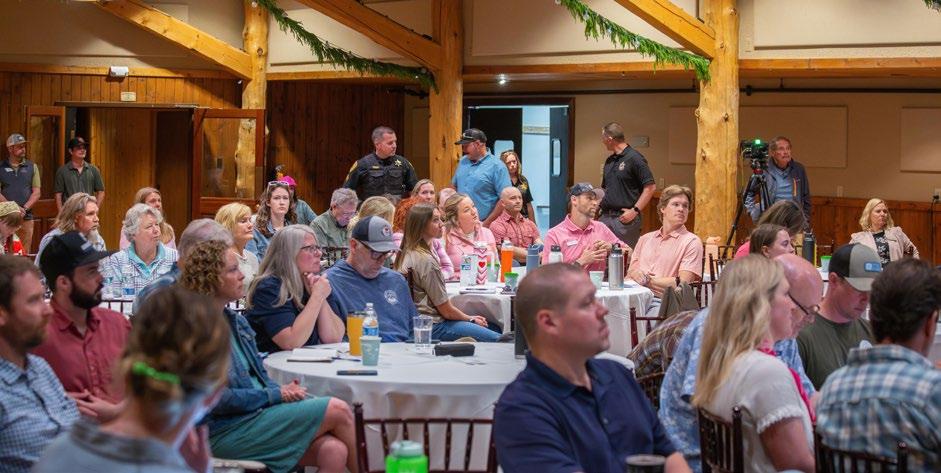
Dominick presented to a full function room at Buck’s Roadhouse. Many attendees wore pink to honor Resort Tax board member Sarah Blechta’s final meeting. PHOTO BY JACK REANEY
FIRST-EVER MINER MARKET BRINGS ENTREPRENEURSHIP AND REAL-WORLD MATH TO OPHIR MIDDLE SCHOOL
BY LESLIE KILGORE
BIG SKY—Students at Ophir Middle School are turning classrooms into storefronts as the school launches its first-ever Miner Market, a student-led entrepreneurial event designed to bring math to life through hands-on business experience.
The Miner Market, named by the middle school student council, will take place May 27-29, with students invited to attend and shop throughout the week. Students will create products and services, run their own businesses and use “Miner Money” currency while learning lessons in economics, financial literacy, marketing and mathematics.
The project is being led by teacher and student council advisor Joy Brooke, who said the idea grew from similar “math markets” she has organized in the past. Ahead of the market, EBS spoke with Brooke and a few of her students to learn about its vision and some of the projects they’re focusing on.
“I have done these math markets before and it not only keeps students engaged near the end of the year but also helps them apply mathematical skills learned throughout the year in real life, like running their own businesses,” Brooke said.
Participation in the market was optional, but students who chose to participate were required to complete a detailed application process that mirrored the steps involved in launching a real business. The application guided students through market research, pricing strategies, advertising plans, startup costs, inventory planning and postmarket financial analysis.
Students were asked to create company names and logos, identify target audiences, survey classmates about product demand and calculate pricing strategies that would allow them to earn a profit. They also had to outline production plans, marketing campaigns and methods for tracking sales and inventory during the event.
“The entrepreneurial skills needed and the questions they had to answer to go through the process of applying to the Miner Market not only encouraged their understanding of math state standards but also the real-life application of how crucial math is in today’s world,” Brooke said.
The application also emphasized broader educational goals, including economics, budgeting, supply and demand, percentages, graphing and financial literacy. After the market concludes, students will calculate profits and expenses and create graphs, or visual data representations, which reflect the success of their businesses.
According to Brooke, the market was created in part to help students understand the practical value of mathematics.
“Oftentimes, students learning math don’t understand the value,” she said. “They make comments like, ‘How am I ever going to use this in real life?’ or ‘Why do I even need to learn this?’”
She said the Miner Market helps answer those questions by giving students direct experience applying math skills in meaningful ways.
“The concept of a math market or the Miner Market, in this case, is to allow students to experience math as not just something we learn in the classroom, but something they will use in everyday life,” Brooke said. “Whether as a consumer or even a business owner, math knowledge is essential. It also makes math fun.”
Brooke said making math engaging and purposeful is especially important at the middle school level.
“This is key in a time when not all students love middle school math,” she said. “Making math purposeful and joyful is important.”
Among the seventh graders participating in the market are Esme Blyth and Wylie Brunner, who are preparing to launch their own student business as part of the event. Like their classmates, Blyth and Brunner have worked through the application process, researched ideas, developed pricing strategies and prepared products for opening day.
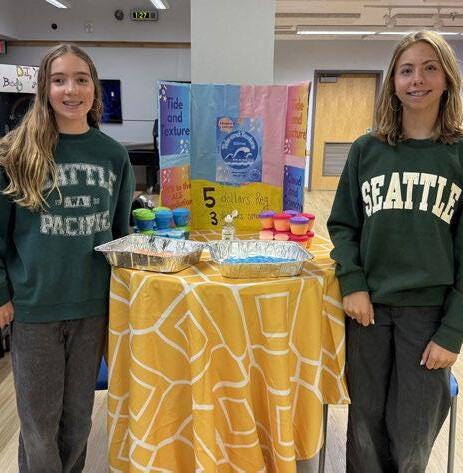
“Wylie and I make our own slimes, with the company name of Tide and Texture. There are going to be two different slime types: crunchy and cloud,” Blythe said.
“Having very little experience in the slime making field myself, I found myself going over to Wylie's house on Fridays to make slime with no idea what to do. After about 3 hours of making slimes, I
am proud to say I made all of the cloud slime by myself,” Blythe continued. "We have put our hard work into making 60 regular slimes, which we will sell for the reasonable price of $5, and 12 smaller slimes, which will be only $2. We are so excited for the miner market to showcase all our hard work. We are also ready to give back to the ALS foundation in our community by donating 40% of our earnings.”
The event also places a strong emphasis on leadership and community service. Brooke said she initially approached Ophir's math teacher, Rosie Sullivan, with the idea before bringing it to the student council so students themselves could help shape the event.
“When I approached our math teacher Mrs. Sullivan, she was very excited for this opportunity, but we both knew successful projects are best when led by students themselves,” Brooke said.
Student council members helped develop the market structure and decided that participating businesses would donate a minimum of 20% of their profits to charity. Students selected either the ALS-focused Soul Shine event in Big Sky or the Haven shelter in Bozeman as the nonprofit businesses to support.
“They really wanted to give back to our community and help in some way,” Brooke said.
In addition to growing young entrepreneurs and mathematicians, Brooke hopes the experience inspires students to become future community leaders.
“Hopefully, besides growing mathematicians and entrepreneurs, we can also grow students who want to give back and be leaders in their communities,” she said.
As students prepare their storefronts and products for opening day, organizers are already hopeful the Miner Market will be a success at Ophir Middle School.
“We hope the Miner Market becomes a tradition every year,” Brooke said.
Esme Blyth and Wylie Brunner at their booth Tides and Texture. PHOTO BY JOY BROOKE
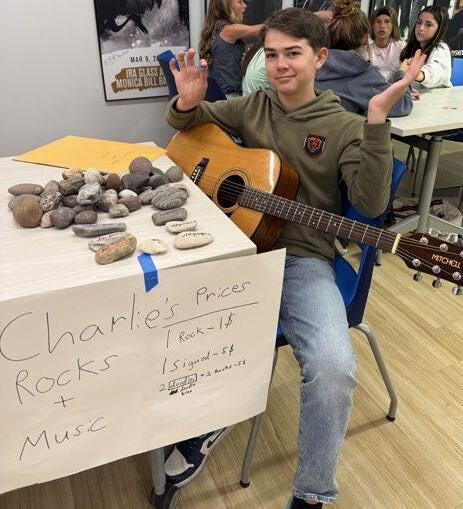
The Miner Market is a student-led entrepreneurial event designed to bring math to life through hands-on business experience. PHOTO BY JOY BROOKE Rocks and music by Charlie. PHOTO BY JOY BROOKE
BIG SKY RESIDENT FACES LONG RECOVERY AFTER MOTORCYCLE CRASH LOCAL
BY JACK REANEY
BIG
SKY—Jordan
Dommer, a resident of Big Sky and member of the local workforce, faces a long road to recovery after a motorcycle accident in the Gallatin Canyon on May 10.
Dommer, 43, suffered numerous injuries including a broken leg, broken jaw, fractured back, cranial hematoma and many broken ribs, as well as a series of small strokes, according to his father, Mark Dommer. First responders transported him immediately via helicopter to Billings Clinic Hospital, and Dommer was later flown to University of Utah Hospital based on the severity of his injuries. He has undergone numerous surgeries, and his intensive treatment is expected to continue in the coming weeks.
“It seems like every day just got a little bit worse,” Mark Dommer told EBS in a phone call Thursday, May 14. “… He’s in pretty tough shape. It’s going to be a long, long haul in terms of rehab.”
Family and friends have started a GoFundMe page to support Jordan’s recovery, with a goal of raising $20,000.
According to Jordan’s sister, Jessica Dommer Wawock, he began breathing under his own power on Friday, May 15.
“It is truly a miracle he is still alive after all he has been through,” Jessica wrote in the GoFundMe description.
While public details of Dommer’s motorcycle accident have not been released, Mark said it was a single-vehicle accident on U.S. Highway 191. Explore Big Sky did not receive a response
from Montana Highway Patrol by press time and will update this story if more information becomes available.
Mark explained that Jordan has been a nationallyrated BMX athlete, and since moving to Montana has been passionate about outdoor sports including
snowboarding, rafting and rock climbing. Mark described his son as a “free spirit” who enjoys adrenaline sports.
“He’s a hard worker,” Mark added.
Jordan works as a server at Blue Buddha Sushi Lounge in Big Sky. Restaurant owner Twist Thompson told EBS that Jordan was a founding employee when the eatery opened in 2020, and continues to be one of his most dedicated employees.
“He’s phenomenal. I don’t think he’s ever missed a shift. I’m almost 100% positive he’s essentially the first server in there every shift,” Thompson said in a phone call.
He added that they’ve become friends in the six years working together, traveling to places such as Las Vegas and Mexico. Thompson explained he’s “a teddy bear” when you get to know him.
“The kid is just—he is just such a loving person,” Thompson said. “He’s just a sweetheart… He’s one of my favorite people, he’s certainly one of my favorite [Big Sky community members]. Just really a beautiful human.”
Mark said he’s greatly appreciative of the many friendships his son has developed in his years living in Montana.
“If they can keep it up and pull for him—and he’s going to need all the support he can get—it’s going to be a long haul and I know his friends in Montana mean a lot to him,” Mark said. “I just suspect he’s going to have a lot of ups and downs… I’d sure appreciate any support he can get.”
COURTESY OF MARK DOMMER
COURTESY OF MARK DOMMER
OP NEWS
BIG SKY PBR CLAIMS 12TH EVENT OF THE YEAR RECOGNITION
IN 15TH YEAR, OUTLAW PARTNERS CREDITS SUCCESS, GROWTH TO GATHERING COMMUNITY
OUTLAW PARTNERS
Editor’s note: Big Sky PBR is produced by Outlaw Partners, publisher of Explore Big Sky.
For longtime Big Sky residents and supporters like Martha Johnson, the annual Big Sky PBR is about far more than championship bull riding, but about bringing the community together. From locals and seasonal homeowners to first-time visitors, the event has become a gathering place where “you’re not meeting strangers, you’re meeting neighbors,” as Johnson put it.
Produced by Outlaw Partners and Freestone Productions, Big Sky PBR has become known for its electric atmosphere in an intimate outdoor arena beneath Lone Mountain, drawing elite riders and fans from across the country each summer. But for longtime sponsors and attendees like Johnson, the heart of the event lies in what it gives back to the community.
“It’s the event that brings the community together from all nooks and crannies of the community,” Johnson said. “As the great community uniter, I love to be a part of that.”
Johnson, a real estate agent and broker, said one of her favorite traditions is inviting newcomers or longtime residents who have never attended to join her group at the event to provide them with an authentic Big Sky experience. Watching people reconnect with the energy of the weekend, she said, is a special moment to watch.
“What it does is reignite their enthusiasm for moving to Big Sky because it’s an event that brings community to Big Sky,” she said.
Steve Anglin, co-founder of Smith Anglin Financial, a regular supporter of the annual event, adds that the enthusiasm extends to family.
“I’ve brought friends, family, everyone,” he said of attending Big Sky PBR. “One of the things that is funny is my kids will move mountains to come to Big Sky PBR, more than Thanksgiving or Christmas. They’ll be in Big Sky PBR every July.”
The success he’s noticed over the years of attending
and sponsoring the event, is due to two things. “One, the Outlaw team is really passionate about the event because it’s a fundraiser and so it has charitable intent and I think that the second reason is they’re really focused on taking care of the cowboys,” he said. “They pour their spirit into it.”
He adds that it doesn’t hurt being in “the most beautiful place in the world.”
Big Sky PBR will take place July 17, 18 and 19 this year, as part of Big Sky’s Biggest Week, a series of family-friendly events at the Big Sky Events Arena. Other events include the Big Sky Community Rodeo, Running of the Bulls trail race, Community Day and Mutton Bustin’, Dick Allgood Community BINGO night and of course, a lineup of live music featuring Dylan Gossett and Alana Springsteen. A full lineup of events can be found at bigskypbr.com
Beyond the competition on the dirt, Johnson believes the event also celebrates the culture and heritage of the American West. From the riders and stock contractors to fans dusting off cowboy boots—and some wearing them for the first time— she said the event keeps that Western spirit alive.
“I think it brings back the romance of the cowboy,” Johnson said. “It’s important to keep that culture alive.”
Big Sky PBR punctuates Big Sky’s Biggest Week with three nights of professional bull riding in the Big Sky Events Arena, gathering thousands each night in Town Center. PHOTO BY TAYLOR ALLEN/OUTLAW PARTNERS
The Outlaw team in Dallas, Texas, at the PBR World Finals during the Event of the Year presentation. OUTLAW PARTNERS PHOTO
LONE PEAK GOLF WINS CLASS B TITLE AGAIN: ‘THEY’VE GROWN TO LOVE THIS SPORT’
BIG HORNS PLACE THREE GIRLS IN TOP FIVE; LEYDIG TAKES INDIVIDUAL TITLE
BY JACK REANEY
BILLINGS—The class of 2026 crew on Lone Peak High School’s girls golf team will forever be remembered for the remarkable feat of winning the Class B state championship twice in three years.
On Tuesday and Wednesday, May 19 and 20, the Big Horns traveled to Billings for their fourth consecutive state tournament appearance. Through the first 18-hole round on Tuesday, the team led by 26 strokes—about six strokes per golfer, with four players scoring. On Wednesday, through sun, wind, rain and more rain, the team extended their margin by more than double, finishing with a 65-stroke victory over Florence-Carlton High School.
“It’s cool, state champions. There’s only one of those... I’m so proud of them, it’s really fun as a coach,” head coach Jenny Wilcynski told EBS in a phone call Thursday. “You have joy for [the players], you have joy for the program. Because it’s definitely not easy... The second one, that’s a pretty big deal, for sure.”
She noted that the girls take immense pride in representing Big Sky on the Class B stage full of larger schools, and said they’ve been “team-focused” and supportive of each other for all four years.
“I think there’s so much pride in competing for a small community... we’re the only program that has brought home a state championship,” Wilcynski added. The 2024 and 2026 Class B titles supplement Lone Peak's past championships at the Class C level—one for the girls, and a handful for the boys program.
Athletics Director John Hannahs, who also serves as a coach for the golf program, spoke to how incredible an accomplishment it is for the same four girls to win the Class B title twice in their four years.
“It’s most definitely an anomaly,” Hannahs said in a phone call. “To be even in the conversation three years in a row is something. And to be champion two of those years... It just speaks to how hard that group of kids worked over the years, and most importantly, how much they love the game... We’re just really proud of them.”
Leydig wins individual title, Kamieniarz close behind
Individually, Big Horn golfers secured the top two spots.
Across 36 holes, senior Cate Leydig finished seven over par by shooting 79 and 72, respectively, placing her atop the Class B leaderboard. Her teammate, senior Olivia Kamieniarz, finished 13 over by shooting 80 and 77, respectively, earning her runner-up. Senior Dylan Manka finished 27 over par, shooting 84 and 87 and securing fifth place.
“They’ve grown to love this sport, the spirit of the game,” coach Wilcynski said. “They’ve put in so
many hours over the summer, and on their own over the years... It’s so cool for them to come in and absolutely dominate those top spots.”
Wilcynski said it’s a big deal to have two players— Leydig and Kamieniarz—in the final pairing, a group of five top-ranked golfers entering day two. The coach had to keep her team-oriented mindset, while still coaching each contender individually. Having known both Kamieniarz and Leydig since kindergarten, coach Wilcynski knew how to best support each player in a mentally challenging sport.
Wilcynski said any of Lone Peak’s top three— Leydig, Kamieniarz and Manka—could have won, just depending on how it shook out on the second day. It was “friendly competition,” with each player rooting for each other and also for themselves.
On Wednesday, Leydig eagled the 11th hole; Kamieniarz birdied. Coach Wilcynski beamed.
“They were playing side by side, and that’s what was so unique about yesterday... each of them could have won individually,” Wilcynski said.
Maddie Wilcynski finished tied for 29th, shooting a 96 and 97 across her two rounds. Bedell finished tied for 63rd place, shooting a 122 and then improving to a 107 in her final round.
Wilcynski and Hannahs thanked local businesses like Big Sky Resort and its golf pro Tom Conway for making the course available, as well Moonlight Basin for allowing the team to use its golf simulators.
“It’s invaluable,” Hannahs said.
Players reflect: ‘nothing but joy, fun and laughter’
Carrying hardware home for the fourth time in four years, the girls rushed home to prepare for this weekend’s graduation ceremony. All who scored in the state tournament are seniors—only freshman Tatum Bedell, who scored at the divisional tournament and played as an alternate at state, will remain on varsity next year.
The program will look different in the graduates’ absence, but coach Wilcynski believes juniors Penelope Boone, Sabine Hurlbut and Ella Smith have what it takes to continue the team’s success if they put some extra effort in this summer, and into their senior season.
“I mean, [the seniors] are all just so helpful and sweet with the younger kids,” Hannahs said. “... They’ve seen what it takes, and I think [younger players] know, most importantly, there isn’t any pressure on them. If they just go out there and play golf and have fun, then things will kind of work themselves out.”
All four seniors reflected on the championship via text in a thread organized by coach Wilcynski.
“This week’s win really felt like a culmination of
all the hard work we have put into golf throughout high school,” Leydig stated. “While it’s bittersweet to be closing this chapter, it feels good to leave knowing we were able to accomplish so much while at Lone Peak.”
Manka said she’s “beyond proud” of the team’s accomplishments over four years, which included a Class C runner-up finish during their freshman year, and a third-place finish in 2025.
“Ending our senior year with a championship win was an amazing way to close this chapter,” Manka stated. “We’ve all put so much time and work into golf these past few years, and it’s incredible to see it all pay off. Some of my favorite memories have been competing and playing alongside my closest friends on the course.”
Kamieniarz echoed the pride of being part of two state championships for LPHS.
“Being able to grow up with these girls from a young age, to playing our senior year all together has been an experience I am happy to be a part of,” Kamieniarz stated. “We have put a lot of work into golf this year and we were able to show it at states.”
Maddie Wilcynski added she’s proud of and happy for her teammates.
“Playing with this team all year has brought nothing but joy, fun and laughter,” Wilcynski stated. “Being able to close it off with success was icing on the cake.”
Wilcynski will now move on from her role as head coach, and expects Hannahs and fellow assistant coach Austin Larsen to help lead the program next year, as well as any other interested coaches who step up. She called it “bittersweet,” and said she won’t be far—she’ll continue coaching individually and rooting for the Big Horns.
“I’m excited for somebody else to take it and see what they can do,” Wilcynski said.
Left to right: Olivia Kamieniarz, Tatum Bedell, Maddie Wilcynski, Cate Leydig and Dylan Manka. COURTESY OF JENNY WILCYNSKI
BIG SKY ROYALS FIND JOY, SUCCESS IN YOUTH BASEBALL
AFTER MERCY-RULE LOSS TO BEGIN 2026 TOURNAMENT, 10U ROYALS SURGE BACK TO CHAMPIONSHIP
BY JACK REANEY
BELGRADE—More than 1,200 highway miles from the fountains of Kauffman Stadium in Kansas City, the Big Sky Royals—full of local nine- and 10-year-olds—displayed some baseball grit in their end-of-season tournament, finishing in second place behind an undefeated opponent.
The Royals play in the Belgrade Youth Baseball League, traveling for games throughout the regular season at four age levels: seven- and eight-year-olds play in the “rookies” league; nine- and 10-year-olds play in the “minors” level; 11- and 12-year-olds play in the “majors"; and 13- and 14-year-olds play Babe Ruth level. This year, the Royals program included 40 Big Sky youngsters, down from roughly 55 players in 2025.
The minors-level 10u Royals team focused on development and baseball fundamentals throughout the season, and coach Ty Traxler said he didn’t find himself using the word “win” in team discussions until tournament time. But coaches agreed it would be fun for players to truly compete for a few games at the end, when all nine teams squared off in a double-elimination tournament. When winning mattered a little more, Traxler said, “The kids absolutely loved it.”
“We really focused on that growth, and learning the fundamentals throughout practice and the regular season... Those kids really had fun bringing what they learned all season to that tournament and competing—and winning,” he told EBS in a phone call.
It didn’t start with a win, though. The River Cats blasted the six-seed Royals in a 10-run mercy rule defeat on Monday, May 11 to start the tournament. Traxler said the 13-3 loss was deflating, but the Royals turned the page and won four straight games, culminating in an 11-7 win against the same River Cats team that mercy-ruled them in the first round. This win sent the Royals to the championship.
“That was satisfying,” Traxler said. “... The
confidence just ballooned after that Friday game, and it rolled into the weekend.”
This season’s warm weather helped, allowing the Royals to practice outside multiple times on the Big Sky School District’s artificial turf. Typically, the Royals don’t get to play baseball outdoors until their first game—snowy fields force them to practice in the gym—which Traxler said is a huge disadvantage.
“Obviously, baseball is an outdoor game. You need dirt, you need grass, to really get a feel for what a baseball is going to do,” he said. “... I attribute the growth and the success that we had, in some part, to our ability to practice outside early.”
Traxler said the new and improved fields at Big Sky Community Park should be great, both for their improved early-season drainage and as an asset to host more Belgrade league games.
Traxler also credited his fellow coaches, Mike and Katie Germain, and Chad Wilson, for teaching the game of baseball thoughtfully, and program director Mara Mitchell for organizing the Big Sky Royals.
“When you have four coaches with 10 or 12 kids, you can have a lot of instruction and focus. Really, those guys were awesome,” Traxler said.
Mara Mitchell echoed Traxler’s gratitude for the coaches.
“We’ve always been lucky to have dedicated coaches, and without them we don’t have a team,” Mitchell told EBS in a phone call. “And the
majority of our coaches—all but one of them—is a parent. So it’s awesome that year in year out, they’re dedicating their time to further the development of baseball in Big Sky.”
The Royals didn’t walk home with the first-place trophy. They faced a tough, undefeated Iron Birds squad and fell in the championship round, 100. Even so, the team was thrilled to finish in the championship and earn a runner-up trophy.
“I think winning, and having some success—which is fun—makes them want to keep playing, and nurtures that love for the team,” Traxler said.
The future of Big Sky baseball will depend on years of development at the youth level, eventually feeding the Lone Peak High School program, currently coached by Matt Morris, who founded the Big Sky Royals program in 2015. Traxler hopes today's baseball youth will eventually carry on Morris’s legacy.
“It’s cool to see and hear about the young players’ success,” LPHS assistant coach Ryan Rothing told EBS. “... Those coaches did a great job of developing skills early and making the game fun for all their players. They’re preparing young and confident players that will be prepared to thrive at the high school level and beyond.”
The following players contributed to the Royals’ championship run: Barker Barnett, Elliot Paulston, Jackson Germain, Taylor Germain, Ketch Traxler, TJ Wilson, Kade Darden, Wyatt Goulding, Sam Daily, Mateo Samardich, Fuller Vanyo, Maverick Fischer, and Waylon Macpherson.
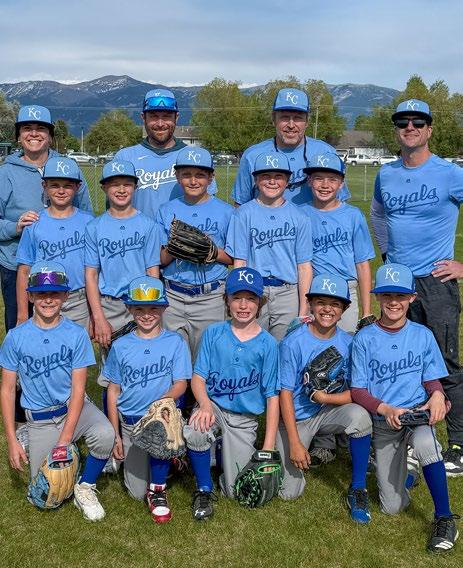
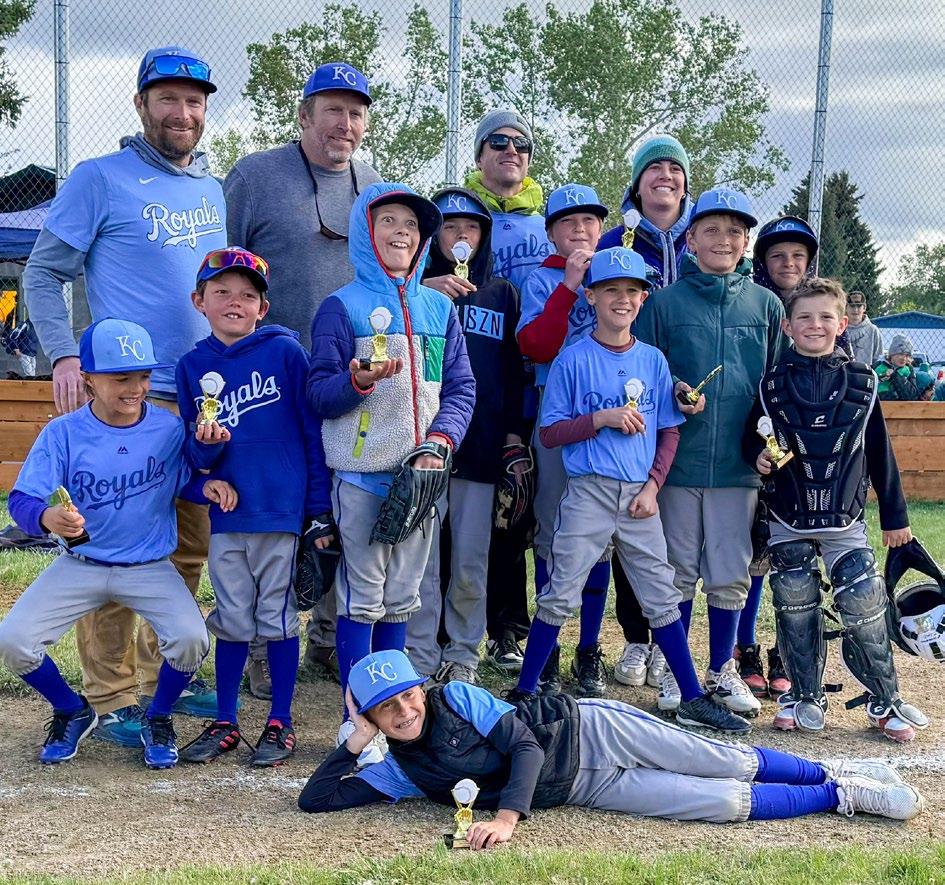
The "minors" aged Big Sky Royals finished in second place in a Belgrade tournament. COURTESY OF TY TRAXLER
COURTESY OF TY TRAXLER
BOZEMAN
BOZEMAN PARKS AND RECREATION DISCUSSES THE POSSIBILITY OF A NEW RECREATION AND SWIM CENTER ENHANCING
THE GROWING CITY’S AQUATIC OPTIONS HAS BEEN STUCK IN PLANNING FOR 20 YEARS
EBS STAFF
Each night at the Bozeman Swim Center, roughly 200 kids crowd lanes for practice with the Barracudas swim team while swim lessons, lap swimmers and other aquatic programs compete for space. As Bozeman’s population continues to grow, so does the demand for community gathering places geared toward youn families, as illustrated by the local aquatic facilities.
Over the last five years, the three-time state champion Barracudas team has grown, Head Coach Kyle Hendricks told EBS. Similarly the city’s swim lessons fill as soon as signups open, leaving a hundreds-long waitlist; last year, 822 kids learned to swim at Bozeman’s two aquatic facilities, Bogert Pool and Bozeman Swim Center, and over 900 kids landed on the waitlist for sessions.
“Our swim lessons are extremely popular,” Elizabeth Hill, BPR’s aquatics manager said. BPR is trying to meet that demand. In 2025, the department held 211 group swim lessons compared to 144 swim lessons in 2024.
This growing demand mirrors the city’s 8.1% population increase between 2020 and 2024 as more young families move to Gallatin Valley to experience its active, outdoor lifestyle, and increasingly to gather and recreate.
A community center, in waiting
That void is a conundrum that weighs on Mitchell Overton, director of BPR.
“ It’s unfortunate,” Overton said. “We want to teach these kids to swim. This is a life-saving, life safety issue.”
High demand for aquatics programs has put more pressure on BPR’s call for a new recreation and swim center, a priority that’s been highlighted since 2007 in the parks, recreation, open space and trails plan that was adopted by the Bozeman City Commission. One of the plan’s recommendations
was to develop two new family-oriented leisure aquatic centers in different parts of the city.
“The City’s slogan is ‘Bozeman: The Most Livable Place,’” the plan stated in its introduction. “The City’s parks, recreation programs and facilities, open spaces, and trails play a vital role in defining Bozeman as ‘the most livable place.’ This plan represents the City’s desire to proactively plan for these amenities; to achieve excellence in meeting both current and future needs.”
In the plan, a multipurpose community recreation center and aquatics center are two items listed on the city’s top ten capital facility recommendations. Overton explained that while an aquatic center has been in park plans for nearly 20 years, the design for a swim and recreation center in Bozeman went on ice a few years ago.
In 2023, BPR hired architects to design a center to house both recreation and swimming facilities. At the same time, the state of Montana was reassessing property values and by the that summer, median home property taxes had risen by 21%. The decision was made to remove the bond for a recreation center from ballots to limit tax burden, Overton said.
Today, nearly two decades since the initial plan was published, the timing seems to be lining up.
“It's now coming back up again due to increased pressures of a population that desires these amenities, the recreational outlet, and swim lessons,” Overton told EBS.
I WOULD REALLY LOVE TO SEE A RECREATION FACILITY FOR FAMILIES. I FEEL LIKE THAT WOULD BE EXTREMELY POPULAR.”
– ELIZABETH HILL, BOZEMAN AQUATICS MANAGER
The current iteration of the plan shrinks the 2023 design from 103,000 square feet to 38,000 square feet, keeping all of the core recreation needs like a pool, courts and community rooms, but making it affordable enough to fund the project.
“I think we're getting to this time that says, ‘Hey, let's pull this together for the community,’” Overton said. Bozeman city officials will need to approve a ballot measure to help fund a new hub for Bozeman’s recreation, including a swim center, allowing voters to choose if they want to support the project with their tax dollars. A ballot measure could come as soon as November, but an immediate and significant push by city commissioners is required to hit that deadline. Mayor Joey Morrison told EBS that as the city focuses on public safety and affordable housing, a ballot initiative supporting a new recreation center isn’t likely in
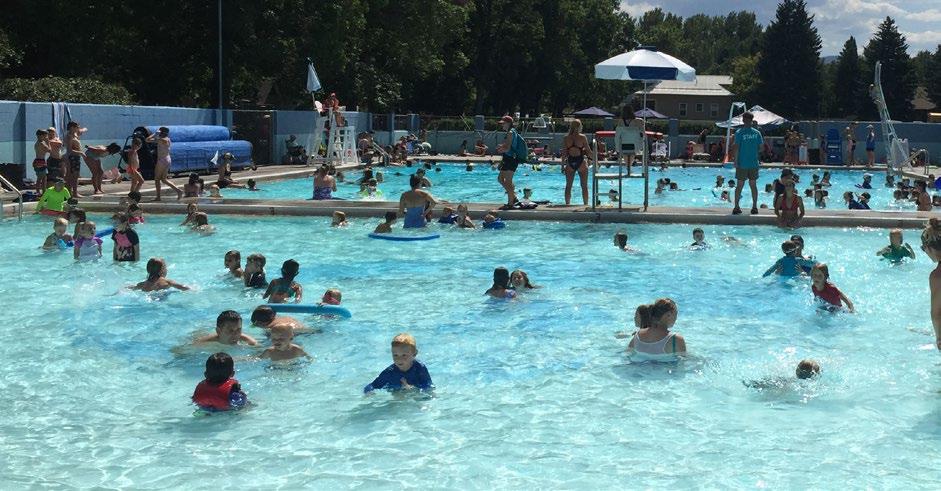
Kids and adults enjoy the Bogert Pool on a busy, sunny day. PHOTO COURTESY OF BOZEMAN PARKS AND RECREATION
The blocks at the Bozeman Swim Center. PHOTO COURTESY OF BOZEMAN PARKS AND RECREATION
the next two years. However, Morrison agrees that a facility for Bozeman’s growing west side could be beneficial to residents.
“I think it’s a good thing,” Morrison said. “It’s an essential need for the west side.”
Building the ‘most livable place’
While momentum builds on the potential for a recreation center, BPR is gearing up for the opening of Bozeman’s first splash pad park. The family-
BOZEMAN
friendly, no-fee water playground in Story Mill Community Park will open on May 27, allowing families and residents a spot to cool off, and kids a chance to play and familiarize themselves with water before learning to swim. Overton is excited about the accessibility of the splash pad and sees it as an example of accessible recreation for a growing town.
“It just really provides this very equitable access for anyone in the community and, I can't say it enough, just really removes barriers,” Overton said. “Public parks are just … the great equalizer. Anyone can go of any means.”
On top of swim lessons, lap swimmers, triathletes, swim clubs, high school physical education classes and swim teams all use pool facilities for fitness and enjoyment. Adults take lessons too that range from learning to swim to refining their strokes. Hill noted that a new recreation space for Bozeman residents would be beneficial.
“Our facilities, they're busy, but it's good … we're able to offer a lot and I think that there's really a desire and an appetite for aquatics in the community,” Hill said. “I would really love to see a recreation facility for families. I feel like that would be extremely popular.”
For Hendricks and the Bozeman Barracudas, a new facility is an exciting opportunity to continue meeting the demand for high quality competitive swimming and coaching.
“ With the size of the team that we have, we're always looking for more space to swim,” Hendricks said. When he arrives to coach and sees seven to
eight kids packed into each lane, Hendricks needs to readjust practice plans. That means that finetuning work is harder to do. “We're able to do so much more effective and advanced coaching with more lane space available as opposed to when we're really crowded and there's not a lot of space, our practices have to be a little more simple.”
In addition to the new splash pad, Bogert Pool will open for the season on June 20. At the end of the summer season, BPR will conduct some repairs and improvements of the pool, keeping it up to speed with Bozeman Swim Center’s 2024 upgrades. As BPR works out plans to add another aquatic facility, Overton highlighted that affordability is still important when working in public parks.
“That's a large part of what it's about, and that's part of what we do in public parks, and that's what we do with public pools. They're affordable to access,” Overton said. “Swim lessons are quality but still attainable. And it's what we would do and would plan to do with a recreation and aquatic center—a true community center.”
From crowded swim lanes to long lesson waitlists, demand for accessible recreation and aquatics programs shows little sign of slowing and as Bozeman continues to grow, city officials, recreation leaders and the broader community are faced with the same question: how to build and maintain the community spaces that keep pace with that growth.
Explore Big Sky is published by Outlaw Partners, whose subsidiaries include real estate development in Bozeman.
Where Business Meets Passion
Bogert pool is set for renovations at the end of the summer. PHOTO BY JEN CLANCEY
RESIDENTS
SUE GALLATIN COUNTY COMMISSION, SHERIFF OVER IMMIGRATION ENFORCEMENT AGREEMENT
FOUR GALLATIN COUNTY RESIDENTS ARGUE 287(G) AGREEMENT IS VOID AND
DIDN’T RECEIVE COMMISSION APPROVAL; MAY 28 HEARING COULD BRING PRELIMINARY DECISION
BY JEN CLANCEY
This May 14 story was updated for print to include public comments made at a May 26 Gallatin County Commission meeting. This is a developing story, and readers can find ongoing coverage on explorebigsky.com.
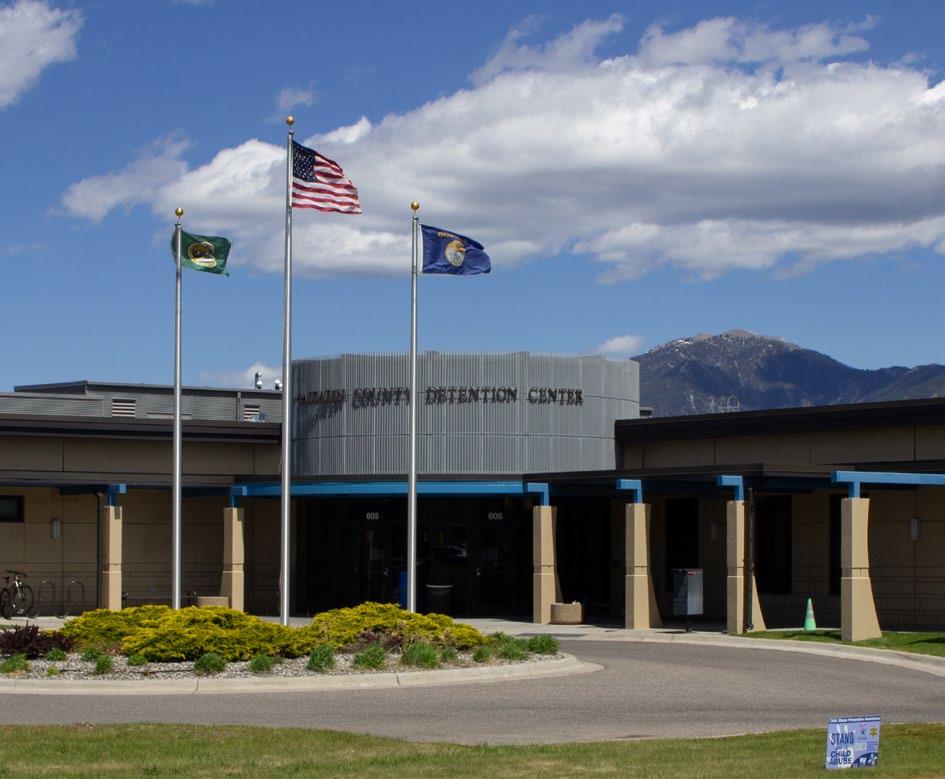
BOZEMAN—Four Gallatin County residents are suing the county commission and sheriff to stop a U.S. Immigration and Customs Enforcement agreement the county operates under a federal program called 287(g).
The complaint, filed on April 28 in Gallatin County District Court, argues the agreement is void because it did not receive consent from commissioners. Gallatin County’s 287(g) Warrant Service Officer model allows the detention center to process and hold inmates for up to 48 hours beyond their scheduled release under an ICE detainer—in these cases, ICE agents will often arrest individuals before they are released from the Gallatin County Detention Center.
“Gallatin County through its elected officials has been knowingly violating Montana law and continues to do so,” the filing alleges. Montana law states that local government, state and federal law enforcement—like ICE—and correctional agencies may use any detention center for holding and punishing offenders, but this requires the consent of the detention center’s governing body.
The suit claims that the Gallatin County Commission never gave consent to the 287(g) agreement signed in 2020 by former Gallatin County Sheriff Brian Gootkin, which would make the agreement void, according to the suit, and the holding of federal immigration inmates unlawful. Because of this, the filing calls for a stop to 287(g) operations, and for the county commission to formally decide whether it consents to ICE’s use of the detention center. It also asks the court to permanently discontinue the 287(g) agreement.
Commissioners Jennifer Boyer and Zach Brown, and Sheriff Dan Springer are defendants in the complaint.
Residents have voiced concerns about the county’s 287(g) partnership, the complaint stated.
Since the original filing, vocal opposition to the county’s agreement with ICE has grown. At a May 26 Gallatin County Commission meeting, over a dozen residents spoke against the 287(g) agreement.
Resident Bill Porter made a public comment expressing his alarm that one person decided to enter into the immigration enforcement partnership, when many fellow residents would have been opposed to it.
“It’s time to revoke the 287(g) agreement,” Porter said.
Another resident, Ita Killeen noted the impact
of the 287(g) agreement on community trust in law enforcement.
“We are told that immigration detention will contribute to community safety. The opposite is true,” Killeen said. “It breaks down trust in the community, and people are more reluctant to call law enforcement for assistance when needed.”
Gallatin County residents Julia Shaida, Tegan Bauer, Erin Levy and Susan McGrath are plaintiffs in the pending case against the 287(g) agreement. Shaida explained that the case is straightforward in an interview with EBS.
“Well, I think that it’s a simple suit that, basically, our commissioners have not consented to having ICE detainees in our jail. And because [the commission] hasn’t, it hasn’t come up for public debate, so other concerned people in Gallatin County haven’t had the opportunity to come forward and express their concerns about that,” Shaida told EBS.
Another plaintiff, McGrath, hopes that the case also raises public awareness about 287(g) in Gallatin County.
“I want them to understand what’s going on in the county because that just mirrors what’s going on nationwide,” McGrath said.
The attorney for the plaintiffs, Christopher B. Gray, declined to comment due to the ongoing nature of the litigation.
County commissioners, sheriff must appear at May 28 hearing to avoid stop to 287(g).
A decision on whether or not the 287(g) agreement is void could come soon.
Gallatin County defendants need to appear at a May 28 hearing in Bozeman to offer a preliminary argument for why the 287(g) agreement can continue.
If they don’t attend, the court will call for an immediate cease to operations under the 287(g) agreement, such as processing and holding federal immigration detainees at the detention center. Commissioners would also need to withhold consent for ICE to use its detention facilities. In that case, the six-year-long partnership with ICE would be halted while the original complaint is handled in court.
Commissioners Boyer and Brown declined to comment on pending litigation, however they noted that they will respond to the complaint in the near term and that they take all litigation seriously. Both Boyer and Brown were not on the county commission when the agreement was signed in 2020.
Sheriff Dan Springer directed requests for comment to commissioners and the Gallatin County Attorney’s Office on May 11, and the Gallatin County Attorney’s Office did not respond to a request for comment by press time. On Monday, May 18, the Gallatin County Attorney’s Office stated they cannot comment on pending litigation.
The Gallatin County Detention Center in Bozeman. PHOTO BY JEN CLANCEY
BUSINESS
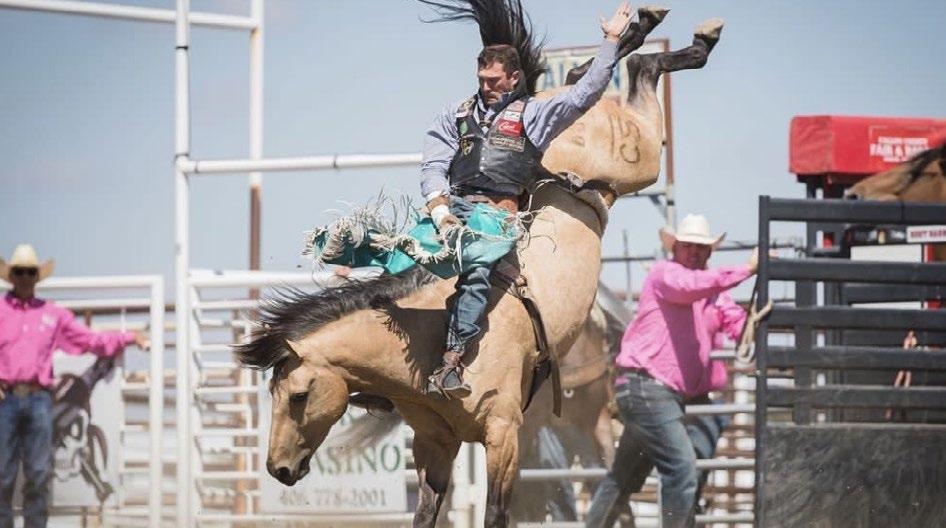
RODEO, MONTANA AND THE MAKING OF A MODERN COWBOY
BY TAYLOR OWENS
Sponsored content
In the West, rodeo doesn’t need explaining. It lives in the long drives between towns, the early mornings and the quiet understanding between competitors. It’s tradition, livelihood and identity all at once.
As Big Sky gears up for a summer of rodeo, PBR, and events that draw crowds from across the country, that culture is on full display, and few embody it more fully than Ariat athlete Caleb Bennett.
For Bennett, rodeo was never something he found. It was something he was born into.
“I was young… I started riding way younger than I should have,” he said, recalling a childhood shaped by horses and the rodeo world. Growing up in that environment, the path forward wasn’t necessarily planned, but it was always there.
Like many riders, his start came through junior rodeo—sheep, steers and eventually bareback ponies. But somewhere along the way, the sport stopped being just part of life and became the thing driving it.
Around 14, it “just… clicked,” he said. “I just craved it. That became my driving force.”
Montana holds a particular weight in the rodeo world. Not because it’s polished or built for spectacle, but because it isn’t.
It’s where the sport still feels close to its roots, where small-town rodeos matter, where young riders learn from those who’ve already been there, and where the line between competitor and mentor is often thin.
Bennett often leads clinics in the area, passing on what he’s learned to the next generation.
The message he leaves his students with is simple, but not easy: “Make sure you’re doing the work that nobody else sees.”
Mentorship doesn’t always look formal. Sometimes it’s advice. Sometimes it’s example. And sometimes, it’s something more tangible.
At a recent clinic, Bennett noticed a couple of young riders who had the drive, but not the gear.
So he stepped in.
“I gave two kids a couple hundred bucks…told them to go get a new pair of boots and get a pair of jeans,” he said. “I believe in this brand [Ariat] so much… once you put these on, you won’t buy another brand.”
It wasn’t about the clothes themselves. It was about giving those kids the chance to show up like professionals, to feel like they belonged in the arena.
For all the milestones in a career—championships, records, trips to the National Finals Rodeo—those aren’t always what linger.
After asking Bennett what stands out most, it wasn’t a single ride or buckle. It’s the people.
“The first thing that comes to mind is just the brotherhood and the camaraderie… it’s indescribable.”
That sense of shared experience, long miles, tough rides, wins and losses, creates something deeper than competition.
Rodeo may be rooted in tradition, but today’s athletes approach it with a level of discipline and professionalism that rivals any sport.
“If you want to be taken seriously, treat it as a business,” he said. A shaped hat, a pressed shirt, clean jeans, and a good pair of boots weren’t just about appearance, they were part of the job.
That mindset is part of what made Bennett’s longstanding partnership with Ariat a natural fit.
More than a decade in, it’s not just about sponsorship, it’s about trust built over thousands
of miles on the road, in airports and arenas across the country.
“When you’re going up and down the road… the comfort of the jeans, the boots, the shirts—it’s everything,” he said. “They listen to their athletes… they care about the product lasting and being worn in comfort.”
That connection shows up not just in Bennett’s career, but in how he gives back, passing along both the mindset and the tools to the next generation. For all its physical demands, rodeo is as much mental as anything else.
“It’s 90% mental,” he said. “If you don’t believe in yourself, why are you doing it?”
That perspective—built over years of competition— extends well beyond the arena.
After decades in the sport, Bennett has stepped into a new phase, one that still keeps him connected to rodeo, but closer to home. And that shift, has brought its own rewards.
“I never thought I’d enjoy being home as much as I do now,” he said. “Being with my wife and our new baby—it’s unreal.”
Even so, rodeo isn’t something he plans to leave behind. Through mentoring, clinics, and his ongoing role within the sport, it remains a constant. Because for those who’ve lived it, rodeo isn’t just something you do. It’s something that stays with you.
As Big Sky welcomes visitors this summer, that connection—between land, lifestyle and sport—is exactly what sets Montana apart.
It’s where rodeo still feels real. Where young riders can watch, learn, and step into something bigger than themselves. And where athletes like Caleb Bennett continue to bridge the past and the future of the Western way of life.
Because here, rodeo isn’t just part of the schedule. It’s part of the place.
Caleb during competition. PHOTO COURTESY OF CALEB BENNETT
Caleb and family. BY MACI BERRY PHOTOGRAPHY
Empowerin g abilities of Montanans of all a ges an d
families sin ce 1977.
No Cost Early Intervention Services tailored to your child and family. Proudly serving Children across Southwest Montana for nearly 50 years. Scan to Request your FREE developmental assessment. We cover pediatric therapies and supportive equipment costs for eligible children.
Scan to learn how you can invest in the future of Montana’s children.
BIG SKY BUSINESS LEADERS REFLECT ON WINTER TOURISM
STATISTICS INDICATE SUCCESSFUL WINTER 2025-26 BUSINESS SEASON DESPITE
SUBPAR SNOW CONDITIONS
BY VICTORIA SMITH EBS CONTRIBUTOR
BIG SKY—When Big Sky Resort opened for the 2025-26 winter season, visitors from across the country and globe would soon travel to Big Sky in hopes of enjoying mountainous views and snowfilled activities. As the season progressed, however, many locals discussed concerns surrounding the shortage in snow—would Big Sky businesses experience a quiet season of winter tourism?
Occasional snowstorms passed through Big Sky, but an extremely warm winter across Montana and the West impacted snowpack depth, especially at lower elevations and south-facing slopes. Based on daily data recorded by the SNOTEL site on Lone Mountain—sitting at a mid-mountain elevation of 8,820 feet—the overall average of snowpack depth this season was 30.3 inches from Nov. 1 through April 30, compared to an overall average of 38.64 inches in the 10 prior seasons.
The season average, calculated using monthly averages, decreased by over 25% compared to 2024-25. Rounded monthly average snowpack depths this season were as follows: November at 6.2 inches; December at 22.48 inches; January at 32.06 inches; February at 37.57 inches; March at 41.35 inches; and April at 40.5 inches. This SNOTEL data provides only a snapshot of overall snow conditions, and this season proved difficult to quantify due to abnormal warmth and unusually dense precipitation.
Although it wasn’t the dream winter for snow sports across the Rockies, Big Sky led its class of Mountain West ski towns nonetheless. At the Madison-Gallatin Joint County Commission meeting on Wednesday, May 13, a presentation led by Visit Big Sky indicated a season of successful winter tourism.
“We outpaced the whole industry throughout the Mountain West this year,” said Brad Niva, CEO of Visit Big Sky and the Big Sky Chamber of Commerce, during the presentation.
From October to March, Big Sky’s hotel and short-term rental occupancy rate surpassed Aspen, Colorado; Vail, Colorado; Breckenridge, Colorado; and Jackson Hole, Wyoming, respectively, as well as numerous other comparable Mountain West destinations, according to VBS data. Big
Sky occupancy rates only dropped 2% from December through March this season compared to winter 2024-25.
Furthermore, Big Sky’s average daily room rate was fruitful for hospitality providers, even with the 2% pullback in visitation. In an interview with Explore Big Sky, Niva said that room rates were up 9% compared to the previous winter.
“We are actually collecting more money based on hotel room [rates],” Niva said during the presentation. “Our room [rates] are actually the highest they’ve ever been in Big Sky’s history.”
Darren Brugmann, executive director of the Big Sky Transportation District, added his perspective from an "unprecedented" winter for the Skyline Bus during the presentation.
“Even though we didn’t see a lot of powder days and you would think we would see less ridership, we—in our 20-year history—we carried far more people than we ever have this past winter,” Brugmann said. “Well over a quarter of a million passengers, almost 300,000... It by far exceeds any other season we’ve ever seen.”
By contrast, Niva noted that Big Sky is still very underdeveloped as a summer destination compared to peers, and summer tourism represents a strong growth opportunity for the business community. Especially as hospitality offerings continue to develop, Niva expects to see overnight summer visits increase—the most economically valuable guests stay for multiple nights, he said.
Visit Big Sky has used targeted mobile advertising to attract individuals who frequently visit competitor destinations, Niva explained, also noting that for every $1 spent on marketing, Visit Big
Pictured on March 29, nearby Fan Mountain's south face displays the effects of southwest Montana's warm, often dry winter. PHOTO BY JACK REANEY
CHART BY VICTORIA SMITH
BUSINESS
Sky tracks $75 in business brought into the community. Furthermore, in an interview with EBS, Niva mentioned recent national media coverage on Big Sky over the past two years, including a late2023 feature by Vogue, a late-2025 “Destination of the Year” listing by Expedia and a top-notch s ki resort ranking by Ski Magazine ahead of the 2025-26 season.
“We are, right now, a shiny penny… People are very curious about our community. They have been hearing about us for a number of years,” Niva told EBS. “The word on the street in the skier world, or winter resort [world], is that Big Sky is something that everybody wants to see.”
According to Visa credit card data compiled by Blue Room Research, Big Sky’s strongest visitor markets are areas with direct flights to Bozeman: projections estimate that greater New York City visitors spent $3.79 million in 2025; Chicago visitors spent $2.55 million; Los Angeles spent $2.43 million; Seattle spent $1.52 million; San Francisco spent $1.46 million; and Boston spent $1.37 million. Houston, Washington, D.C. and Minneapolis follow close behind.
EBS reached out to Big Sky Resort for comment regarding tourism and visitation this past winter
season, and the resort did not provide a statement in time for this story’s publication.
Resort tax collections outpaced prior year; business owners reflect
Based on a recent resort tax collections report released by the Big Sky Resort Area District on May 13, winter business this season—November through March—generated approximately $11.69 million in 3% resort tax collections. This is an increase of nearly 17% compared to the same period last year.
Although the growth in resort tax collections can be influenced by the increased prices of goods and services, some local businesses still indicated a successful season. Duane Gietzel, store manager of The Country Market, said sales increased compared to the year before.
“It was a rough year for the skiing conditions, I’m sure, but I had many customers comment too that the whole Pacific Northwest was rough for snow this year, and [Big Sky was] the best option available,” Gietzel said. “I think maybe the fact that it was the whole region, and not just us, helped.”
Gietzel further attributed the winter season sales to locals who frequent the full-service grocery store—folks who stick around regardless of snow conditions—and an increase in workforce housing developments, like the Powder Light and RiverView apartment buildings near the store. He said there was a slight influx in customers during the late-February F.A.T. Ice Race in Big Sky, too.
This luxury motorsport event also affected sales for the Blue Moon Bakery, which had a booth at the race selling pizza by the slice.
“I think events like that can help,” owner Patrick Griffith told EBS. “Another event that we usually do that usually helps bring people to town is the skijoring, but that didn’t happen this year… We gained a big event, and we also lost a big event.”
Throughout the season, Griffith encountered customers who switched their travel destination to Big Sky after hearing Big Sky Resort had better snow conditions than most mountains in the West. He said that Blue Moon Bakery experienced plenty of tourist business this season, and that the lacking
snow conditions may have even assisted sales. He also acknowledged Visit Big Sky for its marketing efforts that he believes helped draw new visitors to the area.
“I think a lot of people might have hit the mountain for more days of their vacation if the snow was better,” Griffith said. “But since the snow wasn’t great, I think they were looking for other stuff to do around town, so I think that kind of helped push our lunch business a little bit.”
Other local businesses rely on snow for seasonalbased services, including Canyon Adventures which offers snowmobile rentals and tours in the winter, utilizing the Buck Ridge trail in the Custer Gallatin National Forest.
“It’s all just kind of what Mother Nature gives us, unlike the ski resort that can make snow up there,” said Bri Sullivan, office manager of Canyon Adventures. “... We definitely got hit pretty hard with the lack of snow this year.”
Canyon Adventures saw an overall decrease in bookings this season compared to last year. Customers who booked in advance often went through with bookings, Sullivan said, while visitors who came to Big Sky without bookings may have been deterred from snowmobiling after noticing the lack of snow.
“We definitely had to cut our season quite a bit shorter [this year], and there were a couple days throughout the season where we did just close down, having to wait for more snow to come so we could operate again,” Sullivan said.
Despite the overall decrease in snowmobile bookings, Sullivan said that the holiday season— the week before Christmas through the New Year—still brought in customers, as well as spring break in March.
In short, the 2025-26 winter season appears to have displayed the power of Big Sky’s tourism and business community to overcome sub-optimal snow years, especially when warm, dry conditions plague the entire U.S. Rocky Mountain region. Still, Niva said snowfall is a “game-changer” for the entire industry, and the Big Sky community will no doubt be hoping for a snowier winter in 2026-27.
“The one thing we can’t do is control Mother Nature… Every ski area across the West was affected by a lack of snow this year, so overall, we had a phenomenal year compared to our peers,” Niva told EBS. “… We should thank our lucky stars that we came out the way we did.”
Jack Reaney contributed reporting to this story.
It wasn’t all bad—Big Sky locals like Erik Morrison (pictured Feb. 16) still enjoyed a handful of powder days, and many tourists changed their plans to seek Big Sky’s relatively strong snowpack. PHOTO BY JACK REANEY
Even on an exceptionally warm and snow-starved winter, Big Sky tourism didn’t miss a beat. Events like the F.A.T. Ice Race drew crowds that helped bolster winter business. PHOTO BY JACK REANEY
CHART BY VICTORIA SMITH
BUYING INTO BIG SKY COUNTRY: WHAT OUT-OF-STATE BUYERS NEED TO KNOW
BY TAYLOR OWENS
Sponsored content
For many, owning a home in Montana starts as an idea—more space, closer access to the outdoors, and a different pace of life. In places like Big Sky, Bozeman, Whitefish and across southwest Montana, that idea continues to draw interest from out-of-state buyers.
While the market has shifted in recent years, demand hasn’t disappeared—it’s simply evolved.
“We’re still seeing a very steady demand from outof-state buyers to purchase properties in Montana,” said Tim Gaertner, vice president of mortgage lending at Whitefish Credit Union.
Montana’s real estate surge during the pandemic brought a wave of new buyers into the market, many drawn by lifestyle changes and historically low interest rates. But that pace wasn’t sustainable.
“During COVID and immediately after COVID, there was a frenzy to buy Montana properties for out-of-state buyers,” Gaertner says.
As interest rates climbed in 2023, activity slowed and inventory tightened. Many homeowners chose to hold onto properties secured with ultra-low mortgage rates, limiting options for new buyers.
“So people have been in a situation where they have a lot of equity in their house, but they have a low interest rate and they don’t want to touch it,” he said.
That dynamic created a bottleneck in the market— but it’s beginning to ease.
“We’re having the busiest year we’ve had since that time, since the COVID boom,” Gaertner says.
With more buyers and sellers re-entering the market, conditions are starting to feel more active again, particularly in high-demand areas across western Montana.
One major shift for out-of-state buyers is pricing. Montana is no longer the relative bargain it once was.
“If they’re not coming from a high-value area of the country, our median prices…are well ahead of the national average,” said Gaertner. “So it just makes it that much harder.”
For buyers relocating from higher-cost markets, the transition may still feel manageable. For others, it can require a reset in expectations—and careful financial planning before entering the market.
For out-of-state buyers, one of the most important decisions happens before closing: choosing the right lender.
“We do a lot of what we call rescue loans,” Gaertner said.
In many cases, buyers begin the process with large, national lenders, only to encounter issues late in the transaction—often when it’s hardest to recover.
“They get all the way to the appraisal point… and all of a sudden there’s something in the appraisal that doesn’t meet their cookie cutter box and they can’t do the loan,” he explains.
That’s a common challenge in Montana, where properties don’t always fit standardized lending guidelines.
Working with a local institution like Whitefish Credit Union can help avoid those surprises. Because the credit union keeps its loans in-house, it can take a more flexible approach to both borrowers and properties.
“We portfolio everything, lend our own money and keep our loans,” Gaertner says. “It allows us a ton of flexibility on different situations.”
That flexibility is especially important in Montana, where buyers are often looking for something beyond a typical suburban home. Larger parcels,
rural properties, and unique builds are part of the appeal—but they can complicate financing through traditional channels.
Local lenders who understand the landscape are often better equipped to navigate those complexities and keep transactions on track.
Beyond financing, one of the biggest factors impacting buyers today is insurance—particularly in more rural or forested areas.
“Checking early on in that process, is that property that you want to buy—one, is it insurable at all? And what will it cost?” Gaertner said.
In recent years, costs have risen significantly, adding another layer of consideration for buyers evaluating affordability.
“We’ve seen premiums…triple, quadruple…in the last two or three years,” he added.
For some properties, especially those farther from town, availability and affordability of coverage can ultimately shape purchasing decisions as much as price or location.
Another factor that can influence overall cost is how a loan is structured. Unlike many lenders that sell mortgages on the secondary market, Whitefish Credit Union operates differently.
“We don’t charge lender origination fees,” Gaertner said. “Our model is unique for Montana lenders.”
That approach can reduce upfront costs for borrowers, particularly on higher-value properties where fees can add up quickly, and for first-time homebuyers, whose limited funds can be directed toward immediate equity instead of closing costs.
As Montana’s market continues to normalize, outof-state buyers are finding opportunity—but also a need for deeper due diligence. Understanding local pricing, working with lenders familiar with the region, and evaluating long-term costs like insurance are all key parts of the process.
With the right preparation and guidance, the path to owning property in Big Sky Country is still very much within reach—it just looks a little different than it did a few years ago.
Whether you’re buying or selling in the Montana market, learn more from local experts at whitefishcu.com
PHOTO COURTESY OF WHITEFISH CREDIT UNION
PHOTO COURTESY OF WHITEFISH CREDIT UNION
ENVIRONMENT
WHAT HAPPENS IF A WILDFIRE HITS BIG SKY?
RESEARCH GROUP EXPLORES POTENTIAL COSTS IN MAY 13 PRESENTATION
BY FISCHER GENAU
BIG SKY—It’s no secret that Big Sky is at high risk for wildfires due to its proximity to dry, forested regions where fires are a natural part of the ecosystem. But the consequences of one here may be especially severe.
On May 13, Headwaters Economics presented findings at the Madison-Gallatin Joint County Commission meeting in Big Sky, discussing the long-term impacts of a wildfire in Big Sky, highlighting the potential negative consequences to its recreation-based economy and stressing the necessity of fire-resistant homes, clear evacuation routes, and other preventative measures.
“After high-severity fires, visitation to communities like Big Sky drops 15 to 20%, and that drop in visitation can last decades,” Kelly Pohl, associate director of Headwaters Economics, said in the presentation. “The visual of Big Sky burning would have an indelible mark on people’s memories. They would choose to visit other places, and this would have a ripple-on effect with Big Sky’s economy.”
The wildfire risk in Big Sky is greater than 96% of communities in the United States according to a tool created by the USDA Forest Service and Headwaters Economics, an independent research group that’s been studying wildfire for 20 years. Headwaters’ data shows that Big Sky is one of nine Montana communities with risk profiles similar to recent sites of urban conflagrations, and 64% of the costs of a wildfire in Big Sky would be paid at the state and local levels. Big Sky also has a mostly recreation-based economy, and Pohl described how natural disasters like wildfires specifically affect tourism industries.
A study published by researchers at the University of Colorado shows how high-severity wildfires in places like Big Sky tend to disrupt tourism for
years, in addition to the short-term costs of burned buildings and damaged infrastructure. Pohl said that even if infrastructure supporting a tourism economy, like hotels and resort buildings, are not damaged, visitation tends to drop for long periods of time.
However, she said that there are steps Big Sky can take to safeguard against wildfires.
“We know a lot about how to construct homes so that they are wildfire resistant, and the materials and technology used to construct wildfire-resistant homes is widely available and affordable,” Pohl said.
Most homes that burn down during wildfires are ignited by the thousands of tiny embers that can blow up to four miles from the site of a burn. These fall on flammable vulnerabilities like leaves in a home’s gutter or a firewood pile stacked next to a house, but according to Headwaters' research, the cost of building a wildfire-resistant home is roughly the same as building one that’s vulnerable to wildfire.
“In a place like Big Sky, where you have a lot of new development happening, it's a no-brainer,” Pohl said. “We also have a lot of homes already on the landscape, and those homes could be retrofitted and need to have special attention paid to the vegetation around them to reduce their risk.”
The Big Sky Fire Department offers free site visits, forestry advice, fire-adapted building guidelines, and prevention tips through its Wildfire Risk Reduction program. In addition, the online Fire Adapted Big Sky Wildfire Hub is designed to arm residents and businesses with accessible and potentially life- or property-saving resources. The FABS Neighborhood Ambassador program focuses on distributing information through volunteer residents.
Headwaters Economics urged community-scale action rather than building or redesigning homes on a house-by-house basis. Pohl said that building codes and land use planning standards can be leveraged to build new housing with wildfires in mind.
The importance of safe evacuation routes was also stressed in Headwaters Economics’ presentation. Pohl urged the joint county commission—which includes the Big Sky Resort Area District as a local authority—to pursue fuel treatment in key evacuation areas, like U.S. Highway 191 just north of Big Sky and roads in the Moonlight Basin area northwest of Big Sky Resort, so people can evacuate and emergency vehicles can enter safely in the event of a wildfire. Fuel treatment involves thinning trees, removing tree limbs, and removing vegetation that can burn to give firefighters a better chance at protecting those corridors, and Pohl acknowledged that Gallatin County and Big Sky Fire Departments have done “a lot of really good work” on fuel treatment already.
“We love our landscapes here in southwest Montana…and these landscapes are fire-adapted,” Pohl said. “I think it's important for us as a community to also adapt to wildfire, just like the trees that we love. We need to be ready, and we need to understand that fire's a part of this landscape, and if we want to live here, we need to be ready for it.”
Big Sky Fire Department responds to a burning vehicle along Taylor Fork Road on July 25, 2024, dodging a “huge bullet” by extinguishing the flames just south of Big Sky. COURTESY OF BSFD
A map from Headwaters’ presentation showing Big Sky evacuation routes. Red sections indicate areas where fuel treatment is needed along roadways, and pins mark designated areas of refuge. COURTESY OF HEADWATERS ECONOMICS
DISPATCHES FROM THE WILD: INDIGENOUS LESSONS FOR MODERN AMERICAN LEADERSHIP
RELATIONAL ETHICS VS. SELFISH POLITICS
BY BENJAMIN ALVA POLLEY EBS COLUMNIST
In many traditional Indigenous societies, a person was measured not by what they accumulated, but by how well they cared for the community and the land that sustained them. A hunter who hoarded meat, a leader who schemed only for personal gain, or a relative who refused reciprocal obligations did not just earn a bad reputation; they could lose their standing, their voice, even their right to remain with the group. Extreme selfishness was treated not merely as a character flaw, but as a failure to act as a full human being in a web of relationships.
In present-day Montana, both the Blackfeet (Niitsitapi) and Crow (Apsáalooke) tribes traditionally hold cultural values that strongly frown upon greed and emphasize generosity, community sharing and, in some contexts, treat excessive desire as a form of social or spiritual illness.
Modern American politics offers a stark contrast. Some of the most powerful people in our government behave in precisely the ways those societies warned against: fixated on wealth, blind to the common good, and willing to sacrifice community and land as long as decisions bring profits to their donors and allies. Instead of being shamed or removed from power, they are rewarded with campaign contributions, cable news spots, and lifetime careers in office or industry.
If we took seriously the ethical standards that helped Indigenous communities survive for millennia, many current officers in President Donald Trump’s administration would be deemed unfit to govern—not because of partisan disagreement, but because their actions reveal a deeper failure. They repeatedly choose the billionaire class over the wider community, over “the least of these,” and over the biosphere that makes life possible.
Consider efforts by politicians like Utah Sen. Mike Lee to privatize public lands. In many Indigenous frameworks, land is not a commodity; it is a relative—according to the Lakota phrase “mitakuye oyasin”—and a living system with which humans are in constant relationship and obligation. Public lands are at least a partial recognition that some places belong to all of us and to future generations. To carve them up and sell them off is to declare that the immediate profit of a few outweighs the long-term wellbeing of many.
The decision to open land bordering the Boundary Waters of Minnesota, one of the continent’s most pristine freshwater ecosystems, to mining and development follows the same logic. Short-term gains are treated as more important than the health of the watershed, the livelihoods of local communities, and the integrity of a unique and fragile ecosystem. This is a moral choice. It states plainly that corporate interests, investor returns and short-sighted economic growth matter more than
clean water, healthy forests and the right of future generations to inherit a living world.
The push to weaken the very agencies charged with stewarding our shared heritage—the Department of the Interior, the Bureau of Land Management, the U.S. Forest Service and the National Park Service— fits this pattern. Strip them of funding, authority and expertise, then point to their diminished capacity as proof that the private sector should take over. It is a classic sabotage-and-sell-off strategy that treats the public trust as an obstacle rather than a responsibility.
We see the same disregard in the way many leaders treat pollution and public health. Time and again, they side with major polluters, fossil fuel companies, industrial agriculture and chemical manufacturers, and allow them to dump toxins into our air and water with minimal oversight. Regulations meant to keep communities safe are dismissed as “burdens on business,” and any attempt to strengthen protections is attacked as anti-growth or “jobkilling.” The message is clear: clean air, clean water and the survival of other species matter less than rising profits for the elite class—even if leaders lure voters by promising prosperity for the middle class.
This profit-at-all-costs attitude is the opposite of a relational ethic. In Indigenous perspectives, the air we breathe and the water we drink are not disposable resources; they are sacred gifts that bind us to one another and to the more-than-human world. To knowingly poison a river, an aquifer or the atmosphere is not just a technical policy decision; it is a violation of relationship. It harms children with asthma, communities with cancer clusters, and ecosystems pushed to the brink. When leaders shrug off these harms as the “cost of doing business,” they reveal whose lives they value and whose they are willing to sacrifice.
Holding leaders accountable
In a society that took relational ethics seriously, these topics would not be seen as routine policy disagreements. They would be recognized as violations of the basic obligations we owe one another and the Earth. Leaders who consistently harm the community and the land would face consequences: at a minimum, shame and loss of
status. In some traditional societies, they would be banned from the community.
We do not live in a small band society, and we cannot simply banish senators or representatives from the village circle. But we can reclaim the underlying principle: if you persistently act only for yourself and your wealthy patrons, if you treat the planet as expendable, you forfeit your moral claim to lead.
This requires rethinking political accountability. Too often, we frame debates around abstractions— markets, growth, efficiency—as if they exist in a vacuum. An Indigenous-informed lens asks different questions: Who is being harmed? Who is excluded? How will this decision affect the seventh generation to come? Does this policy honor our relationships with land, water and non-human life, or does it treat them as disposable?
By those standards, much of contemporary governance fails. But failure is not fate. The same traditions that condemn narcissistic leadership point toward another path: reciprocity over extraction, obligation over entitlement, collective thriving over private hoarding.
We do not need to romanticize Indigenous societies to learn from them, nor are all of them perfect. We only need the humility to admit that cultures that sustained vibrant communities and intact ecosystems over thousands of years might know something our short-sighted politics has forgotten.
When leaders behave as if only they, and the billionaires and corporations they serve, truly matter, it is not just bad policy. It is a betrayal of what it means to be fully human.
The question before us is whether we will continue to normalize that betrayal—or whether we will finally say, as earlier societies did: this is not how a human being should behave, and such people should not decide the fate of our communities or our planet.
Benjamin Alva Polley is a place-based storyteller. His words have been published in Rolling Stone, Esquire, Field & Stream, The Guardian, Men’s Journal, Outside, Popular Science, Sierra, and WWF, among other notable outlets, and are available on his website.
Many of America’s current government leaders are not acting with respect and honor for land, but instead view it as a resource to exploit in the best interest of the elite class. PHOTO BY BENJAMIN ALVA POLLEY
ROADS DIVIDE OUR CHERISHED LANDSCAPES. WE CAN RECONNECT THEM. ENVIRONMENT
BY BRENDAN MOYNAHAN GUEST COLUMNIST
As I stood alongside U.S. Highway 191 south of Gallatin Gateway last month, the volume of traffic was staggering. Our group, on a site visit to the proposed location of a wildlife crossing overpass, raised our voices loudly to be heard over the constant roar of vehicles. From this vantage point, it wasn’t hard to imagine the confusion and panic of an elk or deer attempting to cross the road between vehicles approaching from both directions.
Herds have moved back and forth between habitat areas—now on opposites sides of U.S. 191—for millennia, but the traffic volume here has increased by 60% over the last decade. Today, 24% of reported collisions between Four Corners and Big Sky are with wildlife.
Earlier this year, I was honored to step into my role as the Center for Large Landscape Conservation’s new Chief Executive Officer. I succeeded CLLC’s visionary founder Gary Tabor, who retired from his role as CEO at the end of 2025. Gary was ahead of his time in understanding that roads, fences, subdivisions and other human activity have created the most pressing conservation issue of our time: habitat fragmentation. He established CLLC to restore fragmented habitat, open pathways of wildlife movement and reconnect large landscapes.
As I considered taking on this new role, CLLC’s mission resonated with me profoundly. Previously,
I served as chief of the National Park Service’s Wildlife Conservation Branch, where I was frequently confronted with the challenge that animals need more than isolated “islands” of habitat—they need pathways to move and flourish. We are very fortunate that parks like Yellowstone and Glacier preserve large, biodiverse areas of land—but what about the places in between?
That’s where my team at CLLC and our many partners and supporters come in. We are focusing on the “messy middle” between protected areas, the patchwork of public and private lands, roads and railways, where wildlife face many barriers. Gallatin County is a perfect example of this, as a growing population and increasing tourism have strained the ability for people and wildlife to coexist.
While our organization works worldwide, the Greater Yellowstone Ecosystem in our back yard is critically important to the survival of iconic species such as bison and grizzly bears. As we enter our next chapter of impact, our commitment to local landscapes remains stronger than ever, including our effort to establish wildlife crossings on some of the busiest roadways in Gallatin County and eventually, across Montana.
Local businesses, foundations, and individuals have boldly rallied to help advance this work and provide the required non-federal match for the federal Wildlife Crossings Pilot Program funding we’re seeking for a Gallatin Gateway wildlife overpass and underpass along U.S. 191. We are beyond grateful for the support from this community, the State of Montana, and Montana’s Congressional delegation.
In the meantime, while pursuing funding with partners for permanent solutions, CLLC partnered
with local residents to warn motorists about elk in the road south of Gallatin Gateway through donated billboard space. In April, after a monthslong collaboration with the Montana Department of Transportation and community members, new light-up warning signs were installed. While not long-term solutions on their own, they help alert drivers to a high-risk area and encourage slower, safer driving.
As proud as I am of our work to restore safe passage for people and wildlife, I acknowledge these are not overnight solutions. Rather, they are longterm efforts to stitch back together landscapes and wildlife movement corridors that have been severed, and we can’t do this work alone. Whereas at one time, wildlife moved freely throughout Montana, a deliberate and sustained investment in time and resources is now required to undo damage already done, and to be wise in designing new infrastructure. There is much work to be done to restore the landscape connections, and public support is needed to succeed.
I see this work as emblematic of the spirit of Montana that is alive and well: Montanans proudly shoulder the responsibility of caring for what is important to us, we craft solutions that fit locally, and we come together to share in the good, creative, hard work to make Montana better. I look forward to getting to know our incredible community of supporters and advocates and seeing what we can accomplish—together.
Dr. Brendan Moynahan is the CEO of the Bozeman-based nonprofit Center for Large Landscape Conservation. He holds a Ph.D. in Wildlife Biology from the University of Montana, and his background includes multiple lead science roles with the National Park Service.
U.S. 191 looking south through the project area to Gallatin Canyon. PHOTO BY ELIZABETH FAIRBANK
THRIVING LANDSCAPES: SUMMER PROPERTY PREP IN BIG SKY
BY ALI CHIPOURAS EBS COLUMNIST
The low snowpack and warm temperatures across the West this year have drought and wildfire on many people’s minds. On a recent episode of the Outlaw Beat Podcast, Big Sky Fire Department’s Wildland Fire Division Chief and Alpenscapes partner Jon Trapp discussed the outlook for the 2026 wildfire season, noting that snowpack, spring rain, warming temperatures and drought all play a role in shaping wildfire conditions.
“It’s definitely looking like conditions are in alignment for a big fire season,” Trapp said. “Whether or not it’s coming for us… will depend on how we have prepared.”
In the Big Sky region, summer property maintenance is about more than having a beautiful garden. It’s about protecting your home and neighbors, supporting the surrounding ecosystem and helping build a more resilient community.
Start with defensible space and wildfire preparedness
Spring and early summer are ideal times to evaluate your property for wildfire risk and make changes before conditions become hotter and drier. One of the most important concepts in wildfire preparedness is defensible space: the buffer between your home and the surrounding vegetation that helps slow or reduce wildfire spread.
Even small preparations, like clearing needles from corners of decks or moving wood piles away from the home, can help reduce risk during a wildfire event. Landscaping decisions such as keeping plants
closest to the home healthy and well-watered can also help reduce vulnerability.
The Alpenscapes Guidebook, a free, easy-to-use landscaping resource, includes information on defensible space, landscaping zones, plant selection and ways to create landscapes that are both wildfire-resilient and appropriate for Big Sky’s alpine environment.
Property owners can also schedule a free site visit with BSFD to better understand wildfire risks around their home and identify practical steps for improving defensible space and preparedness. Additional resources, including the Big Sky Wildfire Action Guide, are available through the Big Sky Wildfire Hub.
Water efficiently
Between March and April 2026, drought conditions in Big Sky worsened from moderate drought to severe drought according to the U.S. Drought Monitor. To stay updated on current drought conditions, visit the Gallatin River Task Force’s Drought Status page.
this year, consider incorporating more native or drought-tolerant species adapted to Big Sky’s alpine climate. Property owners can also schedule a free water efficient landscape assessment with the Gallatin River Task Force to identify opportunities for improving irrigation efficiency and reducing outdoor water use.
Watch for noxious weeds
Summer is also the time invasive weeds begin to emerge across the region, and catching them early can help prevent larger infestations later in the season. Property owners can learn more about common invasive species through Alpenscapes resources or schedule a free site visit with Grow Wild to help identify weeds on their property.
Plant native
Each year, water demand in Big Sky increases by nearly 160% from July through September due to outdoor irrigation, making landscape watering one of the community’s highest summertime water uses.
To help reduce your water usage before the peak season arrives, inspect irrigation systems for leaks, broken sprinkler heads, or inefficient spray patterns. These seemingly small issues can result in significant water loss over the course of a summer. Watering before 8 a.m., avoiding irrigation during or after rainfall, incorporating drip irrigation, drought-tolerant plants and rock gardens can all help reduce water use while supporting healthier, safer landscapes.
If you’re planning new landscaping projects
If you’re planting this summer, plant native. If you want to start planting now, consider using established native plants from a local nursery or the Grow Wild native plant sale fundraiser. Fall is often the best time for seeding native wildflowers, as it mimics natural growing cycles and can improve germination rates. Established plants are more suited for planting in the spring.
Think beyond your property lines
Preparing your property for summer is also an opportunity to think about how individual actions contribute to the broader Big Sky community. Healthy landscapes, wildfire preparedness, water conservation and resilient homes all play a role in protecting the place we live, work, and recreate. Check out Alpenscapes.org for more resources.
Ali Chipouras, writing on behalf of Big Sky’s Alpenscapes, is a sustainability and communications consultant helping organizations and communities in Montana advance their climate, resilience and communication goals.
An image from the Alpenscapes Guidebook shows suggestions for firewise landscaping. IMAGE COURTESY OF ALPENSCAPES
A&E
A LA CARTE: MOUNTAINS AND COWS AND THE REALITY OF
ROCKY MOUNTAIN OYSTERS
BY RACHEL HERGETT EBS COLUMNIST
I was mostly raised in Bozeman, a town now often referred to as “Bozangeles” and considered to be 15 minutes from Montana— though that travel time may have increased with the traffic in recent years. You can see the edges of a wilder Montana from these busy streets, peek at the mountain ranges surrounding the Gallatin Valley or stumble on little pockets of land still dedicated to agriculture.
I say “mostly raised in Bozeman” because I’m blessed with an extensive and tight-knit family, one that happily welcomed an extra hand on the family farm and ranch in the summers. I have fond memories of driving tractors, feeding cattle and irrigating fields. And I have less fond memories of cleaning out the once barley-filled silos, baking as the sun heated the metal and itching incessantly as the barley bristles poked their way through my clothes.
In the evening, when tasks were done for the day, we would sit around the old farmhouse table and my great uncle would extol his profession over a hearty meal mostly consisting of beef and potatoes. Here, I learned the importance of knowing not only where your food comes from, but the people and the work it takes to get it to your table. I have very much had that work on my brain lately—and not the more modern kind that involves driving airconditioned tractors while blaring country music from the radio.
Montana, to me, is exemplified by two things: mountains and cows. Though the gap is narrowing, it remains true that the state has more cows than people. The U.S. Census Bureau estimates Montana’s population as 1,144,694 as of July 2025. The United States Department of Agriculture’s 2025 state agriculture overview lists 2,140,000 head of cattle, including calves. With the presence of cattle comes the somewhat vicious—though necessary—practice of branding.
The 2013 Smithsonian magazine article “Decoding the Range: The Secret Language of Cattle Branding” first describes branding as an antiquated practice. “Livestock branding dates back to 2700 BC, evidenced by Ancient Egyptian hieroglyphics.
Ancient Romans are said to have used hot iron brands as an element of magic,” according to the article by Jimmy Stamp. “But brands are most associated with the cowboys and cattle drives of the Old West, when brands were used to identify a cow’s owner, protect cattle from rustlers (cattle thieves), and to separate them when it came time to drive to market (or rail yards or stock yards).”
But there is no “when” here. Branding in the new West is still used for all of these things. Even cattle rustling still happens. In one quite modern instance, my great uncle had entered an agreement to graze his cattle on someone else’s land, but was refused access when it was time to retrieve them. The stand-off ended when he stole back his own cattle, an event leading to many lively discussions on what constitutes a cattle rustler—specifically if you’ve earned the term if the cows you swipe under cover of darkness are technically your own.
Earlier this month, I was invited to branding at a friend’s family ranch in southeastern Montana. Branding is a production. Once rounded up and penned, calves are roped and held down to be marked with hot irons in the shapes and/or letters of a ranch’s brand. They are also tagged, vaccinated, and—if they are unlucky enough to be male—castrated.
“That’s where you’ll find the freshest Rocky Mountain Oysters,” a neighbor told me as I packed my car to head to the ranch.
For those uninitiated in the lingo, a Rocky Mountain oyster is not seafood at all. It is a bull testicle—often skinned and deep fried. In that preparation, they mainly taste like slightly beefy grease with a chewy texture like calamari. At the ranch, I watched one of the cowboys at this most recent branding take a freshly cut set and cook it on the branding iron furnace. I have to admit I was too intimidated to ask for a taste of the delicacy at its source. I’m kicking myself for that now.
If you’re curious to give them a try, look for an event marketed as a “Testicle Festival.” Many of these are inspired by a weekend party that used to be held at Rock Creek Lodge near Missoula and involve music, beer and Rocky Mountain oysters. The Old Saloon in Emigrant now hosts one as an annual benefit for testicular cancer research and the Alpha Gamma Rho fraternity at Montana State University hosts one to honor Montana’s agricultural history.
I only know of one place where you can always find Rocky Mountain oysters to try if you’re intrigued. They’re still on the menu at Stacey’s Old Faithful Bar and Steakhouse at 300 Mill Street in Gallatin Gateway, off U.S. Highway 191 between Bozeman and Big Sky. Though under new ownership, the place keeps namesake Stacey Crosby’s love for cowboy culture and rodeo alive, and the website uses his description, “where the West is still the West.” Balls and all.
Rachel Hergett is a foodie and cook from Montana. She is arts editor emeritus at the Bozeman Daily Chronicle and has written for publications such as Food Network Magazine and Montana Quarterly. Rachel is also the host of the Magic Monday Show on KGLT-FM and teaches at Montana State University.
PHOTO BY RACHEL HERGETT
A Western delicacy, Rocky Mountain oysters. PHOTO BY RACHEL HERGETT
COMMUNITY EVENTS CALENDAR
BIG SKY FARMERS MARKET
WEDNESDAY, JUNE 3
BIG SKY TOWN CENTER, 5 P.M.
The Big Sky Farmers Market will open the season for its 18th year providing local foods, produce and goods to the Big Sky community. Every Wednesday starting on June 3, vendors will set up shop from 5-8 p.m. in Big Sky Town Center. Visitors can learn more about the weekly event online at bigskyfarmersmarket.com.
or Someone You Know
PHOTO BY FINLEY TIMON
BIG SKY LISTINGS
HEALTH BUZZ: FINDING YOUR PEACE IN AN OVER-PRODUCTIVE CULTURE HEALTH
BY KALEY BURNS EBS COLUMNIST
In a world that constantly pushes people to move faster, achieve more and stay endlessly connected, peace can begin to feel like a luxury instead of a necessity. Yet true peace is not something reserved for people who have escaped all stress or responsibility. Peace is a deeply human need; one that directly affects emotional wellness, physical health, mental clarity and overall quality of life.
Finding your peace does not mean getting rid of everything in your life, avoiding responsibility, or cutting off the world around you. Holistic wellness is not about running away from life. It is about learning how to move through life in a healthier, more grounded and sustainable way.
Many people believe peace will finally arrive after certain milestones are reached: after the promotion, the financial breakthrough, after life slows down or everything becomes easier.
But peace that depends entirely on outside circumstances is fragile. Holistic health teaches that peace begins internally. It grows from the relationship you have with yourself, your habits, your boundaries, your nervous system and your perspective on life.
A peaceful person can still have responsibilities, goals, deadlines, children, challenges and demanding seasons. The difference is not the absence of stress; it is the ability to remain emotionally centered while navigating stress. True peace allows you to participate in life without constantly living in survival mode.
The body itself reflects this connection. Chronic emotional stress affects far more than mood. It can influence sleep, digestion, hormone balance, immune function, energy levels, focus and overall physical health. When the nervous system remains overwhelmed for extended periods of time, the body struggles to recover properly.
Holistic wellness recognizes that the mind and body are deeply interconnected. When people begin creating more peace in their lives, they often notice improvements in both emotional and physical wellbeing such as better sleep quality, reduced anxiety and tension, improved digestion, more stable energy, increased mental clarity, greater emotional resilience and reduced feelings of burnout.
Peace is not simply emotional, it is also biological. For some people, supporting their peace also includes exploring holistic therapies that help the body recover from chronic stress and imbalance. Practices such as acupuncture, massage therapy, breathwork, chiropractic, meditation and IV nutrient therapy have become increasingly popular as complementary wellness tools.
Acupuncture, rooted in traditional Chinese medicine, is often used to help regulate the nervous
system, reduce tension, support relaxation, and improve sleep quality. Many people find that acupuncture creates a sense of calm that allows both the mind and body to release stored stress. Holistically, this matters because emotional strain is often carried physically throughout the body.
IV nutrient therapy is another wellness approach some individuals use to support hydration, recovery, energy levels and overall vitality. During periods of prolonged stress, poor sleep, emotional exhaustion or burnout, the body can become depleted of essential nutrients. While IV therapy is not a replacement for healthy nutrition, medical care or healthy lifestyle habits, some people incorporate it into a broader wellness routine to help support optimal functioning and recovery.
However, no wellness therapy alone can create lasting peace if someone is constantly neglecting their emotional health, boundaries, rest or personal needs. Holistic wellness works best when supportive therapies are combined with intentional daily practices that nurture the mind, body and spirit together.
One of the biggest misconceptions surrounding protecting one’s peace is the idea that it requires eliminating every difficult situation or responsibility. Social media often portrays peace as cutting everyone off, quitting stressful situations immediately or avoiding conflict altogether. But healthy peace looks different.
Healthy peace means: setting boundaries without isolating yourself; resting without abandoning ambition; saying “no” when necessary without guilt; managing stress instead of pretending it does not exist; choosing relationships that nourish rather than drain you; and allowing yourself space to recover emotionally and physically.
Life will always contain responsibility. Families still need care. Careers still require effort. Challenges still arise unexpectedly. Peace is not the removal of all pressure; peace is learning how to remain connected to yourself while handling pressure.
Many people also discover that exhaustion comes not only from doing too much, but from living out of alignment with who they truly are. Inner conflict creates stress: saying yes when you mean no; ignoring your emotional needs; living according to constant external expectations; overextending yourself without rest; or neglecting your physical and mental wellbeing.
Finding peace often requires realignment. It means paying attention to what genuinely supports your health and what consistently drains it. This may involve: spending more time in nature; limiting overstimulation; prioritizing sleep and nutrition; practicing mindfulness, prayer or meditation; making time for stillness and reflection; or pursuing relationships and environments that feel supportive. Modern culture often glorifies burnout and nonstop productivity, but the human body was never designed to function without rest. Stillness is not wasted time. Recovery is not weakness.
It is important to understand that peace is not perfection. Even emotionally healthy people experience grief, stress, disappointment, uncertainty and difficult seasons. The goal is not to create a flawless life free from hardship. The goal is to create enough inner stability to navigate hardship without losing yourself in the process.
Holistically, peace is the harmony between mind, body, emotions, relationships, lifestyle and spirit. It is not passive; it is intentional care for your entire wellbeing.
True peace asks the following questions.
Does your lifestyle support your health? Are your relationships nourishing or draining? Does your nervous system ever have time to recover? Are you living in alignment with your values? Are you caring for yourself as consistently as you care for others?
Peace is not found in escaping life. It is found in learning how to live life with greater awareness, balance and intention.
And when people begin finding their peace, they often discover something unexpected: they do not become less responsible, less motivated or less engaged with life. Instead, they become healthier, more present, emotionally resilient and more capable of showing up fully for what truly matters.
That is the power of holistic wellbeing: learning how to live it in a way that allows both the body and the soul to thrive.
Dr. Kaley Burns is a licensed Naturopathic Physician providing a wide range of services for her clients, including: Naturopathic Medicine, IV Nutrient Therapy, Regenerative Injections, Rejuvenation Therapies, Vitamin Shots, and Nutrition Counseling. She embraces a natural approach to health and aims to similarly inspire and guide others on their health journey.
ADOBE STOCK PHOTO
MSU’s 50th Annual Powwow: A Guide with the American Indian Council
SUBCRIBE & LISTEN
“Love the variety of this podcast. It covers everything from bear attacks to musicians to skiers to whiskey.”
2026 Wildfire Season Preview
EP. 549
Konnor Ralph: Montana’s Olympic Freestyle Skier on Milan 2026