Cody McBeath, Jacob W. Frank, Kristin Gardner, Rachel Hergett, Andrew King, Dave Pecunies, Lizzie Peyton, Benjamin Alva Polley, Ryan Turner
TABLE OF CONTENTS
LOCAL FREERIDE TEAM CONSIDERS 2030 OLYMPICS
Once rooted in rowdy cliff drops, freeride skiing and snowboarding has become a rapidly growing sport that could soon find itself on the world’s biggest stage. As we look to the next winter Olympics in 2030, Big Sky’s Wallace Casper said that dream is a real, working goal.
PROFILE: LOCAL PRO GOLFER DORSEY ADDICKS
Dorsey Addicks, who spent much of her adult life in Big Sky, continues to approach the LPGA on her professional golf journey. She reflected on her love for the game, and her goals as she sets out on the 2026 Epson Tour.
D.C. POLITICIANS HOLD BOZEMAN MEETING TO DISCUSS CONSERVATION, AGRICULTURE
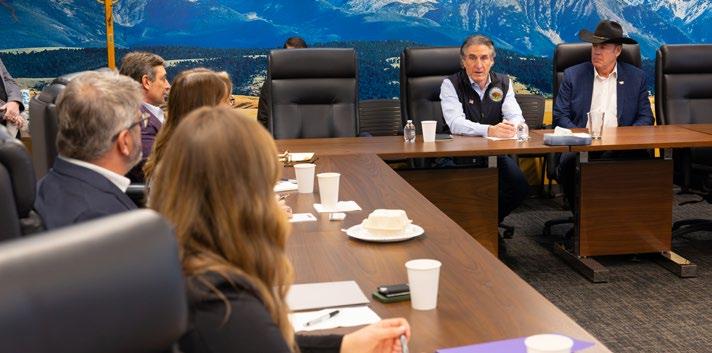
U.S. Secretary of the Interior Doug Burgum and U.S. Congressman Ryan Zinke met with regional agriculture and conservation leaders in Bozeman on Feb. 27, to hear feedback and ensure federal policies align with stakeholder needs.
GALLATIN CANYON SEWER AT ‘CRUX POINT’
A long-awaited project that could support Gallatin River health rests in the balance of a $10 million funding gap. If local and regional authorities can figure out how to fund it, Big Sky could become a state-leading example of wastewater treatment. If not, part of the community will remain “worst-in-class,” leaders say.
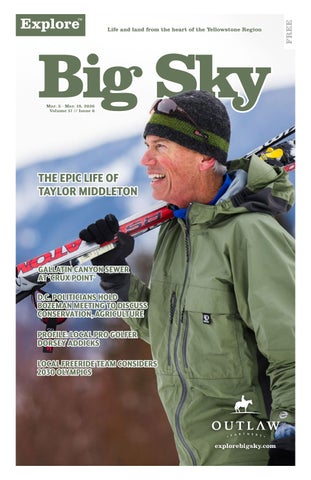
THE EPIC LIFE OF TAYLOR MIDDLETON
ON THE COVER:
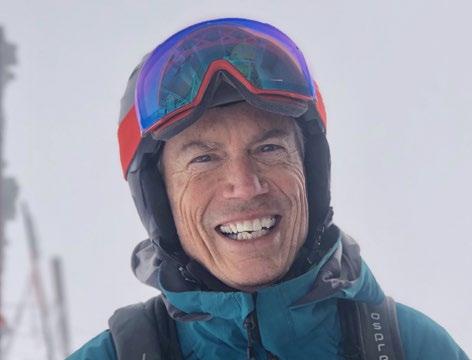
Local fine art photographer Ryan Turner hit the Lone Mountain Ranch Nordic track with Taylor Middleton in 2012, capturing his iconic smile and his love for outdoor adventure. Middleton loved to ski, bike, run, hike and just about any healthy activity in nature. COURTESY OF RYAN TURNER PHOTOGRAPHY
EDITORIAL POLICIES
EDITORIAL POLICY
Outlaw Partners, LLC is the sole owner of Explore Big Sky. EBS reserves the right to edit all submitted material. Printed material reflects the opinion of the author and is not necessarily the opinion of Outlaw Partners or its editors. EBS will not publish anything discriminatory or in bad taste.
EBS welcomes obituaries written by family members or from funeral homes. To place an obituary, please submit 500 words or less to media@theoutlawpartners.com.
On Saturday afternoon, hundreds gathered at the Huntley Dining Room to celebrate the life of Taylor Middleton, who passed away at 68 years old in mid-February. The event included an on-mountain dedication and a Big Sky twist on a 21-gun salute. EBS spoke with friends and mentees of Middleton, who echoed each others' admiration for the longtime resort and community leader.
LETTERS TO THE EDITOR
Letters to the editor allow EBS readers to express views and share how they would like to effect change. These are not Thank You notes. Letters should be 250 words or less, respectful, ethical, accurate, and proofread for grammar and content. We reserve the right to edit letters and will not publish individual grievances about specific businesses or letters that are abusive, malicious or potentially libelous. Include: full name, address, phone number and title. Submit to media@outlaw.partners.
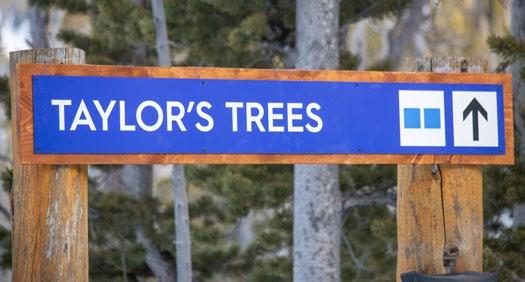
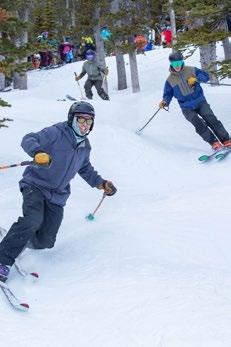
As part of his celebration of life ceremony, Big Sky Resort dedicated the “Tango Trees” trail to Taylor Middleton, who spent decades encouraging the resort to cut more gladed terrain in his various leadership roles. The hidden-gem trail was one of his many favorite tree runs. PHOTO BY JACK REANEY
BRIEFS
NEWS IN BRIEF
REP. RYAN ZINKE ANNOUNCES HE WILL NOT SEEK REELECTION
EBS STAFF
U.S. Rep. Ryan Zinke will not seek reelection in November, he announced in a March 2 press release. Zinke has spent more than 30 years in public service, including 23 years as a U.S. Navy SEAL officer, four years in the Montana State Senate and as U.S. Secretary of the Interior under President Donald Trump. He has also served four nonconsecutive terms in the U.S. House of Representatives.
In the news release, Rep. Zinke said his decision was due in part to ongoing health considerations. He stated that he has undergone multiple surgeries since returning to Congress and anticipates additional procedures following the conclusion of his term.
He will complete the remainder of his current term. Zinke cited work related to infrastructure funding, conservation initiatives, public lands policy and assistance to constituents navigating federal agencies.
“It has been a great privilege to serve Montana and our great Nation as the first U.S. Navy SEAL to serve in the state senate and the U.S. House of Representatives, and the first Montanan to serve as a cabinet secretary,” Zinke stated. “May God bless Montana and all those who defend her.”
ENCORE ELECTRIC HONORED FOR WEST YELLOWSTONE AIRPORT EXPANSION
EBS STAFF
Encore Electric received a 2025 Construction Excellence Award from the Montana Contractors Association in the Best Specialty Contractor Project category. The award honors the company’s electrical work on the airport’s terminal expansion, which was completed in May 2025.
The project modernized the all-wood terminal with updated electrical, data, security and lighting systems while preserving its rustic design, according to a press release from Encore. Work included installing energy-efficient infrastructure and restoring the airport’s historic 1930s aviation beacon as the focus point of the terminal. Encore also partnered with Martel Construction and the Montana Department of Transportation on the project to ensure compliance with federal aviation requirements.
“Building an FAA facility in such a remote location required precision, persistence, and collaboration,” stated Bill Frye, director of the Montana Business Unit for Encore Electric, in the release. “This award reflects the dedication of our electricians and project leaders who delivered exceptional quality under demanding conditions while never compromising safety, craftsmanship or the project vision.”
GALLATIN VALLEY LAND TRUST REACHES 75,000 ACRES CONSERVED IN SOUTHWEST MONTANA
EBS STAFF
The Gallatin Valley Land Trust has permanently conserved 75,000 acres of agricultural land, wildlife habitat, rivers and open space across Gallatin, Park and Madison counties in southwest Montana.
The milestone comes two years ahead of the nonprofit’s schedule after it set a goal three years ago to protect an additional 25,000 acres within five years amid rising development pressure. GVLT previously took 30 years to conserve its first 50,000 acres.
“We could not have reached this milestone alone. We stand on the shoulders of our founders’ bold dreams and decades of leadership that preceded us,” said GVLT Executive Director Chet Work, in an email to supporters. “Most importantly, we owe this success to our landowner partners who choose to conserve their land and our generous supporters, like you, who help fuel this work.”
Founded in 1990, GVLT has completed 137 conservation easements.
The organization currently has 18 projects underway that could conserve more than 20,000 additional acres, including efforts tied to its Northern Yellowstone Open Lands initiative in Park County.
RETIRED YELLOWSTONE RANGER EQUINES AVAILABLE FOR ADOPTION
EBS STAFF
Two longtime service animals from the Yellowstone Ranger District are seeking permanent homes following their retirement from active duty.
Ladybug, a 29-year-old red roan molly mule standing 15 hands high, and Dent, a 25-year-old bay gelding measuring 15.1 hands, both previously supported frontcountry and backcountry operations. The pair are described as gentle, experienced on varied terrain and well-suited as companion animals, in a post by Custer Gallatin National Forest.
Ladybug is known for her calm temperament and enjoys grooming, while Dent is recognized for his playful personality and is best suited for flatter landscapes. Both animals are reported to be good with children and adaptable as pasture companions.
Those interested in adoption can contact Sherri Renck at 406-823-6070 or 406-220-9792, or via email at sherri.renck@usda.gov.
VOTER EDUCATION EVENTS
Learn more and ask questions about the hospital/wellness district initiatives that will be on your mail-in ballot due May 5.
March
Wed., March 4
Family Forum WHERE: BASE WHEN: 5:15 - 7:00 PM Childcare provided
Tuesday, March 24
Ballots & Brews with Explore Big Sky WHERE: Waypoint WHEN: 5:00 - 6:30 PM
May
Tuesday, May 5
Election Day
Mail your ballot by April 27 to ensure it arrives on time.
Wed., March 11
Pizza with a Purpose WHERE: Big Sky Chapel WHEN: 11:45 - 1:30 PM
April
Tuesday, April 14
Ballots & Breakfast WHERE: Big Sky Center for the Arts WHEN: 9:00 - 10:30 AM
Ballots may also be dropped off on or before May 5 at: - Your County Elections Office - BASE (Gallatin County voters only)
Get to Know
Local Candidates
Tuesday, April 21
Candidate Forum
WHERE: WMPAC WHEN: 5:30 - 7:30 PM
Thursday, March 19
Dirtbag Après WHERE: Talus Room, Summit Hotel, Big Sky Resort WHEN: 4:00 - 5:30 PM
OBITUARY
TAYLOR MIDDLETON
Oliver Taylor Middleton was born in 1957 and lived his first life for 22 years as the second son of a main street merchant and timber farmer in the tiny town of Georgiana, Alabama.
He grew up playing and exploring in the thick woods outside his home, where he fished and hunted, rode motorbikes, shot cans on fence posts, and began working at the family grocery store after school as an elementary student. He loved to work; he loved to play; he loved to be outdoors, and he hated being bored. These four imperatives never changed.
He graduated from the University of Alabama in 1979 with a degree in business, the likely heir to operating his family’s retail and timber land interests, a fate he accepted without much enthusiasm. So when his college roommate called with news he’d be working at Glacier National Park, Taylor jumped at the opportunity to join him.
Taylor always said he “left the South running,” and it was true that he never looked back. When Glacier closed for the season, he headed towards Yellowstone, landing at an upstart ski area called Big Sky Resort, just entering its sixth year of operation. He joined the front desk staff at the Huntley Lodge and quickly ditched the deep Southern accent that had people erroneously calling him “Tyler.” He learned to ski at 23; to snowboard, telemark, Nordic ski, and most notably, mountain bike, in his 30s. His second life had officially begun.
After two years of working winters seasonally, Taylor knew for certain that Big Sky was his forever home. He nabbed a year-round job in the sales and marketing office and soon after was promoted to Big Sky’s sales manager.
Selling was easy for Taylor because he loved the product; his positivity turned clients and coworkers into lifelong friends. He often said that it was his prematurely gray hair and confident smile that persuaded group leaders and medical conference planners to take him seriously. The truth was, revenue was desperately needed to grow Big Sky, and Taylor was smart enough to know he was on the front-line to get it. A key strategy: Get Big Sky on every skier’s mental list.
In addition to successfully pursuing sales, Taylor worked hard to get Big Sky on the national map via magazines and newspapers. His success in this area—he lured dozens of national journalists to the resort for stories throughout his career—benefitted Big Sky’s reputation enormously, and ultimately, Taylor personally.
One such journalist, working on assignment for a New York publication, flew in for a four-day reporting visit in January of 1990. Her name was Barbara Rowley, and after quickly finishing the story, she returned just two weeks later at Taylor’s personal invitation. The two were married on Sept. 1, 1991.
In Barbara, Taylor found another lifelong passion— their marriage was his most valued partnership. In just a few years, the self-described Southern redneck had become a non-hunting vegetarian, a devout reader of The New York Times, and his
wife’s best editor, advisor and friend. He instantly became the perfect dog dad to Jasper, and later, Smokey, Ollie and Billie, who all became his bike riding partners. He also agreed, somewhat reluctantly, to travel outside Montana at least once a year, having (post-wedding) surprised his new bride by claiming that there was no reason to ever leave the state.
Barbara quickly made Big Sky her home and began a futile lifetime effort to keep up with her husband on skis, bikes and trails as well as in his unending energy for do-it-yourself projects. Their marriage was a true union: she joined him for countless client and company dinners and resort events; he built sets for the children’s musicals she produced, and welcomed dozens of the young people Barbara mentored to their home—over twenty of whom lived with them for a season or two. Together, they worked and supported each other’s many community initiatives, from the creation of the resort tax to the founding of Lone Peak High School.
At the same time, Taylor’s portfolio of responsibilities within the company was growing, and so was his family. He became a father to Anna, his first daughter, in October 1995 while discussing with the doctor just how many helicopter trips it took to build the first Lone Peak Tram and welcomed a second daughter Kate, four years later.
In 1995, just as the first tram became operational, he was named as John Kircher’s successor as resort general manager, and later Big Sky Resort president as well, holding both top leadership and management positions for the next 24 years before leaving day-to-day oversight and becoming the area’s first president and chief operating officer, extending his impact company-wide across the now 13 resorts under Boyne.
During his long tenure with Big Sky, Taylor enjoyed countless days of perfect powder, and prided himself on skiing for a couple of hours
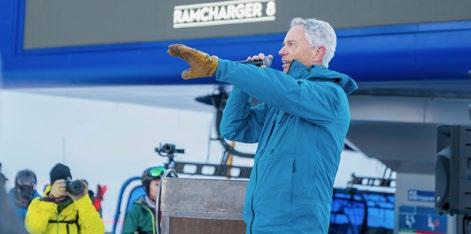
Taylor Middleton led Big Sky Resort for more than four decades. COURTESY OF BIG SKY RESORT
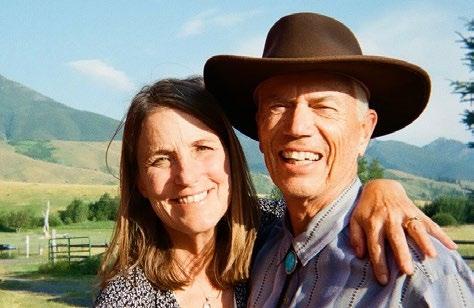
Taylor and his wife, Barbara Rowley. COURTESY OF BIG SKY RESORT
almost every day he worked—on slope meetings were the norm. His co-workers were a vital part of his community. His career overlapped with the construction of more than twenty lifts (and two trams), two slopeside hotels, the opening of what was then the largest conference center in the state, and later the creation of Basecamp, the resort’s outdoor activity center, which together helped launch Big Sky into a true summer destination.
As a community leader representing what was for a long time the biggest employer in town, Taylor was often called upon to use his natural talent as an orator—he never read a speech. His state of the community presentations at the annual owners association meetings were legendary. He was pivotal in the creation of the Big Sky Chamber of Commerce and the drafting and implementation of the resort tax. He was a key player in the formation of the first Big Sky Transportation District, and led the founding of Big Sky’s first bank and its only hospital, serving on each of these new entities’ inaugural boards (and many others). All of these efforts expanded his friend group across the community and southwest Montana.
To accomplish all of this, Taylor worked long weeks, days, and virtually every holiday—he believed in setting the right example from the top. He was known for managing by walking around: moving from the Huntley Lodge to the Summit could take him over an hour. He always said hello to absolutely everyone, usually by name, had to pick up any piece of trash, call in any problems he saw, and take the time to listen to any staff member or guest he crossed paths with. And, of course, he had to test out the snow, or the new trails being built in summer. He was often late for dinner and many winter nights fell asleep in his chair while answering emails.
Still, he prioritized being a loving, adventurous and fun-centric father to Anna and Kate, making sure that—like him—they would love to work, play and be outside. He also made certain that they were never bored.
Together, they skied, rafted, hiked and biked; constructed bluebird boxes and installed them around the town, picked wild strawberries and raspberries, baked buttermilk biscuits, sought out eclipses, aurora borealis, comet showers, learned to unicycle, painted pictures, snorkeled behind beaver dams, hooted at owls, played board games and travelled their backyard, their state and their world with equal enthusiasm. His example was powerful: both girls worked at the company as ski instructors in high school, and are now professional ski patrollers.
A curious citizen scientist, he insisted his family share his geologic, archeological and astronomical investigations, and treasured his days in the mountains learning names of plants, wandering slowly through the woods, and taking any opportunity to sleep under the night sky (even if it was on the porch, where he spent most summer nights). He had a legendary eye for finding arrowheads, crystals and fossils, and always brought home a rock as a souvenir from every adventure.
When he was promoted to Big Sky Resort president and COO in 2019, he relished guiding his successor and great friend Troy Nedved in his prior role as general manager, as well as continuing to mentor dozens of others whose careers had flourished at Big Sky, Boyne and other local businesses. During these years, freed from the on-site requirements of the day-to-day, he was deeply involved in the oversight, planning and execution of the Vision 25 plan which recently came to completion with the opening of the
OBITUARY
new tram and gondola, as well as the envisioning and implementation of the Forever Project, the ambitious multi-resort 2030 net-zero effort.
Despite his many hours at his desk, Taylor got outside every day, a habit somehow documented in The Wall Street Journal which in 2013 found his “epics” a newsworthy story for other executives. In winter, he Nordic skied by headlamp or got in runs before the lifts opened so he could reach his annual 100 days “on snow,” a goal he maintained through 2025.
Skiing trees was his favorite, and every year he directed mountain operations to glade more “hidden” runs across the resort. In summer, his epic mountain bike rides with a wide cast of his “adventure buddies” were never successful, he said, unless they got lost at least twice, returned home in total darkness and drank out of puddles.
Sweat was his friend: he loved putting on a jersey and racing, especially in the Rut and the Biggie, which he did every year until 2025. He kept a
running to-do list of adventures over his garage workbench and when he transitioned out of daily operations and into the COO role, was able to take multi-week van trips throughout the Southwest, raft Grand Canyon, bike and hike in Spain, finally see Hamilton, and most wonderfully, take meetings on the Peloton or on a run.
Taylor worked for Big Sky for 44 years, three decades of them in the top leadership position. Looking back, he celebrated every moment of a career that met and exceeded his greatest desires, allowing him hard work, immense play outdoors, and the great satisfaction of leading a team and building a community.
Most importantly, he was never bored, or even disengaged, not for a single day of his life. In “retirement” he focused on fully living each day with family, friends and pet companions. For Taylor that meant teaching his girls to fix the broken heaters, plumbing and fences, and drive his beloved tractor in Gallatin Gateway. He loved his days of riding his bike around the pasture with the dogs, watching the birds, polishing rocks, cuddling the ever growing collection of barn cats, planting wildflowers, clearing the woods of brush, listening to podcasts, taking long naps in the sun, and reading and being read to by Barbara (a marriagelong tradition). He continued to ride bikes, hike and boat with a steady stream of visitors, often Boyne and Big Sky managers and their families, whose careers he had nurtured and in whom he took great pride. He slept outside every night.
Taylor loved his daily evening walks and ongoing conversations, reveling in the beauty of his first love, Montana, alongside his second one, his family. He often expressed how grateful he was for his final months in which he happily enjoyed more walks, more sunsets, more chances to hold one more arrowhead between his fingers, to hear one more hawk, win one more game, have more adventures with his friends and family visiting the rivers and mountains he loved and most importantly have the opportunity to be together.
Taylor never lost the genuine smile that he once thought was his only attribute, or the joy that lay behind it. He remained happy, busy, and filled with gratitude for the life he had always wanted and which, he said nearly every day, he was lucky enough to have actually lived.
For those who wish to honor Taylor’s legacy and life, consider donations to support the health of Big Sky’s environment, humans or animal companions with gifts to the Big Sky Hospital, Big Sky Bandage or RUFF. Donations to the Boyne Forever Foundation will be used both to help team members in crisis and to continue to fund sustainability efforts in his beautiful and most beloved Big Sky, his last—and very best—place.
COURTESY OF BIG SKY RESORT
COURTESY OF BIG SKY RESORT
SPORTS
SHORTHANDED, BIG HORNS END SEASON WITH DISTRICT TOURNAMENT LOSSES
COACH MALINOWSKI SHARES END-OF-SEASON TAKEAWAYS:
‘I’M REALLY PROUD OF THE EFFORT’
BY JACK REANEY AND JEN CLANCEY
MANHATTAN—The district tournament didn’t go as planned for Lone Peak High School, as the Big Horns enjoyed a first-round bye before losing back-to-back games.
An illness affected multiple players on the young team, including junior starters Miles Romney and Sid Morris. The situation taxed the depth of a program with only 12 players, counting two eighth graders.
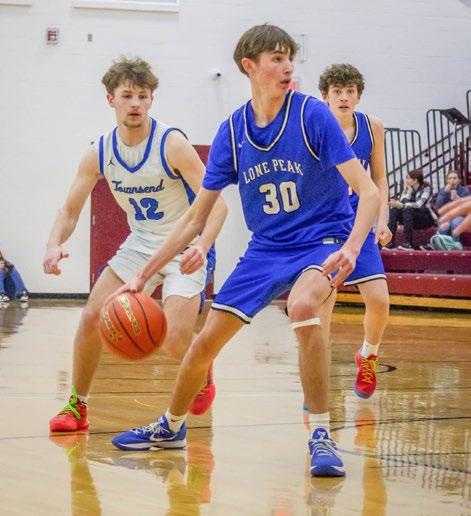
On Wednesday, Feb. 25, Lone Peak played against Broadwater High School (Townsend) to start their District 5B tournament run at Manhattan Christian High School. The Big Horns lost 68-46 against the Bulldogs, but head coach Al Malinowski was proud of the offensive effort in the second half. He recognized it could be even better when everyone on the team is healthy and ready to bring the same energy on defense.
“We just needed to execute against their zone, and at times I think we did a really good job of that. And at other times, we struggled,” Malinowski told EBS after the game.
Junior Ryan Malinowski led scoring with 22 points, including five 3-pointers. Freshman Jens Biggerstaff, senior Ebe Grabow and junior Sidney Morris scored seven points each and sophomore Steen Mitchell scored three points.
After the 22-point loss to Townsend, Lone Peak faced elimination against Jefferson High School on Saturday, Feb. 28.
The Big Horns held a 14-point halftime lead, but ran out of gas and fell by a 16-point margin.
“Everything seemed to kind of catch up to us in that second half,” Malinowski said in a phone call with EBS. “... Probably played our best [first] half of basketball all season. We were moving the ball, people were scoring, we were active.”
He added, “Not making excuses, but the reality of it is, we had a pretty thin bench to begin with... Sometimes it catches up to you. We knew we weren’t at full strength, but we went out and gave it what we could.”
With a short bench and some contributors at less than 100% health, Jefferson’s physicality wore the Big Horns down. Shots stopped falling, junior Sid Morris fouled out and a strong season ended in disappointment.
“It was tough, but at the same time, I’m really proud of the effort that we put in,” Malinowski said. “We’re the smallest school in the 5B district, but I think every game we showed we could compete with the teams we were playing.”
Malinowski pointed out that this year’s team will
only lose one senior. It’s a young program, with a lot of potential and room to grow.
That one senior, however, is Ebe Grabow, who finished his LPHS career with 1,210 points, good for second-most in school history. Grabow racked up 18 career 20-point games.
Returning players include three 100-point scorers this season: juniors Ryan Malinowski, Miles Romney and Sid Morris.
Counting Grabow, 2025-26 was the first season since 2022-23 in which the program had at least four players with 100 points. And this team did it while playing just 20 games—nine fewer than the 2023 state tournament team.
Sharpshooting point guard Ryan Malinowski now owns the program’s single-game, single-season, and career 3-point records. Romney led the team in rebounds. Morris “really excelled” and scored more points from the interior this year, coach Malinowski said.
Young guys
will see their roles expand next season. Coach Malinowski expects a lot more opportunities for current freshman Jens Biggerstaff.
“We’ve got three juniors that are coming back next year with a lot of experience,” Malinowski said, emphasizing the importance of offseason work. “... We just need everybody to get a little better.”
The district tournament offered a lesson about handling adversity, and Malinowski is confident his team will learn from it and benefit from experiencing playoff basketball, regardless of the outcome.
“This team brought us a lot of great moments through the course of the season. We weren’t necessarily playing our best at the end, but I think there’s still a lot to celebrate,” Malinowski said.
The Lone Peak girls team wrapped up their challenging season with a pair of losses in the tournament. They fell 66-36 against Jefferson, and 37-22 against Manhattan High School.
showed growth, too: sophomores Nick Hoadley, Steen Mitchell and Keenan Masonic
Junior Sidney Morris in the Feb. 25 game.
PHOTO BY JEN CLANCEY
BIG SKY’S FREERIDE LEADERS EYE 2030 WINTER OLYMPICS IN FRENCH ALPS
BY LESLIE KILGORE
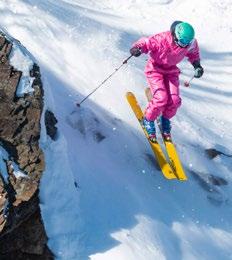
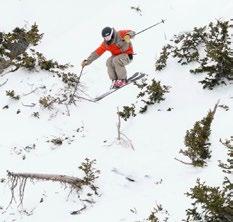
BIG SKY—Freeride skiing and snowboarding was once known as an “extreme sport,” rooted in rowdy cliff drops, challenging terrain, freeform competitions and privately sanctioned events. Now, as we look to the next winter Olympics in 2030, this rapidly growing sport could soon find itself on the world’s biggest stage.
For Big Sky’s Wallace Casper, that possibility is no longer a far-off dream. It’s a real, working goal.
“Yep, 2030,” Casper said. “They will want to do an initial event in the French Alps, and then the ‘34 Winter Olympics is planned to be back in Salt Lake City, where there’s numerous freeride venues. Freeride is a big part of the ski culture in Utah, and it seems like a pretty obvious place to be able to host an Olympic event, so hopefully it really gains major direction there.”
Casper, 29, serves as the freeride program director for the Big Sky Ski Education Foundation, and the northern region series director for the International Freeskiers and Snowboarders Association. In that dual role, he coaches athletes locally while helping oversee competitions and standards across the northern region.
“So, I’m definitely really involved with the sport while putting on events, and managing competition for teams and athletes in the region,” Casper said.
While he is not directly working for the Olympic Committee, Casper says momentum is building at the international level.
“They’ve basically given the IFSA the exact requirements we have to meet,” he said. “And so we’ve been working the last couple years to check all those boxes, and it’s seeming like we are going to get in for 2030, but it’s not set in stone yet.”
Freeride’s roots trace back to 1996, when the IFSA was officially founded by legendary skier Shane McConkey. Casper noted that the first event was likely held in Crested Butte, Colorado.
“They called it the Crested Butte Extremes,” Casper said. “Even the name of the sport has changed. From freeskiing, to big mountain, to freeride. It seemed like they didn’t know what to call it for a while, and now we’ve finally landed on freeride.”
Unlike traditional alpine racing, freeride isn’t about time. Athletes start at the top of a venue and choose their own line to the finish.
“I think the biggest thing is that you are free to pick your own line down the mountain,” Casper said. “There’s a start at the top of the chosen venue and a finish at the bottom. That’s the beauty of the sport, competitors get to decide the way that they interpret the slope.”
Judging is based on five criteria: line, control, technique, fluidity and style.
“The simple way to think of it is your line is the path that you choose,” Casper explained. “The baseline’s kind of the easiest way down, and then anything you do that makes it harder, you’re building your line score. And then the execution is the other four categories. How in control were you? How good was your technique? How smooth are
you? And then there’s style—that’s where skiers and riders amplitude off drops and features, as well as whatever tricks and grabs they throw in.”
Casper often simplifies it for his athletes.
“I’ve told the kids who I’ve coached for a long time that it’s basically big mountain figure skating,” he said. “There’s an element of both creativity and skill that the judges base a run off of during competitions.”
A major step toward Olympic inclusion came when freeride fell under the umbrella of the International Ski and Snowboard Federation roughly three years ago.
“It made our sport more legit in a lot of ways,” Casper said. “Because it’s an international governing entity and that’s one of the Olympic requirements. Since it used to be a private entity, it didn’t qualify for the international governance rules.”
Under FIS oversight, freeride has worked to standardize global judging and qualification systems.
“The biggest thing is that we just have to have a global consistent judging platform,” he said. “You can’t have the South American comps doing their own thing, while North America is doing our own thing. It has to be a global point system.”
At the professional level, judging already involves replay and comparative analysis, something Casper expects would translate seamlessly to Olympic coverage. He said the Freeride World Tour is already using detailed video analysis.
For Casper, Olympic inclusion would elevate athletes who are already performing at elite levels.
“For some of the people who have been on the World Tour and athletes like Big Sky’s Holden Samuels, it’d be so sweet,” Casper said. “I think they’d be stoked if they were Olympic athletes. They should be respected at that level.”
Freeride’s growth is visible not only on the pro circuit, but also in youth and collegiate programs. Casper himself competed with the freeride team at Montana State University while in college.
Locally, Big Sky’s team has stabilized at around 35 athletes this season, supported by Casper and seven additional coaches.
“We’ve been at a consistent number of about 35 kids for the last three or four years,” he said. “We’ve always had really good athletes, especially for our size.”
He credits Big Sky’s terrain for giving athletes a competitive edge.
“When we’re used to our cliffs, and the variety of challenging terrain at Big Sky Resort, then we go to other places, and it feels easy for us,” Casper said. “There’s a reason I’ve been here for 10 years coaching. It’s an ideal spot for the sport.”
Freeride remains relatively niche outside mountain towns, but Casper believes Olympic inclusion could change that.
“I think that it’d be really cool to get the recognition to the sport that it deserves,” he said. “It’s been growing rapidly ever since it started, basically, but it’s still relatively unknown and niche to mountain towns. So if we were to get global attention, I think it would be huge.”
He also believes the stakes, and the talent, will rise with it.
“First of all, a lot of people are going to see freeride for the first time when it goes into the Olympics and probably be inspired and want to join the sport from that,” Casper said. “Also, the stakes are going to be higher. There’s going to be more recognition, and probably a lot more sponsorships for athletes.”
If 2030 becomes a reality, freeride skiing and snowboarding, born on steep faces, wild terrain and built by mountain-town communities like Big Sky, will finally have the global stage its athletes have been working towards for nearly three decades.
“At the end of the day, it’s really cool where the sport is at right now,” Casper said. “But the Olympics is pretty much it. Almost everyone knows what the Olympics means.”
For a sport that began as a grassroots, cliff-hucking spectacle and has evolved into a globally governed discipline, the Olympic rings would represent more than medals. They would signal recognition for athletes who have spent years navigating steep cliffs and unpredictable lines, mastering both courage and technique.
Casper is optimistic about the future. “For some of the people who have been on the World Tour, it’d be sweet if they were Olympic athletes,” he said. “They’re at that level in their athleticism, and they should be recognized.”
Olive Wolfe completes a comp run on Obsidian at Big Sky Resort in 2025. PHOTO BY JULIA BARTON
Duke Woodman on his winning comp run at Snowbird Ski Resort in 2026. PHOTO BY 210 PHOTOGRAPHY UTAH
GOING PRO WITH BIG SKY GOLFER DORSEY ADDICKS
BY FISCHER GENAU
BIG SKY—After two rounds of blistering golf in the Reliance Matrix Championship in Las Vegas, Nevada last year, 30-year-old Dorsey Addicks looked down at her phone and saw she was sitting in first place. The following day, Addicks cooled down a bit, shooting one over par, but she finished the tournament strong and cruised to a top-five finish, netting herself $9,246 after four long days of golf.
“That top five in Vegas was awesome,” Addicks told EBS in a phone call, months later. “I played really good golf.”
Right now, Addicks is the only female professional golfer from Montana, and she’s preparing to compete in her ninth season on the Epson Tour, the official qualifying tour for the Ladies Professional Golf Association. Last year was one of her best as a pro, and this year, she hopes to finally qualify for the LPGA tour. But she also wants to have some fun.
“My word for the year is joy,” Addicks said. “Just trying to find as much joy in all the little moments on the road as I can. I think if I can accomplish that, the rest of the pieces will fall into place.”
Addicks was born in Atlanta, Georgia, but she spent much of her young life in Big Sky after her parents started building a house here in 1998. The family finally moved in 2013, and Big Sky has been her home ever since.
“It felt like I grew up in Montana, minus the fact that I didn’t go to school there,” Addicks said.
“We joke that had I grown up in Montana, I probably would have been a skier instead of a golfer.”
Addicks loves to ski, fly fish, and duck hunt with her dad in the offseason, and she says that most winters, when she’s away training, she can’t help but envy her family and friends skiing at Big Sky Resort.
“I don’t spend as much time [in Big Sky] as I would like,” Addicks said.
Each year, she spends January through February living in her Airstream in Saint Simons, Georgia, training and playing golf constantly. Then, the
Epson Tour begins and she travels March through October, playing golf all over the country at different tournaments. All told, Addicks spends 23 weeks a year on the road.
In 2025, her dad Rich joined her for seven of those weeks, the two of them traveling together in his old Airstream, and both of her parents regularly join her on tour to caddy. Addicks likes to bring home with her as much as she can while competing, and she usually packs a telescoping spinner rod in her travel bag so she can fish between tournaments. Sometimes she’ll bring her golf friends with her in the boat, which she says is “just a kick.”
“It’s quite comical,” Addicks said.
Addicks started playing golf as a child in Atlanta, and she never stopped. After her family moved to Big Sky, she played at the Big Sky Golf Course constantly, and she eventually attended Seattle University on a golf scholarship. As a college student, Addicks became the 2015 Montana State Women’s Amateur Champion, and after graduating in 2017, she headed for the pros as the only female golfer from Montana.
“I love getting to represent the state of Montana,” Addicks said. “Montana is where my heart is and where home is, so any chance I get to represent it is a really cool opportunity.”
Although she doesn’t know what the next few years will bring, Addicks can’t imagine living anywhere but Montana.
“I think everyone from Montana knows, there’s just something about [it] that you just can’t shake off,” Addicks said. “Montana is where I want to live, where I want to be.”
After nine years competing on the Epson Tour, Addicks is still having fun. Her golf coach Jackson Koert, who works with her all offseason in Georgia, said that one of Addicks’ best qualities is her attitude.
“It’s very rare that you see her down, which I think is another superpower she has,” Koert said. “And I think that positive attitude that she has on the golf course carries over to other things, and she’s always fishing and wanting to go hunting and skiing. As a person, she’s phenomenal…and she’s wonderful
to work for.”
Koert has been coaching Addicks for over five years, and he’ll be there with her on March 5 for the first tournament of 2026 in Atlantic Beach, Florida where Addicks is hoping to build off last year’s success. After a hot start and two top-30 finishes, Addicks didn’t score as well down the stretch in 2025, but she says that last season still felt like a win.
“The highs are really high and the lows can be very low out on the road,” Addicks said. “Professional golf is an interesting beast. I still really enjoy it, I’m still getting better every year, I’m still having fun out there and everything, but there’s definitely tough periods.”
Tim McKenna, a member of Big Sky Community Foundation’s board of directors and a good friend of the Addicks family, said he’s never met someone who works as hard as Dorsey works at golf.
“She’s the hardest working person I know in any discipline,” Mckenna said. “That’s a tough field to break into, professional golf, but she really puts everything into it.”
If Addicks doesn’t make the cut at a tournament, she doesn’t get paid, and she said that as the season goes on, the pressure to make cuts, make money and improve her status for next year increases.
“Golf tells you that you suck every single day,” Addicks said. “I think you just have to have a really good maturity and understanding and ability to just roll with the punches and view golf as a roller coaster. Because sometimes all you can do is just hang on for dear life.”
She’s looking forward to the start of this new season, but looking further ahead, Addicks isn't sure what’s in store. For now, she’s just glad to be along for the ride.
“I can’t see myself still golfing [professionally] in 10 years,” Addicks said. “I’d imagine by that point I’d like to settle down and know what it is to have a singular home, but I don’t know. If I’m still having fun and getting better and I can afford to do it, I’m gonna keep doing it. Just ride the journey as long as I want to and see where it takes me.”
Dorsey Addicks, Big Sky resident and Montana’s only professional female golfer, watches her tee shot during Stage 2 of the LPGA’s Qualifying Stage Tournament in 2025. COURTESY OF EPSON TOUR STAFF
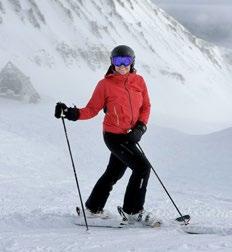
Dorsey Addicks skiing during the off-season at Big Sky Resort in 2025. PHOTO BY RICH ADDICKS
BIG SKY LISTINGS
BIG SKY COMMERCIAL LISTINGS
REGIONAL
SECRETARY OF THE INTERIOR DOUG BURGUM, REP. RYAN ZINKE MEET WITH CONSERVATION LEADERS IN BOZEMAN
EBS STAFF
Editor's note: Outlaw Partners is mentioned in this story, and is the publisher of Explore Big Sky.
BOZEMAN—At sunrise on Friday, Feb. 27, U.S. Secretary of the Interior Doug Burgum and U.S. Rep. Ryan Zinke sat down with leaders from Montana’s conservation and agricultural communities at the Montana Farm Bureau Federation office in Bozeman. The meeting was one stop among a series of stakeholder gatherings held across the state with Burgum, Zinke and U.S. Sen. Steve Daines.
Together, the discussion covered some of the politicians’ plans for the future, and conservation groups shared their input on how the government could better assist their missions in the region.
Secretary Burgum invited specific input, asking participants what they cared about and where his department could tangibly help. He encouraged organizations to stay engaged with the Department of the Interior and to bring forward real, solutionoriented ideas that could be implemented.
Burgum noted that the recreation industry is valued at $1.2 trillion dollars, and 3% of the nation’s employees are tied to the outdoors. He explained that as the leader of public lands management in the U.S., he’s surprised by how the hundreds of millions of acres were managed before his tenure.
“We somehow manage to have the world’s largest balance sheet and then simultaneously the world’s worst returns,” Burgum said. “If we had even slightly better returns, we would have all the dollars we need for conservation, for habitat, for deferred maintenance in our parks.”
Burgum pointed to ideas such as adjusting entrance fees for international visitors at Yellowstone National Park as an example of rethinking revenue structures. The concept was advanced in part by the Property and Environment Research Center and supported by Rep. Ryan Zinke in discussions with the Department of the Interior over the past year.
Other topics ranged from managing open grazing areas and addressing growing conflicts with grizzly bears to wildfire management, forest health and mitigation strategies across the West, including prescribed fire and fuels reduction, as well as federal legislation in need of renewal or support, including the Land and Water Conservation Fund.
Rocky Mountain Elk Foundation Chief Conservation Officer Blake Henning emphasized the organization’s longstanding collaboration with federal agencies.
“One thing I’d just let you know, from our standpoint, the [BLM] has been a very large partner of ours over our history. And so those things that we do with them, particularly around habitat management, prescribed burning forest management, weed control, is important to us,” Henning said. “So we appreciate the emphasis on mining and efficiency in those agencies. We also just … want to make the point that we need those people on the ground to help with that work.”
Henning noted that RMEF has completed roughly 40 projects with BLM over the past decade.
Eric Ladd, CEO and founder of Outlaw Partners and board member of American Rivers, spoke about river protection and the importance of advancing Wild and Scenic designations, including efforts tied to the proposed Greater Yellowstone Recreation Enhancement and Tourism Act, which seeks to
strengthen river protections while supporting recreation-based economies. He also emphasized the need for broader river-first legislation and encouraged more collaboration between water advocates and energy developers.
“If we can get more opportunities to get water groups sitting with energy groups, I think that would be a really big win,” Ladd said. “We could earn that trust, and then we create better funding and better outcomes at the end.”
The Center for Large Landscape Conservation highlighted ongoing efforts to improve wildlife
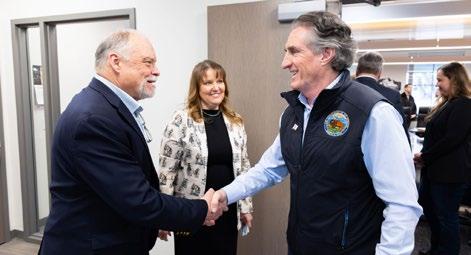
Doug Burgum talks to Rep. Zinke’s staff on Feb. 27. PHOTO BY ANDREW KING/ DEPARTMENT OF THE INTERIOR
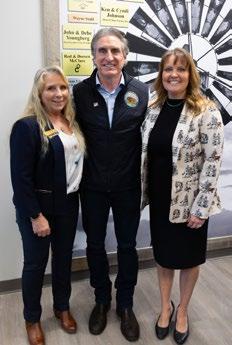
Montana Farm Bureau’s Cyndi Johnson (far left) and Nicole Rolfe (far right) with Burgum. PHOTO BY ANDREW KING/ DEPARTMENT OF THE INTERIOR
REGIONAL
safety along U.S. Highway 191 in Gallatin Gateway. Becca Boslough King, CLLC’s U.S. programs policy specialist, thanked Zinke for his leadership in advancing bipartisan legislation to permanently authorize the Wildlife Crossings Program.
“It is critical for Montana and the country, and especially in Montana, where we have the secondhighest wildlife vehicle collision crash rate,” Boslough King said. “Stretches of road near here see half of accidents caused by wildlife, 10 times the national average.”
Burgum tied much of the discussion back to permitting reform and project efficiency, arguing that billions in already approved capital are stalled nationwide.
“There’s $1.5 trillion of capital expenditures being held up in America,” Burgum said. “Freeing that up helps every American. It’s not partisan. It helps blue states and red states.”
In similar limbo is the EXPLORE Act, passed in January 2025. Will Israel, executive director of Montana Outfitters and Guides Association shared information about the delay in the EXPLORE Act’s enforcement. The law aims to simplify permitting for special recreation across public land agencies and support recreation access on federal lands and public recreation. Israel explained that groups that operate with permitting, like special recreation permits, haven’t yet experienced the benefits of the EXPLORE Act’s policies.
“It is stuck in D.C. It has got to move forward … Those folks are not able to take advantage of that act on any level whatsoever,” Israel said. “I would term it almost as egregious at this point.”
Burgum responded, expressing curiosity about Israel’s concern and wanting to learn more about the problem.
“ We’re all about breaking log jams, so we’ll make sure,” Burgum said, near the meeting’s conclusion.
Earlier, Burgum invited attendees to the opening of the Theodore Roosevelt Presidential Library, set to open in July 2026, reinforcing his emphasis on conservation legacy and national stewardship.
Ryan Chapin, Montana Field Manager for the Theodore Roosevelt Conservation Partnership, thanked Burgum and Rep. Zinke for their leadership in advancing federal support for wildlife-crossing funding.
“Montana’s migration work is gaining momentum, including new efforts at Montana Fish, Wildlife and Parks, and the Montana Department of Transportation,” Chapin said, underscoring the need for the Department of the Interior to continue allocating essential funds to the USGS Corridors Mapping Team for state-based migration mapping.
Following the Bozeman meeting, Burgum and Zinke traveled to Montana Tech University in Butte to tour mineral laboratories and host a separate roundtable on mining and critical minerals, continuing a statewide tour focused on land, water, energy and economic priorities.
Doug Burgum talks to Rep. Zinke’s staff on Feb. 27. PHOTO BY ANDREW KING/ DEPARTMENT OF THE INTERIOR
LOCAL
‘A STRONG FOUNDATION’: BIG SKY WELCOMES FIRST F.A.T. ICE RACE
EVENT SET TO RETURN IN 2027
EBS STAFF
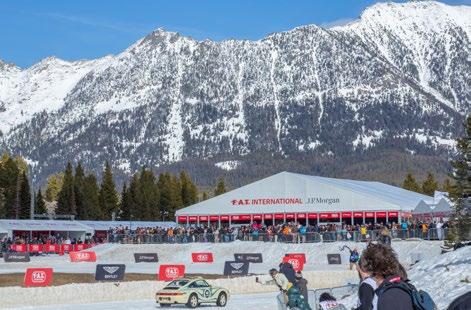
It may have been the end of February, but many of Big Sky’s visitors weren’t here to ski as head-turning vehicles overtook local streets last weekend.
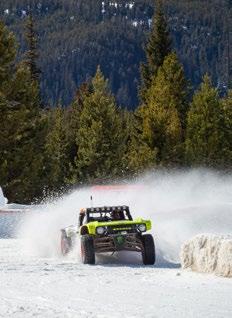
FAT International hosted its annual winter motorsports showcase, the F.A.T. Ice Race, at Moonlight Basin on Feb. 27-28. Various classes of custom-built, high-octane cars tested their traction on an icy, slushy course framed by nearby Fan Mountain.
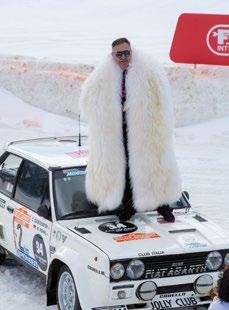
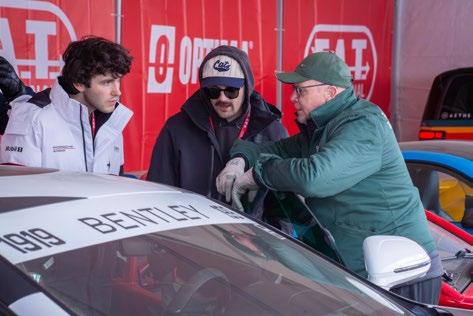
More than 50 vehicles competed, with another 50 on display, alongside hot laps, stunt performances and Red Bull demonstrations, according to a press release. Participants included Don Toliver, Daniel Arsham, Sara Choi, Emelia Hartford and Jeff Zwart, with sponsors including Porsche, Bentley, Nissan and ACG.
A free pre-race event was held Thursday, Feb. 26 at Town Center Plaza, and many vehicles could be spotted around town—some of them parked on sidewalks for display.
"Bringing FAT Ice Race to Montana is super special and Big Sky offers the perfect playground to continue the spirit we built in Zell am See," stated Ferdi Porsche, founder of FAT International, in the release. "There's nothing quite like driving incredible cars on a frozen track, embracing the chaos, and celebrating car culture with old and new friends in an environment like this."
The sold-out event brought fans from all over the world to Big Sky for the first time. Combined with ski crowds of late February, the town felt alive and bustling.
Sam Byrne, cofounder and managing partner of CrossHarbor Capital Partners, shared a statement reflecting on the event’s Big Sky debut.
“This first year far exceeded our expectations. With 5,000 to 6,000 people joining us under beautiful bluebird skies, the atmosphere was electric from start to finish,” Byrne stated in an email shared with EBS. “The course stayed in great shape—slushy at times, but that’s part of the fun of ice racing—and drivers adapted impressively. Most of all, people had an incredible time, and Big Sky businesses felt the momentum all weekend long. This event laid a strong foundation, and we’re excited to make the FAT Ice Race even bigger when it returns in 2027.”
Photos by Jack Reaney
BIG SKY'S WATER HITS MAJOR ‘CRUX POINT’ FUNDING
GAP HAS CANYON SEWER INITIATIVE ON STAND-BY; $50M PROJECT WOULD OFFLOAD NUTRIENTS FROM GALLATIN RIVER
BY JACK REANEY
BIG SKY—Anyone have $10 million lying around?
Big Sky is roughly that sum away from affirming itself as one of Montana's leading communities with regards to its wastewater treatment, infrastructure leaders say.
But without the funding, Big Sky’s wastewater treatment could remain a clash between two extremes: for most of the community, treatment is “probably the best in the state... potentially the region” with a new, top-notch $50 million Water Resource Recovery Facility; but the Gallatin Canyon portion of Big Sky—including the Lazy J commercial area and the Ramshorn, Buck’s and Quarry neighborhoods—continues to treat wastewater using a scattering of sub-optimal, decentralized septic systems.
“Two miles down the hill from that ‘best-in-state’ system, is potentially the worst-in-class,” said Mace Mangold, an engineer and project leader with WGM Group, at the Feb. 11 Resort Tax board meeting.
Mangold described the dire funding needs for the long-anticipated Gallatin Canyon sewer project aiming to rid the area of its septic systems, many of which are believed to release significant nutrients into the groundwater adjacent to the Gallatin River.
If built, the new centralized sewer would collect and pump wastewater to Big Sky’s WRRF to be treated to Class A-1 standards and reused through irrigation and snowmaking. In the opposite direction, purple-pipe infrastructure would provide reuse options for BSCWSD's highly
treated wastewater through groundwater discharge and irrigation, as part of Big Sky’s commitment to avoid discharging into the river as most communities, like Bozeman, do.
The project has been delayed by rising costs, and 2026 will be a make-or-break year with decision time looming in early 2027. A chance to improve the future health of the Gallatin River may come down to money.
Originally, the project was estimated at $42.75 million.
It’s now expected to run $50 million, due to an increasingly costly challenge: sewer pipes would need to run alongside a narrow, two-mile stretch of Montana Highway 64, requiring expensive engineering and timely collaboration with the Montana Department of Transportation.
“That is our hurdle,” Mangold said in his presentation to the Resort Tax board. “That really has been our slowdown for the last year... five years ago, it was a $12 million estimate. Our best guess is it’s about a $20 million scale.”
The remaining $30 million cost includes construction, subsidizing connection costs for property owners, and purchasing treatment service at the WRRF from the Big Sky County Water and Sewer District, a separate entity from the Gallatin Canyon County Water and Sewer District.
Mangold said the current situation has the project at a “funding crux,” in which existing money must be spent soon to preserve future matching funds. But today, the existing money isn’t enough to guarantee a finished product, so the project is not shovel ready.
By early 2027, leaders need to solidify the true costs and assemble a reliable financing stack, as well as a plan with the Montana Department of Transportation. It’s nearly decision time.
Resort Tax board member Michelle Kendziorski commented on the project’s merit.
“I think BSRAD was put in place for infrastructure, and water is a piece of that. I really do think this is important,” Kendziorski said. However, she urged the canyon district to finalize a plan as soon as possible and expressed concern that the Big Sky Resort Area District is being tasked with so much funding.
BSRAD has invested $1.4 million since 2020 into the canyon project, also setting aside $12 million from the 1% for infrastructure that has not yet been allocated or spent. The only other funding source is federal: in 2021, the project earned a $2 million American Rescue Plan Act grant through the state plus another $950,000 ARPA grant distributed by Gallatin County. User fees will eventually cover roughly $10 million in debt, but first, the canyon sewer district needs to close an additional gap of at least $10 million.
“If this project is going to be successful, it has to be a lot more than Resort Tax,” board member Kevin Germain added. “We don’t have the money to do all the things that water and sewer needs, the fire department needs—what this community needs... We’re behind this project. We want to see it succeed. But we need help, it can’t just be us.”
Decades-old septic infrastructure near the Gallatin River is the target of a centralized sewer project. COURTESY OF GALLATIN CANYON COUNTY WATER AND SEWER DISTRICT
BSRAD Executive Director Daniel Bierschwale said the project is currently “not financially feasible” for BSRAD to fund beyond its current commitment of $200,000 per year and the $12 million earmarked from 1% collections.
Expensive up-front, the infrastructure could enable long-term financial benefits.
For one, the sewer design would enable BSCWSD to dispose of some of its water downhill through groundwater discharge and irrigation, saving upwards of $10 million compared to pumping uphill over the next five to 10 years. In addition, BSCWSD would be paid by the Gallatin Canyon district for treatment and reuse.
Board member Sarah Blechta highlighted another advantage: snowmaking infrastructure can expand with a higher volume of treated wastewater. Big Sky Resort recently joined the Spanish Peaks and Yellowstone clubs in earning a permit to make snow using recycled wastewater, and a robust snowmaking system would support tourism and bolster Resort Tax collections in dry winters. Plus, a human-supported snowpack may support aquifer recharge each summer.
If funding falls short, here’s plan B: Mangold said the canyon district will likely still construct a sewer, but instead of connecting to the WRRF, the district would pump wastewater to a smaller, less sophisticated, and somewhat redundant plant.
“Why build another treatment plant when you’ve got best-in-class right up the hill, two miles away,” Mangold said. “... And you’re gonna end up with a lesser solution. You’re gonna end up with a sub-$20 million solution that’s going to fix one-third of the canyon.”
Leaders need buy-in for key funding tool
As project costs ballooned over the past two years, leaders approached the Gallatin County Commission for approval to create a targeted economic development district, or TEDD, to keep the project financially feasible and help subsidize adoption costs for property owners.
A 2024 financial feasibility study determined a TEDD would be key to cover the $10 million gap, as grants of that size are highly competitive and unreliable. Mangold believes the canyon sewer project is the “poster child” for the kind of infrastructure TEDD is designed to fund.
In October 2025, Gallatin County Commissioner Zach Brown announced the county would not support a TEDD, noting that private developers of the sizable Quarry neighborhood, alongside public funding from BSRAD and BSCWSD—plus “corporate firms” with stakes in Big Sky—should be able to foot the bill. Brown's primary concern is his view that a TEDD proactively incentivizes development, and he compared the situation to Bozeman’s “infill development” downtown.
Mangold said that while TEDD can sometimes be used as a catalyst to incentivize development, this case is different because the primary goal is environmental-infrastructure-based, not economic.
“It’s fundamentally a tool to fix infrastructure deficiencies that likely won’t fix themselves... It’s better development while fixing an existing problem to the environment, so it has this double-benefit that most TEDDs don’t,” Mangold told EBS in a phone call. “... And without it, you’re potentially going to get neither.”
County commission approval is required to create a TEDD.
The sewer project was such a sure thing—or so it seemed, two years ago—that Gallatin County approved the Quarry subdivision for construction using temporary septic infrastructure, under the pretense that developers would soon flip a switch onto the new sewer system. Quarry developers argued the neighborhood would support project affordability by providing a large user base.
“I appreciate all the effort that is going on up there to eventually connect this development as well as neighboring properties that are on well and septic—many of which are deteriorating—to central water and sewer district… and my support for The Quarry project is contingent upon that eventual connection,” Brown said in March 2024, reported by Laurenz Busch of Bozeman Daily Chronicle. “This would be a really inappropriate place to [stay on septic] given the underlying groundwater and health and safety concerns.”
The county’s approval came within a year of the Gallatin River’s impairment designation in spring of 2023. Still, leaders felt confident that the sewer would alleviate any environmental concerns created by the Quarry.
Mangold said the Quarry’s septic infrastructure is “very good quality” but inferior to the sewer system. And without the sewer, it’s an additional 135 homes plus apartment buildings and commercial space— adding to an area already full of septic systems within walking distance of the Gallatin River.
So, despite Gallatin County's serious concern about the project failing, the commission 19 months later rejected a funding scheme that would make the project possible.
“There’s no bluffing going on here,” Bierschwale said Feb. 11. “We’re at a position where, either we have the money and we have the solution with the county, or we don’t. And so I would advocate to the community: Do you want to see the canyon district happen? We need to be advocating at the Gallatin County Commission, massively, right now or this is going to fail. Period.”
If the county continues to oppose a TEDD and insists on leaving environmental infrastructure in the hands of private developers, “the project has the potential to die,” Mangold said. The result could be another pocket of flawed infrastructure like the current crisis in Firelight Meadows.
“We will just be forced to fix the problem again. Big Sky continues to have to fix the problem, time and time again,” Blechta said. “... A huge waste of time because it’s just going to cost us more in 20 years.”
Mangold hopes to warm Gallatin County up to that reality.
“Without a TEDD, we need to chase more money, and we need letters of support, and we need [Gallatin] County to be a co-applicant on bigger grants... We need $10 million scale. And that’s either a TEDD component, or federal grant component,” Mangold explained. Gallatin County will need to be a partner in either scenario.
On Feb. 23, the Gallatin County Commission sent a letter to DEQ asking the agency conduct a “comprehensive” Montana Environmental Policy Act study on the project. The outreach was lauded by conservation groups including Upper Missouri Waterkeeper, Gallatin River Task Force, American Rivers and Greater Yellowstone Coalition.
The opinion of those organizations may decide the project’s fate.
“If this is something that we are collectively working towards, with the main goal being improving the quality of our impact to the river, we need the conservation groups to really be on our team with this,” Bierschwale said.
“We need to hear from them resoundingly that they’re behind this,” Germain added.
Mangold said the project team is working to reengage various groups and earn letters of support.
Kristin Gardner, GRTF chief executive and science officer, shared a statement via email with EBS regarding the project.
“The Gallatin Canyon sewer project has the potential to be one of the most important investments we can make in the long-term health of the Gallatin River. By replacing septic systems with modern infrastructure, we reduce nutrient pollution at its source and protect water quality for future generations,” Gardner stated.
Germain highlighted Upper Missouri Waterkeeper as a make-or-break partner. The nonprofit recently expressed “tentative support” for the project but later sued Montana DEQ for its approval of a recent canyon sewer deviation application—a very small piece of the project related to Montana Highway 64 navigation.
Germain noted it could derail the project if legal fees were layered onto a tight budget.
Matt Elsaesser, Waterkeeper’s deputy director, chimed into the BSRAD meeting to clarify that the recent lawsuit “really was about the overall public process and transparency with the agencies,” and added that he sensed “a lot of agreement” among Big Sky leaders that an environmental assessment of the the canyon sewer would be a worthwhile component of the project.
In a follow-up email to Explore Big Sky on Feb. 26, Elsaesser provided a statement from Waterkeeper regarding the group’s stance on the project.
“Solving the well-established ecological and public health challenges presented by legacy septic in Big Sky and the Canyon Area remains critical to restoring and protecting the Gallatin River’s health. For rural communities across the West, centralized treatment remains a bang-for-buck solution offering better pollutant control, enforceable sideboards guaranteeing accountability, and pooled use of scant resources.”
Elsaesser added a caveat urging full transparency from state agencies, including a “robust” framework of public participation framework. The statement echoes years of litigation by the group against Montana DEQ for its approval of the Quarry subdivision, including the recent lawsuit related to the canyon sewer project.
“The Gallatin is too important for anything other than the highest standards of care and full disclosure of all infrastructure proposals, their relationships, their impacts, and alternatives, before any decisions are made,” Elsaesser stated. “Transparency combined with proven solutions to water pollution is the best approach to securing both public and private support, and critical funding.”
Project leaders will continue discussions in March, involving conservation groups, BSRAD and BSCWSD.
EBS STAFF
BIG SKY—The Yellowstone Club Community Foundation announced its 15-year anniversary in February, celebrating its “transformational impact” through investments in education, housing, arts, health care, culture and community infrastructure in Big Sky, the Gallatin Valley and southwest Montana.
Created in 2010, YCCF has invested more than $46 million in community-led initiatives and forged more than 150 partnerships with regional nonprofits, according to a YCCF press release.
“As we look back on the past 15 years, we are
JOY AND GRATITUDE
DEFINE TAYLOR
MIDDLETON’S
BIG SKY LEGACY
HUNDREDS IMMORTALIZE ‘THE SINGLE MOST INFLUENTIAL PERSON IN THE HISTORY OF THIS RESORT AND THIS COMMUNITY’
BY JACK REANEY
BIG SKY—When a community loses its hero, sorrow strikes everyone in unison.
For seven-and-a-half days, Big Sky grappled with Taylor Middleton’s passing, an unexpected event beyond close friends and family. He was 68 years old, led an exceptionally active lifestyle, and was only 16 months removed from his 44-year career leading Big Sky Resort. He learned to ski at 23 years old, climbed from a seasonal gig to sales manager, and eventually from resort GM to his final full-time role as president and COO. When life-changing health complications presented what many would see as tragedy, Taylor Middleton saw opportunity.
His courage provided closure on Saturday, Feb. 28 during Big Sky Resort’s celebration of life. The clear theme was Middleton’s gratitude and joy for all the life he lived, and for all he provided to his family, to Big Sky Resort and the Big Sky community since the early 1980s. It became clear that Middleton would not be defined by his untimely passing, but by his remarkable journey through life: his gritty, self-made career and passion for building community; his wandering “epics,” as he called his outdoor adventures; and his ability to pay attention to the things that mattered.
“Joy and gratitude... Those were Taylor’s words at the end. I believe it completely, because a man who spent his life making other people feel capable and seen and valued has every reason for joy and gratitude,” said Troy Nedved, Middleton’s successor as resort president and COO, in a speech at the celebration of life.
“Your life was the greatest epic of all,” Nedved said. “I’m still learning from you.”
Many tears were shed by the hundreds in attendance on Saturday afternoon, but the lessons shared about Middleton discouraged sorrow, especially with widespread agreement that Middleton himself did not allow his ailing health to drag his spirit down.
Rev. Miriam Schmidt emphasized how Middleton not only practiced joy and gratitude in his final days, but throughout his life. She emphasized the difference between enjoying happiness and optimism when times are good, versus the difficult task of seeking joy through challenging times, hardship and pain.
“And that is what Taylor did. He practiced joy... leading this resort through economic recession, and avalanches, and COVID, and tragic deaths on these slopes,” Schmidt said. “Taylor chose to laugh, and love, and pour himself into all of life until the very end.”
Stephen Kircher, president and CEO of Boyne Resorts, emphasized Middleton’s intentional and caring personality, both in his professional career and personal life.
“He wasn’t the leader in the beginning that he was in the end—none of us are. But Taylor never stopped learning,” Kircher said. “... From the front desk, Taylor went on to become the single most
influential person in the history of this resort and this community.”
In 2000, Middleton and Kircher set a goal to make Big Sky Resort the No. 1-ranked resort by Ski Magazine—a feat they achieved in October 2025. Kircher did not foresee the magnitude of the goal, or the way it would forge a friendship, or enhance an already great resort and community.
“But Taylor did,” Kircher said. “He always saw further than most of us.”
Nedved said Middleton’s leadership style fostered many more leaders within the community. He had a “teach, not tell” way of imparting wisdom. Nedved recalled Middleton’s penchant for asking “thoughtful, unhurried questions” meant to challenge a person and leave them thinking and questioning—sometimes for months or years.
“He had a gift of drawing things out of you, that you didn’t even know were in there. He wasn’t trying to teach you anything... That’s the thing about Taylor’s influence: it had a slow release,” Nedved said. “He never told you what to think, he just created the conditions for you to figure it out for yourself. And that was a far more lasting gift
than any advice.”
Taylor allowed—and celebrated—mistakes and imperfection, Nedved explained. People felt safe to fail, learn and grow.
One of those many homegrown leaders, ski school director Christine Baker, recalled a Taylor-ism: “Don’t let it be what it is, make it into what you want it to be,” she said in a joint speech with resort controller Courtney Jones.
John Rolander, one of Middleton’s great friends and adventure buddies, described Taylor’s love for his daughters, for collecting rocks, arrowheads and petrified wood, and for enchanting kids in nature with his own childlike spirit.
“There’s no doubt Taylor thought the greatest place on earth was Montana. He saw no need, ever, to go anywhere else,” Rolander said in his speech.
Miriam Schmidt added balance, noting that Middleton could occasionally be frustrated, overcommitted or distracted. She said he would want to be remembered as a real person with real faults. “Then we’re not putting him up on some pedestal for doing what regular people can’t do. Then we are learning from him, even after his death.”
Middleton’s oldest daughter, Anna, reflected on her special bond with her father. She noted he never judged, was unconditional in his pride and love, and provided endless support. Plus, she thrived on their adventures together.
“He loved the most random places,” Anna said. “My mom, he and I all had our fair share of time accompanying him on Sprinter van trips to the quietest, flattest, hottest, windiest, least inhabited places... and he was so happy to be there.”
With Taylor’s illness, Anna quit her travel-heavy job to spend more time close to home. She followed his lead, and saw the moment as an opportunity, not a tragedy.
Her sister, Kate, wrote and recited a beautiful heartwrenching poem.
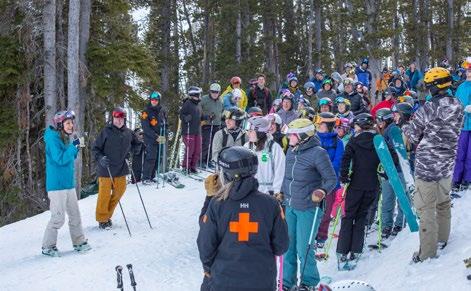
Attendees ventured up the hill for an on-mountain dedication after the ceremony, where a trail was dedicated in Taylor’s name. PHOTO BY JACK REANEY
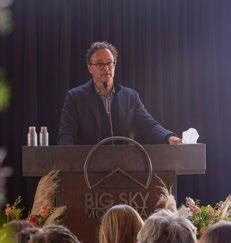
Stephen Kircher gave the opening speech at the Feb. 28 event. PHOTO BY JACK REANEY
“I look forward, and you’re not there anymore,” Kate read. “I look backward, and my time with you is fixed. I can’t stop making plans for the past, so I settle uncomfortably in the present, and know that this is all you and I have... I may be young, but I know I’m lucky to have had what I’ve had for the time I’ve had it—the backyard, no shoes, a frog net and you.”
Taylor’s wife Barbara Rowley kept it short at the conclusion of a long ceremony.
“Nothing is simple and alone,” she said, quoting a verse she'd heard in a different community years ago. “The breathing mountains, the living stone, each blade of grass. The clouds, the rain, each star, the bees, the birds and the invisible spirits of the air. We are all one, indivisible, nothing that any of us does but affects us all.”
John Zirkle led the choir during Middleton’s celebration of life. Asked to remember Middleton in just a few words, he recalled his “open-mouth smile” in a phone call with Explore Big Sky.
“It’s really hard—he’s been such a core muscle for this community, ever since I’ve been here. I mean, he welcomed me, and so many people have that story,” Zirkle told EBS. “Like, Taylor helped me feel like Big Sky could actually be a home for me. And I think he did that for so many people, and I’m just really struggling to see how we’re going to fill that hole moving forward.”
Zirkle and Rowley have led Big Sky’s theater and performing arts scene for decades. He remembers Taylor—a serviceable-at-best carpenter—putting in hours to build the set pieces ahead of Big Sky Broadway plays. Zirkle said he’d over-build everything to ensure the kids’ safety.
“I was just always amazed at how he could kind of keep everybody moving ahead,” Zirkle said. “He really never stopped... I don’t think Taylor ever was bored. I never saw him bored, and I saw that come through while we were building sets together.”
Madeleine Feher, now CEO of the Big Sky Community Organization, spent three years as his executive assistant in the early 2000s. She believes Middleton catapulted her career when he encouraged her to move on from that role.
“Madeleine, you’re stuck in the box,” he told her in 2004, pointing to a simple, hand-drawn diagram. “You’ve gotta get out of the box.” She listened, and felt empowered to take on a new job in hospitality and seek growth outside of her familiar office.
In general, Feher said Middleton was the epitome of an “authentic” and “classic” leader, always finding a thoughtful way to make an impact.
“He was a trailblazer, without question. And he was such a supporter of us going out and getting involved in the community... He knew the impact that would have... And he did it as well. He walked the walk, and talked the talk, and didn’t ask us to do anything he wouldn’t do himself,” Feher said in a phone call with EBS.
Nancy Sheil, now ski patrol director, knows the family well. She taught Kate and Anna in the Big Sky School District, eventually hiring both daughters to the ski patrol. She worked with Rowley on her Big Opportunities foundation. A fellow Alabama native herself, Sheil was inspired by Taylor’s southern roots as evidence of the ability for anyone to work their way to the top at Big Sky Resort.
“He was maybe the most curious minded person that I know,” Sheil told EBS, noting his deep knowledge of the area’s history. “He was always
interested in hearing more about something, whether it was history, or whether it was something happening at work. He would always be asking questions about it and approach it with a curious mindset.”
His curiosity certainly extended to ski patrol, Sheil said. She praised Middleton for never letting his executive title impact the way he treated onmountain employees.
“He would just walk around the resort, and if he saw trash, he would pick it up. And if he saw somebody working, he would strike up a conversation. He was just very approachable and generous with his time and energy,” Sheil said.
That feeling is shared by many, like Mike Foote, race director for the Rut Mountain Runs.
“Taylor had a lot of responsibilities in his professional life. But whenever you were around him, he was paying 100% attention to you,” Foote told EBS. “So full of energy, and positivity and enthusiasm... And it helped you get excited to try bigger things.”
Foote was always impressed by Middleton’s dedication to running the vertical kilometer event, especially because for many years, Middleton went straight to leading a Boyne Resorts state-of-theresort presentation immediately after the grueling climb. He said Middleton was a big advocate for having a world-class trail race in Big Sky, and participated every single year through 2024—in 2025, he met finishers at the peak.
“I can only hope that I can be as positive and welcoming and accommodating and active as Taylor was,” Foote said. “Because he had this energy about him.”
Natalie Osborne, founder and race director of the Big Sky Biggie mountain bike race, said Taylor was one of the first leaders to say “yes” to the idea.
“When Taylor got on board, it signaled to other landowners and partners that this event was worth believing in. His leadership helped open doors that may not have opened otherwise,” Osborne wrote in an email to EBS.
Just like he did for the Rut, Middleton actually showed up. He rode for the first six consecutive years, through 2024. Osborne will remember him as graceful, grounded and quietly powerful with an infectious leadership style that supported Osborne during challenging moments.
“When I once told him I wasn’t sure I could keep leading the event, he gently told me to stay the course and that if I didn’t do it, no one else would, and that the community was behind us,” Osborne stated. “... Getting a finish line hug from Taylor is one of the things I will miss most.”
Tom Owen, owner of Gallatin Alpine Sports, often assisted Taylor in getting lost on his epics in nearby mountains.
He listed some of the “infinite,” sunrise-to-sunset hiking and mountain biking adventures: Hyalite to Porcupine; Spanish Creek to Ennis Lake; Wilson Peak; Ramshorn Peak; Taylor Fork to who knows where; Cinnamon Mountain; Sage Peak. On summer workdays, shorter missions glorified the driveway access offered in Big Sky. In the winter, they swapped hardtails for skate skis and enjoyed the local Nordic track, or ventured into Yellowstone for classic-style tours.
“We would hike and we would bike everywhere around us... He always wrangled me into doing the [Rut VK] with him—I never could beat him,”
Owen said. “He was an amazing, strong athlete. He taught me a lot.”
They shared their last bike ride on Gallatin Gateway pavement in October. Biking had become difficult for Middleton, but Owen knows he enjoyed it still. He said Middleton was a “beautiful, gracious human.”
“The man’s energy and spirit was amazing,” Owen said. “The guy was always upbeat, he was always happy to see you, and he was always just bursting with a smile.”
Taylor’s Trees
After Saturday afternoon’s ceremony, hundreds of attendees jumped on Explorer Gondola for an onmountain dedication.
The word: meet at Tango Trees.
There, on a cat track between iconic Mr. K and Crazy Horse in the historic center of Big Sky Resort, dozens of skiers gathered beside speakers blasting upbeat, throwback tunes.
Middleton spent decades encouraging the resort to cut more glades. It was his favorite terrain to ski. Staff revealed Tango Trees would be renamed in Middleton’s honor.
“It is very fitting that it is a glade run,” Kircher said.
After a long moment of silence at 4:18 p.m., Anna and Kate assisted ski patrol in triggering an explosive on the Cue Ball just below Big Couloir. Kircher explained it as “a Big Sky version of a 21gun salute—one large salute for Taylor, that the entire community will hear.”
Before the boom echoed down to the meadow and across the many mountains Middleton traveled, it was heard by some 200 skiers. Kircher and Nedved rang the ceremonial Austrian bell, and Rowley beamed with pride as hundreds cheered and clacked their poles.
The group dispersed around 4:30, skiing “Taylor’s Trees” with glee to the base area to be greeted by the thumping sound of après in the hazy Saturday sunlight. A lively pocket of culture in a must-visit, top-ranked ski destination, exactly what Taylor Middleton believed in.
Skiers party-lapped the hidden gem of a glade, fueled by Taylor’s energy. PHOTO BY JACK REANEY
SKYLINE RIDERSHIP
INCREASES TO ‘UNPRECEDENTED’ LEVELS
BIG SKY’S LOCAL TRANSPORTATION HAS SEEN THOUSANDS MORE PASSENGER RIDES AFTER CHANGES
BY JEN CLANCEY
BIG SKY—Low snow isn’t putting a damper on local transportation use in Big Sky. According to Big Sky Transportation District Executive Director Darren Brugmann, ridership of the free public transportation options have soared, mostly due to an expansion of Skyline’s short-ride service, Big Sky Connect.
“Even with this year, this winter that we’re all struggling with the snow, we are seeing an unprecedented number of passengers,” Brugmann told the Big Sky Resort Area District board on Feb. 11. “We have carried more people than we ever have and continue to each month.”
In 2025, Skyline completed 42,000 more passenger trips than in 2024, totaling to 340,000 passenger trips by the end of the year. Brugmann credited Big Sky Connect’s success in the Mountain Village area near the base of Big Sky Resort. The Connect service is fare-free and on demand, operating like an Uber in Big Sky with specific service areas. In 2025, Skyline replaced its fixed route bus in the Mountain Village area with Connect, and this past December and January, the service tallied 45% more passenger trips. While the bus route used to pick up passengers on an hourly basis, the Connect vans can reach passengers in a matter of minutes, depending on the demand.
“We finally were able to introduce [Connect] this winter and the fixed route circulator that served the Mountain Village last year, compared to what we’re doing on demand, has definitely showed that it’s much more convenient and much more liked by the public, just by the sheer numbers we’re seeing,” Brugmann told EBS in a phone call. While the district doesn’t have numbers to describe whether passengers are visitors or locals, Brugmann said that
because of the area, Connect is likely most useful for all of the above—visitors, homeowners and employees.
“The village is a little different because we are picking up at condos that people own or rent out for tourists and guests. But we still believe the majority, a lot of them are employees that are being housed up there either by the resort or what have you, and taken to the resort main entrance,” Brugmann said.
The transportation district applied for more than $200,000 to improve technology of public transit services and learned they’d been awarded a federal grant in the fall of 2025. Upgrades through this new funding would include a bus tracker that passengers can view to see if their bus is running on
schedule, automatic passenger counts to assess the most trafficked routes and an electronic fare option.
Brugmann shared the ridership numbers and popularity of new services with BSRAD to show how funding in the future supports a public desire for more accessible transportation.
“To me, it just demonstrates that there is a strong need for public transit and many are using it and will use it if we are able to keep meeting that demand and offering more service,” Brugmann said.
The BSTD will continue to look for funding options and grants to fulfill the need for local and paid regional services, as well as make improvements to attract more passengers to public transit.
The Skyline bus stop in Big Sky Town Center. PHOTO BY JACK REANEY
A passenger exits a Skyline Connect van in Town Center. PHOTO BY JACK REANEY
THE AWAKENING OF THE WILD: 5 Reasons To Visit Yellowstone In Spring
Most travelers imagine Yellowstone National Park in summer, but spring reveals a quieter, more dramatic side of America’s first national park. From late April through early June, melting snow, surging waterfalls, and emerging wildlife transform the landscape into a season of renewal with room to explore. Here are five compelling reasons why spring is the perfect time to visit.
1. See the park come to life
Spring in Yellowstone is synonymous with baby animals. If seeing wildlife is high on your bucket list, this is arguably the best time of year to visit. In April and May, the valleys come alive with newborn bison calves taking their first clumsy steps. By early June, elk calves are often seen sticking close to their mothers near Mammoth Hot Springs. Wolves actively care for their dens and grizzlies, emerging from hibernation, are frequently seen foraging in the meadows, sometimes with babies in tow.
2. Experience the park with less crowds
Before summer visitation peaks, the park feels open and unhurried. Enjoy iconic sights like Grand Prismatic Spring and Old Faithful with room to take it all in. Trails, boardwalks, and scenic drives are quieter and more peaceful. Spring offers a rare chance to connect with the landscape on your own terms.
3. Better lodging availability
Spring makes trip planning easier. Yellowstone’s lodges and campgrounds begin opening in late April. In-park favorites like Old Faithful Inn and Lake Yellowstone Hotel reopen with greater availability than peak summer months. Campgrounds and cabins also begin welcoming guests. You’ll have more flexibility and less competition for iconic stays.
4. Exclusive guided packages
Our spring vacation packages make it easy to explore the best of Yellowstone. For wildlife enthusiasts, we offer the Spring Wolf and Bear Discovery package in partnership with Yellowstone Forever Enjoy guided excursions into the Northern Range with a naturalist, combining safe wildlife viewing with insight into Yellowstone’s ecosystem.
If you’re drawn to Yellowstone’s geothermal features and roaring spring waterfalls, the Spring Into Yellowstone package showcases top park highlights, with opportunities to spot newborn wildlife along the way. Each package includes lodging, in-park transportation, most meals, and more, ensuring a seamless and unforgettable experience.
5. Unforgettable opportunities for adventure
Spring is an ideal time to explore Yellowstone’s boardwalks and scenic drives as park roads reopen. Landmarks like the Lower Falls of the Yellowstone River surge with snow-melt, creating dramatic cascades and rainbows on sunny days. Enhance your visit by taking one of our daily Adventure Tours. Led by experienced guides, these tours offers expert insight and a deeper understanding of this remarkable landscape, geothermal features, history, and wildlife.
WE ARE READY TO WELCOME YOU
If you’ve been waiting to visit Yellowstone National Park, spring is the perfect time. Plan your trip now and experience the park at its most breathtaking. Whether it’s your first visit or a return, spring in Yellowstone is unforgettable.
BSCO ASKS COMMUNITY TO ‘HANG TIGHT’ DURING SUMMER PARK CONSTRUCTION
SOFTBALL, FIELD PROGRAMMING CANCELLED FOR SUMMER 2026; CAMP BIG SKY, SKATE PARK, PUMP TRACK, RACKET COURTS AND PLAYGROUND TO REMAIN OPEN
BY JACK REANEY
BIG SKY—Construction will continue for Big Sky Community Park renovations this spring and summer, as part of a major facilities overhaul funded in large part by a $6.8 million, voterapproved bond. One notable short-term impact will be the lack of recreation programming on grass fields, which means no softball league for 2026.
Soccer and other field-based activities will also be cancelled due to construction, while certain areas of the park will remain primarily open.
Liv Grubaugh, director of development and communications for the Big Sky Community Organization, added that BSCO is “working diligently” to secure alternative locations such as Len Hill Park and the Marty Pavelich Ice Rink, to provide similar summer activities. BSCO will share updates through its website, newsletters and social media.
“We know how much summer rec leagues mean to our community,” Grubaugh stated in an email to EBS. “For many, these programs are a cherished part of the summer season, so we understand that this summer will feel different—and that may be disappointing.”
Madeleine Feher, CEO of BSCO, also understands the disappointment. However, she is optimistic the fields will be ready for fall programming, and believes the long-term benefits are worth waiting for.
“We are on schedule and on budget, which I’m very proud to be able to say,” Feher said during a presentation at the Feb. 11 Resort Tax meeting. “… We will let you know when you can get on that new [field]. So hang tight, it’s going to be outstanding.”
BSCO broke ground on the athletic fields three months and one day after the $6.8 million Community Park Bond was approved on May 6, 2025.
With drainage and long-term reliability being a primary goal, BSCO hired a soil doctor who
recommended letting the excavated ground sit over the course of the winter before a Colorado-based company specializing in high-altitude fields comes in the spring to plant turf.
Once the turf is planted, Feher emphasized the importance of letting the field sit for 60 days. Simply put, don’t jump the fence, even if the grass looks ready for action, she urged. BSCO will make it obvious when the fields are ready for use.
BSCO will also build two new sand volleyball courts, a new basketball court and a new disc golf course this summer. They will open at different times, to be announced by BSCO.
Overall, Big Sky Community Park will still be partially open this summer, including the skate park, pump track, racket courts and Adventure Park playground. However, heavy construction activities may require temporary closures.
In addition to the ongoing park construction,
Feher pointed out that BSCO has done “major renovations” already, before voters approved the $6.8 million bond. Dating back to 2023, recent projects include an upgraded skate park and pump track, a new Adventure Park playground and maintenance building featuring BSCO employee housing, and recently, tennis and pickleball court renovations.
Camp Big Sky bathrooms, outdoor community campus
Another improvement will be public restrooms at Camp Big Sky’s area in the park’s east end—for 22 years, the summer child care program has operated using porta potties. Understandably, bathroom upgrades have been a top request from parents. “It’s time to raise the quality and the level of programming for our children,” Feher said. The building will include outdoor sinks for convenient hand-washing, and a water fill station. It will be ready by July.
Camp Big Sky programming will function as usual this summer.
In the same area, a new “community campus” will offer an “extraordinary” venue for Big Sky gatherings such as events and music beyond BSCO’s own programming, Feher explained. However, the campus construction is not fully covered by the Community Park Bond and will require additional fundraising by BSCO, and permitting is not yet complete.
In addition, BSCO will open its new mountain bike jump line during a community celebration this summer—BSCO hopes to schedule the event in June.
“This is truly a community-built park. The majority of voters that showed up on May 6 made that known that this is something that they wanted, and we’ve been able to deliver on it, and it sure feels great to be able to do that,” Feher said. “… It’s going to be just the cornerstone of our community.”
Softball fields in November 2025. COURTESY OF TWO BEAR CONSTRUCTION
The soccer field at Big Sky Community Park is excavated in November of 2025. COURTESY OF TWO BEAR CONSTRUCTION
ENVIRONMENT
TAYLOR MIDDLETON’S LASTING IMPACT ON CONSERVATION IN BIG SKY
BY KRISTIN GARDNER AND LIZZIE PEYTON GUEST COLUMNISTS
Big Sky is complex. It’s simultaneously a powerful recreation economy, and an ecologically sensitive headwaters community set within the Greater Yellowstone Ecosystem, one of the most intact temperate ecosystems left in the world. Our water, wildlife and forests connect directly to Yellowstone National Park and far beyond.
Taylor Middleton understood this deeply.
Taylor’s leadership legacy at Big Sky Resort helped shape the modern identity of this community, and one of his most important contributions was quieter—he embedded conservation into how Big Sky thinks about growth. He recognized that long term economic success depends on ecological integrity. Snowpack, clean rivers and healthy forests are not luxuries in a mountain town. They are our foundation today and for the future.
He took a strong and unwavering stance that Big Sky be a zero-discharge community. In practical terms, that means treated wastewater is fully recycled and used in irrigation or snowmaking rather than released directly into the Gallatin River. In a headwaters system, that commitment is important in order to protect cold, clean water where it begins.
Taylor did not just endorse policies from afar. He showed up, participated in water stakeholder meetings and became a student of the science. He asked thoughtful questions about nutrient loading, groundwater movement and restoration techniques like beaver dam analogs. He wanted to understand
the mechanics behind the data. His pure curiosity constantly pushed the conversation forward.
Last year, Kristin and Taylor exchanged texts about those beaver dam analogs. Taylor had recently gained a deeper appreciation for how they can improve water storage and quality. He was genuinely excited about the possibility of expanding restoration work in the West Fork drainage, building on the collaborative project the Gallatin River Task Force completed in partnership with Big Sky Resort below Lake Levinsky. Even through text, his enthusiasm for nature-based solutions was unmistakable.
Under Taylor’s leadership, Big Sky Resort launched the Forever Project in 2021, committing to netzero emissions. He did more than approve the initiative. He elevated the sustainability team and made climate responsibility part of the day-to-day operations. He spoke about it publicly and backed
it internally. That level of visible support matters within large operations and sets an example in our small community.
Taylor consistently encouraged the Big Sky Sustainability Network Organization (SNO) to set a more ambitious emissions timeline during the development of the 2023 Big Sky Community Climate Action Plan. The discussions were direct and sometimes challenging, and always rooted in his belief that leadership means going first. If the resort could commit to net-zero, he believed the broader community could rise to the challenge as well.
Taylor supported conservation in tangible ways, from contributing staff time and equipment to stream restoration projects across 12 sites on the Middle and West Forks of the Gallatin, to speaking at the Climate Action Plan launch alongside regional climate leaders. He attended MT2030—a mountain town climate conference—each year with genuine interest, engaging with other mountain communities working toward net-zero emissions and inspiring others to push boundaries.
There is little question that Taylor helped foster a conservation ethic in Big Sky. He demonstrated that economic vitality and responsible environmental leadership are not at odds. They are inseparable—the former relies on the latter.
His legacy now rests with all of us. Continuing the work of protecting our rivers, reducing emissions, and stewarding this extraordinary landscape is the best way to honor the example he set.
In memory of Taylor, we encourage you to visit gallatinrivertaskforce.org and bigskysno.org to learn more and get involved.
Lizzie Peyton is director of Big Sky SNO, and Kristin Gardner is the chief executive and science officer for the Gallatin River Task Force.
Taylor Middleton passed away in mid-February at 68 years old. COURTESY OF BIG SKY RESORT
The Upper Gallatin River. PHOTO BY DAVE PECUNIES
DISPATCHES FROM THE WILD: RETHINKING YELLOWSTONE’S WOLVES THE
MYTH OF A PERFECT TROPHIC CASCADE
BY BENJAMIN ALVA POLLEY EBS COLUMNIST
For years, Yellowstone’s wolves have been held up as the poster animals for ecological redemption. Some people say they are saints. The story is irresistible: apex predators return, elk change their behavior, and the entire landscape springs back to life. Willows soar, rivers heal, and a single management decision triggers one of the “strongest trophic cascades on Earth.”
But a new peer-reviewed critique in Science Daily suggests that reality is far less dramatic—yet more interesting still—than the viral narrative.
In a formal comment in Global Ecology and Conservation, scientists from Utah State University and Colorado State University re-examined a 2025 study led by Dr. William J. Ripple that reported a staggering 1,500% increase in willow crown volume following wolf recovery. That number had previously been widely cited as proof of a powerful, park-wide ecological transformation fueled by predators.
According to lead author Dr. Daniel MacNulty, that central claim doesn’t withstand scrutiny.
The problem starts with how that 1,500% figure was calculated. The original study used plant height to both compute and predict willow crown volume in a regression model. In plain language, the variable used to build the relationship was also used to prove it.
“Because height was used both to compute and to predict volume, the relationship is circular— mathematically guaranteed to look strong even if no biological change occurred,” MacNulty notes in the Science Daily article.
That’s not just a technical quibble. If the statistical design embeds a strong relationship, then the apparent boom in willow growth may, at least in part, be an artifact of the method rather than a genuine ecological surge.
MacNulty and his co-authors raise several additional red flags, including that the heightto-volume model was applied to heavily browsed, oddly shaped willows that violate its assumptions, potentially inflating estimated growth. Second, the willow plots from 2001 and 2020 were often located in different places, blurring the distinction between genuine ecological change and simple sampling differences. Third, that global comparisons of trophic cascades assumed ecosystems were in equilibrium, even though Yellowstone is still recovering and far from a stable, balanced state. Fourth, the selective photographs and the omission of other influences—such as human hunting and hydrology—make it harder to tease out cause and effect.
Once these issues are accounted for, the dramatic story of a park-wide willow renaissance driven by wolves largely disappears. “There is no evidence that predator recovery caused a large or systemwide increase in willow growth,” argues co-author Dr. David Cooper in the Science Daily article.
Instead, the data point to a more modest and patchy response shaped by local water conditions, browsing pressure and site-specific factors.
Importantly, the authors aren’t arguing that wolves don’t matter. They argue that wolves are not magical levers that can single-handedly reset complex ecosystems. Predators do shape food webs—but their effects are context-dependent, variable across space and time, and intertwined with climate, vegetation, human activity and chance.
This debate also helps explain why scientists analyzing the same underlying dataset have reached starkly different conclusions. Ripple et al. portrayed wolf recovery as unleashing a powerful trophic cascade. Hobbs et al. (2024)—who spent two decades running field experiments in Yellowstone— found only weak cascade effects.
That tension should give us pause. When one of ecology’s most celebrated “success stories” turns out to rest on shakier ground than advertised, it’s a reminder that science is not a collection of myths but a process of constant testing and revision.
The Yellowstone wolf story is not a fairy tale of instant ecological redemption. It’s a messy, evolving case study in how large carnivores interact with complex, changing landscapes. That may be less cinematic than the before-and-after photos, but it is closer to the truth—and ultimately far more useful for conservation.
If we want sound policy, we should welcome this kind of rigorous re-analysis, even when it complicates the stories we love to tell.
Benjamin Alva Polley is a place-based storyteller. His words have been published in Rolling Stone, Esquire, Field & Stream, The Guardian, Men’s Journal, Outside, Popular Science, Sierra, and WWF, among other notable outlets, and are available on his website.
A lone wolf stands in Elk Park in Yellowstone. PHOTO BY JACOB W. FRANK / NPS
IT’S TIME TO PROTECT THE ELK AND DEER HERDS OF GALLATIN GATEWAY AND BIG SKY
3,562
Deer and Elk were killed by vehicles in Gallatin County since 2008.
PRIORITIZE WILDLIFE CROSSING SOLUTIONS. SUPPORT AND DONATE TODAY.
EVERY DROP COUNTS: SNOWPACK, STREAMFLOW AND BIG SKY’S WATER FUTURE
BY KRISTIN GARDNER EBS COLUMNIST
I pay close attention to Montana’s snowpack— not just as a skier, but because snowpack is the foundation of our water supply. What falls in the mountains over the course of a few cold months determines how much water flows through our rivers and drinking water aquifers for the rest of the year. This winter, the snowpack story is a familiar one, and it carries important lessons for how we manage water in the Gallatin River basin and beyond.
A changing snowpack landscape
Recent water supply reports from the U.S. Department of Agriculture’s Natural Resources Conservation Service shows that December brought significant precipitation to much of Montana. But where and how that precipitation fell matters. At higher elevations, colder temperatures helped preserve snowpack, leaving many sites near or above average. At lower elevations, warmer storms brought rain instead of snow, erasing early accumulation and reducing overall storage.
This growing divide—described by Micah Drew as a “tale of two snowpacks” in his recent Daily Montanan article—has real consequences. Snowpack, measured as snow water equivalent, is our most reliable form of natural water storage.
When snow is concentrated higher in the mountains and missing at lower elevations, runoff becomes harder to predict, peak flows could arrive earlier and late-season water supplies are more vulnerable. Even in basins like the Gallatin, where snowpack currently looks relatively healthy on paper, warming temperatures and rain-on-snow events introduce uncertainty that didn’t exist a few decades ago.
Why recycled snowmaking is good news
These changing conditions are part of the reason we’ve supported Big Sky’s move toward recycled snowmaking. In 2025, the Montana Department of Environmental Quality approved a program that allows highly treated wastewater to be reused for snowmaking at Big Sky Resort through a partnership with the Spanish Peaks Mountain Club. This decision reflects years of planning, scientific review and collaboration among water managers, regulators and conservation groups.
Recycled snowmaking isn’t about creating more demand for water—it’s about using water more responsibly. Instead of diverting fresh surface water or groundwater during times when rivers are already stressed, this program reuses water that has already served the community once. That water is treated to high standards, turned into snow and returned to the landscape gradually as it melts.
The project will be implemented in phases, with the potential to reuse up to 44 million gallons of water each year. That water stays in the basin, supporting groundwater recharge and streamflows rather than being lost from the system. Snow made from recycled water behaves like natural snow, melting
slowly and predictably. It helps reduce pressure on rivers during low-flow periods and supports the winter economy that Big Sky and surrounding communities depend on.
It’s also important to note that recycled snowmaking is not a silver bullet. It doesn’t replace the need for healthy snowpack, intact headwaters or long-term climate solutions. But it is one practical tool among many—alongside other water conservation efforts and smart planning—that can help drought-prone communities adapt to a future where snow and water are less predictable.
What this means moving forward
The intersection of snowpack trends and recycled snowmaking highlights a broader truth: how we manage water in the face of change matters. Elevation is increasingly determining where snow accumulates and how long it lasts. That reality calls for creative, science-based approaches that protect rivers while recognizing the economic realities of mountain communities.
Big Sky’s recycled snowmaking program reflects an effort to strike that balance. As other communities across the West grapple with similar challenges, I hope this approach helps demonstrate that conservation and innovation don’t have to be at odds—and that thoughtful water reuse can be part of a resilient future for our rivers and our communities.
Kristin Gardner is the chief executive and science officer of the Gallatin River Task Force.
Snow on the mountains in Big Sky. PHOTO BY JACK REANEY
How Responsive is Your Property Manager?
Can you call your property manager about an issue at any time? Can you text them and expect a prompt response? Or are you limited to emailing—only to hear back from someone who doesn’t know you and has never walked your home?
If this is the case, it’s a problem.
Unresolved maintenance issues negatively impact bookings—you could lose five-star reviews, be forced to refund a stay, and miss rebooking opportunities.
At Natural Retreats, our Property Managers respond promptly and follow up with action. We have an in-house Maintenance team and a full network of preferred vendors. We know peace of mind demands responsive communication.
BOZEMAN DJS TO HOST PRAY-FOR-SNOW DANCE, SILENT DISCO IN BIG SKY
DJ SAYS SILENT DISCO HEADPHONES CREATE ‘SOMETHING MAGICAL’ FOR ALL AGES
BY JACK REANEY
BIG SKY—If you’ve never experienced a silent disco, then Saturday, March 7 might be the night. On the back half of an overwhelmingly dry and mild season, a family-friendly event aims to “appease the powder gods, shake off cabin fever and move together,” according to the Snow Dance Silent Disco webpage.
The free, retro-ski-themed outdoor gathering begins at 7:30 p.m. at the Town Center Plaza beside The Wilson Hotel, and will feature at least two “dueling DJs” from Bozeman, each in control of a different headset channel. The spectacle will include professional fire dancers from Bozemanbased Dark Art Collective and a free salty-hotchocolate bar from Bozeman-based sports drink brand LMNT. Registration is recommended, and organizers encourage BYOB as food and drinks will not be sold. The dance will wrap around 10 or 11 p.m., depending on stoke.
The event is organized by “The Merchant,” a Bozeman-based DJ named Dan Kern who has carved a niche in silent disco over his seven years spinning. He’s hosted three similar silent disco events in Big Sky in recent years, and for 2026, he’ll be joined by Bozeman artist Dirtbag Disco and possibly a third DJ.
He envisions the plaza packed with lovers of winter, hopefully with flurries triggered by the snow-seeking ritual. He believes that a snow dance tradition should be a no-brainer for a community investing so deeply in winter lifestyle infrastructure, while depending so much on natural snowfall.
“I’m a big believer [in] the community hype and ritual around coming together and celebrating the season, and working for the powder and getting to feel the real reward when it comes,” Kern told EBS.
“... Every thriving community throughout time has had dance, and coming together around the fire to dance, at the center of its culture.”
Kern and fellow performers worked with Big Sky Town Center to schedule the event, and shared gratitude for Town Center being open to the idea and working out the details to make the event possible.
“Events like this embody the spirit of connection we aim to foster and if a few great dance moves help encourage a little fresh snowfall, we’re fully in support,” Krista Traxler, Lone Mountain Land Company’s senior VP of marketing and strategy, stated via email to EBS—Town Center is operated
by LMLC. “Town Center is proud to be the hub where our community can gather, make memories, and maybe even inspire a little winter magic.”
Silent disco details
Kern explained how silent disco works: participants wear headphones streaming multiple channels indicated by LED colors. On the red channel, for example, listeners might hear classic rock and older sing-alongs, but they can flip to the green channel and hear another DJ playing “ravey house music,” Kern said. Music will be “incredibly inclusive” featuring a variety of electronic dance music, classics, pop and sing-alongs, spanning genres across the decades.
There will be 100 headsets to go around, and walkins are welcome to join.
Kern believes that just about everybody loves silent disco, especially two groups: kids and doubters of the unconventional art.
“There’s just something magical that happens when you put on the headphones,” he said. “It helps people get out of their heads, or out of typical social niceties of mingling and chatting. It’s like, you put the headphones on, you feel the bass, and you’re enough in your own little world that before you know it, people are singing at the top of their lungs... it just drops that inhibition.”
Kern said it’s been a trying winter, and as of midFebruary, the community is still “desperate” for the snow. A superstitious snow dancer himself, he truly believes in the power of the ritual and has heard positive feedback in past years.
“I think the snow gods are ready to see us all come together and really earn it as a community... we need this.”
Silent disco headsets feature color-coded channels. COURTESY OF DAN KERN
“The Merchant” Dan Kern. COURTESY OF DAN KERN
LONE PEAK FILM FESTIVAL SUBMISSIONS OPEN
BY JEN CLANCEY
BIG SKY—In September 2025, movie-goers filled seats at The Waypoint theater for the first Lone Peak Film Festival in Big Sky. The festival featured stories about Montana, Indigenous peoples, conservation and human resilience on-screen.
Daniel Glick, festival director, is looking forward to sharing another year with lovers of film.
“I’m excited about all of it … I’m probably most excited to be there again with everyone and enjoy good movies, movies that make you feel good about people and feel hope for humanity,” Glick told EBS.
“By offering stories of kindness, perseverance, resilience and positive action in the face of injustice or adverse circumstances, we will create spaces where people can come together and honor the goodness in humanity and build a nurturing community,” the film submission description states.
Glick said he’s happy to bring another cohort of the festival’s filmmakers to Big Sky. Last year, LPFF flew out one representative of almost every film and provided teaching opportunities, mentors and career guidance. The independent filmmakers also offered insights about their work in postscreening discussions. Glick said that LPFF will field what filmmakers need assistance with before deciding on mentors.
For now, submissions are open and he hopes to see local stories too.
“I am hoping that some locals submit. I’m hoping that we get some submissions from, not just Montana and Bozeman and the Gallatin Valley, but specifically from Big Sky,” Glick said.
The festival is scheduled for Sept. 17-20 at The Waypoint and tickets will be available a few months out from the festival dates.
“I would just encourage folks to come and attend and have fun with us,” Glick said.
Lone Peak Film Festival's opening night screening in 2025 at The Waypoint in Big Sky.
PHOTO COURTESY OF DANIEL GLICK
A&E
COMMUNITY EVENTS CALENDAR
Read the full events calendar, or submit your own community event by scanning the QR code.
FLY FISHING FILM FESTIVAL
THURSDAY, MARCH 12
THE WAYPOINT, 6 P.M.
From 6-8:30 p.m., the Gallatin River Task Force and Gallatin River Guides will hold the Fly Fishing Film Festival at The Waypoint. The touring festival, now in its 20th year, will show short films centered around fishing from all over the world, with a focus on unique storytelling and beautiful places. Proceeds from the event will go toward restoration work along the Gallatin River.
Do You or Someone You Know Need Help Getting Sober?
Can’t stop drinking? We get it. Contact Alcoholics Anonymous today! Call 1-833-800-8553 to talk to an AA member or go to a meeting in-person or online.
For a full list of meetings visit the website, aa-montana.org, or download the MEETING GUIDE® APP IF YOU HAVE A PROBLEM WITH ALCOHOL, CONTACT AA WE CAN HELP!
“Love the variety of this podcast. It covers everything from bear attacks to musicians to skiers to whiskey.”
Montana Junior Hockey: So Hot
Jackson Hole’s Brainiac
Cats & Dogs: MSU vs Yale Bulldogs
ADOBE STOCK PHOTO
A LA CARTE: PICKLE BARREL A&E
BY RACHEL HERGETT EBS COLUMNIST
As a kid there was something magical about the Pickle Barrel. I was two, maybe three, when mom and I moved into family housing at Montana State University. Shout out to the now demolished houses of Jefferson Court, just down the street from the little sandwich shop that has kept college students fed with massive portions for more than 50 years.
Late owners Ken and Kerry Olson opened the first Pickle Barrel in 1974, tucked inside a cinderblock building (formerly a barbershop) at 809 W. College St. in Bozeman, directly across the street from MSU’s Johnstone Center dorms. Over the years, the Olsons franchised—but only to former employees in an attempt to keep the utterly casual soul of the shop intact. Today, only this first shop and the one on Livingston’s Main Street remain.
Part of Pickle Barrel’s magic to my childhood self was the size—the original sandwich shop has always been wee. During peak times, a crush of customers jockey for territory at the counter register separating the crowd from the kitchen, then retreat back toward the door as they await their orders. It's a dance of sorts in the standing-room-only space.
More magical though, was that a legit barrel of pickles was tucked into the front corner. After the ordering dance, you made your way to the barrel, lifted the lid and used a pair of tongs hanging from a nearby nail to extract your whole pickles of choice. I have always been a fan of a pickle, specifically a cucumber dill. They remain one of my favorite foods. A whole barrel of pickles to choose from felt like a beautiful dream.
Through truly no fault of its own, Pickle Barrel also contributed to what feels like a core childhood memory, one of absolute heartbreak. Somehow in my mind, I had crafted a story that Pickle Barrel made their own pickles inside of these barrels and when the barrel was empty, they would roll out a new barrel—a literal pickle barrel—from somewhere in the back. This is not the case. I was probably no more than five when the pickles ran out, when the barrel supply was depleted and a poor employee had to come out from behind the counter to fill it—from a gallon-sized can! My illusions
were shattered. The barrel of pickles was a lie. How did this feel? It was akin to the collective childhood trauma—that of dropping an ice cream cone in the summer, watching it melt and ooze over hot pavement with no recourse. It may be this scene's prevalence as a trope that sticks in my mind and not actual memory, but the feeling remains. It’s dismay. This was yours and now it’s gone. Poof. Disappeared.
I like to think I have moved past this. Shattered illusions inside, I very much love Pickle Barrel. Like a truly good lover, I know the restaurant by smell. It is some combination of onions and fresh bread and, of course, pickles. But it is somehow distinctive from other sandwich shops and identifiable well beyond the confines of the building. It follows every sandwich and lingers when the last bites have disappeared. I have walked into a room hours after the evidence had been cleared and correctly announced that there had been Pickle Barrel in the space.
Sure, things have changed a bit. Jenny O’Brien is now the owner. The barrel—I’m pretty sure it is the same one—is now behind the counter and you have to ask for pickles. The pickles are now halves and the turkey for the cold sandwiches is a smoked turkey. The attached house that was renovated
into an ice cream shop in the ’80s no longer serves massive Wilcoxson’s scoops, but is used as a bakery that churns out fresh bread and desserts every day. What hasn’t changed is that Pickle Barrel makes a damn good sandwich. Portions—especially the hot offerings—seem to have gotten a bit smaller over the years, but they remain abundant. A half sandwich is often enough for two or three meals. A whole is measured in feet.
There are days I crave the mushroom steak—a chopped beef sandwich cooked on a flat top with onions, mushrooms, Monterey Jack cheese and a hint of rosemary. Others, I go for the Bobcat special, a cold sandwich with half turkey, half roast beef. There are local secrets, things only available at the College Street Pickle Barrel and often not even available to order online. You can replace the bread with a giant pickle, for example. There are also eggy breakfast sandwiches available from when they open at 10 a.m. “until the grill gets too busy with steak sandwiches.”
After more than half a century, the Pickle Barrel is an institution. While food quality and consistency is important, Pickle Barrel has shown that sometimes a sandwich shop can be more than a shop. Its staff remains like a family, with many who have been on the payroll for decades.
I appreciate that Pickle Barrel maintains its sort of DIY ski bum ethos. Sure, some may scoff that the phone message still says the shop is closed over the New Year—I’m writing this in the last week of February. My call went straight to voicemail when I tried to go old school and pre-order over the phone. Ordering is also available online at picklebarrelmt.com.
Instead, I went inside and did the counter dance with a group of college boys, stopping to say hi to an old friend behind the counter. Childhood pickle trauma aside, Pickle Barrel is still something a little bit magic.
Rachel Hergett is a foodie and cook from Montana. She is arts editor emeritus at the Bozeman Daily Chronicle and has written for publications such as Food Network Magazine and Montana Quarterly. Rachel is also the host of the Magic Monday Show on KGLT-FM and teaches at Montana State University.
The Bobcat sandwich at Pickle Barrel. PHOTO BY RACHEL HERGETT
The mushroom steak sandwich at Pickle Barrel. PHOTO BY RACHEL HERGETT
BUSINESS
GALLATIN VALLEY, BIG SKY REAL ESTATE REGAINS MOMENTUM
OUTLAW REALTY RECAPS 2025, LOOKS FORWARD TO 2026 HOUSING MARKET
OUTLAW REALTY
The 2026 real estate market is off to an encouraging start across both Bozeman and Big Sky, with renewed momentum after several transitional years. In Bozeman, newly undercontract homes in January rose 13.7% year over year, outperforming the past three Januarys. Supply also is on the rise with 12% more inventory at the end of month than January 2025.
In Big Sky, January saw a three-year monthly high for closed sales, with newly under-contract properties also up 11% year over year. At the same time, inventory levels are on the rise with monthly new listings up nearly 26%. Pricing has moderated from peak levels, creating a more balanced and dynamic marketplace.
With sales activity picking up, more homes available to choose from, and mortgage rates expected to gradually decline, buyers are entering 2026 with greater flexibility and opportunity. Together, these factors are setting the stage for what could be a strong and active year in the regional real estate market.
Bozeman: A rebalancing
In Bozeman, 2025 slightly outperformed a 13-year low in residential sales in 2024. According to data shared by Outlaw Realty, modest year-over-year sales growth was accompanied by a 2.6% increase in new listings and a rise in days on market.
“Bozeman feels more stable because the fundamentals are re-aligning in a healthy way,” said EJ Daws, managing broker at Outlaw Realty. “Buyers are taking time, negotiating again, and making thoughtful decisions, while sellers are still benefiting from values that remain near historic highs. That combination shows us that the Bozeman market is disciplined.”
Single-family median prices dipped just 0.5% in 2025, while condos and townhomes declined approximately 1.1%, a small correction following several years of rapid appreciation. Daws noted that this moderation mirrors trends seen across Western lifestyle and university-driven markets, but Bozeman stands out for how limited the pullback has been.
“What makes Bozeman unique is how shallow the correction has been,” he said. “This hasn’t been a value reset; it’s been a recalibration.”
Several underlying factors continue to support longterm demand: a strong presence from neighboring Montana State University, steady population growth in Gallatin Valley, remote-work flexibility and ongoing expansion at Bozeman Yellowstone International Airport. Together, these fundamentals have helped the market maintain pricing resilience even as transaction volume adjusts.
January data shows a promising rebound, with new pending sales up 13.7% year-over-year and continuing a steady three-year climb back toward pre-COVID activity levels. Notably, buyer interest returned strongly to the single-family segment, with newly pending single-family homes up 67% for the month. A key driver of renewed momentum appears to be mortgage rates; in January, the 30-year fixed rate dropped to a three-year low of 6.11%.
Buyer interest was further supported by an increase in available inventory and a broader pullback in pricing. January saw a 60% month-over-month increase in new listings—predominantly singlefamily homes—and a 12% year-over-year increase in end-of-month inventory. Median sales price declined 8% month-over-month and was notably down 15% compared to January of last year.
For buyers, this normalization has created opportunity. Increased inventory and longer days on market have reopened the door to negotiation, particularly in entry-level segments like condos and townhomes.
“We are seeing this right now at a brokerage level, where longtime sidelined buyers are waking up and getting active in the market,” Daws said.
For sellers however, the landscape requires precision, Daws explained. Presenting a wellpositioned home is critical.
Homeowners who purchased within the past five years remain in favor. Despite modest price adjustments, values are still near historic highs. Refinancing activity has been limited primarily because many owners secured historically low interest rates earlier in the cycle, but selling remains viable.
The most telling data point is the return to balance itself.
“The increase in inventory and days on market without meaningful erosion of pricing tells us Bozeman is becoming more livable and sustainable,” Daws said. “That’s healthier for the community as a whole.”
Big Sky: A growing global luxury market
It’s been an interesting start to the winter selling season. With low snow accumulation across much of the West, there was some early concern that buyer activity might slow.
“Big Sky has fared better than most, and we’ve actually seen increased interest from buyers coming from other ski destinations,” explained Michael Pitcairn, broker with Outlaw Realty.
Q4 of 2025 saw a surge of activity spilling over into January 2026. Fourth quarter 2025 sales were up 25% year-over-year while January sales were up 80% year-over-year and marking the highest monthly sales figure since April 2022.
While median pricing in Big Sky can fluctuate significantly month-to-month due to variations in product type, ranging from new construction to hotel-affiliated residences and private club properties, overall pricing has trended upward. Increased amenities at Big Sky Resort and the presence of globally recognized hotel brands have further bolstered the area’s profile.
“We’re seeing historic highs in some of the private club individual neighborhoods, while there are still pockets of value within those areas,” Pitcairn said. “Outside of the club environment, we’ve experienced more gradual appreciation following the post-COVID reset.”
Total sales volume in 2025 remained similar to 2024 and was approximately 23% higher than in 2023, an indicator of sustained demand and longterm confidence in the Big Sky community. Strong activity benefits both sides of the transaction.
“For buyers, it reinforces that they are purchasing in a stable, desirable market,” Pitcairn said. “For sellers, if a home is not receiving showings or offers, it’s often an indication that pricing, presentation, or marketing strategy may need to be reconsidered.”
Looking ahead into 2026
Both brokers point to interest rates, inventory levels, and buyer re-entry as key variables to watch in 2026.
“If 2025 was about resetting expectations, 2026 feels like a year where confidence returns,” Daws said. Even modest declines in mortgage rates could meaningfully improve buying power and unlock demand from households already committed to living in the Gallatin Valley.
In Big Sky, Pitcairn agrees that the momentum the market is experiencing deserves attention.
“If current trends continue, this year has the potential to be one of our strongest in recent years,” he said.
For a region known for its quality of life, outdoor recreation and growing cultural calendar, data suggests a steady path forward for buyers, sellers and home owners in the Gallatin Valley and Big Sky area. After a period of recalibration, both thriving communities appear positioned not for retreat, but for a measured, resilient next chapter in their real estate evolution.
EJ Daws and Michael Pitcairn are brokers for Outlaw Realty. The Outlaw Realty team brings more than 30 years of combined market expertise, along with deep community connections. This experience is vital in helping buyers and sellers navigate a complex, evolving market with confidence and clarity. Eli Kretzmann, sales associate for Outlaw Realty, contributed reporting in this article.
ADOBE STOCK PHOTO
BY LESLIE KILGORE
MANAGER OF RAINBOW RANCH LODGE
Peter Christian has known Big Sky well for his entire life, and southwest Montana. A fifthgeneration Montanan and Bozeman native, who grew up ski racing at Bridger Bowl Ski Area, Christian understands the value of the state’s wide-open skies, rugged landscapes and a family legacy that stretches back to the 1870s. After decades building a career in hospitality in Seattle, Washington, including a long tenure as vice president of food and beverage at the Washington Athletic Club, he and his wife returned home to bring their expertise to Rainbow Ranch Lodge. Together, they lead a dedicated team that delivers a boutique lodge experience steeped in history, comfort and Montana charm, where many returning guests come to slow down, reconnect with the outdoors and feel like part of the community.
This series is part of a paid partnership with the Big Sky Chamber of Commerce. The following answers have been edited for brevity.
Explore Big Sky: How did you first come to Big Sky, and what brought you here?
Peter Christian: Well, I’m a Bozeman boy, born and raised here. I’m a fifth-generation Montanan— my family homesteaded just south of Bozeman proper in 1870. My great-great-grandfather, James Patterson, even has Patterson Road named after him. He had big tracts of land for ranching and farming along 19th Street out towards Golden Spike. My parents have passed, but my daughter came here for school and now has a young family. My wife and I also moved back after careers in Seattle. I was vice president of food and beverage at the Washington Athletic Club and then Scott Gibson of Rainbow Ranch suggested that we join him here.
EBS: So you work with your wife at Rainbow Ranch Lodge?
PC: Yes. She’s the director of operations. We divide up senior leadership. I’m the general manager, but you could go to her office and get the same answer as mine. We have a really good team here. We’re currently looking to hire a catering salesman, but otherwise, our team has been very stable, which helps us keep a consistent and high-quality experience for our guests.
EBS: What makes your team at Rainbow Ranch so special?
PC: Staffing is the most important thing as a manager. We’ve been very selective, and it shows. For example, two of our sommeliers are from Colombia, which is key for our extensive wine program. We also have a strong front desk, chef and catering team. Everyone contributes to the culture here.
EBS: Tell us about Rainbow Ranch Lodge itself. What makes it stand out in Big Sky?
PC: We’re a historic boutique lodge with 21 rooms in three different styles. The restaurant, Wild Caddis, is open seven days a week and has a carefully curated selection of food, drinks and wine. Our guests love the pace here. They can relax on porches facing the river, take walks to the trailhead, hike Lemon Knob, or enjoy the big hot tub, which fits 11 people. We also lean into our history and heritage—many guests have been returning for decades, sometimes even bringing their children for weddings or special events.
EBS: What’s your approach to hospitality?
PC: Listening to your team is everything. I started in hospitality at 16 and became a general manager by 26. You learn from the people dealing with guests day-to-day. Flexibility and being a change agent are key. I’ve opened almost a dozen restaurants, which taught me to pivot and adapt. That’s why I still love this business. There’s always a new challenge, and it keeps me growing.
EBS: How do you and your team engage with the Big Sky community?
PC: The community is very supportive. The [Big Sky] Chamber of Commerce and local businesses work together to keep Big Sky relevant year-round. We collaborate with local musicians and vendors, welcome newcomers, and participate in events like business openings. There’s a real sense of helping each other succeed here.
EBS: Growing up and spending most of your life here, what’s a favorite Montana memory?
PC: One that stands out is pretty personal. It was
my dad’s last Bobcat football game. He was a huge, lifelong fan and didn’t miss a home game from, I think, like, 1948 to 2015. And in his last few years, he just couldn't go. He had a stroke and didn’t have the mobility. He passed away at age 90. Anyway, in this memorable game, one player ended up running like 70 yards for a touchdown to win the game. This was the day before we were by my dad's gravesite.
And that night, it snows in October. So we're up at the cemetery, and we're shoveling, and the sun is out. It's 40 degrees. There's not a cloud in the sky. You have snow on the ground, and the Bobcats won on the last play of the game to a sold-out stadium. And I looked up and I'm giving the eulogy on this beautiful Montana day and I said I know that my dad is watching this and he couldn't be happier. I was able to give his eulogy that day, and it felt like a perfect storybook ending. It’s a memory of family, sports and Montana life that I’ll never forget.
EBS: That’s such an incredible memory and really represents what the Bobcats and southwest Montana’s legacy and traditions mean to so many people and families here, for generations!
One more question for you: What do you love most about being back in Big Sky?
PC: The outdoor lifestyle, the friendliness, and the small town Montana feel. Big Sky has grown, but it still maintains that welcoming vibe. I love walking around town, seeing people say hello to one another, and knowing there’s a true sense of community here. It’s just a great place to live and work.
Photo of husband and wife team, Peter and Linda Christian, General Manager and Operations Director at the Rainbow Ranch Lodge. PHOTO COURTESY OF PETER CHRISTIAN
MEADOW
HEALTH BUZZ: THEORIES OF ACUPUNCTURE HEALTH
BY CODY MCBEATH GUEST COLUMNIST
As acupuncture has emerged into mainstream medicine as a treatment option for a wide variety of conditions and disorders, it has garnered a great deal of attention from the western medical community.
Curiosity, investigation and scientific inquiry into this ancient modality have steadily increased ever since New York Times reporter James Reston received pain relief after an appendectomy during President Nixon’s visit to China in the early 1970s. Since this time, many theories have been proposed as to the exact physiological mechanisms behind acupuncture’s efficacy. Thus, as scientific inquiry and research studies steadily increase, so too have the mechanisms of acupuncture become elucidated. What has been found is that acupuncture has three main effects: it restores homeostasis, it reduces inflammation and it relieves pain. The scope of this article is to look at five specific theories that have been proposed and review their findings on acupuncture’s mechanism of action in brief detail.
First, let’s discuss Neurotransmitter and Endorphin Theory.
Acupuncture needle insertion stimulates the release of specific neurotransmitters, such as serotonin, norepinephrine and GABA, and endogenous opioids, such as endorphins and enkephalins. It has been proposed that the release of these neurotransmitters and endogenous opioids lead to the analgesic, pain reducing, mood improving qualities often experienced during acupuncture sessions.
Studies have shown that the use of low frequency electro-acupuncture leads to an increased release of endorphins and enkephalins that act to block our perception of pain and relieve stress.
Another is Gate Control Theory.
Acupuncture regulates our pain physiology system. We have two types of pain receptors, A-fibers and C-fibers, that carry pain signals to our spinal cord and central nervous system. Needle stimulation may inhibit the transmission of pain signals from A-fibers during acupuncture treatment. The basis of this theory is rooted in competition of pain signaling to the brain. Thus, when acupuncture activates receptors at a distal point on the body, these other pain-signaling mechanisms are “gated out” and unable to elicit a pain response.
Acupuncture affects the circulatory system by dilating the blood vessels through nitric oxide release, ultimately increasing blood flow and oxygenation to local tissues and muscles. The insertion of needles creates a “micro-trauma” to the body that increases the amount and migration of white blood cells to the area that helps improve immune function, removes metabolic waste and reduces inflammation in the local area.
As blood flow is increased, more nutrients and inflammatory mediators are circulating which leads to a faster healing response time after injury.
Fourth, there’s Growth Control Theory.
It is believed that acupuncture points have a high correlation to areas on the body known as organizing centers that form during our embryonic development. Further, it has been shown that acupuncture points are areas where there is a high level of electrical conductivity as opposed to adjacent tissue.
So, by stimulating an acupuncture needle we are regulating this growth control system of the body that is responsible for cellular adaptation and tissue growth and regeneration.
Finally, we have the connective tissue model.
While the previous theories represented biological models of acupuncture, this theory presents a biomechanical mechanism of acupuncture. This model looks at the interaction between the muscles, connective tissue, and fascia, in response to the acupuncture needle.
By stimulating what are known as trigger points—taut bands of connective tissue—or the muscle spindle—motor nerve innervation into muscle belly—acupuncture can release these tight bands of tissue and re-establish proprioceptive communication between the muscle and the central nervous system.
When the strands of fascia wrap around the needle, leading to what’s called tissue-needle coupling, the body elicits a response to allow these areas to relax. This communication between the muscle spindle, or motor point, and the central nervous system assists in resetting muscle tone and increasing muscle strength.
The research into the mechanisms of acupuncture show us that there isn't one unifying theory as to why it works. Rather, the efficacy of acupuncture is seen when we assess it from a panoramic lens. The stimulus of an acupuncture needle signals various responses from the body, as the circulatory, endocrine, muscular, and nervous systems all seem to be involved. Due to the physiological response from these multiple systems, we can begin to explain how and why acupuncture can be effective for such a wide variety of medical conditions.
As research into acupuncture evolves, a greater clarity will begin to emerge as to the exact "how" and "why" that underlies acupuncture's magic.
Cody McBeath is an acupuncturist with Big Sky Natural Health, and holds a Master’s Degree in Acupuncture and Oriental Medicine from Oregon College of Oriental Medicine. He enjoys practicing Tai Chi, reading, and playing football and basketball.