Explore Big Sky - February 19th to March 4th, 2026
Feb, 19 - Mar. 4, 2026 Volume 17 // Issue 5
STANDOUT ATHLETE EBE GRABOW SIGNS WITH MONTANA STATE FOOTBALL
DEEP DIVE: IMMIGRATION ENFORCEMENT IN MONTANA
FAILED LAWSUITS, MISCONDUCT CHARGES FOR BOZEMAN LAWYER JOHN MEYER
A LOOK AT BIG SKY'S MID-SEASON SNOWPACK DATA
ARTIFACTS DISCOVERED IN DOWNTOWN BOZEMAN
February 19 - March 4, 2026
Volume 17 // Issue 5
Owned and published in Big Sky, Montana
PUBLISHER
Eric Ladd | eric@theoutlawpartners.com
EDITORIAL
VP MEDIA
Mira Brody | mira@theoutlawpartners.com
SENIOR EDITOR
Jack Reaney | jack@theoutlawpartners.com
STAFF WRITER
Jen Clancey | jen@theoutlawpartners.com
LOCAL JOURNALIST
Leslie Kilgore | leslie@theoutlawpartners.com
DIGITAL MEDIA LEAD
Fischer Genau | fischer@theoutlawpartners.com
STAFF WRITER
Carli Johnson | carli@theoutlawpartners.com
CREATIVE
GRAPHIC DESIGNER
Griffin House | griffin@theoutlawpartners.com
SALES AND OPERATIONS
CHIEF OPERATING OFFICER
Josh Timon | josh@theoutlawpartners.com
CHIEF MARKETING OFFICER
Megan Paulson | megan@theoutlawpartners.com
VP DESIGN & PRODUCTION
Hiller Higman | hiller@theoutlawpartners.com
DIRECTOR OF RELATIONSHIPS
Ersin Ozer | ersin@theoutlawpartners.com
MARKETING MANAGER
Tucker Harris | tucker@theoutlawpartners.com
CONTENT MARKETING LEAD
Taylor Owens | taylor.owens@theoutlawpartners.com
SENIOR ACCOUNTANT
Sara Sipe | sara@theoutlawpartners.com
BUSINESS DEVELOPMENT LEAD
Patrick Mahoney | patrick@theoutlawpartners.com
ACCOUNT COORDINATOR
Ellie Boeschenstein | ellie@theoutlawpartners.com
Abby Butler, Mario Carr, Nielsen Greiner, Rachel Hergett, Johnny O’Connor, Benjamin Alva Polley
TABLE OF CONTENTS
A LOOK AT BIG SKY’S MID-SEASON SNOWPACK DATA
While new data from the U.S. Department of Agriculture’s snowpack maps show grim conditions across the West, the Missouri Headwaters basin is sitting at roughly 82% of its 30-year average. Here in Big Sky, data suggests something distinctive is unfolding in the snowpack this season.
FAILED LAWSUITS, MISCONDUCT CHARGES FOR BOZEMAN LAWYER JOHN MEYER
The Bozeman-based Cottonwood Environmental Law Center was handed another legal defeat in its string of failed lawsuits against Big Sky entities, this time in a dispute dating back to 2023 against the Yellowstone Club. Less than a week later, Cottonwood Executive Director John Meyer was charged with professional misconduct under the Montana Supreme Court’s disciplinary office.
STANDOUT ATHLETE EBE GRABOW SIGNS WITH MONTANA STATE FOOTBALL
One of the most talented multi-sport athletes in Lone Peak High School history, Ebe Grabow will play football for the defending NCAA national champions.
ARTIFACTS DISCOVERED IN DOWNTOWN BOZEMAN
Long before Bozeman was a recreational Mecca for locals and tourists, it was a muddy supply town on the edge of the American frontier. Those layers of history were recently uncovered through the partnership between the Extreme History Project and Montana State University’s archaeology department, with an archeological dig at a downtown site that was once a brothel.
ON THE COVER:
Not just a D-I bound football star, Ebe Grabow is currently leading the Lone Peak basketball team into the district tournament. He’s become the secondhighest scorer in program history, and holds the most wins by any LPHS player. PHOTO BY JACK REANEY
EDITORIAL POLICIES
EDITORIAL POLICY
Outlaw Partners, LLC is the sole owner of Explore Big Sky. EBS reserves the right to edit all submitted material. Printed material reflects the opinion of the author and is not necessarily the opinion of Outlaw Partners or its editors. EBS will not publish anything discriminatory or in bad taste.
EBS welcomes obituaries written by family members or from funeral homes. To place an obituary, please submit 500 words or less to media@theoutlawpartners.com.
DEEP DIVE: IMMIGRATION ENFORCEMENT IN MONTANA
Despite ICE being a federal entity, immigration duties are also practiced at the non-federal local level through the 287(g) program. With more than 1,000 agreements across the U.S., including four in Montana, sheriffs are deciding if they want to carry out federal immigration duties in their department and if so, how that enforcement will look.
LETTERS TO THE EDITOR
Letters to the editor allow EBS readers to express views and share how they would like to effect change. These are not Thank You notes. Letters should be 250 words or less, respectful, ethical, accurate, and proofread for grammar and content. We reserve the right to edit letters and will not publish individual grievances about specific businesses or letters that are abusive, malicious or potentially libelous. Include: full name, address, phone number and title. Submit to media@outlaw.partners.
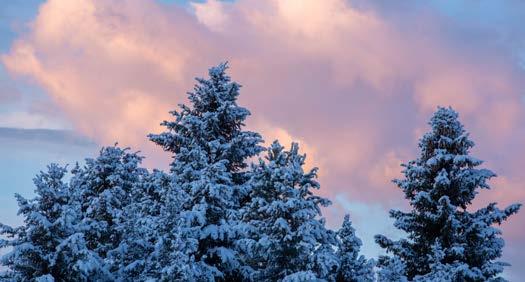
On Presidents’ Day, Feb. 16, a cotton candy sunrise glowed behind an unexpected overnight dump of fresh snow, helping to usher in a week full of cold, stormy weather. Patience is beginning to pay off for local skiers. PHOTO BY JACK REANEY
BRIEFS
NEWS IN BRIEF
BIG SKY REAL ESTATE COLLECTIVE RAISES OVER $100K FOR LOCAL NONPROFITS
EBS STAFF
The Big Sky Real Estate Collective announced it raised $106,261 in 2025, marking its largest annual total since the organization was founded in 2021.
The Collective is a voluntary group of local real estate agents who pledge 1% of their gross commissions to support community priorities including affordable housing, child care, behavioral health services and environmental initiatives. Nine agents participated in 2025: Justa Adams, John Bauchman, Ania Bulis, Michelle Horning, Mia Lennon, Derek Lennon, Katie Morrison, Allen Potts and Ashley Quande.
Funds raised in 2024 were distributed in 2025 to the Big Sky Community Food Bank, Big Sky Sustainability Network Organization (SNO), Big Sky Bandage and Wellness in Action. Since its founding, the Collective has also supported the Big Sky Community Housing Trust, the Center for Large Landscape Conservation and the Big Sky Community Organization.
Funds raised in 2025 will be distributed through the organization’s 2026 grant cycle, with more details announced in the coming months.
ARTISTS COLLECTIVE TO HOST ‘CELEBRATION OF ART’
EBS STAFF
On Saturday, March 7, the nonprofit Big Sky Artists’ Collective will host a new event, “Celebration of Art” from 11 a.m. to 8 p.m. at The Wilson Hotel.
As part of the family-friendly show and sale event, 15 local artists will display and sell a wide array of art including paintings, mosaics and photography. Participants include accomplished professionals and international award winners, according to a press release from the collective. The event will include live music, painting demos, and an apres ski event called “The Art of Whiskey,” in partnership with Willie’s Distillery.
"The Big Sky Artists Collective is continually striving to support our artists with opportunity to show and sell their work,” Maggie Shane, show coordinator, told EBS via email. “By collaborating with The Wilson Hotel our artists can shine and together we create an art experience for everyone."
The collective is now six years old, and includes a membership of 29 local artists and a gallery along Ousel Falls Road in Town Center.
MUSICIANS TO SERENADE, RAISE FUNDS FOR RUFF
EBS STAFF
Internationally acclaimed musicians and “passionate dog lovers” Patricia McCarty and Rose Chancler will perform a benefit concert, named Harmony for Hounds, in support of Riley’s Urgent Fund for Friends on March 6 at 7 p.m. at the Big Sky Chapel. RUFF is a local nonprofit and animal shelter founded by Dr. Stephanie “Syd” Desmarais and Lone Peak Veterinary Hospital. The organization provides financial assistance to animal owners and veterinary care within the Big Sky community.
McCarty, a 15-year winter resident of Big Sky, is the former assistant principal violist of the Boston Symphony Orchestra and has performed internationally as a soloist and chamber musician. Pianist Rose Chancler has appeared in hundreds of concerts across the U.S. and Europe and previously held faculty positions at the University of Alaska, University of Iowa and Plattsburgh State University. McCarty heard about RUFF and found the mission to support Big Sky’s animal population inspiring.
The program will span two centuries of music, featuring works by Georges Onslow, Emil Sjogren, and Rebecca Clarke, as well as a fantasy based on themes from West Side Story. Contemporary selections include pieces about dogs by composers Chiayu and Gabriel Kahane.
Admission to the event is free and open to the public, and donations will be collected at the door or online; all proceeds will go to support RUFF. According to Desmarais, RUFF has raised $1.15 million toward their $1.3 million capital campaign goal. The shelter broke ground in July 2025 and is on track for completion in December 2026.
“As we move toward the finish line, every contribution plays a vital role in helping us complete and equip this much-needed facility,” Desmarais said. “The excitement is building, and we can’t wait to open our doors and begin serving animals and families throughout Big Sky.”
Livable Big Sky is about fostering a shared vision for a community where we can live, work, and grow together. By investing in the systems and services that keep us healthy and connected, we help ensure Big Sky remains a place we can all call home. On the May 5, 2026 mail-in ballot, voters will consider the creation of the Big Sky Hospital / Wellness District.
LOCAL
BIG SKY’S SHALLOWER-THAN-USUAL SNOWPACK HANGS ON AS WEST SUFFERS
BY MARIO CARR
EBS CONTRIBUTOR
BIG SKY—After a dry, warm January, most of the American West is experiencing the worst snowpack in decades, but the skiing in Big Sky is holding up.
Data from the U.S. Department of Agriculture, visible on an interactive map, paints a grim picture of the snowpack across much of the West, but some regions are doing better than others. According to the map as of Feb. 15, Big Sky’s Missouri Headwaters region has a current approximate snowpack that is 82% of its 30-year average, as measured by snow-water equivalent. And looking at the Lone Mountain SNOTEL data, it’s clear that something unique is happening with Big Sky’s snowpack this year.
According to Big Sky Resort’s mountain operations department, as of Feb. 15, the season-to-date snowfall in Big Sky is only 67% of the Feb. 15 average, but notably the snow-water equivalent is at 93%. In essence, despite warm snaps and dry spells, nearly the same amount of water is separating you from the mountain as an average snow year.
Beyond snow-water equivalent, snowpack depth data at the Lone Mountain SNOTEL is available
back to 2003. As of Feb. 16, Big Sky Resort’s midmountain base depth sits at 39 inches with the help of a 5-inch storm on Feb. 9, plus any additional snowfall during the week of Feb. 16. Since 2003, Big Sky has experienced three other seasons with a shallower base at this point in the season, and in those three years, the snowpack held significantly less SWE. February 2024, for example, is a near memory for Big Sky skiers, and that season was notably rough until spring brought with it some big storms—still, they felt too little, too late. That year, Lone Mountain’s snowpack was 40 inches deep as of Feb. 16, but the water content in that snowpack measured a few inches less, at 8 inches. Put simply, the snowpack of 2023-24 was neither deep nor dense. This year’s 39-inch base contains 11.7 inches of water which is nearly 50% more water in a very similar snow depth.
This weather trend has been particularly noticeable at Bridger Bowl, where December 2025 precipitation contained a record amount of water— at lower elevations, some of it was rain—totaling 9.05 inches just that month.
Temperature has a lot to do with it. Bozeman has seen average daily high temperatures 3.5 degrees Fahrenheit higher than any other year since 1941, according to reporting by Montana Free Press.
Anecdotally, Big Sky has experienced similar warmth, with numerous rainfall events since November and a patchy, thin snowpack at meadow elevation.
Meteorologist Jim Brusda, with the National Weather Service’s office in Great Falls, discussed Big Sky’s winter weather on the phone with EBS. He explained that while temperatures this year have been higher in Montana, precipitation has remained near normal.
“Late November into December we actually had quite a bit of precipitation, but some of it fell in the form of rain… January and February have been relatively dry and mild… You’re just one spring storm away from being back to normal,” Brusda said on Feb. 16, hours after roughly 5 inches of warm, heavy snow fell across Big Sky.
The landscape below the mountains is noticeably brown, but through the lens of skiing, Big Sky Resort’s winter could be a lot worse. Although certain upper-mountain lines aren’t “in” quite yet, and others feel tighter than usual—like the Big Couloir or Headwaters chutes—ski patrol has been able to keep terrain consistently open off of the Lone Peak Tram, despite the warm snaps. Glade skiing has been better at this point during heavier seasons, but the dense texture of this year’s snow is covering debris surprisingly well.
While data can offer snapshots to help us better understand what is happening on the mountain, it doesn’t paint the whole picture as to the quality of the skiing and the unique conditions that this season has provided already. If spring-like storms in late February, March and April do send the winter ski season out with a bang, as predicted months ago by The Old Farmer’s Almanac, Big Sky’s skiing could improve rapidly as new snow falls onto a more solid base that’s been able to weather a warmer winter.
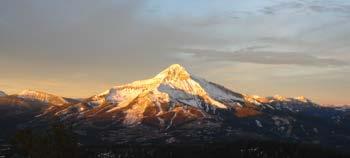
The morning sun peeks into the bowl on Monday, Feb. 16 after a surprise 5-inch storm coats Lone Mountain. PHOTO BY JACK REANEY
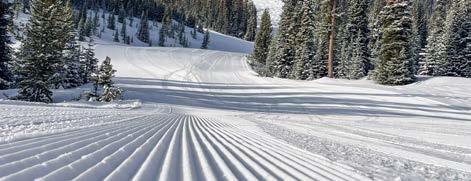
Corduroy on Feb. 16 after the mountain saw 5 inches overnight. PHOTO BY JACK REANEY
FEDERAL JURY DISMISSES COTTONWOOD LAWSUIT AGAINST YELLOWSTONE CLUB
BY JACK REANEY
BUTTE—The Bozeman-based Cottonwood Environmental Law Center has been handed another legal defeat in its string of failed lawsuits against Big Sky entities, this time in a dispute dating back to 2023 against the Yellowstone Club.
Cottonwood also lost multi-year lawsuits in July 2025 and December 2025, and was sanctioned by U.S. District Court Judge Brian Morris in July.
On Thursday, Feb. 5, a jury found unanimously that the Yellowstone Club did not “discharge a pollutant to navigable waters from a point source,” as charged in Cottonwood’s July 2023 filing which stated, “Defendant Yellowstone Club is unlawfully impairing the water quality of the Gallatin River and its tributaries by discharging water pollution into the waters of the United States without a permit.” Trial began Feb. 3.
A Jan. 26 pre-trial court filing stated that YC does use “highly-treated” reclaimed wastewater to irrigate its golf course and a nearby 36-acre reforestation area. YC irrigates as authorized by Montana Department of Environmental Quality “after extensive scientific and environmental review,” according to a YC press release issued Feb. 6. YC does not hold a Clean Water Act discharge permit—it would not be relevant to its DEQapproved landscape irrigation in which reclaimed wastewater does not reach surface waters, directly or indirectly, as found by the court.
“Use of recycled water for irrigation is a conservation-focused approach designed to protect water quality and quantity, prevent impacts on surface waters, and responsibly reuse water in a semi-arid region,” the YC release stated. “Many Montana municipalities directly discharge their treated wastewater into nearby rivers, but Big Sky
has never done so, instead focusing on reuse practices.”
The court’s pre-trial filing states that most of the reclaimed water supply used for YC irrigation comes from the Big Sky community’s new, stateof-the-art Water Resource Recovery Facility, a recent $50 million investment aimed at protecting free-flowing waterways and bolstering Big Sky’s water supply for lawful uses such as snowmaking and large-scale irrigation. The WRRF accounts for roughly 80% of YC’s irrigation water, according to YC representatives, and the remaining 20% is reclaimed from YC’s wastewater treatment facility, which now treats water to the same “class A-1” level as Big Sky’s WRRF, YC representatives explained to EBS.
Rich Chandler, VP of environmental operations at Lone Mountain Land Company—a local affiliate of the YC—said the case was subject to years of “careful scrutiny” and the jury’s verdict reinforces confidence in Montana’s “rigorous” environmental standards and regulatory process.
“Long before this litigation, and consistently throughout it, we’ve had a dedicated team of professionals doing the right work, guided by science, regulatory oversight, and a deep respect for this landscape,” Chandler stated in the release. “The jury’s verdict confirms the effectiveness of our long-standing approach to stewardship and careful environmental management.”
YC emphasizes that it adheres to state and federal environmental regulations, with systems and practices “reviewed repeatedly by regulators, engineers, and environmental professionals.”
On the contrary, Cottonwood claimed that YC “over irrigates its golf course such that Nitrogen pollution reaches the South Fork/West Fork of the Gallatin River” through sprinklers as point
sources, and that “[t]he Gallatin River and its tributaries, including the South Fork/West Fork of the Gallatin River and Second Yellow Mule Creek have suffered from severe algae blooms for the last five years as a result of Defendant’s golf course management practices,” Cottonwood’s filing stated.
Before trial, Cottonwood asked the court the following: to declare, hold and adjudge that YC violated section 301 of the Clean Water Act; to prevent YC from polluting as alleged; to issue a moratorium on construction activities until YC enacts a new wastewater disposal plan; to order YC takes remedial actions for alleged environmental wrongdoing; to order YC to pay civil penalties for CWA violations; and to award Cottonwood with “reasonable litigation costs and expenses” for bringing the case to trial.
With the case dismissed, the court will pursue none of those outcomes.
“Cottonwood may have lost on paper, but we undoubtedly won for the river,” Cottonwood Executive Director John Meyer stated via email to EBS when asked for comment. He did not respond to a follow-up email asking for more detail.
The YC shared a statement paralleled by similar court decisions against Big Sky entities, which, over the past six years, have been forced to shoulder legal costs to defend against Cottonwood. The costs have burdened local water and sewer district ratepayers, and delayed—or potentially inhibited— environmental infrastructure that could protect the Gallatin River and its tributaries.
“With a series of Cottonwood legal efforts having been rejected, the Big Sky community hopes focus can return to shared priorities, including environmental stewardship and conservation investments,” the release stated.
The Yellowstone Mountain Club is a private ski and golf community in Big Sky. PHOTO BY JACK REANEY
BIG SKY LISTINGS
BIG SKY COMMERCIAL LISTINGS
BOZEMAN LAWYER CHARGED WITH PROFESSIONAL MISCONDUCT UNDER MONTANA SUPREME COURT
CHARGES ALLEGE JOHN MEYER
PERSISTED ‘WITHOUT A BASIS IN FACT OR LAW,’ FABRICATED VIDEO MATERIAL, MISUSED SOCIAL MEDIA IN BIG SKY LAWSUITS
BY JACK REANEY
HELENA—On Feb. 9, the Montana Office of Disciplinary Counsel filed professional misconduct charges against John Meyer, a Bozeman-based lawyer and executive director of Cottonwood Environmental Law Center, for his “extensive” and “relentless” environmental litigation involving various entities in the Big Sky area.
Pamela Bucy, chief disciplinary counsel for the ODC—a regulatory department established by the Montana Supreme Court—filed the charges, which compel Meyer to participate in a hearing in the coming six to 12 months as part of an administrative process, unless he reaches a settlement with the ODC. Penalties could include “appropriate” sanctions based on the rules Meyer is accused of violating, from public admonition or censure to the highest punishment, disbarment, although Bucy believes it’s unlikely based on Meyer’s lack of prior discipline.
“We received grievances, or complaints, so that’s why Mr. Meyer got investigated… And this is the result of that investigation,” Bucy told EBS in a phone call.
Whether or not Meyer and the ODC reach terms for a settlement, Bucy’s office will submit a recommended penalty. In the Montana Supreme Court, a commission of attorneys, and laypersons similar to a jury will hear the case and issue a final decision including potential penalties.
Charges include Meyer’s alleged violations of rules that state a lawyer shall not engage in: “dishonesty, fraud, deceit or misrepresentation” and other prejudicial actions; offering evidence “that the lawyer knows to be false”; falsifying or altering evidence; making public “extrajudicial” statements by means of public communication that have “substantial likelihood” of influencing the outcome of court proceedings; and “making a false
statement of material fact or law to a third person in the course of representing a client,” according to citations listed in the Feb. 9 filing.
EBS reached out to Meyer for comment via email. His response solely discussed a 2018 personal injury lawsuit involving Big Sky Resort following a 2015 ski accident, which was mentioned briefly in two paragraphs in Bucy’s 23-page complaint.
“This is an excellent opportunity to educate Montanans and the Montana Supreme Court about Big Sky Resort’s abusive litigation strategies,” Meyer stated via email, claiming that the resort sued him personally and “demanded” a $50,000 settlement. “… When I wouldn’t pay Big Sky $50,000 to drop the case, it tried to depose me immediately before my wedding and said if I didn’t like it I should drop my case. The Court said Big Sky’s lawsuit against me bordered on frivolous.”
Meyer’s response to EBS did not discuss the disciplinary matters at hand.
Big Sky Resort issued a statement to EBS in response to Meyer’s statement, noting that it took less than 30 minutes for a federal jury to unanimously reject Meyer’s personal injury claims against the resort.
“More importantly, the ethical complaint against Mr. Meyer has nothing to do with his personal injury lawsuit against Big Sky, as is clear from the complaint,” resort representatives stated on Feb. 13.
Social media violations, ‘false’ video evidence, ‘often-shifting’ claims
Bucy’s filing included various Cottonwood lawsuits in which ODC investigation found Meyer violated conduct standards.
One lengthy lawsuit involving the Big Sky County Water and Sewer District concluded in July 2025 with sanctions against Cottonwood after multiple
appeals of the initial April 2022 finding. During appeal, Cottonwood claimed that BSCWSD had used hidden spreadsheet tabs to conceal crucial data regarding treated wastewater: “The Court also identified that [Meyer] himself, contrary to his later assertions, admitted that he had in fact received the ‘hidden’ information 10 months prior to the April trial,” Bucy’s filing stated, also noting Meyer’s argument centered around “often-shifting claims.”
After the initial jury verdict in 2022, “[Meyer] remained unwilling to accept the judgment and instead, accused the opposing parties and counsel of presenting false evidence and requested a new trial on those grounds,” Bucy’s filing stated. “[Meyer’s] theories were repeatedly rejected, yet he continued to pursue them, without a basis in fact or law, and in spite of verifiable evidence.”
Another lawsuit named the Montana Department of Environmental Quality and the Yellowstone Club as defendants, alleging that DEQ failed to consider the possible impacts of pharmaceuticals in reclaimed water used for snowmaking. The court did not grant an injunction as requested by Cottonwood, and found Cottonwood’s pharmaceutical allegations to be “a speculative proposition” in a January 2023 ruling.
Bucy’s list continued: a December 2022 complaint by Cottonwood pursued an injunction to effectively create a moratorium on Big Sky development, and also prevent Big Sky Resort from irrigating its golf course with treated wastewater—which the court later found that the resort does lawfully. In June 2023, the court denied the injunction, noting Cottonwood had “already lost on virtually identical claims in federal court.”
In another lawsuit, recently dismissed, Cottonwood alleged Yellowstone Club violated the Clean Water Act through golf course irrigation. A federal jury disagreed. Furthermore, Bucy noted Meyer’s “extrajudicial statements” including his use of social media platforms to “improperly influence the jury
John Meyer is executive director of a nonprofit environmental law firm based in Bozeman. PHOTO BY JEN CLANCEY
pool,” in violation of a January 2025 order “limiting the statements [Meyer] and Cottonwood could make related to expert testimony, their reports and opinions, and the evidence in the case.”
The court found on Oct. 1, 2025, that Meyer again used social media to influence the potential jury pool. Separately, he also used social media to claim that BSCWSD staff committed a crime, despite no official criminal investigation taking place.
“Despite numerous rulings to the contrary, [Meyer] continued to post inflammatory and inaccurate information on his social media indicating that Big Sky District was criminally polluting the Gallatin River,” Bucy’s ruling stated.
In another violation, Meyer allegedly used deceptive video editing to support his claims against the Spanish Peaks Mountain Club.
After Cottonwood reached a settlement with Spanish Peaks in September 2022, Meyer shared an email with SPMC’s legal counsel, accusing SPMC of discharging sewage into a creek. The email included a video link that showed, according to Meyer, SPMC using spray irrigation equipment in an unlawful manner.
“[Meyer] did not disclose that the video had been edited to splice together footage from different days to make it appear as if Spanish Peaks was using irrigation equipment and spraying reclaimed water into a flowing creek on a rainy day,” Bucy’s filing stated, adding that video logs proved the video was inaccurate.
Still, Meyer copied federal and state officials on the letter with the video link, and used the fabricated footage as a basis to file another lawsuit, despite having already settled with SPMC on the issue and “knowing the video was edited,” Bucy’s filing stated.
LOCAL
or the U.S. District Court that the video had been edited and was a false portrayal of his claims.”
Finally, Bucy noted that Meyer’s racketeering lawsuit against various Big Sky entities had “no evidence” as ruled by the court—still, Meyer took the chance to post on social media about Cottonwood’s intention to “hold the 1% accountable.” He named defendants and alleged, “they’ve created a scheme—a racket—to dispose of treated sewage unlawfully so that they can continue to develop unnecessary, multi-million dollar vacation houses… We have alleged they are lying to the jury, they are lying to the court, they have lied to the EPA, the Montana DEQ.”
Bucy called Meyer’s actions “relentless” against Big Sky’s water and sewer district, citing the millions of dollars in cost to the local district’s ratepayers: $3.4 million with burden affecting roughly 3,500 Big Sky ratepayers, equivalent to roughly $1,000 per customer.
“[Meyer] continued needlessly and repeatedly pursuing the same rejected and disproven claim against the Defendants in different forums,” Bucy’s filing stated, noting the journey has been “costly
Not backing down
On Feb. 12, two days after Meyer filed an official acknowledgement to his professional misconduct charges, he sent a promotional email to Cottonwood supporters with the subject line, “Dismantling the Big Sky Machine,” again accusing BSCWSD of “fraudulent data” and describing its version of its accomplishments regulating “billionaire behavior in Big Sky.”
Meyer mentioned the recent failed lawsuit against Yellowstone Club, saying Cottonwood “left it all on the field” and needs more resources to operate effectively—the “small and scrappy” nonprofit firm can’t cover next month’s rent and can’t pay its two employees’ salaries, according to the email.
“Call it bravery, call it stupidity, call it whatever you want,” Meyer wrote. “At the end of the day, Cottonwood is the only group working in the legal system to hold current polluters in Big Sky accountable.”
Four times in the email, a big green button rallies support: “DONATE.”
A five-year lawsuit against BSCWSD concluded in July 2025, with U.S. District Judge Brian Morris ordering sanctions against Cottonwood. PHOTO BY JACK REANEY
BOARD DISCUSSES FUNDS FOR THE MAJOR SEWER PROJECT
BY JEN CLANCEY
BIG
SKY—On
Feb. 4, the Gallatin Canyon County Water and Sewer District discussed how it will communicate current and future plans for its project to construct a centralized sewer in the Big Sky portion of Gallatin Canyon, as well as solutions for funding the development.
In December, the Upper Missouri River Waterkeeper filed a lawsuit against the Montana Department of Environmental Quality for its permitting of a pipeline design review for the Gallatin Canyon sewer project. Citing concerns with public transparency and absent environmental reviews, the lawsuit seeks to require DEQ to conduct a comprehensive environmental assessment of the entire sewer project, and vacate DEQ approvals of the project.
At the district’s February board meeting, GCCWSD board member Scott Altman announced that the district will share all applications and permitting documents related to the sewer project on its website, with monthly updates. He also noted that GCCWSD will do an environmental assessment of permitting for the sewer project moving forward.
“The canyon sewer is a community solution for the health of the river by creating a master plan to remove old septic systems and create the best treatment possible for the canyon. We definitely encourage community participation and have since the beginning,” Altman wrote to EBS on Feb. 10.
When board members at the Feb. 4 meeting asked if the decision to conduct environmental assessments at each stage of permitting was related to the Dec. 17 lawsuit, Altman said no.
“It’s for the community. We are in the community, you know, we’re elected officials. We feel like that’s the correct thing to do … We want everyone to know where we’re at and we want everyone to help, honestly,” Altman said at the board meeting.
Kristin Gardner, chief executive and science officer at the Gallatin River Task Force, thanked GCCWSD for its transparency, and shared opportunities for improvement in communication.
“First I want to appreciate your commitment to transparency. I think it’s really important here,” Gardner said. She noted that a meeting in the near future with river conservation groups should be a priority.
“As far as getting the groups together—you know, a lot of them haven’t heard about this project in a really long time and I think it would be really beneficial if we could get everyone in the room and they have the opportunity to ask questions and get updates because they’re gonna be talking to their membership about this,” Gardner said.
As GCCWSD works to coordinate with conservation groups and the DEQ, funding also remains a challenge in getting Gallatin Canyon properties hooked up to a centralized sewer.
At this point, there’s two options to make the
projected $50 million project feasible: a targeted economic development district and tax incremental financing structure, known as TEDD and TIF, could fund a gap of $10 million or more after local entities pool money for the project; or the project must par back its plans, and forego connecting to the Wastewater Resource Recovery Facility by constructing its own processing facility.
TEDD and TIF efforts have faced pushback at the county level. The Gallatin County Commission announced in October it would not support the funding structure for the sewer project, on the basis that there are other funding options available.
Things look rocky without TEDD and TIF.
Mangold Mangold, VP of infrastructure at WGM Group—the firm contracted to lead the sewer project—explained that TEDD and TIF are a crucial part of the financial stacking to fund the original idea for the project. Mangold is optimistic that a TEDD and TIF is possible with enough outreach and education about the funding model.
“We want to just re-center with the county that this project … it’s not really a Big Sky challenge. It’s a county challenge in their development model—it’s a state challenge. They have these problems all around the state and private development can carry only so much,” Mangold said in the meeting.
“This is a revenue generator for the county,” added David Tuan, a project engineer who has years of local government experience. “It’s a tool they should be using.”
BIG SKY OUT REFLECTS ON MONTANA’S ONLY WINTER PRIDE EVENT
BY JACK REANEY
Local queer advocacy nonprofit Big Sky OUT held its second annual Winter Pride Week in January, and group leaders are celebrating the event’s growth, as well as a rise in community support.
One board member, who goes by Aries, spoke at the Feb. 11 Resort Tax meeting, thanking the board for “taking a chance” on the young nonprofit by awarding a 2025 microgrant which made last winter’s debut event possible—it’s also the only winter pride event in the state, according to Big Sky OUT.
The first year, 150 people showed up with less than a month of notice.
“This year, we went a little bigger,” Aries told the board, sharing a statement written by fellow Big Sky OUT member Taylor McCaslin. “Over 250 participants joined us for a full week of events. We skied down with our giant flag on Mr. K with about 100 participants. We sold out our fundraising event, hosted a film festival at [WMPAC], brought in nationally touring queer DJs and paid every single performer and local creative.”
The nonprofit hopes supporters will plan their winter visits around pride week in the future. While the group started in 2023 with a summer pride march—June is pride month, and roughly 20
summer pride events are planned across Montana— they now plan to pivot their focus to offering Montana’s only winter event.
McCaslin’s statement noted “incredible feedback” on the winter pride event, citing participants who said they’ve never felt more seen and welcomed in a mountain town. Businesses felt a positive economic impact, and reported positive experiences interacting with winter pride participants, according to McCaslin.
Speaking on their own behalf, Aries added, "People have told me that they are willing to stay in this community and continue to show up for us in this community because we simply exist. They don’t necessarily show up to all our events, and that’s fine—they’re just happy that they can see our flyer somewhere and it not get ripped down.”
Founder Brit Diersch spoke with EBS on the phone, and said the nonprofit is on track to be self-sustaining. She listed financial sponsors including Visit Big Sky, Big Sky Thrift (through the Yellowstone Club Community Foundation), Bozeman Health, Lone Mountain Land Company and Big Sky Build.
In addition, Big Sky Resort donated space and supported the winter pride event, as well as other local businesses who hosted gatherings throughout the week.
“That kind of shows the public that we’re not going anywhere,” Diersch said. “To have support from such respected groups and businesses in town allows us to receive more respect for where we are now.”
While Diersch and her team of five Big Sky OUT leaders believe queer inclusivity is not a political topic, she recognizes that it’s a community that is often politicized nonetheless. The group’s aim is to display an inclusive, welcoming spirit in Big Sky, with local events open to all. She said it’s been encouraging to see community leaders stand beside the nonprofit in a time when it would be easy to lean away from the sensitive subject.
“When there’s so much silence, it’s safe to assume there isn’t support,” Diersch said. “That we have so many people speaking out either to verbally support, or financially support, it just makes everyone feel so welcomed in our community. Silence is louder than vocal support. In these times, everyone just feels so unsure.”
Upcoming events include a book swap and craft night at Cowboy Coffee on Thursday, Feb, 26 at 6 p.m., and “Gays on blades” events on the first Monday of every month at 8 p.m. at the Marty Pavelich Ice Rink.
Diersch said the best ways to support the organization are to volunteer, donate and spread the word around.
SPORTS
BIG SKY FOOTBALL STANDOUT EBE GRABOW COMMITS TO MONTANA STATE
BOBCAT HEAD COACH BRENT VIGEN SAW A ‘DO-IT-ALL PLAYER’ IN GRABOW’S HIGH SCHOOL DOMINANCE
BY JACK REANEY
BIG SKY—One of the most talented multi-sport athletes in Lone Peak High School history, Ebe Grabow will play football for the defending NCAA national champions.
The Montana State Bobcats announced Grabow’s signing in a Feb. 4 social media post. “From Big Sky to Bozeman, welcome,” the post stated, listing Grabow’s position as “athlete.” Grabow played wide receiver, quarterback, running back, punt and kick returner, linebacker, cornerback and kicker for Lone Peak. He expects to join MSU’s defensive unit, but will be open to all positions and offers a diverse, coachable skillset.
MSU head coach Brent Vigen said Grabow “really flashed” and stood out at a team camp showcasing small high schools last year.
“Being able to follow him and the success he had for Lone Peak this year, it was evident that he’s a guy we should give an opportunity to,” Vigen said in a written statement shared with EBS via email.
“He’s a do-it-all player at that level—receiver, defensive back, kick returner. I think we see him on the defensive side of the ball, but we’re excited to have him in our program.”
“I’m super excited,” Grabow told EBS in a phone call Thursday. “It really is just a dream come true… it’s pretty surreal. You grow up and you see college athletes, and you just aspire to be them.”
During Grabow’s four years as a varsity starter in Montana’s Class C eight-player format, he racked up 5,000 total receiving yards, 2,500 rushing yards, 1,500 return yards and 110 total touchdowns, according to approximations by Lone Peak’s
coaching staff. He nabbed 18 interceptions on defense, made countless game-changing tackles, and never missed a game for illness or injury.
This season, he was named offensive MVP for the Class C Southern Division, selected to the all-state team, and named first-team all-conference at five different positions, plus second-team at a sixth.
“What a great conclusion to a great high school career,” Lone Peak head coach Dustin Shipman stated in an email to EBS. “Coaching Ebe Grabow for four years has been a privilege. Ebe’s combination of hard work and natural ability has paid off for him and I couldn’t be more thrilled for him to be joining MSU. I look forward to seeing him on Saturdays as a member of Bobcat Nation, and will continue to cheer loudly for him and await the great things he is going to accomplish as a student athlete.”
Grabow becomes the second-ever LPHS athlete to play a varsity sport for the Bobcats, following current redshirt freshman running back George Helms.
Helms looks forward to reuniting with Grabow, whom he played with growing up.
“It’s just awesome to see the hard work that he’s put in to get to where he is now, because I do know how much hard work that takes,” Helms said, adding that it’s even more significant to come from a small school like LPHS. “I’m looking forward to seeing what he does here at MSU… Super happy to be teammates with him again.”
Grabow said he’s very grateful for the opportunity to join a team coming off its first national championship in 41 years. He credited coach Vigen for making a drastic impact on the program.
“It’s awesome to be able to go there and see what happens,” Grabow said. In football, his biggest motivation is to be the best version of himself and do everything he can to help teammates around him.
He thanked his parents, Libby and Jeff, for doing everything they could to support his dream, from covering program and equipment costs, to many hours of travel. He gave a shoutout to Lone Peak assistant coach Clevan “CT” Thomas Jr., a former Bobcat receiver supporting the Big Horns for the past two seasons. “He had a drastic impact on my development in the past few years, and that’s super helpful,” Grabow said. He also gave thanks to the entire Big Horn coaching staff—coaches Shipman, Mark Gale, Adam Farr, Jeff Helms and others—for helping him reach this goal.
Grabow hopes to see Big Sky’s youth and high school football programs continue to grow. He encourages kids to “keep at it,” especially if they have dreams of playing for the Bobcats someday.
“It’s great to see that everyone is starting to play football here… Football is a smaller sport [in Big Sky], but it’s great to see that a lot of middle schoolers and [kids] coming up are aspiring and hoping to make it to the next level,” Grabow said.
Grabow with his parents, Jeff and Libby. PHOTO BY JACK REANEY
Grabow stuns his classmates with an acrobatic catch before halftime in a tight win on Sept. 19, 2025. PHOTO BY JACK REANEY
Grabow offers multi-sport experience
Beyond football, Grabow made his mark as four-year starter on Lone Peak’s basketball and baseball teams.
On the court, he played four varsity seasons and contributed as a freshman on Lone Peak’s 2023 state tournament team, averaging 7.6 points per game. He averaged 15.6 points per game as a sophomore, earning second team all-conference in 2024, and continued to improve overall in 2024-25 with first team all-conference honors.
On Jan. 9, Grabow scored his 1,000th point, becoming just the third Big Horn to reach the milestone. He is currently second all-time in career points with 1,102.
He is tied for third all-time in free throws made with 165, second all-time in 2-point shots with 3 52, and fourth all-time in 3-pointers with 82. He’s fourth all-time in rebounds with 337, second all-time in assists with 212, and third all-time in steals with 148. His career has included 14 games of 20 points or more, and he has scored in 63 consecutive contests.
Head basketball coach Al Malinowski said he looks forward to watching Ebe’s football career continue.
“As the lone senior on the basketball team this season, Ebe’s competitiveness, athleticism and growth as a leader have contributed greatly to our team’s success. It’s exciting to see him pursue this opportunity and I know his coaches and teammates are proud of him,” Malinowski told EBS via text.
In warmer months, Grabow has led Lone Peak’s three-year-old baseball program, anchoring the
Big Horn lineup with a .478 batting average during his junior season. In 14 games he smacked 22 hits including three doubles, two triples, two home runs, 16 RBIs and scored 21 runs with 10 stolen bases.
Grabow pitched 40 innings to a 3.85 ERA last season, featuring a strikeout-to-walk ratio of 39 to 3 and earning two wins.
“Having coached Ebe in baseball, I’ve witnessed his relentless work ethic and athleticism,” head coach Matt Morris told EBS via text. “His talent and leadership will be an asset to Montana State University football. He has room to grow, and the Bobcat family is the perfect fit. As a community, we are proud of his accomplishment."
Grabow executes a strip sack and fumble recovery. PHOTO BY JACK REANEY
GRABOW DUNKS IN FINAL HOME GAME AS BIG HORNS CELEBRATE FOUR SENIORS
SENIOR GIRLS FIND LIFE LESSONS IN TWO ROUGH SEASONS
BY JACK REANEY
BIG SKY—Four minutes into his senior night game, Lone Peak High School’s Ebe Grabow had drained a 3-pointer and knocked down a pair of free throws. He extended his early scoring to seven points when junior point guard Ryan Malinowski lobbed an alley-oop and Grabow stunned the crowd with a two-hand dunk.
“You know, I kind of shocked myself. I had a phenomenal pass from my boy Ryan Malinowski,” Grabow said after the game, noting that they’d attempted it—without much success—in practice, but game-day adrenaline seemed to do the trick. “And I was up there and I just put it down, and I was hyped.”
Head coach Al Malinowski said the alley-oop came on a typical in-bounds play, but one that usually ends with a layup.
“I’ve never seen those two run it like that before,” coach Malinowski said, laughing. “... I had to call a timeout, just because I wanted us to enjoy the moment—but I also wanted our guys to kind of calm down from it and refocus.
“But it was a pretty special play, and I’m glad he was able to do that on senior night.”
The Lone Peak High School boys won their final home game of the season on Friday, Feb. 13, leading the entire game despite a late surge by the visitors from Whitehall High School, who cut the deficit to four points in the final minute. Then, Grabow stepped up and knocked down his free throws to ice the final score at 57-50. The team’s only senior led the scoring with 24 points.
Grabow said it feels great to wrap up a fouryear LPHS basketball career, not long before he
dedicates himself to Division I football at Montana State. For now, he’s the single winningest player in LPHS basketball history, among other milestones.
“To just see how the program’s changed: everyone’s become a real tight knit group and it's great to see how basketball is thriving here,” Grabow said.
He said “it’s everyone’s goal” to earn Lone Peak’s debut in the Class B state tournament, building on a Class C tournament debut in Grabow’s freshman year.
In the three years since, Grabow has led by example as the only remaining player with experience from the unexpected 2023 state tournament run.
“Ebe brings an incredible amount of confidence to the team,” coach Malinowski said. Grabow believes the Big Horns can win any game, according to
Malinowski. “And he’s taught some of the guys that are younger than him to believe in that.”
Beyond winning, Malinowski said Grabow has taught young players Ryan Malinowski, freshman Jens Biggerstaff and sophomore Steen Mitchell to believe in their ability to make an impact. “Showing [them], hey, you can help us as a freshman. I did it, you can do it.”
Building depth has been the goal this season, and Malinowski is proud of the progression he’s seen from the team’s younger players who have stepped into meaningful roles. Now, the focus can shift to setting up matchups.
“They’re all bringing things to the team now,” Malinowski said. “So we’re trying to figure out the right fit, based on the opponent that we’re playing.”
The Big Horns have competed in every game this season, but they need to improve decision-making skills to prevent late-game surges by opponents, coach Malinowski said. Free throw shooting could be better, although he credits the team for taking fouls and earning opportunities in the first place.
Grabow and Malinowski agree they need to move the ball on offense.
“I think we just need to work on moving the ball more and stop isolating ourselves, and play more as a team,” Grabow said. “And I think we can have a shot.”
Lone Peak has two games left, both on the road against Ennis and Jefferson high schools. Then it’s off to the District 5B tournament, where the top three teams advance. After the Big Horns reached earned their first Class B district tournament win in 2025, coach Malinowski hopes to see another strong playoff showing.
Four Lone Peak seniors played their final home game on Feb. 13. PHOTO BY JACK REANEY
Junior Ryan Malinowski scored 17 points in LPHS final home game. PHOTO BY JACK REANEY
If Lone Peak finishes in the top three at districts, they will advance to their first divisional tournament at the Class B level—a feat they fell one game shy of in 2025.
“I really think this is going to be a tournament where... everybody’s got a chance to beat anybody else,” Malinowski said.
‘Just play your hardest’: Girls celebrate three seniors
The Lone Peak girls have faced another rough season, losing all their games since the home opener on Dec. 6. Last season, the Big Horns lost all of their regular season games before ending a 15-month drought with a tournament win.
The team has played with only five or six players for most of the season. Parents and even seventhgrade boys have volunteered to help with practices, scrimmaging and running drills to allow the Big Horns to practice five-on-five.
Head coach Jessica Bedway is pleased to see her team sticking with it and making an effort.
“They’ve come into every game trying their best to get that win,” Bedway said.
She praised her three seniors for setting a good example.
“All three of them have stuck with it for four years, and stuck with it this year when... we had the option of not having a team, and they decided they wanted to play.”
Seniors Maddie Wilcynski, Lauren Jackson and Harper Morris emphasized the importance of
Wilcynski has always focused on giving her all, every game, and the complete effort was on display Friday night as she led the team with 18 points. For younger players rising into the LPHS girls basketball program, she hopes they learn from her work ethic.
“Don’t stop, even if you have not enough girls to play or you just think it’s going to be a rough season,” Wilcynski said. “Just play your hardest, something good is going to come of it, always.”
Jackson has been playing for five years, and said it’s surreal to play her final game in the Lone Peak gymnasium.
“I’m sad it’s over, but movin’ on,” she said.
Morris said while it’s been a rough season, it’s bittersweet to play her final home game, especially with her teammate since kindergarten in Wilcynski. She stuck with it her senior year, with hopes that younger players will build resilience.
“I just hope that they see that no matter how many players you have, you can still go out and fight,” Morris said. “... It’s all about effort and if you give it your all, you’re going to be okay—and that kind of goes for life, too.”
Bedway hopes to see more players get involved with the team next year, as three of six players will graduate.
"We’ll only have three people left,” Bedway said. “So hopefully there will be more interest.”
If local girls are concerned about joining a team without many recent victories, Big Horn seniors have demonstrated the importance of seeing beyond the win-loss record.
“I just love my teammates more than anything,” Wilcynski said. “Just being out there with them makes it all worth it. I don’t care about the score, I don’t care about anything else. Just being out there with a group of girls is the most fun part.”
Senior Maddie Wilcynski drives during her final home game. PHOTO BY JACK REANEY
A WESTERN TRADITION GRIT,
ADRENALINE AND RODEO
CULTURE KEEP THE POPULARITY OF SKIJORING
RAPIDLY GROWING IN MONTANA
BY LESLIE KILGORE
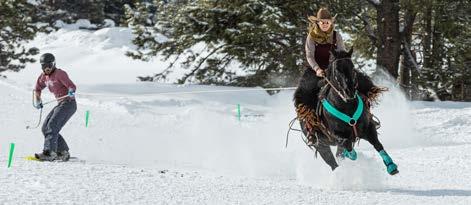
Skijoring is fast, exciting and unmistakably Montana, blending Western heritage with mountain culture in a way few winter sports do.
Across the state, the sport is growing rapidly. Long-established events are evolving to meet unprecedented demand, new competitions are emerging to create access and organizers are working to preserve skijoring’s grit while building a sustainable future. From Red Lodge to Three Forks to Big Sky, each skijoring event reflects the community hosting it–resilient, collaborative and deeply rooted in place.
In Red Lodge, skijoring is a decades-old tradition. The town has hosted races since the mid-20th century, with the competition formally recognized as the National Finals in the 1980s.
“They’ve been running skijoring races in Red Lodge since the '60s,” said Kristen Beck, who currently runs the event with a fleet of community members and dedicated volunteers. “In the '80s, it became formally recognized as the National Finals.”
The name reflects the event’s place on the circuit. “Historically, this has always been the last race of the circuit,” Beck said.
Beck became involved in 2016, stepping into leadership during a pivotal moment for the event. “I just wanted to be a volunteer,” she said. “But with many original organizers ready to step down, I was basically told that if I wanted the races to continue to happen, I was going to have to take the reins.”
That sense of responsibility, passed from one generation of volunteers to the next, remains central to Red Lodge skijoring. But growth has brought new challenges, particularly as events fill up faster and weather becomes less predictable.
“Most races are making their own snow this year,” Beck said. “It’s an entirely different production with
more challenges to endure. And these events are incredibly important to our communities.”
Despite the logistical hurdles, Beck sees opportunity in the sport’s momentum. “It’s been rapidly growing for years,” she said. “But social media has had a huge influence. People see it and think, ‘I want to do that.’”
At its heart, skijoring succeeds because it connects people from different worlds.
“It’s two completely different cultures coming together, and your team needs three different heartbeats to compete,” Beck said. “That’s a really special platform.”
That rapid growth inspired a new event this winter, Bridger Brewskis and Spurs, hosted in Three Forks in partnership with Bridger Brewing at the end of February.
For organizer Kelly Meeker, the motivation was straightforward. “It’s gotten harder and harder to even register for skijoring events in Montana because they sell out so quickly,” she said. “When many of us who were new to the sport didn’t get into events last year, we decided to put on our own to support new and experienced competitors.”
Meeker works with a women-owned and operated barn in Belgrade that emphasizes inclusion and accessibility for riders, values that are shaping the event’s vision in its inaugural year.
“It’s a great way to cross over communities, Western riding sports and skiing, while bringing people together for a fun weekend,” Meeker said. “People will be able to hang out at Bridger Brewing, get a beer and warm up, while also watching some exciting competition. When we approached Bridger Brewing about hosting, they were all about it.”
That crossover has helped introduce new participants to horses and horsemanship. “It allows us to bring more people into our crew,” Meeker said. “Some of the skiers fall in love with horses, and that’s been really cool to see.”
Inclusivity was a priority from the outset, including inviting the Compton Cowboys to compete.
“Expanding what Western life looks like and being an inclusive Western riding community is really important to me,” Meeker said.
Like many Montana events this winter, the inaugural competition faced difficult snow conditions. “The snow has been the biggest challenge,” Meeker said. “There have been a lot of sleepless nights to prepare.”
Still, the demand underscored the sport’s momentum. “People are eager for opportunities to try the sport, even in a low snow year,” Meeker added.
For Meeker, skijoring’s appeal is undeniable. “It brings people together in a competitive, exciting setting,” she said. “It’s exhilarating whether you’re skiing or riding, or even watching. It feels like a rodeo in some ways, while continuing a Western lifestyle into the winter.”
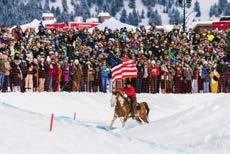
In Big Sky, skijoring has evolved alongside the community itself. Since launching in 2018, the Best in the West Showdown has drawn thousands of spectators and competitors and become a hallmark of winter in Big Sky, bringing more than just skiers to the community for the high-energy event each February. While the event was cancelled this year, organizers look toward the future, and their vision remains clear—much like in Red Lodge, skijoring has become a staple for the Big Sky community each winter.
“I’m beyond proud to have been part of Big Sky Skijoring since day one,” said founder Justa Adams. “What started as a simple idea in 2018 has grown into something bigger than we ever imagined.”
As the town continues to change, so has the event. “Our team has grown alongside this town, adapting as Big Sky continues to evolve and develop,” Adams said. “We’re actively working on a new location for 2027 now, and can’t wait to bring the Best in the West Showdown back to Big Sky next year.”
From Red Lodge’s longstanding legacy to Three Forks’ first-year energy to Big Sky’s growing footprint, skijoring in Montana is being shaped by the same forces—community commitment, weather, infrastructure and a growing appetite for authentic Western winter experiences.
What remains constant is the connection between horse, skier and rider—three heartbeats moving together across the snow—and the people determined to keep this uniquely Montana tradition charging forward.
Looking ahead, Beck sees skijoring continuing to grow and mature. Not by losing its grassroots spirit, but by strengthening the framework that supports it.
“I think we’re getting much closer to a governing body and just more consistency in safety, rules and transparency on a fair race,” Beck said. “Not every track is the same, so you can’t have complete standardization, but we’re getting pretty close to agreeing on what is the crux of a safe, fair and equitable race.”
She likens the sport’s trajectory to rodeo, where local events retain their character while operating within shared expectations.
“That’s where I see it going,” Beck said. “Standards, a point system, and recognition, like rodeo associations, while still allowing each community’s event to be unique and special.”
As Montana skijoring continues to grow, that balance between structure and soul may be what ensures the sport’s longevity for generations to come. Who knows, possibly even in the Winter Olympics someday.
PHOTOS COURTESY OF JUSTA ADAMS
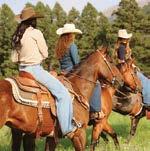
Best in the West Skijoring competition in Big Sky from year’s past. Event organizers hope to bring the sport back to Big Sky in winter 2027. PHOTOS COURTESY OF JUSTA ADAMS
BOZEMAN
MONTANA STATE
STUDENTS, LOCAL
HISTORIANS DISCOVER ARTIFACTS IN BOZEMAN’S HISTORIC DOWNTOWN
BY CARLI JOHNSON
BOZEMAN—Long before Bozeman was bustling with tourists, anglers and skiers balancing a recreational lifestyle with work and family life, it was a muddy supply town on the edge of the American frontier.
In the early 1860s, thousands of men surged west into what was then Montana Territory, chasing the promise of gold in the towns of Bannack, Virginia City and Helena. Bozeman, founded in 1864, wasn’t a mining town but a resupply point, a place to rest horses, purchase grain and provisions, and prepare for the rugged journey toward gold.
As farmers and ranchers settled the fertile Gallatin Valley, many found more reliable fortune feeding miners than searching for gold themselves. Wooden storefronts rose along Main Street. Saloons and boarding houses followed. And, as in nearly every boomtown across the American West, prostitution became part of the town’s early economy.
By the 1880s, Bozeman had a defined redlight district. At its height, up to nine houses of prostitution operated in a small pocket along modern day Mendenhall Street. The district lasted until about 1916, when reform efforts shut it down. Many of the homes were eventually demolished in the 1960s, replaced by parking lots and new construction as the city modernized.
For decades, the history of that district lived mostly in arrest records, city ordinances and newspaper clippings.
Last fall, evidence of life in the 19th century resurfaced—literally.
In early October, anthropology students from Montana State University spent two brisk days excavating an empty lot at 234 E. Mendenhall St., next to the headquarters of the Extreme History Project, a Bozeman-based nonprofit that brings local and statewide history to the public through walking tours, podcasts and exhibits.
The lot, long used for parking, is slated for hotel development. Before construction begins, developer Matt Paine of The Paine Group agreed to allow MSU students and the Extreme History Project to conduct a small archaeological dig on the site.
“It’s arguably the most historic and certainly most interesting district in Bozeman,” Paine said. “When we first chatted about it, I was ecstatic to do it, and we did everything we could to help them get those artifacts out of the ground.”
Crystal Alegria, executive director of the Extreme History Project, said the collaboration came naturally.
Because the lot sits directly beside the organization’s downtown headquarters, Paine reached out to introduce himself before breaking ground, Alegria told EBS.
“I asked if he’d be open to an archaeological dig, and he said yes,” she said.
Alegria partnered with MSU anthropology professor Craig Lee, who incorporated the excavation into his Human Prehistory class. Lee works to incorporate some version of field work and excavation in the undergraduate anthropology program to provide field opportunities for undergraduates.
“Each year we try to do something that’s meaningful and impactful,” Lee said. “Both Crystal and myself really care about these field practicums for the students.”
The dig offered students a rare chance to explore a piece of Bozeman’s past before development moved forward. Within two days, students uncovered dozens of artifacts tied to the neighborhood’s past life.
Among the most striking finds: a bottle of Lydia Pinkham’s Vegetable Compound, a widely marketed 19th-century herbal remedy often used by women seeking to prevent pregnancy; a small medicine bottle from the Gallatin Drug Company, which operated at the corner of Main and Black streets from 1904 to 1950; and a glass syringe, likely associated with drug use.
The artifacts are now being cleaned, analyzed and dated. They are temporarily housed at the Extreme History Project and may eventually be displayed in the future hotel.
“Our goal isn’t just to dig up artifacts,” Lee said. “We want to preserve a piece of Bozeman’s story for the future.”
Prostitution was never legal in Montana, but enforcement in Bozeman often amounted to what Alegria describes as a “tax.” In the 1890s, city ordinances imposed misdemeanor fines—typically
$10 for a madam and $5 for the women who worked in the houses—often collected monthly.
“It was illegal, but they would just pay their fine and go back to work,” Alegria said.
Many of the women entered the trade because few other options paid a living wage. Teaching, domestic work and cooking were available, but rarely enough to support a single woman. Some built profitable businesses. Others were trafficked, struggled with addiction or died young from disease.
Alegria notes that while Bozeman’s red-light district officially closed more than a century ago, the broader issues surrounding sex work and trafficking have not disappeared.
“Just because it stopped happening there,” she said of the Mendenhall Street lot, “doesn’t mean it’s gone.”
Still, both Alegria and Lee see the excavation as a hopeful example of how a fast-growing city can honor its past while building its future.
“This is a great way for the history community and developers to work together,” Alegria said. “We want to maintain our history in Bozeman, even as we grow.”
Paine said his team hopes to carry that collaboration forward as construction begins. If feasible, some of the recovered artifacts could be on display in the hotel. The goal, he said, is to create something the community can be proud of while honoring Bozeman’s past.
As the lot prepares to transform from parking area to hotel, the ground beneath it has already told part of its story. Thanks to a handful of students with trowels and a willing developer, a chapter long buried is back in public view.
Glass bottles found at the dig site on E. Mendenhall St. PHOTO BY CARLI JOHNSON
MEADOW
REGIONAL
BREAKING DOWN MONTANA’S IMMIGRATION ENFORCEMENT PARTNERSHIPS
LAW ENFORCEMENT, IMMIGRATION ADVOCATES WEIGH IN ON LOCAL AGREEMENTS WITH ICE
BY JEN CLANCEY
Vanessa Zamora estimates that Bienvenidos a Gallatin Valley, a Bozeman-based nonprofit, has assisted at least 10 local families in tracking a relative who has been detained by immigration enforcement.
“It’s been interesting for us because we were never meant to be involved in this kind of work,” said Zamora, Bienvenidos’ executive director.
Bienvenidos has welcomed Spanish-speaking immigrants to the Bozeman area since 2021, and in 2024, the organization supported 56 families, including 107 children with resources, immigration support and family activities to thrive in their new home.
“We are set up to be family-oriented, and support families, and welcome families and develop belonging and programs that care for the immigrant community,” Zamora said. “Which is crucial for our economy, crucial for our state, crucial for all of the services that move the economy of Montana.”
In recent months, Zamora said the organization has begun addressing a need that is new to the nonprofit: the challenging task of locating family members and friends detained by Immigration Customs Enforcement—some starting with an Immigration Customs and Enforcement hold in Gallatin County, some arrested on Montana highways and others arrested outside of the state.
Bottom line is, it’s difficult to understand the way ICE and immigration enforcement is affecting southwest Montana communities like the Gallatin Valley.
Breaking down types of 287(g) agreements
State law enforcement, like Montana Highway Patrol, can detain individuals for immigration violations through an agreement with ICE’s 287(g) program, which gives state, county and city law enforcement authority to carry out immigration enforcement across four different agreement types. There are more than 1,400 individual 287(g) agreements between ICE and local or state police across the U.S., including four in Montana.
Iterations of 287(g) agreements that exist in Montana include four different models: a Task Force Model, which enables officers to carry out immigration enforcement like arrests with ICE oversight during routine duties —Montana Highway Patrol entered this agreement in 2025; a Tribal Task Force Model, which functions similarly for tribal law enforcement; a Jail Enforcement Model, which allows officers to identify and process noncitizens arrested in their detention center; and a Warrant Service Officer program, which serves ICE-issued detainer warrants for individuals in their detention centers.
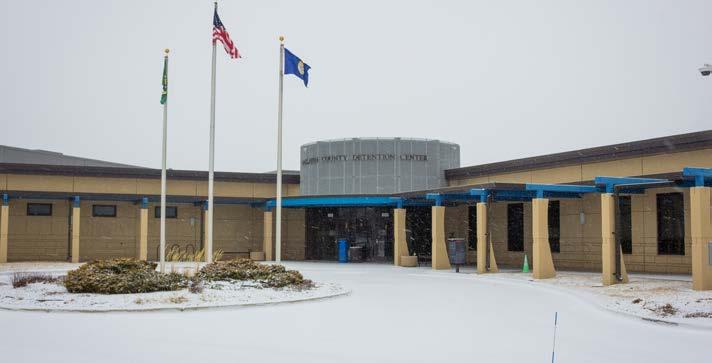
The Gallatin County Sheriff’s Office is five years into a WSO contract. Gallatin County Sheriff Dan Springer described the 287(g) role in county law enforcement as “simple.”
Under this model, ICE reviews individuals who are booked into the Gallatin County Detention Center and will identify individuals for detainer warrants, which will ultimately be served by a 287(g)-trained GCSO officer. An ICE agent must pick up the individual within 48 hours of a detainer warrant. If the individual posts bond but has a detainer warrant, they are held for the extra 48 hours. If ICE doesn’t arrive within the two day period, they are released.
Gallatin County is also a part of the Missouri River Drug Task Force, a multi-jurisdictional drug task force dating back to 1990. Alongside GCSO, Broadwater, Lewis and Clark, Madison, Meagher, Park and Sweet Grass counties participate in the program, which has headquarters in Helena, and is staffed by county law enforcement and the Department of Homeland Security, FBI, Drug Enforcement Agency, Montana Department of Justice and several city police departments.
While not a 287(g) program, the relationship underscores growing tension many agencies face as ICE presence increases in the country; Montana Gov. Greg Gianforte and Attorney General Austin Knudsen opened an investigation of the city of Helena’s resolution to avoid ICE partnerships less than a month after Helena Police Department Chief Brett Petty opted out of the MRDTF due to its collaboration with U.S. Border Patrol. Both 287(g) and MRDTF involvement are voluntary.
Aaron Conner, undersheriff at the Garfield County Sheriff’s Office, signed a Task Force
The Gallatin County Detention Center. PHOTO BY JEN CLANCEY
Model agreement in August 2025. In an October interview, Conner said he sees the agreement as a tool for enforcement in the 4,800-square mile eastern Montana county, and that the training program teaches officers about constitutional rights.
“We wanna make sure all of our residents, none of ‘em have an issue with reaching out to us,” Conner said. “This isn’t, you know, a racial profiling thing or anything like that.”
Serving Garfield County is a vast undertaking, Conner said. Sometimes it takes 45 minutes to reach a call on the other side of the county, and the area is a popular spot for hunting and recreation, adding traffic to highways that run through it. Covering salaries for officers has required outside funding; Conner said that as of October 2025, 50% of officers’ overtime was paid for by grant funding.
The 287(g) program announced in October 2025 reimbursements for Task Force Model-participating agencies by the order of salary, benefits and partial overtime coverage, $7,500 for new equipment and $100,000 for new vehicles. While Conner is unsure about receipt of reimbursements, he said this financial support would be beneficial for his department. One U.S. state was reportedly paid those sums in September 2025, but ICE representatives did not respond to questions about reimbursements for Montana’s Task Force Model agreements, and there are no clearly stated timelines.
Alex Rate, Montana American Civil Liberties Union’s legal director, is critical of the program.
“ First of all, I think 287(g), full stop is a terrible idea and certainly not what local law enforcement should be spending their time doing,” Rate said. “They should not be taking their time being commandeered by the federal government to undertake federal immigration actions where the federal government has plenary control.”
He explained that training is insufficient for enforcement of immigration law in 287(g) programs, and programs like this could invite racial profiling as officers work to determine citizenship status of people they interact with. A 2021 letter signed by over 100 police officers and attorneys to the Department of Homeland Security also shared concerns about the breakdown of trust between law enforcement due to 287(g) agreements.
Training for the Task Force Model requires a 40hour online training course for eligible participants,
and officers need two years of experience to be trained. In jail enforcement models, officers complete a four-week training and one-week “refresher course,” and WSO training lasts eight hours.
The 287(g) program contracts do not have end dates, so usually when an agreement is approved and signed, it will exist indefinitely. However, citizens can advocate for ending an agreement or ask for further transparency about how it’s enforced.
“One of the things people need to remember about 287(g) agreements is that it is a contract and the contract needs both parties to be in agreement. And these are governments elected by the people,” Rate said. “And if folks are dissatisfied with their local law enforcement entering into an agreement, then they should raise hell at the county commission and get their elected officials to put pressure on law enforcement to withdraw from these agreements.”
ICE rumors add confusion, remind advocates to be prepared for increased presence
In late January, as students and businesses nationwide hosted walkouts in protest of ICE presence in U.S. communities, murmurings of increased ICE presence in the Gallatin Valley spread. Those rumors reached Zamora and the Bienvenidos team.
“We tried our best to get to the bottom of everything and provide the information and then talked with everybody and tried to put out the facts that we knew … it activated a lot of our thinking around how we prepare for that,” Zamora said.
Sheriff Springer—who that same week shared a letter addressing rumors and condemning “vigilantism” and attempts “to create fear and chaos within our community”—confirmed he had conversations with Zamora, as well as Bozeman schools and Bozeman Health Deaconess Regional Medical Center about rumors of further ICE
activity.
“I recognize how people are … worried about this, or fearful,” Springer told EBS. He shared anecdotes about search and rescue volunteers being followed and two sheriff’s office personnel confronted about being ICE officers in a restaurant, despite clear sheriff’s uniform markings.
“You know, the problem is those little rumors carry themselves for days and it just makes people worried for zero reasons,” Springer said.
Zamora emphasized that the Latino community also wants to live in a safe place where law enforcement can do its job, but she doesn’t want people to be scared of interacting with law enforcement in the state because they speak Spanish and have brown skin.
She recalled tracking two local high school graduates, one detained by ICE outside of Montana and deported to a country they’d never been to before, and another detained on a Montana highway and sent to an ICE detention center in Washington called the Northwest ICE Processing Center, where the individual reported conditions like not being given enough drinking water to a Bienvenidos volunteer.
As Bienvenidos continues its core mission, right now it is also about providing community members with the resources to help locate and help local family and friends in the throes of complex ICE enforcement.
“We were set up to welcome newcomers and make them feel seen, because it’s difficult to move to a new place and even more, a new country with a new language and a new culture,” Zamora said. “We care for their safety and their wellbeing, and their safety and their wellbeing is threatened by discrimination.”
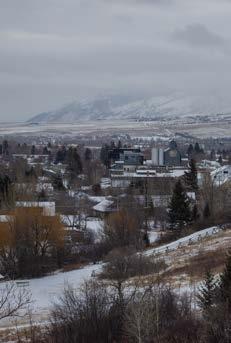
Bozmean Valley PHOTO BY JAEN CLANCEY
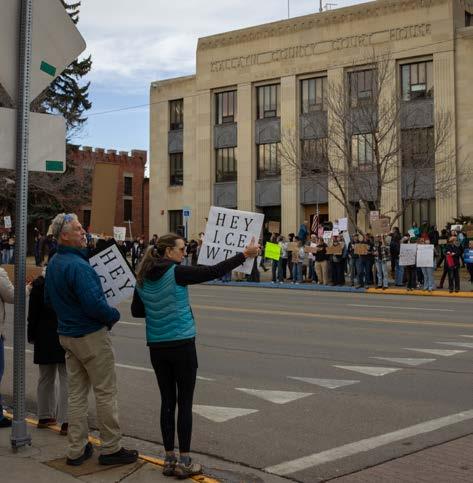
A Feb. 1 student-led protest at the Gallatin County Courthouse against immigration enforcement actions in Minneapolis, Minnesota. PHOTO BY JEN CLANCEY
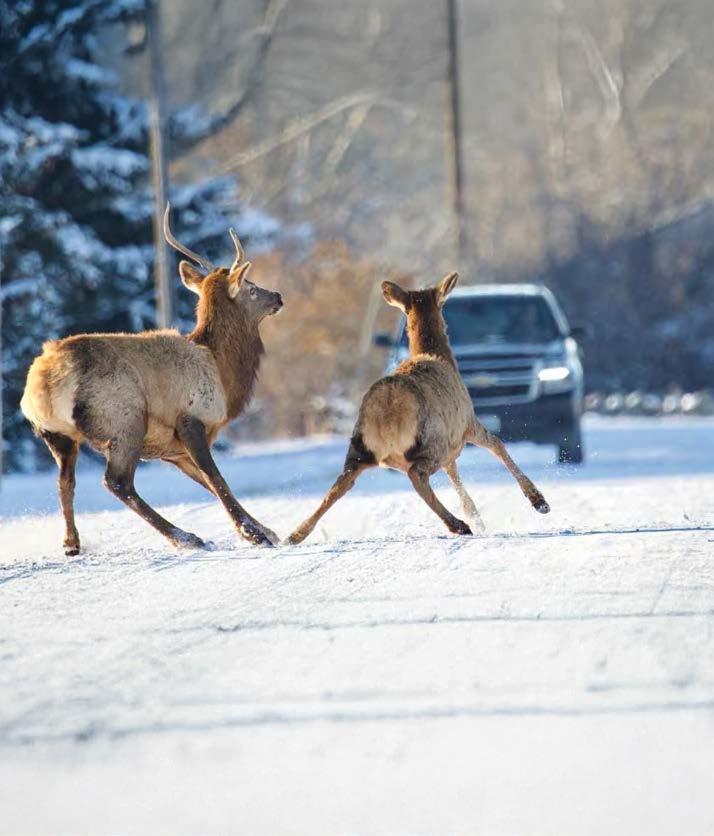
IT’S TIME TO PROTECT THE ELK AND DEER HERDS OF GALLATIN GATEWAY AND BIG SKY
3,562
Deer and Elk were killed by vehicles in Gallatin County since 2008.
PRIORITIZE WILDLIFE CROSSING SOLUTIONS. SUPPORT AND DONATE TODAY.
ENVIRONMENT
DISPATCHES FROM THE WILD: BUREAUCRATS VS. BUFFALO
HOW FEDERAL MICROMANAGEMENT IS UNDERMINING MONTANA’S PRAIRIE REVIVAL
BY BENJAMIN ALVA POLLEY EBS COLUMNIST
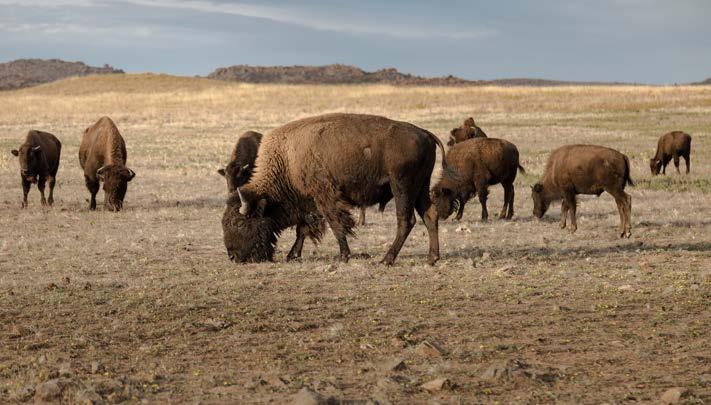
The Trump administration’s reversal on bison grazing in Montana’s BLM high plains is a textbook case of federal micromanagement getting in the way of conservation, local choice and common sense. A visionary effort to restore a vast, functioning prairie ecosystem is being tripped up not by science or law, but by semantic hair-splitting and political pressure.
For two decades, American Prairie, a nonprofit, has quietly pursued a bold goal: re-creating a 5,000-square-mile prairie reserve in eastern Montana, one-and-a-half times the size of Yellowstone. The idea is not a fenced-off park for tourists, but a living landscape where a free-ranging herd of 5,000 bison can coexist with elk, pronghorn, sage grouse, prairie dogs, and eventually even large predators. The group has pieced together this reserve the hard way—by buying land from willing sellers and partnering with ranchers who agree, for a price, to adopt wildlife-friendly practices.
Because the federal government owns much of the West, any landscape-scale conservation project inevitably intersects with public lands. In Montana, the Bureau of Land Management controls more than eight million acres and leases much of it
to ranchers. Grazing is governed by a complex system of permits measured in animal unit months. Montana has more BLM grazing permits than any other state, enough to support about 90,000 cows and calves year-round. When American Prairie buys a ranch, it assumes the associated BLM grazing leases like any other operator.
By now, the organization has assembled more than 600,000 acres—167,070 in private ownership and 436,587 in leased public land. Ecologically, there is no serious dispute against the idea that bison and cattle are comparable grazing animals: both are ruminants with similar impacts on grasslands when properly managed. The BLM itself acknowledged this in 2022, approving American Prairie’s plan to switch its BLM allotments from cattle to bison and explicitly stating it found no scientific or resourcebased reason to exclude bison.
That should have settled the question. Instead, the Montana Stockgrowers Association, backed by Gov. Greg Gianforte and Attorney General Austin Knudsen, pressed a narrow claim: bison are not “livestock” under federal rules. The MSGA believes that bison have negative impacts on rangeland health, riparian areas, and economic impacts to the livestock industry, most of which are unsubstantiated. In December 2025, new Interior Secretary Doug Burgum, appointed by the Trump administration, instructed the BLM to revisit its 2022 decision. The agency has now reversed course, asserting that because bison are not cows, sheep, horses, burros or goats, they are outside the definition of domestic livestock and can
graze federal land only if used for narrowly defined “production-oriented purposes” like meat, milk or fiber.
This cramped reading contradicts both precedent and practice. The Congressional Research Service has pointed to a 1976 Interior Department decision making clear that bison can be treated as livestock under the Taylor Grazing Act. American Prairie, which actively manages its herd and authorizes annual bison harvests, plainly meets any reasonable standard for livestock production.
Far from defending rural communities from “elitists,” as Knudsen claims, the new ruling punishes voluntary, market-based conservation and injects uncertainty into all public-land grazing. The real issue is not bison; it is Washington’s insistence on picking winners and losers on land that could often be better managed by those closest to it. If the federal government will not sell land outright to willing conservation buyers, it should at least honor the rules and grazing rights it has already recognized.
It’s time to let the buffalo roam—and stop letting bureaucracy stand in the way.
Benjamin Alva Polley is a place-based storyteller. His words have been published in Rolling Stone, Esquire, Field & Stream, The Guardian, Men’s Journal, Outside, Popular Science, Sierra, and WWF, among other notable outlets, and are available on his website.
ADOBE STOCK PHOTO
THRIVING LANDSCAPES: HOW YOUR DOG EXPLORES MATTERS TOO
BY ABBY BUTLER EBS COLUMNIST
Having a dog in Big Sky is practically ubiquitous to owning a pair of hiking boots. Our furry friends are our hiking buddies, our mountain biking companions and ultimately part of our families. However, an off-leash romp on your favorite hiking trail can be more harmful to wildlife and their habitat than you might think. This is why recreating with intention is the key to a positive experience for you, your pup and the wildlife whose habitat you’re sharing.
The presence of dogs in natural recreation areas is known to displace wildlife. Human presence by itself disrupts wildlife activity, but add a furry, wolf-like counterpart, and your impacts can be exacerbated. This displacement looks like wildlife changing their routine activities of feeding, breeding and resting, or changing where they habitually do them. What’s a natural reaction to a perceived threat? Moving away to a safer space.
Over time, this results in wildlife losing quality habitat and having to compete for space away from stressors. Research shows that in the presence of dogs, wildlife activity is lower up to 100 meters off-trail. So, Fido heading off-trail just 20 meters impacts wildlife much farther.
Beyond wildlife, our cherished native plants face their own challenges from dogs roaming off-trail. Not only can dogs trample plants and affect soil health, but they’re also one of the best vectors for spreading invasive plant seeds. Invasive species like houndstongue have specialized hooks on their burs that stick just like velcro to furry surfaces—like your dog’s coat. Even worse, some of these seeds, like cheatgrass, can burrow under skin and cause permanent damage and, at times, even death.
The best way to prevent invasive seeds from spreading through your dog’s fur is to collect the seeds at the end of your hike and throw them directly in the trash. Even better, wait till you get home and give them a good brush, inspect the especially thin parts of their skin, like ears and paws, for any sharp seeds, and dispose of everything in your trash.
We like to call this “don’t pick and flick”, because we know how easy it is to pick off a rogue seed and flick it back onto the trail.
The last impact might surprise you. Dog waste is the fifth highest contributor to nitrogen pollution in the Gallatin River. When your dog poops and you don’t pick it up, your dog isn’t just affecting one insignificant spot in the woods, they’re affecting the entire watershed.
Unlike moose and bears whose waste returns materials back to the environment it came from, dogs' waste returns materials that came from the grocery store. Because of their food source, dog
feces is high in nitrogen, phosphorus and e.coli, which when it inevitably enters water systems through erosion and runoff, ends up disrupting a healthy nutrient balance that species like cutthroat trout rely on. The solution? Pick up your dog’s poop! If you’re feeling especially motivated, you can volunteer with the Gallatin River Task Force during their annual Runoff Cleanoff in the spring. It’s not a pretty job but I can personally attest to how satisfied you’ll feel after.
Our dogs are a part of our lives and a part of our ecosystem. Sharing an outdoor experience with your dog is one of the greatest joys in life, and by no means are we saying to keep your pup at home. However, it’s undeniable that their presence can harm the landscape. Whether they’re spooking an elk, giving invasive weed seeds a free ride, or taking a visit to nature’s latrine, they’re leaving their mark on the trail. The best thing you can do for your favorite trails is to treat each outing with your dog intentionally.
Be mindful of your dog—especially when off-leash. Besides outsized impacts on our environment from where they roam, where they relieve themselves, and what they may unintentionally carry back with them, we’ve heard more than one story of an offleash dog returning with a charging bear or moose in tow. So, keep your pup nearby, keep their fur weed seed-free and bring a doggy bag, or two!
Abby Butler is the conservation program coordinator for Grow Wild, a 501c3 nonprofit organization that works to conserve native species in the Upper Gallatin Watershed through education, habitat restoration, and collaborative land stewardship. For more information, visit growwildmt.org.
Cooper, our clean recreation ambassador, off-duty but still on-leash enjoying a hike.
PHOTO COURTESY OF JEN MOHLER
VOTER EDUCATION EVENTS
Learn more and ask questions about the hospital/wellness district initiatives that will be on your mail-in ballot due May 5.
March
Wed., March 4
Family Forum WHERE: BASE WHEN: 5:15 - 7:00 PM Childcare provided
Tuesday, March 24
Ballots & Brews with Explore Big Sky WHERE: Waypoint WHEN: 5:00 - 6:30 PM
May
Tuesday, May 5
Election Day
Mail your ballot by April 27 to ensure it arrives on time.
Wed., March 11
Pizza with a Purpose WHERE: Big Sky Chapel WHEN: 11:45 - 1:30 PM
April
Tuesday, April 14
Ballots & Breakfast WHERE: Big Sky Center for the Arts WHEN: 9:00 - 10:30 AM
Ballots may also be dropped off on or before May 5 at: - Your County Elections Office - BASE (Gallatin County voters only)
Get to Know
Local Candidates
Tuesday, April 21
Candidate Forum
WHERE: WMPAC WHEN: 5:30 - 7:30 PM
Thursday, March 19
Dirtbag Après WHERE: Talus Room, Summit Hotel, Big Sky Resort WHEN: 4:00 - 5:30 PM
THE HIGH COST OF BUILDING A WATER SYSTEM THAT WORKS FOR BIG SKY
BY JOHNNY O’CONNOR GUEST COLUMNIST
Big Sky is at a critical moment in our infrastructure history.
The community’s growth, seasonal population swings, and unique environment demand more from our infrastructure than most communities face. At the Big Sky County Water and Sewer District, our job is to make sure the systems people don’t see every day—water and wastewater—quietly do their work, protect public health, and safeguard the places we all care about.
One of the most significant investments our community has made toward that goal is the Big Sky Water Resource Recovery Facility. Now in its first full year of operation, the WRRF is performing exceptionally well. Treatment results are consistently strong, with high removal rates for nutrients and bacteria, producing reclaimed water that exceeds all Montana Department of Environmental Quality and EPA requirements. This level of performance reflects years of planning, engineering and investment—and the dedication of the operators who run the plant every day. While zero-discharge operation reflects our community’s strong commitment to protecting the Gallatin River, it is important to recognize that utilizing
alternatives to direct river discharge comes at a substantially greater cost to the community.
What makes Big Sky truly unique, however, is not just how well we treat wastewater, but what we do with it afterward. Big Sky is one of only a small number of communities—fewer than 500 in the country—that operates as a zero-discharge system. Instead of releasing treated wastewater into a river or stream under a discharge permit, 100% of our treated water is reused for irrigation and snowmaking, and hopefully someday can be used to manage groundwater recharge, wildland firefighting and fire suppression.
This approach significantly reduces impacts on surface waters while conserving freshwater resources. It also allows reclaimed water to be used where it provides real benefit—supporting vegetation, maintaining soils and, when discharged to groundwater under strict regulatory oversight, helping sustain aquifer levels that ultimately support the Gallatin River system.
That same commitment to protecting water resources is why the district continues to explore solutions for the Gallatin Canyon, where dozens of individual septic systems and small community systems currently operate near the river. For years, community members have raised concerns about aging septic infrastructure and its potential impact on water quality. In response, the district and its partners were asked to evaluate whether centralized sewer service could provide a safer,
more sustainable alternative.
The proposed Gallatin Canyon Sewer Project is still in the planning and review phase, and no final decisions have been made. If pursued, the goal would be to remove multiple septic systems from the canyon and replace them with centralized treatment at the WRRF, with treated water managed through beneficial reuse or regulated groundwater discharge. Properly designed and permitted, this approach can reduce nutrient loading, protect groundwater and ultimately benefit the river by addressing contamination risks at their source.
As with all major infrastructure decisions, this work is guided by careful engineering, regulatory oversight and public involvement. Our responsibility is to ask the right technical questions, evaluate costs and benefits honestly, and ensure that any path forward is both environmentally sound and fiscally responsible.
Big Sky’s water future depends on thoughtful planning today. Whether it’s operating a high performing treatment facility, maintaining a rare zero-discharge system, or evaluating long term solutions for sensitive areas like the Gallatin Canyon, the District remains committed to transparency, stewardship and serving the community’s long-term interests.
Johnny O’Connor is the executive director of the Big Sky County Water and Sewer District.
44 Ridgeview Loop, Big Sky
Lower Cascade Ridge #110, Big Sky
A&E
A LA CARTE: FEELING WILDWOOD EMOTIONS
BY RACHEL HERGETT EBS COLUMNIST
I was the first person to show up to One&Only Moonlight Basin’s restaurant Wildwood for a ladies dinner with the women of Explore Big Sky’s publisher, Outlaw Partners, this month. This isn’t normal. I’m usually living life about 10 minutes late.
This time, though, I was excited for a taste of the new restaurant and had given myself ample time to navigate the unfamiliar and minimally marked roads. I appreciate One&Only’s luxury touches, like valet parking and the gentleman on staff who walked me to the stairs leading down to the restaurant level. I could have also used a guide to make it to the building.
The resort’s Montana modern vibe, with its plethora of leather and wood is at play here, but Wildwood also leans mid-century. This comes out in the angular wood chairs with padded camel covered seats—which are unanimously exclaimed to be some of the most comfortable (and wide-seated) restaurant chairs we have ever had the pleasure of sitting in—and tables set with somewhat unnecessary rattan chargers and ribbed green water glasses that also follow angular lines.
I’m impressed at the menu, which features an impressive variety of dishes incorporating international flavors and local ingredients, and highlights a culinary team led by Chef Matt Dahlkemper, as well as a list of Montana-based food producers that provide ingredients for the dishes. Wildwood very much leans into the idea of farm-to-table dining that is essential to this level of cooking—though the wait staff reminded me a bit more of lumberjacks than farmers, with tan Carhart-like work vests over plaid shirts.
The culinary team updates the dinner menu monthly. This column discusses the February 2026 menu. I’m warned that up to 70% of the dishes may be replaced in the next iteration. Thus my inclination would have been to order one of everything, but we simply did not have enough people at our table to eat all that food.
We asked roaming staff for recommendations, and ordered a good portion of what was on offer.
Our meal started with a savory doughnut hole topped in quince jelly and Spanish Iberico ham, and filled with a custard made with manchego cheese. It was almost like an amuse bouche, though a tad dry for my liking. More cheese custard, please!
Next we sampled the mini croissants, topped with a foie gras mousse, honey, fresh thyme and spiced Marcona almonds. These were incredible, surprising the tastebuds with the richness and sweetness. They were also a textural joy, with the softness and ooze of the mousse and honey contrasting the crispy pastry layers and crunchy almond topping.
First courses were next. A waiter joined us tableside to mix a beef tartar that was prepared much like an Asian poke with chili soy and sushi rice. The show was appreciated, but was quickly overshadowed by
PHOTO BY CARLI JOHNSON
a chestnut soup that seemed understated but with layers of flavor that played on the tongue.
With soup bowls removed, it was time for pasta. Again, the choice seemed impossible and we ordered every option. While intrigued by the pork carnitas fettuccini with cilantro noodles, it was the celery root agnolotti with toasted hazelnuts and a preserved lemon sauce that was the most surprising.
“This makes me feel emotions,” I heard one of the ladies exclaim on first bite.
I felt similar about our next dishes: cast iron sea scallops with a spiced carrot emulsion; cashew butter and maple roasted carrots; and a duck breast cooked over coals and served with roasted sunchokes and confit fennel. The not-quitebarbecue marinade reminded me of one of my Japanese grandmother’s made-up recipes and the cook on the duck itself was enough to line up a few converts to the bird from our table.
We also dug into a whole chicken, seasoned with coriander and served with seemingly unassuming sides that again brought an intricate layering of flavors that seems to be the restaurant’s signature. Smoked and curried cauliflower played beautifully with the sweet spiced harissa honey and vinegar bite of a sprinkle of capers.
At the end of the evening, we were ushered into a glass-encased wine room that served as an atrium to a small private dining room. The goal is for Wildwood to have a selection of 1,000 wines, we were told. I spotted some classy favorites on the list, and was shown a bottle so expensive that its price tag could pay my rent for two years.
As the main portion of the meal wound down, I perused the dessert wine pours on offer. They were predominantly French, with five varieties of Sauternes and Vouvray. Amid them, a listing stood out. Words I did not understand. Hungarian.
Naturally curious, I did a quick online search and learned the wine featured heavy notes of apricot, honey and citrus. Sold. So I asked for a glass of
the 2018 Royal Tokaji 5 Puttonyos Aszú, only comprehending the “royal” and the number as the words fumbled out. Aszú, I have since learned, is a grape varietal grown in the Tokaj region of Hungary. And “5 Puttonyos” refers to the sweetness, on a scale of 1 to 6.
I take a sip and pass the glass around the table for the ladies to test. The verdict is mixed. Those who did not like sweet wines were understandably turned off. But those of us who appreciate them felt like we were hit by a bit of magic. Lesson learned. I have been sleeping on Hungarian wines.
“If I were Harry Styles, I’d write a song about that,” one said.
Dessert wine and coffee secured, all that we had left was the icing on the dinner cake: dessert.
“One of each, please,” I had said earlier, ordering dessert with the rest of the food. After the meal, the waiter seemed incredulous, asking if we were sure we wanted three desserts. We were. And rightfully so. The desserts disappeared in minutes and were each glorious in their own right—the richness of a dense chocolate “S’mores Bar,” the umami added to a deconstructed apple pie with a side of miso ice cream, and the impressive honey tuile that surrounded the Basque cheesecake. Shout out to pastry chef Ashley Ginsberg.
While Wildwood still has a bit of growing pains in the smoothness of service, the whole meal was impressive. The brand new February menu was executed to perfection. I’m both excited to see what’s next and sad that I may never try some of these dishes again.
To bring back my favorite comment of the night, the whole meal “made me feel emotions.”
Rachel Hergett is a foodie and cook from Montana. She is arts editor emeritus at the Bozeman Daily Chronicle and has written for publications such as Food Network Magazine and Montana Quarterly. Rachel is also the host of the Magic Monday Show on KGLT-FM and teaches at Montana State University.
COMMUNITY EVENTS CALENDAR
Read the full events calendar, or submit your own community event by scanning the QR code.
AMERICAN LEGION ORATORICAL CONTEST
WEDNESDAY, FEB. 25 WMPAC, 5 P.M.
On Wednesday, Feb. 25 at 5 p.m., local students will participate in the American Legion Oratorical Contest. Students will take to the Warren Miller Performing Arts Center stage and share speeches lasting five to eight minutes about the Constitution and judges will crown a winner.
Do You or Someone You Know Need Help Getting Sober?
Can’t stop drinking? We get it. Contact Alcoholics Anonymous today! Call 1-833-800-8553 to talk to an AA member or go to a meeting in-person or online.
For a full list of meetings visit the website, aa-montana.org, or download the MEETING GUIDE® APP IF YOU HAVE A PROBLEM WITH ALCOHOL, CONTACT AA WE CAN HELP!
ADOBE STOCK PHOTO
OPINION
SKI TOWN VIGNETTES: THE DREADED ‘TOWN
DAY’
ILLUSTRATION BY NIELSEN GREINER
BY NIELSEN GREINER EBS COLUMNIST
Mountain living has its perks, but sometimes…
It’s been a few weeks since you’ve been to “town”— what many of us Big Sky residents call Bozeman or the greater Gallatin Valley. You look in your fridge and pantry to see what’s left to eat. You find some hummus, half a container of salad, a few beers and an array of condiments—too bad you can’t have these for dinner. In the pantry is a sparse selection of Kraft mac and cheese, an almost-empty bag of tortilla chips, a dwindling box of granola bars, some rice, a few cans of beans and a years-old plastic bag of lentils that you’ll never actually cook. Hmmm.
“Well,” you think with an air of resignation and tinge of anxiety, “I guess it’s time for a town run.”
Hopefully, you’ve chosen a day with clear skies and clean roads. You mentally prepare yourself, knowing that it’ll take the better part of a day to run all your frenzied errands and, if you’re lucky, get back in time for dinner; you’d rather not eat out in town and delay the return. Better buy a bottle of wine or a six-pack, to properly recover when you’re back.
You’re a few minutes down the road, not even out of Big Sky, and someone pulls out in front of you.
“Surely, they’ll speed up,” you tell yourself in the midst of some breathing exercises to ease the swell of anger. They don’t. The speed limit is 55 miles per hour, then 60, and your speedometer doesn’t crest 40—for the entire Gallatin Canyon drive. You’re not sure these deep breaths are helping.
Not until it’s too late do you realize your mistake— you’re going to town in the middle of the day, on a weekend, along with the whole city of Bozeman. You let out a loud, exasperated sigh, and turn up the volume to your favorite tunes or podcast.
Costco is a looney bin. Target isn’t much better. Then it’s Lowe’s or Home Depot, Winco or T&C. Maybe a quick lunch. Park and half-jog, grab and fill a cart, navigate the maze of irritated or resigned zombie-like shoppers, check out and say a kind word to the cashier. Cross another stop off the list, as the winter sun is dipping lower in the southwest sky.
At last, the vehicle is full and after all but draining your checking account, you’re finished—you’re confident you would last a long time if the apocalypse were to start tomorrow. But you’re only partially relieved, knowing you have to make it back through the canyon to Big Sky. You run through another grocery list of asks: “Please oh please, let there not be any accidents; let the blizzard hold off
until I’m home; let me not get stuck behind the family in a rental minivan with summer tires.”
There’s a couple close calls, like usual. Some jerk in a big truck spewing black diesel fumes passes you illegally on a blind, slick curve. Later, God bless them, some family in a rental minivan without winter tires is going 30 miles per hour. The whiteknuckled driver decides to use a turnout at the very last second and you discover you may need new brake pads. Finally, you cherish the cold, thin air as you round the final curve in the road and turn into your driveway. Though hangry, you let out a contented sigh—home, sweet home.
Alas, the fun’s not over yet; it’s almost another hour before everything’s unloaded and the frozen pizza is in the oven, when you’ll finally open the well-deserved bottle of wine or can of beer and, deservingly, stare at a wall.
Cracking a smile, you’re a little proud of yourself for conquering yet another dreaded “town day” without becoming entirely unhinged. There’s always next time for that.
Nielsen Greiner is an aspiring writer, outdoor enthusiast, and small business owner based in Big Sky. He loves snowboarding and splitboarding, mountain biking, long day hikes and truck camping in the woods, and has a thing for books, coffee, trees and birds. This summer, Nielsen lived out of his truck while traveling through Canada and Alaska for two months. To read more, visit nielseninthewild.com.
BUSINESS
HAMMOND PROPERTY MANAGEMENT BECOMES CONFLUENCE COMMUNITY MANAGEMENT IN BIG SKY
BY TAYLOR OWENS
CONTENT MARKETING DIRECTOR
Sponsored content
BIG SKY—After nearly three decades as one of Big Sky’s trusted names in property and association support, Hammond Property Management has officially become Confluence Community Management—a new name that signals both continuity and a broader, community-first mission.
Leading the transition is Mike Palmer, the company’s new owner and former general manager, who says the change reflects what the organization has been doing all along: helping the Big Sky community thrive, not just maintain buildings.
For Palmer and his team, the decision to rename Hammond Property Management wasn’t about distancing from the past. Instead, it was about choosing a title that better matches the work happening behind the scenes across Big Sky’s neighborhoods and associations.
“While we do manage property, the new name better represents the full scope of what we actually provide to our clients,” Palmer explained. “We’re truly managing communities and our work extends far beyond the traditional property management.”
That expanded scope includes developing long-term maintenance strategies, insurance support, and planning and executing capital improvement projects.
Even the word confluence was chosen with Big Sky’s landscape and culture in mind.
“Confluence speaks to both the physical and symbolic nature of the communities we serve,” Palmer said. “We work in the headwaters of the Gallatin and Madison rivers, but the name also reflects how we bring people together.”
That sense of connection isn’t just branding, it’s central to the company’s daily work.
“Our work centers on guiding groups through important decisions that have a direct and lasting impact on our communities,” he said. “Confluence means coming together, which is what we do for our communities. We bring people together… like the rivers converge.”
The rebrand may be new, but the roots run deep. Hammond Property Management has been part of Big Sky for 28 years, and Palmer says the heart of the organization will remain unchanged.
“I'm very excited about the change in the name,” said Shelley Henslee, HOA account manager. “I think it kind of represents us moving forward. We were here before Big Sky made it on the map, and we will continue to grow and be a stable presence here in the community.”
Palmer points to long-term client relationships as proof that the company’s approach works—and that trust has been earned through consistency.
And behind that trust is a team that lives in the same community as the people they serve.
“Our whole team is local to Big Sky. We live here, we work here, and spend our free time here,” Palmer said. “We share the same goals as the communities that we manage, which is… a vibrant, sustainable, thriving Big Sky for the long term.”
He added, “That connection really drives a level of care and accountability that’s hard to replicate.”
In a town where relationships and responsiveness matter, that local presence has become part of the company’s identity.
That same sense of local connection is echoed by Henslee: “We're part of the community. We live here. We not only work for owners, but we also see them at the grocery store or at school pickup or Music in the Mountains or farmers’ markets.”
But the rebrand isn’t just about geography, it’s about scope.
“We specialize in community management, which sets us apart from other property management companies,” he said. “We only work for community associations.”
That focus allows the team to develop a wider view of the needs and challenges associations face across Big Sky, and to bring solutions from one community to another.
For large, complex communities like Firelight Meadows, association management isn’t just a convenience — it’s essential. Becky Brockie, Firelight board member, described Hammond’s involvement as “a game changer,” explaining that self-management simply isn’t realistic at their scale.
“Hammond takes on all of our daily operations, handles all of our emergencies—and that way the board can just focus on governance,” Brockie said.
That support becomes especially critical during major events, like during a roof failure, when Hammond coordinated emergency response efforts and helped manage the full scope of the roof replacement project—providing continuity, oversight and peace of mind for both board members and homeowners.
“We have the opportunity to work with a diverse range of organizations in Big Sky… to identify creative and effective solutions to challenges that a lot of communities face,” Palmer said. “That collaborative, community-wide approach is really unique in our industry.”
Long-time Big Sky resident Brian Wheeler, who spent decades in the community and recently retired as vice president of real estate and development for Big Sky Resort, says Hammond’s value has always come down to how the team operates when it matters most.
“The culture for team problem solving is key with them. No drama—there’s execution and reliable response,” Wheeler said.
Palmer’s personal history at the company gives him a ground-level understanding of what community associations deal with—especially in the demanding mountain environment.
“Early in my career, I managed our roof shoveling crew,” he said. “We spent countless hours and significant resources combating roof leaks in the winter for our associations.”
That experience helped inspire long-term solutions instead of endless seasonal fixes.
“Solving that root problem… was a huge priority for us,” Palmer said. “So now when I drive through those communities with the new roofs and performing well, I don’t see ice dams and crews on the roofs. It’s a real point of pride for me.”
Palmer says the decision to purchase the company was ultimately rooted in one thing: the people.
“When I became general manager and became so close with all my staff and learned how amazing our staff really is, it drove my decision to purchase the company,” he said. “It’s truly a team effort, and I wouldn’t have considered buying the company if we didn’t have the staff that we have.”
Big Sky continues to grow rapidly, and Palmer believes Confluence can play an important role in helping communities evolve responsibly.
The Confluence team celebrating at 320 Guest Ranch. PHOTO BY MICHAEL RUEBUSCH