Page Buono, Sinjin Eberle, Rachel Hergett, Emily O’Connor, Sam Ozanich, Benjamin Alva Polley
TABLE OF CONTENTS
CELEBRATING OUR 400TH ISSUE
To commemorate Explore Big Sky’s 400th issue, EBS dug into our catalog to find interesting, unique or noteworthy covers from the past 10 years.
BSCO TO FIND NEW HOME FOR GREEN BRIDGE
A summer staple, the Markley “Green” Bridge isn’t heading for the junkyard thanks to an effort by the Big Sky Community Organization, and generous storage from Big Sky Rock, developer of the Quarry neighborhood.
BIG SKY ELECTION GUIDE
With ballots coming in the mail in mid-April, hang onto this edition of Explore Big Sky for everything you need to know about the local Big Sky election. This year, millions of taxpayer dollars are at stake, and voters will elect their neighbors to various local positions.
MSU STUDENTS ORGANIZE 50TH POWWOW
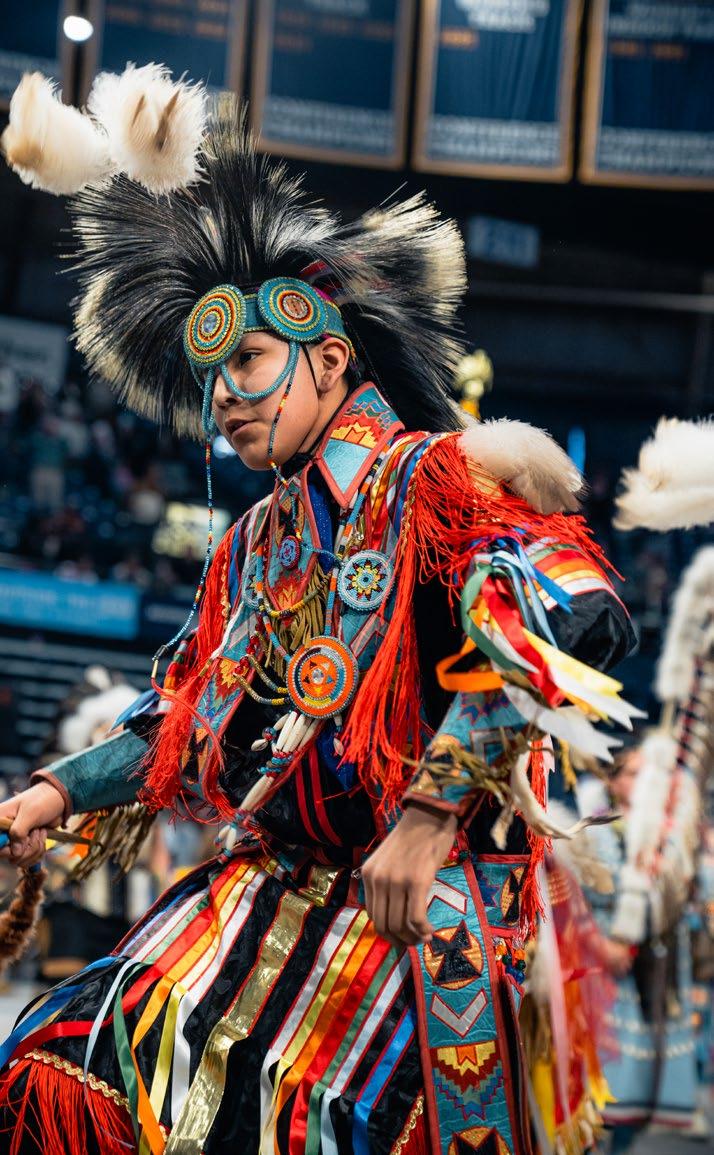
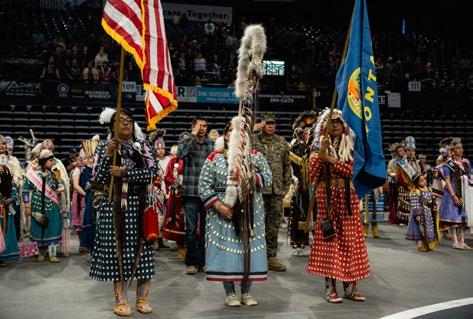
For the past year, Montana State University’s American Indian Council has planned for the 50th MSU AIC Powwow to be the biggest yet. Powwows are significant social events for Indigenous peoples, allowing for the exchange of culture, visiting with relatives and friends, and sharing and competing in dance and drumming. The milestone event took place March 27.
Q&A WITH PEAK SKIS’ BODE MILLER
Despite widespread belief that Peak Skis had shut down, founder Bode Miller says it never died. On March 19, Miller spoke on the phone with Explore Big Sky to discuss his perspective on how Peak lost its way, and how he’s working to rebuild and reconcile.
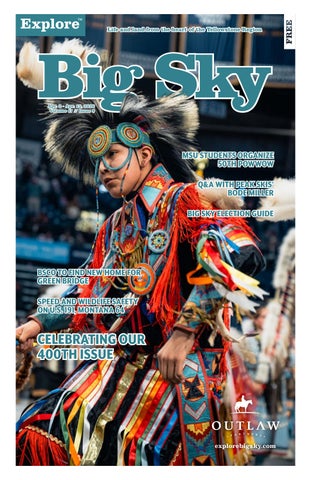
ON THE COVER:
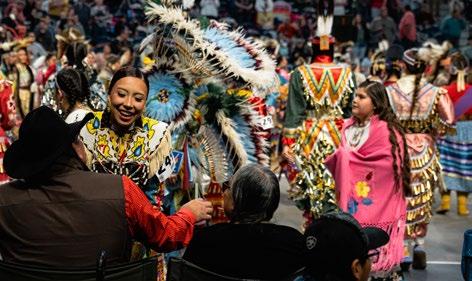
A dancer participates in the grand entry during the American Indian Council’s 50th annual Powwow at Brick Breeden Fieldhouse on March 27. PHOTO BY FISCHER GENAU
EDITORIAL POLICIES
EDITORIAL POLICY
Outlaw Partners, LLC is the sole owner of Explore Big Sky. EBS reserves the right to edit all submitted material. Printed material reflects the opinion of the author and is not necessarily the opinion of Outlaw Partners or its editors. EBS will not publish anything discriminatory or in bad taste.
EBS welcomes obituaries written by family members or from funeral homes. To place an obituary, please submit 500 words or less to media@theoutlawpartners.com.
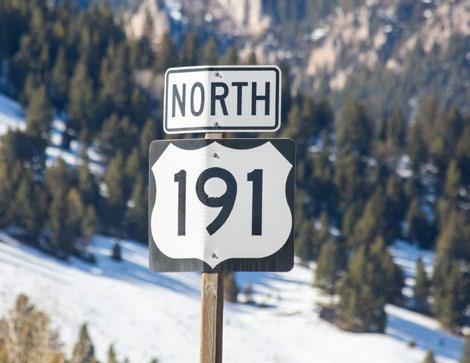
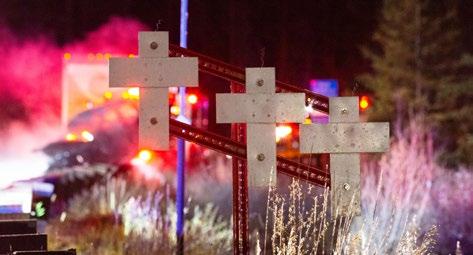
SPEED AND WILDLIFE SAFETY ON U.S. 191, MONTANA 64
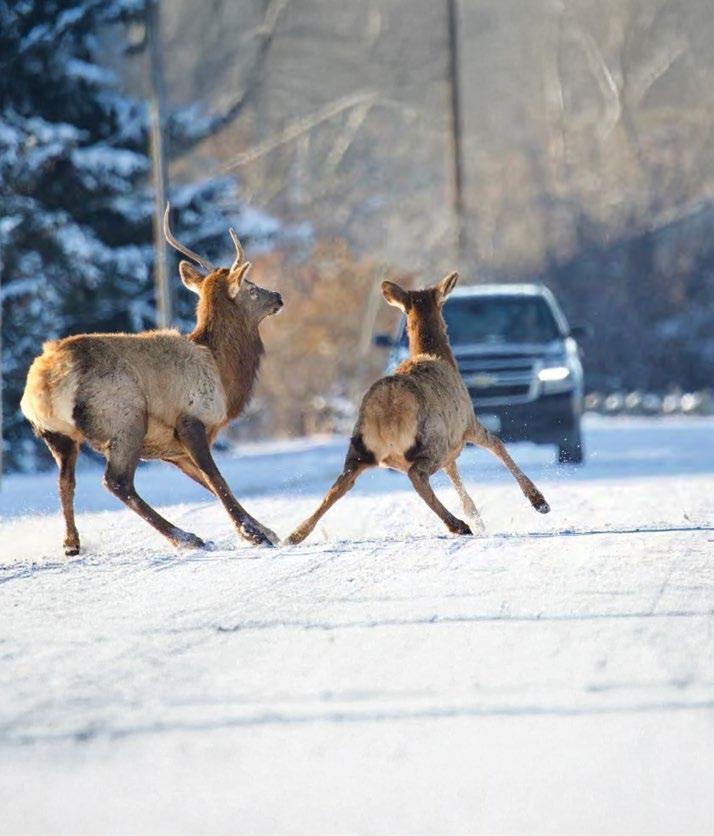
Contributor Ashley McEnroe takes a deep dive into the safety issues caused by speeding drivers on highways through the Big Sky region. Affecting wildlife, community members and other drivers, this story cites the “disappointing” results from various studies spearheaded by concerned community members over recent years.
LETTERS TO THE EDITOR
Letters to the editor allow EBS readers to express views and share how they would like to effect change. These are not Thank You notes. Letters should be 250 words or less, respectful, ethical, accurate, and proofread for grammar and content. We reserve the right to edit letters and will not publish individual grievances about specific businesses or letters that are abusive, malicious or potentially libelous. Include: full name, address, phone number and title. Submit to media@outlaw.partners.
ADVERTISING DEADLINE
For the April 16th issue: April 8th, 2026
CORRECTIONS
Please report errors to media@outlaw.partners.
OUTLAW PARTNERS & EXPLORE BIG SKY P.O. Box 160250, Big Sky, MT 59716 (406) 995-2055 • media@theoutlawpartners.com
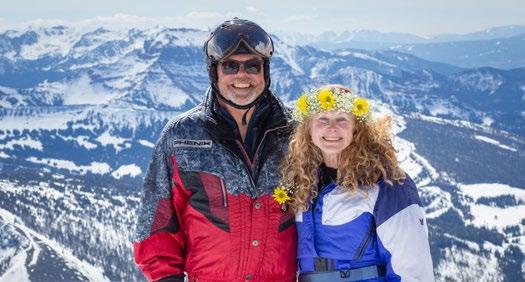
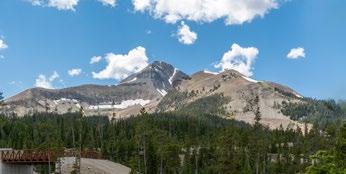
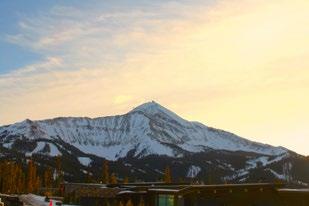
Thirty years ago, Robert and Lynn Jenni became the first to tie the knot at 11,166 feet on Lone Mountain’s summit. One day shy of their 30-year anniversary, they returned in their wedding day outfits to re-create the “totally awesome” moment.
PHOTO BY JACK REANEY
BRIEFS
NEWS IN BRIEF
GALLATIN HISTORY MUSEUM TO HOST CRAFTS, SPEAKER EVENTS THIS SPRING
EBS STAFF
The Gallatin History Museum has begun their programming for community members young and old this spring.
In May, the museum continues its speaker series with a historical presentation titled “The Copper King in Gallatin County (or How Three Forks Almost Became a Smelter Town).” The talk will take place Wednesday, May 13, at 6 p.m., and feature local historian and author Brenda Wahler.
Wahler’s presentation will explore the influence of Marcus Daly and the Anaconda Copper Company, and how industrial expansion nearly brought a major smelting operation to Three Forks near the Missouri Headwaters. The talk highlights how Montana’s copper boom reshaped communities across the state, including in Gallatin County. A book signing for Wahler’s latest work will follow the event.
Founded in 1977 and housed in a historic county jail building, the Gallatin History Museum preserves and interprets the region’s past through exhibits, archives, and public programs focused on early settlement, agriculture and Montana’s mining era. For reservations or more information, attendees can visit the museum’s website.
BOZEMAN POLICE, FIREFIGHTERS TO FACE OFF IN ANNUAL CHARITY HOCKEY GAME
EBS STAFF
The Bozeman police and fire departments will face off in the third annual Frozen Frontline charity hockey game on April 3 at 7 p.m. at Haynes Pavilion at the Gallatin County Fairgrounds.
Each year the tournament raises money for three local nonprofits: the Bozeman Amateur Hockey Association, the Bozeman Police Foundation and the Bozeman Firefighters IAFF Local 613 Benevolent Fund. The Bozeman Amateur Hockey Association offers scholarships to families for youth hockey; the Bozeman Police Foundation fosters public safety through community building, education and outreach; and the Bozeman Firefighters IAFF L613 Benevolent Fund supports public safety, and disaster preparedness. Funds raised at the event are split evenly among the organizations.
So far, Bozeman Police has taken both trophies, with a 7-3 win over Bozeman Fire in 2024 and a 6-5 win in 2025.
“The firefighters hope to stake their claim on the ice this year,” stated a press release from the City of Bozeman. “However, no matter who wins, the game is important for the Bozeman community.”
Admission is donation-based, with a suggested $5 contribution. Organizers say space is limited and encourage attendees to arrive early.
BRIDGER BOWL CLOSES THREE WEEKS EARLY
EBS STAFF
Bridger Bowl Ski Area ended their 2025-26 ski season early, annoucing March 20 that their last days to ski would be March 21 and 22.
“With the recent warm temperatures, we’ve made the difficult decision to wrap up the season a bit earlier than planned,” the nonprofit ski area posted on its website, supplemented by a social media video of General Manager Hiram Towle standing in a puddle. “We are so grateful for everyone who made it so special!”
With record high temperatures in the region, and no precipitation in the short-term forecast, many western ski areas have made the same difficult decision—California’s Sierra-at-Tahoe announced Thursday that its season will end March 22, as did Utah’s Snowbasin Resort.
The area is open for backcountry explorers as conditions exist, but Bridger Bowl notes that ski patrol is not conducting avalanche or rescue work. Skiers should proceed at their own risk.
HYALITE CANYON ROAD CLOSES FOR SEASONAL NON-MOTORIZED RECREATIONAL ACCESS
EBS STAFF
Hyalite Canyon Road, the only motor vehicle access point to the popular Hyalite Canyon recreation area, closed April 1 and will remain so through May 16. This closure is enacted annually to protect road infrastructure during the spring thaw, and allows visitors to access the canyon via bike or foot during the area’s quieter season, ahead of a busy summer.
“The six-week period of no traffic in the canyon offers a unique, nonmotorized recreational experience that folks enjoy and look forward to each spring,” said Kat Barker, recreation program manager for the Bozeman Ranger District in a March 25 press release from the Custer Gallatin National Forest.
The release advised those using the road for recreational activities to exercise caution and reduce speeds when near maintenance vehicles operating on the road, or around blind corners.
PUBLIC NOTICE
NOTICE OF ELECTION JUDGE CLASS FOR MADISON COUNTY
WEDNESDAY, APRIL 22ND, 2026 from 2p.m. to 4p.m.
Madison County Election Administrator, Paula Mckenzie, will hold an Election Judge Certification Training Class in Big Sky, for Madison County Election Judges. The class will be held in the conference room of the Big Sky Water and Sewer district building, located at 561 Little Coyote. The class should take approximately two hours and will certify you for the next two years.
Please call or email with any questions. We are asking you to spread the news and recruit anyone you can!
Our office contact information is: phone 406-898-4406 or e-mail pmckenzie@madisoncountymt.gov
SCHOOL AND SPECIAL PURPOSE DISTRICTS
Join the Coordinating Council of Big Sky for an evening of conversation with local candidates who may help shape our community’s future.
TUESDAY, APRIL 21
WARREN MILLER
PERFORMING ARTS CENTER
5:00 PM – MEET & GREET 5:30 PM – FORUM
FOR THE MAY 2026 ELECTION
Big Sky Resort Area District
Proposed Big Sky Hospital/Wellness District
Big Sky School District
Big Sky Fire District
Big Sky Water & Sewer District
Ennis School District
Attend in person or watch the livestream courtesy of Outlaw Partners.
MORE INFORMATION resorttax.org/2026-candidate-forum
CELEBRATING OUR 400TH ISSUE OP NEWS
To commemorate Explore Big Sky’s 400th issue, EBS dug into our catalog to find interesting, unique or noteworthy covers from the past 10 years. We found EBS’s very first issue, its rebrand from Big Sky Weekly to Explore Big Sky, a tumultuous 2020, and more. To look at past issues of EBS, visit the publications page on our website.
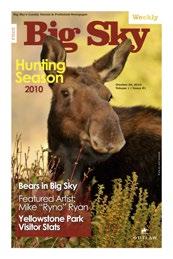
ISSUE 1
OCT. 29, 2010
Outlaw Partners publishes the first issue of its local newspaper, The Big Sky Weekly, after acquiring it from Faith Malpeili. Malpeili ran the paper for its first 14 years.
ISSUE
243
MARCH 27, 2020
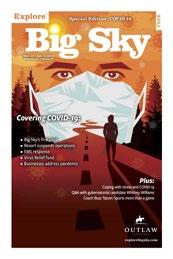
COVID-19 arrives in Big Sky. After Big Sky Resort closed for the pandemic, and amidst changing advisories to prevent the spread of the virus, this special edition covered local consequences and community response. Former Outlaw Partners designer and local artist Kelsey Dzintars illustrated the cover.
ISSUE
70
JULY 12, 2013
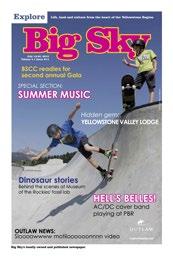
The Big Sky Weekly becomes Explore Big Sky. Issue 70 covered the Museum of the Rockies fossil lab, AC/DC cover band Hell’s Belles, and, for some reason, NBA player Chris Paul’s decision to stay an L.A. Clipper.
ISSUE
255
SEPT. 11, 2020
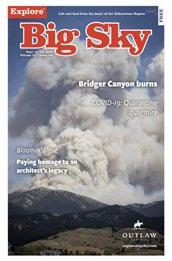
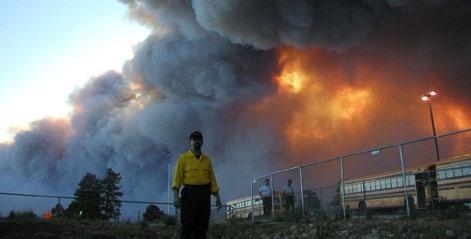
On Sept. 4, 2020, the Bridger Foothills Fire ravaged the east side of the Bridger Mountains, growing from 800 to 7,000 acres in just a six-hour period. It evacuated over 1,000 people, destroyed 28 structures, and resulted in 3 firefighter injuries, but no lives were lost.
ISSUE
165
MARCH 31, 2017
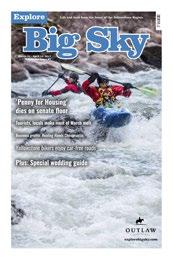
Explore Big Sky’s full-color, full-page format is an effort by publisher Outlaw Partners to break the mold of traditional local newspapers. Cover shots often feature action, like this Gallatin River kayak portrait.
ISSUE 330
JULY 27, 2023
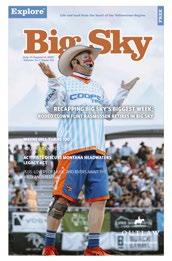
Legendary rodeo clown Flint Rasmussen performs his very last rodeo as lead entertainer, ending a long and storied career in the Big Sky Events Arena during 2023’s Big Sky PBR.
ISSUE
193
APRIL 27, 2018
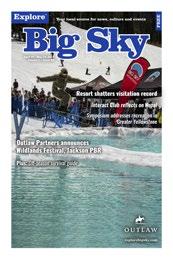
Big Sky Resort sets a new record with over half a million visiting skiers and snowboarders. Plus, the very first Wildlands Festival is announced.
ISSUE 394
JAN. 8, 2026
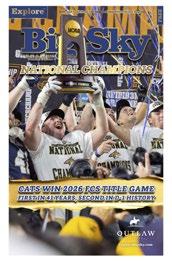
This special cover design of Explore Big Sky shows Montana State’s overtime victory in the FCS Championship in a nail-biter against the Illinois State Redbirds.
LOCAL
DISCOVERY ACADEMY TO CLOSE MIDDLE, HIGH SCHOOLS
NONPROFIT BIG SKY SCHOOL WILL CONTINUE WITH PRE-K THROUGH
FIFTH GRADE INSTRUCTION
BY JACK REANEY
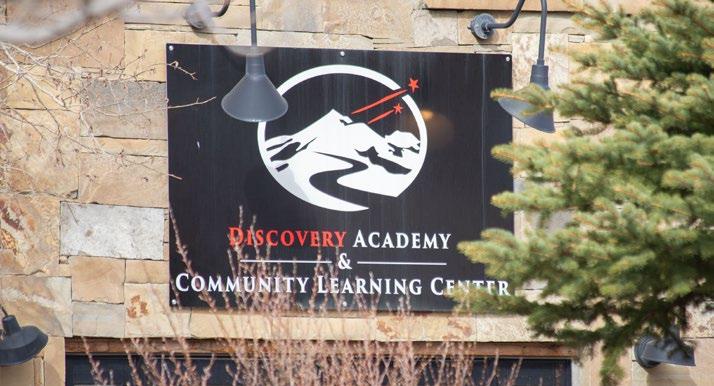
BIG SKY—On Monday, March 23, Big Sky Discovery Academy made a difficult announcement to parents, teachers and students. Based on financial challenges associated with declining enrollment and rising operational costs, the school will no longer offer middle and high school education after the completion of the current school year.
“I’m absolutely heartbroken to make this announcement because these students are so important to the fabric of our community,” Beth Marlington, head of school, said in an interview with EBS. “And I personally have spent so much time working with them, and teaching them, and learning from them. It really hurts my heart to have to put them out there in the world before we were ready to do that. And I hope that they can find ways to thrive in the community without us, and I will help guide them as best I can in the transition.”
Sam Geppert, chair of Discovery’s board, echoed “heartbreak” in describing the decision.
“It’s the hardest decision that we as a board have ever had to make,” Geppert said. “It’s just hard to see these kids have to find something different, when they were doing so well here.”
When families were notified in a meeting Monday, Geppert said the news was received about as well as it could have been. Families were sad, shocked and generally unhappy, but also understood the decision and tried to offer solutions.
The school believes it can and should continue providing a high level of in-person instruction, and the change aims to ensure the school is not forced to lower those standards. High school instruction requires more teachers per student, with a higher level of subject specialization than needed for younger age groups, Marlington explained. The school can now focus its resources and energy toward younger students, aged two years old to fifth grade, which accounts for roughly two-thirds of the school’s programming—of 60 students currently enrolled across all ages, only 13 kids will be impacted immediately after this school year.
Still, Marlington said it’s painful because those 13 students are very important.
In a letter to families, Marlington wrote that the new direction positions Discovery Academy to ensure long-term sustainability and continue offering excellent programs.
“I think we do a really great job of working with those age groups, and it’s something I’m glad we’ll be able to keep providing for the community,” Marlington said, noting the Montessori-style curriculum is helpful to support many young students’ energy and excitement for learning.
Geppert and Marlington say Discovery’s decline in enrollment is not a reflection of quality of programs, or impacted by the recent opening of Big Sky Community School, another nonprofit learning center. Rather, administrators say many families have left the community in the post-COVID years, creating financial challenges for educators across Big Sky, including the Big Sky School District.
With fewer students than the COVID-era peak, operating older grade levels became financially unsustainable.
Marlington also pointed out that Discovery has a reputation for enrolling especially wealthy or high-profile families, but countered that some of those specific families have not been enrolled for multiple years. Now, half of students are on tuition assistance, she said, and the school’s pre-K program is funded with grants from Resort Tax, Spanish Peaks Community Foundation and Lone Mountain Land Company.
Overall, Geppert and Marlington emphasized the importance of Discovery offering alternatives to local families whose children need social or academic support, whether they’re at risk of falling behind in school or in need of additional challenges.
In the years ahead, Marlington said the school will look for opportunities to rebuild its middle and high school classes, and if possible, will do so “organically,” one year at a time as existing students grow. Marlington said Discovery has a “clear vision” of accomplishing that goal, and noted that Discovery is now actively seeking support from the community to make it possible.
“Whether through financial contributions, strategic guidance, or collaborative partnerships, we welcome those who believe in our mission to join us in strengthening our school today and helping shape its future,” Marlington stated in a follow-up email. “Or if you want to learn more about our mission, we are open to conversation and connection.”
PHOTO BY JACK REANEY
SUNDAY, JUNE 14
WELCOME COCKTAIL HOUR
G-MAN
GREEN BRIDGE TO BE REPURPOSED IN BIG SKY
BIG SKY ROCK TO STORE BRIDGE ON QUARRY LAND AS BSCO PURSUES LOCATION FOR PEDESTRIAN USE
BY JACK REANEY
BIG SKY—One of the great local disappointments of 2026 is the replacement of the historic Markley “Green” Bridge over the Gallatin River to the Deer Creek trailhead. But the summertime staple isn’t heading to the junkyard.
At the March 11 Resort Tax board meeting, the Big Sky Community Organization announced its goal to repurpose the bridge elsewhere in the Big Sky community for pedestrian and bike use. CEO Madeleine Feher thanked Battle Ridge Builders, the contractor handling bridge removal, for helping preserve and transport the retired Carnegie Steel structure. She also thanked the Gallatin River Task Force for getting BSCO in touch with the U.S. Forest Service to propose the idea.
“They have to move it no matter what, so we are benefitting from the fact that that transport needed to happen one way or another,” Feher said. “... It’s working out in everybody’s favor to save this bridge.”
The bridge is slated to be removed in early April
and will remain intact in one piece. The only immediate challenge was finding a place to store it for a year or two until BSCO and its local partners find a suitable location to reinstall it. After announcing that need at the BSRAD meeting, BSCO received an outpouring of supportive offers.
Big Sky Rock, the developer behind the Quarry subdivision in the Gallatin Canyon, will store the bridge on some of its vacant land. Partner Scott Altman said it was a no-brainer.
“We’re just like—that’s an icon, we would be happy to be a part of anything to help keep that in the community,” Altman told EBS. “... No matter where it is [repurposed], we fully support it. We’ve offered them a place to keep it for as long as it takes.”
BSCO has a few potential locations in mind, and Feher expects the bridge will be moved to a site that would serve the community by improving walking and biking connectivity in an area that currently lacks a river crossing.
Battle Ridge Builders is covering the cost of transportation, and Big Sky Rock won’t charge for
storage. When a final location is confirmed, BSCO and any other involved entities will need to cover the cost of installing the bridge.
Feher said BSCO felt an important responsibility to preserve the bridge, as part of BSCO’s commitment to building for the future while honoring what has shaped Big Sky. The bridge is a classic landmark in the Gallatin Canyon often used for jumping into the river. She’s proud the Green Bridge will remain a part of the Big Sky community’s story.
“The Green Bridge holds a special place in the history of Big Sky,” Feher said. “It’s more than a structure. It’s a shared experience across generations.”
As for the replacement bridge at Deer Creek, officials say it will no longer be green—that chapter is over. The new bridge is expected to open in early July.
“We have already asked the question, ‘Can it be green?’” said Resort Tax board member Sarah Blechta. “The answer is no. It will be a rusty metal.”
BASE TO SERVE AS NEW POLLING LOCATION IN BIG SKY
BY JEN CLANCEY
BIG SKY—Big Sky voters in Gallatin County will drop off ballots and vote at a new location starting this spring.
BASE Community Center will host the two precincts of Gallatin County’s Big Sky voters, accepting ballots for the May mail-in election, as well as polling for the primary election later in June.
Previously, the Big Sky County Water and Sewer District building in the Meadow Village area held polling for Big Sky’s sole precinct. Recently, Big Sky’s voter base in Gallatin County surpassed the legal threshold of 2,500, requiring the creation of a second precinct. Due to the change, Eric Semerad, the Gallatin County clerk and recorder and election administrator, as well as Jasmine Hall, Gallatin County elections manager, searched for a new space to accommodate elections moving forward.
“We conducted that 2024 election at the water and sewer district office, and our judges let us know that that space is not really compatible with two precincts,” Semerad said. Managing two precincts was doable, Semerad said, but the space was “overburdened.”
Semerad and Hall reached out to BASE and assessed the front lobby area and mixed-use room, and selected the latter. They agreed that BASE’s
location, accessibility and parking makes it a convenient place for voting.
“There might be other places in Big Sky that could accommodate this, but as it’s already a community center, it seems really natural to use it for that,” Semerad said, relating Big Sky’s polling to Gallatin Gateway’s use of their community center. Madeleine Feher, Big Sky Community Organization’s CEO, discussed the change.
“Locating a polling place within a communityfocused facility, such as BASE, reflects Big Sky’s commitment to civic engagement and accessibility. Community centers like BASE are designed to be inclusive gathering spaces—familiar, easy to access, and reflective of the values that bring us together,” Feher stated in an email. She explained that the
new polling place for Gallatin County voters will be welcoming and convenient.
BASE will serve as a Gallatin County ballot deposit location in Big Sky for the May mail-in election, and will hold in-person polling for the June 2 primary election. The next date for in-person polling will be on Nov. 3 for the general election. Madison County voters will continue voting at their established polling location at Big Sky Fire Station 2, unless Madison County changes locations.
“BASE was built to serve as a hub for connection, learning, and opportunity,” Feher stated.
“Supporting the voting process is a natural extension of that mission. We are grateful to Gallatin County for partnering with us to make it easier for our community members to participate in such an important civic responsibility.”
May ballots will be mailed April 17 and voters are encouraged to mail ballots no later than 15 days before Election Day on May 5.
A deposit option is also available. Before May 1, Gallatin County voters in Big Sky can drop off ballots at BASE during regular operating hours.
After May 1, voters can deposit ballots from 6 a.m. to 10 p.m. on Monday through Friday at BASE, and during regular weekend hours. Voters can also deposit ballots on Election Day. Other ballot deposit locations are listed in Gallatin County’s Big Sky Resort Area District election plan.
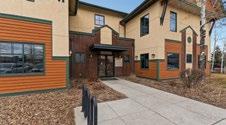
BASE Community Center is located in Town Center.
PHOTO BY JACK REANEY
ELECTION
BIG SKY SCHOOL DISTRICT
TWO CANDIDATES FOR ONE SEAT—THREE-YEAR TERM
MATTHEW DODD
Relevant involvement(s) in Big Sky community:
• Morningstar Learning Center board member (2014 - 2018)
• Various HOAs (2015 - present)
• LPHS Mock Trial coach (2019 - present)
• Big Sky Public Education Support Fund founder, president (2022 - present)
• Big Sky School District trustee, current vice board chair (2023 - present)
Reason for running for this position:
I am seeking re-election for the same reasons I ran in 2023—to use my knowledge, professional skills, and community connections to support the Big Sky School District. We have a duty to ensure our students, teachers, staff, and admin have what they need to be successful, in the classroom and out. As a long-time local lawyer with two kids in the District, I will continue to nurture the folks who are nurturing our children.
JONATHAN GANS
Relevant involvement(s) in Big Sky community:
• Ophir Elementary teacher in fifth and fourth grades (7 years); 11 years prior to that with MiamiDade County Public Schools
• Owner/operator of Rancho Picante Bison, participant in Big Sky Farmers Market since its inception
• Member of Navigator Network with Be Well Big Sky
• Active in Big Sky Community Theater productions
• As a development associate with Lone Mountain Land Company, played pivotal role in educating the community and generating support for the Cold Smoke Affordable Housing Project
Reason for running for this position:
With 18 years of experience as a National Board Certified Teacher, I bring a strong foundation in education and a deep commitment to this District. As a community engagement liaison at LMLC, I collaborate on local initiatives alongside BSRAD and BSCHT. I’m running for the school board to extend my service and help navigate the financial, enrollment, and operational challenges facing our schools.
PROPOSED BIG SKY WELLNESS/HOSPITAL DISTRICT (GALLATIN COUNTY)
FOUR CANDIDATES FOR THREE SEATS—INITIAL TERM LENGTHS VARY
MARILYN FLINT
Relevant involvement(s) in Big Sky community:
• 20-plus-year Big Sky resident
• Board member, Wellness In Action (WIA)
• Advocate for accessible local wellness resources
• Contributor to a range of local community initiatives, programs and events
• Retired business software consultant (cross-industry strategy & operations)
Reason for running for this position:
I understand firsthand how important local access to physical, mental and social health services can be. As a 20-plus-year Big Sky resident, I have relied on our health care network during life-changing health challenges and know how valuable stronger local support would be. Through my volunteer work supporting mental health and community giving, and my background as a business consultant, I bring thoughtful, data-informed decision-making to help strengthen resources for every stage of life.
LAURA SEYFANG
Relevant involvement(s) in Big Sky community:
• Officer with Big Sky Rotary Club
• Leader of Interact Youth Club
• Founding executive director of Big Sky Community Housing Trust
• Leader of Community Support Group for seasonal workers
• Board member for Big Sky Bandage
• President of All Saints Joint Council
Reason for running for this position:
I feel I am a good candidate for the Big Sky Hospital/Wellness District Board because I have worked with and led many local nonprofits which aim to improve the health and wellness of our community. I have significant experience starting up new organizations and as an industrial engineer, my process focus will help the board develop efficient and transparent systems. I look forward to helping make strong decisions about funding critical services.
KATIE GRICE
Relevant involvement(s) in Big Sky community:
• Vice president of sales, Boyne Resorts
• Wellness in Action Board of Directors (2020 - present)
• Big Sky Chamber of Commerce Board of Directors (2019 - 2026)
• Governor-appointed to the Tourism Advisory Council (2016 – 2022)
• Wellness District advocate and grassroots committee member from inception of initiative
Reason for running for this position:
Ensuring Big Sky’s immediate and future access to high-quality health and wellness related services is why I became an early advocate to forming the district, and why I am running to serve as a trustee. I believe thoughtful planning to meet real needs is critical to everyone calling Big Sky home, and I bring a commitment to collaboration, fiscal responsibility, and transparent decision-making that equally reflects the strength and resilience of our community.
SALLY STILWILL
Relevant involvement(s) in Big Sky community:
• Palliative care and Wellness Big Sky Community and Big Sky Medical Center—volunteer
• Committee on Aging Well in Big Sky
• Facilitator of family room renovation at Big Sky Medical Center
• Health care worker—physical therapist
• Facilitator of Befriender program in Big Sky connecting seniors with “friends”
Reason for running for this position:
I am running for this position as an advocate for Big Sky residents of all ages. I have a passion for making sure health and wellness needs are known and met. As a medical professional having lived in Big Sky for 25 years I have witnessed health needs of our community, and worked to promote opportunities for those living here. I want to be part of assuring awareness and accessibility to care in Big Sky.
BIG SKY RESORT AREA DISTRICT
THREE CANDIDATES FOR TWO SEATS—FOUR-YEAR TERM
LAYNEE JONES
Relevant involvement(s) in Big Sky community:
• Civil engineer and planner working on transportation and mapping in Big Sky
• Advocate for clean rivers and wildlife corridors, invasive weed warrior
• Lone Peak Film Festival board member
• Active Transportation Committee
• Eagle Mount Horse Program volunteer
Reason for running for this position:
Big Sky should be livable and affordable for locals, while maintaining a strong sense of place. Transportation is one piece of that, and it’s where my civil engineering background can make a real difference. I’ll focus on planning ahead, tracking development, and lining up infrastructure so we’re not playing catch-up—while giving our rivers and wild places a strong voice. You might know me from the Lone Peak Film Festival—homegrown and local at heart.
TAYLOR KISSELL
Relevant involvement(s) in Big Sky community:
• Business owner and employer
• CAP Mentor
BALLOT ITEM:
MICHELLE KENDZIORSKI
Relevant involvement(s) in Big Sky community:
• Executive Assistant, Big Sky Resort (2021 - present)
• Current BSRAD board member (appointed October 2024)
• Wellness in Action board member (2020 - present)
• Big Sky Softball League (2019 - 2024)
• Lone Peak Booster Club (2021 - 2023)
Reason for running for this position:
I am running for this position because when my boys and I moved from Belgrade to Big Sky in 2018, we found a true community where we have thrived. Big Sky has given us so much, and I want to give back. I have extensive experience in philanthropy management, strategic planning, stakeholder engagement, and community development, and I am committed to ensuring Big Sky continues to thrive as a vibrant community for all who call it home.
• Big Sky Christian Fellowship Elder Board
• Supporter of various education/teacher initiatives in Big Sky
Reason for running for this position: My wife, Steph and I have called Big Sky home for 20 years and are grateful to raise our family
CREATION OF WELLNESS/HOSPITAL DISTRICT
All registered Big Sky voters will see a ballot item regarding the creation of a hospital or wellness district.
For Madison County voters, a “yes” vote is to complete the withdrawal process from the
Madison Valley Hospital District, a process outlined in Senate Bill 260 which passed in 2025. Existing hospital district tax revenues would be redirected to a newly created district in Big Sky across an eight-year period.
here. As the community has evolved, the Big Sky Resort Area District has played a vital role in strengthening it and building sustainable infrastructure. I’m running for the BSRAD board to support this important work and help ensure a positive future for our families, businesses and community.
EDITOR’S NOTE: The following elections are acclaimed, meaning candidates will automatically earn a seat.
BIG SKY COUNTY WATER AND SEWER DISTRICT
Two candidates for two seats—four-year term
• AL MALINOWSKI
• PETER MANKA
BIG SKY FIRE DISTRICT
One candidate for one seat—three-year term
• RYAN CALLAN
PROPOSED BIG SKY WELLNESS/HOSPITAL DISTRICT (MADISON COUNTY)
Three candidates for three seats—initial term lengths vary
• PAULA CLEARY
• HEATHER MORRIS
• MIKE ROWE
For Gallatin County voters, a similar district would be created—no such district currently exists in Big Sky. Creation of this district would not enact any new taxes. Eventually, the board of trustees can ask voters for approval of potential tax structures.
BIG SKY LISTINGS
BIG SKY COMMERCIAL LISTINGS
ELECTION Q&A: BIG SKY WELLNESS DISTRICT
BY JACK REANEY
BIG SKY—Millions of taxpayer dollars that could fund health and wellness services in Big Sky are on the line. On May 5, ballots are due by mail or by drop-off for a local election that will ask Big Sky voters whether they’d like to create a hospital district, or a “wellness district” as it’s being called locally.
If voters on the Madison County side of Big Sky say “yes,” it wraps up the multi-year struggle that was resolved in Senate Bill 260 last year, and redirects roughly $23 million of existing taxpayer dollars into Big Sky over the next eight years—plus more moving forward.
On the Gallatin County side, voters can create a similar district that would link up and receive those dollars through an interlocal agreement to fund health and wellness services offered by providers such as the Bozeman Health Big Sky Medical Center, Wellness In Action and the Big Sky Community Food Bank.
After ballots are mailed April 17, voters will have a tremendous impact on Big Sky’s future.
The following questions were submitted by audience members during a live Q&A facilitated by Jack Reaney, senior editor of Explore Big Sky, on March 24 at The Waypoint. The full livestream is recorded and available on YouTube.
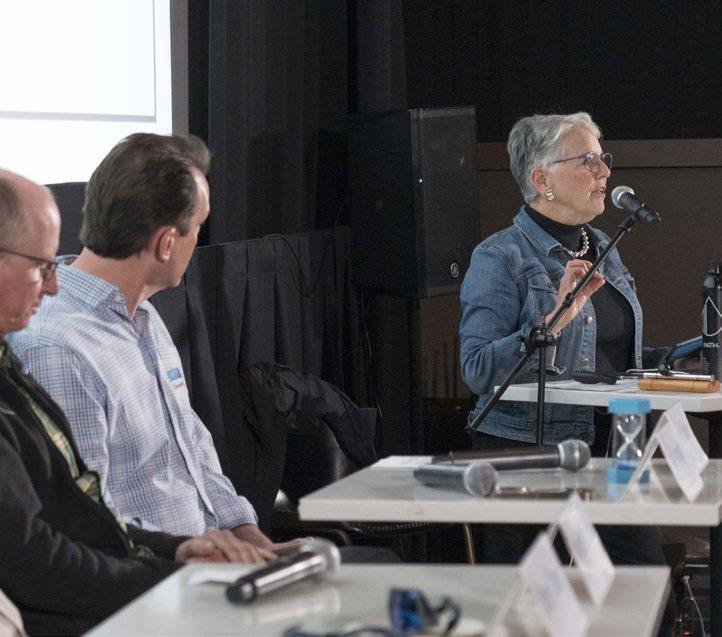
Panelists include local health and wellness leaders from the Big Sky Wellness Coalition: Katie Grice (Big Sky Resort), Kelly Halmes (Bozeman Health), Kiernan Volden (Wellness in Action) and Sarah Gaither (Big Sky Community Food Bank).
Some answers are condensed for readability and brevity.
Q: Could you each go through and give an idea of what the voter sentiment is around this ballot initiative to create the wellness district in each respective county? What do you think the voters think about this? Katie Grice: I’ve been involved since the beginning, right, since the initial conversations of, ‘What are the possibilities out there?’ I will tell you that prior to [Senate Bill] 260, there was a sentiment of concern, of what this means for the Madison County side of Big Sky—also making sure that the community of Ennis and the Madison Valley Hospital District are not being put in a really difficult situation... Senate Bill 260—the negotiation, the compromise that came out of that was because both sides... came to the table and agreed upon a solution that was going to work, but was also going to bring those meaningful dollars back into the community.
So for me, I am less concerned about voter sentiment, I am more [concerned about] the need to provide voter education. And also getting people to vote is critical.
Kelly Halmes: I have two things—I’ve heard a lot of people think this has already been passed, and already done. And they didn’t know about the May 5 [election]. So please, please, tell your friends we’re not done yet, we still have to get [voter approval].
And then the other thing I think is really special about Big Sky, [and] is very different from what’s happening in Madison [Valley], where all of the funding went straight to the hospital. That is not
how we’re gonna roll here in Big Sky. We have lots of people doing lots of amazing things in our community health partners, and so I think that’s super important to know that. That [the money] is going to be spread throughout the community.
Kiernan Volden: I also have two comments. I’d say the first is that Big Sky residents are excited about the fact that this creates local representation. So often, our community does not have people directly directing our funding that we collect in our communities. So I think it’s exciting that we have that chance now.
And the second is, on the Gallatin County side, I know it can be scary when we talk about special purpose districts, and potential new taxes. But I just want to clarify that this vote does not create any new taxes on the Gallatin County side. Any new taxes would have to be brought before the voters again, and voted on by our residents.
Sarah Gaither: I guess I would only add that, it feels like this vote is not as divisive as turf fields were last year. Which is maybe a problem, because we need people to vote.
So yeah, if it were more divisive, it might get a little more turnout. But yes, everybody please vote.
Q: What happens if we don’t get our votes, because of our post office?
Katie Grice: Yeah, so BASE is another location for ballot drop-off for Gallatin County... Pre-planning is the most important thing that we can possibly do, including just ensuring that you are registered to vote. I’ve had way too many conversations over the last few weeks where [people assumed] they were registered to vote, and they were not.
Q: Knowing how the money will be spent is, for me, very important for an educated vote. How will the money be spent?
Kiernan Volden: We unfortunately cannot answer that question. I know that is tough to hear, however, on April 21 there’s a candidate forum at the Warren Miller Performing Arts Center where you can hear from the trustees that will be on the ballot and can maybe share a little bit more then about what their priorities would be [for] how they would direct this funding throughout this community.
Again, this vote just creates the mechanism and [elects] the trustee positions that will go through a whole legal process to set up bylaws, how they will actually function... It is outlined in [Montana Code Annotated] what can be funded, and what cannot be funded.
Sarah Gaither: Just an additional thing that the community should know; While none of the coalition partners will be able to determine exactly where funding will go—of course, that’s up to the trustees—we have been working together for years, and we did just go through a strategic planning process and have outlined community needs in a pretty strategic way. And we have data behind the projects that we kind of want to tackle next. So there is that background that exists, that hopefully the trustees will be able to lean on.
Q: Kiernan, can you address the fact that there are two groups of trustees, [one each] from Madison County and Gallatin County.
Kiernan Volden: So there are sets of trustees since there are two districts, three [trustees] on each side. So the hope is... the two boards of trustees could work together through an interlocal agreement to be able to fund priorities across that boundary... [and] it isn’t separated by the counties within Big Sky.
One audience question asked whether anyone understood exactly how the interlocal agreement allows money to flow from the Madison side into facilities located in Gallatin County, to which all panelists shook their heads, “no.” When asked if that money exchange can happen, legally, panelists nodded their heads, “yes.”
Q: Are there any statistics on which employees [use] these services? Who recruits the employees who use these services? Because landowners bear these costs... If it was YC or Lone Mountain Land Company, or Moonlight, then they should be providing more services to their employees.
Sarah Gaither: People who use the food bank are largely our workforce, you know? There are a wide variety of folks from every employer... and I’m seeing it’s about 25% of the seasonal workforce for every employer. So whether that’s a small business, or whether that’s one of our giant businesses.
Kiernan Volden: I would say from [Wellness in Action’s] perspective, we definitely see a range of community members but I will share that... upwards of 25% to 30% of individuals accessing counseling services through our partners are local youth aged 0 to 11. So there’s definitely a lot of long-term local families using these [resources] that aren’t just seasonal workforce.
About 25% to 30% of counseling clients are seasonal workers. Most individuals, about 75% have a 59716 Big Sky zip code, and about 10% in addition to that have a 59730 Gallatin Gateway zip code [which includes part of Big Sky]. So many of the people using and accessing, at least,
ADOBE STOCK PHOTO / EBS DESIGN
Wellness in Action services are folks that identify as long-term residents.
Kelly Halmes: I would say our family med practice is mostly locals as well, and our mental health is very similar statistics as yours.
EBS: Cool, we have a couple of questions asking about how much money is actually at stake here. One of our writers has suggested that it might be $23 million at some point over the next eight years, so maybe we can confirm that number. [Also], more specificity around our estimate of how much these interlocally joined districts might generate long term.
Katie Grice: The primary question is, what kind of money are we talking about? SB 260’s established framework is the negotiation that allows us an eight-year step down with upwards of $23 to $24 million coming back into the Big Sky community, collected by Big Sky taxpayers over the next eightyear period.
So we’re talking meaningful dollars that are coming in—this is not that far away, this is soon, if we can establish this... That is just on the Madison County side. There is also opportunity if voters approve later on, for additional funds [to be collected] on the Gallatin County side.... This is only effective if both counties are establishing districts.
Q: Cost of primary care in Big Sky is about 30% to 50% higher than in Bozeman (according to audience member)... Will the cost of primary care here in Big Sky be reduced? Also, trauma patients here in Big Sky are overwhelmingly visitors, compared to residents. Maybe we can balance the way that costs can potentially offset costs for locals and residents?
Kelly Halmes: [That is] correct, we are about 22% to 25% more expensive than Bozeman, and that’s just truly because it costs more to keep the electricity on and the heat on, and all the things. So yes, we are.
We gave over $6 million of discounted patient visits in the last 10 years, so we do have a pretty robust patient financial service department. But it could always be better... There is funding that could be made bigger with wellness district funding. But that’s, again—we have to vote the whole initiative in, and that will be the trustees that decide [allocation of funds].
Trauma patients—I don’t know. That’s a really hard question... I could get that data for the next time we do this [at Ballots and Breakfast].
EBS: So just to confirm, it sounds like with a wellness district, it’s possible that some of the funds could be used to help keep the costs of primary care down, and reduce those costs for residents?
Kelly Halmes: Potentially, yeah. Potentially.
Q: We’re talking a lot about funding wellness—and we’ve seen some of the definitions of what wellness can be, between social services, food security, mental health, etc. Does that include environmental wellness? For example, pollution to the Gallatin River. Kiernan Volden: I’d go back to that Montana Code... In general, it’s restricted to hospital and hospital-related services... I would say probably not, for this funding mechanism.
Sarah Gaither: But, if people had to pay less for the health care and wellness services, they would have more money to donate to the river.
Q: Does this move or change the county line? Or just where the taxes paid go.
Kiernan Volden: No county lines will be moved with this vote.
Q: Can funds be used toward a nursing home or elder care?
Katie Grice: [Montana Code] does point to that being permitted and allowed. That’s up to the trustees to determine.
Q: It’s not clear who can vote. Is this just property owners? Is this renters? Registered voters in Montana? Registered voters in Gallatin County? Who’s voting for these districts?
Katie Grice: Registered voters within the district. How do you know [if you’re registered]? You use that QR code (votemt.gov) and double check that you are registered to vote.
Q: To follow up: we have a lot of workforce that may live here for a year, or two years, and they’re originally from Ohio... How do you deal with those?
Katie Grice: You need to first go and understand where you sit as a registered voter. And then if you’re not registered to vote, then you go through the voter registration requirements from there.
Sarah Gaither: Just to be explicit, you can only be registered to vote in one place. You can’t be registered to vote and vote in the same election in Ohio, and here. You have to change your registration status to here.
Q: Can you talk a little bit more about the elected trustees. They can be anyone? How long [do they] serve for? Already decided for Madison but not yet for Gallatin?
Katie Grice: The trustee [candidates] will be at the April 21 candidate forum. [On Madison County side], all three trustees are ‘acclaimed’ because there were three seats that were open. Now, the important part about these seats is that they will have established terms—so one-year term, two-year term and a three-year term, and that’s for both the Madison side and the Gallatin County side... We need to start by staggering those trustees so that it makes those election processes easier in the future... The eligibility to be a trustee is to live in that area, as well.
Q: What if this were to only pass in one of the counties? What if this only passes in Gallatin County, not in Madison County. Would they forfeit the money that’s laid out in Senate Bill 260?
Katie Grice: Listen, it’s critical. It has to happen. It has to happen, right? This will be meaningful only with both sides forming. If it passes on the Gallatin side but not on the Madison side—my goodness, those three-and-a-half to four years of efforts to get to this point... those funds would not be [brought in]... in a meaningful way to the Big Sky community.
Paula Cleary (trustee candidate for Madison side): The money from Madison Couty won’t be able to come down the hill unless there’s a vehicle to receive it.
Q: How much money potentially is available this year?
Katie Grice: I believe the estimate was about $800,000 within the next 12 months that has the opportunity to come into the Big Sky community.
Q: If there ends up being three representatives from Madison County, three representatives from Gallatin County, what’s to say that Madison County doesn’t approve that [funding] for the folks that are standing here? What if they want something that is closer to their homes?
Katie Grice: Well, I mean, you’re right. I think that is the beautiful part of having elected representation from within the community to make decisions for
the community too. And that’s why an interlocal agreement is going to be critical for getting both pieces, and the vision is to have two boards that are working and facing the same direction—much like our [Wellness] Coalition partners as well.
Paula Cleary (trustee candidate for Madison side): My answer is, I have no interest in building a hospital right now.
Daniel Bierschwale (BSRAD staff): I think it’s safe to say the intention of the entire initiative is to ensure that the service area of Big Sky, which includes the meadow and the mountain, is congruent with how we all use it. I don’t want to speak on behalf of a future board member, but I believe... our intention is to make both counties work. And ensure that the services that our currently being provided are supported by the $23 million surplus.
... [Trustees] could do whatever they want with the money. What is being told to you today, and the intention behind both of these boards when they get set up, is to operate through an interlocal agreement. That’s why this initiative is happening on both sides of the county... What we can speak to today is intention, but to be blatantly honest—to the point that you’re making—if they wanted to build a hospital up there, they could.
Q: Will this relieve some of the pressure on Resort Tax, which is currently funding a number of health and wellness nonprofits in Big Sky, for example.
Daniel Bierschwale (BSRAD staff): Yes. Yes it does. We will be here to support all of these initiatives until this is off the ground... It will alleviate some pressure on BSRAD.
Q: Sounds like there was a survey that the [Wellness] Coalition distributed... when was the survey circulated, and how can they find the results?
Kiernen Volden: Yeah, we’ve done several surveys over the past few years. The hospital and HRDC need to do needs assessments every year. We’ve recently done one this winter that was distributed November through February through all of our partner channels, through Explore Big Sky, and many other businesses and community partners in Big Sky.
That was in partnership with the Katz Amsterdam Foundation, which does the same survey of mental and behavioral health specifically across 11 Mountain West resort town communities, including Big Sky... That one was specific to mental and behavioral health. The results are not yet available, but should be available by the beginning of May to our community... distributed out through all of the partners as well, through our website, and e-blasts, things like that.
Sarah Gaither: Katz Amsterdam has a really cool dashboard where you can find historical data for all of the mountain communities. Over the course of the last 10 years, maybe longer. They’ve been doing it for a long time, I think this was Big Sky’s first involvement.
Q: Say, if Madison said no, and Gallatin said yes— could we still have another vote of tax dollars coming through to continue funding the Gallatin side for those trustees to create a framework?
Paula Cleary (trustee candidate for Madison side): No. This is your once chance to get it right.
Katie Grice: ... Yes, I think you can. The money to do so would be challenging. The voter fatigue would be challenging. This is our shot to do this... we have to right now.
BOZEMAN
MONTANA STATE’S 50TH POWWOW GATHERS HUNDREDS
‘WE’RE STILL HERE’: 50 YEARS AFTER ITS OFFICIAL START, THE STUDENT-ORGANIZED POWWOW CELEBRATES MILESTONE
BY JEN CLANCEY
BOZEMAN—Titan Brockie felt emotional as he watched more than 100 dancers circle the floor of Montana State University’s Brick Breeden Fieldhouse on Friday, March 27.
“Just in that moment, you know, seeing all those dancers in the grand entry fill up the dance floor made me really, really emotional. Made me feel really good in my heart,” he said.
Brockie is an Aaniiih and Diné MSU engineering student from Montana, the co-president of the MSU American Indian Council, and a member of the powwow’s co-host drum, the Bobcat Singers. For the past year, Brockie and the AIC have planned for the 50th MSU AIC Powwow to be the biggest yet, reaching out to sponsors, coordinating with drum groups and sharing communications about the event.
Powwows are important gatherings for Indigenous peoples to visit with relatives and friends, exchange culture, craft, and share and compete in dance and singing. AIC Co-President Michaiah Pease described the significance of the half-century anniversary of the MSU AIC Powwow.
“So the 50th anniversary here in Bozeman is a huge milestone for us, just because our community has been through a lot. We’ve been through a lot of assimilation, genocide and then we’re still here,” Pease told EBS.
Pease is from Billings and is Aaniiih and Apsáalooke. She began going to MSU AIC Powwow in high school and now studies environmental engineering at MSU. Powwows are a place where she can be her authentic self, she said, and reconnect with family and friends.
“It’s a lot of people that I don’t just get to see on the regular,” Pease said. “Especially being away from home here in Bozeman, being able to host them here … It’s something I’m really grateful to be a part of.”
While leadership responsibilities may have kept Pease from competing in the Crow Style dance competition, other dancers on the fieldhouse floor pinned numbers to their attire and talked with friends and family.
One dancer, Caroline Spotted Eagle of Arizona, noted that she learned Women’s Traditional dance, specifically Northern Cloth, from her grandpa, who dances Men’s Traditional. She said that dance for her is a way to remember and honor loved ones.
“For me when I dance, I just dance for ones that passed … I just think of my loved ones and my friends and family and I dance for them,” Spotted Eagle said. She grew up watching dancers and would practice in Intertribals, like the one happening on the floor while she spoke with EBS.
Spotted Eagle, who is Blackfeet and Zuni, recently started dancing again with her sister, and she looked forward to an energetic night for the competition.
“I’m pretty excited for that and we have a big crowd tonight. It does feel really lively,” Spotted Eagle said.
Henry Pretty On Top, of Lodge Grass, danced Crow Style at the MSU AIC Powwow. A recent addition to the MSU powwow lineup, AIC added Crow Style to honor relatives from the reservation located in south-central Montana. Pretty On Top, who is Crow and Navajo, has danced since he was very young, and described what Crow Style means to him.
“This style of dancing is pretty much ancient and to us. It’s sacred, a sacred way of dancing and it holds a lot of power,” he said. The 50th powwow is Pretty On Top’s first in Bozeman, but he’s traveled and danced at powwows across Montana. He was happy to see many generations take the floor during the grand entry.
“It also brings me joy that the little ones love to dance as well,” Pretty On Top added. “All the elders come out and dance and that’s what motivates me to dance as much as I can.”
the co-host drum, a group from Saskatchewan, Canada that has played since the ‘80s. The event schedule included time to honor veterans, faculty, staff, student leaders, Head Woman Riley Werk and Head Man Cleveland Leider. The MSU powwow also honors outgoing and incoming Miss Indian MSU Royalty. The list continues.
Watson Whitford, AIC social chair and an environmental horticulture student, explained that sources for funding came from all over, including local businesses, nearby donors, tribal organizations and from MSU academic departments and leaders. A powwow class led by Lisa Perry, director of American Indian and Alaska Native Student
How students pull together a powwow
On April 30, 1976, MSU held its first official powwow in the fieldhouse, but its roots date back to the 1960s, when a small group of Native students organized a powwow at the Darigold building on Bozeman’s North Seventh Avenue.
Decades later, students still organize the event.
This year, council members raised around $70,000, planned for the arrival of 13 contest drum groups, and welcomed 565 registered dancers across new and old styles. They also invited Blackstone as
The powwow hosted over 500 dancers, many of whom took the floor with friends and family in the Intertribal.
PHOTO BY FISCHER GENAU
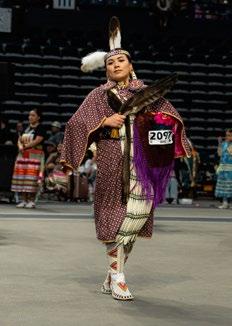
Caroline Spotted Eagle in the Women's Traditional. PHOTO BY FISCHER GENAU
Brockie noted that financial support helps make these events happen.
lost somebody, they could go to a powwow and they might see somebody that might make ’em feel good.”
MSU Billings and University of Montana, leading into larger powwows as the weather warms.
The Apsáalooke Nation Lady Warriors Honor Guard. PHOTO BY FISCHER GENAU
‘I
DON’T QUIT EASY’: Q&A WITH PEAK SKIS FOUNDER BODE MILLER
MILLER ‘100% COMMITTED’ TO DISRUPTING STAGNANT INDUSTRY; STILL WORKING
PAY OVERDUE WAGES
BY JACK REANEY
Editor’s note: Explore Big Sky’s publisher, Outlaw Partners, previously held a marketing partnership with Peak Skis until 2024.
PARK CITY, Utah—Bode Miller is determined to upend the ski manufacturing industry. On that quest, he’s had to put out a couple fires.
His latest venture, Peak Skis, began with an exciting, award-winning launch for winter 202223, but the brand fell upon hard times after about two years. Stories by the Colorado Sun and various ski-focused publications reported on a “collapse,” including employees and athlete-ambassadors like Michelle Parker and Chris Davenport going unpaid, a website going dark with no announcement, and the apparent failure of Peak’s unique direct-to-consumer model.
Miller, the brand’s co-founder, argues those reports were not entirely factual, and that the brand never died, despite recent announcements and fresh energy backed by support from new partners: businessman David Whitlock, and former Olympian and ski industry exec David Currier.
When Miller posted on social media in January 2026 announcing, “2026 Peak Skis are LIVE,” many skiers and media deemed it a resurrection following a quiet 2024-25 when Peak offered a very limited product line and the website went dark. In a separate post the next day, he wrote, “Thank you again for your support and I am personally looking forward to Peak 2.0.”
In a January email to investors and customers, Miller took accountability for “serious mistakes” that lost the trust of many supporters. “I owe
you complete honesty, and I owe you an apology,” he wrote.
He added Peak’s commitment to rebuilding in a sustainable way: “Peak is back—more focused, more disciplined, and more committed than ever to doing things right.”
In a separate email days later, Miller thanked supporters for patience, honesty and support. “If you’re willing to give Peak another shot, I promise we’ll meet you with better execution, better communication, and the same obsession with performance that started this whole thing,” he wrote.
Many, including those owed money, have expressed skepticism with the brand’s current positioning.
From the start, Miller and co-founder Andy Wirth believed Peak’s innovative approach to ski manufacturing brought the “secret sauce” that would overcome difficult economics, paired alongside their direct-to-consumer model. It required a heavy payroll and a heavy burn rate, Miller explained, and certain decisions—like a “super cool” showroom in Bozeman’s Four Corners—were expensive and didn’t generate revenue.
They sought to be contrarians in the industry. Miller likened their approach to his all-or-nothing race style—sometimes it won him races, other times he crashed hard. But even with Peak going the way of the latter, Miller is confident in giving it another go.
On March 19, Miller spoke on the phone with Explore Big Sky to discuss his perspective on how Peak lost its way, and how he’s working to rebuild and reconcile.
Explore Big Sky: Let’s start with the recent news: What’s the current plan for Peak Skis?
Bode Miller: Well, the current plan is the same as the original plan. It’s just a scaling back of the ski division.... There’s nothing new. I mean, “Peak 2.0” was just a thing that caught on somehow. There’s nothing different—all the investors are the same, everybody who invested is still there in whole. And we still have skis. The website went dark because, basically, we had to let everybody go.
... We moved down to Park City, because that’s where I’ve been living and it’s just closer. We only have a limited [quantity] and models of skis. But we’re just going forward with that. The idea now is just to focus on the part that was the most critical from the beginning—I got sidetracked into building skis, because I like building good skis, and I like seeing people ski on skis that I build. And unfortunately... we sunk all of our money and all of our effort and time into that side of the business, and weren’t able to advance on the manufacturing side. So now I’m pretty singularly focused on the manufacturing, although I’m still being distracted by selling and fulfilling orders for skis now.
It’s at least at a healthy place, where the majority of my energy and time is going to this manufacturing solution. Ultimately once that’s done, it changes the whole model for not just Peak, but for ski companies all around. Because the whole business model was never to just build Peak Skis. It was to create a manufacturing solution so that we would build skis for everybody else with our technology— whether that was us doing white label for everybody in the beginning and then ultimately, licensing or selling the technology to lots of different companies so that they can build skis that way.
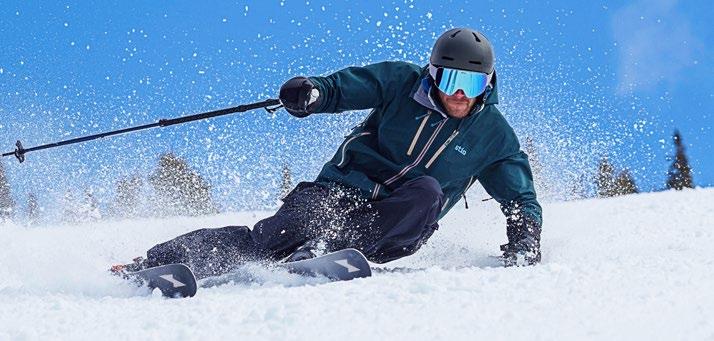
Former Olympian Bode Miller carves on a debut model of Peak Skis. COURTESY OF PEAK SKIS
EBS: Cool. Ok, so you mentioned “no Peak 2.0.” I saw there was an announcement maybe two months ago, from you, about Peak Skis kind of being back. Can you just clarify, what did that mean?
BM: Well, I think the general perception was mostly media-driven, which just didn’t have any information... I was in the midst of sort of managing the situation of letting employees go, getting out of our [Bozeman] headquarters, so I didn’t put much energy into managing the narrative or the story.
And the people who did, like [Chris] Davenport, really seeded one story where he was owed $50,000 of bonuses that he wasn’t paid. So, he kind of drove that [Colorado Sun story] and that kind of became the narrative. And it just was—no part of it was factually correct, really, but as you can imagine I’ve been around media enough to know... at that time I had enough important things to work on that I didn’t really spend any energy on it.
So yeah, Peak 2.0 but nothing different, right? ... A couple of guys, Dave Currier and Dave Whitlock stepped up and said, ‘Hey, we’ll help you to sort of soft-land this thing into what it should be’... The perception was that it was something different or investors had gone away and now we’re restarting it. None of that is true at all, it’s just the same thing.
All of our organizational structures, all the investments, all the cap table, all of our liabilities are still there. We’re just managing those and paying them down to the best of our ability. We paid a bunch of athletes and a bunch of our employees that had back-wages. We paid them, like, 35% of what they’re owed and we’re working through that list. But at the same time, I’m primarily focused on the manufacturing solution, ‘cause that’s where ultimately things actually work, and the company becomes what it should be.
And I’m still 100% committed to that, and I’ll get it done. But it was just a lack of information... it’s a small industry in a lot of ways, and once rumors kind of start, they just kind of go. No one really cares if they’re true or not, they just kind of repeat, and go.
... I’ve never said the company was done, I’ve never packed up shop. We had to make adjustments because we just didn’t have any more money and the system we were using was not sustainable. We were losing money, year-over-year, even though our skis were basically selling out. We became a perfect case study of why we need a manufacturing change in the business.
EBS: Thanks for discussing that. So, at this point, who is still involved in the business? Are there any athletes or ambassadors, and is Andy Wirth still involved? BM: So, we let everybody go. We have no paid employees, we have a warehouse that obviously costs us a little bit of money to store skis in down here [in Utah] but it’s nothing like the old HQ up in Four Corners [Bozeman].
Andy stepped away from the company—still a great friend. There was nothing malicious about anything that he did. He put his ass into this thing. Very few people have a work ethic like he does. He’s the third or fourth biggest investor of cash dollars into the company... anyone saying, like, he made off with investor money, the opposite is true. He borrowed my car because he sold his truck and put that money into Peak.
So, the structure now is me. Running all parts, making all decisions, and David Whitlock and David Currier are helping with kind of restructuring, and helping with all the logistics. They've been great. They've been in the warehouse here. They pack and fulfill orders. You know, kind
of re-set-up the website just to facilitate getting skis out to people. They’re not paid employees, they got a small compensation package of, kind of, options, and that’s it.
So, it’s now, what I would consider to be sustainable to get us through this period [so] I can finish the manufacturing solution.
EBS: Can you tell me just a bit more about what you mean by the manufacturing solution?
BM: Yeah, I mean a lot of it is being protected now [as intellectual property] and that’s kind of an ongoing process so I don’t want to get too detailed.
But essentially, ski manufacturing hasn’t changed since Howard Head build the first laminate skis in the late 50s, early 60s... It takes a really long time, it’s really messy, it’s really inconsistent, there’s a ton of variables in there. It’s expensive and it’s laborintensive. So, for a long time, I’ve known there was a better way to do it.
... Basically, it’s a way to build skis is a new way across the board which will make them way more consistent, [with better] performance and ability to use more, kind of, modern materials... Mold costs, efficiency, labor, recyclability—everything is basically different and much, much better across the board. We’re talking orders of magnitude better.
So, being able to build skis in somewhere between under a second per pair, to a few seconds per pair. No mold cost, and [being] able to change prototypes, and dictate all the different characteristics: force vectors and flex, and torsion, weight and all that baked into the same automated process.
So, something that I feel like will be a real legacy move in the space, right? We haven’t changed in 60 years. Just logically, if something hasn’t changed in 60 years and it’s a global standard industry, then there’s probably an opportunity there. And that’s what I believe I’m solving for, and I believe it will be a massive, massive shift for the industry, all the way to the top... Just to make skis way better, way safer, way more fun.
EBS: Fascinating. Alright, just a couple more for you. As you move forward, what do you expect the Peak product line to be? Do you still plan to have the same array of widths and lengths, or are you simplifying?
BM: Economically, it made no sense. If you’re going to do that, you’re going to lose money, year over year, unless you get above, call it, 10-to-12thousand pairs of skis. You can run super-duper lean and do OK below that, but in this case it just didn’t make any sense.
So we have 88 [millimeters] and 98s, which are both the new models of those skis, and we’ll sell those the end of this [ski season], over the summer and into next year—we’re not ordering new skis.
So we have all the sizes of the 88 and 98, and the 88 is the new geometry—the first of the geometry that I built—the other [88] was an open mold from Elan.
So, it will be very limited from within the Peak brand. And as we spool up the manufacturing, then we’ll expand to a full line.
EBS: And when you say ‘full line,’ does that include 104s, 110s?
BM: Yeah, and also wider. You know, I built a 118 with Crosson [a company that merged with Peak] that I loved, that I would love to build. And it just becomes way more cost effective—right now, there’s no way to do that really without just losing a bunch of money.
So yeah, it will be a full line. We’ll expand—we’ll build race skis. I’ve always wanted to build race skis that were sort of, call it ‘American-made’ that were exclusive to American and Canadian racers. Europeans have had a dominant position in that space for a long time... we’ll build really good kids skis.
It will be kind of a much more comprehensive line than what we had before, because it will be economically sound.
EBS: So, many of your early adopters live in Big Sky and Bozeman, and that’s the same with many of our readers. Do you have any additional thoughts you want to share, especially with these, kind of, ‘day-one’ supporters that are skiing at Bridger Bowl and Big Sky? BM: I mean, obviously that was the whole point of it. To build good skis for people who live that lifestyle and care about what they’re skiing on, and want to have fun. And I appreciate people supporting the company, and I hope they’re happy with the product.
I think there hasn’t really been any knocks against [the skis]. I think the product spoke for itself and was really strong. I think we offered it at a very competitive price.
“I DON’T KNOW IF PEOPLE FOLLOWED MY RACE CAREER AND EVERYTHING ELSE, BUT I’M NOT A QUITTER... I THINK WE DID A LOT OF REALLY GREAT STUFF AND ACCOMPLISHED A LOT, AND THEN HAD SOME DIFFICULTIES. SOME STRUGGLES AND SOME SETBACKS.”
- BODE MILLER, HALL-OF-FAME SKIER AND FOUNDER OF PEAK SKIS
So in that sense, just to clarify that nothing has changed: I don’t quit easy. I mean, I don’t know if people followed my race career and everything else, but I’m not a quitter. And I wouldn’t have started this if I didn’t anticipate that things could go, you know, really well or really tough... I think we did a lot of really great stuff and accomplished a lot, and then had some difficulties. Some struggles and some setbacks.
But ultimately, I know that the solution that I’m coming up with will be really important for the industry as a whole, as well as for all my investors and supporters. So I’m committed to seeing that through and getting it done. And yeah, that’s it, really.
EBS: Well, thank you for your time Bode, and good luck with things moving forward.
Where Business Meets Passion
FROM BIG SKY TO BOZEMAN
TRES TOROS EXPANDS ITS FRESH TAKE ON MEXICAN CUISINE
BY LESLIE KILGORE
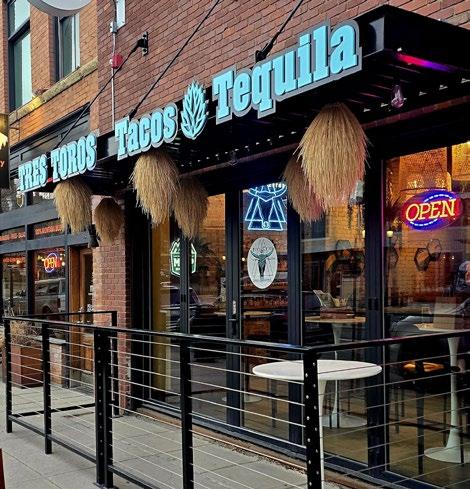
BOZEMAN—After building a loyal following in Big Sky, Tres Toros Tacos and Tequila has expanded to Bozeman, bringing its made-from-scratch Mexican-inspired cuisine and a vibrant cocktail menu to downtown Main Street.
At the helm of the growing restaurant is Executive Chef Brandon Blanchard, who owns both restaurants with well-known Big Sky restaurateurs, Twist and Jaime Thompson. Twist said the second location was the result of persistence and vision.
“It was a match meant to be,” Thompson said. “With my knowledge in opening and owning several restaurants with Jaime, Jaime’s incredible restaurant design skills, and Brandon’s culinary expertise, the concept worked from the start.”
Blanchard originally hoped to launch a restaurant in Bozeman several years ago, but ran into a challenge familiar to local restaurant owners: the city’s limited liquor licenses.
“In Gallatin County, there are city liquor licenses, and there are county liquor licenses,” Blanchard explained. “City liquor licenses, for whatever reason, they don’t seem to be adding anymore.”
The scarcity and current prices of liquor licenses in Bozeman make them difficult for most restaurant owners to obtain.
In 2022, the Thompsons aspired to open a modern Mexican restaurant as Big Sky continued to grow, particularly after seeing the success of their popular sushi restaurant, Blue Buddha Sushi Lounge. That’s when the two parties began to talk about concepts for a new Big Sky restaurant.
Tres Toros quickly gained momentum, winning "Best Restaurant in Big Sky" two out of the three years it has been open in Bozeman Magazine's Bozeman's Choice awards.
Shortly after, Blanchard said Jim Harris, owner of Bozeman Spirits Distillery and a frequent guest at the Big Sky restaurant, approached him with an idea.
“He informed us that he had a space next to the distillery. It had been vacant for many months, and asked if we’d be interested in starting a Tres Toros there,” Blanchard said. “So that’s how it all came about.”
The arrangement allows Tres Toros Bozeman to operate through a concession agreement tied to the
distillery’s liquor license, a common workaround in Bozeman.
While the restaurant has grown quickly, Blanchard believes the core of its success is keeping the menu rooted in from-scratch recipes.
“Every morning we make everything in-house,” he said. “The chips, the seasoning on the chips, the salsas. Everything is made from scratch except for the tres leches and the churros.”
The approach is the opposite of what Blanchard said he notices at many Americanized Mexican restaurants.
“I feel like a lot of Mexican restaurants try to Americanize their food. It’s a little cheese-heavy, and a lot of deep-fried stuff. We wanted to do the opposite.”
The result, he said, is a fresher menu like elote street corn, loaded nachos and birria tacos, some of the restaurant’s most popular items. Blanchard explained the scratch-made approach also helps keep food costs down.
“It’s actually cheaper to make everything from scratch,” he said. “And it’s more flavorful.”
The Bozeman location opened just two months ago and was intentionally designed to mirror the Big Sky restaurant.
Within 60 days of opening, Tres Toros Bozeman was named "Best Mexican Restaurant" in the Bozeman's Choice awards.
While the menu is the same, the two locations serve slightly different communities. Blanchard said Big Sky still sees the heaviest traffic thanks to tourism and the ski economy, while Bozeman draws more locals.
“Big Sky is locals that ski and party and tourists who are on vacation, who are relaxed and drinking more cocktails,” Blanchard said. “Bozeman is more of a local working community.”
Looking ahead, Blanchard said their focus is on continuing to grow the restaurant’s presence in Bozeman, and that becoming a downtown staple of Bozeman is the goal.
“We’ve been lucky enough to obtain two fantastic locations for a restaurant concept that now works in both Big Sky and Bozeman,” Thompson said. “And it’s only going to get better from here.”
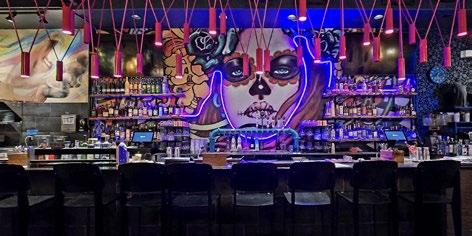
Tres Toros, already a popular hub in Big Sky, has expanded to downtown Bozeman. PHOTO COURTESY OF TRES TOROS TACOS AND TEQUILA
The mural and space in the new Bozeman location of Tres Toros is meant to embrace what patrons are familiar with in Big Sky, catered to a fresh audiance. PHOTO COURTESY OF TRES TOROS TACOS AND TEQUILA
SPORTS
RYAN MALINOWSKI, EBE GRABOW EARN ALL-CONF. BASKETBALL HONORS
GRABOW BECOMES FOURTH-EVER ALL-STATE SELECTION
BY JACK REANEY
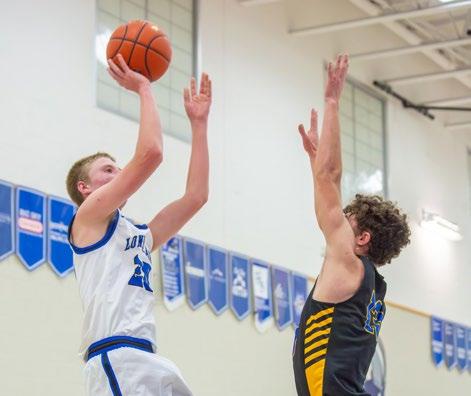
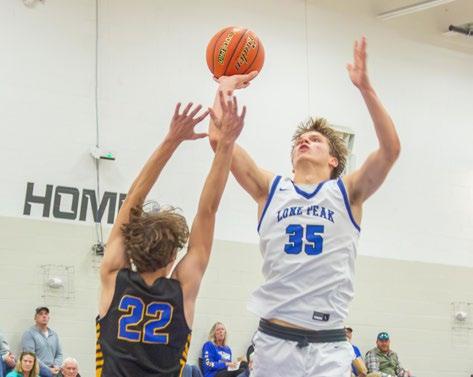
BIG SKY—The two guys who connected for a spectacular alley-oop dunk in February have been recognized for their wider body of work leading Lone Peak High School’s basketball team.
Senior Ebe Grabow earned all-state basketball recognition from opposing coaches in district 5B, becoming the fourth all-state baller in program history alongside Isaac Bedway (2025), Max Romney (2023) and Eddie Stars (2017). Meanwhile, Junior Ryan Malinowski was named first-team all-conference for District 5B, a feat also attained by Grabow. Only six players from seven teams earned first-team all-conference.
Grabow, who will play football at Montana State University, finished his career at second on Lone Peak’s all-time scoring list, with 1,210 points, and is one of three players to top 1,000 points. He also finished second all-time in 2-point shots with 383, fourth in 3-pointers with 90, fourth in rebounds with 361, third in steals with 168, and second in assists with 226. His senior season included career highs in total points with 344, and points per game with 17.2.
Head coach Al Malinowski called Grabow one of the most well-rounded players in school history. He earned similar accolades including division MVP during his senior football season.
Sharp-shooting Ryan Malinowski scored 372 points in his junior season, averaging 18.6 points per game—good for third-best in program history behind two productive seasons put up by Eddie Starz. For the regular season, Malinowski led District 5B in scoring, 3-pointers with 58, and free
throw shooting percentage with 75%. He also led the district in 3-point shooting last season, and he set school records this season with eight 3-pointers in a single game, 64 in a single season and 143 in his continuing career.
Malinowski has scored 716 points in his threeyear career, and sits at sixth all-time in Lone Peak
scoring. He also is fifth all-time in career assists with 138.
He earned Montana High School Association Male Athlete of the Week in January.
“In my opinion, post-season awards are a compliment to our entire program,” coach Malinowski stated in an email to EBS. “While the awards recognize individual players, they are a reflection of both our team's success and the achievements of those players selected. For our relatively young roster to earn an 11-9 record against the difficult schedule we played this season was a challenge, and I am proud of our accomplishments.”
Malinowski noted that the team did not achieve all of its goals this season—the season ended with a quick exit from the district tournament—but the all-conference awards are a reflection of the respect the Big Horns have earned in their three seasons in Class B.
“Their selections are also a testament to their own athletic talents and hard work,” Malinowski stated. “I know I speak for the other players and coaches in congratulating them on their achievements.”
2025-26 was the fourth consecutive season in which two Big Horn boys earned all-conference honors, and the second consecutive season both LPHS players were first-team selections.
The Lone Peak girls team did not have any selections for the 2026 season.
Lone Peak junior Ryan Malinowski. PHOTO BY JACK REANEY
Lone Peak senior Ebe Grabow. PHOTO BY JACK REANEY
THE SHIP NEEDS A CAPTAIN: A CALL FOR LEADERSHIP IN THE COLORADO RIVER BASIN ENVIRONMENT
BY PAGE BUONO AND SINJIN EBERLE AMERICAN RIVERS
The situation is clear: the precipitation outlook in the Colorado River Basin is dire, the river cannot sustain the demands placed on it, and this year we’re likely to face unprecedented management decisions with potentially catastrophic consequences.
Despite decades of warnings and years of negotiations, there remains no clear blueprint for how the West can live with less water. That future is no longer hypothetical—it is already here.
We often talk about the Colorado River and drought in ways that can feel removed, impersonal, abstract and buried in jargon. But beneath the stories, there are real lives, livelihoods, ecosystems and traditions that make the region what it is, and that are very much at stake.
On March 3, for example, the US Drought Monitor released their latest report, revealing that snow-water equivalent is less than 70% of normal across the Central Rockies, and less than 50% in the Four Corners.
Snow water equivalent is essentially how the water in the snow translates to real, wet water—the kind rivers and people rely on. By some accounts, the prediction for this year’s total is now on par with— and potentially worse than—2002, which previously held the record for one of the worst water years on the Colorado River. For those who live in the region, the catastrophic wildfires of 2002 are not abstract: the Hayman fire burned for over a month, killed six people, destroyed more than 600 homes, and amounted to estimates of $42 million worth in damages. That same year, Arizona experienced the
Rodeo-Chediski fire, which burned nearly half a million acres.
But it isn’t just one fire in one year—throughout the Southwest and in California, regions are experiencing some of the largest, most catastrophic wildfires in history, and they’re occurring much more frequently.
Fires are just one way that the consequences of this hydrology are real.
Bad water years are felt by farmers and ranchers crunching the numbers and being forced to make impossible decisions about land, crops and cattle. They are felt by entire communities and businesses facing water cutbacks and rising energy costs. They are felt by rivers warming beyond what fish and wildlife can withstand and by forests burning hotter and longer. They are felt most by families who can least afford the inevitable lack of access to fresh water, threats of wildfires, and energy rate hikes. It’s not one dry year that has placed the Colorado River and all who rely on it in peril; it’s decades of drought amplified by warming temperatures and a system still adjusting, or refusing to adjust, to the reality of a smaller river. The sponge is wrung dry, and we’re a long way from re-saturation. A “Miracle May” might be welcome, but it cannot erase two
decades of declining flows and depleted reservoirs to save us at this point.
Aquifers are drained. Soils are thirsty, trees are thirsty, animals are thirsty. And we are thirsty and grow thirstier—continuing to promise water in a region that’s long been in debt.
We cannot stop the drought or the wildfires. We cannot get more water into Lake Powell than Mother Nature will provide, without significant impacts to communities and economies.
The one thing we do have control over is how we respond. Though there are variables we can’t predict, we can control our collective actions. The reality is less water, and we must start there. With collaboration, transparency, and reliable funding, the West that is grounded in reality and capable of proactively managing scarcity rather than through litigation and denial. The opportunity to manage the river with the river itself at the core of considerations is now. And any leadership, any blueprint for the future must center the fact that without a healthy river, we can’t have healthy communities, economies, or ecosystems.
But that future is contingent upon leadership, and developing and implementing a clear, transparent, and responsive blueprint through the new interim guidelines for Colorado River management. The guidelines should, at a minimum, address the following:
• If water managers consider emergency releases from upper basin reservoirs (such as Flaming Gorge, Blue Mesa or Navajo) to move water into Lake Powell, how are they ensuring that each drop of water used is benefiting as many values as possible?
• How will reservoir operations at Lake Powell and Lake Mead be managed to preserve hydropower reliability while maintaining flows through the Grand Canyon, and what are the implications for energy prices and the availability of power?
Banks of Lake Powell, Arizona in March 2026. PHOTO BY PAGE BUONO
Rodeo-Chediski Wildfire. PHOTO
• Are they considering testing the bypass tubes (which were resurfaced after damage from the 2022 simulated flood in the Grand Canyon) to see if water could be directed into the Canyon via those tubes? What do we know about the constraints on that system?
• The official elevation for the minimum power pool at Glen Canyon Dam (the point at which the dam can no longer generate hydropower) is 3,490 feet, but as the elevation declines (currently sitting at 3,530), at what point do whirlpools begin to form, sucking air into the turbines, and forcing Reclamation to shut down the turbines? In other words, can the models tell us when cavitation* will force a shutdown?
• How will flows through Glen Canyon dam be maintained into Grand Canyon, and what actions could be enacted to preserve fish and wildlife (and curtail invasive fish like smallmouth bass) and the rafting economy that depends on the flows as these lake levels decline?
• As reductions to Colorado River supplies continue to affect Central Arizona Project (a lifeline to urban centers like Phoenix and Tucson) deliveries, how will cities, tribes, and agriculture adapt, and what investments will be needed to maintain reliable supplies? What should water users anticipate? Is there a risk of the CAP going dry?
These questions are not theoretical. The current operating rules for the Colorado River expire in 2026, and the basin states and federal government are debating the next framework for managing a smaller river. The choices made in the coming
ENVIRONMENT
Lake Powell’s drastically low water levels are evident in the discoloration of
decades, often referred to as “the bathtub ring” in March 2026.
months will shape how the West lives with less water for decades to come.
In short, it is both imminent and imperative that state and federal leadership plans for and communicate a response to a (very likely) severe shortage scenario. As John Fleck emphasized in his recent blog, if that planning is already happening, leaders need to “tell us what they’re going to do.”
If planning isn’t underway, the moment to step up to avoid certain catastrophe and ensure a watersecure future is now.
With forethought, collaboration, planning, and clarity, we can do more with less. But with the uncertainty we’re currently experiencing, short— term crisis response that’s poorly communicated, lacks leadership, and is temporary in nature will only result in greater losses of life and livelihoods.
The Colorado River will continue to shape the future of the West. The question is whether we
confront reality now—with planning, cooperation, and investment—or continue reacting to crisis. Leadership today will determine which future we inherit. We urge, and we’re not above pleading, leaders to guide us into a future where the river flows, and our realities ebb and flow with it, instead of at its expense.
Page Buono is a writer and filmmaker, and the Director of Southwest Communications for American Rivers. Page directed, wrote, and produced for the Emmy-nominated PBS series, Human Footprint (2023 and 2025), as well as several other festivalrecognized films. She was a 2021 Media Lab Fellow at the Jackson Wild Summit and has an MFA in creative nonfiction from the University of Arizona. Her writing has appeared in High Country News, The Adventure Journal, Public Books, and others.
Sinjin Eberle is Senior Director of Regional Communications for American Rivers.
“Love the variety of this podcast. It covers everything from bear attacks to musicians to skiers to whiskey.”
Montana Junior Hockey: So Hot
EP. 531
Jackson Hole’s Brainiac
EP. 529
Cats & Dogs: MSU vs Yale Bulldogs
EP. 522
ancient cliffs that were submerged for
PHOTO BY PAGE BUONO
ENVIRONMENT
DISPATCHES FROM THE WILD: BEYOND BOOM AND BUST
MONTANA’S TRUE TREASURE
BY BENJAMIN ALVA POLLEY EBS COLUMNIST
Montana likes to call itself the Treasure State. For more than a century, that phrase has conjured images of gold, copper and other minerals pulled from the ground and shipped elsewhere. But in 2026, we should ask a harder question: what, exactly, are we talking about when we say “treasure,” and who gets to decide?
Some still cling to the old definition: if it can be dug up, drilled, or logged and sold on a quarterly earnings report, it’s a treasure. Under this logic, the highest and best use of land is whatever produces the most immediate financial return. People who argue for protecting public lands—setting some places aside from industrial development—are dismissed as naïve, sentimental, or even, as the Secretary of the Interior Doug Burgum recently put it, “financially illiterate.”
But if protecting public land is “financially illiterate,” then we may need to rewrite the balance sheet.
Montana’s most enduring riches aren’t just buried in the ground. Now more than ever, they flow in our free-running rivers. They stretch across wide open spaces where you can still see the Milky Way. They rise in mountains and roll through valleys that draw hunters, anglers, hikers and families from around the world. They are the blue ribbon trout streams that support guides and outfitters, the elk winter ranges that sustain rural communities, and the public access that lets a kid from anywhere step off a gravel road and onto millions of acres of shared public land.
These are not abstract values. They are economic engines. Outdoor recreation in Montana generates billions of dollars in consumer spending each year and supports tens of thousands of jobs. Small businesses—from motels and diners to gear shops and guiding outfits—depend on intact landscapes and public access. Clean water systems, healthy forests, and functioning wildlife habitat quietly subsidize our communities by reducing treatment costs, buffering floods and droughts, and sustaining the very quality of life that keeps people and businesses here.
None of that shows up on a mining company's quarterly profit statement. But it’s real wealth, and it lasts longer than a boom cycle.
When leaders imply that valuing these public assets is a kind of economic ignorance, they flip reality on its head. What is truly illiterate is an accounting method that counts only what can be immediately extracted and sold, while ignoring the long-term costs of polluted rivers, scarred landscapes, and locked-up private holdings that once were open to all.
Treasures can be spent or stewarded. Cashing them in might feel lucrative in the moment, but it’s a one-time transaction. Once tailings poison a river, once an access corridor is closed off by subdivision, once a migration route is fragmented beyond repair, no commodity price can buy back what’s been lost.
Montanans understand this at a gut level. We hunt on public land passed down from earlier generations who fought to keep it public. We fish streams that remain cold and clear because someone decades ago decided that was worth more than a short-term profit. We bring our kids to trailheads and campgrounds paid for by public investments. These are the dividends of foresight.
So, when we debate the future of our public lands, we shouldn’t let anyone reduce the conversation to a caricature of “jobs versus trees,” or paint those who defend public access as antibusiness dreamers. The real question is about time horizons and beneficiaries. Do we want a model that enriches a few investors for a few years, or one that sustains communities, economies and ecosystems for generations?
In the Treasure State, our greatest wealth is not just under our feet; it’s all around us, in the landscapes we share and the freedoms they afford. Protecting that isn’t financially illiterate. It’s the smartest investment we can make.
Benjamin Alva Polley is a place-based storyteller. His words have been published in Rolling Stone, Esquire, Field & Stream, The Guardian, Men’s Journal, Outside, Popular Science, Sierra, and WWF, among other notable outlets, and are available on his website.
Writer Benjamin Alva Polley skis across Glacier National Park while studying wolverines in 2010.
COURTESY OF BENJAMIN ALVA POLLEY
PHOTO BY BENJAMIN ALVA POLLEY
THE SPEED TRAP: WILDLIFE, SPEED LIMITS AND PUBLIC SAFETY IN BIG SKY
BY ASHLEY MCENROE
EBS CONTRIBUTOR
BIG SKY—Emotion and engineering: two terms often at loggerheads, yet an amalgam of both figures into the often-contentious realm of speed limits. Anyone traveling Gallatin Canyon and Montana Highway 64 between Big Sky Resort and U.S. Highway 191 has seen it: road-killed elk, deer, bears, raptors and even wild turkeys. And bighorn sheep, revered as the local school mascot and iconic species. Over the past month at the turnout beyond the bridge just west of the Conoco station on Montana 64, a lone bighorn lamb waited for a mother that would never return from the other side of the road, where all that remained of her were ravens flitting up as traffic roared past. Heartwrenching, horrible, wasteful: the visions of carnage are unavoidable to passersby, even at the high speed of “Mountain Time” in a mountain town on the move.
While much fruitful discussion of solutions, from improved wildlife crossing signage to costly overpass construction, has made the pages of this and other newspapers, the low-hanging fruit of lowering the speed limit to increase motorist reaction time and decrease deadly crashes remains largely unpicked.
This newspaper has diligently covered the dangers of U.S. 191, including an April 25, 2025, feature, "Highway 191: Montana’s ticking time bomb of a road," and also in 2016, when EBS ran a story about road-killed bighorns and a human death on Highway 64 near the confluence with U.S. 191 and the need for a speed study to save lives.
A speed study, and an ‘unsatisfied’ result
In 2024, the Montana Department of Transportation released a speed study determination for U.S. 191 after a two-year process that originated with a passionate request from two Big Sky residents: Suzy Samardich, who lives near Lower Dudley Creek Road, and David Stewart, a resident of Ramshorn subdivision. In 2022, Samardich and Stewart gathered hundreds of signatures from locals interested in having speed limits on Highways 191 and 64 reviewed and, hopefully, reduced. During the process nearly every local entity, including the Big Sky Resort Tax board, chamber of commerce, nonprofits and businesses, voiced their support for lower speed limits by at least 10 miles per hour across the board to match Big Sky’s increasingly treacherous traffic realities.
The results were underwhelming.
In the 2022-24 speed study determination, MDT approved a 45-mile-per-hour speed limit on U.S. 191 through the 191/64 intersection and a 5-mileper-hour reduction for the rest of the study area. This study area encompassed the five-mile stretch of U.S. 191 from mile marker 45 to 50, essentially just south of the Riverhouse restaurant to the Jack Smith Bridge, the first to cross the Gallatin River as you head north from Big Sky. Aside from the 45 mph leadup to the 64 interchange, most speed limits were set at 55 mph. As for Highway 64, signage and speed limits were not even addressed in the 2024 determination.
However, two years after the approval, the signage approved by the study is still incomplete on U.S. 191. According to current signage, the 55 mph zone starts north of Ophir School, leaving the speed limit
PHOTO BY JACK REANEY
at the school, the Riverhouse and Jake’s Horses with the old 60 mph sign, made even more confusing as it stands beside a 45 mph school zone sign that only applies when its yellow lights are flashing during certain times of day. School traffic, pedestrians, a busy Riverhouse with guests parking along the highway, Warren Miller Performing Arts Center visitors and horses carrying riders of varying abilities are mixing with rocketing trucks and cars, many of them exceeding the speed limit. There is no 55 mph sign southbound after the 191/64 intersection, where new subdivisions are under construction.
Samardich calls the MDT’s final determination “disappointing,” while Stewart looks back on the frustrating speed study experience as something he would rather forget.
“At the time, my kids were just learning to drive, pulling out on 191 in front of traffic going 60 to 65-plus miles per hour,” Stewart said. “When they went skiing, they were going through the Highway 64 interchange with oncoming trucks going over 50 miles per hour at the light. It kinda made me sick to my stomach.”
At the conclusion of the speed study, “Suzy and I were crushed,” Stewart added.
“We were very unsatisfied with the result,” Samardich said. “This was a community effort. Our intention was to make our community safer. We failed because that didn’t happen.”
The safety issue haunts Samardich, who witnessed a highway death at the end of her driveway back in 2005. On a clear October day, a northbound car on U.S. 191 was stopped while attempting to turn left toward the line of mailboxes near Samardich’s driveway entrance, located close to where Dudley Creek flows under the roadway. A northbound dump truck zooming up from behind, in an attempt to avoid rear-ending the stationary car, swerved into the southbound lane and collided head-on with a Honda Civic driven by 28-year-old Bozeman resident Andrew Fischer. A white cross stands at the spot today. Samardich recalls heading down to the highway right after the wreck and encountering the shattering aftermath.
“Andrew died in my driveway,” she said.
“Today, we have semis, heavy construction trucks, most of our workforce commuting from the Bozeman area, recreationalists, tourists, icy and snowy roads, wildlife crossings and speeding,” Samardich said. “As you come into Big Sky, you are entering a resort community where the hallmarks are fly fishermen and skiers. And all of this is on a 60-mile-per-hour road going into residential areas with businesses all along the way on Highway 191.”
Stewart takes his horses across the highway from Ramshorn to the Porcupine trail system and faces the hair-raising prospect of navigating between oncoming motorists in both directions.
“Lots of tourists, when they get past the canyon and the light, see an open stretch, and they just go,” Stewart says. “They don’t understand there are houses there, the Riverhouse, Jake’s Horses. When you don’t know, you don’t know.”
Samardich and Stewart saw the speed study process they began in 2022 as the solution to a growing safety problem that would only get worse with the rapid pace of Big Sky’s growth—everything from bustling nonstop residential, commercial and resort construction, to more visitors for local events. The anticipated result: higher projected tourism, and with it, more traffic.
Speed studies typically take one to two years and involve local, county and state participants. It begins with concerned citizens asking their county commission to approve a request for a speed study. In Big Sky’s case, the Gallatin County Commissioners discussed Samardich and Stewart’s petition in an open meeting and voted to ask MDT to conduct the study.
“There is no rule about what triggers the process,” said Gallatin County Commissioner Zach Brown. “We receive many requests for different stretches of U.S. 191. Often, we get feelings-based information from the public and advocacy groups, and we have to weigh that against engineering methodology.”
Because MDT has jurisdiction over state roads and highways, the Gallatin County Commission cannot approve or deny any changes proposed by the study but can decide whether to advocate for any recommended changes. The ultimate decider of any new speed limits or engineering on state roads is the Montana Transportation Commission, a board consisting of five members, each appointed by the governor for a four-year term.
MDT Butte District project development engineer Brandon Jones said speed studies primarily occur in summer, and they can take anywhere from a few months to about a year, depending on how many are already on MDT’s to-do list.
Speed studies evaluate road conditions, gather collision data, record animal carcass numbers and identify a factor known as the “85th percentile”— the speed at which 85% of the people drove at or below in ideal conditions during the study. The result is a map and detailed analysis of specific roadway stretches with any recommended changes to speed limits and other engineering alterations— new and improved signage or lighting, road widening, turn lanes, bridge improvements and other remedies.
For the Big Sky study, data was collected in 2023 and 2024, followed by months of data compilation. MDT released its findings and recommendations in 2024, which then went to the Montana Transportation Commission for a final decision. The commission voted to tweak U.S. 191’s speed limits in a few areas, including 45 mph in the stretch leading northbound to the traffic light at the Conoco. Otherwise, speed limits are generally 55 mph. The speed study noted that drivers typically exceed posted speed limits.
MDT’s May 2024 Speed Limit Recommendation memorandum, based on the speed study, included a forward-gazing comment: “A 50 miles per hour speed limit does not fit the existing rural town environment and will become more inappropriate with further incoming development along this route and Big Sky proper. Furthermore, the roadway does not meet design standards with an inadequate shoulder width and has pedestrian activity along the route.”
With hopes—and, Stewart and Samardich note, advocacy from all three Gallatin County commissioners, state Rep. Jane Gillette and state Sen. Pat Flowers—that speed limits in the area would be adjusted downward by 10 miles per hour across the board, Stewart and Samardich were devastated by the 2024 speed study’s results.
“The study ignored all the people who live here,” said Stewart. “Suzy and I were crushed. It was years of work down the drain.”
One major problem with speed studies in Montana, Samardich said, is the “85th percentile” standard.
“The problem with the 85th percentile is it matches driver behavior, and human behavior is not always aligned with safety,” Samardich said. “Letting people decide how they want to drive, rewarding construction traffic for speeding—it’s designed to fail. It’s designed to respond to extremes.”
MDT’s decision to keep speeds around Big Sky mainly above 45 mph sent a message, Samardich said, that it prioritizes “speed and convenience.”
“We need to prioritize safety, people and wildlife,” she noted. “It’s a quality-of-life issue for the people who live here and the people who visit.”
As for Shane Sanders, who represents the district that includes Gallatin County on the Montana
ENVIRONMENT
Transportation Commission, the 2024 speed study outcomes were appropriate.
“I came in thinking slower is always better, but the main thing I had to accept is slower is not always safer,” Sanders said. “If a majority of people are going 65 miles per hour and we set the speed limit at 45 miles per hour, that’s where we get large accidents.”
Sanders, who has served on the Transportation Commission since Gov. Greg Gianforte appointed him in 2021, does not have an engineering or transportation industry background but believes he brought a “fresh set of eyes” to the speed study decision-making process. He says he spent a lot of time with engineers during the MDT study and asked plenty of questions, including whether large trucks should even be allowed on U.S. 191 in Big Sky.
At one point during the speed study, Samardich and Stewart invited Sanders to Big Sky so he could examine the situation firsthand. As Sanders slowed down on U.S. 191 to turn into Samardich’s driveway, an 18-wheeler quickly gained on him and, riding Sanders’ bumper at high speed, laid on the horn before flying past as Sanders turned off. It was another hair-raising, typical day in the neighborhood, Samardich said.
While Samardich and Stewart today express doubt that Sanders listened to the concerns of Big Sky residents, organizations and businesses that supported reduced speed limits, Sanders said he’s “the most sympathetic” to community sentiment.
“I think we [Montana Transportation Commission] are doing a better job at listening to communities,” Sanders said.
The prevailing behavior of motorists, core to the 85% standard, was persuasive to Sanders’ decision to approve the MDT speed study findings. Those findings noted that, across the study area, motorists were exceeding posted speed limits.
“Decisions must be safety-based, but compliance is the issue,” Sanders said. “If the speed limit isn’t even being enforced now, and we lower the speed limit, what will change?”
Scofflaws shouldn’t set the standard, Samardich counters. “The 85% rule is antiquated and doesn’t take into account the real-life situation in Big Sky.” As for enforcement, she noted, “If the cops pull people over, the speeding stops.”
Samardich points to West Yellowstone, which sees over four million visitors annually, with most of them passing through Big Sky to get there. Over one million trips on U.S. 191 are for visiting Yellowstone National Park, where tourism has soared over the past decade. Entering West Yellowstone from the north on U.S. 191, speed limits gradually decrease down to 25 miles per hour in the zone featuring local storefronts, restaurants, turnoffs to the park and other attractions, and the traffic light in the center of town.
“In West Yellowstone, which is a lot like Big Sky in many ways, people don’t just fly through. It’s absurd we have such a high speed limit in Big Sky,” Samardich said. “It’s not safe.”
Almost a decade before the latest speed study, MDT conducted a 2015 speed study that found posted speeds were too high. That 2015 study covered U.S. 191 from milepost 43, near the Corral Bar, to milepost 57 and encompassed Ophir School and the Highway 64 interchange. It found the then-existing 55 mph speed limit signs near the Highway 64 intersection should have been marked
as 50 mph as far back as October 2007. Today, signage remains out of compliance with the recent 2024 speed study decision.
Since the 2015 speed study, Big Sky traffic and construction have exploded. In October 2024, Montana Free Press reported that over the past decade on U.S. 191 between Bozeman and West Yellowstone, some segments have seen an 82% increase in average annual daily traffic counts. On an average day, more than 10,000 vehicles travel U.S. 191, and that number can swell to more than 15,000 during peak tourism season. The 2024 MDT speed study indicated that U.S. 191 in the Big Sky area has experienced a 24 to 28% increase in traffic since 2018. The report noted that traffic volumes were 42% higher in summer.
Meanwhile, one in four crashes on U.S. 191 involve wildlife.
The wildlife factor
In a 2023 report, the nonprofit Center for Large Landscape Conservation and Montana State University’s Western Transportation Institute published the results of a two-year study, the U.S. 191/Highway 64 Wildlife and Transportation Assessment, examining the highway from Four Corners to Beaver Creek near Highway 64.
“Collisions involving wildlife make up a quarter of all reported crashes on U.S. 191 between Four Corners and Beaver Creek. That’s nearly five times the national average,” said CLLC Road Ecologist Elizabeth Fairbank, who co-authored the study.
“If you look at the statewide data on the Montana Wildlife and Transportation Partnership planning tool maps, there are several areas on Highway 191 north and south of Big Sky that are really problematic spots for wildlife collisions.”
According to the CLLC study, on Highway 64, over 13% of collisions involve wildlife. Across Montana, the statewide average is 10%, while the national average is 5%. A driver in Montana has a one in 53 chance of hitting an animal every year— the second highest of any state in the nation.
CLLC’s study revealed that, from Four Corners to West Yellowstone, more than 1,850 elk, deer and other species were confirmed killed on U.S. 191 in the 10 years leading up to 2020. Because these numbers include only crashes reported to law enforcement and carcasses deer-sized or larger left in or beside the road and picked up by crews, Fairbank maintains that actual wildlife deaths are much higher. Reported losses amount to $27 million in personal injury and property damage, or $60 million if the intrinsic value of wildlife— which considers species' ability to remain on the landscape—is included. These figures include costs for all documented roadkill: deer, elk, moose, bighorn sheep, wolves, black and grizzly bears and bison.
The expense per collision is mammoth on a personal level. The average cost of vehicle repair and human injury or death for hitting a deer is over $14,000. This rises to nearly $45,500 for striking an elk and over $82,600 for a moose collision. Those are 2020 numbers, Fairbank notes, with 2026 costs significantly higher.
The 2024 MDT speed study on U.S. 191 revealed that, of the 47 vehicle crashes occurring from 2019 to 2021, nearly half (19) were due to driving “too fast for conditions,” and eight incidents were wildlife collisions.
If a roadway speed limit is reduced to protect motorists and animals, law enforcement plays a vital
role in public education and compliance. Another companion to speed limits is the concept of “traffic calming”: roadway changes that encourage drivers to slow down. Speed bumps, medians, roundabouts and reduced lane numbers are some examples. Studies show that traffic calming, combined with lower speed limits, reduces accidents by up to 60%.
With motorists, especially newcomers from urban areas, unaware that wild animals can appear suddenly and unexpectedly on highways, reaction time and physics make a huge difference.
According to the Insurance Institute for Highway Safety, the higher a vehicle’s speed, the more distance it travels from the time a driver detects an emergency to the time the driver reacts, and the more distance needed to stop a vehicle once the driver starts to brake. High speed also increases the risk that an evasive steering maneuver will result in loss of control, like a rollover.
Then, there’s the issue of sheer energy: when impact speed increases from 40 to 60 mph—a 50% increase—the energy produced by a crash increases by 125%. It’s physics: high speed equals a greater likelihood of severe injury or death. Then, there’s the danger of a large animal, on impact, flying through the windshield into the vehicle, resulting often with deadly results.
Even small speed limit changes make a difference. From 1993 to 2017, an IIHS study found that a 5 mph speed limit increase on all roads nationwide led to nearly 37,000 more traffic fatalities, and most of those deaths were on roads not classified as interstates or freeways.
In the absence of expensive infrastructure such as wildlife overpasses, fewer animal deaths on highways can be achieved through lower speed limits with motorist compliance. Kevin Hurley, the vice president of conservation-emeritus for the Bozeman-based Wild Sheep Foundation, points to a success story in southeastern Arizona. With the intent to tackle bighorn sheep highway deaths, a lower speed limit was imposed for big trucks hauling loads to and from the Morenci Mine. “This effort successfully decreased bighorn mortality,” Hurley reported.
“Speed reduction would be the cheapest option,” Hurley said, adding that traffic calming devices like well-marked speed humps also have a proven track record of slowing vehicles down.
In Deer Lodge County, MDT’s Brandon Jones says the 35 and 25 mph speed limits on Montana Highway 1 east and west of Anaconda were established years ago due to collisions involving highway-speed vehicles encountering locals turning onto driveways. In addition to decreasing crashes, a side effect of the lower speed limits has been a
drastic reduction in deaths for the area’s renowned bighorn sheep.
Far to the north of Big Sky, on Montana Highway 200 between Thompson Falls and Plains, Montana Fish, Wildlife and Parks wildlife management biologist Bruce Sterling counted 470 bighorn sheep killed on the highway over the 35 years leading up to his retirement in 2020. After 200 bighorns died on the highway, MDT put up yellow wildlife crossing signs on Sterling’s recommendation. Bighorn highway deaths continued. Yellow flashing lights were added, to no effect. Then, a motorcyclist died after hitting a sheep, and things started happening.
On the most dangerous three-and-a-halfmile section for wildlife, MDT, with Sterling’s cooperation, installed an illuminated reader board warning of the wildlife crossing hazard, established a speed limit reduction from 70 miles per hour to 55, and built fencing on both sides of the highway to funnel animals to an underpass. To prevent bighorns from becoming trapped on the highway between the fences, MDT placed low-voltage electrified mats on the road where the fencing ended.
According to Jones, the agency is planning wildlife passages as part of U.S. 191 bridge projects over the next few years, with a view to reducing wildlife deaths. In spring 2027, MDT aims to replace the Cougar Creek bridge north of West Yellowstone with a structure providing more river clearance and a wider span to create a wildlife path beneath the highway. A similar upgrade is in the offing nearer the north mouth of Gallatin Canyon, where a new bridge is being proposed with added height and span to accommodate a wildlife passage on the south bank of Spanish Creek. The passage is made more pressing because the bridge project also includes a southbound passing lane, which will likely increase highway speeds. MDT expects to award the contracts for the Spanish Creek project in 2029.
A private landowner effort to create a wildlife crossing on U.S. 191 near Big Sky is also underway. Three years ago, the Gallatin Valley Land Trust purchased the last remaining lot in the Dudley Creek HOA, a span of several highway-adjacent lots north of the Dudley Creek Road turnoff. GVLT then began negotiating with private landowners across the highway to gain their approval for a wildlife overpass.
“We knew someone would buy the property and develop it, and its value as a wildlife crossing would be lost,” said GVLT Executive Director Chet Work. He noted that, in the proposed wildlife passage site, he knows around five elk and a wolf have been
recently killed by vehicles, and grizzly bears have been sighted on the highway shoulder.
The Dudley Creek HOA overpass will likely be a concrete structure incorporating native vegetation and rocks to blend with the environment. Fencing along the highway, starting at Dudley Creek Road, is part of GVLT’s plan to funnel wildlife toward the overpass. CLLC has completed the geotechnical and design aspects, Work said, assuring construction harmonizes with area hydrology and geology.
“The overpass design is based on species and gender of each species preferences,” Work added. “For instance, elk cows and their babies will go through an underpass, but bulls prefer overpasses.”
Because of these differing preferences, GVLT is also planning a wildlife underpass at the Jack Smith Bridge north of the Dudley Creek HOA. The project will entail raising the bridge’s height and increasing its span to accommodate a wildlife path on flat ground below that animals can comfortably use to bypass the road, even during high-water events.
Now, funding is the next hurdle. Currently, federal funding for this and other similar projects is in limbo. Competition is fierce, with organizations across Montana applying.
More opportunities for public input and change for Big Sky highway safety lie ahead, according to Big Sky Resort Tax Executive Director Daniel Bierschwale, who supported the 2022 petition for a Big Sky speed study.
“The speed study is a ‘layer of the onion.’ What’s most important is for the public to engage in feedback, especially in multi-year efforts like MDT’s Optimization Plan for U.S. 191 and Highway 64.”
Our community’s founding father, the famed broadcaster and native Montanan Chet Huntley, once described Big Sky as “A place free from congestion, pollution, ugliness and noise.” In 1973, outlining what made Big Sky unique in all the world, he said our community’s perfect planning and protection of wildlife set us apart. “There is simply no justification here whatsoever to create a high-density situation and start stacking people on top of each other ... Big Sky has a fundamental purpose: to live in harmony with nature at her very best.”
Amidst the velocity of trucks and cars, one can imagine the founder’s spirit, a silent figure standing by the white cross on U.S. 191 near Dudley Creek and gazing down at a black bear cub struggling after being sideswiped by a semi. A little fish the bear had just caught in the Gallatin River gasps on the pavement nearby. While dramatic, it’s a scene that actually occurred last summer. As traffic veered around to whiz onward to Bozeman, some drivers stopped. Someone called the authorities, and someone took a picture of the dying cub and fish and posted it on social media. As for the silent figure, if he could speak as he so fluently did as a newsman in life, what would he say?
Perhaps, he would echo the words of longtime Big Sky resident J.C. Knaub, who 10 years ago was on Highway 64 near the Conoco and saw standing stunned in the road a bighorn ram missing its right horn, right eye and the side of its face after being struck in traffic. Knaub said, “We’re killing the very thing that makes this place special.”
Ashley McEnroe is a Big Sky resident and field editor for the Wild Sheep Foundation, based in Bozeman. She is also the author of a forthcoming children's book on Montana bighorn sheep.
Firefighters rushed to extinguish a burning vehicle in an accident that proved fatal, between a semi-truck and pickup truck in October 2024. Mere yards away, three white crosses show the danger of the curve just a few miles north of Big Sky. PHOTO BY JACK REANEY
LISTED
EVERY DROP COUNTS: RESTORATION IS A YEAR-ROUND COMMITMENT ENVIRONMENT
BY EMILY O’CONNOR GUEST COLUMNIST
The Gallatin River Task Force is focused on improving and sustaining the health of the Upper Gallatin River and its tributaries, and one of the most effective ways to pursue this focus is through river restoration.
When we think of river restoration, we often picture the heavy lifting that goes into preserving a landscape: excavators moving earth, crews planting willows and the physical transformation of an eroding streambank into a stable, vegetated corridor that can once again support a healthy river. But healthy streamside habitats aren’t created overnight, and the successes for a healthier Gallatin River aren’t won only during the sunny days of summer. The planning and execution for strategic restoration projects is a year-round mission, complete with data and identification in the winter and design and planning in the spring long before any work begins on the ground.
The Gallatin is experiencing changes that are the result of many factors: increased recreation, rapid land development, community growth and shifting environmental conditions. These impacts are no longer considered distant threats, but rather are our current reality. Keeping the Gallatin healthy has become a practice of intentionality, one where identifying needs and predicting both the seen and unseen are critical in creating a river that thrives for generations.
We can no longer afford to be reactive in the projects and practices that will sustain the Gallatin, and must work towards being one step ahead in our vision for restoration.
Designated access and habitat restoration as solutions
Our strategy has always been guided by science, focusing on projects that balance recreation and the health of the river at each site. Emphasizing designated access, we’re designing parking areas and
designated fishing access sites to reduce informal “social trails” that erode streambanks. To restore habitats, GRTF is also protecting and restoring riverside vegetation that filters pollutants, stabilizes banks and keeps water cool for fish and wildlife. Identifying projects with these strategies takes time and collaboration; it starts with data that evaluates current conditions, leading to thoughtful project design, and often requires community collaboration and partner buy-in to bring the restoration visions to fruition.
Good planning is elemental and lays the foundation, but it is community involvement that ensures long-term success. All the time spent on assessments, permitting and design is strengthened when local knowledge, hands-on help and public stewardship guide the work. By engaging agency partners, neighbors, recreationists and river enthusiasts, we create restoration projects that not only stabilize eroding banks, protect fish habitat and improve wildlife habitat, but also reflect the values and needs of the people who love this river. In the end, taking care of the Gallatin is a shared responsibility, and everyone who values its waters has a role to play in shaping its future.
The Big Sky community has always considered the Gallatin River to be one of our greatest assets, and the Gallatin River Task Force has always considered the work of protecting the river as one of our greatest honors, and responsibilities. As we move
into the coming seasons, our focus shifts toward several key restoration areas.
The upper Gallatin is a priority area—heavy recreation use has led to degraded streamside vegetation and riverbanks. We currently have projects in process between the boundary of Yellowstone National Park and the Covered Wagon Ranch, as well as downstream from Buffalo Creek to Six Shooter. These projects represent a coordinated effort to restore riparian habitat, stabilize streambanks and improve sustainable river access along some of the most heavily used and iconic stretches of the Gallatin River corridor.
The Gallatin River is the lifeblood of our region. Our commitment to its longevity is unwavering, regardless of the season. By investing in rigorous planning and science-driven action, we aren’t just maintaining a waterway—we are preserving a legacy. Our vision isn’t just about fixing what is 'broken.' It is about anticipating the needs of tomorrow. By analyzing data that accounts for weather patterns, climate impacts, community influences and recreational trends, we prioritize projects that offer the highest return on investment for the Gallatin’s health and our community’s future.
Emily O’Connor is the Chief Operating Officer of the Gallatin River Task Force. To learn more and support Gallatin River Restoration visit GRTF's website.
The Task Force in partnership with Custer Gallatin National Forest is in the process of restoring 10 sites just north of the Yellowstone National Park boundary. IMAGE COURTESY OF GRTF
Restoration work is underway just north of the Yellowstone National Park boundary, with new parking areas, strategically placed boulders to protect the landscape from vehicle damage, and drainage features that capture and filter stormwater. This spring, crews will stabilize the riverbank and reseed the area with native vegetation to prevent erosion and filter pollutants. PHOTO COURTESY OF GRTF
WRITERS ON THE RANGE: BISON NEED BETTER TREATMENT FROM MONTANA
BY TYSON RUNNING WOLF AND TOM FRANCE WRITERS ON THE RANGE
In 1886, the last wild buffalo on the Great Plains was killed among the steep bluffs and badlands of central Montana, the final remnant of the tens of millions of bison that once roamed the nation’s vast prairies.
The slaughter of the buffalo was a tragedy for all Western Indian tribes—including every tribe in Montana— because the animals were everything to Native people. Bison provided food, shelter clothing and tools. They were central to spiritual practices. Their destruction was also a central part of the federal campaign to subdue and dispossess tribal nations.
But before the last smoke from the buffalo guns had cleared, Native visionaries had acted. A Salish man known as Attice trailed a few surviving bison across the Continental Divide to Montana’s Flathead Valley. That small herd would become critical seedstock for rebuilding bison herds in both the United States and Canada.
Through Attice’s efforts, state and federal agencies across the West were later able to establish small herds on refuges and wildlife management areas. Over the last 50 years, Western tribes have also led determined efforts to restore buffalo on reservation lands.
Tribes have also benefited from partnerships with conservation organizations that share a vision of big, healthy bison herds grazing across large landscapes. Chief among these partners is American Prairie, which for the past 25 years has worked to restore intact grasslands on public and private lands adjacent to Montana’s Charles M. Russell National Wildlife Refuge. As part of its work, American Prairie has also provided both technical expertise and buffalo to many tribal nations rebuilding their herds.
Yet even with these initiatives, there are only a few thousand truly wild buffalo today, and they occupy just a tiny fraction of their former range across the American and Canadian prairies. Why?
The persecution of bison continues—nowhere more so than in Montana. Governor Greg Gianforte’s administration has opposed any expansion of wild buffalo populations and has relentlessly pressured the federal Bureau of Land Management to reverse earlier, positive bison decisions.
Bowing to this pressure, the BLM has denied a request by American Prairie to convert existing federal grazing permits from cattle to bison in eastern Montana. What’s worse, the BLM has terminated other bison grazing permits the organization had lawfully held for years.
Given the stakes, the Coalition of Large Tribes— advocating for more than 50 tribal nations,
PHOTO BY TAYLOR WRIGHT VIA UNSPLASH
including the Blackfeet Nation and the Fort Belknap Indian Community in Montana—has filed a formal protest of the BLM’s unprecedented and unlawful decision. Federal law is clear: statutes affecting tribes must be interpreted in their favor, and ambiguities must be resolved to protect tribal rights.
The consequences of the BLM’s illegal action are immediate and profound. Terminating these permits disrupts herd genetics, intertribal gifting traditions, treaty territories, and longstanding cooperative relationships. It also establishes a dangerous precedent for other federal agencies engaged in tribal co-stewardship and wildlife restoration, not only for Montana tribes but for tribes everywhere. If bison being managed for conservation can be categorically excluded from federal lands, decades of collaborative progress are jeopardized.
Perhaps most alarming, this decision amounts to rulemaking by fiat. In order to reach the result demanded by the Gianforte administration, the BLM acted without meaningful consultation with either tribes or the public.
Federal law is clear. Actions and decisions affecting tribes require consultation, yet no meaningful effort has been made by either the BLM or the Gianforte administration to fulfill this binding obligation. If this failure to consult is allowed to stand, tribes across the West will be harmed by the precedent.
Montana and the federal government face a defining choice: They can cling to outdated policies that ignore history, science, and treaty obligations, or they can honor tribal leadership, uphold the law and help restore a species that once defined this land.
The future of Montana’s prairies depends on that choice.
The writers are Montana state legislators and contributors to Writers on the Range, writersontherange.org, an independent nonprofit dedicated to spurring lively conversation about the West. Tyson Running Wolf is a member of the Blackfeet Nation who chairs the Montana Native American Caucus in the state legislature. Tom France represents Missoula in the Montana Legislature and works with the Rocky Mountain Tribal Leaders Council on buffalo conservation issues.
A LA CARTE: RATING THE REESE’S A&E
BY RACHEL HERGETT EBS COLUMNIST
Recently, a friend mentioned that he is not a dessert person; He doesn’t love sweet things. I don’t think he understood the sly smile that crossed my face. These words have been a familiar refrain in my life. My late grandma Keiko also insisted that she didn’t like sweets, yet she wasn’t one to decline a lemon-lime soda, strawberry daiquiri, or the sugar bombs known as cordial cherries.
The more recent comment about not liking sweets was also a lie on two counts. One, because this is a friend who loves me and I am pretty damn sweet most of the time. And two, because I know he keeps a bag of the unwrapped mini Reese’s peanut butter cups on the top shelf of his kitchen cupboards. Even though it filled me with nostalgia and warmed my heart with memories of my grandmother, I couldn’t help but call the friend out about the sugar stash.
The discussion that followed prompted this column. We agreed that the mini Reese’s cups were superior to the normal sized counterparts, but had differing reasoning. The mini Reese’s cups are less sweet, he insisted. I believed them to have more chocolate, thus swaying the ratio of peanut butter to chocolate in favor of the latter. Further investigation was obviously needed. Are the mini cups less sweet, despite having more chocolate? Are they actually superior to the original?
So, here we are. A few weeks later, I found myself in a large chain grocery store, staring at a wall of
Reese’s unmistakable orange packaging. Maybe I’m not spending enough time in a candy aisle, or in big enough candy aisles. The variety of Reese’s offerings was overwhelming. The company offers their peanut butter and chocolate candy combination in seemingly endless shapes and sizes. There were ET’s favorite Reese’s Pieces, breakable candy bars, seasonal Easter egg shapes and cups on cups on cups. Limits had to be imposed.
For the purpose of comparison, we’re sticking with Reese’s peanut butter cups in sizes that seem readily available. There are six such sizes. The unwrapped mini cups are the smallest, then there’s miniature, snack and thin, which seem like different shapes but similar volumes. These are followed by the regular peanut butter cups most seem to know and love and then the massive “big cups.”
Before the taste test, I dug into my inner geek and used numbers to make some comparisons. Skip the rest of this paragraph if you’re bored by scientific methodology. First, I loosely used a measuring tape to find the dimensions of each peanut butter cup, cut them in half and attempted to measure the peanut butter inside. It was an imperfect method, as the peanut butter was somewhere between a cylinder and a flattened sphere. Still, volume calculations were made. I then separated the chocolate and peanut butter and weighed each. This is also an imperfect method due to the capabilities of my kitchen scale, which rounds to the nearest gram. Another possible outlier in the data was the package of snack size cups. It seems to have sat on the shelf longer than the others; Its dryer, chalkier peanut butter retained less moisture, and thus weighed less.
Some of the results were surprising. For example, the ratio of peanut butter to chocolate is roughly
the same in the big cup as in the original size. The big cup has a thicker chocolate shell to compensate for the large hunk o’ peanut butter inside. The snack size and miniature cups have slightly less peanut butter. And the least amount of the peanut butter filling shows up in the minis and the thins.
So what does it all mean? Well, even starting with the same base ingredients, the ratio of chocolate to peanut butter filling and the shape of the cup itself change the experience of eating it. But it still feels very personal. My appreciation of peanut butter in sweet applications is a fairly recent development, and still pales in comparison to my appreciation for chocolate. It is natural that I would gravitate toward the versions with less peanut butter. The minis, in that sense, are still better than the original. However, I have a new favorite—the thins. These have a similar amount of chocolate and peanut butter as the minis, but there is a thin disc of peanut butter instead of a glob. It’s more satisfying to eat.
I also have to make note of the sweetness. I had assumed that the milk chocolate shell would carry the bulk of the sugar. I was wrong. The peanut butter itself is sweetened. Cups with more peanut butter add both more salt and more sweet.
In the end, my friend and I were both right. The mini peanut butter cups do taste less sweet—and it is because they have more chocolate. Now I know, and I got to eat a whole lot of chocolate in the process.
Rachel Hergett is a foodie and cook from Montana. She is arts editor emeritus at the Bozeman Daily Chronicle and has written for publications such as Food Network Magazine and Montana Quarterly. Rachel is also the host of the Magic Monday Show on KGLT-FM and teaches at Montana State University.
PHOTO BY RACHEL HERGETT
WHAT’S SO GREAT ABOUT THE BIG SKY SHOOTOUT?
IT’S HARD TO PUT THE EVENT INTO WORDS. FIFTEEN LOCALS TRIED.
BY JACK REANEY
BIG SKY—Just about every year since 2014, the Big Sky Shootout has been an end-of-season celebration of Big Sky’s winter culture, offering raw glimpses into the lives and imaginations of core locals. The packed movie theater is never polite nor too critical, and instead full of laughable outbursts and friendly faces.
Put on every winter by Second Season, the 2026 Shootout received a record number of film and photography submissions and enjoyed another sellout year, according to Second Season founder and CEO Erik Morrison.
During the 8 p.m. showing of the Shootout’s 11th year, Explore Big Sky tapped more than a dozen attendees—some award-winning creators, others just stoked viewers—and asked the same question: What makes the Big Sky Shootout special and unique?
Here’s what they had to say.
Erik Morrison: I would say it’s inclusivity and accessibility. Inclusive of everyone and every aspect of Big Sky life, and it provides access to everyone wanting to see and tell those stories.
Sean Efferson: It brings the community together for local talent to show their amateur videos in a way that brings people together to smile, and laugh, and cheer. And it keeps the Dirtbag thing together.
Rob “Switchy” Leipheimer: I think that it’s one of our greatest events for community, basically. Everybody comes together, and you can be a part of it by submitting a video and everybody’s involved.
Alison Adams: It’s just everything Big Sky. It’s only us here—and it’s for us, by us.
Heather Rapp: The Shootout rivals Dirtbag as one of the most important and exciting events in the ski culture of Big Sky, because it showcases not only the silliness or culmination of dirtbags, but also this culture in its formality. So you have people coming to the Shootout, or submitting to the Shootout, in whatever form that they want… Any sort of culture that Big Sky defines… whether that’s the ski culture, whether it’s the real estate culture, whether it’s the bar culture—whatever it is… This event is a chance to celebrate, comment on, and showcase Big Sky in whatever way people want which is really special and important.
Dan Whitaker: I’d say what’s special, unique, is how these roots are deepening every year with more energy, more creativity, and more awesome.
Morgan Brooke: I love the ability to see everything from the community through a unique, different perspective with the community coming together… It’s a great opportunity for my son, as a [Lone Peak] High School graduate, to be part of this and be part of the community and show his work as he goes into film school.
Matt Rolfson: It just tends to be a bunch of community shenanigans, a lot of good locals just having the best [time] they can with the season, and it’s a cool way to showcase what goes on here in the winter.
Amelia Fogg: I just like to see my friends and homies up on the big screen.
Tim Dietz: This event is a celebration of all my friends, all of the culture that we celebrate. The life we live—that’s all it is.
Callie Stolz Dominick: I think the Big Sky Shootout is an awesome event. Not only because it brings locals together and celebrates our ski community culture, but because it gets people outside, being creative, and we all get to celebrate them.
Andrew Robin: For me, it’s just always a good time to get together with my friends, and new friends, and old friends. We just all come together and have a good time… You’re seeing more of the town and getting more involved because you’re just thinking a little bit differently, and I just love that overall vibe of just bringing people together, coming up with something creative within this small town, and going from there.
Dave McCaffery: I thought the Shootout was amazing. The local flavor that it gives you of the town and the people, and the activities. Just really made something special, it’s really nice to see and I can’t wait for the summer [Shootout].
Andrew Belli: It’s cool that it inspires people that maybe aren’t always super excited to go out and shoot [photos and videos]. Like, sometimes you need a reason to go out and give your work a purpose, and it’s hard to find that if you’re not doing it for work, or the passion isn’t always there. Even if you’re a creative person and you struggle with passion at times, having the end game and the goal of like, ‘this is what it’s for,’ it creates that drive, which is really cool. And I think that’s an important thing for people to have, because it just pushes you to be more creative, and have more fun with it, and just be more involved.
Josh “Rocky” Allen: Every year it is a rejuvenation of the community that makes this place great. You get to recognize the people and the places and the faces that make living here more special than a lot other places that don’t have as close-knit a community as we have.
Online voting for peoples’ choice will open in the coming days, once content is uploaded to Second Season’s YouTube channel. Viewers can vote on the Second Season website.
Morrison is proud that the event’s success has enabled him to launch the second phase of Second Season, a self-sustaining nonprofit arm focused on providing information, PSAs and actionable community-building initiatives in Big Sky. He plans to launch that phase by summer, and looks forward to activating at the Big Sky Farmers Market.
The 2026 event was themed “Big Sky Prom.” PHOTO BY SAM OZANICH / SECOND SEASON
PHOTO BY SAM OZANICH / SECOND SEASON
EVENTS
BAROQUE
MONTANA
PERFORMING
“COME FROM AWAY”
TUESDAY, APRIL 7
BIG SKY CENTER FOR THE ARTS, 7 P.M.
Baroque Music Montana will play “Come From Away” at the Big Sky Center for the Arts. Described as “a recital celebrating Montana immigrants from pre-statehood to today,” the program highlights work by Tan Dun, Paquito D’Rivera and Ernest Bloch, and Georges Enescu’s esteemed Sonata No. 3 "dans le caractère populaire roumain" will be at the center part of the performance. More information and tickets—$30 for adults and $5 for students—can be found on the Arts Council’s website.
Do You or Someone You Know Need Help Getting Sober?
Big Sky
Big Sky
IT’S TIME TO PROTECT THE ELK AND DEER HERDS OF GALLATIN GATEWAY AND BIG SKY
3,562
Deer and Elk were killed by vehicles in Gallatin County since 2008.
PRIORITIZE WILDLIFE CROSSING SOLUTIONS. SUPPORT AND DONATE TODAY.
EBS STAFF CARTOON
ILLUSTRATION BY
JEN CLANCEY
Hi everyone, I’m Jen Clancey, a staff writer at Explore Big Sky. I was inspired to draw this after testing out the idea of a “moosepaper” cartoon, one that quickly sputtered as I attempted to draw a moose.
Here is the scene: an eagle is flying, clutching a fish with his talons and holding his morning newspaper, to the amusement of birders.
I employed two mediums in this work, a Ticonderoga pencil and Crayola colored pencils. I also briefly tried out a third medium but she said my art has the spirit of “a dork obsessed with the news,”—our collaboration was short-lived.