LOCALS: 'WHY DO YOU CHOOSE TO LIVE IN A SKI TOWN?'
April 16 - April 29, 2026
Volume 17 // Issue 9
Owned and published in Big Sky, Montana
PUBLISHER
Eric Ladd | eric@theoutlawpartners.com
EDITORIAL
VP MEDIA
Mira Brody | mira@theoutlawpartners.com
SENIOR EDITOR
Jack Reaney | jack@theoutlawpartners.com
STAFF WRITER
Jen Clancey | jen@theoutlawpartners.com
LOCAL JOURNALIST
Leslie Kilgore | leslie@theoutlawpartners.com
DIGITAL MEDIA LEAD
Fischer Genau | fischer@theoutlawpartners.com
STAFF WRITER
Carli Johnson | carli@theoutlawpartners.com
CREATIVE
GRAPHIC DESIGNER
Luke Breum | luke@theoutlawpartners.com
SALES AND OPERATIONS
CHIEF OPERATING OFFICER
Josh Timon | josh@theoutlawpartners.com
CHIEF MARKETING OFFICER
Megan Paulson | megan@theoutlawpartners.com
VP DESIGN & PRODUCTION
Hiller Higman | hiller@theoutlawpartners.com
DIRECTOR OF RELATIONSHIPS
Ersin Ozer | ersin@theoutlawpartners.com
MARKETING MANAGER
Tucker Harris | tucker@theoutlawpartners.com
CONTENT MARKETING LEAD
Taylor Owens | taylor.owens@theoutlawpartners.com
SENIOR ACCOUNTANT
Sara Sipe | sara@theoutlawpartners.com
BUSINESS DEVELOPMENT LEAD
Patrick Mahoney | patrick@theoutlawpartners.com
ACCOUNT COORDINATOR
Ellie Boeschenstein | ellie@theoutlawpartners.com
Abby Butler, Mel Crichton, Nielsen Greiner, Rachel Hergett, Isaac Hernandez de Lipa, Benjamin Alva Polley, Victoria Smith
TABLE OF CONTENTS
POND SKIM EXHILERATES
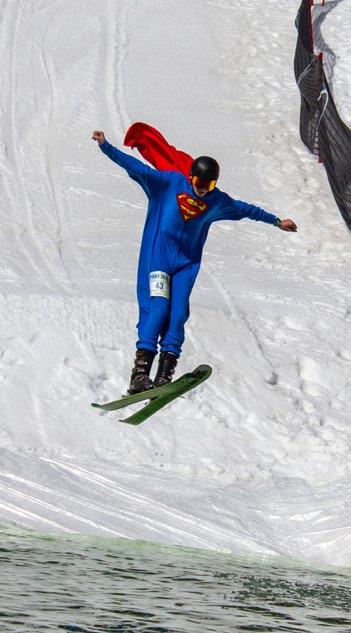
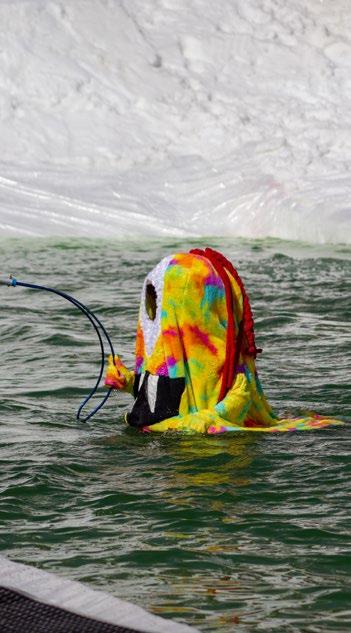
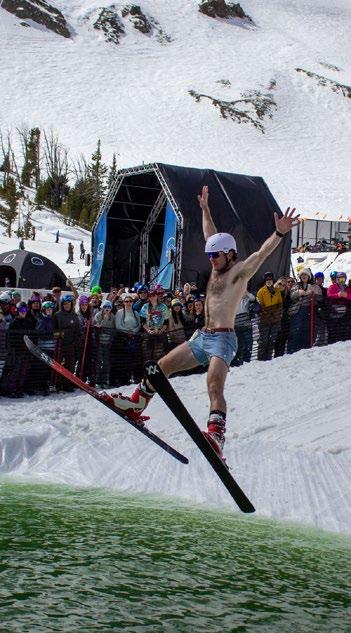
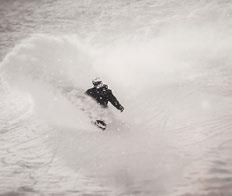
You know it’s almost the end of ski season when Big Sky Resort hosts its pond skim and dozens of brave skiers and snowboarders throw themselves into—and sometimes across—an ice cold pool of water. EBS captured photos and post-skim thoughts from soaking wet contestants.
INSIGHTS ON DROUGHT AS THIN SNOWPACK MELTS AWAY
It’s been a dry, warm winter and many across the West are asking the same question: What does this mean heading into summer? EBS spoke with ranchers, outfitters and snowpack experts for a prediction of what this means for wildfire season, agriculture and summer tourism.
HOUSING TRUST OFFERS RENT ASSISTANCE
The program, called Live Local, is starting off with a limit of $400 of assistance per household, per month and recipients can receive assistance under the program for up to one year. The program is funded with financial support from Moonlight Community Foundation, Spanish Peaks Community Foundation and Resort Tax.
SOUL SHINE SCHEDULED JULY 11
The annual event raises funds and awareness for individuals living with ALS, particularly in the community or surrounding region. Founder Jackie Robin explains the goal to make the community-centered country fair a “laid-back” July Saturday that everyone looks forward to.
LOCALS: ‘WHY DO YOU CHOOSE TO LIVE IN A SKI TOWN?’
ON THE COVER:
EDITORIAL POLICIES
EDITORIAL POLICY
Outlaw Partners, LLC is the sole owner of Explore Big Sky. EBS reserves the right to edit all submitted material. Printed material reflects the opinion of the author and is not necessarily the opinion of Outlaw Partners or its editors. EBS will not publish anything discriminatory or in bad taste.
EBS welcomes obituaries written by family members or from funeral homes. To place an obituary, please submit 500 words or less to media@theoutlawpartners.com.
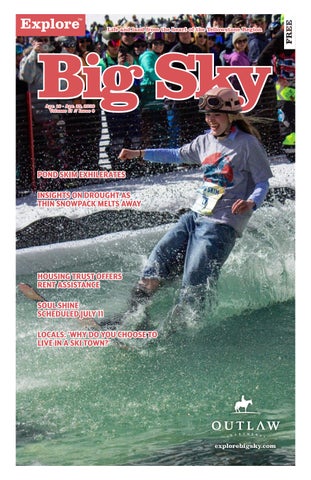
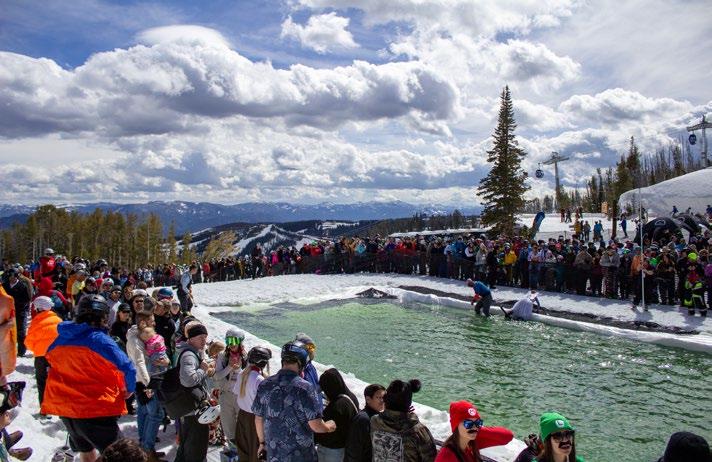
Big Sky Resort celebrated their annual end of season pond skim on Saturday, April 11. Spectators took to The Bowl to watch as skiers and snowboarders dressed in costume and attempted to make it across the pond. PHOTO BY CARLI JOHNSON SCAN
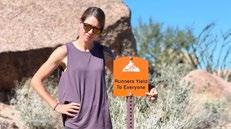
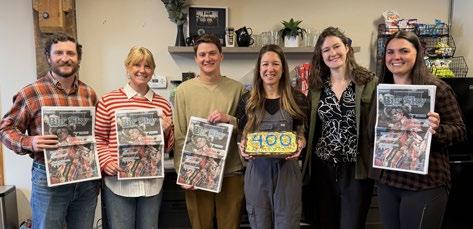
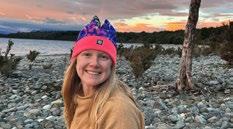
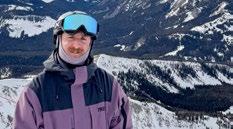
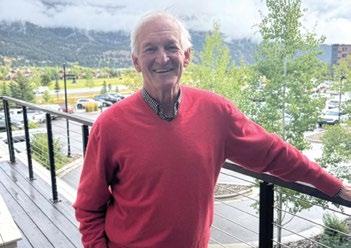
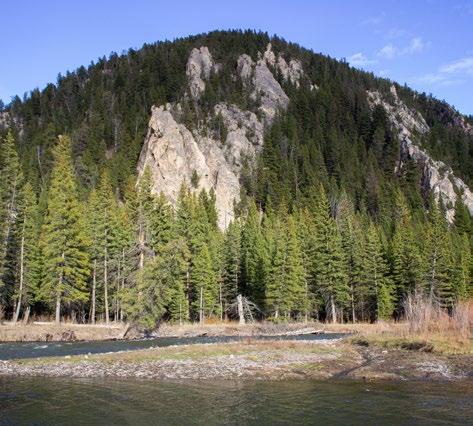
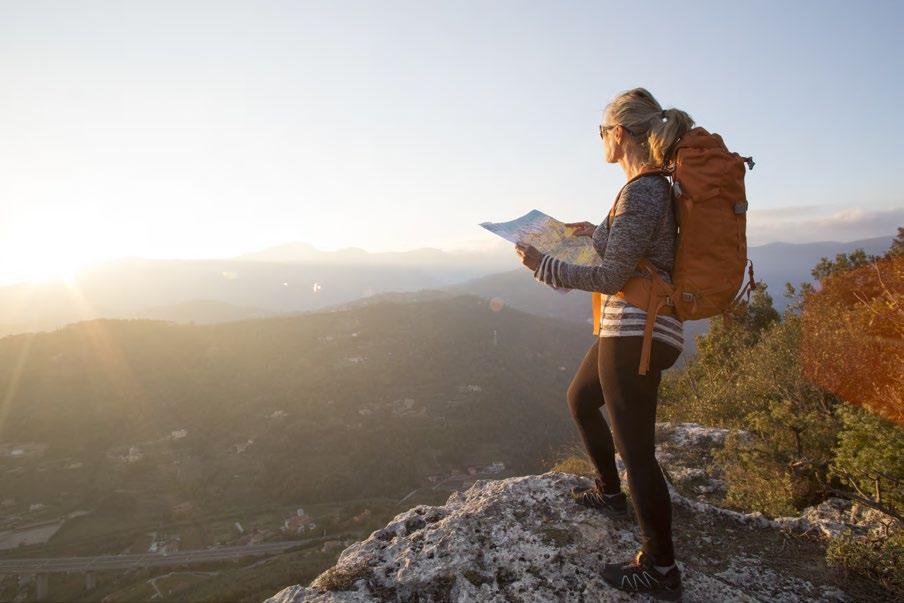
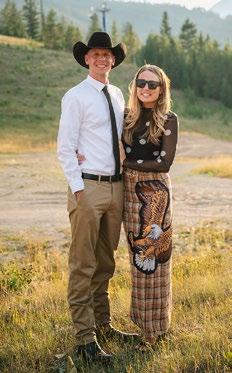
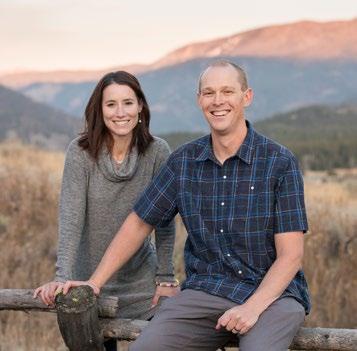
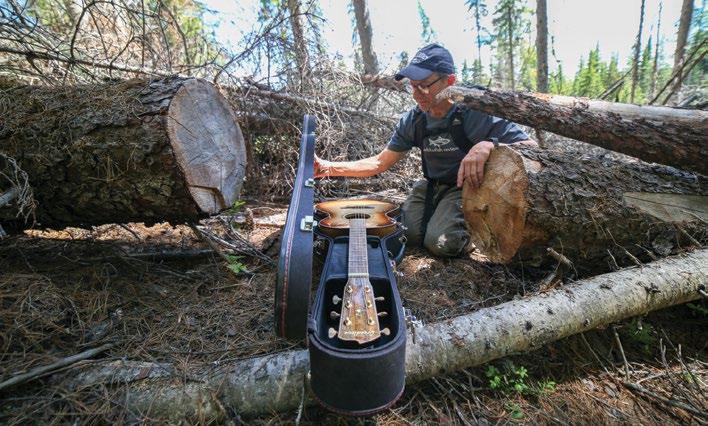
While there may be reasons to not live in a ski town— housing, cost of living, transient community, long and harsh winters—those who stick it out have their reasons to stay. Ask most any local who’s made it work, and they’ll say it’s worth it. For Nielsen Greiner’s final column of the ski season, he asked locals what keeps them around.
LETTERS TO THE EDITOR
Letters to the editor allow EBS readers to express views and share how they would like to effect change. These are not Thank You notes. Letters should be 250 words or less, respectful, ethical, accurate, and proofread for grammar and content. We reserve the right to edit letters and will not publish individual grievances about specific businesses or letters that are abusive, malicious or potentially libelous. Include: full name, address, phone number and title. Submit to media@outlaw.partners.
ADVERTISING DEADLINE
For the April 30th issue: April 22nd, 2026
CORRECTIONS
Please report errors to media@outlaw.partners.
OUTLAW PARTNERS & EXPLORE BIG SKY P.O. Box 160250, Big Sky, MT 59716 (406) 995-2055 • media@theoutlawpartners.com
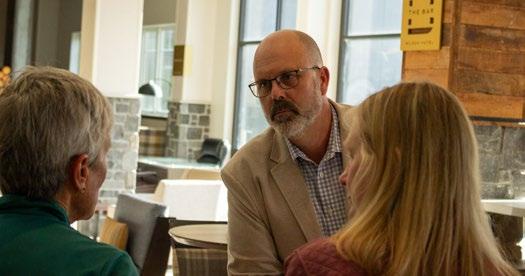
Ryan Busse, a Democratic candidate for the U.S. House of Representatives in Montana's western district, talked with Big Sky residents on the evening of April 13 at The Wilson Hotel. He discussed his priorities for his campaign and answered questions from attendees, continuing a series of visits throughout the western part of the state. PHOTO BY JEN CLANCEY
BRIEFS
NEWS IN BRIEF
BIG SKY RESIDENTS ASKED TO PARTICIPATE IN COUNTY HEALTH STUDY
EBS STAFF
Bozeman Health is compiling its tri-annual Community Health Needs Assessment, in partnership with the Gallatin City-County Health Department, Human Resource Development Council and One Health. Gallatin County residents are asked to participate in a survey to help paint a picture of the county’s local health needs, barriers to care, and overall health priorities through 2029.
The confidential survey is available online and closes April 30. A Spanishlanguage version can be accessed through the website. The report will draw from phone and online surveys, targeted questionnaires and a review of public health data.
“Gallatin County is continuing to grow and change rapidly, and the needs of our community are evolving with it... We are making sure that our public health efforts are grounded in what residents are actually experiencing," Lori Christenson, health officer for GCCHD, stated in a press release.
The findings will guide how Bozeman Health invests resources, and serves as an important data source for organizations throughout Gallatin County, like Big Sky nonprofit Wellness In Action.
“Data from the CHNA survey is essential to Wellness in Action's work,” stated Kiernan Volden, director of programs for WIA, in an email to EBS. “It helps us understand where gaps in services exist, informs how we adapt or build programs, and provides the evidence needed to advocate for funding. Ultimately, survey data ensures WIA’s work is aligned with the real needs of our community.”
In addition to voluntary submissions through the online survey, an independent research firm is conducting confidential phone surveys. The firm, Professional Research Consultants, will call from a 406-area-code through the end of May.
HYALITE FIRE DEPARTMENT RESPONDS TO WEEKEND STRUCTURE FIRE
EBS STAFF
On April 13 at 9:46 p.m., the Hyalite Fire District responded to a reported structure fire involving a large shop outbuilding in Gallatin Gateway. The fire was quickly contained to the room of origin by firefighters, preventing further damage and injuries, “due to the quick and coordinated efforts of responding personnel,” according to an April 14 press release from the department. No injuries were reported and the cause was determined to be accidental.
The Hyalite Fire District deployed a total of four structure fire engines, two water tenders, one support truck, one ambulance and three command units. Assisting agencies included the City of Bozeman Fire Department, Central Valley Fire District, Gallatin Gateway Fire District, Fort Ellis Fire Service Area and the Gallatin County Sheriff’s Office.
“The Hyalite Fire District extends its appreciation to all assisting agencies for their support and continued partnership in protecting the Gallatin Valley community,” stated the release.
RED
CROSS TO HOST DISASTER PREP WORKSHOP
EBS STAFF
The American Red Cross will host a one-hour session on Thursday, April 23 to inform residents on how to prepare for natural disasters, such as wildfire.
The “Be Red Cross Ready” event will be hosted at The Wilson Hotel starting at 3 p.m., and is free to attend with no registration needed. Instructor Winnie Lohof, Red Cross community disaster program manager for southwest Montana, said the purpose of the class is to teach residents to build a “go-bag” for evacuation, and to develop a communication plan with family members, neighbors and communities in general.
“I’m hoping that people will not only learn about that, but also create a larger conversation of the realities of what a disaster kind of looks like, but also how we will support our community members,” Lohof told EBS in a phone call. She believes the helpful nature of Montanans extends through disaster planning and response.
Lohof will stick around after the session to answer any questions, and hear from community members interested in volunteering with the Red Cross for various services, including disaster response.
“We respond to everything from home fires to wildfires, so it’s a great way to get involved with your community,” Lohof said.
The Big Sky Fire Department helped coordinate the April 23 event, and will attend the event to provide assistance or answer questions as needed.
“Given the access, topography, and wildfire risks within Big Sky, it just makes sense to assist partner agencies in providing community education when opportunities arise,” Chris Vigness, BSFD division chief of community risk reduction, stated in an email to EBS “These events help to strengthen the working relationship between agencies and contribute to a stronger and more resilient community.”
GALLATIN BEHAVIORAL HEALTH COALITION CELEBRATES OVER $10 MILLION SECURED IN 2025
EBS STAFF
The Gallatin Behavioral Health Coalition, the multi-agency collaborative that began five years ago, celebrated $10.9 million raised and the implementation of seven new behavioral health services in the area.
Notable milestones in the last year include: the opening of Bozeman Health’s first 14-bed inpatient psychiatric unit, cited as one of the coalition’s proudest achievements, having assisted 119 patients receiving acute psychiatric care; Rimrock’s Bozeman office offering addiction treatment services like withdrawal management and intensive outpatient care and the establishment of Gallatin County’s Assisted Outpatient Treatment program. Lastly, HRDC opened its Homeward Point shelter in Bozeman.
“The Montana Healthcare Foundation believed from the beginning that Gallatin County had the community will and the right partners to build something lasting,” said Scott Malloy, program director at Montana Healthcare Foundation in a March 2026 press release. “What GBHC has achieved is a testament to what happens when organizations put collective community goals ahead of individual organizational territories and show up to work together year after year.”
Looking forward, GBHC is pursuing crisis receiving and stabilization services, expanded resources for adults with serious mental illness and also making progress on the Lighthouse Ranch, a youth behavioral health campus.
OBITUARY
OBITUARY: DON HANSEN
NOV. 15, 1936 - MARCH 28, 2026
Big Sky resident Donald Hansen, an entrepreneur, athlete and adventurer whose life stretched far beyond any one calling, passed away on March 28 at the age of 89.
To write about Don Hansen is to write about motion: prairie wind, Pacific swell, open sky, mountain trails and the forward pull of a man who never stopped testing the edges of life. Don leaves behind a legacy rooted not only in adventure, but in kindness, mentorship and family.
Born in 1936 in Aberdeen, South Dakota, to Fred and Violet Hansen, Don was raised in nearby Redfield where he spent his youth hunting, fishing, working and later dreaming of California. It was in his early years on the prairie that Don was introduced to California, where he discovered the sport that would forever mark his path: surfing.
In 1960, Don founded Hansen Surfboards near Cardiff Reef in Encinitas. The shop became one of the best-known names in California surf culture.
For generations of surfers, skaters, skiers and local families, Hansen's was a gathering place and Don was its heart. He had an instinct not only for business, but for people. He helped sponsor top surfers, mentored young workers and earned the respect of the broader surfing world.
Don chased challenge everywhere. He surfed big Hawaiian waves when that frontier was still young. In those Pacific swells, Don found his Kulia (koolee-ah), stepping into something bigger, pushing past comfort and the thrill of chasing adventure.
That appetite for challenge never stopped at the
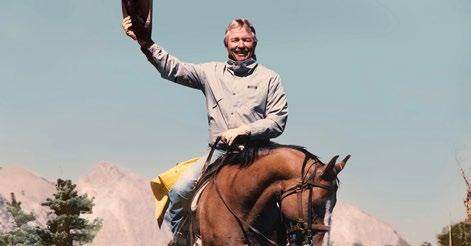
shoreline; it carried him into the open sky. As captain of the Airfreight skydiving team, he helped lead a squad that won national titles and set world records in 10-man speed star competition. Later, on Montana mountain trails, Don “let her buck,” a phrase once used by World War I soldiers from Montana as they charged into battle—and he brought that same spirit to the mountains while living in Big Sky, taking up team roping with enthusiasm and grit.
What set Don apart was not just his willingness to take risks, but his willingness to care. He carried a strong spirit, a memorable sense of humor and an infectious laugh. Don moved through life with faith and gratitude, meeting moments with humor and believing in people before they fully believed in themselves.
LETTER TO THE EDITOR
Dear Editor,
You used to be able to walk or bike anywhere in Big Sky without thinking twice—no sidewalks, just a quiet road and a little trust. One of my favorite memories is riding my mountain bike to Roxy’s with my dog (leash optional), parking them both outside (unlocked), and bumping into friends (and a moose) on the way home.
But that’s changing. Traffic is picking up—even on residential roads—and I’m sure you’ve noticed.
The March 26 article on the Transportation District prioritizing walking and biking connections points to something important: there is now an active transportation plan underway to make these everyday trips safer and more comfortable. I’ve been participating on the Active Transportation Committee for over a year—an effort Bayard Dominick had the foresight to initiate—and it’s
culminated in this plan now taking shape.
Too often, we talk about transportation as scattered fixes—a roundabout here, a path there. But it’s really one connected system. We have a strong bus network that needs to grow, major decisions ahead on 191 and 64, and local walking and biking connections that tie it all together.
As a civil engineer and environmental planner, I’ve seen mountain towns wait too long to make these investments. Big Sky has a chance to get ahead of it. It’s the kind of magic that keeps Big Sky livable and affordable. It doesn’t cost a lot to walk or roll!
Take a look and weigh in! bigskyatp.altaplanning.cloud/
Laynee Jones Big Sky, MT
Don is survived by his wife, Shirley; his children Christian Hansen, Heidi Garvey and husband Kevin, and Josh Hansen and wife Ashli; and three grandchildren: Makena, Jack and Saylor. He was preceded in death by his sons Sage Hansen, Nick Kovalenko and Borris (Bo) Kovalenko, as well as his beloved brothers Harley and Jerry.
A private service will be held in California and celebration of life will be scheduled at a later date in Montana.
In lieu of flowers, donations may be made to Eagle Mount Therapeutic Camp in Bozeman, and Rancho Coastal Humane Society in Encinitas, California.
PUBLIC NOTICE
NOTICE OF ELECTION JUDGE CLASS FOR MADISON COUNTY
WEDNESDAY, APRIL 22ND, 2026 from 2p.m. to 4p.m.
Madison County Election Administrator, Paula Mckenzie, will hold an Election Judge Certification Training Class in Big Sky, for Madison County Election Judges. The class will be held in the conference room of the Big Sky Water and Sewer district building, located at 561 Little Coyote. The class should take approximately two hours and will certify you for the next two years.
Please call or email with any questions. We are asking you to spread the news and recruit anyone you can!
Our office contact information is: phone 406-898-4406 or e-mail pmckenzie@madisoncountymt.gov
SUNDAY, JUNE
WELCOME COCKTAIL HOUR
G-MAN
OP NEWS
EXPLORE BIG SKY HIGHLIGHTS LOCAL NEWS DAY
CELEBRATING OUR NEWSROOM COVERING BIG SKY AND BOZEMAN, AND WHAT LOCAL NEWS MEANS TO US
EBS STAFF
Explore Big Sky is one of over a thousand local newsrooms across the U.S. participating in a new movement called Local News Day. April 9 is a national day of action celebrating the trusted local news and information that helps communities stay informed and connected. While national headlines dominate our feeds, it’s critical to remember that some of the most important news is close to home: the decisions affecting local government and schools, businesses working to thrive in our community and the events bringing neighbors together.
To celebrate Local News Day, EBS would like to introduce ourselves, the local team working to cover Big Sky and Bozeman, and highlight what local news means to us. We’d also like to remind you that local news works best when it’s part of the fabric of the community it serves—if you have a news tip or feedback for us, our doors and emails are always open at media@theoutlawpartners.com.
Thank you for your loyal readership, The Explore Big Sky team
Meet the EBS Team
Mira Brody, VP of Media
I’m Mira and I’ve been with Outlaw Partners since June of 2020. I oversee all Outlaw publications, including EBS, Mountain Outlaw and Explore Yellowstone, and when I have time, enjoy diving into a writing project, usually revolving around history or the outdoors. When I’m not working, you can most likely find me in the mountains in my running shoes or relaxing post-run with my husband and 14-year-old cattle dog, Sierra.
Coffee or tea?
Coffee from the espresso maker, or hot off the camp stove.
Ideal outing in Montana?
A morning peak bag, float on the Yellowstone River and lunch at Follow Yer Nose BBQ.
Favorite spot in southwest Montana?
I love the Hyalites and Gallatin Crest; it’s a really wild, remote landscape but still close enough to town for a day trip.
Why is local news important to you?
Local news connects us to our community. It keeps us focused on what’s important: the people and issues that affect us, and that we have a say in.
I’m Fischer, and I joined Outlaw Partners in 2024 as a summer intern for Explore Big Sky. After that (fateful) summer, I came on part-time as a jack-of-all-trades, master-of-none type guy, shooting videos, taking photos, writing articles, and eventually writing feature stories for Mountain Outlaw and Explore Yellowstone magazines. In my spare time, I like to run, read, play drums in my band, or take a trip back to my beloved Michigan to jump in a Great Lake.
Coffee or tea?
Coffee. From a Moka pot. With a pinch of brown sugar and a splash of oat milk. Over ice.
Ideal outing in Montana?
A long bike ride somewhere with no cars. Presence of migrating birds is always a plus.
Favorite spot in southwest Montana?
Fairy Lake was the first place I visited in the area, and it will forever have a special place in my heart.
A topic you nerd out on?
Books, specifically the collected works of George Saunders. I’d recommend anyone check out his collection of short stories called “Tenth of December” or his novel “Lincoln in the Bardo” if you’re up for a challenge.
What is one of your favorite news stories you’ve read by the Explore Big Sky team recently?
I loved Jen’s coverage of the powwow hosted by the American Indian Council at Montana State University’s Brick Breeden Fieldhouse. I was there to take photos and videos, and I think she did a great job at capturing the spirit of the event and what it means to the people who attended it.
I’m Carli Johnson, and I’ve been working with Explore Big Sky as a multimedia journalist for a year and a half. After graduating from Appalachian State University in North Carolina, I found myself chasing powder and whitewater all the way to Montana. My undergraduate degree in journalism led me to search for a way to get involved in local news in my new community and I found that here, with Explore Big Sky. In my free time, you’ll find me on the trails skiing or running with my dog and floating downstream.
Coffee or tea?
Coffee. Black. No cream or sugar. No, I don’t know what’s wrong with me.
Ideal outing in Montana?
A summer paddle on the Gallatin! Or really any river. Raft or kayak, this girl loves an afternoon float in the summertime.
Favorite spot in southwest Montana?
I spent my first summers in Montana living in Gardiner and visiting Paradise Valley. Where else can you do a morning hike, an afternoon float and see live music all in one day? That, to me, is the perfect Montana summer day.
What does local news mean to you?
To me, local news is a door that has the opportunity to inspire conversation, community and change. To share other people's stories and inform the public on important issues is a privilege that constantly inspires me to live with integrity.
Fischer Genau, Digital Media Lead
Carli Johnson, Staff Writer
Jack Reaney, Senior Editor
I’m Jack Reaney, and I’m a multimedia journalist with nearly four years of experience covering Big Sky’s news through writing, photography and video. I’m originally from New Hampshire, where I learned to ski and developed my love for the mountains and the outdoors. After college at Denison University in Ohio, I was drawn to the West for the same reasons as everyone else—and my mind, body and spirit have thanked me for seeking the privilege to live in such a wonderful place. As a 406 transplant, I feel a strong responsibility to contribute to my new community, and I’m proud that I’m able to do that through my work with EBS and Mountain Outlaw.
Coffee or tea?
Coffee. Not even close. Herbal tea is pleasant before bed, but come on—coffee provides that spark, and there’s a reason our society loves hanging at coffee shops.
Ideal outing in Montana?
I don’t fish or kayak or raft or anything cool, but I love sitting next to a cold, relatively deep river and swimming in it on a hot summer day.
Favorite spot in southwest Montana?
For the sake of answering somewhere outside of Big Sky, I love the Missouri Headwaters State Park. It’s full of rich history.
A topic you nerd out on?
The sinusoidal relationship between the latitude of a location and the length of its days throughout the year. I’m always surprised when people don’t understand this—or worse, when they don’t care.
What inspires you to cover local news?
I am privileged to get paid to learn lots of information about the happenings in Big Sky, or witness newsworthy events, and I am inspired to pass that knowledge along to the community— especially when it informs or counters the local gossip.
Jen Clancey, Staff Writer
I’m Jen Clancey, a staff writer at Explore Big Sky and I’m originally from New Jersey. Technically, I got my start in journalism at my high school’s newspaper The Pirate’s Eye. But I fell in love with local news when I covered central Ohio with Denison University’s The Reporting Project for a
couple years. I moved across the U.S. in 2023 and am coming up on three years at Explore Big Sky, still learning and finding different things to enjoy about reporting. I enjoy reading, dancing, traveling to towns new to me, writing and sitting by rivers and creeks.
Coffee or tea?
For whatever reason, I enjoy a hot coffee at all times of day—I’m a huge fan of an early evening brew. But I do dabble with chamomile, where you'll typically find me with a book “lookin like the bear on the box,” (thank you SNL).
Ideal outing in Montana?
I like to grab a book at the library, a soccer ball, some rollerskates and head out to a river or park with my friends.
Favorite spot in southwest Montana?
I really love Missouri Headwaters State Park. I saw a plump marmot there last weekend, a beaver a few months ago, and the sky really is so big so you can see storms for miles. It’s a great park for train fans too.
A topic you nerd out on?
From time to time, I like to check in on datasets about a range of national or state topics and see if I can make sense of them. I also am fascinated by penguins and sea life.
What inspires you to report on local news?
I’m inspired to cover local news because of its ability to empower readers. I’m grateful that sources have trusted me with their stories. It’s a job that hinges on collaboration, and I’m inspired continually to present fair and thoughtful reporting alongside my team.
It’s time to hear the proposal for the ballot and the Study Commission’s recommendations— shaped by your input—for the future of Gallatin County government.
JOIN US FOR AN UPDATE:
April 22, 6pm – Three Forks High School Auditorium
April 23, 5pm – West Yellowstone Town Hall
April 27, 6pm – Gallatin Gateway Community Center
April 29, 6pm – Gallatin County Courthouse Community Room*
April 30, 6pm – Wilson Hotel, Big Sky
Visit our website for more information.
*Virtual attendance
BIG SKY COMMERCIAL LISTINGS
LOCAL
SKIM TO WIN: BIG SKY’S POND SKIM CONTESTANTS MAKE A SPLASH
BY CARLI JOHNSON
BIG SKY—Aside from signaling the nearing end of the ski season, Big Sky Resort’s annual pond skim marks a fun-filled, splashy spectacle that everyone can enjoy. Contestants and spectators dress in costumes, cheer each other on and of course, get wet.
Every seasoned skier and snowboarder knows that the best way to enjoy the pond skim is to show up in their wackiest outfits, tailgate with a hot dog and cheer on the biggest splashes. This year, Big Sky Resort had judges who scored contestants on best splash, trick and costume.
“We were looking for costumes, energy, who was pumping up the crowd,” said one of the judges, Shelby Stubblefield, when asked about the criteria for contestants. “There were a lot of people who made it across but we were looking for folks that had a little special flair when they hit the water.”
Around 10 a.m., spectators began making the pilgrimage up to The Bowl to find a good viewing spot of the event. Despite the lack of snow, people still found rocky seats among the exposed hillside to get up high and watch from above.
Participants shared many different opinions when asked for tips on how to get across the pond.
After climbing out of the pond, first time pond-skimmer Liam Maumenee advised future contestants to “lean back, but don’t lean back too much.”
Covered in green paint and a wig, Trevor Donathan, dressed as Fiona from Shrek, cautioned against hitting the jump. “I hit the jump and wasn’t even close to making it,” he said with a chuckle.
His partner Robert Driscoll, dressed as Shrek, shook his head when asked for advice. “I wouldn’t know, I didn’t make it,” he said.
Whether contestants made it across or took the plunge, everyone was smiling on their walk out into the crowd. Even those who had to go diving for their skis or be dragged out by a life preserver, the spectacle alone kept the audience entertained.
“After a season where the snowfall didn’t impress too many, it was nice to have an event where the community could come together and just listen to music, watch people splash around in the water and have a good time,” Stubblefield said.
After the final skimmer around noon, spectators turned toward the main stage to listen to a live DJ, me n ü, and keep the excitement going as part of Big Sky Resort’s Spring Series.
Big Sky Resort will remain open for the next two weekends, Friday through Sunday, and will have its closing day on Sunday, April 26.
Photos by Carli Johnson
‘WE’RE ALL GONNA BE FEELING THE STRAIN’ IN POTENTIAL DROUGHT SUMMER FOR SOUTHWEST MONTANA STAKEHOLDERS,
BY JEN CLANCEY
CONSERVATIONISTS AND EXPERTS WEIGH IN ON IMPACT
Ranchers and noxious weed fighters gathered around a table in Ennis on April 14 for a monthly Madison Valley Ranchlands Group meeting. Outside, a wind carried clouds across the sky, and sunshine speckled nearby fields, catching patches of snow and bare rock on the Gallatin and Madison range above the valley. The temperature sat at around 55F.
After the meeting ended, Linda Owens, project director for MVRG, who’s ranched and lived on Madison Valley land for around 40 years, dug into a separate, but highly relevant topic for the area’s residents: drought.
While the mild winter weather allowed for an easier calving season, Owens is concerned about just how easy it was. This winter, snowpack levels across Montana struggled—in some places snowpack dipped to record level lows, like in the Gallatin Basin. Elsewhere, the Madison Basin is at just 61% of its average, according to an April 2026 update from the USDA Natural Resources Conservation Service. Owens is concerned about what that low snowpack means for drought, and she’s not alone. Across southwest Montana, recreationists, agriculturalists, conservationists and experts are bracing for a potentially dry, droughtridden summer.
Owens herself is navigating land that already has a history of drought in Madison Valley, making her pivot to resting grass that typically could be used for grazing, and using more fertile land south of Ennis through a lease. The area is great for grazing, she said, but there are some struggles, like the constant phone calls from the police department when her cattle roam toward the highway, something that could be avoided if closer land wasn’t overburdened by drought in years prior.
She’s talked with Montana State University Extension, which studies and supports the area’s agriculture, to learn more about grazing strategies. MSU Extension soil fertility specialist and professor Dr. Clain Jones, spoke to EBS about the winter season and its potential impacts on the growing season.
“I've complained about past winters before, but nothing was close to this one, both on warmth and on lack of snow,” Jones said. “So it just, it really stood out.”
In drought, farmers and ranchers pulling from streams and ditches may see water dry up later in the summer.
“And we know that snowpack is what drives stream and river and aquifer volumes. And so it is something to be concerned with and it's a little hard to catch up at this point,” Jones said. Low soil moisture levels could also lead to reduced profit amidst ongoing increases in fertilizer and diesel costs.
It’s not only agriculturalists who are warily eyeing higher elevations. A forecaster for the Gallatin National Avalanche Center, Dave Zinn, studied and tracked snow in southwest Montana this winter.
The lack of snowfall this winter wasn’t very unusual for Zinn, but the warmth was, and it triggered unique slides.
“One of the things that we saw this year was wet snow avalanches during periods of the winter when we wouldn't normally see them,” he said. Usually, wet snow avalanches are triggered by water trickling between layers of snowpack and separating ice crystals, and slides start around late March or April. This year, wet snow cascaded down slopes as early as December.
The melt-freeze process that causes wet avalanches does have an upside—over time, areas of snowpack may freeze over and over, forming frozen, cohesive layers that can help sustain snowpacks. But the downside is that much of the region’s snow melted away long before normal runoff.
The USDA’s April snowpack update showed that new snow from March storms melted quickly due to a near-record-warm month, keeping basin levels from catching up to their averages in the southwest Montana region.
Beyond agriculture and snow science, much of Montana’s summer recreation depends on snowpack. Zinn is looking ahead to the spring and summer season, when he kayaks the Gallatin River and coaches as the executive director of the nonprofit Wave Train Kayak Team.
A low-flow summer means a more accessible spring due to less dangerous whitewater, Zinn said, which could help with instructing novice kayakers. But
later on in the summer, programming is less exciting.
“We will sort of make do and really work to make the programs really fun, no matter what the water levels are,” Zinn said. “[High-water season is] a lot of what the whitewater enthusiasts really live for.”
Anglers also populate rivers like the Gallatin in the spring and summer.
J.D. Bingham owns Wild Trout Outfitters in Big Sky and has fished the Gallatin River running behind the shop for 51 years, and guided flyfishing trips since 1984. The key to a good fishing season?
“Cold water and plenty of it,” Bingham said. Instructing new anglers on the ins and outs of flyfishing every year, Bingham said any season is a good one, especially from the eyes of visitors new to the activity. When the summer weather is hot and flows are low, Bingham explained that hootowl restrictions impact trips, but they only require a shift in schedule to start the day earlier and avoid fishing during the hottest parts of the day. Otherwise, worrying is not helpful, he said.
“I mean, you hope for the best and you prep for the worst,” Bingham said. “And it will be what it'll be.”
Even after a bizarre winter, it’s hard to know what conditions will look like come summer, explained Kristin Gardner, CEO and chief science officer of the Gallatin River Task Force.
“If we have a really wet spring and summer, we
The Gallatin River by the Conoco on April 13. PHOTO BY JEN CLANCEY
might not see an impact,” Gardner said. “If we do not have a wet spring and summer, we're gonna probably see some near-record low flows, I would think in August and in the fall. It really just depends on precipitation.”
GRTF works on multiple projects to manage drought locally, from outreach about conserving public water use in the summertime—when use is heaviest—to monitoring water quality with USGS to track river health, and restoring habitat that retains moisture throughout the season.
Riparian habitats and wetlands act like a sponge, Gardner said, soaking up water during wet periods and slowly releasing it when things dry up. Logging and development have straightened out streams that ideally would meander and weave through the landscape to reach floodplains, wetlands and riparian areas. Reinstating a more natural water distribution would help those ecosystems and reduce drought impacts.
West of the Madison and Gallatin ranges, the Madison River Foundation monitors water quality as well. Keith Brauneis, executive director of MRF, and his team work to conserve and restore the Madison watershed—the water that runs in tributaries, wetlands and the Madison River itself. He described his outlook on the season.
“We are definitely heading into a season where every drop of water is gonna matter,” Brauneis told EBS. He said the foundation is working with partners like trout outfitters to educate community members and visitors about safe fish handling in more stressful periods like drought. He noted that conservationists have prepared for a potentially
difficult low water year, which can be stressful for environmentalists and nearby communities.
“This is what we've all been training for. It's always what we've all been practicing for, is summers like this because every one of our watersheds in southwest Montana and all of Montana are gonna be stressed to the max come mid-summer,” Brauneis said. “I think we're all gonna be feeling the strain.”
Back in Ennis, Liz Little, a member of the Madison Valley Ranchlands Group, shared that her ranch’s first calf of the season was born just that morning, officially starting calving season on her ranch consisting mostly of Highland cattle. She’s ranched in McAllister for six years with her family, and provides meat to Big Sky and Bozeman restaurants. She described the distribution of water on ranches in the valley, and how water rights can get more contentious and complicated as the summer goes on.
On a daily basis, a ditch rider monitors and recommends adjustments on intake of water from streams to assure neighbors get their promised amount of water. Other than investments in infrastructure and rotating available grazing land, ranchers and weed warriors convene to discuss new plans or funding at Madison Valley Ranchlands Group board meetings. There, producers can discuss new strategies and meet each other. Those connections can translate to looking out for each other and checking in on livestock if they hear something is up.
Drought is considered to have social, economic and
environmental effects that impact local recreation, businesses, wildlife, livestock and rivers. Owens believes that solutions must start with collaboration, and getting on the same page to find support and solutions.
“As long as we love where we live, we have so much in common,” Owens said.
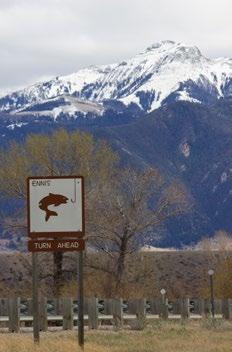
An Ennis Fishing Access Sign on April 14. PHOTO BY JEN CLANCEY
TRANSPORTATION DISTRICT PRIORITIZING WALKING, BIKING CONNECTIONS
SURVEY OUT FOR STRATEGIC NON-VEHICLE TRAVEL PLAN; SURVEY MAP ALLOWS
RESPONDENTS TO DRAW SUGGESTED TRAILS, CROSSWALKS
BY JACK REANEY
BIG SKY—With noisy and fast vehicle traffic increasing steadily through a community full of walkable and bikeable locations, the Big Sky Transportation District has hired a specialist to ensure the future of Big Sky prioritizes spaces for safe and enjoyable non-vehicle travel.
The district hired Alta Planning and Design, a “national leader” in the space and the firm responsible for the 2019 Big Sky Master Trails Plan, to compile the Big Sky Active Transportation Plan. The objective is to guide future investments in trails, sidewalks, crossings and other non-motorized connections between neighborhoods, trailheads, activity centers and public transit.
network have become more visible for residents, workers, and visitors,” a BSTD press release stated.
District. BTSD will integrate plans with broader transportation and transit planning efforts.
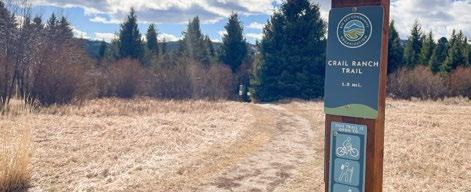
The "Crail Trail" is a popular walking and biking trail in the meadow. PHOTO BY JACK REANEY
HOUSING TRUST OFFERS RENTAL ASSISTANCE THROUGH NEW PILOT PROGRAM
LIVE LOCAL OFFERS UP TO $400 PER MONTH TO FULL-TIME WORKING RESIDENTS
BY VICTORIA SMITH
EBS CONTRIBUTOR
BIG SKY—Workers in Big Sky may now be eligible to receive rental support through Live Local, a new pilot program launched by Big Sky Community Housing Trust.
The program aims to provide local workers with monthly rental assistance payments to help make housing more affordable. Amounts of assistance provided will vary per recipient, depending on the total amount of rent cost that goes over 30% of their gross income.
Live Local is starting off with a limit of $400 of assistance per household, per month, with a total limit of $4,800 per year. Recipients can receive assistance under the program for up to one year, and assistance payments will be disbursed to landlords directly. The program is funded with financial support from Moonlight Community Foundation, Spanish Peaks Community Foundation and Resort Tax.
Eligibility requirements for the program include renting a property full-time in Big Sky, working at least 1,560 hours annually in Big Sky, having a household income at or below 100% of the area median income limit for Gallatin County— which varies depending on total members per household—and spending more than 30% of gross income toward rent.
Income limits of the program are based on annual figures released by the U.S. Department of Housing and Urban Development. The housing trust lists 100% area median income limits for the program as $84,500 for a one-member household, and up to $140,000 for a six-member household.
The housing trust began planning Live Local in
November of last year, modeling it after another program currently active in Whitefish, Montana, called the Workforce Rental Assistance Program.
“Most people in our line of work say that most of our great ideas are somebody else’s great ideas. We share a lot of information with other communities,” said David O’Connor, executive director of Big Sky Community Housing Trust. “Big Sky is a young ski resort, so we have the benefit of having lots of other [ski towns] go before us.”
The housing trust announced Live Local on Friday, March 13, and since reviewing information from early applicants, BSCHT has noticed trends in applicants’ housing costs. For example, individuals often spend between 35% to 45% of their gross income on housing in Big Sky.
“The national standard is closer to 30%, so the goal of Live Local is to bring them down to that 30% range and get their housing costs a bit more under control, so that they can afford to be in Big Sky and can afford to continue to contribute to our community,” said Becky Brockie, director of programs and communications for the housing trust.
Since its creation in 2016, the housing trust has strived toward providing affordable, attainable and stable housing for the local workforce in Big Sky. This has included the undergoing of various building projects and the creation of multiple programs, such as Live Local.
The pilot program is one of the three current programs overseen by the nonprofit, with Good Deeds and Rent Local offering other forms of workforce housing assistance. Live Local is a spin-off of Rent Local, Brockie said, which is a program that works with current homeowners in the community to subsidize affordable, long-term
rentals offered to local workers.
“The Rent Local [program] is a supply side… There’s availability and affordability,” O’Connor said. “Rent Local is availability. Live Local is affordability. So now that we were able to use Rent Local to make some things available, now we tackle the problem of whether or not that’s affordable.”
BSCHT has further increased availability of housing through its building projects, including the MeadowView Condominiums completed in 2021, which created 52 homes, deed-restricted for full-time workers. The nonprofit additionally built two income-restricted apartment buildings on the RiverView campus, completed in 2024, creating 25 apartments with funding from the federal LowIncome Housing Tax Credit program.
The housing trust’s upcoming 99-acre project, Cold Smoke, is further expected to provide 125 new homes for ownership and 264 apartments for rent. According to the nonprofit’s website, the first apartments are slated to be available in 2028, and the first homes are to be available in 2029.
“We’re literally going to be breaking ground [on the project] here in the next week or two,” O’Connor said in late March.
The state of workforce housing in 2026
While the housing trust has provided pathways for many members of the local workforce to obtain housing, various factors have indicated to the nonprofit that housing is still a challenge. Some of these include Big Sky’s zero vacancy rate for longterm rentals in the community, and a steady decline in enrollment across pre-K and K-12 at public and private schools after COVID brought a short-term surge of families to Big Sky.
The Big Sky Community Housing Trust was formed in 2016, later becoming an independent nonprofit in 2020. PHOTO BY VICTORIA SMITH
“[The steady decline in enrollment is] certainly a national trend, but it’s accelerating here from where it’s been at a pretty stable rate,” O’Connor said.
The nonprofit is in the process of completing an updated housing needs assessment that will factor in the Cold Smoke project and its impacts. This assessment will consider jobs available in the community, along with existing housing availability, incomes and other cost of living factors, to then determine community needs. The nonprofit’s last assessment in 2023 showed a need for approximately 1,350 homes in Big Sky by 2028.
“Housing is a moving target. It changes every single day…” O’Connor said. “As we continue to build and rectify the need, the need continues to grow as well.”
Brockie encourages individuals who are interested in renting to join BSCHT waitlists, inquire about employee housing, network with friends and community members and speak with local property managers. Individuals interested in buying are encouraged to begin saving money now, and to speak with a lender and real estate agent to further prepare for purchasing a home. From that point forward, the housing trust’s Good Deeds program may provide valuable support.
“Planning, and being tenacious, and using all of your resources are who usually wins in Big Sky,” Brockie said.
For community members who wish to get involved with the nonprofit’s work, O’Connor said the housing trust is always on the lookout for board
members or committee members with expertise in certain subjects, such as construction, real estate and banking. Individuals can also donate a property to the nonprofit, which would then become permanently deed restricted to allow the housing trust to keep the house affordable.
“Our mission is not just to provide housing, but to provide the tools needed for a well-rounded community like Big Sky to be able to provide all the services that its residents need,” O’Connor said. “So everything from quality of life to filling all the roles… that it takes to make the community operate.”
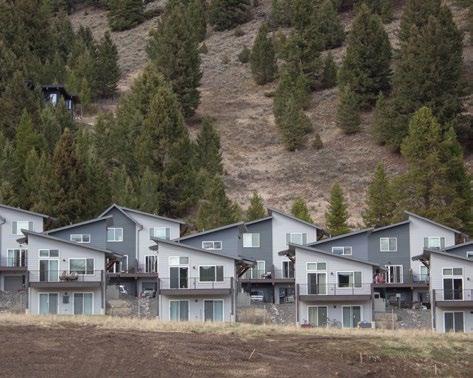
The MeadowView Condominiums were a project completed by Big Sky Community Housing Trust in 2021, consisting of 52 affordable homes. PHOTO BY VICTORIA SMITH
FIRE DISTRICT TO ASK RESORT TAX FOR $900K IN EXTRA FUNDING AFTER TAX ERROR
BUDGET DEFICIT IS DRAINING RESERVES AS BSFD COMMITS TO MAINTAINING EMERGENCY SERVICES
BY JACK REANEY
BIG SKY—The background and fallout of Gallatin County’s $8.3 million tax error impacting the Big Sky Fire District is well understood. The path forward remains painful, and fire district officials hope the Big Sky Resort Area District can provide some additional short-term funding.
On Tuesday, March 31, the fire district board hosted a BSRAD subcommittee to review and evaluate the existing interlocal agreement between BSRAD and BSFD—a three-year funding agreement totaling $3.55 million, with one year remaining. The fire district said it plans to ask Resort Tax for an additional $900,000 for fiscal year 2026-27, through an amendment to the current agreement.
Resort Tax board member Sarah Blechta said the subcommittee pushed for a meeting because BSRAD needed to know what kind of emergency support the fire district planned to ask for. Board member Grace Young also asked for more clarity.
“To help us plan better, we need to ask for more forecasting… We need the long term,” Young said. “We need to know: is this a two-year request? Is this a 10-year request?”
Fire district board member Matt Dodd said the money would help offset immediate budget shortfalls and allow BSFD to maintain its emergency response capabilities. He noted that $900,000 represents roughly one-quarter of the three-year, $3.55 million agreement, and that the fire district’s external finance officers recommended asking for $2 million. The board agreed that $2 million would be an unreasonable request.
“What we’re not going to do is keep going back to BSRAD and saying, you need to keep propping us up,” Dodd said.
Now facing a $2.3 million budget shortfall yearover-year, BSFD is operating under a structural budget deficit of roughly $400,000 this year, and a projected deficit of $740,823 for next year. Currently, BSFD is burning through operational reserves which are held for emergencies like this.
“The $900,000 ask allows us to cover that shortfall, and cover some of the shortfall this year, which allows us, big picture, to keep operational reserves that frankly, we need. We need those operational reserves in large part because we don’t know what’s going to happen next year… but we do know that the community is growing,” Dodd said.
Blechta said the BSRAD subcommittee is grateful for the meeting with BSFD, which helped dig into the complexities of a difficult situation impacting the community.
“The meeting was productive, and we are now focused on getting the remaining questions answered—work the department is actively undertaking—ahead of the April 15 meeting,” Blechta stated in a follow-up email to EBS.
Staff salaries dominate budget: ‘We’re burning through money’
The fire district’s call volume is increasing at a
compounding rate of 10 to 12% every year. In 2017, BSFD received 416 calls and employed 21 full-time staff. By 2025, BSFD received 1,560 calls—nearly quadruple the volume in eight years—and staff had nearly doubled to 41.
Even with local trends showing a stagnant or declining year-round population—with shrinking enrollment impacting local schools, for example— visitation and tourism continues to grow, and BSFD gets more calls.
Furthermore, BSFD is committed to paying a living wage. Only six of its 41 union staff live in Big Sky; Dodd said it’s a testament to BSFD’s strong working conditions and pay that firefighters are willing to put their lives on the line for a community where they don’t live. But being a regional leader in firefighting costs more, Dodd explained.
The fire department currently allocates 94.65% of its total budget toward wages, salaries and benefits. Operating expenses represent just over 5% of BSFD’s total budget.
“I don’t know how to cut it any leaner than that,” Dodd said. “… That’s the biggest struggle we have, is we are burning through money. And we’re burning through money to support the guys that are out protecting the community.”
BSFD administrators took a voluntary 5% salary cut, and the district is currently in regular negotiations with its firefighters union—regardless of the tax issue, the union’s current contract was set to expire June 30—with the goal of reducing payroll in response to budget challenges. Union President Chris Laukant thanked BSRAD for considering the stopgap funding adjustment.
BSFD also opted to not hire four recommended full-time positions this year, which saved $400,000 to $600,000.
Other budget cuts included snow removal, protective gear and uniforms, medical supplies, heavy equipment purchases, and two-thirds of the budgets for outside training opportunities and heavy equipment maintenance.
“Every single thing that’s on a line item has been assessed and re-assessed, and re-assessed,” said Division Chief Jeff Bolton. “… The PPE and uniforms, and all those things got cut down as well.”
If anything is in question, it’s the district’s decision to proceed with the cash purchase of a $1 million
parcel beside its training facility. Fire district leaders have justified the time-sensitive opportunity to acquire three-plus acres of Big Sky land for that price, especially land adjacent to existing facilities, but many community members have expressed disapproval.
“The public perception is your reality, and the fact that you bought the land is just a bad public perception, whether you had [cash] in the reserves or not,” Blechta said, adding that while the purchase will be a “great asset” long-term, it may have been wise to finance the purchase. “… You have to, at some point, start thinking with a PR hat.”
Board chair Carol Collins noted that the $1 million came from capital reserves, not operating reserves— it could not legally be reallocated toward wages or other operational costs.
Dodd acknowledged the pushback, and reminded the public of the land’s purpose, which is to serve as a public safety center, replacing the current fire station and Gallatin County Sheriff’s Office.
“Long-term it’s going to allow us to increase our service district, which lowers ISO scores for all the homeowners in the district, hopefully saving them some money,” Dodd said.
In general, Dodd acknowledged the importance of explaining how BSFD found itself in the current situation, and how it plans to avoid a similar crisis in the future.
He emphasized that as far back as 2023, former Fire Chief Greg Megaard and his to-be successor, Dustin Tetrault, approached Gallatin County with concerns about the tax collections. They were reassured that all is normal.
Still, in 2024, Chief Tetrault escalated the question to the Montana Department of Revenue, and BSFD received the same assurance. Only after Tetrault continued to push—including similar questions to Madison County—did the problem finally emerge.
“Part of [Chief Tetrault’s] mission has been transparency,” Dodd said. “And—good, bad or otherwise—it has been transparent. And it’s ruffled some feathers in town, but that’s what needed to happen, frankly… You shine a light on things, and things get figured out awful quick.”
BSFD will formally present its ask during the April 15 Resort Tax board meeting.
Resort Tax officials met with the BSFD board on March 31. PHOTO BY JACK REANEY
A PLACE TO BELONG GROWING COMMUNITY IN BIG SKY CHRISTIAN FELLOWSHIP’S YOUNG ADULTS
BY LESLIE KILGORE
BIG SKY—The Young Adult Community Group at Big Sky Christian Fellowship began when James Mummery, Caleb Dvorak and Joe Ciardelli met at church and decided to start a Bible study for themselves. A small effort that quickly expanded into a weekly Tuesday gathering now connects to roughly 80 people on WhatsApp and draws 20–25 young adults during the busier seasons in Big Sky.
“We all met at church searching for a like-minded community of our age,” Mummery said. “We were like, hey, do you guys want to start a Bible study, and then before you knew it, there were a bunch of people coming by word-of-mouth.”
Mummery, 36, moved to Big Sky in 2021 after years in San Diego and a childhood split between Japan and the U.S. He described arriving to a town of seasonal friendships and high-paced adventure that left some residents, himself included, feeling isolated once crews left for other seasons.
“That loneliness was sort of the catalyst for me to start going to church more and pursue my faith,” he said. “I think being able to find community is really important in people's decision of whether they're going to stay in Big Sky longer or not.”
Founders and leaders Mummery, Dvorak and Ciardelli organized the meetings around shared meals and discussion. The group meets every Tuesday night at the Big Sky Chapel. Retired physician Dr. Kirk Weber and nurse Cami Weber regularly provide dinner, a contribution Mummery said was vital to creating a welcoming space and a “generational bridge.”
“We need the generations that came before us to pour into us so we can learn and grow,” Mummery said. “It’s a very important part of the group and something that is often lacking in our world today. We need more of this in our communities, and it shows within our group.”
Organizers built the group with an aim of openness. Mummery said it was designed from the start to be welcoming, accessible and transparent to anyone in the community. There are no formal prerequisites or fees, meetings are public and announced in advance, and newcomers are encouraged to join at any time. The group’s leadership model favors shared responsibility and rotating roles so decisionmaking and responsibilities aren’t concentrated in a few hands, but the entire group as a collective.
“We want this group to be for anyone, regardless of where they are on their faith journey,” Mummery said. “If you're not a Christian and part of your story is deciding what you believe in personally and what values you want to help lead your life, having a community is so very important. So don't do life alone.”
The group’s structure also emphasizes stewardship of individual gifts and placing people where they can contribute and grow.
“Our structure and organization are based more on the stewardship, how everything is a gift from God,” Mummery explained. “We try to identify what your strengths and weaknesses are, what your gifts and talents are, and let's put you in a position so that, not only are you good at what you're doing, but you enjoy it.”
Leaders credit that stewardship model with keeping volunteers engaged and the group sustainable. Attendance varies with the season. A core of roughly a dozen members live in Big Sky yearround. During peak periods, turnout commonly reaches two dozen or more. Outside meetings, the group stays connected via a roughly 80-member WhatsApp channel used for logistics, invitations and pastoral support.
Activities blend fellowship with outdoor life — skiing, snowboarding, hot springs trips, hiking — and study, offering a social alternative to the town’s party-focused options. Seasonal workers and short-term residents often arrive expecting social life to center on skiing, nightlife and expedient friendships. Several have told leaders they found a quieter route to belonging through the Tuesday meals and weekly study, along with a dependable place to meet peers, get practical help and form long-term ties that go beyond a single season.
Santiago, who asked that his last name not be shared, joined the Young Adult Community Group with his wife to get to know more people in the area outside of work.
“This group has brought a lot of joy and community to my life, for both my wife and me, in many positive ways,” he said. “Some of the speakers we have are older and wiser than we are at this age, and we can learn a lot from them, whether it’s about things like finances or it’s about our relationship with Christ.”
Santiago added, “Before joining this group and joining the church, we weren’t sure if we wanted to invest long term in Big Sky. But now, it definitely feels like a place we could call home, thanks to the strong feeling of community that we now have.”
Big Sky Resort Chaplain and longtime minister Brad Lartigue helps connect resort workers and
seasonal visitors to the fellowship and young-adult gatherings.
“The motivational charge that I get from ministering alongside and mentoring these nextgeneration young adults of our Big Sky faith community gives me reason to do what I do,” Lartigue said.
He also framed youth mentoring as part of a lifetime of community work.
“I have been privileged to have worked with every age group of people who make Big Sky a community. In all my years of stroking my paintbrush on our Big Sky community’s canvas, these are the days I am excited to see and to be a part of this picture coming to fruition. The young adults of the Big Sky Christian Fellowship church community are a significant part of this,” Latigue said.
Leaders agree that the group has produced tangible outcomes. Members have found faith, built friendships that lead to jobs and housing, and in several cases have decided to remain in Big Sky because of this community.
“A lot of people say it's because they found this group and community,” Mummery said. “Without this community, they would never have decided to stay in Big Sky.”
Mummery urged anyone feeling lost or lonely to seek connection.
“No man is an island. An iron sharpens iron. So we're not really growing in life unless we're surrounded by good people who can help us to grow,” he said. “Everyone is special. You're not alone. You were created with a purpose. That is one of the most important messages we share within this group.”
A group picture of the young adults who attended the Easter Sunrise service at Big Sky Resort.
PHOTO COURTESY OF BRAD LARTIGUE
2026 SOUL SHINE COUNTRY FAIR SET FOR JULY 11
AS ALS PERSISTS, LOCAL NONPROFIT CONTINUES TO GROW IMPACT AND FOSTER RESILIENT COMMUNITY
BY JACK REANEY
BIG SKY—Now in its third year as a standalone nonprofit, Big Sky Soul Shine looks to continue building the popularity of its annual country fair as a fundraiser and awareness builder for individuals living with ALS, and as a fun summer tradition for Big Sky residents and families.
The 2026 Soul Shine Country Fair is scheduled for July 11, from 3 to 8 p.m. at Len Hill Park. Attendance is free and open to all, with voluntary donations encouraged from all who can contribute to the nonprofit’s mission. The event is both kid- and adult-friendly, with carnival games, arts and crafts, a rubber duck race and inflatable axe-throwing, ice cream and food trucks, a mechanical bison, and live country-western music from singer-songwriter Kailey Marie and country-rock swing dance band Rocky Mountain Pearls, starting at 6 p.m.
“We feel we have truly designed a good oldfashioned country fair bursting with activities,” Soul Shine founder Jackie Robin told EBS. “We just want people to look forward to the event because it’s fun, the music is good and you’re going to see people you know and love. The kids are gonna have a blast but there are also plenty of things to do for all ages.”
Robin’s vision for the growing event harkens back to the Big Sky Chamber of Commerce’s annual country fair, a family favorite some 20 years ago. She hopes the Soul Shine fair creates a similar experience for kids, while offering a laid-back Saturday that parents and adults can look forward to. Robin plans to schedule the fair on the second Saturday of every July.
She was pleased with the 2025 event, and has been working on improvements for this year. From 2017 to 2023, the event took place in late June in partnership with Music in the Mountains, and the Hungry Moose Market and Deli—a business founded and formerly owned by the Robins. As years went on, Jackie wanted to “up the game” as a free-standing nonprofit and revive Big Sky’s country fair.
Liz McRae has been celebrating resilience as a Soul Shine volunteer just about every year, and
loves seeing the community find a positive outlet to celebrate wonderful individuals who passed away, and who are living lives affected by ALS. Even as the event has gotten bigger every year, she feels the purpose has not strayed.
“I think essentially, it is the same core celebration happening, which is really cool and is kind of a testament to how powerful the meaning of it is,” McRae said in a phone call. “Sort of this emphasis and celebration of life—your inner light, your soul shine.”
‘I could not be more thankful’
Soul Shine began in 2017, honoring Mark Robin, who passed away later that year. The event took on a new meaning with the diagnosis of community member Eric Bertelson just two years later, who passed away in 2022. Unfortunately, another local father, Dan Hoadley, is now living with ALS. He said it’s progressing slowly but surely since his spring 2023 diagnosis.
The Hoadley family is grateful to be involved with Soul Shine, and Dan said it’s “surreal” to now be on the other side of the event.
“I can remember being at the event when Mark Robin was still alive, and it was pretty overwhelming to just watch,” Hoadley told EBS. “I never thought it was going to affect me personally, but here I am. I could not be more thankful for the community and support that the event and Soul Shine provide... It has been very beneficial to my family and I.”
Hoadley receives “wonderful” care from Team Gleason and the ALS Association, and is very proud to live in a community that supports and advocates for a nonprofit like Team Gleason to assist people living with ALS.
Half of Soul Shine proceeds go directly to Team Gleason, and the other 50% goes to local and regional individuals living with ALS, Robin explained.
Some of those individuals from outside Big Sky have found their way into the Soul Shine community in recent years.
Patrick Shaw, a resident of Island Park, Idaho living with ALS, attended the 2023 event and has stayed involved ever since. Furthermore, Missoula resident Greg Wermers came to the 2025 event after being diagnosed in September of 2024. He plans to attend the 2026 event with friends.
Wermers has deep connections to Big Sky, dating back to a college spring break trip in 1978. Living between Helena and Missoula over the years, he’s always tried to ski Big Sky 15 or 20 days every winter.
ALS began affecting him in January of 2024, but he’s grateful the symptoms have plateaued for the past year, affecting only his arms and hands—that means, for now, he can still enjoy skiing with a little help from his friends.
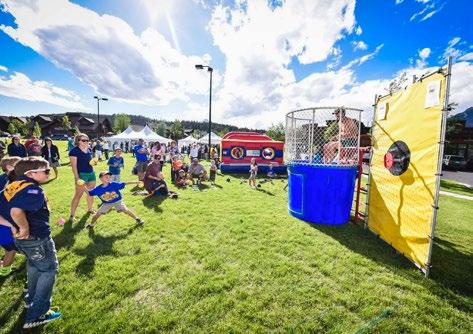
Dunk tank at the Soul Shine Country Fair. COURTESY OF BIG SKY SOUL SHINE
Soul Shine organizers including Janie Bertelson, (second from right), Jackie Robin (middle) and her three sons. COURTESY OF SOUL SHINE
“I think my body and my mind and my spirit just need that skiing to have something to look forward to,” Wermers told EBS “... I certainly need help getting up to the hill. Once I’m on the hill, I’m good.”
He learned about Soul Shine in 2025, and he attended last year’s country fair where he met Soul Shine co-founder Tracy Jacobson. She gave Wermers a big hug, “like I’ve known her forever,” Wermers recalled.
“They took me under their wing, like I was family,” he said. “And it was just a really sweet, sweet thing,
and I was happy I was there. And they were happy I was there.”
Wermers said Robin has been a great resource for his journey, and has even offered her home for him to stay on ski trips.
He’s impressed by how well organized the event is, and believes Soul Shine offers unmatched support and camaraderie.
“I mean, ALS has really affected the Big Sky community... It’s just a big number, like six or seven people,” Wermers said. “In a small community like
that, that’s a big impact... The support that they’re showing to try to combat this disease—I feel like I’m with family when I’m there... They take me under their wing, and they just want the best things to happen.”
Robin thanked sponsors for helping cover event costs to maximize fundraising impact. She said Soul Shine is looking for volunteers willing to support setup and take-down on the day of the event.
In addition, Soul Shine is looking for one or two new board members for a three-year term. Ideally, candidates have a background in logistics or event planning and can help with day-of coordination of the event. Robin noted it’s a much lighter lift than many other nonprofit boards in Big Sky, and the primary responsibility is to grow the impact of the annual event.
“If you or someone you love is living with ALS or if you know someone who has passed away from the disease, Soul Shine is your big hug,” Robin said. “It’s a way to say, ‘we understand.’”
It's the same hug Wermers experienced at his first Soul Shine, and it means a lot to families like the Hoadleys.
“Jackie Robin, she’s just such a wonderful person who goes above and beyond to help people navigating ALS,” Dan Hoadley said. “She’s certainly helped my wife and I, and we’re very appreciative of her help and friendship.”
For those unable to attend the 2026 event, donations can be made online at bigskysoulshine.org.
Dan and Vanessa Hoadley, with their kids, Claire and Nick. COURTESY OF HOADLEY FAMILY
BOZEMAN
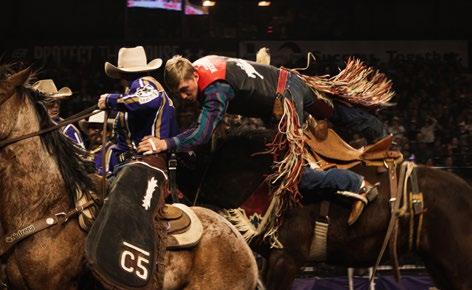
COMMEMORATING A LONGSTANDING CAMPUS TRADITION, BOBCATS SHINE AT 2026 MONTANA STATE SPRING RODEO
BY LESLIE KILGORE
BOZEMAN—On April 9-12, the Montana State University campus once again echoed with Bobcat excitement as the annual MSU spring rodeo drew competitors, families and rodeo fans to a weekend of high-stakes collegiate competition, including a celebrity appearance as famed rodeo entertainer Flint Rasmussen took to the dirt.
“People keep talking about me being retired, and I’ve never been retired, I just changed jobs,” Rasmussen said of his return. “It’s interesting. It feels surreal. I don’t know if I really crave it, but I think my heart rate goes down when I dress like this cuz I’m like, I’m back where I’m supposed to be.”
The event showcased strong performances by the Bobcat rodeo squad and underscored the longrunning role rodeo plays in Montana’s campus life and Western identity.
The MSU team posted several standout finishes across both roughstock and timed events, scoring well in saddle bronc, team roping, goat tying and barrel racing, showcasing the Bobcats’ depth across disciplines.
Standout MSU athletes included sophomore Holden Atkinson, who was the only bull rider to hold on for eight seconds Saturday to score a 78, and junior Faith Marshall, who won the goat tying with a 6.1-second run.
The rodeo serves as more than a competition for MSU but also a campus tradition that brings students, alumni and the Gallatin Valley community together.
Rodeo at MSU has long functioned as both a competitive program for serious student-athletes and as a celebration of the region’s ranching and equestrian culture. Each spring, the event provides a showcase for talent headed into the late-season
circuit and regional collegiate qualifiers, while honoring the practical horsemanship skills that remain central to Montana’s rural communities.
“This has always been a big dream,” said Jordan Lyles. From Hext, Texas, Lyles has been competing in goat tying and breakaway roping for years, and attended her first rodeo at two years old, but it was her first time at the Brick this April. “I came here my junior year of high school. It’s such a full circle moment to be here and how blessed I am to be a Bobcat here.”
“I love it all. The atmosphere is amazing,” Lyles continued. “I’ve been all over the world rodeoing. Being from Texas there’s a lot of big Texas schools that have rodeo, but nobody supports their kids like Montana State and it’s just a huge blessing to be here.”
With the regular collegiate season moving toward regional championships and spring finals, MSU’s rodeo team will use the experience and momentum from the weekend’s performances to sharpen entries and strategies.
“It has been a goal [to compete in rodeo here] for years, I love it here so much,” said Ava Shepherd, an MSU barrel racer from Bozeman. “You can never complain when you’re in the Brick.”
As events concluded, Rasmussen summed up the weekend well:
“You give to them,” he said of the crowd. “And then hopefully their response will fill you up and give it back.”
Fischer Genau contributed to reporting in this article.
PHOTO BY FISCHER GENAU
PHOTO BY FISCHER GENAU
BOZEMAN AIRPORT EXPECTS TO BOARD OVER 1.4 MILLION PASSENGERS IN 2026
DESPITE ECONOMIC AND INTERNATIONAL CONCERNS, AIRPORT EXPECTS
BY JEN CLANCEY
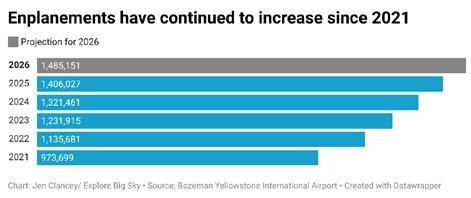
BOZEMAN—Bozeman Yellowstone International Airport estimates that 1,485,151 passengers will board planes from Bozeman in 2026, projecting another record after 2025, and a 5.6% increase in enplanements. The airport announced its projection on March 12, and shared that despite economic concerns domestically and abroad, numbers are expected to reflect the hub’s continued growth.
Brian Sprenger, president and CEO of Bozeman Airport, shared that staff are closely watching economic factors like disposable income, the stock market, job market and “potential recessionary indicators that could impact discretionary travel purchases,” in an email to EBS.
Relations abroad and the Iran war could also continue to impact travel in and out of Bozeman in 2026.
“These factors include the war with Iran, fuel prices and generally poor relations between the U.S. and other countries, particularly countries that in the past have populations that previously desired to visit the U.S.,” Sprenger stated.
Concerns about gas prices have already begun to ripple through the U.S., as drivers see the average fill-up jump higher than $4 per gallon for the first time since 2022, according to AP News’ Wyatte Grantham Phillips reporting on AAA numbers. As of March 6, the national average cost per gallon is $4.116, but Montana's was lower, seeing just under $3.80 per gallon. AP News’ Phillips reports that the Iran war has strongly impacted the supply chain of crude oil, including major cuts to production and high demand for oil elsewhere.
The consequences for airlines are showing up in reported flight cuts and potential price hikes for passengers. Airlines are also bracing for fuel bills to be billions of dollars higher than years prior. On March 30 for instance, Reuters reported that
United Airlines expects an additional $11 billion in jet fuel costs in 2026.
Sprenger outlined how costs could reflect Bozeman passenger numbers and travel demand.
“The most significant potential impact we are closely watching is tied to airline fuel costs due to the Iran war. As fuel costs go up, the potential for increased fares and decreased capacity by airlines becomes more of a factor nationally and worldwide,” Sprenger stated. “The longer the higher fuel costs remain, the more likely overall travel demand and capacity will decrease, including to locations such as BZN. While we believe our impact may be less than some destinations, we are not immune to these significant impacts on travel demand.”
BZN still ‘bullish’ in market, expect projections to demonstrate continued growth
Despite economic challenges, Bozeman Airport predicted travel to continue growing in 2026 due to expanded flight options and ongoing demand in U.S. cities, as reflected in 2025 end-of-year stats.
“The [2025] increase was due to several factors including increased competition in several markets
including Seattle, Chicago and Boston. The June through October 2025 performance was particularly strong. For the rest of the year, we saw a maturing market with more moderate growth,” the March 12 news release stated.
In 2026, summer season inbound travel will likely “positively impact” the airport, including increased service from San Diego, and new services to Phoenix, Arizona, and Austin, Texas. Bozeman Airport also expects to see growth in travel from Atlanta, Chicago, and the New York City area. These growth areas often show competition between airlines, especially in the Seattle area, where Delta and Alaska hit a year of service offerings between Bozeman and the Pacific Northwest city.
“That being said, we remain relatively bullish on our market and continue to expect BZN to be one of the fastest growing airports in the nation,” the release continued. “We hope these projections by airport management will give some guidance for calendar year 2026 expectations, however, all projections are based on the information available as of March 10, 2026 and could change throughout the year.”
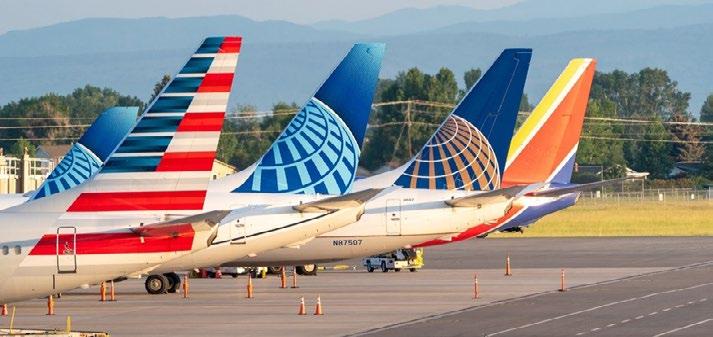
Airlines at Bozeman airport featured in a Jan. 7, 2026 press release about the summer travel schedule. PHOTO COURTESY OF BOZEMAN YELLOWSTONE INTERNATIONAL AIRPORT
ENVIRONMENT
A RIVER STILL RUNS THROUGH US
BY ERIC LADD PUBLISHER
There are certain stories that refuse to fade. They settle into us quietly, like a river carving its way through stone, unchanged in direction but deepened by time.
Nearly 30 years after its release, the movie “A River Runs Through It” is finding its way back into the cultural current. What once defined a generation of anglers now carries a broader and more urgent meaning, one that feels increasingly relevant for the rivers and communities we depend on today.
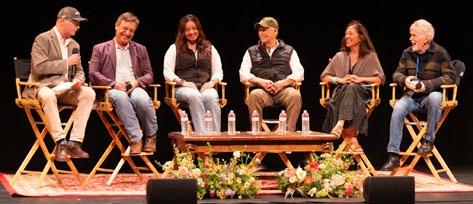
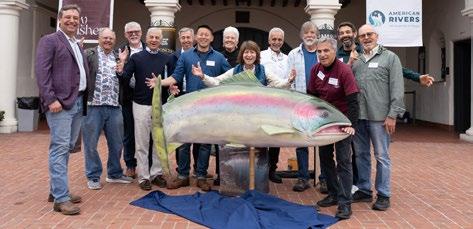
I was reminded of that truth recently in Santa Barbara, California, where a passionate fly-fishing club gathered at the historic Lobero Theatre to celebrate the film. What could have been a simple nostalgic screening evolved into something far more meaningful, capturing a community drawn together by water.
The room was sold out, filled with a couple hundred people—a mix of passionate anglers and many who had never picked up a fly rod. That diversity shaped the evening in a noticeable way, creating a shared experience that reached well beyond the core fly-fishing community.
And yet, everyone was drawn in for the same reason. This night was not really about fishing, but about what fishing represents.
American Rivers President and CEO Tom Kiernan began the evening, speaking to the organization’s 50-plus-year history and its deepening work around clean water, dam removal and species recovery. More importantly, he framed the moment we are living in as a defining one, a true legacy moment in which the responsibility to preserve these rivers for the next generation belongs to all of us.
That message carried forward through the panel. Chris Wood, president and CEO of Trout Unlimited, grounded the discussion in the realities facing cold-water fisheries today, while John Maclean offered a more personal perspective, reflecting on the legacy of his father, author Norman Maclean, and the enduring power of storytelling to shape how we understand rivers, family and place.
Together, the panelists explored how the film has influenced development across the West, helped
shape tourism economies, and even played a role in conversations around mental health and connection. Despite the range of perspectives, the discussion consistently returned to a single, unifying theme: conservation.
A presence that carried the room
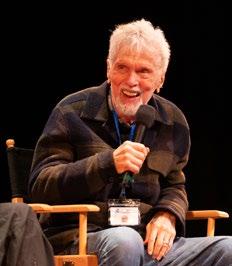
There was something especially powerful about the presence of actor Tom Skerritt that evening.
At 92, he brought a quiet, undeniable gravity into the Lobero Theatre. Having the opportunity to share the stage with him was an honor for me, and it quickly became clear that this was not simply about revisiting a role from the past.
For many, he will always be remembered as the Reverend from “A River Runs Through It,” but in this moment he felt like something more—a steward, dedicating this chapter of his life to conservation and to protecting the landscapes that gave the film its soul.
Time has, of course, shaped the way he speaks. His words come more deliberately now, but what stood out most was not how he spoke, but what he chose to say. With humility and sincerity, and just enough dry wit to remind the room of the storyteller he has always been, he said the film remains one of his favorites and that it left a lasting impact on him personally.
In that moment, the room leaned in. It was not just an actor reflecting on a role, but a man reflecting on meaning.
It is also worth recognizing the vision behind the evening.
What the Santa Barbara Fly Fishing Club created was more than a screening. It was a blueprint for how communities can come together around both passion and responsibility.
By pairing a film that has meant so much to so many with a thoughtful and relevant conversation, they created something that felt authentic and accessible. It was not overly produced or commercialized, and that simplicity is precisely what made it resonate.
It is easy to imagine this format traveling to other river communities across the country, reconnecting people to what matters and inspiring stewardship.
At its core, this film is a story about family, place and the river itself.
Much of that film captures the Gallatin River, a place that now faces real pressures from growth, recreation and long-term sustainability challenges. What once served as a cinematic backdrop is now a frontline for stewardship.
Rivers across the West are under increasing pressure. The Gallatin River is no exception. As more people are drawn to it, the need to protect its health becomes more urgent. This film reminds us that rivers are not simply resources. They are the threads that tie communities together.
Leaving the theatre that night, it was clear this was more than a screening. It was a reminder: If a river runs through all of us, what are we willing to do to protect it?
Left to right: Chris Wood, Eric Ladd, Kayeloni Scott, Tom Kiernan, Julie Tokashiki Skerritt and Tom Skerritt.
PHOTO BY ISAAC HERNANDEZ DE LIPA / MERCURY PRESS
The Santa Barbara Flyfishers presented "A River Runs Through It" including a panel discussion about river conservation, at the Lobero Theatre on March 31 in Santa Barbara, California. PHOTO BY ISAAC HERNANDEZ DE LIPA / MERCURY PRESS
Actor Tom Skerritt had a leading role in the 1992 film, and remains dedicated to river conservation.
PHOTO BY ISAAC HERNANDEZ DE LIPA / MERCURY PRESS
DISPATCHES FROM THE WILD: JIM HALFPENNY
TRACKING THE WILD IN
YELLOWSTONE’S SNOW
BY BENJAMIN ALVA POLLEY EBS COLUMNIST
On an unseasonably warm March evening near Pray, Montana, while most visitors scan the horizon for the quick thrill of a wolf sighting, Jim Halfpenny is more interested in what’s under their feet.
For Halfpenny, the story of the wild is written in clues: a faint scuff in the snow, a distorted paw print cast in plaster, a broken bison vertebra, a raven’s GPS trace arcing across a digital map. To walk with him through his research center in Gardiner, is to realize that almost everything you thought about wildlife was a rough draft. He’s been working on the second, third, and fourth drafts for decades.
Halfpenny introduces himself modestly: not as a “wolf biologist,” but as an ecologist whose world is cold. He defines his specialty with three words— latitudinal, altitudinal, seasonal—and that triad has pulled him from the alpine tundra of Colorado to the polar deserts of Greenland, from Yellowstone’s Lamar Valley to Antarctica. He has worked on all seven continents, in countries including Japan, Greenland, and New Zealand, he led American expeditions to East Greenland in the 1970s, and he wears the Antarctic Service Medal to prove that his affinity for the cold is not a metaphor.
Yet for many in the Greater Yellowstone ecosystem, he is first and foremost the man who can read a track the way other people read a book.
A detective of the snow
Halfpenny came of age in a world that no longer exists. In the 1950s in Scottsbluff, Nebraska, his parents would hand him a can of Vienna sausages,
a can of mandarin oranges, and a can of plaster of Paris and tell him to “go track raccoons.” He did. By his own account, he had memorized every natural history and polar exploration book in the local library. Ernest Thompson Seton’s “Hunter’s Signs” and “Animal Tracks” was a favorite and a blueprint. By age 14, hunters were paying him to do what he would have done for free: find wounded animals they had shot and lost. Long before “forensic wildlife tracking” was a buzzword, Halfpenny was quietly inventing it.
Today, he wears blue jeans, a gray fleece and a gray baseball cap embroidered with orange letters spelling K9YNP, his ham radio call sign. In the basement classroom of his Gardiner Track Education Center, those early obsessions have solidified into an astonishing archive. There are collections of hair and scat, bones and skulls, and more than 10,000 plaster casts, as well as digital and 35 millimeter images of tracks—wolves, coyotes, cougars, wolverines, lynx, bears, even Bigfoot. Each supposed bigfoot track is carefully labeled, not because he believes in the creature, but because serious trackers must be willing to seriously debunk.
The cases are arranged by what he calls the cardinal rule of evidence: “the more important the case, the worse the evidence.” On the top shelves sit pristine, museum-quality casts. As you look downward, the tracks get messier: partial impressions, distorted snow melt, three-toed wolves that lost digits to being stomped on by large ungulates. These are the real-world tracks that confound biologists and game wardens, the tracks he has spent a lifetime teaching people to interpret.
He’s not content with dirt and snow, either. Halfpenny helped pioneer the use of track plates— chalked or sooted surfaces laid over adhesive paper, baited to tempt passing animals. When the animal crosses, it leaves a perfect, ink-like print. He has binders of plate prints from across North America, and he literally wrote the manual that federal and state biologists use to distinguish marten, fisher, wolverine and Canada lynx.
In an era obsessed with GPS collars and remote cameras, Halfpenny’s devotion to footprints might seem quaint or obsolete. It isn’t. It’s subversive. Trackers, unlike instruments, must be physically present. They must slow down. They must pay attention.
The man behind the wolf charts
Halfpenny’s name is now inseparable from Yellowstone’s wolves. He started working with them in 1975, decades before the famous 1995 reintroduction from Canada. When wolves began moving down from British Columbia into Montana, someone had to answer the rancher’s million-dollar question: “Who ate my prize sheep?” Halfpenny was the one called to tell a wolf from a dog, a cougar from a bear, by the tracks and signatures they left behind.
When the reintroduction finally happened, the federal government funded the capture, transport, and initial release of wolves into Yellowstone and central Idaho—and little else. Salaries, flight time, radio collars, and long-term monitoring would rely on ingenuity and donations.
Halfpenny’s contribution was the wolf chart—an annual “playbill” of the wolf cast in the Yellowstone theater. Each pack appears in a distinct color, alpha male and female at the top, subordinates below, with colors following dispersers as they move to other packs, revealing genealogies at a glance. The charts became coveted wall art for wolf watchers, and a funding stream: money from every chart sold goes to the Yellowstone Wolf Project.
From that simple idea sprang something extraordinary: a full genealogy of the Yellowstone wolf population. Combining field observations from an army of wolf watchers with PhD-level genetic work, Halfpenny and collaborators, Leo Leckie and Shauna Baron, built an exhaustive family tree with over 1,200 animals. When they approached Ancestry.com to host it, the company at first assumed they meant humans. After “half a dozen calls” and some disbelief about “animals,” the wolf
Jim Halfpenny is one of the region's foremost wildlife biologists and ecologists. PHOTO BY LARRY MARLOW
Halfpenny smiles for the camera while measuring grizzly tracks. PHOTO BY MICHAEL FRANCIS
tree went live. Schools now use it to teach genetics and ecology; fans follow their favorite wolves the way others follow sports teams.
On the 25th anniversary of reintroduction, Halfpenny and coauthors turned the charts into a phone-book-thick volume: every chart since 1995, plus short biographies of the first 1,300 wolves. For the 30th anniversary, having learned the limits of human endurance, they picked 22 particularly famous wolves and the breeding alphas of each extant pack, giving 40 individuals full-page biographies and genealogical “fan charts.”
Wolves like 907F, who ran blind in one eye into her 12th year, with a lineage stretching back to the original Canadian founders. Wolves like 13M, “Old Blue,” a shy alpha whose mate stayed by his body for days after his collar switched to mortality mode, then tracked the pack through the snow to rejoin them. Wolves like 253M, who survived being hamstrung by a rival, limped across states, was trapped and relocated twice, became the alpha male of two packs in Jackson Hole, and was ultimately the first legally harvested wolf there at age seven.
These are not abstractions in population models; they are individuals with histories, injuries, strange journeys and descendants. In a policy debate that too often collapses wolves into symbols— of wilderness, of federal overreach of rural resentment—Halfpenny insists on the concreteness of their lives.
Between biology and politics
Halfpenny is blunt about the politics that swirl around wolves and bears. He has spent enough nights in backcountry cabins, enough days in agency meetings, to know that science doesn’t float above politics. Rather, it slogs through it.
On proposals to remove federal protections for grizzlies and wolves, he returns to first principles: the Endangered Species Act was designed to
ENVIRONMENT
recover species to the point where states could manage them, not to confer permanent federal guardianship. By the federal recovery criteria originally set for wolves in the Northern Rockies, he argues, those goals have been met. Montana alone now has about 120 packs and well over 1,200 wolves.
But he also knows how numbers can hide value. From a population standpoint, the loss of a few habituated Yellowstone wolves that wander over the park boundary each year and get shot is “not that big of a deal.” From a scientific standpoint, losing a wolf with seven or eight years of radio-collar data and a known place in that vast family tree is a gut punch.
He’s not naïve about state politics, either. “Trust but verify,” he says of state management plans. The real target for wolf numbers, in his view, is not the bare minimum to avoid genetic collapse, nor the maximum fantasy of those who’d prefer a landscape untouched by livestock and people. The target is a messy, shifting “social level” of wolves that human communities will tolerate.
If that sounds unsatisfying, that’s because it is. “Ecology rarely offers clean answers,” he said to a fireside chat at Sage Lodge near Yellowstone’s north entrance. As he reminds audiences, in biology there is rarely a single cause; the “answer equals A plus B plus C plus D.”
“Are Yellowstone’s riversides recovering because wolves reduced elk browsing, or because of climate change, or beaver activity, or human land use? Likely some mix of all of the above, with different weights in different valleys,” he said.
The measure of a life’s work
Jim Halfpenny’s CV is long and decorated: PhD in biology, ecology, and mammalogy from the University of Colorado; former director of the
Mountain Research Station and its Long-Term Ecological Research program; past senior instructor and board chair at NOLS; Fellow of the Explorers Club; and Vietnam veteran with the Navy Achievement Medal with Combat “V.” He appears in multiple editions of "Who's Who". He’s also authored at least 26 books, 15 plastic laminated guides, and eight CDs and videos.
But those bullet points don’t fully capture the impact of his work.
You see it instead in quieter things: in the kid who downloads his Yellowstone wolves app and realizes that wildlife is not an amorphous mass but a set of individuals with birthdays and death dates and cousins; in the state biologist who peers at a blurry snow track and, thanks to Halfpenny’s manuals, can say with confidence whether it belonged to a marten or a wolverine, a coyote or a wolf; in the volunteer who learns from him that wolves and grizzlies don’t just “compete” in some abstract way, but negotiate each carcass with hunger, numbers and social ties.
In a time when conservation fights are increasingly fought on screens and in courtrooms, Halfpenny’s legacy is deeply, insistently physical. It resides in plaster, in chewed bones, in broken vertebrae, in chalk dust, in snow pits dug year after year to measure how winter itself is changing.
It is easy to argue about wolves in the abstract. It is harder and more honest to bend down next to a track, place your hand against it, and imagine the living animal that made it. Jim Halfpenny has spent a lifetime helping the rest of us do exactly that.
Benjamin Alva Polley is a place-based storyteller. His words have been published in Rolling Stone, Esquire, Field & Stream, The Guardian, Men’s Journal, Outside, Popular Science, Sierra, and WWF, among other notable outlets, and are available on his website.
Halfpenny's collection. PHOTO BY LARRY MARLOW
PHOTO BY BENJAMIN ALVA POLLEY
3
THRIVING LANDSCAPES: WILDFIRE RISK,
FOREST PESTS AND THE NEED FOR A COMMUNITY FORESTER
BY ABBY BUTLER EBS COLUMNIST
At Grow Wild, we’re all about conserving our native landscape and promoting informed land stewardship. Since 2004, we’ve been proponents of educating and inspiring landowners to plant native plants and manage invasive species with the underlying knowledge that these benefits extend into the health of the surrounding ecosystem and community of recreators, homeowners and businesses it supports. With an early start to the wildfire season and ongoing drought conditions exacerbated by a lackluster winter, our sights are set on the next critical step for conserving Big Sky’s landscape—a community forester.
First, some context. One of the most important characteristics to a healthy forest, according to Dr. Joseph Orefine from the Yale School of the Environment, is its ability to either resist or adapt, or both, to natural and human-made stressors— also known as resilience. Stressors include extended periods of drought, severe fire events, disease or insect outbreaks or fragmentation caused by human development. When a forest ecosystem lacks resilience, these stressors have long-lasting and devastating impacts to plant and wildlife communities, nearby waterbodies and human health.
For example, mature trees stressed from drought conditions are easier targets for bark beetle infestations, especially in the western portion of the state. According to a 2024 report from the Montana Department of Natural Resources and Conservation, bark beetles and wood borers that typically aren’t “aggressive” are attacking trees impacted by ongoing drought. Plus, defoliators like spruce budworm are damaging and even killing trees. The forest we know today developed under wetter growing conditions and thus is struggling to survive in a drought-prone climate.
When forests struggle, so do rivers like the Gallatin.
Diverse forests provide necessary ecosystem support—various trees, shrubs, forbs and grasses create natural erosion control which, according to the U.S. Fish and Wildlife Service, keeps extra sediment out of the river and ensures that wildlife like trout have clean water to reproduce in. This water-forest relationship also allows a thriving recreation economy to continue in Big Sky.
Restoration of these impacted environments takes expertise and time, and a community forester is a crucial piece to the puzzle, helping Big Sky understand and maintain healthy forest ecosystems.
Big Sky is at risk for severe wildfires and with it a loss of native biodiversity. According to California’s Department of Fish and Wildlife, large patches of high-severity fire can “hinder the ability of an ecosystem to recover.” This leads to the loss of native plant life and allows invasive species to expand. This doesn’t account for the immense risk wildfires pose to human life and personal property.
Looking at just Gallatin County, data from Gallatin County Emergency Management shows a cumulative 1,000,107 acres of land in the Wildland Urban Interface (WUI). Nationally, Montana is ranked second for the percentage of homes at risk of “catastrophic wildfire damage,” according to the Commissioner of Securities and Insurance.
Homeowners face risks to both their personal safety and their ability to afford to remain living and working in Montana. Skyrocketing homeowner insurance premiums or the inability to find coverage at all is an ongoing issue that many Montana legislators have begun trying to address. In the meantime, Montanans bear the weight of
another wildfire season and the potential harm it may cause.
With the knowledge above at the forefront of our strategic planning, we and our partner the Big Sky Fire Department recognize a need for a coordinated, community-wide plan to address these stressors and guide Big Sky into a safer, more informed and more resilient community of landowners, agencies, and partners. We’ve drafted a preliminary Forest Stewardship Plan that outlines priorities for forest health, wildfire risk reduction and long-term stewardship. Guided by the professional expertise of qualified forestry consultants, we will refine this framework and clearly outline the role of a community forester. Proposed roles include educating landowners, assisting with forest and habitat health monitoring, wildfire risk reduction and climate and resilience planning.
As a community, supporting this initiative is a benefit to everyone—whether you own forested land or simply value the safety, beauty and future of this landscape and its inhabitants. You can play a part in this effort by learning about the threats facing Big Sky, whether that’s forest health or wildfire risk, and sharing that knowledge with your neighbors, colleagues and the leaders in your community. Opportunities to learn include utilizing the Fire Adapted Big Sky Wildfire Hub and Alpenscapes, the latter of which recently published a guidebook to share local landscape guidelines. Together, we can begin investing in a healthier and safer future for Big Sky.
Abby Butler is the conservation program coordinator at Grow Wild.
Impact of western pine beetle on a ponderosa pine. PHOTO COURTESY OF U.S. FOREST SERVICE
BY MEL CRICHTON EBS COLUMNIST
If you think this winter’s snowfall has been light, you are not alone. Fuels at lower elevations are already drying out, and wildfires have sprouted across Montana. If the trend continues and we’re met with some bad luck, Big Sky could be in for a wild ride this summer. Here are a few things you can do now to prepare.
The most important thing is to sign up for phone alerts from Gallatin County, via the Everbridge system. Big Sky residents in Madison County should also sign up here, since evacuation routes could be via U.S. Highway 191. The QR code below takes you directly to enrollment, and you will receive push alerts based on your location, even if regular phone lines are overloaded.
If you are ordered to evacuate, you should have your “go kit” packed and ready to move. Kit items include food, medications, pet supplies, battery radios, flashlights, family valuables and whatever else you might need for “roughing it” for at least three days. Move flammable outdoor furniture into the house. Assess your neighborhood egress routes, and keep tabs on elderly or disabled neighbors who might need assistance. When fire danger signs reach “HIGH,” keep your car’s gas tank at least half full. And if you can’t evacuate out of town, know your safe refuge sites—large parking lots, golf courses, BASE.
The leading cause of home losses in wildfires is flying embers, or firebrands, often from miles away. Now that the snow is disappearing, it’s a good time to take a few simple steps to prepare your home for embers. Number one priority is to remove flammables within 5 feet of structures. This includes wood mulch—replace it with stone or gravel. If your firewood stack is within 30 feet of a building, it could easily ignite from flying embers and, due to the high heat produced, ignite structures.
It’s a good time to clean the gutters of flammable pine needles and rake debris away from the house. Flammable bushes like junipers can ignite your siding or break your windows with their heat, so keep them at least 5 feet from the house. If you can, cover open attic and crawlspace vents with a metal screen, one-eighth inch or finer, to keep embers out of your home. And keep flammables from under decks. If the deck goes, the house won’t be far behind.
There are more steps you can take to help your home—and your family—survive a wildfire. For example, you can hire contractors to help you clear flammables; they’re listed on the Build Better Big Sky website. For more detail, you can visit the Fire Adapted Big Sky Wildfire Hub website, talk to your neighborhood wildfire ambassador, or contact me via the email below.
And pencil in June 29 on your calendar for the Big Sky Wildfire Film Fest, a free public event at The Waypoint with educational and Hollywood film presentations.
If you’d like to help finance our Fire Adapted Big Sky awareness campaign, tax-deductible donations can be made through our sponsor, the Big Sky Rotary Club. Just choose the option for wildfire education to donate via PayPal or Venmo.
That was just a high-level overview to help you plan for the worst, but you can get more detail at the Wildfire Hub website or by contacting your neighborhood ambassador or me. For our next article in May, Wildlands Fire Chief Jon Trapp will summarize our 2026 wildfire forecast.
Mel Crichton acts as neighborhood ambassador coordinator for Fire Adapted Big Sky. He may be reached at kj9c@comcast.net.
MAKING IT
BIG SKY:
BY LESLIE KILGORE
From high alpine weddings to unique arrangements tucked into mountain homes and luxury hotels, flowers in Big Sky now carry a signature touch, thanks to owner and lead designer of Sugar & Spice Florals, Heather St. Clair Ross.
After moving from Chicago to Montana to study horticulture at Montana State University, Heather built her foundation in the landscapes of the Mountain West long before she ever opened her own shop. For just over six years, she served as lead horticulturist at Yellowstone Club, where she refined her expertise in large-scale floral design and extensive landscape planting.
In late 2023, freelance floral work around Big Sky quickly grew into a full-time demand, revealing a clear need for a dedicated local florist. That momentum ultimately led her to take a leap of faith, leaving her role at Yellowstone Club to launch Sugar & Spice Florals, a decision rooted in both opportunity and a desire to serve the Big Sky community more directly.
Today, Sugar & Spice Florals has carved out a distinct niche as Big Sky’s go-to local florist, providing arrangements for weddings, events and everyday occasions. The business is also the trusted floral provider for Montage Big Sky, a vendor for Moonlight Basin, Yellowstone Club and One&Only. In 2025, Heather’s work was recognized when she was named "Emerging Entrepreneur" in Explore Big Sky’s annual Best of Big Sky awards.
With a newly established storefront and a growing team, Sugar & Spice Florals has become a staple in the small business community of Big Sky.
This series is part of a paid partnership with the Big Sky Chamber of Commerce. The following answers have been edited for brevity.
Explore Big Sky: When did you come to Big Sky, and where are you from originally?
Heather St. Clair Ross: I grew up in Chicago, and I came out to Montana when I was 18 to study horticulture at Montana State University. Then after graduating, I was hired as the Yellowstone Club lead horticulturist. So my job there was to grow, design, plant and maintain all the flowers around the entire property and all the communal areas—basically everywhere in the club except people’s houses.
EBS: Did you have a team there?
HSR: Yes, I had a team in the summer season that helped me maintain, plant and design everything around the property. I oversaw a team of usually five to six people throughout the summer.
EBS: What led you to start your own business?
HSR: In the latter part of 2023, I began getting quite a bit of freelance work around Big Sky, namely at the Montage, and it quickly grew into a second full-time job. So in July of 2024, I made the difficult decision to leave my rewarding role at the Yellowstone Club to pursue my own floral endeavors and serve the Big Sky community more directly through flowers. I definitely saw an open niche that needed filling, and it worked out really well, so I’m glad I did.
EBS: Tell us about Sugar & Spice Florals and how it’s grown.
HSR: I feel like I definitely refined my expertise in floral design through working at the Yellowstone Club, and when I left my role there to pursue Sugar & Spice Florals full-time, I was doing everything out of my house at first, and then in the summer of 2025, we rented out the Cinnamon Lodge as our first studio space.
After that, I eventually moved into the new location that we’re currently in. So now we have an actual brick-and-mortar retail location. We do weddings, events, everyday flower deliveries, and also sell flowers and houseplants out of our shop.
EBS: What can customers expect when they walk into your shop?
HSR: We have houseplants, and we also have a cooler for flowers, so we always have ready-made arrangements available to purchase. People can also come in and place an order or discuss a wedding or event they have coming up. We’re more than happy to have a consultation too.
EBS: Do you feel your time at the Yellowstone Club helped build connections?
HSR: Yes, definitely. Getting that job right out of college helped me gain a lot of traction in Big Sky and network with people who want high-end flowers. It’s definitely a luxury service, which Big Sky has a lot of, so it’s a great place to do it.
EBS: What are you most excited about right now with the business?
HSR: We’re expecting to be really busy this summer now that we have the brick-and-mortar shop. Our winter was already insanely busy. We had our biggest quarter in the first quarter of the year and a really busy Valentine’s Day. We’re looking forward to having our official grand opening at the beginning of June.
EBS: Tell us about your team.
HSR: For a while, it was just me doing it all, but now I have one full-time employee and we have a part-time flower delivery driver as well. And then we have people who help us during really big weddings or events.
EBS: How are you getting the word out about your new shop?
HSR: I joined the [Big Sky] Chamber of Commerce at the end of last summer, which has definitely helped. We also have a good online presence and run ads, but a lot of it is just word-of-mouth.
EBS: What’s been your most memorable event so far?
HSR: The biggest event was our first wedding at the Yellowstone Club last spring. I ordered 400 bunches of baby’s breath, and we made several big baby’s breath clouds that hung from the ceiling over the dance floor. We also made a huge arch out of baby’s breath for the ceremony. It took a big team and quite a few hours, but it turned out really great. It was endless boxes of baby’s breath.
EBS: How do you engage with the local Big Sky community?
HSR: Through the chamber of commerce we meet and network with other business owners, and I also won the "Emerging Entrepreneur" award for Best of Big Sky, which was really cool. It was pretty unbelievable. I was jumping up and down for a few days. We also donate leftover flowers to the Big Sky thrift store every week. They sell them, and the money goes back into the community instead of the flowers going in the trash. It’s a win-win. We donate plants too, especially orchids after the blooms fall off but are still healthy, so people can pick those up as well.
EBS: What do you love most about the Big Sky community?
HSR: It’s definitely very vibrant and rooted in community. Everyone is so kind and cheering each other on. It’s a really fun place to be a small business owner, and we’ve had some great collaborations with other locals. People are excited to have a florist in town, which is really special.
EBS: What’s next for your business?
HSR: There’s definitely tons of room for growth. Our goal is to be fully booked every summer with weddings and events, while consistently doing daily deliveries. I’m hoping it grows quickly enough that I’ll need another employee sometime this summer. I feel like the growth is pretty boundless.
EBS: What’s the best advice you’ve received as a young entrepreneur?
HSR: My dad has given me quite a bit of good advice, and I have friends who are older entrepreneurs as well. The best advice has been to find your purpose, your truth, and your gift that you’re here to share with the world. If you can find a way to monetize it, you should pursue it wholeheartedly.
Also, believe in yourself, surround yourself with people who are cheering you on, and don’t fall behind. But ultimately, just follow your heart. And yes, enjoy the ride—it’s a grand adventure being self-employed.
SKI TOWN VIGNETTES: ‘GIVING IT ALL WE’VE GOT’ OPINION
BY NIELSEN GREINER EBS COLUMNIST
For my final column of the ski season, I was originally going to ask some locals to tell me about their winter. I quickly realized, however, that I wanted to ask a deeper, more allencompassing question: “Why do you choose to live in a ski town?”
While there may be reasons to not live in a ski town—housing, cost of living, transient community, long and harsh winters—those who stick it out have their reasons to stay. Ask most any local who’s made it work, and they’ll say it’s worth it.
I sent that question via text to some Big Sky resident friends of mine. It would take many pages to sum up and quote the responses I received. The best I can do is share a summary.
There is, of course, an obvious reason to live in this particular ski town—the close proximity to worldclass skiing.
“We love having access to an incredible resort that has endless terrain options, a mere 15 minutes away,” said Cherrie Chamberlain. “The ski-focused culture and community is a large part of our lives, making Big Sky a rather perfect fit.”
“I chose to live in a ski town because I love to snowboard,” said Andy Nagel, a Big Sky Resort employee. It's a straightforward, lifestyle-based decision shared by many, including Nelson VanTassel, a ski patroller at Big Sky Resort.
“I choose to live here because I can’t see myself living anywhere but a mountain town," VanTassel said. "I’ve built my life around the activities that make me come alive.”
As I kept asking around, it was soon apparent that, apart from the obvious reasons, living in a ski town is about much more than skiing. For many, especially families, it’s the strong local community that keeps them here.
Steph and Taylor Kissell’s story is reflective of a broader theme—home, roots, family, community.
“We moved here for work and the gateway drugs of skiing and fishing. Twenty years later, we still find ourselves here. Our jobs and hobbies have shifted, we started a family, and made the transition from renters to homeowners. Now, our community is here. Every time we leave, we look forward to coming home.”
Chris and Vanessa Wilson’s story echoes the Kissells’. Vanessa moved to Big Sky in 1995 and Chris in 1997, looking for a year of fun before pursuing a serious job. “The rest is history,” he told me. “We never left. We made a lot of friends while working here and a lot of us have stuck around. We love our group that we grew up with, and have watched our kids grow up together. It’s a great local community.”
One friend, who asked to remain anonymous, addressed some of the real challenges. “It has not been without difficulties. Big Sky's winters are long, cold, and a lot of work. Shoulder season can be depressing because it is hard to do things outside during mud season. Big Sky has a good crew of core locals, but it can be hard with frequent turnover of new residents, and kids’ friends moving away. It is an expensive place to live and you have to make financial sacrifices to make it work.”
Despite the challenges, he landed on a positive note. “We have flourished in this community despite the difficulties. We have a wonderful group of friends. We are part of a vibrant church. My wife is growing and loves her art options and connections.”
“I could never imagine living elsewhere,” Wes Hoecker—a family man, business owner, and nonprofit board member—told me. “Big Sky is the total package. Yes, it definitely has more than enough challenges, but I think we are better for it. It encourages people to get involved. There’s a lot that needs done in this town and it really does
Steph and Taylor Kissell are raising kids in Big Sky, like many other families, despite the unique challenges of mountain life. COURTESY OF KISSELL FAMILY
Ski patroller Nelson VanTassel and his avalanche dog, Murphy. COURTESY OF BIG SKY SKI PATROL
take everyone to achieve our goals. So it’s really rewarding to be part of such an active and involved community. I have never seen anything like it before. It’s a truly special place that is loved by so many, and I want to make sure we take care of it for generations to come.”
While many initially move here for the outdoor lifestyle, they often choose to stay for the town as much as the activities, as expressed by Jonathan Gans, a former teacher at Ophir School who now works for Lone Mountain Land Company. “I choose to stay here because I love being involved in creating and building a town.”
It’s beautiful when community members share a common passion for what they love to do—like making turns down a smooth white face of snow in a state of bliss. Despite the obstacles, living in a ski town brings us joy. Though personal, this joy is experienced not in isolation but within the whole. It’s like a troupe of dancers. While each dancer is solitary in their act, they perform in unison, creating something far more elegant than their individual roles.
A ski town has a soul—the people, the community. “Locals” are the brush strokes of color that brighten and bring depth to the wild canvas of a rugged landscape of mountains and snow and rivers, trees and birds and wildlife. And we, the community, are not merely passive bystanders, but stewards.
For myself, it’s not only the open space, riding powder off Lone Peak or Headwaters, the outdoor lifestyle, the special community. It’s also the inevitable sacrifices, the costs of choosing such a place. You don’t live in a ski town by accident; as many of us know, it’s not the easy choice, practically speaking. This reality makes it all
snowboarder—recently told me. Certainly, in some ways Big Sky seems about as close to heaven as you can get. Not because everything is perfect. Rather, it’s the commitment each one of us makes, the roots we plant in the tough soil. Like whitebark pines in the alpine, we learn to weather the seasons and play our part in the physical and social ecosystem.
Pondering life as a Big Sky ski bum, Barnett said, “Was it worth it to be a ski bum? The answer is yes… There’s a lot of us up here giving it all we’ve got. You never get that turn back if you don't make it.”
So this one’s for you, Big Sky dwellers, for doing whatever it takes to stay, for giving it all you’ve got to live the ski town dream.
Casey Barnett slaying some Big Sky pow. COURTESY OF CASEY BARNETT
A&E
A LA CARTE: TRUST IN THE POZOLE
BY RACHEL HERGETT EBS COLUMNIST
We place a certain amount of trust in people every time we eat food we did not prepare ourselves. We may trust in the quality of the ingredients, the cleanliness of the restaurant or the care put into the cookery itself.
It can be beneficial to take that trust further, to allow those who are serving us a meal to take part in our decision-making process. This trust opens our minds and excites our palates. We are fed beyond the literal.
Trust was on my mind as I ate the most incredible and beautiful bowl of pozole, a hominy soup with pork and vegetable. Let’s rewind a bit.
As March came to a close, I heard rumors that La Tinga was closed and it broke my heart a little. Owner Alba Jeffries is a light of a human. She calls me Raquel and pushes me to speak more Spanish. She loves to dance, and loves KGLT, including my radio show. When La Tinga had a place on Main Street, she and husband, Curt, hung a wooden “Magic Monday Show” sign in the restaurant.
I felt called to investigate. La Tinga’s building is admittedly out of the way for most, at 3709 Baxter Lane. When I pulled up early on a Friday afternoon, there were a few cars in the lot and an “open” sign glowing in the glass door below the script on the building reading “La Tinga.” Good sign. But then a not-so-good one. There were two sets of hours on the door. One for La Tinga (Tuesdays, 7 a.m.-3 p.m.) and above it, hours for La Perla (Wednesday-Monday, 8 a.m.-5 p.m.). La Perla?
I went inside and was more confused as I was greeted by a smiling Alba on a Friday. She was filling in, she told me. La Perla has been in the space for about a month. Alba opens shop once a week on the day La Perla is closed for us La Tinga loyalists. That Friday was her first time working together with the owner of La Perla, graciously filling in during a staff shortage.
La Tinga, though now feeling more like a rare bird than ever, is still intact for those willing to seek it out. For that I am satisfied and will make a point to visit on a Tuesday.
Instead of Alba’s tacos, I perused the handwritten options from the La Perla menu. Before I had more than a glance at the variety of tacos and flautas, Alba was pointing out the last rectangle of cardstock. Pozole.
Here’s where the trust comes in. If someone who works in food sincerely leads you to a dish, just listen. Maybe it’s not something you normally try. Maybe you usually steer clear of pork. Maybe you have an old aversion to hominy. Trust.
Once I consented to the pozole, Alba asked if I would like the soup for here or to go. When I said “to go,” I got a stern look and a shake of the head from Alba. I would sit and eat the soup at one of
the long communal tables. My neighbors eyed the soup, and sadly learned it had sold out when they tried to order a bowl.
Trust also involves listening to cues. Squeeze the lime wedges on the plate into the bowl, for example. Also listen when the young woman handing you the bowl tells you how a red salsa in a ketchup bottle is the perfect complement. Add the recommended salsa, limbs moved as if by some occult hand to pour ever more from its bottle—even as your mind screams that the salsa will set your mouth on fire and probably make you weep.
Before I left, I also ordered three of the tacos on the day’s menu to go—a green mole chicken, a beef in a beer sauce and a tamarind pork. Each was more delicious than the last and made me wish I had also tried the marinated and grilled fish, especially after seeing they often draw daily selections from a larger and very seafood-heavy menu. La Perla’s food feels like an abuela cooked it, simmering sauces over the stove for days and infusing all her grandmotherly love into them. I trust that over a large set menu any day.
So many of my best food memories come from this sort of trust. It is why I love a chef’s tasting menu. Or an omakase sushi bowl. Or showing up for family dinner at mom’s house. Or the little restaurant around the corner from my flat on Wandsworth Common in southwest London that was perfect for a broke college student. They made one comfort food meal every day, wrote it on a sandwich board outside, and you ate it or you didn’t. I don’t think I ever walked by hungry and chose not to stop in for spaghetti with garlic bread or bangers and mash. Plus, each meal was less than £3 ($4).
And trust is why I am now a devoted fan of La Perla in addition to La Tinga. I will dream of this pozole.
Rachel Hergett is a foodie and cook from Montana. She is arts editor emeritus at the Bozeman Daily Chronicle and has written for publications such as Food Network Magazine and Montana Quarterly. Rachel is also the host of the Magic Monday Show on KGLT-FM and teaches at Montana State University.
PHOTO BY RACHEL HERGETT
Where Business Meets
IT’S TIME TO PROTECT THE ELK AND DEER HERDS OF GALLATIN GATEWAY AND BIG SKY
3,562
Deer and Elk were killed by vehicles in Gallatin County since 2008.
PRIORITIZE WILDLIFE CROSSING SOLUTIONS. SUPPORT AND DONATE TODAY.
COMMUNITY EVENTS CALENDAR
BASE NIGHT OUT
FRIDAY, APRIL 24
BASE, 6 P.M.
On Friday, April 24, BASE will hold its Night Out event, where parents can drop off their kids and BASE will care for them from 6 to 9 p.m., for $30 for the first child and $20 for additional children. Children must be potty trained. For kids, the evening includes dinner, games and a movie.
Do You or Someone You Know Need Help Getting Sober?
PHOTO BY JACK REANEY
BACK 40
SONGS FROM A CLIMATE REFUGE
BY RICK BASS
Physicists tell us that sound waves, once initiated, are never completely stilled, but remain in motion forever, trembling with everdecreasing but never-ending oscillation at the sub-atomic level. That musical instruments, famously, hold within them eternally the vibrations — the sounds — of every song they’ve ever played.
Next summer, an intrepid band of students from Maine will drive around the country with a Black Ram guitar in the front seat. During the 250th anniversary of the United States, they will pioneer a path they call the “Green Curtain” — a loosely-linked series of carbon-storing old-growth forests along the northern tier of the United States. They’ll leave the coast at dawn on the 4th of July and travel from one old forest to another — across Vermont, Michigan, Minnesota, and Montana — mapping a permeable curtain of green: a fringed, frilled, living, breathing organism, absorbing the world’s heated exhalations and preserving biodiversity. Along the way, they’ll teach the guitar — 315 years a tree, but now barely three years a guitar — the songs that matter most to us as a society. And when they come to Montana, our artists will receive them, and show and share with them the best we have: the open spaces that inspire our art and our lives. As they work with the map library department from their university, they will witness and chart a new American
geography: Little Bighorn, Big Sandy, Big Sky, Bigfork, Big Arm, the Big Belt Mountains, and the American Prairie country along the Musselshell. Finally, they’ll reach the most northwestern corner of Montana, an ancient garden in the Yaak Valley that has launched their journey, and the place from which the music is coming. They’ll trailblaze a protected Curtain of Green, a map for navigating the next 250 years, and climate justice.
Whether predetermined pathways exist, written in stone, non-negotiable beneath our feet, or whether we have the freedom to choose and shape our destinies, is a matter for philosophers and theologians.
Sometimes there’s a man, and sometimes there’s an idea. And sometimes there’s a man and an idea. And, well …
It was a long and winding road that led that one certain piece of wood, which would become the Black Ram guitar, to Jeff Bridges, just as it was a long and winding road that led Jeff from California to Montana, more than a half century ago. He had a part in a movie filmed near Chico Hot Springs. It’s where he met his wife, Susan. Montana can just get into a person’s blood, and it’s an especially wonderful thing to see it do so in a young person, with so many years still ahead and such verve and vim. Jeff and Susan augured in, buying a place in Paradise Valley long before it became what it is; they knew beauty when they
saw it. They disassembled an old cabin that was used on the set of another movie they’d worked on, Heaven’s Gate, up in the Flathead. They trucked it to Paradise, reassembled it on their land, moved in, raised a family and, by the side of a rushing, burbling creek and a grove of quaking aspen, lived happily ever after, taking refuge there when they could. When they can.
In Montana, Jeff and Susan have become powerful advocates for William Shore’s Share Our Strength program, working for more than five decades to strengthen food security for children. Susan was a founding board member of Vital Ground, an organization that has protected upwards of a million acres of private land in Montana, with a focus on critical habitat for grizzly bears. Jeff has also provided voiceover for documentaries by a nonprofit group, Save the Yellowstone Grizzly and, more recently, participated in efforts to protect an old-growth inland rainforest in northwest Montana’s Yaak Valley — in the region known as “Black Ram”— as the nation’s first Climate Refuge. Identified recently by Dr. Dominick DellaSala and his team as a premier climate refugia, the public land lying north of the Yaak River and south of Canada — approximately 275,000 acres — is a prime candidate to become a Climate Refuge: a place dedicated to storing maximum above-ground carbon in the long-term safekeeping of ancient forests, and to provide a focal point for increased scientific as well as artistic inquiry. Jeff is tireless, really, except he’s not. After surviving Covid and
Rick Bass opens the case of a Black Ram guitar while visiting the Black Ram region of the Yaak River Valley. PHOTO BY RA BEATTIE
For Explore Big Sky, the Back 40 is a resource: a place where we can delve into subjects and ask experts to share their knowledge. Here, we highlight stories from our flagship sister publication Mountain Outlaw magazine.
Noun: wild or rough terrain adjacent to a developed area Origin: shortened form of “back 40 acres”
cancer, he needs — craves — some downtime, even as his brain keeps whirring.
It was luck, not choice, that led him to hear the first Black Ram guitar. A craft guitar made by Master Luthier Kevin Kopp of Bozeman, the instrument used a piece of 315-year-old Engelmann spruce for its rich and resonant top, salvaged from an illegal logging sale on the Kootenai National Forest. An arts and conservation group I work with — The Montana Project — had the guitar made so that she, the guitar, could advocate for the old forest from which she came, which the U.S. Forest Service has threatened with hundreds of acres of clear-cutting in the wettest, most northwesterly region of the valley. Poet laureate Ada Limón and Montana’s Chris Dombrowski, along with Beth Ann Fennelly and Jane Hirshfield, have visited and written poems about the old forest. Painters Monte Dolack and Clyde Aspevig have captured it on canvas. Rob Quist has written a song for the guitar, salvaged and crafted from one of its trees.
Another group I work with, the Yaak Valley Forest Council, is bringing independent scientists to the Black Ram Forest to study its mysteries.
We hope that by being managed as a Climate Refuge, the Black Ram region will become part of a loosely linked series of other old and mature forests along the northern tier, forming a biodiversity-preserving, carbon-storing, and moisture-holding Green Curtain. Old big trees store more carbon than smaller trees, and they absorb it at a much faster rate, sucking it up, as if telling the heated world to slow down, to chill, to abide in the cool shade of the old forest.
Now scientists creep through the refuge on their hands and knees in slow motion, measuring the health of the forest’s thin soil, which is made up more of rotting carcasses of the giants who came before them, rather than true soil. As if the fallen and the moldering are still not yet fully done living. The scientists are studying the matrix of decaying organic material from which the guitar’s old forest emerged, and still emerges daily. They’re measuring its mycorrhizal activity and comparing it to that of nearby clearcuts.
Dr. Dominick DellaSala recently completed an Ecosystem Conservation Assessment for the entire Northern Rockies, including a detailed analysis of the Yaak River watershed. His team’s findings revealed two key metrics: that the Yaak will retain a greater percentage of its precipitation than other valleys, and that over the coming decades, it will remain the most fire-resistant, with an ever-increasing percentage of canopy cover — cool, moistureretaining shade. A place in which to take refuge. A climate lifeboat.
Jeff asked me. “What does the word refuge mean to you?” To me, it’s not far from the Spanish word querencia — a place to retreat to, and a place from which one draws one’s strength — but I also think refuge can be more basic than that: a place to take shelter, particularly in a storm.
BACK 40
No designation exists yet for a Climate Refuge, but we think that’s a good thing: We get to create it as we go, easing inexorably into a burning future. One way to think of it is this: a place dedicated to storing the maximum amount of carbon and biodiversity in the longterm safekeeping of old and mature forests, while serving as an area for increased scientific and artistic inquiry into the effects of climate change on sensitive species, including our own.
When the painter Clyde Aspevig first came into the old forest, traveling over from his longtime home on the east side of the Divide, the first thing he did was stop and look up at the myriad layers of canopy and exclaim, “This is where the prairie comes from.”
The prairie grasses, begging for water, adapt and yield from that paucity, that hardship, their own incredible ecosystem. The two are connected as if at the hip. We are all in this together.
What does an ancient inland rainforest look like, and why does it matter?
It looks like a beguiling mix of shade and sun, as if the columns and rays of light are musical notes made visible. Enormous cedar trees with broad fern-like fronds keep the forest floor cool, as do the equally large hemlock trees. It looks like towering sun-loving thick-trunked fire-resistant larch standing shoulder to shoulder with the cedar and hemlock: different forest types that should not be able to tolerate one another, but which are not only co-existing, but prospering.
The immense centuries-old larch stands in a vertical fissure of light, growing out of the hearts of the giants that have fallen, and keep falling, throughout time: Each of the trees getting what they need, while beneath the surface, there are conversations we cannot hear, about how to keep old forests old and healthy.
The old forest appears chaotic at first, but after only a few minutes, you realize it all makes sense; everything is in order, as it should be, in a steady, dynamic motion.
As Clyde Aspevig notes, the Yaak’s rainforest makes Montana’s prairie. The old forest at Black Ram strains moisture and makes big trees, which absorb immense volumes of carbon and store it for centuries. This helps slow the rate of the great burning of the Anthropocene. On the east side of the state, the old forest at Black Ram gives our farmers and ranchers a chance. Gives our ski hills a chance, and our lovely rushing rivers, and our cold trout, a chance. Gives Montana a fighting chance. The old forest at Black Ram keeps cool things cool.
Right on, the Dude says, as I tell him of the refuge, and what the word means. Right on, he says. Don’t take no for an answer.
Late in life — having survived much — Jeff’s wandering path led him back to the Flathead, where it — this second part of his life, the Montana part — began. The state where the seed was planted. A literary journal, Whitefish Review, featured Susan’s photography from the set of Heaven’s Gate and hosted a launch
party. The Black Ram guitar was there, played by Badge Busse and others. The Dude showed up, heard the story of how she came to be and what our hopes were. After the party, he played a few songs on her. He said he “dug the concept,” and within the same month, had commissioned six more Black Ram guitars with his signature on them from Tom Bedell. They were crafted using only domestic wood, as part of Jeff’s sustainability campaign, entitled “All in This Together” — a phrase Dave Matthews shared during his Wildlands concert in Big Sky. The campaign encourages people to consider not only where the wood in their guitars comes from — that it be domestic, and sustainably harvested — but to consider all the other wood in their lives — floors, frames, cabinets, etc. — and beyond that, their other choices as well.
In Montana, as in the old forest, there are connections between us that we cannot see. Some of us live amid bounty, even excess, while for others of us, there are times when there is winter in our blood. Just because you cannot see a thing does not mean it’s not there. Translucent underground billion-mile-long networks of mycelia, glowing like fiber optics just beneath our feet, with pretty much all the secrets of the world within, and a buzz, a whisper, we cannot hear, but sometimes — in the old forest — can begin to sense. And are stilled, calmed, in that presence.
Next summer, the students from Maine will arrive. Montana’s arts community will welcome these climate ambassadors by sharing our wild landscapes and then taking them into the old forest to make art, and to hear the silent thrumming symphony of all the trees around them — the old and the young, the fully healthy and the gloriously senescent, the straight and the crooked, the light-loving and the shade-loving: into the swarming diversity, toads and wolves, salamanders and grizzlies.
We will celebrate and nourish the students’ youth, curiosity, and hunger. We will teach them what we want them to learn. And then we will send them on their way, with a bit of Montana in their hearts, and a bit of Montana in their blood. The memories trembling, forever.
And then they will go home, share their stories and art, like ripples widening in a pond, like growth rings for the next 250 years.
It may take a long time for the students’ stories to become embedded in our country’s consciousness and inform our nation’s next genesis, transforming future generations. But that’s another lesson that the old forest, and her guitar, have shown us: that the strongest fiber comes from that which grows the most slowly and has experienced — and survived — the most challenges.
The sound — the music — such a struggle makes is exquisite.
Rick Bass is the author of more than 30 books of fiction and nonfiction. He’s Executive Director of the Yaak Valley Forest Council, and teaches creative writing workshops around the country (rickbass.net) including in the Stonecoast MFA program.