February 2026 - Wilmington Celebrates Delaware 250
The Walnut Street Y: A Legacy of Hope
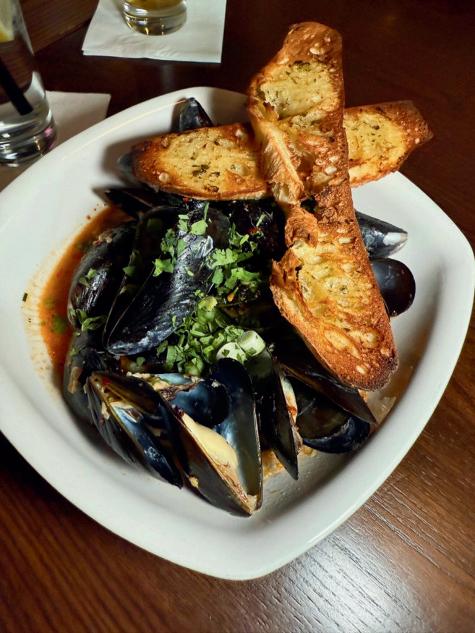
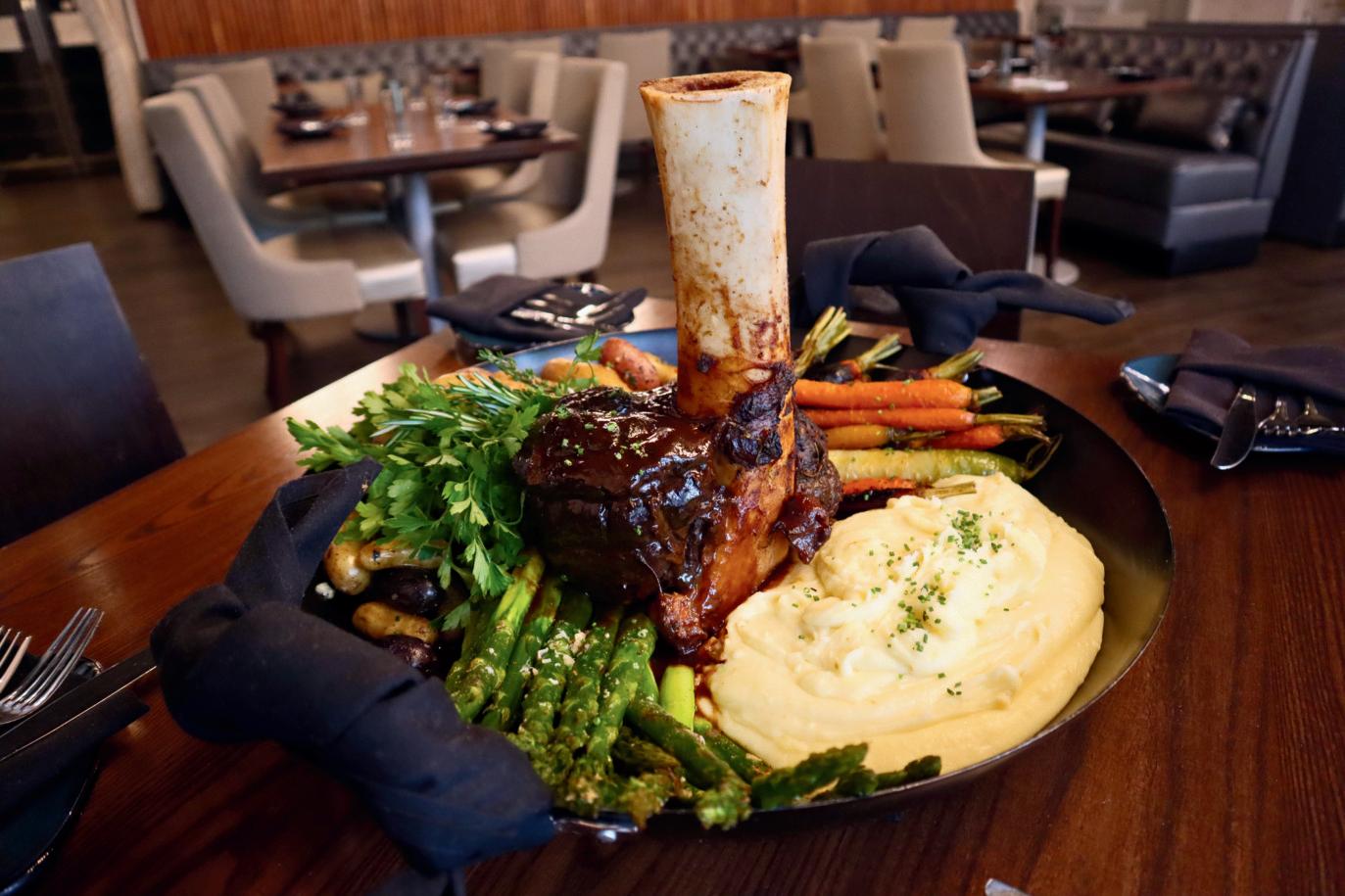
The State of Steak in 2026
Greater Wilmington Beer Week Feb. 16-22
Feb. 16-22
The Venues:
Apothecary Brewing • Autumn Arch Beer Project
Bellefonte Brewing • Brew Works North
Chelsea Tavern • Dorcea
First State Brewing • High Steaks Brewery
Makers Alley • Trolley Tap House
Twisted Irons Craft Brewing • Two Stones Pub (Wilm.)
Washington St. Ale House • Wilmington Brew Works
Presidential Terms
By Michael
Guarino (U of D, Class of ‘29) and Joe O’Brien
THE WAR On Words
A monthly column in which we attempt, however futilely, to defend the English language
MORE COMMON SENSE REVISIONS
Last month, reader Walt DelGiorno pointed out that the phrase “a fraction of what it once was” is insufficient if what is meant is a significant reduction. After all, as Walt said, 1/100 and 99/100 are both fractions, but the first equals 1 percent, while the second is 99 percent. So, “reduced to a small fraction” would be more accurate.
This tendency to use fewer words than needed (the opposite of a redundancy?) prompted a note from Jane Buck, a long-time reader of this column and former president of the American Association of University Professors. Jane says that “being on a diet” and “behaving” are both inadequate. “One is always on a diet,” she says. “The question is, what kind? And one is always behaving, either well or badly.”
Again, noted.
J’EVER NOTICE . . . ?
. . . that many people, including some TV weather reporters, skip the hard c sound in arctic. It’s pronounced ark-tik, not ar-tik.
DEPARTMENT OF REDUNDANCIES DEPT.
Bryan Alexander, TV critic for USA TODAY, gives us this sentence, rampant with superfluities, from a review of the Amazon Prime series Fallout: “Cooper learns about his wife, Barb, and her work with the sinister Vault Tec, the group secretly spurring on global nuclear destruction for nefarious reasons.” A group that is secretly bent on global nuclear destruction is certainly sinister, and undoubtedly is pursuing that goal for nefarious reasons. Also, they are spurring global destruction. No need for the added on.
MEDIA WATCH
Several media outlets failed to employ the correct verb recently.
• Michael Marot, AP: “They (the Indiana football team) sung the school’s fight song in the confetti celebration following their first Big Ten championship since 1967 . . .” Sang is the simple past tense of “sing,” while had sung is the past participle form of “sing.”
Word of the Month
enervate
Pronounced ener-vate,
• Reader Joan Burke submits this headline from PhillyBite Magazine: “3 New Delaware Laws That Will Effect Your Wallet in 2026.” The verb affect is needed here. Effect is generally a noun.
By Bob Yearick
• News Journal Eagles reporter Martin Frank spotted this subhead in The Philadelphia Inquirer: “Embiid scored 31 points but the Bulls prayed on his inability to move on defense.” The Bulls preyed on (exploited, took advantage of) Embiid’s inability to move. That said, preyed is a bit dramatic in this case. Exploited would’ve been a better choice.
• From another reader, Angie Bopp Martin, comes this News Journal verbal gaffe: “In disposing of your Christmas tree, clean off all of the decorations and bring it to one of these yard waste drop-off sites run by the state.” As this column pointed out as recently as November, if the action is towards the speaker, use bring. If it is away from the speaker (as in this case), the correct choice is take.
A few other recent media miscues:
• Reader Larry Hamermesh found an ad in TNJ for “Amish-made mantles with free electric heaters.” A mantle is a blanket or covering. A mantel is that shelf above a fireplace. Says Larry: “Lest you generously think that the ad was for something akin to an electric blanket, I also note that there was an accompanying photo of a fireplace.”
• From the Williamsport Sun-Gazette, courtesy of reader Luann Haney, comes this caption: “[a Christmas treelighting ceremony] drew a crowd of holiday well-wishers despite the chilly weather. Santa and Misses Clause are among the group.” The title for a married woman is generally abbreviated — Mrs. Spelled out, it’s Missus. But Misses misses the mark.
• Son Steven spotted this chyron/crawl on the MS NOW network: “US Students are reading less books coverto-cover.” Maybe the people at MS NOW should read a grammar book. In referring to quantities, the word is fewer. Less is for amounts. If the sentence had been, “US Students are reading less,” it would’ve been correct.
NEED A SPEAKER FOR YOUR GROUP?
Contact me at ryearick@comcast.net for a fun and informative discussion of grammar.
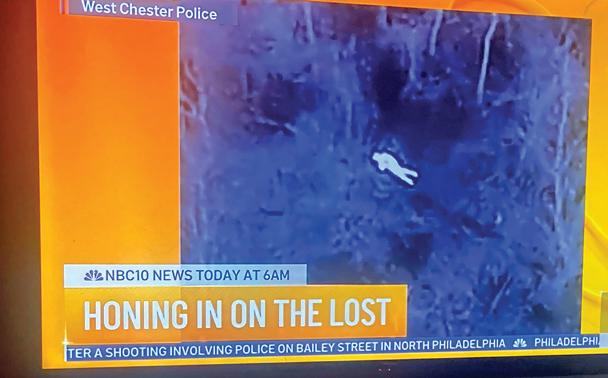
Count NBC10 in Philly among those who don’t know that honing means “to sharpen.” Homing is the correct word here.
Caring for the Hearts
That Care for Us
By Brianna Hansen
As you’ve probably heard before, February is American Heart Month, a time when us humans are reminded to show our hearts a little extra love. But our pets help us do that year-round when they insist on walks, nudge us for a play session, offer stress-relief cuddles, or greet us at the door like we’re the greatest thing since sliced bread. So let’s shift that attention back to them and explore ways to keep their hearts healthy too!
Just like us, dogs and cats can experience heart disease … some issues are genetic, while others develop with age, or are influenced by lifestyle. But the good news is that many of the habits that keep our hearts strong can also help our pets thrive.
Movement tops the list. Daily walks, backyard ball chases, feather hunts, or a game of laser pointer all get blood pumping and muscles moving. Regular walks for dogs (2-3 per day) provide a strong base for cardiovascular fitness and weight management. For cats, interactive play is especially important. Those short bursts of activity mimic hunting instincts and provide meaningful exercise, necessary even for indoor-only felines who rule the home from their windowsill.
Nutrition matters too. A balanced, age-appropriate diet helps prevent obesity, which puts extra strain on the heart. While it’s tempting to share snacks or offer endless treats, portion control is actually an act of love. If your pet’s waistline is starting to disappear, it may be time to chat with a vet about healthier options.
Stress reduction also plays a crucial role. Predictable routines, mental stimulation, and safe spaces help keep anxiety in check. For most pets, a calm environment means a calmer heart. Even something as simple as a daily cuddle session counts. Think of it like emotional cardio!
And of course, routine veterinary care is a cornerstone of health. Subtle changes like coughing, fatigue, reduced appetite, or trouble breathing can be early signs of heart trouble, but they’re easy to miss without regular checkups. Veterinarians can detect murmurs, irregular rhythms, or other concerns long before they become serious.
Caring for your pet’s heart does not have to feel overwhelming or expensive. Many organizations, including Humane Animal Partners and Faithful Friends, offer lowcost wellness services that make preventive care more accessible. These visits can help catch potential issues early and keep your pet on a path toward a longer, healthier life.
So, while you’re thinking about heart health, remember the furry friends who already have yours! A little exercise, mindful feeding, and regular care goes a long way toward keeping every heart in your home beating strong.
FYI Things Worth Knowing
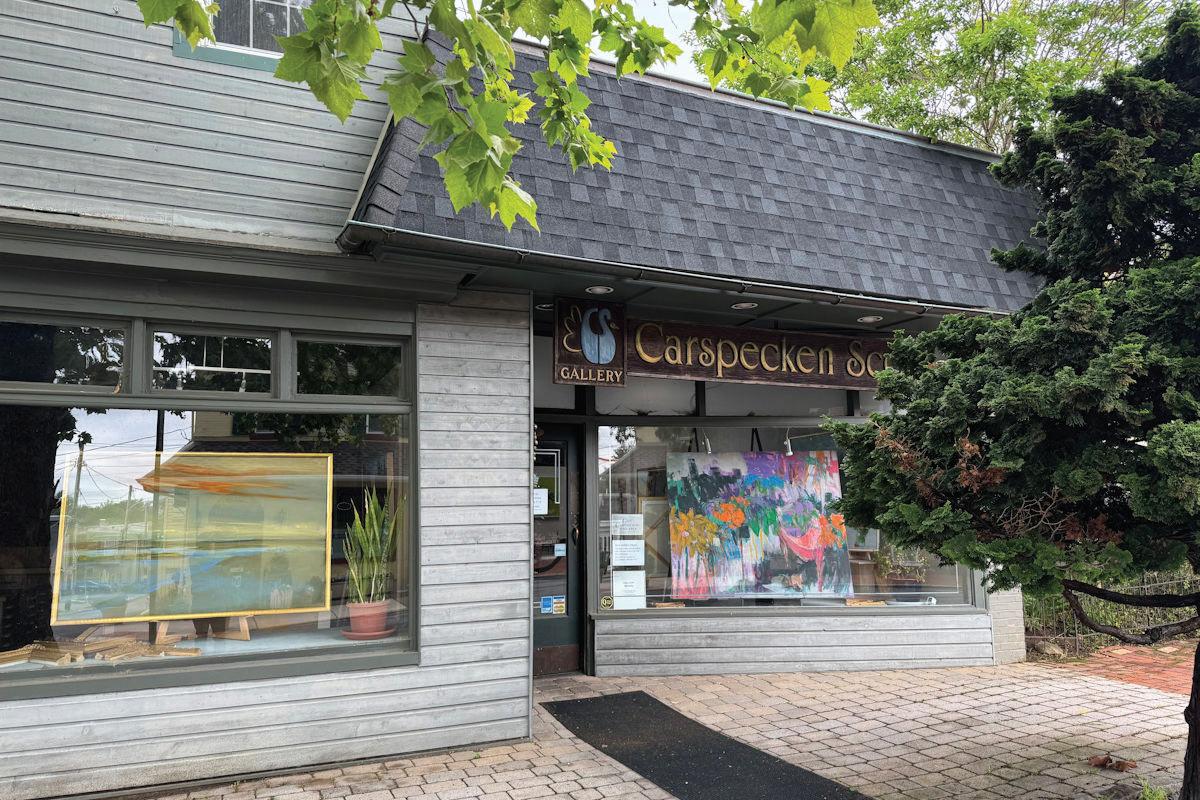
CARSPECKEN-SCOTT GALLERY
BIDS FAREWELL AFTER FIVE DECADES
After more than 50 years serving the community, Carspecken-Scott Gallery will conclude operations, marking the end of a Wilmington institution known for expert art conservation, restoration, and framing. Founded in 1973, the gallery has preserved artwork and memories for generations, continuing founder Fred Carspecken’s legacy after his passing in 2018. In a statement on its website, the gallery staff stated, “It has been our great privilege to serve the community. We thank you for allowing us to be part of your stories. We are proud of the relationships we've built and the art we've helped bring to life.” More at CarspeckenScott.com.
DINE DOWNTOWN & GET REWARDED
The Dine Downtown Deal returns, rewarding diners for supporting Downtown Wilmington eateries. Dine in or take out five times through March 31 and earn a gift card worth 20% of your total spending, redeemable at a Downtown business. Submit receipts by April 30. Details at DowntownWilmingtonDe.com.
WILMINGTON PUBLIC LIBRARY WELCOMES NEW EXECUTIVE DIRECTOR
The Wilmington Public Library Board has appointed Will Johnson as Executive Director, effective January 20. Johnson brings more than 25 years of experience in public and academic libraries, most recently as Deputy Director of Community Wellness and Mobile Services at the Enoch Pratt Free Library in Baltimore. A community-centered leader, he is known for advancing equitable access, partnerships, and social impact through libraries. “Libraries are one of the last free democracies,” Johnson says. “I want the people of Wilmington to know there is something for everyone here.” More at Wilmington.Lib.DE.us.
WILMINGTON CHEF NAMED JAMES BEARD AWARD SEMIFINALIST
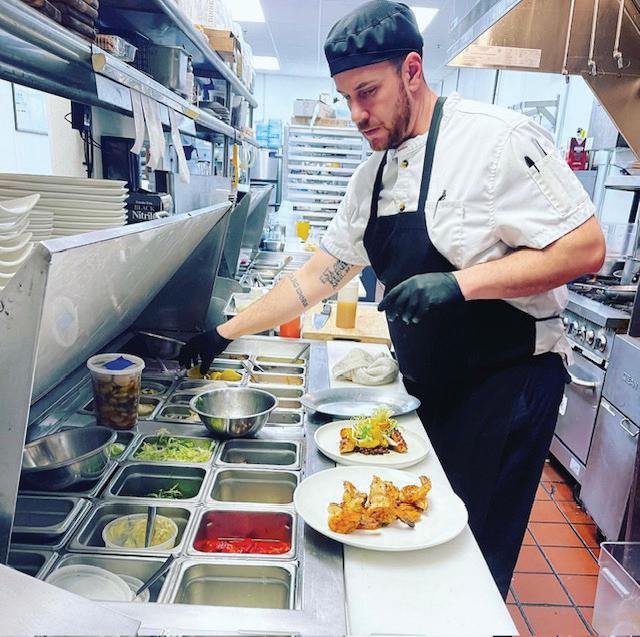
La Fia Bistro Executive Chef Dwain Kalup has been named a semifinalist for the James Beard Award for Best Chef: Mid-Atlantic. Kalup has led the Wilmington restaurant since 2020 and previously earned Beard recognition earlier in his career at Domaine Hudson. La Fia owner Andrea Sikora called the honor “welldeserved,” praising Kalup’s “beauty, intention, and care” and noting that his ability to work at such a high level in the restaurant’s small kitchen is “nothing short of remarkable.” Nominees will be announced March 31, with winners revealed June 15, at the Lyric Opera of Chicago. Visit LaFiaWilmington.com.
DELART ANNOUNCES SEMIQUINCENTENNIAL EXHIBITIONS AND PROGRAMS
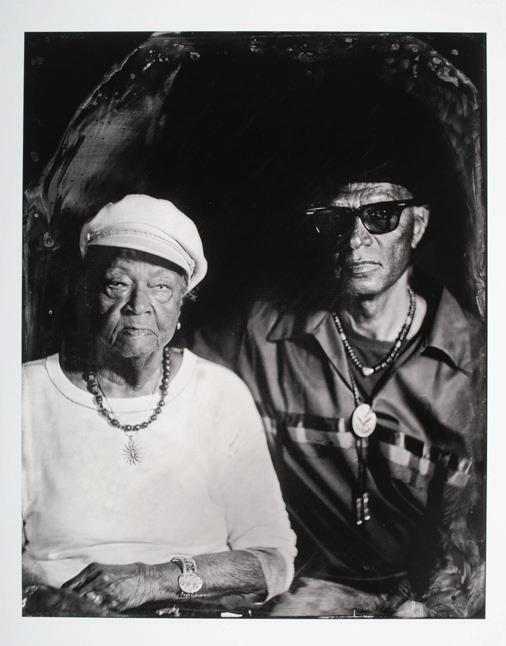
The Delaware Art Museum will mark the nation’s 250th anniversary with a six-month suite of exhibitions and programs exploring the vital role artists play in shaping civic life. Highlights include Living Indigenous (Feb. 28–Aug. 23), developed with the Nanticoke Indian Museum; Citizen Artists (Apr. 11–Jul. 19), celebrating artist workers in America; and The People’s Gallery (Aug. 7–Sept. 6), featuring works submitted by Delaware residents. The museum will also host Citizen Artist Summit Weekend (July 9–12), featuring workshops and lectures on arts funding, collaboration, and community engagement. More at DelArt.org
OPERADELAWARE ANNOUNCES
LEADERSHIP TRANSITION
OperaDelaware General Director Brendan Cooke will step down at the conclusion of the company’s 2025–2026 season, closing a transformative 13-year tenure with the nation’s 11th oldest opera company. Since 2012, Cooke has expanded regional collaborations and launched innovative initiatives including the Company Artist model and Pop-up Opera. A national search is currently underway, with a goal of naming a successor by May 2026, when the company will also host the Opera America National Conference in Wilmington. More at OperaDe.org.
NEW PLAY BRINGS A STORY OF RECOVERY
TO THE STAGE
New Light Theatre presents the regional premiere of The White Chip by Sean Daniels, running March 6–15, at OperaDelaware Studios (4 S. Poplar St.) in Wilmington. The candid, darkly funny play chronicles a journey toward sobriety while working to de-stigmatize substance use disorder. Directed by Charlie DelMarcelle and Allison Heishman, the production partners with Delaware nonprofit atTAcK addiction, which will provide on-site resources, education, and a post-show talkback on March 8. A special Teen Night performance takes place March 13. More at NewLightTheatre.com.
WILMINGTON-SET NOVEL DEBUTS AT HUXLEY & HIRO
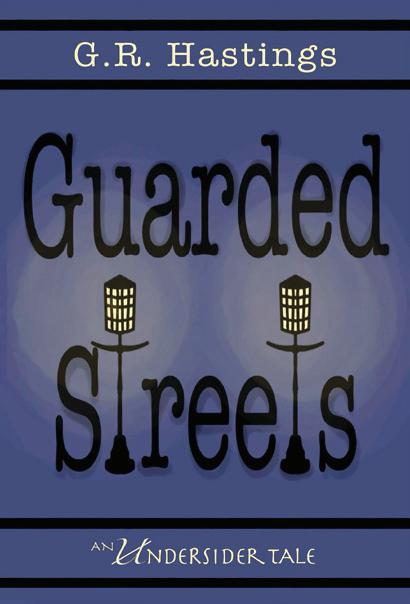
Huxley & Hiro Booksellers (601 N. Market St.) will host a launch party for local author G.R. Hastings’ Wilmington-set novel, Guarded Streets, on Friday, Feb. 6, from 5–8pm. Connecting the underground railroad and the Patty Cannon gang with the 1968 riots and occupation of downtown, the book follows the story of a young woman who is trying to reunite a little girl with her parents one evening on Market Street. Local landmarks, from the Hotel Du Pont to The Queen, are featured throughout. More at HuxleyAndHiro.com.
JThe
People’s Market The
People’s Market
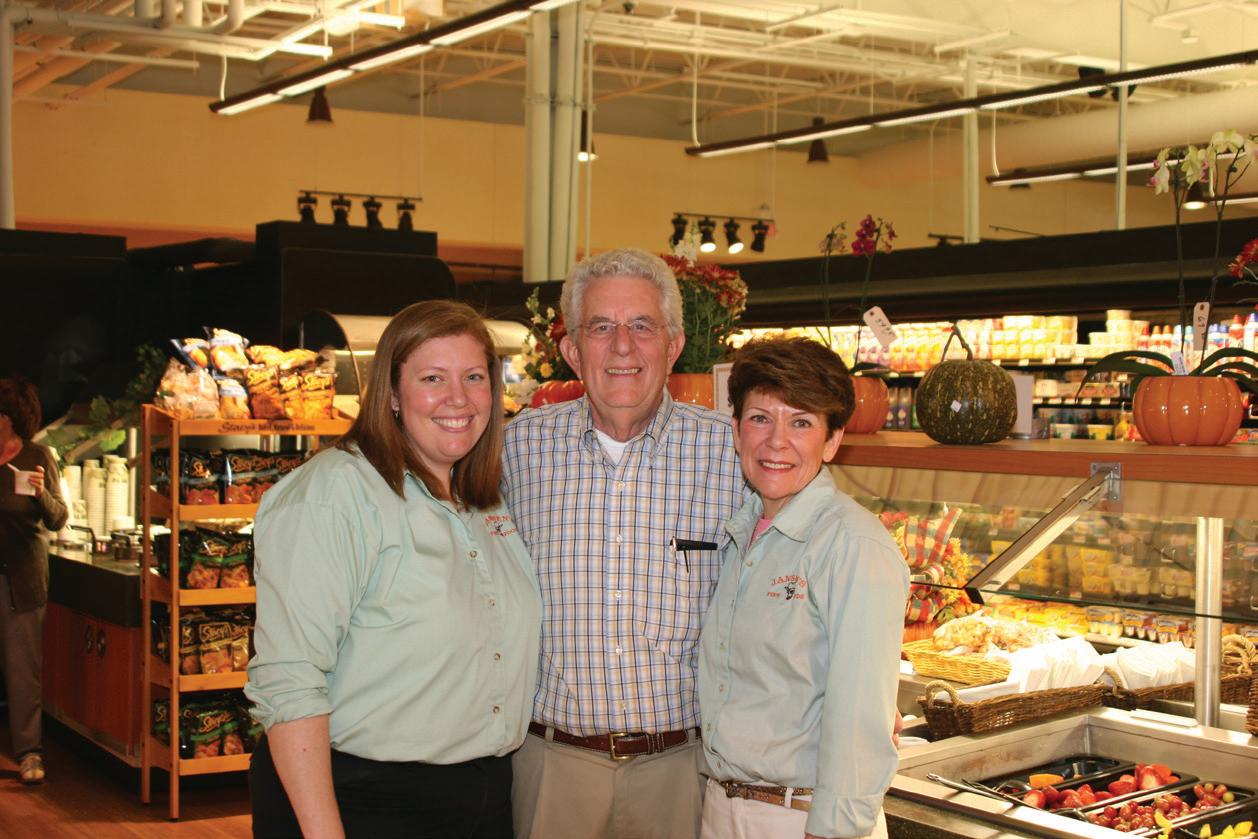
For Joe Janssen, customers always come first
oseph “Joe" Janssen Jr., the man behind one of northern Delaware’s most iconic grocery stores, Janssen’s Market, died last month at the age of 85.
The son of a butcher who dropped out of college to help run the family business when his mother died, Janssen took the reigns of Janssen’s Market at age 24. He never looked back.
Despite the many challenges faced by independent grocery stories, Joe was always prepared to pivot. As a result, through seven decades Janssen’s has continued to thrive.
Founded in 1952, Janssen’s Market remains one of the state’s few independent grocers. Virtually every customer is a regular — mostly because of its warm customer service and well-earned reputation for high-quality products. And Janssen's carries everything — from meat to produce, from baked goods to florals. “Gourmet and everyday” is its tagline.
“I'm not sure it is a secret, but our success is because we are always listening to our customers,” says Joe’s daughter and current Janssen owner, Paula Janssen. “We listen and learn and constantly try new things. My grandfather would always say that in retail you are always moving forward or losing ground — there is no standing still.”
As for her father’s favorite part of the business?
“[It] was the people,” says Paula. “He loved serving customers, growing staff and learning from vendors. He invested so much of himself in other people and although it was sometimes frustrating, he always found it rewarding.”
Above: The gregarious Joe Janssen Jr. At right, Paula Janssen (l), with parents Joe and Eileen Janssen at Janssen's Market Photos courtesy Paula Janssen
Veteran Nurse Applauds Opportunity and Support at Wilmington University
Retired Col. Gwyn Parris-Atwell jokes she bleeds green for her love of Wilmington University, calling its nursing program “the best on the earth.”
The faculty “supported me as a mom, as a military member, as a full-time working person,” she says, adding that “I’ve sent loads of people (to WilmU), and everybody says to me, ‘Gwyn, you were right.’”
A Compassionate Caregiver With Three Nursing Degrees
Col. Parris-Atwell’s military career began in 1991 as an Army Reserve nurse. She deployed to Iraq, Afghanistan and Germany as an Air Force reservist, later joining the Delaware Air National Guard and retiring as the 166th Airlift Wing’s medical group commander in 2022.
On the homefront, Col. Parris-Atwell has spent more than 27 years caring for patients at Penn Medicine, Inspira Health and Jefferson Health — New Jersey. A board-certified family nurse practitioner, certified emergency nurse and Academy of Emergency Nursing fellow, she earned three degrees from WilmU: a Bachelor of Science in Nursing (BSN), Master of Science in Nursing (MSN) and Doctor of Nursing Practice (DNP)
I was such a better professional nurse for it,” Col. ParrisAtwell says. “My leadership skills were enhanced, and I met amazing people” at the University.
Thankful for a Military-Friendly School
She values WilmU’s “family-like environment,” affordability and dedicated professors.
“The faculty, to this day, I still see them at conferences, and I tell them, ‘Thank you for getting me through this,’” Col. Parris-Atwell says, recalling how they allowed her to pause her dissertation during active duty. “They said Gwyn, your active duty is important. Take care of that first, and when you come back, we will take care of getting you finished.”
She counts Dr. Aaron Sebach, dean of the College of Nursing and Health Sciences, among her WilmU mentors.
“I would describe Gwyn as a consummate professional and steadfast advocate for nurses,” Dr. Sebach says. “She is a decorated United States Air Force colonel who is down to earth and an allaround great person. I am fortunate that our paths crossed and am thankful for our friendship.”
A Humble Servant-Leader
Col. Parris-Atwell is happy to “pay it back” — guiding other nurses and volunteering with organizations such as Together With Veterans, which focuses on suicide prevention; the Wilmington University Nursing Advisory Board; Salem Community College Board of Trustees; Salem County Commission on Women; and Salem American Legion Band. Her many distinctions include the U.S. Armed Forces Legion of Merit award, Emergency Nurses Association Lifetime Achievement Award, and Rowan College of South Jersey and Wilmington University Distinguished Alumni Awards.
Reflecting on her time at WilmU, she says, “I knew it was the place for me. It’s all about lifelong learning, and if you don’t do that in your career, you’re not going to succeed. It’s hard work, but you’ve got to do it.”
More information about Wilmington University’s growing suite of nursing degrees is available at wilmu.edu/health , and details about its military support services can be found at wilmu.edu/military.
WKing of the Court
Newark’s Terence Stansbury soared to rare heights
By Chuck Durante
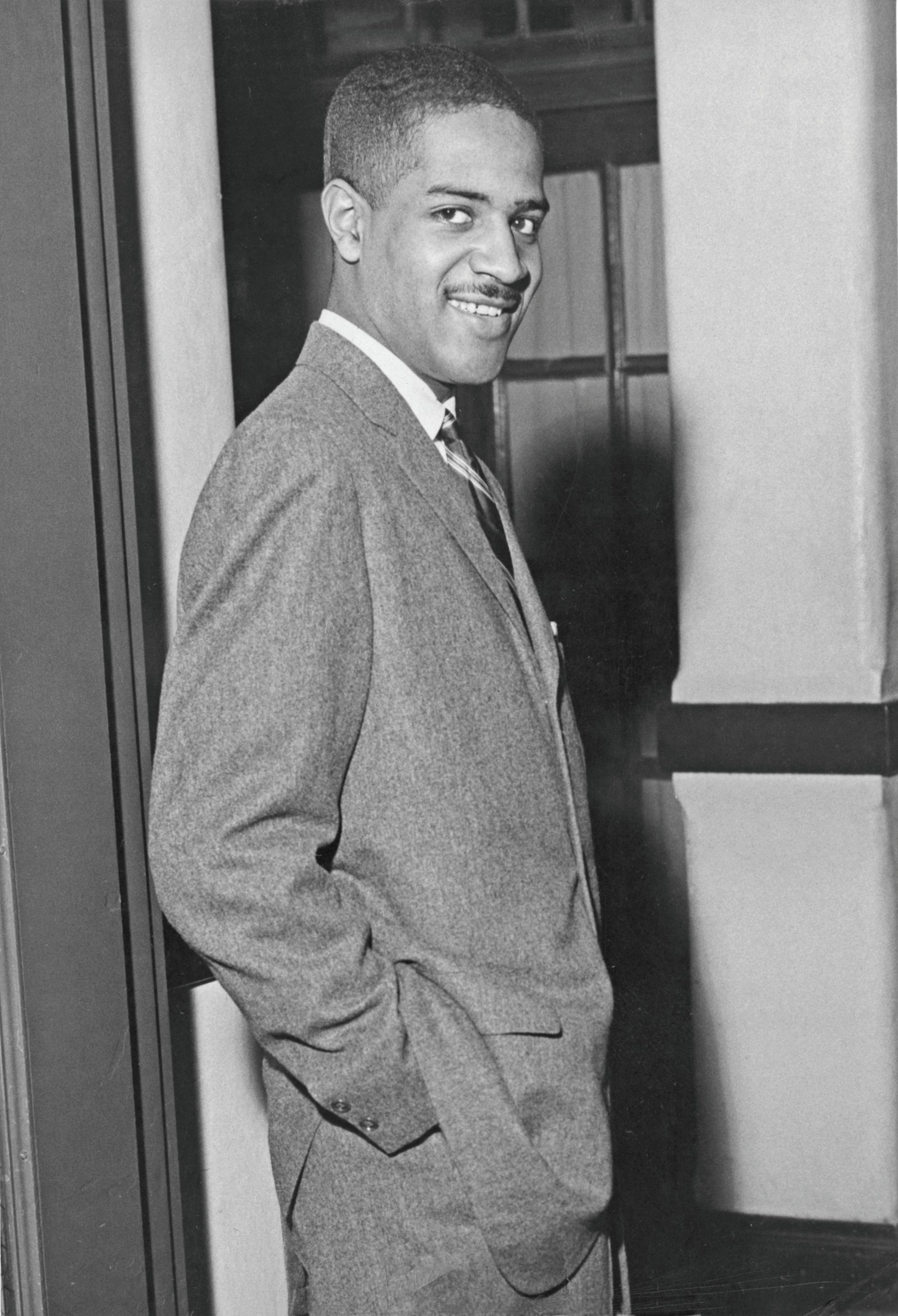
ith a versatility that made him the leading scorer in Temple history, Delaware’s pioneering international star and a legendary dunk artist, Terence Stansbury fashioned a life in basketball unmatched among men who attended high school in the First State.
His spectacular performances in three Slam Dunk Contests reverberate four decades later, his 360-degree Statue of Liberty slam in Dallas is still shared in film and lore. His hops were foreshadowed when he won the New Castle County high jump as an 11th grader. After a brilliant Newark High School career where he was Delaware player of the year and topped The Inquirer’s 1980 All-Area team, he chose Temple after courtship from University of Southern California. After receiving a 75-yard inbounds pass, his jack-in-the-box turnaround jumper slayed Penn and electrified a sold-out Palestra. The Atlantic Ten player of the year, he passed Guy Rodgers as Temple’s all-time leading scorer and was the 15th player taken in the 1984 NBA draft.
A regular for Indiana and Seattle for three years, he was injured before his fourth pro season. A call to a friend by Rollie Massimino landed Stansbury a job in Belgium. A year later, he joined Levallois and lifted the Paris-adjacent team into the elite. “Le Michael Jordan d’Europe,” headlined the magazine Maxi-Basket. His
Temple coach Don Casey invited him back to play for the Los Angeles Clippers, but Stansbury, having immersed himself in French language and culture, found stability and celebrity in a basketball-savvy continent. After playing 16 years in top-level leagues, he coached in several countries.
The son of a record-setting Howard High School relay runner, Stansbury saw his two children distinguish themselves on the court: Tiffany, the top player at North Carolina State before her own 12-year pro career; and Solly, who played college ball at Richmond and now starts for his father’s former team at Levallois.
— Founded in 1976, the Delaware Sports Museum and Hall of Fame is located on the Wilmington Riverfront at 801 Shipyard Drive on the first base side of Frawley Stadium. Sports fans can tour the museum for free each Saturday from 10am to 1pm and for two hours before every Blue Rocks home game.
Terence Stansbury completed three seasons in the NBA then played internationally for 16 years.
Photo courtesy DSHOF
FRIDAY, FEBRUARY 6
5pm Start Next Art Loop: MARCH 6, 2026
RIVERFRONT
The Delaware Contemporary
200 S. Madison Street
656-6466 • DeContemporary.org
Exhibitions: This Place Meant; Creative Influence(r); Constellation of Belonging; Alchemical Signal Flow; Black Collage: Aesthetic Legacies; A Red Sun Has Water in its Eye; and Holding Water
Starbucks @ Justison Landing 329 S. Justison Street 510-2762
Exhibition: Petals Pending Group Show
DOWNTOWN
Chris White Gallery 701 N. Shipley Street 475-0998 • ChrisWhiteGallery.com
Exhibition: Meet Me at The Altar Group Show
Christina Cultural Arts Center
Edward Loper, Sr. Gallery 705 N. Market Street 652-0101 • CCACDe.org
Exhibition: Buluu by Oba Jackson
City of Wilmington’s Redding Gallery 800 N. French Street 576-2100
CityfestWilm.com/Redding-gallery
Artist: K.O. Simms
Gallery at Grace Church 900 N. Washington Street 655-8847
Exhibition: Divinity In Stillness by Kiara Florez
The Grand Opera House
818 N. Market Street
658-7897 • TheGrandWilmington.org
Grand Gallery: Anthomania
Reimagined by Christina Peters
baby grand Gallery: Visions of Space by Burton Aulisio
Huxley & Hiro Booksellers
419 N. Market Street 439-0805• huxleyandhiro.com
Exhibition: A Rose for The Undersiders by Eliza Fisher
John William Gallery
1313 N Market Street
585-317-5409
Exhibition: Otherworlds: John Webb’s Imagined Realms
LaFate Gallery
227 N. Market Street
753-5789 • LaFateGallery.com
Exhibition: United by Reggae Music
MANE Gallery at the Tina Betz Urban Artist Exchange
1509 Clifford Brown Walk, Studio #1 576-2100
CityfestWilm.com/uae-amphitheater Exhibition: Jabaar Brown / Arts Work Winter Co-hort
Mezzanine Gallery
820 N. French Street 577-8278 • Arts.Delaware.gov
Exhibition: For Granted by Christopher L. Starr
The Sold Firm
800-B N. Tatnall Street
689-3237 • TheSoldFirm.com
Exhibition: Optics Group Collage Show
Starbucks 627 N. Market Street
299-9980
Exhibition: Until We Meet Again by Tanya Bracey
Wilma’s
900 N. Market Street
761-0564 • GoodTimeWilmas.com
Artist: Shilpi Gupta
WEST SIDE
Blue Streak Gallery 1721 Delaware Avenue 429-0506
Exhibition: Springs Eternal by Mia Muratori
Delaware Center for Horticulture 1810 N. Dupont Street 658-6262 • TheDCH.org
Artist: Nina Silverman-Weeks
Howard Pyle Studio 1305 N. Franklin Street 656-7304
Artist: Bonnie White
BEYOND THE CITY
Bellefonte Arts
803-C Brandywine Blvd 547-2573
Exhibition: 4th Annual Joy Littleton Mt. Pleasant HS Art Exhibition
Oldhead Tattoo & Gallery 109 N. Maryland Avenue 893-2062
Exhibition: Through the Eyes by Bruce Gulick
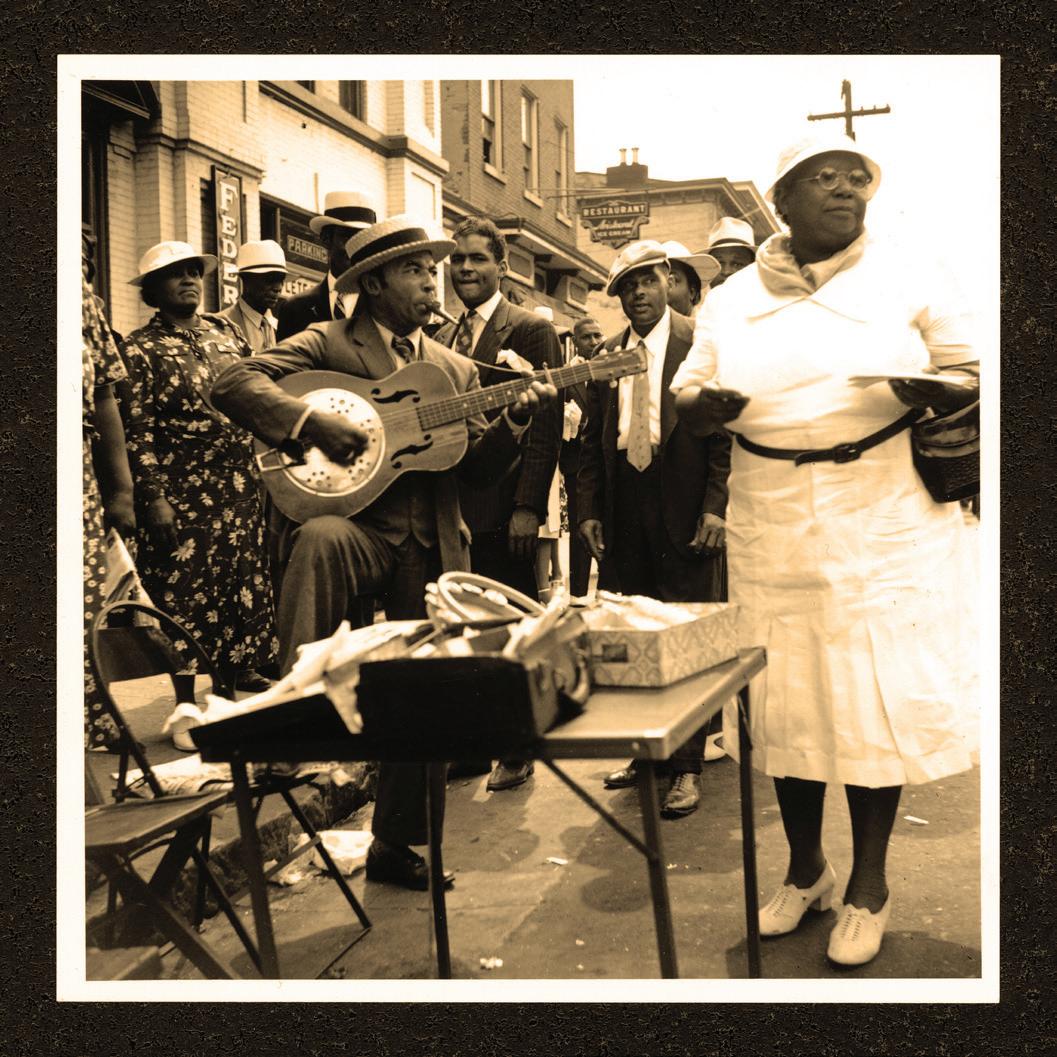
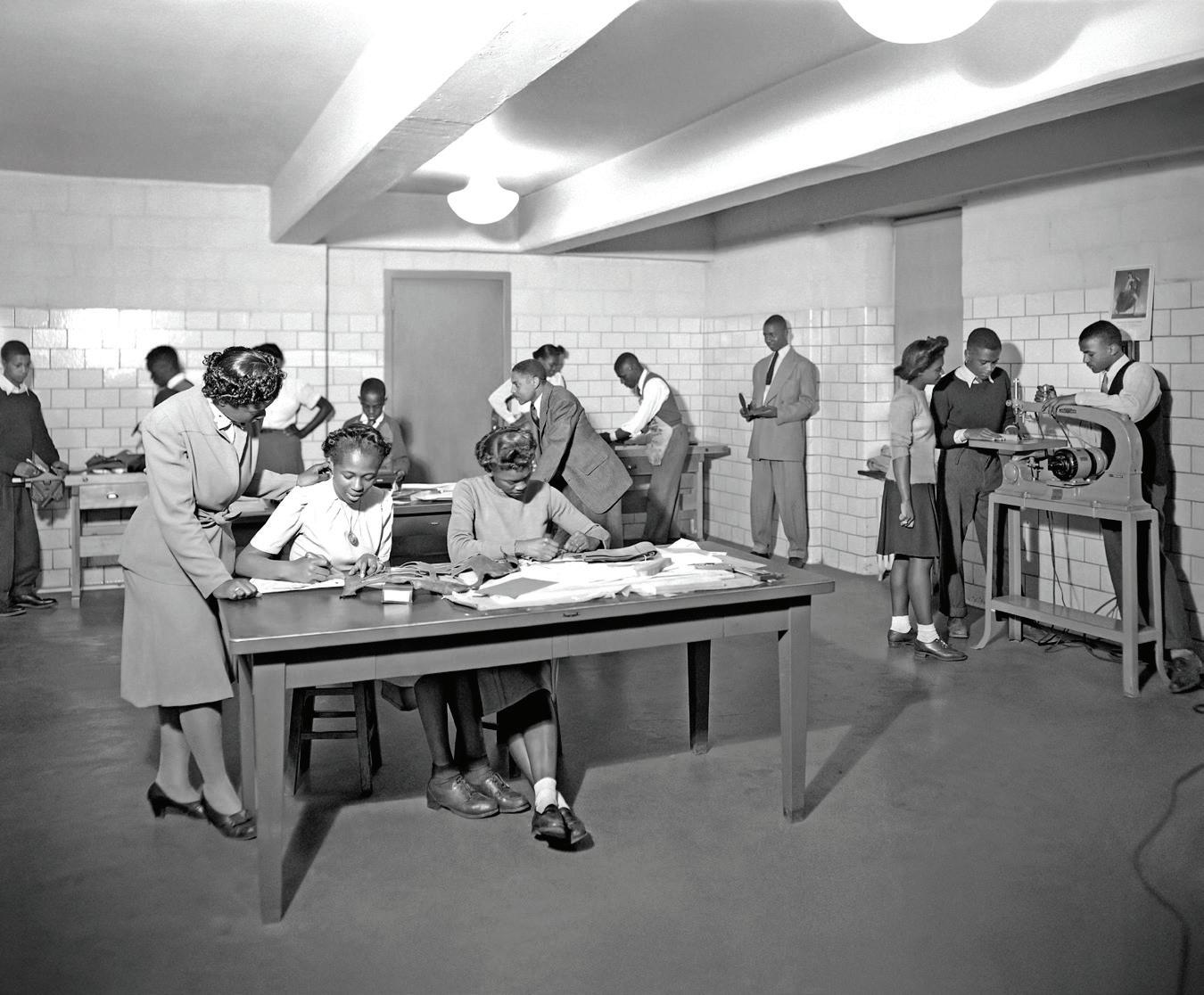
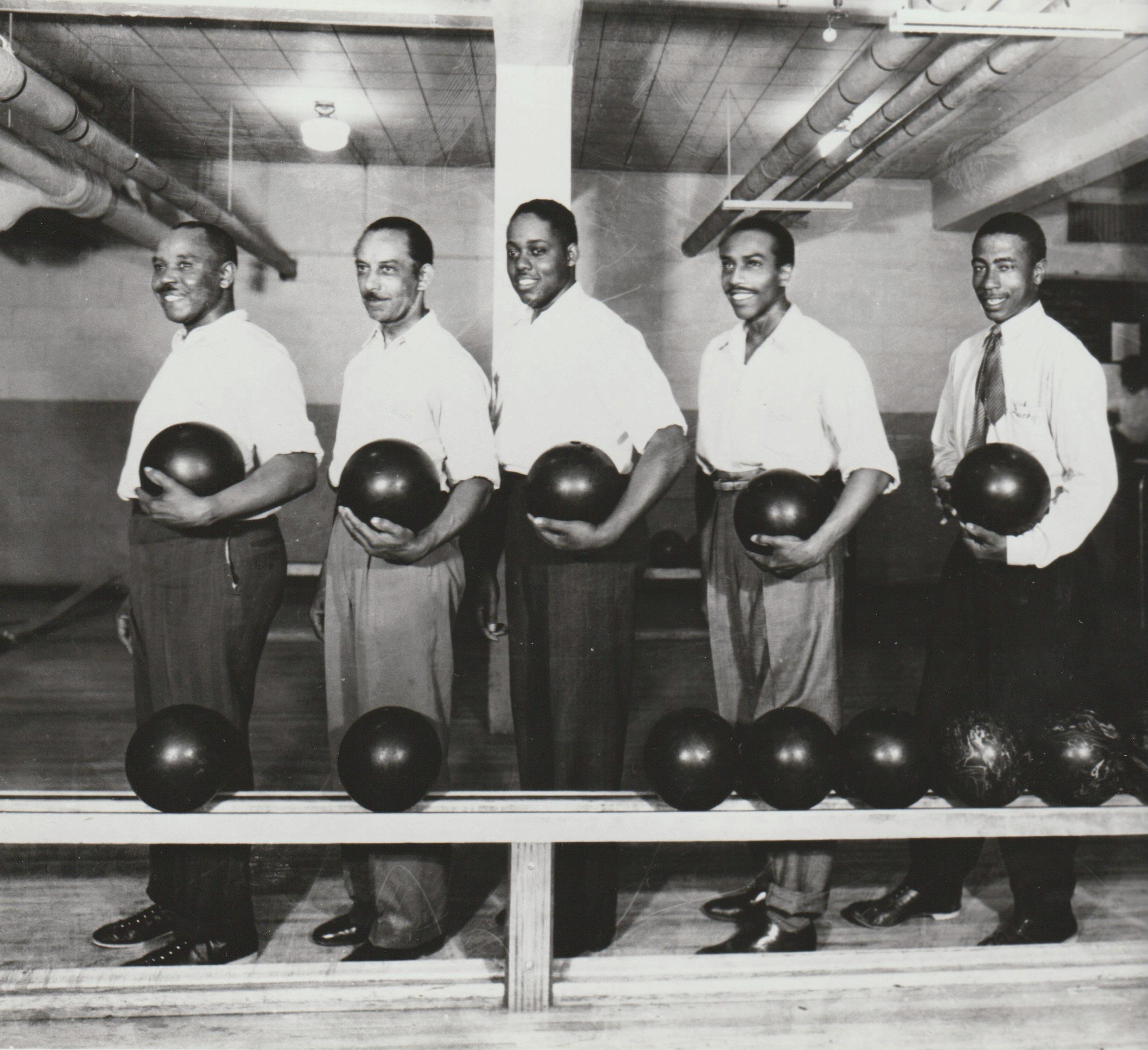
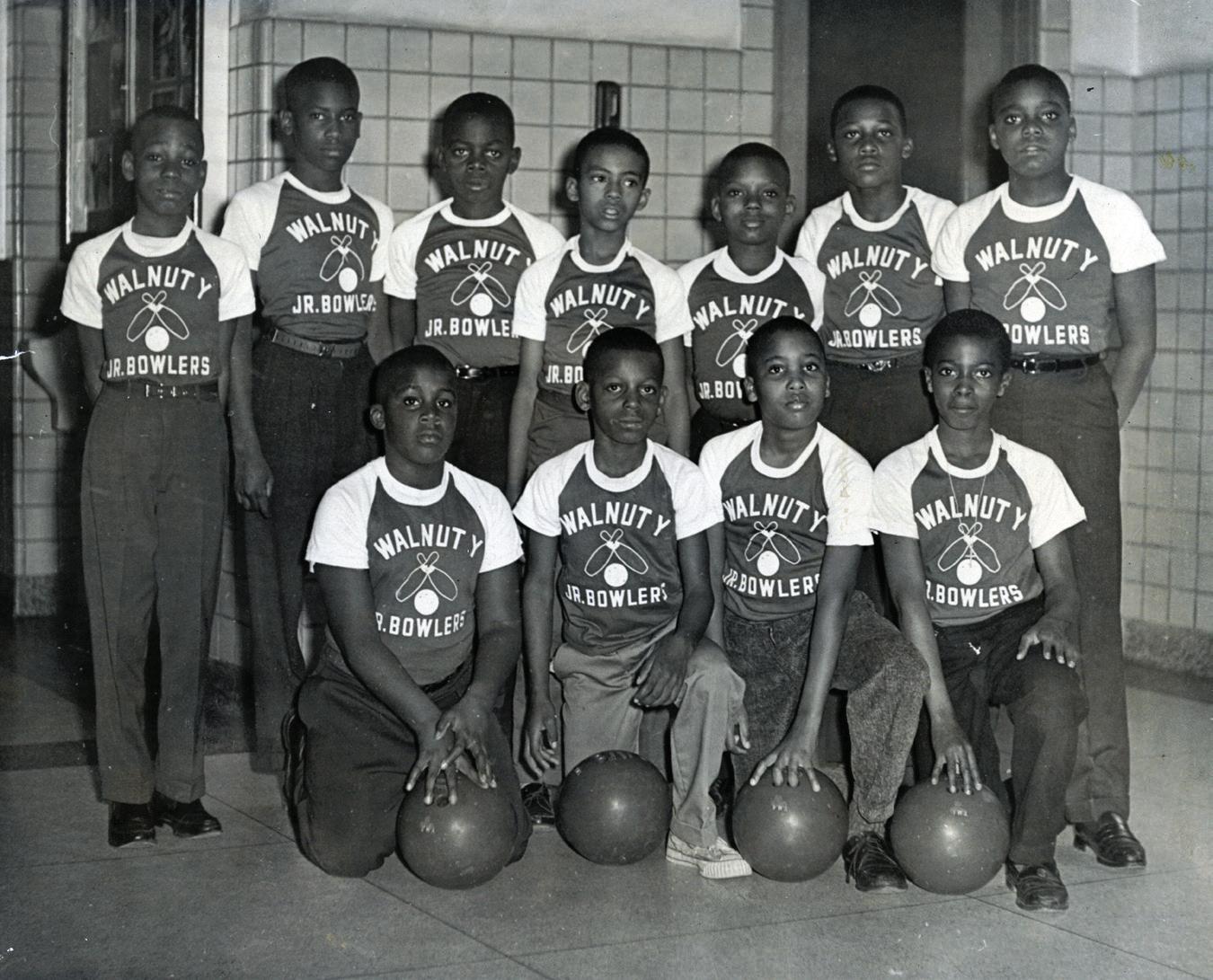
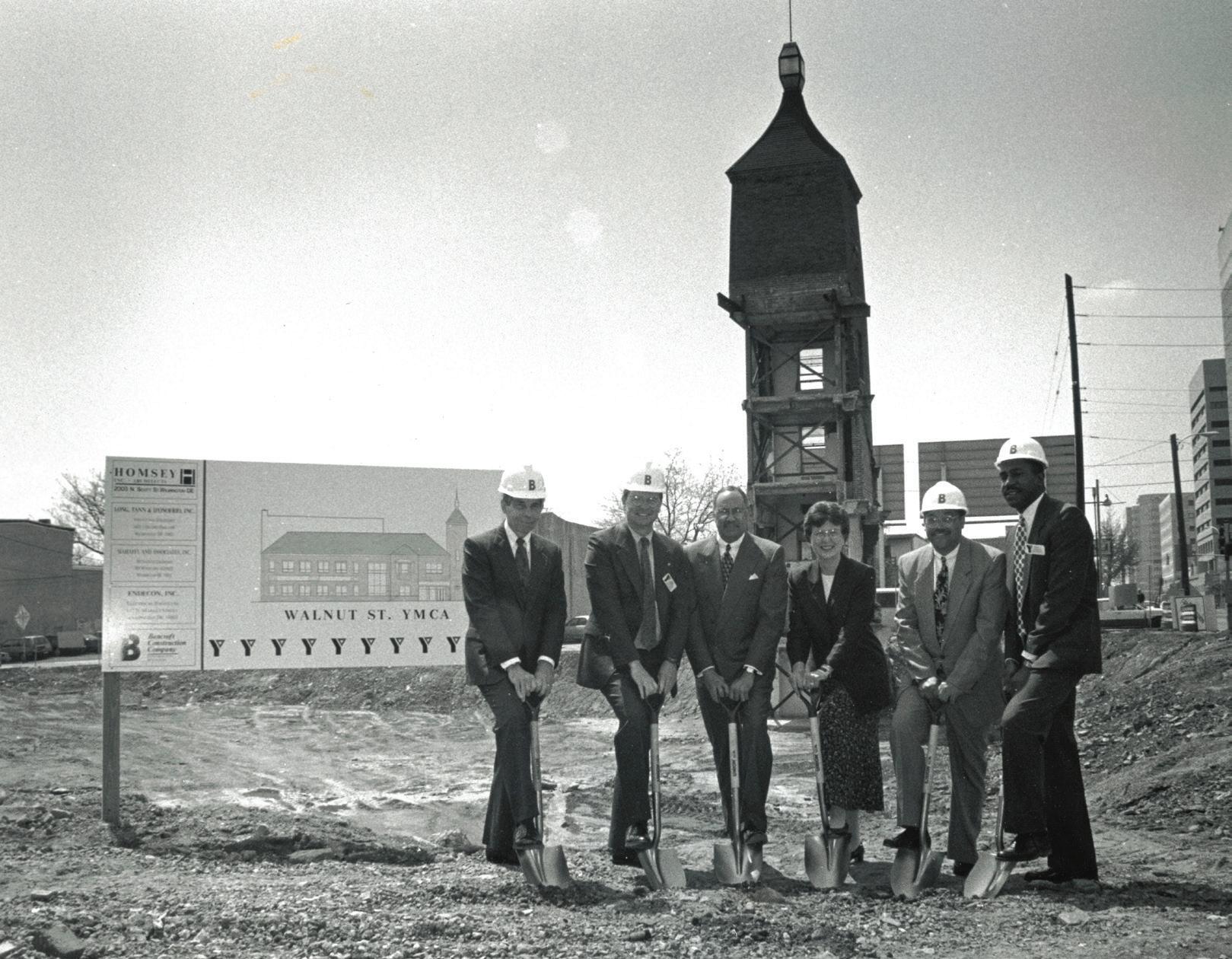
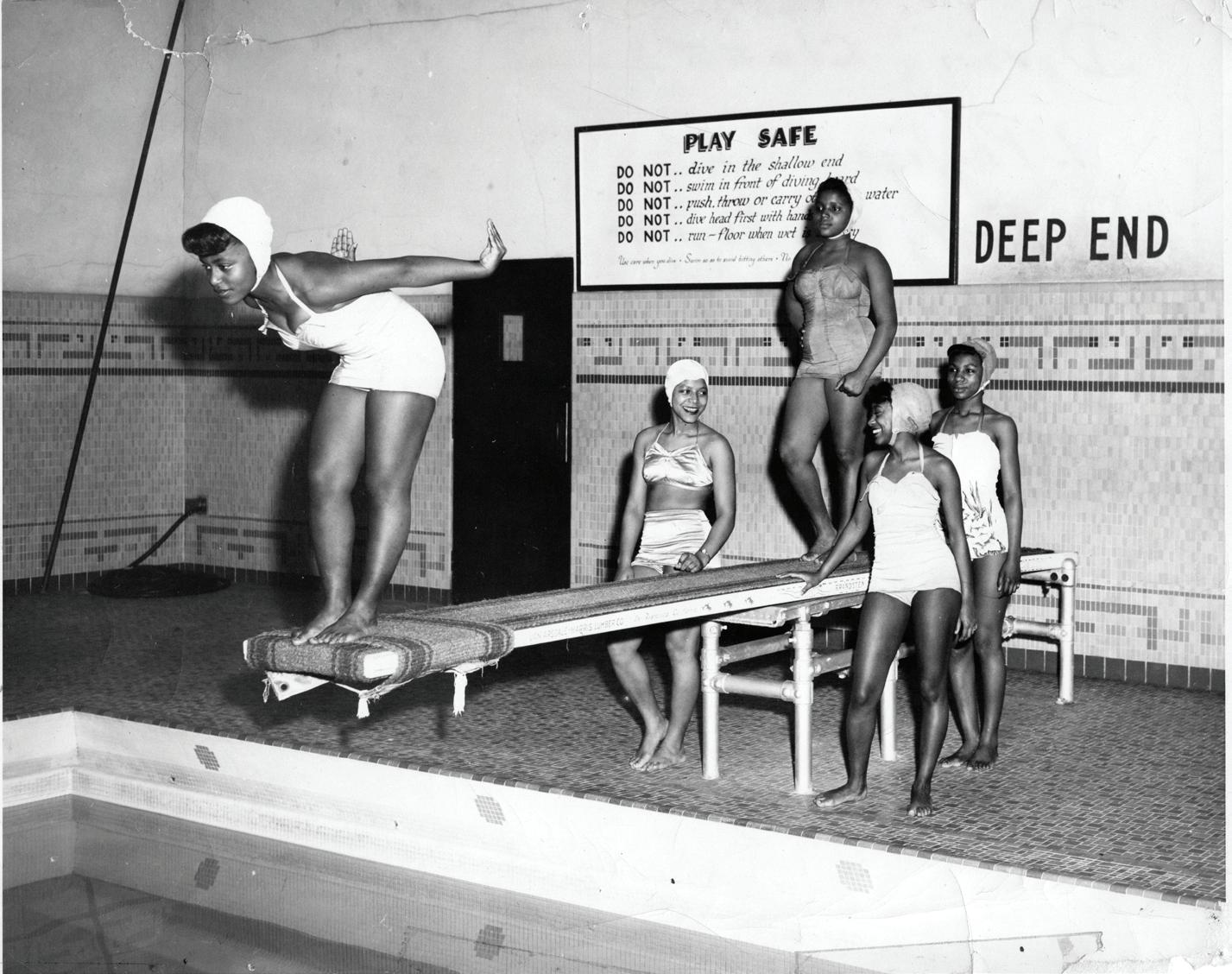
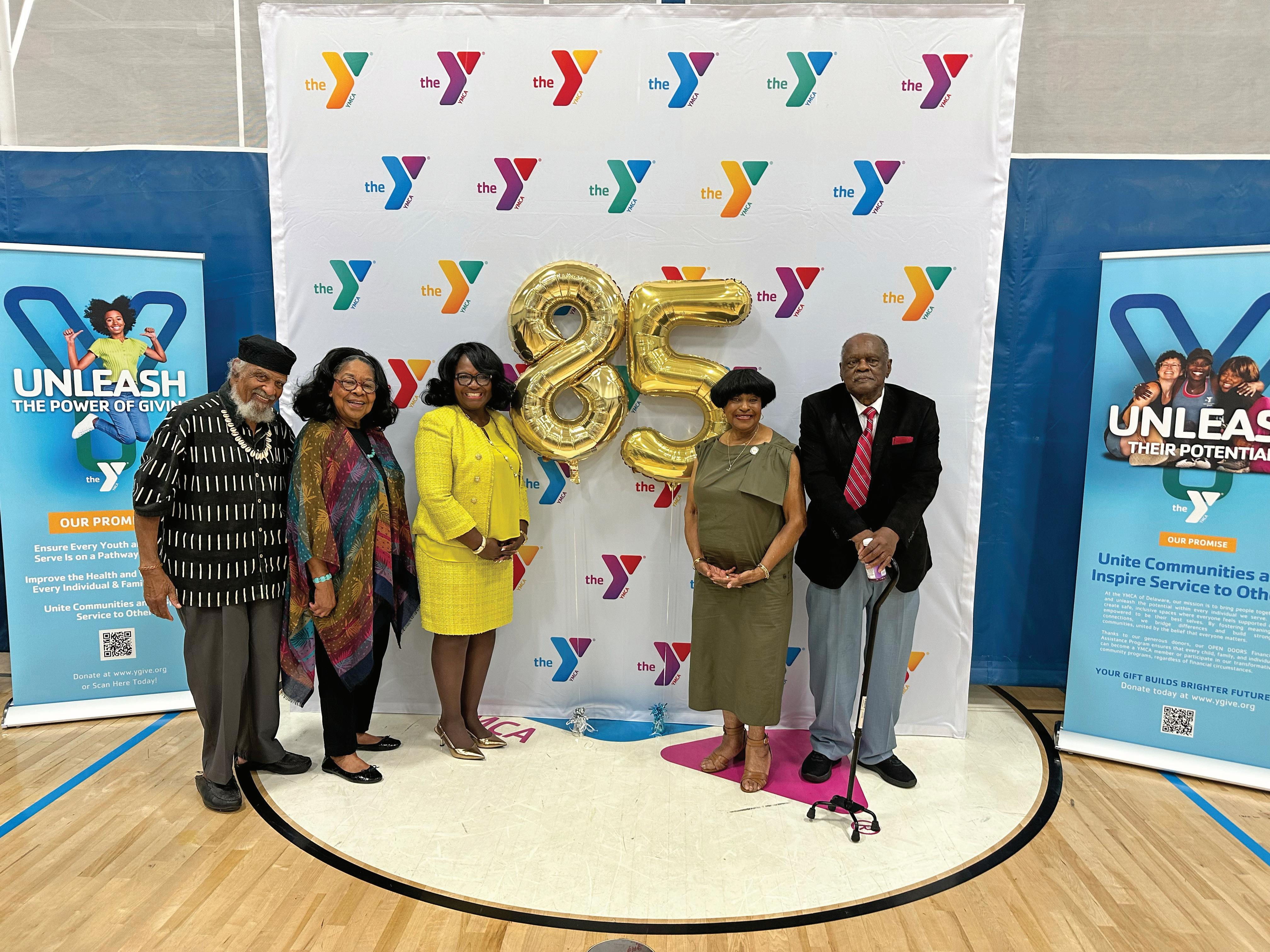
Top photos: In the 1940s, '50s and into the '60s, many of Wilmington's Black youth learned to swim at the Walnut Street Y. They also formed bowling and basketball teams and attended tutoring sessions. Bottom left: In 1998, ground was broken on the new building. At right, Claire Lamar Carey works with members of the Black Achievers Program. Photos courtesy YMCA of Delaware
A Legacy of Hope
For 85 years, the Walnut Street YMCA has nurtured the talent, dignity, and dreams of Wilmington’s Black community
By Bob Yearick
She says the instructor — “very prim and proper” — took the class outside to her car, opened the passenger-side door, and delivered a not-to-be-forgotten lesson: “Back up, put your booty in first, then swing your legs around.”
In addition to learning the delicate steps of correct car entry and exit, young Enid Wallace took tap, ballet, and interpretive dance classes every Saturday for 25 cents per lesson. And, like hundreds of other Black Wilmington teens, she learned to swim in Walnut Street’s indoor pool.
Indeed, beginning with its founding in 1940 — made possible by the largesse of philanthropist H. Fletcher Brown and his wife, Florence Hammett Brown — and continuing through the next three decades, the Walnut Street Y became the de facto center of African American culture in Wilmington. Segregation was a Delaware reality throughout the 1940s, ‘50s and into the ‘60s, and places like Woolworth’s lunch counter and the Central YMCA were off-limits to Blacks, so, except for schools and churches, the building at the corner of Walnut and East 10th Street was one of the limited public recreational/cultural spaces open to them.
Both youth and adults benefited from Walnut's extensive programs and facilities, which included an indoor swimming pool, basement bowling alley, auditorium, cafeteria, library, gymnasium, workshop, game room, meeting rooms, and dormitories.
During the summer, boys might spend all day there, from 8 a.m. to 9 p.m., taking classes in gymnastics, golf,
UNIVERSITY NIGHT AT DELART
art, drama, or playing basketball and chess. Some earned money working as “pin boys” in the bowling alley. They were fueled by the Y cafeteria’s legendary five-cent buttered toast, whose aroma wafted through the neighborhood.
The building was enhanced by art and history. Inside were paintings by noted local African American artist Edward Loper Sr. and others. Outside were friezes that paid homage to such luminaries as Marion Anderson, Booker T. Washington, Paul Robeson, and George Washington Carver, and the illuminated clock tower became a beacon for the community.
85 YEARS OF IMPACT
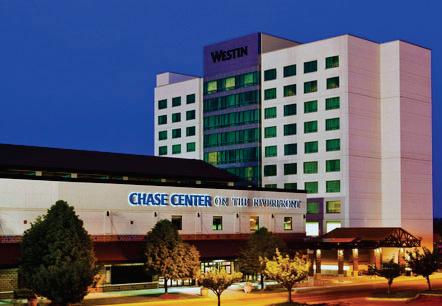
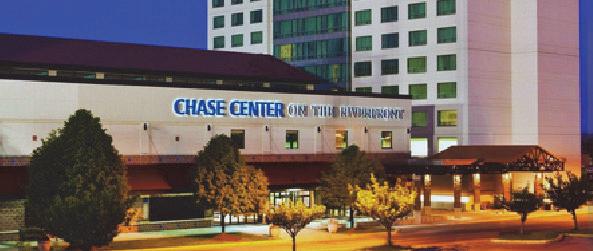
Last October 25, Walnut Street celebrated its rich history with an 85th anniversary gala at the Chase Center on the Riverfront. It was an evening filled with stories, music, and reflection where five community leaders received lifetime achievement awards. In addition to Wallace-Haley, the honorees were:
• Former Mayor James H. Sills Jr. — Wilmington’s first Black mayor and lifelong advocate for public service and opportunity.
• State Rep. Stephanie T. Bolden — Champion for Wilmington’s East Side and tireless promoter of unity and education.
• Claire Lamar Carey — Trailblazing chemist, educator, and former director of the YMCA Black Achievers program.
—
• Harmon R. Carey
Founder
of the AfroAmerican Historical Society and steadfast advocate for preserving Black history.
The honorees reflected on how the Walnut Y had changed their lives, and in turn helped shape Wilmington itself.
Walnut Street was a constant in the life of Jim Sills, Wilmington’s first Black mayor. In 1959, when the native of South Carolina moved here with his wife, he was directed to the Walnut Y, where the staff advised him on housing and helped him establish his eventual deep network in the community.
Throughout his six decades of public service, Sills made the Y a focal point for community meetings and special events, and it was there that he kicked off his mayoral campaign and held his victory party after being elected in 1992.
(Sills is experiencing some health issues and was not available to comment for this story.)
Like Wallace-Haley, Stephanie Bolden remembers the dance lessons at Walnut Street. A native of the East Side, she lost her mother when she was 5. “My dad enrolled me in classes when I was 7 or 8,” she says.
In 2010, Bolden was elected to represent District 2 in the Delaware State Assembly, and she is now the longest serving, elected African American woman in the state of Delaware. The dance lessons proved transformative, giving her an awareness of what she could become.
“On TV and in the movies, you would see Shriley Temple dancing, so these were things that you didn’t feel you would be able to reach,” Bolden says, “but the lessons made you feel more a part of the community, of society.”
‘WE NEVER KNEW WE WERE POOR’
The Y was the place to be for teens on the East Side. In addition to swimming, bowling, and playing basketball, Bolden and her friends learned line dances like the Madison and the Continental. After Thursday night “L Trot” dances, they crossed the street — where Colonial Parking is now stands — to The Blue Goose diner for hamburgers and Cokes.
Most Walnut memberships were paid or subsidized, and volunteers conducted a rigorous membership campaign to raise funds, giving kids from the East Side a taste of the life enjoyed by youth in more prosperous neighborhoods. As a result, says Bolden, “We never knew we were poor.”
Claire Lamar Carey, the first Black woman chemist at Hercules Inc., moved to Wilmington from Augusta,
Ga., in 1965 in the midst of the fair housing crisis. She lived at the YWCA on West 10th Street, but also became familiar with the Walnut Street Y.
“We used the auditorium and gym for our Alpha Kappa Alpha Inc. sorority meetings and activities,” says Carey, “and I pretty much immersed myself in Walnut Street.”
While volunteering as a girls’ basketball coach, she met Harmon R. Carey, who was director of the People’s Settlement. They married and had a son, Roderick, who is now a professor at the University of Delaware.
Long before he became Dr. Carey, young Roderick was enrolled in Walnut Street’s after-care program. When his mother went to pick him up after work, she got a sense of the many activities offered there.
“I remember going from room to room looking for him,” she says. “He might be in the basement in the bowling alley, or in the computer room, or in the gym.”
When she retired from Hercules after 65 years, Carey was persuaded to become leader of the Black Achievers Program of the Delaware YMCA. The program pairs high school youth with successful adult achievers who serve as mentors and roles models to “help instill values of caring and pride.” She led the program for 15 years, and more than 400 of her students went on to degrees in higher education.
‘FOR THE ELITE’
Carey’s husband and fellow honoree, Harmon R. Carey, remembers joining Walnut Street in 1946, at the age of 10. “The Y actually reached out to us,” he says. “One of the staff came down to the lower East Side and found us playing in the street, and he asked if we were interested in joining Walnut Street.”
That had never occurred to Carey and his friends. “We thought the Y was for people with means, for the elite,” he says. “We never went up there.”
He not only joined, but years later, after graduating from Central State University in Wilberforce, Ohio, Carey became a Y recruiter himself. “We had teams that competed against each other to get memberships,” he says, adding, “Our team usually won.”
A former longtime radio host on Wilmington radio station WILM, and now on his own station — WHGE 95.3 FM — Carey has always focused on issues related to the Black community and the city, and particularly the history of the East Side, which he calls “the most historic area of Wilmington.” That was one reason why, in 1998, when the original Walnut Street Y was demolished
Community Executive Director Anesha Law and staffers like Kenny Frazier are building on the Walnut Y's rich history.
to build a new structure on the same spot, he advocated for retaining the clock tower and the relief friezes.
“I’m concerned that our history is being neglected,” he says. “And people who know that history — old folks like me — are going to be gone.”
PRESERVING THE HISTORY
Jeanne D. Nutter agrees. An oral historian, teacher, speaker, and long-time Delaware resident, Nutter had authored two books, Delaware (Black America Series), and Growing Up Black in New Castle County, before the 2024 publication of Walnut Street YMCA and YWCA (Images of America), a book that drew on her childhood experiences at Walnut Street.
Last month, Nutter also completed a documentary, Walnut Street YMCA: Passport to Possibilities, which will be presented at the Chase Center on the Riverfront on Thursday, February 19 (details below).
Both the book and the documentary were labors of love for Nutter. “I took ballet and learned to swim at Walnut Street, my dad was on the board there, and I went to mother-daughter banquets there,” she says. “It was the heartbeat of the Black community, and its story needed to be captured while those people are still with us.”
In completing the book and documentary, Nutter worked closely with Anesha Law, community executive director of Walnut Street for the past three years. Law, who says she “was so honored to participate” in the 85th anniversary celebration, along with her staff are building upon the rich history of their workplace.
“With financial assistance available, we’ve been able to increase our enrichment programs, increase the number of kids in our teen program, and get out more in the community,” she says. “We want to continue giving back to the community, let neighbors know we’re here, and offer a safe space where every child can learn, grow, and thrive.”
The documentary Passport to Possibilities will be presented on Thursday, Feb. 19, at the Chase Center on the Riverfront. For details, contact Jesus de Las Salas at Jdelassalas@ymcade.org. or call 302-571-6962.
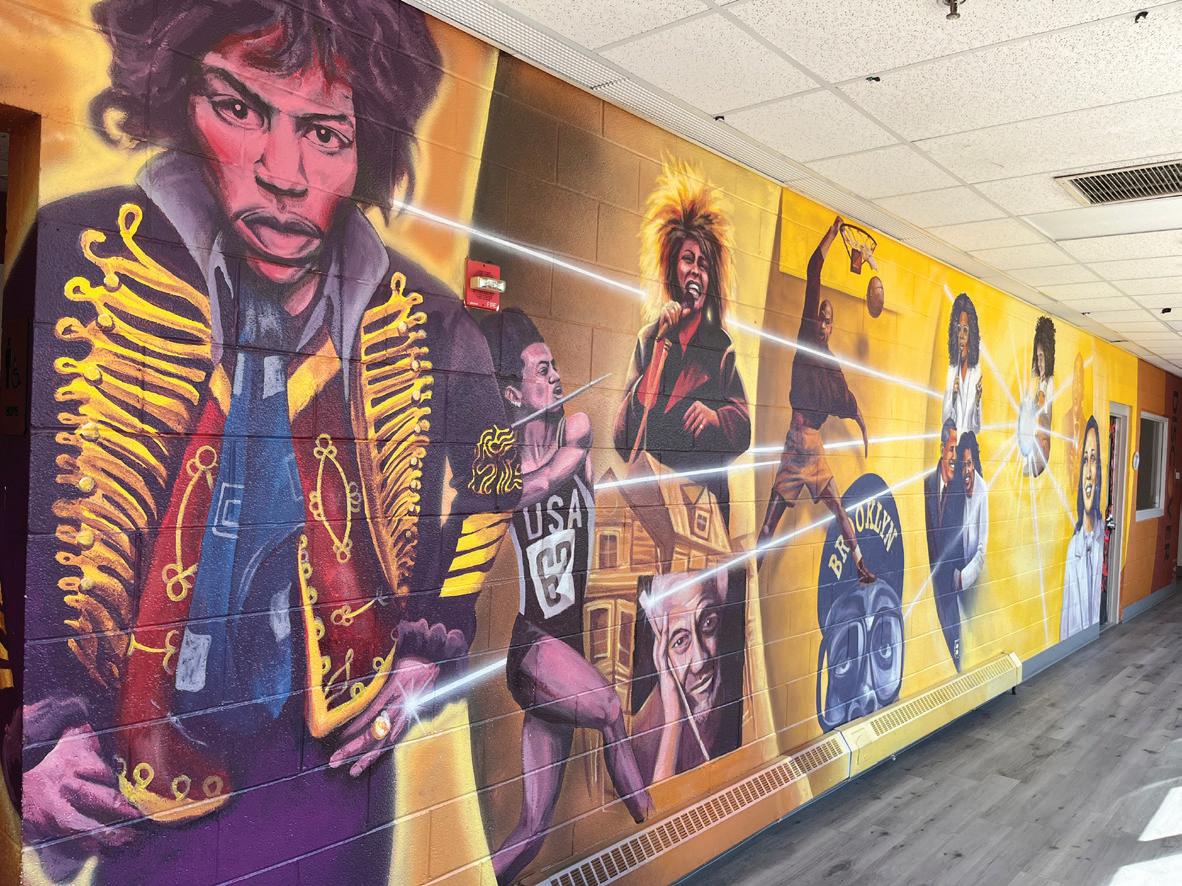
One of the captivating murals, created by artist Christian Kanienberg, that enliven the hallways of the Walnut Street Y.
Eyes on the Prize
A regional robotics program offers a place for both competitive and curious young people
TBy Andrea Smith
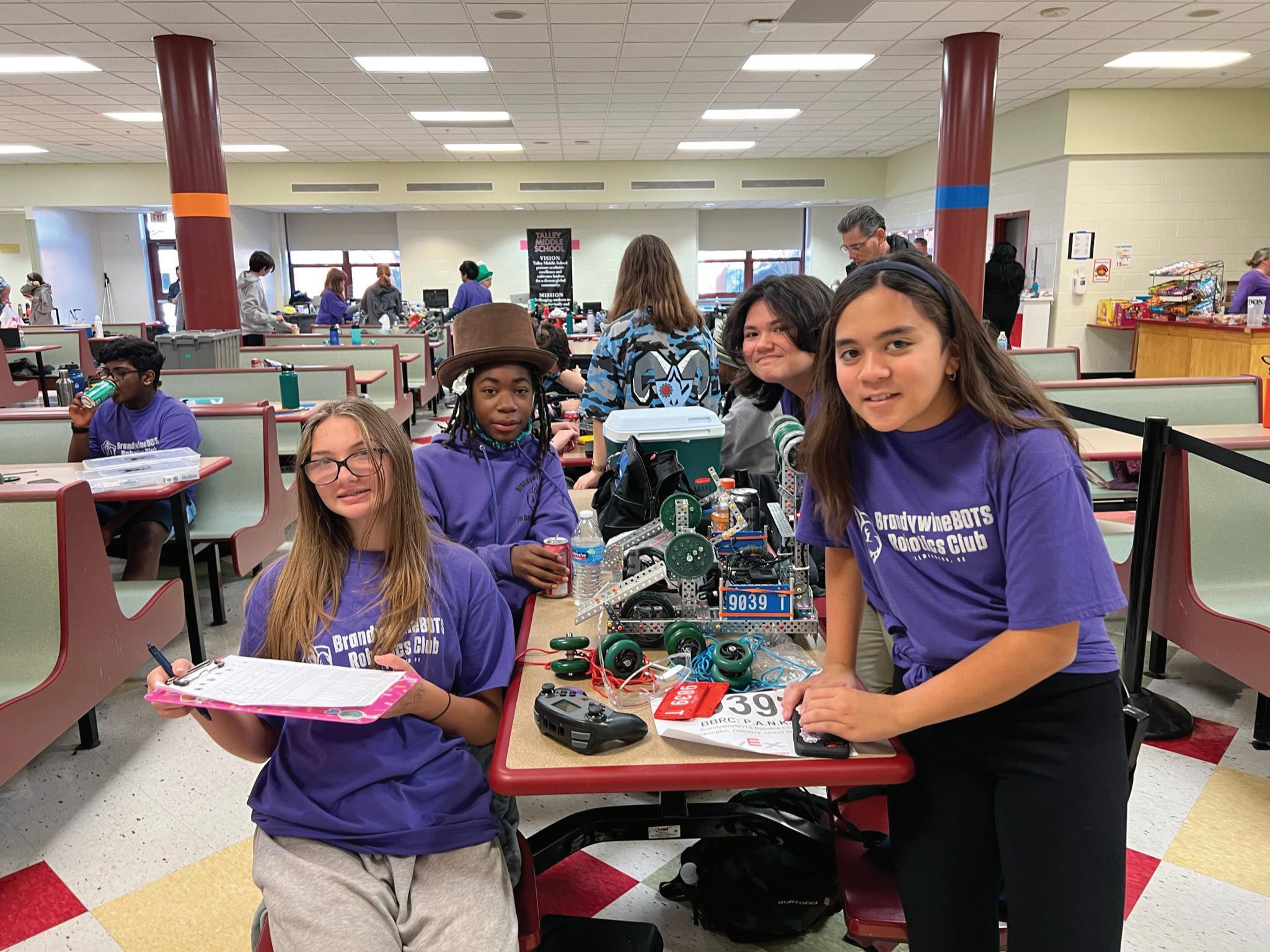
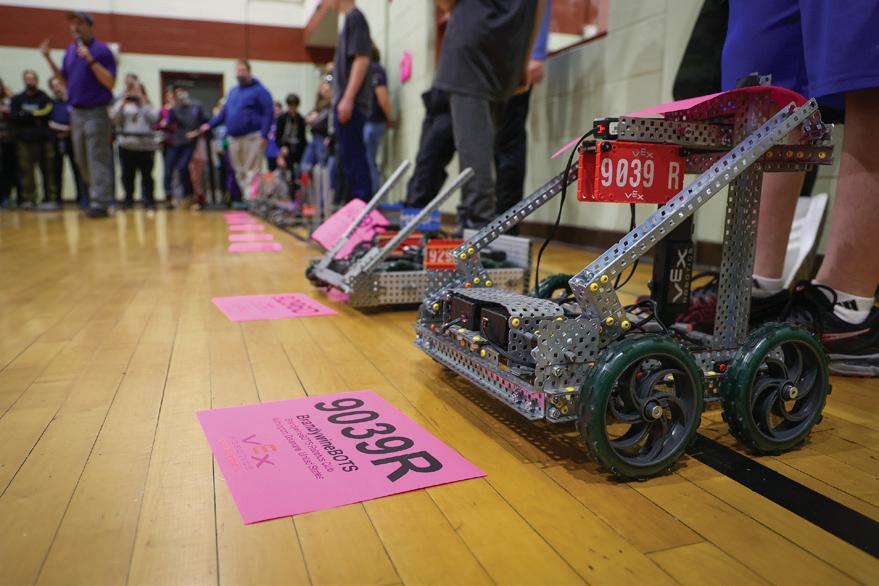
hroughout the two-week winter break, a team of four high school students saw each other almost every day at the BrandywineBOTS Innovation Hub, where they strategized and practiced for their upcoming robotics competition.
Team 9039J-Jinx had been building and improving upon their creation for months, designing a robot capable of winning the game played at VEX V5 robotics competitions worldwide. The week of Christmas was filled with anticipation — not for presents under the tree but for the Sugar Rush competition set for January 4-5 at Hershey, Pennsylvania. A victory there would secure their
spot at the VEX Robotics World Championship.
“This year was different than most,” says team captain Cooper McDonald, a junior at Mount Pleasant High School. “Most times we just go in like, ‘We’re going to do our best and have fun,’ but this year we felt really prepared and like, ‘We’re going to win it,’ and had that mentality.”
McDonald is the team’s driver who maneuvers the
>
robot to collect blocks for points, and his teammates focus on the 12-by-12-foot field to cue strategic moves and track the score. The game requires working with another team or “alliance partner,” which demonstrates the ability to perform collaboratively. It might look like miniature bumper cars, but there are precise objectives.
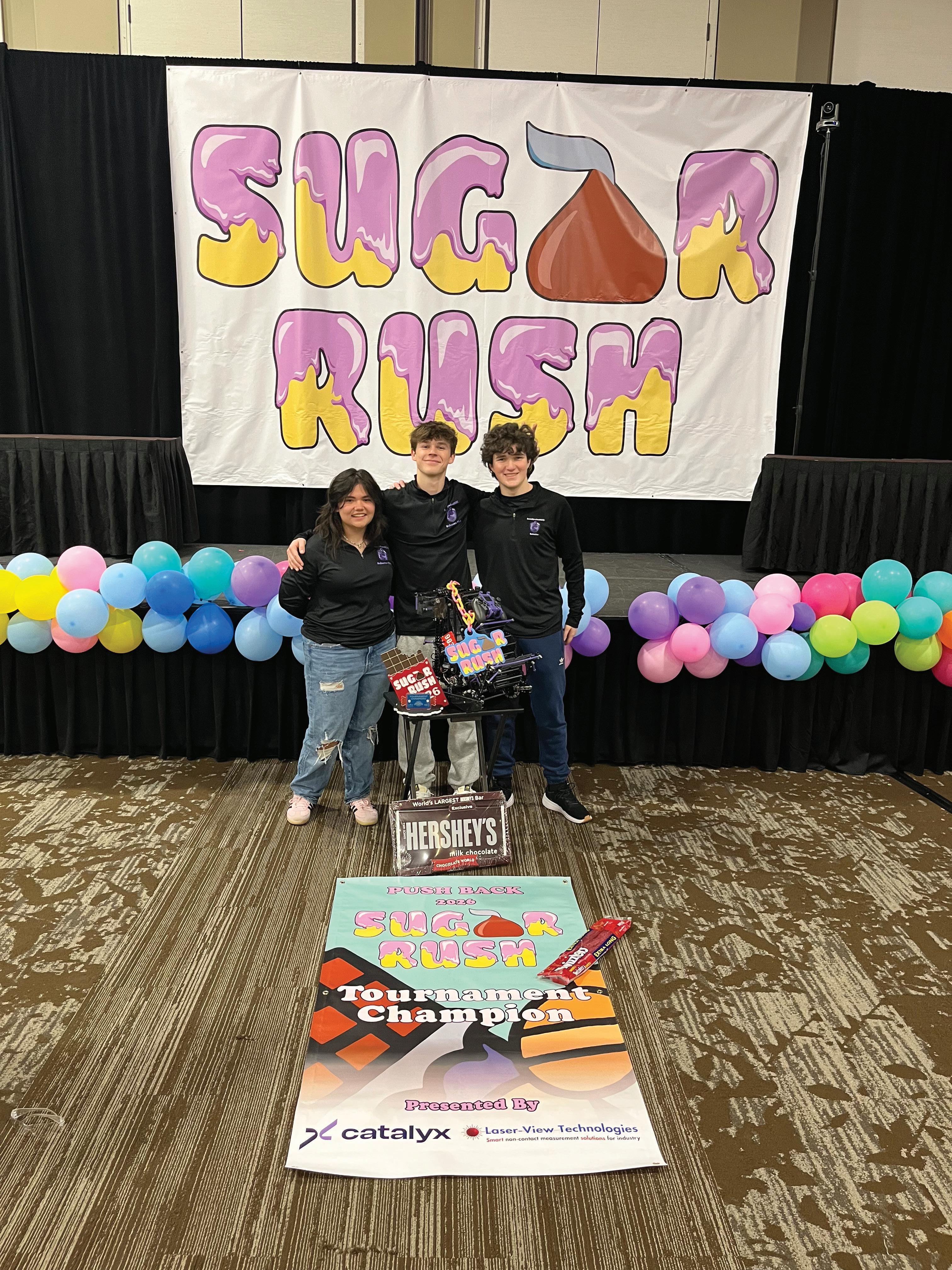
As the clock ticked down during the final Sugar Rush match, the competitive spirit of 9039J-Jinx took over, and by the end, the team and their alliance partner had defeated 120 teams to earn a spot at the World Championship.
Twenty BrandywineBOTS teams have won regional championships and the program has earned 11 Regional Championship Excellence Awards.
“Wow, we did that,” McDonald says, still in shock days later.
BrandywineBOTS Robotics launched as a nonprofit in 2020, and since then, 31 of its middle and high school teams have qualified for a world championship tournament. Twenty BrandywineBOTS teams have won regional championship tournaments, and the program has brought home 11 Regional Championship Excellence Awards in addition to other accolades.
Participants come from across Delaware, Pennsylvania, and New Jersey to design, build, and practice at the BrandywineBOTS Innovation Hub inside the Bellevue Community Center in Wilmington. It’s rarely quiet here
as students rustle through metal and plastic parts and navigate through competition fields. There’s also laughter, cheers, and friendly chatter — it’s a social environment open six days a week and most of the year.
“It’s a far drive, but it’s always worth it to come here,” says Naish Lynch, a sophomore on team 9039J-Jinx who lives in Phoenixville, Pennsylvania. “I’m never like ‘Oh, I have to go to BOTS.’ It’s a fun place to come.”
Bringing Robotics to the Masses
Local robotics coaches and parents initially formed BrandywineBOTS Robotics to combine six Brandywine School District robotics programs, but it’s grown into an independent program that now welcomes third-through12th graders from any district.
“The real, original mission was to give STEM opportunities to everybody, especially students that might be in a community that traditionally doesn't have access to that,” says Jason Heller, BrandywineBOTS co-founder and executive director. “We have a pretty robust scholarship fund, simply to make sure that a kid will never be left out because of a concern about finances.”
This season, the organization gave $5,825 in scholarships and has a full class of 175 participants between the IQ program for thirdthrough-eighth graders and the V5 program for high schoolers. Both programs are volunteer-run and financially supported through sponsorships, grants, donations, and the annual tuition of $450 per IQ participant and $650 per V5 participant. The leadership team welcomes volunteers regardless of their robotics experience, but they’re hoping to recruit more volunteers with STEM backgrounds this year.
“If someone is willing to volunteer, we will find a space for them — whether it’s a day, or once a month, or every week,” volunteer director Elaine McDonald says.
BrandywineBOTS hosts the majority of the Delmarva regional competitions and is a resource for school-based robotics programs. They’ve also partnered with the youth nonprofit UrbanPromise Wilmington to launch the first of many planned satellite programs across Delaware.
“We're probably the largest [nonprofit] program on the East Coast,” Heller says. “I believe we have a responsibility to support and build the region to be able to support the size of the program that we have.”
New this semester, the nonprofit is expanding with a program in the Claymont Community Center called the BrandywineBOTS STEM Academy, which will host “mini camps” or unique interactive classes, each lasting four to six weeks. Camps will cover a variety of topics, such as 3D printing or coding for adaptive technology, and offer something for kindergarten through high school. Registration for the next season of robotics opens in the spring, but the mini camps will open this month at
“The two competition programs [are] a big commitment,” Heller says. “The goal is just to have something for everybody, and maybe [BrandywineBOTS STEM Academy] becomes a feeder into the competition program, or maybe it's just an activity for kids to do that
Believe. Overcome. Transform. Succeed.
Most graduates of the robotics program go on to college with a STEM major, but STEM aspirations aren’t a requirement for entry. To be successful in robotics, one needs to be an innovative thinker, clear communicator,
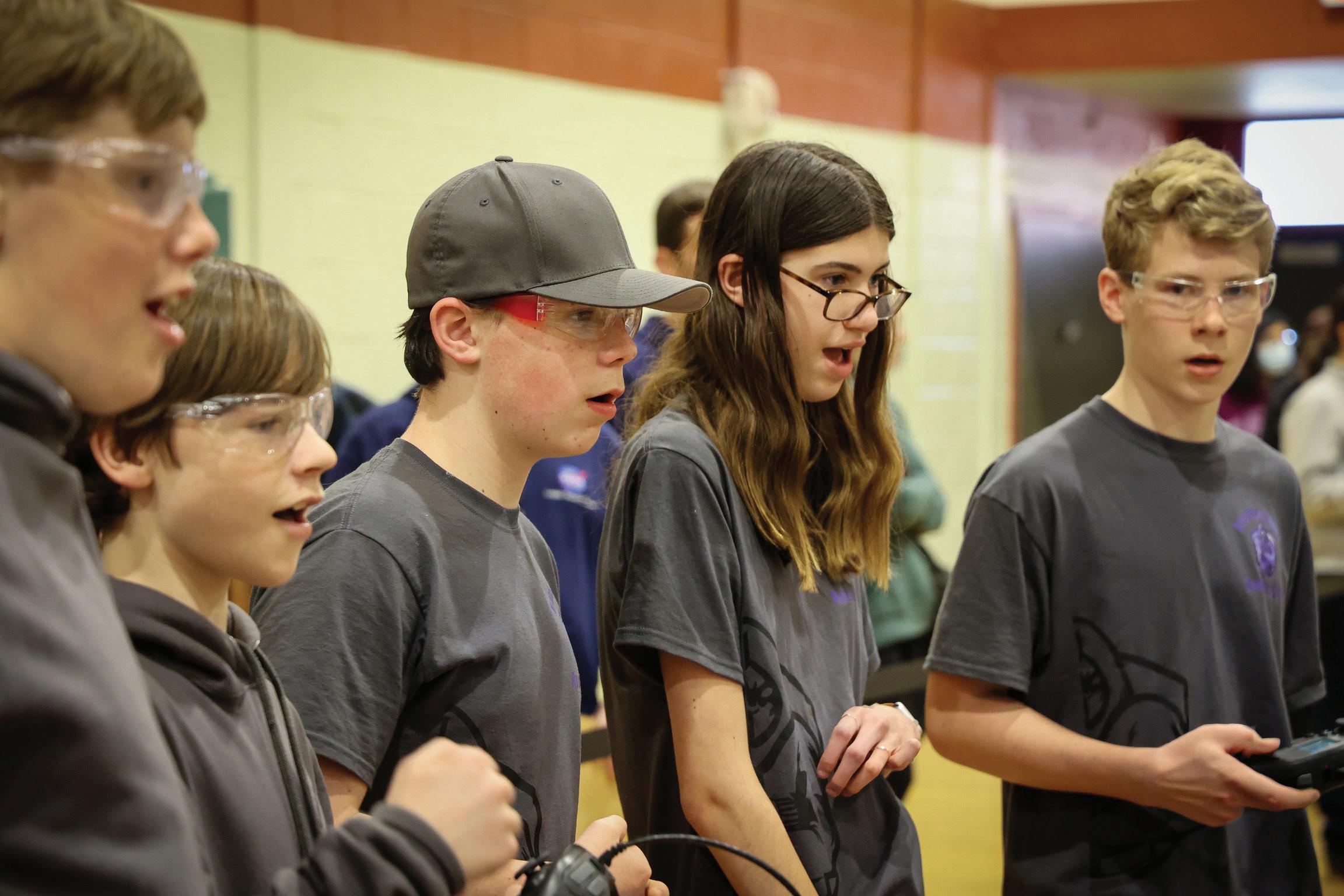
Nin Moore, Cooper McDonald and Naish Lynch celebrate a win at the Sugar Rush VEX V5 Robotics Competition.
and team player. Participants develop these skills and build character throughout each season.
“During the building stages, we had to break [the robot] down a lot and build it back up,” eighth grader Tejasvi Kasireddy illustrates. “That built my perseverance, and I’m more patient now.”
Aidan Burns, a member of the winning 9039J-Jinx team and a junior at Salesianum School, believes he’s on track to meet his goal of becoming a commercial pilot thanks to the opportunities he’s had to hone engineering and critical thinking skills. “Robotics [is] a teamwork environment. It really helps me train and practice in high-stress environments,” he says. “I’m going to use this experience, take it to college, and go become a pilot.”
Elaine McDonald has two sons in the program, including Cooper McDonald of 9039J-Jinx. “This is the first time they came into a competition just really well prepared,” she says. “I think it's because all those years of experience build that confidence and build those skills, and they're much more efficient with their time.”
Still, she appreciates the enthusiasm of the youngest participants: “They get really excited about small things,” she says. “For the most part, it does grow in competitiveness, but we do have a lot of teams that, even in high school, they're just here to have fun and compete, but not necessarily win a world championship. So that's the nice thing, is that there's a spot for all of those teams.”
At any age, the program encourages young people to overcome adversity. “BOTS is an acronym (Believe, Overcome, Transform, Succeed) that kind of loosely translates to the engineering design process,” Heller explains. “We want them to believe in their concept, right? And believe in themselves and that they can do it. But there's going to be barriers along the way, so they need to overcome those barriers, transform their mindset, and that's how they're going to succeed.”
Outside of BrandywineBOTS, members of 9039J-Jinx are athletes, honor society members, and ambitious students. Inside the Innovation Hub, they’re still practicing for their next competition, motivated to win on the world stage. Additionally, they’re mentoring younger participants in the program. Nin Amores, a junior at Mount Pleasant High School and member of 9039J-Jinx, encourages fellow female competitors to advocate for themselves and dream big.
“As a female in this field, a lot of people won’t believe you until you do it,” Amores says with a shrug. “I want to see other people do the best that they can, and show them that [winning] is possible.”
— To learn more about their programs, visit BrandywineBOTS.org.
A 250 Salute
There’s much more than fireworks planned for the City’s year-long tribute
Wilmington has big plans for its America 250 celebration.
In July of 2025, Wilmington Mayor John Carney created a Wilmington 250 committee consisting of key stakeholders. That group included Greater Wilmington Convention and Visitors Bureau, Riverfront Development Corporation, Downtown Visions, Delaware Historical Society, Delaware Libraries, Kalmar Nyckel, West Side Grows, City of Wilmington staff, City Council members as well as writers, poets, historians, interested citizens and previously elected officials. The goal was to collaborate with local historical, cultural and tourism organizations to create a year-long celebration.
"We're honoring our history by celebrating everything that makes Wilmington strong — our arts and culture sector, our business community, the beauty of our neighborhoods, and the people who live here," said Mayor John Carney. "I encourage everyone to join us as we mark this major milestone for our city, state, and nation."
Following is an overview of what is planned throughout the year. Additional activities may be added. For a complete Wilmington 250 calendar, visit InWilmDE.com.
FEBRUARY
Citywide Toast
Mayor John Carney will salute Greater Wilmington Beer Week and conduct a commemorative toast to America 250 on Wednesday, February 18.
MARCH
Mayor’s Budget Address in Old Town Hall.
The mayor’s annual address will be held on Thursday, March 19 in the historic building at 504 N. Market St. Time to be announced.
APRIL
Citywide Dine Around during City Restaurant Week
A progressive dinner will be held on Thursday, April 16 during the 21st City Restaurant Week. will be a progressive dinner. Guests can enjoy appetizers at one restaurant, dinner at a second location, and dessert at a third venue.
MAY
Public Art — Mural
This is a multi-faceted component and a legacy gift to the residents of the City of Wilmington. Concord Avenue is a natural gateway into the city and will be the first site to have a permanent mural installed. Three additional locations are being considered that will tie into a walking tour for residents and visitors.
JUNE
Rumble on Rodney
An outdoor, under-the-light boxing event will take place Friday, June 26 in Rodney Square. Legendary area boxers will be on hand to celebrate this firstever boxing event in the city center. Top-rated regional boxers will perform — from youth the adult. Live music is planned and the evening will culminate with a drone show over Rodney Square.
Community Unity Choir Night
A free concert featuring choral groups from throughout the city to be held at The Grand Opera House.
JULY
July 4th Delaware 250 Celebration
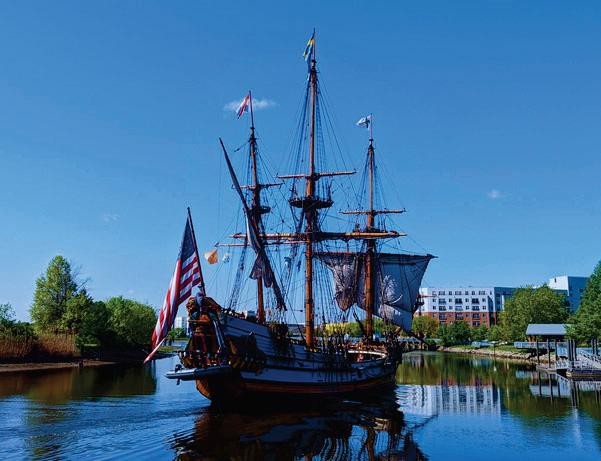
A daylong, free family celebration on the Riverfront featuring live music on multiple stages. Special performers include the Delaware Symphony Orchestra, Chuck Wicks, Kristen & The Noise, Lower Case Blues Band and more. Family entertainment includes hot-air balloon rides, kids amusement rides, miniature golf, street entertainers, a Delaware-made village and tours of the Kalmar Nyckel. The evening will culminate with a fireworks display over the Christina River.
Potluck Dinners
For two months this summer, one council district per week will partner with Play Streets to offer music and coordinate a neighborhood potluck dinner event.
Rico–Inner City Friendship Baseball Game and Latino Americans in the American Revolution
A friendship baseball game will be played between a local Roberto Clemente team and a visiting team from Puerto Rico. The Puerto Rican team will share its rich traditions and heritage while our Wilmington players will highlight our city’s diversity and community spirit — all in the spirit of encouraging youth engagement and strengthening community bonds. Additionally, the City will recognize the contributions of Latino Americans in the Revolutionary War.
Lighting Program
A coordinated effort will be made to illuminate applicable Downtown buildings as well as gateway bridges in a red-white-and-blue color scheme.
AUGUST
Clifford Brown Jazz Festival
Reimagined festival will be a weeklong celebration that includes theme nights. New dates: August 2-8.
SEPTEMBER
Rhode Island Regiment
Bronze Memorial Marker Ceremony and wreath-laying ceremony will be conducted at Wilmington-Brandywine Cemetery to honor the 26 Rhode Island Regiment soldiers associated with Wilmington’s involvement in the Revolutionary War. Fourteen of those soldiers are believed to be Black. The City will publicly acknowledge ongoing research exploring this reported mass grave location at Wilmington-Brandywine Cemetery. The tentative date of the ceremony is Sept. 11, 2026, with invitations extended to the Governor of Rhode Island and the Ambassador for the United Kingdom.
Dance Production
Local dancers will perform a commissioned work celebrating America 250 at The Grand Opera House.
OCTOBER
Delaware Poetry Almanac
A multi-year literary and public history initiative designed to preserve, interpret, and publicly share Delaware’s poetic voices. By the conclusion of Phase One, the Delaware Poets Almanac will have produced a professionally designed and edited 50-poem chapbook.
NOVEMBER
Installation of Historical Heritage Marker Honoring Sallie Shadd
Support the placement of a Historical Heritage Marker in downtown Wilmington honoring Sallie Shadd, an African American woman of remarkable creativity and resilience who is credited with creating and introducing ice cream to the City of Wilmington.
STRETCHING MORE THAN A MONTH Genealogy 101
The Delaware Historical Society will conduct a workshop series grounded in the idea that personal history is American history.
Living Our Shared History: Exploring
Wilmington's
African American Legacy
This blog series is designed to explore and illuminate lesser-known facets of Wilmington’s history, with a particular emphasis on African American heritage. The series will focus on individuals, events, and locations that have played pivotal roles in shaping American history and continue to influence our collective understanding today.
Gateway Banners
Wilmington Celebrates Delaware 250 banners will be installed along Market Street and the Riverfront as well as other gateways of the city. Banner installation is scheduled to begin by early February.
Radio Campaign
Thirty-second pre-recorded live radio reads on WDEL and WSTW. Each spot highlights one of the unique, historically significant facts, bringing Wilmington's story to life in a concise, engaging format. All messaging will drive listeners to a dedicated Delaware 250 landing page featuring the full collection of 250 facts and a calendar of upcoming commemorative events, encouraging deeper exploration and sustained engagement.
Video Legacy Project
Local residents will share stories of Wilmington’s past, present and future. Those videos will be shared via local media outlets as well as the City of Wilmington website. The videos will be archived and shown at the Delaware History Museum as well as venues to be determined.
Wilmington 250 Walking Tour
Paths to Independence: Wilmington and the American Revolution is a four-zone walking tour connecting residents and visitors to Wilmington’s Revolutionary past. By combining signage, interactive maps, and Voice Map-hosted audio, the project will educate the public about Indigenous, African American, Quaker, and Revolutionary industries. This is a self-guided, accessible experience using one’s own smartphone device.
Creation of Official Wilmington 250 Song
Composition of a song commemorating the 250th performed locally by area musicians.
Additional events and initiatives are still in the developmental stage. Among them is a 250 Concert and Comedy Series.
The Underground Railroad
In celebration of Delaware 250, this monthly series will spotlight historic sites unique to our state.
By Chuck Durante
Harriet Tubman and Thomas Garrett helped hundreds reach freedom
By Kevin Noonan
Delaware may not be able to match Pennsylvania’s roster of major historic events, but something of major importance did happen inside our borders in the middle of the 19th Century. That is when The First State became an important stop on the Underground Railroad, helping enslaved African Americans escape to freedom.
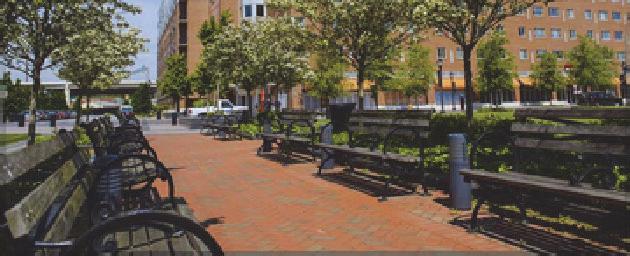
Two people stand out in that noble cause — one a Black woman, the other a white man — and the City of Wilmington honored them in 1999 by naming one of its premier parks after Harriet Tubman and Thomas Garrett.
Tubman-Garrett Riverfront Park, located near the Market Street Bridge and the Christina River, hosts many civic and social events during the year. It also serves as a reminder of the contributions and sacrifices of two ordinary people who did extra-ordinary things. Statues of this dynamic duo are a focal part of the park.
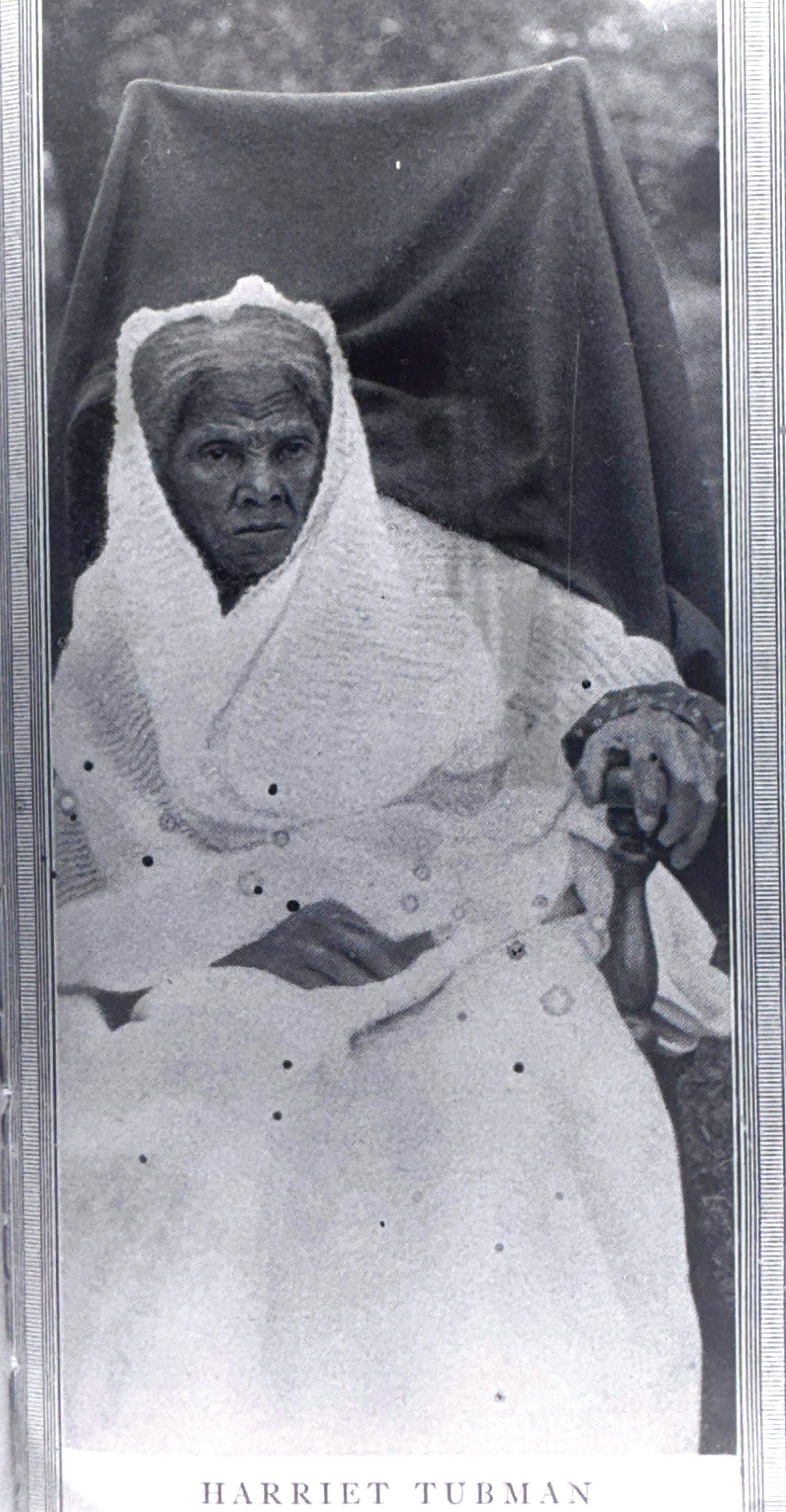
Harriet Tubman was born in Dorchester County, Md., in 1822 to enslaved parents. She escaped to freedom, but eventually returned south to rescue many of her relatives. Tubman was estimated to have made 13 missions to slave states and guided about 70 enslaved people to freedom in the North. Tubman’s commitment to helping others came about because of a spiritual awakening
Presented in partnership with Michelle Harlee (Fourth District) and Wilmington Councilperson-at-Large Latisha Bracy.
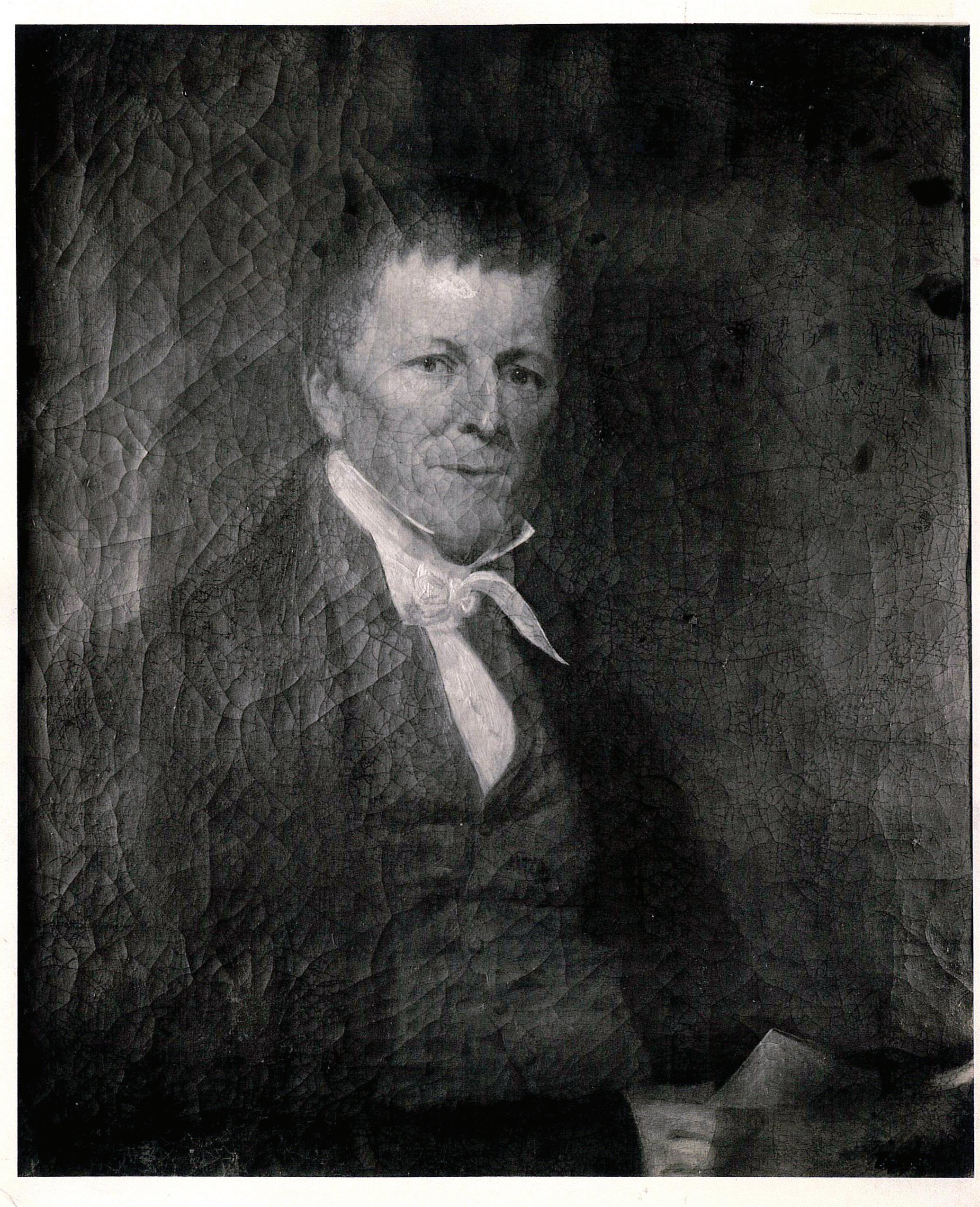
An 1872 photograph of Harriet Tubman (l) and portrait of Thomas Garrett painted by 19th century artist Bass Otis. Photos provided by Delaware Historical Society
fun
she had when she was a child, after suffering a severe head injury. Thomas Garrett said this about Tubman and her faith in the Divine: “I never met any person of any color who had more confidence in the voice of God, as spoken direct to her soul.”
Tubman later moved to central New York, where she remained devoted to civil rights and women’s suffrage. Tubman’s different routes through Delaware and the rest of the Delmarva Peninsula can be traced at TubmanBywayDe.org.
Garrett is also memorialized at the Thomas Garrett House on Quaker Hill in Wilmington, which is part of the Harriett Tubman Underground Railroad Byway. Today, there is a marker honoring Garrett at the corner of Fourth and Shipley street, and he is buried in the Wilmington Friends House cemetery at 401 N. West Street.
Garrett lived in Philadelphia before moving to Wilmington in 1822 and, like many of his fellow Quakers, he was an outspoken abolitionist. But Garrett backed up his words with decisive action, and his house became a focal point of the Underground Railroad. It’s been estimated that he helped more than 2,000 slaves make their way to freedom.
Garrett was a “stationmaster” — someone who transported and, if necessary, hid runaway slaves at his home at 227 Shipley Street. And it’s fitting that the city park that is partially named after him is next to the Christiana River near the Market Street Bridge. One of the legendary stories about Tubman and Garrett is that she was shepherding a group of runaway slaves when she had one final obstacle to overcome — the Market Street bridge over the river. Since it was one of the few gateways into the city, the bridge was closely watched by agents charged with stopping slaves from escaping to the North.
So, Garrett arranged to have workmen travel across the bridge in a horse-drawn wagon, singing boisterously along the way. Later that day, the wagon returned across the bridge, with the workmen still singing and having fun, but this time there was a group of runaways hidden at the bottom of the wagon. The guards once again waved the wagon across the bridge, and Harriett Tubman and Thomas Garrett had worked their magic once again.
Garrett continued to work closely with Tubman and other abolitionists, and in 1848 he and compatriot John Hunn were tried in New Castle Courthouse for aiding and abetting runaways in violation of the Runaway Slave law. They were severely fined, which pushed both men to the brink of poverty, but they never wavered in their commitment to basic human rights.
—Learn more about Garrett at QuakerHillHistoric.org.
A Better Bite in Tougher Times
The cuts, costs, and choices behind steak in 2026
EBy Pam George
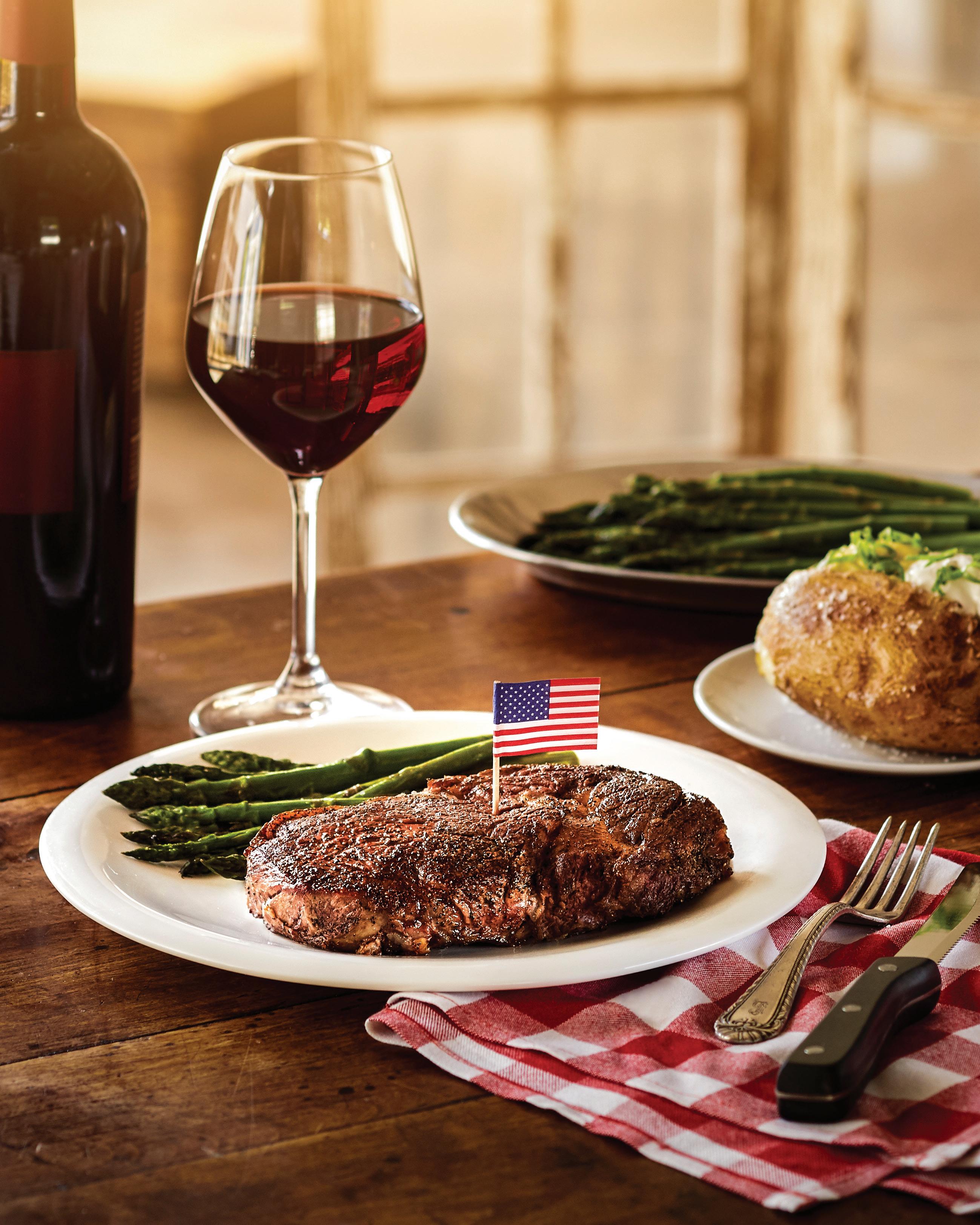
ating a steak is a sensory experience, from the intoxicating scent — at once savory, rich, and buttery — to the beefy taste and satisfying chew. The sight of a burnished sear, a rosy center, and an ivory curl of salt-sprinkled fat is enough to make the mouth water. It’s a fitting Valentine’s Day entrée, when indulgences abound.
New Castle County has no shortage of restaurants that feature steak. Brandywine Hundred boasts Harry’s Savoy Grill, Snuff Mill Restaurant, Butchery & Wine Bar, and Sullivan’s Steakhouse. The city has Bardea Steak, Tonic Seafood & Steak, and Walter’s Steakhouse, while Hockessin is home to RedFire Grill & Steakhouse.
>
South of the city, there’s Ted's Montana Grill, The Marshallton Steakhouse & Seafood, and High Steaks Brewery in Delaware Park Casino & Racing. Even the beaches are rife with steakhouses; 1776 is now under new ownership, and a Brazilian steakhouse, Nossa Casa, just opened in Millsboro.
However, getting beef to the table in 2026 is a balancing act. Supplies are tighter than they were five or six years ago, and prices can move quickly. Yet restaurants still must deliver the same tenderness and marbling guests expect.
“What matters most to me is that every steak eats the way it’s supposed to — the same tenderness, same marbling, same cook — every single time,” agrees Antimo DiMeo, executive chef of Bardea Steak.
Demand Puts Beef on the Rebound
Beef sales have fluctuated over the years depending on whatever study — or diet — is making news. When low-fat eating dominated the 1980s and 1990s, many consumers shifted toward poultry and leaner proteins. Beef clawed its way back as low-carb, high-protein approaches (keto, paleo, and macro-based eating) gained traction.
Today, steak is part of the broad protein fad. Cargill’s 2025 Protein Profile found that 61% of consumers increased their protein intake in 2024, up from 48% in 2019. Granted, many protein-forward influencers tout eggs, cottage cheese, and powders more than rib eye. Still, diners who scale back beef at home often order steak when they go out.
“Ultimately, I think it’s one of those premium proteins that people still enjoy,” says John Constantinou, owner of Walter’s Steakhouse in Wilmington’s Little Italy section. DiMeo would agree. “People still come to a steakhouse to have a steak.”
Consistency and Quality are Key
Many people want to order steak because they don’t cook it at home. Anyone can slap meat on a grill or into a cast-iron pan, but it’s harder to
produce a juicy, well-flavored cut with a proper crust and a perfect medium-rare center.
Then there’s the quality. Restaurants buy to tighter specs than many shoppers do, notes Joe Tis, who oversees culinary operations for Harry’s Hospitality Group, including Harry’s Savoy Grill.
The USDA’s quality grades — mainly based on marbling, or fat within the muscle — are part of that conversation.
• Prime has at least a “slightly abundant” degree of marbling and is often associated with upscale restaurants.
• Choice has at least a “small” amount of marbling.
• Select has at least a “slight” amount of marbling; it’s typically leaner and can be less juicy.
Aging influences tenderness and flavor, but the timeline depends on the restaurant’s program and purchasing model. At Harry’s Savoy Grill, the kitchen breaks down beef on site and holds prime rib for about 45 days as part of its in-house program, Tis says. Walter’s, meanwhile, receives beef that’s already aged about 21 days before it arrives. Constantinou says the restaurant typically keeps it another week or two.
Space and labor are part of the equation. A chain with 10 or more restaurants may not have the space — or the trained staff — to butcher meat at a high level across multiple locations, Tis says. Space is the primary issue for tiny Snuff Mill, which contracts with a third-party to age the beef. Owner Bill Irvin says he’d add more room for dryaging if the restaurant expanded.
Supply and Demand
Even when steak’s popularity surges, availability and price still depend on the cattle cycle. It’s a marriage between slow agriculture — most beef cattle reach slaughter age in about 14 to 22 months, while grass-finished animals often take closer to 24 to 28 months — and a fast-moving market. Beef is a commodity.
USDA data projects per-capita beef availability dropping from 58.5 pounds in 2025 to 56.9 pounds in 2026, reflecting tighter cattle supplies and higher prices even as protein demand remains strong.
The cattle inventory numbers show the longer arc. On
86.7 million head, down from 94.4 million on Jan. 1, 2020, the year before a U.S. drought led farmers to liquidate a good portion of their stock. Rebuilding herds takes time.
“We are all doing our best to weather the storm until it gets caught up,” says Steve Demilio, vice president of food and beverage at Delaware Park Casino & Racing, where High Steaks Brewery is located. “However, we haven’t had any issues with availability or consistency, and our vendors have been excellent at managing inventory.”
Meanwhile, prices can change weekly. “Sometimes it feels like it can swing any given day depending on the cut,” DiMeo says. Harry’s Savoy Grill paid 50 percent more for prime rib than in January 2025.
“The old man in me wants to scream out: ‘Back in my day, I could get a whole side of beef for that price!’” says Patrick Bradley, culinary director of Jamestown Hospitality, which owns Tonic.
Perfecting the Pivot
Snuff Mill cuts volatility by buying direct from farmers. “You’re not waiting on a company like Cargill to get you your product on the 18-wheeler coming from Kansas or Texas,” says owner Bill Irvin. “The farmer sets his price, so he makes money and leaves it there for up to five months.”
So, why don’t more restaurants work directly with farmers? Supply is one limitation. Constantinou doesn’t want to worry if a small farm will have enough of the right cuts, week after week, to meet demand. For many restaurants, especially higher-volume operations, it is also easier to work with a limited number of vendors than to manage a long list of specialty suppliers.
Steakhouses are adapting in different ways. They can raise prices, though that’s usually a last resort. At >
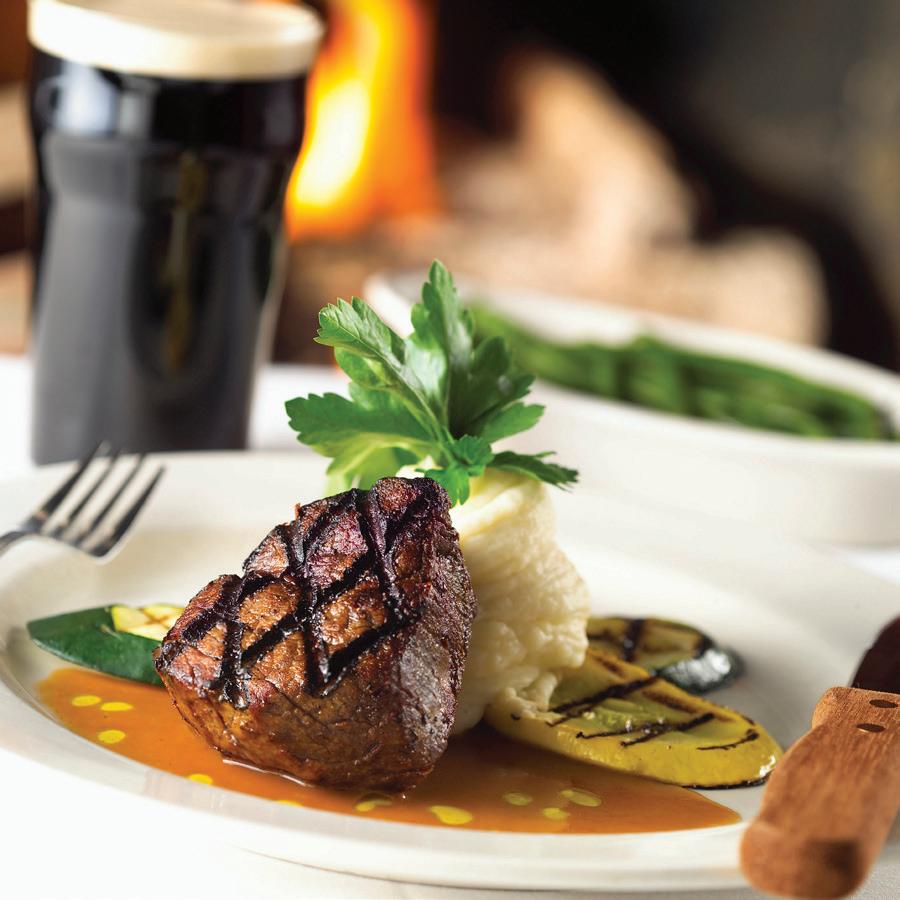
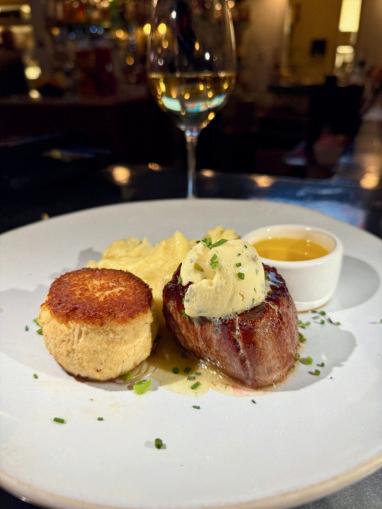
A filet at High Steaks Brewery at Delaware Park.
The Delmonico ribeye at Ted's Montana Grill.
CELEBRATE VALENTINE’S
FEBRUARY 13-15
LIVE MUSIC IN THE LOUNGE LIVE MUSIC IN THE LOUNGE
FRIDAY, FEBRUARY 13 | EMILY MCNATT (8-11 PM)
FRIDAY, FEBRUARY 13 | EMILY MCNATT (8-11 PM)
SATURDAY, FEBRUARY 14 | FROST DUO (5-8 PM)
SATURDAY, FEBRUARY 14 | FROST DUO (5-8 PM)
SATURDAY, FEBRUARY 14 | JENNI SCHICK (8-11 PM)
SATURDAY, FEBRUARY 14 | JENNI SCHICK (8-11 PM)
Snuff Mill, Irvin may increase the cost of specific cuts partly because they sell out, and the small restaurant is consistently booked.
Sides are another lever. Many steakhouses charge extra for them. High Steaks recently transitioned from á la carte to entrées with a choice of two sides — an adjustment that may increase the overall price but deliver more value.
Offering other proteins is a safety valve for costconscious diners. Harry’s Savoy Grill has long been known for seafood, and Tis says the group also features alternatives such as a high-quality pork chop. Constantinou, for one, is reluctant to put too many non-beef items on the menu. After all, the word “steakhouse” is part of Walter’s name.
Making the Cut
Restaurants can also reduce portion sizes and expand their portfolios. “We keep a small section of exclusive steaks for special occasions, while making other beef offerings more price-accessible,” Bradley says.
Some operations lean into cuts that are satisfying and more affordable than, say, filet mignon. Think skirt, hanger, bavette, and other butcher’s cuts, which are frequently marinated to boost tenderness and flavor. High Steaks offers a 10-ounce wagyu bavette steak. Also known as sirloin flap, bavette is an extended, flat, flavorful cut commonly used for steak frites.
If you think short ribs are an answer, think again. They’re indeed less expensive than other cuts, but
they take time and talent to tenderize and develop flavors. Plus, their popularity has led to higher prices, Constantinou says.
At Bardea Steak, DiMeo says the restaurant rotates featured cuts depending on availability and guest interest. Cuts, including picanha (sirloin cap) and zabuton (often associated with Denver steak), pique customer curiosity. Many are part of the restaurant’s “Butcher’s Feast,” a multi-cut tasting experience.
Granted, familiar cuts still anchor the category — ribeye, filet mignon, and New York strip. (Prime rib, despite the name, is a rib-section roast, not a USDA grade; you can find select, choice, and prime versions.)
In a tight market, chefs and restaurateurs say the guest experience matters as much as the protein. “We’re going to focus on our hospitality,” Tis says. At Harry’s Savoy, he adds, a blushing slice of prime rib comes with attentive service and a beverage program that completes the occasion.
Demilio agrees. “From what we hear, 2027 should bring some more consumer-friendly beef pricing, so we will just have to wait and see, keep our fingers crossed and continue to get creative for our guests.”
If the last five years has taught the steak business anything, it’s that the market can move, the herd can tighten, and the costs can climb, but diners still expect the same bite every time. The restaurants that will win are the ones that keep the experience predictable, even when the supply chain isn’t.
Greater Wilmington Beer Week: The Players
Some background on the breweries and venues that have joined forces in the spirit of beer, food, and fun
America celebrates its 250th anniversary this year and Greater Wilmington Beer Week is raising a glass to that milestone — literally.
On Wednesday, February 18, at 7p.m., the 14 venues participating in this year’s celebration will conduct a citywide toast. All you have to do is pick a spot and show up. Commemorative pint glasses will be available at official Beer Week venues.
The toast, however, is just a sip of what Beer Week is pouring this year. This year’s celebration features eight area breweries and six restaurants that boast a top-shelf craft beer menu. Each brewery is creating its own signature beer for Delaware 250, encouraging attendees to explore and sample. For a full schedule of events, visit WilmingtonBeerWeek.com.
In the meantime, if you want the scoop on the participating places, read on …
Apothecary Brewing Co.
Brewer: John Ponte
2703 Philadelphia Pike, Suite A Claymont, DE 19703
ApothecaryBrewing.com
This community-minded brewery offers four flagship beers alongside rotating seasonals, guest taps, and cider and mead from Liquid Alchemy, plus a lively calendar of music, Quizzo, karaoke, D&D nights, and more.
Autumn Arch Beer Project
Brewer: Mike Sobel 810 Pencader Dr, Suite C Newark, DE 19702 AutumnArch.com
Tons of parking, rad pizzas (and salads), and stellar craft brews. Live music every Friday. Dog friendly on Sundays. Open Wednesday–Sunday.
Bellefonte Brewing Company
Brewer: Joe Bob Jacobs 3605 Old Capitol Trail Wilmington, DE 19808
BellefonteBrewingCompany.com
Featuring 16+ beers and seltzers plus regular events (indoor and outdoors) such as food truck festivals, music, video game competitions and corn hole tournaments. Family and dog friendly. Also offers pinball and arcade games.
Brew Works North
Brewer: Craig Wensell 1851 Marsh Rd Wilmington, DE 19810 BrewWorksNorth.com
Designed as a mostly 21+ adult hangout, Brew Works North features 20 taps of Wilmington Brew Works beer & cider and rotating Delaware guest taps. Guests can unwind with bar games like pool and darts, Sports on TV, and plenty of seating. Family friendly Saturdays and Sundays from 12–6pm, and leashed pups welcome Sundays from 12-6pm.
Chelsea Tavern
Number of Beer on Tap: 33 821 N. Market St. Wilmington, DE 19801
ChelseaTavern.com
Offering one of the largest beer selections — in draft , can, and bottle — in the area, Chelsea Tavern has been a longtime supporter of local craft. The tavern is open to 1am daily serving lunch and dinner, plus early happy hour specials (Mon-Fri, 3pm–6pm) and a late night happy hour (Mon-Fri, 11pm-1am). Brunch is served on the weekend, 10am-2pm.
Dorcea
Number of Beer on Tap: 14 1314 Washington St. Wilmington, DE 19801
Dorcea.com
Owned and operated by two longtime hospitality experts, the Bomba brothers, Dorcea combines friendly bar service and a cozy restaurant experience with a focus on comfort food. Draft selection often showcases local breweries, and their can-and-bottle menu is a deep-dive into hard-to-find favorites from near and far.
First State Brewing Company
Brewers: Andrew Johnston &
Matthew Jarrell
109 Patriot Drive Middletown, DE 19709
FirstStateBrewing.com
Named USA Today’s Best New Brewery in 2023, First State Brewing Company pairs thoughtfully crafted best-in-class beer with a chef-driven menu, bringing the same care and creativity to the kitchen as they do to the brewhouse.
High Steaks Brewery at Delaware Park Casino
Brewer: Elliott Sidell
777 Delaware Park Blvd. Wilmington, DE 19804 DelawarePark.com/dining/brewing
Following a full renovation on the first floor, Delaware Park Casino not only offers the best slot product in the country, but is home to the reimagined High Steaks Brewery. Enjoy house brewed beers, perfectly grilled steaks, and an intriguing wine list. With over 14 beers on tap, they have something for everyone.
Makers Alley
Number of Beer on Tap: 24 804 Orange St
Wilmington, DE 19801
MakersAlleyDE.com
Makers Alley is Wilmington's only indoor-outdoor beer garden, serving up an ever-rotating lineup of local craft beer alongside crave-worthy bar bites from our one-of-a-kind 1964 converted airstream kitchen. Open year-round, Makers keeps the good pours coming with monthly tap takeovers, music bingo, trivia nights, and more. Plus, enjoy three hours of free parking at the Mid-town Park Garage directly next door.
Trolley Tap House
Number of Beer on Tap: 31 1616 Delaware Ave.
Wilmington, DE 19806
TrolleyTapHouse.com
Open seven days a week from 3pm to 1am, Trolley Tap House boasts the largest craft selection in Trolley Square. Regular fun includes Music Video Bingo from 7-9pm on Tuesdays; Quizzo from 8-10pm on Wednesdays, and Live Band Karaoke from 9pm-1am on Sundays. Also featuring pool table, video games and a dog-friendly patio.
Twisted Irons Craft Brewing
Brewers: Matt Found & Brandon Gouge
303 Ruthar Drive, Suite F Newark, DE 19711
TwistedIronsBrewery.com
Celebrating five years in March 2026, Twisted Irons offers a wide range of craft beer styles, as well as wine, mixed drinks, and non-alcoholic options. The small-batch “Twisted R&D” project explores exotic and experimental beer styles, both independently and through brewer collabs, ensuring a rotating lineup of unique offerings on tap at all times. Kid and dog-friendly tap room has an indoor golf simulator — reservations can be made online and walk-ins are welcome.
Two Stones Pub (Wilm.)
Number of Beer on Tap: 20 2502 Foulk Rd.
Wilmington, DE 19810
TwoStonesPub.com
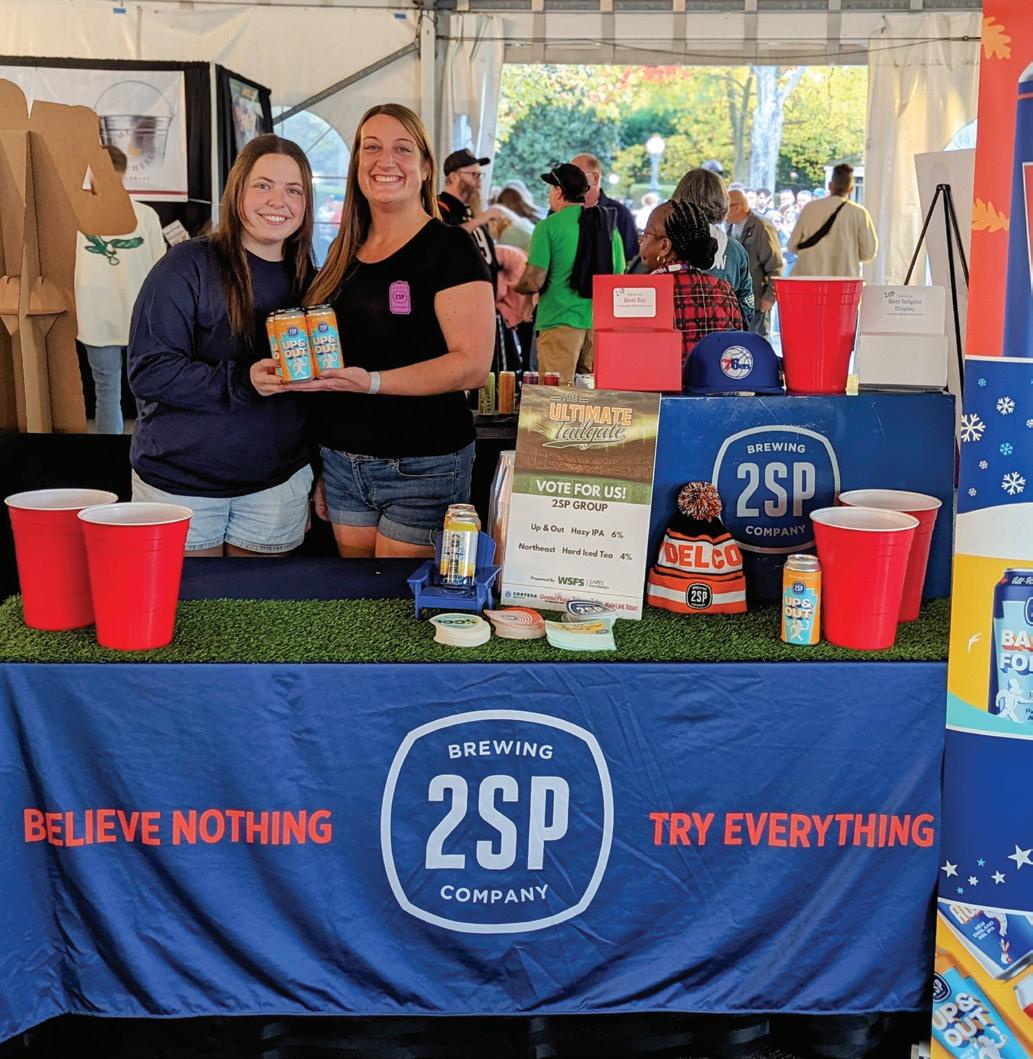
Part of a local restaurant chain that was the first in the area to serve a variety of craft beer from around the country with quality comfort food. Features a mug club, ever-changing Taco Tueday specials, and Sunday Brunch. Showcasing area craft favorites along with select brews from its sister company, 2SP Brewing Co. in Aston, Pa.
Washington Street Ale House
Number of Beer on Tap: 24 1206 Washington St. Wilmington, DE 19801 WSAleHouse.com
A Wilmington landmark since 1997, this ale house is open daily, offering Pasta Night (Mon), Burger Night (Tues), Wing Night (Wed) and Taco Thursdays. A recent winner of “Best Late Night Menu” in the Best of Delaware Awards. Offers 35 canned and bottled beers and a considerably large area-craft selection on draft.
Wilmington Brew Works
Brewer: Craig Wensell
3129 Miller Rd, Wilmington, DE 19802
WilmingtonBrewWorks.com
The only brewery in Delaware’s largest city, housed in a 110-year-old former laboratory in the Ninth Ward. WBW is dedicated to keeping the spirit of the building’s origins alive with new and innovative ales, lagers, sours and ciders. Features a beer-hall style taproom with plenty of indoor and outdoor seating, regular live music and special events.
Suds & A Slice
Autumn Arch founders call on Pizza Buddha to expand their enterprise
By Kevin Noonan
When Dan and Jimmy Vennard decided to open a pizza place next to their thriving brew pub, the brothers didn’t mess around — they went straight to the top and hired Al the Pizza Buddha.
If you don’t know who Al is, well, you don’t know pizza. The Buddha — whose real name is Alastair Hannmann — has made a career advising pizzerias all over the world about the ins and outs of running a pizza parlor, from the kind of sauce and cheese on the pizza to the number of tables and chairs in the parlor.
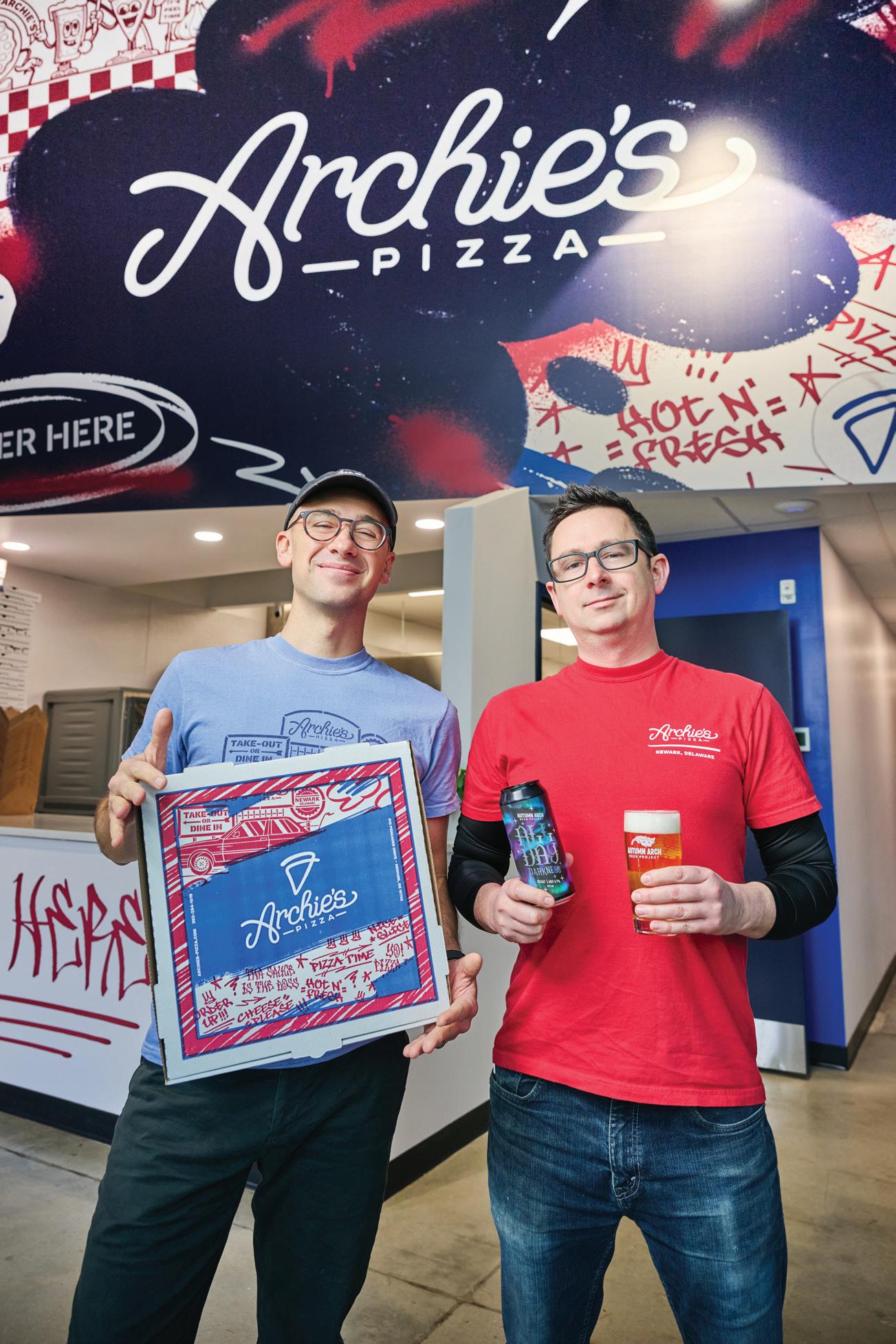
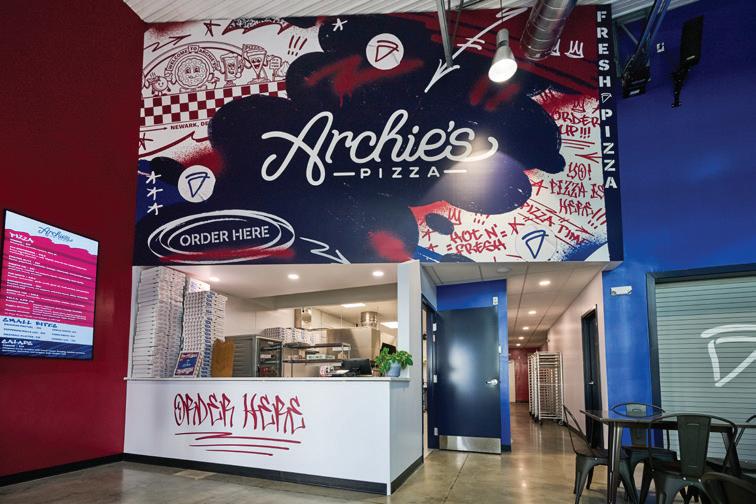
The Vennard brothers, along with Jimmy’s wife, Kathryn, are the owners-operators of Autumn Arch Beer Project, a brew pub at the intersection of Pencader Drive and Pleasant Valley Road south of Newark. And now they’ve added a pizza place next door — called Archie’s Pizza — with plenty of support and guidance from the Pizza Buddha.
“He was amazing,” Jimmy Vennard says. “I don’t know how we would have done it without him.”
Before he contacted Hannmann, Jimmy Vennard
realized how little he knew about running any kind of restaurant, much less a pizzeria. Since this is the 21st century, he went on the internet and started looking at articles and podcasts about the pizza business. And that’s when he discovered Al the Pizza Buddha. The Vennards were impressed by Hannmann’s reputation and intrigued by his personality, so they contacted him. To their surprise and delight, he agreed to work with them.
“He just took it to another level,” Dan Vennard says. “When we started, we didn’t know how much we didn’t know. But Al knows it all. He knows about the best equipment and the best layout for the restaurant, and even things like how to keep the flow of customers moving smoothly and how to train a staff quickly and efficiently.
“He does this all over the world, and we were lucky to get him to help us.”
Jimmy and Dan Vennard (l-r), founders of Autumn Arch and Archie's Pizza. Photos by Joe Hoddinott
Pizza Knows No Borders
If there’s any doubt about Hannmann’s globe-trotting status — he was in Kuwait when he discussed the Vennards with Out & About recently. After leaving the Middle East, he was scheduled to fly to Arizona and then back to Asia — Jakarta, Indonesia this time — before heading home to the island of Kauai in Hawaii.
It’s that international experience and expertise that eventually led to his unofficial title — Al the Pizza Buddha.
“One thing that impressed me with Jimmy and Dan right away was their insistence on doing things the right way,” Hannmann says. “They didn’t want to take any shortcuts, whether that was in the quality of the pizza or the quality of the service.”
One of the first things Hannmann advised was to remember the basics.
“I always tell my clients, you’re not a restaurant — you’re a pizzeria,” he says. “One of the keys to that is to be really strict with the menu. Don’t try and do too much. If you have a menu more than two pages, how do you expect an employee to execute it on a busy Friday night?
“At the same time, you have to be able to serve varied choices, whether it’s vegan or vegetarian or meat-eaters or just the classics,” Hannmann adds. “Really, it’s just a matter of doing what you do well and doing it consistently.
That’s the problem most food places have — the food is good one night and not-so-good the next night — and the brothers understood that immediately. They really approached this whole process with the right focus.”
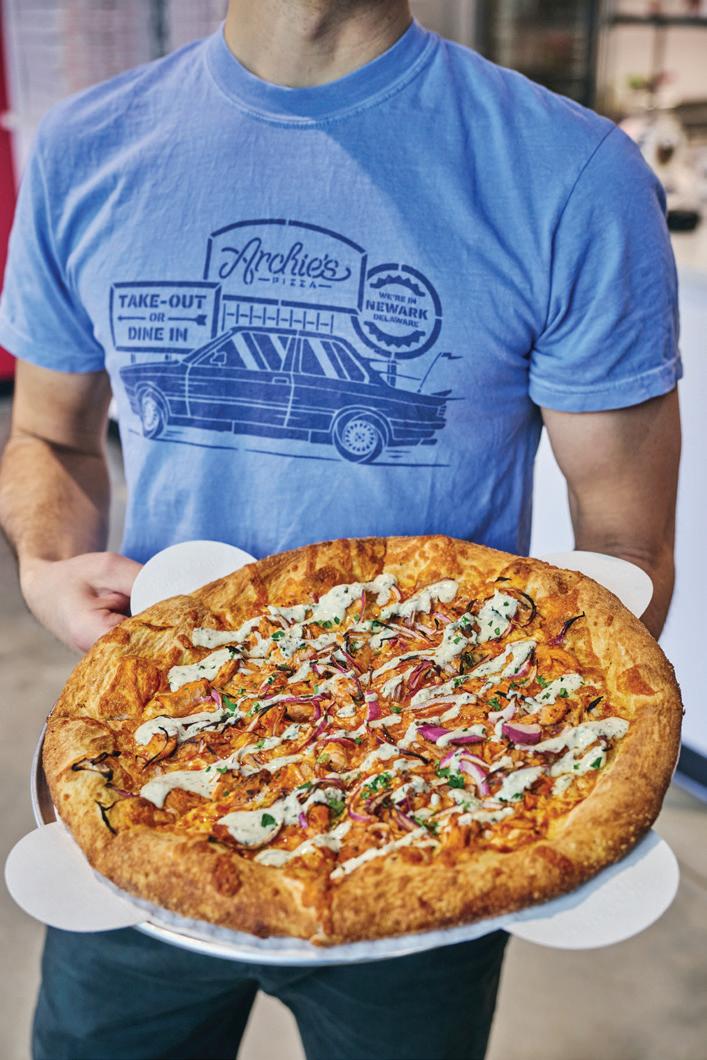
Along with the usual toppings, Archie’s pizza menu includes the Protein Blitz, which is loaded with meat, and the Buffalo Ted, with chicken, red onion, buffalo sauce and mozzarella.
For the less carnivorous, they offer the Presto Pie, with basil, pesto and roasted red peppers, or the Sophistication, with roasted mushrooms, red peppers, artichoke hearts, olives, mozzarella and basil aioli.
Following Hannmann’s advice, the menu also includes pub grub like a Bavarian pretzel with beer cheese, a meatball plate, garlic knots and even cannoli.
Brothers And Brewers
The Vennards were raised in Smyrna and graduated from the University of Delaware with degrees in engineering. Dan, now 42, majored in mechanical engineering and Jimmy, 43, in chemical engineering. Kathryn also has a degree in engineering (industrial) and all three landed jobs with W.L. Gore and Associates, which are pretty good gigs for any engineer.
But the brothers — who had been making home brew
Autumn Arch pivoted from having food trucks on premises to opening Archie's, its own pizza parlor.
for years — weren’t completely satisfied with their button-down jobs. So, in 2019, they took a leap of faith and opened Autumn Arch Beer Project after finding a 5,400-foot warehouse in the Pencader Industrial Park. They started with nine styles of beer and now have produced at least 92 different brews. They even won a Gold medal in 2023 at the prestigious Great American Beer Festival in Denver, where their “All the Love You Won’t Forget” — a Flanders Red Ale — took the top prize in the Belgian Sour Ale competition.
“That just reinforced what we believed all along, and that was we could put out an outstanding product,” Dan Vennard says. “It’s great when a customer tells you that, but even more so when national experts tell you. We knew we make good beer and that was definitely validation on a national level.”
However, the brothers also realized that local craft-beer pubs were starting to suffer from over-saturation in Delaware. That includes Midnight Oil Brewing, which was located nearby in the same warehouse setting as Autumn Arch Beer Project and closed its doors in April of this year after seven years in business.
So, the Vennards decided to expand their hospitality horizons. They would have food trucks parked outside, but that wasn’t something they could completely control. However, they could control their own pizza shop, and it would complement the beer pub. And that’s when they decided to hire the Pizza Buddha.
“I had Jimmy fly down to the international pizza expo in Las Vegas in March and met him in person for the first time,” Hannmann says. “I really picked his brain on what they were looking for, and he made it clear that they didn’t want to open just an ordinary pizzeria. They wanted it to be special and to really enhance their brewery. And I guess that’s why they hired me.”
Hannmann has also shared his world-wide pizza network with the brothers, which has helped them get the right equipment as well simple things like a price break on pizza boxes. For the rookie restaurant owners, Al the Pizza Buddha’s advice has been invaluable.
“We knew nothing,” Jimmy Vennard says, “and he knew everything.”
— For more information about Autumn Arch Beer Project and Archie's Pizza, including hours and menus, visit Archies-Pizza..com.
Archie's offers customers pizza and apparel.
A New Stage is Set
Dual leadership brings fresh energy and perspective to Delaware Theatre Company
This past year has marked a ‘re-invention’ of sorts for Delaware Theatre Company (DTC). In February 2025, DTC tapped then-Associate Artistic Director Mimi Warnick to become its next producing artistic director. Later that August, Candice Buchanan followed, joining the team as its new managing director. The positions, once a combined executive role, are now held by two separate but equal leaders hoping to take DTC to new heights.
By Michelle Kramer-Fitzgerald >
Mimi Warnick (l) and Candice Buchanan are teaming to guide Delaware Theatre Company through its next chapter. Photo by Lena Mucchetti
‘Artistic Vision Meets Organizational Reality’
That’s how Buchanan aptly describes the connection in their roles. “We’re both deeply invested in storytelling, community connection, and the long-term health of the theatre,” she notes, “but our responsibilities are intentionally distinct.”
Buchanan notes that Warnick leads the artistic vision, creative development, and the audience’s experience on stage, while her concentration is on strategy, operations, finance, and external relationships that make that vision sustainable. “Because we trust each other’s expertise, we’re able to stay in our lanes while working toward the same goals,” she says.
Warnick agrees. “Highly collaborative and honest,” is how she describes their management style. “We
communicate constantly and directly, problem-solving together, and trust one another to make decisions.”
Leadership Tied to Storytelling
Candice Buchanan’s professional background has encompassed work in education and community engagement, both at the Delaware Department of Education and the YWCA. While this is her first position within the arts sector, Buchanan sees similarities in her current and past roles.
“In many ways, the responsibilities feel very familiar,” she says. “Leadership, storytelling, relationship-building, and creating meaningful experiences have always been core to my work. My experience has taught me how to lead through complexity, align resources with values, manage risk, and lift up stories that connect communities to the work.”
In the arts, she notes, those same skills are essential in spaces where collaboration, creativity, and sustainability must align to produce quality work that is both accessible and meaningful.
Buchanan says she has enjoyed gaining a deeper understanding of the theatrical production process. “I come from a background where impact is often measured over time, so it’s been incredibly meaningful to observe how a production evolves, problem-solves, and ultimately comes together,” she says. “Watching all the parts align … has been genuinely inspiring.”
She was also pleasantly surprised by how much alignment exists between the arts and the social impact world of her previous roles.
“Many of [DTC’s] most loyal supporters are also longtime champions of service-driven organizations I’ve worked with in the past,” Buchanan says. “It became clear to me that people aren’t choosing between purpose and passion; they’re drawn to both, and the arts are a part of community well-being.”
That observation, she says, will help shape how she considers DTC’s future and the role it can play in our community.
“Regardless of sector,” Buchanan concludes, “nonprofit leadership is about mission, people, and stewardship, and how storytelling ties it all together.”
In Service of the Theater
“Everything I do as producing artistic director is in service of the theater,” says Warnick. This past year, the theatre veteran — with experience in producing, directing and administration both on and off Broadway — has definitely been actively in service.
“This theater went through a major leadership transition all while continuing to produce exciting work and receiving glowing feedback from new and established patrons,” she says. “So, I believe there were many wins for the theater in this past year while simultaneously facing some hurdles.”
She identifies many high points to celebrate. “It was a Philadelphia sports fan dream to work with legendary sportswriter Ray Didinger [in the production of his new play, Spinner] and have a part in bringing such an impactful story to life,” she says.
“It was lovely to get to work with Layon Gray [writer/ director of The Girls of Summer] after so many previous successful productions at DTC. Most recently, having Wolf PAC’s Shrek during the holidays was the biggest treat.”
Warnick says DTC has the “sweet spot” that all creative producers and directors around the world are craving. “This theater champions new work, reimagines beloved classics, and does it all with the goals of bringing people together and prioritizing theater education for patrons of all ages.”
A U.S. Premiere Heads to DTC
DTC’s next production is one for which both leaders are equally excited. DTC will present the U.S. premiere of Glory Ride, February 18 through March 8. The story is based on the life of Tour de France champion Gino Bartali, who secretly collaborated with the Cardinal of Florence to save hundreds of citizens from Mussolini's fascist regime.
Warnick says Glory Ride’s team was interested in having DTC produce the work because DTC has the perfect blend of assets to bring new work to the stage.
“We’re in downtown Wilmington and very close to the train station, [which is great] since most of the talent is based in New York. Our staff is well-seasoned in productions of this scale,” she says. “And our audiences love taking risks in their theater experience, which delivers the perfect energy for creatives in the development process.”
“Glory Ride is an incredibly special story, and it’s been exciting to watch it evolve,” Warnick says. “I hope audiences discover something new about Gino Bartali. I also hope [they] leave knowing that through their presence, reactions, and engagement, they’re contributing to the future life of this musical. They’re helping it grow.”
Building a New Era
In the year following the transition, their immediate focus has been on stabilization and deepening audience engagement
Further ahead, the two will focus on developing efforts to expand access and elevate educational programming; cultivating and supporting new work; and ensuring that DTC remains a vibrant, welcoming part of the community.
Buchanan and Warnick wholeheartedly agree the organization’s greatest strength is its people — staff, artists, audiences, community supporters — coupled with its reputation for high-quality work and meaningful storytelling.
And, like leaders of comparable organizations, they acknowledge challenges (and opportunities) lie in balancing financial sustainability with ambitious programming aimed at growing and diversifying audiences.
What are the two anticipating for the remainder of this season?
“I do look forward to Glory Ride,” Warnick says. “However, I won’t lie; I am so excited to direct this spring. I have always been a director first, and with taking on this role, it has been a while.”
To close DTC’s 25-26 season, Warnick heads to the director’s chair to debut her own new musical, The Chequerboard Watch. “I could not think of better way to close this year than bringing [this piece] to life for the very first time!”
For her part, Buchanan says, “I’m most looking forward to continuing to grow our audiences, strengthening community partnerships, and doing that work intentionally with Mimi to align our artistic ambition with sustainability and meaningful engagement.”
The duo is energized and optimistic about what these changes mean for the seasons ahead. Both emphatically agree DTC has a responsibility to be both a cultural anchor and an engaged community partner.
“For us, that means producing excellent work while also supporting artists, collaborating with other organizations, and ensuring access to theatre for audiences across backgrounds and experiences,” Warnick says. “We see DTC as a place where stories connect people.”
Actor Matthew Amira plays Gino Bartali in the U.S. premiere of Glory Ride.
The City
CITY TO HOST YOUTH SPELLING BEE FOR BLACK HISTORY MONTH
Black History Month is a time to celebrate achievement, resilience, and the power of education to open doors. In Wilmington, we recognize literacy as a cornerstone of opportunity and a key to empowering the next generation.
As part of this commitment, the City of Wilmington Department of Parks & Recreation, in partnership with United Way of Delaware and Get Delaware Reading, will host the City of Wilmington Spelling Bee for students in grades 4 through 6. This engaging event celebrates academic excellence and gives young scholars a supportive space to build confidence and showcase their spelling skills.
Families are encouraged to register students on or before Wednesday, February 4 to participate.
CITY OF WILMINGTON JOB OPPORTUNITIES
Looking for your next opportunity? The City of Wilmington is hiring!
Explore careers that make a real impact in our community, from public safety and public works to administration and professional services.
Visit WilmingtonDE.gov and click on the City Jobs link under the ABOUT US tab to view current openings and apply today.
WILMINGTON RANKED AMONG NATION’S MOST ARTS-VIBRANT CITIES
Wilmington has been recognized as one of the nation’s most arts-vibrant communities, ranking 57th in the 2025 Arts Vibrancy Index by SMU DataArts. With frequent mentions in the rankings over the past several years, this recognition reflects our city’s sustained cultural vitality and the lasting impact of the artists, cultural organizations, and advocates who bring creativity to life across Wilmington.
This honor belongs to everyone who continues to shape Wilmington as a city where the arts thrive. Read more at CulturalData.org/arts-vibrancy-2025/ executive-summary/.
SMALL BUSINESSES INVITED TO APPLY FOR SPRING 2026 EDGE GRANTS
If you’re looking for resources to help your business grow or take the next step, the Delaware Division of Small Business (DSB) has opened applications for the Spring 2026 EDGE Grant Competition
EDGE Resources and fact sheets, budget and matching guidelines, and recorded webinars can be found online at: de.gov/edge. The application period runs from Friday, February 6, to Friday, March 6, 2026 .
Thousands attend the multi-day Clifford Brown Jazz Festival in Rodney Square each year.
Explore the Riverfront
Restaurants & More riverfront market open
mon-fri: 9AM-6PM
sat: 9AM-4PM
Stop in and enjoy fresh produce, made-to-order salads and sandwiches, Mexican and Thai favorites, Peruvian rotisserie, pizza, coffee, pastries, breakfast sandwiches, and so much more —all under one roof!